Super Splendor Xtec (2025) - Motorcycle HERO - Free user manual and instructions
Find the device manual for free Super Splendor Xtec (2025) HERO in PDF.


| Product Type | Motorcycle |
| Brand | Hero MotoCorp |
| Model | Super Splendor Xtec (2025) |
| Engine Displacement | 124.7 cc |
| Maximum Power | 8 kW @ 7500 r/min |
| Maximum Torque | 10.6 N-m @ 6000 r/min |
| Fuel Tank Capacity | 12 litres |
| Kerb Weight (Disc-Drum) | 123 kg |
| Overall Length | 2034 mm |
| Overall Width (Disc-Drum) | 752 mm |
| Overall Height | 1082 mm |
| Wheelbase | 1263 mm |
| Ground Clearance | 170 mm |
| Front Tyre | 80/100-18 47P (Tubeless) |
| Rear Tyre | 90/90-18 51P (Tubeless) |
| Brakes (Front Disc) | 240 mm disc |
| Brakes (Rear Drum) | 130 mm drum |
| Transmission | 5-speed |
| Starting System | Kick & Electric |
| Battery | MF 12V-4Ah/ETZ5 |
| Headlamp | LED (High/Low) |
| Features | i3s (Idle Stop Start), Bluetooth connectivity, USB charger, Side stand engine kill, Integrated Braking System (IBS), Hero App support |
| Warranty | 5 years (conditions apply) |
Frequently Asked Questions - Super Splendor Xtec (2025) HERO
User questions about Super Splendor Xtec (2025) HERO
0 question about this device. Answer the ones you know or ask your own.
Ask a new question about this device
Download the instructions for your Motorcycle in PDF format for free! Find your manual Super Splendor Xtec (2025) - HERO and take your electronic device back in hand. On this page are published all the documents necessary for the use of your device. Super Splendor Xtec (2025) by HERO.
USER MANUAL Super Splendor Xtec (2025) HERO
PREFACE
Thank you for selecting a Hero MotoCorp SUPER SPLENDOR XTEC. We wish you many miles of continued riding pleasure in the years ahead.
We at Hero MotoCorp, are committed to demonstrate excellence in our environment performance on a continual basis, as an intrinsic element of our corporate philosophy. To achieve this we commit ourselves to continue product innovations to improve environment compatibility, comply with all applicable legislation including environment legislation and strengthen the green supply chain.
Your vehicle is conforming to latest BS-VI OBD Stage II-B regulation for emission, safety & noise levels. We are also using non asbestos brake shoes/pads and engine gaskets which are environment friendly in nature.
This vehicle is fitted with a lighting feature known as “Automatic Headlamp ON”. The feature is mandated for all 2 Wheelers by Ministry of Road Transport & Highways (Government of India) vide notification GSR 188 (E) dated 22nd February 2016. This feature helps in conspicuity for improving rider safety. The headlamp of this vehicle will always be lit ON when the engine gets ON.
This booklet is your guide to the basic operation and maintenance of your new Hero MotoCorp SUPER SPLENDOR XTEC. Please take time to read it carefully. As with any fine machine, proper care and maintenance are essential for trouble-free operation and optimum performance.
Your Authorised Hero MotoCorp dealer will be glad to provide further information or assistance and is equipped to handle your future service needs.
Let us make this world a safer, healthier and more environment friendly place.


NOTE
ALL INFORMATION, ILLUSTRATIONS, PHOTOGRAPHS, DIRECTIONS, SPECIFICATIONS AND OTHER CONTENTS COVERED IN THIS OWNER'S MANUAL ARE BASED ON THE LATEST PRODUCT INFORMATION AVAILABLE AT THE TIME OF ITS PUBLISHING APPROVAL, AND THE ACCURACY OR CORRECTNESS OF THE SAME IS NOT UNDERTAKEN OR GUARANTEED.
Hero MotoCorp Ltd RESERVES THE RIGHT TO MAKE CHANGES IN ITS CONTENTS AT ANY TIME WITHOUT NOTICE AND/OR INCURRING ANY OBLIGATION, WHATSOEVER. NO ONE IS ALLOWED TO REPRODUCE ANY PART OF THIS PUBLICATION WITHOUT OBTAINING PRIOR WRITTEN PERMISSION FROM Hero MotoCorp Ltd.
ACCESSORIES SHOWN MAY NOT BE THE PART OF STANDARD FITMENT. IT IS OUR ENDEAVOUR TO CONSTANTLY IMPROVE OUR PRODUCTS. THIS COULD LEAD TO CHANGE IN PRODUCT SPECIFICATIONS WITHOUT NOTICE. Hero MotoCorp Ltd ‘XTEC’ COMPLIES WITH THE LATEST EMISSION SUPER SPLENDOR NORMS.

CONTENTS
| Pg. No.Pg. No. | Pg. No. | ||
| VEHICLE IDENTIFICATION | 1 | SAFETY PRECAUTION | 42 |
| VEHICLE VIEWS | 2 | MAINTENANCE SCHEDULE 43 | |
| VEHICLE SPECIFICATION | 7 | SPARK PLUG INSPECTION 46 | |
| ACCESSORIES & MODIFICATIONS | 9 | ENGINE OIL | 47 |
| ANTI-THEFT TIPS | 9 | ENGINE OIL FILTER ELEMENT 48 | |
| VEHICLE SAFETY | 10 | OIL FILTER SCREEN 49 | |
| • Important safety information 10 | AIR CLEANER 50 | ||
| • Protective apparel | 11 | VALVE CLEARANCE ADJUSTMENT | 51 |
| SAFE RIDING TIPS | 12 | CLUTCH LEVER FREE PLAY 51 | |
| TIPS FOR HEALTHY ENVIRONMENT | 13 | THROTTLE OPERATION | 52 |
| PARTS FUNCTION | 14 | DRIVE CHAIN SLACKNESS 53 | |
| • Ignition switch | 14 | DRIVE CHAIN SLIDER INSPECTION 56 | |
| • Instruments and Indicators | 15 | BRAKES 56 | |
| • LCD panel | 17 | SUSPENSION | 61 |
| LOW FUEL INDICATOR | 19 | WHEEL | 61 |
| FEATURES | 19 | MAIN/SIDE STAND LUBRICATION 64 | |
| HANDLEBAR SWITCHES CONTROL 26 | TUBELESS TYRES | 65 | |
| i3s (IDLE STOP START SYSTEM) | 28 | NUTS, BOLTS & FASTENERS 68 | |
| SIDE STAND INDICATOR/SWITCH | 30 | BATTERY | 68 |
| FUEL | 32 | FUSE REPLACEMENT 70 | |
| SEAT LOCK | 33 | STOP LAMP SWITCH 70 | |
| HELMET HOLDER | 34 | HEADLAMP FOCUS ADJUSTMENT 71 | |
| USB CHARGER | 34 | CATALYTIC CONVERTER | 71 |
| PRE-RIDE INSPECTION | 35 | EVAPORATIVE EMISSION CONTROL SYSTEM 72 | |
| STARTING THE ENGINE | 36 | POLISHING OF VEHICLE | 73 |
| RIDING | 38 | BASIC TROUBLESHOOTING | 74 |
| BRAKING | 39 | ROAD SIGNS | 77 |
| PARKING | 39 | WARRANTY | |
| TOOL KIT/FIRST AID KIT | 40 | HERO GENUINE PARTS | |
| CLEANING AND WASHING OF VEHICLE | 40 | ZONAL/REGIONAL/AREA OFFICES | |
| MAINTENANCE | 41 | ||
VEHICLE IDENTIFICATION
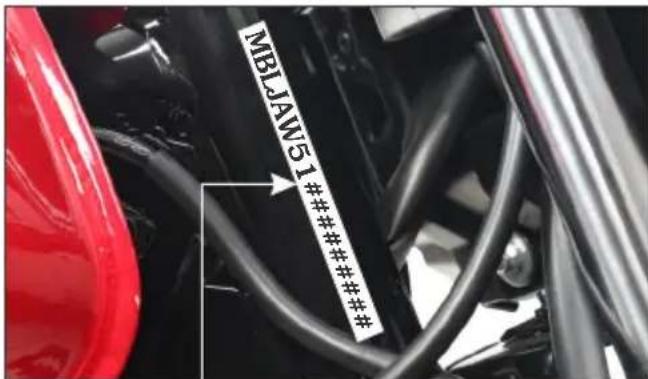
Vehicle Identification Number (VIN)
Location: Stamped on the right side of the steering head tube.
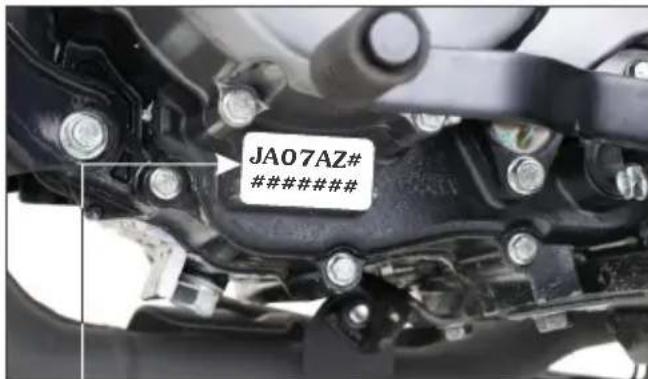
Engine No.
Location: Stamped on the lower side of the left crankcase.
| JA07AZ # | # | # ###### | ||
| Engine Description | Year of Manufacturing | Assembly Plant | Month of Manufacturing | Serial Number |
Model: SUPER SPLENDOR XTEC
| Variant | VIN | Engine |
| Electric start/Front disc/Cast wheel | JAW51 | JA07AZ |
| Electric start/Front drum/Cast wheel | JAW52 | JA07AZ |
VIN and Engine No. may be required:
- During registration of the vehicle.
- For dealing with legal & insurance departments.

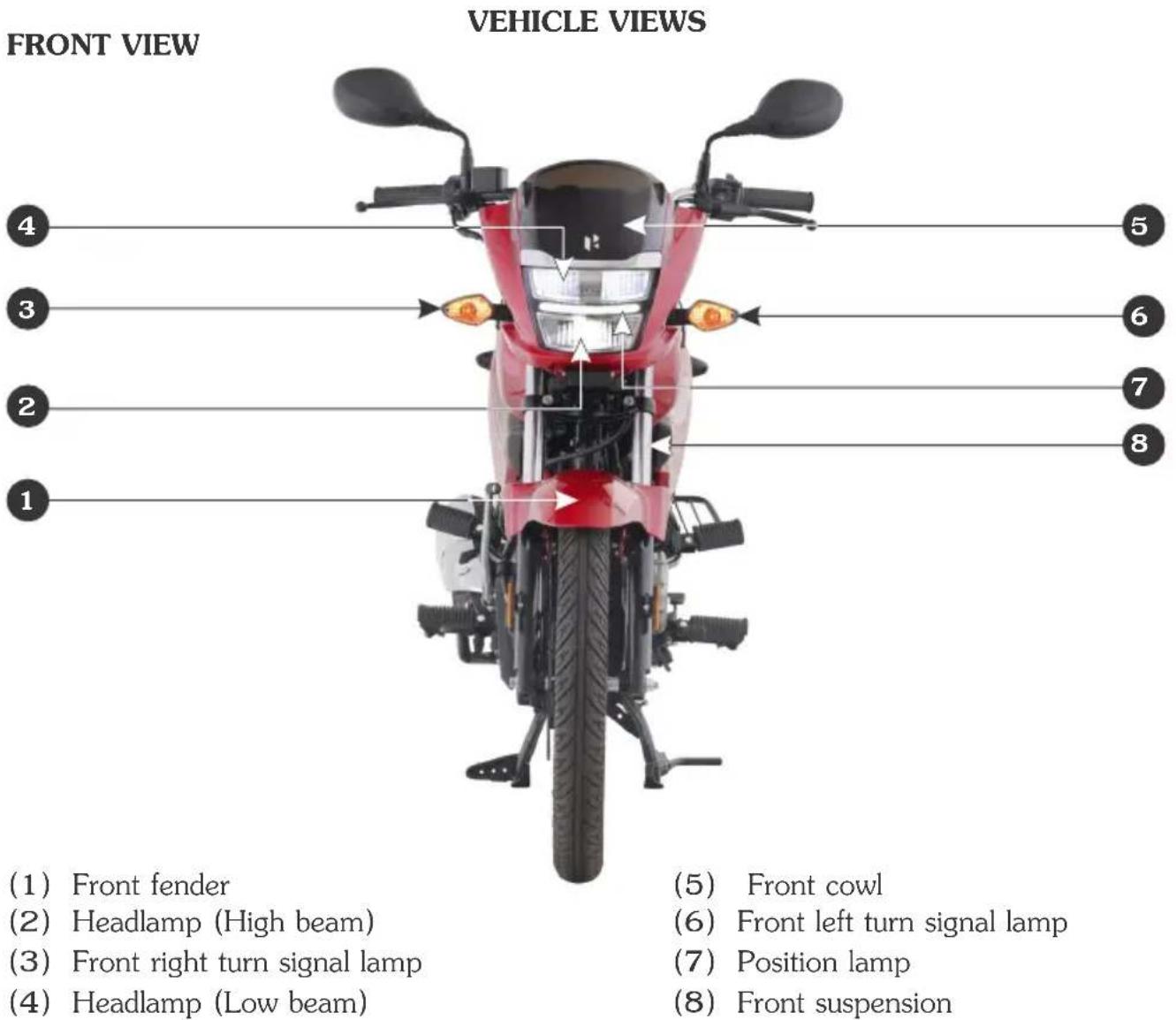
*Accessories and features shown may not be part of standard fitment.

REAR VIEW
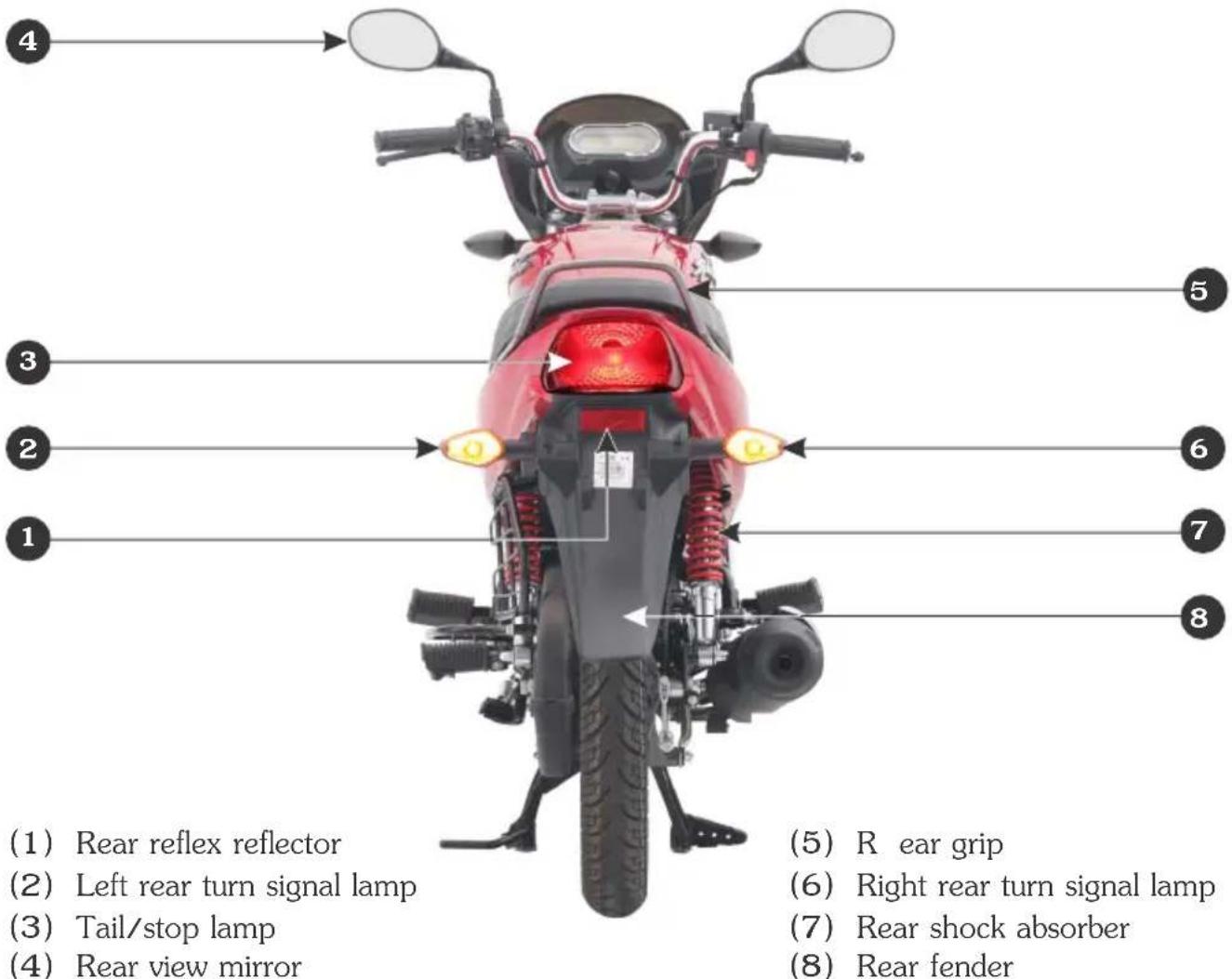
*Accessories and features shown may not be part of standard fitment.

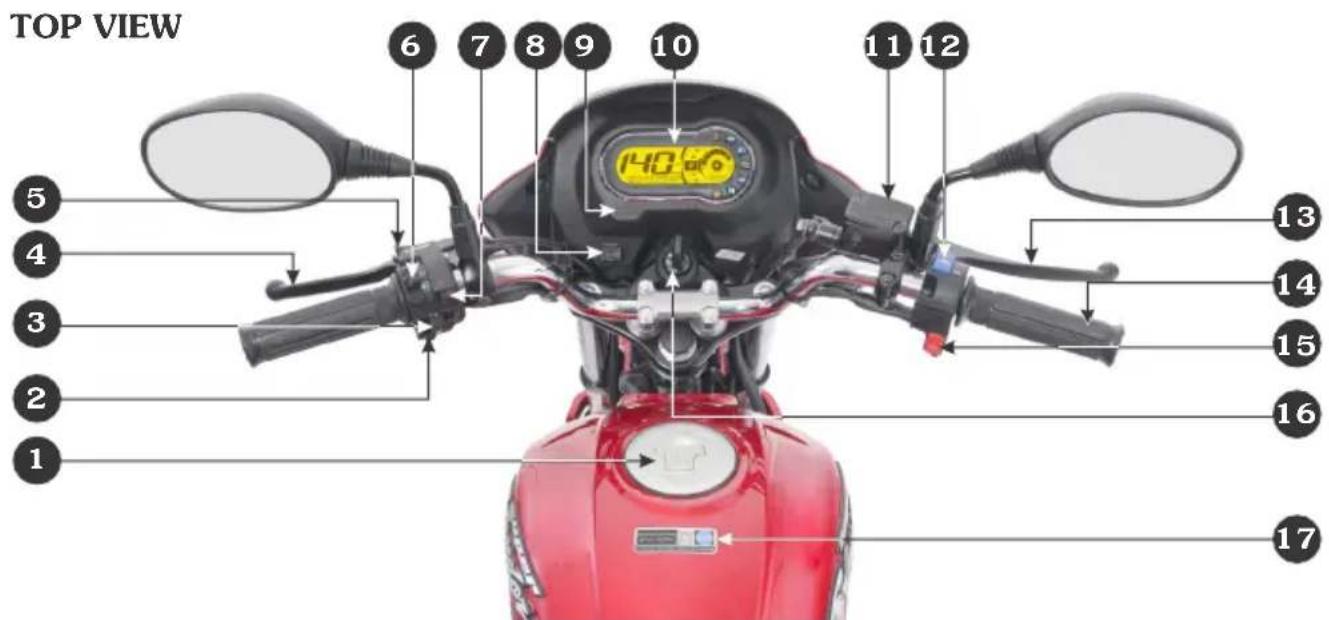
(1) Fuel tank lid
(2) Horn switch
(3) Turn signal lamp switch
(4) Clutch lever
(5) Passing switch
(6) Dimmer switch
(7) Hazard switch
(8) USB charger
(9) Mode button
(10) Meter console
(11) Front brake master cylinder/Reservoir ^#
(12) i3s switch
(13) Front brake lever
(14) Throttle grip
(15) Electric starter switch
(16) Ignition switch with steering lock
(17) E20/QR code sticker
Disc Variant
*Accessories and features shown may not be part of standard fitment.

LEFT SIDE VIEW
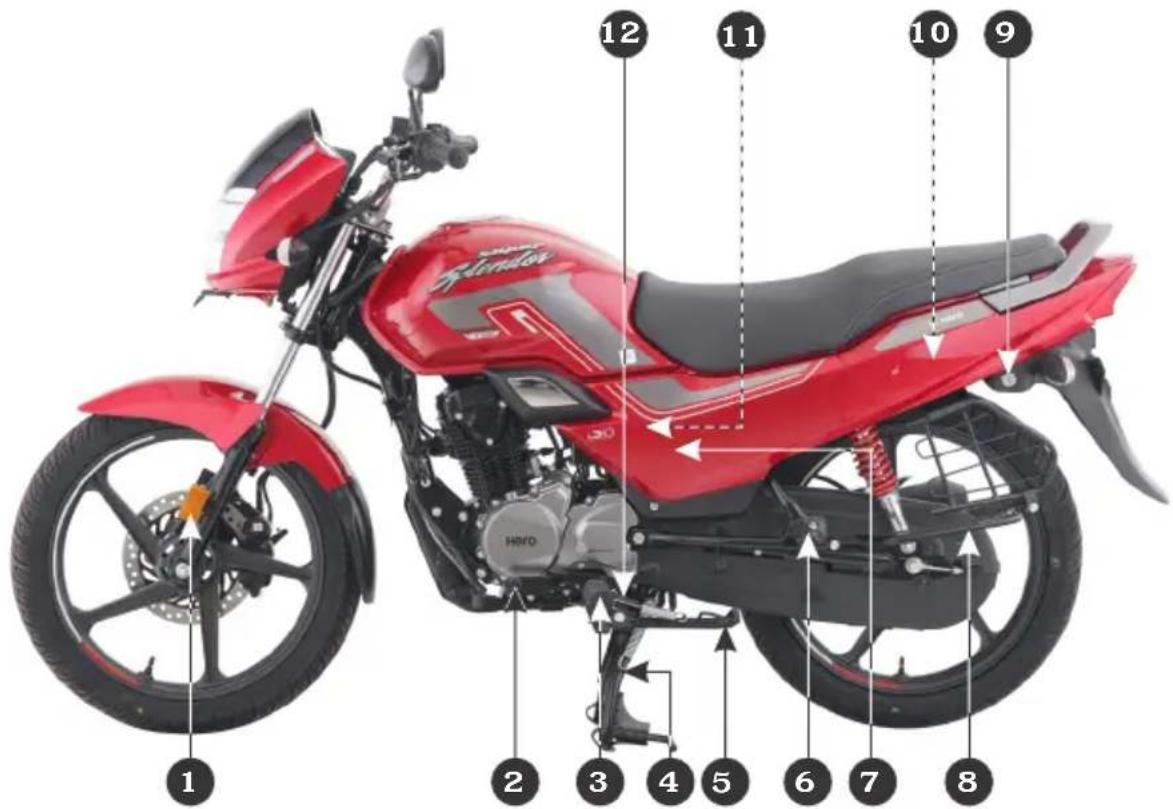
(1) Side reflex reflector
(2) Gear shift pedal
(3) Rider footrest
(4) Main stand
(5) Side stand
(6) Pillion footrest
(7) Left side cover
(8) Saree guard with women pillion step
(9) Seat lock
(10) Helmet holder (inside)
(11) Battery (inside)
(12) Side stand switch
*Accessories and features shown may not be part of standard fitment.
RIGHT SIDE VIEW
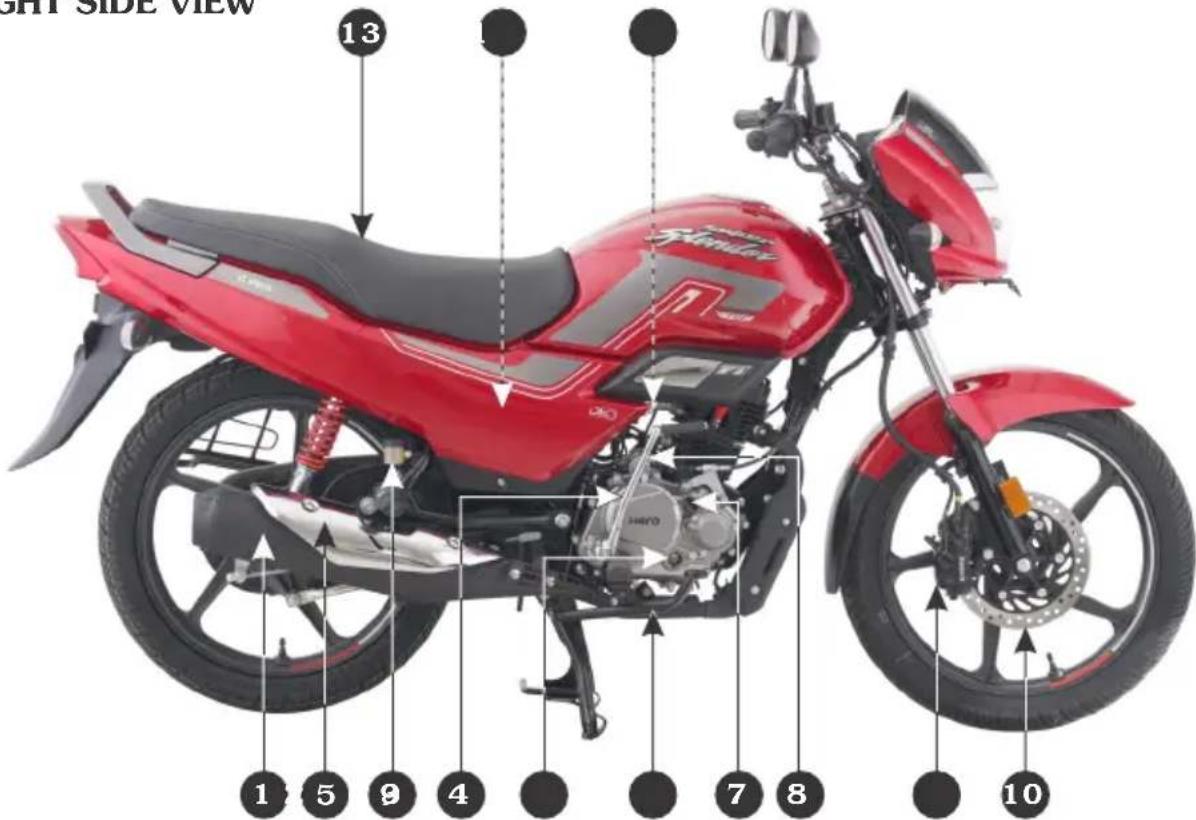
(1) Exhaust muffler
(2) IBS Actuator (inside) ^#
(3) Brake fluid reservoir ^#
(4) Kick starter pedal
(5) Oil level window
(6) Brake pedal
(7) Oil filler cap
(8) Starter motor
(9) Caliper assembly #
(10) Front brake disc ^#
(11) Throttle body (inside)
(12) ECU (inside)
(13) Seat
Disc Variant ^#
*Accessories and features shown may not be part of standard fitment.
VEHICLE SPECIFICATION
| SPECIFICATIONSITEM | ||
| Dimensions | ||
| Overall length | 2034 mm | |
| Overall width | Disc-Drum | 752 mm |
| Drum-Drum | 729 mm | |
| Overall height | 1082 mm | |
| Wheelbase | 1263 mm | |
| Saddle height | 788 mm | |
| Ground clearance | 170 mm | |
| Weight | ||
| Kerb weight | Disc-Drum | 123 kg |
| Drum-Drum | 122 kg | |
| Payload | 130 kg | |
| Capacities | ||
| Engine oil | 1.2 litres at disassembly and 1.0 litre at draining | |
| Fuel tank capacity | 12 litres | |
| Engine | ||
| Maximum power | 8 kW @ 7500 r/min | |
| Maximum torque | 10.6 N-m @ 6000 r/min | |
| Bore and stroke | 52.4x57.8 mm | |
| Compression ratio | 9.9:1 | |
| Displacement | 124.7 cc | |
| Spark plug | NGK-CPR 7EA9, RG8YC (Federal Mogul) | |
| Spark plug gap | 0.8-0.9 mm | |
| Valve clearance | Intake (cold) | 0.08 mm |
| Exhaust (cold) | 0.12 mm | |
| Idle speed | 1400±100 r/min | |
| Chassis and suspension | ||
| Front suspension | Telescopic hydraulic shock absorbers | |
| Rear suspension | Swingarm with 5 step adjustable hydraulic shock absorbers | |
| Caster angle | 26° | |
| Trail length | 94 mm | |
VEHICLE SPECIFICATION
| SPECIFICATIONSITEM | ||
| Tyre size | Front | 80/100-18 47P (Tubeless tyre) |
| Rear | 90/90-18 51P (Tubeless tyre) | |
| Brakes | Front (Disc variant) | Dia. mm240 |
| Front (Drum variant) | Dia. 1 mm30 | |
| Rear (Drum variant) | Dia. 1 mm30 | |
| Transmission | ||
| Primary reduction | 3.35 (67/20) | |
| Final reduction | 3.071 (43/14) | |
| Transmission | 5 speed transmission | |
| Gear ratio | 1^st | 3.17 (38/12) |
| 2^nd | 1.83 (33/18) | |
| 3^rd | 1.272 (28/22) | |
| 4^rd | 1.04 (26/25) | |
| 5^th | 0.923 (24/26) | |
| Electricals | ||
| Battery | *MF battery 12V-4Ah/ETZ5 | |
| Alternator | 1 W @ 5000 40 r/min | |
| Starting system | Kick/Electric tart s | |
| Headlamp (High/Low) | LED | |
| Position lamp | LED | |
| Tail/Stop lamp | 12V-21/5W-**MFR | |
| Turn signal lamp | 12V-10Wx4 (Amber bulb) with clear lens-**MFR | |
| Meter illumination | LED | |
| Neutral indicator | LED | |
| Turn signal indicator | LED | |
| Hi beam indicator | LED | |
| Low fuel indicator | LED | |
| Side stand indicator | LED | |
| i3s indicator | LED | |
| Programmed FI Malfunction indicator lamp (MIL) | LED | |
| Fuse | Circuit fuse | 15A, 10A, 10A, 10A & 10A |
| Spare fuse | 15A, 10A | |
*MF stands for Maintenance Free
**MFR stands for Multi-Focal Reflector
ACCESSORIES & MODIFICATIONS
Modifying your vehicle or using non-Hero MotoCorp accessories can make your vehicle unsafe. Before you consider making any modifications or adding an accessory, be sure to read the following information.
! WARNING
- Improper accessories or modifications can cause a crash in which you can be seriously hurt or killed.
- Follow all instructions in this owner's manual regarding accessories and modifications.
Accessories
- Make sure that the accessory does not obscure any lamps, reduce ground clearance, limit suspension travel or steering travel, affect your riding position or interfere with the operation of any controls.
- Be sure electrical equipment does not exceed the vehicle's electrical system capacity (page 8). A blown fuse can cause a loss of lights.
- Do not pull a trailer or sidecar with your vehicle. This vehicle has not been designed for these attachments, and their use can seriously impair your vehicle's handling.
Modifications
We strongly advise you not to remove any original equipment or modify your vehicle in any way that would change its design or
operation. Such changes could seriously impair your vehicle's handling, stability and braking, making it unsafe to ride. Removing or modifying your lamps, mufflers, emission control system or other equipment can also make your vehicle illegal.
ANTI-THEFT TIPS
• Always lock the steering and never leave the key in the ignition switch. This sounds simple but people do forget.
- Be sure the registration information for your vehicle is accurate and correct.
- vehiclePark your in a locked garden whenever possible.
- Use an additional anti-theft device of good quality.
vehicleNever park your in an iso
Park as far as possible in a designated area.
- Keep a note in your vehicle all the time with your name, address and contact details.
VEHICLE SAFETY
IMPORTANT SAFETY INFORMATION
Your vehicle can provide many years of service and pleasure if you take responsibility for your own safety and understand the challenges you can meet on the road.
There is much that you can do to prot yourself when you ride. You will find many helpful recommendations throughout this manual. Following are a few that we consider most important.
Always wear a helmet
It is a proven fact, helmet significantly reduces the number and severity of head injuries. So always wear a helmet and make sure your pillion rider does the same. We also recommend that you wear eye protection, sturdy boots, gloves and other protective gear.
Before riding your vehicle
Make sure that you are physically fit, mentally focused and free of alcohol and drugs. Check that you and your pillion are both wearing an approved vehicle helmet and protective apparel. Instruct your pillion on holding onto the grab rail or your waist, leaning with you in turns, and keeping their feet on the footrest, even when the vehicle is stopped.
Take time to learn & practice your vehicle
Even if you have ridden other vehicles, practice riding in a safe area to become familiar with how this vehicle works and handles, and to become accustomed to the vehicle's size and weight.


Ride defensively
Always pay due attention to other vehicles around you, and do not assume that other drivers see you. Be prepared to stop quickly or perform an evasive maneuver.
Make yourself easily visible
Some drivers do not see vehicles because they are not looking for them. To make yourself more visible, wear bright reflective clothing, position yourself so that others can see you, signal before turning or changing lanes, and use horn which will help others to notice you.
Ride within your limits
Pushing the limits is another major cause of vehicle accidents. Never ride beyond your personal abilities or faster than conditions demand. Remember that fatigue and negligence can significantly reduce your ability to make good judgements and ride safely.
Do not drink and ride
Riding under the influence of alcohol or drugs is dangerous. Alcohol can reduce your ability to respond to changing conditions and reduce the reaction time. Do not drink and ride.
Keep your vehicle in safe condition
For safe riding, it is important to inspect your vehicle before every ride and perform all recommended maintenance. Never exceed load limits, and always use accessories that have been recommended by Hero MotoCorp for this vehicle.

If you are involved in a crash
Personal safety is your first priority. If you or anyone else has been injured, take time to assess the severity of the injuries and whether it is safe to continue riding. Call for emergency assistance if needed. Also follow applicable laws and regulations if another person or vehicle is involved in the crash.
If you decide to continue riding, first evaluate the condition of your vehicle. If the engine is still running, turn it off. Inspect for fluid leaks, check the tightness of critical nuts and bolts, and check the handlebar, brake levers, brakes, and wheels. Ride slowly and cautiously. Your vehicle may have suffered damage that is not immediately apparent. Have your vehicle thoroughly checked at a qualified service facility as soon as possible.
PROTECTIVE APPAREL
For your safety, we strongly recommend that you always wear an approved helmet (IS marked), eye protection, boots, gloves, long pants and a long sleeve shirt or jacket whenever you ride. Take care of loose/hanging clothes while solo/pillion riding. Although complete protection is not possible, wearing proper gear can reduce the chance of injury when you ride.
Following are suggestions to help you choose proper riding gear.

WARNING
- Not wearing a helmet increases the chance of serious injury or death in a crash.
- Be sure you and your pillion always wear a helmet, eye protection and other protective apparel when you ride.
Helmets and eye protection
Your helmet is your most important piece of riding gear because it offers the best protection against head injuries. A helmet should fit your head comfortably and securely. A bright coloured helmet can make you more noticeable in traffic, as can reflective strips.
An open-face helmet offers some protection, but a full-face helmet offers more. Always wear face shield or goggles to protect your eyes and help your vision.
Additional riding gear
In addition to a helmet and eye protection, we also recommend:
- Sturdy boots with non-slip soles to help protect your feet and ankles.
• Leather gloves to keep your hands warm and help prevent blisters, cuts, burns, and bruises.
A two wheeler riding suit or jacket for comfort as well as protection. Bright coloured reflective clothing can help make you more noticeable in traffic. Be sure to avoid loose clothes that could get caught on any part of your vehicle.

SAFE RIDING TIPS
Hero RideSafe
Do's:
• Always conduct simple pre-ride inspection (page 35).
• Always wear a helmet (ISI marked) with chin strap securely fastened and insist on a helmet for your pillion rider.
- While riding, sit in a comfortable position with your legs close to fuel tank.
- Ride defensively and at a steady speed (between 40-50 km/hr).
- To stop the vehicle (in IBS), press the rear brake pedal for the application of front and rear brakes simultaneously. However, for more effective braking, use both brakes simultaneously, keeping throttle in the closed position.
- Respect road signs and obey traffic rules for your own safety and that of others on the road .(page 77)
- During night time, dip headlamps of your vehicle for oncoming traffic, or when following another vehicle.
- Give way to others on the road and signal before you make a turn.
• To make yourself more visible, wear bright reflective clothing that fits well.
- Tightly wrap loose/hanging clothes & avoid entangling with moving parts.
• Get your vehicle serviced regularly by the Authorised Hero MotoCorp workshop.
- Before riding make sure in which mode you are riding whether with i3s switch "ON" or "OFF".
Don't
- Never use cell phone while riding the h vehicle.
- Avoid sudden acceleration, braking and turning of your vehicle.
- Never shift gears without disengaging the clutch and closing the throttle.
- Never touch any part of the hot exhaust system like muffler.
- Never ride under the influence of alcohol or drugs.
• Concentrate on the road and avoid talking to the pillion rider or others on the road.
- Do not litter the road.
- Do not cross the continuous white/yellow line in the center of the road, while overtaking.
- Do not attach large or heavy items to the handlebars, front forks, or fenders.
- Never take your hands off the steering handle while riding.
- Do not move the side stand down while riding, as engine will stop while vehicle is in gear (page 31) (Wheel locking leading to accident, part damage etc.).
TIPS FOR HEALTHY ENVIRONMENT
The following tips shall ensure a healthy vehicle, healthy environment, and a healthy you.
- Healthy engine: The engine is the lifeline of every vehicle. To keep it healthy, it should be tuned regularly, which will also help reduce pollution and improve vehicle performance & fuel efficiency.
- Regular servicing: Get your vehicle serviced at an Authorised Hero MotoCorp workshop, as per the service schedule, for an optimum performance and keep the emission level under check.
- Genuine spares: Always insist on Hero MotoCorp genuine parts as spurious or incompatible spares and accessories can upset or deteriorate your vehicle's running condition.
- Genuine engine oil: Hero 4T Plus SAE 10W 30 SL grade (JASO MA2) or Hero 4T Plus SAE 5W 30 SN grade (JASO MA2) engine oil recommended by Hero MotoCorp and make sure you change it every 6000 km. (Top up if the oil level is at or near the lower level mark) to keep the engine fit and environment healthy.
(Do not mix “SAE 10W 30 SL grade and SAE 5W 30 SN grade” engine oil during oil change or top up).
- Noise pollution : Noise beyond a certain decibel is pollution. Whether it is from horns or defective mufflers, excessive noise will cause headaches and discomfort.
- Emission pollution: Get emission of your vehicle checked by Authorised agencies at least once every 6 months or as notified by the government from time to time.
- Fuel saving & Reduce pollution : Switch "OFF" the engine while waiting at traffic signal points to save fuel & reduce pollution, if the waiting period is long.
- BS-VI grade fuel : Always use BS-VI grade fuel to adhere to BS-VI norms.
flowchart
graph TD
    A[""ON" (Ω) position"] --> B[""OFF"(⊗) position/Lock open"]
    B --> C[""LOCK" position"]
    C --> A
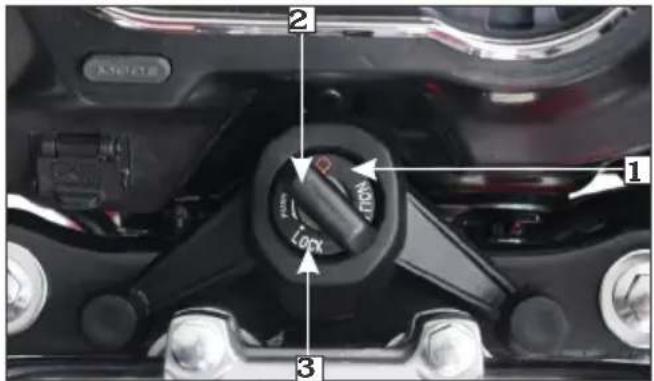
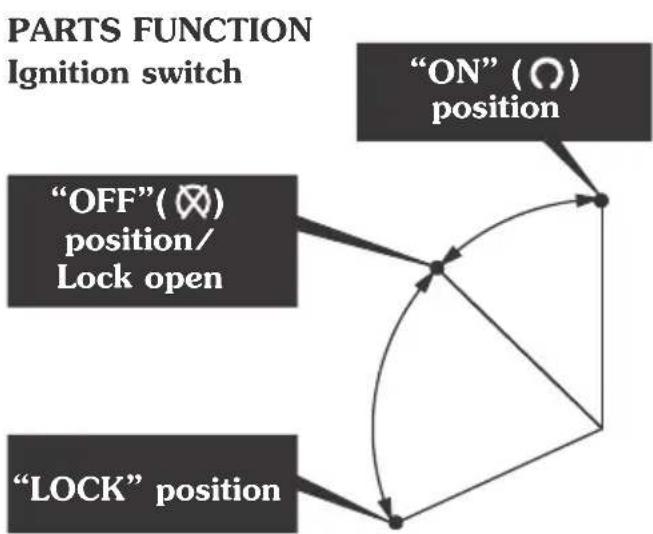
(1) Ignition switch
(2) Ignition key
(3) Steering lock position
| FunctionKey position | Key removal | |
| “ON” (○) | The LCD panel illuminates & initial display of multi function digital segments are displayed. The fuel gauge segment will swing to the maximum scale once and back to their normal position. The speedometer, odometer and RTMI will go to their maximum values and will come back to its their normal readings. Scroll message will appear in LCD panel. The engine can be started. Turn signal lamp, horn, tail/stop lamp, fuel gauge, & neutral indicator will be functional. Programmed FI malfunction indicator lamp (MIL) illuminates continuously and i3s indicator glows for 2 seconds. | Key cannot be removed |
| “OFF”(⊗) | Engine cannot be started and no electrical system will be functional. | Key can be removed |
| “LOCK” | Steering can be locked. | Key can be removed |
Instruments and Indicators
The indicators are in the speedometer panel above the headlamp. The functions are as below.
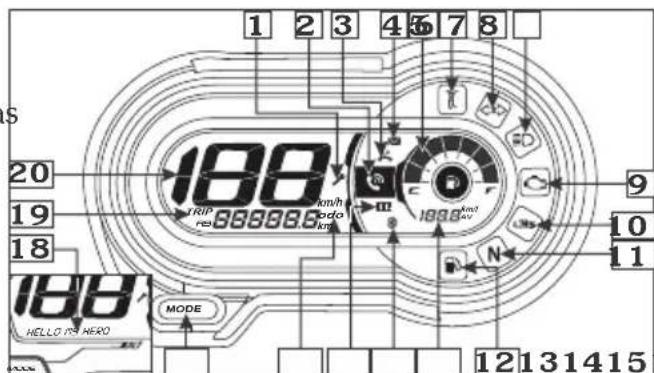
| Sl. No. | Description | Function |
| 1 | Service reminder indicator | Displays when the next service is due .(page 18) |
| 2 | Incoming call alert | You will get all the incoming call alerts on the meter console once your smartphone is paired with the vehicle via Hero app .(page 24) |
| 3 | Missed call alert | You will get all the message alerts on the meter console on your smartphone is paired with the vehicle via Hero app (page 25). |
| 4 | Message alert | You will get all the message alerts on the meter console on your smartphone is paired with the vehicle via Hero app (page 25). |
| 5 | Fuel gauge | Indicates approximate fuel available in the form of digital segments. The digital segments will swing to maximum scale on the meter console once the ignition switch is turned “ON” ) .(page 17) |
| 6 | Side stand indicator | Light glows when the side stand is down. |
| 7 | Turn signal indicators | Flashes when turn signal switch is operated. |
| 8 | High beam indicator | Light glows when headlamp is in “Hi” beam. |

| Sl. No. | Description | Function |
| 9 | Programmed-FI malfunction indicator lamp (MIL) | When the ignition switch is turned “ON” the programmed FI malfunction indicator lamp (MIL) glows continuously and then goes “OFF” once the engine is started. It indicates that programmed FI system is OK. If it glows continuously, there is an abnormality in the programmed FI system, it is recommended to reduce the speed and drive to the Authorised Hero MotoCorp workshop for check-up. |
| 10 | i3s indicator | Indicator glows for 2 seconds and turns “OFF” indicating that i3s system is functional. |
| 11 | Neutral indicator | Light glows when vehicle is in neutral |
| 12 | Low fuel indicator | Light glows when the fuel quantity is low .(page 19) |
| 13 | Real time mileage indicator (RTMI) | It indicates the current mileage of the vehicle (in km/litre). The indication will change after every 3 ± 1 seconds depending upon the driving condition .(page 18) |
| 14 | Bluetooth | On pairing with(page 21), the meter console displays a bluetooth symbol, indicating bluetooth is connected. |
| 15 | Phone battery status | Display battery status of smartphone on the meter console once your smartphone is paired with the vehicle via Hero app .(page 25) |
| 16 | Odometer | Shows accumulated distance travelled (page 17). |
| 17 | Mode button | Switches display between odometer and tripmeter-A & B. |
| 18 | Scroll display | Displays a scrolling “HELLO MY HERO” message for few seconds when the ignition key is turned “ON” (page 18). |
| 19 | Tripmeter(page 167). | Shows the distance travelled during a trip after setting to |
| 20 | Speedometer | Indicates driving speed. |
LCD PANEL
(a) Odometer
The odometer (1) shows accumulated distance travelled. The odometer can be selected by pressing the mode button (2).
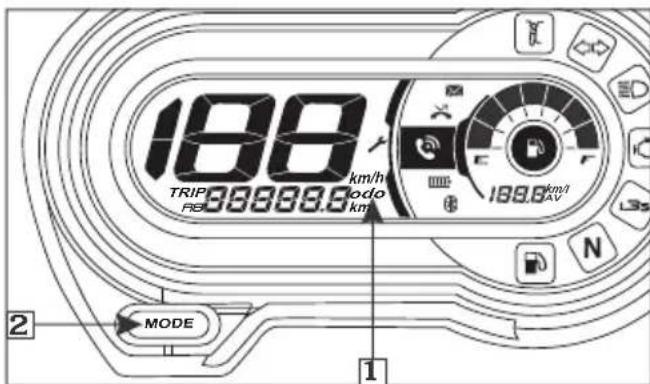
(1) Odometer
(2) Mode button
(b) Tripmeter
The tripmeter (1) shows distance travelled per trip. The tripmeter can be reset to zero by pressing the mode button (2) for more than 2 seconds. The tripmeter can be selected by pressing the mode button.
The tripmeter (1) shows distance travelled since trip meter was reset last time. There are two tripmeters, "Trip-A" and "Trip-B".
Push the mode button (2) to select "Trip-A" and "Trip-B". "Trip-A" and "Trip-B" can be displayed up to "999.9" km.
If the tripmeter exceeds "999.9" km it will return to "0.0" km automatically.
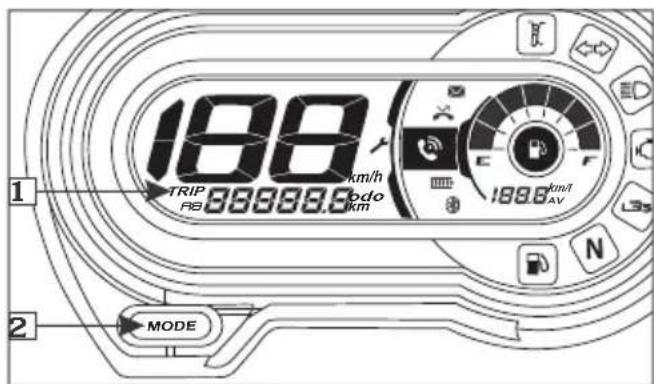
(1) Tripmeter
(2) Mode button
(c) Fuel gauge
The fuel gauge (1) indicates approximate fuel available in the form of digital segments.
The digital segments (2) will swing to maximum scale on the meter console once the ignition switch is turned "ON" (○). If all the segments are displayed it means fuel quantity in the fuel tank is 12 litres.
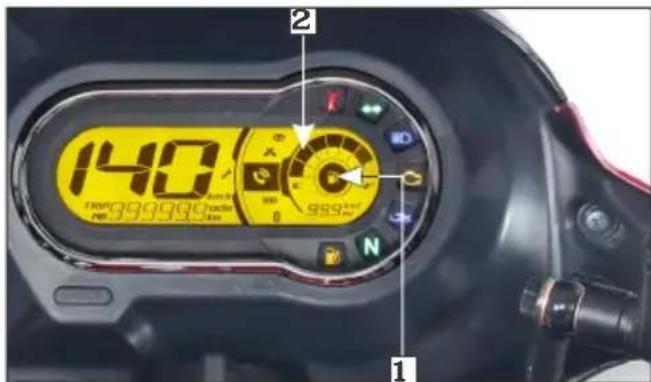
(1) Fuel gauge
(2) Segments

The real time mileage indicator (RTMI) (1) shows the current mileage of the vehicle in km/litre and is refreshed after every 3 seconds.
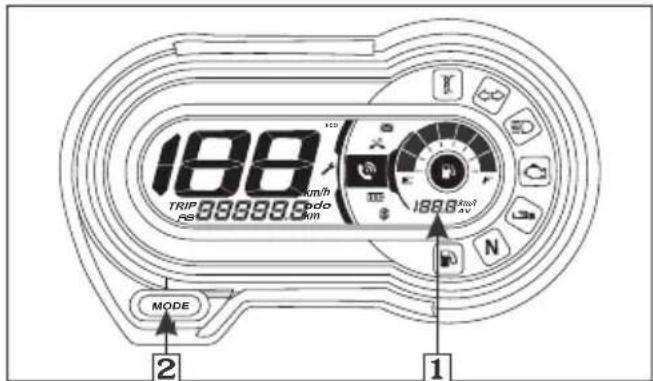
(1) Real Time Mileage Indicator (RTMI) (2) Mode button
When the ignition switch is turned "ON" (Ω) position, the real time mileage indicator will temporarily show the digit "99.9" which indicates that all the digital LCD segments are working. The display range is from (0 to 120 km/litre).
The fuel consumption shall be displayed when the speed of the vehicle is more than 5±2 km/hr. If the speed is less than 5±2 km/hr "---" shall be displayed.
The RTMI shows a minimum value of 0.0km/litre and maximum value of 120 km/litre. During coasting with throttle fully closed, the fuel consumption is very minimal and hence the display can go up to 120 km/litre.
(e) Scroll message
The scroll (1) display a message "HELLO MY HERO" for few seconds whenever the ignition is turned "ON".
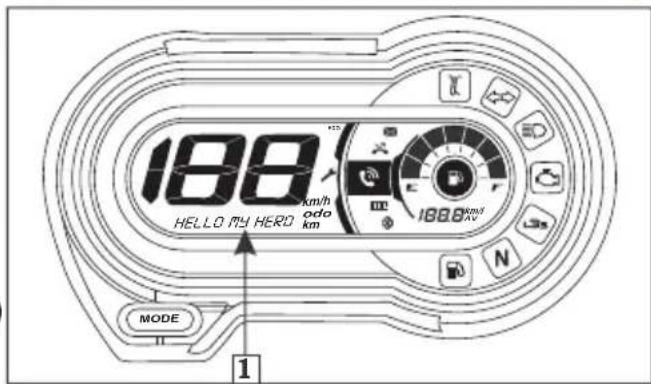
(1) Scroll message
(f) Service reminder indicator
The service reminder indicator (1) is to indicate to the user to bring the vehicle to an Authorised Hero MoroCorp workshop for service. The indicator will start blinking when the vehicle covers kilometers as specified in the maintenance schedule. The indicator will keep on blinking throughout the kilometer interval for a particular service and will stay “ON” thereafter. The service reminder indicator can be reset at an Authorised Hero MoroCorp workshop.


NOTE
After getting the vehicle serviced, make sure that the service reminder indicator has been reset.
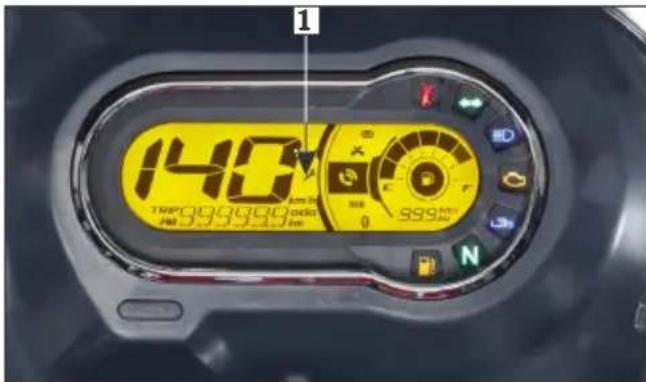
(1) Service reminder indicator
LOW FUEL INDICATOR
Low fuel indicator (1) is a warning indicator for the user to refuel as soon as possible.
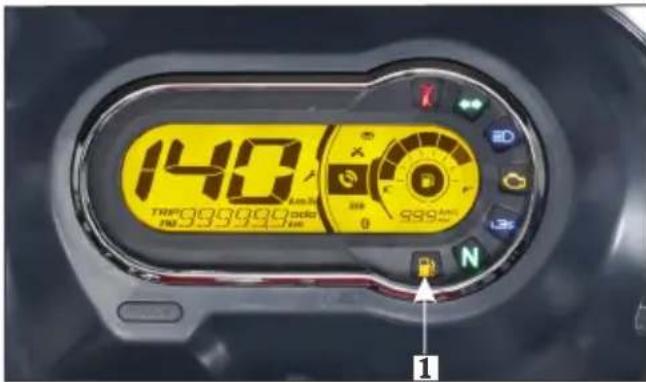
(1) Low fuel indicator

CAUTION
Please ensure the vehicle is not used with low fuel indicator glowing continuously. It will not only result in the vehicle running out of fuel, but may also cause serious damage to the fuel pump. Please ensure fuel is refilled as soon as the low fuel indicator starts glowing.

NOTE
To check the fuel level indication, the vehicle should be on level surface and in stationary condition.
FEATURES
(a) Steering lock
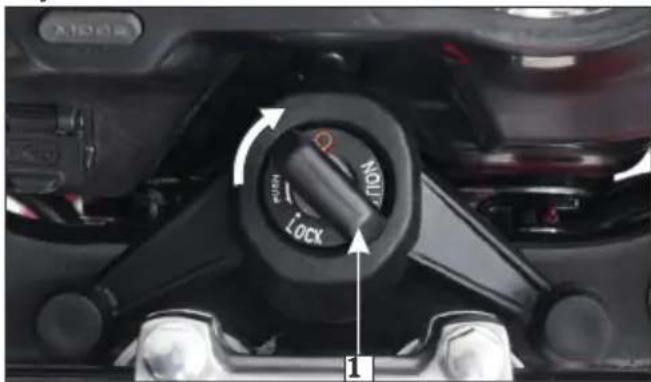
Steering lock with ignition switch, turn the ignition key (1) to "OFF") position & turn the handlebar towards left or right & push the key downwards & turn towards "LOCK" position. After locking take out the ignition key.
natural_image
Close-up of a car dashboard knob with rotary dial and labeled component (no readable text or symbols beyond basic labels)(1) Ignition key

(b) Hero App
Application:
Hero App is available in the google play store (for androids) or App Store (for iOS), which can be installed in your device to access bluetooth, incoming calls alerts, missed call alerts, mobile battery status and message alert.
To connect your device proceed as follows:
- Open Hero App on your smartphone.
- Application asks the user to login (1) using registered mobile number.
- Now user will receive the 6-digit OTP on registered mobile number.
- User required to enter the 6-digit OTP (2) and verify.
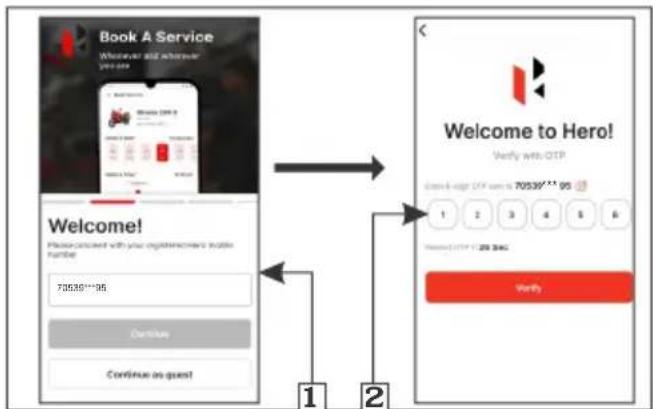
(1) Login
(2) Enter OTP

NOTE
- Compatibility and performance of Hero App may vary based on your device and software version.
- Application needs GPS signal, internet and bluetooth connectivity to perform the desired functionality.
• After successful verification, select vehicle screen (3) will be replicated on mobile screen. Tap on the vehicle image to continue.
- Select the vehicle and click on "Continue" (4).
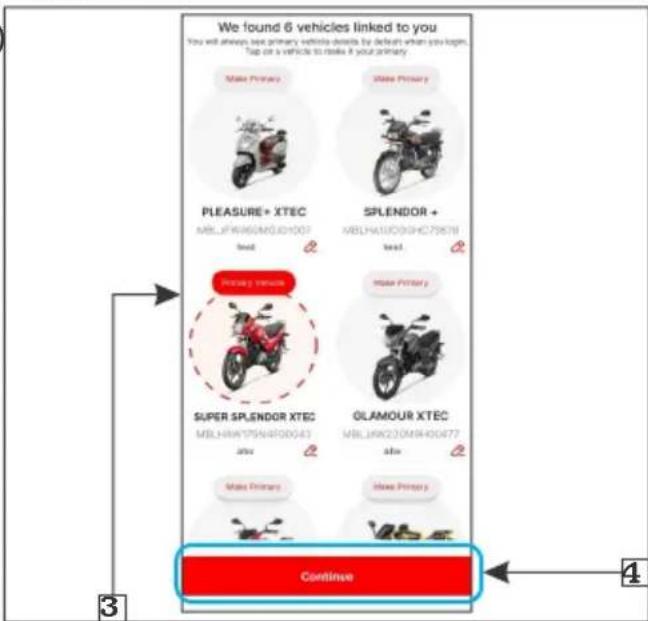
(3) Select vehicle screen
(4) Continue

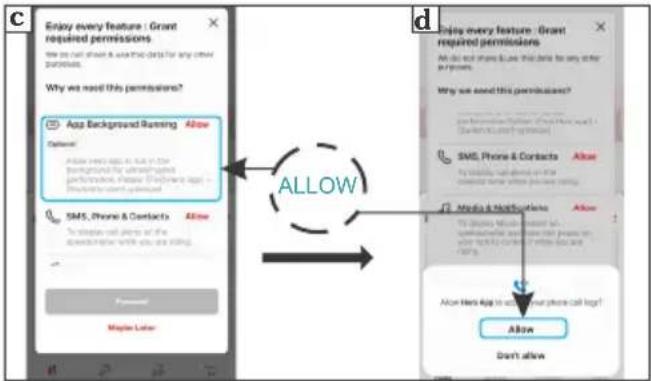
- For first time pairing, allow the application to access:
a. Device location.
b. Bluetooth connectivity.
c. App background running (optional).
d. Phone call logs on your device.
e. Contacts.
f. Make and manage phone calls.
g. Send and view SMS messages.
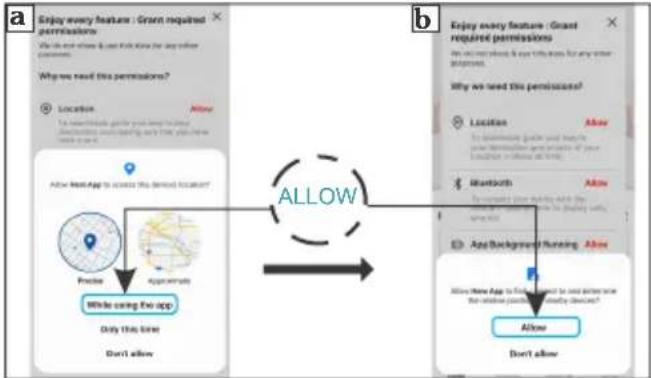
flowchart
graph TD
    A["Where using the app"] -->|Allow| B["Allow"]
    A -->|Don't allow| C["Allow"]
    D["Where is going to access the device location?"] --> E["Where is going to access the device location?"]
    E --> F["Where is going to access the device location?"]
    F --> G["Where is going to access the device location?"]
    G --> H["Where is going to access the device location?"]
    H --> I["Where is going to access the device location?"]
    I --> J["Where is going to access the device location?"]
    J --> K["Where is going to access the device location?"]
    K --> L["Where is going to access the device location?"]
    L --> M["Where is going to access the device location?"]
    M --> N["Where is going to access the device location?"]
    N --> O["Where is going to access the device location?"]
    O --> P["Where is going to access the device location?"]
    P --> Q["Where is going to access the device location?"]
    Q --> R["Where is going to access the device location?"]
    R --> S["Where is going to access the device location?"]
    S --> T["Where is going to access the device location?"]
    T --> U["Where is going to access the device location?"]
    U --> V["Where is going to access the device location?"]
    V --> W["Where is going to access the device location?"]
    W --> X["Where is going to access the device location?"]
    X --> Y["Where is going to access the device location?"]
    Y --> Z["Where is going to access the device location?"]
    Z --> AA["Where is going to access the device location?"]
    AA --> AB["Where is going to access the device location?"]
    AB --> AC["Where is going to access the device location?"]
    AC --> AD["Where is going to access the device location?"]
    AD --> AE["Where is going to access the device location?"]
    AE --> AF["Where is going to access the device location?"]
    AF --> AG["Where is going to access the device location?"]
    AG --> AH["Where is going to access the device location?"]
    AH --> AI["Where is going to access the device location?"]
    AI --> AJ["Where is going to access the device location?"]
    AJ --> AK["Where is going to access the device location?"]
    AK --> AL["Where is going to access the device location?"]
    AL --> AM["Where is going to access the device location?"]
    AM --> AN["Where is going to access the device location?"]
    AN --> AO["Where is going to access the device location?"]
    AO --> AP["Where is going to access the device location?"]
    AP --> AQ["Where is going to access the device location?"]
    AQ --> AR["Where is going to access the device location?"]
    AR --> AS["Where is going to access the device location?"]
    AS --> AT["Where is going to access the device location?"]
    AT --> AU["Where is going to access the device location?"]
    AU --> AV["Where is going to access the device location?"]
    AV --> AW["Where is going to access the device location?"]
    AW --> AX["Where is going to access the device location?"]
    AX --> AY["Where is going to access the device location?"]
    AY --> AZ["Where is going to access the device location?"]
    AZ --> BA["Where is going to access the device location?"]
    BA --> BB["Where is going to access the device location?"]
    BB --> BC["Where is going to access the device location?"]
    BC --> BD["Where is going to access the device location?"]
    BD --> BE["Where is going to access the device location?"]
    BE --> BF["Where is going to access the device location?"]
    BF --> BG["Where is going to access the device location?"]
    BG --> BH["Where is going to access the device location?"]
    BH --> BI["Where is going to access the device location?"]
    BI --> BJ["Where is going to access the device location?"]
    BJ --> BK["Where is going to access the device location?"]
    BK --> BL["Where is going to access the device location?"]
    BL --> BM["Where is going to access the device location?"]
    BM --> BN["Where is going to access the device location?"]
    BN --> BO["Where is going to access the device location?"]
    BO --> BP["Where is going to access the device location?"]
    BP --> BQ["Where is going to access the device location?"]
    BQ --> BR["Where is going to access the device location?"]
    BR --> BS["Where is going to access the device location?"]
    BS --> BT["Where is going to access the device location?"]
    BT --> BU["Where is going to access the device location?"]
    BU --> BV["Where is going to access the device location?"]
    BV --> BW["Where is going to access the device location?"]
    BW --> BX["Where is going to access the device location?"]
    BX --> BY["Where is going to access the device location?"]
    BY --> BZ["Where is going to access the device location?"]
    BZ --> CA["Where is going to access the device location?"]
    CA --> CB["Where is going to access the device location?"]
    CB --> CC["Where is going to access the device location?"]
    CC --> CD["Where is going to access the device location?"]
    CD --> CE["Where is going to access the device location?"]
    CE --> CF["Where is going to access the device location?"]
    CF --> CG["Where is going to access the device location?"]
    CG --> CH["Where is going to access the device location?"]
    CH --> CI["Where is going to access the device location?"]
    CI --> CJ["Where is going to access the device location?"]
    CJ --> CK["Where is going to access the device location?"]
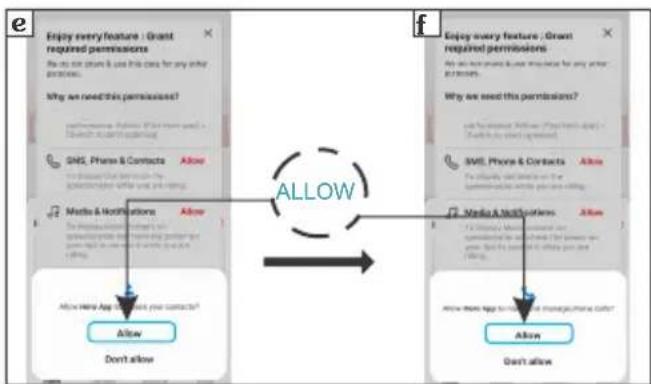
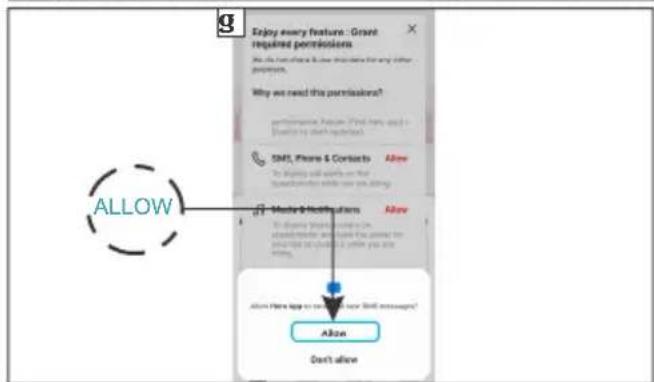
Bluetooth:
Your vehicle is equipped with bluetooth connectivity feature by which you can pair your smartphone with the meter console of your SUPER SPLENDOR XTEC vehicle through Hero App.
After successful login to Hero App (page 20) To connect your device to bluetooth proceed as follows:
• After selecting the vehicle, user can view the Dashboard (1) with Connect button visible.
• After clicking on 'Connect' (2).
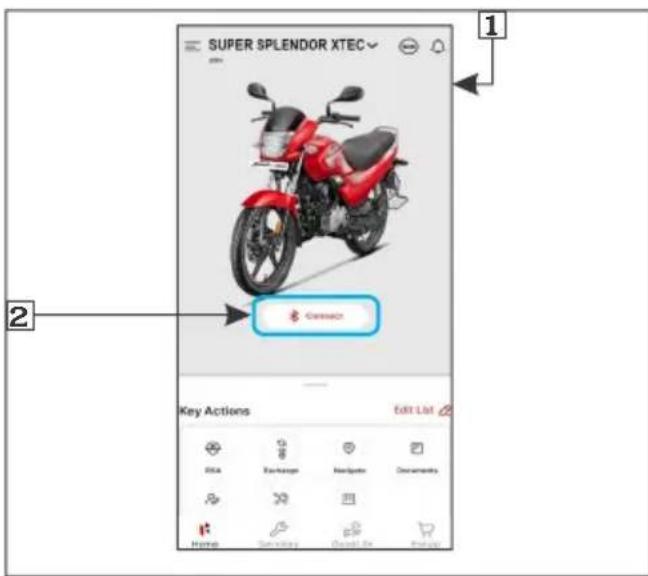
(1) Dashboard
(2) Connect
- User will be redirected to the Bluetooth searching screen (3).
- The application searches for a while and displays all compatible nearby devices. Select the device (4).
- Update your name (5) (if required) and select either save and connect (6) or • connect (7) to proceed.
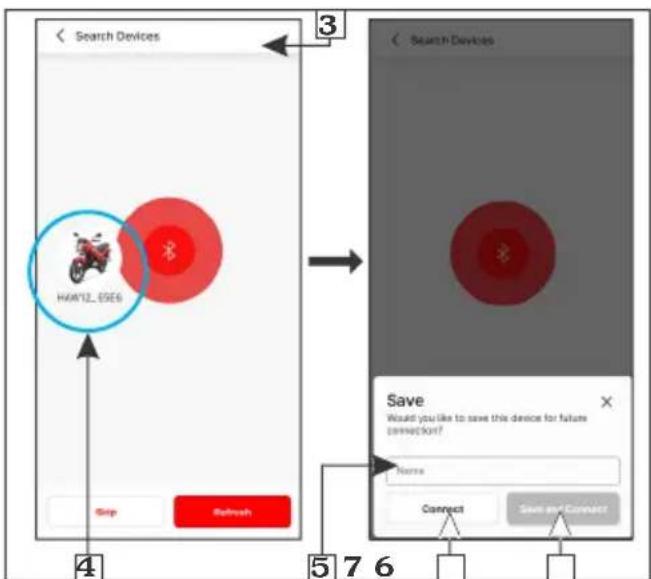
(3) Bluetooth searching screen
(4) Select the device
(5) Update your name
(6) Save and connect
(7) Connect
- Now application will send pairing request and notification (8). Click on the notification
- Now meter console will display paring pin (9).
- Enter the pin in application screen and select "Pair" (10).

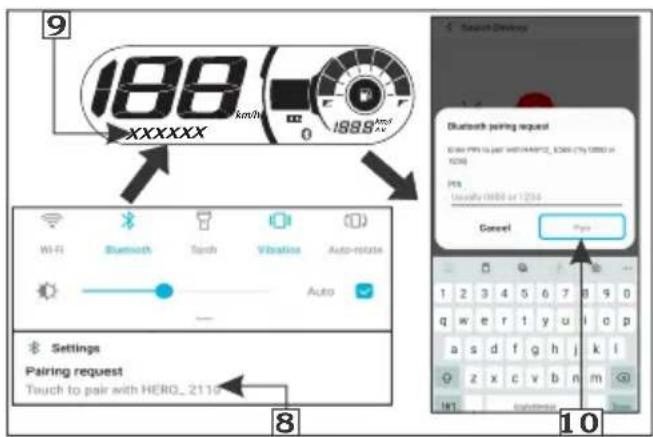
(8) Pairing request notification
(9) Pin (10) "Pair"
- Disclaimer popup (11) instruction will show, click on "Ok" (12) to dismiss the popup.
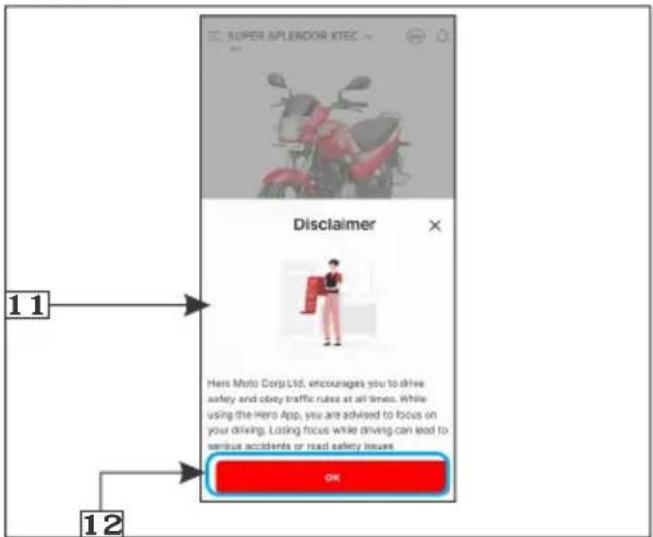
(11) (12) OkDisclaimer popup
- Now application asks the user to give the smart mode permission (android) (13) for DND mode, where phone will switch to vibrate mode from ringing. - After granting permission (14) user will be able to access the DND feature.
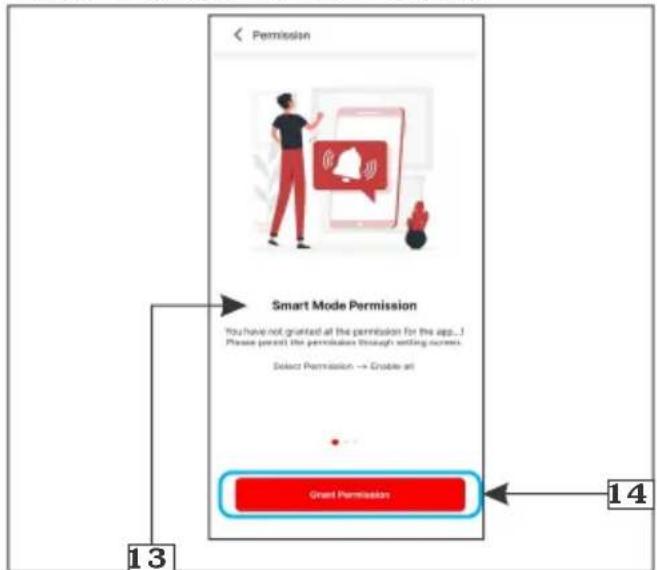
(13) Smart mode permission
(14) Grant permission
- On pairing, meter console displays bluetooth symbol (15) which indicates that bluetooth is connected. - If any error occurs during the course of pairing process, then meter console will not display bluetooth symbol. Repeat the above steps and keep your smartphone closer to the vehicle to reconnect.
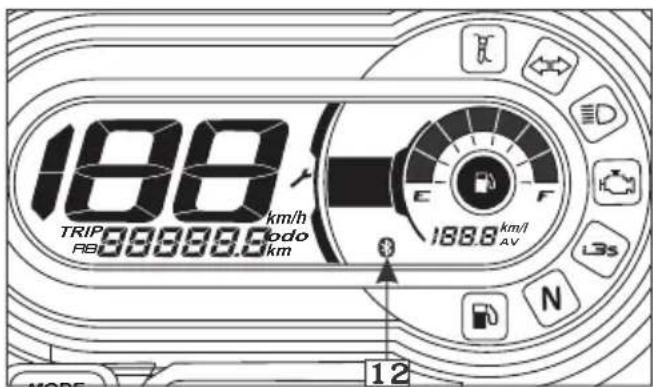
(15) Bluetooth symbol
Autopairing
Your vehicle is equipped with autopairing feature by which if you turn "OFF" vehicle's ignition switch after successful pairing with Hero App, it will reconnect automatically once ignition switch is turned "ON".

NOTE
• Always keep your smartphone close to your vehicle during the course of pairing, autopairing and navigation.
• Application needs to be running in the background and bluetooth must be "ON".
Various features of Hero App are as follows:
- Incoming call alert
When smartphone is paired with the meter console of your vehicle via bluetooth (page 21), then you will get all the incoming calls alerts on the meter console. (1)
It will display the name of the caller (2) if it is stored in your compatible smartphone. For example: If caller's number is stored in your compatible smartphone by name of Vijay, then your meter console will display Vijay.
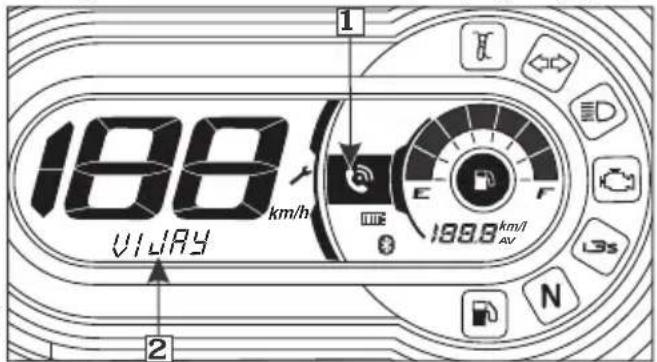
(1) Incoming call alert
(2) Name of the caller
If the number is not saved in your device by name or your device is an iOS, then it will display "unknown" (3).
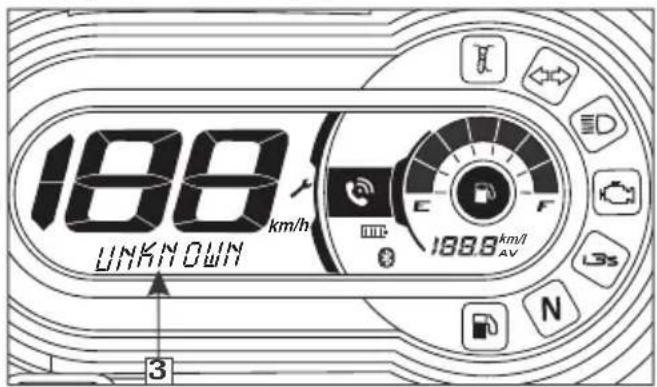
(3) Incoming call alert by unknown number

- Missed call alert
When your smartphone is paired with meter console of your vehicle via bluetooth (page 21), then you will get all the missed calls alerts (1) and in dashboard of Hero A (2) it will show missed call count.
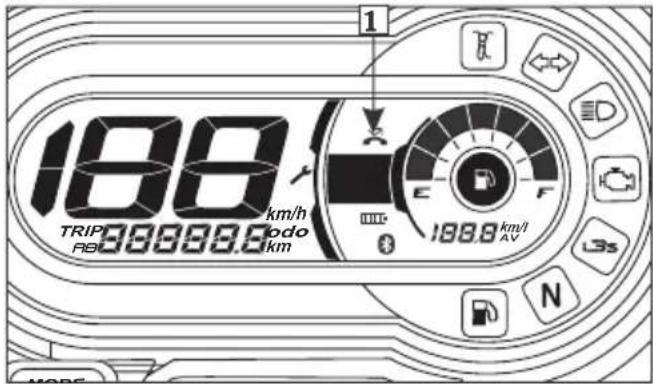
(1) Missed call alert on meter console
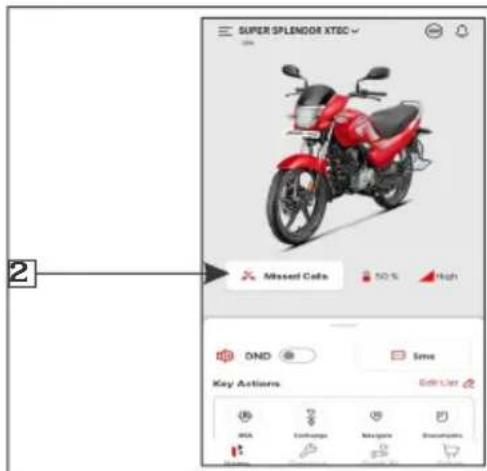
(2) Missed call count on Hero App
- Message alert
When your smartphone is paired (android) with the meter console of your vehicle via bluetooth, then you will get all the (page 21) om ge alerts (1). essa
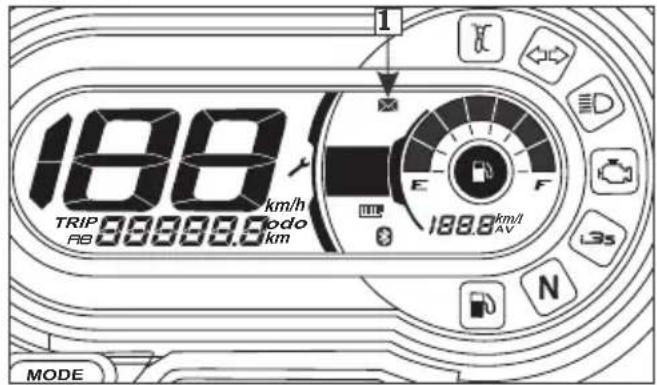
(1) Message alert on meter console
• Phone battery status
When your smartphone is paired with the meter console of your vehicle via bluetooth (page 21), then will display phone batteryit status (1) of your smartphone and in dashboard of Hero App (2).
In meter console:
4 bar display - 80-100%
3 bar display - 60-79%
2 bar display - 40-59%
1 bar display - 20-39%
1 bar blink with outer line display - 1-19%.

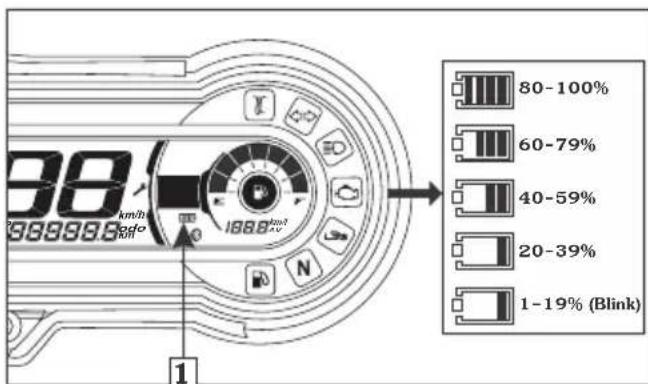
(1) Phone battery status on meter console
In dashboard of Hero App:
Battery status will display in %.
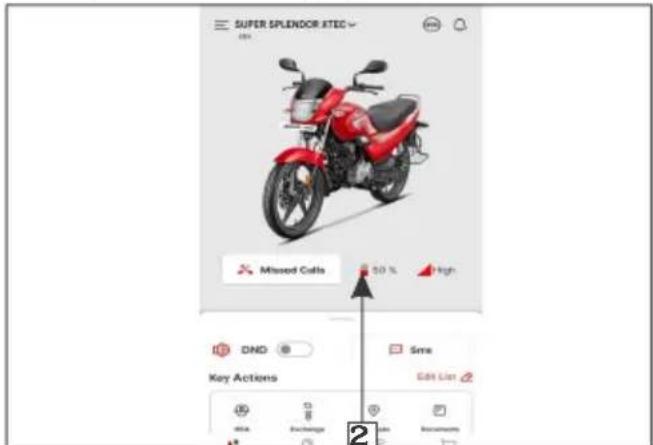
(2) Phone battery status on Hero App
- Do not disturb (DND) mode
When your smartphone is paired with the meter console of your vehicle via bluetooth (page 21), then you can switch "ON" the DND mode (android) (1) in which your smartphone will and yoube on vibrate mode if receive any call, an SMS will be triggered and sent to the caller stating "I'm riding bike, Please call me later".
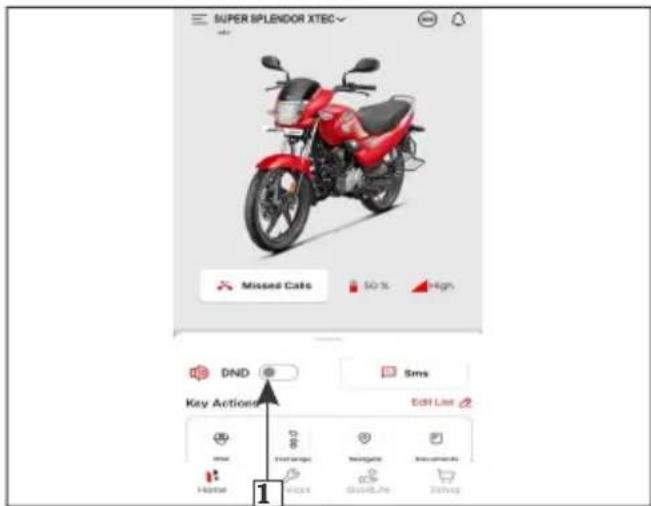
(1) DND mode on Hero App
HANDLEBAR SWITCHES CONTROL Left handlebar controls
1. Passing switch
Gives an indication for passing ahead. Press passing lamp switch (1) to operate the passing lamp.

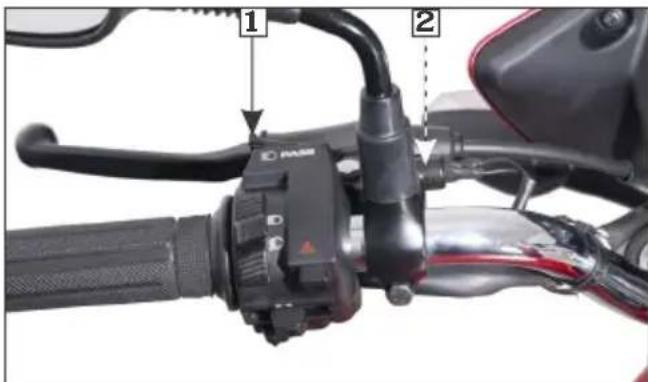
(1) Passing switch
(2) Clutch switch
2. Clutch switch
There is a clutch switch (2) provided for the safety of the rider. The vehicle cannot be started by electric starter switch until the cluto lever is operated when the vehicle is engaged in gear.
3. Headlamp dimmer switch
The headlamp operates only when the enginebreakdown or other unavoidable problems. is running or when passing switch is operated. Upon pressing the hazard switch, all turn Select “ [icon] ” for high beam and “ [icon] ” for signal lamps start flashing simultaneously to low beam. 4. Turn signal lamp switch (▶) ) warn other road users behind you of a hazard or obstruction ahead.
Shift the turn signal lamp switch (4) sidewaysTo turn "OFF" the indicator lamps in hazard for right/left indications and leave it to come switch "ON" condition, press the hazard back to its normal position on its own. switch again.
IMPORTANT: To switch "OFF" the turn signal after completing the turn, gently push inside.
5. Horn switch (☐)
Press the horn switch (5) to operate the horn
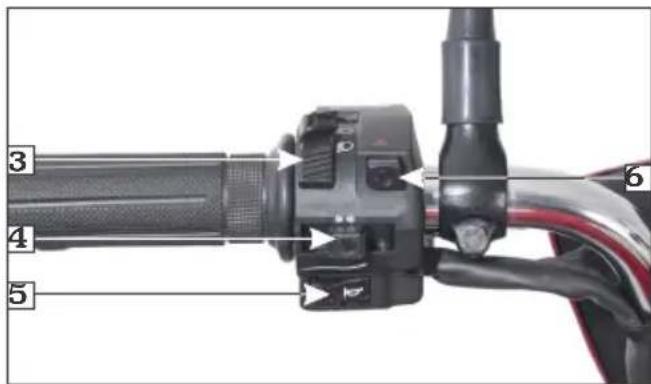
(3) Headlamp dimmer switch
(4) Turn signal lamp switch (5) Horn switch
(6) Hazard switch
6. Hazard switch (△)
Press the hazard switch (6) in ignition "ON" condition whenever your vehicle becomes a temporary hazard for other road users and it is necessary to park the vehicle due to
To turn "OFF" the indicator lamps in hazard switch "ON" condition, press the hazard switch again.
breakdown or other unavoidable problems. Upon pressing the hazard switch, all turn signal lamps start flashing simultaneously to warn other road users behind you of a hazard or obstruction ahead.

NOTE
Use hazard lights only when your vehicle becomes a temporary hazard for other road users.

Right handlebar controls
1. Electric starter switch (E)
Ensure starter switch (1) is operated when the vehicle is in neutral gear. If the vehicle engaged in gear, press the clutch lever before operating the starter switch. Release starter switch after the engine has started.
!! CAUTION
• If electric starter switch is pressed continuously and engine does not start, cranking of engine will stop after 5 sec. After that rider again needs to press the electric starter switch.
- If engine started, cranking of the engine will stop after r/min reaches more than 1000 r/min under normal condition.
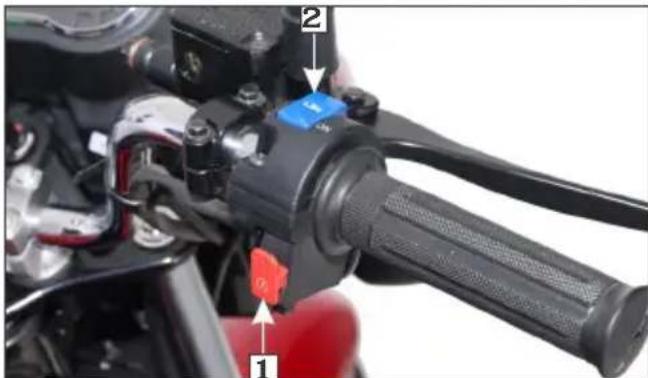
(1) Electric starter switch (2) i3s switch
2. i3s switch
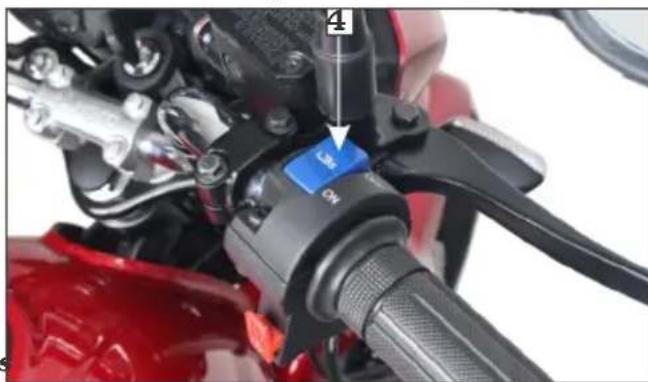
There is an i3s switch provided to enable (2) the rider for turning i3s mode "ON" or "OFF" based on the traffic conditions.
i3s (IDLE STOP START SYSTEM)
Starting & Warm up the engine:
Turn the ignition key to "ON" (1) position. The i3s indicator (1) will glow on the speedometer console for 2 seconds and turn "OFF". For the activation of i3s system, start the engine and let it idle till the engine gets warmed up or temperature reaches more than 55^ .
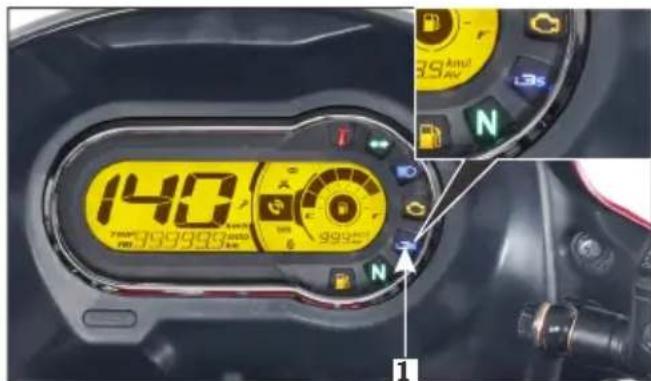
(1) i3s indicator
Initial activation of the i3s system:
Keep the i3s switch (2) to "ON" position. Turn the ignition key to "ON" (Ω) position. The i3s indicator on the speedometer console will glow for 2 seconds and turn "OFF".
Start the vehicle (in neutral and clutch lever released condition) with less than 2000 r/min and let it idle till engine temperature reaches more than 55^ . The engine w cut-off in 30 seconds. After the first stop start, every subsequent stop will be in 5 seconds.
In this condition, the engine can be restarted either with clutch lever, kick or electric start.
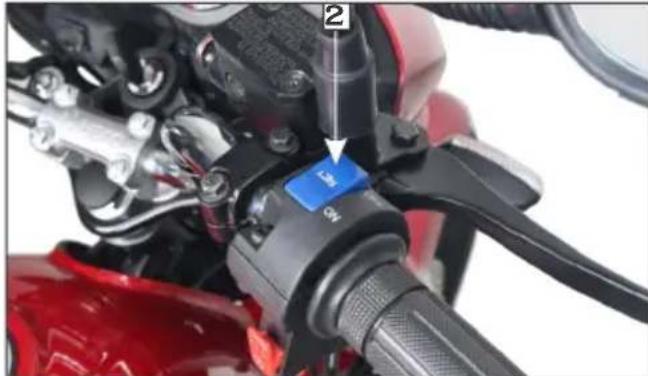
natural_image
Close-up of a red motorcycle's mechanical component with a blue control knob and lever mechanism (no visible text or symbols)(2) i3s switch

NOTE
- If vehicle stops in i3s condition and kept idle for more than 500 secs (ignition switch is "ON" position) i3s function will be deactivated and cannot be started by pressing the clutch lever, rider can only start the vehicle with electric or kick start.
- If engine is stopped by any means other than i3s function, i3s indicator will not glow/blink in the speedometer. In this condition, vehicle will not start by pressing the clutch lever. Vehicle can be started by using kick or electric start.
- If all the required i3s conditions are met, i3s indicator will glow for 5 secs before the engine cuts-off.
Driving with i3s switch in "OFF" position:
While driving in a traffic jam/or very dense traffic where the vehicle has to encounter a stop and go situation, the i3s switch can be Driving with i3s switch in “ON” position. While driving, if the engine is kept idling (whi waiting in a traf c signal), the engine will cut off in 5 sec. (The vehicle should be inonds stand still condition, with neutral gear position at less than 2000 r/min with clutch lever/throttle is in released position and engine is warmed up). The i3s indicator will be continuously blinking in the speedometer indicating that vehicle stopped in i3s condition. By pressing the clutch lever, the engine will start again and gear can be engaged to move the vehicle.
changed to "OFF" position. Once this is done, the i3s system will not work and the vehicle if will be in normal operating conditions as other vehicles and no special functions will be performed.

NOTE
- The i3s system will not function if rider puts the i3s switch to "OFF" position.
- If the battery voltage is low and engine r/min is less than 2000, there will be 3 continuous blinks after every 6 secs.
- If the low battery voltage is detected while the ignition key is in "ON" position or engine is in running condition, the i3s function will be deactivated or may not function properly until the rider turns the ignition switch to "OFF" (☒) position and then back to "ON" (☐) position.
- If the vehicle is driven without battery or with the dead battery and the engine r/min is less than 2000. The i3s indicator on the speedometer will continuouslyblink at every 1.5 secs.
- i3s function If the vehicle has fallen down, may not work properly. Before restarting the engine you must turn the ignition switch to "OFF" (☒) position and then back to "ON" (☐) position.
- If the battery is in healthy condition and the i3s system does not work properly, it is recommended to visit your Authorised Hero MotoCorp workshop.
- i3s system will not function properly if the vehicle battery is low/dead or driven without battery.
- If vehicle diagnoses with any problem in electronic control unit (ECU) the i3s function will not work.
SIDE STAND INDICATOR/SWITCH
For the safety of the customer a side stand indicator (1) is provided.
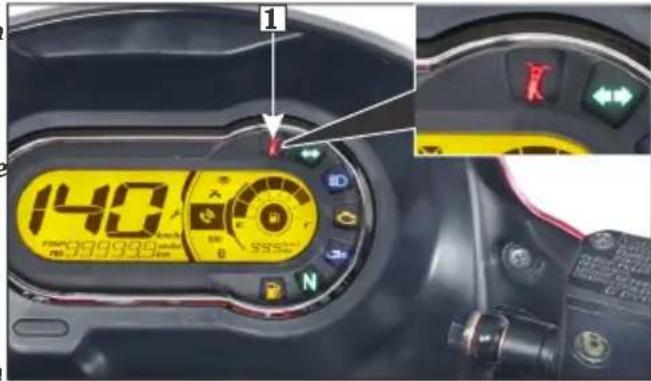
(1) Side stand indicator
A side stand switch (2) is provided in the side y stand, when the side stand is down (ignition switch "ON" Ⓞ), the switch enables the side stand indicator lamp to glow on the speedometer panel.
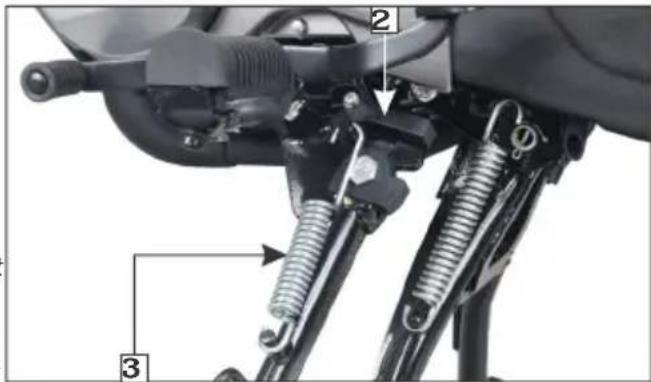
(2) Side stand switch
(3) Side stand spring

- Check the side stand for proper function and the spring (3) for damage or loss of park the vehicle on its main stand and check tension and the side stand assembly for free all the conditions described in the inspection movement. flow diagram:
- Check whether the side stand indicator (1) glows when the side stand is down.
- While the vehicle is removed from side stand, the side stand indicator (1) should not glow.
- If the side stand indicator (1) does not operate as described in above steps, please visit your Authorised Hero MotoCorp workshop.
- Turn the ignition switch to "ON" position and press the electric starter switch (with transmission in neutral and side stand is down).
Does engine start?
NO
!! CAUTION
Ensure that adequate care is taken while cleaning the side stand switch.
Your vehicle is equipped with "Side stand engine kill" feature for added safety purpose.
This feature has following functions:
- It prevents starting the engine when transmission is in gear (irrespective of clutch lever operation) and side stand down.
- It stops the running engine when transmission is in gear (irrespective of clutch lever operation) and side stand is moved down.
!! WARNING
"Side stand engine kill" system is not affected by clutch lever operation.
INSPECTION FLOW DIAGRAM

Visit Authorised Hero MotoCorp Workshop

- Then shift the transmission to gear (with engine running and irrespective of clutch lever operation).

Does engine stop?
NO
Visit Authorised Hero MotoCorp Workshop

- Now pull in the clutch lever and press the electric starter switch (after engine has stopped).

Does engine start?
YES
Visit Authorised Hero MotoCorp Workshop

SYSTEM IS OK
If your vehicle doesn't operate as described in flow diagram, please visit your Authorised Hero MotoCorp workshop.
WARNING
Regularly inspect the functionality of "Side stand engine kill" feature and in case of any malfunction visit Authorised Hero MotoCorp workshop.
FUEL
(a) Fuel tank
Fuel tank capacity is 12 litres (Be sure to fill the fuel tank when low fuel indicator glows).
- To remove the fuel tank cap (1), open the key hole cover (2) and insert the ignition key (3) turn it clockwise and remove the cap.
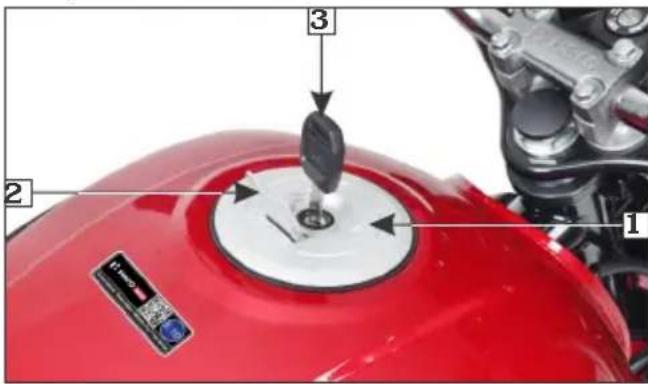
(1) Fuel tank cap
(2) Key hole cover
(3) Ignition key
- Do not overfill the tank. There should be no fuel (5) in the filler neck (4).
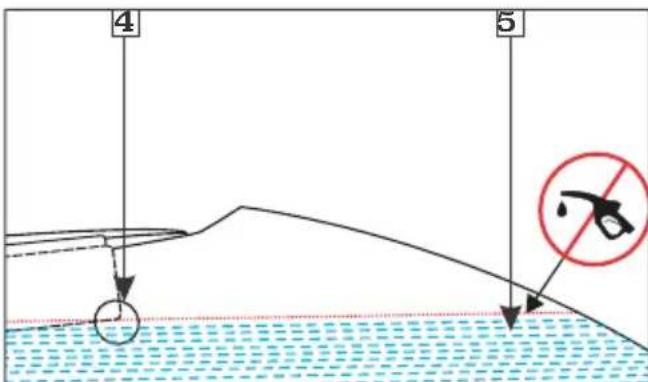
(4) Filler neck
(5) Fuel
- For locking, position the cap with “” mark facing towards the front, back on the opening and press gently. The key springs back to the normal position and the cap gets locked.
!! CAUTION
Do not park the vehicle under direct sunlight as it causes evaporation of petrol due to heat and deterioration of paint gloss due to ultraviolet rays.
!! WARNING
Petrol is extremely flammable and is explosive under certain conditions. Refill in a well ventilated area with the engine stopped. Do not smoke or allow flames or sparks in the area where the vehicle is refilled or where petrol is stored.
(b) Petrol containing alcohol
Fuel available at your location may contain ethanol. Ethanol is a form of alcohol and is generally mixed with petrol to reduce emissions.

s ticker on fuel tank indicates that the
vehicle parts are compliant up to the blend of "20% ethanol with petrol".
It is recommended not to use petrol containing more than 20% of ethanol to avoid any damage to engine and other parts of the vehicle.
If you observe any problem related to the operational performance of the vehicle, contact your Authorized Hero MotoCorp workshop.
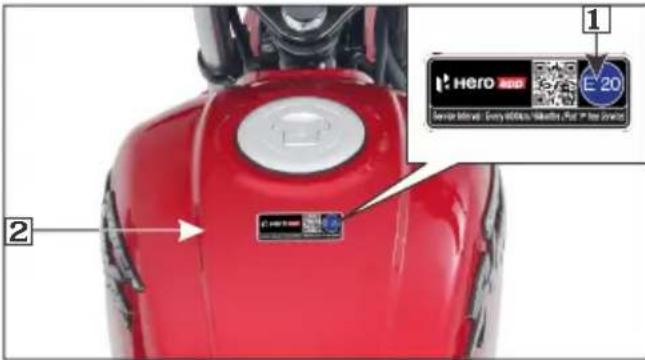
(1) E20 sticker
(2) Fuel tank

CAUTION
Please ensure the vehicle is not used with low fuel indicator glowing continuously. It will not only result in the vehicle running out of fuel, it may also cause serious damage to the fuel pump. Please ensure fuel is filled up as soon as the low fuel indicator starts glowing.

WARNING
- Petrol is highly flammable and explosive. You can be burned or seriously injured when handling fuel.
- Stop the engine and keep heat, sparks and flame away.
- Refuel only outdoors.
- Wipe off spills immediately.
SEAT LOCK
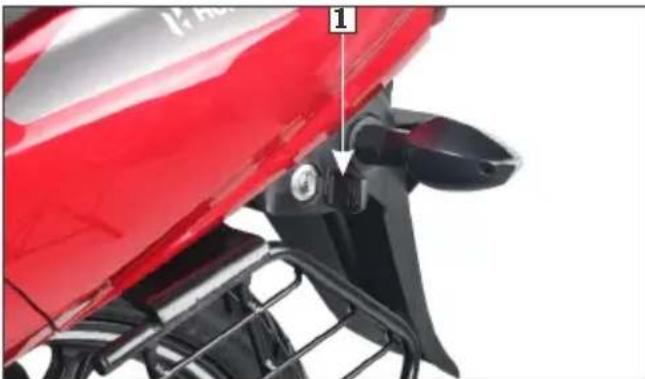
Location : On the rear left side of the seat, below the rear cowl.
Operation : To unlock the seat, insert the ignition key (1) and turn in clockwise direction. To install, engage the hook on the underside of the seat with the frame and push on the top rear side of the seat until the lock clicks.
natural_image
Close-up of a red sports motorcycle front bumper with black gear and handle (no visible text or symbols)(1) Ignition key

HELMET HOLDER
The helmet holder is located below the seat. Remove the seat. Hang the helmet on the helmet holder (1) by using wire helmet set (2) (optional). Install the seat (3) and lock it securely.
WARNING
- Riding with a helmet attached to the holder can interfere with the rear wheel and could cause a crash in which you can be seriously hurt or killed.
• Use the helmet holder only while parked. Do not ride with a helmet secured by the holder.
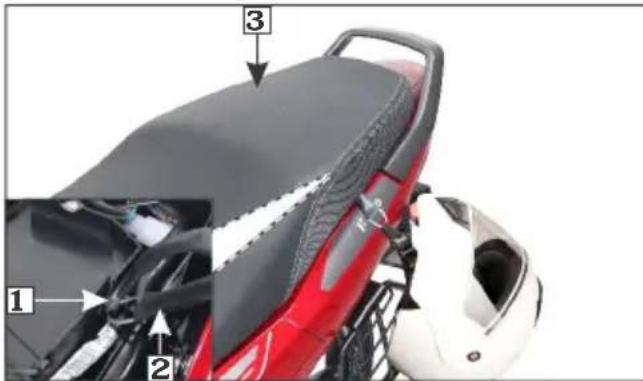
(1) Helmet holder hook
(2) Wire helmet set (optional) (3) Seat
USB CHARGER
A USB charger (1) with a cap (2) located on the left side of the inner panel (3) near meter console to charge your mobile phone safely while riding.
Use of non-standard USB cable may cause damage to the mobile phones.
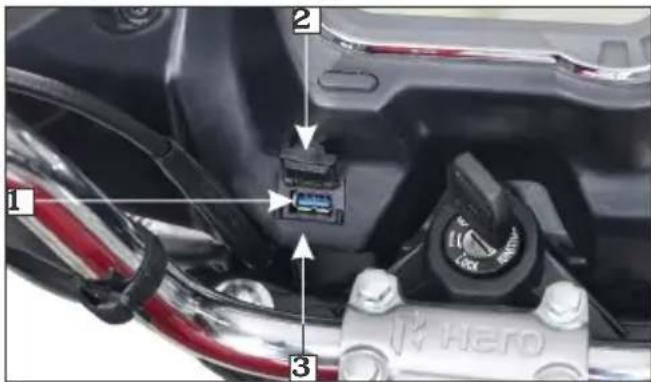
(1) USB charger
(3) Inner panel
(2) Cap
To connect a mobile phone to the charger, first open the cap from the USB charger and then plug the charger cable into it. Hero MotoCorp will not be responsible for damages caused due to use of non-standard USB cable.
!! CAUTION
• Always place the device in a soft clean cloth/towel to avoid any damage due to road shocks while riding.
- Multiple charging of USB devices has to be avoided, simultaneous charging may lead to slow or no charging.
- USB port is for charging compatible US devices.
- Do not leave the USB device and USB cable in the fuel tank cover when the vehicle is parked.
- Charge your device when the engine is operational/while riding.
- USB charger will not be covered under warranty in case of USB charger cap damage.
NOTE
- Do not apply any soap solution, oil or grease inside the USB charger.
• Any personal belongings have to be removed before water washing to avoid damage.
• Always keep the USB port cap closed after use to prevent dust or water entry during rains/water wash. - Do not direct water jet towards the port even with cap closed to avoid any short circuit. Always dry the area using a dry cloth or moisture free compressed air before use.
- Press the cap slightly for proper locking of USB charger cap.
- The charging time of mobile may vary, depending on the mobile's battery state of the charge, mobile make and conditions.
PRE-RIDE INSPECTION
You should conduct pre-ride inspection before riding the vehicle to enhance riding comfort and safety. Clean your vehicle regularly. It protects the surface finish. Avoid cleaning with products that are not specifically designed for vehicle surfaces. Inspect your vehicle every day before you start the engine.
The items listed here will only take a few minutes, and in the long run they can save time, expense and possibly your life. Please follow the tips as given below:
- Engine oil level-Check and top up engine oil if required (page 47). Check for leaks.
- Programmed FI malfunction indicator lamp (MIL)-When the ignition switch is turned “ON” the programmed FI malfunction indicator lamp(MIL) glows continuously and then should go “OFF” once the engine is started.
- Fuel level-Ensure sufficient fuel is available in your fuel tank for your journey (page 17). Check for leaks.
- Low fuel indicator-Vehicle should not be operated with low fuel indicator glowing continuously (page 19).
- Front brake (Disc variant)-Check for correct brake fluid level in the master cylinder (page 56).
- Front and Integrated brakes (Drum variant)-Check operation. Adjust free play if necessary (page 58).
- Rear brake (Disc variant)-Check for correct brake fluid level in the reservoir (page 57).
- Rear brake- Check operation. Adjust free play, if necessary .(page 59)
- Tyres-Check condition and pressure (page 65).
- Clutch-Check for smooth operation. Adjust free play if necessary .(page 51)
- Drive chain-Check condition and slackness (page 53). Adjust and lubricate if necessary.
- Throttle-Check for smooth opening and closing in all steering positions .(page 52)
- Lamps and Horn-Check that headlamp, tail/stop lamp, turn signal lamps and horn function properly.
- Rear view mirror-Ensure that the rear view mirror gives a good rear view when you are sitting on the vehicle.
- i3s switch-Make sure whether the i3s switch is in “ON” or “OFF” position (page 28).
- i3s system-Make sure that i3s system is functional properly .(page 28)
- Fitting & Fasteners-Check & tighten if necessary.
- Steering-Check for smooth action for easy maneuverability.
- Side stand-Check for proper functionality (page 30).
STARTING THE ENGINE
Always follow the proper starting procedure described below :
- To protect the catalytic converter in your vehicle's exhaust system, avoid extended idling and the use of leaded petrol.
- Your vehicle's exhaust contains poisonous carbon monoxide gas. High levels of carbon monoxide can collect rapidly in enclosed areas such as garage. Do not run the engine with the garage door closed.
! CAUTION
- If electric starter switch is pressed continuously and engine does not start, cranking of engine will stop after 5 secs. After that rider again needs to press the electric starter switch.
- If engine started, cranking of the engine will stop after r/min reaches more than 1000 r/min under normal condition.
This vehicle is equipped with a side stand engine kill feature (page 31).
Preparation
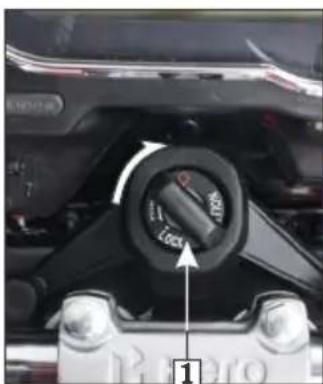
Before starting insert the key and follow the below mentioned procedure :
- Turn the ignition switch (1) "ON".
- Confirm that the programmed FI malfunction indicator lamp (MIL) (2) glows continuously and then goes “OFF” once the engine is started.
natural_image
Close-up of a car's dashboard with a circular dial indicator and a numbered label (1) pointing to the left side (no readable text or symbols beyond the label)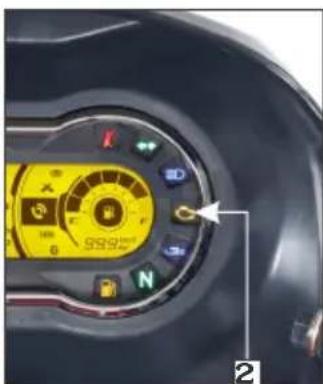
natural_image
Close-up of a car's rotary dial with yellow and green buttons, no visible text or symbols(2) Programmed FI mp (MIL)
(1) Ignition switch malfunction indica

NOTE
If MIL remains "ON" even if the vehicle started, there is an abnormality in the programmed FI system. It is recommended to reduce the speed and drive to the Authorised Hero MotoCorp workshop for check-up.
natural_image
Close-up of a motorcycle's engine compartment showing the 'Hero' button and control panel (no readable text beyond branding)(3) Neutral indicator
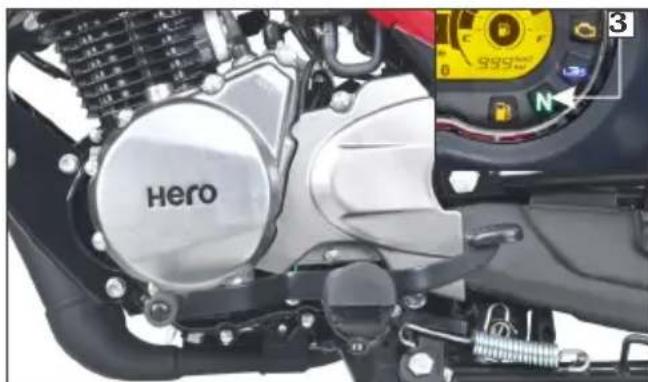
- Find neutral position & check neutral Ⓝ indicator (3) on instrument console with ignition "ON". - Make sure whether the i3s switch (4) is in "ON" or "OFF" position.
natural_image
Close-up of a red motorcycle's brake caliper with a blue control knob (no text or symbols visible)(4) i3s switch
- Electric start : Press the electric starter switch with fully closed throttle. - Kick start : Depress the kick starter until resistance is felt. Then let the kick starter return to the top of its stroke. Kick from the top of the stroke through to the bottom with a rapid, continuous motion.
Starting procedure
At any ambient temperature, Press the starter switch with the throttle completely closed.

NOTE
- This vehicle has a fuel-injected engine with an idle air control valve (IACV).
- It is not recommended to start engine with throttle.


NOTE
The engine will not start if the throttle is open because the Electronic control unit (ECU) cuts-off the fuel supply.
Flooded nginee
If the engine fails to start after repeated attempts, it may be flooded with excess fuel.
- Open the throttle fully.
- Press the starter switch for 5 seconds.
- Follow the normal starting procedure.
- If the engine starts with unstable idle, open the throttle slightly.
- If the engine does not start wait for seconds, then follow first 3 steps again.
Ignition cut off
Your vehicle is designed to automatically stop the engine fuel pump, if vehicle falls down.&
(Bank angle sensor cuts off the ignition).

NOTE
If the vehicle has fallen down, before restarting the engine you must turn the ignition switch to "OFF" (☒) position and then back to "ON" (☐) position.
Running in
Help assure your vehicle's future reliability and performance by paying extra attention to how you ride during the first 500 km.
During this period, avoid full-throttle and rapid acceleration.

NOTE
• To start the engine if any gear is engaged, press the clutch lever and press the starter switch.
- Do not open the throttle while starting the vehicle.

WARNING
Never run the engine in a enclosed area, the exhaust contains poisonous gases.
RIDING
- While the engine is idling, press the clutch lever and depress the gearshift pedal
downwards using the toe to shift into 1 gear. - Slowly release the clutch lever and at the same time, gradually increase engine speed by opening the throttle. Coordination of the throttle and clutch lever will assure a smooth positive start.
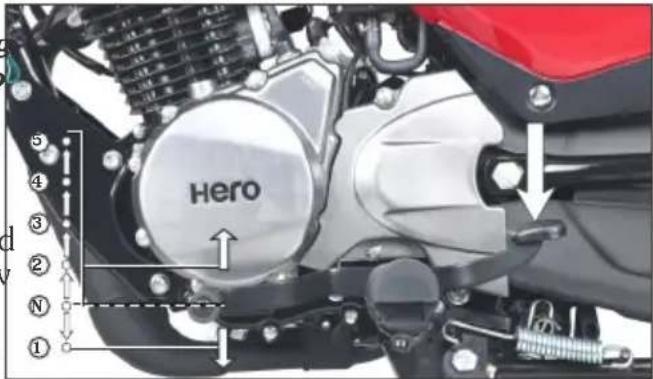

- When the vehicle attains a moderate speed, close the throttle, press the clutch lever and shift to 2 ^nd gear by depressing the gearshift pedal.
- The sequence is repeated progressively to shift 3^rd , 4^th and 5^th (top gear).
Recommended operating speeds for each gear.
1^st : 0-15 km/hr
2^nd : 10-25 km/hr
3^rd : 20-40 km/hr
4^th:25-50km/hr
5^th : 40 km/hr and above
!! CAUTION
Do not shift gears without operation of clutch and without closing the throttle otherwise this would lead to damage of gears.
BRAKING
- For normal braking, close the throttle and gradually apply both front and rear brakes simultaneously while shifting down gears to suit your road speed.
- For maximum deceleration/quick stopping, close the throttle and apply the front and rear brakes simultaneously.
For integrated braking system (IBS)
To stop the vehicle, press the rear brake pedal for the application of front and rear brakes simultaneously. However, for more effective braking, it is advised to apply front and rear brake simultaneously, keeping the throttle in closed position.
!! WARNING
- When riding in wet or rainy conditions, or on loose surfaces, apply front brake carefully after applying rear brake to avoid wheel slip.
- Extreme braking may cause wheel locking and reduce control over the vehicle.
- Wherever possible, reduce speed or apply brake before entering a turn, closing the throttle or braking in mid turn may cause wheel slip. Wheel slip will reduce control over the vehicle.
- When riding in wet or rainy conditions, or on loose surfaces the ability to stop the vehicle reduces.
- All your actions should be smooth under these conditions. Sudden acceleration, braking or turning may cause loss of control. For your safety, exercise extreme caution when braking, accelerating or turning.
- When descending a long steep slope use engine braking (power) by changing to lower gears, with intermittent use of both brakes. Continuous brake application can overheat the brakes and reduce their effectiveness.
PARKING
After stopping the vehicle, shift the transmission to neutral, turn the ignition switch "OFF" (☒), park the vehicle on main stand, lock the steering and remove the key.
!! CAUTION
- Park the vehicle on firm level ground to prevent overturning.
- While parking vehicle on side stand engage the first gear.
TOOL KIT/FIRST AID KIT
The tool kit (1) is located below the seat in the rear. Some emergency repairs, minor adjustments and parts replacement can be performed with the tools contained in the kit. Kit contains one unit of each of the following tools:
- Tool bag
• +, - No. 2 Driver
• Grip - Box wrench 16x14
- Pin spanner
- Fuse puller
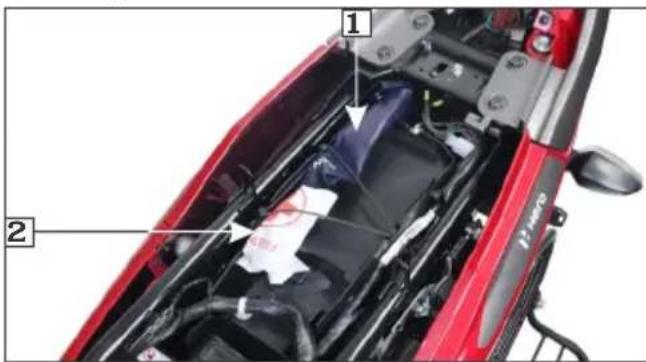
(1) Tool kit
(2) First aid kit
The first aid kit (2) is located below the seat in the rear. For some emergency first aid can be performed by medicine contained in the kit. Kit contains one unit of each of the following items :
- Antiseptic cream
- Sterilized dressing
Waterproof plaster
- Elastic bandage
• Gauze (Rolled bandage)
• Sterilized elastic plaster - First aid bag
- Hemostatic agent
CLEANING AND WASHING OF VEHICLE
Follow the below mentioned steps for washing the vehicle.
- Wet the vehicle with light water spray. Avoid directing water meter console, muffler outlets and electrical parts.
- Clean the headlamp lens and other plastic parts using a cloth or sponge dampened with a solution of mild detergent and water.
- Rub the soiled area gently rinsing it frequently with fresh water.
• After cleaning, spray water thoroughly.
• Dry the vehicle by wiping with dry soft cloth.

NOTE
- Our authorised dealership take all above mentioned precautions like recommended detergents and usage of muffler caps/plugs during wash to ensure quality wash.
- Do not use high pressure water (or air). It can damage certain parts of the vehicle.

MAINTENANCE
I importance of maintenance
A well-maintained vehicle is essential for safe economical and trouble-free riding. It will also help reduce pollution.
To help you, take proper care of your vehicle the following pages include a maintenance schedule and a maintenance record for regular scheduled maintenance.
These instructions are based on the assumption that the vehicle will be used exclusively for its designed purpose.
Sustained high speed operation or operation in unusually wet or dusty conditions will require more frequent service than specified if the maintenance schedule.
Consult your Authorised Hero MotoCorp Dealer for recommendation applicable to your individual needs and use. If your vehicle overturns or is involved in a crash, be sure that you visit your Authorised Hero MotoCorp workshop for detailed inspections.
!! WARNING
- Improperly maintaining this vehicle or failing to correct a problem before you ride can cause a crash in which you can be seriously hurt or killed.
• Always follow the inspection and maintenance recommendations and schedules in this owner's manual.
Maintenance safety
This section includes instructions on some important maintenance tasks. You can perform some of these tasks with the tools provided (if you have basic mechanical skills).
Other tasks that are more difficult and require special tool. It is recommended that wheel removal should normally be handled by a Hero MotoCorp authorised workshop.
You will come across some of the most important safety precautions in the following pages of this manual.
However, we cannot warn you of every conceivable hazard that can arise in performing maintenance. Only you can decide whether or not you should perform a given task.
!! WARNING
Failure to follow maintenance instructions and precautions properly can seriously injure you.
• Always follow the procedures and precautions in this owner's manual.
SAFETY PRECAUTIONS
- Make sure the engine is “OFF” before you begin any maintenance or repair. This will help to eliminate several potential hazards:
• Carbon monoxide poisoning from engine exhaust.
Be sure there is adequate ventilation whenever you operate the engine.
• Burns from hot parts.
Let the engine and exhaust system cool before touching.
• Injury from moving parts.
Do not run the engine unless instructed to do so.
- Read the instruction before you begin and make sure you have the tools and skills required.
- To help prevent the vehicle from falling over, park it on a firm, level surface on the main stand.
- To reduce the possibility of a fire or explosion, be careful when working around petrol or batteries. Use only nonflammable solvent, not petrol, to clean parts. Keep cigarettes, sparks and flames away from the battery and all fuel-related parts.
Remember that your Authorised Hero MotoCorp workshop knows your vehicle best and is fully equipped to maintain and repair it.
To ensure best quality and reliability, it is recommended to use Hero MotoCorp genuine parts for repair and replacement.
MAINTENANCE SCHEDULE
Perform the pre-ride inspection at each scheduled maintenance period. (page 35)
I: INSPECT
C: CLEAN
R: REPLACE
A: ADJUST
L: LUBRICATE
T: TOP UP
E: EMISSION CHECK
The following maintenance schedule specifies all maintenance required to keep your vehicle in peak operating condition. Maintenance work should be performed in accordance with standards and specifications of Hero MotoCorp by properly trained and equipped technicians. Your Authorised Hero MotoCorp workshop meets all of these requirements.
Ensure that each paid service is availed within 180 days or 6000 km from the date of previous service, whichever is earlier.


To be serviced by your Authorised Hero MotoCorp workshop unless the owner has the relevant tools, technical information and is technically qualified.
In the interest of safety, we recommend that these jobs are carried out only by your Authorised Hero MotoCorp workshop.
Note-1 : At higher odometer readings, repeat the frequency interval established here.
Note-2 : Replace air cleaner element once in every 18000 km or early replacement may be required when riding in dusty areas.
Note-3 : Replace engine oil once in every 6000 km. Top up if the oil level is at or near the lower level mark.
Note-4 : Visit Authorised Hero MotoCorp workshop for inspection, cleaning, lubrication and adjustment of drive chain at every 2000 km.
Note-5 : Replace brake fluid once in a every 2 years or 30000 km, whichever is earlier.
Note-6 : Inspect & maintain specified torque.
Note-7 : Inspect the bearings free play, replace if necessary.
Note-8 : Replace front fork oil once every 2 year or 30000 km, whichever is earlier.
Note-9 : Inspect for any play in the rear suspension mounting bushes, replace if necessary.
Note-10 : Check CO emission at idle.
Note-11 : Inspect the canister hoses for deterioration, damage or loose connections and canister for cracks or other damages.
Note:
- Always wipe the water from the vehicle after washing. Use clean soft cloth or pressurized air for completely drying off the water.
• Always use new gaskets, O-rings, circlips and cotter pins once removed.
- Do not mix “SAE 10W 30 SL grade and SAE 5W 30 SN grade” engine oil during oil change or top up.
# Replacement of parts (e.g filters, etc.) and consumables (e.g engine oil, etc.) during paid or free service are at customer's expenses.

MAINTENANCE SCHEDULE
Dear Customer,
We would strongly recommend the following schedule, to keep your vehicle in perfect running condition and healthy environment. Vehicle subjected to severe use or ridden in dusty area will require more frequent servicing.
| ITEMS | WHICHEVER COMES FIRST | #DURING FREE SERVICE PERIOD | DURING PAID SERVICE PERIOD ONCE IN EVERY 6000 KM | |||||
| SERVICE | 1^st | 2^nd | 3^rd | 4^th | ||||
| DAYS | 1st 60 | Next 180 | Next 180 | Next 180 | ||||
| KM Note-1 | 500-750 | 6000-6500 | 12000-12500 | 18000-18500 | 6000 | 12000 | ||
| Fuel Line | I | I | I | I | I | I | ||
| Throttle Operation | I, A | I, A I, A I, A | I, A | I, A | ||||
| Air Cleaner Element | Note-2 | Do not open air cleaner element unless there is a drivability problem | R | Do not open air cleaner element unless there is a drivability problem | ||||
| Spark Plug | R | I, C, A | I, C, AI, C, AI, C, A | R | ||||
| Valve Clearance | I, A I, A | I, A I, A | I, A | I, A | ||||
| Engine Oil | Note-3 | R | R | R | R | R | R | |
| Engine Oil Strainer Screen | C | C | C | |||||
| Engine Oil Paper Filter | RI | I | I | R I | ||||
| Electric Starter | I | I | I | I | I | I | ||
| Oil Circulation | I | I | I | I | I | I | ||
| Drive Chain | Note-4 | I, C, L, A at every 2000 km | I, C, L, A at every 2000 km | |||||
| Drive Chain Slider | III | I | I | I | ||||
| Battery Voltage | III | I I | ||||||
| Brake Shoe | I, A | I, A | I, A | I, A | I, A | I, A | ||
| Disc Wear/Pad Wear | I | I | I | I | I | I | ||
| Brake Fluid | Note-5 | I, T I, T | I, T I, T | I, T | I, T | |||
| Brake System (Brake Cam & Brake Pedal) | I, C, L | I, C, L | I, C, L | I, C, L | I, C, L | I, C, L | ||
| Stop Lamp Switch | I, A | I, A | I, A | I, A | I, A | I, A | ||
| Headlamp Focus | I, A | I, A | I, A I, A | I, A | I, A | |||
| Clutch Lever Free Play | I, A | I, A | I, A | I, A | I, A | I, A | ||
| Side Stand Pivot Bolt | C, L | C, L | C, L | C, L | C, L | C, L | ||
| Rear Brake Pedal/Main Stand Pivot | C, L | C, L | C, L | C, L | C, L | C, L | ||
| Side Stand Switch | I, C | I, C | I, C I, C | I, C | I, C | |||
| i3s System | III | |||||||
| Nut, Bolts & Fasteners | Note-6 | I | I | I | I | I | I | |
| Wheels Bearings | Note-7 | I | I | I | I | I | I | |
| Wheel/Tyres | II II | I | I | |||||
| Steering Head Bearing | I | I, A | I, AI, L, AI, A | I, L, A | ||||
| Front Suspension/Oil Leakage | Note-8 | I | I | I | I | I | I | |
| Rear Suspension | Note-9 | I | I | I | I | I | I | |
| Muffler(Catalytic Converter) | Note-10 | I, E I, E I | E | I, E | I, E | |||
| Evaporative Emission Control System | Note-11 | II II | I | I | ||||
SPARK PLUG INSPECTION
Recommended spark plugs:
NGK-CPR 7EA9, RG8YC (Federal Mogul)
For most riding conditions this spark plug heat range number is satisfactory. However, if the vehicle is going to be operated for extended periods at high speeds or near maximum power in hot climates, the spark plug should be changed to a cold heat range number, consult Authorised workshop Hero MotoCorp on this if required.
- Clean any dirt around the spark plug base.
- Disconnect the noise suppressor cap (1) and remove the spark plug (2) with the help of spark plug box wrench provided in the tool bag.
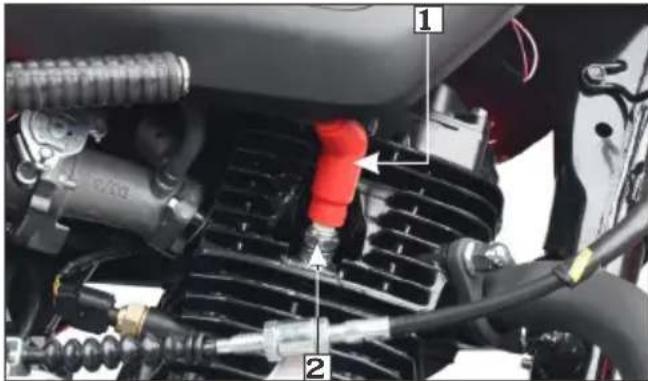
(1) Noise suppressor cap
(2) Spark plug
- Visually inspect the spark plug electrodes for wear. The center electrode should have square edges and the side electrode should not be eroded. Discard the spark plug there is apparent wear or if the insulator is cracked or chipped.
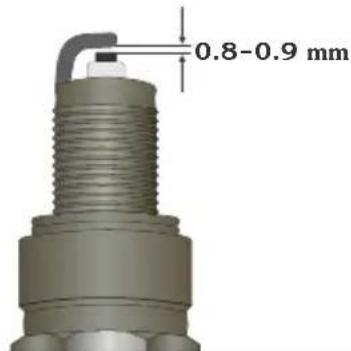
• Make sure that the spark plug gap is 0.8-0.9 mm using a wire-type feeler gauge. If adjustment is necessary, bend the side electrode carefully. Make sure the plug washer is in good condition.
- With the plug washer attached, thread the spark plug in by hand to prevent cross-threading.
- Tighten a new spark plug 1/2 turn with spark plug wrench to compress the washer. If you are reusing a plug, it should only take 1/8-1/4 turn after the plug seats.
!! CAUTION
- Do not remove the spark plug and test for spark on the vehicle by cranking the engine as this could lead to fire or explosion
• Install a dummy spark plug in the cylinder head and test for spark.
- Never use a spark plug with improper heat range.
Always use resistor type spark plug.
ENGINE OIL
Use hero genuine engine oil or recommended grade oil.
BRAND: Hero 4T plus GRADE: SAE 10W 30 SL Grade (JASO MA2).
Manufactured by:
• Tide Water Oil Co. (India) Ltd.
• Savita Oil Technologies Limited.
• Bharat Petroleum Corporation Limited.
OIL CAPACITY: 1.2 litres (disassembly) : 1.0 litre (at oil change)
BRAND: Hero 4T plus GRADE: SAE 5W 30 SN Grade (JASO MA2).
Manufactured by:
• Tide Water Oil Co. (India) Ltd.
- Castrol
Engine oil level inspection/Top up process
Check engine oil level each day before operating the vehicle. The oil level window (1) is on the right crankcase cover for measuring oil level. Oil level must be maintained between the MAX (2) and MIN (3) level marks.
Add the specified oil by removing the oil filler cap (4) and filling till the MAX level mark (2) Do not overfill.
- Do top up if oil level reaches towards the MIN level mark.
- Park the vehicle on its main stand.
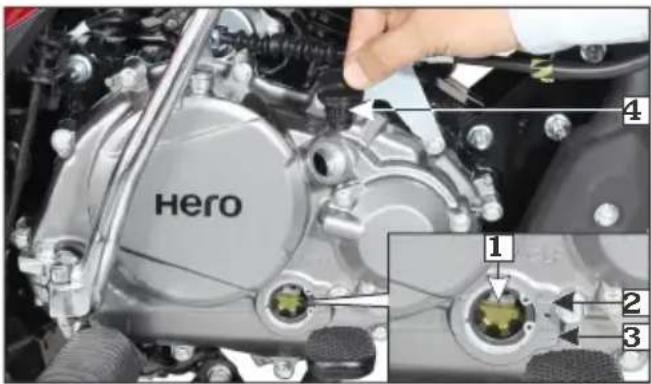
(1) Oil level window
(3) MIN level mark
(2) MAX level mark
(4) Oil filler cap
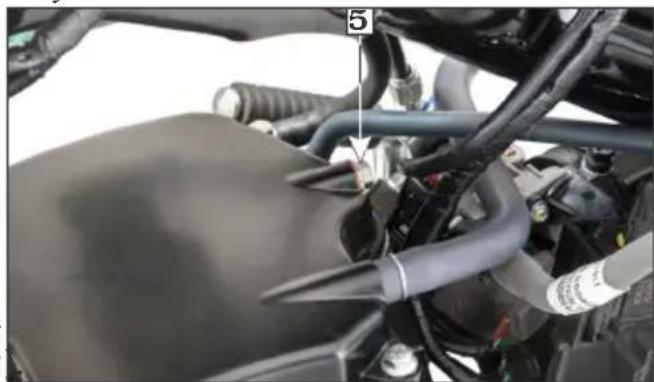
- Start the engine & let it idle for 3-5 minutes. - Slightly loosen the engine oil check bolt (5) and check the engine oil entry into the cylinder head.
natural_image
Close-up of a motorcycle's engine compartment showing hoses, springs, and exhaust pipe (no visible text or symbols)(5) Engine oil check bolt
• After checking the oil circulation, tighten the engine oil check bolt.

- Stop the engine and wait for 2-3 minutes.
- Check the oil level in the oil level window.
- If required, add the specified oil up to the MAX level mark. Do not overfill.
- Reinstall oil filler cap with new O-ring and check for oil leaks.
Engine oil replacement process/
Oil circulation inspection
- Start the engine, warm it up for several minutes and then turn it off.
- Wait for a few minutes until the oil settles down.
• To drain the oil, remove the oil filler cap (page 47), drain bolt (1) and sealing washer (2).
• After the oil has completely drained, reinstall the drain bolt with a new sealing washer.
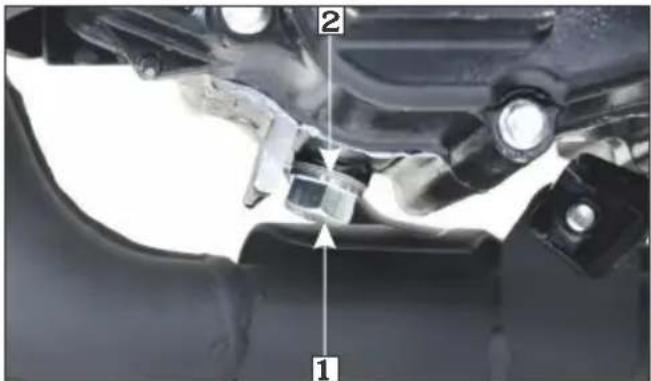
(1) Drain bolt
(2) Sealing washer
- Fill the crankcase through the oil filler hole with 1.0 litre (approximately) of the recommended grade oil as the right crankcase cover is not removed.
- Reinstall the oil level filler cap with a new O-ring.
- Start the engine and allow it to idle for few minutes.
Stop the engine, let the engine oil settle down and recheck the oil level. - Make sure that oil level is at the "MAX" level mark of the oil level window with the vehicle in an upright position and that there are no oil leaks.
!! CAUTION
- Running the engine with insufficient oil can cause serious engine damage.
- Running the engine with excessive oil can cause spark plug fouling & loss in performance.
• Engine oil is a major factor affecting the engine performance and lifespan. Non-detergent, vegetable or castor based racing oils are not recommended.
ENGINE OIL FILTER ELEMENT
NOTE
Drain the engine oil thoroughly (page 46) in case of engine oil filter element replacement.
- Remove the three mounting bolts (1).
- Remove the engine oil filter element cover (2) with O-ring (3).

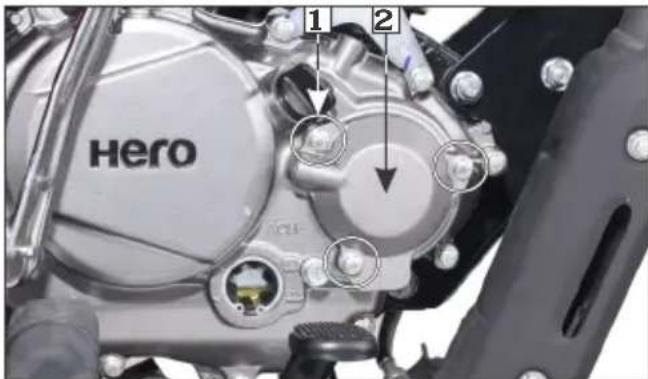
(1) Mounting bolts
(2) Engine oil filter element cover
- Remove the engine oil filter element (4) from the cover.
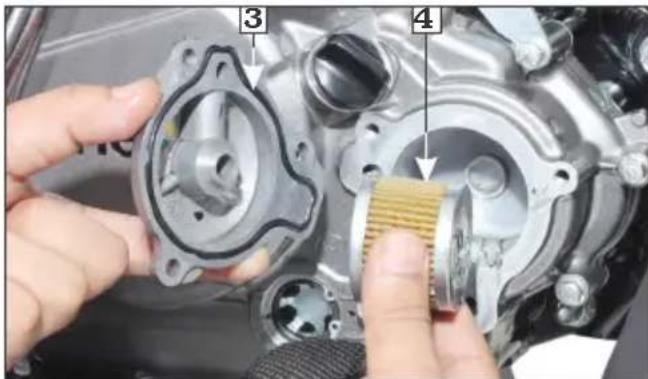
(3) O-ring
(4) Engine oil filter element
- Replace the engine oil filter element (4).
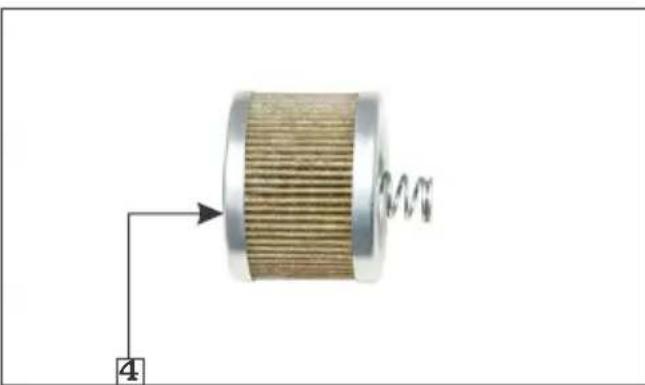
natural_image
Close-up of a cylindrical mechanical component with internal texture and a spring-like extension, connected by a wire (no text or symbols visible)(4) Engine oil filter element

NOTE
- When the engine oil filter element replaced, always replace the O-ring with the new one.
• Make sure that O-ring is properly seated. - Apply engine oil on engine oil filter element before installation.
- Inspect and replace engine oil filter element as specified in the maintenance schedule.
• Installation is in the reverse order of removal.
OIL FILTER SCREEN
Oil filter screen need to be cleaned periodically as per the maintenance schedule (page 43).
It is advised that you visit your Authorised Hero MotoCorp workshop for this type of service.

CAUTION
Must clean the strainer screen filter at 1st service and in every 12000 km.

AIR CLEANER
Air cleaner element inspection
The air cleaner is viscous paper pleated type filter which has enhances filtering efficiency. The air cleaner replaced should be at regular intervals When riding in dusty (page 43) areas, more frequent may be replacement necessary.
• .Remove the seat (page 33)
- Remove the air cleaner cover screws ( ) 1 and the cover ( ).2
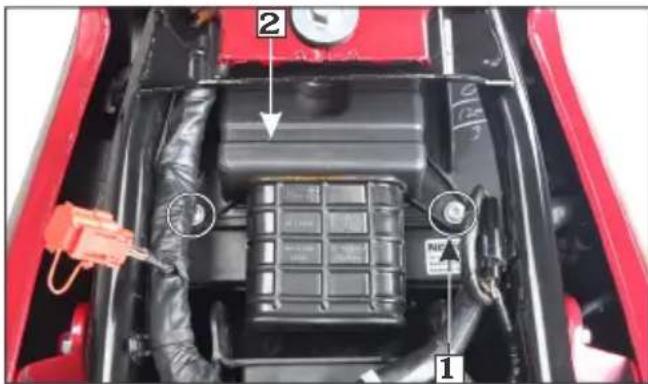
(1) Air cleaner cover screws (2) Cover
- Remove the air cleaner element (3).
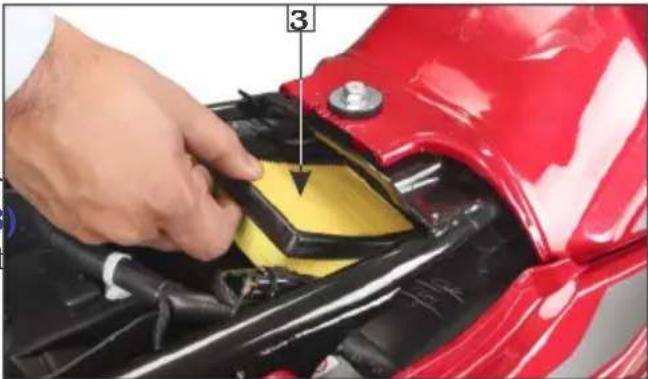
natural_image
Close-up of a hand using a tool to clean or repair a yellow object on a red car body (no text or symbols visible)(3) Air cleaner element
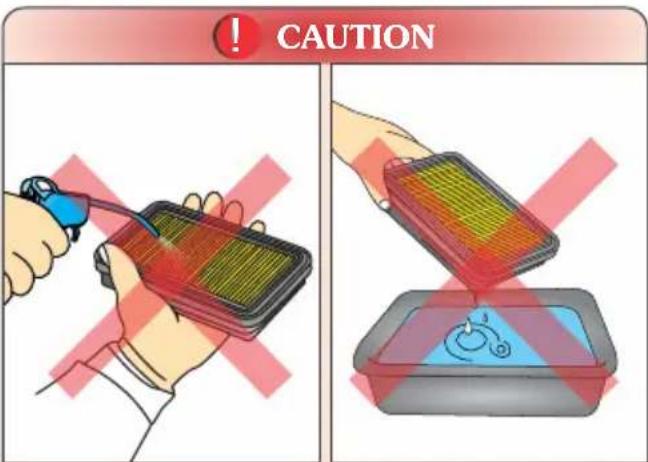
- Never wash or clean the viscous filter. Replace filter element once in every 18000 km.
- Replace it earlier if the air cleaner:
- Becomes very dirty.
- Gets damaged on the surface.
• Sealing area gets damaged.

NOTE
Align the tabs of air cleaner cover before installing screws & the cover.
- Clean the air cleaner housing using a shop towel.
• Install the new air cleaner element.
• Install the air cleaner element cover.
• Install the seat .(page 33)
Air cleaner drain tube plug cleaning
Remove the drain tube (1) and drain th deposit into a container.
Follow the above process more frequently when riding in rain or at full throttle.
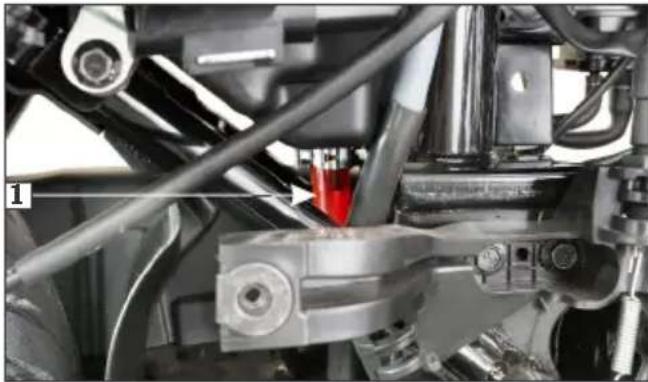
natural_image
Close-up mechanical assembly showing springs, levers, and suspension components (no visible text or symbols)(1) Drain tube
VALVE CLEARANCE ADJUSTMENT
Engine valve clearance changes with use, which may result in improper air-fuel mixture and/or engine noise. To prevent this, the valve clearance must be adjusted at Authorised Hero MotoCorp workshop at the intervals specified in the maintenance schedule (page 43).

NOTE
The checking or adjusting of valve clearance should be performed while the engine is cold. The clearance will change as the engine temperature rises.
- Customer can visit Authorised Hero MotoCorp workshop in case tappet noise observed before 6000 km.
Clutch adjustment may be required if the vehicle stalls when shifting into gear or tends to creep or if the clutch slips, causing acceleration to lag behind engine speed.
Normal clutch lever free play (1) is 10-20 mm at the lever (2).
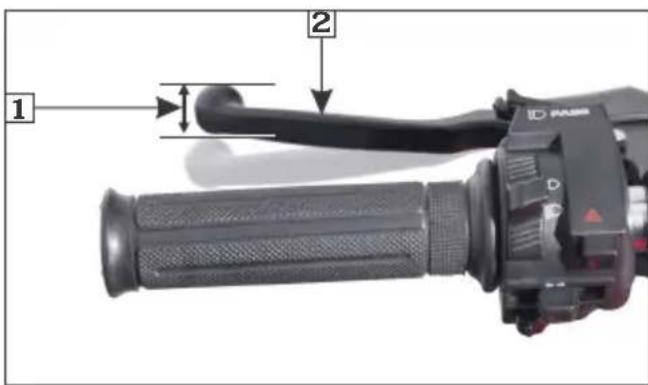
(1) Free play: 10-20 mm (2) Clutch lever
- To adjust the free play, loosen the lock nut (3). Turn the adjusting nut (4) to obtain the specified free play. Tighten the lock nut and check the adjustment.
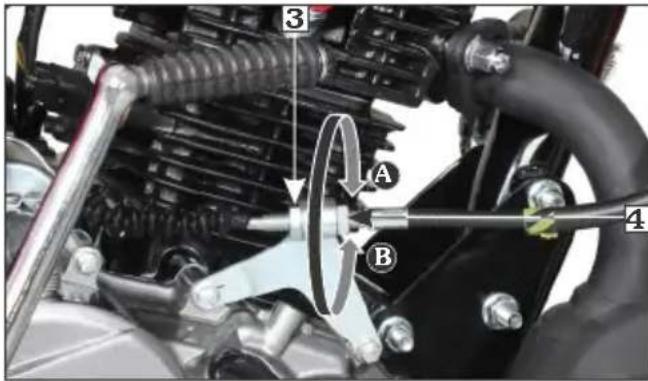
(3) Lock nut (4) Clutch cable adjusting nut (A) Decrease free play (B) Increase free play
- Start the engine, press the clutch lever and shift into gear. Make sure the engine does not stall, and vehicle does not creep. Gradually release the clutch lever and open the throttle. The vehicle should start smoothly and accelerate.
Other checks
- Check the clutch cable for kinks or signs of wear that could cause sticking or failure.
- Check for clutch cable model. Use genuine clutch cables.
- Check for clutch cable routing.

NOTE
If proper adjustment cannot be obtained or the clutch does not work correctly, visit your Authorised workshop. Hero MotoCorp
THROTTLE OPERATION
Cable inspection
Check for smooth rotation of the throttle grip from the fully open to the fully closed position. Check at full left and full right steering positions. Inspect the condition of the throttle cable from the throttle grip down to the throttle body. If the cable is kinked, chafed or improperly routed, it should be replaced or rerouted. Standard throttle grip free play (1) is approximately 2-6 mm of grip rotation.

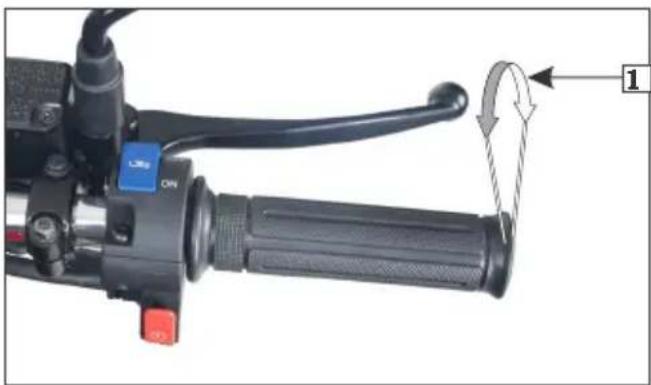
natural_image
Close-up of a hand crank with a blue control switch and red buttons, showing a curved arrow indicating motion (no text or symbols present)(1) Free play: 2-6 mm
Free play adjustment (a) At handlebar side
To adjust the free play, slide the boot (2), loosen the lock nut (3) and turn the adjuster (4) to adjust free play. After adjustment, tighten the lock nut and slide the boot on the adjuster and lock nut securely.
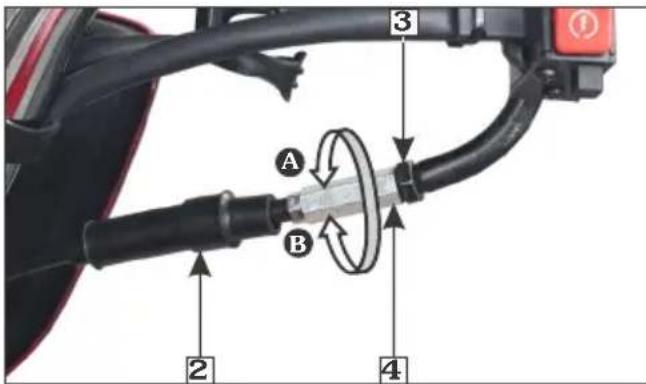
(2) Boot
(3) Lock nut
(4) Adjuster
(A) Decrease free play
(B) Increase free play
If the specified free play is not achieved, adjust the free play on throttle body side.
(b) At throttle body side
Remove the right side cover.
Loosen the lock nut (5). Turn the adjusting nut (6) to obtain the specified free play. Tighten the lock nut and check the adjustment.
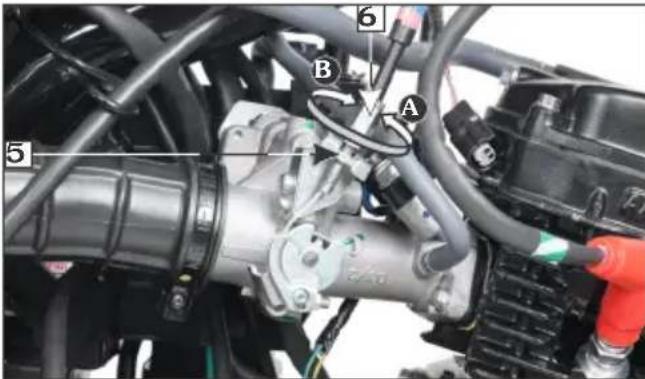
(5) Lock nut
(6) Adjuster
(A) Decrease free play
(B) Increase free play
DRIVE CHAIN SLACKNESS
The service life of the drive chain depends upon proper lubrication and adjustment. Poor maintenance can cause premature wear or damage to the drive chain and sprockets. The drive chain (1) should be checked and lubricated as part of the pre-ride inspection (page 35). Under severe usage, or when the vehicle is ridden in unusually dusty areas. more frequent maintenance will be necessary.
Inspection
- Turn the engine "OFF", park the vehicle on its main stand and shift the transmission to neutral. Remove hole cap (2).
- Drive chain slack (3) should be adjusted to allow approximately 30 mm vertical movement by hand.
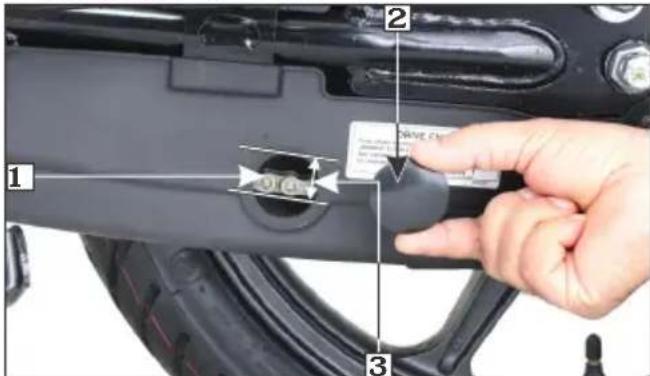
(1) Drive chain (2) Hole cap (3) Drive chain slack : 30 mm
Rotate rear wheel slowly in reverse direction and check drive chain slack as the wheel rotates. Drive chain slack should remain constant as the wheel rotates.
If the chain is slack in one section and tight in another, some links are kinked and binding. Binding can be eliminated by frequent lubrication.
- Turn the chain to view chain lock plate (4) inside the hole. Ensure that the chain lock plate open end (5) is installed in the opposite direction of the chain rotation.
- If the drive chain or sprockets are excessively worn or damaged, they should be replaced. Never use a new chain with worn out sprockets since this will result in rapid chain wear.
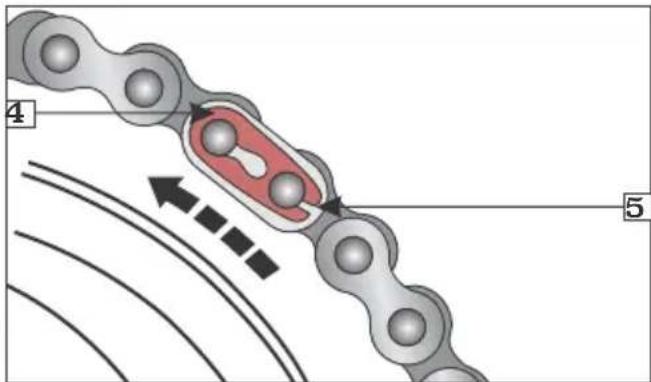
(4) Chain lock plate (5) Open end
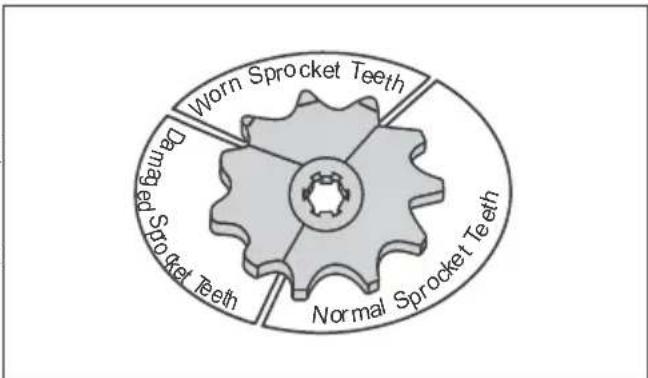
Adjustment
- Park the vehicle on its main stand with the transmission in neutral and the ignition switch in "OFF" (☒) position.
- Loosen the rear axle nut (1) and sleeve nut (2). Loosen both the drive chain lock nuts (3).
- Turn both the adjusting nuts (4) in an equal number of turns until the correct drive chain slack is obtained. Turn the adjusting nut clockwise to decrease the slack or anticlockwise to increase the slack of the chain.
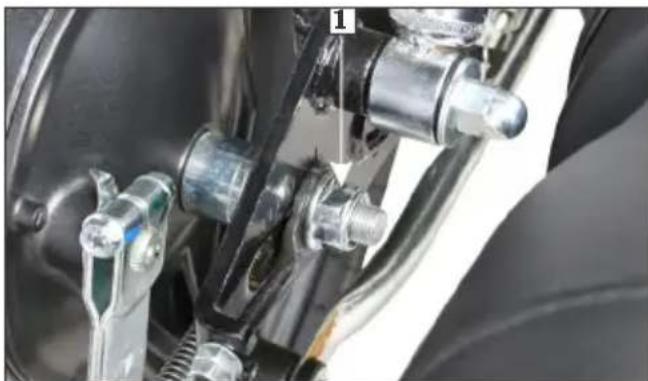
natural_image
Close-up of mechanical components with metallic fittings and a labeled component (no readable text or symbols)(1) Rear axle nut
- Align the chain adjuster index mark (5) with the corresponding scale graduations (6) on both the sides of the swing arm equally.
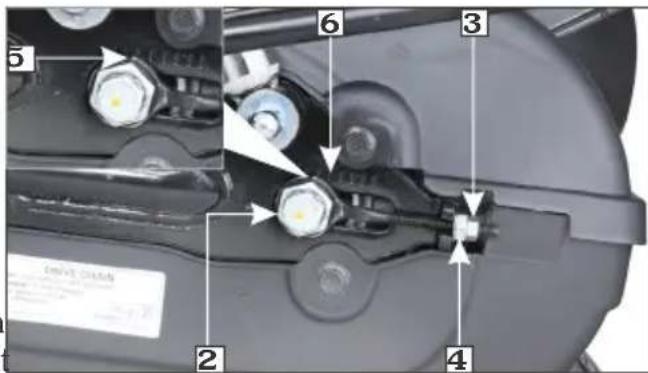
(2) Sleeve nut (3) Drive chain lock nut (4) Drive chain adjusting nut (5) Index mark (6) Scale graduation
- If the drive chain slack is excessive when the rear axle is moved to the farthest limit of adjustment, the drive chain is worn and must be replaced. Tighten the rear axle nut and sleeve nut.
- Rear axle nut torque: 5.2 kgf-m.
- Sleeve nut torque: 4.2 kgf-m.
- Check the drive chain slack again.
- Rear brake pedal free play and stop lamp switch free play are affected when repositioning the rear wheel to adjust drive chain slack. Check rear brake pedal free play and adjust as necessary (page 59).
Lubrication
- Turn the engine "OFF", park the vehicle on its main stand and shift the transmission into neutral.
- Lubricate the drive chain by applying liberal amount of SAE#90 oil.

!! CAUTION
Regular adjustment and lubrication as per the maintenance schedule would ensure high performance and longer life.
NOTE
Visit Authorised Hero MotoCorp workshop for inspection, cleaning, lubrication and adjustment of drive chain at every 2000 km.
DRIVE CHAIN SLIDER INSPECTION
(Refer to "Maintenance Schedule" on (page 43).
Check the drive chain slider (1) for wear, the chain slider must be replaced if it is worn to the bottom of the cutout or wear limit (2) reached. For replacement, visit your Authorised Hero MotoCorp workshop.
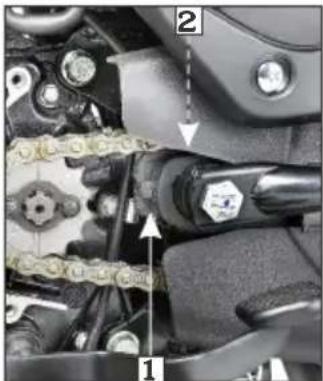
natural_image
Close-up mechanical assembly showing chain links and gear components (no visible text or symbols)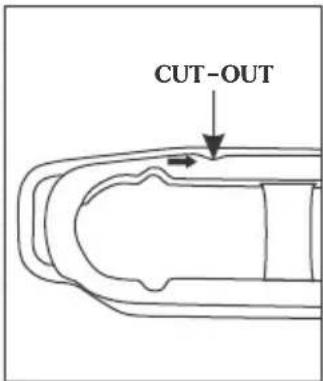
(1) Drive chain slider
(2) Wear limit
BRAKES
Brakes (Integrated braking system)
Brakes are items of personal safety and should always be maintained with proper adjustments. When one applies the Integrated/Rear brake pedal, front & rear brakes activate jointly.
(a) Front brake inspection (Disc) variant Master Cylinder/Reservoir.
Location: Right handlebar.
Brake fluid recommended: DoT 3 or DoT 4 Fluid level-Ensure that the brake fluid level does not fall below "MIN" mark (1) on the master cylinder, when checked with the master cylinder parallel to the ground. The level decreases gradually due to piston movement to compensate for pad wear. If the level decreases abruptly, check for leakage in the brake system and contact your Authorised Hero MoroCorp workshop.
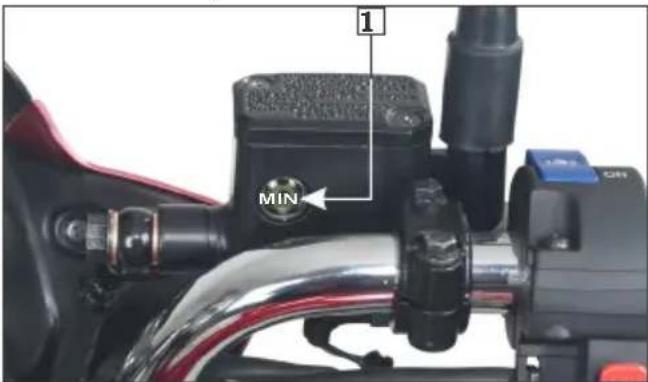
(1) "MIN" mark

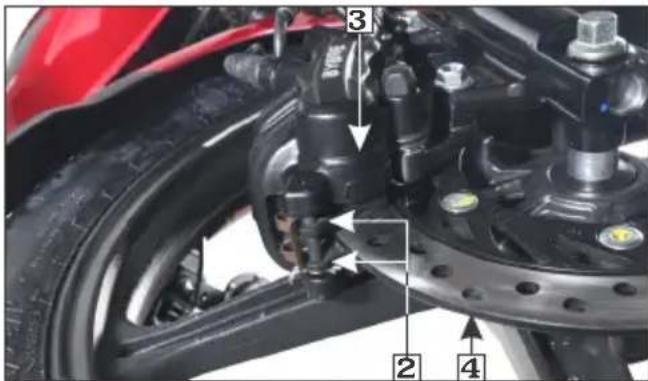
(2) Brake pads
(3) Caliper
(4) Disc

NOTE
- Clean the dirt and mud accumulation between the brake pads (2), caliper (3) and the disc (4) using a water jet.
• Always contact your Authorised Hero MoroCorp workshop for refilling of master cylinder when necessary. Do not mix DoT and DoT 4 brake fluid.
(b) Rear brake fluid (Disc variant)
Refer to the safety precautions on ).(page 4) Reservoir (1)
Location : Near the right side pillion footrest.
Brake fluid recommended :
DoT-4/DoT-3.
Fluid level – Ensure that the brake fluid level, does not fall below "MIN" mark (2) on the reservoir parallel to the ground. The level decreases gradually due to piston movement to compensate for pad wear. If the level decreases abruptly, check for the leakages in the brake system and consult your Authorised Hero MoroCorp workshop.
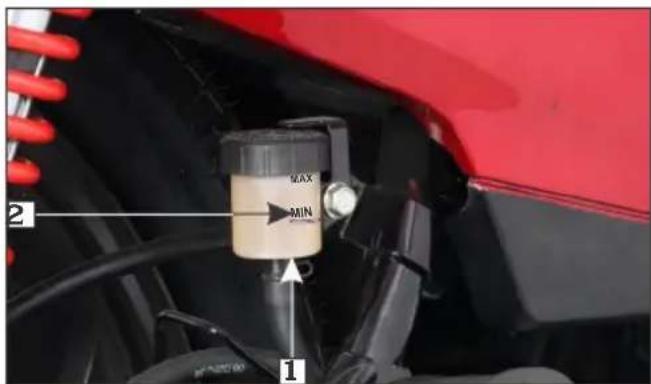
(1) Reservoir
(2) "MIN" mark
(c) Brake pad wear (Disc variant)
Brake pad wear depends upon the severity of usage, the type of riding & road conditions. Generally, the pads will wear faster on wet & dirty roads. Inspect the pads at each regular maintenance interval.
Inspection
- Check the wear indicator grooves (1) on each pad.
- Check the brake pads for wear by examining the wear limit grooves on each pad.
- Replace the pads if worn out to the bottom of the groove.
• Always replace both the pads as a set.
- Visit your Authorised Hero MoroCorp workshop for the brake pad replacement.

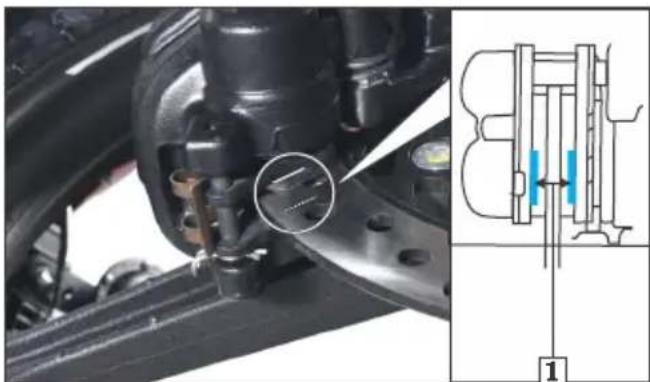
natural_image
Mechanical assembly diagram showing a car wheel and brake system with a magnified inset of the internal components (no text or symbols)(1) Wear indicator groove
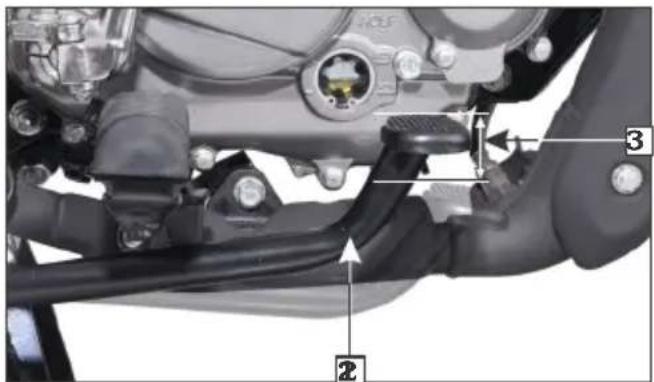
(2) Integrated/Rear brake pedal
(3) Free play: 20-30 mm
!! WARNING
Always apply front and rear brakes simultaneously to avoid skidding of vehicle.
(d) Front brake inspection (Drum variant) The distance, the front brake lever (1) and integrated brake pedal (2) moves before each brake starts to engage is called free play (3).
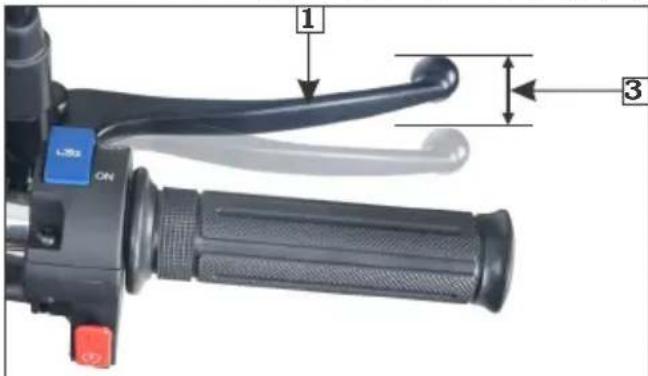
(1) Front brake lever
(3) Free play: 10-20 mm
Front brake cable (A) on "F" side Adjustment
- Push the integrated brake arm (4) by hand in the direction as shown.
- Turn the first adjuster nut (5) till you cannot turn it by hand.
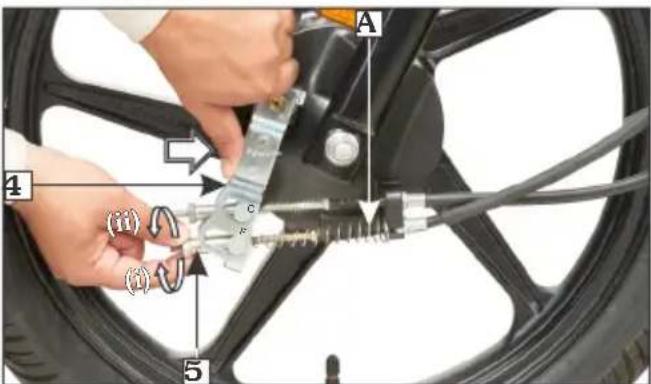
(4) Integrated brake arm (5) First adjuster nut (i) Decrease free play (ii) Increase free play

- Check the free play of front brake lever.
FREE PLAY: 10-20 mm
- If the free play is out specification turn the adjuster nut to obtain desired free play.
Integrated brake cable (B) on "C" side Adjustment
- Push the integrated brake arm (4) by hand in the direction as shown.
- Turn the second adjuster nut (6) until a gap is created between joint (7) and the slot on the first side in integrated brake arm.
• After ensuring the gap, turn the second adjuster nut counterclockwise by half rotation. - Check the free play of rear brake pedal. FREE PLAY: 20-30 mm
- If the free play is out specification turn the adjuster nut to obtain desired free play.
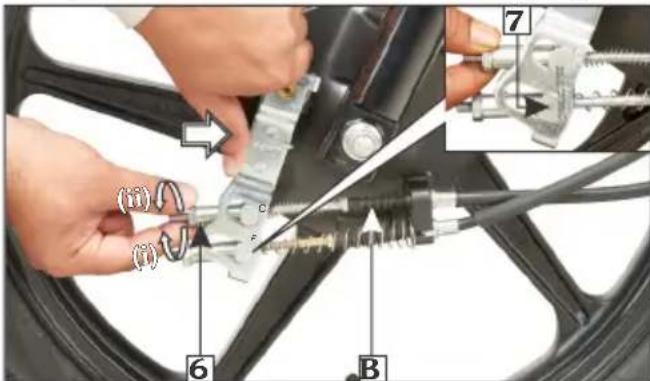
(6) Second adjuster nut
(7) Joint
(ii) Increase free play
(i) Decrease free play

NOTE
"F" & "C" is marked on integrated brake arm.
(e) Rear brake inspection Adjustment
- Park the vehicle on its main stand. - Measure the brake pedal (1) free play before the brake starts to take hold. - Free play (2) should be 20-30 mm.
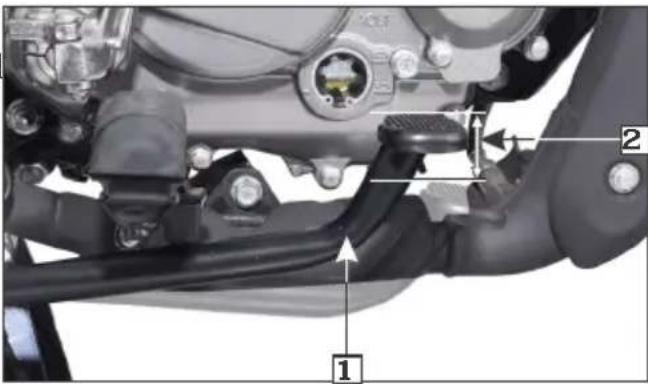
(1) Integrated/Rear brake pedal (2) Free play: 20-30 mm
- If adjustment is necessary, turn the rear brake adjusting nut (3).
- Make sure that the cut-out on the adjusting nut is seated on the brake joint pin (4) after the final adjustment has been made.
- Apply the brake several times and check for free wheel rotation when released.
CW- Clockwise, ACW- Anticlockwise

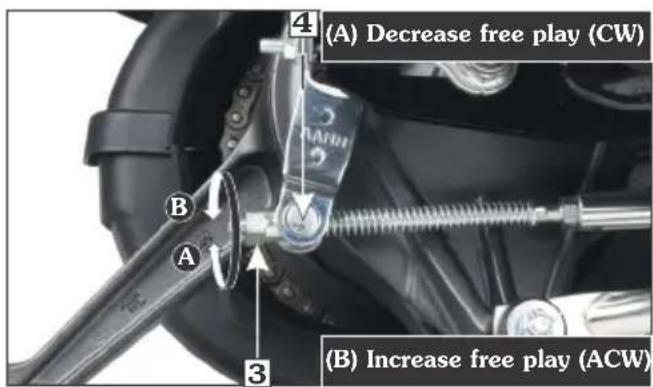
(4) Brake joint pin
(3) Adjusting nut
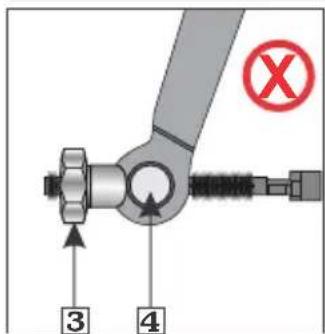
(A) Cut-out not seated (B)
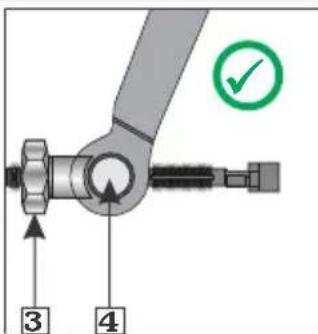
Cut-out seated
(3) Adjusting nut
(4) Brake joint pin

NOTE
If proper adjustment cannot be obtained by this method, visit your Authorised Hero MotoCorp workshop.
(f) Brake wear indicators
When the brake is applied, an arrow (1), fixed to the brake arm (2), moves towards a reference mark (3) on the brake panel (4).
If the arrow aligns with the reference mark on full application of the brake, the brake shoes must be replaced.
Front brake wear indication
( )Drum variant
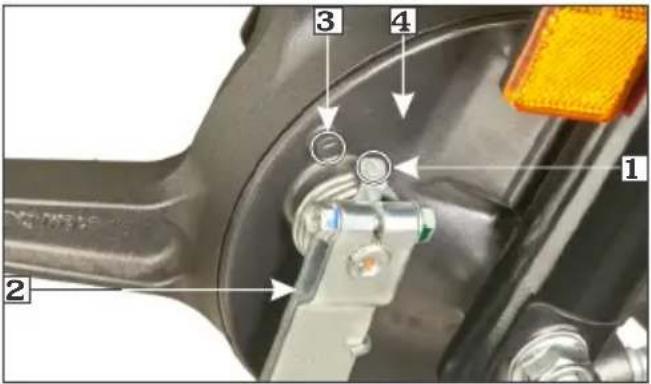
(1) Arrow
(2) Brake arm
(3) Reference mark
(4) Brake panel
Rear brake wear indication
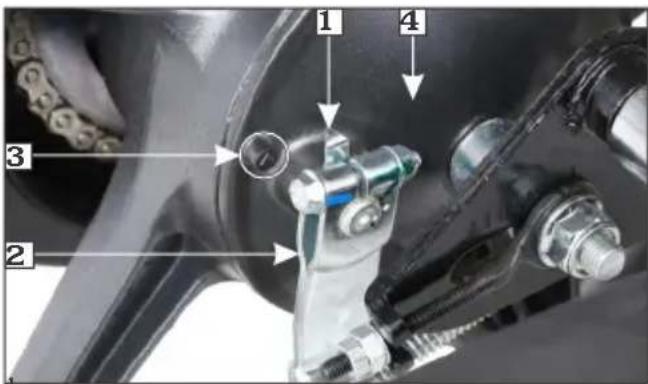
(1) Arrow
(2) Brake arm
(3) Reference mark
(4) Brake panel

SUSPENSION
Front and rear suspension inspection
- Check the front forks by locking the front brake and pumping the front fork up and down vigorously. The suspension action should be smooth and there should be no oil leakage.
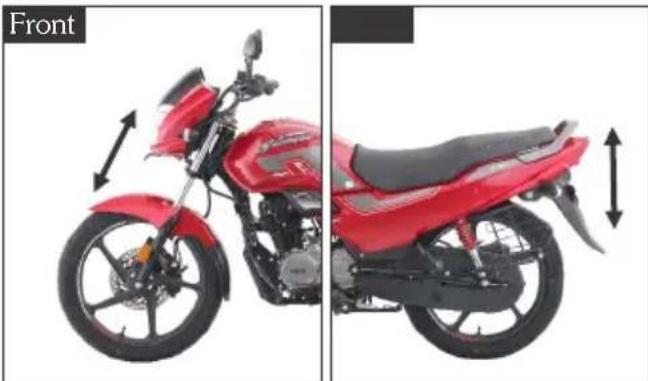
natural_image
Side-by-side comparison of a red motorcycle front view and side profile, showing front and side views with no text or symbols.- Check the rear shock absorber by pushing hard downwards on rear grip while the vehicle is not parked on stand. The suspension action should be smooth and there should be no oil leakage.
Rear shock absorber adjustment
Rear shock absorber adjustment can be made in any position from 1st to 5th according to the load/road conditions or owner's requirement.
Recommended adjustment
- Solo rider: 2nd position
• Rider + Pillion: 5th position
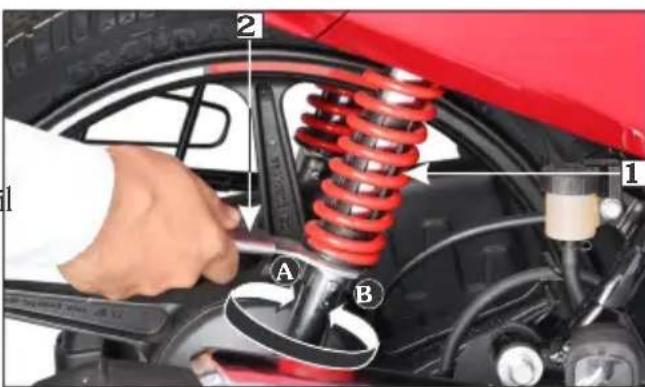
(1) Rear shock absorber
(A) Stiffer
(2) Pin spanner
(B) Softer
• In direction A: Stiffer
• In direction B: Softer

NOTE
Always adjust both the rear shock absorbers to the same position. To adjust the rear shock absorber (1), use the rear shock absorber adjustment tool (Pin spanner) (2) available in the tool kit.
WHEEL
(a) Front wheel (Disc variant)
Removal
- Support the vehicle securely on the main stand and raise the front wheel off the ground.
- Remove the front axle nut (1).
- Remove the axle (2) and the wheel (3).

- Remove the side collar (4) from the right side of the wheel hub.
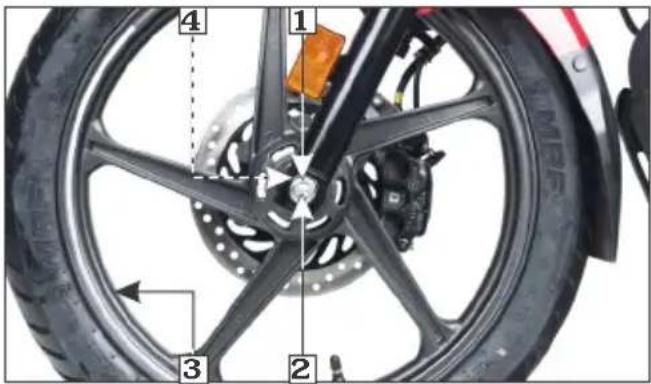
(1) Axle nut
(2) Axle
(3) Wheel
(4) Side collar
!! CAUTION
Do not operate front brake lever when the wheel is removed.
Installation
• Install the side collars (1) to both sides of the wheel hub.
- Position the front wheel between the fork legs by aligning the slot with lug on the fork leg and the disc between the brake pads to avoid damage to the pads. Insert the axle from the right side through the fork legs and wheel hub.
- Tighten the front axle nut to the specified torque.
TORQUE : 5.2 kgf-m
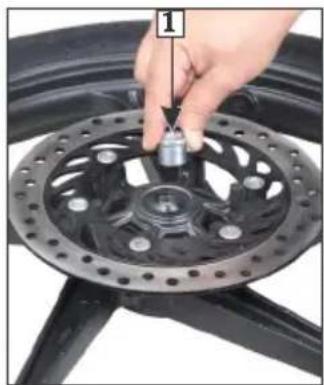
natural_image
Close-up of a hand adjusting a black brake disc with a small component, no visible text or symbols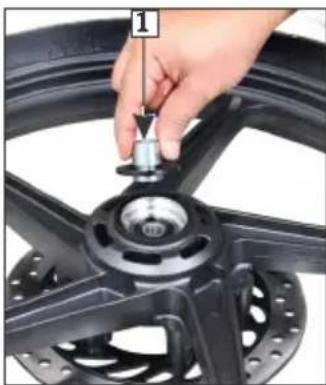
natural_image
Close-up of a hand adjusting a black bicycle wheel rim with a small component (no text or symbols visible)(1) Side collar
• After installing the wheel apply the brake several times and then check if the wheel rotates freely. Recheck the wheel if the brake drags or if the wheel does not rotate freely.
(b) Front wheel ( )Drum variant Removal
- Support the vehicle securely on the main stand and raise the front wheel off the ground.
Disconnect the front brake cable (1) and integrated brake cable (2) from the integrated brake arm (3) and brake panel (4) by removing the front brake adjusting nut (5) and integrated brake adjusting nut (6).
- Remove the axle nut (7).
- Remove the axle (8) and side collar (9).
- Remove the wheel.
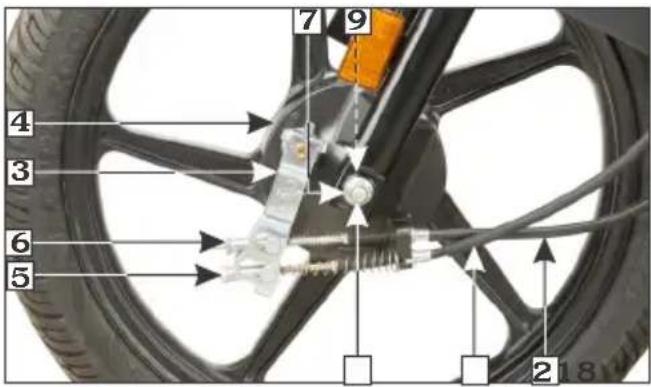
(1) Front brake cable (2) Integrated brake cable
(3) Brake arm (4) Brake panel
(5) Front brake adjusting nut
(6) Integrated brake adjusting nut
(7) Axle nut (8) Axle (9) Side collar
Installation
- Reverse the removal procedure.
• Install the front wheel by ensuring that the lug (10) on the left fork is located in the s (11) in the brake panel. - Tighten the axle nut. Axle nut torque: 5.2 kgf-m
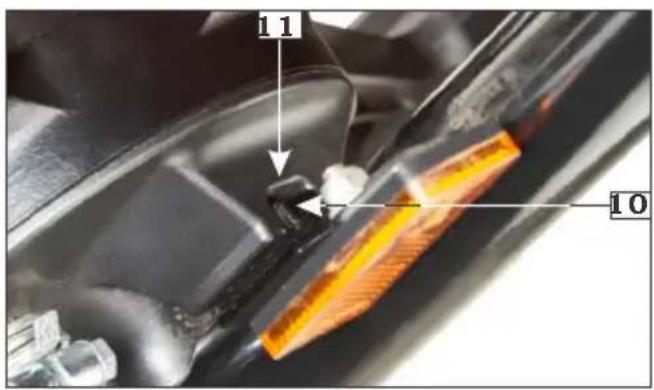
(10) Lug (11) Slot
- Adjust the front brake free play and integrated brake free play (page 58 & le 59).
• After installing wheel, apply the brake several times and check for free wheel rotation when released.
(c) Rear wheel
Removal
- Support the vehicle securely on the main stand and raise the rear wheel off the pot ground.
- Remove the rear brake adjusting nut (1) and disconnect the brake rod (2) from the brake arm (3) by pushing down the brake pedal. Disconnect the brake stopper arm (4) from the brake panel (5) by removing split pin (6), lock nut (7) and washer (8).

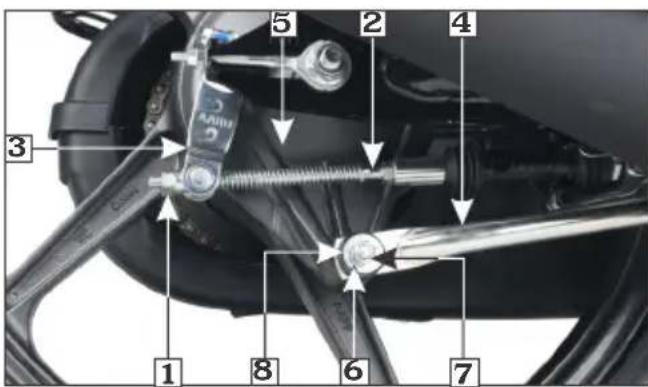
(1) Rear brake adjusting nut (2) Brake rod
(3) Brake arm (4) Brake stopper arm
(5) Brake panel (6) Split pin (7) Lock nut
(8) Washer
- Remove the rear axle nut (9).
- Pull out the axle (10) and collar (11).
- Remove the wheel.
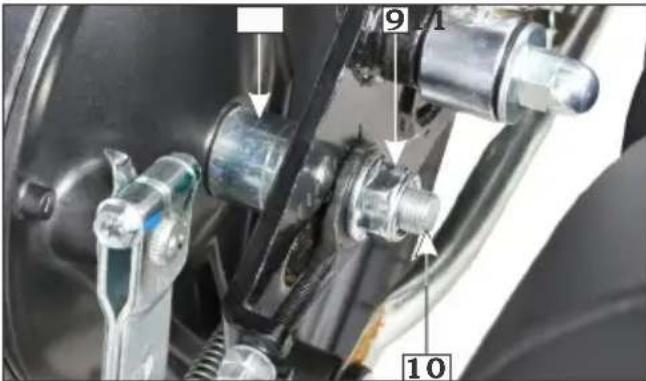
(9) Axle nut (10) Axle (11) Collar
Installation
- Reverse the removal procedure. Axle nut torque: 5.2 kgf-m
Brake stopper arm nut torque: 2.2 kgf-m
- Adjust the rear brake free play (page 59) and drive chain slackness .(page 53)
• After installing the wheel, apply the brake several times and check for free wheel rotation when released.
!! CAUTION
Always replace used split pins with new ones.
• Park the vehicle on a level surface.
- Check the main/side stand return spring for damage or loss of tension.
- Check the main stand (1)/side stand (2) for freedom of movement.
- Clean and lubricate the side stand pivot bolt (3) and rear brake pedal/main stand pivot (4).
• Make sure the side/main stand is not bent.
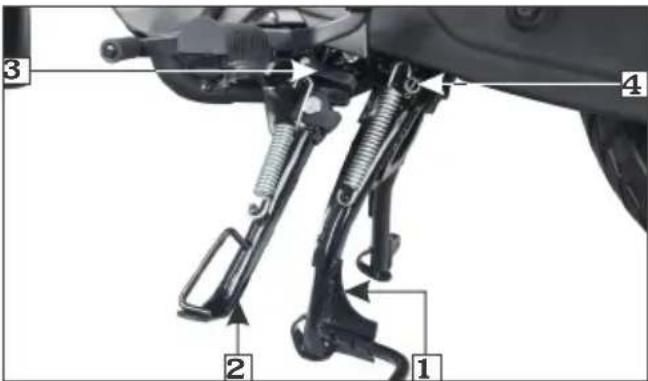
(1) Main stand (2) Side stand
(3) Side stand pivot bolt
(4) Rear brake pedal/Main stand pivot

TUBELESS TYRES
The tyres fitted on your vehicle are of TUBELESS type.
To safely operate your vehicle, your tyres must be of the proper type and size, in good condition with adequate tread, and correctly inflated for the load you are carrying.
The following pages give more detailed information on how and when to check the air pressure, how to inspect your tyres for damage, and what to do when your tyres need to be repaired or replaced.
| Front | 80/100-18 47P (Tubeless tyre) |
| Rear | 90/90-18 51P (Tubeless tyre) |
WARNING
• Using tyres that are excessively worn or improperly inflated can cause a crash in which you can be seriously hurt or killed.
- Follow all instructions in this owner's manual regarding tyres inflation and maintenance.
Air pressure
Keeping your tyres properly inflated provides the best combination of handling, tread life and riding comfort.
Generally, under-inflated tyres wear unevenly, adversely affect handling and are more likely to fail from being overheated.
Under inflated tyres can also cause whee damage in rocky terrain.
Over-inflated tyres make your vehicle ride harshly, are more prone to damage from road hazards, and wear unevenly.
We recommend that you visually check your tyres before every ride and use an air pressure gauge (1) to measure air pressure at least once a month or any time you think the tyres pressure might be low.
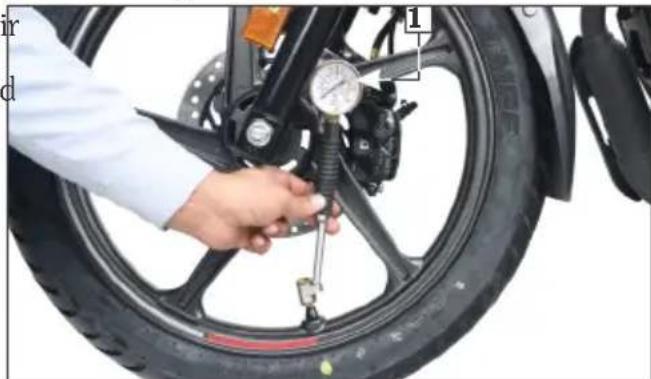
natural_image
Close-up of a hand adjusting the wheel of a motorcycle with a pressure gauge and valve (no visible text or symbols)(1) Air pressure gauge
Tubeless tyres have some self-sealing ability if they are punctured. However, because leakage is often very slow, you should look closely for punctures whenever a tyre is not fully inflated. Always check air pressure when your tyres are "cold"-when the vehicle has been parked for at least three hours. If you check air pressure 'when your tyres are "warm"-when the vehicle has been ridden for even a few km-the readings will be higher than if the tyres were "cold". This is normal, so do not let air out of the tyres to match the recommended cold air
pressures given below. If you do, the tyres will• Excessive tread wear. be under-inflated.
The recommended "cold" tyre pressures are:
| Rider only Rider and Pillion | ||
| Front | 1.75 kgf/cm ^2 (25 psi) | 1.75 kgf/cm ^2 (25 psi) |
| Rear | 2.00 kgf/cm ^2 (29 psi) | 2.30 kgf/cm ^2 (33 psi) |
!! CAUTION
Over inflation/Under inflation will affect the performance.
Inspection
Whenever you check the tyre pressure, you should also examine tyre treads & side walls for wear, damage & foreign objects.
Look for:
- Bumps or bulges in the side of the tyre or the tread. Replace the tyre if you find any bumps or bulges.
- Cuts, splits or cracks in the tyre. Replace the tyre if you can see fabric or cord.
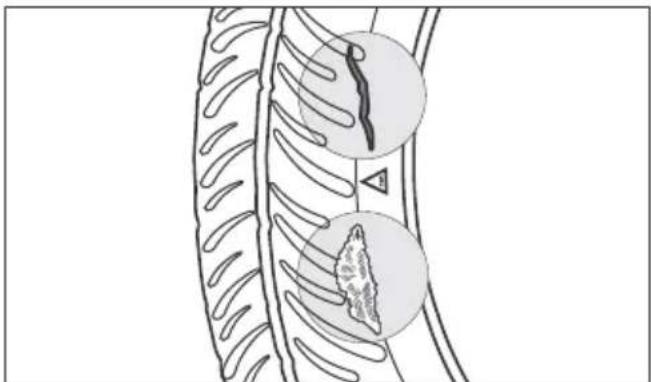
natural_image
Anatomical illustration of human upper thorax with visible spine, ribs, and lung fields (no text or labels)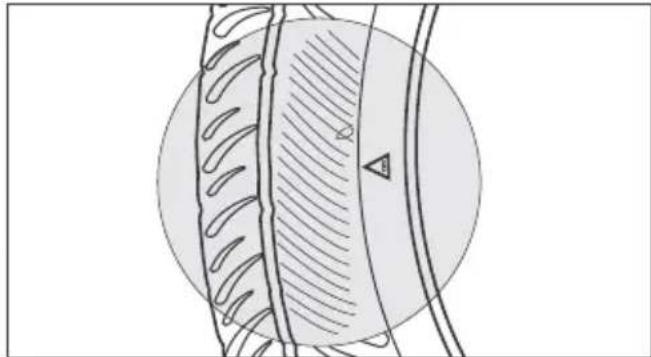
natural_image
Diagram of a biological structure with layered tissue and a central circular region, no text or symbols present- Carefully inspect the tyres for any damage, if the vehicle hits a pothole or hard object.
Tread earw
Replace tyres immediately when the tread wear indicator (1) appears on the tyre. The tread limits are:
MINIMUM TREAD DEPTH:
Front: 1.0 mm Rear: 1.0 mm Check the tread wear indicator for tyre wear.
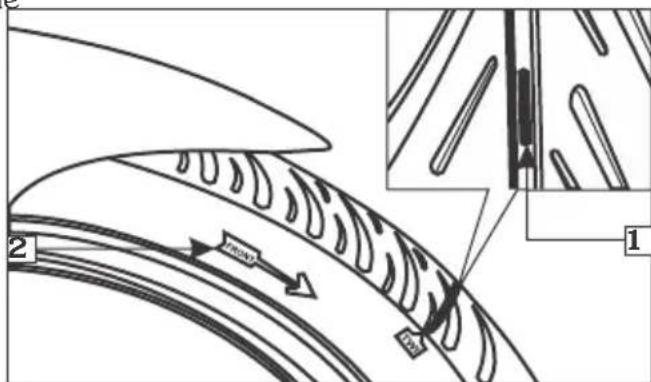
(1) Tread wear indicator (2) Arrow mark

Unidirectional tyres
Whenever the tyre is removed and put back in case of puncture, ensure the arrow mark (2) on the tyre is in the same direction as that of forward rotation of wheel.
Tyre repair
Repairing a puncture or removing a whee requires special tools and technical expertise. If a tyre is punctured or damaged, it is advised to visit nearest tyre manufacture, Hero MotoCorp authorised dealer/workshop or the tyre repair shop who has expertise in repairing methods of tubeless tyre.
A tyre that is repaired either temporarily or permanently, will have lower speed and performance limits than a new tyre. After an emergency repair, always have the tyre inspected/replaced at our authorised dealer and replace the tyre if suggested.
You should not exceed 70 km/hour for the 1st 24 hours or 105 km/hour at any time. In thereafter, In addition, you may not be able to safely carry as much load as with a new tyre. If you decide to have a tyre replace be sure the wheel is balanced before you ride.
Tyre replacement
The tyres that were installed on your vehicle were designed to match the performance capabilities of your vehicle and provide the best combination of handling, braking, durability and comfort.

WARNING
- Operation with excessively worn tyres is hazardous and will adversely affect traction and handling.
- Under-inflation may result in the tyre slipping on or tyre coming off the rim.
Always use the size and type of tyres recommended in this owner's manual.

NOTE
For repair and replacement of tyre it is advised to visit your Authorised Hero MotoCorp workshop.

NOTE
The imported tyre(s) if fitted without ISI mark; are in compliance of BIS standard and Central Motor Vehicle Rules 1989, as declared by the Tyre manufacturer.
Important safety reminders
- Do not install a tube inside a tubeless tyre on this vehicle. Excessive heat buildup can cause the tube to burst.
- Use only tubeless tyres on this vehicle. The rims are designed for tubeless tyres, and during hard acceleration or braking, a tube-type tyre could slip on the rim and cause the tyre to rapidly deflate.

NUTS, BOLTS & FASTENERS
- Tighten bolts and nuts at regular interval shown in the maintenance schedule.
- Check that all chassis nuts and bolts are tightened to correct torque values.
- Check that all cotter pins, safety clips, hose clamps and cable stays are in place.
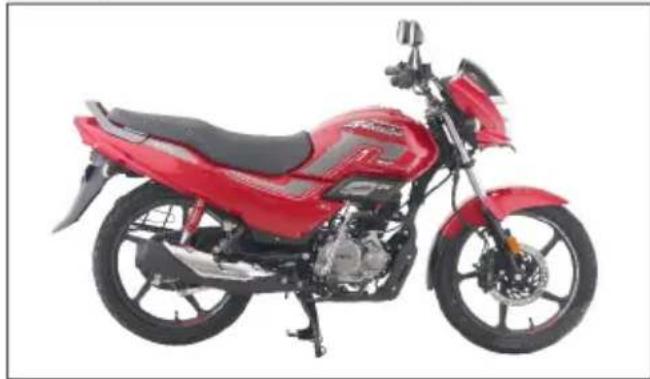
natural_image
Red and black motorcycle with visible engine and side stripes (no text or symbols)BATTERY
Refer to the safety precautions on .(page 42)
Location
The battery is located behind the left side cover.
Specification
*MF Battery 12V-4Ah/ETZ5
It is not necessary to check the battery electrolyte level or add distilled water as the battery is a Maintenance Free (sealed) type. If your battery seems weak and electrolyte is leaking (causing hard starting or other electrical troubles), contact your Authorised Hero MotoCorp workshop.
*MF stands for Maintenance Free

NOTE
This symbol on the battery means that this product must not be treated as household waste.

This symbol on the battery means the old battery must be returned to your Authorised Hero MotoCorp workshop as it must be treated as recyclable material.
- Battery is a Maintenance-Free (sealed) type and can be permanently damaged if the sealing strip is removed.
• An improperly disposed battery can be harmful to the environment and human health. Always confirm local regulations for battery disposal.
Battery charging
Always visit your Authorised Hero MotoCorp workshop if you see any symptom of battery discharge as earliest as possible to get the battery charged. The battery has a tendency to discharge rapidly if optional electrical accessories are fitted on the vehicle.
Battery storage
- If in case your vehicle is not used for more than a month remove the battery, fully charge and store in a cool and dry place.
If the battery is expected to be stored for more then two months, ensure to fully charge the battery once a month.
Always ensure the battery is fully charged before installation.

- Ensure the battery leads are properly connected to the battery terminals during installation.
Battery removal
•
FF"

- Remove the seat .(pages 33)
- Remove the left side cover screws (1) and remove the side cover (2) by releasing the tabs from the slots (3) and lugs from the grommets (4).
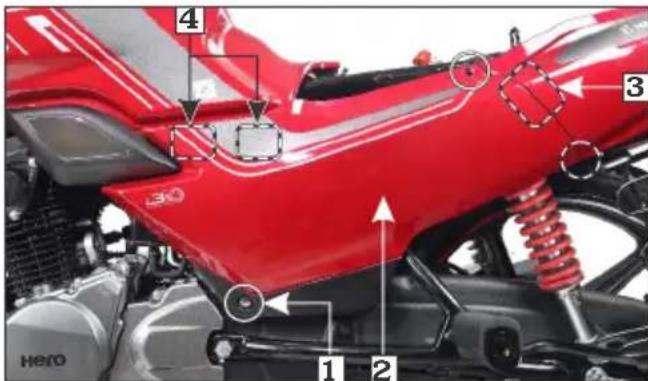
(1) Left side cover screws
(2) Side cover
(3) Tab/slot
(4) Lugs/grommets
- Remove the fuel tank left side cover bolt (5) and remove the cover (6) by releasing the tab (7) from the slot (8).
- Remove the battery clamp bolt (9) and the battery clamp (10).
- Disconnect the negative (-)ve terminal lead (11) from the battery first, then disconnect the positive (+)ve terminal lead (12).
- Pullout the battery (13) from the battery box.
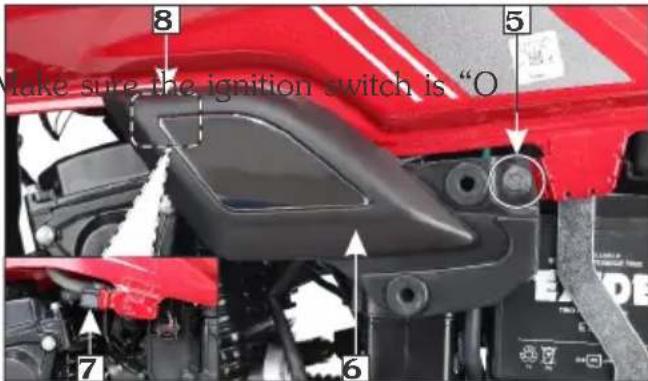
(5) Fuel tank left side cover bolt
(6) Fuel tank left side cover (7) Tab (8) Slot
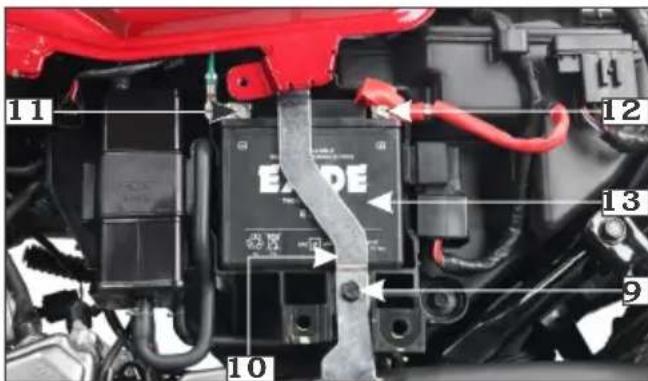
(9) Battery clamp bolt
(10) Battery clamp
(1 1) (-)ve terminal
(12) (+)ve terminal
(13) Battery
Battery installation
- Reinstall in the reverse order of removal. Be sure to connect the positive (+)ve terminal first, then the negative (-)ve terminal.
- Check all fasteners are secured properly.
FUSE REPLACEMENT
Fuse box (1): Location: Mounted on the air cleaner assembly (2) left hand side.
Fuse type: Blade fuse
Circuit fuse (3): 15A, 10Ax4 nos.
Spare fuse (4) : 15A, 10A
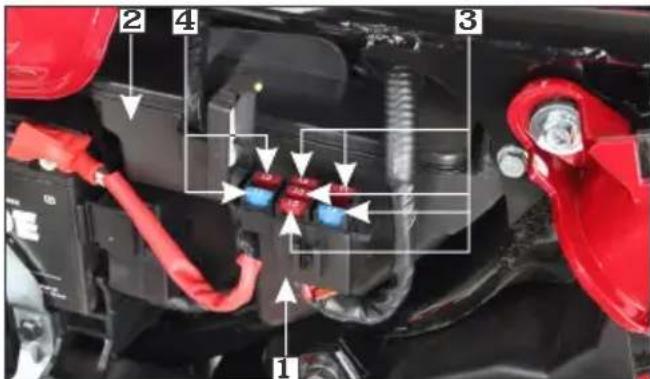
(1) Fuse box (2) Air cleaner assembly
(3) Circuit fuse: 15A, 10Ax4nos.
(4) Spare fuse: 15A, 10A
!! WARNING
Never use a fuse with a different rating from that specified. It may lead to serious damage to the electrical system or a fire due to short circuit.
GOOD FUSE
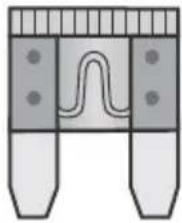
natural_image
Pure diagram of a mechanical component with no text, numbers, or symbolsBLOWN FUSE
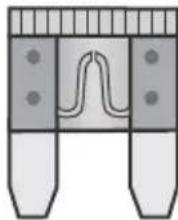
natural_image
Pure diagram of a mechanical component with no text, numbers, or symbols!! CAUTION
- Do not attempt to start or ride the vehicle without a charged battery, it can cause fusing of the bulbs and permanent damage to certain electrical components.
- Turn the ignition switch "OFF" before checking or replacing the fuse to prevent accidental short-circuiting.
STOP LAMP SWITCH
The stop lamp switch (1) must be adjusted so that stop lamp will glow when rear brake is applied. Rear brake free play (page 59) should be adjusted before performing stop lamp switch adjustment. The procedure for adjusting stop lamp switch is as follows:
- Turn the ignition switch to the "ON" ( ) position.
- Turn the adjusting nut (2) to position stop lamp switch at a point where the stop lamp will glow just before the brake pedal is depressed to the limit of its free play. Turn the adjusting nut in direction (A) to advance switch timing or in direction (B) to retard switch timing.
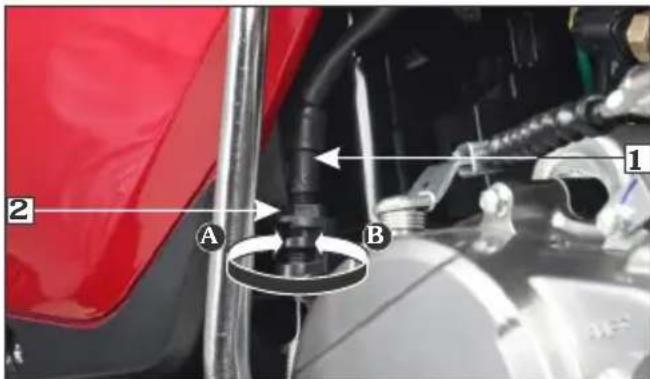
(1) Stop lamp switch (A) Advance
(2) Adjusting nut (B) Retard
HEADLAMP FOCUS ADJUSTMENT
Headlamp is factory preset. However in case of adjustment required, please follow the steps as given below:
- Headlamp adjustment is done by the headlamp adjusting bolt (1) located below headlamp.
- Park the vehicle on its level ground.
- Turn the ignition switch to "ON" (Ω) position and start the engine.
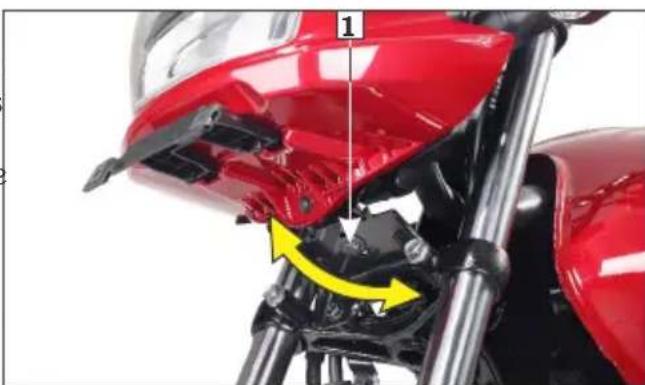
natural_image
Close-up of a red motorcycle's side panel showing mechanical components and a yellow directional arrow (no text or symbols)(1) Headlamp adjusting bolt
!! WARNING
An improperly adjust headlamp may blind oncoming rider/driver or it may fail to light the road for a safe distance.
CATALYTIC CONVERTER
This vehicle is equipped with the catalytic converter (1) in the muffler to meet the emission norms.
The catalytic converter contains precious metals that serve as catalysts, promoting chemical reactions to convert the exhaust gases without affecting the metals. The catalytic converter acts on HC, CO and NOx. The catalytic converter must operate at a high temperature for the chemical reactions to take place. It can set on fire any combustible material that comes near it. Park your vehicle away from high grasses, dry leaves, or other flammable material.
A defective catalytic converter contributes to air pollution and can impair your engine' performance.
Follow these guidelines to protect your vehicle's catalytic converter.
• Always use unleaded petrol. Even a small amount of leaded petrol can contaminate the catalyst metals, making the catalytic converter ineffective.
- Keep the engine in good running condition. A poorly running engine can cause the catalytic converter to overheat.
- If your engine is misfiring, backfiring, stalling, or otherwise not running properly, stop riding and turn "OFF" the engine. Have your vehicle serviced as soon as possible.
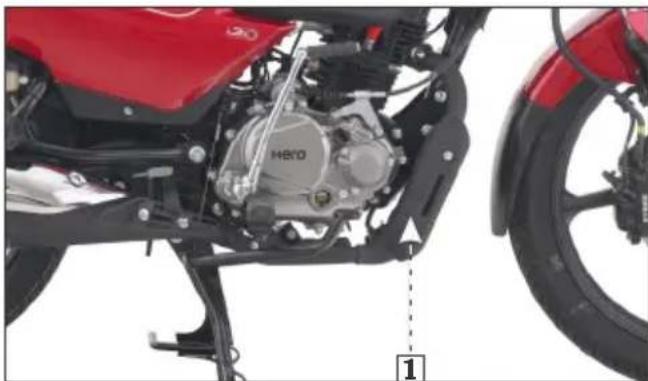
natural_image
Close-up of a red Honda motorcycle's engine and wheel assembly (no visible text or symbols)(1) Catalytic converter
EVAPORATIVE EMISSION CONTROL SYSTEM
This vehicle is equipped with an evaporative emission control system to meet emission standards. During warm weather, the petrol vapours which contain HC evaporates easily into the atmosphere from the fuel tank, if the fuel system is unsealed or open. The evaporative emission control system is used to prevent petrol vapours from escaping into the atmosphere from fuel tank.
The canister (1) collects the fuel vapour from the fuel tank, which gets drawn into the engine for combustion. This prevents pollution that would otherwise have been caused by diffusion of fuel vapour directly into the atmosphere.
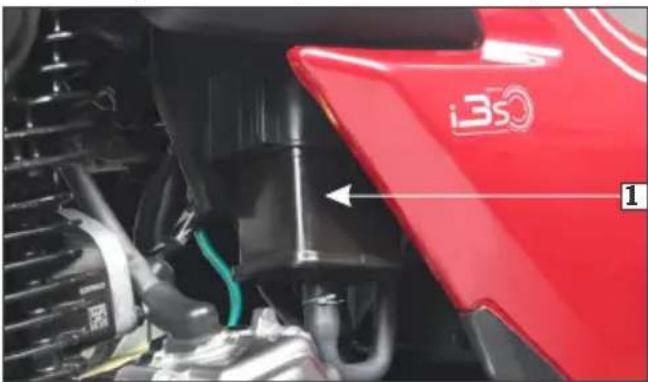
natural_image
Close-up of a red i350 motorcycle engine component with visible wiring and valve (no text or symbols)(1) Canister
POLISHING OF VEHICLE
After washing your vehicle, wax all painted surfaces (except matte painted surfaces) using a commercially available polish/quality liquid or paste wax to finish the job. Use only a non abrasive polish or wax made specifically for automobiles. Apply the polish or wax according to the instructions on the container.

NOTE
Polishing or waxing is not applicable for models having matte paint.
BASIC TROUBLESHOOTING
- STARTING TROUBLE - ENGINE DOES NOT START
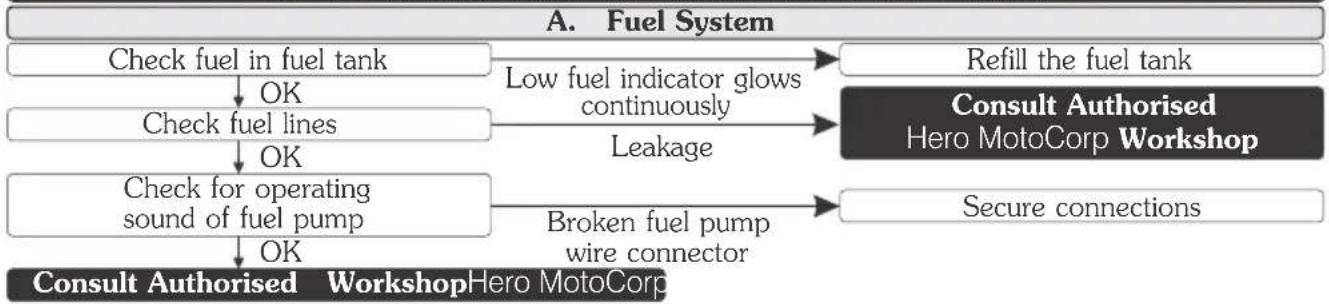
flowchart
graph TD
    A["Check fuel in fuel tank"] -->|OK| B["Check fuel lines"]
    B -->|OK| C["Check for operating sound of fuel pump"]
    C -->|OK| D["Consult Authorised WorkshopHero MotoCorp"]
    A -->|Low fuel indicator glows continuously| E["Refill the fuel tank"]
    B -->|Leakage| F["Consult Authorised Hero MotoCorp Workshop"]
    C -->|Broken fuel pump wire connector| G["Secure connections"]
B. Side Stand Engine Kill System

flowchart
graph TD
    A["Check side stand in gear condition (page 30)"] --> B["Side stand "Up""]
    B --> C["Move the side stand up"]
    C --> D["Side stand "Down""]
    D --> E["Consult Authorised Hero MotoCorp Workshop"]
C. Electric starter not working

flowchart
graph TD
    A["Check fuse"] -->|Ok| B["Inspect battery"]
    B -->|Ok| C["Check connections, ignition switch/starter switch"]
    C -->|Ok| D["Consult Authorised Hero MotoCorp Workshop"]
    A -->|Fused| E["Replace fuse (page 70)"]
    B -->|Weak| F["Consult Authorised Hero MotoCorp Workshop"]
    C -->|Loose| G["Secure connections"]
BASIC TROUBLESHOOTING
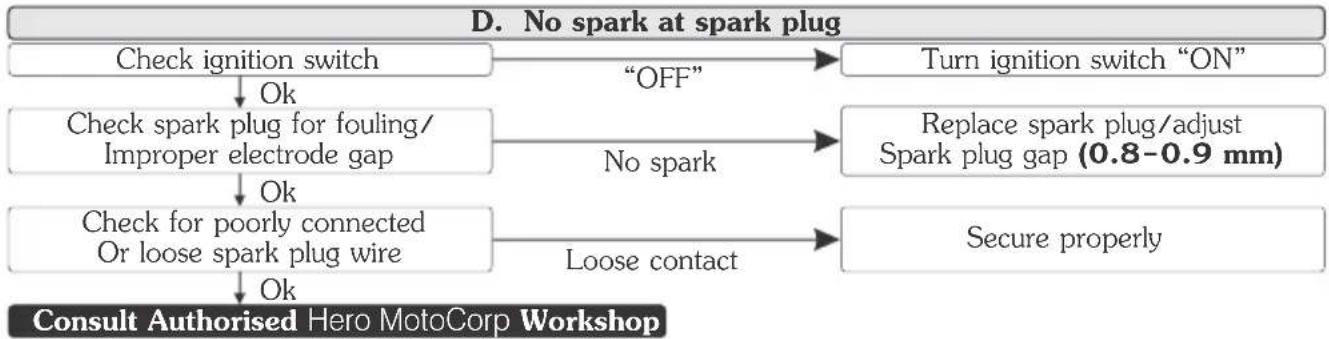
flowchart
graph TD
    A["Check ignition switch"] -->|OK| B["Check spark plug for fouling/Improper electrode gap"]
    B -->|OK| C["Check for poorly connected Or loose spark plug wire"]
    C -->|OK| D["Consult Authorised Hero MotoCorp Workshop"]
    A -->|“OFF”| E["Turn ignition switch “ON”"]
    B -->|No spark| F["Replace spark plug/adjust Spark plug gap (0.8-0.9 mm)"]
    C -->|Loose contact| G["Secure properly"]
- ENGINE STARTS BUT STALLS

flowchart
graph TD
    A["Check fuel lines"] -->|OK| B["Check air cleaner element"]
    B -->|OK| C["Consult Authorised Hero MotoCorp Workshop"]
    A -->|Leakage| D["Consult Authorised Hero MotoCorp Workshop"]
    B -->|Dirty| E["Replace"]
- POOR PICK UP
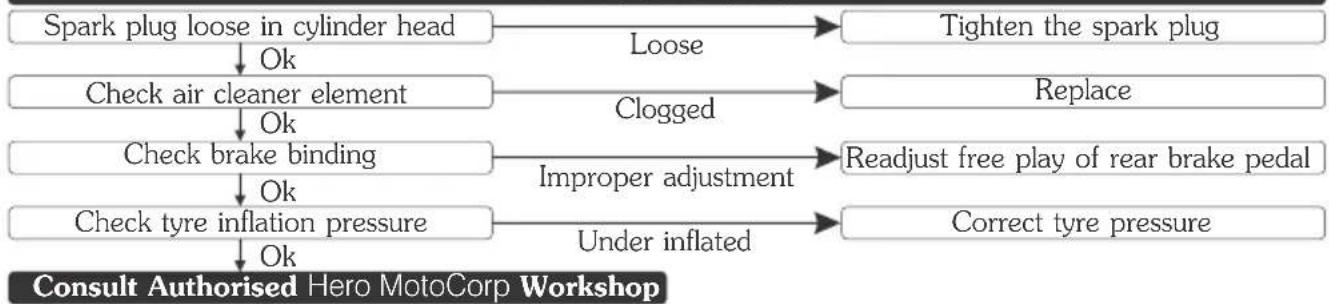
flowchart
graph TD
    A["Spark plug loose in cylinder head"] -->|Ok| B["Check air cleaner element"]
    B -->|Ok| C["Check brake binding"]
    C -->|Ok| D["Check tyre inflation pressure"]
    D -->|Ok| E["Consult Authorised Hero MotoCorp Workshop"]

    F["Tighten the spark plug"] -->|Loose| G["Replace"]
    F -->|Clogged| H["Improper adjustment"]
    H --> I["Correct tyre pressure"]
    I -->|Under inflated| J["Readjust free play of rear brake pedal"]
BASIC TROUBLESHOOTING
- ELECTRICAL SYSTEM
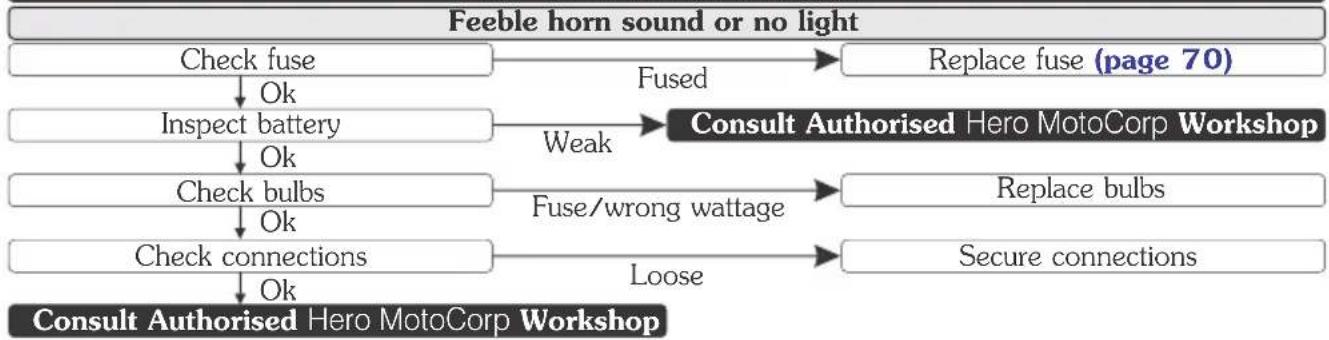
flowchart
graph TD
    A["Check fuse"] -->|Ok| B["Inspect battery"]
    B -->|Ok| C["Check bulbs"]
    C -->|Ok| D["Check connections"]
    D -->|Ok| E["Consult Authorised Hero MotoCorp Workshop"]
    A -->|Fused| F["Replace fuse (page 70)"]
    B -->|Weak| G["Consult Authorised Hero MotoCorp Workshop"]
    C -->|Fuse/wrong wattage| H["Replace bulbs"]
    D -->|Loose| I["Secure connections"]
- i3s SYSTEM
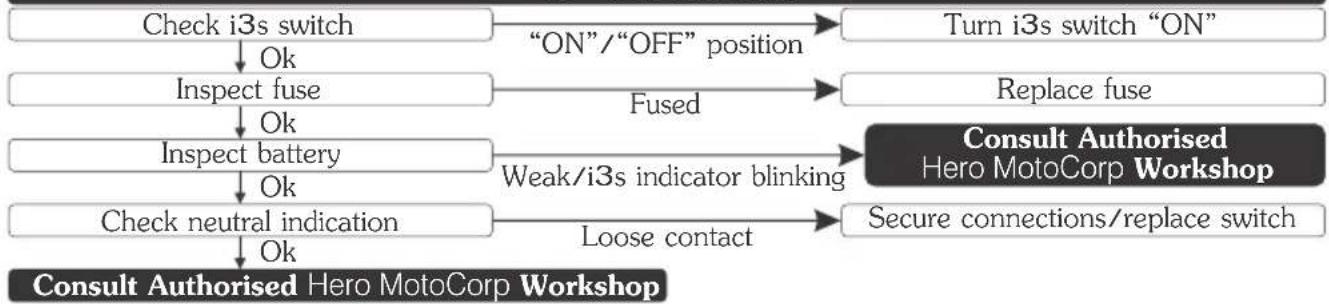
flowchart
graph TD
    A["Check i3s switch"] -->|Ok| B["Inspect fuse"]
    B -->|Ok| C["Inspect battery"]
    C -->|Ok| D["Check neutral indication"]
    D -->|Ok| E["Consult Authorised Hero MotoCorp Workshop"]
    A -->|“ON”/“OFF” position| F["Turn i3s switch “ON”"]
    B -->|Fused| G["Replace fuse"]
    C -->|Weak/i3s indicator blinking| H["Consult Authorised Hero MotoCorp Workshop"]
    D -->|Loose contact| I["Secure connections/replace switch"]

ROAD SIGNS
Mandatory signs: These road signs inform drivers/riders of the traffic rules that apply on a certain stretch of road, thereby instructing them on how to drive/ride. Mandatory signs are distinguished by the bright red circle with black and blue markings. It is imperative that all riders follow these signs as they help avoid accidents. Their violation can be penalised under the Motor Vehicle Act.
Mandatory

Stop

Give Way One Way
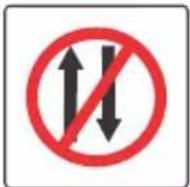
The Ground Truth image displays a single, solid horizontal line. According to Rule 2 (UNDERSCORE & LINE RULES), this is a stylistic or background line, not a placeholder underscore. Therefore, the OCR result must ignore it and output nothing or only meaningful text.
(no text)

No Horn
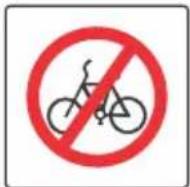
No Bicycles
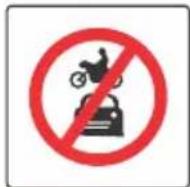
No Automobiles
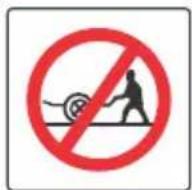
No Hand Cart
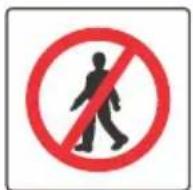
No Pedestrians
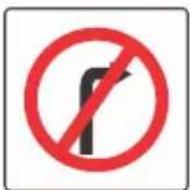
No Right Turn
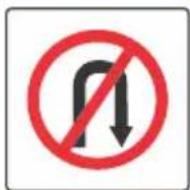
No 'U' Turn
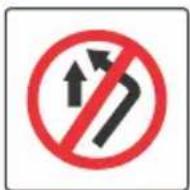
Overtaking Prohibited
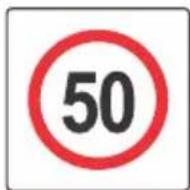
Speed Limit
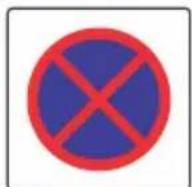
No Stopping or Standing
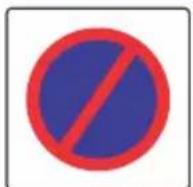
No Parking Length Limit High Limit
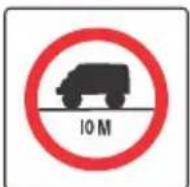
imit High Limit
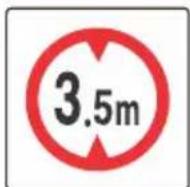
The image contains no text or characters.

Restriction Ends
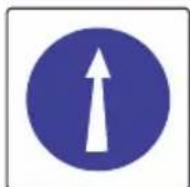
Compulsory-Ahead Only
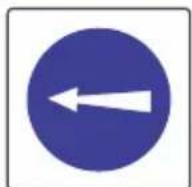
Compulsory-Turn Left

Compulsory-Right Ahead

Compulsory-Ahead or Turn Right

Compulsory-Keep
Left

Compulsory-Bicycle Track

Compulsory-Sound Horn

ROAD SIGNS
Cautionary signs: These signs inform the driver/rider of the road conditions ahead. Cautionary signs therefore serve as a warning. They are usually in a red triangle with black pictures on a white background. Illustrations, diagrams and symbols are used to forewarn about dangers ahead. Cautionary road signs are as important as mandatory signs. However, the violation of cautionary signs does not attract penalty.
Cautionary
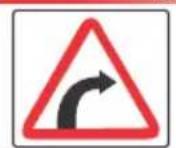
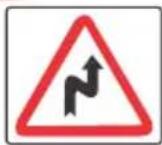
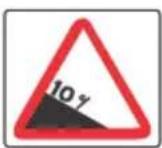
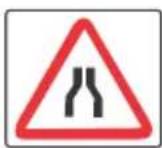
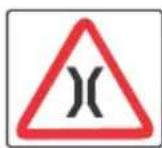
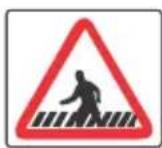





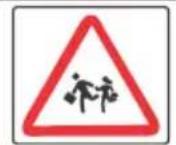
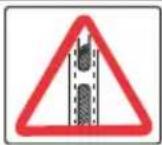
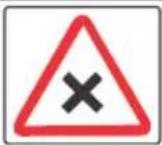


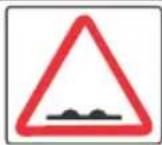
School Ahead
Gap in Medium
Cross Road
Men at Work
Roundabout
Hump Road
ROAD SIGNS
Informatory signs: These are facility signs that provide important information about road directions are maps of specific destinations. On highways, they provide information about the location of public telephones, restaurants, hospitals, parking, petrol pumps, resting-places and more. These signs are usually rectangular, with black or white pictures on a blue background.
Informatory
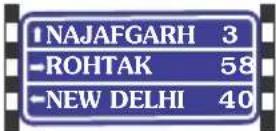

Hospital

First Aid
Post
Petrol Pump

Eating Place

Resting Place

Public
Telephone
Delhi
Place Identification
Place
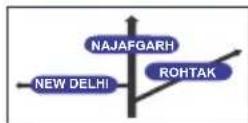
Destination Sign

Light
Refreshment

Taxi Stand

Parking Both Sides

Parking This Side

No Through
Road

No Through Side Road
Bahadurgarh 10
Rohtak 48
Re-assure Sign
Signs and Signals are language of the road. Learn them, respect them.

Hero MotoCorp Ltd.
WARRANTY
Scope of warranty
Hero MotoCorp Ltd. (hereinafter called ‘Hero MotoCorp’) warrants its SUPER SPLENDOR XTEC vehicles, assembled/manufactured in its Plants and sold through its to channel partners, be free from any defect – both in material and workmanship, under normal use and conditions, subject to the following terms & conditions.
Terms & conditions
a) SUPER SPLENDOR XTEC vehicle is warranted for a period of 5 years or 70000 Km, whichever is earlier, from the date of purchase, emission warranty is separately covered under the head of “Emission Warranty”.
b) It is advised that the purchaser avails all free and paid services from the Hero MotoCorp's authorized workshop as per the recommended schedule, to be eligible for warranty benefits. Each paid service should be availed 180 days from the date of previous service or as per the recommended schedule, whichever is earlier.
c) If any problem is observed in SUPER SPLENDOR XTEC vehicle, Hero MotoCorp's only obligation/ liability is to repair or replace that part/those parts which is/are considered to be the cause of such problem, provided however that such problem has not resulted due to misuse/improper handling etc. of the vehicle. Any SUPER SPLENDOR XTEC vehicle needing repair should be brought to Hero MotoCorp's authorized workshop for necessary inspection and carrying out rectification job.
LIMITATIONS OF WARRANTY
The warranty shall not apply—
(1) If all free services/paid services/oil top-ups are not availed as per the recommended schedule at Hero MotoCorp's workshop.
(2) If any other engine oil which is non compatible with the product is used other than SAE 10W30 SL Grade (JASO MA2) or SAE 5W30 SN Grade (JASO MA2).
(3) To normal wear & tear and ageing of components including (but not limited to) brake shoes/pads, clutch plates, drive chain & sprockets, bulbs, electrical wiring, filter, spark plug, fasteners, shims, washers, oil seals, gaskets, rubber parts, bush, rubber bellows, plastic parts breakage, wheel rim for misalignment/bend, steering ball race & cone, control cables such as brake cable/clutch cable, fuses (all types), steering handle for bend and sticker peel off.
(4) If additional wheel(s) is/are fitted and/or any other modification carried out/unauthorized accessories fitted which shall be responsible for malfunction/deterioration of the vehicle or modifications/alterations are made to the vehicle which are not permissible under applicable laws, or modifications, alterations, tampering or improper repair are undertaken at unauthorised workshops.
(5) If any modifications/alterations/repairs are made to the vehicle which are (a) not as per applicable laws, and/or (b) are undertaken at unauthorized workshops.
(6) If there has been any tampering or improper repair undertaken.
(7) If SUPER SPLENDOR XTEC vehicle has been used in any competitive events like races or rallies or for any commercial purposes or if any damage results from misuse or use beyond the limitation of the intended purpose or any damage due to use under abnormal conditions.
( 8) To any damage on vehicle's painted surface cropping up due to industrial pollution or other external factors.
(9) For normal phenomena like noise, vibration, oil seepage etc., which do not affect the performance, quality and/or function, of the vehicle.
(10) To any damage caused due to usage of improper oil/grease and/or non-genuine parts.
(11) If any defect crops or repairs needed as a result of using adulterated fuel.
(12) If any maintenance/repairs required due to bad road conditions or misuse of SUPER SPLENDOR XTEC vehicle or required due to operation or use of the vehicle at any place or for such purpose for which the vehicle is not designed or manufactured.
(13) If any defect crops or repairs needed as a result of SUPER SPLENDOR XTEC vehicle meeting with some accident.
(14) For consumables like oil, grease, gasket etc to be used during free services and/or warranty repairs.
(15) If any damage results from repair, adjustment or maintenance operations by any method other than the methods specified by Hero MotoCorp.
(16) If any damage results from operation, whether intentional or accidental, other than as specified in the Owner's Manual.
(17) To electrical components such as bulbs, fuses, electrical wiring cut due to external reasons (Rat bites etc.).

Hero MotoCorp Ltd.
(18) Any cost for periodic maintenance such as cleaning, inspection and adjustment.
(19) To any part of the SUPER SPLENDOR XTEC vehicle which has been tampered or repaired in such a manner which has resulted in malfunction of the vehicle.
(20) For SUPER SPLENDOR XTEC vehicle not used in accordance with the guidelines given in this Owner's Manual.
(21) To proprietary items like tyres, tubes, batteries, etc, as they are subjected to the warranty terms & conditions of the respective manufacturers and directly handled by them only.
(22) Any defect(s) developing on account of external factors such as environmental factors; including but not limited to fading/peeling/rusting of paint and/or stripes and/or plated parts, seat leather tearing & cracking, aluminum parts oxidation and cracking & discoloring of control switches etc. or any damage resulting from soot and smoke, use of chemical, bird droppings or damage by sea water, sea breeze or salt.
(23) If any damage results from operation, whether intentional or accidental, other than as specified in the Owner's Manual.
(24) If the odometer of SUPER SPLENDOR XTEC has been altered or tampered.
(25) If the Vehicle's Identification Number (VIN) or Engine number has been altered or removed, or any circumstances exist that makes it difficult or impossible to establish the true history, origin and warranty coverage of the vehicle or part in question.
(26) If any damage is caused due to a force majeure event, such as flood, fire, terrorist act, etc.
Hero MotoCorp shall not be liable for (a) any incidental, indirect or consequential damages/loss of any kind whatsoever, and (b) any delay in servicing beyond its control or the control of its authorised dealerships/workshops.
This warranty is only given by Hero MotoCorp and no employee, dealership, workshop or any other person is authorised to extend the warranty provided herein. Hero MotoCorp's obligation under this warranty shall be limited to repairing or replacing, free of cost, those parts of the vehicle which upon examination by the Hero MotoCorp may prove to the satisfaction of Hero MotoCorp to have a manufacturing defect.
Hero MotoCorp's obligation under this warranty shall be limited to repairing or replacing, free of cost, those parts of the vehicle which upon examination by Hero MotoCorp may prove to the satisfaction of Hero MotoCorp to have a manufacturing defect. Decision regarding warranty settlement shall be taken by Hero MotoCorp and the same shall be final and binding on all concerns.
Subject to DELHI JURISDICTION only.
BATTERY WARRANTY
Battery fitted in SUPER SPLENDOR XTEC is a proprietary product of the battery manufacturer and shall be fulfilled and handled directly by the battery manufacturer; Hero MotoCorp shall not be liable for the same. The battery warranty shall be for the period and governed by the terms and conditions as mentioned herein below:
Warranty Period:
The battery is warranted by the battery manufacturer for a period of 18 months from date of sale of vehicle or 20000 km whichever is earlier.
Terms and conditions of warranty
- Batteries are warranted against all defects in material and workmanship. Liability under this warranty is limited to making good of defects rising solely from the use of faulty material or workmanship during manufacturing and developing under proper use.
The warranty commences from the date of delivery to the original purchaser of the vehicle. - In the event of any complaint the battery is to be returned complete with electrolyte to nearest battery service station or dealer. On inspection, battery w be returned or replaced to the ill
- This warranty card accompanies a battery sold as OEM fitment only. Claims should be supported with vehicle purchase invoice to enable processing.
- The right to determine whether a battery needs repair or total replacement lies with the battery manufacturer. In case where the battery is replaced, the defective battery becomes the property of the company and no scrap rebate will be given for it. The warranty period on the battery being repaired/replaced shall commence from the date of sale of the original battery as stated in the original warranty card.
- All liabilities under this warranty will cease if the battery is used on the vehicle other than that on which the battery was originally fitted and on the expiry of the warranty period as mentioned above.
- Recharging is not covered under the purview of this warranty and shall be billed as extra. However, free of cost (FOC) battery replacement/ repair includes cost of charging.
- This warranty does not cover damage to the battery caused by faulty electrical systems, incorrect charging and filling, improper handling of the battery by unauthorized dealers/auto electricians, maintenance, willful abuse, destruction by fire, collusion, theft or recharging.
- Breakage of container and cover do not come under the purview of this warranty.
- Adjudication and settlement of claim will take a couple of days as a battery has to be tested for the reported failure.
- In case of tampering of the original wiring circuit in any manner whatsoever.
1 1. If a battery which is not recommended is fitted on the vehicle then such battery will not carry any warranty. - Applicable taxes which are leviable on the battery under repair or replacement will be borne by you (the customer).
- You (the customer) are deemed to have read, understood and agreed to these conditions at the time of purchase of the vehicle.
EMISSION WARRANTY
Scope of warranty
Hero MotoCorp Ltd. warrants all its vehicles, assembled/manufactured at its various Plants and sold through its channel partners, to comply with emission standards as specified in sub rule (2) of Rule 115 of Central Motor Vehicles Rules, 1989, subject to following terms & conditions.
Terms & conditions
a) The emission warranty shall be applicable in India and shall remain valid for a period of 3 years or 30000 km, whichever occurs earlier, from the date of vehicle purchase.
b) The parts, which are covered under emission warranty are fuel injector, fuel pump, throttle body, ignition coil, oxygen sensor and muffler ("Emission Related Component(s)").
c) In case any defect is observed in any Emission-Related Component(s) which are covered under emission warranty, Hero MotoCorp's only obligation/liability shall be to repair and/or replace those part (s) which is/are considered to be the cause of non-compliance with the emission standards.
d) The method (s) of examination to determine the warranty conditions of the Emission Related Component will be at the sole discretion of Hero MotoCorp and / or its channel partners / service center and result of such examination shall be final and binding. If on examination the warranty conditions of the Emission Related Component is / are not established, Hero MotoCorpwill have the right to charge all, or part of the cost of such examination / service charges to you in addition to the cost of the components.
e) Hero MotoCorp shall have the sole discretion to decide to replace the defective Emission Related Component or the entire assembly or any other part required for such repair.
f) The emission warranty shall be applicable only to those vehicles, which are being regularly maintained in accordance with the maintenance schedule provided in the Owner's Manual.
g) You should follow the recommended parts replacement as per the maintenance schedule in order to avail the emission warranty.
h) If any Emission Related Component is/are tampered and/or repaired by unauthorized person/workshops etc, then the emission warranty shall stand cancelled.
i) Any Emission Related Component suffering from wear and tear under the normal course of running shall not be covered under the emission warranty. Therefore, all such parts should be replaced by you from time to time, on payment basis, as per the maintenance schedule provided in Owner's Manual and dealer's advice.
EMISSION WARRANTY
j) It is recommended to avail the services as per the recommended schedule to be eligible for the emission warranty benefits. Please ensure that each paid service is availed within 180 days from the date of previous services or as per the recommended schedule, whichever is earlier.
k) It is mandatory to obtain a PUC certificate from the authorised PUC center. In case of non-compliance with the emission standards please contact the channel partner/authorised workshop immediately along with the previous OK certificate, for the necessary rectification. The manufacturer or the dealer is not responsible for any penalty levied on you on account of non-compliance with the emission standards.
1) Emission warranty shall not be applicable if
• The vehicle has been subjected to abnormal use, abuse, neglect and improper maintenance or has met with an accident.
- The vehicle, or parts including the Emission Related Component(s) thereof, has been altered, tampered with or modified or replaced in an unauthorized manner.
- The odometer is not functioning or the odometer and/or its reading has been changed/tampered with, so that the actual distance covered cannot be readily determined.
- The vehicle has been used for competitions, races, and rallies or for the purpose of establishing records.
- If any damage results to the Emission Related Component(s) covered under from repair, adjustment or maintenance operations by any method other than the methods specified by .Hero MotoCorp
- If any damage results from operation, whether intentional or accidental, other than as specified in the Owner's Manual.
- Any cost for periodic maintenance such as cleaning, inspection and adjustment.
- If any damage is caused to the Emission Related Component(s) due to a force majeure event, such as flood, fire, terrorist act, etc.
m) All decisions regarding emission warranty settlement shall be taken by Hero MotoCorp and shall be final binding on all concerned.
Subject to Delhi jurisdiction only.

GENUINE PARTS
WHAT ARE THE BENEFITS OF Hero MotoCorp GENUINE SPARE PARTS ?
• Assures long life
- Ensures economy for a long time
• Safety of vehicle and rider
- Peace of mind
- Value for money
• Assured quality
CONSEQUENTIAL DAMAGES ON USING NON-GENUINE PARTS
| Clutch plate | Material used is inferiorDamages other parts of clutch like, clutch center and outer clutchAffects fuel efficiencyPoor acceleration |
| Cam chain kit | Poor performanceReduced life |
| Gasket cylinder head | Improper sealingEngine knockingLeads to leakage and smoky exhaustHigher emission level |


GENUINE PARTS
CONSEQUENTIAL DAMAGES ON USING NON-GENUINE PARTS
| Element air cleaner | Improper air filtration resulting in premature engine failureAffects fuel efficiencyPoor engine performance |
| Spark plug | Frequent stalling of engineHigher emission levelPoor engine performanceAffects fuel efficiency |
| Brake pads/Shoes | Poor braking efficiencyRider safety-an issueDiscs/Drum wear out, resulting in subsequent repair cost |
| Chain sprocket kit | Noisy operationFailure of chain can cause fatal accident |

ZONAL/REGIONAL/AREA OFFICES
For any of your service related query/requirements you may contact the respective Zonal/Regional/Area Offices
CENTRAL ZONE
Hero MotoCorp Ltd., No. 208, 209, 210-2nd floor, Ganpati Plaza, M.I. Road, Jaipur-302001, (Rajasthan). Tel: +91 141-2389031, 2389156, 2389252, E-mail: jaipur@heromotocorp.com
Hero MotoCorp Ltd., Office No. 705-706, 7th Floor, Manglam Fun Square, Durga Nursery Road, Udaipur -313001 (Rajasthan). Tel: +91 0294-2980578, 79, E-mail: udaipur@heromotocorp.com
Hero MotoCorp Ltd., Office. No.401, 4th Floor, Offizo, Magneto Mall, Labhandi, G.E. Road, Raipur -492001, (Chhattisgarh) Tel: +91-771-4034749, E-mail: raipur@heromotocorp.com
Hero MotoCorp Ltd., Office No. 55 to 59, 1st Floor, Maple High Street, Opposite Aashima Mall, Hoshangabad Road, Bhopal-462026, India. Tel: +91-755-2994416, +91-755-2994398, E-mail: bhopal@heromotocorp.com
Hero MotoCorp Ltd., Maloo-01, 601-602, 6th Floor, Plot No. 26C, Scheme No. 94, Ring Road, Indore, M.P.-452010, Tel: +91-731-4978269, 70, E-mail: indore@heromotocorp.com
EAST ZONE
Hero MotoCorp Ltd., Flat No: 1002. 10th Floor, Martin Burn Business Park, BP3, Salt Lake, Sector-V, Kolkata-700091, West Bengal, India. Tel : +91-33-44026841,+91-33-44026830, E-mail : kolkata@heromotocorp.com
Hero MotoCorp Ltd, Odysa Business Centre, Plot no. 30, 30/982, 172/1030, 4th Floor Cuttack, Bhubaneshwar highway road, Rasulgarh, Bhubaneswar-751010, Odisha, India. Tel: +91-674-2581161, 62, 63, 64, E-mail: bhubaneshwar@heromotocorp.com
Hero MotoCorp Ltd., Yash Heights, 1st Floor Bariatu Road, Above Basudeb Tata Showroom Ranchi-834009, Jharkhand, India. Tel: +91-651-2542222, 2542224, 2542225, E-mail: ranchi@heromotocorp.com
Hero MotoCorp Ltd., Sai Corporate Park, A Block, 6th Floor, Rukanpura, Bailey Road Patna, Bihar – 800014 Tel: +910612-2590587/88/89 E-mail: patna@heromotocorp.com
Hero MotoCorp Ltd., 158, Christian Basti, Golden Heights, 3rd Floor, Reliance Trend Building, Adjacent Central Mall, G.S. road, Kamrup, Assam-781005 Tel: 0361-2340058 E-mail: guwahati@heromotocorp.com
NORTH ZONE
Hero MotoCorp Ltd., 3rd Floor, Tower-A, DLF Centre Court, Sector-42, Golf Course Road, Gurgaon -122002, Haryana, India. Tel: 0124-4754800, E-mail: delhi@heromotocorp.com
Hero MotoCorp Ltd., 602, 6th Floor, Tower A, Plot No BW 58, Logix City Center, Sector-32, Noida - 201301. Uttar Pradesh Tel: 0120-4631000, E-mail: noida@heromotocorp.com
Hero MotoCorp Ltd., S.C.O-367-368, First Floor, Sector-34A, Chandigarh-160022, India. Tel: +91-172-2623773, 2623774, 2623775, E-mail: chandigarh@heromotocorp.com
NORTH ZONE
Hero MotoCorp Ltd., Kapoor Towers, Plot No-284, 15-B, Rajpur Road, Dehradun-248001, Uttarakhand, India. Tel:0135-2714661,2713662,2714663, E-mail: dehradun@heromotocorp.com
Hero MotoCorp Ltd., Summit Building (10th Floor) Plot No TCG 3/3 Vibhuti Khand, Gomti Nagar Lucknow - 226010, India. Tel: 0522-4006594, E-mail: lucknow@heromotocorp.com
Hero MotoCorp Ltd., C-19/134-B, Third Floor I .P Grand, Lallapura, Sigra, Varanasi, Uttar Pradesh - 221010, India. Tel: +91-, E-mail: varanasi@heromotocorp.com0542- 2390949,2390241
SOUTH ZONE
Hero MotoCorp Ltd., SKAV 909, 3rd Floor, 9/1, Road, Bangalore-560001, India. Lavelle Tel: +91-80-46881000, E-mail: bangalore@heromotocorp.com
Hero MotoCorp Ltd., 3-6-289, 3rd Floor, Kareem Manzil, Hyderguda, Hyderabad-500029, India. Tel:+91-40-23223735/3727, E-mail: hyderabad@heromotocorp.com
Hero MotoCorp Ltd., 9th Floor Seshachalam Centre No.636/1. Anna Salai, Nandanam, Chennai-600035, India. Tel: +91-44-24340974, 24340977, 24340978, E-mail: chennai@heromotocorp.com
Hero MotoCorp Ltd., 6-A, DD Trade Tower, (6th Floor), Kaloor-Kadavanthra Road, Kaloor-682 017, Kochi-682017, India. Tel: +91-0484-4039646 -7, E-mail: cochin@heromotocorp.com
Hero MotoCorp Ltd., No 1547, 2nd Floor Classic Towers, Trichy Road, Coimbatore - 641018 Tel: +91-422-2200058, 2200061, E-mail: coimbatore@heromotocorp.com
Hero MotoCorp Ltd., First Floor VA Kalburgi Mahalakshmi Mansion, Mandakini Hospital Road, New Cotton Market, Hubli-580029, India. Tel: 0836-2269717, 2361038, E-mail: hubli@heromotocorp.com
Hero MotoCorp Ltd., D.NO. 54-11-18 E, 2nd Floor, Sai Oddessey Building, Opp Executive Club, Near NH-5, Vijayawada-520008, Andhra Pradesh, India. Tel: +91-866-2546859, E-mail: vijayawada@heromotocorp.com
WEST ZONE
Hero MotoCorp Ltd., Chrome Building, Sr. No. 33, Hissa-A-1/1/2, Plot - 2, Viman Nagar Avenue 2, Nagar Road, Pune-411014, India. Tel: +91-020-71903500, E-mail: pune@heromotocorp.com
Hero MotoCorp Ltd., 604, Gunjan Tower, Off Alembic Gorwa Road, Baroda-390023, India. Tel: +91-265-2286569/2286570, E-mail: baroda@heromotocorp.com
Hero MotoCorp Ltd., Ground Floor, Block No.2, Vishnu Vaibhav Complex, 222, Palm Road, Civil Lines, Nagpur-440001, India. Tel: +91-712-2545990-91, E-mail: nagpur@heromotocorp.com
Hero MotoCorp Ltd., Classic Stripes House, 3rd Floor76/79, Makwana Lane, Takpada Off. Andheri-Kurla Road Marol, Andheri Easta, Mumbai-400059, India. Tel: +91-22-28562071, E-mail: mumbai@heromotocorp.com
Hero MotoCorp Ltd., B-201, 2nd floor, Pride Corporate Royal Park, Kalavad Road, Rajkot -360001 Tel: 0281-2460622, 2460623, E-mail: rajkot@heromotocorp.com
Hero MotoCorp Ltd.
Registered Office
The Grand Plaza, Plot No. 2, Nelson Mandela Road, Vasant Kunj, Phase - II, New Delhi - 110070, India.
CIN: L35911DL1984PLC017354, PAN: AAACH0812J
Phone No.: 011-46044100; Fax No.: 011-26143198, 26143321
Toll Free No.: 1800 - 266 - 0018
Website: www.heromotocorp.com
Publication no. OMADGEE0225HMCL