
SUPER JEANS 26 - Clothing TOYOTA - Free user manual and instructions
Find the device manual for free SUPER JEANS 26 TOYOTA in PDF.


| Product type | Jeans |
| Brand | Toyota |
| Model | Super Jeans 26 |
| Category | Clothing |
| Main material | Denim (cotton) |
| Available size(s) | 26 to 40 (waist size in inches) |
| Color(s) | Classic blue |
| Waist circumference | Approximately 66 cm (size 26) to 102 cm (size 40) |
| Inside leg length | Approximately 76 cm (adjustable by size) |
| Approximate weight | 500 g (depending on size) |
| Care instructions | Machine wash at 30 °C, gentle cycle |
| Drying | Air dry, avoid tumble dryer |
| Ironing | Iron at medium temperature (max 150 °C) |
| Bleaching | Do not use bleach |
| Dry cleaning | Possible, but not recommended |
| Care tips | Wash inside out, close zipper and buttons |
| Country of origin | Imported by Toyota Belgium |
| Warranty | 2 years (manufacturing defects) |
Frequently Asked Questions - SUPER JEANS 26 TOYOTA
User questions about SUPER JEANS 26 TOYOTA
0 question about this device. Answer the ones you know or ask your own.
Ask a new question about this device
Download the instructions for your Clothing in PDF format for free! Find your manual SUPER JEANS 26 - TOYOTA and take your electronic device back in hand. On this page are published all the documents necessary for the use of your device. SUPER JEANS 26 by TOYOTA.
USER MANUAL SUPER JEANS 26 TOYOTA
HOME-USE SEWING MACHINE
INSTRUCTION MANUAL
- Read this manual carefully before use and always follow the instructions.
- Keep the manual in a convenient place for easy reference.
- If you give the sewing machine to someone else, also give them this instruction manual.
Contents
1 Before use (Be sure to read this section before use)
- Important safety instructions 3
How to change the power plug 5
Part names 6
Part names and their functions 8 - Quick adviser. 10
How to operate foot controller 11
2 Sewing preparations
- Connecting the power. 12
Winding the lower thread 14 - Threading the lower thread. 16
- Threading the upper thread 18
Using the needle threads 20
Pulling up the lower thread 22
Application of each stitch pattern 23 - Changing the presser foot 26
- Changing the needle. 28
- Relationship between the needle, thread and fabric, and adjusting the thread tension. 29
3 Sewing
- Straight stitching and reverse sewing 30
Zigzag sewing 34 - Adjusting thread tension 35
- Buttonhole sewing 36
Overcasting 39
Zipper insertion 40 - Blind hem stitching. 42
4 Maintenance
Feed dog and hook maintenance 44
- Changing light bulb 48
Servicing double-insulated products (230V-240V) 49
- Notice about the incandescent lamp. 49
Troubleshooting 50
5 Others
Recycling 53
Specifications. 54
1
Before use (Be sure to read this section before use)
Important safety instructions
These safety instructions are designed to prevent danger or damage arising from the incorrect operation of the machine. Read carefully and always follow the instructions.
Explanation of “ Warning” and “ Caution”

Warning
An incorrect operation could result in death or serious injury.

Caution
An incorrect operation could result in an injury or damage to the machine.
Symbol explanation

Do not touch.

Prohibited actions

Required actions

Remove the power plug from the outlet.

Warning

Use an AC 220 to 240V power source.
Not doing so could cause an electric shock or a fire.
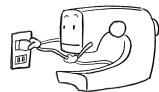

Do not damage the power cord, modify it, bend it excessively, jerk it or twist it.
Doing so could cause an electric shock or a fire.
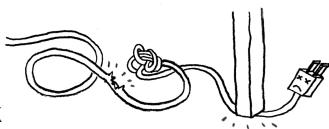
If the power cord is damaged, it must be replaced by a special cord or assembly available from the manufacturer or its service agent.

Do not use outdoors.
Doing so could cause an electric shock or a fire.

Do not operate where aerosol (spray) products are being used or where oxygen is being administered.
Doing so could cause a fire.

Do not repair, disassemble or modify except what is mentioned in the instruction manual.
Doing so could cause an electric shock, a fire or an injury.

Caution

Be sure to close the bobbin case cover before operating the sewing machine.
Not doing so could cause an injury.

When the machine is not in use it should be stored safely, not on the floor as protruding parts could cause injury if a person fell on the machine.
Not doing so could cause an injury.

Before changing the needle or threading the lower thread or upper thread, use the main power switch to turn off the sewing machine.
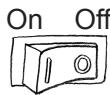
Not doing so could cause an injury.

Do not look away from the needle while operating the sewing machine.
If the needle breaks it could cause an injury.
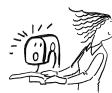


Do not touch moving parts such as the needle, take-up lever or handwheel.
Doing so could cause an injury.


Do not place your hand or fingers under the needle.
Doing so could cause an injury.


Children should only use the machine under the supervision of a parent or guardian.
Otherwise they could injure themselves.
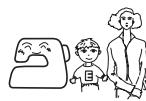

Do not use when young children are near the machine.
They could touch the needle and be injured.


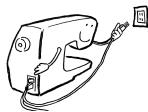
When leaving the sewing machine after using it, use the main power switch to turn off the sewing machine, and then remove the power plug from the outlet.
Not doing so could cause an injury.

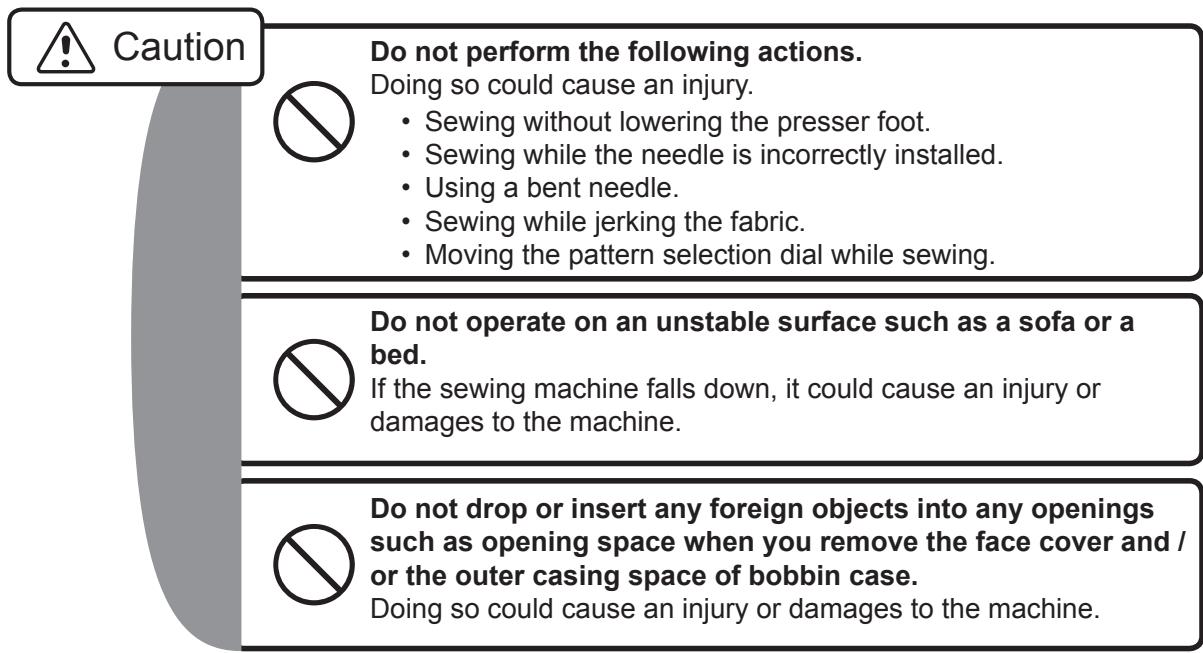
Before using the sewing machine make sure that the presser foot holder clamp screw, needle clamp screw and needle plate screw are firmly tightened, and that the presser foot is properly set in the presser foot holder.
Not doing so could cause an injury.
UK ONLY
IMPORTANT
PLEASE READ CAREFULLY
How to change the power plug

Warning

When you change the power plug or cord, do not repair, disassemble or modify except at the authorised dealer or service centre.
Doing so could cause an electric shock or a fire

If for any reason the power plug for this product is removed it should be immediately disposed of safety and not stored anywhere where it could be inadvertently used again.
Doing so could cause an electric shock or a fire
The wires in this mains lead are coloured in accordance with the following code: BLUE-NEUTRAL BROWN-LIVE (ORACTIVE)
As the colours of the mains lead of this appliance may not correspond with the coloured markings identifying the terminals in your plug - PROCEED AS FOLLOWS:
The earth plug pin is unnecessary. As the machine is designed under double insulation structure, the earth wire is removed from the machine. The wire coloured BROWN must be connected to the terminal marked L or A or coloured RED. The wire coloured BLUE must be connected to the terminal marked N or coloured BLACK. Neither core is to be connected to the earth terminal of a three-pin plug.
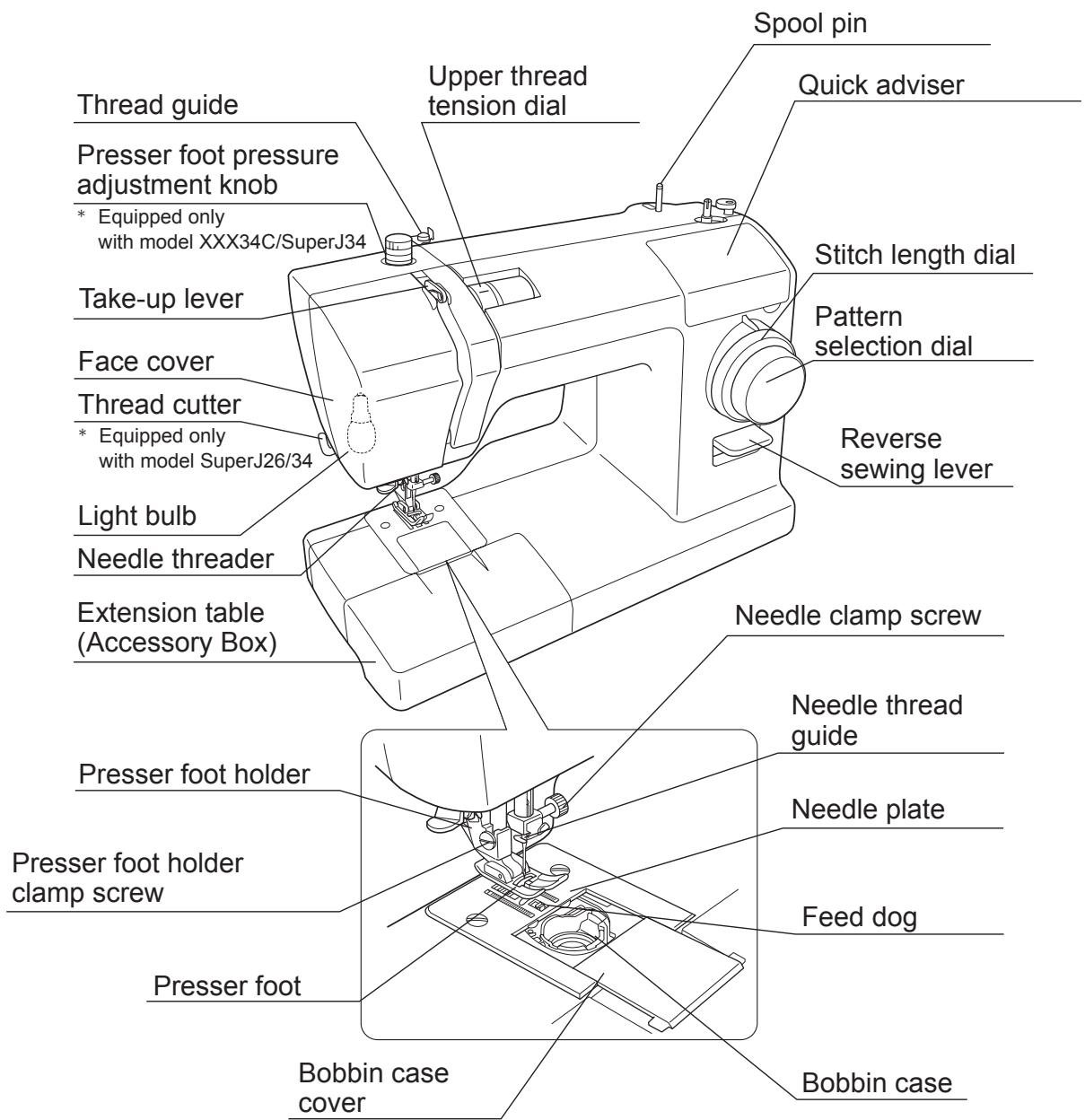
Part names
This manual provides descriptions on operating procedures for two sewing machine models.
Normally, descriptions will apply to both models; however, descriptions that apply to only one of the models will be indicated with "XXX26C/ XXX34C" or "SuperJ26/34".
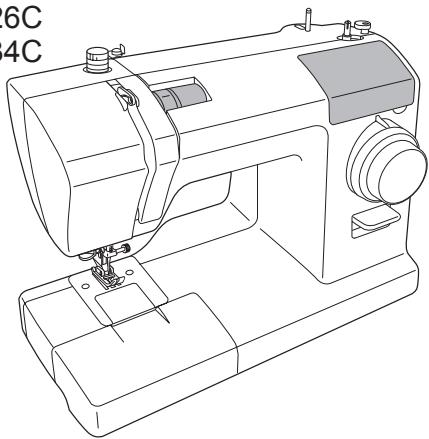
Model XXX26C XXX34C
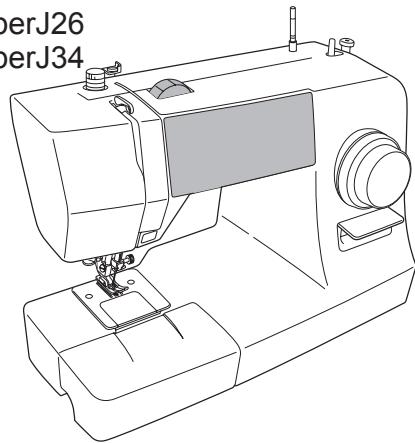
Model SuperJ26 SuperJ34

Part names and their functions
The various parts of the sewing machine have the functions described below.
Presser foot pressure adjustment knob
* Equipped only with model XXX34C/SuperJ34
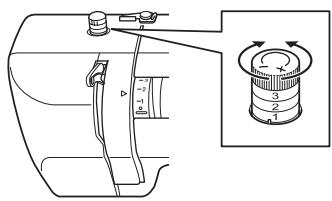
- By turning this knob, the amount of pressure applied by the presser foot can be adjusted.
- Turning the knob toward “—” reduces the amount of pressure applied by the presser foot.
- For best results when sewing stretch or thin fabrics, slightly reduce the pressure.
Normally, sew with the knob set to "3".
Drop feed lever * Equipped only with model XXX34C/SuperJ34
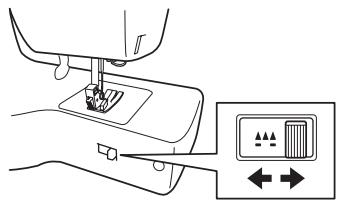
- Lower the feed dog when doing free motion sewing e.g. free motion embroidery or quilting.
During normal sewing, move the lever to the right to raise the feed dog. - When doing free motion sewing, move the drop feed lever to the left to lower the feed dog.
Extension table (Accessory Box)
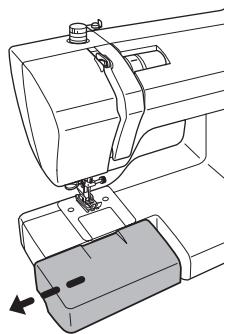
Pull out the extension table (accessory box) in the direction of the arrow.
Presser foot lever
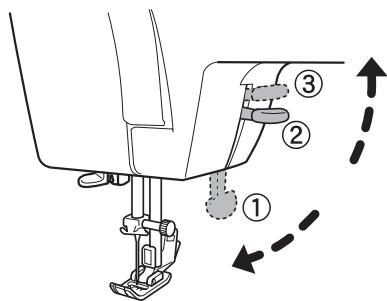
- When sewing, lower the presser foot lever to lower the presser foot. (Position ①)
- When inserting fabric, lift up the presser foot lever to raise the presser foot. (Position ②)
- The presser foot can be raised even higher by raising the presser foot lever to position ③ . Since the presser foot lever does not remain in this position, hold it in place when inserting the fabric. This position is useful when sewing thick fabric.
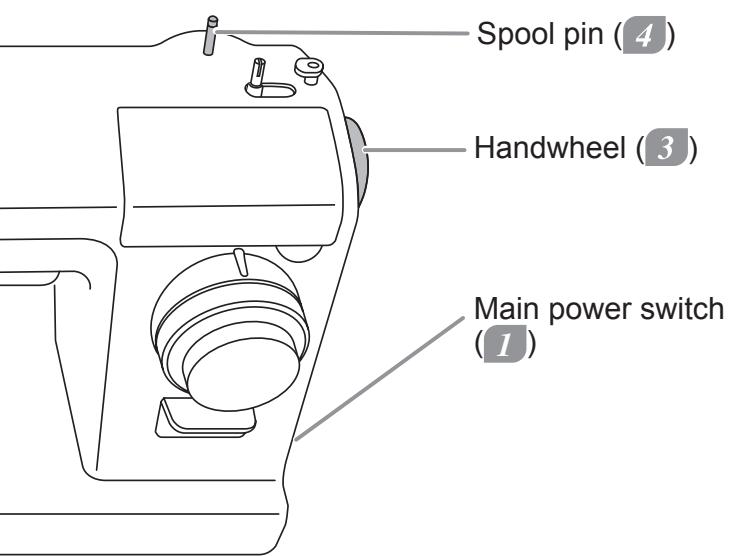
Handwheel
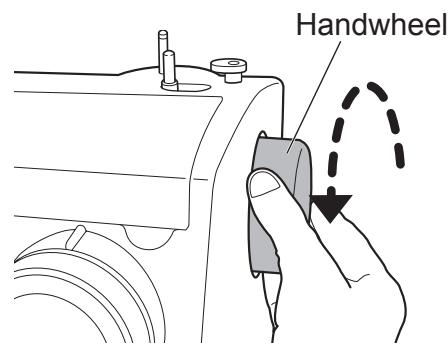
- Use the handwheel to manually raise and lower the needle.
Note:
Always turn the handwheel towards yourself (in the direction of the arrow).
If the handwheel is turned in the opposite direction, the thread may become tangled.
Pattern selection dial and stitch length dial
For operating details, refer to pages 23 - 25.
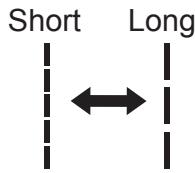
Stitch length dial
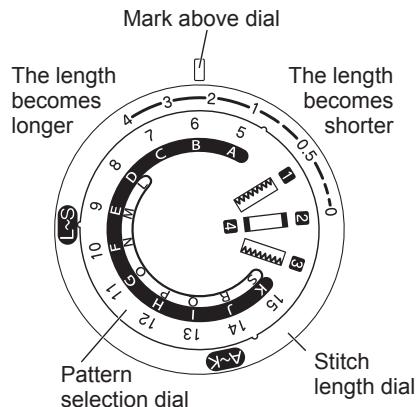
Turn the dial to adjust the stitch length. If a larger number is aligned with the mark above the dial, the stitch length becomes longer. If a smaller number is aligned with the mark above the dial, the stitch length becomes shorter.
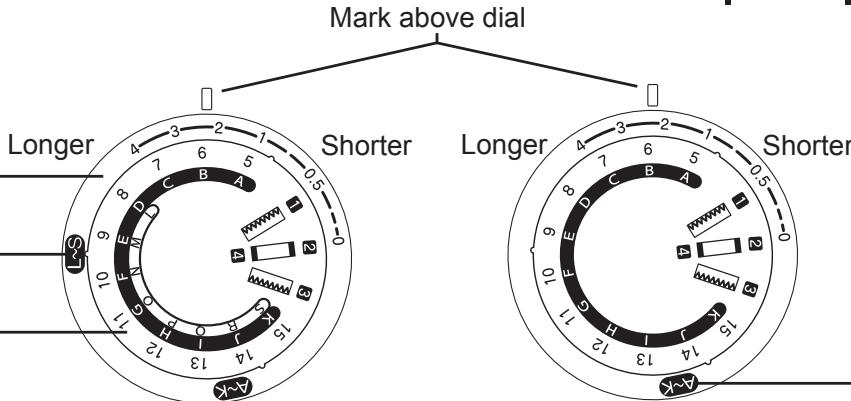
Model XXX34C/SuperJ34
Model XXX26C/SuperJ26
Pattern selection dial
Turn the dial until the desired pattern is aligned with the mark above the dial.
To sew patterns A to K, turn the dial until A K is aligned with the mark above the dial.
To sew patterns L to S, turn the dial until is aligned with the mark above the dial.
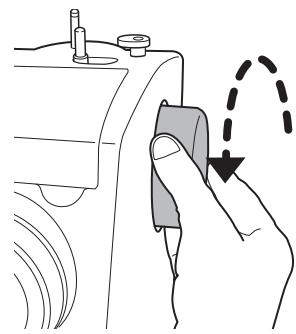
Reverse sewing lever
- Press down the reverse lever, when sewing in reverse.
- Remove your finger from the reverse sewing lever to return to forward direction sewing.
Quick adviser
The quick adviser (under the lid on the sewing machine) provides various descriptions such as basic machine operations.
- Accessing the quick adviser
■ For model XXX26C/XXX34C
Flip up the lid to open it.
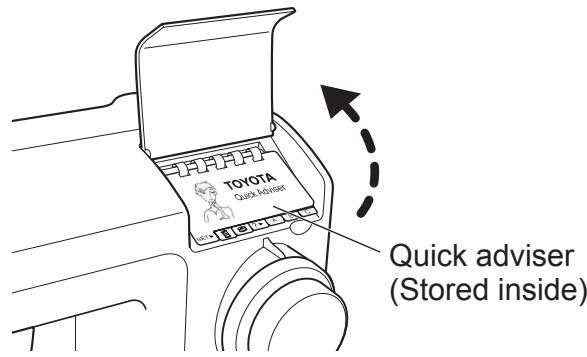
For model SuperJ26/34
Pull the top of the lid towards yourself to open it.
Quick adviser
(Stored inside)
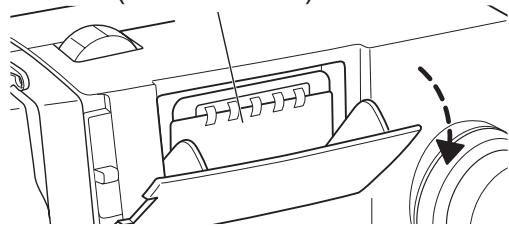
Note:
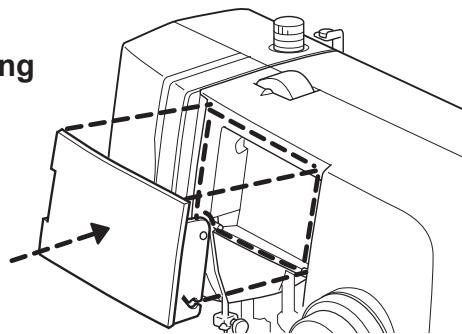
- Do not pull down the top of the lid with extreme force. The lid may break.
- If the lid has been removed from the machine, fit the lid into the corresponding area of the machine, and then push it straight in until it snaps into place.
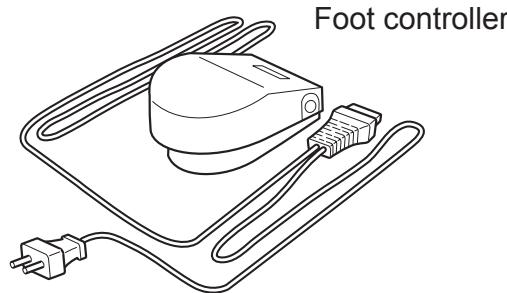
How to operate foot controller

Caution

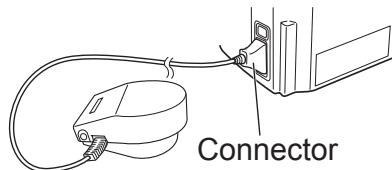
Be sure to use the main power switch to turn off the sewing machine before connecting the foot controller.
Not doing so could cause an injury.
Operation

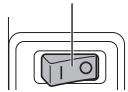
Press the "O" side of the main power switch to turn off the sewing machine.
Main power switch

Insert the power cord connector into the terminal box on the machine.

Press the "I" side of the main power switch to turn on the sewing machine.
Main power switch
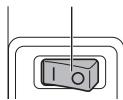

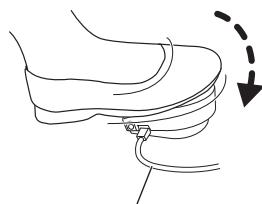
Step on the foot controller to operate the sewing machine.
The more you press the foot controller, the faster the machine runs.
Release the foot controller to stop the machine.
Foot controller
Connecting the power

Warning

Do not touch the power plug with wet hands.
Doing so could cause an electric shock.

Hold the power plug, to remove or insert into the power outlet.
Not doing so could damage the cord and cause an electric shock, fire or injury.

Caution

Before plugging in the power cord, use the main power switch to turn off the sewing machine.
Not doing so could cause an injury.
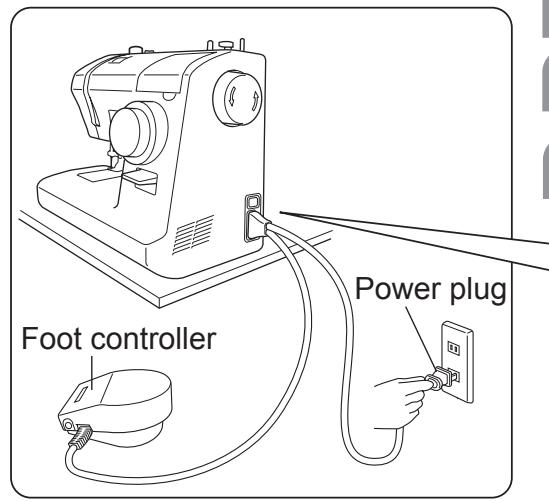
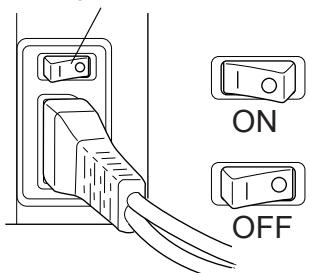
Main power switch
Prepare the foot controller.
2 Insert the power cord connector into the terminal box.
3 Insert the power plug into the outlet.
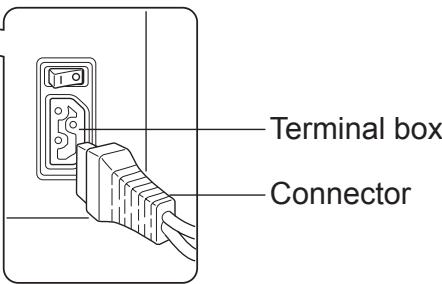
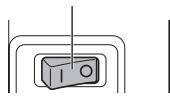
4 Press the "I" side (power on) of the main power switch.
The power is turned on.
Memo
Winding the lower thread
Note:
Prepare a
specially
designed bobbin.
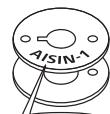
AISIN-1
Start
1 Turn off the sewing machine.
Main power switch
Complete
2
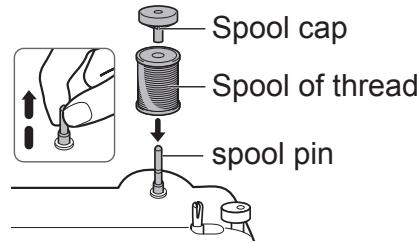
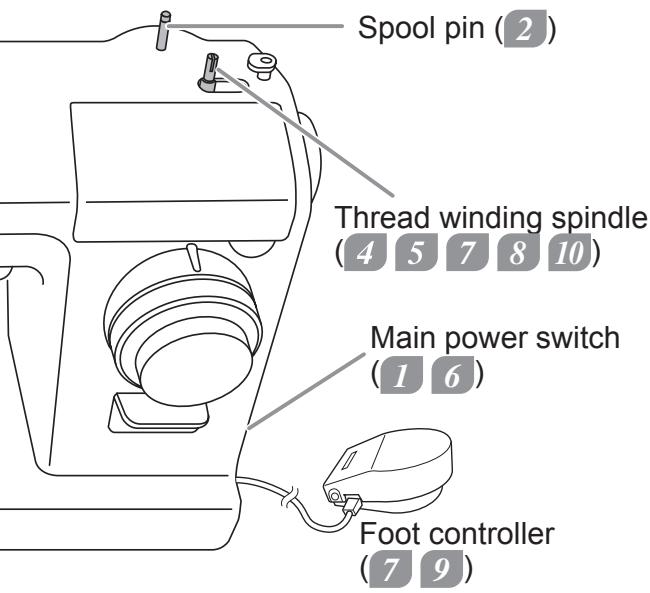
Pull up the spool pin.
Position the spool of thread and the spool cap on to the spool pin.
10
① Return the thread winding spindle by sliding it in the direction of the arrow.
Note
If the thread winding spindle is not returned, the needle does not move and sewing is not possible.
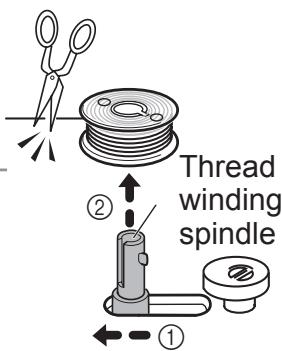
(2) Remove the bobbin from the thread winding spindle, and cut the thread.
9
① Press on the foot controller with your foot to continue winding the bobbin.
② When the bobbin winding becomes slow, release the foot controller to stop winding the bobbin.
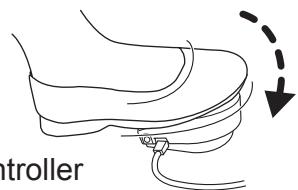
Foot controller
Thread guide
(3)
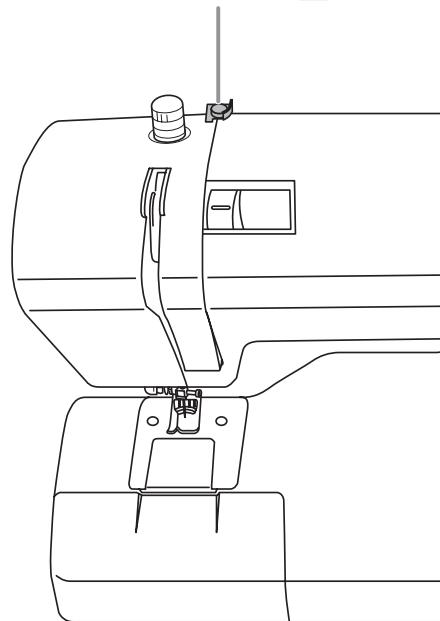
8
Cut the excess thread above the bobbin hole.
- Cut the thread so that no excess extends from the bobbin hole.
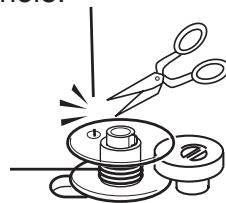
3
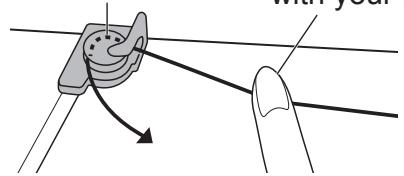
Pull the thread from the thread spool, and then hold it with one hand while passing it around the thread guide with the other hand, as shown.
Thread guide Hold in place with your finger.
4
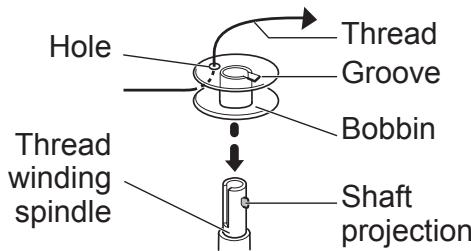
Pass the thread end through the hole in the bobbin as shown.
Place the bobbin on the thread winding spindle so the groove aligns with the shaft projection.
5
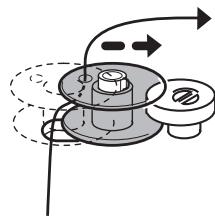
Slide the thread winding spindle in the direction of the arrow until it snaps into place.
6
Turn on the machine. Main power switch
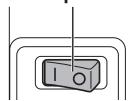
7
(1) While holding the thread end, begin pressing on the foot controller with your foot.
② After the thread has been wound around the bobbin about 10 times, release the foot controller to stop winding.
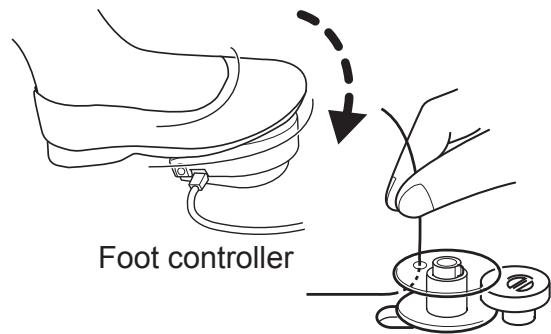
Threading the lower thread
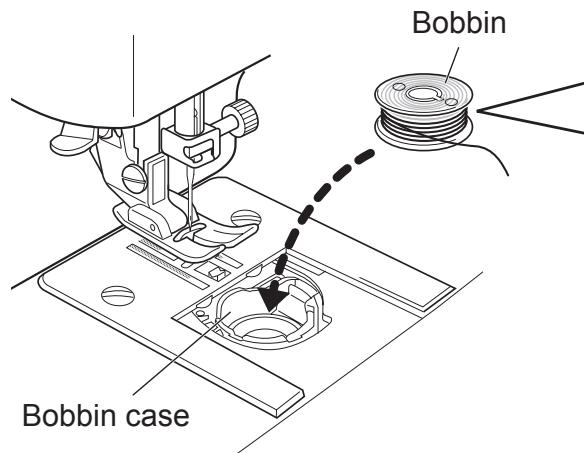
Open the bobbin case cover, and insert the bobbin into the bobbin case.
If the bobbin is incorrectly inserted into the bobbin case, the stitching will not be sewn correctly.
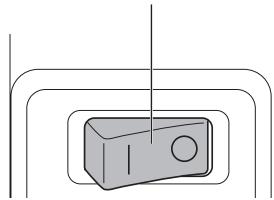
1 Turn off the sewing machine.
Main power switch
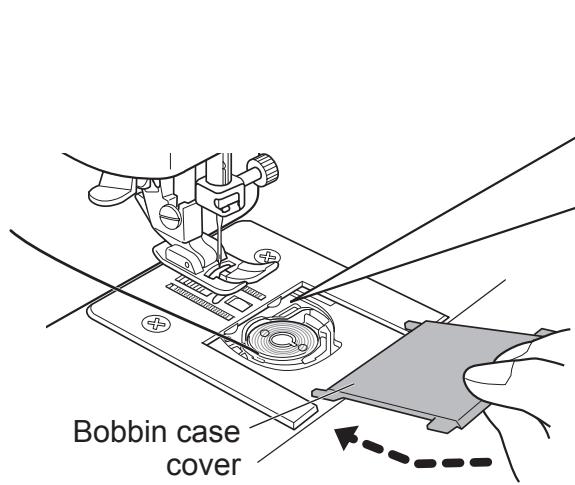
Pull the bobbin case cover towards yourself.
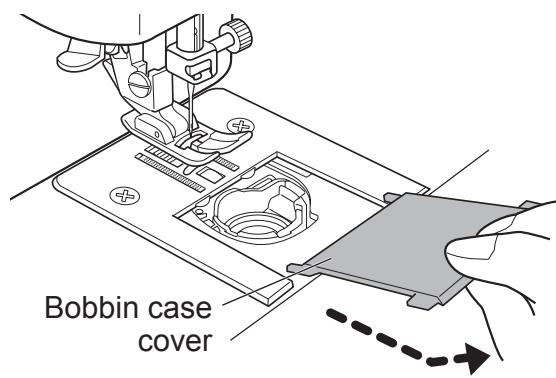
3 Insert the bobbin so that it rotates counterclockwise.
Thread unwinding direction
Counterclockwise
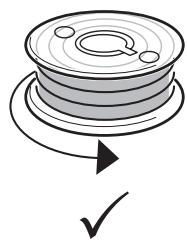
Clockwise
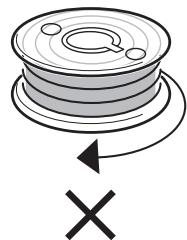
Check the orientation of the bobbin.
4
Pass the thread through , then , and then pull the thread to the rear, as shown below.
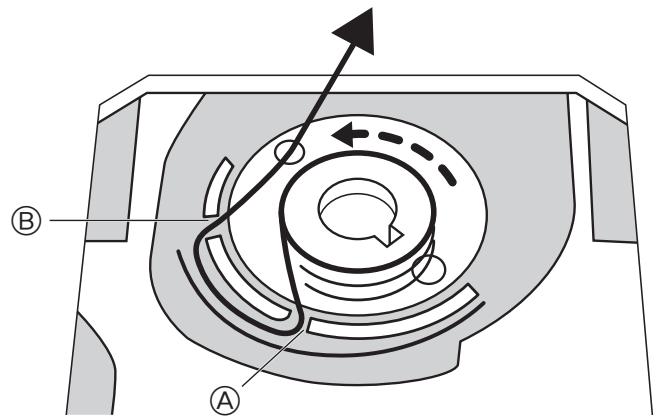
5
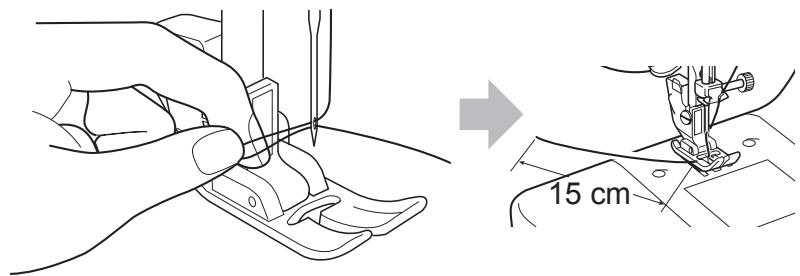
Pull out about 15 cm of thread to the rear.
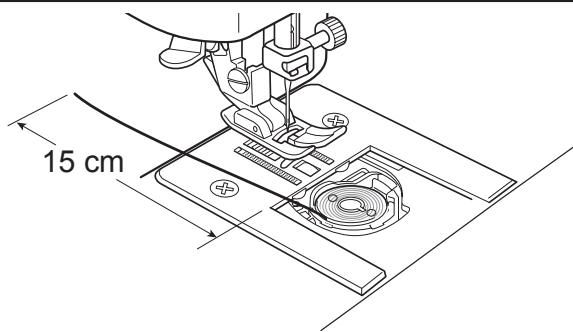
6
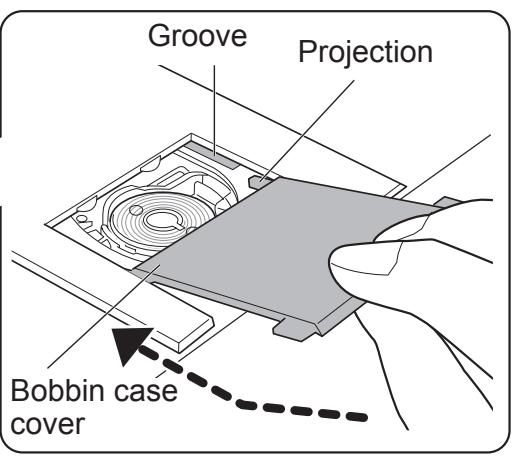
Fit the projections on the bobbin case cover into the race retainer grooves, and then push the bobbin case cover closed.
Threading the upper thread
Start
1 Turn off the sewing machine.
Main power switch
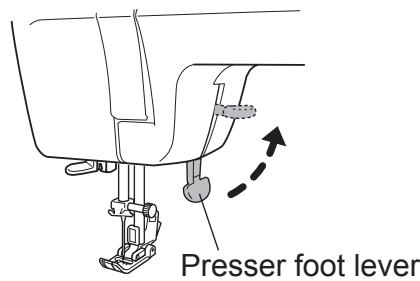
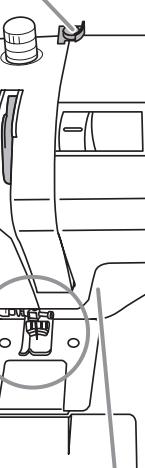
2 Raise the presser foot lever.
Complete
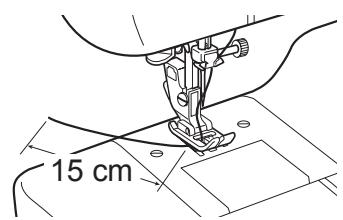
9 Pass the thread through the presser foot, and then pull out about 15 cm of thread to the rear.
Take-up lever (6)
Needle thread guide (7)
Eye of needle (8)
Presser foot (9)
Thread guide (5)
)
Presser foot
lever (2)
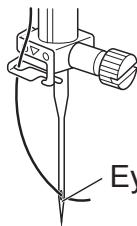
8 From the front, pass the thread through the eye of the needle.
- When using the needle
threader, refer to page 20.
Eye of needle
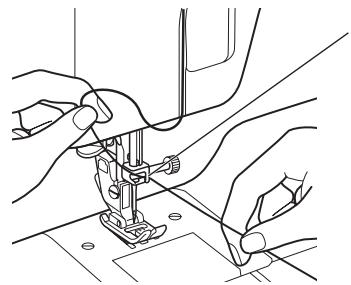
7 Pass the thread through the needle thread guide.
Needle thread guide
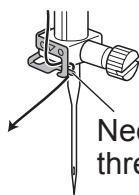
Needle thread guide
The thread can easily be passed through the needle thread guide by holding the thread in your left hand, then feeding the thread with your right hand, as shown.
3 Turn the handwheel towards yourself to raise the take-up lever.
Handwheel Take-up lever
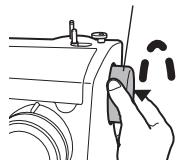
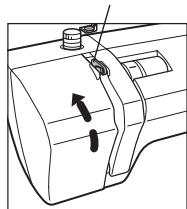
Pull up the spool pin. Position the spool of thread and the spool cap on to the spool pin.
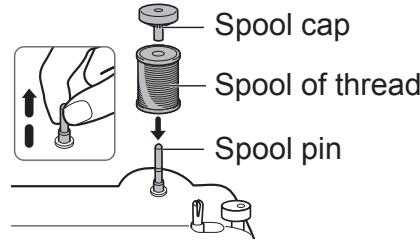
5 ① Pull the thread from the thread spool, and hold it with one hand.
② Pass the thread around the thread guide with the other hand, as shown.
Thread guide
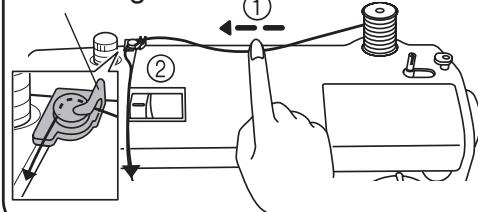

③ Pull the thread down along the groove, and then pull it back up.
(4) Pass the thread through the take-up lever from the right.
⑤ Pull the thread down along the groove.
Check that the take-up lever is correctly threaded.
Pass the thread in the order shown. (③ through ⑤)
The thread should be taut and secure.

Using the needle threads

Caution

Before using the needle threads, use the main power switch to turn off the sewing machine.
Not doing so could cause an injury.
- Use sewing machine needles No. 11/75 to 16/100 with the needle threader.
(Needle No 14/90 is included when the sewing machine is purchased.)
The needle cannot be threaded if the thread is too thick for the needle. For details on possible needle and thread combinations, refer to "Relationship between the needle, thread and fabric, and adjusting the thread tension" on page 29.
Preparing to use the needle threads
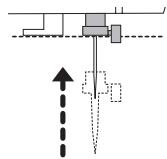
Turn the handwheel towards yourself until the needle is in its highest position.
- If the needle is not in its highest position, the needle cannot be threaded.

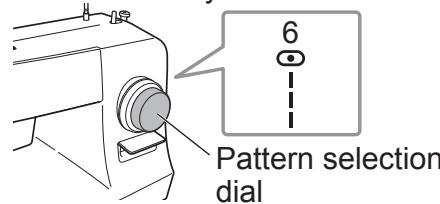
Turn the pattern selection dial to "6" (straight stitch).
- Otherwise, the needle threader may not operate correctly and the needle may not be threaded.
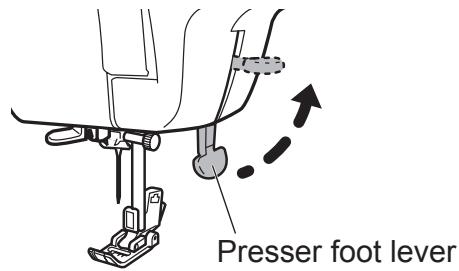
3 Raise the presser foot lever.

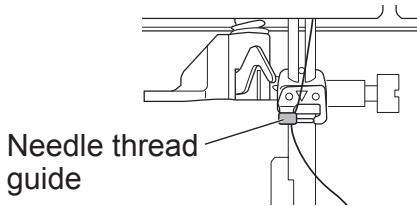
Check that the thread has been passed through the needle thread guide.
- Understanding the needle threads mechanism
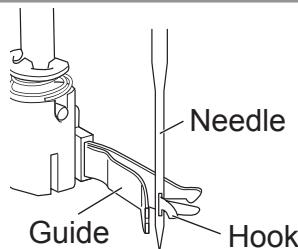
The hook is within the guide.
The hook passes through the needle, catches the thread, then pulls the thread through the needle.
- Using the needle threads
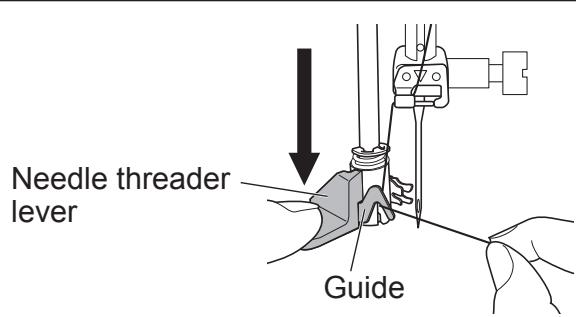
1
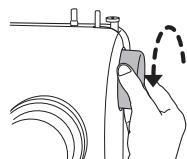
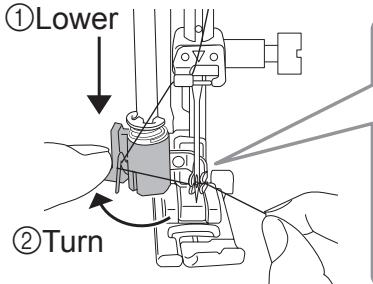
While fully lowering the needle threader lever, hook the thread on the guide as shown in the diagram.
2
Fully turn the needle threads lever to the rear, and pull the thread through the needle threadslot.
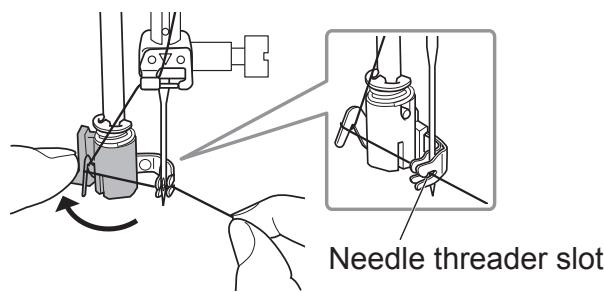
3
① Slowly return the needle threads lever towards yourself as much as possible.
(2) Check that the thread has passed through the eye of the needle.
(3) Release the needle threads lever while releasing the end of the thread.
- If the needle is not threaded, check that the needle has been raised to its highest position, and then repeat the procedure starting with step 1.
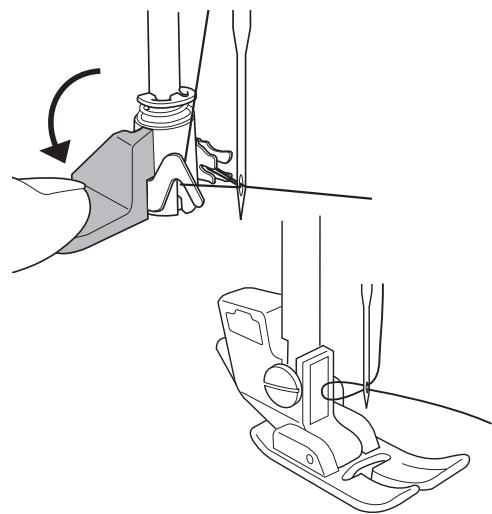
4
Pull the thread loop that formed behind the needle, and then pull about 15cm of thread to the rear.
Pulling up the lower thread
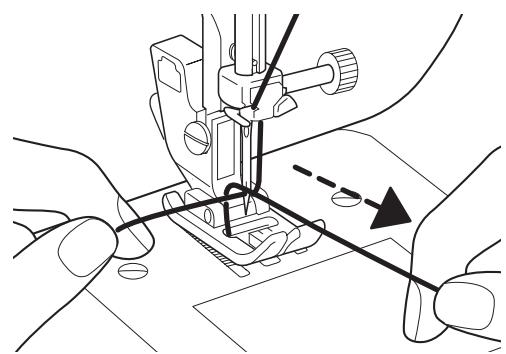
Raise the presser foot lever. Loosely hold the upper thread with your left hand, and then turn the handwheel towards yourself one full turn.
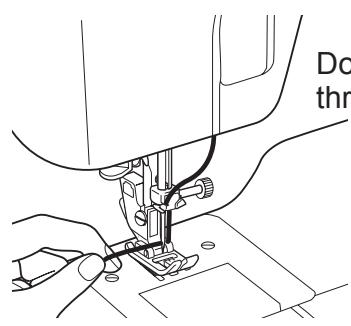
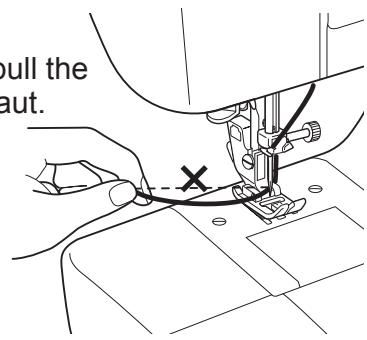
1
Do not pull the thread taut.
2
Lightly pull the upper thread with your left hand to pull up the lower thread.
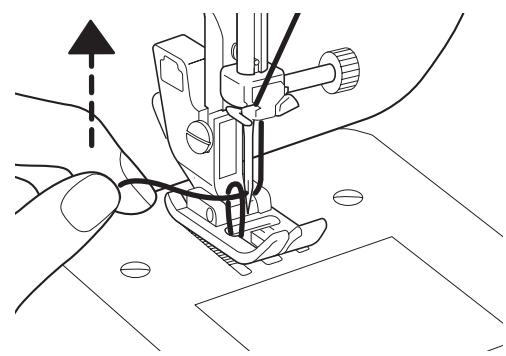
3
Pull out the lower thread to the front.
4
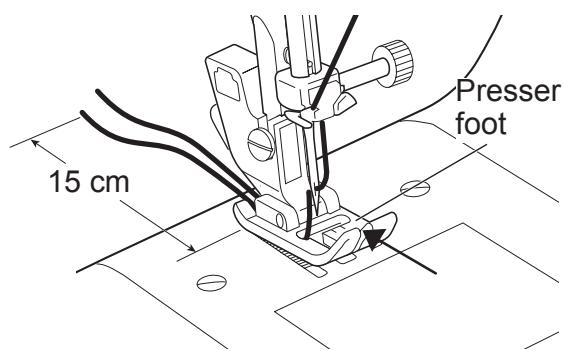
Align both threads, pass them through the groove (arrow) and under the presser foot, and then pull out about 15 cm of thread to the rear.
Application of each stitch pattern
Caution

Before turning the pattern selection dial, use the main power switch to turn off the sewing machine.
Not doing so could cause an injury.

Do not turn the pattern selection dial while the needle is lowered.
Doing so could break the needle and cause an injury.
Turn the handwheel towards yourself to raise the needle to its highest position; otherwise, the pattern and stitch length may not be correctly adjusted.
■ When sewing patterns 1 to 15
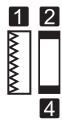


1 Turn the dial until the desired pattern aligns with the mark above the dial.
2 Turn the stitch length dial until the desired stitch length aligns with the mark above the dial.
- The stitch length can be set between 0 and 4. Since the recommended range differs depending on the pattern, refer to the following table.
| Pattern selection dial No. | Application | Stitch length dial (recommended setting) | Presser foot |
| 1 2 3 4 | Buttonhole | 0-4 (0.4~1) | Buttonhole foot |
| 5 6 7 | Straight stitch (left side) | 0-4 (1~4) | Zigzag sewing foot |
| Straight stitch (center) | 0-4 (1~4) | ||
| Zipper insertion | 0-4 (2~4) | Zipper foot | |
| 8 | Blind hem stitch | 0-4 (1~2) | Blind stitch foot * |
| 9 | Decorative stitch | 0-4 (1~4) | Zigzag sewing foot |
| Stretch fabric blind hem stitch | 0-4 (1~2) | Blind stitch foot * |
| Pattern selection dial No. | Application | Stitch length dial (recommended setting) | Presser foot |
| 10 | Mending stitch | 0-4 | |
| Thin fabric | (1~2) | ||
| 11 | Overcasting | 0-4 | |
| Decorative stitch | (1~2) | ||
| 12 | Overcasting | 0-4 | |
| Decorative stitch | (1~2) | ||
| 13 | 0-4 | ||
| Decorative stitch | (1~2) | ||
| 14 | Zigzag stitch | 0-4 | |
| (Zigzag stitch) | (0.5~2) | ||
| 15 | Zigzag stitch (large) | 0-4 | |
| Overcasting | (1~4) | ||
| Overcasting | 0-4 | Overcasting foot * |
- Included only with model XXX34C/SuperJ34. The zigzag sewing foot can also be used for 7, 9, 15.

Caution

Before turning the pattern selection dial, use the main power switch to turn off the sewing machine.
Not doing so could cause an injury.
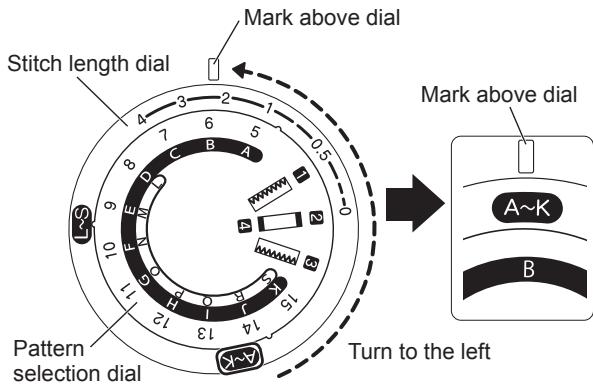
■ When sewing patterns A to K
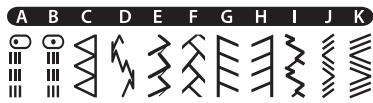

Turn the dial until the desired pattern aligns with the mark above the dial.

Turn the stitch length dial until A~K aligns with the mark above the dial.
- The stitch length is fixed at 3 mm and cannot be adjusted.
| Pattern selection dial No. | Application | Stitch length dial (recommended setting) | Presser foot |
| A III III | Reinforced straight stitch (left side) | A~K | Zigzag sewing foot |
| B III III | Reinforced straight stitch (center) | ||
| C | Decorative stitch Double overlock | ||
| D | Decorative stitch | ||
| E | Decorative stitch | ||
| F | Decorative stitch |
| Pattern selection dial No. | Application | Stitch length dial (recommended setting) | Presser foot |
| G | Decorative stitch Overlock | A~K | Zigzag sewing foot |
| H | Decorative stitch Overlock | ||
| I | Decorative stitch | ||
| J | Reinforced zigzag stitch (medium) | ||
| K | Reinforced zigzag stitch (large) |

Caution

Do not turn the pattern selection dial while the needle is lowered.
Doing so could break the needle and cause an injury.
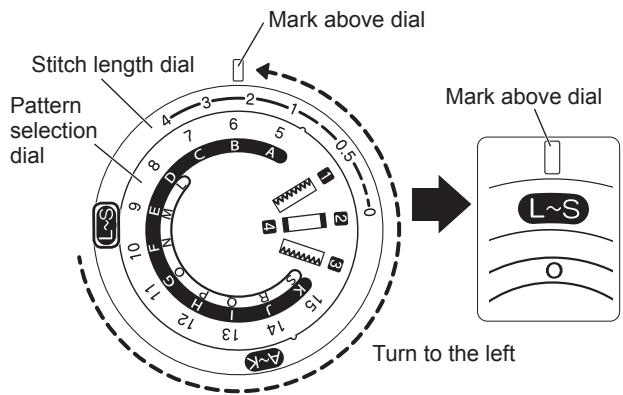
■ When sewing patterns L to S
- Stitches L through S can be sewn only with model XXX34C/SuperJ34.
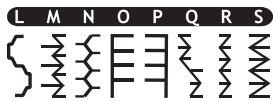

Turn the dial until the desired pattern aligns with the mark above the dial.

Turn the stitch length dial until L~S aligns with the mark above the dial.
- The stitch length is fixed at 3 mm and cannot be adjusted.
| Pattern selection dial No. | Application | Stitch length dial (recommended setting) | Presser foot |
| L | Decorative stitch | L~S | Zigzag sewing foot |
| M | Decorative stitch | ||
| N | Fagoting | ||
| O | Appliqué | ||
| P | Appliqué | ||
| Q | Decorative stitch |
| Pattern selection dial No. | Application | Stitch length dial (recommended setting) | Presser foot |
| R | Decorative stitch | L~S | Zigzag sewing foot |
| S | Decorative stitch |
Changing the presser foot

Caution

Before changing the presser foot, use the main power switch to turn off the sewing machine.
Not doing so could cause an injury.
- Removal
1 Raise the presser foot lever.
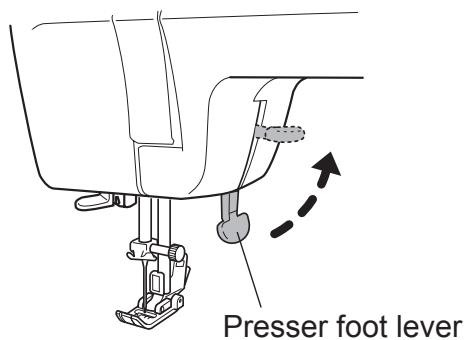
2 Turn the handwheel towards yourself to raise the needle.
Note: Never turn in the wrong direction.

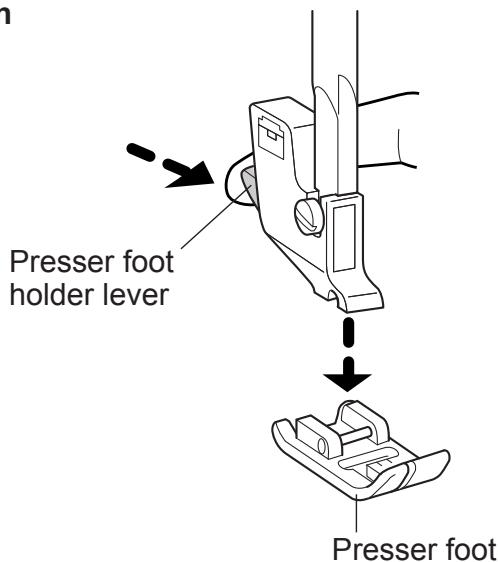
Press the presser foot holder lever in the direction of the arrow to release the presser foot.
- Installation
1 Position the presser foot pin directly below the groove in the presser foot holder.
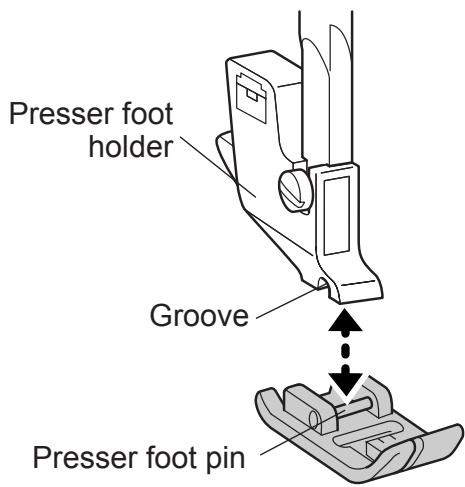
2 Lower the presser foot lever to secure the presser foot.
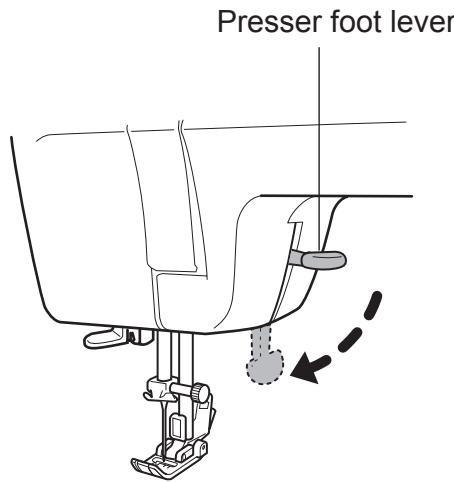
Tip
In order to avoid losing the presser foot, we recommend storing the machine when it is not being used with the needle and the presser foot lowered.
Changing the needle

Caution

Before changing the needle, use the main power switch to turn off the sewing machine.
Not doing so could cause an injury.
Broken needles are dangerous. Be sure to dispose of them in a safe place away from children.
Not doing so could cause an injury.
1
Turn the handwheel towards yourself to raise the point of the needle higher than the needle plate.
2
Hold the needle in one hand, loosen the needle clamp screw with the screw driver for the needle plate, and remove the needle.
Note:
Do not remove the needle clamp screw. Loosen the needle clamp screw to remove the needle.
Screw driver for the needle plate
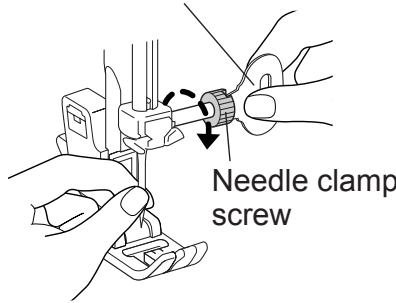
3
Face the flat surface of the needle to the rear and insert until it makes contact with the pin.
Firmly tighten the needle clamp screw with the screw driver for the needle plate.
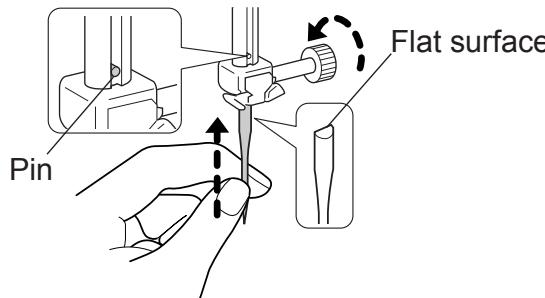
- Correct needle selection
If a faulty needle is used, not only could it impair the sewing performance, but it could also damage the needle plate or hook, or break the needle.
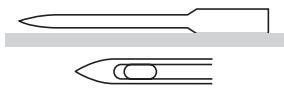
OGood needle
- Incorrect stitching or thread breaking, try replacing the needle.
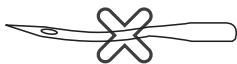
× Faulty needle
The entire needle is bent
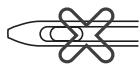
The point of the needle is crushed / worn away
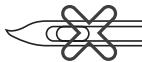
The point of the needle is bent
Relationship between the needle, thread and fabric, and adjusting the thread tension
The quality of the sewing finish will improve if the needle and thread are changed to match the type of fabric. Follow the directions in the table below.
| Thin fabrics | Normal fabrics | Thick fabrics | ||
| Relationship between the needle, thread and fabric | Needle | No. 11/75 | No. 14/90 | No. 16/100 |
| Thread | Polyester No. 90 Cotton No. 80 to No. 120 Silk No. 80 | Polyester No. 50 to No. 60 Cotton No. 60 to No. 80 Silk No. 50 to No. 80 | Polyester No. 30 to No. 50 Cotton No. 40 to No. 50 Silk No. 50 | |
| Fabric | Normal back cloth Quipler Georgette Lawn Lace, etc. | Normal front cloth Broad Soft denim Satin Pile Gingham, etc. | Curtains Denim Quilting Fleece Tweed Felt, etc. | |
| Reference thread tension | Upper thread tension dial | ● For XXX26C/XXX34C -1 ~ -3 ● For SuperJ26/34 -1 ~ -3 | -1 +1 +2 | +1 ~ +3 |
| - | -1 ~ +3 | |||
- Use a ball point needle for the sewing alignment of stretch fabric.
- Please purchase any needles not included as accessories, after checking they are specified as home-use sewing machine needles.
- Use the same kind of threads for upper/ lower thread.
- The bigger the needle number is, the thicker the needle is, the bigger the thread number is, the thinner the thread is.
- Normally, sew with the upper thread tension dial set to “ — ” (for XXX26C/XXX34C) / “ ∇ ” (for SuperJ26/34).
3
Sewing
Straight stitching and reverse sewing

Caution

Do not pull the fabric excessively while sewing.
Doing so could break the needle and cause an injury.
- Straight stitch
1 Turn the handwheel towards yourself to raise the needle.
2 Turn the pattern selection dial to choose the pattern. Set the stitch length dial between "1" and "4".
Zigzag sewing foot (Originally attached to the sewing machine)
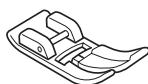
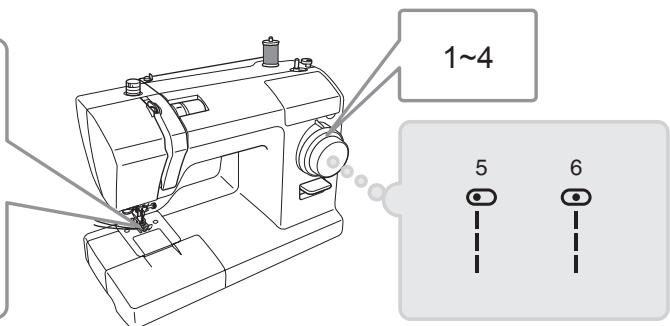
(For details on changing the presser foot, refer to “Changing the presser foot” on page 26.)

Position the fabric and lower the presser foot lever.
Step on the foot controller to begin sewing.
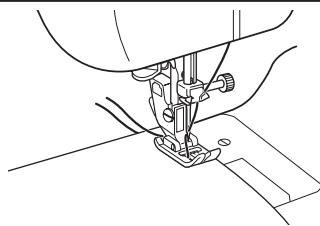
End of sewing
After sewing, turn handwheel towards yourself until the needle is in the highest position.
Raise the presser foot and pull out the fabric to the rear.
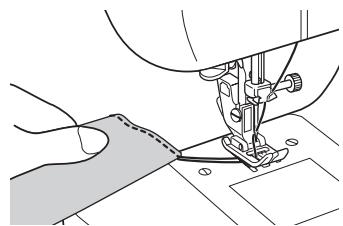
- Thread cutter
■ For model XXX26C/XXX34C
Line up the two threads, and cut them with the thread cutter on the presser bar.
■ For model SuperJ26/34
Line up the two threads, and cut them with the thread cutter on the face cover.
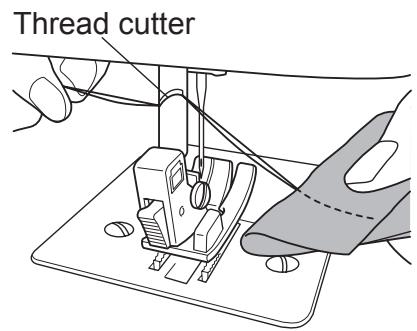
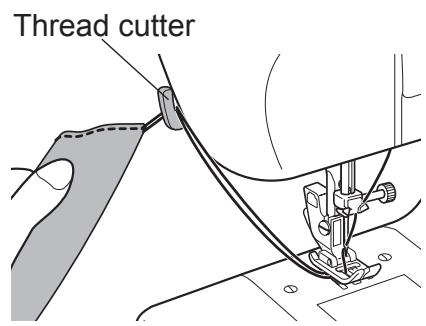
- Reverse sewing
Reverse sewing is performed at the beginning and the end of sewing to prevent the thread from unraveling.
Reverse sewing is performed while pressing down the reverse sewing lever.
- Stitch 1 cm from the edge of the fabric to prevent unraveling at the start of sewing.
- Sew 3 to 4 reverse stitches at the end of sewing.
Note:
Remove your finger from the reverse sewing lever to return to forward direction sewing.
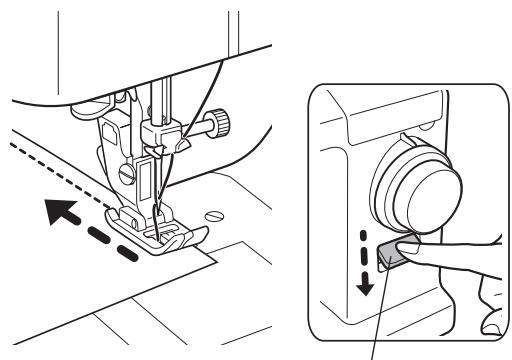
Reverse sewing lever
- Sewing thick fabric
When sewing over thick fabric, the presser foot may tilt and be unable to feed through the fabric.
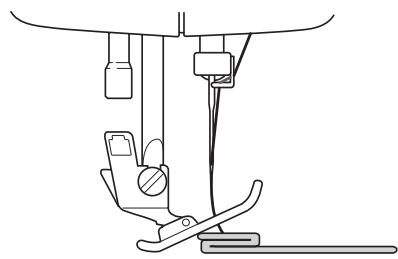
Place fabric or thick paper of the same thickness as the fabric you wish to sew under the presser foot. This will enable smooth sewing.
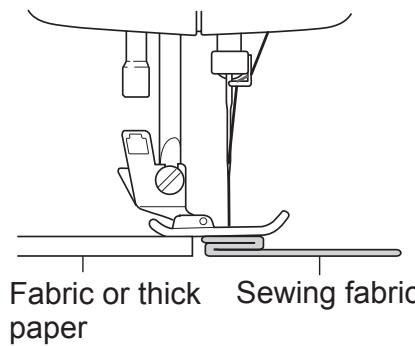
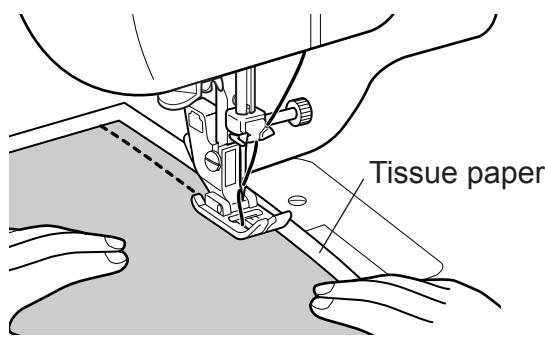
- Sewing thin fabric
When sewing thin fabric, sometimes fabric puckers or is not fed correctly.
At that time, sewing is easier if tissue paper is placed under the fabric.
After sewing remove the paper carefully.
- Sewing hard-to-feed fabric
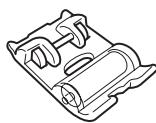
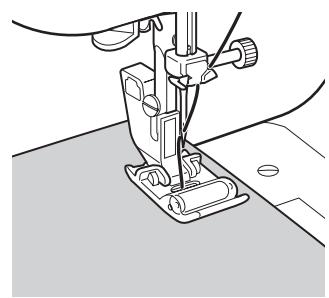
When sewing hard-to-feed fabric, such as leather, use the roller foot.
- The roller foot is only included with model XXX34C/SuperJ34.
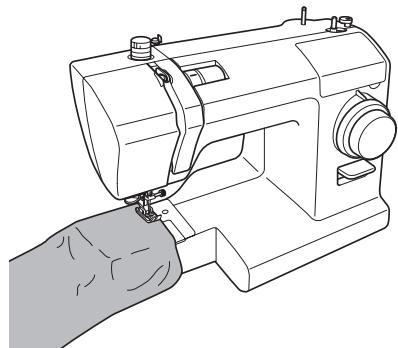
- Sewing tube-shaped fabrics
1
Pull out the extension table (accessory box) in the direction of the arrow.
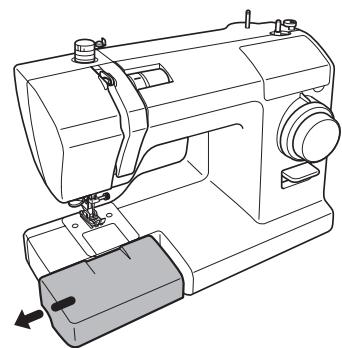
2
Sew tube-shaped fabrics such as trousers or sleeves, by pulling them over the machine free arm as shown in the diragram.
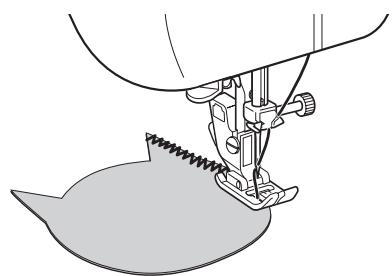
Zigzag sewing
There are various zigzag applications, such as applique and overcasting.
1 Turn the handwheel towards yourself to raise the needle.
2 Turn the pattern selection dial to choose the pattern.
Set the stitch length dial between "0.5" and "4".
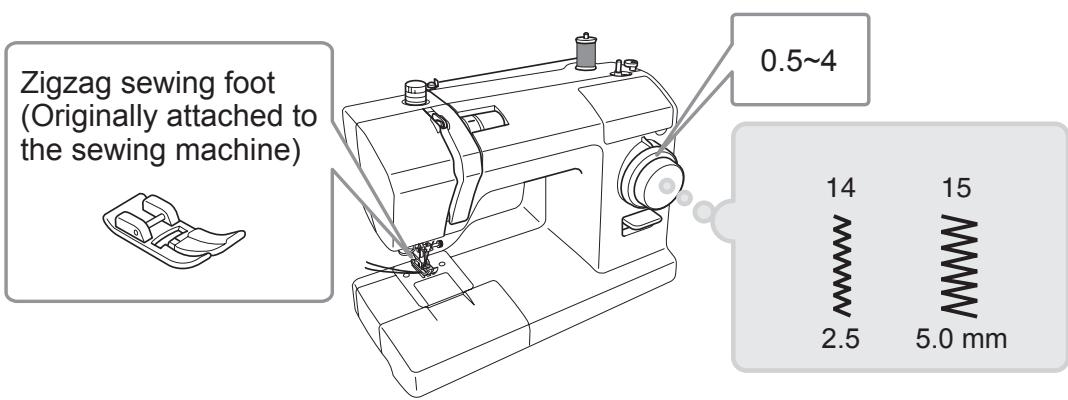
(For details on changing the presser foot, refer to "Changing the presser foot" on page 26.)
3 Position the fabric and lower the presser foot.
Step on the foot controller to begin sewing.
Adjusting thread tension
- Adjustment method for upper thread tension
Straight stitch
Upper thread is tight

Upper thread is loose
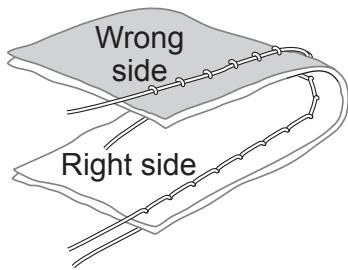
Zigzag sewing
Upper thread is tight
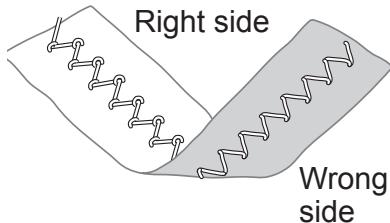
Upper thread is loose
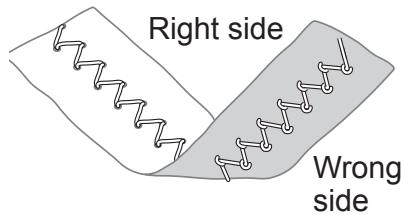
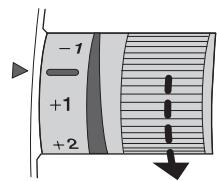
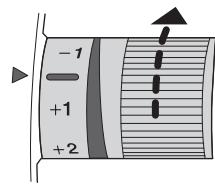
- Upper thread is tight
Model XXX26C
XXX34C
Model SuperJ26
SuperJ34
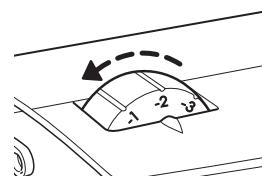
Lower the upper thread tension.
- Upper thread is loose
Model XXX26C
XXX34C
Model SuperJ26
SuperJ34
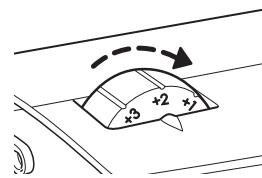
Increase the upper thread tension.
Note: If the tension does not change even when you adjust the upper thread tension, thread the upper thread and lower thread again.
Buttonhole sewing
Buttonhole sewing to match the size of the button is possible.
For stretch fabric or thin fabric, it is recommended to use a stabilizer for a better buttonhole finish.

Caution

Before changing the presser foot, use the main power switch to turn off the sewing machine.
Not doing so could cause an injury.
1
Change to the buttonhole foot.
Set the stitch length dial between "0.4" and "1".
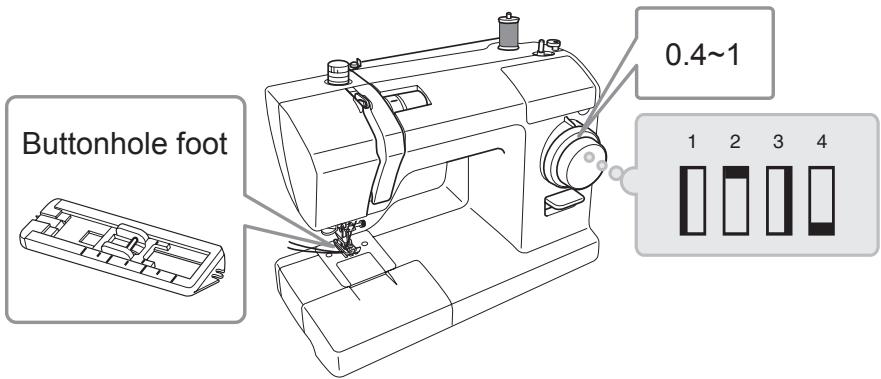
(For details on changing the presser foot, refer to "Changing the presser foot" on page 26.)
2
Set the buttonhole size and mark lines on the fabric.
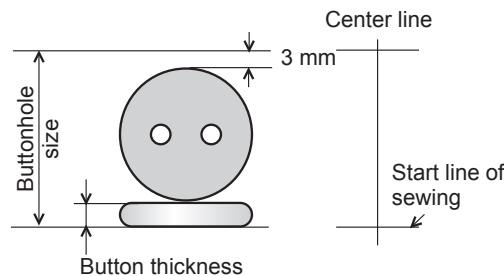
(Button diameter+button thickness+3mm)
3
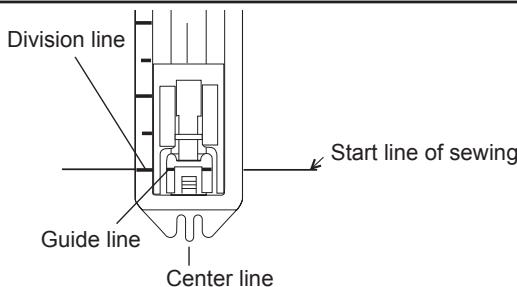
Align the buttonhole foot division line closest to you with the guide line, and lower the presser foot to the start line of sewing on the fabric.
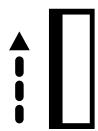
4 Raise the needle to the highest position, set the pattern dial to "1", sew the left side and stop at the line marked on the fabric.
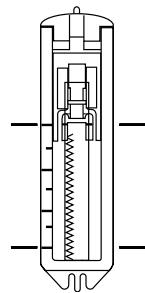
5 Raise the needle to the highest position, set the pattern dial to "2", and sew 5 to 6 bar-tack stitches.
"2" and "4" on the pattern selection dial use the same dial position.
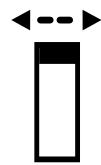
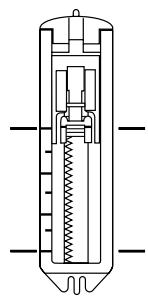
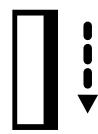
6 Raise the needle to the highest position, set the pattern dial to "3", sew the right side and stop at the line marked on the fabric.
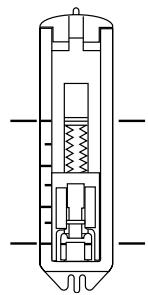
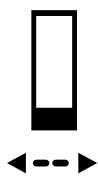
7 Raise the needle to the highest position, set the pattern dial to "4", and sew 5 to 6 bar-tack stitches.
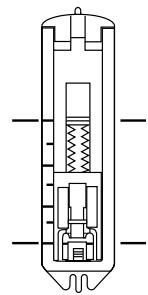

Caution

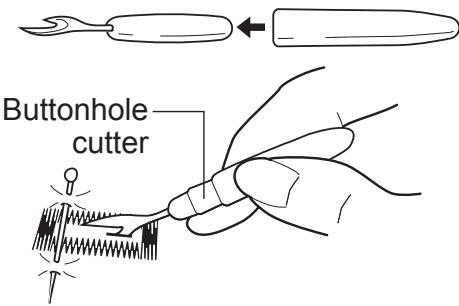
When using the buttonhole cutter to cut the buttonholes, do not hold the fabric in front of the cutter.
Doing so could cause an injury to your hand.

Use the buttonhole cutter to cut the center, making sure not to cut the stitches.
Note:
If a marking pin is put in the bartack area it helps to prevent cutting the bar-tack with the buttonhole cutter.
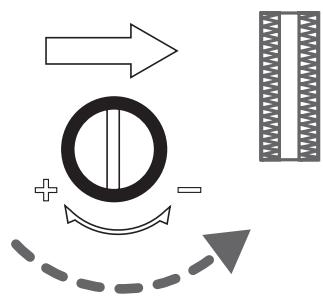
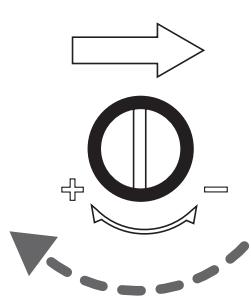
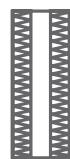
- Adjustment of buttonhole balance
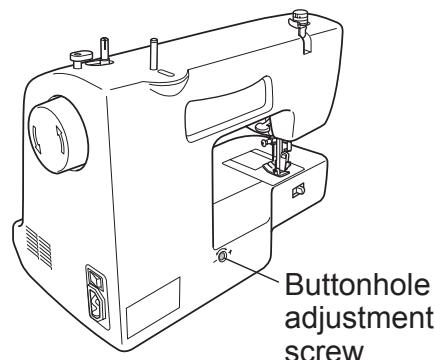
- Use the buttonhole adjustment screw to adjust the balance between the stitches (rear side).
- Adjust by turning with the screw driver of your own.
- Don't turn the screw more than 90^ .
Note:
The original position of buttonhole adjustment screw may vary according to the model of machine.
If the stitches are loose on the right side of the buttonhole, turn slightly in the “-” direction.
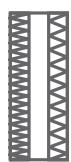
If the stitches are loose on the left side of the buttonhole, turn slightly in the “+” direction.

Overcasting
This is a sewing method that prevents unraveling at the edge of the fabric.

Caution

Before changing the presser foot, use the main power switch to turn off the sewing machine.
Not doing so could cause an injury.
1 Change to the zigzag sewing foot or the overcasting foot.
Set the stitch length dial between "1" and "4".
Note:
Select pattern No.10 when sewing thin fabric.
Zigzag sewing foot
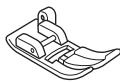
Overcasting foot
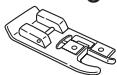
- The overcasting foot is only included with model XXX34C/SuperJ34.
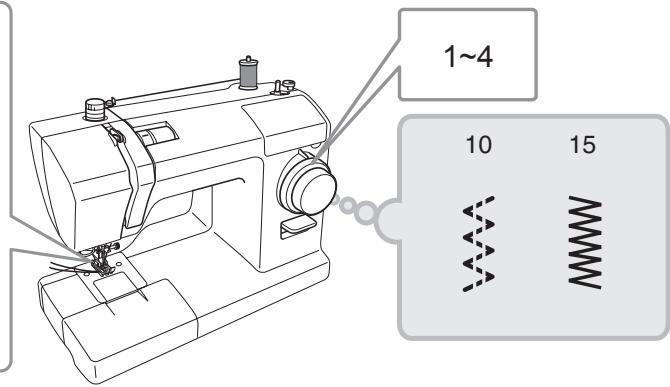
(For details on changing the presser foot, refer to "Changing the presser foot" on page 26.)
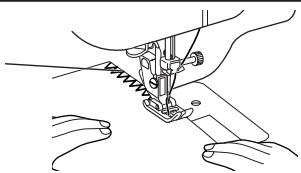
- When using the zigzag sewing foot

Position the fabric so that the needle extends slightly off the edge of the fabric when the needle moves to the right.
Right needle entry point
- When using the overcasting foot

Sew with the edge of the fabric against the guide on the foot.
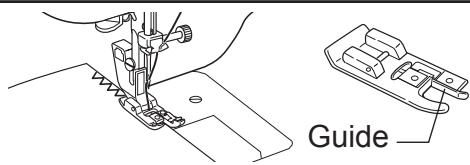

Caution

Do not use stitch number 10 with the overcasting foot.
Doing so may cause the needle to hit the presser foot and break or cause injuries.
Zipper insertion

Caution

Before changing the presser foot, use the main power switch to turn off the sewing machine.
Not doing so could cause an injury.

Change to the zipper foot. Set the stitch length dial between "2" and "4".
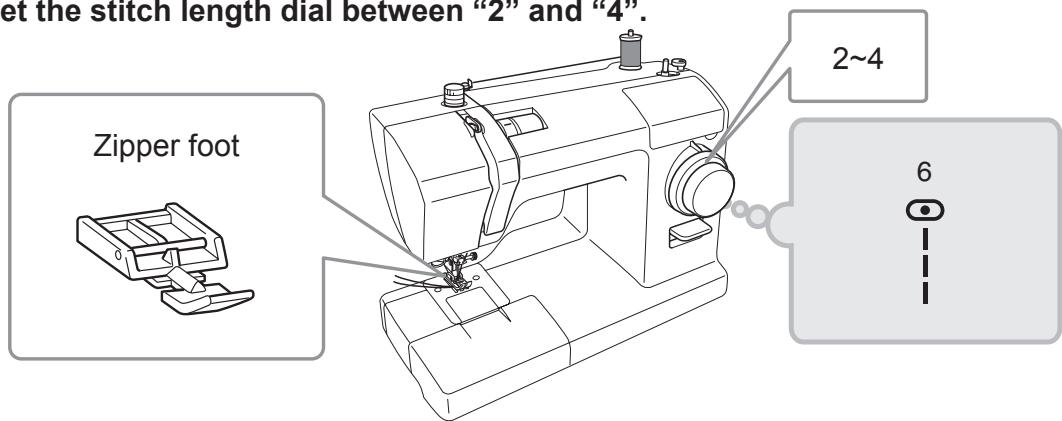
(For details on changing the presser foot, refer to "Changing the presser foot" on page 26.)
- Sewing the left side of the zipper

Set the right side pin of the zipper foot to the presser foot holder.
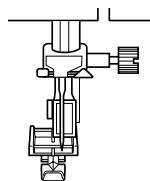
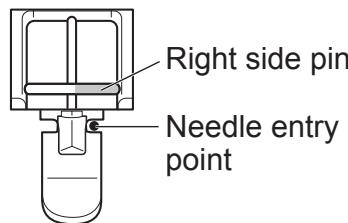

Align the zipper and the fabric, and tack.
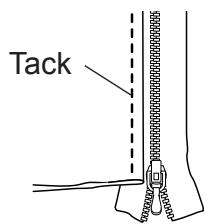

Position the fabric so that the zipper is on the right side of the presser foot.
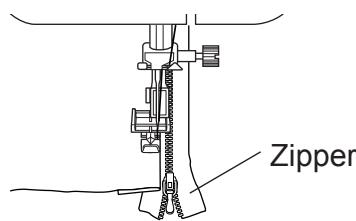

Sew until just before the presser foot makes contact with the slider, and then stop the sewing machine.
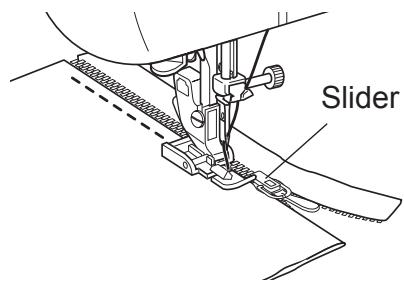

Turn the handwheel towards yourself to lower the needle into the fabric.

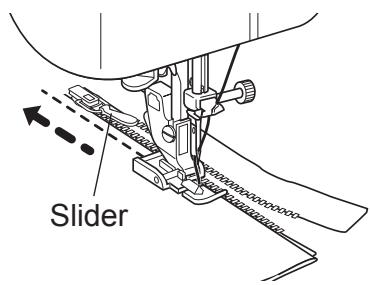
Raise the presser foot.

Move the slider to the rear of the presser foot, and finish the sewing.
- Sewing the right side of the zipper

Release the presser foot and set to the left side pin.
Sew the right side of the zipper using the same procedures as for the left side.
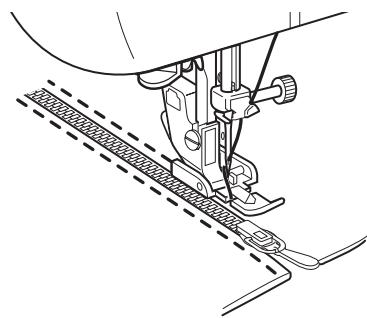
Note:
Sewing in the same direction as the left side will help prevent sewing misalignment.
Blind hem stitching
In this sewing method the stitch cannot be seen on the front of the fabric.

Caution

Before changing the presser foot, use the main power switch to turn off the sewing machine.
Not doing so could cause an injury.
1 Change to the zigzag sewing foot or the blind stitch foot. Set the stitch length dial between "1" and "2".
Zigzag sewing foot
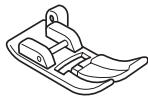
Blind stitch foot
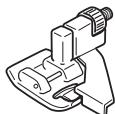
- The blind stitch foot is only included with model XXX34C/ SuperJ34.
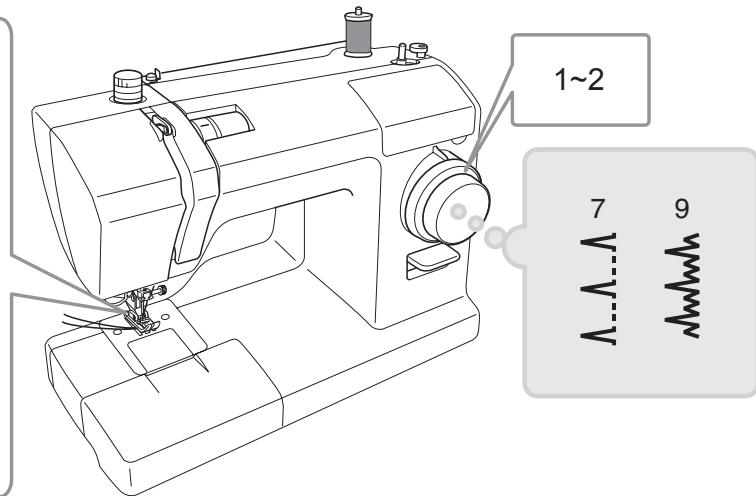
(For details on changing the presser foot, refer to "Changing the presser foot" on page 26.)
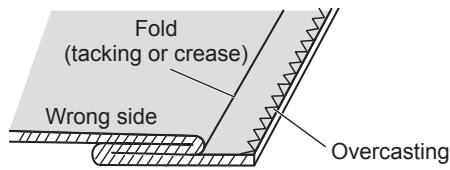
2 Sew overcasting along the edge of the fabric, and then fold the fabric as shown.
- Tack or iron a crease 6 to 8 mm from the edge of the fabric.
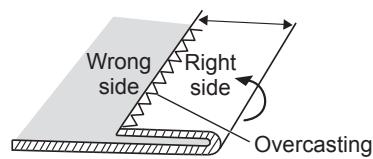
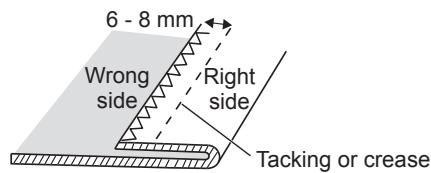

At the tacking or the crease that was ironed, fold back the fabric so that wrong side faces upward.

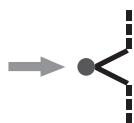
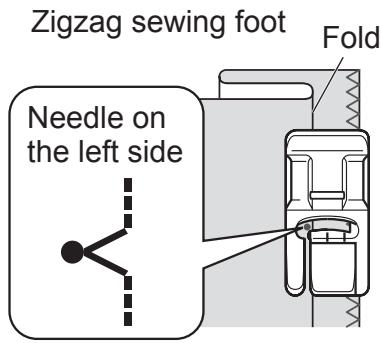
Turn the handwheel towards yourself until the needle is on the left side.
Needle on the left side
5
Position the fabric so that the needle slightly catches the fold.
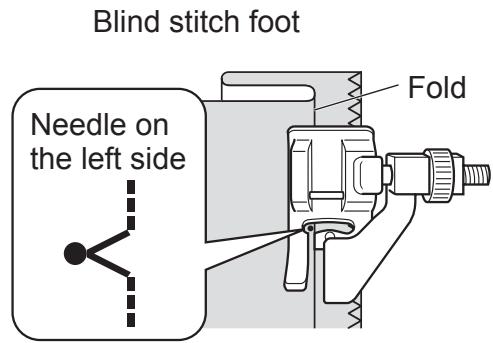
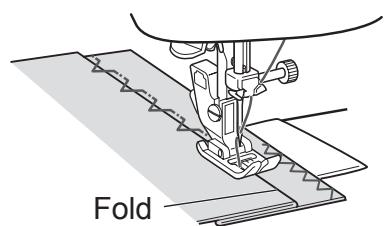
- When using the zigzag sewing foot
Lower the presser foot, and start sewing. The part of the stitch that catches the fold will be visible from the right side of the fabric. Sew evenly so that the stitching is not too large or too small.
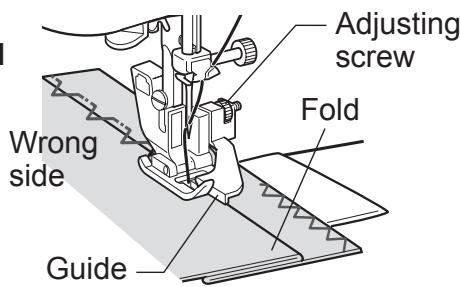
- When using the blind stitch foot
Lower the presser foot, adjust the screw so that the fold aligns with the guide, and then sew with the fold against the guide.
7
After sewing, pull out the tacking, and fold out the fabric.
Balanced stitches Troubleshooting
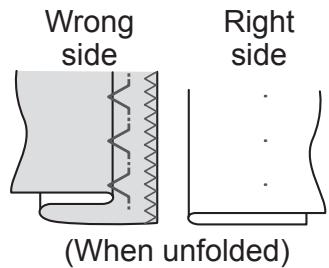
Small stitches evenly located on right side.
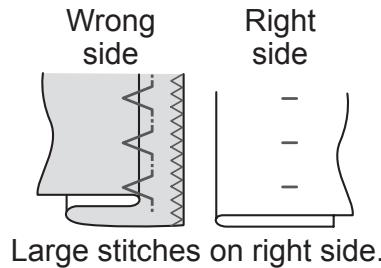
Needle catches too much on the fold
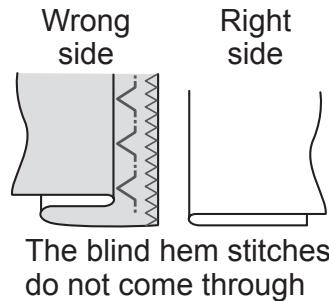
Needle does not catch on the fold
Feed dog and hook maintenance
If the sewing machine makes a loud noise or rotates slowly, there could be thread waste or dust in the hook or feed dog. Perform maintenance on the hook and the feed dog.

Caution

Before cleaning the hook, use the main power switch to turn off the sewing machine, and then remove the power plug from the outlet. Not doing so could cause an injury.
Attention
- Do not use detergent, bleach, benzine, or thinner chemical cloths.
- Doing so could cause discoloration or cracking.
- Cleaning the feed dog and hook

Remove the presser foot and the needle.
Turn the pattern selection dial to "6", and then turn the handwheel towards yourself to raise the feed dog.
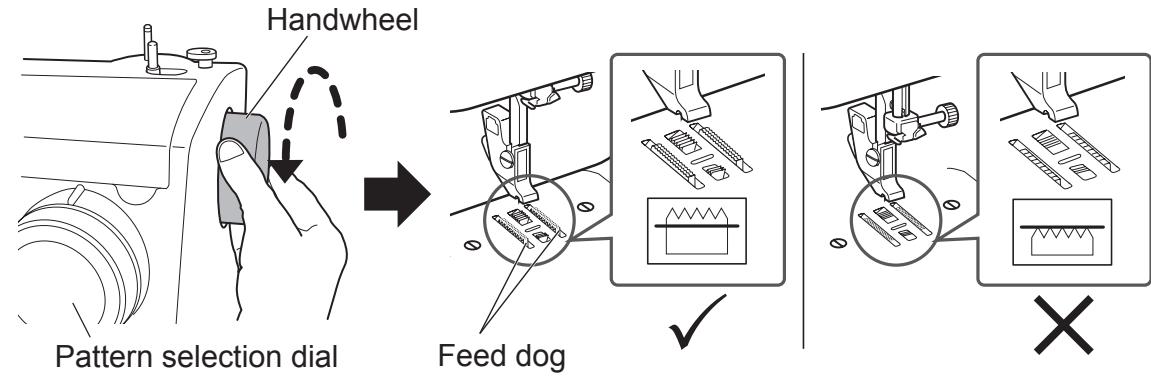

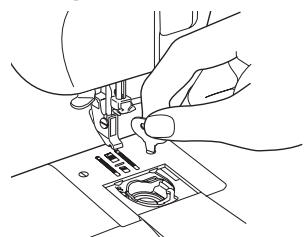
Use the screwdriver for the needle plate to loosen the screws in the needle plate, and then remove the needle plate.

Lift up the bobbin case so that part ⑤ is moved past part ① , as shown.
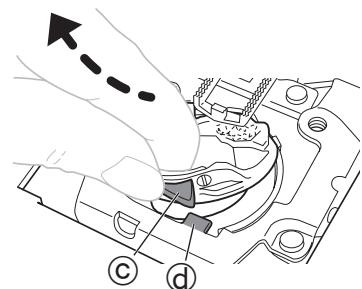
Pull out the bobbin case in the direction of the arrow to remove it.
Note:
Do not pull with excessive force, otherwise the bobbin case may be scratched.
- If the bobbin case cannot be pulled out, repeat the procedure starting with step
3.
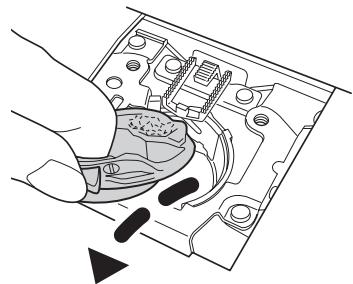
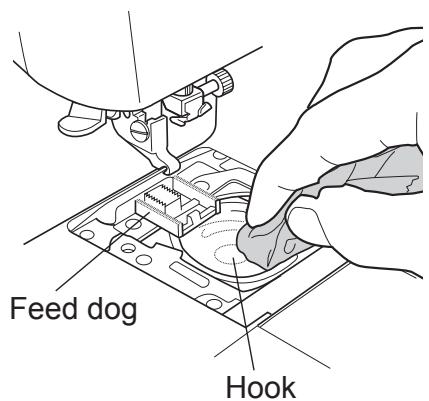
5 Remove any lint or dust from the feed dog and hook, and then wipe them with a soft cloth.
A vacuum cleaner can be used to remove lint and dust.
- Attaching the Bobbin Case
1 Position the bobbin case so that part ⑧ on the bobbin case is below part ⑥ on the sewing machine.
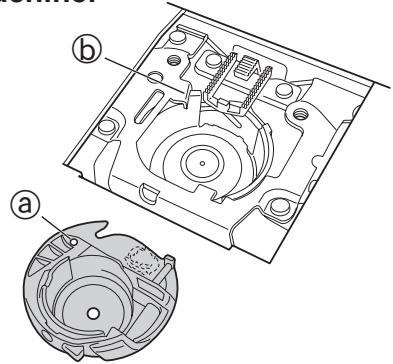
2 With the bobbin case tilted to the left, insert the left side of the bobbin case into the hook, as shown.
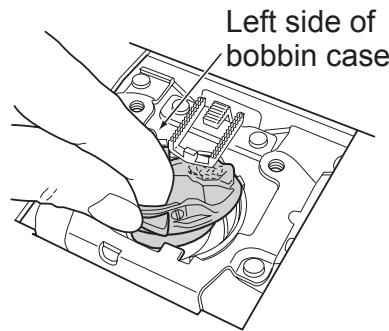
3 Insert the right side of the bobbin case into the hook so that part © on the bobbin case is to the left of part © on the sewing machine.
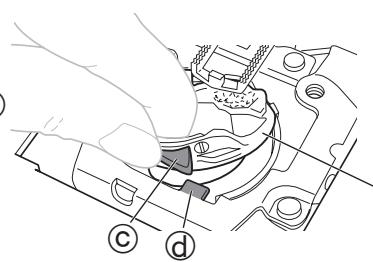
Right side of bobbin case
4 Make sure that the bobbin case is fully installed in the hook.
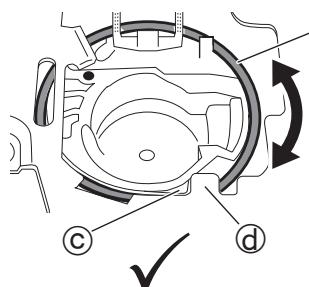
Edge of hook
Make sure that the bobbin case moves slightly in the direction of the arrow.
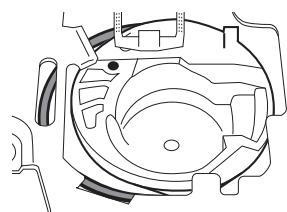
- The entire bobbin case fits into the hook so that the edge of the hook is visible.
- Part ⑤ on the bobbin case is to the left of part ④ on the sewing machine.

- The right side of the bobbin case covers the edge of the hook and the bobbin case is tilted.
Note:
Carefully check the bobbin case since it may be incorrectly installed even though part © of the bobbin case is to the left of part Ⓞ on the machine, as shown in the above diagram on the right.
5
Attach the needle plate with red mark
(a) on the bobbin case positioned as shown in the diagram.
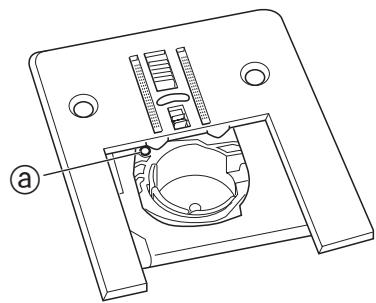
6
① Tighten the needle plate screws.
② Attach the presser foot and insert the needle.
③ Check that the needle correctly enters the hole in the needle plate.
- If the bobbin case is not installed correctly, the handwheel does not turn smoothly. If this occurs, remove the needle plate and bobbin case, and attach them again.
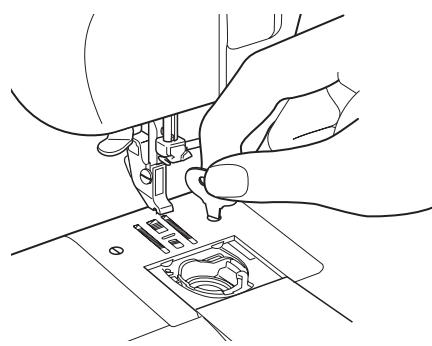
Changing light bulb

Warning

Before changing the light bulb, use the main power switch to turn off the sewing machine, remove the power plug from the outlet, and then wait until the bulb cools.
Not doing so could cause a burn or electric shock.

Loosen the screw with a screw driver of your own, and take off the face cover in the direction of the arrow.
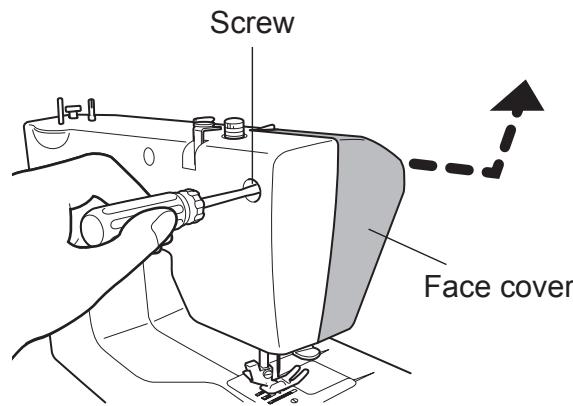

Turn the light bulb counterclockwise as the arrow in the diagram and remove.

Turn the new light bulb clockwise to install.
Note: Use a light bulb with a maximum power of 15 W.

Always reinstall the face cover after replacing the light bulb.
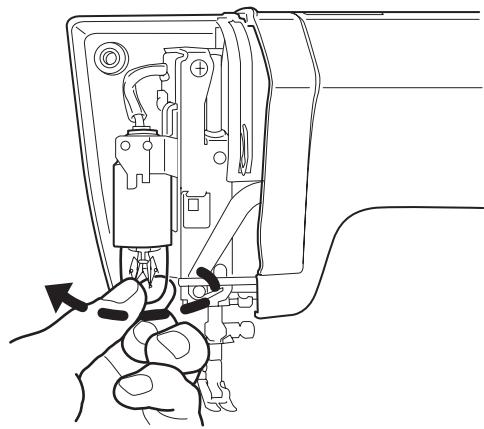
Servicing double-insulated products (230V-240V)
In a double-insulated product, two systems of insulation are provided instead of grounding. No grounding means are provided on a double-insulated product nor should a means for grounding be added to the product. Servicing a double-insulated product requires extreme care and should only be done by qualified service personnel with knowledge of the system under his or her responsibility. Replacement parts for a double-insulated product must be identical to those parts in the product. The symbol is marked on the double-insulated product.
Notice about the incandescent lamp
The incandescent lamp fitted to our product is not suitable for household lighting and is specifically designed for the lighting of the sewing machine sewing area.
Troubleshooting
What is the problem? Check the following possibilities before contacting the service center for repair.
| Trouble | Cause | Countermeasure | Page |
| Machine does not work | The power plug is not inserted | Connect the power plug correctly | 12 |
| The main power switch has been turned off | Turn on the sewing machine | 12 | |
| Thread is tangled in the hook, or there is a broken needle in the hook | Clean the hook | 44 | |
| The thread winding spindle has been pushed to the right | Push the thread winding spindle to the left | 14 | |
| Machine very noisy & very slow | There is lint or fluff in the hook or feed dog | Remove the lint or fluff from the hook or feed dog | 44 |
| Needle keeps breaking | Needle incorrectly inserted into the machine | Insert the needle correctly | 28 |
| The needle clamp screw is loose | Firmly tighten the screw | 28 | |
| The needle is too fine for the fabric | Use the appropriate size needle for the fabric | 29 | |
| The upper thread tension is too tight | Loosen the upper tension | 35 | |
| The bobbin case is not in the correct position | Put the bobbin case in the correct position | 46 | |
| Upper thread keeps Breaking | Machine is incorrectly threaded | Rethread the sewing machine | 16-19 |
| The thread is tangled in the bobbin case or hook | Remove the thread tangle and clean the feed dog and hook | 44 | |
| The upper thread tension is too tight | Loosen the upper tension | 35 | |
| The needle is bent or the needle point is burred | Insert a new needle | 28 | |
| The needle is incorrectly inserted | Insert the needle correctly | 28 | |
| The thread is a poor quality thread | Use a good quality, recommended thread | — | |
| Lower thread keeps breaking | Lower thread is incorrectly threaded | Rethread the bobbin case | 16, 17 |
| Fabric not feeding through the machine | The feed dog is dirty | Remove any lint and fluff from the feed dog | 44 |
| Pattern selection dial set to a buttonhole number – “2” or “4”. | Reset the stitch selection dial to the desired stitch | 23 | |
| The feed dog is lowered | Raise the feed dog | 8 | |
| The stitch length dial is set to “0” | Adjust the stitch length dial | 23-25 | |
| The stitch length is too short | Adjust the stitch length dial to an appropriate setting | 23-25 | |
| The presser foot pressure is too light | Increase the presser foot pressure | 8 | |
| Missed stitches | The needle is incorrectly inserted | Insert the needle correctly | 28 |
| The needle is bent | Use a straight needle | 28 | |
| Needle and thread not suitable for the fabric | Use the correct needle and thread for the fabric | 29 | |
| Incorrect upper threading | Rethread the upper thread correctly | 18, 19 | |
| The fabric wrinkles / puckers | The tension of the upper thread is too tight | Adjust the thread tension | 35 |
| The machine is incorrectly threaded | Rethread the machine | 16-19 | |
| Needle is too thick for the fabric | Use a finer needle to suit the fabric | 29 | |
| The needle is burred | Insert a new needle | 28 | |
| Stretch fabric is being sewn | Use the ball point needle | 29 | |
| Lower thread showing on the top of the fabric | Incorrect bobbin threading | Rethread the bobbin correctly | 16, 17 |
| The tension of the upper thread is too tight | Adjust the thread tension | 35 | |
| Incorrect plastic bobbin used or a metal bobbin is used | Only use the designated TOYOTA bobbin | 14 | |
| Upper thread showing on the under side of the fabric | The tension of the upper thread is too loose | Adjust the thread tension | 35 |
| Incorrect upper threading (not threaded through the thread guide) | Rethread the upper thread correctly | 18, 19 |

| Trouble | Cause | Countermeasure | Page |
| Unable to sew stretch stitches | The stitch length dial is not set to setting “A – K” or “L – S” | Set the stitch length dial to the appropriate setting | 23-25 |
| The stitch length dial and the stitch pattern selection dial settings do not correspond | Select the same setting on the stitch length dial and the pattern selection dial | 23-25 | |
| The needle cannot be threaded with the needle threader | The needle position is too low | Turn the handwheel so that the line is at the top | 9 |
| Needle no. 9/65 is being used | Use needle sizes 11/75 to 16/100 | 29 | |
| Needle incorrectly inserted | Insert the needle correctly | 28 | |
| The needle is bent | Use a straight needle | 28 | |
| Threading of the needle bar thread guide incorrect | Rethread the needle bar thread guide correctly | 18 |
If the above treatments do not solve the problem, contact the service center as described in your warranty.
When calling for service, please note the MODEL and SERIES that are inscribed on the back of your sewing machine.
SP200 SERIES/SERIE MODEL/MODELE


220-240V 50Hz
Total 65W max 15W
Manufacturer/: ZHEJIANG AISIN ELITE
Fabricant MACHINERY & ELECTRIC CO., LTD.P.R.C.
Importer/ AISINEUROPE S.A.
Importateur
Designed and engineered by AISIN SEIKI JAPAN
MADE IN P. R. C. / FABRIQUE A P.R.C.
Recycling
EU ONLY
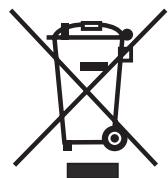
DO NOT THROW AWAY!
We are committed to the protection of the environment. We strive to minimize the environmental impact of our products by continuously improving product design and our manufacturing methods.
At end of life please dispose of this product in an environmentally responsible way.
The crossed-out wheelie bin symbol featured above and on the product's data-plate means that this product falls under the scope of the E.U. "Waste Electrical and Electronic Equipment" (WEEE) directive and "Restriction of the Use of Certain Hazardous Substances in Electrical and Electronic Equipment" (ROHS) directive and should not be disposed of with your household waste. At end of life, you must ensure that this product is disposed of in accordance with national and local legislation and that it is sorted as Category 2 "Small Domestic Appliances" WEEE. You may be liable under local and national laws for improper disposal of this product. Please consult the web, or a competent national or local body, for the return and collections systems available to you and the locations of your nearest recycling points. If you purchase a new product direct from us we will take your old product back, irrespective of the brand, if it is a like for like sale.
As an individual you can make a positive impact on reuse, recycling and other forms of recovery of WEEE. This will reduce use of landfill and minimize the environmental impact of the products you use.
Hazardous substances in electronic and electrical products can have a harmful impact on human health and on the environment.
Specifications
SP200 Series
| Model | XXX26C/XXX34C | SuperJ26/34 |
| Hook type | Horizontal | |
| Needle | Home-use sewing machine needle (HA-1) | |
| Bobbin | TOYOTA-exclusive plastic bobbin | |
| Maximum stitch length | 4 mm | |
| Maximum stitch width | 5 mm | |
| Straight stitch needle position | Center needle position, left needle position | |
| Sewing machine weight (main unit) | 5.0 kg | 5.2 kg |
| Sewing machine size | Width: 412 mmDepth: 192 mmHeight: 292 mm | Width: 410 mmDepth: 198 mmHeight: 294 mm |
| Rated voltage | 220 - 240V ~ | |
| Rated frequency | 50 Hz | |
| Rated power consumption | 65 W | |
| Light bulb | 15 W | |
EU ONLY
AISIN EUROPE S.A. Web: www.home-sewing.com
Head Office
Unit 4, Swan Business Park, Sandpit Road, Dartford, Kent, DA1 5ED UK.
TEL: +44 (0) 1322 291137 FAX: +44 (0) 1322 279214
France Branch
PARC D'ACTIVITES DU VERT, GALANT, 14 RUE DES OZIERS, BP 90756, 95004, CERGY-POTOSE CEDEX, FRANCE
TEL: +33 (0) 1 34 30 25 00 FAX: +33 (0) 1 34 30 25 01
Holland Branch
Energieweg 14, 2382 NJ Zoeterwoude (Rijndijk), THE NETHERLANDS
TEL: +31 (0) 71 5410251 FAX: +31 (0) 71 5413707
Austria Branch
Donaufelder Straße 101/5/1, A-1210 Wien, AUSTRIA
TEL: +43 (0) 1812 06 33 FAX: +43 (0) 1812 06 33-11
- HOME-USE SEWING MACHINE
- INSTRUCTION MANUAL
- Contents
- Before use (Be sure to read this section before use)
- Sewing preparations
- Sewing
- Maintenance
- Others
- Before use (Be sure to read this section before use)
- Important safety instructions
- Caution
- How to change the power plug
- Part names
- Part names and their functions
- Presser foot pressure adjustment knob
- * Equipped only with model XXX34C/SuperJ34
- Drop feed lever * Equipped only with model XXX34C/SuperJ34
- Extension table (Accessory Box)
- Presser foot lever
- Handwheel
- Pattern selection dial and stitch length dial
- Stitch length dial
- Pattern selection dial
- Reverse sewing lever
- Quick adviser
- - Accessing the quick adviser
- ■ For model XXX26C/XXX34C
- For model SuperJ26/34
- Note:
- How to operate foot controller
- Operation
- Connecting the power
- Warning
- Memo
- Winding the lower thread
- 2
- 10
- 9
- Thread guide
- (3)
- 8
- 3
- 4
- 5
- 6
- 7
- Threading the lower thread
- Threading the upper thread
- Using the needle threads
- Preparing to use the needle threads
- Turn the handwheel towards yourself until the needle is in its highest position.
- Raise the presser foot lever.
- - Understanding the needle threads mechanism
- - Using the needle threads
- Pulling up the lower thread
- Application of each stitch pattern
- ■ When sewing patterns 1 to 15
- Turn the dial until the desired pattern aligns with the mark above the dial.
- Turn the stitch length dial until the desired stitch length aligns with the mark above the dial.
- ■ When sewing patterns A to K
- ■ When sewing patterns L to S
- Changing the presser foot
- - Removal
- - Installation
- Tip
- Changing the needle
- 1
- - Correct needle selection
- Relationship between the needle, thread and fabric, and adjusting the thread tension
- Sewing
- Straight stitching and reverse sewing
- - Straight stitch
- End of sewing
- - Thread cutter
- ■ For model SuperJ26/34
- - Reverse sewing
- Reverse sewing is performed while pressing down the reverse sewing lever.
- - Sewing thick fabric
- - Sewing thin fabric
- - Sewing hard-to-feed fabric
- - Sewing tube-shaped fabrics
- Zigzag sewing
- Adjusting thread tension
- - Adjustment method for upper thread tension
- Buttonhole sewing
- - Adjustment of buttonhole balance
- Overcasting
- Change to the zigzag sewing foot or the overcasting foot.
- Zipper insertion
- - Sewing the left side of the zipper
- - Sewing the right side of the zipper
- Blind hem stitching
- Change to the zigzag sewing foot or the blind stitch foot. Set the stitch length dial between "1" and "2".
- Sew overcasting along the edge of the fabric, and then fold the fabric as shown.
- - When using the zigzag sewing foot
- - When using the blind stitch foot
- Balanced stitches Troubleshooting
- Feed dog and hook maintenance
- Attention
- - Cleaning the feed dog and hook
- Pull out the bobbin case in the direction of the arrow to remove it.
- Remove any lint or dust from the feed dog and hook, and then wipe them with a soft cloth.
- - Attaching the Bobbin Case
- Changing light bulb
- Servicing double-insulated products (230V-240V)
- Notice about the incandescent lamp
- Troubleshooting
- SP200 SERIES/SERIE MODEL/MODELE
- Recycling
- EU ONLY
- Specifications
- AISIN EUROPE S.A. Web: www.home-sewing.com
Brand : TOYOTA
Model : SUPER JEANS 26
Category : Clothing