
Medieval Lute - Musical instrument STEINBERG - Free user manual and instructions
Find the device manual for free Medieval Lute STEINBERG in PDF.


| Product Type | Medieval Lute |
| Brand | Steinberg |
| Model | Medieval Lute |
| Category | Musical Instrument |
| Material | Spruce top, maple body, rosewood fingerboard |
| Number of Strings | 7 courses (14 strings) |
| Soundboard | Solid spruce with parchment rose |
| Tuning Pegs | Boxwood pegs, friction fit |
| Weight | Approx. 2.5 kg (5.5 lb) |
| Dimensions (Length x Width x Depth) | 105 cm x 30 cm x 15 cm (41.3 in x 11.8 in x 5.9 in) |
| Body Shape | Pear-shaped with angled neck |
| Finish | Hand-rubbed oil finish |
| String Type | Nylon gut strings |
| Bridge Type | Fixed wooden bridge with string ramps |
| Sound Hole | Rosette-carved central rose |
| Included Accessories | None |
| Care Instructions | Keep at 40-60% humidity; avoid direct sunlight; wipe after playing |
| Safety Warnings | Keep away from heat sources; string tension may cause injury if snapped |
| Repair & Spare Parts | Contact Steinberg or a qualified luthier for repairs; strings available online |
| General Information | Authentic reproduction of a 12th-century lute; suitable for early music ensembles |
Frequently Asked Questions - Medieval Lute STEINBERG
User questions about Medieval Lute STEINBERG
0 question about this device. Answer the ones you know or ask your own.
Ask a new question about this device
Download the instructions for your Musical instrument in PDF format for free! Find your manual Medieval Lute - STEINBERG and take your electronic device back in hand. On this page are published all the documents necessary for the use of your device. Medieval Lute by STEINBERG.
USER MANUAL Medieval Lute STEINBERG
Thank you for purchasing the Lute.
How to install?
In order to properly install your HALion library please follow the instructions given on the Steinberg website or watch the, How to install" HALion instruments video.
For any kind of questions concerning the installation or registration of HALion instruments please contact Steinberg - in terms of the instrument please contact us at: support@cinematque-instruments.com
CINEMATIQUE INSTRUMENTS MANUAL
The instrument
Generally saying, Lute is a term for a most any string instrument having the strings running over a sound box. But if you are actually talking about a Lute one is meaning the European lute (or modern Near-Eastern oud) with characteristics such as a soundboard with a single decorated sound hole called the rose, a shell of thin wooden stripes and most known: a headstock which is angled back from the neck at almost 90°.
Our Lute is a renaissance Lute with 8 courses: (highest to lowest) a'e'b g d A G E . The courses are tuned in unison. Nowadays Lutes are equipped with nylon strings, the same as classica guitars today, but historically they where made of animal guts.
The lute is used in a great variety of instrumental music from the Medieval to the late Baroque eras and was the most important instrument for secular music in the Renaissance. But it is also used in score music such as in the recent Jim Jarmusch's movie 'Only Lovers left alone'.
The Concept
The Lute was carefully sampled in minor thirds on all the 13 strings in 3 dynamic layers and 4 round robin variations. We spent a lot of time to capture the seamless transitions between these layers and variations, so that the instrument feels as natural and smooth as possible.
But this lute is not just sampled notes spread on a keyboard. It is more than this. Like on real string instruments it is now possible to play the same note in different hand positions, each with a different timbre. By changing this position you can make a melody sound different and achieve a more natural feel when played - this all happens live via modwheel.
As if this wasn't enough, we also concentrate on the behavior of the course strings. Beside a separate volume knob, we furthermore defined the parameters flam and detune, which lets you vary the time and the tune in relation to the original string. This can be adjusted by separate knobs.
Finally we added some nice fx and sound options to shape the overall luie sound to our favourite requirements.
CINEMATIQUE INSTRUMENTS MANUAL
In Detail
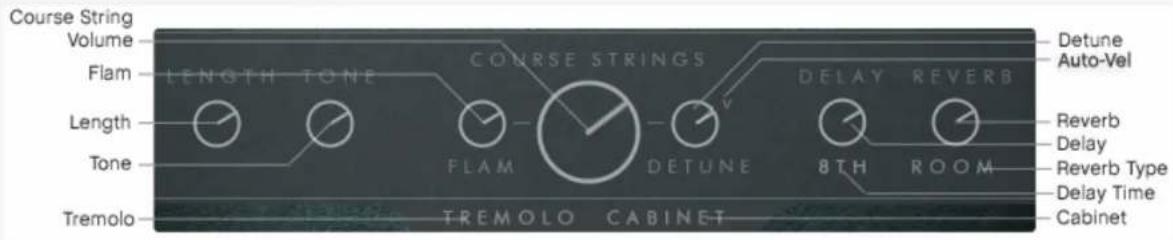
This is the control bar of the HALion Lute:
Course Strings controls the global volume of the course string Volume ( 2^nd string)
Flam controls the time between the original and the course string
Length controls the overall decay/ release time (= Length)
Tone controls the general sound. Turning counter clockwise you will feature the bass frequency and reduce the high frequencies. Turning clockwise you will achieve the opposite.
CINEMATIQUE INSTRUMENTS MANUAL
Tremolo By activating this button you achieve a tremolo function. When releasing an already played key the instrument plays the note again. This lets you easily create tremolos - you can exactly control the velocity and tempo of the tremolo, simulation
Detune controls the amount of detuning of the course string
Auto Vel by activating this button, the Detune amount is controlled by velocity while the maximum detune amount stays at the current detune-knob position
Reverb controls the amount of reverb
Delay controls the amount of delay
Reverb Type By clicking on the name you can select from four different types of reverb: Room, Hall, Special and Infinite
Delay Time By clicking on the name you can select from three different delay times: 4 ^th , 8 ^th and 16th
Cabinet enables a cabinet simulation
CINEMATIQUE INSTRUMENTS MANUAL
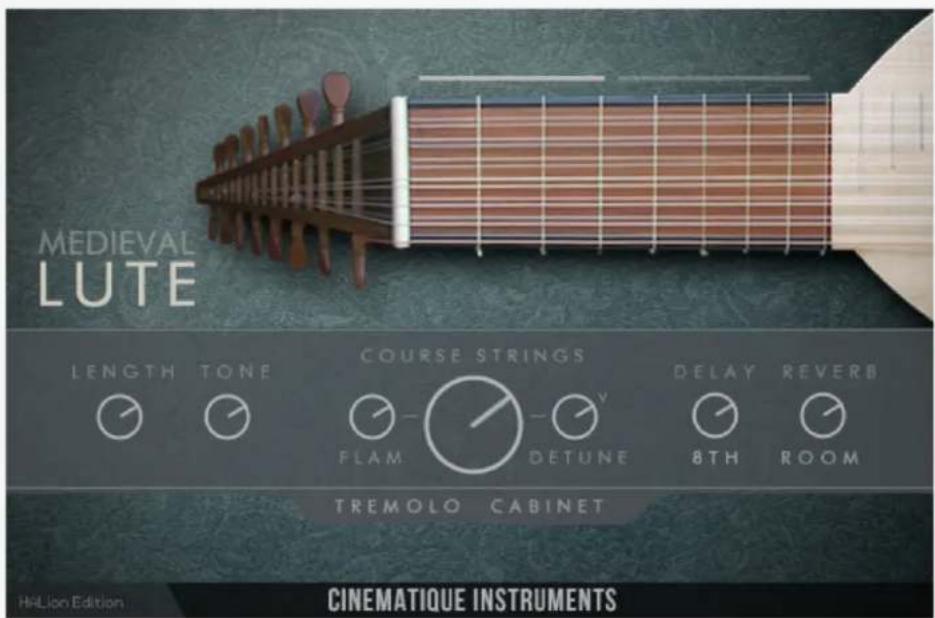
We wish you a great deal of fun and inspiration using our instruments.
Thanks to René, Jumpel, Jonas and Niklas at Cinematique Instruments and Florian, Matthias, Michael and Frank at Steinberg.
Copyright © September, 2019 by Cinematique Instruments, Cologne, Germany
Brand : STEINBERG
Model : Medieval Lute
Category : Musical instrument