ManualGo.com
SRV876G - Cooktop SMEG - Free user manual and instructions
Find the device manual for free SRV876G SMEG in PDF.


Download the instructions for your Cooktop in PDF format for free! Find your manual SRV876G - SMEG and take your electronic device back in hand. On this page are published all the documents necessary for the use of your device. SRV876G by SMEG.
USER MANUAL SRV876G SMEG
THESE INSTRUCTIONS ARE VALID ONLY FOR END USER COUNTRIES WHOSE IDENTIFICATION SYMBOLS APPEAR ON THE COVER OF THIS MANUAL. INSTRUCTIONS FOR THE INSTALLER: these are for the qualified X technician who must carry out a suitable check of the gas system, install the appliance, set it functioning and carry out an inspection test. INSTRUCTIONS FOR THE USER: these contain user advice, description à of the commands and the correct procedures for cleaning and maintenance of the appliance.
THIS MANUAL IS AN INTEGRAL PART OF THE APPLIANCE AND THEREFORE MUST BE KEPT IN ITS ENTIRETY AND IN AN ACCESSIBLE PLACE FOR THE WHOLE WORKING LIFE OF THE COOKING HOB. WE ADVISE READING THIS MANUAL AND ALL THE INSTRUCTIONS THEREIN BEFORE USING THE COOKING HOB. ALSO KEEP THE SERIES OF NOZZLES SUPPLIED. INSTALLATION MUST BE CARRIED OUT BY QUALIFIED PERSONNEL IN ACCORDANCE WITH THE REGULATIONS IN FORCE. THIS APPLIANCE IS INTENDED FOR DOMESTIC USES AND CONFORMS TO CURRENT REGULATIONS IN FORCE. THE APPLIANCE HAS BEEN BUILT TO CARRY OUT THE FOLLOWING FUNCTIONS: COOKING AND HEATING-UP OF FOOD. ALL OTHER USES ARE
Instructions for the installer
2 POSITIONING OF THE HOB
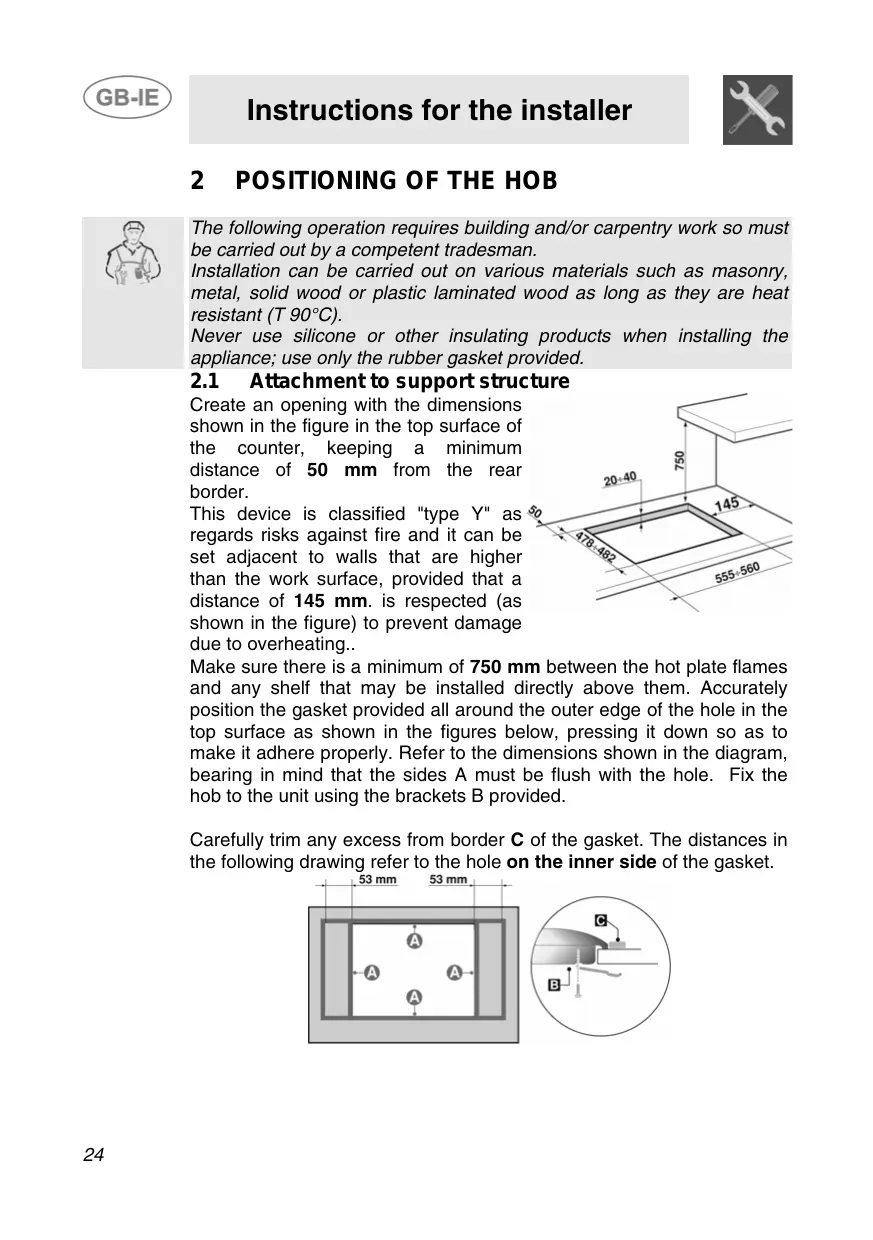
The following operation requires building and/or carpentry work so must be carried out by a competent tradesman. Installation can be carried out on various materials such as masonry, metal, solid wood or plastic laminated wood as long as they are heat resistant (T 90°C). Never use silicone or other insulating products when installing the appliance; use only the rubber gasket provided.
2.1 Attachment to support structure
Create an opening with the dimensions shown in the figure in the top surface of the counter, keeping a minimum 8 distance of 50 mm from the rear F] border. + This device is classified "type Y" as & regards risks against fire and it can be + set adjacent to walls that are higher > FA than the work surface, provided that a 555" distance of 145 mm. is respected (as " shown in the figure) to prevent damage due to overheating.. Make sure there is a minimum of 750 mm between the hot plate flames and any shelf that may be installed directly above them. Accurately position the gasket provided all around the outer edge of the hole in the top surface as shown in the figures below, pressing it down so as to make it adhere properly. Refer to the dimensions shown in the diagram, bearing in mind that the sides À must be flush with the hole. Fix the hob to the unit using the brackets B provided. Carefully trim any excess from border C of the gasket. The distances in the following drawing refer to the hole on the inner side of the gasket. 53 mm 53 mm ; LA] LA] 0:
Instructions for the installer cB In case of installation on a hollow compartment with doors, a separating panel has to be placed under the hob. Keep a minimum distance of 10 mm between the bottom of the unit and the panel surface. The panel has to be easily removable to allow access in the event of technical service. 10 mm
Instructions for the installer 3 ELECTRICAL CONNECTION Make sure that the voltage and capacity of the power line conform to the data shown on the plate located under the casing. Do not remove this plate for any reason. The plug on the end of the supply cable and the wall socket must be the same type and conform to the current electrical system regulations. Check that the power line is adequately grounded. On the power line, install an omnipolar cut-off device with contact cut-off distance greater than or equal to 3 mm, located in an easily accessible position near the unit. Do not use reducers, adapters or shunts. If the power cable is replaced, the wire section on the new cable must not be less than 1.0 mm *(3 x 1.0 cable), keeping in mind that the end
be connected to the hob must have the ground wire (yellow-green) longer by at least 20 mm. Use only HO5V2V2-F cable or similar which has a maximum temperature of 90°C. Any replacement needed should be carried out by a specialised technician who should make the mains connections according to the following diagram. L= brown N= blue Æ> yellow-green CLEN
20 mm The manufacturer will not be liable for any damage to persons or property caused by non-observance of the above instructions or deriving from the tampering of even a single part of the hob.
15mt Instructions for the installer SRE 4 GAS CONNECTION Connection to the gas mains may be made with a rigid copper pipe or with a flexible pipe and conforming to the provisions defined by standard regulations in force. To facilitate connection, fitting A on the rear of the appliance may be adjusted laterally. For this purpose, loosen hexagon nut B, turn fitting A to the desired position, and retighten hexagon nut B (tighiness is ensured by a biconical brass ring). Use a soapy solution to check for proper tightness. Never use a free flame. The hob has been inspected for G20 (2H) natural gas at a pressure of 20 mbar. For use with other types of gases, see Section “ ADAPTATION TO DIFFERENT TYPES OF GAS”. The gas intake fitting is 2" gas external threaded (ISO 228- 1). Connection with rigid copper pipe: the connection to the gas mains must not provoke stress of any kind on the hob. Connection may be made by using biconical adapter D with insertion of gasket C (supplied). Connection with flexible pipe: use only flexible pipes conforming to standard regulations in force, inserting gasket C (supplied) between fitting A and flexible pipe
The flexible pipe has to be installed so that pipe length does not exceed
1.5 meters of maximum extension. Make sure that the pipes do not
touch any moving parts or become damaged.
Instructions for the installer
4.1 Connection to LPG
û Use a pressure regulator and make the connection to the tank EN according to the provisions of standards regulations in force. Make sure that feed pressure conforms to the levels shown in the table in paragraph “5.2 Regulation for LPG”.
4.2 Ventilation of rooms
FF The hob may be installed only in rooms with permanent ventilation, as 1 required by standards regulations in force. The room in which the hob is installed must have sufficient air flow to satisfy the requirements of normal gas combustion and of necessary air exchange in the room. The air intakes, protected by screens, must be appropriately sized (regulations in force) and placed so as not to be blocked in any way. The room where the oven is installed should be suitably ventilated to avoid overheating or excess humidity produced by cooking, and in the case of lengthy use a window should be opened or the speed of any ventilators should be increased.
4.3 Discharge of combustion products
& Discharge of combustion products must be guaranteed by means of hoods connected to a natural draught flue with certain efficiency, or by ZX means of forced aspiration. An efficient aspiration system requires careful planning by a specialist capable of installing it, respecting the positions and distances prescribed by standards. After installation, the installer must issue a certificate of conformity.
Instructions for the installer (BE)
5 ADAPTATION TO DIFFERENT TYPES OF GAS
Before performing any cleaning or maintenance work, disconnect the appliance from the electrical socket. The hob has been inspected for G20 (2H) natural gas at a pressure of 20 mbar. For functioning with other types of gas the nozzles must be replaced and the primary air adjusted. To replace the nozzles and regulate the burners, you have to remove the top as described in the following paragraph.
5.1 Removing the hob
1. Remove all the knobs, the grids, the burner caps and the flame-
2. Remove the screws and the nuts A that secure the burner
supports; Remove plates B; Lift the hob from its seat; Replace the burner nozzles in accordance with the relevant gas table;
6. Regulate the primary air as described in paragraph “5.2 Regulation
5.2 Regulation for LPG
Loosen screw A and push support B all the way. Use a double head wrench to remove nozzle C and assemble the suitable one, following the instructions indicated in the reference charts, with respect to the type of gas to use. The screwing torque of the nozzle should never exceed 3 Nm. Reposition support B so that nozzle C is covered perfectly. Move the Venturi tube D to regulate the air flow until distance “X" is reached indicated in the chart in paragraph “5.4 Regulation of primary air” and then secure the tube by means of screw A. After the regulations have been carried out, restore the seals with sealing wax or equivalent material. Rated Burner heating LPG — G30/G31 28/37 mbar capacity Nozzle Reduced 1/100 mm (W) Auxiliary 1.05 48 30 (1) 380 76 75 Semirapid 1.65 62 30 (1) 380 120 118 Rapid 2.55 76 37 (2) 650 185 182 Rapid large 3.1 85 43 750 225 222 Fish pan 2 67 43 (3) 750 145 143 Ultra rapid 3.3 87 55 (4) 1200 240 236 Double Internal 0.8 42 30 (1) 380 58 57 crown External 3.3 87 55 (4) 1200 240 236 {1}= 83 for valveless appliances. (2)= 40 for valveless appliances. (8)- 45 for valveless appliances. (4)= 65 for valveless appliances.
Instructions for the installer
5.3 Regulation for natural gas
The hob has been inspected for G20 (2H) natural gas at a pressure of 20 mbar. To allow the unit to work with this type of gas, perform the same operations described in paragraph “5.2 Regulation for LPG”, but choose the nozzles and regulate the primary air for natural gas, as shown in the following table and in paragraph “5.4 Regulation of primary air”. After the regulations have been carried out, restore the seals with sealing wax or equivalent material. Auxiliary Double Internal 08 crown External 3.3 130 1200
5.4 Regulation of primary air
Referred to distance “X” in mm. Auxiliary (1) 1.5 1.0 Rapid (3) 1.0 1.5 Fish pan (7) 2.0 2.5 Ultra rapid (5) 20 25 Ultra rapid (8) 2.0 2.5 External 1.5 8.0 External 15 4.0 To identify the burners on your hob, refer to the drawings in point “6.3 Arrangement of burners on hob *
Instructions for the installer 6 FINAL OPERATIONS Having carried out the above adjustments, reassemble the appliance following, backwards, the instructions in paragraph “5.1 Removing the hob”.
6.1 Regulation of minimum for natural gas
Replace the components on the burner and slide the knobs on the gas tap pins. Light the burner and set it at minimum position. Remove the knob and turn the regulation screw inside or next to the gas tap pin (depending on the model) until you get a suitable minimum flame. Replace the knob and check burner flame stability: (rapidiy turning the knob from maximum to minimum position, the flame should not go out).
6.2 Regulation of minimum for LPG
To regulate the minimum for LPG, completely tighten (clockwise) the screw inside or next to the gas tap pin (depending on the model). The diameters of the by-passes for each burner are given in table “5.2 Regulation for LPG". e After having regulated the device with a gas other than the one tested, Y replace the label located on the bottom enclosure with the one that KE) corresponds to the new gas. The label is inside the bag that contains the nozzles.
Instructions for the installer
6.3 Arrangement of burners on hob
Burners Auxiliary Semirapid Rapid Rapid large Ultra rapid Double crown Fish pan Ultra rapid Double crown LHNHHBEWN =
6.4 Lubrication of gas taps
After a while, the gas tap may become hard to turn or lock. If this happens, it has to be cleaned inside and re-greased. This must be done by a qualified technician.
Instructions for the user
Before turning on the burners, make sure that the burner rings, caps and grids have been fitted correctly. In the ultrarapid burner, notch À must be aligned with pin B. Grid C (where available) is intended for use with woks (Chinese pans). Adapter D comes only with open grids models and is intended for use with small sized vessels.
7.1 _Ignition of the burners
= Raised indicators make for easier and clearer reading and use of the controls, each knob being connected to its corresponding burner by a rib. Setting corresponds to the elongated part of the knob or to the marking on it. (Only where applicable) Double-crown burners, controlled by two knobs, feature two ribs, a long | one corresponding to the small inner burner and a short one to the outer burner. Double-crown burners comprise an auxiliary and a rapid burner, controlled by two different knobs which allow both burners to be used at the same time or to select one or the other as required. The device is fit with electronic ignition. Simply press and simultaneously turn the knob counter-clockwise on the low point flame symbol, until the burner is ignited. Concerning models with valves, push the knob for approximately 2 seconds in order to keep the flame burning and to activate the safety device. The burner might go off when the knob is released. In this case repeat the aforesaid operation keeping the knob pressed for more than 2 seconds. Should the burners go off accidentally in the models with valves, a safety device will trip after approximately 20 seconds to block the gas outlet even if the cock is open.
Instructions for the user BE)
7.2 Practical advice for using the burners
For better burner performance and minimum gas consumption, flat bottomed, even pans must be used, with covers and proportional in size to the burners (see paragraph “7.3 Diameter of the pans”). : U9 ÿ€ To avoid overcooking or damage to the surface top Bee or to the glass (where available) while cooking, all LE pans or griddles must be positioned within the cooking hob perimeter and must be a minimum distance of 3-4 cm from the knobs. Take care not to touch the glass of the lid with hot pots and pans. The glass might crack due to the heat.
7.3 Diameter of the pans
Burners © min. and max. (in cm.) Auxiliary 7-18 Semirapid 10-24 Rapid 12-24 Rapid large 14-26 Double crown 12-28 Uttrarapid 22-28 Fish burner Special oval-shaped vessels
7.4 Using a griddle plate
A few precautions are necessary if you wish to use a griddle plate: + __ leave a gap of at least 160 mm between the edge of the griddle plate and the side wall; + _if one of the burners close to the wooden rear wall is of triple flame type, leave a gap of at least 160 mm between this wall and the edge of the griddle plate; + do not allow the burner flames to extend beyond the edge of the griddle plate; + operate the burners underneath the griddle plate for 10 minutes at maximum power, then turn them down to the minimum setting. Never use the griddle plate for more than 45 minutes.
Instructions for the user
8 CLEANING AND MAINTENANCE
Never use a steam jet to clean the appliance. Before any intervention, disconnect the power supply of the appliance.
Clean the cooking top regularly every time you use it, obviously after it has cooled.
8.1.1 Regular daily cleaning of the hob
In order to clean and preserve the surface, always use specific products only, which do not contain abrasive substances or chlorine-based acid substances. How to use: pour the product on a damp cloth and wipe the surface, rinse thoroughly and dry with a soft cloth or deerskin.
8.1.2 Food stains or residues
Do not use metallic sponges or sharp scrapers: they will damage the surface. x Use normal non-abrasive products and remove spots or residuals with non-scratch sponges or, if need be, with wood or plastic utensils. 4 Rinse thoroughly and dry with a soft cloth or deerskin.
Instructions for the user 7
8.2 Cleaning of cooking hob components
CAUTION: do not wash these components in a dishwasher. In normal use of the hob, the stainless steel bumer caps and pan- stands tend to be burnished by the high temperature. Clean these parts using very fine abrasive sponges or similar commercial products. Then use a specific paste polish to restore the steel's shine. Your local authorised after-sales technician is able to supply professional products for appliance cleaning and care. Grids, caps, flame cap crowns and burners can be CS removed for ease of cleaning. Wash them in warm water using a non-abrasive detergent, taking care to remove all tough spots. Before remounting, allow the components to fully dry out. In fact, humidity residues inside the burner holes might impair burner operation. 4
8.2.1 Ignition plugs and safety devices
For good functioning of the lighting ignition plugs and the safety devices, keep them very clean. Check frequently and clean with a damp cloth when necessary.
Clean the glass or steel cover, where mounted, with warm water. Never use abrasive sponges or detergents. Attention: the glass lid may break if overheated. Make sure that all the burners are switched off and let them cool down before lovering the lid. After cleaning, the appliance must be dried thoroughly since detergent and water drips might damage its operation and appearance.