
HC-AED7000 - Defibrillator Mach Power - Free user manual and instructions
Find the device manual for free HC-AED7000 Mach Power in PDF.


| Product Type | Semi-automatic External Defibrillator (AED) |
| Model | HC-AED7000 |
| Manufacturer | Beijing M&B Electronic Instruments, Co., Ltd |
| Dimensions | 303 x 216 x 89 mm |
| Weight | 2.0 kg |
| Power Supply | Internal non-rechargeable battery, 12V DC, 2.8Ah |
| Battery Type | Lithium Manganese Dioxide (CR123A-4x2) |
| Battery Capacity | 100 discharges at 200J or 120 discharges at 150J |
| Battery Shelf Life | 5 years (at 25°C ±15°C) |
| Output Energy Sequence | 150J, 150J, 200J (biphasic truncated exponential) |
| Charge Time | <10 seconds to 150J; <15 seconds to 200J |
| Analysis Time | 8-10 seconds typical |
| Operating Temperature | 0°C to 40°C |
| Storage Temperature | -20°C to 50°C (without battery) |
| Operating Humidity | 30% to 95% (non-condensing) |
| Patient Age/Weight Limit | Not for patients <8 years or <25 kg without pediatric energy reducer |
| User Interface | Two buttons (ON/OFF, Shock), LED prompts, voice prompts |
| Self-Test | Daily battery test; monthly full self-test including charging |
| Cleaning | Wipe with soft cloth and warm water; do not use alcohol, ketone, or flammable agents |
| Accessories Included | One set of defibrillation pads, battery, user manual |
| Optional Accessories | Carrying case, pediatric energy reducer, spare battery (CR123A-4x2) |
| Compliance | CE (MDD 93/42/EEC Class IIb), IEC 60601-2-4 |
Frequently Asked Questions - HC-AED7000 Mach Power
User questions about HC-AED7000 Mach Power
0 question about this device. Answer the ones you know or ask your own.
Ask a new question about this device
Download the instructions for your Defibrillator in PDF format for free! Find your manual HC-AED7000 - Mach Power and take your electronic device back in hand. On this page are published all the documents necessary for the use of your device. HC-AED7000 by Mach Power.
USER MANUAL HC-AED7000 Mach Power
Semi-automatic external defibrillator
HC-AED7000
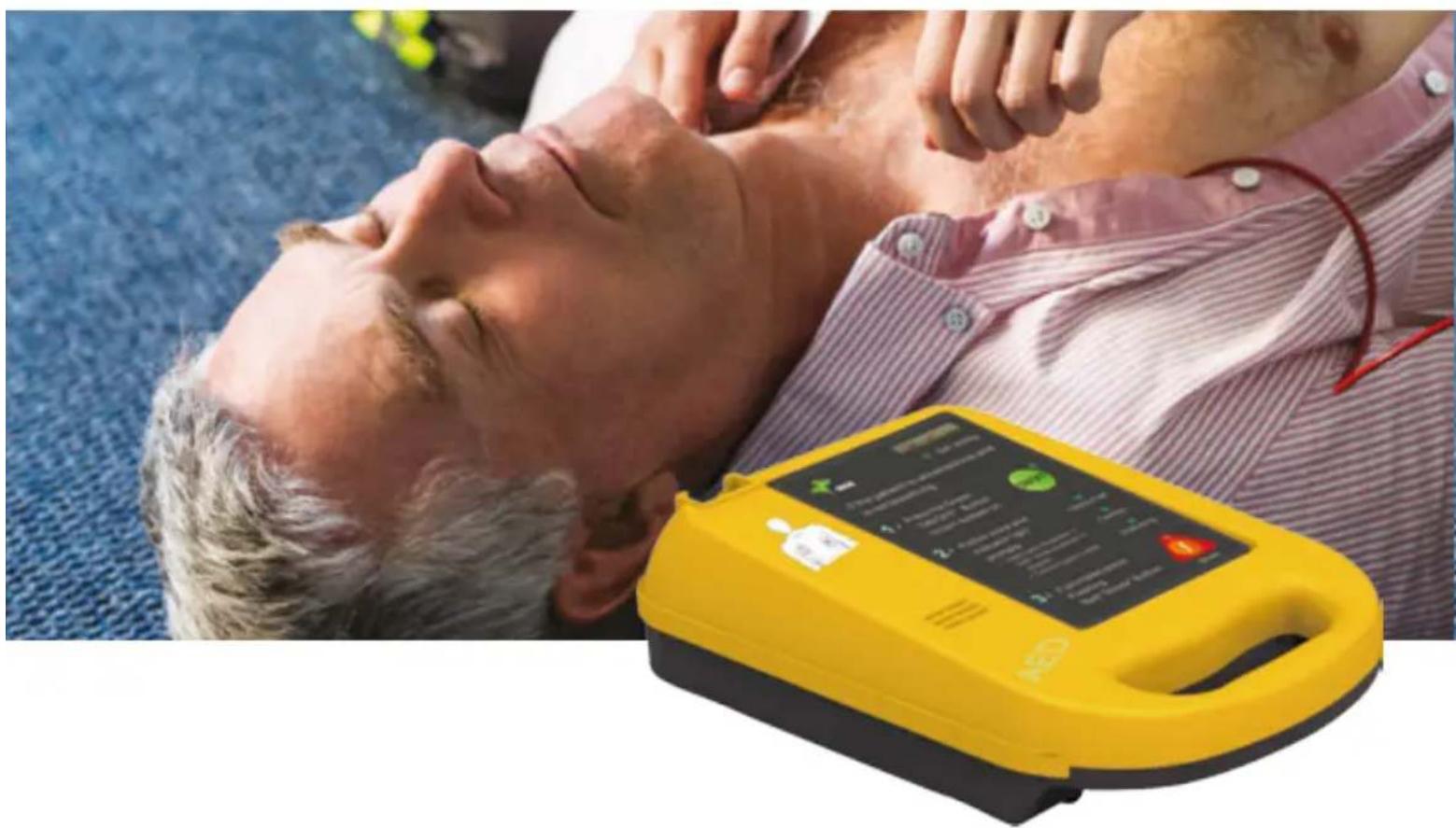

AED7000

Beijing M&B Electronic Instruments, Co., Ltd
Room 6319, Building 1, No.27 Yongwang Road Daxing
Bioengineering and Medicine Industry Base Zhongguancun Science Park Daxing District
102629 Beijing PEOPLE'S REPUBLIC OF CHINA

Shanghai International Holding Corp. GmbH (Europe)
Eiffestrasse 80, 2057 Hamburg, Germany
1.1 Manufacturer ... 6
1.2 Manufacturer's Responsibility ... 6
1.3 User's Responsibility ... 6
1.4 Contact and Technical Support ... 6
1.5 Declaration of Conformity ... 7
1.6 Labels ... 7
2 Safety ... 8
2.1 Conventions Used in the Manual ... 8
2.2 General Cautions and Notices ... 9
2.3 Patient Safety ... 10
2.4 Defibrillator and Electrode Pads ... 11
2.5 Battery ... 13
2.6 Care and Storage ... 13
2.7 Safety Symbols ... 14
3 Introducing the aed7000 ... 14
3.1 Overview of the AED7000 Semiautomatic External Defibrillator ... 14
3.2 Unpacking and Inspecting ... 15
3.3 Getting to Know the AED7000 Semiautomatic External Defibrillator ... 15
3.4 User Interface ... 16
3.5 AED7000 Semiautomatic External Defibrillator Accessories Part List ... 17
4 Self-test function introduction ... 17
4.1 AED Front Cover (with Self-test) ... 17
4.2 Introduction of AED self-test function ... 18
4.3 Self-test function description in detail ... 18
4.4 Actions required during AED Self-testing ... 18
5 Using AED7000 semiautomatic external defibrillator ... 18
5.1 Overview ... 18
5.2 Assess the patient ... 19
5.3 Start the AED7000 Semiautomatic External Defibrillator ... 19
5.4 Attach the electrode pads to the patient ... 20
5.5 Heart rhythm analyzing ... 20
5.6 Charging procedure ... 21
5.7 Discharging Procedure ... 22
5.8 Cardiopulmonary resuscitation procedure (CPR) ... 22
5.9 An emergency cancellation ... 23
6 Maintaining the semiautomatic external defibrillator ... 24
6.1 Maintenance ... 24
6.2 Cleaning and disinfecting ... 26
6.3 Troubleshooting ... 26
7 Specification ... 28
7.1 Physical ... 28
7.2 Electronic isolation ... 29
7.3 Defibrillator ... 29
7.4 Battery ... 30
7.5 Electrodes ... 30
7.6 Guidance and manufacturer's declaration ... 30
7.7 Rhythm recognition performance ... 34
8 Glossary ... 34
1. PREFACE

Do not attempt to use this equipment without thoroughly reading and understanding these instructions.
1.1 Manufacturer
Manufacturer: Room 6319, Building 1, No.27, Yongwang Road, Daxing
Bioengineering and Medicine Industry Base Zhongguancun Science Park Daxing District
102629 Beijing PEOPLE'S REPUBLIC OF CHINA
Product Name Automatic External Defibrillator
Device Type AED7000
1.2 Manufacturer's Responsibility
M&B (Beijing M&B Electronic Instruments, Co., Ltd) is responsible for the safety, reliability, and performance of the AED7000 Semiautomatic External Defibrillator, only if the following conditions are met:
Assembly operations, extensions, readjustments, modifications, or repairs are carried out by persons authorized by M&B.
The AED7000 Semiautomatic External Defibrillator equipment is used in accordance with the instructions for use.
1.3 User's Responsibility
The AED7000 Automated External Defibrillator is intended for use by personnel who are authorized by a physician/medical director, and who have had training in the use of an AED.
The user should be completely knowledgeable of the information contained in the AED7000 Semiautomatic External Defibrillator Users Manual. As with all other electronic patient care monitor, good clinical judgment should be used when operating the AED7000 Semiautomatic External Defibrillator. To ensure patient safety and proper operation, use only manufacturer authorized parts and accessories.
User must save all shipping containers and packaging materials. When shipping the AED7000 and accessories for calibration, service, or upgrades, the original shipping containers and packaging materials must be used.
1.4 Contact and Technical Support
Please contact M&B if you have any questions regarding this notice
Telephone: +86 10 6125 3747
Fax: +86 10 6125 3794
Internet: www.mbelec.com
E-mail: service@mbelec.com
1.5 Declaration of Conformity
Manufacturer: Beijing M&B Electronic Instruments, Co., Ltd
Room 6319, Building 1, No.27 Yongwang Road Daxing
Bioengineering and Medicine Industry Base Zhongguancun Science Park Daxing District 102629
Beijing PEOPLE'S REPUBLIC OF CHINA
Product Name Automatic External Defibrillator
Device Type
AED7000
1.5.1 Declares that the CE-marketed product
| Product Name Automatic External Defibrillator | |
| Device Type BF | |
| Model Number AED7000 | |
| Accessories See list in manual | |
| Compliance | Complies with Council Directive 93/42/EEC (Medical Device Directive) of June 14 1993 class IIb Annex II |
1.5.2 Standard
| General | |
| ISO13485 2003 | |
| ISO14155 2003 | |
| ISO14971 2007 | |
| EN980 2008 | |
| EN1041 1998 | |
| Sicurezza | IEC60601-1:1988+A1:1991+A2:1995+A13:1996 Type BF, Internally Powered, Continuous operation, Defibrillator Proof Operation |
| IEC60601-1-4 2000 | |
| IEC60601-1-6 2006 | |
| IEC60601-2-4 2002 | |
| IEC62304 2006 | |
| EMC IEC60601-1-2: 2007 | |
1.6 Labels
2.1 Conventions Used in the Manual
This section includes a list of conventions used in this manual.
2.1.1 Warnings
Warnings alert the user to a special condition that could result in serious personal injury or death. In this manual, warnings are displayed as shown in the following example:

Warning!
Includes conditions, hazards, or unsafe practices that can result in serious personal death.
2.1.2 Cautions
Cautions alert the user to a special condition that could result in minor personal injury or damage to the equipment. In this manual, cautions are displayed as shown in the following example:

Caution!
Conditions, hazards, or unsafe practices that can result in minor personal injury, damage to the AED7000, or loss of data.
2.1.3 Notes
Notes contain information that augments or clarifies an operating step. Notes do not normally contain actions. They follow the procedural steps to which they refer. In this manual, notes are displayed as shown in the following example:

Note!
If the AED7000 is used more than once per month, it is recommended that authorized service personnel perform a periodic inspection servicing at least once per year.
2.1.4 Voice prompts
The AED7000 provides audio instructions through the built-in speaker to provide operating instructions and assist the user during defibrillation. In this manual, voice prompts are displayed as shown in the following example:

Check the electrodes
2.1.5 Safety information is organized in six groups
- General Cautions and Notices
- Patient Safety
- Defibrillator and Electrode Pads
- Battery
- Care and Storage
- Safety Symbols
2.2 General Cautions and Notices
2.2.1 Dropped or Damaged
If the device has been dropped or damaged in any way, refer the device to qualified service personnel for servicing.
2.2.2 Ferromagnetic Equipment
ECG electrodes and cables contain ferromagnetic materials. They must not be used in the presence of large magnetic fields created by magnetic resonance imaging (MRI) equipment. The large magnetic fields generated by an MRI device could move ferromagnetic equipment with an extremely violent force that could cause serious personal injury or death to persons between the equipment and the MRI device.
2.2.3 Label
Observe all CAUTION and WARNING labels on the equipment and accessories.
2.2.4 Performance
The AED7000 may not meet performance specifications if stored, transported or used outside the specified storage or operating environmental range limits.
2.2.5 Notices
If the battery pack is removed for any reason, the user must label the AED7000 as "Out of service due to battery operation."
Do not use mobile phones near the AED7000 as the radiation field produced by mobile phones will interfere with the functioning of the AED7000.
A warning that the AED7000 should not be used adjacent to or stacked with other equipment and
that if adjacent to or stacked use is necessary, the AED7000 should be observed to verify normal operation in the configuration in which it will be used.
2.2.6 Attention
Electric and magnetic fields can interfere with the equipment's regular work. Therefore, please ensure all external devices used near the AED7000 comply with EMC demands.
2.3 Patient Safety
2.3.1 General

Accessory adapter required for use on pediatric patients.
The AED 7000 is not to be used on patients less than 8 years old or under 25kg (55 lbs), unless it is equipped with the accessory AED 7000 Pediatric Energy Reducer.

Patient Physical Harm
Place the AED7000 in a position where it cannot harm the patient should it fall. Do not use adjacent to or stacked with other equipment. Keep all cables and connectors away from the patient's neck.
2.3.2 Shock Hazard

Defibrillation current can cause injury
Do not touch the patient during defibrillation.
Do not touch equipment connected to or metal objects in contact with the patient during defibrillation. Disconnect other electrical equipment which has no DEFIBRILLATION-PROOF applied parts from the patient before defibrillating.
Avoid contact between parts of the patient's body such as exposed skin of head or limbs, conductive fluids such as gel, blood or saline and metal objects such as a bed frame or a stretcher which may provide unwanted pathways for the defibrillating current.
2.3.3 Burn

Properly place defibrillation pads
Do not allow defibrillation pads to touch each other, or to touch other electrodes, lead wires, dressings, transdermal patches, etc. Such contact can cause patient skin burns during defibrillation and may divert defibrillating current away from the heart. Remove excessive body hair, which may cause skin burns or ineffective energy transfer. Do not use alcohol, iodine or other skin preparations. These can dry the skin and may cause the AED7000 to function improperly or may cause skin burns.
Defibrillator electrodes shall be kept well clear of other electrodes or metal parts in contact with the patient.
2.3.4 Electrical Energy
The AED7000 can deliver 200 joules of electrical energy

Disconnect any medical electronic device that is not labeled “defibrillation protected” from the patient. If this electrical energy is not discharged properly, it could cause personal injury or death to the operator or bystander. During defibrillation, the operator and all other people must stand clear of the patient, bed and all conductive surfaces in contact with the patient.

Properly place defibrillation pads
Do not place electrodes near the generator of an internal pacemaker. Always apply electrodes to flat areas of skin. Avoid application over folds of skin such as those underneath the breast or on obese patients. Excessive hair, poor adhesion, or air under electrode may produce burns.
2.3.5 ECG Misinterpretation

Properly place defibrillation pads
Improperly placed pads may produce incorrect analysis and an inappropriate shock or no shock advisory decision.

Do not move patient
Handling or transporting the patient during ECG analysis can cause incorrect or delayed diagnosis. Follow all instructions in the Users Manual.

Cardiac pacemakers may affect rhythm analysis
Patient pacemakers may reduce the sensitivity of the AED7000 analysis and errors in detecting shockable rhythms.

Radio frequency (RF) interference
Do not operate the AED7000 in conjunction with electro-cautery or diathermy equipment. Any equipment that emits strong radio frequency signals can cause electrical interference and distort the ECG signal to cause inaccurate interpretation of rhythm.
2.4 Defibrillator and Electrode Pads
2.4.1 Explosion

Explosion hazard
Possible explosion and fire hazard if used in the presence of flammable agents or in an oxygen enriched atmosphere.
2.4.2 Electrical Shock or Fire Hazard

No internal, operator-serviceable parts
Do not open unit, remove covers or attempt to repair the AED7000. All servicing must be performed by qualified personnel.

Improper use can cause injury
The AED7000 contains an automatic disarm of the stored energy. If the operator has not delivered the energy to a patient or a test load, an internal timer will disarm the stored energy. This stored electrical energy can potentially cause death or injury if discharged improperly. Follow all instructions in this User's Manual.

Do not immerse or expose the AED7000 to water or other liquids
Do not use the defibrillator if the unit has been immersed in liquid or if excessive condensation is visible on the device.

Conductive parts should not contact other conductive parts including the earth
2.4.3 Improper Device Performance

Properly use electrode pads
Do not attempt to warm the electrodes with a heat source greater than 35° C ( 95° F). Do not immerse or clean electrodes with alcohol or solvents. Do not perform chest compressions (CPR) through electrodes. These actions may damage the electrode pads and cause the unit to function improperly.

Use only M&B approved accessories
Do not use defibrillation pads, batteries, and other accessories not approved by M&B. Use of unauthorized accessories may cause the device to operate improperly and provide false measurements. Follow all labeling instructions on the defibrillation pads and the battery.

Do not repeatedly charge and discharge defibrillator in rapid succession
If a need for repetitive testing arises, wait at least 1 minute for every third discharge to avoid damaging equipment

Improper maintenance can cause improper performance
Follow instructions in the Users Manual.
2.5 Battery
2.5.1 Battery care

Use only M&B batteries
Use only M&B Part No. CR123A-4x 2 non-rechargeable lithium batteries. Use of any other battery can damage the AED7000.

Always verify remaining capacity of a non-rechargeable battery after use
Check capacity and change if battery is low.

Replace battery at 5 years
Battery replacement at 5 years is recommended due to degradation of the battery chemistry. Periodic maintenance and testing is highly recommended to ensure proper battery performance.
2.6 Care and Storage
2.6.1 Cleaning and Sterilization

Clean and maintain the AED7000 according to instructions. See Chapter 4, Maintaining the AED7000 Automatic External Defibrillator.
Do not clean the AED7000 with alcohol, ketone, or any flammable agent. Do not autoclave the AED7000 or attempt to sterilize the AED7000 or any of its accessories.
2.6.2 Electrodes

Follow manufacturer's instructions for use of defibrillation electrodes
Improper use of defibrillation electrodes may cause the AED7000 to function improperly or may cause skin burns. Do not use expired, dry electrodes. Do not reuse disposable electrodes. Only use M&B approved electrodes.

Properly store and use defibrillation pads
Store electrodes in a cool, dry location (between -4° and 131° F or -20° C and 55° C). Do not sterilize the pads, immerse, or clean the electrodes with alcohol or solvents.
2.6.3 Disposal

Disposal of device and its accessories
Please dispose of the device and its accessories which have exceeded their operating time according to relevant regulations. If you have any question on device disposal or need more detailed information, please contact us or our service centers.
2.7 Safety Symbols
Graphical symbols, letter symbols, and signs listed below may be found on the AED7000 and accessories. Please note the use of these symbols for safe and proper use of the equipment.
For a list of icons that display operating status information, see Chapter 3 Introducing the AED7000.
 | Attention, consult accompanying documents |
 | Defibrillator protected type BF applied part. |
| [0756] | Dangerous voltage |
3. INTRODUCING THE AED7000
This chapter provides an introduction to the AED7000 system and presents an overview of the AED7000 controls, indicators, displays, and prompts. It also provides instructions for getting the AED7000 ready for use and preparing the unit for storage.
3.1 Overview of the AED7000 Semiautomatic External Defibrillator
3.1.1 Overview
The AED7000 Semiautomatic External Defibrillator is a safe, easy to use defibrillation device. The unit is lightweight and mobile and can be used in situations where there could be several minutes before the arrival of advanced life support (ALS) personnel.
The AED7000 recognizes ventricular fibrillation and other ventricular tachycardia and guides operators through the defibrillation process. When properly connected to a patient who is unconscious, not breathing, and without a pulse, the AED7000 analyzes the patient's heart rhythm, provides text and audio instruction prompts, determines if a shockable situation exists and if appropriate, automatically arms the Shock button.
The AED7000 delivers the defibrillation shock through two self-adhesive, pre-gelled, low-impedance electrode defibrillator pads. The pads, cable, and connector are sold as disposable kits.
The AED7000 is designed for infrequent use. This term is used to describe a defibrillator designed to endure less than 2500 discharges.
3.1.2 Features
AED7000 features include:
- Three-step defibrillation process
- Two-button operation
- Extensive voice and visual prompts for the operator
- Biphasic energy output
- Lock-out protection to prevent inadvertent defibrillation
3.1.3 Qualified Operators
The AED7000 permits trained users to administer a brief electrical shock to patients experiencing fibrillation or sudden cardiac arrest (SCA). A qualified operator is someone who has successfully completed a CPR AED training course.
Getting the AED7000 Automatic External Defibrillator Ready
Carefully unpack and inspect all the AED7000 system components and accessories. Install the battery. Verify that the self-test passes before putting the unit into service. The device will perform an automatic self test upon being turned on.
3.2 Unpacking and Inspecting
Visually inspect the carton for any signs of damage or mishandling (carton perforations, cuts, or dents; bent or collapsed corners; or broken carton seal). Remove the AED7000 from the carton and inspect it carefully.
Before proceeding:
- Open and carefully unpack each carton.
- Examine the instruments and accessories for signs of damage.
- Check the packing list to determine that all accessories have been received.
- Contact M&B, Service Department at (+86)10-61253747 if anything looks damaged or is missing.
3.2.1 Installing the Battery
The AED7000 uses an extended-life, Lithium non-rechargeable battery.
To install the battery:
- Open the battery compartment (located near the bottom of the backside of the AED7000) by removing the thumbscrews and then sliding the battery cover up and off.
- Locate the 3 battery contact pins in the bottom-right corner of the battery compartment
- Push the 3-pin battery connector onto the contact pins.
- Place the battery into the battery compartment and replace the battery cover.
- Slide the cover back so that the screw holes are aligned.
- Replace the thumbscrews
3.2.2 Running a Self-Test
After installing the battery, the AED7000 powers up and performs a self-test. At power-up, the following tests are performed: battery, main processor, memory and program, ECG acquisition system, and defibrillator.
3.3 Getting to Know the AED7000 Semiautomatic External Defibrillator
The AED7000 is an Semiautomatic external defibrillation (AED) device. It features a straightforward, three-step operating design that uses extensive voice and visual prompts to assist the operator. This defibrillator should not be used on patients less than 8 years old or under 25kg (55lbs), unless it is equipped with the accessory AED 7000 Pediatric Energy Reducer
Functions
This section describes the following AED7000 features:
- Controls
- LED Prompts
- Voice Prompts
- Detailed information on using, and maintaining the AED7000 are presented in Chapters 5 and 6, respectively.
3.4 User Interface
3.4.1 Controls
The AED7000 is designed for ease of operation. After putting the defibrillator pads on the patient and connecting them to the AED7000, the operator performs this simple three-step process:
- Turn the power ON.
- Follow LED prompts on the panel and voice prompts from the speaker.
- If prompted, deliver shock by pressing the flashing red Shock button.
Power ON/OFF: Green On/Off button to toggle system power on/off.
Shock: Red Shock button to discharge defibrillator, red LED flashes when defibrillator is fully charged.
3.4.2 LED Prompts
Operating information and user instructions display in these light-emitting diodes.
Check Pad LED Flashes: Defibrillator pads are not properly attached to the patient or are not properly connected to the AED7000.
Caution LED Flashes Do not touch or move the patient.
Analyzing LED Flashes: ECG leads are properly connected and the system is assessing the patient's heart rhythm.
3.4.3 Voice Prompts
The AED7000 prompt feature provides instructional prompts to guide the user through the defibrillation process.
The AED7000 provides audio instructions through the built-in speaker to provide operating instruction and assist the user during defibrillation.
The voice prompts are listed in the following table.
| 1 Check the electrodes |
| 2 Shock cancelled, check the electrodes. |
| 3 Shock delivered |
| 4 Time out, analysis restart. |
| 5 Analyzing, do not touch the patient. |
| 6 Charging, do not touch the patient |
| 7 No shock advised |
| 8 Press flashing shock button. |
| 9 Stop CPR, start analysis ten seconds later. |
| 10 Low Battery |
| 11 System failure |
Patient may be touched. Carry on CPR. Alternately give 30 chest compressions and 2 mouth-to-mouth breaths. Now give 30 chest compressions. Now give 2 mouth-to-mouth breaths (Four Cycles)
3.4.4 Battery Level Indicator
The Power LED:
| Power led is bright Indicates the charge left in the battery is full |
| Power LED flashes slowly Indicates the charge left in the battery is partially depleted. |
| Power LED flashes fast Indicates the charge left in the battery is low |
3.5 AED7000 Semiautomatic External Defibrillator Accessories Part List
3.5.1 AED7000 Semiautomatic External Defibrillator
AED7000 Automatic External Defibrillator with one set of defibrillation pads, battery and user manual.
3.5.2 AED7000 Automatic External Defibrillator Accessories
| CR123A-4X2 M&B | Battery Pack - Non-rechargeable LiMnO2 battery |
| EDC-2035 Set Of Two Multi-Function Electrodes | |
| AED7000-101 AED7000 | Automatic External Defibrillator User Manual. |
| AED7000-102 AED7000 | Automatic External Defibrillator Carrying Case. |
4. SELF-TEST FUNCTION INTRODUCTION
4.1 AED Front Cover (with Self-test)

4.2 Introduction of AED self-test function
Daily-test: The built-in battery will be tested automatically each day
Monthly-Test: The AED7000 will perform a full self-test each month or following each battery change.
The full self-test includes: battery test, charging & discharging test, data collection and data communication test.
4.3 Self-test function description in detail
Daily-test: On commencement, the self-testing LED indicator will turn on; and automatically turn off on completion of self test. The self-testing result will be displayed in battery LCD, as follows:
| If the battery is low the following icon will appear | |
| If the battery is in normal condition the following icon will appear |
Monthly-test: On commencement, the self-testing LED indicator will turn on; when finished, the self-testing LED indicator turns off. And the test result will appear in LCD:
 | If there is a fault with the AED7000 the following icon will appear |
 | If the AED7000 is in optimal working order the following icon will appear |
4.4 Actions required during AED Self-testing
- The AED7000 will only function under normal operating condition if the following icon is shown:
OK
- Monthly-test when Battery changed
If the monthly self-test function is not required, please install the new battery within 10 seconds following removal of the old battery
If the monthly self-test function is required, please install the new battery 20 seconds later following removal of the old battery. The monthly self-test will commence one minute later after installation of the new battery.
5. USING AED7000 SEMIAUTOMATIC EXTERNAL DEFIBRILLATOR
5.1 Overview
This chapter provides information for using the AED7000.

Caution!
Before proceeding with this chapter, first read the safety section
The common operating procedures of the AED7000 are the several steps below:
- Assess the patient
- Start the AED7000
-
Attach the electrode pads to the patient
-
Heart rhythm analyzing
- Charging procedure
- Discharging procedure
- Cardiopulmonary resuscitation procedure(CPR)
- An emergency cancellation

5.2 Assess the patient
Before using the AED7000, the operator must first check the condition of the patient. The AED7000 can be used on a patient, only if all the following conditions are present:
- Unconsciousness
- Absence of breath
- If both the conditions above exist, the AED7000 should be used immediately.
5.3 Start the AED7000 Semiautomatic External Defibrillator
The operator should first start the AED7000 to check its working condition and power condition.
5.3.1 Checking power condition
Pressing the ON/OFF button for 2\~3 seconds to start the AED7000, the power indicator will turn on. If the indicator is flickering, it means that the AED7000 is in the status of low power, and the current battery should be replaced.
5.3.2 Check the working condition
After the AED7000 starts, the AED7000 will begin to check the condition of the pads connection. Before the pads are properly connected, the AED7000 will prompt the operator to insert the connector of the pads to the socket of the AED7000 and place the pads correctly on the patient.

Check the electrodes

If the pads are improperly connected, the indicator of "Check Pad" will be flickering
No voice prompt or indicator flickering following the start of the AED7000, indicates an internal error of the AED7000 unit, and should not be used on any patient.
5.4 Attach the electrode pads to the patient
The electrode pads must be correctly placed on the patient. Before placing the pads, the following procedures must be executed:
- Remove all clothing covering the chest of the patient
- Wipe off any water or perspiration on the chest.
- Following these two steps, the pads can be placed on the patient.

Place the pads on the patient:
- Open the package of the electrode pads
- Peel off the backing from the electrode pads labeled RA, place this pad below the patient's right collar bone
- Peel off the backing from the electrode pad labeled LL, place this pad over the ribs on the patient's left side below the breast.
- Plug the connector of the electrode pads into the socket of the AED7000 Semiautomatic External Defibrillator.

If the pads are not firmly placed on the chest of the patient, the voice prompts of "Check the electrode" will continuously prompt the operator
5.5 Heart rhythm analyzing
Once the pads are placed on the patient correctly, the AED7000 will begin to analyze the heart rhythm of the patient, at the same time, a voice prompt will broadcast to indicate the next steps to the operator.

Analyzing, do not touch the patient

If the electrodes are properly connected, the indicator of "Check Pad" will stop flickering while "Caution Indicator" and "Analyzing Indicator" will begin flickering.
The AED7000 takes 8\~10 seconds to complete analysis. Because the analyzing result depends on the ECG waveform of the patient, which may be interrupted by any touching or moving the body of the patient, any touch or movement may lead to an incorrect analysis result.

Warning!
Don't touch or move the patient during the analysis period.
There are two possible analysis results. If defibrillation is advised, the AED7000 will start the charging procedure; otherwise, a recommendation of Cardiopulmonary resuscitation procedure (CPR) will begin.
5.6 Charging procedure
If the AED7000 determines that the patient requires defibrillation, the charging procedure will start.

During the charging procedure, Caution indicator and analyzing indicator will be flickering

Charging, do not touch the patient.

Warning!
Do not touch the patient during the charging period
![graph LR A["First energy level"] -->|2min CPR| B["Second energy level"] B -->|2min CPR| C["Third energy level"]](/content/2026/05/932449/images/00b21143e96fc515859734f18297be01975009f1fd3b5de8371dd9cd3eed2d7a.jpg)
2min CPR
The AED7000 has three energy of defibrillation as shown in the table below:
| First energy level 150J | |
| Second energy level 150J | |
| Third energy level 200J |

The charging time depends on the energy of defibrillation
5.7 Discharging Procedure
When the charging procedure of the AED7000 has finished, the AED7000 will enter the discharging procedure and give voice prompts to the operator.

During the discharging procedure, shock indicator, Caution indicator and analyzing indicator will be flickering.

Warning!
During the discharging procedure, do not touch the patient.
The first prompt advises to stand clear of the patient.
The operator should stand clear of the patient before pressing the shock button.

Press flashing shock button
This prompt will be broadcast repeatedly to indicate that the AED7000 is ready to deliver a shock.
Deliver a shock
To deliver a shock, the several steps below must be obeyed:
- Make sure the indicator of shock button is flashing, which means the AED7000 is properly charged
- Before pressing the shock button, make sure no one is touching the body of the patient
- Press the shock button.

If the shock button is pressed, shock indicators and analyzing indicator will stop flickering while the flickering of Caution indicator will continue
Prior to pressing the shock button, if the AED7000 detects that the pads are not firmly placed on the chest of the patient the following alert will occur

Shock cancelled, check the electrodes.
If the operator does not press the shock button, the AED7000 will automatically begin internal discharging procedure in 30 seconds.

Time out, analysis restart.
5.8 Cardiopulmonary resuscitation procedure (CPR)
The AED7000 will enter cardiopulmonary resuscitation procedure, when the condition below occurs:

During the CPR procedure, the four indicators: Check Pad, Caution, Analyzing and Shock will not flicker
No shockable heart rhythm is detected
During the heart rhythm analysis period, if the heart rhythm is not considered to be a shockable rhythm by the AED7000, a cardiopulmonary resuscitation procedure (CPR) will start

No shock advised
During the period of charging, if the AED7000 detects that the shockable rhythm has changed to a normal one, the AED7000 will stop current procedure and switch to CPR procedure.
The operator can touch the body of the patient and check their conditions.

During the cardiopulmonary resuscitation period, the AED7000 will ignore the heart rhythm analyzed result and the improper electrode connection
If the patient is not breathing and has no pulse, a cardiopulmonary resuscitation should be performed on the patient immediately.

The CPR time is fixed at 120 seconds; the AED7000 will prompt the rest time every 30 seconds
The voice prompts of rest time are below:

Patient may be touched. Carry on CPR. Alternately give 30 chest compressions and 2 mouth-to-mouth breaths. Now give 30 times chest compressions. Now give 2 mouth-to-mouth breaths (Four Cycles)
At the end of 10 seconds of CPR, the AED7000 will give a prompt to indicate that the operator must stop CPR and not touch the patient so that the AED7000 can restart a heart rhythm analysis and determine if a shockable rhythm condition exists.

Stop CPR, start analysis ten seconds later.
5.9 An emergency cancellation
If any unpredictable situation occurs, the operator can use the ON/OFF button to make an emergency cancellation.
Examples of unpredictable situation may include:
- The movement of the patient during the discharging period.
- The disconnection of the electrode pads during the discharging period.
- Other dangerous situations.
If an unpredictable situation occurs, the operator should press the ON/OFF button for 2 seconds to shut down the AED7000 and internally discharge all the power to the machine
6. MAINTAINING THE SEMIAUTOMATIC EXTERNAL DEFIBRILLATOR
The maintaining, cleaning and Troubleshooting of the AED7000 will be described in this section:
- Maintaining
- Cleaning and disinfecting
- Troubleshooting
6.1 Maintenance
Maintenance is required for the optimal operation of the AED7000. Maintenance should be performed periodically; with weekly or monthly inspections recommended.
The frequency of inspection:
It is recommended that the AED7000 is inspected once a week or twice a month, but if use of the AED7000 is more frequent, additional inspections should be performed.
The table below describes a general rule to perform the inspection
| Frequency of use (n / month) Inspection | |
| 1 / month Once a week | |
| 2 ~ 3 / month Twice a week | |
| Infrequent using(1 ~ 2 a year) Once a month |

Caution!
If the AED7000 should be used more than 4 times a month, we recommend that the AED7000 should be inspected by authorized service personnel at least twice a year
6.1.1 Inspection schedule
The general inspection schedules are described below. The operator should follow these schedules when performing the inspection, as improper inspection may cause damage to the AED7000.
Check the status of indicator and the voice prompt.
If the AED7000 is started without electrode pads connection, the indicator of "Check pad" will be flickering and a voice prompt of "Check the electrode" will be broadcast. In the absence of either status indicator above, contact the authorized service personnel for the necessary servicing or repair.

Warning!
If the conditions above are observed during the inspection of the AED7000, the AED7000 must not be used on any patient.
6.1.2 Check the battery
The AED7000 begins to check the capacity of the battery when it starts. If the battery capacity is low, the Power LED will be flickering, otherwise the indicator will be green. If a low battery capacity occurs, replace the current battery with a new one.

- Open the battery compartment by removing the thumbscrews and then sliding the battery cover up and off.
- Locate the 3 battery contact pins in the bottom-right corner of battery compartment.
- Push the 3-pin battery connector onto the contact pins.
- Place the battery into the battery compartment and replace the battery cover. Slide the cover back so that the screw holes are aligned.
- Replace the thumbscrews.

Warning!
We recommend replacing the battery provided by the AED7000 service provider or one that matches the standard battery parameters of the AED7000

Warning!
The replaced battery doesn't match the standard battery parameters may cause serious damage to the AED7000.
6.1.3 Check the defibrillator electrodes
Inspect the packaging of any disposable DEFIBRILLATOR ELECTRODES to ensure integrity of any seals and validity of any expiry date.
Charge the ENERGY STORAGE DEVICE once a year. Please contact our service centre or agencies to organize this.
6.2 Cleaning and disinfecting
Cleaning and disinfecting of the AED7000 should be done frequently.
The followings are the guidelines of cleaning and disinfecting of the AED7000:
6.2.1 Cleaning
Before cleaning the AED7000, making sure that the AED7000 has been power off, because any cleaning with the machine powered on may cause a shock hazard to the cleaners.

We recommend that the cleaners use warm water to clean the AED7000. Other cleansers without strong solvents could also be used.

Caution!
Do not allow water or other cleaning products to enter the AED7000 unit when cleaning the machine, as these liquids may cause damage to the AED7000 or a shock hazard
Use a soft cloth to wipe the AED7000. Never clean the AED7000 with any type of brush.

Caution!
When cleaning the electrode pads socket of the AED7000, do not use excess water or cleanser
6.2.2 Disinfecting
Disinfection of the AED7000 is recommended. Use only alcohol based solvents.

Caution!
Never use the following cleansers on the AED7000: Acetone, Ammonia cleanser, Glutaraldehyde
6.3 Troubleshooting
As with any equipment, problems may occur during the operation of the AED7000. Indicators and voice prompts will be given to the operator to indicate any identified issues with the unit.
General trouble shooting tips are noted below.

The operator could try to salve the problem which occurring prior to or during the operation according to these trouble shootings beblow
6.3.1 The troubleshooting of attaching electrode pads
Problem description:
The voice prompt of "Check the electrode" continues to broadcast when the electrode pads
have been placed on the patient and the pads connector has been connect to the socket of the AED7000.

Check the electrodes
Solution:
- If the electrode pads are dry, damaged or out-of-date, replace the current pads with new ones and recommence.
- Ensure that the electrode pads have been properly adhered to the patient. If not attached correctly, wipe off any water or moisture from the chest and shave the hair from chest area, then press the pads firmly on the chest of the patient.
- Ensure the two pads do not touch each other.
- If the pads connector is inadequately connected to the socket of the AED7000, push the connector firmly into the socket.
6.3.2 Troubleshooting of analysis
Problem description:
The analysis is interrupted during the analysis period, and the voice prompt of "Check the electrode" is broadcast.
Solution:
- Shut down the AED7000 and check the pads placed on the patient, if they are not properly connected, press the pads firmly on the chest of the patient, then start the AED7000 again.
- If the patient has moved during the analyzing period, shut down the AED7000 and immobilize the patient if possible.
6.3.3 Troubleshooting of charging
Problem description:
The charging is stopped during the charging period, and the voice prompt of "Charging cancelled: check the electrode" is broadcast.

Charging cancelled: check the electrodes.
Solution:
- Shut down the AED7000 and check pads connector. If the connector inadequately connects to the socket of the AED7000, push the connector firmly into the socket.
- Shut down the AED7000 and check the pads contacting with patient's bare chest. If the pads are poorly contacted, wipe off any moisture and press the pads firmly on the chest of the patient.
6.3.4 Troubleshooting of defibrillation
Problem description:
The AED7000 automatically has an internal disarm function following completion of the analysis process. The unit broadcasts a voice prompt of "Time out, analysis restart".

Time out, analysis restart
Solution:
- If the operator doesn't press the shock button in 30 seconds after the analysis is finished, the AED7000 will automatically disarm.
- Press the shock button in 30 seconds after the voice prompts of "press flashing shock button".

Press flashing shock button
6.3.5 Troubleshooting of battery
Problem description:
During the operation of the AED7000, the ON/OFF indicator is flickering.
Solution:
Shut down the AED7000 and replace the current battery with a new one.
7. SPECIFICATION
The Specification of physical, electronic isolation, defibrillator, battery, electromagnetic compatibility, and rhythm recognition performance is described in this section:
- Physical
• Electronic isolation - Defibrillator
- Battery
• Electromagnetic compatibility
• Rhythm recognition performance
7.1 Physical
| Category Specification | |
| Dimensions 303 x 216 x 89 mm | |
| Weight 2.0 kg | |
| Operating Temperature 0°C -40°C | |
| Operating Humidity | Relative humidity between 30% and 95% (non-condensing) |
| Altitude -91m a 4573m (-300 a 15,000 ft) | |
| Pressure 102.4kPa~57.2kPa (768mmHg~429mmHg) | |
| Storage Temperature -20°C a 50°C (without battery) | |
| Storage Humidity Up to 95% (without battery and non-condensing) |
7.2 Electrical Isolation
| Category Specification | |
| Power Unit operates on internal battery only | |
| External Electrical Connections No external devices are attached to the unit | |
| Risk Current Category | Internally powered equipment with defibrillator-proof BF type patient applied part (as per definition of IEC 60601-1 standard) |
7.3 Defibrillator
| Output Specification | |
| Energy Sequence | Biphasic Truncated exponential (user configurable)150J, 150J, 200J |
| Charge Time from “Shock Advised” | 10 sec. to 150J15 sec. to 200J |
| Analysis Time 9 sec | |
| From start of analysis to shock ready | Less than 20 seconds from power upLess than 25 seconds after 6 shocks |
| Audible Prompts LED prompts | |
| Visual Prompts LED prompts | |
| Controls Two buttons - ON/OFF, Shock | |
| Output Energy Accuracy ±15% into any impedance from 25 to 175Ω | |
| Patient impedance 20Ω a 200Ω |
Waveform details
The table below provides details of the biphasic truncated exponential waveform delivered by the AED7000 (set to 200J) when connected to resistive loads of 25 through 175 Ohms. The waveforms are characterized by typical values for peak current (lp), duration of the first output phase, and duration of the second output phase. Values are within 10%.
| Output Energy (J) | Patient Impedance (Ω) | Ip1 (Amps) | Ip2 (Amps) | Phase1 (ms) | Phase2 (ms) | Interval (ms) |
| 200 | 25 46 34.0 5.5 3.3 | 0.7 | ||||
| 50 | 23 | 17.0 | 10.9 | 6.6 | 0.7 | |
| 75 | 15.3 | 11.3 | 16.3 | 8.9 | 0.7 | |
| 100 | 11.5 | 8.5 | 19.7 | 9.6 | 0.7 | |
| 125 | 9.2 | 6.8 | 20.5 | 11.2 | 0.7 | |
| 150 | 7.6 | 5.8 | 19.8 | 10 | 0.7 | |
| 175 | 6.5 | 5.2 | 19.8 | 10 | 0.7 | |
Pediatric Energy Reducer: Energy Attenuation Factor
| 50% 25 Ω | |
| 25% 50Ω and 75Ω | |
| 20% 100Ω and 125Ω | |
| 15% 150Ω and 175Ω |
7.4 Battery
| Category Specification | |
| Part No CR123A-4x2 | |
| Non-rechargeable 12V d.c. 2.8Ah | |
| Capacity 100 discharges at 200J or 120 discharges at 150J | |
| Shelf Life 5 years (25°C ± 15°C) | |

Battery capacity measured according to IEC 60601-2-4, clause 102.3.2 at room temperature. Capacity may be diminished at operating temperature extremes, or when the available battery charge is used in multiple power ON/OFF cycles.
7.5 Electrodes

Do not use defibrillation pads not approved by M&B. Use of unauthorized defibrillation pads may cause the device to operate improperly and provide false measurements. Follow all labeling instructions on the defibrillation pads
7.6 Guidance and manufacturer's declaration
7.6.1 Electromagnetic emissions (IEC 60601-1-2 Table 201)
The AED7000 is intended for use in the electromagnetic environment specified below. The customer or the user of the AED7000 should assure that it is used in such an environment.
| Emissions test Compliance | Electromagnetic environment guidance | |
| RF emissionsCISPR 11 | Group 1 | TheAED7000 uses RF energy only for its internal function. Therefore, its RF emissions are very low and are not likely to cause any interference in nearby electronic equipment. |
| RF emissionsCISPR 11 | Class B | |
| Harmonic emissions IEC61000-3-2 | Not applicable | |
| Voltage fluctuations/ flicker emissions IEC 61000-3-3 | Not applicable |
Medical Electrical Equipment requires special precautions regarding EMC and must be installed and put into service according to EMC information provided in this document.
7.6.2 Electromagnetic immunity (IEC 60601-1-2 Table 202)
The AED7000 is intended for use in the electromagnetic environment specified below. The customer or the user of the AED7000 should ensure that it is used in such an environment.
| Immunity test | IEC 60601 test level | Compliance level | Electromagnetic environment guidance |
| Electrostatic discharge (ESD) IEC 61000-4-2 | ±6kV contact ±8kV air | ±6kV contact ±8kV air | Floors should be wood, concrete or ceramic tile. If floors are covered with synthetic material, the relative humidity should be at least 30 %. |
| Electrical fast transient/burst IEC 61000-4-4 | ±2 kV for power supply lines ±1 kV for input/output lines | Not applicable | |
| Surge IEC 61000-4-5 | ±1kV differential mode ±2kV common mode | Not applicable | |
| Voltage dips, short inter-ruptions and vol-tage variations on power supply input lines IEC 61000-4-11 | <5% UT(>95% dip in UT) for 0.5 cycle 40% UT (60% dip in UT) for 5 cycles 70% UT (30% dip in UT) for 25 cycles <5% UT (>95 % dip in UT) for 5 sec | Not applicable | |
| Power frequency (50/60 Hz) ma-gnetic field IEC 61000-4-8 | 3 A/m 3 A/m | Power frequency magnetic fields should be at levels characteristic of a typical location in a typical commercial or hospital environment. |

UT is the AC mains voltage prior to application of the test level.
7.6.3 Electromagnetic immunity (IEC 60601-1-2 Table 203)
The AED7000 is intended for use in the electromagnetic environment specified below. The customer or the user of the AED7000 should ensure that it is used in such an environment.
| Immunity test | IEC 60601 test level | Compliance level | Electromagnetic environment guidance |
| Radiated RF IEC 61000-4-3 | 10V/m 80 MHz a 2.5 GHz | 20V/m | Portable and mobile RF communications equipment should be used no closer to any part of the AED7000, including cables, than the recommended separation distance calculated from the equation applicable to the frequency of the transmitter.Recommended separation distance : d = [ 12/E1 ] 80MHz a 800MHz d = [ 23/E1 ] 800MHz a 2.5GHzWhere P is the maximum output power rating of the transmitter in watts (W) and d is the recommended separation distance in meters (m). bField strengths from fixed RF transmitters, as determined by an electromagnetic site survey c, should be less than the compliance level in each frequency range d. Interference may occur in the vicinity of equipment marked with the following symbol:[IMAGE] |

At 80 MHz and 800 MHz, the higher frequency range applies

These guidelines may not apply in all situations. Electromagnetic propagation is affected by absorption and reflection from structures, objects and people
a. The ISM (industrial, scientific, and medical) bands between 150 kHz and 80 MHz are 6.765 MHz to 6.795 MHz; 13.553 MHz to 13.567 MHz; 26.957 MHz to 27.283 MHz; and 40.66 MHz to 40.70 MHz.
b. The compliance levels in the ISM frequency bands between 150 kHz and 80 MHz and in the frequency range 80 MHz to 2.5 GHz are intended to decrease the likelihood that mobile or portable communications equipment could cause interference if it is inadvertently brought into patient areas. For this reason, an additional factor of 10/3 is used in calculating the recommended separation distance for transmitters in these frequency ranges.
c. Field strengths from fixed transmitters, such as base stations for radio (cellular or cordless) telephones and land mobile radios, amateur radio, AM and FM radio broadcast and TV broadcast cannot be
predicted theoretically with accuracy. To assess the electromagnetic environment due to fixed RF transmitters, an electromagnetic site survey should be considered. If the measured field strength in the location in which the AED7000 is used exceeds the applicable RF compliance level above, the AED 7000 should be observed to verify normal operation. If abnormal performance is observed, additional measures may be necessary, such as reorienting or relocating the AED 7000.
d. Over the frequency range 150 kHz to 80 MHz, field strengths should be less than 3V/m.
7.6.4 Recommended separation distances between portable and mobile RF communications equipment and the AED7000 (IEC 60601-1-2 Table 205)
The AED7000 is intended for use in an environment in which radiated RF disturbances are controlled. The customer or the user of the AED7000 can help prevent electromagnetic interference by maintaining a minimum distance between portable and mobile RF communications equipment (transmitters) mad the AED7000 as recommended below, according to the maximum output power of the communications equipment.
| Rated maximum output power of transmitter W | Separation distance according to frequency of transmitter m | |
| 80MHz a 800MHz d=0.6·√P | 80MHz a 2.5GHz d=1.15·√P | |
| 0.01 0.115 0.115 | ||
| 0.1 0.364 0.364 | ||
| 1 1.15 1.15 | ||
| 10 3.637 3.637 | ||
| 100 11.5 11.5 | ||
For transmitters rated at a maximum output power not listed above, the recommended separation distance d in meters (m) can be estimated using the equation applicable to the frequency of the transmitter, where P is the maximum output power rating of the transmitter in watts (W) according to the transmitter manufacturer.

At 80 MHz and 800 MHz, the separation distance for the higher frequency range applies.

The ISM (industrial, scientific and medical) bands between 150 kHz and 80 MHz are 6.765 MHz to 6.795 MHz; 13.553 MHz to 13.567 MHz; 26.957 MHz to 27.283 MHz; and 40.66 MHz to 40.70 MHz.

An additional factor of 10/3 is used in calculating the recommended separation distance for transmitters in the ISM frequency bands between 150 kHz and 80 MHz and in the frequency range 80 MHz to 2.5 GHz to decrease the likelihood that mobile/portable communications equipment could cause interference if it is inadvertently brought into patient areas

These guidelines may not apply in all situations. Electromagnetic propagation is affected by absorption and reflection from structures, objects and people
7.7 Rhythm Recognition Performance
The AED7000 algorithm exceeds the requirements of ANSI/AAMI DF39-1993.
Section 3.3.18 and the sensitivity and specificity levels recommended by the AHA Semiautomatic External Defibrillators for Public Access Use: Recommendations for Specifying and Reporting Arrhythmia Analysis Algorithm Performance.
The test database includes shockable rhythms consisting of ventricular fibrillation rhythms (>150uV) and wide-complex ventricular tachycardia at a rate greater than 140 BPM. Non-shockable rhythms include various sinus rhythms including supraventricular tachycardia, atrial fibrillation, atrial flutter, sinus rhythm with PVC's, asystole, pacemaker rhythms, and ventricular tachycardia with a rate less than 140 BPM and/or narrow complexes.
| Rhythms | Test Sample Size | Performance Goal | Conclusion |
| Shockable: VF | 1067 >90% sensitivity | Meets the AAMI DF39 requirement and AHA recommendation | |
| Shockable: VT | 22 >75% sensitivity | Meets the AAMI DF39 requirement and AHA recommendation | |
| Nonshockable: NSR | 4000 | >99% sensitivity (AHA) | Meets the AAMI DF39 requirement and AHA recommendation |
| Nonshockable: asystole | 179 >95% sensitivity | Meets the AAMI DF39 requirement and AHA recommendation | |
| Nonshockable: all other rhythms | 25732 >95% sensitivity | Meets the AAMI DF39 requirement and AHA recommendation | |
8. GLOSSARY
| AED Semiautomatic external defibrillator | |
| AHA American Heart Association | |
| ALS advanced life support | |
| Arrhythmia Irregular rhythm of the heart muscle | |
| Cardiac arrest Cessation of the heart muscle | |
| CPR Cardiopulmonary resuscitation | |
| Defibrillation | High-energy pulse of electricity (shock) delivered to the heart muscle to restore normal cardiac activity |
| ECG Electrocardiogram | |
| Electrocardiogram Electrocardiogram | |
| Electrocardiogram | Instrument used to record electrical currents associated with heart muscle activity |
| Fibrillation | Rapid twitching movements that replace the normal rhythmic contraction of the heart and may cause a lack of circulation and pulse |
| Joule | The amount of energy delivered during defibrillation, related to the intensity of the shock delivered. |
| Log List of ECG samples and time-stamped system events | |
| Non-shockable rhythm Patient heart rhythms that are not a candidate for defibrillation pulse | |
| NSR Normal sinus rhythm | |
| RF Radio frequency | |
| SCA Sudden cardiac arrest | |
| Self-test | Automatic test performed at system power-up to check readiness of battery, internal circuitry, main processor, and defibrillator |
| Shock Defibrillation electrical pulse | |
| Shockable rhythm Abnormal heart rhythm which is a candidate for defibrillation pulse | |
| Tachycardia An abnormally fast heart rate | |
| Time-stamped event | Any change in heart rhythm or any shock delivered by the defibrillator |
INDICE
1 Prefazione ... 40
Produttore: Room 6319, Building 1, No.27, Yongwang Road, Daxing
Bioengineering and Medicine Industry Base Zhongguancun Science Park Daxing District
102629 Beijing PEOPLE'S REPUBLIC OF CHINA
Room 6319, Building 1, No.27 Yongwang Road Daxing
Bioengineering and Medicine Industry Base Zhongguancun Science Park Daxing District 102629 Beijing PEOPLE'S REPUBLIC OF CHINA
Interferenza in radiofrequenza (RF)
2min CPR
Fabricante: Room 6319, Building 1, No.27, Yongwang Road, Daxing
Bioengineering and Medicine Industry Base Zhongguancun Science Park Daxing District
102629 Beijing PEOPLE'S REPUBLIC OF CHINA
Room 6319, Building 1, No.27 Yongwang Road Daxing
Bioengineering and Medicine Industry Base Zhongguancun Science Park Daxing District 102629
Beijing PEOPLE'S REPUBLIC OF CHINA
2min CPR
For any information and product updates
visit our website www.machpower.it
Mach Power® is a registered trademark
All rights reserved
- SEMI-AUTOMATIC EXTERNAL DEFIBRILLATOR
- 2 SAFETY ... 8
- 3 INTRODUCING THE AED7000 ... 14
- 4 SELF-TEST FUNCTION INTRODUCTION ... 17
- 5 USING AED7000 SEMIAUTOMATIC EXTERNAL DEFIBRILLATOR ... 18
- PREFACE
- 1.1 MANUFACTURER
- 1.2 MANUFACTURER'S RESPONSIBILITY
- 1.3 USER'S RESPONSIBILITY
- 1.4 CONTACT AND TECHNICAL SUPPORT
- 1.5 DECLARATION OF CONFORMITY
- 1.5.1 DECLARES THAT THE CE-MARKETED PRODUCT
- 1.5.2 STANDARD
- 1.6 LABELS
- 2.1 CONVENTIONS USED IN THE MANUAL
- 2.1.1 WARNINGS
- WARNING
- 2.1.2 CAUTIONS
- CAUTION
- 2.1.3 NOTES
- NOTE
- 2.1.4 VOICE PROMPTS
- CHECK THE ELECTRODES
- 2.1.5 SAFETY INFORMATION IS ORGANIZED IN SIX GROUPS
- 2.2 GENERAL CAUTIONS AND NOTICES
- 2.2.1 DROPPED OR DAMAGED
- 2.2.2 FERROMAGNETIC EQUIPMENT
- 2.2.3 LABEL
- 2.2.4 PERFORMANCE
- 2.2.5 NOTICES
- 2.2.6 ATTENTION
- 2.3 PATIENT SAFETY
- 2.3.1 GENERAL
- ACCESSORY ADAPTER REQUIRED FOR USE ON PEDIATRIC PATIENTS
- PATIENT PHYSICAL HARM
- 2.3.2 SHOCK HAZARD
- DEFIBRILLATION CURRENT CAN CAUSE INJURY
- 2.3.3 BURN
- PROPERLY PLACE DEFIBRILLATION PADS
- 2.3.4 ELECTRICAL ENERGY
- THE AED7000 CAN DELIVER 200 JOULES OF ELECTRICAL ENERGY
- 2.3.5 ECG MISINTERPRETATION
- DO NOT MOVE PATIENT
- CARDIAC PACEMAKERS MAY AFFECT RHYTHM ANALYSIS
- RADIO FREQUENCY (RF) INTERFERENCE
- 2.4 DEFIBRILLATOR AND ELECTRODE PADS
- 2.4.1 EXPLOSION
- EXPLOSION HAZARD
- 2.4.2 ELECTRICAL SHOCK OR FIRE HAZARD
- NO INTERNAL, OPERATOR-SERVICEABLE PARTS
- IMPROPER USE CAN CAUSE INJURY
- DO NOT IMMERSE OR EXPOSE THE AED7000 TO WATER OR OTHER LIQUIDS
- CONDUCTIVE PARTS SHOULD NOT CONTACT OTHER CONDUCTIVE PARTS INCLUDING THE EARTH
- 2.4.3 IMPROPER DEVICE PERFORMANCE
- PROPERLY USE ELECTRODE PADS
- USE ONLY M&B APPROVED ACCESSORIES
- DO NOT REPEATEDLY CHARGE AND DISCHARGE DEFIBRILLATOR IN RAPID SUCCESSION
- IMPROPER MAINTENANCE CAN CAUSE IMPROPER PERFORMANCE
- 2.5 BATTERY
- 2.5.1 BATTERY CARE
- USE ONLY M&B BATTERIES
- ALWAYS VERIFY REMAINING CAPACITY OF A NON-RECHARGEABLE BATTERY AFTER USE
- REPLACE BATTERY AT 5 YEARS
- 2.6 CARE AND STORAGE
- 2.6.1 CLEANING AND STERILIZATION
- CLEAN AND MAINTAIN THE AED7000 ACCORDING TO INSTRUCTIONS. SEE CHAPTER 4, MAINTAINING THE AED7000 AUTOMATIC EXTERNAL DEFIBRILLATOR
- 2.6.2 ELECTRODES
- FOLLOW MANUFACTURER'S INSTRUCTIONS FOR USE OF DEFIBRILLATION ELECTRODES
- PROPERLY STORE AND USE DEFIBRILLATION PADS
- 2.6.3 DISPOSAL
- DISPOSAL OF DEVICE AND ITS ACCESSORIES
- 2.7 SAFETY SYMBOLS
- INTRODUCING THE AED7000
- 3.1 OVERVIEW OF THE AED7000 SEMIAUTOMATIC EXTERNAL DEFIBRILLATOR
- 3.1.1 OVERVIEW
- 3.1.2 FEATURES
- 3.1.3 QUALIFIED OPERATORS
- GETTING THE AED7000 AUTOMATIC EXTERNAL DEFIBRILLATOR READY
- 3.2 UNPACKING AND INSPECTING
- BEFORE PROCEEDING
- 3.2.1 INSTALLING THE BATTERY
- TO INSTALL THE BATTERY
- 3.2.2 RUNNING A SELF-TEST
- 3.3 GETTING TO KNOW THE AED7000 SEMIAUTOMATIC EXTERNAL DEFIBRILLATOR
- FUNCTIONS
- 3.4 USER INTERFACE
- 3.4.1 CONTROLS
- 3.4.2 LED PROMPTS
- 3.4.3 VOICE PROMPTS
- 3.4.4 BATTERY LEVEL INDICATOR
- 3.5 AED7000 SEMIAUTOMATIC EXTERNAL DEFIBRILLATOR ACCESSORIES PART LIST
- 3.5.1 AED7000 SEMIAUTOMATIC EXTERNAL DEFIBRILLATOR
- SELF-TEST FUNCTION INTRODUCTION
- 4.1 AED FRONT COVER (WITH SELF-TEST)
- 4.2 INTRODUCTION OF AED SELF-TEST FUNCTION
- 4.3 SELF-TEST FUNCTION DESCRIPTION IN DETAIL
- 4.4 ACTIONS REQUIRED DURING AED SELF-TESTING
- OK
- USING AED7000 SEMIAUTOMATIC EXTERNAL DEFIBRILLATOR
- 5.1 OVERVIEW
- 5.2 ASSESS THE PATIENT
- 5.3 START THE AED7000 SEMIAUTOMATIC EXTERNAL DEFIBRILLATOR
- 5.3.1 CHECKING POWER CONDITION
- 5.3.2 CHECK THE WORKING CONDITION
- 5.4 ATTACH THE ELECTRODE PADS TO THE PATIENT
- PLACE THE PADS ON THE PATIENT
- 5.5 HEART RHYTHM ANALYZING
- 5.6 CHARGING PROCEDURE
- 5.7 DISCHARGING PROCEDURE
- DELIVER A SHOCK
- 5.8 CARDIOPULMONARY RESUSCITATION PROCEDURE (CPR)
- DURING THE CPR PROCEDURE, THE FOUR INDICATORS: CHECK PAD, CAUTION, ANALYZING AND SHOCK WILL NOT FLICKER
- NO SHOCKABLE HEART RHYTHM IS DETECTED
- NO SHOCK ADVISED
- DURING THE CARDIOPULMONARY RESUSCITATION PERIOD, THE AED7000 WILL IGNORE THE HEART RHYTHM ANALYZED RESULT AND THE IMPROPER ELECTRODE CONNECTION
- THE CPR TIME IS FIXED AT 120 SECONDS; THE AED7000 WILL PROMPT THE REST TIME EVERY 30 SECONDS
- PATIENT MAY BE TOUCHED. CARRY ON CPR. ALTERNATELY GIVE 30 CHEST COMPRESSIONS AND 2 MOUTH-TO-MOUTH BREATHS. NOW GIVE 30 TIMES CHEST COMPRESSIONS. NOW GIVE 2 MOUTH-TO-MOUTH BREATHS (FOUR CYCLES)
- STOP CPR, START ANALYSIS TEN SECONDS LATER
- 5.9 AN EMERGENCY CANCELLATION
- EXAMPLES OF UNPREDICTABLE SITUATION MAY INCLUDE
- MAINTAINING THE SEMIAUTOMATIC EXTERNAL DEFIBRILLATOR
- 6.1 MAINTENANCE
- THE FREQUENCY OF INSPECTION
- 6.1.1 INSPECTION SCHEDULE
- 6.1.2 CHECK THE BATTERY
- 6.1.3 CHECK THE DEFIBRILLATOR ELECTRODES
- 6.2 CLEANING AND DISINFECTING
- 6.2.1 CLEANING
- 6.2.2 DISINFECTING
- 6.3 TROUBLESHOOTING
- 6.3.1 THE TROUBLESHOOTING OF ATTACHING ELECTRODE PADS
- PROBLEM DESCRIPTION
- SOLUTION
- 6.3.2 TROUBLESHOOTING OF ANALYSIS
- 6.3.3 TROUBLESHOOTING OF CHARGING
- CHARGING CANCELLED: CHECK THE ELECTRODES
- 6.3.4 TROUBLESHOOTING OF DEFIBRILLATION
- TIME OUT, ANALYSIS RESTART
- PRESS FLASHING SHOCK BUTTON
- 6.3.5 TROUBLESHOOTING OF BATTERY
- SPECIFICATION
- WAVEFORM DETAILS
- 7.5 ELECTRODES
- 7.6 GUIDANCE AND MANUFACTURER'S DECLARATION
- 7.6.1 ELECTROMAGNETIC EMISSIONS (IEC 60601-1-2 TABLE 201)
- 7.6.2 ELECTROMAGNETIC IMMUNITY (IEC 60601-1-2 TABLE 202)
- 7.6.3 ELECTROMAGNETIC IMMUNITY (IEC 60601-1-2 TABLE 203)
- 7.6.4 RECOMMENDED SEPARATION DISTANCES BETWEEN PORTABLE AND MOBILE RF COMMUNICATIONS EQUIPMENT AND THE AED7000 (IEC 60601-1-2 TABLE 205)
- 7.7 RHYTHM RECOGNITION PERFORMANCE
- GLOSSARY
- INDICE
- 1 PREFAZIONE ... 40
- INTERFERENZA IN RADIOFREQUENZA (RF)
Brand : Mach Power
Model : HC-AED7000
Category : Defibrillator