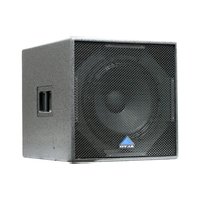
USER MANUAL Elvis 10A ALTO
ELVIS SPEAKER ENCLOSURES PASSIVE AND ACTIVE MODELS

natural_image
Front view of a speaker with two large speakers and a triangular logo (no visible text or symbols on the speaker body)

CAUTION
RISK OF ELECTRIC SHOCK
DO NOT OPEN

TO REDUCE THE RISK OF ELECTRIC SHOCK PLEASE DO NOT REMOVE THE COVER OR THE BACK PANEL OF THIS EQUIPMENT. THERE ARE NO PARTS NEEDED BY USER INSIDE THE EQUIPMENT. FOR SERVICE, PLEASE CONTACT QUALIFIED SERVICE CENTERS.

This symbol, wherever used, alerts you to the presence of un-insulated and dangerous voltages in the product enclosure. These are voltages that be sufficient to constitute the risk of electric or death.

This symbol, wherever used, alerts you to important operating and maintenance instructions.
Please read.
Protective Ground Terminal
\~ AC mains (Alternating Current)
Hazardous Live Terminal
ON: Denotes the product is turned on.
OFF: Denotes the product is turned off.
CAUTION
Describes precautions that should be observed to prevent damage to the product.
-
Read this Manual carefully before operation.
-
Keep this Manual in a safe place.
-
Be aware of all warnings reported with this symbol.
-
Keep this Equipment away from water and moisture.
-
Clean it only with dry cloth. Do not use solvent or other chemicals.
-
Do not damp or cover any cooling opening. Install the equipment only in accordance with the Manufacturer's instructions.
-
Power Cords are designed for your safety. Do not remove Ground connections! If the plug does not fit your AC outlet, seek advice from a qualified electrician. Protect the power cord and plug from any physical stress to avoid risk of electric shock. Do not place heavy objects on the power cord. This could cause electric shock or fire.
-
Unplug this equipment when unused for long periods of time or during a storm.
-
Refer all service to qualified service personnel only. Do not perform any servicing other than those instructions contained within the User's Manual.
-
To prevent fire and damage to the product, use only the recommended fuse type as indicated in this manual. Do not short-circuit the fuse holder. Before replacing the fuse, make sure that the product is OFF and disconnected from the AC outlet.
WARNING
To reduce the risk of electric shock and fire, do not expose this equipment to moisture or rain.

Dispose of this product should not be placed in municipal and should be separate collection.
- Movethis Equipment only with a ca stand, tripod, or bracket,
specified by the manufacturer, or sold with the Equipment. When a cart is used, use caution when moving the cart / equipment combination to avoid possible injury from tip-over

natural_image
Abstract black-and-white icon of a person pushing a large rectangular block within a circular frame (no text or symbols)
- Permanent hearing loss may be caused by exposure to \ extremely high noise levels. The US. Government's Occupational Safety and Health Administration (OSHA) has specified the permissible exposure to noise level.
These are shown in the following chart:
| HOURS X DAY | SPL | EXAMPLE |
| 8 | 90 | Small gig |
| 6 | 92 | train |
| 4 | 95 | Subway train |
| 3 | 97 | High level desktop monitors |
| 2 | 100 | Classic music concert |
| 1,5 | 102 | |
| 1 | 105 | |
| 0,5 | 110 | |
0,25 or less 115 Rock concert
According to OSHA, an exposure to high SPL in excess of these limits may result in the loss of heat. To avoid the potential damage of heat, it is recommended that Personnel exposed to equipment capable of generating high SPL use hearing protection while such equipment is under operation.
The apparatus shall be connected to a mains socket outlet with a protective earthing connection.
The mains plug or an appliance coupler is used as the disconnect device, the disconnect device shall remain readily operable.
IN THIS MANUAL:
-
INTRODUCTION....1
-
QUICK START - PASSIVE SPEAKER CABINETS....2
-. For Passive Full-range Speakers
-. For Passive Subwoofer & Satellite Speakers
- QUICK START - ACTIVE SPEAKER CABINETS....4
-. For Active Full-range Speakers
-. For Active Subwoofer & Satellite Speakers
-
CONNECTIONS....10
-
PASSIVE FULL-RANGE Speaker for ELVIS10/ELVIS12/ELVIS15/ELVIS12M/ELVIS15M
-
PASSIVE SUBWOOFER Speaker for ELVIS12S/ELVIS15S
-. Active FULL-RANGE Speaker for ELVIS10A/ELVIS12/AELVIS15A/ELVIS12MA/ELVIS15MA
-. Active SUBWOOFER Speaker for ELVIS12SA/ELVIS15SA
-
WIRE CONNECTIONS....13
-
TECHNICAL SPECIFICATION....14
-
WARRANTY....20
1. INTRODUCTION
Thank you for your purchasing one of our ELVIS speaker enclosures. It is just one of the many Alto products that a talented, multinational Team of Audio Engineers and Musicians have developed with their great passion for music. We design all our transducers and cabinets in Emilia-Romagna of Italy, a lowland famous for music and fast cars. In fact, Lamborghini, Maserati and Ferrari are made just a few miles away from our design centers. The same area has a long tradition in designing and manufacturing some of the world's best professional transducers. Your ELVIS speaker cabinet is capable of very high sound pressure level and it has been created to give you a performance that is better than any loudspeaker in this range. They are flexible in their passive and active configurations and can be used with single and multiple subwoofers. The active models even include a microphone preamplifier and a three-band graphic equalizer.
Enjoy your ELVIS speaker and make sure to read this Manual carefully before operation!
Passive, Full-range, two speakers. This is the simplest set-up. You just need a mixer and a stereo amplifier. It is good for small club gigs, disco, etc.
Make all initial connections with all the equipment powered off, and ensure that all the main volume controls are turned down completely.
1). Connect one side of the speaker cable to the Output CHA/CHB or Binding Post of your stereo power amplifier and the other side to the Input socket of your Elvis speaker cabinet.
2). Complete other connections as illustrated.
3). Turn on your mixer first, then the stereo power amplifier.
4). Turn up the volume controls of your amplifier to about 70%.
5). Use PFL function to get the proper input level for the mixer, and adjust the Main Mix Level control to manipulate the output level.
6). After use, turn off your stereo power amplifier first, then the mixer.

flowchart
graph TD
    A["Speaker 1"] --> B["STEREO AMPLIFIER"]
    C["Speaker 2"] --> B
    B --> D["Mixer"]
    B --> E["Output"]
    style A fill:#f9f,stroke:#333
    style C fill:#f9f,stroke:#333
    style B fill:#ccf,stroke:#333
    style D fill:#ccf,stroke:#333
    style E fill:#ccf,stroke:#333
If you use a powered mixer for the passive speakers, it is no need to use an amplifier. make sure all the main volume controls of your power mixer are turned down completely.
1). Connect one side of the speaker cable to the SPEAKER OUT of your powered mixer and the other side to the Input socket of your Elvis speaker cabinet.
2). Use PFL function to get the proper input level for the mixer, and adjust the Main Mix Level control to manipulate the output level.
3). After use, turn down of the Main Mix Level control first, then turn off the powered mixer.

flowchart
graph LR
    A["Speaker 1"] -->|LINE IN MAIN OUT L| B["Main Powerer"]
    B -->|LINE IN MAIN OUT R| C["Speaker 2"]
Passive, Full-range, four speakers. It is similar to the first set-up but four speakers are connected instead of two.
1). Follow the same steps as described above.
2). Connect the THROUGH socket of the first Elvis cabinet to the INPUT socket of the second Elvis cabinet.
NOTE: Every time you connect Elvis cabinets this way your parallel them to the output of the amplifier that will read half of the impedance of one speaker.

flowchart
graph TD
    A["Speaker 1"] -->|INPUT| B["STEREO AMPLIFIER"]
    C["Speaker 2"] -->|INPUT| B
    D["Speaker 3"] -->|INPUT| B
    E["Speaker 4"] -->|INPUT| B
    F["Speaker 5"] -->|INPUT| B
    B --> G["Output Unit"]
    style B fill:#f9f,stroke:#333,stroke-width:2px
MIXER
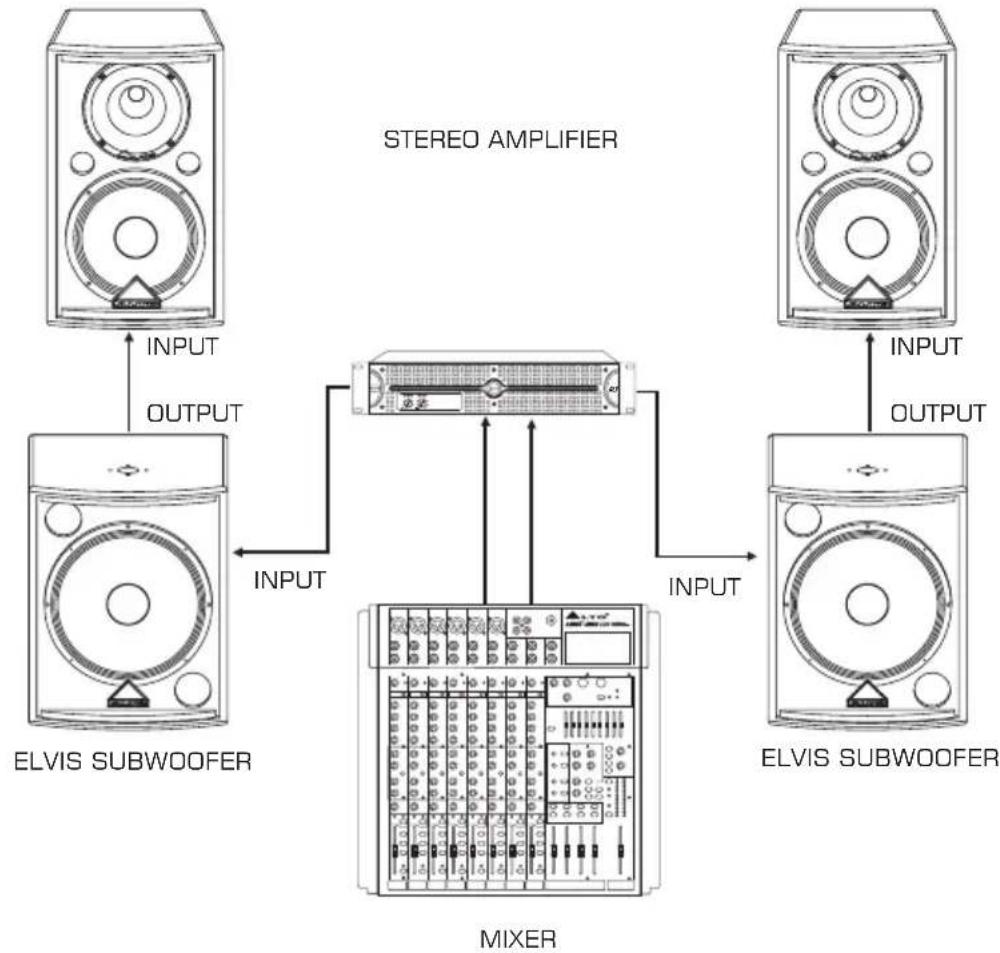
Passive two subwoofers and two satellite speakers. With this example, the stereo amplifier drives both the subwoofers and the satellites. In this case we do not call them full-range anymore because they receive a signal from the subwoofer that is already xovered at 125 Hz. In this way, the high energetic content of the low frequencies is limited to the subwoofer and the satellite's woofer act like a mid-woofer.
1). Connect one side of speaker cable to the Output CHA/CHB or Binding Post of your stereo power amplifier and the other side to the Input socket of your subwoofer, with the second speaker cable connect the Output of the sub-woofer to the Input of satellite.
2). Complete other connections as illustrated.
3). Turn on your mixer first, then the stereo power amplifier.
4). Turn up the volume controls of your amplifier to about 70%.
5). Use PFL function to get the proper input level for the mixer, and adjust the Main Mix Level control to manipulate the output level.
6). After use, turn off your stereo power amplifier first, then the mixer.
flowchart
graph TD
    A["ELVIS SUBWOOFER"] -->|INPUT OUTPUT| B["STEREO AMPLIFIER"]
    C["ELVIS SUBWOOFER"] -->|INPUT OUTPUT| B
    D["MIXER"] -->|INPUT OUTPUT| B
    B --> E["ELVIS SUBWOOFER"]
3. QUICK START - ACTIVE SPEAKER CABINETS
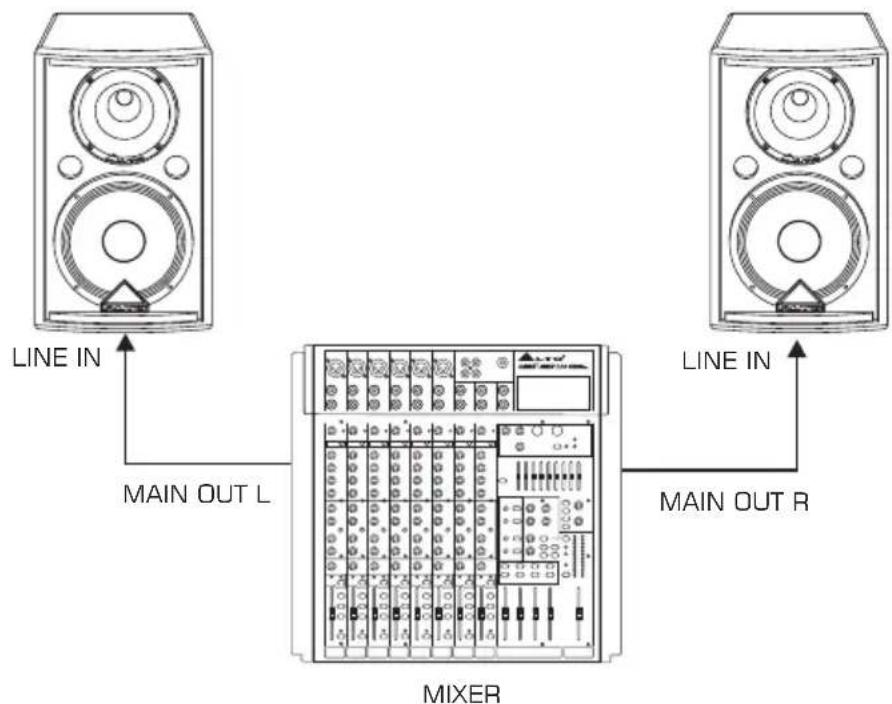
Active, Full-range, two speakers. It is similar to the passive example but you do not need a power amplifier in between the mixer and the 2 ELVIS speakers. Make all initial connections with all the equipment powered off, and ensure that all the main volume controls are turned down completely.
1). Connect one side of the signal cable at your mixer into the Main Output Left / Right (with 1/4"Jack or XLR) and the other side of the cable in to the Line Input (COMBO) of your ELVIS active speaker cabinet (with 1/4"Jack or XLR).
2). Connect the power cord to mains.
3). Turn ON your mixer first, then the ELVIS cabinets.
4). Turn up the volume control of the ELVIS cabinets.
5). Use PFL function to get the proper input level for the mixer, and adjust the Main Mix Level control to reach the desired output level.
6). After use, turn off your active speaker cabinets first, then the mixer.
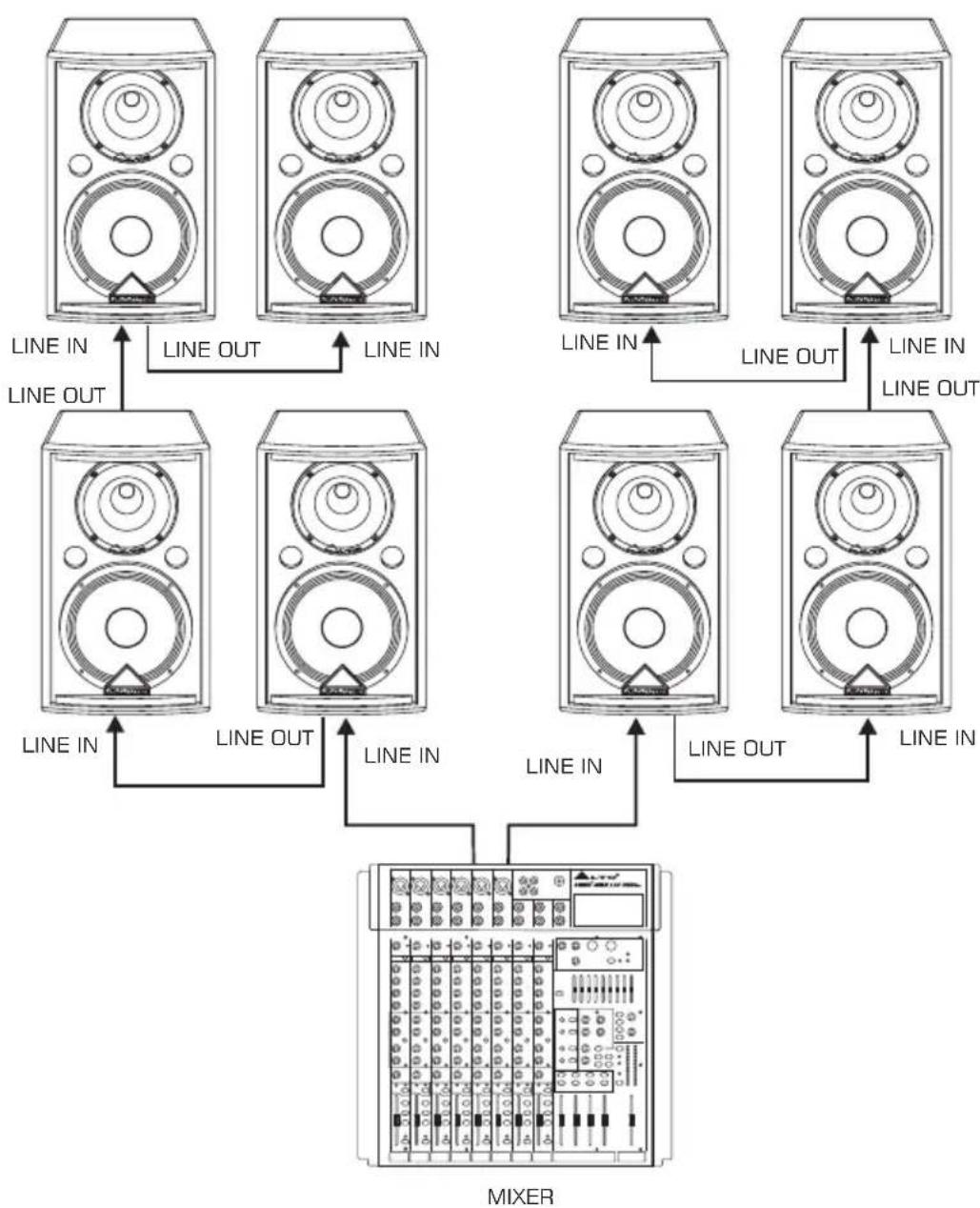
Active, Full-range, multiple speakers. This solution is particularly flexible when you have a large stage and for fixed installations where you want to send the same signal to different zones like in a Bar, Pub, Restaurant, Church, etc. Each ELVIS cabinet has its own volume control so you can adjust different volumes in different zones.
1). Follow the above steps connecting the MAIN OUTPUTS of the mixer to the LINE INPUTS of 2 Elvis active cabinets.
2). Connect the LINE OUT socket of the first ELVIS cabinet to the LINE IN socket of the subsequent piece. You can connect as many speakers as you wish in this way.
flowchart
graph TD
    A["Speaker 1"] -->|LINE IN| B["Mixer"]
    C["Speaker 2"] -->|LINE OUT| B
    D["Speaker 3"] -->|LINE IN| B
    E["Speaker 4"] -->|LINE OUT| B
    F["Speaker 5"] -->|LINE IN| B
    G["Speaker 6"] -->|LINE OUT| B
    H["Speaker 7"] -->|LINE IN| B
    I["Speaker 8"] -->|LINE OUT| B
    J["Speaker 9"] -->|LINE IN| B
    K["Speaker 10"] -->|LINE OUT| B
    L["Speaker 11"] -->|LINE IN| B
    M["Speaker 12"] -->|LINE OUT| B
    N["Speaker 13"] -->|LINE IN| B
    O["Speaker 14"] -->|LINE OUT| B
    P["Speaker 15"] -->|LINE IN| B
    Q["Speaker 16"] -->|LINE OUT| B
    R["Speaker 17"] -->|LINE IN| B
    S["Speaker 18"] -->|LINE OUT| B
    T["Speaker 19"] -->|LINE IN| B
    U["Speaker 20"] -->|LINE OUT| B
    V["Speaker 21"] -->|LINE IN| B
    W["Speaker 22"] -->|LINE OUT| B
    X["Speaker 23"] -->|LINE IN| B
    Y["Speaker 24"] -->|LINE OUT| B
    Z["Speaker 25"] -->|LINE IN| B
    AA["Speaker 26"] -->|LINE OUT| B
    AB["Speaker 27"] -->|LINE IN| B
    AC["Speaker 28"] -->|LINE OUT| B
    AD["Speaker 29"] -->|LINE IN| B
    AE["Speaker 30"] -->|LINE OUT| B
Active, two subwoofers & two satellite speakers. In this example, the mixer is connected to the ELVIS subwoofers and then a 125 Hz xovered line signal is sent to the respective satellites. In this way, the high energetic content of the low frequencies is limited to the subwoofer and the satellite's woofer act like a mid-woofer. As a consequence the satellites built-in amplifier is not stressed by low frequency content.
1). Connect one side of signal cable at your mixer into Main Output Left/Right (with 1/4" Jack or XLR) and the other side of the cable into the Left/Mono Input (COMBO) of the ELVIS active subwoofers; with the second signal cable connect the Left/Mono Line Output of the subwoofer (Stereo/Mono-Jack or XLR) to the Line input (COMBO) of the active satellite (with Stereo - Jack or XLR).
2). Connect the power cord to mains.
3). Turn on your mixer first, then the active speaker cabinets.
4). Turn up the volume control of the active speaker cabinets.
5). Use PFL function to get the proper input level for the mixer, and adjust the Main Mix Level control to manipulate the output level.
6). After use, turn off your active speaker cabinets first, then the mixer.

flowchart
graph TD
    A["ELVIS SUBWOOFER"] -->|LINE IN| B["MIXER"]
    C["ELVIS SUBWOOFER"] -->|LINE IN| B
    D["ELVIS SUBWOOFER"] -->|LINE OUT LEFT/MONO| B
    E["ELVIS SUBWOOFER"] -->|LINE OUT LEFT/MONO| B
    F["ELVIS SUBWOOFER"] -->|LINE OUT RIGHT| B
    B -->|MAIN OUT LEFT LINE IN LEFT/MONO| G["Main Out Left"]
    B -->|MAIN OUT RIGHT LINE IN LEFT/MONO| H["Main Out Right"]
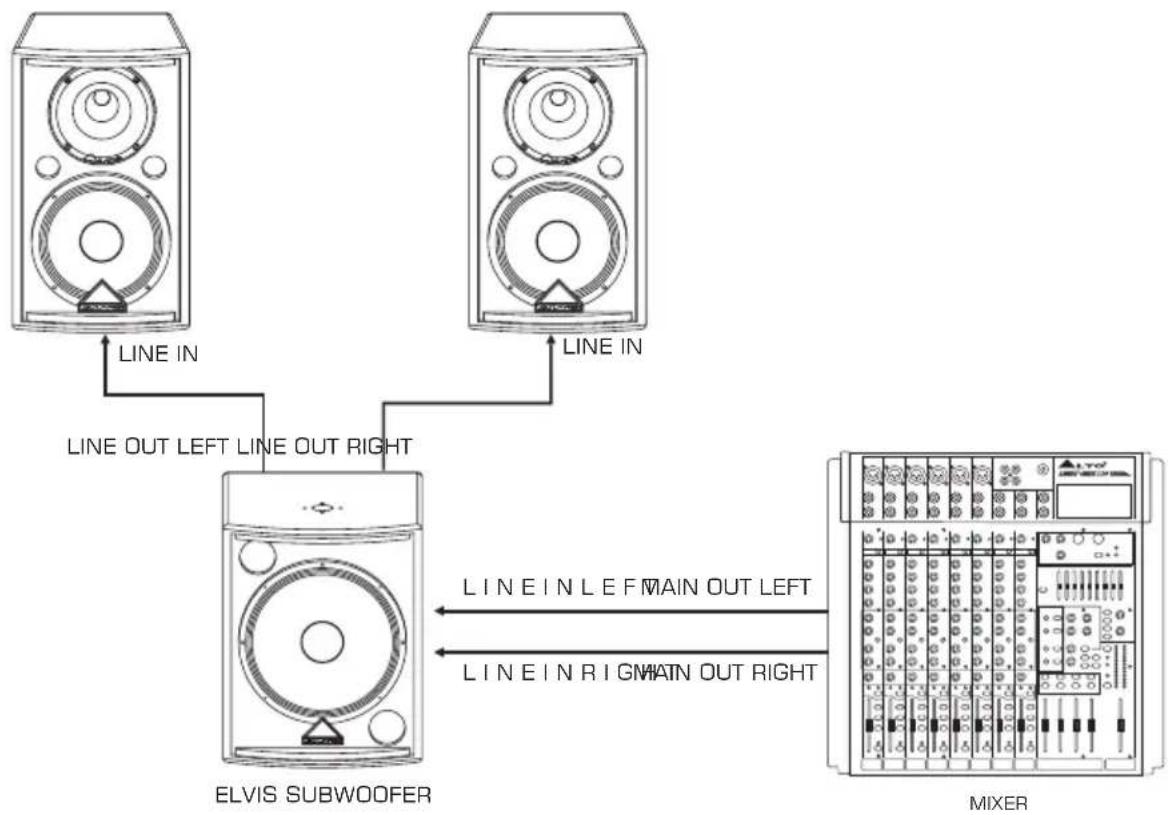
Active, one subwoofer and two satellite speakers.
This is a very popular combination, especially in small size clubs where there is no need for two subwoofers.
1). Connect one side of signal cable at your mixer into Main Output Left (with 1/4"Jack or XLR) and the other side of the cable into the Left Input of the ELVIS active subwoofer. Repeat for the RIGHT channel. With the second signal cable connect the Left Line Output of the subwoofer (Stereo/Mono-Jack or XLR) to the Line input (COMBO) of the active satellite (with Stereo-Jack or XLR). Repeat for the RIGHT channel
2). Connect the power cord to mains.
3). Turn on your mixer first, then the active speaker cabinets.
4). Turn up the volume control of the active speaker cabinets.
5). Use PFL function to get the proper input level for the mixer, and adjust the Main Mix Level control to manipulate the output level.
6). After use, turn off your active speaker cabinets first, then the mixer.
Active, with Microphone and Line Level instruments.
Your Elvis cabinets come with both Line-level and with Microphone Inputs. You can directly connect a microphone into your Elvis cabinet using the MIC input and a keyboard or an electric guitar (you must interconnect a D/I Box if you want to use the guitar) and use the relative level controls as a simple mixer. You can then use the resident 3-bands graphic equalizer to fine-tune your sound. This configuration is good for presentation, meetings, aerobic centers and fashion shows (you can also connect a wireless microphone into the Line input, or for "One Man band" performances.)

- PASSIVE FULL-RANGE: ELVIS10/ELVIS12/ELVIS15/ELVIS12M/ELVIS15M
1). INPUT: Receive the signal coming from an external power amplifier. (SPK +1/-1 connected; +2/-2 not connected).
2). THRU: Direct LINK to connect in parallel a second speaker cabinet (SPK +1/-1 connected; +2/-2 not connected).
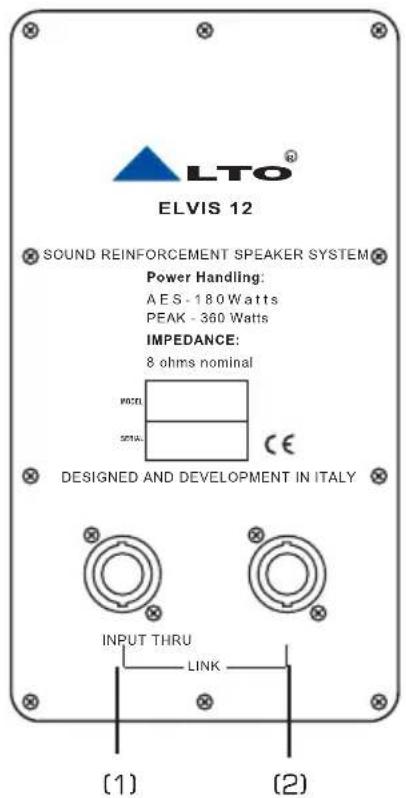

-. PASSIVE SUBWOOFERS: ELVIS12S/ELVIS15S
1). INPUT: Receive the signal coming from an external amplifier. (SPK +1/-1 connected; +2/-2 not connected).
2). OUTPUT: Power output for satellite speaker, under passive crossover filtered at 125Hz (SPK +1/-1 connected; +2/-2 not connected).
ACTIVE FULL- RANGE :
ELVIS10A/ELVIS12A/ELVIS15A/ELVIS12MA/ELVIS15MA
1). ON/OFF switch.
2). Input AC power socket with main fuse.
3). Ground lift
4). POWER, indicate ON status.
5). SIGN/COMP,
compressor, Green/red LED
6). LINE OUT on XLR connector
7). LINE 4NB on COMBO connector.
8). MOLUMEver amplifier control.
9). EQW/MID/HIGH, control at +/-6dB.
10). GAIN control for microphone -10/-45dB.
11). MIC IN on balanced XLR, for microphone.

3 BANDS EQ
You have three EQ control on your Elvis 2-way active cabinets each providing providing +/-6dB of boost and cut. The signal will be unaffected when the controls or on center position.
- HI
If you turn this control up you will boost all the frequencies above 12 kHz (shelving filter). You will add transparency to vocals and guitar and also make cymbals crispier. Turn the control down to cut all frequencies above 12 kHz. In such way you can reduce sibilances of human voice or reduce the hiss of a Tape player.
- MID
This is a peaking filter and it will boost/cuts frequencies with their center at 2.5 kHz. This control will affect especially upper male and lower female vocal ranges and also the harmonics of most musical instruments.
- LOW
If you turn this control up you will boost all frequencies below 80 Hz. You will give more punch to bass drums and bass guitar; and you will make the male vocalist more "macho". Turn it down and you will cut all the frequencies below 80 Hz. In this way you can avoid low-frequency vibrations and resonance thus preserving the life of your woofers.
ACTIVE SUBWOOFERS: ELVIS12 SA/ELVIS15 SA
1). main power switch. ON-OFF
2). Input AC power socket with main fuse.
3). Switch. Ground lift
4). POWER, blue LED, indicate ON status.
5). SIGN/COMP, signal/compressor, green/red LED
6). LEFT signal output on XLR or Jack connector for active satellite, under electronic crossover at 125 Hz.
7). RIGHT on XLR connector for active satellite, under electronic crossover at 125 Hz.
8). VOLUME main power amplifier control.
9). RIGHT, input signal on XLR connector.
10). LEFT/MONO, input signal on COMBO connector.

-. For Passive Speaker Cabinets
Please only use the power connectors to make connections with other signal source equipment for the passive speaker cabinets. The power connector has four terminals: 1+, 1-, 2+, 2-.

In our cabinets, only 1+/1- are used to connect the Speaker+/Speaker-, and 2+/2- are not used.
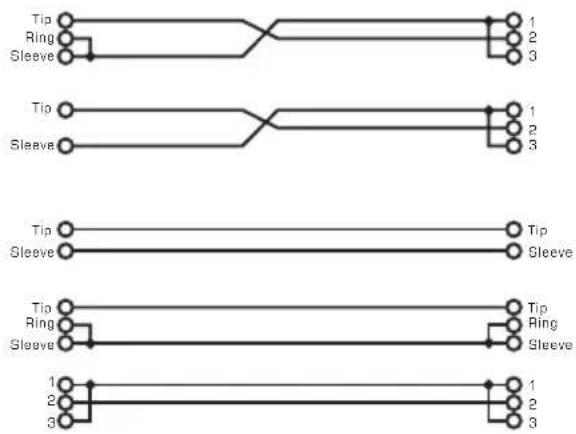
-. For Active Speaker Cabinets
As to these circumstances, audio connections is mostly intended for the signal flow, so, determine the wire configuration according to your real application system and its connecting facility. Normally, you have the following choices:
• Balanced


flowchart
graph TD
    A["Tip"] --> B["Ring"]
    C["Tip"] --> D["Sleeve"]
    E["Ring"] --> F["1"]
    G["Ring"] --> H["2"]
    I["Ring"] --> J["3"]
    K["Ring"] --> L["Sleeve"]
    M["1"] --> N["2"]
    O["2"] --> P["3"]
    Q["1"] --> R["2"]
    S["2"] --> T["3"]
- Unbalanced

flowchart
graph TD
    A["Tip"] --> B["Ring"]
    B --> C["Sleeve"]
    D["Tip"] --> E["Ring"]
    E --> F["Sleeve"]
    G["Tip"] --> H["Ring"]
    H --> I["Sleeve"]
    J["1"] --> K["2"]
    L["1"] --> M["2"]
    N["1"] --> O["3"]
    P["2"] --> Q["3"]
    R["3"] --> S["3"]

6. TECHNICAL SPECIFICATION
| Model No. | ELVIS10 |
| System type | 2-way Vented Box |
| Continuous Power | 120W AES Standard |
| Peak Power Rating | 240W Peak |
| Sensitivity (1W, 1m) | 96 dB/116.5 dB Max |
| Frequency Response | 65 Hz/20 kHz +/-6 dB |
| Impedance | 8 Ohms Nominal |
| Crossover Frequency | 2700 Hz 12 dB/oct. |
| Protection | Electronics High Frequencies Protection |
| Low-Frequency | 10"/266 mm woofer |
| High-Frequency | 1" Compression Driver |
| Spherical Wave Guide | Custom Horn with Polypropilene Reinforced |
| Horn Coverage | 80 H 80 V* |
| Connectors(+1/-1) | 2 x SPK4 Input/Link @+1/-1 connected - +2/-2 not connected |
| Enclosure | Trapezoidal cabinet in 18mm particle board PB. -Covered with resistant carpet -Black metal grille protection |
| Dimensions (H x W x D) | 580 345 305 mm |
| Net Weight (lbs/kg) | 31.22 lbs/14.16 kg |
| Gross Weight (lbs/kg) | 37.92 lbs/17.2 kg |
| Volume | 4.58 CFT |
|
| Model No. | ELVIS12 |
| System type | 2-way Vented Box |
| Continuous power | 180 W AES Standard |
| Peak Power Rating | 360 W Peak |
| Sensitivity (1W, 1m) | 97 dB/119.5 dB Max |
| Frequency Response | 60 Hz/20 kHz +/-6 dB |
| Impedance | 8 Ohms Nominal |
| Crossover Frequency | 2500 Hz 12 dB/oct. |
| Protection | Electronics High Frequencies Protection |
| Low-Frequency | 12"/318mm Woofer |
| High-Frequency | 1" Compression Driver |
| Spherical Wave Guide | Custom Horn with Polypropilene Reinforced |
| Horn Coverage | 80 H 80 V* |
| Connectors(+1/-1) | 2 x SPK4 Input/Link @+1/-1 connected - +2/-2 not connected |
| Enclosure | Trapezoidal cabinet in 18 mm particle board P.B. -Covered with resistant carpet -Black metal grille protection |
| Dimensions (H x W x D) | 635 405 340 mm |
| Net Weight (lbs/kg) | 40.34 lbs/18.30 kg |
| Gross Weight (lbs/kg) | 48.28 lbs/21.9 kg |
| Volume | 6.03 CFT |
6. TECHNICAL SPECIFICATION
| Model No. | ELVIS15 |
| System type | 2-way Vented Box |
| Continuous power | 250 W AES Standard |
| Peak Power Rating | 500 W Peak |
| Sensitivity (1W, 1m) | 98 dB/122 dB Max |
| Frequency Response | 55 Hz/20 kHz +/-6 dB |
| Impedance | 8 Ohms Nominal |
| Crossover Frequency | 2200 Hz 12 dB/oct. |
| Protection | Electronics High Frequencies Protection |
| Low-Frequency | 15"/385 mm woofer |
| High-Frequency | 1"Compression Driver |
| Spherical Wave Guide | Custom Horn with Polypropilene Reinforced |
| Horn Coverage | 80 H 80 V* |
| Connectors(+1/-1) | 2 x SPK4 Input/Link @+1/-1 connected - +2/-2 not connected |
| Enclosure | Trapezoidal cabinet in 18 mm particle board P.B. -Covered with resistant carpet -Black metal grille protection |
| Dimensions (H x W x D) | 700 455 370 mm |
| Net Weight (lbs/kg) | 50.17 lbs/22.76 kg |
| Gross Weight (lbs/kg) | 58.86 lbs/26.7 kg |
| Volume | 7.35 CFT |
|
| Model No. | ELVIS12M |
| System type | 2-way Vented Box |
| Continuous power | 180 W AES Standard |
| Peak Power Rating | 360 W Peak |
| Sensitivity (1W, 1m) | 97 dB/119 dB Max |
| Frequency Response | 75 Hz/20 kHz +/-6 dB |
| Impedance | 8 Ohms Nominal |
| Crossover Frequency | 2500 Hz 12 dB/oct. |
| Protection | Electronics High Frequencies Protection |
| Low-Frequency | 12"/318mm woofer |
| High-Frequency | 1" Compression Driver |
| Spherical Wave Guide | Custom Horn with Polypropilene Reinforced |
| Horn Coverage | 80 H 80 V* |
| Connectors(+1/-1) | 2 x SPK4 Input/Link@+1/-1 connected - +2/-2 not connected |
| Enclosure | Trapezoidal cabinet in 18mm particle board P.B. -Covered with resistant carpet -Black metal grille protection |
| Dimensions (H x W x D) | 615 405 345 mm |
| Net Weight (lbs/kg) | 38.93 lbs/17.66 kg |
| Gross Weight (lbs/kg) | 46.29 lbs/21 kg |
| Volume | 6.10 CFT |
6. TECHNICAL SPECIFICATION
| Model No. | ELVIS15M |
| System type | 2-way Vented Box |
| Continuous power | 250 W AES Standard |
| Peak Power Rating | 500 W Peak |
| Sensitivity (1W, 1m) | 98 dB/122 dB Max |
| Frequency Response | 55 Hz/20 kHz +/-6 dB |
| Impedance | 8 Ohms Nominal |
| Crossover Frequency | 2200 Hz 12 dB/oct. |
| Protection | Electronics High Frequencies Protection |
| Low-Frequency | 15"/385 mm woofer |
| High-Frequency | 1" Compression Driver |
| Spherical Wave Guide | Custom Horn with Polypropilene Reinforced |
| Horn Coverage | 80°H 80 V* |
| Connectors(+1/-1) | 2 x SPK4 Input/Link @+1/-1 connected - +2/-2 not connected |
| Enclosure | Trapezoidal cabinet in 18 mm particle board P.B. -Covered with resistant carpet -Black metal grille protection |
| Dimensions (H x W x D) | 680 450 370 mm |
| Net Weight (lbs/kg) | 50.88 lbs/23.08 kg |
| Gross Weight (lbs/kg) | 62.26 lbs/28.24 kg |
| Volume | 8.12 CFT |
| Model No. | ELVIS12S |
| System type | Vented Box |
| Continuous power | 200 W AES Standard |
| Peak Power Rating | 400 W Peak |
| Sensitivity (1W, 1m) | 97 dB/119dB Max |
| Frequency Response | 50 Hz/20 kHz +/-6 dB |
| Impedance | 4 Ohms Nominal |
| Crossover Frequency | 125 Hz 6 dB/oct. |
| Low-Frequency | 12"/318 mm woofer |
| Connectors(+1/-1) | 2 x SPK4 @ in/out |
| Enclosure | Trapezoidal cabinet in 18 mm particle board P.B. -Covered with resistant carpet -Black metal grille protection |
| Dimensions (H x W x D) | 495 x 400 x 455 mm |
| Net Weight (lbs/kg) | 51.15 lbs/23.2 kg |
| Gross Weight (lbs/kg) | 57.98 lbs/26.3 kg |
| Volume | 6.15 CFT |
6. TECHNICAL SPECIFICATION
| Model No. | ELVIS15S |
| System type | Vented Box |
| Continuous power | 300 W AES Standard |
| Peak Power Rating | 600 W Peak |
| Sensitivity (1W, 1m) | 98 dB/122 dB Max |
| Frequency Response | 45 Hz/20 kHz +/-6 dB |
| Impedance | 4 Ohms Nominal |
| Crossover Frequency | 125 Hz 6 dB/oct. |
| Low-Frequency | 15"/385 mm Woofer |
| Connectors(+1/-1) | 2xSPK4 @ in/out |
| Enclosure | Trapezoidal cabinet in 18 mm particle board P.B. -Covered with resistant carpet -Black metal grille protection |
| Dimensions (H x W x D) | 565 x 455 x 525 mm |
| Net Weight (lbs/kg) | 65.48 lbs/29.7 kg |
| Gross Weight (lbs/kg) | 74.52 lbs/33.8 kg |
| Volume | 8.67 CFT |
| Model No. | ELVIS10A |
| Output Power IHF | 150 Watt IHF |
| Output Power RMS | 84.2 W@8 Ohms 136 W@4 Ohms |
| Max SPL at 1mt | 117.5 dB(IHF Power) |
| Input Sensitivity | Line 0 dB/0.775 V/Mic-10 at -45 dB |
| Input Impedance | 30 kOhms Balanced -15 kOhms Unbalanced |
| Connectors | Mic on XLR/Line Input on Combo/Line-Mix Output on XLR |
| Subsonic Filter | 30 Hz-24 dB/oct. |
| Protections | Soft-Start, Compressor |
| External Control | Mic Gain-EQ-High-Mid-Low-Volume-Ground Switch |
| Power Supply | 230 Volt/115 Volt 50/60 Hz |
| Net Weight (lbs/kg) | 40.12 lbs/18.2 kg |
| Gross Weight (lbs/kg) | 46.83 lbs/21.24 kg |
| Volume | 4.58 CFT |
| Model No. | ELVIS12A |
| Output Power IHF | 250 Watt IHF |
| Output Power RMS | 113 W@8 Ohms 212 W@4 Ohms |
| Max SPL at 1mt | 121 dB (IHF Power) |
| Input Sensitivity | Line 0 dB/0.775 V/Mic-10 at -45 dB |
| Input Impedance | 30 kOhms Balanced - 15 kOhms Unbalanced |
| Connectors | Mic on XLR/Line Input on Combo/Line-Mix Output on XLR |
| Subsonic Filter | 30 Hz-24 dB/oct. |
| Protections | Soft-Start, Compressor |
| External Control | Mic Gain-EQ-High-Mid-Low-Volume-Ground Switch |
| Power Supply | 230 Volt/115 Volt 50/60 Hz |
| Net Weight (lbs/kg) | 50.95 lbs/23.11 kg |
| Gross Weight (lbs/kg) | 58.89 lbs/26.71 kg |
| Volume | 6.03 CFT |
6. TECHNICAL SPECIFICATION
Model No.
Output Power IHF
Output Power RMS
Max SPL at 1mt
Input Sensitivity
Input Impedance
Connectors
Subsonic Filter
Protections
External Control
Power Supply
Net Weight (lbs/kg)
Gross Weight (lbs/kg)
Volume
ELVIS15A
350 Watt IHF
169 W@8 Ohms 300 W@4 Ohms
123 dB (IHF Power)
Line 0 dB/0.775 V/Mic-10 at -45 dB
30 kOhms Balanced - 15 kOhms Unbalanced
Mic on XLR/Line Input on Combo/Line-Mix Output on XLR
30 Hz-24 dB/oct.
Soft-Start,Compressor
Mic Gain-EQ-High-Mid-Low-Volume-Ground Switch
230 Volt/115 Volt 50/60 Hz
62.83 lbs/28.5 kg
71.52 lbs/32.44 kg
7.35 CFT
Model No.
Output Power IHF
Output Power RMS
Max SPL at 1mt
Input Sensitivity
Input Impedance
Connectors
Subsonic Filter
Protections
External Control
Power Supply
Net Weight (lbs/kg)
Gross Weight (lbs/kg)
Volume
ELVIS12MA
250 Watt IHF
113 W@8 Ohms 212 W@4 Ohms
121dB (IHF Power)
Line 0 dB/0.775 V/Mic-10 at -45 dB
30 kOhms Balanced - 15 kOhms Unbalanced
Mic on XLR/Line Input on Combo/Line-Mix Output on XLR
30 Hz-24 dB/oct.
Soft-Start, Compressor
Mic Gain-EQ-High-Mid-Low-Volume-Ground Switch
230 Volt/115 Volt 50/60 Hz
49.54 lbs/22.47 kg
56.92 lbs/25.82 kg
6.10CFT
Model No.
Output Power IHF
Output Power RMS
Max SPL at 1mt
Input Sensitivity
Input Impedance
Connectors
Subsonic Filter
Protections
External Control
Power Supply
Net Weight (lbs/kg)
Gross Weight (lbs/kg)
Volume
ELVIS15MA
350 Watt IHF
169 W@8 Ohms 300 W@4 Ohms
123 dB (IHF Power)
Line 0 dB/0.775V/Mic-10 at -45 dB
30 kOhms Balanced-15 kOhms Unbalanced
Mic on XLR/Line Input on Combo/Line-Mix Output on XLR
30 Hz-24 dB/oct.
Soft-Start,Compressor
Mic Gain-EQ-High-Mid-Low-Volume-Ground Switch
230 Volt/115 Volt 50/60 Hz
65.15 lbs/29.55 kg
76.52 lbs/34.71 kg
8.12 CFT
6. TECHNICAL SPECIFICATION
| Model No. | ELVIS12SA |
| Output Power IHF | 250 Watt IHF |
| Output Power RMS | 113 W@8 Ohms, 212 W@4 Ohms |
| Max SPL at 1mt | 121 dB(IHF Power) |
| Input Sensitivity | Line 0 dB/0.775 V |
| Input Impedance | 30 kOhms-Input/600 Ohms-Output |
| Connectors | L/Mono-R IN on XLR/L-R OUT on XLR |
| Subsonic Filter | Electronic Crossover 125 Hz at 24 dB/oct. |
| Protections | Soft - Start, Compressor |
| External Control | Volume-Stereo/Mono&Ground Switch |
| Power Supply | 230 Volt/115 Volt 50/60 Hz |
| Net Weight (lbs/kg) | 60.36 lbs/27.38 kg |
| Gross Weight (lbs/kg) | 67.19 lbs/30.48 kg |
| Volume | 6.15 CFT |
|
| Model No. | ELVIS15SA |
| Output Power IHF | 350 Watt IHF |
| Output Power RMS | 169 W@8 Ohms, 300 W@4 Ohms |
| Max SPL at 1mt | 123 dB (IHF Power) |
| Input Sensitivity | Line 0 dB/0.775 V |
| Input Impedance | 30 kOhms-input/600 Ohms-output |
| Connectors | L/Mono-R IN on XLR/L-R OUT on XLR |
| Subsonic Filter | Electronic Crossover 125 Hz at 24 dB/oct. |
| Protections | Soft - Start, Compressor |
| External Control | Volume-Stereo/Mono & Ground Switch |
| Power Supply | 230 Volt/115 Volt 50/60 Hz |
| Net Weight (lbs/kg) | 76.68 lbs/34.78 kg |
| Gross Weight (lbs/kg) | 85.72 lbs/38.88 kg |
| Volume | 8.67 CFT |
7. WARRANTY
1. WARRANTY REGISTRATION CARD
To obtain Warranty Service, the buyer should first fill out and return the enclosed Warranty Registration Card within 10 days of the Purchase Date.
All the information presented in this Warranty Registration Card gives the manufacturer a better understanding of the sales status, so as to provide a more effective and efficient after-sales warranty service. Please fill out all the information carefully and genuinely, miswriting or absence of this card will void your warranty service.
2. RETURN NOTICE
2.1 In case of return for any warranty service, please make sure that the product is well packed in its original shipping carton, and it can protect your unit from any other extra damage.
2.2 Please provide a copy of your sales receipt or other proof of purchase with the returned machine, and give detail information about your return address and contact telephone number.
2.3 A brief description of the defect will be appreciated.
2.4 Please prepay all the costs involved in the return shipping, handling and insurance.
3. TERMS AND CONDITIONS
3.1 warrants that this product will be free from any defects in materials and/or workmanship for a period of 1 year from the purchase date if you have completed the Warranty Registration Card in time.
3.2 The warranty service is only available to the original consumer, who purchased this product directly from the retail dealer, and it can not be transferred.
3.3 During the warranty service, may repair or replace this product at its own option at no charge to you for parts or for labor in accordance with the right side of this limited warranty.
3.4 This warranty does not apply to the damages to this product that occurred as the following conditions:
- Instead of operating in accordance with the user's manual thoroughly, any abuse or misuse of this product.
• Normal tear and wear.
- The product has been altered or modified in any way.
- Damage which may have been caused either directly or indirectly by another product / force / etc.
- Abnormal service or repairing by anyone other than the qualified personnel or technician.
And in such cases, all the expenses will be charged to the buyer.
3.5 In no event shall be liable for any incidental or consequential damages. Some states do not allow the exclusion or limitation of incidental or consequential damages, so the above exclusion or limitation may not apply to you.
3.6 This warranty gives you the specific rights, and these rights are compatible with the state laws, you may also have other statutory rights that may vary from state to state.
SEIKAKU TECHNICAL GROUP LIMITED
NO. 1, Lane 17, Sec. 2, Han Shi West Road, Taichung 40151, Taiwan
http://www.altoproaudio.com Tel: 886-4-22313737
email: alto@altoproaudio.com Fax: 886-4-22346757
All rights reserved to ALTO. All features and content might be changed without prior notice. Any photocopy, translation, or reproduction of part of this manual without written permission is forbidden. Copyright 2007 Seikaku Group