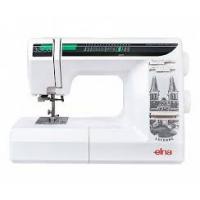


On your ELNA 3003 sewing machine, the adjustment of the upper thread tension is done using the tension disc located on the upper front part of the machine, marked with numbers from 0 to 9.
Initial setting: Start with a medium position, around 4 or 5, which is generally suitable for standard thread and common fabrics like cotton or polyester.
To test the tension: Do a test on a piece of fabric identical to the one you will be sewing, using a straight stitch. Examine the resulting stitches to determine the necessary adjustments:
- If the bobbin thread (bottom thread) is visible on the top of the fabric, the upper thread tension is too low: turn the disc towards the higher numbers (towards 6, 7, 8) clockwise to increase the tension.
- If the needle thread (top thread) is visible on the bottom of the fabric, the tension is too high: turn the disc towards the lower numbers (towards 2, 3, 4) counterclockwise to decrease the tension.
Goal to achieve: The needle thread and the bobbin thread should interlock in the center of the two layers of fabric to achieve a strong and even stitch. The stitches should be balanced and tight.
Make adjustments in small increments of half a position at a time, then test again after each change. For decorative stitches or zigzag and overlock stitches, you may slightly reduce the tension so that the top thread is less visible on the back of the fabric.
If tension issues persist even after these adjustments, also check the bobbin tension via the small screw on the bobbin case. Incorrect bobbin tension can also significantly affect stitch quality and may require correction.