
INMD-YM-201 - Pulse oximeter Innoliving - Free user manual and instructions
Find the device manual for free INMD-YM-201 Innoliving in PDF.


| Product Type | Fingertip Pulse Oximeter |
| Brand | Innoliving |
| Model | INMD-YM-201 |
| Display Type | OLED |
| SpO2 Measurement Range | 0% – 100% |
| Pulse Rate Measurement Range | 30 – 250 bpm |
| SpO2 Accuracy | ±2% (70% – 100%) |
| Pulse Rate Accuracy | ±2 bpm |
| Power Source | 2 x 1.5V AAA alkaline batteries |
| Battery Life | Approximately 30 hours |
| Dimensions | 58 x 32 x 32 mm |
| Weight | 50 g (including batteries) |
| Auto Power Off | After approximately 8 seconds of no signal |
| Low Battery Indicator | Yes |
| Brightness Adjustment | Multiple levels |
| Operating Temperature | 10°C – 40°C |
| Storage Temperature | -20°C – 60°C |
| Humidity | 15% – 80% non-condensing |
| Cleaning | Wipe with a soft, dry cloth; do not use liquids or abrasives |
| Safety Precautions | Keep away from magnetic resonance equipment; do not use if allergic to silicone or rubber |
Frequently Asked Questions - INMD-YM-201 Innoliving
User questions about INMD-YM-201 Innoliving
0 question about this device. Answer the ones you know or ask your own.
Ask a new question about this device
Download the instructions for your Pulse oximeter in PDF format for free! Find your manual INMD-YM-201 - Innoliving and take your electronic device back in hand. On this page are published all the documents necessary for the use of your device. INMD-YM-201 by Innoliving.
USER MANUAL INMD-YM-201 Innoliving
natural_image
Simple geometric diagram with a blue rectangle and two black lines (no text or symbols)b F
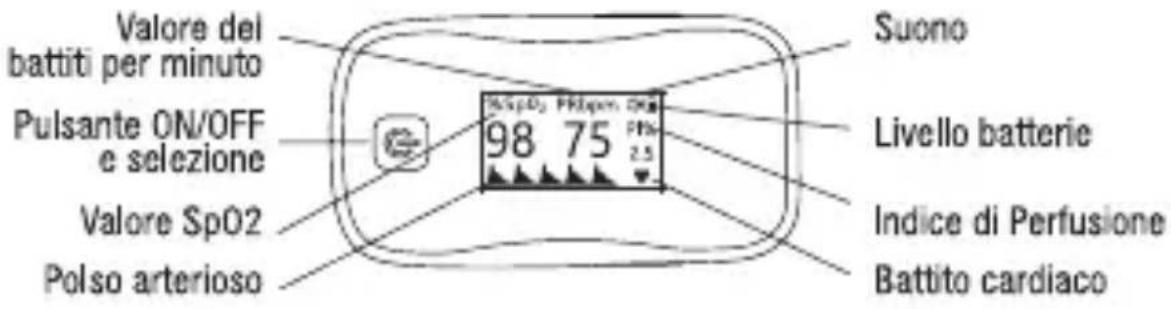
1. INTRODUZIONE AL PRODOTTO E GUIDA OPERATIVA
1.1 Vista frontale
natural_image
Exploded view diagram of an electronic device showing battery pack, casing, and housing (no text or symbols)natural_image
Line drawing of a medical device with a connector, labeled 'Figura 3' (no other text or symbols)2 x 1,5V alkaline batteries (included)
Modello / Model: LR03
Fabbricata da / Manufactured by:
Shenzen New Positive Energy Electronics Co., Ltd.
Room 510, Weifeng Building, No. 6301 Baoan Avenue,
Qiaotou Community, Fuhai Street, Baoan District, Shenzen, PRC
Importate da / Imported by: Innoliving Spa
Via Merloni 2/B - 60131 Ancona, Italia
natural_image
Simple blue horizontal bar with two vertical lines extending from its top (no text or symbols)GB
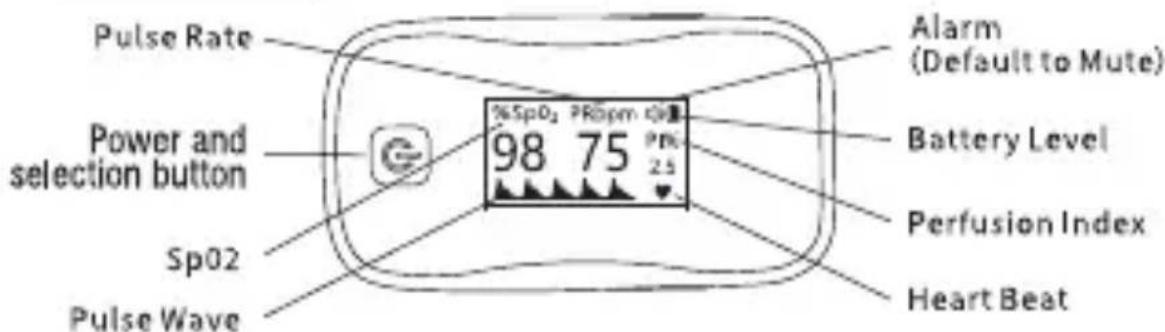
1.PRODUCT INTRODUCTION AND OPERATION GUIDE
1.1 Front View
1.2 Operation Method
A. Open the battery cover, and put the two AAA batteries into the battery compartment in correct polarities, then replace the cover;
B, Press the bottom of the equipment and open the probe, then insert one finger into the probe;
C. Press the button to turn the equipment on, and the measure interface will appear;
D. After about 8 seconds, the measurement result can be read directly from the display screen;
E. Before reading the parameters, make sure that stable numbers of the pulse Oximeter interface has sustained more than 4 second;
F. The equipment will turned off automatically within 8 seconds when the finger left the probe.
GB
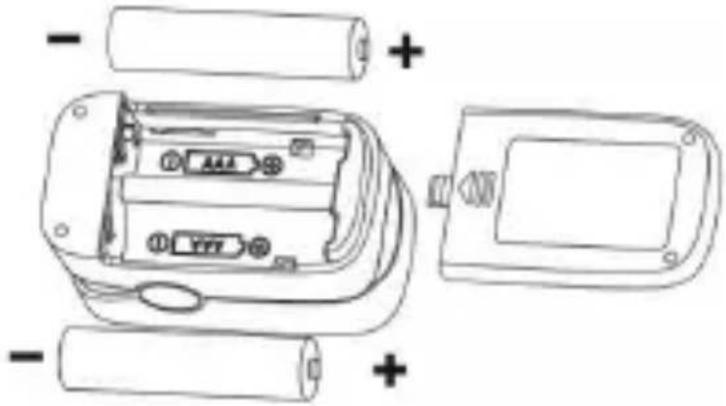
1.3 Battery Installation
A. Put the two AAA batteries into battery compartment in correct polarities (Figure2).
B. Push the battery cover horizontally along the arrow shown as right.
WARNINGS:
- Battery polarities should be correctly installed, otherwise, damage may be caused to the equipment.
- Please remove the batteries if the equipment will not use for a long time.
Figure 2
natural_image
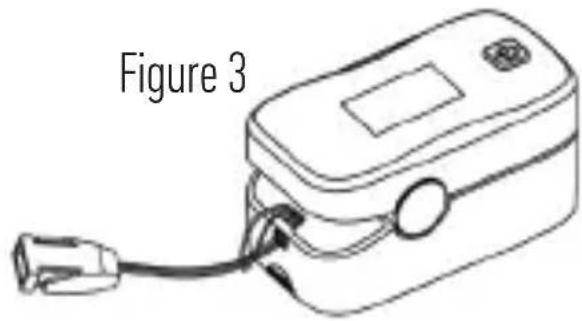
Exploded view diagram of an electronic device showing battery, casing, and housing (no text or symbols)1.4 Lanyard installation
A. Pass the thinner end of the lanyard through the hanging hole; B. Pass the thicker end of the lanyard through the thinner end and tighten the lanyard (Figure3)
natural_image
Line drawing of a medical device labeled 'Figure 3' with a cable and connector (no text or symbols on the device itself)GB
1.5 Attention for Operation
'A. Before use check and confirm that the people or finger size were applicable;
B. Before use check and confirm that the environment should be non-combustible material, as well as to avoid high or low temperature and humidity, but also need to pay attention to the following:
a) To avoid glare and direct sunlight exposure;
b) To avoid radiation infrared or ultraviolet radiation;
c) Avoid contact with the organic solvent, mist, dust, corrosive gases;
C. The equipment should not be used at a location or limb tied with arterial canal or blood pressure cuff or receiving intravenous injection;
D. The equipment may not work normally on microcirculation barrier patients, Warm or rub the finger, or re-position the equipment could improve the measurement.
E. The ray between photo detector and light emitting diode should across patient's arteriole.
F. The patient should not use enamel or other makeup;
G. Avoid to insert a wet finger into the probe.
Notes:
A. The user should fully insert the finger into the probe,
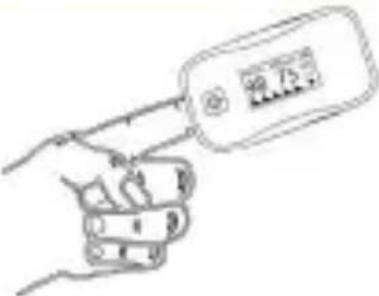
B. It is recommended to let the LED light shine directly on the nail(Figure4);
C. Don't shake the finger and try to keep the patient still during the measurement.
Figure 4
natural_image
Line drawing of a hand holding a small electronic device with a display screen (no text or symbols visible)1.6 Functions and Menu Operation
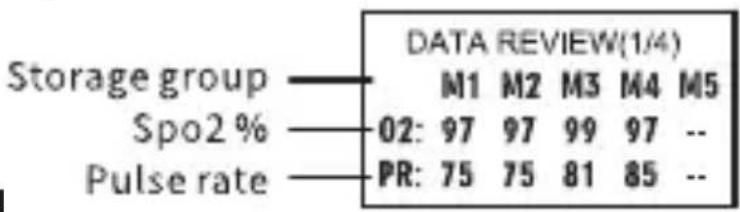
Storage interface
- Press the power button, the Oximeter will enter the storage interface, short press the button to select the page to view the previous historical test data, without pressing the button, this page will remain for 3 seconds.
- The first measurement data (data with countdown record) after each startup will be stored, and the data at the front of the storage interface is the latest test data.
Menu
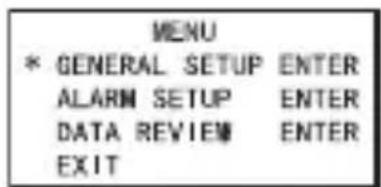
- After turning on the Oximeter, press and hold the power button for about 2 seconds. The Oximeter will display the settings menu. Short press to move"*"to a corresponding option, and hold the button to confirm your selection.
- Quickly press the power button to rotate the display.
GB
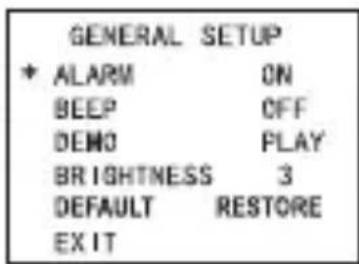
General setup
- Short press to move"*" to the corresponding setting, and hold the button to set alm or Beep to ON or OFF.
- When the alarmis set to ON and the measured Spo2or PR Values go beyond the upper or lower limits, the Oximeter will sound an alert.
- When alarmis set to OFF and the measured values go beyond the limit, the Oximeter will not sound an alert.
- When beep is set to ON, the Oximeter plays a sound indicating the pulse rate during the measurement.
- When beep is set to OFF, no pulse rate sounds played.
- Press the button to select a brightness level ranging from 1 to 5.
• The greater the value, the greater the brightness of the screen. - While the" * "is on the default option, hold the the button to restore factory settings.
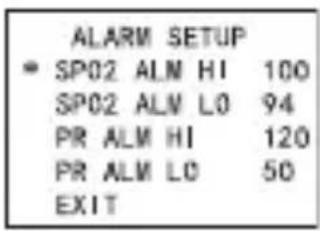
Alarm setup
- Press the button to switch between options. On this screen, you can set the upper limit and lower limit of thespo2 and PRalarms.
GB
- Select the corresponding option and hold the button to change the upper or lower limit.
- Move"*" to the Exit option and hold the button to return to Measurement Mode.
2.SPECIFICATION
2.1 Classification
- Type of protection against electric shock: Internally powered equipment
- Degree of protection against electric shock: Type BF-Applied part
- Operating mode: Spot checking
- Degree of protection against water and dust: IP22
2.2 Power Requirements
Specification of batteries: 2 x AAA
Operating current: 25-50mA
2.3 Physical Specifications
Width*Height*Depth: 57X30X31mm
Weight 28g
2.4 Measurement Specifications
- SpO2 Declared accuracy: 70%\~100%: +2digits
0%\~69%: unspecified - Sp02 Display range: 30%-99%
- Sp02 Resolution: 1%.
- PR Declared accuracy: 25\~250bpm: +3digits
- PR Resolution: 1bpm
GB
2.5 Environmental Specifications
Temperature
- Operating: +50-+104°F/+10-+40°C
- Storage / Transportation: -4\~+140°F /-20\~+60°C
Humidity
• Operating: 15\~95%, noncondensing
• Storage/Transportation: 10\~95%, noncondensing
Atmosphere Pressure
- Operating: 70\~106kpa
• Storage/Transportation: 50\~107.4kpa
2.6 Display
- Display type: TFT Display;
• Display content Sp02%, Pulse Rate, PI%,
• Bar Graph, Battery indicator, - Pulse Wave
Notes:
1) The claim for oxygen saturation accuracy should be supported by clinical studies covering the entire claimed range, The fraction of inspired oxygen(FiO2) delivered to test subjects is varied to achieve a series of targeted steady-state saturation periods over the specified SpO2, accuracy range (e.g. 70 % to 100%), then the SpO2 accuracy is calculated by comparing SpO2 readings of the pulse Oximeter to the values of S2O2 determined with a Co-Oximeter.
2) The clinical trial included 11 subjects, including 6 males and
5 females, with an age range of 18 to 46 years, the subjects skin color included dark black, medium black, light color and white.
3.MAINTENANCE, CLEANING, DISINFECTION
3.1 Maintenance
The equipment's design life expectancy is about 2 years, keep your equipment and accessories free of dust and dirt, and follow these rules:
A. Please clean the equipment before use according to chapter 3.2; Remove the batteries inside the battery cassette if the equipment will not be operated fora long time;
B, Replace the batteries in time when the battery voltage indicate lamps were empty; C. It is recommended that the equipment should be kept in a dry environment with no corrosive gases and good ventilation any time. The moisture and high-light environments will affect its lifetime and even might damage the equipment.
D. It is best to preserve the product in a place where the temperature is between -20 to 60°C and the relative humidity is less than 95%.
E, The packed equipment can be transported by ordinary conveyance. The equipment not be transported mixed with toxic, harmful, corrosive materials.
WARNING!
No modification of this equipment is allowed.
GB
3.2 Cleaning
Your equipment should be cleaned on a regular basis. If there is heavy pollution or lots of dust and sand in your place, the equipment should be cleaned more frequently. Before cleaning the equipment, consult your hospital's regulations for cleaning the equipment. Recommended cleaning agents are:
a) Mild soap (diluted)
b)Ethanol (70%).
To clean your equipment, follow these rules:
a) Shut down the pulse Oximeter;
b) Clean the display screen using a soft, clean cloth dampened with a glass cleaner;
c) Clean the exterior surface of the equipment and probe using a soft cloth dampened with the cleaner;
d) wipe off all the cleaning solution with a dry cloth after cleaning if necessary;
e) Dry your equipment ina ventilated, cool place.
To avoid damage to the equipment, follow these rules:
CAUTIONS
- Always dilute according the manufacturer's instructions or Use lowest possible concentration.
- Do not immerse part of the equipment in the liquid.
- Do not pour liquid onto the equipment or accessories.
- Never use abrasive materials (such as steel wool or silver
GB
polish), or erosive cleaners (such as acetone or acetone-based cleaners).
- If you spill liquid onto the equipment, contact us or your service personnel.
3.3 Disinfection
Clean the pulse oximeter before disinfecting it. The recommended disinfectant is ethanol 70%. Disinfection steps are the same as cleaning.
CAUTION!
Never use ETO or formaldehyde for disinfection.
3.4 Disposal
Dispose of the pulse oximeter in accordance with local environment and waste disposal laws and regulations.
4. ACCESSORIES
- One lanyard.
- Two AAA batteries(Optional).
- One user manual.
5.TROUBLESHOOTING
| Trouble Possible Reason | Solutions | |
| The device can not be turned on | The batteries are drainedaway or almost drainedaway | Replace batteries. |
| Thebattery installation is incorrect | Install the battery over again | |
| The device works abnormally | Please contact the product distributor | |
| The Sp02 and PR are not displayed normally | The finger size is too big or small | Select the suitable size finger to measure |
| Excessive ambient light Avoid excessive ambient light irradiation | ||
| User's blood perfusion is very low | Warm the finger and try again | |
| The display is off suddenly | The device is ste to shut-down automatically in 8 seconds when there is no correct physiological signals | Normal |
| The battery is almost drained away | Replace batteries | |
| The Sp02 and PR are not displayed stably | The finger is not inserted deep enough. | Replace the finger and try again |
| The finger is shaking or the body is moving | Try to keep still | |
| Not used in the work environment required by this manual | Please use in normal working environment | |
| The device work abnormally | Please contact the product distributor | |
6.APPENIX A EMC
The equipment complies with the requirement of standard EN 60601-1-2:20 14"Electromagnetic Compatibility - Medical Electrical Equipment"
| Guidance and manufacturer's declaration - electromagnetic emission | ||
| The model YM201is intended for use in the electromagnetic, environment specified below. The customer or the user of the model YM201 should assure that it is used in such an environment. | ||
| Emission test Compliance Electromagnetic envi | -ronment - guidance | |
| RF emissions CISPR11 Group 1 | The YN201 uses RF energy only for its international function. Therefore, its RF emissions are very low and are not likely to cause any interference in nearby electronic equipment to recommended separation distance. | |
| RF emissions CISPR 11 | Class B The YM201 model is | suitable for use in all establishments, including domestic establishment and those directly connected to the public low-voltage power supply network taht supplies buildings used for domestic purposes |
| Harmonic emissions IEC 61000-3-2 | Not applicable | |
| Voltage fluctuations / flicker emissions IEC 61000-3-3 | Not applicable | |
| Guidance and manufacturer's declaration - electromagnetic immunity | |||
| The model YM201is intended for use in the electromagnetic environment specified below. The customer or the user of the model YM201 should assure that it is used in such an environment | |||
| Immunity test IEC 60601test level | Compliance level | Electromagnetics environment-guidance | |
| Electrostatic discharge (ESD)IEC 61000-4-2 | ±8 kV contact±2 kV, ±4 kV, ±8 kV, ±15 kV air | ±8 kV contact±2 kV, ±4 kV, ±8 kV, ±15 kV air | Floors shold be wood, concrete or ceramic life. If floors are covered with synthetic material, the relative humidity should be at least 30% |
| Electrostatic transient / brustIEC 61000-4-4 | ±2kV for power supply lines100 kHz ±1 kV for input/output lines | N/A N/A | |
| SurgeIEC 61000-4-5 | ±0,5 kV, ±1 kV differential mode-line | N/A N/A | |
| Voltage dips, short interruptions and voltage variations on power on power supply input linesIEC 61000-4-11 | 0% UT (100% dip in UT) for 0,5 cycle at 0°, 45°, 90°, 135°, 180°, 225°, 270° and 315°0% UT (100% dip in UT) for 1 cycle at 0°70% UT (30% dip in UT) for 25/30 cycle at 0°0% UT (100% dip in UT) for 250/300 cycle at 0° | N/A N/A | |
| Power frequency (50/60 Hz)magnetic fieldIEC 61000-4-8 | 30 A/m, 50/60Hz | 30A/m, 50/60Hz | Power frequency magnetic files should beat levels characteristic of atypical location in atypical commercial or hospital environment |
| NOTE: UT is the a. c. mains voltage prior to application of the test level. | |||
GB
| Gidance and manufacturer's declaration - electromagnetic immunity | |||
| The model YM201 is intended for use in the electromagnetic, environment specified below. The customer or the user of the model YM201 should assure that it is used in such an environment. | |||
| Immunity test IEC 60601test level | Compliance level | Electromagnetic environment - guidance | |
| Conducted RFIEC 61000-4-6 | 3 Vrms da 150 kHz a 80 MHz6 Vrms to 150 kHz a 80 MHz outside ISM bandsa | N/A | Portable and mobile RF communications equipment should be used no closer to any of the device, including cables, than the recommended separation distance calculated from the equation applicable to recommended separation distance. |
| Radiated RFIEC 61000-4-3 | 10 V / m80 MHz to 2,7 GHz | 10 V/m | d = [ 3.5V_1 ] d = [ 3.5E_1 ] 80MHz to 800MHz d = [ 7E_1 ] 80MHz to 2.7GHz where P is the maximum output power rating of the transmitter in watts (W) according to the transmitter manufacturer and D is the recommended separation distance in meters (m). Field strengths from fixed RF transmitters, as determined by an electromagnetic site survey, a should be less than the compliance level in each frequency range BInterference may occur in the vicinity of equipment marked with the following symbol: |
GB
NOTE 1 At80 MHz and 800 MHz, the higher frequency range applies. NOTE2 These guidelines may not apply in all situations. Electromagnetic propagation is affected by absorption and reflection rom structures, objects and people.
a) The ISM (industrial, scientific and medical) bands between 0,15 MHz and 80 MHz are 6,765 MHz to 6,795 MHz; 13,553 MHz to 13,567 MHz; 26,957 MHz to 27,283 MHz; and 40,66 MHz to 40,70 MHz. The amateur radio bands between 0,15 MHz and 80 MHz are 1,8 MHz to 2,0MHz, 3,5 MHz to 4,0 MHz, 5,3 MHz to 5,4 MHz, 7 MHz to 7,3 MHz, 10,1 MHz to 10,15 MHz, 14 MHz to 14,2 MHz, 18,07 MHz to 18,17 MHz, 21,0MHz to 21,4 MHz, 24,89 MHz to 24,99 MHz, 28,0 MHz to 29,7 MHz and 50,0 MHz to 54,0 Mae.
b) The compliance levels in the ISM frequency bands between 150 kHz and 80 MHz and in the frequency range 80 MHz to 2.7GHz are intended to decrease the likelihood that mobile/portable communications equipment could cause interference ifitisinadvertently brought into patient areas. For this reason, an additional factor of 10/3 has been incorporated into the formulae used in calculating the recommended separation distance for transmitters in these frequency ranges.
c) Field strengths from fixed transmitters, such as base stations for radio(cellular/cordless) telephones and land mobile radios, amateur radio, AM and FM radio broadcast and TV broadcast cannot be predicted theoretically with accuracy. To assess the electromagnetic environment due to fixed RF transmitters, an electromagnetic site survey should be considered. If the measured field strengthen the location in which the model s used exceeds the applicable RF compliance level above, the model should be observed to verify normal operation. abnormal performance is observed, additional measures may benecessary, such as re-orienting or relocating the YM201,
d) Over the frequency range 150 kHz to 80 MHz field strengths should be less than 3V/m,
2 x 1,5V alkaline batteries (included)
Modello / Model: LR03
Fabbricata da / Manufactured by:
Shenzen New Positive Energy Electronics Co., Ltd.
Room 510, Weifeng Building, No. 6301 Baoan Avenue,
Qiaotou Community, Fuhai Street, Baoan District, Shenzen, PRC
Importate da / Imported by: Innoliving Spa
Via Merloni 2/B - 60131 Ancona, Italia
 | Applied part type BF |
 | Refer to the instruction for use. |
 0123 0123 | The product complies with the requirements of 93/42/CE Directive on medical devices |
 | Not for continuous monitoring |
 | Manufacturer |
 | Authorized Representative in the European Union |
 | Serial number |
 | LOT number |
 | Catalogue number |
 | Importer |
 | Distributor |
 | Manufacturing date |
GB
| MD | Medical device |
| IP22 | Protection grade |
 | Humidity range for transportation and storage |
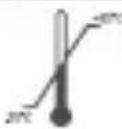 | Temperature range for transportation and storage |
 | Pressure range for transportation and storage |
 | INFORMATION TO USERS according to Legislative Decree No. 49 of March 14, 2014 "2012/19/UE Implementation of the Directive on Waste Electrical and Electronic Equipment (WEEE)". The crossed-out dustbin symbol indicates that the product at the end of its life must be collected separately from other waste. The user should, therefore, take the equipment with the essential components at the end of its useful life to the separate collection center of electronic and electrical waste, or return it to the retailer when purchasing new equipment of equivalent type, in ratio of one to one, or one to zero for devices with larger side less than 25 CM. The separate collection for the decommissioned equipment for recycling, treatment and environmentally compatible disposal contributes to avoid possible negative effects on the environment and human health and promotes recycling of the materials. Improper disposal of the product by the user entails the application of administrative sanctions according to Legislative Decree No. 49 of 14 March 2014. |
 | The batteries used in this device must be disposed of in the special bins at the end of their life. Please inform yourself about the local rules on separate collection of batteries. The correct disposal of batteries helps preventing potentially negative consequences on the environment and human health. |

bar
| Category | Value | |---|---| | GB | 39 |medifit

Shenzhen Yimi Life Technology Co., Ltd
Add: 302 Building C, YouLiTong Technology Industrial Plant, No.56
Qingsong Road, Laokeng Community, Longtian Street, Pingshan District, 518118 Shenzhen, China
Tel: +86 755-89369909
Email: hnpsd@myspo2.com
Web: www.yimilife.com
Shanghai International Holding corp.
Gmbh(Europe)
Address: Eiffestrasse 80, 20537, Hamburg, Germany
Email: shholding@hotmail.com

Innoliving Spa
Via Merloni, 2/B - 60131 Ancona - Italy
www.innoliving.it
CE
0123
Rev.00_07.2024
- INTRODUZIONE AL PRODOTTO E GUIDA OPERATIVA
- Vista frontale
- GB
- 1.PRODUCT INTRODUCTION AND OPERATION GUIDE
- Front View
- Operation Method
- Battery Installation
- WARNINGS:
- Lanyard installation
- Attention for Operation
- Notes:
- Functions and Menu Operation
- Storage interface
- Menu
- General setup
- Alarm setup
- 2.SPECIFICATION
- Classification
- Power Requirements
- Physical Specifications
- Measurement Specifications
- Environmental Specifications
- Temperature
- Humidity
- Atmosphere Pressure
- Display
- 3.MAINTENANCE, CLEANING, DISINFECTION
- Maintenance
- WARNING!
- Cleaning
- To avoid damage to the equipment, follow these rules:
- CAUTIONS
- Disinfection
- CAUTION!
- Disposal
- ACCESSORIES
- 6.APPENIX A EMC
- medifit
- Shenzhen Yimi Life Technology Co., Ltd
- Shanghai International Holding corp.
- Innoliving Spa
Brand : Innoliving
Model : INMD-YM-201
Category : Pulse oximeter