USER MANUAL TRIPLE 6V-1 ROSIERES
GB INSTRUCTIONS FOR USE AND INSTALLATION

TRIPLE 6 G
TRIPLE 6 M
TRIPLE6E
TRIPLE 6 V/1
SOMMAIRE
Puisance resistance 1900 W
F-6 assiettes plates
Unpacking the appliance 36
Recommendations - Safety advices 36-37
INSTALLATION
·Safety 38
GAS CONNECTION 39-40
ELECTRICAL CONNECTION 41-42
- If modifying the gas setting, set the idle flame 43
TECHNICAL DATA 43-44
USE
- THE HOB
The gas burners 45
The hot plate 46
The vitroceramic zone 47-48
- THE OVEN
Oven equipment 49
Use 49-50
Cooking advices 51-52
- THE DISHWASHER
The controls - The Programmes - Use 53-54
Filters - Loading dishes 55
Loading detergent - Rinse aid -Salt. 56-58
Programmes selection 59
Some hints 60
Water connection - water drainage 61-62
Identifying minor faults 63-64
CLEANING 65-66
UNPACKING THE APPLIANCE
Inside the appliance, you will find the booklet and a bag containing :
- if you have to change the type of gas: new jets for the gas modifications, Butane Gas G30 28-30 mbar or Propane Gas G31-37 mbar,
- for connection by soft rubber tube, an end piece for Natural Gas and an end piece for Butane or Propane gas with seal.
READ THE INSTRUCTIONS CAREFULLY TO MAKE THE MOST OF YOUR APPLIANCE.
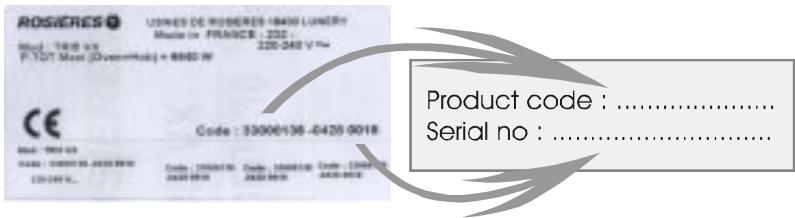
We recommend you keep the instructions for installation and use for later reference, and before installing the appliance, note its serial number below in case you need to get help from the after sales service.
. Identification plate is located at the back of the Triple.
THE COMPANY SHALL NOT BE LIABLE IF THE INSTRUCTIONS PROVIDED IN THIS DOCUMENT ARE NOT COMPLIED WITH.
RECOMMENDATIONS
-
You should entrust the gas installation of your appliance and its electrical connection to an approved installer or technician with similar qualifications.
-
The Triple consists of three elements, a hob, an oven and a diswasher. For safety reasons under no circumstances should any modifications be carried out to this appliance.
- This appliance is be designed for domestic use only.
- If the Triple shows even the smallest defect, do not connect it. Disconnect from the power supply and immediately contact an approved service agent.
- There are certain basic safety rules which are valid for any domestic appliance. They are the following:
- Never touch the appliance when your hands or feet are wet or damp.
- Do not use it when your feet are bare.
- Do not remove the plug from the mains supply socket by pulling the mains cable or the machine itself.
- Do not leave the appliance exposed to the elements (rain, sun etc...).
- Do not let children (or others incapable of operating it) use the machine without supervision.
- Do not lean on the doors or not allow children to do so.
SAFETY INSTRUCTIONS
- All accessible parts are hot when the Triple is in operation. Keep young children away from the Triple when in use. Take care to not touch these elements.
- After each use we recommend that some cleaning of the Triple is undertaken. This prevents the accumulation of dirt or grease which gets re-cooked and burns, generating unpleasant smells and smoke.
- Never use a steam or high pressure spray to clean the appliance.
- Do not store flammable products in the Triple as they can catch fire if the appliance is inadvertantly switched on.
- Use oven gloves when placing or removing a dish from the oven.
- Do not line the oven walls with aluminium foil or single-use oven protectors available from some stores. Aluminium or any other protection, in direct contact with the hot enamel, risks melting the enamel or causing deterioration to the inside.
- When cooking with fats or oils, always take care to watch the cooking process as heated fats and oils can catch fire rapidly.
- This appliance is not intended for use by persons (including children) with reduced physical, sensory or mental capabilities, or lack of experience and knowledge, unless they have been given supervision or instruction concerning use of the appliance by a person responsible for their safety.
- Children should be supervised to ensure that they do not play with the appliance.
-
The hob lid (except TRIPLE 6 Vitroceramic):
-
While the cooker is in use, keep the lid in the upright position.
- before opening the lid, remove any items from it, to avoid any spillage.
- before closing the lid, let all the hot parts of the cooker cool down.
-
do not store heavy or metallic objects on the lid.
-
The dishwasher is designed for normal kitchen utensils. Objects that have been contaminated by petrol, paint, traces of steel or iron, corrosive chemicals, acids or alkalis must not be washed in the dishwasher.
- There should not be water left in the machine or on the dishes at the end of the wash programme.
- If you wish to dispose of an old dishwasher be careful to remove the door to eliminate the risk of children becoming trapped inside it.
- The dishwasher has been made from materials which can be recycled so that it can be disposed of in an environmentally friendly way.
- Ensure that the dishwasher does not crush power cables.
- It is not advisable to use adaptors, multiple plugs and/or extension cables.
- Any queries regarding the power supply cord should be referred to After Sales Service or a qualified technician.
Any failure to follow the above advice may have serious consequences for the safety of the appliance.
Installing a domestic appliance can be a complicated operation which if not carried out correctly, can seriously affect consumer safety.
It is for this reason that a professionally qualified person should undertake the task who will carry it out in accordance with the technical regulations in force.
In the event that this advice is ignored and the installation is carried out by an unqualified person, ROSIERES declines all responsibility for any technical failure of the product whether or not it results in damage to goods or injury to individuals.
INSTALLATION
- Before installing the appliance, the technician must :
- Check the compatibility between the Triple and the gas installation.
The Triple is factory set for use with the gas type as stated on the packaging and repeated on the rating plate affixed to the cooker.
Natural gas G 20-20 mbar / G 25-25 mbar : main gas
- If necessary, change the gas.
To adapt the gas burners hob fit suitable jets that provide the nominal flow rate go to page 39.
- For installation the technician must :
The Triple is Class2 - Sub class 1 ; furniture adjacent to the unit must not be higher than the top of the appliance.
- The Triple has adjustable feet for perfect levelling on the floor.
- Make the gas connection to the installation according to the gas supply, page 40.
- Connect the Triple electrically in compliance with the information given on page 41/42.
- If the gas type has been changed, adjust the minimum flow of each gas burner on page 43.
- Connect the Triple to the water supply and the water drainage (see page 61).
ANY MODIFICATION MADE TO THE GAS SETTING SHOULD BE NOTED ON THE RATING PLATE AFFIXED TO THE APPLIANCE.
When the appliance is located on a carpet floor, attention must be paid to ensure that there are no obstructions to the bottom vents.
| Gas | G20 | G25 | G 30 | G 31 | Gas connector 228-1 |
| Pressure | 20 mbar | 25 mbar | 29 mbar | 37 mbar |
| France | FR | II2E+3+ | α | α | X | X | α |
Factory setting: Natural gas = G20-20 mbar/G25-25 mbar
X Gas setting possible according to installation Butane gas G30-29 mbar or Propane gas G 31-37 mbar
INSTALLATION: GAS
CHANGING THE GAS TYPE :
the calorific capacity and pressure of the gas vary according to the type of gas.
When changing the gas, the technician should successively : change the jets, make the gas connection to the installation and set the minimum flow of all the gas burner tap.
CHANGING THE JETS OF THE GAS BURNERS
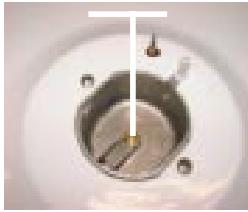
Hob burner jets
To gain access to the jets :
. lift the hob lid,
remove the top, grills, caps and heads of all burners,
. use a tube spanner (7) inside the burner,
. according to the information given in the table, install jets suitable for the burner type and gas type supplied.
For reinstallation, fit the heads, burner and top grills.
JET
Each jet is identified with a mark.
| BURNERS |
| TRIPLE 6 G - 6 M | TRIPLE 6 G | TRIPLE 6 G - 6 M | TRIPLE 6 G - 6 M |
| Front right | Rear left | Front left | Rear right |
| auxiliary | semi-rapid | rapid | ultra-rapid |
| Gas | mbar | Jet | kW | Jet | kW | Jet | kW | Jet | kW |
| * | G 20 | 20 | 76 | 1,00 | 101 | 1,75 | 118 | 2,50 | 144 | 3,50 |
| * | G 25 | 25 | 76 | 0,90 | 101 | 1,60 | 118 | 2,30 | 144 | 3,20 |
| G 30 | 29 | 50 | 1,00 | 66 | 1,75 | 80 | 2,50 | 94 | 3,50 |
| G 31 | 37 | 50 | 1,00 | 66 | 1,75 | 80 | 2,50 | 94 | 3,50 |
| kW = power of the burner |
| * | Factory setting : G 20-20 mbar - G 25-25 mbar |
This must be done in compliance with the regulations in force in the installation country. In all cases, on the gas feed pipe provide a stopcock, a regulator or regulator release device for propane gas. Only use valves, regulators ends and flexible tubes, regulators with the official mark of the installation country.
Gas connection according to installation :
Natural Rigid, Flexible hose with mechanical fittings (1) - Soft rubber tube (3)
Butane Rigid, Flexible hose with mechanical fittings (1) - Soft rubber tube (2)
Propane Rigid, Flexible hose with mechanical fittings (1) - Soft rubber tube (2-3)
1 - provided the flexible hose can be inspected for its entire length.
2 - provided the soft rubber tube can be inspected for its entire length, its length does not exceed 1.5 metres and it is fitted with suitable clamps at the ends.
1, 2 - soft tubes and flexible hoses with mechanical fittings must be arrange to be away from any flames, and not deteriorated by the combustion gases, hot appliance parts or by any spills of hot food.
THREE CONNECTION OPTIONS :
RIGID PIPE CONNECTION
Connect directly to the manifold fittings.
- CONNECTION BY FLEXIBLE HOSE WITH MECHANICAL FITTINGS
We recommend this type of connection.
Screw the hose nuts directly onto the manifold fitting on the one hand and onto the stop cock of the piping on the other hand.
- CONNECTION BY SOFT RUBBER
We do not recommend this type of connection.
To be reserved solely for old installations not enabling any other option.
Screw the compliant end piece (2)
Fit the soft tube to the end piece on the one hand and to the regulator or to the valve outlet on the other hand.
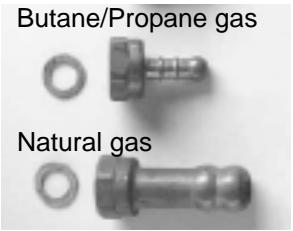
(2) In all cases, make sure the seal is fitted. Following the connection operations, test the leak tightness using soapy water, testing by flame is strictly prohibited.
INSTALLATION - ELECTRICAL CONNECTION
"The installation must conform to the standard directives".
ROSIERES declines all responsibility for any damage that may be caused by unsuitable or unreasonable use.
Warning :
- Always check before any electrical operation, the supply tension shown on the electricity meter, the adjustment of the circuit-breaker, the continuity of the connection to earth to the installation and that the fuse is suitable.
- The electrical connection to the installation should be made via a socket with a plug with earth, or via an omni pole cut-out switch with an opening gap of at least 3mm . If the appliance has a socket outlet, it must be installed so that the socket outlet is accessible.
ROSIERES cannot be held responsible for any accidents resulting from the use of an appliance that is not connected to earth, or with faulty earth connection continuity.
- Any queries regarding the power supply cord should be referred to After Sales Service or a qualified technician.
Warning! This appliance must be earthed. In the absence of adequate earthing you will notice that when touching the metal parts of your appliance an electrical dispersion can be felt due to the presence of a radio interference suppressor.
TRIPLE 6 G - TRIPLE 6 M : a power cord is supplied with this Triple which allows it to be connected only to a power supply of 230V between phases, or between phase and neutral. Connect to a 10/16 Amp socket.
TRIPLE 6 E - TRIPLE 6 V/1 : a power cord is not supplied with this Triple, but it is equipped with a terminal block which enables you to choose the correct connection for the particular power supply.
The terminal block is located at the back of the Triple.
To open the terminal block :
. Locate the two tabs on the sides,
. place the screwdriver blade on the front of the tab, insert it 1 and press down 2, Lift the cover off.
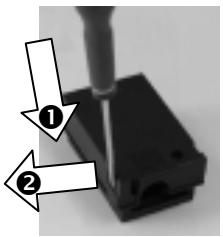
Terminal block
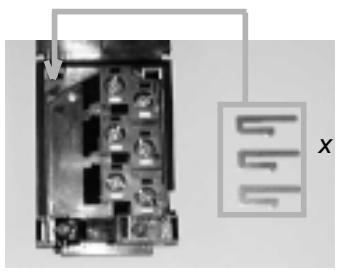
x 3 bars shunts
To connect :
. unscrew the cable grip,
. pass the cable through the cable grip,
. strip the insulation off the end of the each wire and connect them to the terminals according to the numbers shown in the table as well as the "bars shunts".
Example of convection in monophase
1- Put in the bars shunts
2- Put in the wires
3- Pass the cable through the cable grip
1rst 2nd 3rd
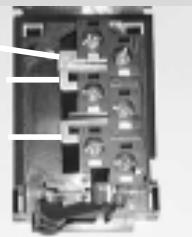
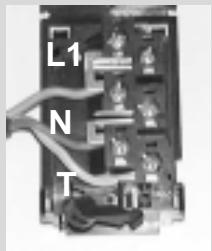
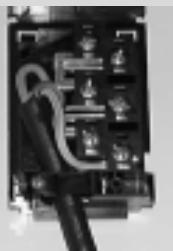
Caution: incorrect tightening can cause dangerous heating risks for the power supply cable.
When the connection operation to the appliance terminals is finished, tighten the cable clamp and close the cover.
| TRIPLE 6 E
TRIPLE 6 V/1 | MONOPHASE
220-240 V~ | THREE PHASES
220-240 V3~ | THREE PHASES
380-415 V3N~ |
| Fuse | 25 A | 25 A | 16 A |
| Cable
Type - Aera | H05VV-F
3 G 2,5 mm² | H05VV-For H05RR-F
4 G 2,5 mm² | H05VV-For H05RR-F
5 G 1,5 mm² |
| CONNECTION TO
THE TERMINAL
BLOCK
To shunt: make a
bridge with a shunt
bar | L1: Phase
Shunt 1-2 and
Shunt 2-3
N: Neutral
Shunt 4-5
T: Earth | L1: Phase
Shunt 1-2
L2: Phase
Shunt 3-4
L3: Phase 5
T: Earth | L1: Phase 1
L2: Phase 2
L3: Phase 3
N: Neutral
Shunt 4-5
T: Earth |
If the gas type has been altered, the stability of the flame in the minimum flow must be checked and set by adjusting the by-pass screw.
To access the top burner by-pass screw, remove the control panel knobs.
a) Butane- propane gas : the setting is done by screwing right in (without forcing) the bypass screw whose calibrated hole provides the minimum flow.
b) Natural gas :
. unscrew the bypass screw one turn,
. replace the control-knob, light the burner and set to low flame,
. remove the control-knob again, screw the by-pass screw until a reduced flame is obtained, staying stable when going from high to low position.
. replace the control-knob.
Warning: Never loosen the others screws!
TECHNICAL DATA
In order to improve the quality of the products, ROSIERES may carry out modifications linked to technical improvements.

Appliance meeting with the standard 89/336/CEE, 73/23/CEE and 90/396/CEE.
| Manufacturer | ROSIERES | ROSIERES | ROSIERES | ROSIERES |
| Model | TRIPLE 6 G | TRIPLE 6 M | TRIPLE 6 E | TRIPLE 6 V/1 |
| Appliance dimensions (cm) | Width 59,6 x Depth 60 X Height 86,5 - 87,5 |
| with lid opened (cm) | 142 - 143 cm |
| THE HOB | 4 gas | 3 gas + 1 hot plate | 4 hot plates | 4 heat zones |
| Front right | Auxiliary比我orose 1 kW | Auxiliary比我orose 1 kW | Ø 145 1000 W | Hilight Ø 165/ 1200 W |
| Rear right | Ultra-rapid 3,5 kW | Ultra-rapid 3,5 kW | Ø 180 1500 W | Hilight Ø 210/ 2300 W |
| Front left | Rapid 2,50 kW | Rapid 2,50 kW | Ø 180 2000 W | Hilight Ø 200/ 1800 W |
| Rear left | Semi-rapid 1,75 kW | Ø 180 1500 W | Ø 145 1500 W | Hilight Ø 165/ 1200 W |
| THE OVEN |
| Norm EN 50304 | Energy efficiency class A (more efficient) to G (less efficient) | A | A | A | A |
| Heating function | Conventional | Conventional | Conventional | Conventional |
| Energy consumption with conventional | 0,78 kWh | 0,78 kWh | 0,78 kWh | 0,78 kWh |
| Energy consumption with forced air convection | - | - | - | - |
| Usable volume | 39 litres | 39 litres | 39 litres | 39 litres |
| Type of appliance (size of the oven) | Medium volume | Medium volume | Medium volume | Medium volume |
| Time to cook based on standard load | 39,5 min | 39,5 min | 39,5 min | 39,5 min |
| The area of the largest baking sheet | 1250 cm² | 1250 cm² | 1250 cm² | 1250 cm² |
| Maxi Oven + Hob power | 2040 W | 3540 W | 8040 W | 8540 W |
| THE DISHWASHER |
| Energy consumption | 0,75 kWh | 0,75 kWh | 0,75 kWh | 0,75 kWh |
| Energy efficiency class | B | B | B | B |
| Energy dry class | B | B | B | B |
| Place settings | 6 | 6 | 6 | 6 |
| Water consumption | 9 | 9 | 9 | 9 |
THE GAS BURNER
USE: each burner is fitted with a thermocouple fast safety. It is a device allowing the automatic cut-out of the gas supplying on the burner, in case the flame dies out accidentally.
- Turn on the gas tap,
- A symbol next to each control knob indicates which burner is lit.
- Press and turn the knob to position keeping it pressed to produce sparks which in turn ignite he burner. Keep the pressure on the control knob a few seconds to permit the releasing of the safety device.
- Set the flame according to your cooking requirements. Intermediate positions are available between the two positions settings on the control knob.
- To turn the flame out, turn the control knob back to stop position.
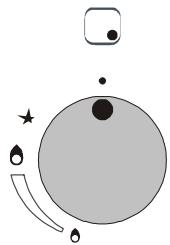
Please note: if there is a power cut, the burner can be ignited by pressing and turning the knob to position and holding a naked flame to the burner.
SOME TIPS ....
- Pans with curved, ridged or warped bottoms are not recommended.
- Avoid boiling food too intensely. Food is not cooked any more quickly this way. In fact, it is subjected to severe agitation, which may cause the food to lose some of its flavour.
- To save gas, make sure that the flames do not overlap the bottom of the pan.
- Do not use the gas burner with an empty pan.
Caution : when the burners are not in service, the general gas supply tap should always be turned off.
The various burners : the hob has burners of different dimensions. You should be aware of the differences in power of each burner.
- use the powerful burner to bring to boil, to fry meat, and in general for any food that should be cooked quickly.
- use the semi-rapid for slow cooking or for sauces.
- use the small burner for small pans and also for slow cooking.
For a proper use of the burners, choose pans which match the dimensions given below: ultra-rapid 22 cm, semi-rapid 12 cm, rapid 16 cm, auxiliary miorose 10 cm.
THE HOT PLATE
A 7 positions commutator controls the standard hot plate. Each position corresponds to a permanent and progressive temperature according to the marks 1,2,3,4,5 and 6.
The self-protecting hot plate, with a red dot in the centre, is also controlled by a 7 positions commutator. An internal thermostat cuts off of the power supply if there is any abnormal heating, if for example, a hot plate is working without a pan on it.
Before using the electrical hot plate for the first time, let it heat up for a few minutes, without a pan, at maximum temperature to allow the protective coating to harden.
HOW TO USE :
- For best results, it is advisable to start on the maximum heat "6" and then turn back to an intermediate temperature taking into account the type and volume of the food.


- An indicator light comes on to show that the hot plate is operating.
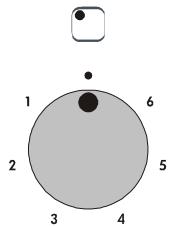
Different temperature settings : below are a few examples which are given as guidelines. When you become more familiar with the appliance, you will be able to choose settings to suit your own personal tastes and requirements.
| Positions | Some tips...... |
| 1 | Very low | To keep a dish hot, melt butter and chocolate... |
| 2 | Low | Slow cooking, sauces, stews, rice pudding, poached eggs... |
| 3 | Moderate | Beans, frozen foods, fruit, boiling water... |
| 4 | Medium | Steamed apples, fresh vegetables, pasta, crepes, fish... |
| 5 | High | More intense cooking, omelettes, steaks.... |
| 6 | Very high | Steaks, chops, frying... |
To obtain the best results from your appliance it is important to observe the following :
- Use thick, flat-based cooking vessel: a completely flat base prevents overheating to certain parts which causes food to stick. Thick metal allows for good heat distribution.
- Make sure that the base of the pan is dry: this will prevent sticking to the hot plate caused by moisture.
- Use pans with a diameter large enough to completely cover the hot plate, otherwise energy will be wasted and any spillages will cause the hot plate to become stained and will become difficult to maintain (rust, etc...)
- Never leave a hot plate switched on without a pan on it as it can be damaged, which would reduce its efficiency.
- When the hot plate is hot, avoid any contact with materials made of plastic or aluminium foil.
As for the hot plate, the use of high quality utensils is important to obtain good cooking results :
- Always use good quality cookware with perfectly flat and thick bases.
- Ensure that the base of the pot or pan is dry.
- Use pans whose diameter is wide enough to completely cover the surface unit.
CHOOSING UTENSILS
The following information will help you to choose cookware which will give good performance.
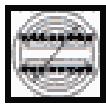
On the label, check the mark that shows if the pan is compatible with the vitroceramic.
Stainless Steel: highly recommended. Especially good with a sandwich clad base. The sandwich base combines the benefits of stainless steel (appearance, durability and stability) with the advantages of aluminium or copper (heat conduction, even heat distribution).
Aluminium: heavy weight recommended. Good conductivity. Aluminium residues sometimes appear as scratches on the hob, but can be removed if cleaned immediately. Because of its low melting point, thin aluminium should not be used.
Cast Iron : usable, but not recommended. Poor performance. May scratch the surface. Copper Bottom / stoneware: heavy weight recommended. Good performance, but copper may leave residues which can appear as scratches. The residues can be removed, as long as the hob is cleaned immediately. However, do not let these pots boil dry. Overheated metal can bond to glass hobs. An overheated copper pot will leave a residue that will permanently stain the hob.
Porcelain/enamel: Good performance only with a thiny smooth, flat base.
THE ZONES
- hilight zone: a metallic conductor strip is spread uniformly over the whole surface unit. It is effective within 3 seconds and is suitable for steady, homogeneous and also sustained cooking.
The glass-ceramic hob benefits from greater heat output which is generated by the hilight cooking zones thereby accelerating the cooking process. Modifications to the design of the hob have not affected the capacity of the glass to withstand high temperatures, but

they have improved controllability. With the "Coup de feu" facility, reduced cooking times of up to 15% can be achieved, depending upon the method of cooking and the type of saucepans being used.
USE :
- Locate the sign corresponding to the cooking zone that you need.
- It is recommended that heat setting is at its highest until it has properly warmed up and then lower to the desired cooking setting.


- The power-on indicator light comes on to show that the heat zone is operating.
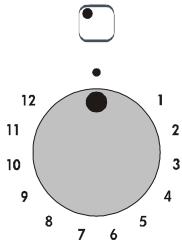
- Each zone is linked to a residual heat indicator located on the hob. It lights up when the heat zone temperature reaches 60^ and above. It will stay on, even if the unit is switched off, until the surface has cooled down.
- To switch off an heat zone, turn the corresponding control knob until the position "0".
- Positions: the examples below are intended as a guide. When you become familiar with using your hob you will be able to work out the settings that suit you best.
| Positions | Some tips...... |
| 1-2 | Very low | To keep a dish hot, melt butter and chocolate... |
| 3-4 | Low | Slow cooking, sauces, stews, rice pudding, poached eggs... |
| 5-6 | Moderate | Beans, frozen foods, fruit, boiling water... |
| 7-8 | Medium | Steamed apples, fresh vegetables, pasta, crepes, fish... |
| 9-10 | High | More intense cooking, omelettes, steaks.... |
| 11-12 | Very high | Steaks, chops, frying... |
Recommendations :
- Never cook food directly on the glass ceramic hob. Always use the appropriate cookware.
- Always place the pan in the centre of the unit that you are cooking on.
- Do not use the surface as a cutting board.
- Do not slide cookware across the hob.
- Do not store heavy items above the hob. If they drop onto the hob, they may cause damage.
- Do not store heavy items above the hob. If they drop onto the hob, they may cause damage.
- Do not use the hob as a working surface.
- Aluminium foil and plastic pans must not be placed on heating zones.
It is strongly recommended to keep children away from the cooking zones while they are in operation or when they are switched off, so long as the residual heat indicator is on, in order to prevent the risks of serious burns.
OVEN EQUIPMENT
It is necessary to do an initial cleaning of the equipment before the first use of each of them. Wash them with a sponge. Rinse and dry off.
- THE SHELF : it is for holding dishes, plates, and meat joints when cooking with the grill. It is fitted with rails which enables the drip tray to be slid into.
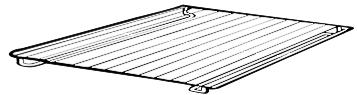
Thanks to its special shape, the shelf always remains horizontal, even when pulled to its fullest extent towards the front of the oven, thus avoiding the risk of dishes sliding off or tipping over.
- THE DRIP TRAY : collects meat and grilling juices during roasting or grilling. It can be put on the shelf, or slid under it.
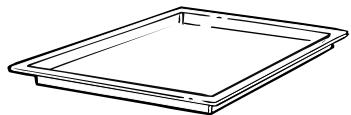
Unless used with the grill, the drip tray must not be stored in the oven while in use.
Never use the drip tray as a roasting tray. This would cause smoke to be produced, fat to be splashed and the oven would become rapidly stained.
- THE ROTISSERIE is equipped with a skewer and a handle, two forks and a skewer support.
When the oven is in use, any unused accessories should be removed.
It takes charge of the functioning of the oven, for between 1 and 120 minutes, with immediate start and automatic stop. When the time is up, the timer automatically cuts off the power supply to the oven.
However, the oven could be used without programming. In this case, turn the control knob to the Hand position .
Note : to set a time, turn the control knob clockwise up to the 120 minutes mark and then turn it back to the required time.
THE OVEN "Use"
VERY IMPORTANT : the oven and the dishwasher cannot be used at the same time. To use the oven, you have to close the dishwasher.
IMPORTANT : always keep small children away from the Triple while it is in use. If the Triple is fitted with a lid, lift it up before use.
THE COOKING METHODS
- Conventional cooking : the top and bottom heating elements are used together. This method is ideal for all traditional roasting and baking, for sealing red meats, roast beef, leg of lamb, bread, flaky pastry. Preheat the oven for about ten minutes and place the cooking meat in the mid shelf position.
- Grill : using the top-heating element. Success is guaranteed for mixed grills, kebabs and "gratin dishes". Five minutes preheating is required to get the element hot.
- Rotisserie : using the top-heating element in conjunction with the rotisserie providing the real flavour of a traditional roast.
. Remove all accessories from the oven.
. Place the drip tray on the oven bottom.
. Skewer the food to be cooked and centre it between the two forks.
. Fit the skewer into the bracket and slide the bracket and skewer on to the second level. The end of the skewer will then be facing the slot in the drive mechanism.
. Fit the skewer into the drive mechanism.
- Rotisserie and conventional cooking : using in the same time the rotisserie and the conventional cooking. It allows to save time when cooking. However, you have to take care of placing the shelf with rails up side down, with rails towards the top and place the drip tray on it.
USE:
- Turn the control knob on the requesting cooking method and set a temperature :

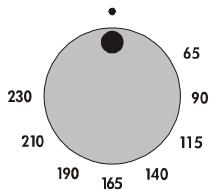


Conventional cooking
Grill
Rotisserie
Rotisserie + Conventional cooking
Temperature from 65^ C to 230^ C
Temperature 230^
Temperature 230^
Temperature 230^
- Turn the control knob of the circuit-breaker timer to the Hand position or on a programming duration.


- The regulator indicator light indicates that the thermostat is working. It goes on and off regularly during the cooking time.
MEAT:
It is better not to salt meats until after cooking as salt encourages the meat to splatter fat. This will dirty the oven and make a lot of smoke.
Joints of white meat, pork, veal, lamb and fish can be put into the oven cold. The cooking time is longer than in a preheated oven, but it cooks through to the centre better as the heat has more time to penetrate the joint.
CORRECT PRE-HEATING IS THE BASIS OF SUCCESSFUL RED MEAT COOKERY.
CAKE - PASTRIES AND BISCUITS :
Avoid using shiny moulds because they reflect heat and can spoil your cakes. If your cakes brown too quickly, cover them with greaseproof paper or aluminium foil.
Caution: the correct way to use foil is with the shiny side in towards. If not the heat is reflected by the shiny surface and does not penetrate the cake.
Avoid opening the door during the first 20 to 25 minutes of cooking : sponge cake, soufflés, brioche, etc., will tend to fall.
You can check if cakes are done, by pricking the centre with a knife blade or metal knitting needle. If the blade comes out nice and dry, your cake is ready, and you can stop the cooking. If the blade comes out moist or with bits of cake attached, continue baking but slightly lower the thermostat so that it finished off without burning.
The following instructions are for guidance only. You may wish to alter them according to your own experience or your personal taste.
Pre-heating times :
. 20 minutes between 210 and 230^ C
15 minutes between 140 and 190^
10 minutes between 65 and 115^
| QUANTITY | FOOD | Oven temperature in °C | Shelf position from the bottom | Cooking time in minutes |
| FISH |
| Trout | 200 | 1 | 15 / 25 |
| 1 kg | Whiting | 190 | 1 | 50 |
| MEAT |
| 1 - 1,5 Kg | Roast-beef | 190 | 1 | 90 |
| 1 kg | Roast veal | 150 / 160 | 1 | 120 / 150 |
| 2 kg | Blanquette of veal | 170 / 190 | 1 | 60 / 90 |
| 1 - 1,5 kg | Leg of lamb | 150 / 160 | 1 | 60 / 75 |
| 1 - 1,5 kg | Leg of mutton | 150 / 160 | 1 | 50 / 60 |
| POULTRY |
| 2 kg | Pigeons | 150 / 160 | 1 | 45 |
| 4 kg | Goose | 160 | 1 | 240 / 270 |
| 2 - 2,5 kg | Duck | 175 | 1 | 90 / 150 |
| 1 - 1,5 kg | Chicken | 170 | 1 | 60 / 80 |
| VARIOUS |
| Lasagne - Cannelloni | 200 | 1 | 40 |
| Soufflés | 200 | 1 | 20 |
| Fritter | 200 | 1 | 20 |
| Pizza | 200 | 1 | 20 |
| PASTRY |
| Buckwheat cake | 175 | 1 | 40 / 50 |
| Tart with fruits | 180 / 190 | 1 | 20 / 30 |
| Biscuit (leaven dough) | 160 | 1 | 40 / 45 |
| Meringue | 100 | 1 | 90 |
| Puff pastry | 200 | 1 | 20 |
THE DISHWASHER
Technical data :
Place load EN50242 6
Capacity with pans & dishes 4 persons
Water supply pressure (litres) 3
Power 1900W
Wash pump power 150 W
Drainage pump power 30 W
Max power absorbed 2050 W
Water pressure mini 0,08 - max 0,8 MPa
Fuse (amp) 10 A
DISHWASHER CONTROLS
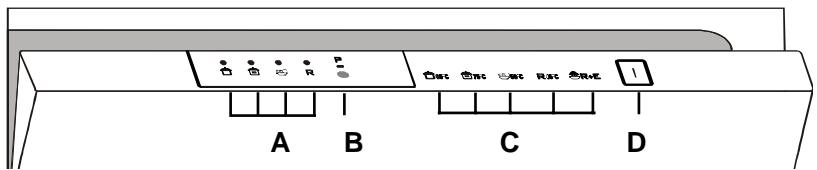
A Programme selection indicator lights
B Programme selection button
C Programme description
D On/off button
SELECTING THE PROGRAMMES AND SPECIAL FUNCTIONS The dishwasher and the oven cannot be used simultaneously.
Setting a programme
Open the door and press the On/off button ; the 4 Program selection LEDs start flashing.
- Set the required programme by pressing Programme selection button, LED of the chosen programme will turn on (2 LEDs for COLD RINSE programme).
- Close the door (after audible signal), the chosen programme will start automatically.
USE THE DISHWASHER
Opening the door
Grip the handle in the front panel and pull forward. If the machine comes open while it is working, an electrical safety device automatically switches everything off. For the machine to work properly, the door should not be opened while it is in operation.
Closing the door
Place the basket in the dishwasher. Make sure that the spray arm is free to rotate and is not obstructed by cutlery, crockery or pans. Close the door, pressing on it to make sure it is firmly shut.
Interrupting a programme
It is not recommended that the door be opened while a programme is running, and especially not during the main wash phase and final drying.
However, the appliance stops automatically when the door is opened.
When the door is closed again, the programme continues automatically.
If you wish to change or cancel a programme that is running, carry out the following procedure: . open the door, keeping the Programme selection button "P" pressed in until all 4 indicator lights are flashing. The current programme is cancelled. A new setting can now be made.
Before starting a new programme, you should check that there is still detergent in the dispenser. If necessary, top up the dispenser.
WARNING: if the door is opened during the drying phase, an intermittent audible signal is activated to advise that the cycle is not yet completed.
End of programme
The end of the programme is indicated by an audible signal. When the door is opened the programme selection indicator lights start flashing. Release the On/off button.
Deactivating the audible signal
The audible function can be deactivated in the following way:
- press the On / Off button
- wait till the programme LEDs blink
- within 2 minutes, press and keep pressed for at least 30 seconds the Programme Selection button (the programme LEDs will still blink and an intermittent audible signal is heard).
- Once the first two LEDs on the left are illuminated without blinking and the audible signal is off, release the button (the audible signal function is active).
- Press again the Programme Selection button, the first two LEDs on the left will go off and the other two LEDs will turn on (the audible signal function is deactivated)
- An audible signal will confirm that the setting is completed
- To set again the audible signal function repeat the whole procedure.
Attention - The dishwasher is equipped with an anti-overflow safety device which in the event of anomaly intervenes by evacuating water in excess.
Fault Signals
If malfunctions or faults occur when a program is running, the LED that corresponds to the selected cycle (2 LEDs for COLD RINSE programme) will blink rapidly and an audible signal will be activated.
In this case, turn the dishwasher off by pressing the On / Off button. After checking to make sure the water inlet hose tap is open, that the drain hose is not bent and that the siphon or filters are not clogged, re-start the selected program. If the anomaly persists, contact Customer Service.
Important!
To ensure the correct operation of the anti-overflow safety device, it is recommended not to move or to tilt the dishwasher during operation.
If it is necessary to move or to tilt the dishwaher, first make sure the washing cyle is finished and that no water is left in the tank.
PRELIMINARY OPERATIONS AND CLEANING THE FILTER UNIT
The filtering system is composed of :
- a central filter cup which traps the largest food particles.
- a flat filter which continuously filters the washing water.
- the micro filter, situated under the flat filter, which traps the smallest food particles ensuring a perfect rinse.
For best results, the filter unit should be checked and cleaned after each wash.
To remove the filter unit, simply grip the handle and lift the whole unit out.
The central cup is just resting on top for easy cleaning.
The dishwasher is fitted with a self cleaning micro filter, which only requires checking about once every 15 days.
However, it is advisable to check after every wash, that the central cup and the flat filter are not clogged.
NB: After cleaning the filters, make sure that they are correctly reassembled, one inside the other, and that the flat filter is properly positioned at the bottom of the dishwasher.
A poor seating of the filter unit could have an adverse effect on the efficiency of the appliance.
Important : Never use the dishwasher without filter.
LOADING DISHES
The basket has been carefully designed to make loading easy.
For good wash performance, remove any debris from the dishes (bones, tooth picks, the remains of meat and vegetables) to avoid blocking the filters, water outlet and washing arm nozzle and, as a result, reducing washing efficiency.
Warning! to avoid any injury from cutlery with blades or sharp points, they can be placed with the handles upwards.
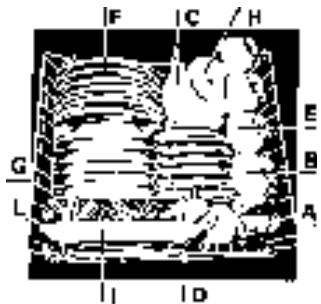
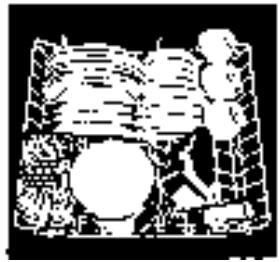
LOADING A 6 PLACES SETTING (EN 50242)
A-6 glasses
F-6 flat plates
B-6 dessert plates
G-6 deep plates
C-6 saucers
H - Medium bowl
D-Small bowl
I - Serving dish
E-6 tea or coffee cups
L - Cutlery
LOADING 4 PLACE SETTINGS PLUS CASSEROLES
Casseroles, salad bowls, soup pans, lids etc., can be loaded on the basket.
It is advisable to arrange the cutlery in the basket provided for that purpose. If there is any cutlery with narrow handles, it should be placed with handles upwards, to avoid falling through the bottom of the basket and blocking the washing arm. Do not put wooden handled lids in the basket, or any whose lids are bonded with resin.
LOADING THE DETERGENT
It is essential to use a detergent that is specifically designed for dishwashers either in powder, liquid or tablet form.
Unsuitable detergents, (like those for washing up by hand) do not contain the proper ingredients for use in a dishwasher and impede the efficient functioning.
Normal wash
The detergent dispenser is inside the door. The dispenser lid should be closed before every wash. To open it, simply press the catch. At the end of each wash cycle the lid is always open and ready for the next time the dishwasher is used.
The amount of detergent to be used varies according to how dirty the dishes are and the type of wash. A 15g dose is normally recommended. If the water is hard or the dishes are exceptionally dirty, 25g of detergent should be loaded. After pooring the detergent into the dispenser, close the lid, since not all detergents are the same and the instructions on the boxes of detergent can vary.
We should just like to remind users that too little detergent does not clean the dishes properly whilst too much detergent not only does not produce better results but is also a waste. Do not use an excessive amount of detergent and help limit damage to the environment at the same time.
Intensive washing
When using the intensive wash programme, add a second dose of detergent of about 15g (1 soup spoonful).
This extra dose should be put in the curved part of the dispenser when it is closed (see diagram).
FILLING THE RINSE AID DISPENSER
The rinse aid dispenser "B" is to the right of the detergent dispenser and has a capacity of about 130ml .
Open the lid and pour in enough liquid, which will last several washes. Try to avoid overloading. Close the lid. This additive, which is automatically released during the last rinse cycle, helps the dishes to dry quickly and prevents spots and stains forming. It is always advisable to use rinse aid.
Check the rinse aid level through the indicator eye "A" which is situated in the centre of the dispensers.
FULL - Dark
EMPTY - Bright


REGULATING THE RINSE AID (from 1 to 6).
The regulator control "B" is below the indicator and can be turned with the finger, the recommended position is "3".
The hardness of the water can be judged by incrustation or by the level of dryness.
It is therefore important that the correct dosage of Rinse Aid is regulated to give the best results.
After the wash,
. if streaks occur on the dishes, decrease the amount by one position.
. if whitish spots occur, increase the amount by one position.
LOADING THE SALT
The dishwasher is fitted with a softener that clears the water of lime which could cause scale and damage the dishwasher.
On the bottom of the diswasher there is a salt dispenser for regenerating the softener.
The filter element of the softener unit should be recharged with a salt specially produced for dishwashers. This salt can be bought either as tablets or as granules.
To add salt, unscrew the cap of the salt dispenser on the bottom and refill the dispenser.
During this operation a little water will overflow but keep adding salt until the dispenser is fill, clean the thread of salt residue and retighten the cap.
If the dishwasher is not required straightaway, set the programme Cold rinse ("Eco+Rapid, 2 LEDs") so that the salt solution which has overflowed is discharged from the washing tank.
The salt dispenser has a capacity of between 1.5kg for efficient use of the appliance, it should be refilled from time to time according to the regulation of the water softener unit.
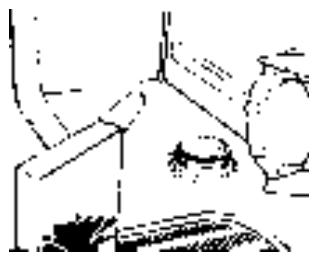
NB: it is necessary to add water until the dispenser overflows. Only install the dishwasher completely filling the salt dispenser.
Regulating the water softener with electronic programmer
The water softener can treat water with a hardness level of up to 60^ (French grading) or 33^ (German grading) through 5 settings.
The settings are listed in the panel below:
| Level | Water hardness | Water hardness | Use of regenerating salt | Water softener setting |
| °fH (French) | °dH (German) |
| 0 | 0-8 | 4 | no | indicator light N.1 |
| 1 | 9-20 | 5-11 | yes | indicator light N.1 |
| 2 | 21-30 | 12-17 | yes | indicator light N.2 |
| 3 | 31-40 | 18-22 | yes | indicator light N.3 |
| 4 | 41-60 | 23-33 | yes | indicator light N.4 |
The softener unit is set in the factory at level 3 (indicator light N.3) as this is suitable for the majority of users.
Regulate the setting of your water softener unit according to the degree of hardness of your water as follows: Open the door, press On / Off button, within 2 minutes press and keep pressed for at least 10 seconds the Programme Selection button; the first three LEDs on the left turn on for 3 seconds.
The LED associated with the set water softener starts flashing; successive button pushing will set the water hardness levels (see table).

Ref. EN 50242 standards:
1) Normal load
2) Shine setting: "4"
3) Amount of detergent: 18gr. for wash
| Programme | Description | Check list | Programme contents | Duration | |
| Detergent for soaking | Detergent for washing | Clean filter | Check rinse aid dispenser | Check salt dispenser | Hot pre-wash | Cold Pre-wash | Main wash | First rinse | Second rinse cold | Rinse with rinse aid | With cold water |
| 65°C | Normal | Once a day - for normal soiled pans and any other items that have been left all day for washing | | | | | | | | 65°C | | | 80 | |
| 75°C | Intensive | Once a day - for heavily soiled pans and any other items that have been left all day for washing. | | | | | | | | 75°C | | | 90 | |
| ECO 45°C | Eco | Energy Saving Programme suitable for normal soiled items. Using detergents with enzyme. | | | | | | | | 45°C | | | 120 | |
| R50°C | Rapid 32' | Quick wash for dishes which are to be washed immediately after the meal. Wash load of 4/6 persons. | | | | | | | | 50°C | | | 32 | |
| R+ECO | Cold pre-wash | Short cold pre-wash for items that are stored in the dishwasher until you are ready to wash a full load. | | | | | | | | | | | 6 | |
SOME PRACTICAL HINTS .... To carry out a wash programme with a full load of dishes load the machine correctly after each meal and do a cold pre-wash between each load to get rid of stains and remove the larger residues of food.
HOW TO GET GOOD WASH RESULTS
1) Place the dishes face downwards.
2) Try to place the dishes in such a way that they are not touching one another. If they are loaded properly you will get better results.
3) Before placing the dishes in the dishwasher remove any remaining food (bones, shells, pieces of meat or vegetables, coffee grounds, skin of fruit, cigarette ash etc. that could clog up the outflow and the washing arm jets.
4) After loading the dishes, check that the washing arm can rotate freely.
5) Pans and other dishes that have particularly stubborn food particles or remnants of burnt food should be left to soak in water with dishwasher detergent.
6) To wash silver properly:
a) - rinse the silver immediately after use especially if it has been used for mayonnaise, eggs, fish etc.
b) - do not sprinkle detergent onto it.
c) - keep it separate from other metals.
WHAT TO DO IF ... You want to stop the dishwasher to put in more dishes whilst it is in the middle of a wash. Open the door, put in the dishes, and close the door, the machine will start up again automatically.
WHAT NOT TO WASH ...
It should also be remembered that not all dishes are suitable for washing in a dishwasher. We advise again using the dishwasher to wash items in thermoplastic, cutlery with wooden or plastic handles, saucepans with wooden handles, items in aluminium, crystal, leaded glass unless otherwise stated.
Certain decorations may fade. It is therefore a good idea before loading the whole batch to wash just one of the items first so as to be sure that others like it will not fade.
It is also a good idea not to put silver cultery with non-stainless steel handles into the dishwasher as there could be a chemical reaction between them.
NB: when buying new crockery or cutlery always make sure that they are suitable for washing in a dishwasher.
AFTER USE - After each wash, close the tap which supplies the water to the dishwasher and press the On/Off button to the Off position.
If the dishwasher is not going to be used for some time, the following precautions are advisable:
1 - carry out a wash programme, but with no dishes, to degrease the machine,
2 - pull the plug out,
3 - turn off the water supply tap,
4 - fill the rinse aid dispenser,
5 - leave the door slightly ajar,
6 - leave the inside of the machine clean,
7 - if the machine is to be left in a place where the temperature is below 0^ , the water left in the dispenser could freeze.
Therefore, it is advisable to raise the temperature above 0^ , approximately 24 hours before using the machine again.
WATER CONNECTION - WATER DRAINAGE
WATER CONNECTION:
The inlet and drain hoses can be directed to left or right.
The dishwasher can be connected to either cold or hot water, as long as it is no hotter than 60^ .
Water pressure mut be between 0,08 MPa and 0,8 MPa. If the pressure is below the minimum consult the service department for advice.
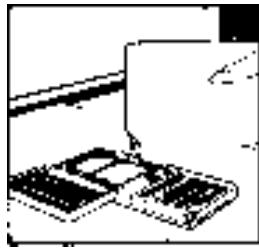
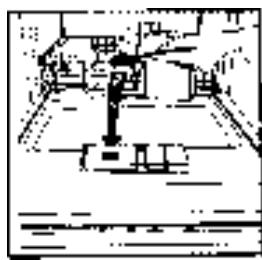
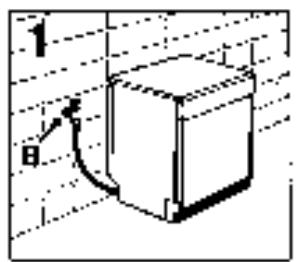
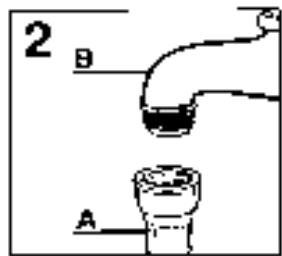
The inlet hose must be connected to a tap so that the water supply can be cut off when the machine is not in use (fig.1). The dishwasher inlet hose is fitted with a 3/4 threaded connector (fig.2). The inlet hose "A" should be tightly connected to a 3/4 tap "B".
The water connection of the dishwasher must be done exclusively with the pipe supplied. Do not use an old pipe.
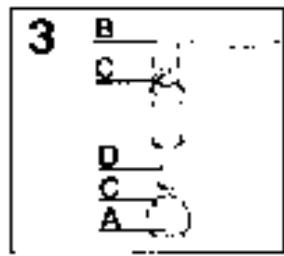
If lime scale deposits or sand are present in the water, it is advisable to obtain the appropriate filter, art. 9226085, from the Service Centre (fig.3). The filter "D" must be inserted between the tap "B" and the inlet hose "A", remembering to fit the washer "C".
If the machine is connected to new pipes or to pipes which have not been in use for long time, run water through for a few minutes before connecting the inlet hose. In this way no deposits of sand or rust will clog up the water inflow filter.
WATER DRAINAGE :
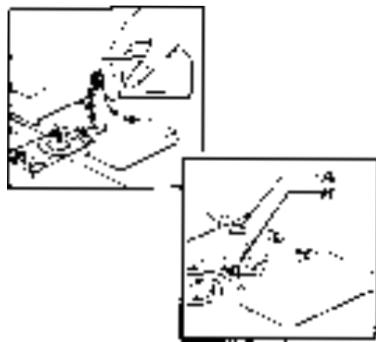
Take care not to bend or kink the drain hose when connecting it to the machine so that the water can drain freely from it (fig.4y).
The drain hose must be at least 40~cm above floor level and it must have an internal diameter of at least 4cm . It is advisable to fit an anti-odour air trap (fig.4x).
If necessary, the outlet hose can be extended up to 2,6m , provided that it is kept at a maximum height of 85~cm above floor level. For this, contact Customer Service.
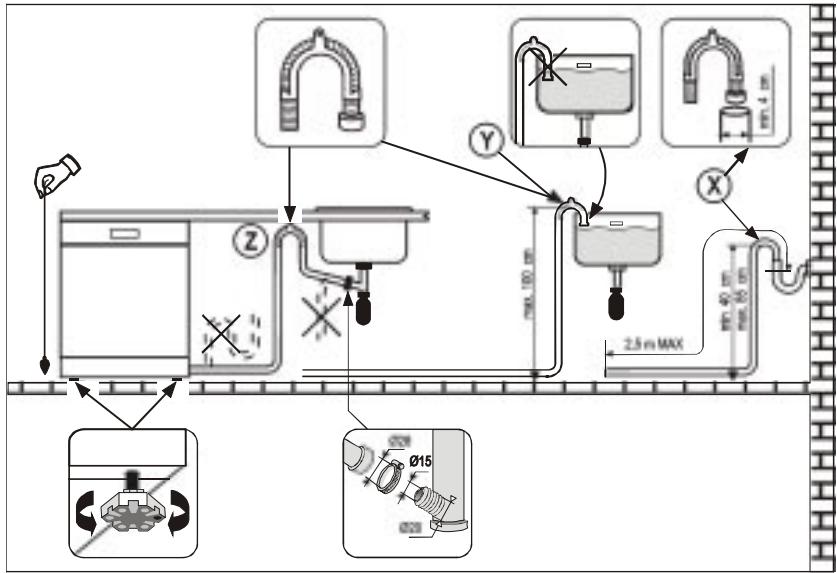
The hose can be hooked over the side of the sink (it must not be immersed in water, in order to prevent water from being siphoned back to the machine when this is in operation) Check that there are no kinks in the inlet and outlet hoses. To extend, if necessary the inlet hose, contact the Customer Service.
IDENTIFYING MINOR FAULTS
REMEMBER! the oven and the dishwasher cannot be used in the same time.
Should the dishwasher fail to operate, before contacting the Service Centre, make the following checks:
| FAULT | CAUSE | REMEDY |
| 1 - Machine completely dead | Plug is not connected correctly | Connect electric plug |
| O/I button has not been pressed | Press button |
| No electricity | Check the electricity supply |
| Door is open | Close door |
| 2 - Machine does not draw water | See causes for No 1 | Check |
| Water tap is turned off | Turn water tap on |
| Programme selector is not at correct position | Turn programme selector to correct position |
| The inlet hose is bent | Eliminate the bends in the hose |
| The inlet hose filter is blocked | Clean the filter at the end of the hose |
| 3 - Machine does not discharge water | Filter is dirty | Clean filter |
| Outlet hose is kinked | Straighten outlet hose |
| The outlet hose extension is not correctly connected | Follow the instructions for connecting the outlet hose carefully |
| The outlet connection on the wall is pointing downwards not upwards | Call a qualified technician |
| 4 - Machine discharges water continuously | Position of outlet hose is too low | Lift outlet hose to at least 40 cm above floor level |
| 5 - Spray arm is not heard to rotate | Excessive amount of detergent | Reduce amount of detergent |
| Item prevents arm from rotating | Check |
| Plate and cup filter very dirty | Clean plate and cup filter |
| 6 - On electronic appliance without a display: "Eco" indicator light and indicator light "No 1", with audible signal | Water inlet tap turned off | Switch off the appliance - Turn on the tap - Re-set the cycle |
| 7 - Load of dishes is only partially washed | See causes for No 5 | Check |
| Bottom of saucepans have not been washed well | Burnt on food remains must be soaked before putting pans in dishwasher |
| Edge of saucepans have not been washed well | Reposition saucepans |
| Spray arm is blocked | Remove spray arm by unscrewing ring nut clockwise and wash under running water |
| The dishes have not been properly loaded | Do not place the dishes too closely together |
| The end of the outlet hose is in the water | The end of the outlet hose must not come into contact with the outflow water |
| The incorrect amount of detergent has been measured out; the detergent is old and hard | Increase the measure according to how dirty the dishes are and change detergent |
| The tap of the salt dispenser is not closed very well | Tighten it fully. |
| The wash programme is not thorough enough | Choose a more vigorous programme |
| 8 - Presence of white spots on dishes | Water is too hard | Check salt and rinse aid level and regulate amount. Should the fault persist, contact Service Centre |
| 9 - Noise during wash | The dishes knock against one another | Load dishes better onto the basket |
| The revolving arm knock against the dishes | Load dishes better |
| 10 - The dishes are not completely dry | Inadequate air flow | Leave the dishwasher door ajar at the end of wash program to allow dishes to dry naturally |
CLEANING
Before carrying out any cleaning, you must :
- Disconnect the appliance from the electrical supply and wait for all the hot parts to cool.
- Never use abrasive cleaners, wire wool or sharp objects to clean the appliance.
never use abrasives, scouring pads or sharp objects, as this will cause irreparable damage to the enamel.
Once the appliance has cooled down, simply clean with soapy water and dry with a clean cloth.
GAS BURNERS:
for cleaning, it is recommended to remove all greasy or burnt deposits with ammonia based products or usual cleaning products. Do not immerse the burner caps in cold water immediately after use, to avoid cracking the enamel from the thermal shock. If the holes become clogged, brush them with soapy water and dry with a cloth
When re-assembling the burners, make sure that the burner caps and the burners themselves are dry and after, seat them correctly.
- Caution: Be careful not to let any water get into the burners.
- LID : once the appliance has cooled down, simply clean with soapy water and dry with a clean cloth. Before lifting the lid, make sure that anything that might spill over has been removed.
ELECTRIC HOT PLATE :
do not use harsh abrasives. Wipe the protective coating regularly with a cloth after use. The hot plate should always be dry, or slightly greasy, if it is not to be used for some time. Remove any rust using emery paper followed by a suitable commercially available product.
Do not use a sponge that is too wet.
It is advisable to keep away from the hob all substances which are liable to melt, such as plastic items, sugar, or sugar-based products.
Maintenance :
. place a few drops of a specialist cleaning product on the hob surface.
. rub any stubborn stains with a soft cloth or with slightly damp kitchen paper.
. wipe with a soft cloth or dry kitchen paper until the surface is clean.
Stubborn stains :
. place a few drops of a specialist cleaning product on the hob surface.
. scrape with a scraper, holding it at an angle of 30^ to the hob, until the stains disappear.
. wipe with a soft cloth or dry kitchen paper until the surface is clean.
repeat the operation if necessary.

A scraper with a razor blade will not damage the surface, as long as it is kept at an angle of 30^ . Never leave a scraper with a razor blade within reach of children.
A few hints :
Frequent cleaning leaves a protective layer which is essential for preventing scratches and wear.
Make sure that the surface is clean before using the hob again.
To remove marks left by water, use a few drops of white vinegar or lemon juice. Then wipe with absorbent paper and a few drops of specialist cleaning fluid.
The glass ceramic surface will withstand scraping from flat-bottomed cooking vessels, however, it is always better to lift them when moving.
- OVEN LIGHTING - The bulb and its cover are made of material resistant to high temperatures: 230V -E14 base - 15 W - Temperature 300^ mini.
Replacing the bulb : disconnect the power supply from the oven before attempting to replace the lamp. Wait for the oven to cool down before doing any operation.
To change a defective bulb, just unscrew the glass cover, unscrew the bulb, replace it with the same type. After replacing the defective bulb, screw back the protective glass cover.
- THE ACCESSORIES -
The oven shelf: do not clean the oven shelf with harsh abrasives. Simply use a cloth wrung out in hot soapy water. Rinse with clean water and then dry.
The drip tray : after grilling, remove the drip tray from the oven and pour the grease into a container. Wash and rinse the drip tray in very hot water, using a sponge and washing powder. If still stained with sticky food, immerse in soapy water. The drip tray can be clean in the dishwasher. Never put the drip tray back in the oven if still dirty.
- THE OVEN DOOR GLASS -
It is recommended to wipe the oven door glass with absorbent paper after each cooking cycle. If there is heavy staining, the glass can be cleaned with a sponge cleaning agent.
- OVENDOOR:
it is possible to clean the oven door while in position or after removal.
To remove the door, carry out the following :
. open the door fully,
. release the hooks,
. pull the door upwards, closing it partially, until it is free.
To refit it, make sure you reposition the hinges carefully ; a notch located below them lets you fit he hinges correctly.
After the door is put back on its supports, fit the hinges in their initial position.
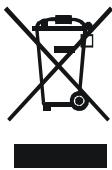
This appliance is marked according to the European directive 2002/96/EC on Waste Electrical and Electronic Equipment (WEEE).
By ensuring this product is disposed of correctly, you will help prevent potential negative consequences for the environment and human health, which could otherwise be caused by inappropriate waste handling of this product.
The symbol on the product indicates that this product may not be treated as household waste. Instead it shall be handed over to the applicable collection point for the recycling of electrical and electronic equipment
Disposal must be carried out in accordance with local environmental regulations for waste disposal.
For more detailed information about treatment, recovery and recycling of this product, please contact your local city office, your household waste disposal service or the shop where you purchased the product.
USINES DE ROSIERES