ADC11AU - Audio/video converter Blustream - Free user manual and instructions
Find the device manual for free ADC11AU Blustream in PDF.


| Product Type | Audio/Video Converter |
| Brand | Blustream |
| Model | ADC11AU |
| Dimensions (W x D x H) | 100 mm x 60 mm x 20 mm |
| Weight | 200 g |
| Power Supply | 5V DC via USB or included adapter |
| Power Consumption | 2.5 W |
| Input Connectors | 1 x HDMI (Type A), 1 x 3.5mm audio |
| Output Connectors | 1 x HDMI (Type A), 1 x Toslink optical, 1 x RCA L/R |
| Supported Video Resolutions | 480i, 480p, 576i, 576p, 720p, 1080i, 1080p |
| Supported Audio Formats | PCM, Dolby Digital, DTS |
| HDCP Support | HDCP 1.4 |
| Audio Extraction | Extract audio from HDMI to optical or analog |
| EDID Management | Built-in EDID emulation |
| Housing Material | Aluminum |
| Operating Temperature | 0°C to 45°C |
| Storage Temperature | -20°C to 60°C |
| Humidity | 10% to 90% non-condensing |
| Certifications | CE, FCC, RoHS |
| Warranty | 2 years |
| Included Accessories | Power adapter, USB cable, user manual |
Frequently Asked Questions - ADC11AU Blustream
User questions about ADC11AU Blustream
0 question about this device. Answer the ones you know or ask your own.
Ask a new question about this device
Download the instructions for your Audio/video converter in PDF format for free! Find your manual ADC11AU - Blustream and take your electronic device back in hand. On this page are published all the documents necessary for the use of your device. ADC11AU by Blustream.
USER MANUAL ADC11AU Blustream
ADC11AU
User Manual
Thank you for purchasing this product.
For optimum performance and safety, please read these instructions carefully before connecting, operating or adjusting this product. Please keep this manual for future reference.

Surge protection device recommended
This product contains sensitive electrical components that may be damaged by electrical spikes, surges, electric shock, lightning strikes, etc. Use of surge protection systems is highly recommended in order to protect and extend the life of your equipment.
Contents
Introduction 03
Features 03
Panel Descriptions 03
Specifications 04
Package Contents 04
Maintenance 04
Introduction
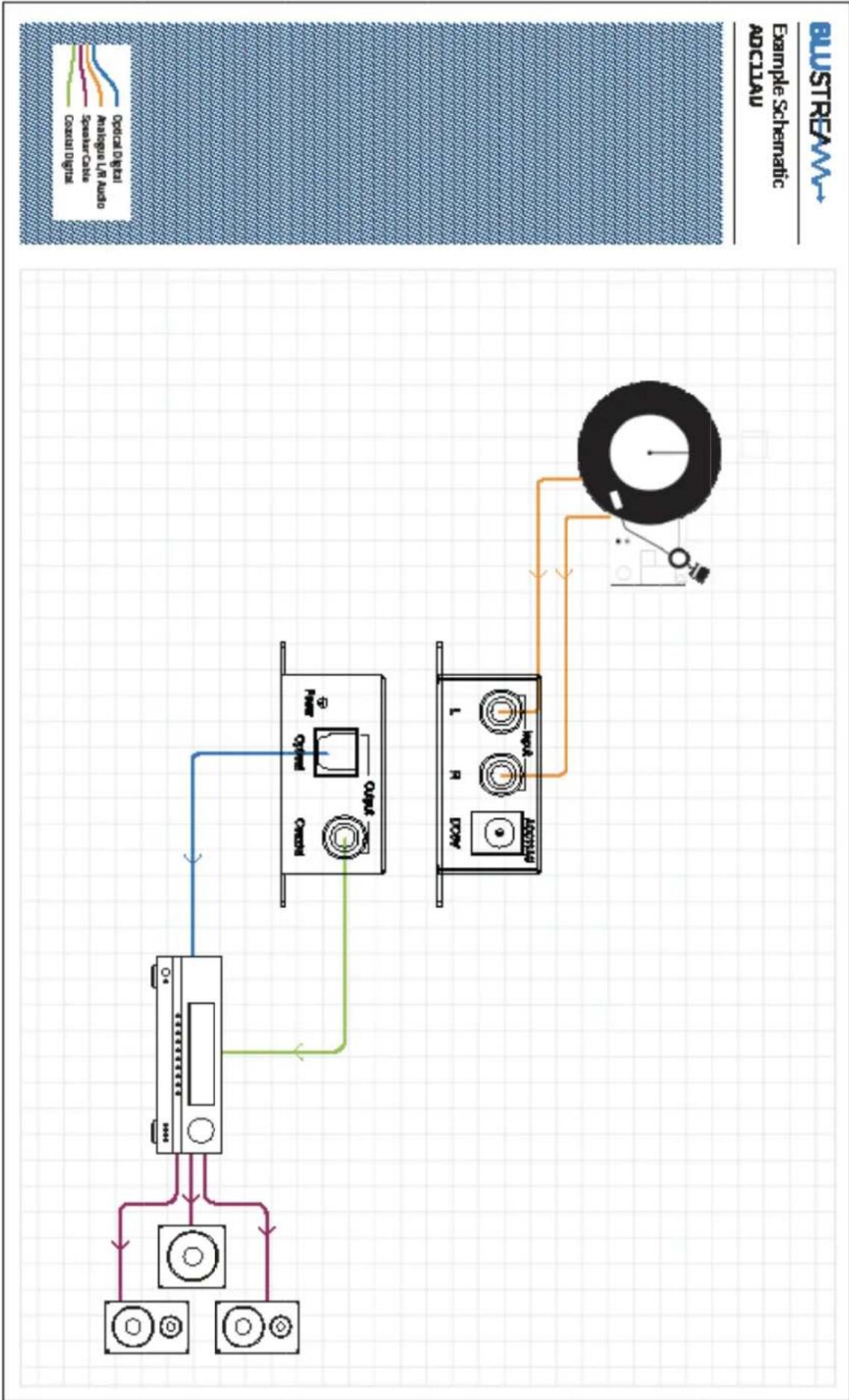
The ADC11AU is an analogue audio to digital audio converter used to convert stereo analogue Left/Right audio to both optical and coaxial digital concurrently. The ADC11AU is useful for converting older analogue audio sources into a suitable digital signal for use with latest AV amplifiers.
The ADC11AU is useful for either home or professional audio application.
FEATURES:
- Converts analogue stereo left/right RCA input to SPDIF optical & coaxial digital PCM audio outputs
- Converts to 16-bit 48 kHz digital audio
-
Both optical digital and coaxial digital outputs work at the same time
-
Plug-and-play
- Small compact size
Front Panel Back Panel
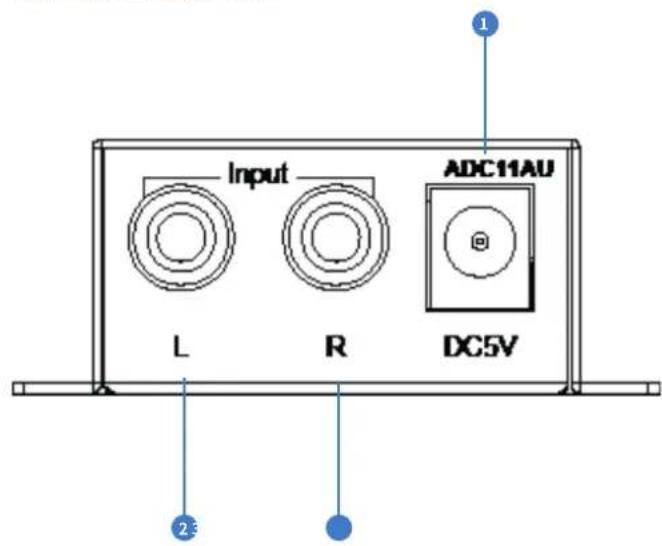
Power port – Use supplied 5V / lamp DC adaptor
2 Left channel analogue audio input
3 Right channel analogue audio input
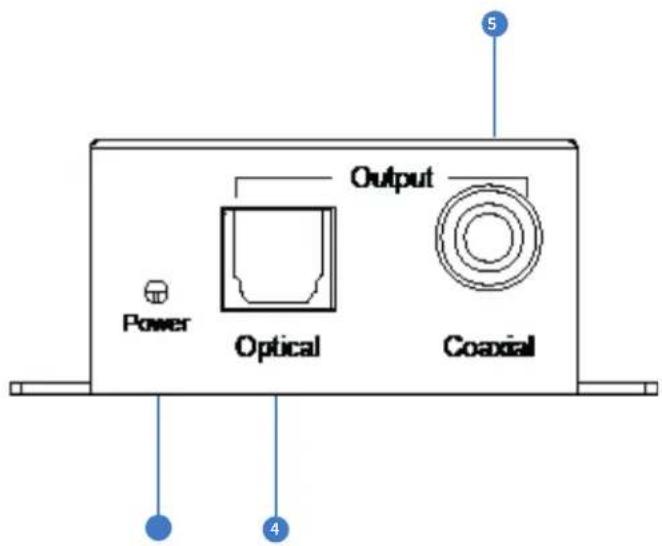
4 Optical digital output
5 Coaxial digital output.
6 Power LED indicator – Displays the status of the power of the unit
Specifications
Audio Input Connectors: 2x Analogue stereo left/right
Audio Output Connectors: 1x SPDIF Optical audio & 1x Coaxial digital
Casing Dimensions (W x H x D): 50mm x 42mm x 26mm
Dimensions including connections (W x H x D): 64mm x 42mm x 26mm
Shipping Weight: 0.4kg
Operating Temperature: 32°F to 104°F (0°C to 40°C)
Storage Temperature: -4°F to 140°F (-20°C to 60°C)
Power Supply: 5V/1A DC
Package Contents:
- 1 x ADC11AU
- 1 x 5V/1A DC power supply
- 1 x DC/USB cable
Maintenance:
Clean this unit with a soft, dry cloth. Never use alcohol, paint thinner or benzene to clean this unit.
Certifications
FCC NOTICE
This equipment has been tested and found to comply with the limits for a Class B digital device, pursuant to part 15 of the FCC Rules. These limits are designed to provide reasonable protection against harmful interference in a residential installation. This equipment generates, uses, and can radiate radio frequency energy and, if not installed and used in accordance with the instructions, may cause harmful interference to radio communications. However, there is no guarantee that interference will not occur in a particular installation. If this equipment does cause harmful interference to radio or television reception, which can be determined by turning the equipment off and on, the user is encouraged to try to correct the interference by one or more of the following measures:
- Reorient or relocate the receiving antenna.
- Increase the separation between the equipment and receiver.
- Connect the equipment into an outlet on a circuit different from that to which the receiver is connected.
- Consult the dealer or an experienced radio/TV technician for help.
CAUTION - changes or modifications not expressly approved by the party responsible for compliance could void the user's authority to operate the equipment.
CANADA, INDUSTRY CANADA (IC) NOTICES
This Class B digital apparatus complies with Canadian ICES-003.
Operation is subject to the following two conditions: (1) this device may not cause interference, and (2) this device must accept any interference, including interference that may cause undesired operation of the device.
CORRECT DISPOSAL OF THIS PRODUCT
This marking indicates that this product should not be disposed with other household wastes. To prevent possible harm to the environment or human health from uncontrolled waste disposal, recycle it responsibly to promote the sustainable reuse of material resources. To return your used device, please use the return and collection systems or contact the retailer where the product was purchased. They can take this product for environmentally safe recycling.
flowchart
graph TD
    A["Speaker"] --> B["Audio System"]
    C["Speaker"] --> B
    D["Speaker"] --> B
    B --> E["Audio Control Module"]
    E --> F["Color Cable"]
    E --> G["Radio Cable"]
    E --> H["Mainline Luf Audio"]
    E --> I["Mainline Luf Radio"]
    E --> J["Mainline Luf Signal"]
    K["Mainline Luf Signal"] --> L["Mainline Luf Signal"]
    M["Mainline Luf Signal"] --> N["Mainline Luf Signal"]
    O["Mainline Luf Signal"] --> P["Mainline Luf Signal"]
    Q["Mainline Luf Signal"] --> R["Mainline Luf Signal"]
    S["Mainline Luf Signal"] --> T["Mainline Luf Signal"]
    U["Mainline Luf Signal"] --> V["Mainline Luf Signal"]
    W["Mainline Luf Signal"] --> X["Mainline Luf Signal"]
    Y["Mainline Luf Signal"] --> Z["Mainline Luf Signal"]
    AA["Mainline Luf Signal"] --> AB["Mainline Luf Signal"]
    AC["Mainline Luf Signal"] --> AD["Mainline Luf Signal"]
    AE["Mainline Luf Signal"] --> AF["Mainline Luf Signal"]
    AG["Mainline Luf Signal"] --> AH["Mainline Luf Signal"]
    AI["Mainline Luf Signal"] --> AJ["Mainline Luf Signal"]
    AK["Mainline Luf Signal"] --> AL["Mainline Luf Signal"]
    AM["Mainline Luf Signal"] --> AN["Mainline Luf Signal"]
    AO["Mainline Luf Signal"] --> AP["Mainline Luf Signal"]
    AQ["Mainline Luf Signal"] --> AR["Mainline Luf Signal"]
    AS["Mainline Luf Signal"] --> AT["Mainline Luf Signal"]
    AU["Mainline Luf Signal"] --> AV["Mainline Luf Signal"]
    AW["Mainline Luf Signal"] --> AX["Mainline Luf Signal"]
    AY["Speaker Cable"] --> AZ["Color Cable"]
    BA["Speaker Cable"] --> BB["Bright Cable"]
    BC["Mainline Luf Audio"] --> BD["Bright Cable"]


Brand : Blustream
Model : ADC11AU
Category : Audio/video converter