
Tasty - Food Dehydrator OBH NORDICA - Free user manual and instructions
Find the device manual for free Tasty OBH NORDICA in PDF.


| Product Type | Food Dehydrator |
| Model | Tasty (OBH Nordica 6775) |
| Power | 250 W |
| Voltage | 220-240 V |
| Number of Trays | 5 stackable and adjustable grids |
| Drying Surface Diameter | 33 cm |
| Speed Settings | 2 (low and high) |
| Lid | Transparent with integrated heating element and fan |
| Base | Bottom tray with rubber feet |
| Dimensions (Approx.) | 35 x 35 x 30 cm |
| Weight (Approx.) | 3 kg |
| Cord Length | 1 m |
| Material | Plastic housing, metal heating element |
| Safety Features | Thermal cut-out, recommended RCD |
| Cleaning | Grids and bottom tray: wash in warm soapy water; lid: wipe with damp cloth |
| Intended Use | Fruits, vegetables, herbs; not for meat or fish |
| Shelf Life of Dried Food | Fruit: up to 1 year; Vegetables: up to 6 months |
| Recommended Storage | Cool, dark place in airtight containers |
| Warranty | According to current law, with cash receipt |
Frequently Asked Questions - Tasty OBH NORDICA
User questions about Tasty OBH NORDICA
0 question about this device. Answer the ones you know or ask your own.
Ask a new question about this device
Download the instructions for your Food Dehydrator in PDF format for free! Find your manual Tasty - OBH NORDICA and take your electronic device back in hand. On this page are published all the documents necessary for the use of your device. Tasty by OBH NORDICA.
USER MANUAL Tasty OBH NORDICA
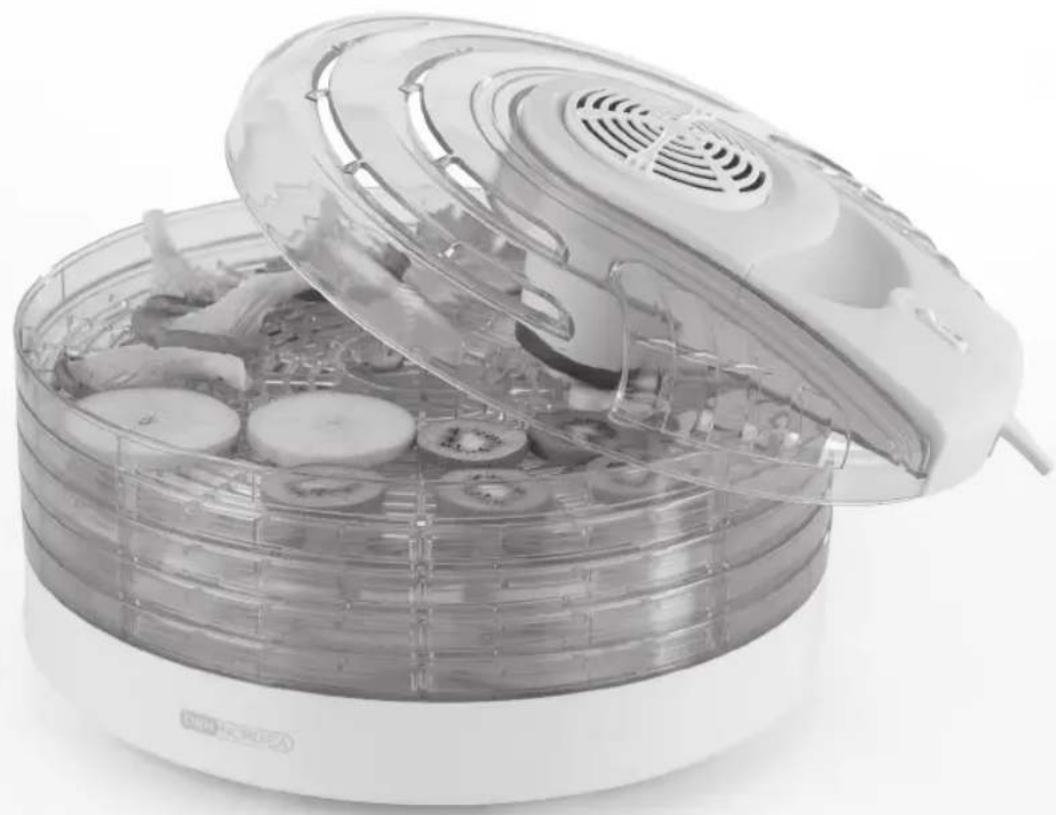
Tasty food dehydrator


5 drying trays

Large drying surface ∅ 33 cm

2 power settings

For fruit and mushrooms

Transparent
lid

Retains the vitamins
OBH Nordica Tasty Food dehydrator
Användning
OBH Nordica Tasty Food dehydrator
Anvendelse
OBH Nordica Denmark A/S
Ole Lippmanns Vej 1
2630 Taastrup
Tlf.: 43 350 350
www.obhnordica.dk
Tekniske data
OBH Nordica 6775
220-240V
250 W

OBH Nordica Tasty Food dehydrator
OBH Nordica Norway AS
Postboks 5334, Majorstuen
0304 Oslo
Tlf: 22 96 39 30
Faks: 22 96 39 40
www.obhnordica.no
Tekniske data
OBH Nordica 6775
OBH Nordica Tasty Food dehydrator
Turvallisuusohjeet
Käyttö
OBH Nordica Tasty Food Dehydrator
Safety instructions
- Read the instruction manual carefully before use, and save it for future use.
- Plug the appliance to a household outlet of 220-240V only, and use the appliance only for the intended use.
- Always unplug the appliance from the mains supply when not in use.
- The appliance must not be immersed into water or other liquids.
- This appliance can be used by children aged 8 years and above and persons with reduced physical, sensory or mental capabilities, or lack of experience and knowledge, if they have been given supervision or instruction concerning the use of the appliance in a safe way by a person responsible for their safety and they understand the hazards involved.
- Children should be supervised to ensure that they do not play with the appliance. Children are not always able to understand potential risks. Teach children a responsible handling of electrical appliances.
- Cleaning and user maintenance shall not be made by children, unless they are over the age of 8 and supervised.
- Keep the appliance and its cord out of reach of children aged less than 8 years.
- Check that the cord is not hanging over the edge of the table.
- Only use the accessories which were provided with the appliance.
- Do not place the appliance on or near hotplates, open fire or the like.
- The appliance should only be used under supervision.
- The appliance is not for outdoor use.
-
Important! Always wipe off the ingredients before they are placed on the grids. Never put canned fruits/vegetables in the dehydrator, as they contain too much fluid.
-
CAUTION: In order to avoid a hazard due to inadvertent resetting of the thermal cut-out, this appliance must not be supplied through an external switching device, such as a timer, or connected to a circuit that is regularly switched on and off automatically.
- Always examine appliance, cord and plug for damage before use. If the supply cord is damaged, it must be replaced by the manufacturer, or his service agent or a similarly qualified person in order to avoid a hazard.
- For additional protection the installation of a residual current device (RCD) with a rated residual operating current not exceeding 30 mA is recommended. Ask your installer for advice.
- The appliance is for domestic use only.
- If the appliance is used for other purposes than intended, or is it not handled in accordance with the instruction manual, the full responsibility for any consequences will rest with the user. Any damages to the product or other things are not covered by the warranty.
Before use
Before you use the appliance for the first time, please read the instruction manual carefully and keep it for future use.
- Unpack the appliance.
- Plug to a wall outlet and switch on the appliance by selecting speed 2, let the appliance run for 30 minutes without any ingredients to remove any possible impurities in the fan. The appliance may emit a certain odour over time, which is quite normal and it will disappear after a while. You should only follow this procedure prior to the first use.
- Wash the grid and the bottom tray in warm soapy water. Rinse well and dry thoroughly.
- Clean the lid with a damp cloth and wipe thoroughly. Never immerse the lid, the cord or the plug in water or any other liquid.
Appliance
- Lid with heating element and fan
- On/off switch and speed selector
- 5 stackable and adjustable grids
- Bottom tray
- Rubber feet

How to use
• Make sure the appliance is switched off before connecting it to the outlet.
- Place the base on an even and stable surface to be sure that it cannot fall down and that you cannot trip over the cord.
• Prepare the ingredients to be dehydrated in accordance with the instructions in this manual. Do not put the ingredients too close to the grid.
- Note! Do not dehydrate soft ingredients. When you prepare the ingredients, let them dry a little before you put them on the grid.
- Arrange the ingredients on the respective grids and stack the grids one on top of the other by inserting the taps on the inside of the edge of the grid into the openings at the underside of the respective grid. If you are going to dehydrate big ingredients and need more air between the grids, position the grids with the taps outside the openings. Remove trays that are not to be used. Next, place the grids on the bottom tray and put on the lid.
- Plug unit into electrical outlet, switch on the appliance and select speed 1 or 2. Select speed 1 if you shall dry ingredients that contain liquid such as e.g. herbs, mushroom, spinach, onion etc. Setting 2 should be chosen if you are to dehydrate ingredients that contain much liquid, such as e.g. apples, apricots, plums, pears, lemon etc.
- Let the ingredients dry for the recommended period of time: drying time depends on the type and the amount of ingredients.
- Check the ingredients regularly to make sure that they do not dry too long. Remove the ingredients from the grid and put them in boxes and bags when they are ready. Certain ingredients require more dehydration time than others, so leave them on the grid until they are completely dry.
- Food that is not going to be eaten within a day or two should be stored in the refrigerator. If you keep dehydrated ingredients in the freezer, be sure to use containers or bags designed for freezer storage.
- Switch off the appliance and unplug after use.
- Always wash the grid and the bottom tray after use. See also the instructions given under "Cleaning and maintenance".
Selecting foods for dehydration
- Only dry fresh and high quality foods. Fruits shall be ripe; they contain natural sugar and are best for dehydration. Fruits that are not ripe may get a bitter and acid taste.
• Vegetables should be fresh; do not dehydrate frozen vegetables. - Berries must be of such a size that they do not drop down between the grids when dehydrated.
- Check and remove bruises and marks on fruits and vegetables.
- Do not use overripe fruits and damaged vegetables. Preparation, dehydration time and storing of the ingredients affect also the taste and the shelf life.
- Do not dry meat or fish in the appliance.
- Follow the instructions in the manual as to preparation, dehydration times and storing to get the best result.
Dehydration time
Below you can see the approximate dehydration time for a number of ingredients. Please note that the dehydration time depends on the size, texture, the contents of liquid, the amount on each grid, the surrounding temperature etc.
Fresh herbs: approx.1-2 hours
Mushrooms and fruit: approx.6 hours
Carrots: approx.8 hours
Paprika and tomatoes: approx.8 hours
Check the ingredients occasionally to make sure that they do not dry too long. If the ingredients contain much moist it will take longer to dry them. It is important that the appliance is placed freely on a tabletop (not under cupboards) with enough space around for air to circulate for an even drying.
Vegetables
Vegetables require a little more as to storage and drying, as they contain less sugar and not much acid. Some vegetables are better for freezing than drying. Dehydrated vegetables can be stored in the refrigerator in air-tight boxes.
Preparation
Select only the best and most fresh vegetables for dehydration. Wash the vegetables carefully before dehydration to remove dirt and bacteria. Wipe the ingredients before you put them on the dehydration grid to shorten the dehydration time. Most vegetables should be peeled, cut or shred prior to drying.
Preparation - vegetables
Blanch (boil for 2-3 minutes) the vegetables before dehydration in order to save the texture and colour. Let the vegetables drip off before you put them in the grid for drying.
Microwave blanching
A microwave oven is perfect for blanching fresh vegetables. Place the vegetables with a small amount of water in a covered pan. Blanch the vegetables until they are thoroughly warm, but not boiled. Stir regularly during preparation. Vegetables blanched in a microwave oven will keep the colour better than vegetables blanched in a saucepan.
Guide for dehydration of vegetables
Vegetable Preparations
Asparagus Cut in halves to separate the tip from the stem. The tips are best for drying, but the stems can be dried and crushed for seasoning.
Beetroots Cut to leave about 2.5 cm of the top and the root. Blanch and let it cool and then cut off the rest of the top and the root. Slice as you want it.
Broccoli Rinse and cut in pieces. Blanch for about 2-4 minutes.
Carrots Rinse and peel. Cut into slices of about 1 cm and blanch for about 4-5 minutes until they start to get tender.
Corn Remove the leaves, rinse and blanch the corncob. Let it cool and cut the corn off the cob.
Celery with stalk Rinse and separate the leaves from the stalk. Cut into pieces of 1 cm. Place the leaves separately from the stalk on the grid.
Chives Rinse and cut in suitable pieces not to drop down into the opening of the grid.
Cucumber Rinse, peel and cut slices of 0.5 mm.
Garlic Peel cloves and cut in halves
Mushrooms Rinse the mushroom. Dehydrate whole or sliced mushrooms.
Onions Peel the onion and cut in rings.
Pepper Jalapeno Rinse and dry whole.
Tomatoes Rinse and remove the stem. Dip in boiling water and then in cold water. Peel off the skin and cut in halves, quarters or slices.
Potatoes Rinse and peel. Cut in slices and blanch. Rinse under cold water and peel. Cut in slices and blanch. Rinse under cold water and let them dry before you put them on the grid. NOTE! If you want to keep the skin on the potatoes, rinse and scrub with a brush. Remove all scars and spots.
Fruit
Almost all kinds of fruit are suitable for drying, but some fruits require longer drying time than others. Some fruits may not be suitable for drying all year round, so we recommend that you start with fruits of the season to test them first.
Preparation of fruit
Rinse the fruit and remove bad spots. Peel if necessary and cut larger fruits in small pieces. Try to cut the fruit in equally sized pieces to obtain the same drying time. Small fruits such as grapes and cherries can be dried whole. Remove seeds from cherries, apricots etc. Certain fruits, such as e.g. apples etc. have a coating of wax when bought in the supermarkets and such fruit should be rinsed before dehydration.
Most fruits can be placed directly on the drying grids after preparation. Apples, apricots, peaches and pears may turn brown when cut and exposed to air. You can prevent this browning by soaking them in pineapple or lemon juice before they are dried; see the section below.
If you want to prevent certain fruits from turning brown when cut, you can choose one of the following alternatives that suit you best. Remember that the storing is important and crucial as to the preservation of the taste and quality of the fruit.
- Cut the fruit and immerse it in pineapple or lemon juice (about 2 minutes) to avoid discoloration and let it drain thoroughly before you put the fruit on the grid. You can also immerse the fruit in honey, orange juice or spices. Use your imagination.
- When drying fruit, in particular halves of apricot, it has been suggested that popping the back inside out will speed up the drying time. This is true, but it results in a small loss of the natural juice. We recommend that you cut the apricot in halves before drying to save the taste and colour.
Frit Preparation
Apples Rinse and peel if desired. Cut in halves, remove the core and cut into slices. Can be pre-treated with a small amount of lemon juice to prevent browning.
Apricots Rinse, cut in halves and remove the kernel. Cut in small pieces if you want to.
Bananas Peel and slice. Can be pre-treated with lemon juice to prevent browning.
Cherries Rinse and remove the pit.
Coconut Drain the milk, crack and remove the coconut flesh. Let it dry and cut in 0.5 cm chunks.
Figs Rinse and remove the stem. Cut in halves or quarters.
Grapes Rinse and remove sprigs. Dry whole.
Papaya Rinse and peel. Cut into pieces.
Peaches Rinse, cut in halves and remove the seed. Cut in small bites if desired.
Pears Rinse and peel if you want. Cut in halves and remove the core. Next, cut in small pieces. Can be pre-treated with lemon juice to prevent browning.
Pineapple Remove the core and cut in small chunks or slices.
Prunes Rinse and cut in halves, remove the pit.
Strawberries Rinse and leave whole, cut in halves or slice.
Herbs
Remove only dead leaves. Spread the herbs on the grid (do not remove leaves from the sprigs until after drying) and let dry for about 2 – 7 hours. When the drying has been completed, remove them from the grid and leave to cool. Remove the leaves from the sprigs, but do not crush/grind until just before preparation. This is the best way to preserve the taste and the scent.
Helpful hints
• Always preheat the dehydrator for at least 5 minutes before use.
- If the dehydrator has been stored for some time, wash the dehydration grid and the drip tray before use.
• Vegetables and fruit should preferably be fresh.
- Vegetables and fruit should always be rinsed before dehydration. Let them drip off before you put them on the grid.
- Always prepare and pre-treat the ingredients to be dehydrated as described in this manual.
- Make sure to position the dehydrator in a safe place allowing air to circulate freely. Read and follow the safety instructions carefully before use.
- The dehydration time varies depending on: ingredient, size, quality and personal taste. We recommend that you always make a note on what you dehydrate, the weight, the dehydration time and the final result.
- Experiment with the recipes in this manual and discover new, delicious dishes.
Storage
Dried foods must be properly packed in order to preserve taste, colour and quality. Store dried foods in freezer bags in air-tight metallic, plastic or glass containers. If you store dehydrated foods direct in boxes, i.e. without a plastic bag, the food will be exposed to air and loose taste, colour and quality. Check the contents after a couple of days to see whether there is moisture in the bag/the box, in which case the food has not been dried sufficiently. Repeat the dehydration procedure.
Keep the dehydrated foods well packed in cool and dark conditions. The colder the storage is, the longer will be the shelf life. If you have room in the refrigerator, this would be the perfect place for storing.
Shelf life
Fruit has a naturally high content of sugar and acid, which means that they dry faster and have a longer shelf life than vegetables. If fruit is kept in room temperature, they will remain fresh for up to a year. Vegetables should be used within 6 months.
Cleaning and maintenance
Always switch off the appliance and unplug before cleaning.
- Never immerse the motor part or the cord in water or any other liquid.
- Always dish the grid and the lid after use in order to be sure that no remains dry up. Wash the grid and the bottom tray in warm water with a washing-up liquid. Rinse and dry thoroughly.
- Wipe the lid with the motor part with a damp cloth and dry thoroughly. The filter of the fan can be cleaned by turning the grid on the motor part and removing the filter. Clean the filter using a soft brush or similar and remount the filter and the grid.
- Do not use scoring detergents for cleaning.
- Wipe the housing with a cloth. Do not let water or other liquids get into contact with the base. Make sure that the grid and the lid are completely dry before remounting them on the base.
- Let the appliance cool before storing. Keep the appliance dry in the box. Do not store it when plugged to the wall outlet.
- Do not wind the cord around the appliance as this may cause a breakage of the cord.
Disposal of the appliance

Legislation requires that all electrical and electronic equipment must be collected for reuse and recycling. Electrical and electronic equipment marked with the symbol indicating separate collection of such equipment must be returned to a municipal waste collection point.
Warranty
Claims according to current law. Any claim shall be accompanied by the cash receipt with purchase date. When raising a claim the appliance must be returned to the store of purchase.
OBH Nordica AB
Löfströms Allé 5
SE-172 55 Sundbyberg
Tel: +46 08-629 25 00
www.obhnordica.se
Technical data
OBH Nordica 6775
220-240V
250 W

These instructions are subject to alterations or improvements.





OBH NORDICA



SE/UL/6775/UVN_020913


- OBH NORDICA TASTY FOOD DEHYDRATOR
- ANVÄNDNING
- ANVENDELSE
- OBH NORDICA DENMARK A/S
- TEKNISKE DATA
- OBH NORDICA NORWAY AS
- TURVALLISUUSOHJEET
- KÄYTTÖ
- SAFETY INSTRUCTIONS
- BEFORE USE
- APPLIANCE
- HOW TO USE
- SELECTING FOODS FOR DEHYDRATION
- DEHYDRATION TIME
- VEGETABLES
- PREPARATION
- PREPARATION - VEGETABLES
- MICROWAVE BLANCHING
- GUIDE FOR DEHYDRATION OF VEGETABLES
- VEGETABLE PREPARATIONS
- FRUIT
- PREPARATION OF FRUIT
- FRIT PREPARATION
- HERBS
- HELPFUL HINTS
- STORAGE
- SHELF LIFE
- CLEANING AND MAINTENANCE
- DISPOSAL OF THE APPLIANCE
- WARRANTY
- OBH NORDICA AB
- TECHNICAL DATA
- OBH NORDICA
Brand : OBH NORDICA
Model : Tasty
Category : Food Dehydrator