
FX-350MS - Scientific calculator CASIO - Free user manual and instructions
Find the device manual for free FX-350MS CASIO in PDF.


| Product type | Scientific calculator |
| Brand | CASIO |
| Model | FX-350MS |
| Display | Two-line (formula and result) |
| Dimensions (H × W × D) | 12,2 × 85 × 155 mm |
| Weight (with batteries) | 100 g |
| Power supply | 1 button cell G13 (LR44) |
| Battery life | Approximately 9 000 hours of continuous display, 3 years on standby |
| Power consumption | 0,0002 W |
| Main functions | Arithmetic, fractions, percentages, degrees/minutes/seconds, trigonometric and hyperbolic functions, logarithms, powers, roots, factorials, random numbers, permutations, combinations, coordinate conversion, 1- and 2-variable statistics (linear, logarithmic, exponential, power, inverse, quadratic regression), engineering notation |
| Calculation modes | COMP (basic), SD (standard deviation), REG (regression) |
| Input capacity | 79 steps maximum |
| Memory | Answer memory, independent memory (M), 9 variables (A-F, M, X, Y), replay memory (128 bytes) |
| Display formats | Norm 1 / Norm 2, Fix (decimal places), Sci (significant digits), fraction (mixed/improper) |
| Operating temperature | 0 °C to 40 °C |
| Safety | Do not expose batteries to heat, do not short-circuit, keep out of reach of children |
| Maintenance and cleaning | Clean with a soft, dry cloth. For stains, use a slightly damp cloth with a mild detergent. Do not use solvents. |
| Spare parts and repairability | Battery type G13 (LR44) replaceable by user. No additional spare parts available. |
| General information | Highly reliable scientific calculator, suitable for secondary and university studies. Supplied with a protective cover. |
Frequently Asked Questions - FX-350MS CASIO
User questions about FX-350MS CASIO
0 question about this device. Answer the ones you know or ask your own.
Ask a new question about this device
Download the instructions for your Scientific calculator in PDF format for free! Find your manual FX-350MS - CASIO and take your electronic device back in hand. On this page are published all the documents necessary for the use of your device. FX-350MS by CASIO.
USER MANUAL FX-350MS CASIO
Removing and Replacing the Calculator's Cover
- Before starting .....①
Holding the cover as shown in the illustration, slide the unit out of the cover.
• After you are finished .....②
Holding the cover as shown in the illustration, slide the unit out of the cover.
- Always slide the keyboard end of the unit into the cover first. Never slide the display end of the unit into the cover.
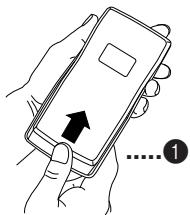
natural_image
Illustration of a hand holding a smartphone with an upward arrow and a dotted line indicating a step (no text or symbols present)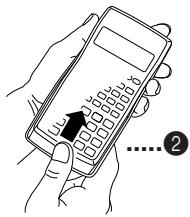
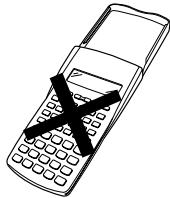
natural_image
Line drawing of a mobile phone with a 'X' symbol crossed out by a black X (no text or symbols present)Safety Precautions
Be sure to read the following safety precautions before using this calculator. Keep this manual handy for later reference.

Caution
This symbol is used to indicate information that can result in personal injury or material damage if ignored.
Batteries
- After removing the battery from the calculator, put it in a safe place where it will not get into the hands of small children and accidentally swallowed.
- Keep batteries out of the reach of small children. If accidentally swallowed, consult with a physician immediately.
- Never charge batteries, try to take batteries apart, or allow batteries to become shorted. Never expose batteries to direct heat or dispose of them by incineration.
- Misuse of batteries can cause them to leak and damage nearby items, and can create the risk of fire and personal injury.
- Always make sure that the battery's positive and negative ends are facing correctly when you load it into the calculator.
- Remove the battery if you do not plan to use the calculator for a long time (fx-82MS/fx-83MS/fx-270MS/fx-350MS).
- Use only the type of battery specified for this calculator in this manual.
Disposing of the Calculator
- Never dispose of the calculator by burning it. Doing so can cause certain components to suddenly burst, creating the risk of fire and personal injury.
- The displays and illustrations (such as key markings) shown in this User's Guide are for illustrative purposes only, and may differ somewhat from the actual items they represent.
- The contents of this manual are subject to change without notice.
- In no event shall CASIO Computer Co., Ltd. be liable to anyone for special, collateral, incidental, or consequential damages in connection with or arising out of the purchase or use of these materials. Moreover, CASIO Computer Co., Ltd. shall not be liable for any claim of any kind whatsoever against the use of these materials by any other party.
Handling Precautions
- Be sure to press the ON key before using the calculator for the first time.
- Even if the calculator is operating normally, replace the battery at least once every three years for the fx-83MS/fx-85MS/fx-270MS/fx-300MS/fx-350MS, or at least once every two years for the fx-82MS.
A dead battery can leak, causing damage to and malfunction of the calculator. Never leave a dead battery in the calculator.
- The battery that comes with this unit discharges slightly during shipment and storage. Because of this, it may require replacement sooner than the normal expected battery life.
- Low battery power can cause memory contents to become corrupted or lost completely. Always keep written records of all important data.
- Avoid use and storage in areas subjected to temperature extremes.
Very low temperatures can cause slow display response, total failure of the display, and shortening of battery life. Also avoid leaving the calculator in direct sunlight, near a window, near a heater or anywhere else it might be exposed to very high temperatures. Heat can cause discoloration or deformation of the calculator's case, and damage to internal circuitry.
- Avoid use and storage in areas subjected to large amounts of humidity and dust.
Take care never to leave the calculator where it might be splashed by water or exposed to large amounts of humidity or dust. Such conditions can damage internal circuitry.
- Never drop the calculator or otherwise subject it to strong impact.
- Never twist or bend the calculator.
Avoid carrying the calculator in the pocket of your trousers or other tight-fitting clothing where it might be subjected to twisting or bending.
- Never try to take the calculator apart.
- Never press the keys of the calculator with a ball-point pen or other pointed object.
- Use a soft, dry cloth to clean the exterior of the calculator.
If the calculator becomes very dirty, wipe it off with a cloth moistened in a weak solution of water and a mild neutral household detergent. Wring out all excess moisture before wiping the calculator. Never use thinner, benzene or other volatile agents to clean the calculator. Doing so can remove printed markings and can damage the case.
Contents
Removing and Replacing the Calculator's Cover .... 1
Safety Precautions 2
Handling Precautions 3
Two-line Display 7
Before getting started.... 7
■ Modes ...... 7
■ Input Capacity 8
■ Making Corrections During Input 8
■Replay Function 9
■ Error Locator 9
■Multi-statements 9
■ Exponential Display Formats ...... 10
■ Decimal Point and Separator Symbols ...... 10
■ Initializing the Calculator .... 11
Basic Calculations ...... 11
■ Arithmetic Calculations ...... 11
■Fraction Operations 11
■ Percentage Calculations ...... 13
■Degrees, Minutes, Seconds Calculations ...... 14
■FIX, SCI, RND 15
Memory Calculations 16
■Answer Memory 16
■ Consecutive Calculations ...... 16
■ Independent Memory 16
■Variables 17
Scientific Function Calculations...... 17
■ Trigonometric/Inverse Trigonometric Functions ... 18
■ Hyperbolic/Inverse Hyperbolic Functions ..... 18
■ Common and Natural Logarithms/
Antilogarithms .... 19
■ Square Roots, Cube Roots, Roots, Squares, Cubes, Reciprocals, Factorials, Random Numbers, , and Permutation/Combination ..... 19
■ Angle Unit Conversion ...... 20
■ Coordinate Conversion (Pol (x, y) , Rec (r, ) ) ..... 20
■ Engineering Notation Calculations ...... 21
Statistical Calculations 21
Standard Deviation 21
Regression Calculations 24
Technical Information 28
■ When you have a problem.... 28
■ Error Messages ...... 28
■ Order of Operations ...... 30
■ Stacks 31
■ Input Ranges 32
Power Supply 34
Specifications 37
Two-line Display
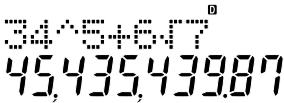
The two-line display makes it possible to view both the calculation formula and its result at the same time.
- The upper line shows the calculation formula.
- The lower line shows the result.
A separator symbol is displayed every three digits when the integer part of the mantissa has more than three digits.
Before getting started...
■ Modes
Before starting a calculation, you must first enter the correct mode as indicated in the table below.
| To perform this type of calculation: | Perform this key operation: | To enter this mode: |
| Basic arithmetic calculations | MODE 1 | COMP |
| Standard deviation | MODE 2 | SD |
| Regression calculations | MODE 3 | REG |
- Pressing the [MODE] key more than once displays additional setup screens. Setup screens are described in the sections of this manual where they are actually used to change the calculator setup.
- In this manual, the name of the mode you need to enter in order to perform the calculations being described is indicated in the main title of each section.
Example:
Statistical Calculations

Note!
- To return the calculation mode and setup to the initial defaults shown below, press SHIFT CLR 2 (Mode) = .
| Calculation Mode: | COMP |
| Angle Unit: | Deg |
| Exponential Display Format: | Norm 1 |
| Fraction Display Format: | a^b/c |
| Decimal Point Character: | Dot |
- Mode indicators appear in the upper part of the display.
- Be sure to check the current calculation mode (SD, REG, COMP) and angle unit setting (Deg, Rad, Gra) before beginning a calculation.
■ Input Capacity
- The memory area used for calculation input can hold 79 "steps." One step is taken up each time you press a number key or arithmetic operator key (++, -, ×, ÷). A SHIFT or ALPHA key operation does not take up a step, so inputting SHIFT √, for example, takes up only one step.
- You can input up to 79 steps for a single calculation. Whenever you input the 73rd step of any calculation, the cursor changes from “_” to “■” to let you know memory is running low. If you need to input more than 79 steps, you should divide your calculation into two or more parts.
- Pressing the Ans key recalls the last result obtained, which you can use in a subsequent calculation. See “Answer Memory” for more information about using the Ans key.
■ Making Corrections During Input
- Use ◀ and ▶ to move the cursor to the location you want.
- Press DEL to delete the number or function at the current cursor position.
- Press SHIFT INS to change to an insert cursor []. Inputting something while the insert cursor is on the display inserts the input at the insert cursor position.
- Pressing SHIFT INS, or ☐ returns to the normal cursor from the insert cursor.
■ Replay Function
- Every time you perform a calculation, the replay function stores the calculation formula and its result in replay memory. Pressing the ▲ key displays the formula and result of the calculation you last performed. Pressing ▲ again back steps sequentially (new-to-old) through past calculations.
- Pressing the ◀ or ▶ key while a replay memory calculation is on the display changes to the editing screen.
- Pressing the ◀ or ▶ key immediately after you finish a calculation displays the editing screen for that calculation.
- Pressing AC does not clear replay memory, so you can recall the last calculation even after you press AC.
- Replay memory capacity is 128 bytes for storage of both expressions and results.
- Replay memory is cleared by any of the following actions.
When you press the ON key
When you initialize modes and settings by pressing SHIFT CLR 2 (or 3)
When you change from one calculation mode to another When you turn off the calculator.
■ Error Locator
- Pressing ▶ or ◀ after an error occurs displays the calculation with the cursor positioned at the location where the error occurred.
■ Multi-statements
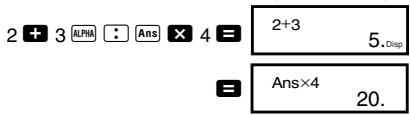
A multi-statement is an expression that is made up of two or more smaller expressions, which are joined using a colon (:).
• Example: To add 2 + 3 and then multiply the result by 4
■ Exponential Display Formats
This calculator can display up to 10 digits. Larger values are automatically displayed using exponential notation. In the case of decimal values, you can select between two formats that determine at what point exponential notation is used.
- To change the exponential display format, press the MODE key a number of times until you reach the exponential display format setup screen shown below.
Fix Sci Norm 1 2 3
- Press 3. On the format selection screen that appears, press 1 to select Norm 1 or 2 for Norm 2.
- Norm 1
With Norm 1, exponential notation is automatically used for integer values with more than 10 digits and decimal values with more than two decimal places.
- Norm 2
With Norm 2, exponential notation is automatically used for integer values with more than 10 digits and decimal values with more than nine decimal places.
- All of the examples in this manual show calculation results using the Norm 1 format.
■ Decimal Point and Separator Symbols
You can use the display setup (Disp) screen to specify the symbols you want for the decimal point and 3-digit separator.
- To change the decimal point and separator symbol setting, press the [MODE] key a number of times until you reach the setup screen shown below.
Disp 1
- Display the selection screen.
1
- Press the number key (1 or 2) that corresponds to the setting you want to use.
1(Dot): Period decimal point, comma separator
2(Comma): Comma decimal point, period separator
■ Initializing the Calculator
- Perform the following key operation when you want to initialize the calculation mode and setup, and clear replay memory and variables.
SHIFT CLR 3 (All)
Basic Calculations
COMP
■ Arithmetic Calculations
Use the MODE key to enter the COMP Mode when you want to perform basic calculations.
COMP ...... MODE 1
- Negative values inside of calculations must be enclosed within parentheses. For details, see “Order of Operations.”
- It is not necessary to enclose a negative exponent within parentheses.
sin 2.34 × 10^-5 2.34 (-) 5
• Example 1: 3 × (5 × 10^-9) = 1.5 × 10^-8
3 ✗ 5 EXP (-) 9 =
• Example 2: 5 × (9 + 7) = 80 5 ✗ (9 + 7)
- You can skip all ☐ operations before ☐.
■ Fraction Operations
• Fraction Calculations
- Values are displayed in decimal format automatically whenever the total number of digits of a fractional value (integer + numerator + denominator + separator marks) exceeds 10.
• Example 1: 23 + 15 = 1315
2 % 3 + 1 % 5 = 13_15.
• Example 2: 3 14 + 1 23 = 4 1112
3 a^b% 1 a^b% 4 +
1 a% 2 a% 3 = 4_11_12.
• Example 3: 24 = 12
2 a% 4
• Example 4: 12 + 1.6 = 2.1
1 a % 2 + 1.6 =
- Results of calculations that mix fraction and decimal values are always decimal.
- Decimal Fraction Conversion
- Use the operation shown below to convert calculation results between decimal values and fraction values.
- Note that conversion can take as long as two seconds to perform.
• Example 1: 2.75 = 2 34 (Decimal → Fraction)
2.75 2.75
a% 2」3」4.
= 114 SHIFT d/c 11_4.
• Example 2: 12 0.5 (Fraction Decimal)
1 a% 2 = 1_2.
a% 0.5
a% 1↓2.
- Mixed Fraction Improper Fraction Conversion
• Example: 1 23 53
1 % 2 % 3 = 1 」 2 」 3.
SHIFT d/c 5」3.
SHIFT d/c 1_2_3.
- You can use the display setup (Disp) screen to specify the display format when a fraction calculation result is greater than one.
- To change the fraction display format, press the MODE key a number of times until you reach the setup screen shown below.
Disp 1
- Display the selection screen.
1
- Press the number key (1 or 2) that corresponds to the setting you want to use.
①(a ^b/c ): Mixed fraction
2(d/c): Improper fraction
- An error occurs if you try to input a mixed fraction while the d/c display format is selected.
■ Percentage Calculations
• Example 1: To calculate 12% of 1500 (180)
1500 ✗ 12 SHIFT %
• Example 2: To calculate what percentage of 880 is 660
(75%)
660 ÷ 880 SHIFT %
• Example 3: To add 15% onto 2500 (2875)
2500 ✗ 15 SHIFT % +
• Example 4: To discount 3500 by 25% (2625)
3500 ✗ 25 SHIFT % -
• Example 5: To discount the sum of 168, 98, and 734 by 20% (800)
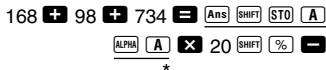
* As shown here, if you want to use the current Answer Memory value in a mark up or discount calculation, you need to assign the Answer Memory value into a variable and then use the variable in the mark up/discount calculation. This is because the calculation performed when % is pressed stores a result to Answer Memory before the - key is pressed.
- Example 6: If 300 grams are added to a test sample originally weighing 500 grams, what is the percentage increase in weight? (160%)
300 + 500 SHIFT %
• Example 7: What is the percentage change when a value is increased from 40 to 46? How about to 48?
(15%, 20%)
46 - 40 SHIFT %

■ Degrees, Minutes, Seconds Calculations
- You can perform sexagesimal calculations using degrees (hours), minutes, and seconds, and convert between sexagesimal and decimal values.
• Example 1: To convert the decimal value 2.258 to a sexagesimal value and then back to a decimal value
2.258 2.258
SHIFT ← 2°15°28.8
2.258
• Example 2: To perform the following calculation:
12°34′56″ × 3.45
12 34 56 3.45 43°24°31.2
FIX, SCI, RND
- To change the settings for the number of decimal places, the number of significant digits, or the exponential display format, press the MODE key a number of times until you reach the setup screen shown below.
Fix Sci Norm 1 2 3
- Press the number key (1, 2, or 3) that corresponds to the setup item you want to change.
1 (Fix): Number of decimal places
2 (Sci): Number of significant digits
3 (Norm): Exponential display format
• Example 1: 200 ÷ 7 × 14 =
200 ÷ 7 × 14 = 400.
(Specifies three decimal places.)
MODE .... 1 (Fix) 3 400.000
(Internal calculation continues using 12 digits.)
200 7 28.571
× 14 = 400.000
The following performs the same calculation using the specified number of decimal places.
200÷7= 28.571
(Internal rounding)
SHIFT Rnd 28.571
× 14 = 399.994
- Press MODE .... 3(Norm) 1 to clear the Fix specification.
• Example 2: 1 ÷ 3 , displaying result with two significant digits (Sci 2)
MODE .... 2 (Sci) 2 1 ÷ 3 = SCI 3.3 ^-01
- Press MODE .... 3(Norm) 1 to clear the Sci specification.
Memory Calculations
COMP
Use the MODE key to enter the COMP Mode when you want to perform a calculation using memory.
COMP MODE 1
■ Answer Memory
- Whenever you press ☐ after inputting values or an expression, the calculated result automatically updates Answer Memory contents by storing the result.
- In addition to ☐, Answer Memory contents are also updated with result whenever you press SHIFT %, M+, SHIFT M-, or SHIFT ST0 followed by a letter (A through F, or M, X, or Y).
- You can recall Answer Memory contents by pressing Ans.
- Answer Memory can store up to 12 digits for the mantissa and two digits for the exponent.
- Answer Memory contents are not updated if the operation performed by any of the above key operations results in an error.
■ Consecutive Calculations
- You can use the calculation result that is currently on the display (and also stored in Answer Memory) as the first value of your next calculation. Note that pressing an operator key while a result is displayed causes the displayed value to change to Ans, indicating it is the value that is currently stored in Answer Memory.
- The result of a calculation can also be used with a subsequent Type A function (x^2, x^3, x^-1, x!) , DRG▶), +, -, ^(x^y), ^x- , ×, ÷, nPr and nCr.
■ Independent Memory
- Values can be input directly into memory, added to memory, or subtracted from memory. Independent memory is convenient for calculating cumulative totals.
- Independent memory uses the same memory area as variable M.
- To clear independent memory (M), input 0 SHIFT STO M (M+).
- Example:
$$ 2 3 + 9 = 3 2 $$
$$ 5 3 - 6 = 4 7 $$
$$ -) 4 5 \times 2 = 9 0 $$
(Total) -11
23 + 9 SHIFT STO M (M+)
53 - 6 M+
45 ✗ 2 SHIFT M-
RCL M (M+)
■ Variables
- There are nine variables (A through F, M, X and Y), which can be used to store data, constants, results, and other values.
- Use the following operation to delete data assigned to a particular variable: O SHIFT STO A. This operation deletes the data assigned to variable A.
- Perform the following key operation when you want to clear the values assigned to all of the variables.
SHIFT CLR 1 (Mcl)
• Example: 193.2 ÷ 23 = 8.4
$$ \underline {{1 9 3 . 2}} \div 2 8 = 6. 9 $$
193.2 SHIFT STO A ÷ 23
ALPHA A ÷ 28
Scientific Function Calculations
COMP
Use the MODE key to enter the COMP Mode when you want to perform scientific function calculations.
COMP ...... MODE 1
- Certain types of calculations may take a long time to complete.
- Wait for the result to appear on the display before starting the next calculation.
• = 3.14159265359
■ Trigonometric/Inverse Trigonometric Functions
- To change the default angle unit (degrees, radians, grads), press the MODE key a number of times until you reach the angle unit setup screen shown below.
Deg Rad Gra 1 2 3
- Press the number key (1, 2, or 3) that corresponds to the angle unit you want to use.
$$ (9 0 ^ {\circ} = \frac {\pi}{2} \text {radians} = 1 0 0 \text {grads}) $$
• Example 1: sin 63°52′41″ = 0.897859012
MODE ..... 1 (Deg)
SHIFT ^-1 ( √ 2 ÷ 2 ) = Ans ÷ SHIFT π =
• Example 4: ^-10.741 = 36.53844577^
MODE .... 1 (Deg)
SHIFT tan ^-1 0.741
■ Hyperbolic/Inverse Hyperbolic Functions
• Example 1: sinh 3.6 = 18.28545536 hyp sin 3.6
• Example 2: ^-130 = 4.094622224
hyp SHIFT sin ^-1 30
■ Common and Natural Logarithms/Antilogarithms
• Example 1: log 1.23 = 0.089905111
log 1.23
• Example 2: In 90 (= log _e 90) = 4.49980967
In 90
$$ \ln e = 1 $$
In ALPHA e
• Example 3: e^10 = 22026.46579
SHIFT e^x 10
• Example 4: 10^1.5 = 31.6227766
SHIFT 10 ^x 1.5
• Example 5: 2^-3 = 0.125
2 ∧ (-) 3 =
• Example 6: (-2)^4 = 16
( - ) 2 ) ∧ 4 =
- Negative values inside of calculations must be enclosed within parentheses. For details, see “Order of Operations.”
■ Square Roots, Cube Roots, Roots, Squares, Cubes, Reciprocals, Factorials, Random Numbers, , and Permutation/Combination
• Example 1: 2 + 3 × 5 = 5.287196909
√ 2 + √ 3 × √ 5 =
• Example 2: [3]5 + [3]-27 = -1.290024053
SHIFT √ 5 + SHIFT √ ( (-) 27 ) =
• Example 3: [7]123 ( =123^17 ) = 1.988647795
7 SHIFT 123
• Example 4: 123 + 30^2 = 1023
123 + 30 x^2 =
• Example 5: 12^3 = 1728
12 x^3
• Example 6: 113-14=12
(3 x^-1 - 4 x^-1 ) x^-1
• Example 7: 8! = 40320
8 SHIFT x! =
• Example 8: To generate a random number between 0.000 and 0.999

(The above value is a sample only. Results differ each time.)
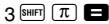
• Example 9: 3 = 9.424777961
• Example 10: To determine how many different 4-digit values can be produced using the numbers 1 through 7
- Numbers cannot be duplicated within the same 4-digit value (1234 is allowed, but 1123 is not). (840)

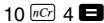
• Example 11: To determine how many different 4-member groups can be organized in a group of 10 individuals (210)
■ Angle Unit Conversion
- Press SHIFT DRG▶ to display the following menu.
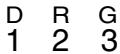
- Pressing 1, 2, or 3 converts the displayed value to the corresponding angle unit.
• Example: To convert 4.25 radians to degrees
MODE .... 1 (Deg)
4.25 SHIFT DRG 2(R) 4.25r 243.5070629
■ Coordinate Conversion (Pol (x, y) , Rec (r, ) )
- Calculation results are automatically assigned to variables E and F.
- Example 1: To convert polar coordinates (r = 2, = 60^) to rectangular coordinates (x, y) (Deg)
$$ x = 1\boxed{\mathrm{SHIFT}}\boxed{\mathrm{Rec}}(2,60) $$
$$ y = 1.732050808 \tag{RCL} \tag{F} $$
- Press RCL E to display the value of x, or RCL F to display the value of y.
- Example 2: To convert rectangular coordinates (1, 3) to polar coordinates (r, ) (Rad)
$$ r = 2 $$
Pol(
1
√
3
□ E
$$ \theta = 1. 0 4 7 1 9 7 5 5 1 $$
RCL
F
- Press RCL E to display the value of r, or RCL F to display the value of θ.
■ Engineering Notation Calculations
• Example 1: To convert 56,088 meters to kilometers
$$ \rightarrow 5 6. 0 8 8 \times 1 0 ^ {3} $$
56088
=
ENG
(km)
• Example 2: To convert 0.08125 grams to milligrams
$$ \rightarrow 8 1. 2 5 \times 1 0 ^ {- 3} $$
0.08125
=
ENG
(mg)
Statistical
Calculations
SD
REG
Standard Deviation
SD
Use the MODE key to enter the SD Mode when you want to perform statistical calculations using standard deviation.
SD
MODE
2
- In the SD Mode and REG Mode, the M+ key operates as the DT key.
- Always start data input with SHIFT CLR 1 (Scl) = to clear statistical memory.
- Input data using the key sequence shown below.
DT - Input data is used to calculate values for n , x , x^2 , , _n and _n-1 , which you can recall using the key operations noted nearby.
| To recall this type of value: | Perform this key operation: |
| x^2 | SHIFT S-SUM 1 |
| x | SHIFT S-SUM 2 |
| n | SHIFT S-SUM 3 |
| SHIFT S-VAR 1 | |
| n | SHIFT S-VAR 2 |
| n-1 | SHIFT S-VAR 3 |
- Example: To calculate _n-1 , _n , , n , x , and x^2 for the following data : 55, 54, 51, 55, 53, 53, 54, 52
In the SD Mode:
SHIFT CLR 1 (Scl) = (Stat clear)
55 DT
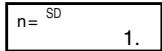
Each time you press to register your input, the number of data input up to that point is indicated on the display (n value).
54 DT 51 DT 55 DT
Arithmetic Mean ( ) = 53.375
Number of Data (n) = 8
Sum of Values (Σx) = 427
Sum of Squares of Values ( x^2 ) = 22805
SHIFT S-VAR 3
SHIFT S-VAR 2
SHIFT S-VAR 1
SHIFT S-SUM 3
SHIFT S-SUM 2
SHIFT S-SUM 1
Data Input Precautions
- DT DT inputs the same data twice.
- You can also input multiple entries of the same data using SHIFT ; . To input the data 110 ten times, for example, press 110 SHIFT ; 10 DT.
- You can perform the above key operations in any order, and not necessarily that shown above.
-
While inputting data or after inputting data is complete, you can use the ▲ and ▼ keys to scroll through data you have input. If you input multiple entries of the same data using SHIFT ; to specify the data frequency (number of data items) as described above, scrolling through data shows both the data item and a separate screen for the data frequency (Freq).
-
You can then edit the displayed data, if you want. Input the new value and then press the ☑ key to replace the old value with the new one. This also means that if you want to perform some other operation (calculation, recall of statistical calculation results, etc.), you should always press the AC key first to exit data display.
- Pressing the DT key instead of ☐ after changing a value on the display registers the value you input as a new data item, and leaves the old value as it is.
- You can delete a data value displayed using ▲ and ▼ by pressing SHIFT CL. Deleting a data value causes all values following it to be shifted up.
- Data values you register are normally stored in calculator memory. The message "Data Full" appears and you will not be able to input any more data if there is no memory left for data storage. If this happens, press the key to display the screen shown below.
EditOFF ESC 1 2
Press 2 to exit data input without registering the value you just input.
Press 1 if you want to register the value you just input, without saving it in memory. If you do this, however, you will not be able to display or edit any of the data you have input.
- To delete data you have just input, press SHIFT CL.
- After inputting statistical data in the SD Mode or REG Mode, you will be unable to display or edit individual data items any longer after perform either the following operations.
Changing to another mode
Changing the regression type (Lin, Log, Exp, Pwr, Inv, Quad)
Use the MODE key to enter the REG Mode when you want to perform statistical calculations using regression.
REG ...... MODE 3
- In the SD Mode and REG Mode, the M+ key operates as the DT key.
- Entering the REG Mode displays screens like the ones shown below.
Lin Log Exp 1 2 3
▶ ↓ ↑ ▶
←Pwr Inv Quad 1 2 3
- Press the number key (1, 2, or 3) that corresponds to the type of regression you want to use.
1 (Lin): Linear regression
2 (Log): Logarithmic regression
3 (Exp): Exponential regression
▶ 1 (Pwr): Power regression
▶ 2 (Inv): Inverse regression
▶ 3 (Quad): Quadratic regression
- Always start data input with SHIFT CLR 1 (Scl) = to clear statistical memory.
- Input data using the key sequence shown below.
- The values produced by a regression calculation depend on the values input, and results can be recalled using the key operations shown in the table below.
| To recall this type of value: | Perform this key operation: |
| x^2 | SHIFT S-SUM 1 |
| x | SHIFT S-SUM 2 |
| n | SHIFT S-SUM 3 |
| y^2 | SHIFT S-SUM ▶ 1 |
| y | SHIFT S-SUM ▶ 2 |
| xy | SHIFT S-SUM ▶ 3 |
| SHIFT S-VAR 1 | |
| x_n | SHIFT S-VAR 2 |
| x_n-1 | SHIFT S-VAR 3 |
| SHIFT S-VAR ▶ 1 | |
| y_n | SHIFT S-VAR ▶ 2 |
| y_n-1 | SHIFT S-VAR ▶ 3 |
| Regression coefficient A | SHIFT S-VAR ▶ ▶ 1 |
| Regression coefficient B | SHIFT S-VAR ▶ ▶ 2 |
| Regression calculation other than quadratic regression | |
| Correlation coefficient r | SHIFT S-VAR ▶ ▶ 3 |
| SHIFT S-VAR ▶ ▶ ▶ 1 | |
| SHIFT S-VAR ▶ ▶ ▶ 2 | |
- The following table shows the key operations you should use to recall results in the case of quadratic regression.
| To recall this type of value: | Perform this key operation: |
| x^3 | SHIFT S-SUM ▶ ▶ 1 |
| x^2y | SHIFT S-SUM ▶ ▶ 2 |
| x^4 | SHIFT S-SUM ▶ ▶ 3 |
| Regression coefficient C | SHIFT S-VAR ▶ ▶ 3 |
| _1 | SHIFT S-VAR ▶ ▶ ▶ 1 |
| _2 | SHIFT S-VAR ▶ ▶ ▶ 2 |
| SHIFT S-VAR ▶ ▶ ▶ 3 |
- The values in the above tables can be used inside of expressions the same way you use variables.
- Linear Regression
- The regression formula for linear regression is: y = A + Bx .
• Example: Atmospheric Pressure vs. Temperature
| Temperature | Atmospheric Pressure |
| 10°C | 1003 hPa |
| 15°C | 1005 hPa |
| 20°C | 1010 hPa |
| 25°C | 1011 hPa |
| 30°C | 1014 hPa |
Perform linear regression to determine the regression formula terms and correlation coefficient for the data nearby. Next, use the regression formula to estimate atmospheric pressure at -5^ and temperature at 1000 hPa. Finally, calculate the coefficient of determination ( r^2 ) and sample covariance
$$ \left(\frac {\Sigma x y - n \cdot \bar {x} \cdot \bar {y}}{n - 1}\right). $$
In the REG Mode:
1(Lin)
SHIFT CLR 1 (Scl) = (Stat clear)
10,1003DT
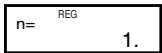
Each time you press to register your input, the number of data input up to that point is indicated on the display (n value).
15,1005DT
20,1010DT
25 , 1011 DT
30,1014DT
Regression Coefficient A = 997.4
Regression Coefficient B = 0.56
Correlation Coefficient r = 0.982607368
Atmospheric Pressure at -5^ = 994.6


Temperature at 1000 hPa = 4.642857143
1000
SHIFT
S-VAR
▶
▶
▶
1
=
Coefficient of Determination = 0.965517241
SHIFT
S-VAR
▶
▶
3
x^2
=
Sample Covariance = 35
(
SHIFT
S-SUM
▶
3
-
SHIFT
S-SUM
3
×
SHIFT
S-VAR
1
×
SHIFT
S-VAR
▶
1
)
÷
(
SHIFT
S-SUM
3
-
1
)
=
- Logarithmic, Exponential, Power, and Inverse Regression
- Use the same key operations as linear regression to recall results for these types of regression.
- The following shows the regression formulas for each type of regression.
| Logarithmic Regression | y = A + B · x |
| Exponential Regression | y = A · e^B · x ( y = A + Bx) |
| Power Regression | y = A · x^B ( y = A + B x) |
| Inverse Regression | y = A + B · 1/x |
• Quadratic Regression
- The regression formula for quadratic regression is:
Perform quadratic regression to determine the regression formula terms for the data nearby. Next, use the regression formula to estimate the values for (estimated value of y) for xi = 16 and (estimated value of x) for yi = 20.
In the REG Mode:
▶ 3 (Quad)
SHIFT CLR 1 (Scl) = (Stat clear)
29 , 1.6 DT 50 , 23.5 DT 74 , 38.0 DT 103 , 46.4 DT 118 , 48.0 DT
Regression Coefficient A = -35.59856934
Regression Coefficient B = 1.495939413
SHIFT S-VAR 1 SHIFT S-VAR 2
Regression Coefficient C = -6.71629667 × 10 ^-3
SHIFT S-VAR 3
when xi is 16 = -13.38291067
1 when yi is 20 = 47.14556728
2 when yi is 20 = 175.5872105
16 SHIFT S-VAR 3
20 SHIFT S-VAR 1
20 SHIFT S-VAR 2
Data Input Precautions
- DT DT inputs the same data twice.
- You can also input multiple entries of the same data using SHIFT; To input the data "20 and 30" five times, for example, press 20, 30 SHIFT; 5 DT.
- The above results can be obtained in any order, and not necessarily that shown above.
- Precautions when editing data input for standard deviation also apply for regression calculations.
- Do not use variables A through F, X, or Y to store data when performing statistical calculations. These variables are used for statistical calculation temporary memory, so any data you may have assigned to them may be replaced by other values during statistical calculations.
- Entering the REG Mode and selecting a regression type (Lin, Log, Exp, Pwr, Inv, Quad) clear variables A through F, X, and Y. Changing from one regression type to another inside the REG Mode also clears these variables.
Technical Information
■ When you have a problem......
If calculation results are not what you expect or if an error occurs, perform the following steps.
- Press SHIFT CLR 2 (Mode) ☐ to initialize all modes and settings.
- Check the formula you are working with to confirm it is correct.
- Enter the correct mode and try performing the calculation again.
If the above steps do not correct the problem, press the ON key. The calculator performs a self-check operation and deletes all data stored in memory if any abnormality is detected. Make sure you always keep written copies of all important data.
■ Error Messages
The calculator is locked up while an error message is on the display. Press AC to clear the error, or press ◀ or ▶ to display the calculation and correct the problem. See "Error Locator" for details.
- Causes
- Calculation result is outside the allowable calculation range.
- An attempt to perform a function calculation using a value that exceeds the allowable input range.
- An attempt to perform an illogical operation (division by zero, etc.)
- Action
- Check your input values and make sure they are all within the allowable ranges. Pay special attention to values in any memory areas you are using.
Stack ERROR
- Cause
- The capacity of the numeric stack or operator stack is exceeded.
- Action
- Simplify the calculation. The numeric stack has 10 levels and the operator stack has 24 levels.
- Divide your calculation into two or more separate parts.
Syntax ERROR
- Cause
- An attempt to perform an illegal mathematical operation.
- Action
- Press ◀ or ▶ to display the calculation with the cursor located at the location of the error and make required corrections.
Arg ERROR
- Cause
- Improper use of an argument
- Action
- Press ◀ or ▶ to display the location of the cause of the error and make required corrections.
■ Order of Operations
Calculations are performed in the following order of precedence.
① Coordinate transformation: Pol (x, y) , Rec (r, )
② Type A functions:
With these functions, the value is entered and then the function key is pressed.
$$ x ^ {3}, x ^ {2}, x ^ {- 1}, x!, \circ , ” $$
$$ \hat {x}, \hat {x} _ {1}, \hat {x} _ {2}, \hat {y} $$
Angle unit conversions (DRG▶)
③ Powers and roots: (x^y), x-
④ a^b/_c
⑤ Abbreviated multiplication format in front of , e (natural logarithm base), memory name, or variable name: 2 , 3e , 5A , A , etc.
⑥ Type B functions:
With these functions, the function key is pressed and then the value is entered.
, [3] , log, ln, e^x , 10^x , sin, cos, tan, ^-1 , ^-1 , ^-1 , sinh, cosh, tanh, ^-1 , ^-1 , ^-1 , (−)
⑦ Abbreviated multiplication format in front of Type B functions: 23 , Alog2, etc.
⑧ Permutation and combination: nPr, nCr
⑨ ×, ÷
⑩ +, -
- Operations of the same precedence are performed from right to left. e^x 120 e^x (120)
- Other operations are performed from left to right.
- Operations enclosed in parentheses are performed first.
- When a calculation contains an argument that is a negative number, the negative number must be enclosed within parentheses. The negative sign (−) is treated as a Type B function, so particular care is required when the calculation includes a high-priority Type A function, or power or root operations.
Example: (-2)^4 = 16
$$ - 2 ^ {4} = - 1 6 $$
■ Stacks
This calculator uses memory areas, called “stacks,” to temporarily store values (numeric stack) and commands (command stack) according to their precedence during calculations. The numeric stack has 10 levels and the command stack has 24 levels. A stack error (Stack ERROR) occurs whenever you try to perform a calculation that is so complex that the capacity of a stack is exceeded.
• Example:
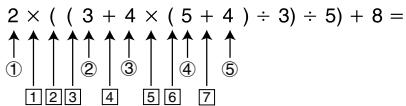
Numeric Stack
| 1 | 2 |
| 2 | 3 |
| 3 | 4 |
| 4 | 5 |
| 5 | 4 |
Command Stack
| 1 | × |
| 2 | ( |
| 3 | ( |
| 4 | + |
| 5 | × |
| 6 | ( |
| 7 | + |
| ⋮ |
- Calculations are performed in sequence according to "Order of Operations." Commands and values are deleted from the stack as the calculation is performed.
■ Input Ranges
Internal digits: 12
Accuracy*: As a rule, accuracy is ±1 at the 10th digit.
* For a single calculation, calculation error is ±1 at the 10th digit. (In the case of exponential display, calculation error is ±1 at the last significant digit.) Errors are cumulative in the case of consecutive calculations, which can also cause them to become large. (This is also true of internal consecutive calculations that are performed in the case of (x^y), [x]y, x! , [3]- , nPr, nCr, etc.) In the vicinity of a function's singular point and point of inflection, errors are cumulative and may become large.
| Functions | Input Range | |
| sinx | DEG | 0≤|x|≤4.499999999×10¹⁰ |
| RAD | 0≤|x|≤785398163.3 | |
| GRA | 0≤|x|≤4.999999999×10¹⁰ | |
| cosx | DEG | 0≤|x|≤4.500000008×10¹⁰ |
| RAD | 0≤|x|≤785398164.9 | |
| GRA | 0≤|x|≤5.000000009×10¹⁰ | |
| tanx | DEG | Same as sinx, except when |x|=(2n-1)×90. |
| RAD | Same as sinx, except when |x|=(2n-1)×π/2. | |
| GRA | Same as sinx, except when |x|=(2n-1)×100. | |
| sin-1x | 0≤|x|≤1 | |
| cos-1x | ||
| tan-1x | 0≤|x|≤9.999999999×1099 | |
| sinhx | 0≤|x|≤230.2585092 | |
| coshx | ||
| sinh-1x | 0≤|x|≤4.999999999×1099 | |
| cosh-1x | 1≤x≤4.999999999×1099 | |
| tanhx | 0≤|x|≤9.999999999×1099 | |
| tanh-1x | 0≤|x|≤9.999999999×10⁻¹ | |
| logx/lnx | 0< x ≤9.999999999×1099 | |
| 10x | -9.999999999×1099≤x≤99.99999999 | |
| ex | -9.999999999×1099≤x≤230.2585092 | |
| 0≤x< 1 × 10100 | ||
| x2 | |x|< 1 × 1050 | |
| 1/x | |x|< 1 × 10100; x ≠ 0 | |
| ^3 | |x|< 1 × 10100 | |
| x! | 0≤x≤69 (x is an integer) | |
| nPr | 0≤n< 1×10¹⁰, 0≤r≤n (n,r are integers)1≤{n!/(n-r)!} < 1×10100 | |
| Functions | Input Range | |
| nCr | 0 ≤q n < 1 × 10^10, 0 ≤q r ≤q n (n, r are integers) 1 ≤q [n!/!(n-r)!\] < 1 × 10^100 | |
| Pol(x,y) | |x|, |y| ≤q 9.999999999 × 10^49 (x^2+y^2) ≤q 9.999999999 × 10^99 | |
| Rec(r,) | 0 ≤q r ≤q 9.999999999 × 10^99 : Same as x | |
| |a|, b, c < 1 × 10^100 0 ≤q b, c | ||
| |x| < 1 × 10^100 Decimal Sexagesimal Conversions 0^ 0^ 0^ ≤q |x| ≤q 999999^ 59^ | ||
| ^(x^y) | x>0: -1 × 10^100 < y x < 100 x=0: y>0 x<0: y=n, 12n+1 (n is an integer) However: -1 × 10^100 < y |x| < 100 | |
| ^x[y]y | y>0: x 0 -1 × 10^100 < 1/x y < 100 y=0: x>0 y<0: x=2n+1, 1n (n 0; n is an integer) However: -1 × 10^100 < 1/x |y| < 100 | |
| a^b/c | Total of integer, numerator, and denominator must be 10 digits or less (including division marks). | |
| SD(REG) | |x| < 1 × 10^50 x _n, y _n, , : n 0 |y| < 1 × 10^50 x _n-1, y _n-1, A, B, r: |n| < 1 × 10^100 n 0, 1 | |
Power Supply
The type of battery you should use depends on the model number of your calculator.
fx-85MS/fx-300MS
The TWO WAY POWER system actually has two power supplies: a solar cell and a G13 Type (LR44) button battery. Normally, calculators equipped with a solar cell alone can operate only when relatively bright light is present. The TWO WAY POWER system, however, lets you continue to use the calculator as long as there is enough light to read the display.
- Replacing the Battery
Either of the following symptoms indicates battery power is low, and that the battery should be replaced.
- Display figures are dim and difficult to read in areas where there is little light available.
- Nothing appears on the display when you press the ON key.
• To replace the battery
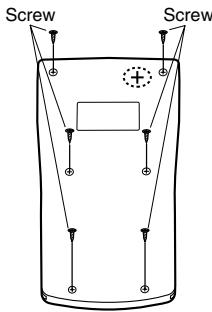
① Remove the six screws that hold the back cover in place and then remove the back cover.
② Remove the old battery.
③ Wipe off the sides of new battery with a dry, soft cloth. Load it into the unit with the positive ⊕ side facing up (so you can see it).
④ Replace the back cover and secure it in place with the six screws.
⑤ Press ON to turn power on. Be sure not to skip this step.
fx-83MS/fx-270MS/fx-350MS
This calculator is powered by single G13 Type (LR44) button battery.
- Replacing the Battery
Dim figures on the display of the calculator indicate that battery power is low. Continued use of the calculator when the battery is low can result in improper operation. Replace the battery as soon as possible when display figures become dim.
• To replace the battery
① Press SHIFT OFF to turn off power.
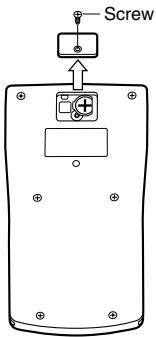
② Remove the screw that holds the battery cover in place and then remove the battery cover.
③ Remove the old battery.
④ Wipe off the sides of new battery with a dry, soft cloth. Load it into the unit with the positive ⊕ side facing up (so you can see it).
⑤ Replace the battery cover and secure it in place with the screw.
⑥ Press ON to turn power on.
fx-82MS
This calculator is powered by a single AA-size battery.
- Replacing the Battery
Dim figures on the display of the calculator indicate that battery power is low. Continued use of the calculator when the battery is low can result in improper operation. Replace the battery as soon as possible when display figures become dim.
• To replace the battery
① Press SHIFT OFF to turn power off.
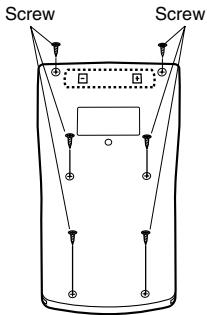
② Remove the six screws that hold the back cover in place and then remove the back cover.
③ Remove the old battery.
④ Load a new battery into the unit with its positive ⊕ and negative ⊖ ends facing correctly.
⑤ Replace the back cover and secure it in place with the six screws.
⑥ Press ON to turn power on.
Auto Power Off
Calculator power automatically turns off if you do not perform any operation for about six minutes. When this happens, press ON to turn power back on.
Specifications
Power Supply:
fx-82MS: Single AA-size battery (R6P (SUM-3))
fx-83MS/fx-270MS/fx-350MS:
Single G13 Type button battery (LR44)
fx-85MS/fx-300MS:
Solar cell and a single G13 Type button battery (LR44)
Battery Life:
fx-82MS: Approximately 17,000 hours continuous display of flashing cursor.
Approximately 2 years when left with power turned off.
fx-83MS/fx-270MS/fx-350MS:
Approximately 9,000 hours continuous display of flashing cursor.
Approximately 3 years when left with power turned off.
fx-85MS/fx-300MS:
Approximately 3 years (1 hour use per day).
Dimensions:
fx-82MS: 18.6 (H) × 85 (W) × 156 (D) mm
^3/4''(H) × 3^3/8''(W) × 6^1/_8''(D)
fx-83MS/fx-85MS/fx-270MS/fx-300MS/fx-350MS:
fx-82MS: 125 g (4.4 oz) including battery
fx-83MS/fx-85MS/fx-270MS/fx-300MS/fx-350MS:
100 g (3.5 oz) including battery
Power Consumption: 0.0002 W
Operating Temperature: 0°C to 40°C (32°F to 104°F)
CASIO®
CASIO COMPUTER CO., LTD.
6-2, Hon-machi 1-chome
Shibuya-ku, Tokyo 151-8543, Japan
- Removing and Replacing the Calculator's Cover
- - Before starting .....①
- • After you are finished .....②
- Safety Precautions
- Caution
- Batteries
- Disposing of the Calculator
- Handling Precautions
- Contents
- Removing and Replacing the Calculator's Cover .... 1
- Safety Precautions 2
- Handling Precautions 3
- Two-line Display 7
- Before getting started.... 7
- Basic Calculations ...... 11
- Memory Calculations 16
- Scientific Function Calculations...... 17
- Statistical Calculations 21
- Technical Information 28
- Power Supply 34
- Specifications 37
- Two-line Display
- The two-line display makes it possible to view both the calculation formula and its result at the same time.
- Before getting started...
- ■ Modes
- Note!
- ■ Input Capacity
- ■ Making Corrections During Input
- ■ Replay Function
- ■ Error Locator
- ■ Multi-statements
- ■ Exponential Display Formats
- - Norm 1
- - Norm 2
- ■ Decimal Point and Separator Symbols
- ■ Initializing the Calculator
- Basic Calculations
- COMP
- ■ Arithmetic Calculations
- ■ Fraction Operations
- • Fraction Calculations
- - Mixed Fraction ↔ Improper Fraction Conversion
- Disp 1
- ■ Percentage Calculations
- ■ Degrees, Minutes, Seconds Calculations
- FIX, SCI, RND
- Fix Sci Norm 1 2 3
- Memory Calculations
- ■ Answer Memory
- ■ Consecutive Calculations
- ■ Independent Memory
- ■ Variables
- Scientific Function Calculations
- ■ Trigonometric/Inverse Trigonometric Functions
- Deg Rad Gra 1 2 3
- ■ Hyperbolic/Inverse Hyperbolic Functions
- ■ Common and Natural Logarithms/Antilogarithms
- ■ Square Roots, Cube Roots, Roots, Squares, Cubes, Reciprocals, Factorials, Random Numbers, , and Permutation/Combination
- ■ Angle Unit Conversion
- ■ Coordinate Conversion (Pol (x, y) , Rec (r, ) )
- ■ Engineering Notation Calculations
- Statistical
- Calculations
- Standard Deviation
- Data Input Precautions
- EditOFF ESC 1 2
- Technical Information
- ■ When you have a problem......
- ■ Error Messages
- - Causes
- - Action
- Stack ERROR
- - Cause
- Syntax ERROR
- Arg ERROR
- ■ Order of Operations
- ■ Stacks
- • Example:
- ■ Input Ranges
- Power Supply
- fx-85MS/fx-300MS
- - Replacing the Battery
- • To replace the battery
- fx-83MS/fx-270MS/fx-350MS
- fx-82MS
- Auto Power Off
- Specifications
- Power Supply:
- Battery Life:
- Dimensions:
- CASIO®
- CASIO COMPUTER CO., LTD.
Brand : CASIO
Model : FX-350MS
Category : Scientific calculator