
HS14540N - Freezer BEKO - Free user manual and instructions
Find the device manual for free HS14540N BEKO in PDF.


| Product Type | Upright Freezer |
| Brand | Beko |
| Model | HS14540N |
| Net Capacity | 145 Liters |
| Height | 185 cm |
| Width | 60 cm |
| Depth | 65 cm |
| Weight | 55 kg |
| Power Supply | 220-240 V ~ 50 Hz |
| Energy Class | A+ |
| Annual Energy Consumption | 220 kWh |
| Noise Level | 40 dB |
| Temperature Control | Mechanical Thermostat |
| Freezing Capacity | 10 kg/24h |
| Storage Time in Power Failure | 15 hours |
| Defrosting | Manual Defrost |
| Interior Light | Yes |
| Door Reversible | Yes |
| Climate Class | SN-T (10°C - 43°C) |
| Refrigerant | R600a |
| Country of Origin | Turkey |
| Spare Parts Availability | 7 years after model end |
Frequently Asked Questions - HS14540N BEKO
User questions about HS14540N BEKO
0 question about this device. Answer the ones you know or ask your own.
Ask a new question about this device
Download the instructions for your Freezer in PDF format for free! Find your manual HS14540N - BEKO and take your electronic device back in hand. On this page are published all the documents necessary for the use of your device. HS14540N by BEKO.
USER MANUAL HS14540N BEKO
HS14540N
EN-D-CZ-SK-LV-LT-ET-IT
WARNING!
In order to ensure a normal operation of your refrigerating appliance, which uses a completely environmentally friendly refrigerant the R600a (flammable only under certain conditions) you must observe the following rules:
- Do not hinder the free circulation of the air around the appliance.
- Do not use mechanical devices in order to accelerate the defrosting, others than the ones recommended by the manufacturer.
- Do not destroy the refrigerating circuit.
- Do not use electric appliances inside the food keeping compartment, other than those that might have been recommended by the manufacturer.
WARNING!
Advice for recycling of the old appliance /1
Packing Recycling /2
Transport instructions /2
Warnings and special advice /2
Setting up /3
Electric connection /3
Switching off /3
Appliance description /4
Freezer operation /4
Advice for food conservation /4
Defrosting of the appliance /5
Cleaning of the appliance /5
Replacing the interior light bulb /5
Defects finding guide /6
D Inhalt
EN
This product is equipped with a lighting source of the "G" energy class. The lighting source in this product shall only be replaced by professional repairers.
D
Figures that take place in this instruction manual are schematic and may not correspond exactly with your product. If the subject parts are not included in the product you have purchased, then it is valid for other models.
2
3
4
5
1
2
3 6
Congratulations for your choice!
The chest freezer you have purchased is one in the BEKO products range and represents a harmonious joining between the refrigeration technique with the aesthetical outlook. It has a new and attractive design and is built according to the European and national standards which guarantee its operation and safety features. At the same time, the used refrigerant, R600a, is environment-friendly and it does not affect the ozone layer.
In order to use the best your freezer, we advise you to read carefully the information in these user instructions.
Advice for recycling your old appliance
If your newly purchased appliance replaces an older appliance, you must consider a few aspects.
The old appliances are not valueless scrap. Their disposal, while preserving the environment, allows the recovery of important raw materials.
Make your old appliance useless:
- disconnect the appliance from the supply;
- remove the supply cord (cut it);
- remove the eventual locks on the door to avoid the blocking of children inside, while playing, and the endangering of their lives. The refrigerating appliances contain insulating materials and refrigerants which require a proper recycling.
Original spare parts will be provided for 10 years following the product purchase date.

INFORMATION

ENERGY

SUPPLIER'S NAME

MODEL IDENTIFIER

The model information as stored in the product database can be reached by entering the following website and searching for your model identifier (*) found on the energy label.
https://eprel.ec.europa.eu/
This appliance is not intended for use by persons with reduced physical, sensory, or mental capabilities, or lack of experience and knowledge, unless they have been given supervision or instruction concerning use of the appliance by a person responsible for their safety.
Children should be supervised to ensure that they do not play with the appliance.
Packing Recycling
WARNING!
Do not allow children to play with the packing or with parts of it. There is a risk of suffocation with parts of corrugated cardboard and with plastic film.
In order to reach you in good condition, the appliance was protected with suitable packing. All the materials of the packing are compatible with the environment and recyclable. Please help us recycle the packing while protecting the environment!
IMPORTANT!
Before putting the appliance into operation, read carefully and entirely these instructions. They contain important information concerning the setting up, use, and maintenance of the appliance.
The manufacturer is free of any responsibility if the information in this document is not observed. Keep the instructions in a safe place in order to reach them easily in case of need. They can also be useful subsequently by another user.
ATTENTION!
This appliance must be used only for its intended purpose, (household use), in suitable areas, far from rain, moisture or other weather conditions.
Transport instructions
The appliance must be transported, as much as possible, only in vertical position. The packing must be in perfect condition during transport.
If during transport the appliance was put in horizontal position (only according to the markings on the packing), it is advised that, before putting it into operation, the appliance is left to rest for 4 hours in order to allow the settling of the refrigerating circuit.
The failure to observe these instructions can cause the breakdown of the motorcompressor and the cancellation of its warranty.
Warnings and general advice
- Do not plug in the appliance if you noticed a failure.
- The repairs must be done only by qualified personnel.
- In the following situations please unplug the appliance from the mains:
- when you defrost completely the appliance;
- when you clean the appliance.
To unplug the appliance, pull by the plug, not by the cable!
- Ensure the minimum space between the appliance and the wall against which it is placed.
- Do not climb on the appliance.
- Do not allow children to play or hide inside the appliance.
- Never use electric appliances inside the freezer for defrosting.
- Do not use the appliance near heating appliances, cookers, or other sources of heat and fire.
- Do not leave the freezer door open longer than necessary to put in or take out food.
- Do not leave food in the appliance if it is not working.
- Do not keep products containing flammable or explosive gases inside.
- Do not keep fizzy drinks (juice, mineral water, champagne, etc.) in the freezer: the bottle can explode! Do not freeze drinks in plastic bottles.
- Do not eat ice cubes or ice cream immediately after taking them out of the freezer because they may cause 'freezer burns'.
- Never touch cold metal parts or frozen food with wet hands because your hands can quickly freeze on the very cold surfaces.
- For the protection of the appliance during warehousing and transport, it is provided with spacers between the door and the cabinet (in the front and rear side). These spacers will be removed before putting the appliance into operation.
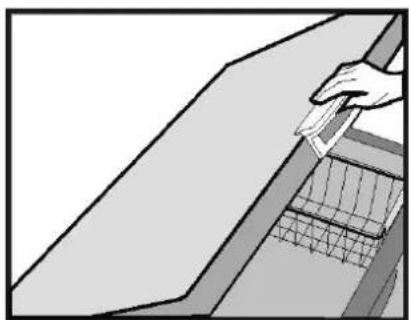
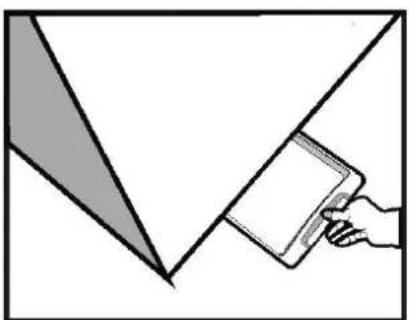
- Excess deposit of ice on the frame and the baskets should be removed regularly with the plastic scraper provided. Do not use any metal parts to remove the ice.
The presence of this ice build-up makes it impossible to close the door correctly.
- If you do not use your appliance for a few days, it is not advisable to switch it off. If you do not use it for a longer period, please proceed as follows:
- unplug the appliance;
- empty the freezer;
- defrost it and clean it;
- leave the door open to avoid the formation of unpleasant smells.
- If your appliance has a lock, keep it locked and store the key in a safe place, out of the reach of children. If you are discarding an appliance with a lock, make sure that it is made ineffective. This is very important so as to avoid children being trapped inside, which may cause loss of life.
- If the supply cord is damaged, it must be replaced by the manufacturer, its service agent or similarly qualified persons in order to avoid a hazard.
Setting up
This appliance was designed to operate at an ambient temperature between +10°C and +43°C (SN-T class). If the ambient temperature is above +43°C, the temperature inside the appliance can increase.
Set up the appliance far from any source of heat and fire. Placing it in a warm room, direct exposure to sunbeams, or near a heat source (heaters, cookers, ovens) will increase energy consumption and shorten the product life.
- Please observe the following minimum distances:
- 100 cm from cookers working with coal or oil;
- 150 cm from electric and gas cookers.
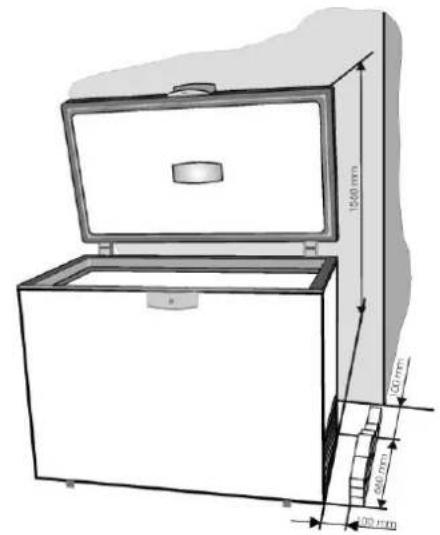
- Ensure free circulation of air around the appliance by observing the distances shown in Item 2.
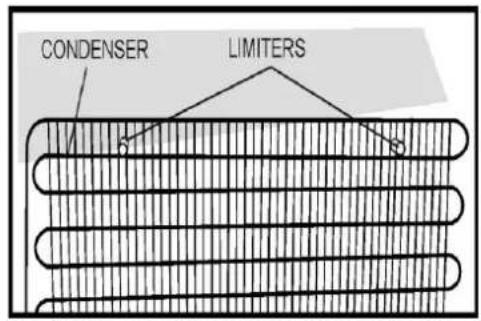
Assemble the supplied spacers on the condenser (on the rear side). (Item 3).
Place the appliance in a perfectly even, dry, and well-ventilated place.
Assemble the supplied accessories.
Electric connection
Your appliance is intended to operate at a single-phase voltage of 220-240V/50 Hz. Before plugging in the appliance, please make sure that the parameters of the mains in your house (voltage, current type, frequency) comply with the operation parameters of the appliance.
- The information concerning the supply voltage and the absorbed power is given on the marking label placed on the back side of the freezer.
- The electric installation must comply with the law requirements.
- The earthing of the appliance is compulsory. The manufacturer has no responsibility for any damage to persons, animals or goods which may arise from the failure to observe the specified conditions.
- The appliance is endowed with a supply cord and a plug (European type, marked 10/16A) with double earthing contact for safety. If the socket is not the same type as the plug, please ask a specialised electrician to change it.
- Do not use extension pieces or multiple adapters.
Switching off
The switching off must be possible by taking the plug out of the socket or by means of a mains two-pole switch placed before the socket.
Operation
Before putting into operation, clean the inside of the appliance (see chapter "Cleaning").
After finishing this operation, please plug in the appliance, adjust the thermostat knob to an average position. The green and red LEDs in the signalling block must light. Leave the appliance to work for about 2 hours without putting food inside it.
The freezing of fresh food is possible after min. 20 hours of operation.
Appliance description
(Item. 1)
- Door handle
- Door
- Lamp housing
- Thermostat box
- Basket
- Lock housing
- Spacer for transport
Freezer operation
Temperature adjustment
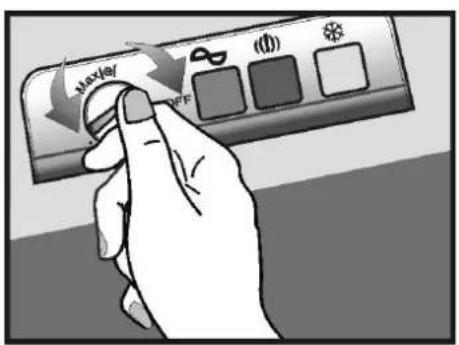
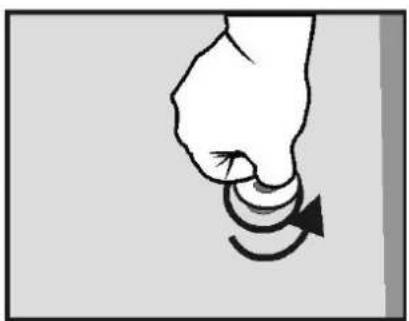
The temperature of the freezer is adjusted by means of the knob assembled on the thermostat (item 4), with the "MAX" position being the lowest temperature.
The achieved temperatures can vary according to the conditions of use of the appliance, such as: place of the appliance, ambient temperature, frequency of door opening, extent of filling with food of the freezer. The position of the thermostat knob will change according to these factors. Normally, for an ambient temperature of approx. 32°C, the thermostat will be adjusted on an average position.
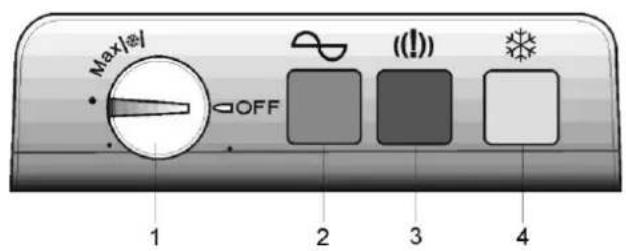
The signalling system is placed on the back side of the freezer (item 5).
It includes:
- Thermostat adjustment knob – the inside temperature is adjusted.
- Green LED – shows that the appliance is supplied with electric energy.
- Red LED – damage – lights if the temperature in the freezer is too high. The LED will operate 15-45 minutes after the freezer is put into operation, then it must go off. If the LED goes on during operation, this means that defects have occurred.
- Orange LED – fast freeze function activated – by setting the knob to Superfreeze position, the orange LED goes on, showing that the appliance has entered into the "fast freeze" mode. The exit of this mode is done automatically after 50 hours, then the appliance runs in economic mode, and the orange LED goes off. The three LEDs give information about the mode of operation of the freezer.
Advice for food conservation
The freezer is intended to keep frozen food for a long time, as well as to freeze fresh food.
One of the main elements for successful food freezing is the packing.
The main conditions that the packing must fulfill are the following: to be airtight, to be inert towards the packed food, to resist low temperatures, to be proof against liquids, grease, water vapours, and smells, and to be able to be washed.
These conditions are fulfilled by the following types of packings: plastic or aluminium film, plastic and aluminium vessels, waxed cardboard glasses, or plastic glasses.
IMPORTANT!
- For freezing fresh food, please use the supplied basket of the appliance.
- Do not place into the freezer too large a quantity of food at a time. The quality of the food is best kept if it is deeply frozen as quickly as possible. This is why it is advisable not to exceed the freezing capacity of the appliance specified in the "Product Fiche".
- The fresh food must not come into contact with the food already frozen.
- The frozen food you have bought can be placed into the freezer without having to adjust the thermostat.
- If the freezing date is not mentioned on the packing, please take into consideration a period of max. 3 months, as a general guide.
- The food, even partially defrosted, cannot be frozen again; it must be consumed immediately or cooked and then refrozen.
- Fizzy drinks will not be kept in the freezer.
- In case of a power failure, do not open the door of the appliance. The frozen food will not be affected if the failure lasts less than 52 hours.
Freezing with Superfrost
- Place the knob to super frost position. The Superfrost lamp comes on.
- Wait 24 hours.
- Place the fresh food in the freezer. In order to achieve fast freezing, food should be in contact with the interior walls when it is placed in the freezer.
- The Superfrost facility automatically switches the fast freezing procedure off after 50 hours.
Important
When you place the knob to Superfrost position, the compressor might not switch on for a few minutes. This is due to the integrated rise-delay switch which is designed to increase the life span of the refrigeration unit.
You should not switch on the Superfrost function:
- when placing frozen food in the freezer;
- when freezing up to approx. 2 kg fresh food daily.
Defrosting of the appliance
- We advise you to defrost the freezer at least twice a year or when the ice layer has an excessive thickness.
- The ice build-up is a normal phenomenon.
- The quantity and the rapidity of ice build-up depends on the ambient conditions and on the frequency of the door opening.
- We advise you to defrost the appliance when the quantity of frozen food is the least.
- Before defrosting, adjust the thermostat knob to a higher position so that the food stores more cold.
- Unplug the appliance.
- Take out the frozen food, wrap it in several sheets of paper and put them in refrigerator or a cool place.
Use a tray and put it under the freezer in the direction of the dripping tube. Take out the obstructing plug. The water which results will be collected in the water vessel. After the melting of the ice and the run-off of the water please wipe with a cloth or with a sponge, then dry well. Put the obstruction plug back in its place. (Item. 6)
For a fast thaw please leave the door open.
Do not use sharp metal objects to remove the ice.
Do not use hairdriers or other electric heating appliances for defrosting.
Inside cleaning
Before starting the cleaning, unplug the appliance from the mains.
- It is advisable to clean the appliance when you defrost it.
- Wash the inside with lukewarm water where you add some neutral detergent. Do not use soap, detergent, gasoline or acetone which can leave a strong odour.
- Wipe with a wet sponge and dry with a soft cloth.
During this operation, avoid excess water to prevent it from entering the thermal insulation of the appliance, which would cause unpleasant odors.
Do not forget to also clean the door gasket, especially the bellow ribs, with a clean cloth.
Outside cleaning
- Clean the outside of the freezer with a sponge soaked in soapy warm water, wipe with a soft cloth, and dry.
- The cleaning of the external part of the refrigerating circuit (motor-compressor, condenser, connection tubes) should be done with a soft brush or with a vacuum cleaner. During this operation, take care not to distort the tubes or detach the cables.
Do not use scouring or abrasive materials!
- After finishing the cleaning, replace the accessories in their places and plug in the appliance.
Replacing the interior light bulb
If the lamp burns out, disconnect the appliance from the mains. Remove the lamp trim. Make sure the lamp is screwed in correctly. Plug the appliance back in. If the lamp still does not turn on, replace it with another one of model E14-15W. Mount the lamp trim back in its place.
The lamp(s) used in this appliance are not suitable for household room illumination. The intended purpose of this lamp is to assist the user in placing foodstuffs in the
refrigerator/freezer in a safe and comfortable way.
The lamps used in this appliance must withstand extreme physical conditions such as temperatures below -20° C.
Defects finding guide
The appliance does not work.
- There is a power failure.
- The plug of the supply cord is not inserted well into the socket.
- The fuse is blown.
- The thermostat is in "OFF" position.
The temperatures are not low enough (red LED on).
- The food prevents the door closing.
- The appliance was not placed correctly.
- The appliance is placed too close to a heat source.
- The thermostat knob is not in the correct position.
Excessive ice build-up
● The door was not closed properly.
The inside lighting does not work
- The lamp is blown. Unplug the appliance from the mains, take out the lamp and replace it with a new one.
The following are not defects
- Possible noddings and cracks coming from the product: circulation of the refrigerant in the system.
Noises during operation
In order to keep the temperature at the value you have adjusted, the compressor of the appliance starts periodically.
The noises which can be heard in such situation are normal.
They are reduced as soon as the appliance reaches the operation temperature.
The humming noise is made by the compressor. It can become a little stronger when the compressor starts.
The bubbling and gurgling noises coming from the refrigerant circulating in the pipes of the appliance are normal operating noises.
Warning!
Never try to repair the appliance or its electric components yourself. Any repair made by an unauthorized person is dangerous for the user and can result in the warranty cancellation.

The symbol ■ on the product or on packaging indicates that this product may not be treated as household waste. Instead, it shall be handed over to the applicable collection point for the recycling of electrical and electronic equipment. By ensuring this product is disposed of correctly, you will help prevent potential negative consequences for the environment and human health, which could otherwise be caused by inappropriate waste handling of this product. For more detailed information about recycling of this product, please contact your local city office, your household waste disposal service, or the shop where you purchased the product.
- WARNING
- D INHALT
- EN
- D
- CONGRATULATIONS FOR YOUR CHOICE
- ADVICE FOR RECYCLING YOUR OLD APPLIANCE
- INFORMATION
- PACKING RECYCLING
- IMPORTANT
- ATTENTION
- TRANSPORT INSTRUCTIONS
- WARNINGS AND GENERAL ADVICE
- TO UNPLUG THE APPLIANCE, PULL BY THE PLUG, NOT BY THE CABLE
- SETTING UP
- ELECTRIC CONNECTION
- SWITCHING OFF
- OPERATION
- APPLIANCE DESCRIPTION
- FREEZER OPERATION
- TEMPERATURE ADJUSTMENT
- ADVICE FOR FOOD CONSERVATION
- FREEZING WITH SUPERFROST
- DEFROSTING OF THE APPLIANCE
- INSIDE CLEANING
- OUTSIDE CLEANING
- DO NOT USE SCOURING OR ABRASIVE MATERIALS
- REPLACING THE INTERIOR LIGHT BULB
- DEFECTS FINDING GUIDE
- THE APPLIANCE DOES NOT WORK
- THE TEMPERATURES ARE NOT LOW ENOUGH (RED LED ON)
- EXCESSIVE ICE BUILD-UP
- THE INSIDE LIGHTING DOES NOT WORK
- THE FOLLOWING ARE NOT DEFECTS
- NOISES DURING OPERATION
Brand : BEKO
Model : HS14540N
Category : Freezer