
DTC657DW8F - Dishwasher HYUNDAI - Free user manual and instructions
Find the device manual for free DTC657DW8F HYUNDAI in PDF.


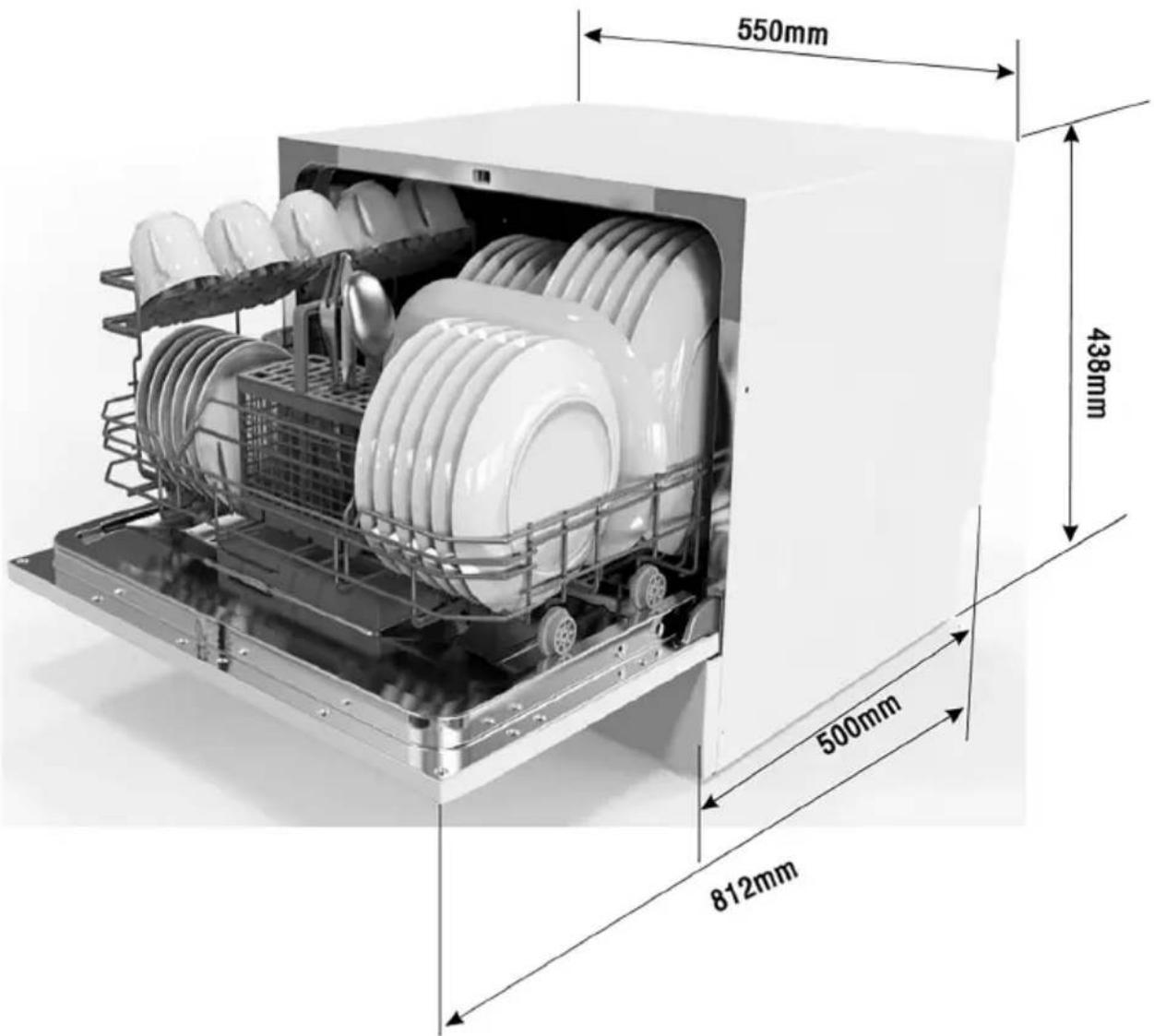
| Product Type | Freestanding Dishwasher |
| Brand | Hyundai |
| Model | DTC657DW8F |
| Energy Efficiency Class | F |
| Rated Capacity | 6 place settings |
| Dimensions (H x W x D) | 44 x 55 x 50 cm |
| Weight (approx.) | 35 kg |
| Power Supply | 220-240 V ~ 50 Hz, 10 A |
| Water Pressure | 0.04 - 1.0 MPa |
| Programs | Eco, Glass, 90min, Rapid, Soak, Self-Cleaning, Intensive, Universal |
| Energy Consumption (Eco program) | 0.613 kWh |
| Water Consumption (Eco program) | 6.5 L |
| Program Duration (Eco) | 3:50 h:min |
| Noise Level | 49 dB(A) re 1 pW |
| Noise Emission Class | C |
| Rinse Aid Dispenser Capacity | Approx. 110 ml |
| Salt Container Capacity | Approx. 1.2 kg |
| Detergent Dispenser | Dual compartment (main wash and pre-wash) |
| Water Softener | Adjustable, 6 levels |
| Interior Material | Stainless steel (typical) |
| Filter System | Coarse, Fine, Micro filter |
| Safety Features | Child lock, overflow protection, grounding |
| Warranty | 24 months |
Frequently Asked Questions - DTC657DW8F HYUNDAI
User questions about DTC657DW8F HYUNDAI
0 question about this device. Answer the ones you know or ask your own.
Ask a new question about this device
Download the instructions for your Dishwasher in PDF format for free! Find your manual DTC657DW8F - HYUNDAI and take your electronic device back in hand. On this page are published all the documents necessary for the use of your device. DTC657DW8F by HYUNDAI.
USER MANUAL DTC657DW8F HYUNDAI
natural_image
Cutaway view of a kitchen appliance showing multiple circular dishes and a rack-mounted cart (no text or symbols visible)NÁVOD K POUŽITÍ NÁVOD NA POUŽITIE INSTRUKCJA OBSŁUGI INSTRUCTION MANUAL HASZNÁLATI UTASÍTÁS
MYČKA NÁDOBÍ UMÝVAČKA RIADU DISHWASHER ZMYWARKA DO NACZYŃ MOSOGATÓGÉP
natural_image
Pure schematic diagram of a mechanical or electrical system with no text, numbers, or symbols
PŘIPOJTE PŘÍVODNÍ HADICI, VYPOUŠTĚCÍ HADICI, ELEKTRICKÝ PŘÍVOD
ZAPNĚTE SPOTŘEBIČ
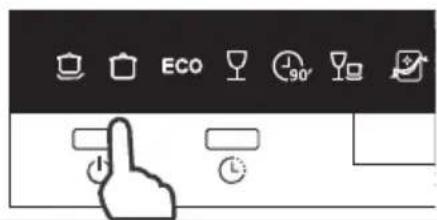
STISKNUTÍM TLAČÍTKA ON/OFF (ZAPNUTO/VYPNUTO) ZAPNĚTE SPOTŘEBIČ. OTEVŘETE DVÍŘKA.
ZKONTROLUJTE HLADINU REGENERAČNÍ SOLI
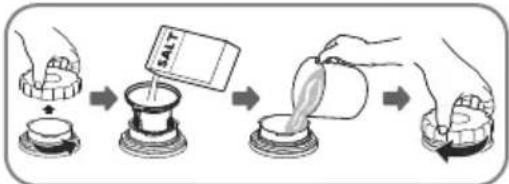
flowchart
graph LR
    A["Hand holding a salt container"] --> B["Add salt to a container"]
    B --> C["Transfer to a salt container with salt into a container"]
    C --> D["Carrying from salt to a container with salt"]

POUŽÍVEJTE POUZE SÚL SPECIÁLNĚ URČENOU DO MYČEK NÁDOBÍ!
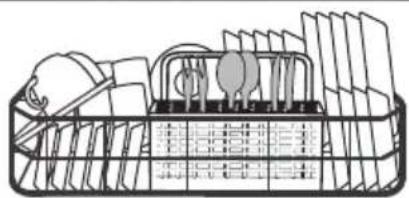
NAPLŠTE KOŠE
natural_image
Illustration of a basket containing various items, including gloves and containers (no text or symbols)OŠKRÁBEJTE VETŠÍ KUSY ZBYTKŮ JÍDLA. VKLÁDEJTE POUZE NÁDOBÍ VHODNÉ DO MYČKY NÁDOBÍ.
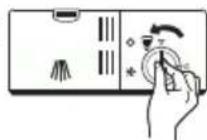
ZKONTROLUJTE ÚROVEŇ LEŠTÍCÍHO PŘÍPRAVKU
1
2
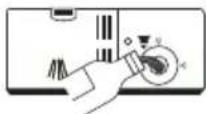
3
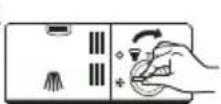
4
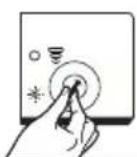

PŘÍPRAVEK, KTERÝ SE VYLIJE VYTŘETE ABSORPČNÍ TKANINOU, ABY SE BĚHEM MYTÍ NETVOŘILA NADBYTEČNÁ PĚNA. NEZAPOMEŇTE DÁT VÍČKO ZPÁTKY.
OTEVŘETE VODOVODNÍ KOHOUTEK A STISKNĚTE TLAČÍTKO START / PAUZA
VYPNĚTE SPOTŘEBIČ
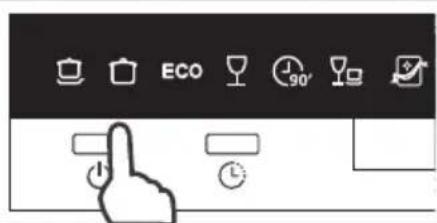
POKUD KONTROLKA
PROGRAMU SVÍTÍ,
ALE NEBLIKÁ, PAK
PROGRAM SKONČIL.
ZAVŘETE VODOVODNÍ KOHOUTEK, VYLOŽTE KOŠÍKY
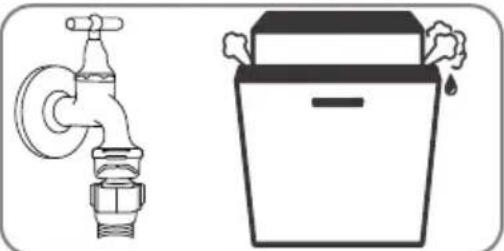
natural_image
Illustration of a faucet and a bucket with water drop (no text or symbols)OTEVŘETE DVÍŘKA MYČKY
A PONECHEJTE JE NĚKOLIK
MINUT OTEVŘENÁ PŘEDTÍM, NEŽ ZAČNETE
NÁDOBÍ VYKLÁDAT.
VYČISTĚTE FILTRY
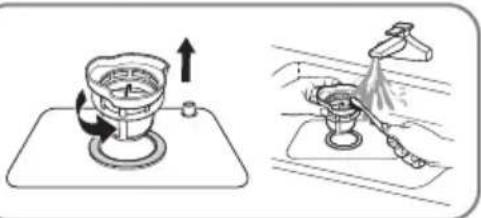
natural_image
Illustration showing a pump being turned into a side panel and then placed on a surface with a spray bottle (no text or symbols)Po KAŽDÉM POUŽITÍ MYČKY
ZKONTROLUJTE FILTRY, NEJSOU-LI UCPÁNY.
OBSAH
CZ - MYČKA NÁDOBÍ
- DÜLEŽITÉ BEZPEČNOSTNÍ INFORMACE ....4
- LIKVIDACE A EKOLOGIE 7
- PROVOZNÍ POKYNY 8
- PŘED PRVNÍM POUŽITÍM 9
- VKLÁDÁNÍ NÁDOBÍ DO KOŠŮ MYČKY DLE EN 60436....15
- ZAPNUTÍ SPOTŘEBIČE 19
- ÚDRŽBAA ČIŠTĚNÍ 22
- POKYNY K INSTALACI 25
- TIPY PRO ŘEŠENÍ PROBLÉMŮ 27
- TECHNICKÉ INFORMACE ....31
- PÉČE O ZÁKAZNÍKA A SERVIS....33
Vážný zákazníku,
natural_image
Symbol of a trash bin crossed out by two crossed lines, with a black rectangle below (no text or labels)natural_image
Line drawing of a laboratory setup with a hand holding a container above a bowl, no text or symbols presentnatural_image
Illustration of a bottle with a cap and a droplet, no text or symbols present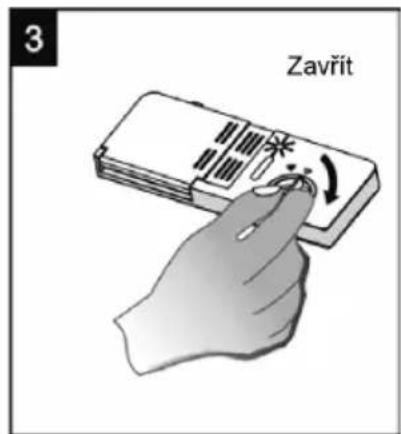
natural_image
Exploded view diagram of a kitchen appliance with labeled components (no text or symbols)Poznámka
natural_image
Technical line drawing of a mechanical assembly inside a vehicle (no text or symbols)natural_image
Close-up of a mechanical component with a glass and a curved arrow labeled 'Open' (no other text or symbols visible)natural_image
3D mechanical component with mounting holes and a directional arrow (no text or symbols)natural_image
Technical line drawing of a rectangular electronic device with internal components and mounting points (no text or symbols)natural_image
Line drawing of hands adjusting a pipe fitting with a faucet (no text or symbols)Umístění spotřebiče
natural_image
Technical line drawing of a mechanical assembly with a magnified inset showing a tool inserted into a spring-loaded component (no text or symbols present)natural_image
Pure technical diagram of a mechanical or electrical system without any text, numbers, or symbols
PRIPOJTE PRÍVODNÚ HADICU, VYPÚŠTACÍ HADICU, ELEKTRICKÝ PRÍVOD.
ZAPNITE SPOTREBIČ
STLAČENÍM TLAČIDLA ON/OFF (ZAPNUTÉ/VYPNUTÉ) ZAPNITE SPOTREBIČ. OTVORTE DVIERKA..
SKONTROLUJTE HLADINU REGENERAČNEJ SOLI
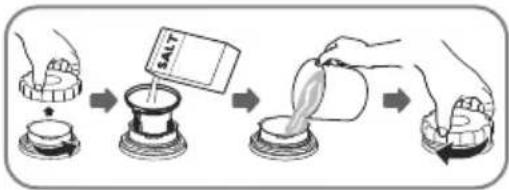
flowchart
graph LR
    A["Person mixing cup with salt"] --> B["Add salt"]
    B --> C["Add liquid into container"]
    C --> D["Add liquid into container with salt"]

POUŽÍVAJTE VŽDY SOL' URČENÚ PRE UMÝVAČKY RIADU.
NAPLŠTE KOŠÍKY
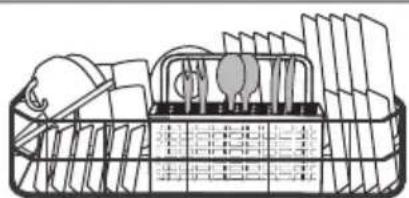
natural_image
Illustration of a basket filled with various items, including a tray, legs, and a plate (no text or symbols)OŠKRABTE VÄCŠÍ KUSY ZVÝŠKOV JEDLA. VKLADAJTE LEN RIAD VHODNÝ DO UMÝVAČKY RIADU.
SKONTROLUJTE ÚROVEŇ LEŠTIACEHO PRÍPRAVKU
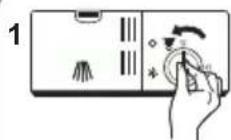
2
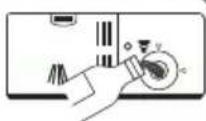
4

LEŠTIACI PRÍPRAVOK, KTORÝ SA VYLEJE, VYTRITE ABSORPČNOU TKANINOU, ABY SA POČAS UMÝVANIA NETVORILA NADBYTOČNÉ PENA. NEZABUDNITE DAŤ VEKO SPÄŤ.
NAPLŇTE DÁVKOVAČ PRE PROSTRIEDOK NA UMÝVANIE
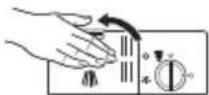
PRIEHRADKA A:
PRE KAŽDÝ UMÝVACÍ CYKLUS
PRIEHRADKA B:
LEN PRE PROGRAMY S PREDMYTÍM
ZVOLTE PROGRAM

EKO->SKLO->
90MIN->RÝCHLY->OPLACH->
ÚDRŽBA->INTENZÍVNY->
UNIVERZÁLNY
SPUSŤTE UMÝVAČKU
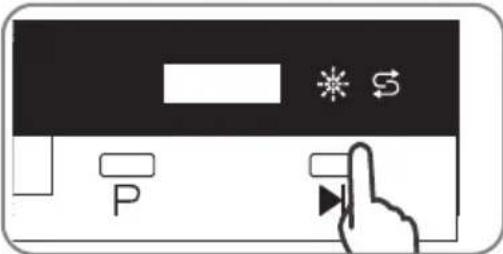
OTVORTE VODOVODNÝ KOHÚTIK A STLAČTE TLAČIDLO START / PAUSE
VYPNITE SPOTREBIČ
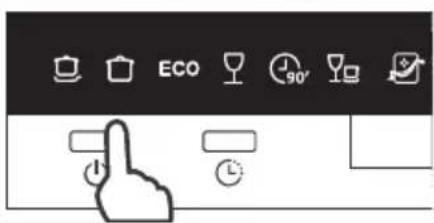
ÁK KONTROLKA PROGRAMU SVIETI, ALE NEBLIKÁ, POTOM PROGRAM SKONČIL.
ZAVRITE VODOVODNÝ KOHÚTIK, VYLOŽTE KOŠÍKY
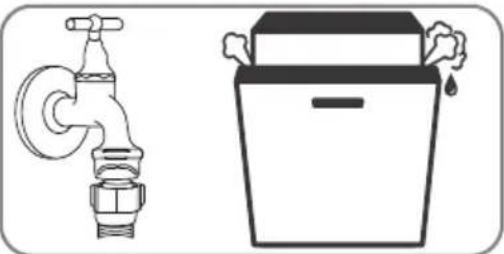
natural_image
Illustration of a faucet and a bucket with water drop (no text or symbols)ÖTVORTE DVIERKA UMÝVAČKY A PONECHAJTE ICH NIEKOLKO MINÚT OTVORENÉ PREDTÝM, NEŽ ZAČNETE RIAD VYKLADAŤ.
VYČISTITE FILTRE
natural_image
Illustration of a portable stove burner and a spray gun on a surface (no text or symbols)PO KAŽDOM POUŽITÍ UMÝVAČKY SKONTROLUJTE FILTRE, AK NIE SÚ UPCHATÉ.
OBSAH
SK - UMÝVAČKA RIADU
- PRED POUŽITÍM SI PREČÍTAJTE VŠETKY POKYNY....36
- LIKVIDÁCIAA EKOLÓGIA 38
- PREVÁDZKOVÉ POKYNY....40
- PRED PRVÝM POUŽITÍM....41
- VKLADANIE RIADU DO KOŠOV UMÝVAČKY PODL'A EN60436 47
- ZAPNUTIE SPOTREBIČA....51
- ÚDRŽBAA ČISTENIE ....54
- POKYNY K INŠTALÁCII 57
- TIPY PRE RIEŠENIE PROBLÉMOV 60
- TECHNICKÉ INFORMÁCIE 63
- STAROSTLIVOSŤ O ZÁKAZNÍKA A SERVIS....65
Vážený zákazník,
natural_image
Symbol of a trash bin crossed with a diagonal line, no text or numbers presentnatural_image
Line drawing of a laboratory balance scale with a hand holding a sample and a small bowl on top (no text or symbols)natural_image
Illustration of a hand holding a bottle with a lid and a magnified view of the bulb (no text or symbols)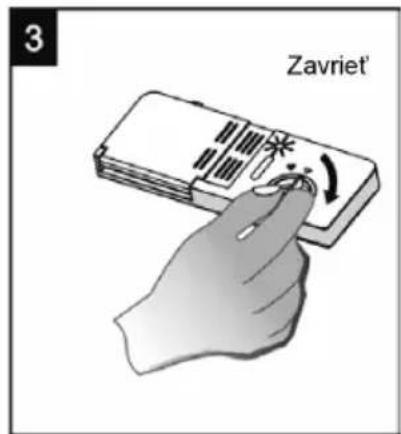
natural_image
Exploded view diagram of a kitchen appliance showing kitchen sink, dashboard, and air vent (no text or labels)Poznámka
natural_image
Technical line drawing of a mechanical assembly with no visible text or symbolsnatural_image
3D mechanical component with a cylindrical feature and an upward arrow indicator (no text or symbols)natural_image
Technical line drawing of a rectangular electronic device with internal components and mounting brackets (no text or symbols)natural_image
Illustration of hands adjusting a faucet handle (no text or symbols present)Umiestnenie spotrebiča
natural_image
Technical line drawing of a mechanical assembly with a magnified inset showing a screw being inserted into a housing (no text or symbols present)natural_image
Pure technical diagram of a mechanical or electrical system with no text, numbers, or symbols
POŁĄCZYĆ WĄŻ ZASILAJĄCY, WĄŻ SPUSTOWY, ZASILANIE ELEKTRYCZNE
WŁĄCZ URZĄDZENIE
NACIŚNIJ PRZYCISK ON/OFF (WŁĄCZANIE / WYŁĄCZANIE), ABY WŁĄCZYĆ URZĄDZENIE. OTWÓRZ DRZWI.
SPRAWDŹ POZIOM SOLI REGENERACYJNEJ
flowchart
graph LR
    A["Raw Material Mix"] --> B["Add Salt"]
    B --> C["Add Cover"]
    C --> D["Add Bag"]
    D --> E["Product Packaging"]

UŻYWAJ TYLKO SPECJALNIE ZAPROJEKTOWANEJ SOLI DO ZMYWAREK!
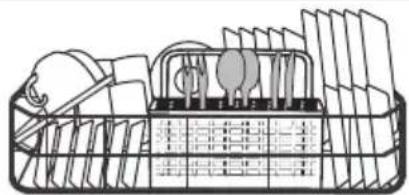
NAPEŁNIJ KOSZE
natural_image
Line drawing of a basket containing various items, including a tray with a bag and a tray holding a bag (no text or symbols)ZDRAP WIĘKSZE KAWAŁKI RESZTEK JEDZENIA. WKŁADAJ TYLKO NACZYNIA, KTÓRE MOŻNA MYĆ W ZMYWARCE.
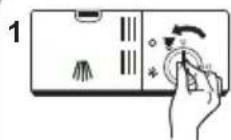
SPRAWDŹ POZIOM JĘZYKA POLSKIEGO
2
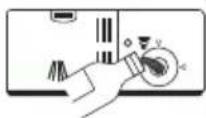
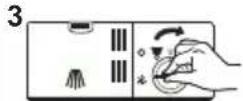
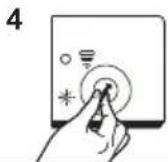

LEŠTIACI PRÍPRAVOK, KTORÝ SA VYLEJE, VYTRITE ABSORPČNOU TKANINOU, ABY SA POČAS UMÝVANIA NE- TVORILA NADBYTOČNÉ PENA. NEZABUDNITE DAŤ VEKO SPĚT.
NAPEŁNIJ DOZOWNIK DETERGENTU
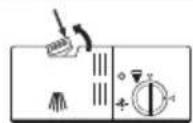
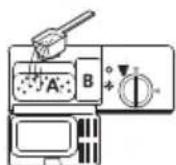
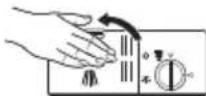
PRIEHRADKA A:
PRE KAŽDÝ UMÝVACÍ CYKLUS
PRIEHRADKA B:
LEN PRE PROGRAMY S PREDMYTÍM
WYBIERZ PROGRAM

flowchart
graph LR
    A["Hand icon"] --> B["Container with two icons"]
    style A fill:#f9f,stroke:#333
    style B fill:#ccf,stroke:#333
EKO->SZKLO->
90MIN->SZYBKI->PŁUKANIE->
KONSERWACJA->INTENSYVNY->
UNIWERSALNY
URUCHOM ZMYWARKE
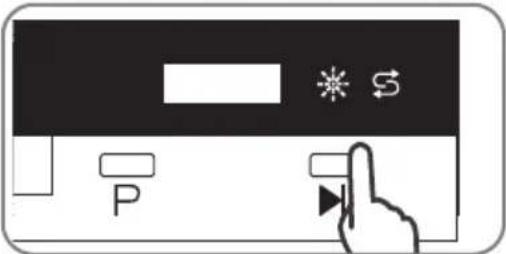
OTWÓRZ KRAN, NACIŚNIJ PRZYCISK START / PAUZA
WYŁACZYĆ URZĄDZENIE
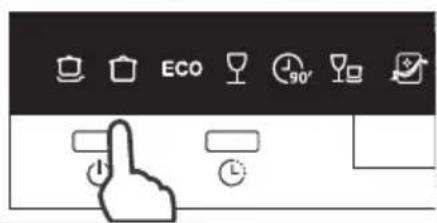
WSKAŻNIK STATUSU ŚWIECI SIĘ, NIE MIGA, TYLKO W TYM PRZYPADKU PROGRAM JEST ZAKOŃCZONY.
ZAMKNIJ KRAN, WYLADOWAĆ KOSZE
natural_image
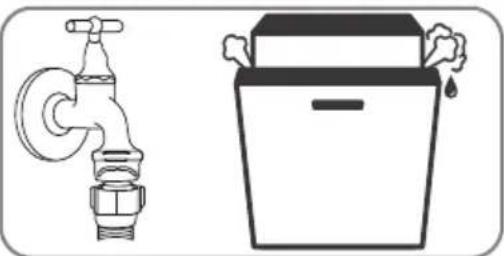
Illustration of a faucet and a bucket with water drop (no text or symbols)OTWORZYĆ DRZWICZKI ZMYWARKI, POZOSTA-WIĆ JE UCHYLONE NA KILKA MINUT, A NASTĘP-NIE WYJĄĆ NACZYNIA.
11 OCZYŚĆ FILTRY
natural_image
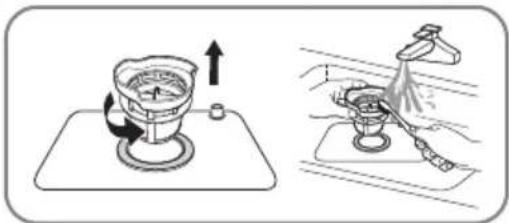
Illustration showing a cooking pot and a hand washing a water dispenser on a surface (no text or symbols)PO ZAKOŃCZENIU KAŻDEGO CYKLU ZMYWANIA NALEŻY SPRAWDZAĆ CZY W FILTRACH NIE ZATRZYMAŁY SIĘ JAKIEŚ RESZTKI.
ZAWARTOŚĆ
PL - ZMYWARKA
- WAŻNE WSKAZÓWKI BEZPIECZEŃSTWA 68
- UTYLIZACJA I EKOLOGIA....71
- INSTRUKCJA OBSŁUGI 72
- PRZED PIERWSZYM URUCHOMIENIEM 73
- UKŁADANIE NACZYŃ W KOSZU ZMYWARKI (EN 60436) 79
- URUCHOMIENIE URZĄDZENIA....83
- CZYSZCZENIE I KONSERWACJA....86
- INSTRUKCJA INSTALACJI URZADZENIA....89
- ROZWIAZYWANIE PROBLEMÓW....92
- INFORMACJE TECHNICZNE....95
- OPIEKA NAD KLIENTEM I SERWIS 97
natural_image
Symbol of a trash bin crossed with diagonal lines, no text or numbers presentnatural_image
Line drawing of a laboratory setup with a hand holding a container above a bowl, no text or symbols presentnatural_image
Illustration of a cleaning tool with a bottle and a magnifying glass (no text or symbols)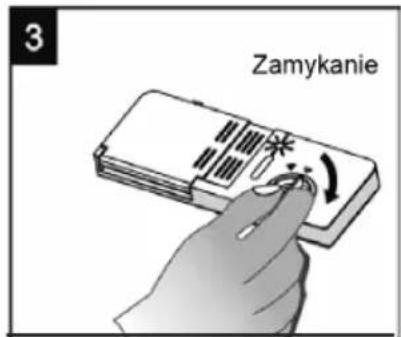
natural_image
Technical illustration of a mechanical device with labeled components (no text or symbols present)Ważne:
natural_image
Technical line drawing of a mechanical assembly with no visible text or symbolsnatural_image
3D rendered mechanical component with two cylindrical features and an upward arrow indicator (no text or symbols)Zestaw filtrów
natural_image
Technical line drawing of a rectangular electronic device with internal components and mounting points (no text or symbols)natural_image
Illustration of hands adjusting a pipe fitting with a faucet (no text or symbols)natural_image
Technical line drawing of a mechanical assembly with a magnified inset showing a tool inserted into a spring (no text or symbols)Podłączenie syfonu
CONNECT THE APPLIANCE
natural_image
Pure schematic diagram of a mechanical or electrical system with no text, numbers, or symbols
CONNECT THE SUPPLY HOSE, DRAIN HOSE, ELECTRICAL SUPPLY.
SWITCH ON THE APPLIANCE
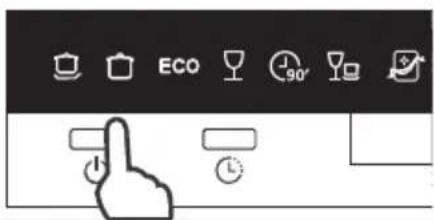
PRESS THE ON/OFF BUTTON TO SWITCH ON THE APPLIANCE, OPEN THE DOOR.
flowchart
graph LR
    A["Person mixing a cup"] --> B["Add salt"]
    B --> C["Salt container with liquid"]
    C --> D["Add liquid into cup"]
    D --> E["Divine pouring"]

ONLY USE SALT SPECIFICALLY DESIGNED FOR THE USE IN DISHWASHERS.
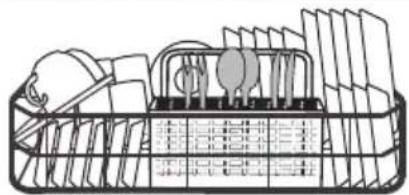
LOAD THE BASKETS
natural_image
Illustration of a basket containing various items, including a tray with a bag and a ruler, with no visible text or symbols.SCRAPE OFF ANY LARGE AMOUNT OF LEFTOVER FOOD. USE ONLY DISHWASHER SAFE DISHES.
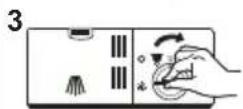
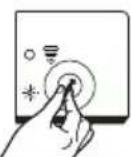
CHECK THE RINSE AID LEVEL
1
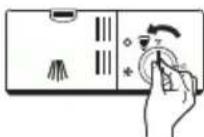
2
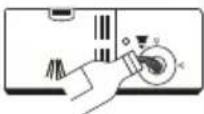
3
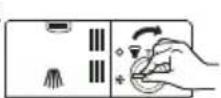
4
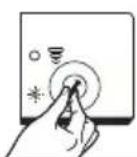

CLEAN UP ANY RINSE AID SPILLED WHILE DURING FILLING WITH AN ABSORBENT CLOTH TO AVOID EXCESSIVE FOAMING DURING THE WASH. DON'T FORGET TO PLACE THE CAP BEFORE YOU CLOSE DISHWASHER DOOR.
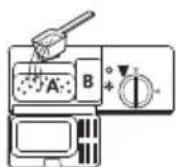
FILL THE DETERGENT DISPENSER
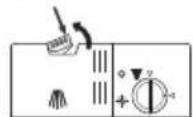
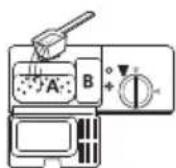
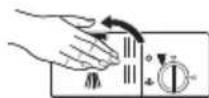
COMPARTMENT A: WITH EACH WASH CYCLE.
COMPARTMENT B: FOR PROGRAMMES WITH PRE-WASH ONLY.
SELECT A PROGRAM
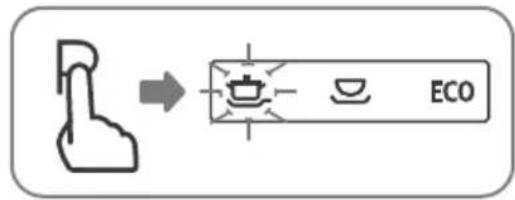
ECO->GLASS->90MIN->
RAPID->SOAK->
SELF-CLEANING->
INTENSIVE->UNIVERSAL
START THE DISHWASHER
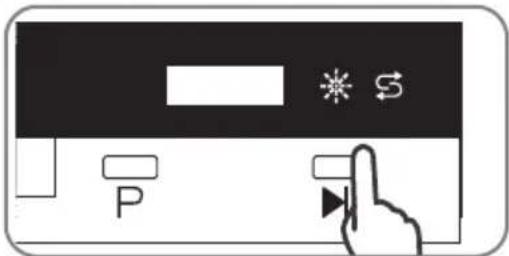
TURN ON THE WATER TAP
AND PRESS THE
START/PAUSE BUTTON.
SWITCH OFF THE APPLIANCE
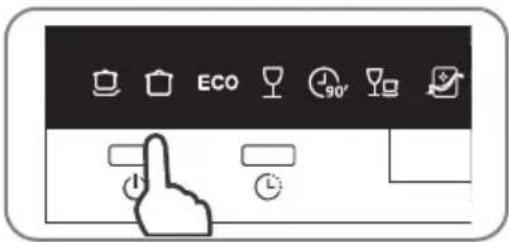
THE PROGRAM LIGHT IS ON
BUT IS NOT BLINKING, ONLY IN THIS CASE
THE PROGRAMME HAS ENDED.
TURN OFF THE WATER TAP, UNLOAD THE BASKETS
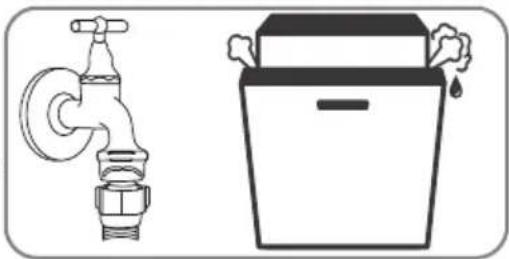
natural_image
Illustration of a faucet and a bucket with water droplets (no text or symbols)OPEN THE DISHWASHER'S DOOR, LEAVE IT AJAR AND WAIT A FEW MINUTES BEFORE REMO-VING THE DISHES.
CLEAN THE FILTERS
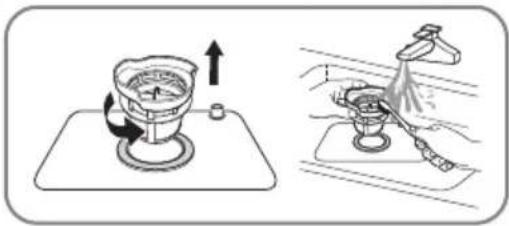
natural_image
Illustration of a cooking step showing a steamer being heated by a hand using a spray gun (no text or symbols present)INSPECT THE FILTERS FOR
BLOCKING AFTER EVERY TIME THE DISHWASHER HAS BEEN USED.
CONTENT
EN - DISHWASHER
- IMPORTANT SAFETY INFORMATION ....100
- DISPOSAL AND ECOLOGY....103
- OPERATION INSTRUCTION....104
- PRIOR USING FOR THE FIRST TIME 105
- LOADING THE DISHWASHER RACKS (EN 60436)....111
- TURNING ON THE APPLIANCE 115
- MAINTANCE AND CLEANING....118
- INSTALLATION INSTRUCTION 121
- TROBLESHOOTING TIPS 124
- TECHNICAL INFORMATION ...... 127
- CUSTOMER CARE AND SERVICE....129
Dear Customer,
Please read this User Information carefully and keep it to refer to at a late r date.
Pass it on to any subsequent owner of the appliance.
- This manual contains sections of Safety Instructions, Operating Instructions, Installation Instructions and Troubleshooting Tips etc.
- Carefully reading it before using the dishwasher will help you to use and maintain the dishwasher properly.
Before Calling for Service
To review the section on Troubleshooting Tips will help you to solve some common problems by yourself and not need to ask for the help of professional technicians.
Note
The manufacturer, following a policy of constant development and up-dating of the product, may make modifications without giving prior notice.
1. IMPORTANT SAFETY INFORMATION
READ ALL INSTRUCTION BEFORE USING
WARNING
When using your dishwasher, follow the below basic precautions including the following:
WARNING!
(valid for the appliances, connected to hot water)
Under certain conditions, Hydrogen gas may be produced in a hot-water system that has not been used for two weeks or more. HYDROGEN GAS IS EXPLOSIVE. If the hot-water system has not been used for such a period, before using the dishwasher turn on all hot-water faucets and let the water f low f rom each for sever al minutes. This will release any accumulated hydrogen gas. As the gas is flammable, do not smoke or use an open flame during this time.
PROPER USE
-
Do not abuse, sit on, or stand on the door or dish rack of the dishwasher
☐ Do not touch the heating element during or immediately after use -
Do not operate your dishwasher unless all enclosure panels are properly in place. Open the door very carefully if the di shwasher is operating. There is a risk of water squirting out.
- Do not place any heavy objects on the door when it is open, or the appliance could tip forward.
When loading items to be washed:
- Locate sharp items so that they are not likely to damage the door seal
- Load sharp knives with the handles up to reduce the risk of cut-type injuries
WARNING
knives and other utensils with sharp points must be loaded in the basket with their points down or placed in a horizontal position.
- When using your dishwasher, you should prevent plastic items from contact ing with heating element.
- Check that the detergent receptacle is empty after completion of the wash cycle.
- Do not wash plastic items unless they are marked dishwasher safe or the equivalent. For plastic items not so marked, check the manufacturer's recommendations.
- Use only detergent and rinse additives designed for an automatic dishwasher. Never use soap, laundry detergent, or hand washing detergent in your dishwasher.
- Keep children away from detergent and rinse aid, keep children away from the open door of the dishwasher, there could still be some detergent left i nside.
☐ Young children should be supervised to ensure that they do not play with the appliance.
☐ The appliance is not intended for use by young children or infirm persons without supervision. - Dishwasher detergents are strongly alkaline. They can be extremely dangerous if swallowed. Avoid contact with skin and eyes and keep children away from the dishwasher when the door is open.
☐ The door should not be left in the open position since this could present a tripping hazard. - This dishwasher is designed for normal household and indoor use.
EN
- If the supply cord is damaged, it must be replaced by the manufacturer or its service agent or a similarly qualified person in order to avoid a hazard.
- Please dispose of packing materials properly.
- Use the dishwasher only for its intended function.
During installation, the power supply must not be excessively or dangerously bent or flattened.
☐ Do not tamper with controls.
☐ The appliance is to be connected to the water mains using new hose sets and the old hose-sets should not be reused.
This appliance is not intend for use by persons(include children) with reduced physical, sensory or mental capabilities, or lack of experience and knowledge, unless they have been given supervision or instruction concerning use of the appliance by a person responsible for their safety - Please unplug before cleaning the appliance.

WARNING: Do not use this product near water, in wet areas to avoid fire or injury of electric current. Always turn off the product when you don't use it or before a revision. There aren't any parts in this appliance which are reparable by consumer. Always appeal to a qualified authorized service. The product is under a dangerous tention.
READ AND FOLLOW THIS SAFETY INFORMATION CAREFULLY SAVE THESE INSTRUCTIONS
2. DISPOSAL AND ECOLOGY
- Do not dispose this product as unsorted municipal waste.
- Collection of such waste separately for special treatment is necessary.
- Dispose of the dishwasher packaging material correctly.
- All packaging materials can be recycled.
- Plastic parts are marked with the standard international abbreviations:
PE for polyethylene, e.g. sheet wrapping material
PS for polystyrene, e.g. padding material
POM polyoxymethylene, e.g. plastic clips
PP polypropylene, e.g. Salt filler
ABS Acrylonitrile Butadiene Styrene, e.g. Control Panel.
WARNING!
Packaging material could be dangerous for children!
- For disposing of package and the appliance please go to a recycling centre.
- Therefore cut off the power supply cable and make the door closing device unusable.
- Cardboard packaging is manufactured from recycled paper and should be dis posed in the waste paper collection for recycling.
- By ensuring this product is disposed of correctly, you will help prevent potential negative consequences for the environment and human health, which could otherwise be caused by inappropriate waste handling of this product.
- For more detailed information about recycling of this product, please contact your local city office and your household waste disposal service.
natural_image
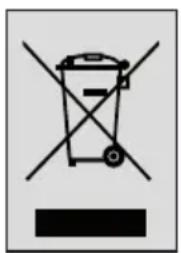
Symbol of a trash bin crossed with a diagonal line, no text or numbers presentThis symbol appearing on the product, on the product accessories or on the product packing means that the product must not be disposed as household waste. When the product/ battery durability is over, please, deliver the product or battery (if it is enclosed) to the respective collection point, where the electrical appliances or batteries will be recycled. The places, where the used electrical appliances are collected, exist in the European Union and in other European countries as well. By proper disposal of the product you can prevent possible negative impact on environment and human health, which might otherwise occur as a consequence of improper manipulation with the product or battery/ accumulator. Recycling of materials contributes to protection of natural resources. Therefore, please, do not throw the old electrical appliances and batteries/ accumulators in the household waste. Information, where it is possible to leave the old electrical appliances for free, is provided at your local authority, at the store where you have bought the product. Information, where you can leave the batteries and accumulators for free, is provided to you at the store, at your local authority.
To get the best performance from your dishwasher, read all operating instructions before using it for the first time.
Control Panel
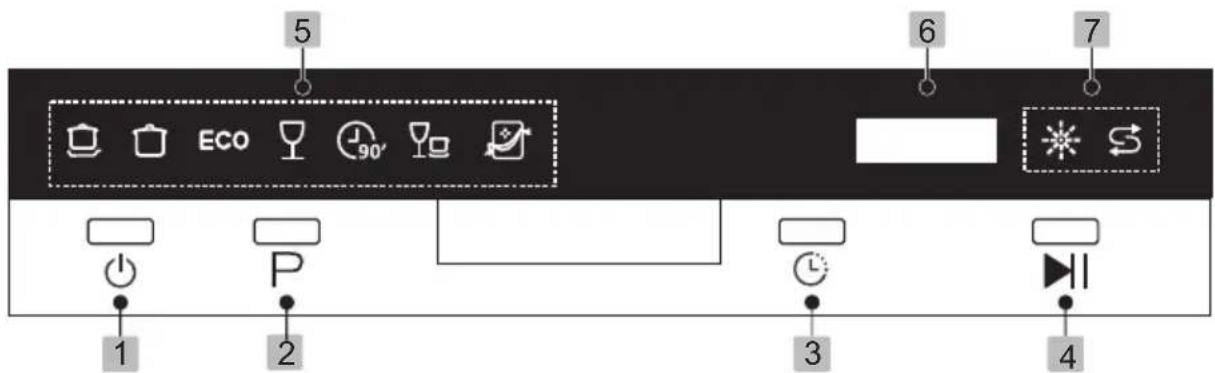
- Power Button: To turn on/off the power supply.
- Washing Program Selector: Press the button to select wash cycles.
- Delay Button: To press the button to delay.
- Start/Pause Button: Press this button to start or pause the dishwasher.
- Program indicator light.
- Display screen: to show the reminding time and the state(runningstate, delay time etc).
- *RinseAid Warning Light: To be on when the rinse aid dispenser needs to be refilled.
Salt Warning Light: To be on when the softener needsto be refilled.
Dishwasher Features
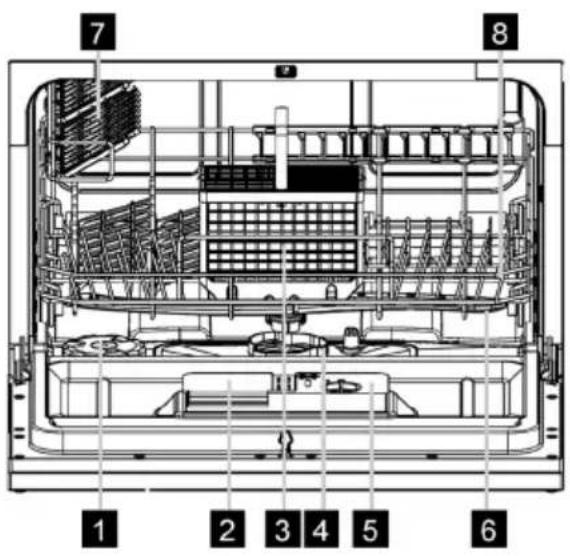
- Salt Container
- Detergent Dispenser
- Cutlery Basket
- Filter assembly
- Rinse Aid Dispenser
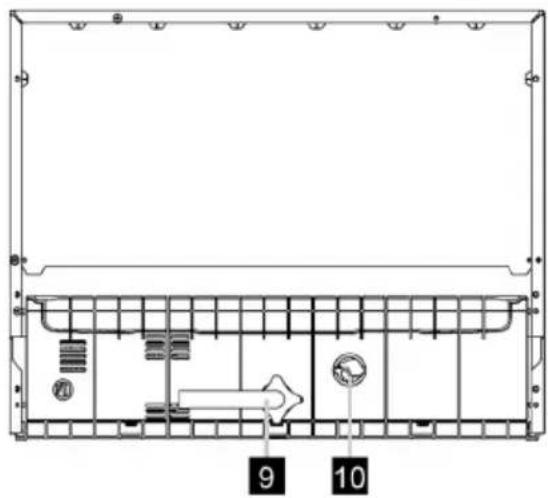
- Spray Arms
- Cup Shelf
- Basket
- Inlet pipe connector
- Drain pipe connector
4. PRIOR USING FOR THE FIRST TIME
Before using your dishwasher for the first time:
- Set the water softener
- Pour 12 litre of water inside the salt container and then fill with dishwasher salt
- Fill the rinse aid dispenser
- Fill in detergent.
A. WATER SOFTENER
- The water softener must be set manually, using the water hardness dial.
- The water softener is designed to remove minerals and salts from the water, which would have a detrimental or adverse effect on the operation of the appliance. The higher the content of these minerals and salts, the harder your water is. The softener should be adjusted according to the hardness of the water in your area. Your local Water Authority can advise you on the hardness of the water in your area.
Adjusting Salt Consumption
Step 1: Enter the status of salt adjustment
- Close the door, within 60 second after power on, press START/PAUSE button for 5 seconds at the same time, then enter setting mode. Digital display stalls "H*",
- The controller factory default H4.
Step 2: select a certain level of salt consumption
- Different programs stand for different level of salt consumption.
- It is recommended to select this level according to below table:
| Water Hardness level | Setting on the water softener | Digital display stalls | Regeneration occurs every x programme sequence 3) | |
| ^^1) | mmol/ I^2) | |||
| 0 – 5 0 – | 0.9 1H1 (Rapid) OFF | |||
| 6 – 11 1.0 | – 2.0 2 H2 (90min) 10 | |||
| 12 – 17 2.1 | – 3.0 3 H3 (90min, Rapid) 5 | |||
| 18 – 22 3.1 | – 4.0 4*H4 (Glass) 3 | |||
| 23 – 34 4.1 | – 6.1 5H5 (Glass, Rapid) | 2 | ||
| 35 – 55 6.2 | – 8.0 6 H6 (Glass, 90min) | 1 | ||
1) German degree of measurement for the water hardness
2) millimol, international unit for water hardness
*) factory setting
3) Every cycle with a regeneration operation consumes additional 2 litres of water, the energy consumption increases by 0.02 kWh and the programme extents by 4 minutes.
There are 6 levels of salt consumption in total
- When you push START/PAUZA button, digital display stalls of information. Press START/PAUZA button every time, stalls by "H1 – H2 – H3 – H4 – H5 – H6 – H1" cycle of change
- In setting mode, don't press any button minimally for 5 sec, in order to exit the settling mode, the machine will get into standby
- Then you can select a program to start your machine.
Water softener
- The hardness of the water varies from place to place.
- If hard water is used in the dishwasher, deposits will from on the dishes and utensils.
- The appliance is equipped with a special softener that uses a salt specifically designed to eliminate lime and minerals from the water.
Loading the Salt into the Softener
- Always use salt intende d for use with dis hwasher.
- The salt container is located beneath the rack and should be filled as follows:
ATTENTION!
Only uses alt specifically designed for use in dishwa shers! All other types of salt not specifically designed for use in a dishwas her, especially tablesalt, will damage the water softener. In case of damage s ca used by the use of unsui tabl e salt the manuf acturer does not give any warranty or is liable for any cause damages. Only fill withs alt just before starting one of the complete washing programmes. This will prevent any grains of salt or salty water, which may have been split, remai ni ng of the bottom of the machine for any period of time, which may cause corrosion. After the first wash cycle the control panel light expires.
WARNING:
if salt is not added, it will cause poor cleaning effect of dishes, and will produce scale.
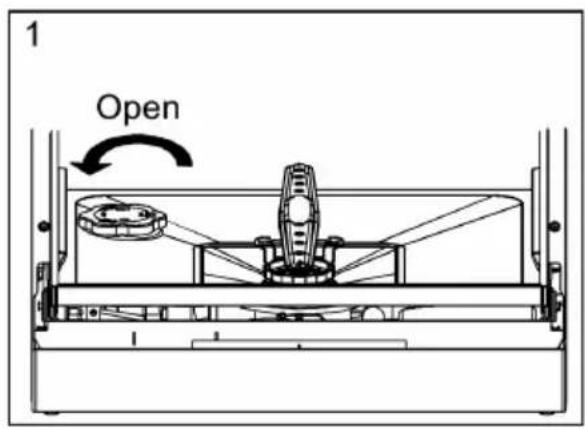
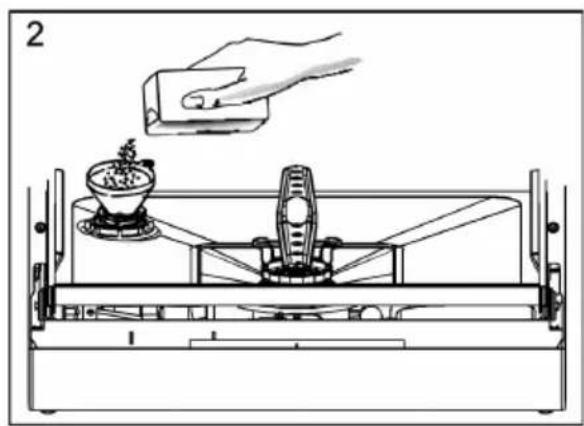
natural_image
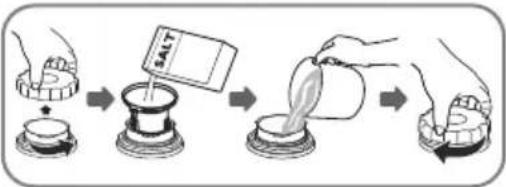
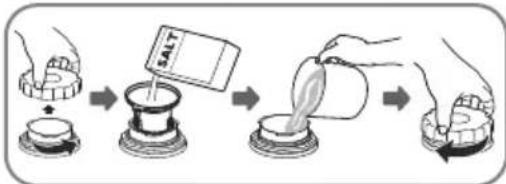
Line drawing of a cooking setup with a hand holding a tool above a bowl, no text or symbols present- Remove the basket and then unscrew and remove the cap from the salt container.
- If you are filling the container for the first time, fill 2/3 of its volume with water (around 500 ml).
- Place the end of the funnel (supplied) into the hole and introduce about 1,2 kg of salt. It is Normal for a small amount of water to come out of the salt container.
- Carefully screw the cap back on.
- Usually, the salt warning light will be off in 2-6 days after the salt container be filled with salt.
- Immediately after filling the salt into the salt container, a washing programme should be started – suggest to use the rapid programm. Otherwise filter system, pump or other important parts of the machine may be damaged by salty water. It is out of warranty.
NOTE:
- The salt container must be refilled when the salt warning light in 1. the control panel comes on. Though the salt container is filled enough, the indicator light may not black out before the salt fully dissolve. If there is no salt warning light in the control panel (for some models), you can judge when to load the salt into the softener by the cycles that the dishwasher had run (see the foregoing schema).
- If there are spills of the salt, a soak program could be run to wipe them out.
B. ⚙ILL THE RINSE AID DISPENSER
Function of Rinse Aid
- Rinse aid is automatically added during the last rinse, ensuring thorough rinsing, and spot and streak free drying.
ATTENTION!
Only use branded rinse aid for dishwasher. Never fill the rinse aid dispenser with any other substances (e.g. dishwasher cleaning agent, liquid detergent). This would damage the appliance.
When to Refill the Rinse Aid Dispenser
- If there is no rinse-aid warning light in the control panel, you can judge the amount of rinse-aid by the color of the optical level indicator "D" located next to the cap. When the rinse-aid container is full, the whole indicator will be dark. As the rinse-aid diminishes, the size of the dark dot decreases. You should never let the rinse aid get below 1/4 full.
- As the rinse aid diminishes, the size of the black dot on the rinse aid level indicator changes, as illustrated below.

Full

^3/_4 Full

1 / 2 Full

14 Full

Empty
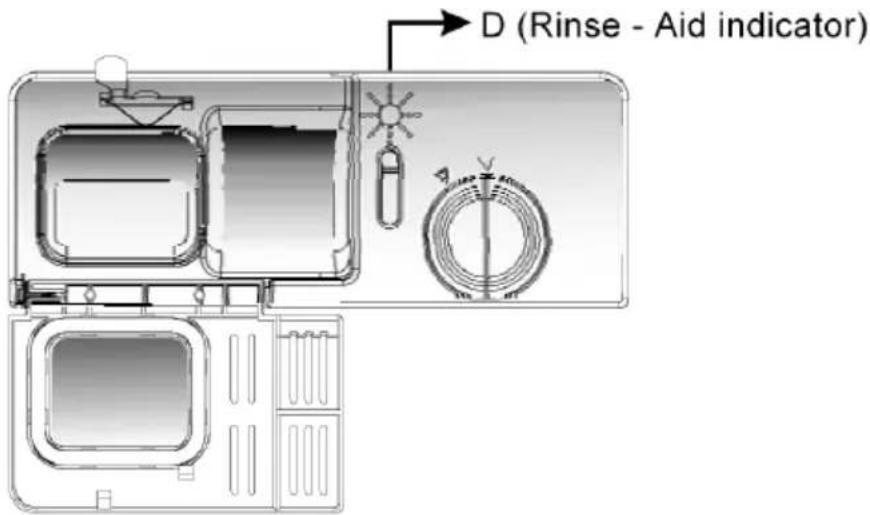
Rinse aid dispenser
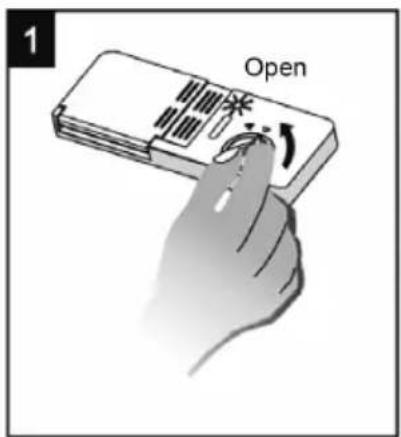
natural_image
Illustration of a bottle with a lid and a droplet falling from it (no text or symbols)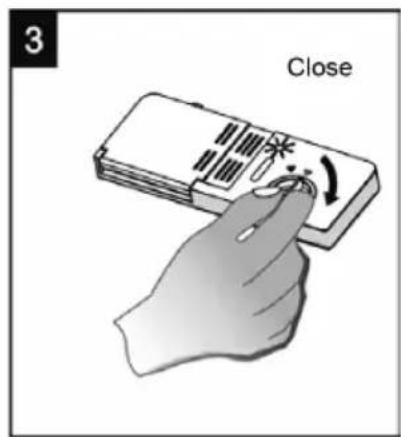
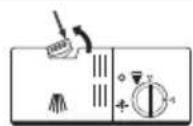
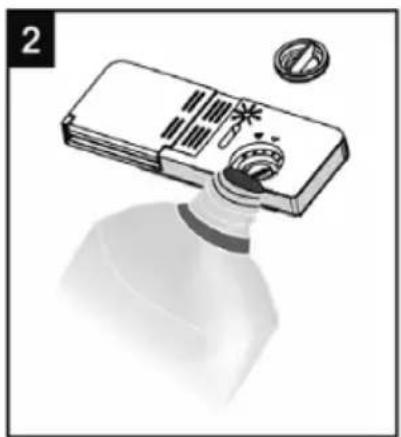
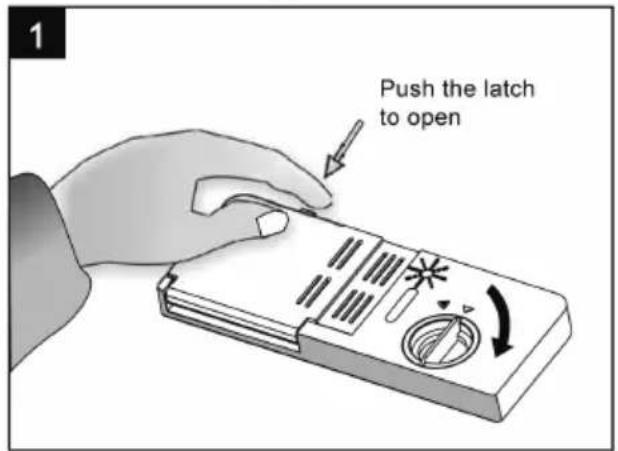
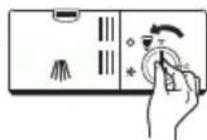
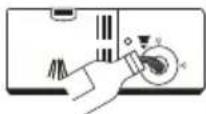
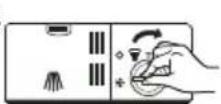
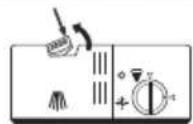
- To open the dispenser, turn the cap to the "open" (left) arrow and lift it out.
- Pour the rinse aid into the dispenser, being careful not to overfill.
-
Replace the cap by inserting it aligned with "open" arrow and turning it to the closed (right) arrow.
-
The rinse aid is released during the final rinse to prevent water from forming droplets on your dishes that can leave spots and streaks. It also improves drying by allowing water to sheet off the dishes.
- Your dishwashers are designed to use liquid rinse aids. The rinse aid dispenser is located inside the door next to the detergent dispenser. To fill the dispenser, open the cap and pour the rinse aid into the dispenser until the level indicator turns completely black.
- The volume of the rinse aid container is about 110 ml.
- Be careful not to overfill the dispenser, because this could cause over sudsing. Wipe away any spills with a damp cloth.
- Don't forget to replace the cap before you close dishwasher door.
ATTENTION!
Clean up any rinse aid split during filling with an absorbent cloth to avoid excess foaming during the next wash.
Adjusting rinse aid dispenser
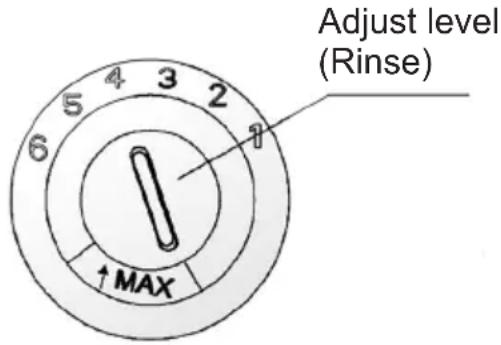
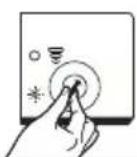
The rinse aid dispenser has six settings. Always start with the dispenser set on "4". If spots and poor drying are problems, increase the amount of rinse aid dispensed by removing the dispenser lid and rotating the dial to "5". If the dishes still are not drying properly or are spotted, adjust the dial to the next higher number until your dishes are spot-free. We suggest you to set on "4" (Factory value is "4")
NOTE
Increase the dose if there are drops of water or lime spots on the dishes after washing. Reduce it if there are sticky whitish streaks on the dishes or a bluish film on glassware or knife blades.
C. FUNCTION OF DETERGENT
Detergents with its chemical ingredients are necessary to remove dirt, crush dirt and transport it out of the dishwasher. Most of commercial quality detergents are suitable for this purpose.
Coccentrated Detergent
Based on their chemical composition, dishwasher can be split in two basic types:
- conventional, alkaline detergents with caustic components
- low alkaline concentrated detergents with natural enzymes
The use of “normal” washing programmes in conjunction with concentrated detergents reduces pollution and is good for your dishes; these wash programmes are specially matched to the dirt-dissolving properties of the enzymes of the concentrated detergent. For this reason “normal” wash programmes in which concentrated detergents are used can achieve the same results that can otherwise only be achieved using “intensive” programmes.
Detergent tablets
Detergent tablets of different brands dissolve at different speeds. For this reason some detergent tablets cannot dissolve and develop their full cleaning power during short programmes. Therefore please use long programmes when using detergent tablets, to unsure the complete removal of detergent residuals.
Detergent dispenser
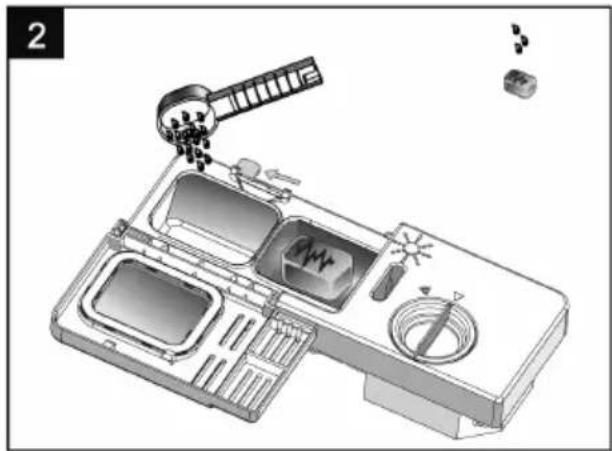
The dispenser must be refilled before the start of each wash cycle following the instructions provided in the Wash Cycle Table? Your dishwashers use less detergent and rinse aid then conventional dishwashers. Generally, only one tablespoon of detergent is needed for a normal wash load. Also, more heavily soiled items need more detergent. AI ways add the detergent just before starting dishwasher, otherwise it could get damp and will not di ssolve properly.
Amount of Dtergent to Use
natural_image
Exploded view diagram of a kitchen appliance with labeled components (no text or symbols)Note
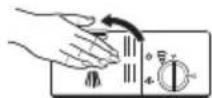
- If the lid is closed: press release button. The lid springs open.
- Always add the detergent just before starting each wash cycle.
- Only use branded detergent aid for dishwasher.
WARNING!
Dishwasher detergent is corrosive! Take care to keep it out of reach of children.
Proper Use of Detergent
- Use only detergent specifically made f or use in dishwashers. Keep your detergent fresh and dry. Don't put powder detergent into the dispenser until you're ready to wash dishes.
WARNING:
If the washing powder is not added, the washing effect will be poor, resulting in increased water and electricity consumption for secondary washing
Fill in detergent
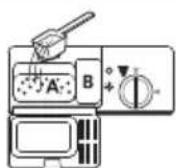
- Fill the detergent dispenser with detergent.
- The marking indicates the dosing levels, as illustrated on right:
A - The place of main wash cycle detergent placed, "MIN" means approximately 20 g of detergent.
B - The place of pre-wash cycle detergent placed, approximately 5 g of detergent
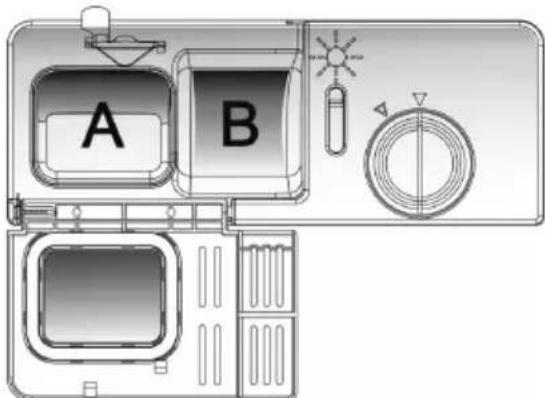
- Please observe the manufact urers dosing and storage recommendations as stated on the detergent packaging.
- Close the lid and press until it locks in place.
- If the dishes are heavily soiled, place an additional detergent dose in the pre-wash detergent chamber. This detergent will take effect during the pre-wash phase.
Note
You find information about the amount of detergent for the single programmes on the last page. Please aware, that according to the level soiling and the specific hardness of water differences are possible.
WARNING:
If the washing powder is not added, the washing effect will be poor, resulting in increased water and electricity consumption for secondary washing
Detergents
There are 3 sorts of detergents
- With phosphate and with chlorine
- With phosphate and without chlorine
- Without phosphate and without chloride
- Normally new pulverised detergent is without phosphate. The water softener function of phosphate is not given. In this case we recommend to fill salt in the salt con tainer even when the hardness of water is only 6 dH. If detergents without phosphate were used in case of hard water often white spots appear at dishes and glasses. In this case please ad d more detergent to reach better results. Detergent s wit hout chlorine do only bleach a little. Strong and coloured spots will not removed completely. In this case please choose a programme with higher temperature.
5. LOADING THE DISHWASHER RACKS (EN 60436)
- For best performance of the dishwasher, follow these loading guidelines. Features and appearance of racks and silverware baskets may vary from your model.
Attention before or after Loading the Dishwasher Racks
- Scrape off any large amounts of leftover food. It is not necessary to rinse the dishes under running water.
-
Place objects in the dishwasher in following way:
-
Items such as cups, glasses, pots/pans, etc. are stood upside down.
-
Curve items, or those with recesses, should be at a slant so that water can run off.
-
They are stacked securely and can not tip over.
-
They do not prevent the spray arms from rotating while washing takes place.
- Very small items should not be washed in the dishwasher as they could easily fall out of the racks.
WARNING:
If tableware placement is not standard, it will cause poor cleaning effect
Loading the Rack
1. Rack
with the cup rack without the cup rack
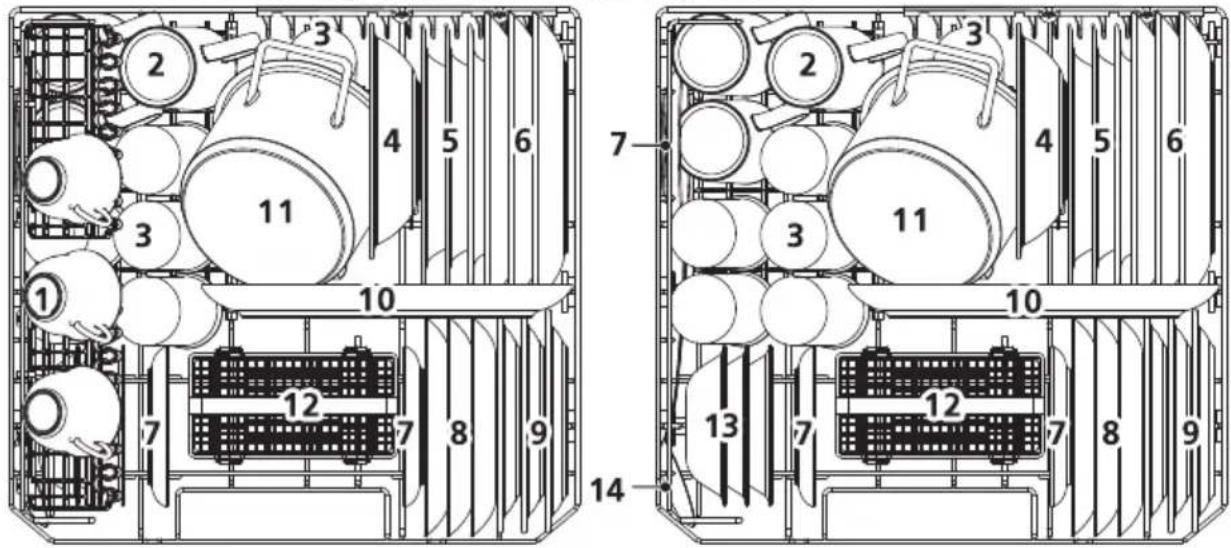
| Item Item | |
| 1Cups 8Dessert dishes | |
| 2 Mugs 9 Melamine dessert plates | |
| 3 Glasses 10 Oval platter | |
| 4Melamine bowl 11Small pot | |
| 5 | Soup plates 12 Cutlery basket |
| 6 Dinner plates 13 Dessert bowls | |
| 7Saucers 14Serving spoon | |
Plate racks of Basket
- The basket is fitted with plate racks which can be stowed horizontal if required.
Cup shelf
- The cup shelf could be stowed standing if no cup being placed, which can set more place.
2. Silverware Basket
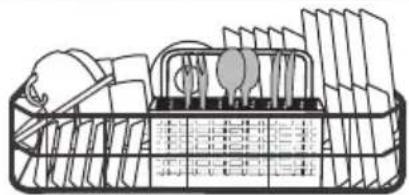
- Silverware should be placed in the silverware basket with handles at the bot tom: If the rack has side baskets, the spoon should be loaded individually into the appropriate slots, especially long utensils should be placed in the horizontal position at the front of the upper rack.
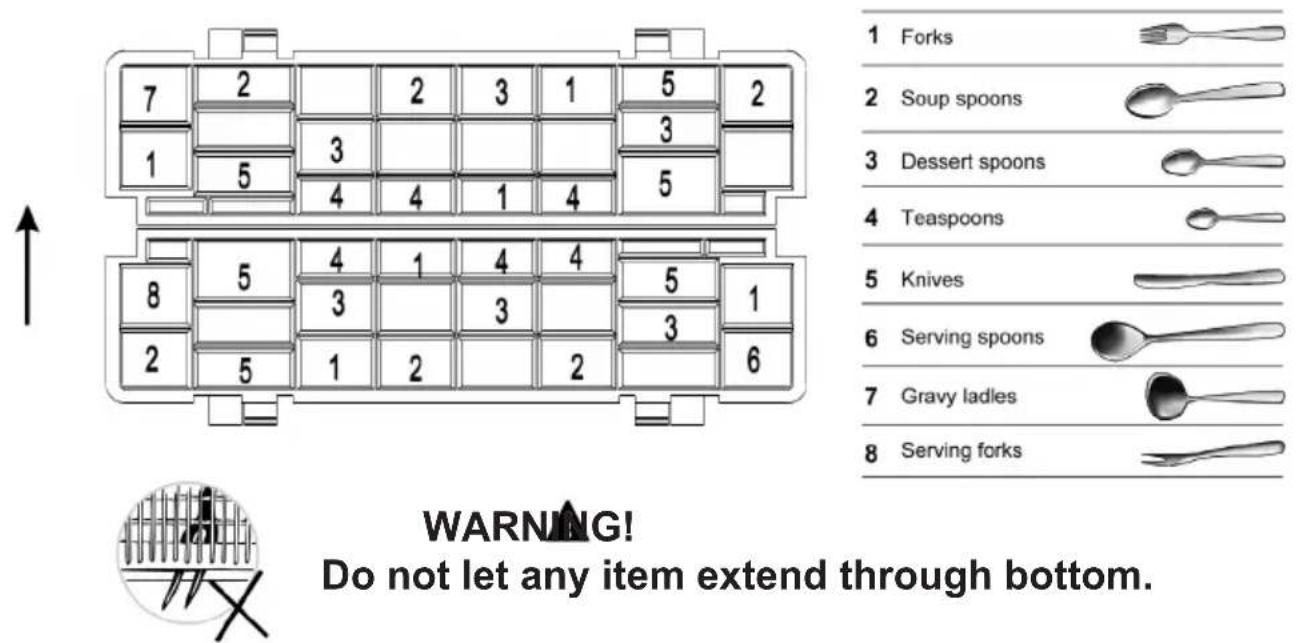
For washing in the dishwasher the following cutlery/dishes
Are not suitable
- Cutlery with wooden, horn china or mother-of-pearl handles
- Plastic items that are not heat resistant
- Older cutlery with glued parts that is not temperature resistant
- Bonded cutlery items or dishes
- Pewter or cooper items
- Lead crystal glass
- Steel items subject to rusting
- Wooden platters
- Items made from synthetic fibres
Are of limited suitability
- Some types of glasses can become dull after a large number of washes
- Silver and aluminium parts have a tendency to discolour during washing
- Glazed patterns may fade if machine washed frequently
Note
- Do not put in items that are dirty of cigarette ash, candle wax, lacquer or paint.
- If you buy new dishes please make sure that they are suitable for dishwashers.
Note
- Please do not overload your dishwasher. There is only space for 6 standard dishes.
- Do not use dish that is not suitable for dishwashers. This is important for good results and for reasonable energy consume.
Loading cutlery and dishes
Before loading the dishes, you should:
- Remove large left-over
- Soften remnants of burnt food in pans
When loading the dishes and cutlery, please note:
- Dishes and cutlery must not impede the rotation of the spray arms.
- Load hollow items such as cups, glasses, pans etc. with the opening downwards so that water cannot collect in the container or a deep base.
- Dishes and items of cutlery must not lie inside one another, or cover each other.
- To avoid damage to glasses, they must not touch
ATTENTION!
Long bladed knives stored in an upright position are a potential hazard! Long and/or sharp items of cutlery such as carving knives must be positioned horizontally in the upper basket.
Damage to glassware and other dishes
Possible causes
- Type of glass or manufacturing process. Chemical composition of detergent.
- Water temperature and duration of dishwasher programme.
Suggested remedy
- Use glassware or porcelain dishes that have been marked di shwasher-proof by the manufacturer
- Use a mild detergent that is described as kind of dishes If necessary, seek further information from detergent manufacturers.
- Select a program me with as low a temperature.
- To prevent damage, take glass and cutlery out of the di shwasher as soon as possible after the programme has ended.
At the End of the Wash Cycle
- When the working cycle has finished, the buzzer of dishwasher will mooing 8 seconds, then stop. Turn of the appliance using the ON/OFF button, shut off the water supply and open the door of the dishwasher. Wait a few minutes before unloading the dishwasher to avoid handling the dishes and utensils while they are still hot and more susceptible to breakage. They will also dry better.
6. TURNING ON THE APPLIANCE
Saving energy
- Pre-rinsing of tableware items leads to increased water and energy consumption and is not recommended.
- Washing tableware in a household dishwasher usually consumes less energy and water in the use phase than hand dishwashing when the household dishwasher is used according to the instructions.
Starting a cycle wash
- Draw out the basket, load the dishes and push them back.
- Pour in the detergent (see the section e`ntitled Salt, Detergent and Rinse Aid).
- Insert the plug into the socket. The power supply is 220 – 240 V AC / 50 Hz, the specification of the socket is 10 A 250 V AC. Make sure that the water supply is turned on to full pressure.
- Close the door, press the ON/OFF button, and the ON/OFF light will turn on.
- Press the program button. If a program is selected, the response light will light. Then press the START/PAUSE button, the dishwasher begins to wash.
WARNING!
When you press the START/PAUSE button to pause during washing, the program light will stop blinking and the dishwasher will mooing every minute unless you press the START/PAUSE button to start.
Change the Programme
- You can modified the washing program, just the dishwasher has been running for a short time. Otherwise, the detergent may have already been released, and the appliance may have already drained the wash water. If this is the case, the detergent dispenser must be refilled (see the section entitled “Loading the Detergent”).
- Press the Start/Pause button to pause the washing. Press Program button for more than 3 seconds - the program will cancel. Press the Program button to select the desired program. Press the Start/Pause button, after 1 seconds, the dishwasher will start.

flowchart
graph LR
    A["Hand Motion"] --> B["3 sec"]
    B --> C["Eco"]
    C --> D["End"]
Note
- If you open the door during a wash cycle, the machine will pause. The program light will stop blinking and the buzzer will mooing every minute unless you close the door. After you close the door, the machine will keep on working after 10 seconds.
The program lights show the state of the dishwasher
- One of the program lights on, you can choose program → stand by
- One of the program lights on → pause
- One of the program lights blinking → run
Wash cycle table
Note: (*) Means: need to fill rinse into the Rinse-Aid Dispenser
| Program | Cycle Selection Information | Description of Cycle |
Intensive  | For heaviest soiledcrockery, and normally soiledpots pans dishes etc with dried on soiling. | Pre-wash (50 °C)Wash (70 °C)RinseRinseRinse (70 °CDrying |
Universal  | Fornormally soiled loads, such as pots,plates, glasses and lightly soiledpans. | Pre-washWash (60 °C)RinseRinse (70 °CDrying |
 (*EN 60436) (*EN 60436) | This is standard programme, it is suitable to cleannormally soiled tableware andit is the most efficient programmein termsof its combinedenergy andwater consumption for that type of tableware. | Pre-washWash (45 °C)Rinse (65 °CDrying |
 | For lightly soiled loads, such as glasses, crystal and finechina. | Wash (45 °C)RinseRinse (60 °CDrying |
90 minut  | For lightly soiled crockery and glass. | Wash (65 °C)RinseRinseRinse (70 °CDrying |
Rapid  | Ashorter wash for lightly soiled loads and quick wash. | Wash (40 °C)RinseRinse |
Self-Cleaning  | This programprovides an effectivecleaning of the dishwasher itself | Wash (70 °C)RinseRinse (65 °CDrying |
Note: ECO (*EN60436) – The ECO program is suitable to clean normally soiled tableware, that for this use, it is the most efficient program in terms of its combined energy and water consumption, and it is used to assess compliance with the EU ecodesign legislation.
| Detergent pre/main | Running time (min) | Energie (kWh) | Water (l) | Rinse Aid | |
| 4/10 g (or 3in1) | 140 1,2 9,6 | * | |||
| 4/10 g (or 3in1) | 120 1,05 7,7 | * | |||
| 14 g (or 3in1) | 230 0,613 6,5 | * | |||
| 14 g (or 3in1) | 750,65 5,8 | * | |||
| 14 g (or 3in1) | 90 1,1 6,6 | * | |||
| 12 g 30 0,5 5,8 | |||||
| 14 g (or 3in1) | 80 0,7 5,6 | * |
Forget to Add a Dish?
A forgotten dish can be added any time before the detergent cup opens.
- Press the start/pause button.
- Open the door a little to stop the washing.
- After the spray arms stop working, you can open the door completely.
- Add forgotten dishes.
- Close the door.
- Press the start/pause button. The dishwasher will work after ten seconds.
WARNING!
It is dangerous to open the door when washing, because the hot water may scald you.
Switch Off the Dishwasher
- The program light is on but isn't blinking, only in this case the program is ended.
- Switch off the dishwasher by pressing the ON/OFF button.
- Turn off the water tap!
- Open the door carefully. Hot steam may escape when the door is opened!
- Hot dishes are sensitive to knocks. The dishes should be allowed to cool down around 15 minutes before removing from the appliance.
- Open the dishwasher's door, leave it ajar and wait a few minutes before removing the dishes. In this way they will be cooler and the drying will be improved.
Unloading the dishwasher
- It is normal that the dishwasher is wet inside.
7. MAINTANCE AND CLEANING
Filtering System
- The filter prevent larger remnants of food or other objects from getting inside the pump. This residue can occasionally clog up the filters.
- The filter system consists of a coarse filter, a flat (Main filter) and a microfilter (Fine filter).
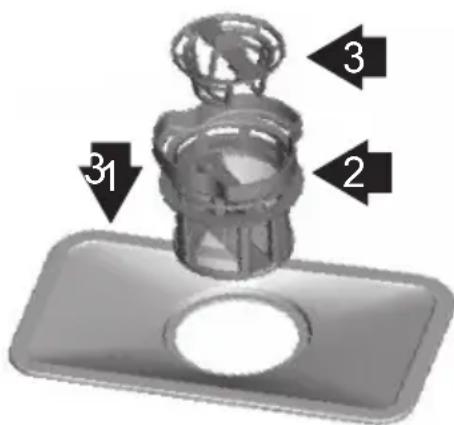
1 Main filter
Food and soil particles trapped by this filter are pulverized by a special jet on the lower spray arm and washed down the drain.
2 Fine filter
This filter holds soil and food residue in the sump area and prevents it from being redeposit on the dishes during a cycle.
3 Coarse filter
Larger items, such as pieces of bone or glass, that could clog the drain are trapped in the coarse filter.
Caring for the Dishwasher
To clean the control panel use a lightly dampened cloth then dry thoroughly. To clean the exterior use a good appliance polish wax. Never use sharp objects, scouring pads or harsh cleaners on any part of the dishwasher.
Protect Against Freezing
If your dishwasher is left in an unheated place during the winter, ask a service technical to:
- Cut off electrical power to the dishwasher.
- Turn off the water supply and disconnect the water inlet pipe from the water valve.
- Drain water from the inlet pipe and water valve. (Use a pan to catch the water)
- Reconnect the water inlet pipe to the water valve.
- Remove the filter in the tub the bottom and use a sponge to use up water in sump.
Cleaning the Spray Arms
natural_image
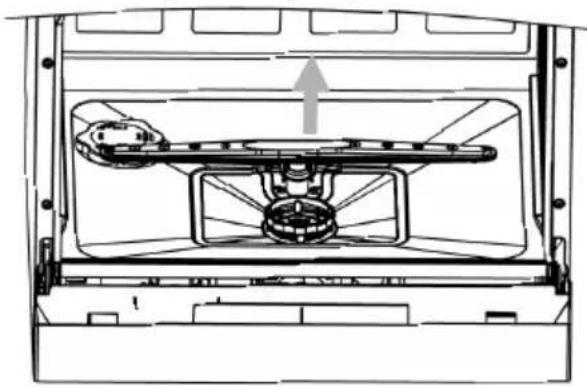
Technical line drawing of a mechanical assembly with no visible text or symbolsIt is necessary to clean the spray arms regularly for hard water chemicals will clog the spray arm jets and bearings. To remove the spray arms, grasp the middle of the spray arm, pull it upwards and remove the arm. Wash the arms in soapy and warm water and use a soft brush to clean the jets. Replace them after rinsing them thoroughly.
Cleaning the Filters
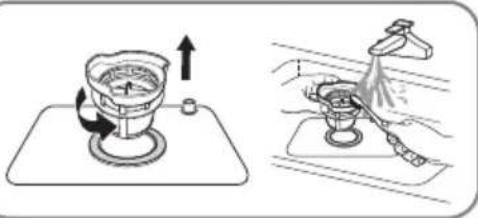
- Inspect the filters for obstructions every time the dishwasher has been used.
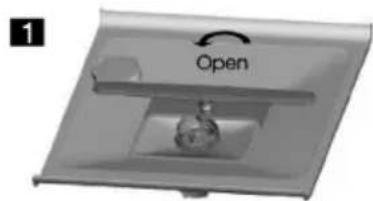
- By unscrewing the coarse filter.you can remove the filter system. Remove any food remnants and clean the filters under running water.
natural_image
Close-up of a mechanical component with a glass inside, labeled 'Open' and number 1 (no other text or symbols)step 1: Turn the filter in anti-clockwise direction.
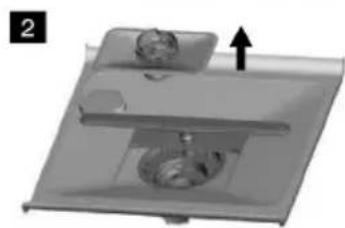
step 2: lift the filter system up.
natural_image
3D mechanical component with a downward arrow indicating force or direction (no text or symbols)NOTE:
When following this procedure from step1 to step 2. the filter system will be removed; when following it from step 2 to step 1, the filter system will be installed .
Filter assembly
- For best performance and results, the filter assembly must be cleaned.
- The filter efficiently removes food particles from the wash water, allowing it to be recirculated during the cycle.
-
For this reason, it is a good idea to remove the larger food particles trapped in the filter after each wash cycle by rinsing the semicircular filter and cup under running water. To remove the filter assembly, pull on the cup handle in the upward direction. The entire filter assembly should be cleaned once a week.
-
To clean the coarse filter and the fine filter, use a cleaning brush. Then, reassemble the filter parts as shown in the figures left and reinsert the entire assembly in the dishwasher, positioning in its seat and pressing downward.
- The dishwasher must never be used without the filters. Improper replacement of the filter may reduce the performance level of the appliance and damage dishes and utensils.
WARNING!
Never run the dishwasher without the filters in place. When cleaning the filters, don't knock on them. Otherwise, the filters could be contorted and the performance of dishwasher could be debased.
Cleaning the Doors
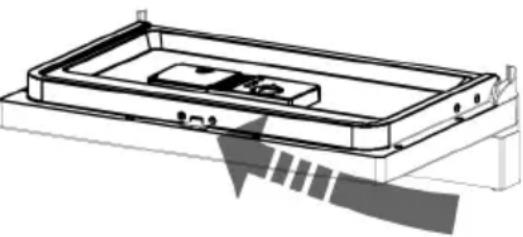
- To clean the edge around the door, you should use only a soft warm, damp rag. To prevent penetration of water into the door lock and electrical components, do not use a spray cleaner of any kind.
- Also, never use abrasive cleaners or scouring pads on the outer surfaces because they will scratch the finish. Some papers towels can also scratch or leave marks on the surface.
natural_image
Technical line drawing of a rectangular electronic device with internal components and mounting brackets (no text or symbols)WARNING!
Never use a spray cleaner to clean the door panel for it could damage the door lock and electrical components. It is not allowed to use the abrasive agent or some paper towel because of the risk of scratching or leaving spots on the stainless steel surface.
How to Keep Your Dishwasher in Shape
After Every Wash
- After every wash, turn of f the water supply to the appliance and leave the door slightly a jar so that moisture and odors are not trapped inside.
- Remove the Plug
- Before cleaning or performing maintenance, always remove the plug from the socket. Do not run risks.
- No Solvents or Abrasive Cleaning
- To clean the exterior and rubber parts of the dishwasher, do not use solvents or abrasive cleaning products. Rather, use only a cloth and warm soapy water. To remove spots or stains from the surface of the interior, use a cloth dampened with water and a little white vinegar, or a cleaning product made specifically for di shwashers.
When You Go on Holiday
- When you go on holiday, it is recommended that you run a wash cycle with the dishwasher empty and then remove the plug from the socket, turn off the water supply and leave the door of the appliance slightly ajar. This will help the seals last longer and prevent odors from forming within the appliance.
Moving the Appliance
- If the appliance must be moved, try to keep it in the vertical position.
- If absolutely necessary, it can be positioned on its back.
Seals
- One of the factors that cause odors to form in the dishwasher is food that remains trapped in the seals. Periodic cleaning with a damp sponge will prevent this from occurring.
8. INSTALLATION INSTRUCTION
About Electricity Connecting
CAUTION! for personal safety: DO NOT USE AN EXTENSION CORD OR AN ADAPTER PLUG WITH THIS APPLIANCE. DO NOT, UNDER ANY CIRCUMSTANCES, CUT OR REMOVE THE THIRD GROUNDING PRONG FROM THE POWER CORD.
Electrical Requirements
Please see the rating label to know the rating voltage and connect the dishwasher to appropriate power supply, which has a required fuse 10 amp. Time delay fuse or circuit breaker recommended and provide separate circuit serving only this appliance. Insure propar ground
Electrical Connection
After making sure that the voltage and the frequency values for the current in the home correspond to those on the rating plate and that the electrical system is sized for the max. voltage on the rating plate, insert the plug into an electrical socket which is earthed properly. If the electrical socket to which the appliance must be connected is not appropriate for the plug, replace the socket, rather than using a adaptors or the like as they could cause overheating and burns.
Grounding instruction
- This appliance must be grounded. In the event of a malfunction or breakdown, grounding will reduce the risk of electric shock by providing a path of least resistance of electric current.
- This appliance is equipped with a cord having an equipment-grounding conductor and a grounding plug. The plug must be plugged into an appropriate outlet that is installed and grounded in accordance with all local codes and ordinances.
WARNING!
Improper connection of the equipment-grounding conductor can result in a risk of electric shock. Check with a qualified electrician or service representative if you are in doubt whether the appliance is properly grounded. Do not modify the plug provided with the appliance; If it is not fit for the outlet. Have a proper outlet installed by a qualified electrician.
Water Connection
WARNING!
In order to avoid that there is more water staying in the inlet hose, please close the hydrant after using.(For the models: no safety inlet hose.)
Cold Water Connection
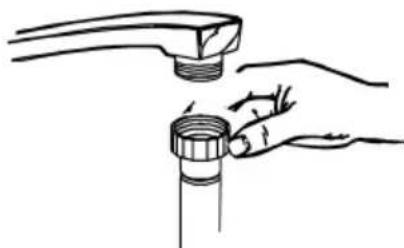
Connect the cold water supply hose to a threaded 3/4 (inch) connector and make sure that it is fastened tightly in place. Water pressure 0.04 – 1.0 MPa. If the water pipes are new or have not been used for an extended period of time, let the water run to make sure that the water is clear and free of impurities. If this precaution is not taken, there is a risk that the water inlet can get blocked and damage the appliance.
natural_image
Illustration of hands adjusting a pipe fitting with a handle (no text or symbols)Positioning the Appliance
Position the appliance in the desired location. The back should rest against the wall behind it, and the sides, along the adjacent cabinets or wall. The dishwasher is equipped with water supply and drain hoses that can be positioned to the right or the left to facilitate proper installation.
Levelling the Appliance
- Dishwasher must be level for proper dish rack operation and wash performance.
- Place level on door and rack track inside the 1 tub as shown to check that the dishwasher is level.
- When level the dishwasher, please pay attention not to let the dishwasher tip over.
Drain hose Connection
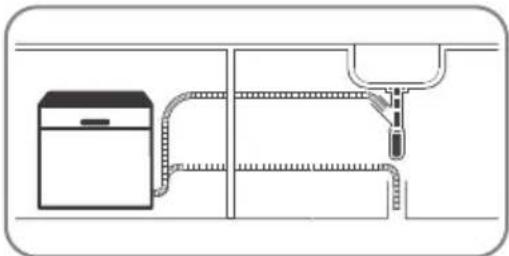
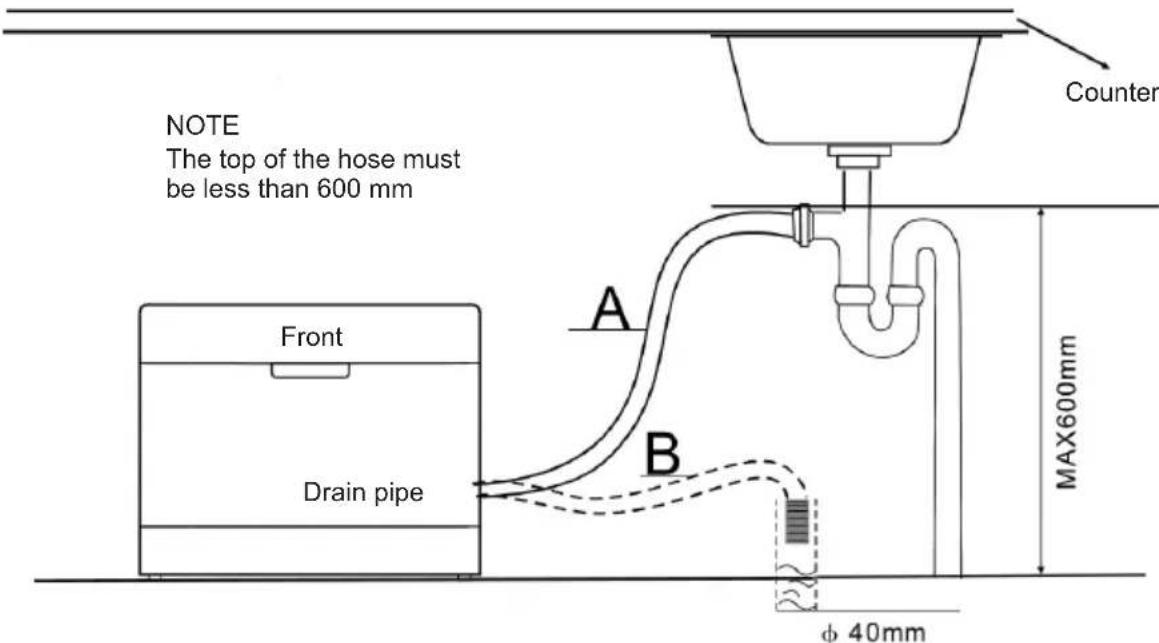
- Insert the drain hose into a drain pipe with a minimum diameter of 40 mm, or let it run into the sink, making sure to avoid bending or crimping it. Use the special plastic support that comes with the appliance.
- The free end of the hose must be at a height max. 600 mm and must not be immersed in water.
How to Drain Excess Water From Hoses
- If the sink is 1000 higher from the floor, the excess water in hoses cannot be drained directly into the sink. It will be necessary to drain excesswater from hoses into a bowl or suitable container that is held outside and lower than the sink.
Water Outlet
- Connect the water drain hose. The drain hose must be correctly fitted to avo id water leaks.
- Ensure that the water inlet hose is not kinked or squashed.
Extension Hose
- If you need a drain hose extension, observe to use a similar dr ain hose.
- It must be no longer than 4 metres; otherwise the cleaning effect of the dishw asher could be reduced.
Syphon Connection
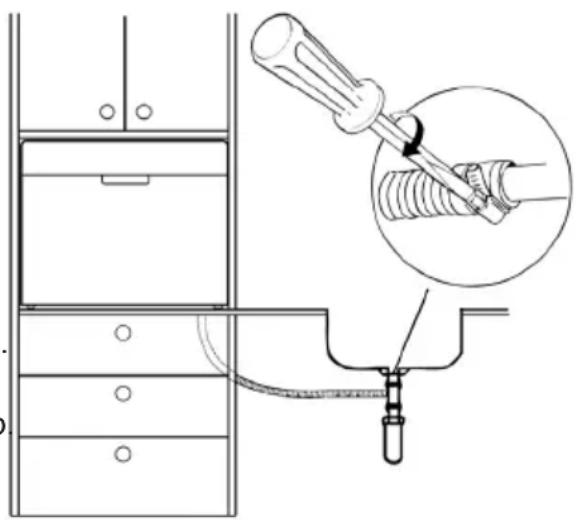
- The waste connection must be at a height of max. 60 cm from the bottom of the dish.
- The water drain hose should be fixed by a hose clip
Start of dishwasher
The followings should be checked before starting the dishwasher.
- Whether the dishwasher is level and fixed
- Whether the inlet valve is opened
- Whether there is leakage at the connections of the conducts
- Whether the wires are tightly connected
- Whether the power is switched on
- Whether the inlet and drain hoses are knotted
- All packing materials and printings should be taken out from the dishwasher
natural_image
Technical line drawing of a mechanical assembly with a magnified inset showing a tool interacting with a coiled spring (no text or symbols present)ATTENTION!
After installation, please put this manual into the bags of printings.
The content of this manual is very helpful to the users.
9. TROBLESHOOTING TIPS
Before Calling for Service
Review the charts on the following pages may make you be free of calling for service.
| Problem Possible | Causes What to do | |
| Dishwasher doesn't run | Fuse blown, or the circuit breaker acted | Replace fuse or reset circuit breaker. Remove any other appliances sharing the same circuit with the dishwasher. |
| Power supply is not turned on | Make sure the dishwasher is turned on and the door is closed securely.Make sure the power cord is properly plugged into the wall socket. | |
| Water pressure is low | Check that the water supply is connected properlyand the water is turned on. | |
| Noise | Some audible sounds are normal | Sound from soft food shredding action and detergent cup opening. |
| Utensils are not secure in the baskets or something small has dropped into the basket | To ensure everything is secured in the dish-washer. | |
| Motor hums | Dishwasher has not been used regularly. If you do not use it often, remember to set it to fill and pump out every week, which will help keep the seal moist. | |
| Suds in the tub | Improper detergent | Use only the special dishwasher detergent to avoid suds.If this occurs, open the dishwasher and let suds evaporate.Add 1 gallon of cold water to the tub. Close and latchthe dishwasher, then Start the „soak“ wash cycle to drain out the water. Repeat if necessary. |
| Spilled rinse agent Always | wipe up rinse agent spills immediately. | |
| Stained tub interior | Detergent with colorant was used | Make sure that the detergent is the one without colorant. |
| Dishe are not dried | Rinse agent dispenser is empty | Make sure that the rinse agent dispense is filled. |
| Problem Possible Causes What to do | ||
| Dishes and flatware not clean | Improper program Select stronger program | |
| Improper rack loading | Make sure that the action of the detergent dispenser and spray arms are not blocked by large dishware. | |
| Spots and filming on glasses and flatware | Extremely hard waterLow inlet temperatureOverloading the dishwasherImproper loadingOld or damp powder detergentEmpty rinse agent dispenserIncorrect dosage of detergent | To remove spots from glassware:Take out all metal utensils out of the dishwasher.Do not add detergent.Choose the longest cycle.Start the dishwasher and allow it to run for about 18 to 22 minutes, then it will be in the main wash.Open the door to pour 2 cups of white vinegar into the bottom of the dishwasher.Close the door and let the dishwasher complete the cycle. If the vinegar does not work:Repeat as above, except use 1/4 cup (60 ml)of citric acid crystals instead of vinegar. |
| Cloudiness on glassware | Combination of soft water and too much detergent | Use less detergent if you have soft water and select a shortest cycle to wash the glassware and to get them clean. |
| White film on inside surface | Tea or coffee stains | Using a solution of 1⁄2 cup of bleach and 3 cups warm water to remove the stains by hand.WARNING: You have to wait for 20 minutes after a cycle to let the heating elements cool down before cleaning interior; otherwise, burns will happen. |
| Iron deposits in water can cause an overall film | You have to call a water softener company for a special filter. | |
| White film on inside surface | Hard water minerals | To clean the interior, use a damp sponge with dishwasher detergent and wear rubber gloves. Never use any other cleaner than dishwasher detergent for the risk of foaming or suds. |
| Detergent cup lid won't latch | Dial is not in the OFF position. | Turn the Dial to OFF position and slide the door latch to the left. |
| Detergent left in dispenser cups | Dishes block detergent cups | Re-loading the dishes properly. |
| Steam Normal phenomenon | There is some steam coming through the vent by the door latch during drying and water draining. | |
| Problem Possible | Causes What to do | |
| Black or gray marks on dishes | Aluminum utensils have rubbed against dishes | Use a mild abrasive cleaner to eliminate those marks. |
| Water standing in the bottom of the tub | This is normal | A small amount of clean water around the outleton the tub bottom keeps the water seal lubricated. |
| Dishwasher leaks | Overfill dispenser or rinse aid spills | Be careful not to overfill the rinse aid dispenser.Spilled rinse aid could cause oversudsing and lead to overflowing. Wipe away any spills with a damp cloth. |
| Dishwasher isn't level Make sure the dishwasher is level. | ||
| Water flow out | Damaged or detective drain pump | Replace the drain pump |
Error codes
When some malfunctions come on, the appliance will display error codes to warn you:
| Codes Meanings Possible Causes | ||
| E1 Longer inlet time. | Faucets is not opened, or water intake is restricted,or water pressure is too low. | |
| E3 Not reaching required temperature. Malfunction of heating element. | ||
| E4 Overflow. | Some element of dishwasher leaks. | |
| Ed | Failure of communication between main PCB with display PCB. | Open circuit or break wiring for the communication. |
WARNING! If overflow occurs, turn off the mainwater supply before calling service. If there is water in the base pan because of an overfill or small leak, the water should be removed before restarting the dishwasher.
WARNING!
If there is an error code that cannot be solved, please request professional assistance.
- TECHNICAL INFORMATION
Product information sheet (EN 60436)
Supplier's name or trade mark: HYUNDAI
General product parameters:
| Parameter Value Parameter Value | ||||
| Rated capacity (ps) (a) 6 Dimensions in cm | Height 44 | |||
| Width 55 | ||||
| Depth 50 | ||||
| EEI (a) 61,9 Energy efficiency class ( | a) | F | ||
| Cleaning performance index (a) 1,125 Drying performance index (a) | 1,065 | |||
| Energy consumption in kWh [per cycle], based on the eco programme using cold water fill. Actual energy consumption will depend on how the appliance is used. | 0,613 | Water consumption in litres [per cycle], based on the eco program. Actual water consumption will depend on how the appliance is used and on the hardness of the water. | 6,5 | |
| Programme duration (h:min) | 3:50 Type | Free standing | ||
| Airborne acoustical noise emissions (dB(A) re 1 pW) (a) | 49 | Airborne acoustical noise emission class (a) | C | |
| Off-mode (W) (a) | 0,49 Standby mode (W) (a) | N/A | ||
| Delay start (W) (if applicable) | 1,00 | Networked standby (W) (if applicable) | N/A | |
| Minimum duration of the guarantee offered by the supplier: | 24 months | |||
Additional information:
Weblink to the supplier's website, where the information in point 6 of Annex II to Commission Regulation (EU) 2019/2022 is found: www.hyundai-electronics.cz
(a) with ECO program
We reserve the right to change technical specifications.
- The device meets the European standards and the directives in the current version at delivery.
- LVD 2014/35/EU
- EMC 2014/30/EU
- EU 2019/2022
NOTE:
The above values have been measured in accordance with standards under specified operating conditions. Results may vary greatly according to quantity and pollution of the dishes, water hardness, amount of detergent, etc.
- The manual is based on the European Union's standards and rules.
- Technical information can be found on the type plate inside the appliance (or on its back side) and on the energy label.
- "Information Sheet" and "Directions for Use" can be downloaded at: www.hyundai-electronics.cz.
- QR code on the energy label supplied with the appliance provides a web link to information concerning the specification of this appliance in the EU EPREL database.
- Keep the energy label together with user manual and all other documentation supplied with this appliance.
- The same information in the EPREL database can also be found at:
https://eprel.ec.europa.eu
- The model name (product number) can be found on the type plate of the appliance and also on the energy label supplied with the appliance.
- We reserve the right to change technical specifications.
11. CUSTOMER CARE AND SERVICE
- Always use original spare parts.
- When contacting our authorised service or information line, make sure you have the following information available: the model name (product number) and serial number (SN).
- This information can be found on the type plate (or on a separate label near it).
- The manufacturer reserves the right for change without prior notice.
- Original spare parts for particular selected components of the product are available at least 7 or 10 years from the launch of the last piece of the appliance on the market (depending on the type of the component).
- The manufacturer provides standard legal warranty for the appliance for a period of 24 months.
- For more information regarding service and purchase of spare parts, visit our website:
- www.etasince1943.com/support
Notes:
natural_image
Pure schematic diagram of a mechanical or electrical system with no text, numbers, or symbols
CSATLAKOZTASSA AZ ELLÁTÓ TÖMLŐT, A LEERESZTŐ TÖMLŐT, AZ ELEKTROMOS TÁPELLÁTÁST.
KAPCSOLJA BE A KÉSZÜLÉKET
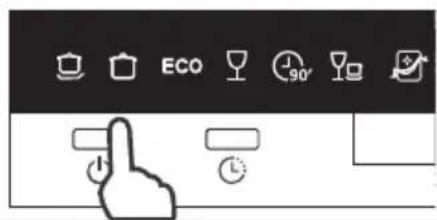
AZ ON/OFF (BE/KIKAPCSOLVA) GOMB MEGNYOMÁSÁVAL KAPC- SOLJA BE A KÉSZÜLÉKET! NYISSA KI AZ AJTÓT!
ELLENÖRIZZE A SÓ SZINTJÉT
flowchart
graph LR
    A["Person mixing a cup with salt"] --> B["Add salt"]
    B --> C["Add salt into a container"]
    C --> D["Heating salt"]
    D --> E["Heating the container"]

MINDIG A KÉSZÜLÉKHEZ JAVASOLT SÓT HASZNÁLJA.
TÖLTSE FEL A KOSARAKAT
natural_image
Illustration of a basket containing various items, including a tray with a bag and a tray holding a bag (no text or symbols visible)TÁVOLÍTSA EL A NAGYOBB ÉLELMISZER MARADÉKOKAT. CSAK MOSOGATÓGÉPBEN MOSHATÓ EDÉNYEKET TEGYEN.
ELLENÖRIZZE AZ ÖBLÍTŐ SZINTJÉT
1
2
3
4

TÖRÖLJÖN FEL MINDEN KIFOLYT ÖBLÍTŐ SZERT EGY JÓ NEDVSZÍVÓ KÉPESSÉGÜ RONGGYAL, HOGY ELKERÜLJE SORÁN A HABOSODÁST. NE FELEJTSE EL VISSZA- TENNI A KUPAKOT.
TÖLTSE FEL A MOSÓSZER-ADAGOLÓT
A REKESZ:
MINDEN MOSÁSI CIKLUSHOZ.
B REKESZ:
CSAK AZ ELÓMOSÁSSAL RENDEL- KEZŐ PROGRAMOKHOZ
VÁLASSZA KI A PROGRAMOT
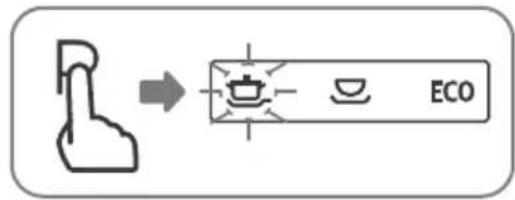
EKO->ÜVEG->90PERC-> GYORS->ÖBLÍTÉS-> KARBANTARTÁS-> INTENZÍV->EGYETEMES
KAPCSOLJA BE A MOSOGATÓGÉPET
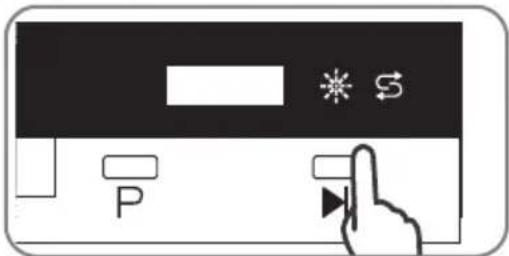
NYISSA KI A VÍZCSAPOT ÉS NYOMJA MEG A START/PAUSE (INDÍTÁS/SZÜNET) GOMBOT!
KAPCSOLJA KI A KÉSZÜLÉKET
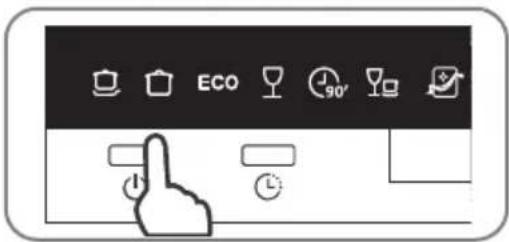
HA A PROGRAM LÁMPA VILÁGÍT, DE NEM VILLOG, CSAK EBBEN AZ ESETBEN ÉRT VÉGET A PROGRAM.
ZÁRJA EL A VÍZCSAPOT ÉS VEGYE KI AZ EDÉNYEKET
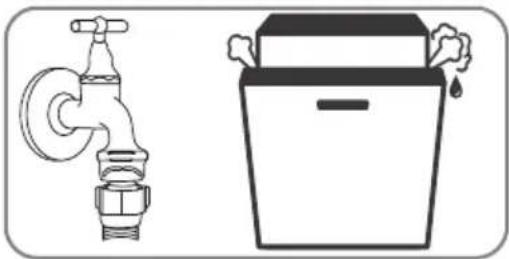
natural_image
Illustration of a faucet and a bucket with water droplets (no text or symbols)NYISSA KI A KÉSZÜLÉK AJTAJÁT, HAGYJA SZELLŐZNI ÉS VÁRJON PÁR PERCET A KIVÉTELLEL.
TISZTÍTSA MEG A SZÜRÖKET
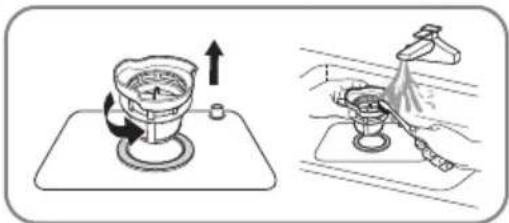
natural_image
Illustration showing a cooking pot being heated by an electric stove, with no text or symbols present.MINDEN HASZNÁLAT UTÁN NÉZZE ÁT A SZÜRÖKET, HOGY VAN-E BENNÜK LERAKÓDÁS.
TARTALOM
HU - MOSOGATÓGÉP
- FONTOS BIZTONSÁGI INFORMÁCIÓK 132
- HULLADÉKKEZELÉS ÉS ÖKOLÓGIA....135
- MÜKÖDTETÉSI TANÁCSOK 136
- ELSÖ HASZNÁLAT ELÖTT....137
- KOSARAK TÖLTÉSE EN 60436 SZERINT....143
- KÉSZÜLÉK BEKAPCSOLÁSA....147
- TISZTÍTÁS ÉS KARBANTARTÁS....150
- BEÜZEMELÉSI TANÁCSOK....153
- HIBAKERESÉSI TIPPEK 155
- TECHNIKAI INFORMÁCIÓ 158
- ÜGYFÉLSZOLGÁLAT ÉS SZERVIZ....160
Tisztelt Vásárló,
natural_image
Symbol of a trash bin crossed with no text or numbers, representing waste sorting or disposal (no text present)natural_image
Line drawing of a cooking setup with a hand holding a tool above a bowl of food, no text or symbols presentnatural_image
Illustration of a hand holding a plastic bottle with a lid and a magnified inset showing the bulb (no text or symbols)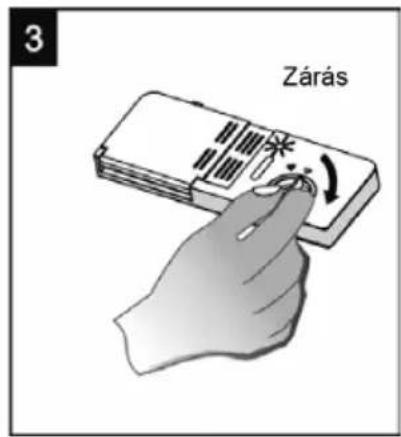
natural_image
Exploded view diagram of a smart kitchen appliance with labeled components (no text or symbols)Megjegyzés
natural_image
Technical line drawing of a mechanical assembly inside a vehicle cabin, showing internal components and a directional arrow (no text or symbols)natural_image
3D rendered mechanical component with a bracket and mounting holes, no visible text or symbolsMEGJEGYZÉS:
natural_image
Technical line drawing of a rectangular electronic device with internal components and a downward arrow indicating motion (no text or symbols)FIGYELMEZTETÉS!
natural_image
Illustration of hands adjusting a pipe fitting with a handle (no text or symbols)natural_image
Technical line drawing of a mechanical assembly with a magnified inset showing a screwdriver inserted into a threaded component (no text or symbols present)FIGYELEM!

- OBSAH
- CZ - MYČKA NÁDOBÍ
- Vážný zákazníku,
- Poznámka
- Umístění spotřebiče
- SK - UMÝVAČKA RIADU
- Vážený zákazník,
- Umiestnenie spotrebiča
- ZAWARTOŚĆ
- PL - ZMYWARKA
- Ważne:
- Zestaw filtrów
- Podłączenie syfonu
- CONTENT
- EN - DISHWASHER
- Dear Customer,
- Before Calling for Service
- Note
- IMPORTANT SAFETY INFORMATION
- READ ALL INSTRUCTION BEFORE USING
- WARNING
- WARNING!
- PROPER USE
- EN
- READ AND FOLLOW THIS SAFETY INFORMATION CAREFULLY SAVE THESE INSTRUCTIONS
- DISPOSAL AND ECOLOGY
- Packaging material could be dangerous for children!
- Control Panel
- Dishwasher Features
- PRIOR USING FOR THE FIRST TIME
- Before using your dishwasher for the first time:
- WATER SOFTENER
- Adjusting Salt Consumption
- Step 1: Enter the status of salt adjustment
- Step 2: select a certain level of salt consumption
- There are 6 levels of salt consumption in total
- Water softener
- Loading the Salt into the Softener
- ATTENTION!
- WARNING:
- NOTE:
- ⚙ILL THE RINSE AID DISPENSER
- Function of Rinse Aid
- When to Refill the Rinse Aid Dispenser
- Rinse aid dispenser
- Adjusting rinse aid dispenser
- FUNCTION OF DETERGENT
- Coccentrated Detergent
- Detergent tablets
- Detergent dispenser
- Amount of Dtergent to Use
- Proper Use of Detergent
- Fill in detergent
- Detergents
- LOADING THE DISHWASHER RACKS (EN 60436)
- Attention before or after Loading the Dishwasher Racks
- Loading the Rack
- Rack
- Plate racks of Basket
- Cup shelf
- Silverware Basket
- For washing in the dishwasher the following cutlery/dishes
- Are not suitable
- Are of limited suitability
- Loading cutlery and dishes
- When loading the dishes and cutlery, please note:
- Damage to glassware and other dishes
- Possible causes
- Suggested remedy
- At the End of the Wash Cycle
- TURNING ON THE APPLIANCE
- Saving energy
- Starting a cycle wash
- Change the Programme
- The program lights show the state of the dishwasher
- Wash cycle table
- Forget to Add a Dish?
- Switch Off the Dishwasher
- Unloading the dishwasher
- MAINTANCE AND CLEANING
- Filtering System
- Main filter
- Fine filter
- Coarse filter
- Caring for the Dishwasher
- Protect Against Freezing
- Cleaning the Spray Arms
- Cleaning the Filters
- Filter assembly
- Cleaning the Doors
- How to Keep Your Dishwasher in Shape
- After Every Wash
- When You Go on Holiday
- Moving the Appliance
- Seals
- INSTALLATION INSTRUCTION
- About Electricity Connecting
- Electrical Requirements
- Electrical Connection
- Grounding instruction
- Water Connection
- Cold Water Connection
- Positioning the Appliance
- Levelling the Appliance
- Drain hose Connection
- How to Drain Excess Water From Hoses
- Water Outlet
- Extension Hose
- Syphon Connection
- Start of dishwasher
- TROBLESHOOTING TIPS
- Error codes
- Product information sheet (EN 60436)
- https://eprel.ec.europa.eu
- CUSTOMER CARE AND SERVICE
- Notes:
- TARTALOM
- HU - MOSOGATÓGÉP
- Tisztelt Vásárló,
- Megjegyzés
- MEGJEGYZÉS:
- FIGYELMEZTETÉS!
- FIGYELEM!
Brand : HYUNDAI
Model : DTC657DW8F
Category : Dishwasher