
STYLUS 150 - Compact camera OLYMPUS - Free user manual and instructions
Find the device manual for free STYLUS 150 OLYMPUS in PDF.


| Product type | Compact film camera |
| Brand | Olympus |
| Model | Stylus 150 (μ[mju:]-III 150) |
| Dimensions (approx.) | 115 × 62 × 37 mm |
| Weight (approx.) | 240 g (without battery) |
| Power supply | 1 lithium CR123A battery |
| Film type | 35 mm film (135) |
| Lens | Motorized zoom 38-150 mm |
| Aperture | f/4.5 - f/9.9 (depending on focal length) |
| Focus | Active autofocus (infrared) |
| Built-in flash | Automatic, red-eye reduction, off |
| Viewfinder | Optical viewfinder with diopter correction |
| Shutter speed | 2 s to 1/500 s |
| Self-timer | 10 seconds |
| Frame counter | Automatic (automatic rewind at end of film) |
| Care | Clean the exterior with a soft dry cloth; use a blower for the lens |
| Safety | Do not disassemble, avoid moisture, store away from dust |
| Spare parts and repairability | Contact an Olympus authorized service center for repairs; batteries and parts available |
Frequently Asked Questions - STYLUS 150 OLYMPUS
User questions about STYLUS 150 OLYMPUS
0 question about this device. Answer the ones you know or ask your own.
Ask a new question about this device
Download the instructions for your Compact camera in PDF format for free! Find your manual STYLUS 150 - OLYMPUS and take your electronic device back in hand. On this page are published all the documents necessary for the use of your device. STYLUS 150 by OLYMPUS.
USER MANUAL STYLUS 150 OLYMPUS
Shinjuku monolith, 3-1, Nishi Shinjuku 2-chome, Shinjuku-ku, Tokyo,
Japan.
Tel. 03-3340-2211
OLYMPUS AMERICA INC.
Two Corporate Center Drive, Melville, NY 11747-3157, U.S.A.
Tel.1-800 "O" CAMERA(622-6372)
Olympus Europa GmbH
(Olympus Studio) 1 North Bridge Road #01-05/34/35 High Street Centre,
Singapore. 179094
Tel: 1-800 659 6787/65 6339 7686
This device complies with part 15 of the FCC Rules. Operation is subject to the conditions that this device does not cause harmful interference.
This Class B digital apparatus meets all requirements of the Canadian interference-Causing Equipment Regulations.
natural_image
Line drawing of a Olympus digital camera with no text or symbols on the bodyEN INSTRUCTIONS 2
FR MODE D'EMPLOI 25
ES INSTRUCCIONES 49
PO INSTRUÇÕES 73
CH 使用說明書 97
KR사용설명서 121
2
WARNING
CONTENTS
3
Read this manual carefully before using your camera.
Indicates circumstances which could result in personal injury or property damage.
KEEP THE BATTERIES AWAY FROM FIRE. NEVER TRY TO DISASSEMBLE, RECHARGE, OR SHORT-CIRCUIT BATTERIES.
KEEP THE BATTERIES OUT OF THE REACH OF CHILDREN. IF A CHILD SWALLOWS A BATTERY, CONTACT A DOCTOR IMMEDIATELY.
NEVER ATTEMPT TO DISASSEMBLE THE CAMERA; IT CONTAINS A HIGH-VOLTAGE CIRCUIT. IF THE INTERNAL PARTS OF THE CAMERA ARE EXPOSED DUE TO DROPPING OR DAMAGE, REMOVE THE BATTERY IMMEDIATELY TO PREVENT FURTHER USAGE.
IN CASE OF MALFUNCTION, CONSULT YOUR NEAREST OLYMPUS DEALER OR OLYMPUS SERVICE CENTER.
Symbols used in this manual:

Incorrect

Operation order

Indicator on

Order

Automatic operation

Indicator blinking

Manual operation

Depress halfway

Attention
- Products shown in pictures and illustrations may be slightly different from the actual unit.
- Pay particular attention to items in this manual enclosed in boxes

Names of parts
Camera body 4
Viewfinder display/LCD panel 5
Using the strap/Diopter adjustment 6
Loading and checking the battery 7
Loading the film 8
Taking pictures 9
Unloading the film 10
Flash photography
Setting the flash mode 11
Auto Flash 12
Red-Eye Reduction Flash 12
Flash-Off 13
Fill-In Flash 13
Night Scene Flash 14
☑ Red-Eye Reduction Night Scene Flash 14
Exposure modes
Setting the exposure mode 15
Spot Metering 15
▲ Infinity 15
Selftimer/Remote Control/Camera Shake Indicator
Selftimer 16
Remote Control (optional) 16
Camera Shake Indicator 17
RC-300C (optional) 18
Correcting the date and time (Quartzdate models only) ...... 19
Printing the date/time (Quartzdate models only) 20
Care and storage 21
Specifications 22


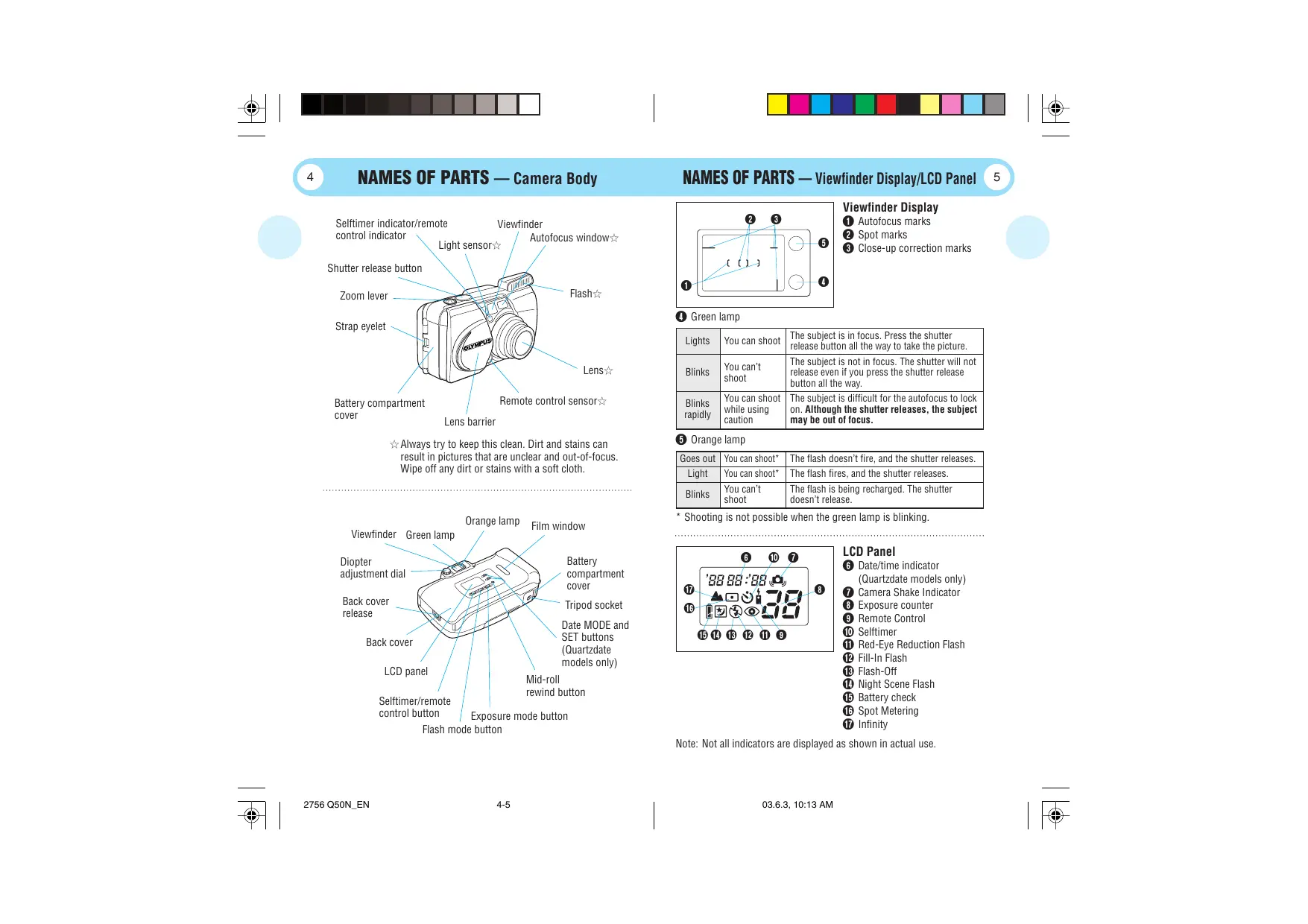
4 NAMES OF PARTS — Camera Body
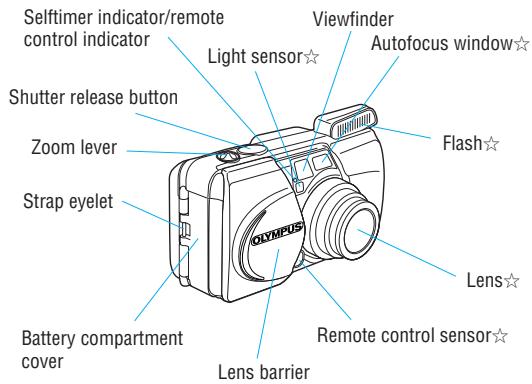
text_image
Selftimer indicator/remote control indicator Shutter release button Zoom lever Strap eyelet Battery compartment cover Viewfinder Light sensor☆ Autofocus window☆ Flash☆ Lens☆ Remote control sensor☆ Lens barrier☆ Always try to keep this clean. Dirt and stains can result in pictures that are unclear and out-of-focus. Wipe off any dirt or stains with a soft cloth.
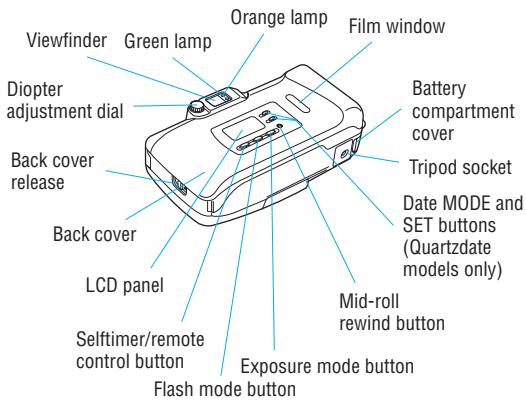
text_image
Viewfinder Green lamp Orange lamp Film window Diopter adjustment dial Back cover release Back cover LCD panel Selftimer/remote control button Flash mode button Battery compartment cover Tripod socket Date MODE and SET buttons (Quartzdate models only) Mid-roll rewind button Exposure mode buttonNAMES OF PARTS — Viewfinder Display/LCD Panel
flowchart
graph TD
    A["①"] --> B["②"]
    B --> C["③"]
    C --> D["④"]
    C --> E["⑤"]
    B --> F["[ "]
    F --> G[" "]
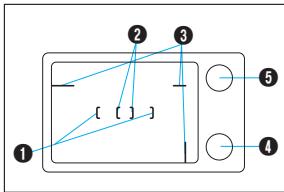
Viewfinder Display
① Autofocus marks
② Spot marks
③ Close-up correction marks
4 Green lamp
| Lights | You can shoot | The subject is in focus. Press the shutter release button all the way to take the picture. |
| Blinks | You can't shoot | The subject is not in focus. The shutter will not release even if you press the shutter release button all the way. |
| Blinks rapidly | You can shoot while using caution | The subject is difficult for the autofocus to lock on. Although the shutter releases, the subject may be out of focus. |
⑤ Orange lamp
| Goes out | You can shoot* | The flash doesn't fire, and the shutter releases. |
| Light | You can shoot* | The flash fires, and the shutter releases. |
| Blinks | You can't shoot | The flash is being recharged. The shutter doesn't release. |
* Shooting is not possible when the green lamp is blinking.
text_image
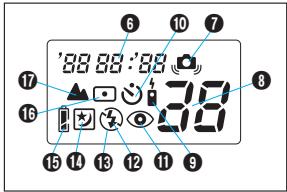
6 10 7 '22:28:28 17 16 15 14 13 12 11 9 37LCD Panel
6 Date/time indicator (Quartzdate models only)
⑦ Camera Shake Indicator
8 Exposure counter
9 Remote Control
10 Selftimer
11 Red-Eye Reduction Flash
⑫ Fill-In Flash
13 Flash-Off
14 Night Scene Flash
15 Battery check
16 Spot Metering
17 Infinity
Note: Not all indicators are displayed as shown in actual use.
6
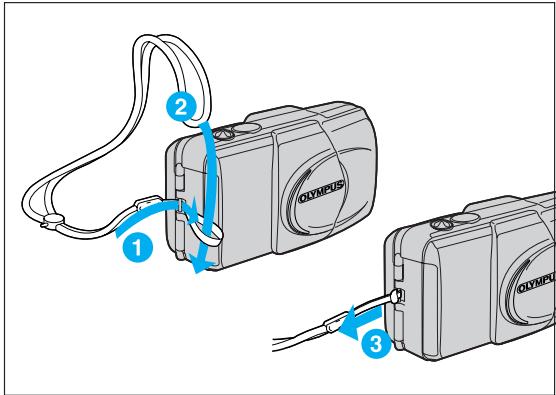
USING THE STRAP
Attach the strap as shown.
text_image
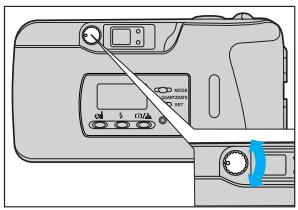
1 2 3DIOPTER ADJUSTMENT
text_image
Diagram of a digital camera with control panel and display, showing settings for signal output and display mode.Turn the diopter adjustment dial until the autofocus marks are clear.
If you are nearsighted, turn the dial up. If you are farsighted, turn it down.
LOADING AND CHECKING THE BATTERY
7
Use one 3 V lithium battery (CR123A or DL123A).
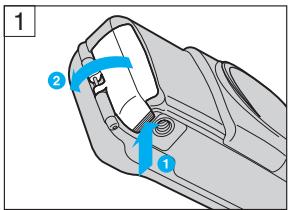
text_image
1 ② ①- While pressing the bottom of the battery compartment cover in direction ①, turn it in direction ② to open.
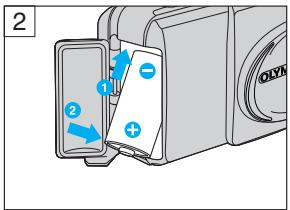
text_image
2 1 2 +Make sure the lens barrier is closed before opening the battery compartment cover.
- Insert the battery correctly. Close the battery compartment cover.
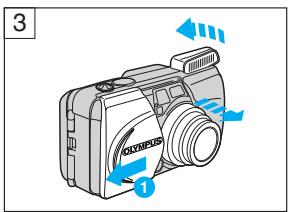
text_image
3 1A brand-new battery lasts for about 15 rolls of film.
- Slide the lens barrier in direction 1 until it clicks. Check the remaining battery power on the LCD panel.
| lights (turns off automatically). | Battery is OK. You can shoot. |
| blinks and other indicators are displayed normally. | Battery is low and will need to be replaced within the next few photos. |
| blinks and other indicators go out. | Battery is dead and must be replaced with a new one immediately. |
8
LOADING THE FILM
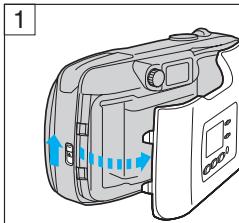
natural_image
Diagram of a digital camera module with blue directional arrows indicating movement or force (no text or symbols)- Slide the back cover release upward to open the back cover.
Do not touch the inside of the camera, especially the lens.
- Insert the film cartridge until it clicks into position.
ISO400 film is recommended. If you are going to use non-DX-coded film, use ISO100 film.
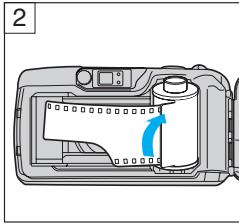
natural_image
Diagram of a camera interior showing internal components and a blue arrow indicating rotation (no text or symbols)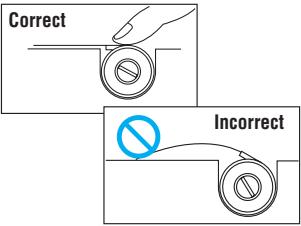
text_image
Correct Incorrect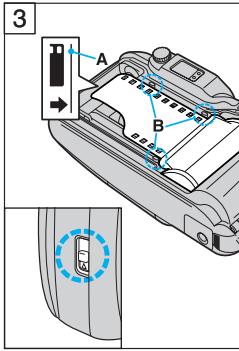
text_image
3 A B- Align the film leader with the guide line (A), and place the film between the positioning guides (B). Then close the back cover until it clicks. Make sure the back cover release has returned to the lower position. The film automatically advances to the first frame.
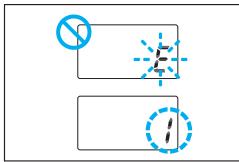
- Open the lens barrier until it clicks. Make sure the exposure counter on the LCD panel reads “/”.
If “E” blinks, reload the film.
TAKING PICTURES
text_image
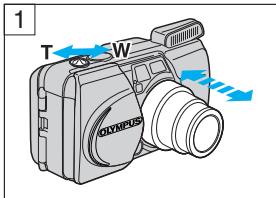
1 T W OUNIPUS- Open the lens barrier until it clicks. The lens will extend slightly and the LCD panel will turn on. Compose your shot. Push the zoom lever to the "T" side for telephoto (150mm) or to the "W" side for wide angle (37.5mm).
text_image
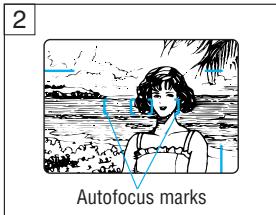
2 Autofocus marksAfter about 4 minutes and 30 seconds of inactivity, the lens retracts and the LCD panel goes out.
- Position the autofocus marks on your subject.
natural_image
Illustration of a printer with digital display and control panel, no text or symbols presentDo not look at the sun or other strong light sources through the viewfinder.
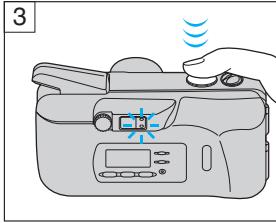
- Press the shutter release button halfway to focus on the subject. After making sure that the green lamp lights, press the shutter release button all the way to take the picture. After the shutter is released, the film automatically advances to the next frame.
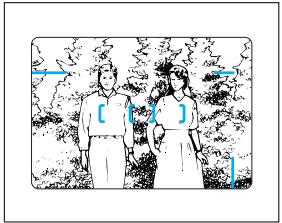
Wide Multi-Autofocus System
natural_image
Two individuals standing outdoors in front of trees, wearing white uniforms with blue buttons (no text or symbols visible)This camera uses a wide multi-autofocus system that makes it easier for the focus to lock on the subject even if it's not in the center of the frame.
9

10
FLASH PHOTOGRAPHY
Setting the Flash Mode
11
Working Distance
Shoot your subject from a distance of 0.6 m to infinity at wide angle (37.5 mm) or 0.8 m at telephoto (150 mm).
- If the green indicator blinks, the shutter cannot be released.
- Although the shutter will release when a subject is extremely close to the camera, the subject will be out of focus.
- In some cases, the autofocus may be unable to lock onto a subject.
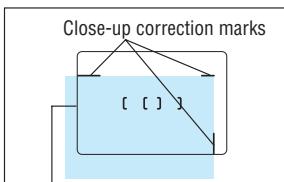
Close-up Correction
text_image
Close-up correction marks [ [ ] ]Picture area at infinity
The picture area will move lower in the viewfinder as you get closer to the subject.
UNLOADING THE FILM
text_image
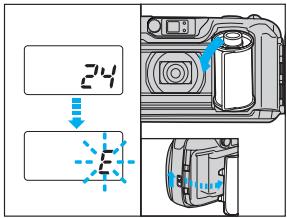
24 5The camera automatically rewinds the film when you reach the end of a roll. Make sure the motor has stopped and that “E” is blinking; then open the back cover to remove the film.
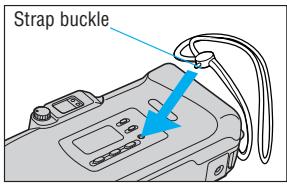
To rewind the film before the end of the roll
text_image
Strap bucklePress the mid-roll rewind button with the protrusion on the strap buckle. Do not use an instrument with a sharp tip. Once the film is removed, it cannot be reloaded and used again.
This camera has six flash modes. Choose the mode best suited to the photographic conditions and your requirements.
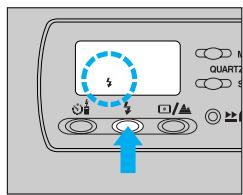
How to select the mode
text_image
Control panel interface with buttons and a dashed circle indicator showing a lightning symbol, labeled 'QUART2' and 'S'Press the flash mode button (⚡). The mode switches in the order shown below. The selected mode is displayed on the LCD panel.
| Mode display | Flash mode | Function |
| Auto Flash | Automatically fires when needed, like in conditions with poor lighting, with backlighting, or under fluorescent lighting. | |
| Red-Eye Reduction Flash | Significantly reduces the phenomenon of “red-eye” (when a subject’s eyes appear red in flash photography). | |
| Flash-Off | Use this when you want to prevent the flash from firing. | |
| Fill-In | Always fires, regardless of available light. | |
| Night Scene Flash | Use this to take pictures of a subject with a night scene in the background. Use a tripod to prevent camera-shake. | |
| Red-Eye Reduction Night Scene Flash | Use this to take pictures of people with a night scene background while reducing “red-eye.” Use a tripod to prevent camera-shake. |

- Do not fire the flash right in front of the eyes of people and animals.
- Do not point the camera at a motorist and fire the flash.
12
FLASH PHOTOGRAPHY
Auto Flash
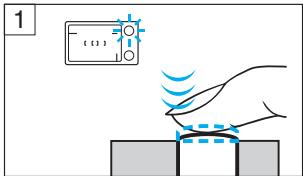
text_image
1 t t t t- Press the shutter release button to make sure the orange lamp lights.
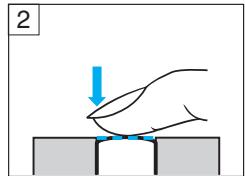
text_image
2- Press the shutter release button all the way to take the picture.
Flash working range (with color negative film)
| ISO | Wide angle (W) | Telephoto (T) |
| 100 | 0.6 to 5.4 m (2.0 to 17.7 ft) | 0.8 to 2.1 m (2.6 to 6.9 ft) |
| 200 | 0.6 to 7.6 m (2.0 to 24.9 ft) | 0.8 to 3.0 m (2.6 to 9.8 ft) |
| 400 | 0.6 to 10.8 m (2.0 to 35.4 ft) | 0.8 to 4.2 m (2.6 to 13.8 ft) |
Note: When slide film is used, the working range at the telephoto side will be reduced by about 40%.
FLASH PHOTOGRAPHY
Flash-Off
13
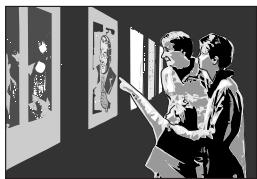
Use this mode in situations where flash photography is not desired or is prohibited or in twilight or night scenes.
natural_image
Two people viewing framed artworks on display, one pointing at a picture (no visible text or symbols)Closing the lens barrier restores the Auto Flash mode.
- Since a slow shutter speed (as low as 2 seconds) is selected, use a tripod to prevent camera-shake.
- Have your subject stay still; otherwise, blurring may result.
FLASH PHOTOGRAPHY
Red-Eye Reduction Flash
A series of low-power pre-flashes before the main flash accustoms the subject's eyes to the light and helps prevent their eyes from appearing red in a photograph.
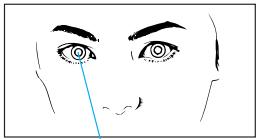
Eyes appear red.
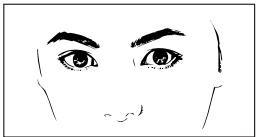
- Hold the camera securely. It takes about 1 second until the shutter releases.
- Red-eye reduction may not be effective when the subject:
- Is not looking at the flash from right in front.
- Is not watching the pre-flashes.
- Is too far from the camera.
The effectiveness of red-eye reduction varies depending on the individual characteristics of each subject.
FLASH PHOTOGRAPHY
↓ Fill-In Flash
Use this mode to compensate for a shadow cast on the subject's face or to shoot in backlit conditions or under fluorescent light.
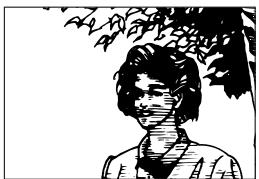
natural_image
Black-and-white sketch of a person with short hair and a bun, partially obscured by tree branches (no text or symbols)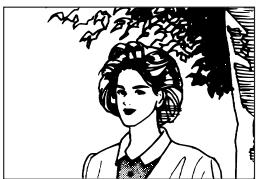
natural_image
Black-and-white illustration of a woman with styled hair and a patterned garment, standing beside a tree (no text or symbols)Closing the lens barrier restores the Auto Flash mode.
- Make sure your subject is within the flash working range (p.12).
- Fill-in flash becomes ineffective in extremely bright conditions.
14
FLASH PHOTOGRAPHY
Night Scene Flash
Use this mode to clearly shoot a subject in the foreground and a night scene in the background.
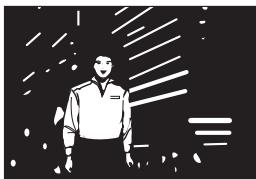
natural_image
Illustration of a person standing in front of a dark background with abstract light streaks (no text or symbols)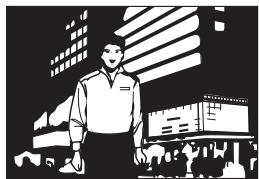
natural_image
Illustration of a man standing in front of a large industrial structure with silhouettes and crowd (no text or symbols)Closing the lens barrier restores the Auto Flash mode.
- Since a slow shutter speed (as low as 4 seconds) is selected in the Night Scene Flash mode, use a tripod to prevent camera shake.
- This mode cannot be combined with the Spot Metering mode.
FLASH PHOTOGRAPHY
Red-Eye Reduction Night Scene Flash
Use this mode to take pictures of people with a night scene background while reducing “red-eye.” Except for the pre-flashes, this mode is the same as the Night Scene Flash mode.

text_image
NEW YORK NEW YORK SP
text_image
YORKS NEW YORK SClosing the lens barrier restores the Auto Flash mode.
- Since a slow shutter speed (as low as 4 seconds) is selected in the Red-Eye Reduction Night Scene Flash mode, use a tripod to prevent camera shake.
- This mode cannot be combined with the Spot Metering mode.
EXPOSURE MODES
Setting the Exposure Mode
15
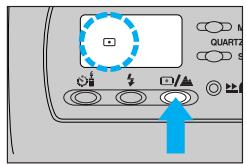
This camera has three exposure modes. Choose the mode that best suits the conditions and your requirements.
text_image
Control panel interface with buttons and a blue arrow pointing to a display screenHow to select the mode
Press the exposure mode button (☐/▲). The mode switches in the order shown below. The selected mode is displayed on the LCD panel.
| Mode display | Exposure mode | Function |
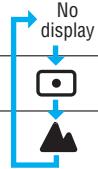 | Auto Exposure | Use this mode in ordinary situations. |
| Spot Metering | To precisely set the focus and exposure for each subject. | |
| Infinity | To shoot scenery through a window. |
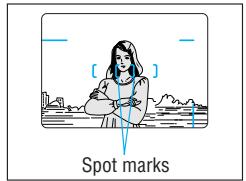
Spot Metering
Position the spot marks on the area where you want to measure the light.
text_image
[ ] Spot marksPress the shutter release button halfway; the green lamp lights and the focus and exposure are locked on that area. Reframe your subject and press the shutter release button all the way.
Closing the lens barrier restores the Auto Exposure mode.
▲ Infinity
The camera automatically sets the working distance at infinity.
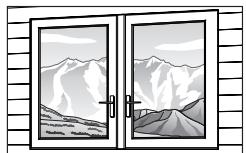
The flash does not fire except in the Fill-In Flash mode.
Closing the lens barrier restores the Auto Exposure mode.
16
SELFTIMER/REMOTE CONTROL/CAMERA SHAKE INDICATOR
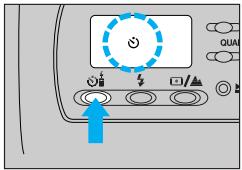
text_image
Control panel interface with display and buttons, featuring a blue arrow pointing to the buttonHow to select the mode
Press the selftimer/remote control button (💡). The mode switches in the order shown below. The selected mode is displayed on the LCD panel.
| Mode display | Mode |
| —— | |
| Selftimer | |
| Remote Control | |
| Camera Shake Indicator |
Selftimer
Secure the camera on a tripod or other support. Compose your shot in the viewfinder. Press the shutter release button halfway (the focus and exposure are locked at this time). Then press the shutter release button all the way. The selftimer indicator lights for about 10 seconds and then blinks for about 2 seconds. After this, the shutter will release.
Remote Control (Optional)
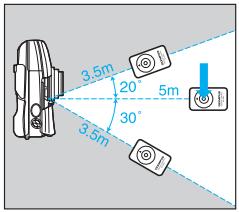
text_image
3.5m 20° 5m 3.5m 30°Compose your shot in the viewfinder. Position the autofocus frame on your subject. To take a picture, point the remote control at the camera and press the button on the remote control. The selftimer/remote control indicator starts blinking, and the shutter will release about 3 seconds later.

Camera Shake Indicator
17
In this mode, the camera warns you before you shoot if camera shake is likely to cause blurring. Also, when there is significant camera shake, this mode helps reduce blurring.
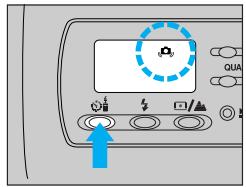
text_image
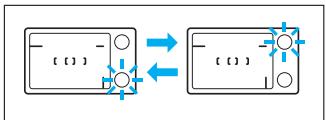
Control panel interface with display, buttons, and warning symbol, labeled 'QUA' in blue arrowIf the green and orange lamps blink alternately when you hold the camera, it means that the camera is shaking and blurring may result. Hold the camera securely until the lamps stop blinking; then press the shutter release button.
flowchart
graph LR
    A["Rectangular Block with internal nodes"] --> B["Rectangular Unit with internal nodes"]
    style A fill:#f9f,stroke:#333
    style B fill:#bbf,stroke:#333
We recommend to fix the camera by using a tripod, when shooting subjects in dark places using the flash-off mode, night scene flash mode, or red-eye reduction night scene flash mode.
18
RC-300C (Optional)
If the selftimer/remote control indicator doesn't blink even when you press the button, replace the battery with a new one (CR2025).
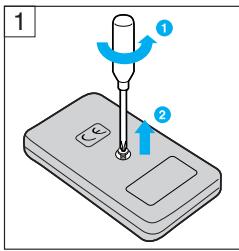
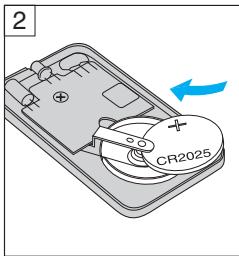
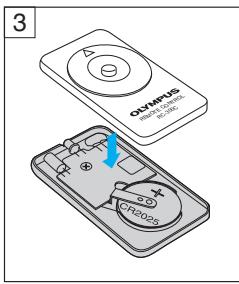
How to replace the battery of the remote control (RC-300C)
text_image
1 ① ②- Turn the screw on the bottom of the remote control counterclockwise to loosen.
text_image
2 CR2025- Turn the remote control over, and remove the cover. Remove the old battery and insert a new battery with facing up as shown.
text_image
3 OCTRUS CN2025- Replace the cover, turn the remote control over, and turn the screw on the bottom clockwise to tighten.
CORRECTING THE DATE AND TIME (Quartzdate models only)
19
Be sure to correct the date and time after the battery has been inserted or replaced.
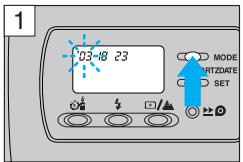
text_image
1 03-18 23 MODE RITZDATE SET- Keep the MODE button pressed until the "year" indicator starts blinking.
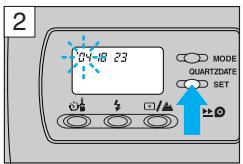
text_image
2 04-18 23 MODE QUARTZDATE SET- Press the SET button to adjust the "year" indicator. If you press the button once, the number on the display will advance by 1. If you keep the button pressed, the numbers will run in rapid succession. If you pass the intended number, keep pressing to return to that number.
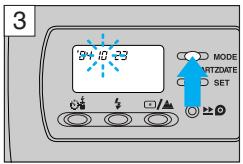
text_image
3 84 15 23 MODE PARTZDATE SET 2+- Press the MODE button once more to make the “month” indicator blink. Press the SET button to adjust the “month” indicator. As you press the MODE button, the blinking indicator changes in the order of “year”, “month”, “day”, “hour” and “minute”.
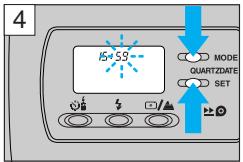
text_image
4 15:59 MODE QUARTZDATE SET- Repeat Steps 2 and 3 to set "hour" and "minute". Make sure the "minute" indicator is blinking.
text_image
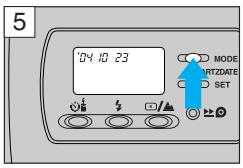
5 '04 10 23 MODE ARTZDATE SET- When "minute" has been set, press the MODE button. None of the indicators will be blinking and date/time correction is now complete.
20
PRINTING THE DATE/TIME (Quartzdate models only)
First select the date/time mode you want to print.
text_image
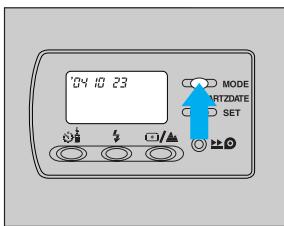
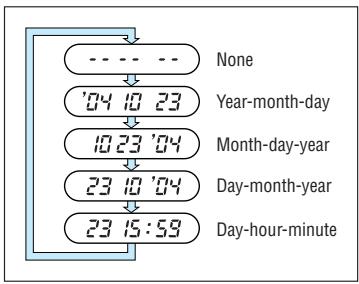
04:10:23 MODE RITZDATE SETPress the MODE button. As you press it, the mode will switch in the order shown below.
Keep the mode you want to print displayed.
flowchart
graph TD
    A["--- --- ---"] --> B["04 10 23"]
    B --> C["10 23 '04"]
    C --> D["23 10 '04"]
    D --> E["23 15:59"]
    style A fill:#f9f,stroke:#333
    style B fill:#ccf,stroke:#333
    style C fill:#cfc,stroke:#333
    style D fill:#fcc,stroke:#333
    style E fill:#cff,stroke:#333
- The date unit uses the same power source as the camera.
- Be sure to correct the date and time after the battery is replaced.
- The date/time is imprinted in the lower right corner of the picture.
- If the date/time is superimposed on a bright color like white, orange, yellow, etc., it may be difficult to read.
- The date/time may not be imprinted correctly on the frame(s) after the specified final exposure of the film.
- When black-and-white film is used, the date/time may not be printed.
CARE AND STORAGE
21
- Do not leave the camera in any place exposed to excessive heat, humidity or direct sunlight — for example, in a car or on the beach.
- Do not expose the camera to formalin or naphthalene.
- If the camera gets wet, wipe it with a dry towel. The salt in seawater can be especially damaging.
- Do not use organic solvents such as alcohol or paint thinner when cleaning the camera.
- Do not leave the camera on or near a television, refrigerator or other appliance with a magnetic field.
- Do not expose the camera to dust or sand as this could cause serious damage.
- Do not shake the camera.
- Do not apply excessive force to the zoom lens.
- Do not expose the camera to extreme heat (over 40^ / 104^ ) or to extreme cold (below -10^ / 14^ ). Low temperatures, even within this range may sometimes cause deterioration in battery performance, temporarily disabling the camera.
- Avoid leaving the camera unused for long periods of time. This can cause mold to grow on the camera as well as other problems. Try to press the shutter release button and check the operation of the camera before use.
- Some airport X-ray machines can damage the film in your camera. Try to avoid passing your camera through these machines. Give it to the security officer for manual inspection.
- Do not touch the front surface of the flash after using it continuously over a short period as the surface may be hot.
22
SPECIFICATIONS
23
| Type: | Fully automatic 35 mm autofocus lens-shutter camera with built-in 37.5 ~ 150 mm zoom lens. |
| Film format: | 35 mm standard DX-coded film (24 x 36 mm). |
| Lens: | Olympus lens, 37.5 ~ 150 mm, F5.1 ~ 13.3, 8 elements in 7 groups. |
| Shutter: | Programmed electronic shutter. |
| Viewfinder: | Real image zoom view viewfinder (with autofocus marks, close-up correction marks, green lamp [autofocus indicator], orange lamp [flash indicator] and diopter adjustment). |
| Focusing: | Passive-type multi-autofocus system (max.11 points). Focus lock possible. Focusing range – wide angle 0.6 m (2.0 ft) ~∞ (infinity), telephoto 0.8 m (2.6 ft) ~∞ (infinity). |
| Exposure control: | Programmed automatic exposure control, 3-zone light metering. Auto exposure range – EV2.7 (F5.1, 4-sec) ~ EV16.1 (F10, 1/690 sec) at wide angle, EV5.5 (F13.3, 4-sec) ~ EV17 (F17.5, 1/440 sec) at telephoto. |
| Exposure counter: | Progressive type displayed on LCD panel. |
| Selftimer: | Electronic selftimer with approx. 12-sec. delay. |
| Remote control: | Infrared remote control unit with approx. 3-sec. delay. |
| Film speed range: | Automatic setting with DX-coded film (ISO50, 100, 200, 400, 800, 1600 or 3200). Other intermediate film speeds will be automatically set for next lower speed. Non-DX-coded film is set at ISO100. |
| Film loading: | Automatic loading. (Automatically advances to first frame when camera back is closed.) |
| Film advance: | Automatic film winding. |
| Film rewind: | Automatic film rewind (automatic rewind activation at end of film, automatic rewind stop). Rewind possible at any point with mid-roll rewind button. |
| Flash: | Built-in pop-up flash. Recycling time – Approx. 0.5 ~ 5.5 sec. (at normal temperature, with new battery). Flash working range – 0.6 ~ 5.4 m (2.0 ~17.7 ft) at wide angle and 0.8 ~ 2.1 m (2.6 ~ 6.9 ft) at telephoto with ISO 100 color negative film; 0.6~ 10.8 m (2.0 ~ 35.4 ft) at wide angle and 0.8 ~ 4.2 m (2.6 ~ 13.8 ft) at telephoto with ISO400 color negative film. |
| Flash modes: | Auto Flash (automatic flash activation in low-light, backlight and fluorescent light), Red-Eye Reduction Flash (same as Auto otherwise), Flash-Off (flash override with shutter speed extended to 2-sec. max.), Fill-In (forced activation), Night Scene flash (with shutter speed extended to 4-sec. max.) and Red-Eye Reduction Night Scene Flash (with shutter speed extended to 4-sec. max.) |
| Exposure modes: | Auto Exposure, Spot Metering and Infinity. |
| Other modes: | Selftimer, Remote Control and Camera Shake Indicator. |
| Battery check: | Displayed on LCD panel. |
| Power source: | One 3 V lithium battery (DL123A or CR123A). |
| Dimensions: | 117 (W) x 61 (H) x 43 (D) mm (4.6 x 2.4 x 1.7 in) (excluding protrusions). |
| Weight: | 225 g (7.9 oz) (without battery). |
| Weatherproof feature: | Equivalent to IEC Standard publication 529 IPX4 (under OLYMPUS test conditions). |
■ Date Unit Specifications (Quartzdate model)
| Types of data recording:(1) None. (2) Year-month-day. (3) Month-day-year. (4) Day-month-year. (5) Day-hour-minute. |
| External display of recorded data:Continuous LCD panel display. |
| Automatic calendar function:To year 2035. |
■ Remote Control RC-300C Specifications (Optional)
| Remote control system: | |
| Infrared. | |
| Power source: | One CR2025 battery. |
| Battery life: | Approx. 5 years. |
| Usage: | Approx. 20,000 times. |
| Working distance: | Approx. 5 m (16.4 ft). |
| Dimensions: | 33 (W) x 56 (H) x 7 (D) mm (1.3 x 2.2 x 0.3 in) |
| Weight: | 11 g (0.4 oz) (without battery). |
SPECIFICATIONS ARE SUBJECT TO CHANGE WITHOUT NOTICE OR OBLIGATION ON THE PART OF THE MANUFACTURER. THE ACTUAL PRODUCT MAY DIFFER FROM ONES SHOWN IN THIS MANUAL.





2756 Q50N_EN
24
03.6.3, 10:13 AM
