 ManualGo.com
E-510 - Digital Camera OLYMPUS - Free user manual and instructions
Find the device manual for free E-510 OLYMPUS in PDF.


Download the instructions for your Digital Camera in PDF format for free! Find your manual E-510 - OLYMPUS and take your electronic device back in hand. On this page are published all the documents necessary for the use of your device. E-510 by OLYMPUS.
USER MANUAL E-510 OLYMPUS
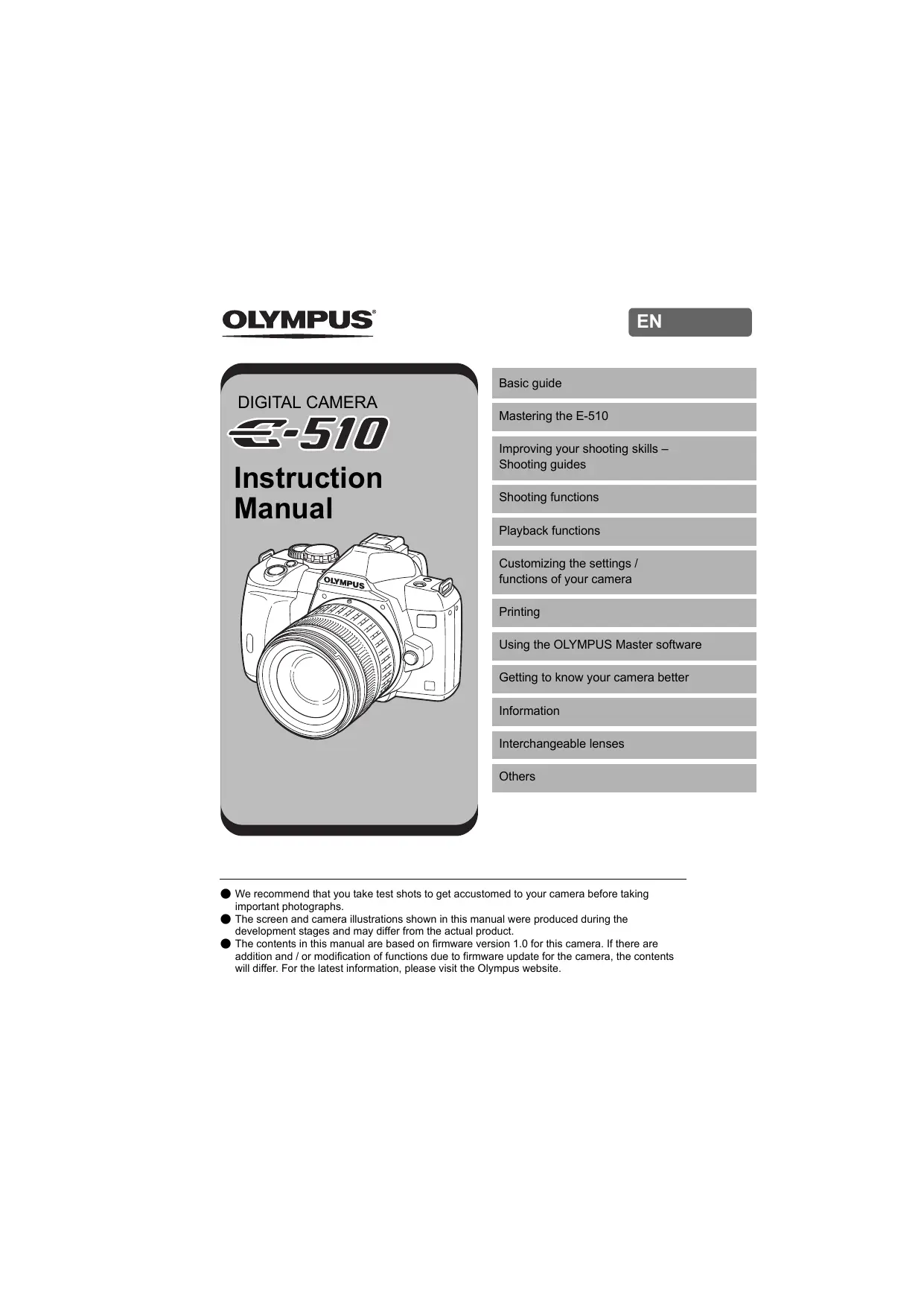
OLYMPUS © We recommend that you take test shots to get accustomed to your camera before taking important photographs. © The screen and camera illustrations shown in this manual were produced during the development stages and may differ from the actual product. © The contents in this manual are based on firmware version 1.0 for this camera. If there are addition and / or modification of functions due to firmware update for the camera, the contents wil differ. For the latest information, please visit the Olympus website.
Structure of this manual Basic camera operal le n mb Basic g This section explains the preparations and settings for the camera, and basic camera operation from easy techniques for shooting to playback and erase functions, Attaching the strap 3. Adjusting the viewfinders diopter 6 Preparing the battery 3 Setting the date / time 6 Attaching a lens to the camera 4° Shooting 7 Loading the card 4 Playback / Erasing 8 Power on 5 Mastering the E-510 mb P.13 Read chapter 1 to master the basic camera operation before proceeding to use the various functions available on this camera. Operating the camera E “Mastering the E-510” (P. 13) Learn how to use the functions in the shooting guides EF “mproving your shooting skills — Shooting guides” (P. 21) Proceed to the pages on the various fun Locating the information you need LS “Shooting tips and information" (P. 84), ‘Menu directory" (P. 95), “Names of parts” (P. 101), Index" (P. 125) Indications used in this manual Important information on factors which may lead to a malfunction or O)] operational problems. Also warns of operations that should be absolutely avoided. TIPS Useful information and hints that will help you get the most out of your camera: Œœ Reference pages describing details or related information:
Basic guide Attaching the strap Thread the strap as indicated by the arrows (®, @). Last, pul the strap tight making sure that i is fastened securely (@) Attach the other end of the strap to the other eyelet in the same way. Lil Preparing the battery À Charging the battery. ago neur Lithium ion battery (BLM-1) Red light Charging in progress Green light. Charging completed (Charging time: Approx. 5 hours) from he battery. Lithium ion charger (BCM-2) Align the battery with the arrow AC cable ( AC wall outet 2 Loading the battery. Batery y Direction indicating mark compariment © 1% Battery compartment cover 3 Close the battery compartment cover and slide the battery compartment lock in the direction of @. Unloading the battery Press the battery lock to unlock and remove the battery. + Itis recommended to set aside a backup battery for prolonged shooting in case the battery in use drains. Battery lock EN 3 epnn6 oiseg
epn6oiseg Attaching a lens to the camera 1 Remove the body cap from the camera and the rear cap from the lens.
2 Attaching a lens to the camera. + Align the lens attachment mark (red) on the camera with the alignment mark red) on the lens, then insert the lens into the camera's body (@). Rotate the lens in the direction indicated by. the arrow until you hear it click (@). + Do not press the lens release button. 3 Remove the lens cap
Rear cap Le] Body cap Lens attachment mark Lens release button Alignment Rep mark (Red) Removing the lens from the à camera Lens cap While pressing the lens release E] button (@), rotate the lens in the direction ofthe arrow (). Loading the card Open the card cover and insert the card. CompactFlash / Microdrive xD-Picture Card Insert the card's contact area into the slot as far as Insert the card untl it is locked into place. it can go.
Card access lamp + CF card slot Card cover mark xD-Picture Card slot
Removing the card + Never open Ihe card cover while the card access lamp is linking. CompactFlash / Microdrive xD-Picture Card + Press the eject button all the way in and letit + Press the inserted card lightiy and it will be pop out, then press it all the way in again to ejected gject the card + Pull out the card. + Pull out the card Eject button Power on Setihe camera power swilch 10 ON. Ta turn off the power, set the power switch lo OFF. Setthe mode dial to AUTO. L_ SSWF indicator LCD monitor fo When the camera is tumed on, the control panel ÉUALEN & | screen is displayed on the monitor.
œ fre E Control panel screen Dust reduction function operation De line control panel screen does not appear, RE press the INFO button The dust reduction function is automatically activated when the camera is tumed on. Uitrasonic vibrations are used to remove dust and dirt from the image pickup device s fiter surface. The SSWF {Super Sonic Wave Filter) indicator blinks while dust reduction is working EN 5 epnn6 oiseg
epn6oiseg Adjusting the viewfinde: diopter Adiust the viewinders diopter in accordance Diopter adjustment dial with your vision. While looking through the viewinder, rotate the diopter adjustment dial lle by tie. When you can see the AF frame cleariy, Viewnder adjustment is complete AF frame Setting the date / time Date and time information is recorded on the card together with the images. The flle name is also included with the date and time information. Be sure to set the correct date and time before using the camera. À Press the MENU button. E} caroserur CUSTOMRESET PCTUREMODE NATURAL GRADAON NORMAL « Ha 2 Use @® to select [Ï2], then press $. 3 Use @® to select [ED], then press $. 4 Use @® to select the year [Y], then press f) © © P he 07208.01
Y MOD TIME Y MOD TIME
2007.08.01 A4: Drm 2007.08.01 4:00 (RIT (CANCELSES GO#OK) 5 Repeat this procedure until the date and time are completely set. + The time is displayed in the 24-hour format. 6 Use © to select the date format. 7 Press the © button. 8 Press the MENU button to exit.
1 Holding the camera. Keep your fingers and the strap away from the lens and the flash. Horizontal grip Vertical grip 2 Place the AF frame on the subject while viewing through the viewfinder. 3 Adjust the focus. 7 Haley doun Press the shutter button gently (halfway). Cr AF confimation mark Shutter buton Aperture value — F ‘250756 o07.08.16 æ
paru Ar | © + The focus is locked when a beep tone is output. The AF confirmation mark and the AF focusing frame light up in the viewinder. + The shutter speed and aperture value that have been set automatically by the camera are displayed. + The control panel screen is not displayed when the shutter button is pressed 4 Release the shutter. Press the shutter button all the way (fully) su Athe way d + The shutter sounds and the picture is taken. Es the way doun The card access lamp blinks and the camera stars recording the picture. + Never remove the battery or card while the card access lamp mark is blinking. Doing so could destroy stored pictures and prevent storage of pictures you have just taken Card access lamp Taking a picture while viewing the monitor Itis possible to use the LCD monitor as a viewfinder and check the subjects composition, or shoot while viewing an enlarged display on the LCD monitor. ES “Live view’ (P. 19) Press the |[O] (live view) 1O1 button button. + The subject is displayed on the LCD monitor. 2 Press the shutter button all the way down. + The picture is taken with the focus. adjusted. RAW+S 10 EN 7 epnn6 oiseg
epn6oiseg When the camera stops operating I no operations are performed for approximately 8 seconds while the camera is on, the monitor backight tums of to save battery power. I no operations are performed for approximately one minute thereaîter, the camera enters the sleep mode (stand-by) and stops operating. The camera activates again when you touch any button (the shutter button, arrow pad, etc.). L& “Backlight timer” (P. 72), “Sleep timer” (P. 72) Playback / Erasing Playing back images Pressing the [#] (playback) button displays the last picture taken ŒJbuton Dispiays the frame that is stored 10 frames back
Dipiaye te pravous /A frame | ( ê Displays the next frame Fronpa CD ” Displays the frame that is Stored 10 frames ahead Close-up playback Each time you rotate the control dial towards Q, the image is enlarged in steps of 2x 14x Control dial Erasing images Playback the image you want to erase and press the {£ (erase) button. Use @@ to select [YES] and press the C) button to erase. YES
Table of Contents Describes the cameras functions and how to operate them. How to use the mode dial 13 Easy shooting modes 13 Advanced shooting modes 13 How to set the functions 14 How to make function settings 14 Setting functions using the control panel screen 14 Setting functions using direct buttons 16 Setting on the menu. 17 Descriptions in this manual 18 Live view 19 Switching the information display 19 Enlarged display operation 20 Ruled lines display 20 Describes the shooting methods suitable for individual situation. Basic function guides. 21 Focus: Operating the shutter button 21 Brightness: Exposure compensation 21 Color: White balance 21 A guide to functions for different subjects 2 Taking landscape pictures 2 Taking flower pictures 23 Taking night scene pictures 24
Categorizes and describes the shooting functions according to the shooting modes; shooting functions; focusing; exposure, color and image: Selecting the appropriate mode for shooting conditions Scene mode 25 P: Program shooting 25 A: Aperture priority shooting 26 S: Shutter priority shooting 27 M: Manual shooting 28 Preview function 29 Various shooting functions Shoofng win the image stabilzer function. 29 Checking the image stabilizer effect on the monitor 29 I correct focus cannot be obtained (Focus lock) 30 AE bracketing 30 Flash shooting 32 Flash mode 32 Manual flash 33 Setting the flash mode 34 Using the built-in flash 35 Flash intensity control 35 Flash bracketing 36 Extemal electronic flashes (optional) 36 Using the external electronic flash 36 Super FP flash 37 Using commercially available flashes. 37 Non-specified commercial flashes 38 Sequential shooting / Self-imer / Remote control 38 Setting the functions 38 Sequential shooting 38
Using the selftimer. 39 Using the remote control 39 Panorama shooting #1 Focusing functions AF frame selection. 41 Focus mode 42 imultaneous use of S-AF mode and MF mode (S-AF+MF) 43 Simultaneous use of C-AF mode and MF mode (C-AF+MF). 43 AF illuminator. 44 Shutter release priority 44 Exposure, image and color Selecting the record mode. 44 ‘Types of record modes 44 RAW data. 45 How to select the record mode 45 Setting the number of pixels and compression rate. 45 Metering mode — Changing the metering system 46 Exposure compensation — Varying the image brightness. 47 AE lock — Locking the exposure 48 ISO — Setting the desired sensiivity to light 48 White balance — Adjusting the color tone 49 Setting the auto / preset / custom wihite balance. 49 WB Compensation 50 Setting the one-touch white balance. 51 WB bracketing 51 Picture mode 52 Gradation 53 \g compensation 53 Noise reduction 53 Noise filter. 54 Color space 54 shock 54 Playback function: 55 Describes the functions used when playing back images that have been taken. Single-frame / Close-up playback. 55 Light box display. 56 Index display / Calendar display. 57 Information display 58 Slideshow 59 Rotating images. 59 Playback on TV 60 Editing st images. 60 Copying images. 61 Single-frame copy. 61 Copying selected frames 62 Copying all the frames 6 Protecting images — Preventing accidental erasure 62 Single-frame protect 6 Protecting selected frames 62 Cancelng all protections. 63 Erasing images. 63 Single-frame erase 63 Erasing selected frames 63 AlHframe erase 64 10 EN
Describes the other different types of functions. me settings or functions can be changed to tie environment in which the camera is used. Custom reset setting. AEL / AFL mode Other function settings. AEL / AFL memo AEL metering, EV step ISO limit Compensating all WE Speed synchronization. Auto pop up [En] FUNCTION Live view boost Customizing the control dial function My Mode setting Reset lens Focus ring Priority setting Quick erase. Erasing RAW and JPEG files. File name Rename file. Rec view — Checking the picture immediately after shooting Setting the beep sound Monitor brightness adjustment. Sleep timer. Backlight timer USB mode Changing the display language Video output Button timer Auto power off. € (arrow pad) lock
Describes how to print images that have been taken. Print reservation (DPOF) Print reservation. Single-rame reservation. Al-frame reservation. Resetting the print reservation data Direct printing (PictBridge). Connecting the camera to a printer Easy printing, Custom printing. EN 11
OLYMPUS Mas Describes how to transfer and store the camera's images to your computer. Flowchart 79 Using the provided OLYMPUS Master sofiware 79 What is OLYMPUS Master? 79 Connecting the camera to a computer 80 Start up the OLYMPUS Master software 80 Displaying camera images on a computer 81 Dounloading and saving images 81 Disconnecting the camera from your computer. 81 Viewing st images 82 To increase the number of languages 82 Transferring images to your computer without using OLYMPUS Master 83 8 Getting to know your camera better 84 Reference for help or when you wish to know more about the camera. Shooting tips and information 84 Tips before you start taking pictures 84 Shooting tips 84 Additional shooting tips and information 87 Playback tips 88 Viewing pictures on a computer. 89 When error messages are displayed 89 Camera maintenance 91 Cleaning and storing the camera. ot Cleaning mode - Removing dust 91 Pixel mapping — Checking the image processing functions. 92 Information Œ Describes how to handle the cards and rechargeable battery, and contains a directory of the camera's functions and displays. Card basics: 93 Usable cards. 93 Formatting the card 94 Battery and charger 94 Using your charger abroad Dre Dr .94 Menu directory 95 Functions that can be set by shooting mode 98 List of record modes 100 Names of parts 101 Camera 101 Viewinder indications 103 Control panel screen. 104 LCD monitor indications (during live view). 106 LCD monitor indications (during playback) 107 Glossary 108 Specifications. a 10 Interchangeabl 114 Describes how to handle interchangeable lenses. Lens. 114 ZUIKO DIGITAL interchangeable lens. 114 E-System Chart 116 Describes precautions regarding the use ofthe camera and accessories. SAFETY PRECAUTIONS. 118 index 125 12 EN
1 Mastering the E-510 How to use the mode dial The mode dial allows you to change the camera settings easily according to the subject Easy shooting modes + Select according to the shooting scene. The camera sets the appropriate shooting conditions automatically. + When rotating the mode dial or tuming off the power in the easy shooting modes, functions with changes made to their settings are restored to the factory default settings. Flow you to shoot using an oplimum apedure and shulter speed hatihe AUTO AUTO" |camera sets. The buitin flash pops up automaticaly in lowight conditions. A | PORTRAIT |Suiabie for shooïng a porvaitsie image of a person. de] TANDSCAPE _ |Suiabie or shooting landscapes and other outdoor scenes Ë MACRO |Suïable fortaking close-up pictures (macro shooting) « SPORT |Suiable for caplurng fastmoving action wihout blurng, | OT [Sutabl for shooting both the main subject and background at night TE different scene modes are valable lo sui a wide range of shooling BEM | Scnemode on (parP 25) Advanced shooting modes + For more advanced shooting and greater creative control, you can set the aperture value and shutter speed + The settings made in the advanced shooting modes are retained even if the camera is tued off. FAIGWS you to shooL using an apedure and shuler speed ina he P Program shooting BR FAlows yeu to set Ihe apeñure manual}. The camera sels he shuller A | Averure prontyshooüng Mens Doom CSD 20) où ing los you to setihe shutler speed manual} The camera ses the S | Shutterprioniy shooting lépérure automatically. (I P. 27) M Manual shooïng JAlows you to set ine aperure and shulier speed manual. (ES P. 28) EN 13 0LS-3 eux Buueysen
0L5-3 eur Bunersenn How to set the functions How to make function settings There are three basic ways to make function settings with this camera. + Settng while looking at the control panel screen (See below) + Settng using direct buttons (LS P. 16) + Settng on the menu (LS P. 17) Setting functions using the control panel screen Select an item on the control panel screen and Power switch change the setting. 1 When the power switch is set to ON, the control panel screen (shooting formation and setting screen) is displayed on the LCD monitor. + The display changes each time the INFO button is pressed. + You can also display the control panel screen by pressing the © button and change the L setting when using live view. INFO button © button {1 Arrow pad Control dial Control panel screen [P. Fa (2007.08.16 La]
E 32 ER Cursor Direct menu 3 Use &% to move the cursor to the function you want to set (@). 4 Tum the control dial to change the setting. + Pressing the © button while the item is being selected displays the direct menu for that function. You can also use the direct menu to change the setting (@). After changing the setting, press the ©) button to confirm your setting. Or if you do not operate the control dial within a few seconds, your setting will be confirmed and the control panel screen will be restored. ES ‘Button timer” (P. 73) 14 EN
0L5-3 eur Bunersenn Setting functions using direct buttons This camera is equipped with direct buttons where functions have been assigned and can be set quickiy. 1 Press the button for the function you want to set. + The direct menu is displayed. eg.) Setting Sequential / Self-timer / Control dial Remote control shooting 6
EI = 5% Direct menu 2 Tu the control dial to change the setting. + Press the ©) button to confirm your setting. Or if you do not operate the control dial within a few seconds, your setting will be confirmed and the previous screen will be restored. LS” “Button timer (P. 73) List of direct buttons The functions assigned to buttons are as shown below. No. Direct buttons Function Ref page 1 Je ro 1 fEeneniarshoaine Semen |Sequente shooihg/Serimerr Re z Exposure compensation builon —__ |Exposure compensalion Par 3 JAF frame button JAF frame selection Pat a Image stabiizer bution Sets image stabiizer F2 5 Live view button FTums live view on or of P19 6 Etash button Pops up the flash and sets Ras Pa mode T [WE [nie balance button Sets white balance F4 8 | AF [Focus mode button Sets focus mode P42 5 [150 _[SObuton Sais 150 sensinity RE 10] © [Mernrgpuion Sets metering mode P46 16 EN
Teb The current seltngis displayed Moves Lo the functions under the tab Select a function and ge to the you have selected. seting screen. ‘Types of tabs © Sets shooting functions. © Sets shooting functions. (2 Sets playback functions. Y Customizes shooting functions. T2 Sets functions that allow you to use the camera efficientiy. 3 Press @ repeatedly until the menu disappears. + The normal shooting screen is restored. + Forthe menu lists, see “Menu directory" (IS P. 05).
0L5-3 eur Bunersenn Descriptions in this manual The operating instructions of the direct buttons, control panel screen and menu are described as in this manual. follows Direct eg.
Live view Iis possible to use the LCD monitor as a viewfinder. You can view the exposure or white balance effect and the subjects composition while you take the picture. À Press the [OI button. Control dial + The subject is displayed on the LCD monitor. AEL / AFL button
2 Press the shutter button all the way down to focus and shoot. + To focus in advance, hold down the AEL / AFL button and press the shutter button. The focus is locked when the AEL / AFL button is pressed. + The image display on the monitor freezes as the mirror goes down during focusing. The picture you just took is briefly displayed on the monitor so you can check the picture. 2 TIPS To check the image stabilizer effect: — Press and hold the IS button. 5° * To focus using MF: — Set [AF MODE] to [MF]. LS “Focus mode” (P. 42 + Tum the focus ring and focus on the subject. For MF shooting method, refer to *MF (manual focus)" (P. 42). + You can also press the AEL / AFL button to activate auto focus. INFO button [button hecking the image stabilizer effect on the monitor” (P. 29) Switching the information display You can press the INFO button to switch the information displayed on the monitor. Information display on Information display on, Information display on + Ruled lines display * + Histogram Information display off Enlarged display 1° Displayed when [FRAME ASSIST] is sel. For operation in the enlarged display, refer to “Enlarged display operation” on the next page. EN 19 0LS-3 eux Buueysen
0L5-3 eur Bunersenn Enlarged display operation Iis possible to enlarge the subject 7 or 10 times for display. Enlarging the image during MF makes focus confirmation and adjustment easier. À Use 3 to move the frame and press the © button. + Area inside the frame is enlarged and displayed + Press and hold the © button to retum the shifted enlargement frame to the center.
b ‘4 2° Turn the control dial to change the magnification (7x / 10x). + Pressing © cancels enlarged display operation. © Notes + there is a high-intensity light source within the screen, the image may be displayed darker but will be recorded normal + the live view function is used over a long period, the temperature of the image pickup device rises causing images with high ISO sensitivity to appear noisy and unevenly colored. Either lower the ISO sensitivity or turn off the camera for some time. + Replacing the lens il cause live view to stop. + The following functions are not available during live view. C-AF / AË lock / [AEL / AFL] Ruled lines display You can display the ruled lines on the LCD monitor as a guide when confirming the composition.
MENU » [}:1] » (FRAME ASSIST]
IOFF] / [GOLDEN SECTION] / [GRID] / [SCALE]
TIPS Checking the subject on the monitor even in low light situations: + Refer t ‘Live view boost” (L& P. 69) 20 EN
2 Improving your shooting skills — Shooting guides Basic function guides To familiarize yourself with the camera, you can start off by taking pictures of surrounding subjects, such as children, flowers and pets. Ifthe pictures taken are not to your liking, try adjusting some of the settings below. Vou can take more satisfying pictures simply by familiarizing yourself with these basic camera functions. Focus: Operating the shutter button A picture can become out of focus when the focus in the picture is on the foreground, background, or other objects in the picture instead of on the subject. To prevent out-of-focus pictures, be sure to focus on the subject you are trying to capture. The shutter button can be pressed halfway down (haif-press) and all the way doun (full press). Once you are able to operate the shutter button effectively, you can focus accurately even on moving subjects. Haifwsy doun: = Allthe way don: © Es IE LT “Shooting” (P. 7), “If correct focus cannot be obtained (Focus lock)" (P. 30) Even when the subject is in focus, the picture can become blurred if you move the camera while the shutter button is being pressed. Make sure how to properly hold the camera. The camera is particulariÿ subject to shaking when using live viewr to take pictures while viewing the subject on the monitor. You can reduce camera shake by using the image stabilizer. L “Holding the camera. (P. 7), “Shooting with the image stabilizer function" (P. 29) In addition to incorrect focusing and camera shake problems, movement of the subject can also cause blurring of the picture. In this case, use a shutter speed that matches the motion of the subject. You can confirm the actual shutter speed and aperture on the displays of the viewfinder and monitor by pressing the shutter button halfway. LE ‘How to use the mode dial” (P. 13), “Preview functi Brightness: Exposure compensation
- (P. 29), “Live view” (P. 19) The camera automatically determines the aperture value and shutter speed according to the brightness level. This is called auto exposure. However, you may not be able to capture the intended picture with auto exposure alone. In this case, you can increase or decrease the auto 3 exposure setting. Increase the exposure to enhance the brightness of a summer beach or the whiteness of snow. Decrease the exposure when = the area to be shot is brighter but smaller compared to its surrounding area. if you are unsure of how much exposure compensation is required, ty taking several pictures at various settings and then compare the pictures. L ‘Exposure compensation — Varying the image brightness” (P. 47), *AE bracketing' (P. 30) Color: White balance Besides sunlight, there are other sources for iluminating the subject, such as tungsten and fluorescent lighting. These types of lighting contain particular colors; therefore, the same white object shot under different lighting has slightly different colors. Even under the same sunlight, the colors in the picture differ depending on the sky conditions, the shadows of trees or buildings, and other factors. White balance automatically corrects the effects from these types of lghting and enables shooting with the right colors. You can usually obtain the right colors with the white balance set to [AUTO]. Depending on the shooting conditions, however, you may not be able to obtain the intended colors. In this case, change the setting accordingly. LE “White balance — Adjusting the color tone” (P. 49) EN 21 sepin6 Bunoous — sinxs Bupoous inof Buino1duuy
A guide to functions for different subjects This section describes the functions suitable under different shooting conditions depending on the subject Taking landscape pictures This section describes how to take outdoor scenery pictures of forests, lakes and beaches in daylight Changing shooting mode ‘The proper shooting method varies depending on whether you are trying to capture the silence of a stil scene or the dynamism of a motion scene. + To capture the depth of a forest, focus with a wider range of the image. Use À (aperture priority shooting) mode and close the aperture {increase the aperture value) as much as possible. + To capture the waves crashing against the seashore, use S (shutter priority shooting) mode and select a fast shutter speed. To capture a flowing waterfall or river, shoot using a slow shutter speed Exposure compensation can be used even under different shooting modes. Check the image that you have shot and use + or — to adjust the exposure to obtain better results. Using white balance The color of water in pictures appears different depending on whether it is a lake reflecting nearby trees or a seashore surrounded by a coral reef. To capture the subtle difference in color, try changing the white balance setting. Change the setting for different situations, such as by using E#5300K] for sunny days and [Q,7500K] for outdoor shaded areas on Sunny days. Changing metering mode Depending on the depth of the water and the direction of the sun, the brightness of the water can difer significant in different areas of the same composition. There is also a difference in the brighiness of forests depending on the way the trees overlap each other. If you know which areas you want to emphasize the compensation in the image composition, you can change the metering mode. When set to [@)] (Digital ESP metering), the camera automatically assesses the brighiness in the composition and determines the exposure, To emphasize a specific partial exposure in the composition, change the metering mode to [(3] (center weighted metering) or [Ce] (spot metering), adjust the AF frame to the locations that you want 10 adjust the exposure and then measure the exposure. 22 EN
Changing saturation There may be times when you cannot reproduce the desired color even when using white balance or exposure compensation. In this case, you can change the [SATURATION] setting to achieve the desired color. The [SATURATION] setting includes to levels of high and low setings. When the setting is high, a vivid color is used La A: Aperiure prior shoqlng”(P. 29)."S: Shuter rioriy shoglingr(P. 27). cMeterng mode — Changing the metering system” (P. 46), “Exposure compensation — Varying the briginess’ (P 47) “White balance — Adjusing tre color tone” (P 49), 1SATURATION] Viiness of the color (P. 52) Taking flower pictures ‘The proper method for taking pictures of flowers differs depending on whether you want to capture, for example, a single flower, a field of blooming flowers, a deep red rose, or the light color of a sweet pea. Using white balance There are many colors of flowers ranging from light to vivid ones. Depending on the colors of he flowers, subtle color shades may not be captured as seen. In this case, you can check the light conditions and change the white balance setting. At [AUTO], the camera automatically determines the type of light and shoots using the proper white balance. However, you can bring out subtle color shades more effectively by changing the setting according to shooting conditions, such as by using [£5300K] for sunny days and [A 7500K] for outdoor shaded areas on sunny days. Using exposure compensation When shooting flowers against a background, select as simple a background as possible to bring out the shape and color of the flower. When shooting bright and whitish flowers, adjust the exposure compensation to — (minus) so that the flower stands out from the darker background Changing shooting mode sepin6 Bunoous — sinxs Bupoous inof Buino1duuy ‘The proper shooting method when taking pictures of lowers differs depending on whether you want to emphasize a single flower or capture a field of flowers. To change the focus area, set the camera to À (aperture priority shooting) mode and select the aperture value. + When you open the aperture (decrease the aperture value), the camera focuses within a shorter range (with a shallow depth of field), emphasizing the subject against a blurred background. + When you close the aperture (increase the aperture value), the camera focuses over a wider range (with more depth of field), producing a picture with both the foreground and background in focus. You can use the preview function to confirm the changes in the depth of field when the aperture is changed Using live view When using a conventional digital single-lens reflex camera with interchangeable lens system, it was necessary to wait until after taking the picture to check the results of the exposure compensation and white balance settings. With the live view function of this camera, however, you can use the monitor to display and check the subject you want to capture. EN 23
sepiné Buroous — sinxs Bunoous imof Buaoiduut Changing lenses When the blooming flowers are few and sparse, take the picture using a telephoto lens. With a telephoto lens, you take pictures in which subjects at different distances appear closer together, giving the impression of a more densely blooming flower field. Using the telescopic feature of the zoom lens also achieves the same effect, but i is easier to achieve this effect when the focal distance of the lens is longer, such as 150 mm or 200 mm, rather than 54 mm. L& ‘A: Aperture priority shooting” (P. 26), “Live view” (P. 19), ‘Preview function" (P. 29), “Exposure compensation — Varying the image brightness” (P. 47), “White balance — Adjusting the color tone” (P. 49) Taking night scene pictures There are different types of night scenes, from the afterglow of a sunset and city lights at night to special light displays and firework displays. Using a tripod Because a slow shutter speed is needed to capture night scenes, a tripod is required to prevent camera shake. fa tripod is not available, you should place the camera on a stable surface to prevent camera Shake. Even if the camera is secured, camera shake may occur when pressing the shutter button. Therefore, i is recommended to use the remote control or self timer. Changing shooting mode Night scenes have different levels of brightness, and the balance of the brighiness in the composition is not uniform. Start by using À (aperure priority shooting) mode to take the picture. Set the aperture to the medium setting (about F8 or F11) and allow the camera to automatically select the shutter speed. When shooting a night scene, because the camera sets the exposure to match the dark areas. which occupy a majority of the composition and the image often turs out whitish (overexposed), adjust the exposure compensation to 1 or 1.5. Use [REC VIEW] to check the image and adjust the aperture and exposure compensation as necessary. image noise can easily occur when shooting at slow shutter speeds. In this case, set [NOISE REDUCT to [ON] to reduce noise: Using manual focus In cases where you cannot use AF (auto focus) to focus on the subject because the subject is too dark or you cannot focus in time to take pictures, such as during a fireworks display, set the focus mode to [MF] (manual focus) and focus manual. To take pictures of night scenes, turn the focus ring of the lens and check whether you can see the lights of the night scene cleariy. To take pictures of a fireworks display, adjust the focus of the lens to infinite unless you are using a long focus lens. If you know the approximate distance to the subject, itis recommended that you focus on something that is at the same distance in advance. 1 *P: Program shooting” (P. 25), “A: Aperture priority shooting” (P. 26), “Sequential shooting / Setftimer / Remote control” (P. 38), “Focus mode” (P. 42), “Noise reduction” (P. 53), “Rec view — Checking the picture immediately after shooting” (P. 71) 24 EN
3 Shooting functions Scene mode When you select a mode to suit the shooting situation, the camera optimizes the settings for the shooting conditions. Unlike the mode dial's scene mode, most functions cannot be changed. Set the mode dial to SE + The scene menu is displayed 7 PORTRAIT 2 Use ® to select the scene mode. SEE + The sample image followed by a description of the selected io mode is displayed. (ral 3 Press the © button. + The camera enters the shooting stand-by mode. fsascrsg + To change the setting, press the © button again. The scene menu is displayed. ‘Types of scene modes con Mode Ton Mode
# [7 SPORT 16 DOCUMENTS F3 [Se HIGHKEY I [17 PANORAMA Œ |[° LowKey Da _|18 BEACH 8 SNOW P: Program shooting The camera sets the optimum aperture value and shutter speed automatically according to the subject brightness. Set the mode dial to P. + When the shutter button is half-pressed, the shutter speed and aperture value are displayed on the viewinder, Releasing the shutter button displays the shutter speed and aperture value on the control panel screen Control panel screen display AIZSONE SIG Averure value [PJ LU Shutter speed fRoo7os1e __ _m) CHARME Euro] IaruraL | Aperture values and shutter speeds in the P mode
AF confirmation mark Shutterspeed Aperture value Viewfinder Exposure mode in the P mode, the camera is programmed such that the aperture value and shutter speed are automatically selected according to the subject brightness as shown below. The program line diagram varies with the type of lens mounted EN 25 (29 suoypuoo Bunoous 10} epouu ayeudoudde eu} Buperes — suoyoury Bupoous
(29 suompuoo Bunoous 104 epouu ojeudoudde oui Buipeles — suonoun, BunooS — nn using the 14-42 mm 13.5-5.6 zoom lens
{focal length: 14 mm) $ ss K F2 N F6 à a Program sit \ " i Ÿ “ Shutter speed l ce Program shift (Ps) By tuming the control dial in the P mode, you can change the combination of aperture and shutter speed as ilustrated above while maintaining the optimum exposure. The program shift setting wall not be canceled aïter shooting. To cancel program shift setting, turn the control dial so that the viewfinders or control panel screen's exposure mode indication PS changes to P ortum off the power. Program sh is not available when you are using a flash. A: Aperture priority shooting The camera sets the optimum shutter speed automatically for the aperture value you have selected. When you open the aperture (decrease the aperture value), the camera wil focus within a shorter range (shallow depth of field) and produce a picture with a blurred background. When you close the aperture (increase the aperture value), the camera will focus within a longer range. Use this mode wihen you wish to add changes to the background representation. Before shooting, you can use the preview function to check how the background will look in your picture. Ir “Preview function" (P. 29) When the aperture value When the aperture value (number) is decreased (number) is increased Set the mode dial to A and turn the control dial Open the aperiure (number is decreased) to set the aperture value. +_ The aperture value changes in 1/3 EV increments &s the control dial is tumed. You can also change the step with the customized settings. Le “EV step” (P. 68) isplay in the viewfinder when the shutter button pressed halfway. Close the aperture (number is increased) + Overexposed when the shutter speed Shutter speed indication is blinking. Increase the aperiure value (number). Apeñure value + Underexposed when the shutter speed indication is blinking. Decrease AF confimation mark the aperure value (number) Exposure mode Viewinder 26 EN
TIPS The shutter speed indication continues to blink after the aperture value is changed: + Ifthe shutter speed indication is blinking when set to a high speed, set the ISO sensitivity to a lower value or use a commercially available ND fiter (for adjusting the amount of light) LE “ISO — Setting the desired sensitivity to light” (P. 48) — Ifthe shutter speed indication is blinking when set to a lower speed, set the ISO sensitiity to a higher value. I “SO — Settng the desired sensitivity to light” (P. 48) To check the depth of field —+ Refer to “Preview function” (P. the selected aperture value: 29) S: Shutter priority shooting ‘The camera sets the optimum aperture value automatically for the shutter speed you have selected. Set the shufter speed depending on the type of effect you want. À higher speed shutter allows you to capture a fast-moving subject without blur, and a slower shutter speed blurs a moving subject, creating a feeling of speed or motion. A fast shutter speed can freeze a fast action scene without any blur. A slow shutter speed will blur a fast action scene. This blurring will give the impression of dynamic motion. Set the mode dial to $ and turn the control dial … Slower shutter speed to set the shutter speed. +_ The shutter speed changes in 1/3 EV increments &s the control dial is tumed. You can also change the step with the customized settings. LE ‘EV step” (P.67) Display in the viewfinder when the shutter button is pressed halfway. Faster shutter speed + Ifthe aperture value indication at the minimum value is blinking', the correct exposure has not been attained (underexposed). Lower the shutter Aperture value speed Ifthe aperture value indication at the maximum AE confirmation value is blinking', the correct exposure has not mark been attained (overexposed). Raise the shutter speed Shutter speed Exposure mode Viewinder *_ The aperure value at the moment when its indication blinks varies with the lens type and focal length of the lens. °TIPS ture looks blurred: — The possibility of camera shake spoling your picture increases greatiy during macro or ultra- telephoto shooting. Raise the shutter speed or use a monopod or tripod to stabilize the camera The aperture value indication continues to link after the shutter speed is changed: + Ifthe aperture value indication at the maximum value is blinking, set the ISO sensitivity to a lower value or use a commercially available ND fiter (for adjusting the amount of light). L& “ISO — Setting the desired sensitivity to light” (P. 48) + Hthe aperture value indication at the minimum value is blinking, set the ISO sensitivity to a higher value. ‘ISO — Setting the desired sensitivity to light” (P. 48) EN 27 (29 suoypuoo Bunoous 10} epouu ayeudoudde eu} Buperes — suoyoury Bupoous
(29 suompuoo Bunoous 104 epouu ojeudoudde oui Buipeles — suonoun, BunooS M: Manual shooting Alows you to set the aperture and shutter speed manualy. You can check how much it differs from the appropriate exposure by using the exposure level indicator. This mode gives you more creative control, allowing you to make whatever settings you like, regardless of the correct exposure. Bulb shooting is also possible, allowing you to take astronomical or freworks pictures. L& ‘Bulb shooting” (P. 28) Set the mode dial to M and turn the control dial to set the value. + To setthe shutter speed: | Tur the control dial. To set the aperture value: Tum the control dial while holding doun the {exposure compensation) button. Using the [DIAL] setting of the [Yi] menu allows you to change to the opposite settings. Ir “Customizing the control dial's function” (P. 69) +_ The range of aperture values available varies with the lens type. The shufter speed can be set to 1/4000 — 60" (sec.) or [BULB] The aperture value and shufter speed change in 1/3 EV increments as the control dial is tumed. You can also change the step with the customized settings. IE “EV step” (P. 68) Slower shutter speed Open the aperture (number is decreased) E button Close the aperture (Enumber is increased) Qres] +_ The exposure level indicator appears on the control panel screen, showing the difference (ranging from 3 EV to +3 EV) between the exposure value calculated by the currently selected aperture and shutter speed compared to the exposure value considered optimum by the camera. Underexposure | Overexposure 150 Es # a Exposure level indicator
Optimum + exposure Noise in images During shooting at slow shutter speeds, noise may appear on-screen. These phenomena are caused when current is generated in those sections of the image pickup device that are not normally exposed to light, resulting in a rise in temperature in the image pickup device or image pickup device drive circuit. This can also occur when shooting with a high ISO setting in an environment exposed to heat. To reduce this noise, the camera activates the noise reduction function. 1 “Noise reduction” (P. 53) Bulb shooting You can take a picture with a bulb exposure time in which the shutter stays open as long as you hold down the shutter button. Set the shutter speed to [BULB] in the M mode. Bulb shooting can also be done using an optional remote control (RM-1). 1 ‘Bulb shooting on the remote control” (P. 40) TIPS The picture looks blurred: + The use of a monopod or tripod is recommended when taking a picture at slow shutter speed 28 EN
Preview function The viewinder shows the focused area (depth of field) with the selected aperture value. For the preview function to work by pressing the Fn button, itis necessary to set the function of the Fn button on the menu beforehand. LS ‘{En] FUNCTION" (P. 68) Press the Fn button to use the preview function. + When [En] FUNCTION] is assigned to [LIVE PREVIEW], pressing the Fn button automatically sitches the camera to live view for a preview of the picture on the monitor. Shooting with the image stabi Fn button You can reduce the amount of camera shake that easily occurs when shooting in low light situations or shooting with high magniication. OFF Image stabilzeris of. LS. 1 Image stabilizer is on LS. 2 This is used when panning in the horizontal direction to achieve a burred background. The horizontal image stabilizer is tumed off, and only the vertical image stabilizer is activated Control dial Direct button 1S » Control dial Displayed when [IMAGE STABILIZER] is sel lo LS. 1] or (LS. 2] Viewfinder + When {Scene mode) is set to [IQ] (DIS MODE), the IS button image stabilizer automatically tums on ([LS. 1]). L& “Scene mode” (P. 25) Checking the image stabilizer effect on the monitor You can hold down the IS button during live view to see the effect ofthe image stabiizer on the monitor. While in that position, you can press the shutter button full to take a picture. + When [IMAGE STABILIZER] is set to [OFF], pressing and holding the IS button activates the image siabiizer ([L.S. 1) + Either releasing the IS button or holding down the 1S button for several seconds tums off the image stabilizer.
(29 suoyouny Bunoous snoueA — suogouny Bunoous + The image stabilzer cannot correct excessive camera shake or camera shake that oceurs when the shutter speed is set to the slowest speed. In these cases, itis recommended that you use a tripod + When using a ipod, set [IMAGE STABILIZER] to [OFF] + When using a lens with an image stabilization function, tum off the image stabilization function of either the lens or the camera. + When you tu off the camera, it may initilize the image stabilizer function. The camera will vibrate for this operation, but this is not a malfunction. + Ared EE displayed on the monitor indicates the failure of the image stabilizer function. I you take a picture as is, the composition may be off. Consult your Olympus Authorized Service Center. If correct focus cannot be obtained (Focus lock) The camera's auto focus may not be able to focus on the subject in situations such as when the subject is not in the center of the frame. If this happens, the easiest solution is to use focus lock. Adjust the AF frame with Shutter button AF frame the subject to be focused and press the shutter button halfway until the AF confirmation mark lights up. + The focus is locked. The AF confirmation mark and the AF focusing frame light up in the viewinder. Card access lamp + Hthe AF confirmation mark blinks, press the shutter button halfway again. + While the shutter button is being pressed, the control panel screen disappears. 2 While pressing the shutter button halfway, move FPS ent AAF confirmation mark to the desired composition and press the button all the way. + The card access lamp blinks while the picture is being stored on the card. H the subject has lower contrast than its surroundings ifthe contrast ofthe subject is weak, such as when the lighting is insuffcient or the subject cannot be seen clean because of fog, the focus may not be achieved. Focus (focus lock) on a high-contrast object the same distance away as the intended subject, recompose your shot and then take the picture. AE bracketing ‘The camera automatically shoots a number of pictures at different exposure values for each frame: Even in conditions where correct exposure is dificult to obtain (such as a backlt subject or a scene at dusk), you can pick the picture you prefer from a selected number of frames with a variety of different exposure settings (exposure and compensation values). The pictures are taken in the following order: Picture with optimum exposure, picture adjusted in — direction, and picture adjusted in + direction. 30 En
:g.) When BKT is set to [3F 1.0EV] Compensation value: 0.3, 0.7 or 1.0 The exposure compensation value will change ifthe EV step is changed. The EV step can be changed using the menu. Exposure compensation value can be adjusted within a range of +1.0. LE ‘EV step” (P. 68) Number of frames: 3 AE BKT Menu FE 3
MENU » [0] » [AE BKT] 3F03EV
IOFF] / (3F 0.3EV]/ [3F 0.7EV] / (SF 1.0EV] 3FO.7EV 3F 10EV Start shooting. + The shooting method varies depending on the setting of single- frame or sequential shooting. L&r “Sequential shooting" (P. 38) Single-frame shooting Exposure Each time the shutter button is pressed fully, a picture is Earl A taken at a different exposure. Shooting frame + The setting for the next shot is displayed in the viewfinder. Sequential shooting Hold down the shutter button until the selected number of frames are taken. The camera shoots each frame at a different exposure. + Releasing the shutter button stops auto brackeïing shooting. When it stops, on the control panel is displayed in green. How AE bracketing compensates exposure in each exposure mode Depending on the selected exposure mode, exposure is compensated in the following way: P mode _: Aperture value and shutter speed A mode : Shutter speed S mode : Aperture value M mode : Shutter speed °TIPS To apply AE bracketing to the exposure value you have compensated: — Compensate the exposure value, then use the AE bracketing feature. AE bracketing is applied to the exposure value you have compensated. © Notes Viewfinder suoroun, Bunoous snoueA - suoyoury Bupoous + During sequential shooting, if the battery check blinks due to low battey, the camera stops shooting and starts saving the pictures you have taken on the card. The camera may not save all ofthe pictures depending on how much battery power remains. EN 31
(29 suoyouny Bunoous snoueA — suogouny Bunoous Flash shooting Flash mode ‘The camera sets the flash mode according to various factors such as fring pattern and flash timing, Available flash modes depend on the exposure mode. The flash modes are available to optional extemal lashes. Auto flash AUTO ‘The flash fires automatically in low light or backlight conditions. ‘To shoot a subject with backlighting, position the AF frame over the subject. Red-eye reduction flash © In the red-eye reduction flash mode, a series of pre- flashes are emitted just before the regular flash fes. e This helps accustom the subjects eyes to the bright " light and minimizes the red-eye phenomenon. - LL. 4 ‘The subjects eyes appear red + After the pre-flashes, it takes about 1 second before the shutter is released. Hold the camera firmy to avoid camera shake. + Effectiveness may be limited the subject is not looking directly at pre-flashes, or the shooting range is too far. Individual physical characteristics may also limit effectiveness. Slow synchronization ({st curtain) $SLOW ‘The slow synchronization flash is designed for slow shutter speeds. Normally, when shooting with a flash, shutter speeds cannot go below a certain level to prevent camera shake. But when shooting a subject against a night scene, fast shutter speeds can make the background t00 dark, Slow synchronization allows you to capture both the background and the subject. Since the shutter speed is slow be sure to stabilize the camera by using a tripod so as not to cause the picture to be blurred 1st curtain Usualy, the flash fires right after the shutter fully opens. This is called 1st curtain. Unless you change it, this is how the flash always res. Slow synchronization (2nd curtain) # SLOW2 2nd curtain flash fires just before the shutter closes. Changing the flash timing can create interesting effects in your picture, such as expressing the movement of a car by showing the tail-lights streaming backwards. The slower the shutter speed, the better the effects tum out. The slowest possible shutter speed depends on the shooting mode. 32 EN
When the shutter speed is set to 2 sec. ST ue 2 seconds
200 curain… sec net Shutter closes st curtain flash fires nd eurtain flash fires. Shutter fully opens Slow synchronization (1st curtain) / Red-eye reduction flash @SLOW st curtain While using slow synchronization with flash shooting, you can also use this function to achieve red-eye reduction. When shooting a subject against a night scene, this function allows you to reduce the red- eye phenomenon. As the time from emittng pre-flashes to shooting is long in 2nd curtain synchronization, i is difficult to achieve red-eye reduction. Hence, only 1sf curtain synchronization seting is available. Fil-in flash % ‘The flash fires regardless of the light conditions. This mode is useful for eliminating shadows on the subjects. face (such as shadows from tree leaves) in a backlight Situation, or for correcting the color shift produced by artificial lighting (especially fluorescent light). @ Notes + When the flash fires, the shutter speed is set to 1/180 sec. or less. When shooting a subject against a bright background with the fil-in flash, the background may be overexposed. In this case, use the optional FL-50 or FL-36 extemal flash and shoot in the Super FP flash mode. EL “Super FP flash (P. 37) Flash off Œ ‘The flash does not fire. Even in this mode, the flash can be used as an AF illuminator when it is raised. LA iluminator (P. 44) h synchronization speed Shutter speed can be changed when the butin flash fires. ISF “Speed synchronization” (P. 68) Manual flash This allows the built-in flash to output a fixed amount of light. To shoot with manual flash, set the f- number on the lens based on the distance to the subject. Ratio of amount of light [GN: Guide number (equivalent to ISO 100) FULL (171) 12 a G 1n6 3 1164 T5 Calculate the f-number on the lens using the following formula. Aperture (Enumber) = GN x ISO sensitivity Distance Lo 1he subject (mi) EN 33 (29 suoroun, Bunoous snoueA - suoyoury Bupoous
(29 suoyouny Bunoous snoueA — suogouny Bunoous 150 sensitivity EU ES EC EE 150 sens EC EE RE EE Flash modes available in different exposure modes Tonror Sur Exposure |oanelscreen | Flashmode | Conditions | Conditions to frethe | speod display 9 restrictions AUTO Auto flash Fires automaticaly in | 30 soc as Auio flash ‘dark / backlit ” TAB0 se. AUTO red-eye reduction) | 1steurtain ‘conditions: EEE P # Filkin flash Aeys fes Rec. A © Flash of. — — — Sovsyrenonzater El] OSLOW (red-eye reduction) 2 st curtain PRE 1 Fires automatically in Siovsynchonzaton Min | 0 00 — mo | son | "aan sa baat ? | Végosec # Son synconzator ï gone | Sn | 2ndcurain « Manuar Rash m2 rue (FULL) ° FA] Manual ash (14) TS | anuatesh (G _ 5 16) ss curtain Always fires. 50 sec. F164 Manual flash (164) 1180 sec. F Fin sh Fi fash 4 | _(rec-eye reduction) © Flash of. — — — Fin esn TS S | gsiow2 | ‘smemnzaton | 2ndeurain (end eur) Manuar Fes ru tFULL) Awaysres | 605ec= Fa Manual fash (14) | ist curtain ET] Manual flash (1716) F164 Manual flash (164) When the flash Is set to the Super FP mode, it detects backlight with longer duration than for normal flash ., before emiting light. E&° “Super FP flash” (P. 37) 2 AUTO, ©, # cannot be set in % mode. Setting the flash mode % FLASH MODE aur0 CE I] Direct button % » Control dial SLoW Control panel screen @suw # @ » ir: FLASH MODE » © #Slowz © $FUL SELECT» 7 co +0 34 EN
Using the built-in flash I you shoot a subject using a lens that is wider than 14 mm (equivalent to 28 mm on a 35 mm film camera), the light emitted by the flash may produce a vignette effect. Whether or not vigneting occurs also depends on lens type and shooting conditions (such as distance to the subject). Press the 4 button to raise the built flash. + The built-in flash will pop up automatically and fire in low light conditions under the following modes.
AUTO /Q/%/ 2:10 27/6) QE 09
2 Press the shutter button halfway. + The & (flash stand-by) mark lights when the flash is ready to fire. IFthe mark is blinking, the flash is charging. Wait until charging is complete. 3 Press the shutter button all the way. TIPS When you do not want the flash to pop up automatically: — Set [AUTO POP UP] on the [}1] menu to [OFF]. L& ‘Auto pop up" (P. 68) Viewinder Flash intensity control Flash stand-by mark This adjusts the amount of light emitted by the flash. In some situations (e.g., when shooting small subjects, distant background, etc.), you may get better results by adjusting light emission. lis useful when you intend to increase the contrast (distinction between light and dark) of images to make the images more vvid MENU » [63] » [62] Use @9 to set the compensation value. TIPS To call up the flash compensation screen quickly: — Hold down the $ button and ne {exposure compensation) button at the same time until the ) screen appears. Use the control dial to set. © Notes + This does not work when the flash control mode on the electronic flash is set to MANUAL. + light emission is adjusted on the electronic flash, it wi be combined with the cameras light emission setting, + When [62)+f] on the [fi] menu is set to [ONI, it will be added to the exposure compensation value EN 35 (29 suoroun, Bunoous snoueA - suoyoury Bupoous
(29 suoyouny Bunoous snoueA — suogouny Bunoous Flash bracketing The camera shoots multiple frames, changing the amount of light emitted by the flash for each shot.
MENU » [©] » [FL BKT]
LOFF]/ (SF 0.3EV]/ [3F 0.7EV]/ [3F 1.0EV] + You can change the EV step interval in the custom menu US “EV step” (P. 68) 3F 0.3EV + In sequential shooting, when the shutter button is pressed, the camera shoots 3 frames at a time in the following order: frame with optimum amount of light emission, frame adjusted in — 3F 1.0EV direction and frame adjusted in + direction. In single-frame CANCELS ER SELECT COHOR) shooting, the amount of light emitted by the flash changes every time the shutter button is pressed. FL BKT 3F O.7EV External electronic flashes (optional) In addition to the camera's buil-in flash capabilities, you can use any of the extemal flash units specified for use with this camera. This enables you to take advantage of a wider variety of flash shooting techniques to suit different shooting conditions. The extemal flashes communicate with the camera, allowing you to control the camera's flash modes with various available flash control modes, such as TTL-AUTO and Super FP flash. The flash can be mounted on the camera by attaching it to the cameras hot shoe. Refer to the external flash's manual as well Functions available with external flash units Opionaliesh | FLO | FL F2 RFA LE Flash contol | TILAUTO.AUTO MANUAL | TILAUTO. mode FP TTL AUTO, FP MANUAL |AUTO, MANUAL TTL-AUTO, MANUAL GN Guide = = \ GNS0 (85 mm) | GN36 (85 mm) - ne | Gas tr) | nee | ve0 6m | Qui cw2 The focal lengih of Ine lens Ihal can be covered (Calculaled based on 35 mm film camera) © Notes The FL-40 optional flash cannot be used. Using the external electronic flash Be sure to attach the flash to the camera before tuming on the flashs power. 1 Remove the hot shoe cover by sliding it in the direction indicated by the arrow in the illustration. + Keep the shoe cover in a safe place to avoid losing it, and put it back on the camera after flash shooting, 2 Attach the electronic flash to the hot shoe on the camera. + Hthe lock pin is protruding, tum the shoe lock ring as far 8 itwill go in the direction opposite to LOCK. This will pull the lock pin back inside: Lock pin Lock ring 36 En
3 Turn on the flash. + When the charge lamp on the flash lights up, charging is complete. + The flash will be synchronized with the camera at a speed of 1/180 sec. or less. Select a flash mode. Select the flash control mode. +_ TTL-AUTO is recommended for normal use. Press the shutter button halfway. + Shooting information such as ISO sensitiity, aperture value, and shutter speed is communicated between the camera and flash. Press the shutter button all the way. +_ The butin flash cannot be used when an extemal flash is attached to the hot shoe. 3 Super FP flash Super FP flash is available with the FL-50 or FL-36. Use the Super Super FP flash FP flash where normal flashes cannot be used with high shutter speed FilLin flash shooting with the aperture open (such as in outdoor NN Oo à portrait shooting) is also possible with Super FP flash. For details, m refer to the extemal flashs manual 150 | WBR20] ANNUAL see Detailed display on the control Using commercially available flashes panel Use the M shooting mode on the camera when using any commercially available flash except for the fiashes specified for this camera. For details on non-specified commercial flashes, see “Non-specified commercial flashes” (LE P. 38). Remove the hot shoe cover to connect the flash unit to the camera. 2 Set the shooting mode to M mode, then set the aperture value and shutter speed. + Set the shutter speed to 1/180 sec. or slower. If the shutter speed is faster than this, commercially available flashes cannot be used. + A slower shutter speed may produce blurred images. 3 Turn on the flash. + Be sure to turn on the flash after attaching the flash unit to the camera. 4 Set the ISO value and aperture value on the camera to match the flash control mode on the flash. + Refer to the flash's manual for instructions on how to set its flash control mode. suoroun, Bunoous snoueA - suoyoury Bupoous + The flash fires each time the shutter is released. When you do not need to use the flash, tum off the flash's power. + Check beforehand that the flash you are using is synchronized with the camera. EN 37
(29 suoyouny Bunoous snoueA — suogouny Bunoous Non-specified commercial flashes
1) Exposures when using a flash require that adjustments be made on the flash. fa flash is used in
the auto mode, match it with the number and ISO sensitivity settings on the camera.
2) Even ifthe flash auto f-number and ISO sensitivity are set the same as on the camera, the correct
exposure may not be obtained depending on the shooting conditions. In such a case, adjust the auto fnumber or ISO on the flash or calculate the distance in the manual mode.
3) Use a flash with an ilumination angle that matches the focal length of the lens. The focal length of
the lens for 35 mm fm is approximately twice as long as the focal length of the lenses designed for this camera.
4) Do not use a flash unit or other accessory TTL flash that has additional communication functions
other than the specified flashes, since it may not only fail to function normally, but may also cause Sequential shooti damage to the camera's circuitry. Setting the functions Direct button @/ ©/ button Control dial @/ Ÿ / à » Control dial + When settings are made with the / Ÿ) / à button, the information is also displayed on the viewfinder. ing / Self-timer / Remote control Sequential shooting Selrtimer Remote control ER 3 ©: 02 td lOSELF Gre-d Single-frame shooting 12-Second selFimer Dsecond b-d 2SELF g+c-d Sequential shooting 2-Second selFtimer Zseconds Control panel screen
Sequential shooting Single-frame shooting C3 Shoots 1 frame at a time when the shutter button is pressed (normal shooting mode). Sequential shooting Eh Shoots 12 frames or more at 3 frames / sec. for as long as the shutter button is pressed (during JPEG). Focus, exposure, and white balance are locked at the first frame (during S-AF, MF). + Press the shutter button fully and keep it pressed. The camera will take pictures in sequence until you release the button. + During sequential shooting, if the battery check blinks due to low battery, the camera stops shoofng and starts saving the pictures you have taken on the card. The camera may not save all ofthe pictures depending on how much battery power remains. 38 EN
Using the self-timer This function lets you take pictures using the self-timer. You can set the camera to release the shutter after either 12 or 2 seconds. Fix the camera securely on a tripod for self-timer shooting Press the shutter button all the way. + A picture is taken. + When 125 is selected Firsf, the self-timer lamp lights up for approximately 10 seconds, then i blinks for approximately 2 seconds and the picture is taken. + When 2s is selected The selftimer lamp blinks for approximately 2 seconds, then the picture is taken. + To cancel the activated selftimer, press the ©} / &) / à button. @ Notes Seitimerlamp + Do not press the shutter button while standing in front of the camera: this could result in the subject being out of focus since focusing is performed when the shutter button is pressed halfway. Eyepiece cover When shooting without looking through the viewinder, attach the eyepiece cover to the viewfnder so that light does not enter the viewfinder. Attach the eyepiece cover after removing the eyecup as ilustrated. The same applies when replacing with an optional eyecup. Eyecup Using the remote control Eyepiece cover By using the optional remote control (RM-1), you can take a picture with yoursef in it or a night scene without touching the camera. The camera can be set to release the shutier either right away or 2 seconds after the shutter button on the remote control is pressed. Bulb shooting is also possible when using the optional remote control. Mount the camera securely on a tripod, point the remote control at the remote control receiver on the camera and press the shutter button on the remote control. + When d0s is selected’ The focus and exposure are locked, the remote control lamp blinks and the picture is taken + When à2s is selected: ‘The focus and exposure are locked, the remote control lamp blinks, then after approximately 2 seconds the picture is taken. Remote control lamp Remote control receiver EN 39 suoroun, Bunoous snoueA - suoyoury Bupoous
(29 suoyouny Bunoous snoueA — suogouny Bunoous Transmitted signal effective area Pointlhe remote control at the remote contrl receiver of {he camera within the effective area as shoun below. When powerul ighting such as direct sunlghtis shining on the remote control receiver, or when fluorescent ight or devices emiting electrical or radio waves are nearby, i could narrow the effective area. Aoprox 3m Remote contra receiver Abo, 2m 9 3%) door) 222212" 66) eue Apart. Em (1641) (nds © TT = eu
Remote control TIPS The remote control lamp does not blink after the shutter button on the remote control is pressed: + The transmitted signal may not be effective if the remote control receiver is exposed to powerful lighting. Move the remote control closer to the camera and press the shutter button on the remote control again: — The transmitted signal may not be effective if the remote control is too far from the camera. Move the remote control closer to the camera and press the shutter button on the remote control again. — There is signal interference. Change the channel as described in the remote controls manual To cancel the remote control shooting mode: — The remote control shooting mode will not be canceled after shooting. Press the ©} / Ÿ) / à button to set to [CDI] (single-frame shooting), etc. To use the shutter button on the camera in the remote control shooting mode: + The shutter button on the camera still works even in the remote control shooting mode: + The shutter will not be released the subject is not in focus. + Under bright light conditions, the remote control lamp may be dificult to see, making it hard to determine whether or not the picture has been taken. + Zoom is not available on the remote control Bulb shooting on the remote control Set the mode dial to M, then set the shutter speed to [BULB]. Press the W button on the remote control to ‘open the shutter. 1F8 minutes elapse afler pressing the W button, the shutter closes automatically. Press the T button lo close the shutter. 40 EN
Panorama shooting You can enjoy panorama shooting easily using the OLYMPUS xD-Picture Card. Using OLYMPUS. Master (provided CD-ROM) t join a few images shot where the subjects edges overlap, you can create a single panorama composite image. Panorama shooting is possible up to a maximum of 10 images. +_ Try your best to include the common parts of the overlapping images when shooting the subject. Setthe mode. IF “Scene mode” (P. 25) + Live viewis activated. 2 Use &% to specify the direction for joining, then shoot the subject with the edges overlapping. Joins the next image to the right. G: _ Joins the next image to the left. : Joins the next image to the top. : Joins the next image to the bottom. + Shoot while changing the composition such that the subject overlaps. + The focus, exposure, etc. will be determined in the first image. + The [MM] (waming) mark will be displayed after you have finished taking 10 shots. + Pressing the © button before shooting the first frame returns to the scene mode selection menu + Pressing the © button in the midst of shooting ends the sequence of panorama shooting, and allows you to continue with the next one. + Panorama shooting cannot be done if the OLYMPUS xD-Picture Card is not loaded in the camera. + During panorama shooting, the image previously taken for position alignment wil| not be retained. With the frames or other markers for display in the images as a guide, set the composition such that the edges of the overlapping images overiap within the frames. AF frame selecti Normally, the camera measures the distance to the subject using the 3 AF frames in the viewfinder and ropriate point. This function allows you to select only one AF frame. Viewfinder Focuses using the 3 AF frames. Center AF frame FE ] Focuses using the left AF frame. Le] Focuses using the center AF frame. Cd Focuses using the right AF frame. PAS
LeftAF frame Right AF frame EN 41 (29 suomuny Bursnoo / suogouny Bunoous snouëA — suoyoury Bupoous
(29 suorpun, Bursnoo 4 — suoyouny Bunoous Control dial Direct button Cri] > Control dial Control panel screen @ » Cr: AF AREA » @ Menu ÉEUES2 MENU » [6]» Focus mode ‘The following three focus modes are available with this camera. You can take pictures by combining S-AF or C-AF mode with MF mode. IF” “Simultaneous use of S-AF mode and MF mode (S-AF+MF)" (P. 43), “Simultaneous use of C-AF mode and MF mode (C-AF+MF)" (P. 43) S-AF (single AF) Focusing is performed once when the shutter button is pressed halfway. focusing fails, release your finger from the shutter button and press it halfway again. This mode is suitable for taking pictures of stl| subjects or subjects with limited movement Press the shutter button halfway. + When the focus is locked, the AF confirmation mark lights up. + À beep sound is output when the subject is in focus. C-AF (continuous AF) The camera repeats focusing while the shutter button remains ï pressed halfway. When the subject is in motion, the camera focuses *F ©°nfmaion en the subject in anticipation of ts movement (Predictive AF). Even if he subject moves or ÿou change the composiion of the picture, the camera continues irying to focus. Press the shutter button halfway and keep i in this position. When tne subject is in focus and locked, the AF confirmation mark lights up. The AF frame does not light up, even when the subject is in focus 2 The camera repeats focusing. Even the subject moves or even if you change the composition of the picture, focusing is tried continuously. + Abeep sound is oufput when the subject is in focus. The beep sound is not output after the third continuous AF operation, even when the subject is in focus. MF (manual focus) This funçion allows you to manuall focus on any subject while iooking through the viewinder. Adjust the focus using the focus ring. Viewinder Rotational direction of the focus ring You can select the rotational direction of the focus ring to suit your preference for howr the lens adjusts to the focusing point. LE ‘Focus ring (P. 70) Focus aid Focus ring 00 When you focus the lens on a subject manually (by tuming the focus ring), the AF confirmation mark lights. When [sws] is selected, the camera performs focusing in the center ÀF frame. 42 EN
Direct button AF » Control dial Control panel screen @ » x: AF MODE » © IS-AF]/ [C-AF] / [MF] / [S-AF+MF] / [C-AF+MF] Menu
+ You can check the settings in the viewfinder while using the AF button to make the settings. G-E : sa £-RE: CAF 2E: MF
C-AFHMF SRE Control dial AF button CAF SAF+MF This function allows you to fine-adjust focus manually by tuming the focus ring after AF is performed in the S-AF mode. When the shutter button is not pressed, MF operation is available. + You can fine-adjust the focus with the focus ring if you have pressed the shutter button halfway and AF is confimed. You can also fine-adjust the focus with the focus ring when the shutter button is not pressed halfway. + Hfthe shutter button is pressed again after fine-adjusting focus with the focus ring, the AF is activated and your adjustments are canceled Simultaneous use of C-AF mode and MF mode (C-AF+MF) Focus with the focus ring and press the shutter button halfway to activate C-AF mode. + Wmile the shutter button is kept pressed, MF mode is not activated. + When the shutter button is not pressed, MF mode is available. TIPS Another way to adjust focus manually in C-AF mode: — You can set the AEL / AFL. button to operate C-AF with the AEL / AFL mode settings. 1 “AEL / AFL mode” (P. 67) @ Notes + Hfthe shutter button is pressed again after fine-adjusting focus with the focus ring, the AF is activated and your adjustments are canceled EN 43 (29 suomouny Bursnoo 1 — suogouny Bupoous
(29 1009 pue eBeuu ‘eunsodkz / suorpuny Bursnoo 4 — suoouny Bunoous AF illuminator The built-n flash can function as an AF iluminator This helps with focusing in lowight conditions in the AF mode. To use this function, raise the flash. MENU » [fi] » [AF ILLUMINAT.] LOFF]/ [ON] Shutter release priority Normall, this camera does not release the shutter while the AF is operating or the flash is charging. If you want to release the shutter without waiting until these operations have completed, use the setting below. You can set the release priority individually in focus mode. RELEASE PRIORITY S Sets release priority for S-AF mode P. 42 ss
RELEASE PRIORITY C_ Sets release priority for C-AF mode (EP 42
MENU » [1] > [RELEASE PRIORITY S] / Ÿ |IFANEX
IRELEASE PRIORITY C] ml «Locx LOFF]/ [ON] CANCEL# IE SELECT#GS GO NOK] + When [RÉLEASE PRIORITY C] is set to [ON], Predictive AF is not available for the first shot. Selecting the record mode You can select a record mode in which to take pictures. Choose the record mode that's best for your purpose (printing, editing on a PC, website editing, etc.). For details about record modes and number of pixels, refer to the table on “List of record modes” (LP. 100). ‘Types of record modes Record mode allows you to select a combination of pixel count and compression rate for the images. you record. An image consists of pixels (dots). When you enlarge an image with a low pixel count, i will be displayed as a mosaic. an image has a high pixel count, the file size (amount of data) will be larger and the number of storable stl pictures wl be lower. The higher the compression, the smaller the file size. However, the image wil have less clarity when played back À mme À recmeemeon
Image becomes clearer
Quai Compression) Number of [Low High Hg High cation Appl DES |'emmreee lemme] eme 8 127 114 1/8 142 É HExS | Ha Ha Ë 3200 x 2400 £ Jlscectiorne | 2560 x 1920 2 Joints 1600 x 1200 Ë 1280 x 960 ê 1024 x_ 768 sa 8 For smai-sized É [prnand website) 640480 RAW data This is unprocessed data that has not undergone changes in white balance, sharpness, contrast or color. To display as an image on the computer, use OLYMPUS Master. RAW data cannot be displayed on a different camera or by using common software, and it cannot be selected for print reservation, His possible to edit images taken with the record mode set to RAW data using this camera. LS ‘Editing still images” (P. 60) How to select the record mode Control panel screen @rœ © Menu MENU » [C] » [€] THQ] / [SQ] / [RAW+SHQ] / [RAW+HQ] / [RAW+SQ] / IRAW] / [SHQ] Setting the number of pixels and compression rate You can change the number of pixels and compression rate of [HQ] and [SQ]. This setting is reflected in the [€] setting Menu MENU » [i1] » [HQ] PIXEL COUNT | COMPRESSION ) Use (7 to set the compression rate. a tra] Tt8]/ 1112) | 1280 x 960 DE MENU » [ii] » [SQ]
1) Use 17 to set the number of pixels
(29 10100 pue eBeuu ‘ainsodxa — suojouny BunooUS Metering mode — Changing the metering system There are 5 ways to measure the subject brighiness: Digital ESP metering, Center weïghted averaging metering, and three types of spot metering. Select the most suitable mode for the shooting conditions, Control dial Direct button € » Control dial Control panel screen » 3: METERING » © [ee] / (O1 / (CO1/ [Ce THN/ (CSISH] Menu MENU » [0] » [METERING] + You can check the settings in the viewfinder while using the &® button to make the settings. MENU button @Bbuton © button METERING Le AO EGP @ : Digital ESP metering 2 : Center weighied averaging metering ©) : Spot meterng es # ! © : Spot metering Highlight control 5H © : Spot metering SAT Shadow control Viewinder Digital ESP metering ‘The camera measures the light levels and calculates the light level differences in 49 separate areas of the image. This mode is recommended for general use. Seting the AF synchronized function to LESP+AF] operates the metering area with the frame in focused in AF as the center. @ Center weighted averaging metering This metering mode provides the average metering between the subject and the background lighting, placing more weight on the subject at the center. Use this mode when you do not want the light level of the background to affect the exposure value: C9) Spot metering ‘The camera meters a very small area around the center of the subject, defined L by the spot metering area mark in the viewfnder. Use this mode when there is Metering area very strong backlight. CHI Spot metering — highlight control Wen the overall background is bright, white areas of the image will come out gray if you use the camera's automatic exposure. Using this mode enables the camera to shift to over-exposure, allowing accurate white reproduction. Metering area is the same as spot metering COSH Spot metering — shadow control When the overall background is dark, black areas of he image will come out gray if you use the cameras automatic exposure. Using this mode enables the camera to shift to under-exposure, allowing accurate black reproduction. Metering area is the same as spot metering 46 EN
Exposure compensation — Varying the image brightness In some situations, you may get better results if you manual compensate (adjust) the exposure value set automatically by the camera. In many cases, bright subjects (such as snow) will tum out darker than their natural colors. Adjusting toward + makes these subjects closer to their real shades. For the same reason, adjust toward — when shooting dark subjects. The exposure can be adjusted in range of
+20EV While holding down the HA (exposure compensation) button, use the control dial to set the compensation value. +_ The EV step interval can be selected from 1/3 EV, 1/2 EV or 1 EV. LS “EV step” (P. 68) + In P mode, you can change the control dial functionality so that exposure compensation can be set using the control dial only. L&_ “Customizing the control dial function" (P. 69)
compensation value Viewfinder Exposure compensation is not possible in M and modes.
AZEV he exposure compensation value exceeds the scale of the exposure compensation indicator, red ID will be displayed on the left and right edges of the indicator. + The exposure compensation indicator will not be displayed when the exposure is compensated by 0. Agjust toward — Ajust toward +
(29 10100 pue eBeuu ‘ainsodxa — suojouny BunooUS AE lock — Locking the exposure [aEL | The metered exposure value can be locked with the AEL / AFL. button (AE lock). Use AE lock when you want a different exposure setting from the one that would normally apply under the current Shooting conditions. Normall, pressing the shutter button halfway locks both AF (auto focus) and AE (automatic exposure), but you can lock the exposure alone by pressing the AL / AFL button, Press the AEL / AFL button at the ition where you wish to lock the g values and the exposure will be locked. As the exposure will be locked while the AEL / AFL button is being pressed, press the shutter button. + Releasing the AEL / AFL button cancels AE lock. AEL/ AFL bution Viewnder + Using the custom menu, you can set AE lock so that it is not canceled when the AEL / AFL button is released 1 “AEL / AFL memo” (P. 67) ISO - Setting the desired sensitivity to light EJ The higher the ISO value, the greater the camera's light sensitivity and the better its ability to shoot in low light conditions. However, higher values may give pictures a grainy appearance. For [AUTO], sensitivity is set automatically according to the shooting conditions. You can set the maximum sensitiity that is set automatically. L& “ISO limit (P. 68) However, sensitivity is fixed to 150100, regardless of this setting, when the flash is not fred in S or M mode. Control dial Direct button 10 » Control dial Control panel screen @r&:150» © TAUTÔ], [100] — [1600] Menu MENU » [0j] » [ISO] + You can check the settings in the viewinder while using the 1$0 button to make the settings. =B auto EI 0 200 400
White balance — Adjusting the color tone Color reproduction differs depending on the light conditions. For instance, when daylight or tungsten lighting is reflected on white paper, the shade of white produced wil be slightiy different for each. With a digital camera, white color can be adjusted to reproduce more natural white with a digital processor. This mechanism is called white balance. There are 4 options for setting the WB with this camera. Auto white balance This function enables the camera to automatically detect white in images and adjust the color balance accordingly. Use this mode for general use. Preset white balance Seven different color temperatures are programmed on this camera covering a variety of indoor and outdoor lighting including fluorescent lights and light bulbs. For example, use preset WB when you want to reproduce more red in the picture of a sunset, or capture a warmer artistic effect under artificial lighting. Custom white balance You can change the color temperature of one of the preset WB settings to your li 1 “Setting the auto / preset / custom white balance” (P. 49) One-touch white balance King, You can set the optimum white balance for the shooting conditions by pointing the camera at a white object Ike a sheet of white paper. The white balance achieved with this setting is saved as one of the preset WB settings. EL “Setting the one-touch white balance” (P. 51) Color temperature The spectral balance of different white light sources is rated numerically by color temperature — concept of Res] physics, expressed using the KeWin (K) temperature eo 200 scale. The higher the color temperature, the richer the + + light in bluish tones and the poorer in reddish; the lower 8 BE the color temperature, the richer the light in reddish tones Ë É and the poorer in bluish. 5 Ë I follows, then, that the color temperatures offluorescent | À Ê lights make them unsuitable as artificial light sources. There are gaps in the hues from the color temperatures of fluorescent light. these differences in hue are small, they + The color temperatures for each light can be calculated with color temperature and this is called source indicated in the above scale correlated color temperature are approximate. The 4000 K, 4500 K and 6600 K preset settings in this camera are correlated color temperatures, and should not be considered strictiy as color temperatures. Use these settings for shooting conditions under fluorescent lights. Setting the auto / preset / custom white balance wB You can adjust the white balance by selecting the appropriate Control dial color temperature for the light conditions. Ebuton Direct button WB » Control dial Control panel screen @rœwWBr © LAUTO] EE] / TO] / Le] / C8 / Ce] / Ce] / Ce] / LOI /[CWB] + CWB (custom white balance) is set by selecting [CWB] and fume control dial will pressing dou ine BA (exposure compensation) button. © button WB button EN 49 (29 10100 pue eBeuul ‘eunsodxz — suogoun, Bupoous
+ You can check the settings in the viewfinder while using the WB. 2 button to make the settings. © cw8 3000K - A : Auto white balance ET DT spas je £ | : Custom white balance One-touch white balance Viewfinder WE mode Light conditions AUTO Used for most light conditions (when here 15 a while porion framed in 1he viewfinder). Use this mode for general use. For shooling ouldoors on à clear day, or lo caplure the reds in a sunset or Îhe colors in a fireworks display For shoolng outdoor In he shadows on à clear day For shoolng outdoor on a cloudy day For shooïng under à lungsten Nght 4000 K For shooïng under white fuorescent ighing #3 4500 K [For shooting under a neural white fluorescent lamp #3 6600 K [For shooting under a daylght fluorescent lamp Oo Color temperalure set by one-louch WE. EF “Seting the one-touch white balance” (P. 51) Golor temperalure se in custom white balance menu. When Ihe value has not been cw8 set, it is set to 3000 K. The color temperature display changes according to your CWB seting TIPS When subjects that are not white appear wi + In the auto WB setting, f there is no near-white color in the image framed in the screen, the white balance will not be correctly determined. In such a case, try preset WB or one-touch WB settings. WB compensation This function lets you make fine changes to the auto WB and preset WB settings. E NE) À MENU » [6j » [WEB] Lu RS Use #3 to select the white balance to adjust. —— 3 Use &% to select the color direct Ou Rats RB Red - Blue ce» 3 sercr + Bo 60 ON G-M Green - Magenta + You can set both color directions. Adjusting the white balance in the R-B direction Depending on the original WE conditions, the image will become redder each time you press @, and bluer each time you press
Adjusting the white balance in the G-M direction Depending on the original WB conditions, the image will become greener each time you press &, and more magenta each time you press + The white balance can be adjusted in 7 increments in each direction (R, B, G and M) 4 Press the © button. + Your adjustment is saved. °TIPS Checking the white balance you have adjusted: — After performing Step 3, point the camera at the subject to take test shots. When the AEL / AFL. button is pressed, sample images that have been taken with the current WWB settings are displayed Adjusting all WB mode settings at once: — Refer to *Compensating all WEB” (P. 68). Setting the one-touch white balance This function is useful when you need a more precise white balance than preset WB can provide. Point the camera at a sheet of white paper under the light source you want to use to determine the white balance. The optimum white balance for the current shooting conditions can be saved in the camera! This is useful when shooting a subject under natural light, as well as under various light sources with different color temperatures. Set [[Fn] FUNCTION] to [C2] beforehand. (EF P. 68) Point the camera at a sheet of white paper. + Position the paper so that it fills the viewfinder. Make sure there are no shadows. 2 While holding down the Fn button, press the Fn button shutter button. + The one-touch white balance screen appears. 3 Select [YES] and press the © button. + The white balance is registered + The registered white balance will be stored in the camera as a preset WB setting. Turning the power off does not erase the data 2 TIPS After pressing the shutter button, [WB NG RETRY] is displayed: — When there is not enough white in the image, or when the image is too bright, too dark or the colors look unnatural, you cannot register the white balance. Change the aperture and shutter speed settings, then repeat the procedure from Step 1 WB bracketing Three images with different white balances (adjusted in specified color directions) are automatically created from one shot. One image has the specified white balance, while the others are the same image adjusted in different color directions.
À MENU» [6] > IWB BKT]
2 Use &% to select the color direct R-B Red - Blue G-M Green — Magenta + You can set both color directions. LU s-M 3 Use &% to set the EV steps. LOFF] /13F 2STEP] / [3F 4STEP] / [3F 6STEP] WB EKT Larasrer M à 4 Start shooting. CANCELYED SECTE 0001 + When the shutter button is pressed down all the way, 3 images adjusted in specified color directions are automatically created. EN 51 (29 10100 pue eBeuul ‘eunsodxz — suogoun, Bupoous
(29 10100 pue eBeuu ‘ainsodxa — suojouny BunooUS TIPS To apply WB bracketing to the white balance you have adjusted: — Adjust white balance manuall, then use the WB bracketing feature. WB bracketing is applied to the wiite balance you have adjusted © Notes + During WB bracketing, the camera cannot shoot in sequence i there is not enough memory in the camera and card for storing more than the selected number of frames. You can select image tone to create unique image effects. You can also fine-adjust image parameters such as contrast and sharpness for each mode.
MENU » [2)] » [PICTURE MODE]
The adjustable parameters are classified according to the condition of the picture. VIVID + Contrast / Sharpness / Saturation ESVVD] Produces vivid colors. LSSNATURAL] Produces natural colors. MONOTONE ÉSMUTED] Produces flat tones. = + Contrast / Sharpness / B&W Filter / Picture tone [IMONOTONE] Produces black and white tone. L'oonrasr ‘The individual parameters are as follows. ee w ICONTRAST] Distinction between light and dark ———— SATURATION &, , 1. ISHARPNESS] _ : Sharpness of the image ISATURATION] _ : Vividness of the color IB&WFILTER] _: Creates a black and white image. The filter color is brightened and the complementary color is darkened. IN: NEUTRAL] _: Creates a normal black and white image. De: YELLOW] _ : Reproduces clearly defined white cloud with natural blue sky. [Or: ORANGE] _ : Siightiy emphasizes colors in blue skies and sunsets. IR: RED] Strongly emphasizes colors in blue skies and brightness of crimson foliage. [G: GREEN] Strongly emphasizes colors in red lips and green leaves. [PICT. TONE] Colors the black and white image. IN: NEUTRAL] _: Creates a normal black and white image: Sepia Bluish Purplish [G: GREEN] Greenish The adjusted parameters are recorded in each picture effect mode. ou can select the picture effect modes on the control panel 52 EN
In addition to the [NORMAL] gradation setting, you can select from 2 other gradation settings. HIGH KEY (H)_ : Extended bright gradations. LOWKEY (L) : Extended dark gradations NORMAL Use [NORMAL] mode for general uses. HIGH KEY. Suitable for a subject that is most highiighted. LOW KEY Suitable for a subject ihatis mosty shadowed! MENU » [£)] > [GRADATION] + Contrast adjustment does not work when set to [HIGH KEY] or [LOW KEY]. 3 Shading compensation In some cases, the edges ofthe image may be shadowed due to the properties of the lens. The shading compensation function compensates by increasing brightness at the dark edge of the image. This function is especially useful when a wide-angle lens is used
MENU » [12] » [SHADING COMP]
IN] [OFF] / [O! + This function is not avallable when a teleconverter or an extension tube is attached to the camera. + Athigher ISO settings, noise in image edges may be conspicuous. This function reduces the noise that is generated during long exposures. When shooting night scenes, shutter speeds are slower and noise tends to appear in images. When the shutter speed is slow, noise reduction is activated and the camera automatically reduces noise to produce clearer images. However, shooting time is approximately twice as long as usual. OFF 10100 pue eBeuul ‘eunsodxz — suogoun, Bupoous
MENU » [©] » [NOISE REDUCT]
LOFF]/ [ON] + The noise-reduction process is activated after shooting. +_ The card access lamp blinks during the noise-reduction process. You cannot take more pictures until the card access lamp goes out + Ibusy] is displayed on the viewfinder while noise reduction is operating, EN 53
(29 10100 pue eBeuu ‘ainsodxa — suojouny BunooUS @ Notes + Whenthe mode is set to ff, [NOISE REDUCT.] is fixed to [ON]. + When [Qi] (Sequential shooting) is set, [NOISE REDUCT. is [OFF] automatically. -_This function may not work effectively with some shooting conditions or subjects. Noise filter You can select the noise processing level. Use [STANDARD] for general use. [HIGH] is recommended during high sensitivity shooting.
CES This function lets you select how colors are reproduced on the monitor or printer. The fist character in image file names indicates the current color space. Ir ‘File name” (P. 71) : ISRGB Standardized color space for Windows. Pmdd0000.jpg [Adobe RGB] Color space that can be set by Adobe P :sRGB Photoshop. _ : Adobe RGB
MENU } [}2] » [COLOR SPACE]
Anti-shock This diminishes camera shake caused by vibrations when the mirror moves. You can select the interval from the time the mirror is raised until the shutter is released. This feature can be useful in astrophotography and microscope photography or other photographic situations where a very slow shutter speed is used, and camera vibration needs to be kept to a minimurn. MENU » [©] » [ANTI-SHOCK]
IOFF] / [1SEC] - [30SEC]
4 Playback functions rame / Close-up playback procedure for viewing pictures are as shown below. However, before using any of these functions, follow Step 1 below. 1 Press the [5] (playback) button (Single- frame playback). + The last recorded image appears. : The LCD monitor turns of after more than 1 minute if no operations are performed. The camera will tu off automatically ifthere is no operation after 4 hours {factory default setting). Tu on the camera again Use 3 to select images you want to view. You can also turn the control dial to switch to Q for close-up playback. Displays the frame that is stored 10 frames back Displays the frame that is stored 10 frames ahead Displays the next frame Displays the previous frame Press the Fn butlon + To exit the playback mode, press the (#] button. + Pressing the shutter button halfway resumes the shooting mode. Control dial Fn button O3 button INFO button (Close-up playback) Press £i lo change the close-up position. suonouny Hoeqfeld Press £i lo move the display of the close-up position: (Close-up playback) Press à to view frame-by-frame close-ups. EN 55
Light box display You can view the playback image and another image together on the left and right sides of the monitor. This is useful if you want to compare images you recorded using bracketing. 1 Press the [si] button while viewing an image. + The frame being viewed is displayed on the left side of the monitor, and the next frame is displayed on the right side. The image is displayed at the same magnification of the image being viewed, + The image on the left is the benchmark image. 2 Use &% to select an image. + You can protect, erase or copy the image on the right. 3 Pressthe + The camera retums to single-frame peyback of the image on the left at the magnification being Operations during light box display ressing the © button replaces the image on the left with the image on the right and becomes the new benchmark image. + You can use the control dial to change the magnification of both ages at the same time. + Pressing the Fn button or INFO button allows you to move the position of the image on the right with the {+ button. Pressing the Fn button or INFO button again allows you to move the positions of both images with the (2) button. {C} :Selects the right image ‘2h : Scrolls the right image Suoyouny xoëqkeid MENU button Control dial Fn button Benchmark image (£ : Scrolls both images in synchronization 56 EN
- You can also use the INFO button in the same way for this procedure.
Index display / Calendar display This function lets you show several images on the monitor at the same time. This is useful when you want to quickly search a number of pictures to find a particular image. During single-frame playback, each time you turn the control dial Control dial toward £, the number of images shown changes from 4 to 9 to 16t0 25. Moves to the previous frame Moves to the next frame : Moves to the upper frame & : Moves to the lower frame + To retum to single-frame playback, turn the control dial to Q, (@-frame index display) LErere Call 9 CCal 20 21 2
A ETS (25-trame index display) (Calendar display) cles (16-frame index display) Calendar display Wih the calendar, you can display images recorded on the card by date. If more than one image was taken on a single date, the image shot first on that date is displayed. Use {2 to select a date and press the © button to play back images for the selected date in single- frame display. EN 57 suonouny Hoeqfeld
Suoyouny xoëqkeid Information display This allows you to display detailed information about the image. Luminance information can also be displayed with histogram and highlight graphs. Press the INFO button repeatedly until the desired information is splayed. + This setting is stored and will be shown the next time the information display is called up. Image only Information 1 INFO button Information 2 “Histogram Ifthe bars in the histogram are higher on the right, the image may be Loo brigh. Fine bars are higher on the le, ihe image may be too dark. Compensate the exposure or shoot again. Displays the frame number, print reservation, protect, record mode and file number Highlight display Lo) SO Ps «060
À fi = Shadow display Highlight display Histogram display The underexposed The overexposed Distribution of the brighiness of {shadowed) parts of the {highighted) parts of the the recorded image is displayed recorded image blink. Record mode is also displayed recorded image blink. Record mode is also displayed 58 EN in a histogram (brighiness component graph). Record mode is also displayed
This function displays images stored on the card one after another. Images are displayed one by one for about 5 seconds starting from the currently displayed image. Slideshow can be performed using index display. You can select the number of frames displayed during slideshow from 1, 4, 9, 16 or 25. MENU » [©] » =] 2 Use é% to set. 1©1 (1-frame display) / [54] (4-frame display) / [629] (Etrame display HA 6] (16-rame display) / (D25] (25-frame display) 3 Press the © button to start the slideshow. 4 Press the © button to stop the slideshow.
When selecting [EPA] the camera will tum off automatically. the show is left running for about 30 minute: Rotating images This function lets you rotate images and display them vertically on the monitor during single-frame playback. This is useful when taking pictures with the camera held vertically. The images will automatically be displayed in the correct direction even if the camera is rotated. MENU » [1] » [£1 E button LOFF]/ [ON] + When set to [ON], images shot vertically wil be automatically rotated and displayed during playback. You can also press the button to rotate and display the image. + The rotated image will be recorded on the card in that position. Original image before rotating EN 59 suonouny Hoeqfeld
Suoyouny xoëqkeid Playback on TV Use the video cable provided with the camera to play back recorded images on your TV. À Turn the camera and TV off, and connect the video cable as illustrated. 2 Turn on the TV and set it to the video input mode. For details on switching to the video input mode, refer to the TV's manual. 3 Turn the camera on and press the [>] playback) button.
Video input terminal To connect the camera to a TV, use the provided video cable. Make sure that the camera's video output signal type is the same as the TV's video signal type. L& “Video output” (P. 73) The camera's monitor turns off automatically when the video cable is connected to the camera. The image may appear off-center depending on the TV screen Recorded images can be edited and saved as new images. Available editing functions depend on the image format (image record mode). À JPEG flle can be printed as is without modification. À RAW file, on the other hand cannot be printed as is. To print a RAW fil, use the RAW edit function to convert the RAW data format to JPEG. Editing images recorded in RAW data format The camera perfoms image processing (such as white balance and sharpness adjustment) on images in the RAW data format, then saves the data to a new fl in the JPEG format. While checking recorded images, you can edit them to your Iiking, Image processing is performed based on the current camera settings. Change the camera settings to suit your preferences before editing. Editing images recorded in JPEG data format [BLACK & WHITE] Creates black and white mages. ISEPIA] Creates sepia-toned images. IREDEYE FIX] Reduces red-eye phenomenon during flash shooting. ISATURATION] Sets the color depth. [En] Convert the image file size to 1280 x 960, 640 x 480 or 320 x 240. 60 En
À MENU» (> ED] Confirm the data format from 2 x . here, RAW or SHQ, Ha, SQ Use G@ to select images you want to view. (JPEG) Press the © button. + The camera recognizes the image data format. + When editing other images, use (Ÿ) to select the image. + For images recorded in RAW+JPÉG, a selection screen will appear, asking you to edit the appropriate data. + To exit the edit mode, press the MENU button. 3 The setting screen varies with the image data format. Select the data you want to edit and do the following steps depending on the image data format.
JPEG EDIT SEPIA REDEVE FIX YES SATURATION 8 saEcT#S C0#OK) ECT# 60#OK) When editing JPEG image When editing RAW image [BLACK & WHITE] / [SEPIA]/ [REDEYE FIX]! RAW editing is based on the camera's current ISATURATION] / [al] settings. Set the camera to suit your references before editing, + The edited image is saved as another image, apart from the original image: @ Notes + Red-eye correction may not work depending on the image. Red-eye correction may affect other parts of the image, as well as the eyes. + Resizing is not possible in the following cases: When an image is recorded in RAW, when an image is processed on a PC, when there is not enough space in the card memory, when an image is recorded on another camera + When resizing ([P]) an image, you cannot select a larger number of pixels than was originally recorded Copying images This function lets you copy images to and from the xD-Picture Card and CompactFlash or Microdrive. This menu can be selected if both cards are inserted. The selected card is the copying source. LE [CF / xD] (P. 94) Single-frame copy À Selectthe desired frame and press the COPY / COPY / 3 button 1 (copy) button. 2 Use ®@ to select [YES], then press ©. EN 61 suonouny Hoeqfeld
Suoyouny xoëqkeid Copying selected frames This function lets you copy al selected images during single-frame playback or index display. Display the images you want to copy and press the © button. + The selected images will be shown with red frames. + To cancel your selection, press the ©) button again: 2 Press if to display the next images you want to No copy and press the © button. 3 After you have selected the images to copy, press the COPY / LL (copy) button. 4 Use @® to select [YES], then press ©. + Itis possible to copy selected frames during index display. COPYSELECT ECF+xD] YES
Protecting images - Preventing accidental erasure Protect images you do not want to erase. Protected images cannot be erased by the single-frame or allframe erase function. Single-frame protect Play back the image you want to protect and press the On On button protect) button. + [Gi (protect mark) is displayed on the top right comer ofthe screen. To cancel the protection Display the images that are protected and press the On button. @ button Protecting selected frames This function lets you protect selected images at one time during single-frame playback or index display. Display the images you want to protect and press the © button. + The selected images wil be shown with red frames. + To cancel your selection, press the ©) button again. + During index display, press {2 to select the images you want to protect and press the © button. 2 Press {3 to display the next images you want to protect and press the © button. 3 After you have selected the images to protect, press the Orn (protect) button. 62 EN
Canceling all protections This function lets you cancel the protection of several images at one time.
Î MENU» [5]] » IRESET PROTECT]
2 Use @® to select [YES], then press ©. @ Notes + Formatting the card erases al images even f they have been protected. L&r “Formatting the card” (P. 94) + Protected images cannot be rotated even when the FA button is pressed Lets you erase recorded images. You can select single-frame erase, which erases only the currentiy displayed image: all-frame erase, which erases all the images stored on the card; or selected frame erase, which erases only the frames selected. + When you perform al-frame or selected frame erase on images recorded using RAW+JPEG, both the RAW and JPEG images are erased. When using single-frame erase, you can select whether to erase the JPEG, RAW, or both RAW and JPEG images. L& “Erasing RAW and JPEG files” (P. 70) + Protected images cannot be erased. Cancel protected images, then erase them. + Once erased, images cannot be restored. Ir “Protecting images — Preventing accidental erasure” (P. 62) Single-frame erase À Play back the image you want to erase. 2 Press the ff (erase) button. Use @® to select [YES], then press - YES °TIPS No To erase immediately: CANCELHEN SELECT#E CONOK] + Hyou have set [QUICK ERASE] (UF P. 70)to [ON], “button pressing the button will erase an image immediately. Erasing selected frames This function lets you erase selected images at one time during single-frame playback or index display. Display the images you want to erase and press the © button. + The selected images will be shown with red frames. + To cancel your selection, press the ©) button again. + During index display, press (3 to select the images you want to erase and press the © button. 2 Press 3 to display the next images you want to ESCORT erase and press the © button. AV PEG AE ERA 3 After you have selected the images to erase, press the # (erase) button.
5 Customizing the settings / functions of your camera ustom reset setting Normall, current camera settings (including any changes you have made) are retained when the power is turned off. However, this camera features [RESET] that restores the factory default settings and [RESET1] and [RESET2] that restores settings registered in advance. The camera setings at that time are registered in [RESET1] and [RESET2]
+ Ifsettings have already been registered, [SET] is displayed next to the [RESET1] / [RESET2] option. Registering reset settings À Select either [RESET1]/ [RESET2] to register and press the Ÿ button. 2 Select [SET] and press the © button. + To cancel the registration, select [RÉSET]
CUSTOM RESET SETTING
Using reset settings You can reset the camera to [RESET1] or [RESET2] setting or restore the factory default settings. IRESET] Resets to the factory default settings. For the factory defauit settings, see “Menu directory (ES P. 95). IRESET!] / [RESET2] Resets to the registered settings. 1 Select either [RESET] / [RESET1] / [RESET2] and press the © button. 2 Use ®@ to select [YES], then press ©. eleweo no jo suojouny / Bus eu] BurILIOyEND 7] EN 65
RAF MODE 7 7 CFD = =
RE BKT 7 7 EDIT FILENAME = —
EVSTEP 7 = SLEEP 7 — = = BACKLIT LCD 7 —
RELTAFL 7 = SHADING COM. 7 7
AEL TAF MEMO 7 = PIXEL MAPPING = —
AEL Metering 7 = CLEANING MODE = —
QUICK ERASE 7 — FIRMWARE = —
+: Can be registered, — : Cannot be registered. 66 EN
AEL / AFL mode You can use the AEL / AFL button to perform AF or metering operations instead of using the shutter button. You can use the button in the following ways. + When you want to focus on a subject and then change the composition of the photo. + When you want to set the exposure by metering an area different from where the camera is focused. Select the function of the button to match the operation when the shutter button is pressed. Select [mode] to [mode4] in each focus mode. (You can only select [mode4] in C-AF mode.) MENU » [fi] » [AEL / AFL] IS-AF]/ [C-AF] / [MF] Modes available in the S-AF mode Shutter button function AEL 7 AFL button function Mode Halfpress Fulpress When hoïding down AEL 7 AFL Focus Exposure Focus Exposure Focus Exposure model Locked Locked _ = _ Locked modeZ | _Lockes — — Locked — Locked modes — Locked — — Locked — Modes available in the C-AF mode Shutter button function AEL 7 AFL bufton function Mode Halfpress Fulpress When holding down AEL 7 AFL Focus Exposure Focus Exposure Focus Exposure model _[Focusingstaris| Locked Locked = _ Locked mode2 _[Focusing stars — Locked Locked — Locked modes — Locked Locked Focusing stars — moded — — Tocked Locked —[Focusing stars. — Modes available in the MF mode Shutter button function AEL 7 AFL bufton function Mode Halfpress Fulpress When holding down AEL 7 AFL Focus Exposure Focus Exposure Focus Exposure model = Locked _ = _ Locked modeZ — — — Locked — Locked modes — Locked = — SAF — Other function settings AEL / AFL memo You can lock and maintain the exposure by pressing the AEL / AFL (AE lock) button. MENU » [fi] » [AEL / AFL MEMO] TON] : Press the AEL / AFL button to lock and maintain the exposure. Press again to cancel the maintaining of he exposure LOFF] : The exposure will be locked only while the AEL / AFL button is pressed AEL metering Sets the metering mode for when pressing the AEL / AFL (AE lock) button to lock the exposure: MENU » [11] » [AELMetering] [AUTO] / [@} / [C2] / [+ ]Hn / (C°JSH] + [AUTO] performs metering in the mode selected under [METERING] mode. EN 67 eleweo no jo suojouny / Bus eu] BurILIOyEND
ISO limit When [ISO] is set to [AUTO], you can set the maximum ISO that is set automatically
MENU » [11] » [ISO LIMIT]
100] [200] / [400] Compensating all WB This lets you apply the same compensation value to all the white balance modes at once MENU » [1 » [ALLEZ] [ALL SE The same compensation value applies to all WB modes. IALL RESET] _: The WB compensation value settings applied to each WB mode are all leared at once I you select [ALL SET]
2) Use @ to set compensate value. L& ‘WB compensation” (P. 50)
+ You can check the white balance you have adjusted. If you select [ALL RESET]
1) Use D to select [YES]
Speed synchronization You can set the shutter speed that will be used when the buil-in flash fires. The speed can be set from 1/60 to 1/180. MENU » [1 » [X-SYNC] [1/60] - [1/180] + For details on the synchronization speed of commercially available flashes, refer to their manuals. Auto pop up The buit-in flash pops up automatically in low light or backlight conditions while in the AUTO or scene mode This allows you to stop the buit-in flash from popping up automatically.
MENU » [}:] > [AUTO POP UP]
TONI: The buitin flash pops up automatically. LOFF]_: The buit-in flash wil not pop up automatically (En) FUNCTION This lets you assign a function to the Fn button. MENU » [ii] > (En) FUNCTION] LOFF] Does not allow function allocation es the Fn button to acquire the WB value. LE “Seting the one-touch white balance” (P. 51) [TEST PICTURE] Pressing ine shutter button while pressing the Fn button enables you to check the picture you have just taken on the monitor without having to record the picture to the card. This is useful when you want o see how a picture turned out without saving it 68 EN
[MY MODE] Wile holding down the Fn button, you can take pictures using the camera settings registered in the [MY MODE SETUP]. L&r ‘My Mode setting" (P. 69) IPREVIEW]/ [LIVE PREVIEW] (electronic) Wnile holding down the Fn button, you can use the preview function 1 ‘Preview function” (P. 29) Live view boost During live view shooting, you can brighten the monitor for easier confirmation on the subject. MENU » [fi] > [LIVE VIEW BOOST] LOFF] ‘The subject is displayed on the monitor with the brightness level that is adjusted according to the exposure being set. You can shoot while confirming through the monitor in advance to get a picture that is to your king. ‘The camera automatically adjusts the brightness level and displays the subject on the monitor for easier confirmation. The effect of the exposure compensation adjustments will not be reflected on the monitor. Customizing the control dial's function You can set the control dials operation to settings the opposite from the factory default setting. The control dial can be used to operate the exposure compensation setting instead of the program shift setting in P mode, and the aperture value setting instead of the shutter speed setting in M mode. MENU » [fi] » [DIAL] IP], (MI If you select [P]: P mode Setusing the control dial while Setting Set using the control dial Dustin Ge EJ button {Eactoy défaut seting) Program shift (PS) Exposure compensation Exposure compensation Program shif (PS) If you select [M]: M mode Setusing he control dial wie Setting Set using the control dial RES SHUTTER factory default seting) Shuter speed parure value Fo. Fperure value Shuter speed My Mode setting This allows you to register 2 different combinations of camera settings. I is useful when you want to temporariy change the settings during memo shooting. You can set either of the [MY MODE SETUP] in the menu in advance. For My Mode, set [[Fn] FUNCTION] to [MY MODE] and when using it, shoot while pressing the Fn button. L& “{Fn] FUNCTION" (P. 68)
MENU » [11] > [MY MODE SETUP]
IMY MODE] / [MY MODE2]
+ Ifmenu settings have already been registered, [SET] is displayed next to the corresponding reset option. Registering Select [SET] and press the © button + The current settings are registered in the camera. For details on the functions that can be registered to My Mode, refer to “Functions that can be registered” (L& P. 66). + To cancel the registration, select [RESET]. EN 69 eleweo no jo suojouny / Bus eu] BurILIOyEND
eseweo Inof jo suonouny / Bus eu] BurIOySNnD Executing Select [MY MODE1] or [MY MODEZ2] and press the © button + Select [YES] and press the © button to set to the available My Mode. Reset lens This allows you to reset the focus of the lens (infinity) when the power is turned off.
MENU » [}:] » (RESET LENS]
LOFF]/ [ON] Focus ring This allows you to customize how the lens adjusts to the focal point by selecting the rotational direction of the focus ring,
MENU » [}:] » [FOCUS RING]
(QUE Priority setting This allows you to customize the initial position of the cursor ([YES] or [NO]) on the [ALL ERASE] or IFORMAT] screen
MENU » [}2] » [PRIORITY SET]
DES]/ [NO] Quick erase This lets you erase the picture you have just taken immediately using the {£ (erase) button.
MENU » [}:1] » (QUICK ERASE]
IOFF] When the {f (erase) button is pressed, the confirmation screen appears, asking you if you want to erase the picture. ION] Pressing the (erase) button erases the picture immediately. Erasing RAW and JPEG files This lets you select the method to erase images recorded in RAW+JPEG. I is a function effective only when deleting one frame:
MENU » [11] > [RAW+JPEG ERASE]
LJPEG] Erases all JPEG image files, leaving only the RAW image files. [RAW] Erases all RAW image files, leaving only the JPEG image files. IRAW#JPEG] _ Erases both image file types. @ Notes + This function is effective only i deleting one frame. For all-frame rase or erasing selected frames, both RAW and JPEG will be erased regardiess of this setting 70 EN
File name When you take a picture, the camera assigns it a unique file name and saves i in a folder. The folder and file name can later be used for fille handling on a computer. File names are assigned as shown in the illustration below. Allfiders Folder name 000 OLYMP. File number (0001 9999) | Aer taking 9898 pictures, to counter is reset to 0001 for the | Dev next pleure, he folder number increments by 1 1o name and | @1-31 ‘create a new folder where the next image (file) is stored. Month (10,11, 12 are numbered AB, C) _; Adobe RGB
MENU » [121 » [FILE NAME]
IAUTO] Even when a new card is inserted, the folder numbers are retained from the previous card. If the new card contains an image flle whose file number coincides with one saved on the previous card, the new card's file numbers start at the number following the highest number on the previous card IRESET] When a new card is inserted, folder numbers start at 100 and file numbers start at 0001. If a card containing images is inserted, the file numbers start at the number following the highest file number on the card + Wen both the Folder and File No. reach their respective maximum number (999 / 9999), it is not possible to store additional pictures even ifthe card is not full. No more pictures can be taken Replace the card with a new one. Rename file You can rename image files to make them easier t identify and organize. Select [RGB] or [Adobe RGB]. 1 “Color space” (P. 54)
MENU » [Ï2] » [EDIT FILENAME]
Use ® to enter the first character. Press { to move to the next setting, then use @ to enter the second character. sRGB : Pmdd0000.jpg AdobeRGB : _mdd0000.jpg ‘You can change the character to OFF, -Zor0-9. Rec view — Checking the picture immediately after shooting This allows you to display the picture you have just taken on the monitor while it is being recorded to the card, and to select how long the picture is displayed. This is useful for making a brief check of the picture you have just taken. Pressing the shutter button halfway while checking the picture lets you resume shooting immediately.
MENU » [12] » [REC VIEW]
[OFF] ‘The picture being recorded to the card is not displayed [SEC]-[20SEC] Selects the number of seconds to display each picture. Can be set in units of 1 second. EN 71 eleweo no jo suojouny / Bus eu] BurILIOyEND
eseweo Inof jo suonouny / Bus eu] BurIOySNnD Setting the beep sound You can turn off the beep sound that is emitted when the focus locks by pressing the shutter button MENU » [1 » [m))] LOFF]/ [ON] Monitor brightness adjustment This allows you to adjust the brighiness of the monitor for optimal viewing MENU » [{21» [' Use @® to adj Sleep timer t the brightness. After a specified period of time elapses with no operations being performed, the camera enters the Sleep mode (stand-by) to save battery power. After the control panel is displayed for a specified period of time, the backlight tums of. After a specific period of time has further passed, the camera enters sleep mode. [SLEËP] lets you select sleep timer. [OFF] cancels the sleep mode. The camera activates again as soon as you touch any button (the shutter button, arrow pad, etc. MENU » [121 » ISLEEP]
LOFF] / MIN] / [SMIN] / [SMIN / 10MIN]
Backlight timer To save battery power, after the control panel is displayed for a specified period of time, the monitor backight tums off and the monitor darkens. [HOLD] sets the backlight to stay on. The monitor backlight tums on again as soon as you touch any button (the shutter button, arrow pad, etc)
MENU » [12] » [BACKLIT LCD]
I8SEC] / [30SEC] / [MIN] / [HOLD]
USB mode You can connect the camera directly to a computer or printer with the provided USB cable. If you specify the device you are connecting to beforehand, you can skip the USB connection setting procedure normall required every time you connect the cable to the camera. For details on how to connect the camera to either device, refer to “Connecting the camera to a printer” (L&_ P. 76) and “Connecting the camera to a computer” (LP. 80),
MENU » [}2] » [USB MODE]
TAUTO] ‘The selection screen for the USB connection will be displayed every time you connect the cable to a computer or printer. ISTORAGE] Allows you to transfer images to a computer. Also, select to use the OLYMPUS Master software via PC connection IMTP] Allows you to transfer images to a computer running Windows Vista without using the OLYMPUS Master software. [CONTROL] Allows you to control the camera from a PC using the optional OLYMPUS Studio. LDEASYI Can be set when connecting the camera to a PictBridge-compatible printer. Pictures can be printed directly without using a PC. LS “Connecting the camera to a printer (P. 76) LECUSTOM] Can be set when connecting the camera to a PictBridge-compatible printer. You can print out pictures with set number of prints, print paper and other settings. LH ‘Connecting the camera to a printer (P. 76) 72 EN
Changing the display language You can change the language used for the on-screen display and error messages from ENGLISH to another language. MENU » [12] » [@ =) Use @® to select the language you want to use. + You can add another language to your camera with the provided OLYMPUS Master software. For detail, refer to Help in OLYMPUS Master software. LE “Using the OLYMPUS Master software” (P. 79) Video output This lets you select NTSC or PAL according to your TV's video signal type You wil need to set this when you want to connect the camera to à TV and play back images in a foreign country. Make sure the correct video signal type is selected before connecting the video cable. I you use the wrong video signal type, recorded pictures wil not play back proper on your TV.
MENU » [}2] » [VIDEO OUT]
INTSC]/ [PAL] TV video signal types in major countries and regions Check the video signal type before connecting the camera to your TV. NTSC [Norih Ameñca, Japan, Taiwan, Korea PAL___ [European couniries, China Button timer When functions are set with the direct buttons, this function allows you to set the duration from when you stop operating the buttons to when the menu disappears.
MENU } [}2] » [BUTTON TIMER]
THOLD] You can take as long as you like to complete function setting. The current screen wil remain until you press the button again. BSEC]/ [SSEC] / [8SEC] _ You can change the setting during the number of seconds indicated. Auto power off You can set the camera to turn off automatically if not operated for a long time. It wall not turn off if this. is set to [OFF] MENU » [f2] » [4 h TIMER] LOFF]/ [4h] {arrow pad) lock To prevent any unwanted operations, you can lock the arrow pad so that the functions assigned to the arrow pad buttons are not activated when pressed. L& “Settng functions using direct buttons” (P. 16)
MENU » [}:] » [GED LOCK]
LOFF]/ [ON] bis] You can switch the functions of the AEL / AFL. button and the Fn button. When you select [ON], the AEL / AFL button will function as the Fn button, and the Fn button wil function as the AEL / AFL button MENU » [f2] » [EI] LOFF]/ [ON] Firmware Your products firmware version will be displayed. When you make inquiries about your camera or accessories or when you want to download software, you will need to state which version of each of the products you are using. MENU » [}2] » [FIRMWARE] Press Ô. Your product firmware version will be displayed. Press the © button to return to the previous screen. EN 73 eleweo no jo suojouny / Bus eu] BurILIOyEND
Eunuud Print reservation (DPOF) Print reservation Print reservation allows you to save printing data (the number of prints and the date /time information) with the pictures stored on the card. Insert the card that contains the recorded pictures into the camera. Pictures set with print reservation can be printed using the following methods. Printing using a DPOF-compatible photo lab You can print the pictures using the print reservation data, Printing using a DPOF-compatible printer Pictures can be printed directly from a dedicated printer without using a PC. For more details, refer to the printer s manual. À PC card adapter may also be necessary. © Notes + DPOF reservations set by another device cannot be changed by this camera. Make changes using the original device. Moreover, setting new DPOF reservations using this camera wil erase the previous reservations set by another device. + Not all functions may be available on all printers or at al photo labs. + RAW data are not printable. Single-frame reservation Follow the operation guide to set print reservation for a picture. Î MENU» 10) 2 Select [D] and press the © button. 3 Press @@ to select the frame that you want to set as print reservation, then press © to set the number of prints. + To set print reservation for several pictures, repeat this step. 4 Press the © button when you have finished. + The menu screen for single-frame reservation appears. 74 EN
5 Use @ to select the date and time format. [NO] The pictures are printed without the date and time. IDATE] The pictures are printed with the shooting date. [TIME] The pictures are printed with the shooting time. 6 Select [SET] and press the © button. eee GANCEL All-frame reservation Applies print reservation to all the pictures stored in the card. The number of prints is fixed at 1 MENU » [7] » [0] 2 Select [{#] and press the @ button. 3 Use @ to select the date and time format. [NO] The pictures are printed without the date and time. IDATE] The pictures are printed with the shooting date. [TIME] The pictures are printed with the shooting time. 4 Select [SET] and press the © button. Resetting the print reservation data You can reset all print reservation data or just the data for selected pictures. 1 MENU)» 10) Resetting the print reservation data for all pictures 2 Select [[}] or [{#] and press the © button. 3 Select [RESET] and press the © button. PRNTORDERSETING ICI PRINT ORDERED Resetting the print reservation data for a selected picture 2 Select [D] and press the © button. 3 Select [KEEP] and press the © button. 4 Use @8 to select the frame with print reservation data you want to reset, then press © to set the number of prints to 0. Press the © button when you have finished. Use @ to select the date and time format. + This setting is applied to all frames with print reservation data. 7 Select [SET] and press the @ button.
Eunuud Direct printing (PictBridge) By connecting the camera to a PictBridge-compatible printer with the USB cable, you can print out recorded pictures direct. To find out f your printer is compatible with PictBridge, refer to the printer s manual. PictBridge The standard that enables digital cameras and printers made by different manufacturers to be connected, and also allows pictures to be printed directly from the camera. STANDARD AI printers that support PictBridge have standard print settings. By selecting [STANDARD] on the settings screens (LP. 77), you can print pictures according to these settings. For details on your printer standard settings, refer to the printers manual or contact the printer manufacturer. + The available print modes and settings such as paper size vary with the type of printer. For details, refer to the printer s manual + For details on printing paper types, ink cassettes, etc. refer to the printers manual. + Use a fully charged battery for printing. + Images recorded in RAW data cannot be printed + The camera wil not enter sleep mode while itis connected to the USB cable: Connecting the camera to a printer Use the provided USB cable to connect the camera to a PictBridge-compatible printer. Turn the printer on and connect the cameras multi-connector to the printer’s USB port with the USB cable. + For details on how to tum the printer on and the position of the USB port, refer to the printer s manual. SX > 1%). USB cable Mult-connector 2 Turn onthe camera. + The selection screen for the USB connection is displayed. 3 Use & to select [EASY PRINT] or [CUSTOM PRINT]. If you select [EASY PRINT] + Go to “Easy printing” (P. 77). If you select [CUSTOM PRINT] IONE MOMENT] is displayed and the camera and printer are connected Go to “Custom printing" (P. 77). USB MODE STORAGE + Hfthe screen is not displayed after a few minutes, disconnect the USB Cable and start again from Step 1 76 EN
Easy printing 1 Use Q@ to display the pictures you want to print on the camera. + Display the image you want to print on the camera and connect pm, the camera with a printer using a USB cable. The screen on the right appears shortly. 2 Press the [} (print) button. + The picture selection screen appears when printing is completed. To print another picture, use @ to select the image and press the D, button. + To exit, unplug the USB cable from the camera while the picture selection screen is displayed Custom printing
Follow the operation guide displayed here. Selecting the print mode Select the type of printing (print mode). The available print modes are as shown below. [PRINT] Prints selected pictures. FALL PRINT] Prints all the pictures stored in the card and makes one print for each picture. [MULTI PRINT] Prints multiple copies of one image in separate frames on a single sheet FALL INDEX] Prints an index of al the pictures stored in the card. [PRINT ORDER] Prints according to the print reservation you made. there is no picture with print reservation, this is not available. (ES P. 74) Setting the print paper items This setting varies with the type of printer. If only the printer's STANDARD setting is available, you cannot change the setting. ISIZE] Sets the paper size that the printer supports. IBORDERLESS] Selects whether the picture is printed on the entire page or inside a blank frame. PRINT PAPER SZE BORDERLESS [PICS / SHEET] Selects the number of pictures per sheet Displayed when you have selected [MULTI PRINT]
Eunuud Selecting pictures you want to print Select pictures you want to print. The selected pictures can be printed later (single-frame reservation) orthe picture you are displaying can be printed right away. [PRINT] (GK) Prints the currently displayed picture. If there is a picture that [SINGLE PRINT] reservation has already been applied to, only that reserved picture will be printed ISINGLE PRINT] (Œ) … Applies print reservation to the currentiy displayed picture. If you want to apply reservation to other pictures after applying ISINGLE PRINT], use (0 to select them. [MORE] (Œ1) Sets the number of prints and other items: or the currently displayed picture, and whether or not to print it LE “Settng printing data” (P. 78) EVE
PRINT + (OK) MORE SELECTED SINGLE PRINT #0 Setting printing data Select whether to print printing data such as the date and time or lle name on the picture when printing, [0x] Sets the number of prints. IDATE] Prints the date and time recorded on the picture. FILE NAME] Prints the file name recorded on the picture: a DATE | WITHOUT ALENAME! WTHoUT SECTSE SE1»D co°DR 2 Once you have set the pictures for printing and printing data, select [PRINT], then press the ©. [PRINT] TTransfers images you print to the printer. FRNT ICANCEL] Resets the settings. AÏ print reservation data will be lost. if you want to keep the print reservation data and make other settings, press G. This retums you to the previous setting, CANGEL + To stop and cancel printing, press the © button. ENT+@ SECTE G0+OK) [CONTINUE] Continues printing ICANCEL] Cancels printing. AI print reservation data will be lost 78 EN
7 Using the OLYMPUS Master software Flowchart Just connect the camera to a computer with the USB cable and you can easily transfer images stored on the card to the computer with the provided OLYMPUS Master software Things to prepare + OLYMPUS Master 2 CD-ROM + Computer equipped with USB port + USB cable Instaling OLYMPUS Master Refer 10 the installation guide included with the OLYMPUS Master)
[Eonnecing he camere win your compuier using 1e provided USS cable UF 0 ]
[Brin OLVNPUS Master UF 50 ] [Fine pictures o your compuier FFE] [Pisconnecig 1e camera rom your computer CU Using the provided OLYMPUS Master software What is OLYMPUS Master? OLYMPUS Master is an image management program with viewing and editing features for pictures taken with your digital camera. Once installed on your computer, you can take avantage of the following e_ Transferring images from the camera or removable media to your computer © Viewing images . You can also enjoy slideshows and sound You can rotate, ti or change the image size. playback A variety of printing formats « Grouping and organizing images You can easily make prints of your pictures, You can orgenize images into albums or folders. € Creating panorama images Transferred mages are automaticaly organized by You can make a panorama from {he photos you shooting date, alowing you to quickly find the have teken using the panorama function. particular images you want. Updating the camera firmware For information about OLYMPUS Masters other features, as well as for details on how to use the software, refer to “Help” in OLYMPUS Master software. EN 79
SlemyoS 1eSEN SNdINATO Eu BUISN Connecting the camera to a computer Connect the camera to your computer with the provided USB cable. À Use the provided USB cable to connect the computer’s USB port to the camera’s multi-connector. + The location of the USB port varies with the computer. For details, refer to your computers manual. Smaller terminal Look for this mark.
ED+ USB port Mult-connector USB Cable 2 Set the camera’s power switch to ON. RUE + The selection screen for the USB connection is displayed. 3 Press ©® to select [STORAGE]. Press the @ button. MT 4 The computer recognizes the camera as a new device. + Windows When you connect the camera to the computer for the first time, the computer automatically recognizes the camera, Click “OK" when the message saying that ihe installation is completed appears. The computer recognizes the camera as a “Removable Disk ŒJ". + Macintosh iPhoto is the default image management application for Mac OS. When you connect your Olympus digital camera for the first time, Photo wil start up automatically. Close iPhoto and start OLYMPUS Master. @ Notes When the camera is connected to the computer, none of the camera buttons are functional. Start up the OLYMPUS Master software = Windows À Double-click the “OLYMPUS Master 2” icon = Macintosh Double-click the “OLYMPUS Master 2” icon #à in the “OLYMPUS Master 2” folder. + The browse window is displayed. + Wen OLYMPUS Master is started up for the fist time after installation, the OLYMPUS Master initial setting screen and user registration screen are displayed before the browse window. Follow the on-screen instructions. CONTROL on the desktop. 80 EN
To exit OLYMPUS Master 1 Click “Exit” [X] on any window. + OLYMPUS Master is exited. Displaying camera images on a computer Downloading and saving images À Click “Transfer Images” à on the browse window, and then click “From Camera” “#3. + The window for selecting the pictures you want to transfer from the camera is displayed. All the images in the camera are displayed. 2 Select “New Album” and enter an album name. 3 Select the image files and click “Transfer Images”. + A window indicating that the download is complete is displayed. 4 Click “Browse images now”. + The downloaded images are displayed in the browse window. Disconnecting the camera from your computer À Make sure that the card access lamp has stopped blinking. 2 Prepare to remove the USB cable. = Windows
1) In the system tray, click the *Unplug or Eject Hardware"
2) Click on the pop-up message.
8) Click “OK” on the “Safe to Remove Hardware” window.
Untitled” or "NO_NÂME" icon on the desktop is dragged En Drag and drop it on the eject icon. =
SIEMYOS J8SEN SNAWNAIO eu BUISN
SlemyoS 1eSEN SNdINATO Eu BUISN 3 Unplug the USB cable from the camera. + For Windows users: When you click “Unplug or Eject Hardware”, a waming message may be displayed. In such case, make sure that no image data is being downloaded from the camera, and that there are no applications open that were accessing the camera image files. Close any such applications and click “Unplug or Eject Hardware” again and then remove the cable Viewing still images À Click the “Album” tab on the browse window and Thumbnai select the album that you want to view. + The selected album image is displayed in the thumbnail area. 2 Double-click the still picture thumbnail that you want to view. + OLYMPUS Master switches to the image edit window and the picture is enlarged + Click"Back” fé) to return to the browse window. To increase the number of languages Please take care that your battery is fully charged! À Make sure that your computer is connected to the Internet. 2 Plug the USB cable into the USB port on the computer. 3 Plug the other end of the USB cable into the camera’s USB connector.
+ The camera turns on automatically. + The monitor tums on and the selection screen for the USB connection is displayed. Select [STORAGE], and press ©. In the browse window, select “Camera”, then “Update Camera / Add Display Language”. + The confirmation window for updating is displayed. Click “OK”. + The updating the camera window is displayed. Click “Add Language” in the updating pr camera display. © = + The “Add Display Language of Camera” window is nt displayed. ——": o au en 82 EN
8 click F2 and select a language. 9 ciick“Add”. + The new language is downloaded to your camera. Please do not remove any cable or the battery while the camera is processing 10 After the download procedure the camera display will show “OK”. You can remove the cables and turn power off. After restarting the camera you will be able to choose the new language from [@-Æ=]. Transferring images to your computer without using OLYMPUS Master Your camera supports the USB Mass Storage Class. Vou can transfer images to a computer by connecting the camera to the computer with the provided USB cable. This can be done even without using OLYMPUS Master. The following operating systems are compatible with the USB connection Windows _: Windows 98SE / Me / 2000 Professional / XP Home Edition / XP Professional / Vista Macintosh : Mac OS 9.0 - 9.2/X + your computer is running Windows 98SE, you will need to install the USB driver. Before connecting the camera to your computer with the USB cable, double-click the files from the following folders on the provided OLYMPUS Master CD-ROM {Drive name): \win9Busb\INSTALL.EXE + your computer is running Windows Vista, select [MTP] in Step 3 on page 80 to use Windows Photo Gallery. + Data transfer is not guaranteed in the following environment, even if your computer is equipped with a USB port. + Windows 95 / 98 / NT 4.0 + Windows 98SE upgrades from Windows 95 / 98 + Mac OS 8.6 or earier + Computers with a USB port added by means of an extension card, etc. + Computers without a factory-installed OS and home-built computers EN 83
18n6q eseuueo inof mouX 0 BUS 8 Getting to know your camera better Shooting tips and information Tips before you start taking pictures The camera does not turn on even when a battery is loaded The battery is not fully charged + Charge the battery with the charger. The battery is temporarily unable to function because of the cold + Battery performance declines in low temperatures, and the charge may not be sufficient to tum on the camera. Remove the battery and warm it by putting it in your pocket for a while. No picture is taken when the shutter button is pressed The camera has turned off automatically + To save battery power, f there is no operation even while the camera is on (monitor is li), the camera goes into sleep mode after a fixed period of time and the camera stops operating. When this happens, the LCD monitor light wil go off. The camera will tum off automatically f there is no further operation for 4 hours. The camera will not work until it is tued back on. LE “Sleep timer” (P. 72), “Auto power off (P. 73) The flash is charging + When the flash is activated and the $ symbol in the control panel or the viewfinder is blinking, this indicates that the flash is charging. Wait for the linking to stop, then press the shutter button. Unable to focus + When the AF confirmation mark in the viewfinder is blinking, it indicates that the camera is unable to focus using AF. Press the shutter button again Noise reduction is activated + When shooting night scenes, shutter speeds are slower and noise tends to appear in images. The camera actvates the noise-reduction process after shooting at slow shutter speeds. During which, shooting is not allowed. You can set [NOISE REDUCT.] to [OFF]. L& “Noise reduction” (P. 53) The date and time has not been set The camera is used with the settings at the time of purchase +_ The date and time of the camera is not set when purchased. Set the date and time before using the camera. EF “Setting the date / time” (P. 6) The battery has been removed from the camera + The date and time settings will be retumed to the factory default settings if the camera is left without the battery for approximately 1 day. The settings will be canceled more quickly if the battery was only loaded in the camera for a short time before being removed. Before taking important pictures, check that the date and time settings are correct. Shooting tips Focusing on the subject There are several ways to focus, depending on the subject. AF frame is not focused on the subject + Use focus lock to focus the AF frame on the subject KL ‘f correct focus cannot be obtained (Focus lock)" (P. 30) instead of the subject are focused on the respective AF frames s*1] (AF frame selection) to [ » ] and focus on the center of the image F frame selection” (P. 41) 84 EN
The subject is moving quickly + Focus the camera on a point roughly the same distance away as the subject you want to shoot by pressing the shutter button halfway), and then recompose your picture and wait for the subject 0 enter the frame. Close up on the subject using macro lens + When using macro lens to close up on the subject, i is difficult to focus with AF when the enlargement ratio of the subject is bigger. Set to manual focus (MF), rotate the focus ring and focus manualy. L& *MF (manual focus)" (P. 42) Taking pictures in low light conditions + The butin flash can be set to function as an AF illuminator. The flash helps to focus in lowr-ight conditions in the AF mode when raised. L& “Using the buil-in flash” (P. 35), A illuminator" (P. 44) Subjects that are difficult to focus on It may be difficult to focus with auto focus in the following situations. AAF confirmation mark is Hirkirg, 2 D 3 These subjects are not V4 [ le res ie Le | Ne Ecaeybaght Sucre Subject with low contrast" in center of frame repealed patterns run Subjects at different Lmoving su Subject not inside distances Fast-moving subject AF frame In any situation, focus on something with high contrast that is at the same distance as the subject, determine the composition and shoot the picture Taking pictures without blurring There are several factors that can cause the picture to blur. The subject is too dark + Change the shutter speed to match the brightness of the subject. Ithe shutter speed is set low to shoot a dark subject, bluring is likely to occur if the subject moves. In addition, when the flash is fumed of in El (Scene mode), ire shutter speed becomes sjower. Mount the camera on a tripod. Using the remote control (optional) to close the shutter is also effective for reducing blurring, There are also ways to shoot with [M] (DIS MODE) under {Scene mode). As the ISO sensitivity increases automatically, you can hand hold the camera and take pictures in low light Situations with the flash off. The camera or your hand moves when pressing the shutter button. + Press the shutter bufton gentiy or hold the camera securely with both hands. + Use the image stabiizer function. L&r “Shooting with the image stabilizer function” (P. 29) Taking pictures with less flash The flash will light up automatically when i is not bright enough. I the subject is too far away, the flash may have no effect. Here is how to take pictures without the flash in this type of situation Setting the image stabilizer function + This function reduces camera shake, enabling you to hold the camera and take pictures in low light situations with the flash off. LE “Shooting with the image stabilzer function” (P. 29) EN 85 1e76q esewueo inof mouX 0} BUReD
18n6q eseuueo inof mouX 0 BUS (Scene mode) to [fi] (DIS MODE) As the image stabiizer (LS. 1]) is automatically activated, the ISO sensitivity also increases automatically. You can hand-hold the camera and take pictures in low light situations with the flash off. Increase the [ISO] setting + Increase the value of the [ISO] setting. The image may become grainy. LF “ISO — Setting the desired sensitivity to light (P. 48) The picture is too grainy There are several factors that can cause the picture to appear grainy. increasing the SO sensitivity + When you increase the [ISO] setting, “noise”, which appears as spots of unwanted color or unevenness in the color, can be introduced and give the picture a grainy appearance. This camera is equipped with a function to allow shooting at high sensitvity while suppressing noise; however, increasing the ISO sensitivity creates grainier pictures than when using a lower sensitivity. LE ‘150 — Setting the desired sensitivit to light” (P. 48) Image taken appears whitish This may occur when the picture is taken in backlight or semi-backlight conditions. This is due to a phenomenon called flare or ghost. As far as possible, consider a composition where strong light source is not taken in the picture. Flare may oceur even when a light source is not present in the picture. Use a lens hood to shade the lens from the light source. fa lens hood does not have effect, use your hand to shade the lens from the light Taking pictures with the correct color The reason why there are differences between the colors in a picture and the actual colors taken and the actual color is the light source iluminating the subject. [WB] is the function that allows the camera to determine the correct colors. Normally, the [AUTO] setting provides the optimal white balance, but depending on the subject, it may be better to experiment with changing the [WB] setting, + When the subject is in the shade on a sunny day + When the subject is illuminated by both natural light and indoor lghting, such as when near a window + When there is no white in the frame 1 ‘White balance — Adjusting the color tone” (P. 49) Taking pictures of a white beach or snow scene In normal cases, white subjects such as snow will appear darker than usual when the picture is taken. There are several ways to capture the whiteness. + Adjustthe exposure compensation toward [+]. L_ “Exposure compensation — Varying the image brightness” (P. 47) Use [Da] (BEACH & SNOW) in {Scene mode) to take the picture. It is most suitable for taking pictures of the sea in a sunny day or snow-capped mountains. ISF “Scene mode” (P. 25) Use [Ce JHi] (Highlight control). Press the shutter button halfway at the center of the viewfinder where you wish to highlight the whiteness. The metered part at the center will be set to appear whiter. Er “Metering mode — Changing the metering system” (P. 46) + Use the auto bracketing function to take the picture. # you do not know the amount of exposure compensation, try using auto bracketing. The compensation value changes a lie every time you press the shutter button. f you set a larger exposure compensation, you can change the compensation value either upwards or dounwards. based on that value and shoot the picture. L& "AE bracketing' (P. 30) 86 EN
Taking pictures of a subject against backlight Hthe background is too bright compared to the subject, the exposure will be affected at the bright parts and the subject will appear darker. This is because the camera determines the exposure from the brightness of he whole screen + Set [METERING] to [Ce] (spot metering) to measure the exposure of the subject in the center of the picture. To change the composition, place the subject in the center of the picture. While holding doun the AEL / AFL button, change the composition and press the shutter button EL “Metering mode — Changing the metering system” (P. 46) + Activate the flash, set the flash mode to [#] (fl-in flash) and shoot the picture. You can shoot a subject against backlight without the face of the subject appearing dark. [$] (fl-in flash) is used for shooting against backlight and under fluorescent and other artificial lightingl LE “Settng the flash mode” (P. 34) Image turns out too bright or too dark When taking pictures in S mode or À mode, the shutter speed or aperture setting displayed in the control panel screen or viewinder may blink. À red display means that the correct exposure cannot be cbtsined. ouf the lus msi. he picture wi sppsar to sgh or oo dr. hat apps, dangolhe sparire seing orale sp À: Aperture priority shooting (P. 26), LS: Shutter priority shooting” (P. 27) Unknown bright dot(s) appear on the subject in the picture taken This may be due to stuck pixel(s) on the image pickup device. Perform [PIXEL MAPPING]. the problem persists, repeat pixel mapping a few times. L&_ “Pixel mapping — Checking the image processing functions" (P. 92) Additional shooting tips and information increasing the number of pictures that can be taken The captured image wil be recorded on the card. The following ways describe how to record more images. *"Énange ine record moe The size of an image varies with the record mode. When you are not sure of the available card capacity, change he image mode and shoot the picture. The smaller the [PIXEL COUNT] and the bigger the [COMPRESSION], the smaller the size of the image becomes. You can select both in IS] of the record mode. L& “Selecting the record mode” (P. 44) + Use a card with large capacity The number of recordable images varies with the capacity of the card. Use a card with large capacity. Using a new card H you use a non-Olympus card or a card used for another application, such as for a computer, the message [CARD ERROR! is displayed. To use this card with this camera, use the [FORMAT] function to format the card. Ur “Formatting the card” (P. 94) Extending the useful life of the battery Performing any of the following operations when not actually taking pictures can deplete the battery
+ Repeated}y pressing the shutter button halfay + Repeatedly playing back the captured images over a long period of time + Using the live view function over a long period To save battery power, turn off the camera whenever it is not in use: Functions that cannot be selected from menus Some items may not be selectable from the menus when using the arrow pad! + Items that cannot be set with the current shooting mode + Items that cannot be set because of an item that has already been set: Combination of [=] and [NOISE REDUCT.], etc. EN 87 1e76q esewueo inof mouX 0} BUReD
18n6q eseuueo inof mouX 0 BUS Selecting the optimal record mode Record modes are divided into 2 main types: RAW and JPEG. RAW records without reflecting the settings for exposure compensation, white balance, etc. on the images themselves. JPEG records as images that reflect these settings. JPEG also compresses images to reduce the fille size when recording them. JPEG is divided into [SHQ], [HQ] and [SQ] types based on the image size (pixel count) or compression rate. The higher the compression rate, the grainier the image will appear when enlarged during display. À rough guide for selection is shown below. Make fine-adjustments of the shooting settings on the computer
- IRAW To print large images on A3 / A4 paper / To edit and process images on a computer + ISHQJHQ] with a large pixel count To print postcard-size images + [SQ] with a large pixel count To send as an e-mail attachment or post on a web site + [SQ] with a small pixel count L& “List of record modes” (P. 100) To restore functions to their settings at the time of purchase +_ The settings are saved even when the power is switched off. (When power is switched on in “Easy shooting modes” (P. 13), it changes to specific settings.) + To retum to the factory default settings, set [RESET] under [CUSTOM RESET SETTING]. You can register up to two types of settings to be reset. Set various functions of the camera and register using IRÉSETA] or [RESET2] under [CUSTOM RESET SETTING]. L& “Custom reset setting” (P. 65) Confirming the exposure when it is difficult to view the monitor outdoors ‘The monitor may be difficult to view and the exposure dificuit to confirm when shooting outdoors: During live view, press the INFO button repeatedly to display the histogram. The following shows you how to read the histogram display easily. How to read the histogram (D Wthe graph has many peaks around here, the image will appear mostiy © black. ( Wthe graph has many peaks around here, the image will appear mostiy ; te. Lo) @ The part indicated in green in the histogram shows the luminance distribution within the center AF frame L ‘Live view (P. 19) ® Leaving set functions in the camera so that they can be used later You can register up to two current camera settings in [MY MODE SETUP]. To call up and use My Mode settings, [En] FUNCTION] must be set to [MY MODE]. f you press down the Fn button while taking the picture, the picture can be taken with the registered settings. LS “{En] FUNCTION" (P. 68), Er “My Mode setting" (P. 69) Playback tips Understanding the settings and other information of pictures taken Play back a picture, and press the INFO button. Press the button repeatedly to change the amount of information displayed. “information display" (P. 58) 88 EN
Viewing pictures on a computer Viewing the entire picture on a computer screen ‘The size ofthe picture displayed on a computer screen changes depending on the computer settings. When the monitor setting is 1024 x 768 and you are using Intemet Explorer to view a picture with an image size of 2048 x 1536 at 100%, the entire picture cannot be viewed without scroling. There are several ways you can view the entire picture on the computer screen View the picture using image browsing software + Install the OLYMPUS Master software from the provided CD-ROM. Change the monitor setting + The icons on the computer desktop may be rearranged. For details of changing the settings on your computer, refer to the computer's manual To view recorded images in RAW Install the OLYMPUS Master software from the provided CD-ROM. You can use the RAW development function in OLYMPUS Master to develop the RAW image in the camera setting used during Shooting, as well as change detailed settings of exposure compensation and white balance When error messages are displayed Viswinder Malcatons |_ Montor indication Possible cause Correaive action The cardis not inserted,|Inser a card or insert a or cannot be recognized. |aiérent card Normal indication 9 NO CARD Mere a probiemwin [sertie card again. ne card. ne problem persists, £ formattne card. Ifhe card F5 cannot be format, it £at+d CARD ERROR cannot be used Eng to he cards [The cardhas been setto rohblied read-oniy seting win the pe] [pr ly 1g computer. Card RTE PROTECT Reset the card with the ë computer. Fe cards Tu No more |Replace1ne card or erase pictures can be taken or _|unwanted pictures No inication Mo more information such | Before erasing, dounioad casDfuu…—— [asprniresenationcanbe Imporantimages to a PC recorded Fnere are no piaures on [The card contains no ne card pictures : Record picures and play NO PICTURE back. Me salsciedpiaure [Use mage processing cannot be displayed or [software t view tne No ndlcaton Playback due lo à problem [picture on a PC. indicalk [with this picture. Or the |Ifthat cannot be done, the PICTURE ERROR [picture cannot be used or |mage fe is damage ayback on this camera Picures taken wih [Use mage processing another camera cannotbe |sofiware to edit the No inication edited on this camera. |picure.
Camera maintenance Cleaning and storing the camera M Cleaning the camera ‘Turn off the camera and remove the battery before cleaning the camera. Exterior: — Wipe gently with a soft cloth. the camera is very dirty, soak the cloth in mild soapy water and wring well. Wipe the camera with the damp cloth and then dry it with a dry cloth. you have used the camera at the beach, use a cloth soaked in clean water and well wrung Monitor and viewfinder: — Wipe gentiy with a soft cloth. Lens, mirror and focusing screen: — Blow dust of the lens, mirror and focusing screen with a commercially available blower. For the lens, wipe gentiy with a lens cleaning paper. m Storage + When not using the camera for a prolonged period, remove the battery and card. Store the camera in a cool, dry place that is well ventilated + Insert the battery periodically and test the cameras functions. Cleaning and checking the image pickup device This camera incorporates a dust reduction function to keep dust from getting on the image pickup device and to remove any dust or dirt from the image pickup device surface with uitrasonic vibrations. Dust reduction works when the power switch is set to ON, The dust reduction function operates at the same time as the pixel mapping, which checks the image pickup device and image processing circuitry. Since dust reduction is activated every time the camera's power is tumed on, the camera should be held upright for the dust reduction function to be effective. The SSWF indicator links while dust reduction is working, LE “SSWF indicator (P. 5) + Do not use strong solvents such as benzene or alcohol, or a chemically treated cloth. + Avoïd storing the camera in places where chemicals are treated, in order to protect the camera from corrosion. + Mold may form on the lens surface if the lens is left dirty. + Check each part of the camera before use ifit has not been used for a long time. Before taking important pictures, be sure to take a test shot and check that the camera Works proper. Cleaning mode - Removing dust I dust or dirt gets on the image pickup device, black dots may appear in the picture. Contact your Olympus Authorized Service Center to have the image pickup device physically cleaned. The image pickup device is a precision device and is easily damaged. When cleaning the image pickup device yourself, be sure to follow the instructions below. If power runs out during cleaning, the shutter will close, which may cause the shutter curtain and mirror to break. Keep an eye on the remaining battery power. Remove the lens from the camera, and set the power switch to ON.
18n6q eseuueo inof mouX 0 BUS 5 Clean the image pickup device. + Carefully blow off any dust on the surface of the image pickup device by using a mechanical blower (commercially available). 6 Be careful notto catch the mechanical blower in the shutter curtain when turning the power of to finish cleaning. + Ifthe camera turns off, the shutter curtain closes, causing the mirror to fall. + Be careful not to let he mechanical blower (commercially available) touch the image pickup device. Ifthe blower touches the image pickup device, the image pickup device will be damaged Never put the mechanical blower behind the lens mount. Ifthe power tums off, the shutter closes, breaking the shutter curtain. + Do not use anything other than the mechanical blower. high-pressure ges is sprayed onto the image pickup device, it will freeze on the image pickup device's surface, damaging the image pickup device. Pixel mapping - Checking the image processing functions The pixel mapping feature allows the camera to check and adjust the image pickup device and image processing functions. After using the monitor or taking continuous shots, wait for at least one minute before using the pixel mapping function to ensure that it operates correct.
Î MENU » [2] » [PIXEL MAPPING]
2 Press @, then press the © button. + The [BUSY] bar is displayed when pixel mapping is in progress. When pixel mapping is. finished, the menu is restored. H you accidentally turn the camera off during pixel mapping, start again from Step 1 92 EN
9 Information Card basics Usable cards “Card”in this manual refers to a recording medium. This camera can use CompactFlash, Microdrive or xD-Picture Card (optional). CompactFlash Microdrive xD-Picture Card À CompactFlash is a large- À Microdrive is a medium that An xD-Picture Card is a capacity solid state flash uses a large-capacity compact | recording medium used mainly in memory card. You can use hard disk drive. You can use a compact cameras. commercially available cards. Microdrive that supports CF+Type Il (CompactFlash extension standard)
Precautions when using a Microdrive À Microdrive is a medium that uses a compact hard disk drive. Because the disk drive rotates, a Microdnve is not as resistant to vibration or impact as other cards. Special care is needed when using a Microdrive (especially during recording and playback) to make sure the camera is not subjected to shock or vibrations. Be sure to read the following precautions before using a Microdrive. Also, refer to the manuals provided with your Microdrive. + Be very careful when putting the camera down during recording. Place it gently on a firm surface. + Do not use the camera in places subject to vibrations or excessive shock, such as at a construction site or in a car while driving along a bumpy road. + Do nottake a Microdrive close to areas where it may be exposed to strong magnetism. @ Notes + The data in the card will not be erased completely even after formatting the card or deleting the data. When discarding, destroy the card to prevent leakage of personal information. EN 93 uoyeuoju|
uoneuoqui Formatting the card Non-Olympus cards or cards formatted on a computer must be formatted with the camera before they can be used Al data stored on the card, including protected images, is erased when the card is formatted. When formatting a used card, confirm there are no images that you still want to keep on the card.
MENU » [2] » [CARD SETUP]
2 Use ®® to select [FORMAT], then press the ©
- Formating is performed CR PRET 2 TIPS When inserting cards into the two card slots: + Select the card to be used in [CF / xD] Control panel screen @? Cr: CF xD» @ [CF]/ [En] Menu MENU » [12] » [CF / xD] Battery and charger © Use the single Olympus lithium-ion battery (BLM-1) Other batteries cannot be used The camera's power consumption varies widely with usage and other conditions. As the following consume a lot of power even without shooting, the battery il be drained quickly. + Pressing the shutter button halfway in shooting mode, performing auto focus repeated. + Using live view. + Displaying images on the LCD monitor for a prolonged period. + When connected to a computer or printer. When using a drained battery, the camera may tum off without the low battery warning being displayed The battery will not be fully charged at the time of purchase. Charge the battery using the designated charger (BCM-2) before use. The normal charging time of the provided charger is approximately 5 hours (estimated). Do not use chargers other than the one designated. Using your charger abroad ‘+ The charger can be used in most home electrical sources within the range of 100 V to 240 V AC. {60 / 60Hz) around the word. However, depending on the country or area you are in, the AC wall outiet may be shaped differentiy and the charger may require a plug adapter to match the wall outiet. For details, ask at your local electrical shop or travel agent © Do not use commercially available travel adaptors as the charger may malfunction 94 EN
BAOTTOD SEC TADSEC MINT HOLD F7
SAONE coNr DFFTON F5 PEL RPPRG = Fe ERNRO ONE = For FRNTRRE = F7 Faclory default seting “1 Settings differ depending on the region where the camera is purchased. EN 97 uoyeuoju|
uoyeuou Functions that can be set by shooting mode ï ê ET Function E plalsim po Aperure value EE = Shut spees = 7 = Bu shooing = 7 El 7 = 7 = < 7 Fish shooing 7 = AUTO 7 — 7 — (Cannot be selectegin C2 “ — ‘ %g mode) — SLOW 7 _ r — 7 = 7 — Flash mode
CUSTOM RESET SETTING
DIAL AELTAFL AELTAFL MEMO JAEL Meteñng [QUICK ERASE
RELEASE PRIORI © FRAME ASSIST Kcannotbe selected (FI mode)
- LE Approx 05 so TA2 Approx 0.3 TT Approx 08 LL Approx. 0.5 1280 x 960 F Fppoc 0 TZ Approx. 02 T27 Approx. 0.5 Te Approx 04 024 x 768 TE Approx 02 TZ Approx 0.1 T27 Approx. 02 Te Approx 02 640 x 480 ee TE FApprox 0.1 TA2 Approx 0.1 © Notes + The number of remaining pictures may change according to the subject or factors like whether print reservations have been made or not. In certain instances, the number of remaining pictures displayed on the viewinder or the LCD monitor does not change even when you take pictures or stored images are erased + The actual lle size varies according to the subject 100 EN
HA (Exposure compensation) Mode dial —— Buil-in flash EPP 13 EP 35 Hot shoe EP. 36 Conti di EP. 14, 16 a swi (flash) button Ponant Era =TISIE button LP. 47 (Sequential shooting / Éétimar/ Remote con) Shutter button button ESP. 38 LFP 7 = COPY / (Copy / Print) button ES P. 61, 76 Strap eyelet LP 3 Selrtimer / Remote control lamp / Remote Lens release button control receiver Er P. 3 ES PA Lens attachment mark Lens lock pin ES P.4 Mirror Mount Attach he lens after removing the body cap from Ihe camera to prevent dust and dirt from entering the camera body.) uoneuoqui 102 EN
uoneuoqui A (Aperture Priority) Mode You setthe aperture yourself and the camera automatically varies the shutter speed so that the picture is taken with the correct exposure. AE (Automatic Exposure) ‘The camera's built-in exposure meter automatically sets the exposure. The 3 AE modes available on this camera are P mode, in which the camera selects both the aperture and shutter speed, À mode, in which the user selects the apeture and the camera sets the shutter speed, and S mode, in which the user selects the shutter speed and the camera sets the aperture. in M mode, the user selects both the apenture and the shutter speed. Aperture The adjustable lens opening which controls the amount of light that enters the camera. The larger the aperture, the shorter the depth of field and the fuzzier the background. The smaller the aperture, the greater the depth of field and the sharper the background. Aperture is measured in f / stops. Larger aperture values indicate smaller apertures, and smaller aperture values indicate larger apertures. AUTO mode Program AE mode (see “P (Program) Mode”). In addition, this mode features automatic flash pop up when shooting in louHlight conditions. Center weighted averaging metering A light metering mode or technique that uses an average of the center and periphery ofthe image area but is biased toward the information at the center of the image area. This method is best used when the brightness of the center and periphery of the image area does not vary great. See also digital ESP metering and spot metering Color space A model that describes colors using more than three coordinates. Color spaces such as RGB, Adobe RGB are occasionally used for encoding / reproducing colors. Color temperature The spectral balance of different white light sources is rated numerically by color temperature — a concept of theoretical physics that, with incandescent lighting, corresponds roughly to the absolute lamp filament temperature, expressed on the Kelvin (K) temperature scale. The higher the color temperature, the richer the light in bluish tones and the poorer in reddish; the lower the color temperature, the richer the light in reddish tones and the poorer in bluish. You may encounter dificuities with color reproduction when shooting indoors under fluorescent lighting, or where sunlight and fluorescent lighting are both present, Your camera is provided with a white balance adjustment feature that you can use to compensate for the odd effects of combinations of color you may occasionally see in your pictures. Compression rate Compression is a method of reducing file size by abbreviating some contents of data, and compression rate denotes the amount of compression. The actual effect of the selected compression rate could vary with the content of the image. The numbers for the compression rate selected with this camera provide only a general scale for reference and are not precise measurements. DCF (Design rule for Camera File system) A standard for image fles by the Japan Electronics and Information Technology Industries Association (JEITA) Depth of Field Depth of Field refers to the distance from the nearest to the furthest point of perceived sharp" focus in a picture. gital ESP (Electro-Selective Pattern) Light Metering This determines the exposure by spliting the image into 49 areas and metering and calculating the light levels in each area DPOF (Digital Print Order Format) This is for Saving desired print settings on digital cameras. By entering which images to print and the number of copies of each, the user can easily have the desired images printed by a printer or print lab that supports the DPOF format. 108 EN
Eclipsing (Vignetting) This refers to when an object obscures part of the field of view so that the whole subject is not photographed. Vignetting also refers to when the image seen through the viewtinder does not exactly match the image shot through the objective lens, so the photographed image includes objects not seen through the viewfinder. In addition, vignetting can occur when an incorrect lens hood is used, causing shadowing to appear in the comers of the image: EV (Exposure Value) À system for measuring exposure. EVO is when the aperture is at F1 and the shutter speed is 1 second. The EV then increases by 1 each time the aperture increases by one F stop or the shutter speed increases by one increment. EV can also be used to indicate brightness and ISO settings. Exposure The amount of light used to capture an image. The exposure is determined by the length of time the shutter is open (shutter speed) and the amount of light that passes through the lens (aperture) Image pickup device This convert light passing through the lens into electrical signals. On this camera, light is picked up and converted into RGB signals to build a single image. Et] International abbreviation for Intemational Organization for Standardization. The sensitivity setting used in digital cameras is based on the same ISO standard used for film sensitivity. The sensitivity is denoted as shown in ‘ISO 100". Higher ISO values indicate greater sensitivity to light, so images can be exposed even in low-light conditions. JPEG (Joint Photographic Experts Group) À compression format for color stl images. Photographs (images) shot using this camera are recorded onto the card in JPEG format when the Record mode is set to SHQ, HQ, SQ. By downloading these images to a personal computer, users can edit them using graphics application sofware or view the images using an Internet web browser. M (Manual) Mode The user sets both the aperture and shutter speed NTSC (National Television Systems Committee) / PAL (Phase Alternating Line) Television formats. NTSC is mainly used in Japan, North America and Korea. PAL is mainly used in Europe and China, Number of Pixels (PIXEL COUNT) The number of dots (pixels) used to create an image denotes the image size. For instance, an image in 640 x 480 pixel count is the same size as the computer screen if the monitor setting is also 640 x 480. Hthe monitor setting is 1024 x 768, the image only takes up part of the screen. P (Program) Mode Also called Program AE mode. The camera automatically sets the best shutter speed and aperture for the shot PictBridge A standard that enables digital cameras and printers made by different manufacturers to be connected, and also allows pictures to be printed direct from the camera. Pixels A pixel is the smallest unit (dot) used to make up an image. Clear large-sized printed images require rilions of pixels. RAW Refers to raw data, data which has not been enhanced with a camera option like white balance, sharpness, contrast, etc. This file format is for viewing and processing with our own software. You may not be able to open or process these files with other graphics software applications, and these files cannot be selected for DPOF printing. RAW files are assigned an orf file extension (*.orf) S (Shutter Priority) Mode Also called Shutter Priority AE mode. The user selects the shutter speed and the camera automatically varies the aperture so that the picture is taken with the best exposure: Single-lens reflex camera À camera that uses the reflective mirror to bend the light entering from the shooting lens and uses the viewinder to check, There is no difference between the composition to be captured and the composition viewed on the viewinder. EN 109 UoREuLIoU
uoneuoqui Sleep Mode À mode designed to save battery life. The camera automatically enters the sleep mode if you do not operate it for a certain time. To get out of the sleep mode, use any button on the camera (hutter button, menu button, etc.) Spot metering The meter reading is taken from a very small area around the center of the subject, defined by the spot metering area mark in the viewfinder. Spot metering is ideal for use in dificult light conditions, or when the important element of the picture (subjects face) is small. Use spot metering for backlt subjects, or sports and stage performers. See also digital ESP metering and center weighted averaging metering, TFT (Thin-Film Transistor) Color Monitor À color monitor constructed using thin-flm technology. TTL phase-contrast detection system This is used to measure the distance to the subject. The camera determines if the image is focused by the detected phase contrast TTL (Through-The-Lens) System To help adjust exposure, a light receptor built into the camera directiy measures the light passing through the lens. 110 EN
M Product type Product type Lens Lens mount Equivalent focal length on à 35 mm fim camera M Image pickup device Product type No. of total pixels No. of effective pixels Screen size Aspect ratio = Viewfinder Product type Field of view Viewfinder magnification Eye point Diopter adjustment range Optical path fraction Depth of field Focusing screen Eyecup = Live view = LCD monitor Product type Total no. of pixels = Shutter Product type Shutter M Auto focus Product type Focusing point AF luminance range Selection of focusing point AF illuminator m Exposure control Metering system Metering range Exposure mode ISO sensitivity Exposure compensation specifications Single-lens reflex digital camera with interchangeable lens system Zuiko Digital, Four Thirds System Lens Four Thirds mount Approx. twice the focal length of the lens AIS" Live MOS sensor Approx. 11,800,000 pixels Approx. 10,000,000 pixels
17.3 mm (H) x 13.0 mm (V) (0.7 x 0.5")
Eye-level single-lens reflex viewfnder Approx. 95% (for field of view on recorded images) Approx. 0.92x (-1 m*, 50 mm lens, infinity) 14 mm (0.6°) from the cover glass (-1 m*) -3.0-+10m Quick return half mirror Can be checked with the Fn button (uhen PREVIEW registered) Fixed Interchangeable Uses Live MOS sensor for shooting Field of view of 100%
uoneuoqui = White balance Product type Mode setting = Recording Memory Recording system Applicable standards M Playback Playback mode Information display = Drive Drive mode Sequential shooting Self-timer Optical remote control = Flash Synchronization Flash control mode External flash attachment M External connector Image pickup device Auto, Preset WB (7 settings), Customized WB, One-touch WB CF card (Compatible with Type 1 and 11} Microdrive (Compatible with FAT 16/32) xD-Picture Card Digital recording, JPEG (in accordance with Design rule for Camera File system [DCF]), RAW Data Exif 2.2, Digital Print Order Format (DPOF), PRINT Image Matching Il, PictBridge Single-frame playback, Close-up playback, Index display, Image rotation, Slideshow, Light box display, Calendar display Information display, Histogram display Single-frame shooting, Sequential shooting, Selftimer, Remote control 3 frames / sec. (Max. no. of storable sequential pictures: 8 frames in RAW) Operation time: 12 sec., 2 sec. Operation time: 2 sec., D sec. (instantaneous shooting) {RM-1 Remote Control [optionall) Synchronized with the camera at 1/180 sec. or less TTL-AUTO (TTL pre-flash mode), AUTO, MANUAL Hot shoe USB connector / VIDEO OUT connector (Multi-connector) = Power supply Battery m Dimensions / weight Dimensions Weight M Operating environment Temperature Humidity. 112 EN Lion Battery (BLM-1) xt 136 mm (W) x 91.5 mm (H) x 68 mm (D) (5.4" x 3.6" x 2.7°) (excluding protrusions) Approx. 460 g (1.0 Ib.) (without battery) 0°C — 40°C (32°F — 104°F) (operation) / —20°C — 60°C (-4°F — 140°F) (storage) 30 — 90% (operation) / 10 — 90% (storage)
sosuel ajgeeBueuoequi 10 Interchangeable lenses Lens Usable lenses Select the lens that you want to shoot with Use a specified Four Thirds lens (Four Thirds mount). When a non-specifed lens is used, AF (auto focus) and light metering wil not function correctly. In some cases, other functions may not work either. Four Thirds mount Developed by Olympus as the lens mount standard for the Four Thirds system. These all-new interchangeable lenses featuring the Four Thirds mount were developed from the ground up based on optic engineering exclusively for digital cameras. ZUIKO DIGITAL interchangeable lens Four Thirds system interchangeable lens designed to withstand rigorous professional use. The Four Thirds system makes it possible for a fast lens to be compact and lightweïght as well. + When you attach or remove the body cap and lens from the camera, keep the lens mount on the camera pointed dounward. This helps prevent dust and other foreign matter from getting inside the camera. + Do not remove the body cap or attach the lens in dusty places. + Do not point the lens aftached to the camera toward the sun. This may cause the camera to malfunction or even ignite due to the magnifing effect of sunlight focusing through the lens, + Be careful not to lose the body cap and rear cap. + Attach the body cap to the camera to prevent dust from getting inside when no lens is attached ZUIKO DIGITAL interchangeable lens M Names of parts Hood mount section Filter mount thread Zoom ring Focus ring Mount index Electrical contacts Front cap Rear cap Lens hood m Attaching the hood + Use the hood when shooting a backlt subject. + For 17.545 mm lens, the lens hood is not provided 114 EN
= Main Specifications Items. 17.545 mm 1442 mm 40150 mm Mount FOUR THIRDS mount Focal distance 17.545 mm 14-47 mm 40 150 mm Max. aperture B5-56 B5-56 m-56 Image angle 6æ-27° 75° 29° 20-82 Lens configuration groups, 7 lenses & groups, 10lenses | 9 groups, 12lenses Mulayer im coaling (arialy single layered) Iris control 15-22 15-22 m-22 Shooting range 028m-00 025m-00 09m-00 Focus adjustment AF LME Switching Weight (exduding hood and cap) 210g 190 g 2209 as oneter x overall length) @ 71x70 mm 965.5 x 61 mm D65.5 x 72 mm Lens hood mount — Bayonet Fier mount thread diameter 52 mm 58 mm Can be used with the optional EX-25 extension tube under the following conditions. The focus adjustment when EX-25 is used will be MF. ification Lens, focal distance Shooting range {: Calculated based on 35 mm film cameï
17.5 mm |Shoingis not possible since subjects cannot be brought into focus at this
focal length 178748 mm [ZE mm 15.1 cm — 15.9 cm 0.89 1.16x (1.78 — 2.32%) 45 mm 18.4 cm — 224 om 0.57 -0.91x (1.14 1.82x) 4 mm [Shoingis not possible since subjects cannot be brought into focus at this focal length 14-42mm 25 mm 133 om 1.02x (2.04x) 42 mm 16.2 cm — 17.3 cm 0.61 -0.69x (1.22 1.38%) 40 mm 19.0 cm — 20.4 cm 0.61-0.70x (1.22 1.40%) 40-150 mm 80 mm 28.0 cm — 40.6 cm 0.32 - 0.48x (0.64 — 0.96%) 150 mm 48.0 cm 118.8 cm 0.17 —0.39x (0.34 - 0.78x) m Storage Precautions + Clean the lens after use. Remove dust and dirt on the surface of the lens with a blower brush or brush. Use commercilly available lens cleaning paper to remove the dirt on the lens. + Always cap the lens and store it when it is not used + Do not use organic solvents. Edges of pictures may be cut o © Notes on Shooting more than one fier is used or if a thick filer is used EN 115 sosuel ajgesBueuoeui
“CAUTION: TO REDUCE THE RISK OF ELECTRICAL SHOCK, DO NOT REMOVE COVER (OR BAGK). NO USER-SERVICEABLE PARTS INSIDE. REFER SERVICING TO QUALIFIED OLYMPUS SERVICE PERSONNEL. An exlamaon mark enciose in a tange alerts you t important operating Ed manne matt ne ocean er DANGER le produetis used uihaut obsening te ifomain gen under is À symbol, serious injury or death may reœuI WARNING ie products useduthat obsening he informaïion given under hs Symbel. muy of death may result Ie produtis used wihout obsening te infarmaton gen under is À CAUTION symbol, minor personal injury, damage to the equipment, or loss of valuable Sa may eau WARNING! TO AVOID THE RISK OF FIRE OR ELECTRICAL SHOCK, NEVER DISASSEMBLE, EXPOSE THIS PRODUCT TO WATER OR OPERATE IN A HIGH HUMIDITY ENVIRONMENT. General Precautions Read AIl Instructions — Before you use the product, read all operating instructions. Save all manuals and documentation for future reference. Cleaning — Always unplug this product from the wall outlet before cleaning. Use only a damp cloth for cleaning. Never use any type ofliquid or aerosol cleaner, or any type of organic solvent to clean this. roduct Attichments — For your safety, and to avoid damaging he product, use only accessories recommended by Olympus. Water and Moisture — For precautions on products with weatherproof designs, read the weatherproofing sections. cation — To avoid damage to the product, mount the product securely on a stable tripod, stand, or bracket. Power Source — Connect this product only to the power source described on the product label. Foreign Objects — To avoid personal injury, never insert a metal object into the product. Heat — Never use or store this product near any heat source such as a radiator, heat register, stove, or any type of equipment or appliance that generates heat, including stereo amplifiers. 118 EN
Product Handling Precautions VAN WARNING @ Do not use the camera near flammable or explosive gases. © Do not use the flash and LED on people (infants, small children, etc.) at close range. + You mustbe atleast 1 m (3) away from the faces of your subjects. Firing the flash too close Lo the subjects eyes could cause a momentary loss of vision: © Keep young children and infants away from the camera. + Always use and store the camera out of the reach of young children and infants to prevent the following dangerous situations which could cause serious injury + Becoming entangled in the camera strap, causing strangulation: ccidentaly swallowing ne battery, cards or other small parts. + Accidentaly fiing the flash into their oun eyes or those of another chid + Accidentally being injured by the moving parts of the camera ‘© Do not look at the sun or strong lights with the camera. @ Do not use or store the camera in dusty or humid places. © Do not cover the flash with a hand while firing. ÂÀ CAUTION © Stop using the camera immediately if you notice any unusual odors, noise, or smoke around it. Never remove the batteries with bare hands, which may cause a fire or burn your hands. ‘@ Never hold or operate the camera with wet hands. © Do not leave the camera in places where it may be subject to extremely high temperatures. + Doing so may cause parts to deteriorate and, in some circumstances, cause the camera to catch fire. Do no use the charger fiLis covered (such as a blanket). This could cause overheating, resulting in fire. © Handie the camera with care to avoid getting a low-temperature burn. + When the camera contains metal parts, overheating can resul in a low-temperature burn, Pay attention to the following: + When used for a long period, the camera will get hot. you hold on to the camera in this state, a low- temperature burn may be caused. In places subject to extremely cold temperatures, the temperature of the camera's body may be lower than the environmental temperature. N possible, wear gloves when handling the camera in cold temperatures. @ &e caretul with the strap. + Be careful with the strap when you carry the camera. It could easily catch on stray objects — and cause serious damage Battery Handling Precautions Follow these important guidelines to prevent batteries from leaking, overheating, burning, exploding, or causing electrical shocks or burns. Â DANGER +_ The camera uses a lithium ion battery specified by Olympus. Charge the battery with the specified charger. Do not use any olher chargers. + Never heal or incinerale batteries. +_ Take précautions when carying or storing batteries to prevent them from coming into contact with any metal objects such as jewelry, pins, fasteners, ëtc. Never store batteries where they wil be exposed to direct sunlight, or subjected to high temperatures in a hot vehicle, near a heal source, etc. + To prevent causing batery leaks or damaging their terminals, carefull follow all instructions regarding the use of batteries. Never attempt to disassemble a battery or modif iin any way, by Soldering, etc. Ifbattery fluid gets into your eyes, flush your eyes immediately with clear, cold running water and seek medical attention immediately. AWways store balteries out of he reach of small children. If a child accidentally swallows a battery, seek medical attention immediately. EN 119 sie
sieo VAN WARNING + Keep batteries dry at al times, To prevent batteries from leaking, overheating, or causing a fire or explosion, use only batteries recommended for use with this product. Insert the battery carefully as described in the operating instructions. Irechargeable batteries have not been recharged wilhin the specified time, stop charging them and do not use them. Do not use a battery ifiLis cracked or broken. Ia battery leaks, becomes discolored or deformed, or becomes abnormal in any olher way during operation, Stop using the camera. If a battery leaks fluid onto your clothing or skin, remove he clothing and flush the affected area with clean, running cold water immediately. the fluid burns your skin, seek medical attention immediately. + Never Subject batteries Lo strong shocks or continuous vibration. VAN CAUTION + Before loading, always inspect ie battery carefull for leaks, discoloration, warping, or any other abnormality +_ The battery may become hot during prolonged use. To avoid minor burns, do not remove it immediately after using the camera. Always unload the battery from lhe camera before storing he camera for a long period. This camera uses a lithium ion battery specified by Olympus. Do not use any other type of battery. For safe and proper use, read the battery's instruction manual carelully before using it. Ifthe balierys lerminals get wel or greasy, camera contact failure may resull. Wipe 1e battery well with a dry cloth before use. Always charge à battery when using it for the first time, or ifit has not been used for a long period. Wen operating the camera with ballery power atlow temperatures, try Lo keep Ihe camera and spare battery as warm as possible. À battery that has run down at low temperatures may be restored after it is warmed at room temperature. The number of pictures you can take may vary depending on the shooting conditions or battery: Before going on a long lip, and especially before lraveling abroad, purchase extra batteries, A recommended battery may be dificul lo obtain while traveling, Please recycle batteries lo help save our planets resources. When you throw away dead batteries, be sure Lo cover their lerminals and always observe local laws and regulations. Caution for Usage Environment +_ Te protectthe high-precision technology contained in this product, never leave {he camera in the places listed below, no matter fin Use or storage: + Places where temperatures and / or humidity are high or go through extreme changes. Direct sunlight, beaches, locked cars, or near ather heat sources (slove, radialor, etc.) or humidiiers. + In sandy or dusty environments. Near flammable items or explosives. + Inwet places, such as bathrooms or in the rain. When using products with weatherproof designs, read their manuals as well. In places prone to strong vibrations. Never drop the camera or subject Lo severe shocks or vibrations. + When mounted on a Ipod, adjust the position of the camera with Ihe tripod head. Do not list he camera. Do not leave the camera pointed direcly at the sun. This may cause lens or shutter curtain damage, color failure, ghosting on the image pickup device, or may possibly cause fires. + Do not touch electric contacts on cameras and interchangeable lenses. Remember Lo attach the body cap when removing the lens. Before sloring Îhe camera for a long period, remove 1he battery. Select a col, dry location for storage lo prevent condensation or mold from forming inside the camera. Alter storage, test ne camera by tuming it on and pressing the shutter release button Lo make sure that iLis operating normally. + Always observe the operating environment restrictions described in the camera's manual 120 EN
LCD Monitor + Do not pushthe monitor forcibly; otherwise the image may become vague, resuling in a playback mode failure or damage to the monitor. + A strip of light may appear on the top / bottom of the monitor, but this is not a malfunction. + When a subject is viewed diagonall in {he camera, lhe edges may appear zigzagged on Îhe monitor. This is not a malfunclion: it will be less noticeable in playback mode. + In places subject to low temperatures, the LCD monitor may take a long time to turn on or its color may change temporaril. When using he camera in extremely cold places, is a good idea lo occasionally place it in à warm place. An LCD monitor exhibitng poor performance due to low temperatures wil recover in normal temperatures. +_ The LCD used for the monitor is made with high-precision technology. However, lack spots or bright spots of light may appear constant on the LCD Monitor. Due to ils characteristics or {he angle at which you are viewing {he monitor, Ihe spot may not be uniform in color and brighiness. This is not a malfunction. Lens De not immerse in waler or splash with water. Do not drop or exert strong force on the lens. De not hold at the moving part of he lens. Do not touch the lens surface directly. Do not touch the contact points direclly. Do not subject lo abrupt temperature changes. Do observe the operating temperature limit Legal and Other Notices + Olympus makes no representations or warranties regarding any damages, or bee expected by using this: uni lawfully, or any request from a third person, which are caused by 1he Inappropriate use of his product. + Olympus makes no representations or warranties regarding any damages or any benefit expected by using this unit lawfully which are caused by erasing picture data. Disclaimer of Warranty + Olympus makes no representations or warranties, ellher expressed or implied, by or conceming any content of these writen materials or sofiware, and in no event shall be liable for any implied warranty of merchantabilty or fitness for any particular purpose or for any consequential, incidental or indirect damages {including but not Iimited to damages for loss of business profits, business interruption and loss of business information) arising from the use or Inability Lo use these written materials or sofware or equipment. Some countries do not allow the exclusion or limitation of ability for consequential or incidental damage, so {he above limitations may not apply to you. + Olympus reserves al rights Lo {his manual. Warning Unauthorized photographing or use of copyrighied material may volate applicable copyright laws. Olympus assumes no responsibility for unauthorized pholographing, use or other ac that Infringe upon the rights of copyright owners. EN 121 sie
sieo Copyright Notice Al rights reserved. No part of these writien materials or his soflware may be reproduced or used in any form or by any means, electronic or mechanical, including photocopying and recording or the use of any type of information storage and retrieval system, without the prior wrilen permission of Olympus. No liabilty is assumed with respect to the use of the information contained in these written materials or sofhware, or for damages resulting from the use of the information contained therein, Olympus reserves the right Lo alter the features and contents of this publication or sofiware without obligation or advance notice. FCC Notice + Radio and Television Interference Changes or modifications not expressly approved by the manufacturer may void {he user's authority to operale this equipment. This equipment has been tested and found lo comply with 1he limits for a Class B digital device, pursuant to Part 18 of the FCC Rules. These limits are designed lo provide reasonable protection against harmful interference in a residential installation. This equipment generales, uses, and can radiate radio frequency energy and, not installed and used in accordance with the instructions, may cause harmiul interference to radio communications. However, there is no guarantee ihat interference wil not occur in a particular installation. this equipment does cause harmiul interference to radio or television reception, which can be determined by tuming the equipment off and on, the user is encouraged to try to correct 1he interference by one or mare of the following measures: + Adjust or relocate the receiving antenna. + Increase the distance between the camera and receiver. + Connect the equipment Lo an out on a circuit different from that Lo which {he recelver is connected. + Consult your dealer or an experienced radio { TV technician for help. Only the OLYMPUS-supplied USB cable should be used to connect ihe camera to USB enabled personal compulers (PC). Any unauthorized changes or modifications to this equipment would void the user's authority to operate it. For customers in North and South America For customers in USA Declaration of Conformity Model Number E-510 Trade Name OLYMPUS. Responsible Pañy _: OLYMPUS IMAGING AMERICA INC, Address 3600 Corporate Parkway, P.O. Box 610, Center Valley, PA 18034-0610, U.S.A. Telephone Number _: 484-896-5000 Tested To Comply With FCC Standards
FOR HOME OR OFFICE USE
This device complies with Part 15 of the FCC rules. Operation is subject to the following two conditions: {1) This device may not cause harmful interference. {2)This device must accept any interference received, including interference that may cause undesired operation. For customers in Canada This Class B digital apparatus meets all requirements of the Canadian Interference-Causing Equipment Regulations. 122 EN
For customers in Europe E" mark indicates that this product complies with the European requirements for safety, C € health, environment and customer protection. *CE” mark cameras are intended for sales in Europe. ‘This symbol [crossed-out weeled bin WEEE Annex IV] indicates separale collection of waste electrical and electronic equipment in the EU countries. Please do not throw the equipment into the domestic refuse. Please use the relurn and collection systems available in your country for the disposal of this produet Use Only Dedicated Rechargeable Battery and Battery Charger We strongly recommend that you use only the genuine Olympus dedicated rechargeable battery and battery charger with this camera. Using a non-genuine rechargeable battery and or battery charger may result in fre or personal injury due to leakage, heating, ignition or damage to the battery. Olympus does not assume any liablity for accidents or demage that may result from the use of à battery and / or battery charger that are not genuine Olympus accessories. Provisions of warranty
1. this product proves to be defeclive, although it has been used propery (in accordance with the written
Handling Care and Operating instructions supplied with 10, during à period of two years from the date of purchase from an authorized Olympus distributor within the business area of Olympus Imaging Europa GmbH as stipulated on the website: hip:/ww olympus.com this product wil be repaired, or at Olympus's option replaced, free of charge. To claim under this warranty the customer must take the product and this Warranty Certifcate belore the end of he no year warranty period Lo the dealer where he product was purchased or any other Olympus service station within the business area of Olympus Imaging Europa GmbH 8s stipulated on the website: htp/ww.olmpus.com. During the one year period of the World Wide Warranty the customer may tum the product in at any Olympus service station. Please nolice that not in all countries such Olympus service station exists. The customer shall transport the product to the dealer or Olympus authorized service station at his own risk and shall be responsible for any costs incurred in transporting the product. This warranty does not cover the following and he customer will be required to pay repair charge, even for defects occurring within the warranty period referred to above. {@) Any defect inat occurs due to mishandling (such as an operation performed that is not mentioned in the Handling Care or other sections of the instructions, etc.) (b) Any defect that occurs due to repair, modification, cleaning, etc. performed by anyone other than Olympus or an Olympus authorized service station {c) Any defect or damage hat occurs due Lo transport, a fal, shock, etc. after purchase of the product. {&) Any defect or damage that occurs due Lo fire, earthquake, flood damage, thunderbol, other natural disasters, environmental pollution and iregular voltage sources. {e)_ Any defect that oceurs due to careless or improper storage (such as keeping the product under conditions of high temperature and humidity, near insect repellents such as naphihalene or harmnful drugs, elc.), improper maintenance, etc. {9 Any defect ina occurs due to exhausted batteries, etc. (@)_ Any defect that occurs due to sand, mud, etc. entéring the inside of the product casing, {h) When this Warranty Certicate is not returned with the product. (When any alterations whatsoever are made Lo the Warranty Certicate regarding the year, month and date of purchase, the customers name, the dealer name, and the serial number. {When proof of purchase Is not presented with this Warranty Certificate. This Warranty applies to the product only, the Warranty does not apply lo any other accessory equipment, such as the case, strap, lens cap and bateries. Obmpus's sole liabilty under this warranty shall be limited to repairing or replacing the product. Any liability for indirect or consequentil loss or damage of any kind incurred or suffered by the customer due Lo a defect of'he product, and in particular any loss or damage caused to any lenses, flms, other equipment or accessories used with the product or for any loss resulling from a delay in repair or loss of data, is excluded Compelling regulations by law remain unaffected by this. EN 123 sie
sieo Notes regarding warranty maintenance This warranty wil only be valid ifthe Warranty Certificate Is duly completed by Olympus or an authorized dealer or other documents contain suficient proof. Therefore, please make sure that your name, the name ofhe dealer, the serial number and the year, month and date of purchase are all complete or the original invoice or he sales receipt (indicaling the dealer s name, the date of purchase and product type) is attached to this Warranty Certiicale. Olympus reserves the right Lo refuse free-of-charge service if nelther Warranty Cericate is completed nor the above document is attached or fine information contained in its incomplete or illegible. Since this Warranty Certificate will not be re-issued, keep it in a safe place. © Please refer to the list on the web site: htp:/haw:olympus.com for the authorized intemational Olympus service network Trademarks + IBMis a registered trademark of International Business Machines Corporation. + Microsoft and Windows are registered trademarks of Microsoft Corporation. + Macintosh is a trademark of Apple Inc. + xD-Picture Card is a trademark. + Al other company and product names are registered trademarks and / or trademarks of their respective ouners. The standards for camera file systems referred loin this manual are the “Design Rule for Camera File System 1DGF” standards stipulated by lhe Japan Electronics and Information Technology Industries Association (EITA) 124 EN
TAF (continuous AF) CAFLMF Calendar display CANDLE CARD SETUP Cards Center weighied averaging metering (5 CF D CHILDREN Œ]
CUSTOM RESET SETTING 65
OLYMPUS IMAGING EUROPA GMBH
Premises: Wendenstrasse 14 — 18, 20097 Hamburg, Germany Tel.: +49 40 - 23 77 3-0 / Fax: +49 40 - 23 07 61 Goods delivery: Bredowstrasse 20, 22113 Hamburg, Germany. Letters: Postfach 10 49 08, 20034 Hamburg, Germany European Technical Customer Support: Please visit our homepage http:/www.olympus-europa.com or call our TOLL FREE NUMBER: 00800 - 67 10 83 00 for Austria, Belgium, Denmark, Finland, France, Germany, Luxemburg, Netherlands, Norway, Portugal, Spain, Sweden, Switzerland, United Kingdom: Please note some (mobile) phone services / provider do not permit access or request an additional prefi to +800 numbers. For all not listed European Countries and in case that you can't get connected to the above mentioned number, please make use of the following CHARGED NUMBERS: +49 180 5 - 67 10 83 or +49 40 - 234 73 48 99. Our Technical Customer Support is available from 9 am to 6 pm MET (Monday to Friday). Authorized Distributors United Kingdom: Olympus Service Department _ South Africa: City Square Trading 197 (PTY) Ltd. L'Eire PO. Box 222 Unit A, The Meadows Southall Middlesex UB2 45H Meadowbrooke Business Estate Tel: (0207) 2530513 Jacaranda Avenue, Olivedale Ext. 17 Johannesburg, Tel: +27 11 7042021 Egypt: Optoscient M. Nagui & Co
10. 28th July SL, Cairo
Tel: +20 2 391 4883 © 2007 OLYMPUS IMAGING CORP. Printed in Germany - OE : 17 : 5/2007 - Hab. : 0417802