HWMK714B - Washing machine Hanseatic - Free user manual and instructions
Find the device manual for free HWMK714B Hanseatic in PDF.


| Product Type | Freestanding Washing Machine |
| Model | HWMK714B |
| Brand | Hanseatic |
| Capacity | 7 kg |
| Dimensions (H x W x D) | 85.0 x 60.0 x 50.0 cm |
| Unloaded Weight | 61 kg |
| Power Consumption | 2000 W |
| Supply Voltage / Frequency / Fuse | 220-240 V / 50 Hz / 10 A |
| Water Pressure Range | 0.05 - 1.0 MPa (0.5 - 10 bar) |
| Max Spin Speed | 1400 rpm |
| Display Type | LED with cycle sequence, time, temperature, spin speed, and symbols |
| Programs | Cotton, Synthetic, Mix, Bed Linen, Baby Care, 20°, Quick 15", Sterilization, ECO 40-60, Wool, Rinse & Spin, Spin Only, Drum Clean, Custom |
| Additional Functions | Pre-wash, Extra Rinse, Time Saving, Night Wash, SpaCare (steam), Degree of Soiling, Start Time Preselection (up to 24h), Button Lock/Child Lock, Mute Beeps |
| Safety Features | Child lock, overflow protection, foam detection, imbalance correction, loading door lock, aquastop on inlet hose |
| Energy Efficiency Class | Not specified (refer to EU product fiche) |
| Noise Level (Spin) | Approx. 75 dB (estimated based on typical machines) |
| Noise Level (Wash) | Approx. 52 dB (estimated based on typical machines) |
| Annual Energy Consumption | Refer to EU energy label (approx. 200 kWh/a estimated) |
| Annual Water Consumption | Refer to EU energy label (approx. 10000 L/a estimated) |
| Spare Parts Availability | Minimum 10 years after last model placed on market |
| Installation Requirements | Level floor, clearance at least 2 cm to walls, water tap 3/4 inch, drain hose height 60-100 cm |
| Included Accessories | Water inlet hose with Aquastop, 4 covers for transport bolts, user manual, short manual, guarantee supplement |
Frequently Asked Questions - HWMK714B Hanseatic
User questions about HWMK714B Hanseatic
0 question about this device. Answer the ones you know or ask your own.
Ask a new question about this device
Download the instructions for your Washing machine in PDF format for free! Find your manual HWMK714B - Hanseatic and take your electronic device back in hand. On this page are published all the documents necessary for the use of your device. HWMK714B by Hanseatic.
USER MANUAL HWMK714B Hanseatic
natural_image
Line drawing of a Hanseafie washing machine with control panel and circular vent (no text or symbols on the device itself)Gebrauchsanleitung
Waschvollautomat
Inhaltsverzeichnis

natural_image
Line drawing of a hand holding a circular mechanical component, labeled (20), with no text or symbols on the diagram itself.natural_image
Technical line drawing of a mechanical component with a circular feature and an arrow indicating rotation (no text or symbols)natural_image
Mechanical assembly diagram showing a cylindrical component mounted on a base plate with directional arrows indicating motion (no text or symbols)natural_image
Diagram of a mechanical or biological structure with curved and straight lines, no visible text or symbolsnatural_image
Line drawing of a pipe fitting with a coiled hose attached to a sink (no text or symbols)natural_image
Line drawing of a Hanseaf air washing machine with control panel and circular vent (no text or symbols on the device itself)User manual
Fully Automatic Washing Machine
Table of contents

You can find more information on setting up and connecting the appliance from page EN-33.
Explanation of terms and symbols ... EN-3
Safety EN-4
Intended use..... EN-4
Safety notices.... EN-4
Operating controls and appliance
parts EN-10
Cycle tables/Laundry detergent
recommendation.... EN-12
Loading laundry and adding
detergent.... EN-18
Loading laundry ..... EN-18
Adding detergent/fabric-care
products ...... EN-18
Operation: Standard cycles ..... EN-19
Before getting started ..... EN-19
Selecting the cycle ..... EN-19
Start cycle ..... EN-20
Interrupting and continuing
the cycle EN-20
Adding laundry ..... EN-20
Interrupting/changing the cycle . . . EN-21
Cycle end....EN-21
Automatic control functions ..... EN-21
Operation: Cycle adjustments ..... EN-22
Changing the washing water
temperature ..... EN-22
Changing spin speed ..... EN-22
Pre-washes/Additional rinses ..... EN-22
Time saving ...... EN-23
Night Wash EN-23
SpaCare.... EN-23
Selecting the degree of soiling . . . EN-24
"Custom" cycle ..... EN-24
Operation: Additional functions ..... EN-25
Start time pre-selection ..... EN-25
Button lock/Child lock ..... EN-25
Switching beeps on/off ..... EN-25
Basic washing tips ..... EN-26
Preparing the laundry ..... EN-26
The right washing load ..... EN-26
The right washing detergent ..... EN-27
Fabric-care products ..... EN-27
The right dosage ..... EN-27
Environmentally friendly washing ..... EN-27
Care and maintenance ..... EN-28
Regular checks EN-28
Regular cleaning EN-28
Cleaning the loading door ..... EN-28
Cleaning the drum ..... EN-29
Cleaning the dispensing drawer . . EN-29
Checking the water inlet filter and replacing the gasket ..... EN-30
Cleaning the lint trap ..... EN-31
Emptying residual water ..... EN-32
Installation, connection and initial
commissioning EN-33
Check package contents ..... EN-33
Transport EN-33
Removing the transport safety devices.... EN-34
Installation site EN-34
Aligning the appliance ..... EN-35
Water connection ..... EN-35
Creating an electrical connection . . EN-37
First use/Test run ..... EN-37
Troubleshooting table ..... EN-38
Service EN-42
Advice, order and complaint ..... EN-42
Repairs, replacement parts and accessories . . . . . . . . . . . . EN-42
| Waste prevention, free return and disposal | EN-43 |
| Waste prevention | EN-43 |
| Free return of old electrical appliances | EN-43 |
| Disposal | EN-43 |
| Packaging | EN-44 |
| Product fiche concerning |
| Regulation (EU) No 2019/2014. . . . EN-45 |
| Technical specifications | EN-45 |
Explanation of terms and symbols

Please read through the safety instructions and user manual carefully before using the appliance. This is the only way you can use all the functions safely and reliably.
Be sure to also observe the national regulations in your country, which are valid in addition to the regulations specified in this user manual.
Keep all safety notices and instructions for future reference. Pass all safety notices and instructions on to the subsequent user of the product.
The following symbols can be found in this user manual.
! WARNING
This term indicates a hazard with a medium level of risk which, if not avoided, could result in death or serious injury.
CAUTION
This term indicates a hazard with a low level of risk which, if not avoided, could result in minor or moderate injury.
! NOTICE
This term warns against possible damage to property.
| i | The symbol refers to useful additional information. |
| Protective earthing |
Safety
Intended use
The appliance is designed for washing, rinsing and spinning laundry in normal household quantities.
It was designed exclusively for use in private households and is not designed for commercial use or multiple use (e.g. use by several parties in a block of flats).
The appliance is designed to hold up to a maximum of
8 kg (Model HWMK814B)
7 kg (Model HWMK714B)
of dry textiles.
The appliance is intended only for use with a water pressure of between 0.05 MPa and 1.0 MPa (0.5 to 10.0 bar).
An ideal ambient temperature of +5 °C to +25 °C must be maintained for optimal operation.
This appliance is not designed for use as a built-in appliance.
Persons who are unable to operate the appliance safely due to their physical, sensory or mental abilities or lack of knowledge must be supervised during use.
Do not make any technical changes to the appliance.
Use the appliance only as described in this user manual. Any other use is deemed improper and may result in damage to property or even personal injury. The manufacturer accepts no liability for damage caused by improper use.
Safety notices
In this chapter, you will find general safety notices which you must always observe for your own protection and that of third parties. Please also observe the warning notices in the individual chapters on commissioning, care and maintenance, etc.
Risks to certain groups of people

WARNING
Danger for children and people with limited physical, sensory or mental capacity!
■ This appliance can be used by children aged from 8 years and above, and persons with reduced physical, sensory or mental capabilities or lack of experience and knowledge if they have been given supervision or instruction concerning use of the appliance in a safe way and understand the hazards involved.
■ Children shall not play with the appliance.
■ Cleaning and user maintenance shall not be made by children without supervision.
■ Children under the age of three should be kept away, unless they are under constant supervision.
Risks to children

WARNING
Risk of suffocation!
Children can become entangled in the packaging fi lm or swallow small parts and suffocate.
■ Do not allow children to play with the packaging fi lm.
■ Prevent children from pulling small parts from the device or taking them out of the accessory bag and putting them in their mouths.
Children and pets could lock themselves in the drum when playing and so endanger their lives.
■ Ensure that children have no access to the appliance when unsupervised, regardless of whether the appliance is switched on or off.
- Check the appliance prior to each operation.
Risk of corrosion!
Detergents cause severe burns of the skin and severe eye damage. They can cause burns in the mouth and throat or lead to suffocation.
■ Prevent children from coming into contact with detergents.
- Keep children away from the open appliance. There may still be remnants of detergents inside. The water inside is not potable drinking water.
■ Consult a doctor immediately if the child has been exposed to detergent in their mouth.
Risk of poisoning!
Washing detergents and fabric-care products can be harmful to health.
- Keep these products out of the reach of children and pets.
Risks in handling household electrical appliances

WARNING
Risk of electric shock!
Touching live parts may result in severe injury or death.
■ Only use the appliance indoors.
■ Never use the appliance in a damp or wet environment.
■ Do not operate or continue to operate the appliance, if it
– shows visible signs of damage, e.g. the power cord is defective.
- starts smoking or there is a smell of burning.
– makes unfamiliar noises.
In these cases, remove the mains plug from the socket or isolate/unscrew the fuse and contact our Service department.
■ The appliance corresponds to protection class I and may only be connected to a plug with a protective conductor that has been properly installed. When connecting the appliance, make sure that the voltage is correct. More detailed information about this can be found on the nameplate.
If the mains plug is no longer accessible after installation, an all-pole disconnecting device complying with overvoltage category III must be connected to the house wiring with a contact gap of at least 3 mm; consult a qualified professional if necessary (see the chapter on “Service”).
■ The appliance must only be connected to the mains after completion of all installation and assembly work.
■ Do not put any objects in or through the housing openings, the dispensing drawer or the washing drum, and also make sure that children cannot insert any objects through them.
- Keep the appliance, the mains plug and the mains cord away from open flames and hot surfaces.
- Do not kink or pinch the mains cord or lay it over sharp edges. This can result in a break in the cable.
■ Never pull the mains plug out of the socket by the mains cord; always hold the mains plug itself.
■ Never touch the mains plug with wet hands.
■ Never immerse the mains cord or mains plug in water or any other liquids.
In the event of a fault, as well as before cleaning and maintenance, unplug the mains plug or isolate/un-screw the fuse.
■ Never clean the appliance with a high-pressure cleaner or steam cleaner. Steam could reach live components through cracks.
■ This appliance contains electrical and mechanical parts which are essential for protection against potential sources of danger. Only parts corresponding to the original appliance specifications may be used for repairs.
■ Investigations and repairs to the appliance may only be carried out by authorised specialists, such as our Service department.
■ Independent repairs made to the appliance may cause damage to property and personal injury and void liability and warranty claims. Never try
to repair a defective or suspected defective appliance yourself.
■ If the mains cord of the appliance is damaged, it must be replaced by the manufacturer, the customer service department or a similarly qualified person in order to prevent hazards.
■ Check the appliance regularly for damage.
CAUTION
Fire hazard!
Improper handling of the appliance can lead to fire.
■ Connect the appliance only to a properly installed and earthed electric socket. Do not connect to a multi-socket extension cable or a multi-socket plug.
■ Do not operate the appliance with an external timer or a separate remote control system.
Risks in handling washing machines

WARNING
Risk of poisoning!
Washing detergents and fabric-care products can be harmful to health.
- Keep these products out of the reach of children and pets.

CAUTION
Risk of burns!
Improper handling of the appliance can lead to burns.
■ The glass of the loading door can get hot during operation. Do not touch the glass when the appliance is running.
■ Do not touch the water outlet hose when water is being pumped out.
Risk of scalding!
Improper handling of the appliance can lead to scalding caused by hot suds.
■ Fix the water outlet hose properly to the drain or bath to prevent it from slipping due to the recoil caused by draining.
■ If the water outlet hose is fixed to the edge of the drain or bath, do not use the drain or bath whilst the appliance is in operation.
■ Do not touch the outlet hose during draining as the suds may be hot.
■ For drains make sure that the cross section of the discharge pipe is great enough that the drain cannot overflow.
■ Leave the suds to cool before draining them (e.g. during emergency draining).
■ Never open the loading door with force.
Danger of explosion!
Improper handling of the appliance can lead to explosions.
■ Do not store any textiles that were recently treated with chemical detergents such as white spirit or stain remover in the washing machine. Such items should first be left to air and dry.
■ Do not store any combustible or easily fl ammable liquids in the vicinity of the washing machine.
Fire hazard!
Insuffi cient ventilation can cause fi res.
■ Do not set up the appliance on carpets or rugs if it has ventilation holes on the base of its housing.
■ Do not close off air vents in the appliance housing.
Risk of injury!
Improper handling of the appliance may result in injury.
■ The appliance is very heavy. Never transport or carry the appliance alone; always with the assistance of another person.
■ Remove all obstacles on the transport route and from the installation location, e.g. open doors and clear away objects lying on the floor.
■ Do not use the loading door as a step, seat or for support. Make sure that children and pets do not stand or sit on the open loading door.
■ Take care to prevent any risk of tripping when laying out the mains cord and hoses.
! NOTICE
Risk of damage to property!
Improper transport and installation may result in damage to the appliance.
■ If a trolley is used to move the appliance, the appliance must be lifted as shown on the packaging. Always transport the appliance vertically.
■ Do not use any sharp or pointed objects when unpacking the appliance.
■ Do not use the loading door or the dispensing drawer to pull or lift the appliance.
■ Remove all packaging material before first use.
■ Make sure the appliance is not connected to the power supply whilst the transport safety devices are being removed or installed.
■ For rugs, carpet, parquet or wooden floor boards, place a stable wooden plate measuring at least 60 × 60 cm underneath the appliance.
Do not stand the appliance on rugs or carpets. Otherwise, it may not be able to properly ventilate, which can result in overheating and damage to it.
■ When positioning on a wooden plate or base, these must be equipped with indentations for the screw-on feet so that the appliance does not migrate off it when spinning.
■ Do not place the appliance on top of other appliances and do not use it as a base for other appliances (e.g. for dryers).
■ Do not sit or stand on the appliance.
Improper handling of the appliance can lead to water damage.
■ Do not leave the appliance unsupervised for long periods of time while the valve is open. When draining as a result of leakiness, substantial amounts of water may leak out.
■ Do not connect the appliance to the cold water supply.
■ Only connect the appliance to a water supply with an inlet water pressure between 0.05 Mpa and 1.0 Mpa (0.5 to 10.0 bar). For higher water pressure, a pressure regulator needs to be installed. Enquire about the water pressure with the local waterworks.
■ Close the water inlet tap after every use.
■ Close the water inlet tap before cleaning the water inlet filter.
■ Only use the hose set delivered with the appliance to connect to the water supply. Do not use old hose sets.
■ Do not extend the water outlet hose or replace it with another hose.
■ Make sure that the water outlet hose is not kinked or twisted.
■ Be aware that substantial amounts of water may leak out during emergency draining.
- Ensure that the water drain is not above the maximum height (see “Intended use”).
■ Ensure that the water outlet hose is in the retaining clips on the back of the appliance so that the curvature always remains above the waterline.
■ Do not submerge the end of the hose in the pumped out water.
■ If the appliance is located in a room susceptible to frost, the water in the appliance can freeze in below-zero temperatures. For this reason, drain away the leftover water if there is a risk of frost to avoid damage to the appliance.
■ Never try to open the loading door with force whilst a cycle is in progress or once a cycle has ended.
Improper filling of the appliance can lead to damage.
■ Make sure that there are no foreign objects in the pockets of garments in the laundry, e.g. needles, nails, coins, matches, staples, clips, etc.
■ Only use dyes that are suitable for washing machines. Do not use decolourisers.
■ Never open the dispensing drawer when the machine is running.
- Never load more than the proposed quantity of textiles at once (see “Intended use”).
■ Never try to open the loading door with force whilst a cycle is in progress or once a cycle has ended. Only open the loading door once it has been released automatically.
Improper cleaning of the appliance can cause damage.
■ Never use harsh, granular, soda, acid, solvent-based or abrasive cleaners. They can damage the surfaces or make the rubber sleeve brittle and fragile. All-purpose cleaners with a neutral pH are recommended.
■ Do not use pointed, sharp or angular objects for cleaning the rubber sleeve. They can make the rubber sleeve leaky.
■ Check and clean fi Iters and gaskets regularly.
- Replace defect fi Iters and gaskets immediately. Never operate the appliance without fi Iters and gaskets or if the fi Iters and gaskets are defective.
■ Never spray the appliance with a water jet or a high-pressure cleaner.
Operating controls and appliance parts
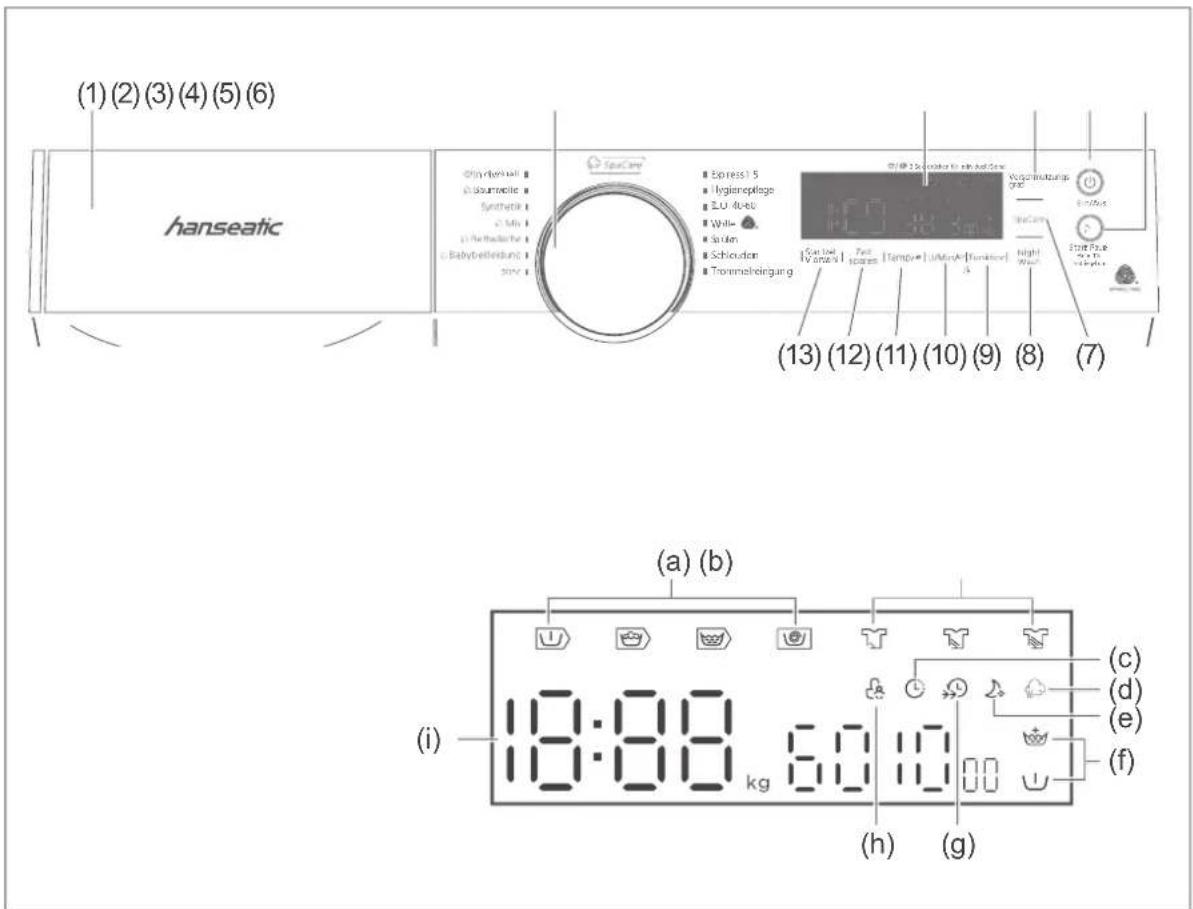
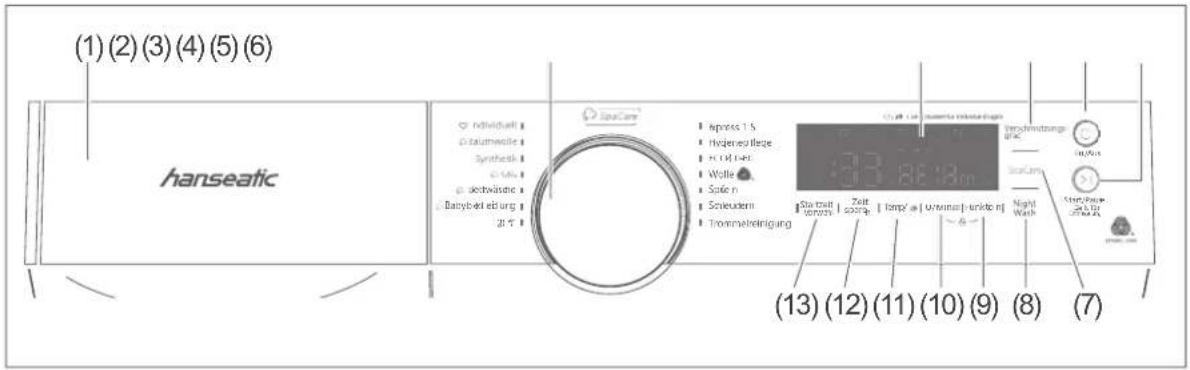
(1) Dispensing drawer
(2) Cycle selector
(3) Display
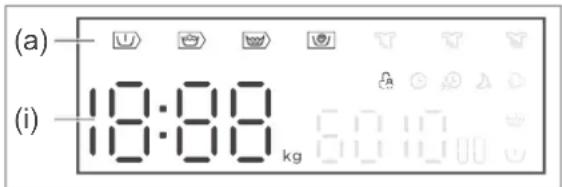
(a) Cycle sequence: "Pre-wash", "Main cycle", "Rinse", "Spinning/Draining"
(b) Current/selected degree of soiling: ☐, ☐, ☑
(c) Ⓤ "Delayed start" active
(e) “NightWash” selected
(f) Selected function ∪ "Pre-wash" and/or crown "Extra rinse"
(g) “Time saving” selected
(h) Button lock/Child lock/Loading door
(i) Number range: Cycle time/Laundry load permitted in kg/Start delay in h, Washing temperature, Spin speed, Poss. error code
(4) "Degree of soiling" button to select one of the three degrees: “light”, “moderate”, “heavy”
(5) Button (to switch the appliance on or off
(6) Button ▷ for starting, interrupting, cancelling and recommencing a cycle
(7) "SpaCare" button to de-crease your laundry
(8) "Night Wash" button limits the spin speed to 800 rpm and mutes beeps
(9) "Function" button to select "∪ Pre-wash" "⊕ Extra rinse"
(10) "Rpm/♥" to select another spin speed and saving the "Custom" cycle
(11) "Temp" button to select another washing temperature and to mute beeps
(12) "Time saving" button to shorten the cycle
(13) "Start time preselection" button to start the cycle at a later time
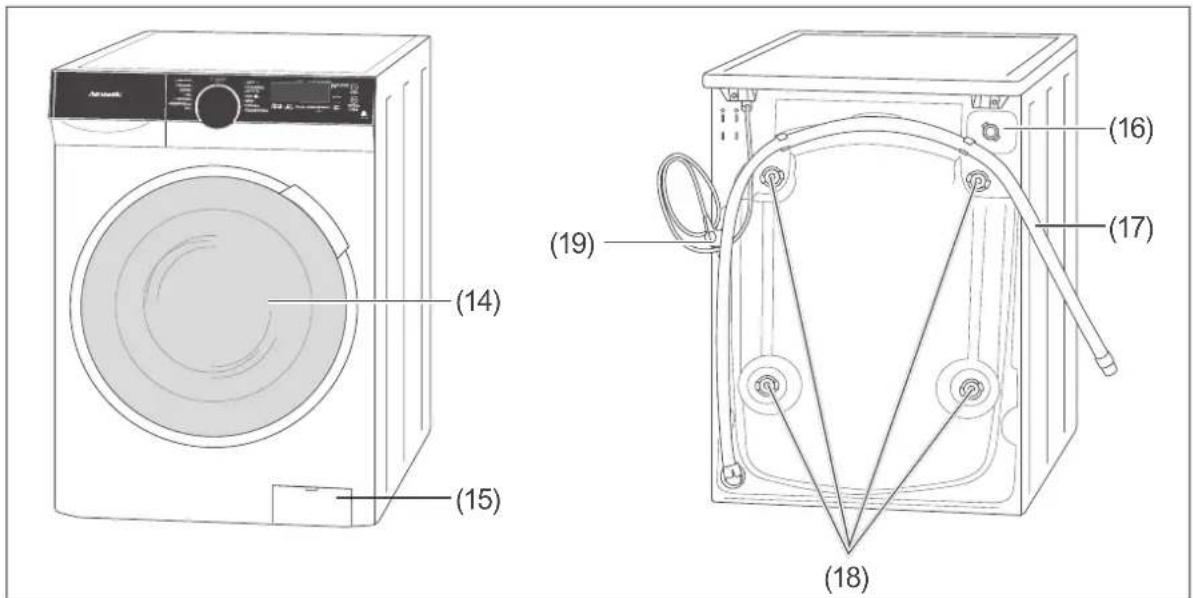
(14) Loading door
(15) Cover of the lint trap
(16) Connection for water inlet hose
(17) Water outlet hose
(18) Transport safety devices, 4×
(19) Mains cable with mains plug
Cycle tables/Laundry detergent recommendation
| Standard cycles of model HWMK814B | |||||||
| Cycle^6) | Type of laundry | Load capacity. maximum [kg]^1) | Cycle time [hr/min] | Standard temperature[°C]2) | Energy consumption[kWh/operating cycle] | Water consumption[litres/operating cycle] | Residual dampness[%/Spin speed inrpm].3) |
| Cotton | Cotton. linen. underwear. sheets.table linen. T-shirts. napkins.hand towels | 8 3:39 40 1 | .120 71 | 70/800 | |||
| Synthetic | Normally soiled sportswear.synthetic laundry and syntheticblended fabrics: Nylon socks.shirts. blouses. trousers whichare partly synthetic | 4 3:18 40 0 | .727 44 | 35/800 | |||
| Mix | Cotton. synthetic. linen andcoloured laundry that can bewashed together | 8 1:20 40 0 | .754 71 | 70/800 | |||
| Bed Linen 8 1:48 40 0.803 71 65/1000 | |||||||
| Baby Care 8 1:42 60 1.284 71 65/1000 | |||||||
| 20° Lightly soiled cotton laundry 4 1:01 20 0.183 | 44 65/1000 | ||||||
| Quick 15" | Slightly soiled clothing (werecommend using a smallamount of detergent) | 2 0:15 -- | 7) | 0.030 | 31 75/800 | ||
| Sterilization4) | 4 2:27 70 1 | .7 55 70/800 | |||||
| ECO 40-605) | Energy-saving: Normally soiledcotton laundry declared to bewashable at 40 °C or 60 °C. canbe cleaned together in this cycle. | 8 3:38 39 | 7) | 0.854 | 59 53/1 | 350 | |
| 4 2:48 7) | 327) | 0.524 | 46 53/1 | 350 | |||
| 2 2:48 7) | 227) | 0.228 | 37 53/1 | 350 | |||
| Wool | Machine-washable wool anddelicates as well as hand wash | 2 1:07 40 0 | .41 60 | 80/600 | |||
| Rinse & Spin | All clothing 8 0:20 / 0.05 25 | 65/1000 | |||||
| Cycle^6) | Type of laundry | Load capacity. maximum [kg]^1) | Cycle time [hr/min] | Standard temperature [°C]^2) | Energy consumption [kWh/operating cycle] | Water consumption [litres/operating cycle] | Residual dampness [%/Spin speed in rpm]^3) |
| Spin only | Clothes suitable for the spin cycle. Spin cycle with freely selectable spin speed including draining | 80:12 / 0.0 | 4 / 65/1 | 000 | |||
| Drum clean / 1:18 90 1.19 17 / | |||||||
Other than “ECO 40–60”, the values specified for the cycles are only guidelines. The length of the cycle may differ from the information provided in this table, depending on the laundry load, the water temperature and ambient temperature, as well as any changed settings.
1) Maximum amount of dry textiles that can be treated in the respective wash cycle.
2) The highest temperature reached by the laundry in the wash cycle for at least five minutes. “--” stands for “Washing water not heating up”
3) Residual dampness after the wash cycle in water content percent and the spin speed at which this was achieved.
^4) The appliance keeps the washing temperature above 60 °C for longer than 30 minutes in order to eliminate harmful bacteria.
5) ECO 40–60 is used to check compliance with EU ecodesign regulations.
6) For information on "Custom" cycle, see page EN-24.
7) The display does not show this values.
| Standard cycles of model HWMK714B | |||||||
| Cycle^6) | Type of laundry | Load capacity. maximum [kg]^1) | Cycle time [hr/min] | Standard temperature [°C]^2) | Energy consumption [kWh/operating cycle] | Water consumption [litres/operating cycle] | Residual dampness [%/Spin speed in rpm]^3) |
| Cotton | Cotton. linen. underwear. sheets. table linen. T-shirts. napkins. hand towels | 7 3:39 40 1 | .050 65 | 70/800 | |||
| Synthetic | Normally soiled sportswear. synthetic laundry and synthetic blended fabrics: Nylon socks. shirts. blouses. trousers which are partly synthetic | 3.5 3:18 40 | 0.698 4 | 1 35/800 | |||
| Mix | Cotton. synthetic. linen and coloured laundry that can be washed together | 7 1:20 40 0 | .696 65 | 70/800 | |||
| Bed Linen 7 1:48 40 0.745 65 65/1000 | |||||||
| Baby Care 7 1:42 60 1.179 65 65/1000 | |||||||
| 20° Lightly soiled cotton laundry 3.5 1:01 20 0.177 41 65/1000 | |||||||
| Quick 15" | Slightly soiled clothing (we recommend using a small amount of detergent) | 2 0:15 -- | 7) | 0.030 | 31 75/800 | ||
| Sterilization 4) | 3.5 2:27 70 | 1.500 5 | 0 70/800 | ||||
| ECO 40-605) | Energy-saving: Normally soiled cotton laundry declared to be washable at 40 °C or 60 °C. can be cleaned together in this cycle. | 7 3:28 38 0 | .782 5 | 1.1 53/1 | 350 | ||
| 3.5 2:42 32 | 0.448 4 | 6.4 53/1 | 350 | ||||
| 2 2:42 22 0 | .213 38 | 8.8 53/1 | 350 | ||||
| Wool | Machine-washable wool and delicates as well as hand wash | 2 1:07 40 0 | .41 60 | 80/600 | |||
| Rinse & Spin | All clothing | 7 | 0:20 | / | 0.045 | 24 | 65/1000 |
| Cycle^6) | Type of laundry | Load capacity. maximum [kg]^1) | Cycle time [hr/min] | Standard temperature [°C]^2) | Energy consumption [kWh/operating cycle] | Water consumption [litres/operating cycle] | Residual dampness [%/Spin speed in rpm]^3) |
| Spin only | Clothes suitable for the spin cycle. Spin cycle with freely selectable spin speed including draining | 70:12 / 0.0 | 4 / 65/1 | 100 | |||
| Drum clean / 1:18 90 1.19 17 / | |||||||

Other than “ECO 40–60”, the values specified for the cycles are only guidelines. The length of the cycle may differ from the information provided in this table, depending on the laundry the water temperature and ambient temperature, as well as any changed settings.
1) Maximum amount of dry textiles that can be treated in the respective wash cycle.
2) The highest temperature reached by the laundry in the wash cycle for at least five minutes. “--” stands for “Washing water not heating up”
3) Residual dampness after the wash cycle in water content percent and the spin speed at which this was achieved.
^4) The appliance keeps the washing temperature above 60 °C for longer than 30 minutes in order to eliminate harmful bacteria.
5) ECO 40–60 is used to check compliance with EU ecodesign regulations.
6) For information on "Custom" cycle, see page EN-24.
7) The display does not show this values.
| Cycle adjustments | ||||||||
| Cycle | Start delay [hr] | Time saving | Temperature [°C] | Spin speed [rpm] | Function | Night wash | SpaCare | Degree of soiling |
| Cotton | -- 20 3040 60 90 | 0 400 600 8001000 1200 1400 | ||||||
| Synthetic | -- 20 3040 60 | 0 400 600 8001000 1200 | ||||||
| Mix | -- 20 3040 60 90 | 0 400 600 8001000 1200 1400 | ||||||
| Bed Linen | -- 20 3040 60 | 0 400 600 8001000 1200 1400 | ||||||
| Baby Care | -- 20 3040 60 90 | 0 400 600 8001000 1200 1400 | ||||||
| 20° -- 20 | 0 400 600 8001000 1200 | |||||||
| Quick 15" -- 20 30 | 0 400 | 600 | 800 | |||||
| Sterilization 4) | 70 | 0 400 600 8001000 1200 1400 | ||||||
| ECO 40-605) | 1400 | |||||||
| Wool | -- 20 3040 | 0 400 600 800 | ||||||
| Rinse & Spin | 0 400 600 8001000 1200 1400 | |||||||
| Spin only | 0 400 600 8001000 1200 1400 | |||||||
| Drum clean 90 | ||||||||
| Laundry detergent recommendations | |||
| Recommended washing detergent | Wash cycles | Washing temperature in °C | Type of laundry and textile |
| Heavy-duty detergent with bleaching agents and optical brighteners | Cotton, ECO 40–60, Mix, Bed Linen | 20 30 40 60 | White laundry comprising boil-proof cotton or boil-proof linen |
| Colour detergent without bleaching agents and optical brighteners | Cotton, Mix, Bed Linen | -- 20 30 40 | Coloured laundry made from cotton or linen |
| Colour or mild detergent without optical brighteners | 20°, Synthetic 20 | Coloured laundry made from easy-care fibres or synthetic material | |
| Mild washing detergent | Synthetic 20 30 | Delicate textiles made from silk, viscose | |
| Special wool detergent | Wool 20 30 Wool | ||
“--” stands for “Washing water not heating up”
Loading laundry and adding detergent
Loading laundry
! NOTICE
Risk of fi re/damage!
Improper handling of the appliance can lead to fi re/faults.
■ Never try to open the loading door with force whilst a cycle is in progress or once a cycle has ended. Only open the loading door once it has been automatically released approx. two minutes after the cycle has ended.
- Open the loading door (14) by pulling the handle slightly towards you.
- Load the laundry.
Observe the maximum laundry load permitted when loading the appliance, do not jam any pieces of laundry between the loading door and rubber sleeve, and follow the tips on page EN-26.
- Push the loading door closed until you hear it snap shut.
Adding detergent/fabric-care products
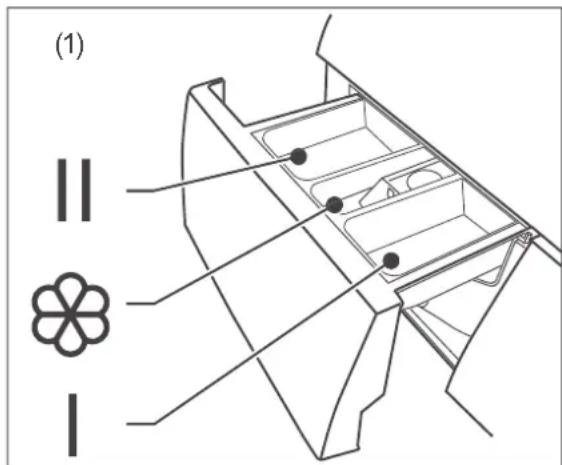
The dispensing drawer (1) has three compartments:
– Dispensing compartment II (left)
Dispensing compartment II is intended for the main wash.
Fill it with powder or liquid detergent or anti-limescale agent for every wash.
- Fabric softener/starch compartment (middle)
Dispense fabric softener or starch here according to the information supplied by the manufacturer.
– Dispensing compartment I (right)
Dispensing compartment I is only intended for prewashes. Only load it if you have selected "Pre-wash" (see table "Cycle adjustments" on page EN-16).
Fill dispensing compartment I with 14 of the detergent and dispensing compartment II with 34 of the detergent.
We recommend using pre-wash cycles only for very dirty clothing.
- Pull out the dispensing drawer (1).
- Load the dispensing compartments as described above.
- Push the dispensing drawer back in after filling.
Operation: Standard cycles
Before getting started
- First read chapters "Intended use" and "Safety notices" (see page EN-4 and the following).
- Remove the transport safety devices and prepare the appliance as described in chapter "Installation, connection and initial commissioning" (see page EN-33).
• Properly attach the water inlet hose (30) and the water outlet hose (17).
Selecting the cycle

NOTICE
Always select the cycle before loading the washing machine. Otherwise the loading sensor will not work.
The cycle table shows you the cycle which is suitable for your laundry (see tables "Standard cycles" on page EN-12; for information on the "Custom" cycle, see page EN-24).
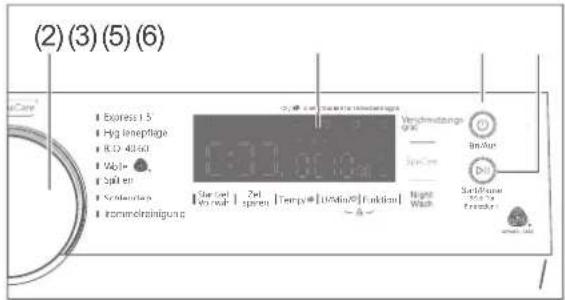
- To switch on the appliance, press the ⏻(5) button.
All symbols/fields in the display (3) will illuminate briefly; then there will only be three lines visible.
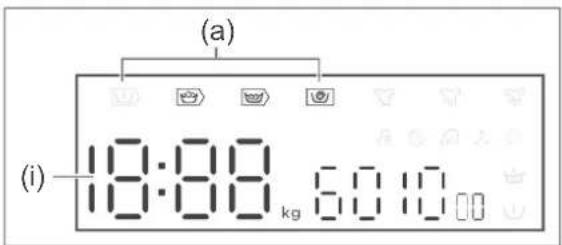
- Select the cycle using the cycle selector (2). The display (3) shows the symbols for the sequence (a) of the current cycle and its standard values in the line (i). Such standard values include the cycle time, current water temperature and spin speed.
| Example cycle: “Cotton” | |
| Degree of soiling | |
| Cycle time in hr/min | 03:39 |
| Washing water temperature | 40 |
| Spin speed | 1400 |
You can change the selected cycle's standard values in order to further adjust them to your kind of laundry. See table "Cycle adjustments" on page EN-16.
Start cycle
- Open the tap completely.
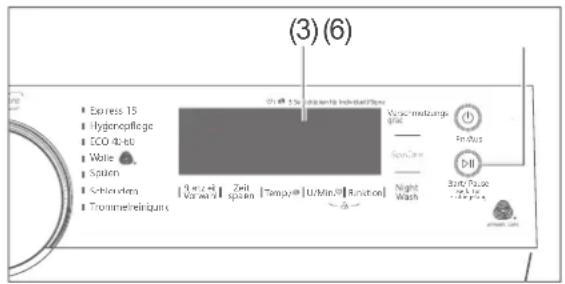
- Press the ▷(6) button.
The cycle starts as soon as the appliance has determined the amount of laundry (approx. 1 minute).
The display (3) shows
– the current cycle phase (a)
- the symbol 📁 showing that the loading door is locked
– the time remaining (i) for the cycle.
Interrupting and continuing the cycle
We recommend only interrupting the cycle for a brief period. Otherwise, the suds will cool down and this will negatively impact the washing result.
To
- interrupt the cycle, press the ▷□ button (6). The indicator for the remaining time (13) will flash during the interruption.
- continue the cycle, press the ▷button (6) again.
Adding laundry
CAUTION
Risk of burns!
Improper handling of the appliance can lead to burns.
■ The glass of the loading door can get hot during operation. Do not touch the glass when the appliance is running.
Risk of scalding!
Improper handling of the appliance can lead to scalding caused by hot suds.
■ Never open the loading door with force.
This function is only available at the beginning of a cycle if the washing water level does not go past the edge of the loading door.
- Press the ▷button (6) until the symbol disappears from the display (at least 3 seconds). The loading door is now unlocked. The drum has come to a stop.
- Open the loading door, place the laundry inside and close the door.
- Press the ▷button (6) to continue the cycle.
Interrupting/changing the cycle
- To interrupt the current cycle or select another cycle, switch off the appliance with the Button (5).
The cycle will be ended. - Set the cycle selector (2) to any other cycle in order to drain the suds.
The suds will be drained away. - To select a new cycle, set the cycle selector (2) to a new cycle.
- If required, add extra detergent.
- Start the new cycle with the ▷□ button (6).
Cycle end
The appliance stops automatically as soon as the selected cycle is finished. The display (3) shows END and the symbol disappears.
- Open the loading door (14) and remove the laundry.
- Leave the loading door (14) open and pull the dispensing drawer (1) out slightly to allow the inside of the appliance to dry.
- To switch off the appliance, press the ⏻ button (5).
If no further setting is made, the appliance will automatically switch off after 15 minutes. - Turn the tap off.
- Disconnect the mains plug from the socket.
Automatic control functions
The following functions run automatically. You cannot change them.
Foam detection
The electronic foam detection makes sure that more water is added to the first rinse cycle for certain amounts of foam.
Overflow protection system
This system prevents the water from leaking out over the dispensing drawer. As soon as a certain water level is exceeded, the outlet pump will automatically switch on.
Dynamic quantity control
If your appliance is loaded only up to half of the maximum capacity, the water consumption and cycle duration will reduce for certain cycles. Adjust the detergent dosage accordingly.
The ⚙ symbol lights up.
The cycle starts as soon as the appliance has determined the amount of laundry (approx. 1 minute).
Imbalance correction system
This system protects your appliance in the event of a too-great imbalance once spinning starts. This can happen with small loads or with large individual pieces of laundry. The laundry is distributed again and the spin speed increased if the laundry distribution is right.
Operation: Cycle adjustments
Additional functions can be used to change a cycle's standard values and adjust them to your laundry in order to achieve the best possible washing result or maximum effectiveness.
The setting options available to you depend on the selected cycle (see “Cycle adjustments” on page EN-16).
If touching the respective key has no effect, none of the additional functions are available.
Changing the washing water temperature
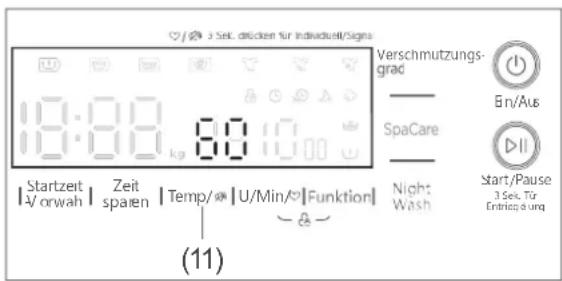
After selecting the desired cycle, its standard temperature will be shown on the display. The setting influences the cycle time and the energy consumption.
- To change the washing water temperature, repeatedly press the "Temp/°" button (11) until the desired temperature is shown on the display (☐ stands for "tap water temperature").

You can now select further additional functions or start the cycle.
Changing spin speed
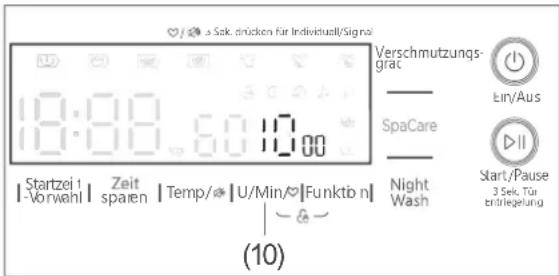
After selecting the desired cycle, its standard spin speed will be shown on the display.
The spin speed affects the noise emissions of the appliance and the residual dampness of the laundry. The higher the spin speed, the higher the noise emissions and the lower the residual dampness.
- To change the spin speed, repeatedly press the "rpm/♥" button (10) until the desired spin speed is shown on the display (☐ stands for "drain without spinning").

You can now select further additional functions or start the cycle.
Pre-washes/Additional rinses
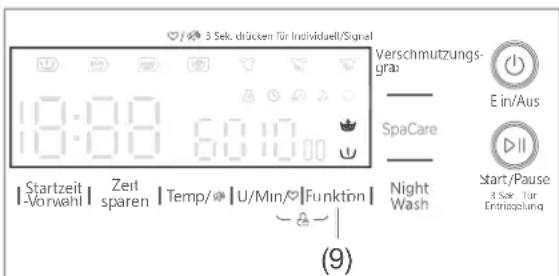
After selecting your preferred cycle, you can add two functions to the cycle:
“Pre-wash”
This option is recommended only for heavily soiled laundry (see “Adding detergent/fabric-care products” on page EN-18).
“Extra rinse”
The setting influences the cycle time as well as the water and energy consumption.
- To select an option, repeatedly press the "Function" button (9) until the display shows the desired function(s).

You can now select further additional functions or start the cycle.
Time saving
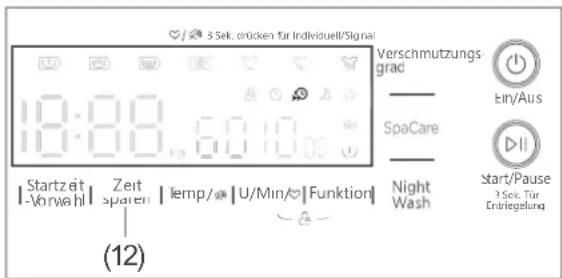
If the appliance is filled up to half the cycle capacity or the laundry is only lightly soiled, you can use this function to shorten the cycle time.
- To shorten the cycle time, press the "Time saving" button (12). The display shows 🔊.

You can now select further additional functions or start the cycle.
Night Wash
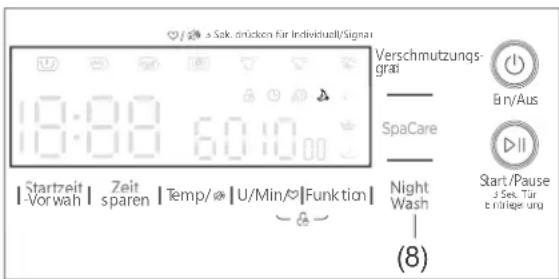
The appliance is operated at a max. spin speed of 800 rpm and mutes the beeps so you do not disturb your neighbours when the cycle is on at night. The setting influences the cycle time.
To switch
- on this setting, press the "Night Wash" button (8).
The symbol will appear on the display.
- off this setting, press the "Night Wash" button (8).
The symbol will disappear from the display.
SpaCare
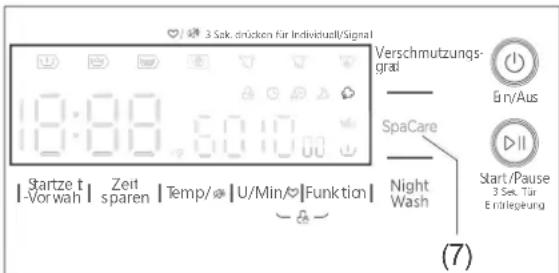
SpaCare cleans your laundry gently with hot steam in order to reduce creases without using fabric softener. The setting influences the cycle time as well as the water and energy consumption.
To switch
- on this setting, press the "SpaCare" button (7).
The symbol will appear on the display.
- off this setting, press the "SpaCare" button (7).
The symbol will disappear from the display.
Selecting the degree of soiling
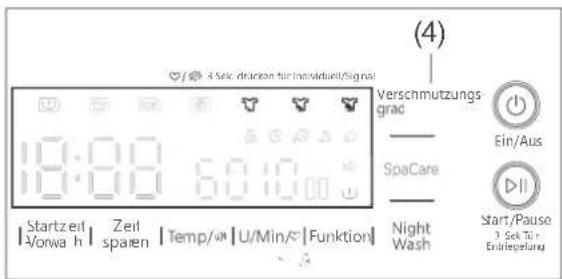
After selecting the desired cycle, the display shows you whether there is a default degree of soiling setting for this cycle.
The setting influences the cycle time, the washing water temperature and the energy consumption.
- To change the degree of soiling, repeatedly press the "Degree of soiling" button (4) until the desired degree is shown on the display:
"light" "moderate" or "heavy".

You can now select further additional functions or start the cycle.
"Custom" cycle
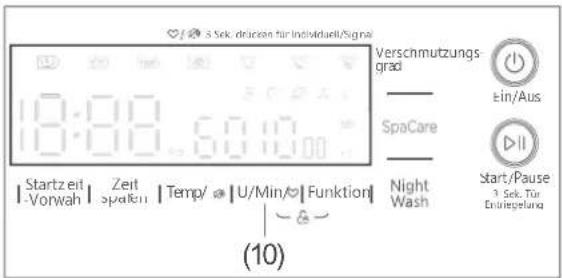
If you frequently use a standard cycle with certain additional settings, you can skip this combination.
- Select the standard cycle and the desired cycle adjustments.
- Press and hold the "rpm/♥" button (10) for approx. 3 seconds.
You can now use the "Custom" cycle.

If you want to save a different combination of standard cycle and cycle adjusts, repeat the process.
Operation: Additional functions
Start time pre-selection
The cycle usually starts as soon as you have pressed the ▷button (6). This appliance also offers you the option to delay the start time.
Setting the start time preselection
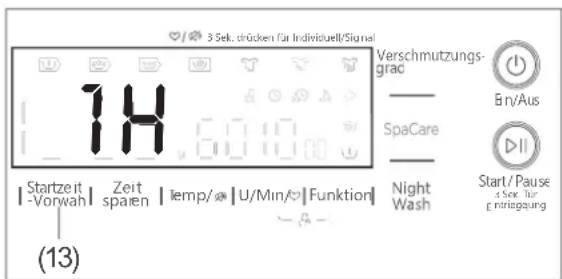
The start time delay can be set in one-hour increments. The maximum start time pre-selection is 24 hours.
- Select the desired cycle using the cycle selector (2).
- Press the "Start time preselection" button (13).
The Ⓞ symbol and the delay time 1H will appear on the display. This means that the selected cycle will start in one hour. - To extend the delay time, repeatedly press the "Start time preselection" button (13) until the display shows the desired delay time.
- Press the ▷□ button (6). The cycle will start after the delay setting has elapsed.
Terminate delay
If the ▷button (6) has
- already been pressed: switch the appliance off using the ⏻ button (5).
- not yet been pressed: repeatedly press the "Start time preselection" button (13) until is shown on the display.
Button lock/Child lock
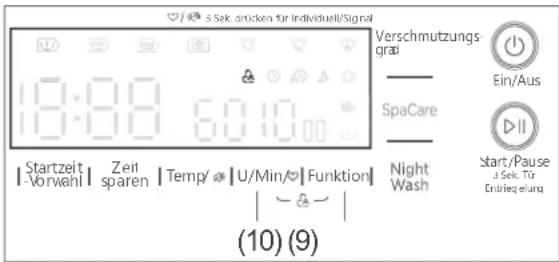
The button lock allows you to secure the appliance from unwanted use. This stops a standard cycle from being altered when not desired and from being accidentally started or stopped. To
- activate the button lock, hold and press both the "rpm/♡" (10) and "Function" (9) buttons at the same time until the 🔊 symbol appears on the display and ℓL flashes. All operating controls are locked (exception: ⏻button (5)).
- switch the button lock off, press and hold both the "rpm/♥" (10) and "Function" (9) buttons at the same time until the symbol and CL disappear.
Switching beeps on/off
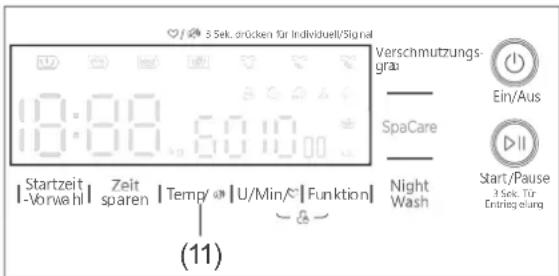
You can decide whether or not there should be a beep when a button is pressed and when the cycle ends.
- To change the current setting, press and hold the "Temp/12" button (11) for 3 seconds.
Basic washing tips
Preparing the laundry
- Remove tissues and foreign objects such as needles, nails, coins, matches, paper clips, clips or similar from your pockets. Turn the pockets inside out if necessary and brush them out.
- Turn trousers, knitwear, T-shirts and track-suits "inside out" to protect the surface material.
- Repair unstitched seams and tears before washing; sew up loose buttons tightly. Close zippers; tie apron strings etc.
Sorting through laundry
The washing instructions of the textile manufacturer/the international care symbols on the labels contain precise information about how to handle each piece of laundry.
We recommend sorting through the laundry according to the following criteria:
- Type of fabric
– Hot wash/coloured wash (cotton)
– Easy-care textiles
– Delicates, wool and hand wash
- Colour
- Wash white laundry separately, otherwise it will turn grey.
- Wash new dark pieces separately at first, as they lose their colour a lot the first few times they are washed.
– Degree of soiling
- If possible, remove stains when still fresh, otherwise they will become particularly stubborn.
- It is best to pre-treat stains with water and ox-gall soap.
Tips for delicate textiles
- Curtains
- Remove the curtains' plastic and metal hooks before washing.
- Handle curtains especially carefully; it is easy to get loose threads. Only put them on a spin cycle if this is specified in the textile label.
- Wash small and delicate pieces, such as baby socks, stockings and underwire bras, in a small pillowcase or small washbag.
The right washing load
The amount of laundry that can be loaded depends on the type and soiling of your laundry and the respective wash cycle (see page EN-12).
As a rule of thumb: Load dry washing up to one hand width below the upper edge of the drum. If you overfill the drum, it may affect the outcome of your wash.
It is best to weigh your washing before you do the wash. Some washing weights can be found in the following table:
| Typical washing weights | |
| Bed sheets Approx. 550 g | |
| Duvet covers Approx. 700 g | |
| Cushion covers Approx. | 180 g |
| Tablecloths | Approx. |
| Terry towels Approx. 200 g | |
| Tea towels Approx. 90 g | |
| Men's shirts Approx. 250 g | |
| Women's nighties | Approx. 180 g |
| Pyjamas | Approx. 450 g |
| Bathrobes | Approx. 1200 g |
| Work overalls (synthetic) | Approx. 300 g |
| Handkerchiefs | Approx. 20 g |
The right washing detergent
- Do not use other cleaning agents, such as scouring powder, household cleaners, etc. These will damage the appliance and your laundry.
Fabric-care products
- Do not use fabric softener in the same wash cycle as starch, fabric conditioner, or finishes.
- Before dispensing viscous fabric-care products, mix them together with a little water to thin them out.
- Only use powder starch according to the instructions on the packet and not with high temperatures, or it may form clumps.
The right dosage
The motto “more is better” does not apply to detergents and fabric-care products. They must be dosed properly to achieve the perfect wash result. Here are some tips:
- If necessary, use a smaller dosage of detergents and fabric-care products if the drum is not filled completely. For example, for half loads, only use about half the amount needed for a full drum.
– Always adjust the amount of detergent to the respective hardness of the water. If your tap water is soft, you need less detergent. Information about the water hardness in your area is provided by the waterworks responsible. The water hardness is also shown on the invoice from your water supplier.
- Dose detergent according to how dirty your laundry is. Laundry that is less dirty requires less detergent.
– Highly concentrated detergent (also known as compact detergent) in particular requires accurate dosage. Even minor differences can have significant effects.
The following wash results are a sign of incorrect dosage of detergent.
Too much detergent:
– Heavy foam formation
– Poor washing and rinsing result
– Skin irritation caused by leftover detergent in the clothing
Not enough detergent
– Laundry turns grey
- “Grease marks” (grey clumps of grease and dirt) on laundry
– Build-up of limescale deposits in the drum, heating elements and/or laundry
Environmentally friendly washing
- The most efficient cycles with regard to energy and water consumption are generally those with a longer duration and lower temperatures.
- The ECO 40–60 and 20 °C cycles are efficient in terms of combined energy and water consumption:
- The ECO 40–60 cycle is suitable for cleaning normally soiled laundry that is declared to be washable at 40 °C or 60 °C and that can be washed together.
- The 20^ cycle is suitable for cleaning lightly soiled laundry that can be washed at a nominal temperature of 20^ .
- You can save energy and water if you use the specified maximum amount of laundry.
Care and maintenance

WARNING
Risk of electric shock!
Touching live parts may result in severe injury or death.
■ Before cleaning the appliance, pull the mains plug out of the socket.
■ Never spray the appliance with a water jet or a high-pressure cleaner.

NOTICE
Risk of damage to property!
Improper handling of the appliance may result in damage.
■ Do not use caustic, abrasive or scouring solvent-based cleaners. They can damage the surfaces or make the rubber sleeve brittle and fragile.
■ Do not use pointed, sharp or angular objects for cleaning the rubber sleeve. They can damage the rubber sleeve and make it leaky.
Regular checks
- Check regularly whether
– the fittings of the inlet hose are sitting securely and are sealed when the valve is open;
– the outlet hose is sitting securely and tightly on the edge of the bath or on the siphon;
– the outlet hose is sitting tightly in the retaining clip at the point where it comes out of the casing;
– the inlet and outlet hoses are brittle, cracked or creased;
– the lint trap is closed tightly;
– the rubber sleeve of the loading door is free of foreign objects such as buttons, paper clips, etc.;
– the drum is free from foreign objects;
– the drum shows signs of rust.
Regular cleaning
Washing machine-cleaning agents for maintaining your appliance can be found in well-stocked supermarkets and drugstores. Cleaning the appliance using these products takes place when the washing machine is empty and is very intensive.
You should clean the appliance in this way every 30 wash cycles to prevent limescale deposits and to maintain your appliance. When doing so, please note the manufacturer instructions on the packaging.

Limescale deposits can be avoided using the right detergent dosage.
Cleaning the loading door
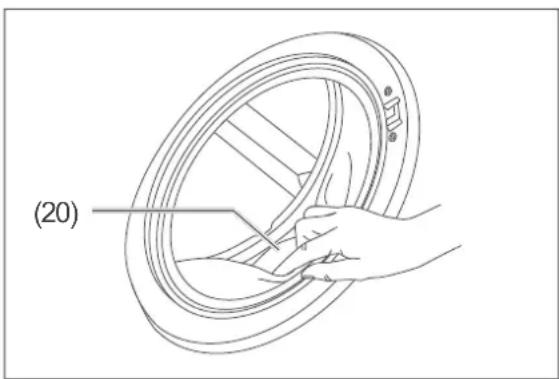
- Pull back the folds of the rubber sleeve (20) carefully and remove all objects from behind it.
- Wipe the loading door (14) and the rubber sleeve (20) with a soft, damp cloth on the outside and inside, and then wipe them both dry.
Cleaning the drum
NOTICE
Risk of damage to property! Improper handling of the appliance may result in damage.
■ Never use harsh cleaning products, such as a scouring pad, etc.
- If you have used starch or fabric sizing, wipe out the drum with a moist cloth.
- Rusty metal parts in the washing (e.g. paper clips, etc.) can cause rust stains in the drum. Use a commercially available rust remover to remove such rust spots.
Cleaning the dispensing drawer
NOTICE
Risk of damage to property! Improper handling of the appliance may result in damage.
■ The dispensing drawer and removable parts are not suitable for the dishwasher.
- Pull the dispensing drawer (1) out as far as possible.
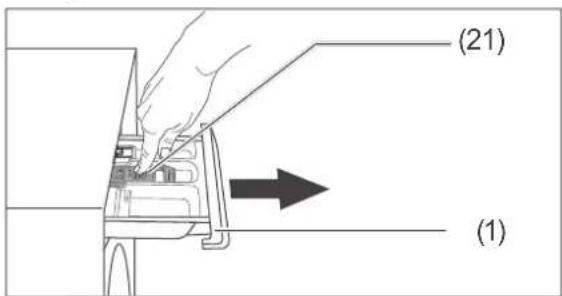
- Press the release spot (21) and fully pull out the dispensing drawer (1).
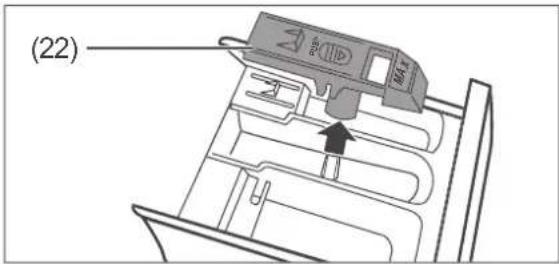
- Remove the insert (22).
- Rinse the dispensing drawer and insert under running water.
- Remove any leftover detergent in the drawer runner and compartments with a small brush for dishes or bottles or a toothbrush.
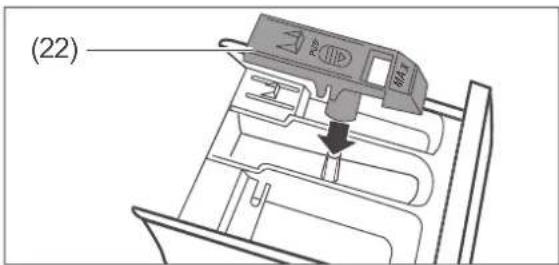
- Properly reinsert the insert (22).
- Push the dispensing drawer back into the rinsing chamber.
Checking the water inlet filter and replacing the gasket

NOTICE
Risk of damage to property! Improper handling of the appliance may result in damage.
■ Turn off the water intake tap after each use, before cleaning the water intake filter or replacing the seal. Otherwise there is a risk of water damage.
■ Close the valve before cleaning the filter or replacing the gaskets.
■ Check and clean fi Iters and gaskets regularly.
■ Replace defect filters and gaskets immediately. Never operate the appliance without filters and gaskets.
There are filters in the appliance's water inlet which prevents foreign particles from entering the appliance.
Check and clean the filter every 3 months or if the appliance is not getting enough water despite the tap being open completely.
- Switch off the appliance, take the mains plug out of the socket and turn off the tap.
- Unscrew the water inlet hose from the valve.
- Clean the filter with a small brush.
- Screw the water inlet hose onto the valve again.
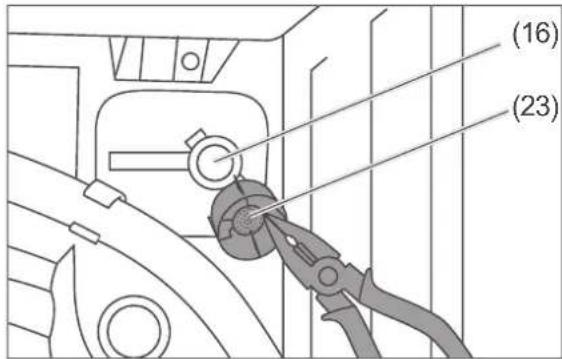
- Unscrew the water inlet hose from the appliance.
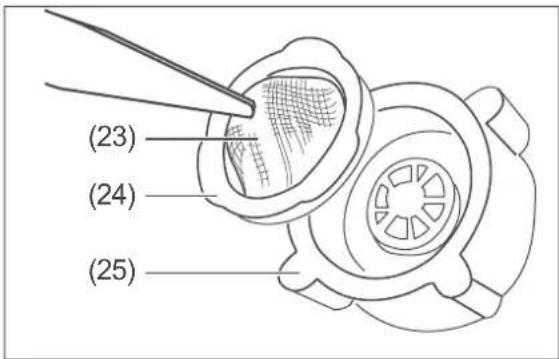
- Use tweezers or a pair of pliers to pull the filter (23) with gasket (24) out of the union nut (25). Rinse the filter under fresh water and clean with a small, soft brush if necessary.
- Re-insert the filter and screw the water inlet hose back onto the appliance.
- Open the valve to check whether the hose and connections are sealed.
Cleaning the lint trap

WARNING
Risk of scalding!
Improper handling of the appliance can lead to scalding caused by hot suds.
■ Allow soapy water to cool before removing the lint trap.

NOTICE
Risk of damage to property!
Improper handling of the appliance may result in damage.
■ When draining in an emergency, substantial amounts of water can leak out.
The lint trap stops threads
and other foreign bodies ending up in the pump with the suds. Clean the lint trap every 3 months.
- Switch off the appliance and take the mains plug out of the socket.
- Close the valve.
natural_image
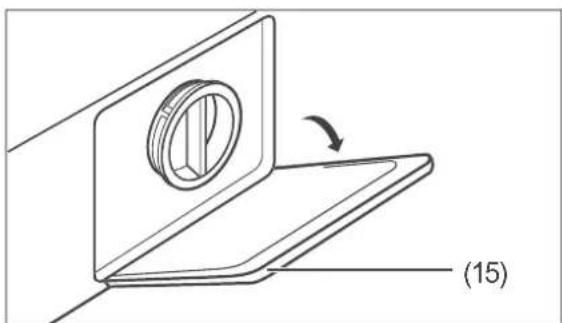
Diagram of a device with a circular component and an arrow indicating rotation, labeled (15) (no text or symbols on the diagram itself)- Carefully open the shutter (15) of the lint trap with a flat object, such as with a flat-tip screwdriver.
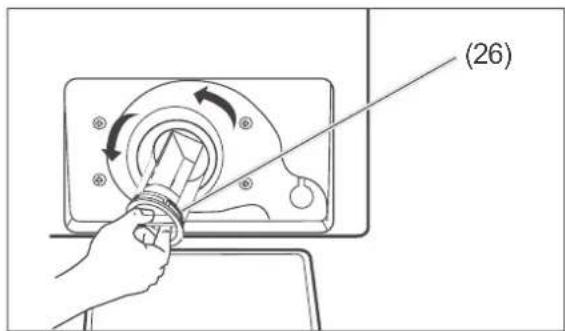
- Place a suitable collecting container underneath the lint trap (26).
- Open the lint trap (26) anticlockwise only to the point where water begins to flow out. You will have to repeatedly empty the collection container every now and then.
- Completely unscrew the lint trap (26) once the water stops flowing.
- Remove all foreign bodies and clean the lint trap (26) under running water.
natural_image
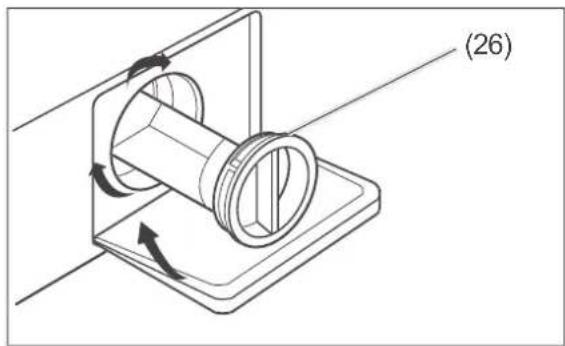
Technical diagram of a mechanical assembly with rotating components and directional arrows (no text or symbols)- Replace the lint trap (26) and screw it all the way in.
- Fold the cover (15) back into position.
Emptying residual water

CAUTION
Risk of injury!
Improper handling of the appliance may result in injury.
■ The appliance is very heavy. Never carry it alone, but always have at least two persons to do so.
If the appliance is in a frost-prone room, you must drain the residual water so that it does not freeze in the appliance and cause damage.
- Follow steps 1 to 7 as described in Section "Cleaning the lint trap" (see page EN-31).
- With the assistance of another person, tilt the appliance forward slightly to allow any residual water to drain from the appliance.
- Replace the lint trap and screw it clockwise all the way in.
- Fold the cover (15) back into position.
- Unscrew the water inlet hose from the valve and remove the drainage hose from the tub or siphon to drain any residual water.
Installation, connection and initial commissioning
Check package contents
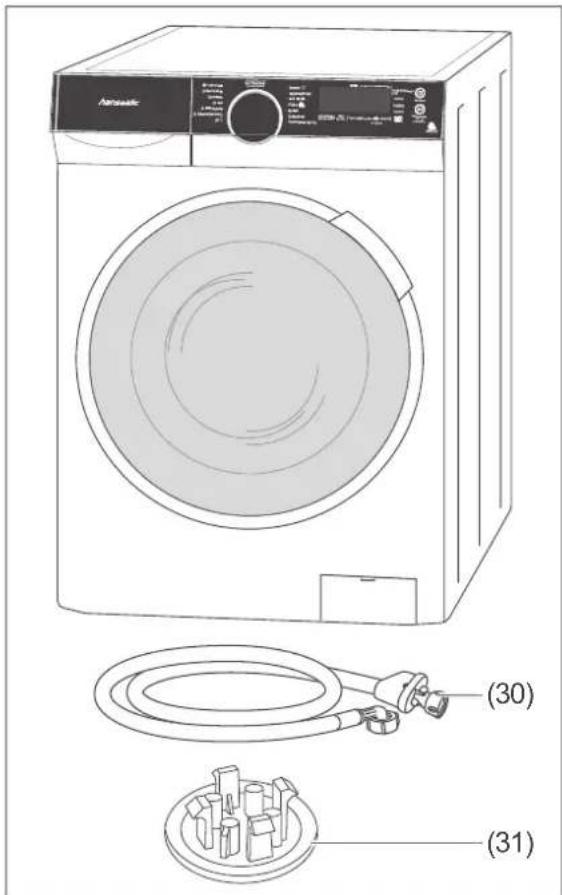
Package contents: Fully Automatic Washing Machine with
1× Water inlet hose with Aquastop (30)
4× Cover for transport safety devices (31)
1× User manual
1× Short manual
1× Guarantee supplement
Check the delivery
- Unpack the appliance.
- Remove all parts of the packaging, plastic profiles, tape and foam padding. Possible residual water or drops in the appliance are merely a sign that it was tested for functionality during production.
- If the delivery is incomplete or the appliance has been damaged during transport, please contact our Service department (see page EN-42).
! WARNING
Risk of electric shock!
Touching live parts may result in severe injury or death.
■ Never use a damaged appliance.
Transport
CAUTION
Risk of injury!
Improper handling of the appliance may result in injury.
■ The appliance is very heavy. Never transport or carry it alone, rather always with at least two persons.
! NOTICE
Risk of damage to property!
Improper handling of the appliance may result in damage.
If a trolley is used to move the appliance, the appliance must be lifted as shown on the packaging. Always transport the appliance vertically and with a built-in transport safety device.
- Check whether the transport route and the installation site are suitable for the weight of the washing machine. If in doubt, ask your landlord or property management.
Removing the transport safety devices

WARNING
Risk of electric shock!
Touching live parts may result in severe injury or even death.
■ Make sure the appliance is not connected to the power supply whilst the transport safety devices are being removed or installed.
There are four transport safety devices on the back of the device. These must be removed before first use.
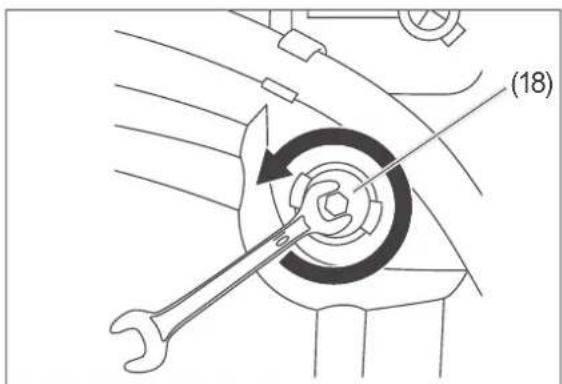
- Loosen the screws of the transport safety devices (18) using a 10 mm wrench.
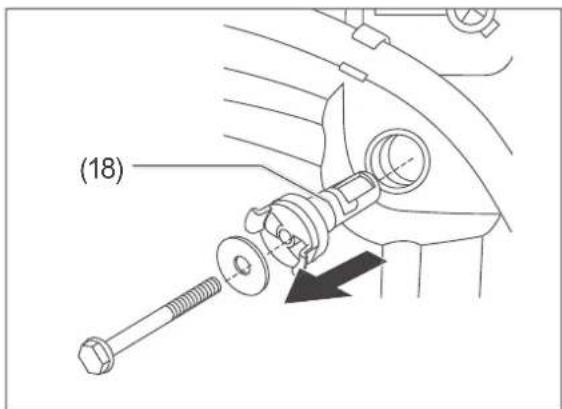
- Remove the transport safety devices (18).
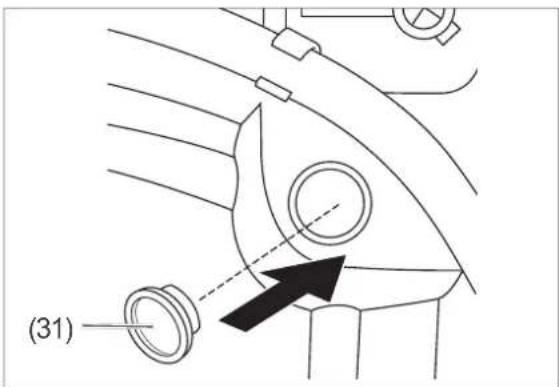
-
Close the openings with the covers (31) supplied.
-
Keep the transport safety devices in a safe place. Re-install the transport safety devices every time the appliance is moved – when moving home or returning the appliance!
Installation site
The installation site must fulfil the following conditions:
- The room must be protected against frost and offer ventilation possibilities.
- The installation area must not be exposed to direct sunlight. No coal- or oil-burning heating appliances are allowed in the immediate proximity.
- A water connection as well as a bath or sink must be available.
- The mains plug must also be easily accessible once the appliance has been set up.
- The ground must be secure, even, clean and dry.
- It is not appropriate to have a rug or carpet under the appliance, as the appliance will not be ventilated well enough and can overheat.
For use on rugs, carpets, parquet or wooden floorboards, place a stable wooden board (measuring at least 60 × 60 cm) underneath the appliance.
If it is placed on a wooden plate or base, the screw-on feet should be fixed so that
the appliance does not dislodge itself when spinning.
Lay a smooth tiled floor or rubber mat under the screw-on feet.
- The appliance needs at least 2 cm clearance to side walls and the back wall.
Aligning the appliance
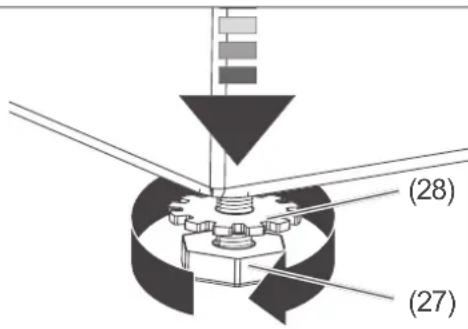
- Loosen the lock nut (28) of one of the screw-on feet (27) underneath the appliance.
- Using your hand, screw the foot (27) in or out as far as necessary. To adjust the foot, twist it
- anti-clockwise to unscrew.
– clockwise to screw in. - Repeat this for the other screw-on feet until the appliance is standing completely horizontally and securely.
- Twist the lock nuts of all screw-on feet upwards to the underside of the machine and tighten the lock nut against the underside of the machine.
Water connection
Establish drain for water

WARNING
Risk of scalding!
Improper handling of the appliance can lead to scalding caused by hot suds.
■ Fix the hose to the sink or bath to prevent it from slipping due to the recoil caused by pumping.
■ For drains, make sure that the cross section of the discharge pipe is great enough that the drain cannot overflow.

NOTICE
Risk of damage to property!
Improper handling of the appliance can lead to water damage.
■ Use only the water outlet hose provided.
■ Do not extend the water outlet hose or replace it with another hose.
■ The water outlet hose must not get bent or twisted.
■ The curvature of the water outlet hose must be at least between 60 cm and 100 cm above the ground to ensure the water drain functions perfectly.
■ The water outlet hose must be in the retaining clips on the back of the appliance so that the bend on the hose always remains above the waterline inside the appliance. The end of the hose must not be submerged in the pumped water.
You can fit the outlet hose in two ways:
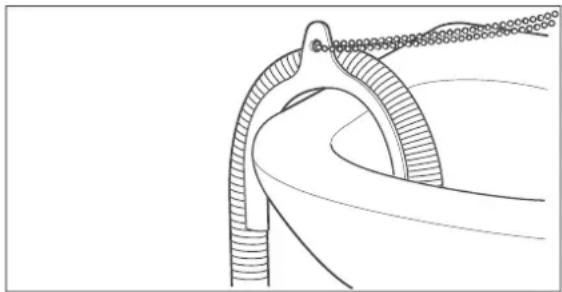
- Attaching with hose holder over the edge of a bathtub or washbasin
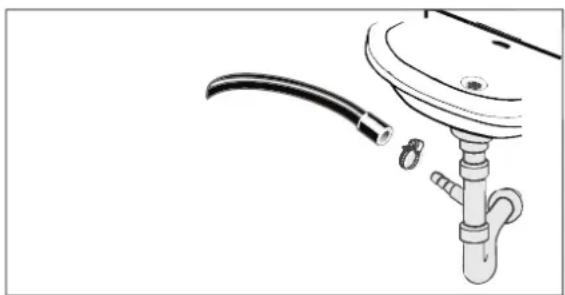
- Attaching the discharge manifold to a washbasin.
Attaching with a hose holder
natural_image
Diagram of a curved pipe or channel with layered structure, no text or symbols present- Put the end of the water outlet hose (17) over a hose holder and hang it over the edge of a bath or a washbasin. You can find a hose holder in a specialist shop or DIY store.
Attaching the discharge manifold to a washbasin
natural_image
Diagram of a pipe fitting attached to a sink, showing tubing and valve (no text or symbols)- The water outlet hose (17) is mounted onto a special device, which can be found on the outlet manifold of a washbasin. In doing so the lock on the siphon must be removed.
Have this fixed by a specialist!
There is a washer in an unused connection manifold to ensure that no water can run out. This washer must be replaced by a seal ring before connecting the water outlet hose.
Establish the water supply
! NOTICE
Risk of damage to property! Improper handling of the appliance may result in damage.
■ Only use the hose set delivered with the appliance to connect to the water supply. Do not use old hoses.
ATTENTION: Do not connect to the hot water supply.
Only connect the appliance to a water supply with an inlet water pressure between 0.05 MPa and 1.0 MPa (0.5 to 10.0 bar). For higher water pressure, a pressure regulator needs to be arranged. Enquire about the water pressure with the water authority.
Do not use a pipe wrench to screw down the union nuts on the valve. This can damage the union nuts.
For the water supply, you will need a valve with a 3/4 inch screw connection.
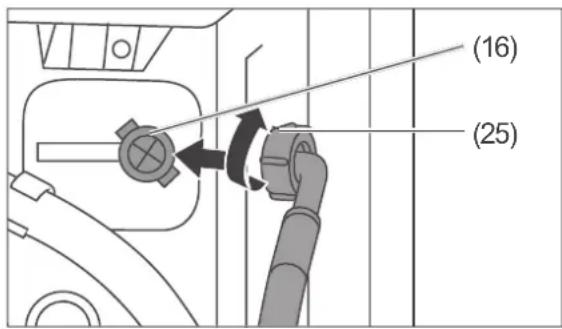
- Screw the enclosed water inlet hose onto the connection (16) by hand. To do so, turn the union nut (25) clockwise.
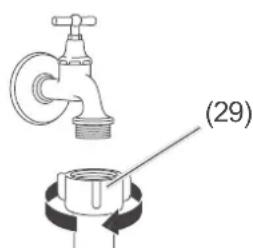
- Secure the other end on the water inlet hose to the tap by hand. Then turn the union nut (29) clockwise.
- Open the valve completely and check whether the connections on the appliance and on the valve are sealed.
- Then close the tap again.
Creating an electrical connection

WARNING
Risk of electric shock!
Touching live parts may result in severe injury or death.
■ Do not put into operation if the mains cord is faulty or the appliance displays other visible damage.
■ Never connect the appliance via a multiple socket.
- Plug the mains plug into a properly installed and earthed electric socket that has been sufficiently secured (220–240 V, 50 Hz, 10 A).
First use/Test run
The appliance requires an initial wash cycle without laundry, but with detergent. The aim of this is to rinse out possible residues from production.
- Dispense a maximum of 25 ml of compact detergent into the left chamber II.
- Make sure that the drum is empty.
- Push the loading door (14) tightly closed.
- Carry on, as described in chapter "Operation: Standard cycles" on page EN-19; use the "Cotton" cycle here.
First use is completed once the cycle has finished.
Troubleshooting table
Malfunctions can occur in all electrical appliances. This does not necessarily mean there is a defect in the appliance. For this reason, please check the tables to see if you can correct the malfunction.

WARNING
Risk of electric shock!
Touching live parts may result in severe injury or death.
- Never try to repair a defective or suspected defective appliance yourself. You can put your own and future users' lives in danger. Only authorised specialists are allowed to carry out this repair work.
| Wash result is not satisfactory | ||
| Problem Possible causes Solutions, tips | ||
| Wash result is unsatisfactory/poor. | Not enough detergent used. | Dispense detergent in accordance with manufacturer instructions. |
| Water is too hard. | Use the amount of detergent recommended by the manufacturer for the water hardness in your area. | |
| Too much laundry is in the drum. | Only load the maximum intended amount of washing into the appliance. | |
| Water temperature is too low. | Wash laundry at a higher water temperature, if necessary select another wash cycle. | |
| Stains have not been pre-treated. | Treat stains with ox-gall soap or stain remover if necessary. | |
| Too much foam is created during the wash cycle. | Too much detergent used. Next time, use less detergent. | |
| Detergent is not suitable for washing machines. | Use detergent suitable for washing machines. | |
| Fabric softener/ fabric-care product was not dispensed. | Insert (22) in fabric softener/ starch compartment was not inserted properly or is clogged. | Remove the insert (22), clean and insert properly (see page EN-29). |
| Laundry is discoloured. | Laundry was washed at a temperature that was too hot. | Bleach laundry carefully if necessary. |
| Whites and colours were not separated. | ||
| Laundry has mould stains. | Damp and/or worn laundry was left in the washing drum. | Remove mould stains carefully before the next wash, preferably with a special cleaner. Ask for advice at a chemist's. |
| Detergent residue on laundry. | Too much detergent used. | Wash laundry with the correct dosage of detergent. |
| Colours of the laundry have faded. | Detergent contains bleaching agent. | Use colour freshener if necessary (available at chemist's). In future, use detergent without bleaching agent. |
| Stain remover or similar was used. | ||
| Malfunction | ||
| Problem Possible causes Solutions, tips | ||
| Appliance does not work. | Mains plug is not sitting properly in the socket or is not plugged in. | Plug it into the socket properly. |
| Socket has no voltage. Check fuse; switch on if necessary. | ||
| Fuse is not intact. Replace fuse. | ||
| Wash cycle does not start. | No wash cycle set. | Select the desired wash cycle using the cycle selector (2). |
| Loading door is not closed properly. | Properly close the loading door (must hear it “snap” shut). | |
| Cycle was not started. | Press the ∅∥ (6) button. | |
| The appliance calculates the amount of laundry (approx. 1 minute). | The program cycle starts as soon as the appliance has determined the amount of laundry. | |
| Appliance is not receiving water. | Valve is closed. Open valve. | |
| Loading door is not closed properly. | Close loading door properly. | |
| There is a kink in the water inlet hose. | Check water inlet hose; dismantle if necessary and re-align. | |
| The water inlet hose is clogged. | Clean the filter on the water inlet hose (see page EN-30). | |
| Filter on inlet is clogged. | Clean the filter on the inlet (see page EN-30). | |
| Water is not being pumped. | Outlet hose is clogged or kinked. | Check outlet hose; dismantle if necessary and re-align. |
| The lint trap is clogged. Clean lint trap (see page EN-31). | ||
| Water is draining even though the appliance is not pumping. | Outlet hose is too low. Place outlet hose higher. | |
| Water is running out (appliance is “leaking”). | Inlet or outlet hose is not screwed on tightly enough. | Screw down inlet or outlet hose down tighter. |
| Lint trap not closed properly. | Properly close the lint trap (see page EN-31). | |
| Appliance is unsteady or vibrating strongly. | Transport safety device(s) was not/were not removed. | Remove transport safety device(s) (see “Removing the transport safety devices” on page EN-34). |
| Appliance was not installed or aligned properly. | Install or align appliance properly (see “Installation site” on page EN-34). | |
| The laundry in the drum is heavy or distributed unevenly. | Stop washing and restart to distribute the laundry more evenly (see “Adding laundry” on page EN-20). | |
| Spin cycle is not running or is slow. | The imbalance correction system for imbalanced drum loads is running. | No error. Once the laundry is distributed evenly, the spin cycle starts automatically. |
| During the wash cycle, no water can be seen in the drum through the glass panel. | This is not an error. The water is at the bottom of the drum. | |
| Loading door won’t open after the wash cycle has finished. | This is not an error. The opening mechanism contains a safety device that keeps the loading door closed another 2 minutes or so after the wash cycle has finished. | |
| Error codes | ||
| Code | Possible causes Solutions, tips | |
| E30 | Loading door is not closed. | Properly close the loading door and re-start the cycle.If the problem persists, please contact our Service department (see page EN-42). |
| E10 | Water level in the appliance is lower than the heating coil. | – The water pressure, to which the appli-ance is connected may be too low or the valve may be closed. If necessary, open the valve completely.– If necessary, loosen any twists or knots in the water inlet hose.– Clean the filter in the water inlet hose (see “Checking the water inlet filter and replacing the gasket” on page EN-30).If the problem persists, please contact our Service department (see page EN-42). |
| E21 | Pump is faulty or lint trap is clogged. | Clean lint trap (see page EN-31). If the problem persists, please contact our Service department (see page EN-42). |
| E12 | Too much water in the appliance. | The appliance is automatically pumping water away. After draining, switch off the appliance, pull the mains plug out of the socket and close the valve. Please contact our Service department (see page EN-42). |
| EHH | Other problem. | Please contact our Service department (see page EN-42). |
Service
Please note!
You are responsible for the condition of the appliance and its proper use in the household.
If you call out for customer service due to an operating error, you will incur charges, even during the guarantee/warranty period.
Damage resulting from non-compliance with this manual unfortunately cannot be recognised.
In order for us to help you quickly, please tell us:
| Name of appliance Model Order number | ||
| hanseatic Fully Automatic Washing Machine | HWMK814B 1861 | 4722 |
| HWMK714B 8405 | 5156 | |
Advice, order and complaint
Please contact your mail order company's customer service centre if
– the delivery is incomplete,
– the appliance is damaged during transport,
– you have questions about your appliance,
- a malfunction cannot be rectified using the troubleshooting table,
– you would like to order further accessories.
Repairs, replacement parts and accessories
You can prevent waste by having your defective appliances repaired. Please contact our Service department regarding this.
Spare parts for your appliance are available for a minimum period of ten years after the last of the model has been placed on the market.
Customers in Germany
- Please contact our technical service department:
Phone +49 (0)40 36 03 31 50
Customers in Austria
- Please contact your mail order company's customer service centre or product advice centre.
Waste prevention, free return and disposal
Waste prevention
According to the provisions of Directive 2008/98/EC, waste prevention measures always take priority over waste management.
For electrical and electronic devices, waste prevention measures include extending the lifespan of defective devices through repair and reselling used working appliances instead of disposing of them.
Please help us reduce waste and contact our customer service if your product is faulty.
More information can be found in the brochure "Waste Prevention Programme – of the German Government with the Involvement of the Federal Länder".
Free return of old electrical appliances
Upon purchasing a new electrical appliance of the same type with essentially the same function, consumers may return an old electrical appliance to a distributor obliged to take back old appliances, at no extra cost for the consumers. This option also exists for deliveries made to a private household. For distance selling, the option of having old electrical equipment collected for free applies only in the case of purchase of new electrical equipment with heat exchangers (e.g. refrigerators, dehumidifiers), screens and display devices with a screen surface > 100 cm ^2 , and large devices with at least one of its external dimensions measuring more than 50 cm.
In addition, consumers may return up to three old electrical appliances of the same type to a distributor's collection point for free, without having to purchase a new electrical appliance. In this case, however, the old appliances' external dimensions may not exceed 25 cm.
Disposal
Disposing of old electrical devices in an environmentally friendly manner
Electrical appliances contain harmful substances as well as valuable resources.

Every consumer is therefore required by law to dispose of old elec-
trical appliances at an authorised collection or return point. They will thus be made available for environmentally-sound, resource-saving recycling.
You can dispose of old electrical appliances free of charge at your local recycling centre.
Please contact your dealer directly for more information about this topic.
Don't forget to erase data!
If necessary, each consumer is responsible for erasing personal data from electrical and electronic equipment.
Batteries and rechargeable batteries, lamps and bulbs
If necessary, old single-use and rechargeable batteries that are not encased by an old electrical appliance, as well as lamps/bulbs that can be removed from an old electrical appliance without being destroyed, must be removed and disposed of separately before you return the appliance.
This symbol means that batteries and rechargeable batteries must not be disposed of with other household waste.
Consumers are required by law to bring all batteries and rechargeable batteries, regardless of whether they contain harmful substances*) or not, to a collection point operated by their communal authority or borough or
to a retailer, so that they can be disposed of in an environmentally friendly manner and so that valuable resources (e.g. cobalt, nickel or copper) can be recovered.
Batteries and rechargeable batteries can be returned free of charge.
Some of the possible contents (e.g. mercury, cadmium and lead) are toxic and, if improperly disposed of, can have adverse effects on the environment. Heavy metals, for instance, can have detrimental health effects on humans, animals and plants and accumulate in the environment and food chain, and then enter the body indirectly through the consumption of food.
There is a high risk of fire with old lithium batteries. Special care must therefore be taken to properly dispose of old lithium batteries and rechargeable batteries. Improper disposal can also lead to internal and external short circuits due to thermal effects (heat) or mechanical damage. A short circuit can lead to a fire or an explosion and have serious consequences for people and the environment. It is therefore important to tape off the poles of lithium batteries and rechargeable batteries before disposing of them to prevent an external short circuit.
Before disposing of the appliance, batteries and rechargeable batteries which are not permanently built into the appliance must be removed and disposed of separately.
Please only dispose of batteries and rechargeable batteries in a discharged state!
If possible, use rechargeable batteries in place of disposable batteries.
*) labelled with:
Cd = Cadmium, Hg = Mercury and
Pb = Lead
Packaging

Our packaging is made of environmentally friendly, recyclable materials:
– Outer packaging made of cardboard
– Moulded parts made of foamed, CFC-free polystyrene (PS)
– Films and bags made of polyethylene (PE)
– Tension bands made of polypropylene (PP)
- Saving energy also protects against excessive global warming. Your new appliance uses little energy due to its environmentally friendly insulation and technology.

If you have sufficient space, we recommend keeping the packaging, at least during the warranty period. If
the appliance needs to be sent out for repairs, only the original packaging will provide sufficient protection.
If you would like to dispose of the packaging, please dispose of it in an environmentally friendly way.
Product fiche concerning Regulation (EU) No 2019/2014
The product fiche for your appliance is available to you online.
Visit https://eprel.ec.europa.eu and enter the model code of your appliance to download the product fiche.
The model code for your appliance can be found under Technical specifications.
Technical specifications
| Item number | 18614722 |
| Name of appliance | Washing Machine |
| Model identifier | HWMK 814B |
| Supply voltage / frequency / fuse | 220-240 V / 50 Hz / 10 A |
| Rated power 2 | 000 W |
| Device measurements (Height × Width × Depth) | 85,0 cm × 60,0 cm × 57,0 cm |
| Unloaded weight | 68 kg |
| Water pressure | 0,05–1,0 MPa / 0,5–10 bar |
| Item number | 84055156 |
| Name of appliance | Washing Machine |
| Model identifier | HWMK714B |
| Supply voltage / frequency / fuse | 220-240 V / 50 Hz / 10 A |
| Rated power 2 | 000 W |
| Device measurements (Height × Width × Depth) | 85,0 cm × 60,0 cm × 50,0 cm |
| Unloaded weight | 61 kg |
| Water pressure | 0,05–1,0 MPa / 0,5–10 bar |