Pick your language and provide your email: we'll send you a specifically translated version.
This manual is not available in your language
Format
1 DIN
Maximum Power
50 W x 4 channels
Nominal Power (DIN)
30 W x 4 channels
CD/USB Audio Formats
MP3, WMA, AAC
Playback Media
CD, CD-R, CD-RW, USB
CD Text
Yes
USB Port
USB 1.1 / USB 2.0, front with sliding cover
USB Capacity
65,025 files / 255 folders
Auxiliary Input
3.5 mm mini-jack front
Preamp Output
1 x RCA, 2.5 V / 10 kOhm
FM Tuner
87.5 - 108 MHz, RDS, Radio-Text
AM Tuner
MW 531-1,611 kHz / LW 153-281 kHz
FM Selectivity (DIN)
greater than 80 dB
FM Stereo Separation
35 dB
Display
FL fluorescent tube, 14 segments x 13 characters
Bluetooth
Via optional module KCA-BT200
Compatible iPod/iPhone
Yes (via optional cable)
Tel/Navi Mute Wire
2 ways (telephone and GPS)
Operating Voltage
14.4 V (11 - 16 V)
Installation Dimensions
182 x 53 x 155 mm
Weight
1,300 g (sleeve and frame included)
Frequently Asked Questions - KDC-W5544U KENWOOD
What is the output power of the KENWOOD KDC-W5544U?
The KDC-W5544U delivers a maximum power of 50 W x 4 channels. The rated power according to the DIN standard is 30 W x 4, measured at 14.4 V. It is a real power suitable for most car audio installations.
What audio formats can the KDC-W5544U play?
The car radio plays MP3, WMA, and AAC files from a CD-R/RW disc or via the front USB port. It also supports CD Text to display the title of recorded tracks. CD multi-sessions are supported.
How many files can be stored on a USB drive?
The USB port (compatible with USB 1.1 and 2.0) can access 65,025 files spread across a maximum of 255 folders. The USB drive is inserted at the front and is protected by a sliding cover.
Is the KDC-W5544U Bluetooth compatible?
Bluetooth is not integrated as standard, but the car radio is prepared to receive the optional KCA-BT200 module. This module connects directly and adds hands-free functions and A2DP audio streaming.
How to connect an iPod or iPhone to the KDC-W5544U?
The iPod/iPhone connection is made via an optional Kenwood cable (depending on your device's connector). The car radio then controls playback directly from the interface, without using the standard USB port.
Does the car radio have an auxiliary input?
Yes, a front 3.5 mm mini-jack AUX input is integrated on the front panel. It allows connecting any external audio source (MP3 player, smartphone, etc.) without an additional adapter.
How does the mute function work for GPS or phone?
The KDC-W5544U has a 2-way mute wire (Tel/Navi) on the rear connector. By connecting this wire to your GPS or hands-free kit, the radio sound is automatically muted for each voice announcement.
What are the FM and AM tuner frequencies?
The FM tuner covers 87.5 to 108 MHz with RDS and Radio-Text. The MW band goes from 531 to 1,611 kHz (9 kHz step) and the LW from 153 to 281 kHz. The FM DIN selectivity exceeds 80 dB.
How to detach the front panel of the KDC-W5544U?
Press the release button located on the left of the front panel, then rotate it towards you to remove it. Store it in the supplied case. Never leave the front panel in the cabin exposed to the sun: heat can damage the FL screen.
What is the preamp output and what is it for?
The car radio has 1 RCA preamp output at 2.5 V (on 10 kOhm). It allows connecting an external amplifier or a subwoofer (active subwoofer) to enhance the quality and power of the audio system.
How to improve sound quality with the built-in equalizer?
The KDC-W5544U offers a 3-band equalizer (bass, mid, treble) adjustable manually, as well as balance (left/right) and fader (front/rear) settings. A spectrum analyzer is displayed in real-time on the FL screen.
What dimensions should be considered for installation?
The KDC-W5544U is a 1 DIN standard size: 182 x 53 x 155 mm (width x height x depth). It fits in any standard 1 DIN slot. The rear connection uses a 16-pin Molex connector and the standard ISO connector.
User questions about KDC-W5544U KENWOOD
1 question about this device. Answer the ones you know or ask your own.
Ask a new question about this device
How to manually tune a station on the KENWOOD KDC-W5544U car radio?
Frequently Asked Questions -25/03/2026
Response Notice-Facile
To manually tune a station on your KENWOOD KDC-W5544U car radio, use the [AUD] button to adjust the frequency step by step.
First, turn on the car radio by pressing the [SRC] button (Power/Source Select)
Select the FM or AM band: For FM, the car radio selects this band by default. To switch to the AM band, push the [AUD] button down until you see "AM" displayed on the screen
Switch to manual tuning mode: Push the [AUD] button left or right. Each press adjusts the frequency in small increments
Find your station: Keep pushing the [AUD] button left or right until you see the desired frequency displayed. For FM, frequencies range from 87.5 to 108 MHz (increasing by a minimum of 0.1 MHz). For AM, they range from 531 to 1,611 kHz (MW band) or 153 to 281 kHz (LW band)
Confirm the station: Once the correct frequency is displayed, the car radio automatically receives the station. The "ST" symbol appears if you are receiving an FM station in stereo
You can also use the automatic SEEK function to skip from one station to another without manual adjustment. To change the search mode between automatic and manual, access the FUNCTION CONTROL menu via the [SEARCH] button and set the SEEK option according to your preference.
If you often listen to the same stations, use the Preset Tuning function to memorize up to 6 stations per band. Press the [SEARCH] button, select "AUTO MEMORY" and let the car radio memorize the 6 best stations with good reception, or use the remote control to directly enter a frequency via the [DIRECT] button and the numbered buttons.
Respond (be the first)
Download the instructions for your Car stereo in PDF format for free! Find your manual KDC-W5544U -
KENWOOD and take your electronic device back in hand. On this page are published all the documents necessary for the use of your device. KDC-W5544U by KENWOOD.
- Read through this page first for the setting of each function.
Display Settings 10
Text Display Selection
Auxiliary Input Display Setting
Music disc/Audio file Operation 11
Music Search
Music Search for iPod
All Random
iPod Control by Hand Mode
Direct Music Search
Direct Disc Search
Basic Operation of Disc Changer (Optional)
Tuner Operation 14
Auto Memory Entry
PTY (Program Type)
Program Type preset
Changing Language for PTY Function
Preset Tuning
Direct Access Tuning
Operation of hands-free phoning 16
Before Use
Receiving a call
During a call
Call waiting
Other functions
Making a call
Dial a number
Speed dialing (Preset dial)
Calling a number in the Phone Book
Calling a number in the call log
Make a voice dialing call
Registering to the Preset Dial Number List
Display of phone number type (category)
Other Functions 19
Activating Security Code
Deactivating Security Code
Manual Clock Adjustment
Demonstration mode setting
Audio Adjustments 20
Audio Control
Adjusting the detail of Audio Control
Audio Setup
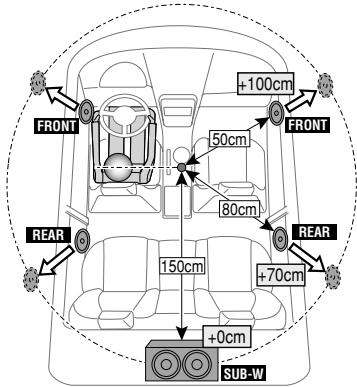
Speaker Setting
Audio Preset Memory
Audio Preset Recall
Audio Adjustments (DSP) 23
Cabin selection
Speaker Setting
DTA (Digital Time Alignment) setting
X'Over setting
Equalizer Control
Preset position selection
Audio Preset Memory
Audio Preset Recall
Favorite Control 26
Preset Memory
Preset Recall
Preset Memory Delete
Name Setting
Bluetooth Setup 28
Registering Bluetooth device
Registering Special Bluetooth device
Registering PIN Code
Downloading the Phone Book
Selecting the Bluetooth device You Wish to Connect
Deleting a Registered Bluetooth device
Displaying the Firmware Version
Adding a voice dialing command
Setting a Voice Command for Category
SMS (Short Message Service)
Downloading the SMS
Basic Operations of remote control 33
Appendix 35
Accessories/ Installation Procedure 39
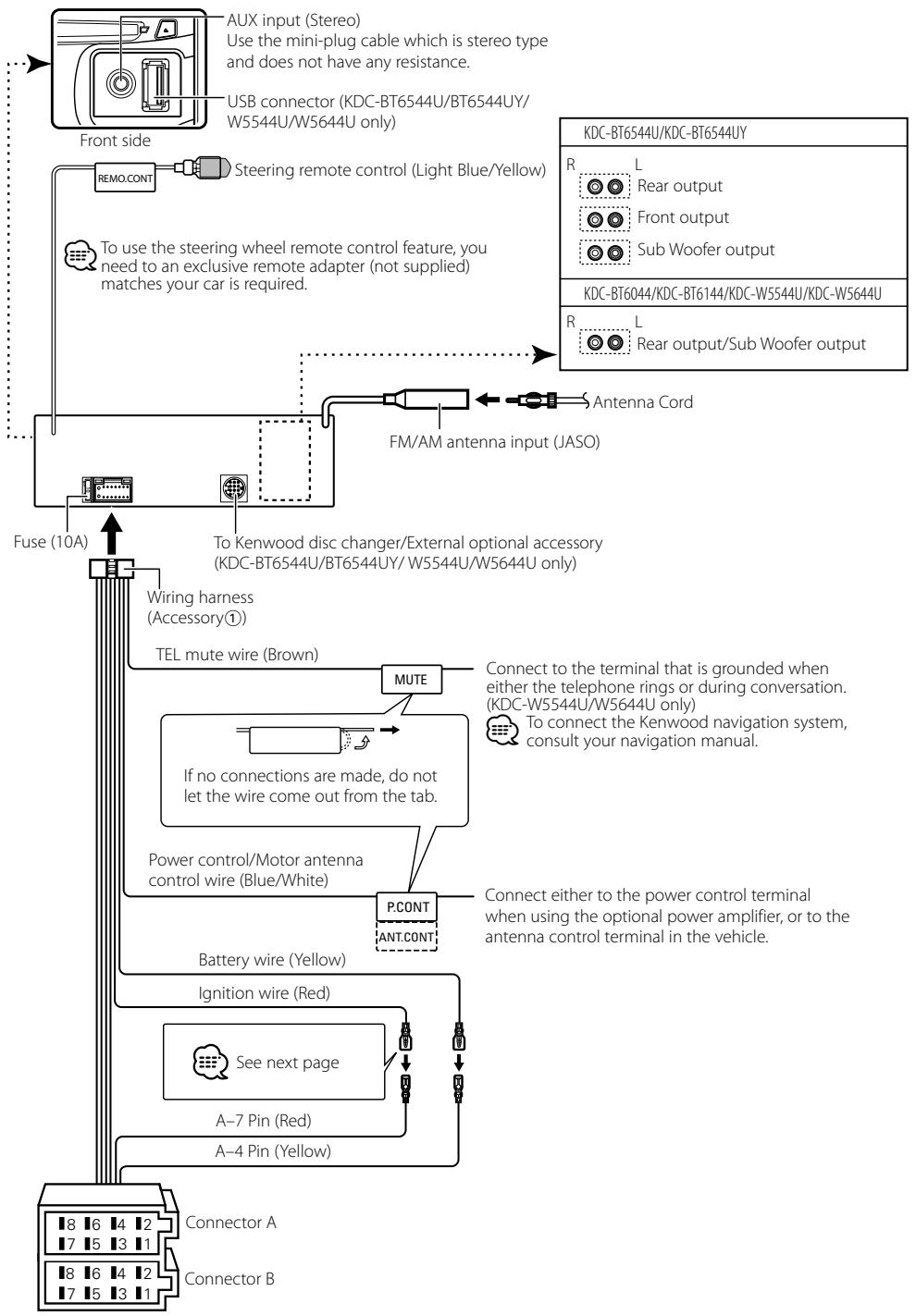
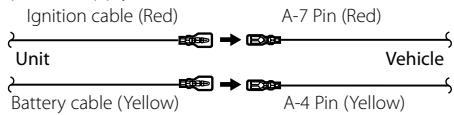
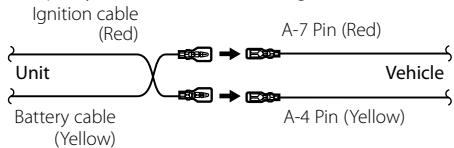
Connecting Wires to Terminals 40
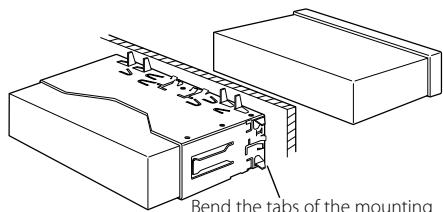
Installation/Removing the Unit 42
Troubleshooting Guide 43
Specifications 45
Before use
▲WARNING
To prevent injury or fire, take the following precautions:
- To prevent a short circuit, never put or leave any metallic objects (such as coins or metal tools) inside the unit.
Before using this unit for the first time
This unit is initially set on the Demonstration mode. When using this unit for the first time, cancel the (page 20).
How to reset your unit
- If this unit or the connected unit (disc auto changer, etc.) fails to operate properly, press the Reset button. The unit returns to factory settings when the Reset button is pressed.
Cleaning the Unit
If the faceplate of this unit is stained, wipe it with a dry soft cloth such as a silicon cloth. If the faceplate is stained badly, wipe the stain off with a cloth moistened with neutral cleaner, then wipe it again with a clean soft dry cloth.
- Applying spray cleaner directly to the unit may affect its mechanical parts. Wiping the faceplate with a hard cloth or using a volatile liquid such as thinner or alcohol may scratch the surface or erases characters.
Cleaning the Faceplate Terminals
If the terminals on the unit or faceplate get dirty, wipe them with a clean soft dry cloth.
Lens Fogging
When you turn on the car heater in cold weather, dew or condensation may form on the lens in the CD player of the unit. Called lens fogging, this condensation on the lens may not allow CDs to play. In such a situation, remove the disc and wait for the condensation to evaporate. If the unit still does not operate normally after a while, consult your Kenwood dealer.
If you experience problems during installation, consult your Kenwood dealer.
When you purchase optional accessories, check with your Kenwood dealer to make sure that they work with your model and in your area.
The characters which can be displayed by this unit are A-Z 0-9 @"‘ % & * + - = ,./\ < > [ ] ( ) :; ^ - { } | \~ .
The RDS feature won't work where the service is not supported by any broadcasting station.
The illustrations of the display and the panel appearing in this manual are examples used to explain more clearly how the controls are used. Therefore, what appears on the display in the illustrations may differ from what appears on the display on the actual equipment, and some of the illustrations on the display may be inapplicable.
Handling CDs
Do not touch the recording surface of the CD.
Do not stick tape etc. on the CD, or use a CD with tape stuck on it.
Do not use disc type accessories.
Clean from the center of the disc and move outward.
When removing CDs from this unit, pull them out horizontally.
If the CD center hole or outside rim has burrs, use the CD only after removing the burrs with a ballpoint pen etc.
CDs that cannot be used
• CDs that are not round cannot be used.
natural_image
Two abstract circular diagrams: one with concentric rings, the other with a heart-shaped symbol (no text or labels)
• CDs with coloring on the recording surface or CDs that are dirty cannot be used.
- This unit can only play the CDs with
This unit may not correctly play discs which do not have the mark.
- You cannot play a CD-R or CD-RW that has not been finalized. (For the finalization process refer to your CD-R/CD-RW writing software, and your CD-R/CD-RW recorder instruction manual.)
Basic Operation
General functions
Power/Source Select button: [SRC]
Turns on the power.
When the power is on, the source switches between Tuner ("TUNER"), USB or iPod* ("USB" or "iPod"), CD ("CD"), Auxiliary input ("AUX"), and Standby ("STANDBY") each time this button is pressed. Press at least 1 second to turn off the power.
When an optional accessory is connected, the source name for each device appears.
When connection of the iPod is recognized, the source display changes from "USB" to "iPod".
* Function of KDC-BT6544U/ BT6544UY/ W5544U/W5644U.
Volume control: [AUD] knob
Turn the knob to adjust the volume.
Subwoofer output: [AUD] knob
Switches between ON ("SUBWOOFER ON") and OFF ("SUBWOOFER OFF") each time pushing toward down for at least 2 seconds.
- You can do this function when "SWPRE" in (page 6) is set to "SW".
Auxiliary input
Connect a portable audio device with mini-plug cable (3.5 ).
Use the mini-plug cable which is stereo type and does not have any resistance.
The auxiliary input requires the setting made in "MENU" > "AUX" of (page 6).
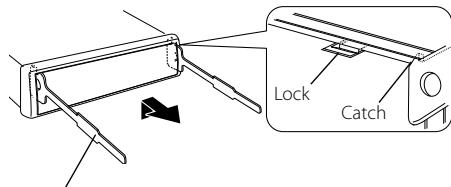
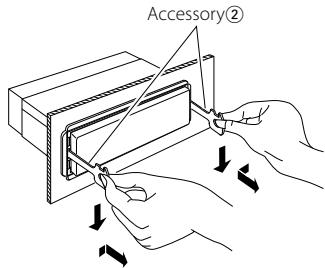
Faceplate release: Release
Releases the faceplate lock so that it can be removed. Refer to the following diagram when reattaching the faceplate.
The faceplate is a precision piece of equipment and can be damaged by shocks or jolts.
Keep the faceplate in its faceplate case while detached.
Do not place the faceplate (and the faceplate case) in areas exposed to direct sunlight, excessive heat or humidity. Also avoid places with too much dust or the possibility of water splashing.
To prevent deterioration, do not touch the terminals of the unit or faceplate with your fingers.
Text/Title scroll: [AUD] knob
Scrolls the CD, audio file, and Radio text display when pushing toward up for at least 2 seconds.
Muting volume upon reception of phone call (Function of KDC-W5544U/ W5644U)
When there is a call, "CALL" is displayed and the audio system is paused.
When the call ends, "CALL" disappears and the audio system comes back on.
The audio system comes back on when [SRC] is pressed during a call.
- To use the TEL Mute feature, you need to hook up the MUTE wire to your telephone using a commercial telephone accessory. Refer to (page 40).
Function Control: [SEARCH]
Press this button for 1 second allows you to set various functions using the [AUD] knob. Refer to (page 6).
Category
Function of setup item
AUTO MEMORY
Putting stations with good reception in the memory automatically.
iPodCTRL*1
Allows you to set up iPod Control by Hand Mode.
PLAY MODE
Allows you to set up the play mode.
DSP*2
Allows you to set up the sound environment.
MENU
Allows you to set up the environment.
RETURN
Exit Function Control mode.
*1 Function of KDC-BT6544U/ BT6544UY/ W5544U/ W5644U.
*2 Function of KDC-BT6544U/ BT6544UY.
Favorite Control: [FAVORITE]
Registers to or retrieves from the memory the operation procedure to select your favorite broadcast station or iPod Playlists/ Artists, etc regardless of the selected source. Refer to (page 26).
Tuner functions
FM band: [AUD] knob
Switches between FM1, FM2, and FM3 each time pushing toward up.
AM band: [AUD] knob
Switches to AM when pushing toward down.
Tuning: [AUD] knob
Changes the frequency when pushing toward left or right.
Use the "MENU" > "SEEK" of (page 6) to change the frequency switching.
During reception of stereo stations the "ST" indicator is ON.
Traffic information: [TI]
For KDC-BT6544U/ BT6544UY/ BT6044/BT6144: Turns ON or OFF the Traffic Information function when pressing for at least 2 seconds.
For KDC-W5544U/W5644U: Turns ON or OFF the Traffic Information function when pressing. When the function is turned ON, "TI" indicator is ON. If traffic bulletin starts when the function is ON, "TRAFFIC" is displayed and traffic information is received.
- If the volume is adjusted during reception of traffic information, the adjusted volume is memorized automatically. The memorized volume will be applied next time the Traffic Information function is turned ON.
Disc & Audio file play functions
Disc play: Disc slot
Starts playing when a disc is inserted.
When a CD is inserted, the "IN" indicator is ON.
- 3 inch (8 cm) CD cannot be used. Attempt to insert using an adapter can cause malfunction.
Disc ejection: [▲]
- You can eject the disc for 10 minutes after switching off the engine.
USB device/iPod play: USB Terminal
(Function of KDC-BT6544U/ BT6544UY/W5544U/W5644U) Connecting a USB device starts playback.
- For the playable audio file, media, and devices, refer to (page 35).
Pause and play: [▶II]
Switches between pause and play each time this button is pressed.
USB device removing: [▲]
Press this button for 2 seconds or longer to select the remove mode, and the remove the USB device. During the remove mode, "USB REMOVE" is displayed.
Music search: [AUD] knob
Changes the music when pushing toward left or right. Fast reverses or forwards the music while keeping pushing toward left or right. (No sound is output while playing audio file.)
Folder search: [AUD] knob
Changes the folder containing the audio file when pushing toward up or down.
- For the operation on iPod, enter (page 11) is first to enter the search mode.
Search mode: [SEARCH]
After pressing [SEARCH] button, you can quickly search songs with the [AUD] knob. See (page 11) for details.
Hands-free phoning
Microphone:
(Function of KDC-BT6544U/ BT6544UY/ BT6044/BT6144) The microphone for the hands free phone is built in. When your voice cannot be recognized due to the low microphone volume or noises in the vehicle, adjust the microphone settings by selecting "MENU" >"MIC GAIN" of and "MENU" >"NR LEVEL" of (page6).
Function Control
Functions in the table below can be set up by using Function Control.
Category
Item
Setting
Entry
Setting overview
Condition
Page
AUTO MEMORY
"AUTO MEMORY"
Memorizes 6 stations with good reception automatically.
Tuner
14
iPodCTRL *1, 3
" iPodCTRL"
"ON"/ "OFF"*
SP-AD
When set to "ON", allows you to operate iPod with the control on the iPod.
iPod
12
PLAY MODE*5
"FILE SCN"
"ON"/ "OFF"*
TBDAD
When set to "ON", plays the intro of the music in the folder successively.
AF2
—
"FOLD RDM"
"ON"/ "OFF"*
SDDAD
When set to "ON", plays the music in the folder randomly.
AF1
—
"ALL RDM"
"ON"/ "OFF"*
DNDAD
When set to "ON", all songs in iPod are played at random.
iPod
12
"FILE REP"
"ON"/ "OFF"*
SDDAD
When set to "ON", plays the music repeatedly.
AF1
—
"FOLD REP"
"ON"/ "OFF"*
—
When set to "ON", plays the music in the folder repeatedly.
AF2
—
"TRAC SCN"
"ON"/ "OFF"*
SDDAD
When set to "ON", plays the intro of the music on the disc successively.
DISC
—
"DISC RDM"
"ON"/ "OFF"*
SDDAD
When set to "ON", plays the music on the disc randomly.
DISC
—
"MGZN RDM"
"ON"/ "OFF"*
—
When set to "ON", plays the music in the disc changer randomly.
CH
—
"TRAC REP"
"ON"/ "OFF"*
ATP
When set to "ON", plays the music repeatedly.
DISC
—
"DISC REP"
"ON"/ "OFF"*
ATP
When set to "ON", plays the music on the disc repeatedly.
CH
—
DSP*1
"CONTROL" "EQ"
Sets the sound quality.
SB
24
"BASS BOOST"
"OFF"/ "STEP1"*/ "2"
Sets the Bass Boost level in two steps.
SB
—
"HIGHWAY- SND"
"OFF"/ "STEP1"/, "2"/ "3"*
Compensates the low volume or bass sound being lost by road noises to make vocal sound clearer.
SB
*6
"SUPREME"
"ON"/ "OFF"*
Turns ON/OFF the Supreme plus function.
AF1
*6
"POSITION"
Compensates the sound environment in accordance with the listening position.
SB
24
"SETUP"
"CABIN"
"COMPACT" etc.
Selects the car type to compensate the distance difference between each speaker.
SB
23
"SPEAKER"
Sets the connected speaker, speaker size, and installation position.
SB
23
"DTA"
Makes fine adjustment of the compensation value specified at Cabin.
SB
23
"X'OVER"
Makes fine adjustment of the X'Over value specified at Speaker.
SB
24
"PRESET"
"RECALL"
Registering the value setup by Sound Control. Recalling the sound setup registered by.
SB
25
"MEMORY"
Registering the value setup by Sound Control.
SB
25
"DSP BYPASS"/ "DSP THROUGH"*
Setting "BYPASS" passes the DSP function. Setting "THROUGH" activates the DSP function.
SB
—
*Factory setting
*1 Function of KDC-BT6544U/ BT6544UY.
*2 Function of KDC-BT6044/ BT6144.
*3 Function of KDC-W5544U/ W5644U.
*4 Function of KDC-BT6544UY/ BT6144/ W5644U.
*5 iPod play mode cannot be set when is set to "OFF".
*6 Refer to
Category
Item
Setting
Entry
Setting overview
Condition
Page
MENU
“SECURITY SET”/“SECURITY CLR”
1 sec.
Sets/Resets security code.
SB
19
“SKIP SRCH”*1, 3
“0.5%”*/“1%”/“5%”/“10%”
Sets the ratio of skip performed with.
iPod
11
“DVC REGIST”*1, 2
1 sec.
Register a Bluetooth device (pairing).
SB
28
“S-DVC SELECT”*1, 2
1 sec.
Allow registration of a special device that cannot be registered normally.
SB
28
“PHONE SEL”*1, 2
1 sec.
Select a cell-phone subject to hands-free connection.
SB
29
“SMS DOWNLOAD”*1, 2
1 sec.
Download a short message.
32
“SMS INBOX”*1, 2
1 sec.
Display the received short message.
31
“VOICE TAG”*1, 2
1 sec.
Registers voice for voice recognition and voice to select the Phone number category in Phonebook.
Phone
30, 31
“VOICE RECOG”*1, 2
1 sec.
Calls by recognizing the registered voice.
Phone
18
“DEVICE DEL”*1, 2
1 sec.
Cancel registration of the Bluetooth device.
SB
30
“DVC STATUS”*1, 2
1 sec.
Display the status of the Bluetooth device.
—
*6
“PIN EDIT”*1, 2
1 sec.
Specify the PIN code required when registering this unit using the Bluetooth device.
SB
28
“AUTO ANS”*1, 2
“OFF”/“OS”-“8S”* -“99S”
Answer a call automatically after lapse of the preset time interval for automatic answer.
SB
*6
“MIC GAIN”*1, 2
“-2”-“0”* -“+2”
Adjusts the sensitivity of the built-in microphone for a telephone call.
—
*6
“NR LEVEL”*1, 2
“-2”-“0”* -“+2”
Reduces the noises generated by the surrounding environment without changing the microphone volume.
—
*6
“SP SEL”*1, 2
“FRONT”*/“F-R”/“F-L”
Specify the voice output speaker.
SB
*6
“CALL BEEP”*1, 2
“ON”*/“OFF”
Output a beep from the speaker when a call comes in.
SB
*6
“BT F/W UPDATE”*1, 2
1 sec.
Display the firmware version and update the firmware.
SB
30
“BEEP”*1, 2
“OFF”/“ON”*
Setting the operation check sound (beep sound) ON/OFF.
SB
—
“CLOCK ADJUST”
1 sec.
Sets the clock.
—
20
“SYNC”
“OFF”/“ON”*
Synchronizing the RDS station time data and this unit's clock.
SB
20
“DISPLAY”
“OFF”/“ON”*
Turns off the display when no operation is performed.
—
*6
“DIMMER”
“OFF”/“AUTO”*
Dims the display part in conjunction with the light switch of the vehicle.
SB
—
“IL EFFECT”
“OFF”/“ON”*
Sets whether the key illumination brightness is changed in conjunction with the key operation.
SB
—
“DOT LINE”
“OFF”/“ON”*
Specifies whether to display the red dotted line on the display.
SB
—
Function Control
Category
Item
Setting
Entry
Setting overview
Condition
Page
MENU
"SWPRE"*2, 3
"REAR"*/ "SUB-W"
[SY04]
Sets the preout output.
SB
*6
"AMP"*1, 2
"OFF"/"ON"*
[2X85]
Turns on/off the built-in amplifier.
SB
*6
"ZONE2"
"REAR"*/ "FRONT"
[ETH0]
Specifies the destination of AUX input sound when the Dual Zone function is turned on.
2ZONE
*6
"SUPREME"*2, 3
"OFF"/"ON"*
Turns ON/OFF the Supreme function.
AF2
*6
"NEWS"
"OFF"*/ "00" - "90"
[0004]
Turns ON/OFF the News Bulletin Automatic Reception function and sets the news bulletin interrupt disabled time.
SB
*6
"LOCAL S"
"OFF"*/ "ON"
Only stations whose reception is good are searched in auto seek tuning.
FM
—
"SEEK"
"AUTO1"*/ "AUTO2"/ "MANUAL"
[D360]
Selects the tuning mode of the radio.
Tuner
5,*6
"AF"
"OFF"/"ON"*
When station reception is poor, automatically switches to the station that is broadcasting the same program over the same RDS network.
FM
*6
"REGIONAL"
"OFF"/"ON"*
Sets whether to switch to the station only in the specific region using the "AF" control.
FM
—
"ATPS"
"OFF"/"ON"*
When traffic information station reception is poor, automatically searches for a station that can be received better.
FM
—
"MONO"
"OFF"/"ON"*
You can reduce the noise when stereo broadcasts are received as monaural.
FM
—
"NAME SET"
[CW03]
Sets the display when switched to AUX source.
AUX
10
"RUSSIAN"*4
"OFF"/"ON"*
Selects Russian as the display language.
SB
*6
"SCROLL"
"AUTO"/ "MANUAL"*
When set to "AUTO", scrolls the screen once with the change of the displayed text.
—
4
"FAV DELETE"
Deletes Favorite Preset Memory.
SB
26
"AUX"
"OFF"/ "ON1"*/ "ON2"
[BATT]
Sets whether to display AUX during source selection.
SB
*6
"POWER OFF"
"----"/ "20M"*/ "40M"/"60M"
Turns off the power when the preset time has lapsed in the Standby mode.
SB
*6
"CD READ"
"1"*/ "2"
Sets the CD read mode.
SB
*6
"AUDIO PRESET"*2, 3
[WAZ0]
Presets the setting value of the audio control. The preset value is retained after resetting.
SB
22
"DEMO MODE"
"OFF"/"ON"*
Specifies whether to enable demonstration.
—
20
*Factory setting
*1 Function of KDC-BT6544U/ BT6544UY.
*2 Function of KDC-BT6044/ BT6144.
*3 Function of KDC-W5544U/ W5644U.
*4 Function of KDC-BT6544UY/ BT6144/ W5644U.
*5 iPod play mode cannot be set when is set to "OFF".
*6 Refer to
Displayed item is depending on currently selected source or mode. The mark in Condition column shows the condition to which the item is displayed.
SB : Can be set in other than standby state.
SB : Can be set in standby state.
AF1 : Can be set while Audio file source of CD/USB/iPod.
AF2 : Can be set while Audio file source of CD/USB (excluding iPod).
DISC : Can be set while CD/ Disc changer source.
CH : Can be set while Disc changer source.
Tuner : Can be set during Tuner source.
FM : Can be set during FM reception.
AUX : Can be set while accessing AUX source.
iPod : Can be set only during playback of the iPod source. (USB source used when the iPod is connected)
2ZONE : Can be set for sources other than the standby source by setting "2 ZONE" of
Phone : Can be set while a cell-phone is connected.
→ : Refer to the reference page.
— : Can be set during all sources.
Refer to the respective page for information on how to set the items with reference page number.
Only the items available to the current source are displayed.
1 Enter Function Control mode
Press the [SEARCH] button for at least 1 second.
"FUNCTION" is displayed.
2 Select your desired setup item
Operation type
Operation
Movement between items
Turn the [AUD] knob.
Selection of item
Press the [AUD] knob.
Return to previous item
Press the [SEARCH] button.
Repeat selection and determination until your desired setup item is selected.
Example:
flowchart
graph TD
    A["Circle icon"] --> B["Arrow to left"]
    C["Circle icon"] --> D["Arrow to right"]
    E["Menu"] --> F["Arrow to right"]
    G["Dot LINE"] --> H["Arrow to right"]
In this manual, the above selection is indicated as
Select "MENU" > "DOT LINE".
3 Make a setting
Press the [AUD] knob or turn the [AUD] knob to select a setting value, and then press the [AUD] knob.
The value of items with ⚙️ mark can be set by press the [AUD] knob.
The value of items with ◆ mark can be set by pushing the [AUD] knob towards right or left.
Some items require you to keep pressing the [AUD] knob for 1 or 2 seconds so that you can make a setting. For these items, the time during which you need to keep pressing the [AUD] knob is displayed in the Entry column in seconds.
For the functions accompanied by the description of the setting procedure and so forth, the reference page numbers are displayed.
4 Exit Function Control mode
Press the [SEARCH] button for at least 1 second.
Display Settings
Text Display Selection
Changes displayed information on each source following;
In Tuner source
Information
Display
Program Service name or Frequency
“FREQUENCY/PS”
Radio text, Program Service name or Frequency
“RADIO TEXT”
Clock
“CLOCK”
In CD & External disc source
Information
Display
Disc title
“DISC TITLE”
Track title
“TRACK TITLE”
Play time & Track number
“P-TIME”
Clock
“CLOCK”
In Audio file/ iPod source
Information
Display
Music title & Artist name
"TITLE/ARTIST"
Album name & Artist name
"ALBUM/ARTIST"
Folder name
"FOLDER NAME"
File name
"FILE NAME"
Play time & Music number
"P-TIME"
Clock
"CLOCK"
In Standby/ Auxiliary input source
Information
Display
Source name
"SOURCE NAME"
Clock
"CLOCK"
1 Enter Switching Display mode
Press the [▶II] button for at least 1 second.
"DISPLAY SEL" is displayed.
2 Select the Display item
Turn the [AUD] knob.
3 Exit Switching Display mode Press the [▶II] button.
When you select the clock display, the display setting of each source will be changed to the clock display.
If the selected display item does not have any information, alternative information is displayed.
When selecting "FOLDER NAME" while playing with iPod, names will be displayed depending on currently selected browsing items.
If the iPod Control by Hand Mode is set to on while playing the iPod, "iPod BY HAND" is displayed.
If all characters cannot be displayed while playing with iPod, the file number in the list is displayed.
Information
Display
Music title
"TITLE***"
Folder name
"FLD***"
File name
"FILE***"
Auxiliary Input Display Setting
Selects the display when changing to Auxiliary input source.
1 Select Auxiliary input display setting item during Menu mode (In AUX mode)
Select the "NAME SET" display.
For how to select Function Control items, refer to (page 6).
2 Enter Auxiliary input display setting mode
Press the [AUD] knob for at least 1 second.
The presently selected Auxiliary input display is displayed.
3 Select the Auxiliary input display Turn the [AUD] knob.
When operation stops for 10 seconds, the name at that time is registered, and the Auxiliary input display setting mode closes.
The Auxiliary input display can be set only when the built-in auxiliary input or the auxiliary input of optional KCA-S220A is used. On the KCA-S220A, "AUX EXT" is displayed by default.
Music disc/Audio file Operation
Function of Audio file/ Internal CD source
Music Search
Selecting the music you want to listen to from the device or media being played now.
1 Enter Music Search mode Press the [SEARCH] button.
"SEARCH" is displayed.
Displays the current Audio file name.
2 Search for music
Audio file
Operation type
Operation
Movement between folders/files
Turn the [AUD] knob or push it towards up or down.
Selection of folder/flie
Press the [AUD] knob or push it towards right.
Return to previous folder
Push the [AUD] knob towards left.
Return to root folder
Push the [AUD] knob towards left for at least 1 second.
“<” or “>” beside the displayed folder name indicates that this folder is preceded or followed by another folder.
When file name is displayed, “*” is added at the end.
Internal CD source
Operation type
Operation
Movement between track
Turn the [AUD] knob or push it towards up or down.
Selection of track
Press the [AUD] knob.
Return to first track
Push the [AUD] knob towards left for at least 1 second.
Cancelling the Music Search mode Press the [SEARCH] button.
- Music Search cannot be performed during Random play or scan play.
Function of iPod
Music Search for iPod
Search for the song (in iPod) you want to play.
1 Enter Music Search mode Press the [SEARCH] button.
"SEARCH" is displayed.
2 Search for music
Operation type
Operation
Movement between items
Turn the [AUD] knob.
Skip Search *1
Push the [AUD] knob towards right or left.
Selection of item
Press the [AUD] knob.
Return to previous item
Push the [AUD] knob towards up.
Return to Top menu
Push the [AUD] knob towards up for at least 1 second.
Search by initial
Press the [SEARCH] button for at least 1 second.
The position of the currently displayed item is indicated by the icon bar in 13 steps.
Cancelling the Music Search mode Press the [SEARCH] button.
Searching for Music by Initial
You can select an alphabetic character from the list in the browse item (artist, album, etc.) selected now.
1 Enter alphabet search mode
Press the [SEARCH] button for at least 1 second.
"A B C ..." is displayed.
- If you can not search for a song by an alphabetic character in the browse item selected now, the data on the screen does not change.
2 Select the initial to be searched for
Operation type
Operation
Move to the next character.
Turn the [AUD] knob or push it towards right or left.
Move to the next row.
Push the [AUD] knob towards up or down.
Cancelling the alphabet search mode
Press the [SEARCH] button.
3 Determine the selected initial.
Press the [AUD] knob.
Start search. When search is completed, the music search mode is selected again at the selected character position.
Cancelling the Searching for Music by Initial
Press the [SEARCH] button for at least 1 second.
Music disc/Audio file Operation
*1 Skip Search: The number of songs to be skipped is determined by the ratio of the total number of songs in the list which is selected now. Set the ratio with "SKIP SRCH" in (page 6). Keep pushing [AUD] knob for 3 seconds or longer skips songs at 10% irrespective of the setting.
The time of search by alphabet may become long depending on the number of songs in iPod or the folder structure.
When selecting an initial in the alphabet search mode, entering “*” searches symbols and entering “1” searches digits.
If the first character string begins with an article "a", "an", or "the" in the alphabet search mode, it is searched for in defiance of the article.
Characters that are included in a song name but cannot be displayed are left blank. If no character included in a song name cannot be displayed, the browse item name and digits are displayed.
Items
Display
Playlists
“PLIST***”
Artists
“ART***”
Albums
“ALB***”
Search by initial
“PRGM***”
Items
Display
Podcasts
“PDCT***”
Genres
“GEN***”
Composers
“COM***”
Function of iPod
All Random
All songs in iPod are played at random.
Enter All random mode
Select "PLAY MODE" > "ALL RDM".
For how to select Function Control items, refer to (page 6).
The time required to turn on the all random function may become longer depending on the number of songs in iPod or the folder structure.
Turning on the all random function changes the iPod browse item to "SONGS". This browse item will not change even if the all random function is turned off.
If the browse item is changed to search for music while the all random function is on, the all random function is turned off and the songs in the browse item are played at random.
Function of iPod
iPod Control by Hand Mode
Allows you to operate iPod with the control on the iPod.
Enter iPod Control by Hand Mode Select "iPodCTRL".
For how to select Function Control items, refer to (page 6).
In the iPod Control by hand mode, iPod cannot be operated using this unit.
This mode is not compatible with music information display. The display will show "iPod BY HAND".
iPod can be operated when it conforms to the iPod control function.
Function of remote control
Direct Music Search
Searchs the music by entering the track number.
1 Enter the music number
Press the number buttons on the remote control.
2 Search the music
Press the [◀◀] or [▶▶] button.
Cancelling Direct Music Search
Press the [▶II] button.
- Direct Music Search cannot be performed during playing of iPod, Random play, or scan play.
Function of disc changers with remote control
Direct Disc Search
Searchs the disc by entering the disc number.
1 Enter the disc number
Press the number buttons on the remote control.
2 Search the disc
Press the [FM+] or [AM-] button.
Cancelling Direct Disc Search
Press the [▶II] button.
Direct Disc Search cannot be performed during playing of Random play or scan play.
Input "0" to select disc 10.
Basic Operation of Disc Changer (Optional)
Selecting CD changer source
Press the [SRC] button.
Select the "CD CH" display.
Music search
Push the [AUD] knob towards right or left.
Disc Search
Push the [AUD] knob towards up or down.
Auto Memory Entry
Putting stations with good reception in the memory automatically.
1 Enter Auto Memory Entry mode Select "AUTO MEMORY".
For how to select Function Control items, refer to (page 6).
2 Open Auto Memory Entry
Turn the [AUD] knob to select "YES", and then press the [AUD] knob.
When 6 stations that can be received are put in the memory, auto memory entry closes.
- When "AF" in (page 6) is ON, only RDS stations are put in the memory.
PTY (Program Type)
Selecting the Program Type below and searching for a station;
Program Type
Display
Program Type
Display
Speech
"SPEECH"
Serious Classical
"CLASSICS"
Music
"MUSIC"
Other Music
"OTHER M"
News
"NEWS"
Weather
"WEATHER"
Current Affairs
"AFFAIRS"
Finance
"FINANCE"
Information
"INFO"
Children's programs
"CHILDREN"
Sport
"SPORT"
Social Affairs
"SOCIAL"
Education
"EDUCATE"
Religion
"RELIGION"
Drama
"DRAMA"
Phone In
"PHONE IN"
Culture
"CULTURE"
Travel
"TRAVEL"
Science
"SCIENCE"
Leisure
"LEISURE"
Varied
"VARIED"
Jazz Music
"JAZZ"
Pop Music
"POP M"
Country Music
"COUNTRY"
Rock Music
"ROCK M"
National Music
"NATION M"
Easy Listening Music
"EASY M"
Oldies Music
"OLDIES"
Folk Music
"FOLK M"
Light Classical
"LIGHT M"
Documentary
"DOCUMENT"
- Speech and Music include the Program type shown below.
Music: Black character item.
Speech: White character item.
1 Enter PTY mode
Press the [SEARCH] button.
Turn the [AUD] knob to select "PTY SEARCH", and then press the [AUD] knob.
2 Select the Program Type
Turn the [AUD] knob or push it towards up or down.
3 Search for the selected Program Type station Push the [AUD] knob towards right or left.
4 Exit PTY mode
Press the [AUD] button.
This function cannot be used during a traffic bulletin or AM reception.
When the selected Program Type is not found, "NO PTY" is displayed. Select another Program Type.
Program Type preset
Putting the Program Type in the preset memory and quick recall.
Presetting the Program Type
1 Select the Program Type to preset
Refer to (page14).
2 Enter Program Type preset mode
Press the [SEARCH] button.
3 Select the number you want to put in the memory
Turn the [AUD] knob or push it towards up or down.
4 Preset the Program Type
Press the [AUD] knob for at least 2 seconds.
5 Exit Program Type preset mode
Press the [SEARCH] button.
Recalling the preset Program Type
1 Enter PTY mode
Refer to (page 14).
2 Enter Program Type preset mode
Press the [SEARCH] button.
3 Select the number you want to recall from the memory
Turn the [AUD] knob or push it towards up or down.
4 Recall the Program Type
Press the [AUD] knob.
5 Exit Program Type preset mode
Press the [SEARCH] button.
Changing Language for PTY Function
Selecting the Program Type display language as follows;
Language
Display
English
“ENGLISH”
French
“FRENCH”
German
“GERMAN”
1 Enter PTY mode
Refer to (page 14).
2 Enter Changing Language mode
Press the [▶II] button.
3 Select the language
Turn the [AUD] knob or push it towards up or down.
4 Exit Changing Language mode
Press the [▶II] button.
Preset Tuning
Recalling the stations in the memory.
1 Enter Preset Tuning Select mode Press the [SEARCH] button.
2 Select a desired station in the memory
Turn the [AUD] knob or push it towards up or down.
3 Recall the station
Press the [AUD] knob.
Cancelling Preset Tuning
Press the [SEARCH] button.
Function of remote control
Direct Access Tuning
Entering the frequency and tuning.
1 Enter Direct Access Tuning mode Press the [DIRECT] button on the remote control.
“- - - -” is displayed.
2 Enter the frequency
Press the number buttons on the remote control.
Example:
Desired frequency
Press button
92.1 MHz (FM)
[0], [9], [2], [1]
810 kHz (AM)
[0], [8], [1], [0]
Cancelling Direct Access Tuning
Press the [DIRECT] button on the remote control.
- You can enter the FM band frequency in steps of a minimum of 0.1 MHz.
Operation of hands-free phoning
Before Use
For details on the Bluetooth cell-phone with the hands-free function, see (page 35).
You need to register your cell-phone before using it with this unit. For more details, see (page 28).
If you have registered two or more cell-phones, you need to select one of them. For more details, see (page 29).
To use the Phone Book, it must be downloaded to this unit in advance. For details, see (page 29).
"BT" indicator is lit when a cell-phone is connected to this unit.
Receiving a call
Answering a Phone Call
Press the [AUD] button.
• The following operations disconnect the line:
- Insert a CD.
- Connect a USB device.
- The name of the calling party is displayed if it has already been registered in the Phone Book.
Rejecting an Incoming Call
Press the [SRC] button or press the [☐] button for at least 1 second.
During a call
Disconnecting a Call
Press the [SRC] button or press the [☐] button for at least 1 second.
Switching to the Private Mode
Press the [▶II] button.
Switches between Private talk ("PRIVATE TALK") and Hands-free talk ("HANDS FREE") each time this button is pressed.
- Depending on the type of your cell-phone, switching to the private talk mode may select the source that was used before commencing the hands-free connection. If this happens, the source cannot be switched back to
the hands-free talk mode by operating this unit. Operate your cell-phone to return to the hands-free talk mode.
Adjusting the Voice Volume during a Call Turn the [AUD] knob.
Call waiting
Answering Another Incoming Call with the Current Call Suspended
1 Press the [AUD] knob.
2 Turn the [AUD] knob or push it towards up or down. Select the "ANSWER" display.
3 Press the [AUD] knob.
Answering another Incoming Call after Terminating the Current Call
Press the [SRC] button or press the [(c)] button for at least 1 second.
Continuing the Current Call
1 Press the [AUD] knob.
2 Turn the [AUD] knob or push it towards up or down. Select the "REJECT" display.
3 Press the [AUD] knob.
Answering the Waiting Call after Terminating the Current Call
Press the [SRC] button or press the [f] button for at least 1 second.
Switching between the Current Call and Waiting Call
Press the [AUD] knob.
Each pressing of this knob switches the calling party.
Other functions
Clearing the Disconnection Message
Press the [ˈʃ] button.
"HF DISCONCT" disappears.
Switching between Display Modes
Press the [▶II] button for at least 1 second.
Pressing this button each time switches between name and telephone number.
Making a call
1 Enter dialing method mode
Press the [(")] button.
2 Select a dialing method
Press the [AUD] knob.
"NUMBER DIAL" » "PHONE BOOK1" » "PHONE BOOK2"
» "OUT-CALL" » "IN-CALL" » "MISSED CALLS"
Methods of operations in the above modes are described below.
3 Exit the dialing method mode
Press the [(")] button.
Dial a number
1 Enter dialing method mode Press the [(")] button.
2 Select the number dial mode Press the [AUD] knob.
Select the "NUMBER DIAL" display.
3 Enter a phone number
Press the number ([1] - [0]), #(FM]), *(AM), or +(▶▶▶I)) button on the remote controller.
4 Make a call
Press the [DIRECT] button on the remote controller.
To erase the entered phone number digit by digit:
Press the [◀◀] button on the remote controller.
- You can input max 32 digits.
Speed dialing (Preset dial)
1 Enter dialing method mode Press the [(")] button.
2 Press the [AUD] knob.
Select the "NUMBER DIAL" display.
3 Enter preset dial mode
Press the [SEARCH] button.
4 Select the number you want to recall from the memory
Turn the [AUD] knob or push it towards up or down.
5 Press the [AUD] knob.
Phone number is displayed.
6 Make a call
Press the [AUD] knob for at least 1 second.
- You need to register the preset dial number. (page 18)
Calling a number in the Phone Book
1 Enter dialing method mode
Press the [(")] button.
2 Select the Phone Book mode Press the [AUD] knob.
Select the "PHONE BOOK1" display, proceed to step 3.
Select the "PHONE BOOK2" display, proceed to step 4.
3 Select the initial to be searched for
Operation type
Operation
Move to the next character.
Turn the [AUD] knob or push it towards right or left.
Move to the next row.
Push the [AUD] knob towards up or down.
Determine the selected initial.
Press the [AUD] knob for at least 1 second.
4 Select the name
Operation type
Operation
Move to the next phone number.
Turn the [AUD] knob or push it towards up or down.
Move to the next name.
Push the [AUD] knob towards right or left.
5 Make a call
Press the [AUD] knob for at least 1 second.
- During search, a non-accent character such as "u" is searched for instead of an accent character such as "ü".
Calling a number in the call log
1 Enter dialing method mode
Press the [(")] button.
2 Select the call log mode Press the [AUD] knob.
Select the "OUT-CALL" (outgoing call), "IN-CALL" (incoming call), or "MISSED CALLS" (missed call) display.
3 Select a name or phone number
Turn the [AUD] knob or push it towards up or down.
4 Make a call
Press the [AUD] knob for at least 1 second.
- The outgoing call list and the incoming call list, and the missed call list are the lists of calls originated from and received at this unit. They are not the ones stored in the cell-phone memory.
Make a voice dialing call
1 Enter voice recognize mode
Select "MENU" > "VOICE RECOG".
For how to select Function Control item, refer to (page 6).
"V-RECOG READY" is displayed.
2 Press the [AUD] knob.
"PB NAME" is displayed. When a beep is heard, utter the name within 1 second.
3 "PN TYPE" is displayed.
When a beep is heard, utter the category within 1 second.
4 Make a call
Press the [AUD] knob for at least 1 second.
- This step is the same as step 3 of the procedure in . You can make a call or select a category.
If your voice cannot be recognized, a message is displayed. Pressing the [AUD] knob allows you to retry voice input. (page 43)
Both the name and category requires registration of a voice tag. (page 30)
• Audio sound is not output during voice recognize.
Registering to the Preset Dial Number List
1 Enter the phone number you wish to register
Enter the phone number with reference to the following:
Dial a number/ Calling a number in the call log/
Calling a number in the Phone Book
2 Enter Preset Memory mode Press the [SEARCH] button.
3 Select the number to put in the memory
Turn the [AUD] knob or push it towards up or down.
4 Determine the number to put in the memory Press the [AUD] knob for at least 1 second.
Exit the Preset Memory mode
Press the [SEARCH] button.
Display of phone number type (category)
The category items in the Phone Book are displayed as follows:
Display
Information
"GENERAL"
General
"HOME"
Home
"OFFICE"
Office
"MOBILE"
Mobile
"OTHER"
Other
Activating Security Code
You can set the Security Code with a 4 digit number of your choice.
The Security Code cannot be displayed or referenced. Make a note of the Security Code and treasure it up.
1 Select Security Code item during Menu mode (In Standby mode)
"SECURITY SET" is displayed.
For how to select Function Control items, refer to (page 6).
2 Enter Security Code mode
Press the [AUD] knob for at least 1 second.
When "ENTER" is displayed, "CODE" is also displayed.
3 Enter Security Code
Operation type
Operation
Select the digits to enter
Push the [AUD] knob towards right or left.
Select the Security Code numbers
Turn the [AUD] knob or push it towards up or down.
4 Confirm the Security Code
Press the [AUD] knob for at least 3 seconds.
When "RE-ENTER" is displayed, "CODE" is also displayed.
5 Do the step 3 through 4 operation, and reenter the Security Code.
"APPROVED" is displayed.
The Security Code function activates.
- If you enter the wrong Code in steps 3 through 4, repeat from step 3.
6 Exit Security Code mode
Press the [SEARCH] button.
Entering Security Code
The Security Code is required to use the audio unit when the unit is first used after removed from the battery power source or the Reset button is pressed.
1 Turn the power ON.
2 Do the step 3 through 4 operation, and enter the Security Code.
"APPROVED" is displayed.
Now, you can use the unit.
Deactivating Security Code
To deactivate the Security Code function.
1 Select Security Code item during Menu mode (In Standby mode)
Select the "SECURITY CLR" display.
For how to select Function Control items, refer to (page 6).
2 Enter Security Code mode
Press the [AUD] knob for at least 1 second.
When "ENTER" is displayed, "CODE" is also displayed.
3 Enter Security Code
Operation type
Operation
Select the digits to enter
Push the [AUD] knob towards right or left.
Select the Security Code numbers
Turn the [AUD] knob or push it towards up or down.
4 Press the [AUD] knob for at least 3 seconds.
"CLEAR" is displayed.
The Security Code function deactivates.
5 Exit Security Code mode
Press the [SEARCH] button.
- If a wrong security code is entered, "ERROR" is displayed. Enter a correct security code.
Other Functions
Manual Clock Adjustment
1 Select Clock Adjustment item during Menu mode
Select the "CLOCK ADJUST" display.
For how to select Function Control items, refer to (page 6).
2 Enter Clock adjustment mode
Press the [AUD] knob for at least 1 second.
The clock display blinks.
3 Adjusting Clock
Adjustment item
Operation
Hours
Push the [AUD] knob towards up or down.
Minutes
Push the [AUD] knob towards right or left.
4 Exit Clock adjustment mode Press the [SEARCH] button.
- You can do this adjustment when "MENU"> "SYNC" in (page 6) is set to "OFF".
Demonstration mode setting
Turning the demonstration mode ON/OFF.
1 Select Demonstration item during Menu mode
Select the "DEMO MODE" display.
For how to select Function Control items, refer to (page 6).
2 Set the Demonstration mode Press the [AUD] knob for at least 2 seconds.
Pressing this button for 2 seconds or longer toggles the setting between "ON" and "OFF".
Audio Adjustments
Audio Control
You can adjust following Audio Control items ;
Adjustment Item
Display
Range
Rear volume
“R-VOLUME”
0 — 35
Subwoofer level
“SUB-W L”
-15 — +15
Bass Boost*
“B.BOOST”
“STEP1”/“STEP2”/“OFF”(The indicator turns on according to the setting.)
For how to select Function Control item, refer to (page 6).
2 Select the item you want to set
Turn the [AUD] knob and push the center when the desired item is displayed.
3 Set the value
Turn the [AUD] knob and push the center when the desired item is displayed.
4 Exit Speaker Setting mode Press the [SEARCH] button.
DTA (Digital Time Alignment) setting
Adjusting fine tuning of the speaker position compensation value specified at (page 23).
For how to select Function Control item, refer to (page 6).
2 Select the item you want to set Turn the [AUD] knob and push the center when the desired item is displayed.
3 Set the X'Over value Turn the [AUD] knob and push the center when the desired value is displayed.
4 Exit X'Over setting mode Press the [SEARCH] button.
Equalizer Control
You can adjust following Equalizer Control items. iPod Equalizer can be set after connecting iPod and selecting "iPod" in . Select from the 22 equalizer types;
- The frequency which can be selected by each Frequency band is shown below.
Band
Frequency
“BAND1”
60/ 100/ 160/ 250/ 400 Hz
“BAND2”
630/ 1k/ 1.6k/ 2.5k Hz
“BAND3”
4/ 6.3/ 10/ 16 kHz
1 Enter Equalizer Control mode Select "DSP" > "CONTROL" > "EQ".
For how to select Function Control item, refer to (page 6).
2 Select the item you want to set
Turn the [AUD] knob and push the center when the desired item is displayed.
3 Set the value
Turn the [AUD] knob and push the center when the desired item is displayed.
iPod Equalizer
Enter iPod Equalizer mode Press the [AUD] button.
Set the value
Turn the [AUD] knob and push the center when the desired item is displayed.
4 Exit Equalizer Control mode Press the [SEARCH] button.
Preset position selection
According to the listening position, select the position from the following settings so that the normal position of the sound environment can be compensated in accordance with the selected position;
Compensation seat
Range
Not compensating.
“ALL”
Front-Left seat
“F-L”
Front-Right seat
“F-R”
Front seat
“F-ALL”
1 Enter Position setting mode Select "DSP" > "CONTROL" > "POSITION" > "PRESET".
For how to select Function Control item, refer to (page 6).
2 Select the seat you want to compensate Turn the [AUD] knob and push the center when the desired item is displayed.
3 Exit Position setting mode Press the [SEARCH] button.
Audio Preset Memory
Registering the value setup by Sound Control.
1 Setup Sound Control
Refer to the following operations to setup the Sound Control.
Cabin selection (page 23)
Speaker Setting (page 23)
DTA (Digital Time Alignment) setting (page 23)
X'Over setting (page 24)
Equalizer Control (page 24)
Preset position selection (page 24)
2 Enter Audio Preset Memory mode (Other than Standby mode)
Select "DSP" > "PRESET" > "MEMORY".
Press the [AUD] knob for at least 1 second.
For how to select Function Control items, refer to (page 6).
3 Select the number to put in the memory Turn the [AUD] knob to select number, and then press the [AUD] knob.
4 Put the Audio Preset in the memory Turn the [AUD] knob to select "YES", and then press the [AUD] knob.
"COMPLETE" is displayed.
5 Exit Audio Preset Memory mode Press the [SEARCH] button.
Register 6 pairs of Audio Preset Memory.
"USER 1": When you press the Reset, all the sources will be the setting value which is registered.
"USER 1", "USER 2":
The memory cannot be erased by the Reset button.
This function cannot be registered when the iPod Equalizer set in (page 24).
Audio Preset Recall
Recalling the sound setup registered by
1 Select the source Press the [SRC] button.
2 Enter Audio Preset Recall mode (Other than Standby mode)
Select "DSP" > "PRESET"> "RECALL".
Press the [AUD] knob for at least 1 second.
For how to select Function Control items, refer to (page 6).
3 Select the number to recall in the memory Turn the [AUD] knob to select number, and then press the [AUD] knob.
4 Recall the Audio Preset Turn the [AUD] knob to select "YES", and then press the [AUD] knob.
"COMPLETE" is displayed.
5 Exit Audio Preset Recall mode Press the [SEARCH] button.
The User memory of "SYSTEM Q" in (page 24) is changed to the value which was recalled.
The source tone memory item of (page 24) is changed to the value which was recalled by the selected source.
Preset Memory
Registering the operation procedure to select your favorite broadcast station or iPod Playlists/ Artists, etc.
1 Select a desired source to register and setting item.
Source
Setting Item
TUNER
Preset Memory
iPod
List selection screen for Playlists/ Artists/ Albums, etc.
Hands-free phone
Telephone number retrieval.
“*” is displayed when the operation procedure can be registered.
iPod setting
The desired list in the first hierarchy can be registered.
flowchart
graph TD
    A["iPod"] --> B["1st hierarchy"]
    B --> C["PLAYLISTS"]
    B --> D["ARTISTS"]
    B --> E["ALBUMS"]
    B --> F["..."]
    B --> G["COMPOSERS"]
    B --> H["AUDIOBOOKS"]
    I["2nd hierarchy"] --> J["ALL ARTISTS"]
    I --> K["ARTISTS 1"]
    I --> L["ARTISTS 2"]
    I --> M["ARTISTS 3"]
    N["3rd hierarchy"] --> O["ALL ALBUMS"]
    N --> P["ALBUM 1"]
    N --> Q["ALBUM 2"]
    N --> R["ALBUM 3"]
2 Enter Preset Memory mode
Press the [FAVORITE] button for at least 1 second.
3 Select the number to put in the memory
Turn the [AUD] knob.
4 Put the Preset in the memory
Press the [AUD] knob.
Cancelling the Preset Memory mode Press the [FAVORITE] button.
Registering the operation procedure to an existing preset number overwrites the existing procedure.
Register 6 pairs of Favorite Preset Memory.
The memory cannot be erased by the Reset button.
If the items in the second or lower hierarchy are changed, the list in iPod will be changed by adding or deleting songs after the FAVORITE registration. Due to this, the list registered in this unit will be different from the list in iPod. The FAVORITE registration should be performed again after editing the items in iPod.
Preset Recall
Retrieving an item registered to Favorite.
1 Enter Preset Recall mode
Press the [FAVORITE] button.
2 Select the number to recall in the memory
Turn the [AUD] knob.
3 Recall the Audio Preset Press the [AUD] knob.
Cancelling the Preset Recall mode Press the [FAVORITE] button.
- When iPod is selected for the source, the list selection screen for Playlists/ Artists/ Albums, etc. is displayed. Songs will not be automatically played.
Preset Memory Delete
Deleting an item registered to Favorite.
1 Enter Preset Memory Delete mode Select "MENU" > "FAV DELETE".
For how to select Function Control item, refer to (page 6).
2 Select the preset number to delete or "ALL" to delete all preset memory numbers.
Turn the [AUD] knob, and then press the [AUD] knob.
"DELETE" is displayed.
3 Delete the selected item registered to Favorite.
Turn the [AUD] knob to select "YES", and then press the [AUD] knob.
"COMPLETE" is displayed.
4 Exit Preset Memory Delete mode Press the [SEARCH] button.
Name Setting
Giving a name to Preset Memory registered to Favorite.
1 Enter Preset Recall mode
Press the [FAVORITE] button.
2 Retrieve the Preset Memory to change.
Turn the [AUD] knob.
3 Enter Name set mode
Press the [AUD] knob for at least 1 second.
Select the "NAME SET" display.
4 Enter the name
Operation type
Operation
Move the cursor to the enter character position
Push the [AUD] knob towards right or left.
Select the characters
Turn the [AUD] knob or push it towards up or down.
5 Exit Name Setting mode
Press the [AUD] knob.
Cancelling the Preset Recall mode
Press the [FAVORITE] button.
Registering Bluetooth device
To make your Bluetooth device (cell-phone) usable with this unit, you need to register it (pairing). You can register up to five Bluetooth devices to this unit.
When registering from Bluetooth devices
1 Turn on the control unit.
2 Start registering a unit by operating the Bluetooth device
By operating the Bluetooth device, register the hands-free unit (pairing). Select "KENWOOD BT CD/R-3P2" from the list of connected units.
3 Enter a PIN code
Input the PIN code registered as mentioned in (page 28).
Check that registration is complete on the Bluetooth device.
4 By operating the Bluetooth device, start hands-free connection.
When registering from this unit
1 Enter Bluetooth device registration mode Select "MENU" > "DVC REGIST".
Press the [AUD] knob for at least 1 second.
For how to select Function Control item, refer to (page 6).
Search for the Bluetooth device.
When search is completed, "FINISHED" is displayed.
2 Select the Bluetooth device
Turn the [AUD] knob or push it towards up or down to select the Bluetooth device.
Press the [AUD] knob to determine the selection.
3 Input the PIN code
Operation type
Operation
Select the numbers.
Turn the [AUD] knob or push it towards up or down.
Move to the next digit.
Push the [AUD] knob towards right.
Delete the last digit.
Push the [AUD] knob towards left.
4 Transmit the PIN code
Press the [AUD] knob for at least 1 second.
If "PAIRING OK" is displayed, registration is completed.
5 Return to the device list
Press the [AUD] knob.
6 Exit Bluetooth device registration
Press the [SEARCH] button.
This unit allows up to eight digits to be input for a PIN code. If a PIN code cannot be input from this unit, it can be input from the Bluetooth device.
If there are 5 or more Bluetooth devices registered, you cannot register a new Bluetooth device.
If the error message appears even though the PIN code is correct, try (page 28).
Registering Special Bluetooth device
Allow registration of a special device that cannot be registered normally (pairing).
1 Enter special device registration mode Select "MENU" > "S-DVC SELECT".
Press the [AUD] knob for at least 1 second.
For how to select Function Control item, refer to (page 6).
A list is displayed.
2 Select a device name
Turn the [AUD] knob or push it towards up or down to select a device name.
Press the [AUD] knob to determine the selection.
If "COMPLETE" is displayed, registration is completed.
3 Go through the procedure of (page 28) and complete the registration (pairing).
Cancelling special device registration mode
Press the [SEARCH] button.
- If the device name is not in the list, select "OTHER PHONE".
Registering PIN Code
By operating the Bluetooth device, specify the PIN code necessary for registering this unit.
1 Enter PIN code edit mode
Select "MENU" > "PIN EDIT".
Press the [AUD] knob for at least 1 second.
For how to select Function Control item, refer to (page 6).
The current setting of PIN code is displayed.
2 Input the PIN code
Operation type
Operation
Select the numbers.
Turn the [AUD] knob or push it towards up or down.
Move to the next digit.
Push the [AUD] knob towards right.
Delete the last digit.
Push the [AUD] knob towards left.
3 Register a PIN code
Press the [AUD] knob for at least 1 second.
If "COMPLETE" is displayed, registration is completed.
4 Exit the PIN code edit mode
Press the [SEARCH] button.
By default, "0000" is specified.
A PIN code can be specified with up to eight digits.
Downloading the Phone Book
Download the phone book data from the cell-phone to this unit so that you can use the Phone Book of this unit.
To download automatically
If the cell-phone supports a phone book synchronization function, the phone book is downloaded automatically after Bluetooth connection.
Setting on the cell-phone may be required.
If no phone book data is found in the unit even after the compete display, your cell-phone may not support automatic download of phone book data. In this case, try downloading manually.
To download from the cell-phone manually
1 By operating the cell-phone, end the hands-free connection.
2 By operating the cell-phone, send the phone book data to this unit
By operating the cell-phone, download the phone book data to this unit.
- During downloading:
"DOWNLOADING" is displayed.
• After completion of downloading:
"COMPLETE" is displayed.
3 By operating the cell-phone, start the hands-free connection.
To clear the downloading completion message Press any button.
Up to 1000 phone numbers can be registered for each registered cell-phone.
Up to 32 digits can be registered for each phone number along with up to 50^* characters representing a name.
(* 50: Number of alphabetic alphabetical characters. Fewer characters can be input depending on the type of characters.)
To cancel downloading of the phone book data, operate the cell-phone.
Selecting the Bluetooth device You Wish to Connect
When two or more Bluetooth devices have already been registered, you need to select the Bluetooth device you wish to use.
1 Enter Bluetooth device selection mode Select "MENU" > "PHONE SEL".
Press the [AUD] knob for at least 1 second.
For how to select Function Control item, refer to (page 6).
'(name)' is displayed.
2 Select the Bluetooth device
Turn the [AUD] knob or push it towards up or down.
3 Set up the Bluetooth device
Push the [AUD] knob towards right or left.
'*(name)' or '-(name)' is displayed.
"*": The selected Bluetooth device is busy.
"-": The selected Bluetooth device is on standby.
" " (blank): The Bluetooth device is deselected.
4 Exit the Bluetooth device selection mode Press the [SEARCH] button.
- If a cell-phone is already selected, deselect it, and then select a different one.
Deleting a Registered Bluetooth device
You can delete a registered Bluetooth device.
1 Enter Bluetooth device deletion mode Select "MENU" > "DEVICE DEL".
Press the [AUD] knob for at least 1 second.
For how to select Function Control item, refer to (page 6).
'(name)' is displayed.
2 Select the Bluetooth device
Turn the [AUD] knob or push it towards up or down.
3 Delete the selected Bluetooth device
Press the [AUD] knob for at least 1 second.
4 Exit the Bluetooth device deletion mode
Press the [SEARCH] button.
- When a registered cell-phone is deleted, its Phone Book, log, SMS, and voice tag are also deleted.
Displaying the Firmware Version
Display the version of the firmware of this unit.
1 Enter Bluetooth Firmware update mode Select "MENU" > "BT F/W UPDATE".
Press the [AUD] knob for at least 1 second.
For how to select Function Control item, refer to (page 6).
The firmware version appears.
2 Exit Bluetooth Firmware update mode Press the [SEARCH] button.
- For how to update the firmware, access our website. http://www.kenwood.com/bt/information/
Adding a voice dialing command
Add a voice tag to the phonebook for voice dialing. You can register up to 35 voice tags.
1 Enter voice tag mode
Select "MENU" > "VOICE TAG".
Press the [AUD] knob for at least 1 second.
For how to select Function Control item, refer to (page 6).
2 Select "PB NAME EDIT" mode
Press the [AUD] knob to select "PB NAME EDIT", and then press the [AUD] knob for at least 1 second.
3 Search for the name to register
Select the name to register with reference to 4 in (page 17). If a voice tag has already been registered for a name,"*" is displayed before the name.
4 Select a mode
Turn the [AUD] knob or push it towards up or down.
Display
Operation
“PB NAME REG”
Register a voice tag.
“PB NAME CHK”*
Play a voice tag.
“PB NAME DEL”*
Delete a voice tag.
“RETURN”
Return to step 2.
* Displayed only when a name for which a voice tag has been registered is selected.
Select "PB NAME REG" (Regist)
5 Register a voice tag (first)
Press the [AUD] knob.
"ENTER1" is displayed.
When a beep is heard, utter a voice tag within 2 seconds.
6 Confirm the voice tag (second)
Press the [AUD] knob.
"ENTER2" is displayed.
When a beep is heard, utter the same voice tag as that you uttered in step 4 within 2 seconds.
"COMPLETE" is displayed.
7 End registration
Press the [AUD] knob.
Return to step 2. You can register another voice tag continuously.
- If your voice cannot be recognized, a message is displayed. Pressing the [AUD] knob allows you to retry voice input. (page 43)
Select "PB NAME CHK" (Play)
5 Press the [AUD] knob.
Play the registered voice and return to step 2.
Select "PB NAME DEL" (Delete)
5 Delete a voice tag
Press the [AUD] knob at least 1 second.
Return to step 2.
Exit the voice tag mode
Press the [SEARCH] button.
• Audio sound is not output during voice tag registration.
Setting a Voice Command for Category
Add a voice tag to the phone number category (type) for voice calling.
1 Enter voice tag mode
Select "MENU" > "VOICE TAG".
Press the [AUD] knob for at least 1 second.
For how to select Function Control item, refer to (page 6).
2 Select "PB TYPE EDIT" mode
Press the [AUD] knob to select "PB TYPE EDIT", and then press the [AUD] knob for at least 1 second.
3 Select the category (type) you wish to set
Turn the [AUD] knob or push it towards up or down.
"GENERAL"/ "HOME"/ "OFFICE"/ "MOBILE"/ "OTHER"
4 Press the [AUD] knob.
5 Select a mode
Turn the [AUD] knob or push it towards up or down.
Display
Operation
“PB TYPE REG”
Register a voice tag.
“RETURN”
Return to step 2.
6 Register the category (type) by performing steps 5 to 7 in (page 30).
Exit the voice tag mode
Press the [SEARCH] button.
- Set the voice tag for all the 5 categories. If the voice tag is not registered for all the categories, the Phonebook may not be recalled by voice command.
SMS (Short Message Service)
The SMS arrived at the cell-phone is displayed on the receiver.
A newly arrived message is displayed.
- To prevent car accidents, the driver should not read the SMS while driving.
When a new message arrives
"SMS RECEIVED" is displayed.
The display disappears with any operations.
Displaying the SMS
1 Enter SMS Inbox mode
Select "MENU" > "SMS INBOX".
Press the [AUD] knob for at least 1 second.
For how to select Function Control item, refer to (page 6).
A message list appears.
2 Select a message
Turn the [AUD] knob or push it towards up or down.
• Each pressing of the [▶▶▶] button for at least 1 second switches between telephone number or name and message reception date.
3 Display the text
Press the [AUD] knob.
Pressing this button again allows you to select a message again.
- Message Scroll
Continuously pushing the [AUD] knob towards right or left scrolls the message.
4 Exit the SMS Inbox mode
Press the [SEARCH] button.
The unopened message is displayed at the beginning of the list. Other messages are displayed in the order of reception.
The SMS that has arrived when the cell-phone is not linked with Bluetooth cannot be displayed. Download the SMS.
The short message cannot be displayed during downloading the SMS.
Downloading the SMS
Download the short message (SMS) arrived at the cell-phone so that it can be read on this unit.
1 Enter SMS download mode
Select "MENU" > "SMS DOWNLOAD".
Press the [AUD] knob for at least 1 second.
For how to select Function Control item, refer to
(page 6).
A message list appears.
2 Start downloading
Press the [AUD] knob.
"DOWNLOADING" is displayed.
When the downloading finishes, "COMPLETE" is displayed.
3 Exit the SMS download mode
Press the [SEARCH] button.
The cell-phone must be able to transmit the SMS using Bluetooth. Setting on the cell-phone may be required. If the cell-phone does not support SMS function, the SMS download item in Function Control mode is not displayed.
When the SMS is downloaded from the cell-phone, the unopened messages in the cell-phone are opened.
The already-read and unread short messages can be respectively downloaded up to 75.
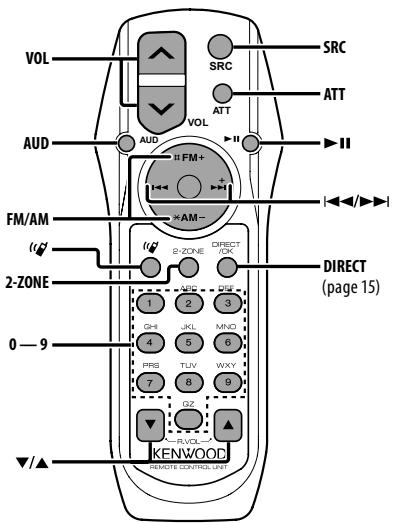
General control
Volume control [VOL]
Source select [SRC]
Volume reduce [ATT]
When the button is pressed again, the volume returns to the previous level.
In Audio control
Audio item select [AUD]
Adjust the Audio item [VOL]
- Refer to
Dual Zone control
Dual zone system on and off [2-ZONE]
Rear channel volume control [▲]/[▼]
In Tuner source
Band select [FM]/[AM]
Station select [|◀◀]/[▶▶]
Recall preset stations [1] — [6]
In CD/USB source
Music select [|◀◀]/[▶▶]
Folder select [FM]/[AM]
Pause/Play [▶II]
Hands-free phone control
Making a call
Enter the dialing method selection mode [(")]
Select a dialing method [AUD]
Number dial input
Operation type
Operation
Input a digit.
[0] – [9] buttons
Input “+”.
[▶▶] button
Input “#”.
[FM] button
Input “*”.
[AM] button
Clear the entered phone number.
[|◀◀] button
Make a call [DIRECT]
Receiving a call
Answer the call [☐]
Switch between the private talk mode and the
hands-free talk mode [▶II]
Call waiting
Answer Another Incoming Call with the Current
Call Suspended [☐]
Answer another Incoming Call after Terminating the Current Call [SRC]
Continue the Current Call [1]
During a call
End the call [SRC]
Adjust the voice volume [VOL]
Loading and Replacing battery
Use two "AA"/"R6"-size batteries.
Slide the cover while pressing downwards to remove it as illustrated.
Insert the batteries with the + and - poles aligned properly, following the illustration inside the case.
natural_image
Diagram of a car interior with battery pack and directional arrows indicating components (no text or symbols)
CAUTION
Do not leave the battery near fire or under direct sunlight. A fire, explosion or excessive heat generation may result.
Do not set the remote control in hot places such as on the dashboard.
Appendix
About Audio file
- Playable Audio file
AAC-LC (.m4a), MP3 (.mp3), WMA (.wma)
- Playable disc media
CD-R/RW/ROM
- Playable disc file format
ISO 9660 Level 1/2, Joliet, Romeo, Long file name.
- Playable USB device
USB mass storage class
- Playable USB device file system
FAT16, FAT32
Although the audio files are complied with the standards listed above, the play maybe impossible depending on the types or conditions of media or device.
- Playing order of the Audio file
In the example of folder/file tree shown below, the files are played in the order from ① to ⑩.
flowchart
graph TD
    A["CD (1)"] --> B["1"]
    A --> C["2"]
    A --> D["3"]
    A --> E["4"]
    A --> F["5"]
    B --> G["Folder"]
    C --> H["Audio file"]
    D --> I["2"]
    D --> J["3"]
    E --> K["4"]
    E --> L["5"]
    F --> M["5"]
    F --> N["10"]
An online manual about audio files is put on the site, www.kenwood.com/audiofile/. On this online manual, detailed information and notes which are not written in this manual are provided. Make sure to read through the online manual as well.
- In this manual, the word "USB device" is used for flash memories and digital audio players which have USB terminals.
- The word "iPod" appearing in this manual indicates the iPod or the iPhone connected with the iPod connection cable* (optional accessory).
* Not supported model KCA-iP500.
Refer to the web site for connectable iPod and iPod connection cable.
www.kenwood.com/ipod/kca_ip/
About USB device
If you start playback after connecting the iPod, the music that has been played by the iPod is played first.
In this case, "RESUMING" is displayed without displaying a folder name, etc. Changing the browse item will display a correct title, etc.
You cannot operate iPod if "KENWOOD" or "✓" displayed on iPod.
When the USB device is connected to this unit, it can be charged up provided that this unit is powered.
• Install the USB device in the place where it will not prevent you from driving your vehicle properly.
You cannot connect a USB device via a USB hub and Multi Card Reader.
Take backups of the audio files used with this unit. The files can be erased depending on the operating conditions of the USB device.
We shall have no compensation for any damage arising out of erasure of the stored data.
No USB device comes with this unit. You need to purchase a commercially available USB device.
When connecting the USB device, usage of the CA-U1EX (option) is recommended. Normal playback is not guaranteed when a cable other than the USB compatible cable is used. Connecting a cable whose total length is longer than 5 m can result in abnormal playback.
About the Cell-Phone
This unit conforms to the following Bluetooth specifications:
For the cell-phones verified for compatibility, access the following URL:
http://www.kenwood.com/bt/information/
The units supporting the Bluetooth function have been certified for conformity with the Bluetooth Standard following the procedure prescribed by Bluetooth SIG. However, it may be impossible for such units to communicate with your cell-phone depending on its type.
• HFP is a profile used to make a hands-free call.
OPP is a profile used to transfer data such as a phone book between units.
For operating KCA-BT200 (Optional)
For operation refer to Model-B-2 in the Instruction Manual of KCA-BT200, and the table below.
Notation used in the KCA-BT200 Instruction Manual
Operation
[▶III] button
[AUD] knob
Control knob
[AUD] knob
Press the [AUTO]/[TI] button
Press the [▶III] button for at least 1 second.
Control knob knob towards up or down
[AUD] knob knob towards up or down
Control knob knob towards left or right
[AUD] knob knob towards left or right
For operating KCA-BT100 (Optional)
However, the following control methods of the function for this unit may be different from the Instruction manual; therefore, refer to the following supplemental instruction.
Press the [AUD] knob. Select the "NUMBER DIAL" display.
Press the [SEARCH] button.
Select the number to recall by turning the [AUD] knob.
Press the [AUD] knob.
Operation is the same. Refer to the instruction manual of KCA-BT100.
Press the [SEARCH] button.
Select the number to memory by turning the [AUD] knob.
Press the [AUD] knob for at least 2 seconds.
1–3. Operation is the same. Refer to the instruction manual of KCA-BT100.
4. Press the [AUD] knob at least 1 second.
5. Press the [SEARCH] button.
For how to operate Menu, refer to in this instruction manual.
About display
Cell-Phone Status is displayed in the status display of this unit.
Moreover, some displays are different from the description of KCA-BT100 Instruction Manual.
Displays of KCA-BT100 Instruction Manual
Actual displays on this unit
“DISCONCT”
“HF DISCONCT”
“CONNECT”
“HF CONNECT”
“PHN-DEL”
“DEVICE DEL”
"P-STATUS"
"DVC STATUS"
"BT-CON Y"
"HF CONNECT Y"
"BT-CON N"
"HF CONNECT N"
Menu Glossary
• AF (Alternative Frequency)
When the reception is poor, automatically alternate to another frequency broadcasting the same program in the same RDS network with better reception.
- AMP
Selecting "OFF" turns off the built-in amplifier. Turning off the built-in amplifier improves the quality of the sound from Preout.
- AUTO ANS (Setting the Time Interval for Automatic Answer)
This function automatically answers (responds to) a call after lapse of the preset time interval for automatic answer.
"OFF": Does not answer the phone call automatically.
"0": Automatically answers the phone call at once.
"1s" – "99s": Automatically answers the phone call after lapse of 1 – 99 seconds.
If the time set in the cell-phone is shorter than that set in the unit, the former will be used.
• This function does not work for call waiting.
- AUX
When this is set to ON, AUX source can be selected.
ON1: Allows AUX source to be selected. Use this setting when the built-in AUX terminal is connected to the external equipment all the time.
ON2: Activates the attenuator function when turning on the power with AUX source selected. Cancel the attenuator function by turning the volume knob clockwise when listening to the audio of the external equipment.
OFF: Disable AUX source selection. Use this setting when the built-in AUX terminal is not used.
- CALL BEEP (Setting the Beep of the Incoming Call)
You can output a beep from the speaker when a call comes in.
"ON": Beep is heard.
"OFF": Beep is canceled.
- CD READ
Sets the method for reading CD.
When unable to play special format CD, set this function to "2" to force playing. Note that some music CD may be unplayable even when set to "2". In addition, audio files cannot be played when set to "2". Normally, keep this set to "1".
1 : Automatically distinguishes between audio file disc and music CD when playing disc.
2 : Forces playing as music CD.
DISPLAY
If this unit is not operated at least 5 seconds with "OFF" selected, the display turns off. During a setup mode, the display will not turn off even if 5 seconds lapse.
• DTA (Digital Time Alignment)
Make fine adjustment of the delay time of the speaker output specified at (page 23) to have a more suitable environment for your vehicle.
The settings of the delay time are automatically identified and compensated by specifying the distances of each speaker from the center of the vehicle interior.
1 Set the front and rear positions and the height of the reference point to the position of the ears of the person sitting in the front seat, and set the right and left positions to the center of the vehicle interior.
2 Measure the distances from the reference point to the speakers.
3 Calculate the distance difference in accordance with the farthest speaker.
- DVC STATUS (Displaying the Bluetooth device Status)
You can display the connection status, signal strength, and battery level.
: Battery level of cell-phone.
Full 📄 → 🙏 → 📄 → 🟢 → 🖼️ Nearly dead
Y: Signal strength of cell-phone.
Maximum _|| _|| _|| _|| Minimum
Icons are not displayed if information cannot be obtained from the cell-phone.
Since the number of steps of the control unit is different from that of the cell-phone, the statuses displayed on the control unit may discord from those displayed on the cell-phone.
• HIGHWAY-SND (Highway sound)
Increases the volume of faintest sound being lost by road noises to make the sound more audible. Additionally, it accentuates bass sound being lost by road noises to make the bass sound more dynamic.
- MIC GAIN
Adjusts the sensitivity of the built-in microphone for a telephone call. Adjust the voice of caller. Setting to "+" increases the voice volume.
• NEWS (News Bulletin with Timeout Setting)
Automatically receives news bulletin when it starts. Set the time during which interrupt is to be disabled after start of another news bulletin.
Changing "NEWS 00M" to "NEWS 90M" turns this function ON.
If news bulletin starts when this function is ON, "TRAFFIC" is displayed and news is received. If "20M" is has been set, reception of another news bulletin will not start for 20 minutes.
The news bulletin volume is the same level that was set for Traffic Information.
- NR LEVEL
Reduces the noises generated by surrounding environment without changing the built-in microphone volume. Adjust the voice of caller when it is not clear. Setting to “+” increases the noise reduction.
• POWER OFF (Power OFF Timer)
Setting the timer to turn this unit's power OFF automatically when Standby mode continues. Using this setting can save the vehicle's battery power.
-- -: Power OFF Timer function is OFF.
20min: Turns the power OFF after 20 minutes. (Factory setting)
40min: Turns the power OFF after 40 minutes.
60min: Turns the power OFF after 60 minutes.
Appendix
• RUSSIAN (Russian language setting)
When this is set to ON, the following character strings are displayed in Russian:
Folder name/ File name/ Song title/ Artist name/ Album name/ KCA-BT200/BT100 (optional accessory)
АБВГДЕЖЗИЙКЛМНОП
РОДГЯЕЗИЯКЛМНОП
РСТУФХЦЧШЩЬЫЬЭЮЯ
РОСТУФХЦЧШЩЬЛЬЗИЯ
- SEEK (Tuning mode select)
Select a tuning mode of the radio.
Tuning mode
Display
Operation
Auto seek
"AUTO1"
Automatic search for a station.
Preset station seek
"AUTO2"
Search in order of the stations in the Preset memory.
Manual
"MANUAL"
Normal manual tuning control.
• SP SEL (Setting up the Voice Output Speakers)
You can specify the voice output speakers.
"FRONT": Outputs voice from the front-left and front-right speakers.
"F-R": Outputs voice from the front-right speaker.
"F-L": Outputs voice from the front-left speaker.
- Select the speaker which is further from the microphone in order to prevent howling or echoes.
- SUPREME
Technology to extrapolate and supplement with proprietary algorithm, the high-frequency range that is cut off when encoding at low bit rate (less than 128Kbps, Sampling frequency is 44.1kHz). Supplementing is optimized by compression format (AAC, MP3 or WMA) and processed according to bit rate.
The effect is negligible with music that is encoded at high bit rate, variable bit rate or has minimal high frequency range.
- SUPREME PLUS
Improved version of SUPREME. It compensates the clarity and transparency of the voice in the compressed audio files and CD-DA music to produce highly realistic vocal sound.
• SWPRE (Switching Preout)
Switches the preout between rear output ("REAR") and subwoofer output ("SUB-W").
• ZONE2 (Dual Zone)
Set the destination (front speaker "FRONT" or rear speaker "REAR") of the sub source (AUX IN) when the Dual Zone function is turned on.
This Product is not installed by the manufacturer of a vehicle on the production line, nor by the professional importer of a vehicle into an EU Member State.
Information on Disposal of Old Electrical and Electronic Equipment and Batteries (applicable for EU countries that have adopted separate waste collection systems)
Products and batteries with the symbol (crossed-out wheeled bin) cannot be disposed as household waste. Old electrical and electronic equipment and batteries should be recycled at a facility capable of handling these items and their waste byproducts.
Contact your local authority for details in locating a recycle facility nearest to you. Proper recycling and waste disposal will help conserve resources whilst preventing detrimental effects on our health and the environment.
Notice: The sign "Pb" below the symbol for batteries indicates that this battery contains lead.
The marking of products using lasers (Except for some areas)
The label is attached to the chassis/case and says that the component uses laser beams that have been classified as Class 1. It means that the unit is utilizing laser beams that are of a weaker class. There is no danger of hazardous radiation outside the unit.
Accessories/ Installation Procedure
Accessories
Installation Procedure
To prevent short circuits, remove the key from the ignition and disconnect the terminal of the battery.
Make the proper input and output wire connections for each unit.
Connect the wire on the wiring harness.
Take Connector B on the wiring harness and connect it to the speaker connector in your vehicle.
Take Connector A on the wiring harness and connect it to the external power connector on your vehicle.
Connect the wiring harness connector to the unit.
Install the unit in your car.
Reconnect the terminal of the battery.
Press the reset button.
Mounting and wiring this product requires skills and experience. For safety's sake, leave the mounting and wiring work to professionals.
Make sure to ground the unit to a negative 12V DC power supply.
Do not install the unit in a spot exposed to direct sunlight or excessive heat or humidity. Also avoid places with too much dust or the possibility of water splashing.
Do not use your own screws. Use only the screws provided. If you use the wrong screws, you could damage the unit.
If the power is not turned ON ("PROTECT" is displayed), the speaker wire may have a short-circuit or touched the chassis of the vehicle and the protection function may have been activated. Therefore, the speaker wire should be checked.
Make sure that all wire connections are securely made by inserting jacks until they lock completely.
If your vehicle's ignition does not have an ACC position, or if the ignition wire is connected to a power source with constant voltage such as a battery wire, the power will not be linked with the ignition (i.e., it will not turn on and off along with the ignition). If you want to link the unit's power
with the ignition, connect the ignition wire to a power source that can be turned on and off with the ignition key.
Use a commercially available conversion connector if the connector does not fit in the vehicle connector.
Insulate unconnected wires with vinyl tape or other similar material. To prevent a short circuit, do not remove the caps on the ends of the unconnected wires or the terminals.
If the console has a lid, make sure to install the unit so that the faceplate will not hit the lid when closing and opening.
If the fuse blows, first make sure the wires aren't touching to cause a short circuit, then replace the old fuse with one with the same rating.
Connect the speaker wires correctly to the terminals to which they correspond. The unit may be damaged or fail to work if you share the wires or ground them to any metal part in the car.
• After the unit is installed, check whether the brake lamps, blinkers, wipers, etc. on the car are working properly.
Mount the unit so that the mounting angle is 30^ or less.
Reception may drop if there are metal objects near the Bluetooth antenna.
Bluetooth antenna unit
For Good Reception
To assure good reception, note the following:
- Communicate with the cell-phone within the line-of-sight distance of 10m (30 ft). The communication range becomes shorter depending on the surrounding environment. The communication range also becomes shorter when there is an obstacle between this unit and the cell-phone. The above maximum communication range (10m) is not always assured.
- A broadcast station or walkie-talkie located nearby can interfere with communication due to too strong signal.
Connecting Wires to Terminals
flowchart
graph TD
    A["Front side"] --> B["AUX input (Stereo)"]
    A --> C["USB connector (KDC-BT6544U/BT6544UY/W5544U/W5644U only)"]
    A --> D["REMO.CONT"]
    D --> E["Steering remote control (Light Blue/Yellow)"]
    E --> F["To use steering wheel remote control feature, you need to an exclusive remote adapter (not supplied) matches your car is required."]
    F --> G["Fuse (10A)"]
    G --> H["Wiring harness (Accessory①)"]
    H --> I["TEL mute wire (Brown)"]
    I --> J["MUTE"]
    J --> K["If no connections are made, do not let the wire come out from the tab."]
    K --> L["Power control/Motor antenna control wire (Blue/White)"]
    L --> M["P.CONT"]
    M --> N["Ant.CONT"]
    N --> O["Battery wire (Yellow)"]
    O --> P["Ignition wire (Red)"]
    P --> Q["See next page"]
    Q --> R["A-7 Pin (Red)"]
    R --> S["A-4 Pin (Yellow)"]
    S --> T["Connector A"]
    S --> U["Connector B"]
    V["KDC-BT6544U/KDC-BT6544UY"] --> W["R"]
    W --> X["L"]
    X --> Y["Rear output"]
    X --> Z["Front output"]
    X --> AA["Sub Woofer output"]
    AB["KDC-BT6044/KDC-BT6144/KDC-W5544U/KDC-W5644U"] --> AC["R"]
    AC --> AD["L"]
    AD --> AE["Rear output/Sub Woofer output"]
    AF["FM/AM antenna input (JASO)"] --> AG["Antenna Cord"]
Connector Function Guide
Pin Numbers for ISO Connectors
Cable Colour
Functions
External Power Connector
A-4
Yellow
Battery
A-5
Blue/White
Power Control
A-6
Orange/White
Dimmer
A-7
Red
Ignition (ACC)
A-8
Black
Earth (Ground) Connection
Speaker Connector
B-1
Purple
Rear Right (+)
B-2
Purple/Black
Rear Right (-)
B-3
Gray
Front Right (+)
B-4
Gray/Black
Front Right (-)
B-5
White
Front Left (+)
B-6
White/Black
Front Left (-)
B-7
Green
Rear Left (+)
B-8
Green/Black
Rear Left (-)
▲WARNING
Connecting the ISO Connector
The pin arrangement for the ISO connectors depends on the type of vehicle you drive. Make sure to make the proper connections to prevent damage to the unit.
The default connection for the wiring harness is described in
① below. If the ISO connector pins are set as described in ②, make the connection as illustrated.
Please be sure to reconnect the cable as shown ② below to install this unit to the Volkswagen vehicles etc.
①(Default setting) The A-7 pin (red) of the vehicle's ISO connector is linked with the ignition, and the A-4 pin (yellow) is connected to the constant power supply.
flowchart
graph LR
    A["Ignition cable (Red)"] --> B["A-7 Pin (Red)"]
    C["Battery cable (Yellow)"] --> D["A-4 Pin (Yellow)"]
    style A fill:#f9f,stroke:#333
    style C fill:#f9f,stroke:#333
    style B fill:#ccf,stroke:#333
    style D fill:#ccf,stroke:#333
2 The A-7 pin (red) of the vehicle's ISO connector is connected to the constant power supply, and the A-4 pin (yellow) is linked to the ignition.
flowchart
graph LR
    A["Unit"] --> B["Ignition cable (Red)"]
    A --> C["Battery cable (Yellow)"]
    B --> D["A-7 Pin (Red)"]
    C --> E["A-4 Pin (Yellow)"]
    D --> F["Vehicle"]
    E --> F
Installation
Bend the tabs of the mounting sleeve with a screwdriver or similar utensil and attach it in place.
- Make sure that the unit is installed securely in place. If the unit is unstable, it may malfunction (for example, the sound may skip).
CAUTION
Install this unit in the console of your vehicle.
Do not touch the metal part of this unit during and shortly after the use of the unit. Metal part such as the heat sink and enclosure become hot.
Removing the hard rubber frame
1 Engage the catch pins on the removal tool and remove the two locks on the upper level. Upper the frame and pull it forward as shown in the figure.
Accessory②
Removal tool
2 When the upper level is removed, remove the lower two locations.
- The frame can be removed from the bottom side in the same manner.
Removing the Unit
1 Refer to the section and then remove the hard rubber frame.
2 Insert the two removal tools deeply into the slots on each side, as shown.
3 Lower the removal tool toward the bottom, and pull out the unit halfway while pressing towards the inside.
Be careful to avoid injury from the catch pins on the removal tool.
4 Pull the unit all the way out with your hands, being careful not to drop it.
Troubleshooting Guide
Some functions of this unit may be disabled by some settings made on this unit.
! • Cannot set up the subwoofer.
- Cannot set up the low pass filter.
- No output from the subwoofer.
- of (page 4) is not set to On.
- Preout is not set to subwoofer. "SWPRE" of (page 6)
! • Cannot register a security code.
- Cannot set up Display.
▶ (page 20) is not turned off.
What might seem to be a malfunction in your unit may just be the result of slight misoperation or miswiring. Before calling service, first check the following table for possible problems.
General
The Touch Sensor Tone does not sound.
√ The preout jack is being used.
The Touch Sensor Tone cannot be output from the preout jack.
Tuner source
? Radio reception is poor.
√ The car antenna is not extended.
Pull the antenna out all the way.
Disc source
? The specified disc does not play, but another one plays instead.
√ The specified CD is quite dirty.
Clean the CD, referring to the CD cleaning of the section on (page 3).
√ The disc is loaded in a different slot from that specified.
Eject the disc magazine and check the number for the specified disc.
√ The disc is severely scratched.
Try another disc instead.
Audio file source
? The sound skips when an Audio file is being played.
√ The media is scratched or dirty.
Clean the media, referring to the CD cleaning of the section on (page 3).
√ The recording condition is bad.
Record the media again or use another media.
Hands-free
? The hands-free talk volume is low.
√ The hands-free talk volume is set at a low level.
The hands-free talk volume can be adjusted independently. Adjust it during hands-free talk. "MENU"> "MIC GAIN" and "NR LEVEL" (page6).
? No sound is heard from the rear speakers.
√ You are talking in the hand-free talk mode.
No sound is heard from the rear speakers in the hands-free talk mode.
? No beep is heard at reception of an incoming call.
√ No beep is heard depending on the type of your cell-phone.
The "MENU"> "CALL BEEP" of (page 6) is set ON.
? Voice is not recognized.
√ The vehicle window is open.
If the surrounding noise is large, voice cannot be recognized properly. Close the vehicle windows to reduce noise.
√ Small voice.
If voice is too small, it cannot be recognized properly. Speak into the microphone a little more loudly and naturally.
√ The person uttering the voice tag is not the one who registered the it.
Only the voice of the person who registered the voice tag can be recognized.
The messages shown below display your systems condition.
TOC ERROR: • No disc has been loaded in the disc magazine.
- The CD is quite dirty. The CD is upside-down. The CD is scratched a lot.
ERROR 05: The disc is unreadable.
ERROR 77: The unit is malfunctioning for some reason.
Press the reset button on the unit. If the "ERROR 77" code does not disappear, consult your nearest service center.
ERROR 99: Something is wrong with the disc magazine. Or the unit is malfunctioning for some reason.
Check the disc magazine. And then press the reset button on the unit. If the "ERROR 99" code does not disappear, consult your nearest service center.
IN (Blink): The CD player section is not operating properly.
Reinsert the CD. If the CD cannot be ejected or the display continues to flash even when the CD has been properly reinserted, please switch off the power and consult your nearest service center.
Troubleshooting Guide
PROTECT (Blink):
The speaker wire has a short-circuit or touches the chassis of the vehicle, and then the protection function is activated.
Wire or insulate the speaker cable properly and press the reset button. If the "PROTECT" code does not disappear, consult your nearest service center.
NA FILE: An Audio file is played with a format that this unit can't support.
COPY PRO: A copy-protected file is played.
READ ERROR: The file system of the connected USB device is broken.
Copy the files and folders for the USB device again. If the error message is still displayed, initialize the USB device or use other USB devices.
NO DEVICE: The USB device is selected as a source although no USB device is connected.
→ Change the source to any source other than USB. Connect an USB device, and change the source to USB again.
N/A DEVICE: • An unsupported USB device is connected.
- Connection to the iPod has failed.
Check that the connected iPod is an iPod that is supported. See (page 35) for information on supported iPods.
NO MUSIC DATA/ERROR 15:
- The connected USB device contains no playable audio file.
• Media was played that does not have data recorded that the unit can play.
USB ERROR: Some trouble may have occurred to the connected USB device.
Remove the USB device, then cycle the power switch to ON. If the same display is repeated, use another USB device.
iPod ERROR: Connection to the iPod has failed.
Remove the USB device and then reconnect it.
Confirm that the software for the iPod is the latest version.
USB REMOVE (Blink):
The Remove mode has been selected for the USB device/iPod. You can remove the USB device/iPod safely.
NO NUMBER: • The calling party does not notify a caller ID.
• There is no phone number data.
NO DATA: • There is no outgoing call list.
• There is no incoming call list.
• There is no missed call list.
• There is no phone book list.
NO ENTRY: The cell-phone has not been registered (pairing).
HF DISCONCT: The unit cannot communicate with the cell-phone.
HF ERROR 07: The memory cannot be accessed.
Turn off the power and on again. If this message still appears, press the reset button on the control unit.
HF ERROR 68: The unit cannot communicate with the cell-phone.
Turn off the power and on again. If this message still appears, press the reset button on the control unit.
UNKNOWN: The Bluetooth device cannot be detected.
DEVICE FULL: 5 Bluetooth device have already been registered. No more Bluetooth device cannot be registered.
PIN CODE NG: The PIN code is wrong.
CONNECT NG: The unit cannot be connected to the device.
PAIRING NG: Pairing error.
NO MATCHING: The voice tag is wrong. Voice cannot be recognized because of an unregistered voice tag, etc.
TOO SOFT: Voice is too small and cannot be recognized.
TOO LOUD: Voice is too large to be recognized.
TOO LONG: The word or utterance is too long to be recognized.
NO PHONEBOOK:
Data is not contained in the phone book.
NO MESSAGE: No short message in In Box.
NO RECORD: The voice tag is not registered in the phonebook.
MEMORY FULL: The number of voice tags reaches the maximum number to be registered in the phonebook.
FAV: NO MEMORY:
The procedure is not registered to Favorite Preset Memory
NO ACCESS: The procedure preset with Favorite Control cannot be available. The preset content may not be recalled depending on the selected source or mode.
NO VOICE: No call.
NO PANEL: The faceplate of the slave unit being connected to this unit has been removed.
Specifications
FM tuner section
Frequency range (50 kHz space) : 87.5 MHz – 108.0 MHz
Usable sensitivity (S/N = 26dB) : 0.7 μV/75 Ω
Quieting Sensitivity (S/N = 46dB) : 1.6 μV/75 Ω
Frequency response ( ± 3.0 dB) : 30 Hz – 15 kHz
Signal to Noise ratio (MONO) : 65 dB
Selectivity (DIN) ( ± 400 kHz)
: ≥ 80 dB
Stereo separation (1 kHz) : 35 dB
MW tuner section
Frequency range (9 kHz space) : 531 kHz – 1611 kHz
Usable sensitivity (S/N = 20dB)
: 25 μV
LW tuner section
Frequency range
: 153 kHz - 281 kHz
Usable sensitivity (S/N = 20dB)
: 45 μV
Bluetooth section
(KDC-BT6544U/BT6544UY/BT6044/BT6144)
Version
: Bluetooth Ver. 2.0 Certified
Frequency range
: 2.402 - 2.480 GHz
Output Power
: +4dBm (MAX), 0dBm (AVE) Power Class 2
Maximum Communication range
: Line of sight approx.10m (32.8 ft)
Profiles
: HFP (Hands Free Profile)
: HSP (Headset Profile)
: SPP (Serial Port Profile)
: PBAP (Phonebook Access Profile)
: OPP (Object Push Profile)
: SYNC (Synchronization Profile)
CD player section
Laser diode : GaAlAs
Digital filter (D/A)
: 8 Times Over Sampling
D/A Converter : 24 Bit
Spindle speed : 500 - 200 rpm (CLV)
Wow & Flutter
: Below Measurable Limit
Frequency response (±1 dB)
: 20 Hz – 20 kHz
Total harmonic distortion (1 kHz) : 0.01 %
Signal to Noise ratio (1 kHz) : 110 dB
Dynamic range : 93 dB
MP3 decode
: Compliant with MPEG-1/2 Audio Layer-3
WMA decode
: Compliant with Windows Media Audio
AAC decode
: AAC-LC ".m4a" files
USB Interface
(KDC-BT6544U/BT6544UY/W5544U/W5644U)
USB Standard
: USB1.1/ 2.0 (Full speed)
Maximum Supply current : 500 mA
File System
: FAT16/ 32
MP3 decode
: Compliant with MPEG-1/2 Audio Layer-3
WMA decode
: Compliant with Windows Media Audio
AAC decode
: AAC-LC ".m4a" files
Specifications
Audio section
Maximum output power
: 50 W × 4
Output power (DIN 45324, +B=14.4V)
: 22 W x 4
Speaker Impedance
: 4 - 8 Ω
Tone action
(KDC-BT6044/BT6144/W5544U/W5644U)
Bass : 100 Hz ±8 dB
Middle : 1 kHz ±8 dB
Treble : 10 kHz ±8 dB
Tone action (KDC-BT6544U/BT6544UY)
BAND1 : 60 Hz - 400 Hz ±9 dB
BAND2 : 630 Hz - 2.5 kHz ±9 dB
BAND3 : 4.0 kHz - 16 kHz ±9 dB
Preout level / Load (CD)
: 2500 mV/10 kΩ
Preout impedance
: ≤ 600 Ω
Auxiliary input
Frequency response (±1 dB)
: 20 Hz - 20 kHz
Input Maximum Voltage
: 1200 mV
Input Impedance
: 100 kΩ
General
Operating voltage (10.5 - 16V allowable)
: 14.4 V
Maximum Current consumption
: 10 A
Installation Size (W x H x D)
: 182 x 53 x 155 mm
Weight
: 1.2 kg
Specifications subject to change without notice.
The "AAC" logo is a trademark of Dolby Laboratories.
The Bluetooth word mark and logos are owned by the Bluetooth SIG, Inc. and any use of such marks by Kenwood Corporation is under license. Other trademarks and trade names are those of their respective owners.
iPod is a trademark of Apple Inc., registered in the U.S. and other countries.
• iPhone is a trademark of Apple Inc.
"Made for iPod" means that an electronic accessory has been designed to connect specifically to iPod and has been certified by the developer to meet Apple performance standards.
"Works with iPhone" means that an electronic accessory has been designed to connect specifically to iPhone and has been certified by the developer to meet Apple performance standards.
Apple is not responsible for the operation of this device or its compliance with safety and regulatory standards.
For KDC-W5544U/KDC-W5644U: Declaration of Conformity with regard to the EMC Directive 2004/108/EC For KDC-BT6544U/KDC-BT6544UY/KDC-BT6044/KDC-BT6144: Declaration of Conformity with regard to the R&TTE Directive 1999/5/EC
Manufacturer:
Kenwood Corporation
2967-3 Ishikawa-machi, Hachioji-shi, Tokyo, 192-8525 Japan
EU Representative's:
Kenwood Electronics Europe BV
Amsterdamseweg 37, 1422 AC UITHOORN, The Netherlands
English
Hereby, Kenwood declares that this unit KDC-BT6544U/KDC-BT6544UY/KDC-BT6044/KDC-BT6144 is in compliance with the essential requirements and other relevant provisions of Directive 1999/5/EC.
Français
Other manuals KENWOOD
Discover other manuals and user guides for the brand KENWOOD
💬 Hi! I'm your manual assistant.I know your KENWOOD KDC-W5544U.
How can I help you? (use, settings, error codes, maintenance, explaining a step from the manual, etc.)💡 Examples :
• How do I use it ?
• Error code E3 ?
• How do I clean it ?



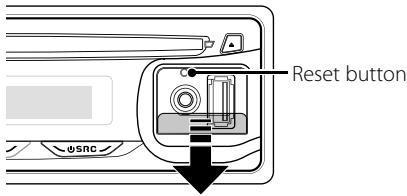


![[↑↓] [TI] Release Microphone Disc slot [▲] KENWOOD MP3/WMA/AAC SCRL FM+ SM- SW SET UP AUD FNC MEMORY OFF Bluetooth SEARCH FAVORITE SRC [AUD] [SEARCH] [FAVORITE] [SRC] Auxiliary input USB Terminal](/content/2025/01/83498/images/2d4cd1f4e3be24b921d6b62a609dcdaffb064aac7031037dfc484061d5f89e4f.jpg)
![KENWOOD KDC-W5544U - Power/Source Select button: [SRC] - 1](/content/2025/01/83498/images/28254f8e240d4d635832e8c06fc1a5c4e4dd41b51a3c922aad3e745e11ee3ba3.jpg)

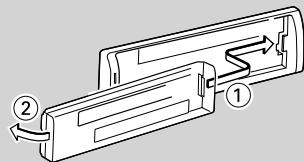


![KENWOOD KDC-W5544U - Tuning: [AUD] knob - 1](/content/2025/01/83498/images/9683262041ae948ea89e783c4cc411c9b3199599538fa4a57c773e987ca0d790.jpg)
![KENWOOD KDC-W5544U - Traffic information: [TI] - 1](/content/2025/01/83498/images/2218a680ae402da242d530923a3506e733b7fb21ecf6baf0a4903a633eba74ee.jpg)

![KENWOOD KDC-W5544U - Disc ejection: [▲] - 1](/content/2025/01/83498/images/2036407aed45a0b7288ee34a6dcb5298b99a7515cbde9de48ab3acb68cc84049.jpg)


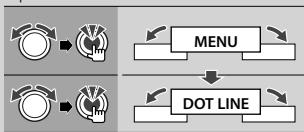


![KENWOOD KDC-W5544U - Cancelling the Music Search mode Press the [SEARCH] button. - 1](/content/2025/01/83498/images/124742bad14c11e39ab8ec585b19fd10b8f33caacc4c9d7c6e558f71cb14b000.jpg)
![KENWOOD KDC-W5544U - Enter Music Search mode Press the [SEARCH] button. - 1](/content/2025/01/83498/images/d738ce651e24798124e829a8864b06ad00a063fb32c246c96373449f72097d58.jpg)


![KENWOOD KDC-W5544U - Exit Clock adjustment mode Press the [SEARCH] button. - 1](/content/2025/01/83498/images/6da77b1138379e80050c9075e611fe957d013aa03d01aa4d00ea1a5b36511077.jpg)

![KENWOOD KDC-W5544U - Exit the Detail Audio Control mode Press the [AUD] knob for at least 1 second. - 1](/content/2025/01/83498/images/08bfca6baef16fe8dbf03094036c771df1c1ff18935bb6386272f2effc4f7142.jpg)


![KENWOOD KDC-W5544U - Exit Cabin select mode Press the [SEARCH] button. - 1](/content/2025/01/83498/images/53eb4fe43b75ca10602df2dd40bf8f91c608a801dea94c7e9c803e24d2eb4466.jpg)
![KENWOOD KDC-W5544U - Exit Audio Preset Memory mode Press the [SEARCH] button. - 1](/content/2025/01/83498/images/345e12383b80a4665dc66dc5bd20d7e39b03b89f1f24df06973b7f589b179658.jpg)
![KENWOOD KDC-W5544U - Exit Audio Preset Recall mode Press the [SEARCH] button. - 1](/content/2025/01/83498/images/f7189ecaeb96d1b8543b5a18efdd07fc3698bf111290d5c7534b804fd40e8db0.jpg)

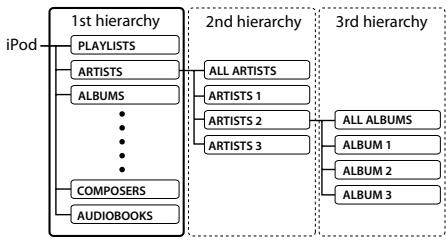
![KENWOOD KDC-W5544U - Cancelling the Preset Memory mode Press the [FAVORITE] button. - 1](/content/2025/01/83498/images/2014f44e2ee8a14a5545b5e5f69eef5cbd763871e91e2610672315e36d588a4e.jpg)
![KENWOOD KDC-W5544U - Cancelling the Preset Recall mode Press the [FAVORITE] button. - 1](/content/2025/01/83498/images/e54e57aa15482e2ccb4790664f277b0c5e5b0a5764a7e66e49d32b46543d2cf3.jpg)