
HL 2500 - Leaf blower Cocraft - Free user manual and instructions
Find the device manual for free HL 2500 Cocraft in PDF.


| Product Type | Leaf blower/vacuum |
| Brand | Cocraft |
| Model | HL 2500 |
| Power | 2500 W |
| Voltage | 220–240 V AC, 50 Hz |
| No-load Speed | 6000–13000 rpm |
| Max Blowing Speed | 270 km/h |
| Max Vacuum Capacity | 13 m³/min |
| Collection Bag Capacity | 45 L |
| Mulching Ratio | Approximately 10:1 |
| Sound Power Level (LwA) | 103 dB(A), K=3 dB(A) |
| Sound Pressure Level (LpA) | 86 dB(A), K=3 dB(A) |
| Vibration (Front Handle) | 4.5 m/s², K=1.5 m/s² |
| Vibration (Rear Handle) | 6.6 m/s², K=1.5 m/s² |
| Weight | 3.8 kg |
| Insulation Class | II |
| Operating Modes | Blower and vacuum (switchable) |
| Speed Control | Variable (6 positions) on rear handle |
| Shoulder Strap | Adjustable, included |
| Package Contents | Motor housing, 2-part chute, shoulder strap, collection bag, screws, manual |
| Maintenance | Clean vents with soft brush; wash bag annually by hand |
| Storage | Indoors, dry place, out of children's reach |
Frequently Asked Questions - HL 2500 Cocraft
User questions about HL 2500 Cocraft
0 question about this device. Answer the ones you know or ask your own.
Ask a new question about this device
Download the instructions for your Leaf blower in PDF format for free! Find your manual HL 2500 - Cocraft and take your electronic device back in hand. On this page are published all the documents necessary for the use of your device. HL 2500 by Cocraft.
USER MANUAL HL 2500 Cocraft
Read the entire instruction manual carefully and make sure that you fully understand it before you use the equipment. Keep the manual for future reference.
Viktig information:
natural_image
Blue and black photo of a blue and black electricity shaver with a cloth cover (no visible text or symbols)Art.no Model
18-4664
31-9050
BV2503E
BV2503E
Ver. 20180427
Original instructions
Bruksanvisning i original
Originalbruksanvisning
Please read the entire instruction manual before using the product and then save it for future reference. We reserve the right for any errors in text or images and any necessary changes made to technical data. If you have any questions concerning technical problems please contact our Customer Services.
Safety
General Safety Instructions
Warning: Read all the instructions.
Failure to adhere to the following instructions may lead to electric shocks, fires and/or serious injury.
SAVE THESE INSTRUCTIONS.
The term “power tool” in the following text refers to your handheld mains operated or battery operated tool.
1) Work area safety
a) Keep the work area clean and well illuminated. Cluttered and poorly lit areas invite accidents.
b) Do not use power tools in explosive environments, such as in the presence of flammable liquids, gases or dust. Power tools create sparks which may ignite dust or fumes.
c) Keep children and other bystanders away from the area where you are using the power tool. Distractions can cause you to lose your concentration and control.
2) Electrical safety
a) The plug of the power tool must fit correctly into the wall socket. Never modify the plug in any way. Never use an adaptor plug together with earthed power tools. Unmodified plugs and matching outlets will reduce the risk of electric shocks.
b) Avoid physical contact with earthed objects such as pipes, radiators, ovens and refrigerators. There is an increased risk of electric shock if your body is earthed.
c) Do not expose the power tool to rain or other wet conditions. Water entering a power tool will increase the risk of electric shock.
d) Do not abuse the mains lead. Never use the lead for carrying, pulling or unplugging the power tool. Keep the lead away from heat, oil, sharp edges and moving parts. Damaged or tangled leads increase the risk of electric shock.
e) When using power tools outdoors, use an extension lead that is suitable for this purpose. The use of an extension lead designed for outdoor use decreases the risk of electric shocks.
f) If the use of the power tool in a wet environment is unavoidable, a wall socket equipped with a residual current device (RCD) should be used.
The use of an RCD (with a tripping current of 30 mA and which trips within 30 ms) significantly reduces the risk of electrocution.
3) Personal safety
a) Pay attention to what you are doing and use common sense when using power tools. Never use power tools if you are tired or under the influence of drugs, alcohol or medication. One moment of inattention while using a power tool may result in a serious injury.
b) Wear protective clothing. Always wear safety glasses. Using protective clothing such as dust masks, non-slip safety shoes, helmets and ear defenders decreases the risk of injury.
c) Avoid accidental starts. Make sure that the power switch is set to OFF before plugging the power tool into a wall socket, fitting the battery or picking up/carrying the power tool. Carrying a power tool with your finger on the power switch/trigger or connecting the power tool to a wall socket when the power switch is set to ON is inviting an accident.
d) Remove all service tools/keys before switching on the power tool. A service tool left on a rotating part of the power tool may result in personal injury.
e) Do not overreach. Keep proper footing and balance at all times. This enables better control of the power tool in unexpected situations.
f) Wear suitable clothing. Do not wear loose-fitting clothing or jewellery. Keep hair, clothes and gloves away from moving parts. Loose-fitting clothes, jewellery or long hair could become caught in moving parts.
g) If equipment for the extraction and collection of dust is available, make sure it is connected and used properly. Use of dust collection equipment can reduce dust related hazards.
4) Use and maintenance of the power tool
a) Do not force the power tool. Use the correct power tool for your application. The correct power tool will do the job better and safer if used at the rate for which it was designed.
b) Never use the power tool if the power switch does not switch the tool on and off properly. Any power tool that cannot be controlled by the power switch is dangerous and must be repaired.
c) Unplug the lead from the wall socket or remove the battery before making any adjustments, changing accessories or storing the power tool. These precautions reduce the risk of the power tool starting unexpectedly.
d) Store power tools that are not being used out of children's reach. Do not allow people who are unfamiliar with the tool or these instructions to operate the tool. Power tools are dangerous in the hands of untrained users.
e) Properly maintain your power tools. Check for misalignment, binding of moving parts, broken parts or anything else which might affect the operation of the power tool. If damaged, have the power tool repaired before use.
Many accidents are caused by poorly maintained power tools.
f) Keep cutting tools sharp and clean. Properly maintained cutting tools with sharp cutting edges are less likely to bind and are easier to control.
g) Use the power tool, and any accessories in accordance with these instructions, taking into account the working conditions and the work to be performed.
Use of the power tool for a purpose other than that for which it is intended could result in a dangerous situation.
5) Service
a) Repairs and service should only be performed by qualified tradesmen, and only with original spare parts. This guarantees that the safety of the power tool is maintained.
Specific safety instructions for leaf blowers/leaf vacuums
- Keep bystanders, especially children and pets away whilst operating the leaf blower/vac.
- Never use the leaf blower/vac if any of its safety devices is damaged or missing.
• Always direct the mains lead to the rear of the leaf blower/vac during use. - The leaf blower/vac must only be used by adults who have read the instruction manual.
- Never have your hands or feet close to the air intake or exhaust chute when starting the leaf blower/vac.
- Always disconnect the leaf blower/vac from the mains supply whenever leaving the machine unattended.
• Always unplug the leaf blower/vac before checking, cleaning or working on the machine. - Keep the air vents of the motor free from grass and leaves.
- Store the leaf blower/vac out of children's reach.
- Carry the leaf blower/vac by its handle, never by the mains cable.
- Connect the leaf blower/vac to the mains using a residual current device (RCD or RCCB).
-
Switch off the leaf blower/vac and unplug it:
-
If the machine starts to vibrate abnormally, check if any of the parts is damaged or loose.
- Before clearing a blockage, emptying or servicing it.
- Whenever leaving the machine unattended.
- If the mains lead becomes damaged during use, unplug it immediately. Do not touch the cable, grip and pull the plug itself.
- Use only genuine spare parts.
- Never drag an extension cable through water or wet grass and always check the extension cable for damage before using it.
- Only operate the leaf blower/vac in daylight.
-
Walk when using the leaf blower/vac and keep your balance, never run. Always be sure of your footing when working on slopes.
-
Regularly check that all screws and nuts are securely tightened.
- The operator is ultimately responsible for any injuries caused to others or damage to their property.
- Use a Residual Current Device on all 230 V power tools. This can help minimise the risk of an electric shock if an earth fault or short circuit occurs.
Leaf blowing
- The blower can throw up objects which can result in personal injury.
- Never direct the exhaust air jet from the leaf blower/vac towards people or animals.
- Do not blow hard objects.
- Do not use the leaf blower/vac close to people or animals.
- Pay particular attention when operating the leaf blower on stairs or in other places with sharp corners and edges.
- Wear safety goggles or a visor, ear defenders, full body clothing and footwear.
Leaf vacuuming
- Never operate the leaf blower/vac if the leaf collection bag is not fitted and closed.
- Do not vacuum sharp, pointed or hard objects such as stones and nails which could penetrate and pass through the material of the collection bag.
- Vacuum only soft objects such as leaves and grass. Hard objects can damage the fan blades.
- Switch off and unplug the leaf blower/vac if it begins to vibrate abnormally.
- Check the collection bag regularly and replace it if it is damaged.
Guide to product safety symbols

Always wear approved safety glasses/visor and hearing protection.

Do not use in the rain or leave outdoors while it is raining.
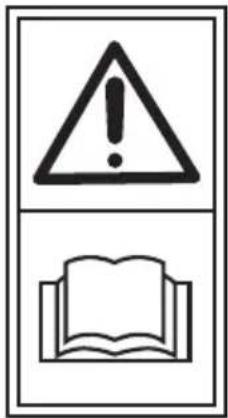
Read the instruction manual.
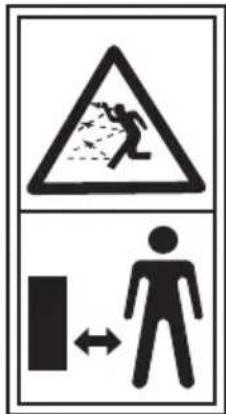
Keep bystanders away.
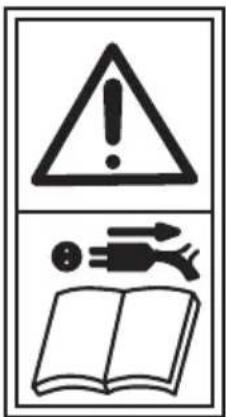
Always switch off and remove the plug from the mains before cleaning or maintenance.
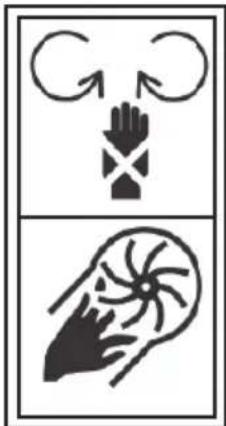
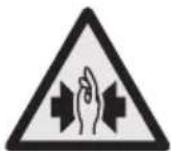
Warning: You can become caught in moving parts. Keep hands away from moving parts.
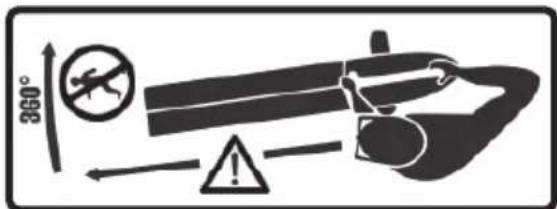
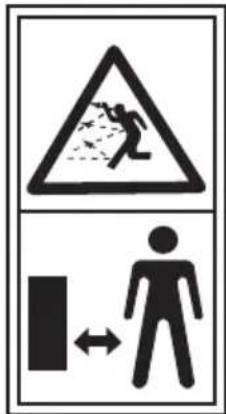
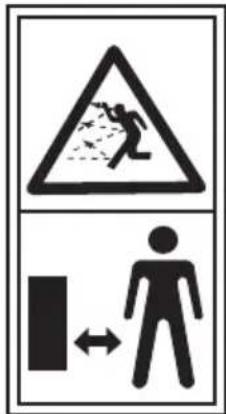
Warning: Stones and other debris ejected by the leaf blower/vac could cause injury. Keep your distance from bystanders and animals.
Package contents
- Motor housing
- Chute (2-part)
- Shoulder strap
- Collection bag
- Screws for assembling the chute
- Instruction manual
Parts
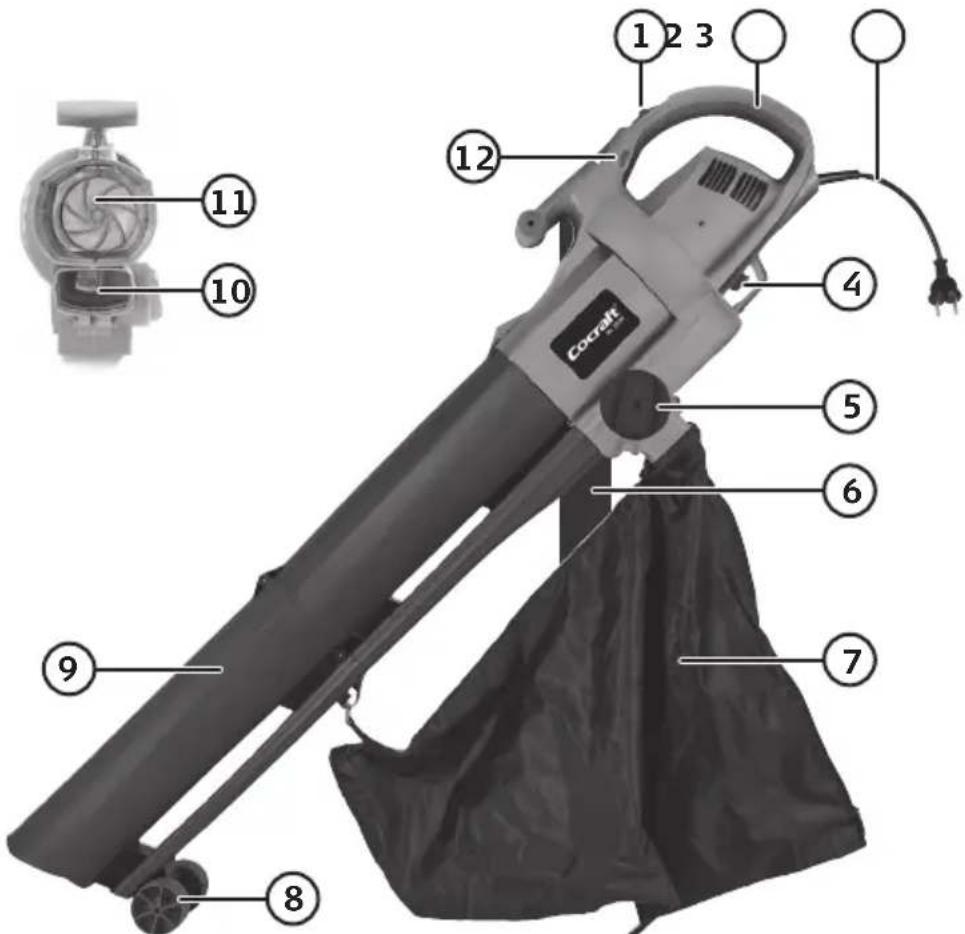
- On/off switch
- Rear handle
- Mains lead with plug
- Cable hanger
- Blower/vacuum selector
- Shoulder strap
- Collection bag
- Support wheels
- Chute
- Blower chute
- Vacuum chute
- Speed control
Assembly instructions
The product is sold partly assembled.
Warning: Remove this label and assemble and attach chute BEFORE operating this blower/vac.
WARNING: REMOVE THIS LABEL AND ASSEMBLE & FIX CHUTE BEFORE OPERATING THIS BLOWER VAC.
Warning: Make sure that the leaf blower/vac is switched off and unplugged before assembling, cleaning or servicing.
Assembling the chute and leaf bag
Warning: Never operate the leaf blower/vac without the leaf collection bag.
Warning: Make sure that the leaf blower/vac is switched off and unplugged before assembling.
-
Connect the two sections of the chute together and fix them at the points indicated by the arrows in the figure using two of the supplied screws.
-
Connect the chute to the motor housing and fix it at the points indicated by the arrows in the figure using the other two supplied screws.
-
Fitting the leaf collection bag: Push the two lugs into the slots in the motor housing until they click into place. Make sure that the bag is fitted securely before switching the leaf blower/vac on.
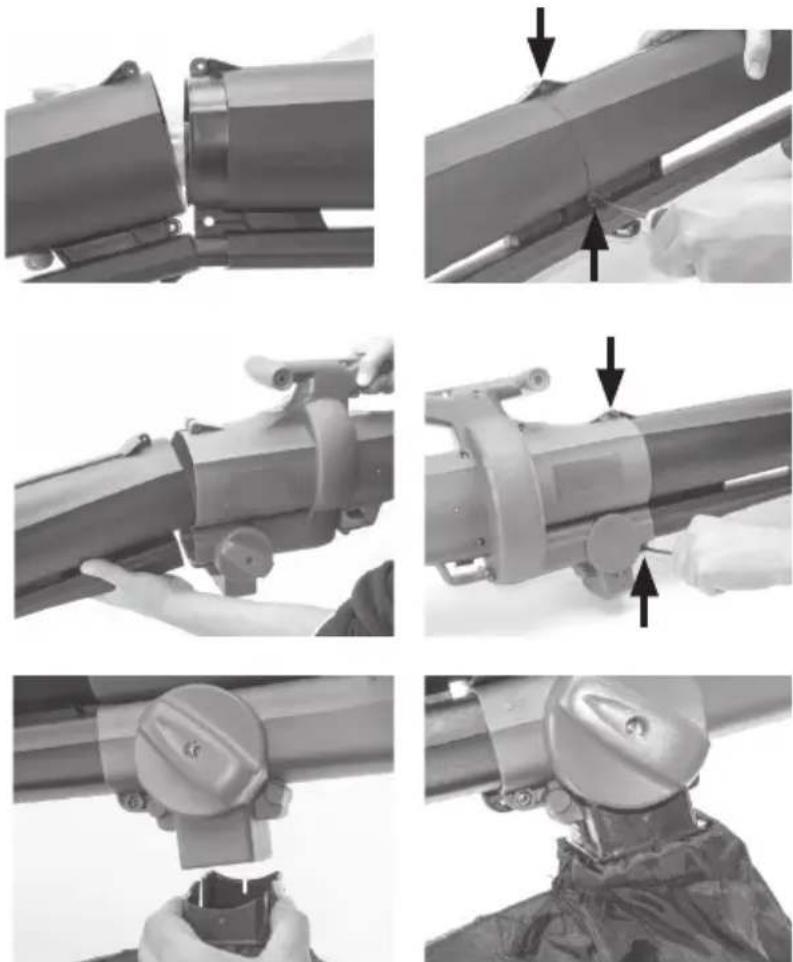
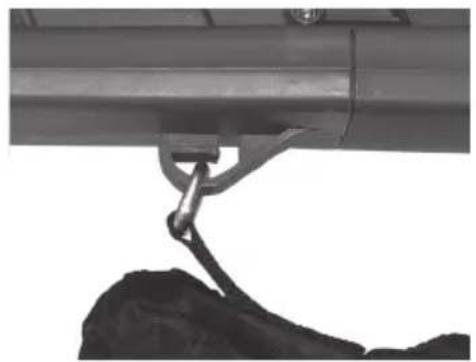
- Attach the front of the bag to the underside of the chute.
natural_image
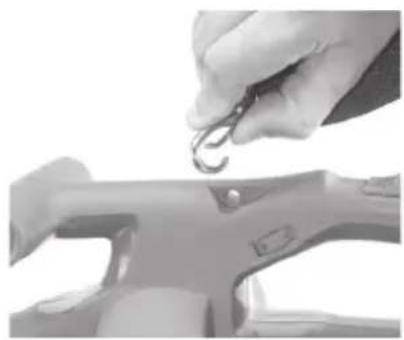
Close-up of a mechanical clamp securing a dark fabric item (no text or symbols visible)- Hook the shoulder strap onto the motor housing. Adjust the length of the strap to suit the operator.
natural_image
Close-up of hands holding a small metal hook attached to a mechanical component (no text or symbols visible)Preparations before use
- Secure the extension lead so that it will not be disconnected accidentally. Use only a weatherproof extension cable with a conductor cross-sectional area of at least 1.5 mm ^2 . Make sure that the extension lead is fully unwound.
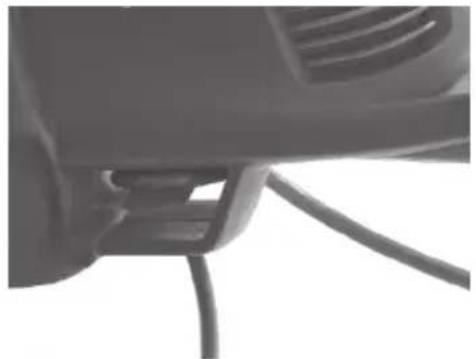
- Loop the mains lead over the cable hanger (4). The cable hanger prevents undue strain on the mains lead and will help prevent the extension cable from becoming unplugged
natural_image
Close-up of a car's front wheel and cable (no visible text or symbols)if it snags on something or is stepped on accidentally. Tighten the mains lead to remove any slack where it passes through the cable hanger.
- Make sure that the leaf bag is fitted correctly and that the shoulder strap is adjusted so the leaf blower/vac can be operated comfortably.
ALWAYS check these points before starting
- Wear safety goggles or a visor, ear defenders, full body clothing and sturdy footwear. A face mask might be required for dusty environments.
- The leaf bag is fitted correctly and zipped up, the chute is assembled and fixed and that there are no signs of damage to the housing of the machine.
• The mains lead and extension lead are intact.
Operating instructions
Switching the blower/vac on/off and adjusting the speed
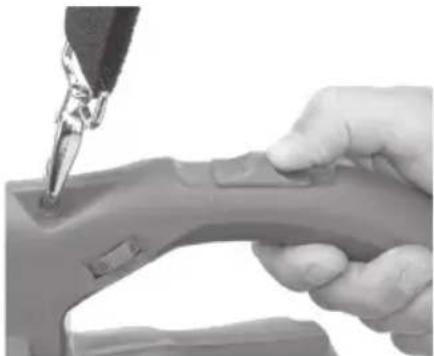
The on/off switch has two settings: Slide the on/off switch forwards to switch the leaf blower/vac on. Slide the on/off switch backwards to switch the leaf blower/vac off.
natural_image
Close-up of a hand using a power tool to apply material to a small electronic component (no visible text or symbols)Selecting the operating mode
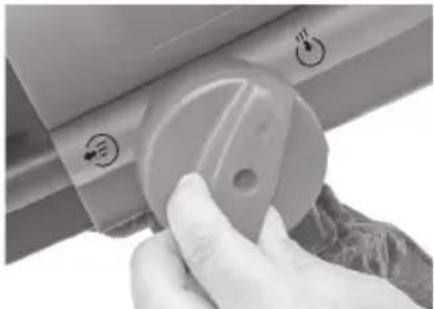
Select the operating mode using the blower/vacuum selector (5).

Turn the selector anticlockwise for blower mode.
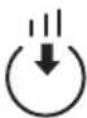
Turn the selector clockwise for vacuum mode.
natural_image
Close-up of a hand adjusting a circular mechanical component with adjustment knob (no text or symbols visible)Setting the speed
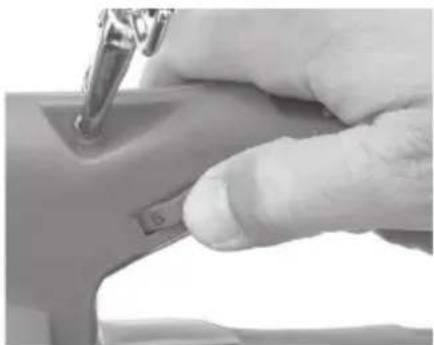
Set the speed (max 6 and min 1) using the speed control dial (12) on the rear handle. Turn the dial backwards for more speed and forwards for less speed.
natural_image
Close-up of a gloved hand using a sewing machine to press or install a small piece of hair (no visible text or symbols)Guidelines for general use
- The leaf blower/vac should not be pointed towards the ground, any people or animals when the motor is switched on.
• Vacuum only dry grass and dry leaves. - Hold the leaf blower/vac firmly in both hands.
- Do not aim the blower tube at cars or other objects with painted or sensitive surfaces.
- Be careful, so that the air blown out doesn't damage the bark of any trees or plants that you want to keep.
-
If necessary, first use a rake to loosen any leaves stuck to the ground before using the leaf blower/vac.
-
Check the ventilation openings of the motor regularly. Remove any material that may cause the motor to overheat.
- Switch the leaf blower/vac off, unplug it and empty the leaf bag frequently (do not leave leaves in the bag until next time). Detach the bag, turn it inside out and shake out all the contents. Wash the bag every year (by hand with a mild detergent) and let it air-dry.
Leaf blowing
Note: The mode selector should be easy to move between settings. If it is stiff, the bag may be full and need emptying. The mode selector must always be set to either blower or vacuum, not in between.
- Turn the selector (5) anticlockwise for the blower mode.
- Hold the leaf blower/vac firmly in both hands and push the on/off switch (1) forwards to start. Adjust the speed using the speed control (12) on the rear handle.
- Blow leaves and debris forwards in front of you to collect them in one place. The blower can also be used to displace leaves from hard to reach places.
- Slide the on/off switch (1) backwards to switch the leaf blower/vac off.
Leaf vacuuming
Warning: Do not vacuum water, glass, metal, hard objects, ash or hot embers, as these can be harmful to the operator and to the machine.
Vacuumed leaves are crushed in the fan and compacted to about 1/10 of their original volume. The leaf collection bag can therefore become quite heavy.
Note: The mode selector should be easy to move between settings. If it is stiff, the bag may be full and need emptying. The mode selector must always be set to either blower or vacuum, not in between.
- Turn the selector (5) clockwise for the vacuum mode.
- Hold the leaf blower/vac firmly in both hands and push the on/off switch (1) forwards to start. Adjust the speed using the speed control (12) on the rear handle.
- Hold the leaf blower/vac about 5 cm above the leaves to be vacuumed.
- Move the chute from side to side, walk forwards and turn slowly. Stop working if the bag feels heavy.
- Slide the on/off switch (1) backwards to switch the leaf blower/vac off.
Emptying the leaf collection bag

Warning: Switch off and unplug the leaf blower/vac before emptying the bag. When the leaf bag is nearing capacity the suctioning effect will be greatly reduced and the bag must be emptied:
- Switch off the leaf blower/vac and unplug it:
- Undo the zip on the back of the bag and shake out the contents.
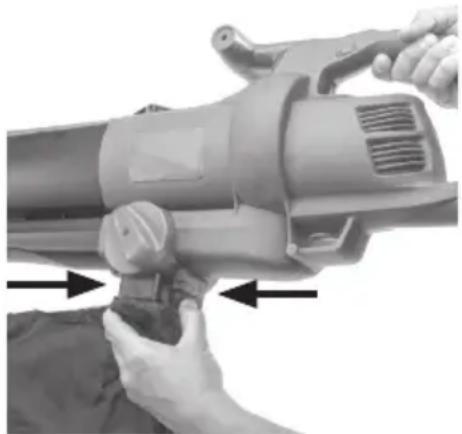
- Always remove the bag before putting the leaf blower/vac away for storage. Press the two tabs shown by the arrows in to release the bag.
- Detach the bag, turn it inside out and shake out all the contents. Make sure that the bag is dry and intact before refitting it.
natural_image
Close-up of a person using a spray gun to adjust the product (no visible text or symbols)If the vacuum effect drops despite the bag not being full, check if the chute or fan is blocked by leaves. Clear the chute or fan of leaves as follows:
- Switch the leaf blower/vac off, unplug it and let it stop completely.
- Detach the chute and the leaf bag.
- Carefully remove the blockage and check that the fan blades and other parts are not damaged.
- Turn the fan blades carefully by hand to check that they can rotate freely.
- Refit the chute and leaf bag.
Find a comfortable working position
Put the shoulder strap (6) over your shoulder and adjust the length until you can carry it comfortably.
Storage and maintenance
Warning: Make sure that the leaf blower/vac is switched off and unplugged before cleaning.
- Clean the ventilation openings of the motor using a soft brush to stop the motor overheating.
- Remove the chute and clean the fan blades regularly using a soft brush. Check that the fan blades are undamaged.
- Store the leaf blower/vac indoors, in a dry place out of children's reach.
- Clean the exterior of the leaf blower/vac with a soft damp cloth and mild detergent. Never clean the product using solvents or abrasive cleaning agents.
- Make sure that the leaf bag is dry and undamaged before storing the leaf blower/vac.
Troubleshooting
| Problem Possible cause Solution | ||
| The motor does not start. | 1. The wall socket has no power.2. The extension cable is faulty.3. The motor or on/off switch is faulty.4. The RCD has tripped. | 1. Check the fuse (min 10 A, slow-blow).2. Check the extension cable, try another.3. Contact our customer services.4. Reset the RCD. |
| Poor suction. | 1. Leaf blockage.2. Leaf bag full.3. Speed set too low.4. Extension lead too long or too thin. | 1. Empty the leaf bag.2. Empty the leaf bag.3. Increase the speed.4. The extension lead may be max 25 m long and must have a csa of at least 1.5 mm ^2 . Longer cable must have a csa of at least 2.5 mm ^2 . |
| Reduced blower air flow. | Blower chute blocked. Unplug the machine and check for blockages. | |
Responsible disposal
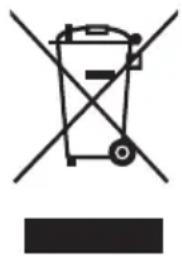
This symbol indicates that this product should not be disposed of with general household waste. This applies throughout the entire EU. In order to prevent any harm to the environment or health hazards caused by incorrect waste disposal, the product must be handed in for recycling so that the material can be disposed of in a responsible manner. When recycling your product, take it to your local collection facility or contact the place of purchase. They will ensure that the product is disposed of in an environmentally sound manner.
natural_image
Symbol of a trash bin crossed out by two crossed lines, with a solid black rectangle below (no text or labels)Technical specifications
Voltage 220–240 V AC, 50 Hz
Wattage 2500 W
Insulation class ||
No-load speed 6000–13000 rpm
Max speed (blowing) 270 km/h
Max vacuum capacity 13 m³/min
Collection bag 45 |
Sound power (LwA) 103 dB(A), K = 3 dB(A)
Sound pressure (LpA) 86 dB(A), K = 3 dB(A)
Vibration at front handle 4.5 m/s ^2 , K = 1.5 m/s ^2
Vibration at rear handle 6.6 m/s ^2 , K = 1.5 m/s ^2
Weight 3.8 kg
Mulching ratio Approximately 10:1
Lövsug/lövblås 2500 W
Art.nr 18-4664 Modell BV2503E
31-9050
BV2503E
natural_image
Three-panel image showing a hand holding a key to a car handle, with no visible text or symbols.natural_image
Close-up of a car's front wheel and cable (no visible text or symbols)natural_image
Close-up of a hand using a soldering iron to apply material on a mechanical component (no visible text or symbols)natural_image
Close-up of a hand holding a circular mechanical component with directional arrows (no text or symbols visible)natural_image
Close-up of a hand using a tool to adjust a small component labeled 'L0' (no other text or symbols visible)Användningsråd
natural_image
Close-up of a person using a handheld gun to adjust the lever (no visible text or symbols)natural_image
Symbol of a trash bin crossed with no text or labels, accompanied by a blank rectangular block below (no text or symbols present)Teknisk specifikation
Spänning 220–240 V AC, 50 Hz
Effekt 2500 W
Isolationsklass ||
Varvtal 6000–13000 v/min
Maxhastighet (blåsning) 270 km/h
Les bruksanvisningen!
natural_image
Six-panel sequence showing mechanical assembly steps with arrows indicating alignment or adjustment (no text or symbols present)natural_image
Three-panel image showing a hand holding a metal hook to press down a black fabric, with no visible text or symbols.natural_image
Close-up of a car's front wheel and cable (no visible text or symbols)natural_image
Close-up of a hand using a power tool to apply a small electronic component (no visible text or symbols)natural_image
Close-up of a hand holding a circular mechanical component with directional arrows (no text or symbols visible)Still inn ønsket turtall
natural_image
Close-up of a hand using a sewing machine to press or install a small electronic component (no visible text or symbols)Tips om bruken
natural_image
Close-up of a person using a handheld gun to adjust the lever (no visible text or symbols)natural_image
Symbol of a trash bin crossed with a diagonal line and a horizontal bar below (no text or labels)Lue käyttöohje!
natural_image
Three-panel image showing a hand holding a metal hook to draw a black fabric, with no visible text or symbols.natural_image
Close-up of a car's front wheel and cable (no visible text or symbols)natural_image
Close-up of a hand using a power tool to apply soldering onto a mechanical component (no text or symbols visible)Toiminnon valinta
natural_image
Close-up of a hand adjusting a circular mechanical component with directional arrows (no text or symbols visible)natural_image
Close-up of a hand using a sewing machine to press or install a small electronic component (no visible text or symbols)Ohjeet käyttöön
natural_image
Close-up of a person using a handheld device to adjust or install a cylindrical device (no visible text or symbols)natural_image
Symbol of a trash bin crossed with no text or labels, accompanied by a black rectangular block below (no text or symbols present)Tekniset tiedot
Jännite 220–240 V AC, 50 Hz
Teho 2500 W
Eristysluokka ||
Melutaso (LPA) 86 dB(A), K = 3 dB (A)
natural_image
Two black-and-white diagrams showing hand gestures and a stylized human head with wind patterns (no text or symbols)natural_image
Three-panel image showing a hand holding a metal hook to adjust the interior of a mechanical device (no text or symbols visible)natural_image
Close-up of a car's front wheel and cable (no visible text or symbols)natural_image
Close-up of a hand using a power tool to apply material to a small electronic component (no visible text or symbols)natural_image
Close-up of a hand adjusting a circular mechanical component with adjustment knobs (no visible text or symbols)natural_image
Close-up of a hand using a tool to press or install a small electronic component labeled 'B' (no other text or symbols visible)Bedienungstipps
natural_image
Close-up of a person using a handheld gun to adjust the barrel (no visible text or symbols)Declaration of Conformity
Declares that this product complies with the requirements of the following directives and standards
Machinery Directive 2006/42/EC
EN 60335-1:2012+A11:2014
EN 50636-2-100:2014
EN 62233:2008
EMC Directive 2014/30/EU
EN 55014-1:2006+A2:2011
EN 55014-2:1997+A2:2008
EN 61000-3-2:2014
EN 61000-3-3:2013
Hemid Alfredson
Henrik Alfredsson
Technical Manager
Insjön, Sweden, 2016-04-26
Sverige
Postal 10 - 13 Market Place
Kingston Upon Thames
Surrey
KT1 1JZ
Deutschland
Kundenservice

- Viktig information:
- Safety
- General Safety Instructions
- SAVE THESE INSTRUCTIONS.
- 1) Work area safety
- 2) Electrical safety
- 3) Personal safety
- 4) Use and maintenance of the power tool
- 5) Service
- Specific safety instructions for leaf blowers/leaf vacuums
- Leaf blowing
- Leaf vacuuming
- Guide to product safety symbols
- Package contents
- Parts
- Assembly instructions
- Assembling the chute and leaf bag
- Preparations before use
- ALWAYS check these points before starting
- Operating instructions
- Switching the blower/vac on/off and adjusting the speed
- Selecting the operating mode
- Setting the speed
- Guidelines for general use
- Emptying the leaf collection bag
- Find a comfortable working position
- Storage and maintenance
- Troubleshooting
- Responsible disposal
- Technical specifications
- Lövsug/lövblås 2500 W
- Användningsråd
- Teknisk specifikation
- Still inn ønsket turtall
- Tips om bruken
- Toiminnon valinta
- Ohjeet käyttöön
- Tekniset tiedot
- Bedienungstipps
- Declaration of Conformity
- Sverige
- Deutschland
Brand : Cocraft
Model : HL 2500
Category : Leaf blower