
TM-281A - Ham Radio KENWOOD - Free user manual and instructions
Find the device manual for free TM-281A KENWOOD in PDF.


| Product type | FM transceiver 144 MHz |
| Brand | KENWOOD |
| Model | TM-281A |
| Dimensions (W x H x D) | 160 x 43 x 126 mm |
| Weight | Approx. 1.13 kg |
| Power supply | 13.8 V DC ±15% (11.7 – 15.8 V) |
| Current (max. transmit) | 14 A |
| Current (receive) | 1 A or less |
| Output power (high) | 65 W |
| Output power (low) | Approx. 25 W |
| RX frequency range | 136 – 174 MHz |
| TX frequency range (K model) | 144 – 148 MHz |
| TX frequency range (E model) | 144 – 146 MHz |
| Mode | F3E (FM) |
| Antenna impedance | 50 Ω |
| Number of memory channels | Up to 200 (100 with names) |
| Main functions | CTCSS, DCS, scan (band, program, memory), repeater, weather alert (K models), lock, APO, TOT, etc. |
| Maintenance and cleaning | Clean with a damp cloth and mild detergent. Avoid harsh chemicals. |
| Safety | Do not transmit for long periods at high power; use appropriate fuse rating; do not modify without authorization. |
| Spare parts and repairability | Optional accessories (microphone, cable, speaker); repair by authorized center; downloadable MCP-1A software. |
| Antenna connector | Type M (SO-239) or N (E market) |
Frequently Asked Questions - TM-281A KENWOOD
User questions about TM-281A KENWOOD
0 question about this device. Answer the ones you know or ask your own.
Ask a new question about this device
Download the instructions for your Ham Radio in PDF format for free! Find your manual TM-281A - KENWOOD and take your electronic device back in hand. On this page are published all the documents necessary for the use of your device. TM-281A by KENWOOD.
USER MANUAL TM-281A KENWOOD
TRANCEPTOR FM 144 MHz
This equipment complies with the essential requirements of Directive 1999/5/EC.
The use of the warning symbol ① means the equipment is subject to restrictions of use in certain countries. This equipment requires a licence and is intended for use in the countries as below.
| AT | BE | DK | FI | FR | DE | GR | IS |
| IE | IT | LI | LU | NL | NO | PT | ES |
| SE | CH | GB | CY | CZ | EE | HU | LV |
| LT | MT | PL | SK | SI | BG | RO |
ISO3166
Information on Disposal of Old Electrical and Electronic Equipment and Batteries (applicable for EU countries that have adopted separate waste collection systems)

Products and batteries with the symbol (crossed-out wheeled bin) cannot be disposed as household waste.
Old electrical and electronic equipment and batteries should be recycled at a facility capable of handling these items and their waste byproducts.

Contact your local authority for details in locating a recycle facility nearest to you.

Proper recycling and waste disposal will help conserve resources whilst preventing detrimental effects on our health and the environment.
Pb
Notice: The sign "Pb" below the symbol for batteries indicates that this battery contains lead.
THANK YOU!
Thank you for choosing this Kenwood transceiver. Kenwood always provides Amateur Radio products which surprise and excite serious hobbyists. This transceiver is no exception. As you learn how to use this transceiver, you will find that Kenwood is pursuing "user friendliness". For example, each time you change the Menu No. in Menu mode, you will see a text message on the display that lets you know what you are configuring.
Though user friendly, this transceiver is technically sophisticated and some features may be new to you. Consider this manual to be a personal tutorial from the designers. Allow the manual to guide you through the learning process now, then act as a reference in the coming years.
MODELS COVERED BY THIS MANUAL
The models listed below are covered by this manual.
TM-281A: 144 MHz FM Transceiver
TM-281E: 144 MHz FM Transceiver
MARKET CODES
K: The Americas
E: Europe
Mn: General
(Where "n" represents a variation number.)
The market code is printed on the barcode label of the carton box.
Refer to the product specifications {pages 71, 72} for information on the available operating frequencies within each model. For accessories supplied with the model, refer to page 1.
FEATURES
- Weather Alert Radio function checks the 1050 Hz tone from NOAA (U.S.A./ Canada only).
- Menu allows for easy control and selecting of various functions.
- Up to 200 memory channels to program frequencies and other various data. (Up to 100 memory channels if Memory Channel Names are assigned to the channels.)
- Continuous Tone Coded Squelch System (CTCSS) or Digital Code Squelch (DCS) rejects unwanted calls from other stations.
- Equipped with an easy-to-read large LCD with alphanumeric display capability.
Free PC software (Memory Control Program) is available to program the frequency, signalling, and other settings of your transceiver. The MCP can be downloaded at: http://www.kenwood.com/i/products/info/amateur/software_download.html
NOTICES TO THE USER
One or more of the following statements may be applicable:
FCC WARNING
This equipment generates or uses radio frequency energy. Changes or modifications to this equipment may cause harmful interference unless the modifications are expressly approved in the instruction manual. The user could lose the authority to operate this equipment if an unauthorized change or modification is made.
INFORMATION TO THE DIGITAL DEVICE USER REQUIRED BY THE FCC
This equipment has been tested and found to comply with the limits for a Class B digital device, pursuant to Part 15 of the FCC Rules. These limits are designed to provide reasonable protection against harmful interference in a residential installation.
This equipment generates, uses and can generate radio frequency energy and, if not installed and used in accordance with the instructions, may cause harmful interference to radio communications. However, there is no guarantee that the interference will not occur in a particular installation. If this equipment does cause harmful interference to radio or television reception, which can be determined by turning the equipment off and on, the user is encouraged to try to correct the interference by one or more of the following measures:
Reorient or relocate the receiving antenna.
- Increase the separation between the equipment and receiver.
- Connect the equipment to an outlet on a circuit different from that to which the receiver is connected.
- Consult the dealer for technical assistance.
When condensation occurs inside the transceiver:
Condensation may occur inside the transceiver when the room is warmed using a heater on a cold day or when the transceiver is quickly moved from a cold location to a warm location. When condensation occurs, the microcomputer and/or the transmit/receive circuits may become unstable, resulting in transceiver malfunction. If this happens, turn OFF the transceiver and wait for a while. When the condensed droplets disappear, the transceiver will function normally.
This device Complies with Industry Canada licence-exempt RSS standard(s). Operation is subject to the following two conditions: (1) this device may not cause interference, and (2) this device must accept any interference, including interference that may cause undesired operation of the device.
PRECAUTIONS
Please observe the following precautions to prevent fire, personal injury, and/or transceiver damage:
- Do not attempt to configure your transceiver while driving; it is simply too dangerous.
- Be aware of local laws pertaining to the use of headphones/headsets while driving on public roads. If in doubt, do not wear headphones while mobiling.
- Do not transmit with high output power for extended periods; the transceiver may overheat.
- Do not modify the transceiver unless instructed by this manual or other Kenwood documentation.
- Do not expose the transceiver to long periods of direct sunlight nor place it close to heating appliances.
- Do not place the transceiver in excessively dusty, humid or wet areas, nor on unstable surfaces.
- If an abnormal odor or smoke is detected coming from the transceiver, turn OFF the power immediately. Contact a Kenwood service station or your dealer.
- This transceiver is designed for a 13.8V power source. Never use a 24V battery to power the transceiver.
CONTENTS
SUPPLIED ACCESSORIES 1
WRITING CONVENTIONS FOLLOWED
IN THIS MANUAL. 1
CHAPTER ① PREPARATION
MOBILE INSTALLATION 2
DC POWER CABLE CONNECTION 3
Mobile Operation 3
Fixed Station Operation. 4
Replacing Fuses. 5
ANTENNA CONNECTION 5
ACCESSORY CONNECTIONS 6
External Speaker. 6
Microphone 6
PC Connection 7
CHAPTER ② YOUR FIRST QSO
CHAPTER ③ GETTING ACQUAINTED
FRONT PANEL 9
DISPLAY 10
REAR PANEL 12
MICROPHONE 12
MIC KEYPAD DIRECT ENTRY 13
CHAPTER ④ OPERATING BASICS
SWITCHING THE POWER ON/OFF 14
ADJUSTING THE VOLUME. 14
ADJUSTING THE SQUELCH 14
TRANSMITTING 15
SELECTING AN OUTPUT POWER 15
SELECTING A FREQUENCY 15
VFO MODE 15
MHz MODE 16
DIRECT FREQUENCY ENTRY 16
CHAPTER 5 MENU SETUP
WHAT IS A MENU? 18
MENUCCESS 18
MENUFUNCTIONLIST 19
CHAPTER 6 OPERATING THROUGH REPEATERS
OFFSET PROGRAMMING FLOW 22
PROGRAMMING AN OFFSET 23
SELECTING AN OFFSET DIRECTION 23
SELECTING AN OFFSET FREQUENCY 23
ACTIVATING THE TONE FUNCTION 24
SELECTING A TONE FREQUENCY 24
AUTOMATIC REPEATER OFFSET 25
TRANSMITTING A 1750 Hz TONE. 25
REVERSE FUNCTION 26
AUTOMATIC SIMPLEX CHECK (ASC) 26
TONE FREQUENCY ID SCAN 27
CHAPTER ⑦ MEMORY CHANNELS
NUMBER OF MEMORY CHANNELS 28
SIMPLEX & REPEATER OR ODD-SPLIT
MEMORY CHANNEL? 28
STORING SIMPLEX FREQUENCIES OR
STANDARD REPEATER FREQUENCIES 29
STORING ODD-SPLIT REPEATER
FREQUENCIES 30
RECALLING A MEMORY CHANNEL 30
USING THE TUNING CONTROL 30
USING THE MICROPHONE KEYPAD 31
CLEARING A MEMORY CHANNEL 31
NAMING A MEMORY CHANNEL 32
MEMORY CHANNEL TRANSFER 33
MEMORY VFO TRANSFER 33
CHANNEL CHANNEL TRANSFER 33
CALL CHANNEL 35
RECALLING THE CALL CHANNEL 35
REPROGRAMMING THE CALL CHANNEL 35
WEATHER ALERT (K MARKET MODELS ONLY) 36
PROGRAMMING THE WEATHER RADIO FREQUENCY 36
ENABLING A WEATHER ALERT 36
CHANNEL DISPLAY 37
CHAPTER ⑧ SCAN
NORMAL SCAN 40
BAND SCAN 40
PROGRAM SCAN 40
MHz SCAN 41
MEMORY SCAN 42
ALL-CHANNEL SCAN 42
GROUP SCAN. 42
CALL SCAN 43
PRIORITY SCAN 43
PROGRAMMING A PRIORITY CHANNEL 43
USING PRIORITY SCAN 44
MEMORY CHANNEL LOCKOUT 44
SCANRESUME METHOD 45
CHAPTER 9 SELECTIVE CALL
CTCSS AND DCS 46
CTCSS 46
SELECTING A CTCSS FREQUENCY 47
CTCSS FREQUENCY ID SCAN 47
DCS 48
SELECTING A DCS CODE 48
DCS CODE ID SCAN 49
CHAPTER 10 DUAL TONE MULTI-FREQUENCY (DTMF) FUNCTIONS
MANUAL DIALING 50
DTMF MONITOR 50
DTMF TX H0LD 51
AUTOMATIC DIALER 51
STORING A DTMF NUMBER IN MEMORY 51
CONFIRMING STORED DTMF NUMBERS 52
TRANSMITTING A STORED DTMF NUMBER 52
ADJUSTING THE DTMF TONE TRANSMISSION SPEED.... 52
ADJUSTING THE PAUSE DURATION 53
DTMF LOCK. 53
CHAPTER 11 AUXILIARY FUNCTIONS
APO (AUTO POWER OFF) 54
BEAT SHIFT 54
S-METER SQUELCH 54
SQUELCH HANG TIME 55
BEEP FUNCTION 55
BUSY CHANNEL LOCKOUT 56
FREQUENCY STEP SIZE 56
DISPLAY BACKLIGHT 57
SUPPLIED ACCESSORIES
After carefully unpacking the transceiver, identify the items listed in the table below. We recommend you keep the box and packaging for shipping.
A market area code (K, E, M2) can be found on the label attached to the package box.
| Accessory | Qty | |
| Microphone | M2 market (KMC-30) | 1 |
| K, E market (DTMF Mic) | ||
| DC power cable (Blade) | 1 | |
| Fuse (Blade) | 1 | |
| Mounting bracket | 1 | |
| Screw set | 1 | |
| Microphone hanger | 1 | |
| Warranty card (K, E market only) | 1 | |
| Instruction manual | 1 | |
| Instruction manual (E market only) | 2 | |
WRITING CONVENTIONS FOLLOWED IN THIS MANUAL
The writing conventions described below have been followed to simplify instructions and avoid unnecessary repetition.
| Instruction | What to do |
| Press [KEY]. | Press and release KEY. |
| Press [KEY] (1s). | Press and hold KEY for 1 second or longer. |
| Press [KEY1], [KEY2]. | Press KEY1 momentarily, release KEY1, then press KEY2. |
| Press [KEY1]+[KEY2]. | Press and hold KEY1, then press KEY2. If there are more than 2 keys, press and hold each key in turn until the final key has been pressed. |
| Press [KEY]+[ ♂]. | With the transceiver power OFF, press and hold KEY, then turn the transceiver power ON by pressing [ ♂] (Power Switch). |
MOBILE INSTALLATION
To install the transceiver, select a safe, convenient location inside your vehicle that minimizes danger to your passengers and yourself while the vehicle is in motion. Consider installing the unit at an appropriate position so that knees or legs will not strike it during sudden braking of your vehicle. Try to pick a well ventilated location that is shielded from direct sunlight.
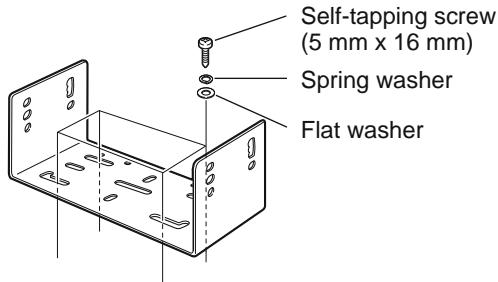
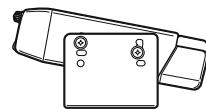
1 Install the mounting bracket in the vehicle using the supplied self-tapping screws (4), flat washers (4), and spring washers (4).
- The bracket must be installed so that the 3 screw hole positions on the side of the mounting bracket are towards the rear of the bracket.
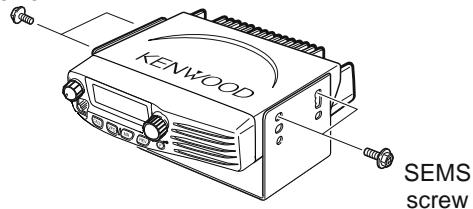
2 Position the transceiver, then insert and tighten the supplied hexagon SEMS screws (4) and flat washers (4).
- Double check that all hardware is tightened to prevent vehicle vibration from loosening the bracket or transceiver.
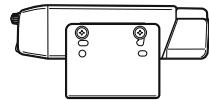
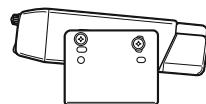
- Determine the appropriate angle of the transceiver, using the 3 screw hole positions on the side of the mounting bracket.
DC POWER CABLE CONNECTION
Locate the power input connector as close to the transceiver as possible.
MOBILE OPERATION
The vehicle battery must have a nominal rating of 12V . Never connect the transceiver to a 24V battery. Be sure to use a 12V vehicle battery that has sufficient current capacity. If the current to the transceiver is insufficient, the display may darken during transmission, or transmit output power may drop excessively.
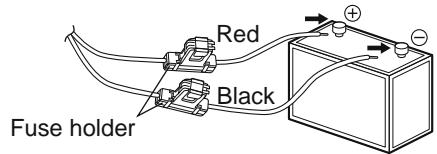
1 Route the DC power cable supplied with the transceiver directly to the vehicle's battery terminals using the shortest path from the transceiver.
- If using a noise filter, it should be installed with an insulator to prevent it from touching metal on the vehicle.
- We recommend you do not use the cigarette lighter socket as some cigarette lighter sockets introduce an unacceptable voltage drop.
- The entire length of the cable must be dressed so it is isolated from heat, moisture, and the engine secondary (high voltage) ignition system/ cables.
2 After the cable is in place, wrap heat-resistant tape around the fuse holder to protect it from moisture and tie down the full run of cable.
3 To prevent the risk of short circuits, disconnect other wiring from the negative (-) battery terminal before connecting the transceiver.
4 Confirm the correct polarity of the connections, then attach the power cable to the battery terminals; red connects to the positive (+) terminal and black connects to the negative (-) terminal.
- Use the full length of the cable without cutting off excess even if the cable is longer than required. In particular, never remove the fuse holders from the cable.
5 Reconnect any wiring removed from the negative terminal.
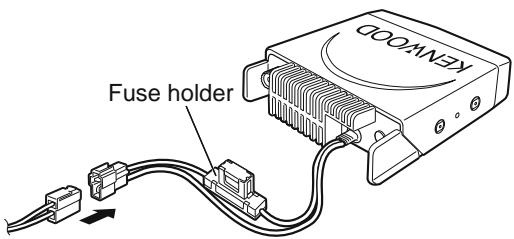
6 Connect the DC power cable to the transceiver's power supply connector.
- Press the connectors firmly together until the locking tab clicks.
In order to use this transceiver for fixed station operation, you will need a separate 13.8 V DC power supply (not included). The recommended current capacity of your power supply is 14 A or more.
1 Connect the DC power cable to the regulated DC power supply and ensure that the polarities are correct (Red: positive, Black: negative).
- Do not directly connect the transceiver to an AC outlet.
- Use the supplied DC power cable to connect the transceiver to a regulated power supply.
- Do not substitute a cable with smaller gauge wires.
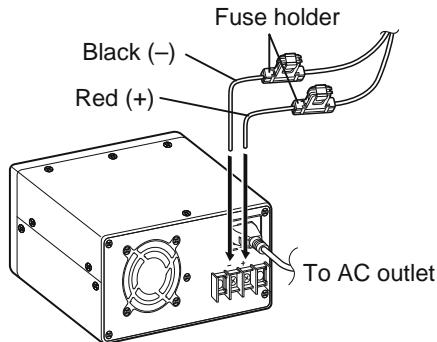
Regulated DC power supply
2 Connect the transceiver's DC power connector to the connector on the DC power cable.
- Press the connectors firmly together until the locking tab clicks.
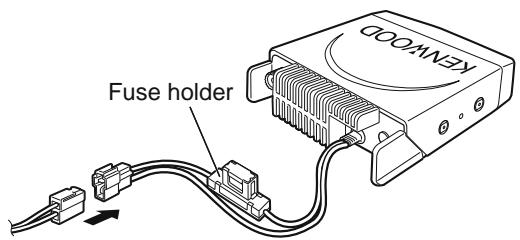
Note:
For your transceiver to fully exhibit its performance capabilities, we recommend using the optional PS-60 (22.5 A, 25% duty cycle) power supply.
Before connecting the DC power supply to the transceiver, be sure to switch the transceiver and the DC power supply OFF.
Do not plug the DC power supply into an AC outlet until you make all connections.
REPLACING FUSES
If the fuse blows, determine the cause, then correct the problem. After the problem is resolved, replace the fuse. If newly installed fuses continue to blow, disconnect the power cable and contact your authorized Kenwood dealer or an authorized Kenwood service center for assistance.
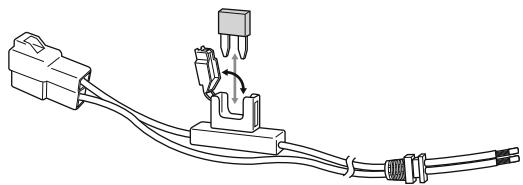
| Fuse Location | Fuse Current Rating |
| Transceiver | 15 A |
| Supplied Accessory DC Power Cable | 20 A |
Only use fuses of the specified type and rating; otherwise the transceiver could be damaged.
Note: If you use the transceiver for a long period when the vehicle battery is not fully charged, or when the engine is OFF, the battery may become discharged, and will not have sufficient reserves to start the vehicle. Avoid using the transceiver under these conditions.
ANTENNA CONNECTION
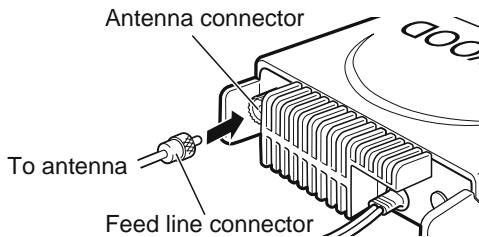
Before operating, install an efficient, well-tuned antenna. The success of your installation will depend largely on the type of antenna and its correct installation. The transceiver can give excellent results if the antenna system and its installation are given careful attention.
Use a 50 impedance antenna and low-loss coaxial feed line that has a characteristic impedance of 50 , to match the transceiver input impedance. Coupling the antenna to the transceiver via feed lines having an impedance other than 50 reduces the efficiency of the antenna system and can cause interference to nearby broadcast television receivers, radio receivers, and other electronic equipment.
Note: E market models use an N-type antenna connector while other models use an M-type (SO-239) connector.

Transmitting without first connecting an antenna or other matched load may damage the transceiver. Always connect the antenna to the transceiver before transmitting.
All fixed stations should be equipped with a lightning arrester to reduce the risk of fire, electric shock, and transceiver damage.
ACCESSORY CONNECTIONS
1
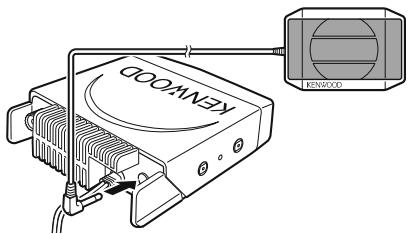
EXTERNAL SPEAKER
If you plan to use an external speaker, choose a speaker with an impedance of 8 . The external speaker jack accepts a 3.5mm (1/8") mono (2-conductor) plug. We recommend using the SP-50B speaker.
MICROPHONE
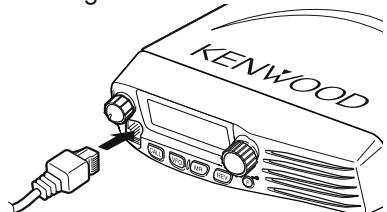
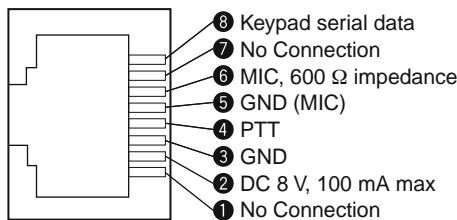
For voice communications, connect a 600 Ω microphone equipped with an 8-pin modular plug into the modular socket on the front of the main unit. Press firmly on the plug until the locking tab clicks.
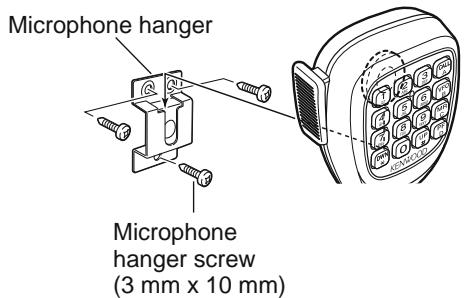
Attach the supplied microphone hanger in an appropriate location using the screws included in the screw set.
PC CONNECTION
To utilize the optional MCP-1A software, you must first connect the transceiver to your PC using an optional Programming Cable (via the microphone jack).
The MCP-1A is free downloadable software available from Kenwood at the following URL:
http://www.kenwood.com/i/products/info/amateur/software_download.html
Note: Ask your dealer about purchasing a Programming Cable.
2
Are you ready to give your transceiver a quick try? Reading this section should get your voice on the air right away. The instructions below are intended only as a quick guide. If you encounter problems or there is something you would like to know more, read the detailed explanations given later in this manual.
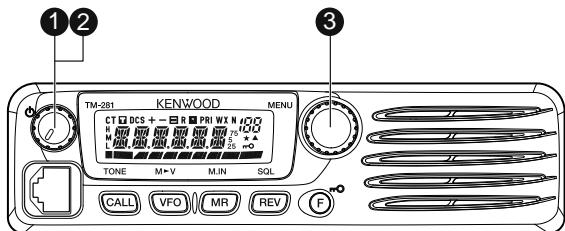
Press [Power] (Power) briefly to switch the transceiver power ON.
- A high pitched double beep sounds and a Power-on message appears momentarily. The various indicators and the current operating frequency appear on the LCD.
- The transceiver stores the current parameters when it is turned OFF and automatically recalls those parameters the next time you turn the transceiver ON.
Turn the Volume control clockwise, to the 12 o'clock position.
③ Turn the Tuning control to select a reception frequency.
- You may further turn the Volume control to adjust the volume level of the signal.
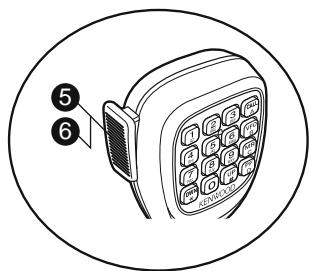
To transmit, hold the microphone approximately 5 ~cm (2 inches) from your mouth.
Press and hold Mic [PTT], then speak in your normal tone of voice.
Release Mic [PTT] to receive.
Repeat steps 4, 5, and 6 to continue communication.
FRONT PANEL
Note: This section describes only the main functions of the front panel controls. Explanations for functions not described here are provided in the appropriate sections of this instruction manual.
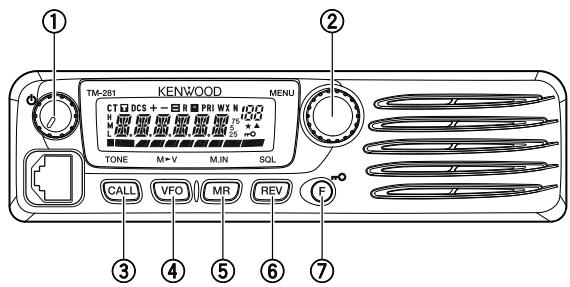
① (Power) switch/ Volume control
Press to switch the transceiver power ON or OFF {page 14}.
Turn to adjust the level of the receive audio from the speaker {page 14}.
② MENU button/Tuning control
Press to enter MHz Mode {page 16}. In this mode, you can change the operating frequency in 1 MHz steps using the Tuning control or Mic [UP]/[DWN]. Press and hold for 1 second while in VFO Mode to begin MHz Scan {page 41} or while in MR Mode to begin Group Scan {page 42}.
Press [F] then press [MENU] to enter Menu Mode {page 18}.
Turn to select:
- Operating frequencies when in VFO Mode {page 15}.
- Memory Channels when in Memory Recall Mode {page 30}.
- Menu Nos. when in Menu Mode {page 18}.
- Scan direction while scanning {pages 27, 39, 47, 49}.
③ CALL key
Press to recall the Call Channel {page 35}. Press and hold for 1 second while in VFO Mode to begin Call/VFO Scan {page 43}. Press and hold for 1 second while in Memory Recall Mode to begin Call/Memory Scan {page 43}.
Press [F] then press [CALL] to activate the Tone {page 24}, CTCSS {page 46}, or DCS {page 48} function.
VFO key
Press to enter VFO Mode {page 15}. In this mode, you can change the operating frequency using the Tuning control or Mic [UP]/[DWN]. Press and hold for 1 second while in VFO Mode to begin Band Scan {page 40}. Press and hold for 1 second while in VFO Mode after programming a scan range to begin Program Scan {page 40}.
In MR Mode, press [F] then press [VFO] to transfer the contents of the selected Memory Channel to the VFO {page 33}.
⑤ MR key
Press to enter Memory Recall Mode {page 30}. In this mode, you can change memory channels using the Tuning control or Mic [UP]/[DWN]. Press and hold for 1 second while in Memory Recall Mode to begin Memory Scan {page 42}.
Press [F], use the Tuning control to select the desired channel, then press [MR] to reprogram the Call Channel or a Memory Channel {page 29}.
⑥ REV key
Press to switch the transmit frequency and receive frequency when operating with an offset {page 23} or an odd-split Memory Channel {page 28}.
Press [F] then press [REV] and rotate the Tuning control to increase or decrease the squelch level {page 14}.
⑦ mO/F key
Press and hold for 1 second to lock the transceiver keys {page 58}.
Press momentarily to access the second functions of the transceiver keys.
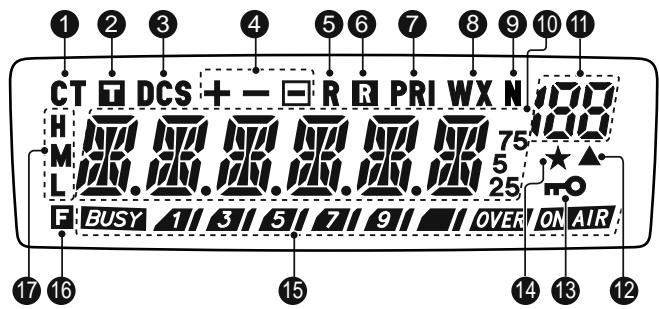
DISPLAY
CT
Appears when the CTCSS function is activated {page 46}.
2 T
Appears when the Tone function is activated {page 24}.
DCS
Appears when the DCS function is activated {page 48}.
4 + - 1
Appears when the repeater shift function is activated {pages 23, 30}. (" " is not used on this transceiver.)
5 R
Appears when the Reverse function is activated {page 26}.
6R
Appears when the Automatic Simplex Check (ASC) function is activated {page 26}.
PRI
Appears when the Priority Scan function is activated {page 44}.
8 WX
Appears when the Weather Alert function is activated {page 36}. (K market models only.)
9 N
Appears when narrow FM Mode is selected {page 60}.
10. 56
Displays the frequencies, Menu settings, Memory name and other information.
188
Displays the Menu No., Memory Channel number, and status {pages 18, 29}.
12
Appears when the displayed Memory Channel has data {page 29}.
13 mO
Appears when the Key Lock function is ON {page 58}.
14 ★
Appears when the Memory Channel Lockout function is ON {page 44}.
BUSY 1/3/5/7/9/ OVER ON AIR
Shows the strength of transmitted {page 15} and received {page 54} signals.
BUSY indicates the squelch is open and the frequency is "busy". It also appears when the squelch is set to minimum {page 14}. If using CTCSS or DCS, it indicates the squelch is open due to a received signal that contains the same CTCSS tone or DCS code that is set in your transceiver.
11351791OVER acts as an S-meter while receiving and an RF power meter while transmitting.
ON AIR indicates the transceiver is transmitting.
16 F
Appears when the function key is pressed.

H appears when high power transmission is selected and L appears when low power is selected {page 15}. ("M" is not used on this transceiver.)
REAR PANEL
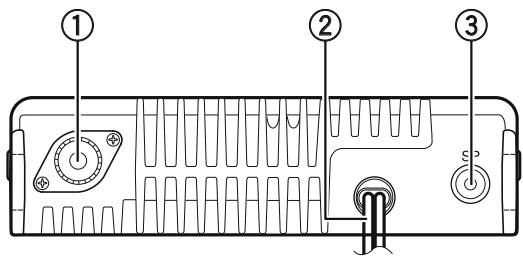
① Antenna connector
Connect an external antenna {page 5} here. When making test transmissions, connect a dummy load in place of the antenna. The antenna system or load should have an impedance of 50
Note: E market models use an N-type antenna connector while other models use an M-type (SO-239) connector.
② Power Input 13.8 V DC cable
Connect a 13.8 V DC power source here. Use the supplied DC power cable {pages 3, 4}.
③ SP (speaker) jack
If desired, connect an optional external speaker for clearer audio. This jack accepts a 3.5mm (1/8") mono (2-conductor) plug. See page 6.
MICROPHONE
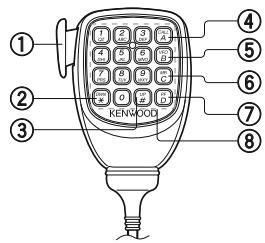
DTMF Microphone
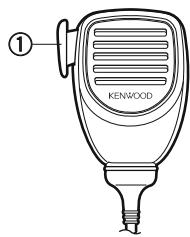
Microphone (KMC-30)
① PTT (Push-to-Talk) switch
Press and hold to transmit. Release to receive.
② DWN/\*key
Press to lower the operating frequency, Memory Channel number, Menu Number, etc. Hold down to repeat the action. Also press to switch between values for functions with multiple choices. Press and hold Mic [PTT], then press [DWN/×] to transmit ×.
③ UP/# key
Press to raise the operating frequency, Memory Channel number, Menu Number, etc. Hold down to repeat the action. Also press to switch between values for functions with multiple choices. Press and hold Mic [PTT], then press [UP/#] to transmit #.
④ CALL/A key
Identical to the front panel CALL key. This key can be reprogrammed if desired {page 59}. Press and hold Mic [PTT], then press [CALL/A] to transmit A.
⑤ VFO/B key
Identical to the front panel VFO key. This key can be reprogrammed if desired {page 59}. Press and hold Mic [PTT], then press [VFO/B] to transmit B.
⑥ MR/C key
Identical to the front panel MR key. This key can be reprogrammed if desired {page 59}. Press and hold Mic [PTT], then press [MR/C] to transmit C.
⑦ PF/D key
The default function of this key is 1 MHz step. This key can be reprogrammed if desired {page 59}. Press and hold Mic [PTT], then press [PF/D] to transmit D.
⑧ DTMF keypad
This 16-key keypad is used for DTMF functions {page 50} or to directly enter an operating frequency {page 16}, or a Memory Channel number {page 30}. The keypad can also be used to program a Memory Channel name, Power-on message, or other character strings {page 63}.
MIC KEYPAD DIRECT ENTRY
The microphone keypad (keyboard models only) allows you to make various entries depending on which mode the transceiver is in.
In VFO or Memory Recall mode, use the Mic keypad to select a frequency {page 16} or Memory Channel number {page 30}. First press the Mic PF key assigned the ENTER function {page 59}.
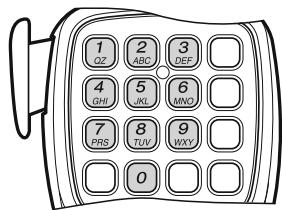
To manually send a DTMF number, press and hold Mic [PTT], then press the DTMF keys on the Mic keypad {page 50} in sequence.
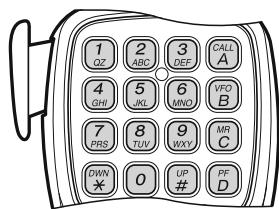
You can also use the Mic keypad to program a Memory Channel name, Power-on message, or other character strings {page 63}.
SWITCHING THE POWER ON/OFF
1 Press [ ] (Power) to switch the transceiver power ON.
- A high pitched double beep sounds and a Power-on message {page 60} appears briefly, followed by the frequency and other indicators.
144.000
2 To switch the transceiver OFF, press [ ] (Power) (1s).
- When you turn the transceiver OFF, a low pitched double
beep sounds. - The transceiver stores the current frequency and parameters when it is turned OFF and recalls these parameters the next time you turn the transceiver ON.
ADJUSTING THE VOLUME
Turn the Volume control clockwise to increase the audio output level and counterclockwise to decrease the output level.
- If you are not receiving a signal, press the Mic PF key assigned the MONI function {page 59}, then adjust the Volume control to a comfortable audio output level. Press the MONI key again to cancel the Monitor function.
ADJUSTING THE SQUELCH
The purpose of Squelch is to mute the speaker when no signals are present. With the squelch level correctly set, you will hear sound only while actually receiving signals. The higher the selected squelch level, the stronger the signals must be to receive.
The appropriate squelch level depends on the ambient RF noise conditions.
1 Press [F], [REV].
- The current squelch level appears.
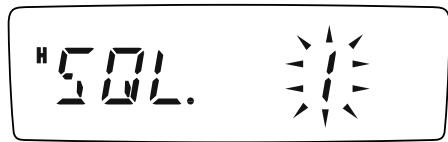
2 Turn the Tuning control to adjust the level.
- Select the level at which the background noise is just eliminated when no signal is present.
- The higher the level, the stronger the signals must be to receive.
10 different levels can be set. (0: Minimum ~ 9: Maximum; 1 is the default value,)
3 Press any key other than [ ] (Power) to store the new setting and exit the squelch adjustment.
TRANSMITTING
1 To transmit, hold the microphone approximately 5 cm (2 inches) from your mouth, then press and hold Mic [PTT] and speak into the microphone in your normal tone of voice.
- "ONAIR" and the RF Power meter appears. The RF Power meter shows the relative transmit output power (41/31/51/71/91/OVER).
- If you press Mic [PTT] while you are outside the transmission coverage, a high pitched error beep sounds.
2 When you finish speaking, release Mic [PTT].
Note: If you continuously transmit for longer than the time specified in Menu No. 21 (default is 10 minutes) {page 62}, the internal timeout timer generates a warning beep and the transceiver stops transmitting. In this case, release Mic [PTT] and let the transceiver cool down for a while, then press Mic [PTT] again to resume transmission.
SELECTING AN OUTPUT POWER
You can configure different power levels for transmission.
1 Press [F], [MENU] and turn the Tuning control to select Menu No. 6 (TXP).
T
1
5
2 Press [MENU] and turn the Tuning control to select "H" (high; default) or "L" (low) power.
3 Press [MENU] to store the setting or any other key to cancel.
4 Press any key other than [MENU] to exit Menu Mode.
CAUTION
Do not transmit at high output power for an extended period of time. The transceiver could overheat and malfunction.
Continuous transmission causes the heat sink to overheat. Never touch the heat sink when it may be hot.
Note: When the transceiver overheats because of ambient high temperature or continuous transmission, the protective circuit may function to lower transmit output power.
SELECTING A FREQUENCY
VFO MODE
This is the basic mode for changing the operating frequency. To enter VFO Mode, press [VFO].
Turn the Tuning control clockwise to increase the frequency and counterclockwise to decrease the frequency, or use Mic [UP]/[DWN].
145025
- Press and hold Mic [UP]/[DWN] to step the frequency repeatedly.
MHz MODE
If the desired operating frequency is far away from the current frequency, it is quicker to use the MHz Tuning Mode.
To adjust the MHz digit:
1 While in VFO or Call Mode, press [MENU].
The MHz digit blinks.
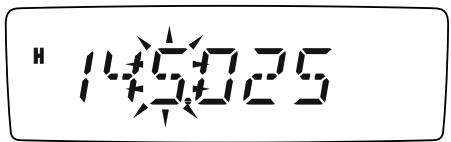
2 Turn the Tuning control to select the desired MHz value.
3 Press any key to set the selected frequency and return to normal VFO Mode.
4 Continue adjusting the frequency as necessary, using the Tuning control or Mic [UP]/[DWN].
DIRECT FREQUENCY ENTRY
In addition to turning the Tuning control or pressing Mic [UP]/[DWN], there is another way to select the frequency. When the desired frequency is far away from the current frequency, you can directly enter a frequency using the Mic keypad (keypad models only).
1 Press [VFO].
- You must be in VFO mode to make a direct frequency entry.
2 Press the Mic PF key assigned the ENTER function {page 59}.
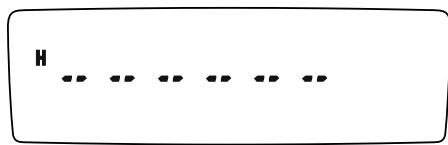
3 Press the numeric keys ([0] to [9]) to enter your desired frequency.
- Pressing Mic Enter fills all remaining digits (the digits you did not enter) with 0 and completes the entry. For example, to select 145.000MHz , press [1], [4], [5] and press Mic Enter to complete the entry.
- If you want to revise the MHz digits only, leaving the kHz digits as they are, press Mic [VFO] in place of Mic Enter.
Example 1
To enter 145.750 MHz:
Key in Display
[Enter]
[1], [4], [5] 145. - - -
[7], [5], [0] 145.750
Example 2
To enter 145.000 MHz:
Key in Display
[Enter]
[1], [4], [5] 145. - - -
[Enter] 145.000
Example 3
To change 144.650 MHz to 145.650 MHz:
Key in Display
144.650
[Enter]
[1], [4], [5] 145. - - -
Mic [VFO] 145.650
Note: If the entered frequency does not match the current frequency step size, the frequency is automatically rounded down to the next available frequency. When the desired frequency cannot be entered exactly, confirm the frequency step size {page 56}.
WHAT IS A MENU?
Many functions on this transceiver are selected or configured via a software-controlled Menu rather than through the physical controls of the transceiver. Once you become familiar with the Menu system, you will appreciate its versatility. You can customize the various timings, settings, and programming functions on this transceiver to meet your needs without using many controls and switches.
MENU ACCESS
1 Press [F], [MENU].
- A brief explanation of the menu, and the setting and Menu No. appear on the display.
![KENWOOD TM-281A - Press [F], [MENU]. - 1](/content/2025/01/83304/images/7a2c138013c68ace0164a3a0a5debf9016d87fd8e5561b5fb02d1145a7af9ed8.jpg)
2 Turn the Tuning control to select your desired Menu.
- As you change the Menu No., a brief explanation of each menu appears along with its current parameter.
![KENWOOD TM-281A - Press [F], [MENU]. - 2](/content/2025/01/83304/images/ccd7233bedd31aa06bd5fc5b159b5b14cb66649e690758692bf325c7995c64ac.jpg)
3 Press [MENU] to configure the parameter of the currently selected Menu No.
![KENWOOD TM-281A - Press [F], [MENU]. - 3](/content/2025/01/83304/images/4947d0b0cc68443f08f893fd70c5012afa90cb5e8cf2dc5bc6de17caac838c15.jpg)
4 Turn the Tuning control to select your desired parameter.
![KENWOOD TM-281A - Press [F], [MENU]. - 4](/content/2025/01/83304/images/0d463498e8574c7de6fcfdc4ed6fd1f8e0bf907e980002016d8c3ef0cb5fe712.jpg)
5 Press [MENU] to store the new setting or any other key to cancel.
6 Press any key other than [MENU] to exit Menu Mode.
MENUFUNCTIONLIST
| On the display | Menu No. | Function | Selections | Default | Ref. Page |
| STP | 1 | Frequency step size | 2.5/ 5/ 6.25/ 10/ 12.5/ 15/ 20/ 25/ 30/ 50/ 100 kHz | Varies (see reference page) | 56 |
| T | 2 | Tone frequency | 67.0 ~ 254.1 Hz | 88.5 | 24 |
| CT | 3 | CTCSS frequency | 67.0 ~ 254.1 Hz | 88.5 | 47 |
| DCS | 4 | DCS code | 023 ~ 754 | 023 | 48 |
| SFT | 5 | Shift direction | OFF/+/- | OFF | 23 |
| TXP | 6 | Transmission power | High/ Low | High | 15 |
| P.VFO | 7 | Programmable VFO | 136 ~ 173 MHz | 136 ~ 173 MHz | 61 |
| SSQ | 8 | S-Meter squelch | ON/OFF | OFF | 54 |
| SQH | 9 | Squelch hang time | OFF/ 125/ 250/ 500 ms | OFF | 55 |
| OFFSET | 10 | Repeater offset frequency | 0 ~ 69.95 MHz | 600 kHz | 23 |
| ARO | 11 | Automatic Repeater Offset | ON/OFF | Varies (see reference page) | 25 |
| PRI | 12 | Priority Scan | ON/OFF | OFF | 43 |
| SCAN | 13 | Scan Resume method | TO/ CO/ SE | TO | 45 |
| L.OUT | 14 | Memory Channel Lockout | ON/OFF | OFF | 44 |
| M.CH | 15 | Memory Channel capacity | 100/ 200 | 100 | 28 |
| M.NAME | 16 | Memory Name | 6 characters | - | 32 |
| MDF | 17 | Memory Name/ Frequency display | MN/ FRQ | MN | 32 |
| APO | 18 | Automatic Power-off | OFF/ 30/ 60/ 90/ 120/ 180 min. | OFF | 54 |
| CK | 19 | CALL key | CALL/ 1750 | Varies (see reference page) | 25,35 |
| HLD | 20 | 1750 Hz tone TX hold | ON/ OFF | OFF | 25 |
| TOT | 21 | Time-out Timer | 3/ 5/ 10 min. | 10 | 62 |
| BCL | 22 | Busy Channel Lockout | ON/ OFF | OFF | 56 |
| P.ON.MSG | 23 | Power-on message | 6 characters | - | 60 |
| BP | 24 | Beep | ON/ OFF | ON | 55 |
| BS | 25 | Beat Shift | ON/ OFF | OFF | 54 |
| FMN | 26 | Narrow FM | ON/ OFF | OFF | 60 |
| ENC | 27 | Tuning control lock | ON/ OFF | OFF | 58 |
| DTMF.MR | 28 | Automatic dialer | Up to 16 digits | - | 51 |
| SPD | 29 | DTMF TX speed | FA/ SL | FA | 52 |
| DT.H | 30 | DTMF TX hold | ON/ OFF | OFF | 51 |
| PA | 31 | DTMF pause period | 100/ 250/ 500/ 750/ 1000/ 1500/ 2000 ms | 500 | 53 |
| DT.L | 32 | DTMF key lock | ON/ OFF | OFF | 53 |
| DT.M | 33 | DTMF monitor | ON/ OFF | OFF | 50 |
| MC.L | 34 | Microphone key lock | ON/ OFF | OFF | 64 |
| PF 1 | 35 | Microphone programmable function key | MONI/ ENTER/ 1750/ VFO/ MR/ CALL/MHZ/ REV/ SQL/ M--V/ M.IN/ C.IN/MENU/ SHIFT/ LOW/ BRIGHT/ LOCK/TONE/ STEP | MHZ | 59 |
| PF 2 | 36 | Microphone programmable function key | MONI/ ENTER/ 1750/ VFO/ MR/ CALL/ MHZ/ REV/ SQL/ M--V/ M.IN/ C.IN/ MENU/ SHIFT/ LOW/ BRIGHT/ LOCK/ TONE/ STEP | MR | 59 |
| PF 3 | 37 | Microphone programmable function key | MONI/ ENTER/ 1750/ VFO/ MR/ CALL/ MHZ/ REV/ SQL/ M--V/ M.IN/ C.IN/ MENU/ SHIFT/ LOW/ BRIGHT/ LOCK/ TONE/ STEP | VFO | 59 |
| PF 4 | 38 | Microphone programmable function key | MONI/ ENTER/ 1750/ VFO/ MR/ CALL/ MHZ/ REV/ SQL/ M--V/ M.IN/ C.IN/ MENU/ SHIFT/ LOW/ BRIGHT/ LOCK/ TONE/ STEP | CALL | 59 |
| BRIGHT | 40 | Display brightness | Maximum level | 57 | |
| ABR | 41 | Automatic display brightness | ON/ OFF | OFF | 57 |
| WXA1 | 42 | Weather Alert | ON/ OFF | OFF | 36 |
| RESET | 99 | Reset selection | VFO/ FULL | VFO | 67 |
^1 WXA (Weather Alert) is available only for K market models.
Repeaters, which are often installed and maintained by radio clubs, are usually located on mountain tops or other elevated locations. They generally operate at higher ERP (Effective Radiated Power) than a typical station. This combination of elevation and high ERP allows communications over much greater distances than communicating without using repeaters.
Most repeaters use a receive and transmit frequency pair with a standard or non-standard offset (odd-split). In addition, some repeaters must receive a tone from the transceiver to be accessed. For details, consult your local repeater reference.
![KENWOOD TM-281A - Press [F], [MENU]. - 5](/content/2025/01/83304/images/f528307c536218c56a0406c0fa02d4e860fabbc5469ea40946cb66d5a8957a9c.jpg)
TX: 144.725 MHz
TX tone: 88.5 Hz
RX: 145.325 MHz
TX: 144.725 MHz
TX tone: 88.5 Hz
RX: 145.325 MHz
OFFSET PROGRAMMING FLOW
1 Select a receive frequency.
2 Select an offset direction.
3 Select an offset frequency (only when programming odd-split repeater frequencies).
Activate the Tone function (if necessary).
Select a tone frequency (if necessary).
If you store all the above data in a Memory Channel, you will not need to reprogram the parameters every time.
Refer to "MEMORY CHANNELS" {page 28}.
PROGRAMMING AN OFFSET
You must first select an amateur radio repeater downlink frequency as described in "SELECTING AN OFFSET FREQUENCY".
SELECTING AN OFFSET DIRECTION
Select whether the transmit frequency will be higher (+) or lower (-) than the receive frequency.
1 Press [F], [MENU] and turn the Tuning control to select Menu No. 5 (SFT).
2 Press [MENU] and turn the Tuning control to select "+" or "-".
3 Press [MENU] to store the setting or any other key to cancel.
4 Press any key other than [MENU] to exit Menu Mode.
- "+" or "-" appears above the frequency, indicating which offset direction is selected.
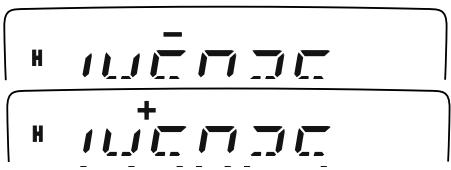
If the offset transmit frequency falls outside the allowable range, transmission is inhibited. In this case, adjust the reception frequency so that the transmit frequency is within the band limits or change the offset direction.
Note: While using an odd-split memory channel or transmitting, you cannot change the offset direction.
SELECTING AN OFFSET FREQUENCY
To access a repeater which requires an odd-split frequency pair, change the offset frequency from the default which is used by most repeaters. The default offset frequency is 600kHz .
1 Press [F], [MENU] and turn the Tuning control to select Menu No. 10 (OFFSET).
2 Press [MENU] and turn the Tuning control to select the appropriate offset frequency.
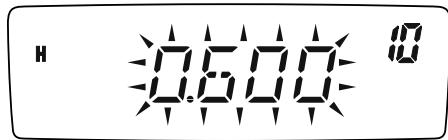
- The selectable range is from 0.00 MHz to 69.95 MHz in steps of 50kHz .
3 Press [MENU] to store the setting or any other key to cancel.
4 Press any key other than [MENU] to exit Menu Mode.
Note: After changing the offset frequency, the new offset frequency will also be used by Automatic Repeater Offset.
ActivATING THE TONE FUNCTION
To activate Tone, press [F], [CALL].
- As you press [F], [CALL], the selection cycles as follows: "OFF" "TONE" "CTCSS" "DCS" "OFF".
- "T" appears on the upper part of the display, indicating that the Tone function is activated.
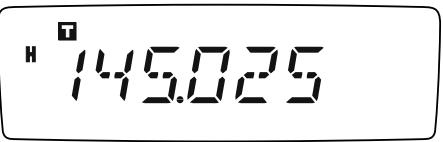
Note: You cannot use the Tone function and CTCSS/ DCS functions simultaneously. Switching the Tone function ON after having activated the CTCSS/ DCS functions deactivates the CTCSS/ DCS functions.
E market version only: When you access repeaters that require a 1750 Hz tone, you do not need to activate the Tone function. Simply press [CALL] without pressing Mic [PTT] to transmit a 1750 Hz tone (default setting).
SELECTING A TONE FREQUENCY
1 Press [F], [MENU] and turn the Tuning control to select Menu No. 2 (T).
2 Press [MENU] and turn the Tuning control to select the desired tone frequency (default is 88.5 Hz).
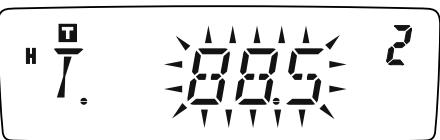
3 Press [MENU] to store the setting or any other key to cancel.
4 Press any key other than [MENU] to exit Menu Mode.
Available Tone Frequencies
| 42 Tone Frequencies (Hz) | |||||
| 67.0 | 85.4 | 107.2 | 136.5 | 173.8 | 218.1 |
| 69.3 | 88.5 | 110.9 | 141.3 | 179.9 | 225.7 |
| 71.9 | 91.5 | 114.8 | 146.2 | 186.2 | 229.1 |
| 74.4 | 94.8 | 118.8 | 151.4 | 192.8 | 233.6 |
| 77.0 | 97.4 | 123.0 | 156.7 | 203.5 | 241.8 |
| 79.7 | 100.0 | 127.3 | 162.2 | 206.5 | 250.3 |
| 82.5 | 103.5 | 131.8 | 167.9 | 210.7 | 254.1 |
Note: 42 different tones are available for the transceiver. These 42 tones include 37 EIA standard tones and 5 non-standard tones.
E market version only:
To transmit a 1750Hz tone, simply press [CALL] without pressing Mic [PTT] (default setting). Release [CALL] to quit transmitting. You can also make the transceiver remain in the transmit mode for 2 seconds after releasing [CALL]; a 1750Hz tone is not continuously transmitted. Access Menu No. 20 (HLD) and select "ON".
To use [CALL] for recalling the Call Channel in place of transmitting a 1750 Hz tone, access Menu No. 19 (CK) and select "CALL".
AUTOMATIC REPEATER OFFSET
This function automatically selects an offset direction, according to the frequency on the VHF band. The transceiver is programmed for an offset direction as shown below. To obtain an up-to-date band plan for repeater offset direction, contact your national Amateur Radio association.
K market version only
144.0 145.5 146.4 147.0 147.6
145.1 146.0 146.6 147.4 148.0 MHz
| S | - | S | + | S | - | + | S | - |
S: Simplex
This complies with the standard ARRL band plan.
E market version only
144.0 145.6 145.8 146.0 MHz
| S | - | S |
S: Simplex
Note: Automatic Repeater Offset does not function when the Reverse function is ON. However, pressing [REV] after Automatic Repeater Offset has selected an offset (split) status, exchanges the receive and transmit frequencies.
1 Press [F], [MENU] and turn the Tuning control to select Menu No. 11 (ARO).
2 Press [MENU] and turn the Tuning control to switch the function "ON" (default) or "OFF".
3 Press [MENU] to store the setting or any other key to cancel.
4 Press any key other than [MENU] to exit Menu Mode.
TRANSMITTING A 1750 Hz TONE
Call Channel default settings:
- On E market models, pressing [CALL] causes the transceiver to transmit a 1750 Hz tone.
- On K and M market models, pressing [CALL] changes the transceiver to the Call Channel {page 35}.
To change the setting of the CALL key:
1 Press [F], [MENU] and turn the Tuning control to select Menu No. 19 (CK).
2 Press [MENU] and turn the Tuning control to select "CALL" or "1750".
3 Press [MENU] to store the setting or any other key to cancel.
4 Press any key other than [MENU] to exit Menu Mode.
Some repeaters in Europe must receive continuous signals for a certain period of time, following a 1750Hz tone. This transceiver is also capable of remaining in the transmit mode for 2 seconds after transmitting the tone.
1 Press [F], [MENU] and turn the Tuning control to select Menu No. 20 (HLD).
2 Press [MENU] and turn the Tuning control to select "ON" or "OFF" (default).
3 Press [MENU] to store the setting or any other key to cancel.
4 Press any key other than [MENU] to exit Menu Mode.
REVERSE FUNCTION
The reverse function exchanges a separate reception and transmission frequency. So, while using a repeater, you can manually check the strength of a signal that you receive directly from the other station. If the station's signal is strong, both stations should move to a simplex frequency and free up the repeater.
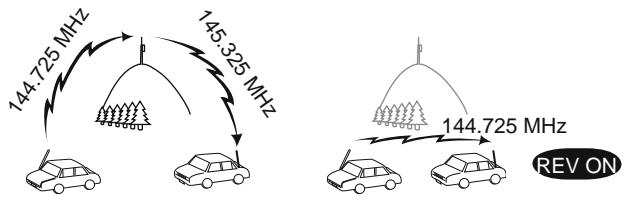
TX: 144.725 MHz TX: 144.725 MHz
RX: 145.325 MHz RX: 145.325 MHz
TX: 144.725 MHz TX: 145.325 MHz
RX: 145.325 MHz RX: 144.725 MHz
To swap the transmission and reception frequencies:
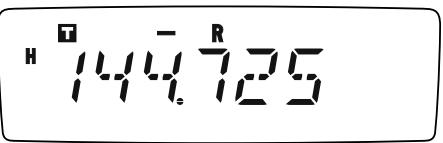
Press [REV] to switch the Reverse function ON (or OFF).
- "R" appears when the function is ON.
Note:
You can turn the Reverse function ON when you are operating in Simplex Mode. However, it does not change the Transmission/Reception frequencies.
If pressing [REV] places the reception frequency outside the allowable range, an error tone sounds and the function does not operate.
If pressing [REV] places the transmission frequency outside the allowable range, pressing Mic [PTT] causes an error tone to sound and transmission is inhibited.
You cannot switch Reverse ON or OFF while transmitting.
AUTOMATIC SIMPLEX CHECK (ASC)
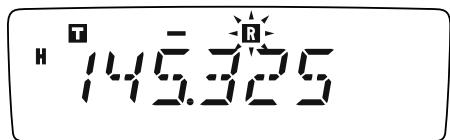
While using a repeater, the ASC function periodically checks the strength of the signal you are receiving from the other station. If the station's signal is strong enough to allow direct contact without a repeater, the "R" indicator starts blinking.
Press [REV] (1s) to switch the function ON (or OFF).
- "R" appears when the function is ON.
While direct contact is possible, "R" blinks.
Note:
Pressing [PTT] causes the "R" icon to quit blinking.
ASC can be activated while operating in Simplex Mode. However, it does not change the Transmission/Reception frequencies.
ASC does not function while scanning.
Activating ASC while using Reverse switches Reverse OFF.
If you recall a Memory Channel or the Call Channel that contains a Reverse ON status, ASC is switched OFF.
ASC causes received audio to be momentarily intermitted every 3 seconds.
TONE FREQUENCY ID SCAN
This function scans through all tone frequencies to identify the incoming tone frequency on a received signal. You can use this function to determine which tone frequency is required by accessing your local repeater.
1 Press [F], [MENU] and turn the Tuning control to select Menu No. 2 (T).
2 Press [MENU] (1s) to start the Tone Frequency ID Scan.
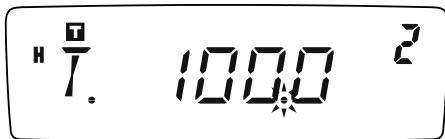
- When the transceiver receives a signal, scan starts. The decimal point blinks during scan.
- While the transceiver is receiving a signal during Tone Frequency ID Scan, the signal is emitted from the speaker.
-
To reverse the scan direction, turn the Tuning control.
-
To quit the function, press any key.
- When the tone frequency is identified, a beep sounds and the identified frequency blinks.
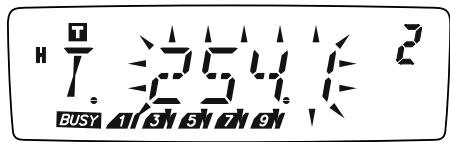
3 Press [MENU] to program the identified tone frequency in place of the current tone frequency or press any other key to exit the Tone Frequency ID Scan.
- Turn the Tuning control while the identified tone frequency is blinking to resume scanning.
4 Press any key other than [MENU] to exit Menu Mode.
Note:
Some repeaters do not re-transmit the access tone in the download signal. In this case, check the other station's uplink signal to detect the repeater access tone.
The transceiver continues to check the Weather Alert Channel and Priority Channel during Tone Frequency ID Scan.
In Memory Channels, you can store frequencies and related data that you frequently use so that you do not need to reprogram that data every time. You can quickly recall a programmed channel through simple operation. A total of 200 Memory Channels (100 when using the Memory Name function) are available for storing frequencies, modes, and other operating conditions.
NUMBER OF MEMORY CHANNELS
The transceiver must be configured to either 200 Memory Channels without using the Memory Name function or 100 Memory Channels with the Memory Name function (default).
To change the Memory Channel capacity:
1 Press [F], [MENU] and turn the Tuning control to select Menu No. 15 (M.CH).
2 Press [MENU] and turn the Tuning control to select either "100" (default) or "200".
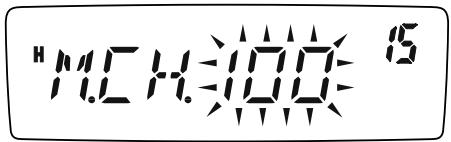
3 Press [MENU].
"SURE ?" appears.
4 Press [MENU] to accept or press any other key to cancel.
Note:
If you change the Memory Channel capacity from 200 channels to 100 channels after having stored data in channels 100 to 199, all Memory Channel data in channels 100 to 199 will be erased.
If you change the Memory Channel capacity from 100 channels to 200 channels after storing Memory Names in those channels, the Memory Name data will be erased.
SIMPLEX & REPEATER OR ODD-SPLIT MEMORY CHANNEL?
You can use each Memory Channel as a simplex & repeater channel or an odd-split channel. Store only 1 frequency to use as a simplex & repeater channel or 2 separate frequencies to use as an odd-split channel. Select either application for each channel depending on the operations you have in mind.
Simplex & repeater channels allow:
Simplex frequency operation
- Repeater operation with a standard offset (if an offset direction is stored)
Odd-split channels allow:
- Repeater operation with a non-standard offset
Note: Not only can you store data in Memory Channels, but you can also overwrite existing data with new data.
The data listed below can be stored in each Memory Channel:
| Parameter | Simplex & Repeater | Odd-Split |
| Receive frequency | Yes | Yes |
| Transmit frequency | Yes | |
| Tone frequency | Yes | Yes |
| Tone ON | Yes | Yes |
| CTCSS frequency | Yes | Yes |
| CTCSS ON | Yes | Yes |
| DCS code | Yes | Yes |
| DCS ON | Yes | Yes |
| Offset direction | Yes | N/A |
| Offset frequency | Yes | N/A |
| Reverse ON | Yes | N/A |
| Frequency step size | Yes | Yes |
| Narrow band FM | Yes | Yes |
| Beat Shift | Yes | Yes |
| Memory Channel lockout | Yes | Yes |
| Memory Channel name | Yes | Yes |
Yes: Can be stored in memory.
N/A: Cannot be stored in memory.
Note:
Memory Channel Lockout cannot be set to the Program Scan Memory (L0/U0 ~ L2/U2), the Priority Channel (Pr), or the Weather Alert Channel (AL).
Tone, CTCSS, and DCS are automatically turned OFF when setting up the Weather Alert Channel (AL).
STORING SIMPLEX FREQUENCIES OR STANDARD REPEATER FREQUENCIES
1 Press [VFO].
2 Turn the Tuning control to select your desired frequency.
- You can also directly enter a desired frequency using the keypad {page 13}.
3 If storing a standard repeater frequency, select the following data:
- Offset direction {page 23}
- Tone function, if necessary {page 24}
CTCSS/DCS function,if necessary{pages 46,48}
If storing a simplex frequency, you may select other related data (CTCSS or DCS settings, etc.).
4 Press [F].
- A Memory Channel number appears and blinks.
- “▲” appears if the channel contains data.
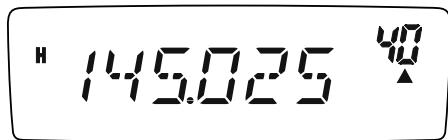
- Memory Channel numbers L0/U0 ~ L2/U2 {page 40}, Pr {page 43}, and AL (Weather Alert) {page 36} (K market models only) are reserved for other functions.
5 Turn the Tuning control or press Mic [UP]/[DWN] to select the Memory Channel in which you want to store the data.
6 Press [MR] to store the data to the channel.
STORING ODD-SPLIT REPEATER FREQUENCIES
Some repeaters use a pair of reception and transmission frequencies with a non-standard offset. If you store 2 separate frequencies in a Memory Channel, you can operate on those repeaters without programming the offset frequency and direction.
1 Store the desired reception frequency and related data by following steps 1 to 6 given for simplex or standard repeater frequencies {page 29}.
2 Turn the Tuning control or press Mic [UP]/[DWN] to select your desired transmission frequency.
3 Press [F].
4 Turn the Tuning control or press Mic [UP]/[DWN] to select the pre-programmed reception Memory Channel in which you want to store the data.
5 Press [MR] (1s).
- The transmission frequency is stored in the Memory Channel.
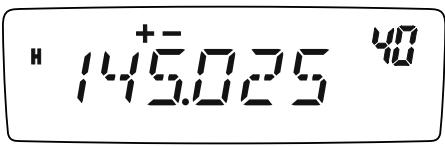
Note:
When you recall an odd-split Memory Channel, “+” and “-” appear on the display. To confirm the transmission frequency, press [REV].
Transmit offset status and reverse status are not stored in odd-split Memory Channels.
RECALLING A MEMORY CHANNEL
USING THE TUNING CONTROL
1 Press [MR] to enter Memory Recall mode.
- The Memory Channel last used is recalled.
2 Turn the Tuning control to select your desired Memory Channel.
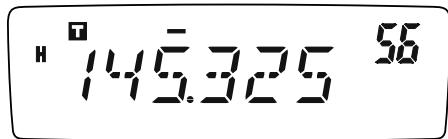
- You cannot recall an empty Memory Channel.
To restore VFO mode, press [VFO].
USING THE MICROPHONE KEYPAD
You can also recall a Memory Channel by entering a desired Memory Channel number with the microphone keypad.
1 Press [MR] to enter Memory Recall mode.
2 Press the microphone key assigned the ENTER function.
3 Enter the channel number using the microphone keypad.
- For single-digit channel numbers, enter "0" first or press Mic Enter after entering the channel number.
- For two-digit channel numbers that begin with "1", press Mic Enter after entering the channel number.
Note:
You cannot recall an empty Memory Channel. An error beep sounds.
You cannot recall the Program Scan Memory Channels (L0/U0 ~ L2/U2), the Priority Channel (Pr), and the Weather Alert Channel (AL) (K market models only) using the numeric keypad.
When you recall an odd-split memory channel, “+” and “-” appear on the display. Press [REV] to display the transmission frequency.
After recalling a Memory Channel, you may modify data such as Narrow Band, Tone, or CTCSS. However, these settings are cleared once you select another channel or the VFO Mode. To permanently store the data, overwrite the channel contents.
CLEARING A MEMORY CHANNEL
To erase an individual Memory Channel:
1 Recall the Memory Channel you want to erase.
2 Press [O] (Power) (1s) to switch the transceiver OFF.
3 Press [MR] + [] (Power).
- An erase confirmation message appears.
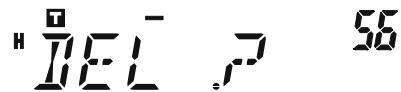
4 Press [MR] to erase the channel data.
- The contents of the Memory Channel are erased.
- To quit clearing the Memory Channel, press any key other than [MR].
Note:
You can also clear the Priority Channel and L0/U0 ~ L2/U2 data. (The Call Channel cannot be cleared.)
To clear all Memory Channel contents at once, perform a Full Reset {page 67}.
You cannot clear channels while in Channel Display Mode.
NAMING A MEMORY CHANNEL
You can name Memory Channels using up to 6 alphanumeric characters. When you recall a named Memory Channel, its name appears on the display in place of the stored frequency. Names can be call signs, repeater names, cities, names of people, etc. In order to use the Memory Name function, the Memory Channel capacity must be set to 100 channels. To change the Memory Channel capacity from 200 to 100, access Menu No. 15 (M.CH) {page 28}.
1 Press [MR] and turn the Tuning control to recall your desired Memory Channel.
2 Press [F], [MENu] and turn the Tuning control to select Menu No. 16 (M.NAME).
3 Press [MENU].
- A blinking cursor appears.
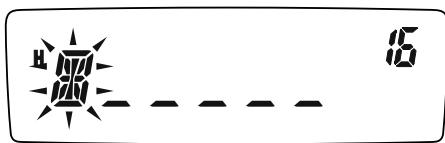
4 Turn the Tuning control to select a desired alphanumeric character.
- You can enter the following alphanumeric characters: 0 9 , A Z, - (hyphen), / (slash), and a space.
- Rather than using the Tuning control, you can use the Mic keypad (keypad models only) to enter alphanumeric characters {page 64}.
5 Press [MR].
- The cursor moves to the next digit.
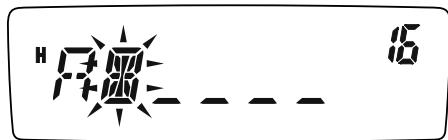
- To move to the previous digit, press [VFO]. To delete the character at the current cursor position, press [F].
6 Repeat steps 4 and 5 to enter up to 6 digits.
7 Press [MENU] to complete the entry.
- Press any key other than [MR], [VFO], [F], and [MENU] to cancel the entry.
To complete an entry of less than 6 characters, press [MENU] two times.
8 Press any key other than [MENU] to exit Menu Mode.
After storing a Memory Name, the Memory Name appears in place of the operating frequency. However, you can still display the operating frequency, if desired. To display the frequency rather than Memory Name, access Menu No. 17 (MDF) and select "FRQ". This menu toggles the display mode between the Memory Name ("MN") and frequency display ("FRQ").
Note:
You cannot name the Call Channel {page 35}.
You cannot assign a Memory Name to a channel that does not contain data.
You can overwrite stored names by repeating steps 1 to 8.
The stored name is erased when you clear the Memory Channel data.
MEMORY CHANNEL TRANSFER
MEMORY VFO TRANSFER
After retrieving frequencies and associated data from Memory Recall Mode, you can copy the data to the VFO. This function is useful, for example, when the frequency you want to monitor is near the frequency stored in a Memory Channel.
1 Press [MR], then turn the Tuning control or press Mic [UP]/[DWN] to recall the desired Memory Channel.
- Alternatively, press [CALL] to select the Call Channel.
2 Press [F], [VFO] to copy the Memory Channel data to the VFO.
Note:
On odd-split channels, the above operation copies only the reception frequency to the VFO (not the transmission frequency). To copy the transmit frequency of an odd-split channel, press [REV] before performing the transfer.
- You can also transfer the Program Scan memory channels (L0/U0 ~ L2/U2), the Priority Channel (Pr), and the Weather Alert Channel (AL) (K market models only) to the VFO.
Lockout status and Memory Names are not copied from a Memory Channel to the VFO.
CHANNEL CHANNEL TRANSFER
You can copy channel information from one Memory Channel to another. This function is useful when storing frequencies and associated data that you temporarily change in Memory Recall Mode.
1 Press [MR], then turn the Tuning control or press Mic [UP]/[DWN] to recall the desired Memory Channel.
2 Press [F].
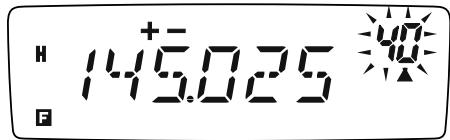
3 Select the Memory Channel where you would like the data copied by using the Tuning control or pressing Mic [UP]/[DWN].
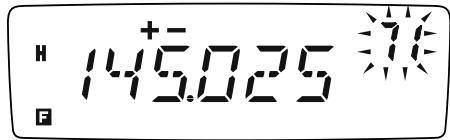
4 Press [MR].
The tables below illustrate how data is transferred between Memory Channels.
| Channel 01 ~ 199 | → | Channel 01 ~ 199 |
| Receive frequency | → | Receive frequency |
| Transmit frequency | → | Transmit frequency |
| Tone frequency | → | Tone frequency |
| Offset direction | → | Offset direction |
| CTCSS frequency | → | CTCSS frequency |
| DCS code | → | DCS code |
| Tone/ CTCSS/ DCS ON/ OFF status | → | Tone/ CTCSS/ DCS ON/ OFF status |
| Offset frequency | → | Offset frequency |
| Reverse ON | → | Reverse ON |
| Frequency step size | → | Frequency step size |
| Memory Channel name1 | → | Memory Channel name1 |
| Memory Channel Lockout ON/ OFF | → | Memory Channel Lockout ON/ OFF |
| Narrow FM ON/ OFF | → | Narrow FM ON/ OFF |
| Channel 01 ~ 199 | → | L0/U0 L2/U2, Pr, AL2 |
| Receive frequency | → | Receive frequency |
| Transmit frequency | → | Transmit frequency |
| Tone frequency | → | Tone frequency |
| Offset direction | → | Offset direction |
| CTCSS frequency | → | CTCSS frequency |
| DCS code | → | DCS code |
| Tone/ CTCSS/ DCS ON/ OFF status | → | Tone/ CTCSS/ DCS ON/ OFF status |
| Offset frequency | → | Offset frequency |
| Reverse ON | → | Reverse ON |
| Frequency step size | → | Frequency step size |
| Memory Channel name1 | → | Memory Channel name1 |
| Memory Channel Lockout ON | → | Memory Channel Lockout OFF |
| Narrow FM ON/ OFF | → | Narrow FM ON/ OFF |
1 When "100" is selected in Menu No.15 (M.CH).
2 The AL Channel is available for K market models only.
Note:
When transferring an odd-split channel, the Reverse status, Offset direction, and Offset frequency are not transferred (pages 23, 26).
Tone, CTCSS, and DCS are automatically turned OFF when transferring data to the Weather Alert Channel (AL).
CALL CHANNEL
Call Channel default settings:
- On K and M market models, pressing [CALL] changes the transceiver to the Call Channel.
- On E market models, pressing [CALL] causes the transceiver to transmit a 1750 Hz tone {page 25}.
The Call Channel can be recalled instantly no matter what frequency the transceiver is operating on. For instance, you may use the Call Channel as an emergency channel within your group. In this case, Call Scan {page 43} will be useful.
The default Call Channel frequency is 144.000 MHz.
Note: Unlike Memory Channels 0 to 199, the Call Channel cannot be cleared.
RECALLING THE CALL CHANNEL
1 Press [CALL] to recall the Call Channel.
- The Call Channel frequency and "C" appear.
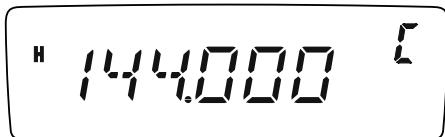
- To return to the previous frequency, press [CALL] again.
REPROGRAMMING THE CALL CHANNEL
1 Select your desired frequency and related data (Tone, CTCSS, DCS, or offset direction, etc.).
- When you program the Call Channel as an odd-split channel, select a reception frequency first.
2 Press [F].
- A Memory Channel number appears and blinks.
3 Turn the Tuning control or press Mic [UP]/[DWN] to select the Call Channel ("C").
4 Press [MR].
- The selected frequency and related data are stored in the Call Channel.
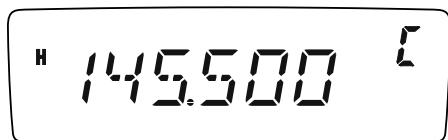
To also store a separate transmit frequency, continue with the following steps:
5 Select the desired transmission frequency.
6 Press [F].
7 Turn the Tuning control or press Mic [UP]/[DWN] to select the Call Channel ("C").
8 Press [MR] (1s).
- The separate transmission frequency is stored in the Call Channel.
Note:
When you recall an odd-split Call Channel, “+” and “-” appear on the display.
Transmit offset status and Reverse status are not stored in an odd-split Call Channel.
WEATHER ALERT (K MARKET MODELS ONLY)
Any of the NOAA Weather Radio channels can be programmed to the AL memory channel of the transceiver. The transceiver can be configured to check the NOAA Weather Alert tone (1050 Hz) and will automatically alert you by recalling and monitoring the Weather Radio frequency when the Weather Alert tone is broadcasted, and the "WX" icon will blink.
7 PROGRAMMING THE WEATHER RADIO FREQUENCY
The transceiver is preprogrammed to 162.550 MHz (WX1). You can store a different frequency to the AL channel to use this function. Refer to the NOAA channel frequency directory for your local weather channel frequency before you use the Weather Alert function. The latest Weather Radio information can be obtained from http://www.nws.noaa.gov/nwr/.
1 Press [VFO].
2 Select your local NOAA Weather Radio channel frequency using the Tuning control or Mic [UP]/[DWN].
3 Press [F].
- A Memory Channel number appears and blinks.
4 Turn the Tuning control or press Mic [UP]/[DWN] to select the Alert Channel ("AL").
5 Press [MR].
| Weather Radio Frequencies (MHz) | ||||||
| WX1 | WX2 | WX3 | WX4 | WX5 | WX6 | WX7 |
| 162.550 | 162.400 | 162.475 | 162.425 | 162.450 | 162.500 | 162.525 |
Note:
When you perform Full Reset {page 63}, the Weather Radio frequency recovers the factory default frequency (162.550 MHz).
When you clear the Weather Radio (AL) Channel {page 31} (the same as clearing a Memory Channel), the factory default frequency (162.550 MHz) will not be recovered.
The Weather Radio (AL) Channel can be programmed with a Channel Name {page 32}.
You can also transfer the AL Memory Channel data to the VFO or another Memory Channel.
ENABLING A WEATHER ALERT
You can monitor the Weather Radio frequency continuously or in the background while receiving on another frequency.
To monitor the Weather Radio frequency continuously:
1 Press [F], [MENU] and turn the Tuning control to select Menu No. 42 (WXA).
2 Press [MENU] and turn the Tuning control to select "ON" or "OFF" (default).
3 Press [MENU] to store the setting.
- "WX" appears on the display.
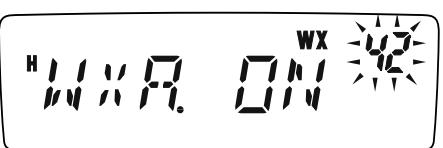
4 Press any key other than [MENU] to exit Menu Mode
- The transceiver automatically changes to the AL channel.
- The Tone, CTCSS, and DCS functions cannot be configured to the AL channel.
- Priority Scan is set to OFF automatically when the Weather Alert function is turned ON.
5 To exit Weather Alert Mode, press [MENU], select Menu No. 42 (WXA), and set it to "OFF" (default).
To monitor another frequency while monitoring the Weather Radio in the background:
1 Perform step 1 4 , above.
2 Press [VFO] or [MR] and turn the Tuning control to select another frequency or Memory Channel.
- "WX" remains on the LCD.
3 When the Weather Alert tone is broadcasted, the transceiver automatically switches to the AL channel.
- "WX" blinks.
4 To exit Weather Alert Mode, press [MENU], select Menu No. 42 (WXA), and set it to "OFF".
Note:
The transceiver checks the Weather Alert tone once every second while you are monitoring another frequency or channel.
When a 1050 Hz tone is detected, the display will change to the AL channel, the Weather Alert tone sounds, and the "WX" icon blinks. Squelch remains open until the frequency is changed or the transceiver power is turned OFF.
If the transceiver is transmitting or receiving a signal on another frequency, the Weather Alert function temporarily pauses.
Turning the Beep function "OFF" does not disable the Weather Alert tone.
You cannot transmit on the AL channel while the Weather Alert function is ON.
CHANNEL DISPLAY
While in this mode, the transceiver displays only Memory Channel numbers (or Memory Names if they have been stored), instead of frequencies.
1 With the transceiver power OFF, press [REV] + [Power] to turn the power ON.
- The transceiver displays the Memory Channel numbers in place of the operating frequencies.
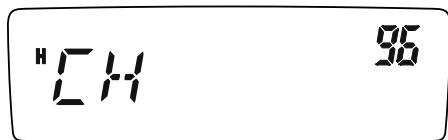
2 Turn the Tuning control or press Mic [UP]/[DWN] to select your desired Memory Channel number.
While in Channel Display mode, you cannot activate the following functions:
VFO Mode
VFO Scan
Call/VFO Scan
MHz Scan
- Scan Direction
Memory Store
Memory to VFO Transfer
Memory to Memory Transfer
Clear Memory Channel
VFO Reset
Full Reset
1 MHz Step
Selection for Tone and Selective Call
- Auto Simplex Checker
- Menu Mode
To recover normal operation, turn the transceiver power OFF and press [REV] + [Power] again.
Note:
To enter the Channel Display Mode, you must have at least one Memory Channel that contains data.
If the Memory Channel contains a Memory Name, the Memory Name is displayed in place of "CH".
7
Scan is a useful function for hands-off monitoring of your favorite frequencies. By becoming comfortable with all types of scan, you will increase your operating efficiency.
This transceiver provides the following types of scans.
| Sca Type | Purpose | |
| Normal Scan | Band Scan | Scans the entire band of the frequency you selected. |
| Program Scan | Scans the specified frequency ranges stored in Memory Channels L0/U0 ~ L2/U2. | |
| MHz Scan | Scans the frequencies within a 1 MHz range. | |
| Memory Scan | All-Channel Scan | Scans all Memory Channels from 0 to 199 (or from 0 to 99). |
| Group Scan | Scans Memory Channels in groups of 20 channels (0 ~ 19, 20 ~ 39, 40 ~ 59, etc.). | |
| Call Scan | VFO | Scans the Call Channel and the current VFO frequency. |
| Memory Channel | Scans the Call Channel and the selected Memory Channel. | |
| Priority Scan | Checks the activities on the Priority Channel (Pr) every 3 seconds. | |
Note:
When the CTCSS or DCS function is activated, the transceiver stops at a busy frequency and decodes the CTCSS tone or DCS code. If the tone or code matches, the transceiver unmutes. Otherwise, it resumes scanning.
Press and hold the Mic PF key programmed as MONI{page 59} to pause scan in order to monitor the scanning frequency. Release the key to resume scanning.
Pressing and holding Mic [PTT] causes scan to stop (excluding Priority Scan).
While scanning, you can change the scan frequency direction by turning the Tuning control or using the Mic [UP]/[DWN] keys.
Starting scan switches OFF the Automatic Simplex Check (ASC) {page 26}.
Adjust the Squelch level before using Scan {page 14}. Selecting a Squelch level too low could cause Scan to stop immediately.
NORMAL SCAN
When you are operating the transceiver in VFO Mode, 3 types of scanning are available: Band Scan, Program Scan, and MHz Scan.
BAND SCAN
The transceiver scans the entire band of the frequency you selected. For example, if you are operating and receiving at 144.525 MHz, it scans all the frequencies available for the VHF band. (Refer to receiver VFO frequency range in the specifications {page 72}.) When the current VFO receive frequency is outside the Program Scan frequency range {below}, the transceiver scans the entire frequency range available for the current VFO.
1 Press [VFO] and turn the Tuning control or press Mic [UP]/[DWN] to select a frequency outside of the Program Scan frequency range.
2 Press [VFO] (1s) to start Band Scan.
- Scan starts from the current frequency.
- The 1 MHz decimal blinks while scanning is in progress.
3 Press any key other than [F] or [O] (Power) to stop Band Scan.
Note:
The transceiver scans the frequency range that is stored in Menu No. 7 (P.VFO) {page 61}.
If you select a frequency within the L0/U0 ~ L2/U2 range in step 2, Program Scan starts.
PROGRAM SCAN
You can limit the scanning frequency range. There are 3 memory channel pairs (L0/U0 ~ L2/U2) available for specifying the start and end frequencies. Program Scan monitors the range between the start and end frequencies that you have stored in these Memory Channels. Before performing Program Scan, store the Program Scan frequency range to one of the Memory Channel pairs (L0/U0 ~ L2/U2).
Storing a Program Scan Frequency Range
1 Press [VFO] and turn the Tuning control or press Mic [UP]/[DWN] to select your desired start frequency.
2 Press [F].
- A Memory Channel number appears and blinks.
3 Turn the Tuning control or press Mic [UP]/[DWN] to select a Memory Channel from L0 ~ L2.
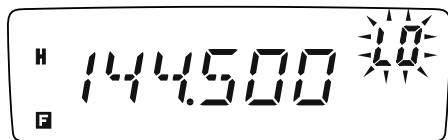
4 Press [MR] to store the start frequency in the Memory Channel.
5 Turn the Tuning control to select your desired end frequency.
6 Press [F].
7 Turn the Tuning control or press Mic [UP]/[DWN] to select a matching Memory Channel from U0 ~ U2.
- For example, if you have selected "L0" in step 3, select Memory Channel "U0".
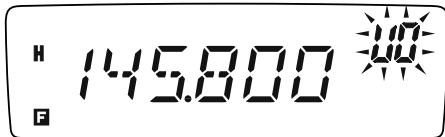
8 Press [MR] to store the end frequency in the Memory Channel.
Performing Program Scan
1 Press [VFO] and turn the Tuning control to select a frequency within the frequency range of Memory Channel L0/U0 ~ L2/U2.
2 Press [VFO] (1s) to start Program Scan.
- Scan starts from the current frequency.
- The 1 MHz decimal blinks while scanning is in progress.
3 Press any key other than [F] or [Θ] (Power) to stop Program Scan.
Note:
The transceiver stops scanning when it detects a signal.
If more than 2 Program Scan channel pairs are stored and overlaps the frequency range among the pairs, the smaller Program Scan Memory Channel number has priority.
If the step size of the current VFO frequency is different from that of the programmed frequencies, VFO Scan begins instead of Program Scan.
To perform Program Scan, the "L" channel must be lower than the "U" channel. Otherwise, Band Scan starts {page 40}.
MHz SCAN
MHz Scan allows you to scan an entire 1 MHz frequency range within the current VFO frequency.
1 Press [VFO] and turn the Tuning control or press Mic [UP]/[DWN] to select a frequency in which to perform MHz Scan.
- If you want to scan the entire 145 MHz frequency, select any frequency between 145.000 and 145.9975 MHz (for example, select 145.650 MHz). Scan will operate between 145.000 MHz and 145.9975 MHz. (The upper frequency limit depends on the current frequency step size.)
2 Press [MENU] (1s) to start MHz Scan.
- Scan starts from the current frequency.
- The 1 MHz decimal blinks while scanning is in progress.
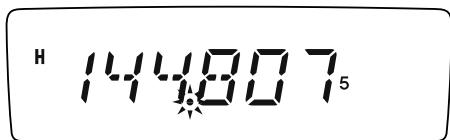
3 Press any key other than [F] or [O] (Power) to stop MHz Scan.
MEMORY SCAN
Memory Scan monitors Memory Channels in which you have stored frequencies.
ALL-CHANNEL SCAN
The transceiver scans all of the Memory Channels in which you have stored frequencies.
1 Press [MR] (1s).
- Scan starts from the last Memory Channel number and ascends up through the channel numbers (default).
- To jump to a desired channel while scanning, quickly turn the Tuning control.
- To reverse the scan direction, turn the Tuning control or press Mic [UP]/[DWN].
8 2 Press any key other than [F] or [ 念 ] (Power) to stop All-Channel Scan.
Note:
- You must have 2 or more Memory Channels that contain data, excluding special function Memory Channels (L0/U0 ~ L3/U3, Pr, and AL).
You can perform Memory Scan while in CH Display Mode. While Scan is paused, the Channel number blinks.
GROUP SCAN
The transceiver scans Memory Channels in groups of 20 channels. When Menu No. 15 (M.CH) is set to 100, the transceiver uses 5 groups of 20 channels. When Menu No. 15 (M.CH) is set to 200, the transceiver uses 10 groups of 20 channels.
1 Press [MR] and turn the Tuning control or press Mic [UP]/[DWN] to select a Memory Channel in the range of the group you want to scan.
2 Press [MENU] (1s).
- Scan starts from the selected Memory Channel number and ascends up through the channel numbers (default).
- To reverse the scan direction, turn the Tuning control or press Mic [UP]/[DWN].
3 Press any key other than [F] or [Θ] (Power) to stop Group Scan.
Note: You must have 2 or more Memory Channels in the selected group that contain data.
| 100 Channels | 200 Channels |
| Group 1: 0 ~ 19 | Group 1: 0 ~ 19 |
| Group 2: 20 ~ 39 | |
| Group 2: 20 ~ 39 | Group 3: 40 ~ 59 |
| Group 4: 60 ~ 79 | |
| Group 3: 40 ~ 59 | Group 5: 80 ~ 99 |
| Group 6: 100 ~ 119 | |
| Group 4: 60 ~ 79 | Group 7: 120 ~ 139 |
| Group 8: 140 ~ 159 | |
| Group 5: 80 ~ 99 | Group 9: 160 ~ 179 |
| Group 10: 180 ~ 199 |
CALL SCAN
You can alternate between monitoring the Call Channel and the current operating frequency.
1 Select the frequency (in VFO or Memory Recall Mode) you want to monitor.
- In VFO Mode, turn the Tuning control or press Mic [UP]/[DWN] to select the desired frequency.
- In Memory Recall Mode, turn the Tuning control or press Mic [UP]/[DWN] to select the Memory Channel you want to monitor.
2 Press [CALL] (1s) to start the Call Scan.
- The Call Channel and the selected VFO frequency or memory channel are monitored.
- The 1 MHz decimal blinks while scanning is in progress.
3 Press any key other than [F] or [Θ] (Power) to stop Call Scan.
Note:
You must configure the CALL key function to "CALL" (Menu No. 19) prior to using Call Scan. Otherwise, a 1750Hz tone will be transmitted.
You can perform Call Scan even if the recalled Memory Channel has been locked out {page 44}.
PRIORITY SCAN
You may sometimes want to check your favorite frequency activities while monitoring other frequencies. In this case, use the Priority Scan function. Priority Scan checks the activities of the Priority Channel every 3 seconds. If the transceiver detects a signal on the Priority Channel, it recalls the frequency to the VFO.
PROGRAMMING A PRIORITY CHANNEL
1 Press [VFO] and turn the Tuning control or press Mic [UP]/[DWN] to select your desired Priority Channel frequency.
2 Select selective call functions, if necessary.
3 Press [F].
- The Memory Channel number appears and blinks.
4 Turn the Tuning control or press Mic [UP]/[DWN] to select the Priority Channel ("Pr").
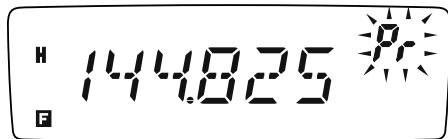
5 Press [MR] to store the data on the Priority Channel.
USING PRIORITY SCAN
1 Press [F], [MENU] and turn the Tuning control to select Menu No. 12 (PRI).
2 Press [MENU] and turn the Tuning control to select "ON" or "OFF" (default).
3 Press [MENU] to store the setting or any other key to cancel.
- "PRl" appears.
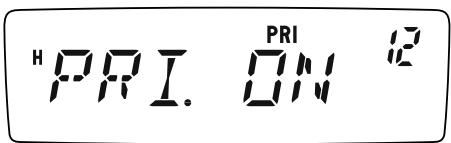
4 Press any key other than [MENU] to exit Menu Mode.
- The transceiver checks for a signal on the Priority Channel every 3 seconds.
- When the transceiver detects a signal on the Priority Channel, "Pr" blinks and the frequency changes to the Priority Channel.
- If you do not operate any control or key for 3 seconds after the signal drops, the transceiver returns to the original frequency and resumes Priority Scan.
Note:
If you clear the Priority Channel {page 31}, Priority Scan stops.
Priority Scan temporarily stops while the transceiver is transmitting.
If Priority Scan is set to ON, the Weather Alert function is automatically turned OFF.
MEMORY CHANNEL LOCKOUT
You can lock out Memory Channels that you prefer not to monitor during Memory Scan or Group Scan {page 42}.
1 Press [MR] and turn the Tuning control or press Mic [UP]/[DWN] to select the Memory Channel to be locked out.
2 Press [F], [MENU] and turn the Tuning control to select Menu No. 14 (L.OUT).
3 Press [MENU] and turn the Tuning control to select "ON" or "OFF" (default).
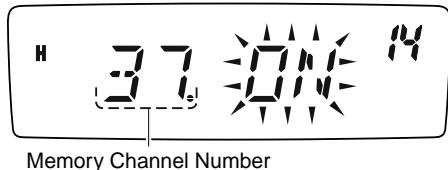
4 Press [MENU] to store the setting or any other key to cancel.
5 Press any key other than [MENU] to exit Menu Mode.
- The “ ” icon appears below the Memory Channel number, indicating the channel is locked out.
6 To unlock the Memory Channel, repeat steps 1 ~ 5, selecting "OFF" in step 3.
- The “ ” icon disappears.
Note:
The Program Scan channels (L0/U0 ~ L2/U2), Call Channel, Priority Channel (Pr), and Weather Radio Channel (AL) (K market models only) cannot be locked out.
Even if a Memory Channel is locked out, you can perform Call Scan {page 43} between the Call Channel and Memory Channel.
SCAN RESUME METHOD
The transceiver stops scanning at the frequency (or Memory Channel) where a signal is detected. It then continues or stops scanning according to which Resume Mode you have selected.
Time-Operated Mode (default)
The transceiver remains on a busy frequency (or Memory Channel) for approximately 5 seconds, then continues to scan even if the signal is still present.
- Carrier-Operated Mode
The transceiver remains on a busy frequency (or Memory Channel) until the signal drops out. There is a 2-second delay between signal dropout and scan resumption.
- Seek Mode
The transceiver moves to a frequency (or Memory Channel) where a signal is present and stops.
To change the scan resume method:
1 Press [F], [MENU] and turn the Tuning control to select Menu No. 13 (SCAN).
2 Press [MENU] and turn the Tuning control to select "TO" (Time-Operated; default), "CO" (Carrier-Operated), or "SE" (Seek) Mode.
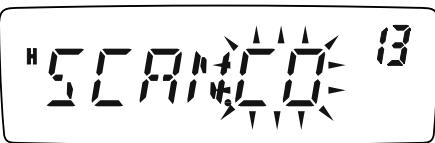
3 Press [MENU] to store the new setting or any other key to cancel.
4 Press any key other than [MENU] to exit Menu Mode.
Note: To temporarily stop scanning and monitor weak signals, press the Mic PF key assigned the MONI function {page 59}. Press the MONI key again to resume scanning.
CTCSS AND DCS
You may sometimes want to hear calls from only specific persons or groups. In this case, use Selective Call. This transceiver is equipped with CTCSS (Continuous Tone Coded Squelch System) and DCS (Digital Coded Squelch). These Selective Calls allow you to ignore (not hear) unwanted calls from other persons who are using the same frequency. The transceiver unmutes only when it receives a signal having the same CTCSS tone or DCS code.
CTCSS freq.: 82.5 Hz
CTCSS freq.: 82.5 Hz

CTCSS freq.: 100 Hz
CTCSS OFF
Note: CTCSS and DCS do not cause your conversation to be private or scrambled. It only relieves you from listening to unwanted conversations.
CTCSS
A CTCSS tone is a sub-audible tone and is selectable from among the 42 tone frequencies listed in the table on page 47. The list includes 37 EIA standard tones and 5 non-standard tones.
To activate CTCSS, press [F], [CALL].
- As you press [F], [CALL], the selection cycles as follows: "OFF" "TONE" "CTCSS" "DCS" "OFF".
- "CT" appears on the upper part of display, indicating that the CTCSS function is activated.
When CTCSS is ON, you will hear calls only when the selected CTCSS tone is received. To answer the call, press and hold Mic [PTT], then speak into the microphone.
Note:
You cannot use the CTCSS and Tone/ DCS functions simultaneously. Switching the CTCSS function ON after having activated the Tone/ DCS functions deactivates the Tone/ DCS functions.
If you select a high CTCSS frequency, receiving audio or noise that contains the same frequency portions may cause CTCSS to function incorrectly. To prevent noise from causing this problem, select an appropriate squelch level {page 14}.
While transmitting the 1750Hz tone by pressing [CALL] {page 25}, the transceiver does not transmit the CTCSS tone.
SELECTING A CTCSS FREQUENCY
1 Press [F], [MENU] and turn the Tuning control on press Mic [UP]/[DWN] to select Menu No. 3 (CT).
- The current CTCSS frequency appears.
2 Press [MENU] and turn the Tuning control to select your desired CTCSS frequency.
- The selectable CTCSS frequencies are the same as those for the Tone frequency. Refer to the table below for the available CTCSS frequencies.
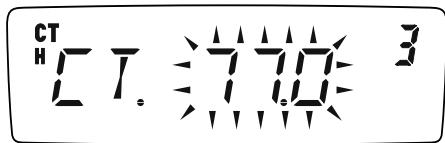
3 Press [MENU] to store the new setting or any other key to cancel.
4 Press any key other than [MENU] to exit Menu Mode.
Note: To use the selected CTCSS tone, you must first turn the CTCSS function ON.
Available CTCSS Tone Frequencies
| 42 Tone Frequencies (Hz) | |||||
| 67.0 | 85.4 | 107.2 | 136.5 | 173.8 | 218.1 |
| 69.3 | 88.5 | 110.9 | 141.3 | 179.9 | 225.7 |
| 71.9 | 91.5 | 114.8 | 146.2 | 186.2 | 229.1 |
| 74.4 | 94.8 | 118.8 | 151.4 | 192.8 | 233.6 |
| 77.0 | 97.4 | 123.0 | 156.7 | 203.5 | 241.8 |
| 79.7 | 100.0 | 127.3 | 162.2 | 206.5 | 250.3 |
| 82.5 | 103.5 | 131.8 | 167.9 | 210.7 | 254.1 |
CTCSS FREQUENCY ID SCAN
This function scans through all CTCSS frequencies to identify the incoming CTCSS frequency on the received signal. You may find this useful when you cannot recall the CTCSS frequency that the other persons in your group are using.
1 Press [F], [MENU] and turn the Tuning control to select Menu No. 3 (CT).
2 Press [MENU] (1s) to start the CTCSS Frequency ID Scan.
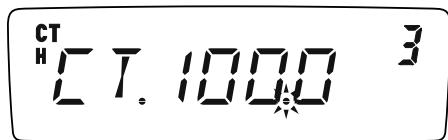
While scanning, the decimal point of the CTCSS frequency blinks.
- To reverse the scan direction, turn the Tuning control or press Mic [UP]/[DWN].
To quit the function, press any key.
- When a CTCSS frequency is identified, the identified frequency appears and blinks.
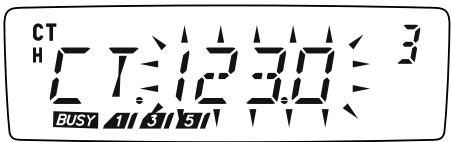
3 Press [MENU] to program the identified frequency in place of the current CTCSS frequency or press any other key to exit the CTCSS Frequency ID Scan.
- Turn the Tuning control or press Mic [UP]/[DWN] while the identified frequency is blinking to resume scanning.
4 Press any key other than [MENU] to exit Menu Mode.
Note:
CTCSS turns ON automatically when performing CTCSS Frequency ID Scan, even if the current frequency is not set with CTCSS.
Received signals are monitored through the speaker while scanning is in progress.
The transceiver continues to check the Weather Alert Channel and Priority Channel during CTCSS scan.
CTCSS Frequency ID Scan does not scan the tone if a signal is not detected.
DCS
DCS is similar to CTCSS. However, instead of using an analog audio tone, it uses a continuous sub-audible digital waveform that represents a 3-digit octal number. You can select a DCS code from among the 104 DCS codes listed in the table below.
To activate DCS, press [F], [CALL].
- As you press [F], [CALL], the selection cycles as follows: "OFF" "TONE" "CTCSS" "DCS" "OFF".
- "DCS" appears on the upper part of display, indicating that the DCS function is activated.
When DCS is ON, you will hear calls only when the selected DCS code is received. To answer the call, press and hold Mic [PTT], then speak into the microphone.
Note: You cannot use the DCS function and CTCSS/ Tone functions simultaneously. Switching the DCS function ON after having activated the CTCSS/ Tone functions deactivates the CTCSS/ Tone functions.
SELECTING A DCS CODE
1 Press [F], [MENU] and turn the Tuning control to select Menu No. 4 (DCS).
- The current DCS code appears.
2 Press [MENU] and turn the Tuning control to select your desired DCS code.
- The current DCS code appears and blinks.
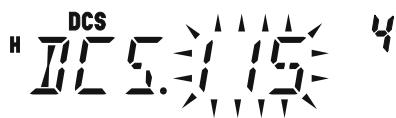
- The available DCS codes are shown in the following table.
| 104 DCS Codes | |||||||||
| 023 | 065 | 132 | 205 | 255 | 331 | 413 | 465 | 612 | 731 |
| 025 | 071 | 134 | 212 | 261 | 332 | 423 | 466 | 624 | 732 |
| 026 | 072 | 143 | 223 | 263 | 343 | 431 | 503 | 627 | 734 |
| 031 | 073 | 145 | 225 | 265 | 346 | 432 | 506 | 631 | 743 |
| 032 | 074 | 152 | 226 | 266 | 351 | 445 | 516 | 632 | 754 |
| 036 | 114 | 155 | 243 | 271 | 356 | 446 | 523 | 654 | |
| 043 | 115 | 156 | 244 | 274 | 364 | 452 | 526 | 662 | |
| 047 | 116 | 162 | 245 | 306 | 365 | 454 | 532 | 664 | |
| 051 | 122 | 165 | 246 | 311 | 371 | 455 | 546 | 703 | |
| 053 | 125 | 172 | 251 | 315 | 411 | 462 | 565 | 712 | |
| 054 | 131 | 174 | 252 | 325 | 412 | 464 | 606 | 723 | |
3 Press [MENU] to store the new code or any other key to cancel.
4 Press any key other than [MENU] to exit Menu Mode.
DCSCODEIDSCAN
This function scans through all DCS codes to identify the incoming DCS code on the received signal. You may find this useful when you cannot recall the DCS code that the other persons in your group are using.
1 Press [F], [MENU] and turn the Tuning control to select Menu No. 4 (DCS).
2 Press [MENU] (1s) to start the DCS Code ID Scan function.

While scanning, the decimal point between "DCS" and the DCS code blinks.
- To quit the function, press any key.
- When a DCS code is identified, the identified DCS code appears and blinks.
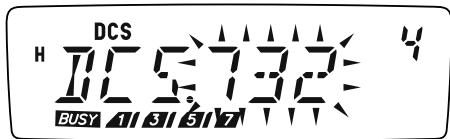
3 Press [MENU] to program the identified DCS code in place of the current DCS code or press any other key to exit the DCS Code ID Scan.
- Turn the Tuning control or press Mic [UP]/[DWN] while the identified DCS code is blinking to resume scanning.
4 Press any key other than [MENU] to exit Menu Mode.
Note:
DCS turns ON automatically when performing DCS Code ID Scan, even if the current frequency is not set with DCS.
Received signals are monitored through the speaker while scanning is in progress.
The transceiver continues to check the Weather Alert Channel and Priority Channel during DCS scan.
DCS Code ID Scan does not scan the code if a signal is not detected.
DUAL TONE MULTI-FREQUENCY (DTMF) FUNCTIONS
This transceiver provides you with 10 dedicated DTMF Memory Channels. You can store a DTMF number (16 digits max.) in each of these channels to recall later for speed dialing.
Many repeaters in the U.S.A. and Canada offer a service called Autopatch. You can access the public telephone network via such a repeater by sending DTMF tones. For further information, consult your local repeater reference.
MANUAL DIALING
The keys on the Mic keypad function as DTMF keys; the 12 keys found on a push-button telephone plus 4 additional keys (A, B, C, D).
To perform Manual Dialing, follow the steps below.
1 Press and hold Mic [PTT] to transmit.
2 While transmitting, press the keys in sequence on the keypad, to send the DTMF tones.
The corresponding DTMF tones are transmitted.
| Freq. (Hz) | 1209 | 1336 | 1477 | 1633 |
| 697 | 1 | 2 | 3 | A |
| 770 | 4 | 5 | 6 | B |
| 852 | 7 | 8 | 9 | C |
| 941 | × | 0 | # | D |
- When DTMF TX Hold is activated {page 51}, you do not need to continuously press Mic [PTT] to remain in transmission mode. However, transmission mode is retained for only 2 seconds after pressing a key, so if the next key is not pressed within this time limit, the transceiver stops transmitting.
DTMF MONITOR
When pressing the Mic DTMF keys, you will not hear DTMF tones emitted from the speaker. However, you can monitor the DTMF tones if desired.
1 Press [F], [MENU] and turn the Tuning control to select Menu No. 33 (DT.M).
2 Press [MENU] and turn the Tuning control to select "ON" or "OFF" (default).
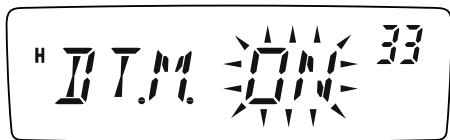
3 Press [MENU] to store the setting or any other key to cancel.
4 Press any key other than [MENU] to exit Menu Mode.
DTMF TX H0LD
This function causes the transceiver to remain in transmission mode for 2 seconds after you release each key. So, you can release Mic [PTT] while sending DTMF tones.
1 Press [F], [MENU] and turn the Tuning control to select Menu No. 30 (DT.H).
2 Press [MENU] and turn the Tuning control to select "ON" or "OFF" (default).
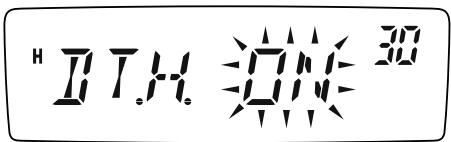
3 Press [MENU] to store the setting or any other key to cancel.
4 Press any key other than [MENU] to exit Menu Mode.
AUTOMATIC DIALER
If you use the 10 dedicated DTMF Memory Channels to store DTMF numbers, you do not need to remember a long string of digits.
STORING A DTMF NUMBER IN MEMORY
1 Press [F], [MENU] and turn the Tuning control to select Menu No. 28 (DTMF.MR).
2 Press [MENU] and turn the Tuning control to select your desired DTMF Memory Channel number from 0 to 9.
- You can also select a DTMF Memory Channel by using Mic [UP]/[DWN].
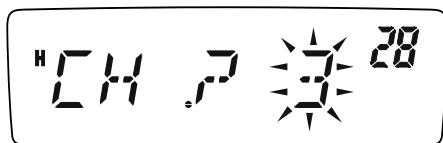
3 Press [MENU].
- The DTMF code entry display appears and the first digit blinks.
4 Turn the Tuning control to select a DTMF code.
- You can also enter a DTMF code using the Mic keypad. Simply press your desired DTMF codes on the keypad.
- On the display, is represented by "E" and # is represented by "F".
5 Press [MR] to select the DTMF code and move the cursor to the next digit.
![KENWOOD TM-281A - Press [MENU]. - 1](/content/2025/01/83304/images/14077689ba588537996c1ccc97005bc70f67becbf56e5d60689c2394988349cb.jpg)
- To move to the previous digit, press [VFO]. To delete the character at the current cursor position, press [F].
6 Repeat steps 4 and 5 to enter up to 16 digits.
7 Press [MENU] to complete the entry.
- Press any key other than [MR], [VFO], [F], and [MENU] to cancel the entry.
To complete an entry of less than 16 digits, press [MENU] two times.
8 Press any key other than [MENU] to exit Menu Mode.
CONFIRMING STORED DTMF NUMBERS
1 Press [F], [MENU] and turn the Tuning control to select Menu No. 28 (DTMF.MR).
2 Press [MENU] and turn the Tuning control to select your desired DTMF Memory Channel number from 0 to 9.
- You can also select a DTMF Memory Channel by using Mic [UP]/[DWN].
3 Press [REV].
- The numbers scroll across the display and the DTMF tones emit from the speaker without transmitting.
4 Press any key other than [REV] or [MENU] to exit.
TRANSMITTING A STORED DTMF NUMBER
1 Press Mic [PTT] ^+ Mic [PF/D].
2 Release Mic [PF/D] (continue pressing Mic [PTT]), then press a key from 0 to 9 to transmit the desired DTMF Memory Channel number.
To transmit tone "D", press Mic [PF/D] again.
- The number stored in the channel scrolls across the display, accompanied by DTMF tones from the speaker. (DTMF tones are not emitted if Menu No. 33 (DT.M) is set to "OFF".)
- After transmission, the frequency display is restored.
3 Release Mic [PTT].
Note:
If you select an empty DTMF Memory Channel and press [MENU], the frequency display is restored.
In step 2, above, you can preview the DTMF Memory Channels first by turning the Tuning control or pressing Mic [UP]/[DWN].
ADJUSTING THE DTMF TONE TRANSMISSION SPEED
This transceiver allows you to configure the DTMF number transmission speed between Fast (default) and Slow. If a repeater cannot respond to the fast speed, adjust this parameter.
1 Press [F], [MENU] and turn the Tuning control to select Menu No. 29 (SPD).
2 Press [MENU] and turn the Tuning control to select "FA" (Fast) or "SL" (Slow).
The tone duration of Fast is 50 ms and Slow is 100 ms.
3 Press [MENU] to store the setting or any other key to cancel.
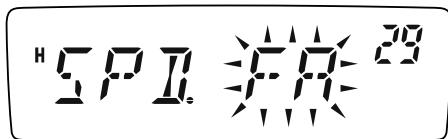
4 Press any key other than [MENU] to exit Menu Mode.
ADJUSTING THE PAUSE DURATION
You can change the pause duration (a space digit) stored in Memory Channels. The default setting is 500 milliseconds.
1 Press [F], [MENU] and turn the Tuning control to select Menu No. 31 (PA).
2 Press [MENU] and turn the Tuning control to select 100, 250, 500 (default), 750, 1000, 1500, or 2000 ms.
3 Press [MENU] to store the setting or any other key to cancel.
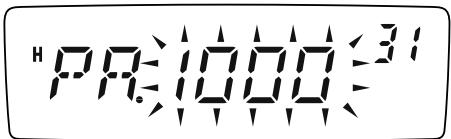
4 Press any key other than [MENU] to exit Menu Mode.
DTMF LOCK
You sometimes may want to disable the keypad to avoid accidental DTMF transmission. In this case, turn the DTMF Lock function ON.
1 Press [F], [MENU] and turn the Tuning control to select Menu No. 32 (DT.L).
2 Press [MENU] and turn the Tuning control to select "ON" or "OFF" (default).
3 Press [MENU] to store the setting or any other key to cancel.
4 Press any key other than [MENU] to exit Menu Mode.
When this function is activated, you cannot send DTMF tones using the Mic keypad. DTMF memory transmission is also inhibited.
APO (AUTO POWER OFF)
The transceiver switches OFF automatically if no keys or controls are pressed or adjusted for the selected duration. One minute before the transceiver switches OFF, warning beeps sound for a few seconds and "APO" blinks.
You can select the APO time from OFF (disable), 30, 60, 90, 120, or 180 minutes.
1 Press [F], [MENU] and turn the Tuning control to select Menu No. 18 (APO).
2 Press [MENU] and turn the Tuning control to select the APO time from OFF (default), 30, 60, 90, 120, or 180 minutes.
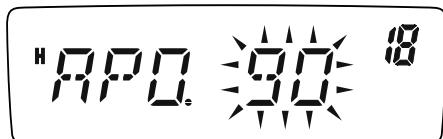
3 Press [MENU] to store the setting or any other key to cancel.
4 Press any key other than [MENU] to exit Menu Mode.
Note:
APO continues to count even while the transceiver is scanning.
- The APO timer starts counting down the time when no key presses, no control adjustments, and no PC control command sequences are detected.
The APO warning beep sounds even if Menu No. 24 (BP) {page 55} is set to "OFF" or the volume level is 0.
BEAT SHIFT
Since the transceiver uses a microprocessor to control various functions of the transceiver, the CPU clock oscillator's harmonics or image may appear on some spots of the reception frequencies. In this case, turn the Beat Shift function ON.
1 Press [F], [MENU] and turn the Tuning control to select Menu No. 25 (BS).
2 Press [MENU] and turn the Tuning control to select "ON" or "OFF" (default).
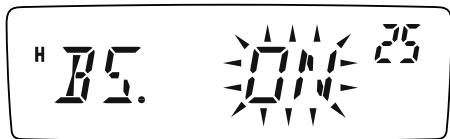
3 Press [MENU] to store the setting or any other key to cancel.
4 Press any key other than [MENU] to exit Menu Mode.
S-METER SQUELCH
S-meter Squelch causes the squelch to open only when a signal with a strength greater than or the same as the S-meter setting is received. This function relieves you from constantly resetting the squelch when receiving weak stations you have no interest in.
1 Press [F], [MENU] and turn the Tuning control to select Menu No. 8 (SSQ).
2 Press [MENU] and turn the Tuning control to select "ON" or "OFF" (default).
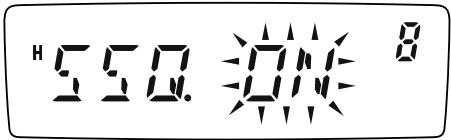
3 Press [MENU] to store the setting.
The S-meter setting segments appear.
4 Press any key other than [MENU] to exit Menu Mode.
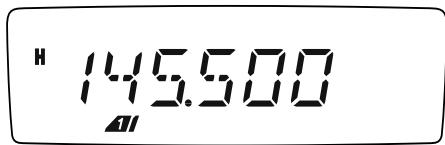
5 Press [F], [REV] to enter S-Meter Level Select Mode.
6 Turn the Tuning control to select your desired level.
7 Press any key other than [ ] (Power) to store the setting and exit S-Meter Level Select Mode.
SQUEELCH HANG TIME
When using S-meter Squelch, you may want to adjust the time interval between when the received signals drop and when the squelch closes.
1 Press [F], [MENU] and turn the Tuning control to select Menu No. 9 (SQH).
2 Press [MENU] and turn the Tuning control to select from OFF (default), 125, 250, and 500 ms.
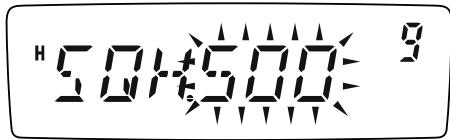
3 Press [MENU] to store the setting or any other key to cancel.
4 Press any key other than [MENU] to exit Menu Mode.
BEEP FUNCTION
The Beep function provides confirmation of entry, error status, and malfunctions of the transceiver. We recommend you leave this function ON in order to detect erroneous operations and malfunctions.
However, to turn the beep function OFF:
1 Press [F], [MENU] and turn the Tuning control to select Menu No. 24 (BP).
2 Press [MENU] and turn the Tuning control to select "OFF".
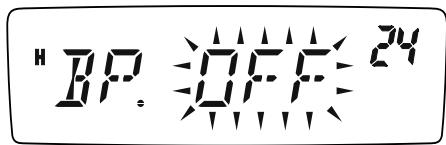
3 Press [MENU] to store the setting or any other key to cancel.
4 Press any key other than [MENU] to exit Menu Mode.
The transceiver generates the following warning beeps even if the Beep function is turned OFF.
APO warning beeps {page 54}
- Weather Alert beep {page 36}
- Time-out Timer warning beep {page 62}
Note: The beep output level is linked to the VOL control position.
BUSY CHANNEL LOCKOUT
This function is used to prevent transmitting on a channel or frequency that somebody else is currently using. When turned ON, an error beep sounds and you cannot transmit even if you press Mic [PTT] while another party is using the channel or frequency.
1 Press [F], [MENU] and turn the Tuning control to select Menu No. 22 (BCL).
2 Press [MENU] and turn the Tuning control to select "ON" or "OFF" (default).
ECL.
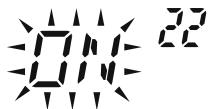
3 Press [MENU] to store the setting or any other key to cancel.
4 Press any key other than [MENU] to exit Menu Mode.
FREQUENCY STEP SIZE
Choosing the correct frequency step size is essential in selecting your exact receive frequency using the Tuning control or Mic [UP]/[DWN]. You can select your desired frequency step size from:
2.5 kHz, 5 kHz, 6.25 kHz, 10 kHz, 12.5 kHz, 15 kHz, 20 kHz, 25 kHz, 30 kHz, 50 kHz, 100 kHz.
To change the frequency step size:
1 While in VFO Mode, press [F], [MENu] and turn the Tuning control to select Menu No. 1 (STP).
2 Press [MENU] and turn the Tuning control to select your desired frequency step size.
T
!
3 Press [MENU] to store the setting or any other key to cancel.
4 Press any key other than [MENU] to exit Menu Mode.
Note: If you change to a frequency step size that does not match the current operating frequency, the transceiver automatically adjusts the frequency to match the new frequency step size.
The default step size for each model is as follows:
| Market Code | Default Frequency Step Size |
| K | 5 kHz |
| E | 12.5 kHz |
| M2 | 12.5 kHz |
Note: The market code is printed on the barcode label of the carton box.
DISPLAY BACKLIGHT
You can manually change the display brightness to match the lighting conditions where you are operating the transceiver. This setting can be permanent or the display can light up only when keys are pressed.
PERMANENT BACKLIGHT
When a permanent setting is selected, the backlight will remain at that setting until it is changed again. The default setting is the maximum brightness.
1 Press [F], [MENU] and turn the Tuning control to select Menu No. 40 (BRIGHT).
2 Press [MENU] and turn the Tuning control to adjust the display brightness.
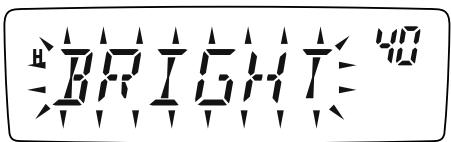
3 Press [MENU] to store the setting or any other key to cancel.
4 Press any key other than [MENU] to exit Menu Mode.
Note: Setting the brightness to OFF (minimum level 1) will turn the front panel key backlight OFF.
AUTOMATIC BACKLIGHT
When using automatic backlight, the display backlight will illuminate every time a front panel or microphone key is pressed. The backlight remains on for 5 seconds before it turns off again.
1 Press [F], [MENU] and turn the Tuning control to select Menu No. 41 (ABR).
2 Press [MENU] and turn the Tuning control to select "ON" or "OFF" (default).
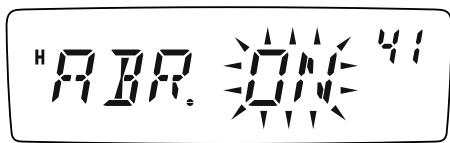
3 Press [MENU] to store the setting or any other key to cancel.
4 Press any key other than [MENU] to exit Menu Mode.
Note: No change occurs if the brightness is set to the highest level.
LOCK FUNCTION
The lock function disables most of the keys to prevent you from accidentally activating a function. Transceiver Lock is suitable for a typical mobile installation where you select most operations using the microphone.
1 Press [F] (1s).
- "m" appears when this function is ON.
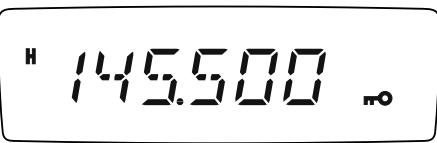
- The following keys cannot be locked:
[ \langle \rangle ] (Power), [F] (1s), [F] + [REV], Volume control, [PTT], and the Mic keypad.
2 Press [F] (1s) again to unlock the keys.
Note:
The Tuning control is also locked. To retain use of the Tuning control while the Lock function is ON, access Menu No. 27 (ENC) {below} and select "ON".
You cannot reset the transceiver {page 67} while the Lock function is ON.
You cannot switch the transceiver operating mode by pressing [O] (Power) + any key.
Microphone PF keys {page 59} operate normally even if the Lock function is ON.
TUNE ENABLE
While the Lock function is ON, you sometimes may want to turn the Tuning control to change the frequency. In this case, turn the Tune Enable function ON.
1 Press [F], [MENU] and turn the Tuning control to select Menu No. 27 (ENC).
2 Press [MENU] and turn the Tuning control to select "OFF" (default) or "ON".

3 Press [MENU] to store the setting or any other key to cancel.
4 Press any key other than [MENU] to exit Menu Mode.
MICROPHONE PF KEYS (KEYPAD MODELS ONLY)
You can access many transceiver settings without using transceiver keys or controls. Microphone keys PF/D, MR/C, VFO/B, and CALL/A are programmable with transceiver functions.
The microphone key default assignments are as follows:
Mic PF1 key [PF/D]: 1 MHz step
Mic PF2 key [MR/C]: Memory Recall
Mic PF3 key [VFO/B]: VFO Select
Mic PF4 key [CALL/A]: Call Channel Select
Note:
Turn the transceiver OFF before connecting the microphone.
Menu No. 34 (MCL) must be configured to "OFF" in order to program the microphone keys.
1 Press [F], [MENU] and turn the Tuning control to select one of Menu No. 35 to Menu No. 38 (PF1 ~ PF4).
2 Press [MENU] and turn the Tuning control to select the programmable function from the list provided below.
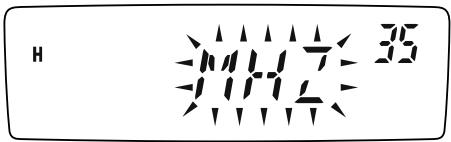
3 Press [MENU] to store the setting or any other key to cancel.
4 Press any key other than [MENU] to exit Menu Mode.
Programmable Functions
- MONI: Monitor function ON/OFF
- ENTER: Used to enter a frequency or memory channel number with the keypad
1750:Transmit 1750Hz
VFO: Enter VFO Mode - MR: Enter MR Mode
CALL: Select the Call Channel - MHZ: Enter 1 MHz Step Mode
- REV: Reverse function ON/OFF (momentary press) and Auto Simplex Checker function ON/OFF (must be held down for 1 second to activate)
- SQL: Enter Squelch Mode
M--V: Memory to VFO transfer
M.IN: Store a Memory Channel
C.IN: Store the Call Channel - MENU: Enter Menu Mode
- SHIFT: Shift function ON/OFF
- LOW: Select transmission power
BRIGHT: Adjust display backlight - LOCK: Transceiver Lock function ON/OFF (must be held down for 1 second to activate)
TONE: Selection for Tone/ Selective Call
STEP: Select the frequency step size
Note: Rather than entering Menu Mode and selecting PF1 ~ PF4, you can simply press and hold the PF key you want to program, then turn the transceiver power ON. When programming the PF keys in this manner, select the function by turning the Tuning control or pressing Mic [UP]/[DWN]. press [MENU] to store the setting, then press any key other than [MENU] to exit Menu Mode.
By default, the transceiver operates in normal FPI (± 5kHz) mode for both transmission and reception
You can also operate the transceiver in narrow band FM (± 2.5kHz)
To operate the transceiver in narrow band FM:
1 Press [F], [MENU] and turn the Tuning control to select Menu No. 26 (FMN).
2 Press [MENU] and turn the Tuning control to select "ON" or "OFF" (default).
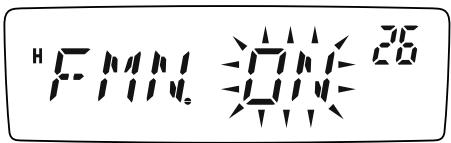
3 Press [MENU] to store the setting or any other key to cancel.
4 Press any key other than [MENU] to exit Menu Mode.
When narrow band FM operation is ON, "N" appears in the top right of the LCD.
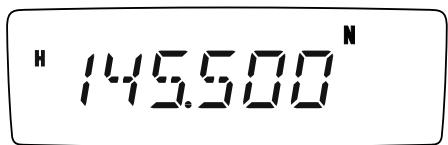
Note: You can store the narrow band FM operation status to the Memory Channels {page 29}.
POWER-ONMESSAGE
You can change the Power-on message (a maximum of 6 characters) when the transceiver is turned ON.
1 Press [F], [MENU] and turn the Tuning control to select Menu No. 23 (P.ON.MSG).
2 Press [MENU].
- The current message and entry cursor appear.
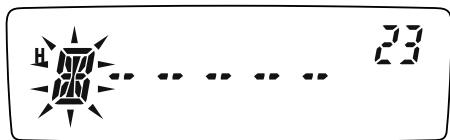
3 Turn the Tuning control to select a character.
- You can enter the following alphanumeric characters: 0 9, A Z, -( hyphen ), / (slash), and a space.
- Rather than using the Tuning control, you can use the Mic keypad (keypad models only) to enter alphanumeric characters {page 64}.
4 Press [MR] to move to the next digit.
- To move to the previous digit, press [VFO]. To delete the character at the current cursor position, press [F].
5 Repeat steps 3 and 4 to enter up to 6 digits.
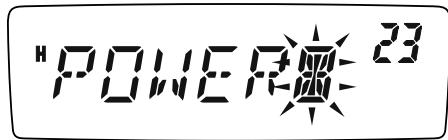
6 Press [MENU] to complete the setting and store the Power-on message.
7 Press any key other than [MENU] to exit Menu Mode.
Note: If a Power-on message is not set, the transceiver model name appears when the transceiver power is turned ON.
PROGRAMMABLE VFO
To limit the operating frequencies within a certain range, program the upper and lower frequency limits to the program VFO parameters. For example, if you select 144 MHz for the lower limit and 145 MHz for the upper limit, the tunable range will be limited from 144.000 MHz to 145.9975 MHz.
1 While in VFO mode, press [F], [MENU] and turn the Tuning control to select Menu No. 7 (P.VFO).
- The current programmable frequency range for the band appears.
2 Press [MENU] and turn the Tuning control to select the lower limit frequency (in MHz).
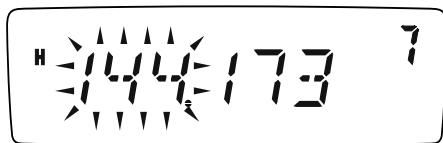
3 Press [MENU] and turn the Tuning control to select the upper limit frequency (in MHz).
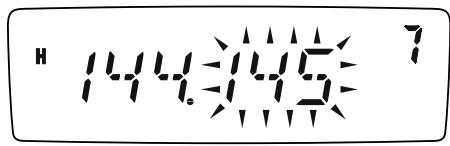
4 Press [MENU] to store the setting or any other key to cancel.
5 Press any key other than [MENU] to exit Menu Mode.
Note:
You cannot program the 100kHz or lower digits.
The upper limit frequency cannot be set lower than the selected lower limit frequency.
TIME-OUT TIMER
The Time-out Timer limits the time of each transmission to a maximum of 3, 5, or 10 (default) minutes. Just before the transceiver stops the transmission, a warning beep sounds. This function is necessary to protect the transceiver from thermal damage and can therefore not be turned OFF.
1 Press [F], [MENU] and turn the Tuning control to select Menu No. 21 (TOT).
2 Press [MENU] and turn the Tuning control to select "3", "5" or "10" (default) minutes.
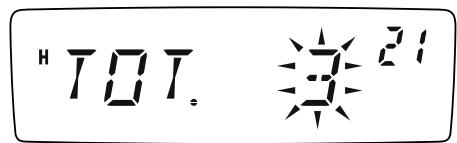
3 Press [MENU] to store the setting or any other key to cancel.
4 Press any key other than [MENU] to exit Menu Mode.
Note: A warning beep sounds even if you set Menu No. 24 (BP) to OFF {page 55}.
You can change numerous transceiver settings by operating the Mic DTMF keys.
The following table shows what function is switched ON and OFF or which setting is changed by pressing the DTMF keys in the appropriate mode of operation.
| Key | RX Mode | TX Mode1 | Storing Memory Name | Storing DTMF Memory | Storing Power-on Message |
| 1 | N/A | Transmit Tone 1 | See note, below | Input Code 1 | See note, below |
| 2 | N/A | Transmit Tone 2 | See note, below | Input Code 2 | See note, below |
| 3 | N/A | Transmit Tone 3 | See note, below | Input Code 3 | See note, below |
| 4 | N/A | Transmit Tone 4 | See note, below | Input Code 4 | See note, below |
| 5 | N/A | Transmit Tone 5 | See note, below | Input Code 5 | See note, below |
| 6 | N/A | Transmit Tone 6 | See note, below | Input Code 6 | See note, below |
| 7 | N/A | Transmit Tone 7 | See note, below | Input Code 7 | See note, below |
| 8 | N/A | Transmit Tone 8 | See note, below | Input Code 8 | See note, below |
| 9 | N/A | Transmit Tone 9 | See note, below | Input Code 9 | See note, below |
| 0 | N/A | Transmit Tone 0 | See note, below | Input Code 0 | See note, below |
| CALL/A | Assigned function | Transmit Tone A | Delete current character | Input Code A | Delete current character |
| VFO/B | Assigned function | Transmit Tone B | Move cursor to previous digit | Input Code B | Move cursor to previous digit |
| MR/C | Assigned function | Transmit Tone C | Move cursor to next digit | Input Code C | Move cursor to next digit |
| PF/D | Assigned function | Transmit Tone D2 | Confirm Memory Name | Input Code D | Confirm Power-on Message |
| DWN/× | Down | Transmit Tone× | Move character down | Input Code ×3 | Move character down |
| UP/# | Up | Transmit Tone # | Move character up | Input Code #4 | Move character up |
1 DTMF tones are not transmitted in TX Mode if the DTMF Lock function is ON.
2 When transmitting a stored DTMF number, press Mic [PTT]+Mic [PF/D], release Mic [PF/D], then press a Memory Channel number from 0 to 9. To transmit the "D" tone, press Mic [PF/D] again.
3 On the display, 喜 is represented by "E".
On the display, # is represented by "F".
Note: When storing a Memory Name or Power-on message, the DTMF keys can be used. Each time a key is pressed, the displayed character will change, according to the table below.
| Key | Displayed Characters | |||
| 1 | Q | Z | 1 | |
| 2 | A | B | C | 2 |
| 3 | D | E | F | 3 |
| 4 | G | H | I | 4 |
| 5 | J | K | L | 5 |
| 6 | M | N | O | 6 |
| 7 | P | R | S | 7 |
| 8 | T | U | V | 8 |
| 9 | W | X | Y | 9 |
| 0 | [space] | 0 | — | / |
MIC LOCK
The Mic Lock function disables the Mic PF keys to prevent you from accidentally changing the transceiver operation.
1 Press [F], [MENU] and turn the Tuning control to select Menu No. 34 (MC.L).
2 Press [MENU] and turn the Tuning control to select "ON" or "OFF" (default).
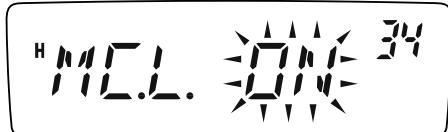
3 Press [MENU] to store the setting or any other key to cancel.
4 Press any key other than [MENU] to exit Menu Mode.
Note: The Mic Lock function will not lock the DTMF keys.
OPTIONAL ACCESSORIES
PS-60
Regulated DC Power Supply
SP-50B
Communications Speaker
MCP-1A
Memory Control Program (Free Software)
The MCP-1A can be
downloaded at:
http://www.kenwood.com/i/products/
info/amateur/software_download.html
PG-2N
DC Power Cable
PG-3B
DC Line Noise Filter
KMC-30
Microphone
MC-59
DTMF Microphone
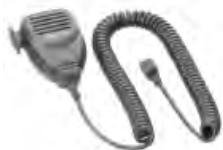
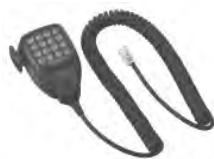
Programming Cable
Ask your dealer about purchasing a Programming Cable.
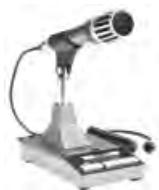
MC-60A
Stand Microphone (MJ-88 required)
MJ-88
Modular to 8-pin Microphone Plug
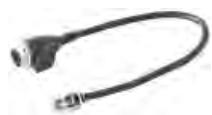
MAINTENANCE
GENERAL INFORMATION
This product has been factory aligned and tested to specification before shipment. Under normal circumstances, the transceiver will operate in accordance with these instructions. All adjustable trimmers, coils, and resistors in the transceiver were preset at the factory. They should only be readjusted by a qualified technician who is familiar with this transceiver and has the necessary test equipment. Attempting service or alignment without factory authorization can void the transceiver warranty.
When operated properly, the transceiver will provide years of service and enjoyment without requiring further realignment. The information in this section gives some general service procedures requiring little or no test equipment.
SERVICE
If it is ever necessary to return this equipment to your dealer or service center for repair, pack it in its original box and packing material. Include a full description of the problems experienced. Include your telephone number, fax number, and e-mail address (if available) along with your name and address in case the service technician needs to call you for further information while investigating your problem. Do not return accessory items unless you feel they are directly related to the service problem.
You may return this product for service to the authorized Kenwood dealer from whom you purchased it, or any authorized Kenwood service center. A copy of the service report will be returned with the transceiver. Please do not send subassemblies or printed circuit boards; send the complete transceiver.
Tag all returned items with your name and call sign for identification. Please mention the model and serial number of the transceiver in any communication regarding the problem.
SERVICE NOTE
If you desire to correspond on a technical or operational problem, please make your note short, complete, and to the point. Help us help you by providing the following:
- Model and serial number of equipment
- Question or problem you are having
- Other equipment in your station pertaining to the problem
- Meter readings
- Other related information (menu setup, mode, frequency, key sequence to induce malfunction, etc.)
Do not pack the equipment in crushed newspapers for shipment! Extensive damage may result during rough handling or shipping.
Note:
Record the date of purchase, serial number and dealer from whom this product was purchased.
For your own information, retain a written record of any maintenance performed on this product.
When claiming warranty service, please include a photocopy of the bill of sale, or other proof-of-purchase showing the date of sale.
CLEANING
The keys, controls, and case of the transceiver are likely to become soiled after extended use. Remove the controls from the transceiver and clean them with a neutral detergent and warm water. Use a neutral detergent (no strong chemicals) and a damp cloth to clean the case.
RESETTING THE TRANSCEIVER
If your transceiver seems to be malfunctioning, resetting the microprocessor may solve the problem. The following 2 reset modes are available. When performing the reset, you may lose memory data and stored information. Back up or write down important data before performing the reset.
INITIAL SETTINGS
The factory defaults for the operating frequencies are as follows.
Transceiver: 144.000 MHz
The Memory Channels have no data stored. The Weather Radio frequency (AL channel) is restored as 162.550 MHz (K market models only). Refer to pages 25 and 56 for the Call Channel and frequency step size default values.
Note: When in Channel Display Mode or while Key Lock is activated {page 58}, you cannot perform VFO reset or Full reset.
FULL RESET
This resets all transceiver parameters to the factory default values. There are two methods available for resetting the transceiver.
Full Reset Method 1:
1 With the transceiver power OFF, press [F] + [] (Power).
- All indicators light momentarily, followed by the full reset confirmation message.
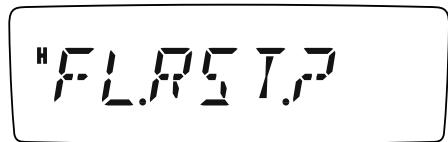
2 Press [F].
"SURE ?" appears.
- Press any key other than [F] to cancel.
3 Press [F] again to reset the transceiver.
- "WAIT" appears momentarily.
Full Reset Method 2:
1 Press [F], [MENU] and turn the Tuning control to select Menu No. 99 (RESET).
2 Press [MENU] and turn the Tuning control to select "FULL".
3 Press [MENU].
"SURE ?" appears.
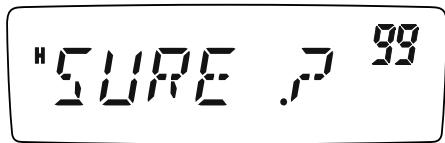
- Press any key other than [MENU] to cancel.
4 Press [MENU] to reset the transceiver.
- "WAIT" appears momentarily.
VFORESET
This resets the transceiver parameters excluding the DTMF Memory, the Memory channel contents, and the Call channel contents. There are two methods available for resetting the transceiver.
Note: Menu No. 7 (P.VFO) and Menu No. 10 (OFFSET) return to the factory default values.
VFO Reset Method 1:
1 With the transceiver power OFF, press [VFO] + [O] (Power).
- The VFO reset confirmation message appears.
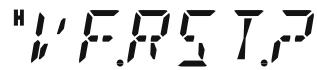
2 Press [VFO].
"SURE ?" appears.
- Press any key other than [VFO] to cancel.
3 Press [VFO] again to reset the transceiver.
- "WAIT" appears momentarily.
VFO Reset Method 2:
1 Press [F], [MENU] and turn the Tuning control to select Menu No. 99 (RESET).
2 Press [MENU] and turn the Tuning control to select "VFO".
3 Press [MENU].
"SURE?" appears.
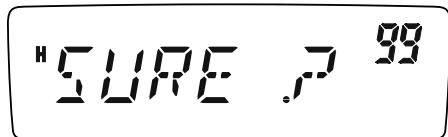
- Press any key other than [MENU] to cancel.
4 Press [MENU] to reset the transceiver.
TROUBLESHOOTING
The problems described in the following tables are commonly encountered operational malfunctions. These types of difficulties are usually caused by improper hook-up, accidental incorrect control settings, or operator error due to incomplete programming. These problems are usually not caused by circuit failure. Please review these tables and the appropriate section(s) of this instruction manual before assuming your transceiver is defective.
| Problem | Problem Cause | Corrective Action | Page Ref. |
| The transceiver will not power up after connecting a 13.8 V DC power supply and pressing the [6] (Power) switch. Nothing appears on the display. | 1 The power cable was connected backwards. 2 One or more of the power cable fuses are open. | 1 Connect the supplied DC power cable correctly: Red → (+); Black → (-). 2 Look for the cause of the blown fuse(s). After inspecting and correcting any problems, install a new fuse(s) with the same ratings. | 3 5 |
| The display is too dim, even though you selected a high brightness level. | The supply voltage is too low. | The supply voltage requirement is 13.8 V DC ±15% (11.7 V to 15.8 V DC). If the input voltage is outside this range, adjust your regulated power supply and/or check all power cable connections. | 3, 4 |
| The frequency cannot be selected by turning the Tuning control or by pressing Mic [UP]/[DWN]. | Memory Recall was selected. | Press [VFO]. | 30, 15 |
| Most buttons/keys and the Tuning control do not function. | 1 One of the Lock functions is ON. 2 The transceiver is in Channel Display mode. | 1 Unlock all of the Lock functions. 2 With the transceiver power OFF, press [6] (Power)+[REV] to exit Channel Display mode. | 53,58,64 37 |
| Memory Channels cannot be selected by turning the Tuning control or by pressing Mic [UP]/[DWN]. | No data has been stored in any Memory Channels. | Store data in some Memory Channels. | 29 |
| You cannot transmit even though you press Mic [PTT]. | 1 The microphone plug was not inserted completely into the front panel connector. 2 You selected a transmit offset that places the transmit frequency outside the allowable transmit frequency range. | 1 Switch OFF the power, then insert the microphone plug until the locking tab clicks in place. 2 Press [F], [MENU] and turn the Tuning control to select Menu No. 5 (SFT). Press [MENU] and turn the Tuning control to select “OFF”. Press [MENU] to store the setting, then press any key other than [MENU] to exit Menu Mode. | 6 23 |
SPECIFICATIONS
Specifications are subject to change without notice due to advancements in technology.
| General | ||
| TX frequency range | K market models | 144 ~ 148 MHz |
| E market models | 144 ~ 146 MHz | |
| M2 market models | 136 ~ 174 MHz | |
| RX frequency range | K market models | 136 ~ 174 MHz |
| E market models | 136 ~ 174 MHz | |
| M2 market models | 136 ~ 174 MHz | |
| Mode | F3E (FM) | |
| Antenna impedance | 50 Ω | |
| Usable temperature range | -20 °C ~ +60 °C (-4 °F ~ +140 °F) | |
| Power supply | 13.8 V DC ±15% (11.7 ~ 15.8 V) | |
| Grounding method | Negative ground | |
| Current | Transmit (max.) | 14 A or less |
| Receive (at 2 W output) | 1.0 A or less | |
| Frequency stability (-20 °C ~ +60 °C) | Within ±2.5 ppm | |
| Dimensions (W x H x D projections not included) | 160 x 43 x 126 mm/ 6.30 x 1.69 x 4.69 in | |
| Weight | Approx. 1.13 kg/ 2.5 lb | |
| Transmitter | ||
| Power output | High | 65 W |
| Low | Approx. 25 W | |
| Modulation | Variable reactance modulation | |
| Spurious emissions | -60 dB or less | |
| Maximum frequency deviation | Wide: ±5 kHz Narrow: ±2.5 kHz | |
| Audio distortion (at 60% modulation) | 3% or less | |
| Microphone impedance | 600 Ω | |
| Receiver | |
| Circuitry | Double superheterodyne |
| Intermediate frequency (1st/ 2nd) | 49.95 MHz/ 450 kHz |
| Sensitivity (12 dB SINAD) | Wide: 0.18 μV or less Narrow: 0.22 μV or less |
| Selectivity (-6 dB) | Wide: 12 kHz or more Narrow: 10 kHz or more |
| Selectivity (-60 dB) | Wide: 30 kHz or less Narrow: 24 kHz or less |
| Squelch sensitivity | 0.1 μV or less |
| Audio output (8 Ω, 5 % distortion) | 2 W or higher |
| Audio output impedance | 8 Ω |
INDEX
1750 Hz 25
Accessories
Optional. 65
Supplied. 1
All-Channel Scan. 42
Automatic Power Off. 54
Automatic Repeater Offset.....25
Automatic Simplex Check.....26
Automatic Dialer 51
Band Scan. 40
Beat Shift. 54
Beep Function 55
Busy Channel Lockout. 56
Call Channel
Changing. 35
Recalling 35
Call Scan 43
Channel Display 37
Continuous Tone Coded
Squelch System (CTCSS)
Freq. ID Scan 47
Selecting a Frequency 47
Using 46
Digital Code Squelch (DCS)
Code ID Scan. 49
Selecting a Code 48
Using 48
Display
Backlight 57
LCD. 10
Dual Tone Multi-Frequency
(DTMF)
Automatic Dialer. 51
Confirming a Stored
Number 52
Lock 53
Manual Dialing 50
Monitor 50
Pause Duration 53
Storing in Memory 51
Tone Transmission Speed.. 52
Transmitting a Stored
Number 52
TX Hold. 51
Frequencies, Selecting
Direct Frequency Entry 16
MHz Mode. 16
VFO Mode. 15
Frequency Step Size 56
Full Reset 67
Fuses, Replacing. 5
Group Scan 42
Installation 2
Accessory Connections 6
Antenna Connection 5
DC Power Cable Connection,
Fixed Station 4
DC Power Cable Connection,
Mobile 3
PC Connection. 7
Keypad Direct Entry 13
Keys and Controls 9
Lock Function 58
Maintenance 66
Manual Dialing. 50
Memory Channels
Clearing. 31
Lockout 44
Naming. 32
Recalling 30
Storing, Odd-split 30
Storing, Simplex. 29
Transfer to VFO 33
Menu
Access 18
Function List. 19
MHz Mode 16
MHz Scan. 41
Microphone
Control 63
Lock 64
PF Keys 59
Narrow Band FM 60
Offset
Automatic Repeater 25
Direction. 23
Frequency 23
Power-on Message 60
Power ON/ OFF 14
Priority Scan
Programming 43
Using 44
Program Scan
Frequency Range 40
Using 41
Programmable Function
(PF) Keys 59
Repeater Operation 22
Reset
Full 67
VFO. 68
Reverse Function 26
Scan
All-Channel 42
Band. 40
Call 43
Group 42
MHz. 41
Priority. 43
Program 41
Resume Method. 45
Specifications 71
Squelch
Adjusting 14
Hang Time 55
S-meter 54
Time-out Timer (TOT) 62
Tone
1750 Hz Tone 25
Activating 24
Freq. ID Scan 27
Selecting 24
Transmitting. 15
Output Power 15
Troubleshooting 69
Tuning Control Unlock 58
VFO
Mode 15
Programmable 61
Reset. 68
Volume, Adjusting. 14
Weather Alert
Enabling 36
Programming 36
KENWOOD
C∈0682 ①
This product complies with Directive, Number 26891 regarding "REGULATION ON THE RESTRICTION OF THE USE OF CERTAIN HAZARDOUS SUBSTANCES IN ELECTRICAL AND ELECTRONIC EQUIPMENT".
- Information on Disposal of Old Electrical and Electronic Equipment and Batteries (applicable for EU countries that have adopted separate waste collection systems)
- THANK YOU!
- MODELS COVERED BY THIS MANUAL
- MARKET CODES
- FEATURES
- NOTICES TO THE USER
- FCC WARNING
- INFORMATION TO THE DIGITAL DEVICE USER REQUIRED BY THE FCC
- PRECAUTIONS
- CONTENTS
- CHAPTER ① PREPARATION
- CHAPTER ② YOUR FIRST QSO
- CHAPTER ③ GETTING ACQUAINTED
- CHAPTER ④ OPERATING BASICS
- CHAPTER 5 MENU SETUP
- CHAPTER 6 OPERATING THROUGH REPEATERS
- CHAPTER ⑦ MEMORY CHANNELS
- CHAPTER ⑧ SCAN
- CHAPTER 9 SELECTIVE CALL
- CHAPTER 10 DUAL TONE MULTI-FREQUENCY (DTMF) FUNCTIONS
- CHAPTER 11 AUXILIARY FUNCTIONS
- SUPPLIED ACCESSORIES
- WRITING CONVENTIONS FOLLOWED IN THIS MANUAL
- MOBILE INSTALLATION
- DC POWER CABLE CONNECTION
- MOBILE OPERATION
- Note:
- REPLACING FUSES
- ANTENNA CONNECTION
- ACCESSORY CONNECTIONS
- EXTERNAL SPEAKER
- MICROPHONE
- PC CONNECTION
- FRONT PANEL
- ⑤ MR key
- ⑥ REV key
- ⑦ mO/F key
- CT
- T
- DCS
- + - 1
- R
- 6R
- PRI
- WX
- N
- 56
- 188
- 12
- mO
- ★
- BUSY 1/3/5/7/9/ OVER ON AIR
- F
- REAR PANEL
- ① Antenna connector
- ② Power Input 13.8 V DC cable
- ③ SP (speaker) jack
- ① PTT (Push-to-Talk) switch
- ② DWN/\*key
- ③ UP/# key
- MIC KEYPAD DIRECT ENTRY
- SWITCHING THE POWER ON/OFF
- ADJUSTING THE VOLUME
- ADJUSTING THE SQUELCH
- TRANSMITTING
- SELECTING AN OUTPUT POWER
- CAUTION
- SELECTING A FREQUENCY
- VFO MODE
- MHz MODE
- DIRECT FREQUENCY ENTRY
- Example 1
- Example 2
- Example 3
- WHAT IS A MENU?
- MENU ACCESS
- Press [F], [MENU].
- OFFSET PROGRAMMING FLOW
- PROGRAMMING AN OFFSET
- SELECTING AN OFFSET DIRECTION
- SELECTING AN OFFSET FREQUENCY
- ActivATING THE TONE FUNCTION
- SELECTING A TONE FREQUENCY
- E market version only:
- AUTOMATIC REPEATER OFFSET
- K market version only
- E market version only
- TRANSMITTING A 1750 Hz TONE
- REVERSE FUNCTION
- AUTOMATIC SIMPLEX CHECK (ASC)
- TONE FREQUENCY ID SCAN
- NUMBER OF MEMORY CHANNELS
- SIMPLEX & REPEATER OR ODD-SPLIT MEMORY CHANNEL?
- STORING SIMPLEX FREQUENCIES OR STANDARD REPEATER FREQUENCIES
- STORING ODD-SPLIT REPEATER FREQUENCIES
- RECALLING A MEMORY CHANNEL
- USING THE TUNING CONTROL
- USING THE MICROPHONE KEYPAD
- CLEARING A MEMORY CHANNEL
- NAMING A MEMORY CHANNEL
- MEMORY CHANNEL TRANSFER
- MEMORY VFO TRANSFER
- CHANNEL → CHANNEL TRANSFER
- CALL CHANNEL
- RECALLING THE CALL CHANNEL
- REPROGRAMMING THE CALL CHANNEL
- WEATHER ALERT (K MARKET MODELS ONLY)
- PROGRAMMING THE WEATHER RADIO FREQUENCY
- ENABLING A WEATHER ALERT
- CHANNEL DISPLAY
- NORMAL SCAN
- BAND SCAN
- PROGRAM SCAN
- Storing a Program Scan Frequency Range
- Performing Program Scan
- MHz SCAN
- MEMORY SCAN
- ALL-CHANNEL SCAN
- Press [MR] (1s).
- 2 Press any key other than [F] or [ 念 ] (Power) to stop All-Channel Scan.
- GROUP SCAN
- Press [MENU] (1s).
- CALL SCAN
- PRIORITY SCAN
- PROGRAMMING A PRIORITY CHANNEL
- USING PRIORITY SCAN
- MEMORY CHANNEL LOCKOUT
- SCAN RESUME METHOD
- Time-Operated Mode (default)
- - Carrier-Operated Mode
- - Seek Mode
- CTCSS AND DCS
- CTCSS
- SELECTING A CTCSS FREQUENCY
- CTCSS FREQUENCY ID SCAN
- SELECTING A DCS CODE
- DCSCODEIDSCAN
- DUAL TONE MULTI-FREQUENCY (DTMF) FUNCTIONS
- MANUAL DIALING
- DTMF MONITOR
- DTMF TX H0LD
- AUTOMATIC DIALER
- STORING A DTMF NUMBER IN MEMORY
- Press [MENU].
- CONFIRMING STORED DTMF NUMBERS
- TRANSMITTING A STORED DTMF NUMBER
- Release Mic [PTT].
- ADJUSTING THE DTMF TONE TRANSMISSION SPEED
- ADJUSTING THE PAUSE DURATION
- DTMF LOCK
- APO (AUTO POWER OFF)
- BEAT SHIFT
- S-METER SQUELCH
- SQUEELCH HANG TIME
- BEEP FUNCTION
- BUSY CHANNEL LOCKOUT
- FREQUENCY STEP SIZE
- DISPLAY BACKLIGHT
- PERMANENT BACKLIGHT
- AUTOMATIC BACKLIGHT
- LOCK FUNCTION
- TUNE ENABLE
- MICROPHONE PF KEYS (KEYPAD MODELS ONLY)
- Programmable Functions
- POWER-ONMESSAGE
- PROGRAMMABLE VFO
- TIME-OUT TIMER
- MIC LOCK
- OPTIONAL ACCESSORIES
- MAINTENANCE
- GENERAL INFORMATION
- SERVICE
- SERVICE NOTE
- CLEANING
- RESETTING THE TRANSCEIVER
- INITIAL SETTINGS
- FULL RESET
- Full Reset Method 1:
- Full Reset Method 2:
- VFORESET
- VFO Reset Method 1:
- VFO Reset Method 2:
- TROUBLESHOOTING
- SPECIFICATIONS
- INDEX
- KENWOOD
- C∈0682 ①
Brand : KENWOOD
Model : TM-281A
Category : Ham Radio