
Power Awning - Store d'ombrage DOMETIC - Free user manual and instructions
Find the device manual for free Power Awning DOMETIC in PDF.


| Product Type | Power Patio Awning for RVs with straight sides |
| Brand | Dometic |
| Model Numbers | 8952XX1.400#(L), 8952XX2.400#(L), 8952XX3.400#(L) and XY variants |
| Application | Recreational vehicles (motorhomes, RVs) |
| Back Channel Dimensions (A x B x C) | 62 3/4" x 62 1/8" x 60 1/8" (XX1); 66 1/4" x 65 5/8" x 63 5/8" (XX2 & XX3) |
| Door Clearance Minimum | 6" to 13" depending on model; add 2" if door toward center |
| Power Supply | 12 Vdc (negative ground) |
| Motor Type | Electric motor, factory pre-wired to RH arm assembly |
| Control | Momentary switch or electronic control with motor overload protection (installer supplied) |
| LED Light Option | Available; requires separate switch (installer supplied) and 3A fuse |
| Included Hardware | (2) 1/4-20 x 3/4" hex head screws, (2) 1/4" split lock washers, (8) #14-10 x 1 1/2" hex head screws, (2) #6-20 x 7/16" self-drilling hex head washer screws |
| Optional Components | Door roller kit (830304), door roller kit 50-pack, torsion crank assembly, back channel spacer kit |
| Safety Features | Ignition/safety interlock system required for motorhomes; crush and pinch hazard warnings |
| Installation | Must be installed by qualified service technician; comply with local codes (NEC, CSA) |
| Materials | Fabric (vinyl or acrylic), aluminum channels, steel fasteners |
| Maintenance | Clean fabric with mild soap and water; avoid abrasive cleaners; store when not in use |
| Warranty | See separate warranty document; Dometic reserves right to modify specifications |
Frequently Asked Questions - Power Awning DOMETIC
User questions about Power Awning DOMETIC
0 question about this device. Answer the ones you know or ask your own.
Ask a new question about this device
Download the instructions for your Store d'ombrage in PDF format for free! Find your manual Power Awning - DOMETIC and take your electronic device back in hand. On this page are published all the documents necessary for the use of your device. Power Awning by DOMETIC.
USER MANUAL Power Awning DOMETIC
RECORD THIS INFORMATION FOR FUTURE REFERENCE:
FRTA Model Number
FRTA Serial Number
Hardware Model Number
Hardware Serial Number
Date Purchased
Retailer / Qualified Installer
INSTALLATION
INSTRUCTIONS
9100
POWER PATIO AWNING
HARDWARE
8952XX1.4X0#(L) BASEMENT
8952XX2.4X0#(L) STANDARD
8952XX3.4X0#(L) REDUCED PITCH
FRTA
Read these instructions carefully. These instructions MUST stay with this product.
INTRODUCTION
This awning (hereinafter referred to as "awning," or "product") is designed and intended for use on RVs with straight sides. For curved sides, please see the separate Hardware List in the Dealer Service Manual for the appropriate model. This product can be installed by one person with brief help from additional personnel. Use these instructions to ensure correct installation and function of product.
Dometic Corporation reserves the right to modify appearances and specifications without notice.
TABLE OF CONTENTS
INTRODUCTION....2
DOCUMENT SYMBOLS 2
IMPORTANT SAFETY INSTRUCTIONS....3
A. Recognize Safety Information 3
B. Understand Signal Words....3
C. Supplemental Directives....3
D. General Safety Messages ....3
GENERAL INFORMATION....3
A. Included Hardware 3
B. Optional Components & Kits 3
SPECIFICATIONS 4
A. Hardware (Back Channel) Dimensions 4
B. Door Clearance 5
C. Measuring Tips 5
PREPARE FOR INSTALLATION....5
A. Door Roller And Edge Guard (Optional) 5
B. Prepare Awning Rail And Insert Fabric....5
C. Prepare Awning For Installation....6
D. Determine Awning Location....8
INSTALL ELECTRICAL KITS 8
A. Install (Fixed/Wired) Awning Switch 8
B. Install Ignition/Safety Interlock System....9
C. Install LED Light Switch (If Applicable)....9
INSTALL AWNING 9
A. Insert Awning Fabric Into Awning Rail 9
B. Attach Top Mounting Brackets / Arm Assemblies 10
C. Attach Back Channels 12
D. Electrical Connections To Awning....13
E. Complete Back Channel Installation....14
F. Secure Awning Fabric To Awning Rail 14
VERIFY INSTALLATION....15
A. Test Operation 15
B. Secure Awning For Travel 15
C. Keep Literature....15
DOCUMENT SYMBOLS

Indicates additional information that is NOT related to physical injury.

Indicates step-by-step instructions.
IMPORTANT SAFETY INSTRUCTIONS
This manual has safety information and instructions to help you eliminate or reduce the risk of accidents and injuries.
A. Recognize Safety Information

This is the safety alert symbol. It is used to alert you to potential physical injury hazards. Obey all safety messages that follow this symbol to avoid possible injury or death.
B. Understand Signal Words
A signal word will identify safety messages and property damage messages, and will indicate the degree or level of hazard seriousness.
WARNING indicates a hazardous situation that, if NOT avoided, could result in death or serious injury.
⚠️ CAUTION indicates a hazardous situation that, if NOT avoided, could result in minor or moderate injury.
NOTICE is used to address practices NOT related to physical injury.
C. Supplemental Directives

Read and follow all safety information and instructions to avoid possible injury or death.
Read and understand these instructions before installing, using, servicing or performing maintenance on this product.
Incorrect installation, operation, servicing, or maintaining of this product can lead to serious injury. Follow all instructions.

The installation MUST comply with all applicable local and national codes, including the latest edition of the following standards:
U.S.A.
• ANSI/NFPA70, National Electrical Code (NEC)
• ANSI/NFPA 1192, Recreational Vehicles Code
CANADA
- CSAC22.1, Parts I & II, Canadian Electrical Code
• CSA Z240 RV Series, Recreational Vehicles
D. General Safety Messages
WARNING
Failure to obey the following warnings could result in death or serious injury:
- This product MUST be installed and serviced by a qualified service technician.
- Do NOT modify this product in any way. Modification can be extremely hazardous.
- IMPACT OR CRUSH HAZARD. This product should be installed in a controlled environment (inside). Do NOT install product during windy conditions, or when wind is expected. Otherwise, product could move unpredictably, become unstable, and could detach, bend or collapse.
GENERAL INFORMATION
A. Included Hardware
(2) 1/4-20 X 3/4" Hex Head Screw
(2) 1/4" Split Lock Washer
(8) #14-10 X 1 1/2" Hex Head Screw
(2) #6-20 X 7/16" Self Drilling Hex Head Washer Screw
B. Optional Components & Kits
(1) 830304 Door Roller Kit
(1) 830304.003 Door Roller Kits (50 Pack)
(1) 3308334.006U Torsion Crank Assembly
(1) 3312853.025(#) Back Channel Spacer Kit
SPECIFICATIONS
A. Hardware (Back Channel) Dimensions

Wiring harness location may be at top or bottom depending on awning model.
| 8952XX1.400#(L) | 8952XX2.400#(L) | 8952XX3.400#(L) | |
| A | 62 3/4" 66 1/4" | 66 1/4" | |
| B | 62 1/8" 65 5/8" | 65 5/8" | |
| C | 60 1/8" 63 5/8" | 63 5/8" | |
| D | 60 3/4" 64 1/4" | 64 1/4" | |
| E | 61 1/2" 65" | 65" | |
| F | 33" | ||
| G | 39" | ||
| H | 3/8" | ||
| J | 1/4" | ||
| K | 5/8" | ||
| L | 3/4" | ||
| M | 1 1/2" | ||
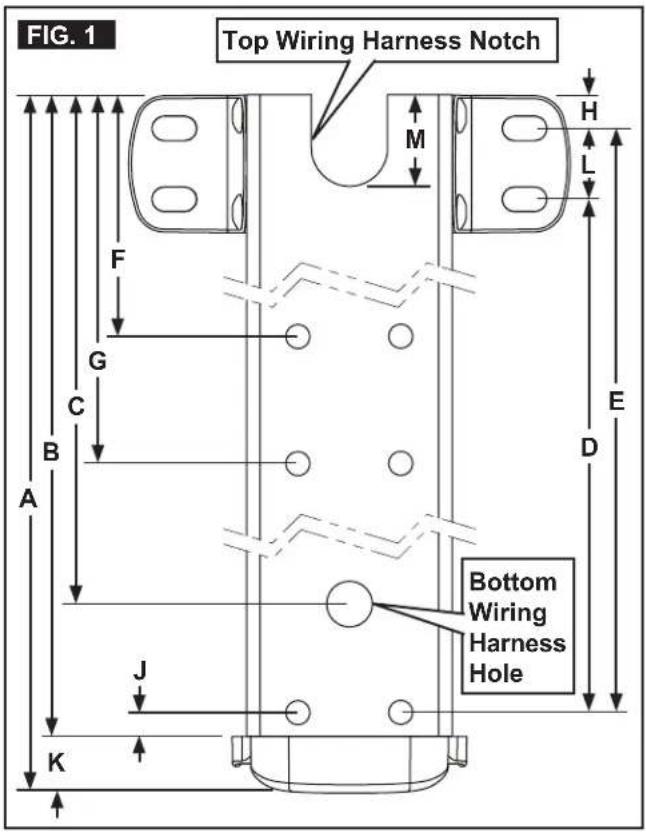
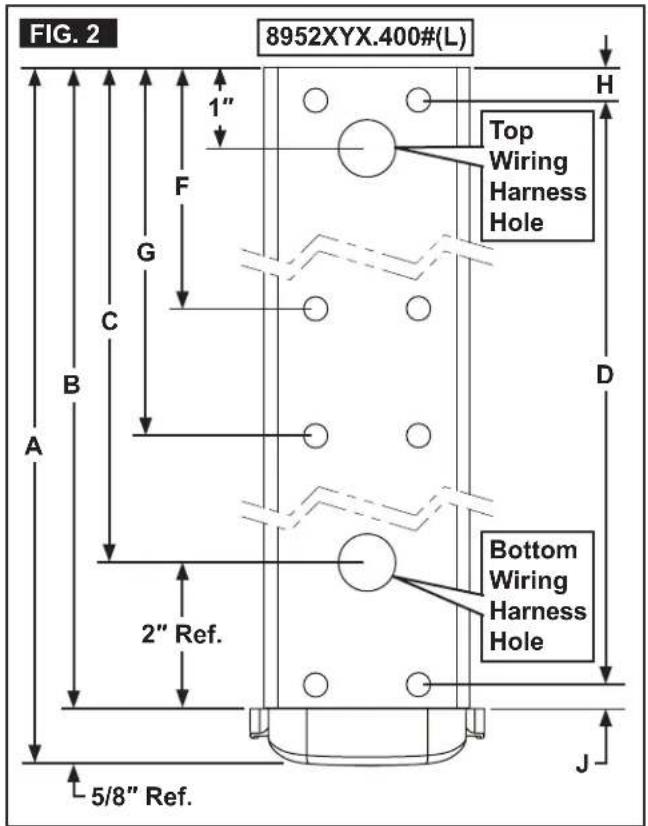
SPECIFICATIONS
B. Door Clearance
Minimum distances between awning rail and entry door:
| Model | Minimum Distance “X” |
| 8952XX1.400#(L) 12" | |
| 8952XX2.400#(L) 7" | |
| 8952XX3.400#(L) 6" | |
| 8952XY1.400#(L)* 13" | |
| 8952XY2.400#(L)* 8" | |
| 8952XY3.400#(L)* 7" | |
| *Replace "Y" with 2 or 3 | |

When entry door is toward center of awning, add 2" to minimum distances.
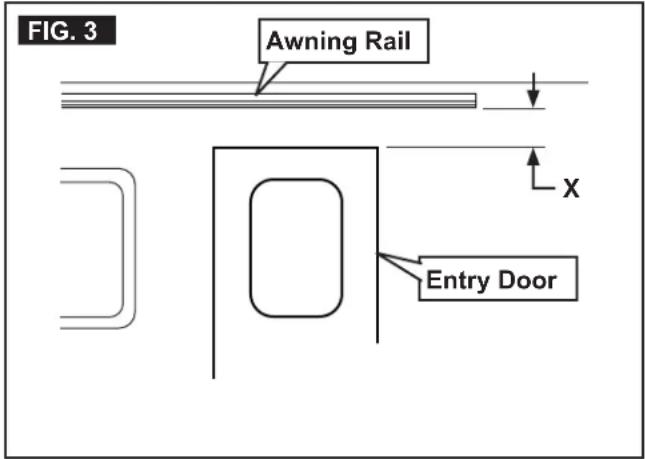
C. Measuring Tips
Consider doors, windows, lights, trim, slideout room, etc. when determining the length and position of the awning so as not to obstruct the operation or block any of these components.
PREPARE FOR INSTALLATION
A. Door Roller And Edge Guard (Optional)
NOTICE Do NOT allow corner of entry door to contact awning fabric. Otherwise, premature wear or tearing of awning fabric could occur.
If there's potential for a squared corner entry door to contact awning fabric, a door roller kit (NOT INCLUDED) must be installed.

Rounded corner doors may NOT require a door roller kit if there is no potential for damage to awning fabric.
See subsection, "B. Optional Components & Kits" on page (3) to order door roller kits.

- Place door roller on upper corner of outer entry door (opposite to hinge), transfer (drill) two pilot holes, and place and tighten mounting screws. See (FIG. 4).
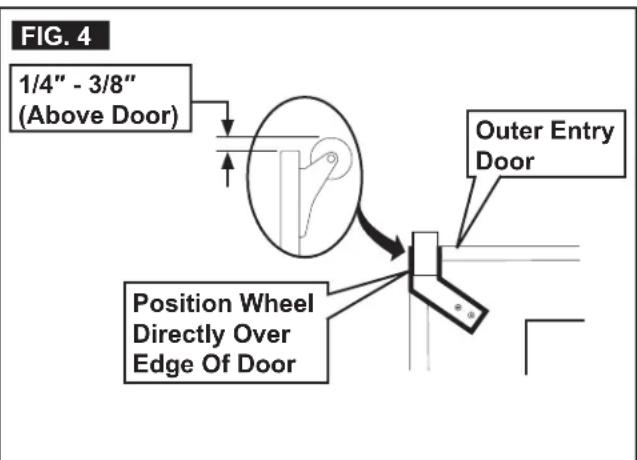
- Clip door edge guard onto upper corner of inner screen door (opposite to hinge). See (FIG. 5).
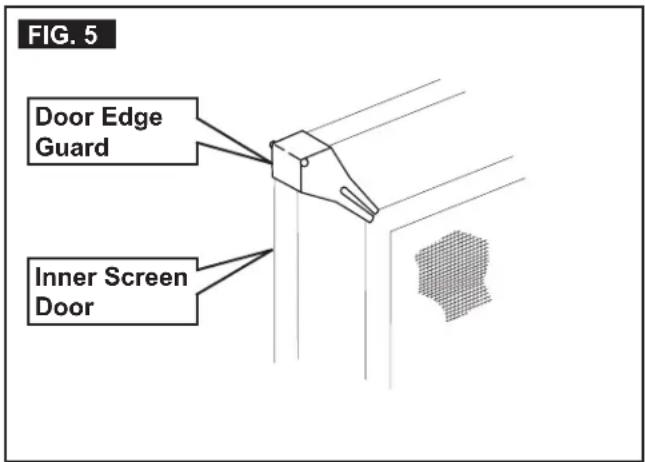
B. Prepare Awning Rail And Insert Fabric
NOTICE Make sure awning rail is parallel to RV floor, and is NOT warped or curved before installing awning fabric. If awning rail is NOT straight, awning fabric may wrinkle or stretch.
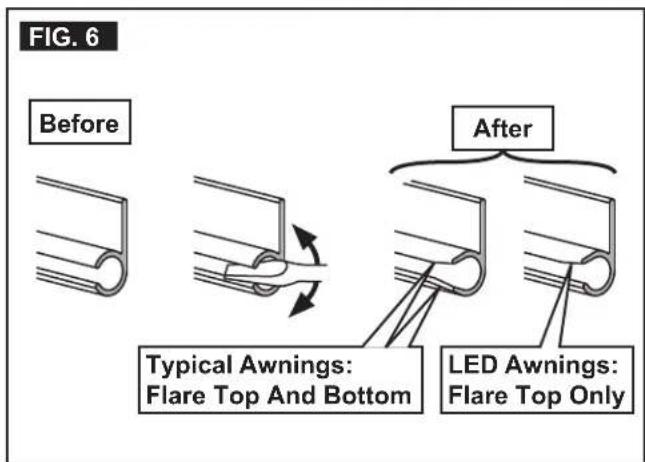
Select desired awning rail end (on RV) into which awning fabric will be inserted. Flare (widen) that end of rail with a flat-bladed screwdriver, and remove (file) sharp edges. See (FIG. 6).

If awning is equipped with LED lights, flare top (of awning rail opening) ONLY.
PREPARE FOR INSTALLATION
C. Prepare Awning For Installation
The awning hardware requires minor preparation before installing on RV.

-
Carefully lay fabric roller tube assembly (FRTA) on a clean, well padded "V" trough (or other well protected surface) to prevent fabric damage.
-
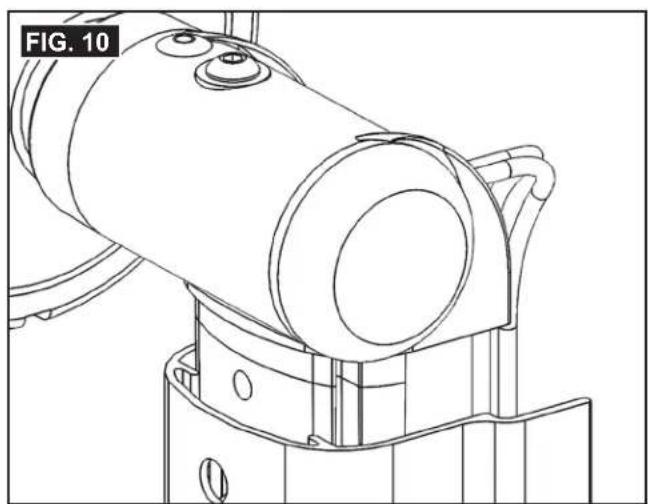
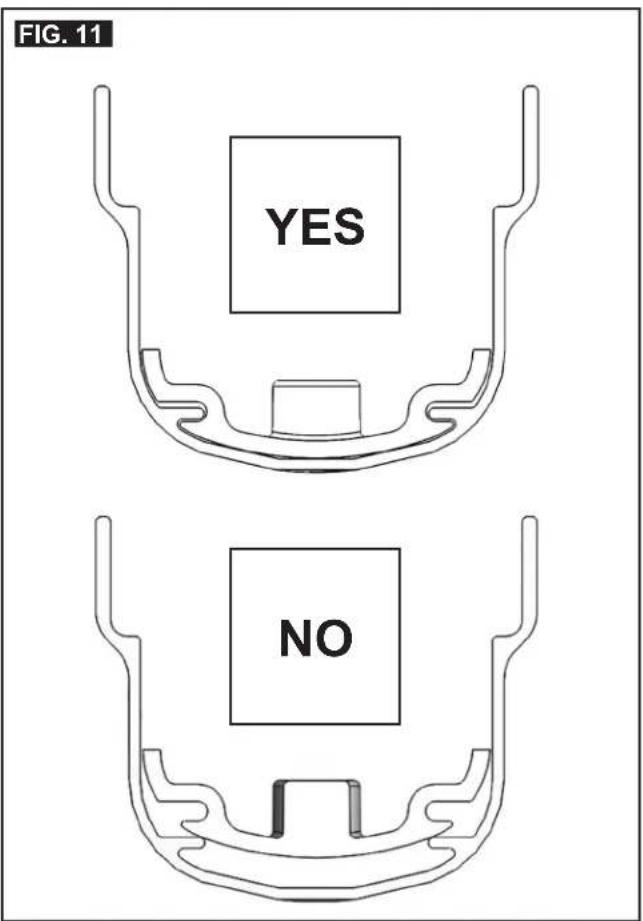
⚠️WARNING IMPACT OR PINCH HAZARD. Do NOT remove ties (wrapped around each arm assembly) until top casting is secured to front channel, awning fabric is attached to awning rail, and arm assembly is mounted to RV. Arm assemblies are under tension from gas strut. Removing these ties could allow arms to extend quickly and unexpectedly. Failure to obey this warning could result in death or serious injury. Insert each top casting into corresponding front channel. See (FIG. 7) & (FIG. 8).

The RH arm assembly (front channel) is pre-wired for awning motor.
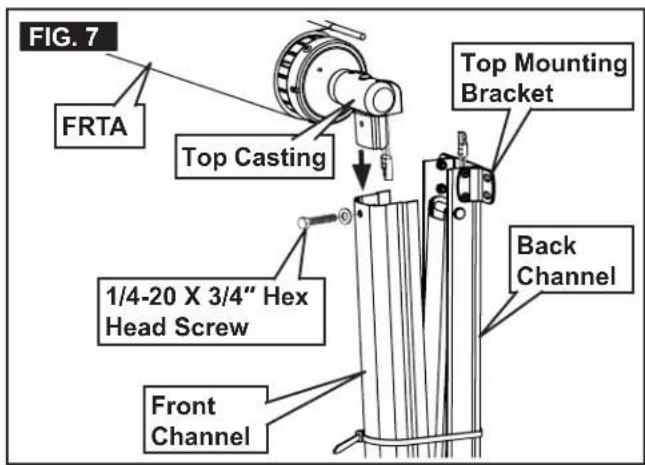
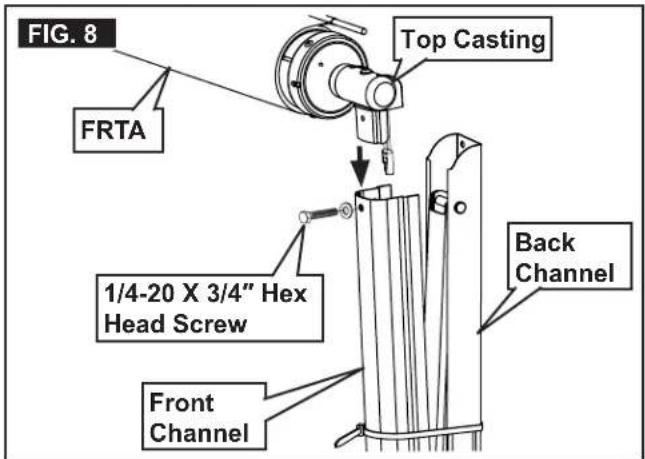
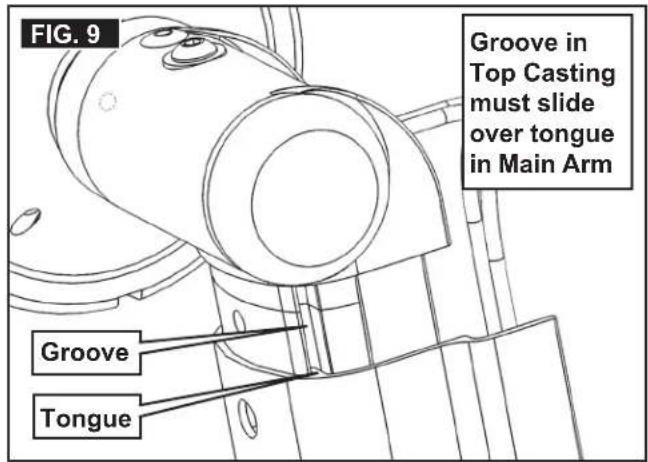
- ⚠ WARNING IMPACT OR CRUSH HAZARD. DO NOT set Top Casting BEHIND Tongue. Aw- ning roller assembly is NOT properly restrained and could become separated. Failure to obey this warning could result in loss of property, seri- ous injury or death.
natural_image
Technical line drawing of a mechanical component with no visible text or symbolsPREPARE FOR INSTALLATION
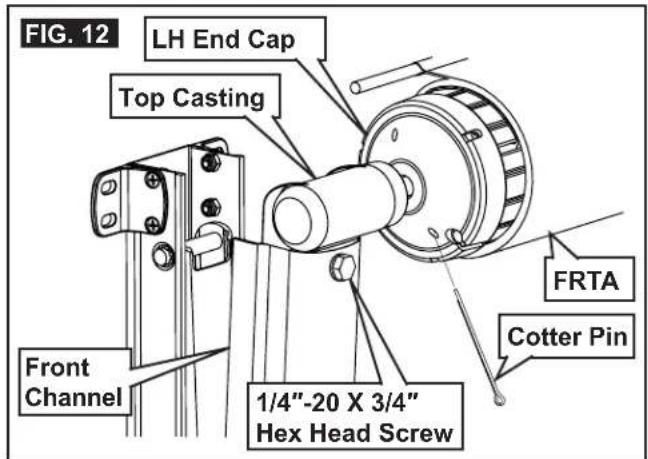
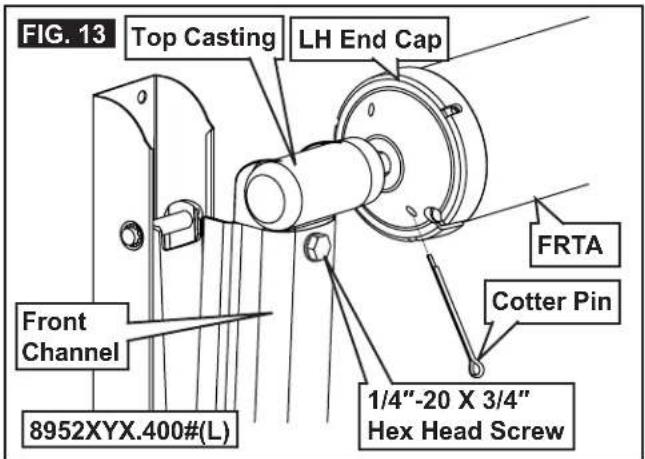
- Secure RH front channel to RH top casting using 1/4-20 X 3/4" hex head screw and 1/4" split lock washer. See (FIG. 7) & (FIG. 8).
- Repeat step (4) for LH side. See (FIG. 12) & (FIG. 13).
PREPARE FOR INSTALLATION
6. ⚠️WARNING IMPACT OR PINCH HAZARD.
Do NOT remove cotter pin from torsion rod (at end cap) until BOTH top castings are secured to corresponding front channels. Otherwise, rapid casting spin off will occur. Spring tension will attempt to spin the hardware and/or fabric roller tube quickly and unexpectedly. Failure to obey this warning could result in death or serious injury.
Remove cotter pin from left end of torsion rod (LH end cap). See (FIG. 12) & (FIG. 13).

Removing cotter pin will release factory preset torsion (spring) tension.
a. Straighten bent end of cotter pin.
b. Rotate fabric roller tube (as if unrolling awning) by pulling bottom of tube toward you.

This will reduce pressure on cotter pin for easier removal.
c. While holding fabric roller tube, pull cotter pin out and discard.
D. Determine Awning Location

1. ⚠️WARNING IMPACT OR CRUSH HAZARD.
Make sure mounting surface on RV is flat, has solid structural backing where fasteners penetrate surface, and will safely and securely support product. Otherwise, product may become unstable and could detach, bend or collapse. Failure to obey this warning could result in death or serious injury.
Find a solid structure in RV wall for support of top mounting brackets and back channels (all mounting points).
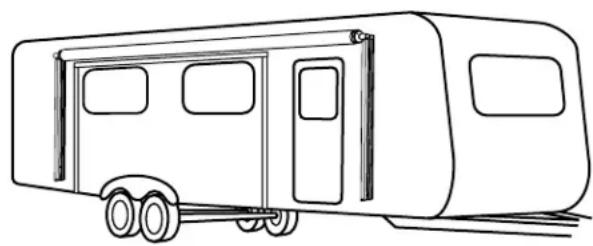
- Make sure arm assemblies do not restrict use of doors, windows, slideout rooms, etc. See (FIG. 14).

To install over windows, see subsection, "B. Optional Components & Kits" on page (3) to order back channel spacer kits.
- NOTICE Allow for sufficient clearance between entry door and fabric or slideout room and fabric to accommodate awning pitch (slope).
Avoid location that interferes with entry door swing when awning is completely extended. See subsection, "SPECIFICATIONS" on page (5).
FIG. 14
natural_image
Line drawing of a small modular vehicle with wheels and doors (no text or symbols)INSTALL ELECTRICAL KITS
WARNING ELECTRICAL SHOCK HAZARD.
Disconnect 120 Vac power from RV. Failure to obey this warning could result in death or serious injury.
NOTICE Disconnect the positive (+) 12 Vdc
terminal from supply battery. Otherwise, damage to unit could occur.
Disconnect power for ALL procedures under this section.
A. Install (Fixed/Wired) Awning Switch

Use correct (Dometic Corporation approved) momentary switch, or electronic control switch with motor overload protection.

- NOTICE Do NOT expose switch to weather, extreme temperatures, or long hours in direct sunlight.
Find a suitable location for awning switch installation.
-
NOTICE Install a (15 A) fuse (installer supplied) at fuse panel for positive (+) 12 Vdc power supply (RED wire) to switch. Otherwise, damage to unit could occur.
-
Route wiring (inside RV) to general location where connections to awning hardware will be made.

Allow enough wiring length to pass through outside RV wall (hole will be drilled later) for connection to awning.
Wiring hole location will be either at top or bottom of RH back channel depending on awning model. See (FIG. 1) & (FIG. 2).
- Make appropriate wiring connections inside RV.

Wiring connections to awning (through outside RV wall) will be made later.
See instructions included with your Do- metic Corporation switch kit for additional wiring instructions.
INSTALL ELECTRICAL KITS
B. Install Ignition/Safety Interlock System
WARNING IMPACT OR CRUSH HAZARD. Do NOT install product without also installing an ignition/safety interlock system. Otherwise, accidental operation during transit could occur. Failure to obey this warning could result in death or serious injury.

Ignition/safety interlock system is only applicable to motorhomes.

-
NOTICE Install a (3 A) fuse (installer supplied) at fuse panel for positive (+) 12 Vdc ignition control (PINK wire) to ignition interlock. Otherwise, damage to unit could occur.
-
Make appropriate wiring connections.

The ignition interlock MUST break the circuit (cut power) to awning when ignition is ON.
See instructions included with your Do-metic Corporation ignition interlock kit for additional wiring instructions.
C. Install LED Light Switch (If Applicable)
An LED light switch (installer supplied) is required for awning models equipped with an LED light strip.

Skip this subsection if awning is NOT equipped with an LED light strip.

-
NOTICE Do NOT expose switch to weather, extreme temperatures, or long hours in direct sunlight. Find a suitable location for LED switch installation.
-
NOTICE Install a (3 A) fuse (installer supplied) at fuse panel for positive (+) 12 Vdc power supply (RED wire) to switch. Otherwise, damage to unit could occur.

Alternatively, a (3 A) in-line fuse may be used between positive (+) 12 Vdc power supply (RED wire) and LED switch.
- Route wiring (inside RV) to general location where connections to awning hardware will be made.

Allow enough wiring length to pass through outside RV wall (hole will be drilled later) for connection to awning.
Wiring hole location will be either at top or bottom of RH back channel depending on awning model. See (FIG. 1) & (FIG. 2).
- Make appropriate wiring connections inside RV.

Wiring connections to awning (through outside RV wall) will be made later.
See instructions included with your LED light switch for additional wiring instructions.
INSTALL AWNING
WARNING Failure to obey the following warnings could result in death or serious injury:
- IMPACT OR CRUSH HAZARD. This product should be installed in a controlled environment (inside). Do NOT install product during windy conditions, or when wind is expected. Otherwise, product could move unpredictably, become unstable, and could detach, bend, or collapse.
- FIRE OR ELECTRICAL SHOCK HAZARD. Make sure there are no obstacles (wires, pipes, etc.) inside the RV's roof, floor and walls. Shut OFF gas supply, disconnect 120 Vac power from RV, and disconnect positive (+) 12 Vdc terminal from supply battery BEFORE drilling or cutting into RV. Failure to obey these warnings could result in death or serious injury.
NOTICE Failure to obey the following notices could damage product or property:
- ALWAYS use sealant on (clean) parts and surfaces where fasteners enter the RV's walls, roof and floor. Otherwise, water leakage could occur.
- Install back channels on a flat surface, level, and keep parallel with each other to ensure correct function and appearance.
A. Insert Awning Fabric Into Awning Rail
WARNING IMPACT OR CRUSH HAZARD. Do NOT remove LED rail from awning fabric (if equipped). Otherwise, awning fabric could separate from awning rail (on RV) and cause awning to extend quickly or detach, bend or collapse. Failure to obey this warning could result in death or serious injury.

If LED light strip is NOT desired, standard fabric MUST be used. Otherwise, you may remove LED light strip from LED rail, and leave empty LED rail on fabric rope.

- NOTICE Do NOT unfurl more than 1 revolution of fabric, as this could cause issues with awning closing and opening correctly. Unfurl awning fabric 1 revolution before inserting fabric (with awning roller cover, if equipped) into awning rail.

Unfurling 1 revolution will allow enough space between RV wall and awning hardware to guide awning fabric into awning rail.
INSTALL AWNING
- ⚠️CAUTION LIFTING HAZARD. Use proper lifting technique and control when lifting product. Failure to obey this caution could result in injury.
NOTICE Keep both arm assemblies parallel to each other to avoid twisting.
With one person grasping each arm assembly, carefully lift entire awning assembly upright. Then carry awning to prepared (flared) awning rail end. See (FIG. 15).
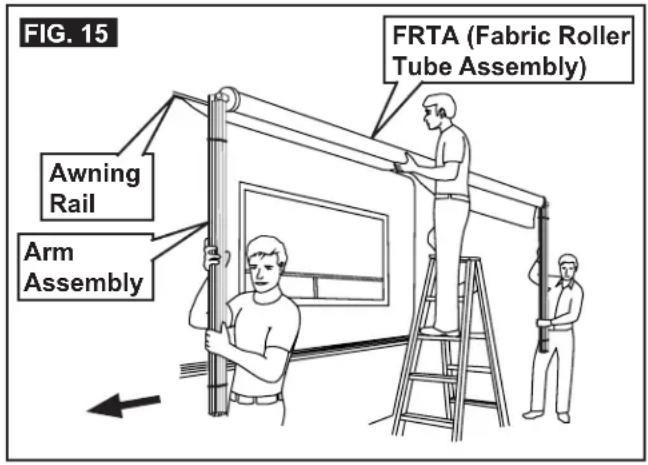
- While one person guides awning fabric (with awning roller cover, if equipped) into awning rail, carefully move (carry) awning hardware assembly to desired location. See (FIG. 15).

A stepladder may be necessary to reach awning rail.
At least two other people are required to hold and control hardware until top mounting brackets and back channels are correctly installed.
B. Attach Top Mounting Brackets / Arm Assemblies

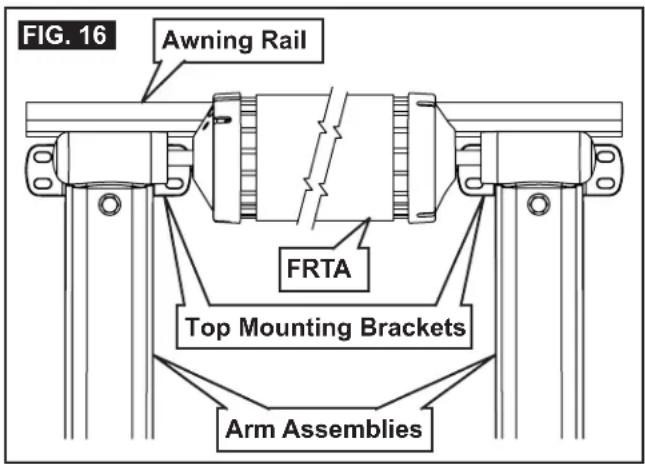
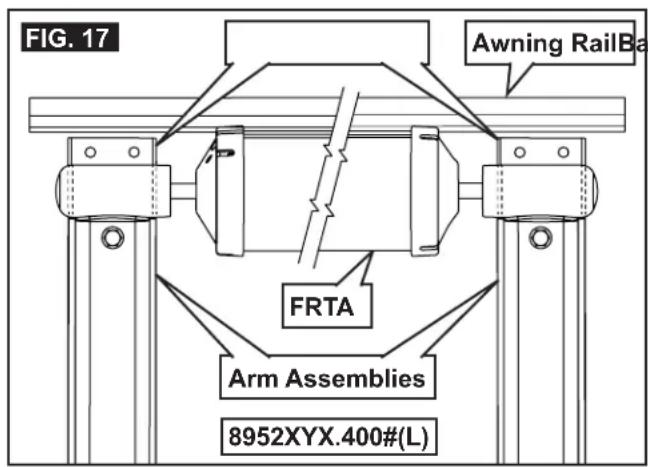
- When awning is in predetermined location, place top mounting brackets (with arm assemblies attached) or arm assemblies (if mounting brackets aren't applicable) directly under and parallel to awning rail. See (FIG. 1), (FIG. 2), (FIG. 16) & (FIG. 17).

To determine correct awning location, see subsection, "D. Determine Awning Location" on page (8).
The motorized arm assembly is ALWAYS installed at the RH side of awning.
Some awning rails have a wide drip channel to catch water as it runs off RV roof. If awning rail is too wide, it may be necessary to lower the position of top mounting brackets to avoid interference with FRTA.
- While holding arm assemblies securely in place, mark top mounting hole locations (LH and RH top mounting bracket slots). See (FIG. 16).

For attaching arm assembly only see (FIG. 17).
ck Chai
- While holding arm assemblies securely in place, mark top mounting hole locations (LH and RH top mounting bracket slots). See (FIG. 16).

For attaching arm assemblies alone (when top mounting brackets are NOT applicable) see (FIG. 17).
- Wiring hole for motorized arm assembly. See (FIG. 1) & (FIG. 2).

The motorized arm assembly is ALWAYS installed at the RH side of awning.
Wiring harness location is determined by awning model. The back channel will either have a notch at top, or a hole near bottom for wiring to pass through RV wall.
INSTALL AWNING
a. If wiring will pass through RV wall at BOT-TOM of back channel, skip to step (5).
b. If wiring will pass through RV wall at TOP of back channel, mark wiring hole (notch) location.
- Move arm assemblies out of the way.
- Drill 3/16" diameter holes through marked mounting hole locations and into solid structure of RV.

Drill 7/32" diameter holes if drilling into steel.
- Drill (1) 5/8" diameter hole at marked TOP wiring hole location and through outside wall of RV.

Skip this step if wiring will pass through RV wall at BOTTOM of RH back channel.
- With arm assembly completely closed, replace top mounting brackets against wall and align its mounting holes to the pre-drilled holes in RV.
- NOTICE Control arm assemblies while installing brackets. When weight of FRTA is NOT supported, downward force could cause arm assemblies to swing sideways and damage RV.
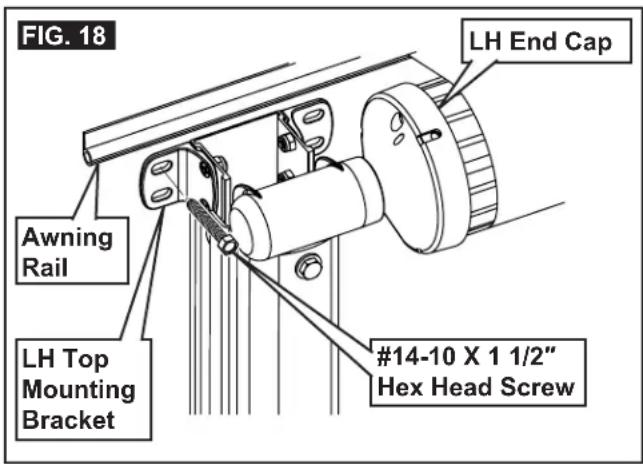
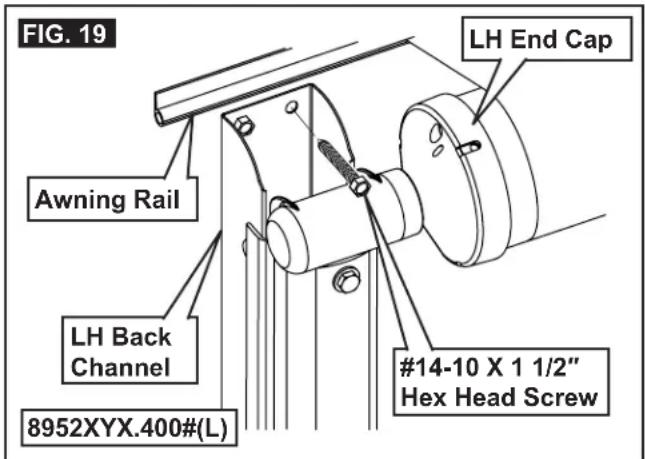
Apply sealant to #14-10 X 1 1/2" hex head screw threads. Then place and tighten (1) screw through outside slot of top mounting bracket and into solid structure of RV. See (FIG. 18) & (FIG. 19).

Make sure arm assemblies are completely closed before tightening outside screws. Closed arm assemblies will help in the overall alignment of awning.
- ⚠️WARNING IMPACT OR PINCH HAZARD. Arm assemblies are under tension from gas strut. Hold arm assemblies and FRTA securely BEFORE removing ties. Otherwise, arms will extend quickly and unexpectedly. Failure to obey this warning could result in death or serious injury.
While holding arm assembly (front channel) and FRTA securely, carefully remove nylon ties (and tape if applicable) around front and back channels. Then allow front channel to open slowly until awning fabric is taut.

Slack from unfurled fabric will allow awning to open approximately 12" - 18".
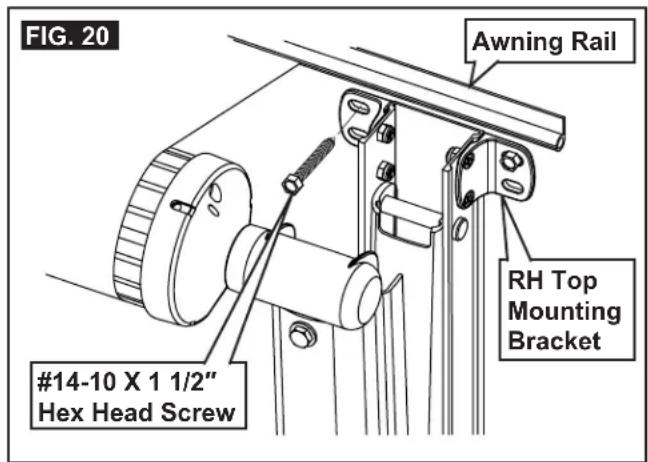
- Apply sealant to #14-10 X 1 1/2" hex head screw threads. Then place and tighten (1) screw through inside slot of top mounting bracket and into solid structure of RV. See (FIG. 20).
- Repeat steps (10) through (11) for opposite side.
INSTALL AWNING
C. Attach Back Channels

- Remove wiring cover from RH back channel (if applicable). Save for reinstallation later.
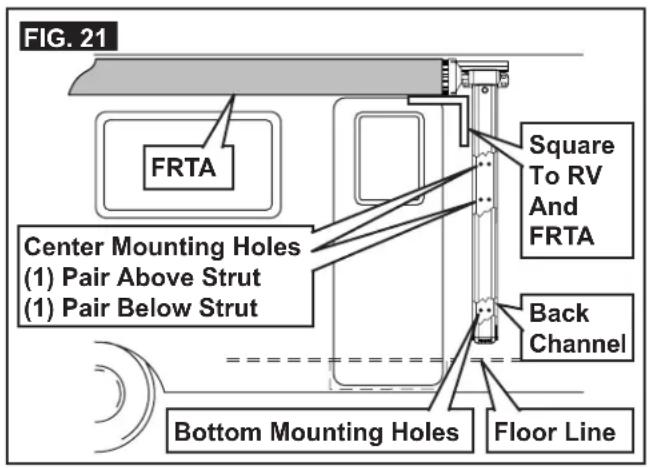
- Square back channel to RV and FRTA. Then mark bottom mounting hole locations (LH and RH back channels). See (FIG. 1) & (FIG. 21).

Measuring from a door or window frame is acceptable.
- Wiring hole for motorized arm assembly. See (FIG. 1) (FIG. 2).

The motorized arm assembly is ALWAYS installed at the RH side of awning.
Wiring harness location is determined by awning model. The back channel will either have a notch at top, or a hole near bottom for wiring to pass through RV wall.
a. If wiring will pass through RV wall at TOP of back channel, skip to step (4).
b. If wiring will pass through RV wall at BOTTOM of back channel, mark wiring hole location.
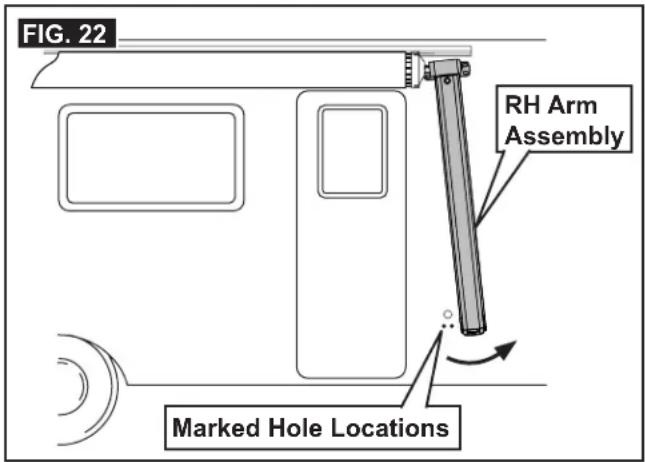
- Carefully swing arm assembly aside (out of the way), to expose marked hole locations. See (FIG. 22).

If arm is too stiff to swing aside, loosen screw on inside slot of top mounting bracket.
- Drill 3/16" diameter holes through marked mounting hole locations and into solid structure of RV.

Drill 7/32" diameter holes if drilling into steel.
- Drill (1) 5/8" diameter hole at marked BOTTOM wiring hole location and through outside wall of RV.

Skip this step if attaching LH back channel, or if wiring will pass through RV wall at TOP of RH back channel.
- Swing back channel back in place, and align its mounting holes to the pre-drilled holes in RV.

Retighten screw on inside slot of top mounting bracket (if loosened earlier to swing arm assembly aside).
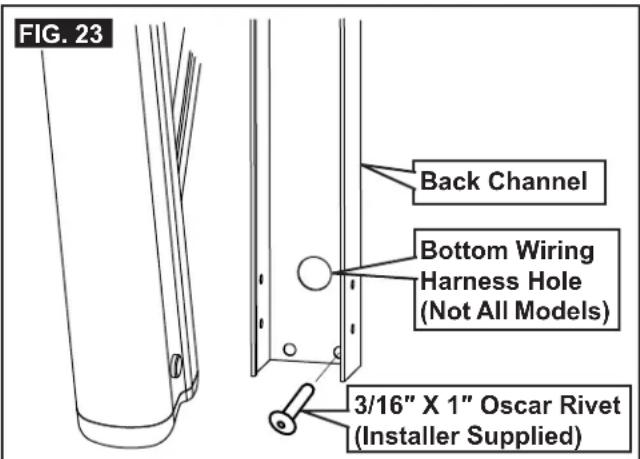
- Apply sealant to 3/16" X 1" oscar rivets (installer supplied). Then place rivets through bottom (2) mounting holes of back channel and secure to solid structure of RV. See (FIG. 23).

Structural backing (with skin) MUST be 3/8" to 1/2" thick to accommodate oscar rivets.
Alternatively, structural screws (installer supplied) may be used to secure back channel if RV has structural backing that will support at least 100 lb force per screw.
INSTALL AWNING
- Repeat steps (4) through (8) for opposite side.
- Apply sealant to #14-10 X 1 1/2" hex head screw threads. Then place and tighten screws through remaining slots of both top mounting brackets and into solid structure of RV. See (FIG. 18), (FIG. 19) & (FIG. 20).
D. Electrical Connections To Awning
NOTICE
Failure to obey the following notices could damage product or property:
- Make sure the positive (+) 12 Vdc terminal is disconnected from supply battery. Otherwise, damage to unit could occur.
- ALWAYS seal wiring against weather and moisture where wiring enters the RV's walls, roof and floor. Otherwise, water leakage could occur.
- Do NOT pinch wiring or allow wiring to rub against sharp edges. If wiring is damaged, it MUST be replaced by a qualified service technician.
Use a grommet (installer supplied) when routing wiring through RV wall.

If grommet is NOT used, use heat-shrink tubing where wiring will pass through RV wall.
1. MOTOR AND SWITCH CONNECTIONS:

a. Pull wiring through wiring hole (and grommet), and connect to appropriate wiring inside RV.

If grommet is NOT used, make sure sealant will also provide effective and permanent protection against wire damage.
See instructions included with your Dometic Corporation switch kit for additional wiring instructions.
b. Connect motor wiring to the factory pre-wired hardware wiring. See (FIG. 24).
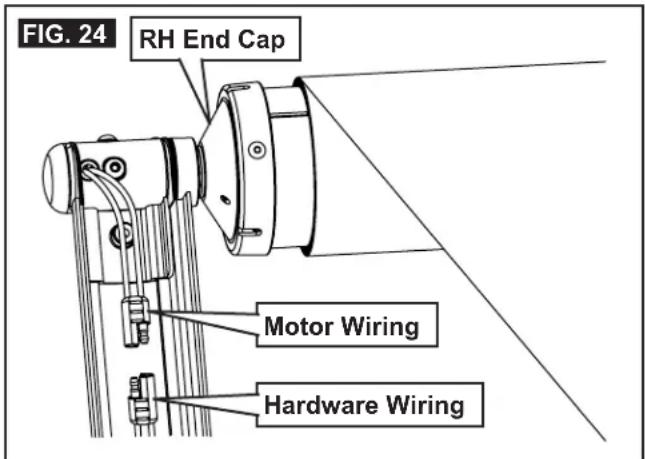
c. Secure any slack motor / hardware wiring inside front channel to prevent pinched or damaged wiring during awning operation.
2. LED LIGHT CONNECTIONS (IF EQUIPPED):

Skip this step if awning is NOT equipped with an LED light strip.

a. Connect LED connector with hardware connector. See (FIG. 25).
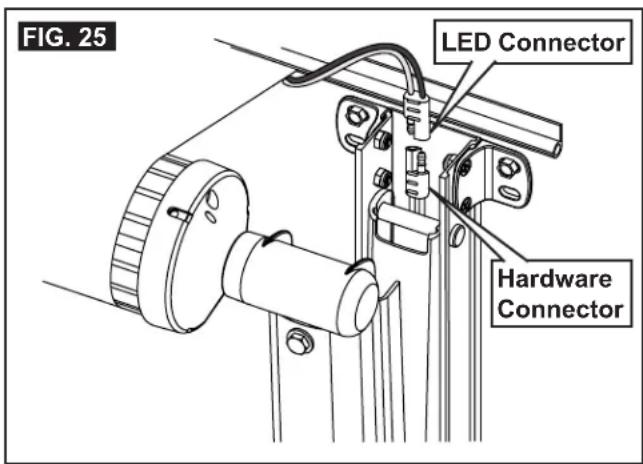
b. Pull wiring through wiring hole (and grommet).

If grommet is NOT used, make sure sealant will also provide effective and permanent protection against wire damage.
c. Connect LED switch wiring to the factory pre-wired LED light strip (Red or White wire positive, Black wire negative).

See instructions included with your LED switch kit (installer supplied) for additional wiring instructions.
d. Secure wiring to prevent pinching or other damage during awning operation.

Allow enough slack in wiring to safely accommodate possible fabric movement.
INSTALL AWNING
E. Complete Back Channel Installation

- With power applied to awning, close awning (fully retract) to verify hardware is nesting correctly. See "Close Awning" in Operating Instructions.
- ⚠️CAUTION PINCH HAZARD. Maintain a horizontal distance of at least 16" between fully open awning and any permanent object. Failure to obey this caution could result in injury. Open awning (fully extend). See "Open Awning" in Operating Instructions.
- Verify back channel is still square to RV and FRTA. See (FIG. 21).
- ⚠️WARNING FIRE OR ELECTRICAL SHOCK HAZARD. Make sure there are no obstacles (wires, pipes, etc.) inside RV's roof, floor and walls. Shut OFF gas supply, disconnect 120 Vac power from RV, and disconnect positive (+) 12 Vdc terminal from supply battery BEFORE drilling or cutting into RV. Failure to obey these warnings could result in death or serious injury.
- Using (1) pair of center mounting holes as a guide, drill 3/16" diameter holes into solid structure of RV. See (FIG. 1), (FIG. 2) & (FIG. 21).

Wiring cover (if present) MUST be removed from RH back channel to access center mounting holes.
Center mounting holes may be above or below strut.
Drill 7/32" diameter holes if drilling into steel.
- Verify wiring (if applicable) is not caught between hardware and RV wall before tightening fasteners.
- Apply sealant to 3/16" X 1" oscar rivets (provided). Then place rivets through back channel (center mounting holes) and secure to solid structure of RV. See (FIG. 23).

Structural backing (with skin) MUST be 3/8" to 1/2" thick to accommodate oscar rivets.
Alternatively, structural screws (installer supplied) may be used to secure back channel if RV has structural backing that will support at least 100 lb force per screw.
- Repeat steps (3) through (7) for opposite side.
- Replace wiring cover onto RH back channel (if applicable).
- Reapply power to awning, and close awning (fully retract).
F. Secure Awning Fabric To Awning Rail

- With power applied to awning, open and close awning four or five times to allow natural self adjustment of awning fabric. See Operating Instructions.
- Verify alignment of awning fabric, and proper nesting of hardware.
a. If there is misalignment, adjust arm assembly by loosening back channel and top mounting bracket screws and move back channel accordingly. (Retighten screws.)
b. Cycle awning again to check alignment.
- Ensure arm assemblies are still nested correctly, then mark location of awning fabric edges on awning rail.
- Pull one edge of awning fabric approximately 1/4" beyond marked position. Then secure with #6 X 7/16" TEK screw through awning rail (approximately 2" from fabric edge). See (FIG. 26).
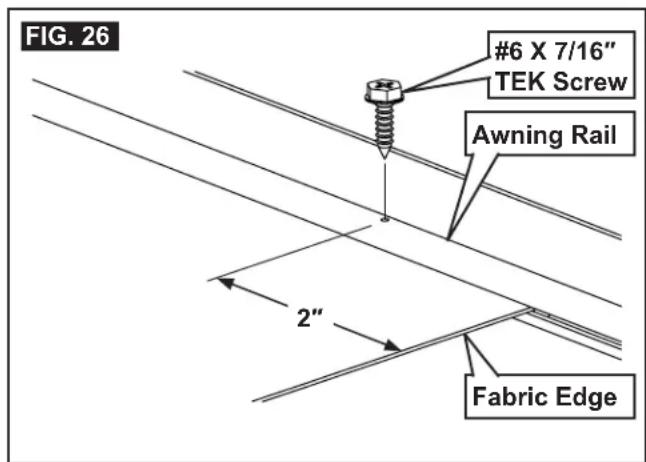
- Pull to stretch opposite edge of awning fabric approximately 3/4". Then secure with #6 X 7/16" TEK screw through awning rail (approximately 2" from fabric edge).
VERIFY INSTALLATION
A. Test Operation
With power applied to awning, operate awning according to Operating Instructions to verify all parts are functioning correctly.
B. Secure Awning For Travel

- Fully close awning. See "Close Awning" in Operating Instructions.
- Verify awning is secure for travel. See "Prepare Awning For Travel" in Operating Instructions.
C. Keep Literature
Instructions contain valuable information for product use and consumer safety.

Keep BOTH the Installation and Operating Instructions with product.
- INSTALLATION
- INSTRUCTIONS
- 9100
- POWER PATIO AWNING
- HARDWARE
- FRTA
- INTRODUCTION
- TABLE OF CONTENTS
- DOCUMENT SYMBOLS
- IMPORTANT SAFETY INSTRUCTIONS
- Recognize Safety Information
- Understand Signal Words
- Supplemental Directives
- U.S.A.
- CANADA
- General Safety Messages
- WARNING
- GENERAL INFORMATION
- Included Hardware
- Optional Components & Kits
- SPECIFICATIONS
- Hardware (Back Channel) Dimensions
- Door Clearance
- Measuring Tips
- PREPARE FOR INSTALLATION
- Door Roller And Edge Guard (Optional)
- Prepare Awning Rail And Insert Fabric
- Prepare Awning For Installation
- ⚠️WARNING IMPACT OR PINCH HAZARD.
- Determine Awning Location
- ⚠️WARNING IMPACT OR CRUSH HAZARD.
- INSTALL ELECTRICAL KITS
- WARNING ELECTRICAL SHOCK HAZARD.
- Install (Fixed/Wired) Awning Switch
- Install Ignition/Safety Interlock System
- Install LED Light Switch (If Applicable)
- INSTALL AWNING
- Insert Awning Fabric Into Awning Rail
- Attach Top Mounting Brackets / Arm Assemblies
- Attach Back Channels
- Electrical Connections To Awning
- NOTICE
- MOTOR AND SWITCH CONNECTIONS:
- LED LIGHT CONNECTIONS (IF EQUIPPED):
- Complete Back Channel Installation
- Secure Awning Fabric To Awning Rail
- VERIFY INSTALLATION
- Test Operation
- Secure Awning For Travel
- Keep Literature
Brand : DOMETIC
Model : Power Awning
Category : Store d'ombrage