
TL2803G - Alarm DSC - Free user manual and instructions
Find the device manual for free TL2803G DSC in PDF.


| Product Type | 3G Cellular Alarm Communicator |
| Brand | DSC (Digital Security Controls) |
| Model | TL2803G |
| Network Technology | HSPA+ (3G) with 2G fallback |
| Compatible Panels | DSC PowerSeries, PowerSeries NEO, and others with TL280 interface |
| Dimensions | Approx. 10.2 x 7.6 x 2.5 cm (4 x 3 x 1 in) |
| Weight | Approx. 100 g (3.5 oz) |
| Power Input | 12 V DC, 500 mA (from alarm panel or external adapter) |
| Battery Backup | Internal rechargeable battery (optional, not included) |
| SIM Card Required | Yes, standard size SIM (not included) |
| Primary Function | Transmits alarm signals to central monitoring station via cellular network |
| Communication Protocol | Contact ID over TCP/IP or SMS (depending on configuration) |
| Installation Method | Surface mount or DIN rail; wired connection to alarm panel |
| Operating Temperature | 0°C to 50°C (32°F to 122°F) |
| Humidity Range | 5% to 95% non-condensing |
| LED Indicators | Power, Network Status, Signal Strength |
| Antenna Type | Internal or external magnetic mount (if equipped) |
| Security Features | Encrypted communication, tamper detection, supervision |
| Maintenance | Keep clean and dry; check signal strength periodically; replace SIM as needed |
| Spare Parts & Repairability | Contact DSC dealer for replacement unit; no user-serviceable parts |
| General Information | Designed for reliable alarm reporting over cellular networks; complies with relevant regulations |
Frequently Asked Questions - TL2803G DSC
User questions about TL2803G DSC
0 question about this device. Answer the ones you know or ask your own.
Ask a new question about this device
Download the instructions for your Alarm in PDF format for free! Find your manual TL2803G - DSC and take your electronic device back in hand. On this page are published all the documents necessary for the use of your device. TL2803G by DSC.
USER MANUAL TL2803G DSC
natural_image
Abstract digital globe with network nodes and connecting lines over a blue gradient background (no text or symbols)
Contents
Introduction 3
Frequency Hopping Spread Spectrum....4
Full Two-Way Synchronized TDMA Communication....5
Secured Wireless Communication with AES Encryption....6
Unmatched Benefits with a Breakthrough Technology .... 7
Summary......8
Introduction
Today, wireless communication is part of daily life. Users have gained full confidence in wireless performance and rely on numerous wireless devices used in their home and work lives. Wireless communication is everywhere we turn and it affects everything in multiple ways.
With intrusion alarm systems, this trend is no different. The shift from hard-wired to wireless alarm systems has been rapid and now wireless technology is increasingly accepted for security applications in residential and business premises. Security installers are standing behind wireless alarm systems, allowing for consumer adoption and insurance companies' acceptance of technologies that had once been considered not trustworthy enough for security.
An additional driver for wireless security is the growth of the connected home. As more homes and businesses adopt networks allowed varying degrees of automation, the demand for wireless security devices is increasing. A study released by Radiant Insights in mid-2015* projected that worldwide sales of security devices for the connected home would grow from about \1.2 billion in 2014 to over \7.5 billion by 2021.
PowerG Technology is one of the leading technologies targeted to this growing market segment. A proprietary, tree topology protocol developed by Tyco Security Products, it is optimized specifically for the monitoring and control of battery-operated devices for security and safety applications for homes and businesses. As such, it fully addresses the key requirements for wireless security systems: reliability, performance, privacy, vulnerability, usability, and maintenance.
At Tyco 2015. This document contains Tyco proprietary information, as well as publicly available information. Both may be subject to change without notice. All rights reserved. Reproduction or distribution other than for intended purposes is prohibited, without the prior written consent of Tyco.
The trademarks and service marks of Lyoo, including the Lyoo mark and logo and PowerG are the exclusive property of Lyoo, and may not be used without permission. All other marks are the property of their respective owners. Created 04/2016.
http://www.radentreights.com/research-security-devices-for-connected-home-industry
Frequency Hopping Spread Spectrum
Frequency hopping Spread Spectrum (FHSS) derives from military radio technology where it was designed to be secure and reliable under adverse battle conditions. FHSS changes the frequency of a transmission at intervals faster than an inductor can return a jamming device. With FHSS, the bandwidth is divided into multiple frequency channels. Once a wireless connection is established and time-synchronization is gained, the receiver and transmitter agree on one or practically infinite frequency hopping sequences. These sequences are both encrypted and time-dependent. Based on the current time and a mathematical calculation, both the receiver and transmitter hop to the next frequency channel in the sequence at the same time. Unless the system time, the system encryption key and the proper calculation are all known, the communication cannot be tracked. As a result, unauthorized interception of, or eaveshopping on a communication is virtually impossible.
the PowerG network uses Frequency Hopping Spread Spectrum technology. The network continuously hopes between multiple frequencies spread over the entire assigned frequency band: 8 hopping frequencies in the 433-451MHz bands, 4 hopping frequencies in the 868-869MHz bands, and 50 hopping frequencies in the 912-918MHz bands.
The network does not remain in a single frequency out switches frequencies 64 times a second, using an encrypted unique pseudo-random sequence known only to devices enrolled to the PowerG panel. The pseudo-random sequence differs from one PowerG panel to another.
By using FHSS technology, the PowerG network successfully overcomes intentional and unintentional interferences and jamming. Multiple PowerG-based alarm systems can operate in the same vicinity without interfering with each other. Robustness and reliability of the wireless network increases dramatically.
An analogy to FHSS is as follows: Imagine a car driven in a multi-lane highway. As a strategy, the driver continuously and rapidly changes lanes. If one of the lanes is blocked by road works or a road accident, the car will avoid the disturbance because it is changing lanes continuously. The following figure illustrates the FHSS concept.
frequency hopping avoids blocking and interferences

flowchart
graph TD
    A["Time"] --> B["Good Hops"]
    B --> C["Bad Hop"]
    C --> D["Bad Frequency (Interference)"]
    style A fill:#f9f,stroke:#333
    style B fill:#ccf,stroke:#333
    style C fill:#cfc,stroke:#333
    style D fill:#fcc,stroke:#333
Full Two-way Synchronized TDMA Communication
TDMA (Time Division Multiple Access) is a digital transmission technology that allows a number of users to access a single radio-frequency (RF) channel without interference by allocating unique time slots to each user within each channel.
TOMA Fabric Structure
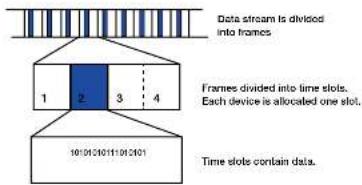
flowchart
graph TD
    A["Data stream is divided into frames"] --> B["Frames divided into time slots. Each device is allocated one slot."]
    B --> C["Time slots contain data."]
    D["1"] --> E["2"]
    E --> F["3"]
    F --> G["4"]
The users transmit in rapid succession, one after the other, each using their own time slot. The allows multiple users to share the same transmission medium (e.g., radio frequency channel) while using only part of its channel capacity. Multiple users, therefore can share the same frequency channel without causing interference because the signal is divided into multiple timeslots, where each timeslot acts as a separate communication path. TOMA relies upon the fact that the signal has been digitized - divided into millions-to-long packers; it allocates a single frequency channel for a short time and then moves to another channel. TOMA is used in digital cellular systems such as GSM.
Similar to the GSM cellular network, each device in the PowerG network is allocated unique timeslots for full two-way data transmission with the panel, streamlining communication and increasing channel efficiency. This eliminates RF collisions and assures that no alarm or supervision message is lost.
TDMA technology allows a low-latency, low-power downlink channel, which is vital to minimizing power usage while maintaining required performance. PowerC-powered devices are mostly dormant, they wake up frequently and periodically, switching on their receiver for a fraction of a millisecond, during which downlink messages can be sent. In this way, they are instantly responsive to a transmitted message, with minimum awake time. Sleepy PowerC devices are kept time synchronized to within + / - 30~ SEC , with an energy consumption footprint of less than 2 A . This response time is ideally suited to provide the services needed for the full range of home/business security and safety applications, including heavy-duty applications, for example battery operated streets that need to be activated within a fraction of a second.
In this way, TDMA technology provides the devices with extended battery life since the device is only transmitting a portion of the time. Repeated transmissions are also avoided, resulting in an energy-saving network.
An analogy to the PowerC synchronized TDMA communication is as follows: imagine a meeting attended by several people. When communication is not synchronized, participants speak simultaneously, creating Interferences and communication blocks. On the other hand, if the meeting is managed by a moderator who controls who speaks by a complex set of rules and a rigid clock, each participant restricts his or her speaking to a specific timestamp during which everyone else remains silent. The meeting is then conducted effectively.
Secured Wireless Communication with AES Encryption
AES (Advanced Encryption Standard) is a symmetric (private key) encryption standard originally published as Rijndae (after its inventors Rijmen and Desmen) in 1998 and adopted by the U.S. government in 2000. In 2001, AES was chosen by NIST (National Institute of Standards and Technology) as the Federal Information Processing Standard (IIPS), also known as IIPS197. In 2003, the National Security Agency (NSA) stated that AES was secure enough to protect its information at the secret and top-secret levels.
AES consists of three block ciphers. Each cipher has a 129-bit block size with three different key sizes of 128, 182, and 256 bits. The algorithm is based on permutations and substitutions. Permutations are rearrangements of data, and substitutions replace one unit of data with another. AES performs permutations and substitutions using several different techniques. The AES cipher repetitively performs a number of transformation rounds, thus converting the input plain data into an output of cipher data. There are several processing steps for each round, with one round that relies exclusively on the encryption key. Then, a set of reverse rounds are applied to convert the cipher data back into plain data. The AES encryption uses a single key which is a shared secret between the sender and receiver to encrypt and decrypt data. An analogy is a locked mailbox without a mail slot. Anybody who wants to leave or read a message needs to have a key to the mailbox.
The PowerG network employs the proven AES-128 (128 bit key) advanced encryption algorithm for correct message identification and for protecting the alarm system from code grabbing and from message substitution by hackers and other attackers. AES-128 uses 10 rounds with each round performing several transformations.
AES is a well-proven encryption algorithm that guarantees strong authentication and encryption security for the PowerG wireless network.
AES Transformations Round

flowchart
graph TD
    A["16 input bytes"] --> B["Sub-Bytes"]
    B --> C["ShiftRows"]
    C --> D["Variables"]
    D --> E["Accorroundkey"]
    E --> F["Output bytes"]

    subgraph Input
        G["0"] --> H["1"] --> I["2"] --> J["3"] --> K["4"] --> L["5"] --> M["6"] --> N["7"] --> O["8"] --> P["9"] --> Q["10"] --> R["11"] --> S["12"] --> T["13"] --> U["14"] --> V["15"]
    end

    subgraph Convolutional
        W["0"] --> X["1"] --> Y["2"] --> Z["3"] --> AA["4"] --> AB["5"] --> AC["6"] --> AD["7"] --> AE["8"] --> AF["9"] --> AG["10"] --> AH["11"] --> AI["12"] --> AJ["13"] --> AK["14"] --> AL["15"]
    end

    subgraph Feedback
        M["0"] --> N["1"] --> O["2"] --> P["3"] --> Q["4"] --> R["5"] --> S["6"] --> T["7"] --> U["8"] --> V["9"] --> W["10"] --> X["11"] --> Y["12"] --> Z["13"] --> AA["14"] --> AB["15"]
    end
Unmatched Benefits with a Breakthrough Technology
The combination of technologies—Frequency Flopping Spread Spectrum (FISS), synchronized TDMA communication, and AES—gives PowerG immense strength to deliver a new advanced alarm system that provides unmatched advantages for professional installers, central monitoring stations and end-users alike. In fact, PowerG provides the convenience of a wireless network with reliability closer than over-to that of a hard-wired one.
• Energy-saving network
Each device continuously measures communication quality and automatically sets its transmission power to the minimum required for reliable communication with the panel. Full, two-way synchronized communication ensures minimum, short transmissions. These significantly extend the battery life of PowerG devices to exceed 8 years. Furthermore, on-site maintenance visits are reduced due to the system's capability to support numerous functions remotely.
• Unmatched robustness and reliability
Signals continuously hop between channels in a random sequence, avoiding interferences and jamming. TDMA communication ensures RF collisions are eliminated.
• Surpasses most industry security standards
The PowerG network employs the proven AES-128 encryption algorithm, protecting the system from code grabbing and message substitution by hackers and other attackers.
• Huge transmission range
PowerG employs advanced radio and diversity antenna technologies that, when combined with frequency hopping and synchronized TDMA communication, result in an extremely large range—far greater than the industry standard. This enables repeater-free installations even on very large premises. Tests reveal a line of sight communication range greater than 2km (6,000ft). By adding a PowerG repeater the range can be doubled.
• Support for advanced applications
PowerG was designed to handle a substantially high bandwidth, enabling the network to transmit large amounts of data in a short time. This provides the infrastructure for solutions such as installations with numerous devices, audio and video applications. Additionally, as a proprietary technology, PowerG supports mobile apps developed specifically to provide real-time visibility and control of PowerG power home and business security alarm systems.
• Advanced, time and money-saving toolset
The PowerG full two-way uplink and downlink data communication providers installers with powerful tools, unmatched in our industry, that can save time and money on a daily basis. The toolsets include: quick and easy installation with built-in link quality indicators on the devices; on-site and remote configurations of devices and peripherals; cost-saving advanced on-site and remote diagnostics—the system continuously diagnoses the RF environment and interference at the site and provides (locally and remotely) meaningful information to help understand and resolve problems; remote real time testing and walk testing of the system.
* In actual installations, the range is reduced due to construction signal attenuation.
Summary
While Frequency Hopping Spread Spectrum, TDMA communication and AES are not new technologies, it is the implementation of all three within PowerG that makes this system so innovative and revolutionary. This combination in Tyco's intrusion alarm systems fully answers the urgent needs of our industry.
By creating an energy-saving, highly robust and reliable network and providing long transmission range, an advanced, time-saving toolset, and support for advanced applications and mobile control, Tyco's PowerG-based intrusion alarm systems fully answer the urgent needs of our industry.
About TSP
Tyco Security Products and its leading brands conducts business in over 176 countries around the world, in multiple languages and employs over 2,700 employees globally, including research and development, marketing, manufacturing, sales, service and logistics teams in the Americas, Europe, the Middle East, Africa, and Asia Pacific. Our products, built by developers from all product disciplines, consistently allow customers to see more, do more, and save more across multiple industries and segments including healthcare, government, transportation, finance, retail, commercial and residential. Worldwide, Tyco Security Products helps protect 42% of Fortune 500 companies, transportation systems on five continents, 37% of the world's top 100 retailers, over two million commercial enterprises, thousands of students in more than 900 educational facilities, and over five million private residences. Learn more about Tyco Security Products at www.tycosecurityproducts.com
© Tyco 2016. This document contains Tyco proprietary information, as well as publicly available information. Both may be subject to change without notice. All rights reserved. Reproduction or distribution other than for intended purposes is prohibited, without the prior written consent of Tyco.
The trademarks and service marks of Tyco, including the Tyco mark and logo and PowerG are the exclusive property of Tyco, and may not be used without permission. All other marks are the property of their respective owners. Created 04/2016.

- Contents
- Introduction
- Frequency Hopping Spread Spectrum
- Full Two-way Synchronized TDMA Communication
- Secured Wireless Communication with AES Encryption
- Unmatched Benefits with a Breakthrough Technology
- • Energy-saving network
- • Unmatched robustness and reliability
- • Surpasses most industry security standards
- • Huge transmission range
- • Support for advanced applications
- • Advanced, time and money-saving toolset
- Summary
- About TSP
Brand : DSC
Model : TL2803G
Category : Alarm