
ICG2000SP - Hob GORENJE - Free user manual and instructions
Find the device manual for free ICG2000SP GORENJE in PDF.


| Product Type | Glass Ceramic Induction Hob |
| Brand | Gorenje |
| Model | ICG2000SP |
| Power Supply | 230 V, 16 A |
| Number of Cooking Zones | 1 |
| Power Levels | 10 (200 W - 2000 W) |
| Temperature Range | 60°C - 240°C |
| Programmable Timer | 1 - 179 minutes |
| Child Lock | Yes |
| Automatic Shut-off | Yes |
| Overheating Protection | Yes |
| Suitable Cookware | Induction-compatible (magnetic base) |
| Cleaning Method | Damp cloth, commercial glass ceramic cleaner, glass scraper for burnt residues |
| Safety Features | Sensor control, child lock, automatic switch-off, overheating protection |
| Noise Level | Lc < 70 dB(A) |
| Energy Transfer | Direct induction (electromagnetic) |
Frequently Asked Questions - ICG2000SP GORENJE
User questions about ICG2000SP GORENJE
0 question about this device. Answer the ones you know or ask your own.
Ask a new question about this device
Download the instructions for your Hob in PDF format for free! Find your manual ICG2000SP - GORENJE and take your electronic device back in hand. On this page are published all the documents necessary for the use of your device. ICG2000SP by GORENJE.
USER MANUAL ICG2000SP GORENJE
ICG2000SP
| STEKLOKERAMIČNA INDUKCIJSKA KUHALNA PLOŠČA | SI |
| STAKLOKERAMIČKA INDUKCIJSKA PLOČA ZA KUHANJE | BIH HR |
| STAKLOKERAMIČKA INDUKCIONA PLOČA ZA KUVANJE | BIH SRB MNE |
| GLASS CERAMIC INDUCTION HOB | GB |
| SKLOKERAMICKÝ INDUKČNÝ VARNÝ PANEL | SK |
| WITROCERAMICZNA INDUKCYJNA PŁYTA | PL |
| UVEGKERAMIA INDUKCIOS FŐZŐLAP | H |
| PLITA CU STICLĂ CERAMICĂ CU INDUCTIE | RO |
| ИНДУКЦИОНЕН СТЪКЛОКЕРАМИЧЕН ПЛОТ | BG |
| СТЕКЛОКЕРАМИЧЕСКАЯ ИНДУКЦИОННАЯ ВАРОЧНАЯ ПАНЕЛЬ | RUS |
SI Navodila za uporabo .... 3
Kuhalne stopnje
Zapečen šećer te plastiku smesta – dok je još vruć – odstranite staklenom strugalicom. Zatim očistite površinu ploče kao što je opisano pod tačkom 2.
Zrnca peska koja padnu na ploču za kuvanje, npr. prilikom guljenja krompira ili pranja salate, mogu kod pomeranja posude izgrebati površinu ploče, stoga pazite da pesak ne ostane ploči za kuvanje.
Promene boja na površini ploče ne utiču na delovanje i stabilnost staklokeramičke ploče, jer se u tom slučaju ne radi o oštećenjima, nego zapečenim ostatcima hrane.
Disposing of old appliances
The symbol on the product or on its packaging indicates that this product may not be treated as household waste. Instead it must be handed over to a collection point for the recycling of electrical and electronic equipment.
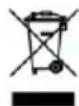
By ensuring that this product is disposed of correctly you will help to protect the environment and human health, which could otherwise be harmed through the inappropriate disposal of this product. For more detailed information about recycling of this product, please contact your local city office, your household waste disposal service or the shop where you purchased the product.
Correct use
The hob is to be used solely for preparing food in the home. It may not be used for any other purpose.
For your information...
Please read this manual carefully before using your appliance. It contains important information on safety and on how to use and look after your appliance so that it will provide you with many years of reliable service.
Should your appliance develop a fault, please first consult the section on "What to do if trouble occurs?"
You can often rectify minor problems yourself, without having to call in a service engineer. Please keep this manual in a safe place and pass it on to new owners for their information and safety.
SAFETY INSTRUCTIONS
Connection and operation
- The appliances are constructed in accordance with the relevant safety regulations.
- The appliance is manufactured in compliance with the relevant effective safety standards.
Nevertheless, we strongly recommend that persons with impaired physical, motoric, or mental capacity, or persons with inadequate experience or knowledge, do not use the appliance unless attended by a qualified person. The same recommendation applies when the appliance is used by persons of less-than-legal age. - Connecting the appliance to the mains and repairing and servicing the appliance may only be carried out by a qualified electrician according to currently-valid safety regulations. For your own safety, do not allow anyone other than a qualified service technician to install, service or repair this appliance.
- Check to make sure the mains socket has the correct rating (16A,230V) before you connect the appliance.
- Only use the appliance if the electrical system in your home has a rating of 16A.
- Noise level: Lc < 70 dB(A)
Concerning the hob

Never touch the surfaces of heating or cooking appliances. They will become hot during operation. Keep children at a safe distance. There is a risk of burning!
- Never allow the induction hob to operate unattended, as the high power setting (power max.) results in extremely fast reactions.
- When cooking, pay attention to the heat-up speed of the cooking zones. Avoiding boiling the pots dry as there is a risk of the pots overheating!
- Do not place empty pots and pans on cooking zones which have been switched on.
- Take care when using simmering pans as simmering water may dry up unnoticed, resulting in damage to the pot and to the hob for which no liability will be assumed.
-
It is essential that after using a cooking zone you switch it off.
-
Overheated fats and oils may spontaneously ignite. Always supervise the preparation of food with fats and oils. Never extinguish ignited fats and oils with water! Put the lid on the pan and switch off the cooking zone.
- The glass ceramic surface of the hob is extremely robust. You should, however, avoid dropping hard objects onto the glass ceramic hob. Sharp objects which fall onto your hob might break it.
- If cracks, fractures or any other defects appear in your glass ceramic hob, immediately switch off the appliance. Disconnect fuse immediately and call Customer Service.
- If the hob cannot be switched off due to a defect in the sensor control immediately disconnect your appliance and call Customer service.
- Take care when working with home appliances! Connecting cables must not come into contact with hot cooking zones.
- The glass ceramic hob should not be used as a storage area.
- Do not put aluminium foil or plastic onto the cooking zones. Keep everything which could melt, such as plastics, foil and in particular sugar and sugary foods away from hot cooking zones. Use a special glass scraper to immediately remove any sugar from the ceramic hob (when it is still hot) in order to avoid damaging the hob.
- Metal items (pots and pans, cutlery, etc.) must never be put down on the induction hob since they may become hot. Risk of burning!
- Do not place combustible, inflammable or heat deformable objects directly underneath the hob.
- Metal items worn on your body may become hot in the immediate vicinity of the induction hob. Caution! Risk of burns! Non-magnetisable objects (e.g. gold or silver rings) will not be affected.
- Never use the cooking zones to heat up unopened tins of food or packaging made of material compounds. The power supply may cause them to burst!
- Keep the sensor buttons clean since the appliance may consider dirt to be finger contact. Never put anything (pans, tea towels etc.) onto the sensor buttons! If food boils over onto the sensor buttons, we advise you to activate the OFF button.
- Hot pans should not cover the sensor buttons, since this will cause the appliance to switch off automatically.
- Activate the childproof lock if there are any pets in the home which could make contact with the hob.
- The induction hob may not be used when pyrolysis operation is taking place in a built-in oven.
- The appliance is not intended to be operated by means of an external timer or separate remote-control system.
- Do not use the glass ceramic hob if it is cracked or broken. If any visible crack appears, immediately unplug disconnect the appliance from the power supply.
- If the supply cord is damaged, it must be replaced by the manufacturer, its service agent or similarly qualified persons in order to avoid a hazard.
- Do not let the cord hang over the edge of the table or worktop.
- WARNING: Danger of fire: do not store items on the cooking surfaces.
- WARNING: Unattended cooking on a hob with fat or oil can be dangerous and may result in fi re. Never try to extinguish a fi re with water, but switch off the appliance and then cover fl ame with a lid or a damp cloth.
• After use, switch off the hob element by its control and not rely on the pan detector. (depending on model) - WARNING: If the surface is cracked, switch off the appliance to avoid the possibility of electric shock. (depending on model)
- Metallic objects such as knives, forks, spoons and lids should not be placed on the hob surface since they can get hot. (depending on model)
- WARNING: Ensure that the appliance is switched off before replacing lamp to avoid the possibility of electric shock.
- Do not use harsh abrasive cleaners or sharp metal scrapers to clean the oven door glass since they can scratch the surface, which may result in shattering of the glass.
Concerning persons
Caution!
The appliance and its accessible parts become hot during use. Care should be taken to avoid touching heating elements. Children less than 8 years of age shall be kept away unless continuously supervised.
Children should be supervised to ensure that they do not play with the appliance.
This appliance can be used by children aged from 8 years and above and persons with reduced physical, sensory or mental capabilities or lack of experience and knowledge if they have been given supervision or instruction concerning use of the appliance in a safe way and understand the hazards involved.
Children shall not play with the appliance.
Cleaning and maintenance shall not be made by children unless they are older than 8 and supervised.
Keep the appliance and its cord out of reach of children less than 8 years.
Attention:
- Persons with cardiac pacemakers or implanted insulin pumps must make sure that their implants are not affected by the induction hob (the frequency range of the induction hob is 20-50 kHz).
Appliance description
The hob
The hob is equipped with an induction cooking mode. An induction coil underneath the glass ceramic hob generates an electromagnetic alternating field which penetrates the glass ceramic and induces the heat-generating current in the pot base. With an induction cooking zone the heat is no longer transferred from a heating element through the cooking pot into the food being cooked but the necessary heat is generated directly in the container by means of induction currents.
Advantages of the induction hob
– Energy-saving cooking through the direct transfer of energy to the pot (suitable pots/pans made of magnetisable material are required).
- Increased safety as the energy is only transferred when a pot is placed on the hob.
– Highly effective energy transfer between an induction cooking zone and the base of a pot.
- Rapid heat-up.
- The risk of burns is low as the cooking area is only heated through the pan base; food which boils over does not stick to the surface.
– Rapid, sensitive control of the energy supply.
OPERATION
Cookware for induction hobs
Cookware for induction cooking zones must be made of metal and have magnetic properties. The base must be sufficiently large.
Only use pots with a base suitable for induction.
This is how to establish the suitability of a pot:
Suitable cookware
Enamelled steel pots with a thick base
Cast iron pots with an enamelled base
Pots made of multi-layer stainless steel, rustproof fermite steel or aluminium with a special base
Unsuitable cookware
Pots made of copper, stainless steel, aluminium, ovenproof glass, wood, ceramic and terracotta
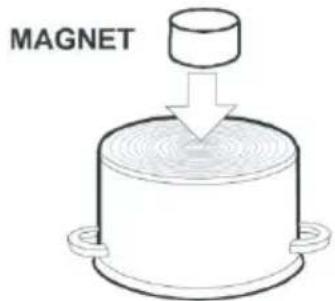
Conduct the magnet test described below or make sure that the pot bears the symbol for suitability for cooking with induction current.
Magnet test:
Move a magnet towards the base of your cookware. If it is attracted, you can use the cookware on the induction hob.
Note:
When using pans suitable for induction from certain manufacturers, noises may occur which are attributable to the design of these pans.
Take care when using simmering pans as simmering water may dry up unnoticed, resulting in damage to the pot and to the hob for which no liability will be assumed.
| Cooking zone | Minimum pan diameter |
| ∅ 260mm | ∅ 120mm |
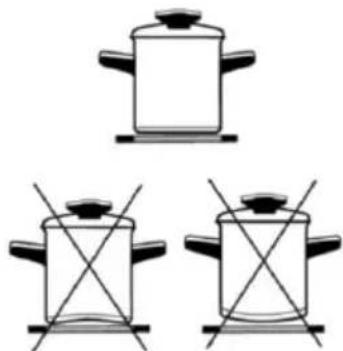
Never use pans with a misshapen base. A hollow or rounded base can interfere with the operation of the overheating protection, so that the appliance becomes too hot. This may lead to the glass top cracking and the pan base melting. Damage arising from the use of unsuitable pans or from boiling dry is excluded from the guarantee.
Power settings
The heating power of the cooking zones can be set at various power levels. In the chart you will find examples of how to use each setting.
| Cooking level: | Suitable for: |
| 1-2 | Keeping food warm. Simmering small quantity (lowest power setting). |
| 3 | Simmering. |
| 4-5 | Simmering larger quantities or roasting larger pieces of meat until they are cooked through. |
| 6 | Roasting, getting juices. |
| 7-8 | Roasting. |
| 9-10 | Roasting (highest power output). |
INDUCTION COOKER PANEL
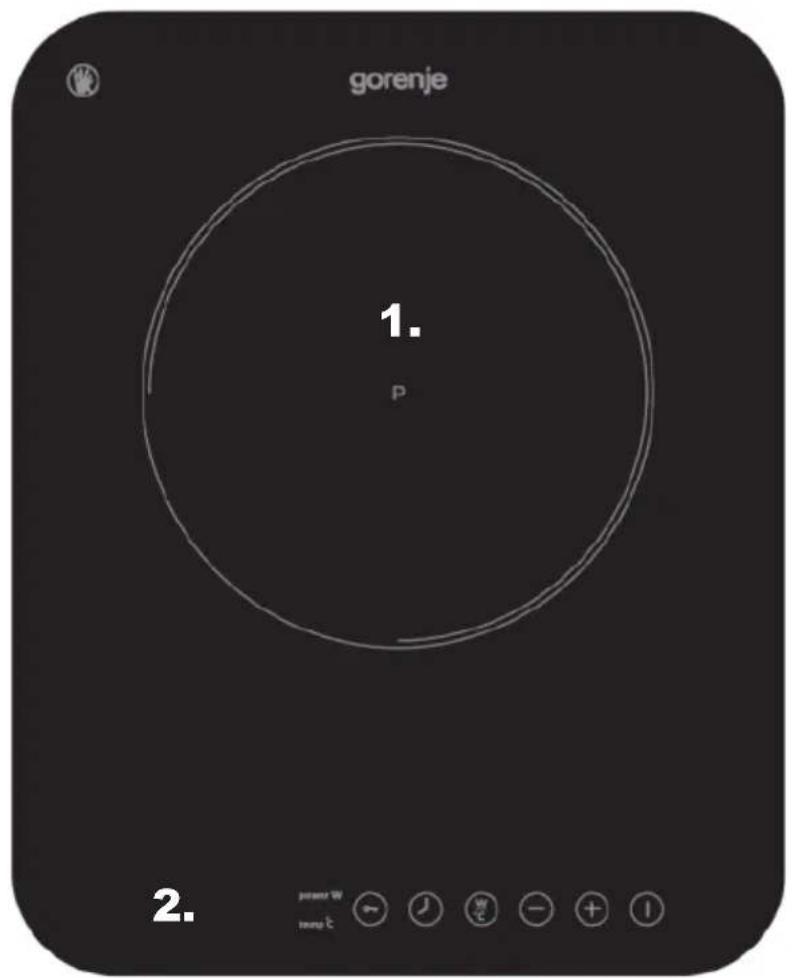
The decorative design may deviate from the illustrations.
- Cooking zone
- Touch-control operating panel
OPERATING THE HOB WITH THE SENSOR BUTTONS
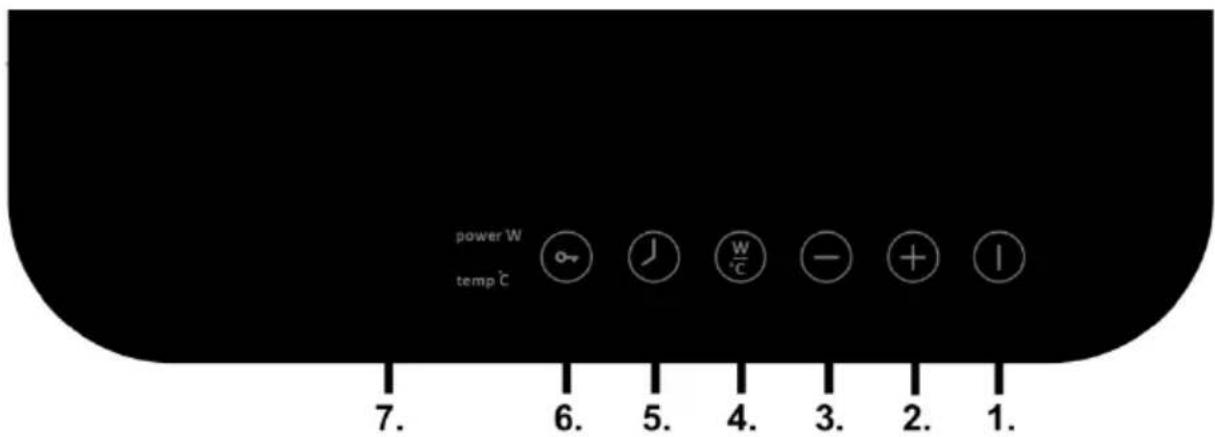
- ON/OFF sensor
- Sensor + to adjust the heat, temp and timer selection
- Sensor - to adjust the heat, temp and timer selection
- Power / Temperature selection (power/temp)
- TIMER selection
- Child lock
- LED display (POWER, TEMP, TIMER)
Operating the buttons
The controls described here expect the pressing of a (selection) button to be followed by the pressing of a subsequent button.
The next button will need to be pressed within 10 seconds, otherwise the selection will be deleted.
The + buttons can be touched individually or be permanently pressed.
Control of the cooking hob and cooking zones
- Upon connection of the glass ceramic hob to the power mains all indicators will briefly light up. The cooking hob is now ready for operation. The cooking hob is fitted with electronic sensors that are activated when the indicated area is touched with a finger for at least 1 second. Each time a sensor is activated, this will be confirmed by an acoustic signal and a lit LED indicator.
- Do not place any objects on the sensor surface. Make sure the sensor area is always clean. Place a piece of suitable cookware on the middle of the cooking zone.
- Press the ① sensor to switch on the cooking hob. Touch the ① sensor and keep pressed for at least 1 second. The cooking hob will be activated. "----" will be displayed, and an acoustic signal will be heard. Then, the appliance is ready for further function settings (note: if no function is selected or set in the following 30 seconds, the appliance will be switched off, which will be indicated by an acoustic signal).
- Then, press the w/c sensor. The cooking hob will automatically start to operate with a power of 1400W. Use the or sensor to adjust the power (200W, 400W, 600W, 800W, 1000W, 1200W, 1400W, 1600W, 1800W, 2000W). The hob can be switched off at any time by pressing the sensor. All settings will be deleted.
- In order to specify the cooking temperature, press the Ⓞ sensors again. The hob will start to operate at a preset temperature of 220°C. Use the ⊕ or ⊖ sensor to adjust to temperature as desired in the range from 60 °C to 240°C). The hob can be switched off at any time by pressing the ⏱ sensor. All settings will be deleted.
Programmable timer
Programmable timer will switch off each activated cooking zone after the set time expires. Cooking time can be set in the range from 1 to 179 minutes.
Switch on the cooking hob. Switch on one or more cooking zones and select the desired cooking power for each one.
Press the ⏻ sensor. "00:30" will appear on the display. Now use the ⊕ or ⊖ sensor to set the time. Use the ⊕ sensor to set the minutes and the ⊖ sensor to set the hours. If you press and hold the sensor, the setting on the display will change at an increasing rate.
To check the remaining cooking time, press the sensor. The preset time can be changed during operation by pressing the or sensor.
Important:
When the time expires, the cooking zone will be switched off. A short beep will be heard.
Child lock
By activating the lock function, you can prevent operation or use of the cooking zones. This way, the lock function also works as a child lock.
Activating the child lock:
The hob must be switched off. Press the ⏻ sensor to switch on the cooking hob. The cooking hob will be activated. " - - - - " will be displayed, and an acoustic signal will be heard. Press the ⏻ sensor and hold it for approx. 3 seconds. A short beep will be heard. The child lock is now activated.
Deactivating the child lock:
To deactivate the lock, press the sensor and hold it for approx. 3 seconds. A short beep will be heard. The child lock is now deactivated.
CLEANING AND CARE

- Before cleaning, switch off the hob and let it cool down.
- Do not use steam cleaners or high-pressure cleaners to clean the cooking hob, as this may result in an electric shock.
- When cleaning make sure that you only wipe lightly over the on/off sensor. The hob may otherwise be accidentally switched on!
Glass ceramic hob
Important! Never use aggressive cleaning agents such as rough scouring agents, abrasive saucepan cleaners, rust and stain removers etc.
Cleaning after use
Always clean the entire hob when it has become soiled. It is recommended that you do so every time the hob is used. Use a damp cloth and a little washing up liquid for cleaning. Then dry the hob with a clean dry cloth to ensure that there is no detergent left on the surface of the hob.
Weekly clean
Clean the entire hob thoroughly once a week with commercial glass ceramic cleaning agents.
Please follow the manufacturer's instructions carefully.
When applied, the cleaning agent will coat the hob in a protective film which is resistant to water and dirt. All dirt remains on the film and can be removed easily. Then rub the hob dry with a clean cloth. Make sure that no cleaning agent remains on the surface of the hob since this will react aggressively when the hob is heated up and will change the surface.
Specific soiling
Heavy soiling and stains (limescaling and shiny, mother-of-pearl-type stains) can best be removed when the hob is still slightly warm. Use commercial cleaning agents to clean the hob.
Proceed as outlined under Item 2.
First soak food which has boiled over with a wet cloth and then remove remaining soiling with a special glass scraper for glass ceramic hobs. Then clean the hob again as described under Item 2.
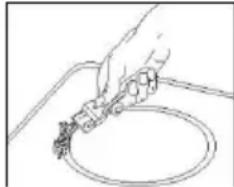
Burnt sugar and melted plastic must be removed immediately, when they are still hot, with a glass scraper. Then clean the hob again as described under Item 2.
Grains of sand which may get onto the hob when you peel potatoes or clean lettuce may scratch the surface of the hob when you move pots around. Make sure that no grains of sand are left on the hob.
Changes in the colour of the hob will not affect the function and the stability of the glass ceramic material. These colour changes are not changes in the material but food residues which were not removed and which have burnt into the surface.
Shiny spots result when the base of the cookware rubs on the surface of the hob, particularly when cookware with an aluminium base or unsuitable cleaning agents are used. They are difficult to remove with standard cleaning agents. You may need to repeat the cleaning process several times. In time, the decoration will wear off and dark stains will appear as a result of using aggressive cleaning agents and faulty pan bottoms.
WHAT TO DO IF TROUBLE OCCURS

Please note
If your appliance is faulty, please check whether you can rectify the problem yourself by consulting these instructions for use.
But there are some problems described below that you can fix yourself.
The fuses blow regularly?
Contact a technical customer service or an electrician!
You can't switch you induction hob on?
- Has the wiring system (fuse box) in the house blown a fuse?
- Has the hob been connected to the mains?
- Are the sensor buttons partly covered by a damp cloth, fluid or a metallic object? Please rectify.
- Are you using unsuitable cookware? See the section on "Cookware for induction hobs".
Is the cookware you are using making noises?
This is due to technical reasons; the induction hob and the pot are not at risk.
Does the cooling fan still operate after it has been switched off?
This is normal since the electronic unit is being cooled down.
Is the hob making noises (clicking or cracking sounds)?
This is for technical reasons and cannot be avoided.
Does the hob have tears or cracks?
If cracks, fractures or any other defects appear in your glass ceramic hob, immediately switch off the appliance. Disconnect fuse immediately and call Customer Service.
| SYMPTOM | POSSIBLE CAUSE | SOLUTION |
| Fault code E0. | Internal circuit error. | Contact the service department. |
| Fault code E1. | Without cookware or incompatible cookware used. | Please check whether the cookware is not suitable. |
| Fault code E2. | Overheating protection on power mode (>150°C). | Eliminate the course of overheating. Once the cooktop has cooled, the appliance can be put into operation again. |
| Fault code E3. | Electronic control of excess voltage (>270V). | Make sure the appliance is connected to the voltage indicated on the rating label. |
| Fault code E4. | Electronic control of low voltage. (<160V). | Make sure the appliance is connected to the voltage indicated on the rating label. |
| Fault code E5. | Temperature sensor open or short circuit. | Contact the service department. |
| Fault code E6. | IGBT open or short circuit. | Contact the service department. |
| Fault code E7. | Overheating protection on TEMP. mode (>240°C). | Eliminate the course of overheating. Once the cooktop has cooled, the appliance can be put into operation again. |
GUARANTEE & SERVICE
If you need information or if you have a problem, please contact the Gorenje Customer Care Centre in your country (you find its phone number in the worldwide guarantee leaflet). If there is no Customer Care Centre in your country, go to your local Gorenje dealer or contact the Service department of Gorenje domestic appliances.
For personal use only!
We reserve the right to any modifications!
GORENJE WISHES YOU A LOT OF PLEASURE WHILE USING YOUR APPLIANCE
Poziomy grzania
GWARANCJA I SERWIS NAPRAWCZY
Höfokbeállítások
① Ceasul electronic programabil
Забележка:

- KUHALNE STOPNJE
- DISPOSING OF OLD APPLIANCES
- CORRECT USE
- FOR YOUR INFORMATION
- SAFETY INSTRUCTIONS
- CONNECTION AND OPERATION
- CONCERNING THE HOB
- CONCERNING PERSONS
- CAUTION
- ATTENTION
- APPLIANCE DESCRIPTION
- THE HOB
- ADVANTAGES OF THE INDUCTION HOB
- OPERATION
- COOKWARE FOR INDUCTION HOBS
- SUITABLE COOKWARE
- UNSUITABLE COOKWARE
- MAGNET TEST
- NOTE
- POWER SETTINGS
- INDUCTION COOKER PANEL
- OPERATING THE HOB WITH THE SENSOR BUTTONS
- OPERATING THE BUTTONS
- CONTROL OF THE COOKING HOB AND COOKING ZONES
- PROGRAMMABLE TIMER
- CHILD LOCK
- ACTIVATING THE CHILD LOCK
- DEACTIVATING THE CHILD LOCK
- CLEANING AND CARE
- GLASS CERAMIC HOB
- CLEANING AFTER USE
- WEEKLY CLEAN
- SPECIFIC SOILING
- WHAT TO DO IF TROUBLE OCCURS
- PLEASE NOTE
- BUT THERE ARE SOME PROBLEMS DESCRIBED BELOW THAT YOU CAN FIX YOURSELF
- THE FUSES BLOW REGULARLY
- YOU CAN'T SWITCH YOU INDUCTION HOB ON
- IS THE COOKWARE YOU ARE USING MAKING NOISES
- DOES THE COOLING FAN STILL OPERATE AFTER IT HAS BEEN SWITCHED OFF
- IS THE HOB MAKING NOISES (CLICKING OR CRACKING SOUNDS)
- DOES THE HOB HAVE TEARS OR CRACKS
- GUARANTEE & SERVICE
- GORENJE WISHES YOU A LOT OF PLEASURE WHILE USING YOUR APPLIANCE
- POZIOMY GRZANIA
- GWARANCJA I SERWIS NAPRAWCZY
- HÖFOKBEÁLLÍTÁSOK
- ① CEASUL ELECTRONIC PROGRAMABIL
- ЗАБЕЛЕЖКА
Brand : GORENJE
Model : ICG2000SP
Category : Hob