
CDX-RA750 - CD Player SONY - Free user manual and instructions
Find the device manual for free CDX-RA750 SONY in PDF.


| Product Type | Car CD Player |
| Brand | Sony |
| Model | CDX-RA750 |
| Dimensions (W x H x D) | 178 mm x 50 mm x 160 mm |
| Weight | 1.2 kg |
| Power Supply | 12 V DC (negative ground) |
| Maximum Power Output | 4 x 50 W |
| Playable Discs | CD, CD-R, CD-RW |
| Radio Bands | FM/AM |
| Audio Features | MP3 playback, Bass Boost, EQ presets |
| Display Type | LCD with backlight |
| Remote Control | Yes (wired or optional wireless) |
| Detachable Faceplate | Yes |
| Preamp Outputs | 2 pairs (front/rear) |
| Cleaning Instructions | Wipe with soft dry cloth; do not use solvents |
| Safety Precautions | Avoid moisture; disconnect battery before installation |
| Spare Parts Availability | Contact Sony support or authorized dealers |
| General Information | Built-in clock, random/repeat play, CD text support |
Frequently Asked Questions - CDX-RA750 SONY
User questions about CDX-RA750 SONY
0 question about this device. Answer the ones you know or ask your own.
Ask a new question about this device
Download the instructions for your CD Player in PDF format for free! Find your manual CDX-RA750 - SONY and take your electronic device back in hand. On this page are published all the documents necessary for the use of your device. CDX-RA750 by SONY.
USER MANUAL CDX-RA750 SONY
FM/AM Compact Disc Player
Operating Instructions
To cancel the demonstration (DEMO) display, see page 10.
Thank you for purchasing this Sony Compact Disc Player. You can enjoy your drive with the following functions.
- CD playback
You can play CD-DA (also containing CD TEXT*), CD-R/CD-RW (MP3/WMA files also containing Multi Session (page 12)) and ATRAC CD (ATRAC3 and ATRAC3plus format (page 13)).
| Type of discs Label on the disc | ||
| CD-DA |  |  |
| MP3WMAATRAC CD |  |  |
 |  | |
- Radio reception
- You can store up to 6 stations per band (FM1, FM2, FM3, AM1 and AM2).
- BTM (Best Tuning Memory): the unit selects strong signal stations and stores them.
- Sound adjustment
- EQ3 parametric: You can choose any one of 7 preset equalizer curves, and adjust as desired.
- DSO (Dynamic Soundstage Organizer): creates a more ambient sound field, using virtual speaker synthesis, to enhance the sound of speakers, even if they are installed low in the door.
- BBE MP: improves digitally compressed sound such as MP3.
- Image setting
You can set various display images on the unit.
- Space Producer: creates animated on-screen patterns in time with the music.
- Optional unit operation
You can also control optional CD/MD changers and optional Sony portable devices in addition to playing with this unit.
* A CD TEXT disc is a CD-DA that includes information such as disc, artist and track name.
For installation and connections, see the supplied installation/connections manual.
Warning if your car's ignition has no ACC position
After turning the ignition off, be sure to press and hold OFF on the unit until the display disappears.
Otherwise, the display does not turn off and this causes battery drain.
CLASS 1 LASER PRODUCT
This label is located on the bottom of the chassis.
BBE®MP DIGITAL
Manufactured under license from BBE Sound, Inc. The BBE MP process
improves digitally compressed sound, such as MP3, by restoring and enhancing the higher harmonics lost through compression. BBE MP works by generating even-order harmonics from the source material, effectively recovering warmth, detail and nuance.
SonicStage and its logo are trademarks of Sony Corporation.
ATRAC, ATRAC3, ATRAC3plus and their logos are trademarks of Sony Corporation.
Microsoft, Windows Media, and the Windows logo are trademarks or registered trademarks of Microsoft
Corporation in the United States and/or other countries.
Table of Contents
Getting Started
Resetting the unit. 4
Setting the clock 4
Detaching the front panel 4
Attaching the front panel 4
Inserting the disc in the unit 5
Ejecting the disc 5
Location of controls and basic operations
Main unit. 6
Card remote commander RM-X151 ..... 6
CD
Display items 8
Repeat and shuffle play....8
Radio
Storing and receiving stations 8
Storing automatically — BTM ..... 8
Storing manually....8
Receiving the stored stations 8
Tuning automatically 8
Other functions
Changing the sound settings 9
Adjusting the sound characteristics ..... 9
Customizing the equalizer curve — EQ3 .... 9
Adjusting setup items — SET 9
Using optional equipment.... 10
CD/MD changer 10
Rotary commander RM-X4S ..... 11
Auxiliary audio equipment.... 11
Additional Information
Precautions 12
Notes on discs 12
About MP3/WMA files 12
About ATRAC CD.... 13
Maintenance 13
Removing the unit. 14
Specifications 14
Troubleshooting 15
Error displays/Messages.... 17
Getting Started
Resetting the unit
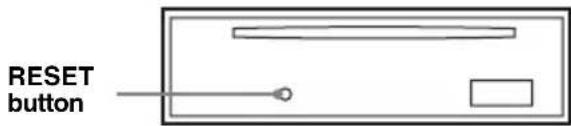
Before operating the unit for the first time, or after replacing the car battery or changing the connections, you must reset the unit.
Detach the front panel and press the RESET button with a pointed object, such as a ballpoint pen.
Note
Pressing the RESET button will erase the clock setting and some stored contents.
Setting the clock
The clock uses a 12-hour digital indication.
1 Press and hold SEL.
The setup display appears.
2 Press SEL repeatedly until "Clock Adjust" appears.
3 Press DSPL.
The hour indication is selected.
4 Press the volume control up or down to set the hour and minute.
To move the digital indication, press DSPL.
5 Press SEL.
The setup is complete and the clock starts.
With the card remote commander
In step 4, to set the hour and minute, press the up or down arrow.
Detaching the front panel
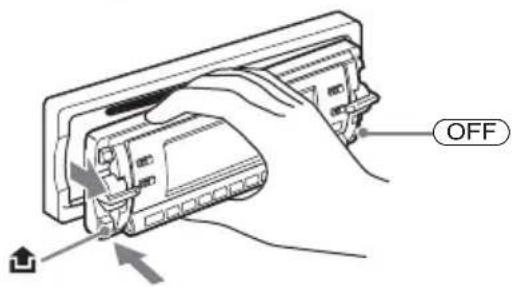
You can detach the front panel of this unit to prevent theft.
Caution alarm
If you turn the ignition switch to the OFF position without detaching the front panel, the caution alarm will sound for a few seconds. The alarm will only sound if the built-in amplifier is used.
1 Press OFF.
The unit is turned off.
2 Press , then pull it off towards you.
Notes
- Do not drop or put excessive pressure on the front panel and display window.
- Do not subject the front panel to heat/high temperature or moisture. Avoid leaving it in a parked car or on a dashboard/rear tray.
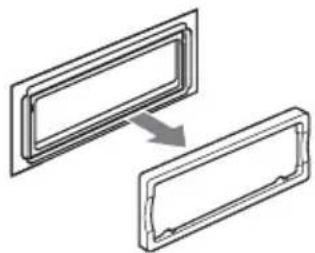
Attaching the front panel
Engage part Ⓐ of the front panel with part Ⓑ of the unit, as illustrated, and push the left side into position until it clicks.
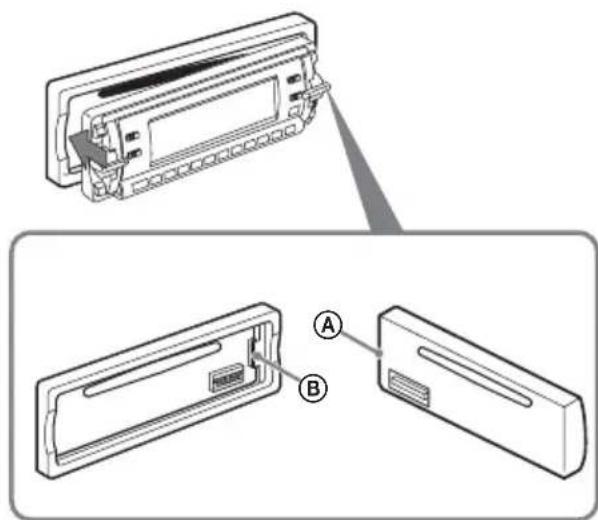
Note
Do not put anything on the inner surface of the front panel.
Inserting the disc in the unit
1 Press ≠.
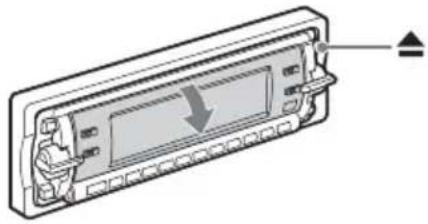
The shutter opens automatically.
2 Insert the disc label side up.
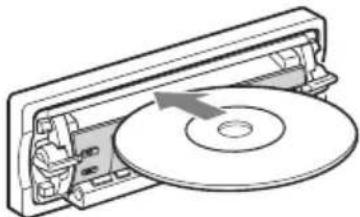
The shutter closes automatically and playback starts.
Ejecting the disc
1 Press ≠.
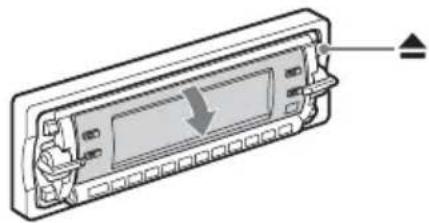
The shutter opens automatically.
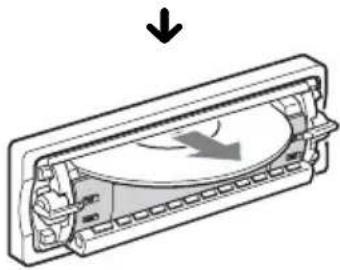
The disc is ejected.
Note
The shutter will close automatically if no operation is performed for 15 seconds.
Location of controls and basic operations
Main unit![graph TD A["1"] --> B["ATT"] B --> C["IMAGE"] C --> D["2"] D --> E["3"] E --> F["4"] F --> G["5"] G --> H["6"] H --> I["7"] I --> J["8"] J --> K["9"] K --> L["10"] L --> M["11"] M --> N["12"] N --> O["13"] O --> P["14"] P --> Q["SOURCE MODE"] Q --> R["GP/ALBM + 1 2 3 4 5 6"] R --> S["BBE MP PAUSERP…](/content/2026/05/815900/images/ebb7361b6c8d464042215b7a17f7609f2e077ac75ecbc72d24212eee3f3928bf.jpg)
Card remote commander
RM-X151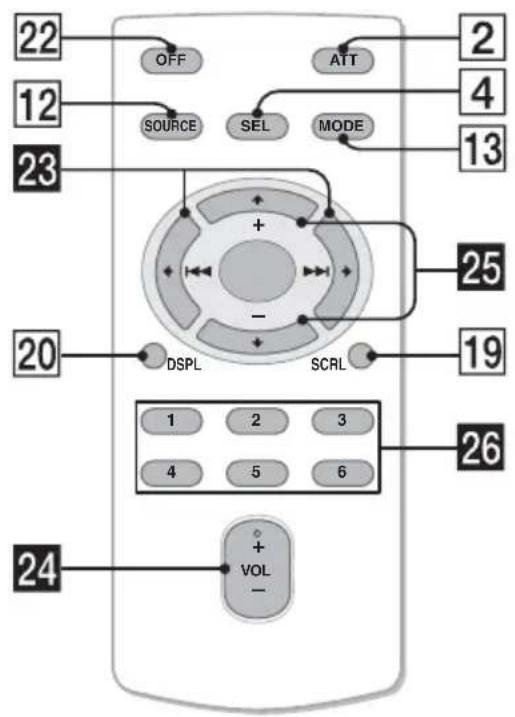
Refer to the pages listed for details. The corresponding buttons on the card remote commander control the same functions as those on the unit.
1 Volume (+/-) control 9
To adjust volume.
2 ATT (attenuate) button
To attenuate the sound. To cancel, press again.
③ IMAGE button 2
To select the display image.
Movie mode 1-3 → Spectrum analyzer mode 1-5 → Space Producer mode → Wallpaper mode 1-3 → normal play/reception mode
4 SEL (select) button
To select setup items.
5 Display window
6 Disc slot 5
To insert the disc.
7 EQ3 (equalizer) button 9
To select an equalizer type (Xplod, Vocal, Edge, Cruise, Space, Gravity, Custom or off).
8 DSO button 2
To select the DSO mode (1, 2, 3 or off). The larger the number, the more enhanced the effect.
9▲ (eject) button 5
To eject the disc/open the shutter.
10▶▶▶▶▶▶▶▶▶▶▶▶ (+/-) control
CD:
To skip tracks (press); skip tracks continuously (press, then press again within about 1 second and hold); reverse/fast-forward a track (press and hold).
Radio:
To tune in stations automatically (press); find a station manually (press and hold).
11 (front panel release) button 4
12 SOURCE button
To power on; change the source (Radio/CD/MD*1/AUX).
13 MODE button 8, 10
To select the radio band (FM/AM)/select the unit *2 .
14 RESET button (located behind the front panel) 4
15 Number buttons
CD/MD*1:
①/②: GP*3/ALBM*4-/+5
To skip groups/albums (press); skip groups/albums continuously (press and hold).
③: REP 8, 10
④: SHUF 8, 10
⑤: BBE MP*6 2
To activate the BBE MP function, set “BBE MP on.” To cancel, set “BBE MP off.”
⑥: PAUSE* 6
To pause playback. To cancel, press again.
Radio:
To receive stored stations (press); store stations (press and hold).
16 Frequency select switch (located on the bottom of the unit)
See “Frequency Select switch” in the supplied installation/connections manual.
17 BTM button 8
To start the BTM function (press and hold).
18SENS button
To improve weak reception: LOCAL/MONO.
19 SCRL (scroll) button 8
To scroll the display item.
20 DSPL (display) button 8
To change display items.
21 Receptor for the card remote commander
22 OFF button
To power off; stop the source.
The following buttons on the card remote commander have also different buttons/functions from the unit.
23 ← (I◄◄) / → (►►I) buttons
To control CD/radio, the same as the ▶▶▶▶▶/I◀◀◀◀ control on the unit.
24 VOL (volume) +/- button
To adjust volume.
25 ↑ (+)/↓ (-) buttons
To control CD, the same as ②/① on the unit.
26 Number buttons
To receive stored stations (press); store stations (press and hold).
*1 When an MD changer is connected. *2 When a CD/MD changer is connected. *3 When an ATRAC CD is played. *4 When an MP3/WMA is played. *5 If the changer is connected, the operation is different, see page 10. *6 When playing back on this unit.
Note
If the unit is turned off and the display disappears, it cannot be operated with the card remote commander unless SOURCE on the unit is pressed, or a disc is inserted to activate the unit first.
Tip
For details on how to replace the battery, see "Replacing the lithium battery of the card remote commander" on page 13.
CD
For details on selecting a CD/MD changer, see page 10.
Display items
Example: when you select the normal play mode by pressing IMAGE repeatedly (page 6).
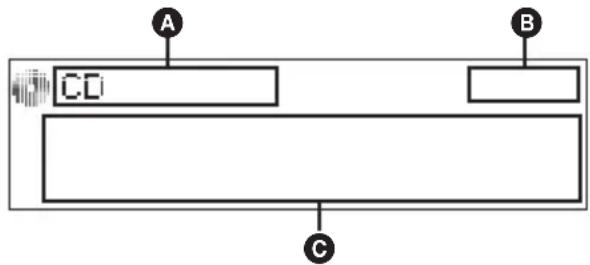
A Source, MP3/WMA/ATRAC3plus indication BClock Track number/Elapsed playing time, Disc/ artist name, Album/group number*1, Album/ group name, Track name, Text information*2
*1 Album/group number is displayed only when the album/group is changed. *2 When playing an MP3, ID3 tag is displayed, when playing ATRAC CD, text information written by SonicStage, etc., is displayed, and when playing WMA, WMA tag is displayed.
To change display items Ⓓ, press DSPL; scroll display items Ⓓ, press SCRL or set "Auto Scroll on" (page 10).
Tip
Displayed items will differ, depending on the disc type, recorded format and settings. For details on MP3/WMA, see page 12; ATRAC CD, see page 13.
Repeat and shuffle play
1 During playback, press ③ (REP) or ④ (SHUF) repeatedly until the desired setting appears.
Select To play
| Repeat Track track repeatedly. | |
| Repeat Album*1 | album repeatedly. |
| Repeat Group*2 | group repeatedly. |
| Shuffle Album*1 | album in random order. |
| Shuffle Group*2 | group in random order. |
| Shuffle Disc disc in random order. | |
*1 When an MP3/WMA is played. *2 When an ATRAC CD is played.
To return to normal play mode, select “Repeat off” or “Shuffle off.”
Radio
Storing and receiving stations
Caution
When tuning in stations while driving, use Best Tuning Memory (BTM) to prevent an accident.
Storing automatically — BTM
1 Press SOURCE repeatedly until "TUNER" appears.
To change the band, press MODE repeatedly. You can select from FM1, FM2, FM3, AM1 or AM2.
2 Press and hold BTM until "BTM" flashes.
The unit stores stations in order of frequency on the number buttons.
A beep sounds when the setting is stored.
Storing manually
1 While receiving the station that you want to store, press and hold a number button (① to ⑥) until "MEM" appears.
The number button indication appears in the display.
Note
If you try to store another station on the same number button, the previously stored station will be replaced.
Receiving the stored stations
1 Select the band, then press a number button (① to ⑥).
Tuning automatically
1 Select the band, then press the ▶▶▶▶I/I◀◀◀ control up or down to search for the station.
Scanning stops when the unit receives a station. Repeat this procedure until the desired station is received.
Tip
If you know the frequency of the station you want to listen to, press and hold the ▶▶▶▶I/I◀◀◀◀ control to quickly locate the approximate frequency, then press the ▶▶▶▶I/I◀◀◀◀ control up or down repeatedly to fine adjust to the desired frequency (manual tuning).
Other functions
Changing the sound settings
Adjusting the sound characteristics
You can adjust the balance, fader, and subwoofer volume.
1 Press SEL repeatedly until "Balance," "Fader" or "Sub Woofer" appears.
The item changes as follows:
equalizer setting *1 →
Balance (left-right) →
Fader (rear-front) →
*1 When EQ3 is activated (page 9). *2 "−∞" is displayed at the lowest setting, and can be adjusted up to 20 steps. *3 When AUX source is activated (page 11).
2 Press the volume control up or down repeatedly to adjust the selected item.
After 3 seconds, the setting is complete and the display returns to normal play/reception mode.
With the card remote commander
In step 2, to adjust the selected item, press ←, ↑, → or ↓.
Customizing the equalizer curve — EQ3
"Custom" of EQ3 allows you to make your own equalizer settings.
1 Select a source, then press EQ3 repeatedly to select "Custom." 2 Press SEL repeatedly until "LOW Center Frequency" appears. 3 Press the volume control up or down repeatedly to select the desired frequency.
LOW Frequency can be set to 60 Hz or 100 Hz.
4 Press SEL. 5 Press the volume control up or down repeatedly to adjust the volume level.
The volume level is adjustable in 1 dB steps, from -10 dB to +10 dB.
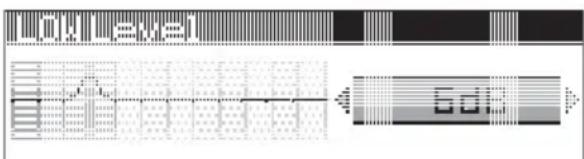
6 Press SEL.
Repeat steps 3 to 6 to adjust “MID” and “HIGH.”
MID and HIGH frequencies differ but are set in the same way (MID: 500 Hz or 1.0 kHz; HIGH: 10.0 kHz or 12.5 kHz).
To restore the factory-set equalizer curve, press and hold SEL before the setting is complete.
After 3 seconds, the setting is complete and the display returns to normal play/reception mode.
Tip
Other equalizer types are also adjustable.
With the card remote commander
In step 3 and 5, to adjust the selected item, press ← , , → or .
Adjusting setup items — SET
1 Press and hold SEL. The setup display appears. 2 Press SEL repeatedly until the desired item appears. 3 Press the volume control up or down to select the setting (example "on" or "off"). 4 Press and hold SEL.
The setup is complete and the display returns to normal play/reception mode.
Note
Displayed items will differ, depending on the source and setting.
With the card remote commander
In step 3, to select the setting, press ← or →.
The following items can be set (follow the page reference for details):
“●” indicates the default settings.
Clock Adjust (page 4)
Beep
To set “on” (●) or “off.”
continue to next page →
Auto Image
Auto Image mode automatically steps (every 10 seconds) through the display images.
- “All” (●): to step repeatedly through the display images in all display modes.
- “off”: to not change the image automatically.
- “SA”: to step repeatedly through the display images of Spectrum analyzer mode.
- “Movie”: to step repeatedly through the display images of Movie mode.
Info (Information)
To display the items (depending on the source, etc.).
- “Simple” (●): to not display any items.
- “All”: to display all items.
- “Clear”: to have items automatically disappear.
AUX-Audio*
To turn the AUX source display “on” (●) or “off” (page 11).
Dimmer
To change the brightness of the display.
- “Auto” (to dim the display automatically when you turn lights on.
- “on”: to dim the display.
- “off”: to deactivate the dimmer.
Motion DSPL (Motion Display)
To select the Motion Display mode.
- “on” (●): to show moving patterns and spectrum analyser.
- “off”: to deactivate the Motion Display.
Demo* (Demonstration)
To set “on” (●) or “off.”
Auto Scroll
To scroll long displayed item automatically when the disc/album/group/track is changed.
- “on”: to scroll.
- “off” (●): to not scroll.
LPF (Low Pass Filter)
To select the subwoofer cut-off frequency: "off"
(●), “125Hz” or “78Hz.”
* When the unit is turned off.
Using optional equipment
CD/MD changer
Selecting the changer
1 Press SOURCE repeatedly until "CD" or "MD" appears.
2 Press MODE repeatedly until the desired changer appears.
Unit number, MP3 indication*1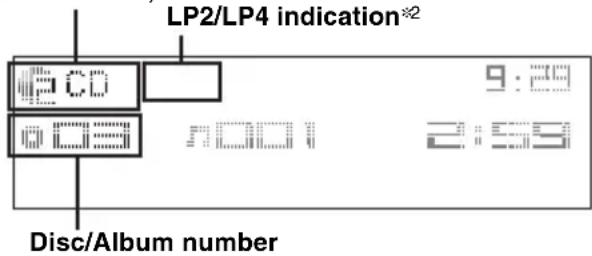
Playback starts.
*1 When MP3 is played. *2 When MDLP disc is played.
Skipping albums and discs
1 During playback, press ①/② (GP/ALBM -/+).
To skip Press ①/②
album and release (hold for a moment).
album within 2 seconds of first continuously releasing.
discs repeatedly.
discs then, press again within 2 continuously seconds and hold.
Repeat and shuffle play
1 During playback, press ③ (REP) or ④ (SHUF) repeatedly until the desired setting appears.
Select To play
Repeat Disc *1 disc repeatedly.
Shuffle tracks in the changer in random Changer *1 order.
Shuffle All *2 tracks in all units in random order.
*1 When one or more CD/MD changers are connected. *2 When one or more CD changers, or two or more MD changers are connected.
To return to normal play mode, select "Repeat off" or "Shuffle off."
Tip
"Shuffle All" will not shuffle tracks between CD units and MD changers.
Rotary commander RM-X4S
Attaching the label
Attach the indication label depending on how you mount the rotary commander.
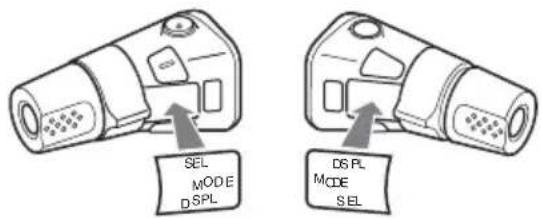
Location of controls
The corresponding buttons on the rotary commander control the same functions as those on this unit.
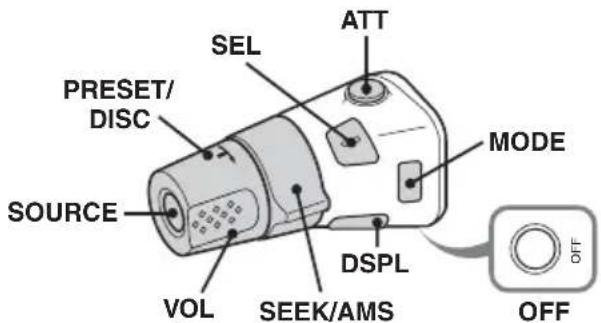
The following controls on the rotary commander require a different operation from the unit.
- PRESET/DISC control
The same as GP/ALBM -/+ on the unit (push in and rotate).
• VOL (volume) control
The same as the volume control on the unit (rotate).
- SEEK/AMS control
The same as the ▶▶▶▶/|◀◀◀◀ control on the unit (rotate, or rotate and hold).
Changing the operative direction
The operative direction of the controls is factory-set as shown below.
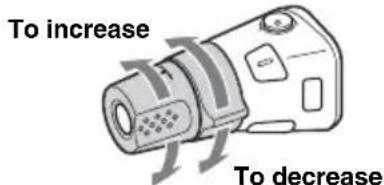
If you need to mount the rotary commander on the right hand side of the steering column, you can reverse the operative direction.
1 While pushing the VOL control, press and hold SEL.
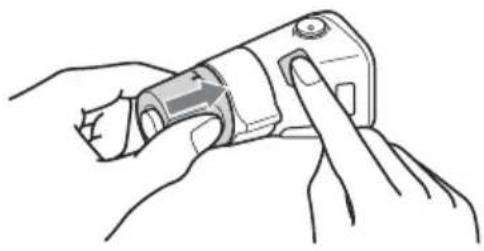
Auxiliary audio equipment
You can connect optional Sony portable devices to the BUS AUDIO IN/AUX IN terminal on the unit. If the changer or other device is not connected to the terminal, the unit allows you to listen to the portable device on your car speakers.
Note
When connecting a portable device, be sure BUS CONTROL IN is not connected. If a device is connected to BUS CONTROL IN, "AUX" cannot be selected by SOURCE.
Tip
When connecting both a portable device and a changer, use the optional AUX-IN selector.
Selecting auxiliary equipment
1 Press SOURCE repeatedly until "AUX" appears. Operate by the portable device itself.
Adjust the volume level
Be sure to adjust the volume for each connected audio device before playback.
1 Turn down the volume on the unit.
2 Press SOURCE repeatedly until "AUX" appears.
3 Start playback of the portable audio device at a moderate volume.
4 Set your usual listening volume on the unit.
5 Press SEL repeatedly until "AUX Level" appears, and press the volume control up or down to adjust the input level (±6 dB).
Additional Information
Precautions
- If your car has been parked in direct sunlight, allow the unit to cool off before operating it.
- Power aerial will extend automatically while the unit is operating.
Moisture condensation
On a rainy day or in a very damp area, moisture condensation may occur inside the lenses and display of the unit. Should this occur, the unit will not operate properly. In such a case, remove the disc and wait for about an hour until the moisture has evaporated.
To maintain high sound quality
Be careful not to splash juice or other soft drinks onto the unit or discs.
Notes on discs
- To keep a disc clean, do not touch its surface. Handle the disc by its edge.
- Keep your discs in their cases or disc magazines when not in use.
- Do not subject discs to heat/high temperature. Avoid leaving them in a parked car or on a dashboard/rear tray.
- Do not attach labels, or use discs with sticky ink/residue. Such discs may stop spinning when used, causing a malfunction, or may ruin the disc.
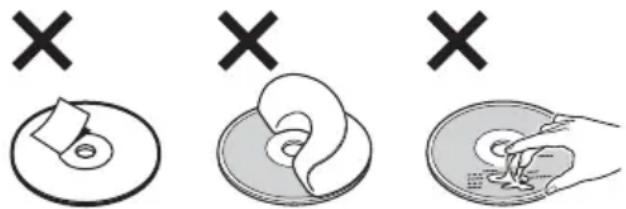
- Do not use any discs with labels or stickers attached. The following malfunctions may result from using such discs:
- Inability to eject a disc (due to a label or sticker peeling off and jamming the eject mechanism).
- Inability to read audio data correctly (e.g., playback skipping, or no playback) due to heat shrinking of a sticker or label causing a disc to warp.
- Discs with non-standard shapes (e.g., heart, square, star) cannot be played on this unit. Attempting to do so may damage the unit. Do not use such discs.
- You cannot play 8 cm CDs.
- Before playing, clean the discs with a commercially available cleaning cloth. Wipe each disc from the centre out. Do not use solvents such as benzine, thinner, commercially available cleaners, or antistatic spray intended for analogue discs.
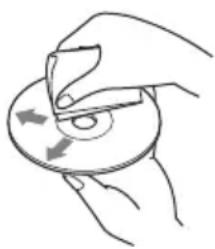
Notes on CD-R/CD-RW discs
- Some CD-Rs/CD-RWs (depending on the equipment used for its recording or the condition of the disc) may not play on this unit.
- You cannot play a CD-R/a CD-RW that is not finalized.
Music discs encoded with copyright protection technologies
This product is designed to play back discs that conform to the Compact Disc (CD) standard. Recently, various music discs encoded with copyright protection technologies are marketed by some record companies. Please be aware that among those discs, there are some that do not conform to the CD standard and may not be playable by this product.
Note on DualDiscs
A DualDisc is a two-sided disc product which mates DVD recorded material on one side with digital audio material on the other side. However, since the audio material side does not conform to the Compact Disc (CD) standard, playback on this product is not guaranteed.
About MP3/WMA files
MP3, which stands for MPEG-1 Audio Layer-3, is a music file compression format standard. It compresses audio CD data to approximately 1/10 of its original size.
WMA, which stands for Windows Media Audio, is another music file compression format standard. It compresses audio CD data to approximately 1/22* of its original size.
* only for 64 kbps
- The unit is compatible with the ISO 9660 level 1/level 2 format, Joliet/Romeo in the expansion format, and Multi Session. • The maximum number of: – folders (albums): 150 (including root and empty folders).
- MP3/WMA files (tracks) and folders contained in a disc: 300 (if a folder/file names contain many characters, this number may become less than 300). – displayable characters for a folder/file name is 32 (Joliet), or 64 (Romeo).
- ID3 tag versions 1.0, 1.1, 2.2, 2.3 and 2.4 apply to MP3 only. ID3 tag is 15/30 characters (1.0 and 1.1), or 63/126 characters (2.2, 2.3 and 2.4). WMA tag is 63 characters.
Playback order of MP3/WMA files
![graph TD A[" "] --> B["1"] B --> C["1"] B --> D["2"] D --> E["3"] D --> F["4"] B --> G["1"] B --> H["2"] D --> I["3"] D --> J["4"] D --> K["5"] D --> L["6"] D --> M["7"] style A fill:#fff,stroke:#000 style B fill:#ccc,stroke:#000 style C fill:#ccc,stroke:#000 style D fill:#ccc,stroke:#000 style E fi…](/content/2026/05/815900/images/477c23539071223fe34af0984bde71f2cfd8d754b58dc88460fd53d690d5eac2.jpg)
Notes
- When naming an MP3 file/WMA file, be sure to add the file extension ".mp3"/".wma" to the file name.
- During playback of a VBR (variable bit rate) MP3/WMA file or fast-forward/reverse, elapsed playing time may not display accurately.
- When the disc is recorded in Multi Session, only the first track of the first session format is recognized and played (any other format is skipped). The priority of the format is CD-DA, ATRAC CD and MP3/WMA.
- When the first track is a CD-DA, only CD-DA of the first session is played.
- When the first track is not a CD-DA, an ATRAC CD or MP3/WMA session is played. If the disc has no data in any of these formats, "NO Music" is displayed.
Notes on MP3
- Be sure to finalize the disc before using on the unit.
- If you play a high-bit-rate MP3, such as 320 kbps, sound may be intermittent.
Notes on WMA
- Files made with lossless compression are not playable.
- Files protected by copyright are not playable.
About ATRAC CD
ATRAC3plus format
ATRAC3, which stands for Adaptive Transform Acoustic Coding3, is audio compression technology. It compresses audio CD data to approximately 1/10 of its original size. ATRAC3plus, which is an extended format of ATRAC3, compresses the audio CD data to approximately 1/20 of its original size. The unit accepts both ATRAC3 and ATRAC3plus format.
ATRAC CD
ATRAC CD is recorded audio CD data which is compressed to ATRAC3 or ATRAC3plus format using authorized software, such as SonicStage 2.0 or later, or SonicStage Simple Burner.
• The maximum number of: – folders (groups): 255 – files (tracks): 999 - The characters for a folder/file name and text information written by SonicStage is displayed.
For details on ATRAC CD, see the SonicStage or SonicStage Simple Burner manual.
Note
Be sure to create the ATRAC CD using authorized software, such as SonicStage 2.0 or later, or SonicStage Simple Burner 1.0 or 1.1.
If you have any questions or problems concerning your unit that are not covered in this manual, consult your nearest Sony dealer.
Maintenance
Replacing the lithium battery of the card remote commander
Under normal conditions, the battery will last approximately 1 year. (The service life may be shorter, depending on the conditions of use.)
When the battery becomes weak, the range of the card remote commander becomes shorter. Replace the battery with a new CR2025 lithium battery. Use of any other battery may present a risk of fire or explosion.
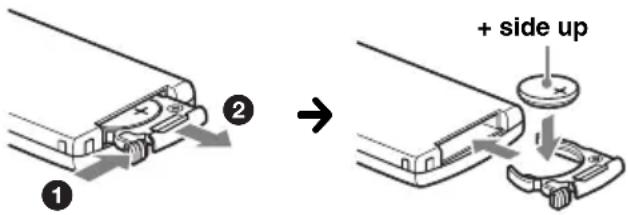
Notes on the lithium battery
- Keep the lithium battery out of the reach of children. Should the battery be swallowed, immediately consult a doctor.
- Wipe the battery with a dry cloth to assure a good contact.
- Be sure to observe the correct polarity when installing the battery.
- Do not hold the battery with metallic tweezers, otherwise a short-circuit may occur.
WARNING
Battery may explode if mistreated.
Do not recharge, disassemble, or dispose of in fire.
continue to next page →
Fuse replacement
When replacing the fuse, be sure to use one matching the amperage rating stated on the original fuse. If the fuse blows, check the power connection and replace the fuse. If the fuse blows again after replacement, there may be an internal malfunction. In such a case, consult your nearest Sony dealer.
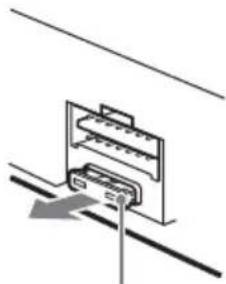
Fuse (10A)
Cleaning the connectors
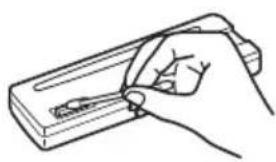
The unit may not function properly if the connectors between the unit and the front panel are not clean. In order to prevent this, detach the front panel (page 4) and clean the connectors with a cotton swab dipped in alcohol. Do not apply too much force. Otherwise, the connectors may be damaged.
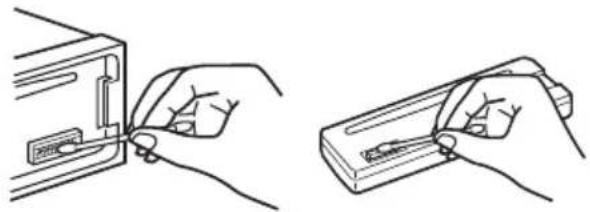
Main unit Back of the front panel
Notes
- For safety, turn off the ignition before cleaning the connectors, and remove the key from the ignition switch.
- Never touch the connectors directly with your fingers or with any metal device.
Removing the unit
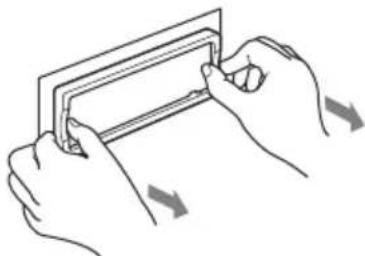
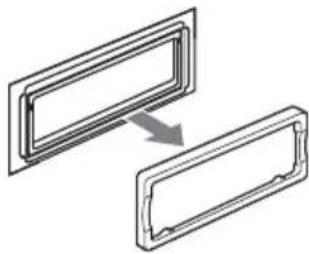
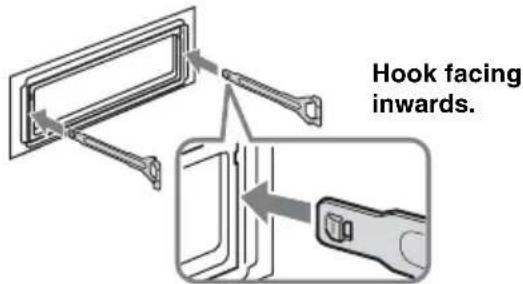
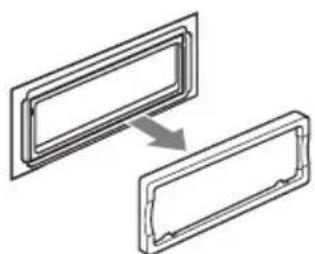
1 Remove the protection collar.
① Detach the front panel (page 4). ② Pinch both edges of the protection collar, then pull it out.

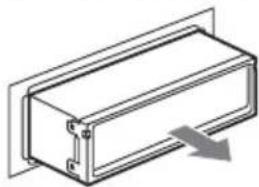
2 Remove the unit.
①Insert both release keys simultaneously until they click.
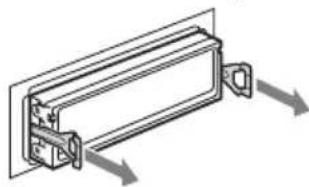
② Pull the release keys to unseat the unit.
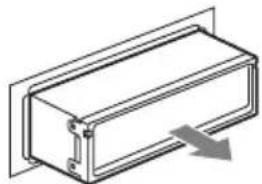
③ Slide the unit out of the mounting.
Specifications
CD Player section
Signal-to-noise ratio: 120 dB
Frequency response: 10 - 20,000 Hz
Wow and flutter: Below measurable limit
Tuner section
FM
Tuning range:
87.5 - 108.0 MHz (at 50 kHz step) 87.5 - 107.9 MHz (at 200 kHz step)
FM tuning interval: 50 kHz/200 kHz switchable
Aerial terminal: External aerial connector
Intermediate frequency: 10.7 MHz/450 kHz
Usable sensitivity: 9 dBf
Selectivity: 75 dB at 400 kHz
Signal-to-noise ratio: 67 dB (stereo), 69 dB (mono)
Harmonic distortion at 1 kHz: 0.5 % (stereo), 0.3 % (mono)
Separation: 35 dB at 1 kHz
Frequency response: 30 - 15,000 Hz
AM
Tuning range:
531 - 1,602 kHz (at 9 kHz step)
530 - 1,710 kHz (at 10 kHz step)
AM tuning interval: 9 kHz/10 kHz switchable
Aerial terminal: External aerial connector
Intermediate frequency: 10.7 MHz/450 kHz
Sensitivity: 30 μV
Power amplifier section
Outputs: Speaker outputs (sure seal connectors)
Speaker impedance: 4 - 8 ohms
Maximum power output: 52 W × 4 (at 4 ohms)
General
Outputs:
Audio outputs terminal (front/rear)
Subwoofer output terminal (mono)
Power aerial relay control terminal
Power amplifier control terminal
Inputs:
Telephone ATT control terminal
Illumination control terminal
BUS control input terminal
BUS audio input/AUX IN terminal
Remote controller input terminal
Aerial input terminal
Tone controls:
Low: ±10 dB at 60 Hz or 100 Hz (XPLOD)
Mid: ±10 dB at 500 Hz or 1 kHz (XPLOD)
High: ±10 dB at 10 kHz or 12.5 kHz (XPLOD)
Power requirements: 12 V DC car battery (negative earth)
Dimensions: Approx. 178 × 50 × 182 mm (w/h/d)
Mounting dimensions:
Approx. 182 × 53 × 161 mm (w/h/d)
Mass: Approx. 1.2 kg
Supplied accessories:
Card remote commander: RM-X151
Parts for installation and connections (1 set)
Optional accessories/equipment:
Rotary commander: RM-X4S
BUS cable (supplied with an RCA pin cord):
CD changer (10 discs): CDX-757MX, CDX-656X
MD changer (6 discs): MDX-66XLP
Source selector: XA-C30
AUX-IN selector: XA-300
Your dealer may not handle some of the above listed accessories. Please ask the dealer for detailed information.
US and foreign patents licensed from Dolby Laboratories.
MPEG Layer-3 audio coding technology and patents licensed from Fraunhofer IIS and Thomson.
Note
This unit cannot be connected to a digital preamplifier or an equalizer which is Sony BUS system compatible.
Design and specifications are subject to change without notice.

- Lead-free solder is used for soldering certain parts. (more than 80 %)
- Halogenated flame retardants are not used in the certain printed wiring boards.
- Halogenated flame retardants are not used in cabinets.
- VOC (Volatile Organic Compound)-free vegetable oil based ink is used for printing the carton.
- Packaging cushions do not use polystyrene foam.
Troubleshooting
The following checklist will help you remedy problems you may encounter with your unit. Before going through the checklist below, check the connection and operating procedures.
General
No power is being supplied to the unit.
- Check the connection. If everything is in order, check the fuse.
- If the unit is turned off and the display disappears, it cannot be operated with the remote commander. → Turn on the unit.
The power aerial does not extend.
The power aerial does not have a relay box.
No sound.
• The volume is too low. - The ATT function is activated, or the Telephone ATT function (when the interface cable of a car telephone is connected to the ATT lead) is activated. - The position of the fader control is not set for a 2-speaker system. - The CD changer is incompatible with the disc format (MP3/WMA/ATRAC CD). → Play back with a Sony MP3 compatible CD changer, or this unit.
No beep sound.
- The beep sound is cancelled (page 9).
- An optional power amplifier is connected and you are not using the built-in amplifier.
- The RESET button has been pressed. → Store again into the memory.
- The power connecting lead or battery has been disconnected.
- The power connecting lead is not connected properly.
The contents of the memory have been erased.
Stored stations and correct time are erased. The fuse has blown.
Makes noise when the position of the ignition key is switched.
The leads are not matched correctly with the car's accessory power connector.
The display disappears from/does not appear in the display window.
- The dimmer is set “Dimmer on” (page 10).
- The display disappears if you press and hold OFF. → Press and hold OFF on the unit until the display appears. • The connectors are dirty (page 14).
Shutter does not close.
Press and hold ▲ for more than 2 seconds. If the problem persists, consult your nearest Sony dealer.
DSO does not function.
Depending on the type of car interior or type of music, DSO may not have a desirable effect.
The images change automatically.
In Auto Image mode, the selected image cannot be displayed.
→ To display only the selected image, set to “Auto Image off” (page 10).
No display items are shown.
→ Set to “Info All” (page 10).
CD/MD playback
The disc cannot be loaded.
- Another disc is already loaded.
- The disc has been forcibly inserted upside down or in the wrong way.
The disc does not play back.
• Defective or dirty disc. - The CD-Rs/CD-RWs are not for audio use (page 12).
MP3/WMA files cannot be played back.
The disc is incompatible with the MP3/WMA format and version (page 12).
MP3/WMA files take longer to play back than others.
The following discs take a longer time to start playback.
- a disc recorded with a complicated tree structure.
- a disc recorded in Multi Session.
- a disc to which data can be added.
The ATRAC CD cannot play.
- The disc is not created by authorized software, such as SonicStage or SonicStage Simple Burner.
- Tracks that are not included in the group cannot be played.
The display items do not scroll.
- For discs with very many characters, those may not scroll.
- “Auto Scroll” is set to “off.” → Set “Auto Scroll on” (page 10) or press SCRL.
The sound skips.
• Installation is not correct. →Install the unit at an angle of less than 45° in a sturdy part of the car. • Defective or dirty disc.
The operation buttons do not function.
The disc will not eject.
Press the RESET button (page 4).
Card remote commander does not work.
Close the shutter.
“MS” or “MD” does not appear on the source display when both the optional MGS-X1 and MD changer are connected.
This unit recognizes MGS-X1 as an MD unit. →Press SOURCE until “MS” or “MD” appears, then press MODE repeatedly.
Radio reception
The stations cannot be received.
The sound is hampered by noises.
- Connect a power aerial control lead (blue) or accessory power supply lead (red) to the power supply lead of a car's aerial booster (only when your car has built-in FM/AM aerial in the rear/side glass).
- Check the connection of the car aerial. • The auto aerial will not go up. → Check the connection of the power aerial control lead.
- Check the frequency.
- When the DSO mode is on, the sound is sometimes hampered by noises. → Set the DSO mode to “off” (page 7).
Preset tuning is not possible.
- Store the correct frequency in the memory. • The broadcast signal is too weak.
Automatic tuning is not possible.
- Setting of the local seek mode is not correct. → Tuning stops too frequently: Press (SENS) until “Local on” appears. → Tuning does not stop at a station: Press (SENS) repeatedly until “Mono on” or “Mono off” (FM), or “Local off” (AM) appears.
- The broadcast signal is too weak. → Perform manual tuning.
During FM reception, the "ST" indication flashes.
- Tune in the frequency accurately. • The broadcast signal is too weak. →Press (SENS) to set the monaural reception mode to “Mono on.”
An FM programme broadcast in stereo is heard in monaural.
The unit is in monaural reception mode. →Press (SENS) until “Mono off” appears.
Error displays/Messages
Blank*1
Tracks have not been recorded on the MD. *2 → Play an MD with recorded tracks.
Error*1
- The disc is dirty or inserted upside down. *2 → Clean or insert the disc correctly.
- A blank disc has been inserted.
- The disc cannot play because of some problem. → Insert another disc.
Failure (Illuminates until any button is pressed.) The connection of speakers/amplifiers is incorrect. → See the installation guide manual of this model to check the connection.
Load
The changer is loading the disc. →Wait until loading is complete.
Local Seek +/-
The local seek mode is on during automatic tuning.
NO Disc
The disc is not inserted in the CD/MD changer. → Insert discs in the changer.
NO Disc Name
A disc name is not written in the track.
NO Group Name
A group name is not written in the track.
NO ID3 Tag
ID3 tag information is not written in the MP3 file.
NO Information
Text information is not written in the ATRAC3/ATRAC3plus or WMA file.
NO Magazine
The disc magazine is not inserted in the CD changer. → Insert the magazine in the changer.
NO Music
The disc is not a music file. → Insert a music CD in this unit or MP3 playable changer.
NO Track Name
A track name is not written in the track.
Not Ready
The lid of the MD changer is open or the MDs are not inserted properly. →Close the lid or insert the MDs properly.
Offset
There may be an internal malfunction. →Check the connection. If the error indication remains on in the display, consult your nearest Sony dealer.
Read
The unit is reading all track and album/group information on the disc. →Wait until reading is complete and playback starts automatically. Depending on the disc structure, it may take more than a minute.
Push Reset
The CD unit and CD/MD changer cannot be operated because of some problem.
→ Press the RESET button (page 4).

During reverse or fast-forward, you have reached the beginning or the end of the disc and you cannot go any further.

The character cannot be displayed with the unit.
*1 If an error occurs during playback of a CD or MD, the disc number of the CD or MD does not appear in the display. *2 The disc number of the disc causing the error appears in the display.
If these solutions do not help improve the situation, consult your nearest Sony dealer.
If you take the unit to be repaired because of CD playback trouble, bring the disc that was used at the time the problem began.

PLEASE READ THIS INSTRUCTION MANUAL CAREFULLY BEFORE CONNECTING AND OPERATING THIS EQUIPMENT. REMEMBER THAT MISUSE OF YOUR DEVICE COULD VOID THE WARRANTY.
Welcome
CLASS 1 LASER PRODUCT
Note
Notes on CD-R/CD-RW discs
Main unit
Specifications
CD player
Caution
Do not place anything on the inner surface of the front panel.
Inserting a disc into the unit
1 Press ▲.
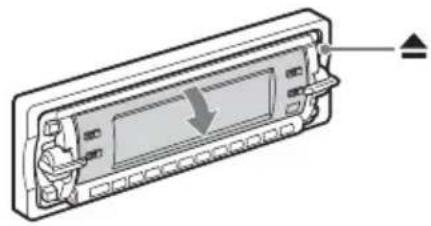
The shutter opens automatically.
2 Insert the disc (label side up).
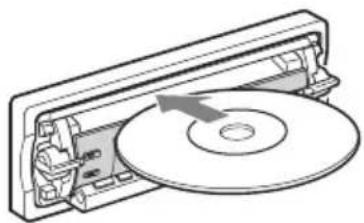
The shutter closes automatically and playback begins.
Ejecting the disc
1 Press ▲.
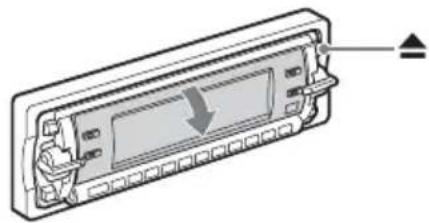
The shutter opens automatically.
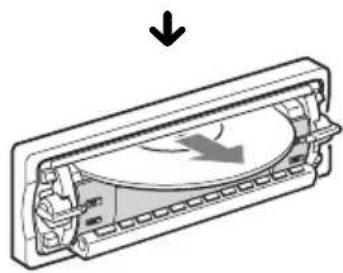
The disc is ejected.
Note
Controller position
Auxiliary audio device
Precautions for CD-R/CD-RW discs
Fuse (10A)
Cleaning the connectors
Main unit
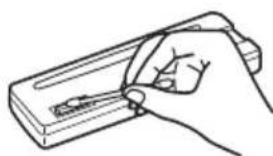
Back of the front panel
Note
↓
2 Remove the device.
③ Slide the unit out of its installation position.
Specifications
CD player section
Signal-to-noise ratio: 120 dB
Frequency response: 10 - 20000 Hz
Wow and flutter: below measurable limit
Tuner section
FM
Tuning range:
- FM/AM COMPACT DISC PLAYER
- CD PLAYBACK
- RADIO RECEPTION
- SOUND ADJUSTMENT
- IMAGE SETTING
- OPTIONAL UNIT OPERATION
- WARNING IF YOUR CAR'S IGNITION HAS NO ACC POSITION
- CLASS 1 LASER PRODUCT
- BBE®MP DIGITAL
- TABLE OF CONTENTS
- GETTING STARTED
- LOCATION OF CONTROLS AND BASIC OPERATIONS
- CD
- RADIO
- OTHER FUNCTIONS
- ADDITIONAL INFORMATION
- RESETTING THE UNIT
- NOTE
- SETTING THE CLOCK
- DETACHING THE FRONT PANEL
- CAUTION ALARM
- NOTES
- ATTACHING THE FRONT PANEL
- INSERTING THE DISC IN THE UNIT
- PRESS ≠
- INSERT THE DISC LABEL SIDE UP
- EJECTING THE DISC
- DSO BUTTON
- ▲ (EJECT) BUTTON
- (+/-) CONTROL
- (FRONT PANEL RELEASE) BUTTON
- SOURCE BUTTON
- MODE BUTTON
- RESET BUTTON (LOCATED BEHIND THE FRONT PANEL)
- NUMBER BUTTONS
- FREQUENCY SELECT SWITCH (LOCATED ON THE BOTTOM OF THE UNIT)
- BTM BUTTON
- SENS BUTTON
- SCRL (SCROLL) BUTTON
- DSPL (DISPLAY) BUTTON
- RECEPTOR FOR THE CARD REMOTE COMMANDER
- OFF BUTTON
- ← (I◄◄) / → (►►I) BUTTONS
- VOL (VOLUME) +/- BUTTON
- ↑ (+)/↓ (-) BUTTONS
- TIP
- DISPLAY ITEMS
- REPEAT AND SHUFFLE PLAY
- STORING AND RECEIVING STATIONS
- CAUTION
- STORING AUTOMATICALLY — BTM
- STORING MANUALLY
- RECEIVING THE STORED STATIONS
- TUNING AUTOMATICALLY
- CHANGING THE SOUND SETTINGS
- ADJUSTING THE SOUND CHARACTERISTICS
- CUSTOMIZING THE EQUALIZER CURVE — EQ
- ADJUSTING SETUP ITEMS — SET
- CLOCK ADJUST (PAGE 4)
- AUTO IMAGE
- INFO (INFORMATION)
- AUX-AUDIO
- DIMMER
- MOTION DSPL (MOTION DISPLAY)
- DEMO* (DEMONSTRATION)
- AUTO SCROLL
- LPF (LOW PASS FILTER)
- USING OPTIONAL EQUIPMENT
- CD/MD CHANGER
- SELECTING THE CHANGER
- SKIPPING ALBUMS AND DISCS
- TO SKIP PRESS ①/②
- SELECT TO PLAY
- ROTARY COMMANDER RM-X4S
- ATTACHING THE LABEL
- LOCATION OF CONTROLS
- CHANGING THE OPERATIVE DIRECTION
- AUXILIARY AUDIO EQUIPMENT
- SELECTING AUXILIARY EQUIPMENT
- ADJUST THE VOLUME LEVEL
- PRECAUTIONS
- MOISTURE CONDENSATION
- TO MAINTAIN HIGH SOUND QUALITY
- NOTES ON DISCS
- NOTES ON CD-R/CD-RW DISCS
- MUSIC DISCS ENCODED WITH COPYRIGHT PROTECTION TECHNOLOGIES
- NOTE ON DUALDISCS
- ABOUT MP3/WMA FILES
- PLAYBACK ORDER OF MP3/WMA FILES
- NOTES ON MP
- NOTES ON WMA
- ABOUT ATRAC CD
- ATRAC3PLUS FORMAT
- ATRAC CD
- MAINTENANCE
- REPLACING THE LITHIUM BATTERY OF THE CARD REMOTE COMMANDER
- NOTES ON THE LITHIUM BATTERY
- WARNING
- FUSE REPLACEMENT
- CLEANING THE CONNECTORS
- REMOVING THE UNIT
- REMOVE THE PROTECTION COLLAR
- REMOVE THE UNIT
- SPECIFICATIONS
- CD PLAYER SECTION
- TUNER SECTION
- FM
- AM
- TUNING RANGE
- POWER AMPLIFIER SECTION
- GENERAL
- OUTPUTS
- INPUTS
- TONE CONTROLS
- MOUNTING DIMENSIONS
- SUPPLIED ACCESSORIES
- OPTIONAL ACCESSORIES/EQUIPMENT
- TROUBLESHOOTING
- NO POWER IS BEING SUPPLIED TO THE UNIT
- THE POWER AERIAL DOES NOT EXTEND
- NO SOUND
- NO BEEP SOUND
- THE CONTENTS OF THE MEMORY HAVE BEEN ERASED
- STORED STATIONS AND CORRECT TIME ARE ERASED. THE FUSE HAS BLOWN
- MAKES NOISE WHEN THE POSITION OF THE IGNITION KEY IS SWITCHED
- THE DISPLAY DISAPPEARS FROM/DOES NOT APPEAR IN THE DISPLAY WINDOW
- SHUTTER DOES NOT CLOSE
- DSO DOES NOT FUNCTION
- THE IMAGES CHANGE AUTOMATICALLY
- NO DISPLAY ITEMS ARE SHOWN
- CD/MD PLAYBACK
- THE DISC CANNOT BE LOADED
- THE DISC DOES NOT PLAY BACK
- MP3/WMA FILES CANNOT BE PLAYED BACK
- MP3/WMA FILES TAKE LONGER TO PLAY BACK THAN OTHERS
- THE ATRAC CD CANNOT PLAY
- THE DISPLAY ITEMS DO NOT SCROLL
- THE SOUND SKIPS
- THE OPERATION BUTTONS DO NOT FUNCTION
- THE DISC WILL NOT EJECT
- CARD REMOTE COMMANDER DOES NOT WORK
- MS” OR “MD” DOES NOT APPEAR ON THE SOURCE DISPLAY WHEN BOTH THE OPTIONAL MGS-X1 AND MD CHANGER ARE CONNECTED
- THE STATIONS CANNOT BE RECEIVED
- THE SOUND IS HAMPERED BY NOISES
- PRESET TUNING IS NOT POSSIBLE
- AUTOMATIC TUNING IS NOT POSSIBLE
- DURING FM RECEPTION, THE "ST" INDICATION FLASHES
- AN FM PROGRAMME BROADCAST IN STEREO IS HEARD IN MONAURAL
- ERROR DISPLAYS/MESSAGES
- BLANK
- ERROR
- LOAD
- LOCAL SEEK
- NO DISC
- NO DISC NAME
- NO GROUP NAME
- NO ID3 TAG
- NO INFORMATION
- NO MAGAZINE
- NO MUSIC
- NO TRACK NAME
- NOT READY
- OFFSET
- READ
- PUSH RESET
- WELCOME
- CD PLAYER
- INSERTING A DISC INTO THE UNIT
- PRESS ▲
- INSERT THE DISC (LABEL SIDE UP)
- CONTROLLER POSITION
- AUXILIARY AUDIO DEVICE
- PRECAUTIONS FOR CD-R/CD-RW DISCS
- REMOVE THE DEVICE
Brand : SONY
Model : CDX-RA750
Category : CD Player