
6090 - Cordless phone NOKIA - Free user manual and instructions
Find the device manual for free 6090 NOKIA in PDF.

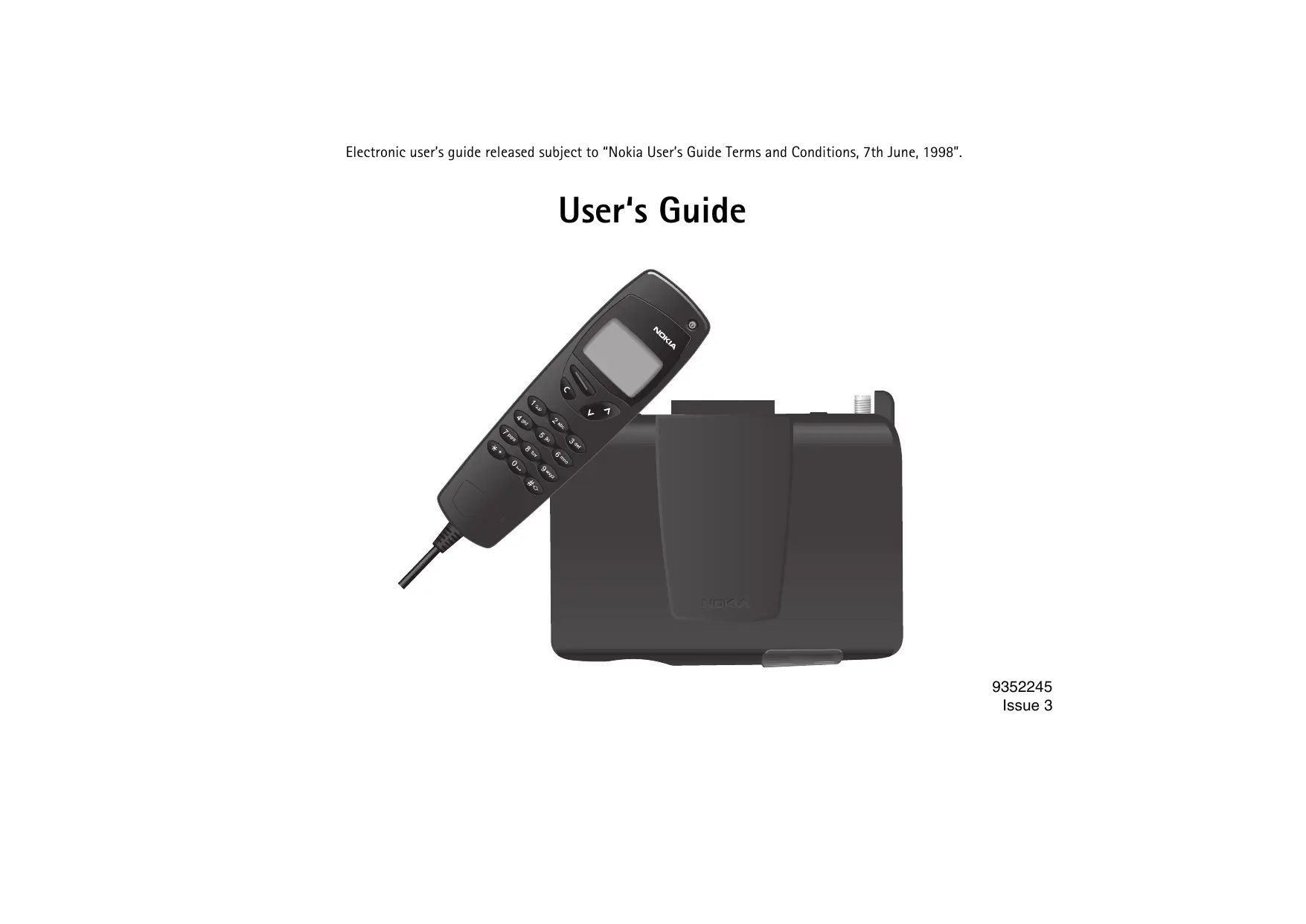

| Product type | Cordless landline phone (GSM 900) |
| Brand | NOKIA |
| Model | 6090 |
| Technology | GSM 900 |
| Power supply | Vehicle battery (10.8 V - 16 V) |
| Display | LCD screen |
| Navigation | Navi™ key and scroll keys |
| Call functions | Call, answer, end, reject, hold, transfer, conference (network services) |
| Phonebook | SIM memory (up to 250 contacts) + internal memory (150 contacts) |
| Messaging | SMS (write, send, receive, save, up to 160 characters) |
| Hands-free speaker | Built-in, switchable during call |
| Connectivity | RS-232 serial port (9-pin) for data/fax, GSM antenna connector |
| Security | PIN code (4-8 digits), security code (5 digits, default 12345), SIM lock, PUK code |
| Ignition detection | Yes (programmable auto power-off) |
| Auto power-off | Configurable (disabled, 45 s to 24 h) |
| Radio mute | Yes (dedicated cable) |
| Backlight | Adjustable (full brightness, custom, off) |
| Operating temperature | -20°C to +60°C |
| Installation | DIN/ISO kit for dashboard or center console mounting |
| Antenna | GSM 8W (not included, sold separately) |
| Data cable | Standard RS-232 (not included) |
| Maintenance | Clean with a soft, slightly damp cloth (mild soap) |
| Additional functions | Calculator, clock, alarm, call forwarding, cost limitation, voicemail |
Frequently Asked Questions - 6090 NOKIA
User questions about 6090 NOKIA
0 question about this device. Answer the ones you know or ask your own.
Ask a new question about this device
Download the instructions for your Cordless phone in PDF format for free! Find your manual 6090 - NOKIA and take your electronic device back in hand. On this page are published all the documents necessary for the use of your device. 6090 by NOKIA.
USER MANUAL 6090 NOKIA
natural_image
Illustration of a Nokia mobile phone with keypad and external case (no text or symbols on device body)9352245
Issue 3
Copyright © Nokia Mobile Phones 1999, 2000, 2001.
All rights reserved.
Reproduction, transfer, distribution or storage of part or all of the contents in this document in any form without the prior written permission of Nokia is prohibited.
Nokia and Nokia Connecting People are registered trademarks of Nokia Corporation. Other product and company names mentioned herein may be trademarks or tradenames of their respective owners.
Navi is a trademark of Nokia Mobile Phones.
Nokia operates a policy of continuous development. Nokia reserves the right to make changes and improvements to any of the products described in this document without prior notice.
Under no circumstances shall Nokia be responsible for any loss of data or income or any special, incidental, consequential or indirect damages howsoever caused.
The contents of this document are provided "as is". Except as required by applicable law, no warranties of any kind, either express or implied, including, but not limited to, the implied warranties of merchantability and fitness for a particular purpose, are made in relation to the accuracy, reliability or contents of this document. Nokia reserves the right to revise this document or withdraw it at any time without prior notice
The availability of particular products may vary by region. Please check with the Nokia dealer nearest to you.
Declaration of Conformity
We, NOKIA MOBILE PHONES Ltd., declare under our sole responsibility that the product NME-3 is in conformity with the provisions of the following Council Directive: 1999/5/EC.
Smart Tips
These Smart Tips pages include some useful tips for efficient usage of your phone.
For more detailed information, read through the user's guide.
Lift off the handset
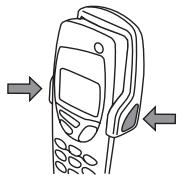 | Press at least one push button of the cradle to lift off the handset. |
Call functions
| Making a call | Key in the phone number including the area code, press the Navi Key (Call). |
| Answering a call | Press the Navi Key (Answer). |
| Ending a call | Press the Navi Key (End). |
| Rejecting a call | Press upon receiving an incoming call. (If the Divert when busy function is activated, rejecting an incoming call will also divert the call). |
| Redial | With display clear, press ⚠ to access the last-dialled numbers. |
| Adjusting the volume | Press ⚠ during a call. |
| Switching to handsfree | Press ⚠, then put the handset back onto the cradle. |
Phone book functions
| Quick savein Phone book | Key in the phone number, press ⚙ to changethe Navi Key text to Save.Press ⚡ (Save).Key in the name and press ⚡ (OK). |
| Quick findin Phone book | Press √ (with display clear), key in the firstletter of the name and use √ to scroll to thedesired name.Press and hold ⚣ to view the phonenumber. |
| Using the Phonebook during acall | To access the Phone book during a call,press ⚠, ⚡ (Options) andselect Phone book. |
| Storing a phone number for speed dialling | Press (Menu), (Select), use to find Speed dials, press (Select), (Assign), find the desired name/phone number and press (OK). |
| Speed dialling | Press a number key 1ap - 9wxyz and press (Call). |
| Calling the mailbox | Press and hold 1ap to dial the voice mailbox number. (The voice mailbox number has to be stored in the memory). |
| One touch dialling | If the Speed dialling function in the menu is activated, press and hold a number key 2abc - 9wxyz for one touch dialling. |
Essential shortcuts
| Reading messages | Press (Read) to reach the messages, use to browse through the messages.Press (Options) for available options.Press to exit the messages. |
| Writing / sending a message | Press ─ (Menu), 2^abc , 3^def , key in a message (press # to change between upper and lower case characters, press and hold # for numbers, press *+ for special characters). |
| Press ─ (Options), access Send via , press ─ (OK), enter the phone number or search for it in the Phone book using , then press ─ (OK). | |
| SIM card priority | Press ─ (Menu), 4^ghi , 2^abc , 7^pqrs , 1^oo to prioritise radio unit SIM or press ─ (Menu), 4^ghi , 2^abc , 7^pqrs , 2^abc to prioritise handset SIM. |
| Selecting a ringing tone | Press ─ (Menu), 9^wxyz , 2^abc to select a ringing tone out of the available list. |
| Selecting the ringing volume | Press ─ (Menu), 9^wxyz , 3^def to select the ringing volume level. |
Table of contents
Smart Tips 3
Table of contents 5
For Your Safety 7
Welcome 8
About labels on your car phone 8
Security code 8
Using this guide 8
Getting Started 9
Inserting a SIM card in the radio unit 9
Inserting a SIM card in the handset 9
Using the keys 10
Switching the car phone on and off.... 10
The display indicators 11
Basic Functions 12
Making a call 12
Receiving a call 12
Adjusting the volume 13
Redialling last number 13
Storing a name and phone number in the Phone book 13
Making a call using the Phone book 14
Other Essential Functions 15
Setting the time 15
Selecting a ringing tone 15
In-call options 15
Voice messages 16
Text messages 16
Fax and data call 17
Ignition sense 17
Automatic power-off 18
Car radio mute 18
Backlight dimming 18
Using the Menu 19
Accessing the menus by scrolling 19
Accessing the menus by shortcut 19
List of menu functions 20
1 Phone book 22
2 Messages 24
3 Call register 26
4 Settings 27
5 Call divert 30
6 Call counters 30
7 Calculator 31
8 Clock 32
9 Tones 32
Reference Information 34
Facts about cellular transmission 34
Access codes 35
Battery information 36
Accessories 37
6090 DIN/ISO installation kit 37
GSM antenna 37
Data cable 37
Care and Maintenance 38
Important Safety Information 39
Traffic safety 39
Operating environment 39
Electronic devices 39
Potentially explosive atmospheres 40
Vehicles 40
Emergency calls 41
Installation 42
Glossary 44
Index 46
Limited Manufacturer's Warranty 48
For Your Safety

Read these simple guidelines. Breaking the rules may be dangerous or illegal. Further detailed information is given in this manual.

ROAD SAFETY COMES FIRST
Don't use a handheld phone while driving; park the vehicle first.

INTERFERENCE
All wireless phones may get interference which could affect performance.

SWITCH OFF IN HOSPITALS
Follow any regulations or rules. Switch phone off near medical equipment.

SWITCH OFF WHEN REFUELING
Don't use phone at a refuelling point. Don't use near fuel or chemicals.

SWITCH OFF NEAR BLASTING
Don't use phone where blasting is in progress. Observe restrictions, and follow any regulations or rules.

MAGNETISM
ATM and credit cards brought into contact with the cradle may be demagnetized and information stored on the card erased. Avoid storage of ATM and credit cards near your cradle.

USE QUALIFIED SERVICE
Only qualified service personnel must install or repair equipment.

ACCESSORIES
Use only approved accessories. Do not connect incompatible products.

CONNECTION TO OTHER DEVICES
When connecting to any other device, read its user's guide for detailed safety instructions. Do not connect incompatible products. Remember to make backup copies of all important data.

MAKING CALLS
Ensure the phone is switched on and in service. Enter the phone number, including the area code, then press (Call). To end a call, press (End).
To answer a call press 📄 (Answer).

EMERGENCY CALLS
Make sure the phone is switched on and in service. Hold ⓒ for several seconds, to clear the display. Enter the emergency number, then press ⏰ (Call). Give your location. Do not end the call until told to do so.

ANTENNA
In order to comply with RF exposure requirements for mobile transmitting devices, a minimum distance of 20 cm must be maintained between the antenna and all persons.
Welcome
Congratulations on the purchase of this car phone, which allows you to access GSM900 networks worldwide.
GSM, the Global System for Mobile Communications, is the digital standard used in many countries throughout the world, enabling you to benefit from the GSM services provided by your car phone.
About labels on your car phone
Your car phone has labels on it which are important for service and related purposes. Therefore be careful not to remove or lose any label or the information it contains.
Security code
The factory setting for the security code is 12345. It is supplied with the car phone on an identification sticker. The security code protects your car phone against unauthorised use.
Change the code, see "4-3 Security settings" on page 28, and keep the new code secret and in a safe place separate from the car phone.
Using this guide
The car phone described in this guide is approved for use on the GSM900 network.
There are a number of features included in this guide which are called Network Services. They are special services provided by wireless service providers. Before you can take advantage of any of these Network Services, you must subscribe to these services with your home service provider and obtain instructions for their use.
In this manual, the menu names and commands that appear on the display of your phone are always in bold print. For example: Phone book, calling.
1. Getting Started
Your car phone consists of two major parts:
- Handset
- Radio unit
Before you can use your car phone, you must place a SIM (Subscriber Identity Module) card in the phone.
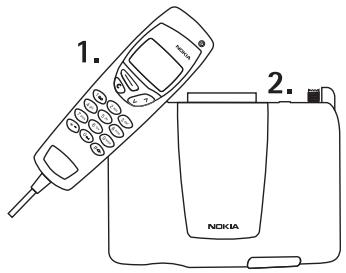
Your car phone has two SIM card readers: one in the radio unit and the other in the handset. The factory setting assigns the card reader in the handset priority; the car phone will only work with the prioritised card (e.g. Phone book).
The user can change the priority of the card readers for use via the menu, see "4-2-7 SIM card priority" on page 28. The user's priority setting is then used as a default setting. If only one reader is initially loaded with a card, that reader is automatically used.
If an invalid or corrupted SIM card is used in the prioritised card reader, the user is notified through a message on the display. The phone will not try to use a different card reader with a lower priority. Switch off the car phone and remove the invalid SIM card. Then restart the car phone. The car phone will then work with the second SIM card.
Inserting a SIM card in the radio unit
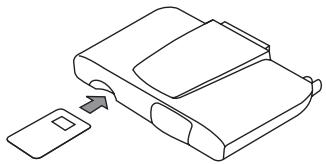
The SIM card and the contacts stored in it can easily be damaged if scratched or bent, so be careful when handling, inserting or removing the card.
Before you insert the SIM card, make sure that the car phone has been switched off!
Insert the SIM card into the slot so that the contacts are towards the radio unit.
natural_image
Line drawing of a device with a small object inserted into a housing (no text or symbols)Inserting a SIM card in the handset
Warning! Keep all miniature SIM cards out of the reach of small children.
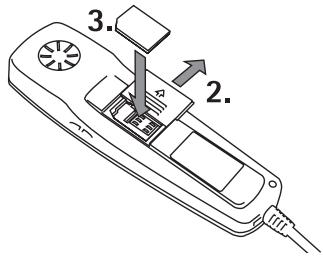
Before you insert the SIM card, make sure that the car phone has been switched off!
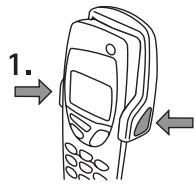
- Press at least one push button of the cradle to lift off the handset.
- At the back of the handset, push the cover for the SIM card aside.
- Insert the SIM card and close the cover.
Using the keys
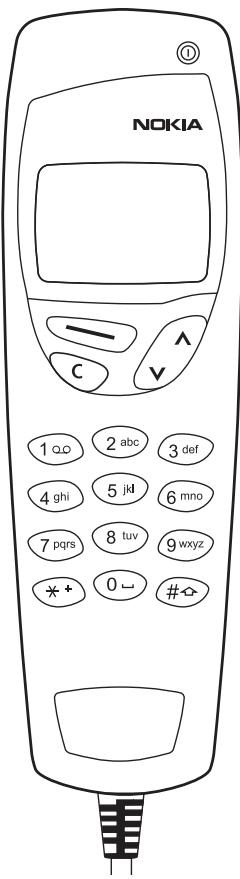
Navi key
The use of the phone is largely based on the Nokia Navi™ key, located below the display. The function of the Nokia Navi™ key varies according to the guiding text shown above the key on the display.
Throughout this user's guide, the relevant guiding text is mentioned together with the Nokia Navi™ key, e.g. (Menu) or (Select).
Scroll keys
Scroll keys are used to browse through menus, submenus and settings and to move the cursor to the right or left.
With clear display, press √ once to access the names and phone numbers stored in the Phone book. With clear display, press ⚠ once to access the list of last-dialled numbers. During a call, press √ to adjust the volume.
The clear key ⓒ
- Use ⓒ to delete a character to the left of the cursor,
- to clear all the characters keyed in from the display (press and hold),
- to return from a submenu to the previous menu level in the menu facility,
• to exit the menu facility,
• to switch to handsfree, - to activate options while you have a call in progress and
• to reject an incoming call.
Switching the car phone on and off ①
Warning! Do not switch on the car phone when wireless phone use is prohibited or when it may cause interference or danger.
Press and hold the Ⓐ key for a second.
Note: Your car phone will not work unless sufficient battery power is supplied through your car battery.
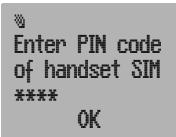
If the handset asks for the PIN code
The PIN code protects your SIM card against unauthorised use and is usually supplied with the SIM card.
Note: Your car phone may have two different SIM cards: one card in the handset and one SIM card in the radio unit.
Key in the PIN code of the SIM card used (factory setting: SIM card of the handset), which is displayed as ****, and press ⏻(OK), see "4-3-5 Change access codes" on page 29.
Note: If you enter an incorrect PIN three times in succession, the card is blocked and you have to re-enter the PIN using the personal unblocking key number (PUK), see "Access codes" on page 35.
Note: If your SIM card is lost or stolen, immediately inform your network operator or service provider to block the card and thus prevent any unauthorised use at your expense. As a rule, you will have to specify your name, the SIM card number and your subscriber's number.
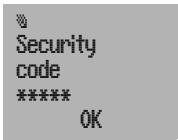
If the handset asks for a security code
Key in the security code, which is displayed as *****, and press ⏻ (OK), see "About labels on your car phone" on page 8.
Note: If you take out the SIM card while the phone is in operation, information could be lost.
The display indicators
The indicators described below are shown when the car phone is ready for use, and no characters have been entered by the user. This is also called a "clear display".
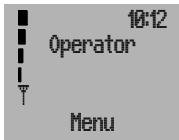
| Operator | Indicates which cellular networkthe car phone is currently being used in.Depending on your SIM card, the name of the ser-vice provider may be shown in the next line. |
| Shows the signal strength of the cellular network atyour current location: the higher the bar, the stron-ger the signal. | |
| 10:12 | Shows the time. |
| Shows that you have received a short message. | |
| Notifys divert of all voice calls. | |
| Shows that the phone is in silent mode. |
2. Basic Functions
Making a call
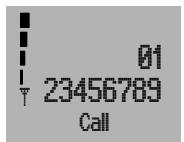
- Key in the phone number including the area code. The text Menu changes to Call.
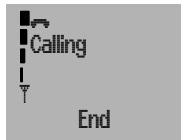
Correct keying mistakes by pressing ⓒ to delete the last character to the left. - Press ☐ (Call) and wait for the answer. The text Call changes to End.
- Press ☐ (End) to finish the call (or to cancel the call attempt).
International call
- Press (*)^+ twice for the international prefix (+ character replaces the international access code).
- Enter the country code, the area code and the phone number.
- To call the number, press ☐ (Call).
Handsfree mode
When you are using the handset while it remains in its cradle, the phone automatically works in handsfree mode. You can switch from handsfree to private mode by picking up the handset. If you replace the handset on the cradle, the call is terminated.
To be able to switch to handsfree mode and continue an on-going call, first press ⓒ and then put the handset back in the cradle.
Receiving a call
When a call is put through to you, the phone will ring and flash either the caller's name or phone number or the text calling.
To answer the call, press 📄 (Answer).
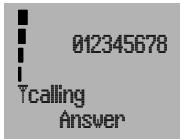
Note: If more than one name with the same last seven digits as the caller's phone number is found in the Phone book, only the caller's phone number is displayed if available.
To reject an incoming call, press ⓒ. If the Divert when busy function is activated to divert the calls, e.g. to your voice mailbox, rejecting an incoming call will also divert the call, see "5 Call divert" on page 30.
If you select Automatic answer (see "4-1 Call settings" on page 27) your phone is set to automatically answer an incoming call after one ring.
Note: If you are using the handsfree mode, you do not have to take the handset out of its cradle. Lift the handset from its cradle only if you want to speak privately. If you put the handset back into its cradle without pressing ⓒ first, you will terminate the call!
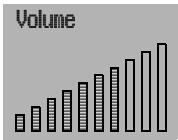
Adjusting the volume
You can adjust the handset volume of the phone during a call. Press ⚠ to increase and Ⓧ to decrease the volume level.
You can also adjust the handsfree volume of the phone during a call. Press ⚠ to increase and Ⓧ to decrease the volume level.
bar
Volume | Category | Volume | |---|---| | 1 | 2 | | 2 | 3 | | 3 | 4 | | 4 | 5 | | 5 | 6 | | 6 | 7 | | 7 | 8 | | 8 | 9 | | 9 | 10 | | 10 | 11 | | 11 | 12 | | 12 | 13 | | 13 | 14 | | 14 | 15 | | 15 | 16 | | 16 | 17 | | 17 | 18 | | 18 | 19 | | 19 | 20 | | 20 | 21 | | 21 | 22 | | 22 | 23 | | 23 | 24 | | 24 | 25 | | 25 | 26 | | 26 | 27 | | 27 | 28 | | 28 | 29 | | 29 | 30 | | 30 | 31 | | 31 | 32 | | 32 | 33 | | 33 | 34 | | 34 | 35 | | 35 | 36 | | 36 | 37 | | 37 | 38 | | 38 | 39 | | 39 | 40 | | 40 | 41 | | 41 | 42 | | 42 | 43 | | 43 | 44 | | 44 | 45 | | 45 | 46 | | 46 | 47 | | 47 | 48 | | 48 | 49 | | 49 | 50 | | 50 | 51 | | 51 | 52 | | 52 | 53 | | 53 | 54 | | 54 | 55 | | 55 | 56 | | 56 | 57 | | 57 | 58 | | 58 | 59 | | 59 | 60 | | 60 | 61 | | 61 | 62 | | 62 | 63 | | 63 | 64 | | 64 | 65 | | 65 | 66 | | 66 | 67 | | 67 | 68 | | 68 | 69 | | 69 | 70 | | 70 | 71 | | 71 | 72 | | 72 | 73 | | 73 | 74 | | 74 | 75 | | 75 | 76 | | 76 | 77 | | 77 | 78 | | 78 | 79 | | 79 | 80 | | 80 | 81 | | 81 | 82 | | 82 | 83 | | 83 | 84 | | 84 | 85 | | 85 | 86 | | 86 | 87 | | 87 | 88 | | 88 | 89 | | 89 | 90 | | 90 | 91 | | 91 | 92 | | 92 | 93 | | 93 | 94 | | 94 | 95 | | 95 | 96 | | 96 | 97 | | 97 | 98 | | 98 | 99 | | Note: The actual values may vary due to the random nature of the data generation. The provided values are placeholders and do not represent actual measurements. The actual values would be the result of the absence of the data generated by the code. [Unlabeled]Redialling last number
The last eight phone numbers you called or attempted to call are stored in the car phone's memory. To redial one of these last-dialled numbers,
- with display clear, press ⬆ once to access the list of the last-dialled numbers.
- Use to access the desired number.
- Press — (Call).
Dialled 1: 23456789 Call
Storing a name and phone number in the Phone book
- Press ☐ (Menu) to access the menu facility.
- With Phone book displayed, press (Select).
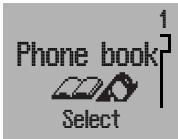
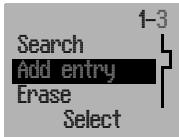
- Use ⬇ to access Add entry and press ⏚ (Select).
Name: prompt is displayed.
- Key in the desired name as follows:
Press the key labelled with the character you want: press once for the first character, twice (before the cursor appears) for the second, etc.
The available character set depends on the selected language, see "4-2-1 Language" on page 27.
- Press a key 0_ - 9^wxyz repeatedly to find characters, e.g. 1_ for characters.,?! - &t 1 and 0_ gives a space,
- switches between upper- and lower-case characters. The ABC or abc indicator is shown on the display.
- Press and hold # to switch between characters and numbers. The ABC (abc) or 123 indicator is shown on the display.
- You can also add a number by pressing and holding the appropriate number key for a second.
When the flashing cursor appears, you can enter the next character.
Press ⬇ to move the cursor.
Press Ⓞ to call up a list of special characters. The ⌘ indicator is shown.
Use ⬆ to scroll to the desired character and press ⬇ (Use) to add it to the name.
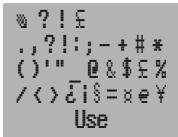
- When you have written the name, press (OK).
Number: prompt is displayed.
- Key in the country code (if necessary), the area code and phone number.
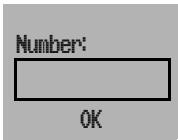
Note: If you key in the + character for the international prefix (by pressing ⓧ twice) in front of the country code, you can use the phone number when calling from abroad.
- Press ☐ (OK). The name and phone number are stored in the Phone book.
Quick Save
With the display clear, key in the phone number, press 🔒 to change the Navi key text to Save and press — (Save). Key in the name and press — (OK).
Making a call using the Phone book
-
Press — (Menu).
-
With Phone book displayed, press — (Select).
-
Press ☐ (Select) to choose Search.
-
Key in the first letter(s) of the name and press ⚡ (OK). You can skip this step if you like.
-
Use ⬤ to reach the desired name. You can check the phone number by pressing and holding Ⓞ.
-
Press — (Call).
A quick way to access the Phone book
With the display clear, press ⓥ. The first name (and phone number) in Phone book are displayed.
Note: The names and phone numbers assigned to the speed dial keys 1 to 9 can be speed dialled via the number keys 1 to 9 and -.
3. Other Essential Functions
Setting the time
- Press ☐ (Menu) and use ⚙ to access Clock and press ☐ (Select).
- Use ⬇ to access Clock settings, press — (Select).
- Use ⬇ to scroll to Set the time and press ⏚ (Select).
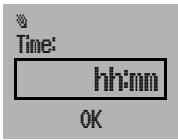
- Key in the time, e.g. 0, 8 tuv, 3 def, 0 for 8:30.
- Press ⏻ (OK) to confirm. The time is displayed in the right-hand corner of the display.
Note: The car phone does not contain its own battery, therefore the setting will be lost if the voltage of the car battery is low.
Selecting a ringing tone
- Press — (Menu).
- Use ⚙ to access Tones and press — (Select).
- Use ⬇ to access Ringing tone and press ⏚ (Select).
- Use ⬤ to scroll to the ringing tone you prefer. The phone gives you a ringing sample. Press ⬇ (OK) to select it.
- Press and hold ⓒ to exit the menu.
In-call options
Your phone provides a number of control functions that you can use during a call. You cannot utilise all of these functions at all times. Only those functions which are available and enabled will be shown in the in-call menu.
Many of the in-call options are network services.
While you have a call in progress, press ⏻ (Options) to enter the in-call menu. If the Navi key text is End, press Ⓒ to activate the text Options.
The following in-call options may be available:
Hold or Unhold to hold or release a call
New Call to make a call during an on-going call
Answer to answer the incoming call
Reject to reject the incoming call
Swap to switch between the two calls
End this call to end the active call
Send DTMF to send DTMF tones
Send to send the character string on the display to the network
End all calls to end both calls
Phone book to enter the Phone book
To exit the in-call menu, press ⓒ.
Voice messages
The network may offer you a voice mailbox service, which you have to install before you can receive voice messages. After you have installed this mailbox (refer to the user's guide supplied by your service provider), you can divert your calls to the voice mailbox and callers can leave you messages.
The network informs you when you have a voice message waiting. Call the mailbox number and listen to the message(s).
- With clear display, press and hold 1 for a second to call your voice mailbox.
If the phone asks for the voice mailbox number, key it in and press (OK), see "2-6 Voice mailbox number" on page 26. You will obtain your voice mailbox number from your service provider upon subscription to the voice mailbox service.
- Listen to the messages. End the call by pressing ⏻ (End).
Note: If the Navi key text Listen is available, press (Listen) to call your voice mailbox.
Text messages
You can read, write and store short text messages of up to 160 characters' length.
Before you can send any messages, you need to store the number of your message centre in the memory of the SIM card. It will remain unchanged until replaced. You will be allocated a
number by your service provider upon subscription to the Short Message Service (SMS), see "2-4 Message settings" on page 24.
Make sure, before sending a text message, that the called party is provided with the SMS feature.
Reading messages
- When you have received an SMS message, the text ...Messages(s) Received and the indicator are displayed. Press (Read).
- Use ⬇ to scroll to the desired message and press ⏚ (Read).
- While reading a message, use Ⓧ to browse through the message. Press ⏱ (Options) for available options. Press ⓒ briefly to exit the message.
- Press and hold ⓒ for a second to exit the menu.
Writing and sending a message
- Press — (Menu).
- Use ⚙ to scroll to the menu function Messages and press — (Select).
-
Use ⬇ to access Write messages and press — (Select).
-
Key in the message. For information on how to use the keys for writing, see "Storing a name and phone number in the Phone book" on page 13.
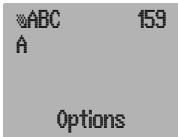
- When you have finished writing, press (Options).
- Select Send and press ⏻ (OK) or select Save to store the message so that it may be sent later.
- Key in the recipient's phone number or press — (Search) and use ⚙ to search for it in the Phone book and press — (OK).
- Press ☐ (OK) to send the message.
- Press and hold ⓒ twice to exit the menu.
Deleting messages
The storage capacity of the SIM card may vary depending on the card. If the SIM card is full, the 📋 indicator begins flashing. To store new messages, you have to delete those messages no longer required.
- Press ☐ (Menu) and scroll to Messages.
- Use 🔊 to access Inbox.
- Press ☐ (Options) and delete the selected message.
Fax and data call
Your radio unit supports fax and data calls. Data calls can be used to access the Internet. For example, the radio unit may be connected to a compatible mobile fax machine or to a compatible portable computer via an RS-232 connection. The RS-232 connector supports full protocol and 9 PIN standard (TIA/EIA-562). You have to select 19200 bps as RS-232 interface speed. For further information, see Nokia 6090 Product Support on www.forum.nokia.com website.
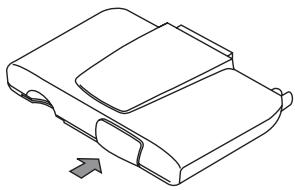
The transceiver is provided with a plastic cap to protect the data adapter connector. Remove the cap and then connect the car phone to your device using any standard 1:1 modem cable.
natural_image
Line drawing of a mechanical component with an arrow indicating direction (no text or symbols)Warning! Keep the cap out of small children's reach! Always remove the cap whenever you may have small children in your vehicle.
Ignition sense
The ignition sense prevents the car phone from draining the car battery. The ignition sense enables the car phone to be switched on or off automatically whenever the car's ignition is switched on or off. However, you can switch the handset on or off at any time via Ⓓ.
Automatic power-off
Automatic power-off prevents the car phone from draining the car battery if the car phone is left on, provided the handset is properly held in its cradle. You can set this function by selecting the length of the automatic power-off time.
- Press ☐ (Menu), use ⚙ to access the menu function Settings and press ☐ (Select).
- Use ⬇ to scroll to Phone settings and press ⏻ (Select).
- Use ⬇ to scroll to Automatic power-off and select the option.
Note: If automatic power-off is disabled, the car phone don't switch itself off automatically.
Ignition sense is connected:
If automatic power-off is set to on and the ignition is turned off, the car phone switches itself off after the set time (45 sec. - 24 hours). The countdown time can be restarted by any user action, i.e. key press or replacement of handset.
Ignition sense is not connected:
If automatic power-off is set to on, the car phone is switched off within the set time after the last user action, i.e. a key press or replacement of the handset.
Note: If you have selected 45 sec., you can postpone switching off for one hour by pressing ⓒ when the message is displayed.
Car radio mute
This feature mutes the car radio during a phone call, or during selecting of the ringing tones and of the volume and during SMS signalling, provided the car radio mute cable was properly connected at the time of installation.
Backlight dimming
- Press — (Menu).
- Use ⚙ to access the menu function Settings and press — (Select).
- Use ⬇ to scroll to Phone settings and press ⏚ (Select).
- Use ⬇ to scroll to Lights and select an option:
Full brightness: Backlighting is always fully on.
Custom setting: Backlighting is adjusted to the brightness of the dash lighting (provided the cable for backlight dimming was connected to a VDA-specific signal).
Off: Lights are always off.
4. Using the Menu
The car phone allows you to alter and view the settings of the functions and options that are listed in the menus and sub-menus.
The menus and submenus can be accessed by scrolling or by using the appropriate shortcut.
Accessing the menus by scrolling
- To access the menu facility, press (Menu).
- Press ⬇ to reach the desired main menu, e.g. Settings.
- Press ☐ (Select) to enter the menu.
- If the menu contains any submenus, scroll to the desired one with ↗.
- Press ☐ (Select) to enter the sub-menu (e.g. Call settings). If the menu contains submenus, repeat steps 4 and 5.
- Press ⬇ to scroll to the setting of your choice.
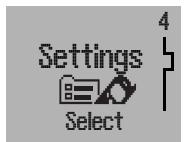
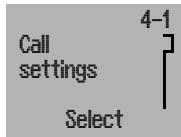
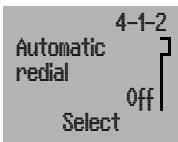
- Press ⏻ (OK) to confirm the chosen setting.
Note: You can return to the previous menu level by pressing Ⓒ briefly or exit the menu without changing any of the settings by pressing and holding Ⓒ.
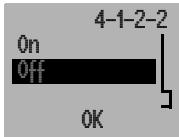
Accessing the menus by shortcut
The menu items (menus, submenus and setting options) are numbered and can be accessed via their shortcut number. This number is shown in the top right-hand corner of the display.
- Press — (Menu).
- Key in the number of the desired menu function you wish to access quickly, i.e. within three seconds.

For example, to set the keypad tones to off:
Press — (Menu), 9wxyz, 5jkl, 1oo, — (OK).
(Menu) to enter the menu,
9wxyz for Tones,
5 jkl for Keypad tones and
1∞ for keypad tones Off.
Press ☐ (OK) to confirm.
List of menu functions
1 Phone book

1 Search
2 Service Nos.
3 Add entry
4 Erase
1 One by one
2 Erase all
5 Edit
6 Copy
7 Send entry
8 Options
1 Memory in use
2 Type of view
3 Memory status
9 Speed dials
2 Messages

1 Inbox
2 Outbox
3 Write messages
4 Message settings
1 Set 1 ^1
1 Message centre number
2 Messages sent as
3 Message validity
2 Set N ^2
3 Common
1 Delivery reports
2 Reply via same centre
5 Info service
1 On
2 Off
3 Topic index
4 Topics
5 Language
6 Voice mailbox number
3 Call register
1 Missed calls
2 Received calls
3 Dialled numbers
4 Erase recent call lists
4 Settings
1 Call settings
- The number of the settings depends on how many settings your SIM card offers. Each setting appears in its own submenu and may have any name.
- The shortcut number of this menu depends on the number of settings available.


1 Anykey answer
2 Automatic redial
3 Speed dialling
4 Call waiting options
5 Own number sending
6 Automatic answer
7 Phone line in use (only when ALS)
2 Phone settings
1 Language
2 Cell info display
3 Welcome note
4 Network selection
5 Lights
1 Full brightness
2 Custom setting
3 Off
6 Automatic power-off
1 Disabled
2 45 sec.
3 1h
...
26 24h
7 SIM card priority
1 Radio unit SIM
2 Handset SIM
3 Security settings
1 PIN code request
2 Fixed dialling
3 Closed user group
4 Phone security
5 Change access codes
1 Change security code
2 Change PIN code
3 Change PIN2 code
4 Restore factory settings
5 Call divert

1 Divert all voice calls without ringing
2 Divert when busy
3 Divert when not answered
4 Divert when phone off or no coverage
5 Cancel all diverts
6 Call counters

1 Show call duration
1 Last call duration
2 All calls' duration
3 Received calls' duration
4 Dialled calls' duration
5 Clear timers
2 Show call costs
1 Last call cost
2 All calls' cost
3 Clear counters
3 Call cost settings
1 Call costs' limit
2 Show costs in
7 Calculator

8 Clock

1 Alarm clock
2 Clock settings
1 Show clock / Hide clock
2 Set the time
3 Time format
9 Tones

1 Incoming call alert
2 Ringing tone
3 Ringing volume
4 Message alert tone
5 Keypad tones
6 Warning tones
1 Phone book

You can store phone numbers and their related names in the memories of your SIM card or of your internal phone memory by using the Phone book menu.
The car phone supports SIM cards which can store up to 250 phone numbers (of up to 30 digits) and names (of up to 16 characters). The length and also the number of phone numbers and names which can be stored in the SIM card may vary depending on the SIM card. In addition, the internal phone memory can store up to 150 phone numbers (of up to 30 digits each) and names (of up to 16 characters each).
1-1 Recalling a name and phone number from the Phone book
Use the menu function Search to see if the desired name and phone number are stored in the Phone book.
Note: By pressing Ⓥ, you can access the names and phone numbers stored in your Phone book more quickly.
1-2 Service numbers
If this service is provided, you can use this menu function for easy access to the service numbers of your service provider.
1-3 Storing a name and phone number in the Phone book
In this menu Add entry, you can store phone numbers and the related names.
1-4 Erasing a name and phone number from the Phone book
You can Erase phone numbers and names from the Phone book either One by one or by selecting Erase all if all the names and numbers are to be erased from the Phone book at one time.
1-5 Editing a name and phone number in the Phone book
In this menu, you can Edit the names and phone numbers stored in the Phone book.
1-6 Copying the Phone book
You can copy the Phone book to the additional storage component in the phone or to another SIM card. Use From SIM card to phone to copy the Phone book entries one by one or all together into your phone; From phone to SIM card copies the Phone book onto another SIM card.
1-7 Sending a name and phone number from Phone book
The menu function Send entry allows you to send a person's name and phone number ('business card') from the Phone book to another phone via SMS.
Sending the contact information
Select Send entry, scroll to the name and number you want to send and press 📄 (Send). Enter the recipient's phone number or search in the Phone book. Press 📄 (OK) to send the information.
Receiving the contact information
When the phone receives contact information, the text Business card received is displayed. Press — (Options) to Show, Save or Discard the information and press — (OK).
1-8 Options
1-8-1 Selecting the Phone book used
Select the Phone book you want to use: the one on SIM card or the one stored in the phone.
1-8-2 Setting the type of viewing for stored names and phone numbers
There are three different ways the phone can show the stored phone numbers and names: Name list (shows three names at a time), Name, number (shows one name and phone number together) or Large font (shows one name at a time).
1-8-3 Checking the amount of free space in the Phone book
You can check how many names and phone numbers may still be stored and are currently stored in the Phone book.
1-9 Assigning a phone number as a speed dial number
You can assign nine phone numbers stored in the Phone book as speed dial numbers which can be dialled via the number keys 1 to 9.
Specifying a speed-dialling key
Select the menu function Speed dials. If no phone number is assigned to a key, press ⏻ (Assign).
Note: Assign is also shown when the phone has automatically assigned a phone number from the Phone book to a speed dial-ling key.
Search for the desired name and/or phone number in the Phone book and press ⏻ (OK) to select it.
If a phone number is assigned to a key, you can view the number, change it or erase it by first pressing ⏻ (Options).
Using the speed dialling key
Press the desired speed dialling key (100 to 9wxyz) briefly and press — (Call) to make the call.
Note: Pressing and holding 100 automatically calls your voice mailbox!
2 Messages

2-1 Inbox
When you have received an SMS message, the text ...Messages(s) received is displayed and the indicator is on. Press (Read) to view the message(s). To view the message later, enter the menu function Inbox.
The messages in the Inbox are listed with the latest message at the top of the list. Use Ⓧ to scroll to the desired message and press ⏚ (Read).
While reading a message, press ⏻ (Options) for available options, and press ⏻ (OK) to select the desired option: Erase, Reply, Edit, Use number (lists the phone number of the sender and numbers found in the message) and Forward (to forward the message). In the Details option, use ⏻ to see the details of the message: the sender's name and phone number, the message centre used for sending and the date and time the message was received.
2-2 Outbox
In the Outbox menu, you can find those stored messages to be sent at a later time.
2-3 Write messages
Within the Write messages menu, you can write and edit text messages of up to 160 characters.
When you have finished writing, press ⏻ (Options) for one of the options: Send, Send by set (sends the message by using a selected setting), Save (stores the message in the outbox folder to be sent later) or Clear screen (removes all the characters in the message).
2-4 Message settings
2-4-1 Set 1 ^1
A setting group or "set" is a collection of settings needed for sending text messages.
You can, for example, send a text message as a fax if this is supported by your service provider by simply selecting the set in which you have defined the proper settings for fax transmissions.
Each set has its own submenu:
2-4-1-1 Message centre number
Stores the phone number of the message centre needed for sending text messages. You obtain this number from your service provider. Key in the phone number of the message centre or edit the existing one and press ⏻ (OK).
2-4-1-2 Message sent as
You can request the network to convert your text messages into Fax, Paging or E-mail format (network service).
In order to receive a converted message, the recipient must have an appropriate terminal device.
2-4-1-3 Message validity
This network service allows you to set the length of time your text messages are stored at the message centre while attempts are made to deliver them.
2-4-2 Set N
2-4-3 Common ^1
2-4-3-1 Delivery reports
You can request the network to send delivery reports on your text messages (network service).
2-4-3-2 Reply via same centre
You can request the network to route the reply to your text message via your own message centre (network service).
2-5 Info service
This network service allows you to receive messages on various topics (such as weather or traffic conditions) from your service provider. For available topics and relevant topic numbers, contact your service provider.
2-5-1 On
If you select On, you will receive messages on the active topics. You can edit the topic list and mark the topics active or inactive.
2-5-3 Topic index
This menu retrieves a list of available topics from the network.
2-5-4 Topics
Here you can Add topic to the topics list. Key in the topic number and name. You can also Edit or Erase the topic list. You can read the topics by selecting Read.
2-5-5 Language
Here you can select the language for the messages. Only messages in the selected language are shown.
2-6 Voice mailbox number
Using the menu Voice mailbox number, you can store the number of your voice mailbox. Key in the number and press (OK). The number will remain unchanged until replaced. You are assigned the number by your service provider.
3 Call register

The phone registers missed and received calls only if the network supports the Calling Line Identification function, if the phone is switched on and if it is within the network's service area.
3-1 Missed calls
The last five phone numbers of the calling parties who have tried to call you are stored in the phone's memory in the missed calls list.
In the options of the Missed calls menu, you can view the phone number, Call the number, view the Time of the missed call if the clock is set to the right time, Edit number and Save it in the Phone book or Erase the phone number.
Note: When a notice about missed calls appears on the display, press ⏻ (List) to view the list of missed call phone numbers.
3-2 Received calls
The last five phone numbers from which you have received a call are stored in the phone's memory in the received calls list.
In the options of the Received calls menu, you can view the phone number, Call the number, view the Time of the received call if the clock is set to the right time, Edit number and Save it in the Phone book or Erase the phone number.
3-3 Dialled numbers
The phone stores the last eight phone numbers that you called or attempted to call.
In the options of the Dialled numbers menu, you can view the phone number, Call the number, view the Time of the call if the clock is set to the right time, Edit number and Save it in the Phone book or Erase the phone number.
3-4 Erasing recent call lists
This menu function allows you to erase all the phone numbers and names in the missed calls, received calls and dialled numbers lists.
Note: If the SIM card is renewed, the contents of the missed calls, dialled numbers and received calls lists are erased.
4 Settings

4-1 Call settings
4-1-1 Anykey answer
This menu function allows you to answer your incoming calls by pressing any key except ⓒ and Ⓑ.
4-1-2 Automatic redial
When this menu function is set to On, your phone will make up to ten attempts to connect the call after an unsuccessful call attempt.
4-1-3 Speed dialling
When this menu function is set to On, you can apply one touch dialling. The names and phone numbers assigned to the speed dialling keys 2^abc to 9^wxyz can be dialled by pressing and holding the corresponding number key.
Note: Pressing and holding 100 dials your voice mailbox number, not the speed dial number assigned to the key.
4-1-4 Call waiting options
When this network service is activated, the network will notify you of a new incoming call while you have a call in progress.
4-1-5 Own number sending
This network service allows you to set whether your phone number is hidden (OFF) or to be displayed (ON) to the person you are calling. Preset resets the phone to the default setting that you have agreed upon with your service provider. Whether your number will be displayed to the person you are calling depends on this agreement and the network's ability to process the number for any particular call.
4-1-6 Automatic answer
When this setting is On, your phone is set to automatically answer an incoming call after one ring.
4-1-7 Phone line in use (only when ALS)
Alternate Line Service is a feature of your SIM card. With this menu, the car phone displays the currently used phone number.
4-2 Phone settings
4-2-1 Language
You can select which language your phone will use for all its display texts. If the setting Automatic is selected, the phone will set the language according to the information contained in the SIM card used in the phone. English is used as a default setting if the language on the SIM card is not found in the phone.
4-2-2 Cell info display
Within this menu, you can set the phone to indicate cell information provided that the cellular network is based on Micro Cellular Network (MCN) technology (network service).
4-2-3 Welcome note
This menu allows you to set the message which is displayed when the phone is switched on.
4-2-4 Network selection
The network can be selected automatically or manually. The automatic mode is set by default.
In Automatic mode, the phone automatically selects one of the cellular networks available in your area.
In Manual mode, the phone shows a list of available networks and you may select the desired network if this network has a roaming agreement with your home network operator. Otherwise the text “No access” is displayed and another network must be selected. The phone remains in manual mode until the automatic mode is selected or until another SIM card is inserted in the phone.
4-2-5 Lights
You can dim the lights of the display and the keypad as desired.
4-2-5-1 Full brightness means that backlighting is fully on.
4-2-5-2 Custom setting means that backlighting of the car phone is adjusted to the brightness of the dash lighting provided the cable for backlight dimming was connected to a VDA-specific signal.
4-2-5-3 Off means that the lighting remains off.
4-2-6 Automatic power-off
Automatic power-off prevents the car phone from draining the car battery if the car phone is accidentally left on provided that the handset is placed correctly in the cradle. You can set this function to Disabled or set the length of the automatic power-off time between 45 sec. and 24 hours. Setting this function to Disabled may cause your car battery to drain.
4-2-7 SIM card priority
4-2-7-1 Radio unit SIM
The SIM card in the radio unit is assigned priority.
4-2-7-2 Handset SIM
The SIM card in the handset is assigned priority.
4-3 Security settings
Your phone is equipped with a versatile security system to prevent unauthorised use of the phone or the SIM card. The codes queried are those valid for the prioritised SIM card.
4-3-1 PIN code request
Within this menu, you can set the phone to ask for the PIN code of your SIM card when the phone is switched on. You need the PIN code to set the request to on.
Note: Remember that some SIM cards do not allow the PIN code request to be turned off.
4-3-2 Fixed dialling
You can restrict your outgoing calls to selected phone numbers, if this function is supported by your SIM card. To save and edit numbers on the list, you need the PIN2 code.
Note: When Fixed dialling is set to On, calls may be possible to certain emergency numbers in some networks (e.g. 112 or other official emergency numbers).
4-3-3 Closed user group
This network service specifies the group of people whom you can call and who can call you. Preset resets the phone to deploy any user group the SIM card owner has agreed upon with the service provider.
Note: When calls are limited to closed user groups, calls may be possible to certain emergency numbers in some networks (e.g. 112 or other official emergency numbers).
4-3-4 Phone security
This menu allows you to set the phone security level to On in order to prevent unauthorised use of the phone. You need the security code to set the security level.
If On is selected, the phone will ask for the security code whenever a new SIM card is inserted.
Note: If you change the security level, all the recent calls lists are cleared.
4-3-5 Change access codes
With this menu, you can change the access codes: security code, PIN code and PIN2 code of the active SIM card. These codes may only include the characters 0 to 9. The phone prompts you to enter the current code and the new code. It also prompts you to verify the new code.
If you want to change the codes of the second SIM card, you have to change the priority of the card reader, see "4-2-7 SIM card priority" on page 28, restart the car phone and change the codes of the second SIM card.
Note: Avoid using access codes similar to the emergency numbers, such as 112, in order to prevent accidental dialling of the emergency number.
4-4 Restore factory settings
You can reset some of the menu settings to their original values. The security code is needed for this function.
5 Call divert

The call divert network service allows you to divert the incoming calls to your voice mailbox (only voice calls) or to another phone number. The following call divert modes are available:
5-1 Divert all voice calls without ringing
5-2 Divert when busy
5-3 Divert when not answered
5-4 Divert when phone off or no coverage.
Then you can Activate, Cancel or check the Status of the selected mode. For some divert modes, Set delay is available.
5-5 With Cancel all diverts, you can set all diverts to off.
Note: If Divert when busy is activated, rejecting an incoming call will also divert the call.
6 Call counters

Note: The actual invoice for calls and services
from your service provider may vary, depending upon network features, rounding-off for billing, taxes and so forth.
6-1 Show call duration
You can use the Show call duration menu to view the approximate duration of your outgoing and incoming calls in hours, minutes and seconds and to reset the call timers to zero.
Inserting a new SIM card does not clear the call timers.
6-2 Show call costs
This network service allows you to check the approximate cost of your last call or of all calls if the call cost service is supported by the network. The costs are shown in terms of charging units. Call costs are shown separately for each SIM card.
6-3 Call cost settings
6-3-1 Call costs' limit
This network function allows you to set a cost limit for the calls with your SIM card. You can make and receive charged calls as long as the set call cost limit is not exceeded. The limit can be set in a specified number of charging units or units of the currency set within the Show costs in menu.
Depending on the SIM card used, you may need the PIN2 code to set a call cost limit.
6-3-2 Show costs in
This network function allows you to select whether the call costs are displayed in terms of charging units or the desired currency. Contact your service provider for the charging unit prices.
Depending on the SIM card used, you may need the PIN2 code to select the currency or unit in Show costs in.
7 Calculator

The phone is provided with a basic four-function calculator, which can also be used for rough currency conversions.
Using the calculator
Enter the first numbers in the calculation using the 0 -9^wxyz keys. Press # for a decimal point (.).
Press () once (+) to add, twice (-) to subtract, three times () to multiply and four times (/) to divide, or press — (0p-tions) to access the desired function.
For a total, press ⏚ (Options) and select Equals using ⏚ (OK). Press ⓒ to clear the display.
Note: This calculator has a limited accuracy and rounding errors may occur, especially in long division.
Making a currency conversion
- Press ☐ (Options) and select Exchange rate.
- Choose either of the displayed options: Foreign unit expressed as domestic units or Domestic unit expressed as foreign units.
- Key in the exchange rate (press # for a decimal point) and press — (OK).
- Make the conversion: Key in the amount to be converted, press ⏻ (Options) and select To domestic or To foreign.
Warning! Your phone must be switched on to use this function. Do not switch the phone on when wireless phone use is prohibited or when it may cause interference or danger.
8 Clock

8-1 Alarm clock
The phone can be set to ring as an alarm at a specified time. The alarm clock uses the time format set for the clock: a 12-hour cycle or a 24-hour cycle.
Note: If the phone is switched off, the alarm clock will not work.
In this menu, you can set the alarm time or select On to change the alarm time or Off to turn off the alarm clock.
When the set alarm time expires
The timer alert tone corresponds to the ringing volume setting. However, only a beep is heard, if you have selected Off or Beep once in the Tones menu.
When the phone alarm goes off, the message Alarm! is shown and the lights flash. If you let the phone alarm run for a minute or if you press (Snooze), the alarm stops for a few minutes and then re-sumes ringing. Press any other key to stop the alarm.
8-2 Clock settings
The phone is provided with a real-time clock. Since the phone has no power backup, you may need to set the time again if the car battery is flat or has been removed.
In this menu, you can Show / Hide clock, Set the time or select the 12-hour or 24-hour Time format.
9 Tones

9-1 Incoming call alert
This menu function allows you to select how the phone notifies you of an incoming call. Available options are Ringing, Ascending, Ring once, Beep once or Off if no ringing tone is to be heard.
Note: If the phone is set to Off, no ringing tone, message alert tone, keypad tone or warning tone will be sounded.
9-2 Ringing tone
You can select any of the ringing tone types available in this menu.
9-3 Ringing volume
A ringing tone is set off when there is an incoming call. This menu function allows you to select any of the ringing volume levels available. The ringing tone volume set also affects the volume of the message alert tone.
9-4 Message alert tone
You can also select an alert tone to indicate an incoming SMS message.
9-5 Keypad tones
A tone is sounded each time a key is pressed. You can set the keypad tone to Off or select any of the three keypad tone levels available.
9-6 Warning tones
If this function is set to On, the notification tones of the phone sound.
5. Reference Information
Facts about cellular transmission
Your car phone employs the data transmission capabilities of the GSM network to send faxes, short messages and e-mail and to establish connections with remote computers.
GSM data capabilities of your car phone
- Data compression with V.42bis
- Non-transparent and transparent data transfer at 9.6kbit/s
- AT commands
(for further information, see Nokia 6090 Product Support on www.forum.nokia.com website) - Fax service classes 1, 2 and 2.0 and ECM (sending)
- SMS sending and receiving
Cellular data connections can be made from most of the locations where your car phone operates. However, we recommend that you move the car to a location where the strongest possible cellular signal can be obtained. When the signal is strong, data transmission is efficient.
In general, you should not expect the same performance from cellular data communications as from line-connected communications due to the inherent characteristics of the cellular environment. The following factors may impair cellular connections:
Noise
Radio interference from electronic appliances and equipment as well as from surrounding traffic may impact the transmission quality.
Handover
As the car phone user moves from one network cell to another, the signal strength of the channel drops and the cellular telephone exchange may hand the user over to a different cell and frequency where the signal is stronger. A cell handover may also occur when the user is stationary due to varying cellular traffic loads. Such handovers may cause slight delays.
Dead spots and dropouts
Dead spots are areas where radio signals cannot be received. Dropouts occur when the car phone user passes through an area where the radio signal is blocked or reduced by geographic or structural obstructions.
Low signal strength
Due to either distance or obstacles, the radio signal strength from a cell site may not be strong or stable enough to provide reliable cellular connection for communication. Therefore, to ensure the best possible communication, remember to take the following points into consideration when using your car phone:
The data and fax connection works best when the car is stationary. Attempting cellular communication while in a moving vehicle is not recommended. Fax transmission is more easily impaired than data or short message transmission.
Check that the cellular signal strength on the handset display is sufficient. If the cellular signals are not strong enough to support a voice call, data connection should not be attempted until you can find a location with better signal reception.
Environmental impacts
Your car phone works in an temperature range between -20^ and +60^ .
Access codes
You can use the access codes described in this section to prevent unauthorised use of your phone and SIM card.
Your car phone may contain two different SIM cards. These cards use different access codes. Remember to check which SIM card is currently in use.
The access codes (except PUK and PUK2 codes) can be changed by using the menu "4-3-5 Change access codes" on page 29. If you want to change the codes of the second SIM card, you have to change the priority of the card reader, see "4-2-7 SIM card priority" on page 28, restart the car phone and change the codes of the second SIM card.
Security code (5 digits)
The security code can be used to prevent unauthorised use of your phone. The security code (factory setting: 12345) is usually supplied with the phone.
Change the code, see "4-3 Security settings" on page 28, and keep the code secret and in a safe place separate from the phone.
PIN code (4 to 8 digits)
The PIN (Personal Identification Number) code protects your SIM card against unauthorised use. The PIN code is usually supplied with the SIM card.
PIN2 code (4 to 8 digits)
The PIN2 code, supplied with some SIM cards, is required to access some functions, such as call cost limit. These functions are only available if supported by your SIM card.
PUK code (8 digits)
The PUK (Personal Unblocking Key) code is required to change a blocked PIN code. The PUK code may be supplied with the SIM card. If not, contact your local service provider for the code. If you lose the code, contact your service provider.
PUK2 code (8 digits)
The PUK2 code, supplied with some SIM cards, is required to change a blocked PIN2 code. If you lose the code, contact your service provider.
Battery information
Your radio unit does not contain its own battery. The voltage is supplied straight from your car battery to the car phone. The car phone works with a voltage from 10.8V to 16V.
If the voltage is higher than 16V, the car phone switches off automatically and remains off until the voltage drops to a value within the permissible range.
If the voltage of the car battery drops lower than 10.8V, a warning appears that phone calls are not possible because of low power. If the voltage drops below approx. 6V, the phone switches off and will automatically switch on as soon as the voltage rises again. The next time the car phone is turned on, a message appears on the display giving the reason for the error.
Accessories
Warning! Use only accessories approved by the phone manufacturer for use with this particular phone model. The use of any other types will invalidate any approval or warranty applying to the phone, and may be dangerous.
6090 DIN/ISO installation kit
natural_image
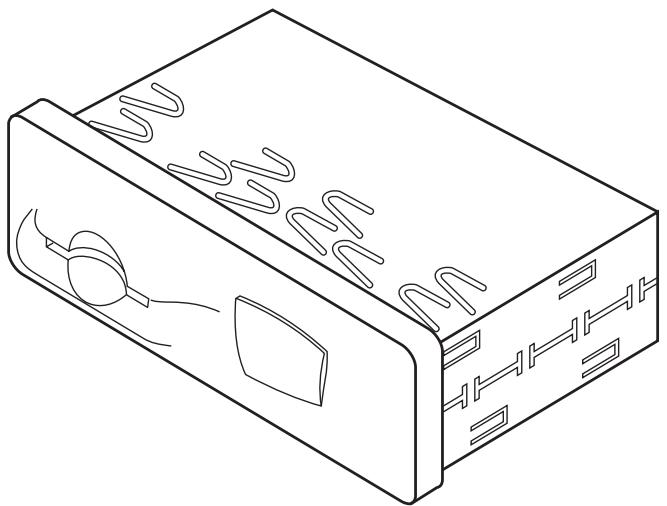
Line drawing of a rectangular electronic device with internal components and ventilation slots (no text or symbols)With the DIN/ISO installation kit, the Nokia 6090 is optimally designed for easy installation in your car, either in the dashboard or in the central console. You have easy access to the radio unit SIM reader or the data connector. For availability of approved accessories, please check with your dealer.
Warning! When you disconnect the power cord of any accessory, grasp and pull the plug, not the cord.
GSM antenna
This antenna is used to connect your car phone to the wireless GSM network. The antenna is not included in the package and has to be purchased separately. Your Nokia dealer can advise you about the antenna that best suits your needs. A dedicated 8W GSM 900 antenna is recommended, combined GSM-phone/FM-radio antennas are not, because they might not be designed for 8W output power. The frequency switch of a combined antenna can be destroyed and the FM-radio reception quality might suffer.
Data cable
This cable is used to connect your car phone to your device (e.g. to the 9-pin serial port of a compatible portable computer or portable fax). As this cable is a standard cable (1:1 modem cable, also called "DB9-prolongator cable" or "RS-232 modem cable") and is not included in the phone package, it can be purchased in shops that sell accessories for computers. To enable a compatible computer to communicate with the phone, a driver file can be downloaded from Nokia 6090 Product Support on www.forum.nokia.com website, and installed in the computer according to instructions provided there.
Care and Maintenance
Your car phone is a product of superior design and craftsmanship and should be treated with care. The suggestions below will help you to fulfil any warranty obligations and to enjoy this product for many years. When using your car phone or any accessory:
- Keep it and all its parts and accessories out of small children's reach.
- Keep it dry. Precipitation, humidity and liquids contain minerals that may corrode electronic circuits.
- Do not use or store it in dusty, dirty areas. Its moving parts can be damaged.
- Do not attempt to open it. Non-expert handling of the device may damage it.
- Do not drop, knock or shake it. Rough handling can break internal circuit boards.
- Do not use harsh chemicals, cleaning solvents or strong detergents to clean it. Wipe it with a soft cloth slightly dampened in a mild soap-and-water solution.
- Do not paint it. Paint can clog the device's moving parts and prevent proper operation.
- If the car phone is not working properly, take it to your nearest qualified service facility. The personnel there will assist you and, if necessary, arrange for service.
Important Safety Information
Traffic safety
Do not use a handheld telephone while driving a vehicle. If using a handheld telephone park the vehicle before conversing. Always secure the phone in its holder; do not place the phone on the passenger seat or where it can break loose in a collision or upon a sudden stop.
The use of an alert device to operate a vehicle's lights or horn on public roads is not permitted.
Remember road safety always comes first!
Operating environment
Remember to follow any special regulations in force in any area and always switch off your phone whenever it is forbidden to use it, or when it may cause interference or danger.
When connecting the phone or any accessory to another device, read its user's guide for detailed safety instructions. Do not connect incompatible products.
As with other mobile radio transmitting equipment, users are advised that for the satisfactory operation of the equipment and for the safety of personnel, it is recommended that the equipment should only be used in the normal operating position.
Electronic devices
Most modern electronic equipment is shielded from radio frequency (RF) signals. However, certain electronic equipment may not be shielded against the RF signals from your car phone.
Hearing aids
Some digital wireless phones may interfere with some hearing aids. In the event of such interference, you may want to consult your service provider.
Other medical devices
Operation of any radio-transmitting equipment, including cellular phones, may interfere with the functionality of inadequately protected medical devices. Consult a physician or the manufacturer of the medical device to determine if your devices are adequately shielded from external RF energy or if you should have any questions.
Switch off your car phone in health care facilities when any regulations posted in these areas instruct you to do so. Hospitals or health care facilities may be using equipment that could be sensitive to external RF energy.
Vehicles
RF signals may affect improperly installed or inadequately shielded electronic systems in motor vehicles (e.g. electronic
fuel injection systems, electronic anti-skid (anti-lock) braking systems, electronic speed control systems, airbag systems).
Check with the manufacturer or their representative regarding your vehicle. You should also consult the manufacturer of any equipment that has been added to your vehicle.
Posted facilities
Switch your car phone off in any facility where posted notices require you to do so.
Potentially explosive atmospheres
Switch off your car phone when in any area with a potentially explosive atmosphere and obey all signs and instructions. Sparks in such areas could cause an explosion or fire resulting in bodily injury or even death.
Users are advised to switch off the car phone when at a refueling point (service station). Users are reminded of the need to observe restrictions on the use of radio equipment in fuel depots (fuel storage and distribution areas), chemical plants or where blasting operations are in progress.
Areas with a potentially explosive atmosphere are often, but not always, clearly marked. They include below-deck on boats, chemical transfer or storage facilities, vehicles using liquified petroleum gas (such as propane or butane), areas where the air contains chemicals or particles, such as grain, dust or metal powders and any other area where you would normally be advised to turn off your vehicle engine.
Vehicles
Only qualified personnel should service or install the car phone in a vehicle. Faulty installation or service may be dangerous and may invalidate any warranty which may apply to the unit.
Check regularly that all car phone equipment in your vehicle is mounted and operating properly.
Do not store or transport flammable liquids, gases or explosive materials in the same compartment as the car phone, its parts or accessories.
For vehicles equipped with an airbag, remember that an airbag inflates with great force. Do not place objects, including both installed or portable wireless equipment in the area over the airbag or in the airbag deployment area. If in-vehicle wireless equipment is improperly installed and the airbag inflates, serious injury could result.
Failure to observe these instructions may lead to suspension or denial of telephone services to the offender or legal action or both.
Emergency calls
Important! This car phone, like any wireless phone, operates using radio signals, wireless and landline networks as well as user-programmed functions which cannot guarantee connection in all conditions. Therefore, you should never rely solely upon any wireless phone for essential communications (e.g. medical emergencies).
Remember, to make or receive any calls, the car phone must be switched on and in a service area with adequate signal strength. Emergency calls may not be possible on all wireless phone networks or when certain network services and/or phone features are in use. Check with local cellular service providers.
To make an emergency call:
- If the phone is not on, switch it on.
Some networks may require that a valid SIM card is properly inserted in the phone. - Press and hold ⓒ for several seconds to ready the phone for calls.
- Key in the emergency number applicable for your present location (e.g. 112 or other official emergency number). Emergency numbers vary according to location.
- Press — (Call).
If certain features are in use (Fixed dialling, etc.), you may first need to turn those features off before you can make an emergency call. Consult this document and your local cellular service provider.
When making an emergency call, remember to give all the necessary information as accurately as possible. Remember that your wireless phone may be the only means of communication at the scene of an accident – do not cut off the call until given permission to do so.
Installation
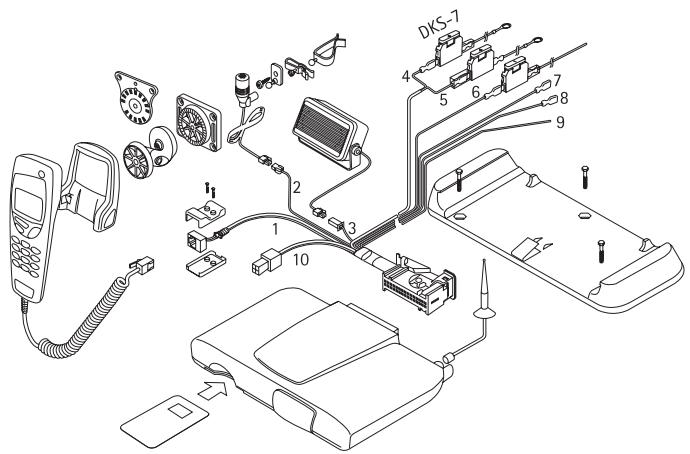
Cable connections
- Handset
- Handsfree microphone
- Handsfree loudspeaker
- 12V car battery + (with 3A fuse), 2 x red
- 12V car battery - (with 3A fuse), 2 x black
- Car ignition sense (with 1A fuse), blue
- Car radio mute connector, yellow
- Car antenna motor control, orange
- Car backlight dimming signal, grey
- Phone audio line-out, black cable
natural_image
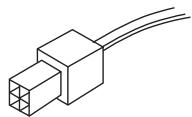
Isometric line drawing of a connector with two pins and three leads (no text or symbols)The phone audio line-out has to be connected to the car radio line-in. It delivers two differential audio signals, each one surrounded by a mass. At a load impedance >
1kOhm, the nominal level is 70 mVrms, the maximum level 2000 mVrms. Check with your car radio dealer to ensure that your specific radio line-in is compatible with your phone equipment.
Note: The SIM card and antenna represented here are not included in the package.
Recommendations
Warning! Only qualified personnel should service the car phone or install the car phone in a vehicle. Faulty installation or service may be dangerous and may invalidate any warranty which may apply to the unit.
Note: When installing the car kit in Australia and New Zealand, the 6090 should be installed in accordance with AS/NZS 4346.
- Microphone installation
The recommended position for the microphone should be the top of the A-pillar or, alternatively, near the back mirror in the middle of the car. The microphone should be pointed in the direction of the driver's mouth with a optimum distance of 30 cm. Streams of fresh air should not be directed at the microphone and the microphone cable should not be laid in the ventilation system. Use the provided soft material to connect the HF microphone to the A-pillar in order to avoid any noise coupling from the car to the microphone.
- Loudspeaker installation
The best position for the RF speaker is in the lower front-seat passenger area.
- Audio line out
Handsfree can also be provided by using the audio line out signal of the 6090 in combination with an appropriate FM car radio supporting the audio line-in function which enables use of the car loudspeaker system instead of using the delivered handsfree loudspeaker HFS-10. For good performance, use the front loudspeaker only and adjust the volume via the 6090 handset. So that keypad and warning tones may be audible, the external handsfree loudspeaker also has to be installed as described above. In case the FM car radio is not equipped with a connector for the audio line-out signal (see picture), the connector may be removed in order that the two wires can be directly connected to the FM car radio line-in. Since the 6090 audio line-out provides a differential signal instead of a +/- signal, the wires may be connected either way.
Warning! Don't connect the handsfree loudspeaker cable (3) to the car radio line-in, you would damage the phone and the car radio. Make sure you connect it only to the HFS-10 loudspeaker provided. Do not use any other loudspeaker than the one provided. Only the audio line-out cable provided (10) may be connected to a car radio.
- Connection to the car battery
Take the voltage directly from the car battery and use the cable supplied with the sales packages. This cable includes fuses to protect the phone. If you do not so, noise may impact the quality of the 6090 loudspeaker. The description
of the cable and its colour may be taken from the attached illustration.
- GSM antenna
A dedicated 8W GSM antenna is recommended. For more information about antenna see "GSM antenna" on page 37. Warning! In order to comply with RF exposure requirements for mobile transmitting devices, a minimum distance of 20 cm must be maintained between the antenna and all persons.
- Connect only the 6090 handset to the system connector as shown in the installation picture.
- When installing the radio unit, ensure a sufficient air supply (e.g. not in a box under the carpet).
- Do not extend the system cable by any wires.
- Use only correct fuses.
- The backlight dimming line (9) requires a signal from the car that matches VDA specifications if backlight dimming of the phone is to be fully functional.
For further information, see Nokia 6090 Product Support on www.forum.nokia.com website.
Glossary
Alternate line service (ALS)
Alternate line service allows you to have two different phone numbers, which page the same SIM card. Each of these phone numbers can have different settings: call barrings, diverts, etc. This is a network service which has to be subscribed to separately with your service provider. These two phone numbers are handled as separate numbers in the network. They are invoiced separately and can be used, for example, for differentiating between personal and business calls.
Car data
Car data includes data that contains the essential information about your car. This information is required in emergency situations.
Data centre number
This number is needed when your phone has been connected to a laptop PC via an RS232-cable and you want to make data calls.
DTMF (Dual Tone Multi-Frequency) tones
DTMF tones are the tones you hear when you press the number keys on the phone keypad. DTMF tones allow you to communicate with voice mailboxes, computerised telephony systems, etc.
PIN (Personal Identity Number) code
The PIN code protects your phone from unauthorised use. The PIN code is supplied with the SIM card. If the PIN code request is set to on, the code is required each time the phone is switched on. The PIN code must be 4 to 8 digits long.
PIN2 code
The PIN2 code is supplied with some SIM cards. The PIN2 code is required to access certain functions supported by the SIM card. The length of the PIN2 code is 4 to 8 digits.
PUK (PIN Unblocking Key) code
The PUK is an 8-digit code supplied with the SIM card. The code is required should you desire to change a disabled PIN code. If you enter an incorrect PUK code ten times in succession, the SIM card is rejected and you cannot make or receive any calls, except emergency calls. If the SIM is rejected, you will need a new SIM card.
You cannot change the PUK code. If you lose the code, contact your network operator.
PUK2 code
The PUK2 code is supplied with some SIM cards. The code is required when you wish to change a disabled PIN2 code. If you en-
ter an incorrect PUK2 code ten times in succession, you will not be able to access the functions which require the PIN2 code. To use these functions again, you will need to obtain a new SIM card from your network operator.
You cannot change the PUK2 code. If you lose the code, contact your network operator.
Security code
The security code is supplied with the car phone on an identification sticker (factory setting: 12345). The security code protects your car phone against unauthorised use.
Change the code, see "4-3-5 Change access codes" on page 29, and keep the new code secret and in a safe place, separate from the car phone.
SIM (Subscriber Identity Module) card
The SIM card contains all the information the cellular network needs to identify the network user. The SIM card also contains security-related information.
The Nokia 6090 contains two SIM cards: one in the handset, a plug-in SIM card, and a larger one in the phone unit: the IC-1 card. The cards differ solely in size.
SMSC number
Short message centre number is needed for sending of short messages. You have to save this number in Message settings.
Voice mailbox
A voice mailbox is a network service or a personal answering machine where people can leave you voice messages.
Index
A
Access Codes 35
PIN code 35
PIN2 code 35
PUK code 35
PUK2 code 36
Security code 8,35
Accessories 37
Alarm clock 32
Antenna 37
Anykey answer 27
Automatic
Answer 27
Power-off 18
Redial 27
B
Backlight dimming ..... 18
Battery information 36
C
C key 10
Calculator 31
Call
Counters 30
Divert 30
Emergency call 41
Fax and data call 17
Handsfree 12
In-call options 15
International call 12
Making a call 12
Missed calls 26
Receiving a call 12
Register 26
Car radio mute 18
Care and maintenance 38
Clock 32
Alarm clock 32
D
Data cable 37
Display indicators 11
E
Emergency call 41
F
Facts about cellular transmission .. 34
Fax and data call 17
G
Glossary 44
GSM antenna 37
H
Handsfree mode 12
|
Ignition sense 17
In-call options 15
Installation 42
International call 12
K
Keys 10
C key 10
Navi key 10
Scroll keys 10
L
Labels on your car phone 8
Lights 28
M
Menu 19
1 Phone book 22
2 Messages 24
3 Call register 26
4 Settings 27
5 Call divert 30
6 Call counters 30
7 Calculator 31
8 Clock 32
9 Tones 32
Accessing the menu by scrolling . 19
Accessing the menu by shortcut . 19
List of menu functions ..... 20
Messages 24
Deleting messages ..... 17
Reading messages 16
Text messages 16
Voice messages 16
Writing and sending messages ... 16
N
Navi key 10
0
One touch dialling 27
P
Phone book 22
Making a call using
the Phone book 14
Quick save 14
Storing in the Phone book ..... 13
PIN code 35
PIN2 code 35
PUK code 35
PUK2 code 36
R
Radio unit 9
Redialling 13
Reference information 34
Ringing tone 32
S
Safety information 7,39
Scrolling 10
Security code 35
Settings 27
Signal strength 11
SIM card 9
Inserting a SIM card 9
Priority 28
Speed dialling 23
T
Text messages 16
Time
Clock 32
Setting of the time 15
Tones 32
Selecting of the ringing tone .... 15
U
Using this guide 8
V
Voice mailbox 26
Voice messages 16
Volume 13
W
Warranty 48
Limited Manufacturer's Warranty
Part of Europe & Africa Region
This limited warranty shall apply in part of Nokia Mobile Phones' Europe & Africa Region unless a local warranty exists. Nokia Mobile Phones Ltd ("Nokia") warrants that this NOKIA product ("Product") is at the time of its original purchase free of defects in materials, design and workmanship subject to the following terms and conditions:
- This limited warranty is given to the end-purchaser of the Product ("Customer"). It shall neither exclude nor limit i) any mandatory statutory rights of the Customer or ii) any of the Customer's rights against the seller/dealer of the Product.
-
The warranty period is twelve (12) months from the date on which the first Customer purchased the Product. In case of a subsequent purchase or other change of owner/user, such warranty period shall continue for the remaining part of the twelve (12) month period and otherwise remain unaffected. This limited warranty is only valid and enforceable in the following countries: Bosnia, Bulgaria, Croatia, Cyprus, the Czech Republic, Estonia, any member state of the European Union, Hungary, Iceland, Israel, Latvia, Lithuania, Macedonia, Malta, Norway, Poland, Romania, the Slovak Republic, Slovenia, Switzerland and Turkey.
-
During the warranty period Nokia or its authorized service company will repair or replace, at Nokia's sole discretion, a defective Product. Nokia will return the repaired Product or another Product to the Customer in good working condition. All parts or other equipment for which replacements have been provided shall become the property of Nokia.
-
A repaired or replaced Product will not be given a prolonged or renewed warranty period.
-
This limited warranty will not cover painted covers or other similar personalized parts. In all cases that require unlocking or locking of an operator SIM-lock, Nokia will first direct the Customer to such operator for unlocking or locking of the operator SIM-lock before repairing or replacing the Product.
-
This limited warranty shall not apply to deteriorations due to normal wear and tear. This limited warranty shall further not apply if:
(i) The defect was caused by the fact that the Product has been subjected to: use in contradiction with the owner's/user manual, rough handling, exposure to moisture, dampness or extreme thermal or environmental conditions or rapid changes in such conditions, corrosion, oxidation, unauthorized modifications or connections, unauthorized opening or repair, repair by use of unauthorized spare parts, misuse, improper installation, accident, forces of nature, spillage of food or liquid, influence from chemical products or other acts beyond the reasonable control of Nokia (including but not limited to deficiencies in consumable parts, such as batteries which all by their nature have a limited lifetime, and breakage or damage to antennas) unless the defect was caused directly by defects in materials, design or workmanship;
(ii) Nokia or its authorized service company was not notified by the Customer of the defect within thirty (30) days after the appearance of the defect within the warranty period;
(iii) the Product was not returned to Nokia or its authorized service company within thirty (30) days after the appearance of the defect within the warranty period;
(iv) the Product serial number, the accessory date code or the IMEI number has been removed, erased, defaced, altered or is illegible;
(v) the defect was caused by a defective function of the cellular network;
(vi) the defect was caused by the fact that the Product was used with or connected to an accessory not manufactured and supplied by Nokia or used in other than its intended use;
(vii) the defect was caused by the fact that the battery was short-circuited or seals of the battery enclosure or cells were broken or show evidence of tampering or the battery was used in equipment other than for which it has been specified; or
(viii) the Product software needs to be upgraded due to changes in cellular network parameters.
-
To claim this limited warranty, the Customer shall present either i) a legible and non-modified original warranty card which clearly indicates the name and address of the seller, the date and place of purchase, the product type and the IMEI or other serial number or alternatively ii) a legible and non-modified original purchase receipt which contains the same information, if such purchase receipt is presented to the seller/dealer of the Product.
-
This limited warranty is the Customer's sole and exclusive remedy against Nokia and Nokia's sole and exclusive liability against the Customer for defects or malfunctions of the Product. This limited warranty replaces all other warranties and liabilities, whether oral, written, (non-mandatory) statutory, contractual, in tort or otherwise. Nokia is in no event liable for any incidental, consequential or indirect damage, costs or expenses. Neither is Nokia in any event liable for any direct damage, costs or expenses, if the Customer is a legal person.
-
Any change or amendment to this limited warranty requires Nokia's prior written consent.
WARRANTY CARD
FILL IN WITH BLOCK LETTERS
Purchaser's Name:
Address:
Country:
Phone:
Date of Purchase (dd/mm/yy): ____ / ____ / ____
Product Type (on phone type label): ____ - ____
Product Model (on phone type label): ____
Phone Serial No (on phone type label): ____ / ____ / ____ / ____
Place of Purchase:
Store Name:
Store Address:
Stamp