CMV328ZT - Microwaves ETNA - Free user manual and instructions
Find the device manual for free CMV328ZT ETNA in PDF.


| Product Type | Combination Microwave Oven (Microwave, Grill, Convection) |
| Brand | Etna |
| Model | CMV328ZT |
| Appliance Dimensions (W x D x H) | 520 mm x 508 mm x 326 mm |
| Cavity Volume | 28 litres |
| Turntable Diameter | 315 mm |
| Electrical Connection | 230 V ~ 50 Hz |
| Microwave Power | 900 W |
| Microwave Power Levels | 5 levels: P100 (100%), P80 (80%), P50 (50%), P30 (30%), P10 (10%) |
| Grill Power | 1 level (G-1) |
| Convection Temperature Range | 140 °C to 230 °C |
| Combination Cooking Modes | 4 modes: C-1 to C-4 |
| Automatic Programs | 10 programs: Auto Reheat, Potato, Meat, Vegetable, Fish, Pasta, Soup, Cake, Pizza, Chicken |
| Defrost Functions | By weight (100-2000 g) and by time |
| Special Functions | Home Fry, Crispy Grill, Low Temperature Control, Deodorization, Child Lock, ECO Mode, Mute Function |
| Control Type | Electronic with knob and buttons |
| Display | Digital display with clock and symbols |
| Interior Light | Yes |
| Safety Features | Child lock, door interlock, automatic shut-off if door opened |
| Cleaning and Maintenance | Clean interior with damp cloth; do not use abrasive cleaners; turntable and accessories dishwasher-safe |
| Included Accessories | Glass turntable, guiding ring, grill tray, grill rack |
Frequently Asked Questions - CMV328ZT ETNA
User questions about CMV328ZT ETNA
0 question about this device. Answer the ones you know or ask your own.
Ask a new question about this device
Download the instructions for your Microwaves in PDF format for free! Find your manual CMV328ZT - ETNA and take your electronic device back in hand. On this page are published all the documents necessary for the use of your device. CMV328ZT by ETNA.
USER MANUAL CMV328ZT ETNA

Let op!
Vermogentoets
▶Magnetron: ‘P100’, ‘P80’, ‘P50’, ‘P30’ of ‘P10’
▷Grill: 'G-1'
Productspecifications
natural_image
Symbol of a trash bin crossed with no text or numbers, representing waste sorting or disposal (no text present)Description of the appliance 6
Control panel 7
First use
Before first use 9
Positioning 9
Using the microwave 9
Guidelines for microwave cookware 10
Operation
Attention! 12
Notes about operation 12
Clock setting 12
Kitchen timer 13
Quick start 13
Microwave cooking 14
Grill cooking 14
Combination cooking 15
Convection cooking (with preheating function) 15
Convection cooking (without preheating function) 16
Multi-stage cooking 16
Automatic programs 17
Defrosting (by weight) 20
Defrosting (by time) 20
Home fry 20
Crispy grill 21
Low temperature control 22
Checking time or power 23
Mute function 23
ECO function 23
Deodorization 23
Child lock 24
Cooking tips
Warming up and cooking 25
Defrosting
25
Factors that influence the cooking process 26
Basic techniques 26
Cooking vegetables 27
Cooking fish 27
Maintenance
Cleaning the appliance 28
Faults
Solving problems 29
Sparks in the microwave 29
Technical specifications
Product specifications 30
Environmental aspects
Disposal of packaging and appliance 31
Introduction
Congratulations on your choice of this Etna microwave. This product was designed with simple operation and optimum comfort in mind.
This manual describes the best way to use this microwave. In addition to information on operation, you will also find background information that may come in handy when using the appliance.

Please read the separate safety instructions carefully before using the appliance!
Read this manual before using the appliance and keep it in a safe place for future use.
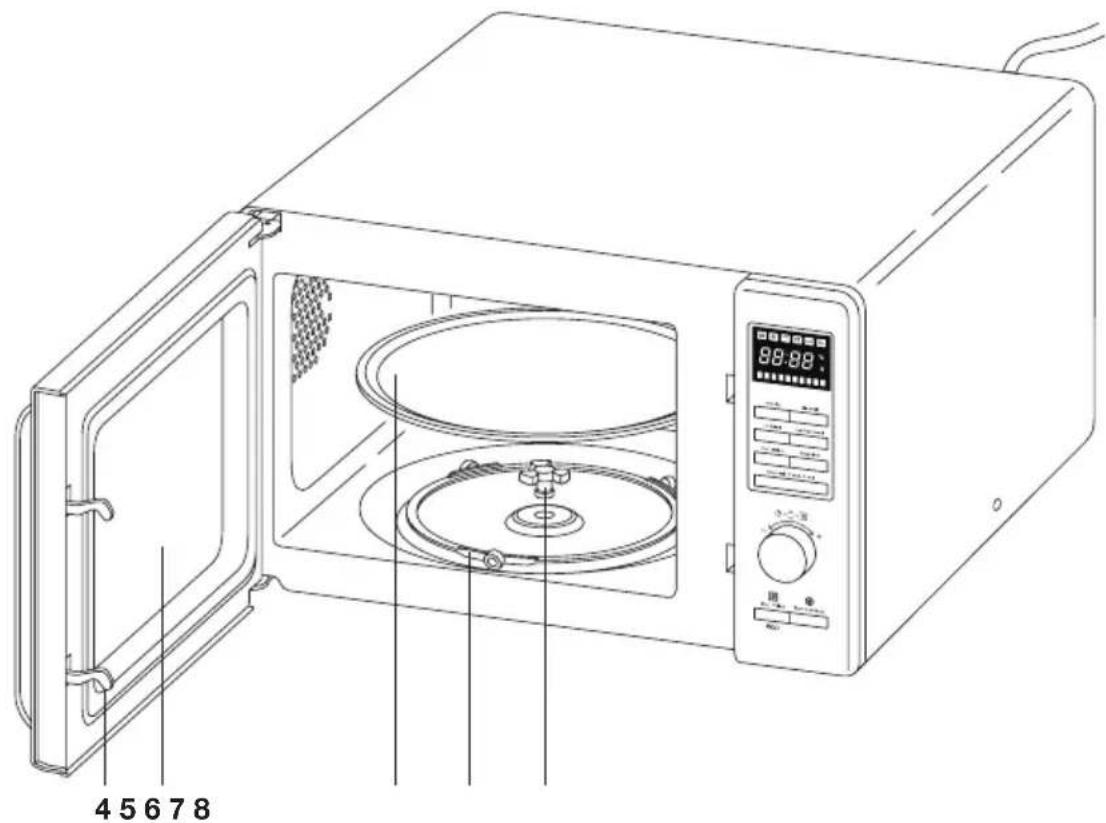
Description of the appliance
- Door
- Door grip
- Control panel
- Door lock
- Window
- Glass turntable
- Guiding ring
- Drive shaft
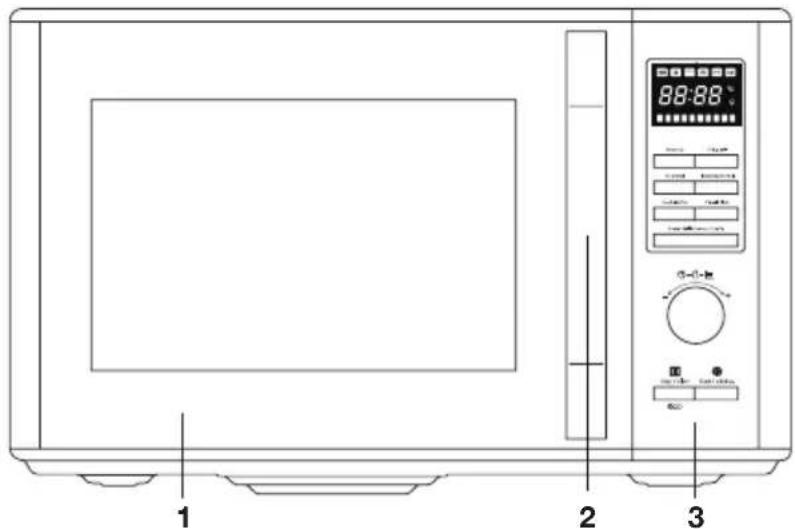
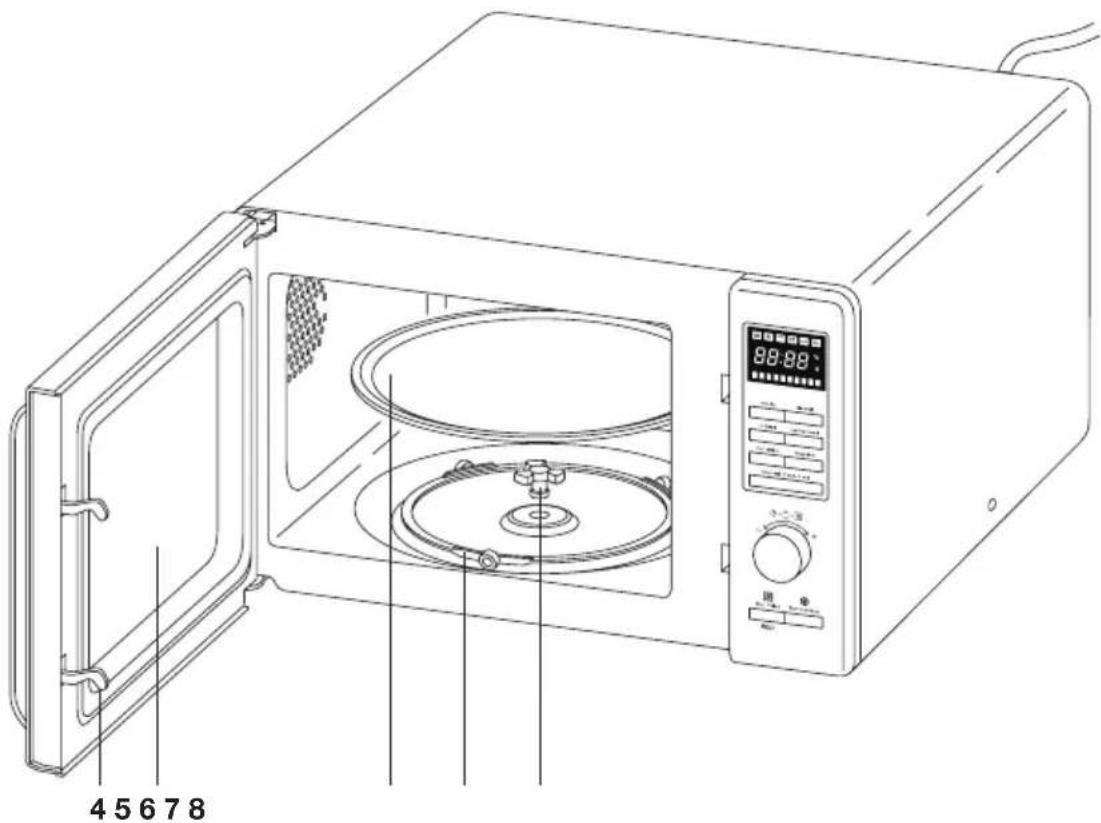

Attention!
The microwave may not be used without the guiding ring and turntable. The turntable should be fitted with the opening for the drive shaft facing downwards.
Control panel
- Display with all symbols
- Home Fry button
- Crispy Grill button
- Pro Defrost button
- Low Temp Control button
- Deodorization button
- 'Delayed start' button / Clock button / Defrost button
- Power button
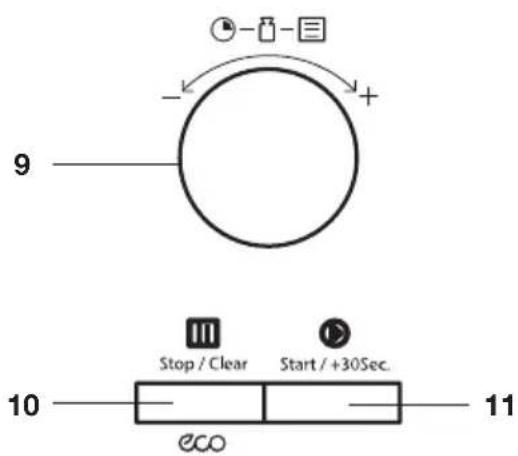
- Adjust knob (Auto/Enter/Time/Weight)
- Pause button / Stop button
- Quick button / Start button
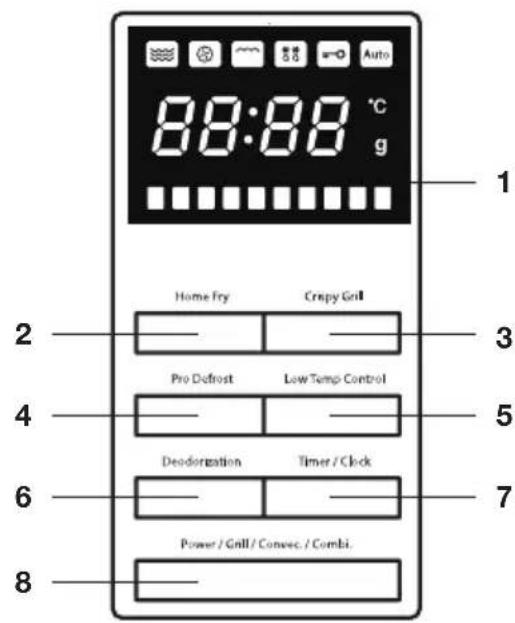
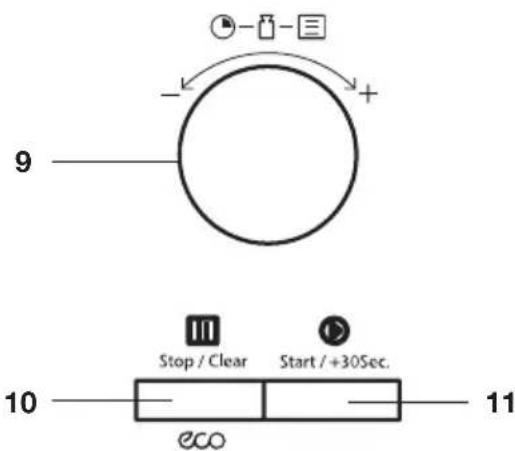
Power button
Press the button (several times) to set the power.
Delayed start button / Clock button / Defrost button
- Setting a delayed start.
- Setting the clock.
- Press the button one/two/three times to set defrost program d1/d2/d3.
Quick button / Start button
- Press the button once to start immediately for 1 minute with the highest power.
- After making a desired setting, press the button once to start the microwave with the setting that has been made before.
Pause button / Stop button
- Press the button once to pause the cooking (for instance, to turn over the food). After that, press the start button to start the cooking again.
During pause, the remaining time and the chosen setting are shown in the display.
- Press the button twice to stop the cooking.
The time and the clock symbol are shown in the display.
Adjust knob
- Turning; selecting an automatic program.
- Turning; setting the time.
▶Turn to the left; go right away to 60 minutes.
▶Turn to the right; steps of 10 seconds.
- Turning; setting the weight in a defrost program and in an automatic program.
The weight setting that can be made depends on the weight range belonging to the chosen defrost program.
The weight setting that can be made depends on the pre-programmed weight settings belonging to the chosen automatic program.
- Pressing (Enter); confirming the choice after choosing an automatic program.
Pressing the knob to confirm will only function for the automatic programs. If you press the knob another moment, you will hear a beep and nothing will happen.

Tip
During cooking you can increase or decrease the time by turning the adjust knob. This isn't possible during the defrost programs and automatic programs; here the time is fixed.
Before first use
- Open the door, remove the packaging and check the microwave for damage.
- Do not use the microwave if it is damaged, contact your supplier.
- Remove the protective film from the casing.
- Clean the oven interior and accessories with a damp cloth. Do not use any abrasive cleaner or strong-smelling cleaning products.
- First, place the guiding ring and then the turntable in the centre of the oven cavity with the opening for the drive shaft facing downwards.

Attention!
The microwave may not be used without the guiding ring and turntable.
Positioning
- Place the microwave oven on a firm, flat surface.
- Make sure that there is sufficient ventilation around the microwave oven. Keep at least a 30 cm space free at the top. At the sides, keep at least 20 cm free. The microwave needs to be at least 85 cm from the floor. The rear surface of appliance shall be placed against a wall.
- Do not cover the air vents.
Using the microwave
Microwaves are high-frequency electromagnetic waves. The energy makes it possible to cook or warm up a dish without affecting the form or colour.
Cooking principle
- The microwaves which the microwave generates are spread evenly by a distribution system. This cooks the dish evenly.
- The food absorbs the microwaves to a depth of approximately 2.5 cm. Cooking then continues, because the heat is spread in the dish.
- The cooking times vary and depend on the dish you use and the properties of the food:
▶Quantity and density
▶Moisture content
▶Starting temperature (whether or not it is cooled)

Attention!
The dish is cooked from the inside out by means of heat distribution. The cooking continues even when you take the dish from the oven. Standing times in recipes and in this book should therefore be adhered to, in order to ensure:
• Even heating into the middle of the dish;
• Equal temperatures in all parts of the dish.
Guidelines for microwave cookware
Cookware that you use for the microwave function should not block the microwaves. Metals such as stainless steel, aluminium and copper reflect microwaves. For that reason, do not use metal cookware. Cookware which is designated as microwave-safe can be used safely. For more information about suitable cookware, consult the following guidelines.
√ Recommended
√ X Careful
x Unsafe
| Cookware Microwave | safe | Remarks |
| Aluminium foil Can be used in | small quantities | to prevent certain parts of the food from overcooking. Arcing can occur if the foil is too close to the oven wall or if too much foil is used. |
| Porcelain and earthenware Porcelain, earthenwareand ivory porcelain are usually suitable, unless they have a metal edge. | ||
| Disposable crockery made from polyester or cardboard | √ | Frozen meals are sometimes packaged in disposable tableware. |
| Fast food packagingPolystyrene cupsPaper bags or newspaperRecycled paper or metal edges | √✗✗ | Can be used to warm up food. Polystyrene can melt if it overheats.Can catch fire.Can cause arcing. |
| GlasswareOven dishesFine glasswareGlass jars | ✓ | Can be used, unless it has a metal edge.Can be used to warm up food or liquids.Thin glass can break or shatter with sudden heating.The lid must be removed. Only suitable for warming. |
| Metal Can cause arcing or fire. | ✕ | |
| PaperPlates, cups, kitchen paperRecycled paper | ✓✕ | For short cooking times and warming. For absorbing excess moisture.Can cause arcing. |
| Plastic Especially heat-resistant thermoplastic | material. Other types of plastic can warp or discolour at high temperatures. Do not use melamine plastic. Can be used to hold moisture. May not touch the food. Be careful when you remove the film; hot steam can escape. Only if boil-proof or ovenproof. Must not be airtight. If necessary, prick it with a fork. | |
Attention!

Attention!
Heating liquids in the microwave can result in delayed boiling. This means that the liquid may start to boil furiously after it is removed from the microwave, with the risk of scalding. You can offset the delayed boiling effect by placing a plastic or glass spoon in the liquid prior to heating it in the microwave.

Attention!
Take care with baby food:
- Shake or stir the content of babies' bottles or pots of baby food after heating.
- Check the temperature of the food carefully prior to consumption to prevent scalding injuries.

Attention!
Cutlery and tableware may become hot after using the microwave.
Notes about operation
- The first time you turn the knob you will hear a beep.
- If you open the door while the oven is on, you must press the start button to continue cooking.
- If the start button is not pressed within 5 minutes after you set a cooking program, the setting will be cancelled and the current time will be shown.
- When a button is pressed properly, you will hear a beep. Otherwise there is no response.
- When the cooking program is finished you will hear 5 beeps.
Clock setting
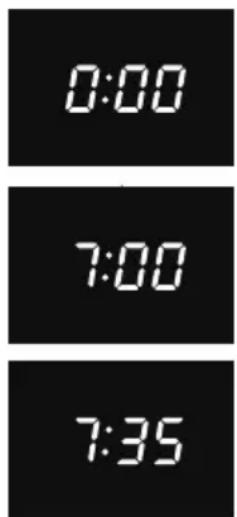
- Connect the microwave to the power mains.
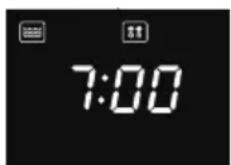
▶'0:00' is shown and you hear a beep. - Press the clock button twice.
The hour digits flash - Turn the adjust knob to set the hour (0 to 23).
- Press the clock button again.
The minute digits flash. - Turn the adjust knob to set the minute (0 to 59).
- Press the clock button to exit clock setting mode.
- Press the clock button again or wait 5 seconds; the time has been set. ▶The set time is shown in the display.

Attention!
If the clock is not set, the time will not be shown.
While setting the clock, you can press the stop button to return to the previous mode.
Kitchen timer
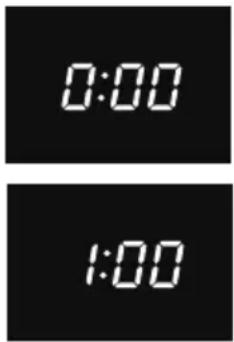
- Press the clock button once
▷'0:00' is shown. - Turn the adjust knob to set the length of time (0:05 to 95:00).
- Press the start button to confirm.
▶When the time is reached, you hear 5 beeps.
▶If the clock is set, the current time is shown.
Quick start
If you want to start the appliance immediately, without making any settings in advance:
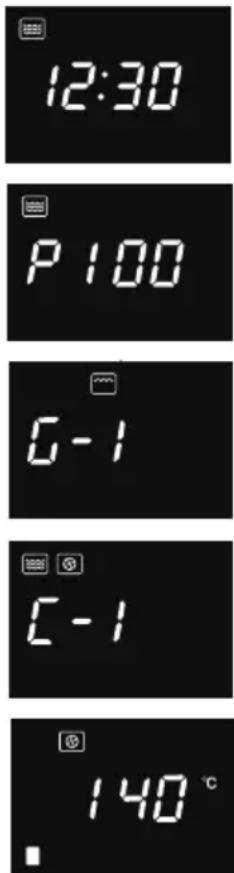
- Press the start button to start cooking at 100% power for 30 seconds. Each additional press increases the time by 30 seconds (0:05 to 95:00).
OR
Press the power button repeatedly or turn the adjust knob to select the function. Stop pressing/turning when the corresponding function flashes:
▶Microwave cooking: 'P100', 'P80', 'P50', 'P30', or 'P10'
▶Grill cooking: 'G-1'
▷Combination cooking: 'C-1', 'C-2', 'C-3', or 'C-4'
▷Convection cooking: '140'

Tip
Quick start is not available for weight defrost, multi-stage cooking, and auto menu cooking.
Microwave cooking
In the table you will see the microwave power settings you can use and for which these power settings are suitable..
| Display Power Use | |
| P100 100% / 900 Watt Quick cooking | |
| P80 80% / 720 Watt Normal cooking | |
| P50 50% / 450 Watt Slow cooking/steaming | |
| P30 30% / 270 Watt Defrosting | |
| P10 10% / 90 Watt Keeping warm |
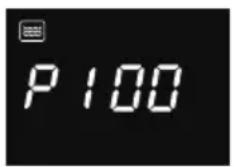
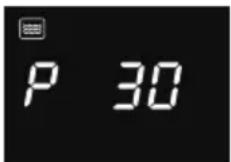
- Press the power button once. ▷'P100' flashes.
- Press the start button to confirm. ▷'P100' stops flashing.
- Press the power button repeatedly or turn the adjust knob to select the microwave power (100% to 10%). 'P100', 'P80', 'P50', 'P30', and 'P10' appear in order.
- Press the start button to confirm.
- Turn the adjust knob to adjust the cooking time (0:05 to 95:00).
- Press the start button to start cooking.

Tip
When you adjust the cooking time, the step interval is as follows:
0-1 min > 5 s, 1-5 min > 10 s, 5-10 min > 30 s, 10-30 min > 1 min, 30-95 min > 5 min
Grill cooking
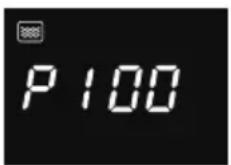
- Press the power button once. ▷'P100' flashes.
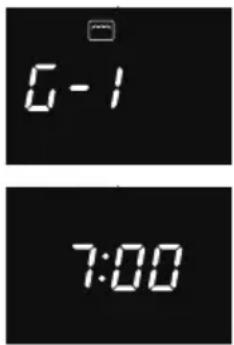
- Press the power button repeatedly or turn the adjust knob to select the grill function. Stop pressing/turning when 'G-1' flashes.
- Press the start button to confirm.
▷'G-1' stops flashing. - Turn the adjust knob to adjust the cooking time (0:05 to 95:00).
- Press the start button to start cooking.
Combination cooking
With this function you can prepare popular dishes very simply. Select the appropriate program
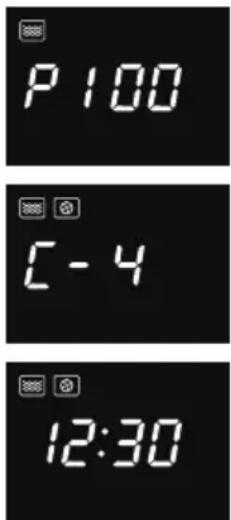
- Press the power button once.
▷'P100' flashes. - Press the power button repeatedly or turn the adjust knob to select the combi function. Stop pressing/turning when 'C-1', 'C-2', 'C-3', or 'C-4' is shown.
- Press the start button to confirm.
- Turn the adjust knob to adjust the cooking time (0:05 to 95:00).
- Press the start button to start cooking.
Convection cooking (with preheating function)
This appliance can also cook like an ordinary oven, using heat instead of microwaves. This is called convection cooking.
When you cook this way, it is best to preheat the oven before you place the food in the oven.
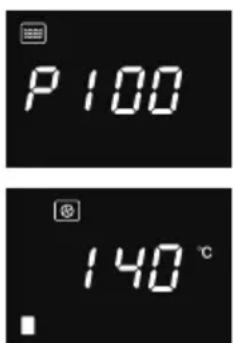
- Press the power button once.
▷'P100' flashes. - Press the power button repeatedly or turn the adjust knob to select the convection function. Stop pressing/turning when '140' flashes.
- Press the start button to confirm.
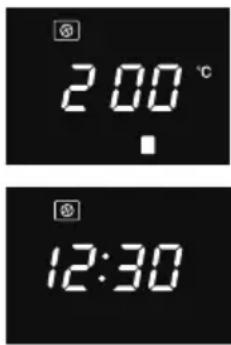
- Turn the adjust knob to select the convection temperature (140 to 230 °C).
- Press the start button to confirm.
- Press the start button to start preheating.
▶When the temperature is reached, you hear 2 beeps and the temperature flashes. - Put food in the oven and close the door.
- Turn the adjust knob to adjust the cooking time (0:05 to 95:00).
- Press the start button to start cooking.
Convection cooking (without preheating function)
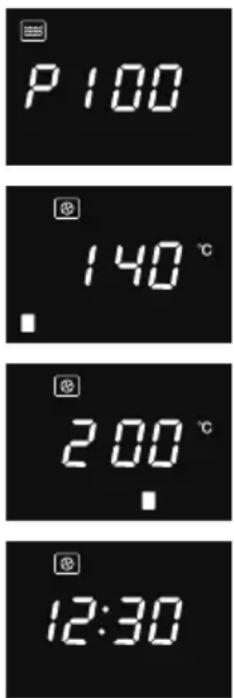
- Press the power button once.
▷'P100' flashes. - Press the power button repeatedly or turn the adjust knob to select the convection function. Stop pressing/turning when '140' flashes.
- Press the start button to confirm.
- Turn the adjust knob to select the convection temperature (140 to 230 °C).
- Press the start button to confirm.
- Turn the adjust knob to adjust the cooking time (0:05 to 95:00).
- Press the start button to start cooking.
Multi-stage cooking
With multi-stage cooking you can set two functions. After the first is finished, you hear a beep and the second begins.

Note
‘Defrosting’ can only be set as the first function. The ‘auto menu’ and ‘preheating’ functions cannot be used.
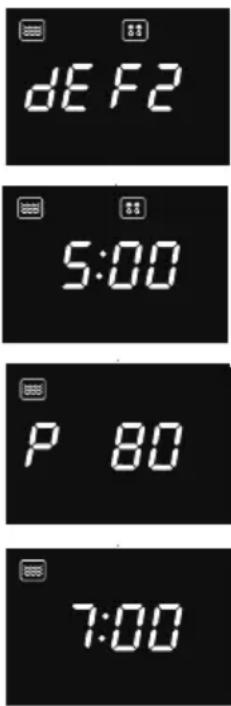
For example, to defrost for 5 minutes and then cook at 80% microwave power for 7 minutes:
- Press the pro defrost button twice.
^▶ 'dEF2' is shown. - Turn the adjust knob to set a defrost time of 5 minutes.
- Press the power button once.
- Press the start button to confirm.
- Turn the adjust knob to select 80% microwave power.
▷'P80' is shown. - Press the start button to confirm.
- Turn the adjust knob to set the cooking time to 7 minutes.
- Press the start button to start cooking.
Automatic programs
With this function you can prepare popular dishes very simply. Select the appropriate program from the table, suitable for the kind of food and the weight.
The temperature, weight and shape of the food will influence the cooking effect. At the end of the automatic program, you can start the microwave again to extend the cooking process for a better result.
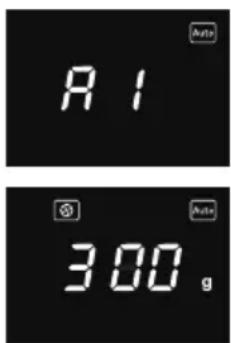
- Turn the adjust knob to select the desired automatic program. Stop pressing/turning when 'A1', 'A2', 'A3' ... 'A10' is shown.
- Press the start button to confirm.
- Turn the adjust knob to select the weight.
'g' is shown. - Press the start button to start cooking.

Notes
- The ‘cake’ program uses the convection function. Wait until the oven has preheated to 160 °C and you hear a beep. Then put the cake in the oven and press start.
- During the ‘chicken’ program you will hear 2 beeps after two-thirds of the time has passed. You do not have to do anything, but for best results you should turn the food and press start to continue cooking.
In the table you will see the automatic programs with the corresponding weight settings.
| Menu Weight Display Power | |||
| A1AUTO REHEAT | 150 g 150 | 100% | |
| 250 g 250 | |||
| 350 g 350 | |||
| 450 g 450 | |||
| 600 g 600 | |||
| A2POTATO | 1 (about 230 g) 1 | 100%2 (about 460 g) | |
| 3 (about 690 g) 3 | |||
| A3MEAT | 150 g 150 | 100% | |
| 300 g 300 | |||
| 450 g 450 | |||
| 600 g 600 | |||
| A4VEGETABLE | 150 g 150 | 100% | |
| 350 g 350 | |||
| 500 g 500 | |||
| A5FISH | 150 g 150 | 80% | |
| 250 g 250 | |||
| 350 g 350 | |||
| 450 g 450 | |||
| 650 g 650 | |||
| A6PASTA | 50 g (with 450 g cold water) 50 | 80% | |
| 100 g (with 800 g cold water) 100 | |||
| 150 g (with 1200 g cold water) 150 | |||
| A7SOUP | 200 ml 200 | 100%400 ml 400 | |
| 600 ml 600 | |||
| A8CAKE | 475 g 475 | Preheat to 160 °C | |
| A9PIZZA | 200 g 200 | C-4300 g 300 | |
| 400 g 400 | |||
| A10CHICKEN | 500 g 500 | C-4 | |
| 750 g 750 | |||
| 1000 g 1000 | |||
| 1200 g 1200 | |||
Defrosting (by weight)
If you are going to defrost food, it is necessary to turn over the food half way the defrost time to get a better result.
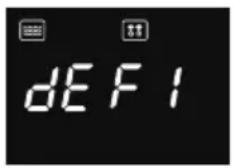
- Press the pro defrost button.
'dEF1' is shown.
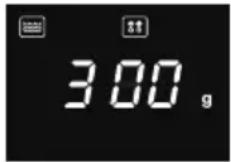
- Turn the adjust knob to select the weight (100-2000 g).
'g' is shown.
- Press the start button to start defrosting.
Defrosting (by time)
If you are going to defrost food, it is necessary to turn over the food half way the defrost time to get a better result.
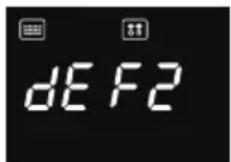
- Press the pro defrost button twice.
^▶ 'dEF2' is shown.
-
Turn the adjust knob to select the time (0:05 to 95:00).
-
Press the start button to start defrosting
Home fry
-
Press the home fry button.
-
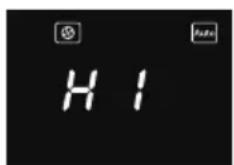
Turn the adjust knob. Stop turning when 'H1', 'H2', 'H3' ... 'H9' is shown.
-
Do not put the food in the oven yet.
-
Press the start button to start preheating.
-
Wait until the oven has preheated and you hear a beep.
-
Now put the food in the oven and press start to start cooking.
| No. | Menu Weight (g) | |
| H1 | Frozen french fries 300 | |
| H2 | Frozen potato croquettes 310 | |
| H3 | Frozen squid 250 | |
| H4 | Frozen onion rings 225 | |
| H5 | Frozen chicken nuggets 400 | |
| H6 | Escalope 350 | |
| H7 | Shrimps 165 | |
| H8 | Vegetable 200 | |
| H9 | Spring rolls 250 |
Crispy grill
- Press the crispy grill button.
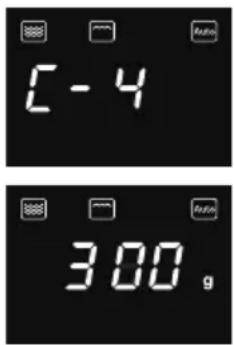
- Press the crispy grill button repeatedly or turn the adjust knob to select grill mode. Stop pressing/turning when 'C1', 'C2', 'C3', or 'C4' is shown.
- Press the start button to confirm.
- Turn the adjust knob to select the weight.
- Press the start button to start cooking.

Note
Place all the food on the grill tray and place the grill tray on the grill rack.
| Crispy grill Weight (g) | Power | Initial temp. | |
| C1 Cordon bleu (fresh mini pizza) | 200 | C-4 Room temp. | |
| 300 | |||
| 400 | |||
| 500 | |||
| 600 | |||
| 700 | |||
| 800 | |||
| Crispy grill Weight (g) Power Initial temp. | |||
| C2 (lasagna) | 200 | C-4 | Refrigerated temp. |
| 300 | |||
| 400 | |||
| 500 | |||
| 600 | |||
| 700 | |||
| 800 | |||
| C3 (bread) | 100 | C-4 Freezing temp.200 | |
| 300 | |||
| C4 (pie/tart) | 300 | C-4 Refrigerated temp. | |
| 400 | |||
| 500 | |||
| 600 | |||
| 700 | |||
| 800 | |||
Low temperature control
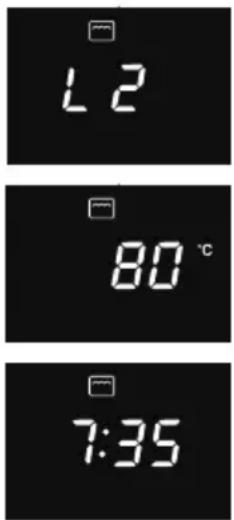
- Press the low temp control button.
- Press the low temp control button repeatedly or turn the adjust knob to select cooking mode. Stop pressing/turning when 'L1', 'L2', 'L3', 'L4', or 'L5' flashes.
- Press the start button to confirm.
- Turn the adjust knob to select the cooking temperature.
- Press the start button to confirm.
- Turn the adjust knob to set the cooking time.
- Press the start button to start cooking.
| Display 40 °C 50 °C | 60 °C 70 | °C 80 | °C 90 °C | 100 °C | 110 °C | Cooking | time (Max) | ||
| L1 (Slow cook) √ | √ 12 h | ||||||||
| L2 (Keep warm) √ | √ √ | 95 min | |||||||
| L3 (Food dry) √ √ | √ √ | √ √ | √ 12 h | ||||||
| L4 (Yoghurt) √ 12 h | |||||||||
| L5 (Warming box) √ | √ √ | √ √ | √ √ | √ | 95 min |
Checking time or power
- You can press the clock button to check the current time during cooking.
- You can press the power button to check the power level during cooking.
Mute function
Muting beeper
While the oven is not in use, press and hold stop and then press start within 3 seconds. You hear a beep and the oven enters mute mode. Now the beeper will no longer sound.
Unmuting beeper
While the oven is not in use, press and hold stop and then press start within 3 seconds. You hear a beep and the oven exits mute mode. Now the beeper will function normally again.
ECO function

Activating ECO mode
While the oven is not in use, press the stop button. The display switches off.
Deactivating ECO mode
Press any button.
Deodorization
Press the deodorization button to start deodorizing.
Child lock
You can ‘lock’ your microwave so that it is no longer possible to start it accidentally (for example during cleaning the appliance).
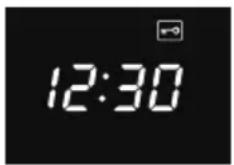
Activating
Press the stop button for 3 seconds.
▶A long beep sounds and the lock indicator goes on to confirm the controls are locked.
The current time or '0:00' is shown.
Deactivating
Press the stop button for 3 seconds.
▶A long beep sounds and the lock indicator goes out to confirm the controls are unlocked.
Warming up and cooking
- The microwave always heats with the same intensity. The more you place in the microwave, the longer the cooking time.
- Flat, level dishes heat up more quickly than narrow, tall dishes.
- Covering dishes with microwave film or a fitting lid prevents spattering, reduces cooking time and helps retain moisture levels. After cooking remove the foil or lid carefully. Please note! The steam released can be extremely hot!
- Dishes that dry out quickly can be moistened. Place potatoes and vegetables in cold water briefly before you place them in the microwave. This prevents a skin forming.
- For an even result it is best to stir or turn a dish a few times.
- For warming up dishes which have already been cooked, always use the highest microwave setting.
- You don't need much water, salt or herbs for the cooking. Salt is best added after cooking. This prevents moisture from being withdrawn from the food.
- After the microwave is switched off, the dish continues cooking for a short time. Take this into account and don't heat up the dish for too long.

Please note!
When heating small quantities of powder-forming products (such as when drying herbs), always place a small cup of water in the microwave. Self-combustion is possible if small quantities are heated.
Defrosting
- Always use the defrost programme to defrost large compact items. Because the dish is defrosted gradually and evenly, you don't run the risk that the outside dries out while the core is still frozen.
- To accelerate the defrosting process, it is advised to separate the item into sections after a certain amount of time.
- For large pieces of meat and compact dishes, have two breaks in the process.
- When defrosting an irregularly-formed dish you can cover thin areas halfway through the defrosting process or wrap them with aluminium foil.
Factors that influence the cooking process
- The temperature of the ingredients influences the preparation time. A cold meal needs more cooking time than a meal at room temperature.
- Lighter dishes cook faster than heavier and solid dishes, such as stews or rolled meats. Take care in preparing light, porous dishes. The edges will quickly become dry and tough.
- Smaller dishes are warmed more evenly if you place them in the microwave separate from each other, preferably in a circle.
- Bones and fat conduct heat better than meat. Aluminium foil blocks the microwaves. By covering thinner areas of dishes (such as chicken legs and wings) you prevent them from cooking too quickly.
- Grease-proof paper prevents spattering and helps retain the heat.
Basic techniques
Placement
Place thicker pieces on the outside of the turntable. Dishes placed on the outside of the turntable receive the most microwaves.
Stirring
Stirring dishes regularly distributes the stored heat. Always stir from the outside in, since the outside of the dish always heats up first.
Turning over
Large, thick dishes should be turned over regularly. They then cook more evenly and quickly.
Pricking
Food with a skin or shell bursts open in the microwave, such as egg yolks, seafood and fruit. Prevent this by pricking it before cooking a few times with a fork or satay stick.
Checking
Dishes cook quickly. That's why you should check them regularly. Take them out of the microwave just before they're ready.
Continued cooking
In general, allow dishes to stand covered for 3 to 10 minutes after removing them from the microwave. The dishes continue to cook. Don't cover dishes with a dry crust, such as cake.
Freezing
When freezing food you should take defrosting in the microwave into account, by not using aluminium foil or trays and by freezing in flat portions.
Cooking vegetables
- If possible, always use fresh vegetables. If vegetables have become a little limp because they've been left for too long, you can place them in cold water for a while so that they absorb moisture.
- Use a large dish to cook vegetables, so that the layer covering the dish base is not too thick.
- Do not add any more water to vegetables than that remaining after rinsing.
• Always cover the dish with a lid or microwave film. - Do not add salt. The salts present naturally in the vegetables should give sufficient flavour. If you still wish to add salt, you can do this after cooking.
- Cook vegetables for the shortest time possible. Take into account the fact that the vegetables will continue to cook.
- Check with a satay stick or fork whether the vegetables are ready.
Cooking fish
Fish needs to cook evenly. For thin fish, oily fish or small portions set the power low (about 30%). In other cases you can set the power somewhat higher. Take continued cooking into account. Fish is ready when it becomes opaque.
Cleaning the appliance
Clean the appliance regularly to prevent fat and food particles from accumulating, especially on the surfaces of the interior and the exterior, the door and the seal.
- Clean the interior and outer casing regularly; use some washing-up liquid and water and dry the oven well with a dry cloth.
- Ensure that the cover of the microwave distributor (right of the oven cavity) is clean. Dirt in the cover can lead to spark formation.
- Clean the interior immediately after use. Remove condensation, boiled over liquid and food remnants with a damp cloth. Remnants of crumbs and moisture absorb microwaves and increase cooking time.
- Clean the accessories regularly; use some washing-up liquid and water with a brush and dry the accessories well with a dry cloth. The accessories are also dishwasher-safe.
- Smells will disappear if you place a glass of vinegar or water with lemon in the oven cavity. Switch the microwave on at full power for two minutes. Then rub down with a damp cloth.

Attention!
- Make sure that no water enters the vents.
- NEVER use abrasive cleaning materials or chemical solvents.
- DO NOT USE any abrasive cleaners or metal scrapers to clean the glass door. This will scratch the surface which may cause the glass to break.
- DO NOT USE high pressure cleaners or steam cleaners to clean the microwave.
- If the seal of the microwave is very dirty, the door won't close properly. The front of adjacent furniture can become damaged. Keep the seal clean.
Solving problems
If you are uncertain about whether your appliance is functioning properly, this does not automatically mean there is a defect. Try to deal with the problem yourself first by checking the points mentioned below. If the recommendations below do not solve your problem, call our service department.
Check:
• Is the plug in the socket?
• Is the door closed properly?
- Is the fuse in the fuse box faulty?
- Are the power settings and times set properly?
- Are there objects in the microwave that shouldn't be there?
• Did you use the correct kitchen utensils?
- Are the ventilation openings blocked?
- Has the food been defrosted sufficiently?
- Did you turn over or stir the food during preparation?
Also try the following:
Place a cup with water (approx. 150 ml) in the microwave, close the door securely and set the time knob at 1 minute.
- Does the oven lamp light?
- Does the cooling fan work?
- Does the turntable rotate?
- Has the water in the cup become hot?
If you answered ‘no’ to any of the questions above, please check the fuse or circuit breaker in your meter cupboard.
If it is OK, contact your service agent.
Sparks in the microwave

Attention!
If you see sparks in the microwave, turn the microwave off immediately. Sparks can be caused by:
- metal or aluminium foil that touches the interior of the microwave;
- aluminium foil that is not correctly covering the food (points that stick up act as an antenna);
- metal from a closing strip or tableware with metallic edges;
• recycled paper that contains small metal particles.
The data plate indicates the total nominal load, the required voltage and the frequency.
This appliance meets all relevant CE guidelines.
Product specifications
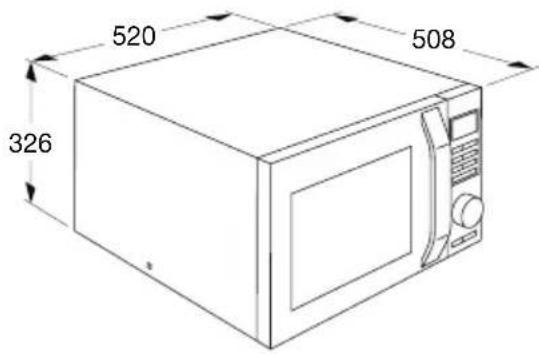
| Appliance dimensions (w x d x h) 5 | 20 mm x 508 mm x 326 mm |
| Volume 28 litres | |
| Diameter of the turntable 315 mm | |
| Connection 230V~50Hz | |
| Microwave power 900 W |
* Depth excludes the knob on the control panel and the door grip.
Disposal of packaging and appliance
Sustainable materials have been used during manufacture of this appliance. This appliance must be disposed of responsibly at the end of its service life. Ask your local authorities for more information about how to do this.
The appliance packaging is recyclable. The following materials may have been used:
- cardboard;
• polyethylene film (PE);
• CFC-free polystyrene (PS rigid foam).
Dispose of these materials in a responsible manner and in accordance with government regulations.
natural_image
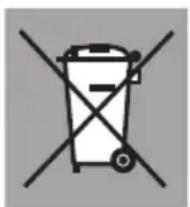
Symbol of a trash bin crossed with no text or numbers, representing waste sorting or disposal (no text present)The product has been marked with a crossed-out dustbin symbol to remind you of the obligation to dispose of electrical household appliances separately. This means that the appliance may not be included with normal domestic refuse at the end of its service life. The appliance must be taken to a special municipal centre for separated waste collection or to a dealer providing this service.
Separate collection of household appliances helps to prevent any potential negative impact on the environment and on human health caused by improper disposal. It ensures that the materials of which the appliance is composed can be recovered to obtain significant savings in energy and raw materials.
CE
Declaration of Conformity
We hereby declare that our products satisfy the applicable European Directives, Orders and Regulations, as well as the requirements stated in the referenced standards.