
TLP-MT3E - Vidéo-projecteur TOSHIBA - Free user manual and instructions
Find the device manual for free TLP-MT3E TOSHIBA in PDF.


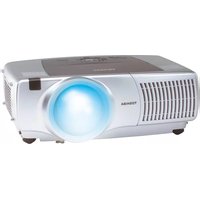
| Product Type | LCD Video Projector |
| Model | Toshiba TLP-MT3E |
| Dimensions (W x H x D) | 318 x 87 x 232 mm (including projections) |
| Weight | 3.7 kg |
| Power Requirements | AC 100-240V, 50/60 Hz |
| Power Consumption | 200 W |
| Lamp Type | UHP lamp 120W (TLPL8 replacement) |
| Lamp Life | Approx. 2000 hours |
| Projection Lens | Zooming lens F=1.8-2.1, f=36-47mm |
| Panel Size | 0.9 inches TFT Active Matrix |
| Resolution | 800 x 600 dots (SVGA) per panel |
| Brightness | Not specified in manual (estimated 1200-1500 lumens typical for era) |
| Contrast Ratio | Not specified (estimated 400:1 typical) |
| Speaker | 1W monaural |
| Video Inputs | RGB (D-sub 15-pin), S-Video, Composite Video, Audio (RCA) |
| Monitor Output | RGB (D-sub 15-pin), Audio |
| Control Port | RS-232C (Mini DIN 8-pin) |
| Keystone Correction | Automatic and manual adjustment |
| Supported Video Signals | NTSC, PAL, SECAM, and various computer signals up to UXGA |
| Remote Control | Wireless infrared, 5m range |
| Operating Temperature | 0° to 35°C |
| Humidity | 30% to 70% RH |
| Accessories Included | Remote control, batteries, power cord, Audio/Video cable, SCART adapter, lens cover |
Frequently Asked Questions - TLP-MT3E TOSHIBA
User questions about TLP-MT3E TOSHIBA
0 question about this device. Answer the ones you know or ask your own.
Ask a new question about this device
Download the instructions for your Vidéo-projecteur in PDF format for free! Find your manual TLP-MT3E - TOSHIBA and take your electronic device back in hand. On this page are published all the documents necessary for the use of your device. TLP-MT3E by TOSHIBA.
USER MANUAL TLP-MT3E TOSHIBA
natural_image
Illustration of a projector with visible lens and ventilation slots (no text or symbols)SAFETY PRECAUTIONS


The lightning flash with arrowhead symbol, within an equilateral triangle, is intended to alert the user to the presence of uninsulated “dangerous voltage” within the product’s enclosure that may be of sufficient magnitude to constitute a risk of electric shock to persons.

The exclamation point within an equilateral triangle is intended to alert the user to the presence of important operating and maintenance (servicing) instructions in the literature accompanying the appliance.
WARNING: TO REDUCE THE RISK OF FIRE OR ELECTRIC SHOCK, DO NOT EXPOSE THIS APPLIANCE TO RAIN OR MOISTURE. DANGEROUS HIGH VOLTAGES ARE PRESENT INSIDE THE ENCLOSURE. DO NOT OPEN THE CABINET. REFER SERVICING TO QUALIFIED PERSONNEL ONLY.
WARNING: This is a Class A product. In a domestic environment this product may cause radio interference in which case the user may be required to take adequate measures.
Before use
IMPORTANT PRECAUTIONS
Save Original Packing Materials
The original shipping carton and packing materials will come in handy if you ever have to ship your LCD projector. For maximum protection, repack the set as it was originally packed at the factory.
Avoid Volatile Liquid
Do not use volatile liquids, such as an insect spray, near the unit. Do not leave rubber or plastic products touching the unit for a long time. They will mar the finish.
Moisture Condensation
Never operate this unit immediately after moving it from a cold location to a warm location. When the unit is exposed to such a change in temperature, moisture may condense on the crucial internal parts. To prevent the unit from possible damage, do not use the unit for at least 2 hours when there is an extreme or sudden change in temperature.
In the spaces provided below, record the Model and Serial No. located at the rear of your LCD projector.
Model No. ____ Serial No. ____
Retain this information for future reference.
IMPORTANT SAFETY INSTRUCTIONS
CAUTION: PLEASE READ AND OBSERVE ALL WARNINGS AND INSTRUCTIONS GIVEN IN THIS OWNER'S MANUAL AND THOSE MARKED ON THE UNIT. RETAIN THIS BOOKLET FOR FUTURE REFERENCE.
This set has been designed and manufactured to assure personal safety. Improper use can result in electric shock or fire hazard. The safeguards incorporated in this unit will protect you if you observe the following procedures for installation, use and servicing. This unit is fully transistorized and does not contain any parts that can be repaired by the user.
DO NOT REMOVE THE CABINET COVER, OR YOU MAY BE EXPOSED TO DANGEROUS VOLTAGE. REFER SERVICING TO QUALIFIED SERVICE PERSONNEL ONLY.
1. Read Owner's Manual
After unpacking this product, read the owner's manual carefully, and follow all the operating and other instructions.
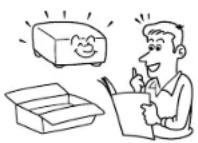
2. Power Sources
This product should be operated only from the type of power source indicated on the marking label. If you are not sure of the type of power supply to your home, consult your product dealer or local power company. For products intended to operate from battery power, or other sources, refer to the operating instructions.

3. Source of Light
Do not look into the lens while the lamp is on. The strong light from the lamp may cause damage to your eyes or sight.
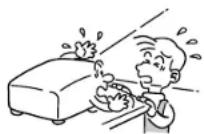
4. Ventilation
Openings in the cabinet are provided for ventilation and to ensure reliable operation of the product and to protect it from overheating, and these openings must not be blocked or covered. The openings should never be blocked by placing the product on a bed, sofa, rug or other similar surface. This product should not be placed in a built-in installation such as a bookcase or rack unless proper ventilation is provided or the manufacturer's instructions have been adhered to.
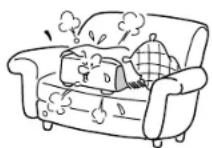
IMPORTANT SAFETY INSTRUCTIONS
5. Heat
The product should be situated away from heat sources such as radiators, heat registers, stoves, or other products (including amplifiers) that produce heat.
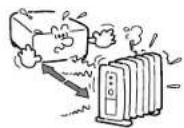
7. Cleaning
Unplug this product from the wall outlet before cleaning. Do not use liquid cleaners or aerosol cleaners. Use a damp cloth for cleaning.
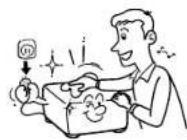
9. Overloading
Do not overload wall outlets; extension cords, or integral convenience receptacles as this can result in a risk of fire or electric shock.
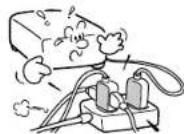
6. Water and Moisture
Do not use this product near water – for example, near a bath tub, wash bowl, kitchen sink, or laundry tub; in a wet basement; or near a swimming pool and the like.
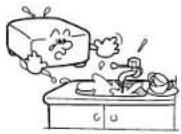
8. Power-Cord Protection
Power-supply cords should be routed so that they are not likely to be walked on or pinched by items placed upon or against them, paying particular attention to cords at plugs, convenience receptacles, and the point where they exit from the product.
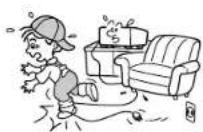
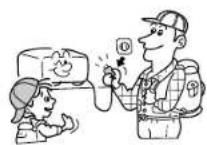
10. Lightning
For added protection for this product during storm, or when it is left unattended and unused for long periods of time, unplug it from the wall outlet.
This will prevent damage to the product due to lightning and power-line surges.
IMPORTANT SAFETY INSTRUCTIONS
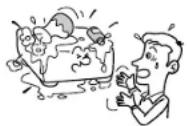
11. Object and Liquid Entry
Never push objects of any kind into this product through openings as they may touch dangerous voltage points or short-out parts that could result in a fire or electric shock. Never spill liquid of any kind on the product.
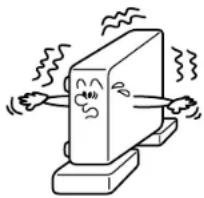
12. Do not place the product vertically
Do not use the product in the upright position to project the pictures at the ceiling, or any other vertical positions. It may fall down and dangerous.
natural_image
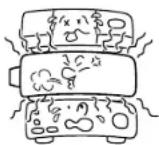
Cartoon illustration of a computer monitor with arms and legs, showing stress or vibration (no text or symbols)13. Stack Inhibited
Do not stack other equipment on this product or do not place this product on the other equipment.
Top and bottom plates of this product develops heat and may give some undesirable damage to other unit.
14. Attachments
Do not use attachments not recommended by the product manufacturer as they may cause hazards.
15. Accessories
Do not place this product on an unstable cart, stand, tripod, bracket, or table. The product may fall, causing serious injury to a child or adult, and serious damage to the product. Use only with a cart, stand, tripod, bracket, or table recommended by the manufacturer, or sold with the product. Any mounting of the product should follow the manufacturer's instructions, and should use a mounting accessory recommended by the manufacturer.
A product and cart combination should be moved with care. Quick stops, excessive force, and uneven surfaces may cause the product and cart combination to overturn.

IMPORTANT SAFETY INSTRUCTIONS
16. Damage Requiring Service
Unplug this product from the wall outlet and refer servicing to qualified service personnel under the following conditions:
a) When the power-supply cord or plug is damaged.
b) If liquid has been spilled, or objects have fallen into the product.
c) If the product has been exposed to rain or water.
d) If the product does not operate normally by following the operating instructions. Adjust only those controls that are covered by the operating instructions as an improper adjustment of other controls may result in damage and will often require extensive work by a qualified technician to restore the product to its normal operation.
e) If the product has been dropped or damaged in any way.
f) When the product exhibits a distinct change in performance – this indicates a need for service.
17. Servicing
Do not attempt to service this product yourself as opening or removing covers may expose you to dangerous voltage or other hazards. Refer all servicing to qualified service personnel.
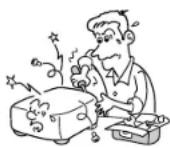
18. Replacement Parts
When replacement parts are required, be sure the service technician has used replacement parts specified by the manufacturer or have the same characteristics as the original part. Unauthorized substitutions may result in fire, electric shock, or other hazards. (Replacement of the lamp only should be made by users.)
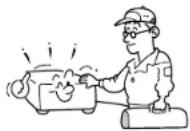
19. Safety Check
Upon completion of any service or repairs to this product, ask the service technician to perform safety checks to determine that the product is in proper operating condition.
20. If glass components, including lens and lamp, should break, contact your dealer for repair service.
This product incorporates glass components, including a lens and a lamp. If such parts should break, please handle with care to avoid injury and contact your dealer for repair service. The broken pieces of glass may cause to injury.
Before use
Contents
Before use
SAFETY PRECAUTIONS 2
IMPORTANT PRECAUTIONS.... 3
IMPORTANT SAFETY INSTRUCTIONS 4
Part names and functions....9
Power supply cord selection 13
Connections and installation
Connections 14
Projector placement.... 16
Operations
Picture projection 19
Adjustments
Setting and adjustments on the menu.... 23
Initial settings - Default 24
Keystone correction - Keystone 26
Projection adjustments - Image 27
Picture adjustments - Picture 28
Sound adjustments - Audio 29
Saving data - Save 30
Maintenance
Trouble indications.... 31
Air filter, lens and main unit cleaning.... 32
Lamp replacement 33
Others
Before calling service personnel 34
Input signal 36
Adjustments with RS-232C 40
Specifications 42
Before use
Part names and functions
Main unit
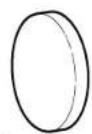
Lens cover
Projection lens
Exhaust holes
Foot adjuster
release button
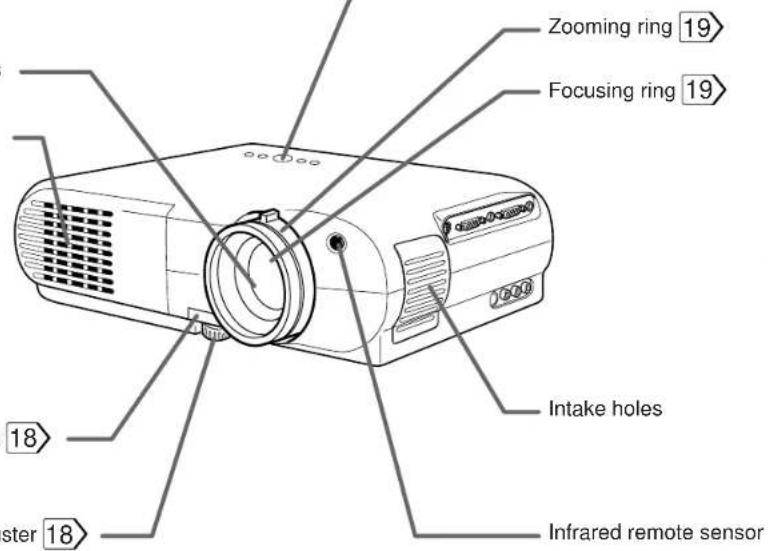
Control panel
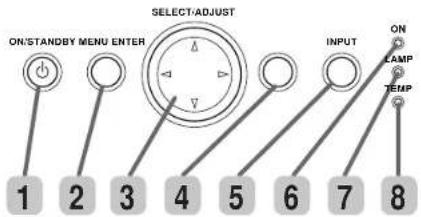
1 ON/STANDBY button 19
To turn the projector on or off.
2 MENU button 23
To display or close the menu.
3 SELECT/ADJUST button 24

To select items or adjust values on the menu.
4 ENTER button 26
To enter your selection on the menu.
5 INPUT button 19>
To select the input source.
6 ON indicator 19 31
7 LAMP indicator 19 31
8 TEMP indicator 31
(Continued)
Before use
(Continued)
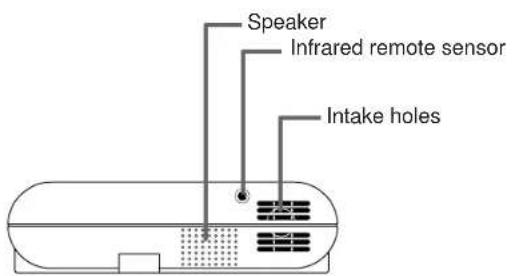
Left side Right side
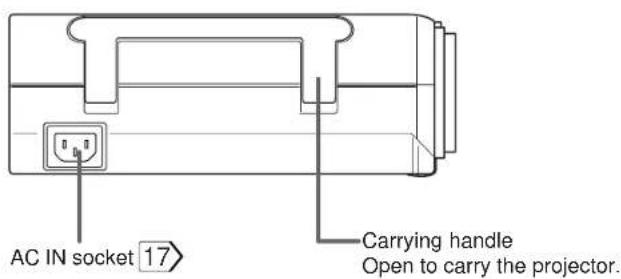
Rear side
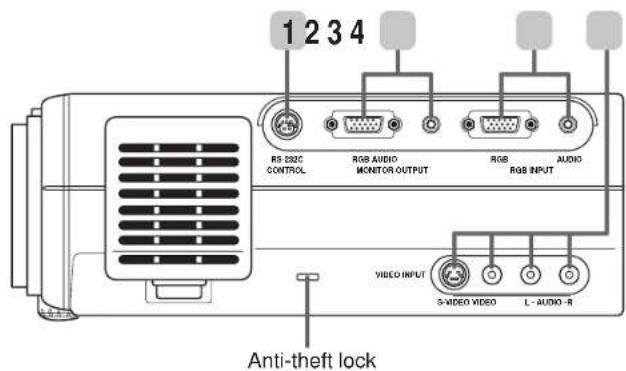
1 CONTROL connector 14 40
To connect a computer to control the projector.
2 MONITOR OUTPUT connectors (RGB output, AUDIO output) 14 To connect to a monitor or audio equipment.
3 RGB INPUT connectors (RGB input, AUDIO input) 15
To connect a computer or video equipment with component video outputs, etc.
4 VIDEO INPUT connectors
(S-VIDEO input, VIDEO input, AUDIO input) 14
To connect a video equipment, etc.
(Continued)
Before use
(Continued)
Remote control
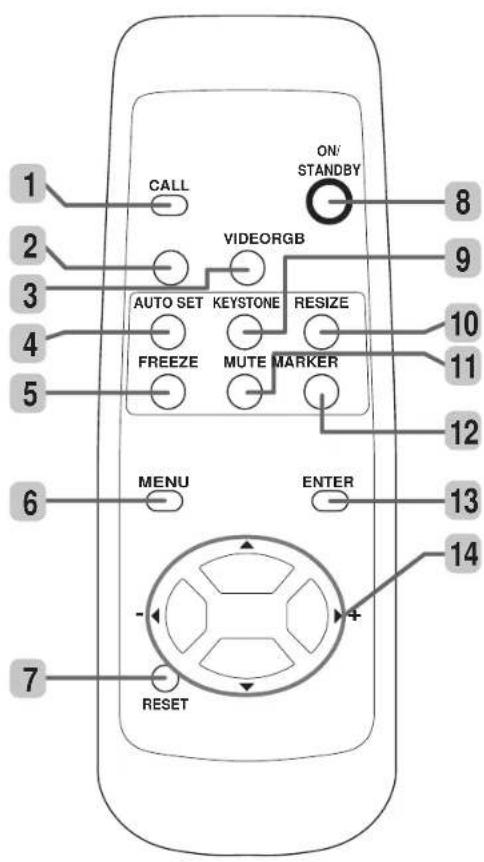
1 CALL button 21
To display the current input source and signal status information.
2 RGB button 19
To select the RGB input.
3 VIDEO button 19
To select S-video input or Video input.
4 AUTO SET button 21
To adjust the image automatically.
5 FREEZE button 21
To freeze the picture.
6 MENU button 24
To display or close the menu.
7 RESET button 25
To restore the settings and adjustments to the default.
8 ON/STANDBY button 19
To turn the projector on or off.
9 KEYSTONE button 20
To correct the keystone distortion of the picture automatically.
10 RESIZE button 22
To change the picture size.
11 MUTE button 21
To cut off the picture and sound temporarily.
12 MARKER button
To display a marker on the screen. Each time the button is pressed, the marker changes the shape, and finally disappears.
13 ENTER button 26
To enter your selection on the menu.
14 ▲, ▼, (◀), (▶buttons 24
- To select items or adjust values on the menu.
- To shift a picture after changing its size with the RESIZE button.
• To move the marker displayed with the MARKER button.
(Continued)
Before use
(Continued)
Installing batteries
1) Open the cover.
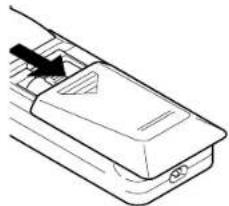
natural_image
Simple line drawing of a mechanical component with an arrow indicating direction (no text or symbols)2) Install the batteries.
Make sure that the +/- polarities match the illustration in the compartment.
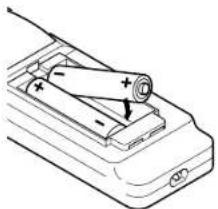
natural_image
Diagram of a battery inside a device casing, showing internal components and polarity indicators (no text or symbols)3) Attach the cover.
Notes
Using batteries incorrectly can cause them to leak or burst. Strictly observe the following.
- Install the batteries with their + and - ends facing correctly.
- Do not charge, heat, disassemble, or short the batteries or throw them into a fire.
- Do not leave exhausted batteries in the remote control.
- Do not mix different types of batteries or new and old batteries.
- When you will not be using the remote control for a prolonged period, take the batteries out of the remote control.
- When the remote control stops working or only works from very close distance, replace all the batteries with new ones.
- When replacing the batteries, use a more longer life alkaline batteries.
- If a battery leaks, carefully wipe off any residue inside the battery case before loading new batteries.
Remote control operation
Point the remote control at the infrared remote sensor and press a button.
Front side
Rear side
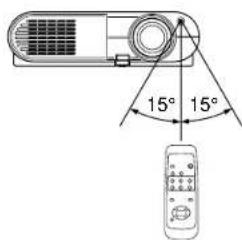
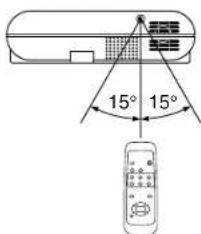
Distance : within about 5 meters from the front of the remote sensor.
Angle : within about 15° of the remote sensor in every direction.
Before use
(Continued)
Notes
- The remote control may not operate when there is sunlight or other strong light such as a fluorescent lamp shining on the remote sensor.
- Operate the remote control from a position where the remote sensor is visible.
- Do not drop the remote control or otherwise jolt it.
- Keep the remote control out of locations with excessively high temperature or humidity.
- Do not get water on the remote control or place wet objects on it.
- Do not disassemble the remote control.
- Under unusual circumstances the remote control may not operate well due to the location being used or the surroundings. At such times, change the direction of the remote control to the projector and retry the operation.
Power supply cord selection
If your line voltage is 220 to 240, use one of the following types of cable.
In Singapore, use the UK type plug cable. (The UK type plug [MP5004] of this model is approved by PSB.)
| Plug configuration | Plug type | Line voltage |
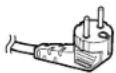 | EURO | 220 – 240V |
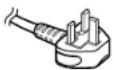 | UK | 220 – 240V |
Use a 5A fuse which is approved by ASTA or BSI to BSI362.
Always replace the fuse cover after changing the fuse.
Connections and installation
Connections
Connecting video equipment
Check that the power for the projector and computer is off before connecting the cables.
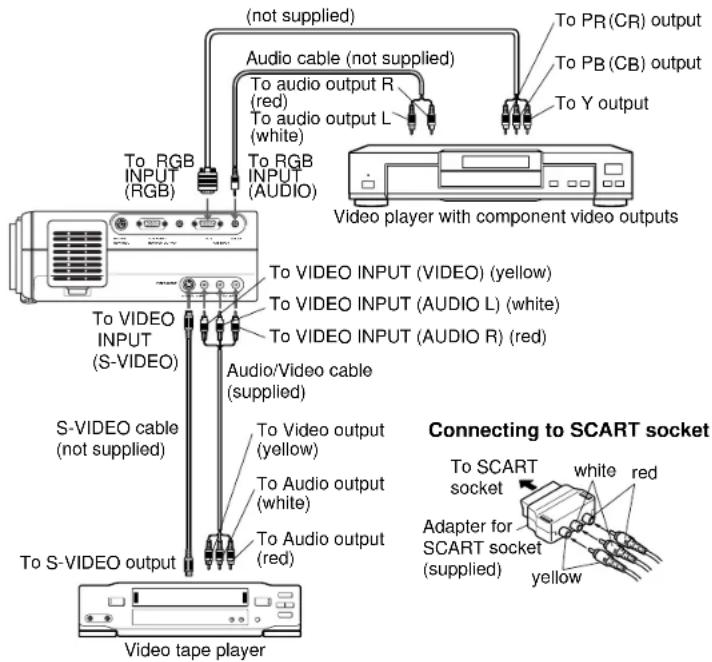
Note
Several video equipments can be connected to the S-VIDEO jack and VIDEO jack separately.
Output terminals
Check that the power for the projector and computer is off before connecting the cables.
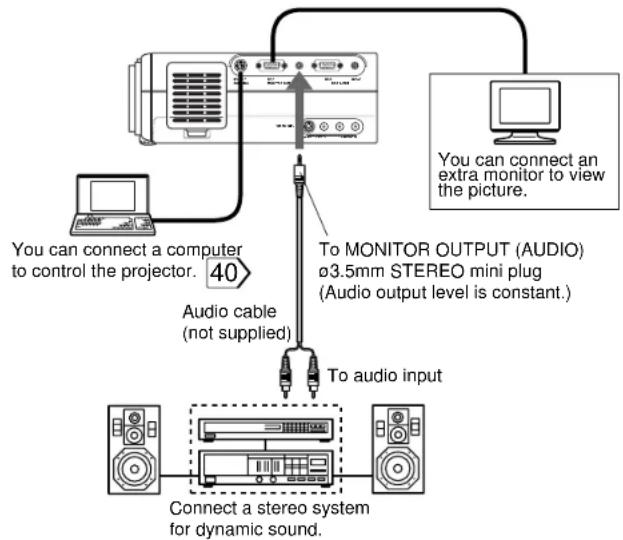
flowchart
graph TD
    A["Computer"] -->|You can connect a computer to control the projector. 40| B["Audio cable (not supplied)"]
    B --> C["To monitor OUTPUT (AUDIO) ø3.5mm STEREO mini plug (Audio output level is constant)."]
    C --> D["To audio input"]
    D --> E["Connect a stereo system for dynamic sound."]
    E --> F["Speaker"]
    G["Computer"] --> H["You can connect an extra monitor to view the picture."]
Notes
- Sound of the source which you select is output to the connected stereo system, etc.
- The MONITOR OUTPUT (RGB output) connector always sends out a signal which is input to the RGB INPUT (RGB input) connector regardless of your source selection.
- Even while the projector is in standby mode, the MONITOR OUTPUT (RGB output) connector continues its output. (Continued)
(Continued)
Connections and installation
(Continued)
Connecting an IBM PC or compatible computer (DOS/V)
Check that the power for the projector and computer is off before connecting the cables.
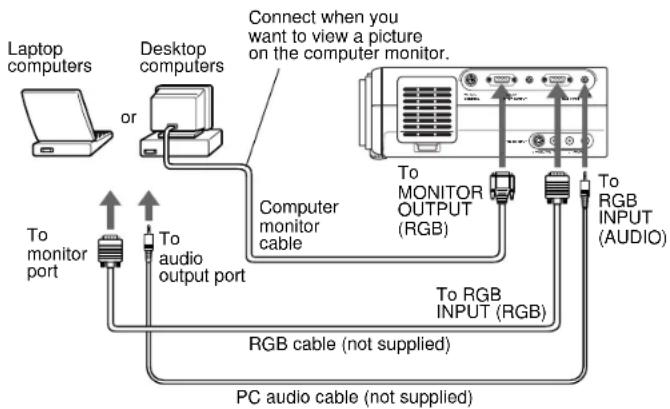
flowchart
graph TD
    A["Laptop computers"] --> B["or"]
    B --> C["Computer monitor cable"]
    C --> D["To monitor port"]
    C --> E["To audio output port"]
    F["Desktop computers"] --> G["Connect when you want to view a picture on the computer monitor."]
    G --> H["To monitor OUTPUT (RGB)"]
    G --> I["To RGB INPUT (AUDIO)"]
    H --> J["To RGB INPUT (RGB)"]
    I --> K["To RGB INPUT (AUDIO)"]
    L["PC audio cable (not supplied)"] --> M["RGB cable (not supplied)"]
    M --> N["To monitor port"]
Notes
- The projector cannot be connected to a computer that does not have an analog RGB output terminal. For details, refer to the computer manual.
- You may not be able to connect some computers to the projector. For details, consult the dealer.
- If NTSC/PAL/SECAM signals are input to the RGB INPUT connector, they cannot be displayed. (Input NTSC/PAL/SECAM signals to the VIDEO INPUT jack.)
Connecting a Macintosh computer
- Attach the supplied adapter for Macintosh computers.
- Check that the power for the projector and computer is off before connecting the cables.
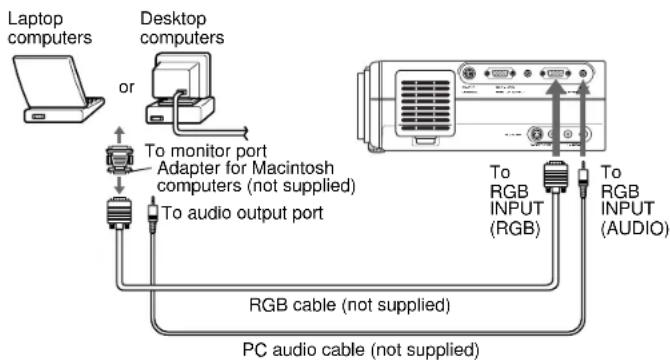
flowchart
graph TD
    A["Laptop computers"] --> B["Desktop computers"]
    B --> C["To monitor port"]
    B --> D["Adapter for Macintosh computers (not supplied)"]
    B --> E["To audio output port"]
    F["PC audio cable (not supplied)"] --> G["RGB cable (not supplied)"]
    G --> H["To RGB INPUT (RGB)"]
    G --> I["To RGB INPUT (AUDIO)"]
Notes
- The projector cannot be connected to a computer that does not have an analog RGB output terminal. For details, refer to the computer manual.
- You may not be able to connect some computers to the projector. For details, consult the dealer.
Connections and installation
Projector placement
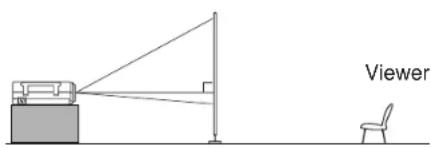
There are four ways of installing this projector as shown right. This section explains the standard case of the floor-mounted front projection.
CAUTION
- When a ceiling mount is required, please consult with the dealer.
- When carrying the unit, always handle the carrying handle.
Preparation
- Select a room that can be darkened.
- Refer to the table on the next page 17 for the screen size and required distance.
Floor-mounted front projection
Viewing a picture projected on the front of the screen from a floor.
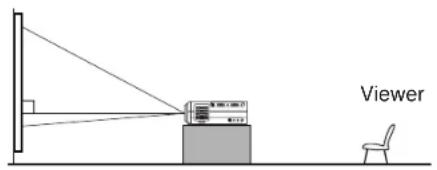
Floor-mounted rear projection
Viewing a picture projected through the back of the screen from a floor installation.
Translucent screen
natural_image
Diagram showing a viewing setup with a projector, a stand, and a chair (no text or symbols)Ceiling-mounted front projection
Viewing a picture projected on the front of the screen from a ceiling installation.
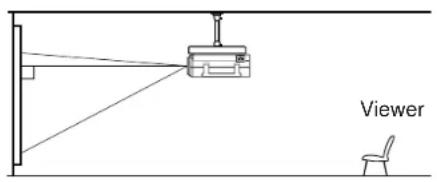
Ceiling-mounted rear projection
Viewing a picture projected through the back of the screen from a ceiling installation.
Translucent screen
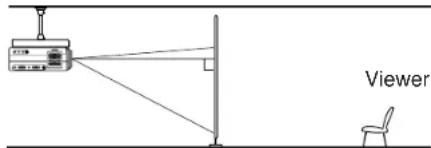
- When installed the projector in the way except the floor-mounted front projection, make the setting of the projecting orientation on the menu. 24
Connections and installation
(Continued)
1 Place the projector on a steady, level surface such as a table.
Point the projector squarely at the screen for the best possible picture.
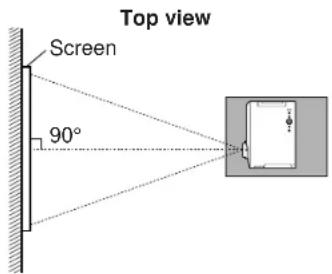
Point the lens straight at the center of the screen as above.
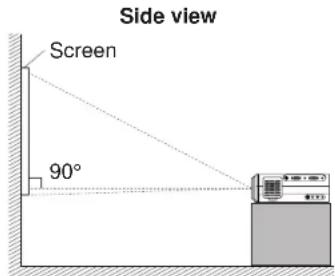
Place the projector horizontally so that the projecting light hits the screen squarely.
2 Adjust the distance between the lens and the screen.
The projection size depends on the distance between the lens and the screen.
Adjust the projection size by changing the distances as shown below.
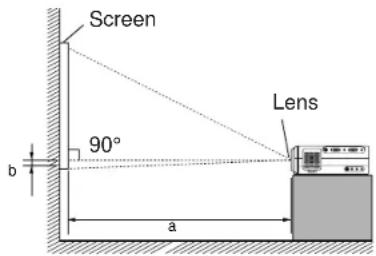
a: Distance between the lens and the screen
b: Distance between the lens height and the bottom of projection area
| Screen size (inches) | a (m) | b (cm) | |
| Minimum (WIDE) | Maximum (TELE) | ||
| 23 | - | 1.132 | 4 |
| 40 | 1.56 | 2.017 | 6 |
| 60 | 2.373 | 3.059 | 9 |
| 80 | 3.186 | 4.1 | 12 |
| 100 | 3.999 | 5.142 | 15 |
| 150 | 6.031 | 7.746 | 23 |
| 200 | 8.064 | 10.35 | 30 |
| 250 | 10.096 | - | 38 |
• The values are approximations.
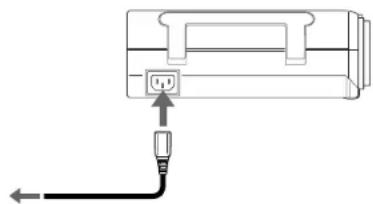
3 Connect the power cord.
- Insert one end in the AC IN socket on the projector.
- Insert the other end in a wall outlet.
natural_image
Diagram of a device with an input cable and outlet cable, showing no text or symbolsTo a wall outlet.
The ON indicator lights in orange and the projector turns to standby mode.
4 Take off the lens cover.
(Continued)
Connections and installation
(Continued)
Notes
- When the projector is moved from a cold location to a warm location, or when the ambient temperature in the projection room has risen suddenly, moisture may condense on the lens or the mirror to blur the projected pictures. In such a case, leave the projector for an adequate time (1 to 2 hours, depending on the room's condition) before using it so it adjusts to the ambient temperature.
- If the screen is exposed to direct sunlight or other strong light, the projected picture becomes too faint to see. Shut out the light with curtains or other means.
- If the screen and the projector are not installed properly, the projected picture may be distorted.
- If the projector is tilted, the picture may be distorted. To obtain the best possible picture, place the projector so it faces the screen squarely.
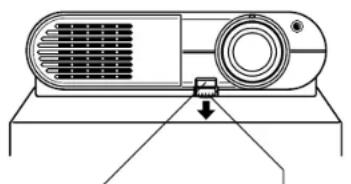
How to use the foot adjuster
The tilt of the projector can be adjusted using the foot adjuster.
1) Lift the front of the projector until a tilt angle desired is obtained and hold down the foot adjuster release button.
The foot adjuster will stretch.
Release the button to lock in position.
natural_image
Diagram of a projector with ventilation grille and base, showing alignment lines (no text or symbols)Foot adjuster release button
Foot adjuster
2) Turn the foot adjuster to make fine adjustment of the height.
Turn clockwise to lift up. Turn counterclockwise to lower.
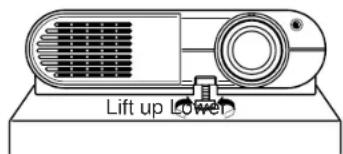
3) To put the foot adjuster back, hold down the foot adjuster release button and lower the front slowly.
The foot adjuster will put back.
Note
Be sure to hold the projector when putting the foot adjuster back so as not to let the front fall on your fingers.
Operations
Picture projection
CAUTION
Do not look into the projection lens while operating the projector.
Preparation
• Install and connect the projector properly.
• Take off the lens cover.
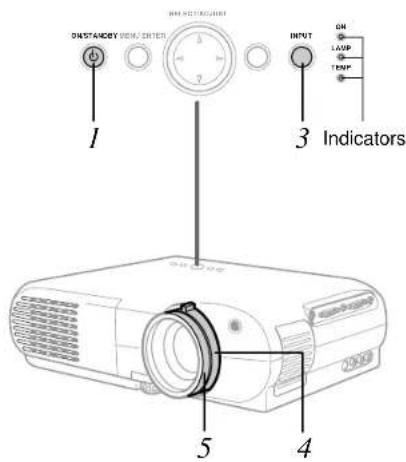
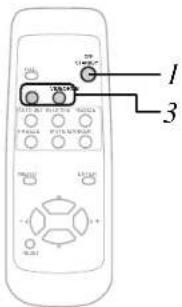
1 Press ON/STANDBY.
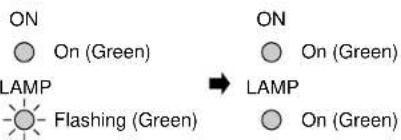
Both the ON and LAMP indicators light up in green.
2 Turn on the connected equipment and put it in playback mode.
3 Select the input source.
(On the control panel of the main unit) Press INPUT repeatedly. Each time the button is pressed, the source indication on the screen changes as follows:
RGB: To project pictures from a computer connected to RGB INPUT or a video equipment with component video output jack.
Video: To project pictures from a video equipment, etc. ↓ connected to VIDEO jack of VIDEO INPUT.
Y/C: To project pictures from a video equipment, etc. connected to S-VIDEO jack of VIDEO INPUT.
(On the remote control)
RGB: Press RGB.
Video/Y/C: Press VIDEO.
Each time the button is pressed, Video/Y/C is switched.
4 Adjust the picture size by turning the zooming ring.
Turn to the right to enlarge the picture. Turn to the left to reduce the picture.
5 Focus on the picture by turning the focusing ring.
A still picture is recommended for focusing.
(Continued)
Operations
(Continued)
Notes
- “A” is displayed on the screen if the projector does not receive any signal from the connected equipment. Put the equipment in playback mode.
- Due to the lamp characteristic, flickers may occasionally occur in a picture. This is not malfunction of the unit.
- When an RGB source is selected and no signal is sent from the computer for about 30 minutes, the projector turns to standby mode for power saving. It automatically turns on when the signal resumes. Pressing ON/STANDBY also turns it on.
- While operating the projector, “☑” may be displayed on the screen. This means that the operation cannot be completed.
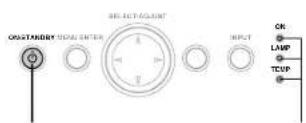
IndicatorsON/STANDRY that the fans are stopped.
Notes
• Even after turning the power off, the intake and exhaust fans continue to work for a while to cool the inside of the projector.
- Immediately after the power off, the projector may not be turned on while the LAMP indicator is flashing in green.
- Before unplugging the power cord, make sure and that the fans are stopped.
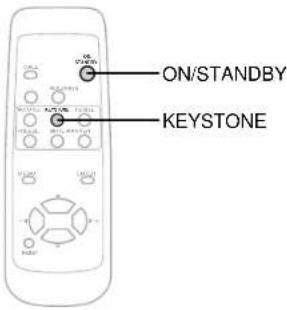
Correcting the keystone distortion
A picture may be expanded on the upper side if projected upward from the projector lifted up by the foot adjuster. The projector can correct this keystone distortion automatically.
Press KEYSTONE.
The keystone distortion is corrected automatically.
To correct further, make the "Keystone" adjustment on the menu. 26
Turning the power off
1) Press ON/STANDBY after using the projector.
An instruction message appears.
2) Press ON/STANDBY again.
The LAMP indicator turns off, and the projector turns to standby mode. (The ON indicator lights in orange.)
3) After confirming the exhaust fan stops, unplug the power cord.
The ON indicator turns off.
(Continued)
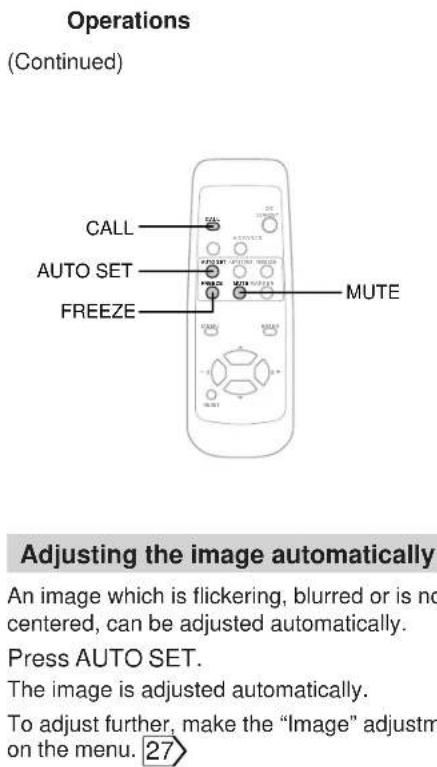
Adjusting the image automatically
An image which is flickering, blurred or is not centered, can be adjusted automatically.
Press AUTO SET.
The image is adjusted automatically.
To adjust further, make the "Image" adjustment on the menu. 27
Cutting off the picture and sound temporarily
1) Press MUTE.
The sound is cut off temporarily.
“” appears.
2) Press MUTE again.
The picture is also cut off temporarily.
" " appears.
To restore, press MUTE again.
Note
If you press MUTE while the menu is displayed, the menu disappears.
Freezing the picture
Press FREEZE.
The picture freezes.
“Ⅱ” mark appears on the screen.
To release the picture, press FREEZE again.
Any other operations can also release the picture.
Displaying the input source information
Press CALL.
The current input source and the signal status information is displayed.
To close the display, press CALL again.
![Contents of displayed items [ Status ] Input :RGB Signal :XGA60 Screen :XGA60 Synchro. :N/N Ver./rev.:V01/R01 Current input source Signal system of the input source — Signal system automatically detected by the projector (Mode determination 36) Synchronizing polarity of input signal P=Positive N=Negative Version number of software](/content/2026/05/805114/images/a9cef396828f0163963705f35481d99d6c3c1ba807514a431be764137a3f73fa.jpg)
Note
If you press CALL while the menu is displayed, the menu disappears.
Operations
(Continued)
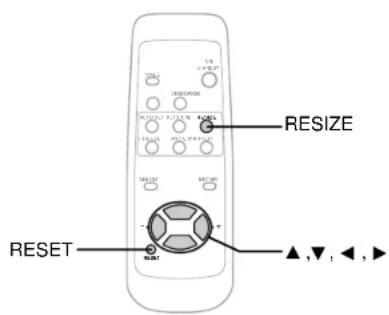
Changing the picture size
Pictures are projected at the maximal projection size regardless of the signal types. Optionally you can change the picture size to through size or enlarge it.
Press RESIZE.
Each time the button is pressed, the picture size changes from the center of the picture.
When the picture size does not correspond with the projection area, the picture can be moved by pressing ▲, ▼ a◀d . ▶
When the picture size is smaller than the projection area:
▲: To move the picture upward
▼: To move the picture down
◀: To move the picture leftward
▶ : To move the picture rightward
When the picture size is larger than the projection area:
▲ : To view the upper side of the picture
▼ : To view the lower side of the picture
◀: To view the left side of the picture
▶ : To view the right side of the picture
Notes
- Picture size returns to normal after the power is turned off. The values are not saved.
- You may not change the picture size depending to the signal.
- Pictures of VGA signals, etc. may be slightly inferior in quality at the initial size because they are enlarged.
- The picture returns to the normal position when the RESET button is pressed after the picture is moved.
- The picture may not be projected properly while moving the picture.
Adjustments
Settings and adjustments on the menu
Most of adjustments and settings are made on the menu.
To display the menu, press MENU.


The followings are adjustments and settings on the menu. For details, see page in ▶.
When using this projector for the first time, see "Default". 24

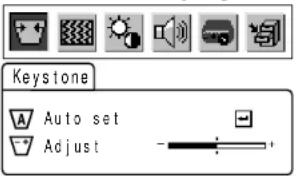
Keystone

Auto set : To correct the keystone distortion automatically.
Adjust : To make the correction of keystone distortion beyond the automatic correction.

Image

Auto sync.: To adjust the image automatically.
Phase : To adjust the phase.
H-position : To shift the image position horizontally
V-position : To shift the image position vertically.
Clock : To adjust the clock frequency.

Picture

Contrast : To adjust the contrast.
Brightness : To adjust the brightness.
Color : To adjust the color depth.
Tint : To adjust the tint.
Sharpness : To adjust the sharpness.
R-level : To adjust the amount of red in the picture.
G-level : To adjust the amount of green in the picture.
B-level : To adjust the amount of blue in the picture.

Audio

Volume : To adjust the sound volume of the speaker.
Bass : To adjust the bass of the sound output.
Treble : To adjust the treble of the sound output.

Default

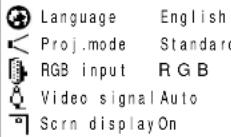
Language : To select the language for displays.
Proj. mode : To set the projecting orientation according to the way of installation.
RGB input : To set the signal type of RGB input.
Video signal: To set the signal type of video input.
Scrn display : To use or disable on-screen displays.

Save

Save data : To save the adjustments and settings on the menu.
All preset : To restore the adjustments and settings on the menu to the factory set.
Adjustments
Initial settings
- Default
Make the basic settings for projecting.
Preparation
- Display the image as explained in "Picture Projection". 19
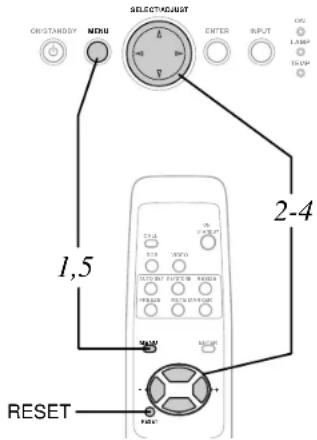
1 Press MENU to display the menu.

Press ◀ or ▶ to select
Default

Press ▲ or ▼ to select a preferred item.

Press ◀ or ▶ to make the setting.
To select another item, go back to step 3. Language
Select a language for the menu or on-screen displays.
English: English
Français: French
Deutsch: German
Italiano : Italian
Español: Spanish
Confirm your installation type on the chart on page 16.
Standard: Floor-mounted front projection
Rear: Floor-mounted rear projection
Ceiling: Ceiling-mounted front projection
R. ceil.: Ceiling-mounted rear projection
RGB input
To set the signal type of RGB input.
RGB: RGB signal
Y/Pb/Pr: Color difference (Component) video signal from the DVD video player, etc.
Video signal
To set the signal type of video input.
Auto: Automatic signal detection works on video input. If it does not properly, set the signal type of the source from the followings.
NTSC M: NTSC M signal
NTSC443A: NTSC4.43A signal
NTSC J: NTSC J signal
NTSC N: NTSC N signal
NTSC443B: NTSC4.43B signal
PAL: PAL signal
PAL N: PAL N signal
SECAM: SECAM signal
PAL443: PAL4.43 signal
PAL M: PAL M signal
(Continued)
Adjustments
(Continued)
Scrn display
On: On-screen displays (indications of input selection, signal absent or mute mode, etc.) appear.
Off: On-screen displays do not appear.
5 Press MENU.
The menu disappears.
Notes
• These settings are stored until you turn the power off.
- To store the settings even if the power is turned off, follow the procedure of "Saving data". 30
- Pressing RESET will return the adjustment or setting currently selected to default.
Adjustments
Keystone correction
- Keystone
Preparation
- Display the image as explained in "Picture Projection". 19
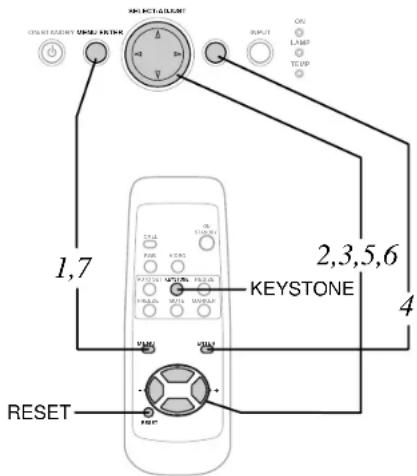
1 Press MENU to display the menu.
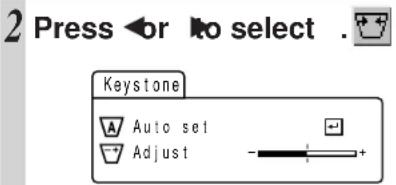
3 Press ▼to select "Auto set".
4 Press ENTER.
The keystone distortion is corrected automatically. For further correction, follow the below steps.
5 Press ▼
6 Press or to correct the distortion.
◀ (−): To reduce the upper width.
▶ (+): To reduce the lower width.
7 Press MENU.
The menu disappears.
Notes
- Pressing KEYSTONE on the remote control can also correct the keystone distortion automatically. 20
• These adjustments are stored until you turn the power off. - Pressing RESET will return the adjustment or setting currently selected to default.
- Pictures may be slightly deteriorated by the keystone correction.
0 degrees setting for the automatic keystone correction
Depending on the operating condition such as vibration, the distortion may be beyond the automatic keystone correction. The horizontal condition setting (0 degrees setting) may be disordered. In such a case, perform the following 0 degrees setting to correct the distortion.
1) Place the projector on a level surface.
2) On the menu, select "Auto set" in "Keystone".
3) Press RESET.
Notes
- Do not make the 0 degrees setting on an inclined or unstable surface or in a shaky place as it may not be performed properly.
- To store this setting even if the power is turned off, follow the procedure of "Saving data". 30
Adjustments
Projection adjustments - Image
Preparation
- Display the image as explained in "Picture Projection". 19
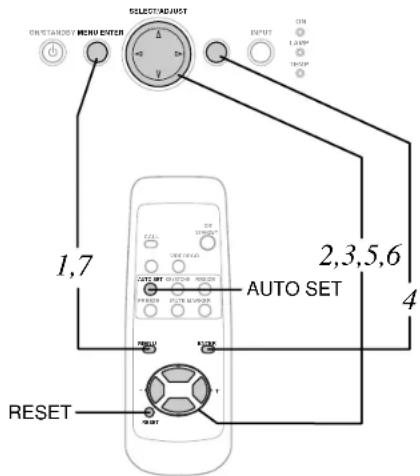
1 Press MENU to display the menu.
2 Press <or to select .
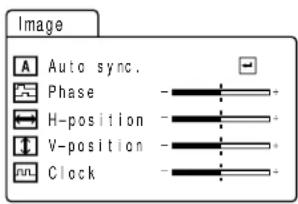
3 Press ▼to select "Auto sync."
4 Press ENTER.
The image is automatically adjusted. For further adjustments, follow the below steps.
5 Press ▲ or ▼ to select a preferred item.
6 Press ◀ or ▶ to adjust the item.
To select another item, go back to step 5.
Phase: To reduce flickers.
H-position: To shift the image to the left (−), to the right (+).
V-position: To shift the image down (−), to up (+).
Clock To remove vertical stripes.
7 Press MENU.
The menu disappears.
Notes
- When performing the automatic projection adjustment, use a bright and distinctly edged picture.
- Pressing AUTO SET on the remote control can also adjust the image automatically. 21
- If you project an image from a computer with an LCD screen while monitoring the image on the computer, the image may not be projected properly, depending on the computer model. In this case, turn off the computer display, or make the necessary picture adjustments on the projector. For details on controlling the computer display, etc., refer to the computer's manual and description on the software for the computer used.
- During adjustments of "H-position" or "V-position", the image may not be projected properly.
- While using, an aberration of the phase may occur. In that case, adjust "Phase" again.
- Some item may be displayed in gray depending on an input source. The item displayed in gray cannot be adjusted and/or set.
• These adjustments are stored until you turn the power off. - To store the adjustments even if the power is turned off, follow the procedure of "Saving data". 30
- Pressing RESET will return the adjustment or setting currently selected to default.
Adjustments
Picture adjustments – Picture
Preparation
- Display the image as explained in "Picture Projection". 19
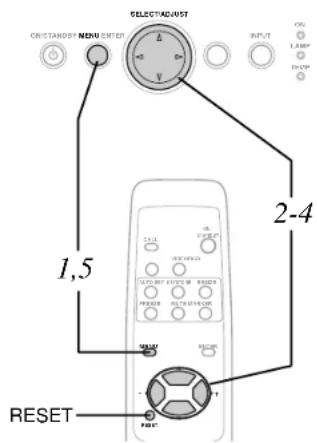
1 Press MENU to display the menu.
2 Press


3 Press ▲ or ▼ to select a preferred item.
4 Press ◀ or ▶ to adjust the item.
To select another item, go back to step 3.
\- : ◀ + : ▶
Contrast : (-) Lower
(+) Higher
Brightness: (−) Darker
(+) Brighter
Color: (−) Duller
(+) Brighter
Tint: (−) Redder
(+) Greener
Sharpness: (−) Softer
(+) Sharper
R-level: (−) To reduce red
(+) To increase red
G-level: (−) To reduce green
(+) To increase green
B-level: (−) To reduce blue
(+) To increase blue
5 Press MENU.
The menu disappears.
Notes
- When the RGB is inputted and when the video signal (also Y/Pb/Pr signal) is inputted, different settings can be adjusted and stored separately.
- Some item may be displayed in gray depending on an input source. The item displayed in gray cannot be adjusted and/or set.
• These adjustments are stored until you turn the power off.
- To store the adjustments even if the power is turned off, follow the procedure of "Saving data". 30
- Pressing RESET will return the adjustment or setting currently selected to default.
Adjustments
Sound adjustments - Audio
Preparation
\- Display the image as explained in "Picture Projection". 19

1 Press MENU to display the menu.

3 Press ▲ or ▼ to select a preferred item.
4 Press ◀ or ▶ to adjust the item.
To select another item, go back to step 3.

Volume : (−) To turn down.
(+) To turn up.
Bass: (−) To reduce the bass.
(+) To increase the bass.
Treble:
(−) To reduce the treble.
(+) To increase the treble.
5 Press MENU.
The menu disappears.
Notes
• These adjustments are stored until you turn the power off.
- To store the adjustments even if the power is turned off, follow the procedure of "Saving data". 30
- Pressing RESET will return the adjustment or setting currently selected to default.
Adjustments
Saving data
\- Save
Preparation
\- Display the image as explained in "Picture Projection". 19

1 Press MENU to display the menu.
2 Press Maintenance
3 Press ▲ or ▼ to select a preferred item.
4 Press ◀ or ▶ to adjust the item.
To select another item, go back to step 3. \- : ◀ + : ▶ Contrast : (-) Lower (+) Higher Brightness: (−) Darker (+) Brighter Color: (−) Duller (+) Brighter Tint: (−) Redder (+) Greener Sharpness: (−) Softer (+) Sharper R-level: (−) To reduce red (+) To increase red G-level: (−) To reduce green (+) To increase green B-level: (−) To reduce blue (+) To increase blue5 Press MENU.
The menu disappears.Notes
- When the RGB is inputted and when the video signal (also Y/Pb/Pr signal) is inputted, different settings can be adjusted and stored separately. - Some item may be displayed in gray depending on an input source. The item displayed in gray cannot be adjusted and/or set. • These adjustments are stored until you turn the power off. - To store the adjustments even if the power is turned off, follow the procedure of "Saving data". 30 - Pressing RESET will return the adjustment or setting currently selected to default.Adjustments
Sound adjustments - Audio
Preparation
\- Display the image as explained in "Picture Projection". 19 1 Press MENU to display the menu.
3 Press ▲ or ▼ to select a preferred item.
4 Press ◀ or ▶ to adjust the item.
To select another item, go back to step 3.  Volume : (−) To turn down. (+) To turn up. Bass: (−) To reduce the bass. (+) To increase the bass. Treble: (−) To reduce the treble. (+) To increase the treble.5 Press MENU.
The menu disappears.Notes
• These adjustments are stored until you turn the power off. - To store the adjustments even if the power is turned off, follow the procedure of "Saving data". 30 - Pressing RESET will return the adjustment or setting currently selected to default. AdjustmentsSaving data
\- SavePreparation
\- Display the image as explained in "Picture Projection". 19  1 Press MENU to display the menu. 2 PressTrouble indications
If there is some problem inside the projector, the indicators light up or flash.
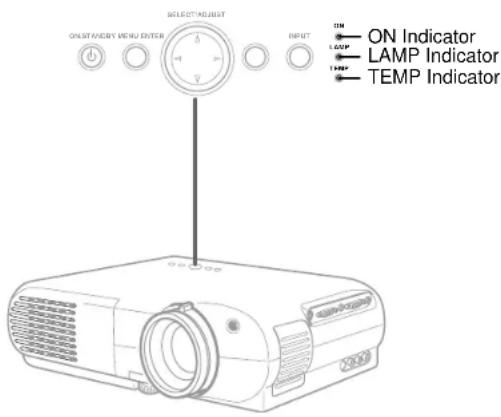
ON Off or lit (red)
LAMP -
TEMP -
The power does not come on.
→ Malfunction of the unit.
- Unplug the power cord and call the dealer.
ON Lit (red)
LAMP Lit (red)
TEMP -
The lamp turns off or does not light up.
→ The lamp's end, or malfunction of the unit.
- Lamp's life length is over, replace the lamp with new one. 33
- Unplug the power cord and call the dealer.
ON Lit (red)
LAMP -
TEMP Lit (red)
The power turns off or does not come on.
→ The inside is too hot, or the projector has been working in an area of high temperature.
- Place the projector correctly so the intake and exhaust fans' holes are not covered.
- Turn the projector off, and leave it for a while, and turn it on again.
- Clean the air filter. 32
ON Lit (red)
LAMP -
TEMP Flashing (red)
The power turns off or does not come on.
→ Trouble with the intake fan.
- Unplug the power cord and call the dealer.
ON Lit (red)
LAMP -
TEMP Flashing (orange)
The power turns off or does not come on.
→ Trouble with the exhaust fan.
- Unplug the power cord and call the dealer.
Note
Before attempting any maintenance, unplug the power cord.
Maintenance
Air filter, lens and main unit cleaning
CAUTION
If you use the projector mounted on the ceiling, ask the dealer to carry out the maintenance such as cleaning.
Cleaning the air filter
The filter under the air filter cover is the device to shut out dusts or dregs.
Do not use the projector with the filter taken off. Give a frequent clean especially to the air filter. (The cleaning period is once per about 50 hours).
1) Unplug the power cord.
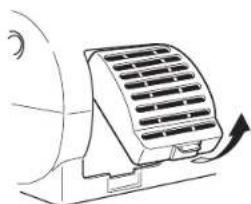
2) Take off the air filter cover.
The filter is on the right side of the projector. Pull up the filter tabs.
natural_image
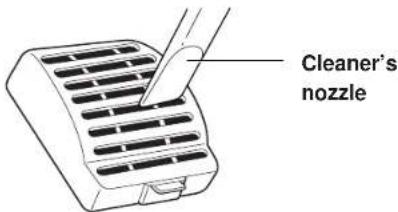
Line drawing of a mechanical device with a fan and directional arrow (no text or symbols)3) Clean the air filter cover.
Remove dust and stains with a vacuum cleaner.
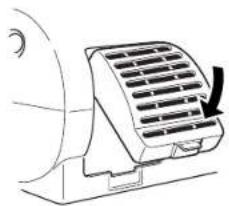
4) Attach the air filter cover.
natural_image
Line drawing of a mechanical device with ventilation slots and a curved handle (no text or symbols)Notes
- When the air filter is dusty, the ventilation is impaired. This causes the temperature inside the projector to rise, and may damage the unit.
- Attach the air filter cover firmly after the cleaning. If it is not set correctly, the dusts will enter and they will be projected and overlapped on the picture.
Cleaning the lens
Use a blower or a lens cleaner to clean the lens.
Never rub or tap the lens with a hard object as the lens surface is fragile.
Cleaning the main unit
- Pull out the power cord before cleaning.
- Use a soft cloth to wipe off stains from the surface.
• To remove difficult stains, use a soft cloth slightly moistened with a weak solution of synthetic detergent and water, and finish with a soft, dry cloth.
Replacing the intake, exhaust fans and air filter
To maintain the efficiency of the projector, replace the intake and exhaust fans about every two to three years.
Ask the dealer for the replacement.
Maintenance
Lamp replacement
The lamp will eventually begin to project dark or dull pictures and finally will not light up. (Lamp's life length depends on the use condition.) In such a case, replace the lamp with new one.
CAUTION
- If you use the projector mounted on the ceiling, ask the dealer to carry out the maintenance such as cleaning or replacement of the lamp.
- When replacing, always use lamp "TLPL8" (sold separately). For detail, refer to TLPL8 instruction.
- If you have been using the projector, the lamp will be very hot, and may cause burn injuries. Wait for the lamp to cool (for longer than 1 hour) before replacing it.
- If the lamp should break, please handle with care to avoid injury due to broken pieces and contact your dealer for repair service.
1 Unplug the power cord.
2 Wait until the lamp gets cold enough.
3 Take off the lamp cover on the bottom panel.
Loosen two screws, and pull off the lamp cover.
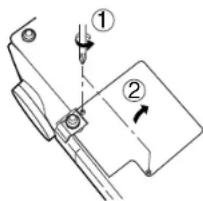
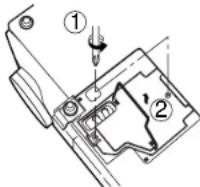
4 Pull out the lamp.
Loosen the two fixing screws, and lift up the handle to pull out the lamp.
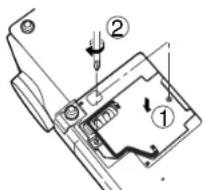
5 Load a new lamp.
Slide until it hits the bottom and tighten the two fixed screws.
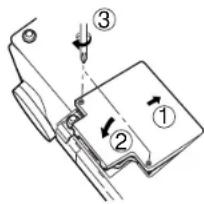
6 Attach the lamp cover.
Slide the cover in place and tighten two screws.
7 Reset the lamp timer.
Refer to the lamp instructions for resetting.
Notes
- The projector displays the total working time at every 1,000 hours (only when plugged in and turned on; ex. “ >1000H ”, “ >2000H ”).
- The lamp should be replaced if the total working time exceeds about 2,000 hours.
- Attach the lamp cover firmly after replacing the lamp. If it is not set correctly, the power will not turn on.
- Use a new lamp when replacing it.
- The lamp is made of glass and is very fragile. Do not touch the lamp with your bare hands and do not jolt or damage it. Do not use an exhausted lamp.
Others
Before calling service personnel
Check the following points before asking for support service.
Refer also to "Trouble indications". 31
The power does not come on.
• The power cord is disconnected.
→ Firmly plug in the power cord. 17
• The lamp cover is not attached correctly.
→ Attach the cover correctly. 33
The power turns off while using the projector.
• The ambient temperature of the projection room is too high.
→ Lower the ambient temperature of the projection room, and turn the power on.
No image appears.
• The lens cover is on.
→ Take off the lens cover.17
• The wrong input is selected.
→ Select the input source correctly. 19
• The muting mode is on.
→ Press MUTE to restore the picture. 21
- The "Brightness" adjustment is at its darkest.
→ Make the "Brightness" adjustment. 28
- The source is not correctly connected to the projector.
→ Connect the source correctly to the projector. 14
No sounds are heard.
• The wrong input is selected.
- Select the input source correctly. 19
• The audio muting mode is on.
→ Press MUTE to restore the sound. 21
• The sound volume is at the minimum.
→ Adjust the sound volume on the menu. 29
- The source is not correctly connected to the projector.
→ Connect the source correctly to the projector. 14
The images are blurred. Focusing is uneven.
• The lens is dirty.
→ Clean the lens.
Use a lens cleaner to clean the lens. 32
• The picture is out of focus.
→ Focus the picture. 19
• The projection distance is not appropriate.
→ Adjust the distance properly. 17
- The projecting light is not hitting the screen squarely.
→ Adjust the projecting direction so that the light hits the screen squarely. 17
- The "Brightness", "Contrast", "Sharpness" or "Phase" adjustments are not correct.
→ Make the "Image" or "Picture" adjustments. 27 28
The pictures are dim.
- The "Brightness" or "Contrast" adjustments are not correct.
→ Make the "Picture" adjustments. 28
• The lamp life is ending.
→ Replace the lamp. 33
The colors are faint. The colors are strange.
- The "Color", "Tint", "R-Level", "G-Level" or "B-Level" adjustments are not correct.
→ Make the "Picture" adjustments. 28
• The lamp life is ending.
→ Replace the lamp. 33
(Continued)
Others
(Continued)
The remote control does not work.
- The remote control is not facing the remote sensor.
→ Face the remote control transmitter toward the remote sensor on the projector. 12
• The remote control is too far.
→ Operate within about 5 meters. 12 - There is an obstruction between the remote control and the remote sensor.
→ Remove the obstacle.
• The batteries are exhausted.
→ Replace the batteries. 12
Others
Input signal
Mode determination and signal system
◎ : full compatible : dot resizing display
□: simplified display : ●gh resolution serial transfer control
| Signal | Frequency | Synchronizing Resolution (line)Default | Remarks | ||||
| Mode System | Horizontal(kHz) | Vertical(Hz) | Horizontal | Vertical H/V | |||
| NTSC | NTSC | 15.734 | 59.940 | 664 | 484 | N/N | VIDEO IN |
| PAL/SECAM | PAL/SECAM | 15.625 | 50.000 | 756 | 574 | N/N | VIDEO IN |
| NTSC/DTV480i | Digital broadcasting | 15.750 | 60.000 | 720/640 | 480 | N/N | RGB IN |
| DTV480P/VGA60Hz | Digital broadcasting | 31.500 | 60.000 | 720/640 | 480 | N/N | RGB IN |
| DTV720P | Digital broadcasting | 47.500 | 60.000 | 1280 | 720 | N/N | RGB IN |
| HDTV/DTV1080i | Hi-Vision/Digital broadcasting | 33.750 | 60.000 | 1920 | 1080 | N/N | RGB IN |
| NEC24K | PC98 Standard | 24.830 | 56.420 | 640 | 400 | N/N | RGB IN |
| TEXT70 | VGA-350 | 31.470 | 70.090 | 640 | 350 | P/N | RGB IN |
| TEXT70 | VGA-400 | 31.470 | 70.090 | 640 | 400 | N/P | RGB IN |
| TEXT85 | VGA 85Hz-1 | 37.861 | 85.080 | 640 | 350 | P/N | RGB IN |
| TEXT85 | VGA 85Hz-2 | 37.861 | 85.080 | 640 | 400 | N/P | RGB IN |
| VGA60 | VGA 60Hz | 31.470 | 59.940 | 640 | 480 | N/N | RGB IN |
| VGA72 | VGA 72Hz | 37.861 | 72.809 | 640 | 480 | N/N | RGB IN |
| VGA75 | VGA 75Hz | 37.500 | 75.000 | 640 | 480 | N/N | RGB IN |
| VGA85 | VGA 85Hz-4 | 43.269 | 85.008 | 640 | 480 | N/N | RGB IN |
| MAC13 | MAC-13" | 35.000 | 66.667 | 640 | 480 | -/- | RGB IN |
| SVGA56 | SVGA 56Hz | 35.156 | 56.250 | 800 | 600 | P/P | RGB IN |
| SVGA60 | SVGA 60Hz | 37.879 | 60.317 | 800 | 600 | P/P | RGB IN |
| SVGA72 | SVGA 72Hz | 48.077 | 72.188 | 800 | 600 | P/P | RGB IN |
| SVGA75 | SVGA 75Hz | 46.875 | 75.000 | 800 | 600 | P/P | RGB IN |
| SVGA85 | SVGA 85Hz | 53.674 | 85.061 | 800 | 600 | P/P | RGB IN |
| MAC16 | MAC-16" | 49.724 | 74.550 | 832 | 624 | -/- | RGB IN |
| XGA43i | XGA 43Hz interlace | 35.522 | 43.479x2 | 1024 | 768 | P/P | RGB IN |
(Continued)
Others
(Continued)
◎ : full compatible : dot resizing display
□: simplified display : ●gh resolution serial transfer control
| Signal | Frequency | Synchronizing | Resolution (line)Default | Remarks | ||||
| Mode System | Horizontal(kHz) | Vertical(Hz) | Horizontal | Vertical H/V | ||||
| XGA60 | XGA 60Hz | 48.363 | 60.004 | 1024 | 768 | N/N | ○ | RGB IN |
| XGA70 | XGA 70Hz | 56.476 | 70.069 | 1024 | 768 | N/N | ○ | RGB IN |
| XGA75 | XGA 75Hz | 60.023 | 75.029 | 1024 | 768 | P/P | ○ | RGB IN |
| XGA85 | XGA 85Hz | 68.677 | 84.997 | 1024 | 768 | N/N | ○ | RGB IN |
| MAC19 | MAC-19” | 60.197 | 74.872 | 1024 | 768 | N/N | ○ | RGB IN |
| SXGA75-1 | SXGA 75Hz | 67.500 | 75.000 | 1152 | 864 | P/P | ○ | RGB IN |
| MAC21 | MAC-21” | 68.681 | 75.062 | 1152 | 870 | -/- | ○ | RGB IN |
| SXGA60-1 | SXGA 60Hz | 60.000 | 60.000 | 1280 | 960 | P/P | ○ | RGB IN |
| SXGA85-1 | SXGA 85Hz | 85.938 | 85.002 | 1280 | 960 | P/P | □ | RGB IN |
| SXGA43i | SXGA 43Hz interlace | 46.433 | 43.436x2 | 1280 | 1024 | P/P | ○ | RGB IN |
| SXGA60-2 | SXGA 60Hz | 63.981 | 60.020 | 1280 | 1024 | P/P | ○ | RGB IN |
| SXGA75-2 | SXGA 75Hz | 79.976 | 75.025 | 1280 | 1024 | P/P | ○ | RGB IN |
| SXGA85-2 | SXGA 85Hz | 91.146 | 85.024 | 1280 | 1024 | P/P | □ | RGB IN |
| UXGA60 | UXGA 60Hz | 75.000 | 60.000 | 1600 | 1200 | P/P | □ | RGB IN |
| UXGA65 | UXGA 65Hz | 81.130 | 65.000 | 1600 | 1200 | P/P | □ | RGB IN |
| UXGA70 | UXGA 70Hz | 87.500 | 70.000 | 1600 | 1200 | P/P | □ | RGB IN |
| UXGA75 | UXGA 75Hz | 93.750 | 75.000 | 1600 | 1200 | P/P | □ | RGB IN |
Notes
- If the mode identification does not define the mode described on the chart above, adjust to the projection details.
- If the mode identification is carried out correctly, a normal display may be not obtained depending on the signal frequency.
- SXGA, UXGA signals can be projected since the projector has simplified compatibility with them. (However, letters and lines can be unequal or a part can be missing. Some signals may not be projected at all.)
- Some computers may have output modes which are not compatible with this projector. Check the compatibility of the connectors, signal levels, timing, and resolutions.
(Continued)
Others
(Continued)
Signal assignment
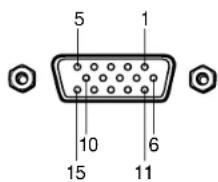
D-SUB 15 pin shrinking terminal
Input Signal
Video signal
Analog 0.7V(p-p) 75Ω
Horizontal synchronizing signal
TTL level (positive/negative polarity)
Vertical synchronizing signal
TTL level (positive/negative polarity)
Composite synchronizing signal
TTL level
Pin arrangements
| Pin No. | |
| 1 | Video input (Red) |
| 2 | Video input (Green) |
| 3 | Video input (Blue) |
| 4 | N.C |
| 5 | GND |
| 6 | GND (Red) |
| 7 | GND (Green) |
| 8 | GND (Blue) |
| 9 | N.C |
| 10 | GND |
| 11 | GND |
| 12 | N.C |
| 13 | Horizontal synchronizing/composite synchronizing signal |
| 14 | Vertical synchronizing signal |
| 15 | N.C |
(Continued)
Others
(Continued)
RGB signal defaults
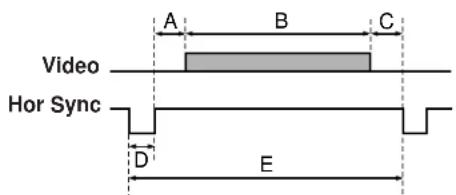
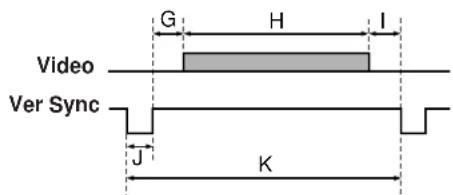
The following signals are factory set as defaults in each mode. However, some computers may have different timings than those in the chart. Make the necessary adjustments if the picture has flickers or is blurred.
Video Timing (Horizontal)
Video Timing (Vertical)
Timing chart
| Mode | Resolution | A (Pixels) | B (Pixels) | C (Pixels) | D (Pixels) | E (Pixels) | fh (kHz) | fv (Hz) | Clock (MHz) | G (Lines) | H (Lines) | I (Lines) | J (Lines) | K (Lines) |
| NEC24k | 640 x 400 | 85 | 640 | 59 | 64 | 848 | 24.83 | 56.42 | 21.053 | 25 | 400 | 7 | 8 | 440 |
| TEXT70 | 640 x 350 | 50 | 640 | 14 | 96 | 800 | 31.47 | 70.09 | 25.175 | 59 | 350 | 38 | 2 | 449 |
| TEXT70 | 640 x 400 | 50 | 640 | 14 | 96 | 800 | 31.47 | 70.09 | 25.175 | 34 | 400 | 13 | 2 | 449 |
| TEXT85 | 640 x 350 | 96 | 640 | 32 | 64 | 832 | 37.86 | 85.08 | 31.500 | 60 | 350 | 32 | 3 | 445 |
| TEXT85 | 640 x 400 | 96 | 640 | 32 | 64 | 832 | 37.86 | 85.08 | 31.500 | 41 | 400 | 1 | 3 | 445 |
| VGA60 | 640 x 480 | 48 | 640 | 16 | 96 | 800 | 31.47 | 59.94 | 25.175 | 33 | 480 | 10 | 2 | 525 |
| VGA72 | 640 x 480 | 128 | 640 | 24 | 40 | 832 | 37.86 | 72.81 | 31.500 | 28 | 480 | 9 | 3 | 520 |
| VGA75 | 640 x 480 | 120 | 640 | 16 | 64 | 840 | 37.50 | 75.00 | 31.500 | 16 | 480 | 1 | 3 | 500 |
| VGA85 | 640 x 480 | 80 | 640 | 56 | 56 | 832 | 43.27 | 85.01 | 36.000 | 25 | 480 | 1 | 3 | 509 |
| MAC13 | 640 x 480 | 96 | 640 | 64 | 64 | 864 | 35.00 | 66.67 | 30.240 | 39 | 480 | 3 | 3 | 525 |
| SVGA56 | 800 x 600 | 128 | 800 | 24 | 72 | 1024 | 35.16 | 56.25 | 36.000 | 22 | 600 | 1 | 2 | 625 |
| SVGA60 | 800 x 600 | 88 | 800 | 40 | 128 | 1056 | 37.88 | 60.32 | 40.000 | 23 | 600 | 1 | 4 | 628 |
| SVGA72 | 800 x 600 | 64 | 800 | 56 | 120 | 1040 | 48.08 | 72.19 | 50.000 | 23 | 600 | 37 | 6 | 666 |
| SVGA75 | 800 x 600 | 160 | 800 | 16 | 80 | 1056 | 46.88 | 75.00 | 49.500 | 21 | 600 | 1 | 3 | 625 |
| SVGA85 | 800 x 600 | 152 | 800 | 32 | 64 | 1048 | 53.67 | 85.06 | 56.250 | 27 | 600 | 1 | 3 | 631 |
| MAC16 | 823 x 624 | 216 | 832 | 40 | 64 | 1152 | 49.72 | 74.55 | 57.283 | 39 | 632 | 1 | 3 | 667 |
| XGA60 | 1024 x 768 | 160 | 1024 | 24 | 136 | 1344 | 48.363 | 60.004 | 65.000 | 29 | 768 | 3 | 6 | 806 |
| XGA70 | 1024 x 768 | 144 | 1024 | 24 | 136 | 1328 | 56.476 | 70.069 | 75.000 | 29 | 768 | 3 | 6 | 806 |
| XGA75 | 1024 x 768 | 176 | 1024 | 16 | 96 | 1312 | 60.023 | 75.029 | 78.750 | 28 | 768 | 1 | 3 | 800 |
| XGA85 | 1024 x 768 | 208 | 1024 | 48 | 96 | 1376 | 68.677 | 84.997 | 94.500 | 36 | 768 | 1 | 3 | 808 |
| MAC19 | 1024 x 768 | 180 | 1024 | 20 | 96 | 1320 | 60.197 | 74.872 | 73.200 | 30 | 768 | 3 | 3 | 804 |
Others
Adjustments with RS-232C
Conditioning of the Projection Unit can also be done by a computer via the RS-232C, as well as by the remote control.
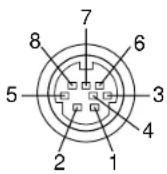
Mini DIN 8-pin (Main Unit)
| Pin No. | Signal | Meaning |
| 1 | RXD | Receiving data |
| 2 | CTS | Consent to send |
| 3 | DSR | Data set ready |
| 4 | GND | Signal ground |
| 5 | RTS | Request to send |
| 6 | N.C | No connection |
| 7 | TXD | Sending data |
| 8 | N.C | No connection |
Interface format
| 1 | Communication method | RS-232C9600 bps, No parity, Data length: 8 bit,Stop bit: 1 bit | ||
| 2 | Communication format | STX (02h) | Command (3Byte) | ETX (03h) |
| One command only can be used in one communication. | ||||
| 3 | Data format | Command shall be composed of alphanumeric characters of ASCII description. Use only capital letters. | ||
| 4 | Return value | Acknowledge | ACK (06h) | |
| Not Acknowledge | NAK (15h) | |||
Note
When commands are transmitted serially, keep more than 100 ms intervals between the commands.
Command list
| Classification | Command | Meaning |
| NORMAL | POF | Power OFF |
| NORMAL | PON | Power ON |
| NORMAL | MOF | Video audio mute OFF |
| NORMAL | MON | Video audio mute ON |
| NORMAL | AON | Audio mute ON |
| NORMAL | DOF | Status display OFF |
| NORMAL | DON | Status display ON |
| NORMAL | FOF | Freeze OFF |
| NORMAL | FON | Freeze ON |
| NORMAL | IN1 | Input (RGB) |
| NORMAL | IN2 | Input (Video) |
| NORMAL | INS | Input (S-video) |
| RESIZE | RS0 | Resize reset |
| RESIZE | RS1 | Resize 1 |
| RESIZE | RS2 | Resize 2 |
| RESIZE | RS3 | Resize 3 |
| RESIZE | RS4 | Resize 4 |
| ADJUST | ARS | Adjustment value reset |
| ADJUST | ARG | Adjustment value increase |
| ADJUST | ALF | Adjustment value decrease |
| ADJUST | AUP | Adjustment value increase |
| ADJUST | ADW | Adjustment value decrease |
| KEYSTONE | PKA | Keystone automatic adjustment |
| KEYSTONE | PKS | Keystone manual adjustment |
| Image | PAT | Panel automatic adjustment |
| Image | PVP | Vertical position adjustment |
| Image | PHP | Horizontal position adjustment |
| Image | PPH | Phase adjustment |
| Image | PCK | Clock adjustment |
(Continued)
Others
(Continued)
| Classification | Command | Meaning |
| Picture | VBR | Brightness adjustment |
| Picture | VCL | Color adjustment |
| Picture | VCN | Contrast adjustment |
| Picture | VSH | Sharp adjustment |
| Picture | VTN | Tint adjustment |
| Picture | VLB | Blue level adjustment |
| Picture | VLG | Green level adjustment |
| Picture | VLR | Red level adjustment |
| Audio | VOL | Volume adjustment |
| Audio | VTR | Treble adjustment |
| Audio | VBS | Bass adjustment |
| Default | LJP | Japanese display setting |
| Default | LEN | English display setting |
| Default | LFR | French display setting |
| Default | LGR | German display setting |
| Default | LIT | Italian display setting |
| Default | LSP | Spanish display setting |
| Default | LP0 | Portuguese display setting |
| Default | PJ0 | Floor-mounted front projection |
| Default | PJ1 | Floor-mounted rear projection |
| Classification | Command | Meaning |
| Default | PJ2 | Ceiling-mounted front projection |
| Default | PJ3 | Ceiling-mounted rear projection |
| Default | KR0 | RGB input mode (RGB) |
| Default | KR1 | RGB input mode (Y/Pb/Pr) |
| Default | KV0 | Video signal mode (Automatic) |
| Default | KV1 | Video signal mode (60/NTSC/JAPAN) |
| Default | KV2 | Video signal mode (60/NTSC/3.58) |
| Default | KV3 | Video signal mode (60/NTSC/4.43) |
| Default | KV4 | Video signal mode (60/PAL/3.58) |
| Default | KV5 | Video signal mode (60/PAL/4.43) |
| Default | KV6 | Video signal mode (50/NTSC/3.58) |
| Default | KV7 | Video signal mode (50/NTSC/4.43) |
| Default | KV8 | Video signal mode (50/PAL/3.58) |
| Default | KV9 | Video signal mode (50/PAL/4.43) |
| Default | KVA | Video signal mode (50/SECAM/4.43) |
| Default | MO0 | OSD mute OFF |
| Default | MO1 | OSD mute ON |
| Save | DRS | Adjustment value preset |
| Save | DSV | Adjustment value saving |
Others
Specifications
Main unit
Power requirements
AC 100-240V 50/60Hz
Power consumption
200W
Mass 3.7 Kg
Dimensions
318 x 87 x 232 (mm) (W/H/D)
(Including the projecting sections)
Ambient environment
Temperature: 0^ to 35^
Humidity : 30% to 70% RH
Lamp UHP lamp 120W
Speaker 1W (monaural)
RGB INPUT
RGB signal : (D-sub 15-pin)
Audio: 1V(p-p), more than 22kΩ,
Audio : 1V(p-p), more than 22kΩ,
RCA pin jack
MONITOR OUTPUT
RGB signal : D-sub 15-pin
Audio : 1V(p-p), less than 2.2kΩ,
3-pannels transmission
Panel size
0.9 inches
Driving system
TFT active matrix
Picture elements
480,000 pixels (800 x 600 dots) x 3
Projection lens
Lens Zooming lens F = 1.8 - 2.1
f = 36 - 47mm
Focusing Manual operation
Zooming Manual operation
Accessories
Wireless remote control 1
R6 size battery 2
Power cord 2
Audio/Video cable 1 (3m)
Adapter for SCART socket 1
Lens cover.... 1
The design and specifications are subject to change without notice.
Trademarks
NEC, PC-98 series are trademarks of NEC Corporation.
IBM, DOS/V, VGA, SVGA, XGA, SXGA, UXGA are trademarks or registered trademarks of International Business Machines Corporation.
Macintosh is a registered trademark of Apple Computer, Inc.
TOSHIBA CORPORATION
Printed in Japan
- SAFETY PRECAUTIONS
- IMPORTANT PRECAUTIONS
- Save Original Packing Materials
- Avoid Volatile Liquid
- Moisture Condensation
- IMPORTANT SAFETY INSTRUCTIONS
- Read Owner's Manual
- Power Sources
- Source of Light
- Ventilation
- Heat
- Cleaning
- Overloading
- Water and Moisture
- Power-Cord Protection
- Lightning
- Object and Liquid Entry
- Do not place the product vertically
- Stack Inhibited
- Attachments
- Accessories
- Damage Requiring Service
- Servicing
- Replacement Parts
- Safety Check
- If glass components, including lens and lamp, should break, contact your dealer for repair service.
- Contents
- Before use
- Connections and installation
- Operations
- Adjustments
- Maintenance
- Others
- Part names and functions
- Main unit
- Left side Right side
- Rear side
- Installing batteries
- Notes
- Remote control operation
- Power supply cord selection
- Connections
- Connecting video equipment
- Note
- Output terminals
- Connecting an IBM PC or compatible computer (DOS/V)
- Connecting a Macintosh computer
- Projector placement
- CAUTION
- Preparation
- Floor-mounted front projection
- Floor-mounted rear projection
- Ceiling-mounted front projection
- Ceiling-mounted rear projection
- Place the projector on a steady, level surface such as a table.
- Adjust the distance between the lens and the screen.
- Connect the power cord.
- Take off the lens cover.
- How to use the foot adjuster
- Picture projection
- Press ON/STANDBY.
- Turn on the connected equipment and put it in playback mode.
- Select the input source.
- Adjust the picture size by turning the zooming ring.
- Focus on the picture by turning the focusing ring.
- Correcting the keystone distortion
- Press KEYSTONE.
- Turning the power off
- Adjusting the image automatically
- Cutting off the picture and sound temporarily
- Freezing the picture
- Displaying the input source information
- Changing the picture size
- Settings and adjustments on the menu
- Keystone
- Image
- Picture
- Audio
- Default
- Save
- Initial settings
- - Default
- Press ◀ or ▶ to select
- Press ▲ or ▼ to select a preferred item.
- Press ◀ or ▶ to make the setting.
- RGB input
- Video signal
- Press MENU.
- Keystone correction
- - Keystone
- degrees setting for the automatic keystone correction
- Projection adjustments - Image
- Picture adjustments – Picture
- Press MENU to display the menu.
- Press
- Press ◀ or ▶ to adjust the item.
- Sound adjustments - Audio
- Press ▲ or ▼ to select a preferred item.
- Saving data
- Trouble indications
- Air filter, lens and main unit cleaning
- Cleaning the air filter
- Cleaning the lens
- Cleaning the main unit
- Replacing the intake, exhaust fans and air filter
- Lamp replacement
- Unplug the power cord.
- Wait until the lamp gets cold enough.
- Take off the lamp cover on the bottom panel.
- Pull out the lamp.
- Load a new lamp.
- Attach the lamp cover.
- Reset the lamp timer.
- Before calling service personnel
- Mode determination and signal system
- RGB signal defaults
- Adjustments with RS-232C
- Specifications
- Projection lens
- Accessories
Brand : TOSHIBA
Model : TLP-MT3E
Category : Vidéo-projecteur