HKS8555GA2S - Fridge Hanseatic - Free user manual and instructions
Find the device manual for free HKS8555GA2S Hanseatic in PDF.


User questions about HKS8555GA2S Hanseatic
0 question about this device. Answer the ones you know or ask your own.
Ask a new question about this device
Download the instructions for your Fridge in PDF format for free! Find your manual HKS8555GA2S - Hanseatic and take your electronic device back in hand. On this page are published all the documents necessary for the use of your device. HKS8555GA2S by Hanseatic.
USER MANUAL HKS8555GA2S Hanseatic
natural_image
Line drawing of an open refrigerator with shelves and doors open (no text or symbols)Gebrauchsanleitung
Kühlschrank mit
natural_image
Technical line drawing of a vehicle front panel with structural ribs and mounting brackets (no text or symbols)natural_image
Simple line drawing of a mechanical component with two downward arrows indicating force or direction (no text or symbols)natural_image
Line drawing of a device with a screwdriver and two curved arrows indicating rotation or movement (no text or symbols)natural_image
Diagram of a mechanical assembly with rotating components and directional arrows (no text or symbols)natural_image
Mechanical assembly diagram showing bolted components and directional arrows indicating motion (no text or labels)natural_image
Diagram of a mechanical assembly with rotating components and directional arrows (no text or symbols)natural_image
Technical line drawing of a mechanical bracket with an inset showing a pin insertion (no text or symbols)natural_image
Technical line drawing of a mechanical assembly with an inset magnified view (no text or symbols)natural_image
Line drawing of a door with a handle and lock, no text or symbols presentnatural_image
Simple line drawing of a car with a curved arrow indicating rotation and a horizontal line below (no text or symbols)natural_image
Pure technical line drawing of a mechanical assembly with no text or symbolsnatural_image
Line drawing of an open refrigerator with doors open and one door closed (no text or symbols)User manual
Refrigerator with four-star freezer compartment
Table of contents
Table of contents . . . . . . . . . . . . . . . . GB-2
Delivery GB-3
Package contents . . . . . . . . . . . . . . GB-3
Check the delivery . . . . . . . . . . . . GB-3
Intended use GB-3
Appliance parts / control elements .... GB-4
Safety GB-5
Explanation of terms GB-5
Explanation of symbols . . . . . . . . GB-5
Safety notices GB-5
Operation GB-10
Requirements for safe use . . . . . . GB-10
Switching the appliance on and off GB-10
Setting the temperature . . . . . . . . GB-10
Moving the glass shelf and door compartments . . . . . . . . . . . . . GB-11
Chilling food GB-11
Filling the fridge compartment . . . . GB-12
Maintaining quality . . . . . . . . . . . GB-12
Freezing foods / storing frozen foods GB-13
Freezing food . . . . . . . . . . . . . . . . GB-13
Storing frozen food . . . . . . . . . . . GB-14
Defrosting food GB-15
Preparing ice cubes . . . . . . . . . . . GB-15
Care and maintenance . . . . . . . . . GB-16
Checking and cleaning door seals . GB-16
Clean exterior . . . . . . . . . . . . . . . . GB-16
Defrosting the freezer compartment and cleaning the interior. GB-16
Replacing the light inside . . . . . . . GB-18
Start-up GB-19
Preparing for start-up . . . . . . . . . GB-19
Moving and unpacking . . . . . . . . GB-19
Choosing a suitable location ..... GB-19
Setting up and aligning the appliance . . . . . . . . . . . . . . . . . GB-20
Changing the door hinges . . . . . . GB-21
Cleaning before use . . . . . . . . . . GB-24
Connecting the appliance to electricity . . .
GB-24
Troubleshooting table . . . . . . . . . . GB-26
Service GB-28
Advice, order and complaint ..... GB-28
Repairs and spare parts . . . . . . . GB-28
Environmental protection . . . . . . . GB-29
Disposing of old electrical devices
in an environmentally-
friendly manner . . . . . . . . . . . . . . . . GB-29
Our contribution to the
protection of the ozone layer ..... GB-29
Product fiche concerning
Regulation (EU) No 1060/2010..... GB-30
Technical specifications . . . . . . . . GB-32

You can find more information on setting up the appliance and starting it up for the first time from page GB-19.

Please read through the safety instructions and user manual carefully before using the appli-
ance. This is the only way you can use all the functions reliably and reliably. Be absolutely sure to also observe the national regulations in your country, which are also valid in addition to the regulations specified in this user manual.
Keep all safety notices and instructions for future reference. Pass all safety notices and instructions on to the subsequent user of the product.
Delivery
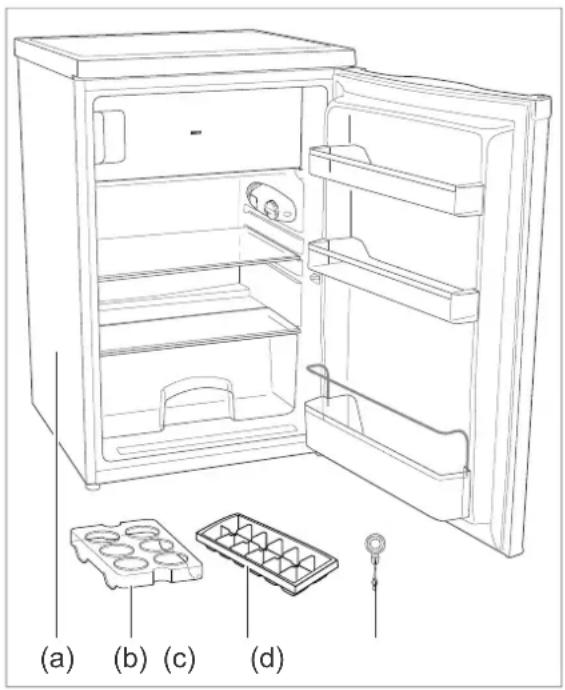
1× Refrigerator with four-star freezer compartment and vegetable compartment (a)
1× Egg tray (b)
1× Ice cube container (c)
1× Cleaning swab (d)
1× Warranty documents
Check the delivery
- Move the appliance to a suitable place and unpack it (siehe „Start-up“ on page GB-19).
- Remove all parts of the packaging, plastic profiles, tape and foam padding.
- Check that the delivery is complete.
- Check whether the appliance was damaged during transit.
- If the delivery is incomplete or the appliance has been damaged during transport, please contact our Service Centre (see page GB-28).
WARNING!
Risk of electric shock! Never use a damaged appliance.
Intended use
This appliance is suitable for chilling fresh food, storing commercially frozen food, freezing fresh, room-temperature foods and making ice.
The appliance is intended solely for use in private households. It is not designed for commercial use.
Use the appliance exclusively as described in this user manual. Any other use is deemed improper and may result in damage to property or even personal injury. The manufacturer accepts no liability for damage caused by improper use.
Appliance parts / control elements
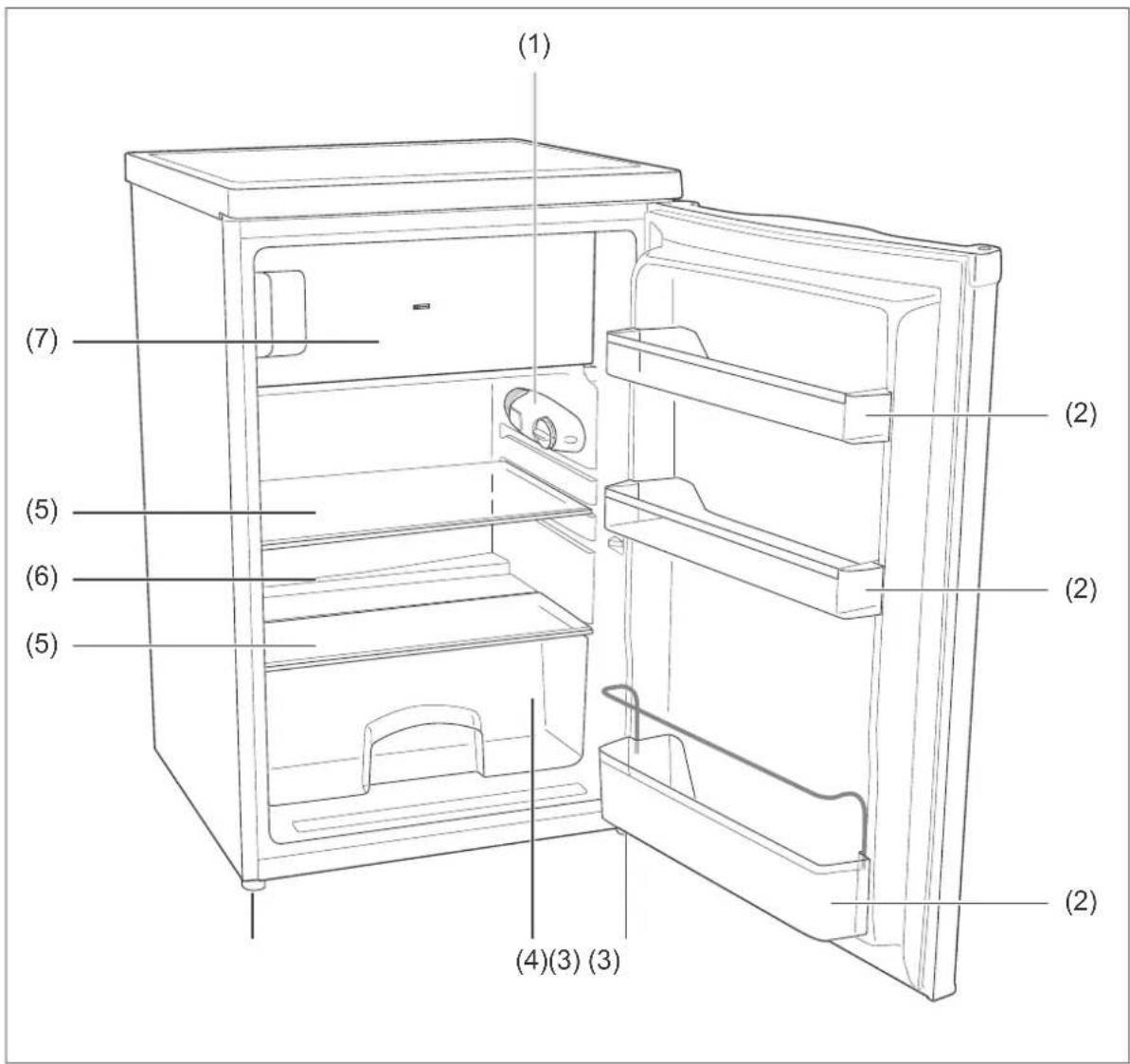
(1) Temperature controller and interior lighting
(2) Door compartments (3×)
(3) Screw feet
(4) Vegetable compartment
(5) Glass shelf
(6) Defrost drain
(7) Four-star freezer compartment
Safety
Explanation of terms
The following symbols can be found in this user manual.

WARNING
This symbol indicates a hazard with a medium level of risk which, if not avoided, could result in death or serious injury.

CAUTION
This symbol indicates a hazard with a low level of risk which, if not avoided, could result in minor or moderate injury.

NOTICE
This symbol warns against possible damage to property.

This symbol refers to useful additional information.
Explanation of symbols

Caution: Fire hazard!

Freezer compartment at -18 °C or r
Safety notices
In this chapter you will find general safety notices which you must always observe for your own protection and that of third parties. Please also observe the warning notices in the individual chapters on operation, installation, etc.

WARNING
Risks in handling household electrical appliances
Risk of electric shock!
Touching live parts may result in severe injury or death.
■ Only use the appliance indoors. Do not use in wet rooms or in the rain.
■ Do not operate or continue to operate the appliance, if
– it shows visible signs of damage, e.g. the power cord is defective,
- it starts smoking or there is a smell of burning,
– it makes unfamiliar noises.
In such cases, pull out the mains plug or unscrew/isolate the fuse and contact our service department (see page GB-28).
■ The appliance corresponds to protection class I and may only be connected to a plug with a protective conductor that has been properly installed. When connecting, make sure that it has the right voltage. You can find more detailed information about this on the nameplate.
- Do not connect to a timer or a separate remote-controlled system for distance monitoring and control.
■ The appliance must only be completely disconnected from the power supply by pulling out the mains plug. The appliance must therefore be connected to an easily accessible socket so that it can be quickly disconnected from the power supply in the event of breakdown.
■ If the mains plug is no longer accessible after installation, an all-pole disconnecting device complying with overvoltage category III must be connected to the house wiring with a contact gap of at least 3 mm; this includes fuses, circuit breakers and contactors.
- Do not kink or pinch the mains cord or lay it over sharp edges. This can result in a break in the cable.
■ When positioning the appliance, ensure the supply cord is not trapped or damaged.
- Do not locate multiple portable socket- outlets or portable power supplies at the rear of the appliance.
- Keep the appliance, the mains plug and the mains cord away from open flames and hot surfaces.
■ Always touch the mains plug, not the mains cord.
■ Never touch the mains plug with wet hands.
■ Never immerse the mains cord or plug in water or any other liquids.
■ If the mains cord of the appliance is damaged, it must be replaced by the manufacturer, through customer service or by a qualified specialist.
- Inspections and repairs to the appliance may only be carried out by authorised specialists (siehe „Service“ on page GB-28).
- Independent or improper repairs made to the appliance may cause damage to property and personal injury; any liability and warranty claims will be forfeited. Never attempt to repair the faulty – or supposedly faulty – appliance yourself.
■ Only parts corresponding to the original appliance specifications may be used for repairs. This appliance contains electrical and mechanical parts which are essential for protection against potential sources of danger.
- In the event of a fault, as well as before extensive cleaning, pull out the mains plug or isolate/unscrew the fuse.
- Do not put any objects in or through the housing openings, and also make sure that children cannot insert any objects in them.
- Check the appliance regularly for damage.
Risks to children
Risk of suffocation!
Children can become entangled in the packaging fi lm or swallow small parts and suffocate.
■ Do not allow children to play with the packaging fi lm.
■ Prevent children from pulling small parts off the device or taking them out of the accessory bag and putting them in their mouths.
Risks when dealing with chemical substances
Danger of explosion!
Improper handling of chemical substances can lead to explosions.
- Do not store explosive substances or spray cans with flammable propellants inside the appliance, as they may cause ignitable gas-air mixtures to explode.
■ Never use defrosting sprays to defrost. They can generate explosive gases.

CAUTION
Risks for certain groups of people
Dangers for children and people with limited physical, sensory or mental capacity!
■ This appliance can be used by children aged from 8 years and above and persons with reduced physical, sensory or mental capabilities or lack of experience and knowledge if they have been given supervision or instruction concerning use of the appliance in a safe way and understand the hazards involved. Children aged from 3 to 8 years are allowed to load and unload refrigerating appliances. Children shall not play with the appliance. Cleaning and user maintenance shall not be made by children without supervision.
■ Make sure children do not have unsupervised access to the appliance.
Risks when dealing with fridge and freezer appliances
Fire hazard!
Improper handling of the appliance can lead to fire and property damage.
■ Only connect the appliance to a properly installed and earthed electric socket.
■ Do not connect to a multi-socket extension cable or a multi-socket plug.
- Keep ventilation openings, in the appliance enclosure or in the built-in structure, clear of obstruction.
- Do not place the appliance directly against the wall. Observe the minimum spacing intervals (siehe „Choosing a suitable location“ on page GB-19).
Dangers from the refrigerant!
Your appliance's refrigeration circuit contains the environmentally friendly, but fl ammable refrigerant R600a (isobutane).
■ Mechanical intervention in the refrigeration system must only be carried out by authorised specialists.
- Do not damage the refrigerant circuit, for example by piercing the refrigerant channels of the condensate vaporiser with sharp objects, bending the tubing, etc.
■ Refrigerant is flammable when spurting out and can damage the eyes. In this case, rinse your eyes in clean water and seek medical assistance immediately.
- To prevent the formation of a flammable gas-air mixture in the event of a leakage in the refrigeration circuit, the installation space must have a minimum size of 1 m ^3 per 8 g of refrigerant in compliance with the EN 378 standard. The amount of refrigerant contained in your appliance can be found in the data sheet at the end of the user manual.
Risk of injury!
Improper handling of the appliance may result in injury.
■ The appliance is heavy and bulky. Ask another person to help with moving and installation.
- Check that entry route and installation location are free of obstacles (e.g. closed doors or objects lying on the floor).
■ Bases, drawers, doors, etc. must not be used as steps or for support purposes.
■ Do not place heavy objects on the appliance, as they could fall down and cause injuries.
■ Take care to prevent the risk of tripping when laying the mains cord.
Health hazard!
Contaminated foods can cause health problems.
■ Opening the door for long periods can cause a significant increase of the temperature in the compartments of the appliance.
■ Clean regularly surfaces that can come in contact with food and accessible drainage systems.
■ Store raw meat and fi sh in suitable containers in the refrigerator, so that it is not in contact with or drip onto other food.
■ Two-star frozen-food compartments are suitable for storing pre-frozen food, storing or making ice-cream and making ice cubes.
■ One-, two- and three-star compartments are not suitable for the freezing of fresh food.
■ If the refrigerating appliance is left empty for long periods, switch off, defrost, clean, dry, and leave the door open to prevent mould developing within the appliance.
Health hazard!
Incorrect handling, insufficient cooling or overlapping items can spoil the stored food. This could lead to a risk of food poisoning when consumed!
■ In particular, pack raw meat and fish carefully to ensure that adjacent food cannot be contaminated by salmonella or similar bacteria.
■ Abide by the storage times recommended by food manufacturers.
■ Note that the shelf life of the frozen food may be shortened due to a rise in the temperature inside the appliance (from defrosting, cleaning or power failure).
- In case of prolonged power failure or appliance malfunction, remove stored frozen food from the appliance and store it in a sufficiently cool place or in another refrigerating appliance (maximum storage time in case of malfunction: 13 hours).
■ After a malfunction, check whether the stored food is still edible. Consume thawed and defrosted foods immediately, do not refreeze.
■ Use only drinking water to make ice cubes.
The appliance may not operate properly if exposed to low ambient temperatures for extended periods of time. This can then lead to an increase in temperature inside the appliance.
■ Always adhere to the prescribed ambient temperature (see data sheet at the end of this user manual).
Risk of injury from frozen goods!
Improper handling of the appliance may result in injury. There is a risk of burns caused by low temperatures.
■ The food and the inside walls of the freezer compartment have a very low temperature. Never touch them with wet hands. This can cause injury to
the skin. Skin damage can occur even with dry skin.
■ Let ice cubes or ice lollies thaw a little before eating, do not put into your mouth straight from the freezer area.
NOTICE
Risk of damage!
If the appliance has been transported horizontally, lubricant from the compressor may have gotten into the cooling circuit.
■ Only transport the appliance in a vertical position, where possible.
- Allow the appliance to stand upright for 2 hours before start-up. The lubricant will flow back into the compressor during this time.
Improper handling of the appliance can lead to property damage.
■ Do not use the door to pull or lift the appliance.
- The appliance must only be placed on a level and firm surface. The surface must be strong enough to support the appliance's weight when fully laden.
■ Do not use sharp or pointed objects to unpack it.
- Do not use electrical appliances inside the food storage compartments of the appliance, unless they are of the type recommended by the manufacturer.
- Do not use any mechanical devices or means other than those recommended by the manufacturer.
■ The interior light must only be used to illuminate the interior of the appliance. It is not suitable for lighting a room.
- Do not store glass or metal containers containing water, lemonade, beer etc. in the freezer compartment. Water expands when frozen and can burst the container.
■ Defrost the freezer compartment in a timely manner, before it forms a layer of ice and frost of more than 5 mm. Excessive ice formation increases power consumption and the freezer compartment door may no longer close tightly.
- Do not use mechanical devices or other means to accelerate the defrosting process, other than those recommended by the manufacturer. For example, do not use any electric heating equipment, knives or devices with an open flame such as a candle. The insulation is sensitive to scratching and heat or can melt.
■ When cleaning, please note:
– Never use harsh, granular, soda, acid, solvent-based or abrasive cleaners. These attack the plastic surfaces. All-purpose cleaners with a neutral pH are recommended.
- Door seals and plastic parts are sensitive to oil and grease. Remove contaminants as quickly as possible.
- Use only soft cloths for cleaning.
- Wait 5 minutes after switching off. Only then switch the appliance on again.
■ Only use original accessories.
Operation
Requirements for safe use
- You have read chapter „Safety“ from page GB-5 and understand all the safety notices.
- The appliance is set up and plugged in as described in chapter „Start-up“ from page GB-19.
Switching the appliance on and off

NOTICE
Risk of damage!
Improper handling of the appliance can lead to property damage.
■ The interior light must only be used to illuminate the interior of the appliance. It is not suitable for lighting a room.
text_image
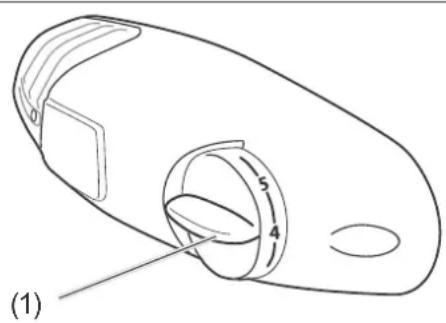
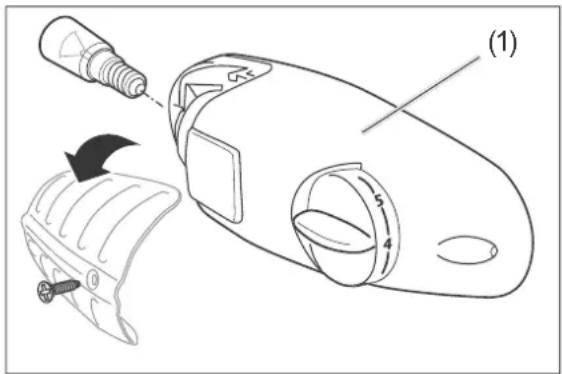
(1)The temperature controller (1) can be used to switch the appliance on and off. The temperature controller is situated on the right-hand wall of the fridge compartment.
Switching on
-
Set the temperature controller (1) to a setting of between "1" and "7". The appliance is then switched on. The compressor will begin to work. The interior light will switch on as soon as the door is opened and will switch off if the door is closed.
-
If the appliance makes worrying noises check the solid base and remove any objects that are on top of the appliance.
Switching off
- Set the temperature controller (1) to "0". The compressor is switched off. The appliance doesn't refrigerate.
- To disconnect the appliance from the power supply, pull the mains plug out of the socket.
- Empty the appliance and clean it (siehe "Care and maintenance" on page GB-16).
- Leave the door open slightly to avoid mould formation.
Setting the temperature

WARNING
Health hazard!
The appliance may not operate properly if exposed to low ambient temperatures for extended periods of time. This can then lead to an increase in temperature in the fridge and freezer compartment.
■ Always adhere to the prescribed ambient temperature (see data sheet at the end of this user manual).
Using the temperature controller (1), you can set the temperature in the fridge and freezer compartments.
- First select a medium setting.
- If, for example in summer, the ambient temperature increases, so select a lower setting accordingly.
In order to
– increase the refrigeration output in the fridge and freezer compartments, turn the temperature controller towards “7”.
– decrease the refrigeration output in the fridge and freezer compartments, turn the temperature controller towards "1".
You ideally need two refrigerator/freezer thermometers to be able to control the refrigeration output.
Place one
- above the vegetable compartment; the correct temperature here is +6 °C.
- in the freezer compartment; the ideal storage temperature is -18 °C.
Moving the glass shelf and door compartments
The upper glass shelf (5) and the door compartments (2) can be taken out and rearranged if necessary.
- Pull out the shelf / lift up and remove the door compartment.
- Slide the shelf into a new position / insert the door compartment from above into a new position.
Chilling food

WARNING
Danger of explosion!
Improper handling of the appliance can lead to explosions.
- Do not store explosive substances or spray cans with flammable propellants inside the appliance, as they may cause ignitable gas-air mixtures to explode.

CAUTION
Health hazard!
Contaminated foods can cause health problems.
■ Opening the door for long periods can cause a significant increase of the temperature in the compartments of the appliance.
■ Clean regularly surfaces that can come in contact with food and accessible drainage systems.
■ Store raw meat and fi sh in suitable containers in the refrigerator, so that it is not in contact with or drip onto other food.
■ Two-star frozen-food compartments are suitable for storing pre-frozen food, storing or making ice-cream and making ice cubes.
■ One-, two- and three-star compartments are not suitable for the freezing of fresh food.
■ If the refrigerating appliance is left empty for long periods, switch off, defrost, clean, dry, and leave the door open to prevent mould developing within the appliance.
Filling the fridge compartment
text_image
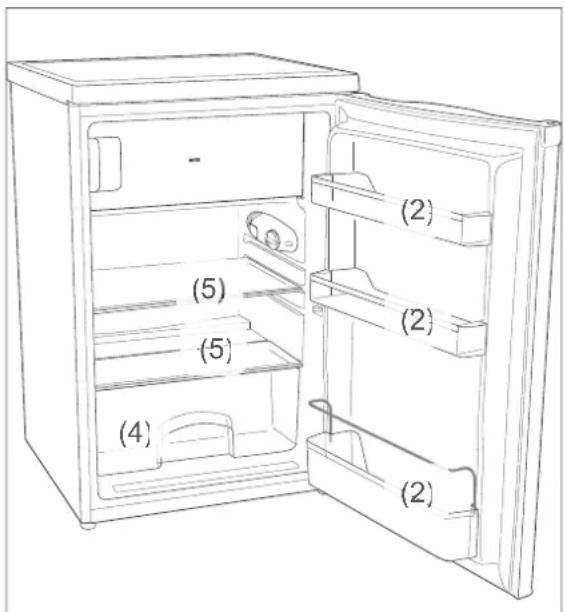
(2) (5) (5) (4) (2)- Fill the fridge compartment in such a way that the temperature conditions inside are used to their full potential:
- Place spreadable butter and cheese in the top door compartment (2). This is where the temperature is warmest.
- Store preserves, jars and eggs in the middle door compartment (2). Eggs are best stored on the supplied egg tray (b).
- Place drinks cartons and bottles in the lower door compartment (2). Position full containers closer to the hinge in order to reduce the strain on the door.
- Place cooked and baked foods on the upper glass shelf (5).
– Place fresh meat, game, poultry, bacon, sausage and raw fish on the glass shelf above the vegetable compartment(4).
This is where the temperature is lowest.
- Place fresh fruit and vegetables in the vegetable drawer (4).
- Only store strong alcohol standing upright and closed tightly.
- Allow hot food to cool before placing it in the fridge compartment.
- The temperatures in the appliance and thus the energy consumption can increase
- if the door is opened frequently or for a prolonged period.
- if the temperature falls below or exceeds the prescribed interior temperature.
- Energy consumption is also dependent on the selected location (siehe „Choosing a suitable location“ on page GB-19).
Maintaining quality
- To maintain the flavour and freshness of food in the fridge compartment, only place packaged food in the fridge compartment. Use special plastic containers for food or customary films.
- Place the food
– in the fridge in a way that allows the air to circulate freely. Do not cover the shelves with paper or anything similar.
– somewhere that is not directly against the rear wall. Otherwise it may freeze onto the rear wall.
Freezing foods / storing frozen foods

WARNING
Danger of explosion! Improper handling of the appliance may lead to an explosion.
- Do not store explosive substances or spray cans with flammable propellants inside the appliance, as they may cause ignitable gas-air mixtures to explode.

CAUTION
Health hazard!
Incorrect handling, insufficient cooling or overlapping items can spoil the stored food. This could lead to a risk of food poisoning when consumed!
■ In particular, pack raw meat and fish carefully to ensure that adjacent food cannot be contaminated by salmonella or similar bacteria.
■ Abide by the storage times recommended by food manufacturers.
■ Note that the shelf life of the frozen food may be shortened due to a rise in the temperature inside the appliance (from defrosting, cleaning or power failure).
■ In case of prolonged power failure or appliance malfunction, remove stored frozen food from the appliance and store it in a sufficiently cool place or in another refrigerating appliance (maximum storage time in case of malfunction: 13 hours).
■ After a malfunction, check whether the stored food is still edible. Consume thawed and defrosted foods immediately, do not refreeze.
Risk of injury!
Improper handling of the appliance may result in injury. Risk of burns caused by low temperatures.
■ The food and the inside walls of the freezer compartment have a very low temperature. Never touch them with wet hands. This can cause injury to the skin. Skin damage can occur even with dry skin.
- Let ice cubes or ice lollies thaw a little before eating, do not put into your mouth straight from the freezer compartment.
Freezing food
Freezing means reducing the core temperature of fresh, room-temperature food to frozen as quickly as possible – for best results “flash-frozen”. If not cooled quickly enough, the food will be “killed by frost”, i.e. the structure will be destroyed. A constant storage temperature of -18^ C is needed to maintain the food’s consistency, taste and nutritional value.
Preparing the food
- Only freeze high quality food.
- Freeze fresh and prepared food dry and unseasoned. Unsalted foods are more durable.
- Allow prepared food to cool before freezing. This not only saves power, but also prevents excessive frost formation in the freezer compartment.
- Carbonated drinks are not suitable for freezing because the carbon dioxide escapes during freezing.
Suitable packaging
Packaging is important when freezing. This will protect against oxidation, penetration by microbes, transfer of odours and flavourings and drying out (freezer burn).
- Only use packaging material that is strong, impermeable to air and liquid, not too stiff and labelled. It should be designated as suitable for freezer use.
- Use plastic clips, rubber bands or adhesive tapes to seal.
Portions
- Use flat portions as much as possible; these freeze through to the core faster.
- Expel the air from the freezer bag as this causes the contents to dry out and takes up space.
- Fill liquid containers no more 34 full, because liquids expand when frozen.
- Do not store glass or metal containers containing liquids such as water, lemonade, beer, etc. Water expands when frozen and may burst the container. Only high percentage alcohol (from 40% volume) should be frozen; make sure that it is tightly sealed.
- Label the frozen food by type, quantity, amount and expiry date. Use waterproof marker pens or adhesive labels wherever possible.
How to pack the freezer properly
Freezing smaller quantities
- up to 1 kg: Once the freezer temperature is -18 °C, you can freeze fresh, room-temperature foods.
Maximum freezing capacity
Adhere to the maximum freezing capacity of 2 kg.
Keep fresh goods out of contact with existing frozen foods as they could start to thaw. If contact with stored food can not be avoided, we recommend that you create a cold reserve in the freezer before freezing the fresh goods.
The temperature in the freezer briefly rises after placing fresh goods inside. After 24 hours, the goods are frozen to the core.
Storing frozen food
The deep-freeze chain must not be broken between the manufacturer and your freezer. The temperature of the frozen food must always be at least -18^ C.
Therefore, do not buy any goods that
– are in frosty, over-icy chests.
- are stacked above the stipulated high-load marker.
– partially clumped (particularly easy to identify with berries and vegetables).
– have snow and juice traces.
Transport frozen foods in special styrofoam boxes or insulated bags.
Observe the storage conditions and times on the packaging.
Defrosting food
Observe the following basic rules when defrosting food:
- To defrost food, remove it from the freezer and let it defrost at room temperature or in the refrigerator.
– Always defrost meat, poultry and fish in the refrigerator. Make sure that the frozen food is not immersed in its own thawing liquid. - To defrost food quickly, use the defrost function on your microwave, for example. Observe the manufacturer's instructions and note that bacteria and germs can form in this way.
- If you only want to defrost part of a pack, remove the portion you need and immediately close the rest of the pack. In this way, you will avoid "freezer burn" and will reduce ice formation on the remaining foods.

Cook or use thawed foods as soon as possible. Dispose of the defrosting liquid.
Preparing ice cubes

CAUTION
Health hazard!
Eating ice cubes which have been prepared using impure or standing water can be harmful to health! Incorrect handling can lead to risks of causing food poisoning.
■ Use only fresh drinking water to make ice cubes.
- Fill the supplied ice cube container (c) to the 3/4 level with fresh drinking water and place it horizontally in the freezer compartment.

The ice cubes are best removed by bending the ice cube container slightly
or holding it under running water for a short while.
Care and maintenance

WARNING
Risk of electric shock!
Touching live parts may result in severe injury or death.
■ Before cleaning, unplug the mains plug from the socket or isolate/un-screw the fuse.
- When pulling out the mains plug, always take hold of the mains plug itself and never the mains cord.

CAUTION
Dangers for children and people with limited physical, sensory or mental capacity!
■ Cleaning and user maintenance must not be carried out by children unless they are supervised.

NOTICE
Risk of damage!
The surfaces and appliance parts can be damaged through improper handling.
■ Never use harsh, granular, soda, acid, solvent-based or abrasive cleaners. These attack the plastic surfaces. All-purpose cleaners with a neutral pH are recommended.
■ Door seals and plastic parts are sensitive to oil and grease. Remove contaminants as quickly as possible.
■ Only use soft cloths.
Checking and cleaning door seals
The door seals must be checked regularly so that no air can enter the appliance.
- To test them, clamp a thin piece of paper in various places. The paper should be difficult to pull through at all points.
- If the seal is not uniform everywhere: Carefully warm the seal in the affected places with a hair dryer and pull it out slightly with your fingers.
- Only clean the dirty seals with clean water; they are sensitive to oil and fat.
Clean exterior
– Coated surfaces
Only use light pH-neutral soapy water.
– Stainless steel surfaces
Use special stainless steel cleaner from a specialist shop. Never use polish.
Defrosting the freezer compartment and cleaning the interior
Moisture from the food and ambient air forms frost on the inside of the appliance.
You should remove ice and frost from the inner walls of the freezer at least once a year, or at the latest when the layer of frost is approx. 4 mm thick. Otherwise the ice forms a layer of insulation, which impedes the cooling output and increases electricity consumption.

WARNING
Danger of explosion!
Improper handling of the appliance can lead to defl agration or explosion!
■ Never use defrosting sprays. They can generate explosive gases.
NOTICE
■ Defrost the appliance in a timely manner, before it forms a layer of ice and frost of more than 4 mm. Excessive ice formation increases power consumption and the freezer compartment door may no longer close tightly.
- Do not use any means other than those recommended by the manufacturer to speed up defrosting. For example, do not use any electric heating equipment, knives or devices with an open flame such as a candle. The insulation is sensitive to scratching and heat or can melt.
If possible, defrost the freezer compartment in winter when the outside temperature is low. You can then store the food on the balcony (or similar) while defrosting. Alternatively, you can wrap up the frozen food in a thick layer of newspaper and store it in a cool room or insulated bag.
If you
- want to defrost the freezer compartment and clean the refrigerator compartment, see sections A to D.
- only want to clean the refrigerator compartment, see sections B and D.
A: Preparation for defrosting the freezer compartment (7)
- 3 hours before cleaning, turn the temperature controller (1) to "7".
This way, the frozen food gets a cold reserve and does not thaw so fast.
B: Preparing for cleaning
2. Set the temperature controller (1) to "0".
3. Disconnect the mains plug from the socket.
4. Remove the chilled foods and make sure that it remains sufficiently cool.
C: Defrosting the freezer compartment (7)
-
Remove the frozen food.
-
To accelerate defrosting, place a flat bowl of hot, but not boiling, water in the freezer compartment. This will accelerate the defrosting process. Carefully scrape off any stubborn ice with the plastic scraper.
-
Leave the door open while defrosting and place a floor cloth in front of the appliance to catch thaw water which may come out.
The defrosting time depends on the thickness of the ice layer. Experience dictates that it is possible to start cleaning after approx. 1 hour.
D: Cleaning
- Remove the three door compartments (2), the two glass shelves (5) and the vegetable compartment (4).
Clean all of the parts in lukewarm soapy water. Then dry everything thoroughly.
natural_image
Line drawing of a cabinet or rack with a handle and label (6), no readable text or symbols present.
text_image
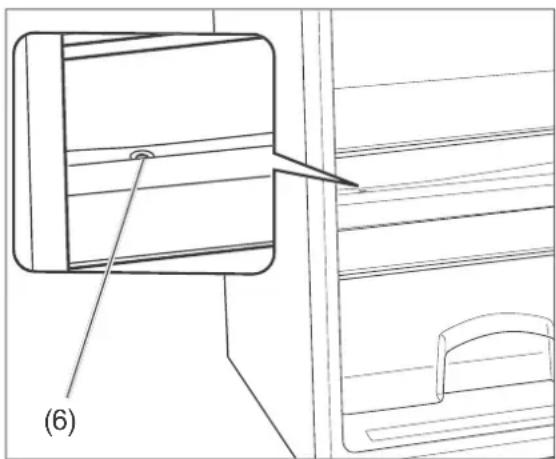
(d)- Clean the opening of the defrost drain (6) using the supplied cleaning swab (d).
- Wash the interior with warm water and washing up liquid.
When wiping clean, add a few drops of vinegar to the water to prevent mould from forming.
- Rub everything completely dry, including the door seals, and allow to air briefly.
- Replace the glass shelves, the vegetable compartment and the door compartments.
- Place the chilled food back in the refrigerator.
- Plug the mains plug back into the socket and turn the temperature controller (1) to level "7".
- As soon as the temperature has reached -18 ^ , place the frozen food in the freezer compartment and turn the temperature controller back to the usual position.
Replacing the light inside

WARNING
Risk of electric shock!
Touching live parts may result in severe injury or death.
■ Unplug the mains cable before changing the light bulb.
Only use light bulbs with an output of max. 10 W, 220-240 V and an E14 base (ILCOS: IBA/C-10-220/240-E14-23).
text_image
(1)- Disconnect the mains plug from the socket.
- Loosen the cover screw with a cross-headed screwdriver and remove the cover.
- Unscrew the bulb from the holder and replace with a new one of the same type.
- Screw the cover back on.
- Re-insert the mains plug into the socket.
Start-up
Preparing for start-up
You have read chapter „Safety“ from page GB-5 and understand all the safety notices.
Moving and unpacking
WARNING
Risk of suffocation!
Children can become entangled in the packaging fi lm or swallow small parts and suffocate.
■ Do not allow children to play with the packaging fi lm.
■ Prevent children from pulling small parts off the device or taking them out of the accessory bag and putting them in their mouths.
CAUTION
Risk of injury!
Improper handling of the appliance may result in injury.
■ The appliance is heavy and bulky. Ask another person to help with moving and installation.
■ Vegetable compartment, door etc. must not be used as steps or for support purposes.
! NOTICE
Risk of damage!
Improper handling of the appliance may result in damage.
■ If possible, do not tilt the appliance horizontally.
■ Do not use sharp or pointed objects to unpack it.
- Move the appliance using a dolly or with the help of a second person.
- Unpack the appliance and carefully remove all packaging, plastic moulding, adhesive strips, protective film and foam padding from the inside, outside and back of the appliance.
Choosing a suitable location
! WARNING
Health hazard!
The appliance may not operate properly if exposed to low ambient temperatures for extended periods of time. This can then lead to an increase in temperature in the fridge and freezer compartment.
■ Always adhere to the prescribed ambient temperature (see data sheet at the end of this user manual).
CAUTION
Dangers from the refrigerant!
- Do not damage the refrigeration circuit, for example by piercing the refrigerant channels of the condensate vaporiser with sharp objects, cutting off the tubing, etc.
■ Refrigerant is flammable when spurting out and can damage the eyes. If this happens, rinse eyes with clean water and seek medical assistance immediately.
text_image
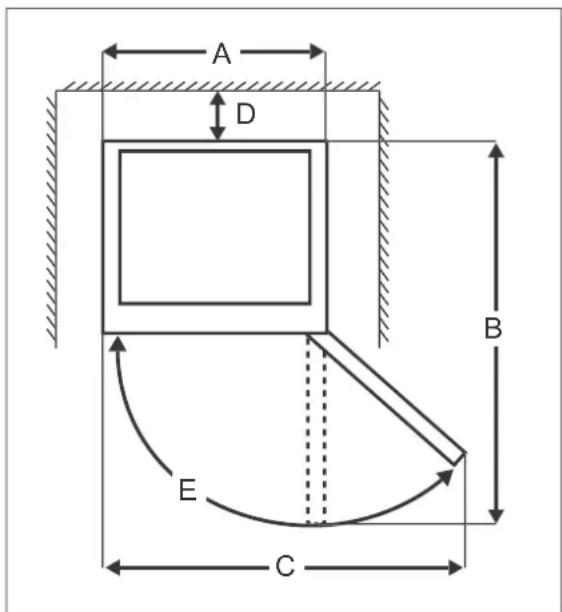
A D B E CSpace requirement according to appliance dimensions
A: 54.5 cm B: 106.5 cm
C: 89.0 cm D: ≥ 5.0 cm
E: 110-125°
Space requirements:
- To prevent the formation of a flammable gas-air mixture in the event of a leakage in the refrigeration circuit, the installation space must have a minimum size of 3m^3 .
- The appliance must only be placed on a level and firm surface. The surface must be strong enough to support the appliance's weight when fully laden.
- Suitable locations are dry, well-ventilated areas that are as cool as possible.
- Unsuitable locations are ones with direct sunlight or which are directly next to an oven, hob or radiator.
- If underfloor heating is installed at the setup location, place the cooling appliance on an insulation plate made from solid material.
Minimum distances:
– The following minimum distances must be maintained:
– from electrical hobs 3 cm
– from oil and coal burning stoves 30cm
– to other freezer appliances 2 cm
– from washing machines/
dishwashers 2
- If you would like to reduce these distances, you can fit an insulation plate between the appliances.
Setting up and aligning the appliance
flowchart
graph TD
    A["Top Circular Unit"] --> B["Left Circular Unit"]
    B --> C["Right Circular Unit"]
    C --> D["Bottom Circular Unit"]
    D --> E["Left Circular Unit"]
    style A fill:#f9f,stroke:#333
    style B fill:#bbf,stroke:#333
    style C fill:#bfb,stroke:#333
    style D fill:#ffb,stroke:#333
    style E fill:#fff,stroke:#333
- Place the appliance on as flat and as firm a base as possible.
- To ensure adequate air circulation, the entire space above the appliance must remain clear of obstructions.
- Check the position with a spirit level.
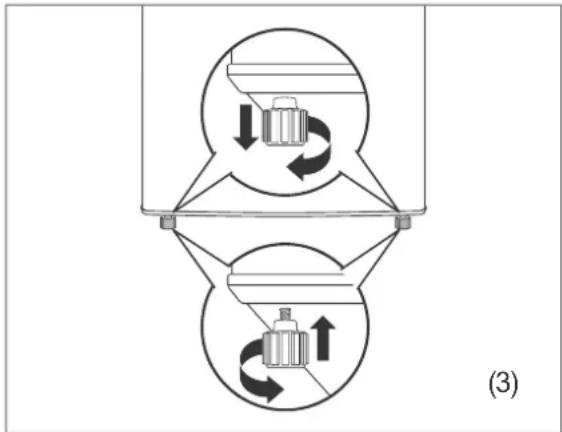
- Level out any unevenness on the ground using the two front screw feet (3).
- Close the door.
- Tilt the appliance backwards slightly and screw/unscrew the two screw feet (3).
- Stand the appliance back up again and check the alignment with a spirit level.
- Repeat the process until the appliance is standing up vertically. The appliance should not move when opening the door.
Changing the door hinges
If necessary, the side of the door hinges can be changed. The door hinges are on the right upon delivery.
This work requires some manual dexterity. Please read the following steps completely before changing the hinges.
In addition to the package contents, you will require:
– Medium-sized cross-headed screwdriver
- 8 mm and 10 mm spanner
– Strong piece of string
– The assistance of another person, where possible
WARNING
Risk of electric shock!
To change the door hinges you will need to remove the cover from the appliance. Live parts can become accessible by doing so.
■ Pull the mains plug out of the socket before starting to change the door hinges.
Prerequisite: The appliance must not be connected to the power supply.
Removing the cover
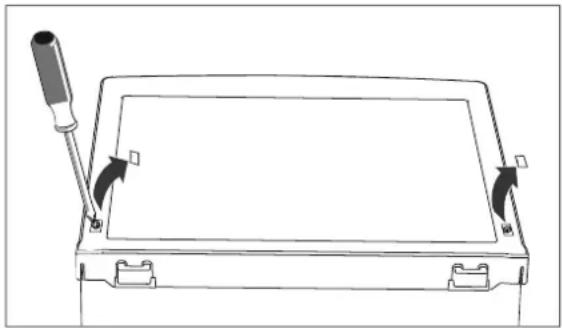
natural_image
Line drawing of a device with a screwdriver inserted into a tray, showing directional arrows (no text or symbols)- Carefully lever out the two screw covers on top of the cover using a screwdriver.
- Unscrew the two screws from the cover by turning to the left and right using a cross-headed screwdriver.
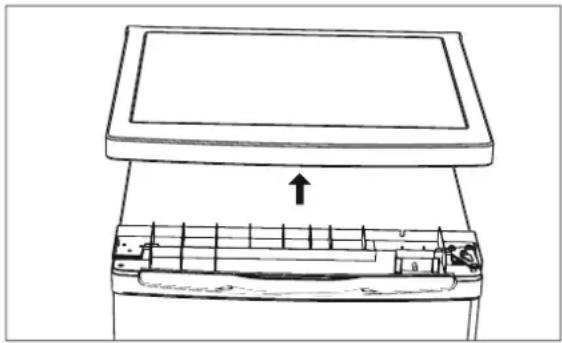
natural_image
Line drawing of a mechanical device with an upward arrow indicating motion or force (no text or symbols)- Lever out the two sides of the cover on the front slightly and lift the cover up.
Changing the upper hinge
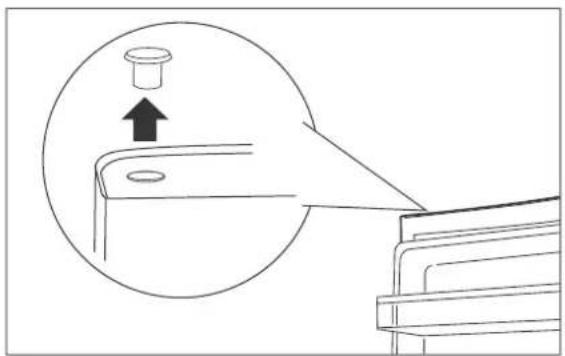
natural_image
Technical line drawing of a mechanical component with an inset showing a cylindrical component and an arrow indicating direction (no text or symbols)- Open the door.
Remove the blind plug on the top of the door by wrapping a strong piece of string around it, tightly pulling the string back and forth and carefully levering out the blind plug.
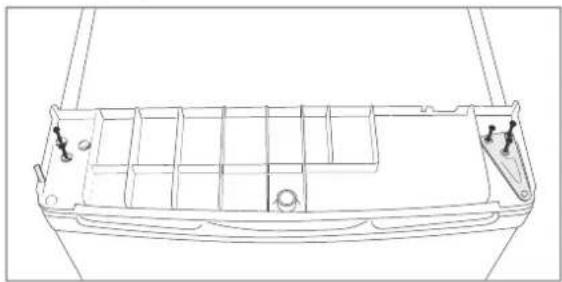
natural_image
Technical line drawing of a vehicle front panel with internal compartments and mounting points (no text or symbols)-
Unscrew the three fixing screws for the hinge plate and the two screws on the opposite side. To do this, use an 8mm spanner or a cross-headed screwdriver.
-
Remove the hinge plate.
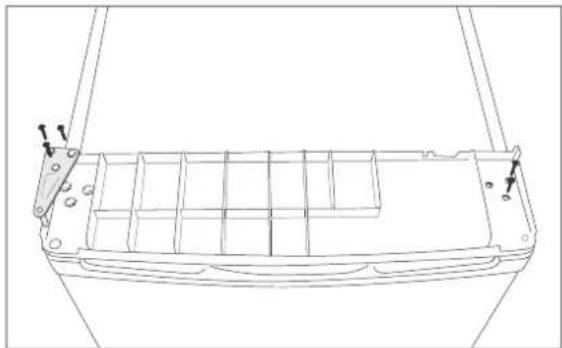
natural_image
Technical line drawing of a vehicle chassis frame with mounting brackets and structural ribs (no text or symbols)- Screw the hinge plate as well as the two screws back onto the respective opposite side.
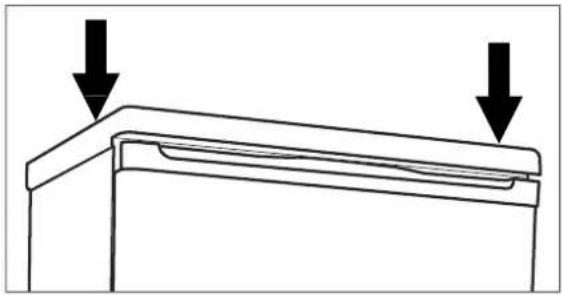
natural_image
Technical line drawing of a mechanical component with two downward arrows indicating force or direction (no text or symbols)- Place the cover back on the refrigerator. Push down on both sides (left and right) of the front of the cover until you hear it click into place.
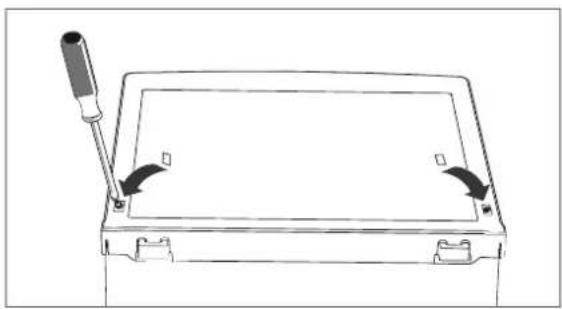
natural_image
Line drawing of a device with a screwdriver and two curved arrows indicating rotation or movement (no text or symbols)- Screw the two screws tightly back onto the cover. To do this, use a cross-headed screwdriver. Secure the two screw covers.
Changing the lower hinge
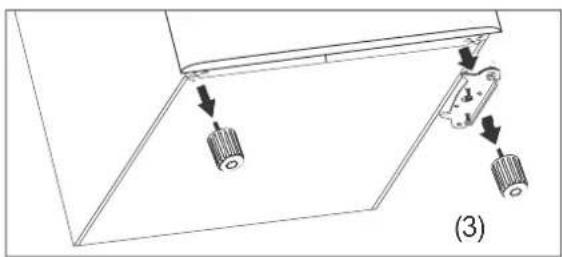
natural_image
Diagram showing mechanical components with arrows indicating assembly or movement (no text or symbols present)- Tilt the refrigerator backwards (max. 45°).
- Unscrew the two front screw feet (3).
- Unscrew the lower hinge plate. To do this, use an 8mm spanner or a cross-headed screwdriver.
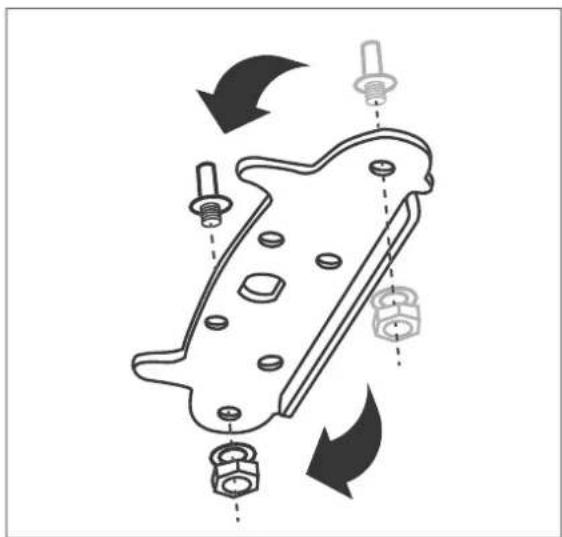
natural_image
Mechanical assembly diagram showing bolted components and directional arrows indicating motion (no text or labels)- Move the hinge pin to the opposite side of the hinge plate. To loosen and tighten the nut, use a 10 mm spanner or the bottom of a screw foot.

natural_image
Diagram of a mechanical assembly with hanging weights and directional arrows (no text or symbols)-
Screw the hinge plate tightly back onto the opposite side. Make sure that the hinge pin is in the hinge bushing of the door. The door will now function properly again.
-
Screw the two screw feet back on tightly and align the refrigerator.
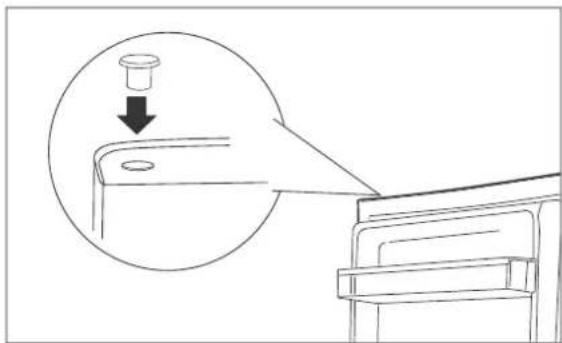
natural_image
Technical line drawing of a mechanical component with an inset showing a downward arrow and a cylindrical part (no text or symbols)- Reinsert the blind plug on the opposite side of the door.
Changing the hinges of the freezer compartment
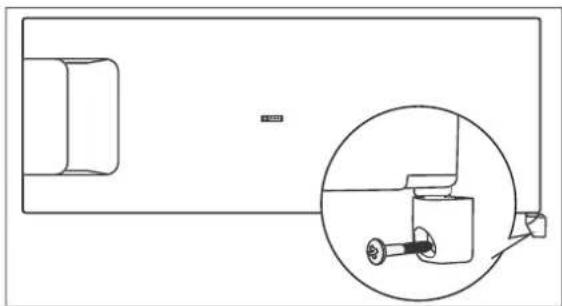
natural_image
Technical line drawing of a mechanical assembly with a zoomed-in circular detail view (no text or symbols)-
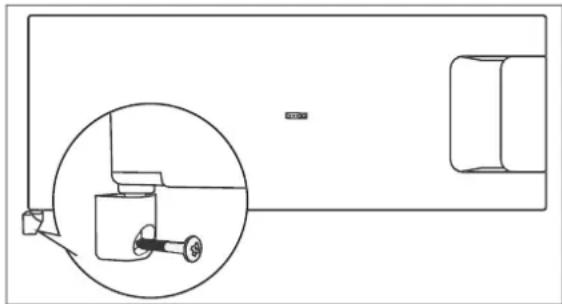
Unscrew the hinge screw on the bottom of the freezer compartment. Use the cross-headed screwdriver.
-
Open the freezer door and remove the door and hinge.
-
Remove the hinge from the door pin.
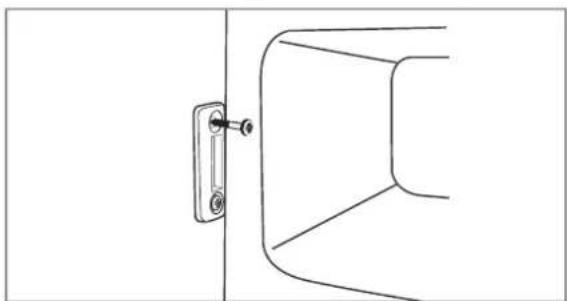
natural_image
Simple line drawing of a door handle and adjacent 3D box (no text or symbols)-
On the door latch, remove the covers on the screws and unscrew the two screws.
-
Turn the door latch 180^ and fix it to the opposite side.
-
Push the two covers into the door latch again.
natural_image
Top-down diagram of a car with a curved arrow indicating clockwise motion and a small box on the ground (no text or symbols)-
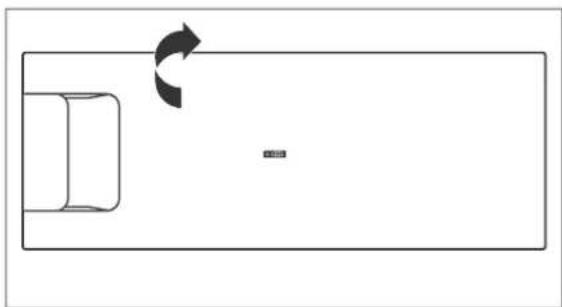
Turn the door 180^ .
-
Insert the door into the opening above with the upper door peg.
natural_image
Technical line drawing of a mechanical assembly with a magnified inset showing a component detail (no text or symbols)- Place the hinge on the lower door peg and screw it tight using the hinge screw.
Cleaning before use
To remove the odour that comes with all new appliances, clean the appliance before using it (siehe „Care and maintenance“ on page GB-16).
Connecting the appliance to electricity

WARNING
Risk of electric shock!
Touching live parts may result in severe injury or death.
■ Do not operate or continue to operate the appliance, if
– it shows visible signs of damage, e.g. the power cord is defective,
- it starts smoking or there is a smell of burning,
– it makes unfamiliar noises.
In such cases, pull out the mains plug or unscrew/isolate the fuse and contact our service department (see page GB-28).
- Do not connect to a timer or a separate remote-controlled system for distance monitoring and control.
- If the mains plug is no longer accessible after installation, an all-pole disconnecting device complying with overvoltage category III must be connected to the house wiring with a contact gap of at least 3 mm; this includes fuses, circuit breakers and contactors.
- Do not kink or pinch the mains cord or lay it over sharp edges. This can result in a break in the cable.

CAUTION
Fire hazard!
Improper handling of the appliance can lead to fire and property damage.
■ Only connect the appliance to a properly installed and earthed electric socket. Do not connect to a multi-socket extension cable or a multi-socket plug.

NOTICE
Risk of damage!
If the cooling unit has been transported horizontally, lubricant from the compressor may get into the cooling circuit.
- Allow the appliance to stand upright for approx. 2 hours after transport and before connecting. This allows the lubricant enough time to flow back into the compressor.
- Insert the mains plug into an easily accessible and properly installed socket (220–240 V\~ / 50 Hz). When the door is open, the interior lighting (1) will now be switched on.

You will find all important information
about operation from page GB-10.
Troubleshooting table
Malfunctions can occur in all electrical appliances. This does not necessarily mean there is a defect in the appliance. For this reason, please check the tables to see if you can correct the malfunction.

WARNING
Risk of electric shock in case of improper repair!
Never attempt to repair the defective or supposed defective appliance yourself. This may put your own and future users' lives at risk. Only authorised specialists are allowed to carry out this repair work.
| Problem Possible cause Solutions, tips, explanations | ||
| Compressor off, interior light off. | No electricity to socket. Check the socket by connecting another device. | |
| Mains plug is loose. Ensure the mains plug is securely plugged in. | ||
| Compressor off, interior light on. | The temperature controller (1) is set to “0”. | Turn the temperature controller to a higher position (siehe „Setting the temperature“ on page GB-10). |
| Desired temperature has been reached. | Further cooling not required. When the inside temperature rises, the compressor automatically switches on. | |
| Appliance cools too quickly. | The temperature controller is set at too high a level. | Select a lower temperature (see page GB-10). |
| The appliance doesn’t cool sufficiently. | The temperature controller is set at too low a level. | Select a higher setting (see page GB-10). |
| Door not tightly closed or door seal is not completely tight. | See “Checking and cleaning the door seals” on page GB-16. | |
| The appliance is near a heat source. | Place an insulation plate between the appliances or switch locations. | |
| Food has been stored warm. | Only store food that has cooled down. | |
| Too many goods frozen. Freeze a max. of 2 kg at a time. | ||
| Thick ice layer in the freezer area. | Defrost the freezer compartment (siehe „Defrosting the freezer compartment and cleaning the interior“ on page GB-16). | |
| Ambient temperature too low or too high. | Adjust the ambient temperature to the climate class (see “Data sheet” at the end of this user manual). | |
| Compressor seems defective. | Set the temperature controller to “7”. If the compressor does not switch on within an hour, inform our customer service team (see page GB-28). | |
| Interior lighting isn't working. | Power supply is interrupted. | Check the socket by connecting another device. |
| Bulb faulty Replace the bulb (siehe „Replacing the light inside“ on page GB-18). | ||
| Appliance is making a noise. | Operating noises are functional and are not a sign of malfunction. | Humming: Refrigeration unit is running. |
| Flowing noise: Refrigerant is flowing through the pipes. | ||
| Clicking: Compressor is switching on or off. | ||
| Disturbing noises. Check that it is stable. | ||
| Water has accumulated in the fridge compartment at the bottom. | Thaw water drain above the vegetable drawer is blocked. | Remove blockage in thawing water drain (siehe „Defrosting the freezer compartment and cleaning the interior“ on page GB-16). |
Service
In order for us to help you quickly, please tell us:
| Name of appliance Colour Model Order number | |||
| hanseatic Refrigerator | stainless steel look | HKS 8555GA2S 882 | 279 |
| white HKS 8555GA2 | 470 705 | ||
| white HKS 8555GA1 | 234 059 | ||
Advice, order and complaint
Please contact your mail order company's customer service centre if
– the delivery is incomplete,
– the appliance is damaged during transport,
– you have questions about your appliance,
- a malfunction cannot be rectified using the troubleshooting table,
– you would like to order further accessories.
Repairs and spare parts
Customers in Germany
– Please contact our technical service: Telephone 0 18 06 18 05 00 (landline 20 cents/call, mobile max 60 cents/call)
Customers in Austria
- Please contact your mail order company's customer service centre or product advice centre.

Please note: You are responsible for the condition of the appliance and its proper use in the household. If you call out for customer service due to an operating error, you will charges, even during the guarantee/warranty period. Damage resulting from non-compliance with this manual unfortunately cannot be recognised.
Environmental protection
Disposing of old electrical devices in an environmentally-friendly manner
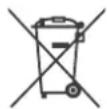
Electrical appliances contain harmful substances and valuable resources.
Every consumer is therefore required by law to dispose of old electrical appliances at an authorised collection or return point. They will thus be made available for environmentally-sound, resource-saving recycling.
You can dispose of old electrical appliances free of charge at your local recycling centre.
Please contact your dealer directly for more information about this topic.

CAUTION
Fire hazard!
Cooling appliances, which contain refrigerants and gases in the cooling systems and insulation, have to be properly disposed of. Refrigerant leakage may cause a fire hazard.
■ Until the point of proper disposal, ensure that none of the cooling fins or tubes on a cooling appliance are damaged.
Our contribution to the protection of the ozone layer

100% CFC and HFC-free refrigeratorants and foaming agents were used in this appliance. This protects the ozone layer and reduces the greenhouse effect.
Our packaging is made from environmentally friendly, recyclable materials:
– Outer packaging made of cardboard
- Moulded parts made of foamed, CFC-free polystyrene (PS)
– Films and bags made of polyethylene (PE)
– Tension bands made of polypropylene (PP)
- Saving energy also protects against excessive global warming. Your new appliance uses little energy due to its environmentally friendly insulation and technology.
If you would like to dispose of the packaging, please dispose of it in an environmentally friendly way.
Product fiche concerning Regulation (EU) No 1060/2010
| Trade mark | hanseatic |
| Model identifier | 234059 / HKS 8555GA1 |
| Category of the household refrigerating appliance model | 7, Refrigerator-freezer |
| Energy efficiency class on a scale from A+++ (most efficient) to D (least efficient) | A+ |
| Energy consumption 172 kWh per year, based on standard test results for 24 hours. Actual energy consumption will depend on how the appliance is used and where it is located | |
| Storage volumeRefrigeratorFreezer / Star rating | 103 L15 L/4 star |
| Power cut safe | 13 h |
| Freezing capacity | 2 kg / 24 h |
| Climate class: N-ST . This appliance is intended to be used at an ambient temperature between +16 °C and +38 °C. | |
| Airborne acoustical noise emissions | 43 dB(A) re 1 pW |
| Built-in appliance | no |
The values indicated above have been measured under standardised laboratory conditions pursuant to EN 62552.
| Trade mark | hanseatic |
| Model identifier | 470705 / HKS8555GA2882279 / HKS8555GA2S |
| Category of the household refrigerating appliance model | 7, Refrigerator-freezer |
| Energy efficiency class on a scale from A+++ (most efficient) to D (least efficient) | A++ |
| Energy consumption 135 kWh peryear, based on standard test results for 24 hours. Actual energy consumption will depend on how the appliance is used and where it is located | |
| Storage volumeRefrigeratorFreezer / Star rating | 103 L15 L / 4 star |
| Power cut safe | 13 h |
| Freezing capacity | 2 kg / 24 h |
| Climate class: N-ST . This appliance is intended to be used at an ambient temperature between +16 °C and +38 °C. | |
| Airborne acoustical noise emissions | 43 dB(A) re 1 pW |
| Built-in appliance | no |
The values indicated above have been measured under standardised laboratory conditions pursuant to EN 62552.
Technical specifications
| Item number | 234059 |
| Name of appliance | Refrigerator with freezer compartment |
| Model identifier | HKS 8555GA1 |
| Device measurements (Height × Width × Depth with connections) | 85,0 cm × 55,0 cm × 58,0 cm |
| Unloaded weight | 27 kg |
| Refrigerant | R600a |
| Filling capacity refrigerant | 21 g |
| Foaming agent | Cyclopentane |
| Rated power | 90 W |
| Supply voltage / frequency / rated current / lamp power 22 | 0-240 V / 50 Hz / 0,6 A max 10 W |
| Protection class | I |
| Item number 470705, 88227 | 9 |
| Name of appliance | Refrigerator with freezer compartment |
| Model identifier | HKS8555GA2HKS8555GA2S |
| Device measurements (Height × Width × Depth with connections) | 85,0 cm × 55,0 cm × 58,0 cm |
| Unloaded weight | 28 kg |
| Refrigerant | R600a |
| Filling capacity refrigerant | 21 g |
| Foaming agent | Cyclopentane |
| Rated power | 80 W |
| Supply voltage / frequency / rated current / lamp power 22 | 0-240 V / 50 Hz / 0,45 A max 10 W |
| Protection class | I |