
TDP-WX5400 - Vidéo-projecteur TOSHIBA - Free user manual and instructions
Find the device manual for free TDP-WX5400 TOSHIBA in PDF.


| Product Type | Video Projector |
| Brand | Toshiba |
| Model | TDP-WX5400 |
| Resolution | WXGA (1280 x 800) |
| Brightness | 3000 ANSI Lumens |
| Contrast Ratio | 2000:1 |
| Lamp Life | 3000 hours (Normal) / 4000 hours (Eco) |
| Lamp Type | UHP 230W |
| Projection Distance | 1.2 - 11.5 m |
| Screen Size | 30 - 300 inches |
| Keystone Correction | Vertical ±30° |
| Inputs | HDMI, VGA (x2), S-Video, Composite Video, Audio (3.5mm) |
| Connectivity | RS-232C, USB (Service Only), Audio Out |
| Built-in Speaker | 1 x 5W Mono |
| Fan Noise | 35 dB (Normal) / 30 dB (Eco) |
| Power Consumption | 300W (Normal) / 230W (Eco) |
| Dimensions (W x H x D) | 300 x 100 x 220 mm |
| Weight | 3.5 kg |
| Cleaning and Maintenance | Clean air filter monthly; replace lamp as needed |
| Safety Features | Auto shut-off after no input, overheating protection |
| Spare Parts and Repairability | Replacement lamp available; filter removable; user-accessible lamp compartment |
| General Information | Manual focus and zoom; menu in multiple languages |
Frequently Asked Questions - TDP-WX5400 TOSHIBA
User questions about TDP-WX5400 TOSHIBA
0 question about this device. Answer the ones you know or ask your own.
Ask a new question about this device
Download the instructions for your Vidéo-projecteur in PDF format for free! Find your manual TDP-WX5400 - TOSHIBA and take your electronic device back in hand. On this page are published all the documents necessary for the use of your device. TDP-WX5400 by TOSHIBA.
USER MANUAL TDP-WX5400 TOSHIBA
natural_image
Line drawing of a Toshiba projector with front panel and side ports (no text or symbols on body)SAFETY PRECAUTIONS

The lightning flash with arrowhead symbol, within an equilateral triangle, is intended to alert the user to the presence of uninsulated "dangerous voltage" within the product's enclosure that may be of sufficient magnitude to constitute a risk of electric shock to persons.

The exclamation point within an equilateral triangle is intended to alert the user to the presence of important operating and maintenance (servicing) instructions in the literature accompanying the appliance.
WARNING: TO REDUCE THE RISK OF FIRE OR ELECTRIC SHOCK, DO NOT EXPOSE THIS APPLIANCE TO RAIN OR MOISTURE. DANGEROUS HIGH VOLTAGES ARE PRESENT INSIDE THE ENCLOSURE. DO NOT OPEN THE CABINET. REFER SERVICING TO QUALIFIED PERSONNEL ONLY.
WARNING: USA only
Handling the cord on this product or cords associated with accessories sold with this product, will expose you to lead, a chemical known to the State of California to cause birth defects or other reproductive harm. Wash hands after handling.
WARNING: USA only
Lamp contains mercury. Disposal of this product may be regulated due to environmental considerations. For disposal, reuse or recycling information, please contact your local government or the Electronic Industries Alliance at www.eiae.org.
- Reorient or relocate the receiving antenna.
- Increase the separation between the equipment and receiver.
- Connect the equipment into an outlet on a circuit different from that to which the receiver is connected.
- Consult the dealer or an experienced radio/TV technician for help.
RESPONSIBLE PARTY: TOSHIBA AMERICA INFORMATION SYSTEMS, INC.
9740 Irvine Blvd., Irvine, CA 92618-1697 U.S.A
Phone: (949) 583-3000
WARNING: Changes or modifications made to this equipment, not expressly approved by Toshiba, or parties authorized by Toshiba, could void the user's authority to operate the equipment.
MODEL NAME: TDP-WX5400 USA only
TRADE NAME: DATA PROJECTOR MODEL NAME: TDP-WX5400

Tested To Comply
With FCC Standards
FOR HOME OR OFFICE USE
FCC NOTICE: This device complies with part 15 of the FCC Rules. Operation is subject to the following two conditions:
(1) This device may not cause harmful interference, and (2) this device must accept any interference received, including interference that may cause undesired operation.
This equipment has been tested and found to comply with the limits for a Class B digital device, pursuant to part 15 of the FCC Rules. These limits are designed to provide reasonable protection against harmful interference in a residential installation. This equipment generates, uses and can radiate radio frequency energy and, if not installed and used in accordance with the instructions, may cause harmful interference to radio communications.
However, there is no guarantee that interference will not occur in a particular installation.
If this equipment does cause harmful interference to radio or television reception, which can be determined by turning the equipment off and on, the user is encouraged to try to correct the interference by one or more of the following measures:
IMPORTANT SAFETY INSTRUCTIONS
CAUTION: PLEASE READ AND OBSERVE ALL WARNINGS AND INSTRUCTIONS GIVEN BY THIS OWNER'S MANUAL AND THOSE MARKED ON THE UNIT. RETAIN THIS BOOKLET FOR FUTURE REFERENCE.
This unit is fully transistorized and does not contain any parts that can be repaired by the user.
DO NOT REMOVE THE CABINET COVER, OR YOU MAY BE EXPOSED TO DANGEROUS VOLTAGE. REFER SERVICING TO QUALIFIED SERVICE PERSONNEL ONLY.
1. Read Owner's Manual
After unpacking this product, read the owner's manual carefully, and follow all the operating and other instructions.

2. Power Sources
This product should be operated only from the type of power source which does not exceed the voltage range specified on therating label and the power cord.
If you are not sure of the type of power supply to your home, consult your product dealer or local power company.

3. Source of Light
Do not look into the lens while the lamp is on. The strong light from the lamp may cause damage to your eyesight.
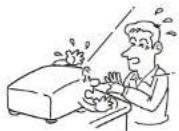
4. Ventilation
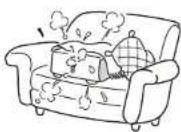
Openings in the cabinet are provided for ventilation and to ensure reliable operation of the product and to protect it from overheating, and these openings must not be blocked or covered.
The openings should never be blocked by placing the product on a bed, sofa, rug or other similar surface. This product should not be placed in a built-in installation such as a bookcase or rack unless proper ventilation is provided.
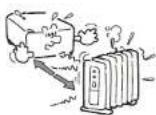
Heat
The product should be situated away from heat sources such as radiators, heat registers, stoves, or other products (including amplifiers) that produce heat.
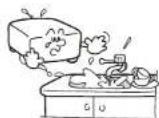
6. Water and Moisture
Do not use this product near water. - for example, near a bath tub, wash bowl, kitchen sink, or laundry tub; in a wet basement; or near a swimming pool and the like.
7. Cleaning
Unplug this product from the wall outlet before cleaning. Do not use liquid cleaners or aerosol cleaners. Use a soft cloth for cleaning.

- Be sure that you firmly insert the plug into the wall outlet. Incorrect or faulty connections may result in fire or electric shock. Avoid using an unsound or loose outlet.
9. Power-Cord Protection
Power-supply cords should be routed so that they are not likely to be walked on or pinched by items placed upon or against them, paying particular attention to cords at plugs, convenience receptacles, and the point where they exit from the product.
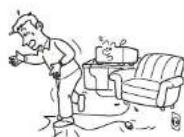
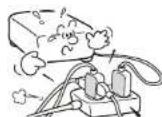
10. Overloading
Do not overload wall outlets; to reduce the risk of electric shock, do not use the polarized plug with an extension cord, receptacle, or other outlet unless the blades can be inserted completely with three-wire grounding type to prevent blade exposure. As this can result in a risk of fire or electric shock.
IMPORTANT SAFETY INSTRUCTIONS (Continued)
11. Lightning storms
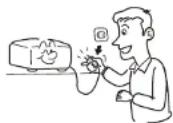
For added protection for this product during storm, or when it is left unattended and unused for long periods of time, unplug it from the wall outlet. This will prevent damage to the product due to lightning and power-line surges. However, while it is thundering or lightning, do not touch the apparatus and any connected cable and/or equipment. This will prevent you from receiving the electric shock by an electric surge.
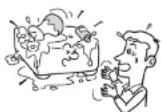
12. Object and Liquid Entry
Never push objects of any kind into this product through openings as they may touch dangerous voltage points or short-out parts that could result in a fire or electric shock. Never spill liquid of any kind on the product.
13. Do not place or keep the projector within the reach of the children.
It may fall down or tip over, which could result in severe injury.
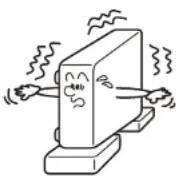
14. Do not place the product vertically
Do not use the product in the upright position to project the pictures at the ceiling, or any other vertical positions. It may fall down and dangerous.
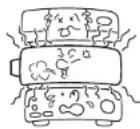
15. Stack Inhibited
Do not stack other equipment on this product or do not place this product on the other equipment. Top and bottom plates of this product develops heat and may give some undesirable damage to other unit.
16. Moving the projector
When carrying the projector, be sure to use the carrying handle to avoid any damage to the lens or main unit.
17. Attachments
Do not use attachments not recommended by product manufacturer as they may cause hazards.
18. Accessories
Do not place this product on an unstable cart, stand, tripod, bracket, or table. The product may fall, causing serious injury to a child or adult, and serious damage to the product. A product and cart combination should be moved with care. Quick stops, excessive force, and uneven surfaces may cause the product and cart combination to overturn.

19. Damage Requiring Service
Unplug this product from the wall outlet and refer servicing to qualified service personnel under the following conditions:
a) When the power-supply cord or plug is damaged.
b) If liquid has been spilled, or objects have fallen into the product.
c) If the product has been exposed to rain or water.
d) If the product does not operate normally by following the operating instructions. Adjust only those controls that are covered by the operating instructions as an improper adjustment of other controls may result in damage and will often require extensive work by a qualified technician to restore the product to its normal operation.
e) If the product has been dropped or damaged in any way (If the cabinet should break, please handle with care to avoid injury).
f) When the product exhibits a distinct change in performance - this indicates a need for service.
IMPORTANT SAFETY INSTRUCTIONS (Continued)
20. If glass components, including 23. Safety Check
lens and lamp, should break, contact your dealer for repair service.
This product incorporates glass components, including a lens and a lamp. If such parts should break, please handle with care to avoid injury and contact your dealer for repair service. The broken pieces of glass may cause to injury. In the unlikely event of the lamp rupturing, thoroughly clean the area around the projector and discard any edible items placed in that area.
21. Servicing
Do not attempt to service this product yourself as opening or removing covers may expose you to dangerous voltage or other hazards. Refer all servicing to qualified service personnel.

22. Replacement Parts
When replacement parts are required, be sure the service technician has used replacement parts specified by the manufacturer or have the same characteristics as the original part. Unauthorized substitutions may result in fire, electric shock, or other hazards.
Upon completion of any service or repairs to this product, ask the service technician to perform safety checks to determine that the product is in proper operating condition.

24. Do not leave thermal-paper documents or easily deformed items on top of the unit or near the air exhaust for long periods of time.
The heat from the unit could erase the information on the thermal paper, or cause deformation or warping.
25. Do not use the product in a closed installation state.
Do not place the product in a box or in any other closed installation state. Otherwise it may overheat. This could result in a risk of fire.
POWER SUPPLY INFORMATION
If your line voltage is 220 to 240V, use one of the following types of cable/plug.
| Plug configuration | Plug type | Line voltage |

EURO
220 - 240V

UK
220 - 240V
Use a 5A fuse which is approved by ASTA or BSI to BSI362.
Always replace the fuse cover after changing the fuse.

Plug type Line voltage
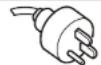
Australian 200 – 240V
240V 10A
Switzerland 200 – 240V
240V 6A
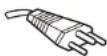
North American 200 – 240V

240V 15A
IMPORTANT PRECAUTIONS
Moisture Condensation
Never operate this unit immediately after moving it from a cold location to a warm location. When the unit is exposed to such a change in temperature, moisture may condense on the lens and the crucial internal parts. To prevent the unit from possible damage, do not use the unit for at least 2 hours when there is an extreme or sudden change in temperature.
Place and Manner of Installation
- Do not place in hot locations, such as near heating equipment. Doing so could cause malfunction, and shorten the life of the projector.
- Avoid locations with oil or cigarette smoke. Doing so will dirty the optical parts, shortening their lives, and darkening the screen.
- Do not use this product in the upright position or tilt it up or down by more than 20^ from level. Doing so may cause a failure or shorten the life of the product.
- Using this instrument near a TV or radio may cause interference to the images or audio sound. If this happens, move it away from the TV or radio.
- In a high altitude location where air is thin, cooling efficiency is reduced so use the projector with [Fan mode] set to [High]. p.58
- Only plug the power cord into outlets rated for use with the power cord's specified voltage range. Do not overload extension cords or table taps as this can result in fire or electric shock.
- Route the power cable or the connecting cable away from where people could trip over it. The projector may fall down, which could result in severe injury.
- Be sure the power cord is easily reached for unplugging in case of emergency. Do not place any obstacles near a wall outlet in which the cord is plugged.
IMPORTANT PRECAUTIONS (Continued)
Avoid Volatile Liquid
Do not use volatile liquids, such as an insect spray, near the unit. Do not leave rubber or plastic products touching the unit for a long time. They will leave marks on the finish. Do not use a chemically saturated cloth.
EXEMPTION CLAUSES
- Toshiba Corporation bears no responsibility in the case of damages arising from natural disaster such as earthquakes, lightning, etc., fire not liable to Toshiba Corporation, acts by third parties, other accidents, or use under abnormal conditions including erroneous or improper operation and other problems.
- Toshiba Corporation bears no responsibility for incidental damages (lost profit, work interruption, corruption or loss of the memory contents, etc.) arising from the use of or the inability to use this unit.
- Toshiba Corporation accepts no liability whatsoever for any damages arising from not having followed the descriptions in this Instruction Manual.
- Toshiba Corporation accepts no liability whatsoever for any damages arising from malfunctions arising from combination with equipment or software that is not related to Toshiba Corporation.
In the spaces provided below, record the Model and Serial No. located at the bottom of your projector.
Model No.
Serial No.
Retain this information for future reference.
OTHER INFORMATION
Copyrights
Showing or transmitting commercial imaging software or broadcast or cable-broad casting programs with the purpose of other than the personal and private viewing, including modifying images using the freeze function, or displaying with the varying aspect ratio of the images, could violate the direct or indirect copyrights of the imaging software or broadcast program, etc., if done without first consulting with the copyright holder. For this reason, please take appropriate measures before performing one of the actions listed above, including obtaining a license from the copyright holder.
Disposal
This product contains substances which are harmful to humans and the environment.
• The lamp contains mercury.
Please dispose of this product or used lamps in accordance with local regulations. Following information is only for EU-member states:
The use of the symbol indicates that this product may not be treated as household waste. By ensuring this product is disposed of correctly, you will help prevent potential negative consequences for the environment and human health, which could otherwise be caused by inappropriate waste handling of this product. For more detailed information about recycling of this product, please contact your local city office, your household waste disposal service or the shop where you purchased the product.

Trademarks
• VGA, SVGA, XGA, SXGA, UXGA, and WXGA are trademarks or registered trademarks of International Business Machines Corporation.
- DLP ^ (Digital Light Processing) is a registered trademark of Texas Instruments, Inc.
• Macintosh is a registered trademark of Apple Computer, Inc.
- Windows is a registered trademark of Microsoft Corporation in the U.S. and other countries.
- Adobe is a registered trademark and Acrobat Reader is a trademark of Adobe Systems Incorporated.
- All other brand and product names are trademarks or registered trademarks of their respective companies.
Notational Conventions Used in This Manual
- References to pages with related information are annotated as follows. For example, if making a reference to page 36: p.36
- The illustrations in this document are for reference purposes only and may not reflect your package exactly.
REMOTE CONTROL BATTERIES
Caution
- Never throw batteries into a fire.
Using the batteries improperly may cause them to explode or leak and lead to burn or injury. If battery-leaking fluid contacts skin, wash the fluid off immediately with clean water and consult a doctor. If the fluid is spilt on an instrument, avoid contact and wipe it off using tissue paper. (Dispose of the used tissue paper as flammable garbage after moistening with water.)
Notes
- Be sure to use AAA (LR03) size batteries.
- Dispose of batteries in a designated disposal area.
- Attention should be drawn to the environmental aspects of battery disposal.
- Do not mix different battery types or combine used batteries with new ones.
- If the remote control does not operate correctly, or if the operating range becomes reduced, replace both batteries with new ones.
- If the batteries are dead or if you will not be using the remote control for a long time, remove the batteries to prevent battery acid from leaking into the battery compartment.
• Following information is only for EU-member states:
[Disposal of batteries and/or accumulators]
The crossed out wheeled dust bin symbol indicates that batteries and/or accumulators must be collected and disposed of separately from household waste.
If the battery or accumulator contains more than the specified values of lead (Pb), mercury (Hg), and/or cadmium (Cd) defined in the Battery Directive (2006/66/EC), then the chemical symbols for lead (Pb), mercury (Hg) and/or cadmium (Cd) will appear below the crossed out wheeled dust bin symbol.
By participating in separate collection of batteries, you will help to assure the proper disposal of products and batteries and thus help to prevent potential negative consequences for the environment and human health.
For more detailed information about the collection and recycling programmes available in your country, please contact your local city office or the shop where you purchased the product.
Hg Cd Pb
CONTENTS
Before Using
SAFETY PRECAUTIONS 2
IMPORTANT SAFETY INSTRUCTIONS 4
POWER SUPPLY INFORMATION 9
IMPORTANT PRECAUTIONS 9
EXEMPTION CLAUSES 10
OTHER INFORMATION 11
REMOTE CONTROL BATTERIES 12
CONTENTS 14
Preparations
Checking the package contents 16
Introduction to the projector 17
Features you will enjoy: 17
Names of each part on the main unit 18
Carrying the projector....19
Names of each part on the control panel and remote control 20
Names of the connector panel terminals 22
Preparing and using the remote control 23
Operating a computer using the remote control 24
Placement 25
Projection distance and size 26
Connection....28
Installing or removing the projection lens....30
Removing the lens from the projector 30
Installing the new lens 31
Securing the lens using the anti-theft screw 32
Installing the optional color wheel (provided) 32
Storing unused color wheel 34
Operations
Turning the power on and off 36
Basic operations....38
Using handy features 42
Using auto setting (computer input only) 42
Correcting the keystone distortion 42
Cutting off the picture and sound temporarily (Mute) 43
Changing picture mode....43
Changing screen size 43
Freezing the image (Freeze) 44
Setting the password 44
Menu tree 46
Using the Adjust menus 50
The Image adjustment menu 50
The Display setting menu 53
The Advanced menu 54
Using the Setting menus 55
The Setting 1 menu 55
The Setting 2 menu 56
The Setting 3 menu 58
Using the Status display screen....59
The Usage time screen....59
The Input screen....59
The Network screen 60
The Version screen 60
Operation using an HTTP browser 61
Overview 61
Preparation before use 61
Handling of the address for operation by using a browser 61
Configuring network settings 62
Structure of the HTTP Server 63
Maintenance
About the lamps 64
Replacing the lamps 65
Resetting the lamp hours counter 68
Lens and main unit cleaning 70
Cleaning the filters 71
Replacing the filters....72
Resetting the filter time counter 73
Others
Trouble indications 74
ON/STANDY LED 74
Status LED....74
Lamp LEDs 74
Before calling service personnel 75
Specifications 76
Screen Trigger 80
Checking the package contents
Please make sure that the following items are included in the box, along with the main unit. If any item is missing, immediately contact the store where you purchased the product.
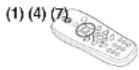


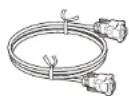

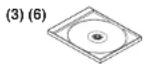

□ (1) Remote control
☐ (5) RGB cable (1.8m) (see note 1)
☐ (2) LR03 (SIZE AAA) batteries for remote control (2)
□ (6) Power cord (see note 1.2)
□ (3) CD-ROM
☐ (7) Six segment color wheel
□ (4) Owner's Manual
□ (8) Lens anti-theft screw
Note
- To maintain original performance, always use the supplied cables.
- The shape and number of supplied power cords vary depending on the product destination.
Save Original Packing Materials
The original shipping carton and packing materials will come in handy if you ever have to ship your projector. For maximum protection when shipping your projector, repack the set as it was originally packed at the factory.
◆ The Supplied CD-ROM
The supplied CD-ROM contains an owner's manual in Portable Document Format (PDF).
Please use Acrobat Reader 5 or later version to view the manual.
■ Adobe® Acrobat® Reader® or Adobe® Reader®
The supplied CD-ROM does not contain Acrobat ^ Reader ^ . If you cannot read PDF files, please install Adobe Reader software in your computer by downloading it from Adobe Systems website.
■ Viewing the Manual
Run the CD-ROM and double-click on Start.pdf. Acrobat Reader® launches, and the menu screen of the owner's manual appears. Click on your language. The Owner's Manual cover and list of bookmarks appears. Click on a bookmark title to view that section of the manual. Click on 📄 to view a reference page with related information. See the Help menu for more information about Acrobat® Reader®.
Introduction to the projector
■ Features you will enjoy:
• DLP projector with high resolution
- Native WXGA support
A WXGA (1280 x 800) resolution provides wide screen display with an aspect ratio of 15:9.
• High brightness
High brightness output of 5200 and 4500 lumens is achieved using the 4-segment color wheel.
- Dual Lamp system
Two-lamp system offers increased lamp life and energy savings along with redundancy - Extensive projection lens with bayonet mount
- Powered Lens Shift, Zoom, and Focus offer Installation flexibility
Powered Horizontal and Vertical lens shift provides the ability to project from off center screen installations. Powered zoom and focus provide quick and easy adjustment. - Direct Power Off & Auto Start
The projector has a feature called "Direct Power Off". This feature allows the projector to be turned off (even when projecting an image) using a power strip equipped with a switch and a breaker.
Note
- Before using Direct Power Off, be sure to allow at least 20 minutes right after turning on the projector and before starting to display an image. Also, the power cable can be removed immediately after turning off the projector. Auto Start eliminates the need to always turn off the projector by the ON/STANDBY button on the remote control or projector cabinet.
- A variety of Input ports and a comprehensive array of system control Interfaces This projector supports input signals including BNC, DVI-D, analog RGB, component, S-video, and composite.
• 3W+3W Stereo speakers
Built in 3W x 2 speakers are provided.
• Prevent unauthorized use of the projector
Enhanced smart security settings for password protection, cabinet control panel lock to help prevent unauthorized access, adjustments and theft deterrence.
- Integrated RJ-45 connector for wired networking capability for property management
- Combination of BrilliantColor™ and 6-segment color wheel offers true color reproduction
Names of each part on the main unit
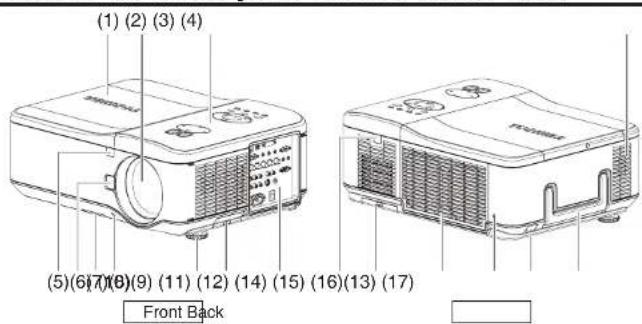
Name : Function
| (1) | Lamp cover | : Remove to replace lamp. p.65 |
| (2) | Lens | : Remove lens cap before use. |
| (3) | Control panel | : Operates the projector. p.20 |
| (4) | Speaker | : Outputs audio sound. |
| (5) | Front IR Receiver | : Receives IR signals from the remote control. p.23 |
| (6) | Lens release button | : Press the release button before removing the lens. |
| (7) | Intake vent and front filter | : Keeps the front fan free of dust.• Clean regularly for optimum performance.• Do not obstruct. |
| (8) | Anti-theft screw | : Prevents theft of the lens. |
| (9) | Foot adjuster | : Adjusts level of projector. p.39 |
| (10) | Right filter | : Keeps the right fan free of dust.• Clean regularly for optimum performance.• Do not obstruct. |
| (11) | Connector panel | : Connect various input devices. p.22 |
| (12) | Rear IR Receiver | : Receives IR signals from the remote control. p.23 |
| (13) | Rear filter | : Keeps the rear fan free of dust.• Clean regularly for optimum performance.• Do not obstruct. |
| (14) | Air exhaust | : Expels air that has grown hot inside the projector-do not obstruct. |
| (15) | Kensington lock | : Attach the projector to a permanent object with the Kensington slot and a security cable. |
| (16) | Security chain lock | : Attach the projector to a permanent object using a security cable. |
| (17) | Carrying handle | : Pull up the handle when carrying the projector. |
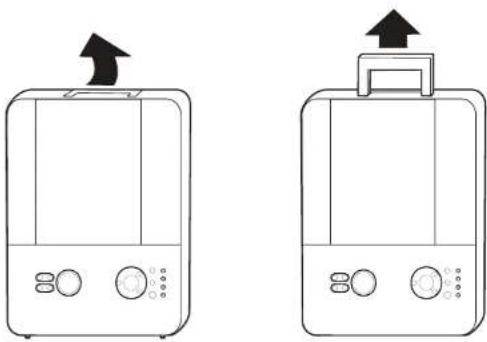
Carrying the projector
Always carry your projector by the handle.
Before moving or carrying the projector, disconnect the power cable and any other cables that may be attached to it.
When moving the projector or when the projector is not in use, cover the lens with the lens cap. To extend the projector handle, refer to the following guide.
① Stand the projector on its end with the panel terminal facing to the bottom.
Note
- Stand the projector on its end by lifting the cabinet. Do not use the handle to place the projector upright.
② Lift the handle in the direction shown until it is fully extended.
natural_image
Two identical kitchen appliances shown in line drawings, each with a black arrow indicating upward motion (no text or symbols)Names of each part on the control panel and remote control
Remote ControlControl panel
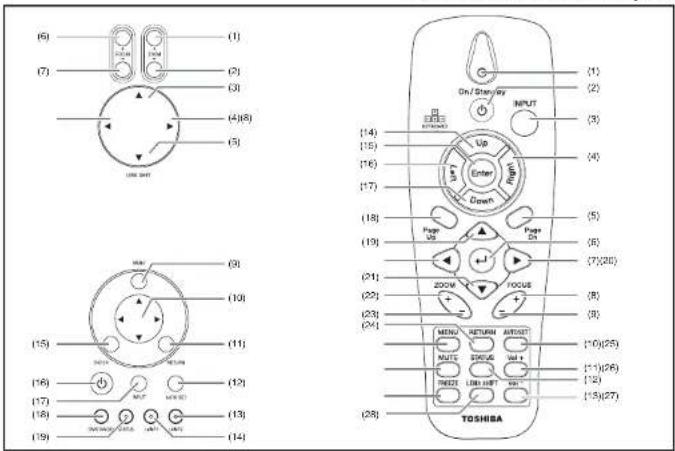
Name: Main Function
Control panel
(1) ZOOM + button
(2) ZOOM - button
(3) UP SHIFT button
(4) RIGHT SHIFT button: Move images right.
(5) DOWN SHIFT button
(6) FOCUS + button :
(7) FOCUS - button
(8) LEFT SHIFT button
(9) MENU button
(10) Selection button
(11) RETURN button
(12) AUTOSET button :
(13) LAMP 2 :
(14) LAMP 1
(15) ENTER button
(16) ON/STANDBY button
Adjusts the screen size.
Adjusts the screen size.
Move images up.
e images right.
Move images down.
Focus the projected image. p.39
Focus the projected image. p.39
Move images left.
Displays menus. p.46
Menu selections and adjustments, volume control, etc. p.46
Goes back one screen.
Performs auto-adjustment of input signals from computer. p.42
See Indicator Messages. 0.74
See Indicator Messages. 0.74
Accepts the selected mode.
Turns the power on/off (standby). p.36
Name: Main Function
(17) INPUT button : Selects input. p.38
(18) ON/STANDBY (LED): See Indicator Messages.
(19) STATUS (LED): See Indicator Messages.

Remote control
(1) Status LED: Lights when the remote control is used.
(2) ON/STANDBY button : Turns the power on/off (standby). p.36
(3) INPUT button : Selects input. p.38
(4) Cursor control button (Right): Controls a Cursor. p.24
(5) Page Dn button : Proceeds PowerPoint® slides. p.24
(6) ENTER button : Executes menu operations, etc.
(7) Selection button (Right) : Menu selections and adjustments, volume control, etc.

(8) FOCUS + button : Focus the projected image. p.39
(9) FOCUS – button : Focus the projected image. p.39
(10) AUTOSET button: Performs auto-adjustment of input signals from computer.

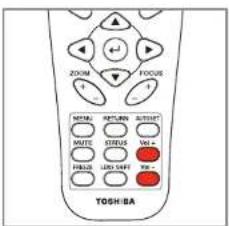
(11) Vol + button : Ajusts the volume.
(12) STATUS button : Opens the OSD Status menu (the menu only opens when an input device is detected).
(13) Vol – button : Ajusts the volume.
(14) Cursor control button (Up): Controls a Cursor. p.24
(15) ENTER button : Accepts the selected mode.
(16) Cursor control button (Left): Controls a Cursor. p.24
(17) Cursor control button (Down): Controls a Cursor. p.24
(18) Page Up button : Reviews PowerPoint® slides. p.24
(19) Selection button (Up): Menu selections and adjustments, volume control, etc. p.46
(20) Selection button (Left) : Menu selections and adjustments, volume control, etc. p.46
(21) Selection button (Down): Menu selections and adjustments, volume control, etc. p.46
(22) ZOOM + button : Adjusts the screen size.
(23) ZOOM - button : Adjusts the screen size.
(24) RETURN button : Goes back one screen
(25) MENU button : Displays menus. p.46
(26) MUTE button : Cuts off the picture and sound temporarily. p.43
(27) FREEZE button : Pauses image. b.44
(28) LENS SHIFT button : Displays the lens shit screen. p.39
Note
• For the remainder of this manual, buttons are referred to as follows:
Selection buttons → ▲▼◀▶ ; ENTER button → 📞
Names of the connector panel terminals
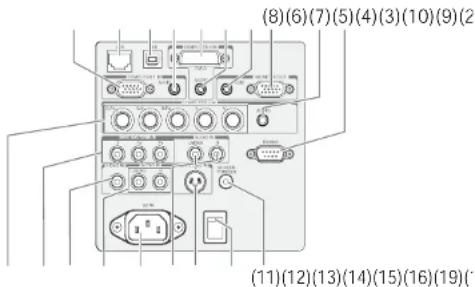
| Name | Main Function | |
| (1) | COMPUTER 1 IN | Connect a VGA cable from a computer. |
| (2) | LAN | Connect a LAN cable from a computer. |
| (3) | USB | Connect the USB cable from a computer for firmware upgrades or keypad remote emulation. |
| (4) | AUDIO IN (1) | Connect the audio cable from the input device. |
| (5) | COMPUTER 3 IN | Connect the DVI cable from a computer. |
| (6) | AUDIO IN (3) | Connect the audio cable from the input device. |
| (7) | AUDIO OUT | Audio loop through. |
| (8) | MONITOR OUT | Connect a monitor. |
| (9) | AUDIO IN (2) | Connect the audio cable from the input device. |
| (10) | RS232C terminal | When operating the projector via a computer, connect this to the controlling computer's RS-232C port. p.79 |
| (11) | SCREEN TRIGGER | When connected to the screen through a commercially available cable, the screen deploys automatically on start up of the projector. The screen retracts when the projector is powered off. p.80 |
| (12) | Main power switch | Turn on/off the projector. |
| (13) | S-VIDEO | Connect a commercially available S-video cable from a video device. |
| (14) | L/MONO, R (Component) | Connect an RCA audio cables from the input device right and left channels. |
| (15) | AC IN | Connect the supplied power cable. |
| (16) | L/MONO, R (Video) | Connect RCA audio cables from the input device right and left channels.This audio jack is shared with S-Video input. |
| (17) | VIDEO IN | Connect a composite video cable from a video device to the yellow RCA jack. |
| (18) | COMPONENT IN (Y, Cb/Pb, Cr/Pr) | Connect a component video enabled device. |
| (19) | COMPUTER 2 IN (R/PR, G/Y, B/PB, H, V) | Connect RGBHV or Component signal from computer or component video enabled device. |
Preparing and using the remote control
■ Loading dry-cell batteries
into the remote control
① Remove the battery cover.
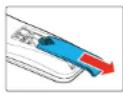
② Insert the dry-cell batteries.
Be sure to align the plus and minus ends of the batteries properly.
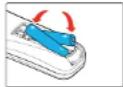
Two batteries (LR03, SIZE AAA) are used.
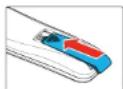
③ Replace the battery cover.
■ Operating the remote control
Point toward the projector's infrared remote sensor, and press a button on the remote control.
- Operating the projector from the front
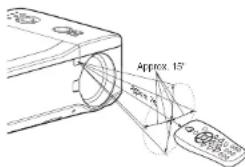
Note
- The above operation is also applicable for the remote control operation from rear side.
Dry-cell batteries
• Before using the batteries, be sure to observe the Safety Precautions described in previous pages.
- If the remote control stops working, or if its range decreases, replace all the batteries with new ones. (2 batteries (LR03 SIZE AAA))
- Do not heat, take apart, or throw batteries into fire.
- Do not use new and old batteries together, or different types of batteries together.
- Dispose of used batteries according to local regulations.
- Remove batteries from remote control when not using for extended periods.
- Keep the batteries away from the reach of children.
Batteries are choking hazards and can be very dangerous if swallowed. If the batteries are swallowed, seek medical assistance immediately.
The remote control
- Avoid exposing the remote control infrared sensor to bright sunlight or fluorescent lighting.
- Do not drop or bang.
- Do not leave in hot or humid locations.
- Do not allow it to get wet or place it on top of wet objects.
- Do not take it apart.
- Ensure that the battery polarities (+/-) are aligned correctly.
- In rare cases, ambient conditions could impede the operation of the remote control. If this happens, point the remote control at the main unit again, and repeat the operation.
Operating a computer using the remote control
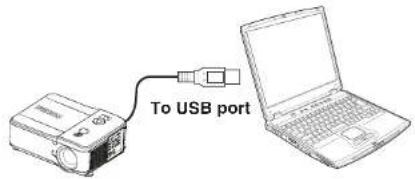
A computer can be operated using the projector's remote control. This function is available on any computer with the Windows 98/98SE, Windows Me, Windows 2000, Windows XP, or Windows Vista operating system, that is equipped with a USB port which can support USB1.1 (This function is also supported on OS 9 or MAC OS X for the Macintosh). However, please note that Toshiba does not guarantee the operation of all computers.
① Connecting a computer
Connect a USB cable (not supplied) from the projector to a computer.
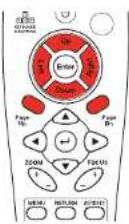
② Operating a computer
Operate remote control's buttons towards the projector's IR receiver.
● Moving the cursor
Press the keyboard function buttons (cursor control buttons) in the direction you wish the cursor to move.
● Using the computer's page up [↑] and down [↓] function
Press the Page Up and Page Dn buttons to switch PowerPoint ^® slides.
Placement
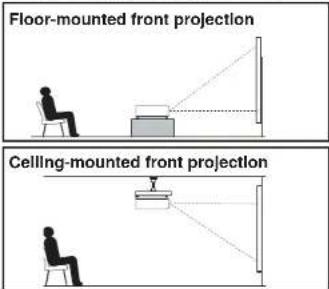
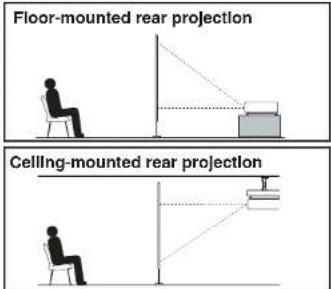
Placement Styles
As shown in the figures below, this device can be placed in 4 different styles.
The factory setting is "floor-mounted front projection." Set [Projection mode] in the Setting - Setting 2 menu p.56, in accordance with your needs.
WARNING
- Always obey the Instructions listed in IMPORTANT SAFETY INSTRUCTIONS when place the unit. Attempting to clean and replace the lamp in a high location by yourself may cause you to fall, resulting in injury.
- If you wish to mount the projector on the ceiling, be sure to ask your dealer to do so. Mounting the projector on a ceiling requires special ceiling brackets (sold separately) and specialized knowledge. Improper mounting could cause the projector to fall, resulting in possible injury and unit damage.
- If the projector is ceiling-mounted, install the breaker for turning off the power in case of anomaly. Let everyone involved with the use of the projector know that fact.
Projection distance and size
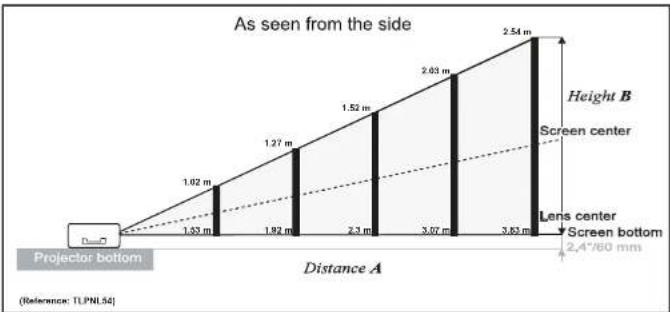
Use the figures and tables below to determine the projection size and projection distance. (Projection sizes are approximate values for full-size picture with no keystone adjustment).
bar
As seen from the side | Distance A | Height B (m) | | :--- | :--- | | 1.02 | 1.52 | | 1.27 | 1.82 | | 1.52 | 2.3 | | 2.03 | 3.07 | | 2.54 | 3.82 | The chart displays a single bar for each distance measurement, with an annotation indicating 'Height B' and 'Screen center' to the right, and 'Lens center' to the left. The bottom label 'Projector bottom' is shown near the first bar. The scale is indicated as 2.4*760 mm.A is the distance between the lens and the screen.
Example of TLPNL54:
The further your projector is away from the screen or wall, the larger the image becomes. The minimum size the image is approximately 40 inches (1.02 m) measured diagonally when the projector is in the distance of 60.2 inches (1.53 m) from the wall or screen. The largest the image can be 500 inches (12.70 m) when the projector is in the distance of 754.7 inches (19.17 m) from the wall or screen.
| Screen Size\Lands | TLPSFL54 TLPSL54 | TLPNL54 | ||||||||||||||||||||||||||
| Distance (A) | ||||||||||||||||||||||||||||
| Diagonal With Height (B) | WIDE TELE | WIDE TELE | WIDE TELE | |||||||||||||||||||||||||
| [inches] | [m] | [inches] | [m] | [inches] | [m] | [inches] | [inches] | [m] | [inches] | [m] | [inches] | [m] | [inches] | [m] | [inches] | [m] | ||||||||||||
| 401 | 1.02 | 33.9 | 0.88 | 21.3 | 0.54 | - - - - - - - - - - - - - - - - - - - - - - - - - - - - - - - - - - - - - - - - - - - - - - - - - - - - - - - - - - - - - - - - - - - - - - - - - - - - - - - - - - - - - - - - - - - - - - - - - - - - - | 35.31 | 15.80 | 6.1 | 54.80 | 21.53 | 7.5 | 5.2 | 0.0 | ||||||||||||||
| 501 | 1.27 | 42.9 | 1.08 | 26.4 | 0.67 | 32.7 | 0.83 | - - - - - - - - - - - - - - - - - - - - - - - - - - - - - - - - - - - - - - - - - - - - - - - - - - - - - - - - - - - - - - - - - - - - - - - - - - - - - - - - - - - - - - - - - - - - - - - - - - | - 56.3 | 1.43 | 78.0 | 1.93 | 75.6 | 1.92 | 9.6 | 2.53 | ||||||||||||
| 601 | 1.52 | 50.9 | 1.29 | 31.9 | 0.81 | 39.4 | - - - - - - - - - - - - - - - - - - - - - - - - - - - - - - - - - - - - - - - - - - - - - - - - - - - - - - - - - - - - - - - - - - - - - - - - - - - - - - - - - - - - - - - - - - - - - - - - - | 17.7 | 1.72 | 9.9 | 2.31 | 80.9 | 2.3 | 119.7 | 5.04 | |||||||||||||
| 801 | 2.03 | 67.8 | 1.72 | 42.5 | 1.04 | 52.4 | 33 | - - - - - - - - - - - - - - - - - - - - - - - - - - - - - - - - - - - - - - - - - - - - - - - - - - - - - - - - - - - - - - - - - - - - - - - - - - - - - - - - - - - - - - - - - - - - - - - - - | ||||||||||||||||||||
| 1001 | 2.54 | 84.8 | 2.15 | 32.1 | 1.31 | 65.7 | 67 | - - - - - - - - - - - - - - - - - - - - - - - - - - - - - - - - - - - - - - - - - - - - - - - - - - - - - - - - - - - - - - - - - - - - - - - - - - - - - - - - - - - - - - - - - - - - - - - - - - | 121.3 | 3.06 | 120 | 9.3 | 0.07 | 159.4 | 0.5 | |||||||||||||
| 1201 | 3.05 | 101.7 | 2.58 | 63.5 | 1.62 | 78.7 | 2 | - - - - - - - - - - - - - - - - - - - - - - - - - - - - - - - - - - - - - - - - - - - - - - - - - - - - - - - - - - - - - - - - - - - - - - - - - - - - - - - - - - - - - - - - - - | ||||||||||||||||||||
| 1501 | 3.81 | 127.3 | 3.23 | 79.6 | 2.02 | 98.4 | 2.5 | - - - - - - - - - - - - - - - - - - - - - - - - - - - - - - - - - - - - - - - - - - - - - - - - - - - - - - - - - - - - - - - - - - - - - - - - - - - - - - | ||||||||||||||||||||
| 1801 | 4.57 | 153.0 | 3.68 | 95.4 | 2.42 | - 118.1 | 3 | - | - | - | 205.1 | 5.16 | 273.2 | 6.94 | 271.7 | 6.9 | 358.7 | 8.11 | ||||||||||
| 2001 | 5.08 | 170.4 | 4.31 | 106.0 | 2.69 | 131 | 1.33 | - 225.6 | 6.75 | 3.8 | 35.5 | 7.71 | 302.0 | 7.67 | 306.4 | 4.10.2 | ||||||||||||
| 3001 | 7.62 | 254.7 | 6.46 | 159.4 | 4.04 | - | - | - | - | - | 338.2 | 8.59 | 455.5 | 11.57 | 452.8 | 11.5 | 586.0 | 15.19 | ||||||||||
| 4001 | 10.16 | 339.6 | 6.62 | 212.2 | 5.36 | - | - | - | - | - | 451.2 | 11.46 | 607.1 | 15.42 | 603.9 | 15.34 | 787.2 | 20.25 | ||||||||||
| 5001 | 12.70 | 424.6 | 10.77 | 295.5 | 6.73 | - | - | - | - | - | 563.8 | 14.82 | 759.1 | 18.28 | 754.7 | 19.17 | 396.5 | 25.31 | ||||||||||
| LensScreen Size | TLPML54 TLPLL54 | ||||||||||||
| Distance (A) | |||||||||||||
| Diagonal Width Height (B) | WIDE TELE WIDE TELE | ||||||||||||
| [inches] | [m] | [inches] | [m] | [inches] | [m] | [inches] | [m] | [inches] | [inches] | [inches] | [inches] | [inches] | [inches] |
| 40 | 1.92 | 3.08 | 0.86 | 21.3 | 0.54 | 75.2 | 1.91 | 150.4 | 3.62 | 150.4 | 3.92 | 261.5 | 7.15 |
| 50 | 1.27 | 4.26 | 1.08 | 29.4 | 0.87 | 94.1 | 2.39 | 157.8 | 4.77 | 167.8 | 4.77 | 352.0 | 6.94 |
| 80 | 1.52 | 5.91 | 1.29 | 31.9 | 0.91 | 113.0 | 2.67 | 225.8 | 5.73 | 225.8 | 5.73 | 422.4 | 10.73 |
| 90 | 2.03 | 6.78 | 1.72 | 42.6 | 1.36 | 150.8 | 3.83 | 300.4 | 7.69 | 300.4 | 7.83 | 563.0 | 14.23 |
| 100 | 2.54 | 8.88 | 2.15 | 53.2 | 1.85 | 186.2 | 4.79 | 375.8 | 9.94 | 375.8 | 9.54 | 703.9 | 17.38 |
| 120 | 3.05 | 10.7 | 2.58 | 63.3 | 1.62 | 226.0 | 6.74 | 450.8 | 11.45 | 450.8 | 11.45 | ||
| 150 | 3.81 | 127.3 | 3.23 | 79.6 | 2.02 | 282.8 | 7.17 | 563.4 | 14.31 | 563.4 | 14.31 | ||
| 180 | 4.37 | 153.0 | 3.88 | 85.4 | 2.42 | 339.6 | 6.61 | 676.4 | 17.18 | 676.4 | 17.18 | ||
| 200 | 5.08 | 170.0 | 4.31 | 106.0 | 2.69 | 375.4 | 9.58 | 751.2 | 19.00 | 751.2 | 19.00 | ||
| 300 | 7.62 | 254.7 | 6.48 | 159.4 | 4.04 | 565.8 | 14.25 | 1127.2 | 20.63 | 1127.2 | 20.63 | ||
| 400 | 10.16 | 339.8 | 8.62 | 212.2 | 5.38 | 753.1 | 19.13 | 1502.8 | 38.17 | 1502.8 | 38.17 | ||
| 500 | 12.70 | 424.6 | 10.77 | 265.5 | 6.73 | 941.8 | 28.91 | 1878.3 | 47.71 | 1878.3 | 47.71 | ||
For your reference, the throw distance can be also obtained by the following formulas.
| Throw Distance | ||
| Lens | [Inches] | [Meters] |
| TLPSFL54 [Notes 1] | B × 0.817 - 1.535 | B × 0.817 - 0.039 |
| TLPSL54 | B × 1.379 - 1.969 through B × 1.854 - 1.811 | B × 1.379 - 0.050 through B × 1.854 - 0.046 |
| TLPNL54 | B × 1.844 - 2.362 through B × 2.435 - 2.48 | B × 1.844 - 0.060 through B × 2.435 - 0.063 |
| TLPML54 | B × 2.328 - 4.134 through B × 4.639 - 4.173 | B × 2.328 - 0.105 through B × 4.639 - 0.106 |
| TLPLL54 | B × 4.580 - 5.433 through B × 8.604 - 5.354 | B × 4.580 - 0.138 through B × 8.604 - 0.136 |
"B" means the screen width.
Notes
- TLPSFL54 is guaranteed the performance only when the Lens Shift is set to 0%. Ensure to adjust the Lens Shift p.39 as the Lens center comes at the Screen center shown in the figure on p.25.
Connection
Before connection
- Read the owner's manual of the device you are connecting to the projector.
- Some computers cannot be used or connected to this projector.
Check for an RGB output terminal and supported signal p.78 - Turn off the power of both devices before connecting.
Notes
- The COMPUTER 1 IN terminal functions identically to the COMPUTER 2 and 3 IN terminals.
- The MONITOR OUT connector will output no video signal (Digital signal) from the COMPUTER 3 IN connector. If no input is selected, the MONITOR OUT terminal outputs the input signals last selected for each input terminal.
- Signals are output from MONITOR OUT terminal even in standby mode.
However, from AUDIO OUT terminal, no audio signal is output.
• A computer monitor cannot accept Y/PB/PR signals correctly - The AUDIO IN 1, 2, and 3 terminals double for devices connected to COMPUTER terminals 1, 2, and 3.
- When an AUDIO OUT terminal is connected, sound is not output from the projector speaker.
• Output volume of AUDIO OUT terminal can be adjusted by the VOL button.
Installing or removing the projection lens
CAUTION:
- Do not shake or apply excessive pressure on the projector or the lens components as the projector and lens components contain precision parts.
- When shipping the projector with the projection lens, remove the projection lens before shipping the projector. Improper handling during transportation may cause damage to the lens and the lens shift mechanism.
- Before removing or installing the lens, be sure to turn off the projector, wait until the cooling fans stop, and turn off the main power switch.
- Do not touch the lens surface when removing or installing the lens.
- Keep fingerprints, dust or oil off the lens surface. Do not scratch the lens surface.
• Work on a level surface with a soft cloth under it to avoid scratching. - If you remove and store the lens, attach the cap to the projector to keep off dust and dirt.
- Do not turn on the projector when a projection lens is not mounted.
■ Removing the lens from the projector
① Remove the lens cap.
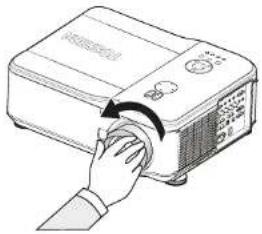
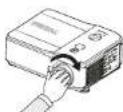
② Push the LENS RELEASE button all the way in and rotate the lens counterclockwise. The lens will be disengaged.
natural_image
Illustration of a hand cleaning a projector with a circular button (no text or symbols)Note
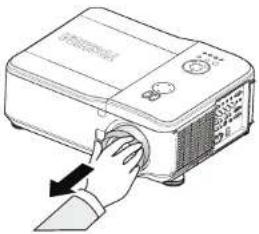
- If the lens cannot be removed by using the LENS RELEASE button, the anti-theft screw may be in use to secure the lens. If that is the case, remove the anti-theft screw first.
③ Pull out the lens slowly.
natural_image
Illustration of a projector with a hand inserting a button to its side (no text or symbols visible)CAUTION:
- When Installing the projection lens into the projector, be sure to remove the lens cap from the back of the lens before installing into the projector. Failure to do so will cause damage to the projector.
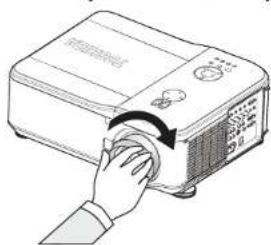
■ Installing the new lens
① Insert the lens with the arrow mark of the unit facing up.
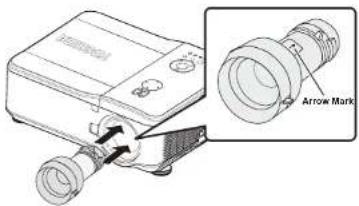
② Rotate the lens clockwise until you feel it click into place.
natural_image
Illustration of a hand cleaning a portable air conditioner unit with a circular arrow indicating rotation (no text or symbols)Installing or removing the projection lens (Continued)
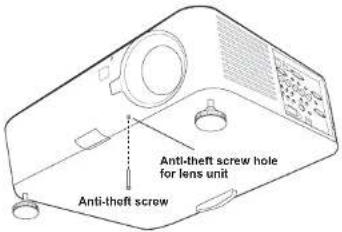
■ Securing the lens using the anti-theft screw
Using the anti-theft screw to prevent theft of the lens. Tighten the supplied anti-theft screw on the front bottom.
Installing the optional color wheel (provided)
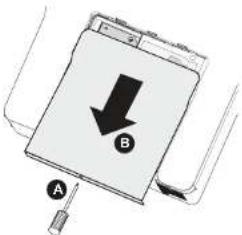
This projector comes with a four-segment color wheel installed. An additional six-segment color wheel is also provided. To replace the color wheel (located under the lamp cover adjacent to lamp 1) refer to the following guide.
Note
- Wait until the lamp housing and the color wheel cool off.
① Loosen the captive screw (A) on the lamp cover.
② Remove the lamp cover by sliding it in the direction of the arrow (B).
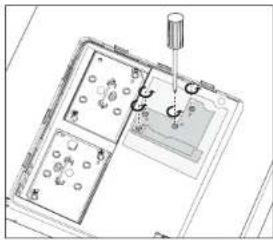
③ Unscrew the retaining screws (x 4) on the four-segment color wheel.
natural_image
Technical diagram of a mechanical assembly with no visible text or symbols④ Lift the color wheel in the direction shown.
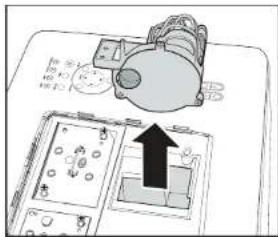
⑤ Insert the six-segment color wheel.
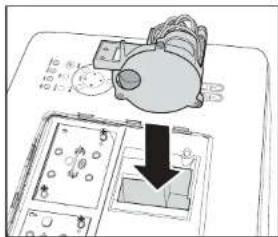
Installing or removing the projection lens (Continued)
⑥ Secure the retaining screws as shown.
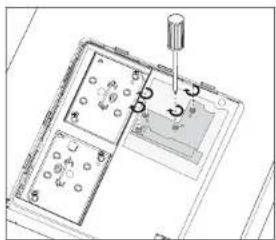
natural_image
Technical line drawing of a device with labeled components and a screwdriver (no readable text or symbols)⑦ Align the lamp cover in the direction of the arrow (A) and slide it into place.
⑧ Secure the captive screw (B).
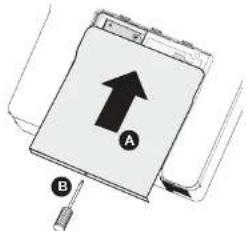
■ Storing unused color wheel
Keep the unused color wheel in the zipper bag in which the 6-segment color wheel was packaged.
This bag prevents dust from falling or collecting on the color wheel.
Turning the power on and off
■ Connecting the power cord
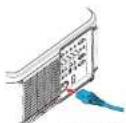
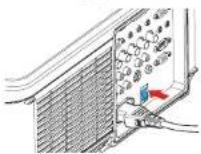
① Insert the power cord connector into the AC IN socket of the projector.
② Insert the power cord plug into a wall or other power outlet.
■ Turning the power on
① Remove the lens cap.
Remove the lens cap as shown (if present). Be sure to remove the lens cap when the power is turned on. If the cap is left on the projector, it could become deformed due to heat.
② Turn on the main power switch.
The ON/STANDBY indicator lights orange, and the Status indicator lights green indicating standby mode.
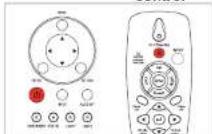
③ Press the ON/STANDY button on the control panel or on the remote control.
The ON/STANDBY LED lights green and the internal cooling fan starts.
④ After approximately 10 seconds, the ON/STANDBY LED flashes intermittently green.
⑤ The LAMP1 and LAMP2 LEDs light green and the ON/STANDY LED flashes more rapidly.
⑥ Once the ON/STANDBY, LAMP1 and LAMP2 LEDs are lit solidly green, the projector is ready for use.
Power cord connector (supplied)
Control panel
Remote control
ON'STANDBY STATUS LAMP1 LAMP2

ON'STANDBY STATUS LAMP1 LAMP2
CAUTION
- Do not look into the lens while the lamp is on. The strong light from the lamp may cause damage to your eyesight.
- Do not block the air intake or exhaust. Doing so could cause a fire due to internal overheating.
- Do not place your hands, face, or other objects near the air exhaust, the lamp cover or the bottom the unit. Doing so could result in injury and/or damage.
Notes
- The first time you use the projector after purchase, after the start-up screen disappears, the start menu is displayed.
- When [Key lock] is [On], the operation buttons of the projector do not work p.56
- When [Password] is [On], enter password then the start-up screen is displayed after the Password entry screen disappears p.45.
- Do not touch the lens directly with your hand.
If fingerprints or stains are left on the projection lens surface, they may interfere with the projector's ability to project images on the screen.
■ Turning the power off
Press the ON/STANDBY button on the control panel or the remote control.
A message appears on the screen, confirming that you wish to shut off the power. This message will disappear after a moment. (This operation is no longer valid after the message disappears.)
② Press the ON/STANDBY button again.
The screen goes blank, but the internal cooling fan continues to operate. Then, the projector goes into standby mode.
ON/STANDBY STATUS LAMP1 LAMP2
During cooling, the ON/STANDBY indicator flashes. While the indicator is flashing, the power can not be turned back on. However, there is no problem with unplugging the power cord in this state.
Note
- The projector consumes about 5W of power in standby. We recommend that you unplug the power cord if you will not be using the projector for an extended period.
Precaution
- If the power cord is unplugged before cooling is complete or the main power is turned off, give the lamp time (about 5 minutes) to cool before plugging it back in. If the lamp overheats, it may fail to light.
■ Power saving mode
Power saving mode activates the standby condition consuming less power than Standard mode. Go to the Setting-Setting 2 menu to turn on Power saving mode.
Basic operations
① Turn on the power.
Turn on the power by following the instructions in "Turning the power on" p.36
② Select the language (When using the first time).
When the projector is used for the first time after purchase, the start menu for language selection is displayed in English. (If the screen is out of focus, adjust it according to the step 6.)
| Please select a menu language. | |
| Please select a menu language. | English |
| Wählen Sie bitte die Menü Sprache aus. | Deutsch |
| S'il vous plaît choisir la langue de menu. | Français |
| Par favore scegliere la lingua del menu. | Italiano |
| Escoja por favor elidioma de menu. | Español |
| Vall menyn språken. | Svenska |
| メニュー言語を選択してください。 | 日本語 |
| 请选择来举语言。 | 中文 |
| Select "UP", "DOWN" & "SELECT" | |
Use the ▲ or ▼ button to select the desired language and press the ⏻ button. Message for setup confirmation is displayed in a selected language.
Notes
- When the projector is turned on the next time, the start menu does not appear upon startup. However, if [All data] is executed from the Reset menu, the start menu will be displayed the next time when the power is turned on.
• The language can also be set from the Setting-Setting 1 menu p.51 - This owner's manual assumes that English has been selected.
③ Activate the connected device.
Turn on and start the connected device such as a computer.
④ Press the INPUT button.
An image of the connected equipment is projected. Each time you press the INPUT button, it switches to the input of the connected equipment that is outputting video signals.
⑤ Projector placement angle adjustments
The placement angle and the height of the projected image can be adjusted by the foot adjusters.
① To raise the level of the projector, twist the adjusters clockwise.
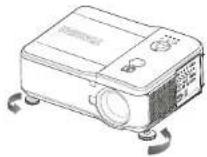
② To lower the level of the projector, lift the projector and twist the adjusters counter clockwise.
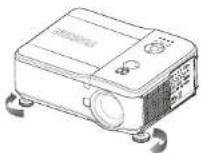
⑥ Adjusting zoom and focus
① If you wish to adjust the screen size, use the ZOOM buttons on the projector or remote to adjust the screen size.
② Use the FOCUS buttons on the projector or remote to adjust the focus.
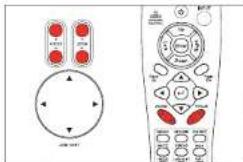
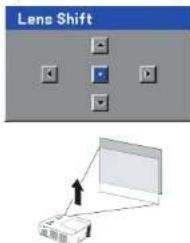
⑦ Adjusting the Picture Position and Picture Size
The Picture Position and Picture Size can be adjusted manually from the lens control panel or from the remote control unit (LENS SHIFT button)
Adjusting Picture Position and Picture Size Manually
① Press the Select keypad in any direction to bring up the [Lens Shift] window.
② Press the directional key as required to shift the image. Releasing the directional arrow will re-center the cursor.
Basic operations (Continued)
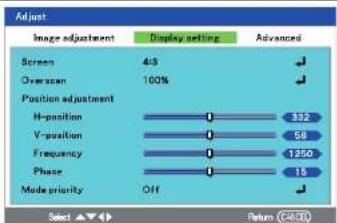
③ To alter the picture size, press Menu and select the [Adjust] menu using ▲ or ▼. Press Enter to open the [Adjust] menu. Press ◀ or ▶ to select [Display setting] followed by ▲ or ▼ to select [Screen]. Press Enter.
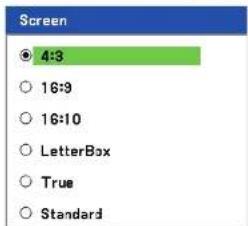
④ The [Screen] window is displayed. Select the desired picture size using ▲ or ▼ and press Enter.
When finished, press [Return] to go back to the projected image.
⑧ Adjusting the volume
The volume can be adjusted with the remote control unit.
① Press the Vol +/- buttons on the remote control. The volume bar is displayed on screen.
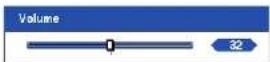
② Use the Vol +/- buttons to adjust the level.
Notes
• Volume can also be adjusted from the Volume in the Menu.
Notes
- Note that lamp characteristics may rarely cause the brightness to fluctuate slightly.
- A lamp is consumable item. If used for extended periods, images will appear dark, and the lamp could burn out. This is characteristic of a lamp, and is not malfunction. (The lifetime of the lamp depends on conditions of use.)
- The DLP ^® chip is made using extremely advanced technology, but there may be black spots (pixels that do not light) or bright spots (pixels that are constantly lit) on the panel. Please note that these are not malfunctions.
- Although this projector supports a wide range of RGB signals [p.70], any resolutions not supported by this projector (WXGA) will be expanded or shrunk, which will affect image quality slightly. To view high-quality images, it is recommended that the computer's external output should be set to WXGA resolution.
- With some models of computer having LCD displays or the like, displaying images simultaneously on the projector and the monitor's display may prevent the images from displaying properly. If this happens, turn off the computer's LCD display. For information on how to turn off the LCD display, see the owner's manual of your computer.
- If no signal is being input from the connected equipment or signal input is stopped while projecting, the "No signal" will appear.
- If a signal not supported by the projector is input, "No signal" message will appear.
- If an unavailable operation button is pressed, "This function is not supported" will appear.
Using handy features
■ Using auto setting (computer input only)
This function automatically sets up the projector to the optimum state. It sets up the sampling phase, frequency and screen position, etc., for each type of input signal through a simple operation.
- Press the AUTOSET button.
Notes
- The image may not be projected or auto adjustment/setting may not be performed correctly for input signals other than those supported by the projector p.78.
- If auto setting fails adjustment, adjust manually through Adjust, Display setting menu p.53.
Remote control
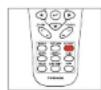
■ Correcting the keystone distortion
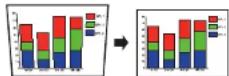
When the projector placement angle against the screen is changed while projecting the image, the picture will undergo keystone (trapezoidal) distortion. This projector is capable of correcting this keystone distortion.
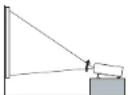
Before correction After correction
● Adjusting Keystone distortion
1 Select the Setting menu using ▲ or ▼. Press Enter to open the Setting menu. Press ◀ or ▶ to select Setting 1 followed by ▲ or ▼ to select Keystone. Press Enter.
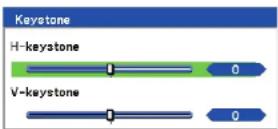
② Use the ◀▶ buttons to adjust the keystone distortion.
Notes
- Depending on the amount of keystone adjustment needed and the image content, some information may be lost, or the picture quality may suffer.
- The keystone correction settings are memorized after the power has been turned off—the projector placement angle against the screen remains unchanged.
- Some adjustments using keystone correction while displaying an input image with a 16:9 aspect ratio, may affect displaying the menu properly. In such a case, reset keystone correction to use the menu.
■ Cutting off the picture and sound temporarily (Mute)
When you want to project the images of another projector, overhead projector, etc. temporarily, this projector's images and sound can be turned off.
- Press the remote control's MUTE button.
The picture and sound are cut off. (The Mute function is released when pressing the MUTE button again.)
Notes
- Operating any other functions will also cancel the muting.
- The mute function is supported during most video and audio playback.
Precaution
- Do not replace the lens cap to cut off the projected image temporarily. It may cause the lens cap to deform due to the heat.
■ Changing picture mode
The projected image mode can be selected.
- Select the Adjust menu using ▲ or ▼. Press Enter to open the Adjust menu. Press ◀ or ▶ to select Image adjustment followed by ▲ or ▼ to select Picture mode. Press Enter. Press ▲ or ▼ to select the desired mode and press Enter.
■ Changing screen size
The screen size for the projected image can be changed.
- Select the Adjust menu using ▲ or ▼. Press Enter to open the Adjust menu. Press ◀ or ▶ to select Display setting followed by ▲ or ▼ to select Screen. Press Enter. Press ▲ or ▼ to select the desired mode and press Enter.
Notes
- Thru display is available for Computer and Network-input images.
- Wide display is available for Y/PB/PR, Video and S-video-input images.
- Using this function on commercial video software, broadcast or cable-broadcasting except for the purpose of your private viewing and listening may infringe the copyright protected by the copyright laws.
Using handy features (Continued)
■ Freezing the image (Freeze)
This function is used to pause or freeze a video during a presentation.
Press the remote control's FREEZE button.
The picture will pause. To release the freeze function, press the FREEZE button again.
Notes
- Other operations will also release the freeze.
• Even if an image is frozen on the projector, the pictures are running on the video or other equipment.
- Using this function on commercial video software, broadcast or cable-broadcasting except for the purpose of your private viewing and listening may infringe the copyright protected by the copyright laws.
■ Setting the password
● How to set password (from [Off] to [On])
To set the security password, refer to the following guide.
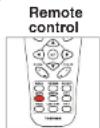
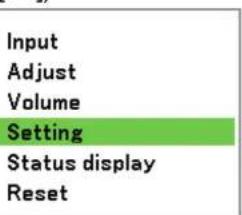
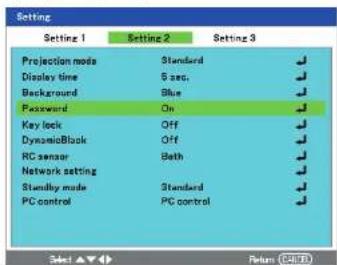
1 Press the Menu button on the projector or remote control to display the Main Menu. Scroll to the [Setting] menu using ▲ or ▼ and press Enter.
② Select [Setting 2] using ◀ or ▶ and press Enter.
③ Select [Password] using ▲ or ▼ and press Enter.
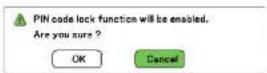
④ Select [On] then [OK] and press Enter.
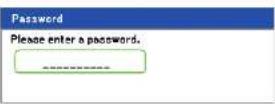
The password entry screen is displayed
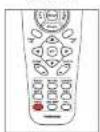
⑤ Enter a password between 4 and 10 characters using the arrow keys of the remote control. Press Enter.
⑥ Re-enter the password for confirmation and press Enter.
⑦ Select [OK] using the remote control and press Enter to enable the password.
Note
- Please do not forget your password. If you forget the password, you can not release the password by yourself.
• In such a case, please contact your dealer.
Remote
control
● How to operate when password is [On]
① Turn on the power.
② The lamp lights and the password entry screen appears.
Enter the password using the arrow keys of the remote control. If the entered password is correct, the start-up screen appears and the projector goes into normal operation. If the password is wrong, a message will appear prompting you to re-enter the password, and the password entry screen is displayed again. If you enter an incorrect password for more than 5 times, the projector will automatically power off and enter standby mode.
Note
- When the password setting is [On], the password will be enabled only when the power is turned on for the first time after the main power switch has been on. The password function will not be activated if the power backed on while it is standby mode without turning off the main power switch.
● How to set password (from [On] to [Off])
1 Select [Password] in the [Setting 2] menu and press Enter.
The password entry screen is displayed.
② Enter the password using the arrow keys of the remote control.
Select [Off] and press Enter to disable the password.
Menu tree
![TOSHIBA TDP-WX5400 - Select [Off] and press Enter to disable the password. - 2](/content/2026/05/801331/images/6e664f3753197862650fdd11f2fa4f875d783e31b4414d685e9b5b7a31d1c046.jpg)
flowchart
graph TD
    A["Input"] --> B["Adjust Comp.1"]
    B --> C["VOLUME"]
    C --> D["Setrag"]
    D --> E["Bonus display"]
    E --> F["Reset"]
    F --> G["Current signal (All data)<br>Close temp 1 time<br>Close temp 2 time<br>Close temp 3 time"]
    G --> H["Output"]
    H --> I["Image adjustment"]
    H --> J["Display setting"]
    H --> K["Advanced"]
    I --> L["Setting 1"]
    I --> M["Setting 2"]
    I --> N["Setting 3"]
    J --> O["Output Time"]
    K --> P["User"]
    K --> Q["Network"]
    K --> R["Version"]
    L --> S["Computer"]
    M --> T["Computer1"]
    N --> U["VPE-PR"]
    O --> V["Video"]
    P --> W["Services"]
![TOSHIBA TDP-WX5400 - Select [Off] and press Enter to disable the password. - 3](/content/2026/05/801331/images/b2dbab7f52d2402f49d84872e2eac0742acccb29d5442cb71ec42e383403682e.jpg)
flowchart
graph TD
    A["Input Image"] --> B["Picture name"]
    A --> C["Debit settings"]
    A --> D["Cleaned"]
    A --> E["Lightness"]
    A --> F["Scanese"]
    A --> G["Color"]
    A --> H["Text"]
    A --> I["Reset"]

    J["Image 1"] --> K["Gamma"]
    J --> L["Color temp"]
    J --> M["TextureColor"]
    J --> N["1-3"]

    O["Color & Advanced"] --> P["Screen"]
    O --> Q["Character"]
    O --> R["Photo corrected"]
    O --> S["Histogram"]
    O --> T["Composition"]
    O --> U["Frequency"]
    O --> V["Phone"]
    O --> W["Media projects (Add)"]

    X["Output"] --> Y["Noise reduction"]
    X --> Z["O2/IO sequence"]
    X --> AA["Progressive"]
    X --> AB["Color metric"]
    X --> AC["Temp"]

    style A fill:#f9f,stroke:#333
    style J fill:#ccf,stroke:#333
Menu tree (Continued)
![TOSHIBA TDP-WX5400 - Select [Off] and press Enter to disable the password. - 4](/content/2026/05/801331/images/c6cc2ea2e5525bb60ff7276adbeba085ef6ce866dbc18a6d3cf22e0e3fcead11.jpg)
flowchart
graph TD
    A["Setting"] --> B["Setting 1"]
    A --> C["Setting 2"]
    A --> D["Setting 3"]

    B --> E["Projection mode"]
    B --> F["Detection time"]
    B --> G["Background"]
    B --> H["Password"]
    B --> I["Key lock"]
    B --> J["DynamicBlack"]
    B --> K["RC sensor"]
    B --> L["Network setting"]
    B --> M["Standby mode"]
    B --> N["PC control PC control Network"]

    C --> O["Keppenise"]
    C --> P["Lamp power"]
    C --> Q["Lamp mode"]
    C --> R["Lamp interval"]
    C --> S["Language"]
    C --> T["Latc Shift"]
    C --> U["Zoom"]
    C --> V["Focus"]

    D --> W["DHCP"]
    D --> X["Enable/Disable"]

    E --> Y["Power on"]
    E --> Z["Noise/Video"]
    E --> AA["Noise/Video/0.5x100ms/20 sec"]
    E --> AB["Sonic tagger"]
    E --> AC["FAN mode"]
    E --> AD["Default/Impacted"]
    E --> AE["Viree mode"]
    E --> AF["Viree"]
    E --> AG["S-Video Auto/TV/8.6x100ms/20 sec"]
    E --> AH["Message DHCP*"]
    E --> AI["Filter scanning"]

    F --> AJ["Short video/Video/Max/Video"]
    F --> AK["Double video/Max/Video/Max/Video/Max/Video/Max/Video/Max/Video/Max/Video/Max/Video/Max/Video/Max/Video/Max/Video/Max/Video/Max/Video/Max/Video/Max/Video/Max/Video/Max/Video/Max/Video/Max/Video/Max/Video/Max/Video/Max/Video/Max/Video/Max/Video/Max/Video/Max/Video/Max/Volume"]

    G --> AL["Input mode"]
    G --> AM["Output mode"]

    H --> AN["Input mode"]
    H --> AO["Output mode"]

    I --> AP["Input mode"]
    I --> AQ["Output mode"]

    J --> AR["Input mode"]
    J --> AS["Output mode"]

    K --> AT["Input mode"]
    K --> AU["Output mode"]

    L --> AV["Input mode"]
    L --> AW["Output mode"]

    M --> AX["Input mode"]
    M --> AY["Output mode"]

    N --> AZ["Input mode"]
    N --> BA["Output mode"]

    O --> BB["Input mode"]
    O --> BC["Output mode"]

    P --> BD["Lamp power"]
    P --> BE["Lamp mode"]
    P --> BF["Lamp interval"]
    P --> BG["Lamp type"]
    P --> BH["Lamp Shift"]
    P --> BI["Zoom"]
    P --> BJ["Focus"]

    Q --> BK["Lamp mode"]
    Q --> BL["Lamp type"]

    R --> BM["Lamp mode"]
    R --> BN["Lamp type"]

    S --> BO["Lamp mode"]
    S --> BP["Lamp type"]

    AT --> BQ["Lamp mode"]
    AT --> BR["Lamp type"]

    AU --> BS["Lamp mode"]
    AU --> BT["Lamp type"]

    AV --> BU["Lamp mode"]
    AV --> BV["Lamp type"]

    AW --> BW["Lamp mode"]
    AW --> BX["Lamp type"]

    AX --> BY["Lamp mode"]
    AX --> BZ["Lamp type"]

    AZ --> CA["Lamp mode"]
    AZ --> CB["Lamp type"]

    BA --> CC["Lamp mode"]
    BA --> CD["Lamp type"]

    BB --> CE["Lamp mode"]
    BB --> CF["Lamp type"]

    AC --> CG["Lamp mode"]
    AC --> CH["Lamp type"]

    AD --> CI["Lamp mode"]
    AD --> CJ["Lamp type"]

    AE --> CK["Lamp mode"]
    AE --> CY["Lamp type"]

    AF --> CZ["Lamp mode"]
    AF --> DA["Lamp type"]

    AG --> EE["Lamp mode"]
    AG --> CF["Lamp type"]

    AH --> EF["Lamp mode"]
    AH --> GF["Lamp type"]

    AI --> GH["Lamp mode"]
    AI --> IG["Lamp type"]

    AJ --> JH["Lamp mode"]
    AJ --> IH["Lamp type"]

    AK --> AJL["Lamp mode"]
    AK --> AK["Lamp type"]

    AL --> ALJ["Lamp mode"]
    AL --> AM["Lamp type"]

    AM --> AN["Lamp mode"]
    AM --> AO["Lamp type"]

    AN --> AP["Lamp mode"]
    AN --> AQ["Lamp type"]

    AO --> AR["Lamp mode"]
    AO --> AS["Lamp type"]

    AP --> AT["Lamp mode"]
    AP --> AU["Lamp type"]

    AQ --> AV["Lamp mode"]
    AQ --> AW["Lamp type"]

    AR --> AX["Lamp mode"]
    AR --> AY["Lamp type"]

    AS --> AZ["Lamp mode"]
    AS --> BA["Lamp type"]

    AT --> BB["Lamp mode"]
    AT --> BC["Lamp type"]

    AU --> BD["Lamp mode"]
    AU --> BE["Lamp type"]

    AV --> BF["Lamp mode"]
    AV --> BG["Lamp type"]

    AW --> BH["Lamp mode"]
    AW --> BI["Lamp type"]

    AX --> BJ["Lamp mode"]
    AX --> BK["Lamp type"]

    AY --> BL["Lamp mode"]
    AY --> BM["Lamp type"]

    AZ --> BN["Lamp mode"]
    AZ --> BO["Lamp type"]

    BA --> BP["Lamp mode"]
    BA --> BQ["Lamp type"]

    AC --> BR["Lamp mode"]
    AC --> BS["Lamp type"]

    AD --> BT["Lamp mode"]
    AD --> BU["Lamp type"]

    AE --> CA["Lamp mode"]
    AE --> CB["Lamp type"]

    AF --> CB
![TOSHIBA TDP-WX5400 - Select [Off] and press Enter to disable the password. - 5](/content/2026/05/801331/images/e43a1864495dd1b5cd33c2f87c93e53ec6f4a8557413534308e5de4455d6a508.jpg)
flowchart
graph TD
    A["Data Entry"] --> B["Data Entry"]
    A --> C["Input"]
    A --> D["Network"]
    B --> B1["Lamp1"]
    B --> B2["Lamp2"]
    B --> B3["Lamp1 time"]
    B --> B4["Lamp2 time"]
    B --> B5["Fulltime"]
    B --> B6["Fibertime"]
    C --> C1["Input name"]
    C --> C2["Sgood"]
    C --> C3["H sync freq"]
    C --> C4["Vegine freq"]
    C --> C5["Virus mode"]
    C --> C6["Sync"]
    C --> C7["Sync penalty"]
    C --> C8["Scan type"]
    D --> D1["P address"]
    D --> D2["Subnet"]
    D --> D3["Gateway"]
    D --> D4["MAC address"]
    E["Server"] --> E1["Model name"]
    E --> E2["Emware"]
Using the Adjust menus
The Adjust menu contains overall projector settings for image output such as sharpness, overscan and color matrix. Three tabs are accessible through the Adjust menu; Image adjustment, Display setting, and Advanced.
Items that can be set or adjusted are marked "Yes", and those that cannot are marked "No". (When an item is masked, it indicates that you cannot select for the current input).
■ The Image adjustment menu
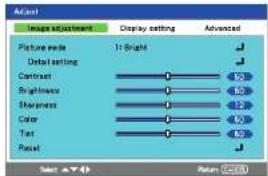
| Item ▲▼ | Description | Computer 1 | Computer 2 | Computer 3 | Y/Pa/Pa | Video | S-video |
| Picture mode | Press 🔒 and toggle the picture mode with ▲▼.Bright/Presentation/Video/Cinema/Photographic/sRGB | Yes Yes | Yes Yes | Yes Yes | |||
| Contrast | Adjust the image contrast.Lower ◀▶ Higher | Yes Yes | Yes Yes | Yes Yes | |||
| Brightness | Adjust the brightness of the image.Darker ◀▶ Lighter | Yes Yes | Yes Yes | Yes Yes | |||
| Sharpness | Adjust the sharpness of the image.Softler ◀▶ Sharper | Yes Yes | Yes Yes | Yes No | |||
| Color | Adjust the color of the image.Lighter ◀▶ Deeper | No No | No Yes | Yes No | |||
| Tint ^-1 | Adjust the lint of the image color.Reddish ◀▶ Greenish | No No | No Yes | Yes No |
*1: Tint can be displayed and adjusted only when the video signal is set to [NTSC] or [Auto].
The Setting 1 menu
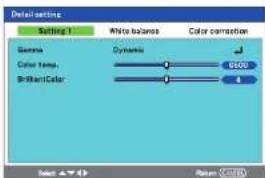
| Item ▲▼ | Description | Bright | Presenatation | Video | Cinema | Photographic | sRGB |
| Gamma | Press 🔊 and toggle the Gamma level with ▲▼.Dynamic/Natural/Black detail | Yes | Yes Yes Yes | Yes Yes | |||
| Color temp. | Adjust the Color temp.Lower ◀▶ Higher | No No | Yes | Yes Yes Yes | |||
| BrilliantColor | Adjust the BrilliantColor value.Lower ◀▶ Higher | No No | Yes | Yes Yes Yes |
The White balance menu
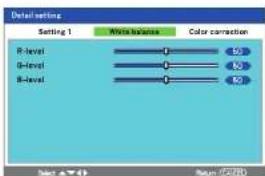
| Item ▲ ▼ | Description | Bright | Prosentation | Video | Cinema | Photographic | sRGB |
| R-level | Adjust the R-level. Lower ◄▶ Higher | Yes | Yes | Yes | Yes | Yes | Yes |
| G-level | Adjust the G-level. Lower ◄▶ Higher | Yes | Yes | Yes | Yes | Yes | Yes |
| B-level | Adjust the B-level. Lower ◄▶ Higher | Yes | Yes | Yes | Yes | Yes | Yes |
Using the Adjust menus (Continued)
The Color correction menu
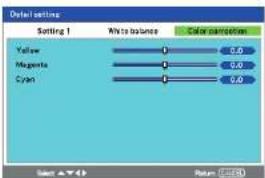
| Item ▲▼ | Description | Bright | Prasenatation | Video | Cinema | Photographic | sRGB |
| Yellow | Adjust the Y level. Lower ◀▶ Higher | No Yes | Yes Yes | Yes Yes | |||
| Magenta | Adjust the M level. Lower ◀▶ Higher | No Yes | Yes Yes | Yes Yes | |||
| Cyan | Adjust the C level. Lower ◀▶ Higher | No Yes | Yes Yes | Yes Yes |
■ The Display setting menu
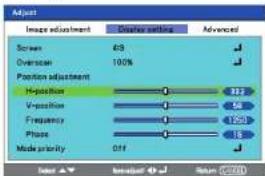
| Item ▲ ▼ | Description | Computer | 1 Computer | 2 Computer | W/Be/Pr | Video | S-video |
| Screen | Select the screen size using ◀ ▶.4:3 — Atandard TV screen.16:9 — Wide screen aspect for video output.16:10 — For video signal with an aspect ratio of 16:10Letterbox — For viewing LaserDisc movies or non-anamorphic DVDs on a 16:9 screenTrue — Displays the image in its true resolution.Standard — Displays the image in its aspect ratio. | Yes Yes | Yes Yes | Yes Yes | |||
| Overscan | Select the overscan value with ◀ ▶.93%/95%/97%/100% | Yes Yes | Yes Yes | Yes Yes | |||
| H-position Adjust the horizontal position of the image.Move left ◀ ▶ Move right | Yes | Yes | No | Yes | No | No | |
| V-position | Adjust the vertical position of the image.Move down ◀ ▶ Move up | Yes | Yes | No | Yes | No | No |
| Frequency | Adjust with ◀ ▶ to eliminate periodic patterns and flickering when fine vertical lines appear on the screen. | Yes | Yes | No | Yes | No | No |
| Phase | Adjust to eliminate flicker with ◀ ▶. | Yes | Yes | No | Yes | No | No |
| Mode priority | Enable or disable mode priority override with ◀ ▶.Wide/4:3 | Yes Yes | Yes Yes | No No | No | ||
Notes
- If you use the Screen setting function on commercial video software, broadcast or cable-broadcasting programs to display images with the varying aspect ratio except for the purpose of your private viewing and listening, it may infringe the copyright protected by the copyright laws.
- [Mode priority] allows you to set the signals which are difficult to distinguish between [Wide] or [4:3] to your selected mode.
Using the Adjust menus (Continued)
■ The Advanced menu
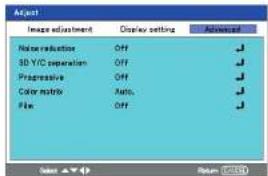
| Item ▲▼ | Description | Computer 1 | Computer 2 | Computer 3 | Y/Pa/Pa | Video | S-video |
| Noise reduction ^1 | Adjust the screen noise reduction level.Off/Low/Mid/High | Yes Yes | Yes Yes | Yes Yes | |||
| 3D Y/C separation | Enbale or disable 3D Y/C separation.On/Off | No No | No No Yes | No | |||
| Progressive Adjust the progressive mode.Off/Still/Standard/Cinema | No No | No Yes Yes Yes | |||||
| Color matrix Set the default Color matrix.Auto/RGB/SDTV/HDTV | Yes Yes | Yes Yes | No No | ||||
| Film | Set the Film mode.Off/2-2/2-3 Auto/2-2/2-3 | No No | No Yes Yes Yes | ||||
*1: Noise reduction may not work depending on signal type.
Using the Setting menus
The Setting menu contain the most often used settings during installation and options to customize the general output of the projector. Three tabs are accessible through the Setting menu; Setting 1, Setting 2, and Setting 3.
■ The Setting 1 menu
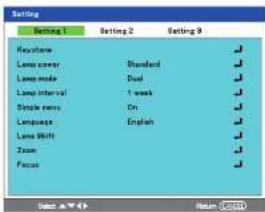
| Item ▲▼ | Description |
| Keystone | Adjust the horizontal/vertical keystone values. Press and adjust the keystone using ▶. |
| Lamp power | Set the lamp power. Press and select the lamp power using ▲▼.Low/Standard |
| Lamp mode | Set the lamp mode. Press and select the lamp mode using ▲▼.Dual/Lamp1/Lamp2 |
| Lamp interval | Set the period of time after which the lamp should be swapped when lamp select is not set to Dual mode. Press and select the lamp interval using ▲▼.Off/1 week/4 week/2000H |
| Language | Select one of the languages below to use for displaying the menu and messagesPress and toggle the display language using ▲▼.English /Deutsch /Français /Italiano /Español /Svenska /日本語 /中文(簡鍍字) |
| Lens Shift Shift the lens using the projector's control panel.·Press to display the Len shift window.·Press ▲▼▲► to shift the lens in the corresponding direction. | |
| Zoom | Use the Zoom feature from the projector's control panel.·Press to display the Zoom window.·Press to zoom out and ► to zoom in. |
| Focus | Use the Focus feature from the projector's control panel.·Press to display the Focus window.·Adjust the focus by pressing ▶ and ►. |
Notes
- For lamp protection, [Lamp mode] cannot be changed its setting mode right after you have switched the lamp mode or the lamp has turned on. If it is the case, allow some time before changing the mode.
Using the Setting menus (Continued)
■ The Setting 2 menu
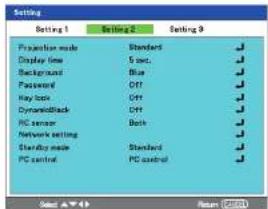
| Item ▲▼ | Description |
| Projection mode | Set the projection mode. Press ⚪ and select the projection mode using ▲▼. • Standard—standard forward facing projection. • Rear ceiling—inverts and reverses the image for ceiling mounted projection from behind the screen. • Rear—reverses the image for projection from behind the screen. • Ceiling—inverts the image for standard ceiling mounted projection. |
| Display time | Set the menu display time. Press ⚪ and select the display time using ▲▼. Continuous/5 sec./15 sec./45 sec. |
| Background | Set the default background appearance. Press ⚪ and select the background using ▲▼. Blue/None/Logo |
| Password | Enable or disable the password security feature p.45. |
| Key lock | Enable or disable the key lock security feature. When enabled, the control panel on the projector is locked—the menus can only be accessed using the remote control. Press ⚪ and select On or Off using ▲▼. |
| DynamicBlack | Enable or disable DynamicBlack. The DynamicBlack feature improves the appearance of black areas of the projected image. Press ⚪ and select On or Off using ▲▼. |
| RC sensor | Enable or disable the front and reaer remote control sensors. Press ⚪ and select the sensor mode using ▲▼. Both/Front/Rear. |
| Network setting | Configure the network settings if the projector is connected to a network. Enable DHCP disable DHCP and enter network IP address information in the supplied fields. Select Apply settings to confirm the network information p.57. |
| Standby mode | Select the desired standby mode. Press ⚪ and select the standby mode using ▲▼. Standard/Power-saving |
| PC control | Select the path for PC Control. Press ⚪ and select the PC control path using ▲▼. PC control/Network |
Network settings
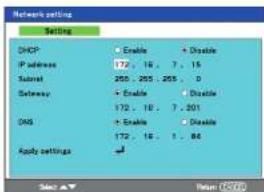
If you set DHCP to Enable, the IP address of the projector is assigned automatically by the DHCP server. If your network environment does not assign IP addresses automatically, set DHCP to Disable, then set the following items manually.
Note
- IP address and Subnet are required fields if DHCP is set to Disable.
When DHCP is set to Dlsable, consult with your network administrator for the settings below and set the IP address manually. An IP address is a unique number assigned to a device. The format is a string of four dot-separated three-digit numbers. (Example: 111.112.xxx.xxx)
A subnet mask is used to determine what subnet the IP address assigned to a device belong (Example: 255.255.xxx.xxx)
This value specifies the IP address of the device, such as a router, to be used to access servers outside the network. (Example: 111.112.xxx.xxx)
This value specifies the IP address of a Domain Name Server (DNS) if present. (Example: 111.112.xxx.xxx)
Select Apply settings to confirm the projector's new network settings.
Using the Setting menus (Continued)
■ The Setting 3 menu
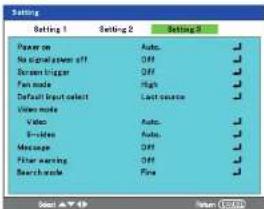
| Item ▲▼ | Description |
| Power on | Select the power on mode. Press and select the power on mode using ▲▼. Manual—the projector must be powered on manually using the control panel or remote. Auto—the projector powers on automatically when the main power switch is turned on. |
| No signal power off | Sets the time to wait for the power to be turned off after the last operation is made with no input signal. Press and select the lamp interval using ▲▼. Off/5 min./10 min./20 min./30 min. |
| Screen trigger | Enable or disable the screen trigger function. Press and select On or Off using ▲▼. |
| Fan mode | Select the desired fan mode. Press and select the fan mode using ▲▼. Standard/High |
| Default input select | Select the image source that the projector will search for automatically on startup. Press and select the default input device using ▲▼. Last source/Auto./Computer1/Computer2/Computer3/Y-PB-PR/Video/S-video |
| Video mode | Video: Press and select the default video mode using ▲▼. Auto./NTSC/PAL/SECAM |
| S-video: Press and select the default S-video mode using ▲▼. Auto./NTSC/PAL/SECAM | |
| Message | Enable or disable the onscreen warning and informational messages. Press and select On or Off using ▲▼. |
| Filter warning | Set the interval between filter cleaning warning messages. Press and select the desired interval using ▲▼. Off/100H/200H/500H/1000H |
| Search mode | Set the search mode. Press and select the desired search mode using ▲▼. Standard/Fine |
Note
- If [Power on] is set to [Auto] and there is a power outage, the projector will come on once power is restored.
- Setting [Fan mode] to [High] increases the cooling fan speed. (The cooling fan noise gets louder.) Set this option to use the projector, for example, at high altitude (over 1,200 meters above sea level). Do not set Fan mode to [High] when using the projector at a lower altitude."
Using the Status display screen
The Status display screen provides a quick access to the detailed information on projector status. The Status display menu contains four distinct tabs; Usage time, Input, Network, and Version.
Note
• Information on the Status display screens is read only.
■ The Usage time screen
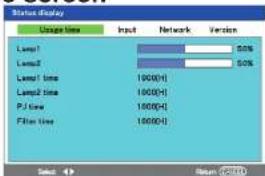
| item ▲ ▼ | Description |
| Lamp1 Displays the Lamp1 life remaining as a percentage. | |
| Lamp2 Displays the Lamp2 life remaining as a percentage. | |
| Lamp1 time Displays the Lamp1 total usage in hours. | |
| Lamp2 time Displays the Lamp2 total usage in hours. | |
| PJ time Displays the projector's total usage in hours. | |
| Filter time Displays the filter total usage in hours. | |
Note
Displays [Lamp 1/2 time] as a measure of when the lamp should be replaced. (Cannot be used as a counter of guaranteed lamp time.) When the displayed time approaches 2,000 hours, consult with a dealer about getting replacement for: TLPLW25 for TDP-WX5400 (sold separately).
■ The Input screen
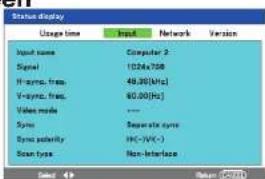
| Item ▲ ▼ | Description |
| Input name | Displays the input terminal that is currently being used. |
| Signal | Displays the signal name of the currently being used. |
| H-sync. freq. | Displays horizontal frequency in KHz |
| V-sync. freq. | Displays vertical frequency in Hz |
| Video mode | Displays video type, if present. |
| Sync | Displays synchronization type. |
| Sync polarity | Displays synchronization polarity. |
| Scan type | Displays the scan type. |
Using the Status display screen (Continued)
■ The Network screen
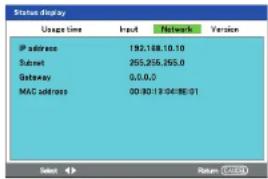
| Item ▲ ▼ | Description |
| IP address Displays the IP address associated with the projector, if connected to a network. | |
| Subnet Displays the subnet mask associated with the projector, if connected to a network. | |
| Gateway Displays the gateway associated with the projector, if connected to a network. | |
| MAC address Displays the MAC address associated with the projector. | |
■ The Version screen
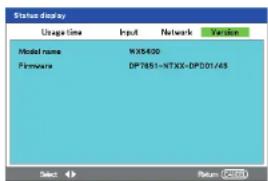
| Item ▲ ▼ | Description |
| Model name | Displays the projector's model name. |
| Firmware | Displays the firmware version currently running on the projector. |
Note
Firmware shows the version of the projector's internal control program. This firmware version will be requested for customer service purposes.
Note
- The displayed information will not be refreshed if the status changes. To refresh the information, dismiss the display, then display it again.
Operation using an HTTP browser
Overview
The use of HTTP server functions will allow control of the projector from a web browser without the installation of special software. Please be sure to use "Microsoft Internet Explorer 4.x" or a higher version for the web browser. (This device uses "JavaScript" and "Cookies" and the browser should be set to accept these functions. The setting method will vary depending on the version of browser. Please refer to the help files and the other information provided in your software).
HTTP server functions is available by accessing the following URL. Enter the either address below in the browser address bar.
http://
http://
Note
- The display or button responses can be slow or operation may not be accepted depending on your network settings. Should this happen, consult your network administrator. The projector may not respond if its buttons are repeatedly pressed in rapid intervals. Should this happen, wait a moment and repeat. If you still can't get any response, turn off and back on the projector.
■ Preparation before use
Make network connections, set up the projector and confirm that it is complete before engaging in browser operations.
Operation with a browser that uses a proxy server may not be possible depending on the type of proxy server and the setting method. Although the type of proxy server will be a factor, it is possible that items that have actually been set will not be displayed depending on the effectiveness of the cache, and the contents set from the browser may not be reflected in operation. It is recommended that you do not use a proxy server unless it is inevitable.
■ Handling of the address for operation by using a browser
Regarding the actual address that is entered for the address or entered to the URL address bar when operation of the projector is via a browser, the host name can be used as it is when the host name corresponding to the IP address of the projector has been registered to the domain name server by a network administrator, or the host name corresponding to the IP address of the projector has been set in the "HOSTS" file of the computer being used.
Example 1:
When the IP address of the projector is 192.168.73.1, access is gained to the HTTP server function by specifying http://192.168.73.1/index.html for the address or the entry column of the URL
Operation using an HTTP browser (Continued)
■ Configuring network settings
The Network Settings screen is displayed as follows: http://
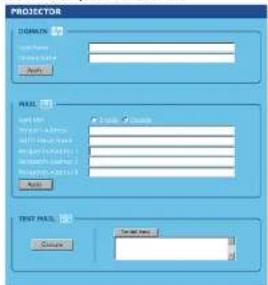
DOMAIN
Host Name: Type in a hostname. Up to 60 alphanumeric characters can be used.
Domain Name: Type in domain name of the network connected to the projector. Up to 60 alphanumeric characters can be used.
Apply: Click to reflect the entries.
Alert Mall: Click Enable to enable Alert Mall feature. This option notifies your computer of an error message via e-mail when using wired LAN. The error message will be notified when the projector lamp has reached the end of its usable life or an error occurs in the projector.
Sender's Address: Specify the sender's address. Up to 60 alphanumeric characters can be used. SMTP Server Name: Type in the SMTP server name to be connected to the projector. Up to 60 alphanumeric characters can be used.
Recipient's Address 1 to 3: Type in recipient addresses. Up to 60 alphanumeric characters can be used. Apply: Click to apply the settings.
TEST MAIL
Send a test mail to check if your settings are correct. Click to Execute to enable this feature.
Test Mail Status Button: Click to display the test result.
Sample of a message sent from the projector:
Projector Name: X X X X
Lamp 1 or 2 Hours Used: xxxx [H]
The lamp is at the end of its usable life. Please replace the lamp.
Note
- If you entered an incorrect address in a test, you may not receive an Alert mail. Should this happen, check if the Reciplent's Address is correctly set.
- Test Mail is not available until either Sender's Address, SMTP Server's Name or Recipient's Address 1-3 is completed.
■ Structure of the HTTP Server
Once the projector is connected to a network and configured correctly, the following screen is displayed through the web browser. The functions that can be controlled vary depending on the input signal to the projector.
http://
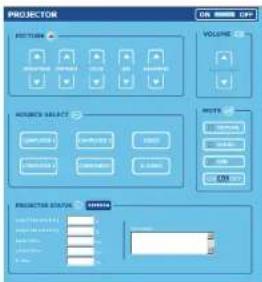
| Function Setting | Description | |
| Power panel On/Off | Controls projector power | |
| Picture panel BRIGHTNESS ▲▼ – Increases or decreases the brightness valueCONTRAST ▲▼ – Increases or decreases the contrast valueCOLOR ▲▼ – Increases or decreases the color valueHUE ▲▼ – Increases or decreases the hue valueSHARPNESS ▲▼ – Increases or decreases the sharpness value | Controls the video adjustments of the projector | |
| Volume panel▲ increases the output volume▼ decreases the output volume | Controls projector volume | |
| Source select panel COMPUTER1 – Switches to the COMPUTER 1 IN connectorCOMPUTER2 – Switches to the COMPUTER 2 IN connectorCOMPUTER3 – Switches to the COMPUTER 3 IN connectorCOMPONENT – Switches to the COMPONENT IN connectorsVIDEO – Switches to the VIDEO IN connectorS-VIDEO – Switches to the S-VIDEO IN connector | This switches the input connector of the projector | |
| Mute panel PICTURE ON – Mutes the videoPICTURE OFF – Cancels the video mutingSOUND ON – Mutes the audioSOUND OFF – Cancels the audio mutingOSD ON – Mutes the on-screen displayOSD OFF – Cancels the muting of the on-screen displayALL ON – Mutes all functionsALL OFF – Cancels the muting of all functions | This controls the mute functions of the projector | |
| Projector status panel Refresh – Updates the panel with the latest information availableLamp1/2 life remaining – Displays the remaining life of Lamp 1/Lamp1/2 time – Displays Lamp 1/2 use in hoursPJ time – Displays the number of hours the project has been underedictionsError Status – Displays the status of projector errors | ||
About the lamps

CAUTION
The product's light sources are mercury lamps that light at increased internal pressure. Be sure to fully understand the following characteristics of the lamps and handle them with extreme care.
- The lamps may burst with a loud noise due to impact or deterioration, or fail to light at the expiration of its life.
- How long it takes before the lamps burst or the life expires may vary greatly by lamp. Some may burst shortly after first use.
- Burst is likely to happen if the lamps are used after the replacement period has elapsed.
- When a lamp bursts, the broken pieces of glass may get inside the product or be released outside from the openings for ventilation.
- When a lamp bursts, a slight amount of mercury gas enclosed in the lamp along with glass dust may be released from the openings for ventilation.
- Immediately replace the lamp when a sign appears on the screen.
- When the replacement time approaches, a message will appear on the screen.
- The risk of burst will increase if a lamp is continuously used without being replaced.
- Frequently check the used hours and prepare spares when the replacement time approaches. (Refer to "Usage time" in the "Status display" 2.59)
■ When a lamp is broken
- If glass components, including a lamp or lens, should break, handle the broken pieces with care to avoid injury and contact your dealer for repair service.
- In the event of lamp burst, unplug the product from the wall outlet, leave and completely ventilate the room. Then, thoroughly clean the area around the projector and discard any edible items placed in that area.
- When a lamp bursts, consult a doctor if glass dust or mercury gas gets into your eyes or you breathe it.
Replacing the lamps
When a lamp reaches the end of it's usable life, the following message is displayed. Replace the lamp.
The lamp1 and lamp2 has reached the end of its usable life. Please replace the lamp.
The projection lamps should be replaced when they burn out. They should only be replaced with a specified replacement part, contact your local dealer if unsure.
CAUTION:
- The lamp contains a certain amount of mercury and should be disposed of according to local ordinance regulations.
- Avoid touching the glass surface of the new lamp: doing so may shorten its operation life.
- If the lamp's useful life ends and projector could not turn on over 2100 hours, please have the projector serviced.
Notes
- The lamps are positioned differently. Use extra caution not to force the lamps when replacing.
- Installation of both lamp modules (Lamp 1 and Lamp 2) is required to operate the projector in dual or single lamp mode. If only a single lamp module is installed, the projector's lamp will not turn on and will appear as a lamp failure.

WARNING
- If the projector is mounted on the ceiling, it is strongly recommended that you contact a Toshiba dealer when the lamp has to be exchanged. Do not attempt to replace the lamp by yourself.
If you uncover the lamp while the projector is mounted on a ceiling, there may be a danger of damage from falling pieces of glass if the lamp is broke, resulting in possible injury. In addition, viewing at high elevations can also be potentially hazardous. Do not attempt to replace the lamp by yourself. - Always use lamp "TLPLW25" (sold separately) when replacing the lamp. Using a lamp other than the one specified may cause a malfunction or damage to the unit due to the difference in the connector shape or the lamp rate.

CAUTION
- If you have been using the projector, the lamp will be very hot, and may cause burn injuries.
Wait 1 hour or longer for the lamp to cool before replacing it. - If the lamp should break, please handle with care to avoid injury due to broken pieces and contact your dealer for repair service.
Replacing the lamps (Continued)
To replace the lamps, refer to the following instructions.
① Unplug power cord.
② Wait until lamp is sufficiently cooled.
③ Loosen the captive screw (A) on the lamp cover.
④ Remove the lamp cover by sliding it in the direction of the arrow (B).
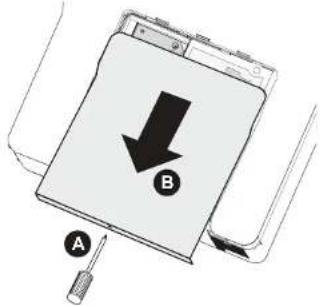
⑤ Loosen the two captive screws (A) on the lamp module. Lift the module handle up (B) in the direction shown.
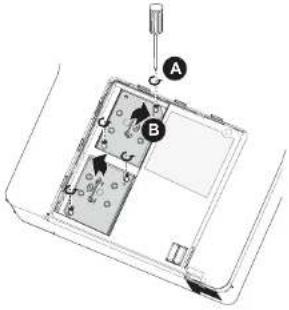
⑥ Pull firmly up the module handle to remove the lamp.
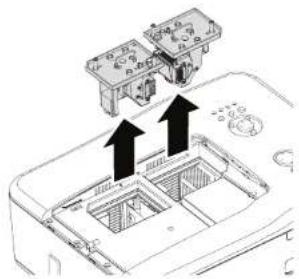
natural_image
Diagram of a device interior showing two components with arrows indicating movement or assembly (no text or symbols present)⑦ Replace the lamp as shown.
Note
- The lamps are positioned differently. Take extra caution not to force the lamps when replacing.
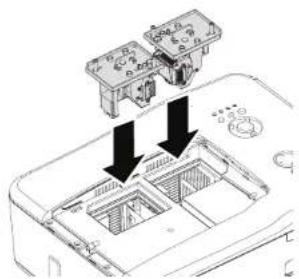
natural_image
Diagram of a device interior showing a top panel with internal components and arrows indicating assembly or connection (no text or symbols present)⑧ Reverse steps 3 to 5 to install the new lamp module and replace the lamp cover.
Note
• The filters should be replaced when replacing the lamp modules.
Replacing the lamps (Continued)
■ Resetting the lamp hours counter
After replacing the lamp(s), the lamp hour counter(s) should be reset to zero. Refer to the following guide:
① Press the [MENU] button on the control panel or remote to open the Main menu.
② Press the ▲ or ▼ button to move to the [Reset] menu and press Enter.
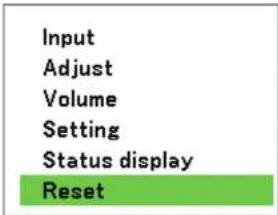
The Reset menu is displayed.
③ Select [Clear lamp1 time] or [Clear lamp2 time] using ▲ or ▼ and press Enter.
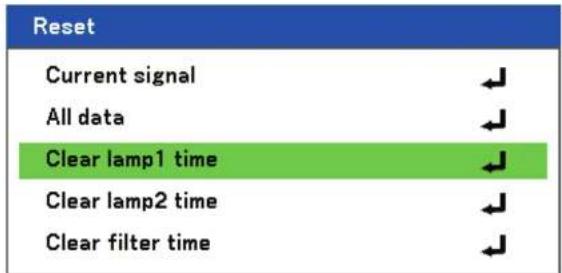
A confirmation box is displayed.
④ Select [OK] using ◀ or ▶ and press Enter to reset the selected lamp hours to zero.
Notes and Precautions
- The Lamp1/2 time item in the Status display, Usage time screen indicates the time of lamp use (use it as a rough estimate or guide for lamp life) p.59.
- Please replace the lamp after 2000 hours of use with Lamp power set to Standard or 3000 hours of use with Lamp power set to Low p.58.
- Attach the lamp cover correctly so that it is secure and not loose. If it is not attached correctly, the projector may fail to turn on or the lamp may fail to come on.
- There may be cases where the lamp stops working before the above mentioned period expires or before the replacement message is displayed.
• Always replace the lamp with a new one. - The lamp is made out of glass. Do not touch the glass surface with your bare hands, bang it, or scratch it. (since dirt, jolts, scratches and other similar particles may affect the lamp).
● About the lamp replacement message
The projector's lamp replacement message displays after an appropriate period based on the use period selected in [Lamp power].
When the replacement time approaches, the message of "The lamp1 and lamp2 has reached the end of its usable life. Please replace the lamp." is displayed when power is turned on and turned off. This display disappears when you press any key.
Lens and main unit cleaning
WARNING
Request cleaning and maintenance of a ceiling-mounted unit from your projector dealership. Attempting to clean the unit or replace the lamp in a high location by yourself may cause you to fall, possibly resulting in injury.
■ Lens cleaning
- Clean the lens with a commercially available blower and/or lens cleaner
- The lens is easily scratched, so do not rub it with hard objects, or strike it.
■ Main unit cleaning
- Always unplug the power cord before cleaning the main unit.
- Wipe dirt off the main unit gently with a soft cloth.
- Do not wipe the main unit with a damp cloth. Doing so may allow water to get inside, resulting in possible electric shock or unit failure.
- Do not use benzene, thinner or other similar chemical solutions as they may deform or discolor the unit or damage the paint surface.
- Do not use a chemically saturated cloth.
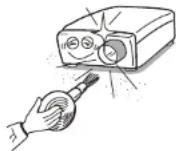
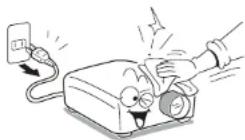
■ Cleaning the filters
The projector uses three filters to keep the fans free of dust and other particles, and should be cleaned every 500 hours of operation. In dustier environments, it is recommended to clean the filters more frequently. If the filter is dirty or clogged, your projector may overheat. When the message below is displayed the filters must be cleaned.
Please clean filter.
Note
- When the Please clean filter message is displayed, please clean or replace all three filters at the same time to synchronize the hours used display. The Filter Warning item should be enabled in the Setting 3 menu p.56.
Refer to the following guide to clean the filters.
① Lift the projector to clean the filter located at the bottom.
Note
- Only clean the outside of the exhaust vents with a vacuum cleaner.
② The left-hand filter can be cleaned as shown in the right figure.
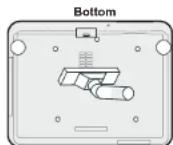
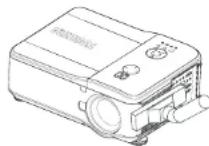
③ The rear filter can be accessed as shown. Once the filters are cleaned, please reset the filter time using the Reset menu p.73.
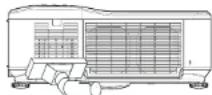
Note
- Using the projector without the air filters fitted inside allows dirt and dust into the projector, causing failure.
WARNING
- Request cleaning and maintenance of a ceiling-mounted unit from your projector dealership. Attempting to clean the unit or replace the lamp in a high location by yourself may cause you to fall, possibly resulting in injury.
Replacing the filters
When the lamps are replaced, the filters should also be replaced, not cleaned. Refer to the following guide to replace the filters.

CAUTION
- Do not drop the projector on your hand or fingers while lifting the projector to replace the filters. Doing so could injure your hand or fingers.

Note
- The side and the rear filters can be pulled out from the slots located at the bottom as shown.
① Gently slide the filter holders in the direction shown.
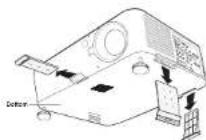
② Lift the filter foams from all three filter holders in the direction shown. Remove them completely from each filter holder and discard.
③ Place a replacement foam and press down firmly.
④ Replace the filter holders by pushing gently in the direction shown.
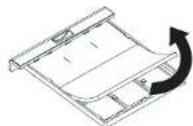

Note
- When dirt and dust build up in the filter, the air circulation inside the projector is affected and the internal temperature will rise, causing the projector to stop working or malfunction.
- Be sure the filter is inserted all the way into the slot. Leaving gaps will allow dust and dirt to get inside the projector again.
- When you purchase a new lamp, new filters are also provided. If a filter is torn or dirty, please replace with new one. Continuing to use a ripped filter will allow dust and dirt to get inside the projector.
- Never run the projector with the filters removed. It is recommended that you clean the
■ Resetting the filter time counter
After replacing the filters, the filter time counter should be reset to zero. Refer to the following guide:
① Press the MENU button on the control panel or remote to open the Main menu.
② Press the ▲ or ▼ button to move to the [Reset] menu and press Enter.
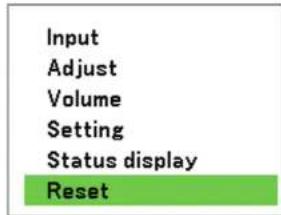
The [Reset] menu is displayed.
③ Select [Clear filter time] using ▲ or ▼ and press Enter.
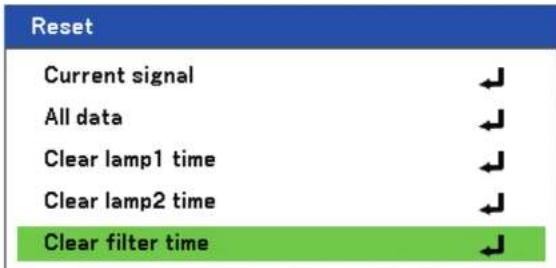
A confirmation box is displayed.
④ Select OK using ◀ or ▶ and press Enter to reset the filter time to zero.
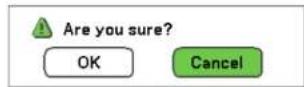
Trouble indications
The indicator lights to inform you of internal abnormalities.
■ ON/STANDY LED
CUSTOMER STATUSLAMP1 LAMP2

| Projector Status LEDCondition | LED Sequence ProjectorCondition | ||
| AC Off Blank Off | |||
| Cooling Orange Blink | 0.5 sec On | → 0.5 sec Off | After Power Off |
| Power Up Sequence Green Blink | 0.5 sec On | → 0.5 sec Off | Power Up |
| Standby / Idle Orange | On On | ||
| Power On Green On On | |||
■ Status LED

| Projector Status LED Condition LED Sequence Projector | Condition | ||
| Normal Condition Off | Off | Power On | |
| Cover ERROR | Blink Red once (repeat) | 0.5 sec On → 2.5 sec Off | ERROR |
| Temperature ERROR | Blink Red twice (repeat) | 0.5 sec On → 2.5 sec Offx 2 times → 2.0 sec Off | ERROR |
| Power ERROR Blink | Red 3 times (repeat) | 0.5 sec On → 2.5 sec Offx 3 times → 2.0 sec Off | ERROR |
| Fan ERROR | Blink Red 4 times (repeat) | 0.5 sec On → 2.5 sec Offx 4 times → 2.0 sec Off | ERROR |
| Key lock Active (when key pressed) | Orange | On | Key lock Active |
| Idle | Green On | On | |
■ Lamp LEDs

| Projector Status | LED Condition | LED Sequence | Projector Condition |
| Lamp Off | Off | Off | Always |
| End of Lamp Life Red | Blink 0.5 sec On → 0.5 sec Off | Off | Always |
| No Lamp Blink Red once (repeat) | 0.5 sec On → 2.5 sec Off | Off | ERROR |
| Lamp ERROR | Blink Red 6 times (repeat) | 0.5 sec On → 2.5 sec Off x 6 times → 2.0 sec Off | ERROR |
| Cooling Lamp | Orange Blink | 0.5 sec On → 0.5 sec Off | Switching lamp 1 and 2 |
| Re-light Up Sequence | Green Blink | 0.5 sec On → 0.5 sec Off | Power Up |
| Lamp Life Over (cannot turn on) | Red On | On | Always |
Before calling service personnel
If you think something is wrong, check the followings before contacting customer service. Please see "Trouble indications" p.74 as well.
| If This Happens | Check |
| No power | • Is the power cord plugged in? Is it connected to the projector?• Is the main power switch turned on? p.36• Is the lamp cover attached properly? p.67 |
| Power goes out during use | • Is the ambient temperature high? p.74• Is the air intake or air exhaust blocked? p.74 |
| No picture | • Is the correct source selected? p.38• Is the mute function on? p.43• Is the brightness setting minimized? p.50• Are the connections set up correctly? p.28• Are all the connected devices functioning properly? |
| No audio | • Is the mute function on? p.43• Is the volume setting minimized? p.40• Are the connections set up correctly? p.28• Are all the connected devices functioning properly? |
| Picture not displayed correctly | • Is the input signal supported by the projector? p.78• Is there something generating an abnormal video signal, for instance the video tape? |
| Picture blurred Part of picture out of focus | • Is the lens dirty? p.70• Is the lens focus adjusted optimally? p.39• Is the projection distance within the supported range? p.26• Is the projector's screen placement angle tilted too far? p.26• Are the sharpness or phase adjustments off? p.50 p.53 |
| Image Is dark | • Are the brightness or contrast adjustments off? p.50• Is the lamp nearing the end of its service life? p.59 |
| Colors too light Bad shading | • Are the color, tint, R-level, G-level, or B-level adjustments off? p.50 p.51• Is the screen dirty?• Is the lamp nearing the end of its service life? p.50 |
| Control panel key doesn't work | • Is the key lock function on? p.56 |
| Remote control doesn't work | • Are the remote control's batteries drained?• Are the batteries inserted into the remote control correctly? p.23• Is the remote control being used within the effective range? p.23• Are there any obstructions between the remote control and projector?• Are there any fluorescent or other bright lights shining at the projector infrared remote sensors? |
Specifications
■ List of general specifications
| Item Specification | ||
| Display type | TI DMD 0.65-inch x 1, 12 degrees, Type A, LVDS DLP w/DDP3020 | |
| Resolution WXGA 1280 x 800 | ||
| Bandwidth Up to UXGA 1600 | x 1200 @ 60 Hz <170 MHz> | |
| Color 16.7 Million (24-bits/Pixel) | ||
| Aspect Ratio 4:3, 16:9, 16:10 | Letterbox, True, Standard | |
| Lens Shift Powered, V (0-100%) & H (+/-20%)* | ||
| Keystone Correction | Horizontal keystone: V (+/-40°), H (+/-35°) @ (TR 1.78), optical offset 50% under single direction | |
| Projection Methods Desktop front/rear, Ceiling front/rear | ||
| Color Wheel 4-segment (W95°): 6-segments | ||
| Throw Ratio (STD Lens) 1.80 | (Wide) - 2.38 (Tele) | |
| Power Consumption | Max dual lamp | 730 Watts @100V/7.4A690 Watts @240V/3.0A |
| Max single lamp | 380 Watts @100V/3.8A370 Watts @240V/1.6A | |
| Standard Mode dual lamp | Typical 710 watts @100V/7.2ATypical 670 watts @240V/2.9A | |
| Standard Mode single lamp | Typical 370 watts @100V/3.7ATypical 360 watts @240V/1.6A | |
| Low Mode dual lamp | Typical 570 watts @100V/5.7ATypical 550 watts @240V/2.4A | |
| Low Mode single lamp | Typical 310 watts @100V/3.1ATypical 300 watts @240V/1.3A | |
| Standby Power < 5 watts (for Power saving); <30 watts (for Normal) | ||
| Weight (without lens) 17 ± 1 kg | ||
| External Dimensions (not including protrusions) | 505 mm x 385 mm x 194 mm (W x D x H) | |
| Cabinet material | Top case: Sabic (GE) PC 945Lamp Door: Sabic (GE) PC 945Bottom case: TEIJIN PC MN-3600HC | |
| Operation environmental condition | Temperature:5°C to 35°C.High altitude: 5°C to 23°C (4000-10000 feet)Relative Humidity:10% to 85%, relative, non-condensing | |
| Storage environmental condition | Temperature: -10°C to 60°C (sea level to 30000 ft)Relative Humidity: 5% to 95%, relative, non-condensing | |
* The values may vary depending on the lens.
| Item Specification | |
| Safety Certifications | |
| Security | |
| Connection terminal | RGB (Analog) D-SUB x 1 (pin 6, 7, 8, 10, 11 GND short), 5 BNC x 1 |
| DVI-D With HDCP Yes | |
| Video (CVBS) Composite video (RCA x 1) | |
| S-Video (Y/C) Mini-DIN | |
| Component Video YPbPr (YCbCr), RCA x 3 | |
| Audio in (Video) Video, S-Video share Left (mono)/Right (RCA x 2); YPbPr Left (mono)/Right (RCA x 2) | |
| Audio in (PC) DVI-D x 1, D-SUB x 1 5BNC x 1; type: Mini-phone jack (3.5 mm) Maximum input level : 2.0 Vrms | |
| Audio out (PC) Mini-phone jack (3.5 mm) x 1 (when plug in audio out cable projector speakers disable) Audio output level = Audio input level X 4.5 db | |
| Screen Control Mini-phone jack (3.5 mm) x 1 | |
| USB 1.1 | |
| Serial Port (RS-232) RS-232 9 pin (Cross) | |
| Monitor Out D-SUB x 1 (pin 6, 7, 8, 10 GND short) | |
| LAN Control RJ-45 10/100 Mbps | |
Notes
• This model complies with the above specifications.
- Designs and specifications are subject to change without notice.
- This model may not be compatible with features and/or specifications that may be added in the future.
■ Separately sold product
Replacement Lamp Model: TLPLW25
Specifications (Continued)
■ Compatible input signal list
The following table shows compatible signal types, their resolution and frequency refresh rates. Horizontal: 15 kHz, 31 kHz to 90 kHz, Vertical: 50 Hz to 85 Hz
| Signal Resolution | (DPI) | Frequency Refresh Rate (KHz) | Frequency Refresh Rate (Hz) | |
| NTSC - 15.73 60.00 | ||||
| PAL - 15.63 50.00 | ||||
| PAL60 - 15.73 60.00 | ||||
| SECAM - 15.63 50.00 | ||||
| VESA D 640 x 480 31.47 59.94 | ||||
| MAC D 640 x 480 35.00 66.67 | ||||
| VESA D 640 x 480 37.86 72.81 | ||||
| VESA D 640 x 480 37.50 75.00 | ||||
| VESA D 640 x 480 43.27 85.01 | ||||
| VESA D 800 x 600 35.16 56.25 | ||||
| VESA D 800 x 600 37.88 60.32 | ||||
| VESA D 800 x 600 48.08 72.19 | ||||
| VESA D 800 x 600 46.88 75.00 | ||||
| VESA D 800 x 600 53.67 85.06 | ||||
| MAC D 832 x 624 49.72 74.55 | ||||
| VESA D 1024 x 768 48.36 60.00 | ||||
| VESA D 1024 x 768 56.48 70.07 | ||||
| MAC D 1024 x 768 60.24 74.93 | ||||
| VESA D 1024 x 768 60.02 75.03 | ||||
| VESA D 1024 x 768 68.68 85.00 | ||||
| VESA D 1152 x 864 67.50 75.00 | ||||
| VESA D 1280 x 768 47.80 60.00 | ||||
| VESA D 1280 x 768 60.30 75.00 | ||||
| VESA D 1280 x 768 68.60 85.00 | ||||
| VESA D 1280 x 800 49.70 60.00 | ||||
| VESA D 1280 x 800 62.80 75.00 | ||||
| VESA D 1280 x 800 71.60 85.00 | ||||
| VESA D 1280 x 960 60.00 60.00 | ||||
| VESA D 1280 x 1024 63.98 60.02 | ||||
| VESA D 1400 x 1050 65.30 60.00 | ||||
| VESA D 1440 x 900 55.90 60.00 | ||||
| VESA D 1440 x 900 70.60 75.00 | ||||
| HDTV (1080i)(1125i) - | 1920 x 1080 33.75 | 60.00 Interlace | ||
| HDTV (1080i)(1125i) - | 1920 x 1080 28.13 | 50.00 Interlace | ||
| HDTV (720p)(750p) | - | 1280 x 720 | 45.00 | 60.00 Progressive |
| HDTV (720p) | - | 1280 x 720 | 37.50 | 50.00 Progressive |
| SDTV (576p)(625p) | - | - | 31.25 | 50.00 Progressive |
| SDTV (480p)(525p) | - | - | 31.47 | 59.94 Progressive |
| DVD YCbCr | - | - | 15.73 | 59.94 Interlace |
| DVD YCbCr | - | - | 15.63 | 50.00 Interlace |
Note
- Images above flagged with "D" are supported by digital signal.
- An image with higher or lower resolution than the projector's native resolution (1280 x 800) will be compressed.
• Some Composite and Sync on Green signals may not be displayed correctly. - Signals other than those specified in the table above may not be displayed correctly. If this should happen, change the refresh rate or resolution on your PC. Refer to Display Properties help section of your PC for procedures.
■ CONTROL terminal
● Pin assignment
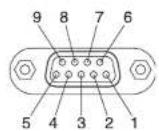
D sub 9 pin connector
| Pin No. | Signal Name | Description |
| 1 | DCD | Data carrier detect |
| 2 | RXD | Receiving data |
| 3 | TXD Sending data | |
| 4 | DTR Data terminal ready | |
| 5 | GND | Signal ground |
| 6 | DSR | Data set ready |
| 7 | RTS Request to send | |
| 8 | CTS Consent to send | |
| 9 | RI Ring indicator | |
Note
• Use a cross cable (not supplied) for RS232C control.
- Interface format
Header: #
Delimiter: CR (0x0Dh)
Command: 3 Byte (ASCII Character)
Parameter: Variable length
(If the command has a parameter, place a colon before the parameter.)
Header:
Delimiter CR (0x0Dh)
Command 3 Byte (ASCII Character, command echo)
Parameter Variable length
(If the command has a parameter, place a colon before the parameter.)
● Main Commands
| Item | Command |
| Power off | PON |
| Shutdown | PSD |
| Status display on | DON |
| Status display off | DOF |
Note
- Contact your dealer for control cable and other commands.
Specifications (Continued)
■ Pin assignment of COMPUTER 1 IN
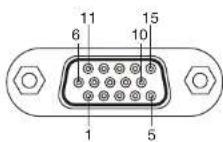
Mini D sub 15 Pin connector
| Pin No. | Pin description | |
| RGB Signal (analog) Y/Cb/Cr Signal | ||
| 1 Red Cr | ||
| 2 Green or Sync on Green Y | ||
| 3 Blue Cb | ||
| 4 Ground | ||
| 5 Ground | ||
| 6 Red Ground Cr Ground | ||
| 7 Green Ground Y Ground | ||
| 8 Blue Ground Cb Ground | ||
| 9 Nd Connection | ||
| 10 Sync Signal Ground | ||
| 11 Nd Connection | ||
| 12 Bidirectional Data (SDA) | ||
| 13 | Horizontal Sync or Composite Sync | |
| 14 | Vertical Sync | |
| 15 Data Clock | ||
■ Screen Trigger
When the projector is powered ON, the screen trigger output sends a low voltage trigger to the screen controller and the screen will go down. When the projector is powered OFF, the screen trigger stops sending a low voltage trigger to the screen controller and the screen will go up.
Note
• To use this feature, you must turn on the Screen Trigger function p.58
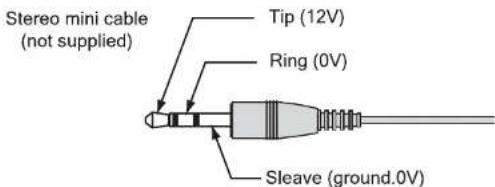
Note
• Screen controllers are supplied and supported by screen manufacturers.
- Do not use this jack for anything other than intended use. Connecting the wired remote control to the SC. TRIGGER Mini Jack causes damage to the remote control.
TOSHIBA CORPORATION

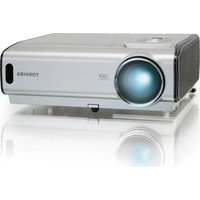
- SAFETY PRECAUTIONS
- MODEL NAME: TDP-WX5400 USA only
- IMPORTANT SAFETY INSTRUCTIONS
- Read Owner's Manual
- Power Sources
- Source of Light
- Ventilation
- Heat
- Water and Moisture
- Cleaning
- Power-Cord Protection
- Overloading
- IMPORTANT SAFETY INSTRUCTIONS (Continued)
- Lightning storms
- Object and Liquid Entry
- Do not place or keep the projector within the reach of the children.
- Do not place the product vertically
- Stack Inhibited
- Moving the projector
- Attachments
- Accessories
- Damage Requiring Service
- If glass components, including 23. Safety Check
- Servicing
- Replacement Parts
- Do not leave thermal-paper documents or easily deformed items on top of the unit or near the air exhaust for long periods of time.
- Do not use the product in a closed installation state.
- POWER SUPPLY INFORMATION
- IMPORTANT PRECAUTIONS
- Moisture Condensation
- Place and Manner of Installation
- IMPORTANT PRECAUTIONS (Continued)
- Avoid Volatile Liquid
- EXEMPTION CLAUSES
- OTHER INFORMATION
- Copyrights
- Disposal
- Trademarks
- Notational Conventions Used in This Manual
- REMOTE CONTROL BATTERIES
- Caution
- Notes
- CONTENTS
- Before Using
- Preparations
- Operations
- Maintenance
- Others
- Checking the package contents
- Note
- Save Original Packing Materials
- ◆ The Supplied CD-ROM
- ■ Adobe® Acrobat® Reader® or Adobe® Reader®
- ■ Viewing the Manual
- Introduction to the projector
- ■ Features you will enjoy:
- Names of each part on the main unit
- Name : Function
- Carrying the projector
- Names of each part on the control panel and remote control
- Control panel
- Remote control
- Names of the connector panel terminals
- Preparing and using the remote control
- ■ Loading dry-cell batteries
- into the remote control
- ■ Operating the remote control
- Operating a computer using the remote control
- ① Connecting a computer
- ② Operating a computer
- Placement
- Placement Styles
- WARNING
- Projection distance and size
- Connection
- Before connection
- Installing or removing the projection lens
- CAUTION:
- ■ Removing the lens from the projector
- ■ Installing the new lens
- Installing or removing the projection lens (Continued)
- ■ Securing the lens using the anti-theft screw
- Installing the optional color wheel (provided)
- ■ Storing unused color wheel
- Turning the power on and off
- Precaution
- ■ Power saving mode
- Basic operations
- Basic operations (Continued)
- ⑧ Adjusting the volume
- Using handy features
- ■ Using auto setting (computer input only)
- - Press the AUTOSET button.
- ■ Correcting the keystone distortion
- ● Adjusting Keystone distortion
- ② Use the ◀▶ buttons to adjust the keystone distortion.
- ■ Cutting off the picture and sound temporarily (Mute)
- - Press the remote control's MUTE button.
- ■ Changing picture mode
- ■ Changing screen size
- Using handy features (Continued)
- ■ Freezing the image (Freeze)
- Press the remote control's FREEZE button.
- ■ Setting the password
- ● How to set password (from [Off] to [On])
- ● How to operate when password is [On]
- ① Turn on the power.
- ② The lamp lights and the password entry screen appears.
- Enter the password using the arrow keys of the remote control. If the entered password is correct, the start-up screen appears and the projector goes into normal operation. If the password is wrong, a message will appear prompting you to re-enter the password, and the password entry screen is displayed again. If you enter an incorrect password for more than 5 times, the projector will automatically power off and enter standby mode.
- ● How to set password (from [On] to [Off])
- Select [Password] in the [Setting 2] menu and press Enter.
- ② Enter the password using the arrow keys of the remote control.
- Select [Off] and press Enter to disable the password.
- Using the Adjust menus
- ■ The Image adjustment menu
- The Setting 1 menu
- The White balance menu
- Using the Adjust menus (Continued)
- ■ The Advanced menu
- Using the Setting menus
- ■ The Setting 1 menu
- Using the Setting menus (Continued)
- ■ The Setting 2 menu
- Network settings
- ■ The Setting 3 menu
- Using the Status display screen
- ■ The Usage time screen
- ■ The Input screen
- Using the Status display screen (Continued)
- ■ The Network screen
- ■ The Version screen
- Operation using an HTTP browser
- Overview
- ■ Preparation before use
- ■ Handling of the address for operation by using a browser
- Example 1:
- Operation using an HTTP browser (Continued)
- ■ Configuring network settings
- DOMAIN
- TEST MAIL
- ■ Structure of the HTTP Server
- About the lamps
- Replacing the lamps
- Replacing the lamps (Continued)
- ■ Resetting the lamp hours counter
- Notes and Precautions
- ● About the lamp replacement message
- Lens and main unit cleaning
- ■ Lens cleaning
- ■ Main unit cleaning
- ■ Cleaning the filters
- Please clean filter.
- Replacing the filters
- ■ Resetting the filter time counter
- Trouble indications
- Before calling service personnel
- Specifications
- ■ Separately sold product
- Specifications (Continued)
- ■ Compatible input signal list
- ■ CONTROL terminal
- ● Pin assignment
- - Interface format
- ■ Pin assignment of COMPUTER 1 IN
- ■ Screen Trigger
Brand : TOSHIBA
Model : TDP-WX5400
Category : Vidéo-projecteur