
DVD 4626 IP - CD Player AEG - Free user manual and instructions
Find the device manual for free DVD 4626 IP AEG in PDF.


| Product Type | CD Player |
| Brand | AEG |
| Model | DVD 4626 IP |
| Playable Discs | CD, CD-R, CD-RW |
| Power Supply | AC 230V ~ 50Hz or 6x LR20 (D size) batteries |
| Power Consumption | 15 W |
| Dimensions (W x H x D) | 250 x 90 x 200 mm |
| Weight | 1.2 kg |
| Output Power | 2 x 1 W RMS |
| Frequency Response | 20 Hz - 20 kHz |
| Signal-to-Noise Ratio | ≥ 70 dB |
| Headphone Jack | 3.5 mm stereo |
| Radio Tuner | FM/MW (AM) with digital tuning |
| Programmable Tracks | Up to 20 tracks |
| Repeat Modes | One/All/Random |
| Display | LCD with backlight |
| Remote Control | Included |
| Cleaning | Use a soft, dry cloth; avoid solvents |
| Safety | Class II, double insulation |
| Accessories | AC power cord, remote control, user manual |
Frequently Asked Questions - DVD 4626 IP AEG
User questions about DVD 4626 IP AEG
0 question about this device. Answer the ones you know or ask your own.
Ask a new question about this device
Download the instructions for your CD Player in PDF format for free! Find your manual DVD 4626 IP - AEG and take your electronic device back in hand. On this page are published all the documents necessary for the use of your device. DVD 4626 IP by AEG.
USER MANUAL DVD 4626 IP AEG
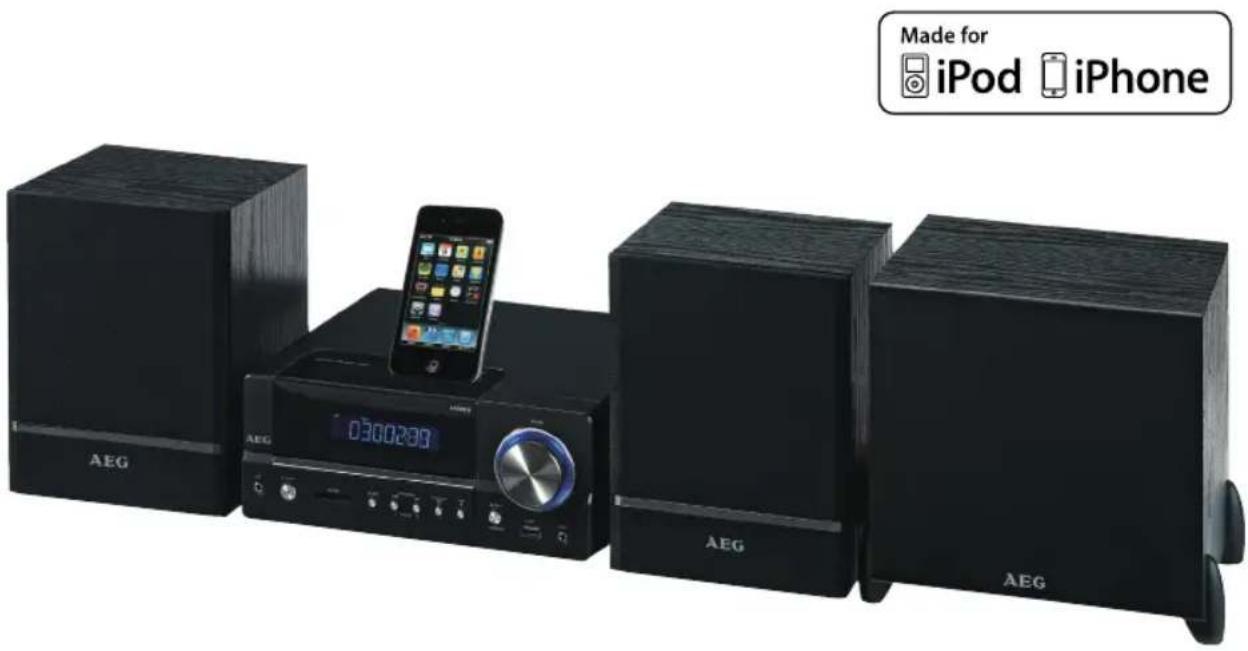
Music Center with DVD for iPhone/iPod
Overview of the components ......Page 3
Instruction Manual Page 38
Technical Data Page 40
Overview of the Components
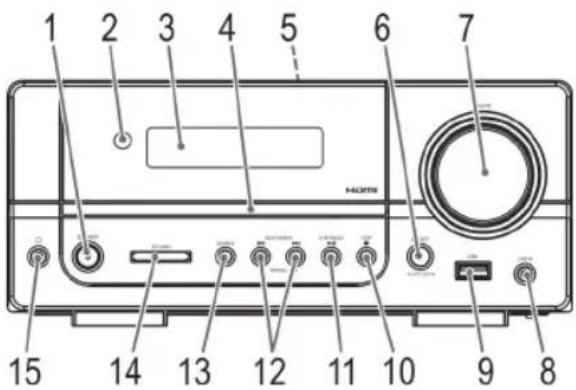
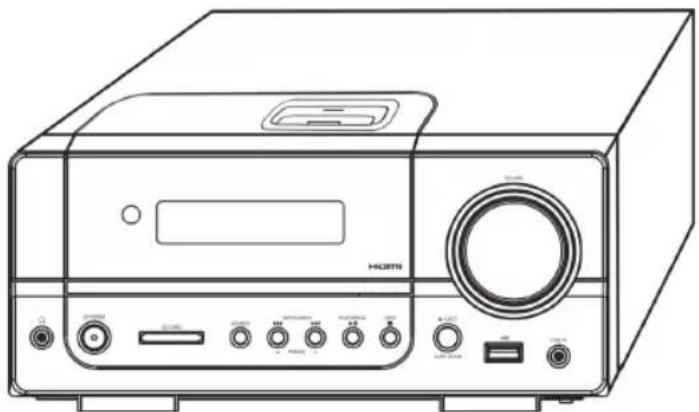
Fig. 1
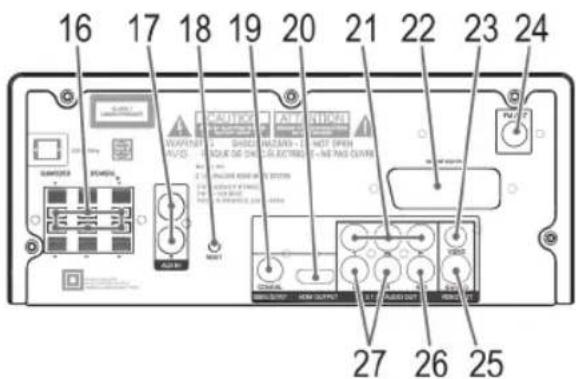
Fig. 2
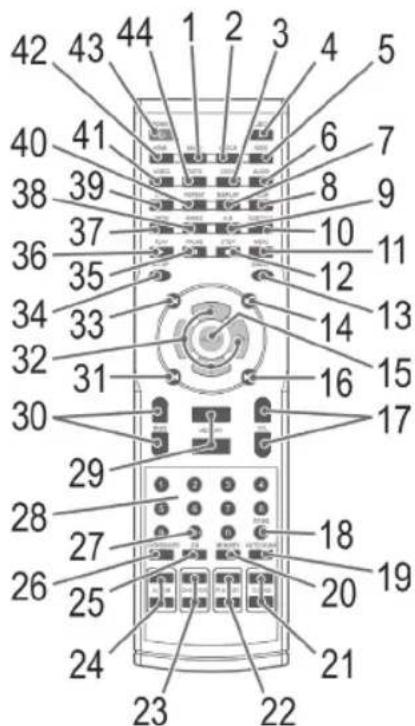
Fig. 3
Fig. 2/16
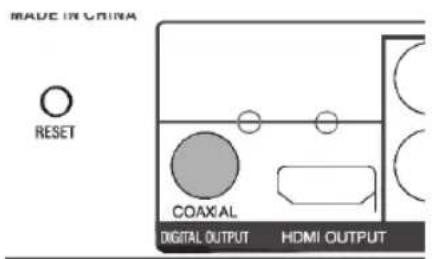
Fig. 2/19
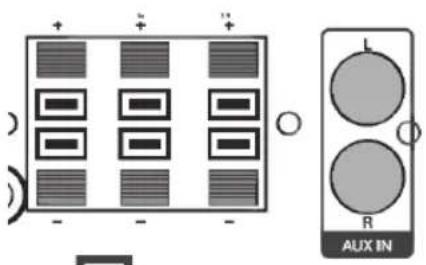
Fig. 2/17
AUX IN / LINE IN input
Fig. 2/24
Antenna input
1 Standby button (POWER) 2 IR Receiver 3 Display 4 CD/DVD tray 5 Docking port 6 "Open/Close / Automatic Station Scan" (▲ EJECT / AUTO SCAN) button 7 VOLUME control 8 LINE IN Audio input 9 USB interface 10 "Stop" (STOP ■) button 11 "Play/Pause" (PLAY/PAUSE▶II) button 12 "Forward/back / manual search" (SKIP/SEARCH ▶/TUNING +/-) 13 "Select function" button (SOURCE): To select from DVD/FM/iPOD and AUX
14 Memory card slot 15 Headset jack 16 Loudspeaker connections 17 AUX IN Audio input 18 "Reset" (RESET) button. Any malfunctions (e.g. unit does not respond) during use can be cancelled by pressing this button. 19 Digital Audio output 20 HDMI output 21 Component Video output 22 SCART output 23 Composite Video output 24 FM ANT antenna input 25 S-Video output 26 2.1 AUDIO OUT SUB Audio output 27 2.1 AUDIO OUT R/L Audio output
Remote (Fig. 3)
1 MUTE: To switch off the sound.
2 CLOCK: Sets the time.
3 ZOOM: To zoom in or out.
4 "▲" EJECT: To open or close the CD/DVD tray.
5 WIDE: Sets the screen display.
6 AUDIO: To change the Audio settings.
7 DISPLAY: To display the play status on screen.
8 SLOW: Slow motion. Continue playing the video with the "PLAY►" button.
9 A-B: To select the section to be repeated.
10 SUBTITLE: To show/hide sub-titles.
11 MENU: To display the main menu of the DVD/VCD.
12 STOP ■: Stop play.
13 SOURCE: For selecting between DVD/FM/iPOD and AUX.
14 ▶: Fast forward.
15 SELECT: Confirm the input.
16 ▶: To jump to the next chapter or song.
17 VOL+/-: To increase the volume/To reduce the volume.
18 MO/ST: In radio mode to toggle between stereo and mono.
19 AUTO SCAN: In radio mode to activate the automatic station scan. The stored radio stations are deleted.
20 MEMORY: In radio mode: for storing radio stations.
21 TUNING ▲/▼. In radio mode: for tuning in to /searching for a radio station.
22 PLAYLIST ▲/▼. To select the playlists of a docked iPod.
23 CHAPTER ▲/▼ To select the chapter of a docked iPod (if chapter is available).
24 ALBUM ▲/▼ To select the albums of a docked iPod.
25 EQ: Sets sound options.
26 DVD/SD/USB: USB / CARD / DVD switching.
27 10+: For selecting the chapters/tracks above 9. Pressing again increases by a further 10.
28 Numerical buttons: For direct selection of chapter or song number.
29 MEMORY: In radio mode, tune into the stored radio station.
30 BASS +/-: Adjust the bass. (Only in EQ FLAT mode.)
31: To return to the previous chapter or song.
32 Cursor buttons: Navigate in the screen menu.
33 ←: Fast reverse.
34 SETUP: To start the setup menu.
35 PAUSEII: Freeze the picture. Continue playing the video with the "PLAY" button.
36 PLAY▶: Start playback.
37 PROG: Call up the play list.
38 ANGLE: To select the viewing angle.
39 TITEL: To show the Playback-Control for VCD.
40 REPEAT: To repeat title, chapters, etc.
41 VIDEO: RGB/S-VIDEO/YUV selector.
42 HDMI: HDMI Select the definition.
43 "☐" POWER: To activate stand-by mode.
44 GOTO: For direct accessing of a section on the CD/DVD.
Technical data
| Type of equipment Music Center with DVD for iPhone / iPod | |
| Model DVD 4626 iP | |
| Voltage 110-240 V AC, 50/60 Hz | |
| Output 70 W | |
| Dimensions (W x H x D) 239 x 106 x 302 mm | |
| Weight (DVD Player) ca. 2.1 kg | |
| Laser Semiconductor laser | |
| Signal format PAL/NTSC | |
| Signal noise distance >=80 dB | |
| Video output 1.0 V (P-P) 75 Ω | |
| Analogue Audio output 2.0 V (rms) | |
| Y/Cb/Cr output (Y) 1.0 V (P-P), 75 Ω■ (Pb)/(Pr) 0.7 V (P-P), 75 Ω | |
| S-Video output | (Y) 1.0 V (P-P), 75 Ω(C) 286 mV (P-P), 75 Ω |
| Operating environment 0°C to 40°C, level bae | |
| Radio frequency range | 88 ~ 108 MHz |
| Compatible media | ■ DVD-Video (DVD Disc, DVD ±R/RW)■ MPEG-4 Video (from CD/DVD Disc, DVD±R/RW, CD-R/RW)■ Audio CD (from CD Disc, CD-R/RW)■ Video CD (from CD Disc, CD-R/RW)■ MP3 files (from CD/DVD Disc, DVD±R/RW, CD-R/RW) |
| Regional | 2 (=Europe, Greenland, South Africa, Egypt and Middle East, Japan) |
| Total Surround Sound | 150 W (PMPO) |
"Made for iPod" and "Made for iPhone" mean that an electronic accessory has been designed to connect specifically to iPod or iPhone and has been certified by the developer to meet Apple performance standards. Apple is not responsible for the operation of this device or its compliance with safety and regulators standards.
Please note that the use of this accessory with iPod or iPhone may affect wireless performance.
Table of Contents
Device parts 38
Remote control....39
Technical data....40
Safety instructions....42
Setting up and connecting....44
Starting up 45
About the DVD-Player 49
Playing media....50
Working in file mode 54
Changing the default settings....57
Radio Station Set-up 63
AUX IN (R/L) Input Sockets....63
Docking Port for iPod/iPhone 64 Troubleshooting 65 Disposal....66 Declaration of conformity 67 OSD Menu overview....67
Many thanks!
Thank you for choosing the Music Center DVD 4626 iP!
We would like to wish you much joy with your machine and thank you for your purchase!
Symbols in this operating manual
Important instructions for your safety are especially marked. You must follow these instructions to avoid accidents and damage to the machine:
WARNING:
Warns against dangers to your health and indicates potential risks of injury.
CAUTION:
Indicates potential hazards for the player or other objects.
i NOTE:
Highlights tips and information for you.
Manufacturer address
ETV
We reserve the right to make technical and design-related changes in the course of ongoing product improvements.

Safety instructions
Operating manual
Read the complete operating manual before using the player.
Keep the manual in a safe place. If you pass the player on to a third party, pass on the operating manual as well.
Non-compliance with this manual can lead to severe injuries or damage to the machine.
We assume no liability for damage caused as a result of non-compliance with this operating manual.
The player may only be used in households for private use. It is not suitable for commercial use.
Children
- Do not leave the machine unattended, and do not use it if children or persons who cannot assess the risk are nearby. Children or persons who cannot assess the risks are not allowed to use the player. Keep the player out of reach.
- Packaging material must not be used to play with. There is a risk of suffocation.
Power supply
The machine is operated with electrical current, which means there is in principle a risk of electric shock. For this reason, pay particular attention to the following:
■ Never touch the plug with wet hands. If you want to pull the plug out of the plug socket, always pull directly on the plug. Never pull on the cable as it could tear. ■ Make sure that the power cable is not bent, caught or run over and that it does not come into contact with heat sources. ■ Make sure that the power cable is not wrapped around the device when in use. - Never place the machine on the power cable while it is being operated. - Only use extension cables that are designed for the power consumption level of the machine. - Keep the appliance away from rain and any moisture. - Only operate the machine if the electrical voltage stated on the type plate agrees with the voltage on your plug socket. The wrong voltage can destroy the machine. - Do not stand vases etc. on the appliance. Water could seep into the appliance. ■ Do not open the appliance. - Pull out the mains plug if the appliance is not to be used over a longer period of time. ■ Take care that nobody can trip over the power supply cable.
Laser
This appliance is classified as a Class 1 laser appliance (CLASS 1 LASER). The associated label is attached to the outside of the appliance. Laser beams can damage the eyes. Therefore, observe the following:
- Do not open the appliance. Do not attempt to dismantle the appliance. To avoid any danger, have service work carried out only by the manufacturer or an authorized service workshop.
Transport
Where to position the appliance
To avoid damage to the DVD, you should remove it before transporting the appliance. ■ Never move the machine when it is in operation.
Safe operation of the appliance presupposes that it is positioned in an appropriate place. Therefore, observe the following:
- Protect the appliance against the influence of weather. Never use it in the open air. ■ Protect the appliance against moisture.
- Do not place liquid-filled vessels, e.g., vases, on the device. ■ Never place the appliance on or in direct vicinity of heat sources, such as hobs, ovens, etc.
- Do not expose the appliance to direct sunlight. Place the appliance so that sufficient air supply is assured. This is to avoid a build-up of heat inside the appliance. Make sure that the ventilation slots are not blocked. ■ Protect the appliance against mechanical vibrations.
- Stand the appliance on a solid base so that it cannot drop down.
- Protect the remote control against weather influences, moisture, and high temperatures (e.g., by direct sunlight).
Operation
The player is able to show a still image on the TV screen/monitor over an unlimited period of time. This can cause damage to the screen. It is therefore advisable to activate the screen saver (see page 58, "General Setup"). Do not increase the volume when the player is playing very quiet sections. This could damage the speakers if very loud passages start suddenly after the quiet section. Do not move the player with a DVD inserted. This could damage the DVD. Do not put your hands into the DVD slot. You could be injured. Place only DVDs or CDs on the DVD tray, as otherwise the player may be damaged. ■ Disconnect the mains plug if the unit is not in use for long periods. Please disconnect the mains plug during thunderstorms.
Intended use
The DVD player is intended solely for the following tasks:
■ Playing Video DVDs and Video CDs. ■ Playing Audio CDs. ■ Receiving radio programs.
■ Reproducing sound from external sources.
Any other use is considered improper and is prohibited.
Defects
If the device should become defective at some point:
If the power supply cable for this appliance is damaged, it must be replaced by the manufacturer or its customer service to avoid hazards. If fluid has seeped into the player, or if the player has been dropped or damaged in any other way, it must be examined by an authorized dealer. Disconnect the player from the power supply and consult an authorized dealer.
Setup and connection
Unpacking
Unpack the appliance and all accessories and check that the contents are complete.
CAUTION:
Always transport or send the player in its original packaging to prevent damage. Keep the packaging for this purpose. Dispose of unnecessary packaging material in accordance with the regulations applicable in your country.
NOTE:
Contact your dealer immediately if you notice transport damage.
Setup
- Place the unit and speakers on a stable, horizontal and level surface. Keep a distance of at least 10 cm from walls and objects.
- Connect the device to a properly installed power socket.
Setting up the Loudspeakers
i NOTE:
Do not insert the plug of the DVD player into the socket until all loudspeakers and connections have been correctly made!
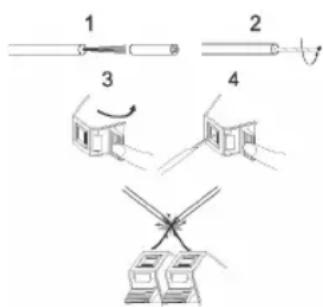
- Remove approximately 1.5 cm of the cable insulation.
- Turn over the cable end.
- Open the cable clamp by pressing the lug.
- Now connect the ends of the cables to the corresponding terminals of the unit. Ensure the correct polarity.
i NOTE:
- Please ensure that exposed wires do not touch or cross each other. Danger of short-circuiting! The subwoofer can be positioned anywhere in the room since the deep tones cannot be localized by the human ear.
Starting up
Remote control battery installation
WARNING:
Leaking out battery acid can damage your health. Remove the battery from the battery compartment as soon as it is exhausted or if the remote control is not going to be used for a longer period of time. Wipe up leaked out battery acid with a cloth. In case of skin contact immediately wash the affected area. Seek medical advice if battery acid has been swallowed. In case of contact with your eyes wash out the eyes and seek medical advice.
△ CAUTION:
Mismatching battery types or new and used batteries must never be used together. Different battery types have different properties. Do not use old and new batteries together. When disposing of old batteries you should strictly comply with the legal and environmental regulations applicable in your country. Do not throw batteries into fire!
i NOTE:
The lifetime of the enclosed batteries may be shortened because of storage.
- Open and remove the battery compartment cover.
- Insert two batteries of type AAA/R03 (1.5 V), ensure correct polarity (+ and -). Start with the negative pole (-).
- Attach and close the battery compartment cover.
i NOTE:
The signals from the remote control are transmitted to the DVD-Player by infrared light. You should therefore take care that the DVD-Player is not exposed to the direct sunlight. This could make the transmission of signals from the remote control to the DVD-Player impossible.
Effective range of the remote control
If you want to use the remote control it has to be pointed at the remote control sensor on the front of the device. The distance between remote control and sensor should not exceed 7 m. The angle of the remote control to the remote control sensor to right, left, top and bottom should not exceed 30°.
Audio-/Video cords
i NOTE:
An undisturbed operation can be guaranteed only with Audio/Video lines up to 1.5 m length.
Connecting the Video cable
The video cable transmits the video data from your DVD player to the TV or the video projector.
There are five different ways of connecting the DVD player with your TV/video projector. Select one of these possibilities to suit your playback unit.
NOTE:
If you are not using a SCART or HDMI connection, you must always establish an additional audio connection for transmitting the audio data (i.e., the sound).
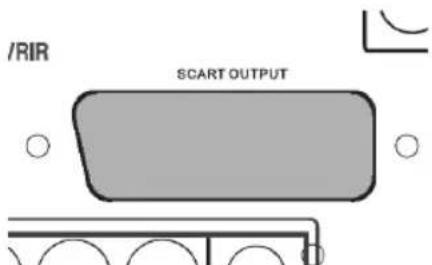
Fig. 2/22
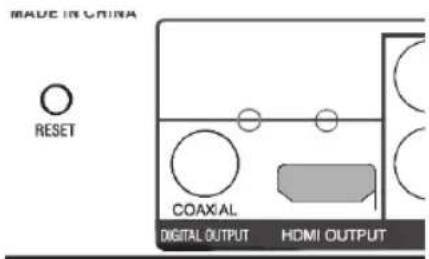
Fig. 2/20
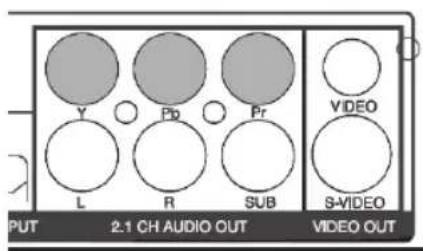
Fig. 2/21
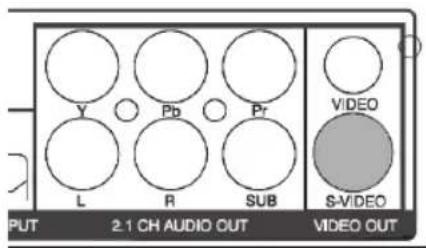
Fig. 2/25
NOTE: For iPod or iPhone video playback
If you also want to play videos from your iPod or iPhone via the docking port, please note that the picture is only displayed via the SCART and S-VIDEO connection.
SCART
SCART is used to transmit both video and audio data.
- Plug the SCART jack firmly into the socket on the back of the player.
- Plug the SCART jack into the corresponding socket on your playback device.
HDMI
Connection using a HDMI cable ensures a very high replay quality.
HDMI is used to transmit both Video and Audio data.
- Plug the HDMI jack into the socket on the back of the player.
- Plug the HDMI jack into the corresponding socket on your playback device.
Component Video
Connection using a Component Video cable ensures a very high replay quality.
Component Video transmits only Video signals.
- Plug each of the three jacks into the corresponding sockets on the DVD-Player.
- Plug the jacks into the corresponding socket on your playback device. Select "Component" from the menu "Video Setup Page". Here you can change the settings "S-Video", "YUV and "RGB" on the playback device that you have connected. Please see the operating instructions of the connected device for the correct setting.
S-Video
Connection using a S-Video cable ensures a very high replay quality.
Component Video transmits only Video signals.
- Plug the S-Video jack into the socket on the back of the player.
- Plug the S-Video jack into the corresponding socket on your playback device.
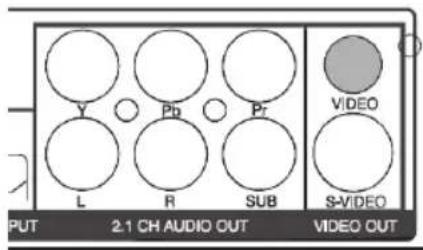
Fig. 2/23
Connecting the Audio cable
Composite-Video
Composite-Video is used to transmit video data.
- Plug the Composite-Video jack into the socket on the back of the player.
- Plug the Composite-Video jack into the corresponding socket on your playback device.
You can choose from three transmission methods for audio signals.
You must generally choose first whether you would like to have the sound coming from your TV, or through a Stereo or 2.1-Amplifier. The Audio cable must then be connected to the TV or an amplifier accordingly.
i NOTE:
If your amplifier is equipped with a digital output, you should use the amplifier. You will experience a much better audio quality, and the installation is much easier.
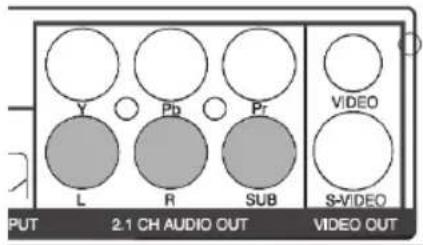
Fig. 2/26, 27
Stereo
Connect both Audio cables for the right and the left speakers to your playback device or your amplifier.
- Plug the Audio jacks into the sockets on the back of the player (R/L). Plug the audio cable for the subwoofer into the (SUB) jack on the back of the unit.
- Plug the Audio jacks into the corresponding sockets on your playback device or your amplifier.
i NOTE:
The 2.1 CH AUDIO OUT outputs are fixed and are not affected by the volume control of the Music Center.
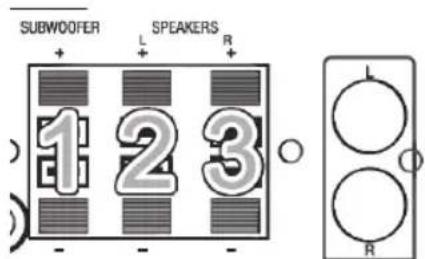
2.1 Audio signal (Connecting the Supplied Loudspeakers)
Connect the SPEAKERS/SUBWOOFER connection on the rear of the DVD player to the corresponding connections on the rear of each loudspeaker.
Proceed as follows:
- Connect the end of the cable to the socket on the rear of the device. Ensure the correct configuration:
- (1) Connection for Subwoofer: Bass
- (2) Front left speaker
- (3) Front right speaker
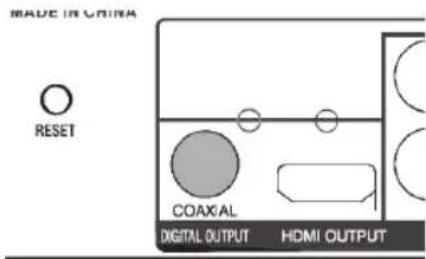
Digital
Connect the coaxial cable for transmitting digital audio signals to your playback device or amplifier.
- Plug the audio jack into the socket on the back of the player.
- Plug the Audio jack into the corresponding socket on your playback device or your amplifier.
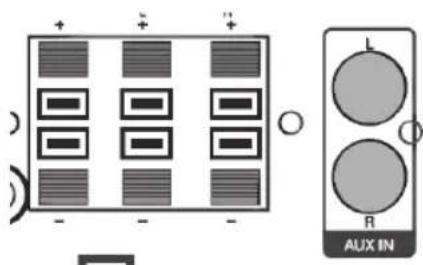
Fig. 2/17
AUX IN / LINE IN- Input
There are two options for connecting an external audio device to the Music Center:
Connect the two audio leads for the right-hand and left-hand sound channel to your output device.
- Insert the audio plugs into the socket on the rear of the device.
- Insert the audio plugs into the corresponding sockets of your output device.
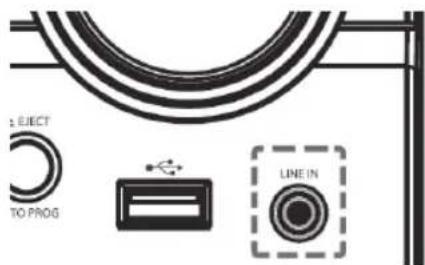
Fig. 1/8
Connect your output unit using a 3.5 mm stereo TRRS connector.
- Plug a 3.5 mm TRRS connector into the jack on the front of the unit.
- Plug the other end of the TRRS connector cable into the corresponding jack on your output unit.

NOTE:
If you have connected an external unit to both inputs, playback from the LINE IN jack (Fig. 1/8) is preferred.
Antenna connections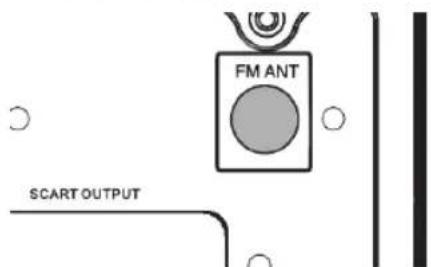
Fig. 2/24
Antenna Input
This device has a built-in FM radio receiver.
■ FM reception:
Connect the cable of your antenna system to the FM socket on the rear of the device.
Inputs on the Front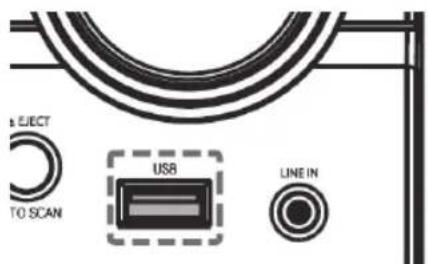
Fig. 1/9
USB Input
Insert a USB storage medium directly into the corresponding socket of the device.
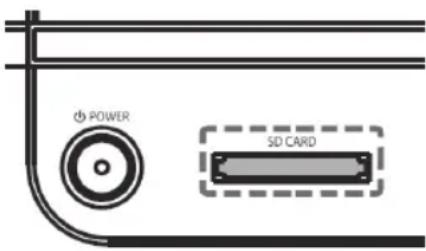
Fig. 1/14
Set the time
Switching on the receiver
Inserting a memory card (on the left side of the unit)
Insert a MMC/SD or MS memory card into the card slot on the left side of the unit.
- Press the CLOCK button in standby mode (Fig. 3/2).
The popup ____ : ____ appears on the display.
- Enter the time using the numerical buttons (Fig. 3/28).
- Confirm your input with the SELECT button (Fig. 3/15).
Press the STANDBY button on the unit (Fig. 1/15) or on the remote control (Fig. 3/43) to switch on the unit.
About the DVD Player
With this DVD player you can play a vast variety of DVD formats (see page 40, "Technical data").
However, you must be aware that in many cases DVDs are encrypted with a so-called "Regional Code". This specifies for which region in the world the DVD is intended. As an example, DVDs marked with regional code "1" are intended for the USA and Canada. DVDs with regional code "2" are for use in Europe.
Note:
With your DVD player you can only play DVDs with regional code "2". There are both many burning and compressing methods as well as high quality differences in (burned) CDs/DVDs. Moreover, the music industry has not yet agreed on a fixed standard for copy protection. This may, in very isolated cases, result in problems when playing CDs, DVDs, and MP3 CDs. This is not a malfunction of the player.
Furthermore, there may be isolated problems when playing CDs or DVDs that were created on a PC (e.g., holiday photographs). In case of problems, check the settings of the DVD writing program on your computer. You should in particular make sure that the DVD has been finalized. For further information on this matter, please refer to the operating manual of your recorder.
Input Not Possible
If a function or input selected by you is not possible, the adjacent symbol is shown on the screen.

Terminology
Track: "Track" is the designation for sections on an Audio-CD. This may be a song, the set of a symphony, etc. ■ Title/Chapter: Video-DVDs are divided into "Title" and "Chapters". A "Title" may be e.g. a particular film, the "Chapters" may be subsections of this film. ■ HDMI: High Definition Multimedia Interface is an interface for transmitting high-resolution digital video data and digital audio data. ■ MPEG4: Your DVD player is also suitable for playing back files that have been compressed using the MPEG-4 system (short for Moving Picture Experts Group-4). MPEG-4 is a compression method by means of which large quantities of data can be reduced without any noticeable loss of picture and sound quality.
NOTE:
It is not possible to guarantee full compatibility with all of the compression methods used worldwide, particularly when more than one soundtrack or subtitles are involved. Also MPEG 4 files with integrated special functions such as a menu, subtitles etc. are not always supported. This is no malfunction of the player.
Using the remote control
Playing media
You transmit commands to the DVD-Player via remote control. It is thus important to point the end of the remote control towards the DVD-Player.
NOTE:
If the device is not yet in DVD mode, press the SOURCE (Fig. 3/13) button on the remote control repeatedly until "DVD" appears in the display.
Loading a CD/DVD
- Press the remote control button EJECT▲ (Fig. 3/4). The CD/DVD tray opens.
- Place the CD/DVD on the tray.
- Press the remote control button EJECT ▲ (Fig. 3/4) again. The CD/DVD tray closes. The display (Fig. 1/3) first shows "LOAD". After a short while the type of the loaded medium is displayed (e.g. "DVD").
Understanding the onscreen CD-menu
When playing CDs the following status information is displayed on screen:
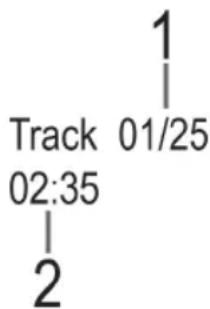
■ Current track/total number of tracks (1). Time (2): This provides information about the duration and the remaining play time. By standard the play time expired of the current track is displayed. The playing time is displayed in minutes and seconds. Press the DISPLAY button (Fig. 3/7) once or several times to have further times displayed. The following possibilities are available for selection - time remaining to the end of the track, - playback time of the CD so far, - time remaining to the end of the CD.
Understanding the onscreen DVD-menu
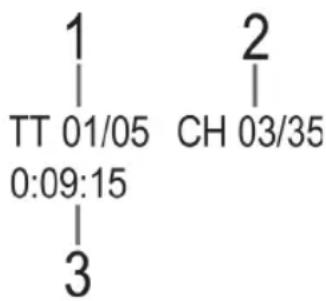
When playing DVDs you can view the on-screen menu by pressing the DISPLAY button (Fig. 3/7).
DVD menu
■ Current title/total number of titles (1). ■ Current chapter/total number of chapters (2). Time (3): This provides information about the duration and the remaining play time. By default, the play time elapsed for the current title is displayed. The display is in hours, minutes, and seconds. Press the DISPLAY button (Fig. 3/7) once or several times to have further times displayed. The following options are available for selection: - time remaining to the end of the title, - elapsed playing time of the chapter, - time remaining to the end of the chapter. - Display off.
Starting playback
- Place the CD/DVD on the CD/DVD tray => Page 50, "Loading a CD/DVD".
- Press the "PLAY ▶" button (Fig. 3/36) on the remote control.
NOTE:
If playback does not start or the playback quality is poor, you should check the default settings of the DVD player.
Interrupting playback
- Press the "PAUSE II" button (Fig. 3/35) on the remote control. Playback is interrupted, and the currently visible image is "frozen".
- Press the "PLAY ▶" button (Fig. 3/36) on the remote control to restart "normal" playback.
Changing audio language
Press the AUDIO button (Fig. 3/6) several times to change the audio language. The available audio languages depend on the DVD.
Showing subtitles
Press the SUBTITLE button (Fig. 3/10) to display the current subtitle status. Press the button several times if you would like to activate or deactivate the subtitle function or if you want to choose a different subtitle language. The available subtitle languages depend on the DVD.
Stopping the replay
- Press the "STOP" button (Fig. 3/12) during replay. The replay stops. Press the "PLAY ▶" button (Fig. 3/36) again to continue the replay from the last position. Press the "STOP" button (Fig. 3/12) twice to stop the replay completely. Press the "PLAY" button (Fig. 3/36) again to replay the CD/DVD from the beginning.
Selecting previous chapter/track
Press the button (Fig. 3/31) to jump to the start of the previous chapter or track.
| Selecting next chapter/track | Press the button (Fig 3/16) to jump to the start of the next chapter or track. |
| Selecting track directly | Enter the number of the desired chapter/track with the Numerical Buttons on the remote control (Fig. 3/28).Replay of the chapter/track starts after a short while. |
| Accessing a section via menu | The on-screen menu enables comfortable access to any sections of a medium. To do this, proceed as follows:1. Press the GOTO button repeatedly (Fig. 3/44). The GOTO menu appears on the screen.2. Select the desired option using the Cursor Buttons (Fig. 3/32).3. Now move to the point from which the replay should start. Depending on the type of medium this may be a track number, a chapter or even a point in time. The input must be made with the Numerical Buttons (Fig. 3/28). Playback begins after a short time. |
| Repeating DVD-title/chapter | 1. Choose the chapter or title to be repeated.2. Press the REPEAT-button (Fig. 3/40). The message "Chapter" appears on the screen.3. Press the REPEAT-button again, until the message "Title" or "All" is displayed. |
| Repeating track on CD | 1. Select the track to be repeated.2. Press the REPEAT-button (Fig. 3/40). The message "Track" appears on the screen. |
| Repeating CD | Keep pressing the REPEAT-button (Fig. 3/40), until the message "All" is displayed on screen. |
| Stopping repeat | Press the REPEAT (Fig. 3/40) repeatedly until the message disappears from the screen. |
| Selecting a section to be repeated | You can define a freely selected section to be automatically repeated.To do this, proceed as follows:1. Mark the beginning of the section to be repeated. During repetition press the button A-B (Fig. 3/9) on the remote control once. The message "A" appears on the screen.2. Mark the end of the section to be repeated by pressing the A-B-button on the remote control once again. The message "A B" appears on the screen. The previously marked section is now repeated.Press the A-B-button again to stop the repetition. |

On MP3 CDs, the section to be repeated must be within a track.
| Using the DVD-menu | Normally each DVD has its own menu. Here you can choose chapters, make settings, etc. This menu is specific for the DVD and can thus not be explained in detail.Press the MENU-button (Fig. 3/11), to access the DVD-menu. Use the Cursor Buttons (Fig. 3/32) to navigate in the Menu. Press the SELECT button (Fig. 3/15) to confirm.If you are in a menu area for direct chapter selection, you can enter the number of this chapter with the Numerical Buttons (Fig. 3/28) on the remote control. |
| Using fast forward or reverse | The DVD-Player has a fast forward and a fast reverse feature.1. Press the ▶ (Fig. 3/14) or.◀ button (Fig. 3/33) to start fast forward or fast reverse. The current replay direction and the speed, e.g. ▶2x" is now displayed on screen.2. Press the ▶ or.◀ button several times in order to change the speed. The speed can be accelerated by factor 2, 4, 8, 16 or 32.3. Press the "PLAY ▶" -button (Fig. 3/36) to restart the "normal" replay when the desired section is reached. |
| Enlarging a screen section | You can change the screen section when viewing DVDs, VCDs or images.Press the ZOOM-button (Fig. 3/3) to change the screen section.Press the button several times to select the suitable zoom factor or to return to the original zoom factor. |
| NOTE:Use the Cursor Buttons (Fig. 3/32) to navigate in the picture you have zoomed into. | |
| Changing the viewing angle | Some DVDs offer the possibility to select the viewing angle.Press the ANGLE-button (Fig. 3/38) to change the viewing angle. |
| NOTE:If changing the Viewing Angle is not possible, the message "∅ will be displayed. | |
| Repeat pressing the button to choose a different viewing angle, or to return to the original viewing angle. | |
| Adjusting the volume | Press the VOL + button (Fig. 3/17) to increase the volume.Press the VOL - button (Fig. 3/17) to reduce the volume. |
| NOTE:Please remember, that this will only change the output volume of the DVD-Player. In order to adjust the volume to your requirements you may also have to change the volume of the playback device. |
- Press the ▶ (Fig. 3/14) or ◀ button (Fig. 3/33) to start fast forward or fast reverse. The current replay direction and the speed, e.g. "▶2x", is now displayed on screen.
- Press the ▶ or ◀ button several times to change the speed. The speed can be accelerated by factor 2, 4, 8, 16, or 32.
- Press the "PLAY ▶" button (Fig. 3/36) to restart the "normal" replay when the desired section is reached.
i NOTE:
i NOTE:
i NOTE:
Creating a playlist (CD/DVD)
CD:
Exit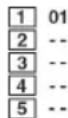
Start Next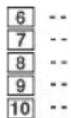
DVD:
Exit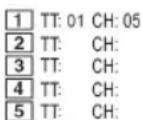
Start Next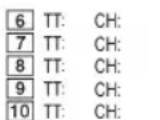
Deleting a playlist (CD/DVD)
Using CD/DVD
You may want to replay the titles, e.g. on a CD, in a different order to the order determined by the producer. With the function "Create Playlist" you can create your own playing order.
To do this, proceed as follows:
- Press the PROG button (Fig. 3/37). A table is displayed. Here you can enter the desired order of the tracks (in the case of CDs) or chapters/titles (for DVDs).
i NOTE:
However, your playlist will be lost when switching off the DVD player or when inserting a new CD/DVD.
- Use the cursor buttons (Fig. 3/32) to navigate in the table.
- Enter the desired track (in the case of CDs) or the desired title and chapter (for DVDs) at the appropriate position in the table. Use the numerical buttons (Fig. 3/28) for this purpose. If you want to enter numbers higher than 9, first press the 10+ button (Fig. 2/27).
- Use the cursor buttons (Fig. 3/32) to select the command "Start" at the bottom of the screen to save the input.
- Press the SELECT button (Fig. 3/15) on the remote control to confirm this command.
- Press the PROG button. You will now see a table (Fig. CD or Fig. DVD).
- Use the cursor buttons (Fig. 3/32) to navigate to the "Stop" command at the bottom of the table.
- Press the SELECT button (Fig. 3/15) on the remote control to confirm this command.
- Press the PROG button to end this procedure.
Working in file mode
In addition to playing back "normal" films or music from CDs/DVDs, this DVD player can also play back video or audio files from CDs or DVDs that are stored in the file system. Such media are often available if you create CDs of digital photos or MP3 music on your computer.
Note:
If the device is not already in DVD mode, press the SOURCE button (Fig. 3/13) on the remote control repeatedly until "DVD" appears in the display.
- Place the CD or DVD on the tray (see page 50, "Loading a CD/DVD").
- Select the desired file(s) and start playback (see page 56, "Selecting file/directory and starting playback").
Using a memory card
You can use the following memory cards:
SD Card, Multi Media Card, Memory Stick
- Insert the memory card into the card reader (Fig. 1/14).
- Press the DVD/SD/USB button (Fig. 3/26) on the remote control to switch the DVD player to file mode.
- Select the desired file(s) and start playback => Page 56, "Selecting file/directory and starting replay".
- If you want to switch back to DVD mode, press the DVD/SD/USB button again (Fig. 3/26).
i NOTE:
To find out which playable files are available, the DVD player now searches the content of the storage device. This process may take some time for large storage devices. During this time you will see the status report "Waiting..." on the screen. If you have also connected an output unit to the USB port, its content is firstly displayed. Press the DVD/SD/USB button again (Fig. 3/26) to display the content of the memory card. The file mode can only be selected if the unit is in DVD mode.
Using a USB medium
By means of the USB connection you can connect numerous devices to the DVD Player. Examples of such devices are USB memory sticks or digital cameras.
This device has been developed in accordance with the latest technical developments in the USB field. Unfortunately the large number of different types of USB storage media on offer today makes it impossible to guarantee full compatibility with all USB storage media. For this reason there may be problems in rare cases with playing back from USB storage media. This is not a malfunction of the device.
- Insert a USB storage medium into the corresponding connection of the DVD player (Fig. 1/9).
- Press the DVD/SD/USB button (Fig. 3/26) on the remote control in order to switch the DVD player to the file mode.
i NOTE:
In order to find out which files can be played back the DVD player now reads the contents of the storage medium. In the case of large storage media this procedure may take a long time. During this time you will see the words "Waiting..." on the screen. The file mode can only be selected if the device is in DVD mode.
- Select the desired file(s) and start playback => Page 56, "Selecting file/directory and starting replay".
- If you would like to return to DVD mode, press the DVD/SD/USB button (Fig. 3/26) again.
Selecting file/directory and starting replay
Media may contain numerous data/files and directories. You must therefore first determine the data to be played.
- If this has not yet been done, insert the CD or DVD into the drive. Alternatively insert a memory card or USB storage device.
- A menu window appears in which the directories (if directories are available) or the files are listed.
- Use the Cursor buttons (Fig. 3/32) to select the desired directory or file from the list.
- Select this by pressing the SELECT button (Fig. 3/15).
File: Once you have selected a file, this is now displayed directly or played back.
Directory: If you have called up a directory, a list of files now opens.
Here too you can select the desired file with the Cursor buttons and the SELECT button (Fig. 3/15). If you have selected a file, this is now displayed or played back.
Please note:
There are both lots of burning and compressing methods as well as high quality differences in CDs/DVDs and burned CDs/DVDs.
For this reason there may occasionally be problems when files are played back (for example files are displayed but cannot be played back). This is no malfunction of the player.
i NOTE:
- With the "◀" button (Fig. 3/32) you can return from the files to the directories. By pressing the PROG (Fig. 3/37) button you can move between the file list and the directory view. In the directory view only the titles in the selected directory are played.
Stopping the replay
Press the "STOP ■" -button (Fig. 3/12) on the remote control to stop the replay.
Viewing pictures
The DVD player is suitable for displaying your digital photographs. These photos may be stored on any medium (DVD, CD, etc.) supported by the DVD player.
i NOTE:
Please ensure a suitable size of the photos. Large size photos may take some time to be displayed or may not be displayed at all. It is of advantage if the size of the photo corresponds with the screen size of the playback device. For TVs this is normally 1024x576 pixel (TV-aspect 16:9) or 768x576 (TV-aspect 4:3). Please note that any conversion generally involves a loss of data with respect to the original format.
Start the replay of photos by selecting the file from which the replay shall start → Page 56, "Selecting file/directory and starting replay".
i NOTE:
After a few seconds a preview picture appears on the right-hand side in the two-column menu window.
Scrolling
■ Manual: Press the ◀◀ (Fig. 3/31) or ▶▶ button (Fig. 3/14) on the remote control to scroll forward or back. - Interrupt scrolling: Press the PAUSE II button (Fig. 3/35) in order to interrupt the automatic picture change. Press the PAUSE II button again in order to resume picture playback.
Rotating a photo
You can use the Cursor buttons to rotate a photo during replay:
■ Mirror vertically: Cursor Button "▲" ■ Mirror horizontally: Cursor Button "▼" ■ Rotate clockwise for 90°: Cursor Button ▶" ■ Rotate counter-clockwise for 90°: Cursor Button "◀"
Fade
Whilst playing back the picture you can select from various fade effects by repeatedly pressing the button PROG (Fig. 3/37).
Changing the default settings
A large number of default settings can be comfortably changed via the screen menu.
Press the SETUP button (Fig. 3/34) on the remote control to start the menu for changing the default settings.
NOTE:
Many of these default settings can be changed via both the remote control and the menu. The difference is: If you change the default settings via the remote control, these changes will only be valid until the DVD player is switched off or the DVD is changed.
However, any changes made in the menu are permanent.
Understanding the menu structure
The Setup menu has two menu levels:
■ Main menu: The main level is shown at the top edge of the screen by means of generic terms. Sub-menu: The corresponding sub-menu options can be found under each of the main menu options.
Using the menu
| General | Audio | Dolby | Video | Preference |
| -- Preference Page -- | ||||
| TV Type | PAL | |||
| Audio | Auto | |||
| Subtitle | NTSC | |||
| Disc Menu | ||||
| Parental | ||||
| Default | ||||
Overview of the main menu
General Setup
| General | Audio | Dolby | Video | Preference |
| -- General Setup Page -- | ||||
| TV Display | Normal/PS | |||
| Angle Mark | Normal/LB | |||
| OSD Lang | Wide | |||
| Screen Saver | ||||
| Last Memory | ||||
Navigation and selection
Use the Cursor Buttons (Fig. 3/32) ▶/▶ on the remote control to browse through the main menu. In contrast to this, you must use the Cursor Buttons (▲/▼) to move in the sub-menu. ■ Select a menu option with the SELECT button (Fig. 3/15). Use the SELECT button also to select an option (e.g. "PAL" in the illustration on the left). The selected option (in the example "PAL") is now highlighted. To return to the submenu or main menu, press the Cursor Button ◀.
Slide control
In some menus you will find slide controls with which you can adjust the volume or picture brightness, for example. The slide control is used as follows:
- Select with the SELECT button.
- Move the control with the Cursor Buttons (▲/▼).
- Confirm the entry with the SELECT button.
GENERAL = General Setup ■ AUDIO = Audio Setup Page ■ DOLBY = Digital Setup Page ■ VIDEO = Video Setup Page ■ PREFERENCES = Preference Page
NOTE:
Some of the menu settings are only available in stop mode (depending on the DVD).
TV Display
Here you can adapt the output of the DVD player to the TV aspect.
Concerning the background: If you do not have a wide screen TV, the TV aspect will be 4:3. However, most feature films have an aspect of 16:9, so the image is too wide for the TV screen.
Here you can specify how the replay of the film is to be adapted to the playback device:
■ Normal/PS: You will only see the middle section of the film. The borders will be cut off. Normal/LB: You will see the complete width of the film. The film is thus reduced in size, whereby black bars appear below and above the film. 16:9: Select this option if you use a wide screen TV for replay. Please note that films that have been recorded with TV aspect 4:3 can still be replayed using aspect 4:3. This means that replaying this film will not require the complete wide screen area of the television.
NOTE:
The setting "Normal/PS" is not supported by all DVDs. ■ You can also toggle between the options using the WIDE button (Fig. 3/5).
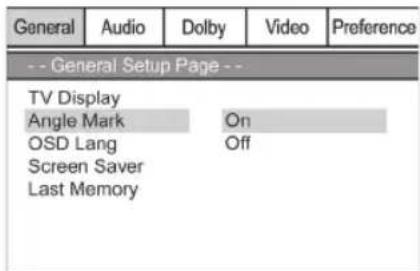
Angle Mark (Camera Angle)
If the DVD contains sequences recorded from different camera angles, you can use the ANGLE button (Fig. 3/38) to select the various camera angles. This function is only available if the DVD contains scenes with various camera angles.
Before you can use this function it has to be activated.
■ On: The angle symbol is shown on the screen. ■ Off: No angle symbol is shown on the screen.
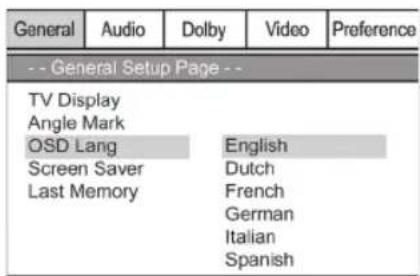
OSD Language
Here you can select the language of the on-screen displays.
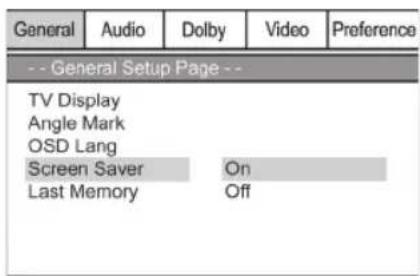
Screen saver
The player is able to display a still image for any time on the screen. This can cause damage to the screen. It is therefore recommended to activate the screen saver.
The following options are available:
- On: The screen saver is activated (default setting). ■ Off: The screen saver is deactivated.
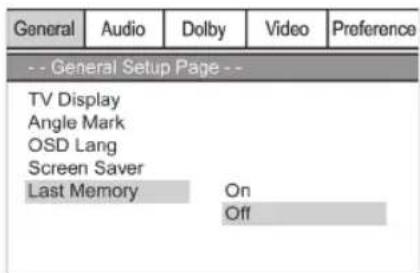
Last Memory
This feature activates the recognition function of the DVD player.
On: if the device is switched of during playback, or if the DVD is changed, the device stores the position at which playback was interrupted. ■ Off: playback begins again at the beginning of the medium.
i NOTE:
This feature is not supported by all DVDs.
Audio Setup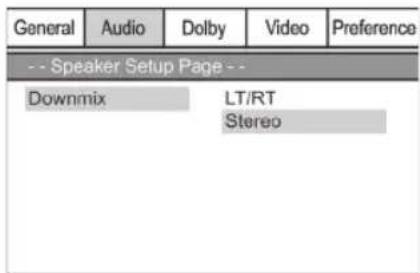
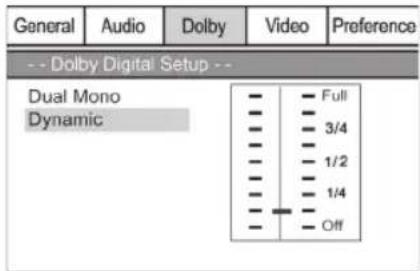
Dolby Digital Setup
| General | Audio | Dolby | Video | Preference |
| -- Dolby Digital Setup -- | ||||
| Dual Mono Dynamic | Stereo L-Mono R-Mono Mix-Mono | |||
Speaker Setup
Downmix
Change the characteristics of the speaker output:
■ LT/RT: Choose this setting if you want to play the DVD with the Pro Logic Dolby stereo effect. This produces an almost real 2-channel replay effect. ■ Stereo: Choose this setting if you want to play a DVD that has been produced in the 5.1-Audio format as 2-channel stereo sound.
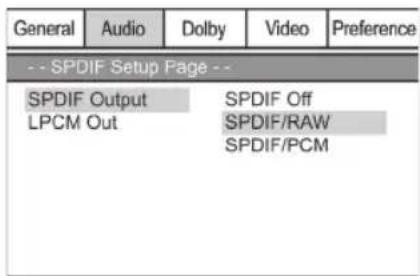
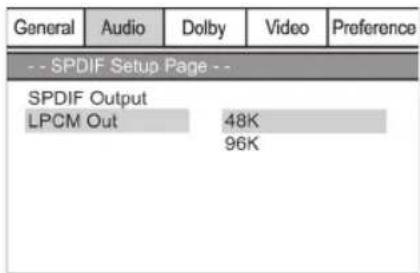
SPDIF Setup
SPDIF Output
Here you specify the settings for the digital audio output.
■ SPDIF/Off: Output of an analogue audio signal, but no digital signal. ■ SPDIF/RAW: Output of a digital audio signal. Use this setting if your amplifier is not a two-channel stereo amplifier. ■ SPDIF/PCM: Output of a digital audio signal that is converted to a 2-channel signal. Use this setting if your amplifier is a two-channel stereo amplifier.
i NOTE:
If there is no audio output, even though you connected the DVD player to an amplifier, you have most likely chosen an incorrect setting for the audio output.
LPCM Output
Here you can set the sampling rate of the audio signal. Generally speaking, a higher sampling frequency produces a better audio signal.
Dual Mono
The audio output is normally in stereo. Here you have the possibility to choose mono output instead of stereo output.
■ Stereo: The audio output is in stereo (default). ■ L-Mono: The audio output is in mono. In this case, the signal of the "left" stereo channel is transmitted to all speakers. ■ R-Mono: The audio output is in mono. In this case, the signal of the "right" stereo channel is transmitted to all speakers. ■ Mix Mono: The audio output is in mono. In this case, the signal of the "both" stereo channels is transmitted to all speakers.
Video Setup
| General | Audio | Dolby | Video | Preference |
| -- Video Setup Page -- | ||||
| Component | YUV | |||
| Resolution | S-Video | |||
| Quality | RGB | |||
| General | Audio | Dolby | Video | Preference |
| -- Video Quality Setup -- | ||||
| Sharpness | High | |||
| Brightness | Medium | |||
| Contrast | Low | |||
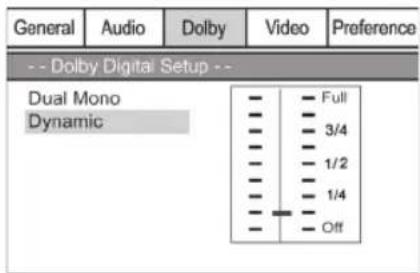
Dynamic
The term "Dynamic" (Dynamic Range) describes the ratio of quietest and loudest sound. If the dynamic range is very large, you will experience very quiet and very loud sounds.
This may cause replay problems. Let us assume that you are watching a DVD in a relatively loud environment. You can now increase the volume to be able to hear also the very quiet passages, however with the disadvantage that loud passages will be unacceptably loud. In this case it would make sense to compress the dynamic range (i.e. reduce) and increase the output volume at the same time.
■ FULL - 1/8: The dynamic range is compressed slightly (1/8) to full (FULL). ■ OFF: The dynamic range is not compressed at all (default).
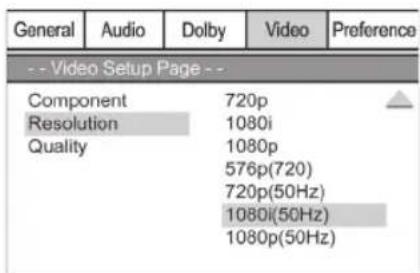
Video Output
Select the video output option for the playback device that is connected and which you wish to use. Choosing the right signal format depends on the type of connection and the playback device (see also the operating manual of the replay unit).
■ YUV: Select this option if your playback device is connected to the DVD player via the component video connection. ■ S-Video: Select this option if your playback unit is connected to the DVD player via the S-Video connection. RGB: Select this option if your playback device is connected to the DVD player via the SCART connection.
i NOTE:
If you would like to select the "RGB" setting, please ensure that your playback device supports this setting.
Resolution
Select the HDMI resolution for the connected playback device that is to be used. Choosing the right signal format depends on the type of connection and the playback device (see also the operating manual of the replay unit).
i NOTE:
You can also toggle between the options by pressing the HDMI button (Fig. 3/42).
Quality (Video Setup)
In this menu, you can perform various settings to adapt the video signal.
Preference Page
| General | Audio | Dolby | Video | Preference |
| -- Preference Page -- | ||||
| TV Type | PAL | |||
| Audio | Auto | |||
| Subtitle | NTSC | |||
| Disc Menu | ||||
| Parental | ||||
| Default | ||||
| General | Audio | Dolby | Video | Preference |
| -- Preference Page -- | ||||
| TV Type | ||||
| Audio | English | |||
| Subtitle | Dutch | |||
| Disc Menu | French | |||
| Parental | German | |||
| Default | Italian | |||
| Spanish | ||||
| General | Audio | Dolby | Video | Preference |
| -- Preference Page -- | ||||
| TV Type | 1 KID SAFE | |||
| Audio | 2 G | |||
| Subtitle | 3 PG | |||
| Disc Menu | 4 PG 13 | |||
| Parental | 5 PGR | |||
| Default | 6 R | |||
| 7 NC17 | ||||
| 8 ADULT | ||||
TV Type
Match the output of the DVD player to the color system of your playback device. The following options are available:
■ PAL: A system commonly used in Europe. ■ AUTO: Select this setting if your playback device is a multi-system unit. ■ NTSC: A system primarily used in North America.
Audio; Subtitle; Disc Menu
■ Audio: Here you can select the preferred audio language. ■ Subtitle: Here you can select the preferred language for the film subtitles. ■ Disc Menu: Here you can select the preferred language for the DVD menus.
Parental
Some DVDs contain information concerning the target group. This method is comparable with the rating of cinema films (e.g., "Suitable only for persons of 12 years and over").
If you have the child lock option activated, a possibly existing corresponding information is read from the DVD and compared with the value pre-set by you. If a DVD is intended for an older age group than the one pre-set by you, the DVD cannot be played.
The following child lock options are available:
- Kid Saf: Suitable for children. ■ G: Suitable for all age groups. PG: The presence of parents is recommended. Some scenes may be unsuitable for children. ■ PG 13: The presence of parents is strictly recommended. Some scenes may be unsuitable for children under the age of 13. ■ PGR: The presence of parents is strictly necessary. ■ R: Young persons under the age of 17 may only view this film in the presence of an adult. ■ NC17: Children and juveniles under the age of 17 are not allowed to watch this film. ■ Adult: The film must only be watched by adults.
To change the parental control option, you must enter the password. The password is "136900".
Default
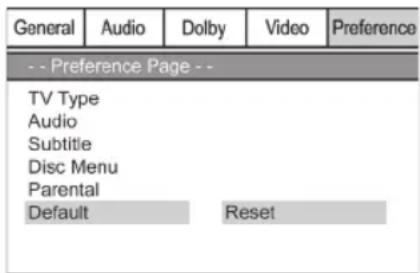
Select the command "Default/Reset" if you want to reset the player to the factory default settings.
Any settings you have made will be lost.
Radio Station Set-up
This device has a built-in FM/AM radio receiver. There are 2 different ways to search for radio stations: automatic station finding and manual station finding.
- Use the SOURCE (Fig. 3/13) button to select the "FM" mode.
- Press the AUTO SCAN (Fig. 3/19) button. The device searches the current frequency band for stations and stores them automatically. The stored radio stations will be deleted.
i NOTE:
It is not possible to change the order of the stations.
Manual Station Finding
- Use the SOURCE (Fig. 3/13) button to select the "FM" mode.
- Press the TUNING ▲/▼buttons (Fig. 3/21) to search for a station. Press the corresponding button repeatedly until you have found the desired radio station.
- To store the radio station you have found press the MEMORY button (Fig. 3/20), a storage location flashes on the display (e.g. P01).
- Then use the MEMORY buttons ▲/▼(Fig. 3/29) to select the desired storage location.
Press the MEMORY buttons ▲/▼(Fig. 3/29) to select the stored radio station.
AUX IN (R/L) Input Sockets
To connect analogue playback units, the unit has two different connection options: LINE IN on the front and AUX IN on the back of the unit. With these sockets you can also hear the sound from other playback devices such MP3 players, CD players etc through the loudspeakers.
- Connect the external unit as follows:
- With a 3.5 mm stereo TRRS connector to the LINE IN jack (Fig. 1/8).
- With a cinch cable (2x RCA) to the AUX IN jacks on the back of the unit (Fig. 2/17).
i NOTE:
If you have connected an external unit to both inputs, playback from the LINE IN jack is preferred.
iPod/iPhone Compatibility
Music/Videos Playback from iPod/iPhone
(iPod/iPhone not supplied)
- Press the SOURCE button (Fig. 3/13) repeatedly until "AUX" appears in the display.
- For the remaining procedure please see the operating instructions of the external sound source.
- Through the loudspeakers you now hear the sound from the external device; with the VOL+/- buttons (Fig. 3/17) you can change the volume.
i NOTE:
Adjust the volume of the external device to a comfortable level.
Docking Port for iPod/iPhone
You have the option of playing music and videos from your iPod or iPhone through this device.
Due to the large variety of iPod and iPhone models and generations on the market, full compatibility cannot be guaranteed. Before connecting your iPod/iPhone, ensure that it has a compatible interface. Full compatibility of the remote functions also cannot be guaranteed. Operate your iPod/iPhone as normal, while it sits in the docking station.
i NOTE:
Depending on the software version of your iPhone the following error message may be displayed:
"This accessory was not developed for iPhone use. It is possible that noise occurs and signal strength is reduced." In this case press "OK".
- If an adapter has been supplied with your iPod, put it onto the dock connector. You can only ensure that the iPod fits correctly into the iPod port if the adapter is plugged in.
- Insert your iPod/iPhone into the dock.
CAUTION:
Make sure that your iPod/iPhone is plugged upright into the port. Do not bend or tilt the iPod/iPhone whilst it is plugged into the port. This may cause damage to the dock or the iPod/iPhone.
- Repeatedly press the SOURCE button (Fig. 3/13) until "IPOD" is displayed.
- Depending on the iPod/iPhone Model, firstly release the button lock and start playing music if necessary with the SELECT button (Fig. 3/15).
- Follow your iPod/iPhone manual for further use of the controls.
NOTE: During iPod/iPhone music/video playback
If required you can also change the EQ setting on your iPod/iPhone, to create the optimum sound. The sound is only transmitted via the music center speakers. The picture is transmitted via the SCART and S-Video connection.
CAUTION:
Return to radio mode before disconnecting your iPod/iPhone from this device to avoid damages to your iPod/iPhone.
NOTE:
If you have an incoming call when playing back music with the iPhone docked, then playback stops and you can hear the ring tone.
iPod/iPhone Charging
Your iPod/iPhone battery is charged as soon as the iPod/iPhone is docked. To do this, the unit must be connected to the mains.
NOTE:
If the slot adapter has been supplied with your iPod, use it to ensure that your iPod fits correctly. Not all iPod/iPhone generations support the charge mode. The duration of the charging process depends on the iPod/iPhone which is used and its operating condition.
Troubleshooting
Before sending the machine to the Customer Services, use the following table to check whether you can rectify the fault yourself.
| Fault Possible cause | Solution | |
| Nothing appears on the display | No power supply | ⚠ WARNING:Before troubleshooting, switch the player off. |
| Put the mains plug in correctly, if necessary, check the socket is working with another appliance. | ||
| No image displayed on screen | Video cable not correctly connected | ⚠ WARNING:Before troubleshooting, switch the player off. |
| Check the correct it of the Video cable ➔ “Connecting the Video cable”. Make sure that the jacks are tightly in the sockets. | ||
| no DVD/CD inserted Insert a CD/DVD. | ||
| DVD/CD not compatible Use only compatible media (see ➔ “Technical Data”). | ||
| DVD/CD incorrectly placed in CD/DVD-tray | Turn the CD/DVD around. | |
| CD/DVD is dirty Clean the CD/DVD around. | ||
| CD/DVD is damaged Use a different CD/DVD. | ||
| Incorrect settings Check the settings of your DVD-Player. | ||
| The child lock system is activated Deactivate the child lock ➔ “Parental”. | ||
| The wrong TV mode has been selected | Press the VIDEO button (Fig. 3/41), to change the TV mode (interlace). | |
| No picture during video playback via iPod / iPhone | Incorrect video output selected. Connect the unit to your playback unit via a SCART or S-Video cable. | |
| No response when pressing button | Power supply problem or static charging of appliance | Press the RESET button (Fig. 2/18) of the back of the unit. |
| Disconnect the mains plug for about 5 seconds. Insert the mains plug into the socket and switch the player on again. | ||
| No sound Audio cable | not connected | WARNING:Before troubleshooting, switch the player off. |
| Video plug for transmission of the Video signal, you must use and Audio cable in addition to the Video cable ⇔ "Connecting the Audio cable". | ||
| Amplifier switched off If you use an amplifier for Audio output: check whether the amplifier is switched on. | ||
| Incorrect settings Check the settings of your DVD-Player. | ||
| Sound is distorted Presets incorrect Change the settings in the audio menu. | ||
| The remote control does not work | wrong direction The remote control is not pointed towards the DVD-Player. | |
| too far away Make sure that the remote control is not further than 7 m away from the player. | ||
| Batteries empty Replace the batteries in the remote control ⇔ "Remote control battery installation". | ||
| Titles are played in wrong order | Playlist is used Delete the playlist | → "Deleting a playlist". |
| DVD cannot be played | DVD has not been finalized Use a finalized DVD. | |
| iPod / iPhone not recognised | iPod or iPhone battery is low Wait a few minutes until the unit recognises your iPod or iPhone. | |
| No radio reception. The antenna cable is not connected. | Insert the antenna cable irmly into the antenna socket of the device. | |
| Poor radio reception. The received radio station is too weak for a stereo operation. | Adjust the device to mono operation by pressing the MO/ST button (Fig. 3/18). | |
| In automatic search mode the radio does not stop at a transmitting station. | The transmission signals are too weak. | Tune in to a radio station manually. |
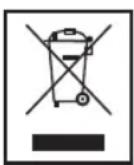
Disposal
At the end of the service life of the appliance, in particular if it is malfunctioning, make the appliance unusable by pulling the mains plug out of the socket and separating the power cable. Dispose of the appliance according to the environmental regulations applicable in your country. Electrical waste may not be disposed of together with household waste. For any advice regarding recycling, contact your local municipal authorities or your dealer.
Declaration of conformity
ETV Elektro-technische Vertriebsgesellschaft mbH hereby declares that the device DVD 4626 iP is in conformity with the basic requirements of the European guideline for electromagnetic compatibility (2004/108/EG) and the low voltage guideline (2006/95/EG).
A copy of the declaration of conformity can be requested from the stated address.
OSD Menu Overview
| General Video | |
| -- Genearl Setup Page -- - - - Video Setup Page -- | |
| TV Display Normal/PS Component YUVNormal/LB S-Video16:9 RGB | |
| Angle Mark On Resolution AutoOff 480i | |
| OSD Lang 480p | |
| Screen Saver On 720p | Off 1080i |
| Last Memory On 1080p | Off 576p(720) |
| Audio 1080p(50Hz) | |
| -- Audio Setup Page -- | |
| Speaker Setup | -- Speaker Setup Page -- |
| Downmix LT/RT Stereo | |
| SPDIF Setup | -- SPDIF Setup Page -- |
| SPDIF Output SPDIF Off SPDIF/RAW SPDIF/PCM | |
| LPCM Out 48K 96K | |
| 720p(50Hz)1080i(50Hz) | ||
| Quality | -- Video Quality Setup -- | |
| Sharpness | HighMediumLow | |
| Brightness | ||
| Contrast | ||
| Dolby | |
| -- Dolby Digital Setup -- | |
| Dual Mono | StereoL-MonoR-MonoMix-Mono |
| Dynamic | |
| Preferences | |
| -- Preference Page -- | |
| TV Type | PALAutoNTSC |
| Audio | |
| Subtitle | |
| Disc Menu | |
| Parental | 1 KID SAFE2 G3 PG4 PG 135 PGR6 R7 NC-178 ADULT |
| Default | Reset |


Guarantee card
DVD 4626 iP
24 months guarantee according to guarantee declaration
- AUX IN / LINE IN INPUT
- ANTENNA INPUT
- WARNING
- CAUTION
- I NOTE
- ETV
- SAFETY INSTRUCTIONS
- OPERATING MANUAL
- CHILDREN
- POWER SUPPLY
- LASER
- TRANSPORT
- WHERE TO POSITION THE APPLIANCE
- OPERATION
- INTENDED USE
- DEFECTS
- SETUP AND CONNECTION
- UNPACKING
- NOTE
- SETUP
- SETTING UP THE LOUDSPEAKERS
- STARTING UP
- △ CAUTION
- EFFECTIVE RANGE OF THE REMOTE CONTROL
- NOTE: FOR IPOD OR IPHONE VIDEO PLAYBACK
- SCART
- HDMI
- COMPONENT VIDEO
- S-VIDEO
- COMPOSITE-VIDEO
- STEREO
- AUDIO SIGNAL (CONNECTING THE SUPPLIED LOUDSPEAKERS)
- DIGITAL
- AUX IN / LINE IN- INPUT
- USB INPUT
- ABOUT THE DVD PLAYER
- INPUT NOT POSSIBLE
- TERMINOLOGY
- USING THE REMOTE CONTROL
- PLAYING MEDIA
- LOADING A CD/DVD
- UNDERSTANDING THE ONSCREEN CD-MENU
- DVD MENU
- WORKING IN FILE MODE
- USING A MEMORY CARD
- USING A USB MEDIUM
- PLEASE NOTE
- SCROLLING
- ROTATING A PHOTO
- FADE
- CHANGING THE DEFAULT SETTINGS
- NAVIGATION AND SELECTION
- SLIDE CONTROL
- TV DISPLAY
- ANGLE MARK (CAMERA ANGLE)
- OSD LANGUAGE
- SCREEN SAVER
- LAST MEMORY
- SPEAKER SETUP
- DOWNMIX
- SPDIF SETUP
- SPDIF OUTPUT
- LPCM OUTPUT
- DUAL MONO
- DYNAMIC
- VIDEO OUTPUT
- RESOLUTION
- QUALITY (VIDEO SETUP)
- TV TYPE
- AUDIO; SUBTITLE; DISC MENU
- PARENTAL
- DEFAULT
- RADIO STATION SET-UP
- MANUAL STATION FINDING
- AUX IN (R/L) INPUT SOCKETS
- DOCKING PORT FOR IPOD/IPHONE
- NOTE: DURING IPOD/IPHONE MUSIC/VIDEO PLAYBACK
- IPOD/IPHONE CHARGING
- TROUBLESHOOTING
- DISPOSAL
- DECLARATION OF CONFORMITY
- DVD 4626 IP
Brand : AEG
Model : DVD 4626 IP
Category : CD Player