
INN-014 - Manometer Innoliving - Free user manual and instructions
Find the device manual for free INN-014 Innoliving in PDF.


| Product Type | Upper Arm Digital Blood Pressure Monitor |
| Model | INN-014 |
| Brand | Innoliving |
| Measuring Method | Non-invasive Oscillometric |
| Measurement Range | Systolic: 50–250 mmHg, Diastolic: 30–200 mmHg, Pulse: 40–180 beats/min |
| Accuracy | Pressure: ±3 mmHg, Pulse: ±5% |
| Display | LCD |
| Power Supply | 2 x 1.5V AAA batteries (alkaline) or optional AC adapter (Input: 100-240V, 50/60Hz; Output: 6V@600mA, Class II) |
| Arm Circumference | 13.5–23 cm (cuff size fits most adults) |
| Memory | Stores last measurement for 2 users; average of last 3 readings |
| WHO Classification Indicator | Six-segment bar indicating Optimal, Normal, High Normal, Mild, Moderate, Severe Hypertension |
| Irregular Heartbeat Detection | Yes (alerts when heartbeat varies >25% from average) |
| Operating Conditions | Temperature: +5°C to +40°C, Humidity: 15–93% RH |
| Storage Conditions | Temperature: -25°C to +70°C, Humidity: ≤3% RH |
| Atmospheric Pressure Range | 700–1060 hPa |
| Dimensions | Approx. 84 x 77 x 15 mm |
| Weight | Approx. 250 g (including batteries) |
| Accessories | Cuff, Instruction Manual, Batteries, Storage Pouch |
| Protection Type | Type BF applied part |
| IP Rating | IP21 (protected against solid objects >12.5 mm and dripping water) |
| Maintenance | Clean with soft damp cloth; do not use solvents; inspect every 2 years |
| Warranty | Refer to manufacturer's terms |
Frequently Asked Questions - INN-014 Innoliving
User questions about INN-014 Innoliving
0 question about this device. Answer the ones you know or ask your own.
Ask a new question about this device
Download the instructions for your Manometer in PDF format for free! Find your manual INN-014 - Innoliving and take your electronic device back in hand. On this page are published all the documents necessary for the use of your device. INN-014 by Innoliving.
USER MANUAL INN-014 Innoliving
NOTA:
![[♥] icon blinks 6:28 12:54 PM me/kg 1:18 14 17 I ♥ 83](/content/2026/05/766084/images/f8a718af41a580f868d69507f49e5f9a934d67aa38900a2bc2e79b936ba4bcf3.jpg)
Measurement result shown
BARRA INDICATRICE DI PRESSIONE
Thank you for purchasing the upper arm digital pressure monitor INN-014.
For a proper use of the product, please read the following instructions carefully before use and consult your physician if you have any queries about your blood pressure. This fully automatic tool uses the oscillometric non-invasive method, which detects blood pressure and heart rate through the brachial artery, the rest is shown on the display. Without the use of a stethoscope, it is still possible to obtain a blood pressure reading in an easy and fast way.
INDICATION FOR USE
This device is intended for use by professional medical personnel and home users. It was designed to measure the systolic and diastolic pressure of the blood of an adult individual using a non-invasive technique, by means of an inflatable cuff worn in the upper arm.
WARNING/CAUTION: Indicates a dangerous situation which, if not avoided, could result in death or serious injury.

WARNING
- Consult your physician before starting to measure your blood pressure.
- Like any oscillometric blood pressure measurement, some medical conditions can affect the measurement accuracy, among others:
- Kidney problems
- Disorder of the cardiac rhythm
- Very low blood pressure
- Very low blood perfusion
- Patients in shocks
- Diabetes
- Vessel anomalies
- People with electrical implants such as a cardiac pacemaker
- Women who are pregnant
- Patient who are pre-eclamptic
- Patient motion during measurement
These conditions can lead to incorrect readings. This represents a risk for your health, since values may be interpreted incorrectly. Always consult your physicianto evaluate your state of health in a suitable way.
- This product is not intended to provide a medical diagnosis.
Measurement results are for reference only. Self-diagnosis and treatment, e.g. regarding medication, using measured results represents risk for your health. Always consult with a licensed physician for determination of appropriate medication and dosage thereof. Follow the instructions of your physician or licensed healthcare provider.
The self-diagnosis and medical-pharmacological treatment based only on the measurement results represent a risk for your health. Always consult a licensed physician to evaluate your state of health and determine the appropriate medication and its dosage. Follow the instructions of your doctor or healthcare professional.
SAFETY NOTES
- Please, consider that tolerances in measurements are admitted. See "TECHNICAL SPECIFICATIONS".
• Measure the pressure with any cuff repeatedly can cause: - A nerve compression with temporary wrist/hand paralysis
- The release of an arterial or venous thrombus, which can cause a life threatening situation.
Please contact your physician about the specific risks of cuff pressure in your specific case.
- The "irregular heartbeat" function does not replace a cardiac examination, but can help detect a potential irregularity of the heartbeat. Always consult your doctor to evaluate your state of health.
- The "irregular heartbeat" function is not designed for diagnosing or treating an arrhythmic disorder. Arrhythmia can only be ascertained by a licensed physician.
GB
- The "WHO BLOOD PRESSURE CLASSIFICATION" chart is not intended to replace a medical diagnosis. This chart is only for reference for different classifications of blood pressure.
- If you notice abnormal or suspicious variations in blood pressure measurements, consult your physician immediately.
- Women who underwent a breast or axillaries lymph node removal operation should consult a physician or licensed healthcare provider before starting blood pressure measurements.
- This device must be used in accordance to the specified ambient conditions, otherwise the accuracy of readings might be affected. See "TECHNICAL SPECIFICATION" for details.
- Do not wrap the cuff around body parts other than your upper left arm. Misuse represents a risk to your health.
- This product is not intended for use by or on children, infants or on persons who cannot express their consent, e.g. persons with mental disorders or similar. Consult your physician for alternative methods of measuring a child's blood pressure.
- Packaging materials are a deadly hazard for children and can cause suffocation. Remove all packaging materials immediately and keep them away from children at all times.
- This product contains small parts that may present a choking hazard to children. Keep the unit and all parts out of reach of children.
- Proper cuff size is important for accurate measurements. Only use the device on adults who have the right upper arm circumference for this instrument. See section "Technical Specifications" for suitable arm circumferences.
- Electromagnetic interference: Avoid strong electrical or electromagnetic fields in the direct vicinity of the device (e.g. mobile telephones, microwave ovens) while it is in operation, as inaccurate measurements may result. To prevent such interference, use the unit at a sufficient distance from such devices or turn the devices off.
- Batteries should not be charged or reactivated by any other means. The batteries may explode.
- Keep the batteries away from fire as there is a risk of ignition or explosion.
• In case battery fluid leaks and come into contact with your eyes or skin, do not rub and immediately rinse with plenty of clean water and seek medical advice. - Do not use the equipment where flammable gas (e.g. anaesthetics gas,
oxygen or hydrogen) or flammable liquid (e.g. alcohol) are present.
- Do not use any cuffs and accessories other than those recommended by the manufacturer for use with this product. Cuffs and accessories not approved for use with this device may cause damage to your health and to the product.
- The tubing presents a strangulation hazard. Keep this product away from children and those who require close supervision, e.g. people with mental disorders.

CAUTION
- The blood pressure monitor is composed by precision electronic components, the accuracy of readings and the instrument's operating life depend on a careful maintenance and care of the product. Protect the unit against hard knocks (e.g. dropping the unit), moisture, water, dirt, dust, chemicals, extreme hot or cold temperatures, major temperature fluctuations, direct exposure to sunlight and heat sources which are too close (e.g. stoves, heating radiators). This may damage the unit. The device must be stored in the specified ambient conditions. Please see section "Technical Specification" for details.
- The device is designed and manufactured for a long service life. However it is generally recommended to have the monitor inspection every 2 years to ensure proper functioning and accuracy.
- Never immerse and/or spill water or any other liquid onto the monitor or any components, otherwise liquid may enter it and cause damages.
- Never use rechargeable batteries. This may damage the unit.
- Replace all batteries at the same time and use batteries of the same type. Do not mix old and new batteries.
- Never try to repair, open and/or disassemble the unit or adjust it yourself. This may cause damage to the unit and impair functions. If you cannot fix the problem using the "TROUBLESHOOTING" instructions, contact the authorized after sales service.
- Do not drop or insert any object into any openings or hoses. This may damage the unit.
- Do not press the buttons with excessive force or with pointed objects
MAINTENANCE
- The blood pressure monitor is composed by precision electronic components, the accuracy of readings and the instrument's operating life depend on a careful maintenance and care of the product. Protect the unit against hard knocks (e.g. dropping the unit), moisture, water, dirt, dust, chemicals, extreme hot or cold temperatures, major temperature fluctuations, direct exposure to sunlight and heat sources which are too close (e.g. stoves, heating radiators). This may damage the unit. The device must be stored in the specified ambient conditions. Please see section "Technical Specification" for details.
- The device is designed and manufactured for a long service life. However it is generally recommended to have the monitor inspection every 2 years to ensure proper functioning and accuracy.
- Never immerse and/or spill water or any other liquid onto the monitor or any components, otherwise liquid may enter it and cause damages.
- Never use rechargeable batteries. This may damage the unit.
- Replace all batteries at the same time and use batteries of the same type. Do not mix old and new batteries.
- Never try to repair, open and/or disassemble the unit or adjust it yourself. This may cause damage to the unit and impair functions. If you cannot fix the problem using the "TROUBLESHOOTING" instructions, contact the authorized after sales service.
- Do not drop or insert any object into any openings or hoses. This may damage the unit.
- Do not press the buttons with excessive force or with pointed objects.
- Clean your device and cuff carefully with a soft damp cloth and dry it immediately with a soft dry cloth. Do not press.
- Do not use any aggressive solvents, cleaning agents, detergents or any other strong chemicals (e.g. thinner, alcohol, benzene) to clean the device.
- When storing the device, make sure that no heavy objects are placed on top of it.
- Do not fold the cuff and tubing tightly. The cuff tube should not have any sharp kinks and keep it away from sharp edges.
- Leaking batteries may damage the unit. If you do not intend to use the unit for long periods, remove the batteries from the battery compartment before storing the device.
GB
PRODUCT DESCRIPTION
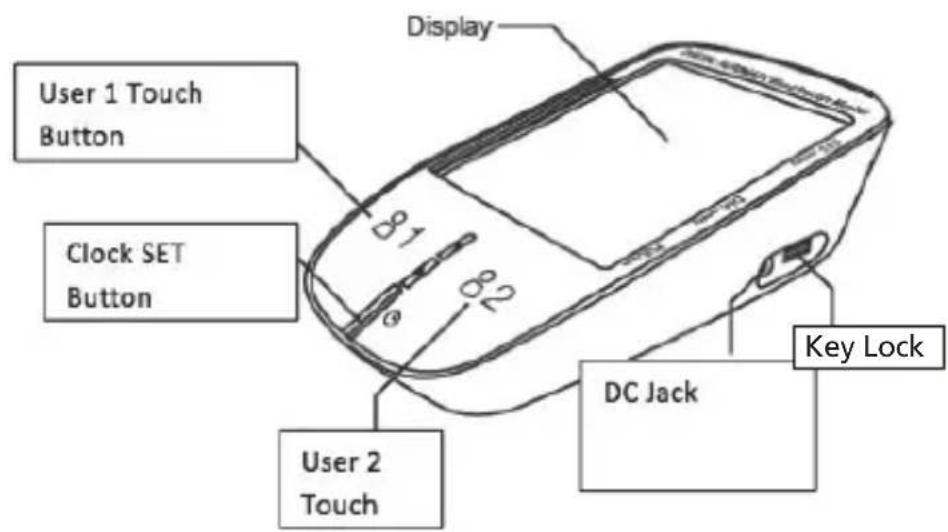
Button [1] / [2] operations:
- Normal measurement with storing data of user 1 and 2
- Press the [1] / [2] button.
- Recalling data
- Press and hold the [1] / [2] button.
- Unrecorded measurement (Guest mode)
- Press both buttons
DISPLAY READINGS
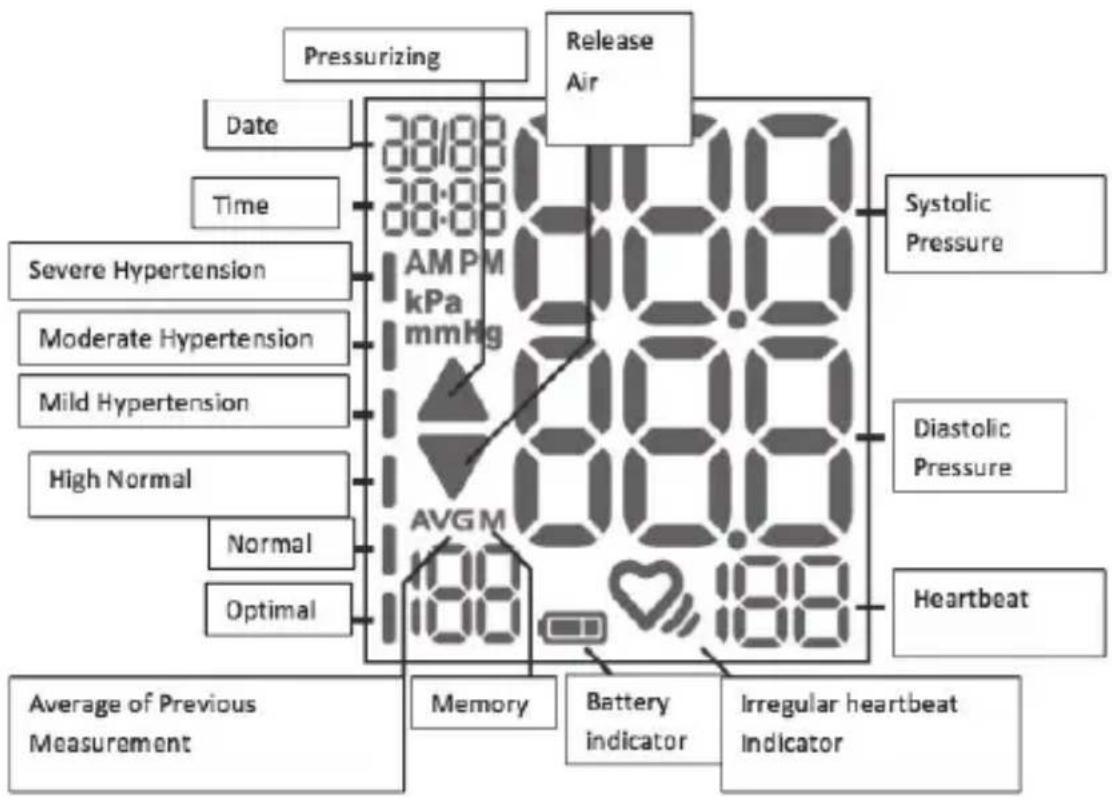
flowchart
graph TD
    A["Pressurizing"] --> B["Release Air"]
    C["Date"] --> D["AM PM kPa mmHg"]
    E["Time"] --> D
    F["Severe Hypertension"] --> D
    G["Moderate Hypertension"] --> D
    H["Mild Hypertension"] --> D
    I["High Normal"] --> J["AVGM"]
    K["Normal"] --> J
    L["Optimal"] --> J
    M["Average of Previous Measurement"] --> N["Memory"]
    O["Battery indicator"] --> P["Irregular heartbeat Indicator"]
    Q["Systolic Pressure"] --> R["Heartbeat"]
    S["Diastolic Pressure"] --> R
    T["Release Air"] --> U["Release Air"]
INSTAL BATTERIES
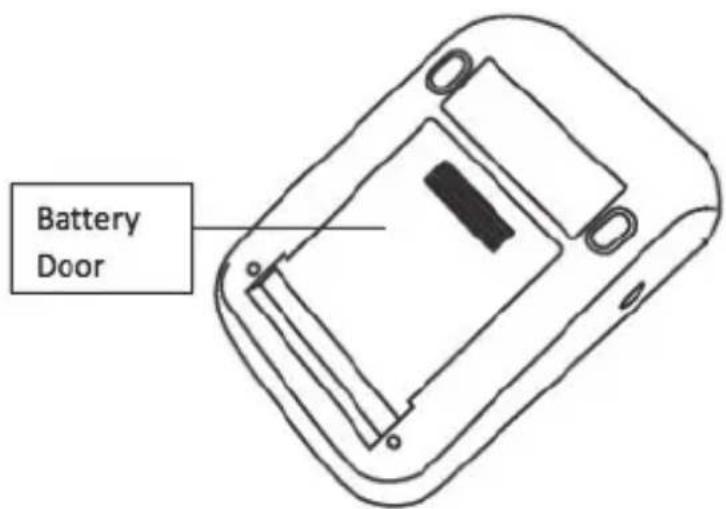
- Pull the battery cover located on the bottom side on the unit as shown in the figure.
- Remove old batteries and insert new ones. Use LR6 or AA alkaline batteries and use batteries of same type only.
- Make sure the battery polarities (+) and (-) match are places as indicated in the battery compartment.
- Place back the battery door.
NOTE:
- Insert the batteries as shown in the battery compartment. If not, the device will not work or even be damaged.
- The icon [1/1] indicates battery power is enough.
- When battery power becomes weak, the icon [☐] and "E6" appear in the display, replace all batteries with new ones. Do not mix old and new batteries.
- Never use rechargeable batteries. This may damage the unit.
- Battery life may vary with ambient temperature and may be shorter at low temperature.
USE OF AC ADAPTOR (OPTIONAL)
- Insert the AC adapter cord into the socket on the right side of the device.
- Insert the AC adapter plug into the outlet.
- To remove the AC adapter, disconnect the adapter plug from the AC outlet first, then the adapter cord from the device.
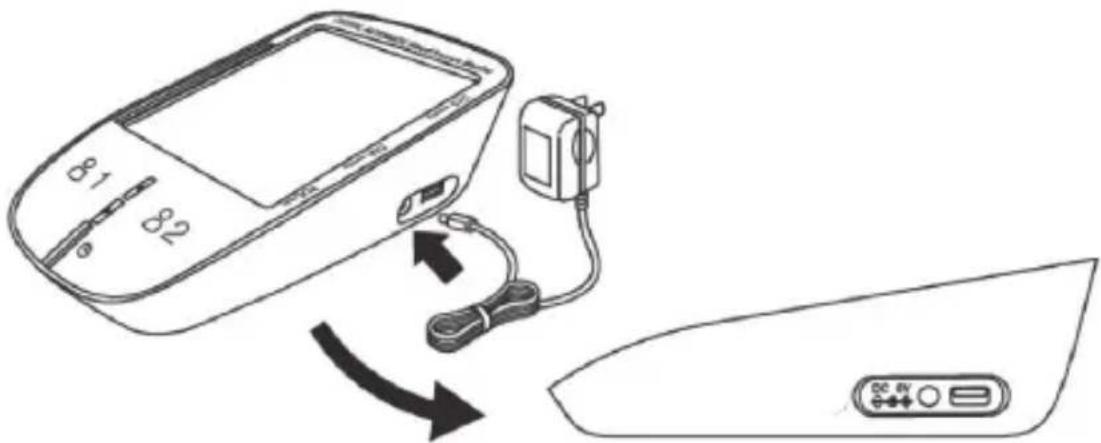
NOTE:
- Optional AC adaptor must comply with the requirement of IEC 60601-1 standard.
- Use only the AC adapter offered by the manufacturer. Using any other AC adapter can affect the output voltage and may represent a risk for people and damage your device.
- When the AC adapter is in use, the device does not draw power from batteries
HOW TO SET THE CLOCK
When new batteries are installed
- "YEAR" will flash on display automatically.
- Press [1] / [2] to select current year.
- Press [⑨] button to confirm and "MONTH" will appear on the display.
- Press [1] / [2] to select current Month.
- Press [⑤] button to confirm and "DAY" will appear on the display.
- Press [1] / [2] to select current Day.
- Press [⑤] button to confirm and "HOUR" will appear on the display.
- Press [1] / [2] to select current Hour.
- Press [◎] button to confirm and "MINUTE" will appear on the display.
- Press [1] / [2] to select current Minute.
- Press [②] button to confirm and clock setting is done.
- The set date and time will be displayed.
At any time:
- Press the button [💡] even when the device is off, to display date and time
- Press and hold button [⑨] for 3 seconds to display the year that will flash on the monitor.
- Follow the above mentioned procedure to set clock.
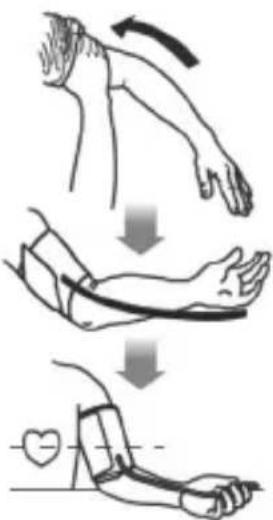
HOW TO APPLY THE ARM CUFF
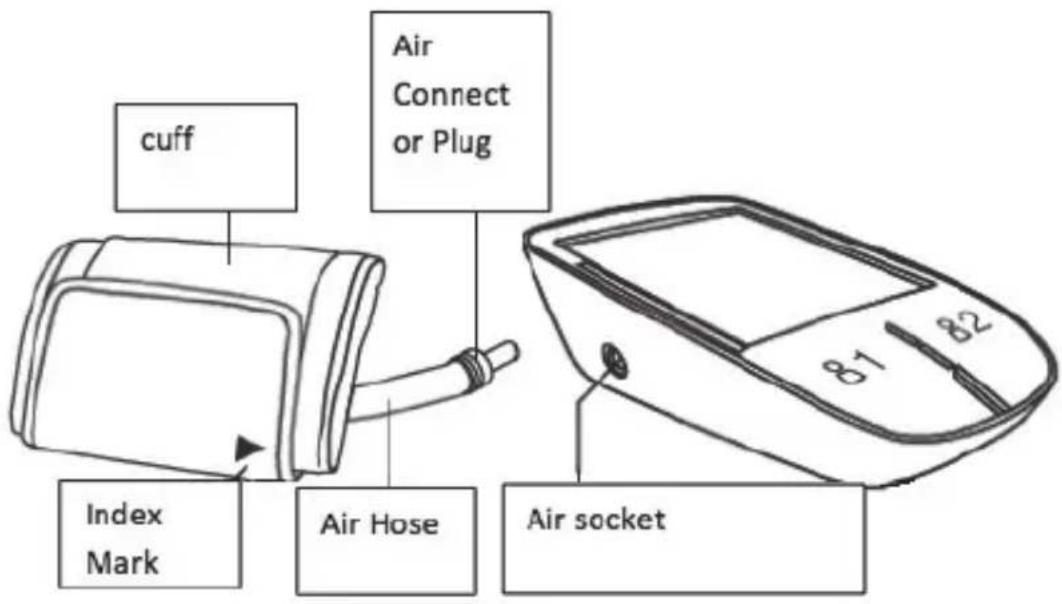
- Pass the end of the cuff furthest from the tubing through the metal ring to form a loop.
- Put your left arm through the cuff loop. The bottom of the cuff should be approximately of 2 - 3 cm above the elbow. The white artery mark on the cuff should lie over the brachial artery on the inside of the arm. The tube should run down the centre of arm and even with the middle finger. Do not place the arm cuff over heavy clothing (e.g. jacket or sweater sleeve) as the blood pressure monitor will not be able to take proper measurement. Blood circulation in the arm should not be restricted by tight clothing or other objects.
- Pull the cuff so that the top and bottom sides are fit evenly around your arm.
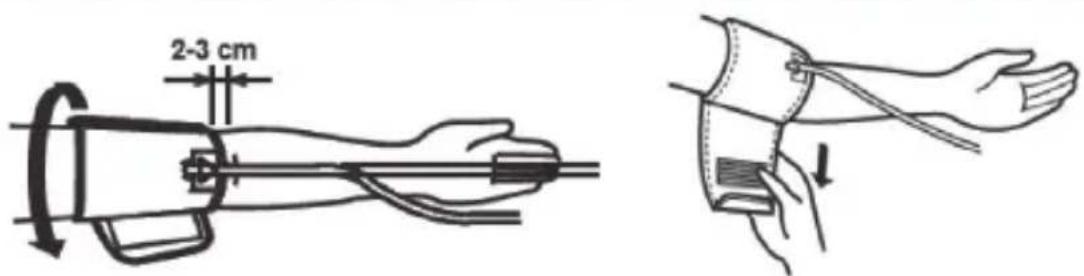
- Insert the cuff tubing into the socket on the left side of the unit. Make sure it is inserted firmly in the main unit that there are no folds in the cuff tubing.
- Make certain the cuff fits snugly around your arm. The cuff should make good contact with your skin.
- If the cuff is assembled correctly, the sewn hook material will be on the outside of the cuff loop and the metal ring will not touch your skin.
- Insert the cuff tubing into the socket on the left side of the unit. Make sure it is inserted firmly in the main unit that there are no kinks in the cuff tubing.
BEFORE MEASURING BLOOD PRESSURE
- Apply the arm cuff following the instruction. 2. It is important to rest at least for 5 minutes before each measurement. Otherwise there may be erroneous results. 3. Sit down in a comfortable position, do not cross your legs, your feet should be fit on the floor and your back should be supported by a chair. At the same time your arm should be supported on a flat surface which the cuff is on a level with your heart. 4. Relax your arm and turn your palm upward. 5. Relax, keep still and do not talk during the measurement in order not to distort the result.
NOTE:
- This instrument is intended for use by adult only. Do not use this device on or children, toddlers and infants.
- For reliable monitoring and reference of blood
pressure, it is recommended to do the measurement daily at the same time.
- In order to obtain a correct measuring of blood pressure, do not eat, drink alcohol and beverages with caffeine, smoke, exercise or bath for at least 30 minutes before taking a measurement since your blood pressure varies from time to time depending on what you have eaten, drunk and what you have done.
GB
- To minimize measurement variations due to physical activity, relax for five to ten minutes before taking a measurement. If you are excited by emotional stress or muscular movement, the measurement result given out may be inaccurate. Stress raises blood pressure.
- You should not be physically tired or exhausted while taking measurement.
- Perform measurements in a quiet and relaxed environment at room temperature.
- Remain relax, still and do not talk during measurement since the accuracy of any blood pressure
measurement with this device can be affected by those multitude of causes.
• Always wait at least 5 minutes between measurements to allow the blood circulation in your arm to return normal. You may need to increase the wait time depending on your individual physiological characteristic.
- If the device detect an abnormal condition, measurement stops and an error code will appear on the display. See "TROUBLESHOOTING" for more details.
- This device focus its measurements on your heartbeat. If you have a very weak or an irregular heartbeat, the device may have difficulty in determining your blood pressure. (An irregular heartbeat is defined as a heartbeat that varies by 25% from the average of all heartbeats during measurement.)
- Do not apply any kind of pressure on the hose during measurement, e.g. laying your arms or any other object on the hose. This could cause incorrect measurements
MEASURE YOUR BLOOD PRESSURE
Measurement with storing data
- Follow the instruction to make yourself ready.
-
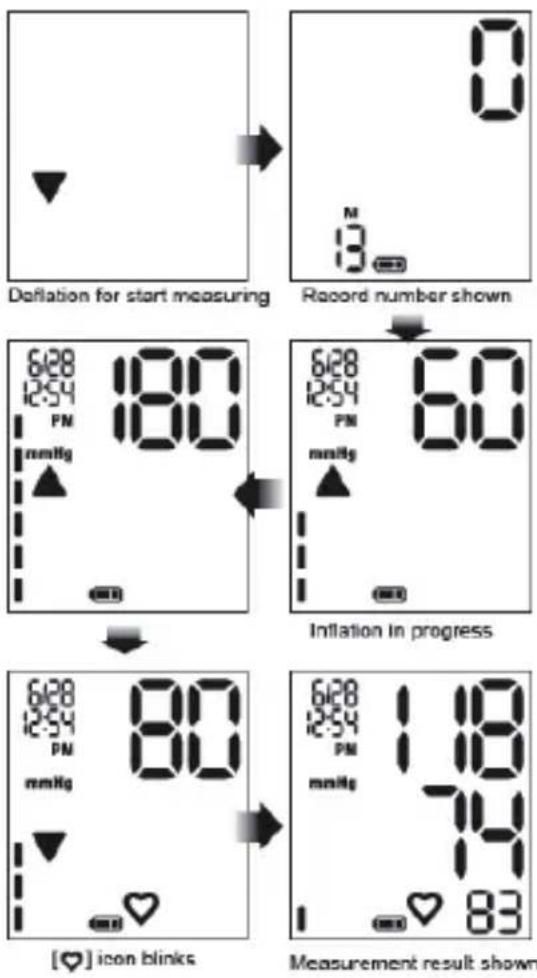
Press [1] or [2] button when the device is off to start measurement. The average blood pressures and last data number are displayed briefly. The current pressure is displayed, as the measurement begins.
-
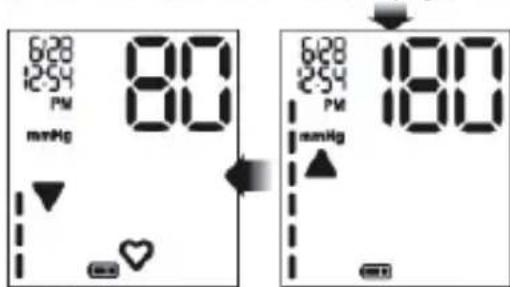
The cuff starts to inflate. It is normal for the cuff to feel very tight. A pressure bar indicator is displayed during measurement. See "PRESSURE BAR INDICATOR" for more details.
-
When inflation is complete, deflation starts automatically. Once the pulse is detected, the heartbeat flashes according to your pulse beat, indicating that the measurement is in progress.
-
When the measurement is complete, the systolic and diastolic pressure and pulse rate are displayed and stored. At the same time, the cuff expels the remaining air and deflates completely.
-
Press either [1] or [2] button to turn off the device.
NOTE:
You can stop inflation by pressing [1] or [2] button at any time.
Measurement without storing data (Guest mode)
- Follow the instruction to make yourself ready.
- Press [1] and [2] button simultaneously when the device is off to start measurement.
- The cuff starts to inflate. It is normal for the cuff to feel very tight.
A pressure bar indicator is displayed during measurement. See "PRESSURE BAR INDICATOR" for more details. - When inflation is complete, deflation starts automatically. Once the pulse is detected, the heartbeat will flash according to your pulse beat, indicating that the measurement is in progress.
- When the measurement is complete, the systolic and diastolic pressure and pulse rate are displayed and stored. At the same time, the cuff expels the remaining air and deflates completely.
- Press either [1] or [2] button to turn off the device.
NOTE:
- You can stop inflation by pressing [1] or [2] button at any time.
• Measurement result will not be recorded to the memory.
![Deflation for start measuring Inflation in progress [♥] icon blinks Measurement result shown](/content/2026/05/766084/images/064cf3474747ae5c61faedbaa0a9933b45c59a371ace2f4b2221fd14a86c65b1.jpg)
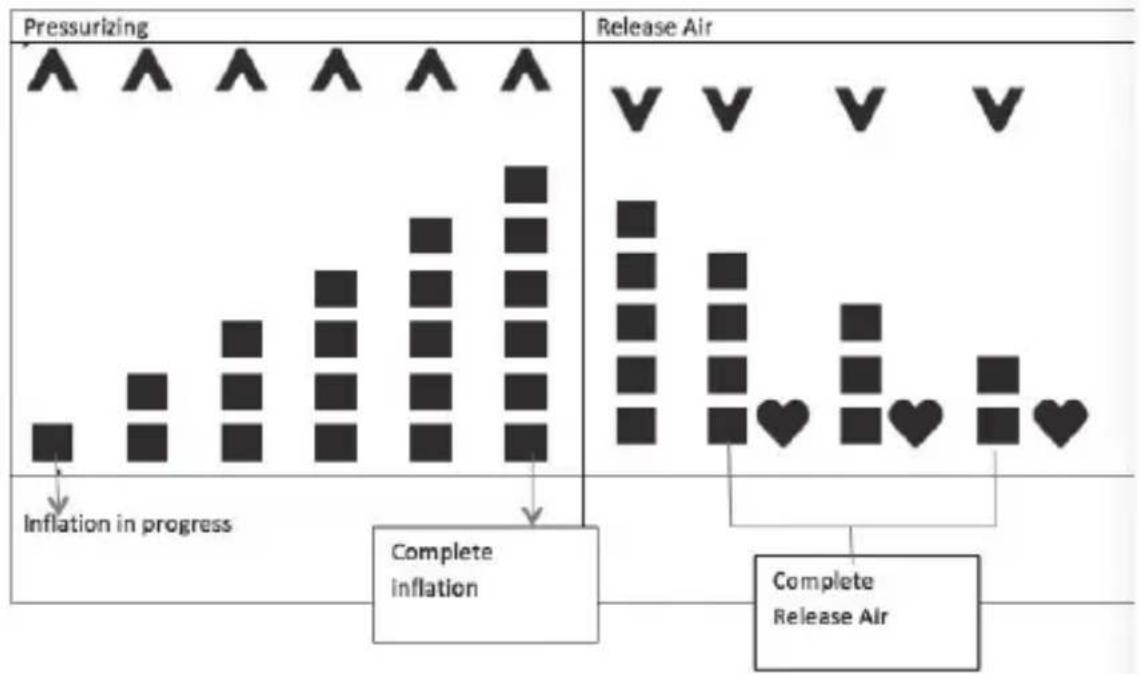
PRESSURE BAR INDICATOR
The indicator monitors the progress of pressure during measurement.
flowchart
graph TD
    A["Pressurizing"] --> B["Inflation in progress"]
    B --> C["Complete Inflation"]
    C --> D["Complete Release Air"]
    D --> E["Release Air"]
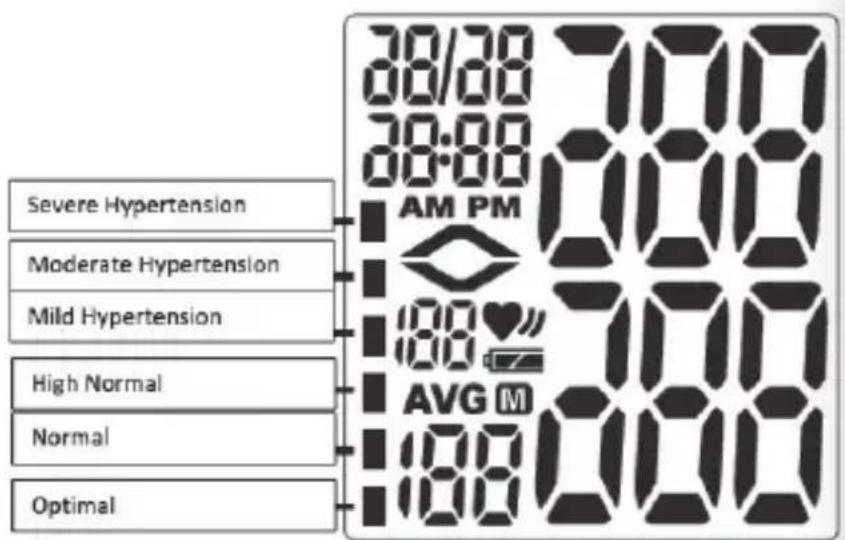
WHO CLASSIFICATION INDICATOR
Each of the six segments of the bar indicator corresponds to the WHO blood pressure classification.
SEE AVERAGE AND PREVIOUS MEASUREMENT DATA
This device can store the measurement readings for each user. Every time you complete the measurement, the device automatically stores the measurement result.
- To get the average measurement data of the last 3 measurements, press and hold [1] or [2] for 2 seconds. Average data will be shown on the display.
- Press the same user button again and continuously to view previous measurement data.
- Press and hold the same user button for 2 seconds to turn on the device.
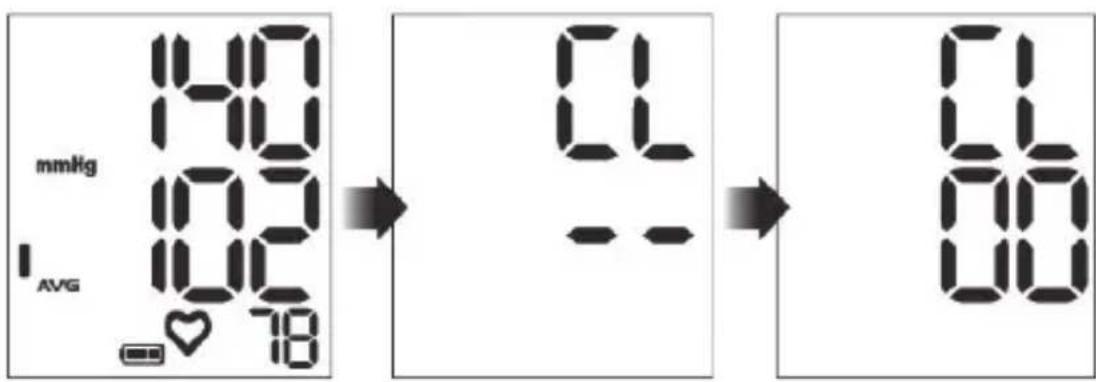
DELETE MEASUREMENT DATA
- Press and hold [1] and [2] buttons simultaneously when the device is showing average or previous measurement data of a selected user.
- [CL] and [--] will be shown on the display, keep holding the buttons until [CL] and [00] is shown.
- All measurement data for the selected user will be deleted.
IRREGULAR HEARTBEAT
This blood pressure monitor provides a blood pressure and pulse rate measurement even when an irregular
heartbeat occurs. An irregular heartbeat is defined as a heartbeat that varies by 25% from the average of all heartbeats during the blood pressure measurement. It is important that you are relaxed, remain still and do not talk during measurements.
NOTE:
- It is advisable to contact your physician if you see this [♥] indicator frequently.
- The “irregular heartbeat” function does not replace a cardiac examination, but it may help to detect potential heart rate irregularities at an early stage. Always consult your physician to determine what will be suitable for you.
- The “irregular heartbeat” function is not designed for diagnosing or treating an arrhythmic disorder. Arrhythmia can only be determined by a licensed physician.
BLOOD PRESSURE
What is Blood Pressure?
Blood pressure is the force exerted by blood against the walls of the arteries. Systolic pressure occurs when the heart contracts. Diastolic pressure occurs when the heart expands. Blood pressure is measured in millimeters of mercury (mmHg). One's natural blood pressure is represented by the fundamental pressure, which is first measured in the morning while one is still at rest and before eating.
What is hypertension and how is it controlled?
Hypertension is an abnormally high arterial blood pressure. If left unattended, hypertension can cause many health problems including stroke and heart attack. Hypertension can be controlled by altering one's lifestyle, avoiding stress, and with medication under a doctor's supervision. To prevent hypertension or to keep it under control:
- Do not smoke
• Exercise regularly - Reduce salt and fat intake
• Have regular physical checkups - Maintain proper weight
Why measure blood pressure at home?
Blood pressure measured at a clinic or doctor's office may cause apprehension or fear and can produce an elevated reading, 25 to 30 mmHg higher than that measured at home. Home measurement reduces the effects of outside influences on blood pressure readings, supplements the doctor's readings and provides a more accurate, complete blood pressure history.
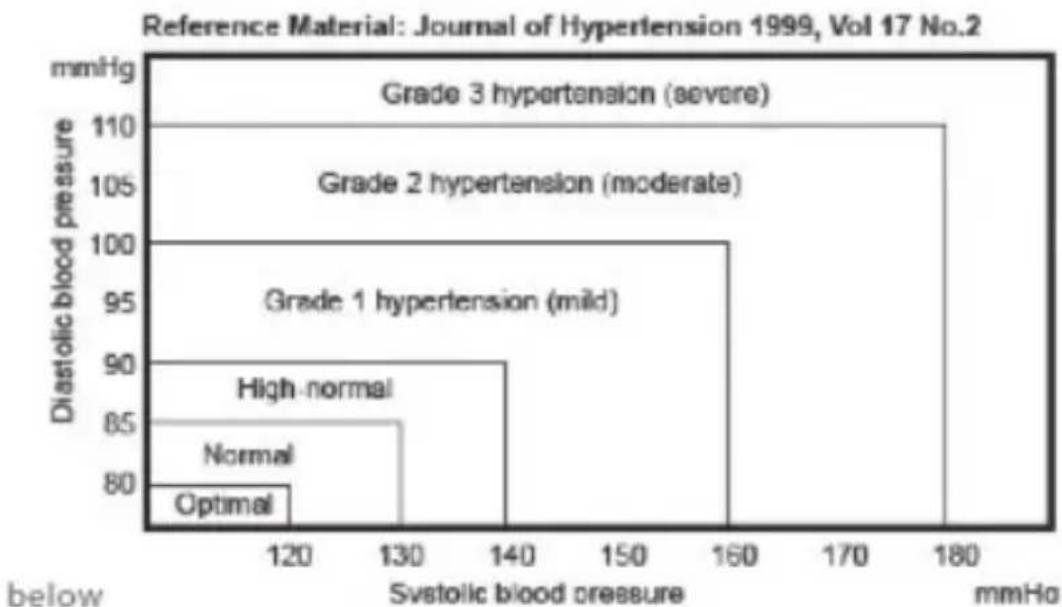
WHO BLOOD PRESSURE CLASSIFICATION
Standards for assessment of high blood pressure, without regard to age, have been established by the World Health Organization (WHO), as shown in the chart below.
heatmap
Reference Material: Journal of Hypertension 1999, Vol 17 No.2 | Category | Diastolic blood pressure (mmHg) | Systolic blood pressure (mmHg) | | :--- | :--- | :--- | | Optimal | 80 | 120 | | Normal | 85 | 130 | | High-normal | 90 | 140 | | Grade 1 hypertension (mild) | 95 | 160 | | Grade 2 hypertension (moderate) | 105 | 170 | | Grade 3 hypertension (severe) | 110 | 180 |TROUBLESHOOTING
| Nothing appears in the display, even when the power is turned on | Batteries are drained | Replace all batteries with new ones |
| Battery polarities are not in the correct position | Re-install the batteries with their negative and positive ends matching their indicated in the battery compartment. | |
| ERROR codice 1 (E1) appears on the display | The cuff position is not fastened properly | Apply the cuff correctly |
| The cuff position is not correct | Sit comfortably and still. Ensure that the cuff is the same level as the heart | |
| ERROR codice 2 (E2) appears on the display | You moved your arm or body during measurement | Make sure you remain very still and quiet during the measurement |
| ERROR codice 3 (E3) | The cuff may not be applied correctly | Check whether tube connection of the cuff is secured to the unit properly |
| ERROR codice 4 (E4) | The unit does not measure | If you have a very weak or irregular heartbeat, the device may have difficulty in determining your blood pressure |
| There is a measuring error | Sit comfortably and still. Fasten the cuff again carefully | |
| ERROR codice 5 (E5) | Cuff over inflated | The measurement range is over 300mmHG. It is recommended to see doctor as soon as possible |
GB
| ERROR codice 6 (E6) | Low battery | Replace Batteries |
| The cuff keeps reinflating | Circuit blocked | Remove and reinsert the batteries and then proceed to take measurement again. |
TECHNICAL SPECIFICATION
| Display: LCD | |
| Range di misurazione | Systolic Pressure: 50-250 mmHg;Diastolic Pressure: 30-200 mmHg |
| Pulse rate 40-180 beats / min | |
| Accuracy | Pressure: +/-3 mmHg Pulse: +/-5% |
| Resolution | Pressure: 1 mmHg Pulse: 1 beat minute |
| Measuring Method Non-invasive, | Oscillometric method |
| Power supply 2 x 1 | .5V AAA batterie |
| Power adapter (optional) | Input 100-240V, 50-60 Hz; Output 6V@600mA (Class II, CE mark) |
| Operating Temperature / Humidity | from +5°C to +40°C, 15-93% RH max |
| Storage Temperature / Humidity | from -25°C to +70°C, 3% RH max |
| Atmospheric pressure 700hPa to | 1060hPa |
| External dimension About 84 x 77 x 15mm | |
| Wrist circumference 13.5 - 23cm | |
| Accessories | Cuff, Instruction Manual, Batteries, Storage Pouch |
| Classification | Application part Type BF |


49

INN-014_manuale_260117 ese.indd 50 26/01/17 10:49




SYMBOL
| Symbol | Meaning |
 | Lot number |
 | Type BF: Device, cuff and tubing are designed to provide special protection against electrical shock |
| DIA | Diastolic Blood Pressure in mmHg |
| PUL Beats | |
 | EC Directive Medical Device Label |
 | Caution |
 | WEEE Label |
 | Read carefully the user manual |
| IP21 Protection Level |
NOTICE: Operation mode: Continuous
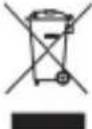
INFORMATION TO USERS according to Legislative Decree No. 49 of March 14, 2014 "2012/19/UE Implementation of the Directive on Waste Electrical and Electronic Equipment (WEEE)"
The crossed-out dustbin symbol indicates that the product at the end of its life must be collected separately from other waste. The user should, therefore, take the equipment with the essential components at the end of its useful lifeto the separate collection center of electronic and electrical waste, or return it to the retailer when purchasing new equipment of equivalent type, in ratio of one to one, or one to zero for devices with larger side less than 25 CM. The separate collection for the decommissioned equipment for recycling, treatment and environmentally compatible disposal contributes to avoid possible negative effects on the environment and human health and promotes recycling of the materials. Improper disposal of the product by the user entails the application of administrative sanctions according to Legislative Decree No. 49 of 14 March 2014
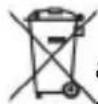
at the end of their life. Please inform yourself about the local rules on separate collection of batteries. The correct disposal of batteries helps venting potentially negative consequences on the environment.
snib laiceps
EMC GUIDANCE
INN-014 requires special precautions regarding EMC and must be installed and put into service according to the EMC information contained in this user manual;
Portable and mobile radiocommunication equipment may affect the operation of INN-014.;
The appliance or system must not be used near other appliances and, if it is necessary to use it near other appliances, the electro-medical device must be observed to check normal functioning in the configuration in which it is used.
The electro-medical device has been tested and found to comply with the emission and immunity limits of electromedical equipment according to IEC60601-1-2: 2014. These limits are designed to provide adequate protection against harmful interference in a typical medical installation. However, there is no guarantee that interference will not occur in a particular installation. If the electro-medical device, interacting with another device, causes or receives detectable interference, the user is invited to limit interference by adopting one or more of the following measures:
- reorient or relocate the receiving device;
- increase the distance between the appliances;
- contact the manufacturer or local technician for assistance.
| Guidance and declaration of manufacturer – electromagnetic emmissions | ||
| INN-014 is intended to be used in the electromagnetic environment specified below. The customer or user of device must assure it's used in this environment. | ||
| Emissions tests | Compliance | Electromagnetic environment |
| Emissions at RF CISPR 11 | Group 1 | INN-014 uses RF energy only for its internal operation. As a result, RF emissions are very low and are unlikely to cause any interference in nearby electronic devices |
| CISPR 11 emissions | Class B | INN-014 is suitable for use in all environments, including domestic and those directly connected o a public low-voltage power supply, that supplies buildings used for domestic purposes. |
| IEC 61000-3-2 harmonic emissions | Not applicable | |
| Voltage fluctuations emissions/flicker IEC 61000-3-3 | Not applicable | |
| Guidance and declaration of manufacturer – electromagnetic immunity | |||
| INN-014 is intended to be used in the electromagnetic environment specified below. The customer of user of INN-014 must assure it's used in this environment | |||
| Immunity test IEC | 60601 test level Compliance level | Electromagnetic environment | |
| Electrostatic discharge (ESD) IEC 61000-4-2 | +- 8 kV contact +- 8 kV contact | Floors must be made of wood, concrete or ceramic tiles. If the floors are covered with synthetic material, the relative humidity should be at least 30% | |
| +- 2; 4; 8; 15 kV air | +- 2; 4; 8; 15 kV air | ||
| Campo magnetico ad alta frequenza (50/60Hz) IEC 61000-4-8 | 30 A/m 30 A/m | Power frequency magnetic fields should be at levels characteristic of a typical location in a typical commercial or hospital environment. | |
| Guidance and declaration of manufacturer - electromagnetic immunity | ||||
| INN-014 is intended to be used in the electromagnetic environment specified below. The customer of user of INN-014 must assure it's used in this environment Portable and mobile RF communications equipment should be used no closer to any part of the blood pressure monitor including cables, than the recommended separation distance calculated from the equation applicable to the frequency of the transmitter | ||||
| Immunity test IEC 60601 test level Compliance | level | Recommended separation distance d: | ||
| RF IrradiateIEC 61000-4-3 | 3 V/m e 10 V/mda 80 MHz a 2,7 GHz | 3 V/m e 10V/m | d = 30 cm | |
| IEC 61000-4-3Proximity fieldimmunity fromwireless RFcommunicationdevices | TETRA 400380 – 390 MHz | 27 V/m 27 V/m | d = 30 cm | |
| GMRS 460FRS 460430 – 170 MHz | 28 V/m 28 V/m | |||
| LTE Band 13, 17704 – 787 MHz | 9 V/m 9 V/m | |||
| GSM 800/900, TETRA800, iDEN 820, CDMA850, LTE Band 5800 960 MHz | 28 V/m 28 V/m | |||
| GSM 1800; CDMA1900; GSM 1900;DECT; LTE Band 51700 – 1990 MHz | 28 V/m 28 V/m | |||
| Bluetooth, WLAN,802.11 b/g/n, RIFD2450, LTE Band 702400 – 2570 MHz | 28 V/m 28 V/m | |||
| WLAN 802.11 a/n5100 – 5800 MHz | 9 V/m 9 V/m | |||
REMARKS
This equipment has been tested and found to comply with the limits for a Class B digital device, pursuant to part 15 of the FCC Rules. These limits are designed to provide reasonable protection against hwristful interference in a residential installation. This equipment generates uses and can radiate radio frequency energy and, if not installed and used in accordance with the instructions, may cause hwristful interference to radio communications. However, there is no guarantee that interference will not occur in a particular installation. If this equipment does cause hwristful interference to radio or television reception, which can be determined by turning the equipment off and on, the user is encouraged to try to correct the interference by one or more of the following measures:
- Reorient or relocate the receiving antenna.
- Increase the separation between the equipment and receiver.
- Connect the equipment into an outlet on a circuit different from that to which the receiver is connected.
- Consult the dealer or an experienced technician for help.
WARNING
- To comply with the limits of the Class B digital device, pursuant to Part 15 of the FCC Rules, this device is
comply with Class B limits. All peripherals must be shielded and grounded.
Operation with non-certified
peripherals or non-shielded cables may results in interference to radio or reception.
- Any changes or modifications not expressly approved by the grantee of this device could void the user's
authority to operate the device
innoliving
Innoliving Spa
Via Merloni, 2/B
60131 Ancona Italy
Tel 071 2133550
www.innoliving.it
MADE IN CHINA
CE
1936
Rev.05_07.2021

- NOTA:
- BARRA INDICATRICE DI PRESSIONE
- INDICATION FOR USE
- WARNING
- SAFETY NOTES
- GB
- CAUTION
- MAINTENANCE
- PRODUCT DESCRIPTION
- DISPLAY READINGS
- INSTAL BATTERIES
- NOTE:
- USE OF AC ADAPTOR (OPTIONAL)
- HOW TO SET THE CLOCK
- At any time:
- HOW TO APPLY THE ARM CUFF
- BEFORE MEASURING BLOOD PRESSURE
- MEASURE YOUR BLOOD PRESSURE
- Measurement with storing data
- Measurement without storing data (Guest mode)
- PRESSURE BAR INDICATOR
- WHO CLASSIFICATION INDICATOR
- SEE AVERAGE AND PREVIOUS MEASUREMENT DATA
- DELETE MEASUREMENT DATA
- IRREGULAR HEARTBEAT
- BLOOD PRESSURE
- WHO BLOOD PRESSURE CLASSIFICATION
- EMC GUIDANCE
- REMARKS
- Operation with non-certified
- innoliving
Brand : Innoliving
Model : INN-014
Category : Manometer