
MZ3555WH - Freezer Concept - Free user manual and instructions
Find the device manual for free MZ3555WH Concept in PDF.


| Product type | Chest freezer |
| Model | MZ3555WH |
| Energy class | F |
| Voltage | 220–240 V ~ 50 Hz |
| Annual power consumption | 205 kWh |
| Daily power consumption | 0.562 kWh |
| Total volume | 83 L |
| Freezer volume | 83 L |
| Freezing capacity | 4 kg / 24 h |
| Freezer accumulation time | 15 hours |
| Climate class | N / ST |
| Noise level | 41 dB(A) |
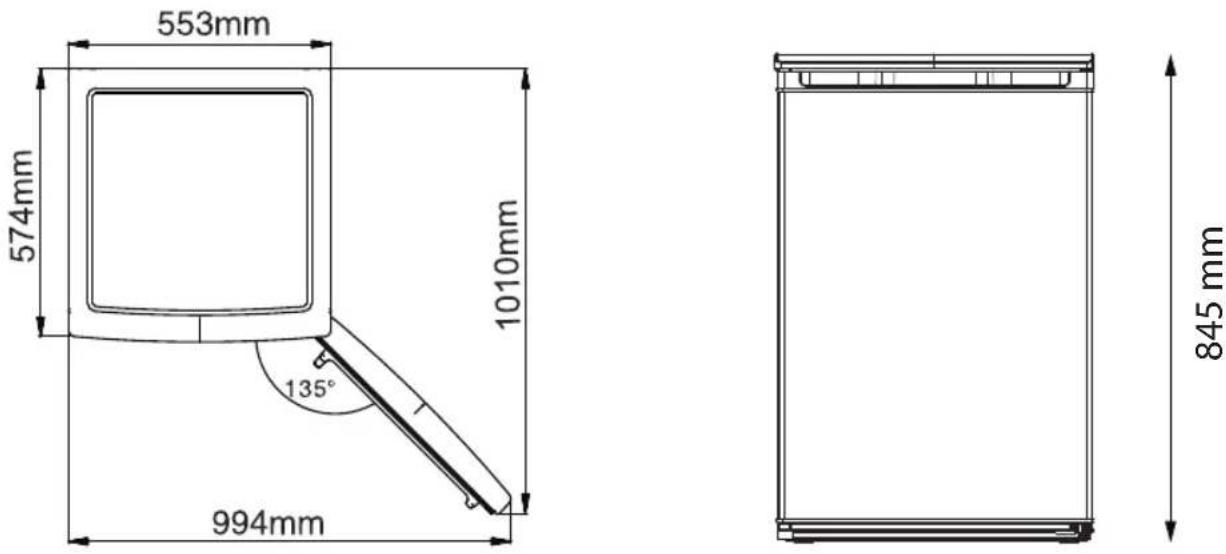
| Height | 845 mm |
| Width | 553 mm |
| Depth | 574 mm |
| Weight | 28.2 kg |
| Number of drawers | 1 (freezer drawer) |
| Temperature control | Manual thermostat |
| Defrosting | Manual |
| Door reversal | Yes (reversible lid) |
| Adjustable feet | Yes (2 levelling feet) |
| Cleaning | Non-abrasive cleaners, lukewarm water |
| Safety features | Child safety lock (not specified), overheat protection via circuit breaker |
| Spare parts availability | Contact authorized service center |
Frequently Asked Questions - MZ3555WH Concept
User questions about MZ3555WH Concept
0 question about this device. Answer the ones you know or ask your own.
Ask a new question about this device
Download the instructions for your Freezer in PDF format for free! Find your manual MZ3555WH - Concept and take your electronic device back in hand. On this page are published all the documents necessary for the use of your device. MZ3555WH by Concept.
USER MANUAL MZ3555WH Concept



PODĚKOVÁNÍ
TIPY K POUŽÍVÁNÍ
natural_image
Technical line drawing of a refrigerator with open lid and internal components, shown in two views (no text or symbols)Obr. 2
natural_image
Technical line drawing of an open refrigerator with internal compartments and a close-up inset showing two hanging components (no text or symbols present)Obr. 3
natural_image
Technical line drawing of a refrigerator with an inset close-up showing internal components (no text or symbols)Obr. 4
BĚŽNÉ PROVOZNÍ ZVUKY
Zvuk praskání ledu
TIPY NA POUŽÍVANIE
natural_image
Technical line drawing of a rectangular frame with a vertical dimension labeled 845 mm (no text or symbols on the frame itself)ZMENA SMERU OTVÁRANIA DVERÍ
Dávajte pozor, aby pri zmene smeru otvárania dverí nedošlo k privrznutiu prstov do pántov dverí.
natural_image
Technical line drawing of a refrigerator with open lid and internal components, plus an inset diagram showing internal components (no text or symbols)Obr. 2
natural_image
Technical line drawing of a refrigerator with internal compartments and hanging control components (no text or symbols)Obr. 3
natural_image
Technical line drawing of a refrigerator with an inset close-up showing internal components (no text or symbols)Obr. 4
BEŽNÉ PREVÁDZKOVÉ ZVUKY
Zvuk praskania l'adu
WSKAZÓWKI DOTYCZĄCE UŻYWANIA
natural_image
Technical line drawing of a rectangular frame with a vertical dimension labeled 845 mm (no text or symbols beyond the measurement)ZMIANA KIERUNKU OTWIERANIA DRZWI
natural_image
Technical line drawing of a refrigerator with open lid and side view showing mounting bracket assembly (no text or symbols)Rys. 2
natural_image
Technical line drawing of a refrigerator with internal shelves and mounting base, accompanied by three schematic diagrams showing mechanical components (no text or labels)Rys.3
natural_image
Technical line drawing of a refrigerator with an inset close-up showing internal components (no text or symbols)Rys. 4
ZWYKŁE DŻWIĘKI EKSPLOATACYJNE
Dźwięk pękania lodu
IZMANTOŠANAS PADOMI
natural_image
Technical line drawing of a rectangular frame with a vertical dimension labeled 845 mm (no text or symbols beyond the measurement)DURVJU ATVĚRŠANAS VIRZIENA
natural_image
Technical line drawing of a refrigerator with open lid and internal components, plus an inset close-up showing mechanical assembly (no text or symbols)- att.
natural_image
Technical line drawing of an open refrigerator with internal shelves and a close-up inset showing hanging components (no text or symbols)- att.
natural_image
Technical line drawing of a refrigerator with an inset close-up showing internal components (no text or symbols)- att.
NORMĀLAS EKSPLUATĀCIJAS SKAŅAS
TRAUCĚJUMU NOVĚRŠANA
Thank you for purchasing the Concept product. We want you to be satisfied with everything we make every day you use it.
Please read the instructions carefully before initial use. You should retain them for future reference. Ensure that anyone using this product is familiar with the instructions.
TABLE OF CONTENTS
Technical specifications
Important safety information
Product description
Tips for use
User manual
Cleaning and maintenance
Installation of the appliance
Door swing direction
Regular operating noise
Troubleshooting
Service centre
Environmental protection
| TECHNICAL SPECIFICATIONS | |
| Energy class F | |
| Voltage | 220–240 V ~ 50 Hz |
| Annual power consumption | 205 kWh |
| Daily power consumption 0,562 KWh | |
| Total volume 83l | |
| Usable volume (refrigerator/freezer) | 0 l / 83 l |
| Freezing capacity 4 kg / 24 hours | |
| Freezer accumulation time 15hours | |
| Climate class N / ST | |
| Noise level 41 dB (A) | |
| Height 845 mm | |
| Width 553mm | |
| Depth 574 mm | |
| Weight 28,2 kg | |
The manufacturer reserves the right to make potential technical changes, typographical errors and any differences in the representation without prior notice.
IMPORTANT SAFETY INFORMATION
When delivering the free-standing freezer
- Immediately after delivery, check the package for any damage during shipping.
- Caution! Caution! Some edges of this appliance that are hidden after installation are sharp! Be careful not to get cut when handling an uninstalled unit.
- Do not install the appliance if it has been damaged. Contact the store where you purchased it immediately.
- Remove all the packaging and marketing materials before first use.
- Keep the packaging materials away from children or dispose of them properly.
During installation
- Do not use the appliance in any other way than as described in this manual.
- Make sure the mains voltage corresponds to the values on the rating plate of the appliance.
• This appliance can be used in households and similar places like:
- Kitchen cabinets in shops, offices and other workplaces.
- Appliances used in agriculture.
- Appliances used by guests in hotels and other areas in a hotel environment.
- Appliances used in a Bed and Breakfast environment.
- Do not use the appliance if you are barefoot.
- Do not touch the appliance with wet hands.
- Do not touch the cooling parts of the freezer with wet hands. Risk of injury!
- Do not stand or sit on the open door of the appliance.
- Do not allow children or unauthorized people to handle the appliance, use it out of their reach.
• Children should not play with the appliance.
- Pay extra attention if the appliance is used near children.
- Do not allow the appliance to be used as a toy.
- This appliance can be used by children aged 8 years and over. Persons with reduced physical, sensory or mental capabilities, or lack of experience and knowledge, should be supervised or familiarized with the instructions for use of the appliance in a safe way and have been made aware of the risks involved.
- Children 3 to 8 years old are only allowed to insert and remove food from the freezer.
- If a malfunction occurs, turn off the appliance and unplug it from the wall outlet.
- When disconnecting the unit from the wall outlet, never pull the power cord, grasp the plug end and disconnect it by removing it from the receptacle.
concept
EN
- Do not immerse the power cord or the plug in water or any other liquid.
- Check the appliance and the power cord for damage regularly.
- Do not switch on the appliance if it has been damaged.
- Do not use the appliance if the door or the door seals are damaged. Call the authorised service centre.
- Do not use any accessories other than those recommended by the manufacturer.
- Do not use accessories with damaged surface treatment or if it has been worn out or has other defects.
- When removing ice from the freezer, be careful, there is a risk of injury and frostbite.
- IMPORTANT! Before switching on, let the appliance stand still for at least 3 hours to settle the refrigerant gases in the compressor after shipping.
- Use the appliance in a room with temperatures between +10 °C and +32 °C.
- Do not place the appliance near heat sources, it may increase its consumption and shorten the service life.
- Do not place any objects on the top of the appliance, as it could damage the appliance.
- Do not place any electrical devices such as mixers and others in the appliance.
- Do not store any corrosive or explosive substances such as aerosol cans with a flammable substance in the appliance.
- Do not run any electrical appliances inside the freezer.
- Before use, it is necessary to wipe the inside of the appliance with a solution of baking soda dissolved in tepid water. After cleaning, dry all parts thoroughly.
- Cleaning and user maintenance shall not be made by children unless they are older than 8 years and supervised.
- WARNING! Do not use mechanical devices or other means to speed up the defrosting process other than those recommended by the manufacturer.
- Do not place the appliance under the direct sun shine.
- Make sure there is enough free space around the appliance for free circulation of air.
- The appliance should be located at least 50 cm from a gas oven or burners and should be placed at least 5 cm away from an electric oven.
- If the appliance is placed close to the freezer, a distance of at least 2 cm should be between them in order to avoid creating moisture on the outside.
Caution!
To avoid injury, open the oven door only for a short period of time to insert or remove food. Children may lock themselves inside the appliance (risk of suffocation) or be exposed to other dangers.
Possible defects
- Only qualified service technicians should repair or perform maintenance to this appliance.
- During the repairs the appliance must be disconnected from the power. Switch off the circuit breaker or remove the plug from the wall outlet.
- When disconnecting the unit from the wall outlet, never pull the power cord, grasp the plug end and disconnect it by removing it from the receptacle.
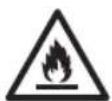
Caution! The risk of fire / Flammable materials.
If you fail to follow these instructions, any possible repair cannot be recognized as a warranty repair.
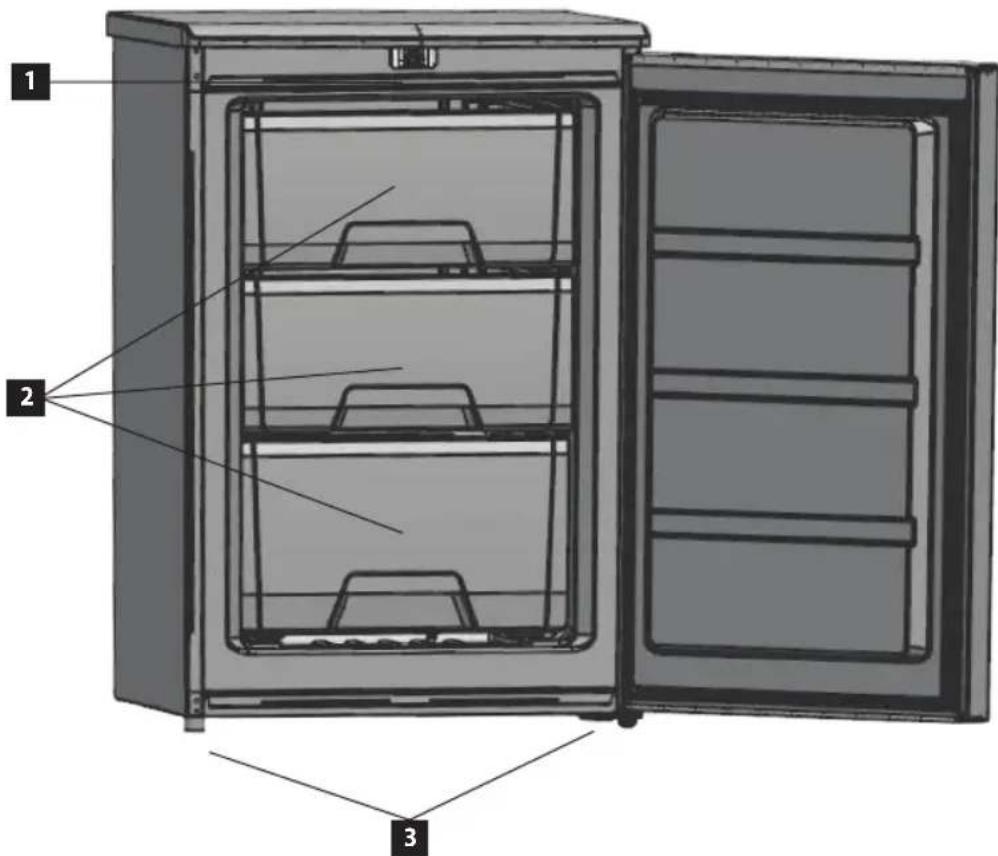
PRODUCT DESCRIPTION
1 Thermostat
2 Freezer drawer
3 Levelling foot
TIPS FOR USE
- If there is a power failure or the cord has been pulled out of the wall socket, it is necessary to wait at least 5 minutes before reconnecting the appliance. This 5-minute delay is done to prevent compressor damage.
- During a power failure, food can be stored for several hours inside the freezer. Open the door of the the freezer as little as possible in order to extend the freshness of the stored food.
- If you do not use the appliance for a long time, disconnect the appliance from the mains, clean the inside of the appliance with non-aggressive detergents (see the Cleaning and Maintenance section) and leave the appliance door open to prevent unpleasant odours inside the appliance.
- The ambient temperature in the room, the temperature of the food, the amount of food stored, and how often the door of the appliance gets opened have an effect on the temperature inside the appliance.
- If you do not freeze fresh food, it is not necessary to set the freezer to the maximum cooling power (MAX). If you leave the temperature set to the maximum cooling power for a long time, the drain line may freeze.
- This appliance is designed for use at ambient temperatures of 10 °C to 32 °C. The appliance may not function properly if it is used in environment with ambient temperatures listed in the table.
| Climate class Ambient Temperature | |
| T 16 °C up to 43 °C | |
| ST 16 °C up to 38 °C | |
| N 16 °C up to 32 °C | |
| SN 10 °C up to 32 °C |
Tips for storing food in a freezer
The freezer is used to freeze fresh food, store frozen food for the time specified on the packaging and to produce ice.
- Pack the fresh food airtight. Special freezer bags, polyethylene bags and plastic containers are ideal.
- Prevent fresh food from coming into contact with already frozen food.
- In case of power failure, open the freezer door only when necessary and as little as possible. The freezer keeps the food frozen for up to 12 hours.
- Never place warm food or beverages in the freezer.
- Before putting frozen food into the freezer, make sure the packaging is not damaged.
- It is also not recommended to put beverages in glass bottles in the freezer, glass can easily rupture due to low temperatures inside the freezer.
USER MANUAL
Before first user
Before first use you should wipe the outside and inside of the appliance with a damp cloth for hygiene reasons. Wash all removable parts with warm soapy water.
After installing the freezer, leave the appliance standstill for at least half an hour before connecting to the mains. It is necessary to allow the cooling gases to set down. Then you can connect the freezer to the mains and let it run for 2-3 hours to stabilize a normal operating temperature. A slight odour may occur during this time. It will go away as soon as the appliance starts to cool. Then put fresh or frozen food inside the appliance.
Note: If a power failure occurs during the first run, wait for at least 5 minutes before switching on again or connecting to the mains.
Freezer temperature setting
- The temperature in the freezer can be set with the thermostat control knob. It is located in the front upper part of the freezer.
- Turn the thermostat control knob up or down to set the temperature inside the freezer.
- The symbols on the control knob "1 \~ 4" indicate different temperature levels.
- Position "1" means the warmest level, position "4" is the coldest level.
- For normal use, set the knob to a position between "1" and "4", the exact position for general use above position number "2".
- When using the freezer for the first time or after defrosting, turn the temperature control to "4" and let the freezer run for at least two hours before storing the food in the freezer.
• All purchased frozen food should be placed in the freezer as soon as possible to prevent thawing of the food. - Follow the recommendations for storage printed on the frozen food packaging.
- Make sure that the drawer does not freeze in the refrigeration pipe.
- Make sure that the drawer does not freeze to the refrigeration pipe.
CLEANING AND MAINTENANCE
- Disconnect the power cord from the wall outlet or switch off the circuit breaker of the appliance before cleaning and maintenance.
- The inside of the freezer should be cleaned according to the frequency of use to avoid unpleasant odours.
- One source of odour can also be dirt deposits around the sealing. Regular cleaning with a damp cloth prevents these unpleasant odours.
- For cleaning, we recommend using non-aggressive products, preferably clear lukewarm water along with a soft sponge or paper towel.
- Let the appliance open to dry out naturally after cleaning.
- For cleaning, we do not recommend cleaning agents such as alcohol, acetone, oil, toothpaste or any other abrasive products.
- We do not recommend using coarse sponges or steel brushes.
• We do not recommend using boiling water as it may cause damage to individual parts of the appliance. - We do not recommend cleaning the appliance with a stream of water that could interfere with the insulation or cause a short circuit of some electronic components of the appliance.
- Clean all the accessories of the appliance with a solution of lukewarm water and a detergent. Never wash the accessories in a dishwasher!
Defrosting
- Disconnect the electrical plug from the mains
- Move food from thefreezerto place where it will not be spoiled, prepare a container to catch defrosting frost
- Wipe the thawed water on the evaporator and the inner lining with a dry cloth, then wring the cloth out and repeat the process until the ice has completely thawed
- To speed up the defrosting process, you can use an ice scoop (use only a plastic or wooden scoop to avoid damaging the seal and the inner lining) in combination with the use of an adequate amount of warm water
- After complete defrosting and wiping the residual water inside the freezer with a dry cloth, you can put the food back in the freezer and switch on the appliance.
Installation instructions
- The warranty does not cover damages caused by incorrect installation.
- The responsibility for installing the appliance lies with the buyer, not the manufacturer.
- The manufacturer bears no responsibility for damage caused to people, animals or property due to incorrect installation.
- Place the appliance on a flat place in a well-ventilated are.
- Do not place the appliance under the direct sun shine.
- The appliance should be placed at least 10 cm from the wall at the back and both sides. There should be a free space of approximately 30 cm above the appliance as it needs to ventilate freely.
- If necessary, use the adjustable feet at the bottom of the appliance to align the appliance in a horizontally stable position.
Connection to the mains
- Make sure the mains voltage and current protection correspond to the values on the rating plate of the appliance. We recommend using a separate outlet with a 16 A circuit breaker.
- Only use grounded sockets.
- Do not use multiple sockets, plugs and extension cords. There is a risk of overheating.
- The plug of the power cord on the appliance must be freely accessible even after the installation.
• Changes in a connection may only be performed by a qualified professional. - Electrical safety of the appliance can be guaranteed only if the protective terminal of the appliance is connected to the protective conductor of the mains.
- The manufacturer bears no responsibility for damage to persons or property as a result of missing or bad protective connection.
- The power cord must be positioned in a way that it is not deformed or excessively bent.
APPLIANCE DIMENSIONS
DOOR OPENING DIRECTION CHANGE
Be careful not to pinch your fingers in the upper and lower hinges of the door when changing the door opening direction.
- Switch off the circuit breaker or remove the plug from the wall outlet. When disconnecting the appliance from the wall outlet, never pull the power cord, grasp the plug end and disconnect it by removing it from the receptacle.
- If you have any food and drinks in the freezer door compartments, remove them.
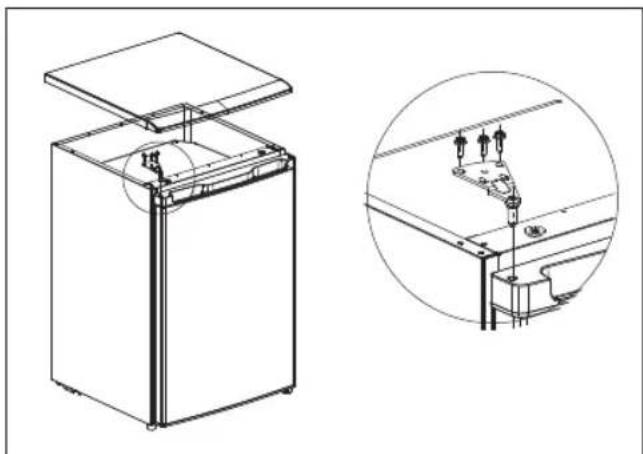
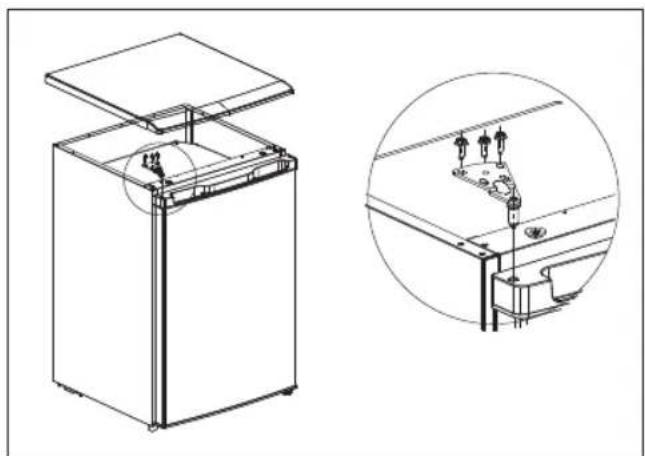
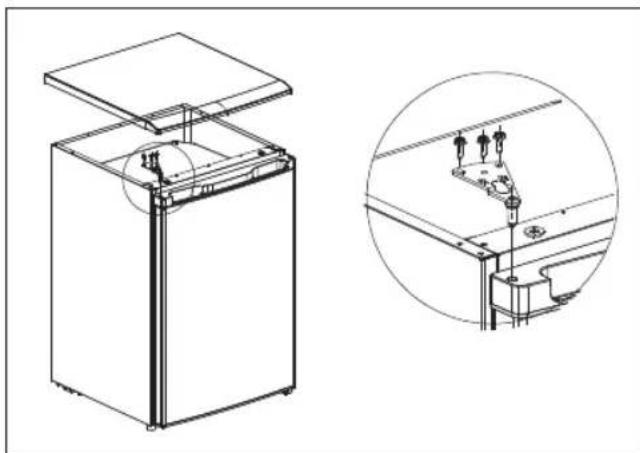
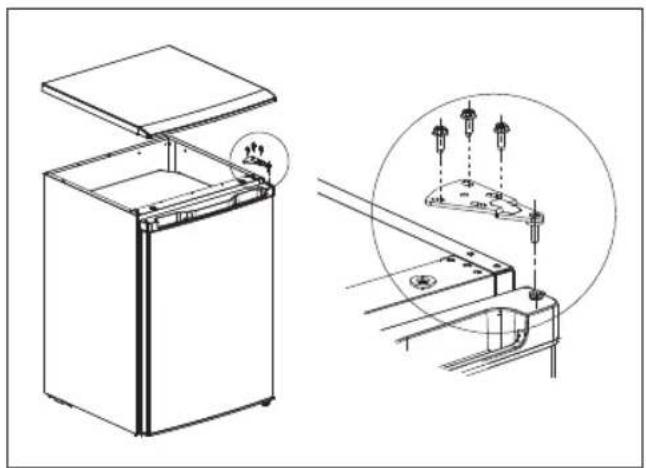
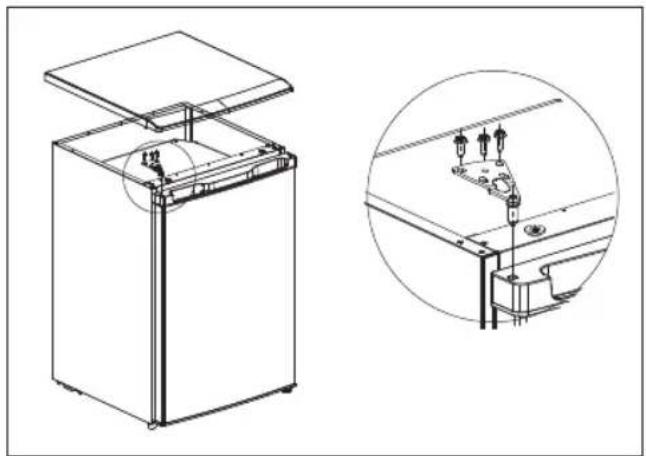
- Remove the top cover and remove the screws from the top hinge of the freezer (Fig. 2) and remove the top hinge. During dismantling hold the door in a vertical position to prevent them from falling and subsequent damage. Remove the freezer door and place it in a safe place.
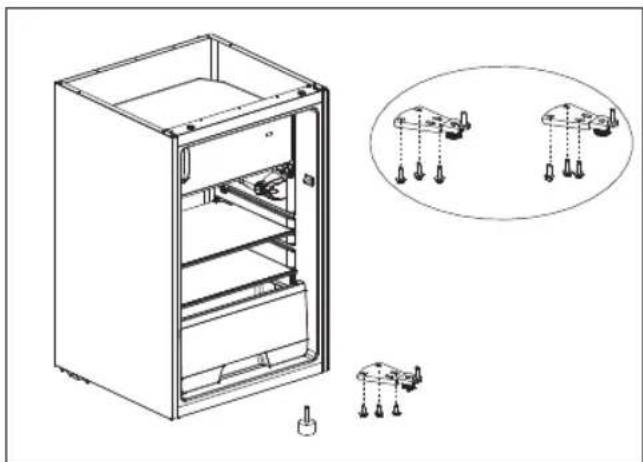
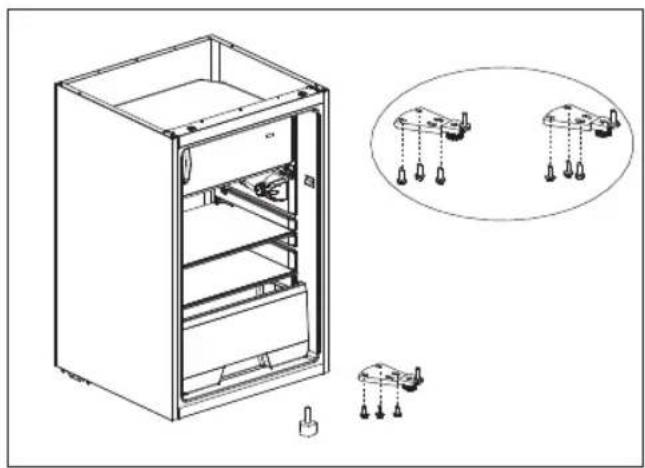
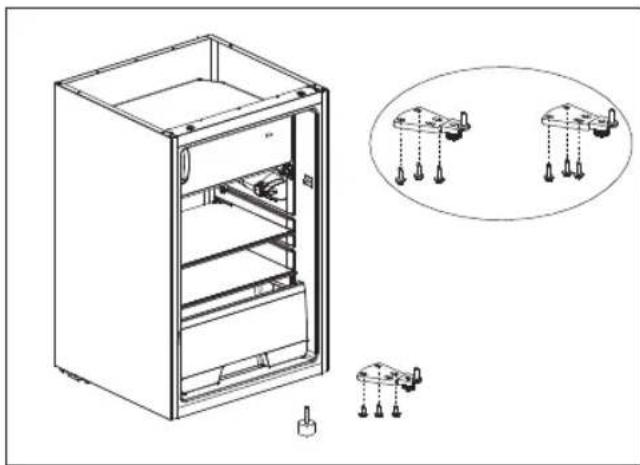
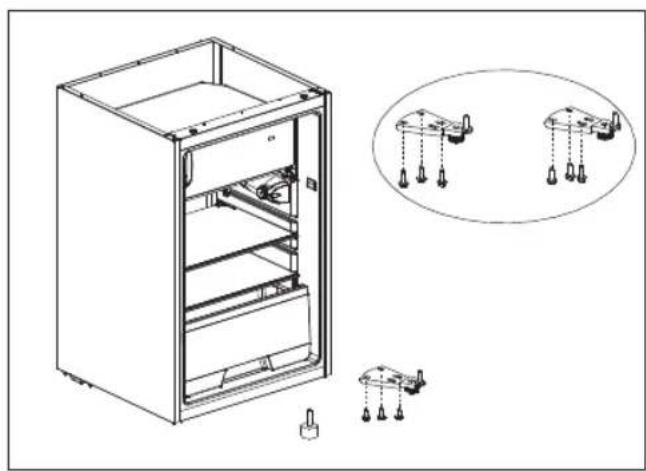
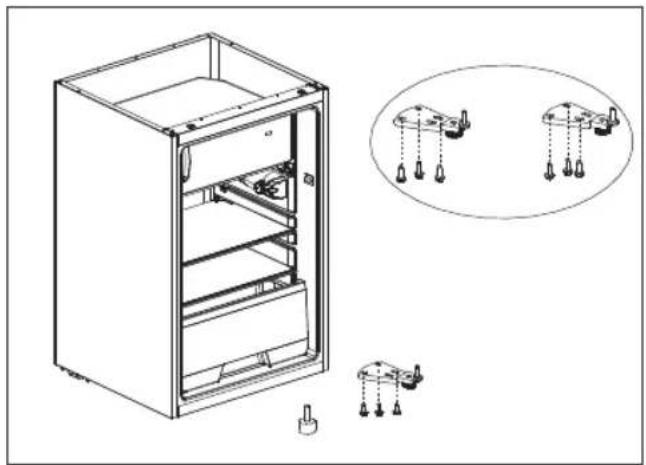
- Remove the freezer lower hinge screws (Fig. 3). Remove the lower door hinge and unscrew the two levelling feet.
- Install the lower door hinge to the opposite side. Ensure that the screws are correctly positioned (Fig. 3) and fix them. Screw in the levelling feet.
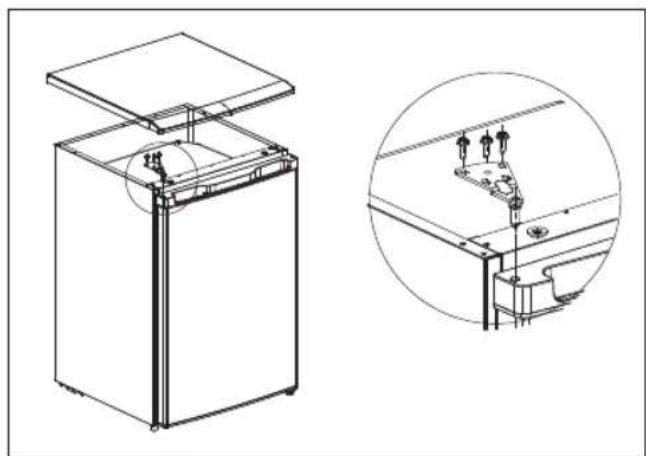
- Place the door on the lower hinge and install the upper hinge. Ensure that the screws are correctly positioned (Fig. 4) and fix them.
- Put back the top cover of the freezer (Fig. 4).
- Make sure that the freezer door closes properly.
natural_image
Technical line drawing of a refrigerator with open lid and internal components, plus an inset diagram showing internal wiring connections (no text or symbols)Fig. 4
natural_image
Technical line drawing of a refrigerator with internal compartments and mounting hardware (no text or symbols)Fig. 5
natural_image
Technical line drawing of a refrigerator with an inset close-up showing internal components (no text or symbols)Fig. 6
VVREGULAR OPERATING NOISE
Ice crackling noise
It may occur during the automatic defrosting, or it can be caused by the expansion and contraction of air inside the freezer.
Short cracking
It can be heard when the thermostat turns on and off the compressor.
Noise of the compressor
Running compressor produces noise. After the installation of the appliance, the compressor may be a little louder for a short time.
Bubbling and flowing
This sound is generated when the refrigerant is flowing through the appliance pipes.
Sound of running water
Water flows into the evaporator container during the defrosting process and it is audible throughout the defrosting process.
Sound of an airflow (sound of a ventilator)
The sound is created by the air circulation inside the appliance. This is a normal feature of a freezer equipped with a No-Frost system.
TROUBLESHOOTING
You can rectify most of the minor faults that appear when using the freezer without having to contact an authorized service centre. The following overview should help you find the causes of the faults that occur.
If the following overview does not help to remedy the error, please contact an authorized service centre.
| Defect description | Possible cause Solution | |
| The appliance does not work | The power cord plug is not plugged in the wall outlet. | Check the connection of the cord. |
| Damaged power cord | Do not connect the appliance into the mains. Contact a qualified expert or an authorised service. | |
| Faulty main electronics or control electronics | Contact an authorized service centre. | |
| The appliance cannot lower the temperature | Cooling fluids leakage Contact an authorized service centre. | |
| Clogged freezer piping Contact an authorized service centre. | ||
| The operation of the freezer is too loud | The freezer is not stabilized | Align the freezer so that it is levelled. Make sure that it does not rest on, for instance, furniture. |
| A frost deposit forms inside the freezer. | Insufficiently packaged food or wet containers | Ensure that the food packaging is not damaged or that the containers are dry before placing them in the freezer. |
| Door gets opened too frequently Do not open the door so often. | ||
| Incorrectly placed compartments in the freezer | Check that the freezer compartments are properly placed. | |
| The door sealing is damaged or worn out Contact an authorized service centre. | ||
SERVICE CENTRE
CAUTION!
Extensive maintenance or repair, which requires access to internal parts of the product, has to be performed by a qualified service centre.
ENVIRONMENTAL PROTECTION
- Prefer recycling of packaging materials and old appliances.
- Packaging materials may be disposed of as sorted waste.
- Dispose the plastic bags made of polyethylene (PE) of as sorted waste.
Recycling of the appliance at the end of its lifespan:
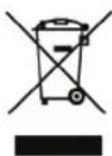
This appliance is labelled in accordance with European Directive 2012/19/EU concerning used electrical and electronic appliances (waste electrical and electronic equipment - WEEE). The symbol on the product or its packaging indicates that this product may not be treated as household waste. It is necessary to take it to a container park for the recycling of electrical and electronic equipment. By ensuring the correct disposal of this appliance you will help prevent potential negative consequences to the environment and human health, which could otherwise result from inappropriate disposal of this product. Disposal must be performed in accordance to the regulations for waste disposal. For more detailed information about recycling of this appliance see the authorized local office or service for household waste disposal or the shop, where you purchased the appliance.


- PODĚKOVÁNÍ
- TIPY K POUŽÍVÁNÍ
- BĚŽNÉ PROVOZNÍ ZVUKY
- Zvuk praskání ledu
- TIPY NA POUŽÍVANIE
- ZMENA SMERU OTVÁRANIA DVERÍ
- BEŽNÉ PREVÁDZKOVÉ ZVUKY
- Zvuk praskania l'adu
- WSKAZÓWKI DOTYCZĄCE UŻYWANIA
- ZMIANA KIERUNKU OTWIERANIA DRZWI
- ZWYKŁE DŻWIĘKI EKSPLOATACYJNE
- Dźwięk pękania lodu
- IZMANTOŠANAS PADOMI
- DURVJU ATVĚRŠANAS VIRZIENA
- NORMĀLAS EKSPLUATĀCIJAS SKAŅAS
- TRAUCĚJUMU NOVĚRŠANA
- TABLE OF CONTENTS
- IMPORTANT SAFETY INFORMATION
- When delivering the free-standing freezer
- During installation
- concept
- Caution!
- Possible defects
- PRODUCT DESCRIPTION
- TIPS FOR USE
- Tips for storing food in a freezer
- USER MANUAL
- Before first user
- Freezer temperature setting
- CLEANING AND MAINTENANCE
- Defrosting
- Installation instructions
- Connection to the mains
- APPLIANCE DIMENSIONS
- DOOR OPENING DIRECTION CHANGE
- VVREGULAR OPERATING NOISE
- Ice crackling noise
- Short cracking
- Noise of the compressor
- Bubbling and flowing
- Sound of running water
- Sound of an airflow (sound of a ventilator)
- TROUBLESHOOTING
- SERVICE CENTRE
- ENVIRONMENTAL PROTECTION
- Recycling of the appliance at the end of its lifespan:
Brand : Concept
Model : MZ3555WH
Category : Freezer