
PT-LB51NTU - Video projector PANASONIC - Free user manual and instructions
Find the device manual for free PT-LB51NTU PANASONIC in PDF.


| Product Type | LCD Projector |
| Brand | Panasonic |
| Model | PT-LB51NTU |
| Power Supply | 100 V - 240 V, 50 Hz/60 Hz |
| Power Consumption (Standby) | Approx. 4 W |
| Lamp Type | UHP Lamp (Replaceable) |
| Replacement Lamp Part Number | ET-LAB50 |
| Lamp Life (Standard Mode) | Approx. 2,000 hours |
| Lamp Life (Eco Mode) | Extended (set 'LAMP POWER' to 'ECO MODE') |
| Main Functions | LCD projection, manual focus, zoom, keystone correction, OPTION menu |
| Ceiling Mount Installation | Possible with optional kit ET-PKB50, for qualified technician only |
| Altitude Use | Up to 1,400 m without adjustment; above, set 'HIGH ALTITUDE' to 'YES' |
| Maintenance and Cleaning | Internal cleaning by authorized service center at least once a year; wipe power plug with a dry cloth |
| Safety | Overload protection, automatic shutdown in case of problem, mandatory grounding |
| Remote Control Batteries | Specified type (check manual); observe polarities, do not mix old and new batteries |
| Indicators | LAMP indicator lights red in standby and after 1,800 hours of use |
| Installation Precautions | Do not block ventilation openings, avoid humidity and dust, do not install on unstable surfaces |
Frequently Asked Questions - PT-LB51NTU PANASONIC
User questions about PT-LB51NTU PANASONIC
0 question about this device. Answer the ones you know or ask your own.
Ask a new question about this device
Download the instructions for your Video projector in PDF format for free! Find your manual PT-LB51NTU - PANASONIC and take your electronic device back in hand. On this page are published all the documents necessary for the use of your device. PT-LB51NTU by PANASONIC.
USER MANUAL PT-LB51NTU PANASONIC
LCD Projector Commercial Use
Operating Instructions
Model No. PT-LB50NTU
PT-LB50U
PT-LB50SU
natural_image
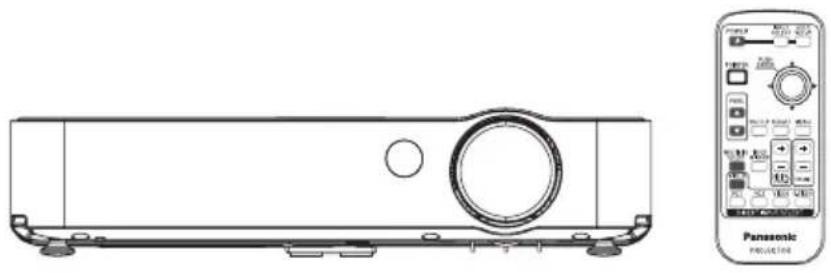
Line drawing of a projector with a circular vent and control panel (no text or symbols)Before operating this product, please read the instructions carefully and save this manual for future use.
Dear Panasonic Customer:
This instruction booklet provides all the necessary operating information that you might require. We hope it will help you to get the most out of your new product, and that you will be pleased with your Panasonic LCD projector. The serial number of your product may be found on its bottom. You should note it in the space provided below and retain this booklet in case service is required.
Model number: PT-LB50NTU / PT-LB50U / PT-LB50SU
Serial number:
IMPORTANT SAFETY NOTICE
WARNING: TO REDUCE THE RISK OF FIRE OR ELECTRIC SHOCK, DO NOT EXPOSE THIS PRODUCT TO RAIN OR MOISTURE.
Power Supply: This LCD Projector is designed to operate on 100 V – 240 V, 50 Hz/60 Hz AC, house current only.
CAUTION: The AC power cord which is supplied with the projector as an accessory can only be used for power supplies up to 125 V, 7 A. If you need to use higher voltages or currents than this, you will need to obtain a separate 250 V power cord. If you use the accessory cord in such situations, fire may result.

The lightning flash with arrowhead symbol, within an equilateral triangle, is intended to alert the user to the presence of uninsulated “dangerous voltage” within the product’s enclosure that may be of sufficient magnitude to constitute a risk of electric shock to persons.

The exclamation point within an equilateral triangle is intended to alert the user to the presence of important operating and maintenance (servicing) instructions in the literature accompanying the product.
CAUTION:
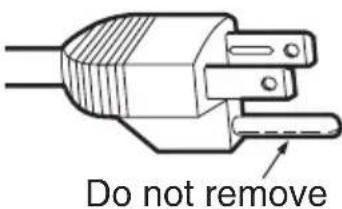
This equipment is equipped with a three-pin grounding-type power plug. Do not remove the grounding pin on the power plug. This plug will only fit a grounding-type power outlet. This is a safety feature. If you are unable to insert the plug into the outlet, contact an electrician. Do not defeat the purpose of the grounding plug.
WARNING:
This equipment has been tested and found to comply with the limits for a Class B digital device, pursuant to Part 15 of the FCC Rules. These limits are designed to provide reasonable protection against harmful interference in a residential installation. This equipment generates, uses and can radiate radio frequency energy and, if not installed and used in accordance with the instructions, may cause harmful interference to radio communications. However, there is no guarantee that interference will not occur in a particular installation. If this equipment does cause harmful interference to radio or television reception, which can be determined by turning the equipment off and on, the user is encouraged to try to correct the interference by one or more of the following measures:
– Reorient or relocate the receiving antenna.
– Increase the separation between the equipment and receiver.
- Connect the equipment into an outlet on a circuit different from that to which the receiver is connected.
- Consult the dealer or an experienced radio/TV technician for help.
FCC CAUTION: To assure continued compliance, use only shielded interface cables when connecting to computers or peripheral devices. Any unauthorized changes or modifications to this equipment will void the users authority to operate.
FCC RF Exposure Warning: (if provided with wireless device)
— This equipment complies with FCC radiation exposure limits set forth for an uncontrolled environment.
- This equipment has been approved for mobile operation and requires minimum 20 cm spacing be provided between antenna(s) and all person's body (excluding extremities of hands, wrist and feet) during wireless modes of operation.
- This equipment may not be used with other installed transmitters, which may be capable of simultaneous transmission.
WARNING:
- Not for use in a computer room as defined in the Standard for the Protection of Electronic Computer/Data Processing Equipment, ANSI/NFPA 75.
- For permanently connected equipment, a readily accessible disconnect device shall be incorporated in the building installation wiring;
- For pluggable equipment, the socket-outlet shall be installed near the equipment and shall be easily accessible.
Declaration of Conformity
Model Number: PT-LB50NTU / PT-LB50U / PT-LB50SU
Trade Name: Panasonic
Responsible party: Panasonic Corporation of North America
Address: One Panasonic Way Secaucus New Jersey 07094
Telephone number: 1-800-528-8601 or 1-800-222-0741
Email: pbtsservice@panasonic.com
This device complies with Part 15 of the FCC Rules. Operation is subject to the following two conditions: (1) This device may not cause harmful interference, and (2) this device must accept any interference received, including interference that may cause undesired operation.
Contents
Preparation
IMPORTANT SAFETY NOTICE ...2
Precautions with regard to safety ...5
Accessories ......9
Before use ....10
Location and function of each part...12
Getting started
Setting-up......18
Projection methods, Projector position, Projection distances
Connections......21
Connecting to computer, Connecting to video equipment (1), Connecting to video equipment (2)
Preparation for the remote control unit....24
Basic operation
Turning on the power......26
Turning off the power......28
Useful functions
Selecting the input signal .....30
Correcting the image position automatically....31
Turning off the picture and sound momentarily ....32
Adjusting the volume .....32
Enlarging the picture......33
Displaying two screens......34
Displaying the pointer......35
Adjustments and settings
On-screen menus ....36
Menu screens, Menu operation guide, Returning a setting to the factory default
Adjusting the picture......40
PICTURE MODE, CONTRAST BRIGHTNESS, COLOR, TINT, SHARPNESS, COLOR
TEMPERATURE, Projecting sRGB-compatible pictures,
DAYLIGHT VIEW, AI, DETAILED SETUP
Adjusting the position......44
REALTIME KEYSTONE, KEYSTONE, POSITION, DOT CLOCK, CLOCK PHASE, ASPECT, RESIZING, FRAME LOCK
Changing the display language...48
Option settings ......49
INPUT GUIDE, STARTUP LOGO, POINTER SELECT, PC2 SELECT, LAMP POWER, LAMP RUNTIME, POWER OFF TIMER, DIRECT POWER ON, CONTROL PANEL, AUTO SETUP, SIGNAL SEARCH, INSTALLATION, HIGHLAND, RGB/YPBPR, VOLUME, DETAILED SETUP
Setting up the security function ....54
INPUT PASSWORD, PASSWORD CHANGE, TEXT DISPLAY, TEXT CHANGE
Wireless setup ....56
Care and maintenance
When the TEMP indicator and the LAMP indicator are illuminated...57
Cleaning and replacing the air filter ...59
Replacing the lamp unit ......60
Before calling for service......63
Cleaning and maintenance .....64
Others
Specifications ......65
Appendix ......67
Projection dimensions calculation methods, List of compatible signals, Guide screen for computer connection, Using the SERIAL connector
Dimensions ....72
Trademark acknowledgements ....72
NOTES IMPORTANTES CONCERNANT LA SECURITE...73
Precautions with regard to safety
WARNING
If you notice smoke, strange smells or noise coming from the projector, disconnect the power cord plug from the wall outlet.
- Do not continue to use the projector in such cases, otherwise fire or electric shocks could result.
- Check that no more smoke is coming out, and then contact an Authorized Service Center for repairs.
- Do not attempt to repair the projector yourself, as this can be dangerous.
Do not install this projector in a place which is not strong enough to take the full weight of the projector.
- If the installation location is not strong enough, it may fall down or tip over, and severe injury or damage could result.
Installation work (such as ceiling suspension) should only be carried out by a qualified technician.
- If installation is not carried out correctly, there is the danger that injury or electric shocks may occur.
If foreign objects or water get inside the projector, or if the projector is dropped or the cabinet is broken, disconnect the power cord plug from the wall outlet.
- Continued use of the projector in this condition may result in fire or electric shocks.
- Contact an Authorized Service Center for repairs.
Do not overload the wall outlet.
- If the power supply is overloaded (for example, by using too many adapters), overheating may occur and fire may result.
Do not remove the cover or modify it in any way.
- High voltages can cause fire or electric shocks.
- For any inspection, adjustment and repair work, please contact an Authorized Service Center.
Clean the power cord plug regularly to prevent it from becoming covered in dust.
- If dust builds up on the power cord plug, the resulting humidity can damage the insulation, which could result in fire. Pull the power cord plug out from the wall outlet and wipe it with a dry cloth.
- If not using the projector for an extended period of time, pull the power cord plug out from the wall outlet.
Do not do anything that might damage the power cord or the power cord plug.
- Do not damage the power cord, make any modifications to it, place it near any hot objects, bend it excessively, twist it, pull it, place heavy objects on top of it or wrap it into a bundle.
- If the power cord is used while damaged, electric shocks, short-circuits or fire may result.
- Ask an Authorized Service Center to carry out any repairs to the power cord that might be necessary.
Do not handle the power cord plug with wet hands.
● Failure to observe this may result in electric shocks.
Insert the power cord plug securely into the wall outlet.
- If the plug is not inserted correctly, electric shocks or overheating could result.
- Do not use plugs which are damaged or wall outlet which are coming loose from the wall.
Do not place the projector on top of surfaces which are unstable.
- If the projector is placed on top of a surface which is sloped or unstable, it may fall down or tip over, and injury or damage could result.
Do not place the projector into water or let it become wet.
● Failure to observe this may result in fire or electric shocks.
Do not place the projector on soft materials such as carpets or sponge mats.
- Doing so may cause the projector to overheat, which can cause burns, fire or damage to the projector.
Do not place liquid containers on top of the projector.
- If water spills onto the projector or gets inside it, fire or electric shocks could result.
- If any water gets inside the projector, contact an Authorized Service Center.
Do not insert any foreign objects into the projector.
- Do not insert any metal objects or flammable objects into the projector or drop them onto the projector, as doing so can result in fire or electric shocks.
Keep the batteries out of the reach of infants.
- If the batteries are swallowed, death by suffocation may result. If you believe that the batteries may have been swallowed, seek medical advice immediately.
Do not allow the + and - terminals of the batteries to come into contact with metallic objects such as necklaces or hairpins.
- Failure to observe this may cause the batteries to leak, overheat, explode or catch fire.
- Store the batteries in a plastic bag and keep them away from metallic objects.
During a thunderstorm, do not touch the projector or the cable.
• Electric shocks can result.
Do not use the projector in a bath or shower.
- Fire or electric shocks can result.
Do not look into the lens while the projector is being used.
- Strong light is emitted from the projector's lens. If you look directly into this light, it can hurt and damage your eyes.
- Be especially careful not to let young children look into the lens. In addition, disconnect the power cord plug when you are away from the projector.
Do not place your skin into the light beam while the projector is being used.
- Strong light is emitted from the projector's lens. If you place directly into this light, it can hurt or damage your skin.
Do not place your hands or other objects close to the air outlet port.
- Heated air comes out of the air outlet port. Do not place your hands or face, or objects which cannot withstand heat close to this port [allow at least 10cm (4") of space], otherwise burns or damage could result.
Replacement of the lamp should only be carried out by a qualified technician.
- The lamp has high internal pressure. If improperly handled, explosion might result.
- The lamp can easily become damaged if struck against hard objects or dropped, and injury or malfunctions may result.
When replacing the lamp, allow it to cool for at least one hour before handling it.
- The lamp cover gets very hot, and touching it can cause burns.
Before replacing the lamp, be sure to disconnect the power cord plug from the wall outlet.
- Electric shocks or explosions can result if this is not done.
Caution
Do not cover the air inlet port or the air outlet port.
- Doing so may cause the projector to overheat, which can cause fire or damage to the projector.
- Do not place the projector in narrow, badly ventilated places such as closets or bookshelves.
- Do not place the projector on cloth or papers, as these materials could be drawn into the air inlet port.
Do not set up the projector in humid or dusty places or in places where the projector may come into contact with smoke or steam.
- Using the projector under such conditions may result in fire or electric shocks.
When disconnecting the power cord, hold the plug, not the cord.
- If the power cord itself is pulled, the cord will become damaged, and fire, short-circuits or serious electric shocks may result.
Always disconnect all cables before moving the projector.
- Moving the projector with cables still attached can damage the cables, which could cause fire or electric shocks to occur.
Do not place any heavy objects on top of the projector.
- Failure to observe this may cause the projector to become unbalanced and fall, which could result in damage or injury.
Do not short-circuit, heat or disassemble the batteries or place them into water or fire.
- Failure to observe this may cause the batteries to overheat, leak, explode or catch fire, and burns or other injury may result.
When inserting the batteries, make sure the polarities (+ and -) are correct.
- If the batteries are inserted incorrectly, they may explode or leak, and fire, injury or contamination of the battery compartment and surrounding area may result.
Use only the specified batteries.
- If incorrect batteries are used, they may explode or leak, and fire, injury or contamination of the battery compartment and surrounding area may result.
Do not mix old and new batteries.
- If the batteries are inserted incorrectly, they may explode or leak, and fire, injury or contamination of the battery compartment and surrounding area may result.
Do not put your weight on this projector.
- You could fall or the projector could break, and injury may result.
- Be especially careful not to let young children stand or sit on the projector.
If not using the projector for an extended period of time, disconnect the power cord plug from the wall outlet.
- If dust builds up on the power cord plug, the resulting humidity may damage the insulation, which could result in fire.
- This projector continues to draw approximately 4 W of power even when the power is turned off.
Disconnect the power cord plug from the wall outlet as a safety precaution before carrying out any cleaning.
- Electric shocks can result if this is not done.
If the lamp has broken, ventilate the room immediately. Do not touch or bring your face close to the broken pieces.
- Failure to observe this may cause the user to absorb the gas which was released when the lamp broke and which contains nearly the same amount of mercury as fluorescent lamps, and the broken pieces may cause injury.
- If you believe that you have absorbed the gas or that the gas has got into your eyes or mouth, seek medical advice immediately.
- Ask your dealer to replace the lamp unit and check the inside of the projector.
Ask an Authorized Service Center to clean inside the projector at least once a year.
- If dust is left to build up inside the projector without being cleaned out, it can result in fire or problems with operation.
- it is a good idea to clean the inside of the projector before the season for humid weather arrives. Ask your nearest Authorized Service Center to clean the projector when required. Please discuss with the Authorized Service Center regarding cleaning costs.
We are constantly making efforts to preserve and maintain a clean environment.
Please take non repairable units back to your dealer or a recycling company.
NOTICE:
- This product has a High Intensity Discharge (HID) lamp that contains a small amount of mercury. It also contains lead in some components. Disposal of these materials may be regulated in your community due to environmental considerations. For disposal or recycling information please contact your local authorities, or the Electronics Industries Alliance: http://www.eiae.org
Accessories
Check that all of the accessories shown below have been included with your projector.
Card remote control unit*(PT-LB50NTU: N2QAYA000001 x1PT-LB50U, PT-LB50SU: N2QAYA000002 x1)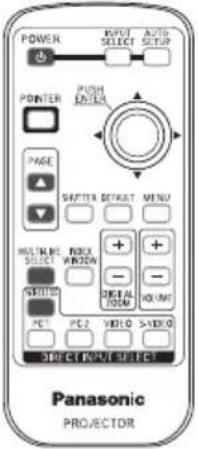 *The illustration above is the remote control unit for the PT-LB50NTU. *The illustration above is the remote control unit for the PT-LB50NTU. | AAA batteries for remote control unit (x2)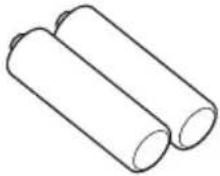 RGB signal cable [1.8 m (5'10'), K1HA15DA0002 x1] RGB signal cable [1.8 m (5'10'), K1HA15DA0002 x1]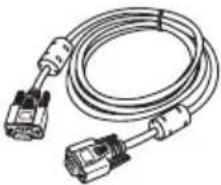 | |
Power cord(K2CG3DR00006 x 1)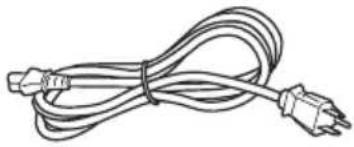 | Carrying bag(TPEP018 x 1)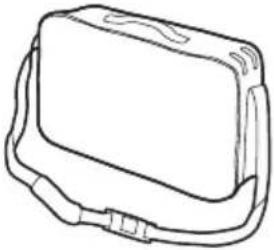 | CD-ROM*(TQBH9008 x1) *PT-LB50NTU only *PT-LB50NTU only |
Before use
Caution when moving the projector
Be sure to use the accessory carrying bag when moving the projector.
When placing the projector inside the carrying bag, position it so that the lens is facing upward. Do not place the projector with its adjustable legs extended and do not put anything else in the bag other than the projector, cables and the remote control unit.
Cautions regarding setup
Avoid setting up in places which are subject to vibration or shocks.
The internal parts can be damaged, which may cause malfunctions or accidents.
Avoid setting up in places which are subject to sudden temperature changes, such as near an air conditioner.
The life of the lamp may be shortened.
Do not set up the projector near high-voltage power lines or near motors.
The projector may be subject to electromagnetic interference.
If installing the projector to the ceiling, ask a qualified technician to carry out all installation work.
You will need to purchase the separate installation kit (Model No.ET-PKB50).
Furthermore, all installation work should only be carried out by a qualified technician.
If using this projector at high elevations (above 1 400 m), set the “HIGHLAND” to “ON”. (Refer to page 52.)
Failure to observe this may result in malfunctions.
Notes on use
In order to get the best picture quality
Draw curtains or blinds over any windows and turn off any lights near the screen to prevent outside light or light from indoor lamps from shining onto the screen.
Do not touch the surfaces of the lens with your bare hands.
If the surface of the lens becomes dirty from fingerprints or anything else, this will be magnified and projected onto the screen.
Screen
Do not apply any volatile substances which may cause discoloration to the screen, and do not let it become dirty or damaged.
Lamp
The lamp may need to be replaced earlier due to variables such as individual lamp characteristics, usage conditions and the installation environment, especially when the projector is subjected to continuous use for more than 10 hours or the power is frequently turned on and off.
Liquid crystal panel
The liquid crystal panel of the projector is built with very high precision technology to provide fine picture details. Occasionally, a few non-active pixels may appear on the screen as fixed points of blue, green or red. Please note that this does not affect the performance of your LCD.
Location and function of each part
Projector
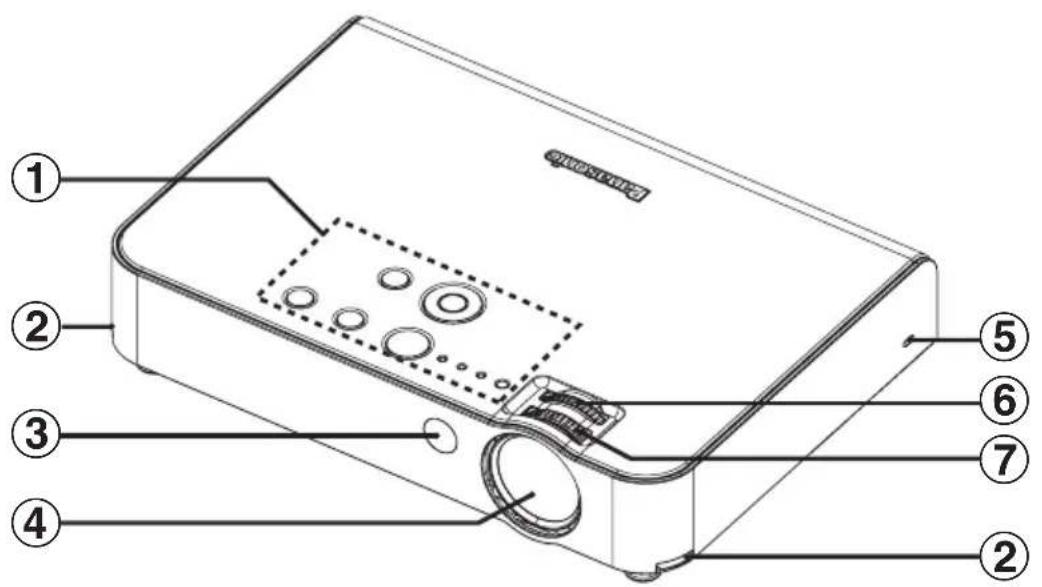
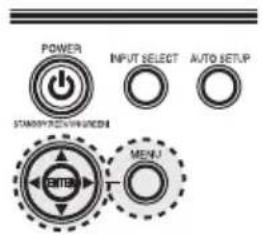
①Projector control panel (page 14)
②Leg adjuster buttons (L/R) (page 27)
These buttons are used to unlock the front adjustable legs. Press to adjust the angle of tilt of the projector.
③Remote control signal receptor (page 24)
④Projection lens
⑤Security lock
This can be used to connect a commercially-available theft-prevention cable (manufactured by Kensington). This security lock is compatible with the Microsaver Security System from Kensington.
⑥Zoom ring (page 27)
⑦ Focus ring (page 27)
Projector
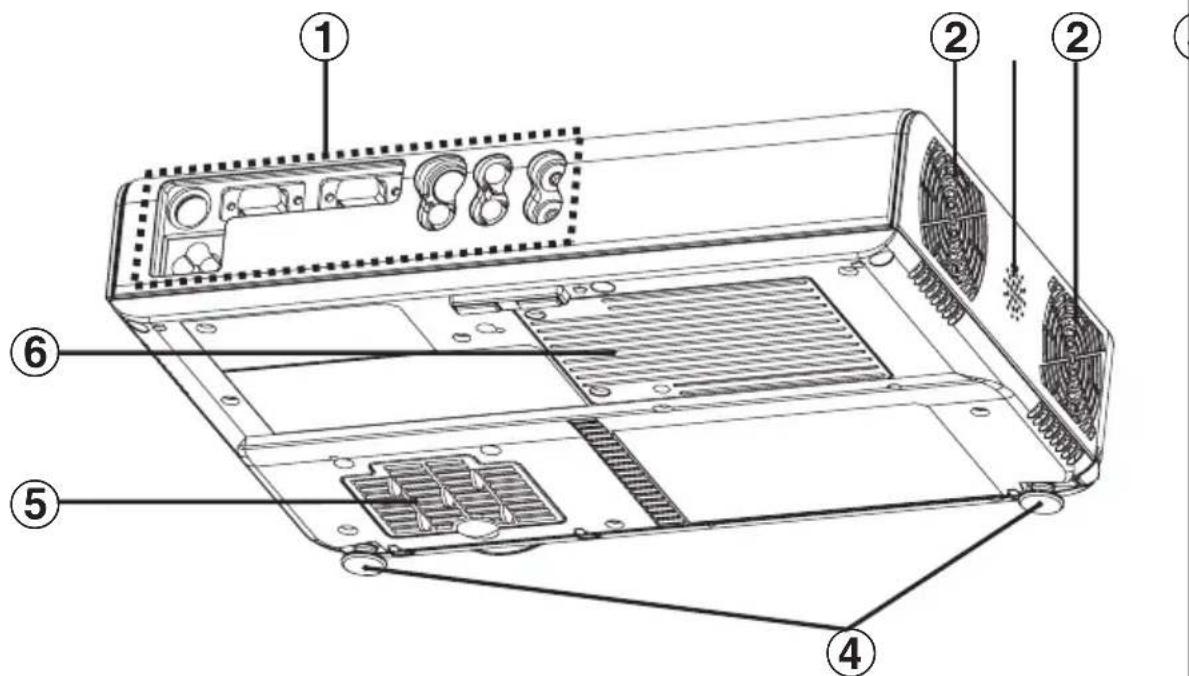
①Connector panel (page 16)
②Air outlet port
Do not cover this port.
③Speaker
④Front adjustable legs (L/R) (page 27)
⑤Air inlet port, Air filter (page 59)
Do not cover this port.
⑥Lamp unit cover (page 60)
NOTE:
- During projection of an image, the cooling fan will operate, emitting a small noise as it operates. This noise may change depending on the ambient temperature. Turning the lamp on or off will cause this noise to increase a little.
- By using the "OPTION" menu to set "LAMP POWER" to "ECO-MODE", the operating sound of the fan can be reduced. (Refer to page 50.)
WARNING
Do not place your hands or other objects close to the air outlet port.
- Heated air comes out of the air outlet port. Do not place your hands or face, or objects which cannot withstand heat close to this port [allow at least 10cm (4") of space], otherwise burns or damage could result.
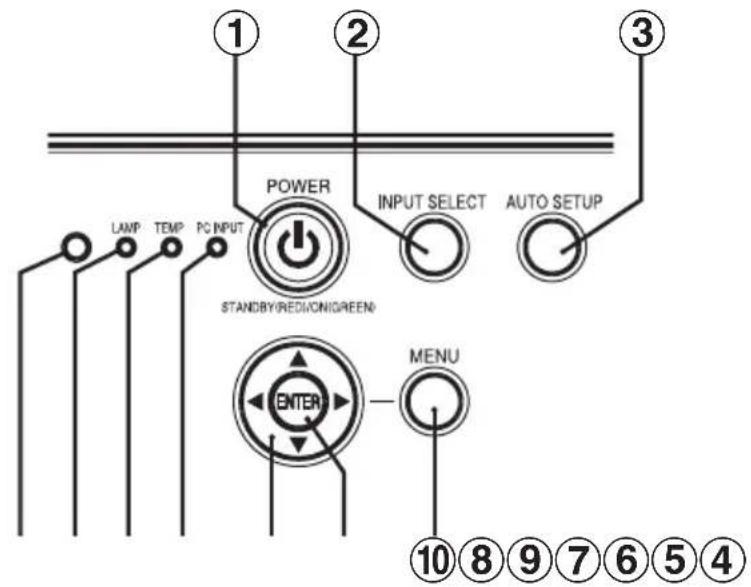
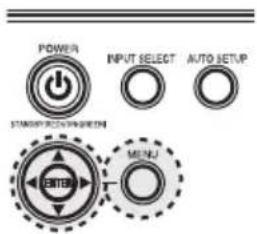
Projector control panel
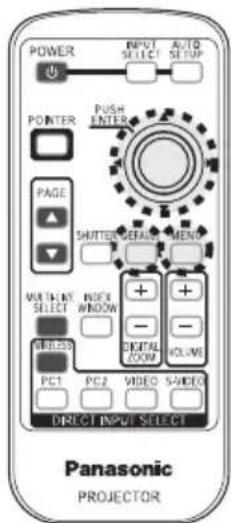
Remote control unit
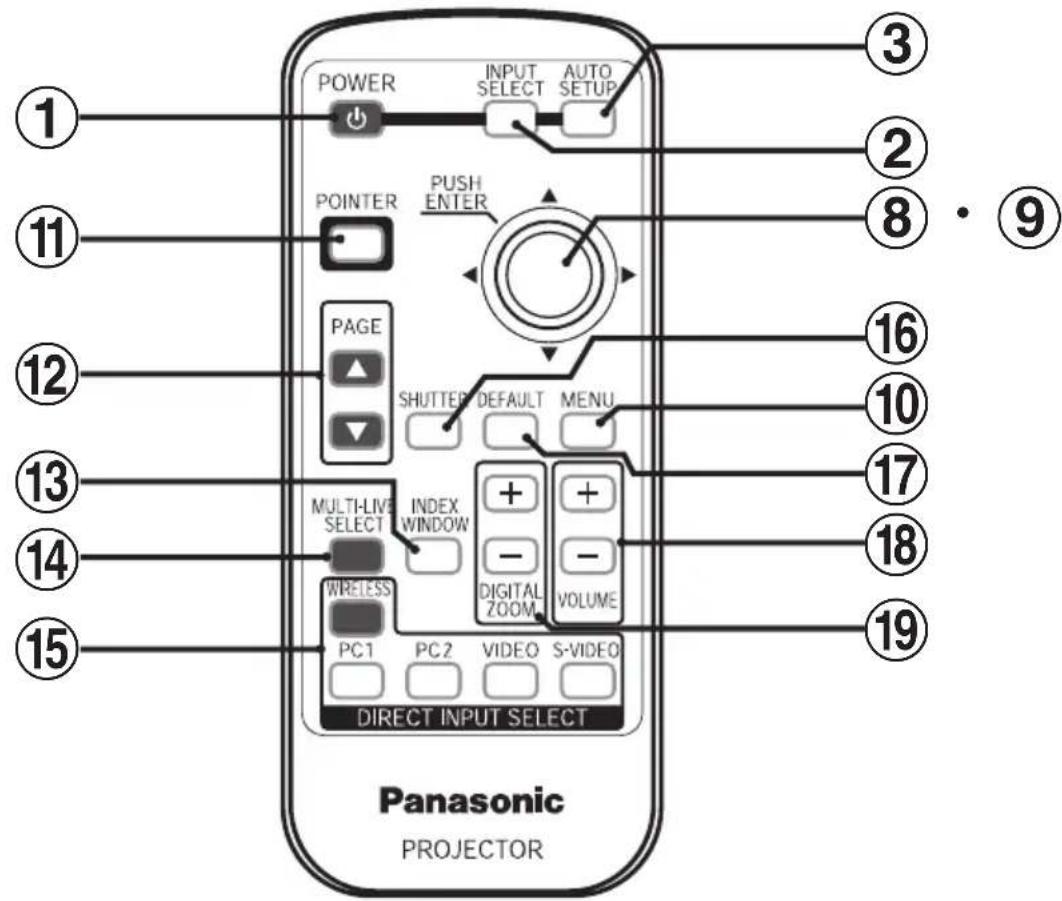
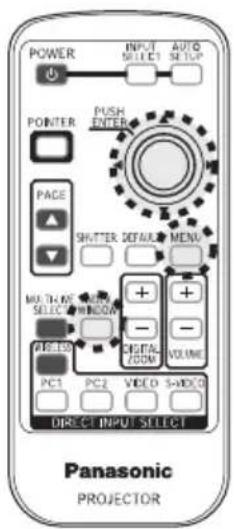
*The illustration above is the remote control unit for the PT-LB50NTU. The remote control unit for the PT-LB50U and PT-LB50SU is not equipped with PAGE buttons, a MULTI-LIVE SELECT button or a WIRELESS button.
①POWER button (pages 26, 28 and 29)
This button is used to turn the power on and off. This button on the projector illuminates red when the projector is in standby mode, and it illuminates green when a picture starts to be projected.
②INPUT SELECT button (pages 27 and 30)
This button is used to switch the input signals from the connected equipment.
③AUTO SETUP button (pages 27 and 31)
If this button is pressed while a RGB signal is being projected, the position of the image and the settings for "DOT CLOCK" and "CLOCK PHASE" will be adjusted automatically.
④Illumination sensor (page 42)
This sensor detects the luminance when the “DAYLIGHT VIEW” function is operating. Do not cover the projector and do not place any object on the projector when using it.
⑤LAMP indicator (page 58)
This indicator illuminates when it is time to replace the lamp unit. It flashes if a circuit abnormality is detected.
⑥TEMP indicator (page 57)
This indicator illuminates if an abnormally high temperature is detected inside the projector or around it. If the temperature rises above a certain level, the power supply will be turned off automatically and the indicator will flash.
⑦PC INPUT indicator
This indicator illuminates when a signal is being input to the connector (PC 1 IN or PC 2 IN) selected using the input select buttons.
⑧Arrow (▲▼◀ and ▶) buttons (page 38)
These buttons are used to select and adjust items in the on-screen menus.
⑨ENTER button (page 38)
This button is used to accept and to activate items selected in the on-screen menus.
⑩MENU button (pages 36 and 38)
This button is used to display the menu screen. When a menu screen is being displayed, this button can be used to return to a previous screen or to clear the screen.
⑪ POINTER button (page 35)
This button is used to display a pointer on the projected images.
⑫PAGE buttons (PT-LB50NTU only)
These buttons are used when the projector is controlled by means of a wireless network. Refer to the accessory CD-ROM for details.
⑬INDEX WINDOW button (page 34)
This button can be used to split the image projection area into a still picture and a moving picture. You can also select this function from the on-screen menu (refer to page 53).
⑭ MULTI-LIVE SELECT button (PT-LB50NTU only)
This button is used when the projector is controlled by means of a wireless network. Refer to the accessory CD-ROM for details.
(continued on next page)
(continued from previous page)
⑮DIRECT INPUT SELECT buttons (pages 27 and 30)
You can select the input signal directly by pushing these buttons (the WIRELESS button is for the PT-LB50NTU only).
⑯SHUTTER button (page 32)
This button is used to momentarily turn off the picture and sound. You can also select this function from the on-screen menu (refer to page 53).
⑰DEFAULT button (page 39)
This button is used to reset the projector adjustment values to the factory default settings.
⑱VOLUME +/- buttons (page 32)
These buttons are used to adjust the volume of the sound that is output from the projector's built-in speaker and VARIABLE AUDIO OUT connector. Refer to page 52 for details on how to adjust the volume without using the remote control unit.
⑲DIGITAL ZOOM +/- buttons (page 33)
These buttons are used to enlarge the projected image.
Connector panel
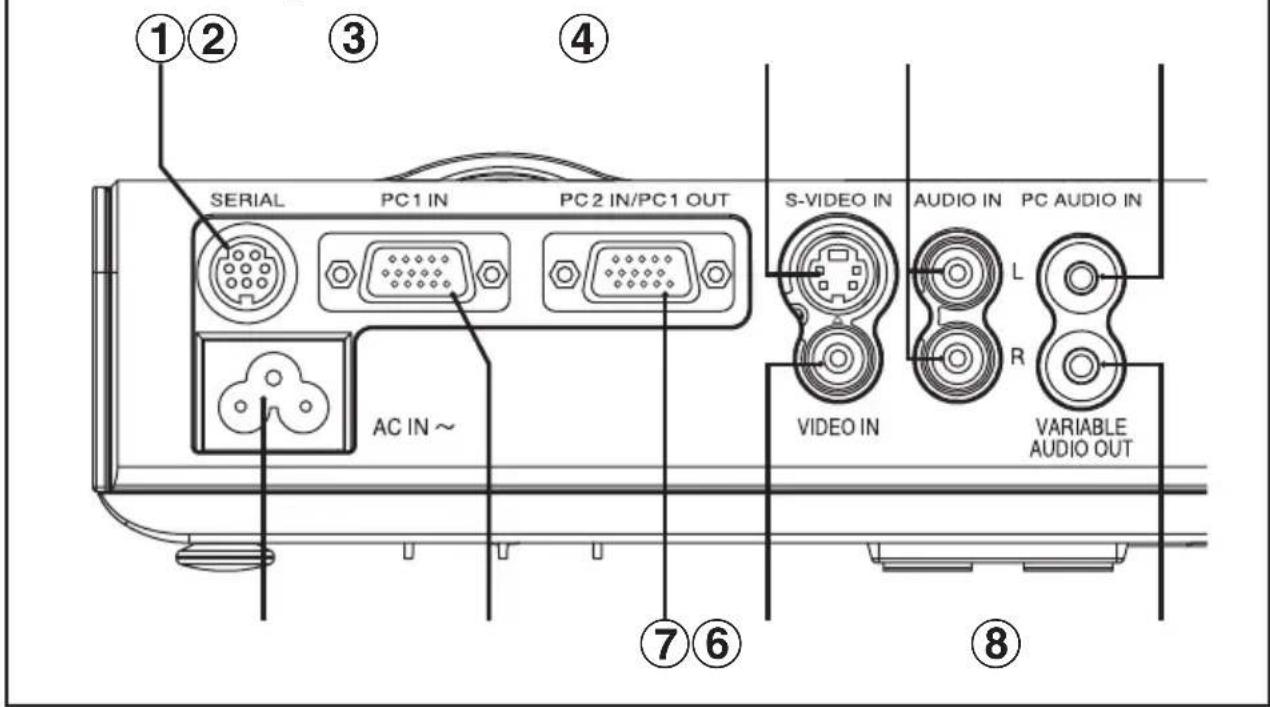
①SERIAL connector (pages 21, 22, 23 and 70)
This connector is used to connect a personal computer to the projector in order to control the projector externally. (RS-232C compatible)
②S-VIDEO IN connector (pages 23 and 46)
This connector is used to input signals from S-VIDEO-compatible equipment such as a DVD player. The connector is S1 signal compatible, and it automatically switches between 16:9 and 4:3 aspect ratios in accordance with the type of signal being input.
③AUDIO IN L-R connectors (for S-VIDEO/VIDEO) (page 23)
④PC AUDIO IN connector (pages 21 and 22)
⑤Power input socket (AC IN) (page 26)
The accessory power cord is connected here.
Do not use any power cord other than the accessory power cord.
⑥PC 1 IN connector (pages 21 and 22)
This connector is used to input RGB signals and YPBPR signals.
⑦PC 2 IN / PC 1 OUT connector (pages 21, 22 and 50)
This connector is used to input or output RGB signals and YPBPR signals. Adjust "PC2 SELECT" in the "OPTION" menu to select whether you want input or output with this connector.
⑧VIDEO IN connector (page 23)
This connector is used to input video signals from video equipment such as a video deck.
⑨VARIABLE AUDIO OUT connector (pages 21, 22, and 23)
This connector is used to output the audio signals which are input to the projector. If audio equipment is connected to this connector, no sound will be output from the built-in speakers.
Setting-up
Projection methods
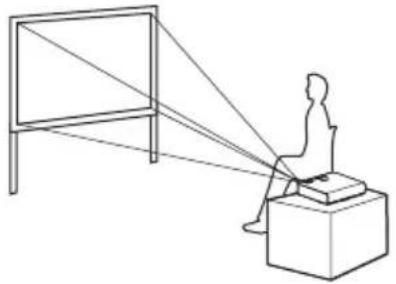
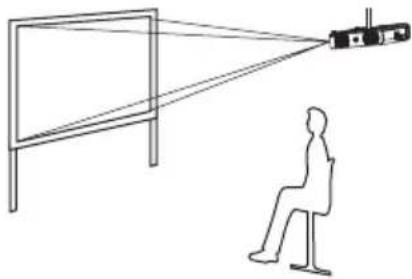
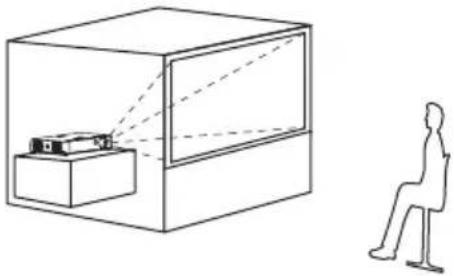
In way of installing projector, any one of the following four projection methods are used. Select whichever projection method matches the setting-up method. (The projection method can be set from the "OPTION" menu. Refer to page 52 for details.)
- Front-desk projection - Front-ceiling projection
natural_image
Line drawing of a person sitting on a box using a projector to observe a screen (no text or symbols)| Menu item Setting | |
| INSTALLATION | FRONT/DESK |
natural_image
Line drawing of a person seated in a chair observing a projector mounted on a screen (no text or symbols)| Menu item Setting | |
| INSTALLATION | FRONT/CEILING |
- Rear-desk projection (Using a translucent screen)
natural_image
Simple line drawing of a person sitting in front of a transparent box with a small object inside, connected to a dashed line indicating perspective (no text or symbols)| Menu item Setting | |
| REAR/DESKI | |
- Rear-ceiling projection (Using a translucent screen)
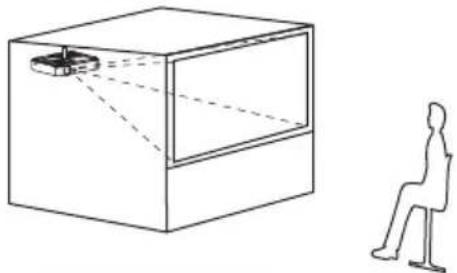
natural_image
Simple line drawing of a rectangular box with a small circular object inside, connected to a human figure in a seated posture (no text or symbols)| Menu item Setting | |
| ATINSTALLATION | REAR/CEILING |
NOTE:
- You will need to purchase the separate ceiling bracket (ET-PKB50) when using the ceiling installation method.
- Do not set up the projector vertically or tilted horizontally, otherwise it may cause damage to the projector.
- It is recommended that you set up the projector in a place that is tilted at less than ± 30^ vertically. Setting up the projector in places that are tilted at more than ± 30^ vertically may shorten component life.
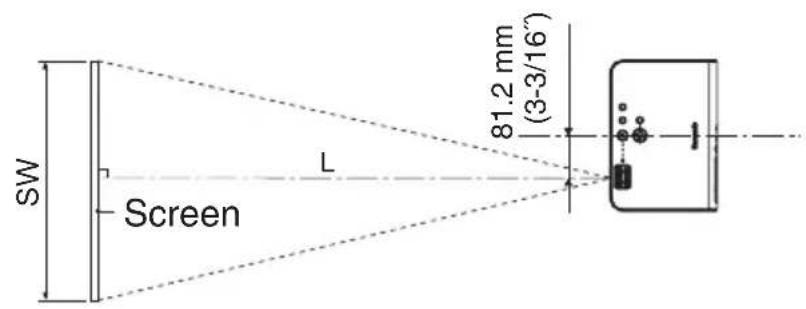
Projector position
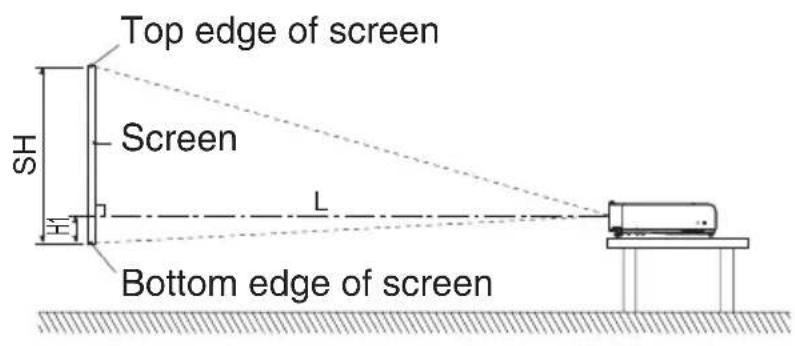
L: Projection distance
SH: Image height
SW:Image width
H1: Distance from center of lens to bottom edge of projected image
Projection distances
PT-LB50NTU/PT-LB50U
| 4:3 Screen size (diagonal) | Projection distance (L) | Height position (H1) | |
| Wide (LW) Telephoto (LT) | |||
| -0.84 m(33') | 1.1 m(3'7") | 0.07 m(2-3/4") | |
| 1.02 m(40") | 1.2 m(3'11") | 1.4 m(4'7") | 0.08 m(3-1/8") |
| 1.27 m(50") | 1.6 m(5'2") | 1.8 m(5'10") | 0.11 m(4-5/16") |
| 1.52 m(60") | 1.9 m(6'2") | 2.1 m(6'10") | 0.13 m(5-3/32") |
| 1.78 m(70") | 2.2 m(7'2") | 2.5 m(8'2") | 0.15 m(5-7/8") |
| 2.03 m(80") | 2.5 m(8'2") | 2.9 m(9'6") | 0.17 m(6-11/16") |
| 2.29 m(90") | 2.8 m(9'2") | 3.3 m(10'9") | 0.19 m(7-15/32") |
| 2.54 m(100") | 3.1 m(10'2") | 3.6 m(11'9") | 0.21 m(8-1/4") |
| 3.05 m(120") | 3.7 m(12'1") | 4.4 m(14'5") | 0.25 m(9-13/16") |
| 3.81 m(150") | 4.6 m(15'1") | 5.5 m(18") | 0.32 m(12-19/32") |
| 5.08 m(200") | 6.2 m(20'4") | 7.3 m(23'11") | 0.42 m(16-17/32") |
| 6.35 m(250") | 7.7 m(25'3") | 9.2 m(30'2") | 0.53 m(20-27/32") |
| 7.62 m(300") | 9.2 m(30'2") | 11.1 m(36'5") | 0.64 m(25-3/16") |
PT-LB50SU
| 4:3 Screen size (diagonal) | Projection distance (L) | Height position (H1) | |
| Wide (LW) Telephoto (LT) | |||
| -0.84 m(33') | 1.1 m(3'7") | 0.07 m(2-3/4") | |
| 1.02 m(40") | 1.2 m(3'11") | 1.4 m(4'7") | 0.09 m(3-17/32") |
| 1.27 m(50") | 1.5 m(4'11") | 1.8 m(5'10") | 0.11 m(4-5/16") |
| 1.52 m(60") | 1.8 m(5'10") | 2.1 m(6'10") | 0.13 m(5-3/32") |
| 1.78 m(70") | 2.1 m(6'10") | 2.5 m(8'2") | 0.15 m(5-7/8") |
| 2.03 m(80") | 2.5 m(8'2") | 2.9 m(9'6") | 0.17 m(6-11/16") |
| 2.29 m(90") | 2.8 m(9'2") | 3.2 m(10'5") | 0.20 m(7-27/32") |
| 2.54 m(100") | 3.1 m(10'2") | 3.6 m(11'9") | 0.22 m(8-21/32") |
| 3.05 m(120") | 3.7 m(12'1") | 4.3 m(14'1") | 0.26 m(10-7/32") |
| 3.81 m(150") | 4.6 m(15'1") | 5.4 m(17'8") | 0.33 m(12-31/32") |
| 5.08 m(200") | 6.1 m(20') | 7.3 m(23'11") | 0.43 m(16-29/32") |
| 6.35 m(250") | 7.6 m(24'11") | 9.1 m(29'10") | 0.54 m(21-1/4") |
| 7.62 m(300") | 9.1 m(29'10") | 10.9 m(35'9") | 0.65 m(25-9/16") |
NOTE:
- The dimensions in the table above are approximate.
- For details about projected image distances, refer to page 67.
Connections
Notes on connections
- Read the instruction manual for each peripheral device carefully before connecting it.
- Turn off the power supply for all peripheral devices before making any connections.
- If the cables necessary for connection are not included with the peripheral device or available as an option, you may need to prepare a proper cable for the device concerned.
- If there is a lot of jitter in the video signal, the projected image may flicker. In such cases, it will be necessary to connect a TBC (time base corrector).
- Refer to the list on page 68 for details on compatible signals which can be input to the projector.
- Only one audio system circuit is available for each of the PC AUDIO IN and AUDIO IN L-R connectors, so if you change the audio input source, you will need to remove and insert the appropriate plugs.
Connecting to computer
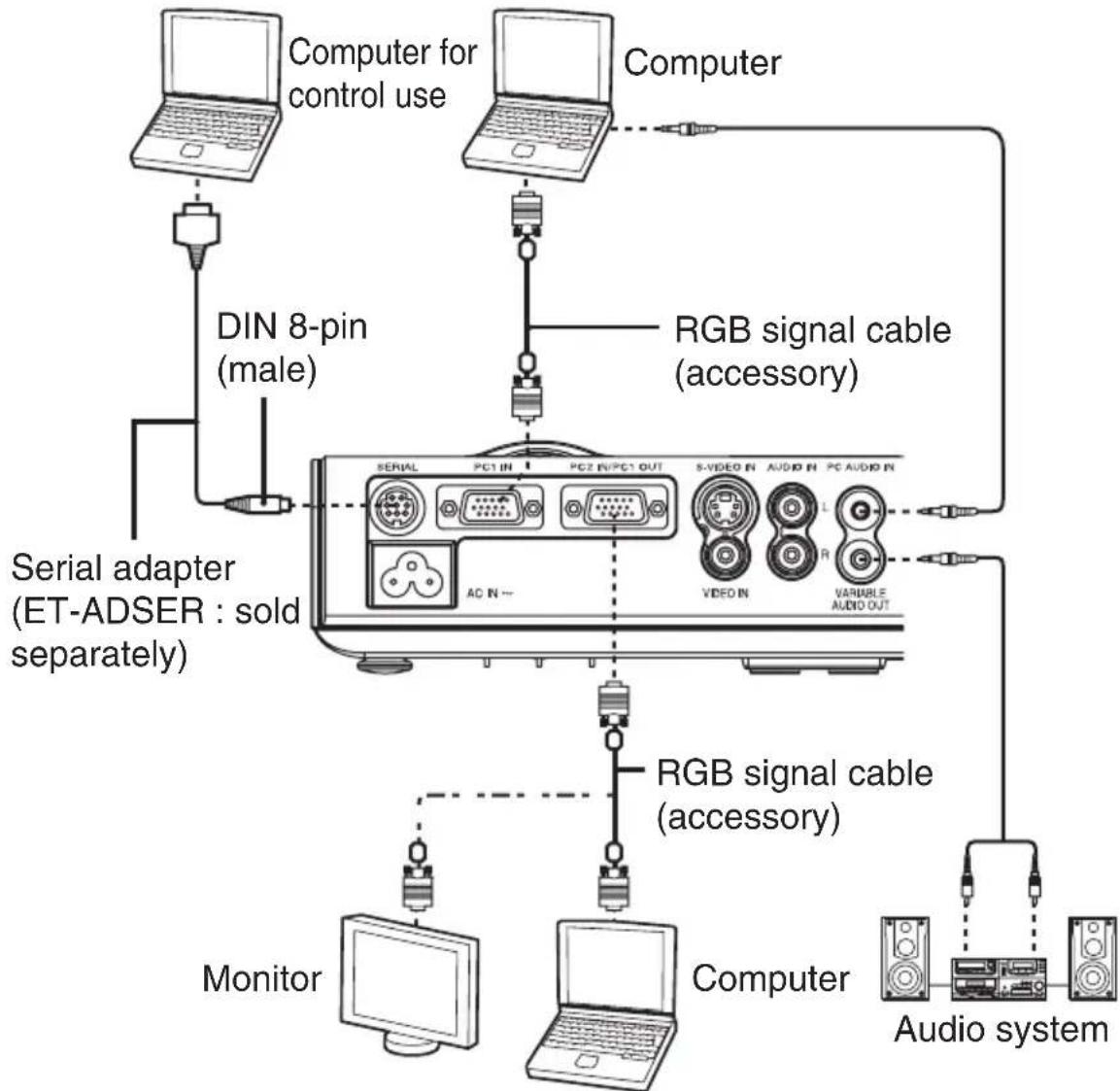
flowchart
graph TD
    A["Computer"] -->|DIN 8-pin (male)| B["Serial adapter (ET-ADSER : sold separately)"]
    C["Computer for control use"] -->|RGB signal cable (accessory)| B
    D["Computer"] -->|RGB signal cable (accessory)| B
    B --> E["Monitor"]
    B --> F["Computer"]
    B --> G["Audio system"]
    E --> H["Monitor"]
    E --> I["Computer"]
    F --> J["Audio system"]
    style A fill:#f9f,stroke:#333
    style C fill:#f9f,stroke:#333
    style D fill:#f9f,stroke:#333
    style E fill:#ccf,stroke:#333
    style F fill:#ccf,stroke:#333
    style G fill:#ccf,stroke:#333
Refer to the accessory CD-ROM for details on the wireless network that can be used for controlling the projector with a personal computer. (PT-LB50NTU only)
Connecting to video equipment (1)
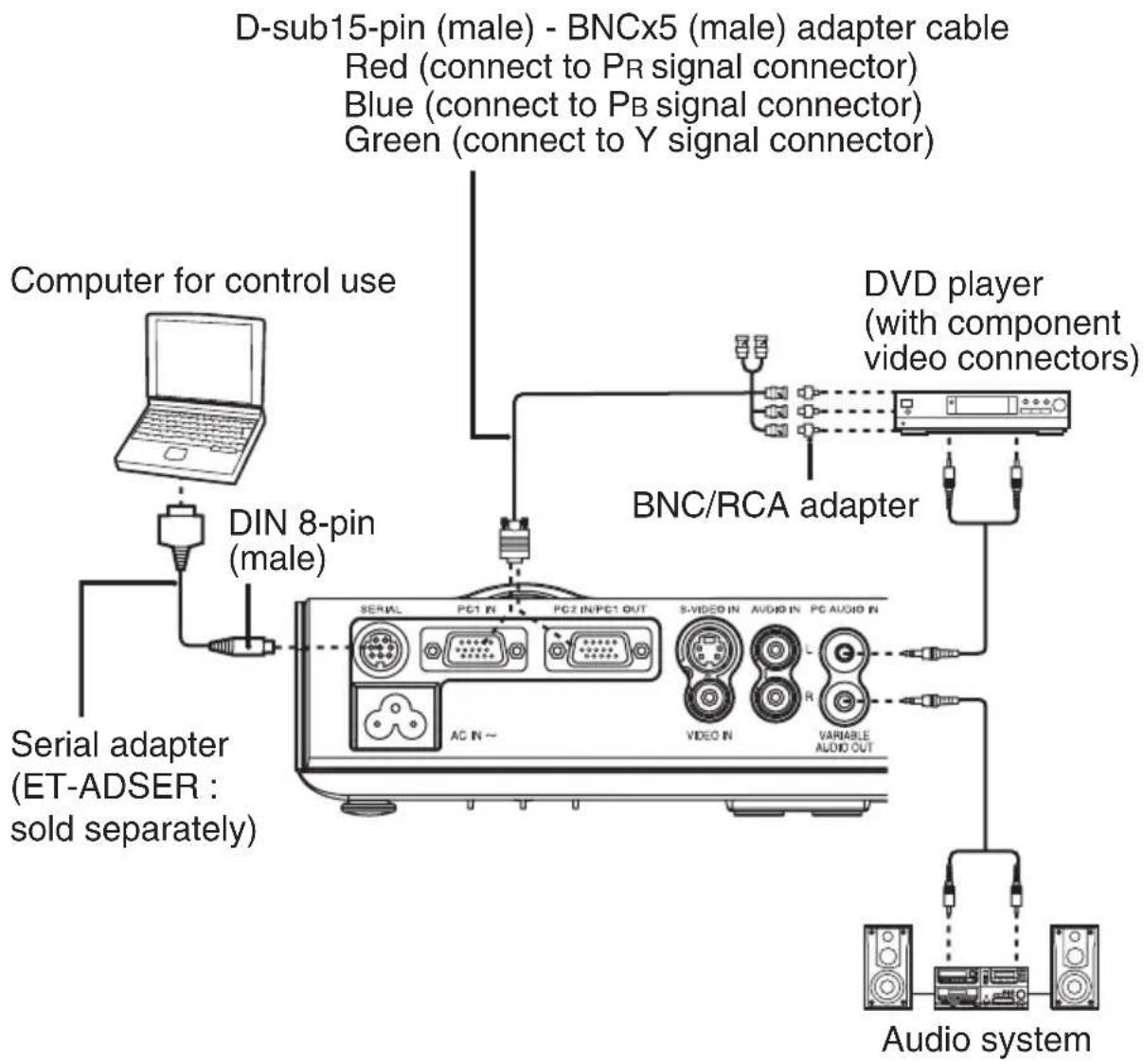
flowchart
graph TD
    A["Computer for control use"] --> B["DIN 8-pin (male)"]
    B --> C["Serial adapter (ET-ADSER : sold separately)"]
    C --> D["BNC/RCA adapter"]
    D --> E["Video player (with component video connectors)"]
    E --> F["Audio system"]
    G["D-sub15-pin (male) - BNCx5 (male) adapter cable"] --> H["Red (connect to PR signal connector)"]
    G --> I["Blue (connect to PB signal connector)"]
    G --> J["Green (connect to Y signal connector)"]
NOTE:
- Do not input the signal to the PC 2 IN/PC 1 OUT connector when "PC2 SELECT" in the "OPTION" menu is set to "OUTPUT". (page 50)
- If the signal cables are disconnected or if the power supply for the computer or video deck is turned off while “DIGITAL ZOOM” or “INDEX WINDOW” is being used, these functions will be cancelled. (pages 33 and 34)
Connecting to video equipment (2)
Computer for control use
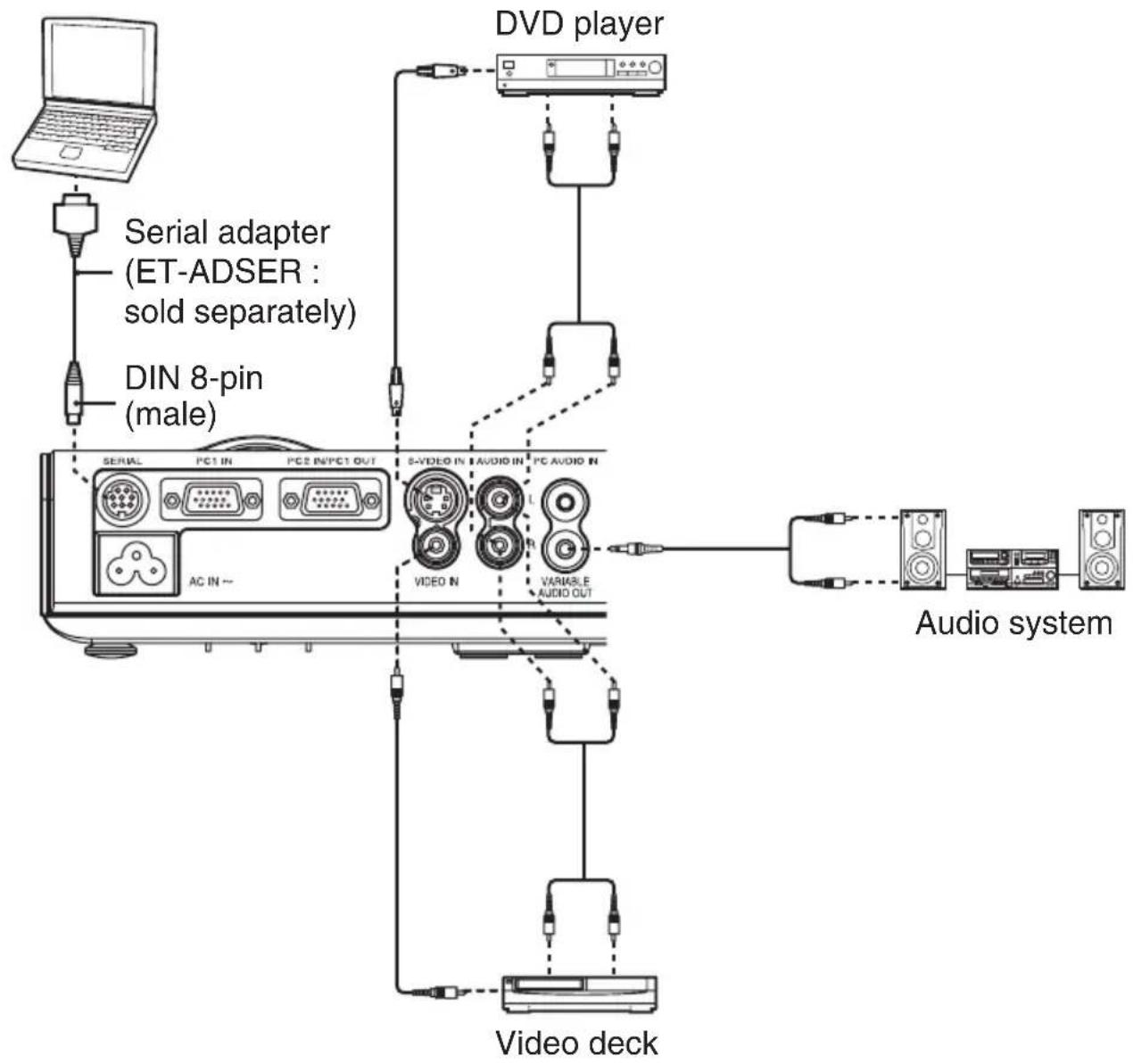
flowchart
graph TD
    A["Laptop"] --> B["Serial adapter (ET-ADSER : sold separately)"]
    B --> C["DIN 8-pin (male)"]
    C --> D["Video deck"]
    D --> E["Video system"]
    E --> F["Video player"]
    F --> G["Video IN"]
    G --> H["Video deck"]
    H --> I["Variable AUDIO OUT"]
    I --> J["PC AUDIO IN"]
    J --> K["PC1 IN"]
    K --> L["PC2 IN/PC1 OUT"]
    L --> M["AC IN --"]
Getting started
Preparation for the remote control unit
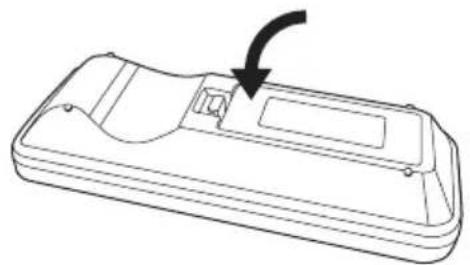
①While pressing the tab, lift the battery cover to remove it.
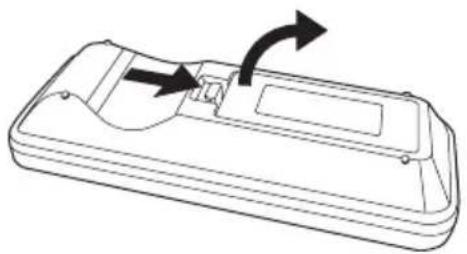
natural_image
Line drawing of a remote control casing with two arrows indicating clockwise motion (no text or symbols)②Insert the batteries into the battery holder so that the polarities are correct.
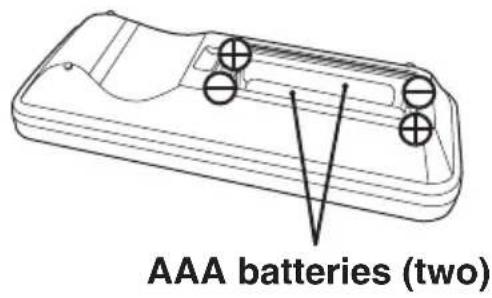
③Replace the battery cover (a click will be heard).
natural_image
Line drawing of a remote control casing with a scroll wheel and a black arrow indicating rotation (no text or symbols)NOTE:
- Do not drop the remote control unit.
- Keep the remote control unit away from liquids.
- Remove the batteries if not using the remote control unit for long periods.
- Do not use rechargeable batteries.
- If the remote control unit is held so that it is facing directly in front of the remote control signal receptor, the operating range is within approximately 7 m (23') from the surfaces of the receptor. Furthermore, the remote control unit can be operated from an angle of ± 30^ to the left or right and ± 15^ above or below the receptor.
- If the buttons on the remote control unit are kept pressed, the battery power will be consumed rapidly.
- If there are any obstacles in between the remote control unit and the receptor, the remote control unit may not operate correctly.
- If strong light is allowed to shine onto the remote control signal receptor, correct projector operation may not be possible. Place the projector as far away from light sources as possible.
- If facing the remote control unit toward the screen to operate the projector, the operating range of the remote control unit will be limited by the amount of light reflection loss caused by the characteristics of the screen used.
Turning on the power
Make sure that all peripheral devices are connected properly before turning on the power.
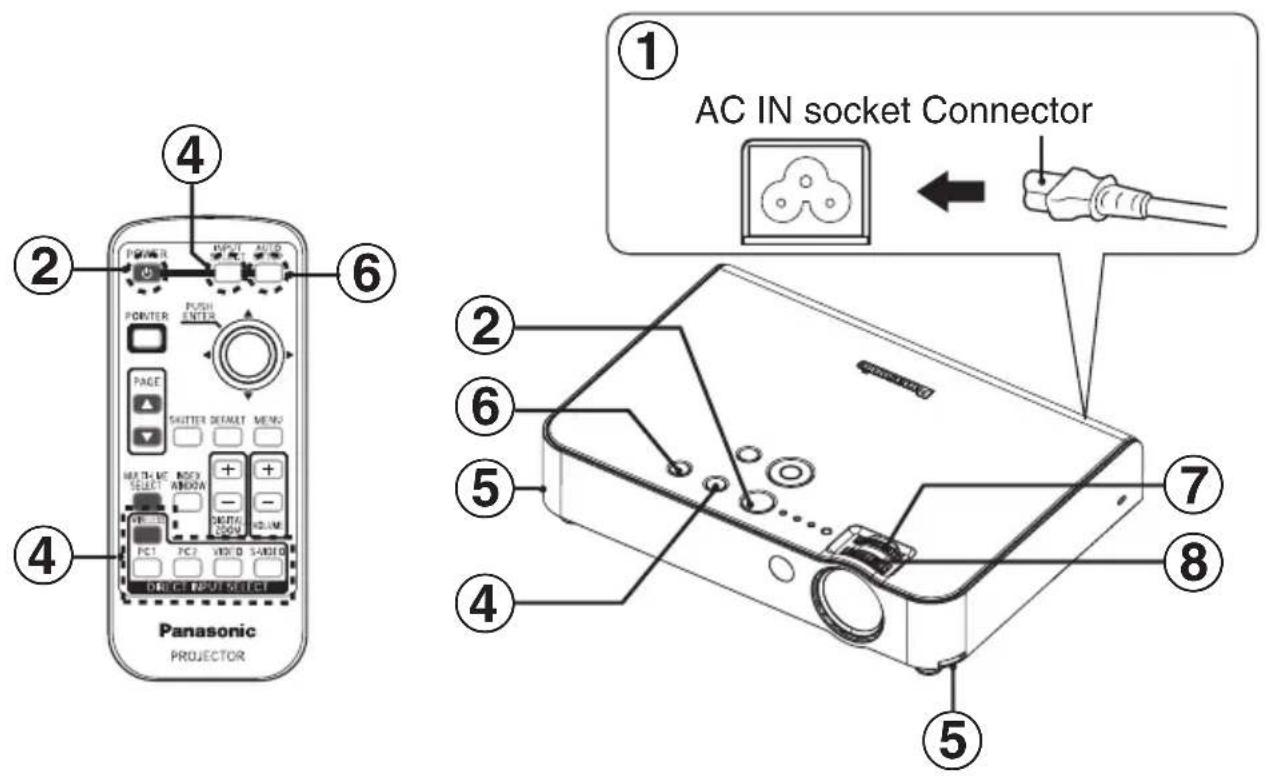
① Connect the accessory power cord to the AC IN socket.
- Insert the connector into the AC IN socket so that the shape of the connector matches the shape of the socket. Then insert the power cord plug into the wall outlet.
- The POWER button on the projector will illuminate red.
Press the POWER button.
- The POWER button on the projector will flash green. After a short period, it will illuminate green, and the startup logo will be displayed. If you would like the startup logo not to be displayed, set "STARTUP LOGO" to "OFF". (Refer to page 49.)
③ Turn on the power of all connected devices.
- Start the play function of a device such as a DVD player.
NOTE:
- A tinkling sound may be heard when the lamp unit is turned on, but this is not a sign of a malfunction.
④ Select the input signal by pressing the INPUT SELECT button or the DIRECT INPUT SELECT buttons.
- A picture will be projected in accordance with the selected input signal. (page 30)
- When “SIGNAL SEARCH” is set to “ON”, the projector detects which signals are being input, and uses these signals for projection.
- If no signal is detected, the guide screen for computer connection will be displayed (when "INPUT GUIDE" in the "OPTION" menu is set to "DETAILED". Refer to page 69 for details).
- Press the INPUT SELECT button to finish the input signal search.
Direct power on function
If “DIRECT POWER ON” in the “OPTION” menu is set to “ON”, projection will start after the power cord is connected. Refer to page 51 for details.
Follow the procedure below when you set the projector up first, and when you change the placement after original setup.
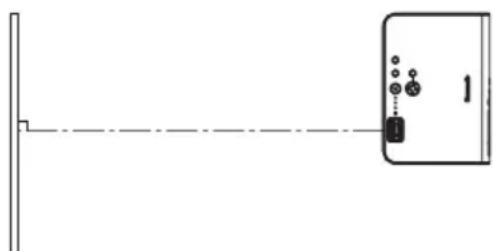
⑤ Adjusting the angle
- Place the projector so that it is vertical to the screen.
natural_image
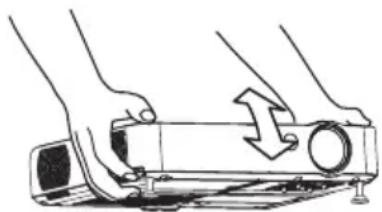
Simple line drawing of a vertical pole with a dashed line extending to a rectangular device labeled '1' (no text or symbols on the device itself)- While pressing the adjuster buttons, adjust the forward/back angle of tilt of the projector. Adjust so that the projected image is placed at the center of the screen.
natural_image
Illustration of hands operating a mechanical device with a circular component and an arrow indicating motion (no text or symbols)⑥ Press the AUTO SETUP button (when RGB signals are being input).
- Settings such as the position of the image will be corrected automatically. (page 31)
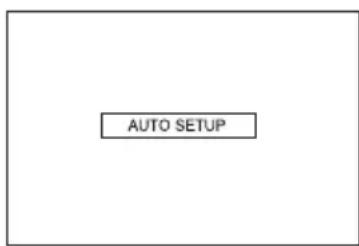
⑦ Adjusting the size
- Turn the zoom ring to adjust the size of the projected image.
8 Adjusting the focus
- Turn the focus ring to adjust the focus of the projected image.
Turning off the power
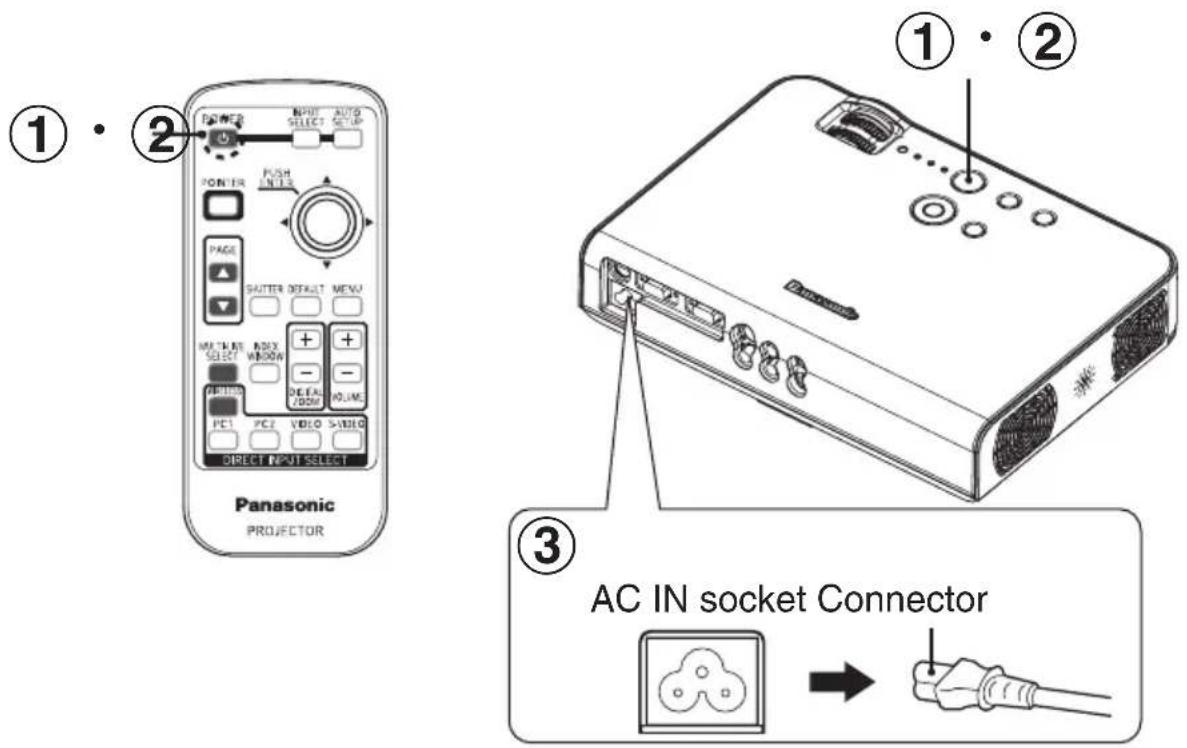
① Press the POWER button.
- The "POWER OFF" confirmation screen will be displayed.
②Press the POWER button again.
● The lamp unit will switch off and the picture will stop being projected.
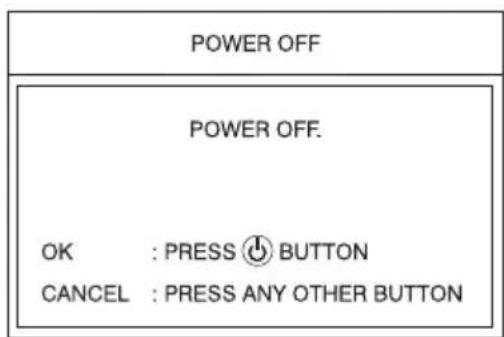
(The POWER button on the projector will illuminate orange while the cooling fan is still operating.)
NOTE:
- Press any button other than the POWER button to cancel the "POWER OFF" screen.
- The "POWER OFF" screen will disappear in 10 seconds.
③ Disconnect the power cord after the POWER button on the projector illuminates red.
- Disconnect the power cord plug from the wall outlet first, and then disconnect the connector from the AC IN socket.
NOTE:
- You can also turn off the power by holding down the POWER button for at least 0.5 seconds.
Direct power off function
You can disconnect the power cord during projection or immediately after use and move the projector. The cooling fan will operate by the internal power supply to cool down the lamp.
- When this function is used, it may take more time for the lamp to turn back on again compared to when the lamp cools down with the power cord connected.
- Do not put the projector in a bag while the POWER button on the projector is illuminated.
CAUTION
If not using the projector for an extended period of time, disconnect the power cord plug from the wall outlet.
- If dust builds up on the power cord plug, the resulting humidity may damage the insulation, which could result in fire.
- This projector continues to draw approximately 4 W of power even when the power is turned off.
POWER button on the projector
| POWER button status | Projector status | |
| Red | Illuminated | The projector is in standby mode and image projection is possible by pressing the POWER button. |
| Green | Flashing | The projector is preparing for projection after the power has been turned on while the POWER button on the projector is illuminated red. (After a short period, a picture will be projected.) |
| Illuminated | A picture is being projected. | |
| Orange | Illuminated | The lamp is cooling down after the power has been turned off or while direct power off function is operating. |
| Flashing | The projector is preparing for projection after the power has been turned on while the POWER button on the projector is illuminated orange. (After a short period, a picture will be projected.) | |
Selecting the input signal (INPUT SELECT/ DIRECT INPUT SELECT)
You can select the input signal by pressing the INPUT SELECT button or the DIRECT INPUT SELECT buttons.
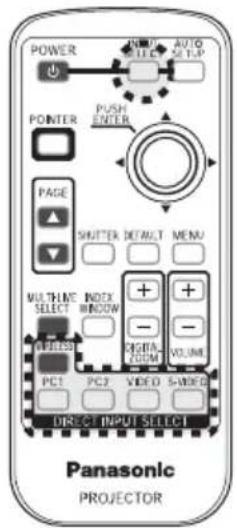
Projector control panel
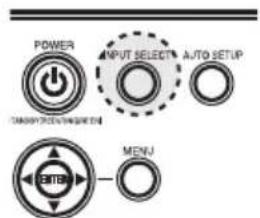
Press the INPUT SELECT button.
- The input signal selected will change as shown below each time the INPUT SELECT button is pressed.
| INPUT SELECT button | Changing signals | |
| Control panel |  | |
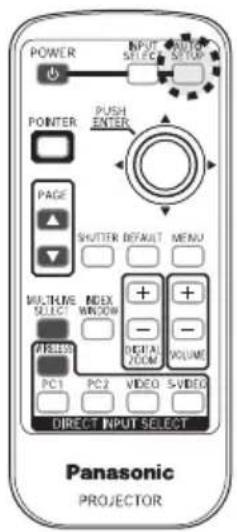
| Remote control unit |  | |
* "WIRELESS" is for the PT-LB50NTU only.
Press the DIRECT INPUT SELECT buttons.
- You can select the input signal directly.
| DIRECT INPUT SELECT buttons | Changing signals | |
| Remote control unit |  | The signal that is being input to the PC 1 IN connector will be projected. |
 | The signal that is being input to the PC 2 IN connector will be projected. | |
 | The signal that is being input to the S-VIDEO IN connector will be projected. | |
 | The signal that is being input to the VIDEO IN connector will be projected. | |
 | The signal that is set by the wireless network will be projected. (page 56) | |
* "WIRELESS" is for the PT-LB50NTU only.
NOTE:
- "PC2" cannot be selected when "PC2 SELECT" in the "OPTION" menu is set to "OUTPUT".
Correcting the image position automatically (AUTO SETUP)
This projector can adjust the position of the image and the settings for "DOT CLOCK" and "CLOCK PHASE" when RGB signals are being input.
Projector control panel
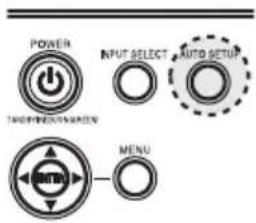
Press the AUTO SETUP button while RGB signals are being projected.
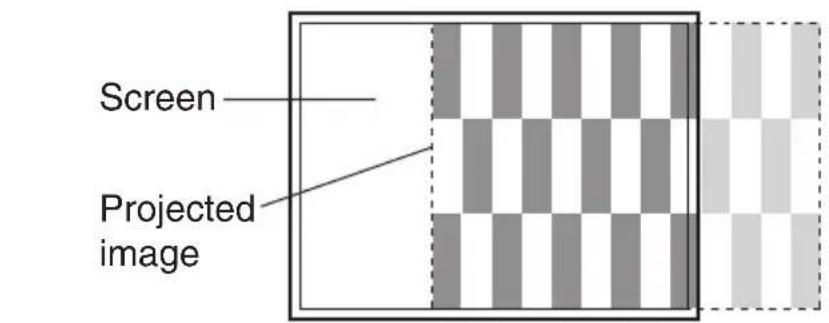
• Automatic positioning will be carried out.
NOTE:
- "SIGNAL SEARCH" will also be carried out. (When "SIGNAL SEARCH" is set to "ON", refer to page 51 for details.)
- If the dot clock frequency is 100 MHz or higher, "DOT CLOCK", and "CLOCK PHASE" will not be adjusted automatically. Refer to page 45 for details.
- If the edges of the projected image are indistinct, or if a dark picture is being projected, the automatic setup processing may stop automatically before it is complete. If this happens, project a different picture and then press the AUTO SETUP button again.
Turning off the picture and sound momentarily (SHUTTER)
The “SHUTTER” function can be used to momentarily turn off the picture and sound from the projector when the projector is not being used for short periods of time, such as during breaks in meetings or when carrying out preparation. The projector uses less power in “SHUTTER” mode than it does in normal projection mode.
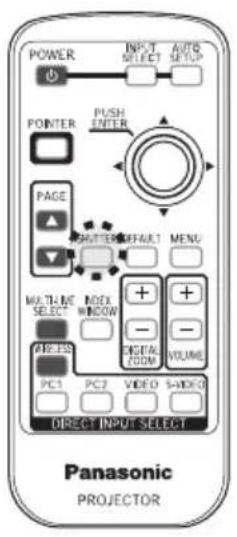
Press the SHUTTER button.
- The picture and sound will be turned off.
- Press any button on either the projector or remote control unit to return to normal operating mode.
NOTE:
- You can also select "SHUTTER" from the on-screen menu (refer to page 53).
Adjusting the volume (VOLUME)
You can adjust the volume of the sound that is output from the projector's built-in speaker and VARIABLE AUDIO OUT connector.
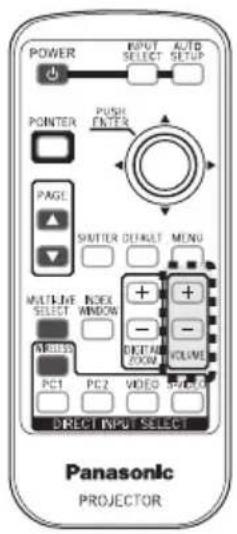
Press the VOLUME +/- button.
- Press the + button to raise the volume.
- Press the - button to lower the volume.
NOTE:
- You can also select "VOLUME" from the on-screen menu (refer to page 52).
Enlarging the picture (DIGITAL ZOOM)
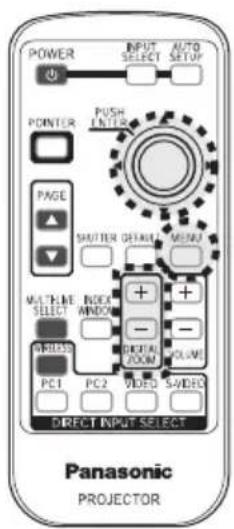
You can enlarge the projected image and move the enlarged area.
Projector control panel
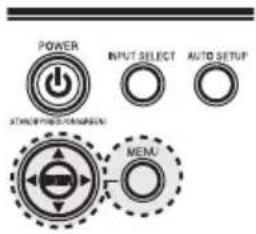
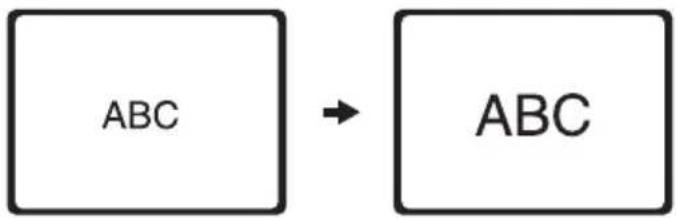
Press the DIGITAL ZOOM +/- button.
- The picture will then be enlarged to 1.5 times the normal size. - Press the MENU button to return to the normal screen.
flowchart
graph LR
    A["ABC"] --> B["ABC"]
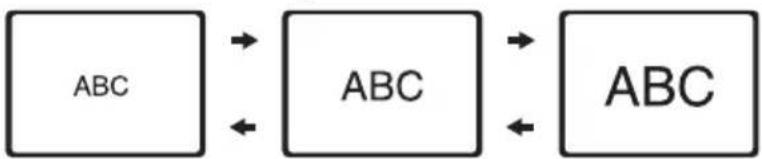
Button functions when using "DIGITAL ZOOM"
+button The enlargement ratio will increase.
- button The enlargement ratio will decrease.
flowchart
graph LR
    A["ABC"] --> B["ABC"]
    B --> C["ABC"]
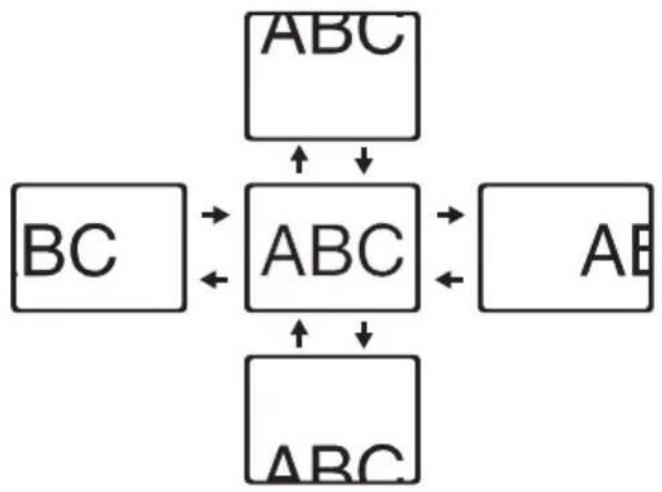
▲▼ buttons The displayed position will move upward or downward.
◀▶ buttons The displayed position will move to the left or right.
flowchart
graph TD
    A["ABC"] --> B["ABC"]
    C["BC"] --> B
    D["ABC"] --> E["ABC"]
    F["ABC"] --> E
    B --> G["AB"]
    E --> G
    style A fill:#fff,stroke:#000
    style C fill:#fff,stroke:#000
    style D fill:#fff,stroke:#000
    style F fill:#fff,stroke:#000
NOTE:
- The enlargement ratio can be changed within the range of x1 to x2, in steps of 0.1. When RGB signals are being input, the enlargement ratio can be changed within the range of x1 to x3, except when the “FRAME LOCK” is set to “ON” (page 47).
- If the type of signal being input changes while the digital zoom function is being used, the digital zoom function will be cancelled.
Displaying two screens (INDEX WINDOW)
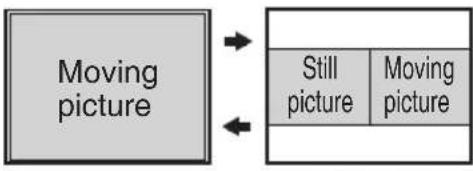
This function lets you store a picture which is being projected into memory, so that you can display a still picture and a moving picture on the screen.
Projector control panel
Press the INDEX WINDOW button.
- The current moving picture will be captured in a still window.
- Press the MENU button to return to the previous screen.
flowchart
graph LR
    A["Moving picture"] --> B["Still picture"]
    B --> C["Moving picture"]
Button functions when using "INDEX WINDOW"
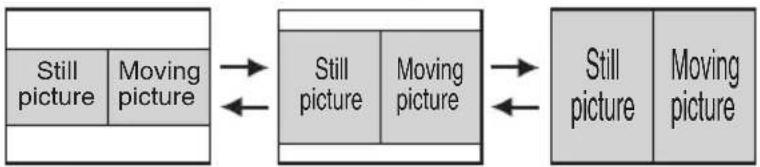
Press the ▲ or ▼ button to select a screen size.
It can switch to three stages.
flowchart
graph LR
    A["Still picture"] --> B["Still picture"]
    B --> C["Still picture"]
    C --> D["Moving picture"]
    D --> E["Moving picture"]
    style A fill:#f9f,stroke:#333
    style B fill:#ccf,stroke:#333
    style C fill:#cfc,stroke:#333
    style D fill:#fcc,stroke:#333
Press the ◀ or ▶ button to switch between the still picture screen and moving picture screen.
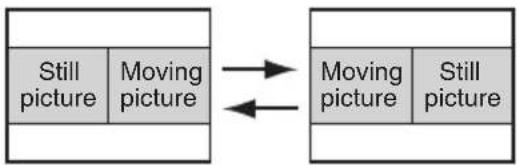
flowchart
graph LR
    A["Still picture"] --> B["Moving picture"]
    B --> C["Moving picture"]
    C --> D["Still picture"]
Press the ENTER button to capture the present moving picture in a still window.
NOTE:
- The aspect ratio of the screen changes and the image is vertically elongated in comparison to a normal image.
- When the screen size is changed, the picture's aspect ratio will also change. Make sure that you fully understand the notes on "ASPECT" on page 47 before using the "INDEX WINDOW" function.
- You can also select "INDEX WINDOW" from the on-screen menu (refer to page 53).
Displaying the pointer (POINTER)
You can display the pointer on the projected images.
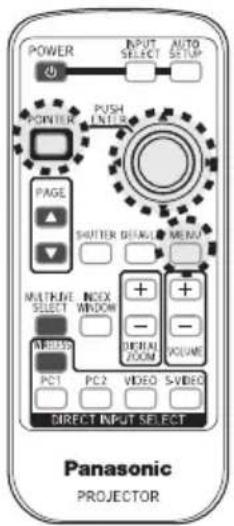
Projector control panel
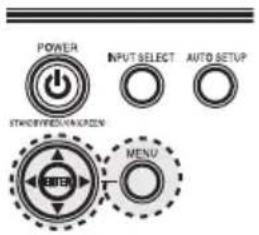
Press the POINTER button.
- A pointer will be displayed in the middle of the projected image.
- Press the POINTER button to cancel the pointer display.
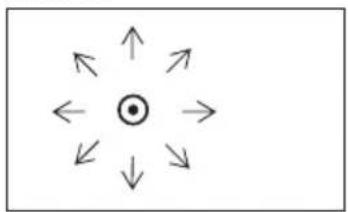
Moving the pointer
Press the ▲▼◀▶ buttons to move the pointer.
natural_image
Circular diagram with arrows pointing outward from a central dot (no text or symbols)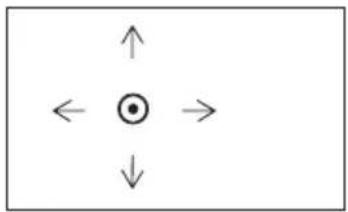
natural_image
Simple diagram with four arrows pointing outward from a central circle (no text or labels)You can select the pointer in "POINTER SELECT" from 3 types (refer to page 50).
Pointer1 Pointer2 Pointer3

natural_image
Simple geometric diagram with a black circle centered inside a square (no text or symbols)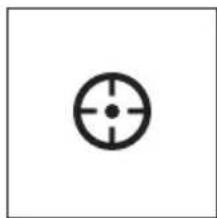
natural_image
Simple geometric target symbol with concentric circles and crosshairs (no text or labels)
natural_image
Simple line drawing of a hand making a thumbs-up gesture (no text or symbols)NOTE:
- The pointer cannot be displayed when a menu screen is being displayed.
On-screen menus
Menu screens
The various settings and adjustments for this projector can be carried out by selecting the operations from on-screen menus.
The general arrangement of these menus is shown below.
Menu Screen
(When a VIDEO signal is being input)
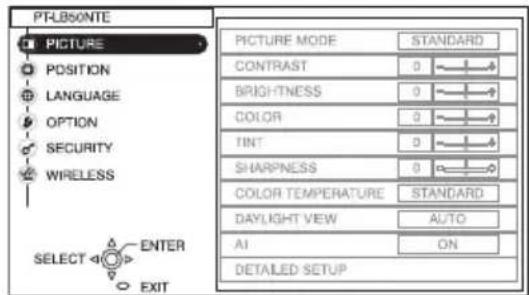

- Press the MENU button to display the menu screen. Refer to page 38 for details on how to operate the on-screen menus.
- The illustrations of the on-screen menus in this operating instructions are for the PT-LB50NTU.

PICTURE menu (page 40)

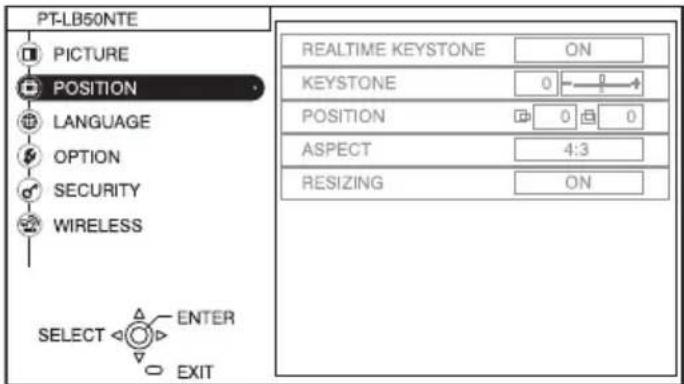
POSITION menu (page 44)
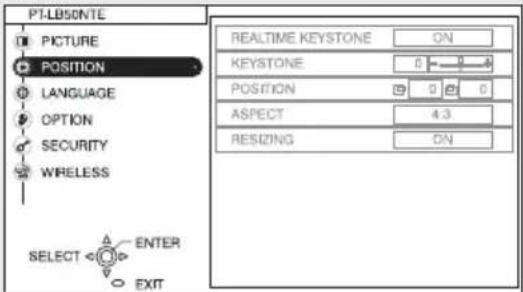

LANGUAGE menu (page 48) SECURITY menu (page 54)
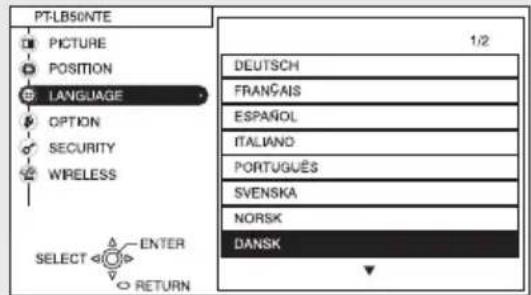


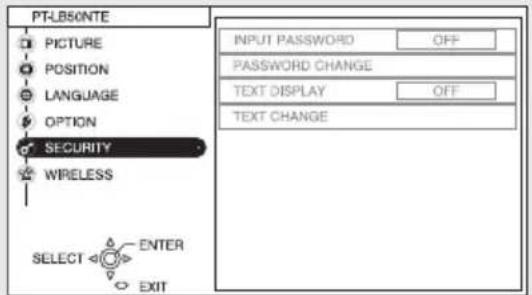
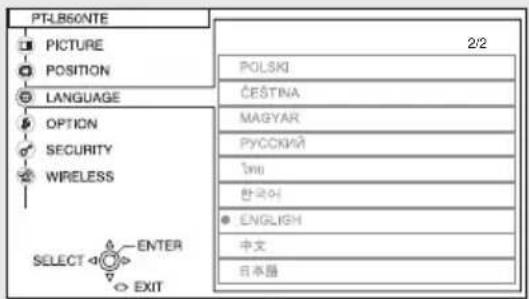

WIRELESS menu (page 56)
(PT-LB50NTU only)
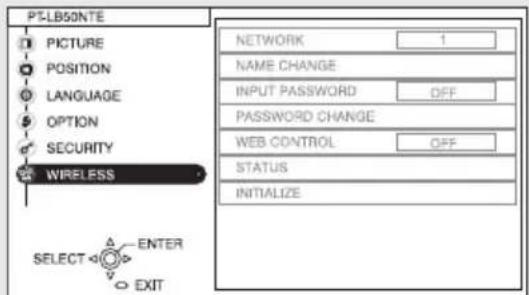

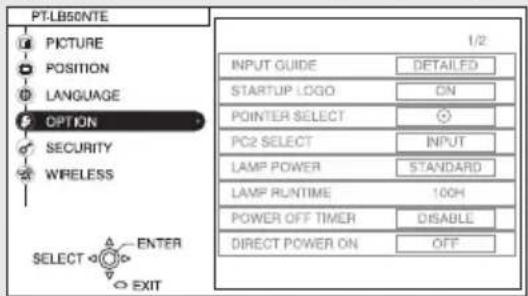
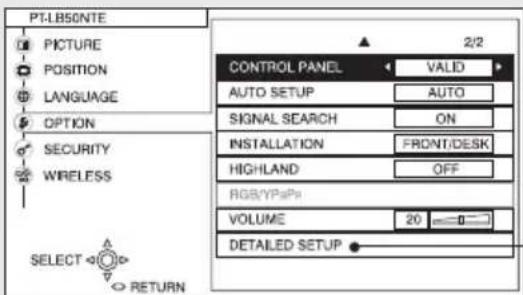
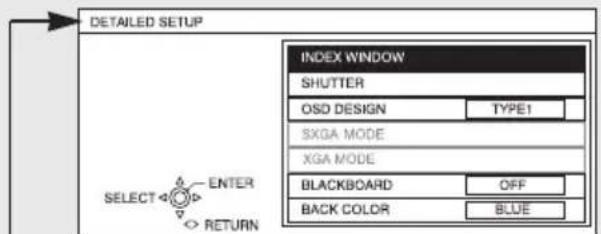
OPTION menu (page 49)


Menu operation guide
①Press the MENU button.
Projector control panel
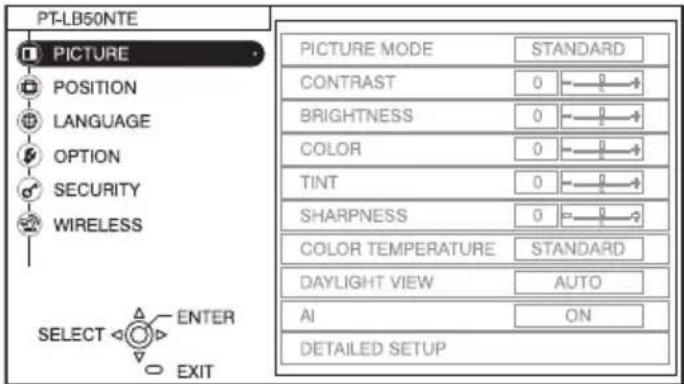
The menu screen will be displayed.
②Press the ▲ or ▼ button to select an item from the main menu on the left side.
The selected item will be displayed in orange.
The sub-menu for the selected item will be displayed on the right side.
③Press the ENTER button.
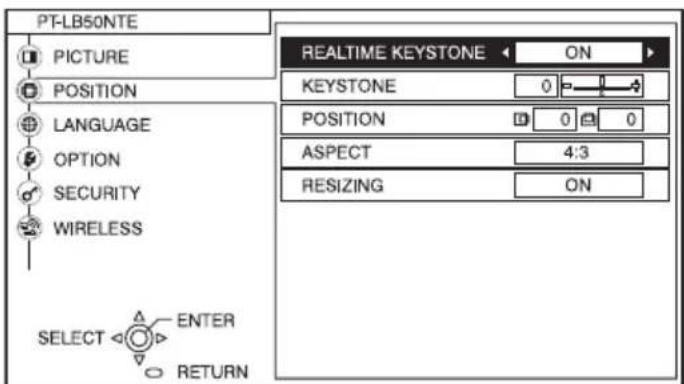
You can select an item from the sub-menu.
NOTE:
- Press the MENU button to return to the previous screen.
④Press the ▲ or ▼ button to select an item, and then press the ◀ or ▶ button to adjust the value or change the setting.
If adjusting the items in the “PICTURE” and “POSITION” menus, the menu screen will disappear and only the selected item will be displayed.

The value and setting indicator will turn green when any adjustment changes from the factory set value. For items without any selective setting or bar scale, press the ENTER button. The next screen for the item will then be displayed.
Unavailable on- screen menu items
This projector has unadjustable items and unusable functions depending on the signal being input.
If an item cannot be adjusted or a function cannot be used, you cannot select the corresponding item.
Returning a setting to the factory default
If you press the DEFAULT button on the remote control unit, you can return settings to the factory default settings. However, the operation of this function varies depending on which screen is being displayed.
- When a menu screen is being displayed
All the items on the sub-menu which is being displayed will be returned to their factory default settings, and the value and setting indicator will appear white.
- When an individual adjustment screen is being displayed
Only the item displayed will be returned to the factory default setting, and the value and setting indicator will appear white.
NOTE:
- A triangle symbol below a bar scale indicates the factory default setting. Items which do not have this triangle symbol cannot be returned to the factory default setting. The positions of the triangle symbols vary depending on the type of signal being input.
Indicates the current adjustment value
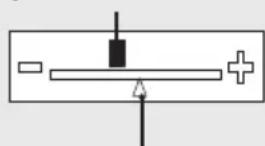
Indicates the standard factory default setting
Adjusting the picture
①Press the MENU button to display the menu screen.
②Select the “PICTURE” menu from the main menu, and then press the ENTER button.
③ Press the ▲ or ▼ button to select an item.
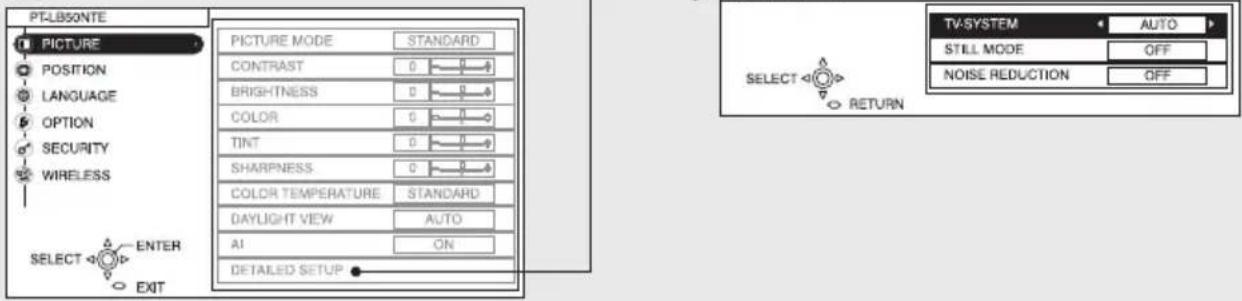
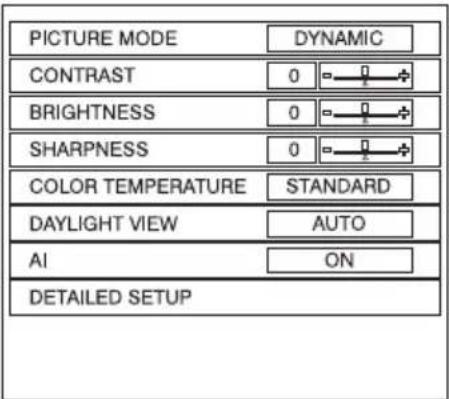
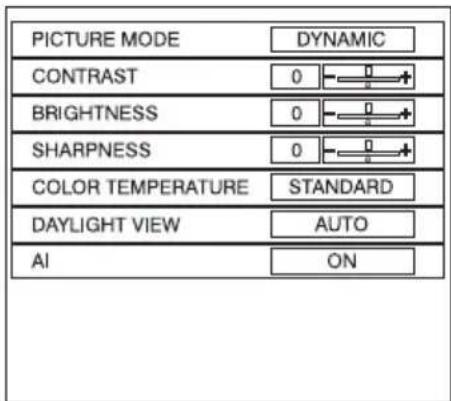
④ Press the ◀ or ▶ button to adjust the value or change the setting. For items with selective setting or a bar scale, the individual adjustment screen will be displayed. For “DETAILED SETUP”, press the ENTER button to display the next screen.
When an S-VIDEO/VIDEO signal is being input
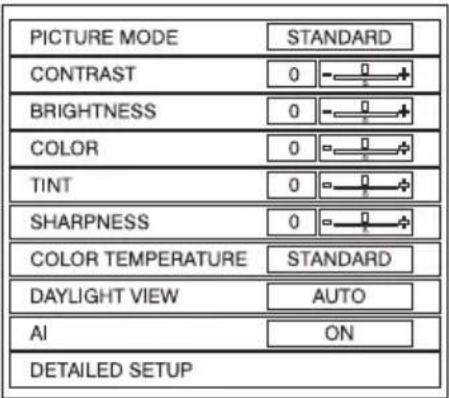
When an YPBPR signal is being input
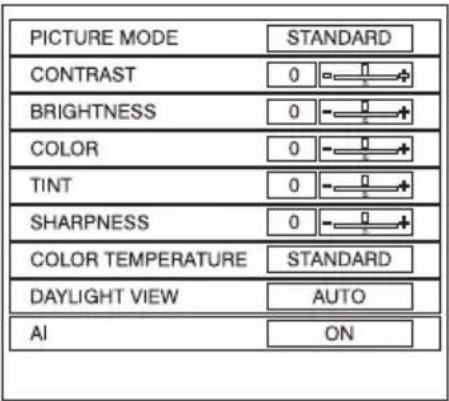
When an RGB signal is being input
When WIRELESS is selected
PICTURE MODE
When an S-VIDEO/VIDEO/YPBPR signal is being input
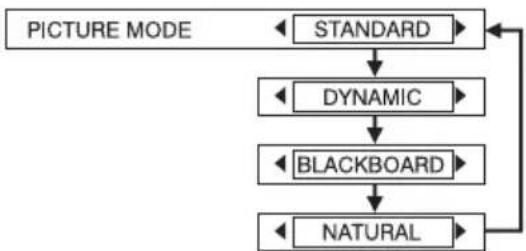
flowchart
graph TD
    A["PICTURE MODE"] --> B["STANDARD"]
    B --> C["DYNAMIC"]
    C --> D["BACKBOARD"]
    D --> E["NATURAL"]
    E --> C
When an RGB signal is being input or WIRELESS is selected
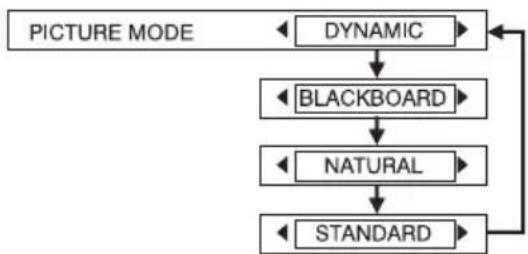
flowchart
graph TD
    A["PICTURE MODE"] --> B["DYNAMIC"]
    B --> C["BLACKBOARD"]
    C --> D["NATURAL"]
    D --> E["STANDARD"]
    E --> A
Select the picture mode that best matches the image source and room conditions.
The mode best used in dark rooms is “NATURAL”. For rooms having regular lighting conditions in use, select “STANDARD”. For exceptionally bright rooms, use “DYNAMIC”.
"BLACKBOARD" is available only when "BLACKBOARD" in the "OPTION" menu is set to "ON". Select "BLACKBOARD" when projecting onto blackboards.
CONTRAST
This adjusts the contrast of the picture. (Adjust the "BRIGHTNESS" setting first if required before adjusting the "CONTRAST" setting.) The picture is bright: ◀ button The picture is dark: ▶ button
BRIGHTNESS
This adjusts the darker areas (black areas) in the picture.
Black areas are too light: ◀ button Dark areas are too solid: ▶ button
COLOR
(S-VIDEO/VIDEO/YPBPR only) The color is too deep: ◀ button The color is too pale: ▶ button
TINT
(NTSC/NTSC 4.43/YPBPR only) This adjusts the flesh tones in the picture.
The flesh tones are greenish:
button
The flesh tones are reddish:
▶ button
SHARPNESS
To soften the picture details:
button
To sharpen the picture details:
▶ button
COLOR TEMPERATURE
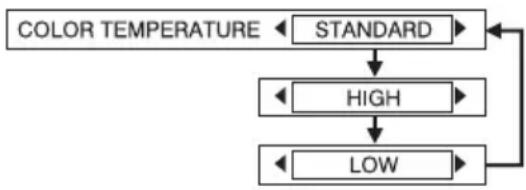
flowchart
graph TD
    A["COLOR TEMPERATURE"] --> B["STANDARD"]
    B --> C["HIGH"]
    C --> D["LOW"]
    D --> C
This is used to adjust the white areas of the picture if they appear bluish or reddish.
Normally “STANDARD” should be selected. If the white areas of the pictures appear reddish, set to “HIGH”. If the white areas of the pictures appear bluish, set to “LOW”.
Projecting sRGB-compatible pictures
sRGB is an international color reproduction standard (IEC61966-2-1) established by the International Electrotechnical Commission (IEC). If you would like the colors in sRGB-compatible pictures to be reproduced more faithfully, make the following settings.
①Press the ▲ or ▼ button to select “PICTURE MODE”, and then press the ◀ or ▶ button to select “NATURAL”.
②Press the DEFAULT button on the remote control unit.
③Press the ▲ or ▼ button to select “COLOR TEMPERATURE”, and then press the ◀ or ▶ button to select “STANDARD”.
NOTE:
- sRGB is only enabled when RGB signals are being input (when “LAMP POWER” is set to “STANDARD”, “AI” is set to “OFF”, and “DAYLIGHT VIEW” is set to “OFF”).
DAYLIGHT VIEW
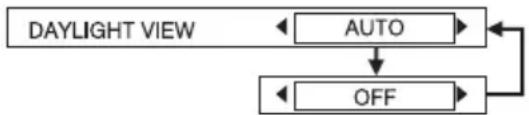
flowchart
graph TD
    A["DAYLIGHT VIEW"] --> B["AUTO"]
    B --> C["OFF"]
    C --> A
This adjusts the vividness of the projected images when the projector is used under bright lighting.
AUTO
The vividness of the projected images will be adjusted according to the lighting condition of the room.
OFF
"DAYLIGHT VIEW" is disabled.
NOTE:
- “AUTO” may not function correctly if any objects are placed on the projector.
- “AUTO” will be disabled when “INSTALLATION” in the “OPTION” menu is set to “REAR/DESK” or “REAR/CEILING”.
AI
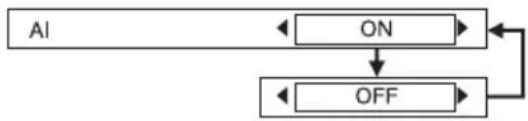
flowchart
graph TD
    A["AI"] --> B["ON"]
    B --> C["OFF"]
    C --> A
ON
The lamp is controlled according to the input signals to project images with the best quality.
OFF
"AI" is disabled.
NOTE:
- “AI” is disabled when “LAMP POWER” is set to “ECO-MODE”. (Refer to page 50.)
DETAILED SETUP
You can adjust the picture quality of the projected images in detail. Press the ENTER button to display the "DETAILED SETUP" menu.
WHITE BALANCE RED/GREEN/BLUE
(RGB only)
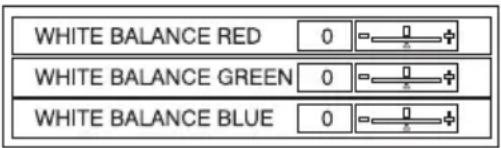
This is used to adjust the white areas of the picture if they appear colorised.
To make the selected color lighter:
button
To make the selected color stronger:
▶ button
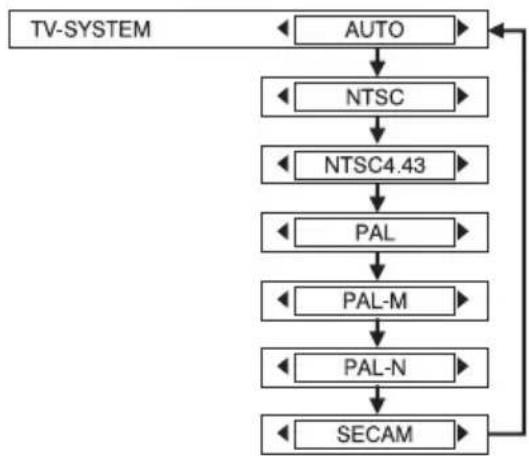
TV-SYSTEM
(S-VIDEO/VIDEO only)
flowchart
graph TD
    A["TV-SYSTEM"] --> B["AUTO"]
    B --> C["NTSC"]
    C --> D["NTSC4.43"]
    D --> E["PAL"]
    E --> F["PAL-M"]
    F --> G["PAL-N"]
    G --> H["SECAM"]
    H --> I["Output"]
This should normally be set to "AUTO". If the signal is of such poor quality that the correct format cannot be automatically distinguished, change the setting manually to the required TV system.
NOTE:
- When set to "AUTO", the projector automatically distinguishes between NTSC/NTSC 4.43/PAL/PAL60/PAL-M/PAL-N/SECAM signals.
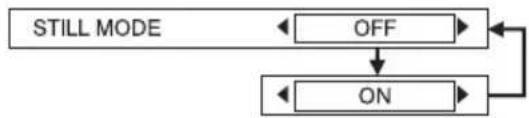
STILL MODE
(S-VIDEO/VIDEO only)
flowchart
graph TD
    A["STILL MODE"] --> B["OFF"]
    B --> C["ON"]
    C --> A
To reduce flickering of still images (vertical flicker), set "STILL MODE" to "ON".
NOTE:
- Set to "OFF" when playing back moving images.
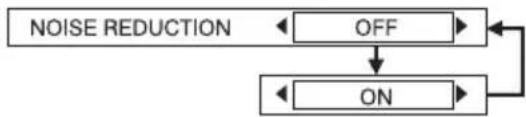
NOISE REDUCTION
(S-VIDEO/VIDEO only)
flowchart
graph TD
    A["NOISE REDUCTION"] --> B["OFF"]
    B --> C["ON"]
    C --> A
If the signal is of such poor quality that picture interference appears, set "NOISE REDUCTION" to "ON". To turn off the "NOISE REDUCTION" feature, set to "OFF".
Adjusting the position
①Press the MENU button to display the menu screen.
②Select the “POSITION” menu from the main menu, and then press the ENTER button.
③ Press the ▲ or ▼ button to select an item. (When RGB signals are being input, first press the AUTO SETUP button to initiate automatic positioning. If the optimum setting is not obtained when “AUTO SETUP” is carried out, adjust the items manually.)
④ Press the ◀ or ▶ button to adjust the value or change the setting. For items with selective setting or a bar scale, the individual adjustment screen will be displayed.
When an S-VIDEO/VIDEO signal is being input
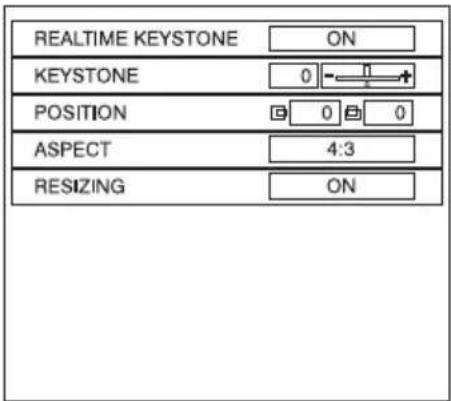
When an RGB/YPBPR signal is being input
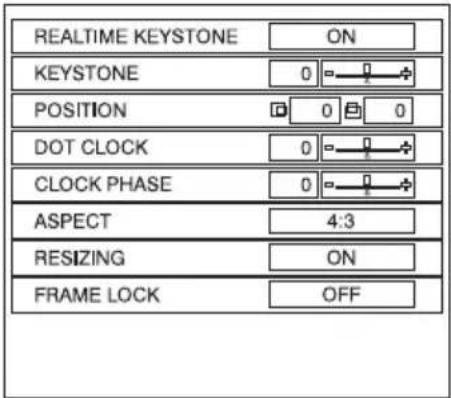
When WIRELESS is selected
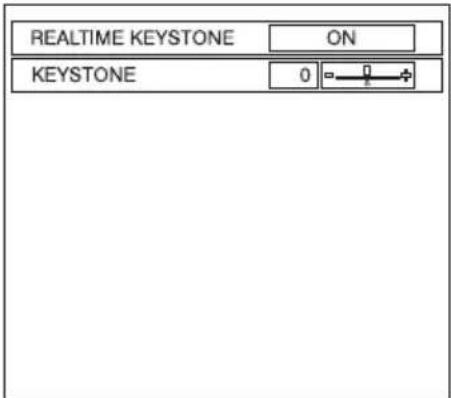
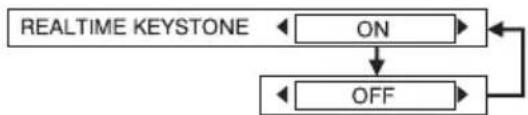
REALTIME KEYSTONE
flowchart
graph TD
    A["REALTIME KEYSTONE"] --> B["ON"]
    B --> C["OFF"]
    C --> A
This projector detects its own degree of tilt and corrects the keystone distortion automatically.
ON
"REALTIME KEYSTONE" is enabled.
OFF
"REALTIME KEYSTONE" is disabled.
KEYSTONE

This projector detects its own degree of tilt and corrects the keystone distortion automatically ("REALTIME KEYSTONE"). However, keystone distortion may still affect the images in some cases (e.g. when the projector is tilted slightly and the tilt is corrected slowly by hand or when the screen itself is tilted). In such cases, set "REALTIME KEYSTONE" to "OFF" and correct the vertical keystone distortion manually.
| Picture condition | 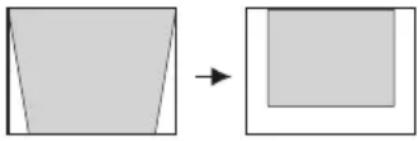 |
| Operation | Press the ▲ or ▶button. |
| Picture condition | 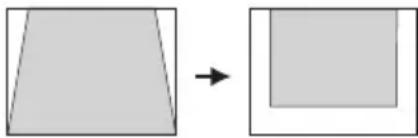 |
| Operation | Press the ▼ or ◀button. |
NOTE:
- Vertical keystone distortion can be corrected to ± 30^ of the angle of tilt. However, the greater the correction amount, the more the picture quality will deteriorate, and the harder it will become to achieve a good level of focus. To obtain the best picture quality, set up the projector and screen in such a way that the amount of keystone correction required is as minimal as possible.
- The picture size will also change when correction of keystone distortion is carried out.
- The ratio of length and width of an image may become incorrect depending on the amount of the keystone correction.
- Keystone distortion of the on-screen display will not be corrected.
- You can correct the keystone distortion manually when "REALTIME KEYSTONE" is set to "ON". However, when you turn on the power, the amount of correction will be reset and "REALTIME KEYSTONE" will function again if the tilt is different from the last time you used the projector. If you correct the keystone distortion manually when "REALTIME KEYSTONE" is set to "OFF", the amount of correction
will be stored by the projector even after the power is turned off.
POSITION
(S-VIDEO/VIDEO/RGB/YPBPR only)
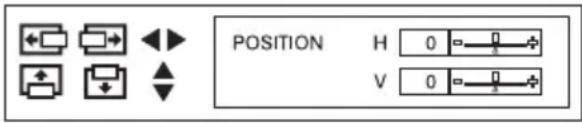
Moves the picture position.
Press the ENTER button to display the "POSITION" screen.
Press the ◀ or ▶ button to move the picture horizontally.
Press the ▲ or ▼ button to move the picture vertically.
DOT CLOCK
(RGB only)
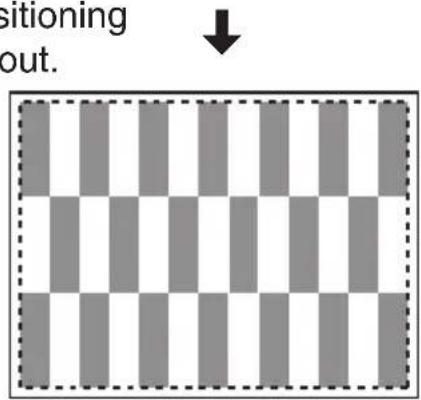
Periodic striped pattern interference (noise) may occur when a striped pattern such as the one below is projected. If this happens, press the ◀ or ▶ button to adjust so that any such noise is minimised.

CLOCK PHASE
(RGB/YPBPR only)
Adjust the "DOT CLOCK" setting first before carrying out this adjustment. Press the ◀ or ▶ button to adjust so that the noise level is least noticeable.
NOTE:
- If signals with a dot clock frequency of 100 MHz or higher are being input, interference may not be completely eliminated when the “DOT
CLOCK" and "CLOCK PHASE" adjustments are carried out.
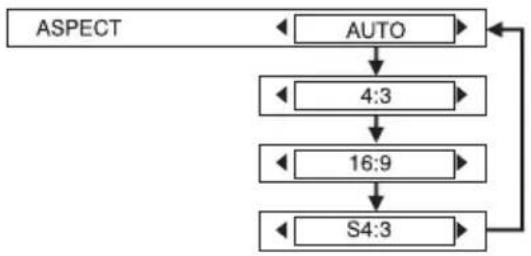
ASPECT
(S-VIDEO/VIDEO/480i, 576i, 480p and 576p YPBPR only)
flowchart
graph TD
    A["ASPECT"] --> B["AUTO"]
    B --> C["4:3"]
    C --> D["16:9"]
    D --> E["S4:3"]
    E --> B
AUTO
(S-VIDEO only)
When an S1 video signal is being input, the aspect ratio is changed automatically to project a 16:9 picture.
4:3
The input signal is projected without change.
16:9
The picture is compressed to a ratio of 16:9 and projected.
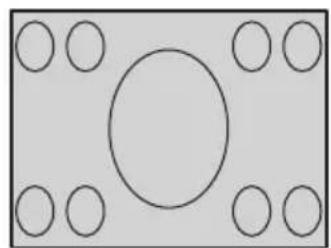
natural_image
Simple diagram with a central circle surrounded by eight surrounding circles, no text or symbols present.When a horizontally squeezed signal is being input.
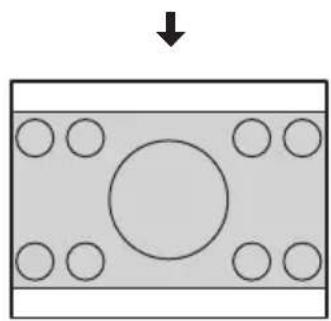
natural_image
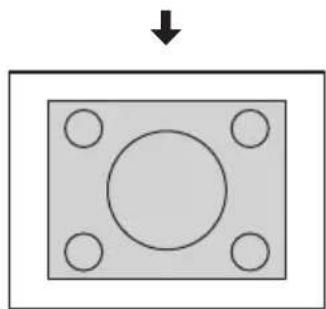
Diagram of a rectangular block with circular holes and a central circle, no text or symbols presentS4:3
The size of the input signal is compressed to 75% and projected. (This is useful for projecting a picture with a 4:3 aspect ratio onto a 16:9 screen.)
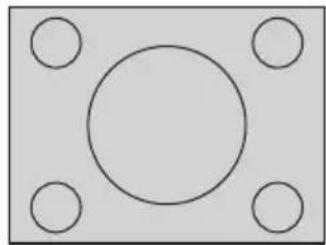
natural_image
Simple geometric diagram with a central circle and four surrounding circles (no text or symbols)When a 4:3 signal is being input.
natural_image
Simple diagram showing a rectangular plate with four circular holes and a central circle, no text or symbols present.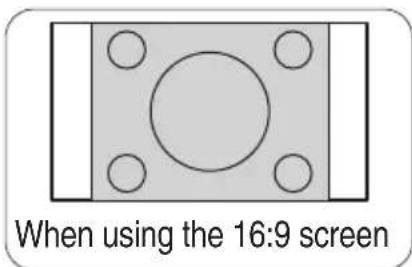
S1 video signals
- S1 video signals are a type of video signal with an aspect ratio of 16:9 which include a detector signal. This detector signal is output by some sources such as wide-vision video decks.
- When "ASPECT" is set to "AUTO", the projector recognizes the detector signal and automatically switches the aspect ratio to 16:9.
NOTE:
- If using this projector in places such as cafes or hotels to display programmes for a commercial purpose or for public presentation, note that if the aspect ratio (16:9) selection function is used to change the aspect ratio of the screen picture, you may be infringing the rights of the original copyright owner for that programme under copyright protection laws.
- If a 4:3 picture is projected onto a 16:9 screen, distortion may occur around the edges of the picture so that part of the picture is no longer visible. Programes which have 4:3 aspect ratios should be viewed in 4:3 mode to give proper consideration to the aims and intentions of the original programme's creator.
RESIZING
(S-VIDEO/VIDEO/RGB/YPBPR only)
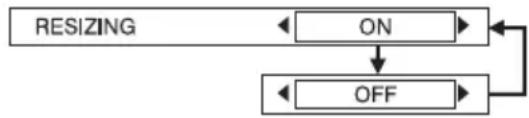
flowchart
graph TD
    A["RESIZING"] --> B["ON"]
    B --> C["OFF"]
    C --> A
This should normally be set to "ON". (This setting is only for signals which have lower resolutions than the LCD panels. Refer to page 68 for details.)
ON
The pixel resolution of the input signal is converted to the same resolution as the LCD panels before being projected.
This may sometimes cause problems with the quality of the picture.
OFF
The input signal is projected at its original resolution, with no pixel conversion. The projected picture will be smaller than normal, so adjust the zoom setting or move the projector forwards or backwards to adjust the picture size if necessary. If set to “OFF”, some features, such as “DIGITAL ZOOM”, “REALTIME KEYSTONE”, “KEYSTONE” or “INDEX WINDOW” will not function.
FRAME LOCK
(RGB only)
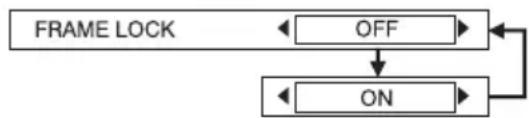
flowchart
graph TD
    A["FRAME LOCK"] --> B["OFF"]
    B --> C["ON"]
    C --> A
If the picture's condition is bad while an RGB moving picture is projected, set "FRAME LOCK" to "ON". Refer to page 68 for compatible RGB signals.
Changing the display language
①Press the MENU button to display the menu screen.
②Select the “LANGUAGE” menu from the main menu, and then press the ENTER button.
③Press the ▲ or ▼ button to select a language, and then press the ENTER button.
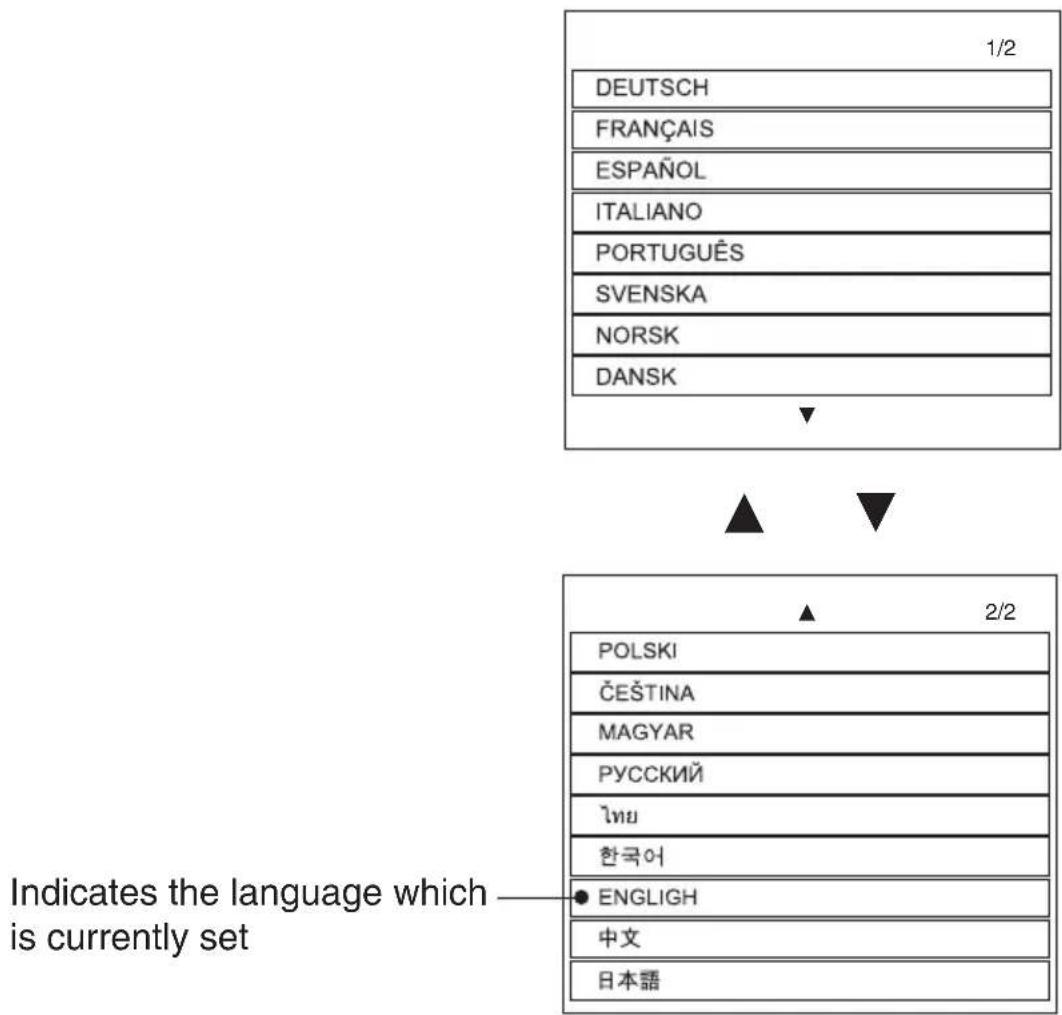
Option settings
①Press the MENU button to display the menu screen.
②Select the “OPTION” menu from the main menu, and then press the ENTER button.
③ Press the ▲ or ▼ button to select an item.
④ Press the ◀ or ▶ button to change the setting. For “DETAILED SETUP”, press the ENTER button to display the next screen.
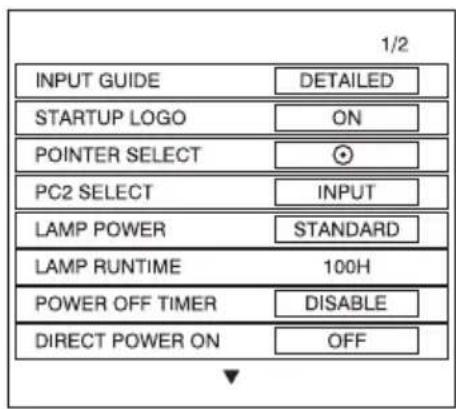

INPUT GUIDE
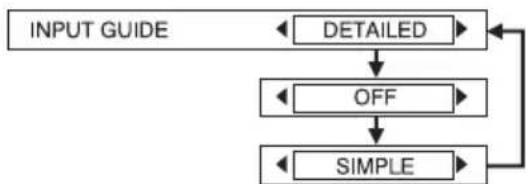
flowchart
graph TD
    A["INPUT GUIDE"] --> B["DETAILED"]
    B --> C["OFF"]
    C --> D["SIMPLE"]
    D --> A
When the input signal is changed, the input signal information will be displayed in the upper right corner of the projected images. You can select the level of the input signal information.
DETAILED
The input signal information will be displayed in detail.
OFF
The input signal information will not be displayed.
SIMPLE
Only the name of the input signal will be displayed.
NOTE:
- If "INPUT GUIDE" is set to "DETAILED", the guide screen for computer connection will be displayed when PC1 or PC2 is selected and no signal is being input to the PC 1 IN or PC 2 IN connector. If you would like the guide screen not to be displayed, set "INPUT GUIDE" to "SIMPLE" or "OFF".
STARTUP LOGO
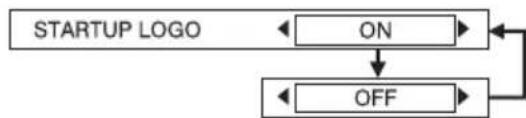
flowchart
graph TD
    A["STARTUP LOGO"] --> B["ON"]
    B --> C["OFF"]
    C --> A
ON
The "Panasonic" logo will be displayed when the power is turned on.
OFF
The "Panasonic" logo will not be displayed when the power is turned on.
POINTER SELECT
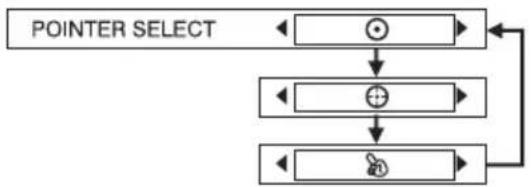
flowchart
graph TD
    A["POINTER SELECT"] --> B["Add"]
    B --> C["Cancel"]
    C --> D["Add"]
    D --> E["Next Step"]
If you press the POINTER button on the remote control unit, the pointer will be displayed. You can select the pointer from 3 types as shown below (refer to page 35).
「⊙」 A double circle will be displayed.
「⊕」 A circle with a cross will be displayed.
This setting is used to select the function of the PC 2 IN/PC 1 OUT connector. When set to "INPUT", it is set to the PC 2 IN connector. When set to "OUTPUT", it is set to the PC 1 OUT connector.
LAMP POWER
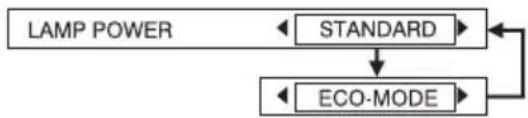
flowchart
graph TD
    A["LAMP POWER"] <--> B["STANDARD"]
    B --> C["ECO-MODE"]
    C --> A
This setting changes the lamp brightness. When set to “ECO-MODE”, the luminance of the lamp is reduced, but the projector uses less power, and the operating noise is also reduced. This can help to extend the lamp’s operating life. If using the projector in small rooms where high luminance is not required, it is recommended that you set the “LAMP POWER” to “ECO-MODE”.
NOTE:
- “LAMP POWER” cannot be set when no signal is being input.
LAMP RUNTIME
This setting displays the usage time for the lamp unit which is currently being used. When replacing the lamp unit, follow the instructions on page 61, and reset "LAMP RUNTIME" to "0".
NOTE:
- The lamp's operating life varies depending on the usage conditions (such as the "LAMP POWER" setting and the number of times the power is turned on and off).
POWER OFF TIMER
If no signal is input to the projector for the duration of the period you set, the projector will return to standby mode. The period can be set from 15 minutes to 60 minutes in 5 minute intervals. If you don't use this feature, set it to "DISABLE".
DIRECT POWER ON
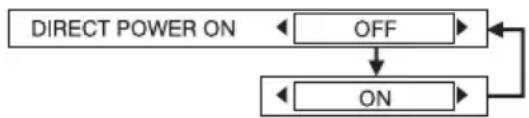
flowchart
graph TD
    A["DIRECT POWER ON"] --> B["OFF"]
    B --> C["ON"]
    C --> A
This sets the projector's start up status for when the power cord is connected.
OFF
The projector will start from the same status as when the power cord was disconnected. If the power cord was disconnected during projection when the projector was used the last time, projection will start after the power cord is connected.
ON
The projection will start after the mains lead is connected.
CONTROL PANEL
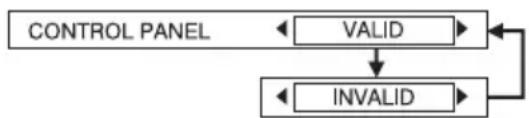
flowchart
graph TD
    A["CONTROL PANEL"] --> B["VALID"]
    B --> C["INVALID"]
    C --> A
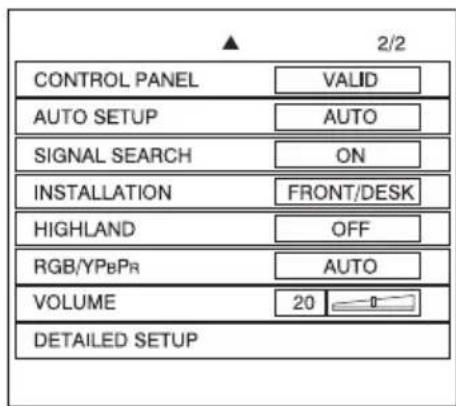
To disable the buttons on the projector, set "CONTROL PANEL" to "INVALID". A confirmation screen will then be displayed. Select "OK" by using ◀ or ▶ button. To use the buttons on the projector, set to "VALID" by using the remote control unit.
AUTO SETUP
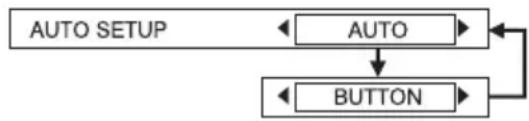
flowchart
graph TD
    A["AUTO SETUP"] --> B["AUTO"]
    B --> C["BUTTON"]
    C --> A
This should normally be set to "AUTO".
AUTO
"AUTO SETUP" will be carried out when the input signal is changed to RGB.
BUTTON
"AUTO SETUP" will function only when you press the AUTO SETUP button.
SIGNAL SEARCH
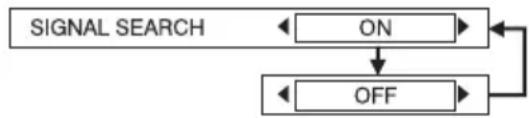
flowchart
graph TD
    A["SIGNAL SEARCH"] --> B["ON"]
    B --> C["OFF"]
    C --> A
This should normally be set to "ON".
ON
When the power is turned on and "AUTO SETUP" is running, the projector detects which signals are being input, and uses these signals for projection.
(If a picture is being projected, the signal source is not automatically changed.)
OFF
Use this setting when you do not want the signal source to be changed automatically when the power is turned on and “AUTO SETUP” is running.
INSTALLATION
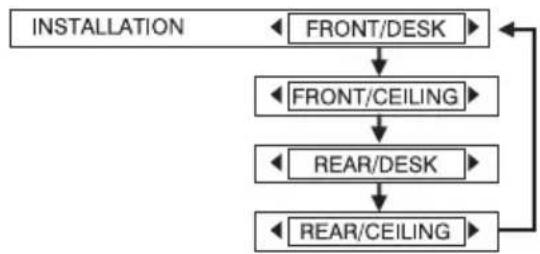
flowchart
graph TD
    A["INSTALLATION"] --> B["FRONT/DESK"]
    B --> C["FRONT/CEILING"]
    C --> D["REAR/DESK"]
    D --> E["REAR/CEILING"]
    E --> A
This setting should be changed in accordance with the projector setting-up method. (Refer to page 18.)
FRONT/DESK
When the projector is placed on a desk or similar in front of a screen.
FRONT/CEILING
When the projector is placed in front of a screen and suspended from a ceiling using a ceiling bracket (sold separately).
REAR/DESK
When using a translucent screen and the projector is placed on a desk or similar.
REAR/CEILING
When using a translucent screen and the projector is suspended from a ceiling using a ceiling bracket (sold separately).
HIGHLAND
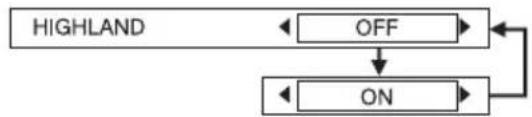
flowchart
graph TD
    A["HIGHLAND"] --> B["OFF"]
    B --> C["ON"]
    C --> A
Set "HIGHLAND" to "ON", when using this projector at high elevations (above 1 400 m) only.
RGB/YPBPR
(480i, 576i, 480p, 576p, 1 080/60i, 1 080/50i, 720/60p and VGA480 signals only)
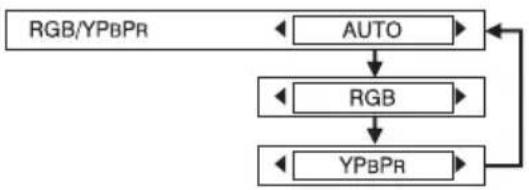
flowchart
graph TD
    A["RGB/YPBPR"] --> B["AUTO"]
    B --> C["RGB"]
    C --> D["YPBPR"]
    D --> E["Output"]
This sets the signal that is input to the PC 1 IN and PC 2 IN/PC 1 OUT connector.
Normally "AUTO" should be selected. RGB or YPBPR is selected automatically depending on the synchronising signal status. If an image is not projected correctly, select "RGB" or "YPBPR" in accordance with the input signal.
VOLUME
You can adjust the volume of the sound that is output from the projector's built-in speaker and VARIABLE AUDIO OUT connector.
DETAILED SETUP
Press the ENTER button to display the "DETAILED SETUP" menu.
INDEX WINDOW
This functions in the same way as the “INDEX WINDOW” button on the remote control unit. Refer to page 34 for details.
SHUTTER
This functions in the same way as the "SHUTTER" button on the remote control unit. Refer to page 32 for details.
OSD DESIGN
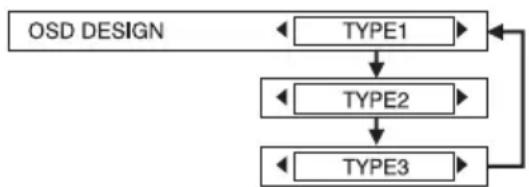
flowchart
graph TD
    A["OSD DESIGN"] --> B["TYPE1"]
    B --> C["TYPE2"]
    C --> D["TYPE3"]
    D --> E
You can select the background for the OSD from 3 types.
TYPE1
Transparent black
TYPE2
Solid blue
TYPE3
Transparent navy blue
SXGA MODE
[RGB(SXGA) only]
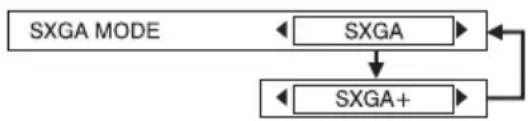
flowchart
graph TD
    A["SXGA MODE"] <--> B["SXGA"]
    B --> C["SXGA+"]
    C --> A
Adjust this item if the projected image overflows from the screen when an SXGA signal is being input.
SXGA
Select this item normally.
SXGA+
When the edges of the projected image are not visible, select this item.
XGA MODE
[RGB(XGA) only]
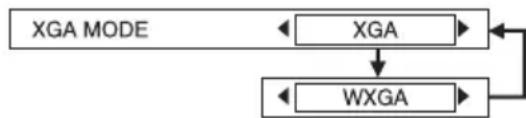
flowchart
graph TD
    A["XGA MODE"] <--> B["XGA"]
    B <--> C["WXGA"]
    C --> B
Adjust this item if the projected image overflows from the screen when an XGA signal is being input.
XGA
Select this item normally.
WXGA
Select this item when the edges of the projected image are not visible or the projected image is vertically elongated.
BLACKBOARD
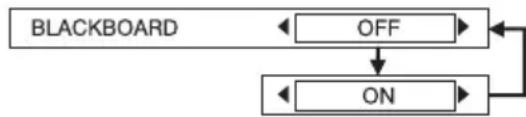
flowchart
graph TD
    A["BLACKBOARD"] --> B["OFF"]
    B --> C["ON"]
    C --> D["Feedback to OFF"]
Set to "ON" when "PICTURE MODE" is set to "BLACKBORD". (Refer to page 40.)
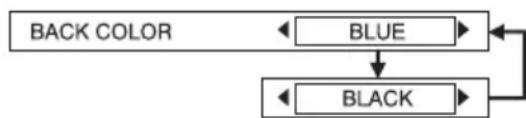
BACK COLOR
flowchart
graph TD
    A["BACK COLOR"] --> B["BLUE"]
    B --> C["BLACK"]
    C --> A
This sets the color which is projected onto the screen when no signal is being input to the projector.
Setting up the security function
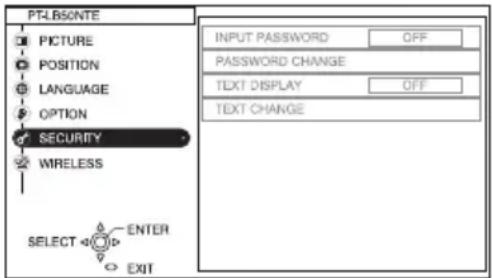
This projector is equipped with a security function. A password input screen can be displayed, or a company URL can be set up and displayed at the bottom of the projected image.
①Press the MENU button to display the menu screen.
②Select the “SECURITY” menu from the main menu, and then press the ENTER button.

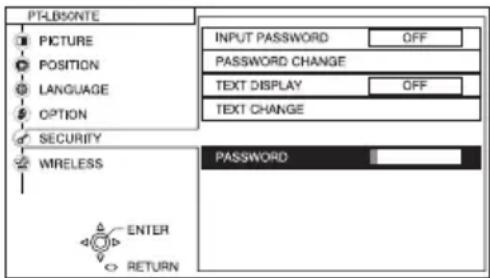
(When you use the "SECURITY" function for the first time)
Press the ▲, ▶, ▼, ◀, ▲, ▶, ▼ and ◀ buttons in order, then press the ENTER button.
(When a password change has been made before)
Type in the changed password, then press the ENTER button.

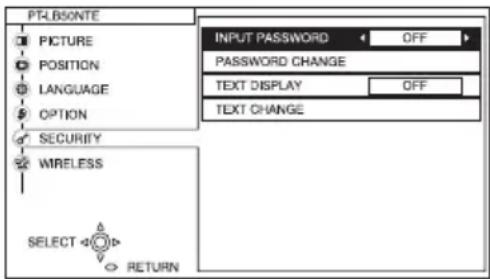
③ Press the ▲ or ▼ button to select an item.
④ Press the ◀ or ▶ button to
change the setting.
For “PASSWORD CHANGE” and “TEXT CHANGE”, press the ENTER button to display the next screen.
INPUT PASSWORD
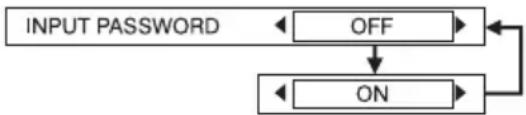
flowchart
graph TD
    A["INPUT PASSWORD"] --> B["OFF"]
    B --> C["ON"]
    C --> A
The password input screen can be displayed when the power is turned on. All of the controls other than the POWER button are disabled unless the password is entered correctly.
OFF
"INPUT PASSWORD" is disabled.
ON
"INPUT PASSWORD" is enabled.
PASSWORD CHANGE
Passwords can be changed. Press the ENTER button to display the "PASSWORD CHANGE" screen.
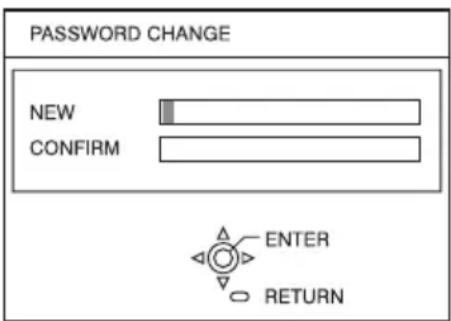
①Set a password by pressing the ▲,▼,◀, and ▶ buttons.
(A maximum of 8 buttons can be set.)
②Press the ENTER button.
③Enter the password again for confirmation.
④Press the ENTER button.
NOTE:
- The entered password will appear as *. It will not be displayed on the screen.
- If you enter the wrong password, an error message will be displayed. Enter the correct password again.
TEXT DISPLAY
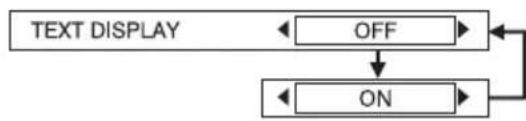
flowchart
graph TD
    A["TEXT DISPLAY"] --> B["OFF"]
    B --> C["ON"]
    C --> A
You can set text to be displayed at the bottom of the projected image at all times.
OFF
"TEXT DISPLAY" is disabled.
ON
"TEXT DISPLAY" is enabled.
TEXT CHANGE
The text which is displayed when "TEXT DISPLAY" is set to "ON" can be changed.
Press the ENTER button to display the "TEXT CHANGE" screen.
![TEXT CHANGE A B C D E F G H I J K L M DELETE N O P Q R S T U V W X Y Z a b c d e f g h i j k l m n o p q r s t u v w x y z 0 1 2 3 4 5 6 7 8 9 SPACE ! " # $ % & ' * + - / = ? @ \ ^ _ ` | ~ ( ) < > [ ] { }, . : ; OK CANCEL SELECT ENTER RETURN](/content/2026/05/762567/images/bf1edd56fac30daa143c40b73f42593b4db358d17333aed602557eca0f3e6d64.jpg)
① Press the ▲, ▼, ◀ and ▶ buttons to select the characters, then press the ENTER button. (You can enter 22 characters continuously.)
- Select "DELETE" to delete a character.
② Press the ▲, ▼, ◀ and ▶ buttons to select "OK", then press the ENTER button.
- Select "CANCEL" to cancel the change.
Wireless setup (PT-LB50NTU only)
You need to make adjustments on some items when controlling the projector with a personal computer by means of the wireless network. Refer to the accessory CD-ROM for details.
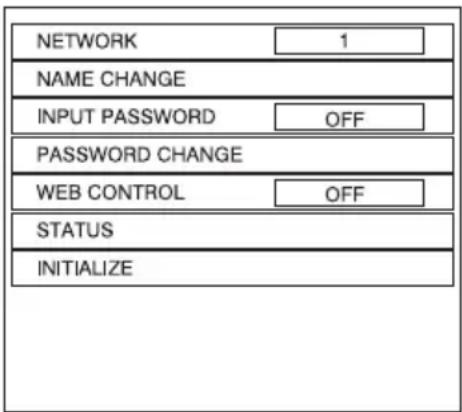
NETWORK
Select the network setting you want to use.
NAME CHANGE
The name for this projector can be set.
INPUT PASSWORD
Set to “ON” if you want password confirmation to be used when controlling the projector with a personal computer by means of the wireless network.
PASSWORD CHANGE
Passwords can be changed.
WEB CONTROL
To control the projector with a personal computer by means of the wireless network, set the “WEB CONTROL” to “ON”.
STATUS
The wireless settings will be displayed.
INITIALIZE
Wireless settings can be returned to the factory default settings.
When the TEMP indicator and the LAMP indicator are illuminated
There are two indicators on the control panel of the projector which give information about the operating condition of the projector. These indicators illuminate or flash to warn you about problems that have occurred inside the projector, so if you notice that one of the indicators is on, turn off the power and check the table below for the cause of the problem.
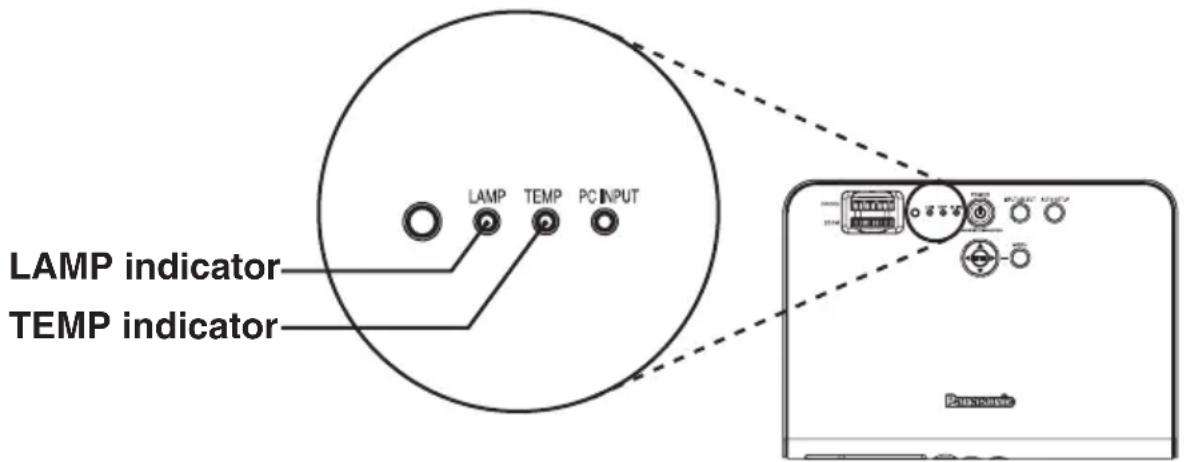
| TEMP indicator | ||
| Indicator display | Illuminated (red)(Lamp unit on) | Flashing (red)(Lamp unit off) |
| Problem | The surrounding temperature or the temperature inside the projector has become unusually high. | The surrounding temperature or the temperature inside the projector has become dangerously high, causing the lamp unit to automatically shut off. |
| Possible cause | ● The ventilation holes may be covered.● The ambient temperature in the place of use may be too high.● The air filter may be blocked. | |
| Remedy | ● Uncover the ventilation holes.● Set up the projector in a place where the temperature is between 0 °C (32 °F) and 40 °C (104 °F) and the humidity is between 20% and 80% (with no condensation). [If you set the “HIGHLAND” to “ON” (page 52), set up the projector in a place where the temperature is between 0 °C (32 °F) and 35 °C (95 °F) and the humidity is between 20% and 80% (with no condensation).]● Disconnect the power cord by following the procedure on page 28, and then clean the air filter. (Refer to page 59.) | |
| LAMP indicator | |||
| Indicator display | Illuminated (red) | Flashing (red) | |
| Problem | It is nearly time to replace the lamp unit. | An abnormality has been detected in the lamp circuit. | |
| Possible cause | ● Does “REPLACE LAMP” appear on the screen after the projector is turned on? | ● The power may have been turned on straight away after it was turned off. | ● There may be an abnormality in the lamp circuit.● The lamp unit may be blown. |
| Remedy | ● This occurs when the operation time for the lamp unit is nearing 1 800 hours (when “LAMP POWER” has been set to “STANDARD” and when “AI” has been set to “OFF”). Ask your dealer or an Authorized Service Center to replace the lamp unit. (page 60) | ● Wait for a while until the lamp unit cools down before turning the power back on again. | ● Disconnect the power cord by following the procedure on page 28, and then contact an Authorized Service Center.● Ask your dealer or an Authorized Service Center to replace the lamp unit. (page 60) |
NOTE:
- Be sure to disconnect the power cord by following the procedure given in “Turning off the power” on page 28 before carrying out any of the procedures in the “Remedy” column.
- If the TEMP indicator is illuminated and the power turns off after the procedures in the “Remedy” column have been carried out, it means an abnormality has occurred. Please contact an Authorized Service Center so that the necessary repairs can be made.
Cleaning and replacing the air filter
If the air filter becomes clogged with dust, the internal temperature of the projector will rise, the TEMP indicator will illuminate and the projector's power will turn off (the TEMP indicator will flash after the power is turned off). The air filter should be cleaned every 100 hours of use.
Cleaning
Use a vacuum cleaner to clean off any accumulated dust.
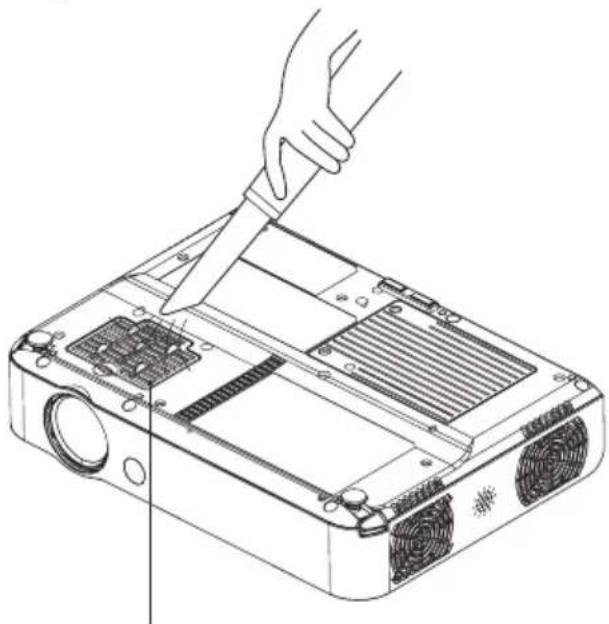
natural_image
Line drawing of a hand using a tool to adjust or install electronic components on a device (no text or symbols visible)Air filter cover
NOTE:
- If the dust cannot be cleaned by a vacuum cleaner, remove the air filter and soak it in water, and then wash out the dust by hand. Be sure to install the air filter after it has dried.
- Do not use detergent when washing the air filter.
- If the dust cannot be removed by cleaning, it is time to replace the air filter. Please consult your dealer.
Furthermore, if the lamp unit is being replaced, replace the air filter at this time also.
Replacement procedure
①Turn off the power and disconnect the power cord.
Be sure to disconnect the power cord by following the procedure given on page 28.
②Gently turn the projector upside down, and then remove the air filter cover.
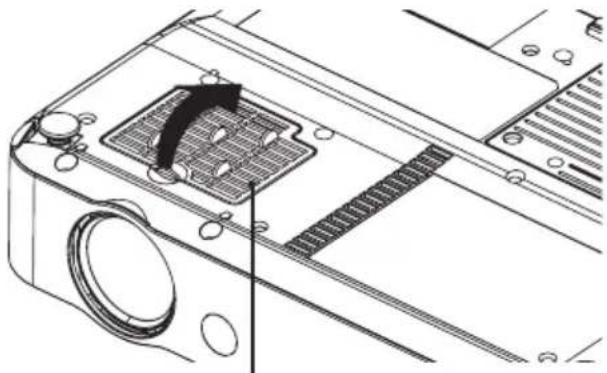
natural_image
Technical line drawing of a camera interior showing the lens, grille, and ventilation slots (no text or symbols)Air filter cover
③Replace the air filter, and then install the air filter cover.
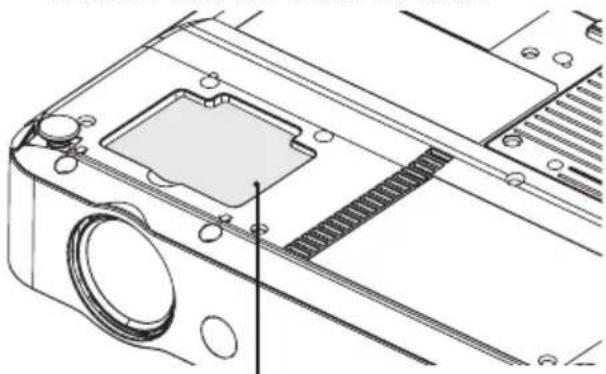
natural_image
Technical line drawing of a camera module with no visible text or symbolsAir filter
NOTE:
- Be sure to install the air filter before using the projector. If the projector is used without the air filter installed, dust and other foreign particles will be drawn into the projector, and malfunctions will result.
Replacing the lamp unit
Warning
The lamp unit should only be replaced by a qualified technician.
When replacing the lamp, allow it to cool for at least one hour before handling it.
- The lamp cover gets very hot, and touching it can cause burns.
Notes on replacing the lamp unit
- The light generating lamp is made of glass, so dropping it or allowing it to hit hard objects may cause it to burst. Be careful when handling the lamp.
- Dispose of the removed old lamp with the same care that would be taken with a fluorescent light.
- A Phillips screwdriver is necessary for removing the lamp unit.
NOTE:
- The projector is not supplied with a replacement lamp unit. Please ask your dealer for details. Lamp unit product no.: ET-LAB50
CAUTION:
- Do not use any lamp unit other than the one with the product number indicated above.
Lamp unit replacement period
The lamp is a consumable product. Even when the full life of the bulb has not been exhausted, the brightness of the light will gradually decline. Therefore periodic replacement of the lamp is necessary.
The intended lamp replacement interval is 2 000 hours, but it is possible that the lamp may need to be replaced earlier due to variables such as a particular lamp's characteristics, usage conditions and the installation environment. Early preparation for lamp replacement is encouraged.
The lamp will automatically shut off after approximately 10 minutes when 2 000 hours of use have been reached because of a much greater chance of it exploding after this time.
NOTE:
- The usage hours explained above are for when “LAMP POWER” in the “OPTION” menu has been set to “STANDARD” and when “AI” in the “PICTURE” menu has been set to “OFF”. If “LAMP POWER” is set to “ECO-MODE”, or “AI” is set to “ON”, the life of the lamp can be extended.
- While 2 000 hours is the intended replacement interval, it is not a period of time covered by warranty.
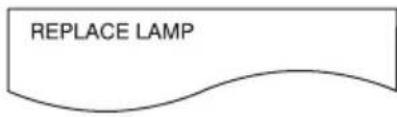 | LAMP indicatorOn-screen display | |
| More than 1 800 hours | Displayed for 30 seconds. Pressing any button will clear the display. | Illuminates red during image projection and standby mode. |
| More than 2 000 hours | Remains displayed until any button is pressed. |
Lamp unit replacement procedure
NOTE:
- If the lamp usage time has passed 2000 hours (when “LAMP POWER” has been set to “STANDARD” and when “AI” has been set to “OFF”), the projector will switch to standby mode after approximately 10 minutes of operation. The steps ⑦ to ⑫ on the next page should thus be completed within 10 minutes.
①Disconnect the power cord from the projector by following the procedure on page 28, and check that the area around the lamp unit has cooled down.
②Use a Phillips screwdriver to turn the lamp unit cover fixing screws at the bottom of the projector, and then remove the lamp unit cover.
Lamp unit cover
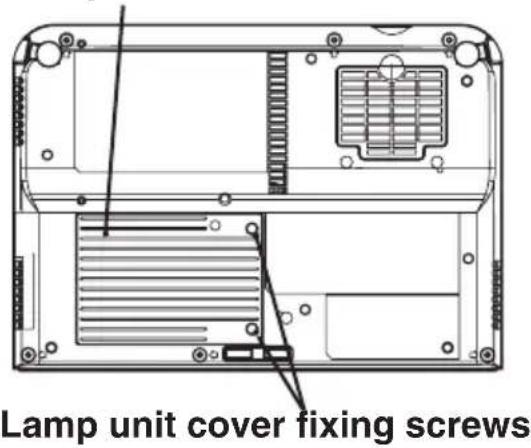
③Use a Phillips screwdriver to loosen the two lamp unit fixing screws until the screws turn freely. Then hold the handles of the lamp unit and gently pull the lamp unit out from the projector.
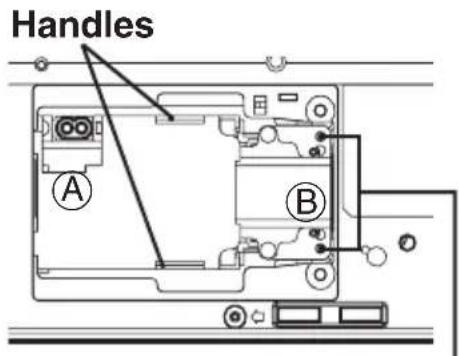
Lamp unit fixing screws
④Insert the new lamp unit while making sure that the direction of insertion is correct, and then use a Phillips screwdriver to securely tighten the lamp unit fixing screws.
When inserting the new lamp unit, be sure to push it in at the point Ⓐ and Ⓑ.
⑤Install the lamp unit cover, and then use a Phillips screwdriver to securely tighten the lamp unit cover fixing screws.
NOTE:
- Be sure to install the lamp unit and the lamp unit cover securely. If they are not securely installed, it may cause the protection circuit to operate so that the power cannot be turned on.
⑥Connect the power cord.
⑦Press the POWER button so that a picture is projected onto the screen.
NOTE:
- If "DIRECT POWER ON" in the "OPTION" menu has been set to "ON", projection will start after the power cord is connected. Refer to page 51 for details.
⑧Press the MENU button to display the menu screen, and then press the ▲ or ▼ button to select the “OPTION” menu.
⑨Press the ENTER button, and then press the ▲ or ▼ button to select “LAMP RUNTIME”.
⑩Press and hold the ENTER button for approximately 3 seconds.
The “LAMP RUNTIME” screen will be displayed.
LAMP RUNTIME
LAMP RUNTIME RESET.
OK : PRESS ⏻ BUTTON
CANCEL : PRESS ANY OTHER BUTTON
NOTE:
- Press any button other than the POWER button to cancel the "LAMP RUNTIME" screen.
⑪Press the POWER button to turn off the power.
⑫ Disconnect the power cord after the POWER button on the projector illuminates red.
This will reset the cumulative usage time for the lamp unit to "0".
Before calling for service
Before calling for service, check the following points.
| Problem Possible cause | Page | |
| Power does not turn on. | The power cord may not be connected.The main power supply is not being supplied to the wall outlet.TEMP indicator is illuminated or flashing.LAMP indicator is illuminated or flashing.The lamp unit cover has not been securely installed. | -5758- |
| No picture appears. | The video signal input source may not be connected properly.The input selection setting may not be correct.The “BRIGHTNESS” adjustment setting may be at the minimum possible setting.The “SHUTTER” function may be in use. | -304132,53 |
| The picture is fuzzy. | The lens focus may not have been set correctly.The projector may not be at the correct distance from the screen.The lens may be dirty.The projector may be tilted too much. | 2720-18 |
| The color is pale or grayish. | “COLOR” or “TINT” adjustment may be incorrect.The input source which is connected to the projector may not be adjusted correctly. | 41- |
| No sound can be heard. | The audio signal source may not be connected properly.The volume adjustment may be at the lowest possible setting.A cable may be connected to the VARIABLE AUDIO OUT connector. | -32,5221,22,23 |
| The remote control unit does not operate. | The battery may be weak.The battery may not be inserted correctly.The remote control signal receptor on the projector may be obstructed.The remote control unit may be out of the operation range. | -242424 |
| The buttons on the projector do not function. | The “CONTROL PANEL” may be set to “INVALID”. In order to set the “CONTROL PANEL” to “VALID” without using the remote control unit, keep holding down the ENTER button on the projector and press the MENU button for more than 2 seconds. | 51 |
| The picture does not display correctly. | ● The signal format (“TV-SYSTEM”) may not be set correctly.● There may be a problem with the video tape or other signal source.● A signal which is not compatible with the projector may be being input. | 43—68 |
| Picture from computer does not appear. | ● The cable may be too long.● The external video output for the laptop computer may not be set correctly.(The actual method varies depending on the type of computer, so refer to the documentation provided with your computer for further details.)● If an PC INPUT indicator is turned off, the video signals may not be output from the computer.● “PC2 SELECT” in the “OPTION” menu is set to “OUTPUT” when the signals are input to PC 2 IN/PC 1 OUT connector. | —691450 |
Cleaning and maintenance
Before carrying out cleaning and maintenance, be sure to disconnect the power cord plug from the wall outlet.
Wipe the cabinet with a soft, dry cloth.
If the cabinet is particularly dirty, soak the cloth in water with a small amount of neutral detergent in it, squeeze the cloth very well, and then wipe the cabinet. After cleaning, wipe the cabinet dry with a dry cloth. If using a chemically-treated cloth, read the instructions supplied with the cloth before use.
Do not wipe the lens with a cloth that is dusty or which produces lint. If any dust or lint gets onto the lens, such dust or lint will be magnified and projected onto the screen. Use a blower to clean any dust and lint from the lens surface, or use a soft cloth to wipe off any dust or lint.
Specifications
Power supply: 100 V - 240 V \~, 50 Hz/60 Hz
Power consumption: 240 W [During standby (when fan is
stopped): Approx. 4 W]
Amps: 2.8 A - 1.3 A
LCD panel:
Panel size (diagonal): 0.6 type (15.24mm)
Aspect ratio: 4:3
Micro lens array: Available
Display method: 3 transparent LCD panels (RGB)
Drive method: Active matrix method
Pixels:
PT-LB50NTU/PT-LB50U: 786 432 (1 024 x 768) x 3 panels
PT-LB50SU: 480 000 (800 x 600) x 3 panels
Lens: Manual zoom (1 - 1.2) / Manual focus
F 1.6 - 1.9 f 18.8 mm - 22.6 mm
Lamp: UHM lamp (165 W)
Luminosity: 2 000 lm
Scanning frequency (for RGB signals):
Horizontal scanning frequency: 15 kHz - 91 kHz
Vertical scanning frequency: 50 Hz - 85 Hz
Dot clock frequency: Less than 100 MHz
YPBPR signals: 480i, 576i, 480p, 576p, 1 080/60i, 1 080/50i, 720/60p
Color system: 7 (NTSC/NTSC 4.43/PAL/PAL-M/PAL-N/PAL60/SECAM)
Projection size: 838.2 mm - 7 620 mm (33" - 300")
Throw distance:
PT-LB50NTU/PT-LB50U: 1.1 m - 11.1 m (3'7" - 36'5")
PT-LB50SU: 1.1 m - 10.9 m (3'7" - 35'9")
Optical axis shift: 6:1 (fixed)
Screen aspect ratio: 4:3
Installation: Front/Desk
Front/Ceiling
Rear/Desk
Rear/Ceiling (menu selection)
Speaker: 4 cm x 2 cm oval x 1
Max. usable volume output: 1 W (mono)
Wireless LAN (PT-LB50NTU only): IEEE802.11 b/g
Connectors
PC IN/OUT: Dual line, D-sub HD 15-pin (female)
(One line is available for input and output, selectable using an on-screen menu)
During RGB input/output:
R.G.B.: 0.7 V [p-p], 75 Ω
G.SYNC: 1.0 V [p-p], 75 Ω
HD, VD: TTL, automatic positive/negative polarity compatible
During YPBPR input/output:
Y: 1.0 V [p-p] (Including sync), 75 Ω
P_B, P_R: 0.7 V [p-p], 75
VIDEO IN: Single-line, RCA pin jack, 1.0 V [p-p], 75 Ω
S-VIDEO IN: Single-line, Mini DIN 4-pin
Y 1.0 V [p-p], C 0.286 V [p-p], 75 Ω
AUDIO IN: Single-line, 0.5 V [rms] RCA pin jack x 2 (L-R)
PC AUDIO IN: Single-line, 0.5 V [rms] M3 jack (Stereo MINI)
VARIABLE AUDIO OUT: Single-line, 0.5 V [rms] M3 jack (Stereo MINI)
(Monitor output/stereo compatible)
0 V [rms] - 2.0 V [rms] (variable)
SERIAL: DIN 8-pin RS-232C compatible
Cabinet: Moulded plastic (PC/ABS)
Dimensions:
Width: 297 mm (11-11/16")
Length: 210 mm (8-1/4")
Height: 57 mm (2-7/32")(Not including the
projection parts)
Weight:
PT-LB50NTU: 1.9 kg (4.2 lbs.)
PT-LB50U/PT-LB50SU: 1.8 kg (4.0 lbs.)
Operating environment:
Temperature: 0 °C - 40 °C (32 °F - 104 °F)
[When the "HIGHLAND" is set to "ON"
(page 52): 0 °C - 35 °C (32 °F - 95 °F)]
Humidity: 20% - 80% (no condensation)
Certifications: UL60950, C-UL
FCC Class B
Power supply: 3 V DC (AAA battery x 2)
Operating range: Approx. 7 m (23') (when operated directly in front of signal receptor)
Weight: 74 g (2.6 ozs.) (including battery)
Dimensions:
Width: 51.5 mm (2')
Length: 123 mm (4-13/16")
Height: 21.1 mm (-13/16")
Ceiling bracket ET-PKB50
Wireless remote control unit ET-RM300
Serial adapter ET-ADSER
(DIN 8-pin/D-sub 9-pin)
Appendix
Projection dimensions calculation methods
If the screen size (diagonal) is SD (m), then the following formula is used to calculate the projection distance for the wide lens position (LW) and the projection distance for the telephoto lens position (LT).
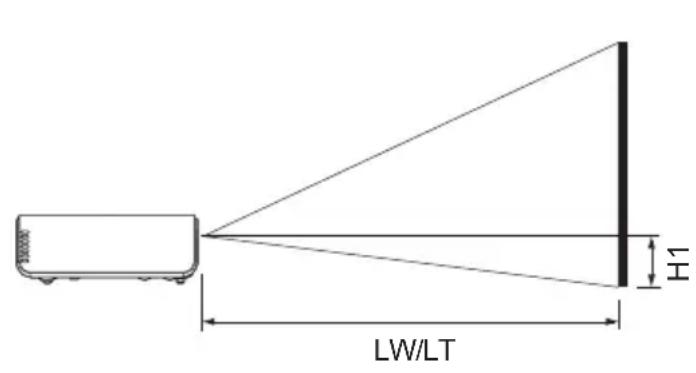
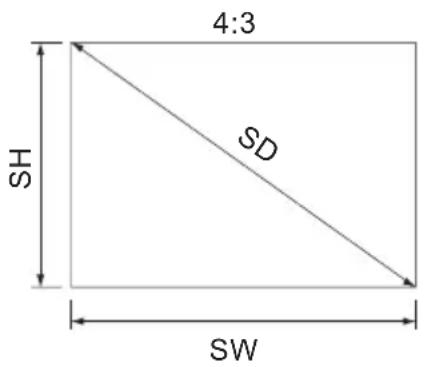
| PT-LB50NTU/PT-LB50U | LW=0.0307xSD/0.0254-0.031 |
| LT=0.0371xSD/0.0254-0.029 | |
| PT-LB50SU | LW=0.0304xSD/0.0254-0.029 |
| LT=0.0368xSD/0.0254-0.041 |
For 16:9 aspect ratios, the following formula can be used to calculate the projection distance.
| PT-LB50NTU/PT-LB50U | LW=0.0335xSD/0.0254-0.0315 |
| LT=0.0405xSD/0.0254-0.0365 | |
| PT-LB50SU | LW=0.0332xSD/0.0254-0.032 |
| LT=0.0401xSD/0.0254-0.038 |
*The values obtained from the formulas above are approximate.
NOTE:
- If 4:3 images are projected onto a 16:9 screen that has been set using the projection distance for a 16:9 screen, the 4:3 images will overflow the screen at the top and bottom. In such cases, set "ASPECT" to "S4:3". (Refer to page 46 for details.)
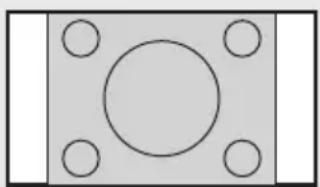
natural_image
Simple geometric diagram with a central circle and four surrounding circles, no text or symbols present.List of compatible signals
| Mode | Displayresolution (dots)*1 | Scanningfrequency | Dot clockfrequency(MHz) | Picturequality*2 | Resizing*3 | Format | ||||
| H(kHz) | V(Hz) | LB50NTULB50U | LB50SU | LB50NTULB50U | LB50SU | |||||
| NTSC/NTSC4.43/PAL-M/PAL60 | 720 x 480i | 15.7 59 | 9 A A | OK OK | S-Video/Video | |||||
| PAL/PAL-N/SECAM | 720 x 576i | 15.6 50 | 0 A A | OK OK | S-Video/Video | |||||
| 480i | 720 x 480i | 15.7 59 | 9 13.5 | A A OK OK | YPbPr/RGB | |||||
| 576i | 720 x 576i | 15.6 50 | 0 13.5 | A A OK OK | YPbPr/RGB | |||||
| 480p | 720 x 483 3 | 1.5 59 | 9 27.0 | A A OK OK | YPbPr/RGB | |||||
| 576p | 720 x 576 3 | 1.3 50 | 0 27.0 | A A OK OK | YPbPr/RGB | |||||
| 1 080/60i | 1 920 x 1 080i | 33.8 6 | 0.0 74 | 3 A A | YPbPr/RGB | |||||
| 1 080/50i | 1 920 x 1 080i | 28.1 5 | 0.0 74 | 3 A A | YPbPr/RGB | |||||
| 720/60p | 1 280 x 720 | 45.0 6 | 0.0 74 | 3 A A | YPbPr/RGB | |||||
| VGA400 | 640 x 400 3 | 1.5 70 | 1 25.2 | A A OK OK | RGB | |||||
| 640 x 400 3 | 7.9 85 | 1 31.5 | A A OK OK | RGB | ||||||
| VGA480 *4 | 640 x 480 3 | 1.5 59 | 9 25.2 | A A OK OK | RGB | |||||
| 640 x 480 3 | 5.0 66 | 7 30.2 | A A OK OK | RGB | ||||||
| 640 x 480 3 | 7.9 72 | 8 31.5 | A A OK OK | RGB | ||||||
| 640 x 480 3 | 7.5 75 | 0 31.5 | A A OK OK | RGB | ||||||
| 640 x 480 4 | 3.3 85 | 0 36.0 | A A OK OK | RGB | ||||||
| SVGA | 800 x 600 3 | 5.2 56 | 3 36.0 | A AA OK RGB | ||||||
| 800 x 600 3 | 7.9 60 | 3 40.0 | A AA OK RGB | |||||||
| 800 x 600 4 | 8.1 72 | 2 50.0 | A AA OK RGB | |||||||
| 800 x 600 4 | 6.9 75 | 0 49.5 | A AA OK RGB | |||||||
| 800 x 600 5 | 3.7 85 | 1 56.3 | A AA OK RGB | |||||||
| MAC16 | 832 x 624 4 | 9.7 74 | 6 57.3 | A A OK RGB | ||||||
| XGA *4 | 1 024 x 768 | 48.4 6 | 0.0 65 | 0 AA A | RGB | |||||
| 1 024 x 768 | 56.5 7 | 0.1 75 | 0 AA A | RGB | ||||||
| 1 024 x 768 | 60.0 7 | 5.0 78 | 8 AA A | RGB | ||||||
| 1 024 x 768 | 68.7 8 | 5.0 94 | 5 AA A | RGB | ||||||
| 1 024 x 768i | 35.5 8 | 7.0 44 | 9 AA A | RGB | ||||||
| MXGA | 1 152 x 864 | 64.0 7 | 1.2 94 | 2 A A | RGB | |||||
| 1 152 x 864 | 67.5 7 | 4.9 | 108.0 B B | RGB | ||||||
| 1 152 x 864 | 76.7 8 | 5.0 | 121.5 B B | RGB | ||||||
| MAC21 | 1 152 x 870 | 68.7 7 | 5.1 | 100.0 B B | RGB | |||||
| MSXGA *4 | 1 280 x 960 | 60.0 6 | 0.0 | 108.0 B B | RGB | |||||
| SXGA *4 | 1 280 x 1 024 | 64.0 6 | 0.0 | 108.0 B B | RGB | |||||
| 1 280 x 1 024 | 80.0 7 | 5.0 | 135.0 B B | RGB | ||||||
| 1 280 x 1 024 | 91.1 8 | 5.0 | 157.5 B B | RGB | ||||||
| SXGA + *4 | 1 400 x 1 050 | 64.0 6 | 0.0 | 108.0 B B | RGB | |||||
| 1 400 x 1 050 | 65.1 5 | 9.9 | 122.4 B B | RGB | ||||||
| UXGA60 *4 | 1 600 x 1 200 | 75.0 6 | 0.0 | 162.0 B B | RGB | |||||
| WXGA*5 *4 | 1 280 x 768 | 47.8 5 | 9.9 79.5 | 5 | A | A | RGB | |||
| 1 280 x 800 | 49.7 5 | 9.8 83.5 | 5 | A | A | RGB | ||||
| 1 440 x 900 | 55.9 5 | 9.9 | 106.5 | A | A | RGB | ||||
*1 The "i" appearing after the resolution indicates an interlaced signal.
*2 The following symbols are used to indicate picture quality.
AA Maximum picture quality can be obtained.
A Signals are converted by the image processing circuit before picture is projected.
B Some loss of data occurs to make projection easier.
*3 Signals with "OK" are compatible with the "RESIZING" function. (page 47)
*4 Signals that are compatible with the "FRAME LOCK" function. (page 47)
*5 Signals that are compatible with the CVT standard.
Guide screen for computer connection
Refer to the list below for details on the keyboard commands to change the output setting.
| Manufacturer | Keyboard command | Manufacturer | Keyboard command |
| Panasonic NEC |  | EPSON DELL |  |
| TOSHIBA SHARP HP |  | IBM SONY |  |
| Apple |  | ||
| FUJITSU |  | Other |  |
Using the SERIAL connector
The serial connector which is on the connector panel of the projector conforms to the RS-232C interface specification, so that the projector can be controlled by a personal computer which is connected to this connector.
Connection
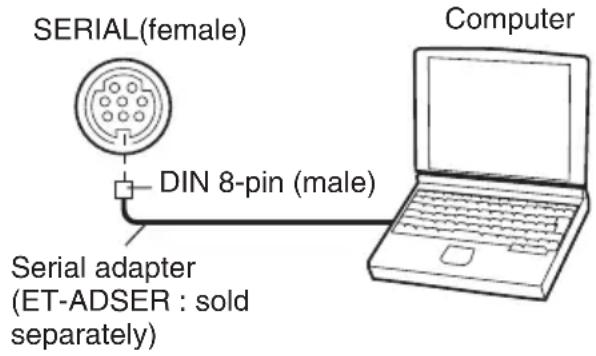
NOTE:
- You must use only RS-232C Serial Interface Cable with ferrite core, type ET-ADSER.
Pin assignments and signal names
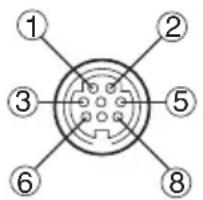
DIN 8-pin Appearance
| Pin No. | Signal name | Contents |
| 3 | RXD | Received data |
| 4 | GND | Earth |
| 5 | TXD | Transmitted data |
| 1 | Connected internally | |
| 2 | ||
| 6 | ||
| 7 | NC | |
| 8 | NC |
Communications settings
| Signal level RS-23 | 2C |
| AsynchronousSync. metho | |
| Baud rate | 9 600 bps |
| Parity | None |
| Character length 8 bits | |
| Stop bit 1 bit | |
| X parameter None | |
| S parameter None | |
Basic format
The data sent from the computer to the projector is transmitted in the format shown below.
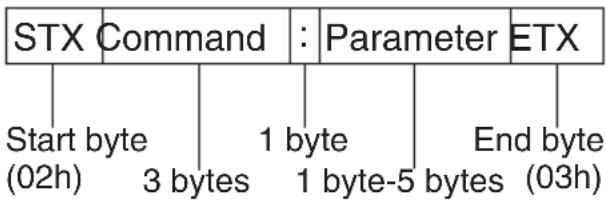
flowchart
graph TD
    A["STX Command"] --> B["Start byte (02h)"]
    A --> C["3 bytes"]
    A --> D["1 byte"]
    A --> E["1 byte-5 bytes"]
    A --> F["Parameter ETX"]
    A --> G["End byte (03h)"]
NOTE:
- The projector can not receive the command for 10 seconds after the lamp is switched on. Wait 10 seconds before sending the command.
- If sending multiple commands, check that a response has been received from the projector for one command before sending the next command.
- When a command which does not require parameters is sent, the colon (:) is not required.
- If an incorrect command is sent from the personal computer, the "ER401" command will be sent from the projector to the personal computer.
Control commands
The commands which the personal computer can use to control the projector are shown in the following table.
| Command | Control Contents | Remarks |
| Power ONPON | In standby mode, all commands other than the PON command are ignored.The PON command is ignored during lamp ON control.If a PON command is received while the cooling fan is operating after the lamp has switched off, the lamp is not turned back on again straight away, in order to protect the lamp. | |
| Power OFFPOF | ||
| VolumeAVL | Parameter000-063 (Adjustment value 0-63) | |
| IIS | Input signal selection | ParameterVID=VIDEO SVD=S-VIDEORG1=PC1 RG2=PC2NWP=WIRELESS (PT-LB50NTU only) |
| Q$S | Lamp ON condition query | Callback0 = Standby1 = Lamp ON control active2 = Lamp ON3 = Lamp OFF control active |
| Shutter functionOSH | Operation will be switched between ON and OFF each time the command is sent. Do not switch operation ON and OFF after only short periods of time. |
Cable specifications
(When connected to a personal computer)
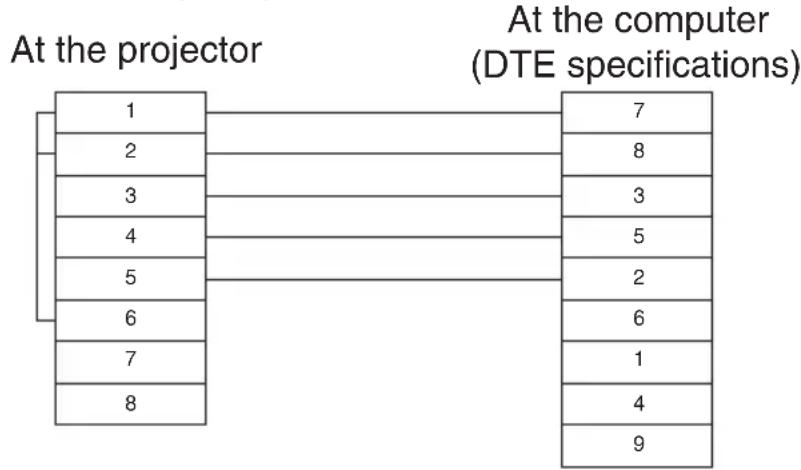
flowchart
graph TD
    A["At the projector"] --> B["1"]
    A --> C["2"]
    A --> D["3"]
    A --> E["4"]
    A --> F["5"]
    A --> G["6"]
    A --> H["7"]
    A --> I["8"]
    J["At the computer (DTE specifications)"] --> K["7"]
    J --> L["8"]
    J --> M["3"]
    J --> N["5"]
    J --> O["2"]
    J --> P["6"]
    J --> Q["1"]
    J --> R["4"]
    J --> S["9"]
Dimensions
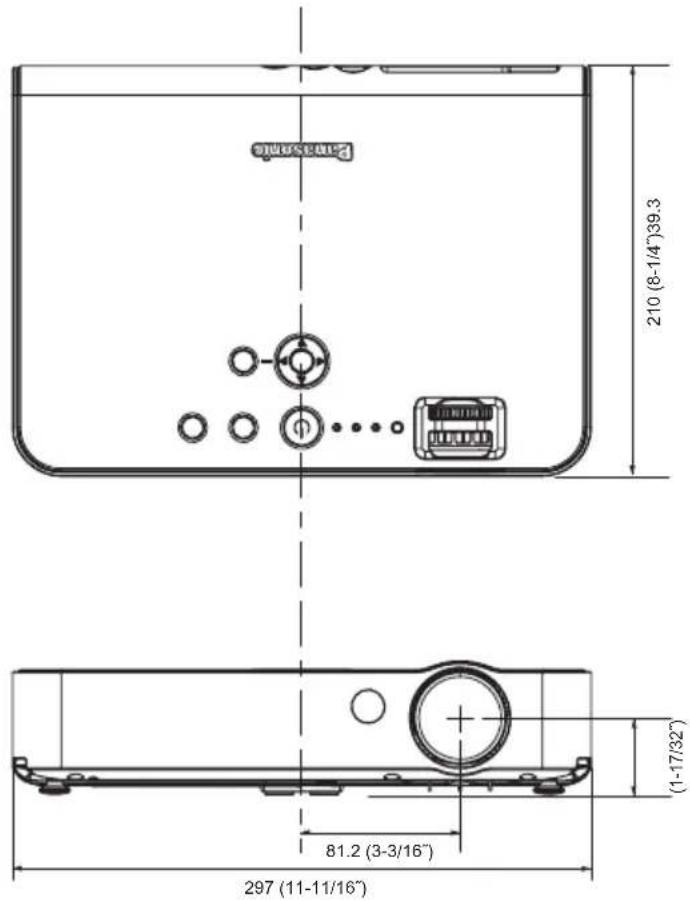
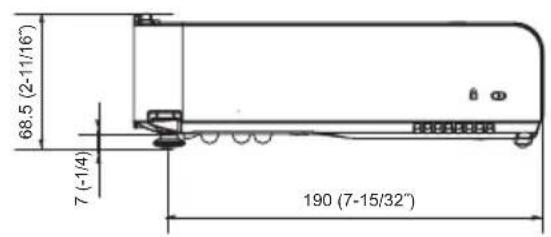
Trademark acknowledgements
- VGA and XGA are trademarks of International Business Machines Corporation.
• Macintosh is a registered trademark of Apple Computer, Inc. - S-VGA is a registered trademark of the Video Electronics Standards Association.
- The font used in the on-screen displays is a Ricoh bitmap font, which is manufactured and sold by Ricoh Company, Ltd.
All other trademarks are the property of the various trademark owners.
Information on Disposal in other Countries outside the European Union

This symbol is only valid in the European Union. If you wish to discard this product, please contact your local authorities or dealer and ask for the correct method of disposal.
These Operating Instructions are printed on recycled paper.
NOTES IMPORTANTES CONCERNANT LA SECURITE
AVERTISSEMENT: POUR REDUIRE LES RISQUES DE FEU OU DE CHOC ÉLECTRIQUE, NE PAS EXPOSER CE PRODUIT À L'EAU OU À L'HUMIDITÉ