
81133 - Hammer VOREL - Free user manual and instructions
Find the device manual for free 81133 VOREL in PDF.


| Product type | Pneumatic hammer |
| Brand | VOREL |
| Model | 81133 |
| Weight | 1.0 kg |
| Maximum service pressure | 0.63 MPa |
| Air connection diameter (PT) | 1/4" (6.3 mm) |
| Inner diameter of air hose | 3/8" (10 mm) |
| Impact frequency | 4500 min⁻¹ |
| Tool holder diameter | 10 mm |
| Required air flow (at 0.63 MPa) | 113 l/min |
| Sound pressure (EN ISO 3744) | 85 ± 3 dB(A) |
| Sound power (EN ISO 3744) | 96 ± 3 dB(A) |
| Vibration (ISO 28927-9) | 9.4 ± 1.5 m/s² |
| Power supply | Compressed air |
| Main functions | Cutting, chiseling, punching metal |
| Routine maintenance | Lubrication with SAE 10 oil, cleaning with WD-40 |
| Mandatory safety | Wear hearing protectors and safety glasses |
| Spare parts | List available at www.toya.pl |
| Repairability | Inspection by qualified workshop every 6 months or 100 hours of use |
| Recommended use | Indoors, do not expose to moisture or precipitation |
Frequently Asked Questions - 81133 VOREL
User questions about 81133 VOREL
0 question about this device. Answer the ones you know or ask your own.
Ask a new question about this device
Download the instructions for your Hammer in PDF format for free! Find your manual 81133 - VOREL and take your electronic device back in hand. On this page are published all the documents necessary for the use of your device. 81133 by VOREL.
USER MANUAL 81133 VOREL
VOREL
BY TOYA
PL MŁOTEK PNEUMATYCZNY
EN PNEUMATIC HAMMER
DE DRUCKLUFT-HAMMER
PL EN DE RU UA LT LV CZ SK HU RO ES FR IT NL GR
PL
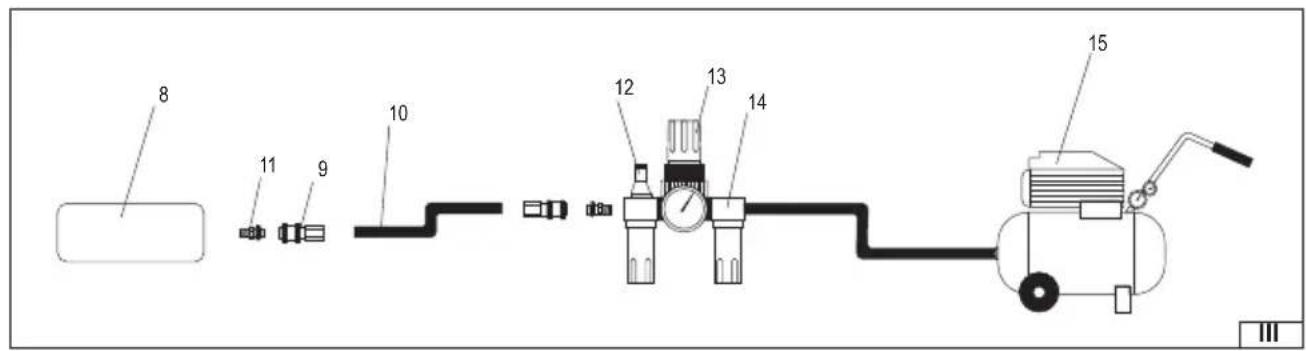
- air inlet
- air inlet connector
- trigger
- working tool
- chuck
- spring
- tool
- hose socket
- hose
- hose connector
- greaser
- reducer
- fi lter
- compressor
DE
Maximum air pressure
Max. Betriebsdruck
Air connection diameter
Read the operating instruction
Wear hearing protectors
Gehörschutz tragen
Wear protective goggles
Schutzbrille tragen
Pneumatic hammer is a tool supplied with a jet of compressed air. By using chisels, cutters and drifters attached to tool chuck it allows metal cutting, chiselling and punching. The tool is adapted to work indoors and it should not be exposed to humidity and atmospheric precipitations. Correct, reliable and safe operation of the tool depends on proper operation, therefore:
Before starting the work with this tool, please read this manual and keep it properly.
The supplier does not assume any liability for any damages resulting from misuse of the tool, failure to follow safety regulations and recommendations specified in this manual. Misuse of the product will also result in loss of guarantee rights of the user and also due to a breach of an agreement.
EQUIPMENT
Hammer is fitted with joint that allows connecting it to pneumatic system, additional chisels and drifters as well as a spring that allows proper and safe operation of tool.
TECHNICAL DATA
| Parameter Measuring unit Value | ||
| Catalogue number 81133 | ||
| Weight [kg] 1,0 | ||
| Air connector diameter (PT) [” / mm] | 6,3 / 1/4 | |
| Air hose diameter (internal) [” / mm] | 10 / 3/8 | |
| Impact frequency [min] | -1] 4500 | |
| Tool chuck diameter [mm] | 10 | |
| Maximum working pressure | [MPa] | 0,63 |
| Required air flow (at 0,63 MPa) | [l/min] | 113 |
| Acoustic pressure (EN ISO 3744) | [dB(A)] | 85 ± 3 |
| Acoustic power (EN ISO 3744) | [dB(A)] | 96 ± 3 |
| Oscillations (ISO 28927-9) | [m/s2] | 9,4 ± 1,5 |
EN
GENERAL SAFETY CONDITIONS
WARNING! When working with pneumatic tool it is always recommended to follow basic rules of safety at work, including those mentioned below, in order to limit the risk of fire, electric shock and avoid injuries.
Before starting the work with this tool, please read this manual and keep it properly.
NOTE! Read all instructions below. Failure to observe them may lead to electric shock, fire or body injuries. The term "pneumatic tool" used in instructions refers to all tools supplied with jet of compressed air at right pressure.
ADHERE TO INSTRUCTIONS BELOW
General safety rules
Prior to installation, work, repair, maintenance and replacement of accessories or in the event of work close to pneumatic tool, due to many threats, please read and understand safety instructions. Failure to perform the above duties may result in severe body injuries. Installation, adjustment and assembly of pneumatic tools may be carried out only by qualified and trained personnel. Do not modify a pneumatic tool. Modification may lower the efficiency and level of safety and increase the risk of tool operator. Do not throw away the safety instruction, it should be transferred to a tool operator. Do not operate pneumatic tool if it is damaged. A tool should undergo periodic inspection for visibility of data required by ISO 11148 standard. An employer/user should get in touch with the manufacturer in order to replace the name plate each time it is necessary.
Threats associated with parts ejected
Disconnect the tool from power source before the replacement of tool inserted or accessory. A damage to processed object, accessories or even a tool inserted may result in ejection of part at high speed. Always use an impact resistant eye protector. Class of protection to be chosen depending on work performed. Make sure, that the object processed is attached securely. In the event of work with the tool over your head, use protective helmet. Also a risk towards
EN
third parties should be taken into account. Make sure, that the object processed is attached securely. Do not work with a tool without making sure that the limiter of tool inserted has been installed. To avoid injuries, replace the limiter as soon as it has been used, broken or deformed. Before the work firmly apply the tool inserted to processed surface.
The threat associated with operation
A tool while operating may expose operator's hands to threat such as: crushing, hitting, cutting off, rubbing or heat. Wear proper gloves to protect your hands. An operator and maintenance staff should be physically capable to deal with number, weight and power of the tool. Keep the tool the correct way. Keep balance and position of foot that guarantee your safety. Release the pressure applied on start/stop device in case of power failure. Use only lubricants that are recommended by the manufacturer. Avoid direct contact with a tool inserted during and after completion of work, it may be hot. Use protective goggles, it is recommended to wear well matching gloves and protective clothes.
Threats associated with repeated movements
When using a pneumatic tool for a work consisting in repeated movements, the operator is exposed to experiencing a discomfort of palms, arms, neck or other body parts. In case of using a pneumatic tool, the operator should adopt comfortable position ensuring proper foot posture and avoid strange posture or postures not guaranteeing stability. An operator should change his posture during prolonged work, this will help avoiding discomfort and fatigue. If an operator is experiencing symptoms such as: long-term or repeated discomfort, pain, pulsating pain, tingling, numbness, burning or stiffness, he should not ignore them, should tell about that his employer and consult with a physician.
Threats associated with accessories
Disconnect the tool from power source before the replacement of tool inserted or accessory. Use accessories and consumables only in sizes and of types recommended by the manufacturer. When appropriate, never use any chisels as hand tools in case of hammers. They have been designed and subjected to heat treatment with regard to use only with non-rotary impact tools. When appropriate, in case of hammers and crushers, never use blunt chisels, as they are subjected to big load and may break due to fatigue of material. Use of blunt tool may increase oscillations and that is why sharp tools should be used. In case of hammers, when appropriate, never cool down the hot inserted tools in water, this may result in brittleness and premature wear. In case of hammers, when appropriate, damage or breaking of tool may result from improper use of tool as a lever, e.g. when leveraging. It is better to work by removing small fragments which will allow avoiding jamming. Avoid direct contact with a tool inserted during and after completion of work, it may be hot or sharp.
Threats associated with work place
Slipping, stumbling and falls are main causes of injuries. Avoid slippery surfaces caused by using the tool, as well as risk of stumbling caused by hoses with compressed air. Take care in an unknown environment. There may exist hidden threats, such as electricity or other utilities. Pneumatic tools are not designed for use in areas exposed to explosion and are not isolated from contact with electric power. Make sure, that there are no electric conductors, gas pipes etc. that may pose a threat in case of any damage caused by the tool.
Threats associated with vapours and dusts
Dust and vapours generated by use of pneumatic tool may cause bad health condition (for example a cancer, birth defects, asthma and/or skin inflammation), indispensable are: risk assessment and implementation of proper control measures in relation to these threats. Risk assessment should include effect of dust generated by tool and possibility of stirring the existing dust. Air outflow should be directed in such a way as to minimize stirring of dust in dusty environment. In environment of dust or vapours, the priority is to control them at the source of emission. All integrated functionalities and accessories for collecting, extracting or minimizing dust or smoke should be properly utilized and maintained pursuant to manufacturer's recommendations. Use respiratory tract protectors, in accordance with employer's instructions and in compliance with hygiene and safety requirements. Operation and maintenance of pneumatic tool should be carried out in accordance with instructions contained in user manual, this will allow minimizing the emission of vapours and dust. Select, maintain and replace tools inserted in accordance
EN
with instructions of user manual, to prevent increase in quantity of vapours and dust.
Threat of noise
Exposure to high level of noise may cause permanent and irreversible loss of hearing and other problems, such as noise in ears (sounding, buzzing, whistling or humming in ears). Risk assessment is indispensable, as well as implementation of appropriate control measures in relation to these threats. Right controls in order to minimize the risk may include activities such as: muffling materials that prevent "sounding" of object being processed. Use ear protectors, in accordance with employer's instructions and in compliance with hygiene and safety requirements. Operation and maintenance of pneumatic tool should be carried out in accordance with instructions contained in user manual, this will avoid unnecessary increase in noise level. If a pneumatic tool is fitted with a muffler, always make sure that it is properly installed when operating the tool. Select, maintain and replace worn-out inserted tools used in accordance with instructions of user manual. This will allow avoiding unnecessary noise increase.
Threats of oscillations
Exposure to oscillations may cause long-term damage of nerves and blood vessels in hands and arms.
Dress warm clothes when working at low temperatures and keep your hands warm and dry. In case of numbness, pain or whitening of skin of fingers and hand, stop using the pneumatic tool, than inform your employer and consult with physician. Operation and maintenance of pneumatic tool in accordance with instructions contained in user manual, will allow avoiding unnecessary increase in oscillation level. Do not hold the tool inserted with your free hand, this will increase exposition to oscillations. Grab the tool lightly but securely, taking into account the required counter forces, since the threat posed by oscillations is usually higher, when the gripping force is higher. Hold additional handpieces from central position and avoid putting pressure to the handpiece until it stops. In case of crushers, remove smaller blocks of concrete to avoid jamming the tool. In case of crushers, move the tool every few seconds. When displacing stop the tool since oscillations reach high level if the tool inserted does not lean against material that is being processed.
Additional safety instructions regarding the pneumatic tools
Compressed air may cause serious injuries:
- always cut off air supply, empty the hose from air pressure and disconnect the tool from air supply, when: it is not used, before the replacement of accessories or during repairs;
- never direct the air towards yourself or other persons.
Hitting by hose may cause serious injuries. Always carry out inspection with regard to damaged or loose hoses and connectors. Cold air should be directed away from hands.
Each time when the universal screwed connectors are used (claw connections), use protective spindles and protective connectors against possibility of damaging the connections between hoses and between the hose and the tool. Do not exceed the maximum pressure specified on the tool.
Never move the toll by keeping the hose.
OPERATING CONDITIONS
Make sure that the source of compressed air allows generating proper operating pressure and provides the required air flow. In the case of too high pressure of supply air, use pressure regulator with safety valve. Pneumatic tool should be supplied through filter and lubricator system. This will ensure cleanliness and air humidification at the same time. Condition of filter and lubricator should be checked before each use and possibly filter should be cleaned or oil in lubricator should be refilled. This will ensure proper operation of tool and extends its service life.
In case of high loads, a recoil force may be generated and directed towards the tool operator. You should adopt a posture to be able to eff ectively resist these forces.
Unexpected tool movement or cracking of tool inserted may be a cause of injuries.
In case of using additional tool chucks or supporting racks, make sure that the tool was properly and securely fixed.
Keep parts of your body and clothes away from operating tool. There is a risk of drawing or seizing. Always make sure that all spanners and tools used for adjustment and fixing of other tools in pneumatic hammer have been removed before the work.
It is possible to generate dust during the work, which depending on the processed material may be harmful for the operator.
EN
During cutting or demolition works, elements of material processed may be thrown away.
It is forbidden to hold the toll inserted with bare hand. This may be a cause of injuries due to oscillations.
USING TOOL
Make sure before each use that none element of pneumatic system is damaged. In case any damages are found, immediately replace with new defect-free system components.
Before each use of pneumatic system, moisture condensed inside the tool, compressor and cables should be dried out.
Connecting the tool to pneumatic system
Drawing shows the recommended method of connecting the tool to pneumatic system. Method presented will ensure the most effective use of tool and also will prolong its service life.
Insert few drops of oil of SAE 10 viscosity, to air inlet.
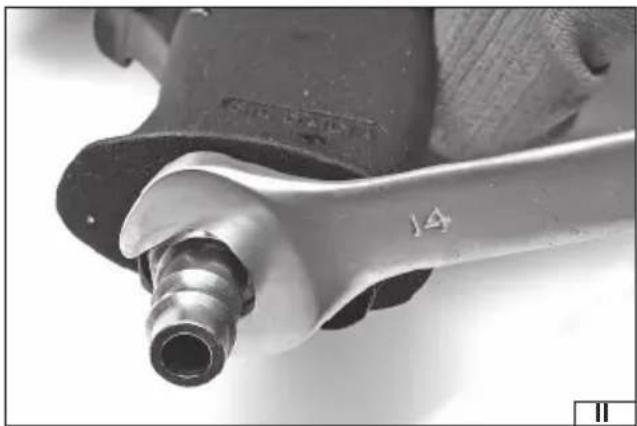
Screw in to the thread of air inlet the proper tip that allows connecting air supply hose, tightly and securely. (II)
Attach proper tip on the tool driver. When working with pneumatic tools use only accessories adjusted to work with impact tools.
Wherever possible, adjust the pressure (torque).
Connect the tool to pneumatic system using a hose with internal diameter of 10 / 3/8". Make sure the strength of hose is at least 1.38MPa. (III)
Start the tool for few seconds making sure that no suspicious sounds or oscillations may be found.
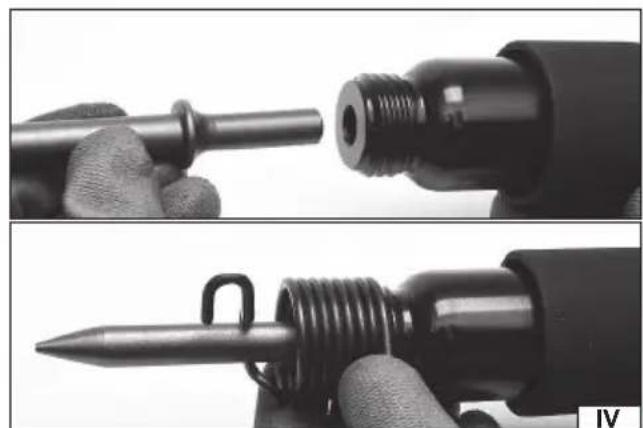
Assembly of accessories (IV)
Attach the selected tool in tool chuck.
Rewound the spring around the thread so that the flange on tool inserted leaned on the wire handle, preventing the tool from sliding out from the tool chuck. Tighten the spring firmly and securely.
Work with hammer
Select the right tool for particular type of work.
Put only such pressure to the tool, which is required for particular work. Do not put excessive pressure on the object being processed,
this may lead to cracking of tool inserted and serious injuries. When processing metal sheet pay attention to sharp edges that may emerge during cutting. Also pay attention to fragments that may be torn off while processing. Do not let them pose any threat at the work place.
MAINTENANCE
Never use gasoline, solvent or any other flammable liquid for cleaning the tool. Vapours may ignite, causing an explosion and serious injuries.
Solvents used for cleaning the tool chuck and body may cause softening of sealing. Thoroughly dry the tool before the work.
In case any irregularities in operation of tool are found, disconnect the tool immediately from the pneumatic system.
All components of pneumatic system must be protected against contaminants. Contaminants that penetrate into pneumatic system may damage the tool and other components of pneumatic system.
Tool maintenance before each use
Disconnect the tool from pneumatic system.
Before each use, insert small quantity of preserving liquid (e.g. WD-40) through the air slot.
Connect the tool to pneumatic system and start it for approx. 30 seconds. This will allow distributing the preserving fluid inside the tool and clean it.
Again disconnect the tool from pneumatic system.
Insert small quantity of SAE 10 oil into the inside of tool, through the air slot and slots designed for this purpose. It is recommended to use SAE 10 oil designed for maintenance of pneumatic tools. Connect the tool and start it for a short period of time.
Note! WD-40 may not be used as the regular lubricating oil.
Wipe the excess of oil that got out through outlet slots. Oil left may damage the sealing of the tool.
Other maintenance actions
Check before each use, if any traces of damage may be found on the tool. Drivers, tool chucks and spindles must be kept clean.
Every 6 months or after 100 hours of service deliver the tool to repair workshop for inspection by qualified staff. If the tool was used with-
GB
out recommended air supply system, frequency of tool inspection should be increased.
Removal of failures
Immediately stop to use the tool after detection of any failures. Operation of inoperable tool may cause injuries. All repairs or replacements of tool components must be performed by qualified staff in authorised repair shop.
| Failure Possible solution | |
| Tool's rotational speed is too low or it does not start | Insert small quantity of WD-40 though air inlet slot. Start the tool for few seconds. Blades could have stuck to rotor. Start the tool for approx. 30 seconds. Lubricate the tool with small quantity of oil. Note! Excess of oil may cause lowering of tools' power. In this case clean the drive. |
| Tolls starts and then slows down. | Compressor does not provide proper air infl ow. Tool is started using the air accumulated in compressor's tank. Along with the process of emptying the tank, the compressor is not able to supplement the air. Connect the tool to more effi cient compressor. |
| Insuffi cient power | Make sure that hose's internal diameter is at least equal to diameter specified in table in point 3. Check the settings of pressure, whether it is set to maximum value. Make sure, that the tool is properly cleaned and lubricated. If no effects are observed, have the tool repaired in repair shop. |
Spare parts
To obtain information on spare parts for pneumatic tools please contact the manufacturer or his representative.
After the end of work, housing, ventilation slots, switches, additional handle and cover should be cleaned, e.g. with an air jet (with a pressure of no more than 0.3 MPa), brush or dry cloth without the use of chemicals or cleaning fluids. Tools and tool chucks to be cleaned using dry and clean cloth.
Used tools are recycled materials- it is forbidden to throw them to communal waste containers since they contain substances that are dangerous to human health and environment! You are kindly requested to help in economical management of natural resources and protection of natural environment by delivering the used equipment to point of storage of used equipment. To limit quantity of waste it is necessary to re-use it, recycle or recover in other form.
D
MERKMALE DES WERKZEUGES
E R E D E T I U T A S Í T Á S
HU
M A N U A L O R I G I N A L
ES
CONDITIONS D'EXPLOITATION
DECLARATION OF CONFORMITY
0525/81133/EC/2025
We declare and guarantee with full responsibility that the following products:
Pneumatic hammer; 0,63 MPa; 4500 min -1 ; 10 mm; item no. 81133
meet requirements of the following European Standards / Technical Specifications:
EN ISO 11148-4:2012
and fulfill requirements of the following European Directives:
2006/42/EC Machinery and safety elements
Serial number: concern all serials numbers of item(s) mentioned in this declaration
The person authorized to compile the technical file:
Agnieszka Rędziak
(Place and date of issue)
V-CE PREZES ZARZADU
JAN SZMIDT
(Name and signature of authorized person)
INSTRUKCJA ORYGINALNA
TOYA S.A.



- VOREL
- BY TOYA
- PL EN DE RU UA LT LV CZ SK HU RO ES FR IT NL GR
- PL
- DE
- BEFORE STARTING THE WORK WITH THIS TOOL, PLEASE READ THIS MANUAL AND KEEP IT PROPERLY
- EQUIPMENT
- GENERAL SAFETY CONDITIONS
- ADHERE TO INSTRUCTIONS BELOW
- GENERAL SAFETY RULES
- THREATS ASSOCIATED WITH PARTS EJECTED
- EN
- THE THREAT ASSOCIATED WITH OPERATION
- THREATS ASSOCIATED WITH REPEATED MOVEMENTS
- THREATS ASSOCIATED WITH ACCESSORIES
- THREATS ASSOCIATED WITH WORK PLACE
- THREATS ASSOCIATED WITH VAPOURS AND DUSTS
- THREAT OF NOISE
- THREATS OF OSCILLATIONS
- OPERATING CONDITIONS
- USING TOOL
- MAINTENANCE
- GB
- REMOVAL OF FAILURES
- SPARE PARTS
- D
- MERKMALE DES WERKZEUGES
- HU
- ES
- CONDITIONS D'EXPLOITATION
- DECLARATION OF CONFORMITY
Brand : VOREL
Model : 81133
Category : Hammer