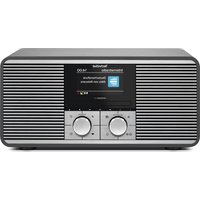
DigitRadio 425 - Radio TECHNISAT - Free user manual and instructions
Find the device manual for free DigitRadio 425 TECHNISAT in PDF.


| Product type | Clock radio with CD player, Bluetooth, DAB+/FM and Internet |
| Brand | TechniSat |
| Model | DigitRadio 425 |
| Category | Radio |
| Dimensions (W x D x H) | 375 x 187 x 150 mm |
| Weight | Approx. 2.5 kg |
| Power supply | Power adapter 12 V DC, 2 A (100-240 V AC, 50/60 Hz) |
| Power consumption in operation | 24 W max. |
| Power consumption in standby | < 2 W |
| Speakers | 2 x 15 W RMS broadband |
| Reception modes | DAB/DAB+, FM, CD, AUX, USB, Bluetooth, Internet Radio, Spotify, Podcast |
| DAB frequencies | Band III 174-240 MHz |
| FM frequencies | 87.5-108 MHz |
| Bluetooth | 2.402-2.480 GHz (4 dBm) |
| WLAN | 2.412-2.472 GHz, 5.150-5.725 GHz (16 dBm) |
| Preset memory | 40 DAB+ and 40 FM stations |
| CD player | Compatible with CD, CD-R/RW, MP3, WMA, AAC |
| USB port | 5 V, 1 A |
| Display | LCD display with backlight |
| Functions | 2 alarms, Snooze, Sleep timer, Equalizer, Alarm, Clock |
| Included accessories | Remote control, AAA batteries (2), power adapter, user manual |
| Cleaning | Soft, dry cloth; do not use abrasive products or solvents |
| Safety | Do not open the casing, avoid moisture, disconnect before any maintenance |
Frequently Asked Questions - DigitRadio 425 TECHNISAT
User questions about DigitRadio 425 TECHNISAT
0 question about this device. Answer the ones you know or ask your own.
Ask a new question about this device
Download the instructions for your Radio in PDF format for free! Find your manual DigitRadio 425 - TECHNISAT and take your electronic device back in hand. On this page are published all the documents necessary for the use of your device. DigitRadio 425 by TECHNISAT.
USER MANUAL DigitRadio 425 TECHNISAT
13 Spotify Connect 44
15.7 Software Update
2.5 Service information....67
3 Figures and description 68
4 Description of the DIGITRADIO 451 CD IR....73
4.1 Scope of delivery....73
4.2 Features of the DIGITRADIO 451 CD IR....73
4.3 Preparing the DIGITRADIO 451 CD IR for operation....73
4.3.1 Inserting batteries in the remote control....73
4.3.2 Connecting to the mains....74
4.3.3 Aligning the telescopic antenna 74
4.3.4 Using Headphones....75
4.4 General device functions....75
4.4.1 Switching on the device 75
4.4.2 Switching off the device 75
4.4.3 Source selection....76
4.4.4 Adjusting the volume....76
4.4.5 Activating the mute function....76
4.4.6 Menu operation....76
4.5 Displays....77
4.5.1 Accessing displays....78
5 Initial set-up....79
6 The DAB function 80
6.1 DAB radio reception 80
6.1.1 Scanning 80
6.1.2 Selecting a station 80
6.1.3 Saving DAB stations....81
6.1.4 Selecting programmed stations....81
6.1.5 Deleting a saved memory slot....81
6.1.6 Signal strength 82
6.1.7 Adjusting the volume 83
6.1.8 Deleting inactive stations 83
6.1.9 Station sequence 83
7 FM mode....84
7.1 Switching on FM radio mode 84
7.2 FM reception with RDS information....84
7.3 Manual station scan....84
7.4 Automatic station scan 85
7.5 Setting mono/stereo 85
7.6 Saving FM stations....86
7.7 Selecting programmed stations....86
7.8 Deleting a saved memory slot....86
8 Audio input 87
9 CD/MP3 player 88
9.1 General information on CDs/MP3 CDs....88
9.1.1 Discs you can use....89
9.2 Playing CDs 89
9.2.1 Picking a track....90
9.2.2 Quick search....90
9.2.3 Repeat function....90
9.2.4 Random playback....91
9.3 CD advice 91
10 USB player....92
10.1 Playing from a USB....92
10.1.1 Picking a track....93
10.1.2 Quick search 93
10.1.3 Repeat function 93
10.1.4 Random playback 94
11 Bluetooth playback 94
11.1 Switching to Bluetooth mode....94
11.2 Pairing an external device 95
11.3 Cancelling pairing....95
12 Internet radio 96
12.1 Last listened to....96
12.2 Station list....97
12.3 Adding favourites....97
12.4 Retrieving favourites....97
13 Spotify Connect 98
14 Other functions....98
14.1 Sleep timer 98
14.2 Alarm 99
14.2.1 Setting the time of the alarm....99
14.2.2 Switching off the alarm after it has gone off....100
14.2.3 Turning off/disabling the alarm or turning on/enabling the alarm....100
14.2.4 Snooze function....100
15 System settings....101
15.1 Equaliser....101
15.1.1 MyEQ 101
15.2 Internet settings....102
15.2.1 Setting up a wireless connection....102
15.2.1.1 Network wizard configuration....102
15.2.1.2 Configuration via WPS function 102
15.2.1.3 Manual Configuration 103
15.2.2 Display settings....103
15.2.3 NetRemote PIN setup....103
15.2.4 Deleting a network profile....103
15.2.5 Disabling wireless connection in standby....104
15.3 Time settings....104
15.3.1 Setting the time/date manually....104
15.3.2 Update settings....104
15.3.3 Set format....104
15.4 Display backlight....105
15.5 Language 105
15.6 Factory settings 105
15.7 Software update....105
15.8 SW info....105
16 Cleaning....105
17 Troubleshooting.... 107
17.1 General problems....107
17.2 Problems with the remote control....107
17.3 Problems with the radio 108
17.4 Problems with the external input....108
17.5 Problems with the CD player....109
18 Technical data....110
2 Important notes
Please observe the following instructions to minimise any safety hazards, prevent damage to the TV, and help protect the environment. Please read all the safety instructions carefully and store them for future reference. Always observe all warnings and information in this quick start guide and on the rear of the device.

Warning - indicates an important note which you must always observe in order to avoid problems with the television, loss or misuse of data or unwanted operation.

Tip - indicates a note about the function described, as well as other functions associated with it, and any others to be observed with reference to the respective place in the instruction manual.
2.1 Safety

For your own protection you should read the safety notes carefully before using your DIGITRADIO 451 CD IR. The manufacturer accepts no liability for damage caused by improper handling and by non-observance of the following safety precautions:

Do not open the device under any circumstances! Touching parts that conduct voltages can be fatal!

Any necessary repairs should only be carried out by qualified personnel.

Only operate the device in a temperate climate.

In the event of extended transportation in cold conditions and subsequently changing to warm rooms, do not switch on immediately. Wait for the temperature to equalise.

Do not expose the device to dripping or sprayed water. If water has penetrated the device, switch it off and inform the service department.

Do not expose the device to heat sources that heat the device over and above normal use.

During thunderstorms, you must disconnect the device from the mains socket. Overvoltage can damage the TV.
In the event of an obvious device defect, generation of an odour or smoke, significant malfunctions, or damage to the housing, switch off the device and notify the service department.
Only connect the radio to mains voltage at 100V-240 V\~, 50/60 Hz. Never try to operate the radio at a different voltage.
The device may only be connected after the installation has been completed according to regulations.
⚠️ If other damage is evident on the device, it must not be put into operation.
When disconnecting the power supply unit from the socket, pull the power supply unit - not the cable.
Do not operate the device near to a bath or swimming pool, or where water may splash onto it.
⚠️ Never attempt to repair a defective device yourself. Always contact one of our customer service locations.
Foreign objects, e.g. needles, coins, etc., must not be allowed to fall into the interior of the device. Do not touch the connection contacts with metal objects or your fingers. This may cause a short circuit.
Do not place objects or naked flame sources such as lighted candles on the device.
⚠️ Never allow children to use the device unsupervised.
The device is still connected to the mains when in standby mode.
This device is not intended for use by persons (including children) with reduced physical, sensory or mental capabilities or lack of experience and/or knowledge unless they are supervised by a person responsible for their safety or have received instructions from that person on how to use the device.
Children must be supervised to ensure that they do not play with the device.
⚠️ It is forbidden to make changes to the device.
⚠️ Damaged devices or accessories must not be used.
2.2 Intended use
Please read this instruction manual carefully. This is the only way to operate your device safely and correctly. Keep the instruction manual in a safe place for use at a later date. The device is designed to receive DAB+/FM radio broadcasts, music/MP3 CDs, USB and Bluetooth, and Internet streams. The device has been designed for private use and not for commercial purposes.
2.3 Disposal
The packaging material used for your device consists entirely of recyclable materials. Please sort the components appropriately, and dispose of them in line with your local waste disposal regulations. This product is identified according to Directive 2012/19/EU on Electrical and Electronic Waste (WEEE) and, at the end of its service life, must not be disposed of with normal domestic waste. It must be taken to a collection point for recycling electrical and electronic devices.
The symbol on the product, the instruction manual or the packaging indicates this.
The materials used can be re-used in accordance with their labelling. An important contribution is made to our environment by recycling, the recovery of materials or other kinds of recycling for old devices.

Please ask local authorities for the location of the relevant disposal point. Ensure that flat batteries/rechargeable batteries and electronic waste are not disposed of with household waste, but are disposed of properly (returned to specialist dealers, hazardous waste).
Batteries/rechargeable batteries may contain toxic substances that are hazardous to health and the environment. Batteries/rechargeable batteries are subject to the European Directive 2006/66/EC. They must not be disposed of with normal household waste.

Disposal Instructions:
Disposal of packaging:
Your new device was protected by packaging on its way to you. All materials used are environmentally-friendly and recyclable. Please collaborate and dispose of the packaging in an environmentally-friendly way. Please contact your dealer or local waste disposal centre for current disposal instructions.

Risk of suffocation! Keep packaging and parts of packaging away from children. Risk of suffocation from films and other packaging materials.
Device disposal:
Old devices are not worthless. Valuable raw materials can be extracted from them by disposing of them in an environmentally-friendly way. Contact your local recycling centre for information about the correct way of disposing of your device. Prior to disposal of the device, remove the batteries/rechargeable batteries contained therein.
2.4 Legal notices
TechniSat hereby declares that the radio equipment type DIGITRADIO 451 CD IR conforms with directive 2014/53/EU. The full text of the EU conformity declaration is available at the following Internet address:
http://konf.tsat.de/?ID=22453
TechniSat is not liable for damage caused by external influences, wear and tear or improper use, unauthorised repairs, modifications or accidents.
Subject to change for amendments and printing errors. Last updated 09/19. Duplication and reproduction only with the publisher's approval. You can find the current version of the manual in PDF format in the download area of the TechniSat home page at www.technisat.com.
i DIGITRADIO 451 CD IR and TechniSat are registered trademarks of:
D-54550 Daun/Eifel (Germany)
www.technisat.de
The device may only be operated in enclosed rooms in the 5 GHz WLAN range in the countries listed below.
| BE CY FI FR HU LV LI | |||||
| LU NL ES SE UK CH |
Names of the companies, institutions or brands mentioned are trademarks or registered trademarks of their respective owners.
2.5 Service information
This product is quality-tested and comes with the statutory warranty period of 24 months from the date of purchase. Please keep your receipt as proof of purchase. In the event of warranty claims please contact the product dealer.
Note: For questions and information, or if there is a problem with this device, please contact our technical hotline:
Mon - Fri 8 am - 8 pm on:
+49 (0) 3925 9220 1800.
If the device needs to be sent to us for any reason, please only use the following address:
39418 Stassfurt, Germany

3 Figures and description
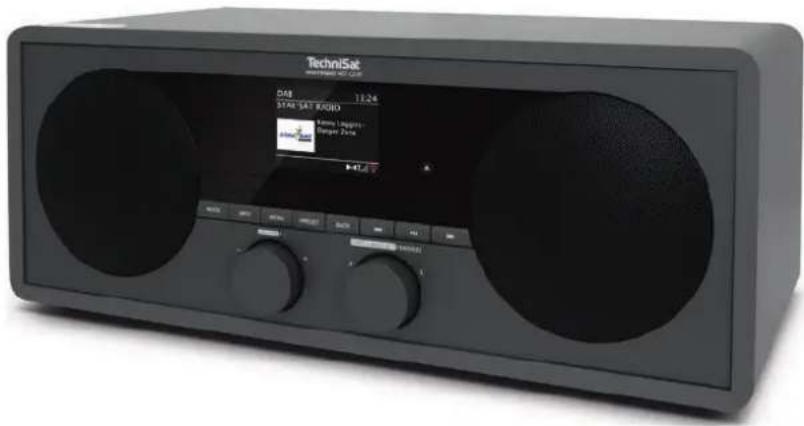
Front view
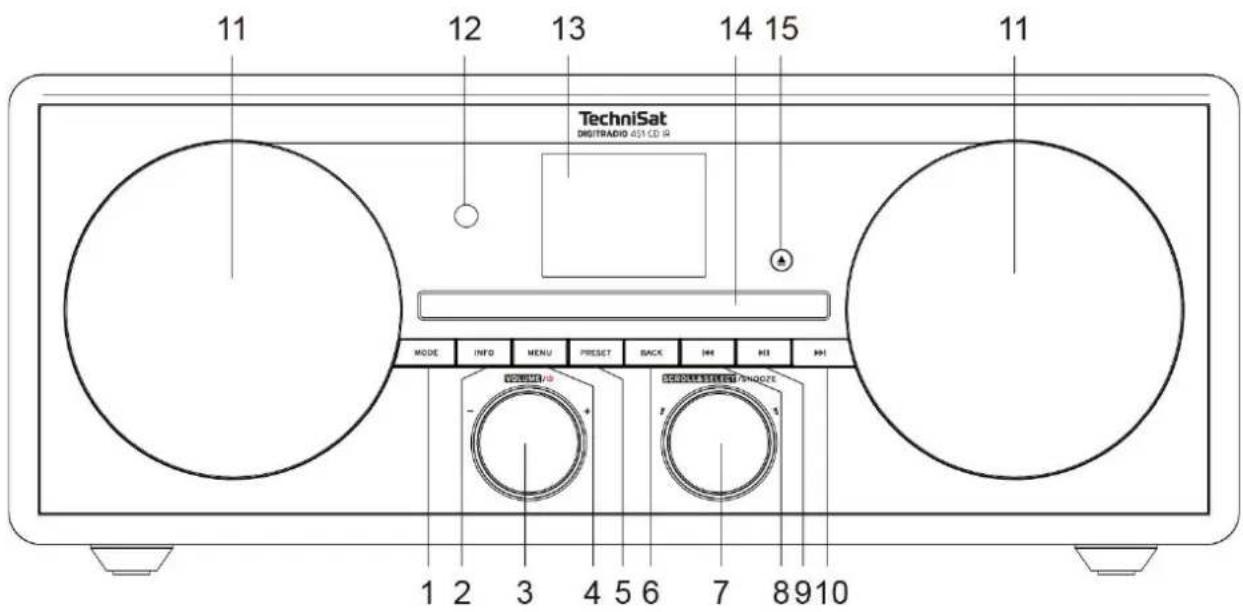
Front view description
| 1 | MODE Switch between the play sources of DAB+, FM, CD, AUX, USB, Bluetooth, Internet., Podcast and Spotify. |
| 2 INFO Switch between displays/information. | |
| 3 | VOLUME/ knob Press to switch the device on and off; turn to adjust the volume. |
| 4 MENU Access/exit the main menu. | |
| 5 PRESET | Favourites memory 1-12. |
| 6 BACK goes one step back in menus, cancels settings. | |
| 7 | SCROLL&SELECT/SNOOZE knob Turn to navigate in menus or change values. Press to accept/save the selection. Activates the snooze function when an alarm is active. |
| 8 | Skip track/Search back only in CD mode. Press briefly to restart the current track, press twice to skip to the previous track, press and hold to rewind. |
| 9 Play/Pause in CD mode: pause/resume playback. | |
| 10 | Skip track/Search forwards only in CD/music playback mode. Press briefly to skip to the next track, press and hold to fast forward. |
| 11 Left/right speaker. | |
| 12 Infrared receiver. | |
| 13 Display. | |
| 14 CD tray. | |
| 15 CD eject button press briefly to open/close the CD tray. | |
Rear view
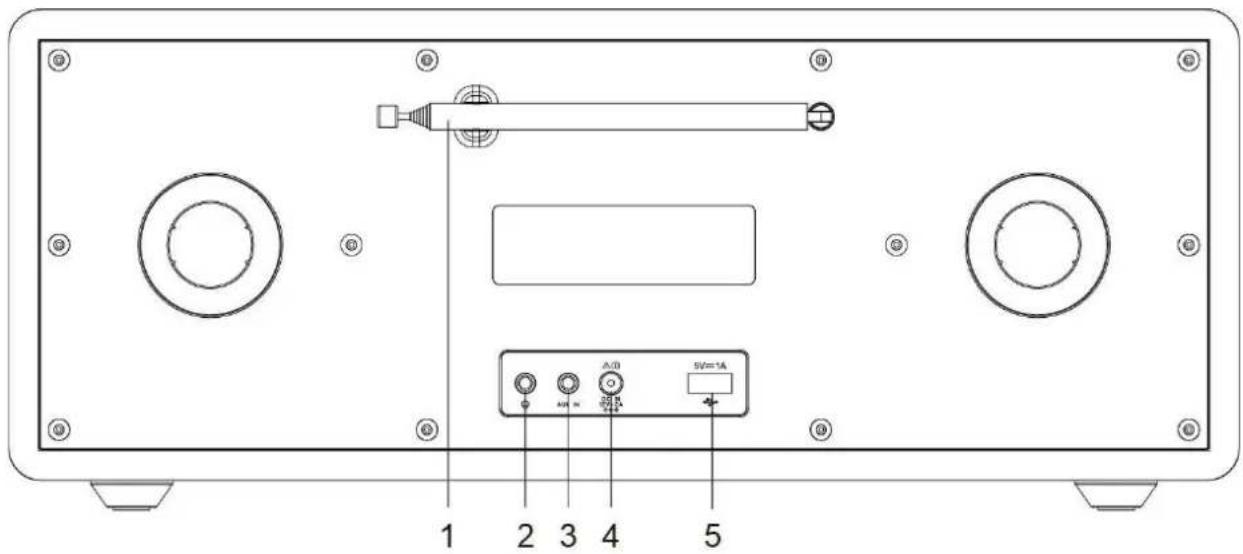
| 1 Telescopic a | antenna Extend fully for optimal reception. |
| 2 Headphone | socket To connect external headphones with a 3.5 mm jack (stereo). |
| 3 AUX IN Anal | ogue (Line IN 3.5 mm jack stereo) to play external audio sources. |
| 4 DC IN 12 V | Mains socket. |
| 5 USB socket | 5 V, 1 A. |
Remote control
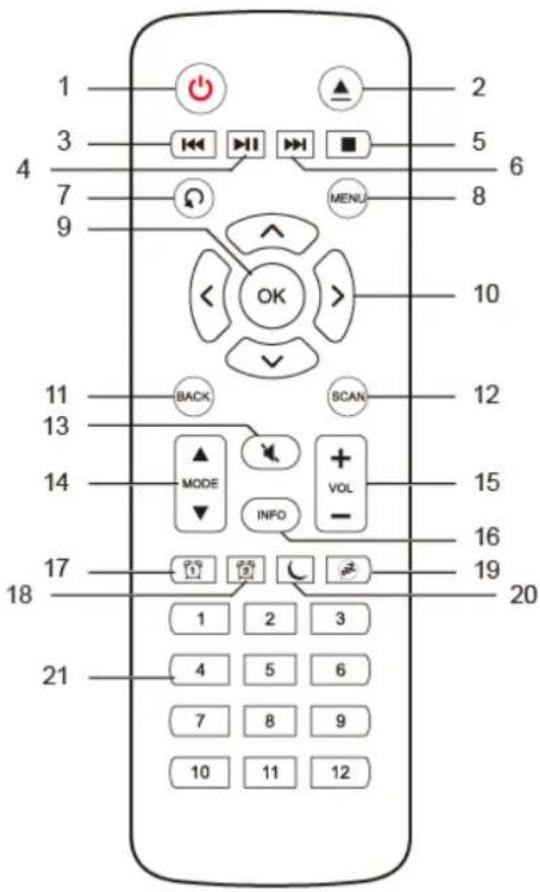
| 1 On/Standby | to switch the device on and off. End alarm tone. |
| 2 CD eject button | press briefly to eject the CD. |
| 3 | Skip track/Search back Press briefly to restart the current track, press twice to skip to the previous track, press and hold to rewind. |
| 4 Play/pause | Pause/resume playback. |
| 5 STOP Stop | playback. |
| 6 | Skip track/Search forwards Press briefly to skip to the next track, press and hold to fast forward. |
| 7 Repeat/shuffle | Select repeat/random play functions. |
| 8 MENU to access the main menu. | |
| 9 OK Accept or save selection, navigation in menu. | |
| 10 Arrow buttons to navigate in menus, change values. | |
| 11 BACK goes one step back in menus, cancels settings. | |
| 12 SCAN launches a station scan in DAB+ and FM mode. | |
| 13 Mute function. | |
| 14 MODE Source selection. | |
| 15 VOL+/- increases or decreases the volume. | |
| 16 INFO Switch between multiple displays/information. | |
| 17 Alarm 1 to activate and operate the alarm function. | |
| 18 Alarm 2 to activate and operate the alarm function. | |
| 19 Snooze activates the snooze function when an alarm is active. | |
| 20 | SLEEP activates the sleep timer; press multiple times for different periods. |
| 21 Number buttons/one-touch selection buttons 1-12. | |
4 Description of the DIGITRADIO 451 CD IR
4.1 Scope of delivery
The following are included in the delivery:
1 x DIGITRADIO 451 CD IR, 1 x instruction manual, 1 x remote control + batteries, 1 x mains adapter
4.2 Features of the DIGITRADIO 451 CD IR
The DIGITRADIO 451 CD IR consists of a DAB+/FM receiver with the following features:
- You can store up to 40 DAB+ and 40 FM stations.
- The radio can receive the following frequencies: FM 87.5-108 MHz (analogue) and DAB+ 174-240 MHz (digital).
- CD player
- MP3/AAC/WMA playback from CD/USB
- Bluetooth playback
- Internet radio/podcast/Spotify
- The device has a time and date display.
- Alarm/sleep function
4.3 Preparing the DIGITRADIO 451 CD IR for operation
4.3.1 Inserting batteries in the remote control
Slide open the battery cover on the back of the remote control. Insert two AAA (micro) size 1.5 V batteries into the battery compartment, paying attention to the polarity. Batteries included in the scope of delivery.
Close the battery cover carefully until the lid snaps shut.
i Replace batteries that are losing charge before they are spent.
Always replace all the batteries at the same time and use batteries of the same type.
⚠️ Leaking batteries may damage the remote control.
⚠️ If you are not going to use the device for an extended period, remove the batteries from the remote control.
⚠️ Important instructions for disposal: Batteries may contain toxic substances that are hazardous to the environment. Therefore, it is imperative to dispose of the batteries according to the legal provisions in force. Never dispose of the batteries with normal domestic waste.
4.3.2 Connecting to the mains
Insert the DC plug of the power supply unit into the socket labelled DC IN on the back of the DIGITRADIO. Then plug the AC adapter into a 100-240 V \~ 50/60 Hz power socket.
⚠️ Make sure that the operating voltage of the power supply unit matches the local mains voltage before you plug it into the wall socket.
4.3.3 Aligning the telescopic antenna
The number and quality of broadcast stations depends on the reception conditions at the location of the radio. Excellent reception can be achieved with the telescopic antenna.
Extend the telescopic antenna to its full length and align.
Precise alignment of the telescopic antenna is often important, especially in peripheral areas of DAB+ reception. On the Internet, you can quickly find the position of the nearest transmitter mast at www.digitalradio.de, for example.
i Start the initial scan at a window facing the direction of the transmitter mast. In bad weather, DAB+ reception may be limited.
Do not touch the telescopic antenna while a station is playing. This could compromise reception and lead to sound dropouts.
4.3.4 Using Headphones
Damage to hearing!
Do not listen to the radio at high volume with headphones. Doing so can cause permanent hearing damage. Turn down the radio volume to the lowest level before using headphones.
i Only use headphones with a 3.5 mm stereo jack plug.
Insert the headphone plug into the headphone socket on the back of the device. Sound is now played exclusively through the headphones; the loudspeaker is muted.
If you want to use the speakers again, unplug the headphones from the headphone socket on the device.
4.4 General device functions
4.4.1 Switching on the device
To ensure good DAB+/FM reception, please fully extend the antenna located on the rear of the device. When doing so please note Section 4.3.3 as well.
First prepare the DIGITRADIO for operation as described in Sections 4.3.1 and 4.3.3.
To switch on the DIGITRADIO 451 CD IR, press the VOLUME/ ^① knob on the device (3) or On/Standby on the remote control (1).
4.4.2 Switching off the device
To switch off the device, press the VOLUME/ ^1 knob on the device (3) or On/Standby on the remote control (1). The date and time are shown on the display. You can adjust the display brightness in standby mode as described in Section 15.4.
You can also switch off the WLAN connection in standby by holding down the VOLUME/ knob on the device (3) or On/ Standby on the remote control (1) as the device is switched off. The next time you switch on, the WLAN connection will be automatically re-established.
4.4.3 Source selection
Press the MODE button on the device (1) or on the remote control (14) multiple times to scroll through the available sources.
i The currently selected source is shown in the display.
4.4.4 Adjusting the volume
Turn the VOLUME/ ^1 knob on the device (3) to decrease or increase the volume. On the remote control, use the VOL+/- rocker button (15).
i The adjusted volume is shown in the display during the control process.
If the volume is turned down completely, the device switches to standby mode after about 15 minutes.
4.4.5 Activating the mute function
You can mute the volume using the audio mute button (13). "Mute" appears in the display and in the status bar.
Pressing the button again switches the sound back on.
4.4.6 Menu operation
The menu is divided into the menu for the respective source and into the system settings that apply to all sources. Operation within the menus is carried out using the SCROLL&SELECT knob (7) on the device or with the up/down arrow buttons (10) and the OK button (9) on the remote control.
Turn the SCROLL&SELECT knob (7) to the right and left or press the up/down arrow buttons (10) on the remote control to move the highlight or change the highlighted value. By turning the SCROLL&SELECT knob (7) or pressing the OK button (9) on the remote control, you can confirm a selection to enter a submenu or to save the set value.
If a value has been changed, this is saved. If there is an arrow ( ) next to a menu item, you can access additional settings or functions.
To open the main menu for the selected source, press the MENU button on the device or on the remote control.
The menu for the currently selected source contains source-specific settings and options. From here you can also access the system settings.
Press the MENU button to exit the menu. Depending on which submenu or option you are in, you may need to press the MENU button multiple times.
If you want to cancel a setting without saving it, press the MENU button or, alternatively, the BACK button.
Functions and keys to be pressed are shown in bold in this instruction manual. Display indications are in [square brackets].
i Some text displays (e.g. menu items, station information) may be too long to be shown on the display. These are then displayed as scrolling text after a short time.
Additional descriptions of the device functions in this instruction manual are given using the buttons on the remote control.
4.5 Displays
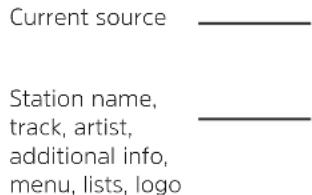
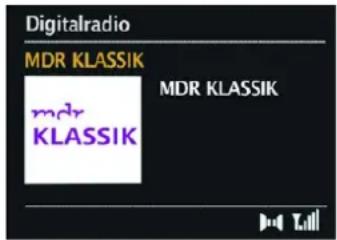
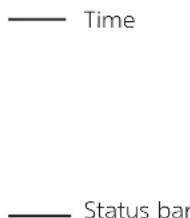
The displays shown can vary depending on the selected function/source. Take note of the instructions on the display.
4.5.1 Accessing displays
By pressing the INFO button (16) multiple times while playing from a source, you can display and cycle through the following information:
DAB mode:
- Track, artist, DLS: running text with any additional information provided by the broadcaster
- Type of programme
- Ensemble, frequency
- Signal error rate, signal strength
- Bit rate, sound format
- Date
- Station name
FM mode:
- RT radio text (where broadcast)
- PTY (programme type)
- Frequency
- Date
CD/MP3 and USB playback
- File name
- Album
- Artist
- Track
- Date
Bluetooth
- Playing time, total playing time
- Artist
- Album
- Sound format, sampling rate
Internet radio
- Keyword, description
- Language, location
- Bit rate, sound format, sampling rate
- Playback buffer
- Date
Podcast
- Playing time, total playing time
- Track name
- Track description
- Artist
- Album
- Bit rate, sound format, sampling rate
- Playback buffer
- Date
Spotify
- Artist, track, playing time, total playing time
- Performer
- Album
- Bit rate, sampling rate
- Playback buffer

In DAB mode, some stations show pictures or additional information that can fill the entire display. These inserts can be reduced/enlarged using the OK button.
5 Initial set-up
When you switch on the DIGITRADIO 451 CD IR for the first time, the initial set-up wizard is launched.
All settings can subsequently be changed at any time.
When carrying out the initial setup, follow the radio operating method for selecting and setting in menus as described in Section 4.4.6.
Select using your preferred operating language and confirm your selection.
Pay attention to the data protection information in the radio display and confirm that you have read it.
To start the initial setup wizard, select the [YES] field and confirm.
In the next step you can select the time format. Select the setting you prefer ([12] or [24]) and confirm.
You must then select the source (DAB+, FM or Internet) via which the DIGITRADIO 451 CD IR obtains and updates the time and date.
If you have selected [Update from NET], the next step is to select the time zone so that the time is displayed correctly, and whether daylight saving time or standard time applies at the time of setting.
i The radio then searches for available wireless networks.
Select the WLAN network you recognise and then select the preferred connection method. [Press button] Start WPS function (please refer to the procedure for your router)
[PIN] Start WPS function with a PIN (please refer to the procedure for your router)
[Skip WPS] Enter the network key manually (you only need to enter it once)
After selecting [Skip WPS], you can enter the password using the on-screen keyboard. Then select the [OK] field. If the password entered is correct, a connection to the network is now established. The signal bars in the status bar of the display indicate whether a connection exists.
After the network configuration has been completed, confirm the note that the initial setup is completed.
6 The DAB function
DAB+ is a digital format through which crystal clear sound with no noise can be heard. In contrast to conventional analogue radio stations, DAB+ can be used to broadcast multiple stations on the same frequency. More information is available at www.dabplus.de or www.dabplus.ch.
6.1 DAB radio reception
Press the MODE button until [Digital Radio] appears in the display.
6.1.1 Scanning
The automatic scan [Full Scan] scans all DAB band III channels and finds all broadcasters broadcasting in the reception range.
Press the SCAN button to carry out a full scan. [Scanning] appears in the display. The scan starts and a progress bar appears in the display.
Alternatively:
Start the scan via Menu > Full Scan.
When this is complete, press ▲ or ▼ and OK to select a station.
If no stations are found, check the orientation of the antenna and change the location if necessary.
6.1.2 Selecting a station
By turning the SCROLL&SELECT knob on the device or pressing ▲ or ▼, you can select a station from the station list that appears.
Confirm your selection by pressing the SCROLL&SELECT knob on the device or by pressing OK on the remote control.
Alternatively, you can select a station via Menu > Station List.
6.1.3 Saving DAB stations
The favourites memory can hold up to 40 stations in the DAB range.
i Stored stations are retained even in the event of a power cut.
Set the station you want.
Hold down the PRESET button on the device until the favourites memory list appears.
Use the SCROLL&SELECT knob to select a memory slot between 1 and 40, and press the SCROLL&SELECT knob. [saved] appears in the display.
Alternatively:
Press one of the number keys 1-12 on the remote control and hold down until [saved] appears in the display.
Repeat the process to save additional stations.
6.1.4 Selecting programmed stations
Briefly press the PRESET button on the device.
Use the SCROLL&SELECT knob to select a memory slot between 1 and 40, and press the SCROLL&SELECT knob to play the station saved to it.
Alternatively:
Press the number key you want (1- 12) on the remote control.
If you have not saved a station to the selected programme slot, [Memory Slot Empty] is displayed.
6.1.5 Deleting a saved memory slot
Simply save a new station to the respective programme slot as described in Section 6.1.3.
6.1.6 Signal strength
Press the INFO button multiple times until the signal strength is displayed.
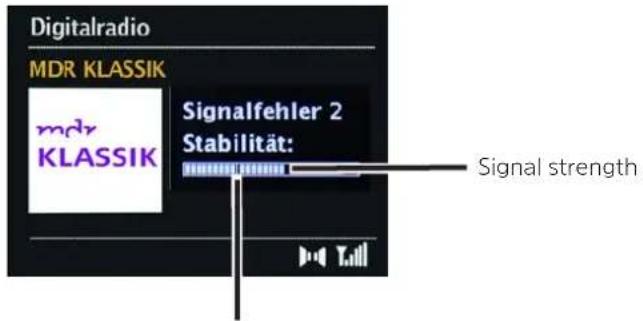
Minimum signal intensity
The level of the bar indicates the current signal strength.
i Stations with a signal strength below the minimum signal strength are not broadcasting a strong enough signal. Adjust the antenna position again if required.
You can select the reception channels individually and have their signal strengths displayed under the Set Manually menu item. You can adjust the telescopic antenna optimally for channels suffering from poor reception in the installation location. This is how stations which have not been found during a scan up until now can be found and played.
To do so, select Menu > Set Manually and then select a broadcast frequency. The signal intensity is then shown in this frequency.
6.1.7 Adjusting the volume
The compression rate flattens dynamic variations and the associated variations in volume.
In Menu > Volume Adjustment you can select the compression rate you want.
Use ▲ or ▼ to select the compression rate:
DRC high - high compression
DRC low - low compression
DRC off - compression disabled.
Confirm by pressing OK.
6.1.8 Deleting inactive stations
The Delete Inactive Stations function allows you to clear the station list of those stations that are currently no longer transmitting or receivable.
You can delete inactive stations via Menu > Delete Inactive Stations.
Confirm by pressing the OK button.
Select Yes in the query that appears and confirm by pressing OK.
6.1.9 Station sequence
Under Menu > Station Sequence you can select whether the station list should be sorted alphanumerically or by broadcaster.
7 FM mode
7.1 Switching on FM radio mode
Press the MODE button repeatedly until [FM] appears in the display.
When first switched on the frequency is set to 87.50 MHz.
If you have already set or saved a station, the radio plays the first station set.
i With RDS stations, the station name appears.
i Realign the antenna if necessary to improve reception.
7.2 FM reception with RDS information
RDS is a procedure for broadcasting additional information via FM stations. Broadcasters with RDS broadcast their station name or the programme type, for example. This appears in the display.
The device can show the following RDS information:
RT (radio text),
PS (station name),
PTY (programme type).
7.3 Manual station scan
Turn the SCROLL&SELECT knob or press ▲ or ▼ to set the station you want.
i The display shows the frequency in increments of 0.05 MHz.
7.4 Automatic station scan
Press the SCROLL&SELECT knob or the SCAN button to launch the automatic scan. The station frequency runs upwards in the display.
or
Hold down ▲ or ▼ for approx. 2 seconds to search automatically for the next station with a strong enough signal.
If an FM station with a strong enough signal is found, the search stops and the station is played. If an RDS station is received, the station name and, if applicable, the radio text are displayed.
To tune in to weaker stations, please use the manual station selection function.
You can select whether the search should only stop at strong stations or at weaker stations as well.
To do this, select Yes in Menu > Scan Setting if the scan should only stop at strong stations, or No if it should also stop at weaker stations.
7.5 Setting mono/stereo
If a weak signal is being received and the station only plays with interference, it can be advantageous to switch to listening in mono.
To do this, select Yes in Menu > Audio Setting if the sound is to be played in mono, or No if the sound is to be played in stereo.
7.6 Saving FM stations
i The favourites memory can hold up to 40 stations in the FM range.
i Stored stations are retained even in the event of a power cut.
Set the station you want.
Hold down the PRESET button on the device until the favourites memory list appears.
Use the SCROLL&SELECT knob to select a memory slot between 1 and 40, and press the SCROLL&SELECT knob. [saved] appears in the display.
Alternatively:
Press one of the numeric keys 1-12 on the remote control and hold down until [saved] appears in the display.
Repeat the process to save additional stations.
7.7 Selecting programmed stations
Briefly press the PRESET button on the device.
Use the SCROLL&SELECT knob to select a memory slot between 1 and 40, and press the SCROLL&SELECT knob to play the station saved to it.
Alternatively:
Press the number key you want (1- 12) on the remote control.
If you have not saved a station to the selected programme slot, [Memory Slot Empty] is displayed.
7.8 Deleting a saved memory slot
Simply save a new station to the respective programme slot as described in Section 7.6.
8 Audio input
You can play sound from an external device via the DIGITRADIO 451 CD IR.
Connect the external device to the audio input (3) of the DIGITRADIO 451 CD IR. Use a standard stereo jack cable to do so (3.5mm, not supplied).
Press the MODE button until [Aux In] appears in the display.
Play music through the external playback device.
To set the volume optimally, use the volume control on both the radio and the connected device.
i Please note that if the volume setting of the connected device is very low and the volume setting of the radio is much higher, interference/noise will also be amplified more and can therefore be heard more clearly. It is recommended that you adjust the volume of the DIGITRADIO 451 CD IR e.g. on a DAB+ or FM station, switch to the audio input and then adjust the volume of the connected device so that the total volume of the audio input is approximately the same as the volume of the DAB+/FM radio station. This also allows you to avoid large volume differences when switching between the functions of the DIGITRADIO 451 CD IR.
In the AUX input mode, the device remains switched on even if the connected audio source is not providing a signal.
9 CD/MP3 player
9.1 General information on CDs/MP3 CDs
The DIGITRADIO 451 CD IR is suitable for music played using audio data (CD-DA, MP3, WMA or AAC for CD-R and CD-RW). MP3 formats must be generated with ISO 9660 Level 1 or Level 2. Multi-session CDs cannot be read.
In MP3, WMA or AAC mode, the terms "Folder" (= album) and "Track" are key. "Album" corresponds to the folder on the PC, and "Track" to the PC file or a CD-DA track. The device sorts albums or tracks alphabetically by name. If you prefer a different order, change the name of the track or album and place a number in front of the name.
When burning a CD-R and CD-RW with audio data, various problems can arise which could occasionally compromise smooth playback. The causes of this are faulty software or hardware settings or the blank disc being used. Should such errors arise, you should contact your CD burner/burner software manufacturer or search for the relevant information, e.g. on the Internet.
If you make audio CDs, observe the legal requirements and do not violate the copyrights of third parties.
The device can play CDs with MP3, WMA, AAC data and normal audio CDs (CD-DA). Do not use other extensions such as *.doc, *.txt, *.pdf etc. when converting audio files to MP3. Music files with the extensions *.DLF, *.M3U and *.PLS cannot be played.
Due to the wide variety of encoder software, it cannot be guaranteed that every MP3, WMA and AAC file can be played without interference.
i If there are any faulty tracks/files, playback will continue with the next track/file.
i It is better to burn the CD at a low speed and to create the CD as single session and finalise it.
The device switches to standby mode after approx. 15 minutes with no playback.
9.1.1 Discs you can use
The CD player is compatible with CD, CD-R/RW and MP3 CD media. All the discs referred to here (CD disc size 12 cm, playing time 74 mins) can be played on this device.
If you are transporting the device, remove the disc from the drive. This prevents damage to the CD player and the disc.
The playing quality of MP3, WMA or AAC CDs is dependent on the bit rate setting and the burner software used.
9.2 Playing CDs
Press the MODE button repeatedly until [CD] appears in the display.
To insert a CD, press the CD eject button on the remote control (2) or on the front of the device (15). Insert the CD in the CD tray (14) with the label facing upwards. Press the CD eject button again to close the CD tray.
i Carefully insert the CD with the printed side facing upwards. Ensure that the CD is not positioned at an angle.
i Please hold the CD by the edge when inserting/removing.
When operating, wait until the content of the CD has been read in full to ensure that all the required information has been read. This process can take some time with MP3 CDs especially.
You can press the Play/Pause button to start/pause playback (the playing time flashes in the display).
Press the STOP button to stop the playback. The total number of tracks appears in the display.
i Always stop playing a CD before removing it.
If no sound is being played, the DIGITRADIO 451 CD IR switches to standby after approx. 15 minutes.
9.2.1 Picking a track
You can use the Skip to the next/previous track buttons to skip to the next/previous track.
Alternatively:
Select the folder/track via Menu > Search.
The display shows the track number of the track you have picked (F = folder/album, T = track).
9.2.2 Quick search
Whilst the track is running, it is possible to perform a quick search forwards or backwards to search for a specific position.
Hold down the Skip to the next/previous track buttons to skip quickly forwards or backwards through a track while you are holding the button down..
9.2.3 Repeat function
You can choose to repeat one track, the entire folder/album (MP3, WMA or AAC CDs only) or all tracks on the CD.
To do this, press the Repeat/Shuffle button on your remote control (7) repeatedly.
The selected mode is shown in the display (Repeat Track ⏻, Repeat Folder/Album ⏻, Repeat All Tracks ⏻).
To switch the function off again, press the Repeat/Shuffle button repeatedly until the repeat indicator is no longer shown.
Alternatively:
Select the repeat function you want via Menu > Repeat.
9.2.4 Random playback
With the random generator you can play the tracks on a CD in any mixed sequence.
During playback, press the Repeat/Shuffle button on the remote control (7) repeatedly until the display shows the X symbol for random playback.
To switch the function off, press the Repeat/Shuffle button again.
Alternatively:
Switch random playback on/off via Menu > Random Playback.
9.3 CD advice
Always keep the CD in its cover and only hold it by the edges. The rainbow-coloured, shimmering surface must never be touched and must always be kept clean. Do not stick paper or adhesive tape on the label side of the disc. The CD should be kept away from intense sunlight and heat sources such as radiators.
Furthermore, CDs must not be kept in a car parked directly in the sun, since the inside temperature in the car can get extremely high. Remove fingerprints and dust on the recorded side with a dry cleaning cloth. Do not use disc care products such as disc spray, cleaning fluids, antistatic spray or solvents such as benzine, thinner or other commercially-available chemicals to clean CDs. If necessary, stubborn stains can be removed using a moist chamois leather.
Wipe from the centre to the edge of the disc. Circular movements when cleaning cause scratches. This can lead to errors during playback.
10 USB player
The DIGITRADIO 451 CD IR is suitable for playing music from USB storage devices with a maximum power consumption of 1 A. MP3 formats must be generated with ISO 9660 Level 1 or Level 2. In MP3, WMA or AAC mode, the terms "Folder" (= album) and "Track" are key. "Album" corresponds to the folder on the PC, and "Track" to the PC file. The device sorts albums or tracks alphabetically by name. If you prefer a different order, change the name of the track or album and place a number in front of the name.
The device can play files with MP3, WMA and AAC data. Do not use other extensions such as *.doc, *.txt, *.pdf etc. when converting audio files to MP3. Music files with the extensions *.DLF, *.M3U and *.PLS cannot be played.
Due to the wide variety of encoder software, it cannot be guaranteed that every MP3, WMA and AAC file can be played without interference.
If there are any faulty tracks/files, playback will continue with the next track/file.
The device switches to standby mode after approx. 15 minutes with no playback.
10.1 Playing from a USB
Press the MODE button repeatedly until [USB] appears in the display.
Connect a USB device to the USB port (5).
When operating, wait until the content of the USB medium has been read in full to ensure that all the required information has been read.
You can press the Play/Pause button to start/pause playback (the playing time flashes in the display).
Press the STOP button to stop the playback. The total number of tracks appears in the display.
i Always stop playing from a USB device before removing it.
If no sound is being played, the DIGITRADIO 451 CD IR switches to standby after approx. 15 minutes.
10.1.1 Picking a track
You can use the Skip to the next/previous track buttons to skip to the next/previous track.
Alternatively:
Select the folder/track via Menu > Search.
The display shows the track number of the track you have picked (F = folder/album, T = track).
10.1.2 Quick search
Whilst the track is running, it is possible to perform a quick search forwards or backwards to search for a specific position.
Hold down the Skip to the next/previous track buttons to skip quickly forwards or backwards through a track while you are holding the button down..
10.1.3 Repeat function
You can choose to repeat one track, the entire folder/album or all tracks on the CD.
To do this, press the Repeat/Shuffle button on your remote control (7) repeatedly.
The selected mode is shown in the display (Repeat Track ⏻, Repeat Folder/Album ⏻, Repeat All Tracks ⏻).
To switch the function off again, press the Repeat/Shuffle button repeatedly until the repeat indicator is no longer shown.
Alternatively:
Select the repeat function you want via Menu > Repeat.
10.1.4 Random playback
With the random generator you can play the tracks on a CD in any mixed sequence.
During playback, press the Repeat/Shuffle button on the remote control (7) repeatedly until the display shows the X symbol for random playback.
To switch the function off, press the Repeat/Shuffle button again.
Alternatively:
Switch random playback on/off via Menu > Random Playback.
11 Bluetooth playback
In Bluetooth mode you can play music on a connected smartphone or tablet via the speakers of the DIGITRADIO 451 CD IR. For this purpose, the two devices must first be "paired" to each other.
11.1 Switching to Bluetooth mode
Press the MODE button repeatedly until [Bluetooth Audio] appears in the display.
The first time you use the Bluetooth function, an external device (e.g. a smartphone/tablet) must first be paired with the radio.
If an external device has already been paired and is in range, a connection is generated automatically. Depending on the connected device, music playback may start automatically.
11.2 Pairing an external device
Proceed as follows to pair an external device (e.g. a smartphone or tablet) with the DIGITRADIO 451 CD IR:
Start Bluetooth mode as described in Section 11.1.
You can start the pairing process on the radio via Menu > Set Up Bluetooth.
Now start searching for nearby Bluetooth devices on your external device. You may need to enable the Bluetooth feature on your external device first.
You can find out how to activate the Bluetooth function and carry out a search on your external device by consulting the instruction manual for your external device.
The two devices should be within 10 cm of each other during the pairing process.
The entry DIGITRADIO 451 CD IR should now appear in the list of Bluetooth devices found on your external device. Tap on the name of the radio to complete the pairing process. If the pairing process has completed successfully, [Connected] appears in the display.
Depending on the Bluetooth protocol for your external device, you can control the music playback via the playback buttons.
Play/pause - Play/Pause button
Next track - Skip to next track button
Track from the start - Skip to previous track button
Search backwards - Hold down Rewind button
Search forwards - Hold down Fast Forward button
Bluetooth volume - VOLUME/ knob on the device or VOL+/- on the remote control
Alternatively you can use the playback controls in the music app on your external device.
You can use Menu > Show Details to display information about the DIGITRADIO 451 CD IR Bluetooth, the connected device and a list of paired devices, as well as establish a connection to one of the paired devices.
11.3 Cancelling pairing
Cancelling an active pairing must be done on your external device.
You can find out how to activate the Bluetooth function and carry out a search on your external device by consulting the instruction manual for your external device.
i You can then pair a new device as described in Section 11.2.
12 Internet radio
The DIGITRADIO 451 CD IR is equipped with an Internet radio receiver. In order to receive Internet radio stations/channels, you need an Internet connection using a connection to a wireless network via a WLAN router. See Section 15.2 on how to establish an Internet connection.
Press the MODE button repeatedly until [Internet Radio] appears in the display.
If you are starting Internet radio operation for the first time without having configured a WLAN connection during the initial installation, the Scan Wizard appears, showing you all the WLAN stations within range. Select the WLAN network you recognise by pressing OK and enter the corresponding password using the virtual keyboard (skip WPS). Then select OK and press the OK button. If the password entered is correct, a connection to the network is now established. The signal bars in the status bar of the display indicate whether a connection exists. To cancel the input, select CANCEL and press the OK button. If you make a mistake, you can delete the last letter you entered by pressing BKSP
12.1 Last listened to
Select MENU > Last Listened To to display a list of recently played stations.
Select a station using the up/down arrow keys and press OK to play.
12.2 Station list
Press the MENU button and select Station List.
Under Station List, all Internet radio stations are displayed, sub-divided into different categories. You can also access your favourites here.
Select a station by category/country/genre and press the OK button.
12.3 Adding favourites
Hold down the PRESET button on the device until [Save Preset] appears in the display. You can now select one of 30 favourite memory slots using the SCROLL&SELECT knob or the up/down arrow keys on the remote control. To save the station, press the OK button when the highlight is on the favourites memory slot you want. The display shows [saved].
Alternatively:
Hold down one of the number buttons 1-6 on the device or 1-12 on the remote control to save a station to one of the corresponding number buttons.
i Press the INFO button to obtain additional information about the station currently playing.
12.4 Retrieving favourites
Briefly press the PRESET button on the device and use the SCROLL&SELECT knob or the up/down arrow keys on the remote control to select a station from the station memory list. Press the OK button to play the station.
Alternatively:
Hold down one of the number buttons 1-6 on the device or 1-12 on the remote control to select a station directly.
13 Spotify Connect
Use your smartphone, tablet or computer as a remote control for Spotify.
There is more information at spotify.com/connect.
The Spotify software is subject to third-party licence provisions, which you can find here: http://www.spotify.com/connect/third-party-licenses
14 Other functions
14.1 Sleep timer
The DIGITRADIO 451 CD IR has a sleep timer that you can use to switch automatically to standby after a set time.
Via Menu > Main Menu > Sleep, you can use the SCROLL&SELECT knob and the ▲or ▼buttons on the remote control to set the time after which the device switches to standby in each operating mode, in steps of Sleep off, 15, 30, 45 and 60 minutes.
Alternatively:
Push the SLEEP (20) button on the remote control repeatedly.
A moon symbol appears in the status bar of the display with the time still available until the DIGITRADIO 451 CD IR switches to standby.
14.2 Alarm
You can access the alarm settings via Menu > Main Menu > Alarm.
Alternatively:
Press the ALARM 1/2 button (17, 18) on the remote control to go directly to the alarm settings.
14.2.1 Setting the time of the alarm
The alarm function cannot be used until the correct time has been set. Depending on the configuration, this either happens automatically or will need to be set manually. For more information on this, see Section 15.3.
Select one of the alarm time memories (Alarm 1 or Alarm 2) and set the values you want one by one.
Repeat Select from Off, Daily, Once, Weekend (SAT-SUN), Weekdays (MON-FRI).
Time Set the time at which you want to be woken up.
If you have chosen Once as the repeat option, the date is also required.
Mode Set the source with which you want to be woken up. The options are Buzzer, Internet Radio, Digital Radio (DAB) or FM.
Programme Select whether to play Last Listened To or one of the favourites memory slots from the previously set source.
If not all of the favourite memory slots are available for selection, please programme the alarm while the radio is in the mode you want.
Volume Select the volume at which you wish to be woken up.
Save The values you have just set are only accepted once you have saved them.
The alarm is active as long as the alarm has been set to Alarm > [On] at the outset. An alarm icon appears in the status bar with the corresponding number of the active alarm ① When set to Off, the alarm is not active at the set time.
14.2.2 Switching off the alarm after it has gone off
Press the On/Standby button to turn off the alarm.
i [Alarm Off] appears in the display; the alarm icon remains visible if the alarm repeat is set to Daily, Weekend, or Workdays.
14.2.3 Turning off/disabling the alarm or turning on/enabling the alarm
Select the alarm memory Alarm 1 or Alarm 2 that you want to turn off/disable or turn on/enable as described in 14.2.1.
To turn off/disable the alarm, set the [Repeat] item to [Off], or set the desired repeat option to turn on/enable a programmed alarm.
i The change is not applied until you select the [Save] item.
i The alarm settings are retained so that it can be easily reactivated at a later date.
14.2.4 Snooze function
Press the Snooze button on the remote control (19) to activate the snooze function.
Alternatively, press the SCROLL&SELECT/SNOOZE knob.
i The snooze time can be extended by pressing the corresponding button repeatedly.
15 System settings
The system settings apply equally to all sources.
To access the system settings, press the MENU button and select > System Settings.
15.1 Equaliser
To adjust the sound of the DIGITRADIO 451 CD IR, you can use the equaliser with the preconfigured settings Normal and MyEQ.
You can access the equaliser settings via MENU > Main Menu > System Settings > Equaliser.
Select the equaliser setting you want and press the OK button.
i A * marks the current selection/setting.
15.1.1 MyEQ
Select the My EQ Setting item to adjust the bass and treble.
Change the value by pressing the ▲/▼ arrow keys. Then press OK to save.
Select the My EQ equaliser setting to hear sound using these presets.
15.2 Internet settings
You can access and configure the network settings via MENU > Main Menu > System Settings > Internet Settings.
15.2.1 Setting up a wireless connection
To configure the network connection via WLAN, you have the option of using the network wizard or doing this manually.
15.2.1.1 Network wizard configuration
Select [Network Wizard] to launch this.
The network wizard now searches for all the wireless networks within range and displays them.
Select the WLAN network you recognise and then select the preferred connection method. [Press button] Start WPS function (please refer to the procedure for your router)
[PIN] Start WPS function with a PIN (please refer to the procedure for your router)
[Skip WPS] Enter the network key manually (you only need to enter it once)
After selecting [Skip WPS], you can enter the password using the on-screen keyboard. Then select the [OK] field. If the password entered is correct, a connection to the network is now established. The signal bars in the status bar of the display indicate whether a connection exists.
15.2.1.2 Configuration via WPS function
This establishes a direct connection to the router. Selecting and/or entering a WLAN network (SSID) and password is not required.
Start the WPS function on your router in accordance with its operating instructions.
Then select [PBC WLAN Setup] to start the connection process.
i Please pay attention to the display. The connection process is usually completed after a few seconds and the WLAN connection can now be used.
15.2.1.3 Manual Configuration
Select [Manual Settings] and then [Wireless] to start manual configuration.
Now select whether you want your router to automatically retrieve the IP address, gateway, etc. from your router (DHCP enabled) or enter it manually (DHCP disabled).
Please note that automatic retrieval of the IP address, gateway, subnet mask only works if the DHCP function is enabled in your router.
Enter the IP address, subnet mask, gateway address, primary DNS and, if required, secondary DNS in sequence using the arrow keys on the remote control. Confirm each value you set by pressing OK.
Now enter the name (SSID) of your WLAN network using the virtual keyboard and confirm by selecting OK.
Select whether your WLAN network is Open or encrypted with WEP or WPA/WPA2 and confirm the following item.
Finally, enter your WLAN password via the virtual keyboard and confirm by selecting OK to start the connection process.
i Usually the WLAN connection can be used after a few seconds.
15.2.2 Display settings
Select [Display Settings] to display the current network settings.
15.2.3 NetRemote PIN setup
Under certain circumstances it may be necessary to secure the connection to the radio with a PIN.
Enter a 4-digit PIN in [NetRemote PIN Setup].
15.2.4 Deleting a network profile
Use this menu item to terminate an existing connection to a WLAN and to delete the settings carried out. If you want to reconnect the device to this network, all settings will need to be carried out again.
15.2.5 Disabling wireless connection in standby
After turning off the radio, press and hold On/Standby for a moment to turn off the wireless connection in standby.
Note that the wireless network is only deactivated for this standby phase; next time you turn on the radio, the wireless connection is automatically re-established.
15.3 Time settings
Via MENU > Main Menu > System Settings > Time and Date you can access and configure the settings relating to the time and date.
15.3.1 Setting the time/date manually
Select [Time/Date Setting] to set the time and date manually.
Change a value using the ▲ or ▼ arrow keys and confirm by pressing the OK button.
i Each time you press the OK button, the highlight moves to the next value.
15.3.2 Update settings
In [Update Settings], select whether to update the time and date automatically via digital radio [Update From DAB], FM [Update From FM] or the Internet [Update From NET], or select [No Update].
i If [No Update] is selected, the date and time must be set manually.
If you have selected [Update from NET], you will need to select the time zone [Set Time Zone] so that the time is displayed correctly, and specify whether daylight saving time [Daylight Saving?] or standard time applies at the time of setting.
15.3.3 Set format
Under [Set Format], you can select whether to display the time in 12-hour or 24-hour format.
15.4 Display backlight
Via MENU > Main Menu > System Settings > Backlight you can access the settings for the display backlight.
Select [Operation] or [Standby] to set for operation or standby.
You can now adjust the brightness in three steps, High, Medium or Low, or turn it off via Off (standby only).
15.5 Language
You can select the menu language you prefer via MENU > Main Menu > System Settings > Language.
15.6 Factory settings
Access MENU > Main Menu > System Settings > Factory Settings to reset your DIGITRADIO 451 CD IR to the delivery status.
i Please note that, if you do this, all the settings you have carried out (e.g. saved stations and favourites) will be lost and must be repeated to use the radio as usual.
If you really want to reset the radio, select [YES] in the displayed confirmation prompt, or cancel the procedure with [NO].
i After the factory settings have been completed, the radio starts with the initial setup query (see Section 5).
15.7 Software update
From time to time software updates may be provided which can contain enhancements or error fixes. This ensures that the DIGITRADIO 451 CD IR is always up to date.
Access MENU > Main Menu > System Settings > Software Update.
Do not switch off the DIGITRADIO 451 CD IR during the update process!
i Follow the instructions delivered with the software update.
15.8 SW info
You can view the software version currently installed the device under MENU > Main Menu > System Settings > Info.
16 Cleaning
To avoid the risk of electric shock, do not clean the device with a wet cloth or under running water. Remove the mains plug prior to cleaning!
Do not use scourers, scouring powders or solvents such as alcohol, benzine, methylated spirit, thinners, etc., as they could damage the surface of the device.
Do not use any of the following substances: salt water, insecticide, chlorine or acidic solvents (ammonia).
i Clean the housing with a soft cloth moistened with water.
Clean the display with a soft cotton cloth only. If required, use the cotton cloth with a reduced volume of non-alkaline, diluted water-based soap solution.
i Rub the surface with the cotton cloth gently until it is completely dry.
17 Troubleshooting
If the device does not operate as intended, check the following tables for information.
17.1 General problems
| Symptom Possible cause/remedy | |
| The device cannot be switched on. The device is not being supplied with power. Attach the mains adapter correctly to the mains socket. Select another socket if necessary. | |
| No sound can be heard. Increase the volume. The incorrect source may have been selected.The mute function may be active. | |
| The display does not switch on. Switch the device off, unplug from the mains briefly, switch the device back on. | |
| Interference can be heard. A mobile phone or another device is emitting interfering radio waves in the vicinity of the device. Remove the mobile phone or device from the vicinity of the radio. | |
| Other operational faults,loud noises or a malfunctioning display are occurring. | Electronic components in the device are faulty.Remove the mains plug. Leave the device disconnected from the power source for approx. 10 seconds. Reconnect the device. |
17.2 Problems with the remote control
| Symptom Possible cause/remedy | |
| The remote control does not work. Batteries | are incorrectly inserted or are low.Check the polarity.Change the batteries. |
| IR connection interrupted.Remove objects that are located between the remote control and the device. | |
| Distance too great. The max. distance to the device is approx. 4 metres. | |
17.3 Problems with the radio
| Symptom Possible cause/remedy | |
| No radio stations are being received. The device is | not currently in radio mode. Press the MODE button and select DAB or FM. |
| No DAB signal is being received. Check whether DAB reception is available in the region.Readjust the antenna.Try to receive other stations.Perform a station scan. | |
| The sound is low or of poor quality. Other devices | such as televisions are disrupting reception. Move the radio further away from these devices. |
| The antenna is incorrectly aligned.Change the position/alignment of the antenna. | |
17.4 Problems with the external input
| Symptom Possible cause/remedy | |
| No sound from the external input (AUX). Is the external device connected correctly? | |
If you are still unable to rectify the fault after the described checks, please contact the technical hotline (see page 67).
17.5 Problems with the CD player
| Symptom Possible cause/remedy | |
| The CD does not play or skips during playback. The device is not in CD mode.Incorrect CD inserted. | |
| The sound is intermittent. The volume is set too high. Decrease the volume. | |
18 Technical data
| Reception channels DAB/DAB+, FM, CD, AUX analogue, USB, Bluetooth, Internet radio, Spotify, podcast |
| Speakers 2 x 15 W rms broadband |
| Frequencies DAB: Band III 174 - 240 MHz |
| Power supply Mains adapter input: AC 100-240 V ~ 50/60 Hz |
| Power consumption In operation: 24 W max. |
| Connections Analogue Audio In |
| Favourites memory slots DAB/DAB+: 12 |
| Ambient conditions Operating temperature: 0° - 40 °C |
| Dimensions mm (W x D x H) 375 x 187 x 150 |
Mode d'emploi
DIGITRADIO 451 CD IR
TechniSat
1 Sommaire
1 Sommaire 112
2 Consignes importantes....116
2.1 Sécurité 116
10.1 Lecture USB....146
Lecture/Pause - Touche Lecture/Pause
- Spotify Connect 44
- Software Update
- USB player....92
- Bluetooth playback 94
- Internet radio 96
- Spotify Connect 98
- Other functions....98
- System settings....101
- Important notes
- Safety
- Intended use
- Disposal
- Disposal Instructions:
- Legal notices
- Service information
- Figures and description
- Rear view
- Remote control
- Description of the DIGITRADIO 451 CD IR
- Scope of delivery
- Features of the DIGITRADIO 451 CD IR
- Preparing the DIGITRADIO 451 CD IR for operation
- Inserting batteries in the remote control
- Connecting to the mains
- Aligning the telescopic antenna
- Using Headphones
- Damage to hearing!
- General device functions
- Switching on the device
- Switching off the device
- Source selection
- Adjusting the volume
- Activating the mute function
- Menu operation
- Displays
- Accessing displays
- DAB mode:
- FM mode:
- CD/MP3 and USB playback
- Bluetooth
- Internet radio
- Podcast
- Spotify
- Initial set-up
- The DAB function
- DAB radio reception
- Scanning
- Selecting a station
- Saving DAB stations
- Selecting programmed stations
- Deleting a saved memory slot
- Signal strength
- Adjusting the volume
- Deleting inactive stations
- Station sequence
- FM mode
- Switching on FM radio mode
- FM reception with RDS information
- Manual station scan
- Automatic station scan
- Setting mono/stereo
- Saving FM stations
- Selecting programmed stations
- Deleting a saved memory slot
- Audio input
- CD/MP3 player
- General information on CDs/MP3 CDs
- Discs you can use
- Playing CDs
- Picking a track
- Quick search
- Repeat function
- Random playback
- CD advice
- USB player
- Playing from a USB
- Picking a track
- Quick search
- Repeat function
- Random playback
- Bluetooth playback
- Switching to Bluetooth mode
- Pairing an external device
- Cancelling pairing
- Internet radio
- Last listened to
- Station list
- Adding favourites
- Retrieving favourites
- Spotify Connect
- Other functions
- Sleep timer
- Alarm
- Setting the time of the alarm
- Switching off the alarm after it has gone off
- Turning off/disabling the alarm or turning on/enabling the alarm
- Snooze function
- System settings
- Equaliser
- MyEQ
- Internet settings
- Setting up a wireless connection
- Network wizard configuration
- Configuration via WPS function
- Manual Configuration
- Display settings
- NetRemote PIN setup
- Deleting a network profile
- Disabling wireless connection in standby
- Time settings
- Setting the time/date manually
- Update settings
- Set format
- Display backlight
- Language
- Factory settings
- SW info
- Cleaning
- Troubleshooting
- General problems
- Problems with the remote control
- Problems with the radio
- Problems with the external input
- Problems with the CD player
- Mode d'emploi
- Sommaire
Brand : TECHNISAT
Model : DigitRadio 425
Category : Radio