RT-40 DG3111QV - Fridge SAMSUNG - Free user manual and instructions
Find the device manual for free RT-40 DG3111QV SAMSUNG in PDF.


User questions about RT-40 DG3111QV SAMSUNG
0 question about this device. Answer the ones you know or ask your own.
Ask a new question about this device
Download the instructions for your Fridge in PDF format for free! Find your manual RT-40 DG3111QV - SAMSUNG and take your electronic device back in hand. On this page are published all the documents necessary for the use of your device. RT-40 DG3111QV by SAMSUNG.
USER MANUAL RT-40 DG3111QV SAMSUNG
natural_image
Black and white photo of water droplets in a flowing liquid (no text or symbols)
Refrigerator
User manual
RT33DG*****/RT40DG*****
Free Standing Appliance
natural_image
Black and white illustration of ice cubes with bubbles rising, no text or symbols present
natural_image
Dynamic splash of ice cubes with bubbles, no text or symbols presentSAMSUNG
Contents
Safety information 3
Important safety symbols and precautions 6
Severe warning signs for transportation and site 7
Critical installation warnings 7
Installation cautions 11
Critical usage warnings 12
Usage cautions 17
Cleaning cautions 19
Critical disposal warnings 21
Additional tips for proper usage 22
Saving Energy Tips 24
This appliance is intended to be used in household and similar applications such as 25
Instructions about the WEEE 25
Installation 26
Refrigerator at a glance 26
Step-by-step installation 28
Operations 32
Main panel 32
Special features 39
Maintenance 41
Handle and care 41
Cleaning 43
Replacement 44
Troubleshooting 45
General 45
Do you hear abnormal sounds from the refrigerator? 47
English2
Safety information
- Before using your new Samsung Refrigerator, please read this manual thoroughly to ensure that you know how to operate the features and functions that your new appliance offers safely and efficiently.
- This appliance is not intended for use by persons (including children) with reduced physical, sensory, or mental capabilities, or those who lack experience and knowledge, unless they have been given supervision or instruction concerning the use of the appliance by a person responsible for their safety.
- This appliance can be used by children aged from 8 years and above and persons with reduced physical, sensory or mental capabilities or lack of experience and knowledge if they have been given supervision or instruction concerning use of the appliance in a safe way and understand the hazards involved.
Children shall not play with the appliance. Cleaning and user maintenance shall not be made by children without supervision.
- Warnings and Important Safety Instructions in this manual do not cover all possible conditions and situations that may occur.
It is your responsibility to use common sense, caution, and care when installing, maintaining, and operating your appliance.
Safety information
- Because these following operating instructions cover various models, the characteristics of your refrigerator may differ slightly from those described in this manual and not all warning signs may be applicable. If you have any questions or concerns, contact your nearest service center or find help and information online at www.samsung.com.
- R-600a or R-134a is used as a refrigerant. Check the compressor label on the rear of the appliance or the rating label inside the fridge to see which refrigerant is used for your refrigerator. When this product contains flammable gas (Refrigerant R-600a), contact your local authority in regard to safe disposal of this product.
- In order to avoid the creation of a flammable gas-air mixture if a leak in the refrigerating circuit occurs, the size of the room in which the appliance may be sited depends on the amount of refrigerant used.
- Never start up an appliance showing any signs of damage. If in doubt, consult your dealer. The room must be 1 m ^3 in size for every 8 g of R-600a refrigerant inside the appliance. The amount of refrigerant in your particular appliance is shown on the identification plate inside the appliance.
- Refrigerant squirting out of the pipes could ignite or cause an eye injury. When refrigerant leaks from the pipe, avoid any naked flames and move anything flammable away from the product and ventilate the room immediately.
- Failing to do so may result in fire or explosion.
- It is hazardous for anyone other than an Authorized Service Person to service this appliance.
English4
- Do not store explosive substances such as aerosol cans with a flammable propellant in this appliance.
-
To avoid contamination of food, please respect the following instructions:
-
Opening the door for long periods can cause a significant increase of the temperature in the compartments of the appliance.
- Clean regularly surfaces that can come in contact with food and accessible drainage systems.
- Store raw meat and fish in suitable containers in the refrigerator, so that it is not in contact with or drip onto other food.
- Two-star frozen-food compartments are suitable for storing pre-frozen food, storing or making icecream and making ice cubes.
- One-, two- and three-star compartments are not suitable for the freezing of fresh food.
- If the refrigerating appliance is left empty for long periods, switch off, defrost, clean, dry, and leave the door open to prevent mould developing within the appliance.
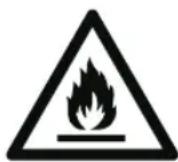
WARNING; Risk of fire / flammable materials
Safety information
Important safety symbols and precautions
Please follow all safety instructions in this manual. This manual uses the following safety symbols.
WARNING
Hazards or unsafe practices that may result in severe personal injury, property damage, and/or death.
CAUTION
Hazards or unsafe practices that may result in severe personal injury and/or property damage.
NOTE
Useful information that helps users understand or benefit from the refrigerator.
These warning signs are here to prevent injury to you and others.
Please follow them carefully.
After reading this section, keep it in a safe place for future reference.
English6
Severe warning signs for transportation and site

WARNING
- When transporting and installing the appliance, care should be taken to ensure that no parts of the refrigerating circuit are damaged.
- Refrigerant leaking from the pipe work could ignite or cause an eye injury. If a leak is detected, avoid any naked flames or potential sources of ignition and air the room in which the appliance is standing for several minutes.
- This appliance contains a small amount of isobutane refrigerant (R-600a), a natural gas with high environmental compatibility that is, however, also combustible. When transporting and installing the appliance, care should be taken to ensure that no parts of the refrigerating circuit are damaged.
Critical installation warnings

WARNING
- Do not install the refrigerator in a damp location or place where it may come in contact with water.
- Deteriorated insulation on electrical parts may cause an electric shock or fire.
- Do not place this refrigerator in direct sunlight or expose it to the heat from stoves, room heaters, or other appliances.
Safety information
- Do not plug several appliances into the same multiple power strip. The refrigerator should always be plugged into its own individual electrical outlet which has a voltage rating that matches the voltage listed on the refrigerator's rating plate.
- This provides the best performance and also prevents overloading of house wiring circuits, which could cause a fire hazard from overheated wires.
- If the wall socket is loose, do not insert the power plug.
- There is a risk of electric shock of fire.
- Do not use a power cord that has cracks or abrasion damage along its length or at either end.
- Do not bend the power cord excessively or place heavy objects on it.
- Do not pull or excessively bend the power cord.
- Do not twist or tie the power cord.
- Do not hook the power cord over a metal object, place a heavy object on the power cord, insert the power cord between objects, or push the power cord into the space behind the appliance.
- When moving the refrigerator, be careful not to roll over or damage the power cord.
- This may result in an electric shock or fire.
- Never unplug your refrigerator by pulling on the power cord. Always grip the plug firmly and pull straight out from the outlet.
- Damage to the cord may cause a short-circuit, fire, and/or electric shock.
- Do not store explosive substances such as aerosol cans with a flammable propellant in this appliance.
English8
- Do not install this appliance near a heater or inflammable material.
- Do not install this appliance in a location where gas may leak.
- This may result in an electric shock or fire.
- This refrigerator must be properly located and installed in accordance with the instructions in this manual before you use it.
- Connect the power plug in the proper position with the cord hanging down.
- If you connect the power plug upside down, the wire can get cut off and cause a fire or electric shock.
- Make sure that the power plug is not crushed or damaged by the back of the refrigerator.
- Keep the packing materials out of reach of children.
- There is a risk of death from suffocation if a child puts the packing materials on his or her head.
- The appliance must be positioned so that the plug is accessible after installation.
- Failing to do so may result in an electric shock or fire due to electric leakage.
- Do not install this appliance in a humid, oily or dusty location, in a location exposed to direct sunlight and water (rain drops).
- Deteriorated insulation of electrical parts may cause an electric shock or fire.
- If any dust or water is in the refrigerator, pull out power plug and contact your Samsung Electronics service center.
- Otherwise there is a risk of fire.
Safety information
- Do not stand on top of the appliance or place objects (such as laundry, lighted candles, lighted cigarettes, dishes, chemicals, metal objects, etc.) on the appliance.
- This may result in an electric shock, fire, problems with the product, or injury.
- You need to remove all the protective plastic film before you initially plug the product in.
- Children should be supervised to ensure that they do not play with the snap rings used for door adjustment or the water tube clips.
- There is risk of death by suffocation if a child swallows a snap ring or water tube clip. Keep the snap rings and water tube clips out of children's reach.
- The refrigerator must be safely grounded.
- Always make sure that you have grounded the refrigerator before attempting to investigate or repair any part of the appliance. Power leakages can cause severe electric shock.
- Never use gas pipes, telephone lines, or other potential lightning attractors as an electrical ground.
- You must ground the refrigerator to prevent any power leakages or electric shocks caused by current leakage from the refrigerator.
- This may result in an electric shock, fire, explosion, or problems with the product.
- Plug the power plug into the wall socket firmly. Do not use a damaged power plug, damaged power cord, or loose wall socket.
- This may result in an electric shock or fire.
English10
- If the power cord is damaged, have it replaced immediately by the manufacturer or one of its service agents.
- The fuse on the refrigerator must be changed by a qualified technician or service company.
- Failing to do so may result in an electric shock or personal injury.
- When positioning the appliance, ensure the supply cord is not trapped or damaged.
- Do not locate multiple portable socket-outlets or portable power supplies at the rear of the appliance.
Installation cautions

CAUTION
- Allow sufficient space around the refrigerator and install it on a flat surface.
- Keep the ventilation space in the appliance enclosure or mounting structure clear of obstructions.
- Allow the appliance to stand for 2 hours before loading foods after installation and turning on.
- We strongly recommend you have a qualified technician or service company install the refrigerator.
- Failing to do so may result in an electric shock, fire, explosion, problems with the product, or injury.
• Overload on any one door may fell the refrigerator, causing physical injury.
Safety information
Critical usage warnings
WARNING
- Do not insert the power plug into a wall socket with wet hands.
- This may result in an electric shock.
- Do not store articles on the top of the appliance.
- When you open or close the door, the articles may fall and cause personal injury and/or material damage.
- Do not insert hands, feet or metal objects (such as chopsticks, etc.) into the bottom or the back of the refrigerator.
- This may result in an electric shock or injury.
- Any sharp edges may cause a personal injury.
- Do not touch the inside walls of the freezer or products stored in the freezer with wet hands.
- This may cause frostbite.
- Do not put a container filled with water on the refrigerator.
- If spilled, there is a risk of fire or electric shock.
- Do not keep volatile or flammable objects or substances (benzene, thinner, propane gas, alcohol, ether, LP gas, and other such products) in the refrigerator.
- This refrigerator is for storing food only.
- This may result in fire or explosion.
- Children should be supervised to ensure that they do not play with the appliance.
- Keep fingers out of “pinch point” areas. Clearances between the doors and cabinet are necessarily small. Be careful when you open the doors if children are in the area.
English12-
- Do not let children hang on the door or door bins. A serious injury may occur.
- Do not let children go inside the refrigerator. They could become trapped.
- Do not insert your hands into the bottom area under the appliance.
- Any sharp edges may cause personal injury.
- Do not store pharmaceutical products, scientific materials, or temperature sensitive products in the refrigerator.
- Products that require strict temperature controls must not be stored in the refrigerator.
- Do not place or use electrical appliance inside the refrigerator/freezer, unless they are of a type recommended by the manufacturer.
- If you smell pharmaceutical or smoke, pull out power plug immediately and contact your Samsung Electronics service center.
- If any dust or water is in Refrigerator, pull out power plug and contact your Samsung Electronics service center.
- Otherwise there is a risk of fire.
- Do not let children step on a drawer.
- The drawer may break and cause them to slip.
- Do not leave the doors of the refrigerator open while the refrigerator is unattended and do not let children enter inside the refrigerator.
- Do not allow babies or children go inside the drawer.
- It can cause death from suffocation by entrapment or personal injury.
Safety information
- Do not overfill the refrigerator with food.
- When you open the door, an item may fall out and cause personal injury or material damage.
- Do not spray volatile material such as insecticide onto the surface of the appliance.
- As well as being harmful to humans, it may also result in an electric shock, fire, or problems with the product.
- Do not use or place any substances sensitive to temperature such as flammable sprays, flammable objects, dry ice, medicine, or chemicals near or inside of the refrigerator.
- Do not use a hair dryer to dry the inside of the refrigerator. Do not place a lighted candle in the refrigerator for removing bad odours.
- This may result in an electric shock or fire.
- Do not stand on top of the appliance or place objects (such as laundry, lighted candles, lighted cigarettes, dishes, chemicals, metal objects, etc.) on the appliance. This may result in an electric shock, fire, problems with the product, or injury. Do not put a container filled with water on the appliance.
- If spilled, there is a risk of fire or electric shock.
- Do not use mechanical devices or any other means to accelerate the defrosting process, other than those recommended by the manufacturer.
- Do not damage the refrigerant circuit.
- Never stare directly at the UV LED lamp for long periods of time.
- This may result in eye strain due to the ultraviolet rays.
English14
- Do not put fridge shelf in upside down. Shelf stopper could not work.
- It may cause a personal injury because of glass shelf drop.
- If a gas leak is detected, avoid any naked flames or potential sources of ignition, and air the room in which the appliance is standing for several minutes.
- Do not touch the appliance or power cord.
- Do not use a ventilating fan.
- A spark may result in explosion or fire.
- Use only the LED Lamps provided by the manufacturer or its service agents.
- Bottles should be stored tightly together so that they do not fall out.
- This product is intended only for the storage of food in a domestic environment.
- Do not attempt to repair, disassemble, or modify the refrigerator yourself.
- Unauthorized modifications can cause safety problems. To reverse an unauthorized modification, we will charge the full cost of parts and labor.
- Do not use any fuse (such as cooper, steel wire, etc.) other than a standard fuse.
- If your refrigerator needs to be repaired or reinstalled, contact your nearest service center.
- Failing to do so may result in an electric shock, fire, problems with the product, or injury.
- If the interior or exterior LED lamp has gone out, contact your nearest service center.
Safety information
- If the refrigerator emits a burning smell or smoke, unplug the refrigerator immediately and contact your Samsung Electronics service center.
- Failing to do so may result in an electric or fire hazards.
- Pull the power plug out of the socket before changing the interior lamps of the refrigerator.
- Otherwise, there is a risk of electric shock.
- If you experience difficulty changing a non-LED light, contact a Samsung service center.
- If the product is equipped with LED lamps, do not disassemble the Lamp Covers and LED lamps yourself.
- Contact a Samsung service center.
- Plug the power plug into the wall socket firmly.
- Do not use a damaged power plug, damaged power cord or loose wall socket.
- This may result in an electric shock or fire.
English16
Usage cautions

CAUTION
- Do not re-freeze frozen foods that have thawed completely. Do not place carbonated or fizzy drinks in the freezer compartment. Do not put bottles or glass containers in the freezer.
- When the contents freeze, the glass may break and cause personal injury.
• To get the best performance from the product:
- Do not place food too close to the vents at the rear of the refrigerator as this can obstruct free air circulation in the refrigerator compartment.
- Wrap food up properly or place it in airtight containers before putting it into the refrigerator.
- Please observe maximum storage times and expiration dates of frozen goods.
- Do not place glass or bottles or carbonated beverages into the freezer.
- The container may freeze and break, and this may result in injury.
- Do not place carbonated or fizzy drinks in the freezer compartment. Do not put bottles or glass containers in the freezer.
- When the contents freeze, the glass may break and cause personal injury and property damage.
Safety information
• Service Warranty and Modification.
- Any changes or modifications performed by a 3rd party on this finished appliance are not covered under Samsung warranty service, nor is Samsung responsible for safety issues that result from 3rd party modifications.
- Do not block the air vents inside the refrigerator.
- If the air vents are blocked, especially with a plastic bag, the refrigerator can be over cooled.
- Wipe excess moisture from the inside and leave the doors open.
- Otherwise, odor and mold may develop.
- If the refrigerator is disconnected from the power supply, you should wait for at least five minutes before plugging it back in.
- When the refrigerator got wet by water, pull out the power plug and contact your Samsung Electronics service center.
- Do not strike or apply excessive force to any glass surface.
- Broken glass may result in a personal injury and/or property damage.
- Be careful that your fingers are not caught in.
- The lamps in the freezer and refrigerator can be turned off if the doors of the freezer and refrigerator are left open for 2 seconds or longer.
- The lamps will turn back on when the doors are closed and opened again.
- If the refrigerator is flooded, make sure to contact your nearest service center.
- There is a risk of electric shock or fire.
English18
- Do not keep vegetable oil in your refrigerator's door bins. The oil can solidify, making it foul-tasting and difficult to use. In addition, the open container can leak and the leaked oil can cause the door bin to crack. After opening an oil container, it is best to keep the container in a cool and shaded place such as a cupboard or pantry.
- Examples of vegetable oil: olive oil, corn oil, grape-seed oil, etc.
Cleaning cautions
CAUTION
- Do not spray water directly on the inside or outside the refrigerator.
- There is a risk of fire or electric shock.
- Do not use a hair dryer to dry the inside of the refrigerator.
- Do not place a lighted candle in the refrigerator to remove bad odors.
- This may result in an electric shock or fire.
- Do not spray cleaning products directly on the display.
- Printed letters on the display may come off.
- If any foreign substance such as water has entered the appliance, unplug the power plug and contact your nearest service center.
- Failing to do so may result in an electric shock or fire.
Safety information
- Use a clean, dry cloth to remove any foreign matter or dust from the power plug blades. Do not use a wet or damp cloth when cleaning the plug.
- Otherwise, there is a risk of fire or electric shock.
- Do not clean the appliance by spraying water directly onto it.
- Do not use benzene, thinner, or Clorox, Chloride for cleaning.
- They may damage the surface of the appliance and may cause a fire.
- Before cleaning or performing maintenance, unplug the appliance from the wall socket.
- Failing to do so may result in an electric shock or fire.
- Use a clean sponge or soft cloth and a mild detergent in warm water to clean the refrigerator.
- Do not use abrasive or harsh cleansers such as window sprays, scouring cleansers, flammable fluids, muriatic acid, cleaning waxes, concentrated detergents, bleaches, or cleansers containing petroleum products on exterior surfaces (doors and cabinet), plastic parts, door and interior liners, and gaskets.
- These can scratch or damage the material.
- Do not clean glass shelves or covers with warm water when they are cold. Glass shelves and covers may break if exposed to sudden temperature changes or impacts such as bumping or dropping.
English20-
Critical disposal warnings
WARNING
- Please dispose of the packaging material from this product in an environmentally friendly manner.
- Ensure that none of the pipes on the back of the refrigerator are damaged prior to disposal.
- R-600a or R-134a is used as a refrigerant. Check the compressor label on the rear of the appliance or the rating label inside the fridge to see which refrigerant is used for your refrigerator. If this refrigerator contains flammable gas (Refrigerant R-600a), contact your local authority in regard to safe disposal of this product.
- When disposing of this refrigerator, remove the door/door seals and door latch so that small children or animals cannot become trapped inside. Children should be supervised to ensure that they do not play with the appliance. If trapped inside, a child may get hurt or suffocate to death.
- Cyclopentane is used in the insulation. The gases in the insulation material require a special disposal procedure. Please contact your local authorities in regard to the environmentally safe disposal of this product.
- Keep all packaging materials well out of the reach of children, as packaging materials can be dangerous to children.
- If a child places a bag over his or her head, the child could suffocate.
English 21
Safety information
- DANGER: Risk of child entrapment. Before you throw away your old refrigerator or freezer:
- Take off the doors.
- Leave the shelves in place so that children may not easily climb inside.
Additional tips for proper usage
- In the event of a power failure, call the local office of your electric company and ask how long the failure is going to last.
- Most power failures that are corrected in an hour or two will not affect your refrigerator temperatures. However, you should minimize the number of door openings while the power is off.
- Should the power failure last more than 24 hours, remove and discard all frozen food.
- The refrigerator might not operate consistently (frozen contents can thaw or temperatures can become too warm in the frozen food compartment) if sited for an extended period of time in a location where ambient air temperatures are constantly below the temperatures for which the appliance is designed.
- In case of particular foods, keeping it under refrigeration can have a bad effect on preservation due to its properties.
- Your appliance is frost free, which means there is no need to manually defrost your appliance. This will be carried out automatically.
English22-
- Temperature rise during defrosting complies with ISO requirements. If you want to prevent an undue rise in the temperature of frozen food while the appliance defrosts, wrap the frozen food in several layers of newspaper.
- Do not re-freeze frozen foods that have thawed completely.
- The temperature of two star section (sections) or compartment (compartments) which have two star symbol (*) is slightly higher than other freezer compartment (compartments).
The two star section (sections) or compartment (compartments) is (are) based on the instruction and/or the condition as delivered.
Safety information
Saving Energy Tips
- Install the appliance in a cool, dry room with adequate ventilation. Ensure that it is not exposed to direct sunlight and never put it near a direct source of heat (a radiator, for example).
- Not to block any vents and grilles is recommended for energy efficiency.
- Allow warm food to cool down before placing it in the appliance.
- Put frozen food in the refrigerator to thaw. You can then use the low temperatures of the frozen products to cool food in the refrigerator.
- Do not keep the door of the refrigerator open for too long when putting food in or taking food out. The shorter the time the door is open, the less frost build-up you'll have in the freezer.
- It is recommended to install the refrigerator with clearance to the back and sides. This will help reduce power consumption and keep your energy bills lower.
- For the most efficient use of energy, please keep the all inner fittings such as baskets, drawers, shelves on the position supplied by manufacturer.
English24
This appliance is intended to be used in household and similar applications such as
- staff kitchen areas in shops, offices and other working environments;
- farm houses and by clients in hotels, motels and other residential type environments;
• bed and breakfast type environments;
• catering and similar non-retail applications.
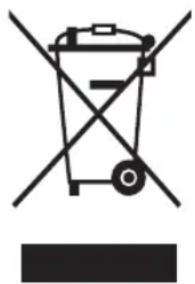
Instructions about the WEEE
natural_image
Symbol of a waste bin with crossed lines indicating no waste or restriction, and a solid black rectangle below (no text or symbols)Correct Disposal of This Product (Waste Electrical & Electronic Equipment) (Applicable in countries with separate collection systems)
This marking on the product, accessories or literature indicates that the product and its electronic accessories (e.g. charger, headset, USB cable) should not be disposed of with other household waste at the end of their working life. To prevent possible harm to the environment or human health from uncontrolled waste disposal, please separate these items from other types of waste and recycle them responsibly to promote the sustainable reuse of material resources.
Household users should contact either the retailer where they purchased this product, or their local government office, for details of where and how they can take these items for environmentally safe recycling.
Business users should contact their supplier and check the terms and conditions of the purchase contract. This product and its electronic accessories should not be mixed with other commercial wastes for disposal.
Installation
Follow these instructions carefully to ensure a proper installation of this refrigerator and to prevent accidents before using it.
WARNING
- Use the refrigerator only for its intended purpose as described in this manual.
- Any servicing must be performed by a qualified technician.
- Dispose of the product packaging material in compliance with local regulations.
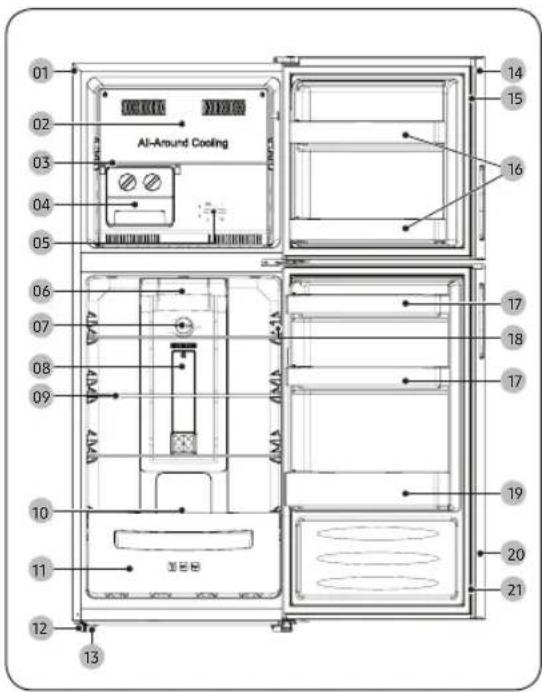
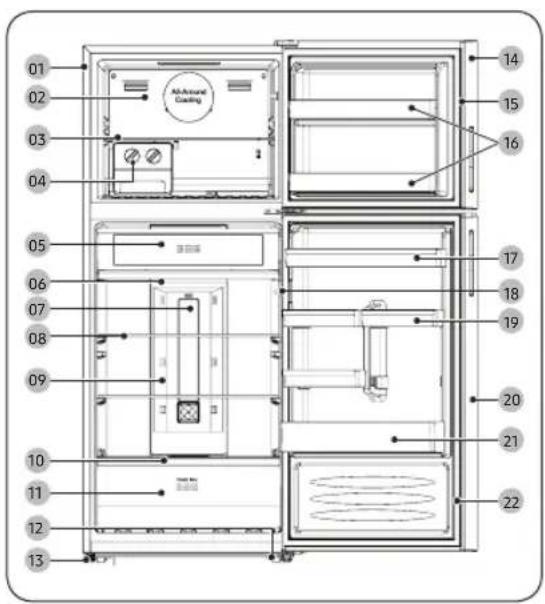
Refrigerator at a glance
NOTE
The actual image and provided parts of the refrigerator may differ, depending on the model and the country.
Type A
text_image
01 02 03 04 05 06 07 08 09 10 11 12 13 AI-Around Cooling 14 15 16 17 18 17 19 20 2101 Cabinet
02 Freezer air duct
03 Freezer shelf
04 Twistable Ice tray
05 Freezer temperature control Knob
06 Fridge air duct
07 Fridge temperature control
08 Fridge lamp cover
09 Fridge shelf
10 Fresh box shelf
11 Fresh box
12 Adjustable feet
13 Roll wheel
14 Freezer door
15 Freezer door gasket
16 Freezer door bin
17 Fridge door bin
18 Door switch
19 Fridge door lower bin
20 Fridge door
21 Fridge door gasket
English26

Type B
text_image
01 02 03 04 05 06 07 08 09 10 11 12 13 14 15 16 17 18 19 20 21 2201 Cabinet
02 Freezer air duct
03 Freezer shelf
04 Twistable Ice tray
05 Fresh Zone cover
06 Fresh Zone tray
07 LED cover
08 Fridge shelf
09 Fridge air duct
10 Fresh box shelf
11 Fresh box
12 Roll wheel
13 Adjustable feet
14 Freezer door
15 Freezer door gasket
16 Freezer door bin
17 Fridge door upper bin
18 Door switch
19 Fridge door middle bin
20 Fridge door
21 Fridge door lower bin
22 Fridge door gasket
To secure more room for storage in the freezer compartment
Remove one or more optional accessories such as shelf (or shelves), twist ice maker(s), ice storage bin(s), ice bucket(s) and their supports, all of which can be removed manually without a tool.
• These optional accessories do not affect thermal and mechanical performance.
- A declared storage volume of the freezer is based on the nonexistence of those optional accessories.
- For best energy efficiency, make sure all shelves and drawers are placed in their original position.
Installation
Step-by-step installation
STEP 1 Select a site
Site requirements:
• Solid, level surface without carpeting or flooring that may obstruct ventilation
- Away from direct sunlight
- Adequate room for opening and closing the door
- Away from a heat source
• Room for maintenance and servicing
• Temperature range: between 10 °C and 43 °C
Effective temperature range
The refrigerator is designed to operate normally in the temperature range specified by its class rating.
| Class Symbol | Ambient Temperature range (°C) | ||
| IEC 62552 (ISO 15502) ISO 8561 | |||
| Extended Temperate SN | +10 to +32 | +10 to +32 | |
| Temperate N +16 | to +32 +16 | to +32 | |
| Subtropical ST +16 | to +38 +18 | to +38 | |
| Tropical T +16 to | +43 +18 to | +43 | |

NOTE
The cooling performance and power consumption of the refrigerator may be affected by the ambient temperature, the door-opening frequency, and the location of the refrigerator. We recommend adjusting the temperature settings as appropriate.
English28
Clearance
See the pictures and table below for space requirements for installation.
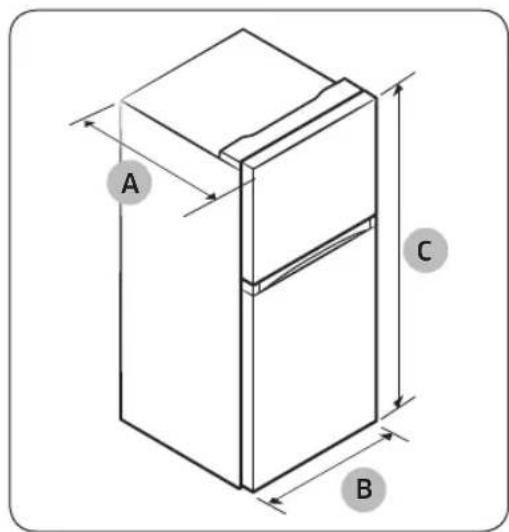
text_image
A C B| Model RT33D RT40D | |
| Depth "A" 660 740 | |
| Width "B" 655 705 | |
| Height "C" 1680 1735 |
(unit : mm)
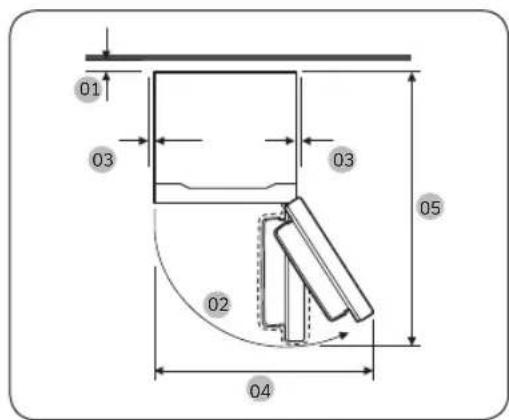
text_image
01 03 03 05 02 04| RT33D RT40D | ||
| 01 | more than 50mm recommended | |
| 02 | 135° (Freezer) / 130° (Fridge) | 140° (Freezer) / 140° (Fridge) |
| 03 | At least 50 mm | |
| 04 | 1100 mm (Freezer) / 1070 mm (Fridge) | 1240 mm |
| 05 | 1230 mm 1350 mm | |
Installation
STEP 2 Spacing (applicable models only)
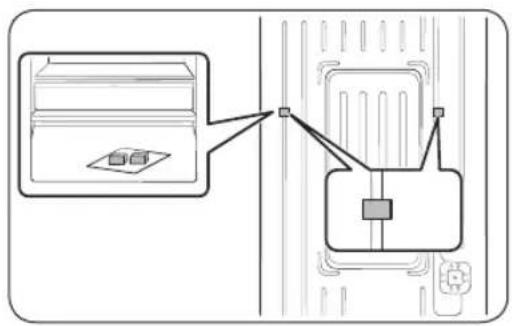
flowchart
graph TD
    A["Device"] --> B["Control Panel"]
    B --> C["Arrow pointing to the Control Panel"]
    style A fill:#f9f,stroke:#333
    style B fill:#ccf,stroke:#333
- Open the door and locate the provided spacers (x2).
- Unpack both spacers and attach them to the rear of the refrigerator as shown. They help ventilate air to the rear wall and save power consumption.
STEP 3 Flooring
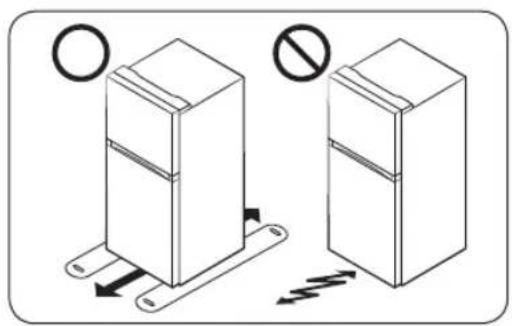
natural_image
Diagram showing two refrigerators with directional arrows indicating movement, no text or symbols present- The surface to install the refrigerator must support a fully loaded refrigerator or approximately 90 kg.
• To protect the floor, put a large piece of cardboard on each leg of the refrigerator. - Once the refrigerator is in its final position, do not move it unless necessary to protect the floor. If you have to, use thick paper or cloth such as old carpets along the movement path.
English30-


STEP 4 Adjust the levelling feet
CAUTION
- When installed, the refrigerator must be levelled on a flat, solid floor. Not levelling the refrigerator can cause damage to the refrigerator or physical injury.
- Levelling must be performed with the refrigerator empty. Make sure no food items are inside the refrigerator.
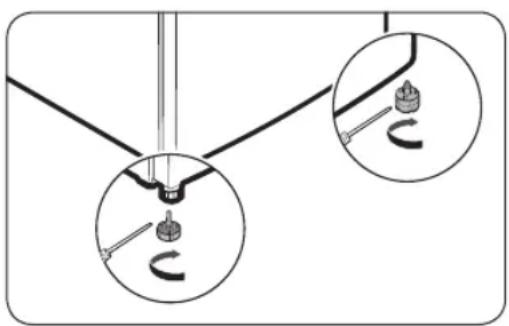
- For safety reasons, adjust the front a little higher than the rear. Level the refrigerator using special screws (levellers) on the front legs. Use a flat-head screwdriver to turn the levellers.
natural_image
Diagram showing mechanical components with two circular insets highlighting a specific assembly (no text or labels)Level the refrigerator by manually adjusting the levelling feet. Turn the levelling feet clockwise to lower the position or turn anticlockwise to raise. For safety reasons, adjust the front side a little higher than the rear side.
STEP 5 Initial settings
By completing the following steps, the refrigerator should be fully functioning.
- Plug the power cord into the wall socket to turn the refrigerator on.
- Open the door, and check if the interior light lights up.
- Set the temperature to the coldest, and wait for about an hour. Then, the freezer will be slightly chilled, and the motor will run smoothly.
- Wait until the refrigerator reaches the set temperature. Now the refrigerator is ready for use.
STEP 6 Final check
When the installation is complete, confirm that:
- The refrigerator is plugged into an electrical outlet and grounded properly.
- The refrigerator is installed on a flat, level surface with a reasonable clearance from the wall or the cabinet.
- The refrigerator is level and is sitting firmly on the floor.
- The door opens and closes freely, and the interior light turns on automatically when you open the door.
Operations
Main panel
Type A
Fridge - Analogue
text_image
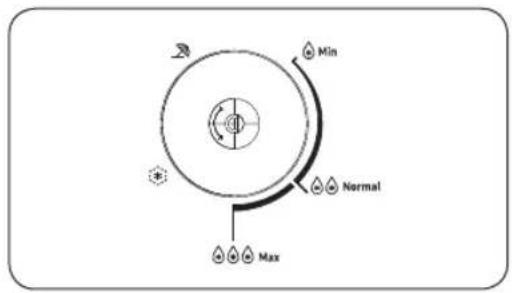
Min Normal Max- Turn the dial left and right to set the desired temperature. - Turn the dial left to raise, and turn it right to lower the temperature.
NOTE
To ensure optimal performance, we recommend setting the temperature to 🔊
CAUTION
- Do not set the fridge temperature higher (Min) when the room temperature is lower than 10 °C, and lower (Normal-Max) when the temperature is higher than 35 °C. It may cause problems with the cooling performance.
English32-
Freezer - Analogue
flowchart
graph TD
    A["Max"] --> B["Directional Arrow"]
    C["Min"] --> B
    B --> D["Control Block"]
    D --> E["Max"]
    style A fill:#f9f,stroke:#333
    style C fill:#f9f,stroke:#333
    style D fill:#ccf,stroke:#333
    style E fill:#ccf,stroke:#333
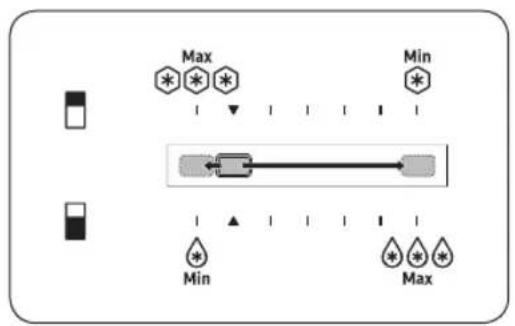
• To increase the temperature, slide the temperature control to the right.
• To decrease the temperature, slide the temperature control to the left.
- In winter, slide the temperature control to the left-most end.

text_image
Max Min Min MaxTo make ice in summer (above 35 °C), set the freezer temperature to the center.
NOTE
If the Ice maker is not making enough ice, slide the temperature control to the left.
CAUTION
- To prevent system failure or food spoiling, do not set the temperature to the left-most end (maximum) in summer (above 35 °C).
- Do not store glass bottles containing liquid in the freezer. Glass bottles will crack or break into pieces when the liquid freezes.
Operations
Type B
text_image
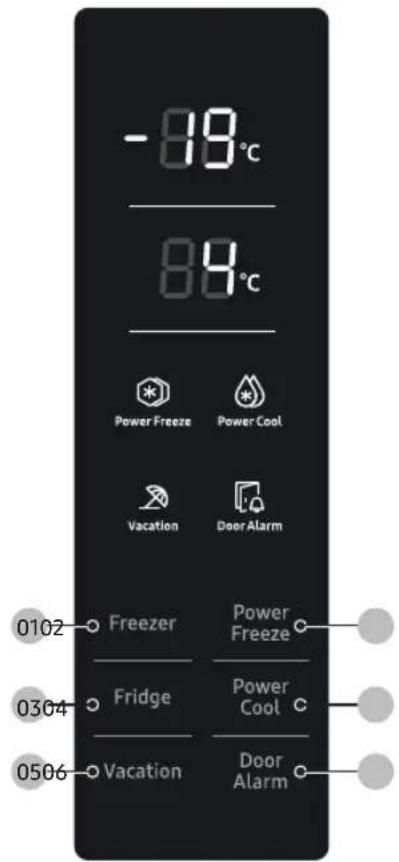
-88°C 88°C Power Freeze Power Cool Vacation Door Alarm 0102 Freezer Power Freeze 0304 Fridge Power Cool 0506 Vacation Door AlarmOperations
01 Freezer 02 Power Freeze
03 Fridge 04 Power Cool
05 Vacation 06 Door Alarm
NOTE
Use your appliance according to the following control regulations, your appliance has the corresponding functions and modes as the control panels showed in the pictures above. When the appliance is powered on for the first time, the backlighting of the icons on display panel starts working. If no buttons have been pressed and the doors are closed, the backlighting will turn off.
English34
Controlling the temperature
We recommend that when you start your refrigerator for the first time, the temperature for the refrigerator is set to 4 °C and the freezer to -19 °C. If you want to change the temperature, follow the instructions below.
| Temperature Setting Recommendation | ||
| Freezer Compartment Fridge Compartment | ||
| Summer(Higher than 35 °C) | Set on -21 °C Set on 3 °C | |
| Normal Set on -19 °C | Set on 4 °C | |
| Winter(Under 10 °C) | Set on -17 °C Set on 5 °C | |

CAUTION
When you set a temperature, you set an average temperature for the whole refrigerator cabinet. Temperature inside each compartment may vary from the temperature values displayed on the panel, depending on how much food you store and where you place them. Ambient temperature may also affect the actual temperature inside the appliance.
Operations
01 Freezer
Press Freezer to set freezer temperature between -14 ^ and -24 ^ as needed, and the control panel will display corresponding value according to the following sequence.

text_image
-14 °C -15 °C -16 °C -17 °C -18 °C -19 °C -24 °C -23 °C -22 °C -21 °C -20 °C02 Power Freeze
Power Freeze can quickly lower frozen temperature and freeze your food faster than usual. This feature also helps to keep the vitamins and nutrition of fresh food for longer period.
- Press Power Freeze button to activate the Power Freeze function. The light will come on and the freezer temperature setting displays -24 °C.
- To cool large amounts of food completely, activate Power Cool at least 24 hours in advance.
• Power Freeze automatically switches off after 26 hours. - When Power Freeze function is on you can switch off Power Freeze function by pressing Power Freeze or Freezer button and the freezer temperature setting will revert back to its previous setting.
03 Fridge
Press Fridge button repeatedly to set your desired fridge temperature between 8 °C and 2 °C, the temperature will increase 1 °C degrees with each press and the fridge temperature indicator will display corresponding value according to the following sequence.

flowchart
graph LR
    A["8°C"] --> B["7°C"]
    B --> C["6°C"]
    C --> D["5°C"]
    D --> E["4°C"]
    E --> F["3°C"]
    F --> G["2°C"]
    G --> A
English36-
04 Power Cool
Power Cool can refrigerate the food quicker and keep food fresh for a longer period.
- Press Power Cool button to activate this function. The Power Cool icon will light up and the fridge temperature indicator will display 2 °C.
- Power Cool automatically switches off after 6 hours.
- Press Power Cool or Fridge to cancel Power Cool mode and revert to previous temperature settings.
05 Vacation
This function is designed to minimize the energy consumption and electricity bills while the Fridge is not in use for a long period of time. You can activate this function by pressing Vacation button for a short until the Vacation light icon is illuminated.

NOTE
Do not store any food in the refrigerator chamber during this time.
- When the Vacation function is activated, the temperature of the refrigerator is automatically switched to 15 °C to minimize the energy consumption. The refrigerator temperature setting displays “-” and the freezer compartment remains on.
- Press Vacation button to cancel Vacation mode and revert to previous temperature settings.
Operations
06 Door Alarm
In case of alarm, "Door Alarm" icon will light up and a buzzing sound will start. Press Door Alarm button to stop alarm and buzzing then "Door Alarm" icon will turn off.
CAUTION
When the refrigerator is turned on after a period of inactivity, the Door Alarm may be activated. In this case, press Door Alarm button to cancel it.
- Door alarm
- Leaving any door of refrigerator or freezer open for over 2 minutes will activate a door alarm and buzzer. The buzzer will beep 3 times per minute for 10 minutes. Closing the door cancels the door alarm and buzzer.
- To save energy, please avoid keeping doors open for a long time when using refrigerator. The door alarm can also be cleared by closing the doors.
- Temperature alarm
- If freezer temperature is too high due to power failure or other reasons, it will give temperature alarm and the freezer temperature settings displays “- -”.
- In case of temperature alarm, buzzer will sound constantly for 10 times.
- In case of temperature alarm, press Door Alarm button for 3 seconds to check the highest freezer temperature value and "Door Alarm" icon will simultaneously flash for 5 seconds.
English38
Special features
The actual image and special functions of your refrigerator may differ, depending on the model and the country.
Fresh Zone
natural_image
Line drawing of a cabinet or rack unit with no visible text, numbers, or symbolsDoor bin
natural_image
Illustration of hands holding a rectangular object with upward arrows indicating motion or force (no text or symbols)Shelf in Refrigerator chamber
natural_image
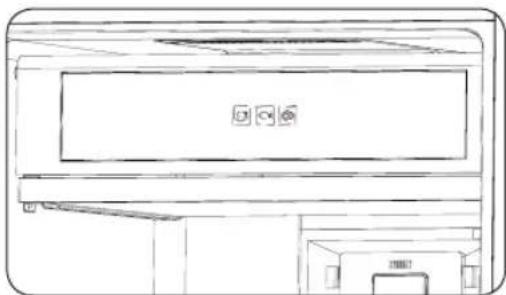
Illustration of a hand placing a rectangular object on a shelf with an arrow symbol (no text or labels)- The Fresh Zone is suitable for storing fish, meat and sausage for a short-term fresh.
- The temperature in fresh zone is lower than the refrigerator compartment sometimes even below 0 °C.
- Do not store foods that can get frostbite quickly, such as vegetables and fruits.
-
The Drawer wheel to slide the drawer easily while opening and closing.
-
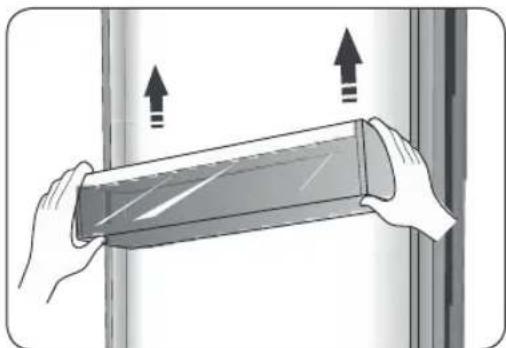
It is suitable for the storage of eggs, canned liquid, bottled drinks and packed food, etc. Don't place too many heavy things in the door bins.
- The middle door bin can be placed at different heights according to your requirements.
- Please take food out of the door bin before lifting vertically to reposition.
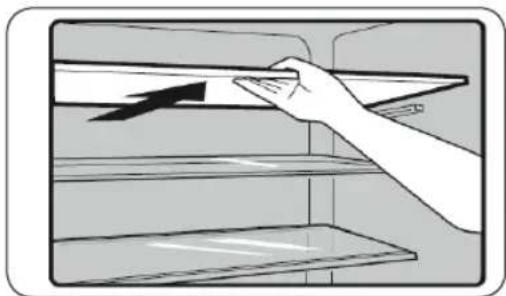
- There are shelves in refrigerator chamber, and they can be taken out to be cleaned.
Operations
Fresh Box and Humidity control
text_image
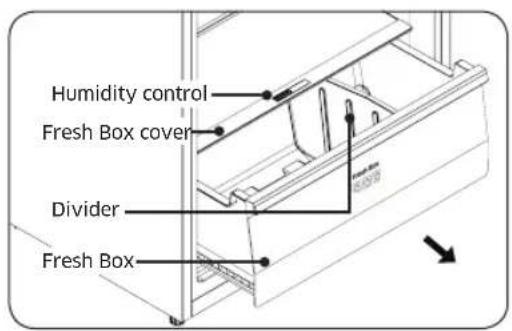
Humidity control Fresh Box cover Divider Fresh Box- The fresh box is for storing vegetables and fruits. You can adjust the humidity inside by using the sliding block.
- The sliding block on fresh box cover can slide to left or right and the air hole become more or less relatively. More air hole opening means less humidity and less means more humidity.
• We recommend that you store vegetables with more humidity and fruit less humidity. - When you remove the fresh box, pull them forward, then lift the fresh box off the slides. Remember to empty food in the fresh box firstly. Once you have removed the drawers, ensure the slides are pushed back fully.
- Divider easily manage fresh box space as you store separate food.
Twistable ice tray (applicable models only)
The twistable ice tray is used to make and deposit ice cubes. You should use it as follows.
- Pull out the twistable ice tray from the installation bracket.
- Fill the drink water inside (do not fill above the max water level).
- Place the filled ice tray back to the bracket.
- Wait for around 3 hours, twist the knobs clockwise and the ice will drop into the ice box below.
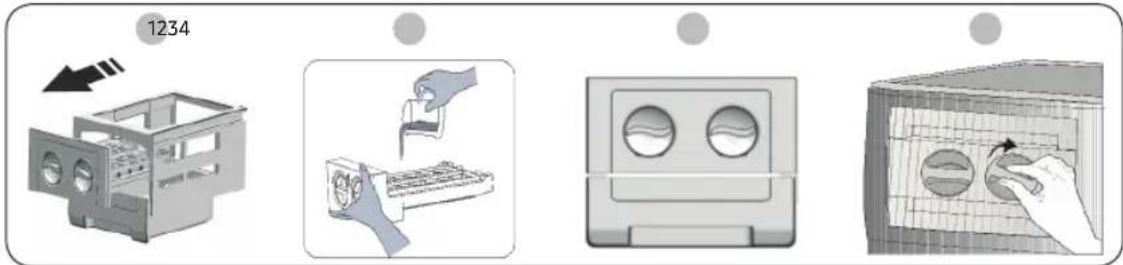
text_image
1234NOTE
- Ice box is inadvisable to be used to make ice, otherwise it may crack.
- If it takes a long time to make ice, do not hold the ice tray directly to avoid the ice tray sticking and hurting your hands.
English40
Maintenance
Handle and care
Shelves (fridge/freezer)
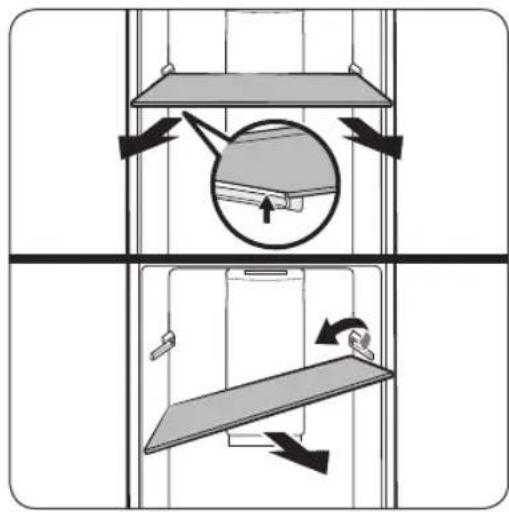
text_image
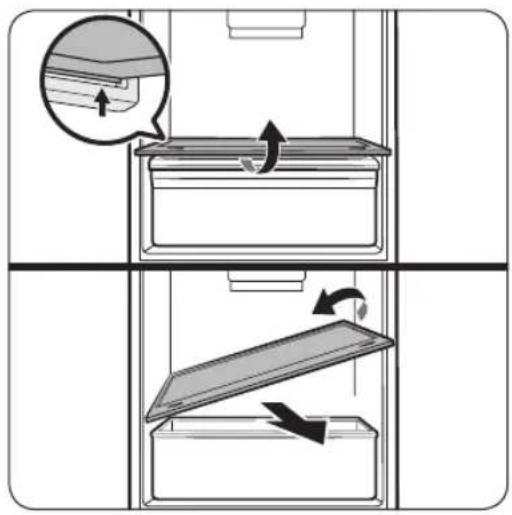
Diagram illustrating a mechanical or electrical system with labeled components and directional arrows indicating motion or movement.To remove the shelf, hold it with both hands and lift it to release it from the rear hook. Then, tilt it on one side and pull it out.
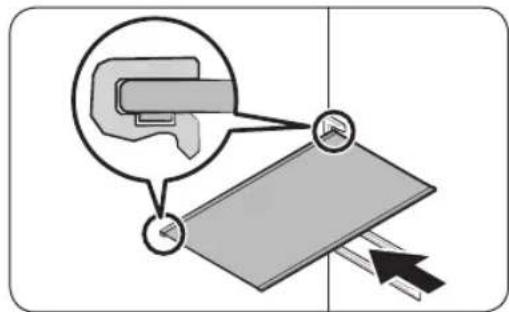
text_image
Diagram illustrating a mechanical or optical setup with labeled components and directional arrows, likely from an engineering or physics context.Before you insert the shelf, check the shape of the back of the shelf. Then, insert the shelf in the reverse order of removal.
CAUTION
- The shelf must be inserted correctly. Do not insert it upside down or back to front.
- Shelves are heavy, therefore be careful when you handle them.
Fresh Box
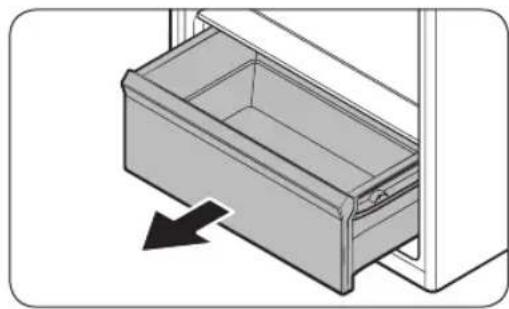
natural_image
Diagram of a drawer with an arrow indicating direction, no text or symbols presentGently lift up the front of the fresh box and slide out.
Maintenance
Fresh Box shelf
natural_image
Diagram showing a refrigerator interior with airflow arrows indicating movement, no text or symbols presentHold the fresh box shelf with both hands and lift it to release it from the rear hook. Then, tilt it on one side and pull it out.
Door bins
natural_image
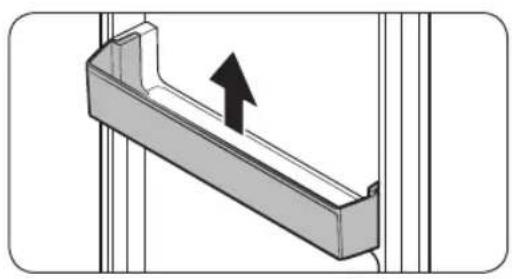
Diagram of a mechanical bracket with an upward arrow indicating force or direction (no text or symbols present)Slightly lift up and pull out the door bins.
CAUTION
To prevent accidents, empty the door bins before removing them.
English42
Cleaning
WARNING
- Do not use benzene, thinner, or home/car detergent such as Clorox™ for cleaning purposes. They may damage the surface of the refrigerator and cause a fire.
-
Do not spray water onto the refrigerator. This may cause electric shock.
Regularly use a dry cloth to remove all foreign substances such as dust or water from the power plug terminals and contact points. -
Unplug the power cord of the refrigerator.
- Use a moistened soft lint-free cloth or paper towel to clean the refrigerator's interior and exterior.
- When done, use a dry cloth or paper towel to dry well.
- Plug in the power cord of the refrigerator to turn the refrigerator on.
NOTE
If you have removed any removable parts such as shelves for cleaning, refer to the overall layout in the Refrigerator at a glance section to make sure you have reinserted correctly.
Maintenance
Replacement
Lamps
To replace them, contact a local Samsung service center.
WARNING
- The lamps are not user-serviceable. Do not attempt to replace a lamp yourself. This can cause electric shock.
Lamp (Light Source)
The lamp(s) and/or control gear(s) are not user-serviceable. To replace the lamp(s) and/or control gear(s) in the product, contact a local Samsung service center.
For detailed instructions on replacing lamp(s) or control gear(s) in your product, visit the Samsung website (http://www.samsung.com), go to Support > Support home, and then enter the model name.
For detailed instructions on dismantling lamp(s) and/or control gear(s), simply follow the replacement instruction reached as described above.
English44
Troubleshooting
Before calling for service, review the checkpoints below. Any service calls regarding normal situations (No Defect Cases) will be charged to users.
General
Temperature
| Symptom Possible causes Solution | ||
| Fridge/freezer does not operate.Fridge/freezer temperature is warm. | Power cord is not plugged in properly.Temperature control is not set correctly.Refrigerator is located near a heat source or direct sunlight.Not enough clearance between refrigerator and sides/rear.Vacation mode is activated.The refrigerator is overloaded. Food is blocking the refrigerator vents. | Properly plug in the power cord.Set the temperature lower.Keep the refrigerator away from direct sunlight or a heat source.We recommend that the gap between the refrigerator and nearby walls (or cabinets) is more than 50 mm.Deactivate vacation mode.Do not overload the refrigerator. Do not allow food to block ventilation. |
| Fridge/freezer is over-cooling. | Temperature control is not set correctly. | Set the temperature higher. |
| Interior wall is hot. | Refrigerator has heat-proof piping in the interior wall. | To prevent condensation from forming, the refrigerator has heat-proof piping in the front corners. If the ambient temperature rises, this equipment may not work effectively. This is not a system failure.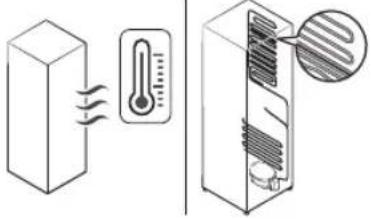 |
Troubleshooting
Odours
| Symptom Possible causes Solution | ||
| Refrigerator has odours. | • Spoiled food. | • Clean the refrigerator and remove any spoiled food. |
| • Food with strong odours. | • Make sure strong smelling food is wrapped airtight. | |
Condensation
| Symptom Possible causes Solution | ||
| Condensation forms on the interior walls. | ·If door is left open, moisture enters the refrigerator. | ·Remove the moisture and do not open the door for a long time. |
| ·Food with high moisture content. | ·Make sure food is wrapped airtight. | |
Water/Ice (Auto Ice Maker models only)
| Symptom Possible causes Solution | ||
| The ice maker does not produce ice. | · The freezer room is not cold enough. | · Make sure the cold air outlet is not clogged. |
| · The wire connector of the ice maker is not connected properly. | · Make sure the wire connector from the wire housing is connected properly. | |
| · The water line flowing to the Ice maker is bent or kinked. | · Make sure the water line in the rear of the refrigerator is not bent or kinked. | |
English46
Do you hear abnormal sounds from the refrigerator?
Before calling for service, review the checkpoints below. Any service calls related to normal sounds will be charged to the user.
These sounds are normal.
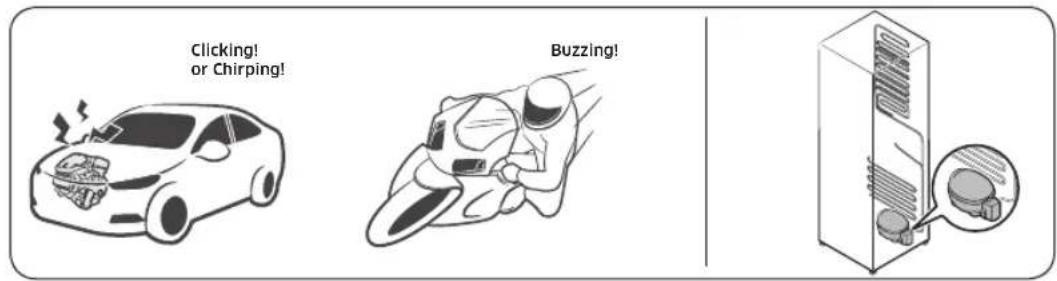
- When starting or ending an operation, the refrigerator may make sounds similar to a car engine igniting. As the operation stabilizes, the sounds will decrease.
text_image
Clicking! or Chirping! Buzzing!- While the fan is operating, these sounds may occur. When the refrigerator reaches the set temperature, no fan sound will occur.
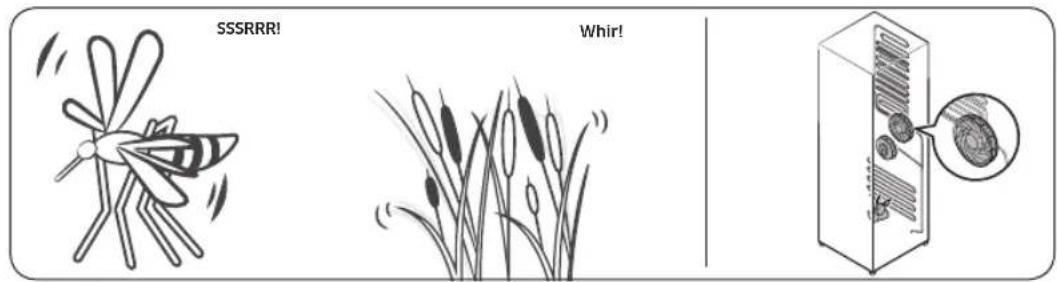
text_image
SSSRRR! Whir!- During a defrost cycle, water may drip on the defrost heater, causing sizzling sounds.
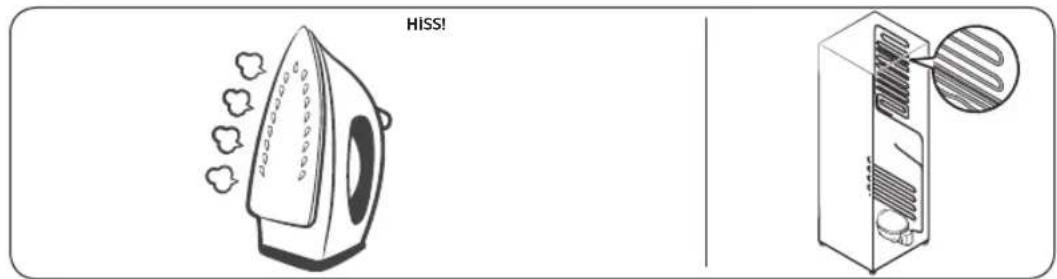
text_image
HISS!English 47
Troubleshooting
- As the refrigerator cools or freezes, refrigerant gas moves through sealed pipes, causing bubbling sounds.
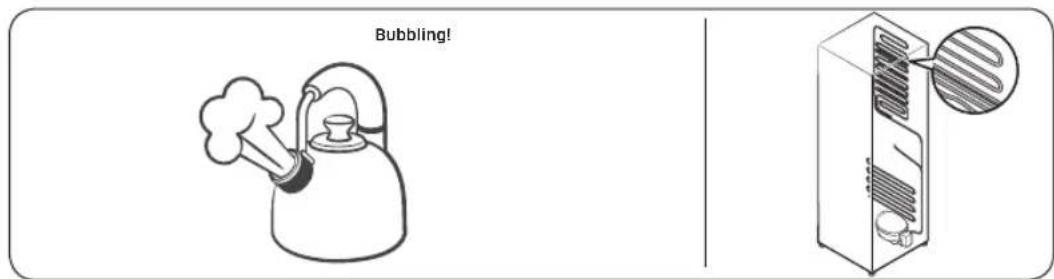
text_image
Bubbling!- As the refrigerator temperature increases or decreases, plastic parts contract and expand, creating knocking noises. These noises occur during the defrosting cycle or when electronic parts are working.
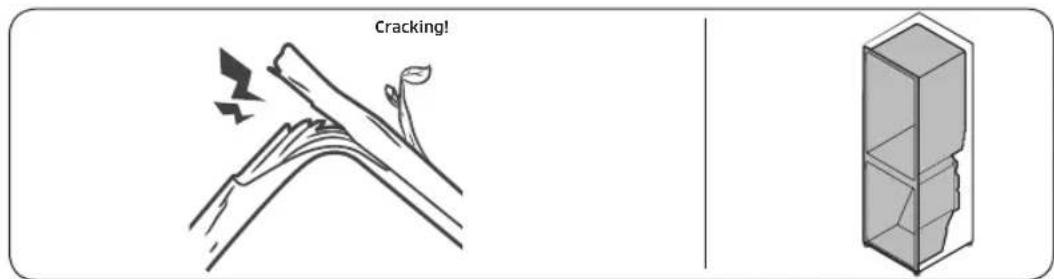
text_image
Cracking!- For ice maker models: When the water valve opens to fill the ice maker, buzzing sounds may occur.
- Because of pressure equalizing when opening and closing the refrigerator door, whooshing sounds may occur.
English48-
Memo
Memo
Memo
SAMSUNG
Contact SAMSUNG WORLD WIDE
If you have any questions or comments relating to Samsung products, please contact the SAMSUNG customer care center.
| Country Contact Center Website | ||
| U.A.E 800-SAMSUNG (800 - 726 7864) | www.samsung.com/ae/support (English)www.samsung.com/ae_ar/support (Arabic) | |
| OMAN 800-SAM CS (800-72627) | ||
| KUWAIT 183-CALL (183-2255) | ||
| BAHRAIN 8000-GSAM (8000-4726) | ||
| QATAR 800-CALL (800-2255) | ||
| EGYPT | 08000-726786416580WhatsApp 010 000 16580 | www.samsung.com/eg/support |
| ALGERIA 3004 www.samsung.com/n_africa/support | ||
| PAKISTAN 0800-Samsung (7267864) www.samsung.com/pk/support | ||
| TUNISIA 80 100 012 www.samsung.com/n_africa/support | ||
| JORDAN | 0800-2227306-577-7444WhatsApp +962-79-777-7421 | www.samsung.com/levant/support |
| Lebanon | 1598WhatsApp +962-79-777-7421 | |
| Iraq | 80010080WhatsApp +962-79-777-7421 | |
| MOROCCO 080 100 22 55 www.samsung.com/n_africa/support | ||
| SAUDI ARABIA | 8002474357 (800 (08:00 ~ 20:00 HELP)From Inside Saudi Arabia+966112614718 From outside Saudi Arabia(Call charges may be applied)Digital services (24/7 HELP) | www.samsung.com/sa_en/support (English)www.samsung.com/sa/support (Arabic) |
RT33D,RT40D_UM_Rev00_EG

natural_image
Black and white photo of water droplets in a flowing liquid (no text or symbols)
Réfrigérateur
Guide d'utilisation
RT33DG*****/RT40DG*****
Appareil non encastrable
natural_image
Black and white illustration of ice cubes with bubbles rising, no text or symbols present
natural_image
Abstract water splash shaped like a cube with bubbles and droplets (no text or symbols)SAMSUNG
Sommaire
natural_image
Symbol of a waste bin with no text or labels, crossed by diagonal lines and a solid black rectangle below (no text or symbols present)flowchart
graph TD
    A["Device"] --> B["Control Panel"]
    B --> C["Arrow 1"]
    B --> D["Arrow 2"]
natural_image
Diagram showing two refrigerators with directional arrows indicating movement, no text or symbols presentnatural_image
Diagram showing a mechanical assembly with two circular insets highlighting internal components (no text or labels)natural_image
Line drawing of a cabinet or rack with front panel and side shelves (no text or symbols)natural_image
Illustration of hands holding a rectangular device with arrows indicating upward motion (no text or symbols)natural_image
Illustration of a hand placing a tray with a lightning bolt on the shelf (no text or symbols)text_image
Diagram illustrating a mechanical or electrical system with labeled components and directional arrows indicating motion or movement.text_image
Diagram illustrating a device with a magnified view of the screen and directional arrows, likely illustrating a physical or engineering concept.natural_image
Diagram of a mechanical drawer with an arrow indicating direction (no text or symbols present)natural_image
Diagram of a refrigerator interior showing airflow direction and component placement (no text or symbols)natural_image
Diagram of a mechanical bracket with an upward arrow indicating force or direction (no text or symbols present)natural_image
Diagram of a refrigerant unit with heat exchanger and cooling fins (no text or labels)natural_image
Diagram of a refrigerator interior showing airflow direction and component placement (no text or symbols)صناديق الباب
natural_image
Diagram of a mechanical component with an upward arrow indicating direction (no text or symbols)الاستعمال والعنابة
text_image
Diagram illustrating a mechanical or electrical system with labeled components and directional arrows indicating motion or movement.text_image
Diagram illustrating a mechanical or electrical component with labeled parts and directional arrows, including a magnified inset showing a tool interacting with a component.درج الأطعمة الطازجة
natural_image
Diagram of a drawer with an arrow indicating direction (no text or symbols present)text_image
Diagram illustrating four steps of washing machine operation: cooling, washing machine, hand washing, and packaging with directional arrows.ملحوظة
natural_image
Architectural line drawing of a two-story building facade with windows and doorways (no text or symbols)صندوق الباب
natural_image
Illustration of hands holding a rectangular object with upward arrows indicating motion or force (no text or symbols)natural_image
Illustration of a hand placing a rectangular object on a shelf with an arrow indicating direction (no text or symbols)- إندار الباب
• ت Winning what's the blind.
natural_image
Diagram showing a hanging lamp with a coiled cable and two circular insets illustrating the components (no text or symbols)flowchart
graph TD
    A["Device"] --> B["Control Panel"]
    B --> C["Arrow to Device"]
    style A fill:#f9f,stroke:#333
    style B fill:#ccf,stroke:#333
natural_image
Diagram showing two refrigerators with directional arrows indicating movement, no text or symbols presentترك السافةönاسبة
•Discounted Objective for the 1-1 pm and 24 pm
natural_image
Symbol of a trash bin crossed with a diagonal line, representing no waste or restriction (no text present)
نصائح توفير الطاقة
natural_image
Black and white abstract water splash with flowing liquid (no text or symbols)الثلاثة
دليل المستخدم
RT33DG*****/RT40DG*****
جهاز مستقل