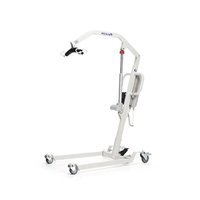
Falcon - Chair Vermeiren - Free user manual and instructions
Find the device manual for free Falcon Vermeiren in PDF.


| Brand | Vermeiren |
| Model | Falcon |
| Product type | Patient lift |
| Intended use | Transfer of seated patients between chairs, beds, bathrooms |
| Maximum load | 130 kg |
| Total weight | 35 kg |
| Lifting range | 1100 mm |
| Maximum height of central attachment point | 1609 mm |
| Minimum height of central attachment point | 509 mm |
| Chassis spread | 506 mm - 970 mm |
| Dimensions (L × W × H) | 1158 mm × 565 mm × 294 mm (folded) |
| Turning radius | 1188 mm |
| Ground clearance | 15.5 mm |
| Power supply | 24 V battery, 100-240 V AC charger |
| Battery capacity | 2.9 Ah |
| Battery life | Approximately 24 hours of full charge |
| Main functions | Electric lifting/lowering, chassis spread, parking brakes, swiveling |
| Safety | Emergency stop, manual emergency lowering, limit switches |
| Protection class | IP54 (control box, hand control, motor) |
| Operating temperature | +5°C to +40°C |
| Sound level | < 54 dB(A) |
| Maintenance | Cleaning with mild detergent, regular checks, annual inspection by a dealer |
| Expected service life | 8 years |
| Spare parts | Use only original Vermeiren parts |
| Reparability | Repairs by trained personnel only |
| Warranty | Based on normal use and maintenance |
Frequently Asked Questions - Falcon Vermeiren
User questions about Falcon Vermeiren
0 question about this device. Answer the ones you know or ask your own.
Ask a new question about this device
Download the instructions for your Chair in PDF format for free! Find your manual Falcon - Vermeiren and take your electronic device back in hand. On this page are published all the documents necessary for the use of your device. Falcon by Vermeiren.
USER MANUAL Falcon Vermeiren
natural_image
White TALCON medical mobility device with articulated arm and wheels (no text or symbols visible)EN
Instructions for specialist dealer
This instruction manual is part and parcel of the product and must accompany every product sold.
Version: A, 2022-11
FR
All rights reserved, including translation.
This page is intentionally left blank
Contents
Contents....1
Preface....2
1 Your product....3
2 Before use 4
2.1 Intended use 4
2.2 General safety instructions....4
3 Using the patient hoist 5
3.1 Operating the lift....5
3.2 Slings 7
3.3 Battery and charging....9
3.4 Emergency....10
4 Installation and adjustment....11
4.1 Delivery 11
4.2 Assembly or dismantling 11
5 Maintenance....13
5.1 Time of maintenance.... 13
5.2 Shipping and storage 14
5.3 Cleaning....14
5.4 Disinfection 14
5.5 Inspection....15
5.6 Expected lifespan....15
5.7 Reuse....15
5.8 End of use....15
6 Troubleshooting....16
7 Technical specifications....17
Preface
Congratulations! You are now owner of a Vermeiren patient hoist!
This product is made by qualified and committed personnel. It is designed and produced according to high quality standards, guarded by Vermeiren.
Thank you for your trust in the products of Vermeiren. To support you on the use of this patient hoist and its operating options, this manual is offered. Please read it carefully; it will help you to get familiar with the operation, capabilities and limitations of your product.
If you still have questions after reading this manual, do not hesitate to contact your specialist dealer. He/she will be glad to help you.
Important note
To ensure your safety and to prolong the lifetime of your product, please take good care of it and have it checked and serviced on a regular basis.
This manual reflects the latest product developments. Vermeiren has the right to implement changes to this type of product without any obligation to adapt or replace similar products previously delivered.
Pictures of the product are used to clarify the instructions in this manual. Details of the depicted product may deviate from your product.
Information available
On our website http://www.vermeiren.com/ you will always find the most recent version of the information in this manual. Please consult this website regularly for possible updates.
Visually impaired people can download the electronic version of this manual and have it read out by means of a text-to-speech software application.

This user manual For user and specialist dealer

Service manual For specialist dealer

EC declaration of conformity
1 Your product
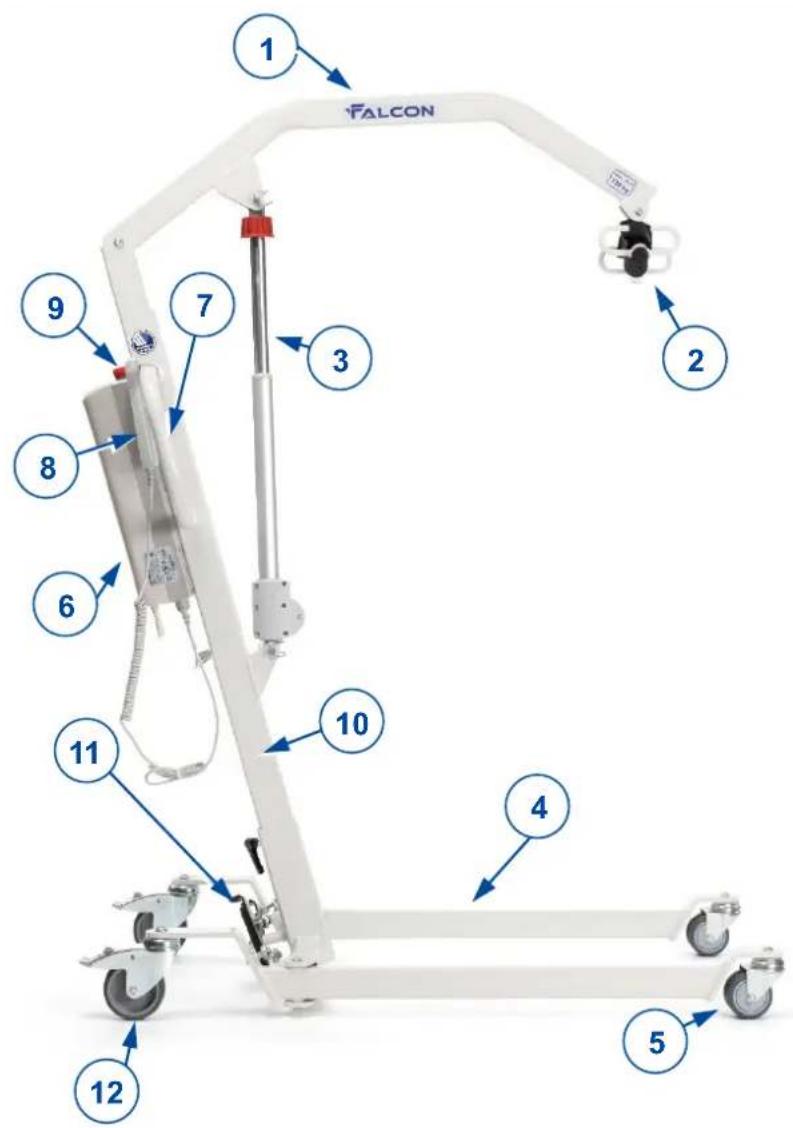
- Cantilever arm
- Spreader bar
- Motor
- Chassis
- Roller
- Control box
- Handle for pushing
- Manual operation
- Emergency stop
- Pole
- Chassis expansion pedal
- Caster with brake
2 Before use
2.1 Intended use
In this paragraph a brief description of the intended use of your patient hoist is given. Additionally, relevant warnings are added to the instructions in the other paragraphs. In this way we would like to make you aware of the possible misuse that may appear.
- Indications and contraindications: This patient hoist is meant to be operated by an attendant to transfer sitting patients between e.g. wheelchairs, nursing beds and bathrooms. The patient hoist is designed and produced to be a transport/transfer aid for elderly persons or persons who suffer from paralysis, limb loss or defects, stiff or damaged joints, cardiovascular problems, cachexia, ...
• This patient hoist is suitable for indoor use. - This patient hoist is designed and produced solely to transport/transfer one (1) person with a maximum weight according to the specifications in §7. It is not designed for transportation of goods or objects, nor for any use other than previously described.
- Only use accessories and spare parts approved by Vermeiren.
- Please read all technical details and limits of your patient hoist in chapter 7.
- The warranty on this product is based on normal use and maintenance as described in this manual. Damage to your product caused by improper use or lack of maintenance will cause the warranty to lapse.
2.2 General safety instructions
CAUTION
Risk of injuries and/or damage
Please read and follow the instructions in this manual. Otherwise you may get injured or your patient hoist may get damaged.
Keep the following general warnings in mind during use:
- The patient hoist must only be operated by qualified staff who have been instructed or trained in its specific application.
- Do not exceed the maximum load for the patient hoist. This will shut down the control box.
- In case of different user weights for patient hoist and slings, always observe the lowest user weight.
- An attendant needs to be present during the lifting operation.
- Be aware that some parts of the patient hoist may get very hot or cold due to ambient temperature, solar radiation or heating devices. Be careful when touching.
- The patient hoist has been tested for electromagnetic compatibility and complies with the standard. Nevertheless, sources of electromagnetic fields may influence the performance of the patient hoist, such as the fields of mobile phones, power generators or high-power energy sources. On the other hand, the electronics of the patient hoist can affect other electronic appliances too.
- Only use the patient hoist on flat surfaces where all castors touch the ground and where there is sufficient contact to operate the patient hoist safely. Do not take obstacles with the patient hoist while transferring a patient.
- Do not use the patient hoist in wet or humid environments.
- Alterations or substitutions should not be made to the patient hoist securement points or to structural and frame parts or components without consulting the manufacturer.
- Make sure that your hands, clothes, belts, buckles or jewellery don't get caught by wheels or other moving parts during use.
- Be careful with sources of ignition such as lit cigarettes as they may set the sling alight.
In case a serious incident has occurred involving your product, notify Vermeiren or your specialist dealer as well as the competent authority in your country.
3 Using the patient hoist
3.1 Operating the lift

CAUTION
Risk of injuries and/or damage
- When using the lift, make sure that there is sufficient room around and above it, as the adjustment movements could otherwise lead to damage or injury.
• Always be aware of the lifting arm to avoid injury. - Only slings that have been designed and approved for the patients must be used (see usage instructions for the various slings). Use of any other slings is at your own risk.
- Only use the handles to push/pull the patient hoist, no other components.
Please observe the technical information according to which the patient hoists may be operated. The patient hoist must only be operated by authorised staff who have been trained in its use and operation.
3.1.1 Altering the chassis width
natural_image
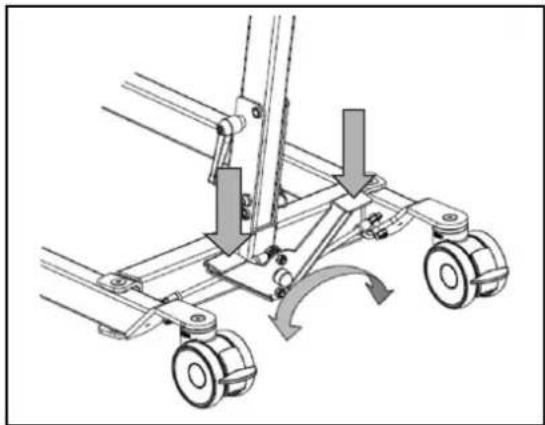
Mechanical assembly diagram showing a cart with wheels and directional arrows indicating motion (no text or symbols)To get the lift around a wheelchair or other seating furniture, or to increase the stability of the lift in the standing position, the separation of the chassis legs can be increased.
Stand behind the assembled lift and take hold of the handles for pushing the patient hoist (on the left and right, next to the control box). Press the lever at the bottom of the chassis (left or right) down with your foot, and the separation of the legs of the chassis can be increased or decreased.
3.1.2 Parking brakes
natural_image
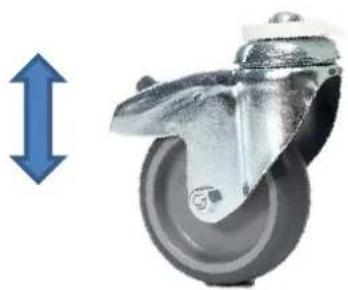
Close-up of a metallic mechanical component with a blue upward arrow indicating vertical displacement (no text or symbols)Secure the two casters at the back of the chassis by pressing the caster brake plates down gently to their end stops with the tip of your foot. To release the brake, push the brake plate gently back up again with the front of your foot until the casters are free.
3.1.3 Raising and lowering the cantilever arm
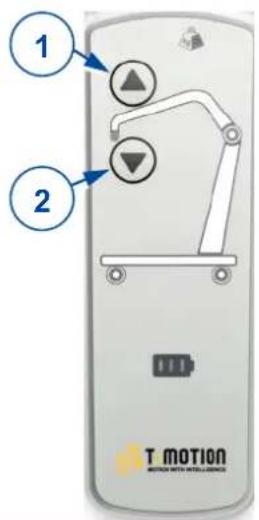
The manual control allows the cantilever arm to be adjusted smoothly to any point.
① = Raise the cantilever arm
② = Lower the cantilever arm
When using the lift function until the end of the hoist motor, the limit switch is activated by electronics (security function). Use the lifting function only in the middle of the adjustment range.
3.1.4 Lowering button
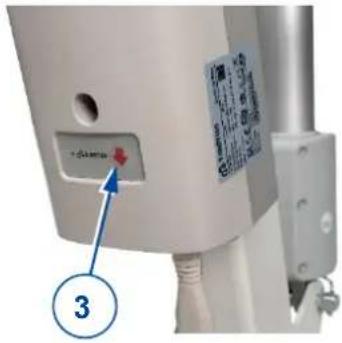
If the manual operation mechanism should be damaged, it is possible to lower the cantilever arm from the control box.
The arm moves down for as long as the button (3) on the control box panel is pressed.
3.1.5 Moving the patient hoist

CAUTION
Risk of injuries
- Be careful passing through restricted passages (e.g. doors).
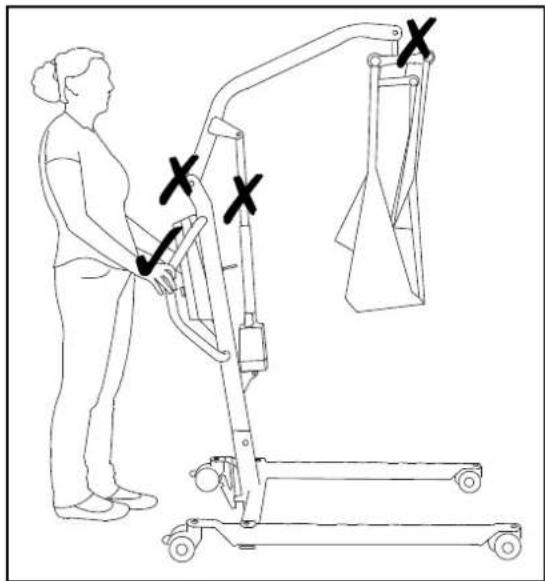
- Stand behind the patient hoist and grasp the handles (left and right, next to the control box) with both hands.
- Make sure that both back caster brakes have been released.
- Push the patient hoist slowly into the desired position.
When it is not loaded, we advise you to pull the patient hoist backwards, which makes it easier to get round any obstacles (door frames, corners of rooms or furniture).
3.1.6 Turn the patient hoist around his axle

CAUTION
Risk of injuries
- Be careful there are no people or objects in the swing range of the patient hoist.
-
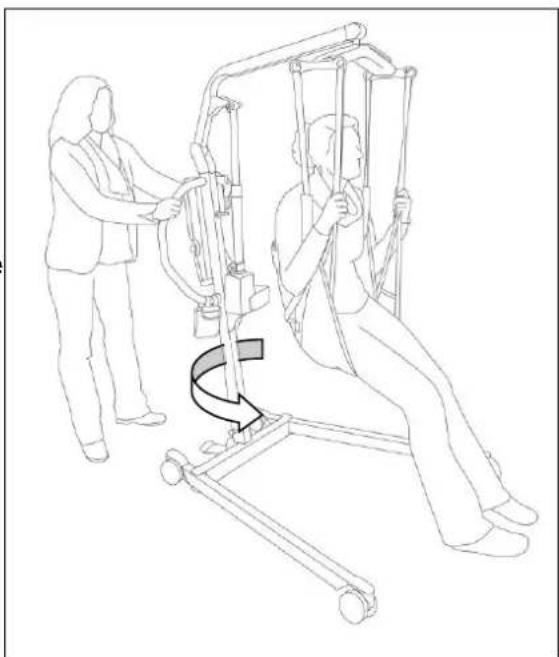
Turn the patient hoist carefully and slowly around his axle, so that the patient cannot swing out.
-
Open the legs of the patient hoist to give more stability.
-
Activate the brakes.
-
Place the patient in the patient hoist with the appropriate sling. (refer to sling manual for instructions of placing the patient in the hoist).
-
Lift the patient from the ground, chair, bed, ...
-
Loosen both brakes of the rear wheels.
-
Stand behind the patient hoist and grasp the handgrips (left and right next to the control box) with both hands.
-
Now turn the patient hoist carefully, slowly around
on the same place. Be careful you do not touch any objects with the legs of the patient hoist. - When you are turned in the good position, you can lift the patient down.
natural_image
Line drawing of a person using a rehabilitation machine with a curved arrow indicating rotation (no text or symbols)3.2 Slings

CAUTION
Risk of injuries
- Only use appropriate slings for the patients.
- Do not use damaged slings.
- Read the full slings manual first.
- Only use compatible slings approved by Vermeiren.
The patient hoist must only be used with slings designed for the Vermeiren Falcon patient hoists (for 4-point speader bar).
The applicability and instructions for use for the specific slings should be followed, see the separate manual.
3.2.1 Attaching to the spreader bar of the patient hoists
The slings shall be attached by the mounting straps. These mounting straps shall be suspended on the spreader bar of the patient hoist.
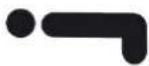
The mounting straps of the slings have 4 loops in different colors.

With these loops it is possible to lift the patient in different positions. These positions depends on the length and weight of the person.
Shoulders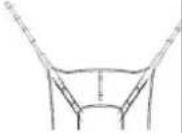 | Legs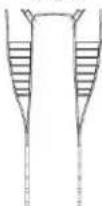 | Head(only by comfort sling)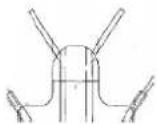 | ||
 | Green |  | Green | Green |
 | Red |  | Red | Red |
 | Yellow | 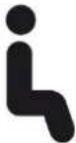 | Yellow | Yellow |
 | Black |  | Black | Black |
The legrests can be attached on the patient hoist according different methods.
- Crossed legrests
This is the most used method to attach the sling. The attachment of the sling with crossed legrests shall be according to the instructions below:
- Put the mounting strap of the legrest through the loop of the other legrest.
- Attach the mounting straps of the legrests on the spreader bar of the patient hoist.
• Crossed under both thighs
⚠️ CAUTION: Risk of falling - By a patient with amputated legs increases the risk of falling because the patient loose easy his balance.
This method can be used for lifting a patient with amputated legs. The attachment of the sling crossed under both thighs shall be according to the instructions below:
- Cross the mounting strap of the legrest under the thighs.
- Attach the mounting straps of the legrests on the spreader bar of the patient hoist.
• Each legrest separately on the spreader bar
⚠️ CAUTION: Risk of falling- This method increases the chance of sliding out the sling.
Attaching each legrest separately on the spreader bar can be used for patient with sensitive genitals. The attachment of the sling with this method shall be according instructions below:
- Put the legrest around each leg separately, but not crossed.
- Attach the mounting straps of the legrests on the spreader bar of the patient hoist.
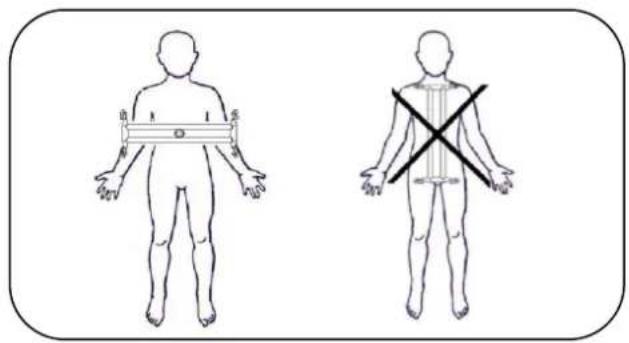
3.2.2 Position of spreader bar
The spreader bar must always be perpendicular to the body of the patient. The left figure is the good method. The right figure is the wrong way.
3.3 Battery and charging
3.3.1 Battery charger
| Primary voltage | 100 - 240VAC / 50/60 Hz |
| Safeguards | Protected against reverse polarisation, electrical surges and extreme temperature |
| Ambient temperature | 0 to +40°C |
| Length of mains lead | 2.0 m |
| Ambient storage temperature | -15° to +50°C |
| Relative storage humidity | max. 95% (non-condensing) |
| Conformity | tested in accordance with IEC 60601-1 |
3.3.2 Charging the batteries
Use only the control box with included battery charger.
We recommend that you should regularly recharge the batteries in order to ensure that the hoist remains usable and to extend the lifespan of the batteries. The control box will give a warning sound to tell you when the battery charge is low.
First use
First, insert the supply cable with the connector side into the appropriate connector on the control box. The plug side of the supply cable must be insert in the socket outlet. The loading time is about 24 hours.
Recharging
WARNING: Risk of injury – Do not use the lift when the supply cable is connected in the socket outlet.
When the battery is running low, only the left LED will light green. Once the battery level gets very low, the LED will light red and a beeping sound can be heard every 2 seconds.
The battery is fully charged once all LEDs are fully green.
After the recharging process is completed, you should always remove the mains plug from the socket first and then remove the connector plug from the control box.
Do not use the lift while it is being recharged!
If the batteries are not used for a significant period, they discharge slowly by themselves (deep discharge). It then becomes impossible to recharge them. You should therefore recharge the batteries at least once a month even if they are not being used.
3.4 Emergency
In cases for emergency the emergency stop and the function for lowering in an emergency must be used.
3.4.1 Emergency stop
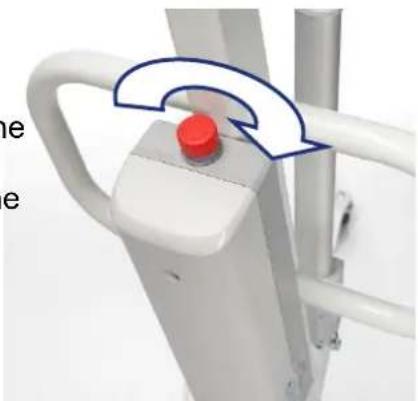
In emergencies, and during assembly and disassembly, the emergency stop is activated by pressing the red button on the control box.
Push the button and turn in the direction of the arrows. If the button is fully pressed to the back turn back in the opposite direction of the arrows.
The emergency stop is deactivated by turning the red button in the direction of the arrows.
natural_image
Close-up of a white industrial machine handle with a red knob and blue curved arrow indicating rotation (no text or symbols)3.4.2 Emergency lowering
⚠ WARNING: Risk of injury – Adjust the manual emergency lowering for the weight of the patient.
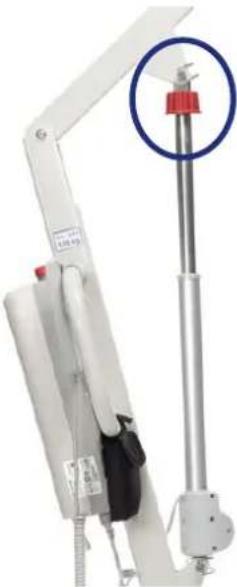
Emergency lowering if the power fails or the batteries are empty can be done by turning the red button at the upper end of the motor.
Please note that the manual emergency lowering is only possible when the patient is sitting in the patient hoist.
natural_image
Mechanical device with a red circular annotation highlighting a red component, no visible text or symbols4 Installation and adjustment
The patient hoist is delivered fully assembled by your specialist dealer.
The instructions in this chapter are for the specialist dealer.
To find a service facility or specialist dealer near you, contact the nearest Vermeiren facility.
WARNING: Risk of unsafe limitations - Use only the limitations described in this manual.
4.1 Delivery
The Vermeiren Falcon patient hoist shall be delivered with:
- chassis including 4 casters (2 with brakes)
- pole, including handles for pushing
- cantilever arm and spreader bar
• control box (incl. 2 accumulator batteries and manual operation) - battery charger
- motor
- instruction manual
Before use check if everything is included and that no products are damaged (example by transport, ...).
Please note that the basic configuration may vary from one European country to another. Please contact the specialist dealer in your country for more information.
4.2 Assembly or dismantling
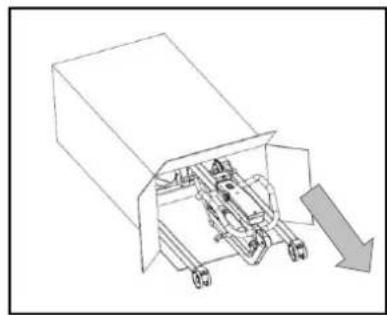
4.2.1 Unpacking
WARNING: Risk of injury - After unpacking and before further assembly, always first confirm that the emergency stop (the red pushbutton on the control box) is pressed in.
The patient hoist packaging has been selected to provide the best possible protection during transport.
natural_image
Technical line drawing of a mechanical assembly inside a box, showing internal components and a downward arrow (no text or symbols)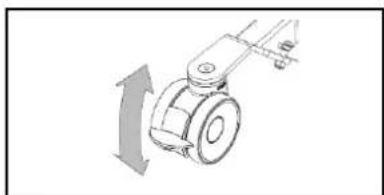
natural_image
Mechanical diagram showing a rotating component with an upward arrow indicating rotational motion (no text or symbols)-
Take all parts of the patient hoist out of the box and check that all the items have been delivered and that the individual parts do not have any visible defects. If there is any damage, please contact your sales office.
-
Before assembly, put on the caster brakes to make sure that the lift cannot be moved unintentionally. Push the caster brake plate down gently to its end stop with the front of your foot. To release the brake, push the brake plate gently back up again with the front of your foot until the caster is free.
4.2.2 Assembly
WARNING: Risk of clamping - Take care that no body parts and wires get trapped, crushed or cut during assembly.
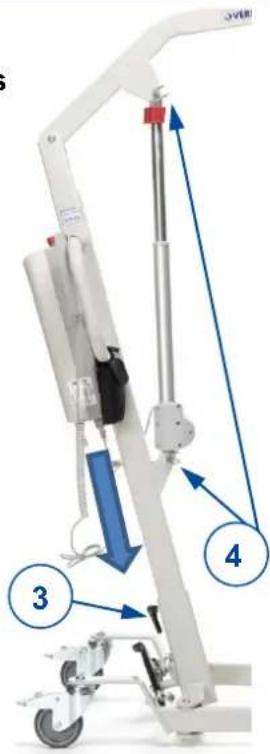
- Insert the vertical pole into the lower frame and tighten the lever securely.
- Place the motor in its attachments on the vertical pole and the hoist arm (4) and secure into place with the pins.
- For first use: Mount the control box to the vertical pole by tightening the two bolts.
4.2.3 Dismantling
WARNING: Risk of clamping - Take care that no body parts and wires get trapped, crushed or cut during dismantling.
WARNING: Risk of injury - Check the emergency stop (red pushbutton on the control box) is activated, to avoid unintentional adjustment movements.
-
Secure the two casters at the back of the chassis by pressing the caster brake plates down gently to their end stops with the tip of your foot. To release the brake, push the brake plate gently back up again with the front of your foot until the casters are free.
-
Release the motor from the hoist arm and vertical pole by removing the pins (4).
-
Remove the lever and take the vertical pole out of the lower frame.
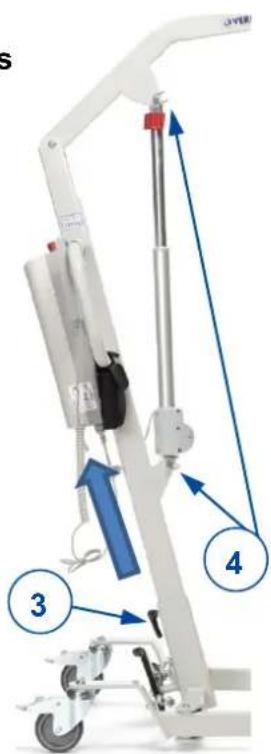
5 Maintenance
5.1 Time of maintenance

CAUTION
Risk of injuries and damage
Repairs and replacements may only be undertaken by trained persons and only genuine replacement parts of Vermeiren should be used (see the maintenance manual).
i
The last page of this manual contains a registration form for the specialist dealer to record each service.
The service frequency depends on the frequency and intensity of use. Contact your dealer to agree to a common timetable for inspection/maintenance/repair.
For the maintenance manual, refer to the Vermeiren website: www.vermeiren.com.
Before each use
Inspect the following points:
- All parts: present and undamaged or unworn.
• All parts: clean, see §5.3.
• Condition of frame parts: no deformation, instability, weakness or loose connections. - Brakes: no visible damage and/or dirt.
- Control box, manual control, battery charger, relevant cables: no damage such as wires that have become frayed, broken or exposed. Check that the electrical adjustment of the cantilever arm is working properly, using the manual control.
• Battery status: charge the battery when necessary, see §3.3.
Approx. every 8 weeks
Depending on the frequency of use, check the following:
• Lubrication of the joints of the cantilever arm
• Condition of the casters
- Whether there is any visible damage to the casing of the control box, battery, battery charger and the manual controls
• Whether the cables are fit for use
- Recharge the battery
Approx. every 6 months or for every new user
Depending on the frequency of use check the following:
- Cleanliness
- General condition
• That the battery charger is working - Casters are working
If the resistance to rotation is too great, clean the casters. If this is insufficient, please consult your dealer.
Yearly or more often
Have the patient hoist inspected and serviced by your specialist dealer, at least once a year, or more often. The minimum maintenance frequency depends on use and should therefore be commonly agreed upon with your specialist dealer.
5.2 Shipping and storage
- Shipping and storage should happen according to the technical specifications in §7. Make sure that the patient hoist is stored dry.
- Prevent cables from being crushed or bent with kinks.
- Disconnect the patient hoist from the socket.
- Provide sufficient covering or packaging to protect the patient hoist against rust and foreign bodies. (e.g. salt water, sea air, sand, dust).
- Store all removed parts together in one place (or mark them if necessary) to avoid mixing up with other products when re-assembling (e.g. the charger).
- Make sure no objects are stored on or against the patient hoist and its components to prevent damage.
5.3 Cleaning
CAUTION
Risk of damage by moisture
- Never use a hose or high-pressure cleaner.
- Use a mild commercial detergent to remove stubborn dirt.
• Stains can be removed by using a sponge or a soft brush.
• Do not use strong cleaning liquids like solvents, nor use hard brushes.
5.3.1 Plastic parts
Clean plastic parts of your patient hoist with commercial plastic cleaners. Read the specific product information and only use a soft brush or soft sponge.
5.3.2 Coating
The high quality of the surface layer guarantees optimal protection against corrosion. If the outer coat is damaged by scratching or in some other way, get your specialist dealer to repair the affected surface.
When cleaning, only use warm water and normal household detergents and soft brushes and cloths. Ensure that no wetness gets into the tubes.
5.3.3 Electronics casing
WARNING: Risk of injury - The emergency stop must be activated before maintenance work, so that no unintentional adjustment movements can be made.
Wipe the control box, motor casing and manual controls down with a cloth moistened by a few drops of a commercial domestic cleaner. Do not use abrasives or sharp-edged polishing equipment like a metal scrubber or brush, as these can scratch the surface of the manual control and destroy its water repelling property.
Regularly check the plug connectors for corrosion or damage, as these could affect the functional integrity of the electronics.
The manufacturer will not accept liability for damages caused by insufficient maintenance.
5.4 Disinfection
WARNING: Dangerous Products - The use of disinfectants is restricted to authorized personnel.
All parts of the patient hoist can be treated by scrubbing with a commercial disinfectant. Follow the instructions on the disinfectant.
Washing instructions for slings can be found in the slings manual and on the label of each sling.
5.5 Inspection
In principle we recommend one inspection every year, and a minimum of one before usage is resumed. All of the following checks must be performed and documented by authorized persons:
- Check the cabling (in particular for crushing, wear, cuts, visible parts of the insulation of the inner wires, visible metal wire cores, kinks, bulges, colour changes of the outer sleeve, brittle spots, and safe positioning so that mechanical effects such as being cut or crushed are not probable).
- Visual inspection of the frame parts to check for plastic deformation and/or wear and tear (frame, motor suspension, cantilever arm, spreader bar).
- Visually check for damage to the paintwork (danger of corrosion).
• Visual inspection of all casings for damage; screws must be tight.
- Verify the amount of grease on the metal joints of movable parts
• Visually check all plastic parts for cracks and brittle spots
- Review the control box + included charger residual discharge current (A) based on VDE 0702
• Review the control box + included charger insulation resistance (MO) based on VDE 0702
- Functional test of the cantilever arm (lubrication of the joint parts, range of adjustability, deformation, wear and tear)
- Check the functioning of the hoist drives (during a test drive → noises, speed, free running, etc.), if necessary: Measure the performance, first with no load and then with the nominal load ("SWL"), to investigate the wear and tear of the motors by comparing the values for the electric current against the values when it was delivered.
• Functional test of the emergency stop
• Functional test of the emergency lowering
• Completeness of the delivery condition, instruction manual available?
Checking measurements may only be carried out by skilled persons trained on the patient hoist at least and at least under the supervision of an electrician who knows the checking instruments and processes. Only an electrician can release the patient hoist for use after making the measurements and carrying out the servicing.
The service must only be signed off in the maintenance plan if a minimum of all the above-mentioned aspects have been checked.
5.6 Expected lifespan
The average lifespan of the patient hoist is 8 years. Depending on the frequency of use, storage, maintenance, servicing and cleaning, the lifespan of the patient hoist will increase or decrease.
5.7 Reuse
Before each reuse, have the patient hoist disinfected, inspected and serviced according to the instructions in this chapter.
5.8 End of use
At end of life, you need to dispose of the patient hoist according to the local environmental legislation. The best way to do so, is to disassemble the patient hoist to facilitate the transport of recyclable parts.
6 Troubleshooting
Table 1: Troubleshooting
| Problem | Cause of problem | Problem solving |
| Noisy sound of the moving parts (example: cantilever arm). | Lubrication is necessary. | Lubricate the moving parts.(Do not lubricate the actuator!) |
| Actuator makes an unusual sound. | The actuator is damaged. | Replace the actuator or contact your specialist dealer. |
| Patient hoist does not lift anymore. | 1. Electric actuator is damaged.2. The user weight is too high (overload LED on manual control lights up).3. Manual control or actuator are not connected.4. Battery not connected or not connected properly to control box.5. Battery too low.6. Emergency stop is activated. | 1. Replace the actuator.2. Use a patient hoist with higher maximum user weight.3. Check connections. If necessary connect manual control or actuator.4. Check battery is installed or the connection of the battery.5. Charge the batteries or replace.6. Deactivate the emergency stop. |
| Lowering the patient in case of emergency does not work. | There is required a minimum weight load to lower the patient. | If the patient weight is too low pull down slightly on the cantilever arms or adjust the lowering speed. |
| Battery cannot be charged | 1. Batteries not fitted correctly to control box.2. Mains cable defect.3. Batteries are defected.4. Control box with included charger is defected5. Battery charger is defected | 1. Check batteries are connected to the control box.2. Change mains cable.3. Replace battery.4. Replace control box with included charger.5. Replace new battery charger. |
7 Technical specifications
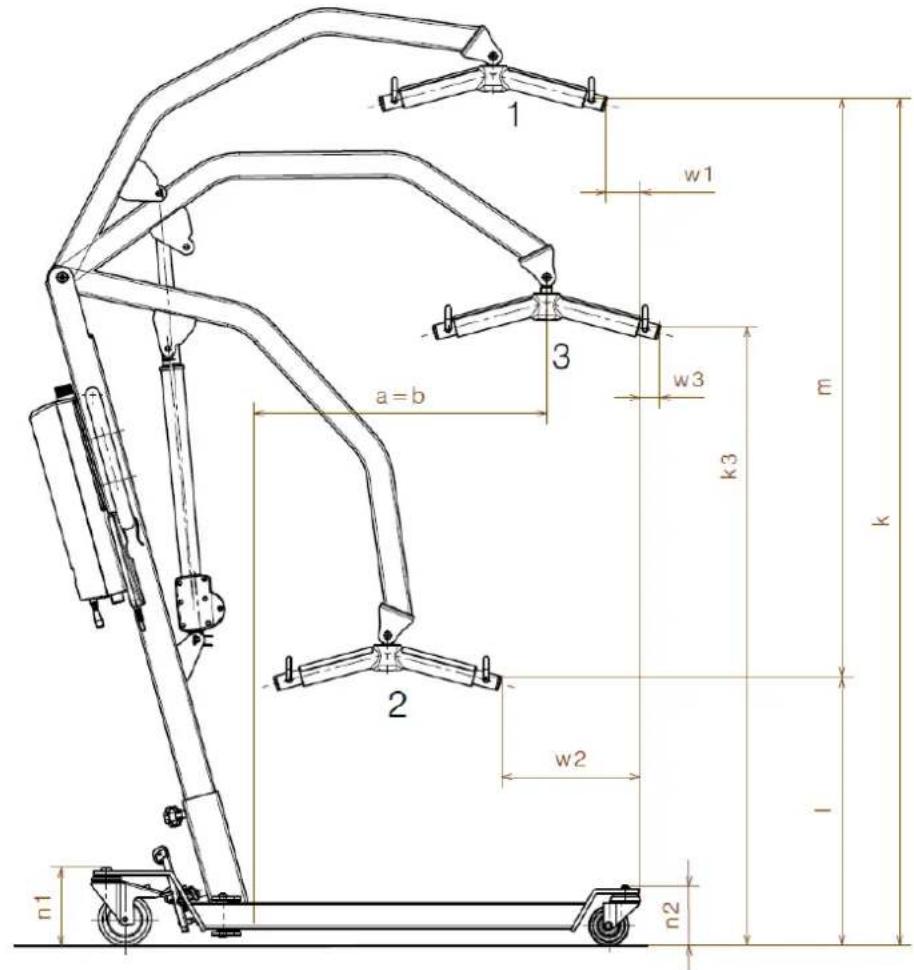
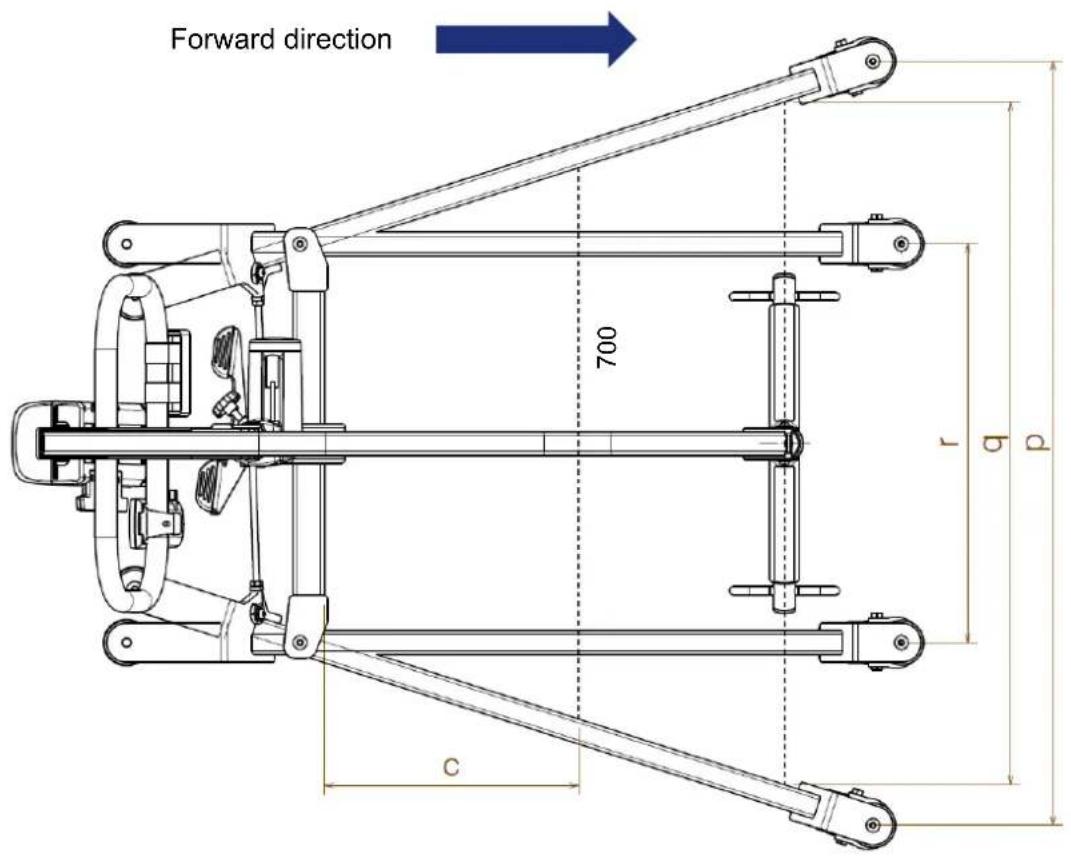
Table 2: Technical specifications
| Brand | Vermeiren |
| Type | Patient hoist |
| Model | Falcon |
| Description | Measurement in drawing | Dimensions |
| Lowest CAP position* | l | 509 mm |
| Highest CAP position* | k | 1609 mm |
| Lifting range (range of heights) | m | 1100 mm |
| Leg length | 1042 mm | |
| Total length | 1158 mm | |
| Minimum leg separation | r | 506 mm |
| Maximum leg separation | q | 970 mm |
| Leg height / Frame height | n1 | 149 mm |
| n2 | 112,5 mm | |
| Overall width (closed), external dimension | 565 mm | |
| Overall width (opened), castors forwards | p | 1026 mm |
| Folded length | 1236 mm | |
| Folded height | 294 mm | |
| Folded width | 565 mm | |
| Min. distance between wall / CSP* (maximum reach) | w3 | 36 mm |
| Min. distance between wall / CSP* (minimum height) | w2 | 263,5 mm |
| Min. distance between wall / CSP* (maximum height) | w1 | 65 mm |
| Turning circle | 1188 mm | |
| Total weight | 35 kg | |
| Weight of chassis | 16,5 kg | |
| Weight of control box + battery | 3 kg | |
| Weight of upper frame (cantilever arm / spreader bar + motor + control box) | 18,5 kg | |
| Maximum load | 130 kg | |
| Ground clearance | 15,5 mm | |
| Maximum reach at 600 mm | a | 557 mm |
| Maximum reach from support | b | 557 mm |
| Reach from support at separation 700 mm | c | 323 mm |
| Power outlet | 24V =max. 250 VA | |
| Operating temperature | +5 to +40°C | |
| Relative humidity | 20% to 80% at 30°C, non-condensing | |
| Noise level | < 54 dB(A) | |
| Control box | TiMOTION TC20 | |
| Battery | Not applicable |
| Brand | Vermeiren |
| Type | Patient hoist |
| Model | Falcon |
| Description | Measurement in drawing | Dimensions |
| Manual control | TiMOTION TH10 | |
| Motor | TiMOTION TA23 | |
| Control box protection class | IP54 | |
| Battery protection class | Not applicable | |
| Manual control protection class | IP54 | |
| Motor protection class | IP54 | |
| Insulation class | II - Type B | |
| Periodic operation | max. 10%, or 2 min. continuous operation/18 min. pauses | |
| Battery capacity | 2.9 Ah | |
| Emergency stop | Yes | |
| Manual lowering in emergency | yes | |
| Electrical lowering in emergency | No | |
| We reserve the right to introduce technical changes. Measurement tolerance ± 15 mm / 1,5 kg / 1,5° | ||
1 = Highest position, 2 = Maximum reach, 3 = Lowest position
* CSP = Central suspension point
Table des matières
natural_image
Mechanical assembly diagram showing a cart with wheels and directional arrows indicating motion (no text or symbols)natural_image
Close-up of a metallic mechanical component with a blue upward arrow indicating vertical motion (no text or symbols)① = Soulever la potence
② = Abaisser la potence
natural_image
Line drawing of a person using a rehabilitation machine with a curved arrow indicating rotation (no text or symbols)3.2 Sangles

AVERTISSEMENT
natural_image
Two human body diagrams showing different positions of a bandage, one with a cross symbol and the other with a horizontal bar (no text or labels)natural_image
Close-up of a white industrial machine handle with a red knob and blue curved arrow indicating rotation (no text or symbols)natural_image
Mechanical robotic arm with a red circular component inserted, no visible text or symbolsnatural_image
Diagram of a mechanical assembly inside a box with a downward arrow indicating motion (no text or symbols)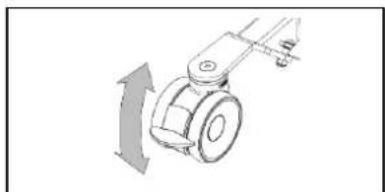
natural_image
Mechanical device with rotational arrow indicating motion (no text or symbols)natural_image
Mechanical assembly diagram showing a cart with wheels and directional arrows indicating motion (no text or symbols)natural_image
Close-up of a metallic mechanical component with a blue upward arrow indicating vertical displacement (no text or symbols)natural_image
Line drawing of a person using a leg exercise machine with a curved arrow indicating rotation (no text or symbols)3.2 Tilbanden

VOORZICHTIG
Gevaar voor letsel
natural_image
Two human body diagrams showing different postures of a medical device, one with a band and the other with a cross (no text or symbols)3.3 Batterij en laden
3.3.1 Batterijlader
natural_image
3D rendering of a white industrial machine with a red button and blue curved arrow indicating rotation or motion (no text or symbols)3.4.2 Neerlaten in noodsituaties
natural_image
Mechanical device with a red circular component and white frame, no visible text or symbols4 Montage en afstelling
natural_image
Technical illustration of a mechanical device with internal components and directional arrows indicating motion (no text or symbols)natural_image
Mechanical assembly diagram showing a cart with wheels and directional arrows indicating motion (no text or symbols)natural_image
Close-up of a metallic mechanical component with a blue upward arrow indicating vertical motion (no text or symbols)natural_image
Line drawing of a person using a leg exercise machine with a curved arrow indicating motion (no text or symbols)
3.2 Sitzsystem

WARNUNG
Verletzungsgefahr
natural_image
Two human body diagrams showing different postures of a physical or medical device, one with horizontal bars and the other with a cross (no text or symbols)natural_image
Close-up of a white industrial machine handle with a red button and blue curved arrow indicating rotation (no text or symbols)3.4.2 Manuelle Notabsenkung
natural_image
Mechanical device with a red circular annotation highlighting a component, no visible text or symbolsDE
natural_image
Technical line drawing of a mechanical device with internal components and directional arrows indicating motion (no text or symbols)DE
5 Wartung
5.1 Wartungstermine
VORSICHT
natural_image
Mechanical assembly diagram showing a cart with wheels and directional arrows indicating motion (no text or symbols)natural_image
Close-up of a metallic mechanical component with a blue upward arrow indicating vertical displacement (no text or symbols)natural_image
Line drawing of a person using a rehabilitation machine with a curved arrow indicating rotation (no text or symbols)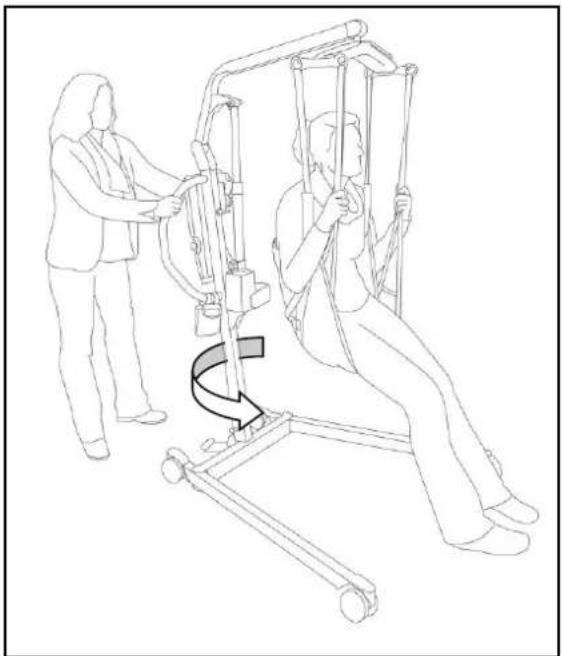
natural_image
Line drawing of a person using a rehabilitation machine with a curved arrow indicating rotation (no text or symbols)natural_image
Two human body diagrams showing different postures of a medical device, one with horizontal bars and the other with a cross (no text or symbols)natural_image
Close-up of a white industrial machine handle with a red button and blue curved arrow indicating rotation (no text or symbols)natural_image
Mechanical robotic arm with a red circular annotation highlighting a specific component (no text or symbols visible)natural_image
Mechanical assembly diagram showing a cart with wheels and a lever mechanism (no text or symbols)natural_image
Close-up of a metallic mechanical component with a blue upward arrow indicating vertical displacement (no text or symbols)
natural_image
Line drawing of a person using a leg exercise machine with a curved arrow indicating rotation (no text or symbols)natural_image
Two human body diagrams showing different postures of a physical or medical device, with no text or symbols present.3.3 Batería y carga
natural_image
Close-up of a white industrial machine handle with a red button and blue curved arrow indicating rotation or adjustment (no text or symbols)natural_image
Close-up of a robotic arm with a red circular annotation highlighting a specific component (no text or symbols visible)natural_image
Technical line drawing of a mechanical device with internal components and directional arrows indicating motion (no text or symbols)
4.2.3 Desmontaje
5 Mantenimiento
natural_image
Mechanical assembly diagram showing a cart with wheels and a lever mechanism (no text or symbols)natural_image
Close-up of a metallic mechanical component with a blue upward arrow indicating vertical displacement (no text or symbols)natural_image
Line drawing of a person using a leg exercise machine with a curved arrow indicating motion (no text or symbols)natural_image
Two human body diagrams with bandages and a cross symbol, no text or labels presentnatural_image
Close-up of a white industrial machine handle with a red button and blue curved arrow indicating rotation (no text or symbols)natural_image
Close-up of a white robotic arm with a red circular annotation highlighting a red component, no visible text or symbols.5 Konserwacja
natural_image
Mechanical assembly diagram showing a cart with wheels and directional arrows indicating motion (no text or symbols)natural_image
Close-up of a metallic mechanical component with a blue upward arrow indicating vertical displacement (no text or symbols)natural_image
Line drawing of a person using a mobility device with a curved arrow indicating motion (no text or symbols)3.2 Závěsy

POZOR
Riziko zranění
natural_image
Close-up of a white industrial machine handle with a red button and blue curved arrow indicating rotation or adjustment (no text or symbols visible)
natural_image
Mechanical device with a red circular annotation highlighting a component, no visible text or symbolsnatural_image
Technical line drawing of a mechanical assembly with no visible text or symbols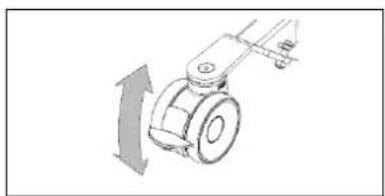
natural_image
Mechanical component diagram showing a rotating arm with directional arrow (no text or symbols)Service registration form
This product (name): ....
was inspected (I), serviced (S), repaired (R) or disinfected (D):
| By (stamp):Kind of work: I / S / R / DDate: | By (stamp):Kind of work: I / S / R / DDate: | By (stamp):Kind of work: I / S / R / DDate: |
| By (stamp):Kind of work: I / S / R / DDate: | By (stamp):Kind of work: I / S / R / DDate: | By (stamp):Kind of work: I / S / R / DDate: |
| By (stamp):Kind of work: I / S / R / DDate: | By (stamp):Kind of work: I / S / R / DDate: | By (stamp):Kind of world: I / S / R / DDate: |
| By (stamp):Kind of work: I / S / R / DDate: | By (stamp):Kind of work: I / S / R / DDate: | By (stamp):Kind of work: I / S / R / DDate: |
| By (stamp):Kind of work: I / S / R / DDate: | By (stamp):Kind of work: I / S /R / DDate: | By (stamp):Kind of work: I / S / R / DDate: |
| By (stamp):Kind of work: I / S / R / DDate: | By (stamp):Kind of work: I / S / R / DDate: | By (stamp):Kind of work: I / S / R / DDate: |

Vermeiren GROUP
Vermeirenplein 1 / 15
2920 Kalmthout
BE
website: www.vermeiren.com

- EN
- Instructions for specialist dealer
- FR
- Contents
- Contents....1
- Preface....2
- Your product....3
- Before use 4
- Using the patient hoist 5
- Installation and adjustment....11
- Maintenance....13
- Troubleshooting....16
- Technical specifications....17
- Preface
- Important note
- Information available
- Your product
- Before use
- Intended use
- General safety instructions
- CAUTION
- Using the patient hoist
- Operating the lift
- Altering the chassis width
- Parking brakes
- Raising and lowering the cantilever arm
- Lowering button
- Moving the patient hoist
- Turn the patient hoist around his axle
- Slings
- Risk of injuries
- Attaching to the spreader bar of the patient hoists
- ⚠️ CAUTION: Risk of falling - By a patient with amputated legs increases the risk of falling because the patient loose easy his balance.
- ⚠️ CAUTION: Risk of falling- This method increases the chance of sliding out the sling.
- Position of spreader bar
- Battery and charging
- Battery charger
- Charging the batteries
- First use
- Recharging
- WARNING: Risk of injury – Do not use the lift when the supply cable is connected in the socket outlet.
- Emergency
- Emergency stop
- Emergency lowering
- Installation and adjustment
- Delivery
- Assembly or dismantling
- Unpacking
- Assembly
- Dismantling
- Maintenance
- Time of maintenance
- Before each use
- Approx. every 8 weeks
- Yearly or more often
- Shipping and storage
- Cleaning
- Plastic parts
- Coating
- Electronics casing
- Disinfection
- Inspection
- Expected lifespan
- Reuse
- End of use
- Troubleshooting
- Technical specifications
- Table des matières
- Sangles
- AVERTISSEMENT
- Tilbanden
- VOORZICHTIG
- Gevaar voor letsel
- Batterij en laden
- Batterijlader
- Neerlaten in noodsituaties
- Montage en afstelling
- Sitzsystem
- WARNUNG
- Verletzungsgefahr
- Manuelle Notabsenkung
- DE
- Wartung
- Wartungstermine
- VORSICHT
- Batería y carga
- Desmontaje
- Mantenimiento
- Konserwacja
- Závěsy
- Service registration form
Brand : Vermeiren
Model : Falcon
Category : Chair