AVI98AC3ZI - Wine cellar AVINTAGE - Free user manual and instructions
Find the device manual for free AVI98AC3ZI AVINTAGE in PDF.


| Product type | Integrated column triple-compartment wine cellar |
| Brand | Avintage |
| Model | AVI98AC3ZI |
| Maximum capacity | 97 bottles (75 cl Bordeaux type) |
| Height (mm) | 1788 |
| Width (mm) | 595 |
| Depth (mm) | 624 |
| Net volume (L) | 246 |
| Climate class | N/ST (16 °C to 32 °C) |
| Temperature range upper zone | 5 °C to 20 °C |
| Temperature range middle zone | 5 °C to 10 °C |
| Temperature range lower zone | 10 °C to 20 °C |
| Refrigerant | R600a (isobutane), 55 g |
| Power supply | 220-240 V / 50 Hz |
| Annual energy consumption | 162 kWh/year |
| Maximum power | 165 W |
| Lighting | Interior LED with timer (10 min) or permanent |
| Number of shelves | 10 (including 1 presentation shelf) |
| Door reversibility | Yes, possible from right to left |
| Special functions | Anti-vibration, anti-UV, humidification system, temperature alarm, temperature memory |
| Defrosting | Automatic |
| Parts warranty | 1 year |
| Recommended cleaning | Warm water and mild detergent, no solvents or abrasives |
Frequently Asked Questions - AVI98AC3ZI AVINTAGE
User questions about AVI98AC3ZI AVINTAGE
0 question about this device. Answer the ones you know or ask your own.
Ask a new question about this device
Download the instructions for your Wine cellar in PDF format for free! Find your manual AVI98AC3ZI - AVINTAGE and take your electronic device back in hand. On this page are published all the documents necessary for the use of your device. AVI98AC3ZI by AVINTAGE.
USER MANUAL AVI98AC3ZI AVINTAGE
natural_image
Interior view of a double-b longevity wine cabinet with multiple wine bottles on shelves (no visible text or labels)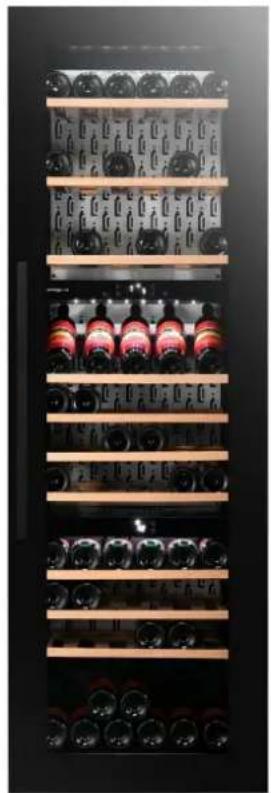
natural_image
Interior view of a multi-level wine storage cabinet with shelves stocked with bottles (no visible text or labels)FR - MANUEL D'UTILISATION p. 3
GB - USE INSTRUCTIONS p. 29
text_image
Technical diagram of a device with labeled components and an inset cross-section showing internal structure and assembly details.natural_image
Simple geometric shapes on dark background: a gray square, two white squares with plus and minus symbols (no text or labels)1) “ ○ ” témoin lumineux
natural_image
Technical line drawing of a refrigerator interior showing internal shelves and door frame, labeled Fig. A (no text or symbols on diagram)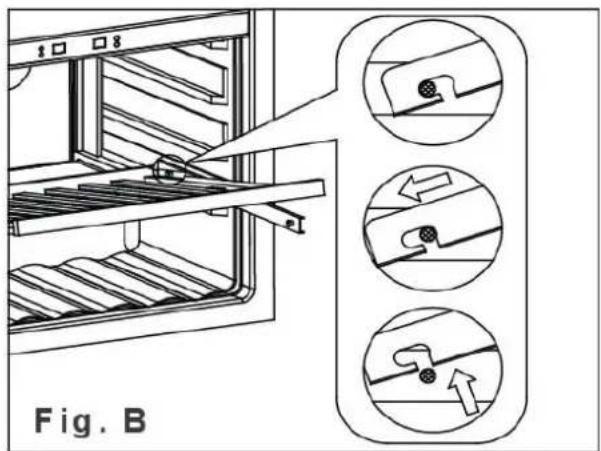
text_image
Fig. B6. CHARGEMENT
Before use, please read and follow the safety rules and operating instructions in this manual.
Firstly, we would like to thank you for purchasing an AVINTAGE product and hope that this appliance fully lives up to your expectations.
This appliance enables you to bring your bottles at room temperature or bring them to service temperature (depending on the bottles) thanks to its wide adjustment range.
1. GENERAL SAFETY INSTRUCTIONS
Before you use your appliance for the first time, please read this user manual carefully. Store it carefully so that you can refer to it in the future, if necessary. To reduce the risk of fire, electrical shock, or injury when using your appliance, follow these basic precautions.
Generally speaking, your appliance must be maintained by a qualified professional.
For your safety and correct usage, before installing and first using the appliance, read this user manual carefully, including its hints and warnings. To avoid unnecessary mistakes and accidents or to avoid damage to the appliance, it is important to make sure that all people using the appliance are thoroughly familiar with its operation and safety features. Save these instructions and be sure that they remain with the appliance if it is moved or sold, so that anyone using it throughout its life will be properly informed on its usage and safety notices. This will ensure optimum operation of the appliance.
For the safety of life and property and to avoid any risk of injury, keep the precautions of these user's instructions as the manufacturer is not responsible for damages caused by omission.
This appliance is intended exclusively for domestic use and is intended for the storage of special drink products at a storage temperature higher than that of a storage compartment for fresh products. Under no circumstances is it intended to keep food products fresh.
Make sure that your electrical installation's voltage corresponds to that on the appliance's nameplate; the appliance must be connected to an approved, earthed system. Incorrect repairs or connections can cause safety hazards. Have your electrical installation checked by a professional, if you are in any doubt.
This unit must be correctly connected to an earthed socket for your protection. Do not cut off or remove the earth wire on the mains cable supplied.
For safety reasons, do not use an electrical extension cable.
If your appliance is damaged (e.g. a major impact) or suffers harm (power surge due to lightning, flood, fire), it may be dangerous to use. Disconnect the mains plug and have the appliance checked by an approved professional repairer.
To prevent any danger, do not replace a damaged mains cable yourself. Contact your retailer, an approved service center or professional repairer.
This appliance must be positioned such that the mains socket is accessible. Do not move the appliance once it is full: you might distort its body beyond repair. The electrical parts must not be directly accessible.
√ Keep children away from the appliance.
√ Do not use this appliance outdoors.
In the event that liquid is accidentally spilled (broken bottle, etc.) on electrical components (motor, etc.), disconnect the mains plug immediately.
To prevent any risk of fire, electrocution or injury, do not immerse the mains cable, plug or the appliance itself in water or any other liquid. Do not handle the appliance with wet hands.
Keep the appliance away from any source of heat and out of direct sunlight.
Do not allow the mains cable to hang from a table or be in contact with sharp edges or hot surfaces.
Do not pull on the mains cable - take hold of the plug to disconnect the appliance.
Ensure that the area where your appliance is positioned can support its weight when loaded (a 75 cl bottle weighs approximately 1.3 kg). Your cellar must be placed on a flat surface. If you have to position it on a rug or carpet, place a support underneath.
To prevent damaging the door gasket, make sure the door is fully open when pulling shelves out of the rail compartment.
Safety of children and other vulnerable persons
- This appliance can be used by children aged from 8 years and above, and by persons with reduced physical, sensory or mental capabilities or lack of experience and knowledge if they have been given supervision or instruction concerning use of the appliance in a safe way and understand the hazards involved.
- User cleaning and servicing operations should not be carried out by children, unless they are more than 8 years old and are supervised.
- Keep all packaging away from children as there is risk of suffocation.
- Risk of child entrapment. Child entrapment and suffocation are
not problems of the past. Junked or abandoned appliances are still dangerous, even if they will “just sit in the garage a few days”.
- If you are discarding the appliance, pull the plug out of the socket, cut the connection cable (as close to the appliance as you can) and remove the door to prevent children playing from suffering an electric shock or from closing themselves inside it.
- If this appliance, featuring a magnetic door seals, is to replace an older appliance having a spring lock (latch) on the door or lid, be sure to make the spring lock unusable before you discard the old appliance. This will prevent it from becoming a death trap for a child.
- Keep the appliance and its power cable out of reach of children less than 8 years old.
- Before you throw away your old wine cooler: take off the door. Leave the shelves in place so that children may not easily climb inside.
- Children should be supervised to ensure they do not play with the appliance.
- Note: Children aged from 3 to 8 years are allowed to load and unload the appliance.
General safety
WARNING — This appliance is intended to be used in household and similar applications such as:
√ Staff kitchen areas in shops, offices and other working environments,
√ Farm houses and by clients in hotels, motels and other residential type environments,
√ Bed and breakfast type environments,
√ Catering and similar non-retail applications.
WARNING — To avoid a hazard due to instability of the appliance, it must be fixed in accordance with the instructions.
WARNING — Do not store explosive substances such as aerosol cans with a flammable propellant in this appliance, as they could leak or release fluids.
WARNING — If the supply cord is damaged, it must be replaced by the manufacturer, its service agent or similarly qualified persons in order to avoid a hazard.
WARNING — Keep ventilation openings, in the appliance enclosure or in the built-in structure, clear of obstruction and ensure that air can circulate, especially if the appliance is recessed into a wall.
WARNING — Do not use mechanical devices or other means to accelerate the defrosting process, other than those recommended by the manufacturer.
WARNING — Do not damage the refrigerant circuit.
WARNING — Do not use electrical appliances inside the storage compartments of the appliance, unless they are of the type recommended by the manufacturer.
WARNING — The refrigerant and insulation blowing gas are flammable. When disposing of the appliance, do so only at an authorized waste disposal center. Do not expose to flame.
WARNING — The refrigerant of these appliances is R600a, flammable and explosive articles should not be put in or near the cabinet, to avoid the fire or explode caused.
Refrigerating fluid
The refrigerating circuit in the appliance uses refrigerating isobutene (R600a), which is a highly inflammable natural gas and is therefore dangerous for the environment. When transporting or installing the appliance, ensure that no element of the refrigerating circuit is damaged. The refrigerating fluid (R600a) is inflammable.
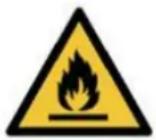
Caution: risk of fire
If the refrigerant circuit should be damaged:
√ Avoid opening flames and sources of ignition.
√ Thoroughly ventilate the room in which the appliance is situated. It is dangerous to alter the specifications or modify this product in any way.
Any damage to the cord may cause a short circuit, fire, and/or electric shock.
Electrical safety
- We decline any liability in respect of incidents caused by poor electrical installation.
- The power cord must not be lengthened. Do not use an extension cable, or adapter, or multi-way socket.
- Make sure that the power plug is not crushed or damaged. A crushed or damaged power plug may overheat and cause a fire.
- Make sure that you can access the main plug of the appliance.
- Do not pull the main cable.
- Ensure that the appliance is always electrically earthed.
- If the power plug socket is loose, do not insert the power plug. There is a risk of electric shock or fire.
-
You must not operate the appliance without the interior lighting lamp cover.
-
The cellar is only applied with power supply of single phase alternating current of 220\~240V/50Hz.
- Do not attempt to replace a damaged power cable, contact your after-sales service.
- The power socket must be easily accessible but out of reach of children. In case of doubt, contact your installation technician.
Daily use
- This appliance is intended to be used exclusively for the storage of wine.
- Do not store flammable gas or liquids in the appliance. There is a risk of an explosion.
- Do not operate any electrical appliances in the appliance (electric ice cream makers, mixers etc.).
- When unplugging always pull the plug from the mains socket and do not pull on the cable.
- Do not place hot items near the plastic components of this appliance.
- The appliance manufactures storage recommendations should be strictly adhered to. Refer to relevant instructions for storage.
- Keep burning candles lamps and other items with naked flames away from the appliance so that do not set the appliance on fire.
- The appliance is intended for keeping beverages in normal household as explained in this instruction booklet.
- The appliance is heavy. Care should be taken when moving it. If your appliance is equipped with castors, remember that these are only designed to facilitate minor movements. Do not move the appliance over long distances.
- Never use the base, drawers, doors etc. to stand on or as supports.
- To avoid items falling and causing injury or damage to the appliance, do not overload the door racks or put food into the appliance.
Caution: cleaning and servicing
- Before carrying out servicing, switch off the power supply and disconnect the appliance.
- When cleaning the appliance, do not use metal objects, steam systems, volatile fluids, organic solvents or abrasive substances.
- Never clean appliance parts with flammable fluids. The fumes can create a fire hazard or explosion.
- Do not use sharp or pointed objects to remove ice. Use a plastic scraper.
Important information concerning installation
- It is intended to be used exclusively for the storage of wine.
- This refrigerating appliance is not suitable for the freezing foodstuffs.
- The wine cooler is recommended to be designed at 12^ .
- The shelves placed in factory mode is the most efficient use of energy for the refrigerating appliances.
- Avoid locating the unit in moist areas.
- Keep the appliance away from direct sunlight and sources of heat (stove, heater, radiator, etc.). Direct sunlight may affect the acrylic coating and heat sources may increase electrical consumption. Extreme cold or hot ambient temperatures may also cause the appliances not to perform properly.
- Plug the wine cooler into an exclusive, properly installed-grounded wall outlet. Do not under any circumstances cut or remove the third (ground) prong from the power cord. Any
questions concerning power and/or grounding should be directed toward a certified electrician or an authorized products service center.
- To ensure proper electrical connection, follow the recommendations given in the present manual.
- Unpack the appliance and visually check that it is not damaged. Do not connect a damaged appliance. Inform your retailer or point of sale of any damage. In such a case, keep the packaging.
- It is recommended that the appliance be allowed to settle for at least 24 hours before connecting the electrical power supply, so that the compressor fluid feed is correct.
- Proper air circulation is necessary to avoid overheating. To ensure sufficient ventilation, observe the installation recommendations provided.
- In order to avoid fire risk, wherever possible, ensure that the appliance is not in contact with walls or with any hot element (compressor, condenser). Observe the installation recommendations.
- The appliance should not be placed close to radiators or cooking hot plates or gas rings.
- Check that electrical sockets remain accessible when the appliance is installed.
- When positioning the appliance, ensure the supply cord is not trapped or damaged.
Power saving
To limit the electricity consumption of your appliance:
√ Install it in an appropriate place (see “Installation instructions”).
√ Leave the doors open as little time as possible.
√ To ensure that the appliance operates properly, clean the
condenser regularly (see "Maintenance").
√ Regularly inspect the door seals and ensure that they are still closing properly. If this is not the case, contact your after-sales service.
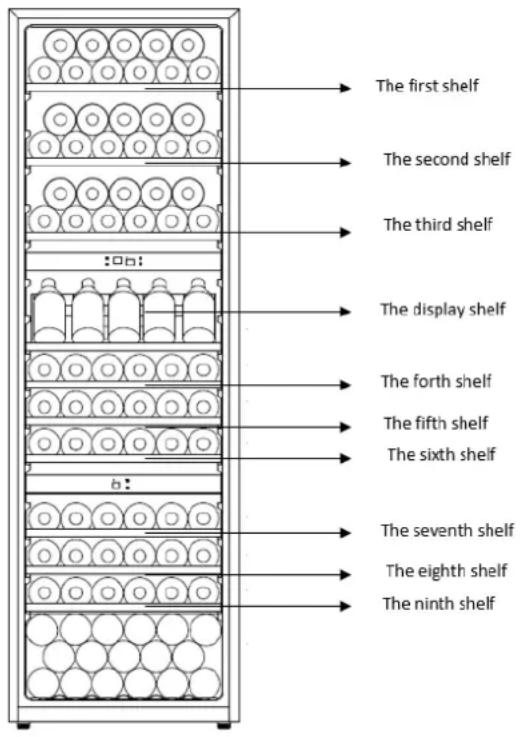
√ The following combination of shelves is recommended for energy to be used as efficiently as possible by the refrigeration unit. There are four shelves and one display shelf in total.
text_image
The first shelf The second shelf The third shelf :□: The display shelf The forth shelf The fifth shelf The sixth shelf b: The seventh shelf The eighth shelf The ninth shelf√ The appliance's thermostat is electronic and allows you to set the temperature between 5 and 20 degrees.
For wine storage, it is recommended that you set your appliance to 12 degrees.
This temperature can be adapted according to the type of wine stored.
Setting the temperature above 12 degrees will reduce the energy consumption of the appliance.
Setting the temperature below 12 degrees will increase the energy consumption of the appliance. Some models allow you to set different temperature levels in the same cellar. The appliance ensures that the temperature is maintained as long
as it is in operation and used under normal conditions.
The temperature inside the appliance can be influenced by many factors: room temperature, exposure to the sun, number of door openings and the number of bottles stored... Slight changes in temperature are perfectly normal.
Trouble shooting
- Any electrical work should be carried out by a qualified and skilled technician.
- The appliance should be repaired by an accredited repair centre, using only manufacturer's original spare parts.
The appliance is designed for home use only. The manufacturer declines any liability whatsoever in the case of other use.
R600a
Safety instructions
- Caution — Do not obstruct the ventilation grills on the appliance. Keep ventilation openings in the appliance enclosure or in the structure for building-in clear of obstruction.
- Caution — Do not store explosive substances, such as aerosol cans containing an inflammable propellant, in the appliance.
- Caution — Do not damage the refrigerating circuit in the appliance.
- Caution — The refrigerating units use isobutane (R600a), and should not be placed close to ignition sources (for example, electrical contacts that are exposed or open contacts that could be closed by the refrigerating fluid in the event of a leak). The refrigerating fluid type is specified on the power cabinet identification plate.
- Caution — Do not use electrical equipment in the compartments of the appliance, unless they are of the type recommended by the manufacturer.
This appliance meets the requirements of all applicable European directives and their amendments.

text_image
CEEPREL
To find out more about your product, consult the online EPREL database. As defined in Commission Delegated Regulation (EU) 2019/2016, all information relating to this refrigeration appliance is available on the EPREL Base (European Product Database for energy labeling). This database enables you to consult the information and technical documentation of your refrigeration appliance. You can access the EPREL Database by scanning the QR code on the energy label of your appliance or by going directly to: www.ec.europa.eu and searching the reference of your refrigeration appliance.
2. TECHNICAL DATA
Below is an example of the nameplate:
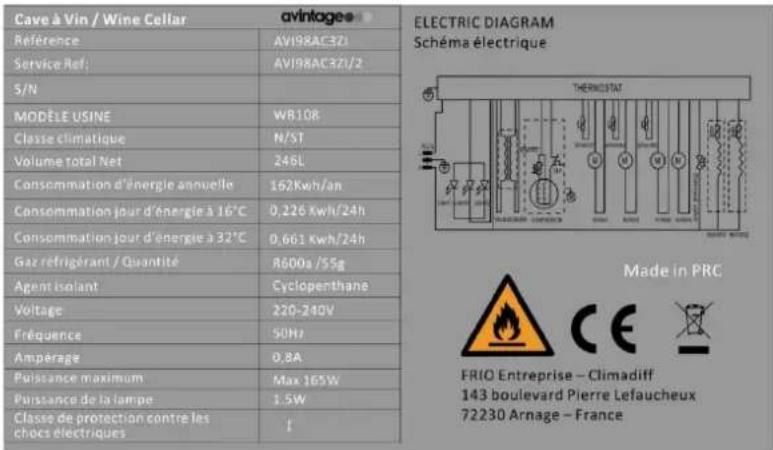
The nameplate attached to the inside or rear of the appliance (depending on the model) includes the entire information specific to your appliance.
We recommend that you make a note of its serial number in this booklet prior to installation, so that you can refer to it later (technical work, request for assistance, etc.).

natural_image
Empty rectangular frame with black border (no text or symbols)Once the appliance is installed and loaded, access to it is not so easy.
CAUTION: no assistance can be provided without this information.
3. INSTALLATION INSTRUCTIONS
Before using this appliance
- Remove the exterior and interior packing.
- Before connecting the appliance to the power source, let it stand upright for approximately 24 hours. This will reduce the possibility of a malfunction in the cooling system from handling during transportation.
- Clean the interior surface with lukewarm water using a soft cloth.
- When disposing your appliance, please choose an authorized disposal site.
- Place your wine cooler on a floor that is strong enough to support it when it is fully loaded. To level your Wine cooler, adjust the front leveling leg at the bottom of the wine cooler.
- Adequate ventilation is required, do not block the front air outlet.
- Not designed for placement in adage or basement.
- The appliance is for indoor use only.
- This device is designed to be incorporated into fitted kitchen units.
- Connect the cellar to a single socket and be careful to support it, so that your wine cellar is perfectly level (use of a spirit level is recommended). This will prevent any movement due to instability, causing noise and vibration, and will ensure that the door seals perfectly.
- This appliance is intended to be used exclusively for the storage of wine.
- This appliance is using flammability refrigerant. So never damage the cooling pipe work during the transportation.
Attention
- Store wine in sealed bottles.
- Do not overload the cabinet.
- Do not open the door unless necessary.
- Do not cover shelves with aluminum foil or any other shelf material which may prevent air circulation.
- Should the wine cooler be left empty for long periods it is suggested that the appliance is unplugged, and after careful cleaning, leave the door ajar to allow air to circulate inside the cabinet in order to avoid possible condensation, mold or odors forming.
CAUTION: please keep the appliance away from substance, which can cause ignition.
Ambient room temperature limits
This appliance is designed to operate in ambient temperatures specified by its temperature class marked on the rating plate.
| CLASS | SYMBOL | AMBIENT TEMPERATURES RANGE (°C) |
| Extended temperate | SN | From +10 to +32 |
| Temperate | N | From +16 to +32 |
| Subtropical | ST | From +16 to +38 |
| Tropical | T | From +16 to +43 |
This refrigerating appliance is intended to be used at ambient temperatures ranging from 16 °C to 32 °C
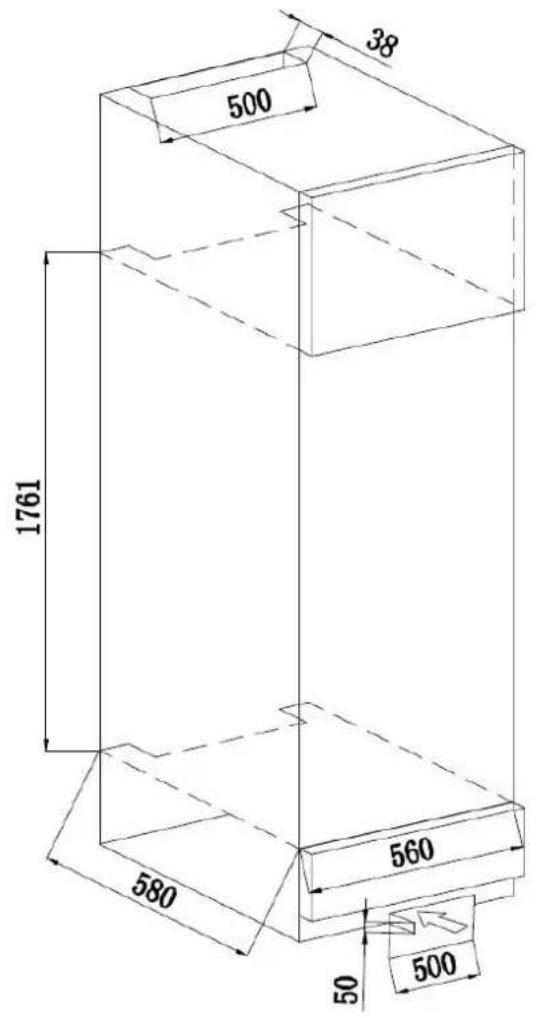
Built-in installation drawing
The wine cooler door seals the installed unit almost completely.
CAUTION: for all of these models, please take into consideration the clearances required for air intake and exhaust.
Hot air must be driven by the ventilation to the rear wall of the cellar and then expelled upwards. The ventilation channels shall be at least 200 square centimeters in cross-section.
Warning: to ensure proper operation, the ventilation grilles must never be obstructed or covered.
text_image
1761 500 38 580 560 50 500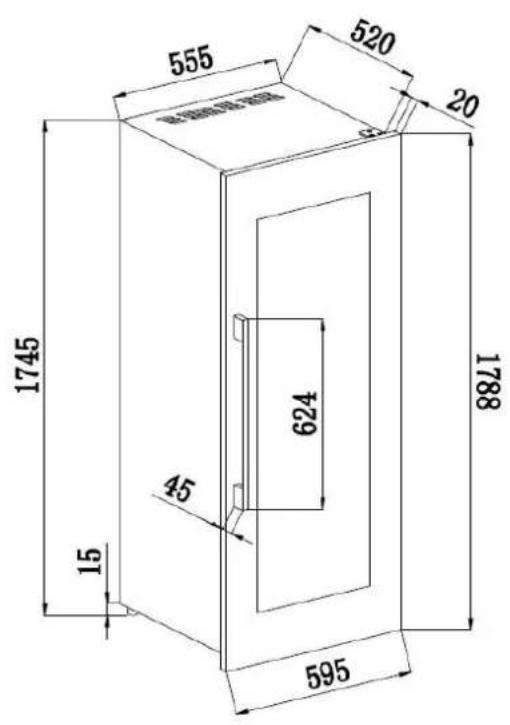
text_image
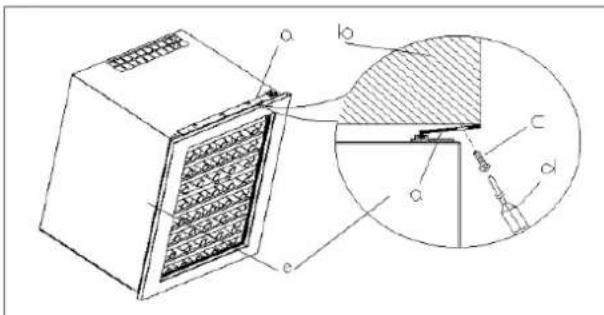
555 520 20 1745 624 1788 45 15 595- After installed wine cellar into cooler, please adjust limited block (a) close to the kitchen cabinet (b).
- Please fix the 3 pcs screws through the limited block (a) screw hold into the kitchen cabinet (b), please find below picture for reference.
text_image
Technical diagram of a device with labeled components and cross-sectional viewa. Limited block
b. Kitchen cabinet
c. Screw
d. Screwdriver
e. Wine cooler
Reversing the door
The door can be changed from left and right side. No special requirement, all the door is opened from left side. If require to open from right side please refer to the following direction:
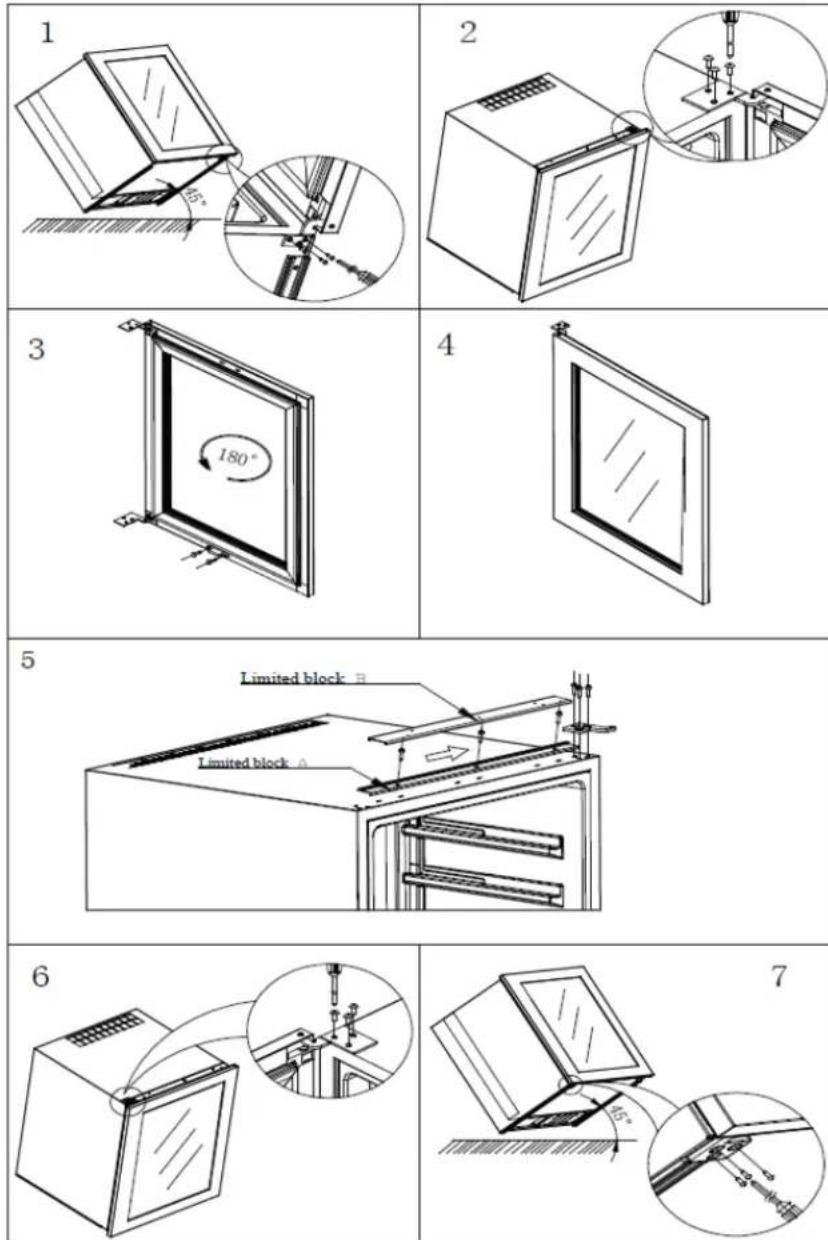
- Incline the wine cooler with 45 degrees, take out right lower hinge's screws with screwdriver (Fig.1).
- Level the wine cooler, hold the door and take out right upper hinge's screws with screwdriver, then take out the door, put the door safety and rotate it at 180 degree (Fig.2, Fig.3 & Fig.4).
- Remove limited block B as per the arrows in picture, then release all the screws on limited block A, and take away limited block A. Install the limited block A at the right side with screws, then install limited block B, then fit the door with screws (Fig.5, Fig.6 & Fig.7).
Note: this is a two person operation
4. OPERATING INSTRUCTIONS
It is recommended that you installed your appliance in a place where the ambient temperature is between
16-32°C (N class marked on the rating plate). If the ambient temperature is above or below recommended temperatures, the performance of the unit may be affected and it may not be possible to obtain temperature between 5-20°C/5-10°C/10-20°C.
How to set temperature
The controls of your wine cooler (the upper zone and middle zone)

natural_image
Pure graphical icons without any text, numbers, or symbols
To control this unit's power, ON/OFF.
Press and hold this button for approximately 3 seconds.
- Display

Upper chamber electronic display
- Display

Middle chamber electronic display
- Bouton

Upper chamber temperature setting button
- Bouton

Middle chamber temperature setting button
• “

' indicator light
Compressor in operation display.
•

button
To control the inner light turn on/off.
Setting the temperature control
Each cooling compartment of the wine cooler (upper & middle) is independently controlled. To set the temperature:
- When pressing ☐ or ☐ ton, the system will be entering the set up mode in the upper or middle compartment automatically. The LED will flashing and display the setting temperature.
- Press once the button, the temperature will decrease 1°C. When exceeding the minimum value that can be established, it will jump to the highest adjustable temperature value automatically. After stopping pressing the button for 5 seconds, LED figure will stop flash, then exit setting model.
Upper compartment::the temperature setting can be adjusted from 5°C to 20°C.
Middle compartment: the temperature setting can be adjusted from 5^ C to 10^ C.
- If you want to know the actual temperature, please press 3 seconds, display panel will show actual temperature. After 5 seconds, it will show the setting temperature.
The controls of your wine cooler (the lower zone)
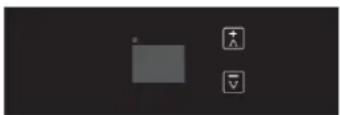
1) “○” indicator light Compressor in operation display.
2) LED display window Display temperature for lower zone.
3) “ + ” button (right) To set the temperature of the lower chamber. Press once the button, the temperature will increase 1^ C.
4) “ ▼” button (right)
To set the temperature of the lower chamber. Press once the button, the temperature will decrease 1^ C.
Setting the temperature control
To set the temperature:
- When pressing + button the system will be entering the set up mode in the lower compartment automatically. The LED will flashing and display the setting temperature.
- Press once the button, the temperature will decrease or increase 1^ C. When exceeding the minimum value that can be established, it will jump to the highest adjustable temperature value automatically. After stopping pressing the button for 5 seconds, LED figure will stop flash, then exit setting model.
- The temperature setting can be adjusted from 10^ to 20^ .
When the surrounding temperature is 25^ C and the wine cooler has no bottle loaded, it will take around 30 minutes to increase the wine cooler's temperature from 5^ C to 12^ C. Under the same circumstance, it will take around 30 minutes to decrease the wine cooler's temperature from 12^ C to 5^ C. The less the temperature span is, the less time it will take. The setting temperature of upper zone should be lower than the setting temperature of lower zone
Function instruction
• Temperature alarm:
If inner temperature is higher than 23^ C after running 10 hours with power, the “HI” is shown in display panel, and the buzzer alarm after one hour continuously. It informs that the inner temperature is too high, please check the reason. If inner temperature is lower than 0^ C, the “LO” is shown in display panel, and the buzzer alarm too will sound.
• Temperature recollection function:
In the event of a power interruption, wine cabinet will remember the previous temperature settings and when the power is recovered, the cabinet temperature will go back the same setting temperature as power off.
Internal light
In order to reduce energy consumption, this wine cabinet will automatically switch off the LED lights after
10 minutes.
If you want the LED light to remain on continuously, this is possible. Please press and hold the button for 5 seconds, the display will show "LP". After 4 seconds the display will revert back to normal, and the light will remain on until manually switched off.

If you want to revert back and conserve energy (recommended), please press and hold the 📋 button for 5 seconds, the display will show "LF". After 4 seconds the display will revert back to normal, and the light will automatically switch off after 10 minutes.
5. EQUIPMENT
The climate control system
According to advice from specialists, the ideal temperature for storing wine is around 12^ C, within a bracket of 10 to 14^ C. Do not confuse this with service temperature, which varies between 5 and 20^ C, depending on the specific nature of the wine.
It is especially important to avoid sudden changes in temperature. Designed by specialists for oenophiles, this appliance, unlike a simple refrigerator, takes into account the sensitivity of grand cru wines to sudden variations in temperature by ensuring the close control of a constant average temperature.
The anti-vibration system
The refrigeration compressor is equipped with special dampers (silent-blocks) and the inner space is insulated from the body by a thick layer of polyurethane foam. These characteristics prevent the transmission of vibration to your wines.
The humidification system
This appliance is fitted with trays that maintain the correct level of humidity. If the humidity is too low, top up the level in the reservoir to three quarters of its capacity. Check the level from time to time and add water if necessary. Ensure that the tray always contains water.
Designed by specialists for oenophiles, Avintage brand has taken into account the sensitivity of corks to too low a level of ambient humidity. This is why the tray should be placed on the shelf below the fan situated in the bottom, to provide minimum humidity. Be sure to check the water level, if you are storing wines over a long period and you are not using the appliance solely for bringing wines to service temperature (with a quick rotation of bottles).
Make sure that the tray full of water is completely stable to avoid any water falls or leaks.
The anti-UV system
Light accelerates the ageing of wine. In our solid door cellars, your wines are naturally protected, on condition, of course, that the door is not opened too often. This glass-door model has been specially treated and filters out harmful ultraviolet rays, thus ensuring your wines are perfectly shielded.
Defrosting
Your appliance is equipped with an automatic defrost cycle. When a cooling cycle finishes, the appliance's refrigerated surfaces are defrosted automatically. The defrost water is channeled into a condensates evaporation tray which is located in the back of the appliance near the compressor. The heat produced by the compressor then evaporates the condensates collected in the tray.
Shelves
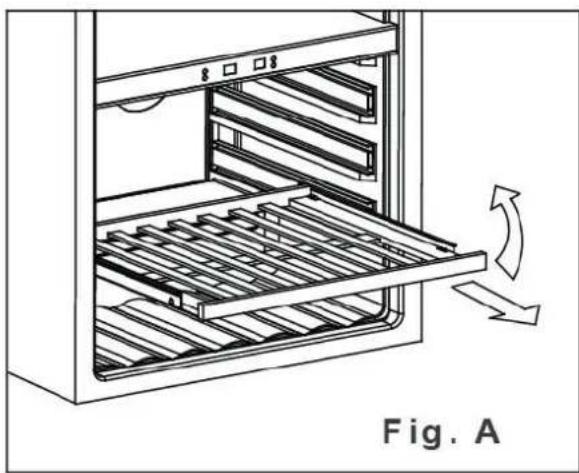
To prevent damaging the door gasket, make sure to have the door all the way opened when pulling shelves out of the rail compartment.
To remove shelves:
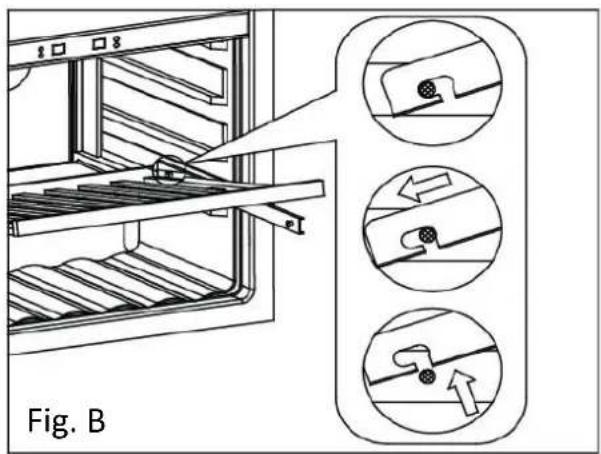
- Fully extend the shelf you wish to remove (Fig. A)
- Lift the front of the shelf up (Fig. A)
- Holding the shelf track, push the shelf in, then up to release from the rear dampers (Fig. B)
natural_image
Line drawing of a refrigerator interior showing internal shelves and a door, with no text or symbols present.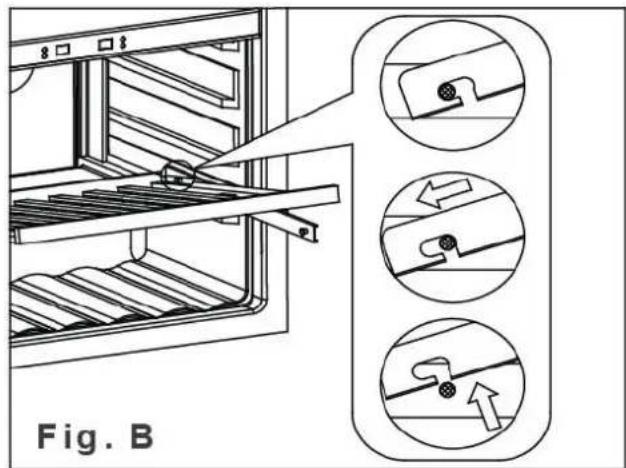
text_image
Fig. B6. LOADING
The maximum recommended loading quantities for bottles are given as guidelines and are indicative only; they provide a quick estimate of the size of the appliance (similar to the capacity of a refrigerator expressed in liters).
They correspond to tests conducted with a standard bottle: the standard "75 cl light Bordeaux" bottle - standards apply the geographical origin of each bottle shape (Bordeaux, Burgundy, Provence, etc.) and a type (traditional, heavy, light, flute, etc.), each with its own diameter and height.
In reality and in extreme cases, you could store more bottles by stacking the same type of bottle without using shelves, but a varied cellar comprises a wide variety of bottles and the practical aspect of everyday cellar management limits its capacity. You will therefore probably load the appliance a little less than the recommended maximum.
The announced capacity is the maximum capacity calculated with a defined number of shelves, which varies according to the model. This standard is calculated with 75cl bottles of the traditional Bordeaux type. Any other type of bottle size and the addition of shelves will considerably reduce the storage capacity. Below is the loading plan with the maximum announced capacity.
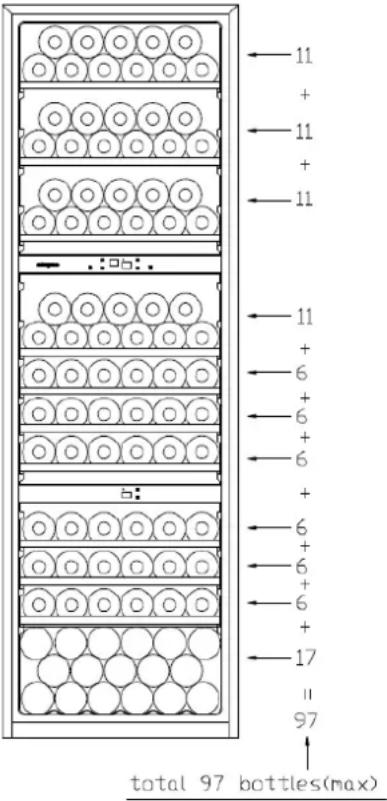
text_image
11 + 11 + 11 - 11 + 6 + 6 + 6 + 6 + 6 + 17 11 97 total 97 bottles(max)Examples of serving temperatures
Opinions vary, and the ambient temperature too, but many people agree on the following:
| Prestigious Bordeaux wines – Reds | 16 – 17°C |
| Prestigious Burgundy wines – Reds | 15 – 16°C |
| Prestigious dry white vintages | 14 – 16°C |
| Light, young, fruity reds | 11 – 12°C |
| Provence rosés, primeur wines | 10 – 12°C |
| Dry whites and vin de pays reds | 10 – 12°C |
| Vin de pays whites | 8 – 10°C |
| Champagnes | 7 – 8°C |
| Sweet wines | 6°C |
7. CARE AND MAINTENANCE
Before cleaning your appliance (something that should be done regularly), disconnect it by removing the plug or by pulling the fuse on the circuit.
Before using your appliance for the first time and regularly after that, we recommend that you clean the inside and outside (front, side and top) with warm mixed with a gentle cleaning product. Rinse with clean water and allow to dry before reconnecting. Do not use solvents or abrasives.
When the appliance is switched on for the first time, there may be a residual odour. In that case, runt the appliance empty for a few hours at the coldest possible temperature. The cold will kill any odours.
In case of a power cut
Most power cuts are resolved within a short time. A power cut of 1 or 2 hours will not affect the temperature in your cabinet. To protect your wines during a power cut, avoid opening the door as much as possible. During very long power cuts, take the necessary measures to protect your wine.
- If the appliance is disconnected or if there is a power cut, you must wait three to five minutes before re-starting. If you try to re-start before this time, the compressor will only re-start after 3 to 5 minutes (if the temperature requires).
- When switching on for the first time or following a prolonged shutdown, it is possible that when restarting, the temperatures selected and those displayed are not the same. This is normal. It will take a few hours before they stabilize.
Vacation time
- Short vacations: leave the wine cooler operating during vacations of less than three weeks.
- Long vacations: if the appliance will not be used for several months, remove all items and turn off the appliance. Clean and dry the interior thoroughly. To prevent odor and mold growth, leave the door open slightly: blocking it open if necessary.
Moving your wine cooler
- Remove all items.
- Securely tape down all loose items (shelves) inside your appliance.
- Turn the adjustable leg up to the base to avoid damage.
- Tape the door shut.
- Be sure the appliance stays secure in the upright position during transportation. Also protect outside of appliance with a blanket, or similar item.
Energy saving tips
- The wine cooler should be located in the coolest area of the room (but at least at 16^ C), away from heat producing appliances, and out of the direct sunlight.
- Ensure that the unit is adequately ventilated. Never cover air vents.
- Only open the door for as long as necessary.
8. IN THE EVENT OF A BREAKDOWN
Despite the care we take during production, a breakdown can never be totally ruled out. Before contacting your retailer's after-sales department, please check that:
- The appliance is properly plugged in
- There is not a power cut in progress
- The breakdown is not one of those described in the table at the end of this manual
IMPORTANT: if the power cable supplied is damaged, it must be replaced by the manufacturer, a service centre approved by the brand or the retailer. In all events, it must be replaced by qualified personnel in order to avoid any risk of injury.
IF THESE CHECKS REVEAL NOTHING, THEN CONTACT YOUR RETAILER'S AFTER-SALES DEPARTMENT.
CAUTION!
Unplug the appliance before carrying out any maintenance or repair work.
9. SPARE PART AND SAV
Aesthetic and functional spare parts are available to professional repairers and final consumers for a minimum period of 10 years from the date of placing the last unit in the model on the market.
The list of spare parts and the procedure for ordering them (professional access / final consumer access) are available on the following website: www.interfroidservices.fr or by post to the following address: Interfroid Services, 143 Bd Pierre Lefaucheux - 72230 ARNAGE.
All FRIO wine cellar benefit from a 1-year parts warranty.
10. TROUBLE SHOOTING
You can solve many common Wine cooler problems easily, saving you the cost of a possible service call. Try the suggestions below to see if you can solve the problem before calling the servicer.
| PROBLEM | POSSIBLE CAUSE |
| Wine cooler does not operate | Not plugged inThe appliance is turned offThe circuit breaker tripped or a blown fuse |
| Wine cooler is not cold enough | Check the temperature control settingExternal environment may require a higher settingThe door is opened too oftenThe door is not closed completelyThe door gasket does not seal properly |
| Turns on and off frequently | The room temperature is hotter than normalA large amount of contents has been added to the wine cooler.The door is open too oftenThe door is not closed completelyThe temperature control is not set correctlyThe door gasket does not seal properly |
| The light does not work | Not plugged inThe circuit breaker tripped or a blown fuseThe bulb has burned out, contact your after-sales serviceThe light switch is “OFF” |
| Vibrations | Check to assure that the wine cooler is level |
| The wine cooler seems to make too much noise | The rattling noise may come from the flow of the refrigerant, which is normalAs each cycle ends, you may hear gurgling sounds caused by the flow of refrigerant in your wine coolerContraction and expansion of the inside walls may cause popping and crackling noisesThe wine cooler is not level |
| The door will not close properly | The wine cooler is not levelThe door was reversed and not properly installedThe gasket is dirtyThe shelves are out of position |
Replacing light
This appliance consists of light-emitting diodes (LEDs). This type of diode cannot be changed by the consumer. The lifetime of these LEDs is normally sufficient for no change to be made. If however, and despite all the care taken during the manufacture of your wine cellar, the LEDs were defective, please contact your after-sales service for any intervention.
11. ENVIRONMENT
This appliance is marked according to the European directive 2012/19/CE on Waste Electrical and Electronic Equipment (WEEE). By ensuring this product is disposed of correctly, you will help prevent potential negative consequences for the environment and human health, which could otherwise be caused by inappropriate waste handling of this product.
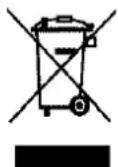
The symbol on the product, or on the documents accompanying the product, the Crossed Out Wheelie Bin, indicates that this appliance may not be treated as household waste. Instead it shall be handed over to the applicable collection point for the recycling of electrical and electronic equipment, or, if you are buying an equivalent product, to the retailer of the new product.
The user is responsible for taking the appliance to the appropriate collection centre at the end of its useful life. Selective and appropriate collection for the recycling of no longer used appliances and their disposal and destruction in an environmentally friendly manner, helps to prevent potential negative effects on the environment and health, and encourages the recycling of materials used to make the product.
For more detailed information about treatment, recovery and recycling of this product, please contact your local authority, your household waste disposal service or the retailer where you purchased the product.
12. WARNING
As we continuously improve our products for the benefit of our customers, we reserve the right to modify technical characteristics without notice.
Warranties for AVINTAGE brand products are offered exclusively by selected retailers. No part of these instructions may be considered as a supplementary guarantee.
FRIO ENTREPRISE cannot be held liable for errors or technical or editorial omissions in this document.
Non-binding document.
natural_image
Empty rectangular frame with black border (no text or symbols)text_image
Technical diagram of a device with labeled components and cross-sectional view showing internal structure and assembly.natural_image
Simple gray square icon with a small human figure and a downward arrow symbol on a dark background (no text or labels)1) " Leuchtmelder
natural_image
Diagram of a refrigerator interior showing internal rack structure and airflow direction (no text or symbols)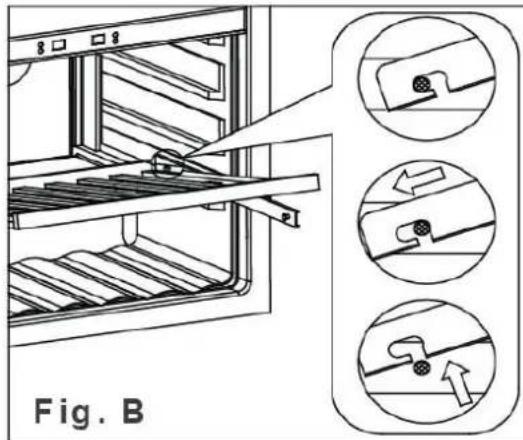
text_image
Fig. B6. BEFÜLLUNG
natural_image
Empty rectangular frame with black border (no text or symbols)text_image
Technical diagram of a device with labeled components (a, b, c, d) and an inset showing cross-sectional view.natural_image
Simple gray square icon with a small human figure and a checkmark inside, set against a dark background (no text or symbols)1) Indicatielampje " ○ "
natural_image
Diagram of a refrigerator interior showing internal shelves and a door, with no text or symbols present.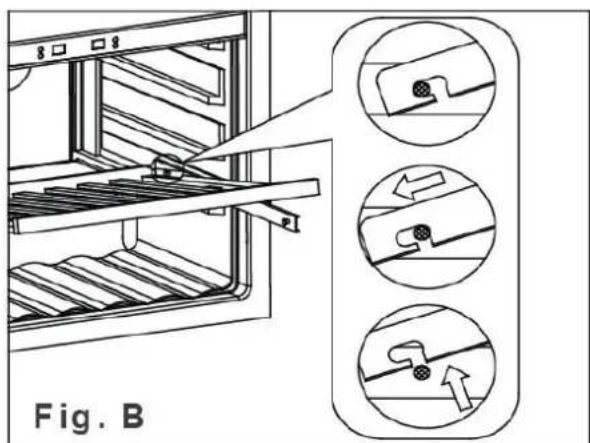
text_image
Fig. B6. LADEN
natural_image
Empty rectangular frame with black border (no text or symbols)text_image
Technical diagram of a device with labeled components (a, b, c, d, e) and an inset showing cross-sectional view.natural_image
Simple gray square icon with a small human figure and checkmark inside, set against a dark background (no text or symbols)natural_image
Diagram of a refrigerator interior showing internal shelves and a door, with no text or symbols present.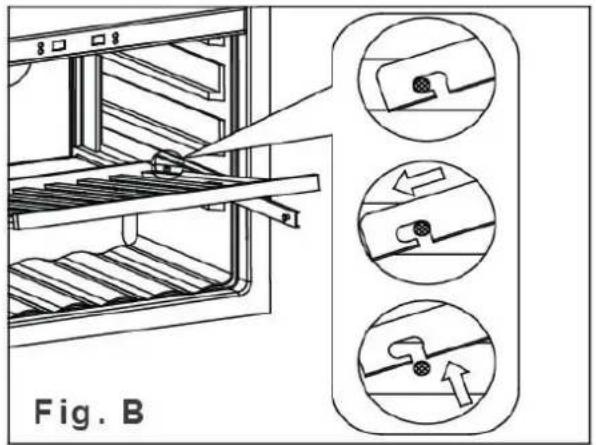
text_image
Fig. B6. CARGA
natural_image
Empty rectangular frame with black border (no text or symbols)text_image
Technical diagram of a device with labeled components (a, b, c, d) and an inset showing a cross-sectional view.natural_image
Simple gray square icon with two small icons: one with a plus sign and another with a downward arrow, on a dark background (no text or symbols)1) “ ○ ” spia luminosa
natural_image
Diagram of a refrigerator interior showing internal shelves and a door, with no text or symbols present.