
BC2500 - Car battery charger VOLTCRAFT - Free user manual and instructions
Find the device manual for free BC2500 VOLTCRAFT in PDF.


| Product type | Car battery charger |
| Brand | Voltcraft |
| Model | BC2500 |
| Input voltage | 220-240 V~, 50 Hz |
| Output voltage | 6 VDC, 12 VDC, 12.8 VDC (LiFePO4) |
| Max output current | 2.5 A |
| Compatible battery types | Lead-acid 6/12 V (Wet, Gel, MF, AGM) and LiFePO4 12.8 V |
| Supported battery capacity (lead-acid) | 4 to 26 Ah |
| Supported battery capacity (LiFePO4) | 2 to 15 Ah |
| Protection | Overcharge, reverse polarity, short circuit, overheat |
| Fuse | T2A, non-replaceable |
| Charger cable length | 1.5 m |
| Battery cable length | 0.4 m |
| Protection rating | IP20 |
| Operating temperature | 0 to +40 °C |
| Storage temperature | -30 to +60 °C |
| Operating humidity | 20 to 85% RH (non-condensing) |
| Storage humidity | 10 to 90% RH (non-condensing) |
| Main functions | Regular charging, maintenance charging, voltage selection |
| Display | LED indicators for progress and status |
| Cleaning and maintenance | Disconnect, let cool, clean with a dry cloth |
| Safety | Indoor use only, avoid moisture |
| Protection class | II (double insulation) |
Frequently Asked Questions - BC2500 VOLTCRAFT
User questions about BC2500 VOLTCRAFT
0 question about this device. Answer the ones you know or ask your own.
Ask a new question about this device
Download the instructions for your Car battery charger in PDF format for free! Find your manual BC2500 - VOLTCRAFT and take your electronic device back in hand. On this page are published all the documents necessary for the use of your device. BC2500 by VOLTCRAFT.
USER MANUAL BC2500 VOLTCRAFT
GB Operating Instructions
BC2500 Car Battery Charger
Item no: 3203181
CE

1 Operating Instructions for download
Use the link www.conrad.com/downloads (alternatively scan the QR code) to download the complete operating instructions (or new/current versions if available). Follow the instructions on the web page.
2 Intended use
The product is a car battery charger. Use the product to charge lead-acid and LiFePO4 lithium batteries.
Observe the following limitations:
- Do not charge starter or emergency batteries of electric vehicles (EVs).
- Charge 6 or 12 V lead-acid batteries (Wet, Gel, MF, and AGM).
Charge 12.8 V 4-cell LiFePO4 lithium rechargeable batteries (with battery management).
Do not exceed the battery capacities stated in the "Technical data". - Only charge one battery at any given moment.
Features:
Regular charging
Trickle charging
■ Overcharge, reverse polarity, short circuit protection
■ Overheating protection
The product is intended for indoor use only. Do not use it outdoors.
Contact with moisture must be avoided under all circumstances.
If you use the product for purposes other than those described, the product may be damaged.
Improper use can result in short circuits, fires, electric shocks or other hazards.
The product complies with the statutory national and European requirements.
For safety and approval purposes, you must not rebuild and/or modify the product.
Read the operating instructions carefully and store them in a safe place. Make this product available to third parties only together with the operating instructions.
All company names and product names are trademarks of their respective owners. All rights reserved.
3 Delivery contents
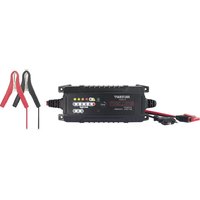
- Charger with cable
- Operating instructions
- Charging cable with battery clamps
4 Description of symbols
The following symbols are on the product/appliance or are used in the text:

For safe and proper use, follow these instructions. Keep them for future reference.

The symbol warns of hazards that can lead to personal injury.

The symbol warns of dangerous voltage that can lead to personal injury by electric shock.

This product must only be used in dry, enclosed indoor areas. It must not become damp or wet.

Fuse location

Protection class 2 (double or reinforced insulation, protective insulation).
5 Safety instructions

Read the operating instructions carefully and especially observe the safety information. If you do not follow the safety instructions and information on proper handling, we assume no liability for any resulting personal injury or damage to property. Such cases will invalidate the warranty/guarantee.
5.1 Read first!
This appliance can be used by children aged from 8 years and above and persons with reduced physical, sensory or mental capabilities or lack of experience and knowledge if they have been given supervision or instruction concerning use of the appliance in a safe way and understand the hazards involved.
■ Children shall not play with the appliance.
- Cleaning and user maintenance shall not be made by children without supervision.
■ WARNING Never recharge non-rechargeable batteries.
5.2 General
The product is not a toy. Keep it out of the reach of children and pets.
Do not leave packaging material lying around carelessly. This may become dangerous playing material for children.
If you have questions which remain unanswered by this information product, contact our technical support service or other technical personnel.
- Maintenance, modifications and repairs must only be completed by a technician or an authorised repair centre.
5.3 Handling
- Handle the product carefully. Jolts, impacts or a fall even from a low height can damage the product.
5.4 Operating environment
- Do not place the product under any mechanical stress.
- Protect the appliance from extreme temperatures, strong jolts, flammable gases, steam and solvents.
- Protect the product from high humidity and moisture.
■ Protect the product from direct sunlight.
5.5 Operation
- Consult an expert when in doubt about the operation, safety or connection of the product.
If it is no longer possible to operate the product safely, take it out of operation and protect it from any accidental use. DO NOT attempt to repair the product yourself. Safe operation can no longer be guaranteed if the product:
– is visibly damaged,
– is no longer working properly,
– has been stored for extended periods in poor ambient conditions or
– has been subjected to any serious transport-related stresses.
5.6 Electrical safety

Do not modify or repair mains supply components including mains plugs, mains cables, and power supplies. Do not use damaged components. Risk of death by electric shock!
■ Connect the product to a mains socket that can be accessed easily.
- Only connect the product to a mains socket connected to the public supply. Before connecting, check whether the voltage stated on the rating plate complies with the voltage of your electricity supplier.
- Never connect or disconnect the product if your hands are wet. There is a risk of electric shock.
For safety reasons, disconnect the product from the mains socket during storms.
Do not touch the product if there are any signs of damage, as this may cause a fatal electric shock! Take the following steps:
- Switch off the mains supply to the product (switch off the corresponding circuit breaker or remove the safety fuse, and then switch off the corresponding RCD protective switch).
- Remove the product from the mains socket.
- Do not use the product again. Prevent others from using it.
5.7 Connected devices
Also observe the safety and operating instructions of any other devices which are connected to the product.
5.8 Product

WARNING: Explosive gases. Prevent flames and sparks. Provide adequate ventilation during charging.

WARNING: Risk of electric shock. Disconnect the product from the power supply before connecting or disconnecting leads to the battery.

WARNING: Always wear eye protection and protective clothing when working around batteries.
Do not short circuit the leads.
People with pacemakers should consult a doctor before use. Electromagnetic fields in proximity can cause pacemaker interference and/or failure.
■ Always switch the vehicle engine and electrics OFF before connecting the product.
■ Make sure the vehicle is properly secured (e.g., car parking brake is engaged, boat is securely moored).
Risk of electric shock! Never use the product with wet hands.
Risk of burns! Engines compartments can become dangerously hot after use. Always allow to cool to room temperature before connecting the product.
5.9 Working with rechargeable batteries
- Avoid creating sparks by connecting battery leads in the correct order. Sparking can damage the vehicle electrical system and/or ignite flammable substances.
Before charging, the electrolyte (battery acid) must be filled to the maximum marked levels. Never use tap water. Distilled water must be used. - Never attempt to recharge frozen or damaged batteries.
When working around vehicles and batteries, be aware that loose hair, clothing, and jewellery (e.g., rings, bracelets, necklaces, and watches) can get trapped and/or conduct electricity and cause electric shock or burns. - Keep battery contact terminals clean. Contamination can lead to incorrect measurement results due to poor conductivity.
6 Product overview
6.1 Operating panel
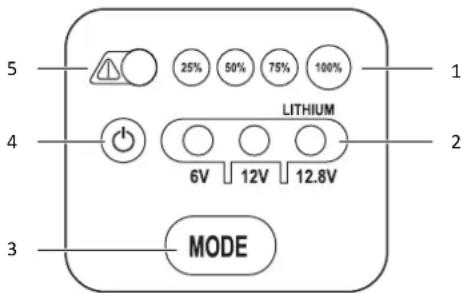
1 Progress indicators 2 Voltage selection indicators
3 Mode selection button 4 Power indicator
5 Error indicator
6.2 Indicators
Vbat = Battery voltage
| Indicator Colour Description | ||
| Power indicator Green Steady: Charger is switched on | ||
| Voltage selection indicator: 6V, 12V, 12.8V | Red Steady: Indicates which mode (voltage mode) is selected and activated | |
| Error indicator Off Steady: No battery is connectedSteady: Vbat >15 V | ||
| Error indicator Red Steady: Battery recovery and soft start charging failedFlashing: Polarity is reversed | ||
| Error indicator Yellow Flashing (6V/12V batteries): Battery is connected >40 hours | ||
| Progress indicator 25% | Red Flashing: Vbat <6.4/12.8 VSteady (after 3 sec): Vbat >6.4/12.8 VOff: Battery fully charged | |
| Progress indicator 50% | Orange Flashing: 6.4/12.8 V < Vbat < 6.8/13.6 VSteady (after 3 sec): Vbat >6.8/13.6 VOff: Battery fully charged | |
| Progress indicator 75% | Yellow Flashing: 6.8/13.6 V < Vbat < 6.95/13.9 VSteady (after 3 sec): Vbat >6.95/13.9 VOff: Battery fully charged | |
| Progress indicator 100% | Green Flashing: 6.95/13.9 V < Vbat < Fully chargedSteady (after 3 sec): Battery fully charged | |
7 Charging batteries
7.1 Connecting the charger to the battery
Note:
If you connect a battery with a voltage of ≥ 14 V, the error indicator lights up.
- Consult the car operating instructions on how to connect an external battery charger. If the car operating instructions are different from the instructions below, follow the car operating instructions to connect the charger to the battery.
- Disconnect the charger from the power supply.
- Clean the battery terminals.
- Connect the battery charging cable to the battery charger cable.
- Connect the red (+) clamp to the positive (+) battery terminal.
- Connect the black (-) clamp to the negative (-) battery terminal.
- Wiggle the clamps back and forth to ensure good contact.
7.2 Charging the battery
Notes:
- The charger automatically activates the last used mode.
Notes:
- If the battery is fully charged and you do not disconnect the battery, the charger enters trickle charging.
Preconditions:
√ The charger is connected to the battery.
- Consult the car operating instructions on how to connect a charger to the car battery.
- Connect the charger to a suitable wall socket.
→ The power indicator is on.
- (For lead-acid batteries) Press the button MODE to select 6 or 12 V. Observe the voltage selection indicators.
→ Charging begins shortly after you select the mode. -
(For Lithium batteries) Press and hold the button MODE until the voltage selection indicator 12.8 V lights up.
→ Charging begins shortly after you select the mode. -
Monitor the progress indicators.
-
(If necessary) Stop charging by repeatedly pressing the button MODE until all voltage selection indicators are off.
→ Charging stops.
- If charging is complete, disconnect the charger from the power supply.
- Disconnect the charger by following the instructions in "Disconnecting the charger from the battery".
7.3 Disconnecting the charger from the battery
- Disconnect the charger from the power supply.
- Disconnect the black (-) clamp from the negative (-) battery terminal.
- Disconnect the red (+) clamp from the positive (+) battery terminal.
8 Cleaning and care
Important:
- Do not use aggressive cleaning agents, rubbing alcohol or other chemical solutions. They damage the housing and can cause the product to malfunction.
-
Do not immerse the product in water.
-
Disconnect the charger from the power supply.
- Disconnect the charger from the battery.
- Let the product cool down to ambient temperature.
- Clean the product with a dry, fibre-free cloth.
9 Disposal

This symbol must appear on any electrical and electronic equipment placed on the EU market. This symbol indicates that this device should not be disposed of as unsorted municipal waste at the end of its service life.
Owners of WEEE (Waste from Electrical and Electronic Equipment) shall dispose of it separately from unsorted municipal waste. Spent batteries and accumulators, which are not enclosed by the WEEE, as well as lamps that can be removed from the WEEE in a non-destructive manner, must be removed by end users from the WEEE in a non-destructive manner before it is handed over to a collection point.
Distributors of electrical and electronic equipment are legally obliged to provide free take-back of waste. Conrad provides the following return options free of charge (more details on our website):
in our Conrad offices
■ at the Conrad collection points
at the collection points of public waste management authorities or the collection points set up by manufacturers or distributors within the meaning of the ElektroG
End users are responsible for deleting personal data from the WEEE to be disposed of.
It should be noted that different obligations about the return or recycling of WEEE may apply in countries outside of Germany.
10 Technical data
10.1 Charger
Supported battery types .... 6V/12 V Lead-acid batteries (Wet, Gel, MF, and AGM)
12.8 V LiFePO4 (with battery management)
Not suitable for emergency or starter batteries of electric vehicles (EVs)
Supported battery capacity.... 6V/12V Lead-acid batteries: 4 - 26 Ah
12.8 V Lithium (LiFePO4) batteries: 2 - 15 Ah
Input 220 - 240 V/AC, 50 Hz
Output.... 6 V/DC, max. 2.5A
12 V/DC, max. 2.5 A
12.8 V/DC, max. 2.5 A (LiFePO4)
Charging activating voltage .... Lead-acid batteries 6 V: >2.0 V
Lead-acid batteries 12 V: >7.0 V
Lithium (LiFePO4) batteries: >11.6 V s
Trickle charging current.... < 60 mA
Fuse....T2A, non-replaceable
Ingress protection.... IP20
Protection .... Overcharge protection, reverse polarity protection, overheating protection, short circuit protection
Charger cable length 1.5 m
Dimensions (W x H x D) 68 x 116 x 71 mm
Weight 400 g
10.2 Environment
Operating conditions.... 0 to +40 °C, 20 – 85 % RH (non-condensing)
Storage conditions....-30 to +60 °C, 10 – 90 % RH (non-condensing)
10.3 Other
Battery connection cable length ..... 0.4 m
VOLTCRAFT
F Mode d'emploi
WARNING: Explosive gases. Prevent flames and sparks. Provide adequate ventilation during charging.

Dimensions (L x H x P).... 68 x 116 x 71 mm
Poids.... 400 g
10.2 Environnement
WARNING: Explosive gases. Prevent flames and sparks. Provide adequate ventilation during charging.

Loodzuuraccu's 12 V: >7,0 V
Lithiumaccu's (LiFePO4): >11,6 V
Druppellaadstroom .... < 60 mA
Copyright by Conrad Electronic SE.
*3203181_V2_1024_jh_mh_nl 36028798532325771-4 I5/O2 en
- BC2500 Car Battery Charger
- Operating Instructions for download
- Intended use
- Delivery contents
- Description of symbols
- Safety instructions
- Read first!
- General
- Handling
- Operating environment
- Operation
- Electrical safety
- Connected devices
- Product
- Working with rechargeable batteries
- Product overview
- Operating panel
- Indicators
- Charging batteries
- Connecting the charger to the battery
- Note:
- Charging the battery
- Notes:
- Preconditions:
- Disconnecting the charger from the battery
- Cleaning and care
- Important:
- Disposal
- Technical data
- Charger
- Environment
- Other
- VOLTCRAFT
- Environnement
Brand : VOLTCRAFT
Model : BC2500
Category : Car battery charger