WS67G1CMX - Cooker WHIRLPOOL - Free user manual and instructions
Find the device manual for free WS67G1CMX WHIRLPOOL in PDF.


User questions about WS67G1CMX WHIRLPOOL
0 question about this device. Answer the ones you know or ask your own.
Ask a new question about this device
Download the instructions for your Cooker in PDF format for free! Find your manual WS67G1CMX - WHIRLPOOL and take your electronic device back in hand. On this page are published all the documents necessary for the use of your device. WS67G1CMX by WHIRLPOOL.
USER MANUAL WS67G1CMX WHIRLPOOL
natural_image
Simple line drawing of a kitchen oven icon (no text or symbols)EN ENGLISH
Health and Safety guide 3
Quick guide 7
Installation guide 64
FR FRANÇAIS
These instructions are valid if the country symbol appears on the appliance. If the symbol does not appear on the appliance, please refer to the technical instructions which will provide the necessary instructions concerning modification of the appliance to the conditions of use of the country.
⚠️ CAUTION : Use of the gas cooking appliance results in the production of heat, moisture and products of combustion in the room in which it is installed. Ensure that the kitchen is well ventilated, especially when the appliance is in use: keep natural ventilation holes open or install a mechanical ventilation device (mechanical extractor hood). Prolonged intensive use of the appliance may call for additional ventilation, such as opening a window, or more effective ventilation, for example increasing the level of mechanical ventilation (if possible).
⚠️ Failure to follow the information in this manual exactly may cause a fire or explosion, resulting in property damage or personal injury. Before using the appliance, read these safety instructions. Keep them nearby for future reference.
These instructions and the appliance itself provide important safety warnings, to be observed at all times. The manufacturer declines any liability for failure to observe these safety instructions, for inappropriate use of the appliance or incorrect setting of controls.
⚠ WARNING: If the hob surface is cracked, do not use the appliance – risk of electric shock.
⚠ WARNING : Danger of fire : Do not store items on the cooking surfaces.
⚠️ CAUTION: The cooking process has to be supervised. A short cooking process has to be supervised continuously.
⚠ WARNING: Leaving the hob unattended when cooking with fat or oil can be dangerous – risk of fire. NEVER try to extinguish a fire with water, but switch off the appliance and then cover the flames e.g. with a lid or a fire blanket.
Do not use the hob as a work surface or support. Keep clothes or other flammable materials away from the appliance, until all the components have cooled down completely – risk of fire.
⚠️ Very young children (0-3 years) should be kept away from the appliance. Young children (3-8 years) should be kept away from the appliance unless continuously supervised. Children from 8 years old and above and persons with reduced physical, sensory or mental capabilities or lack of experience and knowledge can use this appliance only if they are supervised or have been given instructions on safe use and understand the
hazards involved. Children must not play with the appliance. Cleaning and user maintenance must not be carried out by children without supervision.
A CAUTION: In case of hotplate glass breakage:-shut immediately off all burners and any electrical heating element and isolate the appliance from the power supply; - do not touch the appliance surface; -do not use the appliance

The glass lid can break in if it is heated up. Turn off all the burners and the electric plates before closing the lid. Do not shout down lid when burner alight
⚠ WARNING: The appliance and its accessible parts become hot during use. Careshould be taken to avoid touching heating elements. Children less than 8 years of age must be kept away unless continuously supervised
⚠️ Never leave the appliance unattended during use. If the appliance is suitable for probe usage, only use a temperature probe recommended for this oven - risk of fire.
⚠️ Keep clothes or other flammable materials away from the appliance, until all the components have cooled down completely - risk of fire. Always be vigilant when cooking foods rich in fat, oil or when adding alcoholic beverages - risk of fire. Use oven gloves to remove pans and accessories. At the end of cooking, open the door with caution, allowing hot air or steam to escape gradually before accessing the cavity - risk of burns. Do not obstruct hot air vents at the front of the oven - risk of fire.
Exercise caution when the oven door is in the open or down position, to avoid hitting the door. When you place the rack inside, make sure that the stop is directed upwards and in the back of the cavity.
The device shall not be operated for more 15 s. If after 15s the burner has not lit, stop operating the device and open the compartment door and/or wait at least 1 min before attempting a further ignition of the burner.
PERMITTED USE
⚠️ CAUTION: The appliance is not intended to be operated by means of an external switching device, such as a timer, or separate remote controlled system.
This appliance is intended to be used in household and similar applications such as: staff kitchen areas in shops, offices and other working environments; farm houses; by clients in hotels, motels, bed & breakfast and other residential environments.
⚠️ No other use is permitted (e.g. heating rooms).
This appliance is not for professional use. Do not use the appliance outdoors.
Do not store explosive or flammable substances (e.g. gasoline or aerosol cans) inside or near the appliance - risk of fire.
⚠️ Use pots and pans with bottoms the same width as that of the burners or slightly larger (see specific table). Make sure pots on the grates do not protrude beyond the edge of the hob.
⚠️ Improper use of the grids can result in damage to the hob: do not position the grids upside down or slide them across the hob.
Do not let the burner flame extend beyond the edge of the pan.
Do not use : Cast iron griddles, ollar stones, terracotta pots and pans. Heat diffusers such as metal mesh, or any other types. Two burners simultaneously for one receptacle (e.g. Fish kettle).
Should particular local conditions of the delivered gas make the ignition of burner difficult, it is advisable to repeat the operation with the knob turned to small flame setting.
In case of installation of a hood above the cooktop, please refer to the hood instructions for the correct distance.
The protective rubber feet on the grids represent a chocking hazard for young children. After removing the grids, please ensure that all the feet are correctly fitted.
INSTALLATION
⚠ The appliance must be handled and installed by two or more persons - risk of injury. Use protective gloves to unpack and install - risk of cuts.
⚠ The electrical and gas connections must comply with local regulations.
⚠️ Installation, including water supply (if any), electrical connections and repairs must be carried out by a qualified technician. Do not repair or replace any part of the appliance unless specifically stated in the user manual. Keep children away from the installation site. After unpacking the appliance, make sure that it has not been damaged during transport. In the event of problems, contact the dealer or your nearest Aftersales Service. Once installed, packaging waste (plastic, styrofoam parts etc.) must be stored out of reach of children - risk of suffocation. The appliance must be disconnected from the power supply before any installation operation - risk of electric shock. During installation, make sure the appliance does not damage the power cable - risk of fire or electric shock. Only activate the appliance when the installation has been completed.
WARNING : Modification of the appliance and its method of installation are essential in order to use the appliance safely and correctly in all the additional countries.
⚠️ Use pressure regulators suitable for the gas pressure indicated in the instructions.
⚠️ The room must be equipped with an air extraction system that expels any combustion fumes.
The room must also allow proper air circulation, as air is needed for combustion to occur normally. The flow of air must not be less than 2 m^3/h per kW of installed power.
⚠ The air circulation system may take air directly from the outside by means of a pipe with an inner cross section of at least 100 cm ^2 ; the opening must not be susceptible to blockages.
The system can also provide the air needed for combustion indirectly, i.e. from adjacent rooms fitted with air circulation tubes as described above. However, these rooms must not be communal rooms, bedrooms or rooms that may present a fire hazard.
Liquid petroleum gas sinks to the floor as it is heavier than air. Therefore, rooms containing LPG cylinders must also be equipped with vents to allow gas to escape in the event of a leak. This means LPG cylinders, whether partially or completely full, must not be installed or stored in rooms or storage areas that are below ground level (cellars, etc.). It is advisable to keep only the cylinder being used in the room, positioned so that it is not subject to heat produced by external sources (ovens, fireplaces, stoves, etc.) which could raise the temperature of the cylinder above 50°C.
Should you find it difficult to turn the knobs for the burner, please contact the After-sales Service, who can replace of the burner tap if found to be faulty.
The openings use for the ventilation and dispersion of heat must never be covered.
⚠️ Do not remove the appliance from its polystyrene foam base until the time of installation.
Connection with rigid pipe (copper or steel).
If the gas pressure is different from the recommended pressure, a suitable pressure regulator must be fitted to the inlet pipe in accordance with the current National Regulations.
⚠ Do not install the appliance behind a decorative door - risk of fire.

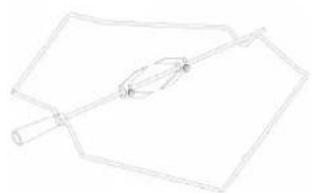
if the range is placed on a base, it must be leveled and fixed to the wall by the retention chain provided, to prevent the appliance slipping from the base.

WARNING: In order to prevent the appliance from tipping, the retention chain must be installed. Refer to the instructions for installation.
GAS CONNECTION
⚠ WARNING : Prior to installation, ensure that the local distribution conditions (type of gas and gas pressure) and the configuration of the appliance are compatible.
⚠️ Check that the pressure of the gas supply is consistent with the values indicated in Table 1 ("Burner and nozzle specifications").
⚠ WARNING : The configuration conditions of this appliance are stated on the label (or data plate).
WARNING: This appliance is not connected to a combustion products evacuation device. It
must be installed and connected in accordance with current installation regulations. Particular attention must be paid to the relevant requirements regarding ventilation.
⚠️ If the appliance is connected to liquid gas, the regulation screw must be fastned as tightly as possible.
IMPORTANT: When the gas cylinder or gas container is installed, it must be properly settled (vertical orientation).
⚠ WARNING : This operation must be performed by a qualified technician
⚠️ Use only flexible or rigid metal hose for gas connection.
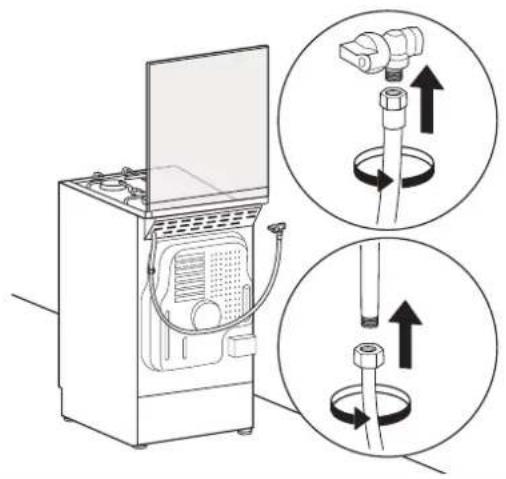
⚠️ Connection with a rigid pipe (copper or steel) Connection to the gas system must be carried out in such a way as not to place any strain of any kind on the appliance. There is an adjustable L-shaped pipe fitting on the appliance supply ramp and this is fitted with a seal in order to prevent leaks. The seal must always be replaced after rotating the pipe fitting (the seal is provided with the appliance). The gas supply pipe fitting is a threaded 1/2 gas cylindrical male attachment.
⚠️ Connecting a flexible jointless stainless steel pipe to a threaded attachment
The gas supply pipe fitting is a threaded 1/2 gas cylindrical male attachment. These pipes must be installed so that they are never longer than 2000 mm when fully extended. Once connection has been made, make sure that the flexible metal pipe does not touch any moving parts and is not compressed. Only use pipes and seals that comply with current national regulations.
IMPORTANT: If a stainless steel hose is used, it must be installed so as not touch any moving part of the furniture (e.g. drawer). It must pass thorough an area where there are no obstructions and where it is possible to inspect it across its entire length.
The appliance should be connected to the main gas supply or to a gas cylinder in compliance with the current national regulations. Before making the connection, make sure that the appliance is compatible with the gas supply you wish to use. If it is not, follow the instructions indicated in the paragraph "Adapting to different types of gas".
After connection to the gas supply, check for leaks with soapy water. Light up the burners and turn the knobs from max position 1* to minimum position 2* to check flame stability.
⚠️ Connection to the gas network or the gas cylinder may be carryout using a flexible rubber or steel hose, in accordance with current national legislation.
ADAPTING TO DIFFERENT TYPES OF GAS
(This operation needs to be carried out by a qualified technician.)
⚠ In order to adapt the appliance to a type of gas other than the type for which it was manufactured (indicated on the rating label), follow the dedicated steps provided after installation drawings.
ELECTRICAL WARNINGS
IMPORTANT: Information about current and voltage consumption is provided on the rating plate.
⚠️ The rating plate is on the front edge of the oven (visible when the door is open).
⚠ It must be possible to disconnect the appliance from the power supply by unplugging it if plug is accessible, or by a multi-pole switch installed upstream of the socket in accordance with the wiring rules and the appliance must be earthed in conformity with national electrical safety standards.
The power cable must be long enough to connect the appliance, once fitted in its housing, to the main power supply. Do not pull the power supply cable.
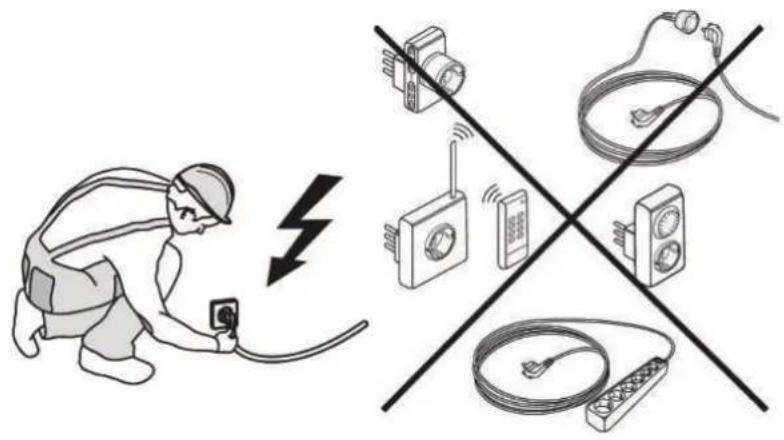
Do not use extension leads, multiple sockets or adapters. The electrical components must not be accessible to the user after installation. Do not use the appliance when you are wet or barefoot. Do not operate this appliance if it has a damaged power cable or plug, if it is not working properly, or if it has been damaged or dropped.
⚠️ If the supply cord is damaged, it must be replaced with an identical one by the manufacturer, its service agent or similarly qualified persons in order to avoid a hazard - risk of electric shock.
⚠️ If the power cable needs to be replaced, contact an authorised service centre.
⚠ WARNING: Ensure that the appliance is switched off before replacing the lamp to avoid the possibility of electric shock.
CLEANING AND MAINTENANCE
⚠ WARNING: Ensure that the appliance is switched off and disconnected from the power supply before performing any maintenance operation; never use steam cleaning equipment - risk of electric shock.
Do not use harsh abrasive cleaners or metal scrapers to clean the door glass since they can scratch the surface, which may result in shattering of the glass.
Do not use abrasive or corrosive products, chlorine-based cleaners or pan scourers.
⚠️ Make sure the appliance has cooled down before cleaning or performing maintenance. - risk of burns.
⚠ WARNING: Switch off the appliance before replacing the lamp - risk of electric shock.
To avoid damaging the electric ignition device, do not use it when the burners are not in their housing.
Wear protective gloves for cleaning and maintenance.
DISPOSAL OF PACKAGING MATERIALS
The packaging material is 100% recyclable and is marked with the recycle symbol. The various parts of the packaging must therefore be disposed of responsibly and in full compliance with local authority regulations governing waste disposal.
DISPOSAL OF HOUSEHOLD APPLIANCES
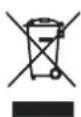
This appliance is manufactured with recyclable or reusable materials. Dispose of it in accordance with local waste disposal regulations. For further information on the treatment, recovery and recycling of household electrical appliances, contact your local authority, the collection service for household waste or the store where you purchased the appliance. This appliance is marked in compliance with European Directive 2012/19/EU, Waste Electrical and Electronic Equipment (WEEE). and with the Waste Electrical and Electronic Equipment regulations 2013 (as amended).
By ensuring this product is disposed of correctly, you will help prevent negative consequences for the environment and human health. The symbol on the product or on the accompanying documentation indicates that it should not be treated as domestic waste but must be taken to an appropriate collection centre for the recycling of electrical and electronic equipment.
ENERGY SAVING TIPS
Only preheat the oven if specified in the cooking table or your recipe. Use dark lacquered or enamelled baking trays as they absorb heat better. Use a pressure cooker to save even more energy and time.
DECLARATION OF CONFORMITY
This appliance meets: Ecodesign requirements of European Regulation 66/2014; Energy Labelling Regulation 65/2014; Ecodesign for Energy-Related Products and Energy Information (Amendment) (EU Exit) Regulations 2019, in compliance with the European standard EN 15181. This appliance meets Ecodesign requirements of European Regulation 66/2014 and The Ecodesign for Energy-Related Products and Energy Information (Amendment) (EU Exit) Regulations 2019 in compliance with the European standard EN 30-2-1.
text_image
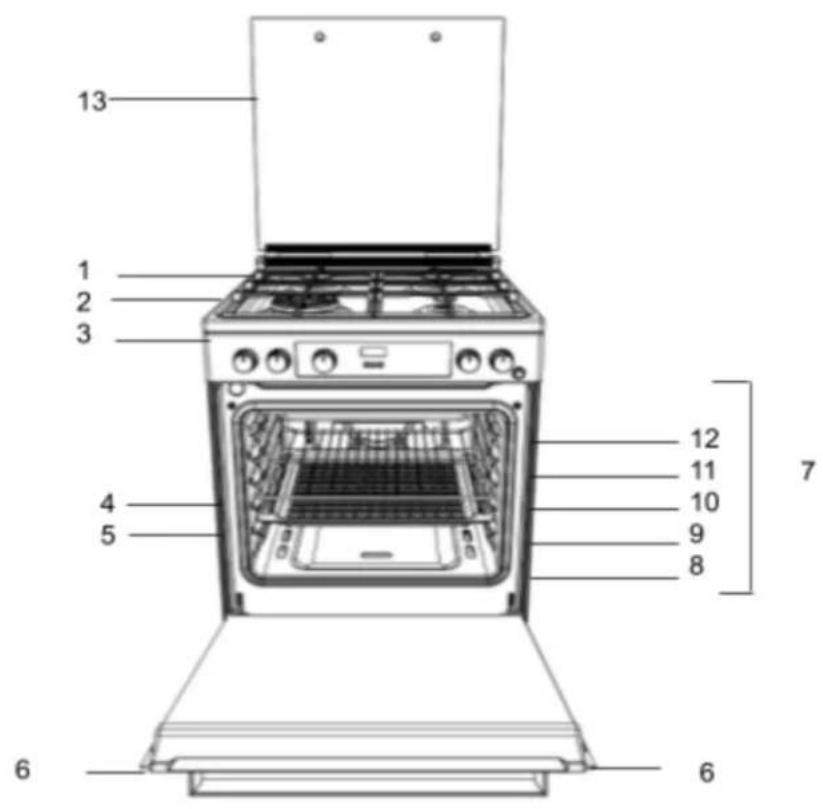
13 1 2 3 4 5 6 7 8 9 10 11 121.Hob burner
2.Hob grid
3. Control panel
4.Wireshelf
5. Tray
6. Door
7. Guide rails for the sliding racks
8. position 1
9.position 2
10. position 3
11.position 4
12. position 5
13. Glass lid
CONTROL PANEL
text_image
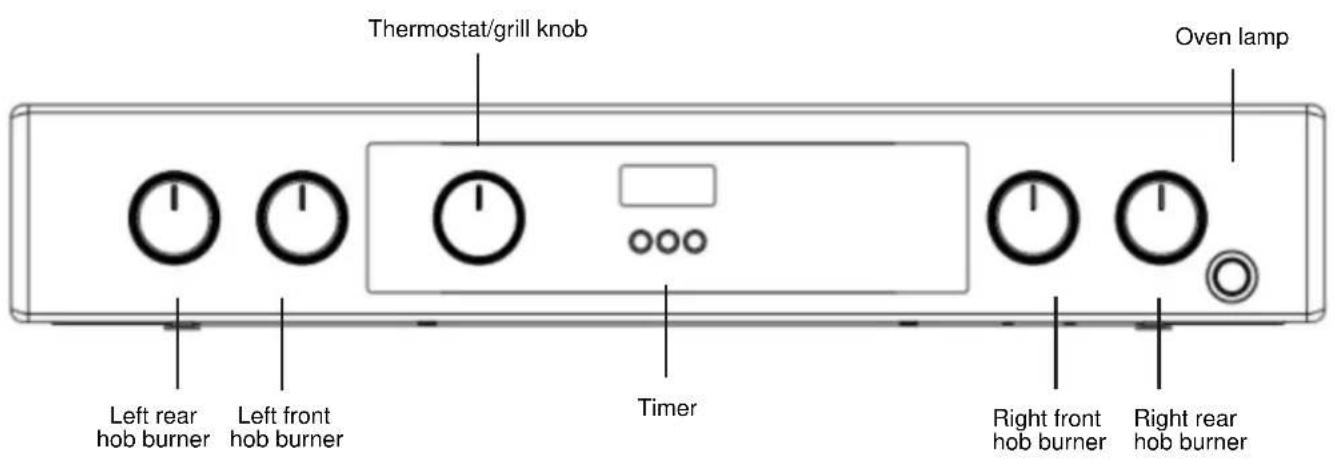
Thermostat/grill knob Oven lamp Left rear hob burner Left front hob burner Timer Right front hob burner Right rear hob burnerINSTALLATIONINSTALLATIONINSTALLATIONINSTALLATION
Before operating your new appliance please read this instruction booklet carefully. It contains important information concerning the safe installation and operation of the appliance.
Please keep these operating instructions for future reference. Make sure that the instructions are kept with the appliance if it is sold, given away or moved.
The appliance must be installed by a qualified professional according to the instructions provided.
Any necessary adjustment or maintenance must be performed after the appliance has been disconnected from the electricity supply.
The following instructions should be read by a qualified technician to ensure that the appliance is installed, regulated and technically serviced correctly in compliance with current regulations.
Positioning and levelling
It is possible to install the appliance alongside cupboards whose height does not exceed that of the hob surface.
This cooker should be installed directly on the floor. Do not install this cooker on an. Do not install artificial base of any kind. artificial base of any kind. Make sure that the wall in contact with the back of the appliance is made from a non-flammable, heat-resistant material (T 90°C).
Important: Do not install this appliance Important: Do adjacent to the door or other means of adjacent to the access to minimise the likelihood of personsaccess using the door making contact with pans on the hob surface.the hob surface.
The appliance must not be installed behind a decorative door in order to avoid overheating
This appliance must not be fitted on a platform.
The cooker is designed to fit between kitchen cabinets spaced 600mm apart. The space either side need only be sufficient to allow withdrawal of the cooker for servicing. It can be used with cabinets one side or both as well as in a corner setting. It can also be used free-standing.
Adjacent side walls which project above hob level, must not be nearer to the cooker than 150mm or 65mm and should be protected by heat resistant material. Any overhanging surface or cooker hood should not be nearer than 750mm.
a. The cooker may be located in a kitchen, a kitchen/diner or bed sitting room, but not in a bathroom or shower room.
b. The hoods must be installed according to the requirements in the hood handbook.
c. The wall in contact with the back of the cooker must be of flameproof material.
d. The cooker is fitted with a safety chain that must be attached to a hook, secured to the wall behind the appliance.
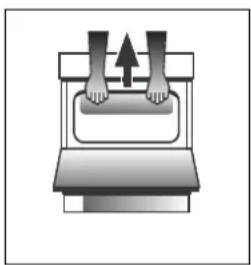
Before moving your cooker check that it is cool, and switched off at the cooker control unit. Movement of your cooker is most easily achieved by lifting the front as follows:
Moving the Cooker
natural_image
Diagram of two hands pressing down on a mechanical component (no text or symbols)Fig. A
Open the grill door sufficiently to allow a comfortable grip on the underside front edge of the oven roof, avoiding any grill elements. (FIG.A)
Take care in moving the cooker as it is heavy. Take care to ensure that any floor covering is not damaged.
Electrical connection
Power supply voltage and frequency: 230-240V a.c. 50°C At this cooker on an. Do not install this cooker on an The supply cable must be positioned so that it never artificial base of any kind. reaches at any point a temperature 50°C higher than the room temperature. The cable must be routed away from the rear vents. Should you require it, you may use a longer cable, however, you must ensure that the cable supplied with the appliance is replaced by one of the same specifications in accordance with current standards and legislation.
WARNINGS: THIS APPLIANCE MUST BEWARNINGS: THIS AP EARTHED.EARTHED.
The cooker must be connected to the mains by a switched (double pole) cooker outlet correctly fused with a capacity appropriate to that shown on the cooker Rating Plate. All electrical wiring from the consumer unit to the cooker, via the switched double pole cooker outlet, must be of an acceptable type and current rating as above.
Gas connection
The cooker should be connected to the gas-supply by a gas safe registered installer. During installation of this product it is essential to fit an approved gas tap to isolate the supply from the appliance for the convenience of any subsequent removal or servicing. Connection of the appliance to the gas mains or liquid gas must be carried out according to the prescribed regulation in force, and only after it is ascertained that it is adaptable to the type
of gas to be used. If not, follow the instructions indicated in the paragraph headed "Adaptation to different gas types". On some models the gas supply can be connected on the left or on the right, as necessary; to change the connection, reverse the position of the hose holder with that of the cap and replace the gasket (supplied with the appliance). In the case of connection to liquid gas, by tank, use pressure regulators that conform to the regulation in force. The gas supply must be connected to the left of the appliance.
Be sure that the hose does not pass through the rear of the cooker touching hot parts.
Adapting to different types of gas
It is possible to adapt the appliance to a type of gas other than the default type (this is indicated on the rating label on the cover).
Adapting the hob
natural_image
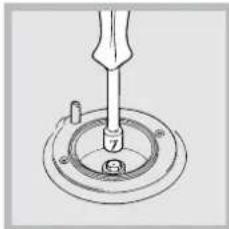
Technical line drawing of a mechanical assembly with a tool inserted into a circular component (no text or symbols)Replacing the nozzles for the hob burners:
-
Remove the hob grids and slide the burners off their seats.
-
Unscrew the nozzles using a 7mm socket spanner (see figure), and replace them with nozzles suited to the
new type of gas (see Burner and nozzle specifications table).
- Replace all the components by following the above instructions in reverse.
Adjusting the hob burners' minimum setting:
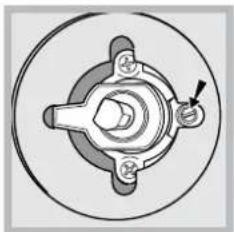
- Turn the tap to the minimum position.
- Remove the knob and adjust the regulatory screw, which is positioned inside or next to the tap pin, until the flame is small but steady. If the appliance is connected to a liquid gas supply, the bypass screw must be set to a minimum.
- While the burner is alight, quickly change the position of the knob from minimum to maximum and vice versa several times, checking that the flame is not extinguished.
Upon completion of adjustment, reseal using sealingwax or an equivalent material.
The hob burners do not require primary air adjustment.
natural_image
Mechanical component diagram showing a central hub with four mounting holes and a pointer indicating a feature (no text or labels)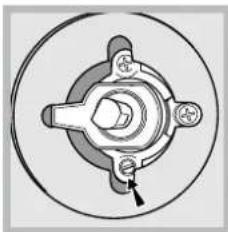
natural_image
Mechanical component diagram showing a central hub with four arms and a central shaft (no text or symbols)After adjusting the appliance so it may be used with a different type of gas, replace the old rating label with anew one which corresponds to the new type of gas (these labels are available from Authorised Technical Assistance Centres).
Should the gas pressure used be different (or vary slightly) from the recommended pressure, a suitable pressure regulator must be fitted to the inlet hose in accordance with current standards EN 88-1 and EN 88-2 relating to "regulators for channelled gas".
Replacing the Triple ring burner nozzles
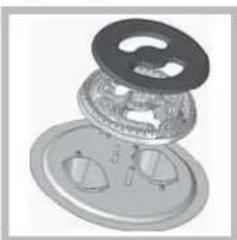
- Remove the pan supports and lift the burners out of their housing. The burner consists of two separate parts (see pictures).
- Unscrew the nozzles using a 7 mm socket spanner. Replace the nozzles with models that are configured for use with the new type of gas (see Table 1). The two nozzles have the same hole diameter.
- Replace all the components by completing the above operations in reverse order.
- Adjusting the burners' primary air :
natural_image
3D mechanical assembly diagram showing layered components with no visible text or symbols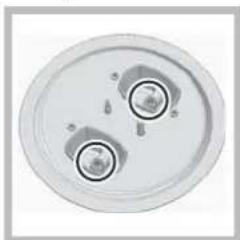
natural_image
Top-down view of a circular mechanical component with two central holes and mounting holes (no text or symbols visible)Does not require adjusting.
- Setting the burners to minimum:
- Turn the tap to the low flame position.
- Remove the knob and adjust the adjustment screw, which is positioned in or next to the tap pin, until the flame is small but steady.
- Having adjusted the flame to the required low setting, while the burner is alight, quickly change the position of the knob from minimum to maximum and vice versa several times, checking that the flame does not go out.
Adapting the oven
Replacing the oven burner nozzle:
- Remove the oven compartment.
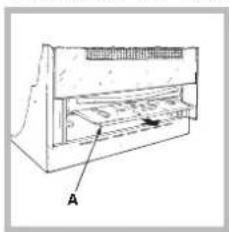
natural_image
Technical line drawing of a mechanical device with labeled component A (no text or symbols beyond label)- Slide out the protection panel A (see diagram).
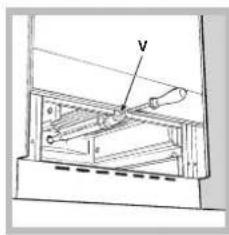
text_image
Technical diagram showing a mechanical assembly with labeled component 'v' and dimension lines- Remove the oven burner after unscrewing the screws V (see figure). The whole operation will be made easier if the oven door is removed.
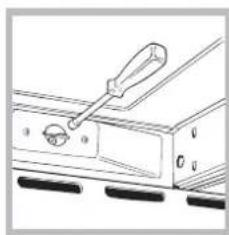
natural_image
Line drawing of a mechanical switch or lever mechanism (no text or symbols)- Unscrew the nozzle using a special nozzle socket spanner (see figure) or with a 7 mm socket spanner, and replace it with a new nozzle that is suited to the new type of gas (see Burner and nozzle specifications table).
Adjusting the gas oven burner's minimum setting:
- Light the burner (see Start-up and Use).
- Turn the knob to the minimum position (MIN) after it has been in the maximum position (MAX) for approximately 10 minutes.
- Remove the knob.
- Tighten or loosen the adjustment screws on the outside of the thermostat pin (see figure) until the flame is small but steady.
!If the appliance is connected to liquid gas, the bypass screw must be adjusted to minimum. - Turn the knob from the MAX position to the MIN position quickly or open and shut the oven door, making sure that the burner is not extinguished.
Adapting the grill
Replacing the grill burner nozzle:
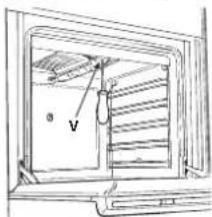
text_image
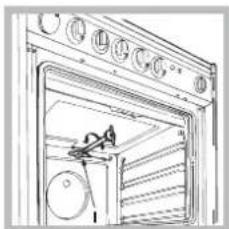
Technical diagram showing a window with labeled component 'V' and internal structure lines- Remove the oven burner after loosening screw V (see figure).
natural_image
Line drawing of a cabinet interior with doors, wheels, and a door (no text or symbols)- Unscrew the grill burner nozzle using a special nozzle socket spanner (see figure) or preferably with a 7 mm socket spanner, and replace it with a new nozzle that is suited to the new type of gas (see Burner and nozzle specifications table
!Be careful of the spark plug wires and the thermocouple tubes.
!The oven and grill burners do not require primary air adjustment.
!After adjusting the appliance so it may be used with a different type of gas, replace the old rating label with a new one that corresponds to the new type of gas (these labels are available from Authorised Technical Assistance Centres).
!Should the gas pressure used be different (or vary slightly) from the recommended pressure, a suitable pressure regulator must be fitted to the inlet hose in accordance with current national regulations relating to "regulators for channelled gas".
Table of burner and nozzle specifications
| Liquid Gas | Natural Gas | ||||||||||
| Thermal Power kW (p.c.s*) | By-Pass 1/100 Reduced *** | Nozzle 1/100 (mm) | Flow* g/h | Thermal Power kW (p.c.s*) | Nozzle 1/100 (mm) | Flow l/h | |||||
| Burner Diameter (mm) | Nominal | Reduced *** | ** Nominal | Reformed | |||||||
| Oven | - | 2.60 | 1.00 | 50 | 79T2A | 189 | 186 | 2.60 | 0.70 | 112 T2 | 248 |
| Grill | - | 2.20 | 2.00 | - | 78 T2A | 160 | 157 | 2.20 | 1.50 | 110 T2 | 209 |
| Rapid (R) | 130 | 3.30 | 1.50 | 61 | 2x65 | 240 | 236 | 3.30 | 1.50 | 2x99 | 314 |
| Semi Rapid (Medium) (S) | 75 | 2.00 | 0.40 | 30 | 69 | 145 | 143 | 2.00 | 0.40 | 104 | 190 |
| Auxiliary (Small) (A) | 55 | 1.00 | 0.40 | 30 | 50 | 73 | 71 | 1.00 | 0.40 | 78 | 95 |
| Supply Pressures | Nominal (mbar) | 28-30 | 37 | 20 | |||||||
| Minimum (mbar) | 20 | 25 | 17 | ||||||||
| Maximum | 35 | 45 | 25 | ||||||||
methane nozzles are available on request but not as an accessory
*with dry gas 15°C 1013 mbar
** Propane P.C.S=50,37 MJ/Kg
*** Butane P.C.S=49,47MJ/kg
Natural G20 P.C.S=37,78Mj/m³
FIRST TIME USE DAILY USE
Using the hob
Lighting the burners
For each BURNER knob there is a complete ring showing the strength of the flame for the relevant burner.
To light one of the burners on the hob:
- Press the BURNER knob and turn it in an anticlockwise direction so that it is pointing to the maximum flame setting ⬆.
For the models with the electronic ignition button (★), press the button and then turn the knob.
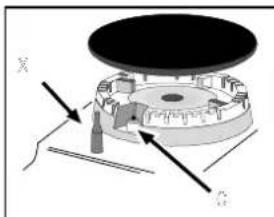
- Adjust the intensity of the flame to the desired level by turning the BURNER knob in an anticlockwise direction. This may be the minimum setting ▶, the maximum setting ▶ or any position in between the two. If the appliance is fitted with an electronic lighting device* (C), press the ignition button, marked with the
natural_image
Mechanical assembly diagram showing a rotating component with directional arrows indicating motion (no text or labels)symbol ☆, then hold the BURNER knob down and turn it in an anticlockwise direction, towards the maximum flame setting, until the burner is lit. The burner may be extinguished when the
knob is released. If this occurs, repeat the operation, holding the knob down for a longer period of time.
! If the flame is accidentally extinguished, switch off the burner and wait for at least 1 minute before attempting to relight it.
If the appliance is equipped with a flame failure safety device (X) ^* , press and hold the BURNER knob for approximately 2-3 seconds to keep the flame alight and to activate the device.
To switch the burner off, turn the knob until it reaches the stop position •.
Flame adjustment according to levels
the burner flame intensity can be adjusted with the knob according to 10 power levels, from maximum to minimum with 5 intermediate positions:

a click will indicate the change from one level to another when turning the knob. The system guarantees a more precise adjustment, allows to replicate the flame intensity and to identify easily the preferred level for different cooking operations.
Practical advice on using the burners
For the burners to work in the most efficient way possible and to save on the amount of gas consumed, it is recommended that only pans that have a lid and a flat base are used. They should also be suited to the size of the burner.
| Burner Cookware Diameter (cm) | |
| Triple Crown (TC) 2/4 - 26Fast (R) | |
| Auxiliary (A) 10 - 14 | |
| Semi Fast (S) 16 - 20 | |
To identify the type of burner, please refer to the diagrams contained in the "Burner and nozzle specifications".
| LEVEL | COOKING METHOD"suggested for" |
| 1 - 2 - 3 | KEEPWARM |
| GENTLE COOK | |
| 4 - 5 | SIMMERING |
| STEWING | |
| 6 - 7 | ROASTING |
| FRYING | |
| 8 - 9 | STIR FRYING |
| GRILLING | |
| 10 FAST | HEATING |
USING THE OVEN FIRST TIME AND DAILY USE
!The first time you use your appliance, heat the empty oven with its door closed at its maximum temperature for at least half an hour. Ensure that the room is well ventilated before switching the oven off and opening the oven door. The appliance may emit a slightly unpleasant odour caused by protective substances used during the manufacturing process burning away.
!Never put objects directly on the bottom of the oven; this will avoid the enamel coating being damaged. Only use position 1 in the oven when cooking with the rotisserie spit.
Lighting the oven
Press the BURNER knob and turn it in an anticlockwise direction so that it is pointing to the maximum flame setting
For the models with the electronic ignition button (★), press the button and then turn the knob.
If, after 15 seconds, the burner is still not alight, release the knob, open the oven door and wait for at least 1 minute before trying to light it again.
!The oven is fitted with a safety device and it is therefore necessary to hold the OVEN control knob down for approximately 6 seconds.
!If the flame is accidentally extinguished, switch off the burner and wait for at least 1 minute before attempting to relight the oven.
Adjusting the temperature
To set the desired cooking temperature, turn the OVEN control knob in an anticlockwise direction. Temperatures are displayed on the control panel and may vary between MIN (145°C) and MAX (250°C). Once the set temperature has been reached, the oven will keep it constant by using its thermostat.
Oven light
The light may be switched on at any moment by pressing the OVEN LIGHT button.
Grill
To light the grill, press the OVEN control knob while turning it in a clockwise direction until it reaches the [m], position. The grill enables the surface of food to be browned evenly and is particularly suitable for roast dishes, schnitzel and sausages. Place the rack in position 4 or 5 and the dripping pan in position 1 to collect fat and prevent the formation of smoke.
!The grill is fitted with a safety device and it is therefore necessary to hold the OVEN control knob down for approximately 6 seconds.
!If the flame is accidentally extinguished, switch off the burner and wait for at least 1 minute before attempting to relight the grill.
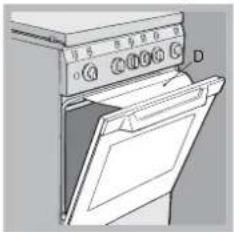
!When using the grill, leave the oven door ajar, positioning the deflector D between the door and the control panel (see figure) in order to prevent the knobs from overheating.
natural_image
Illustration of an open refrigerator with control panel and door (no text or symbols)ACCESSORIES
natural_image
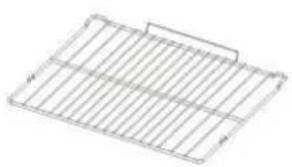
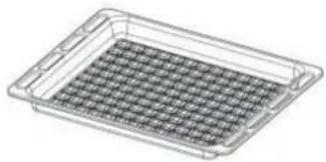
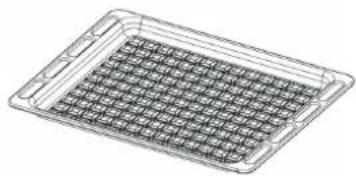
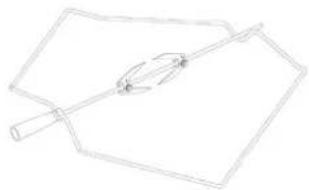
Four technical line drawings of rectangular trays or enclosures, shown from different angles (no text or symbols)The number and type of accessories may vary depending on which model is purchased. Other accessories that are not supplied can be purchased separately from the After-sales Service.
INSERTING WIRE SHELVES ANDOTHER ACCESSORIES INTO THE OVEN
-
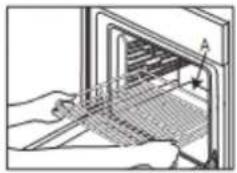
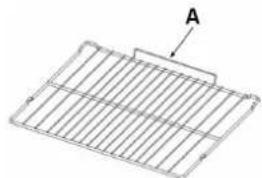
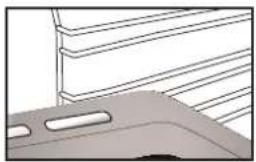
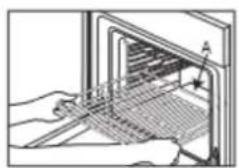
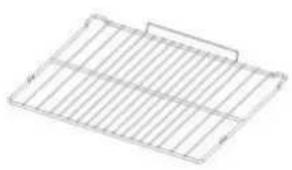
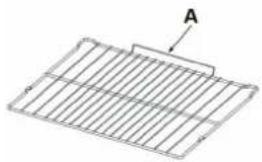
Insert the wire shelf horizontally, with the raised part "A" upwards (Fig. 1A, Fig. 1B)
-
Other accessories, such as the drip tray and baking tray, are inserted in the same way as the wire shelf (Fig. 2).
natural_image
Diagram of hands operating a rack-mounted device with a grid and labeled component A (no text or symbols present)Fig. 1A
natural_image
Simple line drawing of a grid structure with a labeled point A (no text or symbols beyond label)Fig. 1B
natural_image
Illustration of a laptop with a handle and two slots, next to a stack of books (no text or symbols visible)Fig. 2
The table lists the best function, accessories and level to use to cook various types of food. Cooking times start from the moment food is placed in the oven, excluding preheating (where required). Cooking temperatures and times are approximate and depend on the amount of food and type of accessory used. Use the lowest recommended settings to begin with and, if the food is not cooked enough, then switch to higher settings. Use the accessories supplied and preferably dark-coloured metal cake tins and baking trays. You can also use Pyrex or stoneware pans and accessories, but bear in mind that cooking times will be slightly longer.
| RECIPE FUNCTION | PREHEAT | TEMPERATURE(°C) / POWERLEVEL | DURATION(Min) | LEVEL (L-number) AND ACCESSORIES | ||
| Leavened cakes / Sponge cakes | CONVENTIONAL 15' | 160 35 - 60 | L-3 | _ | ||
| Filled cake(cheese cake, strudel, fruit pie) | CONVENTIONAL 15' | 170 40 - 60 | L-3 | _ | ||
| Cookies / Shortbread CONVENTIONAL 15' 150 30 - 60 L-3 | _ | |||||
| Small cakes / Muffin CONVENTIONAL 15' 160 30 - 40 L-3 | _ | |||||
| Choux buns CONVENTIONAL 15' 170 20 - 40 L-3 | _ | |||||
| Pizza / Bread / Focaccia Thin | CONVENTIONAL 15' | 220 - 250 15 | - 30 L-3 | _ | ||
| Pizza / Bread / Focaccia Thick | CONVENTIONAL 10' | 190 - 220 20 | - 40 L-3 | _ | ||
| Savoury pies (vegetable pie, quiche) | CONVENTIONAL 10' | 170 - 180 | 35 - 60 L-3 | _ | ||
| Vols-au-vent / Puff pastry crackers | CONVENTIONAL 15' | 170 - 180 | 15 - 30 L-3 | _ | ||
| Lasagne / Flans / Baked pasta / Cannelloni | CONVENTIONAL 15' | 170 - 190 | 40 - 60 L-3 | _ | ||
| Lamb / Veal / Beef / Pork 1 kg | CONVENTIONAL 10' | 170 - 190 70 | - 90 L-3 | _ | ||
| Chicken / Rabbit / Duck 1 kg | CONVENTIONAL 15' | 170 - 190 25 | - 50 L-3 | _ | ||
| Turkey / Goose 3 kg CONVENTIONAL 10' 150 - 170 130 - 170 L-3 | _ | |||||
| Fish fillets / Steaks | GRILL | 10' | MAX | 15 - 35 | L-3 | _ |
| Stuffed vegetables (tomatoes, courgettes, aubergines) | GRILL | 10' | MAX | 30 - 60 L-3 | _ | |
| Vegetable gratin | GRILL | 10' | MAX | 15 - 40 | L-3 | _ |
| Toast | GRILL | 10' | MAX | 3 - 5 | L-3 | _ |
| Sausages / Kebabs / Spare ribs / Hamburgers | GRILL | 10' | MAX | 20 - 40 L-3 | _ | |
| Roast potatoes | CONVENTIONAL 10' | 180 - 220 | 35 - 60 L-3 | _ | ||
| Leg of lamb / Shanks CONVENTIONAL 10' 170 - 200 50 - 100 L-3 | _ | |||||
| ACCESSORIES | |||||
| Wire shelf | Baking dish or cake tin on the wire shelf | Baking tray/Drip tray or Baking dish on the wire shelf | Drip tray / Baking tray | Drip tray / Baking tray with 500 ml of water |
text_image
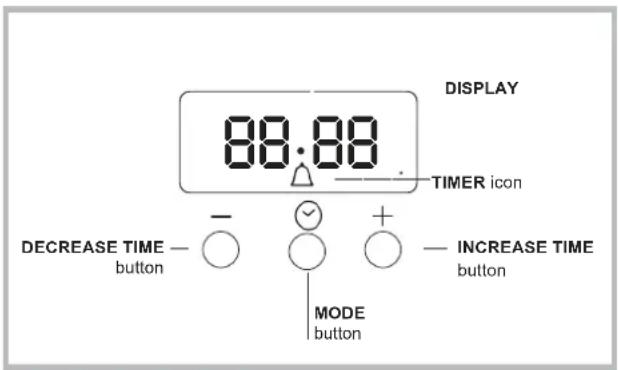
DISPLAY 88:88 TIMER icon DECREASE TIME — ○ - ○ + — INCREASE TIME button MODE button buttonSetting the clock
The clock may be set when the oven is switched off or when it is switched on, provided that the end time of a cooking cycle has not been programmed previously. After the appliance has been connected to the mains,
or after a blackout, the 00:00
digits on the DISPLAY will begin to flash.
-
Press the "+" and "-" button simultaneously Than the colon between hours and minutes is flashing.
-
Use the "+" and "-" buttons to adjust the time; if you press and hold either button, the display will scroll through the values more quickly, making it quicker and easier to set the desired value.
Changing the buzzer frequency
The buzzer signal frequency can be changed by touching the "-" repeatedly.
Setting the minute minder
This function does not interrupt cooking and does not affect the oven; it is simply used to activate the buzzer when the set amount of time has elapsed.
- Press the button several times until the icon and the three digits on the display begin to flash.
- Use the “+” and “-” buttons to set the desired time; if you press and hold either button, the display will scroll through the values more quickly, making it quicker and easier to set the value.
- Wait for 5 seconds, If you press the button one more time the display will then show the time as it counts down.
When this period of time has elapsed the buzzer will be activated.
TURN OFF THE MAIN SWITCH AND ENSURE THE COOKER IS COLD BEFORE CLEANING. BEFORE SWITCHING ON AGAIN, ENSURE THAT ALL CONTROLS ARE IN THE OFF POSITION.
| Do not use steam cleaning equipment. | Carry out the required operations when the oven is cold. | Do not use wire wool, abrasive scourers or abrasive/corrosive cleaning agents, as these could damage the surfaces of the appliance. |
| Use protective gloves during all operations. | Disconnect the appliance from the power supply. |
Discon nect the appliance from the power supply.
Respecting and conserving the environment
- Whenever possible, avoid pre-heating the oven and always try to fill it. Open the oven door as little as possible because heat is lost every time it is opened. To save a substantial amount of energy, simply switch off the oven 5 to 10 minutes before the end of your planned cooking time and use the heat the oven continues to generate.
- Keep gaskets clean and tidy to prevent any door energy losses
- If you have a timed tariff electricity contract, the “delay cooking” option will make it easier to save money by moving operation to cheaper time periods.
- The base of your pot or pan should cover the hot plate. If it is smaller, precious energy will be wasted and pots that boil over leave encrusted remains that can be difficult to remove.
- Cook your food in closed pots or pans with well-fitting lids and use as little water as possible. Cooking with the lid off will greatly increase energy consumption
- Use purely flat pots and pans
- If you are cooking something that takes a long time, it's worth using a pressure cooker, which is twice as fast and saves a third of the energy.
Switching the appliance off
Disconnect your appliance from the electricity supply before carrying out any work on it.
The cover *
natural_image
Simple line drawing of a storage tray with four wheels and two upward arrows, no text or symbols present.If the cooker is fitted with a glass cover, this cover should be cleaned using lukewarm water. Do not use abrasive products.
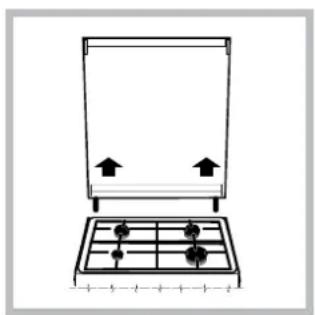
It is possible to remove the cover in order to make cleaning the area behind the hob easier. Open the cover fully and pull it upwards (see figure).
! Do not close the cover
when the burners are alight or when they are still hot.
Inspecting the oven seals
Check the door seals around the oven periodically. If the seals are damaged, please contact your nearest Authorised After-sales Service Centre. We recommend that the oven is not used until the seals have been replaced.
Gas tap maintenance
Over time, the taps may become jammed or difficult to turn. If this occurs, the tap must be replaced.
! This procedure must be performed by a qualified technician who has been authorised by the manufacturer.
EXTERIOR SURFACES
- Clean the surfaces with a damp microfibre cloth. If they are very dirty, add a few drops of pH-neutral detergent. Dry them with a dry cloth.
- Do not use corrosive or abrasive detergents. If any of these products inadvertently comes into contact with the surfaces of the appliance, clean immediately with a damp microfibre cloth.
Do not use alcohol-based products such as denatured alcohol.
INTERIOR SURFACES
- After every use, leave the oven to cool and then clean it, preferably while it is still warm, to remove any deposits or stains caused by food residues. To dry any condensation that has formed as a result of cooking foods with a high water content, let the oven to cool completely and then wipe it with a cloth or sponge.
- Clean the glass in the door with a suitable liquid detergent.
ACCESSORIES
Soak the accessories in a washing-up liquid solution after use, handling them with oven gloves if they are still hot. Food residues can be removed using a washing-up brush or a sponge.
REPLACING THE LIGHT
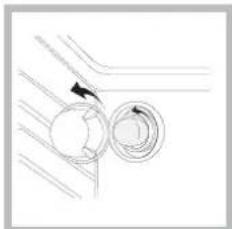
- Disconnect the oven from the power supply.
- Unscrew the cover from the light, replace the bulb and screw the cover back on the light.
natural_image
Pure technical diagram showing two circular components with directional arrows, no text or symbols present- Reconnect the oven to the power supply.
Note: Use 40 W/230 V type G9
The bulb used in the product is specifically designed for domestic appliances and is not suitable for general room lighting within the home (EC Regulation 244/2009). Light bulbs are available from our After-sales Service.
- Do not handle bulbs with your bare hands as your fingerprints could damage them. Do not use the oven until the light cover has been refitted.
This product contains a light source of energy efficiency class G
CATALYTIC CLEANING
These are panels coated with a special enamel, which is able to absorb the fat released by food as it cooks. This enamel is quite strong, so that the various accessories (racks, dripping pans, etc.) can slide along them without damaging them. White marks may appear on the surfaces; these are not a cause for concern.
Nevertheless, the following should be avoided: -scraping the enamel with sharp objects (a knife, for example); -using detergents or abrasive materials.
REMOVING AND REFITTING THE OVEN DOOR GLASS
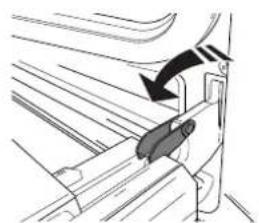
- To remove the door, open it fully and lower the catches until they are in the unlock position.
natural_image
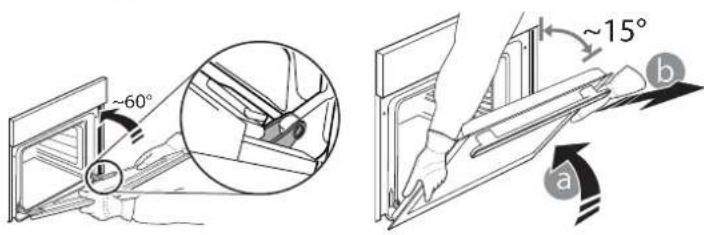
Diagram of a car door handle mechanism with an arrow indicating direction (no text or symbols present)- Close the door as much as you can.
Take a firm hold of the door with both hands – do not hold it by the handle.
Simply remove the door by continuing to close it while pulling it upwards (a) at the same time until it is released from its seating (b).
text_image
~60° ~15° a bPut the door to one side, resting it on a soft surface.
-
Refit the door by moving it towards the oven, aligning the hooks of the hinges with their seating and securing the upper part onto its seating.
-
Lower the door and then open it fully.
Lower the catches into their original position: Make sure that you lower them down completely.
- Try closing the door and check to make sure that it lines up with the control panel. If it does not, repeat the steps above.
CLICK TO CLEAN - CLEANING THE GLASS
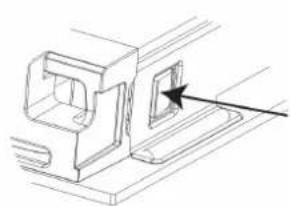
- After removing the door and resting it on a soft surface with the handle downwards, simultaneously press the two retaining clips and remove the upper edge of the door by pulling it towards you.
natural_image
Technical line drawing of a mechanical bracket with an arrow pointing to a detail (no text or symbols present)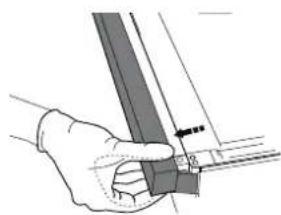
natural_image
Hand holding a mechanical component with a ruler and bracket (no visible text or symbols)-
Lift and firmly hold the inner glass with both hands, remove it and place it on a soft surface before cleaning it.
-
When reassembling the inner door glass insert the glass panel correctly so that the text written on the panel is not reversed and can be easily legible.
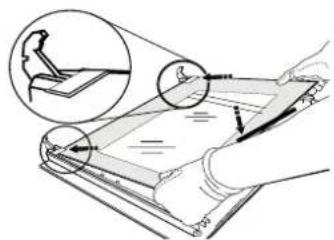
text_image
Diagram illustrating a hand holding a notebook with a magnified inset showing a seated figure and its outline, likely illustrating a writing or sketching process.- Refit the upper edge: a click will indicate correct positioning. Make sure the seal is secure before refitting the door.
TROUBLESHOOTING
| What to do if... | Possible reasons | Solutions |
| The oven is not working. | Power cut.Disconnection from the mains | Check for the presence of mains electrical power and whether the oven is connected to the electricity supply.Turn off the oven and restart it to see if the fault persists. |
AFTER-SALES SERVICE
To receive assistance, call the number given on the warranty leaflet enclosed with the product or follow the instructions on our website. Be prepared to provide:
• a brief description of the problem;
• the exact model type of your product;
- the assistance code (the number following the word SERVICE on the identification plate attached to the product, which can be seen on the inside edge when the oven door is open);
- your full address;
• a contact telephone number.
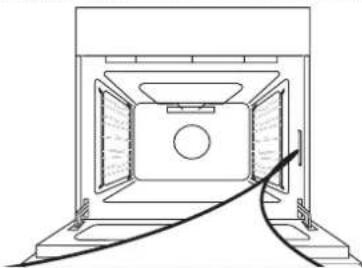
natural_image
Technical line drawing of a mechanical assembly or enclosure with internal components and a curved path (no text or symbols)

Mod. XXX Ind.C. XXX
Prod.N. XXX
S.N. XXX
Please note: If repairs are required, contact an authorised service centre that is guaranteed to use original spare parts and perform repairs correctly. Please refer to the enclosed warranty leaflet for more information on the warranty.
www A complete product specification, including the energy efficiency ratings for this oven, can be read and downloaded from our website www.whirlpool.com
natural_image
Diagram of a mechanical press or clamping device with two hands pressing down on a base (no text or symbols)شکل ۱
natural_image
Mechanical component diagram showing a central hub with four arms and a circular housing (no text or symbols)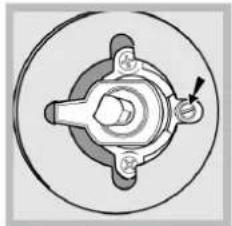
natural_image
Mechanical component diagram showing a central hub with four arms and a pointer indicating a specific part (no text or symbols present)natural_image
Exploded view of a mechanical component with internal gears and housing (no text or symbols visible)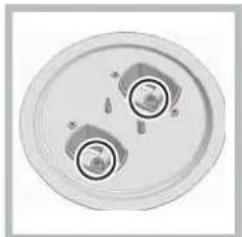
natural_image
Top-down view of a circular mechanical component with two central holes and mounting holes (no text or symbols visible)لا يحتاج إلى ضبط.
natural_image
Technical line drawing of a mechanical assembly with a tool inserted into a circular component (no text or symbols).3
مواعمة الشواية
natural_image
Line drawing of a door with circular control knobs and a hanging device (no text or symbols)natural_image
Technical line drawing of a mechanical device with labeled component A (no text or symbols beyond label)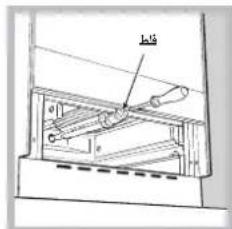
text_image
1.05 a b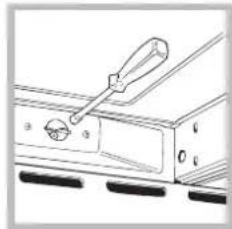
natural_image
Technical line drawing of a mechanical clamp or bracket with no visible text or symbolsThe image contains no text. It is a graphical icon depicting water droplets and vertical bars, which are likely to be used for visual inspection or data processing. Therefore, no OCR output can be generated.
text_image
Diagram of a refrigerator with labeled control panel and door, showing front and rear views with Chinese text.5 4
!
!
OVEN
! إضاعة الفرن
!
OVEN
6
ضبط درجة الحرارة
250 MAX
145
MIN
ضوء الفرن
OVEN LIGHT
natural_image
Simple line drawing of a mechanical component with a curved arrow and shaft (no text or symbols)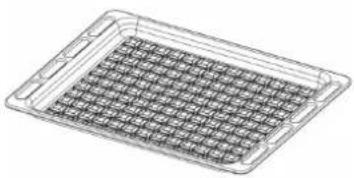
natural_image
3D wireframe rendering of a rectangular tray with a grid pattern (no text or symbols)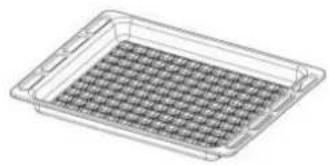
natural_image
3D wireframe rendering of a rectangular tray with a grid pattern (no text or symbols)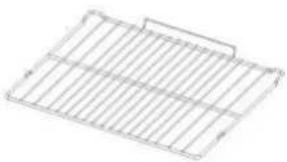
natural_image
Simple line drawing of a wire mesh grid (no text or symbols)natural_image
Pure 3D grid diagram with a labeled point A, no text or symbols present1B شكل
natural_image
Illustration of hands operating a grating machine with a rack inside (no text or symbols visible)1A شكل
natural_image
Pure technical line drawing of a mechanical component or bracket (no text or symbols)2 شكل
natural_image
Pure mechanical diagram showing two circular components with a curved arrow indicating motion (no text or symbols)natural_image
Simple line drawing of a gas stove with two upward arrows indicating top-down orientation (no text or symbols)natural_image
Hand holding a metal rod with a small arrow pointing to it, no text or symbols visible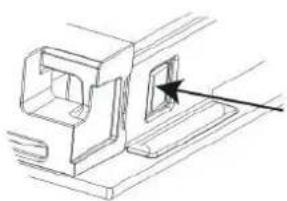
natural_image
Technical line drawing of a mechanical bracket with a cursor pointer and arrow (no text or symbols)text_image
Diagram illustrating a hand holding a notebook with magnified views showing the interior and side views of the device.natural_image
Diagram of a car seatbelt mechanism with an arrow indicating direction (no text or symbols present)DÉCLARATIONS DE CONFORMITÉ
INSTALLATION DU FOUR
natural_image
Diagram of a mechanical press or clamping device with two hands pressing down on a base (no text or symbols)Fig. A
natural_image
Technical line drawing of a mechanical assembly with a tool inserted into a circular component (no text or symbols)natural_image
Mechanical component diagram showing a central hub with four arms and a circular base (no text or symbols)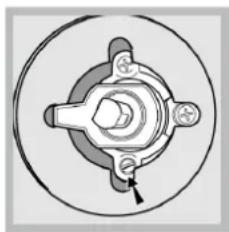
natural_image
Mechanical component diagram showing a central hub with four arms and a central shaft (no text or symbols)natural_image
Exploded view diagram of a mechanical assembly (no text or symbols visible)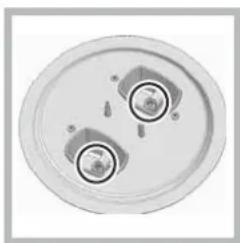
natural_image
Top-down view of a circular mechanical component with two circular features and mounting holes (no text or symbols visible)natural_image
Technical line drawing of a mechanical device with labeled component A (no text or symbols beyond label)text_image
Technical diagram showing a mechanical assembly with labeled components V and e, likely from an engineering or physics context.natural_image
Technical line drawing of a mechanical clamp or bracket with mounting holes (no text or symbols)text_image
Technical diagram showing a mechanical or electrical component with labeled parts and directional arrowsnatural_image
Line drawing of a front view of a large appliance with control knobs and a fan (no text or symbols)The image contains no text. It is a graphical icon depicting water droplets and vertical bars, which are likely to be used for visual inspection or data processing. Therefore, no OCR output can be generated.
natural_image
Diagram of a kitchen appliance with door, drawer, and control panel (no text or symbols)ACCESSOIRES
GRILLE
natural_image
Pure wire mesh diagram of a rectangular metal grate (no text or symbols)LÈCHEFRITE
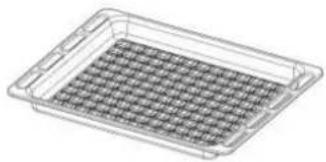
natural_image
3D rendering of a rectangular tray with a grid pattern on the front face (no text or symbols)PLAQUE DE CUISSON
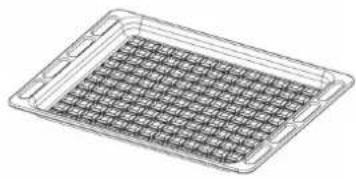
natural_image
3D wireframe rendering of a rectangular tray with a grid pattern (no text or symbols)KIT TOURNEBROCHE
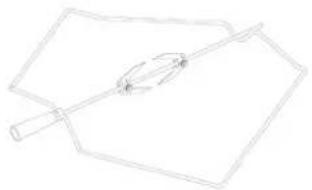
natural_image
Simple line drawing of a mechanical component with a curved arrow and shaft (no text or symbols)natural_image
Diagram of a mechanical assembly with labeled component A, showing internal structure without any text or symbolsFig. 1a
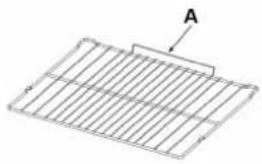
natural_image
Simple line drawing of a grid structure with a labeled point A (no text or symbols beyond label)Fig. 1B
natural_image
Illustration of a laptop with a keyboard and mouse, no text or symbols presentFig. 2
natural_image
Simple line drawing of a storage tray with four wheels and two upward arrows, no text or symbols present.REEMPLACER L'AMPOULE
natural_image
Pure mechanical diagram showing two circular components with an arrow indicating rotation (no text or symbols)natural_image
Diagram of a car seatbelt mechanism with directional arrow (no text or symbols)natural_image
Technical line drawing showing a mechanical component with an arrow pointing to a detail (no text or symbols present)text_image
Diagram illustrating a hand holding a folded document with an inset showing a hand holding a small object, labeled with angle β and directional arrows.natural_image
Diagram of a mechanical press or clamping device with two hands pressing down on a base (no text or symbols)Elk. A
natural_image
Line drawing of a person using a kitchen appliance to adjust a hair rod, with inset images showing the same setup (no text or symbols)natural_image
Technical line drawing of a mechanical assembly with a tool inserted into a circular component (no text or symbols)natural_image
Mechanical component diagram showing a central hub with four arms and a circular housing (no text or symbols)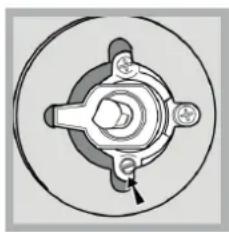
natural_image
Mechanical component diagram showing a central hub with four arms and a bolt, no text or symbols present.text_image
Technical diagram showing a mechanical assembly with labeled components and motion indicatorsnatural_image
Line drawing of a mechanical device with a tool inserted, showing no text or symbolstext_image
Technical diagram showing a mechanical or electrical component with labeled parts and directional arrowsnatural_image
Line drawing of a door with circular components and a hanging mechanism (no text or symbols)natural_image
Exploded view diagram of a mechanical assembly (no text or symbols visible)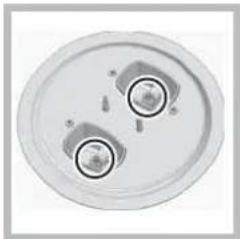
natural_image
Top-down view of a circular mechanical component with two central holes and mounting holes (no text or symbols visible)natural_image
Diagram of a kitchen appliance with a door and control panel (no text or symbols)E3APTHMATA
ΣΧΑΡΑ
natural_image
Line drawing of a metal grid or rack structure with no text or symbolsΒΑΘΥ ΤΑΨΙ
natural_image
3D rendering of a rectangular tray with a grid pattern inside, no text or symbols visibleΤΑΨΙ ΨΗΣΙΜΑΤΟΣ
natural_image
3D rendering of a rectangular tray with a grid pattern, no text or symbols visibleKIT ΣΟΥΒΛΑΣ
natural_image
Pure line drawing of a mechanical component with no text, numbers, or symbolsnatural_image
Diagram of a mechanical assembly with a grid-like structure and an arrow indicating direction (no text or symbols present)Eik. 1A
natural_image
Pure 3D wireframe diagram of a grid structure with a labeled point A (no text or symbols beyond label)Eik. 1B
natural_image
Illustration of a laptop with a keyboard and mouse, no text or symbols presentEik. 2
natural_image
Simple line drawing of a roof-mounted cabinet with four wheels and an open lid, no text or symbols present.natural_image
Pure technical diagram showing two circular components with directional arrows, no text or symbols presentnatural_image
Diagram of a car seatbelt mechanism with an arrow indicating direction (no text or symbols present)natural_image
Technical line drawing showing a mechanical component with an arrow indicating direction, and a hand holding a tool (no text or symbols present)text_image
Diagram illustrating a hand holding a folded document with magnified views showing the anatomical structure and directional arrows.text_image
Illustration showing a person using a device to inspect a document with warning symbol, alongside an open oven and magnified view of the document.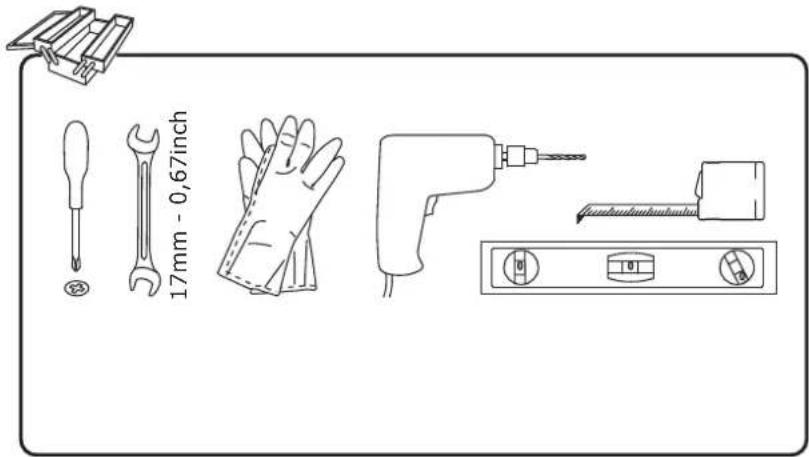
text_image
17mm - 0,67inch
text_image
Min. 750 mm Min. 420 mm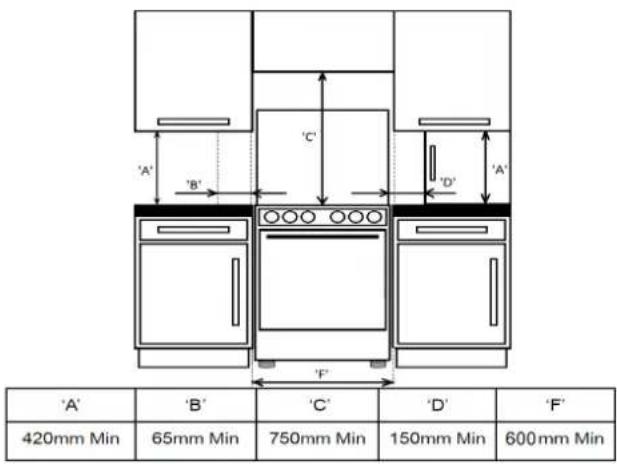
text_image
A' B' C' D' A' B' F' 'A' 'B' 'C' 'D' F' 420mm Min 65mm Min 750mm Min 150mm Min 600mm Min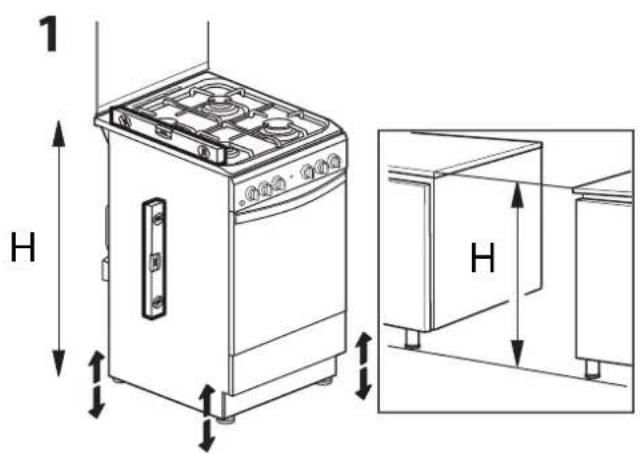
text_image
1 H H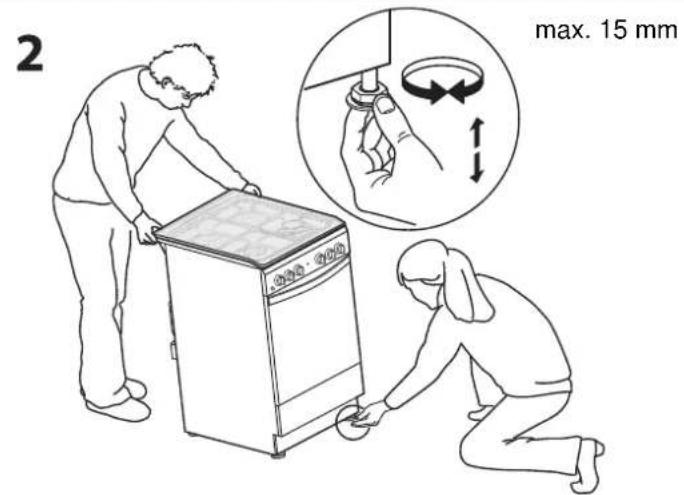
text_image
2 max. 15 mm3
natural_image
Diagram of a kitchen appliance with two circular insets showing internal components and directional arrows (no text or symbols)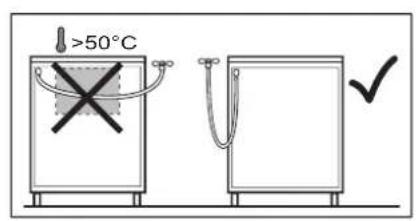
text_image
>50°C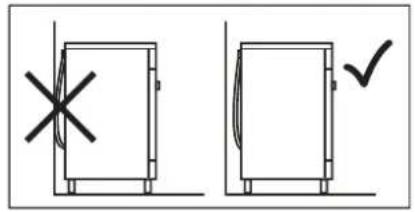
text_image
Diagram showing two mechanical or electrical component configurations with symbols indicating failure or rejection states.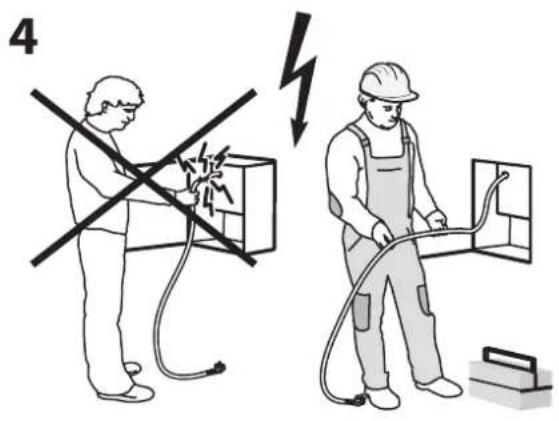
text_image
4