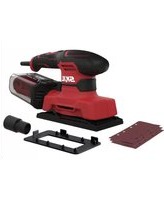
7352 AA - Sander SKIL - Free user manual and instructions
Find the device manual for free 7352 AA SKIL in PDF.


| Product type | Sander |
| Brand | SKIL |
| Model | 7352 AA |
| Intended use | Dry sanding and polishing of wood, painted surfaces, plastic and filler |
| Professional use | No (tool for household use) |
| Power supply | Mains (power cable) |
| On/off switch | Yes (sliding) |
| Dust container | Yes, removable |
| Vacuum adapter | Available (not included as standard) |
| Sheet perforator | Available (not included as standard) |
| Speed adjustment | Yes (adjustment wheel) |
| Double insulation | Yes (does not require grounding) |
| Sound pressure level | 84.0 dB(A) |
| Sound power level | 95.0 dB(A) |
| Vibration (total value) | 7.0 m/s² (uncertainty K=1.5 m/s²) |
| Recommended paper grits | Coarse (40, 60), medium (80, 100, 120), fine (180, 240, 320) |
| Maintenance - Cleaning | Disconnect before cleaning; clean ventilation slots with a brush |
| Repairability | Repair by qualified personnel using original spare parts |
| Warranty | Covers manufacturing defects; does not cover overloading or misuse |
| Weight | Not specified in the manual |
| Dimensions | Not specified in the manual |
Frequently Asked Questions - 7352 AA SKIL
User questions about 7352 AA SKIL
0 question about this device. Answer the ones you know or ask your own.
Ask a new question about this device
Download the instructions for your Sander in PDF format for free! Find your manual 7352 AA - SKIL and take your electronic device back in hand. On this page are published all the documents necessary for the use of your device. 7352 AA by SKIL.
USER MANUAL 7352 AA SKIL
natural_image
Illustration of a SKIL power tool with a mounted device (no text or symbols visible)
EAC
GB ORIGINAL INSTRUCTIONS 8
F NOTICE ORIGINALE 10
10
natural_image
Illustration of a SKIL power tool with two hanging bell icons above it, showing mechanical components and motion arrows (no text or symbols)GB
Orbital sander 7352
INTRODUCTION
- This tool is intended for dry sanding and finishing of wood, painted surfaces, plastic and filler
• This tool is not intended for professional use - Read and save this instruction manual ③
TECHNICAL DATA①
TOOL ELEMENTS ②
A On/off switch
B Dust box
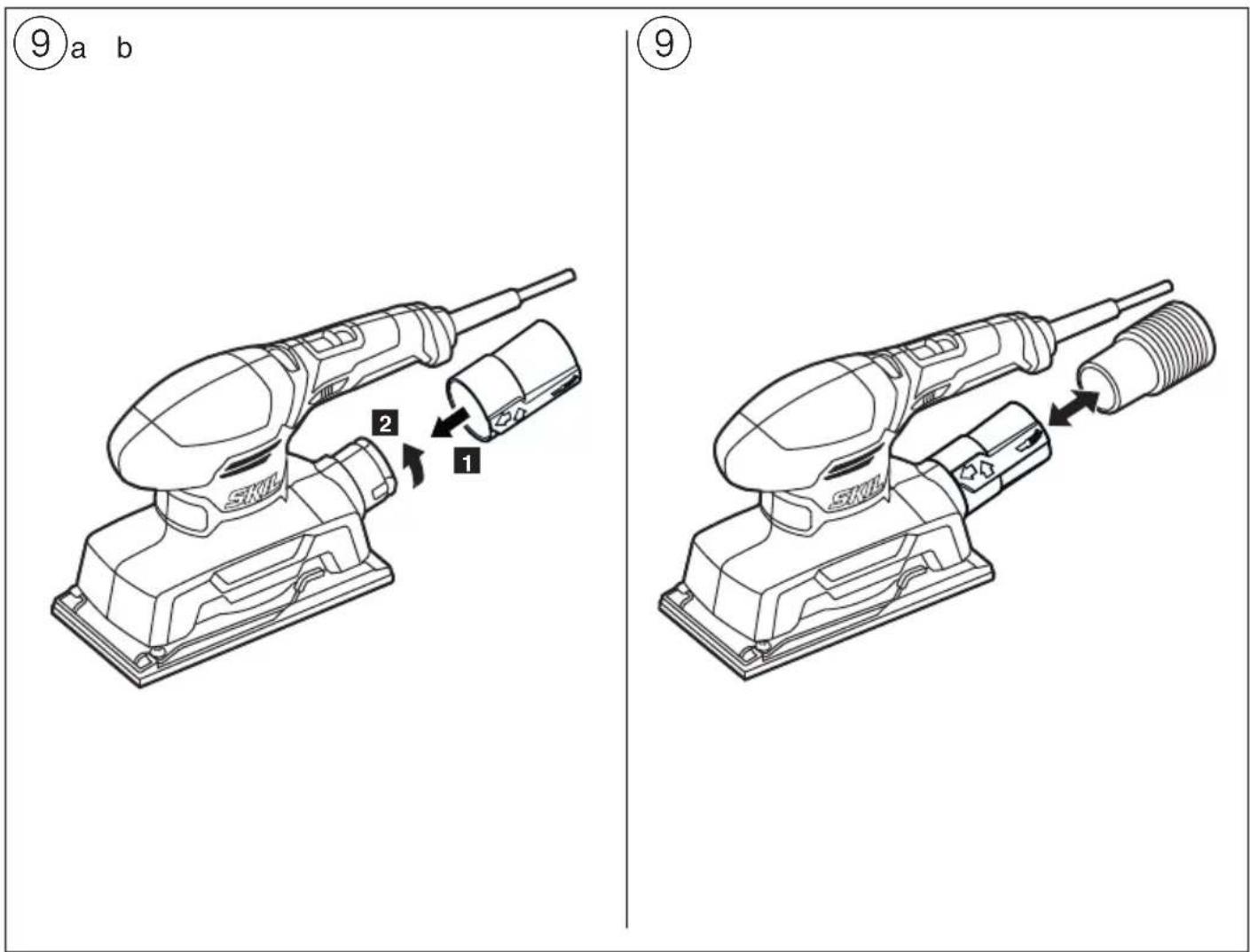
C Vacuum cleaner adapter*
D Paper punch*
E Sanding speed selection wheel
F Ventilation slots
* NOT STANDARD INCLUDED
SAFETY
GENERAL POWER TOOL SAFETY WARNINGS
A WARNING Read all safety warnings, instructions, illustrations and specifications provided with this power tool. Failure to follow all instructions listed below may result in electric shock, fire and/or serious injury.
Save all warnings and instructions for future reference.
The term “power tool” in the warnings refers to your mains-operated (corded) power tool or battery-operated (cordless) power tool.
1) WORK AREA SAFETY
a) Keep work area clean and well lit. Cluttered or dark areas invite accidents.
b) Do not operate power tools in explosive atmospheres, such as in the presence of flammable liquids, gases or dust. Power tools create sparks which may ignite the dust or fumes.
c) Keep children and bystanders away while operating a power tool. Distractions can cause you to lose control.
a) Power tool plugs must match the outlet. Never modify the plug in any way. Do not use any adapter plugs with earthed (grounded) power tools.
Unmodified plugs and matching outlets will reduce risk of electric shock.
b) Avoid body contact with earthed or grounded surfaces such as pipes, radiators, ranges and refrigerators. There is an increased risk of electric shock if your body is earthed or grounded.
c) Do not expose power tools to rain or wet conditions. Water entering a power tool will increase the risk of electric shock.
d) Do not abuse the cord. Never use the cord for carrying, pulling or unplugging the power tool. Keep cord away from heat, oil, sharp edges or moving
2) ELECTRICAL SAFETY
parts. Damaged or entangled cords increase the risk of electric shock.
e) When operating a power tool outdoors, use an extension cord suitable for outdoor use. Use of a cord suitable for outdoor use reduces the risk of electric shock.
f) If operating a power tool in a damp location is unavoidable, use a residual current device (RCD) protected supply. Use of an RCD reduces the risk of electric shock.
3) PERSONAL SAFETY
a) Stay alert, watch what you are doing and use common sense when operating a power tool. Do not use a power tool while you are tired or under the influence of drugs, alcohol or medication. A moment of inattention while operating power tools may result in serious personal injury.
b) Use personal protective equipment. Always wear eye protection. Protective equipment such as a dust mask, non-skid safety shoes, hard hat, or hearing protection used for appropriate conditions will reduce personal injuries.
c) Prevent unintentional starting. Ensure the switch is in the off-position before connecting to power source and/or battery pack, picking up or carrying the tool. Carrying power tools with your finger on the switch or energising power tools that have the switch on invites accidents.
d) Remove any adjusting key or wrench before turning the power tool on. A wrench or a key left attached to a rotating part of the power tool may result in personal injury.
e) Do not overreach. Keep proper footing and balance at all times. This enables better control of the power tool in unexpected situations.
f) Dress properly. Do not wear loose clothing or jewellery. Keep your hair and clothing away from moving parts. Loose clothes, jewellery or long hair can be caught in moving parts.
g) If devices are provided for the connection of dust extraction and collection facilities, ensure these are connected and properly used. Use of dust collection can reduce dust-related hazards.
h) Do not let familiarity gained from frequent use of tools allow you to become complacent and ignore tool safety principles. A careless action can cause severe injury within a fraction of a second.
4) POWER TOOL USE AND CARE
a) Do not force the power tool. Use the correct power tool for your application. The correct power tool will do the job better and safer at the rate for which it was designed.
b) Do not use the power tool if the switch does not turn it on and off. Any power tool that cannot be controlled with the switch is dangerous and must be repaired.
c) Disconnect the plug from the power source and/or remove the battery pack, if detachable, from the power tool before making any adjustments, changing accessories, or storing power tools. Such preventive safety measures reduce the risk of starting the power tool accidentally.
d) Store idle power tools out of the reach of children and do not allow persons unfamiliar with the power
tool or these instructions to operate the power tool. Power tools are dangerous in the hands of untrained users.
e) Maintain power tools and accessories. Check for misalignment or binding of moving parts, breakage of parts and any other condition that may affect the power tool's operation. If damaged, have the power tool repaired before use. Many accidents are caused by poorly maintained power tools.
f) Keep cutting tools sharp and clean. Properly maintained cutting tools with sharp cutting edges are less likely to bind and are easier to control.
g) Use the power tool, accessories and tool bits etc., in accordance with these instructions, taking into account the working conditions and the work to be performed. Use of the power tool for operations different from those intended could result in a hazardous situation.
h) Keep handles and grasping surfaces dry, clean and free from oil and grease. Slippery handles and grasping surfaces do not allow for safe handling and control of the tool in unexpected situations.
5) SERVICE
a) Have your power tool serviced by a qualified repair person using only identical replacement parts. This will ensure that the safety of the power tool is maintained.
SAFETY INSTRUCTIONS FOR SANDERS
GENERAL
- This tool should not be used by people under the age of 16 years
- Use completely unrolled and safe extension cords with a capacity of 16 Amps (U.K. 13 Amps)
- Never use the tool when the cord is damaged; it must be replaced by a specially prepared cord available through the service organization.
- Dust from material such as paint containing lead, some wood species, minerals and metal may be harmful (contact with or inhalation of the dust may cause allergic reactions and/or respiratory diseases to the operator or bystanders); wear a dust mask and work with a dust extraction device when connectable
- Certain kinds of dust are classified as carcinogenic (such as oak and beech dust) especially in conjunction with additives for wood conditioning; wear a dust mask and work with a dust extraction device when connectable
- Follow the dust-related national requirements for the materials you want to work with
- Do not work materials containing asbestos (asbestos is considered carcinogenic)
- When sanding metal, sparks are generated; do not use dust box and keep other persons and combustible material from work area
- Regularly clean the power tool's air vents. The motor's fan will draw the dust inside the housing and excessive accumulation of powdered metal may cause electrical hazards.
• Always disconnect plug from power source before making any adjustment or changing any accessory ACCESSORIES - SKIL can assure flawless functioning of the tool only when original accessories are used
- Do not continue to use worn, torn or heavily clogged
sanding sheets
BEFORE USE
- Always check that the supply voltage is the same as the voltage indicated on the nameplate of the tool
- Avoid damage that can be caused by screws, nails and other elements in your workpiece; remove them before you start working
- Secure the workpiece (a workpiece clamped with clamping devices or in a vice is held more securely than by hand)
DURING USE
- The noise level when working can exceed 85 dB(A); wear ear protection
- Wear protective gloves, safety glasses, close-fitting clothes and hair protection (for long hair)
- Always keep the cord away from moving parts of the tool; direct the cord to the rear, away from the tool
- Do not touch the moving sanding sheet
- In case of electrical or mechanical malfunction, immediately switch off the tool and disconnect the plug
- If the cord is damaged or cut through while working, do not touch the cord, but immediately disconnect the plug
AFTER USE
- When you put away the tool, switch off the motor and ensure that all moving parts have come to a complete standstill
EXPLANATION OF SYMBOLS ON TOOL
③ Read the instruction manual before use
④ Double insulation (no earth wire required)
⑤ Do not dispose of the tool together with household waste material
WHEN CONNECTING NEW 3-PIN PLUG (U.K. ONLY):
- Do not connect the blue (= neutral) or brown (= live) wire in the cord of this tool to the earth terminal of the plug
- If for any reason the old plug is cut off the cord of this tool, it must be disposed of safely and not left unattended
USE
- Mounting of sanding sheet ⑥
! disconnect the plug
! the dust suction requires the use of perforated sanding sheets
! use paper punch D for adapting non-perforated sanding sheets to dust suction ⑦
! perforation in sanding sheet should correspond with perforation in sanding foot
! replace worn sanding sheets in time
! always use the tool with the total sanding surface covered with sanding paper
- On/off switch
-switch on/off the tool by pushing switch A ② forward/backwards
! before the sanding surface reaches the workpiece, you should switch on the tool
! before switching off the tool, you should lift it from the workpiece
- Dust suction
! do not use dust box/vacuum cleaner when sanding metal
Dust box ⑧
-empty dust box B regularly for optimal dust pick-up performance
-remove dust box B by pulling dust box B backwards
For using vacuum cleaner ⑨
-mount vacuum cleaner adapter C as illustrated -connect vacuum cleaner hose to vacuum cleaner adapter C
- Speed control
For optimal sanding results on different materials -with wheel E② you can set the desired sanding speed -adjust speed to grit size used -before starting a job, find the optimal speed and grit by testing out on spare material
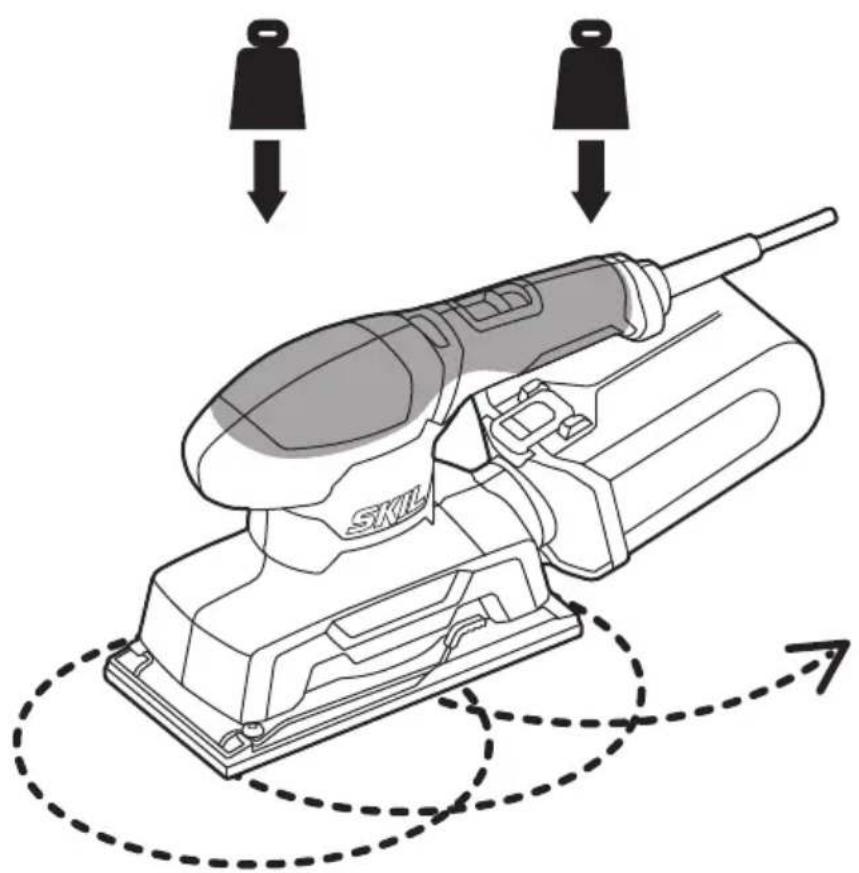
- Holding and guiding the tool ⑩
! while working, always hold the tool at the grey-coloured grip area(s)
-guide the tool parallel to the working surface
! do not apply too much pressure on the tool; let the sanding surface do the work for you
-do not tilt the tool in order to avoid unwanted sanding marks
-keep ventilation slots F② uncovered
APPLICATION ADVICE
- Move the tool in straight movements in line with the grain -for sanding bare wood surfaces -for extra fine finishing
- Never use the same sanding sheet for wood and metal
- Recommended sanding sheet grits: -for removing paint and for sanding of extremely rough wood use coarse grit sizes (40, 60) -for sanding of rough or plain wood use medium grit sizes (80, 100, 120) -for smoothing of wood and surfaces with old paint as well as for finishing of bare wood use fine grit sizes (180, 240, 320)
- Use different grit sizes when the working surface is rough:
-start sanding with coarse or medium grit -finish with fine grit
• For more information see www.skil.com
MAINTENANCE / SERVICE
• This tool is not intended for professional use
- Always keep tool and cord clean (especially ventilation slots F ②)
-remove adhering sanding dust with a brush! disconnect the plug before cleaning
- If the tool should fail despite the care taken in manufacturing and testing procedures, please send the tool undismantled together with proof of purchase to your dealer.
- Be aware that damage due to overload or improper handling of the product will be excluded from the warranty (for the warranty conditions please ask your dealer).
ENVIRONMENT
- Do not dispose of electric tools, accessories and packaging together with household waste material (only for EU countries)
-in observance of European Directive 2012/19/EC on waste of electric and electronic equipment and its implementation in accordance with national law, electric tools that have reached the end of their life
must be collected separately and returned to an environmentally compatible recycling facility
-symbol ⑤ will remind you of this when the need for disposing occurs
NOISE / VIBRATION
- Measured in accordance with EN 62841 the sound pressure level of this tool is 84.0 dB(A) and the sound power level 95.0 dB(A) (uncertainty K = 3 dB), and the vibration 7.0 m/s ^2 (triax vector sum; uncertainty K = 1.5 m/s ^2 )
- The vibration emission level has been measured in accordance with a standardised test given in EN 62841; it may be used to compare one tool with another and as a preliminary assessment of exposure to vibration when using the tool for the applications mentioned
-using the tool for different applications, or with different or poorly maintained accessories, may significantly increase the exposure level
-the times when the tool is switched off or when it is running but not actually doing the job, may significantly reduce the exposure level
! protect yourself against the effects of vibration by maintaining the tool and its accessories, keeping your hands warm, and organizing your work patterns
F
Ponceuse vibrante 7352
INTRODUCTION
natural_image
Simple line drawing of a pencil (no text or symbols)
natural_image
Simple line drawing of a pencil (no text or symbols)
natural_image
Simple line drawing of a pencil (no text or symbols)www.skil.com



- GB
- Orbital sander 7352
- INTRODUCTION
- TECHNICAL DATA①
- TOOL ELEMENTS ②
- SAFETY
- GENERAL POWER TOOL SAFETY WARNINGS
- 1) WORK AREA SAFETY
- 2) ELECTRICAL SAFETY
- 3) PERSONAL SAFETY
- 4) POWER TOOL USE AND CARE
- SAFETY INSTRUCTIONS FOR SANDERS
- GENERAL
- BEFORE USE
- DURING USE
- AFTER USE
- EXPLANATION OF SYMBOLS ON TOOL
- WHEN CONNECTING NEW 3-PIN PLUG (U.K. ONLY):
- USE
- APPLICATION ADVICE
- MAINTENANCE / SERVICE
- ENVIRONMENT
- NOISE / VIBRATION
- Ponceuse vibrante 7352
Brand : SKIL
Model : 7352 AA
Category : Sander