
EC6-1-6ST - Coffee machine AEG - Free user manual and instructions
Find the device manual for free EC6-1-6ST AEG in PDF.
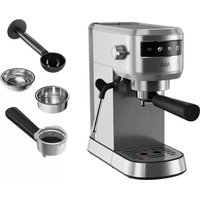


| Brand | AEG |
| Model | EC6-1-6ST |
| Product type | Espresso coffee machine with steam nozzle |
| Color | Black and silver |
| Water tank capacity | 1.2 L (estimated value) |
| Maximum pressure | 15 bar (estimated value) |
| Power | 1400 W (estimated value) |
| Power supply | 220-240 V ~ 50/60 Hz |
| Dimensions (W x D x H) | 25 x 35 x 30 cm (estimated value) |
| Net weight | 4 kg (estimated value) |
| Main functions | Espresso 1 cup, 2 cups, steam, hot water, milk frother, cup warmer |
| Automatic shut-off | 20 minutes of inactivity |
| Coffee type | Ground coffee or E.S.E pods |
| Number of included filters | 1-cup filter and 2-cup filter |
| Included accessories | Measuring spoon/tamper, cleaning pin |
| Filter cleaning | Dishwasher safe (filters only) |
| Descaling | Recommended every 2-3 months or when indicator lights flash 5 times |
| Safety | Automatic shut-off, burn protection, mandatory grounding |
| Warranty | 2 years (subject to general terms and conditions) |
| Manual available in | French, English, German, Spanish, Dutch, and others |
Frequently Asked Questions - EC6-1-6ST AEG
User questions about EC6-1-6ST AEG
0 question about this device. Answer the ones you know or ask your own.
Ask a new question about this device
Download the instructions for your Coffee machine in PDF format for free! Find your manual EC6-1-6ST - AEG and take your electronic device back in hand. On this page are published all the documents necessary for the use of your device. EC6-1-6ST by AEG.
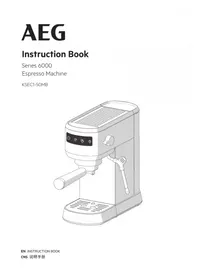
USER MANUAL EC6-1-6ST AEG
GB INSTRUCTION BOOK
AR USER MANUAL
![graph LR A["Raw Material Input"] --> B{Decision} B -->|Yes| C["Check for Paper"] B -->|No| D["End"]](/content/2026/04/665535/images/71a4ae9aa0b24a3ce7712412c3ad1f7e30afaa2f46a36cc7202672ecd68ad7f9.jpg)

aeg.com/shop
Premium Coffee Descaler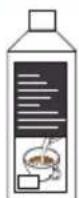
Ref: ECF-4-2
PNC:900167954
Premium Coffee Tablets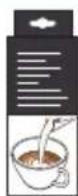
Ref: TCF
PNC:950078803
CONTENTS
ENGLISH 6
ARABIC 11
BULGARIAN 16
GERMAN 22
SPANISH
FRENCH 34
GREEK 40
28
DUTCH 46
PORTUGUESE 52
FOR PERFECT RESULTS
Thank you for choosing this AEG product. We have created it to give you impeccable performance for many years, with innovative technologies that help make life simpler features you might not find on ordinary appliances. Please spend a few minutes reading to get the very best from it.
Visit our website to:

Get usage advice, brochures, trouble shooter, service information: www.aeg.com/webselfservice

Register your product for better service: www.registeraeg.com

Buy accessories and consumables for your appliance: www.aeg.com/shop
CUSTOMER CARE AND SERVICE
When contacting Service, ensure that you have the following data available:
- Model number
- PNC number
- Serial number
The information can be found on the rating plate.
ENGLISH
Thank you for choosing an AEG product. In order to ensure the best results, always use original AEG accessories and spare parts. They have been designed especially for your product. This product is designed with the environment in mind. All plastic parts are marked for recycling purposes.
COMPONENTS (picture page 2)
A. Power indicator button
B. One-cup indicator/button
C. Two-cup indicator/button
D. Steam indicator/button
E. Brewing head
F. One-cup/E.S.E pod filter cup
G. Two-cup filter cup
H. Filter holder
I. Tamper/dispenser measure spoon
* available in certain models only
J. Cleaning pin*
K. Water tank lid
L. Water tank handle
M. Water tank
N. Cup warmer
O. Steam knob
P. Hot water/steam nozzle (milk frother)
Q. Drip grid
R. Drip tray
SAFETY ADVICE
Read the following instructions carefully before using the appliance for the first time.
- This appliance can be used by children aged from 8 years and above and persons with reduced physical, sensory or mental capabilities or lack of experience and knowledge if they have been given supervision or instruction concerning use of the appliance in a safe way and understand the hazards involved.
• Children shall not play with the appliance.
- Cleaning and user maintenance shall not be made by children unless they are supervised.
- Keep the appliance and its cord out of reach of children less than 8 years old.
- The appliance may only be connected to a power supply whose voltage and frequency comply with the specifications on the rating plate!
- Never use or pick up the appliance if – the supply cord is damaged, – the housing is damaged.
- The appliance must only be connected to an earthed socket. If necessary, an extension cable suitable for 10 A can be used.
- If the appliance or the supply cord is damaged, it must be replaced by the manufacturer, its service agent or similarly qualified person, in order to avoid hazard.
• Always place the appliance on a flat, level surface.
- The appliance must be switched off and the mains plug withdrawn each time after use, before cleaning and maintenance.
- The appliance and accessories become hot during operation. Use only designated handles and knobs. Allow to cool down before cleaning or storage.
- The mains cable must not come into contact with any hot parts of the appliance.
- Do not remove the filter holder during the brewing process as the appliance is pressurized. The risk of burns exists.
- Do not remove the water tank during the brewing process.
- Do not remove the filter holder during the brewing process or when there's steam /
hot water escaping from the filter holder. Ensure to release the pressure into water tank before removing the filter holder. DANGER! There is risk of scalding.
- Release pressure through hot water/steam nozzle before removing filter holder.
- Warning: Avoid steam burn.
- When the steam function is used there can be some hot water dripping from the brewing head. DANGER! The water is hot, there is a risk for scalding.
- When opening the steam knob, a shot of hot water may come out. Be careful and open the steam valve slowly. DANGER! The water is hot, there is a risk of scalding.
- Do not immerse the appliance in water or any other liquid.
- Do not exceed the maximum filling volume as indicated on the appliance.
- Fill the water tank only with cold water, never with milk or other liquids. Always use fresh water to brew espresso to ensure the best taste.
- Do not use the appliance if the water tank has not been filled.
- Do not use the appliance without the drip tray or drip grid, unless a taller cup or mug is in use.
- Do not use or place the appliance on a hot surface or near a source of heat.
- Warning: Avoid spillage on the connector.
- This appliance is intended for domestic use only. The manufacturer cannot accept any liability for possible damage caused by improper or incorrect use.
- This appliance is not intended to be operated by means of an external timer or separate remote-control system.
This appliance is intended to be used in household and similar applications such as:
- staff kitchen areas in shops, offices, and other working environments;
- farm houses;
- by clients in hotels, motels, and other residential type environments;
- bed and breakfast type environments.
GETTING STARTED (see pictures on pages 3 and 4)
Starting the machine for the first time
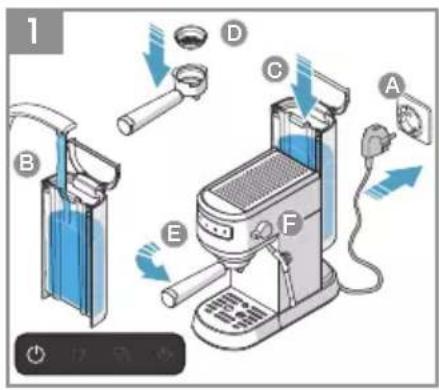
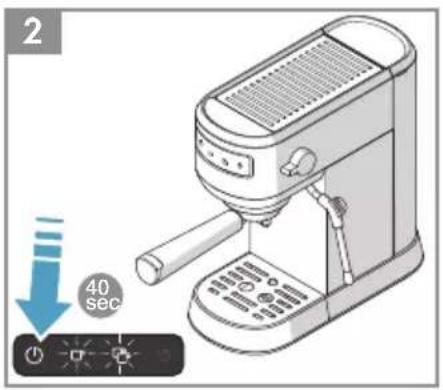
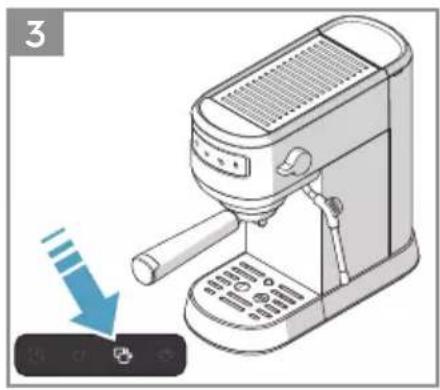
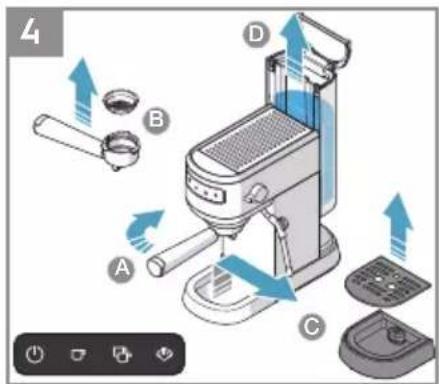
1. Place the machine on a flat surface. Plug in the machine to turn on its standby mode, while the ⏻ button turns half on. Fill the tank with cold pure water. Put the filter cup into the filter holder, and then fix it onto the brewing head anti-clockwise from "LOCK" to "CLOSE" position without coffee. Make sure the knob is at the horizontal position ("OFF" position). 2. Start the machine with the ⏻ button, whose light turns fully on and the □ and 📋 buttons start blinking. 3. When the buttons stop blinking, pre-heating is done. Press the 📋 button to start the brewing process. NOTE: There may be noise when pumping the water for the first time. It is normal. The machine is releasing the air from inside. The noise will stop after about 20 seconds. 4. When brewing is finished, remove the filter holder clockwise, clean up the filter and clear up the drip tray. Now the machine is ready to use. NOTE: The machine will turn off automatically after 20 minutes of no operation.
Making espresso coffee
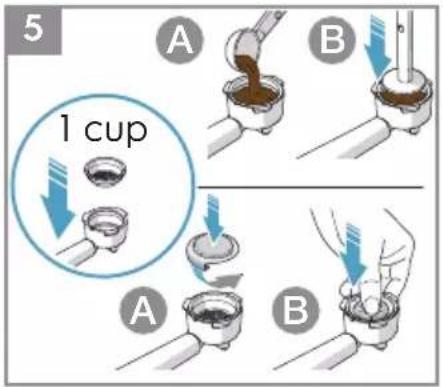
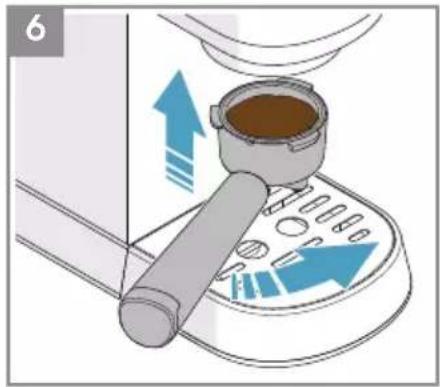
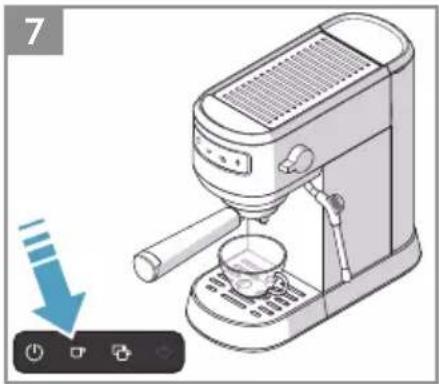
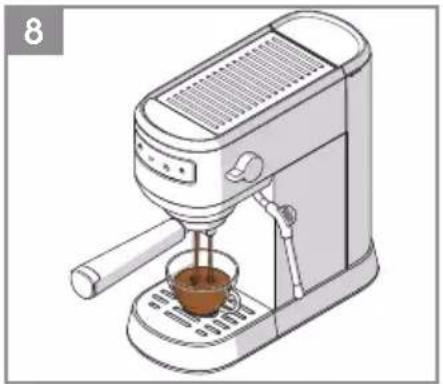
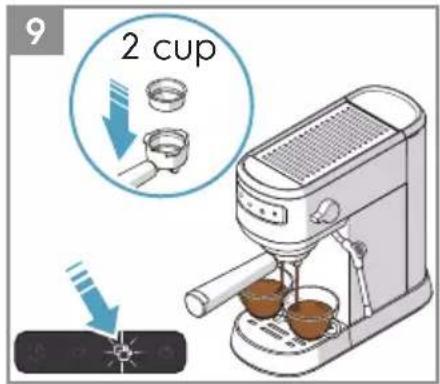
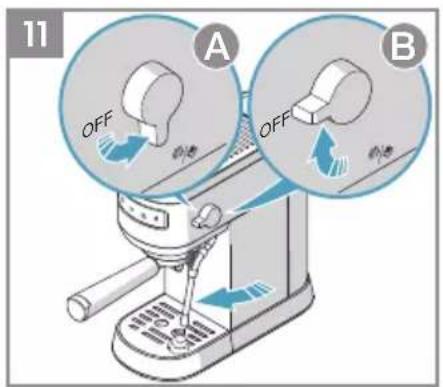
5. Put the one-cup filter cup into the filter holder. Add one spoon of ground coffee, press it tight with the tamper; or add an E.S.E pod and put it into the filter cup. E.S.E (Easy Serving Espresso) pods can be used to simplify espresso preparation. Each pre-packed pod contains 7 grams of coffee, already measured and pressed and sealed between 2 fine layers of filter paper. 6. Fix the filter holder onto the brewing head anti-clockwise from "LOCK" to "CLOSE" position. 7. Put a warm cup on the drip tray. In "pre-heating done" mode when the ⏻, □, and 📋 buttons are steadily and fully lit, press the button to start the brewing process. 8. Wait a moment and the top-grade coffee will flow out. When the machine stops working, your coffee is now ready. 9. Now apply the two-cup filter cup. Press the button. Brew 2 cups of espresso at the same time. 10. NOTE: If both the □ and 📋 buttons start blinking quickly, you may simply press the □ or 📋 button to cancel brewing, or (step 11) 11. (step 10) you may restart brewing after cooling down the boiler. Turn the knob to the // position and release hot water from the steam nozzle. The pump stops working automatically when it's done cooling off. Turn the knob off and resume brewing again.
Making hot water
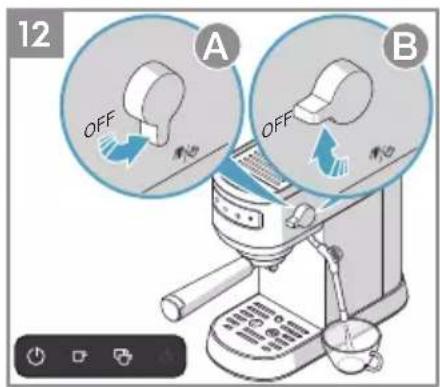
12. In "pre-heating done" mode when the ⏻, □, and 📋 buttons are steadily and fully lit, turn the knob to the position. Hot water comes out of the steam nozzle. Turn the knob off when the desired amount is complete.
Frothing milk and making cappuccino/latte
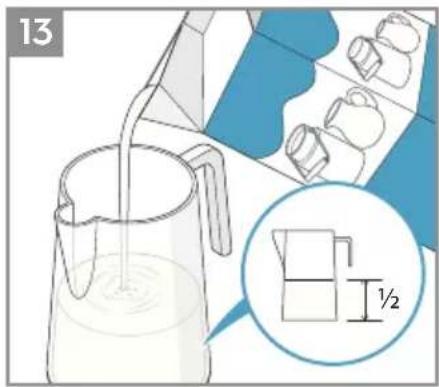
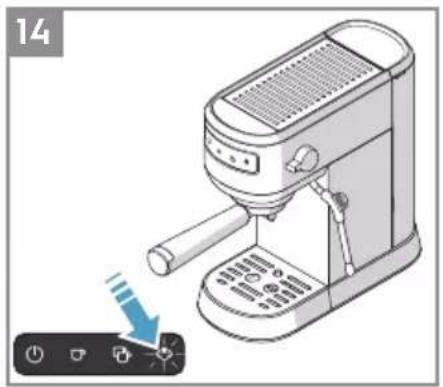
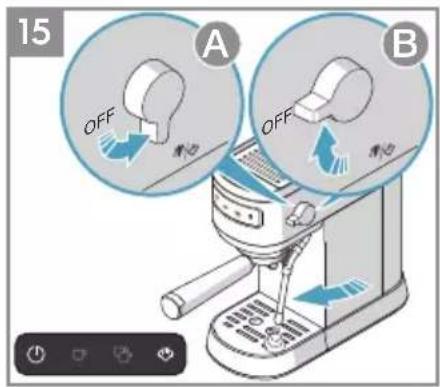
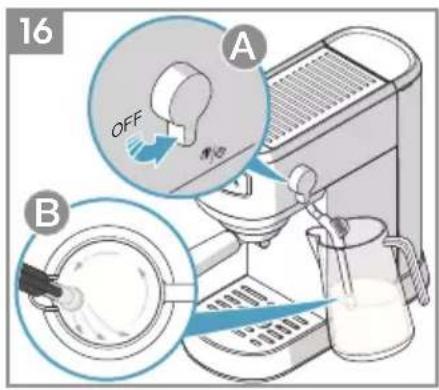
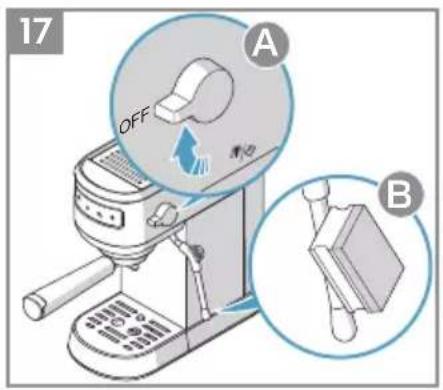
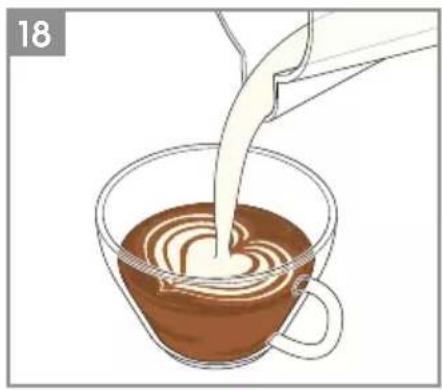
13 Fill a jug with 100ml (for cappuccino) or 200ml (for latte) milk. NOTE: make sure jug diameter is no less than 70±5mm, and jug capacity can hold twice the milk volume after it's done frothing. 14 In "pre-heating done" mode when ⏻ and □ and 📋 buttons are steadily and fully light on, press button, it starts blinking. NOTE: Use full milk at refrigerator temperature (NOT HOT!). 15 When the 🎨 button stops blinking, steam / milk frothing function is ready. Before frothing milk, push steam nozzle in the direction of drip tray, turn the knob to "position and release steam until there's no water coming out, then turn off steam function by turning the knob back to horizontal "OFF" position. 16 Immerse steam nozzle in milk about 2cm under the milk surface, turn on the knob. Make sure the steam nozzle is placed in a position that makes the milk turning in one direction inside the jug from top to bottom. 17 When the desired level of foam is reached, turn off the knob. NOTE: Clean steam nozzle with wet sponge immediately after steam stops generating, but care not to hurt! The pump automatically stops working after milk frothing for 3 minutes. 18 Pour the frothed milk into the espresso prepared, now the cappuccino/latte is ready. Sweeten to taste and if desired, sprinkle the froth with a little cocoa powder. NOTE: After making steam, you may immediately make espresso again by pressing or button. If both and buttons start blinking quickly, cool down the boiler and resume brewing (see step 11).
DIY / volume
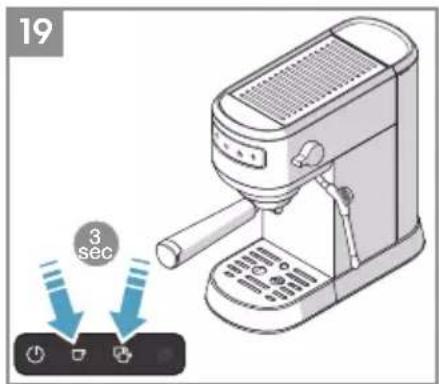
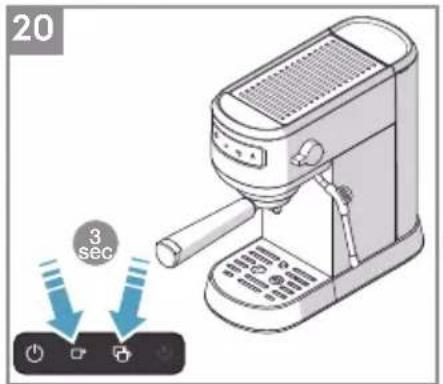
19 In "pre-heating done" mode when ⏻ and □ and 📋 buttons are steadily and fully light on, long press / button for 3 seconds to start resetting mode. Press / button to start brewing and press again to stop when the desired volume is complete. Now the volume is saved for next operation and from then on. 20 Restore factory volume setting simply by long pressing and buttons for 3 seconds again.
CLEANING AND CARE
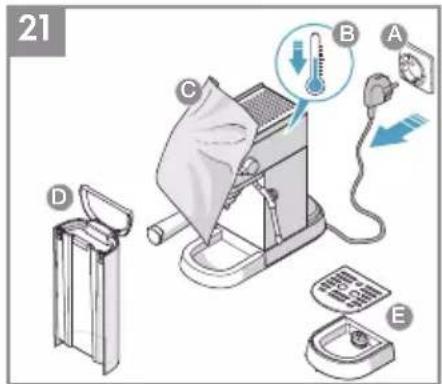
21 Turn the machine off and unplug the power cord. Let the machine cool down completely before cleaning. Wipe all outer surfaces with a damp cloth. Clean water tank, drip tray and drip grid regularly. Never use caustic or abrasive cleaners, and never immerse the machine in liquid!
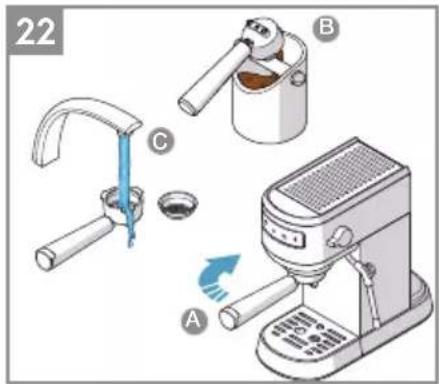
22 Detach the filter holder by turning it clockwise. Scrap coffee residue or used E.S.E pod. Extract the filter cup from the filter holder, rinse them with clean water and dry thoroughly.
DECALCIFYING
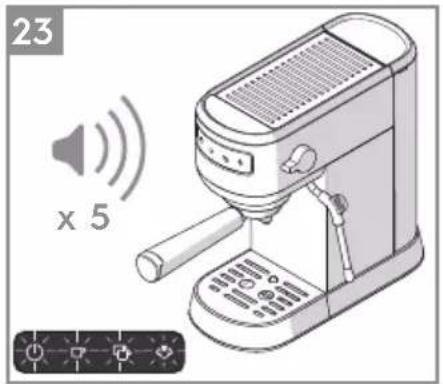
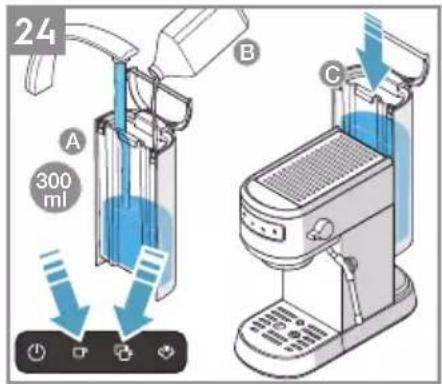
23 Descaling is recommended when all indicators blink 5 times with 5 beeps the moment the machine is turned on. The descaling warning will repeat 2 more times each time you turn on the appliance if you do not perform descaling or do not cancel it by simultaneously pressing and holding the buttons for 3 seconds. 24 Fill the water tank to the 300ml level with water and then add the descaling agent (or fill with water and vinegar in a 1:1 ratio). Use only an environmentally friendly descaling agent and always follow the manufacturer's instructions. In "pre-heating done" mode, when the and buttons are steadily and fully lit, simultaneously press and hold the buttons for 3 seconds to start the descaling process, during which the and buttons blink slowly one after another. When descaling completes, the machine will return to standby mode. Perform steps 1-4 twice before using the machine.
Enjoy your new AEG product!
TROUBLESHOOTING
| PROBLEM POSSIBLE CAUSE SOLUTION | ||
| Water leaks from the bottom of coffee maker. | There is too much water in the drip tray. Please clean the drip tray. | |
| The coffee maker malfunctions. Please contact with the authorized service facility for repairing. | ||
| Water leaks outside of filter cup. There is some coffee powder on filter edge when locked into the brewing head. | Clear up the coffee powder on the filter edge. | |
| Acid (vinegar) taste exists in espresso coffee. | Didn't perform descaling correctly. Clean up machine according to step 1-4 for "Start the machine for the first time". | |
| The coffee powder is stored in a hot, wet place for a long time. The coffee powder turns bad. | Please use fresh coffee powder, or store unused coffee powder in a cool, dry place. After opening a package of coffee powder, reseal it tightly and store it in a refrigerator to maintain its freshness. | |
| The coffee maker cannot work anymore or does not respond at all. | The power outlet is not plugged well. Plug the power cord into an earthed socket correctly. If the appliance still does not work, please contact with the authorized service facility for repairing. | |
| The steam / milk frothing does not work properly. | The white indicator is not illuminated. Only after the white indicator is illuminated, the steam station can be used to perform milk frothing. | |
| The container is too big or the shape is not fit. | Use high and narrow cup or professional milk frothing jug. | |
| You have used skimmed milk. Use whole milk or half-skimmed milk. | ||
| Steam indicator blinking quickly. Make steam for 3 minutes and the steam knob is not reset. | Reset steam knob to "OFF" position. | |
| One-cup indicator and two-cup indicator blinking quickly. | Make hot water for 40ml and then the steam knob is not reset. | Reset steam knob to "OFF" position. |
| The steam knob is not reset after cooling down. | ||
| Boiler temperature is too high. Cool it down by perform Step 11. | ||
| One-cup indicator, two-cup indicator and steam indicator blinking quickly. | The steam knob is not reset, but the machine is turned on. | Reset steam knob to "OFF" position. |
| ALL indicators blinking at the same time for 5 times. | Need descaling. Perform decalcifying. | |
| Filter holder is too tight to operate. Too much coffee powder filled in filter. Fill filter cup with less coffee powder. | ||
| Coffee flows drip by drip. Too much powder. Fill filter cup with less coffee powder. | ||
DISPOSAL
Recycle the materials with the symbol. The packaging materials can be recycled. Please sort individual components by type and dispose of them in applicable containers according to local disposal instructions. Recycling of packaging materials reduces the use of raw materials and the amount of waste in landfill sites. Help protect the environment and human health by recycling your packaging.

Do not dispose of appliances marked with the symbol with household waste. Return the product to your local recycling facility or contact your municipal office.
AEG reserves the right to change products, information and specifications without notice.
For Switzerland:

Where should you take your old equipment?
Anywhere that sells new equipment or hand it in to official SENS collection points or official SENS recycling firms. The list of official SENS collection points can be found at www.erecycling.ch
| الحل السبّب المحتمل المشكلة | |
| تسرب الماء من قاع ماكينة صنع القهوة. | يرجى تنظيف صينية التنقيط. يوجد الكثير من الماء في صينية التنفيط. تسرب الماء من قاع ماكينة صنع القهوة. |
| ماكينة صنع القهوة متعطلة. | |
| تسرب الماء خارج كوب الف SPR. | يوجد بعض مسحوق القهوة على حافة الف SPR. |
| طعم حمض (خل) موجود في قهوة الإسبريسو. | 璟ند تثبيته في رأس التخمير. |
| لا تعمل ماكينة صنع القهوة أو لا تستجب على الإトラق. | يُخزن مسحوق القهوة في مكان ساخن ورطب ل crude طويلة. مسحوق القهوة ي섭ح سياً. |
| رغوة الحلب / البخار لا تعمل بشكل صحيم. | لم يتم توصيل الماكينة بمنFD الطاقة جيدا. |
| مؤشر البخار يوض بسرعة | استمرار عمل البخار لمدة ۳ دقائق ولا يتم إعادة. ضبط مقاض البخار. |
| يومض مؤشر الكويت واحد ومؤشر الكويتين بسرعة | يتم توزيع الماء الساخن بسعة ۴،öl، وبعだ ذلك لا يتم إعادة تعيين مقاض البخار. |
| لا يتم إعادة تعيين مقاض البخار بعد أن تBERد الماكينة. | |
| درجة حراリア الغلاية مرتفعة للغابة. | |
| يومض مؤشر الكويت واحد ومؤشر الكويتين و MunichArchArchArchArchArchArchArchArchArchArchArchArchArchArchArchArchArchArchArchArchArchArchArchArchArchArchArchArchArchArchArchArchArchArchArchArchArchArchArchArchArchArchArchArchArchArchArchArchArchArchArchArchArchArchArchArchArchArchArchArchArchArchArchArchArchArchArchArchArchArchArchArchArchArchArchArchArchArchArchArchArchArchArchArchArchArchArchArchArchArchArchArchArchArchArchArchArchArchArchArch ArchArchArchArchArchArchArchArchArchArchArchArchArchArchArchArchArchArchArchArchArchArchArchArchArchArchArchArchArchArchArchArchArchArchArchArchArchArchArchArchArchArchArchArchArchArchArchArchArchArchArchArchArchArchArchArchArchArchArchArchArchArchArchArchArchArchArchArchArchArchArchArchArchArchArchArchArchArchArchArchArchArchArchArchArchArchArchArchArchArchArchArchArchArchArchArchArchArchArchArcharchArchArchArchArchArchArchArchArchArchArchArchArchArchArchArchArchArchArchArchArchArchArchArchArchArchArchArchArchArchArchArchArchArchArchArchArchArchArchArchArchArchArchArchArchArchArchArchArchArchArchArchArchArchArchArchArchArchArchArchArchArchArchArchArchArchArchArchArchArchArchArchArchArchArchArchArchArchArchArchArchArchArchArchArchArchArchArchArchArchArchArchArchArchArchArchArchArchArchArchARCHArchArchArchArchArchArchArchArchArchArchArchArchArchArchArchArchArchArchArchArchArchArchArchArchArchArchArchArchArchArchArchArchArchArchArchArchArchArchArchArchArchArchArchArchArchArchArchArchArchArchArchArchArchArchArchArchArchArchArchArchArchArchArchArchArchArchArchArchArchArchArchArchArchArchArchArchArchArchArchArchArchArchArchArchArchArchArchArchArchArchArchArchArchArchArchArchArchArchArchrchArchArchArchArchArchArchArchArchArchArchArchArchArchArchArchArchArchArchArchArchArchArchArchArchArchArchArchArchArchArchArchArchArchArchArchArchArchArchArchArchArchArchArchArchArchArchArchArchArchArchArchArchArchArchArchArchArchArchArchArchArchArchArchArchArchArchArchArchArchArchArchArchArchArchArchArchArchArchArchArchArchArchArchArchArchArchArchArchArchArchArchArchArchArchArchArchArchArchArch ARCHArchArchArchArchArchArchArchArchArchArchArchArchArchArchArchArchArchArchArchArchArchArchArchArchArchArchArchArchArchArchArchArchArchArchArchArchArchArchArchArchArchArchArchArchArchArchArchArchArchArchArchArchArchArchArchArchArchArchArchArchArchArchArchArchArchArchArchArchArchArchArchArchArchArchArchArchArchArchArchArchArchArchArchArchArchArchArchArchArchArchArchArchArchArchArchArchArchArchArchAchArchArchArchArchArchArchArchArchArchArchArchArchArchArchArchArchArchArchArchArchArchArchArchArchArchArchArchArchArchArchArchArchArchArchArchArchArchArchArchArchArchArchArchArchArchArchArchArchArchArchArchArchArchArchArchArchArchArchArchArchArchArchArchArchArchArchArchArchArchArchArchArchArchArchArchArchArchArchArchArchArchArchArchArchArchArchArchArchArchArchArchArchArchArchArchArchArchArchArchArchArchArchArchArchArchArchArchArchArchArchArchArchArchArchArchArchArchArchArchArchArchArchArchArchArchArchArchArchArchArchArchArchArchArchArchArchArchArchArchArchArchArchArchArchArchArchArchArchArchArchArchArchArchArchArchArchArchArchArchArchArchArchArchArchArchArchArchArchArchArchArchArchArchArchArchArchArchArchArchArchArchArchArchArchArchArchArchArchArchArchArchArchArchArchArchArchArchArcharch ArchArchArchArchArchArchArchArchArchArchArchArchArchArchArchArchArchArchArchArchArchArchArchArchArchArchArchArchArchArchArchArchArchArchArchArchArchArchArchArchArchArchArchArchArchArchArchArchArchArchArchArchArchArchArchArchArchArchArchArchArchArchArchArchArchArchArchArchArchArchArchArchArchArchArchArchArchArchArchArchArchArchArchArchArchArchArchArchArchArchArchArchArchArchArchArchArchArchArcharcharchArchArchArchArchArchArchArchArchArchArchArchArchArchArchArchArchArchArchArchArchArchArchArchArchArchArchArchArchArchArchArchArchArchArchArchArchArchArchArchArchArchArchArchArchArchArchArchArchArchArchArchArchArchArchArchArchArchArchArchArchArchArchArchArchArchArchArchArchArchArchArchArchArchArchArchArchArchArchArchArchArchArchArchArchArchArchArchArchArchArchArchArchArchArchArchArchArchArcharchAchArchArchArchArchArchArchArchArchArchArchArchArchArchArchArchArchArchArchArchArchArchArchArchArchArchArchArchArchArchArchArchArchArchArchArchArchArchArchArchArchArchArchArchArchArchArchArchArchArchArchArchArchArchArchArchArchArchArchArchArchArchArchArchArchArchArchArchArchArchArchArchArchArchArchArchArchArchArchArchArchArchArchArchArchArchArchArchArchArchArchArchArchArchArchArchArchArcharchArcharchArchArchArchArchArchArchArchArchArchArchArchArchArchArchArchArchArchArchArchArchArchArchArchArchArchArchArchArchArchArchArchArchArchArchArchArchArchArchArchArchArchArchArchArchArchArchArchArchArchArchArchArchArchArchArchArchArchArchArchArchArchArchArchArchArchArchArchArchArchArchArchArchArchArchArchArchArchArchArchArchArchArchArchArchArchArchArchArchArchArchArchArchArchArchArchArchArcharchArchAchArchArchArchArchArchArchArchArchArchArchArchArchArchArchArchArchArchArchArchArchArchArchArchArchArchArchArchArchArchArchArchArchArchArchArchArchArchArchArchArchArchArchArchArchArchArchArchArchArchArchArchArchArchArchArchArchArchArchArchArchArchArchArchArchArchArchArchArchArchArchArchArchArchArchArchArchArchArchArchArchArchArchArchArchArchArchArchArchArchArchArchArchArchArchArchArchARCHArchArchARCHArchArchArchArchArchArchArchArchArchArchArchArchArchArchArchArchArchArchArchArchArchArchArchArchArchArchArchArchArchArchArchArchArchArchArchArchArchArchArchArchArchArchArchArchArchArchArchArchArchArchArchArchArchArchArchArchArchArchArchArchArchArchArchArchArchArchArchArchArchArchArchArchArchArchArchArchArchArchArchArchArchArchArchArchArchArchArchArchArchArchArchArchArchArchArchArchARCHArchArcharchArchArchArchArchArchArchArchArchArchArchArchArchArchArchArchArchArchArchArchArchArchArchArchArchArchArchArchArchArchArchArchArchArchArchArchArchArchArchArchArchArchArchArchArchArchArchArchArchArchArchArchArchArchArchArchArchArchArchArchArchArchArchArchArchArchArchArchArchArchArchArchArchArchArchArchArchArchArchArchArchArchArchArchArchArchArchArchArchArchArchArchArchArchArchArchArchARCHArchArch ArchArchArchArchArchArchArchArchArchArchArchArchArchArchArchArchArchArchArchArchArchArchArchArchArchArchArchArchArchArchArchArchArchArchArchArchArchArchArchArchArchArchArchArchArchArchArchArchArchArchArchArchArchArchArchArchArchArchArchArchArchArchArchArchArchArchArchArchArchArchArchArchArchArchArchArchArchArchArchArchArchArchArchArchArchArchArchArchArchArchArchArchArchArchArchArchArcharchArchArcharchArchArchArchArchArchArchArchArchArchArchArchArchArchArchArchArchArchArchArchArchArchArchArchArchArchArchArchArchArchArchArchArchArchArchArchArchArchArchArchArchArchArchArchArchArchArchArchArchArchArchArchArchArchArchArchArchArchArchArchArchArchArchArchArchArchArchArchArchArchArchArchArchArchArchArchArchArchArchArchArchArchArchArchArchArchArchArchArchArchArchArchArchArchArchArchArch ArchArchArcharchArchArchArchArchArchArchArchArchArchArchArchArchArchArchArchArchArchArchArchArchArchArchArchArchArchArchArchArchArchArchArchArchArchArchArchArchArchArchArchArchArchArchArchArchArchArchArchArchArchArchArchArchArchArchArchArchArchArchArchArchArchArchArchArchArchArchArchArchArchArchArchArchArchArchArchArchArchArchArchArchArchArchArchArchArchArchArchArchArchArchArchArchArchArchArchArcharchArchArch ArchArchArchArchArchArchArchArchArchArchArchArchArchArchArchArchArchArchArchArchArchArchArchArchArchArchArchArchArchArchArchArchArchArchArchArchArchArchArchArchArchArchArchArchArchArchArchArchArchArchArchArchArchArchArchArchArchArchArchArchArchArchArchArchArchArchArchArchArchArchArchArchArchArchArchArchArchArchArchArchArchArchArchArchArchArchArchArchArchArchArchArchArchArchArchArchArch Arch Arch Arch Arch Arch Arch Arch Arch Arch Arch Arch Arch Arch Arch Arch Arch Arch Arch Arch Arch Arch Arch Arch Arch Arch Arch Arch Arch Arch Arch Arch Arch Arch Arch Arch Arch Arch Arch Arch Arch Arch Arch Arch Arch Arch Arch Arch Arch Arch Arch Arch Arch Arch Arch Arch Arch Arch Arch Arch Arch Arch Arch Arch Arch Arch Arch Arch Arch Arch Arch Arch Arch Arch Arch Arch Arch Arch Arch Arch Arch Arch Arch Arch Arch Arch Arch Arch Arch Arch Arch Arch Arch Arch Arch Arch Arch Arch Arch Arch Arch arch Arch Arch Arch Arch Arch Arch Arch Arch Arch Arch Arch Arch Arch Arch Arch Arch Arch Arch Arch Arch Arch Arch Arch Arch Arch Arch Arch Arch Arch Arch Arch Arch Arch Arch Arch Arch Arch Arch Arch Arch Arch Arch Arch Arch Arch Arch Arch Arch Arch Arch Arch Arch Arch Arch Arch Arch Arch Arch Arch Arch Arch Arch Arch Arch Arch Arch Arch Arch Arch Arch Arch Arch Arch Arch Arch Arch Arch Arch Arch Arch Arch Arch Arch Arch Arch Arch Arch Arch Arch Arch Arch Arch Arch Arch Arch Arch Arch Arch Arch Arcالحل السبّب المحتمل Maríaشكلة | الحل السبّب المحتمل Maríaشكلة |
| مُجْتَفَيْذ إجراء إزالة الترسبات يلزم تتفيّذ إجراء إزالة الترسبات تومض جميع المؤشرات في نفس الوقت ه مرات | مُجْتَفَيْذ إجراء إزالة الترسبات يلزم تتفيّذ إجراء إزالة الترسبات تومض جميع المؤشرات في:% فر و##ت |
| م tightى الف SPR ضيق جدًا بحیث لا يمکن تشغيله | م tightى الف SPR ضيق جدًا بحیث لا يمکن تشغيله |
| أملا كوب الف SPR بكمية أقل من المسحوق كتیر للغaaية تندفق المهوة في شكل نقطة بنقطة | أملا كوب الف SPR بكمية أقل من المسحوق كتیر للغaaية تندفق المهوة في شكل نقطة بنقطة |
| مُجْتَفَيْذ إجراء إزالة الترسبات يلزم تتفيّذ إجراء إزالة الترسبات تومض جميع المؤشرات في:% فر و##ت | |
| م tightى الف SPR ضيق جدًا بحیث لا يمکن تشغيله | |
| أملا كوب الف SPR بكمية أقل من المسحوق كتیر للغaaية تندفق المهوة في شكل نقطة بنقطة |
Make espresso coffee
- AEG.COM/SHOP
- CONTENTS
- FOR PERFECT RESULTS
- CUSTOMER CARE AND SERVICE
- ENGLISH
- COMPONENTS (PICTURE PAGE 2)
- SAFETY ADVICE
- READ THE FOLLOWING INSTRUCTIONS CAREFULLY BEFORE USING THE APPLIANCE FOR THE FIRST TIME
- THIS APPLIANCE IS INTENDED TO BE USED IN HOUSEHOLD AND SIMILAR APPLICATIONS SUCH AS
- GETTING STARTED (SEE PICTURES ON PAGES 3 AND 4)
- STARTING THE MACHINE FOR THE FIRST TIME
- MAKING ESPRESSO COFFEE
- MAKING HOT WATER
- FROTHING MILK AND MAKING CAPPUCCINO/LATTE
- DIY / VOLUME
- CLEANING AND CARE
- DECALCIFYING
- DISPOSAL
- MAKE ESPRESSO COFFEE
Brand : AEG
Model : EC6-1-6ST
Category : Coffee machine