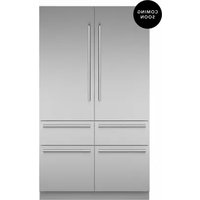
T48BT120NS - Fridge THERMADOR - Free user manual and instructions
Find the device manual for free T48BT120NS THERMADOR in PDF.


User questions about T48BT120NS THERMADOR
0 question about this device. Answer the ones you know or ask your own.
Ask a new question about this device
Download the instructions for your Fridge in PDF format for free! Find your manual T48BT120NS - THERMADOR and take your electronic device back in hand. On this page are published all the documents necessary for the use of your device. T48BT120NS by THERMADOR.
USER MANUAL T48BT120NS THERMADOR
Freezer refrigerator
T48BT110NS T48BT120NS
T48IT100NP

natural_image
Assorted fresh vegetables including tomatoes, peppers, broccoli, and eggplant arranged on a striped cloth (no text or symbols visible)THERMADOR.COM
Further information and explanations are available online:
Table of contents
1 Safety 4
1.1 Safety definitions.... 4
1.2 General information.... 4
1.3 Intended use 4
1.4 Restrictive Use.... 4
1.5 Safe transport 4
1.6 Safe installation.... 4
1.7 Safe use.... 5
1.8 Damaged appliance 6
1.9 State of California Proposition 65 Warnings ...... 6
2 Preventing material damage 7
3 Environmental protection and energy-saving ..... 7
3.1 Disposal of packaging 7
3.2 Saving energy 7
4 Installation and connection.... 7
4.1 Included in delivery 7
4.2 Criteria for the installation location 8
4.3 Installing the appliance.... 8
4.4 Preparing the appliance for first use.... 8
4.5 Connecting the appliance to the drinking water connection 8
4.6 Connecting the appliance to the electricity supply ..... 8
5 Familiarizing yourself with your appliance ..... 9
5.1 Appliance 9
5.2 Control panel.... 10
5.3 Control panel (variable-temperature compartment).... 11
6 Features.... 12
6.1 Shelf 12
6.2 Snack container 12
6.3 Cool-fresh container.... 12
6.4 Variable-temperature container.... 12
6.5 Container divider.... 12
6.6 Frozen food pull-out container.... 12
6.7 Suspended frozen food container.... 12
6.8 Door tray 12
6.9 Ice storage container.... 12
6.10 Camera 12
6.11 Odor filter 13
6.12 Accessories 13
7 Before using the appliance for the first time ..... 13
7.1 Performing initial start-up 13
8 Basic Operation.... 13
8.1 Switching on the appliance.... 13
8.2 Operating tips.... 14
8.3 Switching off the appliance.... 14
8.4 Setting the temperature.... 14
8.5 Cool-fresh compartment storage setting.... 14
8.6 Keylock 14
8.7 Storage setting in the variable-temperature compartment 14
9 Basic settings.... 15
9.1 Changing the basic settings 15
9.2 Overview of the basic settings.... 15
10 Additional functions.... 16
10.1 Super cooling 16
10.2 Automatic Super freezing 16
10.3 Manual Super freezing 16
10.4 Shopping mode 17
10.5 Vacation mode 17
10.6 Energy-saving mode 17
10.7 Interior lighting.... 17
10.8 Sabbath mode.... 17
11 Alarm.... 17
11.1 Door alarm 17
11.2 Temperature alarm.... 17
12 Home Connect® 18
12.1 Setting up the Home Connect® app 18
12.2 Setting up Home Connect®.... 18
12.3 Remote Diagnostics 18
12.4 Data Protection 18
12.5 Status of the Home Connect® connection.... 19
13 Service settings.... 19
13.1 Changing service settings 19
13.2 Overview of the service settings 19
14 Refrigerator compartment 20
14.1 Tips for storing food in the refrigerator compartment 20
14.2 Chill zones in the refrigerator compartment 20
15 Cool-fresh compartment.... 21
15.1 Storage recommendations for the cool-fresh compartment 21
16 Freezer compartment.... 21
16.1 Tips for storing food in the freezer compartment .... 21
16.2 Tips for freezing fresh food.... 21
16.3 Defrosting methods for frozen food 21
17 Variable-temperature compartment.... 21
17.1 Storage recommendations in the variable-temperature compartment 22
18 Water system 22
18.1 Water filter 22
18.2 Water dispenser.... 23
18.3 Ice maker 23
19 Defrosting.... 24
19.1 Defrosting in the refrigerator compartment 24
19.2 Defrosting in the cool-fresh compartment...... 24
19.3 Defrosting in the freezer compartment 24
19.4 Defrosting in the variable-temperature compartment 24
20 Cleaning and maintenance.... 24
20.1 Care instructions for stainless steel surfaces ..... 24
20.2 Preparing the appliance for cleaning 24
20.3 Cleaning the appliance.... 25
20.4 Cleaning the camera 25
20.5 Removing the fittings.... 25
20.6 Replacing the odor filter 26
21 Troubleshooting.... 27
21.1 Power failure 30
22 Storage and disposal.... 30
22.1 Taking the appliance out of operation 30
22.2 Disposal of your old appliance 30
23 Customer Service 30
24.1 Information regarding Free and Open Source Software.... 31

IMPORTANT SAFETY INSTRUCTIONS READ AND SAVE THESE INSTRUCTIONS
Observe the following safety instructions.
1.1 Safety definitions
Here you can find explanations of the safety signal words used in this manual.

WARNING
This indicates that death or serious injuries may occur as a result of non-observance of this warning.

CAUTION
This indicates that minor or moderate injuries may occur as a result of non-observance of this warning.
NOTICE:
This indicates that damage to the appliance or property may occur as a result of non-compliance with this advisory.
Note: This alerts you to important information and/or tips.
1.2 General information
■ Read this manual carefully.
- Keep the manual and the product information in a safe place for future reference or for the next owner.
- Do not connect the appliance if it has been damaged in transit.
1.3 Intended use
Only use this appliance:
■ for chilling and freezing food, making ice and dispensing water.
■ for normal household use and in enclosed spaces in a residential environment.
■ Up to an altitude of 2000 m above sea level.
1.4 Restrictive Use
This appliance is not intended for use by persons (including children) with reduced physical, sensory or mental capabilities, or lack of experience and knowledge, unless they have been given supervision or instruction concerning use of the appliance by a person responsible for their safety.
Do not let children play with the appliance.
Cleaning and user maintenance must not be performed by children unless they are being supervised.
1.5 Safe transport
WARNING
The appliance is very top-heavy and may tip over.
▶ The appliance must be transported by two or more people.
- Do not remove the appliance from the pallet until it is ready for installation.
- Keep the doors and drawers closed until the appliance is fully installed.
WARNING
The heavy weight of the appliance may result in injury when lifted.
▶ Do not lift the appliance on your own.
1.6 Safe installation
WARNING
To avoid risk of injury from incorrect repairs, observe the following.
- Connect and operate the appliance only in accordance with the specifications on the rating plate.
- Connect the appliance to a power supply with alternating current only via a correctly installed socket outlet with grounding.
The protective conductor system of the domestic electrical installation must be properly installed.
▶ Never equip the appliance with an external switching device, e.g. a timer or remote control. - When the appliance is installed, the mains plug of the power cord must be freely accessible. If free access is not possible, an isolating switch must be integrated into the permanent electrical installation according to the installation regulations.
- When installing the appliance, check that the power cord is not trapped or damaged.
To avoid risk of injury from damaged insulation of the power cord, observe the following.
▶ Never let the power cord come into contact with heat sources.
WARNING
If the appliance's ventilation openings are closed off, a leak in the refrigeration circuit may result in a flammable mixture of gas and air.
- Keep ventilation openings in the appliance casing or in the integrated casing clear of obstruction.

IMPORTANT SAFETY INSTRUCTIONS READ AND SAVE THESE INSTRUCTIONS
WARNING
To avoid risk of injury from an extended power cord and non-approved adapters, observe the following.
▶ Do not use extension cords or multiple socket strips.
▶ Only use adapters and power cords approved by the manufacturer.
▶ If the power cord is too short and a longer one is not available, please contact an electrician to have the domestic installation adapted.
Portable multiple socket strips or portable power supply units may overheat and cause a fire.
- Do not place portable multiple socket strips or power supply units on the back of the appliance.
WARNING
The appliance is very top-heavy and may tip over.
The appliance must be installed by two or more people as soon as it is no longer secured and is removed from the pallet.
- Secure the unit using the supplied anti-tip bracket.
- Do not leave the appliance unattended during installation.
CAUTION
Touching sharp edges on the appliance may lead to cuts.
▶ Wear protective gloves.
1.7 Safe use
WARNING
Moisture intrusion may cause an electric shock.
▶ Use the appliance in enclosed spaces only.
▶ Never expose the appliance to intense heat or humidity.
- Do not use any steam cleaners or high-pressure cleaners to clean the appliance.
WARNING
Children may pull packaging material over their heads, or wrap themselves up in it and suffocate.
- Keep packaging material away from children.
▶ Do not allow children to play with packaging material. Children may breathe in or swallow small parts, causing them to suffocate.
▶ Keep small parts away from children.
▶ Do not allow children to play with small parts.
WARNING
If the cooling circuit is damaged, flammable refrigerant may escape and explode.
▶ To accelerate the defrosting process, do not use any other mechanical devices or means other than those recommended by the manufacturer.
▶ If food is stuck to the freezer compartment, loosen it with a blunt implement such as the handle of a wooden spoon.
Products which contain flammable propellants and explosive substances may explode, e.g. spray cans.
- Do not store products which contain flammable propellants (e.g. spray cans) or explosive substances in the appliance.
WARNING
Electrical devices placed inside the appliance may cause a fire, e.g. heaters or electric ice makers.
▶ Do not operate electrical devices within the appliance.
WARNING
Containers which contain carbonated drinks may burst.
▶ Do not store containers that contain carbonated drinks in the cool-fresh compartment or in the variable-temperature compartment below 34 °F (1 °C).
- Do not store containers which contain carbonated drinks in the freezer compartment.
Injury to the eyes caused by escaping flammable refrigerant and hazardous gases.
- Do not damage the tubes of the refrigerant circuit or the insulation.
WARNING
Contact with frozen food and cold surfaces may cause burns by refrigeration.
▶ Never put frozen food straight from the freezer compartment into your mouth.
- Avoid prolonged skin contact with frozen food, ice and surfaces in the freezer compartment.
CAUTION
To prevent food from being contaminated, you must observe the following instructions.
Leaving the door open for an extended period of time may lead to a considerable temperature increase in the compartments of the appliance.
▶ Regularly clean the surfaces that may come into contact with food and accessible drain systems.

IMPORTANT SAFETY INSTRUCTIONS READ AND SAVE THESE INSTRUCTIONS
▶ If water has not been dispensed for 5 days, flush the water system.
- Store raw meat and fish in suitable containers in the refrigerator so that they do not touch or drip on other food.
If the fridge/freezer is empty for an extended period of time, switch off the appliance, defrost it, clean it and leave the door open to prevent the formation of mold.
Metal or metal-style parts in the appliance may contain aluminum. If acidic food comes into contact with aluminum in the appliance, aluminum ions may pass into the food.
▶ Do not consume soiled food.
1.8 Damaged appliance
WARNING
To avoid risk of injury from a damaged appliance or power cord, observe the following.
▶ Never operate a damaged appliance.
▶ Never pull on the power cord to unplug the appliance. Always unplug the appliance at the power outlet.
▶ If the appliance or the power cord is damaged, immediately unplug the power cord or switch off the breaker in the circuit breaker box and turn off the water tap.
▶ Call Customer Service. → Page 30
To avoid risk of injury from improper repairs, observe the following.
▶ Only qualified technicians or authorized service providers should perform repairs.
▶ Only genuine spare parts may be used to repair the appliance.
If the power cord or the appliance power cable of this appliance becomes damaged, it must be replaced with a special power cord or special appliance power cable, which is available from the manufacturer or the manufacturer's Customer Service.
WARNING
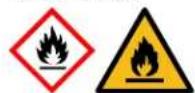
If the tubes are damaged, flammable refrigerant and harmful gases may escape and ignite.
- Keep open flames and ignition sources away from the appliance.
▶ Ventilate the room.
▶ Switch off the appliance.
▶ Unplug the appliance from the power source or switch off the circuit breaker in the fuse box.
▶ Call Customer Service. → Page 30
1.9 State of California Proposition 65 Warnings
This product may contain a chemical known to the State of California, which can cause cancer or reproductive harm. Therefore, the packaging of your product may bear the following label as required by California:
STATE OF CALIFORNIA PROPOSITION 65 WARNING: / AVERTISSEMENT ISSUE DE LA PROPOSITION 65 DE L'ÉTAT DE LA CALIFORNIE:
WARNING / AVERTISSEMENT
Cancer and Reproductive Harm / Cancer et dommages à la reproduction - www.P65Warnings.ca.gov.
2 Preventing material damage
NOTICE:
The high weight of the appliance or, if not rolled in a straight line, the appliance's castors may damage the floor when the appliance is moved.
▶ Transport the appliance using a hand-cart.
- Use floor protection when moving the appliance, and do not move it in a zigzag fashion.
When the appliance door is closed, the mullion rail should be closed (flush with the door edge) or damage may occur.
▶ Never open the mullion rail manually.
▶ If the mullion rail has been opened, rotate it closed (flush with the door edge) before closing the appliance door.
Using the base, runners or appliance doors as a seat or climbing surface may damage the appliance.
- Do not stand or lean on the base, runners or doors.
If the water pressure is too high or too low, this may impair functioning of the appliance.
▶ Make sure that the water pressure in the water supply system is at least 29 psi (200 kPa) and max. 116 psi (800 kPa).
▶ If the water pressure exceeds the maximum value specified, a pressure-reducing valve must be installed between the drinking water connection and the hose set of the appliance.
Modified or damaged water hoses may result in material damage and damage to the appliance.
▶ Never kink, crush, modify or cut through water hoses.
▶ Never re-use water hoses that have been used before.
- Never pull on the water hose on the rear panel of the appliance.
Contamination with oil or fat may cause plastic parts and door seals to become porous.
- Keep plastic parts and door seals free of oil and grease.
Metal or metal-style parts in the appliance may contain aluminum. When aluminum comes into contact with acidic foods, it corrodes and discolors.
▶ Only store packaged food in the appliance.
If you clean fittings and accessories in the dishwasher, this may cause them to become deformed or discolor.
▶ Never clean fittings and accessories in the dishwasher.
3 Environmental protection and energy-saving
3.1 Disposal of packaging
The packaging materials are environmentally compatible and can be recycled.
- Sort the individual components by type and dispose of them separately.
3.2 Saving energy
If you follow these instructions, your appliance will use less power.
Selecting the installation location
- Keep the appliance out of direct sunlight.
■ Install the appliance as far away as possible from heating elements, stoves and other heat sources: - Maintain a 1^1/4 (30 mm) clearance to electric or gas stoves.
- Maintain an 11^13/_16 (300 mm) clearance to oil or solid-fuel stoves.
■ Never cover or block the external ventilation openings.
Saving energy during use
Note: The arrangement of the fittings does not affect the energy consumption of the appliance.
- Open the appliance only briefly and then close it carefully.
■ Never cover or block the interior ventilation openings or the exterior ventilation openings.
■ Transport purchased food in a cooler and place quickly in the appliance. - Allow warm food and drinks to cool down before storing them.
■ Thaw frozen food in the refrigerator compartment to utilize the low temperature of the food.
■ Always leave some space between the food and to the back panel.
■ Vacuum the external ventilation grilles when they are dusty.
4 Installation and connection
4.1 Included in delivery
After unpacking all the parts, check for any damage in transit and for completeness of delivery.
If you have any concerns, contact your dealer or our Customer Service → Page 30.
The delivery consists of the following:
■ Equipment and accessories ^1
■ Installation material
■ Installation instructions
■ User manual
■ Explanation of the limited product warranty
■ Warranty enclosure ^2
■ Energy label
■ Information on energy consumption and noises
■ Information about Home Connect®
4.2 Criteria for the installation location
WARNING
If the appliance is in a space that is too small, a leak in the refrigeration circuit may result in a flammable mixture of gas and air.
▶ Only install the appliance in a space with a volume of at least 35 ft^3 ( 1 m^3 ) per 0.3 oz (8 g) refrigerant. The amount of refrigerant is indicated on the rating label.
→ "Appliance", Fig. 1 16, Page 10
The weight of the appliance from factory may be up to 740 lbs (335 kg) depending on the model.
The subfloor must be sufficiently stable to bear the weight of the appliance.
4.3 Installing the appliance
- Install the appliance in accordance with the enclosed installation instructions.
4.4 Preparing the appliance for first use
- Remove the information material.
- Remove the protective film and transit bolts, e.g. remove the adhesive strips and cardboard.
- Clean the appliance for the first time. → Page 25
4.5 Connecting the appliance to the drinking water connection
Requirements
■ A shut-off valve must be installed on the water connection and be freely accessible following installation of the appliance.
■ Ensure that the water coming from the water connection is potable.
■ The water hose has a sealing ring.
- Draw mains water from the domestic drinking water connection until the water is no longer cloudy and containers no deposits.
If the mains water is still cloudy or contains deposits, install an external water filter system.
- Install the water hose according to the enclosed installation instructions on the appliance.
4.6 Connecting the appliance to the electricity supply
- Insert the appliance plug of the power cord into the appliance.
- Insert the power plug of the appliance's power cord in a socket outlet with grounding nearby.
The connection data of the appliance can be found on the rating plate. → "Appliance", Fig. 1 16, Page 10 - Check the power plug is inserted properly.
√ The appliance is now ready to use.
5 Familiarizing yourself with your appliance
5.1 Appliance
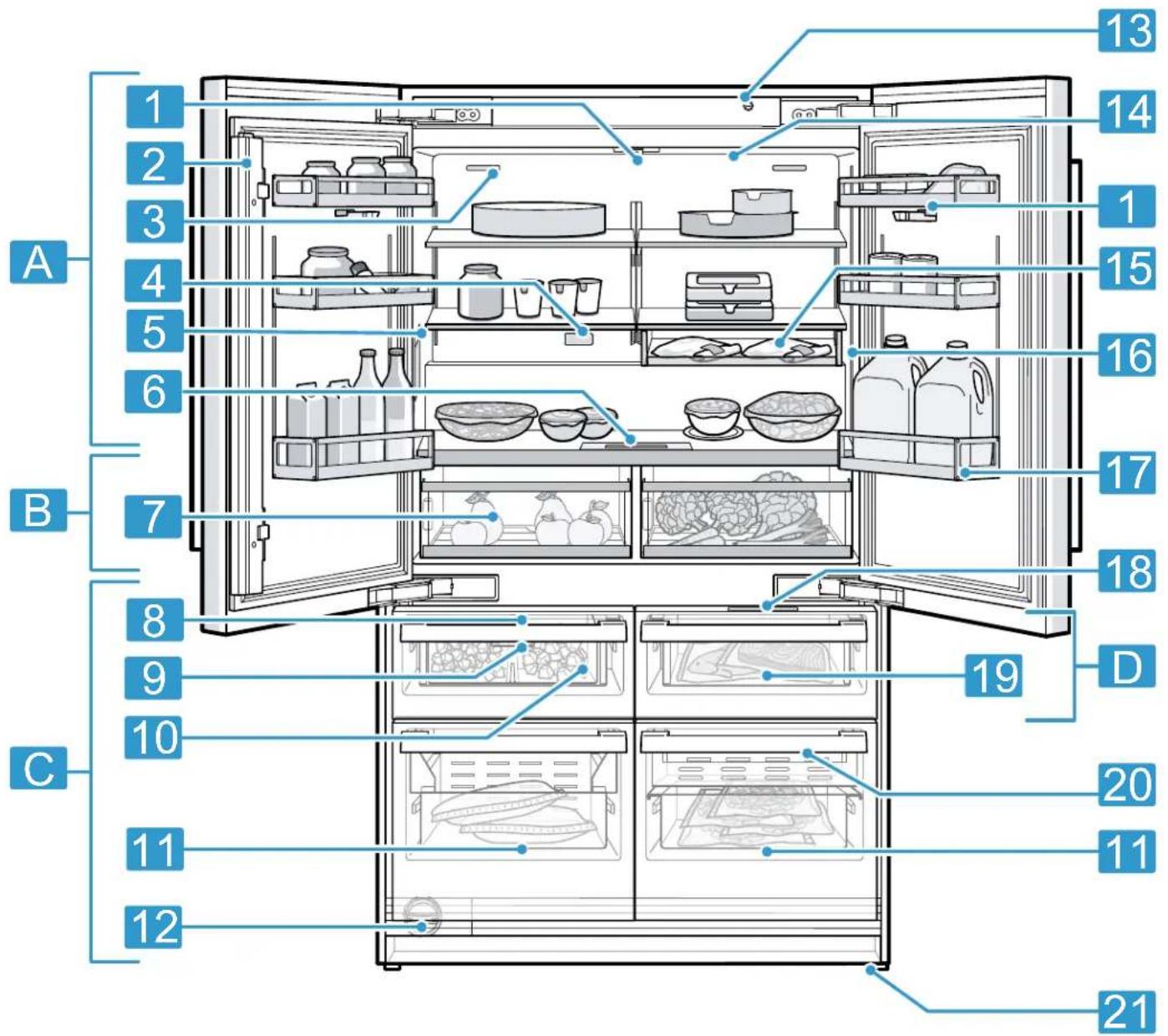
Here you can find an overview of the parts of your appliance.
text_image
A 1 2 3 4 5 6 7 B 8 9 10 C 11 12 13 14 15 16 17 18 19 D 20 11 21
Your appliance may differ from the diagrams with regard to cosmetic features and dimensions.
| A | Refrigerator compartment → Page 20 |
| B | Cool-fresh compartment → Page 21 |
| C | Freezer compartment → Page 21 |
| D | Variable-temperature compartment → Page 21 |
| 1 | Camera |
| 2 | Mullion rail with condensation protection → Page 7 |
| 3 | Inner ventilation openings (refrigerator compartment) |
| 4 | Odor filter → Page 13 |
| 5 | Water dispenser → Page 23 |
| 6 | Control panel → Page 10 |
| 7 | Cool-fresh container → Page 12 |
| 8 | Ice cube maker → Page 23 |
| 9 | Container divider → Page 12 |
| 10 | Ice storage container → Page 12 |
| 11 | Suspended frozen food container → Page 12 |
| 12 | Water filter → Page 22 |
| 13 | Main switch |
| 14 | Interior lighting |
| 15 | Snack container → Page 12 |
| 16 | Rating label → Page 31 |
| 17 | Door tray for large bottles → Page 12 |
| 18 | Control panel (variable-temperature compartment) → Page 11 |
| 19 | Variable-temperature container |
| 20 | Frozen food pull-out container → Page 12 |
| 21 | Screw foot |
5.2 Control panel
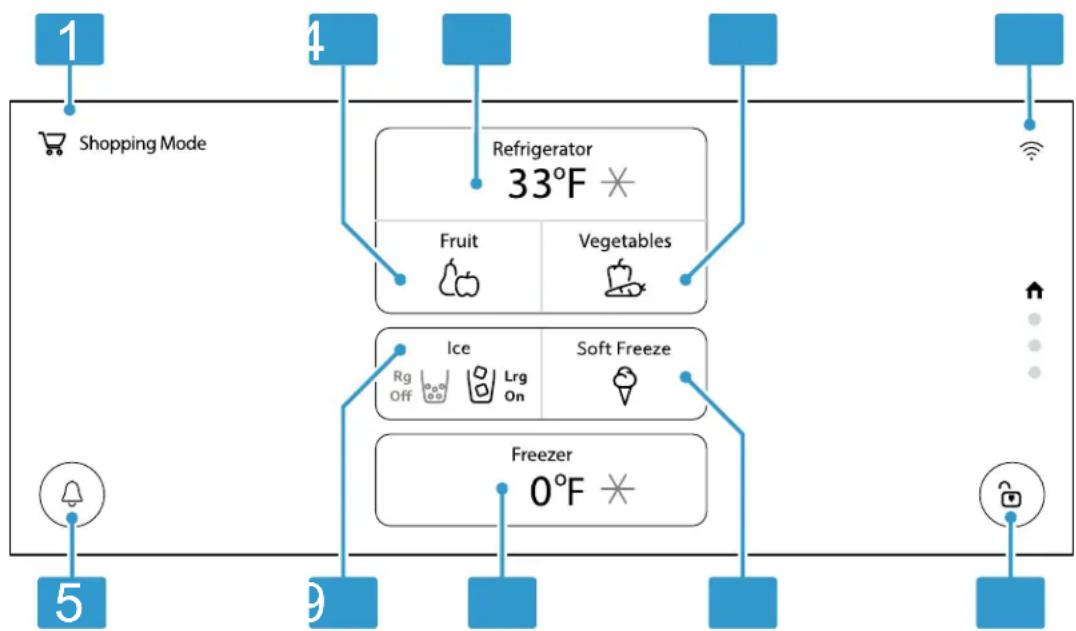
You can use the control panel to configure all functions of your appliance and to obtain information about the operating status.
flowchart
graph TD
    A["Shopping Mode"] --> B["Refrigerator 33°F *"]
    B --> C["Fruit"]
    B --> D["Vegetables"]
    C --> E["Ice Off"]
    C --> F["Lrg On"]
    D --> G["Soft Freeze"]
    E --> H["Freezer 0°F *"]
    F --> H
    G --> H
2
| 1 | Displays the set mode. |
| 2 | Allows the cool-fresh compartment to be set. |
| 3 | Allows the refrigerator compartment to be set. |
| 4 | Shows the status of Home Connect®, for example, whether Home Connect® is switched on or off. |
| 5 | ♀ opens the notification center. |
| 6 | Allows ice cube production to be set. |
| 7 | Allows the freezer compartment to be set. |
| 8 | Allows the variable-temperature compartment to be set. |
9 Switches the display's button lock on or off.
Operating logic
Some areas of the display respond to touch. You can activate settings by touching the buttons. The activated settings are highlighted on the display. You can change or deactivate the activated settings by repeatedly pressing the relevant buttons on the display.
NOTICE:
Pressing on the display with force may cause damage.
- Do not apply heavy pressure on the display.
- Do not press on the display using pointed or sharp objects.
| Symbol Description | |
| ↑ | Go to the start screen |
| i | Display additional information |
| Symbol Description | |
| ○ | Switch on the function |
| ○ | Switch off the function |
5.3 Control panel (variable-temperature compartment)
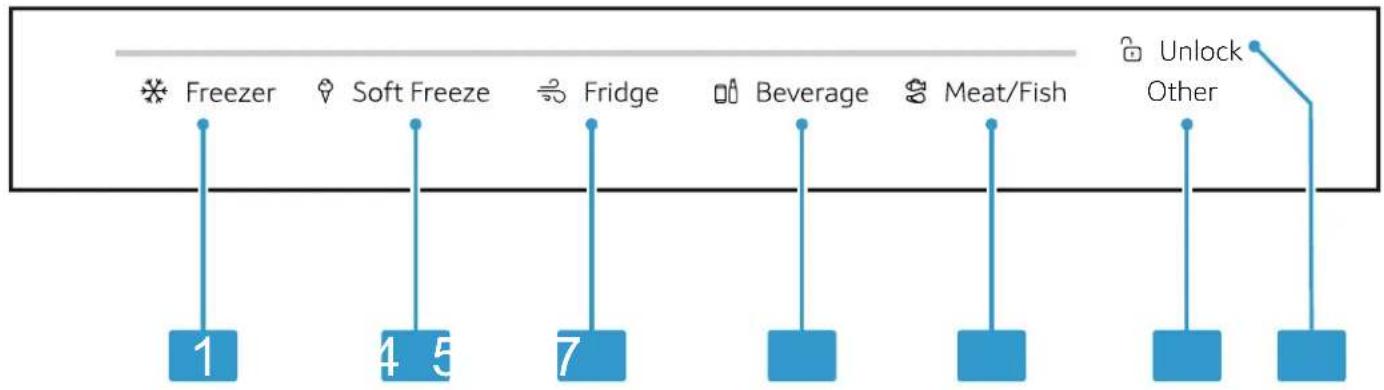
Use the variable-temperature compartment's control panel to set the storage setting.
flowchart
graph TD
    A["Freezer"] --> B["1"]
    C["Soft Freeze"] --> D["4"]
    E["Fridge"] --> F["5"]
    G["Beverage"] --> H["7"]
    I["Meat/Fish"] --> J[" "]
    K["Unlock"] --> L["Other"]
3
1 ✦ Freezer sets the storage setting in the variable-temperature compartment to a freezer compartment.
2 Soft Freeze sets the storage setting in the variable-temperature compartment to soft freezing.
3 Fridge sets the storage setting in the variable-temperature compartment to a refrigerator compartment.
4 Beverage sets the storage setting in the variable-temperature compartment for drinks.
5 Meat/Fish sets the storage setting in the variable-temperature compartment to meat and fish.
6 "Other" lights up if user-defined settings have been set via the Home Connect® app or the control panel.
7 Unlock switches off the button lock for the control panel (variable-temperature compartment).
6 Features
The features of your appliance depend on the model.
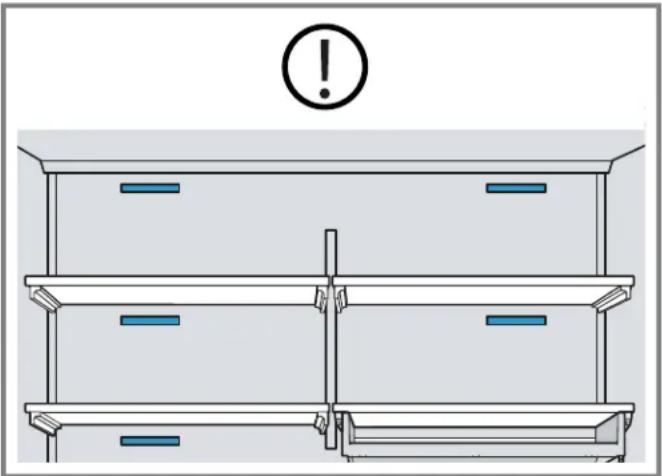
6.1 Shelf
To vary the shelf as desired, you can remove the shelf and re-insert it elsewhere.
→ "Removing the shelf", Page 25
Note
To avoid impeding the circulation of air, do not cover the inner ventilation openings.
text_image
Diagram of a multi-level storage cabinet with warning symbol and labeled components6.2 Snack container
Store packaged food or small snacks in the snack container.
6.3 Cool-fresh container
To automatically set the cool-fresh container to the right humidity and temperature for your food, use the different cool-fresh container storage settings.
Store fresh fruit and vegetables loose in the cool-fresh container.
Cover any chopped fruit and vegetables, or store in air-tight packaging.
For hygiene reasons, do not store fruit and vegetables in a cool-fresh container with meat and fish.
Condensation may form in the cool-fresh container depending on the type and quantity of food stored.
Remove the condensation with a dry cloth.
To ensure that the quality and aroma are retained, store fruit and vegetables that are sensitive to cold outside of the appliance at temperatures of approximately 46 °F
(8 °C) to 54 °F (12 °C), e.g. pineapple, bananas, citrus fruits, cucumbers, zucchini, bell peppers, tomatoes and potatoes.
6.4 Variable-temperature container
Use different storage settings to set the correct temperature for your food in the variable-temperature compartment.
6.5 Container divider
To create more storage space in the ice storage container, you can remove the container divider. Removing the container divider → Page 25
6.6 Frozen food pull-out container
In order to achieve an improved overview and to remove frozen food more quickly, remove the frozen food pull-out container.
6.7 Suspended frozen food container
Store large frozen items in the suspended frozen food container.
6.8 Door tray
To adjust the door tray as desired, you can remove the door tray, and re-insert it elsewhere.
→ "Removing the door tray", Page 25
6.9 Ice storage container
If ice cube production is switched on, the ice cubes are automatically stored in the ice storage container.
NOTICE:
The ice maker may become blocked or damaged by food or objects stored in the ice storage container.
▶ Never store food or objects in the ice storage container.
Note: To prevent the ice storage container from being overfilled, do not manually distribute the ice cubes throughout the ice storage container.
Tip: To ensure that no ice cubes fall into the freezer compartment from the ice storage container, do not slam the freezer compartment drawer shut.
6.10 Camera
Each time the door is closed, the cameras take a photo of the refrigerator compartment, the cool-fresh compartment and the inside of the refrigerator compartment doors. You can call up the photos using the Home Connect app and a mobile device. Activating the cameras → Page 15
Note: Close the appliance door slowly so that the cameras are able to take high-quality photos. If you close the appliance door too quickly, the photos may be blurred.
The photos may also be unclear if the camera is dirty.
→ "Cleaning the camera", Page 25
6.11 Odor filter
The odor filter filters odors in the refrigerator compartment and can be replaced if required.
→ "Replacing the odor filter", Page 26
6.12 Accessories
Only use genuine accessories. These are designed especially for your appliance.
The accessories for your appliance depend on the model.
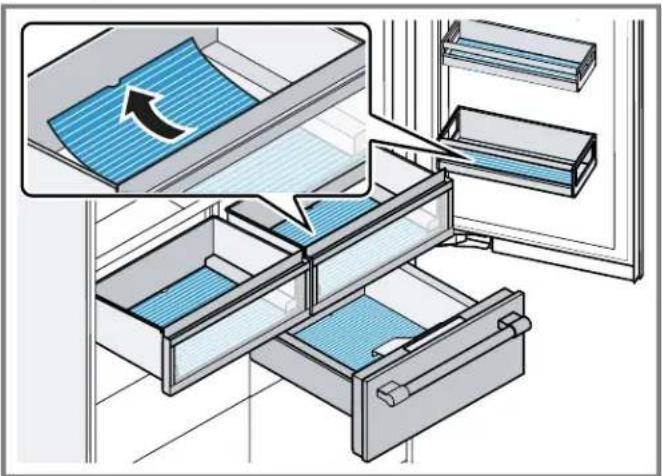
Anti-slip mat
The anti-slip mat prevents bottles and food from slipping. Condensation may form on the anti-slip mat depending on the type and quantity of food stored. Where necessary, remove the anti-slip mat and wipe away the condensation with a dry cloth.
natural_image
Illustration of a refrigerator drawer with blue insulation material being placed into the drawer (no text or symbols)Ethylene absorber
For important safety instructions and information about installation and use, see the enclosed installation instructions for the ethylene absorber.
The ethylene absorber slows down the ripening of ethylene-sensitive fruit and vegetables to keep them fresher for longer.
Installing the ethylene absorber
- Install the ethylene absorber in accordance with the installation instructions for the ethylene absorber.
Using the refill set
-
Install the components of the refill set in accordance with the installation instructions for the ethylene absorber.
-
Replace the bags at least every 6 months after resetting.
Note: Refill sets can be purchased from customer service or our website.
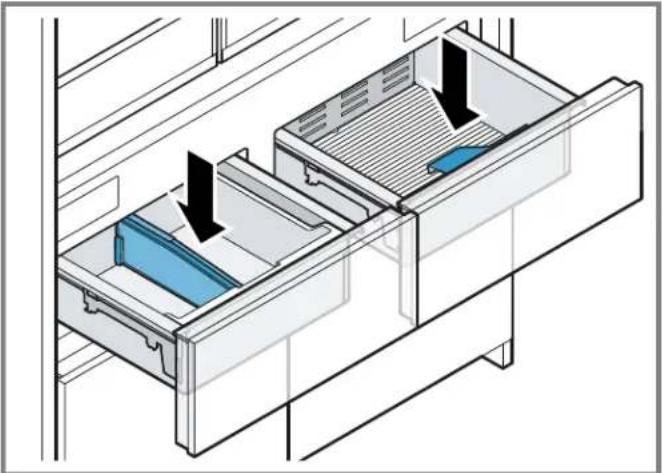
Ice scoop
You can use the ice scoop to remove a portion of ice cubes.
Tip
Place the ice scoop in the variable-temperature container or on the container divider.
natural_image
Isometric diagram of a double-free drawer with blue liquid and black arrows indicating flow or placement (no text or symbols)7 Before using the appliance for the first time
7.1 Performing initial start-up
Requirements
■ The appliance is installed in accordance with the enclosed installation instructions.
■ The appliance is connected to the electricity supply.
→ Page 8
- Switch on the appliance at the main switch.
→ "Appliance", Fig. 1 13, Page 10 - Close the appliance doors, wait 3 minutes and reopen them.
- Select a language.
- Check the water connection and the water output.
-
Select one of the options:
-
To set up Home Connect®, touch "Connect Now" and follow the instructions on the display.
- To manually set the time, date and temperature unit, touch "Manual Set-Up" and follow the instructions on the display.
- Press "Install Now" to start the ethylene absorber installation and follow the instructions on the display.
- To directly access the start screen, touch "Skip".
√ The initial start-up is complete.
8 Basic Operation
8.1 Switching on the appliance
- Switch on the appliance at the main switch.
→ "Appliance", Fig. 1 13, Page 10
√ The appliance begins to cool.
2. Set the desired temperature. → Page 14
8.2 Operating tips
■ Once you have switched on the appliance, the set temperature is only reached after several hours. Do not put any food in the appliance until the set temperature has been reached.
■ The front and side panels of the housing heat up occasionally. This prevents condensation from forming.
- When closing the door, make sure that the door is not blocked by stored items.
- When you close the door, a vacuum may be created. The door is then difficult to open again. Wait a moment until the vacuum is offset.
■ The temperature in the appliance varies due to the following conditions:
– How often the appliance is opened
- Load capacity
– Temperature of newly stored food
– Ambient temperature
- Direct sunlight
8.3 Switching off the appliance
- Switch off the appliance at the main switch.
→ "Appliance", Fig. 1 13, Page 10
8.4 Setting the temperature
Setting the refrigerator compartment temperature
- Touch the temperature display (refrigerator compartment).
- Touch X repeatedly until the temperature display (refrigerator compartment) shows the desired temperature setting.
Tip: When you press and hold √/, the temperature changes by 1° per second until you release it. The recommended temperature in the refrigerator compartment is 37 °F (3 °C).
Setting the recommended refrigerator compartment temperature
- Touch the temperature display (refrigerator compartment).
- Touch "Set to Default" ⚠.
√ The refrigerator compartment temperature is set to 37^ F ( 3^ C).
Setting the freezer compartment temperature
- Touch the temperature display (freezer compartment).
- Touch repeatedly until the temperature display (freezer compartment) shows the desired temperature setting.
Tip: When you press and hold √/, the temperature changes by 1° per second until you release it. The recommended temperature in the freezer compartment is 0 °F (-18 °C).
Setting the recommended freezer compartment temperature
- Touch the temperature display (freezer compartment).
- Touch "Set to Default" 8.
√ The freezer compartment temperature is set to 0 °F (-18 °C).
8.5 Cool-fresh compartment storage setting
You can set the temperature and humidity of the cool-fresh container using predefined storage settings.
Tip: Further settings are available in the Home Connect® app.
Setting the cool-fresh compartment storage setting
- Touch the required cool-fresh compartment storage setting.
- Touch "More Options" 000
- Touch the required storage setting and confirm using ↑.
8.6 Keylock
The button lock prevents the appliance from being operated accidentally or incorrectly while running.
Note: You can permanently activate or deactivate the automatic button lock. → Page 15
Switching on the keylock
▶ Press and hold ☑ for 2 seconds.
lights up.
Switching off the keylock
▶ Press and hold 📄 for 2 seconds.
8.7 Storage setting in the variable-temperature compartment
You can set the temperature of the variable-temperature compartment using predefined storage settings on the control panel on the appliance or on the control panel of the variable-temperature compartment.
Tip: Further settings are available in the Home Connect® app.
Setting the variable-temperature compartment
- Touch the storage setting for the variable-temperature compartment.
- Touch "More Options" 000
- Touch the required storage setting and confirm using ↑.
Setting the control panel (variable-temperature compartment)
-
In the control panel (variable-temperature compartment), touch and hold Unlock until the light bar lights up fully.
-
Touch the storage setting that you desire.
9 Basic settings
9.1 Changing the basic settings
- Swipe to "Settings".
"General" lights up. - Touch and change the desired basic setting.
9.2 Overview of the basic settings
Here you can find an overview of the basic settings and factory settings. The basic settings depend on the features of your appliance.
"General"
| Setting Selection Description | ||
| Connectivity/WiFi See the information on the display.More OptionsConnect Now | Displays the Wi-Fi status. → Page 19Displays the Home Connect® settings.Set up Home Connect®. → Page 18 | |
| Cameras / Switch the cameras on or off. ○ ○ | → "Camera", Page 12 | |
| Language English | EspañolFrançais | Select the menu language. |
| Units Farenheit | Celcius | Set the temperature unit. |
| "Special Modes" | ||
| Setting Selection Description | ||
| Normal Mode Normal Mode Switch standard mode on or off. | ||
| Shopping Shopping Switch shopping mode on or off. | → "Shopping mode", Page 17 | |
| Sabbath Sabbath Switch Sabbath mode on or off. Select | a preset time and follow the instructions on the display.→ "Sabbath mode", Page 17Tip: You can adjust the preset times. | |
| Eco Eco Switch energy-saving mode on or off. | → "Energy-saving mode", Page 17 | |
| Vacation Vacation Switch vacation mode on or off. | → "Vacation mode", Page 17 | |
| "Display" | ||
| Setting Selection Description | ||
| Display Brightness Auto | Manual √/∧ | Switch the automatically set display lighting on or off.Set the display lighting from 20% to 100%. |
| Automatic Display Lock | ○/○Activate or deactivate the automatic | keylock. |
"Audio"
| Setting Selection Description | ||
| Display Volume / Set the display volume from 0 to 8. | ||
| Notification Volume / Set the volume of the notification | sounds from 0 to 8. | |
| "Lighting" | ||
| Setting Selection Description | ||
| Interior Lights Auto | Manual | Switch the automatically set brightness of the interior lighting on or off.→ "Interior lighting", Page 17Set the brightness of the interior lighting from 20% to 100%. |
| Light Guidance / Switch the lighting assistant on or off. | ||
| Theatre Lighting / Switch the theater lighting on or off. | ||
10 Additional functions
Find out which additional functions can be used for your appliance. Additional functions can be set via the Home Connect® app.
10.1 Super cooling
With Super cooling, the refrigerator compartment cools as cold as possible.
Switch on Super cooling before placing large quantities of food in the refrigerator compartment.
Note: When Super cooling is switched on, increased noise may occur.
Switching on Super cooling
- Touch the temperature display (refrigerator compartment).
- Touch "Super Cool" ✕Off".
√ *On" lights up on the temperature display (refrigerator compartment).
Note: After approximately 6 hours, the appliance switches to normal operation.
Switching off Super cooling
- Touch the temperature display (refrigerator compartment).
- Touch "Super Cool" ✕Off".
√ *On" goes out on the temperature display (refrigerator compartment).
√ The previously set temperature is displayed.
10.2 Automatic Super freezing
With automatic Super freezing, the freezer compartment cools down to a much lower temperature than in normal mode. This freezes food more quickly.
The automatic Super freezing switches on if you place fresh food in the suspended frozen food container, starting from the right-hand side.
If the automatic Super freezing is switched on, ✝ lights up and increased noise may occur.
After operation, the appliance switches from automatic Super freezing to normal operation.
Note: You can find out how to activate and deactivate automatic Super freezing in the service settings.
→ Page 20
Canceling automatic Super freezing
- Touch the temperature display (freezer compartment).
-
Touch ✉On".
-
*On" goes out on the temperature display (freezer compartment).
√ The previously set temperature is displayed.
10.3 Manual Super freezing
With Super freezing, the freezer compartment cools as cold as possible.
Switch on Super freezing 4 to 6 hours before placing food weighing 4.4 lbs (2 kg) or more into the freezer compartment.
Use Super freezing to accelerate ice cube production.
Note: When Super freezing is switched on, increased noise may occur.
Switching on manual Super freezing
- Touch the temperature display (freezer compartment).
- Touch "Super Freeze" ✉Off".
- * "On" lights up on the temperature display (freezer compartment).
Note: After approximately 8 hours, the appliance switches to normal operation.
Switching off manual Super freezing
- Touch the temperature display (freezer compartment).
- Touch "Super Freeze" ✦ Off".
- *On* goes out on the temperature display (freezer compartment).
√ The previously set temperature is displayed.
10.4 Shopping mode
Switch on the "Shopping Mode" before you go shopping for food.
The "Shopping Mode" switches Super cooling and Super freezing on at the same time.
Note: You can find out how to switch on shopping mode in the basic settings. → Page 15
10.5 Vacation mode
If you are going to be away for a long time, you can switch on energy-saving vacation mode on the appliance.
CAUTION
The refrigerator compartment heats up while the vacation mode is switched on. The increased temperature may cause bacteria to increase and spoil the food.
- When the vacation mode is switched on, do not store any food in the refrigerator compartment.
The appliance automatically sets the temperatures.
| Refrigerator compartment 58 °F (14 °C) | |
| Cool-fresh compartment Temperature remains unchanged | |
| Freezer compartment Temperature remains unchanged | |
| Variable-temperature compartment | Temperature remains unchanged |
Notes
■ While the vacation mode is activated, the ice cube production and the water dispenser are switched off.
- You can find out how to switch on vacation mode in the basic settings. Page 15
10.6 Energy-saving mode
You can set the appliance to save energy with the energy-saving mode.
The appliance automatically sets the temperatures.
| Refrigerator compartment 43 °F (6 °C) | |
| Cool-fresh compartment 32 °F (0 °C) | |
| Freezer compartment 6 °F (-14 °C) | |
| Variable-temperature compartment | Temperature remains unchanged |
Temperatures above 0 °F ( -18 °C ) reduce the shelf life of food. Use energy-saving mode for short-term storage of food.
Note: You can find out how to switch on energy-saving mode in the basic settings. → Page 15
10.7 Interior lighting
You can switch the interior lighting off or set the brightness.
Note: You can find out how to set the brightness of the interior lighting in the basic settings. → Page 16
10.8 Sabbath mode
To ensure that you can also use the appliance on the Sabbath, the Sabbath mode switches off all non-essential functions.
During Sabbath mode, the following functions are switched off:
■ Super cooling
■ Alarm
■ Water dispensing
■ Ice cube production
■ Interior lighting
■ Audible signals
■ Messages on the control panel
■ Automatic Super freezing and manual Super freezing
Notes
■ The brightness of the control panel lighting is reduced during the Sabbath mode.
■ You can find out how to switch on Sabbath mode in the basic settings. → Page 15
11 Alarm
11.1 Door alarm
If the appliance door is open for a while, the door alarm switches on.
A warning tone sounds and a 🔒 "Door Alarm" appears.
Switching off the door alarm
- Close the appliance door or touch "Mute Alarm".
√ The warning tone is switched off.
11.2 Temperature alarm
If the freezer compartment becomes too warm, the temperature alarm will switch on.
A warning tone sounds and 🔒 "Freezer High Temp. Alarm" lights up.
CAUTION
During the thawing process, bacteria may multiply and spoil the frozen food.
- Do not refreeze partly or completely thawed food.
▶ Refreeze food only after cooking.
- The frozen items should no longer be stored for the maximum storage period.
The temperature alarm can be switched on in the following cases:
■ The appliance is switched on.
Do not store any food until the appliance has reached the set temperature.
■ Large quantities of fresh food are being placed inside. Switch on Super freezing before placing large quantities of food in the appliance.
■ The freezer compartment door is open for too long. Check whether the frozen food has defrosted or thawed.
Switching off the temperature alarm
- Touch "Yes, see highest temp." and use "OK" to confirm.
√ The warning tone is switched off.
√ The display indicates the warmest temperature reached in the freezer compartment. The display will then indicate the set temperature again.
√ From this time on, the warmest temperature is recalculated and saved.
12 Home Connect®
This appliance is network-capable. Connecting your appliance to a mobile device lets you control its functions via the Home Connect® app.
The Home Connect® services are not available in every country. The availability of the Home Connect® function depends on the availability of Home Connect® services in your country. You can find information on this at: www.home-connect.com.
To be able to use Home Connect®, you must first set up the connection to the WLAN home network (Wi-Fi ^1 ) and to the Home Connect® app.
After switching on the appliance, wait at least 2 minutes until internal device initialization is complete. Only then should you set up Home Connect®.
The Home Connect® app guides you through the entire registration process. Follow the instructions in the Home Connect® app to implement the settings.
Tip: Follow the instructions in the Home Connect® app as well.
Notes
- Also note the safety information in this instruction manual and ensure that it is also observed when operating the appliance using the Home Connect® app. → "Safety", Page 4
- Operating the appliance on the appliance itself always takes priority. It is not possible to operate the appliance using the Home Connect® app during this time.
12.1 Setting up the Home Connect® app
- Install the Home Connect® app on your mobile device.
- Start the Home Connect® app and set up access for Home Connect®.
The Home Connect® app guides you through the entire registration process.
12.2 Setting up Home Connect®
Requirement: The appliance receives signals from the WLAN home network (Wi-Fi) at its installation location.
- Scan the following QR code.
text_image
RFTH1T01You can install the Home Connect® app and connect your appliance via the QR code.
- Follow the instructions in the Home Connect® app.
12.3 Remote Diagnostics
Customer Service can access your appliance via Remote Diagnostics if you ask them to do so, provided your appliance is connected to the Home Connect® server and Remote Diagnostics is available for your appliance and country. For more information on Remote Diagnostics' availability in your country, visit the Service/Support section of your local website: www.home-connect.com. Please be aware that while Remote Diagnostics can assist in troubleshooting select issues, there may be instances where an on-site service visit is required if the problem cannot be resolved remotely.
12.4 Data Protection
Please read this information on data protection. The first time your appliance is registered on a home network connected to the Internet, your appliance transmits the following types of data to the Home Connect® server (initial registration):
■ Unique appliance identification (consisting of appliance codes as well as the MAC address of the installed Wi-Fi communication module).
■ Security certificate of the Wi-Fi communication module (to ensure a secure data connection).
■ The current software and hardware version of your home appliance.
■ Status of any previous reset to factory settings.
This initial registration prepares the Home Connect® functions for use and is only required when you want to use the Home Connect® functions for the first time.
Notes
- Please note that the Home Connect® functions can only be used in conjunction with the Home Connect® app. Information on data protection can be retrieved in the Home Connect® app.
- It is possible that users, persons or spaces outside of the appliance may be captured by the cameras and therefore displayed in the Home Connect® app. Such photos are processed in the Home Connect® system for the purpose of provision in the Home Connect® app. Information on data processing can be retrieved in the Home Connect® app.
12.5 Status of the
Home Connect® connection
This is where you will find an overview of the status of the Home Connect® connection.
| Symbol Description | |
| The appliance is connected to the Home Connect® app. | |
13.2 Overview of the service settings
This is where you can find an overview of the service settings.
"Application Info"
| Setting Selection Description | ||
| See the information on the display. E-Number: | Displays information about your appliance. | |
| Production Date: // | ||
| Z-Number: | ||
| Serial Number: | ||
"Filter Management"
| Setting Selection Description | |
| Water Filter See the information on the display. Reset | Displays the water filter status.Follow the instructions on the display and reset the water filter status. |
| Ethylene Absorber See the information on the display. Install Reset Remove | Displays the ethylene absorber status.Install the ethylene absorber.Reset the status of the ethylene absorber.Remove the ethylene absorber. "Ethylene absorber", Page 13 |
| Air Filter See the information on the display. The air filter is designed to last for the lifetime of your appliance. | |
"How-To Guides"
| Setting Selection Description | |
| See the information on the display. How to restart my appliance.How to change my water filter.How to change my ethylene absorber. | Shows the step-by-step instructions on the display. Touch the required instruction and follow the instructions on the display. |
| "Customer Service" | |
| Setting Selection Description | |
| 24/7 Customer Service See the information on the display. Displays the Customer Service telephone number. Scan the QR code in order to access the Customer Service website. | |
| "Advanced Service" | |
| Setting Selection Description | |
| Time & Date See the information on the display.Auto-adjust 📄/○ | Follow the instructions on the display and set the time and date.Switch the automatically set time and date on or off.Note: "Auto-adjust" is only available if Home Connect® is set up. |
| Auto-Super / Activate or deactivate the automatic | Super freezing.→ "Automatic Super freezing", Page 16 |
| Factory Reset Reset Now Reset the appliance to the factory | settings. |
| Demo Mode / Switch demo mode on or off The | appliance does not cool in demo mode.Note: Demo mode is only available for a limited time after the appliance is switched on. |
14 Refrigerator compartment
You can keep dairy products, eggs, prepared meals, pastries, open preserves and hard cheese in the refrigerator compartment.
The temperature can be set from 33 ^ ( 1 ^ ) to 43 ^ ( 6 ^ ).
The refrigerator compartment can also be used to store highly perishable foods in the short to medium term. The lower the selected temperature, the longer the food remains fresh.
14.1 Tips for storing food in the refrigerator compartment
■ Only store food when fresh and undamaged.
■ Store food covered or in air-tight packaging.
- To avoid impeding the circulation of air and to prevent food from freezing, do not place food in front of the inner ventilation openings or in direct contact with the back wall.
- Allow hot food and drinks to cool down first before placing in the appliance.
- Observe the best-before date or expiration date specified by the manufacturer.
14.2 Chill zones in the refrigerator compartment
The air recirculation cooling system allows the air to circulate evenly in the refrigerator compartment and ensures a constant temperature at all shelves.
Coldest zone
The coldest zone is in the bottom area at the back panel.
Tip: Store highly perishable food such as fish, sausages and meat in the cool-fresh compartment or in the variable-temperature compartment.
→ "Cool-fresh compartment", Page 21
→ "Variable-temperature compartment", Page 21
15 Cool-fresh compartment
In the cool-fresh compartment, you can keep fresh food fresh up to three times longer than in the refrigerator compartment.
The temperature can be set from 32 °F (0 °C) to 37 °F (3 °C) using pre-defined storage settings.
Storing food in the cool-fresh compartment retains the quality of the food better. The low temperature and the optimum moisture provide ideal storage conditions for fresh food.
15.1 Storage recommendations for the cool-fresh compartment
| Storage setting Food |
| ☐ Beverage Drinks |
| ☐ Vegetable Vegetables |
| ☐ Fruit Fruit |
| ☐ Variety Mixed load with fruit and vegetables |
| ☐ Fish Fish and seafood |
| ☐ Deli Gourmet food |
| ☐ Cheese Cheese and dairy products |
| ☐ Charcuterie Gourmet food, cheese and dairy products |
| ☐ Meat Meat and sausage |
Tip: Fruit, vegetables, drinks and snacks may freeze below 32 °F (0 °C).
Use the 🔒 and ⚙ storage settings for "Meat" and "Fish" only.
16 Freezer compartment
You can store frozen food, freeze food and make ice cubes in the freezer compartment.
The temperature can be set from 6 °F (-14 °C) to -7 °F (-22 °C).
Long-term storage of food should be at 0 °F ( -18 °C ) or lower.
The freezer compartment can be used to store perishable foods long-term. The low temperatures slow down or stop the spoilage.
16.1 Tips for storing food in the freezer compartment
■ Store food in air-tight packaging.
- Do not bring food which is to be frozen into contact with frozen food.
■ Distribute the food over a wide area in the suspended frozen food container.
16.2 Tips for freezing fresh food
■ Freeze fresh and undamaged food only.
■ Freeze food in portions.
- Cooked food is more suitable for freezing than food that can be eaten raw.
■ Vegetables: Wash, chop up and blanch before freezing.
■ Fruit: Wash, pit and perhaps peel, possibly add sugar or ascorbic acid solution.
- Food that is suitable for freezing includes baked items, fish and seafood, meat, game, poultry, eggs without shells, cheese, butter and curd cheese, prepared meals and leftovers.
- Food that is unsuitable for freezing includes lettuce, radishes, eggs in shells, grapes, raw apples and pears, yogurt, sour cream, crème fraîche and mayonnaise.
Packing frozen food
If you select suitable packaging material and the correct type of packaging, you can determine the product quality and prevent freezer burn.
- Place the food in the packaging.
- Squeeze out the air.
- Pack food airtight to prevent it from losing flavor or drying out.
- Label the packaging with the contents and the date of freezing.
16.3 Defrosting methods for frozen food
CAUTION
During the thawing process, bacteria may multiply and spoil the frozen food.
- Do not refreeze partly or completely thawed food.
▶ Refreeze food only after cooking. - The frozen items should no longer be stored for the maximum storage period.
■ Defrost animal-based food, such as fish, meat, cheese, curd cheese, in the refrigerator compartment.
■ Defrost bread at room temperature.
■ Prepare food for immediate consumption in the microwave, in the oven, or on the cooktop.
17 Variable-temperature compartment
You can use the variable-temperature compartment as a refrigerator compartment and store food using predefined storage settings. Or you can use the variable-temperature compartment as a freezer compartment and softly freeze food at lower temperatures.
The temperature can be set from 0 °F (-18 °C) to 39 °F (4 °C) using pre-defined storage settings.
17.1 Storage recommendations in the variable-temperature compartment
This is where you can find out which storage setting you can use in the variable-temperature compartment.
Storage setting Food
| Freezer See Freezer compartment→ Page 21 | |
| Soft Freeze Soft freezing, e.g. meat, sausage, fish and pureed food | |
| Fridge See Refrigeratorcompartment → Page 20 | |
| Beverage Drinks | |
| Meat/Fish Meat and fish | |
| Deli/Cheese Gourmet food, cheese and dairy products | |
| Pastry Cakes and other baked goods |
18 Water system
Your appliance is equipped with water-carrying components.
The water system only works if a water filter or a bypass cap is installed.
Switch off ice cube production before disconnecting the appliance from the drinking water connection. → Page 24
18.1 Water filter
The water filter filters particles and the taste of chlorine out of the water.
The water filter reduces further contamination, e.g. from chloramines, lead and pharmaceutical products.
Note: The water filter does not filter bacteria or microbes out of the water.
Change the water filter:
■ Every 6 months.
■ If 🔔'Filter is expired." lights up.
■ If the water output has visibly reduced.
■ If ice cube production has visibly reduced.
Tips
■ A new water filter can be purchased from our customer service, your dealer or our website.
- If you do not want to use a water filter in your appliance or an external water filter system is installed, you can permanently replace the water filter with a bypass cap. The bypass cap filters only large particles out of the water and can be cleaned as required.
A bypass cap can be purchased from customer service or our website.
Changing the water filter or replacing it with a bypass cap
- Hinge the filter cover upwards.
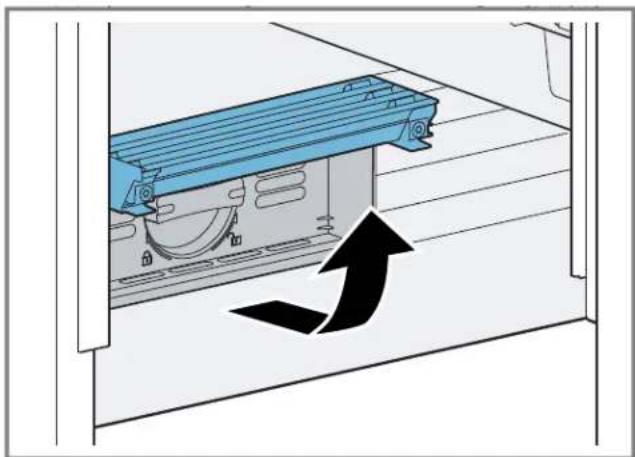
natural_image
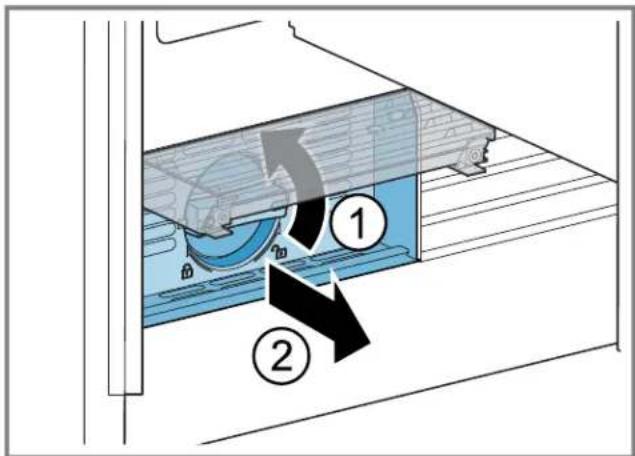
Diagram of a blue mechanical device inside a storage unit with an upward arrow indicating motion (no text or symbols)- Turn the water filter counterclockwise by 90^ ① and remove it ②
- Remove the water filter with care as it is under pressure.
text_image
Diagram showing airflow or ventilation system with labeled components and directional arrows indicating flow directionNote: When removing it, a small amount of water may drip out of the water filter. Remove the drips of water with a dry cloth.
Tip: You can dispose of the old water filter with your household garbage.
- Insert the new water filter or the bypass cap all the way in the filter opening and turn it 90° clockwise.
- Close the filter cover.
- Discard the ice cubes produced during the first 24 hours, and dispense water for 5 minutes and discard.
18.2 Water dispenser
Dispense cold water via the water dispenser.
Putting the water dispenser into operation
Note: Once the appliance has been connected or a new water filter has been installed, there will be air in the water system.
Requirement: The appliance is connected to the drinking water connection.
- Keep dispensing water until it contains no more air bubbles.
Remove any splashes of water with a dry cloth.
- For hygiene reasons, dispense water for 5 minutes and discard.
Dispensing water
▶ Press and hold the glass against the dispensing button ① or hold the glass under the water dispenser and press ⬇②
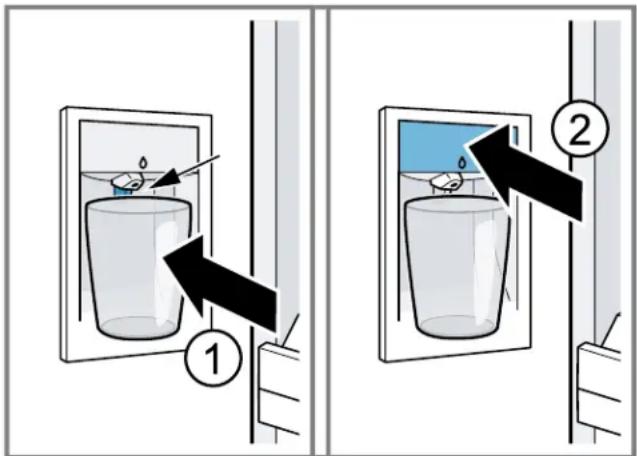
text_image
Diagram showing two steps of a water level measurement device, labeled 1 and 2, with arrows indicating water flow direction.Notes
■ After a while of continuous dispensing, the water stops being dispensed. Wait a few seconds before dispensing water again.
■ After water has been dispensed several times consecutively, water stops being dispensed. Wait a few minutes before dispensing water again.
Water dispenser keylock
The button lock prevents the water dispenser from being operated accidentally or incorrectly while running.
Switching on the water dispenser keylock
- Swipe to Water.
- Press and hold Hold to unlock until the light bar lights up fully.
√ Lock icon lights up.
Switching off the water dispenser keylock
-
Swipe to Water.
-
Press and hold Lock Water until the light bar lights up fully.
√ The water capacity favorites light up.
Water capacity
Your appliance has 4 water capacities at the factory and these are stored as favorites on the display.
The predefined water capacities can be adjusted or deleted.
Removing a favorite
- Swipe to Water.
- Touch the desired favorite.
- Hold a glass below the water dispenser and press and hold until the water capacity has been fully removed.
Saving new favorites
Note: Max. 6 water capacities can be stored.
- Swipe to Water.
- Hold a glass below the water dispenser, and press and hold until the desired water capacity has been removed.
- Touch Save as Favourite.
- Touch the desired name.
- Touch the desired color.
- Touch ☑
√ The new favorite is saved.
Adjusting a favorite
- Swipe to Water.
- Touch the desired favorite.
- Touch
- Touch the desired name and confirm using ☑
- Touch the desired color and confirm using ☑
√ The favorite is adjusted.
Deleting a favorite
- Swipe to Water.
- Touch the desired favorite.
- Touch
- Touch Delete favourite and use Yes, delete to confirm.
√ The favorite is deleted.
18.3 Ice maker
Use the different functions of the ice cube maker to produce ice cubes.
WARNING
Rotating parts may cause injury.
▶ Never reach into or underneath the ice maker.
| Regular Ice Ice cube production of small ice cubes |
| Large Ice Ice cube production of large ice cubes |
Quick Ice Accelerated ice cube
production
Note: 🔒 "Quick Ice" is only available if ice cube production is switched on.
Note: The ice cube maker automatically detects that the ice storage container is full and stops producing ice cubes. The display shows 📄.
It may take up to 48 hours until the ice storage container is full.
Tip: If the ice cubes taste stale, dispose of the remaining ice cubes and the cubes produced over the next 24 hours. If the ice cubes still taste stale, change the water filter.
Putting the ice maker into operation
Notes
■ Ice cube production starts as soon as the appliance is switched on and the freezer compartment has reached the set temperature.
- As soon as the freezer compartment reaches the set temperature, the first batch of ice cubes will be ready in approximately 4 hours.
Requirement: The appliance is connected to the drinking water connection.
- For hygiene reasons, discard the ice cubes produced within the first 24 hours.
Switching on ice cube production
- Touch the ice cube maker setting and confirm using 000.
- Switch on the desired ice cube production.
Switching off ice cube production
- Touch the ice cube maker setting and confirm using 000.
- Switch off the desired ice cube production.
19 Defrosting
19.1 Defrosting in the refrigerator compartment
The refrigerator compartment in your appliance defrosts automatically.
19.2 Defrosting in the cool-fresh compartment
The cool-fresh compartment in your appliance defrosts automatically.
19.3 Defrosting in the freezer compartment
The fully automatic NoFrost system ensures that the freezer compartment remains frost-free. Defrosting is not required.
19.4 Defrosting in the variable-temperature compartment
The variable-temperature compartment in your appliance defrosts automatically.
20 Cleaning and maintenance
To keep your appliance working efficiently for a long time, it is important to clean and maintain it carefully. Customer Service must clean inaccessible points. Cleaning by Customer Service can give rise to costs.
20.1 Care instructions for stainless steel surfaces
When taking care of and cleaning stainless steel surfaces, use only cleaning cloths and cleaning agents suitable for stainless steel.
Tips
■ To prevent visible scratches, wipe the stainless steel surface in the direction of the grain.
- Suitable cleaning agents and cleaning cloths are available from our customer service, your dealer or on our website.
20.2 Preparing the appliance for cleaning
- Switch off the appliance.
- Disconnect the appliance from the power supply. Unplug the appliance from the power source or switch off the circuit breaker in the fuse box.
- Take out all of the food and store it in a cool place. Place ice packs (if available) onto the food.
- Remove all fittings and accessories from the appliance. → Page 25
20.3 Cleaning the appliance

WARNING
Moisture intrusion may cause an electric shock.
- Do not use any steam cleaners or high-pressure cleaners to clean the appliance.
NOTICE:
Unsuitable cleaning agents may damage the surfaces of the appliance.
- Do not use hard scouring pads or cleaning sponges.
- Do not use strong or abrasive cleaning agents.
-
Do not use cleaning agents with a high alcohol content. If you clean fittings and accessories in the dishwasher, this may cause them to become deformed or discolor.
▶ Never clean fittings and accessories in the dishwasher. -
Prepare the appliance for cleaning. → Page 24
- Clean the appliance, the fittings, the accessories and the door seals with a dish cloth, lukewarm water and a little pH-neutral dishwashing liquid.
- Dry thoroughly with a soft, dry cloth.
- Insert the fittings.
- Connect the appliance to the electricity supply. → Page 8
- Switch on the appliance.
- Put the food into the appliance.
20.4 Cleaning the camera
If the temperature or the air humidity changes, this may cause the camera lenses to steam up.
- Clean the camera with a microfiber cloth.
- Clean the camera lenses with a microfiber cloth and a commercially available rain deflector.
20.5 Removing the fittings
If you want to clean the fittings thoroughly, remove these from your appliance.
Removing the shelf
▶ Lift the shelf ① and remove it .②
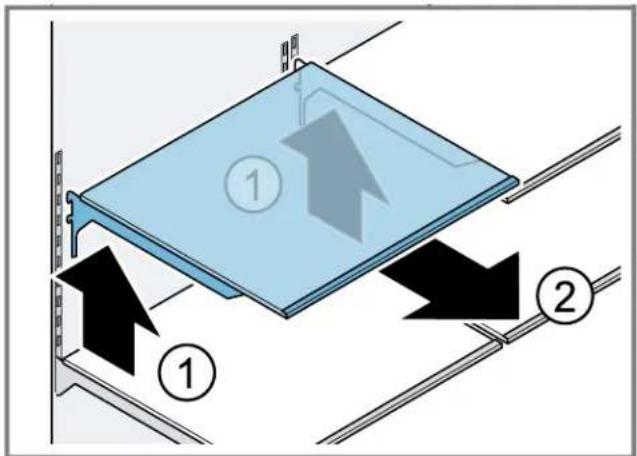
text_image
Diagram showing two labeled components (① and ②) with directional arrows indicating movement or flow between them, likely illustrating a mechanical or electrical system.Removing the snack container
- Pull the snack container out all the way.
- Underneath the snack container on both sides, press the telescopic rail lock downwards ① and remove the snack container ②.
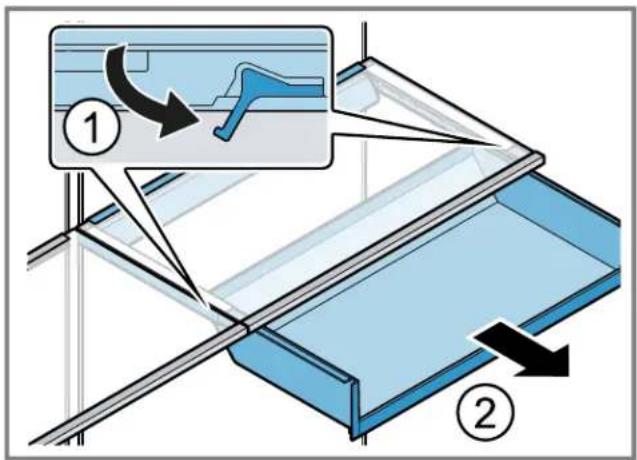
text_image
Diagram illustrating a mechanical or structural assembly with labeled steps 1 and 2, showing directional arrows and a highlighted component.Removing the door tray
▶ Lift the door tray and remove it.
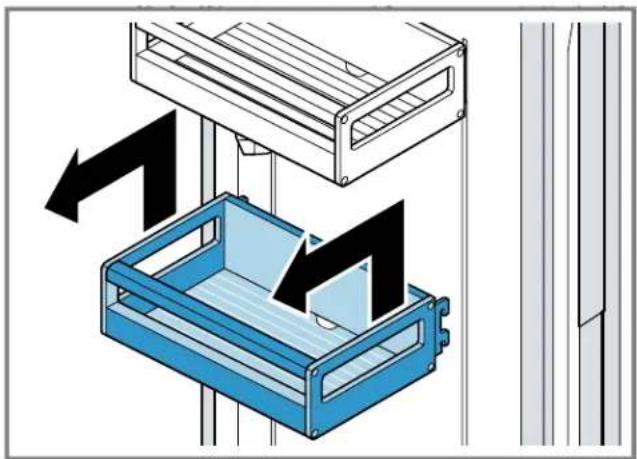
natural_image
Diagram showing airflow or movement between a blue plastic rack and a white rack unit (no text or symbols)Removing the container divider
▶ Lift up the container divider and remove it.

natural_image
Technical line drawing of a mechanical assembly with a blue component and an upward arrow indicating motion (no text or symbols)Removing the cool-fresh container
- Pull the cool-fresh container out all the way.
- Underneath the cool-fresh container on both sides, press the telescopic rail lock outwards ① and remove the cool-fresh container ②.
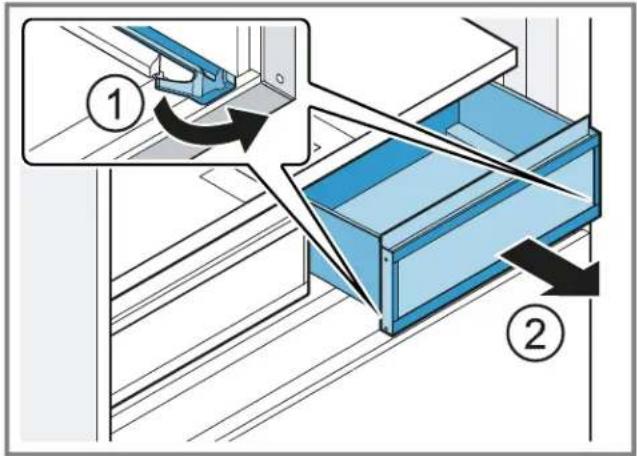
text_image
Diagram illustrating a mechanical assembly process with labeled steps ① and ② showing component alignment and assembly.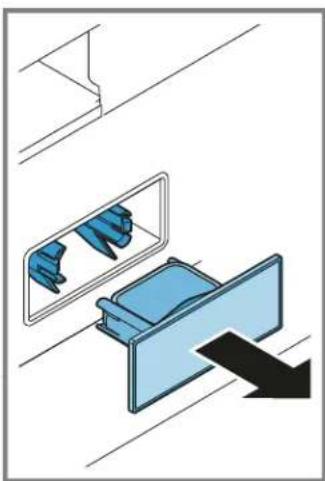
natural_image
Diagram showing a blue mechanical component being inserted into a larger portion of a wall, with no visible text or symbols.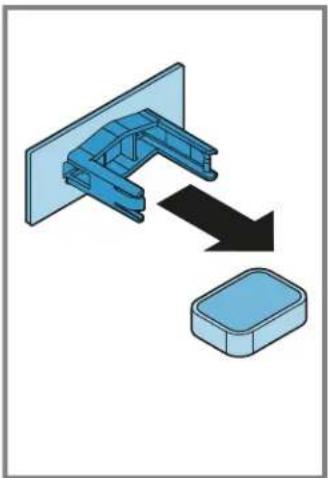
natural_image
Diagram showing a blue mechanical component being processed into a rectangular housing, with an arrow indicating process direction (no text or symbols present)Note: A new odor filter can be purchased from our customer service or our website.
Removing the ice storage container
- Remove the ice storage container upwards.
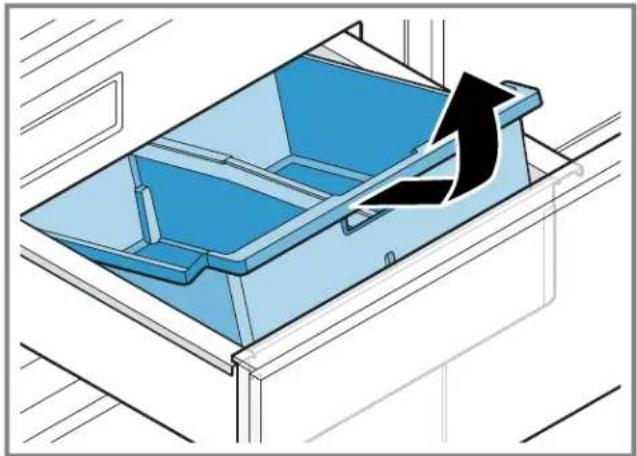
natural_image
Illustration of a blue plastic container with an arrow indicating direction (no text or symbols)20.6 Replacing the odor filter
- Remove the odor filter holder.
- Take the used odor filter out of the odor filter holder and replace it with the new odor filter.
21 Troubleshooting
You can eliminate minor issues on your appliance yourself. Please read the information on eliminating issues before contacting Customer Service. This may avoid unnecessary repair costs.

WARNING
To avoid risk of injury from improper repairs, observe the following.
▶ Only qualified technicians or authorized service providers should perform repairs.
- Only genuine spare parts may be used to repair the appliance.
If the power cord or the appliance power cable of this appliance becomes damaged, it must be replaced with a special power cord or special appliance power cable, which is available from the manufacturer or the manufacturer's Customer Service.
Issue Cause and troubleshooting
| The appliance is not cooling, the displays and lighting are lit. | Showroom mode is switched on.1. Swipe to "Service".2. Touch "Advanced Service".3. Touch "Demo Mode" |
| The LED lighting does not work. Various causes are possible.► Call customer service.→ "Customer Service", Page 30 | |
| The refrigeration unit is switching on more frequently and for longer. | The appliance has been opened frequently.► Do not open appliance door unnecessarily. |
| External ventilation openings are covered up.► Remove any obstructions from in front of the external ventilation openings. | |
| Not a fault. Modern refrigeration machines switch on more frequently and have different power levels to cool more efficiently.► Remove any obstructions from in front of the external ventilation openings.► Install the appliance as far away as possible from heating elements, cookers and other heat sources. Avoid prolonged exposure of the appliance to direct sunlight.► Only open the appliance door as briefly as necessary.► Allow hot food and drinks to cool down first before storing in the appliance. | |
| A layer of frost forms on the back wall of the refrigerator compartment. | Not a fault. Modern refrigeration machines ensure a more even temperature in the refrigerator compartment. The back wall of the refrigerator compartment is defrosted automatically at regular intervals.► Only open the appliance door as briefly as necessary.► Pack the food airtight or cover it.► Allow hot food and drinks to cool down first before storing in the appliance.► Always leave some space between the food and the interior walls. |
| Home Connect® is not working properly. | Various causes are possible.► Go to www.home-connect.com. |
| The cameras do not take any photos. | The cameras are not activated in Home Connect.► Activate the cameras. |
| Cameras are not calibrated.1. Switch off the appliance.2. Disconnect the appliance from the power supply.Unplug the power plug or switch off the circuit breaker in the fuse box.3. Reconnect the appliance after 5 minutes.4. Use the main switch to switch the appliance on. → "Appliance", Fig. 1 13, Page 105. Close the appliance doors and wait for 3 minutes.6. If the fault persists, call customer service. → Page 30 | |
| Issue Cause and troubleshooting | |
| The cameras take blurred photos. The appliance door was closed too quickly.► Close the appliance door slowly. | |
| Photos are missing, are not cropped or show an incorrect angle. | Cameras are not calibrated.1. Switch off the appliance.2. Disconnect the appliance from the power supply.Unplug the power plug or switch off the circuit breaker in the fuse box.3. Reconnect the appliance after 5 minutes.4. Use the main switch to switch the appliance on. → "Appliance", Fig. 1 13, Page 105. Close the appliance doors and wait for 3 minutes.6. If the fault persists, call customer service. → Page 30 |
| A message with "D" or "E" appears on the display. | The electronics have detected a fault.1. Switch off the appliance.2. Disconnect the appliance from the power supply.Unplug the power plug or switch off the circuit breaker in the fuse box.3. Reconnect the appliance after 5 minutes.4. If the message still appears on the display, call Customer Service.→ "Customer Service", Page 30 |
| A warning tone sounds and "Door Alarm" appears.The door alarm is switched on. | The appliance door is open.► Close the appliance door. |
| A warning tone sounds and "Freezer High Temp. Alarm" lights up.The temperature alarm is switched on. | Various causes are possible.1. Touch "Yes, see highest temp." and use "OK" to confirm.✓ The alarm is switched off.2. After several hours, check whether the set freezer compartment temperature has been reached again. |
| Large quantities of fresh food have been placed inside.► Do not exceed the freezing capacity. | |
| The temperature differs greatly from the setting. | Various causes are possible.1. Switch off the appliance.2. Switch the appliance back on after approximately 5 minutes.- If the temperature is too warm, check the temperature again after a couple of hours.- If the temperature is too cold, check the temperature again on the following day. |
| Water is leaking out of the appliance. | The water connection or water hose is not leak-tight.► Check if the water connections are fastened firmly and the water hose is undamaged.If necessary, replace the water hose. |
Issue Cause and troubleshooting
| Water output is reduced. Low water pressure. | |
| Check the pressure of the water supply system or the external water filter system, e.g. reverse osmosis system.Connect the appliance only to a water connection with sufficient water pressure.→Page 7 | |
| The water filter is blocked.→Change the water filter. | |
| Water is dripping from the water dispenser. | Air is in the water system.Keep dispensing water until it contains no more air. |
| The water dispenser is not functioning. | There is no water being supplied to the appliance.Ensure that there is a water supply and that the shut-off valve on the water connection is open.Contact an installer if necessary. |
| Kink in the water hose.Turn off the water supply and straighten the kink in water hose.If necessary, replace the water hose. | |
| Ice cube production is low. The appliance has only recently been connected. | |
| Wait approximately 4 hours until the first batch of ice cubes is ready. | |
| The freezer compartment has been opened frequently or for an extended period of time.Check ice cube production after a few hours. | |
| Low water pressure.Check the pressure of the water supply system or the external water filter system, e.g. reverse osmosis system.Connect the appliance only to a water connection with sufficient water pressure.→Page 7 | |
| The water filter is blocked.Change the water filter. | |
| Food or objects are blocking the fill level sensor for the ice maker.Remove all food and objects from the ice storage container. | |
| Fault in the ice maker.1. Switch off the appliance.Disconnect the appliance from the power supply.Unplug the power plug or switch off the circuit breaker in the fuse box.3. Reconnect the appliance after 5 minutes.If the fault persists, call customer service.→Page 30 | |
| The ice maker is not functioning. Ice cube production is switched off. | |
| Switch on ice cube production.→Page 24 | |
| There is no water being supplied to the appliance.Ensure that there is a water supply and that the shut-off valve on the water connection is open.Contact an installer if necessary. | |
| Kink in the water hose.Turn off the water supply and straighten the kink in water hose.If necessary, replace the water hose. | |
| Fault in the ice maker.1. Switch off the appliance.Disconnect the appliance from the power supply. | |
| Issue Cause and troubleshooting | |
| The ice maker is not functioning. Unplug the power plug or switch off the circuit breaker in the fuse box.3. Reconnect the appliance after 5 minutes.4. If the fault persists, call customer service. → Page 30 | |
| The appliance hums, bubbles, buzzes, gargles, clicks, crackles or rumbles. | Not a fault. A motor is running, e.g. refrigerating unit, fan. Refrigerant is flowing through the pipes. The motor, switches, solenoid valves or water valves are switching on or off. Automatic defrosting is running. Ice cubes fall into the ice storage container.No action required. |
| The appliance makes noises. The appliance is not level.► Align the appliance using a bubble level and the screw feet. | |
21.1 Power failure
During a power failure, the temperature in the appliance rises; this reduces the storage time and the quality of the frozen food.
Notes
■ Open the appliance as little as possible during a power failure and do not place any other food in the appliance.
- Check the quality of the food immediately after a power failure.
- Dispose of any frozen food that has defrosted and is warmer than 41^ (5 °C).
- Cook or fry slightly thawed frozen food, and then either consume it or freeze it again.
22 Storage and disposal
22.1 Taking the appliance out of operation
- Switch off the appliance.
- Disconnect the appliance from the power supply. Unplug the appliance from the power source or switch off the circuit breaker in the fuse box.
- Disconnect the appliance from the drinking water connection.
- Remove all of the food.
- Remove the water filter.
- Clean the appliance. → Page 25
- To ensure the ventilation inside the appliance, leave the appliance open.
22.2 Disposal of your old appliance
Environmentally compatible disposal allows valuable raw materials to be recycled.
WARNING
Children can lock themselves in the appliance, thereby putting their lives at risk.
- Remove the appliance doors.
- To prevent children from climbing in, leave shelves and containers in the appliance.
- Keep children away from the discarded appliance.
WARNING
If the tubes are damaged, flammable refrigerant and harmful gases may escape and ignite.
- Do not damage the tubes of the refrigerant circuit or the insulation.
- Unplug the appliance from the power supply.
- Cut through the power cord.
- Remove the appliance doors.
- Dispose of the appliance in an environmentally responsible manner. Information about current disposal methods can be obtained from your specialist dealer or local authority.
23 Customer Service
With any warranty repair, we will make sure your appliance is repaired by an authorized service provider using genuine replacement parts. We use only genuine replacement parts for all repairs. Detailed information on the warranty period and terms of warranty can be found in the Statement of Limited Product Warranty, from your retailer, or on our website.
If you contact Customer Service, you will need the model number (E-Nr.), the production number (FD) and the consecutive numbering (Z-Nr.) of your appliance.
USA:
1-800-735-4328
www.thermador.com/support
www.thermador.com/us/accessories
CA:
1-800-735-4328
www.thermador.ca
www.thermador.ca/en/support/filters-cleaners-accessories
For assistance with connecting to Home Connect®, you can also view instructions here:
www.home-connect.com/us/en/help-support/set-up
Making a note of your appliance's details and the
Customer Service telephone number will enable you to find them again quickly.
24 Technical specifications
Refrigerant, cubic capacity and further technical specifications can be found on the rating plate.
→ "Appliance", Fig. 1 16, Page 10
24.1 Information regarding Free and Open Source Software
This product includes software components that are licensed by the copyright holders as free or open source software.
The applicable license information is stored on your home appliance. You can also access the applicable license information via your Home Connect® app: "Profile -> Legal information -> License Information".¹ You can download the license information on the brand product website. (Please search on the product website for your appliance model and additional documents). Alternatively, you can request the relevant information from ossrequest@bshg.com or BSH Hausgeräte GmbH, Carl-Wery-Str. 34, 81739 Munich, Germany.
The source code will be made available to you on request. Please send your request to ossrequest@bshg.com or BSH Hausgeräte GmbH, Carl-Wery-Str.34, 81739 Munich, Germany.
Subject: „OSSREQUEST“
The cost of performing your request will be charged to you. This offer is valid for three years from the date of purchase or at least as long as we offer support and spare parts for the relevant appliance.
16 Compartiment congélation.... 53
text_image
Diagram of a multi-level storage cabinet with warning symbol and labeled compartments6.2 Bac à snacks
natural_image
Illustration of a refrigerator drawer with blue insulation material being folded into compartments (no text or symbols)natural_image
Diagram of a double-free drawer with blue liquid inside, showing internal compartments and arrows indicating flow direction (no text or symbols)16 Compartiment congélation
natural_image
Diagram of a blue mechanical device with a black arrow indicating motion or force direction (no text or symbols present)text_image
Diagram illustrating airflow or ventilation process with labeled components and directional arrowstext_image
Diagram showing two steps of a water level measurement device, labeled 1 and 2, with arrows indicating water flow direction.Remarques
text_image
Diagram showing two labeled arrows pointing to a blue rectangular device with an upward arrow, indicating directional movement or flow.text_image
Diagram illustrating a mechanical assembly with labeled steps ① and ②, showing directional movement and component placement.Retirer le compartiment de contre-porte
natural_image
Diagram showing airflow or ventilation from a blue plastic rack to an air conditioner unit (no text or symbols present)natural_image
Diagram of a door latch or drawer with a blue panel and black arrow indicating direction (no text or symbols)text_image
Diagram showing two steps of a blue metal shelf assembly with directional arrows indicating process flow.natural_image
Diagram of a blue plastic container with an arrow indicating direction, no text or symbols presentnatural_image
Diagram showing a blue mechanical component being inserted into a larger portion, with no visible text or symbols.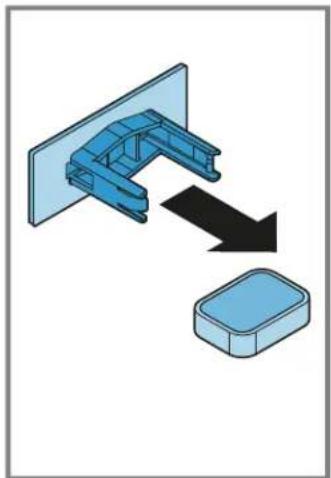
natural_image
3D diagram showing a blue mechanical component being processed into a rectangular housing, with an arrow indicating process direction (no text or symbols)www.thermador.com/us/accessories
CA:
1-800-735-4328
www.thermador.ca
www.home-connect.com/us/en/help-support/set-up
text_image
Diagram of a multi-level storage cabinet with warning symbol and labeled compartments6.2 Cajón para aperitivos
natural_image
Illustration of a refrigerator drawer with blue insulation material being placed into the drawer (no text or symbols)Absorbente de etileno
natural_image
Diagram of a double-free drawer with blue insulation and black arrows indicating flow direction (no text or symbols)natural_image
Diagram of a blue mechanical device inside a storage cabinet with an upward arrow indicating motion (no text or symbols)text_image
Diagram illustrating airflow or ventilation process with labeled components and directional arrowstext_image
Diagram showing two steps of a water displacement experiment in a tank, labeled with arrows and numbered annotations.Notas
text_image
Diagram showing two labeled arrows pointing to a blue panel with directional arrows, indicating movement or force directions.text_image
Diagram illustrating a mechanical or structural assembly with labeled steps ① and ②, showing directional arrows and a highlighted section.natural_image
Diagram showing two blue plastic storage bins with black arrows indicating flow or movement, no text or symbols present.natural_image
Technical line drawing of a mechanical assembly with a blue component and an upward arrow indicating motion (no text or symbols)text_image
Diagram illustrating a mechanical assembly process with labeled steps ① and ② showing component positioning and assembly.natural_image
Illustration of a blue plastic container with an arrow pointing to it, no text or symbols present20.6 Sustituir el filtro desodorizante
natural_image
Diagram showing a blue mechanical component being inserted into a larger portion of a wall, with no visible text or symbols.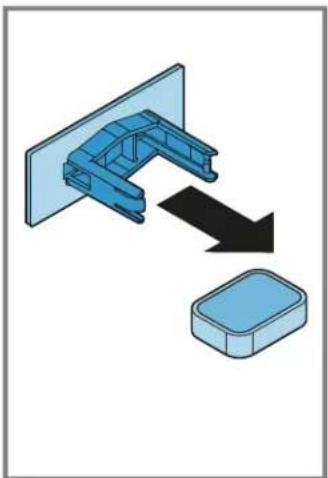
natural_image
3D diagram showing a blue mechanical component being inserted into a rectangular housing, with an arrow indicating direction (no text or symbols)www.thermador.com/us/accessories
CA:
1-800-735-4328
www.thermador.ca
www.thermador.ca/en/support/filters-cleaners-accessories
www.home-connect.com/us/en/help-support/set-up
Thermador.com/us/support/quicklinks
Owner Manuals
Download owner manuals, specifications and CADS.
How-To Videos
View instructional videos for changing water filters, cleaning, adjusting settings, and beyond.
FAQs & Cleaning Tips
Browse through cleaning, usage, and troubleshooting tips.
Home Connect® Support
Find the answers to all your Home Connect ^® related questions.
Thermador Accessories Store
Purchase filters, cleaners, accessories, and parts.
Warranties
View information on Thermador product warranties.
Product Registration
Register your products today to easily manage your appliance information.
Virtual Demo
Schedule a product overview to receive step-by-step guidance on using your appliance.
Virtual Showroom
Take a Virtual Showroom tour to view and interact with our entire collection of appliances.
Newsletter
Get the latest information on product news and events.
Blog
Read about the latest in home design and culinary inspiration.
Recipes
Need inspiration for your next gathering? Browse our vast collection of recipes.