ART091BK - Refrigerator AYA - Free user manual and instructions
Find the device manual for free ART091BK AYA in PDF.


| Product type | Table top refrigerator |
| Brand | AYA |
| Model | ART091BK |
| Dimensions (H x W x D) | 831 x 450 x 490 mm |
| Total volume | 91 L |
| Energy efficiency class | E |
| Annual energy consumption | 85 kWh/year |
| Acoustic noise | 41 dB(A) – Class C |
| Climate class | N/ST (16 °C to 38 °C) |
| Refrigerant | R600a (22 g) |
| Rated voltage | 220-240 V ~ 50 Hz |
| Rated current | 0.65 A |
| Weight | Not specified (approximately 20 kg estimated) |
| Construction type | Freestanding |
| Defrost | Manual (defrost button) |
| Temperature control | Dial from 0 (off) to 7 (max cold) |
| Main functions | Fresh compartment, vegetable drawer, door balconies, bottle compartment, coldest zone indicator |
| Door reversibility | Possible (reversible door opening) |
| Maintenance and cleaning | Clean interior with baking soda, exterior with soft cloth and neutral product; clean seals regularly |
| Safety | Grounding mandatory; do not use extension cord; do not damage refrigeration circuit; supervise children |
| Spare parts and repairability | Spare parts availability: 10 years; legal conformity warranty: 2 years |
| General information | Domestic use only; do not freeze; protection class I; insulating foam: cyclopentane |
Frequently Asked Questions - ART091BK AYA
User questions about ART091BK AYA
0 question about this device. Answer the ones you know or ask your own.
Ask a new question about this device
Download the instructions for your Refrigerator in PDF format for free! Find your manual ART091BK - AYA and take your electronic device back in hand. On this page are published all the documents necessary for the use of your device. ART091BK by AYA.
USER MANUAL ART091BK AYA
Refrigerator
table top
TABLE OF CONTENTS
Important safety instructions - 32 -
Structure illustration - 37 -
Transport and handing -38-
Installation -38-
First use -39-
Test -40-
Temperature control - 40 -
Storage of food - 41 -
Defrosting -44-
Helpful hints and tips - 44 -
Cleaning and care - 46 -
Door reverse - 47 -
Coldest zone in the refrigerator - 49 -
Technical specifications - 51 -
Troubleshooting -54-

This product is for household use only!
Please read these instructions carefully before the first use of this product and save this manual for your future reference.
IMPORTANT SAFETY INSTRUCTIONS
This warning is only for EUROPEAN market only!
When using an electrical appliance, basic precautions should always be followed, including the following:
- This appliance can be used by children aged from 8 years and above and persons with reduced physical, sensory or mental capabilities or lack of experience and knowledge if they have been given supervision or instruction concerning use of the appliance in a safe way and understand the hazards involved. Children shall not play with the appliance. Cleaning and user maintenance shall not be made by children without supervision.
- Children aged from 3 to 8 years are allowed to load and unload refrigerating appliances.
- If the supply cord is damaged, it must be replaced by the manufacturer, its service agent or similarly qualified persons in order to avoid a hazard.
- WARNING: Keep ventilation openings, in the appliance enclosure or in the built-in structure, clear of obstruction.
- WARNING: Do not use mechanical devices or other means to accelerate the defrosting process, other than those recommended by the manufacturer.
- WARNING: Do not damage the refrigerant circuit.
- WARNING: Do not use electrical appliances inside the
food storage compartments of the appliance, unless they are of the type recommended by the manufacturer.
-
Do not store explosive substances such as aerosol cans with a flammable propellant in this appliance.
-
This appliance is intended to be used in household and similar applications such as
– staff kitchen areas in shops, offices and other working environments;
– farm houses and by clients in hotels, motels and other residential type environments;
– bed and breakfast type environments;
– catering and similar non-retail applications.
-
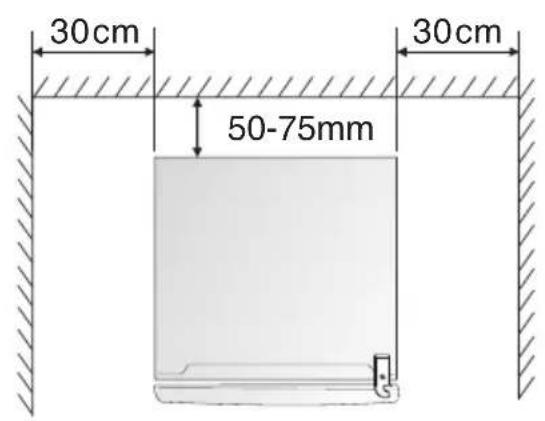
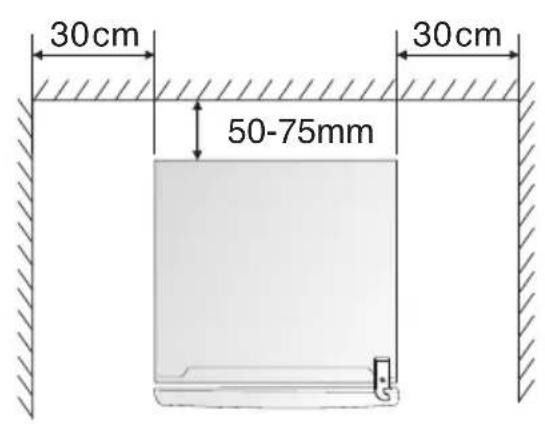
Placed the appliance against a wall with a free distance not exceeding 75 mm and more than 50mm
-
WARNING: When positioning the appliance, ensure the supply cord is not trapped or damaged.
-
WARNING: Do not locate multiple portable socket-outlets or portable power supplies at the rear of the appliance.
-
To avoid contamination of food, please respect the following instructions:
- Opening the door for long periods can cause a significant increase of the temperature in the compartments of the appliance.
- Clean regularly surfaces that can come in contact with food and accessible drainage systems.
- Store raw meat and fish in suitable containers in the refrigerator, so that it is not in contact with or drip onto other food.
- Two-star frozen-food compartments are suitable for storing pre-frozen food, storing or making ice cream and making ice cubes.
- One-, two- and three-star compartments are not suitable for the freezing of fresh food.
- If the refrigerating appliance is left empty for long periods, switch off, defrost, clean, dry, and leave the door open to prevent mould developing within the appliance.
- Unplug the appliance from outlet when not in use, before putting on or taking off parts, before cleaning.
- Make sure to place the plug all the way into socket when connecting your appliance.
- Insert the plug into a single grounded socket.
- Never use the appliance in place where combustible and inflammable materials are kept.
- For safety reason, be sure to repair or replace parts at an authorized service dealers.
- The motor is permanently lubricated and will require no oil.
- The appliance must be positioned so that the plug is accessible.
- Please according to local regulations regarding disposal of the appliance for its flammable blowing gas. Before you scrap the appliance, please take off the doors to prevent children trapped.
- Ensure the refrigerator is unplugged before cleaning or if the product is not in use.
- To clean the appliance use only mild detergents or glass cleaning products. Never use harsh detergents or solvents.
- It is not recommended to use this refrigerator with an extension cord or power board. Please ensure that the appliance is plugged directly into the electrical outlet.
- Do not place hot food or drink into the refrigerator before it cools down to room temperature.
- Close the door immediately after putting in any items so the inside temperature will not rise dramatically.
-
Keep appliance away from any heat source or direct sunlight.
-
To fix stably, the appliance must be placed on a flat and solid surface. It should not be laid on any soft material.
-
Do not place any other appliance on top of the refrigerator, and do not wet it.
-
To avoid injury or death from electrical shock do not operate the appliance with wet hands, while standing on a wet surface or while standing in water.
-
Do not use outdoors or in wet conditions.
-
Never pull the cord to disconnect it from the outlet. Grasp the plug and pull it from the outlet.
-
Keep the cord away from heated surfaces.
-
Check that the voltage of the power supply in your home is the same as the voltage shown on the rating label of this product.
-
Connect your refrigerator to an independent electrical socket and use a safe ground wire.
-
When the frost in refrigerator is removed, or when there is no electricity or when refrigerator ceases to be used, it should be cleaned in order to prevent it from smelling.
-
Turn on electricity only 5 minutes later after electricity goes off. Otherwise, the compressor may be damaged.
-
Children should be supervised to ensure that they do not play with the appliance.
-
The appliance is not intended to be operated by means of an external timer or a separate remote-control system.
-
This appliance has been incorporated with a grounded plug. Please ensure the wall outlet in your house is well earthed.
-
It is recommended to check regularly the supply cord for any sign of possible deterioration, and the appliance should not be used if the cable is damaged.
-
Regarding the information for replacing of the lamps of the appliance, thanks to refer to the paragraph "CLEANING AND CARE" of the manual.
-
Regarding the information pertaining to the installation, handing, maintenance, servicing and disposal of the appliance, thanks to refer to the paragraph "TRANSPORT AND HANDING" "INSTALLATION" "CLEANING AND CARE" "TROUBLESHOOTING" of the manual.
-
Disposal of the appliance: To prevent possible harm to the environment or human health from uncontrolled waste disposal, recycle it responsibly to promote the sustainable reuse of material resources. And the disposal should only be done through public collection points. Contact the waste treatment center nearest your home for more details on the correct procedures for disposal
-
Please according to local regulations regarding disposal of the appliance for its flammable blowing gas. Before you scrap the appliance, please take off the doors to prevent children trapped.
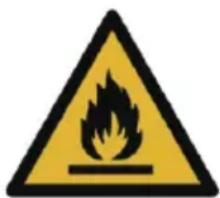
- WARNING! Risk of fire – flammable material. Please keep the product far away fire source during using, service and disposal. There are flammable materials at the back of the appliance.
STRUCTURE ILLUSTRATION

- Fresh room
- Drip Tray
- Glass shelf
-
Crisper
-
Adjustable foot
- Thermostat Knob
- Balcony
- Bottle rack
TRANSPORT AND HANDING
When transportation, hold the base and lift the refrigerator carefully with an angle inferior at 45 degree. Never hold the door handle as support. Never place it upside down nor horizontally. Push refrigerator on its basis and place it thanks to its roller feet.
INSTALLATION
This refrigerating appliance is not intended to be used as a built-in appliance.
To fix stably, the appliance must be placed on a flat and solid surface. It should not be laid on any soft material.
Choose a location where there is no heat source. Keep the refrigerator away from direct sunlight or other appliance producing heat.
Choose a dry and well-ventilated place where there is no corrosive air.
In order to improve efficiency of the cooling system and save energy, it is necessary to maintain good ventilation around the appliance for the dissipation of heat. For this reason, sufficient clear space should be available around the refrigerator.
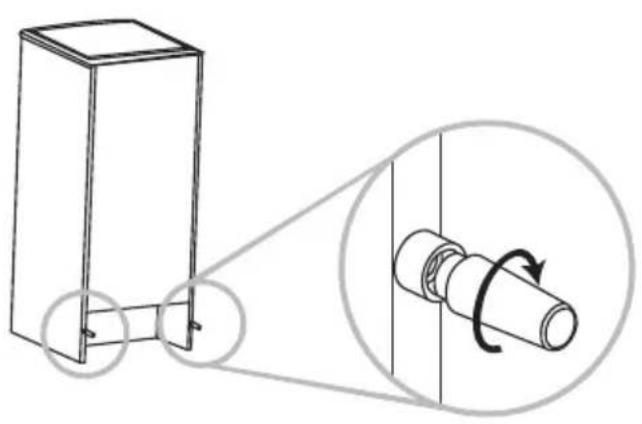
The appliance is supplied with two plastic spacers. After installation of these spacers, the appliance cannot be pushed against the wall to maintain proper ventilation. Insert the spacers into the relevant openings on the back of the appliance, then screw the spacers tightly. Place the appliance against a wall with a free distance between 50 mm and 75 mm.
FIRST USE
Before the use of the refrigerator, remove all the packages, including bottom cushion and foam pads and rubber belts in the refrigerator.
Adjust the feet and clear the outside and inside of the refrigerator with warm cloth.
Do not start the refrigerator immediately after vertical placement. Only start it after around 4 hours standing to ensure its proper operation.
To prevent damage to the power cord and any consequence incidents, the power cord should be not covered by the refrigerator or other objects. Before switching on the refrigerator, please check the voltage range of refrigerator carefully if the same as that of the power supply.
When the refrigerator is first installed, allow it stabilize at normal operating temperatures for 2-3 hours prior to filling it with fresh or frozen foods.
If operation is interrupted, wait for 5 minutes before restarting.
TEST
Clean the parts of the refrigerator with lukewarm water on a soft cloth or with a neutral detergent and with clear water, then wipe them dry.
Notes: Electric parts of the refrigerator can only be wiped by dry cloth.
Turn the thermostat knob on the "3" position and turn on electricity. The compressor begins to work.
Close the door and wait 30 minutes. If the temperature in the freezer compartment decreased obviously, it shows that the refrigerator system works well. When the refrigerator operates for a period of time, the temperature controller will automatically set the temperature on conditions that the door is not too often opened.
If the above steps are successful, the trial operations are finished. The refrigerator works normally.
TEMPERATURE CONTROL
The fridge is controlled with a temperature control knob located inside it, towards the upper right - hand corner.
Adjust the control knob as desired to suit your individual preference.
0=off setting
1=cold setting
7=coldest setting
- In the off position (0) the appliance does not operate (the cooling system is switched off), but power supply is not interrupted.
- The running time and temperature are affected by where the fridge is located, how often the door is opened and the temperature of the room the fridge is located in.
- When you use the appliance for the first time or after defrosting, adjust the control knob to the coldest setting for at least 2 hours before introducing food to be stored, and then readjust to the middle setting.
Set the thermostat knob to "3-4" position for a normal use.
Note: the temperature will impact the storage time of food. Set the temperature as necessary. Warmer will accelerate food spoilage and colder will frozen food bad. Thus food to be wasted.
STORAGE OF FOOD
Your appliance has the accessories as the “Structure illustration” showed in general, with this part instruction you can have the right way to storage your food. The glass shelves and crisper can be removed to store food if needed.
Note: Food is not allowed to touch directly all surface inside the appliance, and should be stored in proper containers.
Storing food in the refrigerator compartment
The fridge freezer compartment helps to extend the storage times of fresh perishable foods.
Fresh food care for best results:
- Store foods that are very fresh and of good quality.
- Ensure that food is well wrapped or covered before it is stored. This will prevent food from dehydrating, deteriorating in colour or losing taste and will help maintain freshness. It will also prevent odour transfer. Vegetables and fruit need not be wrapped if they are stored in the vegetable container of the fridge compartment.
- Make sure that strong smelling foods are wrapped or covered and stored away from foods such as butter, milk and cream which can be tainted by strong odours.
- Cool hot foods down before placing them in the fridge compartment.
Dairy foods and eggs
- Most pre-packed dairy foods have a recommended 'use by /best before/best by/ date stamped on them. Store them in the fridge compartment and use within the recommended time.
- Butter can become tainted by strong smelling foods so it is best stored in a sealed container.
- Eggs should be stored in the fridge compartment.
Red meat
- Place fresh red meat on a plate and loosely cover with plastic wrap or foil.
- Store cooked and raw meat on separate plates. This will prevent any juice lost from the raw meat from contaminating the cooked product.
Fish and seafood
- Until required, refrigerate on a plate loosely covered with plastic wrap, waxed paper or foil.
- Whole fish should be rinsed in cold water to remove loose scales and dirt and then patted dry with paper towels. Place whole fish or fillets in a sealed plastic bag.
- Keep shellfish chilled at all times. Use within 1-2 days.
Cooked food
- These should be stored in suitable covered containers so that the food will not dry out.
- Keep for only 1-2 days.
Vegetable container
- The vegetable container is the optimum storage location for fresh fruit and vegetables.
- Take care not to store the following at temperatures of less than 7°C for long periods: Citrus fruit, melons, aborigines, pineapple, papaya, curettes, passion fruit, cucumber,
peppers, tomatoes.
- Undesirable changes will occur at low temperatures such as softening of the flesh, browning and/or accelerated decaying.
· Do not refrigerate avocados (until they are ripe), bananas and mangoes.
This refrigerating appliance is not suitable for freezing foodstuffs.
| Refrigerator comportments Type of food Storage time | ||
| Door or balconies of fridge compartment | · Food with natural preservatives, such jams,juices, drinks, condiments.· Do not store perishable foods. | 3 days |
| Crisper drawer | · Fruits, herbs and vegetables should be placed separately in the crisper bin.· Do not store bananas,onions,potatoes, garlic in the refrigerator. | 1 week |
| Fridge shelf-middle | · Fridgeshelf-middle | 1 week |
| Fridge shelf-top | · Foods that do not need cooking,such as ready-to-eat food,deli meats,leftovers | 1 week |
DEFROSTING
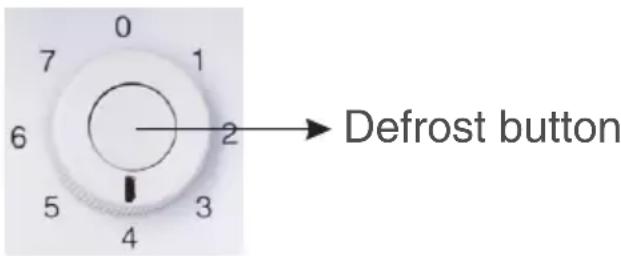
Defrost the refrigerator when the frost is more than 3mm thick. To defrost, simply press the defrost button on the temperature control knob.
Be sure to keep the drip tray in place.
The refrigerator will restart automatically when defrosting ends. Empty water from the drip tray after defrosting.
HELPFUL HINTS AND TIPS
We recommend that you follow the tips below to save energy.
- Try to avoid keeping the door open for long periods in order to conserve energy.
- Ensure the appliance is away from any sources of heat(Direct sunlight, electric oven, cooker, etc.)
- Don't set the temperature colder than necessary.
- Don't store warm food or evaporating liquid in the appliance.
- Place the appliance in a well ventilated, humidity free room. Please refer to Installing your new appliance chapter.
- The “STRUCTURE ILLUSTRATION” shows the correct combination for the drawers, crisper and shelves.
Hints for fresh food refrigeration
- Do not place hot food directly into the refrigerator or freezer, the internal temperature will increase resulting in the compressor having to work harder and will consume more energy.
- Do cover or wrap the food.
- Place food properly so that air can circulate freely around it.
Hints for refrigerator
- Meat (All Types) Wrap food: wrap and place on the glass shelf above the vegetable drawer. Always follow food storage times and use by dates suggested by manufacturers.
- Cooked food, cold dishes, etc.: They should be covered and may be placed on any shelf.
- Fruit and vegetables: They should be stored in the special drawer provided.
- Butter and cheese: Should be wrapped in airtight foil or plastic film wrap.
- Milk bottles: Should have a lid and be stored in the door racks.
Switching off your appliance
If the appliance needs to be switched off for an extended period, the following steps should be taken prevent mould on the appliance.
- Remove all food;
- Remove the power plug from the mains socket;
- Clean and dry the interior thoroughly;
- Ensure that all the doors are wedged open slightly to allow air to circulate.
CLEANING AND CARE
For hygienic reasons the appliance (including exterior and interior accessories) should be cleaned regularly at least every two months.
WARNING: The appliance must not be connected to the mains during cleaning. Danger of electrical shock! Before cleaning switch the appliance off and remove the plug from the mains socket.
Exterior cleaning
- To maintain good appearance of your appliance, you should clean it regularly.
- Wipe the digital panel and display panel with a clean, soft cloth.
- Spray water onto the cleaning cloth instead of spraying directly on the surface of the appliance. This helps ensure an even distribution of moisture to the surface.
- Clean the doors, handles and surfaces of machine with a mild detergent and then wiped dry with a soft cloth.
Caution!
- Don't use sharp objects as they are likely to scratch the surface.
- Don't use Thinner, Car detergent, bleach, ethereal oil, abrasive cleansers or organic solvent such as Benzene for cleaning. They may damage the surface of the appliance and may cause fire.
Interior cleaning
You should clean the appliance interior regularly. It will be easier to clean when food stocks are low. Wipe the inside of the fridge freezer with a weak solution of bicarbonate of soda, and then rinse with warm water using a wrung-out sponge or cloth. Wipe completely dry before replacing the shelves and baskets. Thoroughly dry all surfaces and removable parts.
Caution!
- Don't use sharp objects to remove frost from the freezer. Only after the interior completely dry should the appliance be switched back on and plugged back into the mains socket.
Door seals cleaning
Take care to keep door seals clean. Sticky food and drinks can cause seals to stick to the cabinet and tear when you open the door. Wash seal with a mild detergent and warm water. Rinse and dry it thoroughly after cleaning.
Caution!
- Only after the door seals are completely dry should the appliance be powered on.
DOOR REVERSE
Users can change the direction of opening according to one's own needs. The concrete operating sequence is as follows:

- Remove the hole cover.

- Remove hinge cover and top hinge with a “+” screwdriver, then remove the door.

- Remove the foot and bottom hinge, fix them to oppostie side.

- Put on the door to bottom hinge, then fix top hinge and cover.
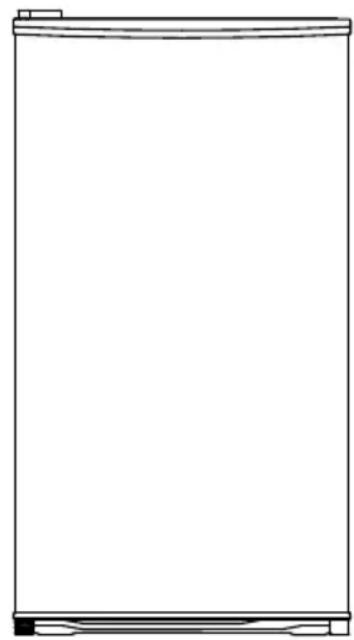
- Fix the hole cover, completed.
COLDEST ZONE IN THE REFRIGERATOR
This symbol indicates the location of the coldest zone of the refrigerator, The area is bounded below by the glass crisper, and above by the symbol or the rack positioned at the same height.

To ensure the temperature in this area, do not change the positioning of the shelf. In forced air refrigerators (equipped with a fan or No Frost models), the symbol of the coldest zone is not represented because the temperature inside is homogeneous.
Temperature indicator setting
To help you set your refrigerator well, it is equipped with a temperature indicator that will monitor the average temperature in the coldest zone.
WARNING: This indicator is intended to work only with your refrigerator, do not use it in another refrigerator (in fact, the coldest zone is not the same), or for any other use.
Checking the temperature in the coldest zone
With the temperature indicator, you can check regularly that the temperature of the coldest zone is correct. Indeed, the internal temperature of the refrigerator depends on several factors such as the ambient temperature of the room, the amount of food stored and the frequency of door opening. Take these factors into consideration when setting the device.
When the indicator shows « OK », this means that your thermostat is well adjusted and the internal temperature correct.
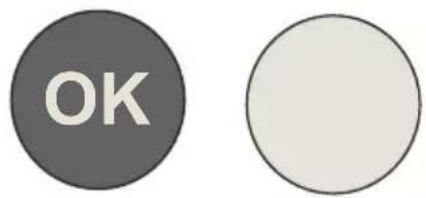
If the indicator of temperature turns WHITE, this means that the temperature is too high; in this case, increase the refrigerator temperature control setting and wait for 12 hours before performing a new visual inspection of the indicator.
When fresh food has been introduced or the door has been left open, it is possible for the indicator of temperature to turn WHITE after a while.
TECHNICAL SPECIFICATIONS
| General information cooling | |||||
| Supplier's name or trade mark: AYA | |||||
| Supplier's address: BUT INTERNATIONAL, 1 AVENUE SPINOZA 77184 EM ERAINVILLE, FRANCE | |||||
| Model identifier: ART091BK/E | |||||
| Type of refrigerating appliance: | |||||
| Low-noise appliance: | no | Design type: | freestanding | ||
| Wine storage appliance: | no | Other refrigerating appliance: | yes | ||
| General product parameters: | |||||
| Parameter | Value | Parameter | Value | ||
| Overall dimensions (millimetre) | Height | 831 | Total volume ( dm3 ou l) | 91 | |
| Width | 450 | ||||
| Depth | 490 | ||||
| EEI | 100 | Energy efficiency class | E | ||
| Airborne acoustical noise emissions (dB(A) re 1 pW) | 41 | Airborne acoustical noise emission class | C | ||
| Annual energy consumption (kWh/a) | 85 | Climate class: | temperate/subtropical | ||
| Minimum ambient temperature (°C), for which the refrigerating appliance is suitable | 16 | Maximum ambient temperature (°C), for which the refrigerating appliance is suitable | 38 | ||
| Winter setting | no | ||||
| Compartment Parameters: | |||||
| Compartment type | Compartment parameters and values | ||||
| Compartment Volume ( dm3 or l) | Recommended temperature setting for optimised food storage (°C) These settings shall not contradict the storage conditions set out in Annex IV, Table 3 | Freezing capacity (kg/24 h) | Defrosting type (auto-defrost = A, manual defrost = M) | ||
| Pantry no | - - - - | ||||
| Wine storage no | - - - - | ||||
| Cellar no | - - - - | ||||
| Fresh food yes | 914-M | ||||
| Chill no - - - - | |||||
| Compartment type | Compartment parameters and values | |||||
| Compartment Volume (dm 3 or l) | Recommended temperature setting for optimised food storage (°C) These settings shall not contradict the storage conditions set out in Annex IV, Table 3 | Freezing capacity (kg/24 h) | Defrosting type (auto-defrost = A, manual defrost = M) | |||
| 0-star or ice-making | no | — — — — | ||||
| 1-star no | — — — — | |||||
| 2-star no | — — — — | |||||
| 3-star no | — — — — | |||||
| 4-star no | — — — — | |||||
| 2-star section no | — — — — | |||||
| Variable temperature compartment | no | — — — — | ||||
| For 4-star compartments | ||||||
| Fast freeze facility No | ||||||
| Light source parameters: | ||||||
| Type of light source N/A | ||||||
| Energy efficiency class N/A | ||||||
| Minimum duration of the guarantee offered by the manufacturer: 2 years | ||||||
| Additional information: N/A | ||||||
| Weblink to the manufacturer's website, where the information in point 4(a) Annex of Commission Regulation (EU) 2019/2019 is found: www.but.fr | ||||||
| Reference: | ART091BK/E |
| Rated voltage: | 220-240V~ |
| Ampere: | 0.65A |
| Rated frequency: | 50Hz |
| Climate class: | N/ST |
| Refrigerant: | R600a(22g) |
| Protection against electrical shock: | I |
| Insulation foam: | CYCLOPENTANE |
Climate class:
- Extended temperate(SN): 'this refrigerating appliance is intended to be used at ambient temperatures ranging from 10°C to 32 °C';
- Temperate(N): 'this refrigerating appliance is intended to be used at ambient temperatures ranging from 16 °C to 32 °C';
- Subtropical(ST): 'this refrigerating appliance is intended to be used at ambient temperatures ranging from 16 °C to 38°C';
- Tropical(T): 'this refrigerating appliance is intended to be used at ambient temperatures ranging from 16 °C to 43 °C';
Note: More data information, please scan the QR code on the energy label.
TROUBLESHOOTING
If your device shows the other symptoms that those described below, please call the service after sale of the shop a retailer.
| Symptom | Cause | Solution |
| The appliance does no work | There is no power supply | Check the plug connecting it others appliance, or verify that the appliance is connected to the plug |
| The fuse doesn’t work | Replace the fuse | |
| The appliance makes a lot of noise | The appliance is too close to the wall, or is not stable, or the accessories inside the refrigerator are placed in wrong position | Stabilize the base of the refrigerator by adjusting the position of feet, take away the device of the wall, place correctly the accessories inside the refrigerator |
| The appliance doesn’t cool enough | The door is too often opened or was left opened for a long time | Close the door and do not open it too much frequently |
| The refrigerator is too close to the wall | Take away the device of the wall to favor the ventilation | |
| The refrigerator is too full | Remove food of the device | |
| Symptom Cause Solution | ||
| The appliance doesn't cool enough | The temperature is badly adjusted | Turn the knob of regulation of temperature on "3" or more |
| There are smells in the appliance | Food made obsolete inside the refrigerator | Throw away obsolete food and wrap the other |
| The inside of the device at need to be cleaned | Clean the inside of the refrigerator | |

CORRECT DISPOSAL OF THIS PRODUCT
European directive 2012/19/EU on Waste from Electrical and Electronic Equipment (WEEE), requires that used household appliances are not thrown into the normal municipal waste stream. Used appliances must be collected separately in order to optimize the rate of recovery and recycling of materials that compose them, and to reduce the impact on human health and on the environment. The crossed bin symbol is affixed to all the products to remind you of the obligations of separated collection.
We decline liability for any damage or accident derived from any use of this product which is not in conformity with the instructions contained in this booklet.
The following symptoms are not breakdowns:
- The noise of the cooling liquid which circulates in pipes can be heard, it is normal.
- The humidity on the surface outside of the device during the wet seasons is not a problem of the device; you just need to wipe it with a dry soft cloth.
- The compressor and the condenser can warm more during the periods of strong heat.
- The frame of the door is a bit hot; it means that the condenser works to evacuate the humidity of air.
Note:
· In accordance with Article L. 217 of the Consumer Code, your product has 2 year legal guarantee of conformity.
· Period of availability of repair spare parts: 10 years.
· To contact our After-Sales Service, before going to BUT store, call 09 78 97 97 97, from Monday to Saturday from 8:00 a.m. to 8:00 p.m. (Price of a local call).


- TABLE OF CONTENTS
- THIS PRODUCT IS FOR HOUSEHOLD USE ONLY
- IMPORTANT SAFETY INSTRUCTIONS
- THIS WARNING IS ONLY FOR EUROPEAN MARKET ONLY
- STRUCTURE ILLUSTRATION
- TRANSPORT AND HANDING
- INSTALLATION
- FIRST USE
- TEST
- TEMPERATURE CONTROL
- STORAGE OF FOOD
- STORING FOOD IN THE REFRIGERATOR COMPARTMENT
- DAIRY FOODS AND EGGS
- RED MEAT
- FISH AND SEAFOOD
- COOKED FOOD
- VEGETABLE CONTAINER
- DEFROSTING
- HELPFUL HINTS AND TIPS
- HINTS FOR FRESH FOOD REFRIGERATION
- HINTS FOR REFRIGERATOR
- SWITCHING OFF YOUR APPLIANCE
- CLEANING AND CARE
- EXTERIOR CLEANING
- CAUTION
- INTERIOR CLEANING
- DOOR SEALS CLEANING
- DOOR REVERSE
- COLDEST ZONE IN THE REFRIGERATOR
- TEMPERATURE INDICATOR SETTING
- CHECKING THE TEMPERATURE IN THE COLDEST ZONE
- TECHNICAL SPECIFICATIONS
- CLIMATE CLASS
- TROUBLESHOOTING
- CORRECT DISPOSAL OF THIS PRODUCT
- WE DECLINE LIABILITY FOR ANY DAMAGE OR ACCIDENT DERIVED FROM ANY USE OF THIS PRODUCT WHICH IS NOT IN CONFORMITY WITH THE INSTRUCTIONS CONTAINED IN THIS BOOKLET
- THE FOLLOWING SYMPTOMS ARE NOT BREAKDOWNS
- NOTE
Brand : AYA
Model : ART091BK
Category : Refrigerator