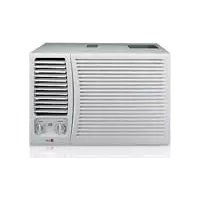
W246BC - Air-conditioner LG - Free user manual and instructions
Find the device manual for free W246BC LG in PDF.


| Product type | Window air conditioner (single unit) |
| Brand | LG |
| Model | W246BC |
| Category | Air conditioner |
| Main functions | Cooling, Ventilation, Heating (depending on model) |
| Operating modes | High Cool, Med Cool, Low Cool, High Heat, Low Heat (depending on model), Low Fan, Med Fan |
| Temperature control | Adjustable thermostat from 16°C to 30°C (via remote control) |
| Fan speed | 3 speeds (High, Medium, Low) in cooling; 2 speeds in heating |
| Timer | Automatic shut-off from 1 to 12 hours |
| Auto Swing (automatic louver movement) | Yes (depending on model) |
| Remote control | Yes, with AAA 1.5V batteries (not included) |
| Power supply | Independent circuit, grounding mandatory |
| Air filter | Washable with lukewarm water (max 40°C); clean every 2 weeks |
| Installation | In wall box; tilt outward by 3° for drainage |
| Drainage | By gravity; optional drainage pan for excess water |
| Safety | Automatic shut-off in case of failure; auto restart |
| Maintenance | Clean filter, interior grille with soft cloth; no harsh chemicals |
| Repairability | Entrust to authorized technician; use genuine spare parts |
| Package contents | Air conditioner, cabinet, front grille, remote control, screws, foam, drainage pan (for some models) |
| Weight | Approximately 30 kg (estimate) |
Frequently Asked Questions - W246BC LG
User questions about W246BC LG
0 question about this device. Answer the ones you know or ask your own.
Ask a new question about this device
Download the instructions for your Air-conditioner in PDF format for free! Find your manual W246BC - LG and take your electronic device back in hand. On this page are published all the documents necessary for the use of your device. W246BC by LG.
USER MANUAL W246BC LG
ROOM AIR CONDITIONER OWNER'S MANUAL
Please read the operating instructions and safety precautions carefully and thoroughly before installing and operating your room air conditioner.
CLIMATISEUR DE PIÈCE MANUEL DU PROPRIÉTAIRE
Safety Precautions....3
Before Opeation ......7
Introduction 8
Installation 9
Operating Instructions .....14
Maintenance and Service ......21

FOR YOUR RECORDS
Write the model and serial numbers here:
Model #
Serial #
You can find them on a label on the side of each unit.
Dealer's Name
Date Purchased
■Staple your receipt to this page in the event you need it to prove date of purchase or for warranty issues.

READ THIS MANUAL
Inside you will find many helpful hints on how to use and maintain your air conditioner properly. Just a little preventive care on your part can save you a great deal of time and money over the life of your air conditioner.
You'll find many answers to common problems in the chart of troubleshooting tips. If you review our chart of
Troubleshooting Tips first, you may not need to call for service at all.

PRECAUTION
- Contact the authorized service technician for repair or maintenance of this unit.
- Contact the installer for installation of this unit.
- The air conditioner is not intended for use by young children or invalids without supervision.
- Young children should be supervised to ensure that they do not play with the air conditioner.
- When the power cord is to be replaced, replacement work shall be performed by authorized personnel only using only genuine replacement parts.
- Installation work must be performed in accordance with the National Electric Code by qualified and authorized personnel only.
natural_image
Simple line drawing of people relaxing at a table with sun and palm trees in the background (no text or symbols)Safety Precautions
To prevent injury to the user or other people and property damage, the following instructions must be followed.
■ Incorrect operation due to ignoring instruction will cause harm or damage. The seriousness is classified by the following indications.

WARNING
This symbol indicates the possibility of death or serious injury.

CAUTION
This symbol indicates the possibility of injury or damage to properties only.
■Meanings of symbols used in this manual are as shown below.


Be sure not to do.
Be sure to follow the instruction.

WARNING
Installation
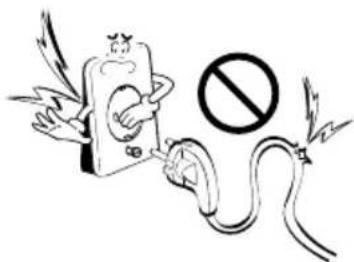
Don't use a power cord, a plug or a loose socket which is damaged.
- Otherwise, it may cause a fire or electrical shock.
Do not disassemble or modify products.
- It may cause failure and electric shock.
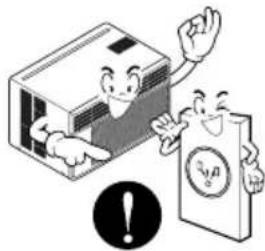
Always plug into a grounded outlet.
- Otherwise, it may cause a fire or electrical shock.
natural_image
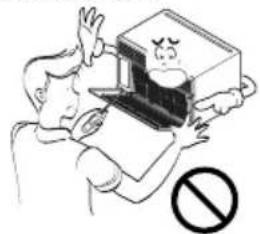
Illustration of two cartoon characters interacting with a device, one pointing at the camera and the other holding a document with a warning symbol (no text present)Be caution when unpacking and installing.
- Sharp edges may cause injury.
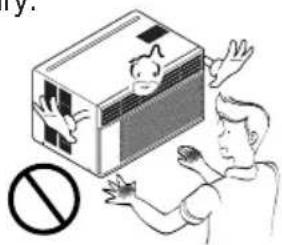
Do not modify or extend the power cord length.
- It will cause electric shock or fire due to heat generation.
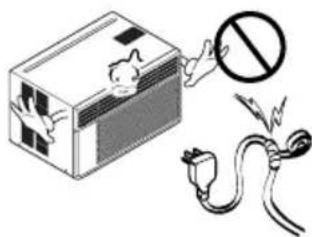
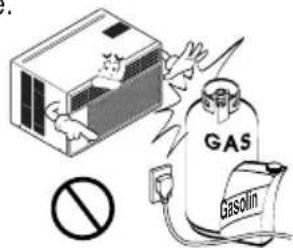
Do not use the power cord near flammable gas or combustibles such as gasoline, benzene, thinner, etc.
- It may cause explosion or fire.
Operation
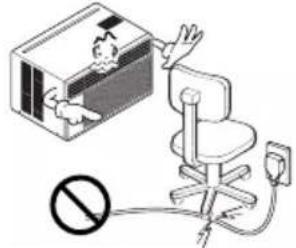
Do not place heavy object on the power cord and take care so that the cord should not be pressed.
• There is danger of fire or electric shock.
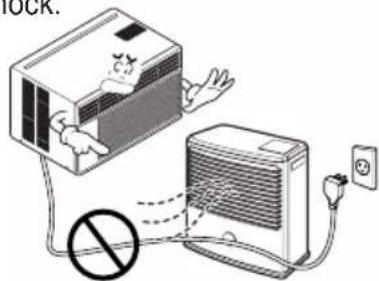
Do not place the power cord near a heater.
- It may cause fire and electric shock.
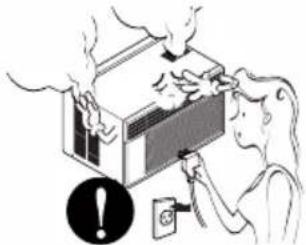
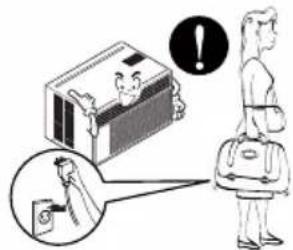
Unplug the unit if strange sounds, odors, or smoke come from it.
- Otherwise it may cause fire and electric shock accident.
natural_image
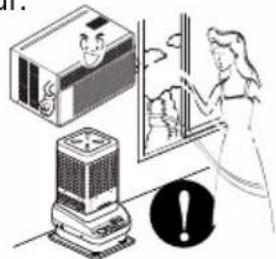
Illustration of a person using a power outlet to clean or install a cabinet, with smoke rising (no text or symbols)Ventilate the room well when using this appliance together with a stove, etc.
• An oxygen shortage may occur.
natural_image
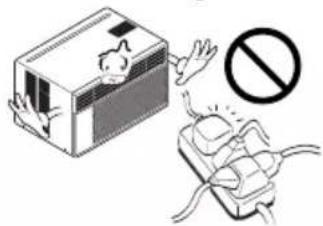
Illustration of a woman opening a window with a refrigerator and warning symbol (no text or labels)Do not share the outlet with other appliances.
- It will cause electric shock or fire due to heat generation.
natural_image
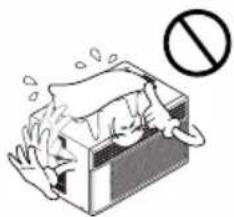
Illustration of a car with a sign and a prohibition symbol (no text or labels present)Do not allow water to run into electric parts.
- It will cause failure of machine or electric shock.
natural_image
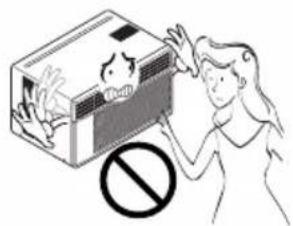
Illustration of a person inside a box with steam rising, symbolizing noise or overload (no text or symbols present)Do not open the suction inlet grill of the product during operation.
- Otherwise, it may electrical shock and failure.
Turn off the power and breaker firstly when cleansing the unit.
- Since the fan rotates at high speed during operation, it may cause injury.
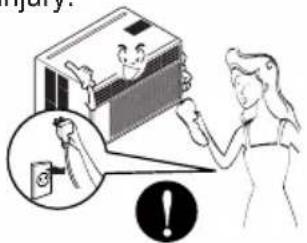
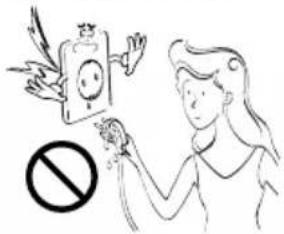
Take the power plug out if necessary, holding the head of the plug and do not touch it with wet hands.
- Otherwise, it may cause a fire or electrical shock.
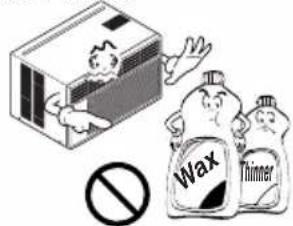
Use a soft cloth to clean. Do not use wax, thinner, or a strong detergent.
- The appearance of the air conditioner may deteriorate, change color, or develop surface flaws.
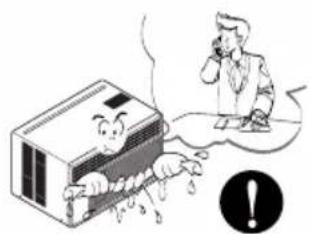
If water enters the product, turn off the the power switch of the main body of appliance. Contact service center after taking the power-plug out from the socket.
natural_image
Illustration of a person using a phone to interact with a cartoon-style air conditioner (no text or symbols present)Turn off the main power switch when not using it for a long time.
- Prevent accidental startup and the possibility of injury.
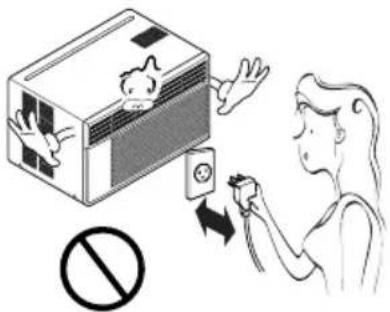
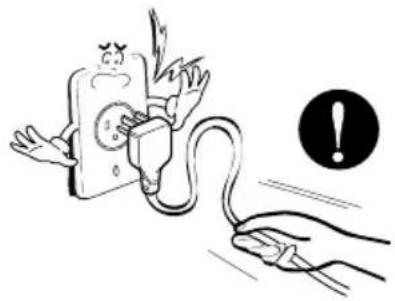
Do not operate or stop the unit by inserting or pulling out the power plug.
- It will cause electric shock or fire due to heat generation.
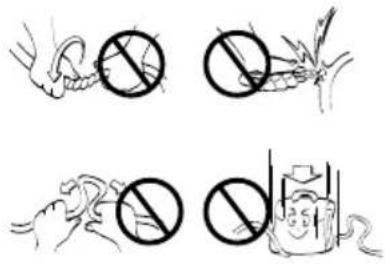
Do not damage or use an unspecified power cord.
- It will cause electric shock or fire.
Do not operate with wet hands or in damp environment.
- It will cause electric shock.
Hold the plug by the head when taking it out.
- It may cause electric shock and damage.
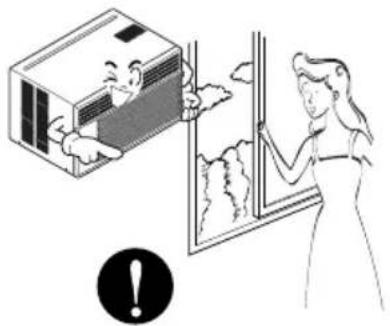
When gas leaks, open the window for ventilation before operating the unit.
• Otherwise, it may cause explosion, and a fire.
Never touch the metal parts of the unit when removing the filter.
• They are sharp and may cause injury.
natural_image
Illustration of a hand connecting an electrical plug to a fuse with an exclamation mark (no text or symbols present)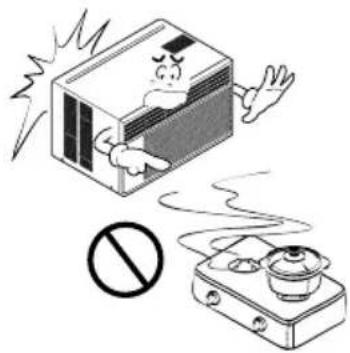
natural_image
Illustration of a distressed air conditioner emitting exhaust smoke next to a portable stove with a cooking pan nearby (no text or symbols)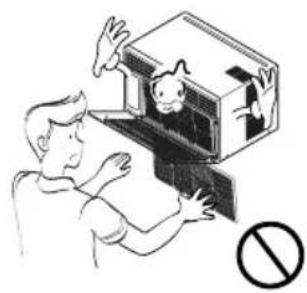
natural_image
Illustration of a person reaching toward a box with a child inside, no text or symbols presentCAUTION
■Installation
Install the product so that the noise or hot wind from the outdoor unit may not cause any damage to the neighbors.
- Otherwise, it may cause dispute with the neighbors.
natural_image
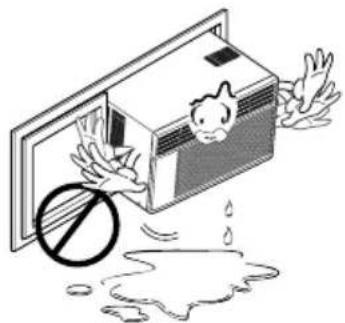
Illustration of a person incubating with a baby in a cage, no text or symbols presentKeep level parallel in installing the product.
- Otherwise, it may cause vibration or water leakage.
natural_image
Illustration of a distressed credit card falling into a window with a prohibition symbol (no text or symbols present)Operation
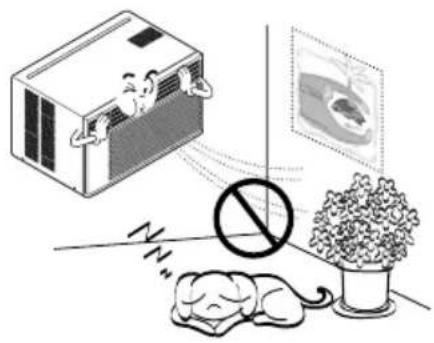
Do not put a pet or house plant where it will be exposed to direct air flow.
- It may cause injury.
natural_image
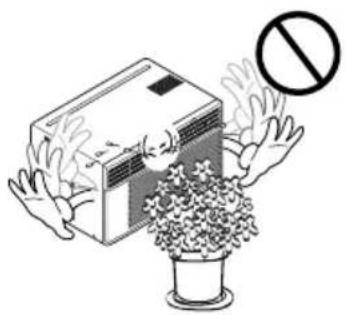
Illustration of a car air conditioner unit with a sleeping dog, no visible text or symbolsDo not block the inlet or outlet of air flow.
- It may cause product failure.
natural_image
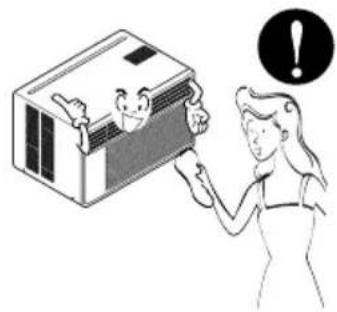
Illustration of a person holding a large box with smoke, emitting exhaust smoke, and a prohibition symbol (no text or labels)Use a soft cloth to clean. Do not use wax, thinner, or a strong detergent.
• The appearance of the air conditioner may deteriorate, change color, or develop surface flaws.
natural_image
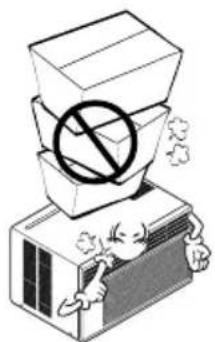
Illustration of a person interacting with a large air conditioner unit, with a warning symbol (no text or labels present)Do not step on the indoor/outdoor unit and do not put anything on it.
- It may cause an injury through dropping of the unit or falling down.
natural_image
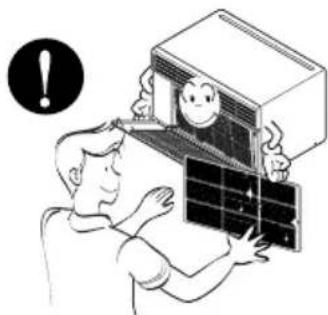
Illustration of a person climbing a car with a prohibition symbol above (no text or symbols present)Always insert the filter securely. Clean it every two weeks.
• Operation without filters will cause failure.
natural_image
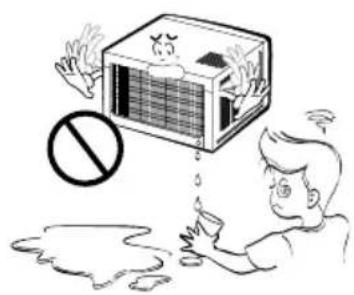
Illustration of a person assembling a solar panel with a smiling face emerging from the box (no text or symbols)Do not drink water drained from air conditioner.
- It contains containments and will make you sick.
natural_image
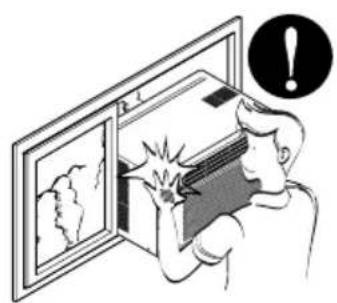
Illustration of a person reacting to a large box with a 'no' symbol, showing a distressed face and swirling liquid (no text or symbols present)Be cautious not to touch the sharp edges when installing.
- It may cause injury.
natural_image
Illustration of a person using an air conditioner to exhaust air, with a warning symbol (no text or labels)Avoid excessive cooling and perform ventilation sometimes.
- Otherwise, it may do harm to your health.
natural_image
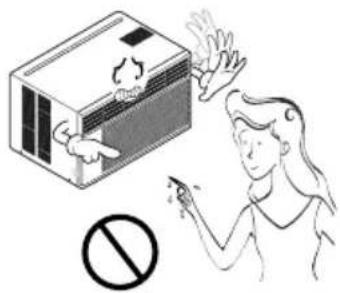
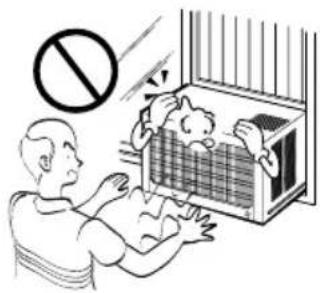
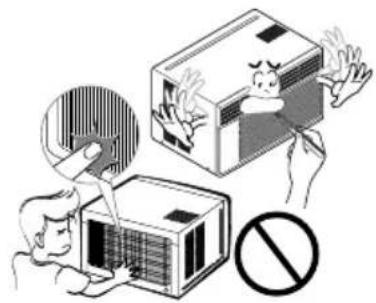
Illustration of a woman opening a window with a smiling face inside, next to a box with clouds and a warning symbol (no text present)Do not insert the hands or bars through the air inlet or outlet during operation.
• Otherwise, it may cause personal injury.
natural_image
Illustration of a person using a barcode scanner to interact with a box, no text or symbols presentBefore Operation
Preparing for Operation
- Contact an installation specialist for installation.
- Plug in the power plug properly.
- Use a dedicated circuit.
- Do not use an extension cord.
- Do not start/stop operation by plugging/unplugging the power cord.
- If the cord/plug is damaged, replace it with only an authorized replacement part.
Usage
- Being exposed to direct airflow for an extended period of time could be hazardous to your health. Do not expose occupants, pets, or plants to direct airflow for extended periods of time.
- Due to the possibility of oxygen deficiency, ventilate the room when used together with stoves or other heating devices.
- Do not use this air conditioner for non-specified special purposes (e.g. preserving precision devices, food, pets, plants, and art objects). Such usage could damage the items.
Cleaning and Maintenance
- Do not touch the metal parts of the unit when removing the filter. Injuries can occur when handling sharp metal edges.
- Do not use water to clean inside the air conditioner. Exposure to water can destroy the insulation, leading to possible electric shock.
- When cleaning the unit, first make sure that the power and breaker are turned off. The fan rotates at a very high speed during operation. There is a possibility of injury if the unit's power is accidentally triggered on while cleaning inner parts of the unit.
Service
For repair and maintenance, contact your authorized service dealer.
Introduction
Symbols Used in this Manual

This symbol alerts you to the risk of electric shock.

This symbol alerts you to hazards that could cause harm to the air conditioner.
NOTICE
This symbol indicates special notes.
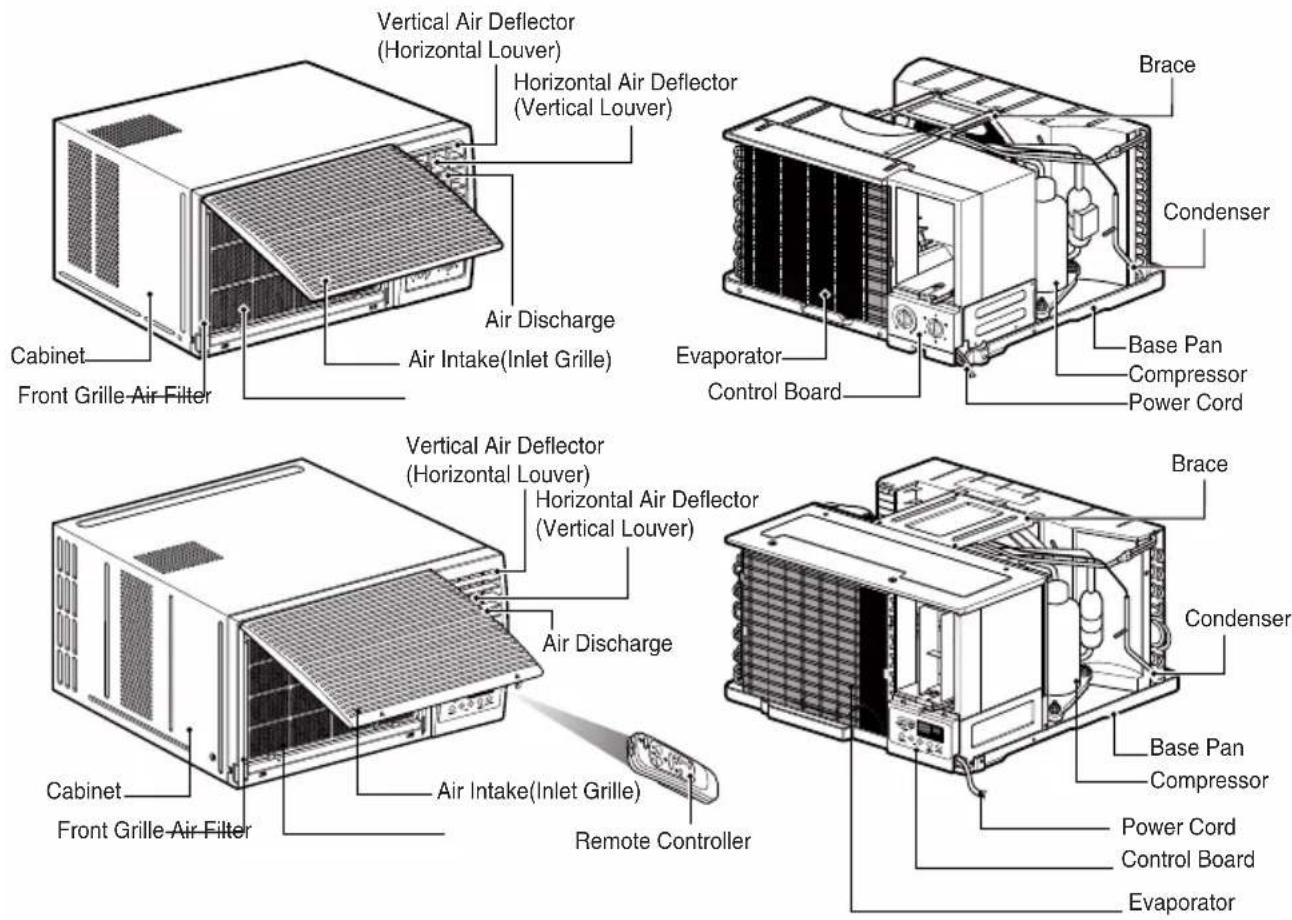
Features

WARNING: This appliance should be installed in accordance with the National Electric Code.
Installation
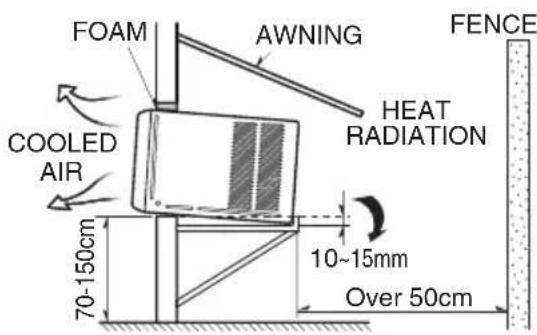
Select the Best Location
- Measure the space for installation to assure a good fit. The air conditioner must be installed firmly into place to prevent vibration and noise.
- Avoid exposure to direct sunlight.
- Remove all obstacles from the rear of the unit. There must be at least 50cm (20in.) of cleared space around the rear of the unit. Obstacles restricting the airflow may reduce the cooling efficiency of the unit.
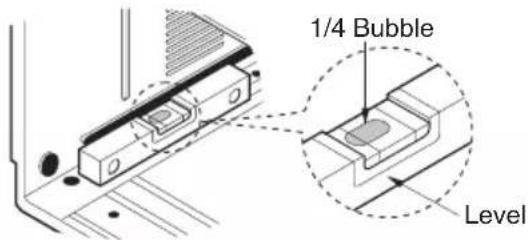
- The unit should be installed with a slight tilt towards the outside (approx. 3°) to allow condensed water to drain. (About 10\~15mm or 1/4 bubble with level)
NOTICE The external grille must be exposed outside for air discharge.
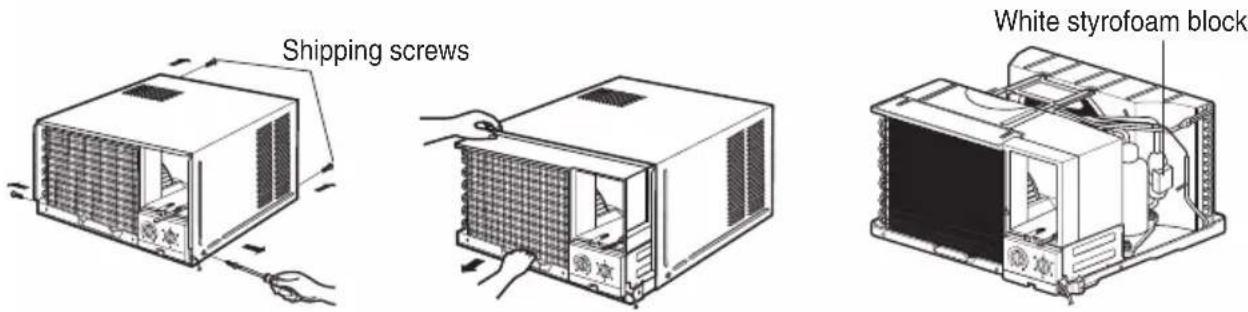
Remove the Air Conditioner From the Case
- Remove 2 shipping screws from the back of the case.
- Remove the 2 screws on each side of the case. Keep these for later use.
- Slide out the air conditioner from the case by pulling the base-pan handle while bracing the case.
- Remove the white Styrofoam shipping block from the compressor. (Applicable for some models)
Attaching the Drain Pan (Optional)
The drain pan is used to collect condensed water.
The base-pan may overflow due to high humidity. The base-pan may also collect excess water when in reverse mode (in Reverse Cycle models only). To drain the excess water, remove the drain cap from the back of the unit and secure the drainpipe as follows:
- Remove the drain pan located in the air discharge or on the barrier.
- Remove the rubber cap from the hole on the base-pan. (Not applicable to all models)
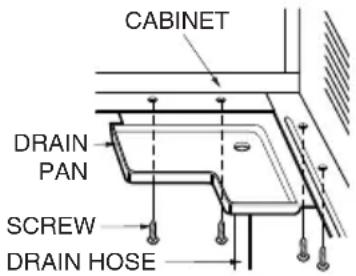
- Install the drain pan to the left corner of the cabinet with 2-4 screws.
- Connect the drain hose to the hole located on the bottom of the drain pan.
You can purchase the drain hose or tubing locally to satisfy your particular needs. (Drain hose not included)
Installation of the Housing
Step 1
Remove the air conditioner from it's packaging and slide the air conditioner out of it's housing.
Step 2
Prepare the hole in the wall so that the bottom of the housing is well supported, the top has minimum clearance and the air inlet louveres have clearance as shown. Holes from the outside through to the cavity should be sealed. The housing should slope down towards the rear by about 5mm to allow water formed during operation to drain.
Step 3
Install the housing into the wall and secure. Ensure the foam seals are not damaged. Flash, seal or fill gaps around the inside and outside to provide satisfactory appearance and protection against the weather, insects and rodents.
NOTICE UNIT MAY BE SUPPORTED BY A SOLID FRAME FROM BELOW OR BY A HANGER FROM A SOLID OVERHEAD SUPPORT.
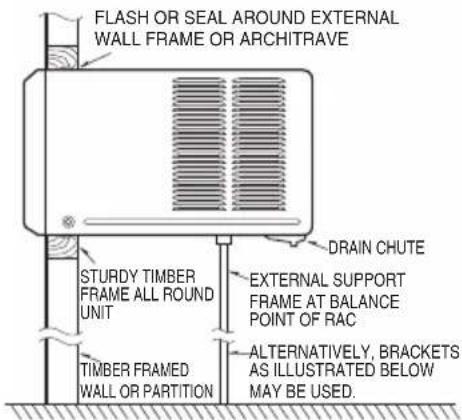
Preferred method of installation into a timber framed wall, partition or window.
Installations of the unit into the Housing
- Slide the unit into the housing until it is firmly against the rear of the housing. Care is required to ensure the foam sealing strips on the housing remain in position.
- Connect the air conditioner to the power and coil excess cord length beneath the air conditioner base or control box.
- Engage the Chassis Lock into the bottom housing rail and secure to the base with the screw provided.
- Remove the front panel from i's carton and plastic bag and fit as per the Operating Instruction.
- Switch unit on. Check for operation of the unit and check for vibration in the installation.
- Fit the drain chute to the housing and run a drain line to a suitable location if required.
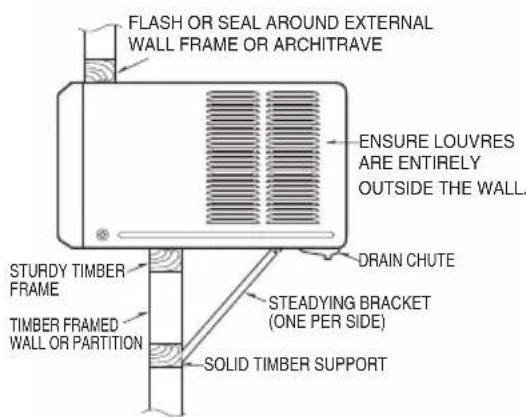
Alternative method of installation if external support cannot be provided.
Installations of the unit into the wall
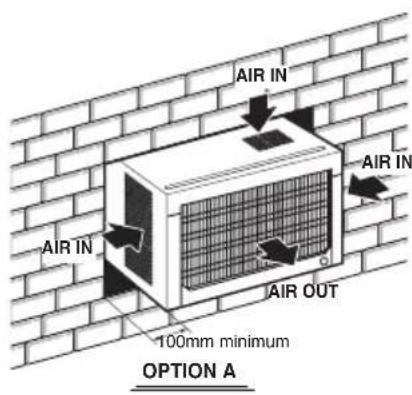
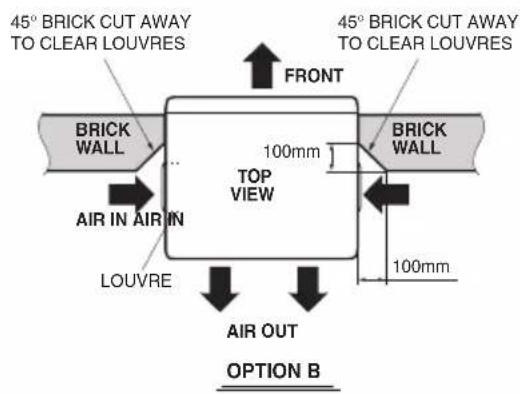
Install the Air Conditioner in the Case
- Slide the air conditioner into the case. Reinstall the 2 screws removed earlier on each side of the case.
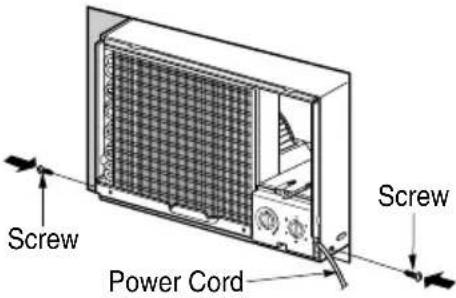

CAUTION: The power cord must be connected to an independent circuit. The green wire must be grounded.
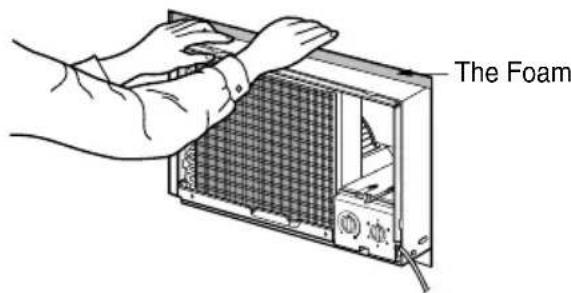
- Stuff the foam between the top of the unit and the wall to prevent air and insects from getting into the room.
- Before installing the front grille, pull out the vent control lever located above the unit control knobs, as shown. (for some models)
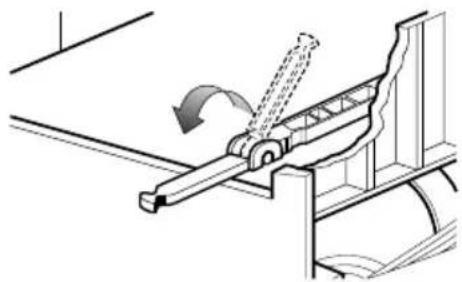
natural_image
Technical diagram of a mechanical assembly with a rotating lever and base plate (no text or symbols)- Attach the front grille to the case by inserting the tabs on the grille into the slots on the front of the case. Push the grille in until it snaps into place. When you detach the front grille from the case, push the grille to your right side and pull it toward you.
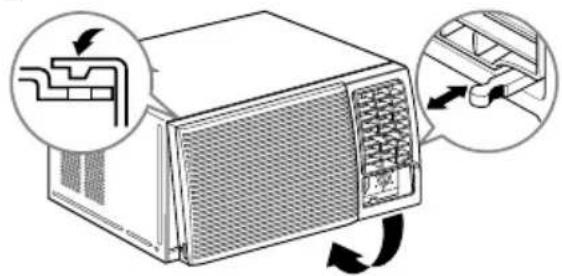
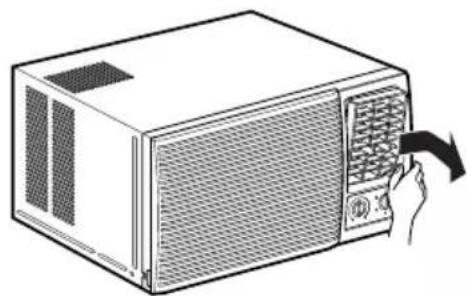
natural_image
Line drawing of a microwave oven with a hand inserting a fan into the front panel (no text or symbols)- Lift the inlet grill and secure the front grille with a screw(L:10mm). Lower the inlet grille into place. (for some models)
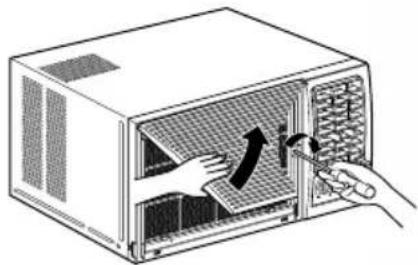
natural_image
Illustration of a hand inserting a device into a microwave oven with a tool (no text or symbols)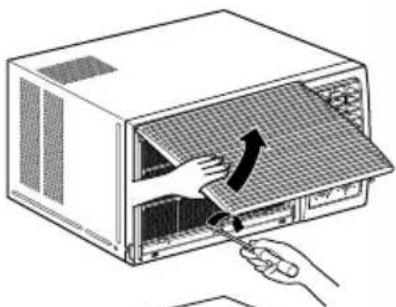
natural_image
Illustration of a computer oven with a hand inserting a cable into the rack (no text or symbols)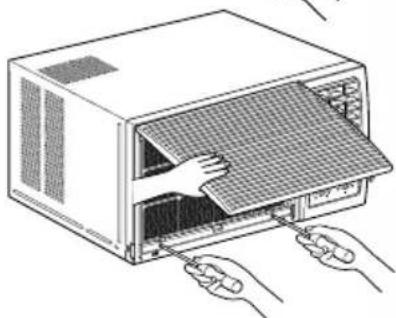
natural_image
Illustration of a computer monitor with hands inserting a cable into the front panel (no text or symbols visible)How to Use the Reversible Inlet Grille(For Some Models)
The grille is designed to clean the filter both upward and downward.
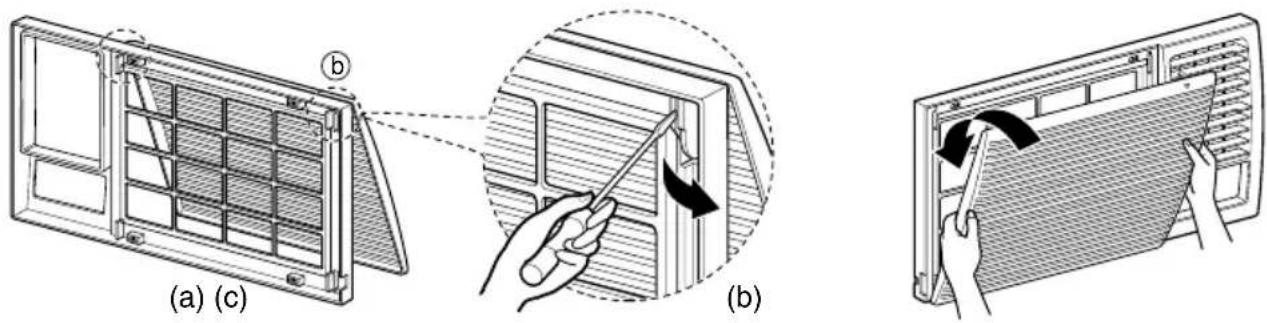
A. Before attaching the front grille to the cabinet, if you want to pull out the filter upward;
- Open the inlet grille slightly (a).
- Turn inside out the front grille (a).
- Disassemble the inlet grille from the front grille with separating the hinged part by inserting a straight type screw-driver tip (b).
- Then, rotate the inlet grille 180 degrees and insert the hooks into bottom holes of the front grille.
- Insert the filter and attach the front grille to the cabinet.
B. If you want to pull out the filter downward;
The grille is already designed that way.
Circuit Breaker Installation and Parts for Installation
- Read thoroughly and follow all directions provided.
- A circuit breaker must be installed between the power source and the unit if the plug is not used (see illustration below).
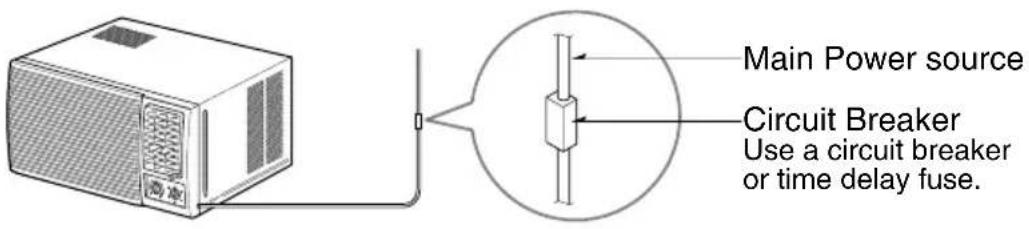
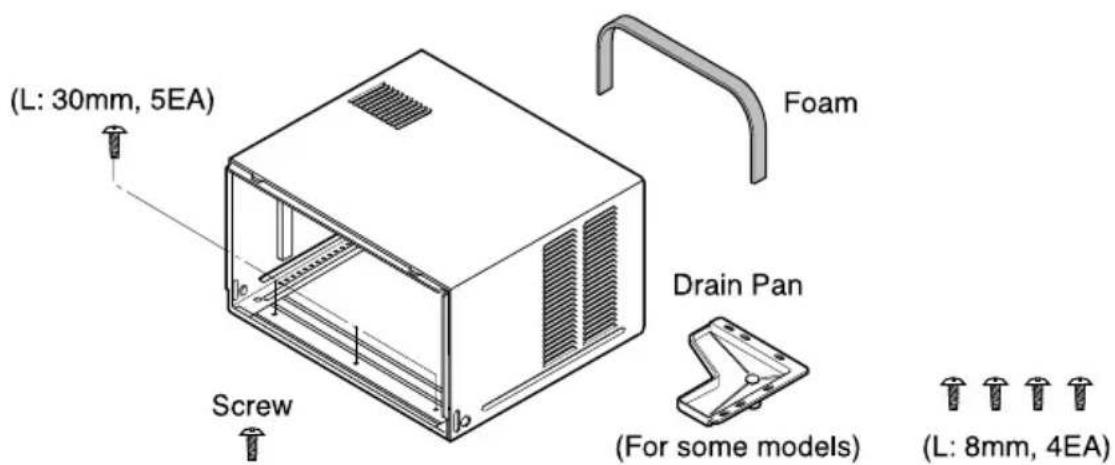
(For Front Grille, L: 10mm, 1EA)
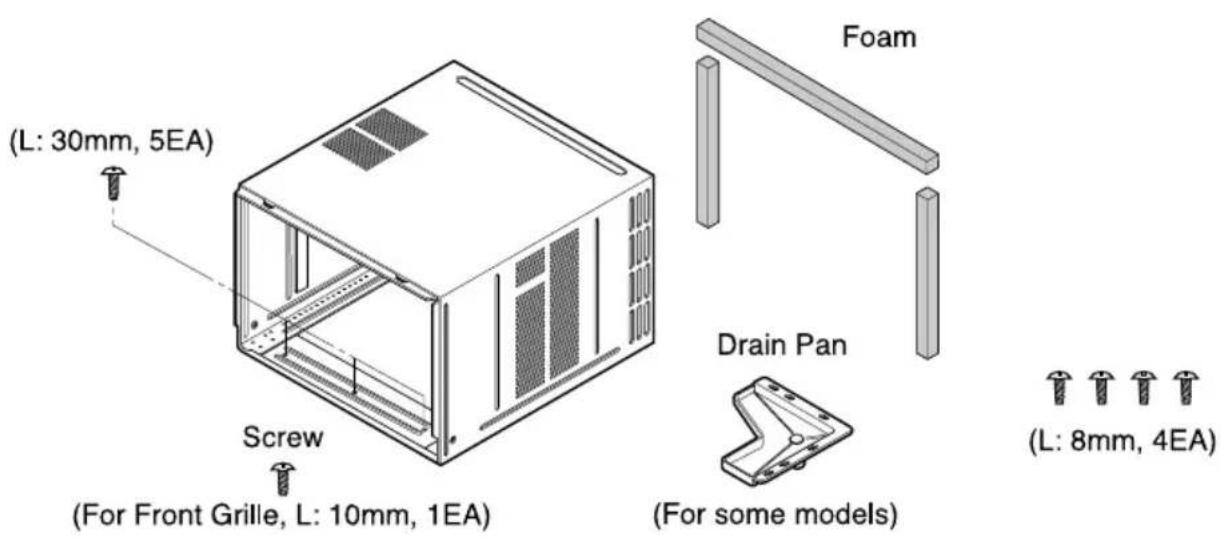
Operating Instructions
Controls
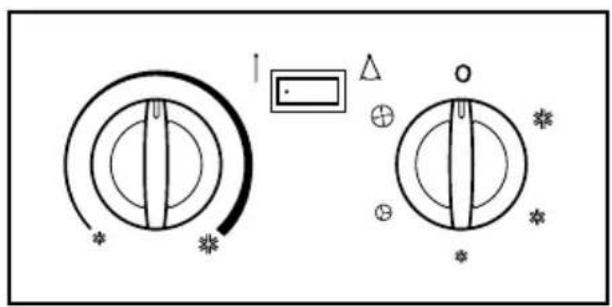
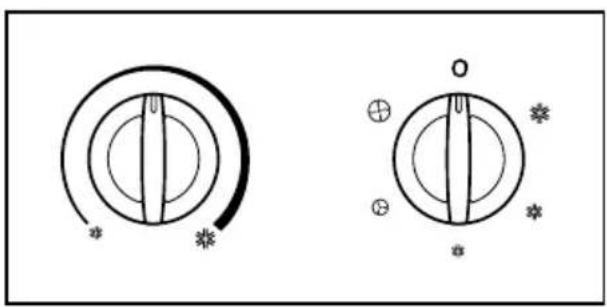
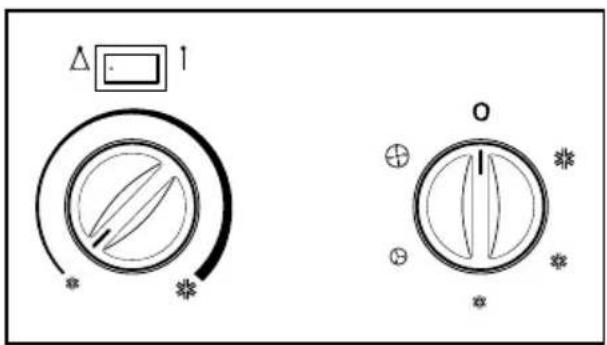
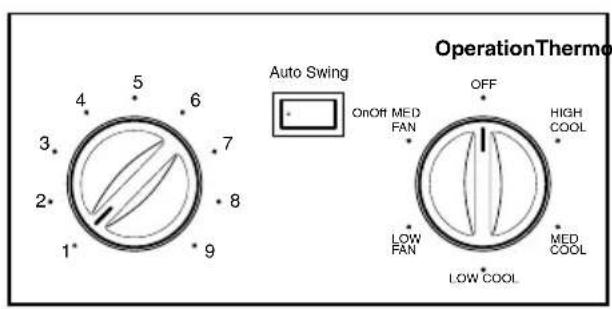
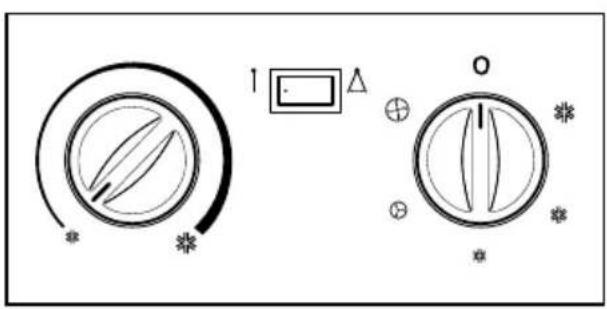
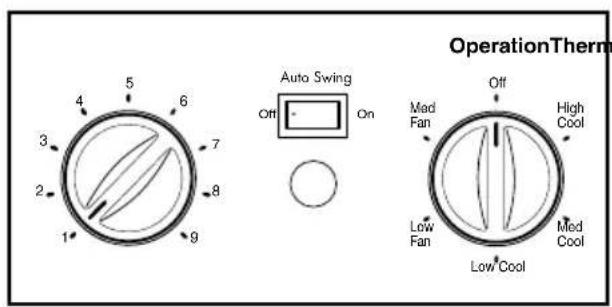
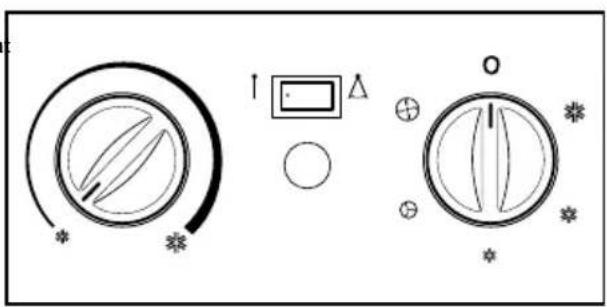
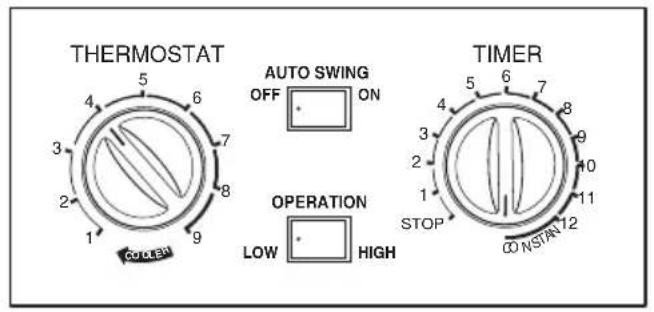
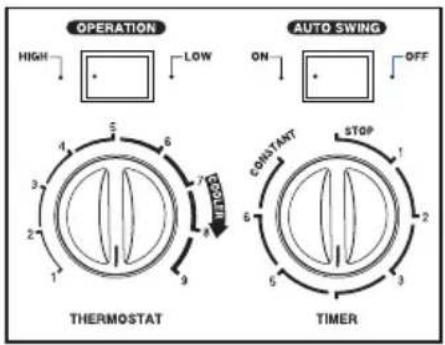
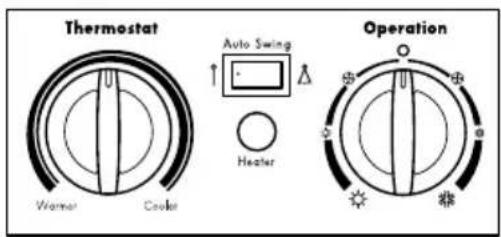
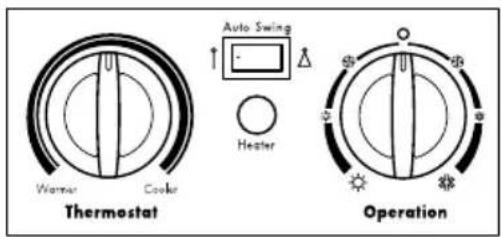
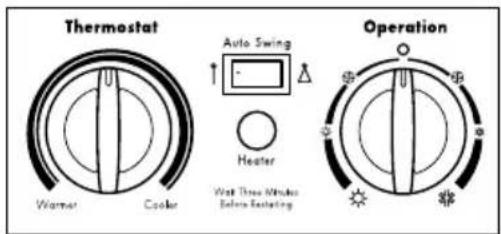
The controls will look like one of the following.
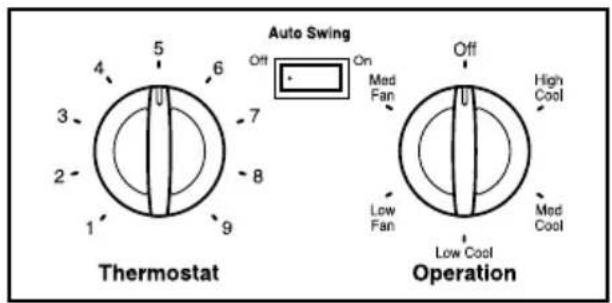
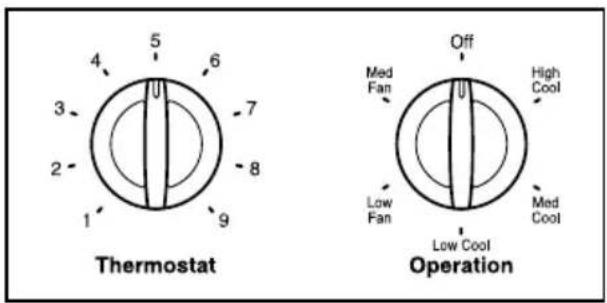
natural_image
Two circular mechanical gauges with cross-sectional views and star symbols, no text or labels present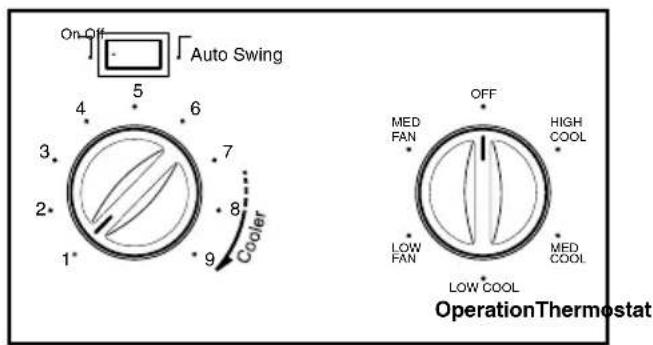
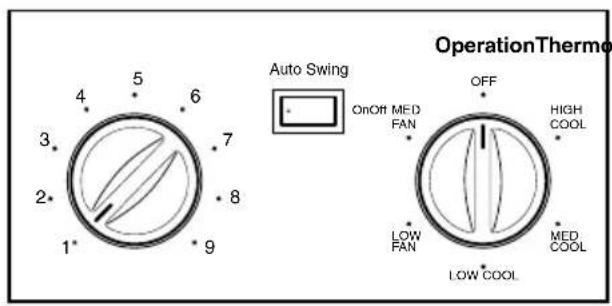
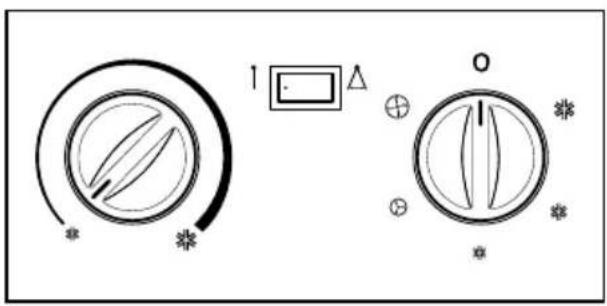
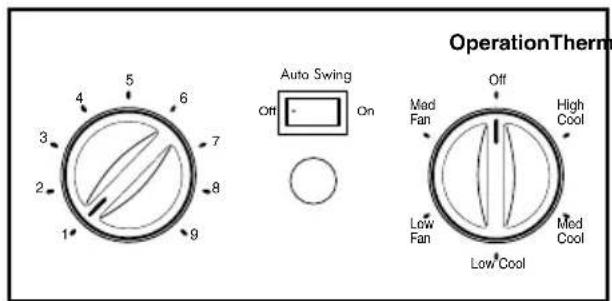
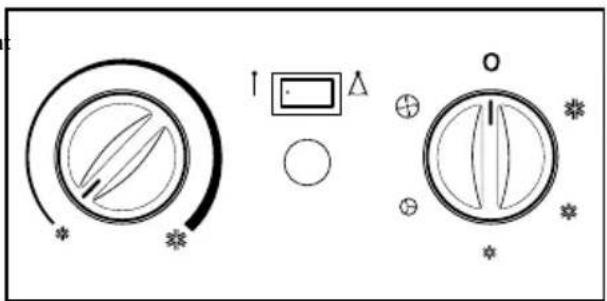
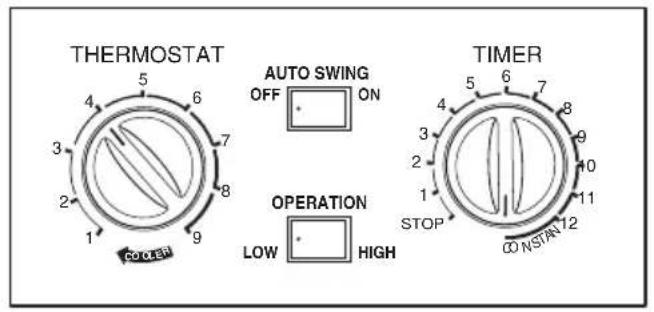
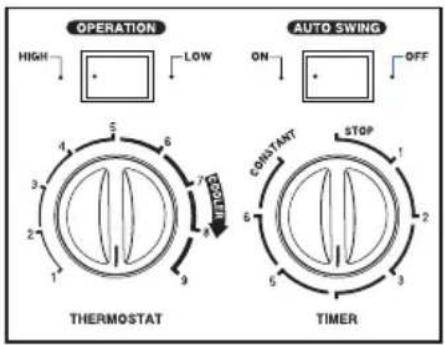
OPERATION
High Cool ( * ), Med Cool ( * ) and
Low Cool ( * ) provide cooling with different fan speeds. Med Fan ( ⊕ ) or Low Fan ( ⊙ ) provides air circulation and filtering without cooling. Off ( ○ ) turns the air conditioner off.
NOTICE If you move the switch from a cool setting to off or to a fan setting, wait at least 3 minutes before switching back to a cool setting.
HIGH COOL : Permits cooling with the high fan speed operation.
LOW COOL : Permits cooling with the low fan speed operation.
Cooling Descriptions
For Normal Cooling- Select High Cool or Med Cool with the Operation knob at the midpoint of Thermostat knob. For Maximum Cooling- Select High Cool with the Operation knob at the highest number available on your Thermostat knob.
For Quieter & Nighttime Cooling- Select Low Cool with the Operation knob at the midpoint of Thermostat knob.
■THERMOSTAT
The THERMOSTAT is used to maintain the room temperature. The compressor will cycle on and off to keep the room at the same level of comfort. When you turn the knob to a higher number(the right side) and the indoor air will become cooler.
The 5 or 6 position (the middle position of arc) is a normal setting for average conditions.
■AUTO SWING
Auto swing switch controls the horizontal air direction by air swing system (not on all models).
ON (△): Auto swing is operated.
OFF ( 1 ) : Auto swing is not operated.
TIMER
The timer can control the operation times within 12 hours. If you set the timer switch at the "1" position, after 1 hour the unit will be stopped automatically. If you want to operate continuously, set the timer switch at the "CONSTANT" position. The timer switch cannot rotate further colckwise from the "CONSTANT" position. If you set the timer switch at the "STOP" position, the unit will be stopped all operations.

CAUTION: When the air conditioner has been performed its cooling operation and is turned off or set to the fan position, wait at least 3 minutes before resetting to the cooling operation again.
Controls
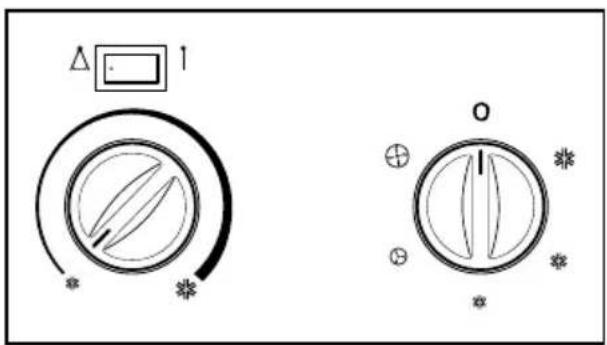
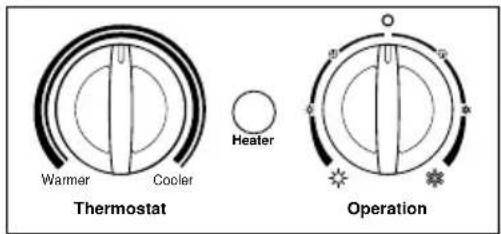
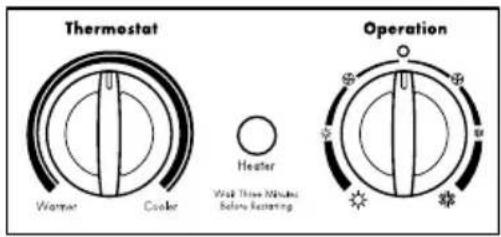
The controls will look like one of the following.
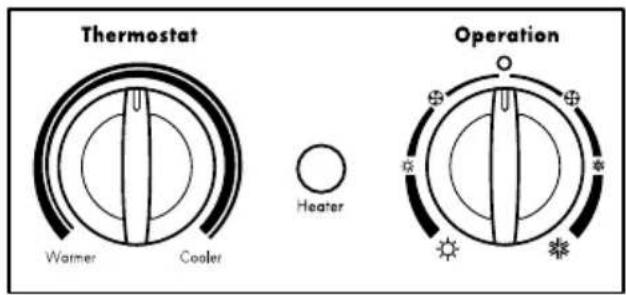
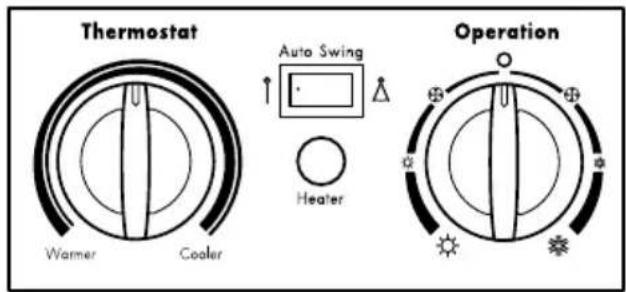
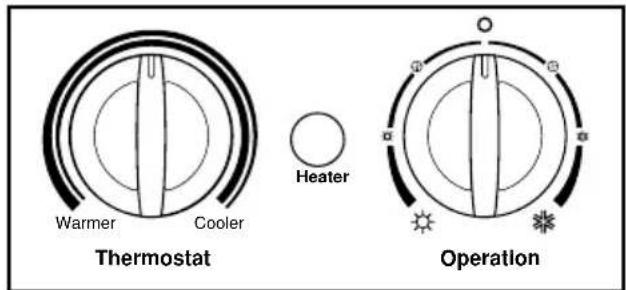
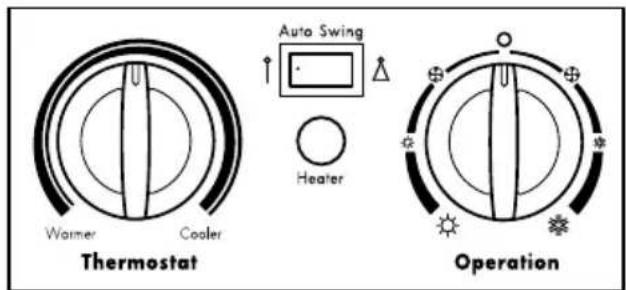
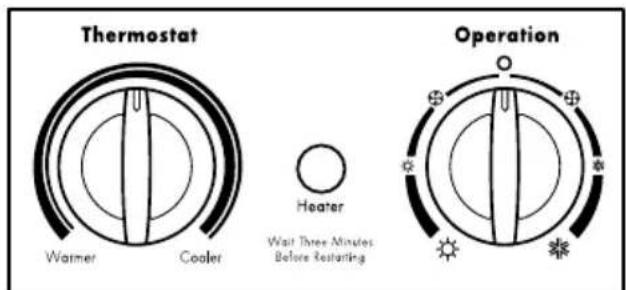
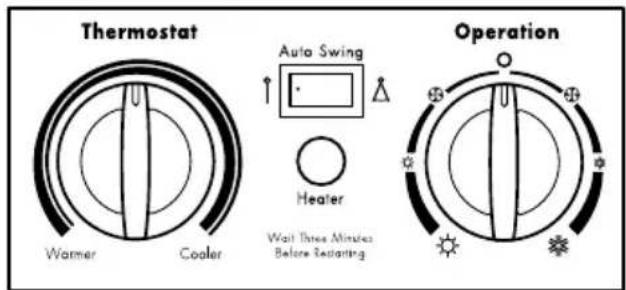
■ AUTO SWING (for some models)
ON (△): Air swing is operated while OPERATION knob is set to the COOL or HEAT position.
OFF ( 1 ): Stops the operation of air swing.
■ THERMOSTAT
Turn the thermostat control to the desired setting. The control position is a normal setting for average conditions. You can change this setting, if necessary, in accordance with your temperature preference.
The thermostat automatically controls cooling or heating, but the fan runs continuously whenever the air conditioner is in operation. If the room is too warm, turn the thermostat control clockwise. If the room is too cool, turn the thermostat control counterclockwise.
■ HEATER () LAMP
When the unit sets heating operation condition, the green lamp is lighted.
When the frost settles on the heat exchanger of the outside, defrosting is made automatically and the green lamp is turned off.
The unit may give a "hiss" and the fan motor stops for 1 to 10 minutes.
This should not be regarded as a problem.
After defrosting, the heating operation begins again.
■ OPERATION
OFF (O): Turns the air conditioner off. LOW FAN (⊗): Permits the low fan speed operation without cooling (heating).
LOW COOL ( * ) : Permits cooling with the low fan speed operation.
HIGH COOL ( * ) : Permits cooling with the high fan speed operation.
LOW HEAT ( ☉ ) : Permits heating with the low fan speed operation.
HIGH HEAT (☀️): Permits heating with the high fan speed operation.

CAUTION: When the air conditioner has been performed its cooling operation and is turned off or set to the fan position, wait at least 3 minutes before resetting to the cooling operation again.
Remote Control
The remote control and control panel will look like one of the following pictures.
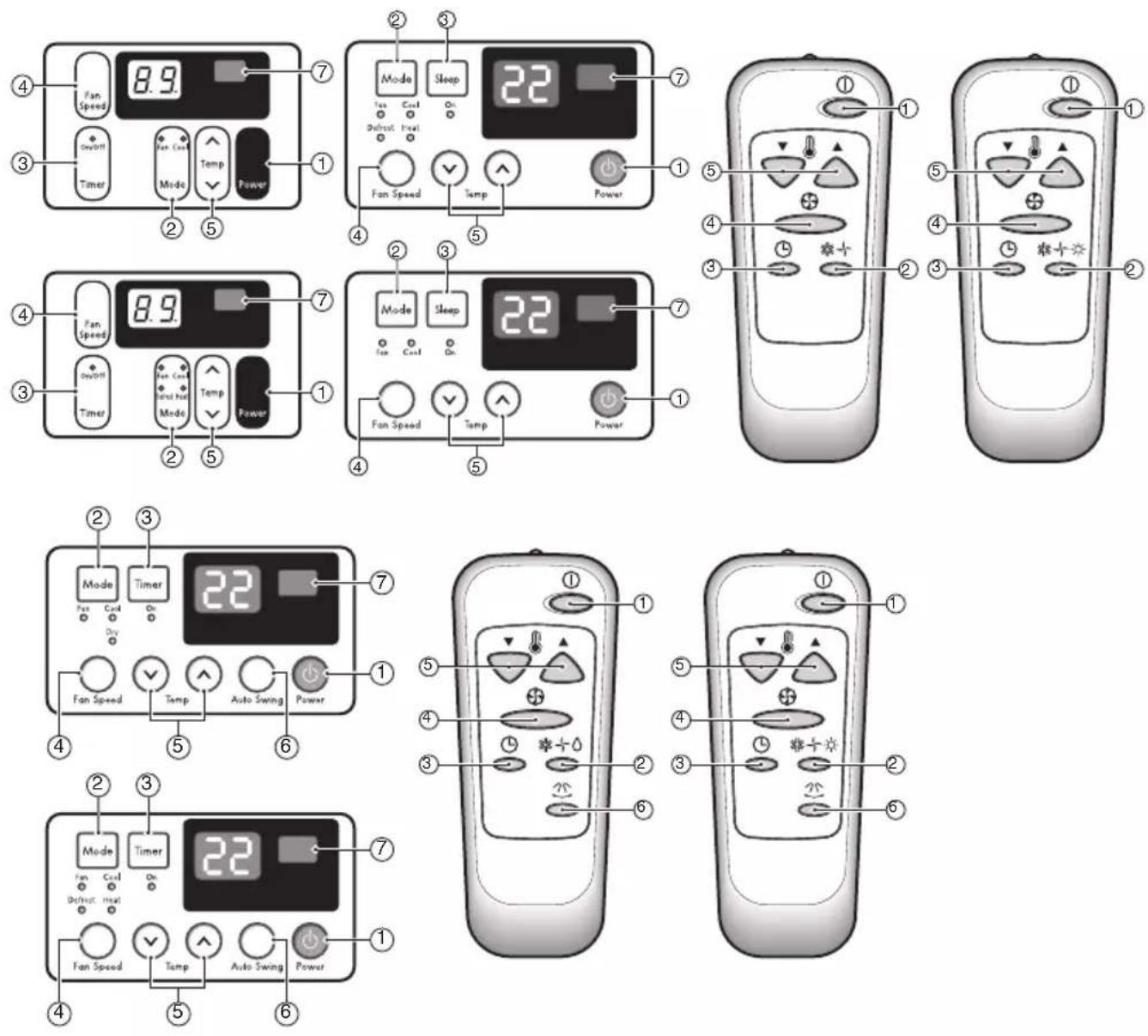
1. POWER
Operation starts when this button is pressed and stops when you press the button again.
2. OPERATION MODE SELECTOR
Heating function is only available in some models.
Select cooling mode to cool the room.
Select heating mode to heat the room.
Select fan mode for basic ventilating fan operation.
3. ON/OFF TIMER
The timer can be set to start and stop the unit in hourly increments (up to 12 hours).
Temperature increases only by 2^ C and no longer increase thereafter.
4. FAN SPEED SELECTOR
For increased power while cooling or heating, select a higher fan speed.
Cooling Model: 3 steps{High[F3] → Low[F1] → Med[F2]}
Heating Model: 2 steps{High[F2] →Low[F1]}
5. TEMPERATURE CONTROL
The thermostat monitors room temperature to maintain the desired temperature.
The thermostat can be set between 16^ C\~ 30^ C ( 61^ F\~ 81^ F).
The unit takes an average of 30 minutes to adjust the room temperature by 1^ C ( 1.8^ F).
6. AUTO SWING BUTTON (available in some models)
Allows the unit to automatically swing its louvers left and right during operation. If the option is deselected, the louvers will stop in their last position and orient the airflow in the corresponding direction.
7. REMOTE SENSOR
Auto Restart
In case the power comes on again after a power failure, Auto Restarting Operation is the function to operate procedures automatically to the previous operating conditions.
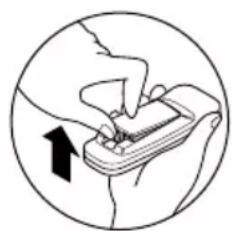
Inserting the Remote Control Batteries
- Push out the cover on the back of the remote control with your thumb
- Pay attention to polarity and insert two new AAA 1.5V batteries.
- Reattach the cover.
NOTICE Do not use rechargeable batteries. Make sure that both batteries are new.
- In order to prevent discharge, remove the batteries from the remote control if the air conditioner is not going to be used for an extended period of time
Keep the remote control away from extremely hot or humid places.
To maintain optimal operation of the remote control, the remote sensor should not be exposed to direct sunlight. - The remote control can be mounted on a wall using the mountable holder.
natural_image
Illustration of a hand holding a small object with an arrow indicating direction (no text or symbols)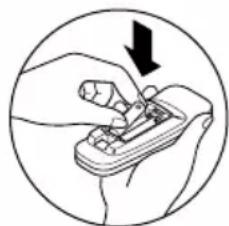
natural_image
Illustration of a hand using a tool to adjust or install a mechanical component, with no visible text or symbols.Ventilation
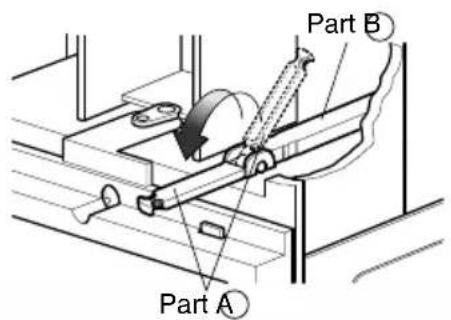
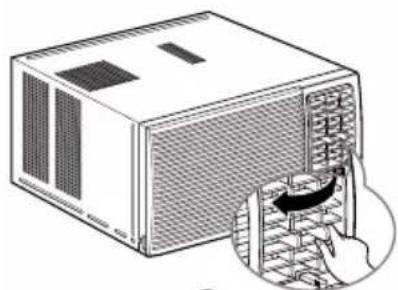
The ventilation lever must be in the CLOSE position in order to maintain the best cooling conditions. When fresh air is necessary in the room, set the ventilation lever to the OPEN position. The damper is opened and room air is drawn out.
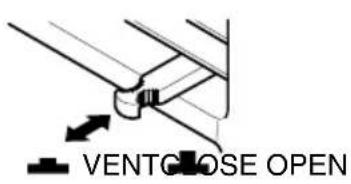
NOTICE Before using the ventilation feature, position the lever, as shown. First, pull down part to horizontal line with part . B
Air Direction
natural_image
Illustration of a microwave oven with a hand inserting a grid into the air gap (no text or symbols)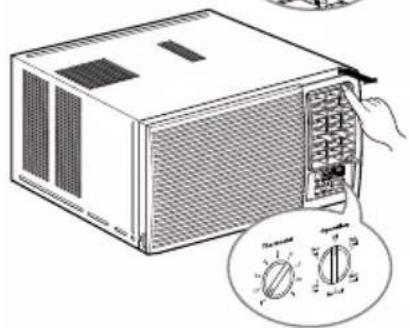
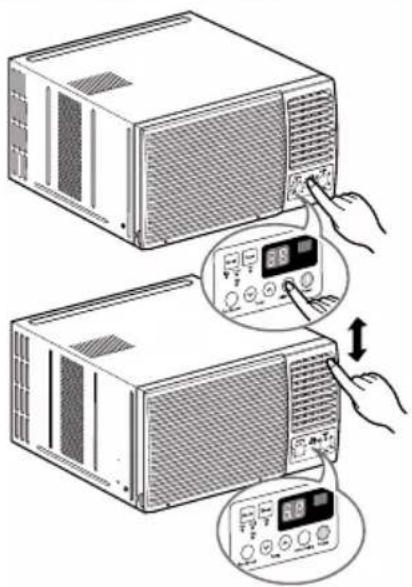
The direction of air can be controlled wherever you want to cool by adjusting the horizontal louver and the vertical louver.
• HORIZONTAL AIR-DIRECTION CONTROL
To control horizontal direction of air flow, set to the ON position the air-swing switch and the air flow will be swept horizontally by the automatic air-swing system.
If you want to stop the air flow from moving, switch off the air swing switch at the desired position of the vane.
• VERTICAL AIR-DIRECTION CONTROL
The vertical air direction is adjusted by moving the horizontal louver.
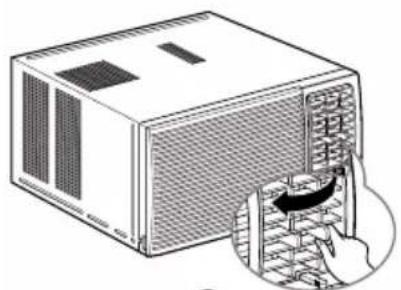
The direction of air can be controlled wherever you want to cool by adjusting the horizontal louver and the vertical louver.
• HORIZONTAL AIR-DIRECTION CONTROL
The horizontal air direction is adjusted by rotating the vertical louver right or left.
• VERTICAL AIR-DIRECTION CONTROL
The vertical air direction is adjusted by rotating the horizontal louver forward or backward.
How to Attach Drain Pan(Optional)
The air conditioner employs a proper drain method whereby the condensed water (moisture removed from the air) is drained to the outside.
In very humid weather, (and for reverse cycle models in the reverse mode) excessive condensate water removed from the air may cause some water to collect. To remove this excess water you can install the drain
pan as detailed below.
- Take the drain pan which is located in the air discharge.
- Remove the hole rubber from the base-pan (for some models).
- Install the drain pan to the right corner of the cabinet with 4 (or 2) screws.
- Connect the drain hose of 3/5" inside diameter to the outlet located at the bottom of the drain pan. You can purchase the drain hose or tubing locally to satisfy your particular needs. (Drain hose is not supplied).
How to Connect a Drain Hose
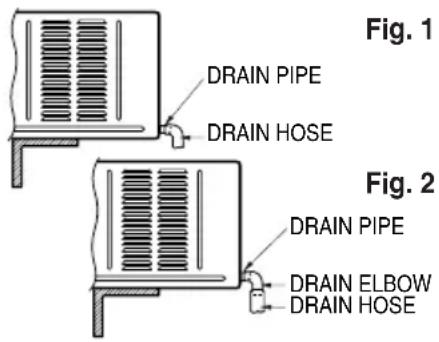
A drain hole is provided at the rear of the air conditioner unit. Select a drain method according to the following.
- Remove the hole rubber from the base-pan. (for some models)
- Connect a drain hose of 916 " inside diameter to the drain pipe as shown in Fig. 1.
- Or connect a pipe elbow of 916 " inside diameter to the drain pipe, then connect a drain hose of 916 " inside diameter to the pipe elbow as shown in Fig. 2.
Maintenance and Service
TURN THE AIR CONDITIONER OFF AND REMOVE THE PLUG FROM THE POWER OUTLET.
Air Filter Cleaning
he air filter should be checked at least twice a month to see if cleaning is necessary. Trapped particles in the filter will build up and block the airflow. This reduces the cooling capacity and also causes an accumulation of frost on the cooling coils.
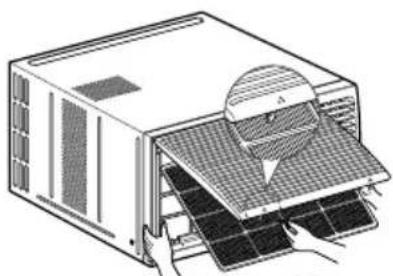
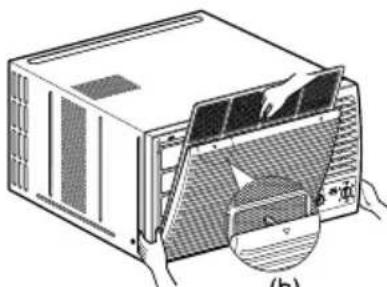
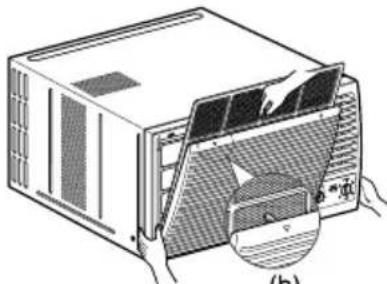
- Open the inlet grille upward by pulling out the bottom of the inlet grille.(a)
In another case, you can open the inlet grille downward by pulling out the top of the inlet grille.(b) - Remove the air filter from the front grille assembly by pulling the air filter up or down slightly.
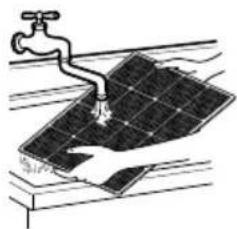
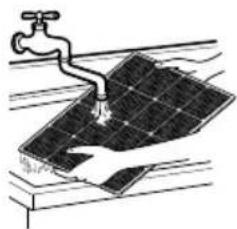
- Wash the filter using lukewarm water below 40°C (104°F).(c)
- Gently shake the excess water from the filter completely. Replace the filter.
natural_image
Diagram of a computer unit with a fan and solar panel array, showing hands inserting or removing components (no text or symbols present)(a)
natural_image
Diagram of a computer unit with a partially open panel and hands inserting a fan (no text or symbols visible)(b)
natural_image
Illustration of a faucet spraying water onto a solar panel (no text or symbols)(c)
NOTICE Mark of inlet grille means opening direction.
How to Attach Front Grille to Cabinet
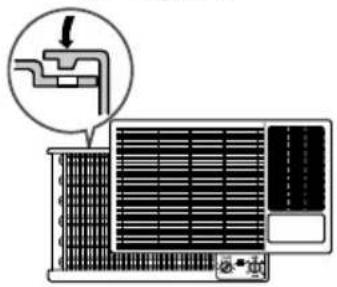
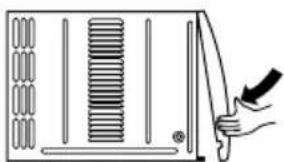
- Pull down front grille from the cabinet top.
-
Push front grille's tips toward the cabinet in order to insert front grille's tabs into the cabinet.
-
Open the inlet grille.
- Tighten the screw through the front grille into the plate of the evaporator or base pan.
- Close inlet grille.
natural_image
Simple line drawing of a kitchen appliance with a knife and a rack (no text or symbols)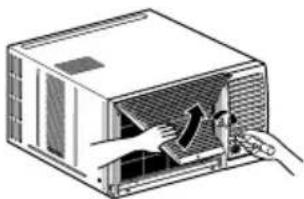
natural_image
Illustration of a computer oven with hands inserting or removing a fan (no text or symbols)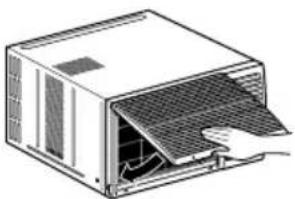
natural_image
Illustration of a computer oven with ventilation slots and a handle (no text or symbols)Troubleshooting
Normal Operating
- You may hear a pinging noise caused by water being picked up and thrown against the condenser on rainy days or when the humidity is high. This design feature helps remove moisture and improve efficiency.
- You may hear the thermostat click when the compressor cycles on and off.
- Water will collect in the base pan during high humidity or on rainy days. The water may overflow and drip from the outdoor side of the unit.
- The fan may run even when the compressor does not.
Abnormal Operation
| Problem Possible | Causes What To Do | |
| Air conditioner does not start | ■ The air conditioner is unplugged. | ·Make sure the air conditioner plug is pushed completely into the outlet. |
| ■ The fuse is blown/circuit breaker is tripped. | ·Check the house fuse/circuit breaker box and replace the fuse or reset the breaker. | |
| ■ Power failure. | ·If power failure occurs, turn the mode control to OFF. When power is restored, wait 3 minutes to restart the air conditioner to prevent tripping of the compressor overload. | |
| Air conditioner does not cool as it should | ■ Airflow is restricted. | ·Make sure there are no curtains, blinds, or furniture blocking the front of the air conditioner. |
| ■ The THERMOSTAT may not be set high enough. | ·Turn the knob to a higher number. The highest setting provides maximum cooling. | |
| ■ TEMP Control set to a higher number. | ·Set the TEMP Control to a lower number. | |
| ■ The air filter is dirty. | ·Clean the filter at least every 2 weeks. See the operating instructions section. | |
| ■ The room may have been hot. | ·When the air conditioner is first turned on you need to allow time for the room to cool down. | |
| ■ Cold air is escaping. | ·Check for open furnace floor registers and cold air returns.·Set the air conditioner's vent to the closed position. | |
| ■ Cooling coils have iced up. | ·See Air Conditioner Freezing Up below. | |
| Air conditioner freezing up | ■ Ice blocks the air flow and stops the air conditioner from cooling the room. | ·Set the mode control at Med Fan or High Cool with the thermostat at 1 or 2.·Set the mode control at High Fan or High Cool with the high temperature. |
TABLE DES MATIÈRES
natural_image
Simple line drawing of people relaxing at a table with sun, palm tree, and drink cups (no text or symbols)Mesures de sécurité
natural_image
Illustration of a smiling gift box and a smiling card with a face icon, accompanied by a warning symbol (no text present)natural_image
Illustration of a car air conditioner connected to an air conditioner via a power outlet, with a prohibition symbol (no text or labels)natural_image
Illustration of a person interacting with a computer monitor and screen, with a warning symbol (no text or labels present)natural_image
Illustration of a box with a warning sign and a person running away (no text or symbols)natural_image
Illustration of a box with clothes being lifted by a prohibition symbol (no text or labels)natural_image
Illustration of a person reacting to a device with a prohibition symbol (no text or labels)natural_image
Illustration of a cartoon character reacting to a distressed air conditioner unit with steam rising (no text or symbols)natural_image
Illustration of a hand connecting an electrical plug to a fuse with an exclamation mark (no text or symbols on the diagram itself)natural_image
Illustration of a distressed air conditioner with a warning symbol (no text or labels)natural_image
Illustration of a person opening a box with a baby inside, no text or symbols presentATTENTION
Installation
natural_image
Illustration of a person opening a baby cage with a no-smoking symbol above (no text or labels)natural_image
Illustration of a distressed air conditioner with a prohibition symbol and falling liquid (no text or symbols present)■Fonctionnement
natural_image
Illustration of a car air conditioner unit with a sleeping bed, a crossed-out prohibition sign, and a potted plant nearby (no text or symbols)natural_image
Illustration of a person interacting with a large air conditioner unit, with a warning symbol (no text or labels present)natural_image
Illustration of a person standing on a car with a prohibition symbol above, surrounded by clouds (no text or symbols present)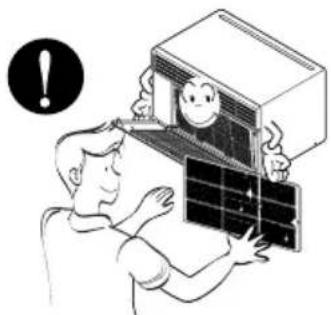
natural_image
Illustration of a person assembling a solar panel with a smiling face emerging from the unit (no text or symbols)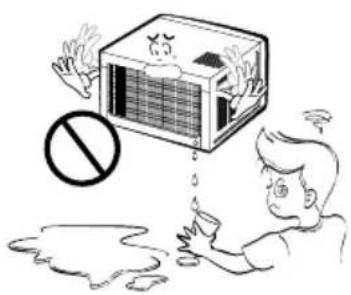
natural_image
Illustration of a person drinking from a polluted stream with a prohibition symbol above (no text or labels)natural_image
Illustration of a person using a vacuum cleaner to clean air, with an exclamation mark (no text or symbols on the diagram itself)natural_image
Illustration of a woman opening a window with a smiling air conditioner unit, no text or symbols present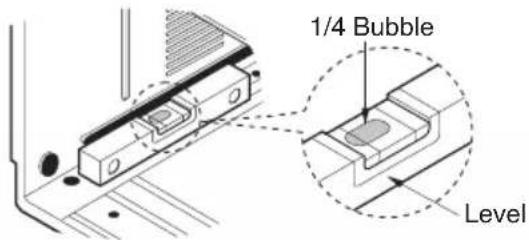
natural_image
Technical line drawing of a mechanical assembly with a rotating shaft and base plate (no text or symbols)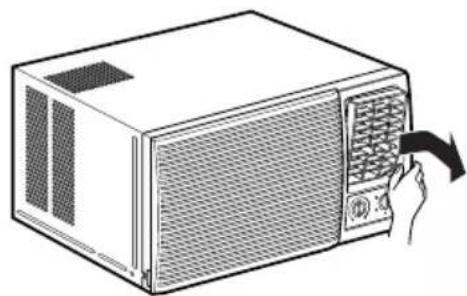
natural_image
Line drawing of a microwave oven with a hand inserting a fan into the front panel (no text or symbols)natural_image
Illustration of a microwave oven with a hand inserting a fan into the opening, showing airflow direction (no text or symbols)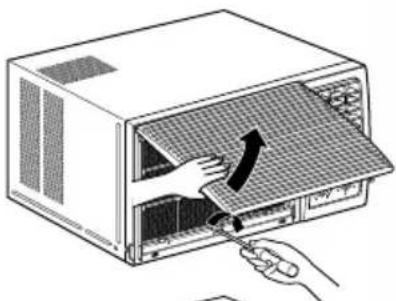
natural_image
Illustration of a computer oven with a hand inserting a cable into the rack (no text or symbols visible)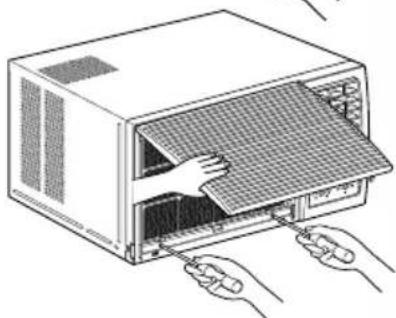
natural_image
Line drawing of a computer monitor with hands inserting a cable into the front panel (no text or symbols)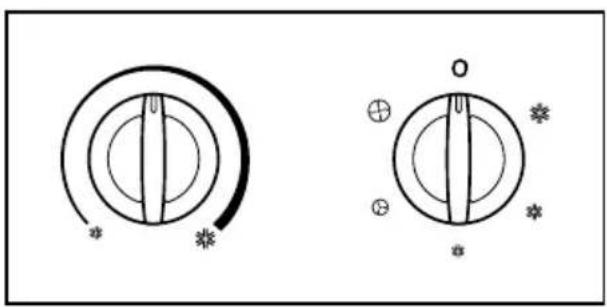
natural_image
Two circular mechanical gauges with cross-sectional views and star symbols, no text or labels present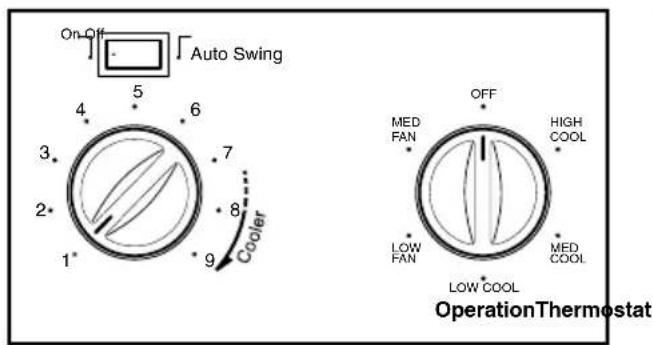
■FONCTIONNEMENT
1. POWER [ALIMENTATION]
natural_image
Illustration of hands holding a device with an arrow indicating motion (no text or symbols)![LG W246BC - POWER [ALIMENTATION] - 1](/content/2026/04/659442/images/d308e1db1a3a67a82592d57ba7b7ecfd4efe5410194045d58070d680be97c688.jpg)
natural_image
Illustration of a hand using a tool to adjust or install a mechanical component, with no visible text or symbols.Ventilation
natural_image
Illustration of a microwave oven with a hand inserting a grid into the front panel (no text or symbols visible)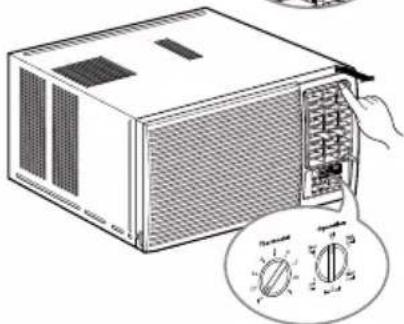
natural_image
Illustration of a microwave oven with a hand inserting a fan into the front panel, showing a rotary dial (no text or symbols present)natural_image
Illustration of a computer unit with a fan and solar panel array, showing hands interacting with the lid (no text or symbols)(a)
natural_image
Diagram of a computer with a fan and ventilation cover, showing hands interacting with the lid (no text or symbols present)(b)
natural_image
Diagram of a water tap spraying into a solar panel (no text or symbols)(c)
Guide de dépannage

- ROOM AIR CONDITIONER OWNER'S MANUAL
- CLIMATISEUR DE PIÈCE MANUEL DU PROPRIÉTAIRE
- FOR YOUR RECORDS
- READ THIS MANUAL
- PRECAUTION
- Safety Precautions
- WARNING
- CAUTION
- Installation
- Operation
- ■Installation
- Before Operation
- Preparing for Operation
- Usage
- Cleaning and Maintenance
- Service
- Introduction
- Symbols Used in this Manual
- Features
- Select the Best Location
- Remove the Air Conditioner From the Case
- Attaching the Drain Pan (Optional)
- Installation of the Housing
- Step 1
- Step 2
- Step 3
- Installations of the unit into the Housing
- Installations of the unit into the wall
- Install the Air Conditioner in the Case
- How to Use the Reversible Inlet Grille(For Some Models)
- Before attaching the front grille to the cabinet, if you want to pull out the filter upward;
- If you want to pull out the filter downward;
- Circuit Breaker Installation and Parts for Installation
- Operating Instructions
- Controls
- Cooling Descriptions
- ■THERMOSTAT
- ■AUTO SWING
- TIMER
- ■ AUTO SWING (for some models)
- ■ THERMOSTAT
- ■ HEATER () LAMP
- ■ OPERATION
- Remote Control
- POWER
- OPERATION MODE SELECTOR
- ON/OFF TIMER
- FAN SPEED SELECTOR
- TEMPERATURE CONTROL
- AUTO SWING BUTTON (available in some models)
- REMOTE SENSOR
- Auto Restart
- Inserting the Remote Control Batteries
- NOTICE Do not use rechargeable batteries. Make sure that both batteries are new.
- Ventilation
- Air Direction
- • HORIZONTAL AIR-DIRECTION CONTROL
- • VERTICAL AIR-DIRECTION CONTROL
- How to Attach Drain Pan(Optional)
- How to Connect a Drain Hose
- Maintenance and Service
- Air Filter Cleaning
- How to Attach Front Grille to Cabinet
- Troubleshooting
- Normal Operating
- TABLE DES MATIÈRES
- Mesures de sécurité
- ATTENTION
- ■Fonctionnement
- POWER [ALIMENTATION]
- Guide de dépannage
Brand : LG
Model : W246BC
Category : Air-conditioner