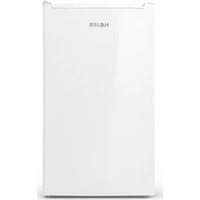
FR-80W.005A - Freezer Haeger - Free user manual and instructions
Find the device manual for free FR-80W.005A Haeger in PDF.



| Product type | Freezer |
| Brand | Haeger |
| Model | FR-80W.005A |
| Dimensions (W x D x H) | 480 mm x 510 mm x 835 mm |
| Net weight | 23 kg |
| Power supply | 220-240 V ~ 50 Hz |
| Rated current | 0.7 A |
| Protection class | I (Earth connection) |
| Refrigerant | R600a (isobutane), 28 g |
| Insulation gas | Cyclopentane |
| Energy class | F |
| Annual energy consumption | 198 kWh/year |
| Total capacity | 69 L |
| Freezing capacity | 3 kg/24 h |
| Autonomy during power failure | 8 h |
| Climate class | N/ST (+16 °C to +38 °C) |
| Noise level | 41 dB(A) |
| Defrost type | Manual |
| Number of drawers | 2 removable drawers |
| Temperature setting | Rotary thermostat (positions OFF, 1-4) |
| Maintenance | Clean with water and mild detergent; defrost when frost exceeds 2 cm |
| Manufacturer warranty | 24 months in EU |
Frequently Asked Questions - FR-80W.005A Haeger
User questions about FR-80W.005A Haeger
0 question about this device. Answer the ones you know or ask your own.
Ask a new question about this device
Download the instructions for your Freezer in PDF format for free! Find your manual FR-80W.005A - Haeger and take your electronic device back in hand. On this page are published all the documents necessary for the use of your device. FR-80W.005A by Haeger.
USER MANUAL FR-80W.005A Haeger
Table Top Freezer Congelador Table Top Congelador Table Top Congélateur Table Top
South Pole 80FR
FR-80W.005A
Instructions Manual
This appliance is intended to be used in household and similar applications such as staff kitchen areas in shop, offices and other working environments; farm houses and by guests in hotels, motels and other residential environments; bed and breakfast type environments; catering and similar non-retail applications.
If the supply cord is damaged, it must be replaced by the manufacturer, its service agent or similarly qualified persons in order to avoid a hazard.
Do not store explosive substances such as aerosol cans with a flammable propellant in this appliance. The appliance has to be unplugged after use and before carrying out user maintenance on the appliance.
Warning: Keep ventilation openings, in the appliance enclosure or in the built-in structure, clear of obstruction.
Warning: Do not use mechanical devices or other means to accelerate the defrosting process, other than those recommended by the manufacturer.
Warning: Do not damage the refrigerator circuit.
Warning: Do not use electrical appliances inside the food storage compartments of the appliance, unless they are of the type recommended by the manufacturer.
Warning: Please dispose the refrigerator according to local regulations because it uses flammable blowing gas and refrigerator.
Warning: When positioning the appliance, ensure the supply cord is not trapped or damaged.
Warning: Do not locate multiple portable socket-outlets or portable power supplies at the rear of the appliance.
Do not use extension cord or ungrounded (two prong) adapters.
Danger: Risk of child entrapment. Before you throw away your old refrigerator or freezer:
- Take off the doors.
- Leave the shelves in place so that children may not easily climb inside.
The refrigerator must be disconnected from the source of electrical supply before attempting the installation of accessory.
Refrigerant and cyclopentane foaming material used for refrigerator are flammable. Therefore, when the refrigerator is scrapped, it shall be kept away from any fire source and be recovered by a special recovering company with corresponding qualification other than be disposed by combustion, so as to prevent damage to the environment or any other harm.
This appliance can be used by children aged from 8 years and above and people with impaired physical, sensory or mental abilities or with a lack of experience and knowledge provided that they are supervised or have received instruction in the safe use of this device, and about the resulting hazards. Cleaning and user maintenance shall not be made by children without supervision. Children aged from 3 to 8 years are allowed to load and unload appliance.
Children should be supervised to ensure that they do not play with the appliance. Children below the age of 3 must be kept away from the appliance unless they are under continuous adult supervision.
To avoid contamination of food, please respect the following instructions:
- Opening the door for long periods can cause a significant increase of the temperature in the compartments of the appliance.
- Clean regularly surfaces that can come in contact with food and accessible drainage systems.
- Store raw meat and fish in suitable containers in the refrigerator, so that it is not in contact with or drip onto other food.
- Two -**- star frozen-food compartments are suitable for storing pre-frozen food, storing or making ice cream and making ice cubes.
- One - *, two - **- and three-star - ***- compartments are not suitable for the freezing of fresh food.
- If the refrigerating appliance is left empty for long periods, switch off, defrost, clean, dry, and leave the door open to prevent mould developing within the appliance.

Warning: Risk of fire / flammable materials
Dear costumer
Thank you for having chosen a HÆGER product.
The HÆGER products have been produced to think about the welfare of the consumer privileging the most raised standards of quality, functionality and assign. We are sure you will be happy with this appliance.
Your new appliance is designed exclusively for domestic use.
To ensure best use of your appliance, carefully read the instructions handbook which contains a description of the appliance and advice on storing and preserving food.
Keep this handbook for future reference and pass them on to whoever might acquire the appliance at a future date.
Before using the appliance
- After unpacking, make sure that the appliance is undamaged and that the door closes properly. Any damage must be reported to your dealer within 24 hours after delivery of the appliance.
- Wait at least two hours before switching the appliance on in order to ensure the refrigerant circuit is fully efficient.
- Installation of the appliance and electrical connections must be carried out by a qualified electrician, in accordance with the manufacturer's instructions and local safety regulations
- Clean the inside of the appliance before using it.
Special Instructions
If this appliance is to replace an old refrigerator with a lock, break or remove the lock as safety measure before storing it, to protect children while playing might lock them inside.
Old refrigerators and freezers contain insulation gases and refrigerant, which must be disposed of properly. Please ensure that the refrigeration tubing is not damaged.

Warning: This refrigerator contains isobutane (R600a); this refrigerant gas is CFC-free but combustible. When transporting, installing, cleaning and repairing the refrigerator, take care not to damage any parts of the refrigeration circuit to prevent the risk of gas leaks. In case of damage, do not
use naked lights and ventilate the room containing the appliance appropriately.
Safety Precautions
The manufacturer declines all responsibility in case of failure to comply with the following precautions:
- Never put a damaged appliance into operation, if in doubt, contact your dealer.
- The appliance must be installed and connected to the electrical mains in full compliance with the instructions provided in the handbook. The electrical connection conditions must be as specified on the nameplate. The appliance's electrical safety is only guaranteed if the household electrical system is earthed in accordance with the relevant regulations.
- Make sure that all repairs and servicing are only carried out by a qualified technician. Always disconnect the appliance from the electrical mains in case of breakdown and maintenance, when changing light-bulbs or during cleaning. Never defrost using electrical devices or steam cleaners. Never remove frost or ice with sharp items, as this may cause irreparable damage to the walls of the refrigerator.
- Never attempt to move the refrigerator by pulling on the door or the handle.
- Never store liquids in cans or glass containers in the freezer compartment, especially if they contain added carbon dioxide. Never store products containing gases, flammable propellants or explosive substances in the freezer. There is always explosion hazard!
- The use of electrical appliances (such as ice-cream makers or whisks) inside the appliance is forbidden.
- To ensure the refrigerator operates correctly, never obstruct or cover the air ducts in any way.
- Never touch frozen products taken straight from the freezer or put them in your mouth. There is burn hazard due to the very low temperatures.
- Never eat or drink foods which look or smell strange.
- This appliance can be used by children aged from 8 years and above and persons with reduced physical, sensory or mental capabilities or lack of experience and knowledge if they have been given supervision or instruction concerning use of the appliance in a safe way and understand the hazards involved. Children shall not play with the appliance. Cleaning and user maintenance shall not be made by children unless they are older 8 years and supervised.
• Children must be supervised to ensure that they do not play with the appliance. - In case of electricity blackout, open the door(s) as little as possible. Once partly or completely thawed, frozen foods must not be re-frozen.
Intended use
- This compressor-freezer unit is designed for deep-freezing and long-term storage of deep-frozen food, as well as for making ice-cubes.
- Refrigeration appliances are classified into certain climate classes. Please refer to the product data sheet for information on the classification for this unit.
- This appliance is intended for domestic or similar applications, such as in:
- shops, offices and other similar working environments,
- agricultural areas,
- hotels, motels etc. and similar establishments,
- bed and breakfast type environments.
- This appliance is not intended for commercial use, nor for use in the catering business or similar wholesale environments.

Warming: The manufacturer declines all responsibility for injury or damage caused by failure to comply with the above regulations or deriving from tampering with even just one part of the appliance and the use of non-original spare parts.
Installation and connection
Choosing the site
- Always place the freezer in a dry place with satisfactory ventilation. Never expose it to direct sunlight or install it outdoors. Depending on its climate class, the appliance can be used in different temperature conditions:
| Class | Ambient temperature |
| SN (Subnormal) | from +10°C to +32°C |
| N (Normal) | from + 16°C to + 32°C |
| ST (Subtropical) | from + 18°C to + 38°C |
| T (Tropical) | from + 18°C to + 43°C |
- Never place the freezer close to heat sources. If this is unavoidable, a suitable insulating panel must be used to allow the appliance to function properly. Otherwise, place the appliance at least 3 cm from electric or gas cookers and at least 30 cm from combustion or radiation heating systems.
- To allow proper cooling of the condenser, the freezer must not be placed too close to the wall. If the refrigerator is installed underneath a wall cupboard, the distance between the two must be at least 10 cm.
- Take care not to scratch or damage the floor when installing the appliance on parquet or linoleum. If necessary, when positioning slide the refrigerator over pieces of wood or a mat to the point decided for connection to the electrical mains.
Positioning and levelling the appliance
Place the freezer on a stable and level floor. In case the floor is not perfectly level, use the two adjustable feet on the front part of the freezer. To ensure major stability, easier movement and a correct positioning of the product, two additional wheels are present at the rear. In any case we recommend moving the fridge very carefully in order to avoid floor damage (especially in case of wooden floor).
Electrical connection
Before switching the freezer on for the first time, leave it vertical for at least two hours. Then connect the appliance's power supply lead to a mains socket with earth contact, installed in accordance with electrical safety regulations. The rated voltage and frequency are stated on the nameplate on back of the freezer. The appliance must be connected to the electrical mains and earthed in compliance with the relevant regulations and requirements. The appliance is able to withstand short fluctuations in voltage of no more than 15% less or 10% more than the rated voltage stated on the nameplate. If the power supply lead has to be replaced, this operation must only be carried out by a qualified technician. The socket must be accessible after the appliance has been placed.
Product Description
- Temperature Control
-
2x removable basket drawers
-
Plastic flap
-
Door
Before using for the first time
- Remove any exterior and interior packaging materials completely, including the adhesive strips.
- Before it is connected to the mains, the unit must be thoroughly checked for transport damage, including its power cord.
- Clean the unit as described in the section Maintenance and cleaning.
- To ensure proper functioning, wait for about two hours before connecting the unit and switching it on after it has been positioned.
- When the unit is first switched on, a slight 'new' smell may be noticed. However, this will disappear once the cooling process has begun.
Setting and selecting the freezer operating temperature
Operating for the first time
- When operating under normal conditions and unloaded, auto mode usually stops at the required temperature in 2 or 3 hours.
- Then set the thermostat to the required setting for the freezer conditions.
Temperature control (Thermostat)
Caution: When the thermostat is turned clockwise to position "4", do not attempt to turn it further or it will be damaged.
- The temperature in the freezer is controlled by the thermostat control regulator in the upper side of freezer. Turn the thermostat control regulator to regulate the temperature inside the freezer. Use a wide flat bladed screwdriver or coin to adjust the temperature. The markings on control regulator indicated “OFF, 1, 2, 3 and 4” for the different temperature grades.
- The closer the knob is set to position "3", the lower the temperature. A medium setting is the most suitable for general operations.
- Position "4" is colder than the position "1". The freezer temperature will vary depending on the quantity of food stored and the frequency of door opening.

Important: In order to maintain good cooling efficiency and save energy, we recommend you do not store too much food inside and do not open the door too frequently.
Freezing foods
- For proper storage and freezing, fruit and vegetables should be packed in portions of not more than 1 kg and meat and fish up to a max. of 2kg. Small packages of food freeze more quickly, giving better conservation of their nutrients and flavour, even after thawing and preparation.
- Use only freezer bags, aluminium film, food-approved polyethylene film and freezer containers. Do not use paper bags, non-food-approved cellophane bags, shopping bags or used freezer bags.
- Pack foods in airtight packs and try to expel all the air. If using bags, close the packs with the elastic bands or plastic-coated wire strips provided.
- Always cool hot foods to room temperature before placing them in the freezer and do not allow frozen foods to touch fresh foods for freezing.
- Always mark packs with the date of freezing, quantity and type of food and make sure that foods are fresh and in good condition.
Storing frozen foods
- When purchasing frozen foods, always take care that the pack is not damaged, that the product is not past its sell-by date and that the thermometer of the freezer in which the products are displayed for sale does not show a temperature above -18°C. Also note the temperature advice, storage period and modes of consumption stated by the producer.
- Purchased foods should also be protected using suitable insulated containers during transportation to eliminate the risk of thawing. An increase in temperature might reduce their storage life and adversely affect their quality.
- Do not purchase frozen foods which are carrying too much frost; they might already have been thawed.
Thawing frozen foods
- Partially thawed foods should be eaten as soon as possible. Low temperatures preserve foods, but they do not destroy the micro-organisms which are activated after thawing, which may cause the stored foods to deteriorate. If thawed foods smell and look normal, they can be cooked and if required re-frozen once they have cooled.
- Depending on their type and intended use, frozen foods can be thawed correctly at room temperature, in the refrigerator, in an electric oven (conventional or fan), or in a microwave oven using the relevant function.
Maintenance and Cleaning
Defrosting the freezer
The freezer compartment has to be defrosted manually. When the thickness of frost or ice on the shelves exceeds 2 cm, the freezer should be defrosted. A few hours before defrosting, set the thermostat on position 4 in order to further lower the temperature of the frozen foods. Then turn the knob to the OFF (stop) setting and disconnect the plug from the electrical mains. Remove the frozen foods from the freezer compartment and protect them from thawing while cleaning.
Cleaning
- Before cleaning, disconnect the plug from the electrical mains. Clean the outside using only water and a gentle liquid detergent or an ordinary detergent for washable surfaces (such as a window-cleaning product). Never use products containing abrasives or substances which may attack the lacquered or painted parts, acids or chemical solvents. Use a sponge or a soft cloth.
- Do not use steam cleaners to clean the inside; we recommend the use of specific cleaning products.
- Clean the gaskets with warm water and then dry.
- To allow the freezer to operate at full efficiency, periodically also clean the condenser on the rear with a brush or a vacuum cleaner.
- Also make a periodic check on the tray above the compressor and clean it if necessary.
Practical advice for saving energy
- Install the freezer in a cool, well ventilated place, protected against direct sunlight and well away from heat sources.
- Do not place hot foods in the freezer sections. Wait for foods to cool to room temperature before placing them on the shelves;
-
Open the door(s) as infrequently and for as short a time as possible to prevent the compartments from warming up too much;
-
Clean the condenser (rear of the freezer) periodically to prevent the appliance from losing efficiency;
- If the freezer is to be out of use for a long period, it is best to empty it and switch it off.
Operating noise
- The freezer is cooled by means of a compression system. In order to maintain the preset temperature inside the freezer sections, the compressor comes into operation in response to the level of cooling required and may operate continuously if necessary. When the compressor starts up a humming sound will be heard, tending to drop in volume after a few minutes.
-
Another normal refrigerator operating noise is a gurgling due to the coolant flowing through the pipes in the circuit. This noise is perfectly normal and does not mean that the appliance is malfunctioning. If it is over-loud, there may be other causes. In this case, check that:
-
the freezer is properly levelled on the floor and does not vibrate when the compressor is in operation: adjust the feet provided as appropriate;
- The drawers and shelves are correctly fitted and securely in place: fit correctly;
Troubleshooting Guide
The appliance is not working.
Check that
- the switch in your home installation fuse box is switched on.
- the wall socket is working. This can be done by connecting another electrical device to the socket and checking for function.
The unit seems to generate insufficient cooling power.
Check whether
- too much food has been stored in the unit.
- the thermostat is set to position 1 (in this case, set it to a suitable higher value).
- the door is not properly closed.
- there is too much dust on the condenser.
- the unit is too close to a wall or other object at the rear or to the sides.
The normal operating sound changes or becomes louder.
Check whether
- the unit has been properly positioned.
- any objects or obstructions are touching the rear of the unit.
- there are any objects on top of the unit which might be vibrating.
Technical data
| Reference | FR-80W.005A |
| Supply Voltage / Protection class | 220-240 V~ 50Hz / I |
| Rated current | 0.7A |
| Refrigerant/Amount | R600a / 28g |
| Insulation blowing gas | Cyclopentane ( C_5H_10 ) |
| Energy Efficiency Class (1) | F |
| Energy consumption of E16 (2) | 0.328kWh/24h |
| Energy consumption of E32 (2) | 0.648kWh/24h |
| Annual Energy consumption (2) | 198kWh/annum EEI (%): 124 |
| Total Storage Volume | 69 L |
| Star rating | |
| Defrost type | Manual |
| Freezing capacity | 3kg/24h |
| Temperature Rise | 8h |
| Climate Class (Ambient range) | N/ST (+16°C a +38°C) |
| Noise [dB (A) re 1pW] | 41 |
| Net weight / Gross weight | 23kg/25kg |
| Dimensions (W x D x H) | 480mm x 510mm x 835mm |
| (1) Energy class: A......G (A= more economical...G=less economical) | |
| (2) The real energy consumption depends on conditions and appliance location. | |
Declaration of Conformity
This appliance is intended for storing food and is manufactured in conformity with European Regulation 10-2011 and European regulation (EC) No. 1935/2004.
This product has been designed, manufactured and marked in compliance with:

- the safety objectives of Low voltage Directive 2014/35/EU;
- the protection requirements of EMC Directive 2014/30/EU;
- Plastic materials and articles intended to come into contact with food – Commission Regulation (EU) 10/2011;
- Commission Delegated Regulation (EU) 2019/2016 & Commission Regulation (EU) 2019/2019.
The electrical safety of the appliance is guaranteed only if it is connected to an efficient and approved earthing system.
Disposal – Environment policy
Packing

The packaging material is entirely recyclable and marked with the recycling symbol. Follow local regulations for scrapping. Keep the packaging materials (plastic bags, polystyrene parts, etc.) out of reach of children, as they are potentially dangerous.
Disposal
The appliance is manufactured using recyclable material.
This appliance is marked according to the European directive 2012/19/EU on Waste Electrical and Electronic Equipment (WEEE).
By ensuring this product is disposed of correctly, you will help prevent potential negative consequences for the environment and human health, which could otherwise be caused by inappropriate waste handling of this product.

This symbol on the product, or on the documents accompanying the product, indicates that this appliance may not be treated as household waste. Instead it shall be handed over to the applicable collection point for the recycling of electrical and electronic equipment.
Before disposal, make the appliance unusable by cutting off the power cable and removing the doors and shelves so that children cannot easily climb inside the appliance.
Disposal must be carried out in accordance with local environmental regulations for waste disposal. Deliver the appliance immediately to an authorized dump; do not leave it unattended even for a few days, since it is potentially dangerous for children.
For more detailed information about treatment, recovery and recycling of this product, please contact your local city office, your household waste disposal service or the shop where you purchased the product.
Warranty Declaration
Insofar as claims filed for elimination of deficiencies (applicable laws) are being processed, these shall be handled via the contractual partners. In addition, the distributor provides the following manufacturer's warranty:
- For this device, the distributor grants a warranty period of 24 months (*), figured from the date of purchase from the dealer; this must be verified by the original receipt, or other similar documents, in accordance with pertinent, existing guidelines.
- Warranty claims shall be filed via a specialized dealer.
- The voluntary warranty covers the rectification of any damage or deficiency that occurs during the warranty period and which is demonstrably due to material or production faults.
- Not included in this voluntary warranty are damage and deficiencies resulting from incorrect connection, from improper handling, from non-observance of the programming instructions or instructions for use, or from force majeure. The voluntary warranty does not cover installation and programming work performed by the specialized dealer. In particular, no claim can be made for installation or programming work to be performed free of charge by the specialized dealer. The voluntary warranty does not cover deficiencies which have a negligible effect on the value or usability of the device. Further costs, such as for installation, transport and travel expenses are expressly excluded from the warranty.
- It is at the discretion of the distributor to replace the device with an identical one instead of performing repairs. Further claims for damage are not permissible. Any data stored in the device will be lost after repair work or replacement of the device.
- The voluntary warranty is nullified if changes are made to the product, or when the product is operated in a country for which it was not developed nor produced.
- Fulfilment of the voluntary warranty presupposes that the device has been packed complete and protected against breaking and impacts (if possible, in the original packaging) and shipped with the warranty certificate from the specialized dealer.
- If testing reveals that there are no grounds for warranty claims, or that the product does not exhibit any deficiencies, the costs for repair work and testing shall be borne by the user. The distributor processing the claim arising from the voluntary warranty is authorized to charge these costs to the user.
- Services arising from the voluntary warranty affect neither an extension of the warranty period, nor do they mark the beginning of a new term for the voluntary warranty.
- Warranty claims according to applicable law filed by the end customer shall neither be excluded, nor restricted by this independent manufacturer's declaration.
The user is protected by the guarantee indicated in the Directive 1999/44/CE issue by the European Parliament on 1999, May 25.
(*) Only for European Union countries
ADVERTÊNCIA


- Table Top Freezer Congelador Table Top Congelador Table Top Congélateur Table Top
- Dear costumer
- Before using the appliance
- Special Instructions
- Safety Precautions
- Intended use
- Installation and connection
- Choosing the site
- Positioning and levelling the appliance
- Electrical connection
- Product Description
- Before using for the first time
- Setting and selecting the freezer operating temperature
- Operating for the first time
- Temperature control (Thermostat)
- Freezing foods
- Storing frozen foods
- Thawing frozen foods
- Maintenance and Cleaning
- Defrosting the freezer
- Cleaning
- Practical advice for saving energy
- Operating noise
- Troubleshooting Guide
- The appliance is not working.
- Check that
- The unit seems to generate insufficient cooling power.
- Check whether
- The normal operating sound changes or becomes louder.
- Declaration of Conformity
- Disposal – Environment policy
- Packing
- Disposal
- Warranty Declaration
- ADVERTÊNCIA
Brand : Haeger
Model : FR-80W.005A
Category : Freezer