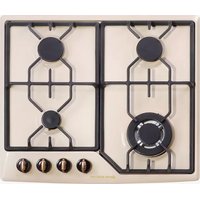
EMH46RC - Cooker EAS Electric - Free user manual and instructions
Find the device manual for free EMH46RC EAS Electric in PDF.



User questions about EMH46RC EAS Electric
0 question about this device. Answer the ones you know or ask your own.
Ask a new question about this device
Download the instructions for your Cooker in PDF format for free! Find your manual EMH46RC - EAS Electric and take your electronic device back in hand. On this page are published all the documents necessary for the use of your device. EMH46RC by EAS Electric.
USER MANUAL EMH46RC EAS Electric
natural_image
Simple geometric diagram with four circles arranged in a 2x2 grid, one circle empty and two on the left (no text or symbols)EMH46RN
EMH46RC
MANUAL DE INSTRUÇÕES
Contenido
INSTRUCCIONES DE USO
natural_image
Symbol of a trash bin crossed with no text or numbers, representing waste sorting or disposal (no text present)natural_image
Exploded view diagram of a mechanical assembly showing internal components (no text or labels)text_image
COPPER PIPE OR STAINLESS STEEL HOSE YES BAND CLAMPS Service opening in cabinet i : REAR VIEW NO REAR VIEWtext_image
Neutral BLU live Earth(Yellow/Green)natural_image
Simple line drawing of a mechanical component with a central rod and base, no text or symbols present.text_image
installation opening 150 550 470 75natural_image
Line drawing of hands holding a tool over a curved object, no text or symbols present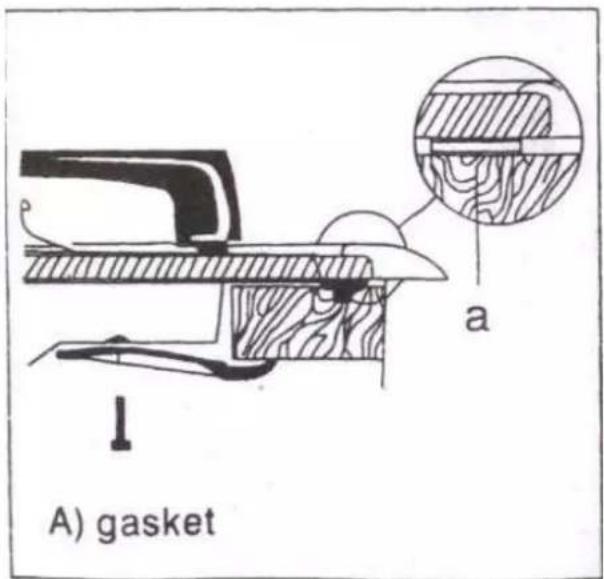
text_image
A) gasket aa Removable panel b Space for connections
3 Introduction
3 Safety instructions
7 Description of the hob
7 Instructions for use
9 Cleaning and maintenance
INSTALLATION INSTRUCTIONS
11 Technical data
12 Installation environment
13 Gas connection
14 Electrical connection
15 Adapting the hob to different types of gas
16 Building into fitted kitchen units
18 COMMERCIAL GUARANTEE
Introduction
These instructions have been drawn up for your safety and that of others. You are therefore requested to read them carefully before installing and using the appliance. Keep this instruction manual for future reference as necessary. If the appliance is sold or moved, make sure that the manual is handed over to the new user.
Safety instructions
- Installation of the appliance and its connection to the electrical mains must only be carried out by QUALIFIED PERSONNEL. Before any procedure, it is important to check that the appliance is DISCONNECTED from the electrical mains.
- It is risky to modify or attempt to modify the characteristics of this product.
■ After removing the appliance from the packaging, make sure that it is undamaged and that the electrical lead is in perfect condition. Otherwise, contact your dealer before putting the appliance into operation. - EAS Electric Smart Technology S.L. declines all responsibility in case of failure to comply with the accident prevention regulations.
■ Make sure that air is able to circulate freely around the appliance. Poor ventilation produced a shortage of oxygen
■ Make sure that the appliance is supplied with the type of gas indicated on the relative sticker next to the mains gas connection pipe. - Use of a gas cooking appliance produces heat and moisture in the room in which it is installed. Ensure that the room is well ventilated by keeping the air intakes open and in good working order or by installing an extractor hood with discharge pipe.
- If the appliance is used intensively for a long time the effectiveness of the ventilation will have to be increased, for example by opening a window or increasing the power of any electric extractor fan.
During use
- This product is designed to cook food inside ordinary homes and for non-professional purposes. It should not be used for any other purpose.
- After using the appliance, make sure that all controls are in "CLOSED" or "OFF" position.
- If you use an electrical socket close to this appliance, take care that the cables of the appliances you are using are far away from the hot parts of this appliance.
Children's safety
- This appliance must only be used by adults. Make sure that children do not touch the controls or play with the appliance.
- The exposed parts of this appliance heat up during cooking and remain hot for some time even after it is switched off. Keep children well away until the appliance has cooled down.
Cleaning and maintenance
- Keep the appliance thoroughly cleaned. Food residues may cause fire risks.
Service and parts
- In the instance of malfunctions. Never attempt to repair the appliance yourself. Repairs by unskilled persons may cause damage and accidents. First refer to the contents of this manual. If you do not find the necessary information, contact your nearest Service Centre. Servicing work on this appliance must be carried out by an authorized Technical Service Centre. Always request the use of original spare parts.
Environmental protection advice
All the materials used are environmentally compatible and recyclable. Please make your contribution to conserving the environment by using the separate waste collection channels available.
Decommissioned appliances
- Appliances which are no longer used or usable are not worthless waste. Through environment-friendly disposal, a number of materials used in the production of your appliance can be recovered.
- Find out about the current disposal options from your specialist dealer, or your local authority.
- Before scrapping the appliances, cut the power supply lead and make it unusable.
natural_image
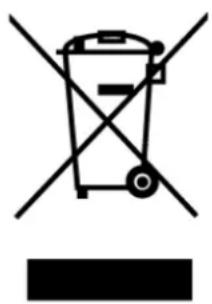
Symbol of a trash bin crossed with no text or numbers, representing waste sorting or disposal (no text present)DISPOSAL: Do not di spose this product as unsorted municipal was te. Collection of such waste separately for special treatment is necessary.
The european directive 2012/19 /UE on wasted electrical and electronic equipments (WEEE), requires that household electrical appliances must not be disposed of in the normal unsorted municipal waste stream. appliances must be collected separately in order to optimize the recovery and recycling of the materials they contain, and reduce the impact on human health and the environment.
The crossed out “wheeled bin” symbol on the product reminds you of your obligation, that when you disposed of the appliances, it must be separately collected. Consumers should contact their local authority or retailer for information concerning the correct disposal of their old appliance.
Guide to reading the instructions
The following symbols will help you when reading the instructions:



Safety information
"Step by step" instructions
Suggestions and Advice
Information concerning environmental protection

This appliance complies with the following EEC Directives:
- 73/23 and 90/683 (relating to Low Voltage);
- 89/336 (relating to Elec tromagnetic Compatibility);
- 90/396 (relating to Gas Appliances);
- 93/68 (relating to the General Standards) And subsequent amendments.
Description of the hob
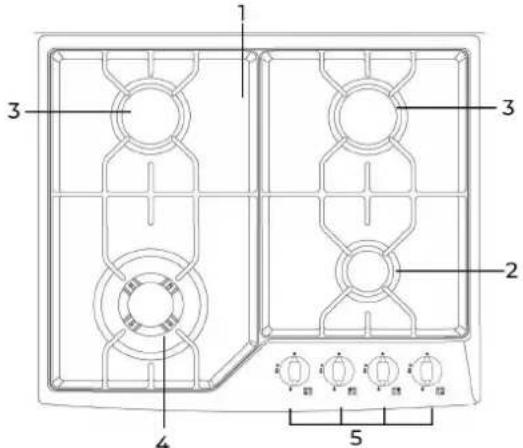
text_image
1 2 3 4 5- Hob
- Small auxiliary burner
- Medium semi-rapid burner
- Triple flame burner
- Burner control knobs
Instructions for use
The hob control knobs
The symbols on the control knobs mean the following:
- no gas flow
maximum gas flow
Minimum gas flow
All operating positions must be set between the maximum and minimum flow settings, and never between the maximum setting and the closed position.
(Symbol present on version with lighting integrated in the Control knob)
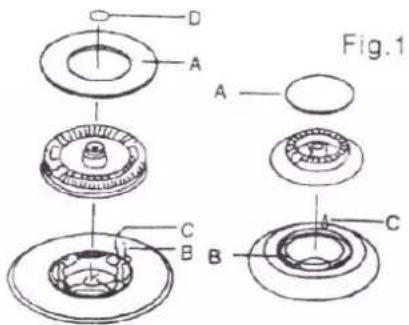
text_image
Fig.1 A D A C B C B CA-Burner cap
B-Lighting plug
C-Thermocouple
D-Triple flame cap
Dual triple flame version
- no gas flow
maximum gas flow from central burner
minimum gas flow from central burner
maximum gas flow from outer and central burners simultaneously
minimum gas flow from outer and central burners simultaneously
Lighting the burners


To obtain a flame more easily, light the burner before placing a cooking utensil on the pan stand.
To light a burner, proceed as follow: for Version with lighting integrated in the control knob push the knob of the burner fully down and turn it anticlockwise to the "maximum flow" setting symbol, or press the button if the appliance has individual lighting.
After lighting the flame, keep the knob pressed for about 10 seconds: this time is necessary to heat up the "thermocouple", (Fig.1-C) and activate the safety valve, which would otherwise cut off the gas flow.

Then check that the flame is even and turn the control knob to adjust the flame as required.
In the instance of a power cut, place a flame near the burner and proceed as already described.
If the flame does not light after a few attempts, check that the "burner cap" and "flame cap" are correctly positioned. To turn off the flame, turn the control knob clockwise to the ● symbol.
Before removing pans from the burners, always lower or turn off the flame.
For correct use of the hob
For lower gas consumption and better efficiency: Use only flat-bottomed pans of dimensions suitable for the burners, as shown in the table on the right. Also, as soon as a liquid comes to the boil take care to turn the flame down to a level that will just keep it boiling.
| Burner | minimum diameter | maximum diameter |
| Large (rapid) | 180mm | 220mm |
| Medium (semi-rapid) | 120mm | 200mm |
| Small (Auxiliary) | 80mm | 160mm |
| Triple Flame | 220mm | 260mm |

During cooking processes involving fats or oils, watch your foods carefully because these substances may catch fire if brought to high temperatures.
Cleaning and maintenance
Before each operation, disconnect the appliance from the electrical mains and allow it to cool down.
General cleaning
Wash enameled parts with lukewarm water and detergent: do not use abrasive products which might damage them.
Wash the flame caps and burner caps often with boiling water and detergent, taking care to remove all deposits.
The hob pan stands can also be washed in a dishwasher.
For stubborn dirt, use ordinary non-abrasive detergents or specific commercial products. We strongly advise you not to use scouring pads, steel wool or acids for cleaning.
Hob
Clean the hob regularly with a soft cloth wet with lukewarm water and a little liquid detergent. Do not use the following products:
- household detergents or bleaches;
- soaped scouring pads not suitable for non-stick utensils;
- steel wool scouring pads;
- stain removers for baths or sinks.
If the hob gets very dirty, use specific commercial products.
Ignition plug
Automatic burner ignition is provided (when installed) by a ceramic “plug” and a metal electrode (B in fig.1). Periodically clean these parts of the hob thoroughly. In addition, to avoid ignition difficulties, check that the cavities in the burner are not obstructed.
To remove deposits from the burner cavities, remove the cap and separate the two parts (see diagram on the right). After cleaning, put the two parts back together and return them correctly to their position. After washing, replace the hob pan stands, checking that they are correctly positioned.

natural_image
Exploded view diagram of a mechanical assembly showing internal components (no text or labels)Routine maintenance
Have the condition and efficiency of the gas pipe and the pressure regulator (if installed) checked periodically. anomalies are found, do not repairs but have the faulty part replaced.
To ensure good performance and safety, the gas regulator taps must be greased periodically.

Periodic lubrication of the taps must only be carried out by qualified personnel, who must also be contacted if the appliance malfunctions.
Service and parts
Before leaving the factory, this appliance was tested and adjusted by specialist skilled staff to give the best operating results. Any subsequent necessary repairs or adjustments must be carried out with the greatest care and attention.
For this reason, we strongly advise you always to contact the Dealer who sold you the appliance or our nearest Service Centre, specifying the nature of the problem, the model of the equipment (Mod.) and the serial number (Ser. No.). These data are provided in the plate on the cover of this manual. Always request the use of original spare parts.
Warranty conditions
You new appliance is covered by a warranty. The warranty conditions are provided in full in the “Warranty conditions-Service centers” leaflet which you will find at the end of this manual. Keep the fiscal receipt or delivery note, either of which documents you obtained with your purchase of the appliance which provides proof of date of purchase, in a safe place together with the manual.
If the After-Sales Service is call in, show these documents to the staff. If this procedure is not followed, the Service-Centre will have no option but to charge for any repairs.
If necessary, you may find your nearest Centre by consulting the "Contact" section on our website.
Technical Data
Dimensions in mm:
Installation opening L x P
- 550 x 470
- 550 × 470
- 750 × 470
| BURNER TYPE | MAX OUTPUT | MIN OUTPUT | G20 20mbar | G30 28-30mbar | G30 50mbar | |||
| Kw Kw | Nozzle Making mm | Cons M^3/h | Nozzle Making mm | Cons g/h | Nozzle Making mm | Cons g/h | ||
| Small Auxiliary burner | 1.00 0.35 | 0.72 | 0.095 | 0.50 73 | 0.43 73 | |||
| Medium Semi-rapid Burner | 1.75 0.65 | 0.97 | 0.167 | 0.65 127 | 0.58 127 | |||
| Large rapid burner | 3.0 | 1.0 | 1.15 | 0.286 | 0.85 | 218 | 0.75 | 218 |
| Triple flame burner | 3.80 | 1.9 | 1.35 | 0.362 | 0.98 | 277 | 0.77 | 277 |
Gas intake connection
G1/2"
Electricity supply
220-240v\~50/60Hz
Instructions for the installation technician

CAUTION: This appliance must only be installed and used in rooms with permanent ventilation to local standards. Installation of the appliance and its connection to the electrical mains must only be carried out by QUALIFIED PERSONEL.
Before any procedure, it is important to check that the appliance is DISCONNECTED from the electrical mains. The Manufacturer declines all responsibility for any damage arising from installation in breach of the regulations in force or from failure to comply with the accident prevention regulations.
Installation premises
For proper operation of a gas appliance, the air necessary for the combustion of the gas must be able to flow into the room naturally. The air must flow into the room directly through openings in the outside walls. These openings must have an unobstructed cross-section not less than 2m^3/h for each kw of power (see total power in kw on the appliance nameplate). This opening must be constructed so that it will not be
obstructed from inside or outside, or constructed close to the floor. The opening is recommended to be on the side opposite to that on which the flue gases are discharged. If it is not feasible to provide these openings in the room where the appliance is installed, the necessary air may be taken from an adjacent room, provided that:
- this room is not a bedroom or a hazardous environment;
• this room has ventilation; - the ventilation between the room where the appliance is installed and the adjacent room has openings.
Discharge of flue gases
Gas cooking appliances must discharge their flue gases through hoods connected directly to flues or the outdoors. If it is not possible to install the hood (fig. B) an electric fan must be installed on the outside wall or the window of the room, provided it is possible for the ventilation opening to be increased in proportion to the delivery rate of the fan (fig. C).
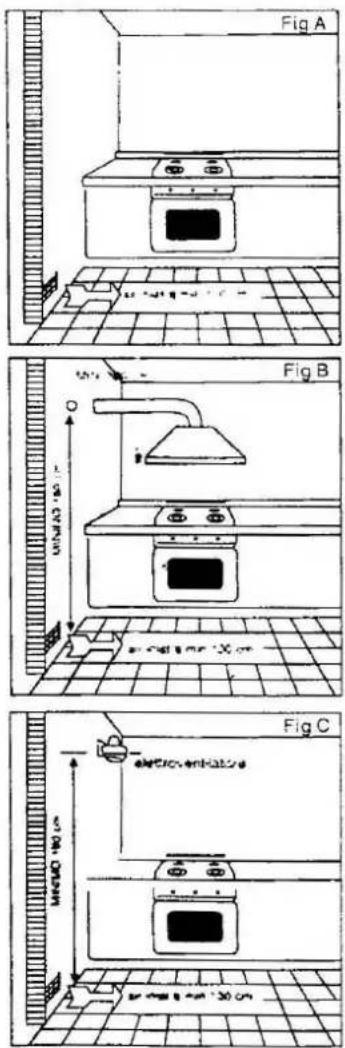
For a kitchen, the delivery rate of this electric fan must guarantee an hourly air exchange of 3-5 times its volume. In both instances, the use of flues already used by other appliances to discharge the flue gases is forbidden.
Connection to the gas supply
The gas Connection must be made in accordance with the local standards. When installing, fit a safety tap at the end of the pipeline. The appliance leaves the factory tested and set for the type of gas indicated on the plate inside the bottom guard, close to the gas connection pipe. Make sure that the type of gas to be supplied to the appliance is the same as that shown on the plate. Otherwise, follow the instructions provided in the "Adapting to different types of gas" section.
For maximum efficiency and minimum consumption, make sure that the gas supply pressure complies with the values shown in the gas used is different from that specified (or variable). A suitable pressure regulator must be installed on the supply pipeline.
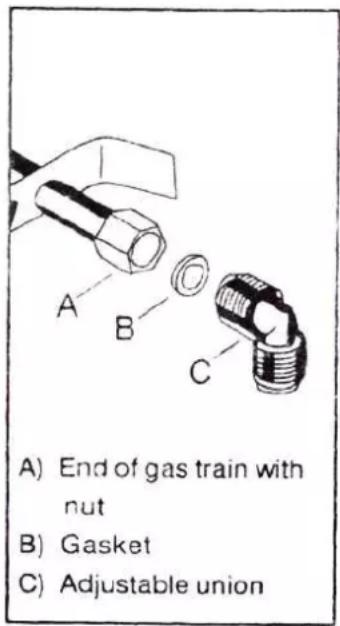
text_image
A) End of gas train with nut B) Gasket C) Adjustable unionThe union must be fitted on the end of the gas train. Complete with GJ1/2" threaded nut, fitting the gasket between the components as shown in the illustration. The gaskets must comply with the local standards. Screw the parts together without forcing, fit the union so that it points in the direction required then tighten all parts.
Connection
Make the connection to the gas system using a rigid metal pipe and regulation unions, or with a stainless steel hose complying with the local standard. If metal hoses are used, take care that they do not come into contact with mobile parts and are not crushed. This must also be checked if the hob is to be combined with an oven.
The gas intake connection of the appliance has a “male thread.” When making the connection, take care not to apply stresses of any kind to the appliance.

When the installation is complete, always check that all the unions are absolutely tight using a soapy solution. Never use a flame to make this check.
Electrical connection
The appliance is profited to operate with a power supply voltage of 230V single-phase. The connection must be made in accordance with the regulations and laws in force. Before making the connection, make sure that:
1) the safety circuit-breaker and the electrical system are able to withstand the load of the appliance (see nameplate).
2) The power supply system has an earth connection in good working order in accordance with the regulations in force;
3) The socket or omni polar switch use are easily accessible with the appliance installed.

text_image
YES COPPER PIPE OR STAINLESS STEEL HOSE BAND CLAMP Service opening in cabinet i : REARVIEW NO REAR VIEWFit a plug suitable for the load on the power lead and connect it to a suitable safety socket. If you wish to make a direct connection to the mains, an omni polar switch with a gap between the contacts of at least 3 mm, of suitable rating for the load and complying with the regulations in force, must be installed between the appliance and the mains. The switch must not break a contact in the yellow/green earth wire.
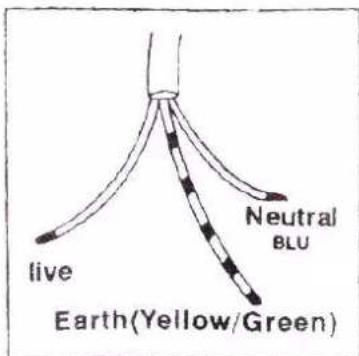
The brown live wire (connected to the “L” terminal of the terminal board) must always be connected to the live wire of the power supply mains. In all cases, the power supply lead must be positioned so that it does not reach a temperature 50oC above the room temperature at any point. One example of an ideal route is shown in the illustration. The cable is guided by means of band clamps fixed to the side of the cabinet, in order to avoid any contact with the appliance underneath the hob.
Replacing the power supply lead
If the lead has to be replaced, only HO5RR-F or HO5RN-F type cables suitable for the load and the operating temperature must be used. In addition, the yellow/green earth wire must be about 2 cm longer than the live and neutral wires.
text_image
Neutral BLU live Earth(Yellow/Green)Adapting to the different types of gas
Changing the nozzles
1) Remove the pan standee.
2) Remove the burner caps and flame caps from the burners.
3) Use a size 7 socket wrench to unscrew and remove the nozzles, replacing them with those corresponding to the type of gas to be used (see the table).
4) Reassemble the parts, reversing the operations described above.
5) Then replace the setting data (close to the mains gas connection) with the one for the new type of gas If the pressure of the gas used is different from that specified(or variable),a suitable piped gas pressure regulator complying with the standard must be installed on the supply pipeline.
natural_image
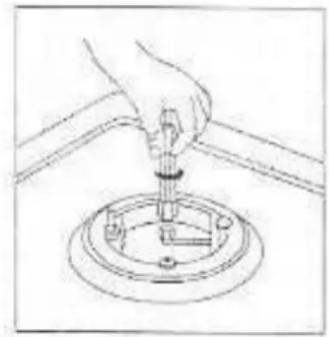
Hand using a tool to lift a circular component (no text or symbols visible)Setting the minimum level
1) Light the burner as already described.
2) Turn the tap to the minimum flame position.
3) Remove the control knobs.
4) LPG TO NG:
Use a thin blade screwdriver to turn the by-pass screw located above left of the gas valve, shaft as shown right.

natural_image
Simple line drawing of a cleaning or painting tool on a tiled floor (no text or symbols)Turn gently the by-pass screw clockwise to the end completely then turn it anti-clockwise 1/2 turn for the Triple flame burner, 3/4 turn for the Large rapid burner, 1/2 turn for the Medium Semi-rapid Burner and 3/8 turn for the Auxiliary burner.
5) NG TO LPG:
Use a thin blade screwdriver to turn the by-pass screw located above left of the gas valve shaft as shown right. Turn gently the by-pass screw clockwise to the end.
Finally, check that the burner does not go out when the tap is turned quickly from the maximum to the minimum position.
Building into fitted kitchen units
These hobs are designed for installation in fitted kitchen units up to 600mm deep with suitable characteristics.
Any cabinet side panels taller than the height of the hob itself must be at least 150mm away from the opening into which the hob is inserted.
The dimensions of the hob and the installation opening are shown in the illustration.

text_image
installation opening 150 550 470 75Insertion and fixing
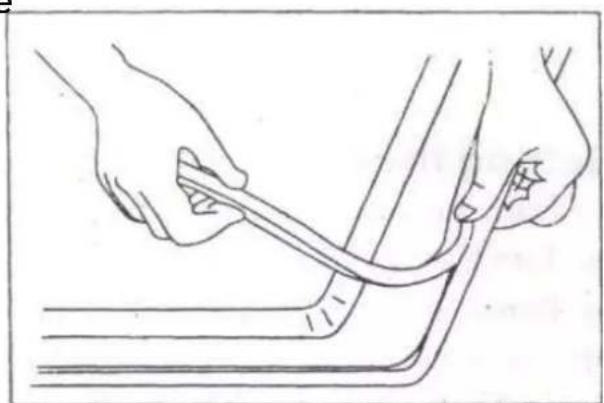
Before inserting the hob in the installation opening, place the special gasket around the bottom edge of the hob.
It is important to fix this gasket evenly, without gaps or overlapping, to prevent liquid from seeping underneath the hob.
1) Remove the pan stands and the burner caps and turn the hob upside down, taking care not to damage the ignition plugs and the thermocouples.
2) Place the gasket around the bottom edge of the hob as shown in the illustration on the right.
3) Place the hob in the installation opening and push it down so that the hob is resting firmly on the cabinet, as show in the illustration. The side springs will hold it in place.
natural_image
Line drawing of hands holding a tool over a curved object, no text or symbols present
text_image
A) gasket aInstallation options
On base cabinet with door
When constructing the cabinet, suitable precautions must be taken to prevent contact with the casing of the hob, which becomes very hot during operation. The recommended method for overcoming this problem is illustrated in fig.1
The panel underneath the hob must be easily removable to allow the hob to be locked in position and released in case of servicing work.

text_image
60 a b 20 min 30 Fig.a Removable panel b Space for connections
On base cabinet with oven
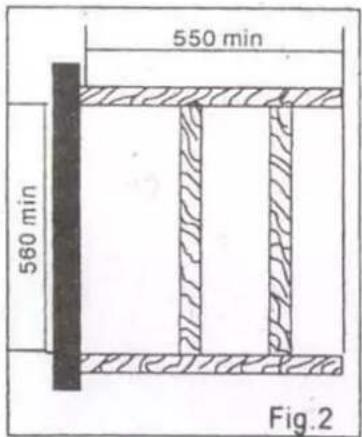
The installation compartment must have the dimensions shown in figures 2 and 3 and must have supports to allow satisfactory ventilation. Two possible methods for avoiding overheating are illustrated in figures 3 and 4. The electrical connections of the hob and oven must be made separately both for electrical reasons and to simplify removal of the oven through the front of the cabinet.
Wall cabinets or extractor hoods must be at least 650 mm above the hob.
text_image
550 min 560 min Fig.2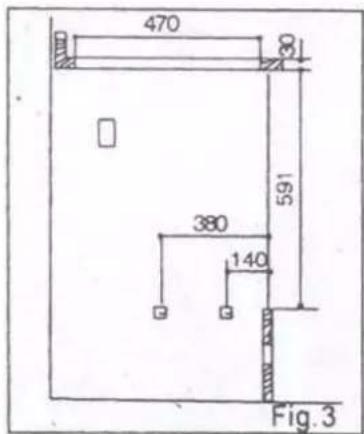
text_image
470 38 591 380 140 Fig. 3
text_image
Fig. 3 50 cm² 360 cm²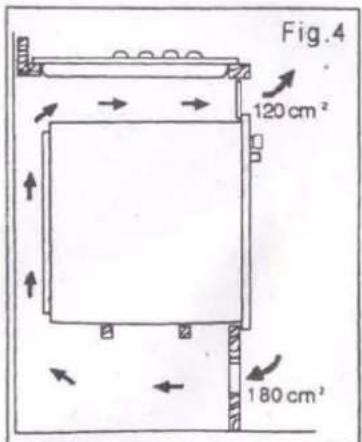
text_image
Fig. 4 120 cm² 180 cm²COMMERCIAL GUARANTEE CONDITIONS FOR WHITE PRODUCTS
This appliance has a two-year repair guarantee, from the date of sale, against all malfunctions originating from manufacturing, including labor and spare parts. To justify the purchase date, it will be mandatory to present the invoice or purchase receipt. This guarantee will only be effective in Spain.
GUARANTEE EXCLUSIONS
- Remote controls, drain intake rubbers, dockings and door seals, weather stripping.
- Damage to enamels, paints, nickel plating, chrome plating, oxidation or other types of aesthetic parts or components that do not affect the internal functioning of the appliance.
- Damage to wear parts due to use, corrosion or oxidation, whether caused by normal use of the appliance or accelerated deterioration due to unfavorable environmental or climatic circumstances. Not suitable for outdoor use.
- Damage to fragile pieces of glass, glass ceramic, plastics, handles, baskets, doors or light bulbs when their failure or breakage is not attributable to a manufacturing defect.
- Faults produced by fortuitous causes or accidents of force majeure, or as a consequence of abnormal, negligent or inappropriate use of the device.
- Civil liabilities of any nature.
- Consequential damage to the appliance as long as it has not been caused by an internal malfunction.
- Maintenance or upkeep of the appliance: periodic reviews, adjustments and greases.
- Faults that accessories and complements, adapters, external cables, bags, spare parts of all kinds, lamps, as well as any part considered consumable by the manufacturer, may suffer.
- Faults caused by incorrect or illegal installation, inadequate ventilation, lack of grounding in the home, power disturbances, inappropriate modifications or use of non-original spare parts.
- Appliances used in industrial applications or for commercial purposes.
-
Appliances with illegible or altered serial number.
-
Defects or breakdowns produced as a result of fixes, repairs, modifications, or disassembly of the installation of the device by the user or by a technician not authorized by the manufacturer, or as a result of manifest non-compliance with the manufacturer's instructions for use and maintenance.
- During the warranty period it is essential to keep all manuals together with the equipment. If the equipment is sold, donated or given away, the manual and all related documents must be given to the new user. If any of these are lost, their replacement cannot be claimed.
- Faults that have their origin or are a direct or indirect consequence of: contact with liquids, chemicals and other substances, as well as conditions derived from the climate or the environment: earthquakes, fires, floods, excessive heat or any other external force, such as insects, rodents and other animals that may have access to the interior of the machine or its connection points.
- Damages derived from terrorism, riot or popular tumult, legal or illegal demonstrations and strikes; facts of actions of the Armed Forces or the State Security Forces in times of peace; armed conflicts and acts of war (declared or not); nuclear reaction or radiation or radioactive contamination; vice or defect of the goods; facts classified by the Government of the Nation as "national catastrophe or calamity".
Design and specifications are subject to change without prior notice for product improvement.

EAS ELECTRIC
SMART TECHNOLOGY
www.easelectric.es
Contenu
MODE D'EMPLOI
natural_image
Symbol of a trash bin crossed with no text or numbers, representing waste sorting or disposal (no text present)natural_image
Exploded view diagram of a mechanical assembly showing internal components (no text or labels)Entretien courant
text_image
Fig A Fig B Fig Ctext_image
COPPER PIPE OR STAINLESS STEEL HOSE YES BAND CLAMP Service opening in cabinet REAR VIEW NO REAR VIEWtext_image
live Neutral BLU Earth(Yellow/Green)natural_image
Line drawing of a hand using a tool to press or install a circular component (no text or symbols)natural_image
Simple line drawing of a mechanical component with no visible text or symbolstext_image
installation opening 150 550 470 75natural_image
Line drawing of hands holding a tool over a curved object, no text or symbols present
text_image
A) gasket aa Removable panel b Space for connections
EXCLUSIONS DE LA GARANTIE
natural_image
Symbol of a trash bin crossed with no text or numbers, representing waste sorting or disposal (no text present)natural_image
Exploded view diagram of a mechanical assembly showing internal components (no text or labels)text_image
Fig A Fig B Fig C MAGNO NO. 10 30 cmtext_image
YES COPPER PIPE OR STAINLESS STEEL HOSE BAND CLAMP Service opening in cabinet i : REAR VIEW NO REAR VIEWtext_image
Neutral BLU live Earth(Yellow/Green)natural_image
Hand using a tool to press or install a mechanical component on a circular base (no text or symbols visible)natural_image
Line drawing of a mechanical component with a central shaft and base, no text or symbols present5) Gás natural a gás butano/propano
text_image
Installation opening 150 550 470 75Inserção e fixação
natural_image
Line drawing of hands holding a curved object, possibly a tool or device, with no visible text or symbols.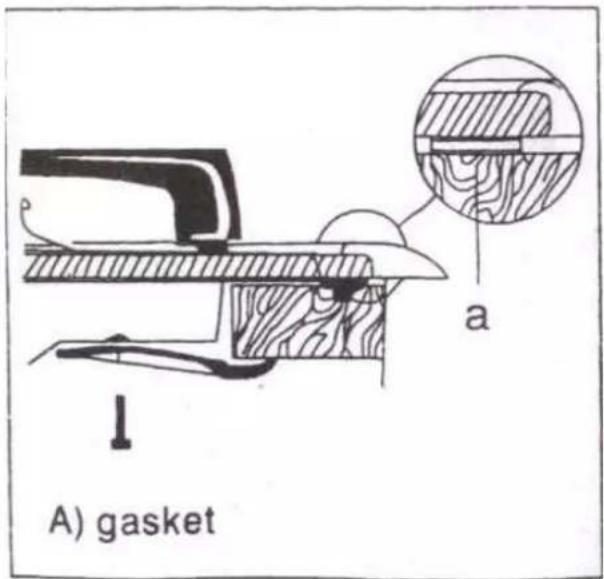
text_image
A) gasket aa Removable panel b Space for connections