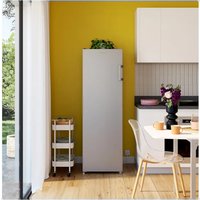
SCA206NFS - Freezer SIGNATURE - Free user manual and instructions
Find the device manual for free SCA206NFS SIGNATURE in PDF.


Pick your language and provide your email: we'll send you a specifically translated version.
| Product type | Upright freezer |
| Brand | SIGNATURE |
| Model | SCA206NFS |
| Dimensions (H x W x D) | 1700 x 540 x 590 mm |
| Total volume | 206 L |
| Energy efficiency class | E |
| Annual energy consumption | 223 kWh/year |
| Noise emissions | 43 dB(A) - Class D |
| Climate class | SN / N / ST / T (10°C to 43°C) |
| Rated voltage | 220-240 V ~ 50 Hz |
| Rated current | 1.0 A |
| Refrigerant | R600a (50 g) |
| Freezing capacity | 9.3 kg/24 h |
| Super freeze function | Yes, manual activation, automatic stop after 26 h |
| Defrost | Automatic (No Frost) |
| Door reversal | Yes, reversible |
| Open door alarm | Yes, after 3 minutes |
| Number of drawers | Several drawers (according to illustration) |
| Adjustable feet | Yes, at the front |
| Recommended cleaning | Warm water and mild detergent |
| Availability of spare parts | 10 years |
| Legal warranty of conformity | 2 years |
Frequently Asked Questions - SCA206NFS SIGNATURE
How to adjust the temperature of the freezer SCA206NFS?
Use the SET button on the control panel to scroll through the temperatures: -16°C, -18°C, -20°C, -22°C, -24°C. The recommended storage temperature is -18°C.
What to do if the audible alarm goes off?
The open door alarm sounds if the door remains open for more than 3 minutes. Close the door or press any button to deactivate it. If it persists, check that the door is properly closed.
How to use the super freeze function?
Press the SET button until the Fast Freeze indicator lights up. The appliance operates continuously to quickly freeze large quantities of fresh food. The function automatically stops after 26 hours.
Is the freezer defrosted automatically?
Yes, the freezer compartment is equipped with No Frost function. Defrosting is automatic, but you can also activate it manually by holding the SET button for about 15 seconds.
What is the maximum freezing capacity per 24 hours?
The freezing capacity is 9.3 kg per 24 hours. Do not exceed this amount to ensure quick and even freezing.
Can I reverse the door opening direction?
Yes, the door is reversible. Follow the steps described in the manual: remove the upper and lower hinges, move the stoppers and bushings, then reassemble everything on the opposite side.
How to clean the interior of the freezer?
Unplug the appliance, remove the food and drawers. Wash the surfaces with a damp cloth and mild detergent, then dry thoroughly. Never use abrasive products or solvents.
What do the error codes on the panel mean?
If the alarm symbol and a temperature flash, this indicates a failure. Contact an authorized after-sales service. Do not attempt to repair yourself.
What are the important safety precautions?
Do not use mechanical devices to speed up defrosting, do not damage the refrigeration circuit, do not store explosive substances, and keep ventilation openings clear.
How to save energy with this freezer?
Install the appliance in a cool, well-ventilated place, away from heat sources. Set the temperature to -18°C, avoid opening the door too often, let hot food cool before placing it, and defrost regularly.
User questions about SCA206NFS SIGNATURE
0 question about this device. Answer the ones you know or ask your own.
Ask a new question about this device
No questions yet. Be the first to ask one.
Download the instructions for your Freezer in PDF format for free! Find your manual SCA206NFS - SIGNATURE and take your electronic device back in hand. On this page are published all the documents necessary for the use of your device. SCA206NFS by SIGNATURE.
USER MANUAL SCA206NFS SIGNATURE
SIGN
CONGÉLATEUR Armoire
SCA206NFSE
TABLE DES MATIERES
Consignes de sécurité importantes
-]
-8-Description
- 9 - Installation e
-14-Deballage
-15 -Command
- 16 -Utilisation e
- 18 -Comment
Nettoyage et conservation - 19 -
- 20 -Conseils er
Inversion de porte
-21-
-23 -Spectificat
-26 -Dépannage


Séparez les éléments avant de trier

CET APPAREIL EST DESTINE A UN USAGE DOMESTIQUE UNIQUEMENT!
Veuillez dire attentivement toutes les instructions avant la première utilisation et conservez-les pour une referencia ultérieure.
CONSIGNES DE SECURITE IMPORTANTES
Cet averissement ne s'applique qu'au marché EUROPEEN!
Lorsque vous utilisez un apparéil électrique, les précautions de sécurité de base doivent toujours être respectées, y compris ce qui suit:
1. Cét apparéil peut être utilisé par des enfants âgés d'au moins 8 ans et par des personnes ayant des capacités physiques, sensorielles ou mentales réduites ou dénuées d'expérience ou de connaissance, s'illes (si elles) sont correctement surveillée(e)s ou si des instructions relatives à l'utilisation de l' apparéil en toute sécurité leur ont été données et si les risques encourus ont été appréhendés. Les enfants ne doivent pas jouer avec l' apparéil. Le nettoyage et l'entretien par l'usager ne doivent pas être effectués par des enfants sans surveillance.
2. Les enfants âgés de 3 à 8 ans sont autorisés à charger et décharger les appareils de réfrigération.
3. Si le cable d'alimentation est endommagé, il doit être remplace par le fabricant, son service après vente ou des personnes de qualification similaire afin d'éviter un danger.
4. AVENTISSEMENT: Maintenir dégagées les ouvertures de ventilation dans l'enceinte de l'appareil ou dans la structure d'encastrement.
5. AVENTISSEMENT: Ne pas utiliser de dispositifs mécaniques ou autres moyens pour accélérer le processus de dégivrage autres que ceux recommendés par le fabricant.
6. AVERTISSEMENT: Ne pas endommager le circuit de réfrigération.
7. AVERTISSEMENT: Ne pas utiliser d'appareils électriques à l'intérieur du compartment de stockage des denrées, à moins qu'ils ne soient du type recommandé par le fabricant.
8. Ne pas stocker dans cet appeareil des substances explosives telles que des aerosols contenant des gaz propulseurs inflammables.
9. Cet apparéil est destiné à être utilisé dans des applications domestiques et similaires telles que:
- Les coins cuisines réservés au personnel des magasins, bureaux et autres environnementis professionnels;
- Les fermes et l'utilisation par les clients des hotels, motelels et autres environnementés à caractère résidentiel;
- Les environnements de type chambres d'hôtes;
- La restauration et autres applications similaires hormis la vente au détail.
10. Placer l'appareil contre un mur avec une distance n'excédant pas 75 mm et plus de 50 mm.
11. AVERTISSEMENT: Lors du positionnement de l'appareil, s'assurer que le cordon d'alimentation n'est pas coincide ni endommagé.
12. AVERTISSEMENT: Ne pas placer des prises de courant mobiles et multiples ni de blocs d'alimentations électriques portables à l'arrête de l'appareil.
13. Pour éviter la contamination des aliments, veuillez respecter les instructions suivantes:
- L'ouverture prolongée de la porte peut entrainer une augmentation importante de la température dans les compartiments de l'appareil.
- Nettoyez régulièrement les surfaces pouvant entraient en contact avec des alimentents et les systèmes de vidange accessibles.
- Conservez la viande et le poisson crus dans des recipients appropriés au réfrigérateur, de manière à ce qu'ils ne soient pas mis en contact avec d'autres alimentés ni ne s'égouttent dessus.
- Les compartments pour alimentés surgelés à deux étoiles convennent au stockage des alimentés précongeles, au stockage ou à la fabrication de crème glacée et à la fabrication de glaçons.
- Les compartments à une, deux et trois étoiles ne convennent pas pour la congélation d'aliments frais.
- Si l'appareil de réfrigération reste vide pendant delongues périodes, éteignez, décongelez, nettoyez, séchez et laissez la porte ouverte pour éviter la
formation de moisissure dans l'appareil.
14. Débranchez l'appareil de la prise de courant lors de non-utilisation, avant d'instructor ou de démonter les pieces, avant tout nettoyage.
15. Veillez à bien insérer la fiche dans la prise de courant lorsque vous branchez l'appareil.
16. Insérez la fiche dans la prise unique ayant une mise à la terre.
17. N'utilisez jamais l'appareil dans un endroit où des matières combustibles et inflammables sont conservées.
18. Pour les raisons de sécurité, assurez-vous de réparer ou remplaçer les pieces dans un agent de service/agréé.
19. Le moteur doit être lubrifié en permanence et ne nécessite aucun huile.
20. L'appareil doit être place de façon à ce que la prise de courant soit facilement accessible.
21. Rétérez-vous à la reglementation locale concernant l'élimination de l'appareil, car il contient du gaz inflammable. Avant de jeter votre apparéil usé, assurez-vous de retarder les portes pour éviter que les enfants ne soient coincés.
22. Assurez-vous que l'appareil soit débranché avant de le nettoyer.
23. Pour nettoyer cet apparéil, utilisez un chiffon humide ou bien un produit de nettoyage pour les vitres. N'employez jamais de détermagent abrasif ou de dissolvant.
24. Il est recommendé de ne pas utiliser ce congélateur avec une rallonge électrique. Assurez-vous que la fiche du cordon d'alimentation soit insérée directement dans la prise de courant.
25. Ne pas placer de boisson ou plat chaud dans l'appareil.
26. Refermez la porte après utilisation afin d'éviter l'augmentation importante de température.
27. Ne pas placer l'appareil à proximé d'une source de chaleur ou directement à la lumière du soleil.
28. L'appareil doit être place sur une surface plane et stable.
29. Ne pas poser d'objet lourd sur le réfrigérateur et ne pas le mouiller.
30. Pour éviter tout risque d'électrocution, n'utilisez jamais cet apparéil avec les mains humides, en vous tenant sur une surface humide ou dans l'eau.
31. Cet apparéil ne doit pas être utilisé à l'extérieur et ne doit pas être exposé à la pluie.
32. Ne jamais tirer sur le cable d'alimentation pour débrancher l'appareil. Saisissez la fiche et tirez-la de la prise de courant.
33. Gardez le cable d'alimentation éloigné des surfaces chauffées.
34. Avant de brancher l'appareil, assurez-vous que la tension de la prise secteur à votre domicile correspond à cette montré sur la plaque signalétique de l'appareil.
35. Branchez votre congélateur dans une prise de courant indépendante et utilisez un fil de terre pour assurer la sécurité.
36. Quand le congélateur cesse d'être utilisé netto-yez l'appareil.
pour empêcher la propagation d'odeur.
37. Il convient de surveiller les enfants pour s'assurer qu'ils ne jouent pas avec l'ordinateil.
38. Les apparèils ne sont pas destinés à être mis en fonctionnement au moyen d'une minutes extérieure
ou par un système de commande à distance séparé.
39. L'appareil est équipe d'une prise de terre pour vous protégger d'eventuels risques electriques et doit être branché sur un socle de prise de courant compteant un contact de terre.
40. Il est recommendé d'examiner régulièrement le cable d'alimentation pour déceler tout signe de détérioration eventuelle, et l'appareil ne doit pas être utilisé si le cable est endommagé.
41. En ce qui concerne les informations pour l'installation, la manipulation, l'entretien et la mise au rebut de l'appareil, reférez-vous au paragraph «TRANSPORT ET MISE EN ROUTE» «INSTALLATION» «ENTRETIEN ET MAINTENANCE» «DEPANNAGE» de la notice.
42. Référez - vous à la réglementation locale concernant l'élimination de l'appareil, car il contient du gaz inflammable. Avant de jeter votre apparéil use, assurez - vous de retarder les portes pour éviter que les enfants ne soient coincés.

43. A VERTISSEMENT! Risqued'incendie/matières inflammables.Maintenir votre apparéil éloigné de toutesource de flamme durant l'installation, l'entretien et l'utilisation.
44. Si le circuit de réfrigération est endommagé : - Eviter les flammes nues ou étincelles d'allumage. - Bien ventiler la pierce où l'appareil est installé.
45. Si vous souhaitez vous débarrasser d'un vieux conge lateur ou d'un vieux réfrigérateur importante une serrure sur la porte, veillez à ce que celle-ci soit
désactivée afin d'éviter que des enfants ne risquent de se retrouver enfermés à l'intérieur en jouant.
46. Débranchez toujours l'appareil après usage et avant de le nettoyer. Enlevez tous les aliments avant de nettoyer l'appareil.
47. Évitez demettre des alimentés trop volumineux,le fonctionnement de l'appareil risquerait d'être affecté.
48. Faites extrémement attention quand vous déplacez l'ordinateil.
49. Évitez de donner aux enfants des crèmes glacées ou des glaces à l'eau sorting juste du congélateur; la base température risquerait de leur brûler les levres.

1. Panneau de contrôle
2. Cadre en verre du congélateur
3. Tiroirs du congélateur
4. Pieds de mise à niveau
5. Porte - bouteille
Remarque: Les étagères en verre et le bac à légumes peuvent être retirees et insérés pour le nettoyage et le stockage des aliments en fonction de l'appareil.
Cet produit de réfrigération n'est pas destiné à être utilisé comme un produit intégrable
Installation avant la première mise en marche
- Déballez l'appareil, enlevez les bandes adhéses protégant les portes et l'équipment (4). Les événuels restes du col peuvent être enlever avec un détergent délicat.
Garder les éléments en mousse de polystyrene. Au cas de nécessite du retransport du refrigerateur/congelateur, emballez-le de la mousse de polystyrene et du film ainsi que protégez-le avec la bande adhésive.
- Lavez l'intérieur du réfrigérateur et du congélateur ainsi que les autres éléments de l'équipment avec de l'eau tiède avec du produit lave vaisselle et ensuite essuyez et séchez.
- Placez votre réfrigérateur/congélateur à niveau et en position stable à un sol solide, dans une piece sèche, régulièrement aérée et non en-soleillée loin des sources de chaleur comme la cusinière, le radiateur du chauffage central, le tuyau du chauffage central, l'installation de l'eau chaude, etc.
Le film de protection qui peut recouvrir l'appareil le doit être retire.
- Placez l'appareil à niveau en visant 2 pieds réglables à l'avant.


- Afin d'assurer une ouverture facile de la porte, la distance entre la paroi latérale de l'appareil (du côte des charnières) et la paroi de la pierce est illustrée sur la.
W D H A B C(°) E F H A B C(°) E F 540 59 1700 890 109600125 50 890 1098 125 50 100


Assurez une ventilation convenable de la pierce ainsi que la libre circulation de l'air de tous les cots de l'appareil.

Les distances minimums des sources de chauffage
des cuisinières electriques, à gaz et autres - 30 mm,
des poêles à fuel ou à charbon - 300 mm,
des fours de cuisine encastrables - 50 mm
S'il n'est pas possible de respecter les distances ci-dessus mentionnées, utilisez une plaque d'isoation.
Attention:
La paroi arrriere du réfrigerateur et sur tout le réfrigérant et les autres éléments du circuit frigorifique ne peuvent pas rester en contact avec les autres éléments qui peuvent cause des endommagement et sur-tout (avec le tuyau du chauffage central et la tube d'amnée d'eau).
Il est interdit de manipuler d'une façon quelconque des pieces d'agre - gat. Prenez les mesures de ne pas endommager la tube capillaire vis - sible dans la cavite pour le compresseur. Cette tube ne peut pas etre fléchie, redressée ni enroulée.
- L'endommagement de la tube capillaire par l'utilisateur le prive du droit de garantie.

- Pour certains modèles au besoin, la poignée non fixée doit être récuperée à l'intérieur de l'armoire, puis vissee sur la porte avec son propre tournevis.
Raccordement au réseau électrique
- L'appareil doit être branché au réseau du courant alternative 220 - 240V, 50Hz au moyen d'une prise murale correctement installée, mise à la terre et protégée par un coupe-circuit de 10 A.
- La mise à la terre de l'appareil est recommandée par la loi. Le fabricant renonce à une responsabilité quelconque à titre des endommage -ments éventuels qui peuvent subir les personnes ou les objets suite à ne pas replir cette obligation imposée par cette règle.
- I ne faut pas utiliser de raccords adaptatifs, de prises multiples (ré-partiteurs), de rallonges deux fils. S'il y a la nécessité d'utiliser un rallonge, il est permitted d'utiliser qu'un rallonge avec un rouleau de sécurité, à prise unique ayant une attestation de sécurité VDE/GS.
- Au cas d'utilisation d'un rallonge (avec le rouleau de sécurité, ayant le signe de sécurité), sa prise doit être place à une distance sure des éviers et ne peut pas être exposée à être submerger de l'eau ainsi que des autres écouts.
- AVERTISSEMENT: Ne pas placer de socles mobiles de prises multiples ni de blocs d'alimentation portables à l'arrête de l'appareil
- AVERTISSEMENT: Lors du positionnement de l'appareil, s'assurer que le cordon d'alimentation n'est pas coincide ni endommagé.
- Les données se trouve sur la plaque signalétique place en bas de la paroi à l'intérieur du compartment réfrigerateur**.
Mise hors circuit
Il faut assurer la possibilité de débrancher l'appareil par le retrait de la fche ou par l'éteint de l'interrupteur bipolaires.

Classe climatique
L'information sur la classe climatique de l'appareil se trouve sur la plaque signalétique. Il indique la température ambiente (c'est-à-dire de
la piece dans laquelle il fonctionne) du fonctionnement optimal (cor-rect) de l'appareil.
Classe climatique
Température ambiente admissible
SN tempérée élargie l'appareil réfrigérant est destiné à une utilisation à une plage de températures comprise entre 10 °C et 32 °C N tempérée l'appareil réfrigérant est destiné à une utilisation à une plage de températures comprise entre 16 °C et 32 °C ST subtropicale l'appareil réfrigérant est destiné à une utilisation à une plage de températures comprise entre 16 °C et 38 °C T tropicale l'appareil réfrigérant est destiné à une utilisation à une plage de températures comprise entre 16 °C et 43 °C

Pour son transport, l'appareil a eté emballé afin de le protégger contre les endommagements. Avec déballage de l'appareil, prière d'éliminer les éléments de l'emballage d'une façon non nuisible à l'environnement.
Tous les matériaux utilisés pour l'emballage sont inoffensifs pour l'environn-
ement et recyclables à 100% (ils sont marqués par un symbole approprié)
Attention! Lors du déballage, garder les matériaux d'emballage (petits sacs polyethylene, morceaux de polystyrene, etc.) hors de portée des enfants.
Commande de l'appareil
Le panneau de commande est presenté sur le dessin 7, pour rappel, il est presenté également ci-dessous:
Frost


Réglage de la température à l'intérieur de l'appareil
Le panneau de commande se trouve à l'intérieur de l'appareil sur la paroi supérieure du compartment. Il permet deCHOISIR LA TEMPERATURE selon la sequence suivante: -16ircC - > - 18ircC - > - 20ircC - > - 22ircC - > - 24ircC ou d'activer la fonction de congélation rapide (Fast Freeze). La modification du réglage se fait par la pression sur la touche SET.
Fonction de super Congélation: Utiliser cette fonction avant le replissage des compartiments du congélateur avec une grande quantité d'alments. L'appareil fonctionnera en continu pour congefer rapidement les aliments. Lorsque cette fonction est active, l'indicateur de cette fonction s'allume. Cette fonction se désactive automatiquement après 26h.
Alarme porte ouverte : Sil's appeareil est ouvert pendant plus de 3 minutes, un signal sonore est émis. Fermer la porte ou appuyer sur quelconque touche afin d'eteindre l'alerte. Dans le second cas l'alerte s'enclenchera de nouveau après 3 minutes.
Codes d'erreur: Si le symbole de l'alarme et l'une des températures sur ler panneau clignotent, ceci signifie une défaillance de l'appareil. Contacter un service agréé.
Dégivrage : L'appareil dispose d'une fonction de dégivrage automatique. Pour activer la fonction de dégivrage automatique, appuyer sur et maintainir pressée la touche SET pendant environ 15 secondes. Toutes les diodes sur le panneau s'allument, le compresseur s'arrête et l'élement chauffant se met en marche. Pour annuler la fonction, appuyer sur la touche SET et la maintainir pressée pendant 3 secondes, ou attendre la fin du programme, En cas de désactivation manuelle de la fonction de dégivrage, attendre 10 minutes avant de l'activer de nouveau.
Congélation des produits
- Il est permitted deCongeler pratiquement tous les produits alimentaires à l'exection des légumes consommés crus comme par ex. la salute verte.
- Pour une meilleure congélation, il est recommandé d'utiliser des produits extra frais et de les congeler en petite portion.
- Il convient d'emballer les produits dans des matériaux sans odeur, résistant à la pénétration de l'air et d'humidité ainsi qu'in sensibles aux matières grasses. Les emballages les plus appropriés sont: les sachets, les feuilles du film en polyéthylène, du film aluminium.
- L'emballage doit être hémetique et bien adhééré aux produits congélés. Les emballages en verre sont deconseillés.
- Les produits alimentaires frais (à température ambiente), mis dans le but d'être congélés ne doivent pas rester en contact avec les produits déjà congélés aparavant.
- Il est déconseilé de mettre dans le congélateur, en une fois par 24 heures, plus de nourriture fraîche que mentionné dans le tableau de Specification technique de l'appareil.
- Afin de garder une bonne qualité des produits congélés, il est conseilé de regrouper les produits congélés dans la partie centrale du congélateur de telle façon qu'ils ne restent pas en contact avec des produits encore non congélés.
- Nous conseillons de déplacer les portions congélées vers un côté du compartment congestionelateur etmettre les portions fraîches à congeler du côté opposé en les poussant au maximum vers la paroi arrêté laterale.
Pour congeler les produits, utiliser un congélateur marqué \*\*\*.
- I'll fault se rapeller que la température du组成部分 réfrigérateur est influencée entre autres par: la température ambiente, le niveau. de chargement des denrées, la fréquence d'ouverture de la porte, le niveau de givrage, la mise au point de thermostat.
- Si une difficulté d'ouvrir la porte du compariment réfrigérateur se présente tout juste après sa fermeture, nous vous conseillons d'attendre 1 à 2 minutes jusqu'à ce que la dépression qui s'y est formée soit compensée.
Le temps de conservation des produits congélés dépend de leur qualité à l'état frais avant congestion ainsi que de la température de conservation. En conservant la température inférieure ou égale à -18°C les périodes de conservation suivantes sont conseillées:
Produits Mois
Boeuf 6-8 Veau 3-6 Abats 1-2 Porc 3-6 Volaille 6-8 Poissons 3-6
Le département de refroidissement rapide ne sert pas à l'entreposage de nourriture surgelée. Il est possible de produit et d'entreposer un uniquement des glaçons dans ce département.
Attention : Si l'appareil ne possède pas de compartmentement * * * , ceci signifie que l'appareil réfrigerant n'est pas adapté aux besoin de condégulation des produits alimentaires.
Conseils pratiques
- Ne pas placer le congealateur pres des radiateurs, des jours ou risquer une influence directe des rayons du soleil.
- S'assurer que les cavités du condenseur à l'arrière ne sont pas obstruées. Les nettoyer et depoussierer une ou deux fois par an.
- Choisir une température appropriée: une température de -18ircC dans le congélateur est sufsante
- Il ne faut ouvoir la porte du réfrigerateur ou du congelateur qu'en cas de nécessité. Il est bon à savoir qu'elle nourriture est conservée dans le réfrigerateur ainsi que savoir précisé où elle se trouve. Il faut remettre le plus vite possible les produits non-utilisés dans le réfrigerateur ou dans le congelateur avant qu'elle ne se rechauffe.
- Nettoyez régulièrement l'intérieur du réfrigérateur à l'aide d'un tissu imbibe d'un détergent doux.
- Maintenez propre le joint autour de la porte, autrement la portes risque de ne pas se fermer complètement. Il faut toujours replacer les joints endommages.
Que veulent dire les étoiles?

Une température d'au moins -6ircC suffit pour stocker les alimentés surgelés pendant environ 2-3 jours. On rencontres le plus souvent des tiroirs ou compartments ayant le symbole de l'étoile dans les réfrigerateurs bon marché.

On peut stocker les aliments dans une température de -12ircC pendant 1 mois sans risquer qu'ils perdent leur goût. Cette température n'est pas suffisante pour congelever les aliments.

Permet de stocker des aliments déjà congeles pendant 1 an maximum; mais ne permet PAS de congelever des aliments frais.

Cet apparéil convient à stocker des aliments dans une température en-dessous de -18ircC et de congeler de plus grandes quantités d'aliments.
Pour le nettoyage du chassis et des pieces en plastique ne jamais utilisier de solvants ni de produits de nettoyage agressifs et abrasifs (par exemple des poudres ou des crèmes de nettoyage)! Utiliser uniquement des produits de nettoyage liquides délicats et des torchons doux. Ne pas utiliser le côté abrasive des éponges.
Dégivrage automatique du congélateur
Le compartment congestioneur est équipé de la fonction de dégivrage automatique (no-frost). Les denrées alimentaires sont congestés par un système de réfrigeration par circulation d'air et l'humidité du compartment congestioneur evacuée à l'extérieur. En conséquence dans le congestioneur ne se forme pas un superflu de dépôt de givre et les produits ne se collent pas entre eux.
Lavage à main du组成部分 congélateur
Il est recommandé de laver au moins une fois par an le compartmenting concélateur. Cette opération empêche la formation des bacteriés et des odeurs désagréables. Il convient demettre hors circuit l'appareil entier par la touche (1), sortir des compartments les produits et laver à l'eau tiède et au détergent délicat. Essuyer les compartments avec un chiffon.
Dansaucuncasiln'estpaspermisdeplacera l'intérieur ducongélateur unaccumulateureélectrique dechaleur,de soufflage,niunseche-che-veux.
CONSEILS EN MATIÈRE D'ÉCONOMIE D'ENERGIE
Installez le réfrigérateur ou le congélateur dans un endroit frais à l'abri des rayons directs du soleil et en le tenant éloigné de toute cuisine, radiateur, lave-vaisselle ou tout apparéil émettant de l'air chaud.
Ne réglez pas le réfrigérateur ou le congélateur sur des températures inférieures à celles recommandées.
Réglez la température sur une fourchette appropriée, par exemple réglez le thermostat sur la position du milieu pour une température de 4ircC dans le réfrigérateur et de -18ircC dans le congélateur.
Laissez refroidir les plats deja cuits avant de lesmettre au réfrigérateur ou au congélateur. Cela évitera de faire augmenter la température interne du réfrigérateur.
Faites en sorte que votre réfrigérateur soit toujours plein mais pas trop afin de réduire la perte d'air «froid». Ne replissez pas trop le réfrigérateur ou le congélateur. Dans la mesure du possible, prévoyez environ 20% d'espace libre pour la circulation de l'air Pour empêcher l'air froid de s'évacuer, limitez la fréquence d'ouverture de la porte. Lorsque vous rentrez de courses, mettez les alimentés à conserver au réfrigérateur à part avant d'ouvrir la porte. N'ouvrez la porte que pourmettre ou prendres des alimentés Veillez à ce que le joint de la porte soit propre et en bon état.
Une feuille de papier doit pouvoir être maintainue entre le réfrigérateur et la porte une fois celle-ci fermée.
Dégivrez le congélateur régulièrement ou lorsque la glace fait plus de 5 mm d'épaisseur. L'accumulation de glace sur les parois internes.
LNVERSION DE PORTE
1. Assurez-vous que le réfrigérateur est débranché.
2. Retirez le couvercle de la charnière, dévissez les trois vis qui fixent la charnière supérieure à la porte, puis retirez la charnière.

3. Retirez la porte du组成部分 congélateur de l'appareil.
4. Dévissez les vis qui fixent la charnière inférieure au côte droit de l'appareil, puis retirez la charnière.

5. Retirez la rondelle et l'écrou qui fixent l'axe de la goupille au trou de droite sur la charnière inférieure, puis retirez l'axe.

6. Insérer l'axe de goupille au trou de gauche sur la charnière inférieure, puis fixez l'axe avec la rondelle et l'écrou.

7. Installé la charnière inférieure sur le côte gauche de l'appareil .
8. Retirez la vis qui fixe la butée de porte en bas à droite de la porte du组成部分 congélate ur,puis retirez la butée de porte et installez-la sur le côte inférieur

9. Installer la porte du组成部分.congelateur.
10. Déplacez la douille du côté supérieur droit de la porte du congelatueur vers le côté supérieur gauche de la porte.
Et déplacez le couvercle du trou gauche sur le côté droit.

11. Retirez le couvercle du trou du côte supérieur gauche et fixez le couvercle sur le côte supérieur droit de l'appareil.

12. Fixez la churnière supérieure sur le côte supérieur gauche de l'appareil avec les trois vis que vous avez retirees precedemment. Avant de serrer les vis de la churnière supérieure, assurez-vous que le haut de la porte est au niveau de l'appareil et que le joint en caoutchouc fait une bonne étanchéité.
13. Installes le couvercle de charnière sur le côte supérieur gauche de l'appareil.

14. Retirer le bouchon gauche, dévisser les boulons et retarder le bouchon
droit.

15. Installes le bouchon de trou droit sur le côté gauche de la porte et la poignée sur le côté droit de la porte.

Remarque: assurez-vous que les joints en caoutchouc forment une bonne étanchéité avec l'appareil tout autour des portes avant de serrer les vis des charnières.
SPECIFICATIONS TECHNIQUES
Fiche d'informa tion produit Nom du fournisseur ou marque commerciale: SIGNATURE Adresse du fournisseur: BUT INTERNATIONAL, 1 AVENUE SPINOZA 77184 EMERAINVILLE, FRANCE Référence du modele: SCA206NFSE Type d'appareil de réfrigération: Appareil à faible niveau de bruit: à pose lib renon Type de construc tion: Appareil de stockage du vin: oui non Autre apparile de réfrigération: Paramètres généraux du produit: Paramètre Valeur Paramètre Valeur Dimensions hors tout(millimètres) Hauteur 1700 Volume total (dm3ou l) 206 Largeur 540 Profondeur 590 IEE 100 Classe d'éfficacité énergé que E Émissions de bruit acoustique dans l'air[dB(A) re 1 pW] 43 Classe d'émission de bruitacousque dans l'air D Consommation d'énergie annuelle (kWh/an) 223 Classe climatique: tempéré étendu/temperée/subtropicale/tropical Température ambiente minimale (°C) à laquellel'appareil de réfrigeration est adapté 10 Température ambiente maximale(°C)a laquelle l'appareil deréfrigération est ajusté 43 Réglage hiver non Paramètres des compartiments: Type de compar émit Paramètres et valeurs de compar timent Volume du compar éntent(dm3oul) Réglage de températurerecommendé pour un stockageoptés dénéesdenrées alimentaires (°C) Ces réglages ne doivent pasétre en contradiction avec lesconditions de stockage prévuesà l'annexe IV, tableau 3 Pouvoir degénélation spécifique(kg/24 h) Mode de dégivrage(dégiv rage auto m atique = A,dégivrage manuel = M) Garde-manger non - - - - Stockage du vin non - - - - Cave non - - - - Denrées-alimentairesfraîches non - - - - Type de compartment Paramètres et valeurs de compartment Volume du compartment (dm3 ou l) Réglage de température recommendé pour un stockage optimisé des denrées alimentaires (°C) Ces réglages ne doivent pas être en contradiction avec les conditions de stockage prévues à l'annexe IV, tableau 3 Pouvoir de congélation spécifique (kg/24 h) Mode de dégivrage (dégivrage automatique = A, dégivrage manuel = M) Denrées hautement périssables non - - - - Sans étoile ou fabrication de glace non - - - - 1 étoile non - - - - 2 étoiles non - - - - 3 étoiles non - - - - 4 étoiles oui 206 -18 9.3 A Zone 2 étoiles non - - - - Compartiment à température variable non - - - - Compartments « quatre étoiles » Dispositif de congélation rapide Oui Paramètres de la source lumineuse: Type de source lumineuse N/A Classe d'efficacité énergétique N/A Durée minimale de la garantie offerte par le fabricant: 2 ans Informations supplémentaires: N/A Lien internet vers le site web du fabricant où se trouvent les informations visées au point 4 a) de l'annexe du règlement (UE) 2019/2019 de la Commission: www.but.fr
Référence: SCA206NFSE Tension nominale: 220-240V~ Courant nominal: 1.0A Fréquence nominale: 50Hz Classe climatique: SN/N/ST/T Gaz réfrigérant: R600a(50g) Classe de protection contre choc électrique: I Mousse d'iso1ation: CYCLOPENTANE
Classe climatique :
- Tempéré étendu (SN): «cet apparéil frigorifique est destiné à être utilisé à des températures ambiantes comprises entre 10irc C et 32irc C»;
- Tempéré (N): «cet apparéil frigorifique est destiné à être utilisé à des températures ambiantes comprises entre 16irc C et 32irc C»;
- Subtropical (ST): «cet apparéil frigorifique est destiné à être utilisé à des températures ambiantes comprises entre 16irc C et 38irc C»;
- Tropical(T): «cet apparéil frigorifique est destiné à être utilisé à des températures ambiantes comprises entre 16ircC et 43ircC
Remarque: Plus d'informations sur les données, veuilles scanner le code QR sur l'étiquette énergétique.
Symptôme Raison Solution L'appareil ne fonctionne pas Pas d'alimentation électrique Assurez-vous que l'appareil est bien branché et que la prise murale fonctionne normalement Le fusible a sauté Remplacez le fusible L'appareil fait beaucoup de bruit L'appareil n'est pas parallèle au sol. L'appareil est trop proche du mur ou les accessoires intérieurs du réfrigerateur sont mal places. Stabilisez la base du réfrigérateur en réglient la positon des pieds. Eloignez l'appareil du mur. Placez correctement les accessoires intérieurs du réfrigérateur. L'appareil n'atteint pas la températu re désirée. La porte est ouverte trop souvent ou a été laissée ouverte longtemps. Fermez la porte et ne l'ouvre pas trop fréquement. Le réfrigérateur est trop proche du mur. Eloignez l'appareil du mur pour assurer une bonne. Le réfrigérateur est trop plein. Retirez des alimentés de l'appareil. L'appareil n'atteint pas la température désirée. La température est mal réglée. Réglage de la température: -16°C -> °C -> -20°C8-> -22°C -> -24°C ou d'ac-tiver la fonction de congélation rapide (Fast Freeze). L'appareil dégage de mauvaises odeurs. Des aliments ont périmé à l'intérieur du réfrigérateur. Jetez les aliments périmés et emballez les autres aliments. L'intérieur de l'appareil a besoin d'être nettoyé. Nettoyez l'intérieur de l'appareil.
Si vous appeareil present des symptômes suivants, contactez un centre de service après-vente autorisé ou votre revendeur.
Les symptômes suivants ne sont pas de pannes:
1. Le bruit du liquide réfrigerant qui circule dans les tuyaux peut être entendu, cela est normal.
2. L'humidité sur la surface extérieure de l'appareil durant les saisons humides n'est pas un problème, il suffit de passer un chiffon doux et sec sur les surfaces.
3. Le compresseur et le condenseur peuvent chauffer davantage durant les périodes de forte chaleur.
4. Le cadre de la porte est un peu chaud, cela signifie que le condenseur fonctionne pour evacuer l'humidité de l'air.
Le fabriquant et le revendeur ne peuvent pas etre tenus responsable de tout accident ou dommage cause par une utilisation impropre de l'appareil, ou si les instructions données dans le present manuel n'ont pas ete respectees.
ENLEVEMENT DES APPAREILS MENAGERS USAGES

La directive europeenne 2012/19/UE sur les déchets d'équipements ELECTriques et électroniques (DEEE) exige que les apparciels menagers usages ne soient pas jetés dans le flux normal des déchets municipaux. Les apparciils usages doivent être collectés séparément afin d'optimiser le taux de valorisation et de recyclage des matériaux qui les composent, et de réduire l'impact sur la santé humaine et sur l'environnement. Le symbole de la poubelle barrée est apposé sur tous les produits pour vous rappeler les obligations de collecte sélective.
Attention:
- Conformément à l'Article L. 217 du code de laconsommation, votre produit bénéficiaie d'une garantielegale de conformite de 2 ans.
- Durée de disponibilité des pieces détaches dedépannage : 10 ans.
- Pour contacter notre Service ÀpRES-Vente, avant de vous déplacer à votre magasin BUT, appepez le 09 7897 97 97, Du Lundi au Samedi de 08h00 à 20h00 (Prixd'un appel local).

SIGN
UPRIGHT
Freezer
SCA206NFSE
TABLE OF CONTENTS
Important safety instructions - 31 -
Structure illustration -37-
Acting conditions of the appliance -38-
Unpacking -42-
Controls -43-
Operation and functions -44-
Using the refrigerator efficiently -46-
Washing and maintenance - 47 -
Energy saving tips - 48 -
Reversing the door swing -49-
Technical specifications -51-
Troubleshooting -54-

This product is for household use only!
Please read carefully this manuel before your first use and save it for future reference.
IMPORTANT SAFETY INSTRUCTIONS
This warning is only for EUROPEAN market only!
When using an electrical appliance, basic precautions should always be followed, including the following:
1. This appliance can be used by children aged from 8 years and above and persons with reduced physical, sensory or mental capabilities or lack of experience and knowledge if they have been given supervision or instruction concerning use of the appliance in a safe way and understand the hazards involved. Children shall not play with the appliance. Cleaning and user maintenance shall not be made by children without supervision.
2. Children aged from 3 to 8 years are allowed to load and unload refrigerating appliances.
3. If the supply cord is damaged, it must be replaced by the manufacturer, its service agent or similarly qualified persons in order to avoid a hazard.
4. WARNING: Keep ventilation openings, in the appliance enclosure or in the built-in structure, clear of obstruction.
5. WARNING: Do not use mechanical devices or other means to accelerate the defrosting process,
other than those recommended by the manufacturer.
6. WARNING: Do not damage the refrigerant circuit.
7. WARNING: Do not use electrical appliances inside the food storage compartments of the appliance, unless they are of the type recommended by the manufacturer.
8. Do not store explosive substances such as aerosol cans with a flammable propellant in this appliance.
9. This appliance is intended to be used in household and similar applications such as
- staff kitchen areas in shops, offices and other working environments;
- farm houses and by clients in hotels, motels and other residential type environments;
- bed and breakfast type environments;
- catering and similar non-retail applications.
10. Placed the appliance against a wall with a free distance not exceeding 75mm and more than 50mm
11. WARNING: When positioning the appliance, ensure the supply cord is not trapped or damaged.
12. WARNING: Do not locate multiple portable socket-outlets or portable power supplies at the rear of the appliance.
13. To avoid contamination of food, please respect the following instructions:
- Opening the door for long periods can cause a significant increase of the temperature in the compartments of the appliance.
- Clean regularly surfaces that can come in contact with food and accessible drainage systems.
- Store raw meat and fish in suitable containers in the refrigerator, so that it is not in contact with or drip onto other food.
- Two-star frozen-food compartments are suitable for storing pre-frozen food, storing or making ice cream and making ice cubes.
- One-, two- and three-star compartments are not suitable for the freezing of fresh food.
- If the refrigerating appliance is left empty for long periods, switch off, defrost, clean, dry, and leave the door open to prevent mould developing within the appliance.
14. Unplug the appliance from outlet when not in use, before putting on or taking off parts, before cleaning.
15. Make sure to place the plug all the way into a socket when connecting your appliance.
16. Insert the plug into a single grounded socket.
17. Never use the appliance in place where combustible and inflammable materials are kept.
18. For safety reason, be sure to repair or replace parts at an authorized service dealers.
19. The motor is permanently lubricated and will require no oil.
20. The appliance must be positioned so that the plug is accessible.
21. Please according to local regulations regarding disposal of the appliance for its flammable blowing gas. Before you scrap the appliance, please take off the doors to prevent children trapped.
22. Ensure the refrigerator is unplugged before cleaning or if the product is not in use.
23. To clean the appliance use only mild detergents or glass cleaning products. Never use harsh
detergents or solvents.
24. It is not recommended to use this freezer with an extension cord or power board. Please ensure that the appliance is plugged directly into the electrical outlet.
25. Do not place hot food or drink into the refrigerator before it cools down to room temperature.
26. Close the door immediately after putting in any items so the inside temperature will not rise dramatically.
27. Keep appliance away from any heat source or direct sunlight.
28. To fix stably, the appliance must be placed on a flat and solid surface. It should not be laid on any soft material.
29. Do not place any other appliance on top of the refrigerator, and do not wet it.
30. To avoid injury or death from electrical shock do not operate the appliance with wet hands, while standing on a wet surface or while standing in water.
31. Do not use outdoors or in wet conditions.
32. Never pull the cord to disconnect it from the outlet. Grasp the plug and pull it from the outlet.
33. Keep the cord away from heated surfaces.
34. Check that the voltage of the power supply in your home is the same as the voltage shown on the rating label of this product.
35. Connect your freezer to an independent electrical socket and use a safe ground wire.
36. When there is no electricity or when freezer ceases to be used, it should be cleaned in order to prevent it from smelling.
37. Children should be supervised to ensure that
they do not play with the appliance.
38. The appliance is not intended to be operated by means of an external timer or a separate remote-control system.
39. This appliance has been incorporated with a grounded plug. Please ensure the wall outlet in your house is well earthed.
40. It is recommended to check regularly the supply cord for any sign of possible deterioration, and the appliance should not be used if the cable is damaged.
41. Regarding the information pertaining to the installation, handing, maintenance, servicing and disposal of the appliance, thanks to refer to the paragraph "TRANSPORT AND HANDING" "INSTALLATION" "CLEANING AND CARE" "TROUBLESHOOTING" of the manual.
42. lease according to local regulations regarding disposal of the appliance for its flammable blowing gas. Before you scrap the appliance, please take off the doors to prevent children trapped.

43. WARNING! Risk of fire - flammable material. Please keep the product far away fire source during using, service and disposal. There are flammable materials at the back of the appliance.
44. If the refrigerant circuit is damaged:
- Avoid naked flames and sources of ignition.
- Thoroughly ventilate the room in which the appliance is situated.
45. If you are discarding an old freezer or refrigerator with a lock / catch fitted to the door,
ensure that it is left in a disabled condition to prevent the entrapment of young children when playing.
46. Unplug the appliance from the mains socket not in operation and before cleaning.
47. Avoid putting food too bulky, the operation of the appliance could be affected.
48. Extreme caution must be used when moving the appliance.
49. Do not give children ice - cream and water ices direct from the freezer as the low temperature may cause freezer burns" on the lips.

1. Control pane
2. Freezer Glass Shelves
3. Freezer drawers
4. Adjustable Feet
5. Bottle racks
Note: The glass shelves and the crisper can be removed and inserted for cleaning and storing of food according to the appliance.
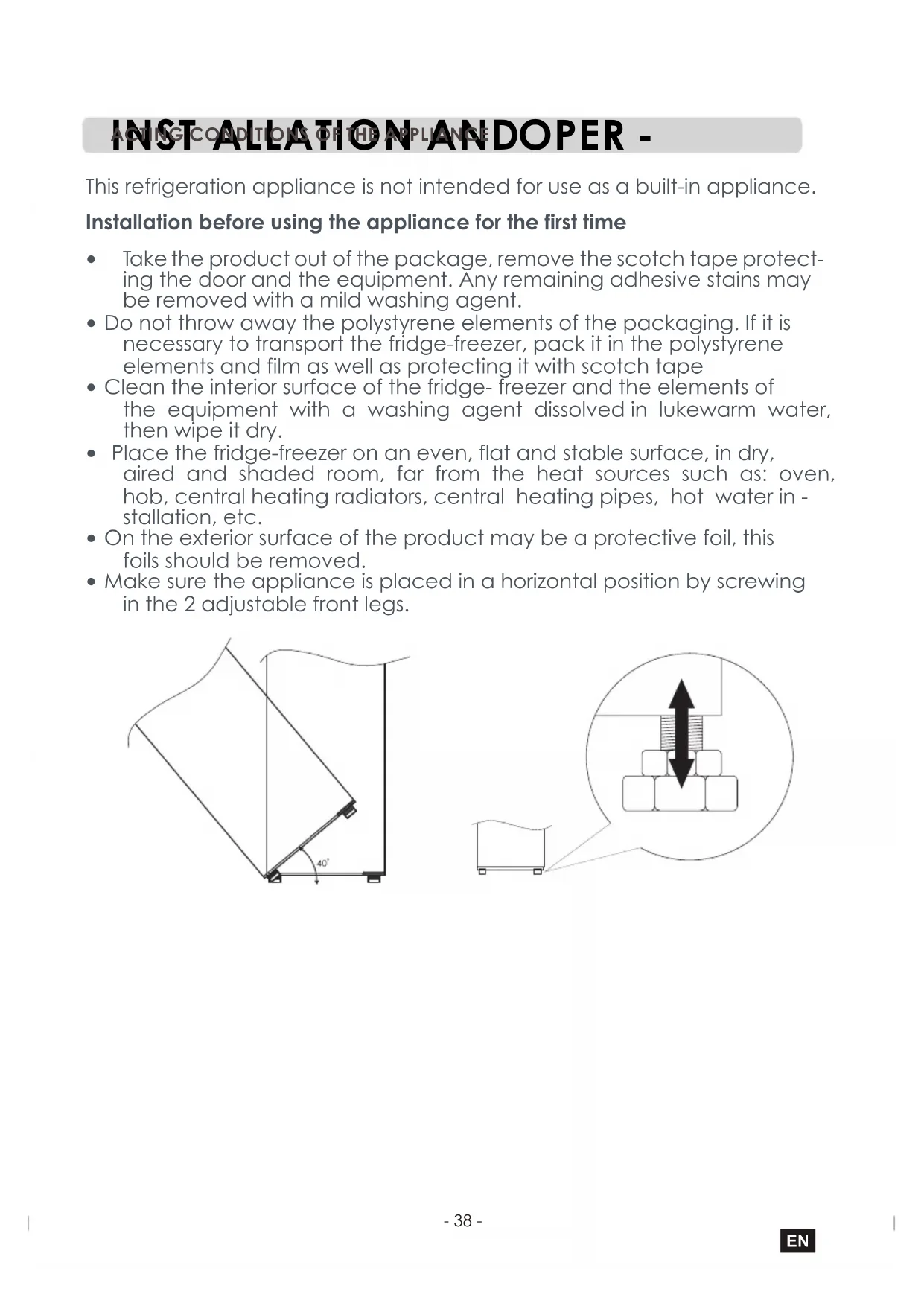
INSTCONDITIONS OF THE APPLIANDEOPER -
This refrigeration appliance is not intended for use as a built-in appliance.
Installation before using the appliance for the first time
- Take the product out of the package, remove the scotch tape protecting the door and the equipment. Any remaining adhesive stains may be removed with a mild washing agent.
- Do not throw away the polystyrene elements of the packaging. If it is necessary to transport the fridge-freezer, pack it in the polystyrene elements and film as well as protecting it with scotch tape
- Clean the interior surface of the fridge-freezer and the elements of the equipment with a washing agent dissolved in lukewarm water, then wipe it dry.
- Place the fridge-freezer on an even, flat and stable surface, in dry, aired and shaded room, far from the heat sources such as: oven, hob, central heating radiators, central heating pipes, hot water installation, etc.
- On the exterior surface of the product may be a protective foil, this foils should be removed.
- Make sure the appliance is placed in a horizontal position by screwing in the 2 adjustable front legs.


- To ensure that the door opens freely, the distance between the side of the appliance (on door hinges side) and the wall is shown on.
W D H A B C(°) E F H A B C(°) E F 540 590 1700 890 1096 125 50 100


- Ensure adequate ventilation of the room and free air circulation from all sides of the appliance (fg. 4).*

Minimum distances from the heat sources
from the electric gas and other ovens - 30 mm,
from oil or coal fried ovens - 300 mm,
- from built-in ovens - 50 mm
If there is no possibility of ensuring the above-mentioned distances, provide an appropriate insulation board.
Warning:
- The rear wall of the refrigerator, in particular, the condenser and other elements of the cooling system must not contact other elements, which may damage them, (e.g. central heating pipes and the water supply pipes).
- It is forbidden to readjust or modify any parts of the unit. It is crucial not to damage the capillary tube visible in the compressor recess. The tube may not be bent, straightened or wound.
- If the capillary tube is damaged by the user the guarantee will be void.

- In some models the handle is put into the appliance, You should screw it with Your own screwdriver,
Mains connection
- This appliance should be connected to AC 220-240V 50Hz supply scoket. The socket must be fitted properly, and must be supplied with an earthing conduit and a 10A fuse.
- It is a legal requirement that the appliance is properly earthed. The manufacturer will not be held liable for any damage or injury which may result from the failure to fulfil this requirement.
- Do not use adapters, multiple sockets and two-wire extension leads. If it is necessary to use the extension lead, it must be equipped with a protection ring and a single socket and must have a VDE/GS safety certificate.
- If an extension lead is used (with a protection ring and safety certificate), its socket must be located at a safe distance, away from the sinks, and must not be in a place where in could be flooded by water or waste water.
- See the type plate at the lower part of the internal wall of the appliance for detailed specifications**.
Disconnecting the mains
Make sure the appliance can be easily disconnected from the mains, either by pulling the plug out of the mains socket, or by switching the two-pole switch of.

Climate range
The information about the climate range of the appliance is provided on the rated plate. It indicates at which ambient temperature (that is, room temperature, in which the appliance is working) the operation of the appliance is optimal (proper).
Climate class Allowable ambient temperature
SN Extended Temperate This refrigeration appliance is intended for use at an ambient temperature ranging between 10°C and 32°C N Temperate This refrigeration appliance is intended for use at an ambient temperature ranging between 16 °C and 32°C ST Subtropical This refrigeration appliance is intended for use at an ambient temperature ranging between 16 °C and 38 °C T Tropical This refrigeration appliance is intended for use at an ambient temperature ranging between 16 °C and 43 °C

During transportation, protective packaging was used to protect the appliance against any damage. After unpacking, please dispose of all elements of packaging in a way that will not cause damage to the environment.
All materials used for packaging the appliance are environmentally friendly; they are 100 % recyclable and are marked with the appropriate symbol.
Important! Packaging materials (bags, polyethylene, polystyrene, etc.) should be kept away from children during unpacking.
Appliance controls
The control panel is shown in figure 10. It is also shown below for your reference:
N Frost


SET
Adjust temperature inside the appliance
The control panel is located inside the appliance on the top wall of the compartment. It allows you to adjust the temperature setting in the following sequence: -16ircC - > - 18ircC - > - 20ircC - > - 22ircC - > - 24ircC or activate the Fast Freeze function. You can change settings by consecutive pressing the SET button.
Fast Freeze function: Use this function after placing a lot of fresh food in the freezer compartment. The appliance will run continuously to quickly freeze the food. When the function is active, the indicator for this function lights up. This function will turn off automatically after 26 hours.
Open door alarm If the appliance door is open for more than 3 minutes, the alarm will sound. Close the door or press any button to silence the alarm. If the door is not closed the alarm will sound again after 3 minutes.
Error Codes: If the alarm symbol flashes together with one of the displayed temperatures on the control panel, it indicates a malfunction. Contact a service centre.
Defrosting: The appliance features an automatic defrost function. To use the auto defrost function, touch and hold SET for about 15 seconds. All the indicators on the control panel will light up, the compressor will stop and the heater will be on. To cancel the function, touch and hold SET for 3 seconds, or wait until the function completes. If you manually deactivate the defrost function, you need wait 10 minutes before activating it again.
Freezing food
- Practically all the food products, except for vegetables consumed raw, such as lettuce can be frozen.
- Only food products of the highest quality, divided into small portions for single use, should be frozen.
- Products should be packed in materials that are odourless, resistant to air and moisture penetration, and not susceptible to fat. Plastic bags, polyethylene and aluminium sheets are the best wrapping materials.
- The packaging should be tight and should stick to the frozen products. Do not use glass containers.
- Keep fresh and warm foodstuff at ambient temperature away from the products, which have already been frozen.
- We advise you not to place more of fresh food at a time to the freezer per day (see table witch technical specification).
- In order to maintain optimum quality of the frozen food, reorganise the food that is in the middle of the freezer, so that it does not touch the products that are not yet frozen.
- It is recommended that you move the already frozen products to one side and place the fresh products that are to be frozen on the opposite side, as close to the rear and side walls as possible.
. To freezing products, use space marked . * * * *
- Bear in mind that the temperature in the freezer is affected by several factors, including the ambient temperature and the quantity of food products in the chamber, the frequency of opening the door, the amount of frost in the freezer, and the thermostat setting.
- If you cannot open the freezer door immediately after closing it, allow 1-2 minutes for the negative pressure to compensate, and try again to open the door.
The storage time for frozen products depends on their quality before freezing when fresh, and on the storage temperature. The following storage periods are recommended when the temperature of -18ircC or lower is maintained.
Products Months
Beef 6-8 Veal 3-6 Giblets 1-2 Pork 3-6 Poultry 6-8 Fish 3-6
Do not store frozen food in rapid cooling chamber. Ice cubes can be prepared and stored in this chamber.
Note: If the appliance does not have a freezer compartment ( is not suitable for freezing foodstuffs.
Practical everyday tips
- Do not place freezers next to radiators, heaters, stoves or in direct sunlight.
- Make sure that air vents are not covered up and clean the dust off them once or twice a year.
- Select the right temperature: -18ircC in your freezer is sufficient.
- When on holiday, turn up the temperature in your fridge.
- Only open your fridge or freezer when necessary. It helps if you know what food each contains and where it is located. Return food to the fridge or freezer as soon as possible after you have used it so that it does not warm up too much.
- Wipe the inside of your fridge regularly with a cloth soaked in a mild detergent.
- Keep the seal around the door clean, otherwise it will not shut properly. Always replace broken seals.
Understanding the stars

Temperature is at least -6ircC ; sufficient to store frozen food for about a week. Drawers or compartments marked with one star used to be a feature of (mostly) cheaper fridges.

Food can be stored at -12ircC or below for 1-2 weeks without losing its taste. Not suitable for freezing food.

This rating is mainly used to store foods at -18ircC or below. Can also be used to freeze up to 1 kilogram of fresh food.

This appliance is suitable for storing foods at -18ircC or below and freezing larger quantities of fresh foods.
Never clean the product's casing or plastic parts using solvents or strong, abrasive detergents (e.g. washing powders or creams)! Use mild liquid detergents and soft cloths only. Do not use sponges.
Automatic freezer defrosting
The freezer chamber has been equipped with an automatic defrosting function (no-frost). The food is frozen in the cooled circulation air, and the moisture from the freezer chamber is discharged outside. As a result, no ice and frost is produced in the freezer and the products do not freeze on each other.
Washing freezer chambers manually
It is recommended to wash the freezer chambers at least once a year. This prevents the formation of bacteria and bad odours. Switch of the appliance, remove the food from the chambers and wash them using water with a mild detergent. Then, wipe the chambers dry with a cloth.
WARNING! You must not put an electric heater, a heating fan or a hair dryer into the freezer by any means.
ENERGY SAVING TIPS
- Install the fridge or freezer in a cool place out of direct sunlight and away from cookers, heaters, dishwashers or any hot air emitting items.
- Do not set the fridge and freezer temperatures lower than necessary. Set the internal temperature within the correct range e.gadjust the thermostat at middle position for 4ircC in the fridge compartment and -18ircC in the freezer respectively.
- Let pre-cooked foods cool down before placing them in the fridge or freezer. This will prevent the internal temperature of the fridge from rising.
- Keep your fridge full, but not over crowded, this helps reduce «cold» air loss.Meanwhile, avoid overloading the fridge or freezer. Try to leave about 20% free space for air circulation.
- To prevent cold air escaping, limit the frequency of opening door. When retuning from shopping, sort foods to be kept in your fridge before opening the door. Only open the door to put food in or take it out.
- Make sure the door seal is clean and in good condition. It should hold a piece of paper tightly in place when shut.
- Defrost regularly or when ice is more than 5mm thick. Thick ice covering the inner sides significantly increases energy use.
- The combination of the drawers, baskets and shelves shown in the device description is optimal for efficient energy savings. Changing the combination proposition could alter the efficiency.
REVERSING THE DOOR SWING
1. Make sure that your refrigerator is unplugged.
2. Pry the hinge cover up and off, remove the three screws that secure the upper hinge to the door, then remove the hinge.

3. Remove the freezer compartment door from the cabinet.
4. Remove the screws that secure the lower hinge to the right side of the cabinet, then remove the hinge.

5. Remove the washer and nut that secure the pin shaft to the right hole on the lower hinge, then remove the shaft

6. Insert the pin shaft into the left hole on the lower hinge, then secure the shaft with the washer and nut.

7. Install the lower hinge on the left side of the cabinet.
8. Remove the screw that secures the door stop from the bottom right of the freezer compartment door, then remove the door stop and install to the bottom left side.

9. Install the freezer compartment door.
10. Move the door bushing from the top right side of the freezer door to the top left side of the door. And move the left hole cover to the right side.

11. Remove the hole cover from the top left side of the cabinet and secures the cover on the top right side of the cabinet.

12. Secure the upper hinge to the top left side of the cabinet with the three screws you removed previously. Before you tighten the upper hinge screws, make sure that the top of the door is level with the cabinet and that the rubber gasket makes a good seal.
13. Install the hinge cover over the hinge on the top left side of the cabinet.

14. Remove the left hole plugs, screw off the bolts, and remove the right hole plugs.

15. Install the right hole plugs on the left side of the door, and install the handle on the right side of the door.

Note: Ensure the rubber gaskets are making a good seal with the cabinet all the way around the doors before tightening the hinge screws.
TECHNICAL SPECIFICATIONS
General information cooling Supplier's name or trade mark: SIGNATURE Supplier's address: BUT INTERNATIONAL, 1 A VENUE SPINOZA 77184 EMERAINVILLE, FRANCE Model iden tifer: SCA206NFSE Type of refrigerating appliance: Low-noise appliance: no Design type: freestanding Wine storage appliance: no Other refrigerating appliance: yes General product parameters: Parameter Value Parameter Value Overall dimensions (millimetre) Height 1700 Total volume (dm3 ou l) 206 Width 540 Depth 590 EEI Energy e 100 fficiency class E Airborne acous tical noise emissions (dB(A) re 1 pW) 43 Airborne acous tical noise emission class D Annual energy consumption (kWh/a) 223 Climate class: extended temperate/temperate /subtropical /tropical Minimum ambient temperature (°C), for which the refrigerator gappliance is suitable 10 Maximum ambient temperature (°C), for which the refrigerator gappliance is suitable 43 Winter setting no Compartment Parameters: Compartment type Compartment Volume (dm3 or l) Recommended temperature setgtin for opted food storage (°C)These se sthall not contradict the storage condistsetout in Annex IV, Table 3 Freezing capacity (kg/24 h) Defrosting type (auto-defrost = A, manual defrost = M) Pantry no Wine storage no Cellar no Fresh food no Chill no Compartment type Compartment parameters and values Compartment Volume (dm3 or l) Recommended temperature setting for optimised food storage (℃)These settings shall not contradict the storage conditions set out in Annex IV, Table 3 Freezing capacity (kg/24 h) Defrosting type (auto-defrost = A, manual defrost = M) 0-star or ice-making no - - - - 1-star no - - - - 2-star no - - - - 3-star no - - - - 4-star yes 206 -18 9.3 A 2-star section no - - - - Variable temperature compartment no - - - - For 4-star compartments Fast freeze facility Yes Light source parameters: Type of light source N/A Energy efficiency class N/A Minimum duration of the guarantee offered by the manufacturer: 2 years Additional information: N/A Weblink to the manufacturer's website, where the information in point 4(a) Annex of Commission Regulation (EU) 2019/2019 is found: www.but.fr
Reference: SCA206NFSE Rated voltage: 220-240V~ Ampere: 1.0A Rated frequency: 50Hz Climate class: SN/N/ST/T Refrigerant: R600a(50g) Protection against electrical shock: I Insulation foam: CYCLOPENTANE
Climate class:
- Extended temperate(SN): 'this refrigerating appliance is intended to be used at ambient temperatures ranging from 10ircC to 32ircC' ;
- Temperate(N): 'this refrigerating appliance is intended to be used at ambient temperatures ranging from 16irc C to 32irc C' ;
- Subtropical(ST): 'this refrigerating appliance is intended to be used at ambient temperatures ranging from 16irc C to 38irc C' ;
- Tropical(T): 'this refrigerating appliance is intended to be used at ambient temperatures ranging from 16irc C to 43irc C' ;
Note: More data information, please scan the QR code on the energy label.
TROUBLESHOOTING
Symptom Cause Solution The appliance does not work There is no power supply Check the plug connecting it others appliance, or verify that the appliance is connected to the plug The fuse doesn't work Replace the fuse The appliance makes a lot of noise The appliance is too close to the wall, or is not stable, or the accessories inside the refrigerator are placed in wrong position Stabilize the base of the refrigerator by adjusting the position of feet, take away the device of the wall, place correctly the accessories inside the refrigerator The appliance doesn't cool enough The door is too often opened or was left opened for a long time Close the door and do not open it too much frequently The refrigerator is too close to the wall Take away the device of the wall to favor the ventilation The refrigerator is too full Remove food of the device The appliance doesn’t cool enough The temperature is badly, adjusted Adjust the temperature setting :“-16°C -> -18°C -> -20°C -> -22°C ->-24°C or activate the Fast Freeze function. There are smells in the appliance Food made obsolete inside the refrigerator Throw away obsolete food and wrap the other The inside of the device at need to be cleaned Clean the inside of the refrigerator
If your device shows the other symptoms that those described above, please call the service after sale of the shop a retailer.
The following symptoms are not breakdowns:
1. The noise of the cooling liquid which circulates in pipes can be heard, it is normal.
2. The humidity on the surface outside of the device during the wet seasons is not a problem of the device; you just need to wipe it with a dry soft cloth.
3. The compressor and the condenser can warm more during the periods of strong heat.
4. The frame of the door is a bit hot; it means that the condenser works to evacuate the humidity of air.
Note:
We decline Liability for any damage or accident derived from any use of this product which is not in conformity with the instructions contained in this booklet.
CORRECT DISPOSAL OF THIS PRODUCT European directive 2012/19/EU on Waste from Electrical and Electronic Equipment (WEEE), requires that used household appliances are not thrown into the normal municipal waste stream. Used appliances must be collected separately in order to optimize the rate of recovery and recycling of materials that compose them, and to reduce the impact on human health and on the environment. The crossed bin symbol is affixed to all the products to remind you of the obligations of separated collection.
Note:
- In accordance with Article L. 217 of the Consumer Code, your product has 2 year legal guarantee of conformity.
Period of availability of repair spare parts: 10 years.
- To contact our After-Sales Service, before going to BUT store, call 09 78 97 97 97, from Monday to Saturday from 8:00 a.m. to 8:00 p.m. (Price of a local call).

LE TRI

FACILE


Séparez les éléments avant de trier
BUT INTERNATIONAL
1 Avenue Spinoza
77184 Emerainville, France
CONGÉLATEUR Armoire
SCA206NFSETABLE DES MATIERES
Consignes de sécurité importantes -] -8-Description - 9 - Installation e -14-Deballage -15 -Command - 16 -Utilisation e - 18 -Comment Nettoyage et conservation - 19 - - 20 -Conseils er Inversion de porte -21- -23 -Spectificat -26 -Dépannage  Séparez les éléments avant de trier
 CET APPAREIL EST DESTINE A UN USAGE DOMESTIQUE UNIQUEMENT! Veuillez dire attentivement toutes les instructions avant la première utilisation et conservez-les pour une referencia ultérieure.CONSIGNES DE SECURITE IMPORTANTES
Cet averissement ne s'applique qu'au marché EUROPEEN!
Lorsque vous utilisez un apparéil électrique, les précautions de sécurité de base doivent toujours être respectées, y compris ce qui suit: 1. Cét apparéil peut être utilisé par des enfants âgés d'au moins 8 ans et par des personnes ayant des capacités physiques, sensorielles ou mentales réduites ou dénuées d'expérience ou de connaissance, s'illes (si elles) sont correctement surveillée(e)s ou si des instructions relatives à l'utilisation de l' apparéil en toute sécurité leur ont été données et si les risques encourus ont été appréhendés. Les enfants ne doivent pas jouer avec l' apparéil. Le nettoyage et l'entretien par l'usager ne doivent pas être effectués par des enfants sans surveillance. 2. Les enfants âgés de 3 à 8 ans sont autorisés à charger et décharger les appareils de réfrigération. 3. Si le cable d'alimentation est endommagé, il doit être remplace par le fabricant, son service après vente ou des personnes de qualification similaire afin d'éviter un danger. 4. AVENTISSEMENT: Maintenir dégagées les ouvertures de ventilation dans l'enceinte de l'appareil ou dans la structure d'encastrement. 5. AVENTISSEMENT: Ne pas utiliser de dispositifs mécaniques ou autres moyens pour accélérer le processus de dégivrage autres que ceux recommendés par le fabricant. 6. AVERTISSEMENT: Ne pas endommager le circuit de réfrigération. 7. AVERTISSEMENT: Ne pas utiliser d'appareils électriques à l'intérieur du compartment de stockage des denrées, à moins qu'ils ne soient du type recommandé par le fabricant. 8. Ne pas stocker dans cet appeareil des substances explosives telles que des aerosols contenant des gaz propulseurs inflammables. 9. Cet apparéil est destiné à être utilisé dans des applications domestiques et similaires telles que: - Les coins cuisines réservés au personnel des magasins, bureaux et autres environnementis professionnels; - Les fermes et l'utilisation par les clients des hotels, motelels et autres environnementés à caractère résidentiel; - Les environnements de type chambres d'hôtes; - La restauration et autres applications similaires hormis la vente au détail. 10. Placer l'appareil contre un mur avec une distance n'excédant pas 75 mm et plus de 50 mm. 11. AVERTISSEMENT: Lors du positionnement de l'appareil, s'assurer que le cordon d'alimentation n'est pas coincide ni endommagé. 12. AVERTISSEMENT: Ne pas placer des prises de courant mobiles et multiples ni de blocs d'alimentations électriques portables à l'arrête de l'appareil. 13. Pour éviter la contamination des aliments, veuillez respecter les instructions suivantes: - L'ouverture prolongée de la porte peut entrainer une augmentation importante de la température dans les compartiments de l'appareil. - Nettoyez régulièrement les surfaces pouvant entraient en contact avec des alimentents et les systèmes de vidange accessibles. - Conservez la viande et le poisson crus dans des recipients appropriés au réfrigérateur, de manière à ce qu'ils ne soient pas mis en contact avec d'autres alimentés ni ne s'égouttent dessus. - Les compartments pour alimentés surgelés à deux étoiles convennent au stockage des alimentés précongeles, au stockage ou à la fabrication de crème glacée et à la fabrication de glaçons. - Les compartments à une, deux et trois étoiles ne convennent pas pour la congélation d'aliments frais. - Si l'appareil de réfrigération reste vide pendant delongues périodes, éteignez, décongelez, nettoyez, séchez et laissez la porte ouverte pour éviter la formation de moisissure dans l'appareil. 14. Débranchez l'appareil de la prise de courant lors de non-utilisation, avant d'instructor ou de démonter les pieces, avant tout nettoyage. 15. Veillez à bien insérer la fiche dans la prise de courant lorsque vous branchez l'appareil. 16. Insérez la fiche dans la prise unique ayant une mise à la terre. 17. N'utilisez jamais l'appareil dans un endroit où des matières combustibles et inflammables sont conservées. 18. Pour les raisons de sécurité, assurez-vous de réparer ou remplaçer les pieces dans un agent de service/agréé. 19. Le moteur doit être lubrifié en permanence et ne nécessite aucun huile. 20. L'appareil doit être place de façon à ce que la prise de courant soit facilement accessible. 21. Rétérez-vous à la reglementation locale concernant l'élimination de l'appareil, car il contient du gaz inflammable. Avant de jeter votre apparéil usé, assurez-vous de retarder les portes pour éviter que les enfants ne soient coincés. 22. Assurez-vous que l'appareil soit débranché avant de le nettoyer. 23. Pour nettoyer cet apparéil, utilisez un chiffon humide ou bien un produit de nettoyage pour les vitres. N'employez jamais de détermagent abrasif ou de dissolvant. 24. Il est recommendé de ne pas utiliser ce congélateur avec une rallonge électrique. Assurez-vous que la fiche du cordon d'alimentation soit insérée directement dans la prise de courant. 25. Ne pas placer de boisson ou plat chaud dans l'appareil. 26. Refermez la porte après utilisation afin d'éviter l'augmentation importante de température. 27. Ne pas placer l'appareil à proximé d'une source de chaleur ou directement à la lumière du soleil. 28. L'appareil doit être place sur une surface plane et stable. 29. Ne pas poser d'objet lourd sur le réfrigérateur et ne pas le mouiller. 30. Pour éviter tout risque d'électrocution, n'utilisez jamais cet apparéil avec les mains humides, en vous tenant sur une surface humide ou dans l'eau. 31. Cet apparéil ne doit pas être utilisé à l'extérieur et ne doit pas être exposé à la pluie. 32. Ne jamais tirer sur le cable d'alimentation pour débrancher l'appareil. Saisissez la fiche et tirez-la de la prise de courant. 33. Gardez le cable d'alimentation éloigné des surfaces chauffées. 34. Avant de brancher l'appareil, assurez-vous que la tension de la prise secteur à votre domicile correspond à cette montré sur la plaque signalétique de l'appareil. 35. Branchez votre congélateur dans une prise de courant indépendante et utilisez un fil de terre pour assurer la sécurité. 36. Quand le congélateur cesse d'être utilisé netto-yez l'appareil. pour empêcher la propagation d'odeur. 37. Il convient de surveiller les enfants pour s'assurer qu'ils ne jouent pas avec l'ordinateil. 38. Les apparèils ne sont pas destinés à être mis en fonctionnement au moyen d'une minutes extérieure ou par un système de commande à distance séparé. 39. L'appareil est équipe d'une prise de terre pour vous protégger d'eventuels risques electriques et doit être branché sur un socle de prise de courant compteant un contact de terre. 40. Il est recommendé d'examiner régulièrement le cable d'alimentation pour déceler tout signe de détérioration eventuelle, et l'appareil ne doit pas être utilisé si le cable est endommagé. 41. En ce qui concerne les informations pour l'installation, la manipulation, l'entretien et la mise au rebut de l'appareil, reférez-vous au paragraph «TRANSPORT ET MISE EN ROUTE» «INSTALLATION» «ENTRETIEN ET MAINTENANCE» «DEPANNAGE» de la notice. 42. Référez - vous à la réglementation locale concernant l'élimination de l'appareil, car il contient du gaz inflammable. Avant de jeter votre apparéil use, assurez - vous de retarder les portes pour éviter que les enfants ne soient coincés.  43. A VERTISSEMENT! Risqued'incendie/matières inflammables.Maintenir votre apparéil éloigné de toutesource de flamme durant l'installation, l'entretien et l'utilisation. 44. Si le circuit de réfrigération est endommagé : - Eviter les flammes nues ou étincelles d'allumage. - Bien ventiler la pierce où l'appareil est installé. 45. Si vous souhaitez vous débarrasser d'un vieux conge lateur ou d'un vieux réfrigérateur importante une serrure sur la porte, veillez à ce que celle-ci soit désactivée afin d'éviter que des enfants ne risquent de se retrouver enfermés à l'intérieur en jouant. 46. Débranchez toujours l'appareil après usage et avant de le nettoyer. Enlevez tous les aliments avant de nettoyer l'appareil. 47. Évitez demettre des alimentés trop volumineux,le fonctionnement de l'appareil risquerait d'être affecté. 48. Faites extrémement attention quand vous déplacez l'ordinateil. 49. Évitez de donner aux enfants des crèmes glacées ou des glaces à l'eau sorting juste du congélateur; la base température risquerait de leur brûler les levres.  1. Panneau de contrôle 2. Cadre en verre du congélateur 3. Tiroirs du congélateur 4. Pieds de mise à niveau 5. Porte - bouteille Remarque: Les étagères en verre et le bac à légumes peuvent être retirees et insérés pour le nettoyage et le stockage des aliments en fonction de l'appareil. Cet produit de réfrigération n'est pas destiné à être utilisé comme un produit intégrableInstallation avant la première mise en marche
- Déballez l'appareil, enlevez les bandes adhéses protégant les portes et l'équipment (4). Les événuels restes du col peuvent être enlever avec un détergent délicat. Garder les éléments en mousse de polystyrene. Au cas de nécessite du retransport du refrigerateur/congelateur, emballez-le de la mousse de polystyrene et du film ainsi que protégez-le avec la bande adhésive. - Lavez l'intérieur du réfrigérateur et du congélateur ainsi que les autres éléments de l'équipment avec de l'eau tiède avec du produit lave vaisselle et ensuite essuyez et séchez. - Placez votre réfrigérateur/congélateur à niveau et en position stable à un sol solide, dans une piece sèche, régulièrement aérée et non en-soleillée loin des sources de chaleur comme la cusinière, le radiateur du chauffage central, le tuyau du chauffage central, l'installation de l'eau chaude, etc. Le film de protection qui peut recouvrir l'appareil le doit être retire. - Placez l'appareil à niveau en visant 2 pieds réglables à l'avant.   - Afin d'assurer une ouverture facile de la porte, la distance entre la paroi latérale de l'appareil (du côte des charnières) et la paroi de la pierce est illustrée sur la.| W D | H A B C(°) | E F H | A | B | C(°) | E | F |
| 540 59 | 1700 890 | 109600125 | 50 890 | 1098 | 125 | 50 | 100 |
Les distances minimums des sources de chauffage
des cuisinières electriques, à gaz et autres - 30 mm, des poêles à fuel ou à charbon - 300 mm, des fours de cuisine encastrables - 50 mm S'il n'est pas possible de respecter les distances ci-dessus mentionnées, utilisez une plaque d'isoation.Attention:
La paroi arrriere du réfrigerateur et sur tout le réfrigérant et les autres éléments du circuit frigorifique ne peuvent pas rester en contact avec les autres éléments qui peuvent cause des endommagement et sur-tout (avec le tuyau du chauffage central et la tube d'amnée d'eau). Il est interdit de manipuler d'une façon quelconque des pieces d'agre - gat. Prenez les mesures de ne pas endommager la tube capillaire vis - sible dans la cavite pour le compresseur. Cette tube ne peut pas etre fléchie, redressée ni enroulée. - L'endommagement de la tube capillaire par l'utilisateur le prive du droit de garantie.  - Pour certains modèles au besoin, la poignée non fixée doit être récuperée à l'intérieur de l'armoire, puis vissee sur la porte avec son propre tournevis.Raccordement au réseau électrique
- L'appareil doit être branché au réseau du courant alternative 220 - 240V, 50Hz au moyen d'une prise murale correctement installée, mise à la terre et protégée par un coupe-circuit de 10 A. - La mise à la terre de l'appareil est recommandée par la loi. Le fabricant renonce à une responsabilité quelconque à titre des endommage -ments éventuels qui peuvent subir les personnes ou les objets suite à ne pas replir cette obligation imposée par cette règle. - I ne faut pas utiliser de raccords adaptatifs, de prises multiples (ré-partiteurs), de rallonges deux fils. S'il y a la nécessité d'utiliser un rallonge, il est permitted d'utiliser qu'un rallonge avec un rouleau de sécurité, à prise unique ayant une attestation de sécurité VDE/GS. - Au cas d'utilisation d'un rallonge (avec le rouleau de sécurité, ayant le signe de sécurité), sa prise doit être place à une distance sure des éviers et ne peut pas être exposée à être submerger de l'eau ainsi que des autres écouts. - AVERTISSEMENT: Ne pas placer de socles mobiles de prises multiples ni de blocs d'alimentation portables à l'arrête de l'appareil - AVERTISSEMENT: Lors du positionnement de l'appareil, s'assurer que le cordon d'alimentation n'est pas coincide ni endommagé. - Les données se trouve sur la plaque signalétique place en bas de la paroi à l'intérieur du compartment réfrigerateur**.Mise hors circuit
Il faut assurer la possibilité de débrancher l'appareil par le retrait de la fche ou par l'éteint de l'interrupteur bipolaires. Classe climatique
L'information sur la classe climatique de l'appareil se trouve sur la plaque signalétique. Il indique la température ambiente (c'est-à-dire de la piece dans laquelle il fonctionne) du fonctionnement optimal (cor-rect) de l'appareil. Classe climatique Température ambiente admissible| SN | tempérée élargie | l'appareil réfrigérant est destiné à une utilisation à une plage de températures comprise entre 10 °C et 32 °C |
| N | tempérée | l'appareil réfrigérant est destiné à une utilisation à une plage de températures comprise entre 16 °C et 32 °C |
| ST | subtropicale | l'appareil réfrigérant est destiné à une utilisation à une plage de températures comprise entre 16 °C et 38 °C |
| T | tropicale | l'appareil réfrigérant est destiné à une utilisation à une plage de températures comprise entre 16 °C et 43 °C |
Commande de l'appareil
Le panneau de commande est presenté sur le dessin 7, pour rappel, il est presenté également ci-dessous: Frost        Réglage de la température à l'intérieur de l'appareil
Le panneau de commande se trouve à l'intérieur de l'appareil sur la paroi supérieure du compartment. Il permet deCHOISIR LA TEMPERATURE selon la sequence suivante: -16ircC - > - 18ircC - > - 20ircC - > - 22ircC - > - 24ircC ou d'activer la fonction de congélation rapide (Fast Freeze). La modification du réglage se fait par la pression sur la touche SET. Fonction de super Congélation: Utiliser cette fonction avant le replissage des compartiments du congélateur avec une grande quantité d'alments. L'appareil fonctionnera en continu pour congefer rapidement les aliments. Lorsque cette fonction est active, l'indicateur de cette fonction s'allume. Cette fonction se désactive automatiquement après 26h. Alarme porte ouverte : Sil's appeareil est ouvert pendant plus de 3 minutes, un signal sonore est émis. Fermer la porte ou appuyer sur quelconque touche afin d'eteindre l'alerte. Dans le second cas l'alerte s'enclenchera de nouveau après 3 minutes. Codes d'erreur: Si le symbole de l'alarme et l'une des températures sur ler panneau clignotent, ceci signifie une défaillance de l'appareil. Contacter un service agréé. Dégivrage : L'appareil dispose d'une fonction de dégivrage automatique. Pour activer la fonction de dégivrage automatique, appuyer sur et maintainir pressée la touche SET pendant environ 15 secondes. Toutes les diodes sur le panneau s'allument, le compresseur s'arrête et l'élement chauffant se met en marche. Pour annuler la fonction, appuyer sur la touche SET et la maintainir pressée pendant 3 secondes, ou attendre la fin du programme, En cas de désactivation manuelle de la fonction de dégivrage, attendre 10 minutes avant de l'activer de nouveau.Congélation des produits
- Il est permitted deCongeler pratiquement tous les produits alimentaires à l'exection des légumes consommés crus comme par ex. la salute verte. - Pour une meilleure congélation, il est recommandé d'utiliser des produits extra frais et de les congeler en petite portion. - Il convient d'emballer les produits dans des matériaux sans odeur, résistant à la pénétration de l'air et d'humidité ainsi qu'in sensibles aux matières grasses. Les emballages les plus appropriés sont: les sachets, les feuilles du film en polyéthylène, du film aluminium. - L'emballage doit être hémetique et bien adhééré aux produits congélés. Les emballages en verre sont deconseillés. - Les produits alimentaires frais (à température ambiente), mis dans le but d'être congélés ne doivent pas rester en contact avec les produits déjà congélés aparavant. - Il est déconseilé de mettre dans le congélateur, en une fois par 24 heures, plus de nourriture fraîche que mentionné dans le tableau de Specification technique de l'appareil. - Afin de garder une bonne qualité des produits congélés, il est conseilé de regrouper les produits congélés dans la partie centrale du congélateur de telle façon qu'ils ne restent pas en contact avec des produits encore non congélés. - Nous conseillons de déplacer les portions congélées vers un côté du compartment congestionelateur etmettre les portions fraîches à congeler du côté opposé en les poussant au maximum vers la paroi arrêté laterale. Pour congeler les produits, utiliser un congélateur marqué \*\*\*. - I'll fault se rapeller que la température du组成部分 réfrigérateur est influencée entre autres par: la température ambiente, le niveau. de chargement des denrées, la fréquence d'ouverture de la porte, le niveau de givrage, la mise au point de thermostat. - Si une difficulté d'ouvrir la porte du compariment réfrigérateur se présente tout juste après sa fermeture, nous vous conseillons d'attendre 1 à 2 minutes jusqu'à ce que la dépression qui s'y est formée soit compensée. Le temps de conservation des produits congélés dépend de leur qualité à l'état frais avant congestion ainsi que de la température de conservation. En conservant la température inférieure ou égale à -18°C les périodes de conservation suivantes sont conseillées: Produits Mois| Boeuf 6-8 |
| Veau 3-6 |
| Abats 1-2 |
| Porc 3-6 |
| Volaille 6-8 |
| Poissons 3-6 |
Conseils pratiques
- Ne pas placer le congealateur pres des radiateurs, des jours ou risquer une influence directe des rayons du soleil. - S'assurer que les cavités du condenseur à l'arrière ne sont pas obstruées. Les nettoyer et depoussierer une ou deux fois par an. - Choisir une température appropriée: une température de -18ircC dans le congélateur est sufsante - Il ne faut ouvoir la porte du réfrigerateur ou du congelateur qu'en cas de nécessité. Il est bon à savoir qu'elle nourriture est conservée dans le réfrigerateur ainsi que savoir précisé où elle se trouve. Il faut remettre le plus vite possible les produits non-utilisés dans le réfrigerateur ou dans le congelateur avant qu'elle ne se rechauffe. - Nettoyez régulièrement l'intérieur du réfrigérateur à l'aide d'un tissu imbibe d'un détergent doux. - Maintenez propre le joint autour de la porte, autrement la portes risque de ne pas se fermer complètement. Il faut toujours replacer les joints endommages.Que veulent dire les étoiles?
 Une température d'au moins -6ircC suffit pour stocker les alimentés surgelés pendant environ 2-3 jours. On rencontres le plus souvent des tiroirs ou compartments ayant le symbole de l'étoile dans les réfrigerateurs bon marché.  On peut stocker les aliments dans une température de -12ircC pendant 1 mois sans risquer qu'ils perdent leur goût. Cette température n'est pas suffisante pour congelever les aliments.  Permet de stocker des aliments déjà congeles pendant 1 an maximum; mais ne permet PAS de congelever des aliments frais.  Cet apparéil convient à stocker des aliments dans une température en-dessous de -18ircC et de congeler de plus grandes quantités d'aliments. Pour le nettoyage du chassis et des pieces en plastique ne jamais utilisier de solvants ni de produits de nettoyage agressifs et abrasifs (par exemple des poudres ou des crèmes de nettoyage)! Utiliser uniquement des produits de nettoyage liquides délicats et des torchons doux. Ne pas utiliser le côté abrasive des éponges.Dégivrage automatique du congélateur
Le compartment congestioneur est équipé de la fonction de dégivrage automatique (no-frost). Les denrées alimentaires sont congestés par un système de réfrigeration par circulation d'air et l'humidité du compartment congestioneur evacuée à l'extérieur. En conséquence dans le congestioneur ne se forme pas un superflu de dépôt de givre et les produits ne se collent pas entre eux.Lavage à main du组成部分 congélateur
Il est recommandé de laver au moins une fois par an le compartmenting concélateur. Cette opération empêche la formation des bacteriés et des odeurs désagréables. Il convient demettre hors circuit l'appareil entier par la touche (1), sortir des compartments les produits et laver à l'eau tiède et au détergent délicat. Essuyer les compartments avec un chiffon. Dansaucuncasiln'estpaspermisdeplacera l'intérieur ducongélateur unaccumulateureélectrique dechaleur,de soufflage,niunseche-che-veux.CONSEILS EN MATIÈRE D'ÉCONOMIE D'ENERGIE
Installez le réfrigérateur ou le congélateur dans un endroit frais à l'abri des rayons directs du soleil et en le tenant éloigné de toute cuisine, radiateur, lave-vaisselle ou tout apparéil émettant de l'air chaud. Ne réglez pas le réfrigérateur ou le congélateur sur des températures inférieures à celles recommandées. Réglez la température sur une fourchette appropriée, par exemple réglez le thermostat sur la position du milieu pour une température de 4ircC dans le réfrigérateur et de -18ircC dans le congélateur. Laissez refroidir les plats deja cuits avant de lesmettre au réfrigérateur ou au congélateur. Cela évitera de faire augmenter la température interne du réfrigérateur. Faites en sorte que votre réfrigérateur soit toujours plein mais pas trop afin de réduire la perte d'air «froid». Ne replissez pas trop le réfrigérateur ou le congélateur. Dans la mesure du possible, prévoyez environ 20% d'espace libre pour la circulation de l'air Pour empêcher l'air froid de s'évacuer, limitez la fréquence d'ouverture de la porte. Lorsque vous rentrez de courses, mettez les alimentés à conserver au réfrigérateur à part avant d'ouvrir la porte. N'ouvrez la porte que pourmettre ou prendres des alimentés Veillez à ce que le joint de la porte soit propre et en bon état. Une feuille de papier doit pouvoir être maintainue entre le réfrigérateur et la porte une fois celle-ci fermée. Dégivrez le congélateur régulièrement ou lorsque la glace fait plus de 5 mm d'épaisseur. L'accumulation de glace sur les parois internes.LNVERSION DE PORTE
1. Assurez-vous que le réfrigérateur est débranché. 2. Retirez le couvercle de la charnière, dévissez les trois vis qui fixent la charnière supérieure à la porte, puis retirez la charnière.  3. Retirez la porte du组成部分 congélateur de l'appareil. 4. Dévissez les vis qui fixent la charnière inférieure au côte droit de l'appareil, puis retirez la charnière.  5. Retirez la rondelle et l'écrou qui fixent l'axe de la goupille au trou de droite sur la charnière inférieure, puis retirez l'axe.  6. Insérer l'axe de goupille au trou de gauche sur la charnière inférieure, puis fixez l'axe avec la rondelle et l'écrou.  7. Installé la charnière inférieure sur le côte gauche de l'appareil . 8. Retirez la vis qui fixe la butée de porte en bas à droite de la porte du组成部分 congélate ur,puis retirez la butée de porte et installez-la sur le côte inférieur  9. Installer la porte du组成部分.congelateur. 10. Déplacez la douille du côté supérieur droit de la porte du congelatueur vers le côté supérieur gauche de la porte. Et déplacez le couvercle du trou gauche sur le côté droit.  11. Retirez le couvercle du trou du côte supérieur gauche et fixez le couvercle sur le côte supérieur droit de l'appareil.  12. Fixez la churnière supérieure sur le côte supérieur gauche de l'appareil avec les trois vis que vous avez retirees precedemment. Avant de serrer les vis de la churnière supérieure, assurez-vous que le haut de la porte est au niveau de l'appareil et que le joint en caoutchouc fait une bonne étanchéité. 13. Installes le couvercle de charnière sur le côte supérieur gauche de l'appareil.  14. Retirer le bouchon gauche, dévisser les boulons et retarder le bouchon droit.  15. Installes le bouchon de trou droit sur le côté gauche de la porte et la poignée sur le côté droit de la porte.  Remarque: assurez-vous que les joints en caoutchouc forment une bonne étanchéité avec l'appareil tout autour des portes avant de serrer les vis des charnières.SPECIFICATIONS TECHNIQUES
| Fiche d'informa tion produit | |||||
| Nom du fournisseur ou marque commerciale: SIGNATURE | |||||
| Adresse du fournisseur: BUT INTERNATIONAL, 1 AVENUE SPINOZA 77184 EMERAINVILLE, FRANCE | |||||
| Référence du modele: SCA206NFSE | |||||
| Type d'appareil de réfrigération: | |||||
| Appareil à faible niveau de bruit: à pose lib renon | Type de construc tion: | ||||
| Appareil de stockage du vin: oui | non | Autre apparile de réfrigération: | |||
| Paramètres généraux du produit: | |||||
| Paramètre | Valeur | Paramètre | Valeur | ||
| Dimensions hors tout(millimètres) | Hauteur | 1700 | Volume total (dm3ou l) | 206 | |
| Largeur | 540 | ||||
| Profondeur | 590 | ||||
| IEE | 100 | Classe d'éfficacité énergé que | E | ||
| Émissions de bruit acoustique dans l'air[dB(A) re 1 pW] | 43 | Classe d'émission de bruitacousque dans l'air | D | ||
| Consommation d'énergie annuelle (kWh/an) | 223 | Classe climatique: | tempéré étendu/temperée/subtropicale/tropical | ||
| Température ambiente minimale (°C) à laquellel'appareil de réfrigeration est adapté | 10 | Température ambiente maximale(°C)a laquelle l'appareil deréfrigération est ajusté | 43 | ||
| Réglage hiver non | |||||
| Paramètres des compartiments: | |||||
| Type de compar émit | Paramètres et valeurs de compar timent | ||||
| Volume du compar éntent(dm3oul) | Réglage de températurerecommendé pour un stockageoptés dénéesdenrées alimentaires (°C) Ces réglages ne doivent pasétre en contradiction avec lesconditions de stockage prévuesà l'annexe IV, tableau 3 | Pouvoir degénélation spécifique(kg/24 h) | Mode de dégivrage(dégiv rage auto m atique = A,dégivrage manuel = M) | ||
| Garde-manger non | - | - | - | - | |
| Stockage du vin non | - | - | - | - | |
| Cave non | - | - | - | - | |
| Denrées-alimentairesfraîches | non | - | - | - | - |
| Type de compartment | Paramètres et valeurs de compartment | ||||
| Volume du compartment (dm3 ou l) | Réglage de température recommendé pour un stockage optimisé des denrées alimentaires (°C) Ces réglages ne doivent pas être en contradiction avec les conditions de stockage prévues à l'annexe IV, tableau 3 | Pouvoir de congélation spécifique (kg/24 h) | Mode de dégivrage (dégivrage automatique = A, dégivrage manuel = M) | ||
| Denrées hautement périssables | non | - | - | - | - |
| Sans étoile ou fabrication de glace | non | - | - | - | - |
| 1 étoile | non | - | - | - | - |
| 2 étoiles | non | - | - | - | - |
| 3 étoiles | non | - | - | - | - |
| 4 étoiles | oui | 206 | -18 | 9.3 | A |
| Zone 2 étoiles | non | - | - | - | - |
| Compartiment à température variable | non | - | - | - | - |
| Compartments « quatre étoiles » | |||||
| Dispositif de congélation rapide | Oui | ||||
| Paramètres de la source lumineuse: | |||||
| Type de source lumineuse | N/A | ||||
| Classe d'efficacité énergétique | N/A | ||||
| Durée minimale de la garantie offerte par le fabricant: 2 ans | |||||
| Informations supplémentaires: N/A | |||||
| Lien internet vers le site web du fabricant où se trouvent les informations visées au point 4 a) de l'annexe du règlement (UE) 2019/2019 de la Commission: www.but.fr | |||||
| Référence: | SCA206NFSE |
| Tension nominale: | 220-240V~ |
| Courant nominal: | 1.0A |
| Fréquence nominale: | 50Hz |
| Classe climatique: | SN/N/ST/T |
| Gaz réfrigérant: | R600a(50g) |
| Classe de protection contre choc électrique: | I |
| Mousse d'iso1ation: | CYCLOPENTANE |
Classe climatique :
- Tempéré étendu (SN): «cet apparéil frigorifique est destiné à être utilisé à des températures ambiantes comprises entre 10irc C et 32irc C»; - Tempéré (N): «cet apparéil frigorifique est destiné à être utilisé à des températures ambiantes comprises entre 16irc C et 32irc C»; - Subtropical (ST): «cet apparéil frigorifique est destiné à être utilisé à des températures ambiantes comprises entre 16irc C et 38irc C»; - Tropical(T): «cet apparéil frigorifique est destiné à être utilisé à des températures ambiantes comprises entre 16ircC et 43ircC Remarque: Plus d'informations sur les données, veuilles scanner le code QR sur l'étiquette énergétique.| Symptôme | Raison | Solution |
| L'appareil ne fonctionne pas | Pas d'alimentation électrique | Assurez-vous que l'appareil est bien branché et que la prise murale fonctionne normalement |
| Le fusible a sauté | Remplacez le fusible | |
| L'appareil fait beaucoup de bruit | L'appareil n'est pas parallèle au sol. L'appareil est trop proche du mur ou les accessoires intérieurs du réfrigerateur sont mal places. | Stabilisez la base du réfrigérateur en réglient la positon des pieds. Eloignez l'appareil du mur. Placez correctement les accessoires intérieurs du réfrigérateur. |
| L'appareil n'atteint pas la températu re désirée. | La porte est ouverte trop souvent ou a été laissée ouverte longtemps. | Fermez la porte et ne l'ouvre pas trop fréquement. |
| Le réfrigérateur est trop proche du mur. | Eloignez l'appareil du mur pour assurer une bonne. | |
| Le réfrigérateur est trop plein. | Retirez des alimentés de l'appareil. | |
| L'appareil n'atteint pas la température désirée. | La température est mal réglée. | Réglage de la température: -16°C -> °C -> -20°C8-> -22°C -> -24°C ou d'ac-tiver la fonction de congélation rapide (Fast Freeze). |
| L'appareil dégage de mauvaises odeurs. | Des aliments ont périmé à l'intérieur du réfrigérateur. | Jetez les aliments périmés et emballez les autres aliments. |
| L'intérieur de l'appareil a besoin d'être nettoyé. | Nettoyez l'intérieur de l'appareil. |
ENLEVEMENT DES APPAREILS MENAGERS USAGES
 La directive europeenne 2012/19/UE sur les déchets d'équipements ELECTriques et électroniques (DEEE) exige que les apparciels menagers usages ne soient pas jetés dans le flux normal des déchets municipaux. Les apparciils usages doivent être collectés séparément afin d'optimiser le taux de valorisation et de recyclage des matériaux qui les composent, et de réduire l'impact sur la santé humaine et sur l'environnement. Le symbole de la poubelle barrée est apposé sur tous les produits pour vous rappeler les obligations de collecte sélective.Attention:
- Conformément à l'Article L. 217 du code de laconsommation, votre produit bénéficiaie d'une garantielegale de conformite de 2 ans. - Durée de disponibilité des pieces détaches dedépannage : 10 ans. - Pour contacter notre Service ÀpRES-Vente, avant de vous déplacer à votre magasin BUT, appepez le 09 7897 97 97, Du Lundi au Samedi de 08h00 à 20h00 (Prixd'un appel local). SIGN
UPRIGHT
Freezer
SCA206NFSE
TABLE OF CONTENTS
Important safety instructions - 31 -
Structure illustration -37-
Acting conditions of the appliance -38-
Unpacking -42-
Controls -43-
Operation and functions -44-
Using the refrigerator efficiently -46-
Washing and maintenance - 47 -
Energy saving tips - 48 -
Reversing the door swing -49-
Technical specifications -51-
Troubleshooting -54-

This product is for household use only!
Please read carefully this manuel before your first use and save it for future reference.
IMPORTANT SAFETY INSTRUCTIONS
This warning is only for EUROPEAN market only!
When using an electrical appliance, basic precautions should always be followed, including the following:
1. This appliance can be used by children aged from 8 years and above and persons with reduced physical, sensory or mental capabilities or lack of experience and knowledge if they have been given supervision or instruction concerning use of the appliance in a safe way and understand the hazards involved. Children shall not play with the appliance. Cleaning and user maintenance shall not be made by children without supervision.
2. Children aged from 3 to 8 years are allowed to load and unload refrigerating appliances.
3. If the supply cord is damaged, it must be replaced by the manufacturer, its service agent or similarly qualified persons in order to avoid a hazard.
4. WARNING: Keep ventilation openings, in the appliance enclosure or in the built-in structure, clear of obstruction.
5. WARNING: Do not use mechanical devices or other means to accelerate the defrosting process,
other than those recommended by the manufacturer.
6. WARNING: Do not damage the refrigerant circuit.
7. WARNING: Do not use electrical appliances inside the food storage compartments of the appliance, unless they are of the type recommended by the manufacturer.
8. Do not store explosive substances such as aerosol cans with a flammable propellant in this appliance.
9. This appliance is intended to be used in household and similar applications such as
- staff kitchen areas in shops, offices and other working environments;
- farm houses and by clients in hotels, motels and other residential type environments;
- bed and breakfast type environments;
- catering and similar non-retail applications.
10. Placed the appliance against a wall with a free distance not exceeding 75mm and more than 50mm
11. WARNING: When positioning the appliance, ensure the supply cord is not trapped or damaged.
12. WARNING: Do not locate multiple portable socket-outlets or portable power supplies at the rear of the appliance.
13. To avoid contamination of food, please respect the following instructions:
- Opening the door for long periods can cause a significant increase of the temperature in the compartments of the appliance.
- Clean regularly surfaces that can come in contact with food and accessible drainage systems.
- Store raw meat and fish in suitable containers in the refrigerator, so that it is not in contact with or drip onto other food.
- Two-star frozen-food compartments are suitable for storing pre-frozen food, storing or making ice cream and making ice cubes.
- One-, two- and three-star compartments are not suitable for the freezing of fresh food.
- If the refrigerating appliance is left empty for long periods, switch off, defrost, clean, dry, and leave the door open to prevent mould developing within the appliance.
14. Unplug the appliance from outlet when not in use, before putting on or taking off parts, before cleaning.
15. Make sure to place the plug all the way into a socket when connecting your appliance.
16. Insert the plug into a single grounded socket.
17. Never use the appliance in place where combustible and inflammable materials are kept.
18. For safety reason, be sure to repair or replace parts at an authorized service dealers.
19. The motor is permanently lubricated and will require no oil.
20. The appliance must be positioned so that the plug is accessible.
21. Please according to local regulations regarding disposal of the appliance for its flammable blowing gas. Before you scrap the appliance, please take off the doors to prevent children trapped.
22. Ensure the refrigerator is unplugged before cleaning or if the product is not in use.
23. To clean the appliance use only mild detergents or glass cleaning products. Never use harsh
detergents or solvents.
24. It is not recommended to use this freezer with an extension cord or power board. Please ensure that the appliance is plugged directly into the electrical outlet.
25. Do not place hot food or drink into the refrigerator before it cools down to room temperature.
26. Close the door immediately after putting in any items so the inside temperature will not rise dramatically.
27. Keep appliance away from any heat source or direct sunlight.
28. To fix stably, the appliance must be placed on a flat and solid surface. It should not be laid on any soft material.
29. Do not place any other appliance on top of the refrigerator, and do not wet it.
30. To avoid injury or death from electrical shock do not operate the appliance with wet hands, while standing on a wet surface or while standing in water.
31. Do not use outdoors or in wet conditions.
32. Never pull the cord to disconnect it from the outlet. Grasp the plug and pull it from the outlet.
33. Keep the cord away from heated surfaces.
34. Check that the voltage of the power supply in your home is the same as the voltage shown on the rating label of this product.
35. Connect your freezer to an independent electrical socket and use a safe ground wire.
36. When there is no electricity or when freezer ceases to be used, it should be cleaned in order to prevent it from smelling.
37. Children should be supervised to ensure that
they do not play with the appliance.
38. The appliance is not intended to be operated by means of an external timer or a separate remote-control system.
39. This appliance has been incorporated with a grounded plug. Please ensure the wall outlet in your house is well earthed.
40. It is recommended to check regularly the supply cord for any sign of possible deterioration, and the appliance should not be used if the cable is damaged.
41. Regarding the information pertaining to the installation, handing, maintenance, servicing and disposal of the appliance, thanks to refer to the paragraph "TRANSPORT AND HANDING" "INSTALLATION" "CLEANING AND CARE" "TROUBLESHOOTING" of the manual.
42. lease according to local regulations regarding disposal of the appliance for its flammable blowing gas. Before you scrap the appliance, please take off the doors to prevent children trapped.

43. WARNING! Risk of fire - flammable material. Please keep the product far away fire source during using, service and disposal. There are flammable materials at the back of the appliance.
44. If the refrigerant circuit is damaged:
- Avoid naked flames and sources of ignition.
- Thoroughly ventilate the room in which the appliance is situated.
45. If you are discarding an old freezer or refrigerator with a lock / catch fitted to the door,
ensure that it is left in a disabled condition to prevent the entrapment of young children when playing.
46. Unplug the appliance from the mains socket not in operation and before cleaning.
47. Avoid putting food too bulky, the operation of the appliance could be affected.
48. Extreme caution must be used when moving the appliance.
49. Do not give children ice - cream and water ices direct from the freezer as the low temperature may cause freezer burns" on the lips.

1. Control pane
2. Freezer Glass Shelves
3. Freezer drawers
4. Adjustable Feet
5. Bottle racks
Note: The glass shelves and the crisper can be removed and inserted for cleaning and storing of food according to the appliance.
INSTCONDITIONS OF THE APPLIANDEOPER -
This refrigeration appliance is not intended for use as a built-in appliance.
Installation before using the appliance for the first time
- Take the product out of the package, remove the scotch tape protecting the door and the equipment. Any remaining adhesive stains may be removed with a mild washing agent.
- Do not throw away the polystyrene elements of the packaging. If it is necessary to transport the fridge-freezer, pack it in the polystyrene elements and film as well as protecting it with scotch tape
- Clean the interior surface of the fridge-freezer and the elements of the equipment with a washing agent dissolved in lukewarm water, then wipe it dry.
- Place the fridge-freezer on an even, flat and stable surface, in dry, aired and shaded room, far from the heat sources such as: oven, hob, central heating radiators, central heating pipes, hot water installation, etc.
- On the exterior surface of the product may be a protective foil, this foils should be removed.
- Make sure the appliance is placed in a horizontal position by screwing in the 2 adjustable front legs.


- To ensure that the door opens freely, the distance between the side of the appliance (on door hinges side) and the wall is shown on.
W D H A B C(°) E F H A B C(°) E F 540 590 1700 890 1096 125 50 100


- Ensure adequate ventilation of the room and free air circulation from all sides of the appliance (fg. 4).*

Minimum distances from the heat sources
from the electric gas and other ovens - 30 mm,
from oil or coal fried ovens - 300 mm,
- from built-in ovens - 50 mm
If there is no possibility of ensuring the above-mentioned distances, provide an appropriate insulation board.
Warning:
- The rear wall of the refrigerator, in particular, the condenser and other elements of the cooling system must not contact other elements, which may damage them, (e.g. central heating pipes and the water supply pipes).
- It is forbidden to readjust or modify any parts of the unit. It is crucial not to damage the capillary tube visible in the compressor recess. The tube may not be bent, straightened or wound.
- If the capillary tube is damaged by the user the guarantee will be void.

- In some models the handle is put into the appliance, You should screw it with Your own screwdriver,
Mains connection
- This appliance should be connected to AC 220-240V 50Hz supply scoket. The socket must be fitted properly, and must be supplied with an earthing conduit and a 10A fuse.
- It is a legal requirement that the appliance is properly earthed. The manufacturer will not be held liable for any damage or injury which may result from the failure to fulfil this requirement.
- Do not use adapters, multiple sockets and two-wire extension leads. If it is necessary to use the extension lead, it must be equipped with a protection ring and a single socket and must have a VDE/GS safety certificate.
- If an extension lead is used (with a protection ring and safety certificate), its socket must be located at a safe distance, away from the sinks, and must not be in a place where in could be flooded by water or waste water.
- See the type plate at the lower part of the internal wall of the appliance for detailed specifications**.
Disconnecting the mains
Make sure the appliance can be easily disconnected from the mains, either by pulling the plug out of the mains socket, or by switching the two-pole switch of.

Climate range
The information about the climate range of the appliance is provided on the rated plate. It indicates at which ambient temperature (that is, room temperature, in which the appliance is working) the operation of the appliance is optimal (proper).
Climate class Allowable ambient temperature
SN Extended Temperate This refrigeration appliance is intended for use at an ambient temperature ranging between 10°C and 32°C N Temperate This refrigeration appliance is intended for use at an ambient temperature ranging between 16 °C and 32°C ST Subtropical This refrigeration appliance is intended for use at an ambient temperature ranging between 16 °C and 38 °C T Tropical This refrigeration appliance is intended for use at an ambient temperature ranging between 16 °C and 43 °C

During transportation, protective packaging was used to protect the appliance against any damage. After unpacking, please dispose of all elements of packaging in a way that will not cause damage to the environment.
All materials used for packaging the appliance are environmentally friendly; they are 100 % recyclable and are marked with the appropriate symbol.
Important! Packaging materials (bags, polyethylene, polystyrene, etc.) should be kept away from children during unpacking.
Appliance controls
The control panel is shown in figure 10. It is also shown below for your reference:
N Frost


SET
Adjust temperature inside the appliance
The control panel is located inside the appliance on the top wall of the compartment. It allows you to adjust the temperature setting in the following sequence: -16ircC - > - 18ircC - > - 20ircC - > - 22ircC - > - 24ircC or activate the Fast Freeze function. You can change settings by consecutive pressing the SET button.
Fast Freeze function: Use this function after placing a lot of fresh food in the freezer compartment. The appliance will run continuously to quickly freeze the food. When the function is active, the indicator for this function lights up. This function will turn off automatically after 26 hours.
Open door alarm If the appliance door is open for more than 3 minutes, the alarm will sound. Close the door or press any button to silence the alarm. If the door is not closed the alarm will sound again after 3 minutes.
Error Codes: If the alarm symbol flashes together with one of the displayed temperatures on the control panel, it indicates a malfunction. Contact a service centre.
Defrosting: The appliance features an automatic defrost function. To use the auto defrost function, touch and hold SET for about 15 seconds. All the indicators on the control panel will light up, the compressor will stop and the heater will be on. To cancel the function, touch and hold SET for 3 seconds, or wait until the function completes. If you manually deactivate the defrost function, you need wait 10 minutes before activating it again.
Freezing food
- Practically all the food products, except for vegetables consumed raw, such as lettuce can be frozen.
- Only food products of the highest quality, divided into small portions for single use, should be frozen.
- Products should be packed in materials that are odourless, resistant to air and moisture penetration, and not susceptible to fat. Plastic bags, polyethylene and aluminium sheets are the best wrapping materials.
- The packaging should be tight and should stick to the frozen products. Do not use glass containers.
- Keep fresh and warm foodstuff at ambient temperature away from the products, which have already been frozen.
- We advise you not to place more of fresh food at a time to the freezer per day (see table witch technical specification).
- In order to maintain optimum quality of the frozen food, reorganise the food that is in the middle of the freezer, so that it does not touch the products that are not yet frozen.
- It is recommended that you move the already frozen products to one side and place the fresh products that are to be frozen on the opposite side, as close to the rear and side walls as possible.
. To freezing products, use space marked . * * * *
- Bear in mind that the temperature in the freezer is affected by several factors, including the ambient temperature and the quantity of food products in the chamber, the frequency of opening the door, the amount of frost in the freezer, and the thermostat setting.
- If you cannot open the freezer door immediately after closing it, allow 1-2 minutes for the negative pressure to compensate, and try again to open the door.
The storage time for frozen products depends on their quality before freezing when fresh, and on the storage temperature. The following storage periods are recommended when the temperature of -18ircC or lower is maintained.
Products Months
Beef 6-8 Veal 3-6 Giblets 1-2 Pork 3-6 Poultry 6-8 Fish 3-6
Do not store frozen food in rapid cooling chamber. Ice cubes can be prepared and stored in this chamber.
Note: If the appliance does not have a freezer compartment ( is not suitable for freezing foodstuffs.
Practical everyday tips
- Do not place freezers next to radiators, heaters, stoves or in direct sunlight.
- Make sure that air vents are not covered up and clean the dust off them once or twice a year.
- Select the right temperature: -18ircC in your freezer is sufficient.
- When on holiday, turn up the temperature in your fridge.
- Only open your fridge or freezer when necessary. It helps if you know what food each contains and where it is located. Return food to the fridge or freezer as soon as possible after you have used it so that it does not warm up too much.
- Wipe the inside of your fridge regularly with a cloth soaked in a mild detergent.
- Keep the seal around the door clean, otherwise it will not shut properly. Always replace broken seals.
Understanding the stars

Temperature is at least -6ircC ; sufficient to store frozen food for about a week. Drawers or compartments marked with one star used to be a feature of (mostly) cheaper fridges.

Food can be stored at -12ircC or below for 1-2 weeks without losing its taste. Not suitable for freezing food.

This rating is mainly used to store foods at -18ircC or below. Can also be used to freeze up to 1 kilogram of fresh food.

This appliance is suitable for storing foods at -18ircC or below and freezing larger quantities of fresh foods.
Never clean the product's casing or plastic parts using solvents or strong, abrasive detergents (e.g. washing powders or creams)! Use mild liquid detergents and soft cloths only. Do not use sponges.
Automatic freezer defrosting
The freezer chamber has been equipped with an automatic defrosting function (no-frost). The food is frozen in the cooled circulation air, and the moisture from the freezer chamber is discharged outside. As a result, no ice and frost is produced in the freezer and the products do not freeze on each other.
Washing freezer chambers manually
It is recommended to wash the freezer chambers at least once a year. This prevents the formation of bacteria and bad odours. Switch of the appliance, remove the food from the chambers and wash them using water with a mild detergent. Then, wipe the chambers dry with a cloth.
WARNING! You must not put an electric heater, a heating fan or a hair dryer into the freezer by any means.
ENERGY SAVING TIPS
- Install the fridge or freezer in a cool place out of direct sunlight and away from cookers, heaters, dishwashers or any hot air emitting items.
- Do not set the fridge and freezer temperatures lower than necessary. Set the internal temperature within the correct range e.gadjust the thermostat at middle position for 4ircC in the fridge compartment and -18ircC in the freezer respectively.
- Let pre-cooked foods cool down before placing them in the fridge or freezer. This will prevent the internal temperature of the fridge from rising.
- Keep your fridge full, but not over crowded, this helps reduce «cold» air loss.Meanwhile, avoid overloading the fridge or freezer. Try to leave about 20% free space for air circulation.
- To prevent cold air escaping, limit the frequency of opening door. When retuning from shopping, sort foods to be kept in your fridge before opening the door. Only open the door to put food in or take it out.
- Make sure the door seal is clean and in good condition. It should hold a piece of paper tightly in place when shut.
- Defrost regularly or when ice is more than 5mm thick. Thick ice covering the inner sides significantly increases energy use.
- The combination of the drawers, baskets and shelves shown in the device description is optimal for efficient energy savings. Changing the combination proposition could alter the efficiency.
REVERSING THE DOOR SWING
1. Make sure that your refrigerator is unplugged.
2. Pry the hinge cover up and off, remove the three screws that secure the upper hinge to the door, then remove the hinge.

3. Remove the freezer compartment door from the cabinet.
4. Remove the screws that secure the lower hinge to the right side of the cabinet, then remove the hinge.

5. Remove the washer and nut that secure the pin shaft to the right hole on the lower hinge, then remove the shaft

6. Insert the pin shaft into the left hole on the lower hinge, then secure the shaft with the washer and nut.

7. Install the lower hinge on the left side of the cabinet.
8. Remove the screw that secures the door stop from the bottom right of the freezer compartment door, then remove the door stop and install to the bottom left side.

9. Install the freezer compartment door.
10. Move the door bushing from the top right side of the freezer door to the top left side of the door. And move the left hole cover to the right side.

11. Remove the hole cover from the top left side of the cabinet and secures the cover on the top right side of the cabinet.

12. Secure the upper hinge to the top left side of the cabinet with the three screws you removed previously. Before you tighten the upper hinge screws, make sure that the top of the door is level with the cabinet and that the rubber gasket makes a good seal.
13. Install the hinge cover over the hinge on the top left side of the cabinet.

14. Remove the left hole plugs, screw off the bolts, and remove the right hole plugs.

15. Install the right hole plugs on the left side of the door, and install the handle on the right side of the door.

Note: Ensure the rubber gaskets are making a good seal with the cabinet all the way around the doors before tightening the hinge screws.
TECHNICAL SPECIFICATIONS
General information cooling Supplier's name or trade mark: SIGNATURE Supplier's address: BUT INTERNATIONAL, 1 A VENUE SPINOZA 77184 EMERAINVILLE, FRANCE Model iden tifer: SCA206NFSE Type of refrigerating appliance: Low-noise appliance: no Design type: freestanding Wine storage appliance: no Other refrigerating appliance: yes General product parameters: Parameter Value Parameter Value Overall dimensions (millimetre) Height 1700 Total volume (dm3 ou l) 206 Width 540 Depth 590 EEI Energy e 100 fficiency class E Airborne acous tical noise emissions (dB(A) re 1 pW) 43 Airborne acous tical noise emission class D Annual energy consumption (kWh/a) 223 Climate class: extended temperate/temperate /subtropical /tropical Minimum ambient temperature (°C), for which the refrigerator gappliance is suitable 10 Maximum ambient temperature (°C), for which the refrigerator gappliance is suitable 43 Winter setting no Compartment Parameters: Compartment type Compartment Volume (dm3 or l) Recommended temperature setgtin for opted food storage (°C)These se sthall not contradict the storage condistsetout in Annex IV, Table 3 Freezing capacity (kg/24 h) Defrosting type (auto-defrost = A, manual defrost = M) Pantry no Wine storage no Cellar no Fresh food no Chill no Compartment type Compartment parameters and values Compartment Volume (dm3 or l) Recommended temperature setting for optimised food storage (℃)These settings shall not contradict the storage conditions set out in Annex IV, Table 3 Freezing capacity (kg/24 h) Defrosting type (auto-defrost = A, manual defrost = M) 0-star or ice-making no - - - - 1-star no - - - - 2-star no - - - - 3-star no - - - - 4-star yes 206 -18 9.3 A 2-star section no - - - - Variable temperature compartment no - - - - For 4-star compartments Fast freeze facility Yes Light source parameters: Type of light source N/A Energy efficiency class N/A Minimum duration of the guarantee offered by the manufacturer: 2 years Additional information: N/A Weblink to the manufacturer's website, where the information in point 4(a) Annex of Commission Regulation (EU) 2019/2019 is found: www.but.fr
Reference: SCA206NFSE Rated voltage: 220-240V~ Ampere: 1.0A Rated frequency: 50Hz Climate class: SN/N/ST/T Refrigerant: R600a(50g) Protection against electrical shock: I Insulation foam: CYCLOPENTANE
Climate class:
- Extended temperate(SN): 'this refrigerating appliance is intended to be used at ambient temperatures ranging from 10ircC to 32ircC' ;
- Temperate(N): 'this refrigerating appliance is intended to be used at ambient temperatures ranging from 16irc C to 32irc C' ;
- Subtropical(ST): 'this refrigerating appliance is intended to be used at ambient temperatures ranging from 16irc C to 38irc C' ;
- Tropical(T): 'this refrigerating appliance is intended to be used at ambient temperatures ranging from 16irc C to 43irc C' ;
Note: More data information, please scan the QR code on the energy label.
TROUBLESHOOTING
Symptom Cause Solution The appliance does not work There is no power supply Check the plug connecting it others appliance, or verify that the appliance is connected to the plug The fuse doesn't work Replace the fuse The appliance makes a lot of noise The appliance is too close to the wall, or is not stable, or the accessories inside the refrigerator are placed in wrong position Stabilize the base of the refrigerator by adjusting the position of feet, take away the device of the wall, place correctly the accessories inside the refrigerator The appliance doesn't cool enough The door is too often opened or was left opened for a long time Close the door and do not open it too much frequently The refrigerator is too close to the wall Take away the device of the wall to favor the ventilation The refrigerator is too full Remove food of the device The appliance doesn’t cool enough The temperature is badly, adjusted Adjust the temperature setting :“-16°C -> -18°C -> -20°C -> -22°C ->-24°C or activate the Fast Freeze function. There are smells in the appliance Food made obsolete inside the refrigerator Throw away obsolete food and wrap the other The inside of the device at need to be cleaned Clean the inside of the refrigerator
If your device shows the other symptoms that those described above, please call the service after sale of the shop a retailer.
The following symptoms are not breakdowns:
1. The noise of the cooling liquid which circulates in pipes can be heard, it is normal.
2. The humidity on the surface outside of the device during the wet seasons is not a problem of the device; you just need to wipe it with a dry soft cloth.
3. The compressor and the condenser can warm more during the periods of strong heat.
4. The frame of the door is a bit hot; it means that the condenser works to evacuate the humidity of air.
Note:
We decline Liability for any damage or accident derived from any use of this product which is not in conformity with the instructions contained in this booklet.
CORRECT DISPOSAL OF THIS PRODUCT European directive 2012/19/EU on Waste from Electrical and Electronic Equipment (WEEE), requires that used household appliances are not thrown into the normal municipal waste stream. Used appliances must be collected separately in order to optimize the rate of recovery and recycling of materials that compose them, and to reduce the impact on human health and on the environment. The crossed bin symbol is affixed to all the products to remind you of the obligations of separated collection.
Note:
- In accordance with Article L. 217 of the Consumer Code, your product has 2 year legal guarantee of conformity.
Period of availability of repair spare parts: 10 years.
- To contact our After-Sales Service, before going to BUT store, call 09 78 97 97 97, from Monday to Saturday from 8:00 a.m. to 8:00 p.m. (Price of a local call).

LE TRI

FACILE


Séparez les éléments avant de trier
BUT INTERNATIONAL
1 Avenue Spinoza
77184 Emerainville, France
UPRIGHT
Freezer
SCA206NFSETABLE OF CONTENTS
Important safety instructions - 31 - Structure illustration -37- Acting conditions of the appliance -38- Unpacking -42- Controls -43- Operation and functions -44- Using the refrigerator efficiently -46- Washing and maintenance - 47 - Energy saving tips - 48 - Reversing the door swing -49- Technical specifications -51- Troubleshooting -54- This product is for household use only!
Please read carefully this manuel before your first use and save it for future reference.IMPORTANT SAFETY INSTRUCTIONS
This warning is only for EUROPEAN market only!
When using an electrical appliance, basic precautions should always be followed, including the following: 1. This appliance can be used by children aged from 8 years and above and persons with reduced physical, sensory or mental capabilities or lack of experience and knowledge if they have been given supervision or instruction concerning use of the appliance in a safe way and understand the hazards involved. Children shall not play with the appliance. Cleaning and user maintenance shall not be made by children without supervision. 2. Children aged from 3 to 8 years are allowed to load and unload refrigerating appliances. 3. If the supply cord is damaged, it must be replaced by the manufacturer, its service agent or similarly qualified persons in order to avoid a hazard. 4. WARNING: Keep ventilation openings, in the appliance enclosure or in the built-in structure, clear of obstruction. 5. WARNING: Do not use mechanical devices or other means to accelerate the defrosting process, other than those recommended by the manufacturer. 6. WARNING: Do not damage the refrigerant circuit. 7. WARNING: Do not use electrical appliances inside the food storage compartments of the appliance, unless they are of the type recommended by the manufacturer. 8. Do not store explosive substances such as aerosol cans with a flammable propellant in this appliance. 9. This appliance is intended to be used in household and similar applications such as - staff kitchen areas in shops, offices and other working environments; - farm houses and by clients in hotels, motels and other residential type environments; - bed and breakfast type environments; - catering and similar non-retail applications. 10. Placed the appliance against a wall with a free distance not exceeding 75mm and more than 50mm 11. WARNING: When positioning the appliance, ensure the supply cord is not trapped or damaged. 12. WARNING: Do not locate multiple portable socket-outlets or portable power supplies at the rear of the appliance. 13. To avoid contamination of food, please respect the following instructions: - Opening the door for long periods can cause a significant increase of the temperature in the compartments of the appliance. - Clean regularly surfaces that can come in contact with food and accessible drainage systems. - Store raw meat and fish in suitable containers in the refrigerator, so that it is not in contact with or drip onto other food. - Two-star frozen-food compartments are suitable for storing pre-frozen food, storing or making ice cream and making ice cubes. - One-, two- and three-star compartments are not suitable for the freezing of fresh food. - If the refrigerating appliance is left empty for long periods, switch off, defrost, clean, dry, and leave the door open to prevent mould developing within the appliance. 14. Unplug the appliance from outlet when not in use, before putting on or taking off parts, before cleaning. 15. Make sure to place the plug all the way into a socket when connecting your appliance. 16. Insert the plug into a single grounded socket. 17. Never use the appliance in place where combustible and inflammable materials are kept. 18. For safety reason, be sure to repair or replace parts at an authorized service dealers. 19. The motor is permanently lubricated and will require no oil. 20. The appliance must be positioned so that the plug is accessible. 21. Please according to local regulations regarding disposal of the appliance for its flammable blowing gas. Before you scrap the appliance, please take off the doors to prevent children trapped. 22. Ensure the refrigerator is unplugged before cleaning or if the product is not in use. 23. To clean the appliance use only mild detergents or glass cleaning products. Never use harsh detergents or solvents. 24. It is not recommended to use this freezer with an extension cord or power board. Please ensure that the appliance is plugged directly into the electrical outlet. 25. Do not place hot food or drink into the refrigerator before it cools down to room temperature. 26. Close the door immediately after putting in any items so the inside temperature will not rise dramatically. 27. Keep appliance away from any heat source or direct sunlight. 28. To fix stably, the appliance must be placed on a flat and solid surface. It should not be laid on any soft material. 29. Do not place any other appliance on top of the refrigerator, and do not wet it. 30. To avoid injury or death from electrical shock do not operate the appliance with wet hands, while standing on a wet surface or while standing in water. 31. Do not use outdoors or in wet conditions. 32. Never pull the cord to disconnect it from the outlet. Grasp the plug and pull it from the outlet. 33. Keep the cord away from heated surfaces. 34. Check that the voltage of the power supply in your home is the same as the voltage shown on the rating label of this product. 35. Connect your freezer to an independent electrical socket and use a safe ground wire. 36. When there is no electricity or when freezer ceases to be used, it should be cleaned in order to prevent it from smelling. 37. Children should be supervised to ensure that they do not play with the appliance. 38. The appliance is not intended to be operated by means of an external timer or a separate remote-control system. 39. This appliance has been incorporated with a grounded plug. Please ensure the wall outlet in your house is well earthed. 40. It is recommended to check regularly the supply cord for any sign of possible deterioration, and the appliance should not be used if the cable is damaged. 41. Regarding the information pertaining to the installation, handing, maintenance, servicing and disposal of the appliance, thanks to refer to the paragraph "TRANSPORT AND HANDING" "INSTALLATION" "CLEANING AND CARE" "TROUBLESHOOTING" of the manual. 42. lease according to local regulations regarding disposal of the appliance for its flammable blowing gas. Before you scrap the appliance, please take off the doors to prevent children trapped.  43. WARNING! Risk of fire - flammable material. Please keep the product far away fire source during using, service and disposal. There are flammable materials at the back of the appliance. 44. If the refrigerant circuit is damaged: - Avoid naked flames and sources of ignition. - Thoroughly ventilate the room in which the appliance is situated. 45. If you are discarding an old freezer or refrigerator with a lock / catch fitted to the door, ensure that it is left in a disabled condition to prevent the entrapment of young children when playing. 46. Unplug the appliance from the mains socket not in operation and before cleaning. 47. Avoid putting food too bulky, the operation of the appliance could be affected. 48. Extreme caution must be used when moving the appliance. 49. Do not give children ice - cream and water ices direct from the freezer as the low temperature may cause freezer burns" on the lips.  1. Control pane 2. Freezer Glass Shelves 3. Freezer drawers 4. Adjustable Feet 5. Bottle racks Note: The glass shelves and the crisper can be removed and inserted for cleaning and storing of food according to the appliance.INSTCONDITIONS OF THE APPLIANDEOPER -
This refrigeration appliance is not intended for use as a built-in appliance.Installation before using the appliance for the first time
- Take the product out of the package, remove the scotch tape protecting the door and the equipment. Any remaining adhesive stains may be removed with a mild washing agent. - Do not throw away the polystyrene elements of the packaging. If it is necessary to transport the fridge-freezer, pack it in the polystyrene elements and film as well as protecting it with scotch tape - Clean the interior surface of the fridge-freezer and the elements of the equipment with a washing agent dissolved in lukewarm water, then wipe it dry. - Place the fridge-freezer on an even, flat and stable surface, in dry, aired and shaded room, far from the heat sources such as: oven, hob, central heating radiators, central heating pipes, hot water installation, etc. - On the exterior surface of the product may be a protective foil, this foils should be removed. - Make sure the appliance is placed in a horizontal position by screwing in the 2 adjustable front legs.   - To ensure that the door opens freely, the distance between the side of the appliance (on door hinges side) and the wall is shown on.| W D | H A B C(°) | E F H | A | B | C(°) | E | F |
| 540 | 590 | 1700 | 890 | 1096 | 125 | 50 | 100 |
Minimum distances from the heat sources
from the electric gas and other ovens - 30 mm, from oil or coal fried ovens - 300 mm, - from built-in ovens - 50 mm If there is no possibility of ensuring the above-mentioned distances, provide an appropriate insulation board.Warning:
- The rear wall of the refrigerator, in particular, the condenser and other elements of the cooling system must not contact other elements, which may damage them, (e.g. central heating pipes and the water supply pipes). - It is forbidden to readjust or modify any parts of the unit. It is crucial not to damage the capillary tube visible in the compressor recess. The tube may not be bent, straightened or wound. - If the capillary tube is damaged by the user the guarantee will be void.  - In some models the handle is put into the appliance, You should screw it with Your own screwdriver,Mains connection
- This appliance should be connected to AC 220-240V 50Hz supply scoket. The socket must be fitted properly, and must be supplied with an earthing conduit and a 10A fuse. - It is a legal requirement that the appliance is properly earthed. The manufacturer will not be held liable for any damage or injury which may result from the failure to fulfil this requirement. - Do not use adapters, multiple sockets and two-wire extension leads. If it is necessary to use the extension lead, it must be equipped with a protection ring and a single socket and must have a VDE/GS safety certificate. - If an extension lead is used (with a protection ring and safety certificate), its socket must be located at a safe distance, away from the sinks, and must not be in a place where in could be flooded by water or waste water. - See the type plate at the lower part of the internal wall of the appliance for detailed specifications**.Disconnecting the mains
Make sure the appliance can be easily disconnected from the mains, either by pulling the plug out of the mains socket, or by switching the two-pole switch of. Climate range
The information about the climate range of the appliance is provided on the rated plate. It indicates at which ambient temperature (that is, room temperature, in which the appliance is working) the operation of the appliance is optimal (proper). Climate class Allowable ambient temperature| SN Extended Temperate | This refrigeration appliance is intended for use at an ambient temperature ranging between 10°C and 32°C |
| N Temperate | This refrigeration appliance is intended for use at an ambient temperature ranging between 16 °C and 32°C |
| ST Subtropical | This refrigeration appliance is intended for use at an ambient temperature ranging between 16 °C and 38 °C |
| T Tropical | This refrigeration appliance is intended for use at an ambient temperature ranging between 16 °C and 43 °C |
Appliance controls
The control panel is shown in figure 10. It is also shown below for your reference: N Frost           SETAdjust temperature inside the appliance
The control panel is located inside the appliance on the top wall of the compartment. It allows you to adjust the temperature setting in the following sequence: -16ircC - > - 18ircC - > - 20ircC - > - 22ircC - > - 24ircC or activate the Fast Freeze function. You can change settings by consecutive pressing the SET button. Fast Freeze function: Use this function after placing a lot of fresh food in the freezer compartment. The appliance will run continuously to quickly freeze the food. When the function is active, the indicator for this function lights up. This function will turn off automatically after 26 hours. Open door alarm If the appliance door is open for more than 3 minutes, the alarm will sound. Close the door or press any button to silence the alarm. If the door is not closed the alarm will sound again after 3 minutes. Error Codes: If the alarm symbol flashes together with one of the displayed temperatures on the control panel, it indicates a malfunction. Contact a service centre. Defrosting: The appliance features an automatic defrost function. To use the auto defrost function, touch and hold SET for about 15 seconds. All the indicators on the control panel will light up, the compressor will stop and the heater will be on. To cancel the function, touch and hold SET for 3 seconds, or wait until the function completes. If you manually deactivate the defrost function, you need wait 10 minutes before activating it again.Freezing food
- Practically all the food products, except for vegetables consumed raw, such as lettuce can be frozen. - Only food products of the highest quality, divided into small portions for single use, should be frozen. - Products should be packed in materials that are odourless, resistant to air and moisture penetration, and not susceptible to fat. Plastic bags, polyethylene and aluminium sheets are the best wrapping materials. - The packaging should be tight and should stick to the frozen products. Do not use glass containers. - Keep fresh and warm foodstuff at ambient temperature away from the products, which have already been frozen. - We advise you not to place more of fresh food at a time to the freezer per day (see table witch technical specification). - In order to maintain optimum quality of the frozen food, reorganise the food that is in the middle of the freezer, so that it does not touch the products that are not yet frozen. - It is recommended that you move the already frozen products to one side and place the fresh products that are to be frozen on the opposite side, as close to the rear and side walls as possible. . To freezing products, use space marked . * * * * - Bear in mind that the temperature in the freezer is affected by several factors, including the ambient temperature and the quantity of food products in the chamber, the frequency of opening the door, the amount of frost in the freezer, and the thermostat setting. - If you cannot open the freezer door immediately after closing it, allow 1-2 minutes for the negative pressure to compensate, and try again to open the door. The storage time for frozen products depends on their quality before freezing when fresh, and on the storage temperature. The following storage periods are recommended when the temperature of -18ircC or lower is maintained. Products Months| Beef 6-8 |
| Veal 3-6 |
| Giblets 1-2 |
| Pork 3-6 |
| Poultry 6-8 |
| Fish 3-6 |
Practical everyday tips
- Do not place freezers next to radiators, heaters, stoves or in direct sunlight. - Make sure that air vents are not covered up and clean the dust off them once or twice a year. - Select the right temperature: -18ircC in your freezer is sufficient. - When on holiday, turn up the temperature in your fridge. - Only open your fridge or freezer when necessary. It helps if you know what food each contains and where it is located. Return food to the fridge or freezer as soon as possible after you have used it so that it does not warm up too much. - Wipe the inside of your fridge regularly with a cloth soaked in a mild detergent. - Keep the seal around the door clean, otherwise it will not shut properly. Always replace broken seals.Understanding the stars
 Temperature is at least -6ircC ; sufficient to store frozen food for about a week. Drawers or compartments marked with one star used to be a feature of (mostly) cheaper fridges.  Food can be stored at -12ircC or below for 1-2 weeks without losing its taste. Not suitable for freezing food.  This rating is mainly used to store foods at -18ircC or below. Can also be used to freeze up to 1 kilogram of fresh food.  This appliance is suitable for storing foods at -18ircC or below and freezing larger quantities of fresh foods. Never clean the product's casing or plastic parts using solvents or strong, abrasive detergents (e.g. washing powders or creams)! Use mild liquid detergents and soft cloths only. Do not use sponges.Automatic freezer defrosting
The freezer chamber has been equipped with an automatic defrosting function (no-frost). The food is frozen in the cooled circulation air, and the moisture from the freezer chamber is discharged outside. As a result, no ice and frost is produced in the freezer and the products do not freeze on each other.Washing freezer chambers manually
It is recommended to wash the freezer chambers at least once a year. This prevents the formation of bacteria and bad odours. Switch of the appliance, remove the food from the chambers and wash them using water with a mild detergent. Then, wipe the chambers dry with a cloth. WARNING! You must not put an electric heater, a heating fan or a hair dryer into the freezer by any means.ENERGY SAVING TIPS
- Install the fridge or freezer in a cool place out of direct sunlight and away from cookers, heaters, dishwashers or any hot air emitting items. - Do not set the fridge and freezer temperatures lower than necessary. Set the internal temperature within the correct range e.gadjust the thermostat at middle position for 4ircC in the fridge compartment and -18ircC in the freezer respectively. - Let pre-cooked foods cool down before placing them in the fridge or freezer. This will prevent the internal temperature of the fridge from rising. - Keep your fridge full, but not over crowded, this helps reduce «cold» air loss.Meanwhile, avoid overloading the fridge or freezer. Try to leave about 20% free space for air circulation. - To prevent cold air escaping, limit the frequency of opening door. When retuning from shopping, sort foods to be kept in your fridge before opening the door. Only open the door to put food in or take it out. - Make sure the door seal is clean and in good condition. It should hold a piece of paper tightly in place when shut. - Defrost regularly or when ice is more than 5mm thick. Thick ice covering the inner sides significantly increases energy use. - The combination of the drawers, baskets and shelves shown in the device description is optimal for efficient energy savings. Changing the combination proposition could alter the efficiency.REVERSING THE DOOR SWING
1. Make sure that your refrigerator is unplugged. 2. Pry the hinge cover up and off, remove the three screws that secure the upper hinge to the door, then remove the hinge.  3. Remove the freezer compartment door from the cabinet. 4. Remove the screws that secure the lower hinge to the right side of the cabinet, then remove the hinge.  5. Remove the washer and nut that secure the pin shaft to the right hole on the lower hinge, then remove the shaft  6. Insert the pin shaft into the left hole on the lower hinge, then secure the shaft with the washer and nut.  7. Install the lower hinge on the left side of the cabinet. 8. Remove the screw that secures the door stop from the bottom right of the freezer compartment door, then remove the door stop and install to the bottom left side.  9. Install the freezer compartment door. 10. Move the door bushing from the top right side of the freezer door to the top left side of the door. And move the left hole cover to the right side.  11. Remove the hole cover from the top left side of the cabinet and secures the cover on the top right side of the cabinet.  12. Secure the upper hinge to the top left side of the cabinet with the three screws you removed previously. Before you tighten the upper hinge screws, make sure that the top of the door is level with the cabinet and that the rubber gasket makes a good seal. 13. Install the hinge cover over the hinge on the top left side of the cabinet.  14. Remove the left hole plugs, screw off the bolts, and remove the right hole plugs.  15. Install the right hole plugs on the left side of the door, and install the handle on the right side of the door.  Note: Ensure the rubber gaskets are making a good seal with the cabinet all the way around the doors before tightening the hinge screws.TECHNICAL SPECIFICATIONS
| General information cooling | |||||
| Supplier's name or trade mark: SIGNATURE | |||||
| Supplier's address: BUT INTERNATIONAL, 1 A VENUE SPINOZA 77184 EMERAINVILLE, FRANCE | |||||
| Model iden tifer: SCA206NFSE | |||||
| Type of refrigerating appliance: | |||||
| Low-noise appliance: | no | Design type: | freestanding | ||
| Wine storage appliance: | no | Other refrigerating appliance: | yes | ||
| General product parameters: | |||||
| Parameter | Value | Parameter | Value | ||
| Overall dimensions (millimetre) | Height | 1700 | Total volume (dm3 ou l) | 206 | |
| Width | 540 | ||||
| Depth | 590 | ||||
| EEI Energy e | 100 | fficiency class | E | ||
| Airborne acous tical noise emissions (dB(A) re 1 pW) | 43 | Airborne acous tical noise emission class | D | ||
| Annual energy consumption (kWh/a) | 223 | Climate class: | extended temperate/temperate /subtropical /tropical | ||
| Minimum ambient temperature (°C), for which the refrigerator gappliance is suitable | 10 | Maximum ambient temperature (°C), for which the refrigerator gappliance is suitable | 43 | ||
| Winter setting | no | ||||
| Compartment Parameters: | |||||
| Compartment type | Compartment Volume (dm3 or l) | Recommended temperature setgtin for opted food storage (°C)These se sthall not contradict the storage condistsetout in Annex IV, Table 3 | Freezing capacity (kg/24 h) | Defrosting type (auto-defrost = A, manual defrost = M) | |
| Pantry no | |||||
| Wine storage no | |||||
| Cellar no | |||||
| Fresh food no | |||||
| Chill no | |||||
| Compartment type | Compartment parameters and values | ||||
| Compartment Volume (dm3 or l) | Recommended temperature setting for optimised food storage (℃)These settings shall not contradict the storage conditions set out in Annex IV, Table 3 | Freezing capacity (kg/24 h) | Defrosting type (auto-defrost = A, manual defrost = M) | ||
| 0-star or ice-making | no | - | - | - | - |
| 1-star | no | - | - | - | - |
| 2-star | no | - | - | - | - |
| 3-star | no | - | - | - | - |
| 4-star | yes | 206 | -18 | 9.3 | A |
| 2-star section | no | - | - | - | - |
| Variable temperature compartment | no | - | - | - | - |
| For 4-star compartments | |||||
| Fast freeze facility | Yes | ||||
| Light source parameters: | |||||
| Type of light source | N/A | ||||
| Energy efficiency class | N/A | ||||
| Minimum duration of the guarantee offered by the manufacturer: 2 years | |||||
| Additional information: N/A | |||||
| Weblink to the manufacturer's website, where the information in point 4(a) Annex of Commission Regulation (EU) 2019/2019 is found: www.but.fr | |||||
| Reference: | SCA206NFSE |
| Rated voltage: | 220-240V~ |
| Ampere: | 1.0A |
| Rated frequency: | 50Hz |
| Climate class: | SN/N/ST/T |
| Refrigerant: | R600a(50g) |
| Protection against electrical shock: | I |
| Insulation foam: | CYCLOPENTANE |
Climate class:
- Extended temperate(SN): 'this refrigerating appliance is intended to be used at ambient temperatures ranging from 10ircC to 32ircC' ; - Temperate(N): 'this refrigerating appliance is intended to be used at ambient temperatures ranging from 16irc C to 32irc C' ; - Subtropical(ST): 'this refrigerating appliance is intended to be used at ambient temperatures ranging from 16irc C to 38irc C' ; - Tropical(T): 'this refrigerating appliance is intended to be used at ambient temperatures ranging from 16irc C to 43irc C' ; Note: More data information, please scan the QR code on the energy label.TROUBLESHOOTING
| Symptom | Cause | Solution |
| The appliance does not work | There is no power supply | Check the plug connecting it others appliance, or verify that the appliance is connected to the plug |
| The fuse doesn't work | Replace the fuse | |
| The appliance makes a lot of noise | The appliance is too close to the wall, or is not stable, or the accessories inside the refrigerator are placed in wrong position | Stabilize the base of the refrigerator by adjusting the position of feet, take away the device of the wall, place correctly the accessories inside the refrigerator |
| The appliance doesn't cool enough | The door is too often opened or was left opened for a long time | Close the door and do not open it too much frequently |
| The refrigerator is too close to the wall | Take away the device of the wall to favor the ventilation | |
| The refrigerator is too full | Remove food of the device | |
| The appliance doesn’t cool enough | The temperature is badly, adjusted | Adjust the temperature setting :“-16°C -> -18°C -> -20°C -> -22°C ->-24°C or activate the Fast Freeze function. |
| There are smells in the appliance | Food made obsolete inside the refrigerator | Throw away obsolete food and wrap the other |
| The inside of the device at need to be cleaned | Clean the inside of the refrigerator |
Note:
We decline Liability for any damage or accident derived from any use of this product which is not in conformity with the instructions contained in this booklet.| CORRECT DISPOSAL OF THIS PRODUCT | |
| European directive 2012/19/EU on Waste from Electrical and Electronic Equipment (WEEE), requires that used household appliances are not thrown into the normal municipal waste stream. Used appliances must be collected separately in order to optimize the rate of recovery and recycling of materials that compose them, and to reduce the impact on human health and on the environment. The crossed bin symbol is affixed to all the products to remind you of the obligations of separated collection. | |
Note:
- In accordance with Article L. 217 of the Consumer Code, your product has 2 year legal guarantee of conformity. Period of availability of repair spare parts: 10 years. - To contact our After-Sales Service, before going to BUT store, call 09 78 97 97 97, from Monday to Saturday from 8:00 a.m. to 8:00 p.m. (Price of a local call).  LE TRI  FACILE   Séparez les éléments avant de trier BUT INTERNATIONAL 1 Avenue Spinoza 77184 Emerainville, France
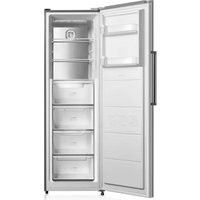
Table of contents
Click a title to access it
- SIGN CONGÉLATEUR Armoire
- TABLE DES MATIERES
- Séparez les éléments avant de trier
- CONSIGNES DE SECURITE IMPORTANTES
- Cet averissement ne s'applique qu'au marché EUROPEEN!
- Installation avant la première mise en marche
- Les distances minimums des sources de chauffage
- Attention:
- Raccordement au réseau électrique
- Mise hors circuit
- Classe climatique
- Commande de l'appareil
- Réglage de la température à l'intérieur de l'appareil
- Congélation des produits
- Conseils pratiques
- Que veulent dire les étoiles?
- Dégivrage automatique du congélateur
- Lavage à main du组成部分 congélateur
- CONSEILS EN MATIÈRE D'ÉCONOMIE D'ENERGIE
- LNVERSION DE PORTE
- SPECIFICATIONS TECHNIQUES
- Classe climatique :
- ENLEVEMENT DES APPAREILS MENAGERS USAGES
- SIGN UPRIGHT
- Freezer
- TABLE OF CONTENTS
- This product is for household use only!
- IMPORTANT SAFETY INSTRUCTIONS
- This warning is only for EUROPEAN market only!
- INSTCONDITIONS OF THE APPLIANDEOPER -
- Installation before using the appliance for the first time
- Minimum distances from the heat sources
- Warning:
- Mains connection
- Disconnecting the mains
- Climate range
- Appliance controls
- Adjust temperature inside the appliance
- Freezing food
- Practical everyday tips
- Understanding the stars
- Automatic freezer defrosting
- Washing freezer chambers manually
- ENERGY SAVING TIPS
- REVERSING THE DOOR SWING
- TECHNICAL SPECIFICATIONS
- Climate class:
- TROUBLESHOOTING
- Note:
Manual assistant
Powered by Anthropic
Waiting for your message
Product information
Brand : SIGNATURE
Model : SCA206NFS
Category : Freezer