
Essentio CG8350 - Bag ASUS - Free user manual and instructions
Find the device manual for free Essentio CG8350 ASUS in PDF.



| Product Type | Desktop Computer |
| Brand | ASUS |
| Model | Essentio CG8350 |
| Dimensions (approx.) | 180 x 440 x 450 mm (W x H x D) |
| Weight (approx.) | 10 kg |
| Power Supply | Internal power supply, 300 W (estimated) |
| Operating System | Windows 7 |
| Front USB Ports | 2 x USB 2.0 |
| Rear USB Ports | 2 x USB 2.0, 2 x USB 3.0 |
| Video Outputs | 1 x VGA, 1 x DVI-D, 1 x HDMI |
| Audio | Microphone input, headphone output, 7.1-channel surround ports |
| Network | Gigabit Ethernet (RJ-45) |
| Memory Card Reader | SD/MMC, Memory Stick, CompactFlash |
| Optical Drive | DVD burner (or Blu-ray, depending on configuration) |
| Included Software | ASUS AI Suite II, AI Manager, Nero 9, Trend Micro Internet Security (trial) |
| Security | Kensington lock, BIOS password, device password protection |
| Maintenance and Cleaning | Disconnect power before cleaning; use a damp, non-abrasive cloth |
| Operating Temperature | 0°C to 35°C |
| Safety Instructions | Do not obstruct ventilation; do not expose to moisture; use on a stable surface |
| Repairability | Replaceable components (RAM, hard drive, graphics card); contact customer service for repair |
| Included Peripherals | Keyboard, mouse, power cord, installation guide, warranty card |
Frequently Asked Questions - Essentio CG8350 ASUS
User questions about Essentio CG8350 ASUS
0 question about this device. Answer the ones you know or ask your own.
Ask a new question about this device
Download the instructions for your Bag in PDF format for free! Find your manual Essentio CG8350 - ASUS and take your electronic device back in hand. On this page are published all the documents necessary for the use of your device. Essentio CG8350 by ASUS.
USER MANUAL Essentio CG8350 ASUS
ASUS Essentio Desktop PC
CG8350
User Manual

natural_image
Line drawing of a desktop computer tower with visible drive bays and control panel (no text or symbols)E6181
First Edition
January 2011
Copyright © 2011 ASUSTeK Computer Inc. All Rights Reserved.
No part of this manual, including the products and software described in it, may be reproduced, transmitted, transcribed, stored in a retrieval system, or translated into any language in any form or by any means, except documentation kept by the purchaser for backup purposes, without the express written permission of ASUSTeK Computer Inc. ("ASUS").
Product warranty or service will not be extended if: (1) the product is repaired, modified or altered, unless such repair, modification of alteration is authorized in writing by ASUS; or (2) the serial number of the product is defaced or missing.
ASUS PROVIDES THIS MANUAL "AS IS" WITHOUT WARRANTY OF ANY KIND, EITHER EXPRESS OR IMPLIED, INCLUDING BUT NOT LIMITED TO THE IMPLIED WARRANTIES OR CONDITIONS OF MERCHANTABILITY OR FITNESS FOR A PARTICULAR PURPOSE. IN NO EVENT SHALL ASUS, ITS DIRECTORS, OFFICERS, EMPLOYEES OR AGENTS BE LIABLE FOR ANY INDIRECT, SPECIAL, INCIDENTAL, OR CONSEQUENTIAL DAMAGES (INCLUDING DAMAGES FOR LOSS OF PROFITS, LOSS OF BUSINESS, LOSS OF USE OR DATA, INTERRUPTION OF BUSINESS AND THE LIKE), EVEN IF ASUS HAS BEEN ADVISED OF THE POSSIBILITY OF SUCH DAMAGES ARISING FROM ANY DEFECT OR ERROR IN THIS MANUAL OR PRODUCT.
SPECIFICATIONS AND INFORMATION CONTAINED IN THIS MANUAL ARE FURNISHED FOR INFORMATIONAL USE ONLY, AND ARE SUBJECT TO CHANGE AT ANY TIME WITHOUT NOTICE, AND SHOULD NOT BE CONSTRUED AS A COMMITMENT BY ASUS. ASUS ASSUMES NO RESPONSIBILITY OR LIABILITY FOR ANY ERRORS OR INACCURACIES THAT MAY APPEAR IN THIS MANUAL, INCLUDING THE PRODUCTS AND SOFTWARE DESCRIBED IN IT.
Products and corporate names appearing in this manual may or may not be registered trademarks or copyrights of their respective companies, and are used only for identification or explanation and to the owners' benefit, without intent to infringe.
Contents
Notices ......v
Safety information ......vii
Conventions used in this guide ...... viii
Where to find more information ...... viii
Package contents ix
Chapter 1 Getting started
Welcome! 1-1
Getting to know your computer 1-1
Setting up your computer 1-5
Turning your computer ON/OFF 1-8
Chapter 2 Using Windows ^® 7
Starting for the first time.... 2-1
Using Windows ^® 7 desktop 2-2
Managing your files and folders.... 2-7
Restoring your system....2-10
Protecting your computer....2-11
Getting Windows® Help and Support 2-15
Chapter 3 Connecting devices to your computer
Connecting a USB storage device 3-1
Connecting microphone and speakers 3-2
Connecting multiple external displays 3-5
Connecting an HDTV 3-7
Chapter 4 Using your computer
Proper posture when using your Desktop PC.... 4-1
Using the memory card reader 4-2
Using the optical drive 4-3
Using the multimedia keyboard (on selected models only) 4-4
Chapter 5 Connecting to the Internet
Wired connection 5-1
Contents
Chapter 6 Using the Utilities
ASUS AI Suite II 6-1
ASUS AI Manager....6-10
Nero 9 6-15
Recovering your system 6-19
Chapter 7 Troubleshooting
Troubleshooting 7-1
Notices
REACH
Complying with the REACH (Registration, Evaluation, Authorisation, and Restriction of Chemicals) regulatory framework, we published the chemical substances in our products at ASUS REACH website at http://green.asus.com/english/REACH.htm
Federal Communications Commission Statement
This device complies with Part 15 of the FCC Rules. Operation is subject to the following two conditions:
- This device may not cause harmful interference; and
- This device must accept any interference received including interference that may cause undesired operation.
This equipment has been tested and found to comply with the limits for a Class B digital device, pursuant to Part 15 of the FCC Rules. These limits are designed to provide reasonable protection against harmful interference in a residential installation. This equipment generates, uses and can radiate radio frequency energy and, if not installed and used in accordance with manufacturer's instructions, may cause harmful interference to radio communications. However, there is no guarantee that interference will not occur in a particular installation. If this equipment does cause harmful interference to radio or television reception, which can be determined by turning the equipment off and on, the user is encouraged to try to correct the interference by one or more of the following measures:
- Reorient or relocate the receiving antenna.
- Increase the separation between the equipment and receiver.
- Connect the equipment to an outlet on a circuit different from that to which the receiver is connected.
- Consult the dealer or an experienced radio/TV technician for help.

The use of shielded cables for connection of the monitor to the graphics card is required to assure compliance with FCC regulations. Changes or modifications to this unit not expressly approved by the party responsible for compliance could void the user's authority to operate this equipment.
RF exposure warning
This equipment must be installed and operated in accordance with provided instructions and the antenna(s) used for this transmitter must be installed to provide a separation distance of at least 20 cm from all persons and must not be co-located or operating in conjunction with any other antenna or transmitter. End-users and installers must be provide with antenna installation instructions and transmitter operating conditions for satisfying RF exposure compliance.
Canadian Department of Communications Statement
This digital apparatus does not exceed the Class B limits for radio noise emissions from digital apparatus set out in the Radio Interference Regulations of the Canadian Department of Communications.
This class B digital apparatus complies with Canadian ICES-003.
Macrovision Corporation Product Notice
This product incorporates copyright protection technology that is protected by method claims of certain U.S. patents and other intellectual property rights owned by Macrovision Corporation and other rights owners. Use of this copyright protection technology must be authorized by Macrovision Corporation, and is intended for home and other limited viewing uses only unless otherwise authorized by Macrovision Corporation. Reverse engineering or disassembly is prohibited.
Lithium-Ion Battery Warning
CAUTION: Danger of explosion if battery is incorrectly replaced. Replace only with the same or equivalent type recommended by the manufacturer. Dispose of used batteries according to the manufacturer's instructions.
Safety information

Disconnect the AC power and peripherals before cleaning. Wipe the Desktop PC using a clean cellulose sponge or chamois cloth dampened with solution of nonabrasive detergent and a few drops of warm water then remove any extra moisture with a dry cloth.
- DO NOT place on uneven or unstable work surfaces. Seek servicing if the casing has been damaged.
• DO NOT expose to dirty or dusty environments. DO NOT operate during a gas leak. - DO NOT place or drop objects on top and do not shove any foreign objects into the Desktop PC.
• DO NOT expose to strong magnetic or electrical fields. - DO NOT expose to or use near liquids, rain, or moisture. DO NOT use the modem during electrical storms.
- Battery safety warning: DO NOT throw the battery in fire. DO NOT short circuit the contacts. DO NOT disassemble the battery.
- Use this product in environments with ambient temperatures between 0^ (32°F) and 35^ (95°F).
- DO NOT cover the vents on the Desktop PC to prevent the system from getting overheated.
• DO NOT use damaged power cords, accessories, or other peripherals. - To prevent electrical shock hazard, disconnect the power cable from the electrical outlet before relocating the system.
- Seek professional assistance before using an adapter or extension cord. These devices could interrupt the grounding circuit.
- Ensure that your power supply is set to the correct voltage in your area. If you are not sure about the voltage of the electrical outlet you are using, contact your local power company.
- If the power supply is broken, do not try to fix it by yourself. Contact a qualified service technician or your retailer.
Conventions used in this guide
To ensure that you perform certain tasks properly, take note of the following symbols used throughout this manual.

DANGER/WARNING: Information to prevent injury to yourself when trying to complete a task.
CAUTION: Information to prevent damage to the components when trying to complete a task.
IMPORTANT: Instructions that you MUST follow to complete a task.
NOTE: Tips and additional information to help you complete a task.
Where to find more information
Refer to the following sources for additional information and for product and software updates.
ASUS websites
The ASUS website provides updated information on ASUS hardware and software products. Refer to the ASUS website www.asus.com.
ASUS Local Technical Support
Visit ASUS website at http://support.asus.com/contact for the contact information of local Technical Support Engineer.
Package contents
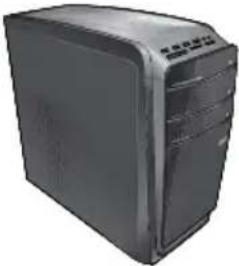 |  | 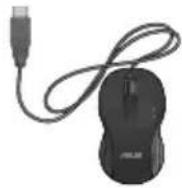 | |
| ASUS Essentio Desktop PC | Keyboard x1 Mouse x1 | ||
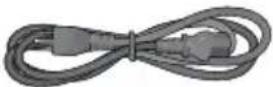 |  | ||
| Power cord x1 Installation Guide x1 | |||
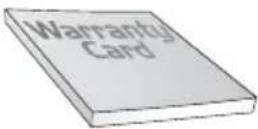 | 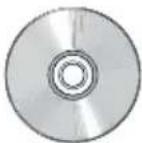 | ||
| Warranty card x1 Nero 9 burning software DVD x1 | |||

- If any of the above items is damaged or missing, contact your retailer.
- The illustrated items above are for reference only. Actual product specifications may vary with different models.
Chapter 1
Getting started
Welcome!
Thank you for purchasing the ASUS Essentio CG8350 Desktop PC!
The ASUS Essentio CG8350 Desktop PC provides cutting-edge performance,
uncompromised reliability, and user-centric utilities. All these values are encapsulated in a stunningly futuristic and stylish system casing.

Read the ASUS Warranty Card before setting up your ASUS Desktop PC.
Getting to know your computer

Illustrations are for reference only. The ports and their locations, and the chassis color vary with different models.
Front panel


Click the number to view its corresponding description.
- USB 2.0 ports. These Universal Serial Bus 2.0 (USB 2.0) ports connect to USB 2.0 devices such as a mouse, printer, scanner, camera, PDA, and others.
- Microphone port. This port connects to a microphone.
- Headphone port. This port connects to a headphone or speaker.
- Power button. Press this button to turn on your computer.
- Optical disk drive eject button. Press this button to eject the optical disk drive tray.
- Optical disk drive bay (empty). Allows you to install an additional optical disk drive in this bay.
- Optical disk drive bay. There is an optical disk drive in this bay.
- Memory Stick™ / Memory Stick Pro™ card slot. Insert a Memory Stick™ / Memory Stick Pro™ card into this slot.
- Secure Digital™ / MultiMediaCard slot. Insert a Secure Digital™ / MultiMediaCard card into this slot.
- CompactFlash® / Microdrive™ card slot. Insert a CompactFlash® / Microdrive™ card into this slot.
Rear panel


Click the number to view its corresponding description.
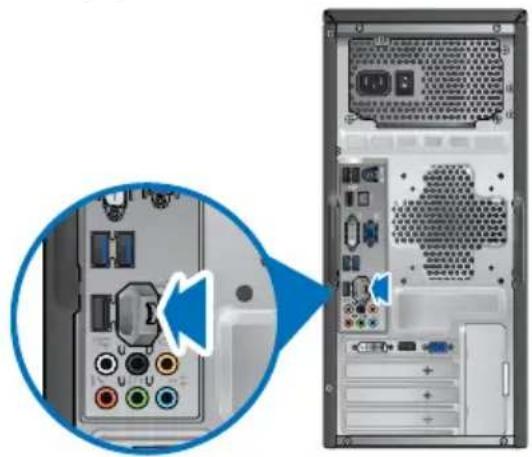
- Power connector. Plug the power cord to this connector.
- Power switch. Switch to turn ON/OFF the power supply to your computer.
- Air vents. These vents allow air ventilation.

DO NOT block the air vents on the chassis. Always provide proper ventilation for your computer.
- PS/2 Keyboard / Mouse Combo port (purple/green). This port is for a PS/2 keyboard or mouse.
- USB 2.0 ports. These Universal Serial Bus 2.0 (USB 2.0) ports connect to USB 2.0 devices such as a mouse, printer, scanner, camera, PDA, and others.
- Optical S/PDIF_OUT port. This port connects to an external audio output device via an optical S/PDIF cable.
- HDMI port. This port is for a High-Definition Multimedia Interface (HDMI) connector, and is HDCP compliant allowing playback of HD DVD, Blu-ray, and other protected content.
- DVI-D port. This port is for any DVI-D compatible device and is HDCP compliant allowing playback of HD DVD, Blu-ray, and other protected content.
- VGA port. This port is for VGA-compatible devices such as a VGA monitor.
- USB 3.0 ports. These Universal Serial Bus 3.0 (USB 3.0) ports connect to USB 3.0 devices such as a mouse, printer, scanner, camera, PDA, and others.

- DO NOT connect a keyboard / mouse to any USB 3.0 port when installing Windows® operating system.
-
Due to USB 3.0 controller limitation, USB 3.0 devices can only be used under Windows® OS environment and after the USB 3.0 driver installation.
• USB 3.0 devices can only be used as data storage only.
• We strongly recommend that you connect USB 3.0 devices to USB 3.0 ports for faster and better performance for your USB 3.0 devices. -
USB 2.0 ports. These Universal Serial Bus 2.0 (USB 2.0) ports connect to USB 2.0 devices such as a mouse, printer, scanner, camera, PDA, and others.
-
LAN (RJ-45) port. This port allows Gigabit connection to a Local Area Network (LAN) through a network hub.
LAN port LED indications
| Activity/Link LED | Speed LED | |
| Status Description Status Description | ||
| OFF No link OFF 10Mbps connection | ||
| ORANGE Linked ORANGE 100Mbps connection | ||
| BLINKING Data activity GREEN 1Gbps connection | ||
ACT/LINK SPEED
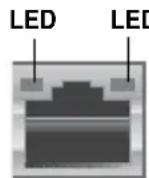
LAN port
Refer to the audio configuration table below for the function of the audio ports in a 2, 4, 6, or 8-channel configuration.
Audio 2, 4, 6, or 8-channel configuration
| Port | Headset2-channel | 4-channel 6-channel 8-channel | ||
| Light Blue Line In Line In Line In Line In | ||||
| Lime Line Out Front Speaker Out Front Speaker Out Front Speaker Out | ||||
| Pink Mic In Mic In Mic In Mic In | ||||
| Orange | - | - | Center/Subwoofer | Center/Subwoofer |
| Black | - | Rear Speaker Out | Rear Speaker Out | Rear Speaker Out |
| Gray | -- | - | Side Speaker Out | |
- ASUS Graphics Card (on selected models only). The display output ports on this optional ASUS Graphics Card may vary with different models.
- Expansion slot bracket. Remove the expansion slot bracket when installing an expansion card.
Setting up your computer
This section guides you through connecting the main hardware devices, such as the external monitor, keyboard, mouse, and power cord, to your computer.
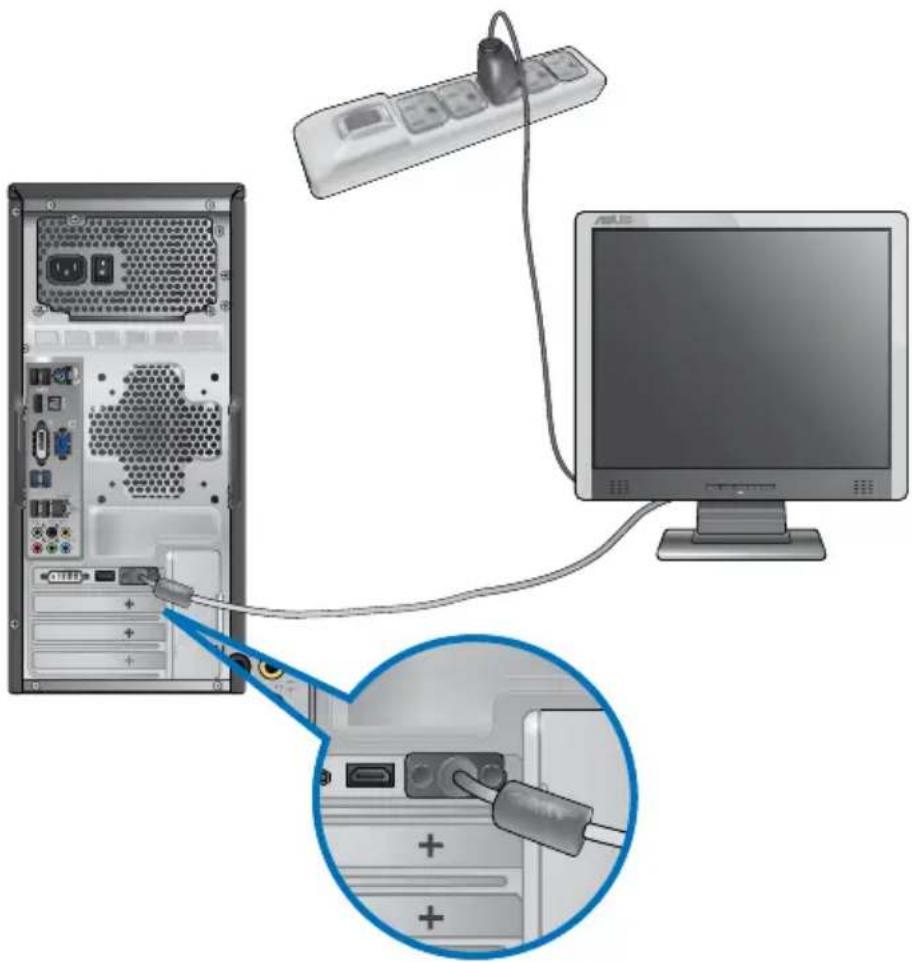
Connecting an external monitor
Using the ASUS Graphics Card (on selected models only)
Connect your monitor to the display output port on the discrete ASUS Graphics Card.
To connect an external monitor using the ASUS Graphics Card:
- Connect a monitor to a display output port on the ASUS Graphics Card.
- Plug the monitor to a power source.

The display output ports on the ASUS Graphics Card may vary with different models.
natural_image
Diagram showing connection between a computer monitor and an internal server, with cable routing and a close-up of the device (no text or symbols present)Using the onboard display output ports
Connect your monitor to the onboard display output port.
To connect an external monitor using the onboard display output ports:
- Connect a VGA monitor to the VGA port, or a DVI-D monitor to the DVI-D port, or an HDMI monitor to the HDMI port on the rear panel of your computer.
- Plug the monitor to a power source.

natural_image
Diagram showing computer setup with monitor, tower, and server rack connected to a cable via cable (no text or symbols present)
- If your computer comes with an ASUS Graphics Card, the graphics card is set as the primary display device in the BIOS. Hence, connect your monitor to a display output port on the graphics card.
Connecting a USB keyboard and a USB mouse
Connect a USB keyboard and a USB mouse to the USB ports on the rear panel of your computer.
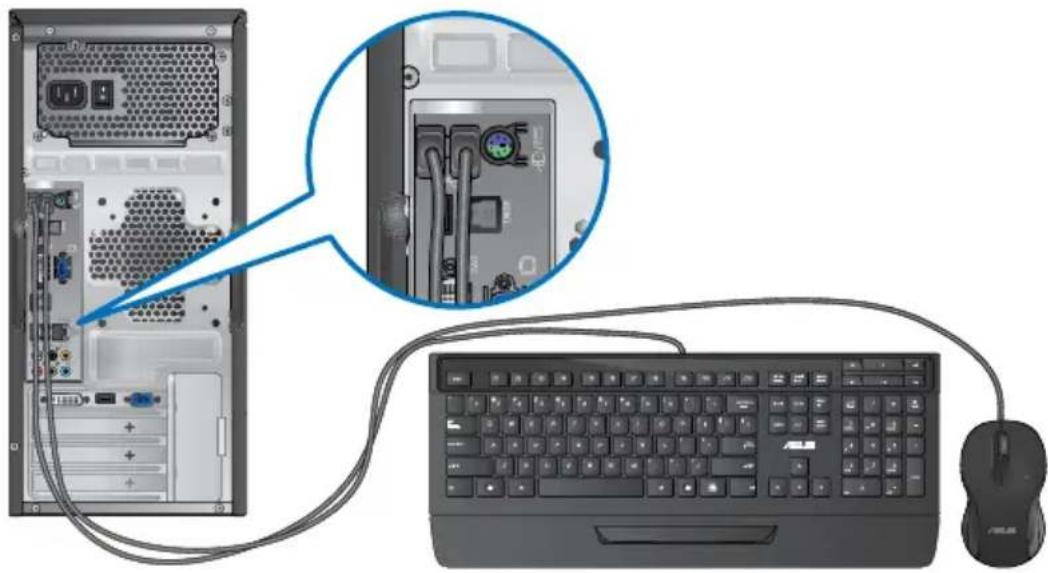
natural_image
Diagram showing computer setup with CPU, keyboard, mouse, and cable (no text or symbols)Connecting the power cord
Connect one end of the power cord to the power connector on the rear panel of your computer and the other end to a power source.
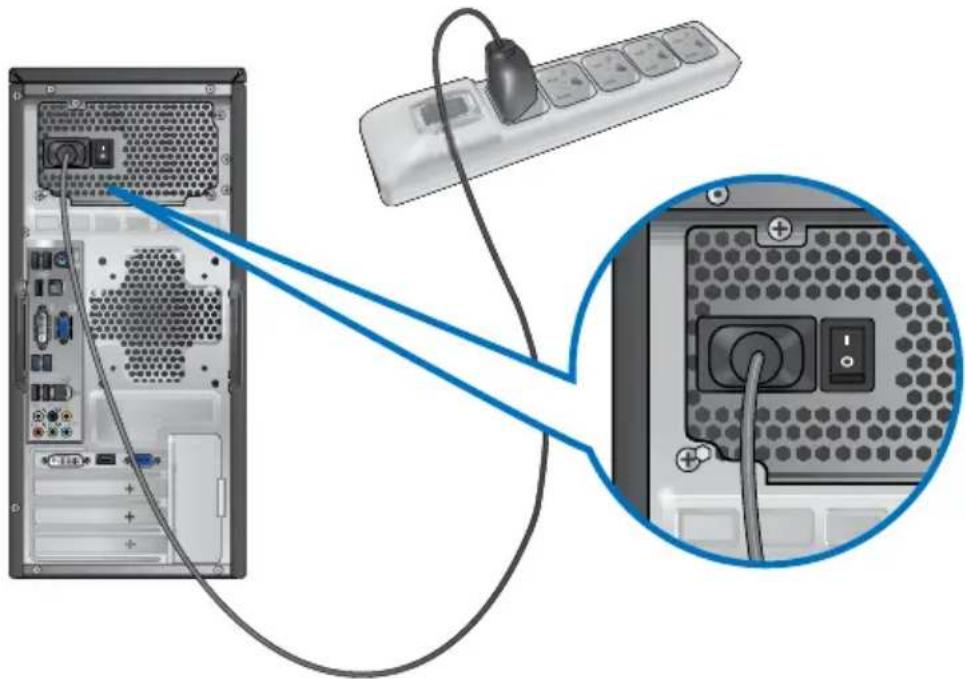
natural_image
Diagram showing internal components of a computer tower with connected cables and a keyboard, no text or symbols presentTurning your computer ON/OFF
This section describes how to turn on/off your computer after setting up your computer.
Turning your computer ON
To turn your computer ON:
- Turn your monitor ON.
- Turn the power switch ON, then press the power button on your computer.

- Wait until the operating system loads automatically.
Turning your computer OFF
To turn your computer OFF:
- Close all running applications.
- Click on the Windows® desktop.
- Click Shut down to shut down the operating system.
Chapter 2
Using Windows® 7
Starting for the first time
When you start your computer for the first time, a series of screens appear to guide you in configuring the basic settings of your Windows ^® 7 operating system.
To start for the first time:
- Turn your computer on. Wait for a few minutes until the appears.
Set Up Windows screen - From dropdown list, select your language. Click Next.
- From the dropdown lists, select your Keyboard layout. Click Next.
Country or region, Time and currency, and - Key in uniques names for the user name and computer name. Click Next.
- Key in the necessary information to set up your password, then click also click Next to skip this step without entering any information.
Next. You may

If you want to set up a password for your account later, refer to the section Setting up a user account and password in this chapter.
- Carefully read the license terms. Tick I accept the license terms and click Next.
- Select Use recommended settings or Install important updates only to set up the security settings for your computer. To skip this step, select Ask me later.
- Review your date and time settings. Click Next. The system loads the new settings and restarts. You may now start using your computer.
Using Windows ^® 7 desktop

Click the Start icon > Help and Support to obtain more information about Windows
③7.

Using the Start menu
The Start menu gives you access to programs, utilities, and other useful items on your computer. It also provides you with more information about Windows 7 through its Help and Support feature.
Launching items from the Start menu
To launch items from the Start menu:
- From the Windows
® taskbar, click the Start icon

- From the Start menu, select the item that you want to launch.

You may pin programs that you want constantly displayed on the Start menu. For more details, refer to the section Pinning programs on the Start menu or taskbar on this chapter.
Using the Getting Started item
The Getting Started item on the Start menu contains information about some basic tasks such as personalizing Windows ^® , adding new users, and transferring files to help you to familiarize yourself with using Windows ^® 7.
To use the Getting Started item:
-
From the Windows ^ taskbar, click the Start icon to launch the Start menu.
-
Select Getting Started. The list of available tasks appears.
-
Select the task that you want to do.
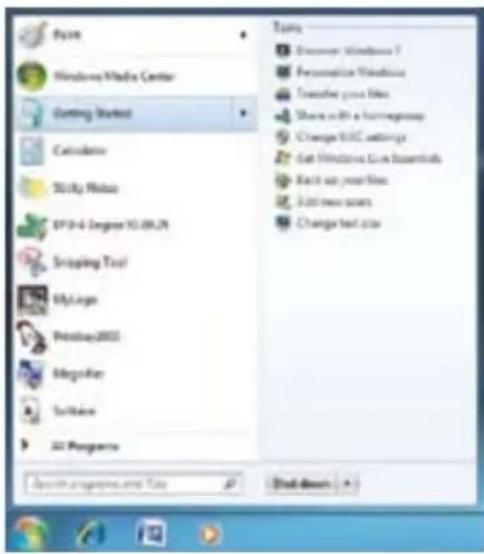
Using the taskbar
The taskbar allows you to launch and manage programs or items installed on your computer.
Launching a program from the taskbar
To launch a program from the taskbar:
- From the Windows program. ^® taskbar, click an icon to launch it. Click the icon again to hide the
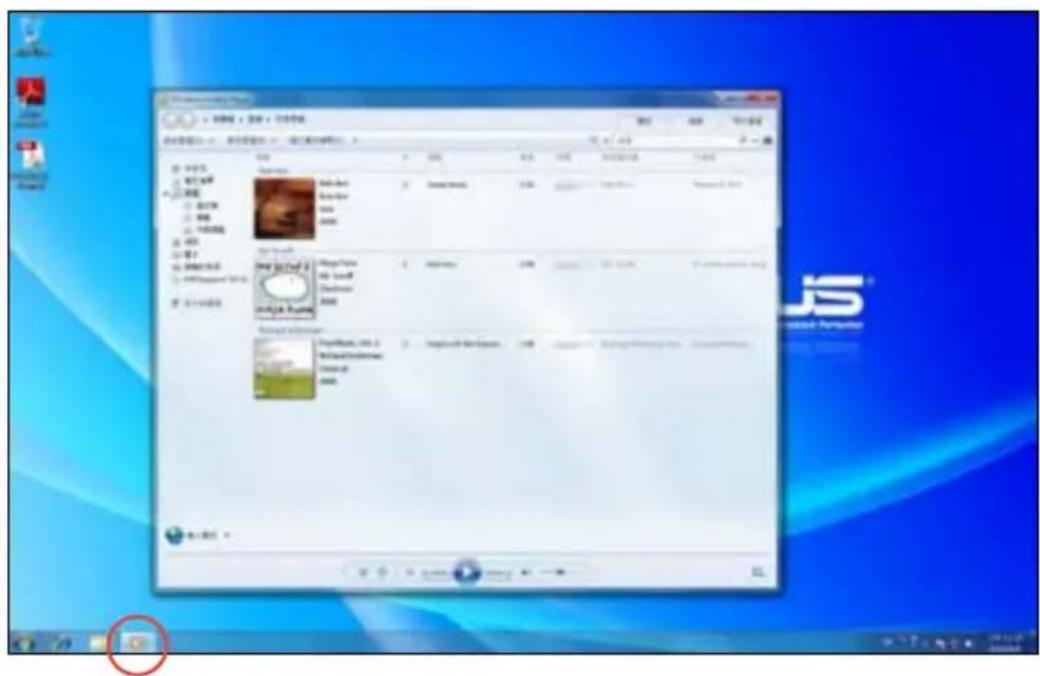
You may pin programs that you want constantly displayed on the taskbar. For more details, refer to the section Pinning programs on the Start menu or taskbar on this chapter.
Pinning items on the jumplists
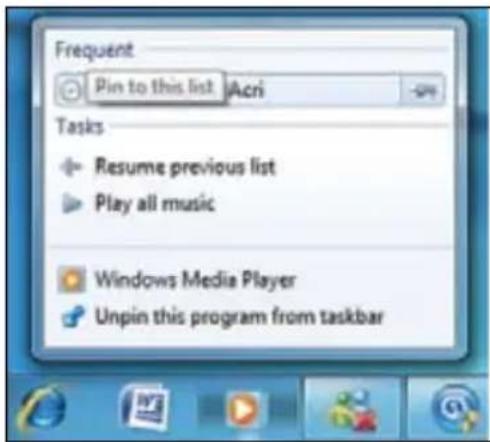
When you right-click an icon on the taskbar, a jumplist launches to provide you with quick-access to the program's or item's related links. You may pin items on the jumplist such as favorite websites, often-visited folders or drives, or recently played media files.
To pin items to the jumplist:
- From the taskbar, right-click an icon.
- From the jumplist, right-click the item that you want to pin, then select Pin to this list.
Unpinning items from the jumplist
To unpin items from the jumplist:
- From the taskbar, right-click an icon.
- From the jumplist, right-click the item that you want to remove from the jumplist, then select Unpin from this list.
Pinning programs on the Start menu or taskbar
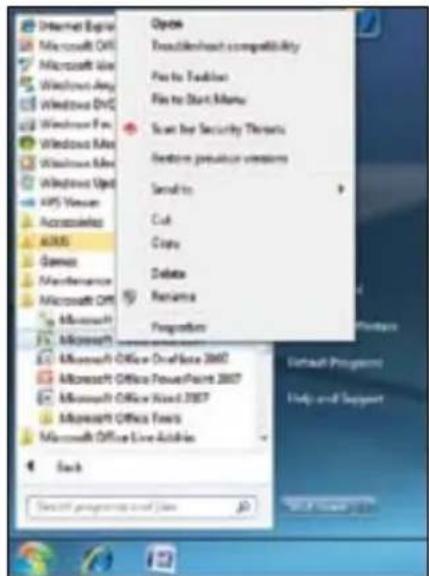
To pin programs on the Start menu or taskbar:
- From the Windows ^ taskbar, click the Start icon

to launch the Start menu.
- Right-click the item that you want to pin on the Start menu or taskbar.
- Select Pin to Taskbar or Pin to Start menu.

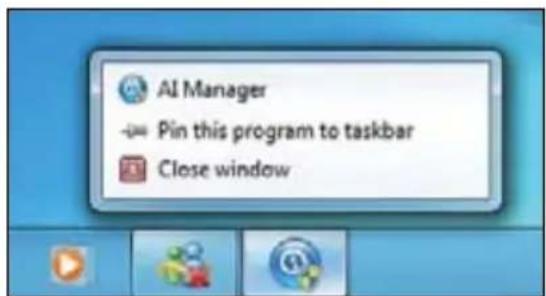
You may also right-click on the icon of a running program on the taskbar, then select Pin this program to taskbar.
Unpinning programs from the Start menu
To unpin programs from the Start menu:
- From the Windows ^ taskbar, click the Start icon to launch the Start menu.
- From the Start menu, right-click the program that you want to unpin, then select Remove from this list.
Unpinning programs from the taskbar
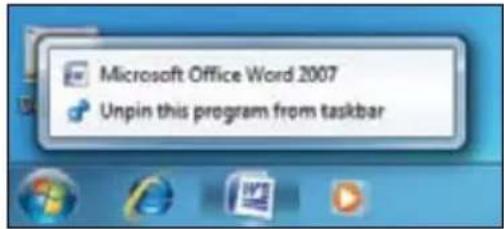
To unpin programs from the taskbar:
- From the taskbar, right-click the program that you want to remove from the taskbar, then select Unpin this program from taskbar.
Using the notification area
By default, the notification area shows these three icons:
 | Action Center notificationClick this icon to display all the alert messages/notifications and launch the Windows® Action Center. |
 | Network connectionThis icon displays the connection status and signal strength of the wired or wireless network connection. |
 | VolumeClick this icon to adjust the volume. |
Displaying an alert notification
To display an alert notification:
- Click the Notification icon the message to open it.



For more details, refer to the section Using Windows® Action Center in this chapter.
Customizing icons and notifications
You may choose to display or hide the icons and notifications on the taskbar or on the notification area.
To customize icons and notifications:
- From the notification area, click on the arrow icon

-
Click Customize.
-
From the dropdown list, select the behaviors for the icons or items that you want customize.
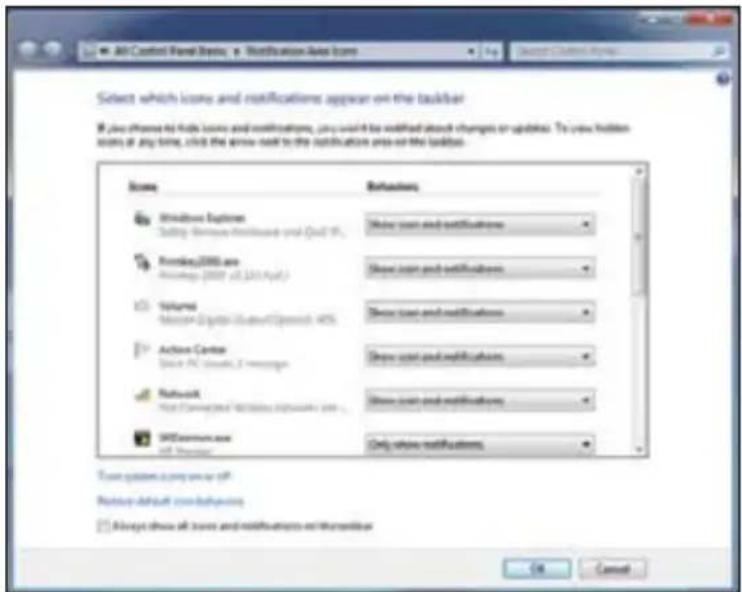
Managing your files and folders
Using Windows® Explorer
Windows® Explorer allows you to view, manage, and organize your files and folders.
Launching Windows® Explorer
To launch Windows Explorer:
- From the Windows ^ taskbar, click the Start icon to launch the Start menu.
- Click Computer to launch Windows Explorer.
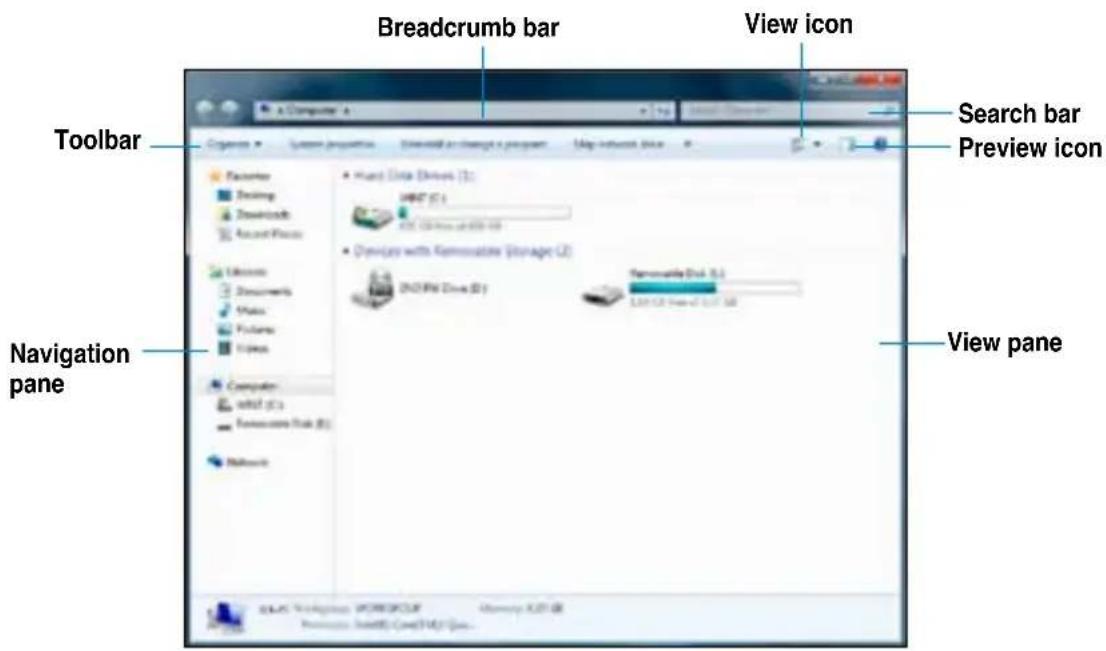
Exploring files and folders
To explore files and folders:
- Launch Windows Explorer.
- From the navigation or view pane, browse for the location of your data.
- From the breadcrumb bar, click the arrow to display the contents of the drive or folder.
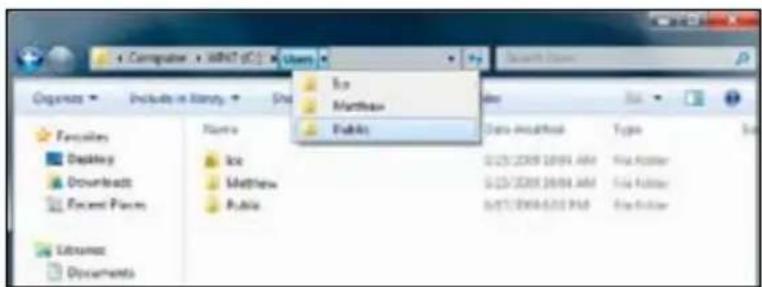
Customizing the file/folder view
To customize the file/folder view:
- Launch Windows Explorer.
- From the navigation pane, select the location of your data.
- From the toolbar, click the View icon
- From the View menu, move the slider to select how you want to view the file/folder.
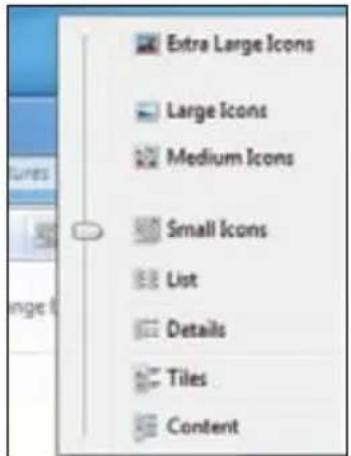

You may also right-click anywhere on the View pane, click View, and select the view type that you want.

Arranging your files
To arrange your files:
- Launch Windows Explorer.
- From the Arrange by field, click to display the dropdown list.
- Select your preferred arrangement type.

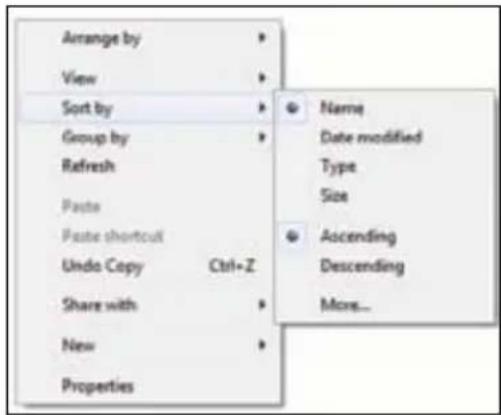
Sorting your files
To sort your files:
- Launch Windows Explorer.
- Right-click anywhere on the View pane.
- From the menu that appears, select Sort by, then select your preferred sorting type.
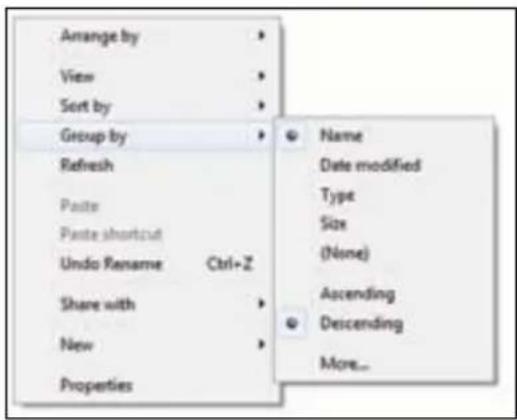
Grouping your files
To group your files:
- Launch Windows Explorer.
- Right-click anywhere on the View pane.
- From the menu that appears, select Group by, then select your preferred grouping type.
Adding a new folder
To add a new folder:
- Launch Windows Explorer.
- From the toolbar, click New folder.
- Key in a name for the new folder.


You may also right-click anywhere on the View pane, click New > Folder.

Backing up your files
Setting up a backup
To set up a backup:
- Click

All Programs > Maintenance > Backup and Restore.
- Click
Set up backup. Click Next.

- Select your backup destination. Click Next.
- Select Let Windows choose (recommended) or Let me choose as your backup mode.

If you select Let Windows choose, Windows will not back up your programs, FAT-formatted files, Recycle Bin files, or temporary files that are 1GB or more.
- Follow the onscreen instructions to finish the process.
Restoring your system
The Windows® System Restore feature creates a restore point where the computer's system settings are stored at certain time and date. It allows you to restore or undo changes to your computer's system settings without affecting your personal data.
To restore your system:
-
Close all running applications.
-
Click

All Programs > Accessories > System Tools > System Restore.
- Follow the onscreen instructions to complete the process.
Protecting your computer
Using Windows® 7 Action Center
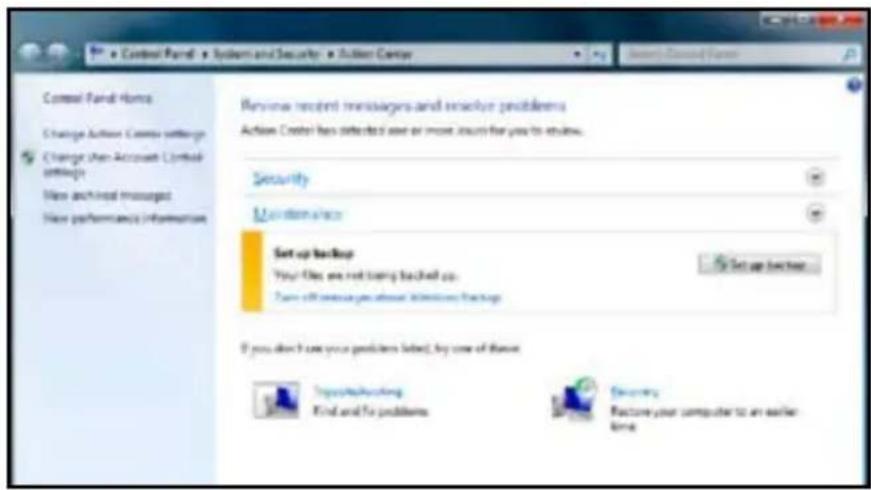
Windows® 7 Action Center provides you with alert notifications, security information, system maintenance information, and the option to automatically troubleshoot and fix some common computer problems.

You may customize the notifications. For more details, refer to the previous section Customizing icons and notifications in this chapter.
Launching Windows® 7 Action Center To launch Windows® 7 Action Center:
- To launch Windows 7 Action Center, click the Notification icon, then click Open Action Center.

- From Windows 7 Action Center, click the task that you want to do.
Using Windows® Update
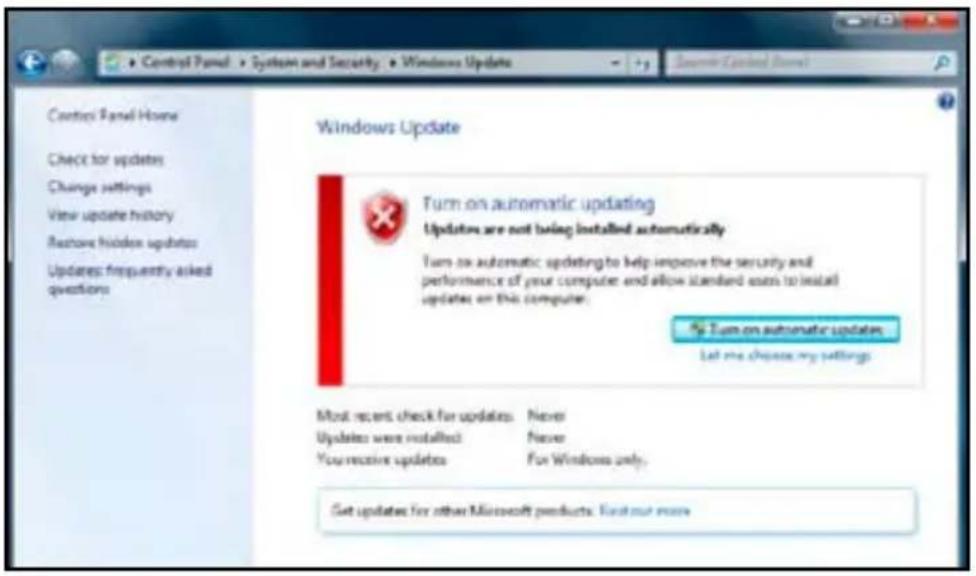
Windows Update allows you to check and install the latest updates to enhance the security and performance of your computer.
Launching Windows® Update
To launch Windows® Update:
- From the Windows ^ taskbar, click the Start icon to launch the Start menu.
- Select All Programs > Windows Update.
- From the Windows Update screen, click the task that you want to do.
Setting up a user account and password
You may create user accounts and passwords for people who will use your computer.
Setting up a user account
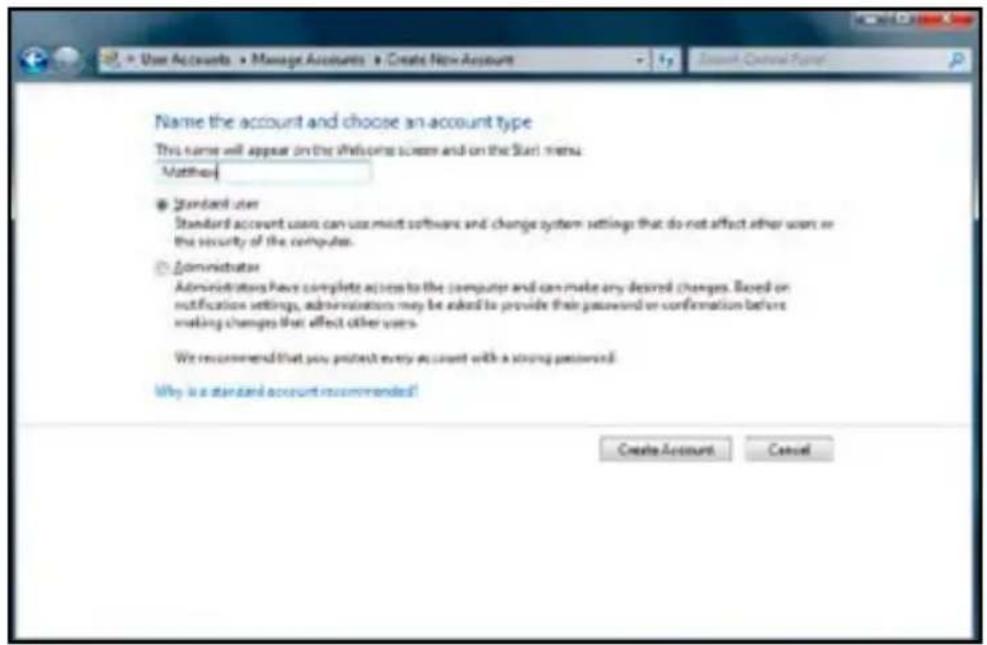
To set up a user account:
- From the Windows ^ taskbar, click > Getting Started > Add new users.
- Select Manage another account.
- Select Create a new account.
- Key in the name of the new user.
- Select either Standard user or Administrator as the user type.
- When done, click Create Account.
Setting up a user's password
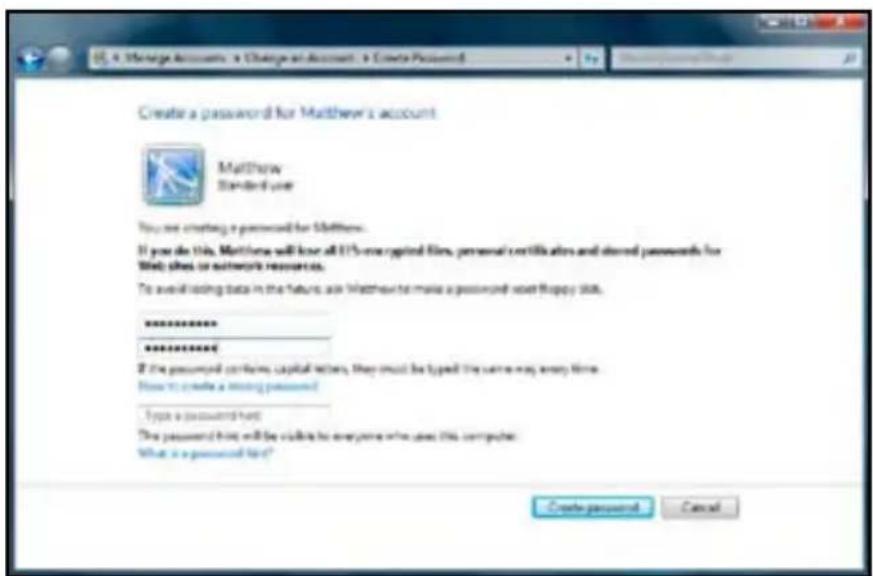
To set up a user's password:
- Select the user that you would like to set a password.
- Select Create a password.

- Key in a password and confirm it. Key in your password's hint.
- When done, click Create password.
Activating the anti-virus software
Trend Micro Internet Security is pre-installed on your computer. It is a third-party anti-virus software protecting your computer from virus attacking. It is purchased separately. You have a 30-day trial period after activating it.
To activate Trend Micro Internet Security:
- Run the Trend Micro Internet Security application.
- Carefully read the license terms. Click Agree & Activate.
- Input your e-mail address and select your location. Click Next.
- Click Finish to complete the activation.
Getting Windows® Help and Support
Windows® Help and Support provides you with guides and answers in using the applications in Windows® 7 platform.
To launch Windows® Help and Support, click > Help and Support.
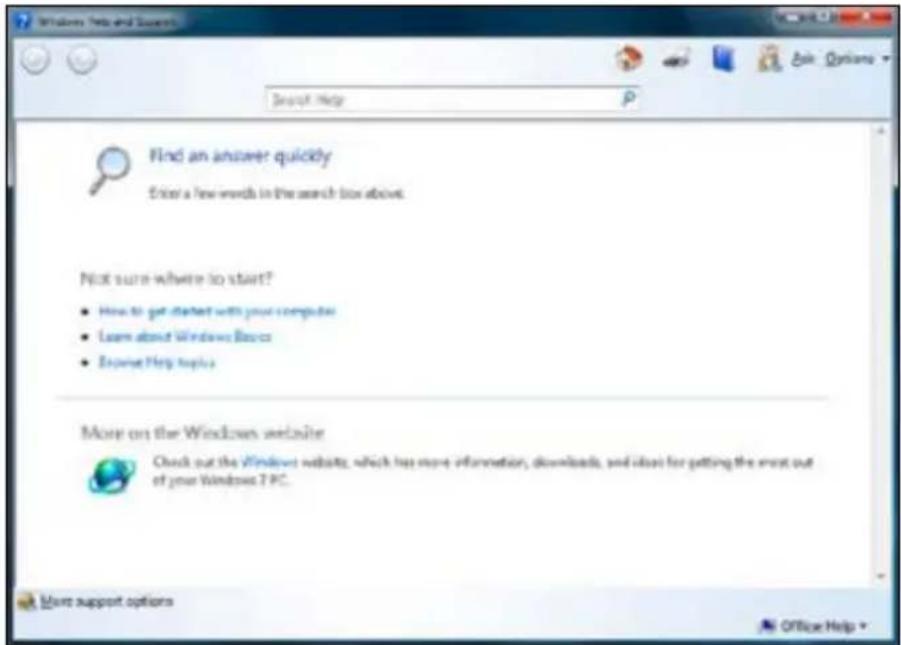

Ensure that you are connected to the Internet to obtain the latest Windows ^® online help.
Chapter 3
Connecting devices to your computer
Connecting a USB storage device
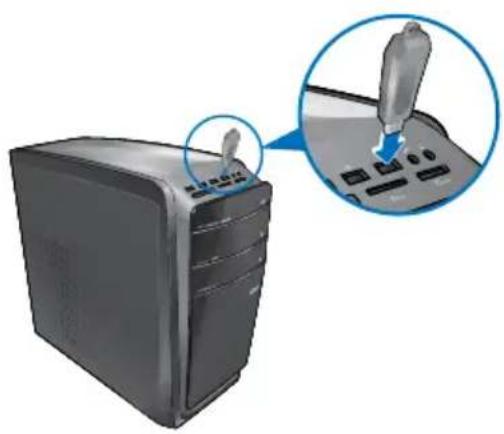
This desktop PC provides USB 2.0/1.1 ports on both the front and rear panels. The USB ports allow you to connect USB devices such as storage devices.
To connect a USB storage device:
- Insert the USB storage device to your computer.
natural_image
Illustration of a desktop computer tower with a pen inserted, showing the keyboard and mouse control panel (no text or symbols present)Front panel
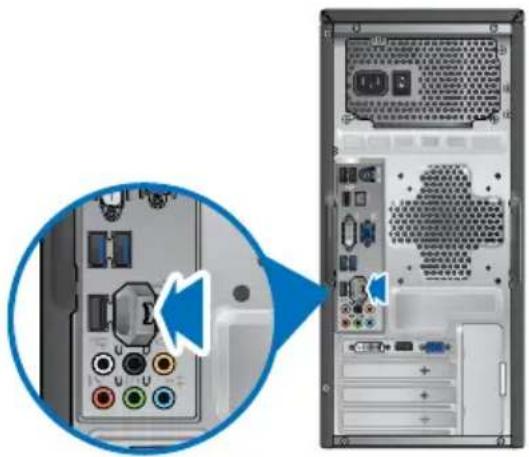
natural_image
Back view of a computer tower showing internal components and a close-up of the speaker port (no text or symbols visible)Rear panel
To remove a USB storage device:
-
Click from the Windows notification area on your computer, then click Eject USB2.0 FlashDisk.
-
When the Safe to Remove Hardware message pops up, remove the USB storage device from your computer.
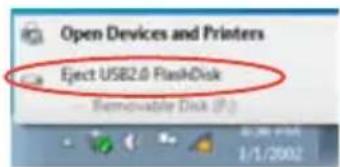


DO NOT remove a USB storage device when data transfer is in progress. Doing so may cause data loss or damage the USB storage device.
Connecting microphone and speakers
This desktop PC comes with microphone ports and speaker ports on both the front and rear panels. The audio I/O ports located on the rear panel allow you to connect 2-channel, 4-channel, 6-channel, and 8-channel stereo speakers.
Connecting Headphone and Mic

natural_image
Illustration of a desktop computer tower connected to an audio headset via cable, with a magnified inset showing the cable being inserted into a device (no text or symbols present)Connecting 2-channel Speakers
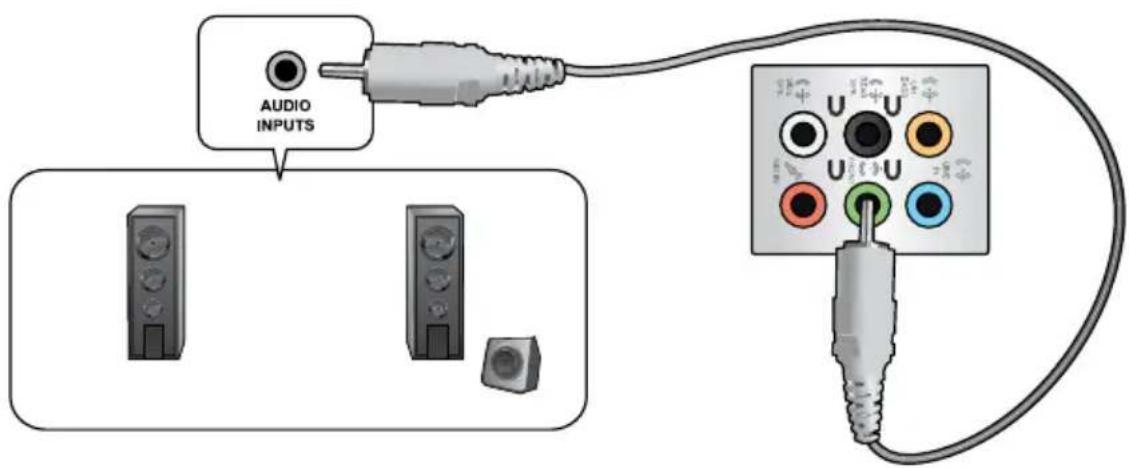
Connecting 4-channel Speakers

Connecting 6-channel Speakers

Connecting 8-channel Speakers

Connecting multiple external displays
Your desktop PC may come with VGA, HDMI, or DVI ports and allows you to connect multiple external displays.

When a graphics card is installed in your computer, connect the monitors on the output ports of the graphics card.
Setting up multiple displays
When using multiple monitors, you are allowed to set display modes. You can use the additional monitor as a duplicate of your main display, or as an extension to enlarge your Windows desktop.
To set up multiple displays:
- Turn off your computer.
- Connect the two monitors to your computer and connect the power cords to the monitors. Refer to Setting up your computer section in Chapter 1 for details on how to connect a monitor to your computer.

natural_image
Illustration of a desktop computer setup with two monitors and a tower connected via cables (no text or symbols)
For some graphic cards, only the monitor that is set to be the primary display has display during POST. The dual display function works only under Windows.
- Turn on your computer.
- Do any of the following to open the Screen Resolution setting screen:
- Click

Control Panel > Appearance and Personalization > Display > display settings.
- Right click anywhere on your Windows desktop. When the pop-up menu appears, click Personalize > Display > Change display settings.
- Select the display mode from the Multiple displays: drop-down list.
• Duplicate these displays: Select this option to use the additional monitor as a duplicate of your main display.
- Extend these displays: Select this option to use the additional monitor as an extension display. This increases your desktop space.
• Show desktop only on 1 / 2: Select this option to show desktop only on monitor 1 or monitor 2.
- Remove this display: Select this options to remove the selected display.
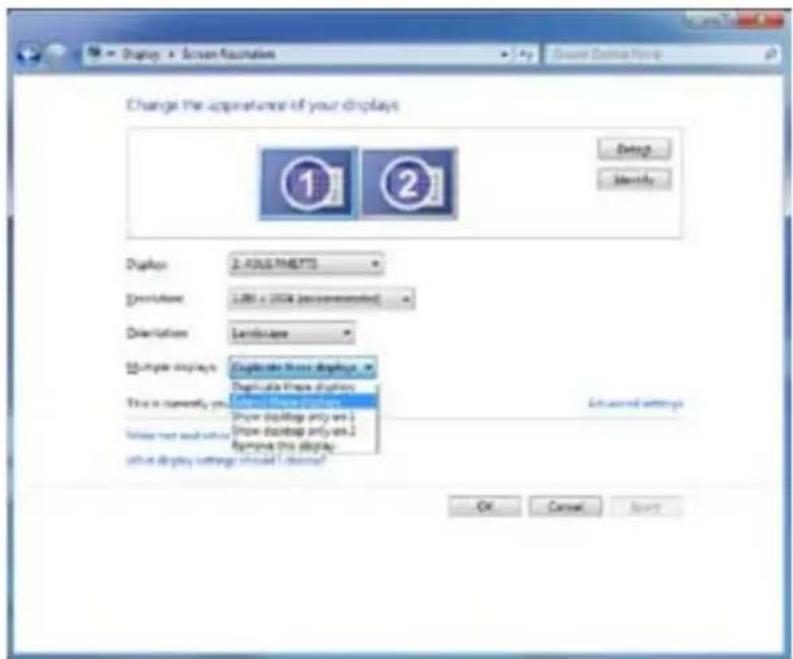
- Click Apply or OK. Then click Keep Changes on the confirmation message.
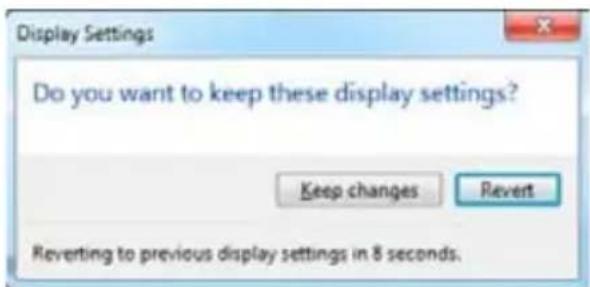
Connecting an HDTV
Connect a High Definition TV (HDTV) to the HDMI port of your computer.

- You need an HDMI cable to connect the HDTV and the computer. The HDMI cable is purchased separately.
- To get the best display performance, ensure that your HDMI cable is less than 15 meters.
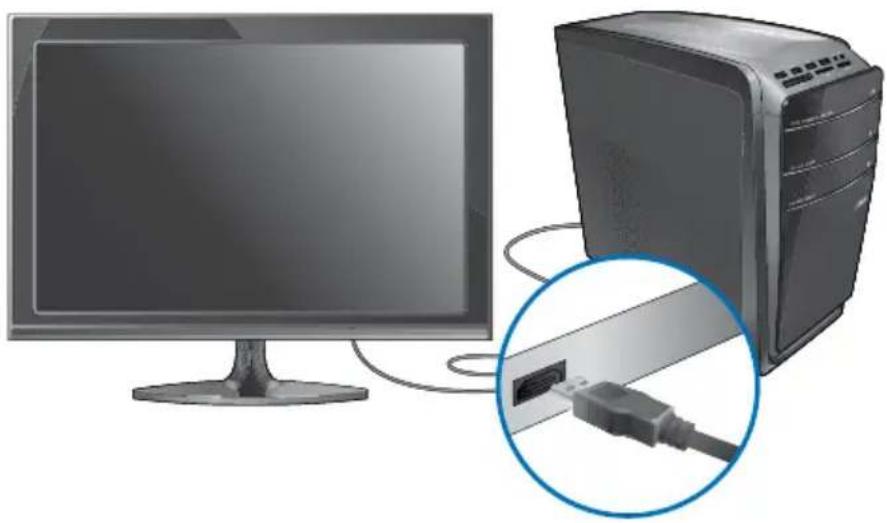
natural_image
Illustration of a desktop computer connected to a tower, with an icon showing the cable being inserted (no text or symbols present)Chapter 4
Using your computer
Proper posture when using your Desktop PC
When using your Desktop PC, maintaining the proper posture is necessary to prevent strain to your wrists, hands, and other joints or muscles. This section provides you with tips on avoiding physical discomfort and possible injury while using and fully enjoying your Desktop PC.
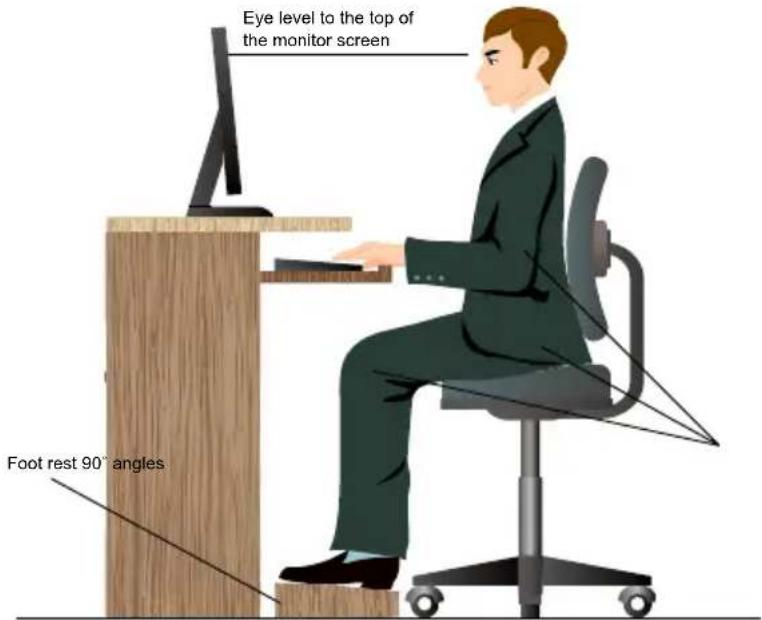
To maintain the proper posture:
- Position your computer chair to make sure that your elbows are at or slightly above the keyboard to get a comfortable typing position.
- Adjust the height of your chair to make sure that your knees are slightly higher than your hips to relax the backs of your thighs. If necessary, use a footrest to raise the level of your knees.
- Adjust the back of your chair so that the base of your spine is firmly supported and angled slightly backward.
- Sit upright with your knees, elbows and hips at an approximately 90^ angle when you are at the PC.
- Place the monitor directly in front of you, and turn the top of the monitor screen even with your eye level so that your eyes look slightly downward.
- Keep the mouse close to the keyboard, and if necessary, use a wrist rest for support to reduce the pressure on your wrists while typing.
- Use your Desktop PC in a comfortably-lit area, and keep it away from sources of glare such as windows and straight sunlight.
• Take regular mini-breaks from using your Desktop PC.
Using the memory card reader
Digital cameras and other digital imaging devices use memory cards to store digital picture or media files. The built-in memory card reader on the front panel of your system allows you to read from and write to different memory card drives.
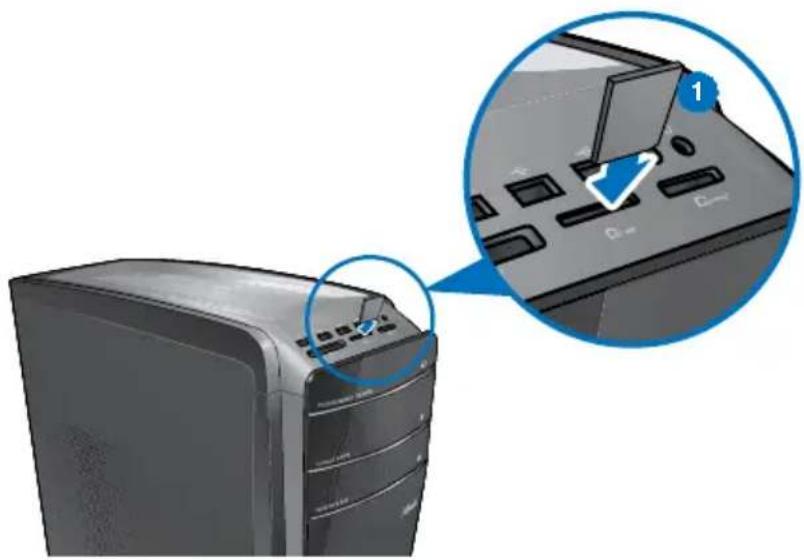
natural_image
Illustration of a desktop computer tower with a close-up view showing the keyboard and mouse (no text or symbols present)To use the memory card:
- Insert the memory card into the card slot.

- A memory card is keyed so that it fits in only one direction. DO NOT force a card into a slot to avoid damaging the card.
-
You can place media in one or more of the card slots and use each media independently. Place only one memory card in a slot at one time.
-
Select a program from the AutoPlay window to access your files.

- If AutoPlay is NOT enabled in your computer, click Windows ^® 7 Start button on the taskbar, click Computer, and then double-click the memory card icon to access the data on it.
• Each card slot has its own drive icon which is displayed on the Computer screen. -
The memory card reader LED lights up and blinks when data is being read from or written to the memory card.
-
When finished, right-click the memory card drive icon on the Computer screen, click Eject, and then remove the card.

Never remove cards while or immediately after reading, copying, formatting, or deleting data on the card or else data loss may occur.

To prevent data loss, use "Safely Remove Hardware and Eject Media" in the Windows notification area before removing the memory card.
Using the optical drive

natural_image
Illustration of a desktop computer with an open CD and two labeled arrows indicating components (no text or symbols present)Inserting an optical disc
To insert an optical disc:
- While your system is on, press the eject button below the drive bay cover to open the tray.
- Place the disc to the optical drive with the label side facing up.
- Push the tray to close it.
- Select a program from the AutoPlay window to access your files.

If AutoPlay is NOT enabled in your computer, click Windows® 7 Start button on the taskbar, click Computer, and then double-click the CD/DVD drive icon to access the data on it.
Removing an optical disc
To remove an optical disc:
-
While the system is on, do either of the following to eject the tray:
-
Press the eject button below the drive bay cover.
-
Right-click the CD/DVD drive icon on the Computer screen, and then click Eject.
-
Remove the disc from the disc tray.
Using the multimedia keyboard (on selected models only)

The keyboard varies with models. The illustrations on this section are for reference only.
ASUS PRIMAX/KB2621 keyboard
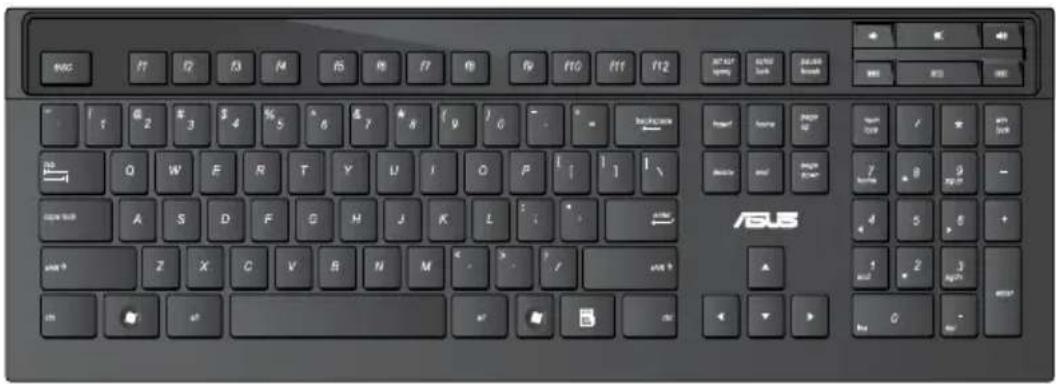
Keys Description
| 1. | Decreases the system volume. | |
| 2. | Turns the volume's mute mode on/off. | |
| 3. | Increases the system volume. | |
| 4. | Goes to the previous track in a media player. | |
| 5. | Plays or pauses playback in a media player. | |
| 6. | Goes to the next track in a media player. |
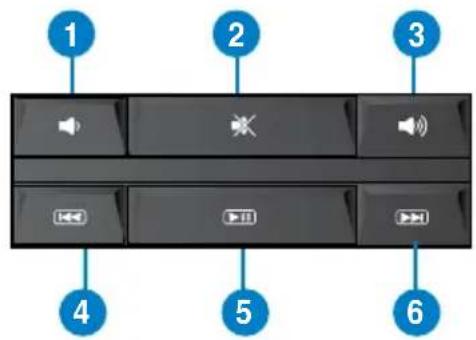
flowchart
graph TD
    A["1"] --> B["Speaker Icon"]
    C["2"] --> D["X Cross Icon"]
    E["3"] --> F["Speaker Icon"]
    G["4"] --> H["Back Button"]
    I["5"] --> J["Play Button"]
    K["6"] --> L["Play Button"]

The special function keys only work on Windows ^® Vista / Windows ^® 7 operating systems.
Chapter 5
Connecting to the Internet
Wired connection
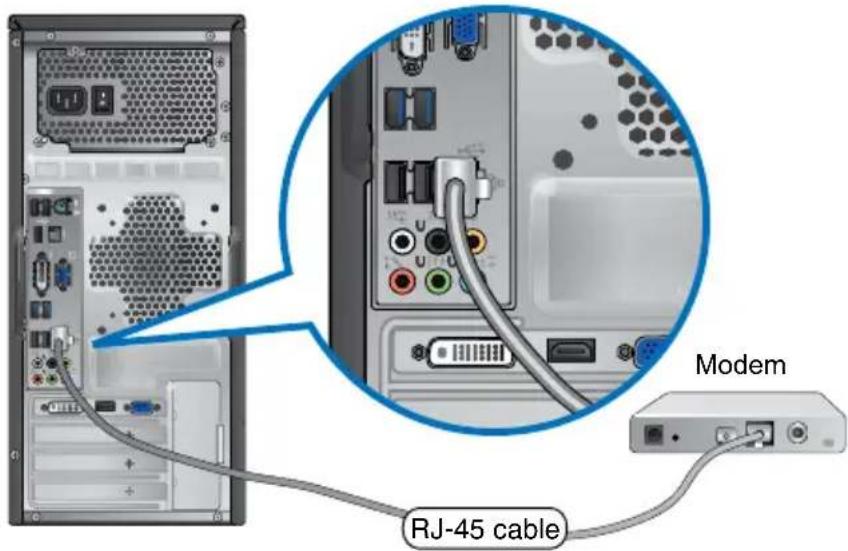
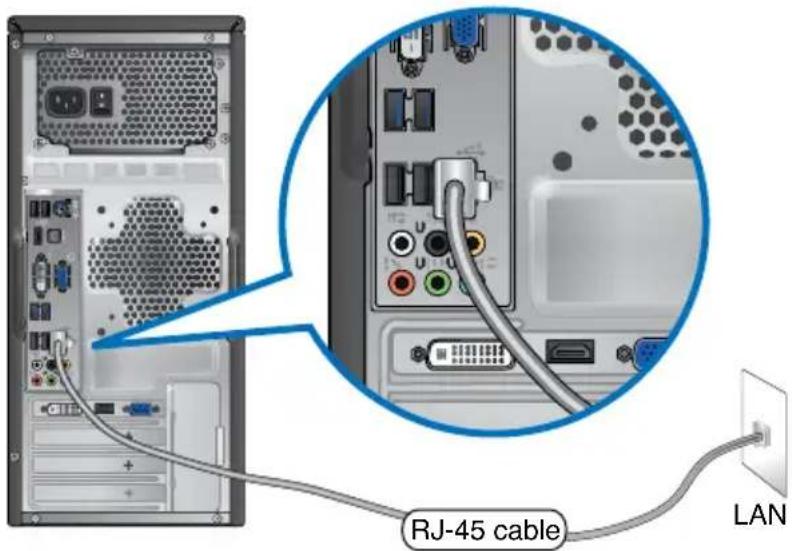
Use an RJ-45 cable to connect your computer to a DSL/cable modem or a local area network (LAN).
Connecting via a DSL/cable modem
To connect via a DSL/cable modem:
- Set up your DSL/cable modem.

Refer to the documentation that came with your DSL/cable modem.
- Connect one end of an RJ-45 cable to the LAN (RJ-45) port on the rear panel of your computer and the other end to a DSL/cable modem.
-
Turn on the DSL/cable modem and your computer.
-
Configure the necessary Internet connection settings.

Contact your Internet Service Provider (ISP) for details or assistance in setting up your Internet connection.
Connecting via a local area network (LAN)
To connect via a LAN:
- Connect one end of an RJ-45 cable to the LAN (RJ-45) port on the rear panel of your computer and the other end to your LAN.
- Turn on your computer.
- Configure the necessary Internet connection settings.

Contact your network administrator for details or assistance in setting up your Internet connection.
Chapter 6
Using the Utilities

The support DVD and Recovery DVD may not be included in the package. You can burn them by yourself. Refer to Recovering your system for details.
ASUS AI Suite II
ASUS AI Suite II is an all-in-one interface that integrates several ASUS utilities and allows users to launch and operate these utilities simultaneously.
Installing AI Suite II
To install AI Suite II:
- Place the support DVD in the optical drive. The Drivers installation tab appears if your computer has enabled the Autorun feature.
- Click the Utilities tab, then click ASUS AI Suite II.
- Follow the onscreen instructions to complete the installation.
Using AI Suite II
AI Suite II automatically starts when you enter the Windows® operating system (OS). The AI Suite II icon appears in the Windows® notification area. Click the icon to open the AI Suite II main menu bar.
Click each button to select and launch a utility, to monitor the system, to update the motherboard BIOS, to display the system information, and to customize the settings of AI Suite II.

Tool
The Tool section includes the EPU, Probe II and Sensor Record panels.

EPU
EPU is an energy-efficient tool that satisfies different computing needs. This utility provides several modes that you can select to save system power. Selecting Auto mode will have the system shift modes automatically according to current system status. You can also customize each mode by configuring settings like CPU frequency, GPU frequency, vCore Voltage, and Fan Control.
Launching EPU
After installing AI Suite II from the support DVD, launch EPU by clicking Tool > EPU on the AI Suite II main menu bar.
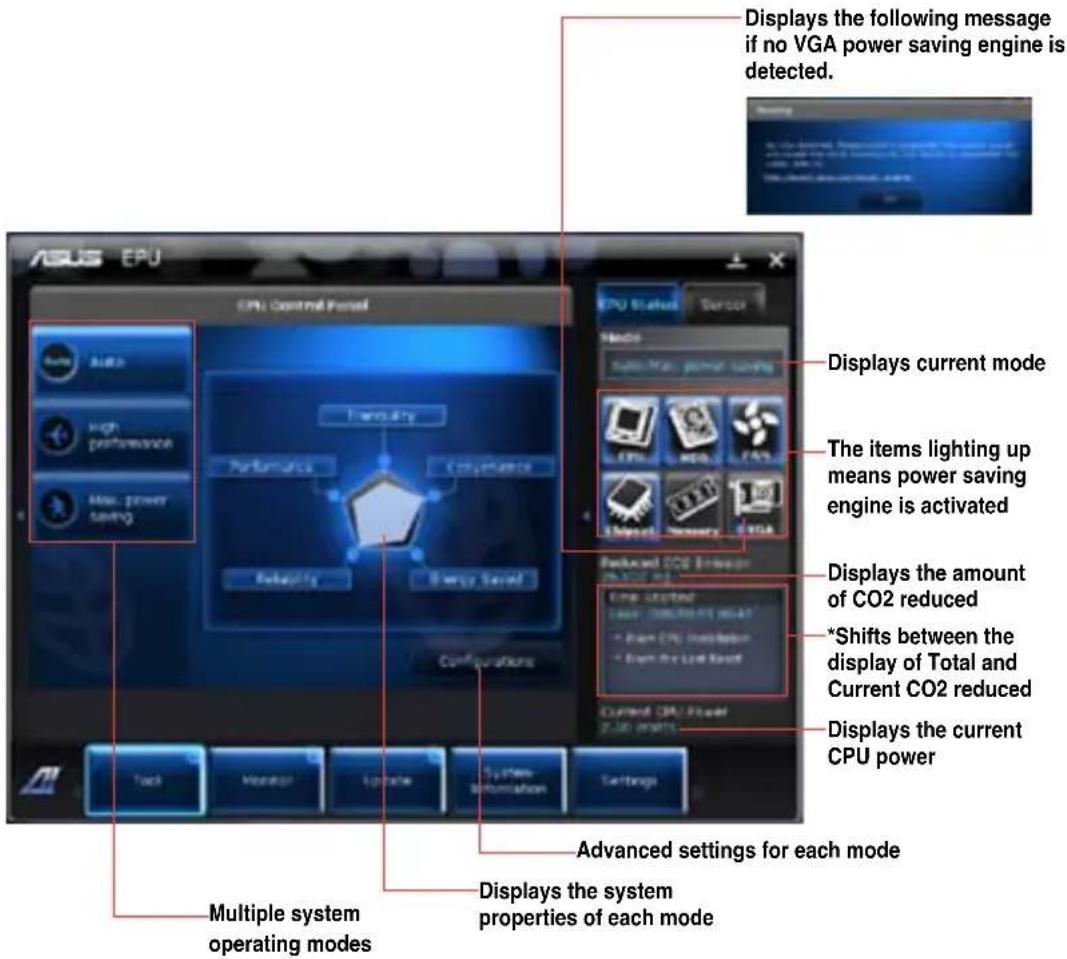

*• Select From EPU Installation to show the CO2 that has been reduced since you installed EPU.
*• Select From the Last Reset to show the total CO2 that has been reduced since you click the Clear button
Probe II
Probe II is a utility that monitors the computer's vital components, and detects and alerts you of any problem with these components. Probe II senses fan rotations, CPU temperature, and system voltages, among others. With this utility, you are assured that your computer is always at a healthy operating condition.
Launching Probe II
After installing AI Suite II from the support DVD, launch Probe II by clicking Tool > Probe II on the AI Suite II main menu bar.
Configuring Probe II
Click the Voltage/Temperature/Fan Speed tabs to activate the sensors or to adjust the sensor threshold values. The Preference tab allows you to customize the time interval of sensor alerts, or change the temperature unit.

Sensor Recorder
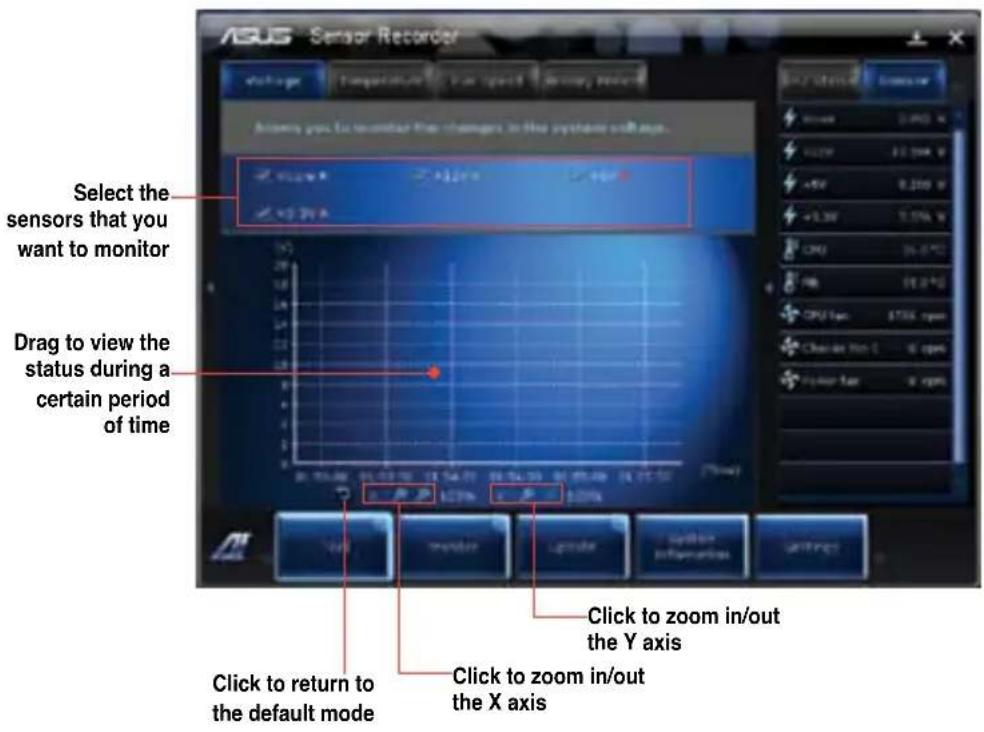
Sensor Recorder allows you to monitor the changes in the system voltage, temperature, and fan speed, as well as recording the changes.
Launching Sensor Recorder
After installing AI Suite II from the support DVD, click Tool > Sensor Recorder on the AI Suite II main menu bar to launch PC Probe.
Configuring Sensor Recorder
Click the Voltage/Temperature/Fan Speed tabs and select the sensors that you want to monitor. The History Record tab allows you to record the changes in the sensors that you enable.
Monitor
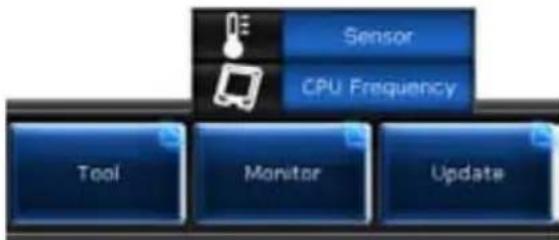
The Monitor section includes the Sensor and CPU Frequency panels.
Sensor
The Sensor panel displays the current value of a system sensor such as fan rotation, CPU temperature, and voltages. Click Monitor > Sensor on the AI Suite II main menu bar to launch the Sensor panel.
CPU Frequency
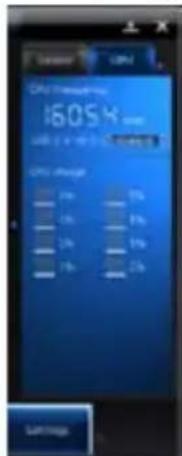
The CPU Frequency panel displays the current CPU frequency and CPU usage. Click Monitor > CPU Frequency on the AI Suite II main menu bar to open the CPU Frequency panel.
Resident in the right pane (system information area)
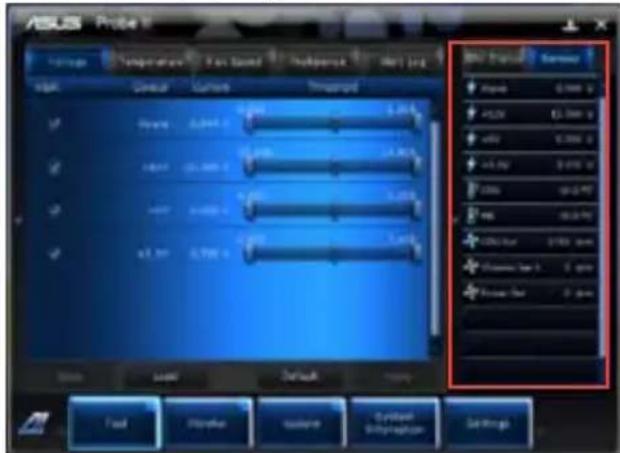
Sensor panel

CPU Frequency panel
Update
The Update section allows you to update the motherboard BIOS and the BIOS boot logo with the ASUS designed update utilities.
ASUS Update
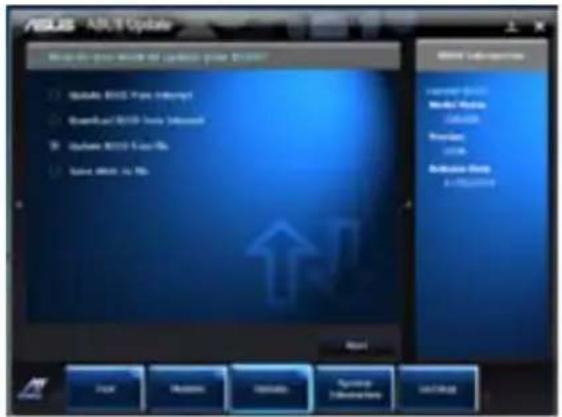
The ASUS Update is a utility that allows you to manage, save, and update the motherboard BIOS in Windows® OS. The ASUS Update utility allows you to update the BIOS directly from the Internet, download the latest BIOS file from the Internet, update the BIOS from an updated BIOS file, save the current BIOS file or view the BIOS version information.
Updating the BIOS through the Internet
To update the BIOS through the Internet:
-
From the ASUS Update screen, select Update BIOS from Internet, and then click Next.
-
Select the ASUS FTP site nearest you to avoid network traffic. If you want to enable the BIOS downgradable function and auto BIOS backup function, check the checkboxes before the two items on the screen.
-
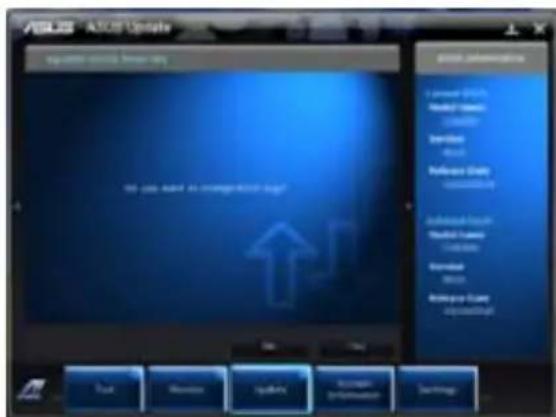
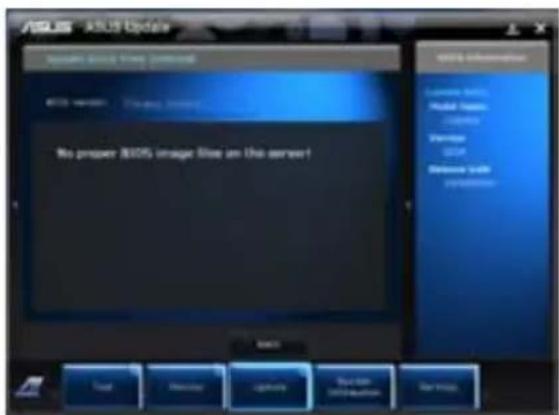
Select the BIOS version that you want to download. Click Next. When no updated version is detected, it is shown as the screen on the right side.


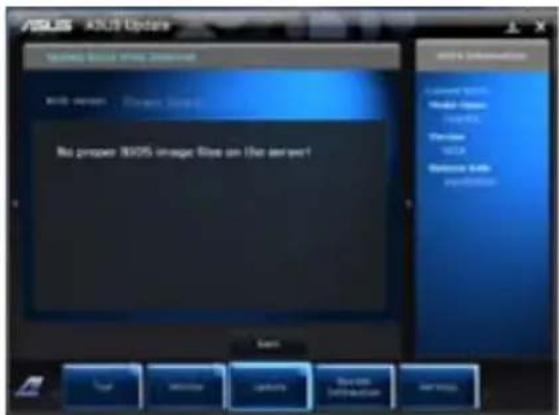
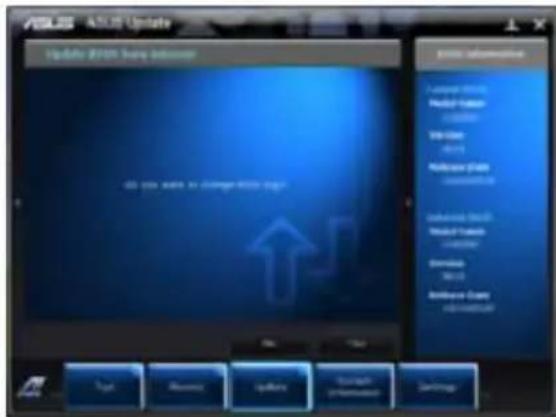
- You can decide whether to change the BIOS boot logo, which is the image appearing on screen during the Power-On Self-Tests (POST). Click Yes if you want to change the boot logo or No to continue.
- Follow the onscreen instructions to complete the update process.
Updating the BIOS through a BIOS file
To update the BIOS through a BIOS file:
- From the ASUS Update screen, select Update BIOS from file, and then click Next.

- Locate the BIOS file from the Open window, click Open, and click Next.

- You can decide whether to change the BIOS boot logo. Click Yes if you want to change the boot logo or No to continue.
- Follow the onscreen instructions to complete the update process.
System Information
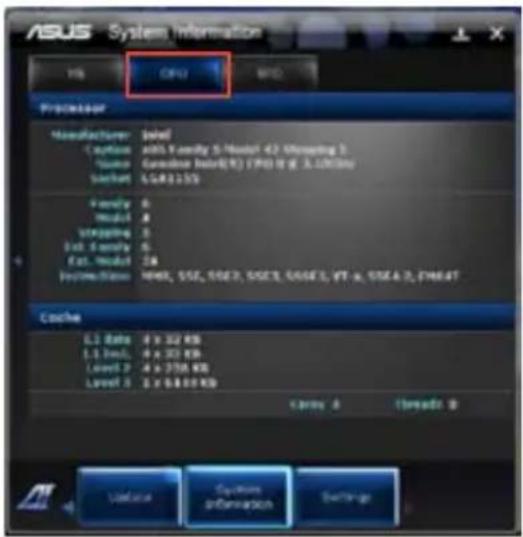
The System Information section displays the information about the motherboard, CPU, and memory slots.
- Click the MB tab to see the details on the motherboard manufacturer, product name, version, and BIOS.
- Click the CPU tab to see the details on the processor and the Cache.
- Click the SPD tab and then select the memory slot to see the details on the memory module installed on the corresponding slot.


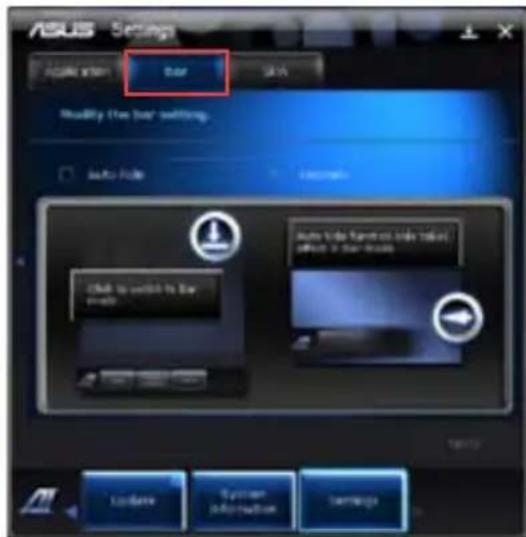
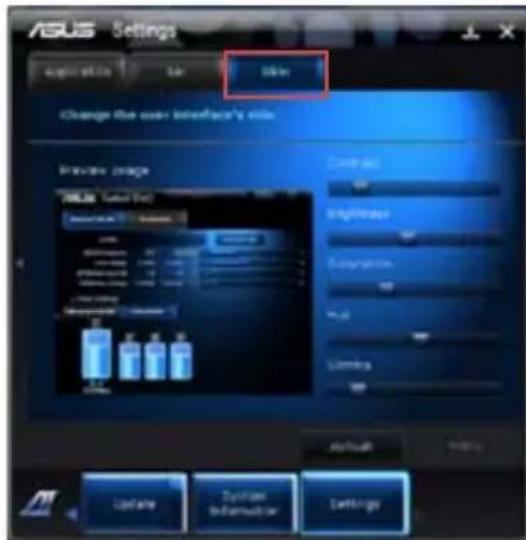
Settings
The Settings section allows you to customize the main menu bar settings and the interface's skin.
• Application allows you to select the application that you want to enable.
- Bar allows you to modify the bar setting,
- Skin allows you to customize the interface's contrast, brightness, saturation, hue, and gamma.
![ASUS Settings Application Easy Easy Assist you to select the application you need to enable Tool M1: [x1.01.04] Noise 2 (x1.79.24) Standard Response (x1.01.04) Number Server (x1.38.36) Parameters (x1.01.04) Update Auto update (x1.01.04) System Information (x1.01.04) Options Database Information Settings](/content/2026/04/643842/images/77ab784dfb56eee5aa66c2d92955dd64c20afbbccc54bac5e3a46be382457454.jpg)
ASUS AI Manager
ASUS AI Manager is a utility which gives you quick and easy access to frequently-used applications.
Installing AI Manager
To install AI Manager:
- Place the support DVD in the optical drive. If Autorun is enabled, the Drivers installation wizard appears.

If Autorun is disabled, double-click the setup.exe file from the ASUS AI Manager folder in the support DVD.
-
Click the Utilities tab, then click ASUS AI Manager.
-
Follow the onscreen instructions to complete the installation.
Launching AI Manager
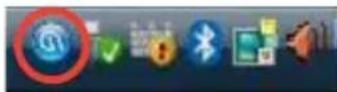
To launch the AI Manager from the Windows ^® desktop, click Start > All Programs > ASUS > AI Manager > AI Manager 1.xx.xx. The AI Manager quick bar appears on the desktop.

After launching the application, the AI Manager icon appears in the Windows ^® taskbar.
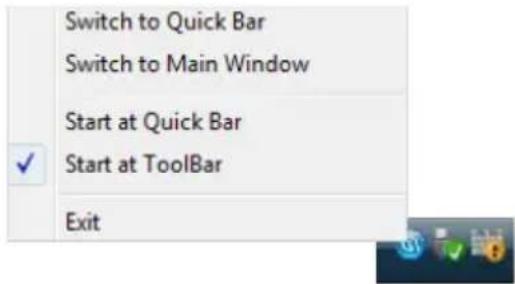
Right-click this icon to switch between the quick bar and the main window, and to launch the AI Manager either from the quick bar or taskbar.
AI Manager quick bar
The AI Manager quick bar saves the desktop space and allows you to launch the ASUS utilities or display system information easily. Click any of the Main, My Favorites, Support or Information tab to display the menu's contents.
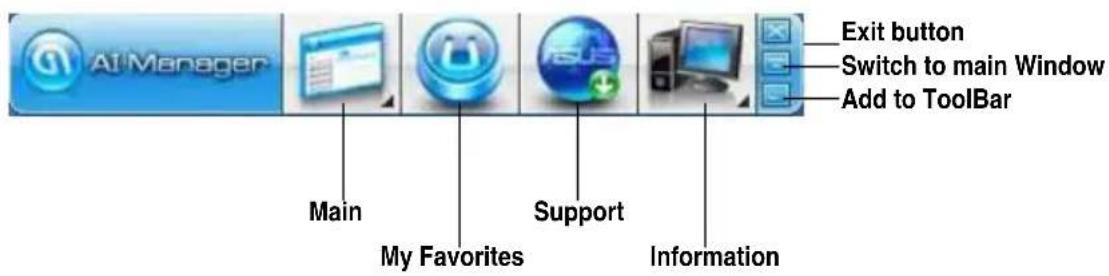
Click the Maximize/restore button to switch between full window and quick bar. Click the Minimize button to keep the AI Manager on the taskbar. Click the Close button to quit the AI Manager.
Main
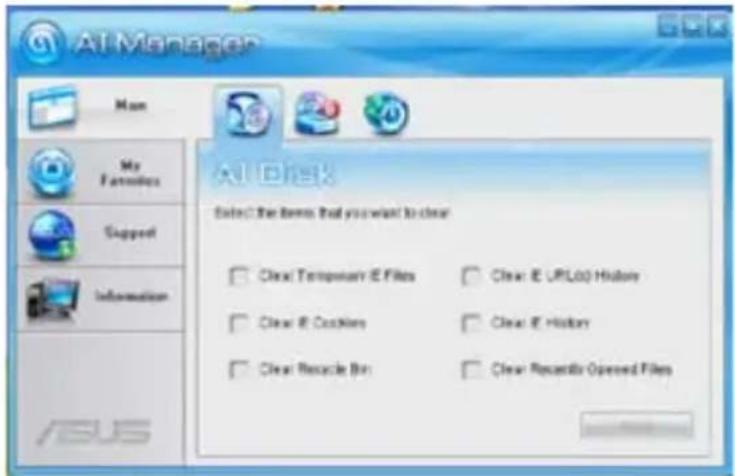
The Main menu contains three utilities: AI Disk, AI Security, and AI Booting. Click the arrow on the Main menu icon to browse through the utilities in the main menu.

AI Disk
AI Disk allows you to easily clear temporary IE files, IE cookies, IE URLs, IE history, or the Recycle Bin. Click the AI Disk icon on the quick bar to display the full AI Disk window and select the items you want to clear. Click Apply when done.
AI Security
AI Security enables you to set a password to secure your devices, such as USB flash disks and CD/DVD disks, from unauthorized access.
To lock a device:
- When using AI Security for the first time, you are asked to set a password. Key in a password with at most 20 alphanumeric characters.
- Confirm the password.
- Key in the password hint (recommended).
- When done, click Ok.

- Select the device you want to lock, then click Apply.
- Key in the password you have set previously, then click Ok.
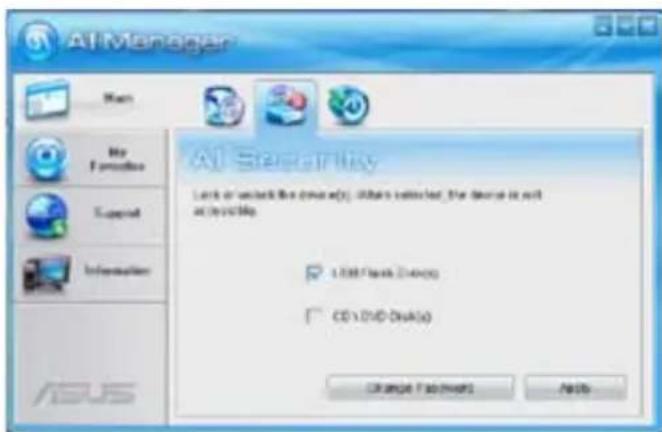
To unlock the device:
- Deselect the locked device, then click Apply.
- Key in the password you have set previously, then click Ok.
To change the password:
- Click Change Password, then follow the onscreen instructions to change password.
AI Booting
AI Booting allows you to specify the boot device priority sequence.

To specify the boot sequence:
-
Select a device, then click the left/right button to specify the boot sequence.
-
When done, press Apply.
My Favorites
My Favorites allows you to add applications that you frequently use, saving you from searching for the applications throughout your computer.
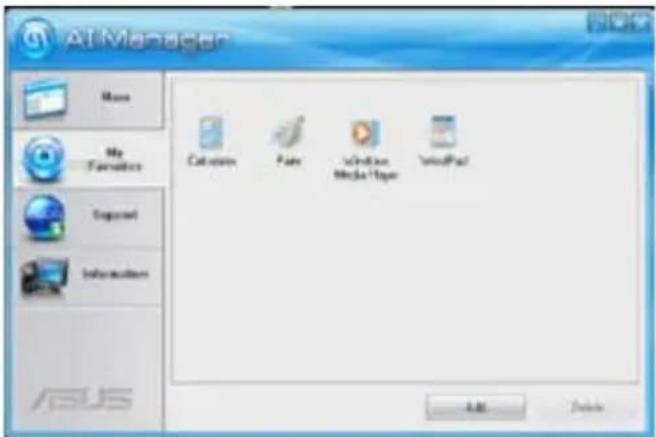
To add an application:
- Click Add, then locate the application you want to add to My Favorites.
- Click Open on the file location window. The application is added to My Favorites list.
Right click on the application icon to launch, delete, or rename the selected application. You can also double click to launch the selected application.
Support
Click any links on the Support window to go to the ASUS website, technical support website, download support website, or contact information.

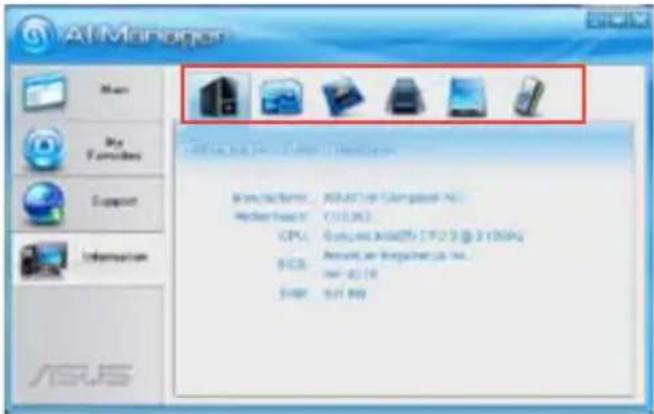
Information
Click the tab on the Information window to see the detailed information about your system, motherboard, CPU, BIOS, installed device(s), and memory.
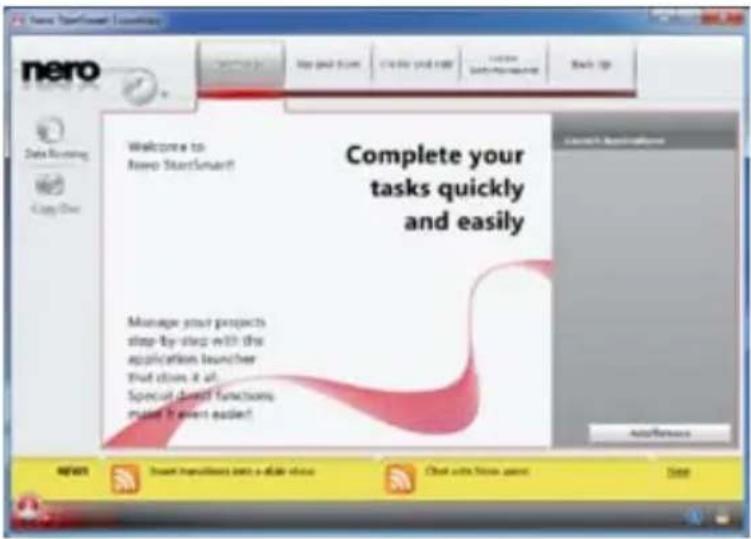
Nero 9
Nero 9 allows you to create, copy, burn, edit, share, and update different kinds of data.
Installing Nero 9
To install Nero 9:
- Insert the Nero 9 DVD into your optical drive.
- If Autorun is enabled, the main menu appears automatically.

If Autorun is disabled, double-click the SeupX.exe file from the main directory of your Nero 9 DVD.
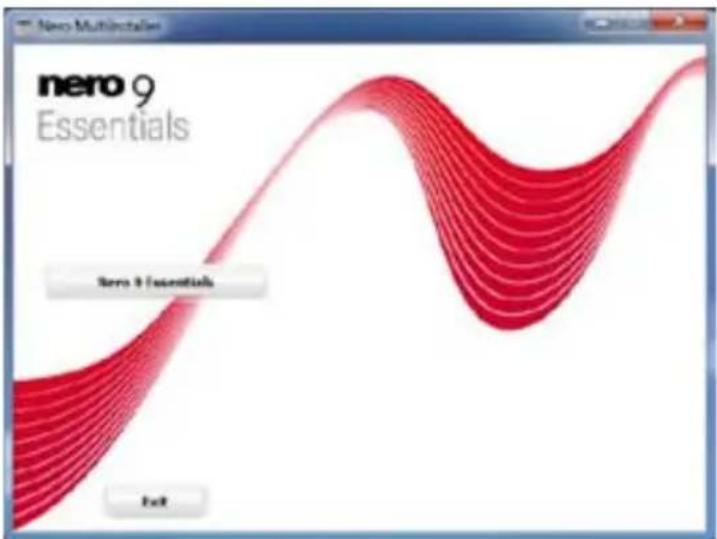
- From the main menu, click Nero 9 Essentials.
- Select the language you want to use for Installation Wizard. Click Next.
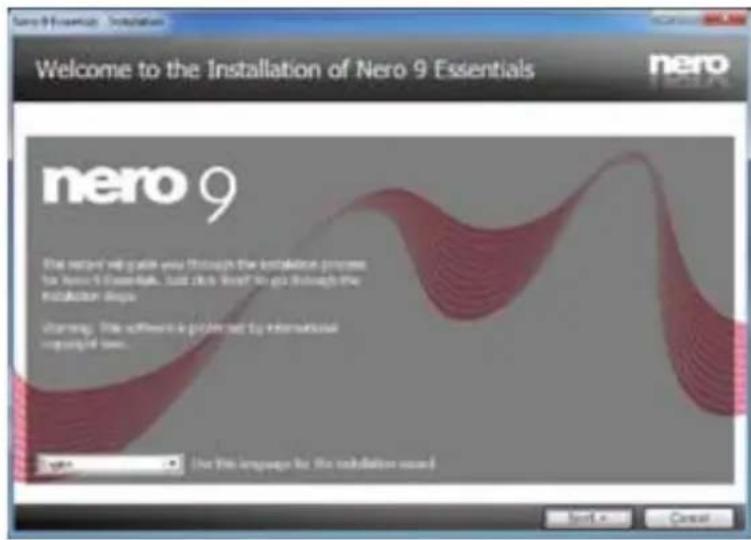
- Click Next to continue.

- Tick I accept the License Conditions. When done, click Next.

- Select Typical then click Next.

- Tick Yes, I want to help by sending anonymous application data to Nero then click Next.
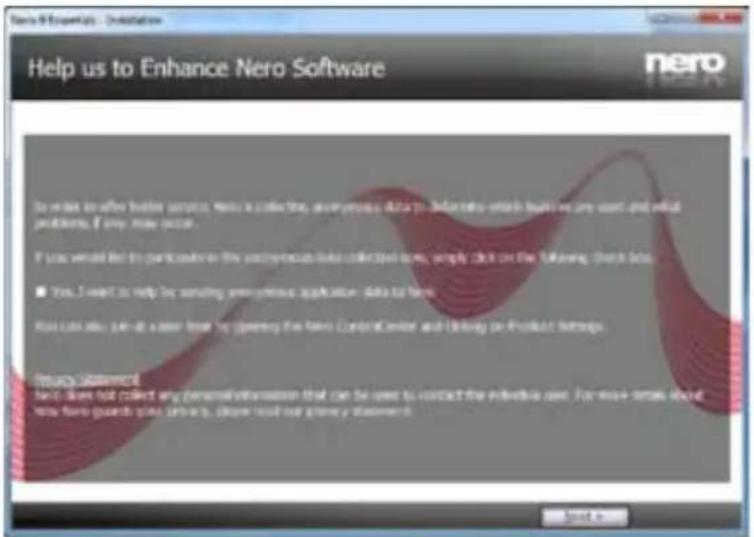
- When done, click Exit.

Burning files
To burn files:
- From the main menu, click Data Burning > Add.

- Select the files that you want to burn. When done, click Add.

- After selecting files that you want to burn, click Burn to burn the files to a disc.
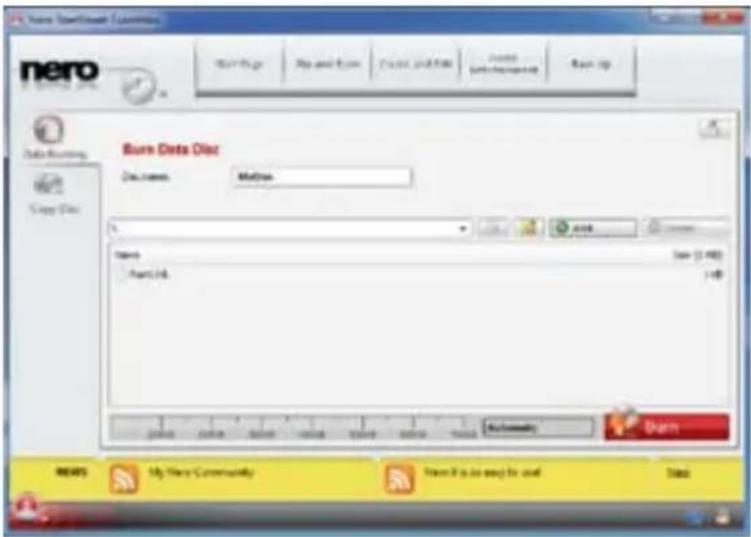

For more details about using Nero 9, refer to the Nero website at www.nero.com
Recovering your system
Using the Recovery Partition
The Recovery Partition quickly restores your Desktop PC's software to its original working state. Before using the Recovery Partition, copy your data files (such as Outlook PST files) to USB storage devices or to a network drive and make note of any customized configuration settings (such as network settings).
About the Recovery Partition
The Recovery Partition is a reserved space on your hard disk drive used to restore the operating system, drivers, and utilities installed on your Desktop PC at the factory.
DO NOT delete the partition named RECOVERY. The Recovery Partition is created at the factory and cannot be restored if deleted. Take your Desktop PC to an authorized ASUS service center if you have problems with the recovery process.

Using the Recovery Partition:
- Press < F9> during bootup.
-
Press < Enter> to select Windows Setup [EMS Enabled].
-
Select one of the following recovery options.
System Recovery:
This feature allows you to restore the system to the factory default settings.
System Image Backup:
This feature allows you to burn the system image backup in DVD discs, which you can use later to restore the system to its default settings.
System DVD Backup:
This feature allows you to make a backup copy of the support DVD.
- Follow the onscreen instructions to complete the recovery process.

Visit the ASUS website at www.asus.com for updated drivers and utilities.
Using the Recovery DVD (on selected models)

Prepare 1\~3 blank writable DVDs as instructed to create the Recovery DVD.

Remove the external hard disk drive before performing system recovery on your Desktop PC. According to Microsoft, you may lose important data because of setting up Windows on the wrong disk drive or formatting the incorrect drive partition.
To use the Recovery DVD:
- Insert the Recovery DVD into the optical drive. Your Desktop PC needs to be powered ON.
- Restart the Desktop PC and press < F8> on bootup and select the optical drive (may be labeled as "CD/DVD") and press
to boot from the Recovery DVD. - Select OK to start to restore the image.
- Select OK to confirm the system recovery.

Restoring will overwrite your hard drive. Ensure to back up all your important data before the system recovery.
- Follow the onscreen instructions to complete the recovery process.

DO NOT remove the Recovery disc, unless instructed to do so, during the recovery process or else your partitions will be unusable.

Visit the ASUS website at www.asus.com for updated drivers and utilities.
Chapter 7
Troubleshooting
Troubleshooting
This chapter presents some problems you might encounter and the possible solutions.
? My computer cannot be powered on and the power LED on the front panel does not light up
- Check if your computer is properly connected.
- Check if the wall outlet is functioning.
- Check if the Power Supply Unit is switched on. Refer to the section turning your computer ON/OFF in Chapter 1.
? My computer hangs.
- Do the following to close the programs that are not responding:
- Simultaneously press
+ + keys on the keyboard, then click Start Task Manager. - Click Applications tab.
- Select the program that is not responding, then click End Task.
- If the keyboard is not responding. Press and hold the Power button on the top of your chassis until the computer shuts down. Then press the Power button to turn it on.
? I cannot connect to a wireless network using the ASUS WLAN Card (on selected models only)?
- Ensure that you enter the correct network security key for the wireless network you want to connect to.
- Connect the external antennas (optional) to the antenna connectors on the ASUS WLAN Card and place the antennas on the top of your computer chassis for the best wireless performance.
? The arrow keys on the number key pad are not working.
Check if the Number Lock LED is off. When the Number Lock LED is on, the keys on the number key pad are used to input numbers only. Press the Number Lock key to turn the LED off if you want to use the arrow keys on the number key pad.
? No display on the monitor.
- Check if the monitor is powered on.
- Ensure that your monitor is properly connected to the video output port on your computer.
- If your computer comes with a discrete graphics card, ensure that you connect your monitor to a video output port on the discrete graphics card.
- Check if any of the pins on the monitor video connector is bent. If you discover bent pins, replace the monitor video connector cable.
- Check if your monitor is plugged to a power source properly.
- Refer to the documentation that came with your monitor for more troubleshooting information.
? When using multiple monitors, only one monitor has display.
- Ensure that the both monitors are powered on.
- During POST, only the monitor connected to the VGA port has display. The dual display function works only under Windows.
- When a graphics card is installed on your computer, ensure that you connect the monitors to the output port on the graphics card.
- Check if the multiple displays settings are correct. Refer to section Connecting multiple external displays in Chapter 3 for details.
? My computer cannot detect my USB storage device.
- The first time you connect your USB storage device to your computer, Windows automatically installs a driver for it. Wait for a while and go to My Computer to check if the USB storage device is detected.
- Connect your USB storage device to another computer to test if the USB storage device is broken or malfunctions.
I want to restore or undo changes to my computer's system settings without affecting my personal files or data.
The Windows ^® System Restore feature allows you to restore or undo changes to your computer's system settings without affecting your personal data such as documents or photos. For more details, refer to the section Restoring your system in Chapter 2.
? The picture on the HDTV is stretched.
- It is caused by the different resolutions of your monitor and your HDTV. Adjust the screen resolution to fit your HDTV. To change the screen resolution:
- Do any of the following to open the
Screen Resolution setting screen:
- Click

Control Panel > Appearance and Personalization > Change display settings.
- Right click anywhere on your Windows desktop. When the pop-up menu appears, click Personalize > Display > Change display settings.
- Adjust the resolution. Refer to the documentation came with your HDTV for the resolution.
- Click Apply or OK. Then click Keep Changes on the confirmation message.
? My speakers produce no sound.
- Ensure that you connect your speakers to the Line out port (lime) on the front panel or the rear panel.
- Check if your speak is connected to a electrical source and turned on.
- Adjust your speakers' volume.
- Ensure that your computer's system sounds are not Muted.
- If it is muted, the volume icon is displayed as
sounds, click

from the Windows notification area, then click
- If it is not muted, click

and drag the slider to adjust the volume.
- Connect your speakers to another computer to test if the speakers are working properly.
? The DVD drive cannot read a disc.
- Check if the disc is placed with the label side facing up.
- Check if the disc is centered in the tray, especially for the discs with non-standard size or shape.
- Check if the disc is scratched or damaged.
? The DVD drive eject button is not respond.
-
Click > Computer.
-
Right-click

DVD RW Drive
, then click Eject from the menu.
Power
| Problem Possible Cause Action | ||
| No power(The power indicator is off) | Incorrect power voltage | Set your computer's power voltage switch to your area's power requirements.Adjust the voltage settings. Ensure that the power cord is unplugged from the power outlet. |
| Your computer is not turned on. | Press the power key on the front panel to ensure that your computer is turned on. | |
| Your computer's power cord is not properly connected. | Ensure that the power cord is properly connected.Use other compatible power cord. | |
| PSU (Power supply unit) problems | Try installing another PSU on your computer. | |
Display
| Problem Possible Cause Action | ||
| No display output after turning the computer on (Black screen) | The signal cable is not connected to the correct VGA port on your computer. | Connect the signal cable to the correct display port (onboard VGA or discrete VGA port).If you are using a discrete VGA card, connect the signal cable to the discrete VGA port. |
| Signal cable problems Try connecting to another monitor. | ||
LAN
| Problem Possible Cause Action | ||
| Cannot access the Internet | The LAN cable is not connected. | Connect the LAN cable to your computer. |
| LAN cable problems | Ensure the LAN LED is on. If not, try another LAN cable. If it still does not work, contact the ASUS service center. | |
| Your computer is not properly connected to a router or hub. | Ensure that your computer is properly connected to a router or hub. | |
| Network settings | Contact your Internet Service Provider (ISP) for the correct LAN settings. | |
| Problems caused by the anti-virus software | Close the anti-virus software. | |
| Driver problems Reinstall the | LAN driver | |
Audio
| Problem Possible Cause Action | ||
| No Audio | Speaker or headphone is connected to the wrong port. | Refer to your computer's user manual for the correct port.Disconnect and reconnect the speaker to your computer. |
| Speaker or headphone does not work. | Try using another speaker or headphone. | |
| The front and back audio ports do not work. | Try both the front and back audio ports. If one port failed, check if the port is set to multi-channel. | |
| Driver problems Reinstall the audio driver | ||
System
| Problem Possible Cause Action | ||
| System speed is too slow | Too many programs are running. | Close some of the programs. |
| Computer virus attack | ·Use an anti-virus software to scan for viruses and repair your computer.·Reinstall the operating system. | |
| The system often hangs or freezes. | Hard disk drive failure | ·Send the damaged hard disk drive to ASUS Service Center for servicing.·Replace with a new hard disk drive. |
| Memory module problems | ·Replace with compatible memory modules.·Remove the extra memory modules that you have installed, then try again. | |
| There is not enough air ventilation for your computer. | Move your computer to an area with better air flow. | |
| Incompatible softwares are installed. | Reinstall the OS and reinstall compatible softwares. | |
CPU
| Problem Possible Cause Action | ||
| Too noisy right after turning on the computer. | Your computer is booting up. | It is normal. The fan runs on its full speed when the computer is powering on. The fan slows down after entering the OS. |
| The BIOS settings have been changed. | Restore the BIOS to its default settings. | |
| Old BIOS version | Update the BIOS to the latest version. Visit the ASUS Support site at http://support.asus.com to download the latest BIOS versions. | |
| Computer is too noisy when in use. | The CPU fan has been replaced. | Ensure that you are using a compatible or ASUS-recommended CPU fan. |
| There is not enough air ventilation for the computer. | Move your computer to an area with better air flow. | |
| The system temperature is too high. | Update the BIOS.If you know how to reinstall the motherboard, try to clean the inner space of the chassis. | |

If the problem still persists, refer to your Desktop PC's warranty card and contact the ASUS Service Center. Visit the ASUS Support site at http://support.asus.com for the service center information.
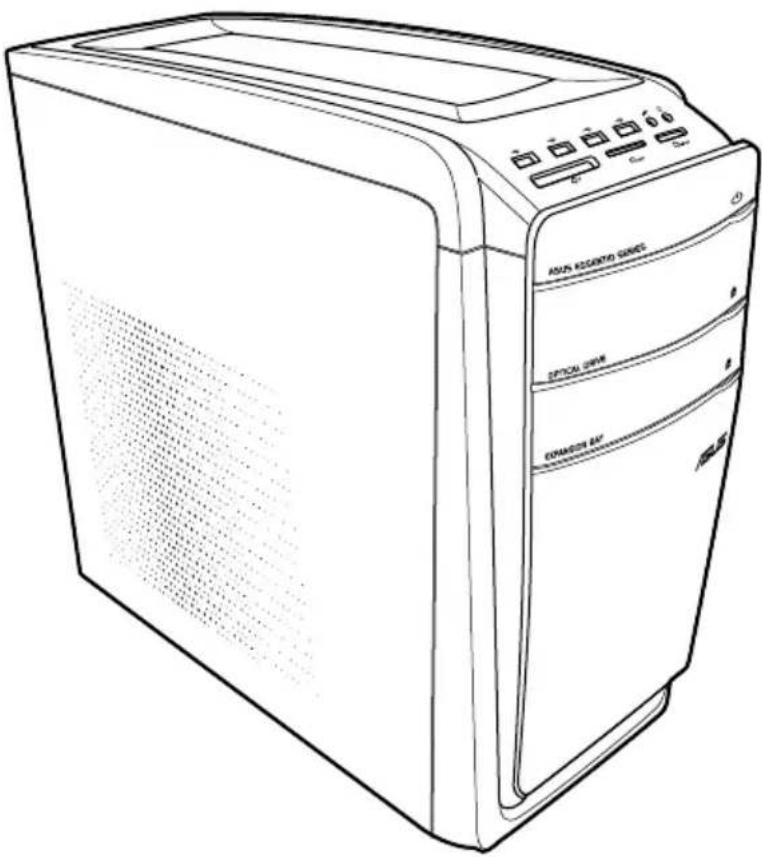
ASUS Essentio Desktop PC
CG8350
Benutzerhandbuch
natural_image
Line drawing of a desktop computer tower with visible drive bays and control panel (no text or symbols)G6181
Erste Ausgabe
Januar 2011
natural_image
Diagram showing connection between a computer monitor and an external server rack, with cable routing and a close-up of the device (no text or symbols present)natural_image
Diagram showing connection between a computer monitor, an ABCD server rack, and a remote control unit (no text or symbols present)
natural_image
Diagram showing a computer setup with an open desktop computer, internal cable, and connected keyboard (no text or symbols visible)natural_image
Diagram showing connections between a computer tower, keyboard, and internal hardware components (no text or symbols present)Dateien sichern
natural_image
Illustration of a desktop computer tower with a magnified view showing the keyboard and mouse (no text or symbols present)Vorderseite

natural_image
Back view of a computer tower showing internal components and a close-up of the tower's cable ports (no text or symbols visible)Rückseite
natural_image
Illustration of a desktop computer tower connected to an earphone, with a magnified inset showing cable being inserted (no text or symbols present)natural_image
Illustration of a desktop computer setup with tower, two monitors, and a server connected via cables (no text or symbols)
natural_image
Illustration of a desktop computer connected to a tower, with an icon showing the cable being inserted (no text or symbols present)Kapitel 4
Computer verwenden
natural_image
Illustration of a desktop computer tower with a close-up view of its internal keyboard and drive button (no text or symbols)natural_image
Illustration of a desktop computer with an open CD and two labeled arrows indicating components (no text or symbols present)
Tasten Beschreibung
Sensor
Update
ASUS Update
ASUS AI Manager
AI Security
Nero 9
natural_image
Line drawing of a desktop computer tower with labeled drive ports (no text or symbols on the device itself)F6181
Première édition
Janvier 2011
Support technique ASUS local
natural_image
Diagram showing computer setup with CPU, monitor, and remote control via cable (no text or symbols)natural_image
Diagram showing computer setup with CPU, monitor, and remote control panel connected to a cable (no text or symbols present)
natural_image
Laptop keyboard connected to a mouse via cable, showing internal hardware and connection (no text or symbols visible)natural_image
Diagram showing a computer tower connected to a rack-mounted device via cable, with an inset close-up of the internal components (no text or symbols visible)Trier vos fichiers
Lancer Windows® Update
natural_image
Computer tower with a close-up of its internal keyboard and mouse pointer (no text or symbols visible)Panneau avant

natural_image
Back view of a computer tower showing internal components and a close-up of the device's internal structure (no text or symbols visible)Panneau arrière
natural_image
Illustration of a desktop computer tower connected to an earphone, with a magnified inset showing cable being inserted (no text or symbols present)natural_image
Illustration of a desktop computer setup with tower, two monitors, and a server connected via cables (no text or symbols)
natural_image
Illustration of a desktop computer connected to a tower, with an attached cable showing the cable connector (no text or symbols present)Chapitre 4
natural_image
Illustration of a desktop computer tower with a close-up view showing the internal key (no text or symbols present)natural_image
Illustration of a desktop computer tower with an open CD and two labeled parts (no text or symbols on the main diagram)Sensor (Sondes)
ASUS Update
Menu des réglages
- Application
- Skin (Apparence)
ASUS AI Manager
Installer AI Manager
AI Security
System Image Backup:
natural_image
Line drawing of a desktop computer tower with visible drive bays and control panel (no text or symbols)S6181
Primera edición
Octubre de 2010
natural_image
Diagram showing connection between a computer monitor and an internal server, with cable routing and a close-up of the device (no text or symbols present)natural_image
Diagram showing connection between a computer monitor and an internal server with connected cables, highlighting a cable to the tower (no text or symbols present)
natural_image
Diagram showing a computer setup with an open server, internal components, and connected keyboard (no text or symbols visible)natural_image
Diagram showing a computer tower internal structure connected to a rack-mounted device via cable, with an inset close-up of the internal components (no text or symbols visible)

Uso de Windows® Update

natural_image
Illustration of a desktop computer tower with a magnified view showing the keyboard and mouse pointer (no text or symbols present)Panel frontal
natural_image
Back view of a computer tower showing internal components and a close-up of the tower's front panel (no text or symbols visible)Panel posterior

natural_image
Illustration of a desktop computer tower connected to an audio headset via cable, with a magnified inset showing the cable being inserted into a device (no text or symbols present)natural_image
Illustration of a desktop computer setup with tower, two monitors, and an open computer via cable (no text or symbols)
natural_image
Illustration of a desktop computer tower connected to a monitor, with an attached USB cable shown in its close-up (no text or symbols present)The Ground Truth image displays a single, continuous horizontal line, which is a stylistic or background element (like a ruled paper line). According to Rule 2, such lines must be ignored by the OCR result. The provided OCR content is "____", which consists of underscores. Underscores are not equivalent to a solid line and are not permitted under the “Stylistic/Background Lines (Ignore)” rule. Outputting underscores for a stylistic line is incorrect because it misinterprets the line as a fill-in-the-blank placeholder. Therefore, the OCR result is inconsistent with the Ground Truth.
[Non-Text]
[Non-Text]
[Non-Text]
[Non-Text]
[Non-Text]
[Non-Text]
[Non-Text]
[Non-Text]
[Non-Text]
[Non-Text]
[Non-Text]
The Ground Truth image displays a single, solid horizontal line. According to Rule 2 (UNDERSCORE & LINE RULES), this is a stylistic or background line, not a placeholder underscore. Therefore, the OCR result must ignore it and output nothing or only meaningful text. The provided OCR content is "____", which consists of four underscores. This is an incorrect interpretation of the line as a placeholder, violating the rule that stylistic lines must be ignored. The OCR has hallucinated placeholder underscores where none exist in the GT. Hence, the result is inconsistent with the Ground Truth.
The Ground Truth image displays a single, continuous horizontal line, which is a stylistic or background element (like a ruled paper line). According to Rule 2, such lines must be ignored by the OCR result. The provided OCR content is "____", which consists of underscores. Underscores are not equivalent to a solid line and are not permitted under the “Stylistic/Background Lines (Ignore)” rule. Outputting underscores for a stylistic line is incorrect because it misinterprets the line as a fill-in-the-blank placeholder. Therefore, the OCR result is inconsistent with the Ground Truth.
[Non-Text]
[Non-Text]
[Non-Text]
[Non-Text]
[Non-Text]
[Non-Text]
[Non-Text]
[Non-Text]
[Non-Text]
[Non-Text]
[Non-Text]
(1) AD = BD = 1
The Ground Truth image displays a single, continuous horizontal line, which is a stylistic or background element (like a ruled paper line). According to Rule 2, such lines must be ignored by the OCR result. The provided OCR content is "____", which consists of underscores. Underscores are not equivalent to a solid line and are not permitted under the “Stylistic/Background Lines (Ignore)” rule. Outputting underscores for a stylistic line is incorrect because it misinterprets the line as a fill-in-the-blank placeholder. Therefore, the OCR result is inconsistent with the Ground Truth.
[Non-Text]
[Non-Text]
[Non-Text]
[Non-Text]
[Non-Text]
[Non-Text]
[Non-Text]
[Non-Text]
[Non-Text]
[Non-Text]
The Ground Truth image displays a single, solid horizontal line. According to Rule 2 (UNDERSCORE & LINE RULES), this is a stylistic or background line, not a placeholder underscore. Therefore, the OCR result must ignore it and output nothing or only meaningful text. The provided OCR content is "____", which consists of four underscores. This is an incorrect interpretation of the line as a placeholder, violating the rule that stylistic lines must be ignored. The OCR has hallucinated placeholder underscores where none should exist in the GT. Hence, the OCR result is inconsistent with the Ground Truth.
The Ground Truth image displays a single, continuous horizontal line, which is a stylistic or background element (like a ruled paper line). According to Rule 2, such lines must be ignored by the OCR result. The OCR content provided is "", which consists of no characters. Since the OCR output correctly ignores the background/stylistic line and produces no actual text, it complies with the “Stylistic/Background Lines (Ignore)” rule. Therefore, the OCR result is consistent with the Ground Truth.
[Non-Text]
[Non-Text]
[Non-Text]
[Non-Text]
[Non-Text]
[Non-Text]
[Non-Text]
[Non-Text]
[Non-Text]
[Non-Text]
[Non-Text]
The Ground Truth image displays a single, solid horizontal line. According to Rule 2 (UNDERSCORE & LINE RULES), this is a stylistic or background line, not a placeholder underscore. Therefore, the OCR result must ignore it and output nothing or only meaningful text. The provided OCR content is "____", which consists of four underscores. This is an incorrect interpretation of the line as a placeholder, violating the rule that stylistic lines must be ignored. The OCR has hallucinated placeholder underscores where none should exist in the GT. Hence, the OCR result is inconsistent with the Ground Truth.
The Ground Truth image displays a single, continuous horizontal line, which is a stylistic or background element (like a ruled paper line). According to Rule 2, such lines must be ignored by the OCR result. The OCR content provided is "", which consists of no characters. Since the OCR output correctly ignores the background/stylistic line and produces no actual text, it complies with the “Stylistic/Background Lines (Ignore)” rule. Therefore, the OCR result is consistent with the Ground Truth.
1
[Non-Text]
[Non-Text]
[Non-Text]
[Non-Text]
[Non-Text]
[Non-Text]
[Non-Text]
[Non-Text]
[Non-Text]
[Non-Text]
(No text)
The Ground Truth image displays a single, continuous horizontal line, which is a stylistic or background element (like a ruled paper line). According to Rule 2, such lines must be ignored by the OCR result. The provided OCR content is "____", which consists of underscores. Underscores are not equivalent to a solid line and are not permitted under the “Stylistic/Background Lines (Ignore)” rule. Outputting underscores for a stylistic line is incorrect because it misinterprets the line as a fill-in-the-blank placeholder. Therefore, the OCR result is inconsistent with the Ground Truth.
The Ground Truth image displays a single, solid horizontal line. According to Rule 2 (UNDERSCORE & LINE RULES), this is a stylistic or background line, not a placeholder underscore. Therefore, the OCR result must ignore it and output nothing or only meaningful text. The provided OCR content is "____", which consists of four underscores. This is an incorrect interpretation of the line as a placeholder, violating the rule that stylistic lines must be ignored. The OCR has hallucinated placeholder underscores where none should exist in the GT. This adheres to the strict requirement to ignore such lines.
[Non-Text]
[Non-Text]
[Non-Text]
[Non-Text]
[Non-Text]
[Non-Text]
[Non-Text]
[Non-Text]
[Non-Text]
[Non-Text]
[Non-Text]
The Ground Truth image displays a single, continuous horizontal line, which is a stylistic or background element (like a ruled paper line). According to Rule 2, such lines must be ignored by the OCR result. The provided OCR content is "____", which consists of underscores. Underscores are not equivalent to a solid line and are not permitted under the “Stylistic/Background Lines (Ignore)” rule. Outputting underscores for a stylistic line is incorrect because it misinterprets the line as a fill-in-the-blank placeholder. Therefore, the OCR result is inconsistent with the Ground Truth.
[Non-Text]
[Non-Text]
[Non-Text]
[Non-Text]
[Non-Text]
[Non-Text]
[Non-Text]
[Non-Text]
[Non-Text]
[Non-Text]
[Non-Text]
The Ground Truth image displays a single, solid horizontal line. According to Rule 2 (UNDERSCORE & LINE RULES), this is a stylistic or background line, not a placeholder underscore. Therefore, the OCR result must ignore it and output nothing or only meaningful text. The provided OCR content is "____", which consists of four underscores. This is an incorrect interpretation of the line as a placeholder, violating the rule that stylistic lines must be ignored. The OCR has hallucinated placeholder underscores where none should exist in the GT. Hence, the OCR result is inconsistent with the Ground Truth.
The Ground Truth image displays a single, continuous horizontal line, which is a stylistic or background element (like a ruled paper line). According to Rule 2, such lines must be ignored by the OCR result. The OCR content provided is "", which consists of no characters. Since the OCR output correctly ignores the background/stylistic line and produces no actual text, it complies with the “Stylistic/Background Lines (Ignore)” rule. Therefore, the OCR result is consistent with the Ground Truth.
The Ground Truth image displays a single, solid horizontal line. According to Rule 2 (UNDERSCORE & LINE RULES), this is a stylistic or background line, not a placeholder underscore. Therefore, the OCR result must ignore it and output nothing or only meaningful text. The provided OCR content is "____", which consists of four underscores. This is an incorrect interpretation of the line as a placeholder, violating the rule that stylistic lines must be ignored. The OCR has hallucinated placeholder underscores where none exist in the GT. Hence, the OCR result is inconsistent with the Ground Truth.
[Non-Text]
[Non-Text]
[Non-Text]
[Non-Text]
[Non-Text]
[Non-Text]
[Non-Text]
[Non-Text]
[Non-Text]
[Non-Text]
[Non-Text]
The Ground Truth image displays a single, continuous horizontal line, which is a stylistic or background element (like a ruled paper line). According to Rule 2, such lines must be ignored by the OCR result. The provided OCR content is "____", which consists of underscores. Underscores are not equivalent to a solid line and are not permitted under the “Stylistic/Background Lines (Ignore)” rule. Outputting underscores for a stylistic line is incorrect because it misinterprets the line as a fill-in-the-blank placeholder. Since the OCR output incorrectly rendered a stylistic line as underscores (which should be ignored), this violates the rule. Therefore, the OCR result is inconsistent with the Ground Truth.
[Non-Text]
[Non-Text]
[Non-Text]
[Non-Text]
[Non-Text]
[Non-Text]
[Non-Text]
[Non-Text]
[Non-Text]
[Non-Text]
[Non-Text]
The Ground Truth image displays a single, continuous horizontal line, which is a stylistic or background element (like a ruled paper line). According to Rule 2, such lines must be ignored by the OCR result. The provided OCR content is "____", which consists of underscores. Underscores are not equivalent to a solid line and are not permitted under the “Stylistic/Background Lines (Ignore)” rule. Outputting underscores for a stylistic line is incorrect because it misinterprets the line as a fill-in-the-blank placeholder. Therefore, the OCR result is inconsistent with the Ground Truth.
(No text)
[Non-Text]
[Non-Text]
[Non-Text]
[Non-Text]
[Non-Text]
[Non-Text]
[Non-Text]
[Non-Text]
[Non-Text]
[Non-Text]
[Non-Text]
The Ground Truth image displays a single, continuous horizontal line, which is a stylistic or background element (like a ruled paper line). According to Rule 2, such lines must be ignored by the OCR result. The OCR content provided is "", which consists of no characters. Since the OCR output correctly ignores the background/stylistic line and produces no actual text, it complies with the “Stylistic/Background Lines (Ignore)” rule. Therefore, the OCR result is consistent with the Ground Truth.
The Ground Truth image displays a single, solid horizontal line. According to Rule 2 (UNDERSCORE & LINE RULES), this is a stylistic or background line, not a placeholder underscore. Therefore, the OCR result must ignore it and output nothing or only meaningful text. The provided OCR content is "____", which consists of four underscores. This is an incorrect interpretation of the line as a placeholder, violating the rule that stylistic lines must be ignored. The OCR has hallucinated placeholder underscores where none exist in the GT. Hence, the result is inconsistent with the Ground Truth.
[Non-Text]
[Non-Text]
[Non-Text]
[Non-Text]
[Non-Text]
[Non-Text]
[Non-Text]
[Non-Text]
[Non-Text]
[Non-Text]
[Non-Text]
The Ground Truth image displays a single, continuous horizontal line, which is a stylistic or background element (like a ruled paper line). According to Rule 2, such lines must be ignored by the OCR result. The OCR content provided is "", which consists of no characters. Since the OCR output correctly ignores the background/stylistic line and produces no actual text, it complies with the “Stylistic/Background Lines (Ignore)” rule. Therefore, the OCR result is consistent with the Ground Truth.
The Ground Truth image displays a single, solid horizontal line. According to Rule 2 (UNDERSCORE & LINE RULES), this is a stylistic or background line, not a placeholder underscore. Therefore, the OCR result must ignore it and output nothing or only meaningful text. The provided OCR content is "____", which consists of four underscores. This is an incorrect interpretation of the line as a placeholder, violating the rule that stylistic lines must be ignored. The OCR has hallucinated placeholder underscores where none should exist in the GT. This adheres to the strict requirement to ignore such lines.
[Non-Text]
[Non-Text]
[Non-Text]
[Non-Text]
[Non-Text]
[Non-Text]
[Non-Text]
[Non-Text]
[Non-Text]
[Non-Text]
The Ground Truth image displays a single, solid horizontal line. According to Rule 2 (UNDERSCORE & LINE RULES), this is a stylistic or background line, not a placeholder underscore. Therefore, the OCR result must ignore it and output nothing or only meaningful text. The provided OCR content is "____", which consists of four underscores. This is an incorrect interpretation of the line as a placeholder, violating the rule that stylistic lines must be ignored. The OCR has hallucinated placeholder underscores where none should exist in the GT. This adheres to the strict requirement to ignore such lines.
The Ground Truth image displays a single, solid horizontal line. According to Rule 2 (UNDERSCORE & LINE RULES), this is a stylistic or background line, not a placeholder underscore. Therefore, the OCR result must ignore it and output nothing or only meaningful text. The provided OCR content is "____", which consists of four underscores. This is an incorrect interpretation of the line as a placeholder, violating the rule that stylistic lines must be ignored. The OCR has hallucinated placeholder underscores where none should exist in the GT. This adheres to the strict requirement to ignore such lines.
[Non-Text]
[Non-Text]
[Non-Text]
[Non-Text]
[Non-Text]
[Non-Text]
[Non-Text]
[Non-Text]
[Non-Text]
[Non-Text]
[Non-Text]
The Ground Truth image displays a single, solid horizontal line, which is a stylistic or background element (like a ruled paper line or separator), not a placeholder for text. According to Rule 2, such stylistic/background lines must be ignored by the OCR result. The OCR content provided is "", which consists of no characters. This correctly represents the absence of any textual content in the GT and correctly matches the visual line as a stylistic element. Therefore, the OCR output should not contain any underscores or line representations. Outputting underscores for a stylistic line violates the rule and constitutes an error.
The Ground Truth image displays a single, solid horizontal line. According to Rule 2 (UNDERSCORE & LINE RULES), this is a stylistic or background line, not a placeholder underscore. Therefore, the OCR result must ignore it and output nothing or only meaningful text. The provided OCR content is "____", which consists of four underscores. This is an incorrect interpretation of the line as a placeholder, violating the rule that stylistic lines must be ignored. The OCR has hallucinated placeholder underscores where none should exist in the GT. Hence, the OCR result is inconsistent with the Ground Truth.
[Non-Text]
[Non-Text]
[Non-Text]
[Non-Text]
[Non-Text]
[Non-Text]
[Non-Text]
[Non-Text]
[Non-Text]
[Non-Text]
[Non-Text]
[EMPTY]
[Non-Text]
[Non-Text]
[Non-Text]
[Non-Text]
[Non-Text]
[Non-Text]
[Non-Text]
[Non-Text]
[Non-Text]
[Non-Text]
[Non-Text]
The Ground Truth image displays a single, solid horizontal line. According to Rule 2 (UNDERSCORE & LINE RULES), this is a stylistic or background line, not a placeholder underscore. Therefore, the OCR result must ignore it and output nothing or only meaningful text. The provided OCR content is "____", which consists of four underscores. This is an incorrect interpretation of the line as a placeholder, violating the rule that stylistic lines must be ignored. The OCR has hallucinated placeholder underscores where none should exist in the GT. Hence, the OCR result is inconsistent with the Ground Truth.
The Ground Truth image displays a single, continuous horizontal line, which is a stylistic or background element (like a ruled paper line). According to Rule 2, such lines must be ignored by the OCR result. The provided OCR content is "____", which consists of underscores. Underscores are not equivalent to a solid line and are not permitted under the “Stylistic/Background Lines (Ignore)” rule. Outputting underscores for a stylistic line is incorrect because it misinterprets the line as a fill-in-the-blank placeholder. Therefore, the OCR result is inconsistent with the Ground Truth.
[Non-Text]
[Non-Text]
[Non-Text]
[Non-Text]
[Non-Text]
[Non-Text]
[Non-Text]
[Non-Text]
[Non-Text]
[Non-Text]
[Non-Text]
The Ground Truth image displays a single, solid horizontal line. According to Rule 2 (UNDERSCORE & LINE RULES), this is a stylistic or background line, not a placeholder underscore. Therefore, the OCR result must ignore it and output nothing or only meaningful text. The provided OCR content is "____", which consists of four underscores. This is an incorrect interpretation of the line as a placeholder, violating the rule that stylistic lines must be ignored. The OCR has hallucinated placeholder underscores where none should exist in the GT. Hence, the OCR result is inconsistent with the Ground Truth.
The Ground Truth image displays a single, continuous horizontal line, which is a stylistic or background element (like a ruled paper line). According to Rule 2, such lines must be ignored by the OCR result. The provided OCR content is "____", which consists of underscores. Underscores are not equivalent to a solid line and are not permitted under the “Stylistic/Background Lines (Ignore)” rule. Outputting underscores for a stylistic line is incorrect because it misinterprets the line as a fill-in-the-blank placeholder. Therefore, the OCR result is inconsistent with the Ground Truth.
[Non-Text]
[Non-Text]
[Non-Text]
[Non-Text]
[Non-Text]
[Non-Text]
[Non-Text]
[Non-Text]
[Non-Text]
[Non-Text]
[Non-Text]
The Ground Truth image displays a single, solid horizontal line, which is a stylistic or background element (like a ruled paper line). According to Rule 2, such lines must be ignored by the OCR result. The OCR content provided is "", which consists of no characters. Since the OCR output correctly ignores the stylistic line, it complies with Rule 2. Therefore, the OCR result is consistent with the Ground Truth.
[Non-Text]
[Non-Text]
[Non-Text]
[Non-Text]
[Non-Text]
[Non-Text]
[Non-Text]
[Non-Text]
[Non-Text]
[Non-Text]
[Non-Text]
[Non-Text]
The Ground Truth image displays a single, continuous horizontal line, which is a stylistic or background element (like a ruled paper line). According to Rule 2, such lines must be ignored by the OCR result. The OCR content provided is "", which consists of no characters. Since the OCR output correctly ignores the background/stylistic line and produces no actual text, it complies with the “Stylistic/Background Lines (Ignore)” rule. Therefore, the OCR result is consistent with the Ground Truth.
[Non-Text]
[Non-Text]
[Non-Text]
[Non-Text]
[Non-Text]
[Non-Text]
[Non-Text]
[Non-Text]
[Non-Text]
[Non-Text]
[Non-Text]
[Non-Text]
[Non-Text]
[Non-Text]
[Non-Text]
[Non-Text]
[Non-Text]
[Non-Text]
[Non-Text]
[Non-Text]
[Non-Text]
[Non-Text]
[Non-Text]
[Non-Text]
[Non-Text]
[Non-Text]
[Non-Text]
[Non-Text]
[Non-Text]
[Non-Text]
[Non-Text]
[Non-Text]
[Non-Text]
[Non-Text]
[Non-Text]
[Non-Text]
[Non-Text]
[Non-Text]
[Non-Text]
[Non-Text]
[Non-Text]
[Non-Text]
[Non-Text]
[Non-Text]
[Non-Text]
[Non-Text]
[Non-Text]
[Non-Text]
Capítulo 4
Uso del equipo
natural_image
Illustration of a desktop computer tower with a close-up view of its internal keyboard and drive button (no text or symbols)natural_image
Illustration of a desktop computer with an open CD and two arrows indicating file transfer (no text or symbols present)Sensor
Panel Sensor
![Newscaler 0.000 0.000 41.00 45.0 47.00 47.00 52.00 56.00 56.00 [ ] 17.00 rpm [ ] 17.00 rpm [ ] 8 rpm Settings](/content/2026/04/643842/images/1dde64d51ea014852d0973813c907e550fc05e3861c5e89ffcabd416b954f075.jpg)

Actualización
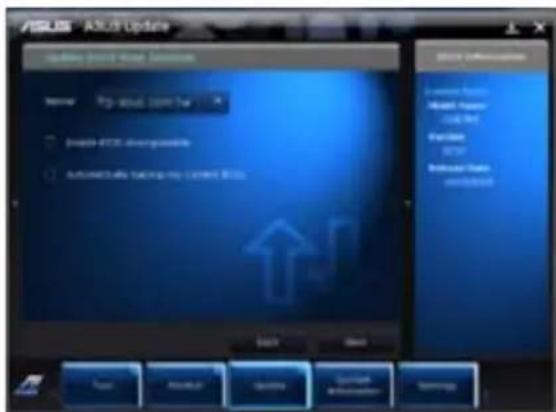


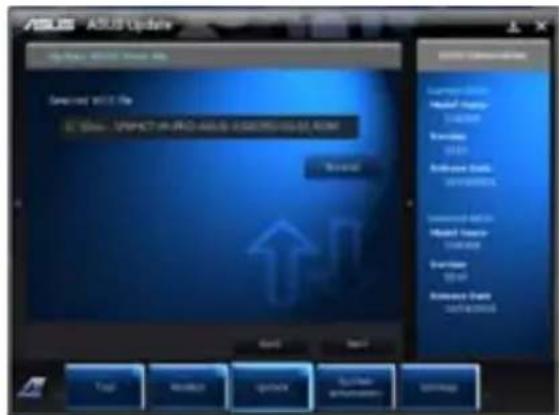


ASUS AI Manager
Para instalar AI Manager:
Barra rápida de AI Manager
AI Security
Información
natural_image
Line drawing of a desktop computer tower with visible drive bays and control panel (no text or symbols)Du6181
Eerste uitgave
oktober 2010
ACT/ KOPPELINGS-LED SNELHEIDS-LED
natural_image
Diagram showing computer setup with CPU, monitor, and remote control via cable (no text or symbols)natural_image
Diagram showing connection between a computer monitor and an electronic device via cable, with a magnified view of the internal components (no text or symbols present)
natural_image
Diagram showing a computer setup with an open server, internal components, and connected keyboard (no text or symbols visible)De stroomkabel verbinden
natural_image
Diagram showing internal components of a computer tower with connected cables and a power strip (no text or symbols)Uw computer AAN/UIT-schakelen
Uw computer AAN-schakelen
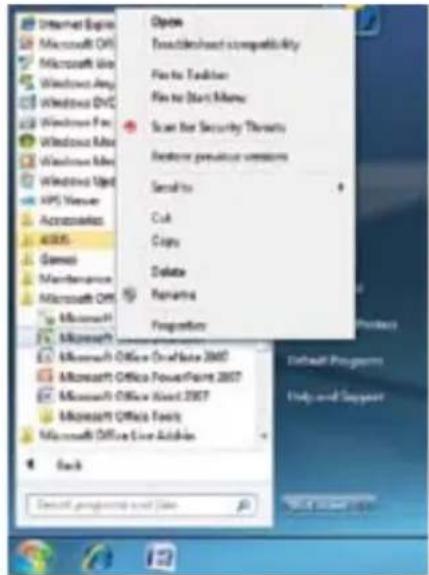


De antivirus-software activeren

natural_image
Illustration of a desktop computer tower with a pen inserted, showing the keyboard and mouse control panel (no text or symbols present)Voorpaneel

natural_image
Back view of a computer tower showing internal components and a close-up of the speaker port (no text or symbols visible)Achterpaneel

natural_image
Illustration of a desktop computer tower connected to an audio headset via cable, with a magnified inset showing the cable being inserted into a device (no text or symbols present)natural_image
Illustration of a desktop computer setup with two monitors and a tower connected via cables (no text or symbols)![Display + Screen Resolution Change the appearance of your displays Display: 2.015 PS48775 [Unspecified] 1.000 x 100% (non-essential) Dislocations: Landrace Multiple displays: This is currently yes. Show desktop only on 1 Show desktop only on 2 Remove this display OK Cancel Apply](/content/2026/04/643842/images/6b109607dc8607a2f07676db3eeb36dbee023012cea69ea9e696922e6d2e19c0.jpg)
Een HDTV aansluiten
natural_image
Illustration of a desktop computer connected to a tower, with an icon showing the cable being inserted (no text or symbols present)[EMPTY]
[Non-Text]
[Non-Text]
[Non-Text]
[Non-Text]
[Non-Text]
[Non-Text]
[Non-Text]
[Non-Text]
(1) AD = BD = 1
[Non-Text]
[Non-Text]
[Non-Text]
[Non-Text]
[Non-Text]
[Non-Text]
[Non-Text]
[Non-Text]
[Non-Text]
[EMPTY]
[Non-Text]
[Non-Text]
[Non-Text]
[Non-Text]
[Non-Text]
[Non-Text]
[Non-Text]
[Non-Text]
The Ground Truth image displays a single, solid horizontal line, which is a stylistic or background element (like a ruled paper line). According to Rule 2, such lines must be ignored by the OCR result. The OCR content provided is "", which consists of no characters. Since the OCR output correctly ignores the stylistic line, it complies with Rule 2. Therefore, the OCR result is consistent with the Ground Truth.
[Non-Text]
[Non-Text]
[Non-Text]
[Non-Text]
[Non-Text]
[Non-Text]
[Non-Text]
[Non-Text]
The Ground Truth image displays a single, solid horizontal line. According to Rule 2 (UNDERSCORE & LINE RULES), this is a stylistic or background line, not a placeholder underscore. Therefore, the OCR result must ignore it. The provided OCR content is "____", which consists of four underscores. This is an incorrect interpretation of the line as a placeholder, violating the rule that stylistic lines must be ignored. The OCR has hallucinated text (underscores) where none should exist based on the GT's visual context. Hence, the OCR result is inconsistent with the Ground Truth.
[EMPTY]
[Non-Text]
[Non-Text]
[Non-Text]
[Non-Text]
[Non-Text]
[Non-Text]
[Non-Text]
[Non-Text]
The Ground Truth image displays a single, solid horizontal line. According to Rule 2 (UNDERSCORE & LINE RULES), this is a stylistic or background line, not a placeholder underscore. Therefore, the OCR result must ignore it and output nothing or only meaningful text. The provided OCR content is "____", which consists of four underscores. This is an incorrect interpretation of the line as a placeholder, violating the rule that stylistic lines must be ignored. The OCR has hallucinated placeholder underscores where none exist in the GT. Hence, the OCR result is inconsistent with the Ground Truth.
The Ground Truth image displays a single, solid horizontal line. According to Rule 2 (UNDERSCORE & LINE RULES), this is a stylistic or background line, not a placeholder underscore. Therefore, the OCR result must ignore it and output nothing or only meaningful text. The provided OCR content is "____", which consists of four underscores. This is an incorrect interpretation of the line as a placeholder, violating the rule that stylistic lines must be ignored. The OCR has hallucinated underscores where none should exist based on the GT's visual context. Hence, the OCR result is inconsistent with the Ground Truth.
[Non-Text]
[Non-Text]
[Non-Text]
[Non-Text]
[Non-Text]
[Non-Text]
[Non-Text]
[Non-Text]
The Ground Truth image displays a single, solid horizontal line, which is a stylistic or background element (like a ruled paper line). According to Rule 2, such lines must be ignored by the OCR result. The OCR content provided is "", which consists of no characters. Since the OCR output correctly ignores the stylistic line, it complies with Rule 2. Therefore, the OCR result is consistent with the Ground Truth.
(1) AD = BD = 1
[Non-Text]
[Non-Text]
[Non-Text]
[Non-Text]
[Non-Text]
[Non-Text]
[Non-Text]
[Non-Text]
The Ground Truth image displays a single, continuous horizontal line, which is a stylistic or background element (like a ruled paper line). According to Rule 2, such lines must be ignored by the OCR result. The provided OCR content is "____", which consists of underscores. Underscores are not equivalent to a solid line and are not permitted under the “Stylistic/Background Lines (Ignore)” rule. Outputting underscores for a stylistic line is incorrect because it misinterprets the line as a fill-in-the-blank placeholder. Since the OCR output incorrectly rendered a stylistic line as underscores (which should be ignored), this violates the rule. Therefore, the OCR result is inconsistent with the Ground Truth.
[Non-Text]
[Non-Text]
[Non-Text]
[Non-Text]
[Non-Text]
[Non-Text]
[Non-Text]
[Non-Text]
[Non-Text]
(1) AD = BD = 1
[Non-Text]
[Non-Text]
[Non-Text]
[Non-Text]
[Non-Text]
[Non-Text]
[Non-Text]
[Non-Text]
The Ground Truth image displays a single, continuous horizontal line, which is a stylistic or background element (like a ruled paper line). According to Rule 2, such lines must be ignored by the OCR result. The OCR content provided is "", which consists of no characters. Since the OCR output correctly ignores the background/stylistic line and produces no actual text, it complies with the “Stylistic/Background Lines (Ignore)” rule. Therefore, the OCR result is consistent with the Ground Truth.
[Non-Text]
[Non-Text]
[Non-Text]
[Non-Text]
[Non-Text]
[Non-Text]
[Non-Text]
[Non-Text]
[Non-Text]
The Ground Truth image displays a single, continuous horizontal line, which is a stylistic or background element (like a ruled paper line). According to Rule 2, such lines must be ignored by the OCR result. The provided OCR content is "____", which consists of underscores. Underscores are not equivalent to a solid line and are not permitted under the “Stylistic/Background Lines (Ignore)” rule. Outputting underscores for a stylistic line is incorrect because it misinterprets the line as a fill-in-the-blank placeholder. Therefore, the OCR result is inconsistent with the Ground Truth.
[Non-Text]
[Non-Text]
[Non-Text]
[Non-Text]
[Non-Text]
[Non-Text]
[Non-Text]
[Non-Text]
The Ground Truth image displays a single, solid horizontal line. According to Rule 2 (UNDERSCORE & LINE RULES), this is a stylistic or background line, not a placeholder underscore. Therefore, the OCR result must ignore it and output nothing or only meaningful text. The provided OCR content is "____", which consists of four underscores. This is an incorrect interpretation of the line as a placeholder, violating the rule that stylistic lines must be ignored. The OCR has hallucinated placeholder underscores where none should exist in the GT. Hence, the OCR result is inconsistent with the Ground Truth.
The Ground Truth image displays a single, solid horizontal line. According to Rule 2 (UNDERSCORE & LINE RULES), this is a stylistic or background line, not a placeholder underscore. Therefore, the OCR result must ignore it and output nothing or only meaningful text. The provided OCR content is "____", which consists of four underscores. This is an incorrect interpretation of the line as a placeholder, violating the rule that stylistic lines must be ignored. The OCR has hallucinated placeholder underscores where none should exist in the GT. Hence, the OCR result is inconsistent with the Ground Truth.
[Non-Text]
[Non-Text]
[Non-Text]
[Non-Text]
[Non-Text]
[Non-Text]
[Non-Text]
[Non-Text]
The Ground Truth image displays a single, solid horizontal line, which is a stylistic or background element (like a ruled paper line). According to Rule 2, such lines must be ignored by the OCR result. The OCR content provided is "", which consists of no characters. Since the OCR output correctly ignores the stylistic line, it complies with Rule 2. Therefore, the OCR result is consistent with the Ground Truth.
[Non-Text]
[Non-Text]
[Non-Text]
[Non-Text]
[Non-Text]
[Non-Text]
[Non-Text]
[Non-Text]
[Non-Text]
The Ground Truth image displays a single, solid horizontal line. According to Rule 2 (UNDERSCORE & LINE RULES), this is a stylistic or background line, not a placeholder underscore. Therefore, the OCR result must ignore it and output nothing or only meaningful text. The provided OCR content is "____", which consists of four underscores. This is an incorrect interpretation of the line as a placeholder, violating the rule that stylistic lines must be ignored. The OCR has hallucinated placeholder underscores where none should exist in the GT. Hence, the OCR result is inconsistent with the Ground Truth.
[Non-Text]
[Non-Text]
[Non-Text]
[Non-Text]
[Non-Text]
[Non-Text]
[Non-Text]
[Non-Text]
The Ground Truth image displays a single, solid horizontal line. According to Rule 2 (UNDERSCORE & LINE RULES), this is a stylistic or background line, not a placeholder underscore. Therefore, the OCR result must ignore it and output nothing or only meaningful text. The provided OCR content is "____", which consists of four underscores. This is an incorrect interpretation of the line as a fill-in-the-blank placeholder, violating the rule that stylistic lines must be ignored. The OCR has hallucinated underscores where none should exist based on the GT's visual context. Hence, the OCR result is inconsistent with the Ground Truth.
The Ground Truth image displays a single, solid horizontal line. According to Rule 2 (UNDERSCORE & LINE RULES), this is a stylistic or background line, not a placeholder underscore. Therefore, the OCR result must ignore it and output nothing or only meaningful text. The provided OCR content is "____", which consists of four underscores. This is an incorrect interpretation of the line as a placeholder, violating the rule that stylistic lines must be ignored. The OCR has hallucinated placeholder underscores where none should exist in the GT. This adheres to the strict requirement to ignore such lines.
[Non-Text]
[Non-Text]
[Non-Text]
[Non-Text]
[Non-Text]
[Non-Text]
[Non-Text]
[Non-Text]
[EMPTY]
[Non-Text]
[Non-Text]
[Non-Text]
[Non-Text]
[Non-Text]
[Non-Text]
[Non-Text]
[Non-Text]
The Ground Truth image displays a single, solid horizontal line. According to Rule 2 (UNDERSCORE & LINE RULES), this is a stylistic or background line, not a placeholder underscore. Therefore, the OCR result must ignore it and output nothing or only meaningful text. The provided OCR content is "____", which consists of four underscores. This is an incorrect interpretation of the line as a placeholder, violating the rule that stylistic lines must be ignored. The OCR has hallucinated placeholder underscores where none should exist in the GT. This adheres to the strict requirement to ignore such lines.
The Ground Truth image displays a single, solid horizontal line, which is a stylistic or background element (like a ruled paper line or separator), not a placeholder for text. According to Rule 2, such stylistic/background lines must be ignored by the OCR result. The OCR content provided is "", which consists of no characters. This correctly represents the absence of any textual content in the GT and correctly matches the visual line as a stylistic element. Therefore, the OCR output should not contain any underscores or line representations that constitute a formatting error. The OCR should have outputted nothing or ignored the line entirely.
[Non-Text]
[Non-Text]
[Non-Text]
[Non-Text]
[Non-Text]
[Non-Text]
[Non-Text]
[Non-Text]
The Ground Truth image displays a single, solid horizontal line. According to Rule 2 (UNDERSCORE & LINE RULES), this is a stylistic or background line, not a placeholder underscore. Therefore, the OCR result must ignore it and output nothing or only meaningful text. The provided OCR content is "____", which consists of four underscores. This is an incorrect interpretation of the line as a placeholder, violating the rule that stylistic lines must be ignored. The OCR has hallucinated placeholder underscores where none should exist in the GT. Hence, the OCR result is inconsistent with the Ground Truth.
[Non-Text]
[Non-Text]
[Non-Text]
[Non-Text]
[Non-Text]
[Non-Text]
[Non-Text]
[Non-Text]
[Non-Text]
[EMPTY]
[Non-Text]
[Non-Text]
[Non-Text]
[Non-Text]
[Non-Text]
[Non-Text]
[Non-Text]
[Non-Text]
The Ground Truth image displays a single, solid horizontal line. According to Rule 2 (UNDERSCORE & LINE RULES), this is a stylistic or background line, not a placeholder underscore. Therefore, the OCR result must ignore it and output nothing or only meaningful text. The provided OCR content is "____", which consists of four underscores. This is an incorrect interpretation of the line as a placeholder, violating the rule that stylistic lines must be ignored. The OCR has hallucinated placeholder underscores where none exist in the GT. Hence, the OCR result is inconsistent with the Ground Truth.
The Ground Truth image displays a single, solid horizontal line. According to Rule 2 (UNDERSCORE & LINE RULES), this is a stylistic or background line, not a placeholder underscore. Therefore, the OCR result must ignore it and output nothing or only meaningful text. The provided OCR content is "____", which consists of four underscores. This is an incorrect interpretation of the line as a placeholder, violating the rule that stylistic lines must be ignored. The OCR has hallucinated placeholder underscores where none should exist in the GT. Hence, the OCR result is inconsistent with the Ground Truth.
[Non-Text]
[Non-Text]
[Non-Text]
[Non-Text]
[Non-Text]
[Non-Text]
[Non-Text]
[Non-Text]
[Non-Text]
[Non-Text]
[Non-Text]
[Non-Text]
[Non-Text]
[Non-Text]
[Non-Text]
[Non-Text]
[Non-Text]
[Non-Text]
[Non-Text]
[Non-Text]
[Non-Text]
[Non-Text]
[Non-Text]
[Non-Text]
[Non-Text]
[Non-Text]
[Non-Text]
[Non-Text]
[Non-Text]
[Non-Text]
[Non-Text]
[Non-Text]
[Non-Text]
[Non-Text]
[Non-Text]
[Non-Text]
Hoofdstuk 4
natural_image
Computer tower with a close-up view of its internal keyboard and drive button (no text or symbols visible)natural_image
Illustration of a desktop computer with an open CD and two arrows indicating file transfer (no text or symbols present)Sensor
Paneel Sensor

Paneel CPU-frequentie

Update
ASUS update
- Selecteer de BIOS-versie die u wilt downloaden. Klik op Next (Volgende).
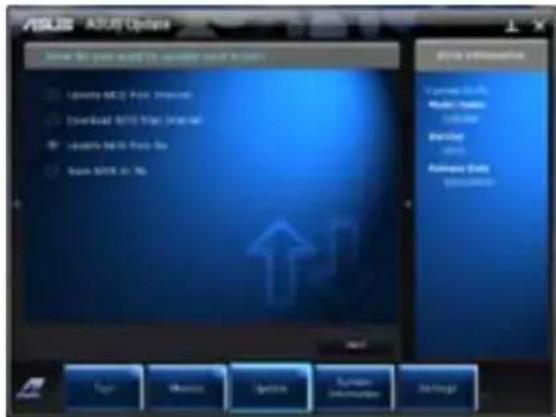

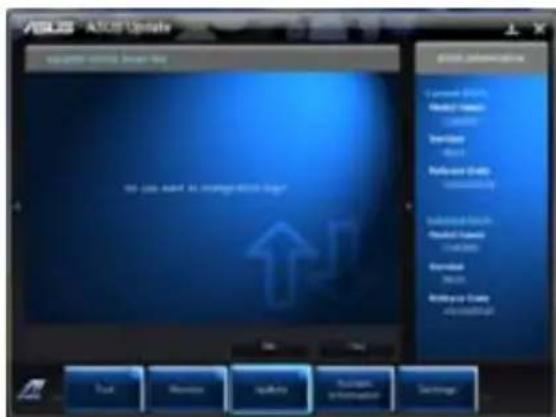
Systeeminformatie
Instellingen

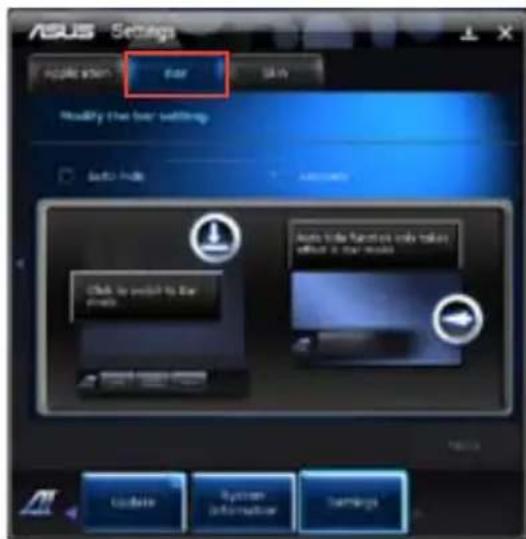
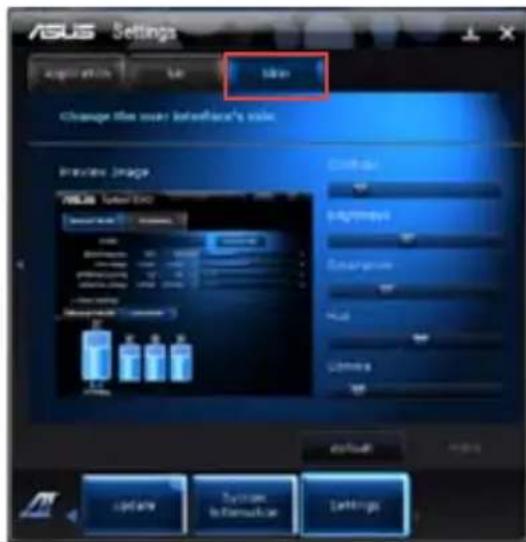
ASUS AI Manager
AI Manager-snelbalk
AI-beveiliging
Informatie
Nero 9 installeren
- Selecteer Typical (Typisch) en klik daarna op Next (Volgende).

Bestanden branden
- ASUS Essentio Desktop PC
- CG8350
- User Manual
- Copyright © 2011 ASUSTeK Computer Inc. All Rights Reserved.
- Contents
- Chapter 1 Getting started
- Chapter 2 Using Windows ® 7
- Chapter 3 Connecting devices to your computer
- Chapter 4 Using your computer
- Chapter 5 Connecting to the Internet
- Chapter 6 Using the Utilities
- Chapter 7 Troubleshooting
- Notices
- REACH
- Federal Communications Commission Statement
- RF exposure warning
- Canadian Department of Communications Statement
- Macrovision Corporation Product Notice
- Lithium-Ion Battery Warning
- Safety information
- Conventions used in this guide
- Where to find more information
- ASUS websites
- ASUS Local Technical Support
- Package contents
- Chapter 1
- Getting started
- Welcome!
- Getting to know your computer
- Setting up your computer
- Connecting an external monitor
- Using the ASUS Graphics Card (on selected models only)
- To connect an external monitor using the ASUS Graphics Card:
- Using the onboard display output ports
- To connect an external monitor using the onboard display output ports:
- Connecting a USB keyboard and a USB mouse
- Connecting the power cord
- Turning your computer ON/OFF
- Turning your computer ON
- To turn your computer ON:
- Turning your computer OFF
- To turn your computer OFF:
- Chapter 2
- Using Windows® 7
- Starting for the first time
- To start for the first time:
- Using Windows ® 7 desktop
- Using the Start menu
- Launching items from the Start menu
- To launch items from the Start menu:
- Using the Getting Started item
- To use the Getting Started item:
- Using the taskbar
- Launching a program from the taskbar
- To launch a program from the taskbar:
- Pinning items on the jumplists
- To pin items to the jumplist:
- Unpinning items from the jumplist
- To unpin items from the jumplist:
- Pinning programs on the Start menu or taskbar
- To pin programs on the Start menu or taskbar:
- Unpinning programs from the Start menu
- Unpinning programs from the taskbar
- Using the notification area
- Displaying an alert notification
- Customizing icons and notifications
- To customize icons and notifications:
- Managing your files and folders
- Using Windows® Explorer
- Launching Windows® Explorer
- To launch Windows Explorer:
- Exploring files and folders
- To explore files and folders:
- Customizing the file/folder view
- To customize the file/folder view:
- Arranging your files
- To arrange your files:
- Sorting your files
- To sort your files:
- Grouping your files
- To group your files:
- Adding a new folder
- To add a new folder:
- Backing up your files
- Setting up a backup
- Restoring your system
- To restore your system:
- Protecting your computer
- Using Windows® 7 Action Center
- Launching Windows® 7 Action Center To launch Windows® 7 Action Center:
- Using Windows® Update
- Launching Windows® Update
- To launch Windows® Update:
- Setting up a user account and password
- Setting up a user account
- To set up a user account:
- Setting up a user's password
- To set up a user's password:
- Activating the anti-virus software
- To activate Trend Micro Internet Security:
- Getting Windows® Help and Support
- Chapter 3
- Connecting devices to your computer
- Connecting a USB storage device
- To connect a USB storage device:
- To remove a USB storage device:
- Connecting microphone and speakers
- Connecting Headphone and Mic
- Connecting 2-channel Speakers
- Connecting 8-channel Speakers
- Connecting multiple external displays
- Setting up multiple displays
- To set up multiple displays:
- Connecting an HDTV
- Chapter 4
- Using your computer
- Proper posture when using your Desktop PC
- To maintain the proper posture:
- Using the memory card reader
- To use the memory card:
- Using the optical drive
- Inserting an optical disc
- To insert an optical disc:
- Removing an optical disc
- To remove an optical disc:
- Using the multimedia keyboard (on selected models only)
- ASUS PRIMAX/KB2621 keyboard
- Chapter 5
- Connecting to the Internet
- Wired connection
- Connecting via a DSL/cable modem
- Connecting via a local area network (LAN)
- To connect via a LAN:
- Chapter 6
- Using the Utilities
- ASUS AI Suite II
- Installing AI Suite II
- To install AI Suite II:
- Using AI Suite II
- Tool
- EPU
- Launching EPU
- Probe II
- Launching Probe II
- Configuring Probe II
- Sensor Recorder
- Launching Sensor Recorder
- Configuring Sensor Recorder
- Monitor
- Sensor
- CPU Frequency
- Update
- ASUS Update
- Updating the BIOS through the Internet
- Updating the BIOS through a BIOS file
- System Information
- Settings
- ASUS AI Manager
- Installing AI Manager
- To install AI Manager:
- Launching AI Manager
- AI Manager quick bar
- Main
- AI Disk
- AI Security
- To lock a device:
- To unlock the device:
- To change the password:
- AI Booting
- To specify the boot sequence:
- My Favorites
- To add an application:
- Support
- Information
- Nero 9
- Installing Nero 9
- To install Nero 9:
- Burning files
- To burn files:
- Recovering your system
- Using the Recovery Partition
- About the Recovery Partition
- Using the Recovery Partition:
- System Recovery:
- System Image Backup:
- System DVD Backup:
- Using the Recovery DVD (on selected models)
- To use the Recovery DVD:
- Chapter 7
- Troubleshooting
- ? My computer cannot be powered on and the power LED on the front panel does not light up
- ? My computer hangs.
- ? I cannot connect to a wireless network using the ASUS WLAN Card (on selected models only)?
- ? The arrow keys on the number key pad are not working.
- ? No display on the monitor.
- ? When using multiple monitors, only one monitor has display.
- ? My computer cannot detect my USB storage device.
- I want to restore or undo changes to my computer's system settings without affecting my personal files or data.
- ? The picture on the HDTV is stretched.
- ? My speakers produce no sound.
- ? The DVD drive cannot read a disc.
- ? The DVD drive eject button is not respond.
- CPU
- Benutzerhandbuch
- Dateien sichern
- Kapitel 4
- Computer verwenden
- Support technique ASUS local
- Trier vos fichiers
- Lancer Windows® Update
- Chapitre 4
- Sensor (Sondes)
- Menu des réglages
- Installer AI Manager
- Uso de Windows® Update
- Capítulo 4
- Uso del equipo
- Actualización
- Para instalar AI Manager:
- Barra rápida de AI Manager
- Información
- De stroomkabel verbinden
- Uw computer AAN/UIT-schakelen
- Uw computer AAN-schakelen
- De antivirus-software activeren
- Een HDTV aansluiten
- Hoofdstuk 4
- Systeeminformatie
- Instellingen
- AI Manager-snelbalk
- AI-beveiliging
- Informatie
- Nero 9 installeren
- Bestanden branden
Brand : ASUS
Model : Essentio CG8350
Category : Bag