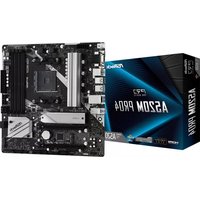
A520M Pro4 - Motherboard ASROCK - Free user manual and instructions
Find the device manual for free A520M Pro4 ASROCK in PDF.


User questions about A520M Pro4 ASROCK
0 question about this device. Answer the ones you know or ask your own.
Ask a new question about this device
Download the instructions for your Motherboard in PDF format for free! Find your manual A520M Pro4 - ASROCK and take your electronic device back in hand. On this page are published all the documents necessary for the use of your device. A520M Pro4 by ASROCK.
USER MANUAL A520M Pro4 ASROCK
Copyright©2020 ASRock INC. All rights reserved.
Copyright Notice:
No part of this documentation may be reproduced, transcribed, transmitted, or translated in any language, in any form or by any means, except duplication of documentation by the purchaser for backup purpose, without written consent of ASRock Inc.
Products and corporate names appearing in this documentation may or may not be registered trademarks or copyrights of their respective companies, and are used only for identification or explanation and to the owners' benefit, without intent to infringe.
Disclaimer:
Specifications and information contained in this documentation are furnished for informational use only and subject to change without notice, and should not be constructed as a commitment by ASRock. ASRock assumes no responsibility for any errors or omissions that may appear in this documentation.
With respect to the contents of this documentation, ASRock does not provide warranty of any kind, either expressed or implied, including but not limited to the implied warranties or conditions of merchantability or fitness for a particular purpose.
In no event shall ASRock, its directors, officers, employees, or agents be liable for any indirect, special, incidental, or consequential damages (including damages for loss of profits, loss of business, loss of data, interruption of business and the like), even if ASRock has been advised of the possibility of such damages arising from any defect or error in the documentation or product.

This device complies with Part 15 of the FCC Rules. Operation is subject to the following two conditions:
(1) this device may not cause harmful interference, and
(2) this device must accept any interference received, including interference that may cause undesired operation.
CALIFORNIA, USA ONLY
The Lithium battery adopted on this motherboard contains Perchlorate, a toxic substance controlled in Perchlorate Best Management Practices (BMP) regulations passed by the California Legislature. When you discard the Lithium battery in California, USA, please follow the related regulations in advance.
"Perchlorate Material-special handling may apply, see www.dtsc.ca.gov/hazardouswaste/perchlorate"
ASRock Website: http://www.asrock.com

AUSTRALIA ONLY
Our goods come with guarantees that cannot be excluded under the Australian Consumer Law. You are entitled to a replacement or refund for a major failure and compensation for any other reasonably foreseeable loss or damage caused by our goods. You are also entitled to have the goods repaired or replaced if the goods fail to be of acceptable quality and the failure does not amount to a major failure. If you require assistance please call ASRock Tel: +886-2-28965588 ext.123 (Standard International call charges apply)
The terms HDMI ^® and HDMI High-Definition Multimedia Interface, and the HDMI logo are trademarks or registered trademarks of HDMI Licensing LLC in the United States and other countries.

Motherboard Layout
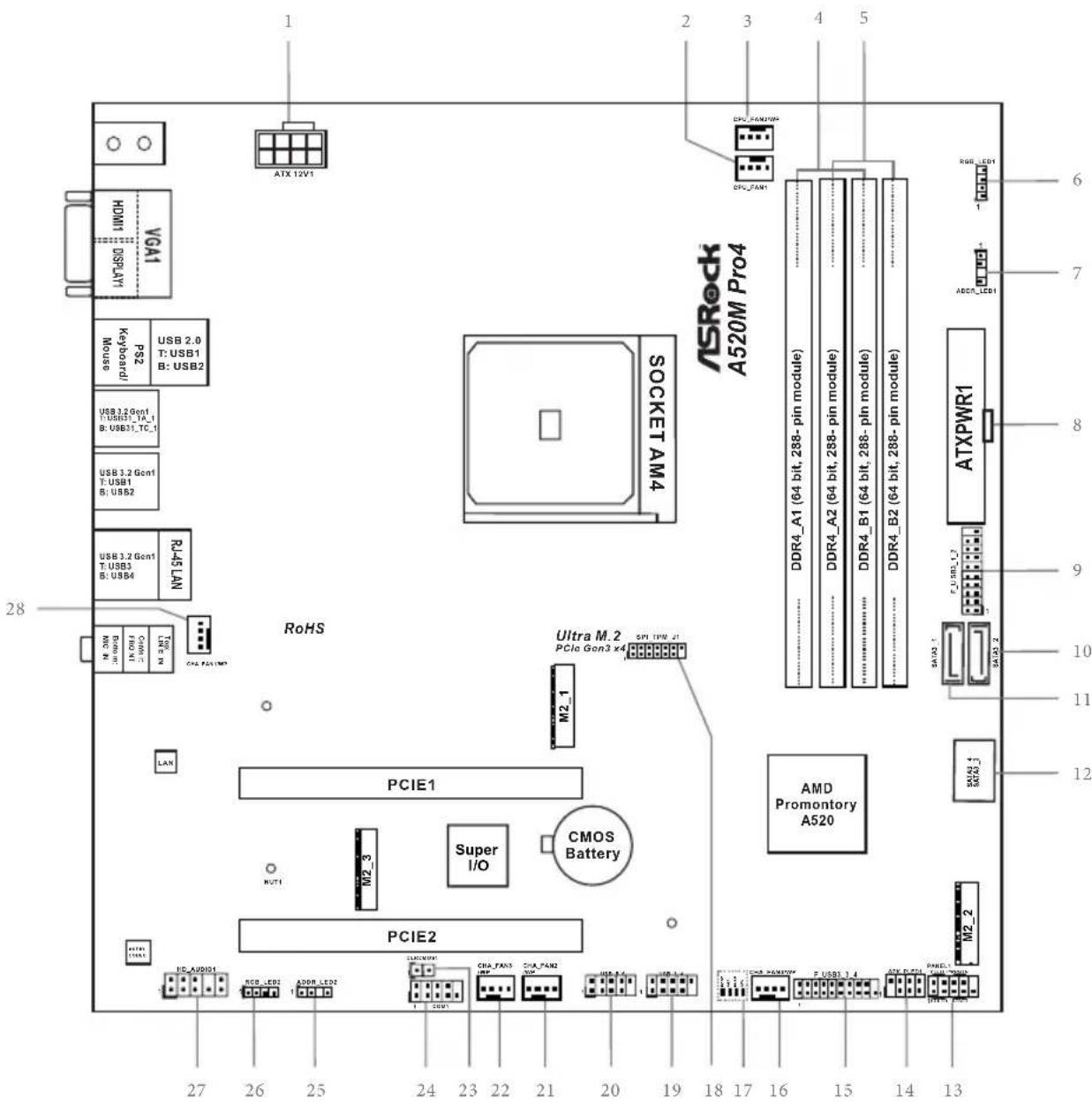
text_image
ASRock A520M Pro4 VGA1 DISPLAY HDMI 1 2 3 4 5 6 7 8 9 10 11 12 13 14 15 16 17 18 19 20 21 22 23 24 25 26 27 PCIE2 Super I/O CMOS Battery M2_3 PCIE1 M2_1 Ultra M.2 PCio G0n3 X4 RoHS PCIE1 M2_1 SOCKET AM4 DDR4_A1 (64 bit, 288- pin module) DDR4_A2 (64 bit, 288- pin module) DDR4_B1 (64 bit, 288- pin module) DDR4_B2 (64 bit, 288- pin module) ATXPWR1 M2_2 AMD Promontory A520 DATAS_1 DATAS_2 DATAAS_3 DATAAS_4 DATAAS_5No. Description
1 8 pin 12V Power Connector (ATX12V1)
2 CPU Fan Connector (CPU_FAN1)
3 CPU/Water Pump Fan Connector (CPU_FAN2/WP)
4 2 x 288-pin DDR4 DIMM Slots (DDR4_A1, DDR4_B1)
5 2 x 288-pin DDR4 DIMM Slots (DDR4_A2, DDR4_B2)
6 RGB LED Header (RGB_LED1)
7 Addressable LED Header (ADDR_LED1)
8 ATX Power Connector (ATXPWR1)
9 USB 3.2 Gen1 Header (F_USB3_1_2)
10 SATA3 Connector (SATA3_2)
11 SATA3 Connector (SATA3_1)
12 SATA3 Connector (SATA3_4) (Upper), SATA3 Connector (SATA3_3) (Lower)
13 System Panel Header (PANEL1)
14 Power LED and Speaker Header (SPK_PLED1)
15 USB 3.2 Gen1 Header (F_USB3_3_4)
16 Chassis/Water Pump Fan Connector (CHA_FAN4/WP)
17 Post Status Checker (PSC)
18 SPI TPM Header (SPI_TPM_J1)
19 USB 2.0 Header (USB_3_4)
20 USB 2.0 Header (USB_5_6)
21 Chassis/Water Pump Fan Connector (CHA_FAN2/WP)
22 Chassis/Water Pump Fan Connector (CHA_FAN3/WP)
23 Clear CMOS Jumper (CLRCMOS1)
24 COM Port Header (COM1)
25 Addressable LED Header (ADDR_LED2)
26 RGB LED Header (RGB_LED2)
27 Front Panel Audio Header (HD_AUDIO1)
28 Chassis/Water Pump Fan Connector (CHA_FAN1/WP)
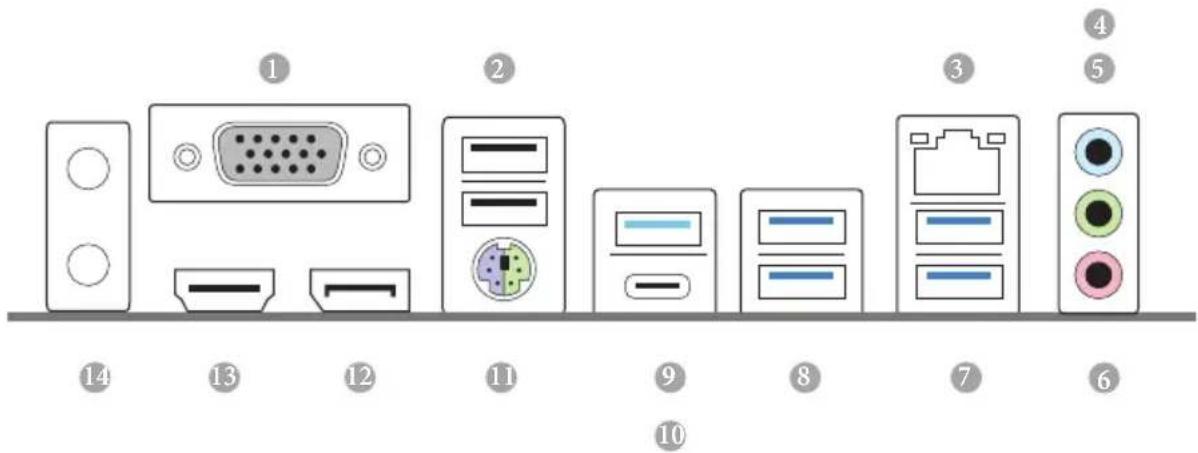
1.4 I/O Panel
text_image
Diagram showing labeled electronic device ports and connectors, including VGA, USB, and network ports with numbered labels.No. Description No. Description
1 D-Sub Port 9 USB 3.2 Gen1 Type-A Port
2 USB 2.0 Ports (USB_12)* (USB3_TA_1)
3 LAN RJ-45 Port** 10 USB 3.2 Gen1 Type-C Port
4 Line In (Light Blue)*** (USB3_TC_1)
5 Front Speaker (Lime)*** 11 PS/2 Mouse/Keyboard Port
6 Microphone (Pink)*** 12 DisplayPort 1.4
7 USB 3.2 Gen1 Ports (USB3_34) 13 HDMI Port
8 USB 3.2 Gen1 Ports (USB3_12) 14 Antenna Bracket
* Please note that the USB_2 consumes auxiliary power (+5VSB) while the other USB ports consume DUAL Power (+5VDUAL). The USB_2 is optimal for connecting the USB Type speaker and headset.
** There are two LEDs on each LAN port. Please refer to the table below for the LAN port LED indications.
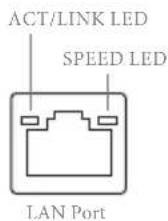
| Activity / Link LED | Speed LED | ||
| Status | Description | Status | Description |
| Off | No Link | Off | 10Mbps connection |
| Blinking | Data Activity | Orange | 100Mbps connection |
| On | Link | Green | 1Gbps connection |
*** Function of the Audio Ports in 7.1-channel Configuration:
| Port Function | |
| Light Blue (Rear panel) Rear Speaker Out | |
| Lime (Rear panel) Front Speaker Out | |
| Pink (Rear panel) Central /Subwoofer Speaker Out | |
| Lime (Front panel) Side Speaker Out | |
Chapter 1 Introduction
Thank you for purchasing ASRock A520M Pro4 motherboard, a reliable motherboard produced under ASRock's consistently stringent quality control. It delivers excellent performance with robust design conforming to ASRock's commitment to quality and endurance.

Because the motherboard specifications and the BIOS software might be updated, the content of this documentation will be subject to change without notice. In case any modifications of this documentation occur, the updated version will be available on ASRock's website without further notice. If you require technical support related to this motherboard, please visit our website for specific information about the model you are using. You may find the latest VGA cards and CPU support list on ASRock's website as well. ASRock website http://www.asrock.com.
1.1 Package Contents
• ASRock A520M Pro4 Motherboard (Micro ATX Form Factor)
• ASRock A520M Pro4 Quick Installation Guide
• ASRock A520M Pro4 Support CD
• 1 x I/O Panel Shield
• 2 x Serial ATA (SATA) Data Cables (Optional)
• 2 x Screws for M.2 Socket (Optional)
1.2 Specifications
Platform
- Micro ATX Form Factor
- Solid Capacitor design
- 2oz Copper PCB
CPU
- Supports 3 ^rd Gen AMD AM4 Ryzen ^TM / future AMD Ryzen ^TM Processors (3000 and 4000 Series Processors)*
* Not compatible with AMD Ryzen™ 5 3400G and Ryzen™ 3 3200G. - Digi Power design
• 8 Power Phase design
Chipset
- AMD A520
Memory
• Dual Channel DDR4 Memory Technology
• 4 x DDR4 DIMM Slots
- AMD Ryzen series CPUs (Matisse) support DDR4 4533+(OC)/4466(OC)/4400(OC)/4333(OC)/4266(OC)/4200(OC)/4133(OC)/4000(OC)/3866(OC)/3800(OC)/3733(OC)/3600(OC)/3466(OC)/3200/2933/2667/2400/2133 ECC & non-ECC, un-buffered memory*
- AMD Ryzen series APUs (Renoir) support DDR4 4733+ (OC)/4666(OC)/4600(OC)/4533(OC)/4466(OC)/4400(OC)/4333(OC)/4266(OC)/4200(OC)/4133(OC)/4000(OC)/3866(OC)/3800(OC)/3733(OC)/3600(OC)/3466(OC)/3200/2933/2667/2400/2133 ECC & non-ECC, un-buffered memory*
* Please refer to Memory Support List on ASRock's website for more information. (http://www.asrock.com/)
* Please refer to page 22 for DDR4 UDIMM maximum frequency support.
• Max. capacity of system memory: 128GB
• Supports Extreme Memory Profile (XMP) memory modules
• 15μ Gold Contact in DIMM Slots
Expansion Slot
- 2 x PCI Express 3.0 x16 Slots (PCIE1: x16 mode; PCIE2: x2 mode)*
* Supports NVMe SSD as boot disks - 1 x M.2 Socket (Key E), supports type 2230 WiFi/BT module
Graphics
- Integrated AMD Radeon ^TM Vega Series Graphics in Ryzen Series APU*
* Actual support may vary by CPU
- DirectX 12, Pixel Shader 5.0
- Shared memory default 2GB. Max Shared memory supports up to 16GB.
* The Max shared memory 16GB requires 32GB system memory installed.
- Three graphics output options: D-Sub, HDMI and DisplayPort 1.4
• Supports Triple Monitor
- Supports HDMI 2.1 with max. resolution up to 4K x 2K (4096x2160) @ 60Hz
- Supports DisplayPort 1.4 with max. resolution up to 5K (5120x2880)@120Hz
- Supports D-Sub with max. resolution up to 1920x1200 @ 60Hz
- Supports Auto Lip Sync, Deep Color (12bpc), xvYCC and HBR (High Bit Rate Audio) with HDMI 2.1 Port (Compliant HDMI monitor is required)
• Supports HDR (High Dynamic Range) with HDMI 2.1
- Supports HDCP 2.3 with HDMI 2.1 and DisplayPort 1.4 Ports
- Supports 4K Ultra HD (UHD) playback with HDMI 2.1 and DisplayPort 1.4 Ports
• Supports Microsoft PlayReady®
Audio
- 7.1 CH HD Audio with Content Protection (Realtek ALC1200 Audio Codec)
• Premium Blu-ray Audio support
• Supports Surge Protection
• PCB Isolate Shielding
• Individual PCB Layers for R/L Audio Channel
- Nahimic Audio
LAN
• PCIE x1 Gigabit LAN 10/100/1000 Mb/s
• Realtek RTL8111H
• Supports Wake-On-LAN
• Supports Lightning/ESD Protection
• Supports Energy Efficient Ethernet 802.3az
- Supports PXE
Rear Panel I/O
- Antenna Bracket
• 1 x PS/2 Mouse/Keyboard Port - 1 x D-Sub Port
- 1 x HDMI Port
- 1 x DisplayPort 1.4
• 1 x USB 3.2 Gen1 Type-A Port (Supports ESD Protection) - 4 x USB 3.2 Gen1 Type-A Ports (ASMedia ASM1074 hub) (Supports ESD Protection)
- 1 x USB 3.2 Gen1 Type-C Port (Supports ESD Protection)
- 2 x USB 2.0 Ports (Supports ESD Protection)
- 1 x RJ-45 LAN Port with LED (ACT/LINK LED and SPEED LED)
• HD Audio Jacks: Line in / Front Speaker / Microphone
Storage
-
4 x SATA3 6.0 Gb/s Connectors, support RAID (RAID 0, RAID 1 and RAID 10), NCQ, AHCI and Hot Plug*
* M2_2 and SATA3_3_4 share lanes. If either one of them is in use, the other one will be disabled. -
1 x Ultra M.2 Socket (M2_1), supports M Key type 2280 M.2 PCI Express module up to Gen3 x4 (32 Gb/s)**
- 1 x M.2 Socket (M2_2), supports M Key type 2280 M.2 SATA3 6.0 Gb/s module and M.2 PCI Express module up to Gen3 x2 (16 Gb/s) ^**
** Supports NVMe SSD as boot disks
** Supports ASRock U.2 Kit
Connector
• 1 x COM Port Header
• 1 x SPI TPM Header
• 1 x Power LED and Speaker Header
• 2 x RGB LED Headers
* Support in total up to 12V/3A, 36W LED Strip
• 2 x Addressable LED Headers
* Support in total up to 5V/3A, 15W LED Strip
• 1 x CPU Fan Connector (4-pin)
* The CPU Fan Connector supports the CPU fan of maximum 1A (12W) fan power.
* Support in total up to 12V/3A, 36W LED Strip
• 2 x Addressable LED Headers
* Support in total up to 5V/3A, 15W LED Strip
• 1 x CPU Fan Connector (4-pin)
* The CPU Fan Connector supports the CPU fan of maximum 1A (12W) fan power.
- 1 x CPU/Water Pump Fan Connector (4-pin) (Smart Fan Speed Control)
- 4 x Chassis/Water Pump Fan Connectors (4-pin) (Smart Fan Speed Control)
* The Chassis/Water Pump Fan supports the water cooler fan of maximum 2A (24W) fan power.
* CPU_FAN2/WP, CHA_FAN1/WP, CHA_FAN2/WP, CHA_FAN3/WP and CHA_FAN4/WP can auto detect if 3-pin or 4-pin fan is in use.
• 1 x 24 pin ATX Power Connector
• 1 x 8 pin 12V Power Connector
• 1 x Front Panel Audio Connector
- 2 x USB 2.0 Headers (Support 4 USB 2.0 ports) (Supports ESD Protection)
- 2 x USB 3.2 Gen1 Headers (Support 4 USB 3.2 Gen1 ports) (Supports ESD Protection)
BIOS
Feature
• AMI UEFI Legal BIOS with GUI support
• Supports "Plug and Play"
• ACPI 5.1 compliance wake up events
• Supports jumperfree
- SMBIOS 2.3 support
- CPU, CPU VDDCR_SOC, DRAM, VPPM, +1.8VSB Voltage Multi-adjustment
Hardware Monitor
- Temperature Sensing: CPU, CPU/Water Pump, Chassis/Water Pump Fans
- Fan Tachometer: CPU, CPU/Water Pump, Chassis/Water Pump Fans
- Quiet Fan (Auto adjust chassis fan speed by CPU temperature): CPU, CPU/Water Pump, Chassis/Water Pump Fans
- Fan Multi-Speed Control: CPU, CPU/Water Pump, Chassis/Water Pump Fans
- Voltage monitoring: +12V, +5V, +3.3V, CPU Vcore, CPU VDDCR_SOC, DRAM, VPPM, 1.05V_PROM_S5, +1.8V, VDDP
os
- Microsoft® Windows® 10 64-bit
Certifications
- FCC, CE
- ErP/EuP ready (ErP/EuP ready power supply is required)
* For detailed product information, please visit our website: http://www.asrock.com

Please realize that there is a certain risk involved with overclocking, including adjusting the setting in the BIOS, applying Untied Overclocking Technology, or using third-party overclocking tools. Overclocking may affect your system's stability, or even cause damage to the components and devices of your system. It should be done at your own risk and expense. We are not responsible for possible damage caused by overclocking.
Chapter 2 Installation
This is a Micro ATX form factor motherboard. Before you install the motherboard, study the configuration of your chassis to ensure that the motherboard fits into it.
Pre-installation Precautions
Take note of the following precautions before you install motherboard components or change any motherboard settings.
- Make sure to unplug the power cord before installing or removing the motherboard. Failure to do so may cause physical injuries to you and damages to motherboard components.
- In order to avoid damage from static electricity to the motherboard's components, NEVER place your motherboard directly on a carpet. Also remember to use a grounded wrist strap or touch a safety grounded object before you handle the components.
- Hold components by the edges and do not touch the ICs.
- Whenever you uninstall any components, place them on a grounded anti-static pad or in the bag that comes with the components.
- When placing screws to secure the motherboard to the chassis, please do not over-tighten the screws! Doing so may damage the motherboard.
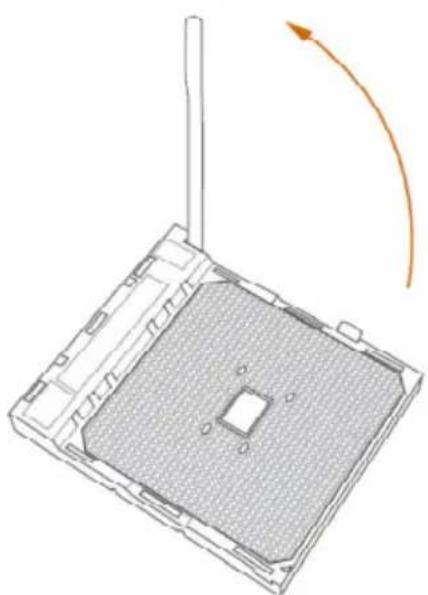
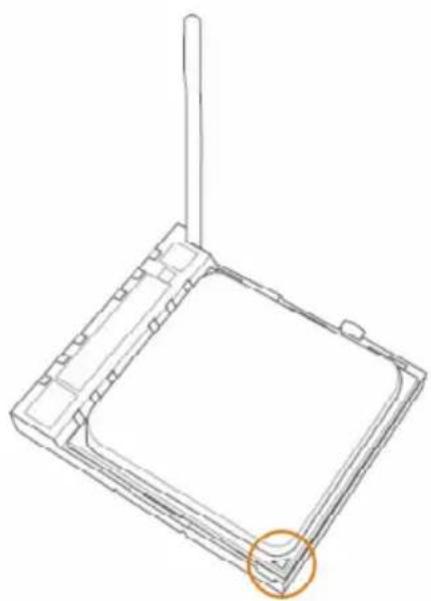
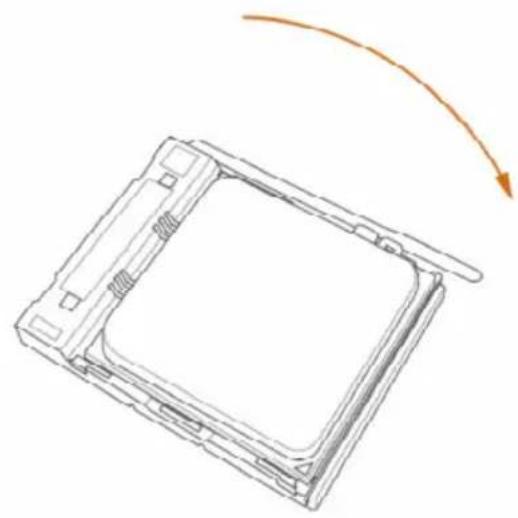
2.1 Installing the CPU

Unplug all power cables before installing the CPU.
1
natural_image
Diagram of a square electronic device with a central square and antenna, showing an orange curved arrow indicating rotation or movement (no text or symbols present)2
natural_image
Technical line drawing of a square electronic component with a vertical rod and circular highlight (no text or symbols)3
natural_image
Diagram of a rectangular device with a curved arrow indicating rotation or movement (no text or symbols)2.2 Installing the CPU Fan and Heatsink
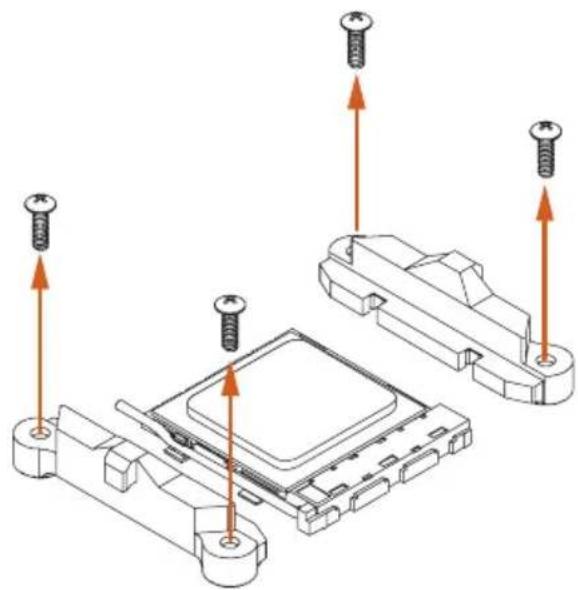
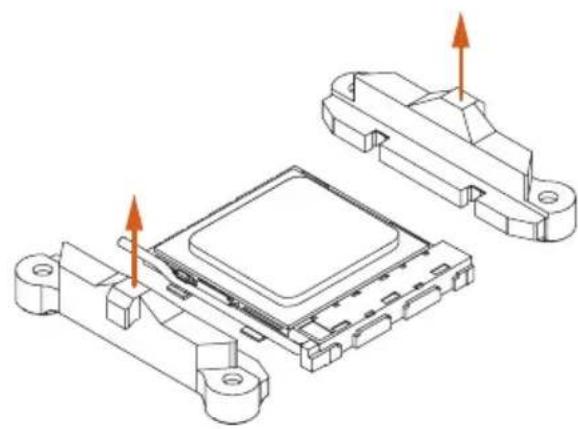
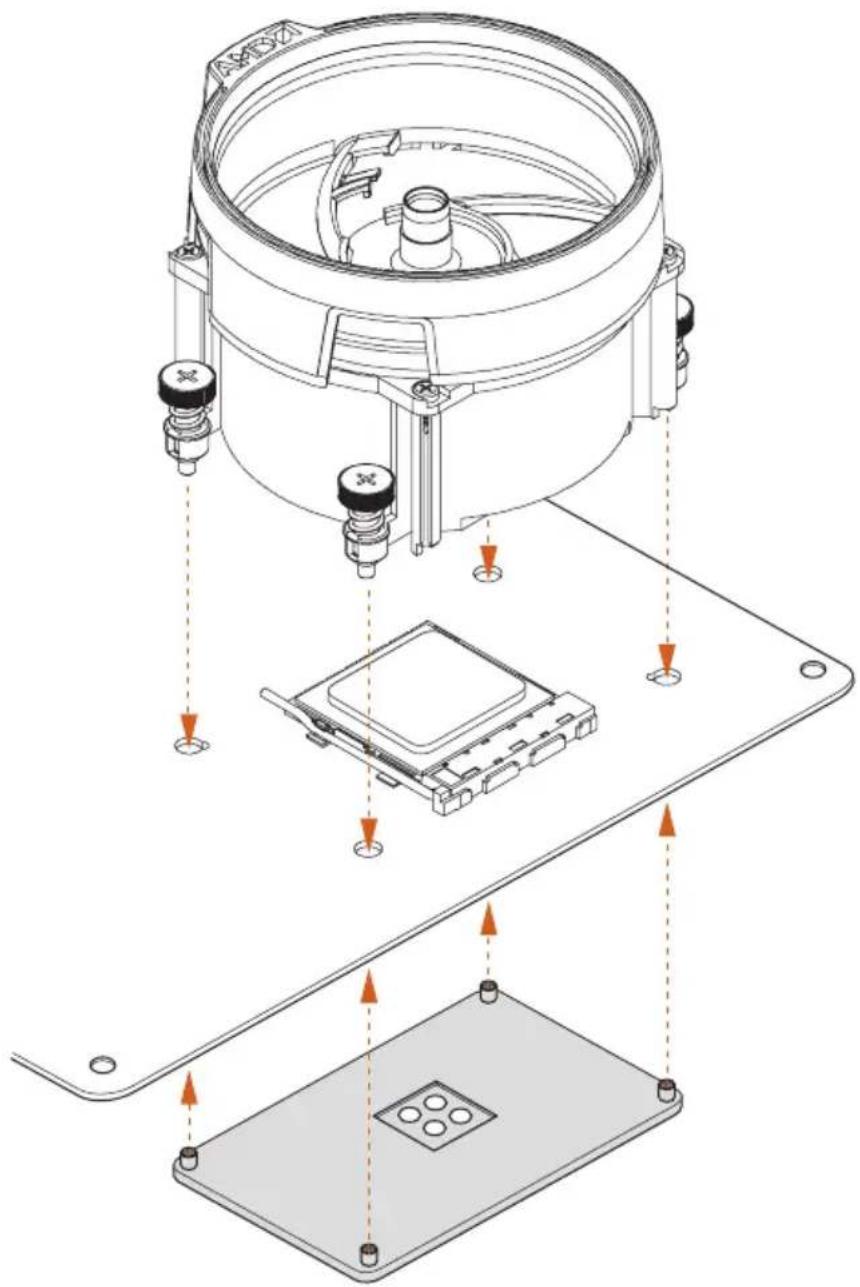
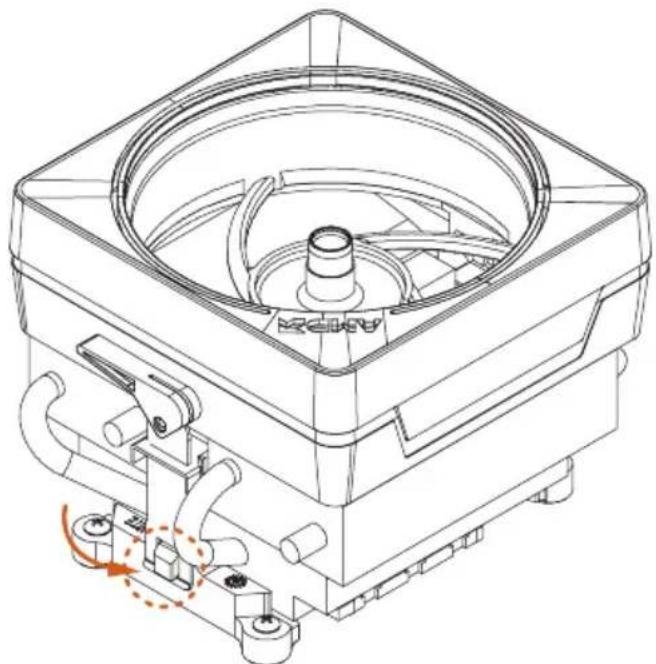
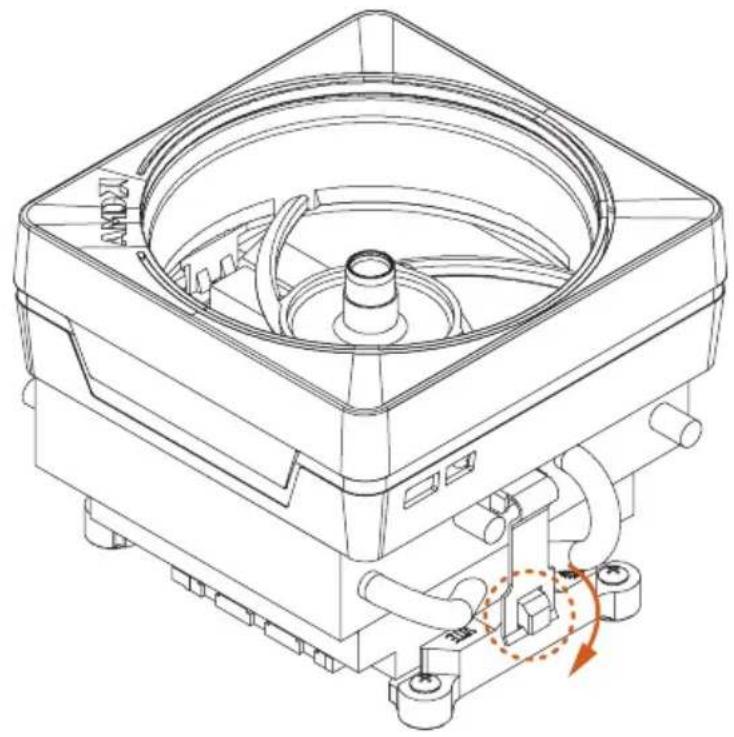
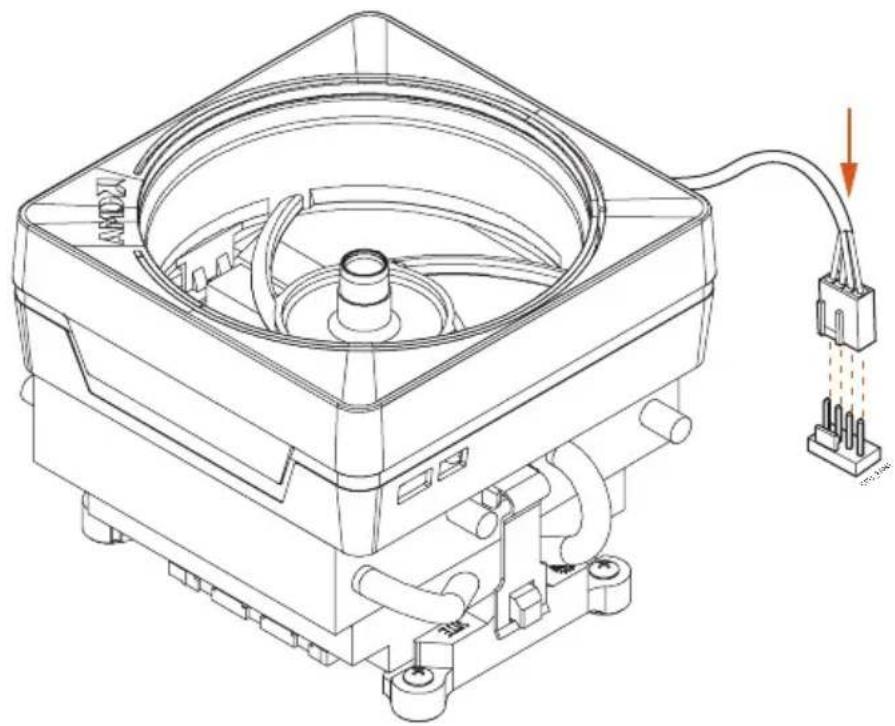
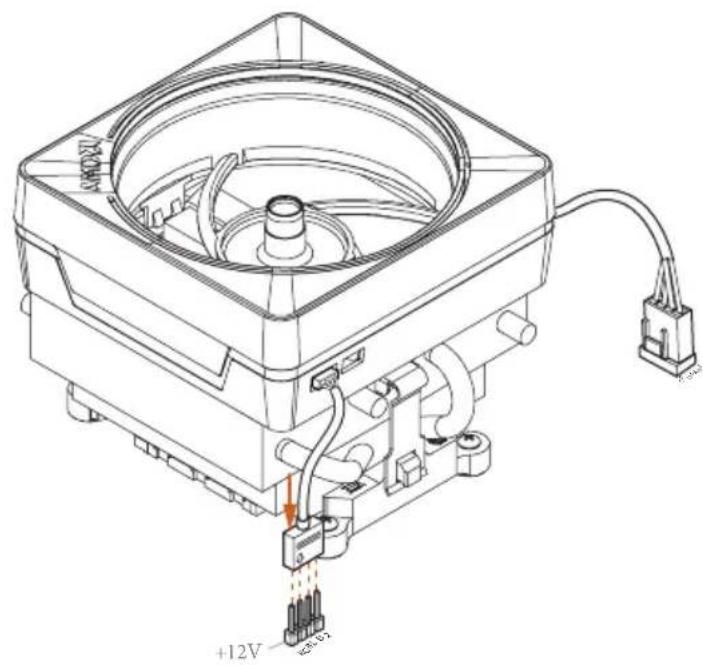
After you install the CPU into this motherboard, it is necessary to install a larger heatsink and cooling fan to dissipate heat. You also need to spray thermal grease between the CPU and the heatsink to improve heat dissipation. Make sure that the CPU and the heatsink are securely fastened and in good contact with each other.

Please turn off the power or remove the power cord before changing a CPU or heatsink.
Installing the CPU Box Cooler SR1
1
natural_image
Technical diagram showing screw installation on a microchip base (no text or symbols)2
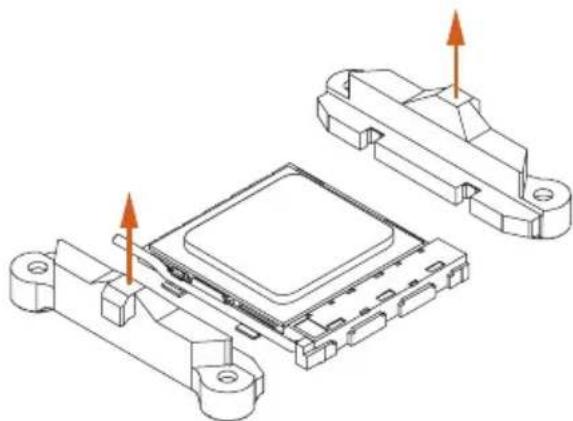
natural_image
Technical line drawing of an electronic component with two housing parts and orange arrows indicating assembly or movement (no text or symbols)3
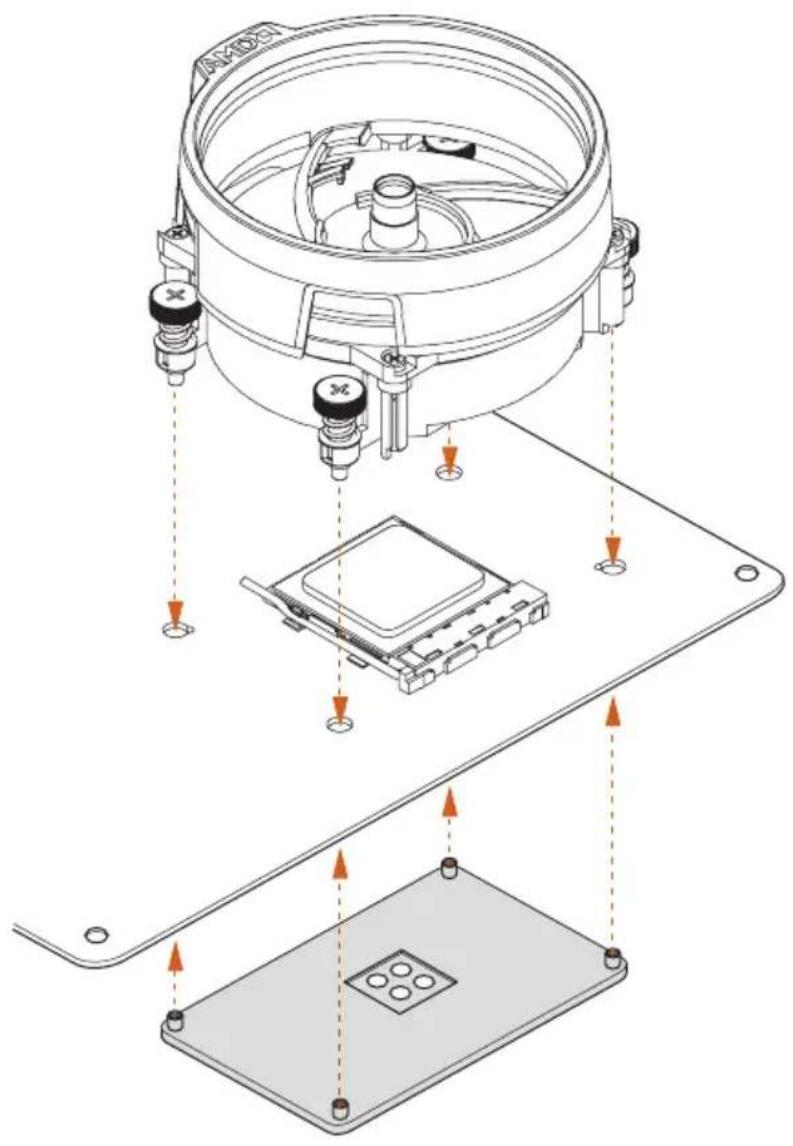
text_image
Technical diagram showing assembly of an accelerometer with labeled components and directional arrows indicating assembly steps.4
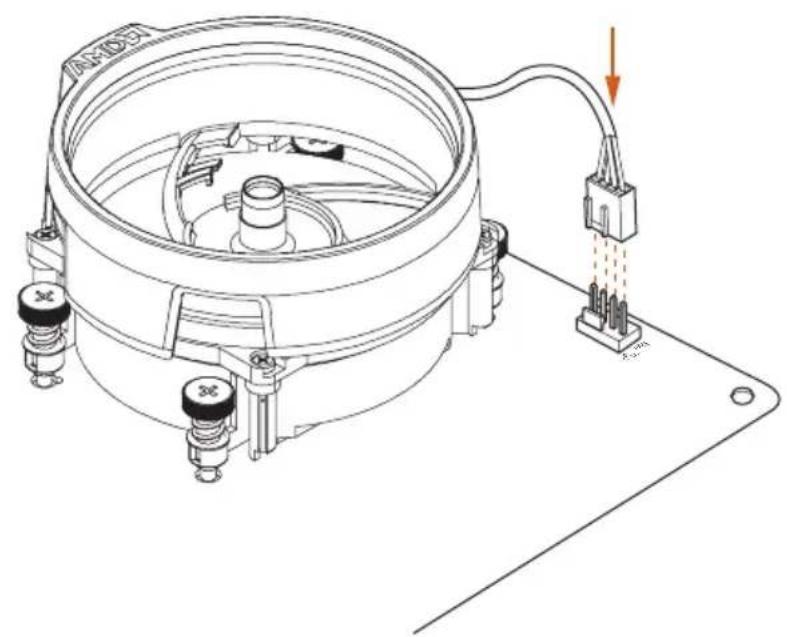
natural_image
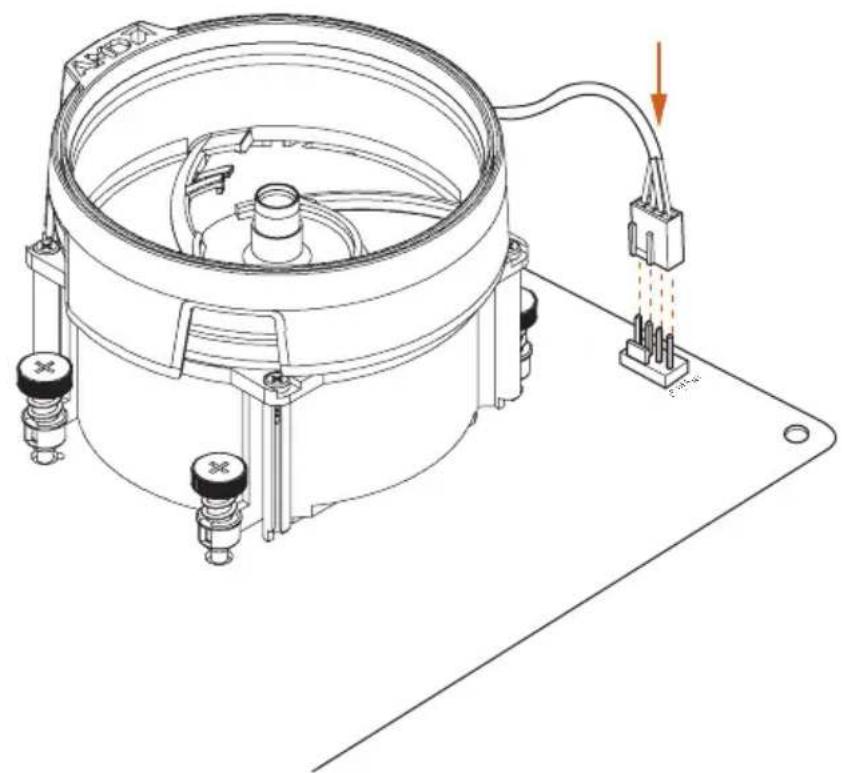
Technical line drawing of a mechanical device with mounting base and wiring, no visible text or symbolsInstalling the AM4 Box Cooler SR2
1
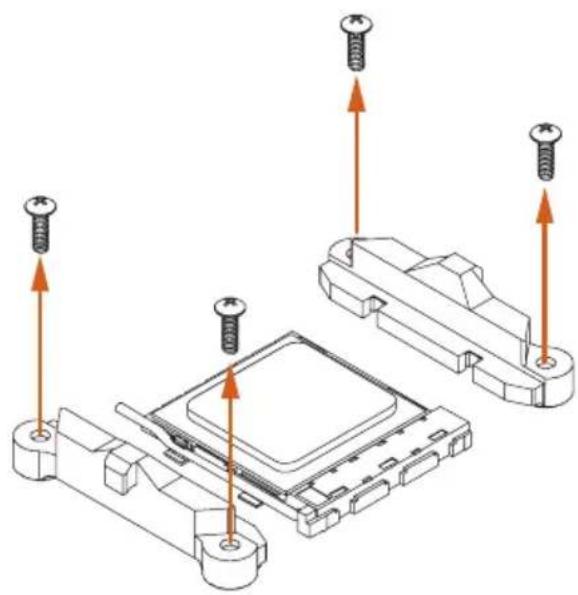
natural_image
Technical diagram showing screw fasteners inserted into a microchip assembly (no text or labels)2
natural_image
Technical line drawing of an electronic component with two views (top and side), showing internal structure and mounting points (no text or symbols)3
natural_image
Technical diagram of a mechanical assembly with exploded view and mounting base (no text or symbols)4
natural_image
Technical line drawing of a mechanical device with mounting base and wiring, no visible text or symbols*The diagrams shown here are for reference only. The headers might be in a different position on your motherboard.
Installing the AM4 Box Cooler SR3
1
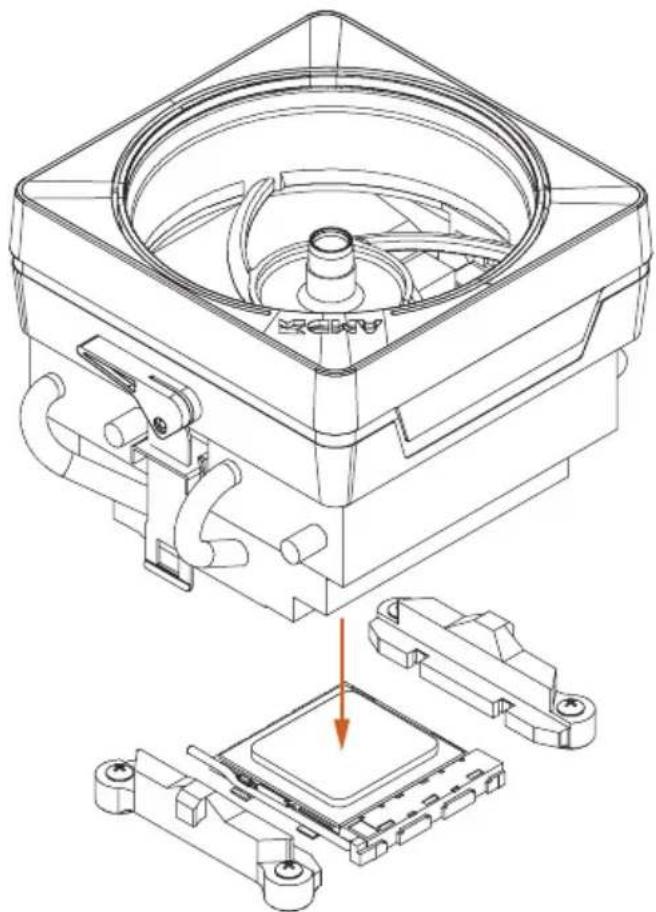
natural_image
Technical line drawing of a mechanical assembly with a central component and two supporting components (no text or symbols)2
natural_image
Technical line drawing of a mechanical device with no visible text or symbols3
natural_image
Technical line drawing of a mechanical device with no visible text or symbols4

natural_image
Technical line drawing of a mechanical device with internal components and a highlighted orange section (no text or symbols)5
natural_image
Technical line drawing of a mechanical device with internal components and wiring (no text or symbols)6
text_image
+12V +12V*The diagrams shown here are for reference only. The headers might be in a different position on your motherboard.
2.3 Installing Memory Modules (DIMM)
This motherboard provides four 288-pin DDR4 (Double Data Rate 4) DIMM slots, and supports Dual Channel Memory Technology.

- For dual channel configuration, you always need to install identical (the same brand, speed, size and chip-type) DDR4 DIMM pairs.
- It is unable to activate Dual Channel Memory Technology with only one or three memory module installed.
- It is not allowed to install a DDR, DDR2 or DDR3 memory module into a DDR4 slot; otherwise, this motherboard and DIMM may be damaged.
- We suggest that you install the memory modules on DDR4_A2 and DDR4_B2 first for better DRAM compatibility on 2 DIMMs configuration.
AMD non-XMP Memory Frequency Support
Ryzen Series CPUs (Matisse):
UDIMM Memory Slot
A1 A2 B1 B2
Frequency
(Mhz)
- SR - - 3200
- DR - - 3200
- SR - SR 3200
- DR - DR 3200
SR SR SR SR 2933
SR/DR DR SR/DR DR 2667
SR/DR SR/DR SR/DR SR/DR 2667
Ryzen Series APUs (Renoir):
| UDIMM Memory SlotA1 A2 B1 B2 | Frequency(Mhz) |
- SR -- 3200
- DR - - 3200
- SR - SR 3200
- DR - DR 3200
SR SR SR SR 2933
SR/DR DR SR/DR DR 2667
SR/DR SR/DR SR/DR SR/DR 2667
SR: Single rank DIMM, 1Rx4 or 1Rx8 on DIMM module label
DR: Dual rank DIMM, 2Rx4 or 2Rx8 on DIMM module label

The DIMM only fits in one correct orientation. It will cause permanent damage to the motherboard and the DIMM if you force the DIMM into the slot at incorrect orientation.
1
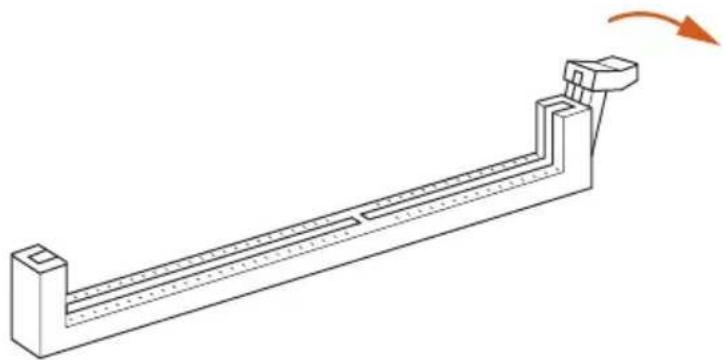
natural_image
Technical line drawing of a mechanical lever or support structure with a rotation arrow indicating motion (no text or symbols present)2
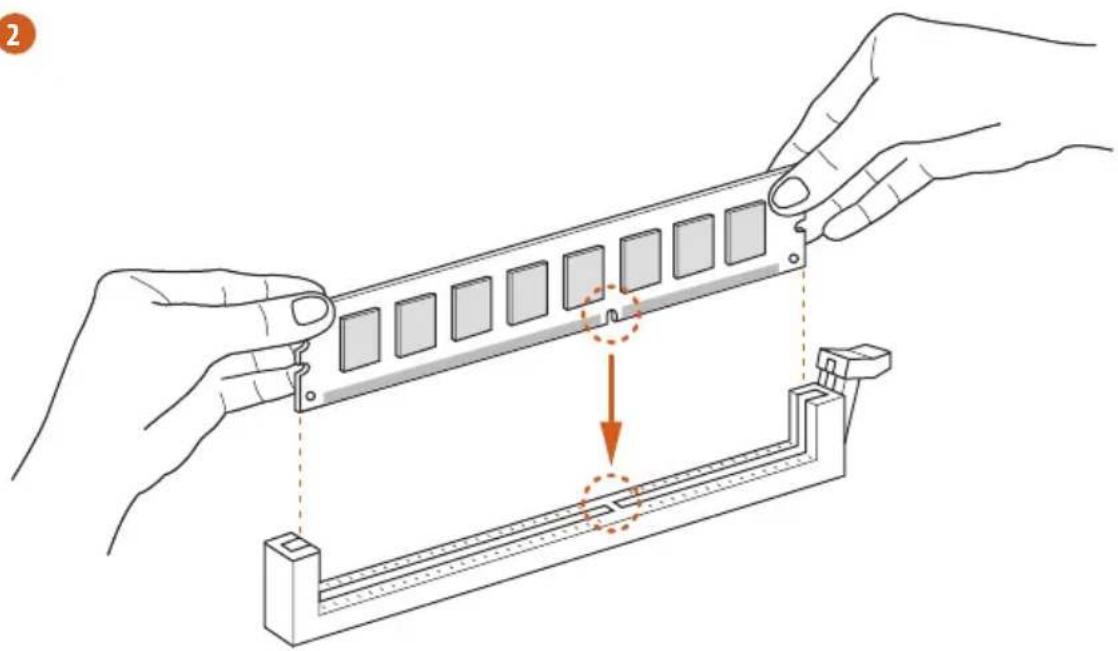
natural_image
Illustration of hands installing a mechanical component with a highlighted section (no text or symbols)3
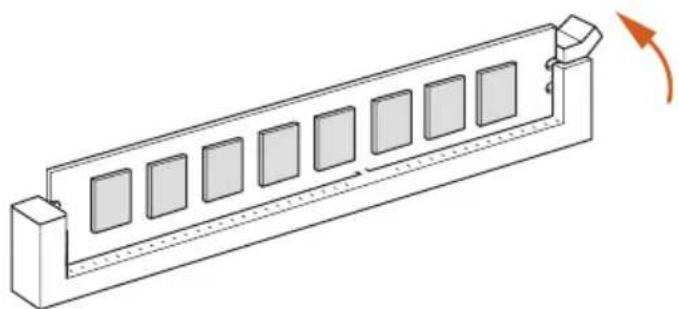
natural_image
Isometric line drawing of a rectangular electronic component with multiple square slots and a curved arrow indicating rotation (no text or symbols)2.4 Expansion Slots (PCI Express Slots)
There are 2 PCI Express slots on the motherboard.

Before installing an expansion card, please make sure that the power supply is switched off or the power cord is unplugged. Please read the documentation of the expansion card and make necessary hardware settings for the card before you start the installation.
PCIe slots:
PCIE1 (PCIe 3.0 x16 slot) is used for PCI Express x16 lane width graphics cards. PCIE2 (PCIe 3.0 x16 slot) is used for PCI Express x4 lane width graphics cards.

For a better thermal environment, please connect a chassis fan to the motherboard's chassis fan connector (CHA_FAN1/WP, CHA_FAN2/WP, CHA_FAN3/WP or CHA_FAN4/WP) when using multiple graphics cards.
2.5 Jumpers Setup
The illustration shows how jumpers are setup. When the jumper cap is placed on the pins, the jumper is “Short”. If no jumper cap is placed on the pins, the jumper is “Open”.
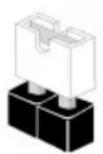
Short
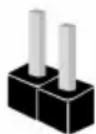
Open
Clear CMOS Jumper
(CLRCMOS1)
(see p.1, No. 23)

2-pin Jumper
Short: Clear CMOS
Open: Default
CLRCMOS1 allows you to clear the data in CMOS. The data in CMOS includes system setup information such as system password, date, time, and system setup parameters. To clear and reset the system parameters to default setup, please turn off the computer and unplug the power cord, then use a jumper cap to short the pins on CLRCMOS1 for 3 seconds. Please remember to remove the jumper cap after clearing the CMOS. If you need to clear the CMOS when you just finish updating the BIOS, you must boot up the system first, and then shut it down before you do the clear-CMOS action.
2.6 Onboard Headers and Connectors

Onboard headers and connectors are NOT jumpers. Do NOT place jumper caps over these headers and connectors. Placing jumper caps over the headers and connectors will cause permanent damage to the motherboard.
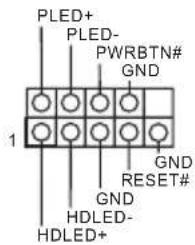
System Panel Header (9-pin PANEL1) (see p.1, No. 13)
text_image
PLED+ PLED- PWRBTN# GND 1 GND RESET# GND HDLED- HDLED+Connect the power button, reset button and system status indicator on the chassis to this header according to the pin assignments below. Note the positive and negative pins before connecting the cables.

PWRBTN (Power Button):
Connect to the power button on the chassis front panel. You may configure the way to turn off your system using the power button.
RESET (Reset Button):
Connect to the reset button on the chassis front panel. Press the reset button to restart the computer if the computer freezes and fails to perform a normal restart.
PLED (System Power LED):
Connect to the power status indicator on the chassis front panel. The LED is on when the system is operating. The LED keeps blinking when the system is in S1/S3 sleep state. The LED is off when the system is in S4 sleep state or powered off (S5).
HDLED (Hard Drive Activity LED):
Connect to the hard drive activity LED on the chassis front panel. The LED is on when the hard drive is reading or writing data.
The front panel design may differ by chassis. A front panel module mainly consists of power button, reset button, power LED, hard drive activity LED, speaker and etc. When connecting your chassis front panel module to this header, make sure the wire assignments and the pin assignments are matched correctly.
Power LED and Speaker Header
(7-pin SPK_PLED1)
(see p.1, No. 14)
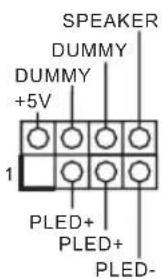
Please connect the chassis power LED and the chassis speaker to this header.
Serial ATA3 Connectors Vertical:
(SATA3_1:
see p.1, No. 11)
(SATA3_2:
see p.1, No. 10)
Right Angle:
(SATA3_3:
see p.1, No. 12) (Lower)
(SATA3_4:
see p.1, No. 12) (Upper)
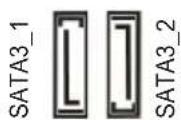
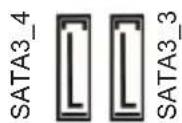
These four SATA3 connectors support SATA data cables for internal storage devices with up to 6.0 Gb/s data transfer rate. * M2_2 and SATA3_3_4 share lanes. If either one of them is in use, the other one will be disabled.
USB 2.0 Headers
(9-pin USB_3_4)
(see p.1, No. 19)
(9-pin USB_5_6)
(see p.1, No. 20)
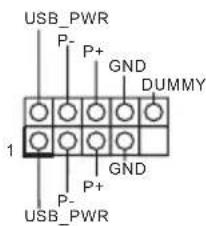
text_image
USB_PWR P- P+ GND DUMMY 1 GND P+ P- USB_PWRThere are two headers on this motherboard. Each USB 2.0 header can support two ports.
USB 3.2 Gen1 Headers (19-pin F_USB3_1_2)
(see p.1, No. 9)
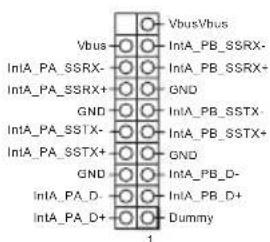
text_image
VbusVbus Vbus IntA_PB_SSRX- IntA_PB_SSRX+ GND IntA_PB_SSTX- IntA_PB_SSTX+ GND IntA_PB_D- IntA_PB_D+ Dummy 1There are two headers on this motherboard. Each USB 3.2 Gen1 header can support two ports.
(19-pin F_USB3_3_4)
(see p.1, No. 15)
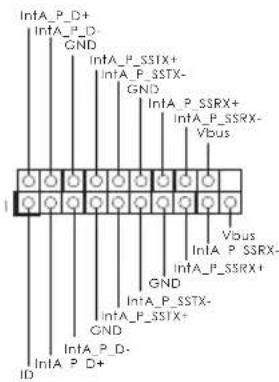
text_image
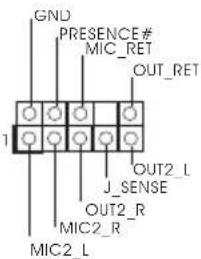
IntA_P_D+ IntA_P_D- GND IntA_P_SSTX+ IntA_P_SSTX- GND IntA_P_SSRX+ IntA_P_SSRX- Vbus I/O Vbus IntA_P_SSRX- GND IntA_P_SSTX- GND IntA_P_D- IDFront Panel Audio Header (9-pin HD_AUDIO1) (see p.1, No. 27)
text_image
GND PRESENCE# MIC_RET OUT_RET J_SENSE OUT2_L J_SENSE OUT2_R MIC2_R MIC2_LThis header is for connecting audio devices to the front audio panel.

- High Definition Audio supports Jack Sensing, but the panel wire on the chassis must support HDA to function correctly. Please follow the instructions in our manual and chassis manual to install your system.
- If you use an AC'97 audio panel, please install it to the front panel audio header by the steps below:
A. Connect Mic_IN (MIC) to MIC2_I.
B. Connect Audio_R (RIN) to OUT2_R and Audio_L (LIN) to OUT2_L.
C. Connect Ground (GND) to Ground (GND).
D. MIC_RET and OUT_RET are for the HD audio panel only. You don't need to connect them for the AC'97 audio panel.
E. To activate the front mic, go to the "FrontMic" Tab in the Realtek Control panel and adjust "Recording Volume".
Chassis Water Pump Fan Connectors
(4-pin CHA_FAN1/WP)
(see p.1, No. 28)
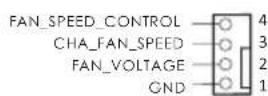
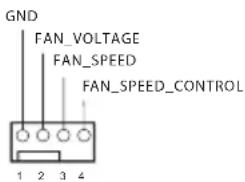
This motherboard provides four 4-Pin water cooling chassis fan connectors. If you plan to connect a 3-Pin chassis water cooler fan, please connect it to Pin 1-3.
(4-pin CHA_FAN2/WP)
(see p.1, No. 21)
(4-pin CHA_FAN3/WP)
(see p.1, No. 22)
(4-pin CHA_FAN4/WP)
(see p.1, No. 16)
text_image
GND FAN_VOLTAGE FAN_SPEED FAN_SPEED_CONTROL 1 2 3 4CPU Fan Connector (4-pin CPU_FAN1) (see p.1, No. 2)
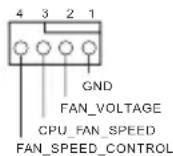
This motherboard provides a 4-Pin CPU fan (Quiet Fan) connector. If you plan to connect a 3-Pin CPU fan, please connect it to Pin 1-3.
CPU Water Pump Fan Connector (4-pin CPU_FAN2/WP) (see p.1, No. 3)
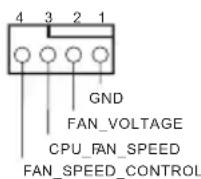
This motherboard provides a 4-Pin water cooling CPU fan connector. If you plan to connect a 3-Pin CPU water cooler fan, please connect it to Pin 1-3.
ATX Power Connector (24-pin ATXPWR1) (see p.1, No. 8)
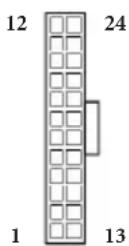
This motherboard provides a 24-pin ATX power connector. To use a 20-pin ATX power supply, please plug it along Pin 1 and Pin 13.
ATX 12V Power
Connector
(8-pin ATX12V1)
(see p.1, No. 1)
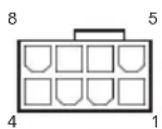
This motherboard
provides an 8-pin ATX
12V power connector. To use a 4-pin ATX power supply, please plug it along Pin 1 and Pin 5.
*Warning: Please make sure that the power cable connected is for the CPU and not the graphics card. Do not plug the PCIe power cable to this connector.
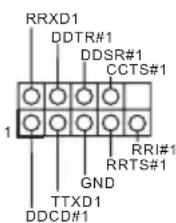
Serial Port Header
(9-pin COM1)
(see p.1, No. 24)
text_image
RRXD1 DDTR#1 DDSR#1 CCTS#1 RRI#1 RRTS#1 GND TTXD1 DDCD#1This COM1 header supports a serial port module.
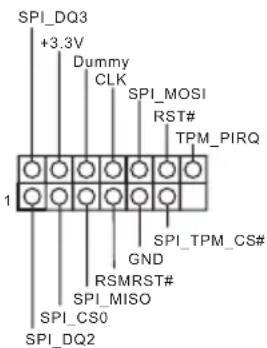
SPI TPM Header
(13-pin SPI_TPM_J1)
(see p.1, No. 18)
text_image
SPI_DQ3 +3.3V Dummy CLK SPI_MOSI RST# TPM_PIRQ 1 GND SPI_TPM_CS# RSMRST# SPI_MISO SPI_CS0 SPI_DQ2This connector supports SPI Trusted Platform Module (TPM) system, which can securely store keys, digital certificates, passwords, and data. A TPM system also helps enhance network security, protects digital identities, and ensures platform integrity.
RGB LED Headers
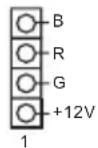
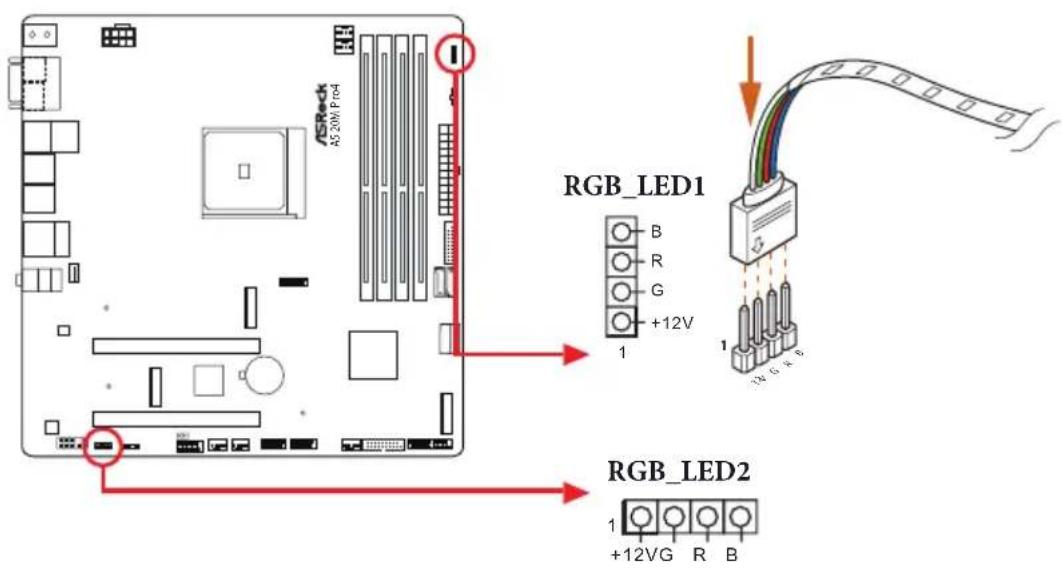
(4-pin RGB_LED1)
(see p.1, No. 6)
(4-pin RGB_LED2)
(see p.1, No. 26)
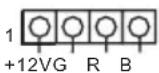
These two RGB headers are used to connect RGB LED extension cable which allows users to choose from various LED lighting effects.
Caution: Never install the RGB LED cable in the wrong orientation; otherwise, the cable may be damaged.
*Please refer to page 44 for further instructions on these two headers.
Addressable LED Headers
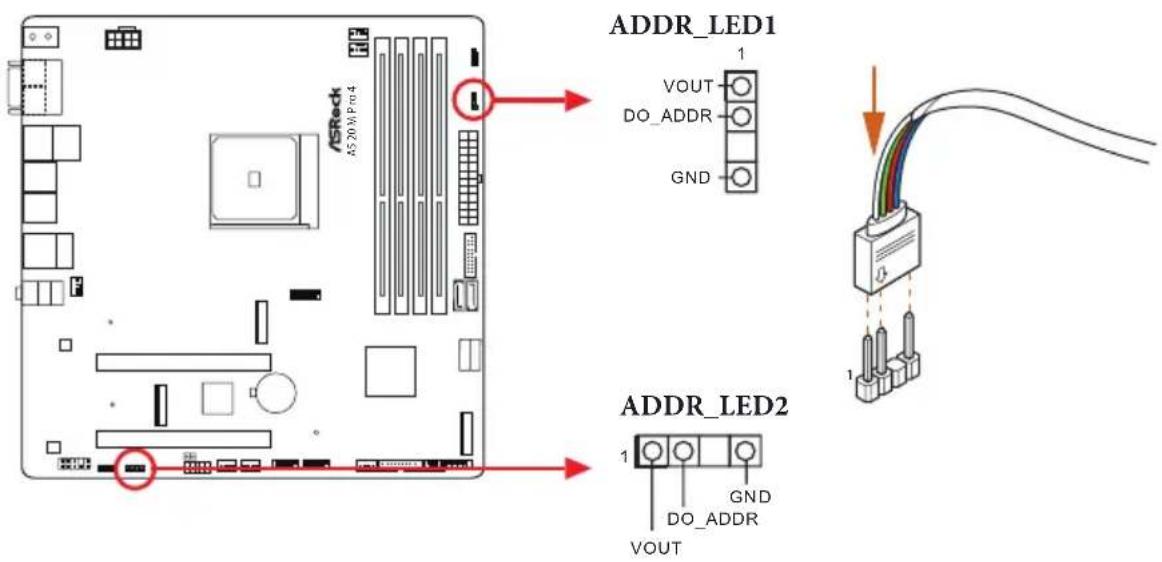
(3-pin ADDR_LED1)
(see p.1, No. 7)
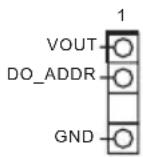
(3-pin ADDR_LED2)
(see p.1, No. 25)
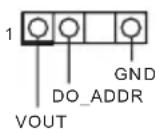
These two Addressable headers are used to connect Addressable LED extension cable which allows users to choose from various LED lighting effects.
Caution: Never install the Addressable LED cable in the wrong orientation; otherwise, the cable may be damaged.
*Please refer to page 45 for further instructions on this header.
2.7 Post Status Checker
Post Status Checker (PSC) diagnoses the computer when users power on the machine. It emits a red light to indicate whether the CPU, memory, VGA or storage is dysfunctional. The lights go off if the four mentioned above are functioning normally.
2.8 M.2\_SSD (NGFF) Module Installation Guide (M2\_1)
The M.2, also known as the Next Generation Form Factor (NGFF), is a small size and versatile card edge connector that aims to replace mPCIe and mSATA.
The Ultra M.2 Socket (M2_1) supports M Key type 2280 M.2 PCI Express module up to Gen3x4 (32 Gb/s).
Installing the M.2\_SSD (NGFF) Module
natural_image
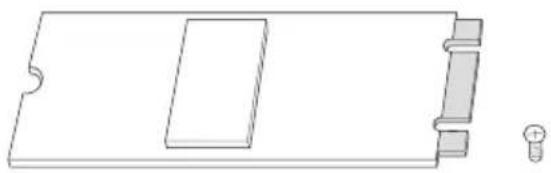
Pure technical line drawing of a rectangular component with internal slots and a small protrusion (no text or symbols)Step 1
Prepare a M.2_SSD (NGFF) module and the screw.
natural_image
Technical diagram showing a 3D mechanical part with dimension lines and a separate view of a stepped component (no text or symbols)Step 2
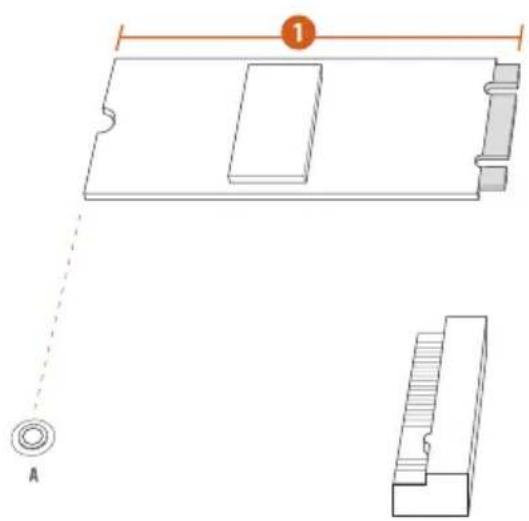
Depending on the PCB type and length of your M.2_SSD (NGFF) module, find the corresponding nut location to be used.
No. 1
Nut Location A
PCB Length 8cm
Module Type Type2280
text_image
Technical diagram showing a mechanical assembly with labeled components and directional arrows indicating motion or force.Step 3
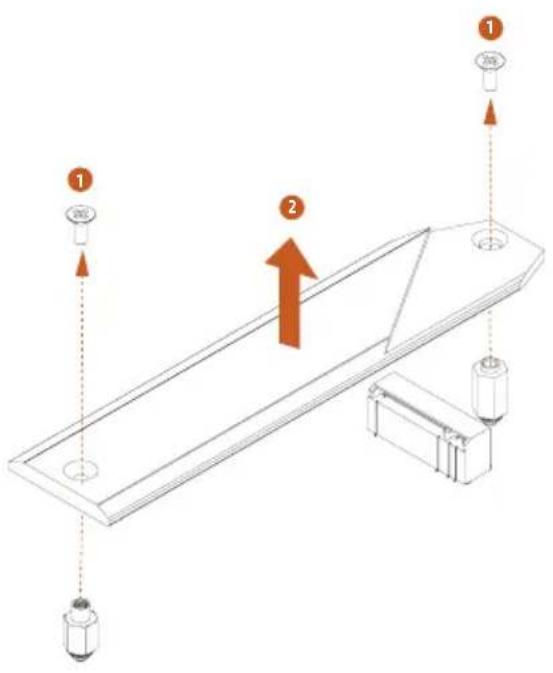
Before installing a M.2 (NGFF) SSD module, please loosen the screws to remove the M.2 heatsink.
*Please remove the protective films on the bottom side of the M.2 heatsink before you install a M.2 SSD module.
natural_image
Technical line drawing of a mechanical assembly with a component labeled A, showing a shaft and housing (no text or symbols present)Step 4
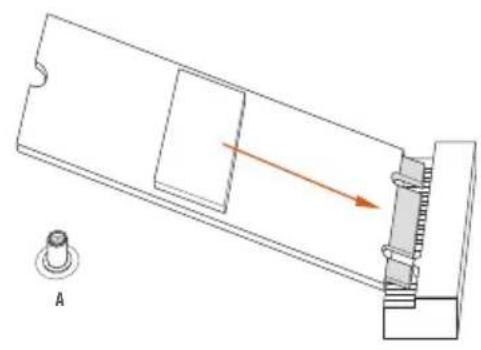
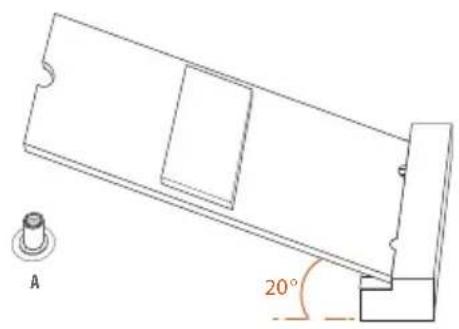
Align and gently insert the M.2 (NGFF) SSD module into the M.2 slot. Please be aware that the M.2 (NGFF) SSD module only fits in one orientation.
text_image
A 20°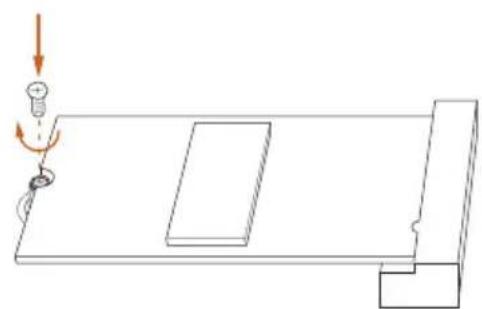
natural_image
Simple line drawing of a mechanical setup with a lever and base plate (no text or symbols)Step 5
Tighten the screw with a screwdriver to secure the module into place. Please do not overtighten the screw as this might damage the module.
M.2\_SSD (NGFF) Module Support List (M2\_1)
| Vendor Interface P/N | ||
| ADATA PCIe3 x4 ASX7000NP-128GT-C | ||
| ADATA PCIe3 x4 ASX8000NP-256GM-C | ||
| ADATA PCIe3 x4 ASX7000NP-256GT-C | ||
| ADATA PCIe3 x4 ASX8000NP-512GM-C | ||
| ADATA PCIe3 x4 ASX7000NP-512GT-C | ||
| Apacer PCIe3 x4 AP240GZ280 | ||
| Corsair PCIe3 x4 CSSD-F240GBMP500 | ||
| Intel PCIe3 x4 SSDPEKKF256G7 | ||
| Intel PCIe3 x4 SSDPEKKF512G7 | ||
| Kingston PCIe3 x4 SKC1000/480G | ||
| Kingston PCIe2 x4 SH2280S3/480G | ||
| OCZ PCIe3 x4 RVD400 -M2280-512G (NVME) | ||
| PATR IOT PCIe3 x4 PH240GPM280SSDR NVME | ||
| Plextor PCIe3 x4 PX-128M8PeG | ||
| Plextor PCIe3 x4 PX-1TM8PeG | ||
| Plextor PCIe3 x4 PX-256M8PeG | ||
| Plextor PCIe3 x4 PX-512M8PeG | ||
| Plextor PCIe | PX-G256M6e | |
| Plextor PCIe | PX-G512M6e | |
| Samsung | PCIe3 x4 | SM961 MZVPW128HEGM (NVM) |
| Samsung | PCIe3 x4 | PM961 MZVLW128HEGR (NVME) |
| Samsung | PCIe3 x4 | 960 EVO (MZ-V6E250) (NVME) |
| Samsung | PCIe3 x4 | 960 EVO (MZ-V6E250BW) (NVME) |
| Samsung | PCIe3 x4 SM951 (NVME) | |
| Samsung | PCIe3 x4 | SM951 (MZHPV256HDGL) |
| Samsung | PCIe3 x4 | SM951 (MZHPV512HDGL) |
| Samsung | PCIe3 x4 SM951 (NVME) | |
| Samsung | PCIe x4 | XP941-512G (MZHPU512HCGL) |
| SanDisk | PCIe | SD6PP4M-128G |
| SanDisk | PCIe | SD6PP4M-256G |
| TEAM | PCIe3 x4 TM8FP2240G0C101 | |
| TEAM | PCIe3 x4 TM8FP2480GC110 | |
| WD | PCIe3 x4 | WDS256G1X0C-00ENX0 (NVME) |
| WD | PCIe3 x4 | WDS512G1X0C-00ENX0 (NVME) |
For the latest updates of M.2_SSD (NFGG) module support list, please visit our website for details: http://www.asrock.com
2.9 M.2\_SSD (NGFF) Module Installation Guide (M2\_2)
The M.2, also known as the Next Generation Form Factor (NGFF), is a small size and versatile card edge connector that aims to replace mPCIe and mSATA. The M.2 Socket (M2_2) supports M Key type 2280 M.2 SATA3 6.0 Gb/s module and M.2 PCI Express module up to Gen3 x2 (16 Gb/s).
* M2_2 and SATA3_3_4 share lanes. If either one of them is in use, the other one will be disabled.
Installing the M.2\_SSD (NGFF) Module
natural_image
Pure technical line drawing of a rectangular component with a slot and a small screw, no text or symbols present.Step 1
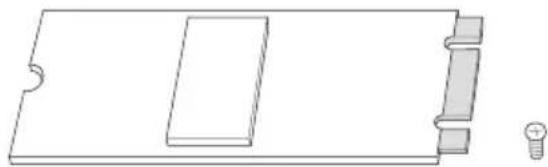
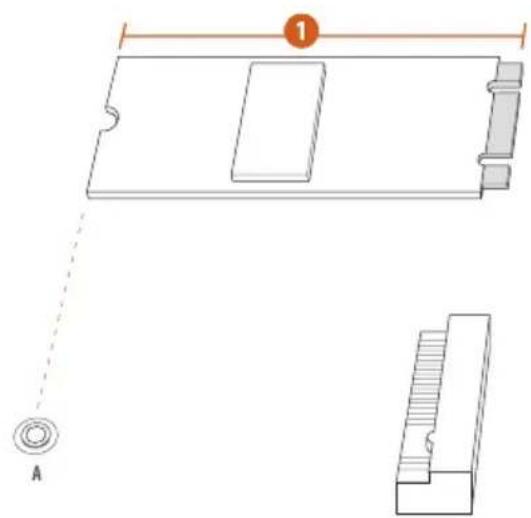
Prepare a M.2_SSD (NGFF) module and the screw.
natural_image
Technical line drawing of a mechanical component with dimension lines and labeled section A (no text or symbols beyond labels)Step 2
Depending on the PCB type and length of your M.2_SSD (NGFF) module, find the corresponding nut location to be used.
No. 1
Nut Location A
PCB Length 8cm
Module Type Type2280
natural_image
Technical diagram of a mechanical assembly with a lever and housing, showing directional arrow (no text or symbols)Step 3
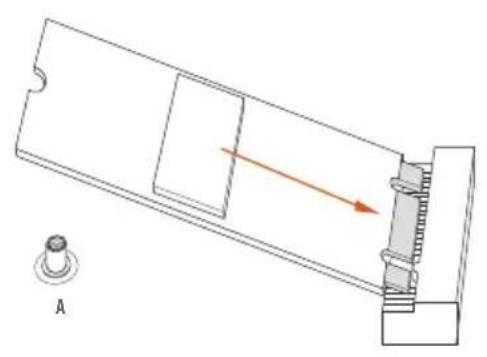
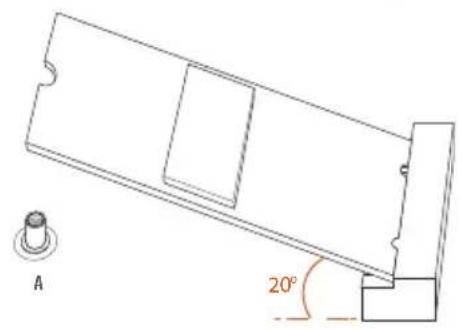
Align and gently insert the M.2 (NGFF) SSD module into the M.2 slot. Please be aware that the M.2 (NGFF) SSD module only fits in one orientation.
natural_image
Technical line drawing of a mechanical component with angular annotation (20°) and base, no readable text or symbols beyond labels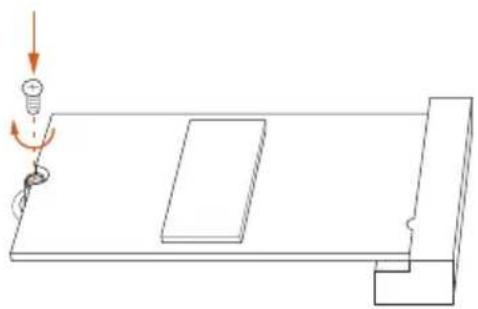
natural_image
Pure technical diagram showing a light bulb and hanging hook on a rectangular platform (no text or symbols)Step 4
Tighten the screw with a screwdriver to secure the module into place. Please do not overtighten the screw as this might damage the module.
M.2\_SSD (NGFF) Module Support List (M2\_2)
| Vendor Interface P/N | |
| ADATA SATA3 AXNS330E-32GM-B | |
| ADATA SATA3 AXNS381E-128GM-B | |
| ADATA SATA3 AXNS381E-256GM-B | |
| ADATA SATA3 ASU800NS38-256GT-C | |
| ADATA SATA3 ASU800NS38-512GT-C | |
| Crucial SATA3 CT120M500SSD4 | |
| Crucial SATA3 CT240M500SSD4 | |
| Intel SATA3 Intel SSDSCKGW080A401/80G | |
| Kingston SATA3 SM2280S3 | |
| Plextor PCIe PX-G256M6e | |
| Plextor PCIe PX-G512M6e | |
| Samsung PCIe x4 XP941-512G (MZHPU512HCGL) | |
| SanDisk PCIe SD6PP4M-128G | |
| SanDisk PCIe SD6PP4M-256G | |
| Team SATA3 TM4PS4128GMC105 | |
| Team SATA3 TM4PS4256GMC105 | |
| Team SATA3 TM8PS4128GMC105 | |
| Team SATA3 TM8PS4256GMC105 | |
| Transcend | SATA3 TS256GMTS400 |
| Transcend | SATA3 TS512GMTS600 |
| Transcend | SATA3 TS512GMTS800 |
| V-Color | SATA3 VLM100-120G-2280B-RD |
| V-Color | SATA3 VLM100-240G-2280RGB |
| V-Color | SATA3 VSM100-240G-2280 |
| V-Color | SATA3 VLM100-240G-2280B-RD |
| WD | SATA3 WDS100T1B0B-00AS40 |
| WD | SATA3 WDS240G1G0B-00RC30 |
For the latest updates of M.2_SSD (NFGG) module support list, please visit our website for details: http://www.asrock.com
2.10 M.2 WiFi/BT Module Installation Guide (M2\_3)
The M.2, also known as the Next Generation Form Factor (NGFF), is a small size and versatile card edge connector that aims to replace mPCIe and mSATA. The M.2 Socket (Key E) supports type 2230 WiFi/BT module.
* The M.2 socket does not support SATA M.2 SSDs.
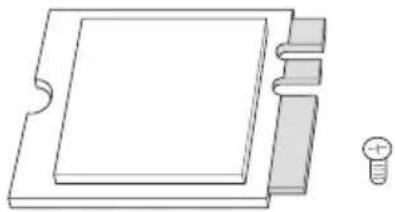
Installing the WiFi/BT module
natural_image
Pure technical line drawing of a mechanical component with no text or symbolsStep 1
Prepare a type 2230 WiFi/BT module and the screw.

natural_image
Pure electrical circuit lines without any symbols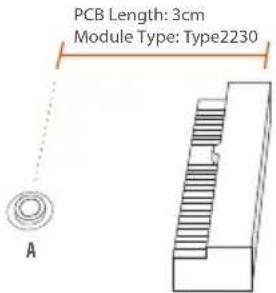
text_image
PCB Length: 3cm Module Type: Type2230 AStep 2
Find the nut location to be used.
natural_image
Pure mechanical assembly diagram without any text, numbers, or symbolsStep 3
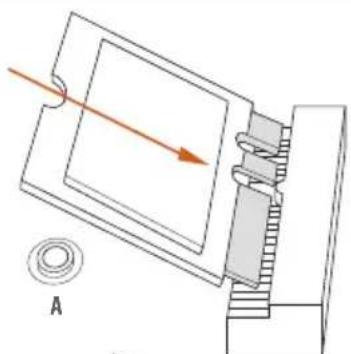
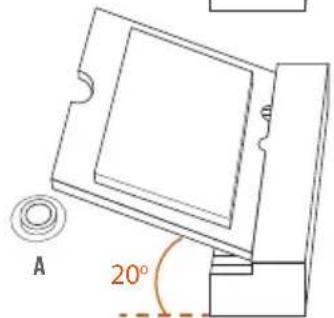
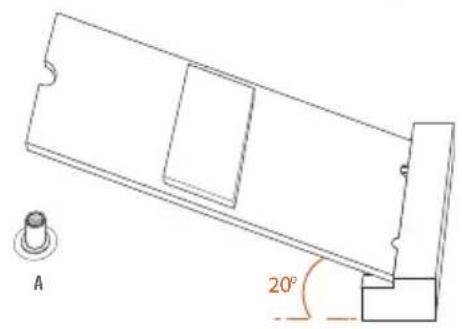
Gently insert the WiFi/BT module into the M.2 slot. Please be aware that the module only fits in one orientation.
text_image
A 20°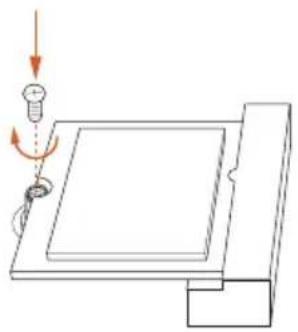
natural_image
Diagram of a mechanical assembly with a screw and nut, showing motion direction (no text or symbols)Step 4
Tighten the screw with a screwdriver to secure the module into place. Please do not overtighten the screw as this might damage the module.
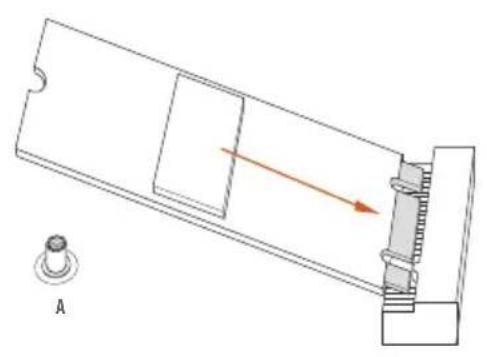
natural_image
Technical diagram of a mechanical assembly with a lever and housing, showing motion direction (no text or symbols)Step 3
Align and gently insert the M.2 (NGFF) SSD module into the M.2 slot. Please be aware that the M.2 (NGFF) SSD module only fits in one orientation.
natural_image
Technical line drawing of a mechanical component with angular annotation (20°) and base, no readable text or symbols beyond the angle marker.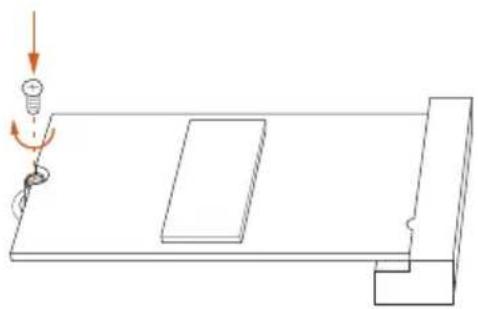
natural_image
Pure technical diagram showing a light bulb and hanging hook on a rectangular platform (no text or symbols)Step 4
Tighten the screw with a screwdriver to secure the module into place. Please do not overtighten the screw as this might damage the module.
M.2\_SSD (NGFF) Module Support List (M2\_2)
| Vendor Interface P/N | |
| ADATA SATA3 AXNS330E-32GM-B | |
| ADATA SATA3 AXNS381E-128GM-B | |
| ADATA SATA3 AXNS381E-256GM-B | |
| ADATA SATA3 ASU800NS38-256GT-C | |
| ADATA SATA3 ASU800NS38-512GT-C | |
| Crucial SATA3 CT120M500SSD4 | |
| Crucial SATA3 CT240M500SSD4 | |
| Intel SATA3 Intel SSDSCKGW080A401/80G | |
| Kingston SATA3 SM2280S3 | |
| Plextor PCIe PX-G256M6e | |
| Plextor PCIe PX-G512M6e | |
| Samsung PCIe x4 XP941-512G (MZHPU512HCGL) | |
| SanDisk PCIe SD6PP4M-128G | |
| SanDisk PCIe SD6PP4M-256G | |
| Team SATA3 TM4PS4128GMC105 | |
| Team SATA3 TM4PS4256GMC105 | |
| Team SATA3 TM8PS4128GMC105 | |
| Team SATA3 TM8PS4256GMC105 | |
| Transcend | SATA3 TS256GMTS400 |
| Transcend | SATA3 TS512GMTS600 |
| Transcend | SATA3 TS512GMTS800 |
| V-Color | SATA3 VLM100-120G-2280B-RD |
| V-Color | SATA3 VLM100-240G-2280RGB |
| V-Color | SATA3 VSM100-240G-2280 |
| V-Color | SATA3 VLM100-240G-2280B-RD |
| WD | SATA3 WDS100T1B0B-00AS40 |
| WD | SATA3 WDS240G1G0B-00RC30 |
For the latest updates of M.2_SSD (NFGG) module support list, please visit our website for details: http://www.asrock.com
2.11 ASRock Polychrome SYNC
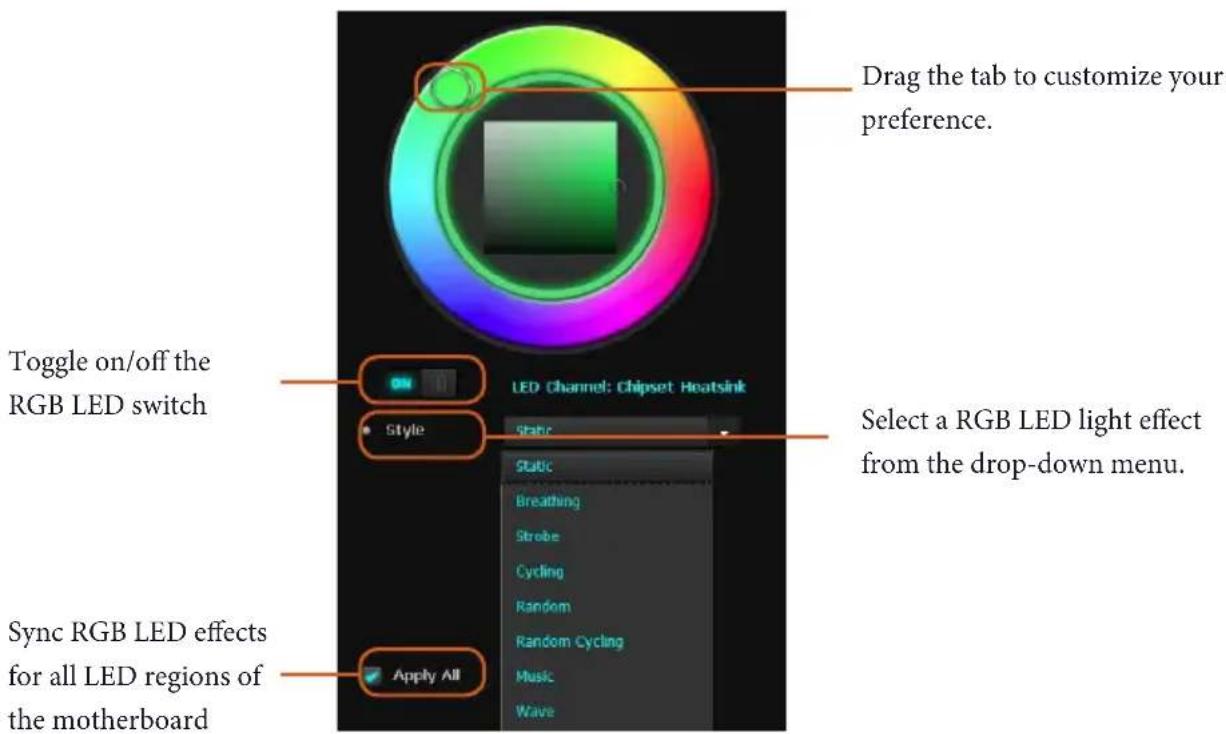
ASRock Polychrome SYNC is a lighting control utility specifically designed for unique individuals with sophisticated tastes to build their own stylish colorful lighting system. Simply by connecting the LED strip, you can customize various lighting schemes and patterns, including Static, Breathing, Strobe, Cycling, Music, Wave and more.
Connecting the LED Strip
Connect your RGB LED strips to the RGB LED Headers (RGB_LED1, RGB_LED2) on the motherboard.
text_image
RGB_LED1 B R G +12V 1 RGB_LED2 1 +12VG R B
- Never install the RGB LED cable in the wrong orientation; otherwise, the cable may be damaged.
- Before installing or removing your RGB LED cable, please power off your system and unplug the power cord from the power supply. Failure to do so may cause damages to motherboard components.

- Please note that the RGB LED strips do not come with the package.
- The RGB LED header supports standard 5050 RGB LED strip (12V/G/R/B), with a maximum power rating of 3A (12V) and length within 2 meters.
Connecting the Addressable RGB LED Strip
Connect your Addressable RGB LED strips to the Addressable LED Headers (ADDR_LED1, ADDR_LED2) on the motherboard.
text_image
ASRock AS20 M P 4 ADDR_LED1 VOUT DO_ADDR GND ADDR_LED2 1 GND DO_ADDR VOUT
- Never install the RGB LED cable in the wrong orientation; otherwise, the cable may be damaged.
- Before installing or removing your RGB LED cable, please power off your system and unplug the power cord from the power supply. Failure to do so may cause damages to motherboard components.

- Please note that the RGB LED strips do not come with the package.
- The RGB LED header supports WS2812B addressable RGB LED strip (5V/Data/GND), with a maximum power rating of 3A (5V) and length within 2 meters.
ASRock Polychrome SYNC Utility
Now you can adjust the RGB LED color through the ASRock Polychrome SYNC Utility. Download this utility from the ASRock Live Update & APP Shop and start coloring your PC style your way!
text_image
Drag the tab to customize your preference. Toggle on/off the RGB LED switch Style LED Channel: Chipset Heatsink Select a RGB LED light effect from the drop-down menu. Sync RGB LED effects for all LED regions of the motherboard Apply AllTechnische Daten
- 4 x connettori SATA3 6,0 Gb/s, supporto RAID (RAID 0, RAID 1, e RAID 10), NCQ, AHCI e Hot Plug*
** Supporta kit ASRock U.2
Connettore
• Supporta "Plug and Play"
• Supporta jumperfree
If you need to contact ASRock or want to know more about ASRock, you're welcome to visit ASRock's website at http://www.asrock.com; or you may contact your dealer for further information. For technical questions, please submit a support request form at http://www.asrock.com/support/tsd.asp
ASRock Incorporation
2F., No.37, Sec. 2, Jhongyang S. Rd., Beitou District,
Taipei City 112, Taiwan (R.O.C.)
ASRock EUROPE B.V.
Bijsterhuizen 11-11
6546 AR Nijmegen
The Netherlands
Phone: +31-24-345-44-33
Fax: +31-24-345-44-38
ASRock America, Inc.
13848 Magnolia Ave, Chino, CA91710
U.S.A.
Phone: +1-909-590-8308
Fax: +1-909-590-1026
DECLARATION OF CONFORMITY
Per FCC Part 2 Section 2.1077(a)

Responsible Party Name: ASRock Incorporation
Address: 13848 Magnolia Ave, Chino, CA91710
Phone/Fax N o: +1-909-590-8308/+1-909-590-1026
hereby declares that the product
Product Name : Motherboard
Model Number: A520M Pro4
Conforms to the following specifications:
☒ FCC Part 15, Subpart B, Unintentional Radiators
Supplementary Information:
This device complies with part 15 of the FCC Rules. Operation is subject to the following two conditions: (1) This device may not cause harmful interference, and (2) this device must accept any interference received, including interference that may cause undesired operation.
Representative Person's Name: James
Signature :
Date : May 12, 2017
EU Declaration of Conformity
ASRock®
For the following equipment:
Motherboard
(Product Name)
A520M Pro4 / ASRock
(Model Designation / Trade Name)
ASRock Incorporation
(Manufacturer Name)
2F., No.37, Sec. 2, Jhongyang S. Rd., Beitou District, Taipei City 112, Taiwan (R.O.C.)
(Manufacturer Address)
EMC — Directive 2014/30/EU (from April 20th, 2016)
□ EN 55022:2010/AC:2011 Class B
EN 55024:2010/A1:2015
EN 55032:2012+AC:2013 Class B
EN 61000-3-3:2013
EN 61000-3-2:2014
□ LVD — Directive 2014/35/EU (from April 20th, 2016)
□ EN 60950-1:2011+A2:2013 □
EN 60950-1:2006/A12:2011
☒ RoHS — Directive 2011/65/EU
CE marking
(EU conformity marking)
C ∈
ASRock EUROPE B.V.
(Company Name)
Bijsterhuizen 1111 6546 AR Nijmegen The Netherlands
(Company Address)
Person responsible for making this declaration:
(Name, Surname)
A.V.P
(Position / Title)
May 27, 2020
(Date)
P/N: 15G062241000AK V1.0